Regional Working Group Report
POLLUTION
UNDP/GEF Project Entitled "Reducing
Environmental Stress
in the Yellow Sea Large Marine Ecosystem"
Report of First Meeting
Qingdao, China, 6~9 April 2005
GEF
About this publication:
This publication contains the report of the First Meeting of the Regional Working Group for
the Pollution Component, under the UNDP/GEF Project, "Reducing Environmental Stress in
the Yellow Sea Large Marine Ecosystem." The report includes a summary of the
discussions and agreements from the Meeting. Data and information to be collected for the
Yellow Sea Transboundary Diagnostic Analysis are listed in the Annex to the report.
For reference purposes, this report may be cited as:
UNDP/GEF 2005. Reducing Environmental Stress in the Yellow Sea Large Marine
Ecosystem, Report of the First Meeting of the Regional Working Group for the Pollution
Component. UNDP/GEF/YS/RWG-P.1/3.
Cover design:
Ms. YUN Euidea
Photo credits:
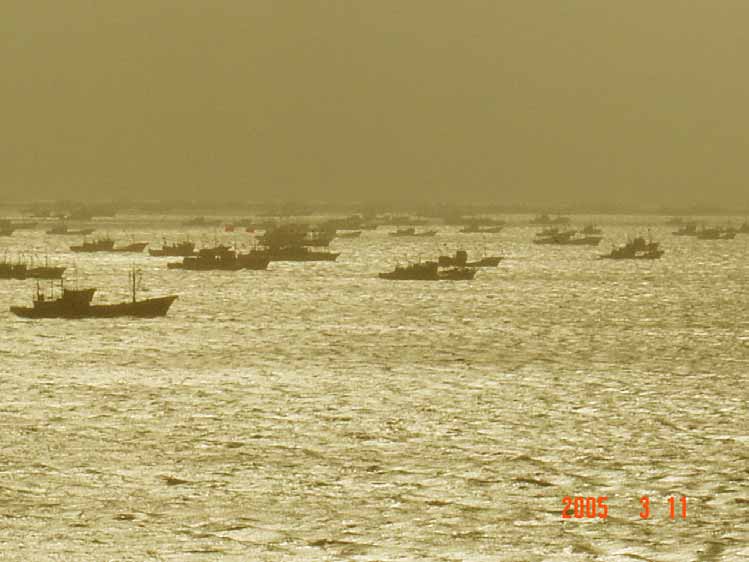
Fishing boats on the Yellow Sea near Jeju Island in the southern part
of Republic of Korea, March 2005. Courtesy of Mr. Yihang JIANG.
REDUCING ENVIRONMENTAL STRESS
IN THE YELLOW SEA
LARGE MARINE ECOSYSTEM
Report of the First Meeting of the
Regional Working Group for the Pollution Component
UNDP/GEF Yellow Sea Project
Qingdao, China, 6th to 9th April 2005

GEF
UNDP/GEF PROJECT ENTITLED "REDUCING ENVIRONMENTAL STRESS IN THE
YELLOW SEA LARGE MARINE ECOSYSTEM"
UNDP/GEF/YS/RWG-P.1/3
Date: 9 April 2005
English only
First Meeting of the Regional Working Group
for the Pollution Component
Qingdao, China, 6-9 April 2005
Meeting Report
TABLE OF CONTENTS
1 OPENING
OF
THE MEETING ....................................................................................................... 1
1.1
WELCOME ADDRESSES ....................................................................................................................... 1
1.2
INTRODUCTION OF MEMBERS .............................................................................................................. 1
2 ORGANISATION
OF THE MEETING............................................................................................ 1
2.1
DESIGNATION OF OFFICERS................................................................................................................ 1
2.2
DOCUMENTATION AVAILABLE TO THE MEETING ................................................................................. 1
2.3
ORGANISATION OF WORK ................................................................................................................... 2
3 ADOPTION
OF
THE
MEETING AGENDA .................................................................................... 2
4
DRAFT TERMS OF REFERENCE FOR THE REGIONAL WORKING GROUP FOR
POLLUTION (RWG-P) ................................................................................................................... 2
5
OVERALL PROJECT AND COMPONENT OBJECTIVES ........................................................... 3
5.1
GENERAL DESCRIPTION OF ACTIVITIES CONTAINED IN THE PROJECT IMPLEMENTATION PLAN ......... 3
5.2
REPORTING RESPONSIBILITIES OF THE RWG-P ................................................................................ 3
5.3
REQUIRED OUTPUTS AND OUTCOMES FROM THE 1ST RWG-P MEETING ........................................... 4
5.4
CO-OPERATION WITH OTHER PROJECT COMPONENTS AND RELEVANT ACTIVITIES IN THE REGION ... 5
6
DATA AND INFORMATION NEEDS FOR THE POLLUTION COMPONENT ............................. 6
6.1
DISCUSSION ON YELLOW SEA POLLUTION PROBLEMS, IDENTIFICATION OF DATA AND INFORMATION
REQUIREMENTS, AND AGREEMENT ON THEIR FORMAT ....................................................................... 6
6.2
COUNTRY PRESENTATIONS ON AVAILABLE DATA/INFORMATION ON SOURCES, PATHWAYS, AND
DISTRIBUTION OF POLLUTANTS; DETERMINATION OF "HOT SPOTS;" MONITORING PROCEDURES; AND
ANALYSIS OF POLLUTANT FATE AND TRANSPORT ............................................................................... 7
7 REQUIRED
COSTED
ACTIONS AND WORKPLAN .................................................................... 7
7.1
REQUIRED ACTIONS FOR TDA PREPARATION..................................................................................... 7
7.2
INFORMATION GAPS............................................................................................................................. 8
7.3
WORKPLAN FOR 2005 TO 2006.......................................................................................................... 8
8 OTHER
BUSINESS........................................................................................................................ 8
9
DATE AND PLACE FOR NEXT RWG-P MEETING ..................................................................... 9
10 ADOPTION
OF
THE MEETING REPORT..................................................................................... 9
11 CLOSURE
OF
THE MEETING ...................................................................................................... 9
ANNEXES
Annex I
List of Participants
Annex II
Agenda
Annex III
Revised Terms of Reference for the UNDP/GEF Yellow Sea Project Regional
Thematic Working Group - Pollution
Annex IV
Data and Information Requirements for the Pollution Component and Causal
Chain Analysis for Yellow Sea Pollution-Related Problems
Annex V
Pollution Component Revised List of Activities
Annex VI
Pollution Component Workplan 2005 to 2006
UNDP/GEF/YS/RWG-P.1/3
Page 1
1
OPENING OF THE MEETING
1.1 Welcome
addresses
1.1.1 On behalf of the United Nations Development Programme (UNDP) and United
Nations Office for Project Services (UNOPS), Mr. Yihang Jiang, Project Manager,
opened the meeting and welcomed the members of the Regional Working Group-
Pollution (RWG-P) to Qingdao. He briefly mentioned the progress of the Project,
highlighting the Project Steering Committee's approval of the Project Implementation
Plan.
1.1.2 Mr. Jiang explained the goals of the Project, namely, the development of the
Transboundary Diagnostic Analysis (TDA), Strategic Action Programme (SAP), and
National Strategic Action Plans. In the final year of the Project, there will be
implementation of demonstration and/or pilot activities identified in the SAP. This
Meeting will focus on the process for TDA preparation, but also keep in mind the SAP
development.
1.1.3 Mr. Jiang noted that the preliminary TDA information was a bit out of date. The
preliminary TDA was prepared for the Global Environment Facility (GEF) Council to
understand the project document before approving the Project. The final TDA, to be
produced, needs updated data and information. Therefore, this Regional Working
Group meeting will discuss and agree on identifying pollution-related problems of the
Yellow Sea, agree on the types of information to support the identified problems,
agree on the format of the collected information, and propose activities to gather
additional required data.
1.2
Introduction of members
1.2.1 RWG-P members were invited to introduce themselves and give a brief introduction
on their background and roles in the Project. The list of participants is attached to
this report as Annex I.
2
ORGANISATION OF THE MEETING
2.1
Designation of Officers
2.1.1 Mr. Jae Ryoung Oh nominated Mr. Quan Wen as Chairperson. Members agreed
and Mr. Wen was duly elected as Chairperson. The PMO was responsible for
secretariat functions of the meeting.
2.2
Documentation Available to the Meeting
2.2.1 Mr. Wen invited the Secretariat to introduce this agenda item. Ms. Connie Chiang of
the Project Management Office (PMO) introduced the Meeting's working and
information documents prepared by the PMO, with a brief emphasis on the Terms of
Reference (TOR) for the RWG-P which was further discussed during the relevant
agenda item.
2.2.2 Mr. Jiang drew the member's attention to Document UNDP/GEF/YS/RWG-P.1/6, on
a regional criteria to calculate activity costs. He asked all members to carefully
UNDP/GEF/YS/RWG-P.1/3
Page 2
review this document, as it was an important element related to activity
implementation.
2.3
Organisation of Work
2.3.1 The PMO presented the provisional working programme for the Meeting (Document
UNDP/GEF/YS/RWG-P.1/inf.3).
2.3.2 The Chairperson informed the Meeting about the organisation of work. It was agreed
that, due to the nature of the agenda items to be discussed, the Meeting would be
organised in plenary as far as possible. Sessional working groups would be formed if
deemed necessary.
2.3.3 Mr. Jiang thanked the National Marine Environment Monitoring Centre, China, for
their generous support and hospitality provided during the Meeting.
2.3.4 The meeting was conducted in English.
3
ADOPTION OF THE MEETING AGENDA
3.1
The Chairperson introduced the Provisional Agenda (Document UNDP/GEF/YS
/RWG-P.1/1) and Annotated Provisional Agenda (Document UNDP/GEF/YS/RWG-
P.1/2), prepared by the Project Management Office.
3.2
Mr. Wenxi Zhu asked for clarification on Agenda Item 5.2, "Reporting Responsibilities
of the RWG-P." Ms. Chiang clarified that this was actually reporting requirements of
contractors. However, as the RWG-P would be working closely with the contractors
and assisting in ensuring deadlines were met, the RWG-P should be aware of the
United Nation's reporting requirements.
3.3
Mr. Hak Bong Chang asked about selection of institutions when issuing contracts.
Mr. Jiang explained the general bidding process of the United Nations when issuing
contracts, in order to show that a transparent selection process was used. Mr. Jiang
also explained that such a procedure is used to obtain the best value for money to
fulfil the tasks.
3.4
Following the above clarifications, the meeting adopted the agenda that is attached
as Annex II to this report.
4
DRAFT TERMS OF REFERENCE FOR THE REGIONAL WORKING GROUP FOR
POLLUTION (RWG-P)
4.1
Ms. Chiang presented the TOR for the RWG-P, as listed in the Project Document.
She explained that from the time of writing the TOR to the present, conditions of
project implementation had changed. Members were asked to review the TOR, and
make suggestions to revise the TOR to better reflect the current status of the RWG-
P.
4.2
Mr. Zhu stated that that Chair of the RWG should be consistent to more efficiently co-
ordinate work in between RWG meetings. Members agreed that China would take
the lead role for the pollution component. However, some members suggested that
each RWG meeting chairperson may not necessarily be the Chairperson of the
Group.
UNDP/GEF/YS/RWG-P.1/3
Page 3
4.3
The pros and cons of rotating the RWG meeting chairperson was discussed, and
members agreed that the Chair of the RWG should also serve as the Chair of the
RWG meetings.
4.4
The PMO was asked to prepare a revision of the TOR for the RWG-P. With the
revision provided by the secretariat, members discussed the major responsibilities of
the RWG-P. There was extensive discussion on a "network" for pollution monitoring.
In order to have effective implementation of the project activities and to create a
sustainable effect of the Project, "networks" do need to be established to ensure that
the results of the Project benefit the region long after the SAP is implemented.
4.5
Ms. Hyun Shin Lee explained that the establishment of "networks" was approved in
the original TORs, which was agreed by the countries. Therefore, there should not
be any problems to create these "networks."
4.6
The next topic of discussion was the identification of "hot spots." The RWG members
felt that this was an important task, but required clearer definition on the term, "hot
spot." Members agreed that the hot spots in this project should include sources and
impacts of pollutants.
4.7
Regarding the regional procedures for remediation and prevention of pollution, and
testing the implementation, the Meeting realised the necessities and agreed to
include the relevant responsibilities into the TOR of the RWG-P.
4.8
Members also recognised the importance to have regional guidelines for marine
pollution monitoring and assessment, and decided to add this responsibility to the
TOR.
4.9
Following the discussions and clarifications, members agreed to the revised TOR to
be submitted to the Project Steering Committee (PSC) for approval. The revised
TOR is attached to this report as Annex III.
5
OVERALL PROJECT AND COMPONENT OBJECTIVES
5.1
General description of activities contained in the Project Implementation Plan
5.1.1 Due to the member's differences in familiarity of the Project, Ms. Chiang gave an
overview of the Project, including the goals of producing the TDA and SAP, and
highlighted the pollution component's activities. She also gave a brief introduction on
the work to be accomplished by the 1st RWG-P Meeting.
5.1.2 The meeting noted the information provided, in particular the relevant parts in
preparing the TDA and SAP.
5.2
Reporting responsibilities of the RWG-P
5.2.1 The Secretariat introduced Document UNDP/GEF/YS/RWG-P.1/inf.5, and gave an
overview on contracting procedures and reporting responsibilities of the contractors.
Members noted that as the Project operates within the framework of United Nations,
relevant UN rules and procedures should be followed. It was explained that one
purpose of reporting was to keep abreast of the progress of each activity, and to
provide assistance, should the activity face difficulties.
UNDP/GEF/YS/RWG-P.1/3
Page 4
5.2.2 Members asked about the procedure to select contractors to implement activities.
Referring to the document presented to the meeting, the Project Manager clarified
that the normal bidding procedure should be applied. If there is a case where a
wavier of bidding is requested, justification needs to be provided. Mr. Jiang informed
the Meeting that a similar clarification was provided during the 1st Meeting of the
Project Steering Committee.
5.2.3 Mr. Chang asked about the differences in the various types of contracts. The
Secretariat explained that the type of contract issued by the UN would depend on the
amount and institution to be contracted. There are not many differences between the
types of contracts, and all do require clearly defined TORs and progress and financial
reporting, which will be spelled out in the terms of reference for each contract.
5.2.4 Mr. Jiang emphasised that a wider participation of stakeholders would be more
beneficial to the Project. He encouraged all members to work together to involve
more stakeholders in different levels of implementation, including in the regional
working groups.
5.2.5 Ms. Lee reiterated that the Project should produce high quality outputs; therefore, the
open bidding process is used to get the best quality products. She encouraged the
RWG members to help find the best entities to carry out the tasks, from a wider
range of available resources.
5.2.6 Ms. Lee asked who is responsible for keeping to the reporting schedule. Mr. Jiang
replied that the contractor is responsible for keeping to the agreed reporting schedule
and workplan. The PMO and National Project Co-ordinator (NPC) will monitor
implementation progress, and remind contractors of deadlines. The RWG would be
responsible for the technical quality of tasks. Mr. Jiang emphasised that on-time
delivery of outputs is very important, and does affect the contractor's possibility of
receiving future contracts.
5.2.7 Mr. Oh asked about fixed rules for spending money, such as overhead costs. The
PMO replied that, in principle, the overhead charges for the management costs of the
project should be covered by national co-financing resources. Ms. Chiang further
stated that each contract will state the TOR and budget breakdown, and money is to
be spent according to the agreed budget and workplan attached to each contract.
5.2.8 The Meeting took note of the reporting requirements that will be applied during
implementation of project activities.
5.3
Required outputs and outcomes from the 1st RWG-P Meeting
5.3.1 Ms. Chiang introduced this agenda item, explaining the required outputs and
outcomes of this Meeting, and how the outputs would contribute to the later stages of
the Project, particularly the TDA/SAP development. Mr. Jiang explained that the
TDA will be a scientific-based document requiring references for all statements.
Therefore, the importance and purpose of collecting data is to have concrete proof
for the statements made in the TDA.
5.3.2 Members were invited to consider whether these outputs and outcomes are realistic
for the Meeting to achieve in four days. Members discussed the TDA timelines, in
the context of whether the proposed outputs would meet the TDA milestones. The
PMO explained that the main milestone was that the TDA should be produced by the
UNDP/GEF/YS/RWG-P.1/3
Page 5
end of 2006. All RWGs should begin as early as possible to collect the data for TDA
inputs. Therefore, this Meeting will need to agree on the problems, required types of
natural and socio-economic data, required actions, ways to calculate cost of actions,
and timeline and costs of actions to work towards TDA development.
5.4
Co-operation with other project components and relevant activities in the
region
5.4.1 Ms. Chiang introduced this agenda item by explaining that the PMO had requested
brief information of relevant projects in the participating countries, in order to assist
the PMO in examining the possible co-operative areas for the Yellow Sea Project.
Members were invited to present national and regional projects that had the potential
to co-operate with this Project.
5.4.2 Mr. Oh presented his two training programmes carried out by APEC Marine
Environmental Training and Education Center in conjunction with Korea International
Cooperation Agency in 2003: 1) oil pollution in the marine environment; and 2)
protecting marine environment from sewage. Mr. Oh mentioned the number and
types of trainees, and available facilities of the training centre, and showed pictorial
examples of on-hands training in the field and lab.
5.4.3 Mr. Oh then presented the national programmes of his institute, The South Sea
Institute of the Korea Ocean Research and Development Institute (KORDI) that
included persistent organic pollutants, endocrine disrupting chemicals, and bio-
accumulative and toxic chemicals. He explained the types of chemicals his lab can
analyse, and showed samples of past and current work in monitoring pollutants in
Korean bays, fate studies, ultra-trace level analyses, and molecular markers.
5.4.4 Mr. Oh extended his invitation to China for future training programmes.
5.4.5 Mr. Jiang expressed his wish that training needs will be identified, as the Project has
resources for training workshops.
5.4.6 Ms. Juying Wang presented China's monitoring system in the Yellow Sea, showing
the national monitoring network and existing programmes that include monitoring of:
red tide, coastal ecological conditions, pollution status, river inputs, discharge outlets,
and dumping sites.
5.4.7 Ms. Wang mentioned the three surveys in China:
1) survey of main pollutants, main ecological environmental issues, transport of
pollutants, toxic effects, tissue residual analysis, ecological effects of
pollutants in Bohai and Yellow Sea;
2) Joint survey with Korea; and
3) Coastal integrated survey and assessment and "digital ocean" framework.
5.4.8 Ms. Wang mentioned that the third project will finish later than YSLME, and perhaps
a time difference might make co-operation difficult. Mr. Jiang replied that this kind of
situation was a common occurrence. The TDA would be built on the best available
data, to summarise our understanding of the marine environment. Data collected
later can contribute to later stages of project as an environmental status indicator.
UNDP/GEF/YS/RWG-P.1/3
Page 6
5.4.9 Mr. Wen added that there was a second baseline pollution investigation carried out in
China in 1998. The data were collected from near coast areas.
5.4.10 Mr. Jiang mentioned some regional data centres, e.g. NEAR-GOOS, PICES, UNEP-
NOWPAP's Regional Activity Centers for data information and pollution monitoring,
GEF Global Ballast Water Project, PEMSEA demonstration activity in Bohai Sea,
East Asian Marginal Seas, GLOBEC, World Data Centre for Oceanography. He
indicated that it would appropriate if necessary data and information could be
collected from these sources.
5.4.11 Mr. Oh alerted the members that Korea National Fisheries Research and
Development Institute (NFRDI) has a national long-term monitoring programme since
1921 that includes major physical and chemical parameters of water quality. The
data are kept in NFRDI, and anyone can access them via the internet. Mr. Oh also
mentioned NFRDI's regular monitoring projects.
5.4.12 Mr. Jiang mentioned that the Korea Oceanographic Data Centre has good
information, and this resource should be used.
5.4.13 He also mentioned that the PMO had started discussions with UNEP Northwest
Pacific Action Plan on co-operating activities. He also noted the good example of
regional co-operation already in place between the RWG-Biodiversity and WWF's
Yellow Sea Eco-region Planning Programme.
5.4.14 Mr. Oh asked the Chinese members if there are any pollution research projects in
conjunction with fisheries and analysing tissue content. Ms. Wang mentioned
China's participation in Mussel Watch, biomarkers, and fish liver analysis. Mr.
Chuanlin Huo mentioned that Yellow Sea Fisheries Research Institute carries out
these kinds of research, while his institute does research on marine toxicology and
biomarkers to assess persistent organic pollutants (POPs).
5.4.15 The Meeting took note of the sources of data information presented by the
participating countries, and agreed that efforts should be made to collect relevant
data and information from all sources, including those mentioned during the
discussion of this agenda item.
5.4.16 The Meeting also noted a presentation of Mr. Kenneth Sherman's of the US National
Oceanic Atmospheric Administration, which indicated that ecosystem indicators are
cross-cutting by many of this Project's components. The Meeting recognised the
cross-component issues of the Project, and recommended that the Regional Science
and Technical Panel consider the cross-component issues, especially with regard to
ecosystem indicators. Mr. Chang suggested that the Project should consider
sustainable development indicators as one means to monitor Project success.
6
DATA AND INFORMATION NEEDS FOR THE POLLUTION COMPONENT
6.1
Discussion on Yellow Sea pollution problems, identification of data and
information requirements, and agreement on their format
6.1.1 The PMO presented Document UNDP/GEF/YS/RWG-P.1/5, and members were
asked to complete the table listing the problems, data and information requirements
to support or refute the problem, data format, and temporal and spatial scale of data
to be collected.
UNDP/GEF/YS/RWG-P.1/3
Page 7
6.1.2 Members separated into two groups by countries, to complete the table. Upon return
to the plenary session, each country presented their additions and changes to the
table. Mr. Oh suggested that some parameters required further information on the
types of input and the medium in which the chemical existed in sea water,
sediment, or biota. He also suggested that GIS data should be used, where
available, to complement the data and show the locations of the chemicals.
6.1.3 Mr. Huo presented the results from China's discussion session, which were similar to
those of Korea, with one additional information data related to dumping.
6.1.4 The members contributed their expertise in proposing pollution-related problems of
the Yellow Sea, and spent a sizeable amount of effort to produce the comprehensive
list of required data and formats. Members also discussed the causal chain and
governance analysis and finalised this information. The parameters for the
intercalibration exercises are also attached. The tables are attached to this report as
Annex IV.
6.1.5 The Meeting agreed that if both countries do not have data for a given parameter,
then that parameter will be deleted from the table. If only one country has data, then
the parameter is kept, and the other country should search for the missing
information. If both countries have limited information, then that parameter is kept,
and both countries will search further for that parameter.
6.2
Country presentations on available data/information on sources, pathways,
and distribution of pollutants; determination of "hot spots;" monitoring
procedures; and analysis of pollutant fate and transport
6.2.1 The topics under this agenda item were already discussed under other agenda items,
and are captured in the respective parts in this report.
7
REQUIRED COSTED ACTIONS AND WORKPLAN
7.1
Required actions for TDA preparation
7.1.1 Ms. Chiang introduced the Full Time Equivalent (FTE), as a proposed method for the
Project to have a regional guideline to calculate the costs of activities. She informed
the members of the background and rationale of this agenda item, namely it was a
task charged to the PMO by the 2nd Regional Technical Meeting.
7.1.2 After extensive discussion on the different economic situations and different methods
in calculating the activities costs in the participating countries, members recognised
that the discussion on the method of calculation is beyond the responsibilities of the
regional working group. Therefore, they could not reach agreement on this issue.
7.1.3 Following discussions with other partners of the Project, the PMO informed the
Meeting that necessary consultations will be carried out by the PMO with the relevant
governmental agencies and the NPCs to resolve this issue. Mr. Jiang recalled that
the initial intention to calculate the costs of the activities was to identify the ideal
amount of the costs for the activities, but not for the calculation of the contracts. He
also reminded the members that the total project budget is fixed, and it would not be
possible to exceed the approved budget amount.
UNDP/GEF/YS/RWG-P.1/3
Page 8
7.1.4 Members reviewed the list of activities and actions required for preparation of the
pollution component of the TDA. Following some clarifications provided by the PMO,
the meeting felt that the activities discussed and agreed during the 2nd Regional
Technical Meeting are appropriate for the first 2 years of project implementation. The
meeting made slight changes in the list of activities, and agreed on the activities and
actions to be taken during the first two years of project implementation.
7.1.5 The revised agreed list of activities is attached to this report as Annex V.
7.2 Information
gaps
7.2.1 Ms. Wang mentioned that organic pollutant data and information was quite lacking in
China, and this was a stark information gap.
7.2.2 Members discussed how to fill the information gaps and agreed that a joint survey
with other RWGs was necessary. After careful consideration, members proposed
that two to four persons from this component should participate in the joint survey
with the fisheries and ecosystem groups, to collect necessary samples from sea
water, sediment and biota.
7.2.3 Members also recommended that biota samples and information should be shared
from the fisheries group, as the fisheries group will already collect this information.
7.2.4 It was agreed that sampling within the coastal areas would be done separately by
each country, as existing monitoring activities already meet the necessary
requirements.
7.2.5 Members also agreed that the joint-survey would be basin-wide, while other
remaining information gaps would be obtained from existing national projects and
programmes.
7.3
Workplan for 2005 to 2006
7.3.1 Ms. Chiang presented the proposed workplan of the RWG-P for 2005-2006.
Members discussed and agreed on the pollution component's workplan for 2005 to
2006. The workplan is attached to this report as Annex VI.
8 OTHER
BUSINESS
8.1
The Chairperson invited members to raise any other issues that needed to be
considered by this meeting.
8.2
Mr. Oh suggested that the PMO could use a software, prepared by an expert of
KORDI that can easily present data in an easy to understand format. The Project
Manager agreed to consult with the expert concerned, and find a way to use the
software.
8.3
Mr. Jiang suggested that RWG members should consider the training opportunities of
the APEC training centre operated in the South Sea Institute of KORDI in October
every year. For this year, the three-week training course will focus on oil pollution
and pollution policy. Mr. Oh was asked to invite Chinese participants to the training
workshop. The PMO will communicate will Mr. Oh to discuss how the training
UNDP/GEF/YS/RWG-P.1/3
Page 9
programme can complement the capacity building tasks provided by this Project.
The meeting felt that this would be a valuable opportunity to upgrade capacities of
the participating institutions, and invited the Project Manager to explore the possibility
to organise joint training activities.
8.4
Ms. Lee asked how co-financing can contribute to each activity. The PMO replied
that the NPC is responsible for co-ordinating the co-financing sources, and the PMO
will discuss this further with the NPC.
8.5
The PMO was requested to again remind the NPCs to provide the project briefs
which had already been requested once before.
9
DATE AND PLACE FOR NEXT RWG-P MEETING
9.1
The Chairperson invited members to consider the date and place for the 2nd RWG-P
Meeting.
9.2
Members agreed to have the next RWG-P Meeting in Busan, Korea, 10-13 October
2005. The PMO will contact all members, should there be any changes.
10
ADOPTION OF THE MEETING REPORT
10.1 The Chairperson led the discussion of the draft meeting report prepared by the
Secretariat. The report was reviewed, amended, and adopted by the Meeting.
11
CLOSURE OF THE MEETING
11.1 The Chairperson thanked Ms. Lee and the PMO staff for organising the Meeting. He
also thanked the Korean and Chinese RWG members for their contributions and co-
operative nature throughout the Meeting.
11.2 Mr. Jiang thanked the members for their accomplishments on producing the data and
information table. He commented that the use of data should not be limited to serve
the TDA, but also should be used for preparing regional status reports on marine
pollution.
11.3 Ms. Chiang thanked the Chairperson and local staff for their assistance in the
Meeting's preparation. She also thanked all members for their hard work and
achieving the expected outcomes of the Meeting.
11.4 Ms. Lee thanked all members for their hard work, and wished that the co-operative
spirit shown in this Meeting would be extended to the future of the RWG-P and other
working groups.
11.5 The Meeting closed at 1500 hours on 9th April 2005.
UNDP/GEF/YS/RWG-P.1/3
Annex I
Page 1
Annex I
List of Participants
People's Republic of China
Mr. WEN Quan
Mrs. WANG Juying
SOA Key Lab of Coastal Ecosystem and
National Marine Environment Monitoring
Environment Research
Centre
National Marine Environment Monitoring
42 Linghe Street
Centre
Dalian 116023
42 Linghe Street
Tel: 86-411-8478-2526
Dalian 116023
Fax: 86-411-8478-2522
Tel: 86-411-8478-2522
Email: jywang@nmemc.gov.cn
Fax: 86-411-8478-2522
Email: qwen@nmemc.gov.cn
Mr. HUO Chuanlin
Mr. YAO Ziwei
National Marine Environment Monitoring
National Marine Environment Monitoring
Centre
Centre
Institute of Marine Environmental Protection
Institute of Marine Environmental Protection
of State Oceanic Administration
of State Oceanic Administration
42 Linghe Street, Shahekou district
42 Linghe Street
Dalian 116023
Dalian 116023
Tel: 86-411-8478-2732
Tel: 86-411-8478-2822
Fax: 86-411-8478-2522
Fax: 86-411-8478-2508
Email: clhuo@nmemc.gov.cn
Email: zwyao@nmemc.gov.cn
Mr. ZHU Wenxi
Mr. ZHU Mingyuan
Deputy Director
First Institute of Oceanography, SOA
Department of International Co-operation
6 Xianxialing Road Hi-Tech Industrial Park
State Oceanic Administration
Qingdao, Shandong 266001
1 Fuxingmenwai Avenue
Tel: 86-532-8896-7447
Beijing 100860
Fax: 86-532-8896-7548
Tel: 86-10-6804-8051
Mobile: 86-136-0898-3422
Fax: 86-10-6803-0799
Email: myzhu@public.qd.sd.cn
Email: wxzhu@soa.gov.cn
Republic of Korea
Mr. Jae Ryoung OH
Ms. Hee-Gu CHOI
Principal Research Scientist
Senior Scientist
Marine Environmental Research Lab
National Fisheries Research &
South Sea Institute - Korea Ocean
Development Institute (NFRDI)
Research and Development Institute (KORDI) 408-1, Sirang-Ri, Gijang-eup, Gijang-gun
391 Jangmok-ri, Jangmok-myon
Busan, 619-902
Geoje 656830
Tel. 82-2-3674-6561
Tel: 82-55-639-8670
Fax. 82-2-3674-6565
Fax: 82-55-639-8509
Email: hgchoi@momaf.go.kr
Email: jroh@kordi.re.kr
UNDP/GEF/YS/RWG-P.1/3
Annex I
Page 2
Mr. Hak-Bong CHANG
Head
Marine Environment Policy Research Team
Marine Environment & Coastal Management
Research Division
Korea Maritime Institute (KMI)
1027-4, Bangbae 3-dong, Seocho-gu
Seoul 137-851
Tel: 82-2-2105-2763
Fax: 82-2-2105-2779
Email: hbchang@kmi.re.kr
United Nations Development Programme
(UNDP)
Ms. Hyun-Shin LEE
UNDP Korea Office
Hannam Tower
730, Hannam 2-Dong, Yongsan-ku
Seoul, Republic of Korea
Tel: 82 2-790-9562/5
Fax: 82-2-749-1417
E-mail: hyun-shin.lee@undp.org
Project Management Office (PMO)
Mr. Yihang JIANG
Ms. Connie CHIANG
Project Manager
Environment Officer
UNDP/GEF Yellow Sea Project
UNDP/GEF Yellow Sea Project
Korea Ocean Research and Development
Korea Ocean Research and Development
Institute
Institute
1270 Sa-dong Sangnok-gu Ansan-si
1270 Sa-dong Sangnok-gu Ansan-si
Gyeonggi-do 426-744
Gyeonggi-do 426-744
Republic of Korea
Republic of Korea
Tel: 82-31-400-7825
Tel: 82-31-400-7833
Fax: 82-31-400-7826
Fax: 82-31-400-7826
email: yihang@yslme.org
email: connie@yslme.org
Ms. Jung-Hwa KIM
Secretary
UNDP/GEF Yellow Sea Project
Korea Ocean Research and Development
Institute
1270 Sa-dong Sangnok-gu Ansan-si
Gyeonggi-do 426-744
Republic of Korea
Tel: 82-31-400-7829
Fax: 82-31-400-7826
email: junghwa@yslme.org
UNDP/GEF/YS/RWG-P.1/3
Annex I
Page 3
Secretariat
Ms. WANG Wenqi
Ms. LIN Xinzhen
Senior Engineer
Project Manager
Vice Director of Foreign Affairs Office
Project Management Department
First Institute of Oceanography, SOA
National Marine Environment Monitoring
6 Xianxialing Road Hi-Tech Industrial Park
Centre
Qingdao, Shandong 266001 China
Institute of Marine Environmental Protection
Tel: 86-532-8896-3909
of State Oceanic Administration
Fax: 86-532-8896-7548
42 Linghe Street, Dalian, 116023, China
Email: fiokjc@public.qd.sd.cn
Tel: 86-411-8478-3299
Fax: 86-411-8478-3299
Email: xzlin@nmemc.gov.cn
Ms. SUN Ping
First Institute of Oceanography, SOA
6 Xianxialing Road Hi-Tech Industrial Park
Qingdao, Shandong 266001 China
Tel: 86-532-8896-7440
Fax: 86-532-8896-7548
Email: sharry_cn@hotmail.com
UNDP/GEF/YS/RWG-P.1/3
Annex II
Page 1
Annex II
Agenda
1.
OPENING OF THE MEETING
1.1 Welcome
addresses
1.2 Introduction
of
members
2.
ORGANISATION OF THE MEETING
2.1 Designation
of
Officers
2.2
Documentation Available to the Meeting
2.3
Organisation of Work
3.
ADOPTION OF THE MEETING AGENDA
4.
DRAFT TERMS OF REFERENCE FOR THE REGIONAL WORKING GROUP
FOR POLLUTION (RWG-P)
5.
OVERALL PROJECT AND COMPONENT OBJECTIVES
5.1
General description of activities contained in the Project Implementation
Plan
5.2
Reporting responsibilities of the RWG-P
5.3
Required outputs and outcomes from the 1st RWG-P Meeting
5.4
Co-operation with other project components and relevant activities in the
region
6.
DATA AND INFORMATION NEEDS FOR THE POLLUTION COMPONENT
6.1
Discussion on Yellow Sea pollution problems, identification of data and
information requirements, and agreement on their format
6.2 Country presentations on available data/information on sources,
pathways, and distribution of pollutants; determination of "hot spots;"
monitoring procedures; and analysis of pollutant fate and transport
7.
REQUIRED COSTED ACTIONS AND WORKPLAN
7.1
Required actions for TDA preparation
7.2 Information
gaps
7.3
Workplan for 2005 to 2006
8. OTHER
BUSINESS
9.
DATE AND PLACE FOR NEXT RWG-P MEETING
10.
ADOPTION OF THE MEETING REPORT
11.
CLOSURE OF THE MEETING
UNDP/GEF/YS/RWG-P.1/3
Annex III
Page 1
Annex III
Revised Terms of Reference for the UNDP/GEF Yellow Sea Project
Regional Thematic Working Group - Pollution
Background:
To facilitate the achievement of the regional goals and objectives, Regional Thematic
Working Groups (RWG) for each component (Ecosystem, Biodiversity, Fisheries, Pollution,
and Investment) shall be established with overall responsibility for ensuring effective
implementation of project activities and to provide a mechanism for exchange of information
and experience of management experiences in each country.
Membership:
Each of the five RWGs will include:
· Two scientists (social and natural) from each country;
· One additional expert drawn from the legal, regulatory, investment, and/or
environmental management fields, from each country;
· One Chairperson for each RWG; and
· The Working Group Chairpersons will be members of the Regional Science and
Technical Panel.
Working modalities:
Each RWG will represent the regional perspective and not just the national perspective.
Working "without walls," the RWGs will communicate primarily through email, with one or two
working meetings annually. Each RWG will operate on the basis of working parties involving
participation of experts from all coastal countries together with external experts where this is
considered necessary. The RWGs report to the Regional Scientific and Technical Panel
through the Project Management Office (PMO), although they may also have national
reporting requirements from National Project Co-ordinators.
Meetings:
The PMO, in consultation with the Chairpersons, shall convene meetings of the RWGs
according to an agreed schedule, which will form part of the agreed work plan and timetable
for the work of the Project.
The PMO shall act as Secretariat to the RWGs, and shall ensure that reports of the meetings
are circulated to all members of the working groups, and are copied to the members of the
RSTP.
Tasks:
· Provide technical inputs/comments for the project workplans in their respective areas
of competency;
· Develop annual and quarterly work plans and implement activities in respective
thematic area, based on and fully integrated in the project workplan, and make
annual and quarterly progress reports;
· Be responsible for regional co-ordination within area of competency;
· Facilitate creation of effective national thematic network;
UNDP/GEF/YS/RWG-P.1/3
Annex III
Page 2
· Organise and conduct working parties and training within area of competency;
· Develop relevant regional recommendations, guidance and strategy within area of
competency;
· Contribute scientific knowledge in the area of expertise to the development of the
TDA;
· Assist in development and implementation of the Regional Strategic Action
Programme (SAP) and National Yellow Sea Action Plans (NYSAP);
· Contribute to the development of the Priority Investment Portfolio;
· Assist, through the Chairperson, in effective project management by assisting with
scheduling, scoping, and budgeting for various interlinked activities;
· Contribute scientific and technical advice to the formulation of proposals for national
and regional actions and donor funding;
· Network with national and international institutions and specialists in respective focal
area;
· Assist in preparing and implementing regional pilot and/or demonstration projects;
· Liaise closely with PMO, through RWG Chairpersons;
· Contribute scientific and technical expertise to YSLME data and information system
development, public awareness activities and stakeholder participation;
· Co-operate with other RWGs; and
· Develop and maintain a database within area of competence.
____________________
MAJOR RESPONSIBILITIES OF
REGIONAL WORKING GROUP POLLUTION
Location of WG Chair: People's Republic of China
Tasks:
· Coordinate the development of a regional system of effective marine contaminant
reduction and mitigation. Facilitate the establishment of regional quality assurance
system.
· Establish and support a well functioning network of monitoring centres throughout the
region. Compile reliable data to catalyze reduction and prevention of contamination.
· Identify "Hot Spots." Prepare regional procedures for remediation and prevention, for
adoption and implementation.
· Develop regional guidelines for monitoring and assessment of the marine
environment in the Yellow Sea.
· Provide guidance in developing regional strategies for pollution control and
management.
· Provide scientific guidance for the development of the pollution chapter of the TDA.
· Provide scientific guidance in the development and implementation of the SAP and
NYSAP.
· Prepare workplan of pollution component with detailed costed actions for
consideration and approval of PSC.
UNDP/GEF/YS/RWG-P.1/3
Annex IV
Page 1
Annex IV
Data and Information Requirements for the Pollution Component and
Causal Chain Analysis for Yellow Sea Pollution-Related Problems
Table 1. Data and information requirements.
Information
Spatial
ROK
PRC
needed to
Kinds of data
Type of
Temporal
Scale (W, B,
Has
Has
Problem
detect problem
needed
Data
Input
Scale*
C, E, M)**
Data?***
Data?***
Priority (H, M, L)
KOREA CHINA
Deteriorating
water quality
(rivers,
water quality
dissolved
seasonal for
W
lakes, seas)
characteristics
oxygen
% saturation
past 20 yrs
(1degX1deg)
X W H H
seasonal for
NO2 - µg/L
past 20 yrs
""
X
W
H
H
NO3 - µg/L
""
""
X
W
H
H
ammonium - µg/L
""
""
W
W
H
H
total dissolved N - µg/L
""
""
X
W
H
H
total particulate N
""
""
N
N
M
M
total dissolved P - µg/L
""
""
N
N
M
M
orthophosphate
""
""
X
W
H
H
total particulate P
""
""
N
N
M
M
N:P ratios
""
""
X
W
H
H
silicates
""
""
X
W
H
H
seasonal for
chlorophyll a - µg/L
past 20 yrs
"" W
W
M
H
UNDP/GEF/YS/RWG-P.1/3
Annex IV
Page 2
Information
Spatial
ROK
PRC
needed to
Kinds of data
Type of
Temporal
Scale (W, B,
Has
Has
Problem
detect problem
needed
Data
Input
Scale*
C, E, M)**
Data?***
Data?***
Priority (H, M, L)
KOREA CHINA
seasonal for
carbon
total particulate C
past 20 yrs
""
N
?
M
M
seasonal for
fecal coliform
colonies/100 ML
past 20 yrs
C W
W
M
M
seasonal for
COD
mg/L
past 20 yrs
B, C, E
X
W
M
H
seasonal for
SS
mg/L
past 20 yrs
B, C, E
X
W
H
M
annual for 10
Heavy Metals
Cd, Cr, Cu, Pb, Hg, Zn, As
seawater
years
W W
W
H
M
Organic
annual for 5
Pollutants
Organotin seawater
years
C X
?
H
L
annual for 5
Phenolic Compounds
seawater
years C
W
N
H
L
annual for 20
Oil
seawater
years
C, E
W
X
H
H
physical
seasonal for
W
characteristics
salinity ppt
past 20 yrs
(1degX1deg)
X W H M
seasonal for
W
temperature
C
past 20 yrs
(1degX1deg)
X W H M
seasonal for
W
pH
past 20 yrs
(1degX1deg)
X W M
M
seasonal for
W
transparency
m
past 20 yrs
(1degX1deg)
W W H M
biannual for 20
circulation
years ~~
X
?
M
annual for 10
biota
Heavy Metals
Cd, Cr, Cu, Pb, Hg, Zn, As
years C,
E
W
W
H
H
Organic
annual for 5
Pollutants
Organotin
years
C, E
X
W
H
M
annual for 10
PCBs
years C,
E
X
W
H
H
annual for 5
Dioxins and Furans
years C,
E
W
?
M
M
UNDP/GEF/YS/RWG-P.1/3
Annex IV
Page 3
Information
Spatial
ROK
PRC
needed to
Kinds of data
Type of
Temporal
Scale (W, B,
Has
Has
Problem
detect problem
needed
Data
Input
Scale*
C, E, M)**
Data?***
Data?***
Priority (H, M, L)
KOREA CHINA
OCPs (9):
Aldrin, chlordane, DDT &
metabolites, dieldrin,
endrin, heptachlor,
hexachlorbenzene,
hexachlorocyclohexanes,
annual for 10
mirex
years
C, E
X
W
H
H
PAHs (16):
Naphthalene,
acenaphthylene,
acenaphthene, fluorine,
phenanthrene, anthracene,
pyrene,
bezo[a]anthracene,
chrysene,
benzo[b]fluoranthene,
benzo[k)fluoranthene,
benzo[a] pyrene,
indeno[1,2,3-
cd]anthracene,
annual for 10
benzo[ghi]perylene
years
C, E
X
W
H
M
Other
Substances of
annual for 5
Concern PBDE
years C,
E
W
N
H
L
annual for 5
PBB
years
C, E
N
N
M
L
annual for 5
Phenolic Compounds
years C,
E
W
N
H
L
annual for 10
lipid
years C,
E
W
?
H
L
annual for 5
biomarker
years
C
W
?
L
UNDP/GEF/YS/RWG-P.1/3
Annex IV
Page 4
Information
Spatial
ROK
PRC
needed to
Kinds of data
Type of
Temporal
Scale (W, B,
Has
Has
Problem
detect problem
needed
Data
Input
Scale*
C, E, M)**
Data?***
Data?***
Priority (H, M, L)
KOREA CHINA
annual for 10
sediment
Heavy Metals
Cd, Cr, Cu, Pb, Hg, Zn, As
years
B, C, E
W
W
H
H
Organic
annual for 5
Pollutants
Organotin
years
B, C, E
X
W
H
M
annual for 10
PCBs
years
B, C, E
X
W
H
H
annual for 5
Dioxins and Furans
years
B, C, E
W
?
M
M
OCPs (9):
Aldrin, chlordane, DDT &
metabolites, dieldrin,
endrin, heptachlor,
hexachlorbenzene,
hexachlorocyclohexanes,
annual for 10
mirex
years
B, C, E
X
W
H
H
PAHs (16):
Naphthalene,
acenaphthylene,
acenaphthene, fluorine,
phenanthrene, anthracene,
pyrene,
bezo[a]anthracene,
chrysene,
benzo[b]fluoranthene,
benzo[k)fluoranthene,
benzo[a] pyrene,
indeno[1,2,3-
cd]anthracene,
annual for 10
benzo[ghi]perylene
years
B, C, E
X
W
H
M
Other
Substances of
annual for 5
Concern PBDE
years
B, C, E
W
N
H
L
annual for 5
PBB
years
B, C, E
N
N
M
L
UNDP/GEF/YS/RWG-P.1/3
Annex IV
Page 5
Information
Spatial
ROK
PRC
needed to
Kinds of data
Type of
Temporal
Scale (W, B,
Has
Has
Problem
detect problem
needed
Data
Input
Scale*
C, E, M)**
Data?***
Data?***
Priority (H, M, L)
KOREA CHINA
annual for 5
Phenolic Compounds
years
B, C, E
W
N
H
L
annual for 10
TPH
years
B, C, E
X
W
H
H
annual for 10
organic C
years
B, C, E
W
W
M
H
annual for 10
grain size
years
B, C, E
W
W
H
M
annual for 10
sulphide
years
C, E
X
W
H
H
annual for 10
Inputs
Heavy Metals
Pb, Hg
Atm Inputs
years C
?
?
M
M
annual for 10
PCBs
atm. Input
years
C ?
?
M
L
OCPs (9):
Aldrin, chlordane, DDT &
metabolites, dieldrin,
endrin, heptachlor,
hexachlorbenzene,
hexachlorocyclohexanes,
annual for 10
mirex atm.
Input
years C
?
?
M
L
PAHs (16):
Naphthalene,
acenaphthylene,
acenaphthene, fluorine,
phenanthrene, anthracene,
pyrene,
bezo[a]anthracene,
chrysene,
benzo[b]fluoranthene,
benzo[k)fluoranthene,
annual for 10
benzo[a] pyrene,
atm. Input
years C
?
?
M
M
UNDP/GEF/YS/RWG-P.1/3
Annex IV
Page 6
Information
Spatial
ROK
PRC
needed to
Kinds of data
Type of
Temporal
Scale (W, B,
Has
Has
Problem
detect problem
needed
Data
Input
Scale*
C, E, M)**
Data?***
Data?***
Priority (H, M, L)
KOREA CHINA
indeno[1,2,3-
cd]anthracene,
benzo[ghi]perylene
Other
Substances of
annual for 5
Concern PBDE
?
years
C ?
N
L
L
annual for 5
PBB
atm. Input
years
C ?
N
L
L
annual for 10
Inputs
Heavy Metals
Cd, Cr, Cu, Pb, Hg, Zn, As
Riv inputs
years
E W
W
H
M
Organic
annual for 5
Pollutants
Organotin ship/port
years
E W
?
H
M
OCPs (9):
Aldrin, chlordane, DDT &
metabolites, dieldrin,
endrin, heptachlor,
hexachlorbenzene,
hexachlorocyclohexanes,
annual for 10
mirex riv.
Input
years E
W
N
H
M
annual for 5
Phenolic Compounds
riv. Input
years
E W
N
H
M
annual for 20
Oil
riv. Input
years E
W
W
H
M
Dredging and
Dredged
Dumping
Material
MT/Y
20 years
C, M
W
X
M
H
Sewage Sludge
MT/Y
20 years
M
W
W
M
M
Litter
10 years
C
W
N
H
L
Land
Land
Reclamation
Reclamation
Km2
20
years
C
X
W
M
M
Oil and Gas
Industry
discharge
15 years
C
W
W
M
M
UNDP/GEF/YS/RWG-P.1/3
Annex IV
Page 7
Information
Spatial
ROK
PRC
needed to
Kinds of data
Type of
Temporal
Scale (W, B,
Has
Has
Problem
detect problem
needed
Data
Input
Scale*
C, E, M)**
Data?***
Data?***
Priority (H, M, L)
KOREA CHINA
production
15 years
B, C
X
X
M
L
Traffic and
Shipping
Cargo
20 years
W
W
X
H
H
Spill Accidents
MT
20 years
W
X
X
H
H
Coastal
Industries
Location Map
20 years
B, C, E
W
W
H
M
decline in
fish and
disease and
other marine death in marine
harmful algal
annual for past
species
organisms
bloom #
occurrences
20 yrs
C, E, M
X
X
M
H
annual for past
duration
20 yrs
C, E, M
X
W
M
H
annual for past
month of occurrence
20 yrs
C, E, M
X
X
M
H
annual for past
areal size of occurrence
20 yrs
C, E, M
X
W
M
H
annual for past 5
parasites
# occurrences
yrs
C, E
W
W
M
L
annual for past 5
duration
yrs
C, E
W
W
M
L
annual for past 5
month of occurrence
yrs C,
E
W
W
M
L
annual for past 5
areal size of occurrence
yrs
C, E
W
W
M
L
fisherfolk
gross annual income per
annual for past
income
household
20 yrs
County/City
?
W
L
M
deteriorating
human
death and
health
disease in
loss of labour
# of able-bodied persons
annual for past
quality
humans
pool
not employed
20 yrs
County/City
N
N
L
L
nat'l/individual
average insurance
annual for past
insurance costs
premium costs in USD
20 yrs
County/City
N
?
L
M
UNDP/GEF/YS/RWG-P.1/3
Annex IV
Page 8
Information
Spatial
ROK
PRC
needed to
Kinds of data
Type of
Temporal
Scale (W, B,
Has
Has
Problem
detect problem
needed
Data
Input
Scale*
C, E, M)**
Data?***
Data?***
Priority (H, M, L)
KOREA CHINA
hospitalization /
annual for past
outpatient fee
fee in USD
20 yrs
""
N
?
L
introduced
human-affected
annual for past
diseases
#, type of new diseases
20 yrs
""
N
?
deteriorating
beaches and quality of
coastal
recreational
bathing season
Bathing
areas
areas
fecal coliform
colonies/100 ML
for past 10 yrs
beaches
W
W M H
bathing season
Bathing
enterococcus
colonies/100 ML
for past 5 yrs
beaches
N
N
M
M
bathing season
litter
for past 10 yrs
C
W
W
M
H
seasonal for
transparency
m
past 20 yrs
C W
W
M
H
bathing season
Bathing
sewage
for past 10 yrs
beaches W ? M M
income from
tourism activities USD
past 20 yrs
C
W
X
M
H
Notes:
*Temporal data listed is ideal time frame for historical records. Minimum literature review should include 10 years of historical data.
**Spatial scale notes: W = whole Yellow Sea; B = associated river basins; C = coastal areas; E = estuary; M = middle of the ocean.
*** X = have full data; W = have partial data for listed temporal and/or spatial scales; N = do not have; ? = have very few data or not sure.
UNDP/GEF/YS/RWG-P.1/3
Annex IV
Page 9
Table 2. Causal chain analysis.
Immediate causes
Problem Impacts
(technical)
Underlying causes Root
causes Governance
analysis
Deteriorating water
quality (rivers, lakes,
rapid coastal population
poor/ineffective legal
seas)
loss of recreational areas
eutrophication of waters urbanisation
growth
instruments
modification of inland
environmentally
inadequate/insufficient
loss of tourism income
point & non-point inputs
water flow to Yellow Sea
unfriendly technology
infrastructure base
inadequate/insufficient
increased sedimentation
oil spills
resource use conflict
knowledge
inadequate mgmt/planning
insufficient stakeholder
restricted water
involvement in
loss of water supply
circulation
land reclamation
mgmt/planning
insufficient financing
more costly water supply
ballast water
upland land clearance
mechanisms & support
decline in coastal
community health
dredging
insufficient outreach
decline/shift in spp.
diversity/numbers
aquaculture
loss of fishing industry
income
dumping
decline in human/marine
organism health
harmful algal bloom and
emerging diseases in the
ocean
"dead zones," reduced O2,
fish kills
UNDP/GEF/YS/RWG-P.1/3
Annex IV
Page 10
deteriorating human
rapid coastal population
poor/ineffective legal
health quality
loss of labour pool
eutrophication of waters urbanisation
growth
instruments
increased nat'l/individual
environmentally
hospital/insurance costs
point & non-point inputs
resource use conflict
unfriendly technology
inadequate mgmt/planning
insufficient stakeholder
increased human-affected
inadequate/insufficient
involvement in
diseases
knowledge
mgmt/planning
insufficient financing
mechanisms & support
inadequate/insufficient
infrastructure base
insufficient outreach
decline in fish and other
rapid coastal population
poor/ineffective legal
marine species
decline in food source
eutrophication of waters resource use conflict
growth
instruments
loss of income for
inadequate/insufficient
inadequate infrastructure
fisherfolks, aquarium
point & non-point inputs
knowledge
base
rapid development of
degradation of food web
oil spill
industry
inadequate mgmt/planning
insufficient stakeholder
decline/shift in spp.
involvement in
diversity/numbers
ballast water
habitat destruction
mgmt/planning
marine mammal, seabird
insufficient financing
death
mechanisms & support
human poisoning
insufficient stakeholder
deteriorating beaches
rapid coastal population
involvement in
and coastal areas
loss of recreational areas
eutrophication of waters resource use conflict
growth
mgmt/planning
inadequate/insufficient
insufficient financing
loss of tourism income
point & non-point inputs
land reclamation
knowledge
mechanisms & support
decline in coastal
inadequate infrastructure
community health
oil spill
urbanisation
base
poor/ineffective legal
upland land clearance
instruments
insufficient outreach
UNDP/GEF/YS/RWG-P.1/3
Annex IV
Page 11
Table 3. Parameters for intercalibration exercises.
Priorities
Medium Target
Pollutants Korea China Regional Korea China Regional
NO2
1 1 1
NO3
1 1 1
Ammonia
1 1 1
Total dissolved N
Total particulate N
Water
Total dissolved P
Phosphate
1 1 1
Total particulate P
Silicates
1 1 1
Trace metals
3 2 2
PCBs
2 2 2
OCPs
2 2 2
PAHs
2 2 2
Organotins
Y
Y
4 4 4
Sediment
Phenolic compounds
Y
Y
5 5 5
PBDEs
Y
Y
6 6 6
Organic carbon
Grain size
Oil
Trace metals
3 2 2
PCBs
2 2 2
OCPs
2 2 2
PAHs
2 2 2
Biota
Organotins
Y
Y
(bivalves)
4 4 4
Phenolic compounds
PBDEs
Y
Y
5 5 5
Lipid
Note:
$PNQVMTPSZ
Y : Optional
1 = high priority; 6 = low
UNDP/GEF/YS/RWG-P.1/3
Annex V
Page 1
Annex
V
Pollution Component Revised List of Activities
Objective IV. Pollution Component
IVA. Critical Spots
Activity 1. Determine and rank
Review previous and ongoing monitoring system and
critical spot sources of water
assess methodologies and/or technical guidelines
quality degradation
(including target contaminants, QA/QC, intercalibration
exercises, data exchange, etc.)
Develop technologies for monitoring contaminants and
nutrients
Present outcomes of ranking, data and info in WG
meeting 2
Prepare a regional synthesis (consultant)
Finalise national outputs and synthesis (WG meeting 3)
Publish the outcomes (printing)
Inputs to final TDA
IVB. Contaminant Levels
Activity 1. Develop baseline data
Review existing data & info on contaminant levels
and summarize contaminant and Data quality control for baseline data WG meeting 2
nutrient levels in the YSLME
Present outcomes of ranking, data and info in WG
meeting 2
Environmental Survey with other working groups (if not,
need ship time)
Prepare a regional synthesis (consultant)
Finalise national outputs and synthesis (WG meeting 3)
Inputs to final TDA
Activity 2. Develop regional
Establish a monitoring network / or use the existing
monitoring network strategy
ones (PMO)
Draft Monitoring guidelines / standards (consultant)
Agree on the guidelines / standards (WG meeting 3)
Intercalibration exercise of participating labs (Contract)
Development of indicators to assess the
implementation of relevant international conventions
Activity 3. Determine and rank
Prepare format for data & info collection (PMO), no
critical spot sources of water
need to rank the spots
quality degradation
Identification of hot spots
Contract to relevant national institution(s) to collect hot
spots data and information (contract to Nat'l focal
points)
Discussion & further requirements (WG meeting 2)
Revise the hot spots data & info
Inputs to final TDA
UNDP/GEF/YS/RWG-P.1/3
Annex V
Page 2
IVC. Analysis of the Fate and Transport of Contaminants to Facilitate SAP Analysis
Activity 1. Review existing
Review existing understanding
understanding of fate and
Present outcomes of reviewing from national outputs in
transport of contaminants and
WG meeting 2
nutrients
Prepare a regional synthesis (consultant)
Finalise national outputs and synthesis (WG meeting 3)
Practice & intercalibration of the procedure
Publish the outcomes (printing)
Inputs to final TDA
Activity 2. Perform fate and
Analysis for fate and transport of contaminants and
transport analyses of
nutrients
contaminants and nutrients for
Impact prediction of impact of discharged contaminants
management and policy
and nutrients on the environment
development, including EIA
process, ICZM
Activity 3. Pollution prevention
ICM actions for controlling discharge of contaminants
and management
and nutrients
IVD. Regional Strategy for Pollution Control
Activity 1. Review and compare
Contract to relevant national institution(s)
national regulations and laws on
Regional review (WG meeting 4)
water quality and pollution
Regional analysis and suggestion on harmonisation
control, develop proposals
Publish review report
Inputs to national and regional SAP
Activity 2. Develop investment
Economic valuation of hot spots, & identify the
strategies
opportunities (Consultant)
Identify hot spots in both source, and impact (WG
meeting 4)
Prepare draft strategy (consultant)
Discuss the draft (WG meeting 4)
Revise the draft (Consultant)
Finalise the investment strategy (WG meeting 5)
Publish the investment strategy
Inputs to regional SAP
Activity 3. Develop funding
Prepare an implementation plan (consultant)
mechanism to implement the
Agree on the implementation plan (WG meeting 5)
regional strategy
Contracts for implementation
Activity 4. Develop regional
Root cause analysis for contaminants
priorities and strategies to reduce Discuss the draft (WG meeting 3)
contaminant and nutrient levels
Revise the draft
Finalise the strategy (WG meeting 4)
Input to SAP
GEF
Global Environment Facility
United Nations Development Programme
Reducing Environmental Stress
in the Yellow Sea Large Marine Ecosystem
UNDP/GEF Yellow Sea Project Management Office
c/o Korea Ocean Research and Development Institute
1270, Sa-2dong, Sangnok
Ansan City 426-744
Republic of Korea
Tel. 82-31-400-7829
Fax. 82-31-400-7826
www.yslme.org
For a copy of the publication, please contact the Project Management Office
info@yslme.org