Regional Working Group Report
FISHERIES
UNDP/GEF Project Entitled "Reducing
Environmental Stress
in the Yellow Sea Large Marine Ecosystem"
Report of First Meeting
Qingdao, China, 11~14 April 2005
GEF
About this publication:
This publication contains the report of the First Meeting of the Regional Working Group for
the Fisheries Component, under the UNDP/GEF Project, "Reducing Environmental Stress in
the Yellow Sea Large Marine Ecosystem." The report includes a summary of the
discussions and agreements from the Meeting. Data and information to be collected for the
Yellow Sea Transboundary Diagnostic Analysis are listed in the Annex to the report.
For reference purposes, this report may be cited as:
UNDP/GEF 2005. Reducing Environmental Stress in the Yellow Sea Large Marine
Ecosystem, Report of the First Meeting of the Regional Working Group for the Fisheries
Component. UNDP/GEF/YS/RWG-F.1/3.
Photo credits:
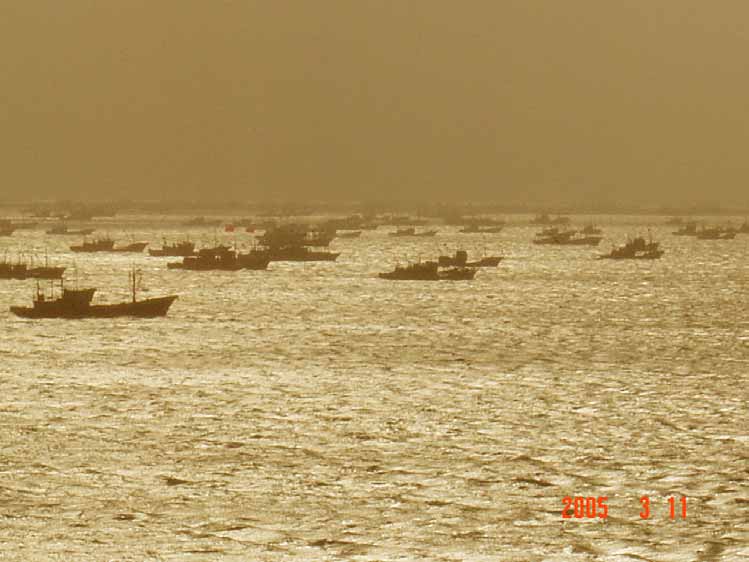
Fishing boats on the Yellow Sea near Jeju Island in the southern part
of Republic of Korea, March 2005. Courtesy of Mr. Yihang JIANG.
REDUCING ENVIRONMENTAL STRESS
IN THE YELLOW SEA
LARGE MARINE ECOSYSTEM
Report of the First Meeting of the
Regional Working Group for the Fisheries Component
UNDP/GEF Yellow Sea Project
Qingdao, China, 11th to 14th April 2005

GEF
UNDP/GEF PROJECT ENTITLED "REDUCING ENVIRONMENTAL STRESS IN THE
YELLOW SEA LARGE MARINE ECOSYSTEM"
UNDP/GEF/YS/RWG-F.1/3
Date: 14 April 2005
English only
First Regional Working Group Meeting
For the Fisheries Component of
the UNDP/GEF Yellow Sea Project
Qingdao, China, 11-14 April, 2005
Meeting Report
TABLE OF CONTENTS
1.
OPENING OF THE MEETING ....................................................................................................... 1
1.1
WELCOME ADDRESSES............................................................................................................. 1
1.2
INTRODUCTION OF THE MEMBERS.............................................................................................. 1
2.
ORGANISATION OF THE MEETING............................................................................................ 1
2.1
ELECTION OF OFFICERS ........................................................................................................... 1
2.2
DOCUMENTATION AVAILABLE TO THE MEETING .......................................................................... 2
2.3
ORGANISATION OF WORK ......................................................................................................... 2
3.
ADOPTION OF THE MEETING AGENDA .................................................................................... 2
4.
TERMS OF REFERENCE, MEMBERSHIP AND RULES OF PROCEDURE FOR THE
REGIONAL WORKING GROUP FOR FISHERIES (RWG-F)................................................................ 3
5.
OVERALL GOALS AND OBJECTIVES OF THE FISHERIES COMPONENT............................. 4
6.
CO-OPERATION WITH OTHER PROJECT COMPONTENTS AND RELEVANT ACTIVITIES IN
THE REGION.......................................................................................................................................... 6
7.
REVIEW AND EVALUATION OF STOCK ASSESSMENT OUTPUTS ACCORDING TO
WORKPLAN ........................................................................................................................................... 6
8.
REVIEW AND EVALUATION OF CARRYING-CAPACITY OUTPUTS ACCORDING TO
WORKPLAN ........................................................................................................................................... 7
9.
REVIEW AND EVALUATION OF MARICULTURE PRODUCTION OUTPUTS ACCORDING TO
WORKPLAN ........................................................................................................................................... 8
10.
DISCUSSION AND ADOPTION OF ACTIVITIES COSTINGS AND WORKPLAN.................. 9
11.
OTHER BUSINESS ................................................................................................................... 9
12.
VENUE FOR NEXT REGIONAL WORKING GROUP MEETING........................................... 10
13.
ADOPTION OF THE MEETING REPORT .............................................................................. 10
14.
CLOSURE OF THE MEETING................................................................................................ 10
ANNEXES
Annex I
List of Participants
Annex II
Agenda
Annex III
Revised Terms of Reference for the UNDP/GEF Yellow Sea Project Regional
Thematic Working Group - Biodiversity
Annex IV
Data and Information Requirements for the Biodiversity Component and
Causal Chain Analysis for Yellow Sea Biodiversity-Related Problems
Annex V
Biodiversity Component Revised List of Activities
Annex VI
Biodiversity Component Workplan 2005 to 2006
UNDP/GEF/YS/RWG-F.1/3
Page 1
1.
OPENING OF THE MEETING
1.1 Welcome
addresses
On behalf of the UNDP/GEF Yellow Sea project, the Project Manager Mr. Yihang
Jiang opened the meeting and welcomed all participants to Qingdao, "the centre of
oceanography and fisheries in China". He briefly introduced the background of the
project and the objectives of the meeting of the Regional Working Group for the
Fisheries Component of the UNDP/GEF Yellow Sea Large Marine Ecosystem
Project.
1.1.1 Mr. Jiang explained the major outcomes of the Project, namely, the development of
the Transboundary Diagnostic Analysis (TDA), Strategic Action Programme (SAP),
and National Strategic Action Plans. In the final year of the Project, there will be
implementation of demonstration and/or pilot activities identified in the SAP. This
Meeting will focus on the process for TDA preparation, but also keep in mind the SAP
development.
1.1.2 Mr. Jiang noted that the preliminary TDA information was a bit out of date. The
preliminary TDA was prepared for the Global Environment Facility (GEF) Council to
understand the project document before approving Project. The final TDA, to be
produced, needs updated data and information. Therefore, this Regional Working
Group (RWG) meeting will discuss and agree on identifying fisheries-related
problems of the Yellow Sea, agree on the types of information to support the
identified problems, agree on the format of the collected information, and propose
activities to gather additional required data.
1.1.3 Mr Jiang further elaborated that once the required data has been identified, the group
will need to determine the kind of actions will need to be undertaken. At this point
contracts will have to be made with contractors for data and information collection
and that the costs of activities will need to be established with consideration of the
national coefficient. These form the critical components of this RWG meeting.
1.1.4 There were some discussions regarding co-operative efforts between other regional
working groups for a better cross-component distribution of information. Mr Archer
informed the group that cross-component meetings may be planned in the future and
that Agenda Item 6 will provide more detail about current and potential partnerships
and co-operation.
1.2
Introduction of the members
Participants of the regional working group attended the meeting were invited to
introduce themselves and each gave a brief introduction of their expertise and
experience, to the group. The list of participants is attached to this report as Annex I.
2.
ORGANISATION OF THE MEETING
2.1
Election of Officers
2.1.1 In accordance with the UN rules of procedure for the conduct of meetings,
participants were invited to nominate a Chairperson for the meeting.
UNDP/GEF/YS/ RWG-F.1/3
Page 2
2.1.2 Ms. Yeon In Ja, for the West Seas Fisheries Research Institute of the National
Fisheries Research and Development Institute of Korea, nominated Mr. Jin Xian Shi,
of the Yellow Sea Fisheries Research Institute of China, for the position of
Chairperson. The group agreed with the nomination and Mr. Jin was duly elected as
Chairperson.
2.1.3 Mr. Jin accepted his new post and welcomed the members of the RWG. He referred
to the agenda and voiced his hope that the large amount of work could be completed
as per the agenda schedule set by the Secretariat.
2.2
Documentation Available to the Meeting
2.2.1 The Chairperson invited the Secretariat to introduce the documents prepared for the
meeting.
2.2.2 Mr. Jeff Archer from the Project Management Office (PMO) introduced the list of
documents (UNDP/GEF/YS/RWG-F.1/inf.1) and informed the meeting that the
documents in front of the group included the discussion documents; Expected
Outcomes and Outputs of the meeting, Data and Information Requirements of the
TDA, and a Proposal for the Regional Calculation of the Costs of Project Activities;
and informational documents including; Provisional Terms of Reference, Financial
Reporting Procedures and Requirements for the Regional Working Group for the
Fisheries Component. Also included were the Report of the First technical Meeting
on Preparation of the Implementation Plan for the UNDP/GEF Yellow Sea Project,
the Report of the Second Technical Meeting on the Preparation of the
Implementation Plan for the UNDP/GEF Yellow Sea Project, and the Report of the
First Project Steering Committee Meeting.
2.3
Organisation of Work
2.3.1 Mr. Archer introduced the document UNDP/GEF/YS/RWG-F.1/inf.3 describing the
Provisional Working Programme for the meeting and noted that the meeting would be
conducted in plenary as far as possible although sessional working groups could be
formed as deemed necessary.
2.3.2 Mr. Jiang Yihang, Project Manager of the PMO, thanked the Yellow Sea Fisheries
Research Institute, for their generous support and hospitality provided during the
Meeting.
3.
ADOPTION OF THE MEETING AGENDA
3.1
The Chairperson invited participants to consider the Provisional Agenda (Document
UNDP/GEF/YS/RWG-F.1/1) and Annotated Provisional Agenda (Document
UNDP/GEF/YS/RWG-F.1/2), prepared by the Secretariat, and to propose any
amendments or additions that they might wish.
3.2
The meeting adopted the agenda, which is attached as Annex II to this report.
UNDP/GEF/YS/ RWG-F.1/3
Page 3
4.
TERMS OF REFERENCE, MEMBERSHIP AND RULES OF PROCEDURE
FOR THE REGIONAL WORKING GROUP FOR FISHERIES (RWG-F)
4.1
The Chairperson invited Mr. Archer of the Secretariat to introduce document
UNDP/GEF/YS/RWG-F.1/inf.4, describing the Terms of References for the Regional
Working Group on Fisheries prepared during the PDF-B phase.
4.2
Mr. Archer described the Implementation Structure of the YSLME Project, noting
specifically that the primary reporting requirements of the Regional Working Groups
(RWGs) are to the PMO, with some requirement to the National Project Co-ordinator
(NPC). Mr. Archer further noted that the PMO, in consultation with the Chairperson,
would convene meetings of the RWG according to an agreed schedule, which
formed part of the agreed work-plan and timetable for the Project, and that the PMO
would act as Secretariat to the RWGs.
4.3
Mr. Archer explained how the RWG fitted within the framework of the project and
described the focal areas and major tasks of the RWG, providing examples of the
Major Tasks that the RWG were expected to perform that were listed in the
document. These are to:
· Provide technical inputs and comments for the project work-plans in their
respective areas of competency;
· Develop annual and quarterly work plans and implement activities in respective
thematic area, based on, and fully integrated in the project work-plan, and make
annual and quarterly progress reports;
· Develop relevant regional recommendations, guidance and strategy within area
of competency;
· Assist in development and implementation of the National Yellow Sea Action
Plans (NYAP's) and Regional Strategic Action Plan (SAP).
4.4
Mr. Archer introduced UNDP/GEF/YS/RWG-F.1/inf.5 and gave an overview of the
functional requirements of the working group, its reporting relationships and
responsibilities, its role in achieving objectives, and the financial rules and financial
reporting responsibilities of the regional working group.
4.5
Mr. Archer outlined the budgetary control framework and noted that the UNOPS, with
assistance from UNDP/GEF is the responsible organisation with respect to the entire
budgetary process, and that the PSC approves the budget and work-plans developed
by the RWG on an annual basis, within the framework of the Project Implementation
Plan.
4.6
It was explained that the responsibilities of Contracted Institutions and individuals will
be detailed in the agreements developed for each contracted activity, and that there
were several different contract modalities for these agreements based on the nature
of contracted entities and the magnitude of costs. These included: reimbursable
MOAs for agreements with NGOs, with the possibility of a small amount paid up-front
if needed; Fixed-price and reimbursable contracts for institutions, large contracts vs.
smaller-component contracts for long-term activities.
4.7
Mr. Archer emphasized that open-competitive bidding should be applied in selecting
institutions and individuals to maximise benefits of funding allocated to activities.
4.8
Mr. Archer went onto say that contractors (individuals or institutions) are required to
provide two documents in addition to the final product of the contract. These are an
UNDP/GEF/YS/ RWG-F.1/3
Page 4
expenditure report and a progress report, the frequency of which will be based on the
modality of contract. An example of each was provided as tables in the document.
4.9
Members asked for clarification and expansion of certain points and collectively
agreed to remove the word `annual' from the first and second bullet point of the
`Major Responsibilities of Regional Working Group on Fisheries' which referred to the
effective mechanism of regional stock assessment and carrying capacity,
respectively. Also, the 5th bullet point of the same paragraph was modified with the
change in the words `bilateral or regional agreement' to `bilateral and/or regional
agreement' to reflect the alternative.
4.10 The Chairman asked that the PMO reflect these changes in the document and
provide a new TOR to the group for them to consider. Mr. Archer agreed to have the
document ready for revision at the start of the meeting on the next day.
4.11 The Group revised the TOR for RWG-F provided by the PMO, and agreed on the
main body of text regarding the membership and working modality. There was some
discussion regarding the concept of Carrying Capacity and whether it was an archaic
assessment that may have been superseded by more contemporary methods such
as other, newer, ecosystem-based fishery management tools.
4.12 The group agreed to modify the statement regarding Carrying Capacity in the TOR to
allow the group freedom to explore newer techniques, methods and mechanisms for
ecosystem-based fisheries management in addition to Carrying capacity. The new
version of the TOR for the RWG-F can be found in Annex III.
5.
OVERALL GOALS AND OBJECTIVES OF THE FISHERIES COMPONENT
5.1 Mr. Archer introduced documents UNDP/GEF/YS/RWG-F.1/4 and
UNDP/GEF/YS/RWG-F.1/5., describing respectively, the Expected Outcomes and
Outputs of the Meeting and the Data and Information Required, and due to
unfamiliarity of the project by some members, summarized the general requirements
and procedures for preparing the Transboundary Diagnostic Analysis (TDA),
Strategic Action Plan (SAP), and the general activities pertaining to the Regional
Working Group for the Fisheries Component (RWG-F) as contained in the project
brief.
The `Causal Chain Analysis' and `Governance Analysis' procedure was outlined to
the group, and examples of Causal Chain Analysis relevant to the Fisheries
Component of the TDA were provided.
5.2
Mr. Archer highlighted the priority questions for the regional working group to
consider during this meeting, answers for which were required to fulfil the TDA and
develop the SAP.
5.3
The required Outcomes and Outputs of the meeting were then reiterated for the
group. These were to:
Outcomes:
· Discuss and agree on the TOR for the RWG-F.
· Discuss and agree on the types of data and information to collect to fulfil
objectives.
UNDP/GEF/YS/ RWG-F.1/3
Page 5
· Discuss and agree on the costs, types and schedule of activities to implement.
· Determine cooperative measures with other RWGs for preparing cross-
component analysis.
Outputs
· Produce a list of data and information requirements and their format.
· Provide an agreed method of equitably calculating the costs of activities.
· Produce a listed cost of actions.
· Produce a list of agreed responsibilities of relevant institutions and individuals in
collecting required data and information, and carrying out relevant analysis.
· Provide a proposal to be submitted to the regional Science and Technical Panel
on ways to coordinate with other RWGs in preparing the TDA; and
· Produce a work-plan for the Fisheries Component for 2005 and 2006.
5.4
The Chairman invited comments from the group on the overall goals and objectives
of the meeting.
5.5
Ms. Yeon remarked that it would be difficult to determine a common way to collect
data and agree on its format due to differences in the way the different regions obtain
data. She cited a specific example of the differences between the way Korea and
China collect their fisheries data.
5.6
Mr. Archer stated that it is up to the RWG to decide on how to collect data and
information, and what its format is, in such a way so as to create a common method
that can be used regionally to review historic data and also form the basis for future
comparative studies. The agreed method did not need to be prefect at this present
time, and can be a good compromise.
5.7
Mr Jiang reiterated the need for a common method for gathering data for the future
for a better representation of the conditions of the Yellow Sea. From this we can
identify the gaps and decide on how to fill the gaps.
5.8
Mr. Fang Jian Guang stated that the data presented in table is currently too exact
and should be more general in nature.
5.9
Mr. Archer stated that the table presented in the document was just an example for
consideration of the group and that all data provided could be added to, deleted or
modified as required by the group.
5.10 There was some discussion about the TDA and SAP process, with some members,
who were unfamiliar with the process, seeking additional clarification of the above.
5.11 Mr. Archer reiterated some of the points from his presentation with regard to the
TDA/SAP process procedure for the information of the group.
5.12 The group requested that the PMO prepare a list of the most commonly used
abbreviations or acronyms used in the documentation and presentation for their
reference during presentations and review of documents. Mr. Archer agreed to
produce this list and provide to them at the start of the next days meeting, and this
list can be found as Appendix I to the new version of the TOR for the RWG-F in
Annex III of this document.
UNDP/GEF/YS/ RWG-F.1/3
Page 6
6.
CO-OPERATION WITH OTHER PROJECT COMPONTENTS AND
RELEVANT ACTIVITIES IN THE REGION
6.1
Mr. Archer introduced this agenda item by providing details of the current co-
financing arrangement, which included participation by GEF, UNDP, Governments,
NOAA and WWF-/KORDI/KEI Yellow Sea Eco-Region Planning Project (YSEPP),
and showed a list of potential NGOs, Institutes and programs, prepared by the PMO,
for the consideration of the group.
6.2
The group accepted the provisional list with the understanding that the list would be
dynamic as items are eliminated, and new relationships established.
6.3
Mr. Archer invited participants to add to the list by providing other national and
regional activities that could co-operate with the Fisheries component of the YSLME
Project, in particular, sources of co-financing and methods of co-operation, and how
the activities of the Fisheries component can be co-ordinated with other components
of the YSLME Project, and present these lists during the early parts of the next-days
meeting.
6.4
The need to cooperate with the other RWGs for the YSLME project, especially with
regards to the Ecosystem component, was highlighted by members of the group,
stressing that the carrying-capacity area of the RWG-F should look to cooperate with
both the RWG for Ecosystem and Investment on numerous matters such as carrying-
capacity, policy and legal issues, respectively. Members of the meeting suggested
that joint RWG meetings could be organised to facilitate communication, discussion,
sharing and coordination of activities between RWGs for the benefit of the project.
6.5
Mr. Jin noted that RWG Chairs come together during regular RSTP meetings and
that this would be a good venue for groups to exchange vital information and improve
coordination, and agreed to the suggestion that each RWG should be asked to
consider what co-operation was needed to benefit each working group, and that
these requirements should be submitted to the PMO before the next RSTP meeting
so that they can be discussed and addressed.
6.6
Mr. Jiang informed the group that the organisation of a joint meeting was an option
but may not be an effective activity at present given the paucity of data at hand, and
the absence of a stratagem for obtaining required data. He noted that there was an
urgent need to finalize the data and information requirements pertaining to the
Fisheries RWG activities before any effective coordination between RWGs at
meetings could occur. He also noted that the structure of the RWG meeting schedule
was set at the beginning of the project and it would be currently be difficult to alter its
framework, especially given the lack of information on data and information needs.
He suggested that the RSTP could be asked to consider the organisation of an
`Ecosystem' meeting including all RWGs in the near future to discuss the cross-
component issues.
7.
REVIEW AND EVALUATION OF STOCK ASSESSMENT OUTPUTS
ACCORDING TO WORKPLAN
7.1
On behalf of Korea and China, Ms. Yeon and Mr. Jin presented brief diagnoses of
the fisheries stocks in their regions, highlighting the problems that existed,
UNDP/GEF/YS/ RWG-F.1/3
Page 7
highlighting the transboundary issues and describing the national and regional
sources of data and information that were available.
7.2
Ms. Yeon gave a review and diagnosis of the fisheries stocks in the Korean waters of
the Yellow Sea based on available commercial monitoring data, biological
parameters and survey results. She noted that the commercial fish catches and
resources abundance have been significantly reduced, species composition of
catches has changed from; large size-classes, with higher price, in higher trophic
levels and mainly demersal species guilds (such as Small Yellow Croaker, Hairtail
etc) to; smaller sized, lower value, lower trophic level, and mainly small pelagic
species, (such as anchovy) and bivalves . Estimated optimum fishing intensity was at
much lower level than the current fishing effort. In general, the quality of the major
commercially valuable stocks is at `low levels'. She said that monitoring and
biological data for commercial fisheries currently exists in Korea, but the data from
survey results is not enough to indicate the precise fisheries abundance and current
carrying capacity of the system.
7.3
Mr. Jin gave an overview of the status of fisheries resources and transboundary
problems in the Yellow Sea. He presented the current data sets possessed for this
region, indicating the gaps in data and the transboundary issues that currently exist
and gave some recommendations on how the data gaps can be addressed. Mr. Jin
noted that survey data, as opposed to fisheries data, was the most reliable and
accurate measure of obtaining data for stock assessment. He reported that although
total catch has increased over recent times, the general CPUE has been at low
levels. He mentioned that although there has been a dramatic decrease in the
biomass of some commercially valuable species, there has also been an apparent
dramatic increase in the biomass of others. He added that in general fishes are
smaller in size, lower in economic value, and dominant species has varied with time.
Mr. Jin also provided information on the current methods of fishery management for
the China region of the Yellow Sea that includes: Sino-Korean Fisheries Agreements,
summer bans on fishing, closed seasons and areas, minimum landing sizes,
minimum mesh sizes and reduced fishing efforts from China.
8.
REVIEW AND EVALUATION OF CARRYING-CAPACITY OUTPUTS
ACCORDING TO WORKPLAN
8.1
Ms. Yeon presented an unpublished paper developed by colleagues from the Marine
Environment Management Team, National Fisheries Research and Development
Institute (NFRDI) of Korea; providing an overview of the current state-of-knowledge
and data that exists on carrying capacity for their region of the Yellow Sea Large
Marine Ecosystem (YSLME) and the results of preliminary carrying-capacity analysis,
highlighting present initiatives and actions of fisheries management in Korea, current
and emerging issues on carrying capacity, and describing current research concerns
and the national and regional sources of data and information that are available. The
paper also describes some methods for developing models for the study of carrying
capacity for fisheries and how they can be applied to the study of the Yellow Sea.
8.2
Mr. Jin reported that due to incomplete nature of the marine surveys in the region,
they are unable to determine carrying capacity in the whole of the Yellow Sea at
present.
UNDP/GEF/YS/ RWG-F.1/3
Page 8
9.
REVIEW AND EVALUATION OF MARICULTURE PRODUCTION OUTPUTS
ACCORDING TO WORKPLAN
9.1
Mr Jang presented a regional overview of the existing status and trends of
Mariculture and highlighting the problems that existed in the Korean region and
describing the national and regional sources of data and information that are
available. He noted that in general there has been a dramatic increase in mariculture
production coupled with an increase in the number of mariculture farms and
activities. He listed the major produced species and their proportional representation;
With Macroalgae forming 50% of production (the Sea Mustard Undaria 48%),
followed by shellfish (Oysters 80%, Short-neck clam 8%), then finfish (Flatfish 55%,
Rockfish 17%), and described the problems and threats to the industry. He
mentioned that, of the diseases affecting mariculture at the present, the shrimp
disease White Spot Syndrome Virus (WSSV) was the most important due to the
sudden introduction of the disease from Taiwan, the increasing rate of infection in the
wild shrimp population, rapid spread around the globe and its dramatic effect on
infected livestock.
9.2
Mr. Fang presented a regional overview of the existing status and trends of
Mariculture and problems that existed for the Chinese region. He reported the
`development in mariculture in China. He described three main current shallow sea
mariculture issues: High density culture, quality product and the exploitation of
coastal waters for economic benefit with little concern for the environment. He also
described information on the modelling of carrying capacity for cultured macro-algal
and scallop stocks in Sungo Bay, China.
9.3
Participants separated into two groups to discuss, modify and add to, the Problem
and Data requirement table and Causal Chain analysis provided by the secretariat,
and after much discussion, agreed on a list of data and information requirements,
and a provisional Causal Chain Analysis Matrix to present to the RSTP and use for
the future planning of activities.
9.4
Mr. Kim presented an additional list of suggested data and information parameters
for consideration to be added to the list to include certain socio-economic issues,
such as policy, legal issues, regulations and enforcement. He emphasized a need to
include information on fishing income in during data acquisition (by fisherman) and
fishing costs (by fisherman and fishing). He also emphasized the importance of
obtaining information on the export and import of fisheries products between Korea
and China. He noted that this information is helpful in helping us understand the
fisheries and economies of both countries. He requested the group for feedback on
the information he provided.
9.5
The group made comments, additions and modifications to the list of information
requirements provided by Mr. Kim, and these were incorporated into the main data
and information requirement table. The group agreed that if both countries didn't
possess the required dataset for a given parameter, then that parameter will be
removed from the data requirements table unless, that data could be obtained by
both countries, and in the same format, from that point on. The final table contains an
agreed data-set required for the TDA for which both countries can either obtain
historical data for, or can collectively obtain in the future. The final table and that of
the final Causal Chain Analysis matrix can be found in Annex IV.
UNDP/GEF/YS/ RWG-F.1/3
Page 9
10.
DISCUSSION AND ADOPTION OF ACTIVITIES COSTINGS AND
WORKPLAN
10.1 The Chairman invited the Secretariat to give a presentation on a proposed regional
criterion for the calculation of costs to obtain data and information.
10.2 Mr. Archer briefly outlined the required actions by the RWG-F that were needed to
meet the requirements for the preparation of the TDA. These were to agree on list of
costed activities to be supported within the framework of the project; and formulate a
work-plan for the first two years, with an indication of the tasks, responsibilities and
deadlines for completion of the tasks.
10.3 The participants were invited to review the attached document UNDP/GEF/YS/RWG-
F.1/6 detailing a proposed regional criterion for calculating the costs of activities. The
Full Time Equivalent (FTE) Agreement was briefly described and was proposed as a
possible method of equitably calculating the costs of activities taking into
consideration regional differences in the way labour/salaries are calculated and
differences in the Cost of Living Index (COL). The background of the FTE unit, the
calculation of the FTE figure and the development of the FTE Agreement, was briefly
explained.
10.4 Mr. Jiang gave a brief history of the nature of this document and the rationale for its
inclusion in the meeting. He noted the urgency to address this issue but remarked
however, that the issue was beyond the scope and expertise of this group and
recommended that this issue should be referred to the higher government
organisations involved in this project for their deliberation.
10.5 The group made supporting comments to Mr. Jiang's recommendation and further
recommended to the Chair that the issue be referred to the RSTP for discussion and
resolution at their next meeting.
10.6 The group then revised the list of activities and actions required for the Fisheries
Component of the Implementation Plan and developed a new work-plan for the 2005
and 2006 years. The group made a small change to the list of activities and some
modifications to the existing work-plan due to new changes in scheduling of some
activities such as Ship surveys and meeting dates.
10.7 The revised agreed list of activities is attached to this report as Annex V.
11. OTHER
BUSINESS
11.1 The Chairman invited members to presentations or raise any other issues that need
to be considered by this meeting.
11.2 Ms. Yeon on behalf of the Korean delegation reported that the Terms of Reference
(TOR) for membership of the RWG were `unfair' given the inequality in the number of
members. She noted that Korea would prefer an equal number and would like to
know if this could be changed at this time.
11.3 The Chairman invited Mr. Jiang to give a brief overview of how the decision was
made to use only three members for each working group from each country, and only
one chairman to represent both.
UNDP/GEF/YS/ RWG-F.1/3
Page 10
11.4 Mr. Jiang replied that it was an agreement of the 2nd meeting of the Regional
Technical Meeting (RTM), and agreed by the Project Steering Committee (PSC) two
months ago. However, if RWG felt strongly about it and wanted it changed, they
would have to seek an agreement with all the other working groups, agree on the
number of members, and provide a new proposal for consideration of the PSC at
their next meeting.
11.5 Ms. Wei from China stated that this issue has been discussed at the RTM meeting
and the agreement on the number of experts for the five project components has
reached. The agreement was submitted and approved by the PSC some two months
ago, it was not appropriate to change the number of the regional working group at
this moment.
11.6 With the statement made by the members, the meeting did not reach an agreement
on this issue.
11.7 Mr. McGilvray of the Marine Stewardship Council (MSC) gave a brief overview of the
organisation that he represents, summarising the organisation frameworks, the eco-
labelling and certification process which they have developed and are implementing
globally, and how their activities may benefit the YSLME project. Presently they have
certified 12 fisheries using the MSC process, standards and guidelines and are
currently assessing over 20 other fisheries for inclusion in the MSC eco-labelling and
certification process.
12.
VENUE FOR NEXT REGIONAL WORKING GROUP MEETING
12.1 The Chairman invited members to consider and agree on the venue for the next
Regional Working Group Fisheries Component meeting.
12.2 A provisional meeting date had been set by the PMO for the early part of October,
however, due to the PICES Meeting being held at this time, it was agreed to move
the meeting to the 25th to 28th October, 2005. It was suggested that the possible
venue of the meeting would be Jeju Island or Gyeongju, Korea. The secretariat will
discuss the venue with the host and make arrangements on behalf of the group.
13.
ADOPTION OF THE MEETING REPORT
13.1 The report was considered paragraph by paragraph and adopted as contained in this
document.
13.2 The Chairman moved the formal motion for the adoption of the report of the First
Meeting of the Regional Working Group for the Fisheries Component of the YSLME
which was passed by acclamation.
14.
CLOSURE OF THE MEETING
14.1 The Chairperson thanked the Members of the Regional Working Group for the
Fisheries Component, the Project Manager, PMO staff and other participants for their
hard and constructive work.
UNDP/GEF/YS/ RWG-F.1/3
Page 11
14.2 On behalf of all participants, the Project Manager thanked the Chairperson for his
hard work and guidance that ensured the success of the meeting.
14.3 The meeting was formally closed at 12:30 hrs, April 14th, 2005.
UNDP/GEF/YS/ RWG-F.1/3
Annex I
Page 1
Annex I
List of Participants
People's Republic of China
Dr. JIN Xianshi
Dr. FANG Jianguang
Director,
Professor Director
Fishable Resources & Ecosystem
Mariculture Ecology Division
Management Division
Yellow Sea Fisheries Research Institute
Yellow Sea Fisheries Research Institute
106 Nanjing Road
106 Nanjing Road
Qingdao 266071
Qingdao 266071
Tel: 86-532-582-2957
Tel: 86-532-584-9430
Fax: 86-532-581 1514
Fax: 86-532-581 1514
Email: fangjg@ysfri.ac.cn
Email: jin@ysfri.ac.cn
Dr. ZHAO Xianyong
Dr. WANG Jun
Deputy Director
Associate Professor
Fishable Resources and Ecosystem
Yellow Sea Fisheries Research Institute
Management Division
106 Nanjing Road
Yellow Sea Fisheries Research Institute
Qingdao 266071
106 Nanjing Road
Tel: 86-532-583-6344
Qingdao 266071
Fax: 86-532-581 1514
Tel: 86-532-583-6344
Email: wangjun@ysfri.ac.cn
Fax: 86-532-581 1514
Email: zhaoxy@ysfri.ac.cn
Ms. WEI Yan
Department of International Co-operation
State Oceanic Administration
1 Fuxingmenwai Avenue
Beijing 100860
Tel: 86-10-6804-8051
Fax: 86-10-6803-0799
Email: shb@soa.gov.cn
Republic of Korea
Dr. In Ja YEON
Dr. JANG In Kwon
Senior Scientist
Senior Researcher
West Sea Fisheries Research Institute
West Sea Fisheries Research Institute
National Fisheries Research & Development
National Fisheries Research &
Institute (NFRDI)
Development Institute (NFRDI)
707, Ulwang-dong, Jung-gu, Incheon,
707 Ulwang-dong, Jung-gu, Incheon
400-420, Republic of KOREA
400-420, Republic of KOREA
Tel: 82-32-745-0551
Tel: 82-32-745-0570
Fax: 82-32-745-0549
Fax: 82-32-745-0558
Email: ijyeon@nfrdi.re.kr
Email: jangik@nfrdi.re.kr
UNDP/GEF/YS/ RWG-F.1/3
Annex I
Page 2
Dr. KIM Do Hoon
Senior Researcher
Korea Maritime Institute
1027-4 Bangbae-3-Dong, Seocho-Gu,
Seoul, Korea 137-852
Tel: 82-2-2105-2754
Fax: 82-2-2105-2859
Email: kimdh@kmi.re.kr
Marine Stewardship Council
Mr. Frazer McGilvray
Regional Manager-East Asia
Marine Stewardship Council
Unit 10, 46-48 Urunga Parade,
Miranda, NSW, 2228, Australia
Tel: 612-9524-8400
Fax: 612-9524-8900
E-mail: frazer.mcgilvray@msc.org
Project Management Office (PMO)
Mr. Yihang JIANG
Mr. Jeffrey ARCHER
Project Manager
Fisheries/Biodiversity Officer
UNDP/GEF Yellow Sea Project
UNDP/GEF Yellow Sea Project
Korea Ocean Research and Development
Korea Ocean Research and Development
Institute
Institute
1270 Sa-dong Sangnok-gu Ansan-si
1270 Sa-dong Sangnok-gu Ansan-si
Gyeonggi-do 426-744
Gyeonggi-do 426-744
Republic of Korea
Republic of Korea
Tel: (82-31) 400 7825
Tel: (82-31) 400 7832
Fax: (82-31) 400 7826
Fax: (82-31) 400 7826
email: yihang@yslme.org
email: jeff@yslme.org
Ms. Jung-Hwa KIM
Secretary
UNDP/GEF Yellow Sea Project
Korea Ocean Research and Development
Institute
1270 Sa-dong Sangnok-gu Ansan-si
Gyeonggi-do 426-744
Republic of Korea
Tel: (82-31) 400 7829
Fax: (82-31) 400 7826
email: junghwa@yslme.org
UNDP/GEF/YS/ RWG-F.1/3
Annex I
Page 3
Secretariat
Ms. WANG Wenqi
Ms. SUN Ping
Senior Engineer
First Institute of Oceanography, SOA
Vice Director of Foreign Affairs Office
6 Xianxialing Road Hi-Tech Industrial Park
First Institute of Oceanography, SOA
Qingdao, Shandong 266001
6 Xianxialing Road Hi-Tech Industrial Park
Tel: 86-532-896-7440
Qingdao, Shandong 266001
Fax:
Tel: 86-532-889-7431
Email: sharry_cn@hotmail.com
Fax: 86-532-889-7548
Email: fiokje@public.qd.sd.cn
Ms. NIU Mingxiang
Yellow Sea Fisheries Research Institute
106 Nanjing Road
Qingdao 266071
Tel: 86-532-5836344
Fax:
Email: nmx77@163.com
UNDP/GEF/YS/ RWG-F.1/3
Annex II
Page 1
Annex II
Agenda
1. OPENING OF THE MEETING
1.1 Welcome addresses
1.2 Introduction of the members
2. ORGANISATION OF THE MEETING
2.1 Election of Officers
2.2 Documentation Available to the Meeting
2.3 Organisation of Work
3. ADOPTION OF THE MEETING AGENDA
4. TERMS OF REFERENCE, MEMBERSHIP AND RULES OF PROCEDURE FOR
THE REGIONAL WORKING GROUP FOR FISHERIES (RWG-F)
5. OVERALL GOALS AND OBJECTIVES OF THE FISHERIES COMPONENT
6. CO-OPERATION WITH OTHER PROJECT COMPONTENTS AND RELEVANT
ACTIVITIES IN THE REGION
7. REVIEW AND EVALUATION OF STOCK ASSESSMENT OUTPUTS ACCORDING
TO WORKPLAN
8. REVIEW AND EVALUATION OF CARRYING-CAPACITY OUTPUTS ACCORDING
TO WORKPLAN
9. REVIEW AND EVALUATION OF MARICULTURE PRODUCTION OUTPUTS
ACCORDING TO WORKPLAN
10. DISCUSSION AND ADOPTION OF ACTIVITES COSTINGS AND WORKPLAN
11. ANY OTHER BUSINESS
12. VENUE FOR NEXT REGIONAL WORKING GROUP MEETING
13. ADOPTION OF THE MEETING REPORT
14. CLOSURE OF THE MEETING
UNDP/GEF/YS/ RWG-F.1/3
Annex III
Page 1
Annex III
Revised Terms of Reference
For the UNDP/GEF Yellow Sea Project
Regional Thematic Working Groups
Background:
To facilitate the achievement of the regional goals and objectives, Regional Thematic
Working Groups (RWG) for each component (Ecosystem, Biodiversity, Fisheries, Pollution,
and Investment) have been established with overall responsibility for ensuring effective
implementation of project activities and to provide a mechanism for exchange of information
and experience of management experiences in each country.
Membership:
Each of the five RWGs will include:
· Two scientists (social and natural) from each country;
· One additional expert drawn from the legal, regulatory, investment, and/or
environmental management fields, from each country;
· One Chairman for each RWG; and
· The Working Group Chairpersons will be members of the Regional Science and
Technical Panel.
Working modalities:
Each RWG will represent the regional perspective and not just the national perspective.
Working "without walls", the RWGs will communicate primarily through email, with one or two
working meetings annually. Each RWG will operate on the basis of working parties involving
participation of experts from all coastal countries together with external experts where this is
considered necessary. The RWGs report to the Regional Scientific Technical Panel through
the Project Management Office (PMO), although they may also have national reporting
requirements from the National Project Co-ordinators.
Meetings:
The PMO, in consultation with the Chairperson, shall convene meetings of the RWGs
according to an agreed schedule, which will form part of the agreed work plan and timetable
for the work of the Project.
The PMO shall act as Secretariat to the RWGs, and shall ensure that reports of the meetings
are circulated to all members of the working groups, and are copied to the members of the
RSTP.
Tasks:
· Provide technical inputs/comments for the project workplans in their respective areas
of competency;
· Develop annual and quarterly work plans and implement activities in respective
thematic area, based on and fully integrated in the project workplan, and make
annual and quarterly progress reports;
UNDP/GEF/YS/ RWG-F.1/3
Annex III
Page 2
· Be responsible for regional coordination within area of competency;
· Facilitate creation of effective national thematic network;
· Organise and conduct working parties and training within area of competency;
· Develop relevant regional recommendations, guidance and strategy within area of
competency;
· Contribute scientific knowledge in the area of expertise to the development of the
TDA;
· Assist in development and implementation of the Regional Strategic Action
Programme (SAP) and National Yellow Sea Action Plans (NYSAP);
· Contribute to the development of the Priority Investment Portfolio;
· Assist, through the Chair, in effective Project Management by assisting with
scheduling, scoping, and budgeting for various interlinked activities;
· Contribute scientific and technical advice to the formulation of proposals for national
and regional actions and donor funding;
· Network with national and international institutions and specialists in respective focal
area;
· Assist in preparing and implement regional pilot projects and/or demonstration
projects;
· Liaise closely with PMO, through RWG Chairpersons;
· Contribute scientific and technical expertise to YSLME information system
development, public awareness activities and stakeholder participation;
· Co-operate with other RWGs; and
· Develop and maintain a database within area of competence.
____________________
MAJOR RESPONSIBILITY OF REGIONAL THEMATIC WORKING GROUP ON
FISHERIES
Location of WG Chair: People's Republic of China
Tasks:
· Develop common methodology for regional stock assessment strategy and region-wide
monitoring. Perform initial joint stock assessment. Elaborate an effective mechanism
for regional stock assessment.
· Perform re-iterative series of regional analyses of carrying capacity. Develop
mechanism for regional carrying capacity determination and/or other ecosystem-
based fisheries management tools.
· Develop joint applied research program for sustainable mariculture. Pilot
demonstration projects in mariculture. Assist region to implement more broadly
proven sustainable mariculture techniques.
· Coordination of joint development and demonstration of methods for diagnosis,
prevention, and control of disease in mariculture. Development of regional
communication network about diseases to reduce transboundary implications.
· Facilitate developed and endorsed bilateral and/or regional agreement for sustainable
use of fisheries resources.
UNDP/GEF/YS/ RWG-F.1/3
Annex III
Page 3
· Facilitate improvement of fisheries management in the YSLME. Develop strategies
for sustainable use of transboundary stocks building on management plans.
UNDP/GEF/YS/ RWG-F.1/3
Annex III
Page 4
APPENDIX I
LIST OF ACRONYMS/ABBREVIATIONS USED BY THE PMO IN DOCUMENTATION
AND PRESENTATIONS
DPRK
Democratic People's Republic of Korea
EcoQO
Ecosystem Quality Objectives
FAO
Food and Agriculture Organization
GEF
Global Environment Facility
GIS
Geographic Information System
GLOBEC
Global Ocean Ecosystem Dynamics
HAB
Harmful Algal Bloom
IMCF
Inter-ministerial Coordinating function
LME
Large Marine Ecosystem
MOA
Memorandum of Agreement
NFP
National Focal point
NGOs Non-Governmental
Organizations
NOAA
US National Oceanic and Atmospheric Administration
NOWPAP
Northwest Pacific Action Plan
NPC
National Project Coordinator
NYAP
National Yellow Sea Action Plan
PDF
Project Development Facility
PMO
Project Management Office (also known as PCU-Project Coordinating Unit)
PRC
People's Republic of China
PSC
Project Steering Committee
PTDA
Preliminary Transboundary Diagnostic Analysis
ROK
Republic
of
Korea
RSTP
Regional Scientific and Technical Panel
RWG
Regional Working Groups
RWG-F
Regional Working Groups for Fisheries Component
SAP
Strategic Action Program
TDA
Transboundary Diagnostic Analysis
TOR
Terms of Reference
UNEP
United Nations Environment Programme
UNDP
United Nations Development Programme
UNOPS
United Nations Office for Project Services
YSLME
Yellow Sea Large Marine Ecosystem
WG
Working
Group
UNDP/GEF/YS/ RWG-F.1/3
Annex IV
Page 1
Annex IV
Provisional Data Requirement Summary
Problem
Type of Data Required
Type, Unit:
Frequency:
Temporal
Available:
Available:
Requirements:
ROK
CHINA
Decline in Many
Landings
Tonnes, by species
30 years
Y
Y
Commercially
Important Fishery
Species
Fishing Effort
No. Boats, by fishery
30 years
Y
Y
HP of boats, by fishery
30 years
Y
Y
Composition of Catch
% Species of catch
30 years
Y
Y
Biological data
Growth pattern, by species
10 indicator species
Y
Y
Reproduction, by Species
10 indicator species
Y
Y
Spawning Season, by Species
10 indicator species
Y
Y
Survey Result
Species Composition
20 years
5 coastal, annually. Once In
2-3times in every decade since
1970s.
1980s with large coverage.
Biomass
20 years
5 coastal, annually. Once In
2-3times in every decade since
1970s.
1980s with large coverage.
Environmental Characteristics
20 years
5 coastal, annually. Once In
2-3times in every decade since
1970s.
1980s with large coverage.
Icthyoplankton counts
20 years
5 coastal, annually. Once In
2-3times in every decade since
1970s.
1980s with large coverage.
New Survey Result
Species Composition, Biomass,
2-3
Environmental Characteristics and
surveys/Dec.-
Icthyoplankton, etc.
Jan; April-may;
Autumn ?
Ecological Characteristics
Migration pattern by species,
10 species
Y
Y
spawning and nursery areas by
species.
UNDP/GEF/YS/ RWG-F.1/3
Annex IV
Page 2
Lack of knowledge of
Basin-Scale survey,
Estimated from survey data
N
Y
Carrying Capacity
Existing methods/models
Unsustainable
Change in extent of marine
ha per region (province, habitat) per
Min 25 yrs
10 years
10 years
Mariculture
farms
annum
Change in production of
Tonnes per species (or kinds of
marine farmed species
organisms) per annum
10 years
10 years
Environmentally
Change in the condition of
Destructive
habitats in the vicinity of
Abundance and distribution of
aquaculture practices
aquaculture facilities
important species
Socio-economic Data
Required
Vessels by Fishery
Number of Fisherman by
Region
Fisheries Income
Fishery Consumption Per
Capita
Fishery Export and
Import
Economic Importance of
Fisheries (e.g.
Employment, GDP
Contribution)
UNDP/GEF/YS/ RWG-F.1/3
Annex IV
Page 3
AGREED CAUSAL CHAIN ANALYSIS MATRIX
Priority
If yes,
Immediate
rank
priority rank
Causes
Trans-
Problem
Impacts
(Technical)
Underlying cause
Root cause
Governance
(H, M, L)
boundary?
(H, M, L)
Fisheries Issues
Decline in
Reduction in trophic level,
Over-exploitation
Inadequate management
Increasing demand for
Inadequate legal
Conditions of
Reduction in overall size of
of target species
and control of fisheries
marine resources due to
instruments at national
Many
some commercially
activities, Over-Capacity
rapid population and
and regional levels,
Commercially
valuable species, Change
of fishing fleets, Illegal
economic expansion
inadequate
Important Fishery
in composition of species
Fishing, Inadequate
implementation of
Species
monitoring and
national regulatory
enforcement, lack of
instruments; lack of
scientific-based
regional harmonization of
knowledge on status of
regulations. Inadequate
stocks
knowledge and
infrastructure base
H Y
H
Uncontrolled
Damage to coastal
Over-extensive
Effect of mariculture
Increasing demand for
Inadequate legal
Aquaculture
infrastructure, damage to
and overly-
activities on surrounding
marine resources due to
instruments at national
Practices
environmental quality,
intensive
habitats
rapid population and
and regional levels,
introduction of foreign
aquaculture
economic expansion
inadequate
species and pathogens,
activities
implementation of
increase in disease
national regulatory
outbreak
instruments; lack of
regional harmonization of
regulations. Inadequate
knowledge and
infrastructure base
H
Y
H
Inadequate
Incapacity to adequately
Lack of
Inadequate knowledge
Poor regional
Capacity to
manage activities and
information,
and infrastructure base
coordination,
Assess Ecosystem
resources and mitigate
environmental
communication and
effects
impact
collaboration, insufficient
assessments
financing mechanisms
Inadequate understanding
and support
and associated policies
M
Y
M
UNDP/GEF/YS/ RWG-F.1/3
Annex V
Page 1
Annex V
AGREED LIST OF ACTIVITIES OF THE IMPLEMENTATION PLAN
Objective I. Fisheries & Mariculture
Activities Agreed
Actions to be taken
IA. Stock assessment
Activity 1. Review of existing data (review of
Contract to relevant national institution(s) for data and info.
historical data commercial fisheries and
research results)
Revise national data and info
Inputs to final TDA
Activity 2. Diagnosis of stock conditions
Regional WG meeting 1
Finalisation of data and info. WG meeting 3
Activity 3. Develop common methodology for Gathering existing methods & prepare suggested
joint regional stock assessment and perform
methods(consultant)
initial joint regional stock assessment
Discuss & Modify the methods (WG meeting 1)
Revise the regional methods (consultant)
finalise the method (WG meeting 2)
Activity 4. Perform demonstration of a
Prepare guidelines for survey (consultant)
Regional Survey
Accept guidelines (WG meeting 2)
Equipment
Ship rental for Regional Survey (sub-contract)
Analyse survey result (consultant)
Publish survey result (printing)
Activity 5. Perform initial joint regional stock
Prepare a plan for the stock assessment
assessment
Technical discussion on the plan (WG meeting 3)
implement the regional stock assessment (contracts)
Discuss the results of assessment (WG meeting 4)
Additional assessment if necessary (contracts)
Accept the assessment result (WG meeting 5)
Publication of assessment results (printing)
Activity 6. Create mechanism for regional
Identify major barriers in stock assessment WG meeting 2)
annual multi-species stock assessment, by
Identify the species to be assessed (WG meeting 2)
introducing legal/policy changes to overcome
Prepare draft mechanism for annual assessment (PMO)
existing barriers
Discuss the draft mechanism (WG meeting 3)
Revise the draft mechanism (consultant)
Finalisation of the mechanism (WG meeting 5)
IB. Carrying capacity
Activity 1. Review existing state-of-
Contract to relevant national institution(s) for assessing
knowledge and preliminary carrying capacity
information
analysis (retrospective) and define gaps
Regional WG meeting 1
Revise national state of knowledge
Finalisation of Report (WG meeting 3)
Inputs to final TDA
Activity 2. Fill the knowledge gaps for
Prepare guidelines for carrying capacity (consultant)
carrying capacity analysis.
Reg Training course on carrying capacity (Training 1)
Activity 3. Perform iterative series of analysis
Prepare workplan for the analysis (consultant)
of carrying capacity
discuss and agree on the workplan (WG meeting 3)
Implement the workplan (contracts to national focal points)
Activity 4. Annual carrying capacity
Gathering results of the analysis (PMO)
determination
Scientific seminar (together with WG meeting 5). (Meetings)
UNDP/GEF/YS/ RWG-F.1/3
Annex V
Page 2
Annual carrying capacity determination (scientific seminar)
Publication of regional carrying capacity
IC. Mariculture Production
Activity 1. Review existing status and trends
Contract to relevant national institution(s) for assessing
of mariculture
information
Regional WG meeting 1
Activity 2. Develop joint applied research
Prepare a draft joint research plan (consultant)
program for sustainable mariculture
Present draft to the WG meeting 2
Revise the draft according to the agreement
Finalise the plan in WG meeting 3
Prepare technical guidelines (consultant)
Training course on mariculture techniques
Activity 3. Pilot demonstration projects in
Selection sites for pilot, WG meeting 3
mariculture
Implementation of the pilot activities (contract)
Present results to WG meeting 5
Publication of the results (printing)
Activity 4. Facilitate communication about
Establish a regional network on information sharing and quick
new diseases, diagnoses, and control
response (PMO)
techniques
Agreement at WG meeting 3
Prepare technical guidelines (consultant)
Training course on disease diagnosis, prevention and control
ID. Regional Agreements and National Laws & Management Plan
Activity 1. Review existing national laws and
Contract to relevant national institution(s) to assess information
regulations on fisheries and mariculture, and
on national laws & regulation, and national responsibility of
pertinent international agreements
regional and Int'l conventions
Publication of the existing knowledge together with analysis and
suggestions
Activity 2. Develop regional agreement for
Feasibility study on regional agreement, in particular to
sustainable use of fisheries resources
implement the FAO code of conduct for responsible fisheries
Prepare draft regional agreement (consultant)
Discuss the regional agreement WG meeting 4
Revise the draft (PMO)
Discussion WG meeting 5
Repeat the actions if necessary
Finalise the agreement and propose to the respective governments
for approval
Activity 3. Propose measures for strengthening Enforcement will be considered together with Activity 2
laws and regulations
Activity 4. Development of Regional fisheries
Identify regional requirements and target for regional SAP
management/implementation plans, including
(consultant)
regional recovery programme
Prepare national SAP (contract to focal points)
Discuss draft national SAP (WG meeting 3)
Revise national SAP
Finalise national SAP
Discuss framework of Regional SAP (WG meeting 3)
Prepare draft regional SAP (consultant)
Discuss and revise (WG meetings 4, 5, 6)
Implement reg'l management plan
UNDP/GEF/YS/ RWG-F.1/3
Annex VI
Page 1
Annex VI
WORKPLAN 2005 & 2006
Proposed Fisheries Component Workplan for 2005
a
Mar
Apr
May
Jun
Jul
Aug
Sep
Oct
Nov
Dec
Fisheries Regional Working Group Meetings
1
2
Project Steering Comm. Meetings
Regional STP meetings
Contract to national institution(s) - Review existing data and
1 info
c
ti
v
i
ty
A Revise national data and info (Contractor)
2 Finalisation of data and info. WG meeting 3
c
ti
v
i
ty
A
Discuss the methods (RWG 1)
1
t
Gathering existing methods & prepare suggested
e
n
methods(consultant)
m
c
ti
v
i
t
y
3
A Revise the regional methods (consultant)
Discuss, modify and finalise the method (RWG 2)
2
Prepare guidelines for survey (consultant)
ck assess
Accept guidelines (RWG 2)
2
t
o
4 Obtain Equipment
S
Ship rent for Regional Survey (sub-contract)
c
ti
v
i
ty
Ship Survey
A Analyse survey result (consultant)
Publish survey result (printing)
ID major barriers in stock assessment (RWG 2)
2
Identify the species to be assessed (RWG 2)
2
6 Prepare draft mechanism for annual assessment (PMO)
Discuss the draft mechanism (RWG 3)
c
ti
v
i
ty
A Revise the draft mechanism (consultant)
Finalisation of the mechanism (RWG 5)
Contract to relevant national institution(s) for assessing
information
1 RWG 1
1
c
ti
v
i
ty
A Revise national state of knowledge
Finalisation of Report (RWG 2)
2
2 Prepare guidelines for carrying capacity (consultant)
a
c
i
t
y
c
ti
v
i
ty
cap
A Reg Training course on carrying capacity (Training 1)
g
n
Prepare workplan for the analysis (consultant)
3
a
r
r
yi
C
discuss and agree on the workplan (RWG 3)
c
t
i
v
i
ty
A Implement the workplan (contracts to national focal points)
Gathering results of the analysis (PMO)
4 Scientific seminar (together with RWG 5)
c
t
i
v
i
ty
Annual carrying capacity determination (scientific seminar)
A Publication of the regional carrying capacity
UNDP/GEF/YS/ RWG-F.1/3
Annex VI
Page 2
Proposed Fisheries Component Workplan for 2005
a
Mar
Apr
May
Jun
Jul
Aug
Sep
Oct
Nov
Dec
Contract to relevant national institution(s) for assessing
1 information
i
ty
c
tiv
A RWG 1
1
Prepare a draft joint research plan (consultant)
Present draft to the RWG 2
2
2
i
ty Revise the draft according to the agreement
t
i
on
Finalise the plan in RWG 3
uc
c
tiv
A Prepare technical guidelines (consultant)
od
Training course on mariculture techniques
e
Pr
Selection sites for the pilot (RWG 3)
3
l
t
ur
i
ty Implementation of the pilot activities (contract)
c
tiv Present results to RWG 5
a
r
i
c
u
A Publication of the results (printing)
M
Establish a regional network on information sharing and quick
response (PMO)
4
i
ty Agreement at RWG 3
Prepare technical guidelines (consultant)
c
tiv
A
Training course on disease diagnosis, prevention and control
Contract to relevant national institution(s) to assess
information on national laws & regulation, and national
1
i
ty responsibility of regional and Intl conventions
Regional WG meeting 1
1
l
an
c
tiv
A Publication of the existing knowledge together with analysis
P
and suggestions
e
nt
RWG 2
2
e
m
Feasibility study on the regional agreement, in particular for
a
nag
implement the FAO code of conduct in responsible fisheries
M
Prepare drft regional agreement (consultant)
s
&
Discuss the regional agreement RWG 4
Revise the draft (PMO)
Law
c
ti
v
i
t
y
2
A Discussion RWG 5
al
n
repeat the actions if necessary
t
i
o
Finalise the agreement and propose to the respective
a
goverments for approval
d N
t
3
t
s
an
Ac Enforcement will be considered together with Activity 2.
en
Identify regional requirements and target for regional SAP
(consultant)
r
eem
g
Prepare national SAP (contract to focal points)
A
Prepare draft regional SAP (consultant)
al
n
4
i
ty Discuss framework of Regional SAP (RWG 3)
i
o
Discuss and revision (RWG 4,5, 6)
e
g
c
tiv
R
A Discuss draft national SAP (RWG 5)
Revise national SAP
Finalise national SAP
Implement regl. Management plan
UNDP/GEF/YS/ RWG-F.1/3
Annex IV
Page 3
Proposed Fisheries Component Workplan for 2006
Jan
Feb
Mar
Apr
May
Jun
Jul
Aug
Sep
Oct
Nov
Dec
Fisheries Regional Working Group Meetings
3
4
Project Steering Comm. Meetings
Regional STP meetings
Contract to national institution(s) - Review existing data and
t
i
v
i
t
y
info
Ac Revise national data and info
Finalisation of data and info. RWG 3
3
Input to TDA
Discuss the methods (RWG 1)
Gathering existing methods & prepare suggested
methods(consultant)
c
ti
v
i
t
y
3
Revise the regional methods (consultant)
ent
A Discuss, modify and finalise the method (RWG 2)
sm
Prepare guidelines for survey (consultant)
Accept guidelines (RWG 2 )
4 Obtain Equipment
i
ty Ship rent for Regional Survey (sub-contract)
t
ock asses
c
tiv Ship Survey
S
A Analyse survey result (consultant)
Publish survey result (printing)
ID major barriers in stock assessment RWG 2)
Identify the species to be assessed (RWG 2)
Prepare draft mechanism for annual assessment (PMO)
Discuss the draft mechanism (RWG 3)
3
c
ti
v
i
t
y
6
A Revise the draft mechanism (consultant)
Finalisation of the mechanism (RWG 5)
Contract to relevant national institution(s) for assessing
information
Regional WG meeting 1
Revise national state of knowledge
c
ti
v
i
t
y
1
A Finalisation of Report (WG meeting 3)
3
Inputs to final TDA
t
y
Prepare guidelines for carrying capacity (consultant)
paci
a
c
ti
v
i
t
y
2
A Reg Training course on carrying capacity (Training 1)
i
ng c
Prepare workplan for the analysis (consultant)
Discuss and agree on the workplan (WG meeting 3)
3
r
r
y
a
C
c
ti
v
i
t
y
3
A Implement the workplan (contracts to national focal points)
Gathering results of the analysis (PMO)
Scientific seminar (together with WG meeting 5)
c
ti
v
i
t
y
4
Annual carrying capacity determination (scientific seminar)
A Publication of the regional carrying capacity
UNDP/GEF/YS/ RWG-F.1/3
Annex VI
Page 4
Proposed Fisheries Component Workplan for 2006
Jan
Feb
Mar
Apr
May
Jun
Jul
Aug
Sep
Oct
Nov
Dec
t
y
Contract to relevant national institution(s) for assessing
i
vi information
Act Regional WG meeting 1
Prepare a draft joint research plan (consultant)
Present draft to the WG meeting 2
2
n
i
ty Revise the draft according to the agreement
o
Finalise the plan in WG meeting 3
3
cti
c
tiv
A Prepare technical guidelines (consultant)
odu
Training course on mariculture techniques
Selection sites for the pilot (RWG 3)
3
e Pr
Implementation of the pilot activities (contract)
l
t
ur
Present results to WG meeting 5
c
ti
v
i
t
y
3
r
i
cu
A Publication of the results (printing)
a
M
Establish a regional network on information sharing and quick
response (PMO)
4
i
ty Agreement at WG meeting 3
3
Prepare technical guidelines (consultant)
c
tiv
A
Training course on disease diagnosis, prevention and control
Contract to relevant national institution(s) to assess
1 information on national laws & regulation, and national
i
ty responsibility of regional and Intl conventions
an
c
tiv Publication of the existing knowledge together with analysis
Pl
A
nt
and suggestions
e
Feasibility study on the regional agreement, in particular for
nagem
implement the FAO code of conduct in responsible fisheries
a
Prepare draft regional agreement (consultant)
2
& M
i
ty Discuss the regional agreement WG meeting - 4
s
Revise the draft (PMO)
c
tiv
A Discussion WG meeting 5
Law
repeat the actions if necessary
onal
Finalise the agreement and propose to the respective
a
ti
goverments for approval
t
3
and N
Ac Enforcement will be considered together with Activity 2.
s
Identify regional requirements and target for regional SAP
ent
(consultant)
em
Prepare national SAP (contract to focal points)
r
e
g
Prepare draft regional SAP (consultant)
4
A
i
ty Discuss framework of Regional SAP (WG meeting 3)
3
Discuss and revision (WG meetings 4,5, 6)
i
onal
c
tiv
A Discuss draft national SAP (WG meeting 5)
e
g
R
Revise national SAP
Finalise national SAP
Implement regl. Management plan
GEF
Global Environment Facility
United Nations Development Programme
Reducing Environmental Stress
in the Yellow Sea Large Marine Ecosystem
UNDP/GEF Yellow Sea Project Management Office
c/o Korea Ocean Research and Development Institute
1270, Sa-2dong, Sangnok
Ansan City 426-744
Republic of Korea
Tel. +82-31-400-7829
Fax. +82-31-400-7826
www.yslme.org
For a copy of the publication, please contact the Project Management Office
info@yslme.org