Regional Working Group Report
ECOSYSTEM
UNDP/GEF Project Entitled "Reducing
Environmental Stress
in the Yellow Sea Large Marine Ecosystem"
Report of First Meeting
Goeje Is., R.Korea, 10~13 May 2005
GEF
About this publication:
This publication contains the report of the First Meeting of the Regional Working Group for
the Ecosystem Component, under the UNDP/GEF Project, "Reducing Environmental Stress
in the Yellow Sea Large Marine Ecosystem." The report includes a summary of the
discussions and agreements from the Meeting. Data and information to be collected for the
Yellow Sea Transboundary Diagnostic Analysis are listed in the Annex to the report.
For reference purposes, this report may be cited as:
UNDP/GEF 2005. Reducing Environmental Stress in the Yellow Sea Large Marine
Ecosystem, Report of the First Meeting of the Regional Working Group for the Ecosystem
Component. UNDP/GEF/YS/RWG-E.1/3.
Cover design:
Ms. YUN Euidea
Photo credits:
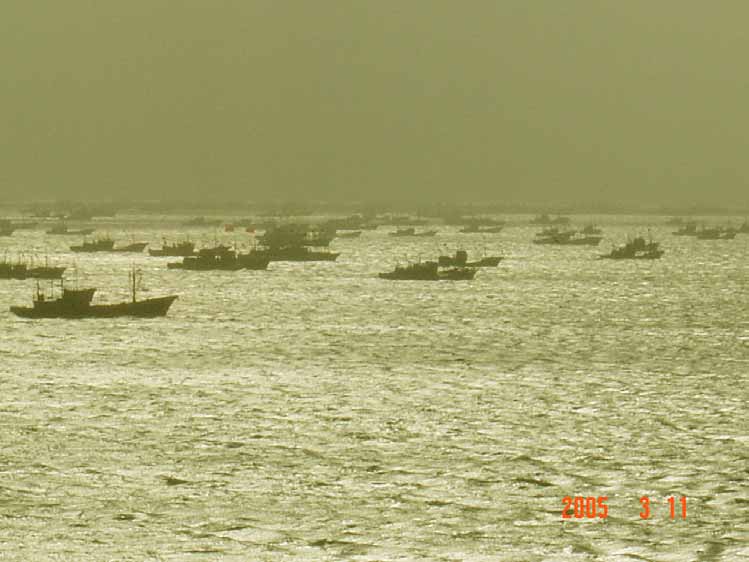
Fishing boats on the Yellow Sea near Jeju Island in the southern part
of Republic of Korea, March 2005. Courtesy of Mr. Yihang JIANG.
REDUCING ENVIRONMENTAL STRESS
IN THE YELLOW SEA
LARGE MARINE ECOSYSTEM
Report of the First Meeting of the
Regional Working Group for the Ecosystem Component
UNDP/GEF Yellow Sea Project
Goeje, Republic of Korea, 10th to 13th May 2005

GEF
UNDP/GEF Project entitled "Reducing Environmental Stress in the
Yellow Sea Large Marine Ecosystem"
UNDP/GEF/YS/RWG-E.1/3
Date: 13 May 2005
English only
First Meeting of the Regional Working Group
for the Ecosystem Component
Goeje, Korea, 10-13 May 2005
Meeting Report
TABLE OF CONTENTS
1
OPENING OF THE MEETING ............................................................................................................ 1
1.1
WELCOME ADDRESSES................................................................................................................... 1
1.2
INTRODUCTION OF MEMBERS ........................................................................................................ 1
2
ORGANISATION OF THE MEETING .............................................................................................. 1
2.1
DESIGNATION OF OFFICERS .......................................................................................................... 1
2.2
DOCUMENTATION AVAILABLE TO THE MEETING........................................................................ 1
2.3
ORGANISATION OF WORK .............................................................................................................. 1
3
ADOPTION OF THE MEETING AGENDA ..................................................................................... 2
4
DRAFT TERMS OF REFERENCE FOR THE REGIONAL WORKING GROUP FOR
ECOSYSTEM (RWG-E)........................................................................................................................ 2
5
OVERALL PROJECT AND COMPONENT OBJECTIVES....................................................... 2
5.1
GENERAL DESCRIPTION OF ACTIVITIES CONTAINED IN THE PROJECT IMPLEMENTATION
PLAN .............................................................................................................................................. 2
5.2
REPORTING RESPONSIBILITIES OF THE RWG-E ....................................................................... 3
5.3
REQUIRED OUTPUTS AND OUTCOMES FROM THE 1ST RWG-E MEETING ............................. 3
6
DATA AND INFORMATION NEEDS FOR THE ECOSYSTEM COMPONENT................. 4
6.1
DISCUSSION ON YELLOW SEA ECOSYSTEM PROBLEMS, IDENTIFICATION OF DATA AND
INFORMATION REQUIREMENTS, AND AGREEMENT ON THEIR FORMAT.............................. 4
6.2
COUNTRY PRESENTATIONS ON AVAILABLE DATA/INFORMATION ON STATE OF THE
ECOSYSTEM, DATA REQUIREMENTS TO ESTIMATE CARRYING CAPACITY, CAUSAL
CHAIN ANALYSIS, INFORMATION GAPS FOR ECOSYSTEM STRESSORS ............................. 5
7
REQUIRED ACTIONS AND WORKPLAN ..................................................................................... 5
7.1
REQUIRED ACTIONS FOR TDA PREPARATION............................................................................ 5
7.2
INFORMATION GAPS AND ACTIONS REQUIRED FOR THE FIELD SURVEY ................................ 6
7.3
WORKPLAN FOR 2005 TO 2006.................................................................................................... 7
7.4
CO-OPERATION WITH OTHER PROJECT COMPONENTS AND RELEVANT ACTIVITIES IN THE
REGION.......................................................................................................................................... 7
8
OTHER BUSINESS................................................................................................................................ 8
9
DATE AND PLACE FOR NEXT RWG-E MEETING ................................................................... 8
10 ADOPTION OF THE MEETING REPORT...................................................................................... 8
11 CLOSURE OF THE MEETING........................................................................................................... 8
ANNEXES
Annex I
List of Participants
Annex II
Agenda
Annex III
Revised Terms of Reference for the UNDP/GEF Yellow Sea Project Regional
Thematic Working Group - Ecosystem
Annex IV
Data and Information Requirements for the Ecosystem Component and
Causal Chain Analysis for Yellow Sea Ecosystem-Related Problems
Annex V
Ecosystem Component Workplan 2005 to 2006
UNDP/GEF/YS/RWG-E.1/3
Page 1
1
OPENING OF THE MEETING
1.1 Welcome
addresses
1.1.1 On behalf of the United Nations Development Programme (UNDP) and United
Nations Office for Project Services (UNOPS), Mr. Yihang Jiang, Project Manager,
opened the meeting and welcomed the members of the Regional Working Group-
Ecosystem (RWG-E) and observers to Goeje. He informed participants of the
previous three Regional Working Group Meetings' (Pollution, Fisheries, Biodiversity)
results, and highlighted the objectives of this Meeting, namely, the data and
information collection, formulating a list of activities, and the workplan for the first two
years of project implementation.
1.1.2 On behalf of the Korea Ocean Research and Development Institute (KORDI), Mr.
Sinjae Yoo, welcomed all participants.
1.2
Introduction of members
1.2.1 RWG-E members and other participants were invited to introduce themselves and
give a brief introduction on their background and roles in the Project. The list of
participants is attached to this report as Annex I.
2
ORGANISATION OF THE MEETING
2.1
Designation of Officers
2.1.1 Mr. Mingyuan Zhu nominated Mr. Sinjae Yoo as Chairperson. Members agreed and
Mr. Yoo was duly elected as Chairperson. The PMO was responsible for secretariat
functions of the Meeting.
2.2
Documentation Available to the Meeting
2.2.1 Mr. Yoo invited the Secretariat to introduce this agenda item. Ms. Connie Chiang of
the Project Management Office (PMO) introduced the Meeting's working and
information documents prepared by the PMO, with a brief explanation on the Terms
of Reference (TOR) for the RWG-E and regional calculation cost that was discussed
further during the relevant agenda items.
2.2.2 Mr. Jiang drew the member's attention to Document UNDP/GEF/YS/RWG-E.1/6, on
a regional criteria to calculate activity costs. He stated that the other RWGs had felt
that this task was beyond their responsibility to decide. Nevertheless, members were
asked to consider this issue, such as to suggest some ways in which the costs for
activities might be calculated.
2.3
Organisation of Work
2.3.1 The PMO presented the provisional working programme for the Meeting (Document
UNDP/GEF/YS/RWG-E.1/inf.3), stating that this was a general guide for the Meeting.
The PMO added that the working programme was flexible, and could be changed
according to the Meeting's progress.
UNDP/GEF/YS/RWG-E.1/3
Page 2
2.3.2 The Chairperson informed the Meeting about the organisation of work. It was agreed
that, due to the nature of the agenda items to be discussed, the Meeting would be
organised in plenary as far as possible. Sessional working groups would be formed if
deemed necessary.
2.3.3 The meeting was conducted in English.
3
ADOPTION OF THE MEETING AGENDA
3.1
The Chairperson introduced the Provisional Agenda (Document UNDP/GEF/YS
/RWG-E.1/1) and Annotated Provisional Agenda (Document UNDP/GEF/YS/RWG-
E.1/2), prepared by the Project Management Office. The Chairperson emphasised
the three main focal areas for the Meeting: 1) terms of reference for the RWG-E; 2)
data and information collection; and 3) list of activities and workplan.
3.2
Mr. Jiang suggested that the members consider the joint survey cruise that is to be
carried out in January 2006 with the other RWGs. Members decided to discuss this
topic during Agenda Item 7.
3.3
Members also agreed to move Agenda Item 5.4, "Co-operation with other project
components and relevant activities in the region," to Agenda Item 7 (Required actions
and workplan), as these two issues were closely related.
3.4
Following the above decisions, members adopted the revised agenda that is
attached as Annex II to this report.
4
DRAFT TERMS OF REFERENCE FOR THE REGIONAL WORKING GROUP FOR
ECOSYSTEM (RWG-E)
4.1
Ms. Connie Chiang introduced the Terms of Reference (TOR) for the RWG-E, as
listed in the Project Document. She explained that from the time of writing the TOR
to the present, conditions of project implementation had changed. Members were
asked to review the TOR, and make suggestions to revise the TOR to better reflect
the current status of the RWG-E and Project objectives.
4.2
Members posed questions regarding the roles of the RWG, procedures to issue
activity contracts, TDA/SAP preparation, and the Priority Investment Portfolio, which
were duly clarified by the PMO staff. Members then carefully reviewed the RWG-E's
TOR, and made changes to the background, membership, meeting procedure, and
tasks.
4.3
Following the discussions, members agreed to the revised TOR to be submitted to
the Project Steering Committee (PSC) for approval. The revised TOR is attached to
this report as Annex III.
5
OVERALL PROJECT AND COMPONENT OBJECTIVES
5.1
General description of activities contained in the Project Implementation Plan
5.1.1 Due to the member's differences in familiarity of the Project, Ms. Chiang gave a
presentation on the Project, including the goals of producing the Transboundary
Diagnostic Analysis (TDA) and Strategic Action Programme (SAP), and highlighted
UNDP/GEF/YS/RWG-E.1/3
Page 3
the ecosystem component's activities. She also gave a brief introduction on the work
to be accomplished by the 1st RWG-E Meeting.
5.1.2 Ms. Young Shil Kang asked about the co-financing amounts from the governments.
The PMO explained the history and development of the Project, noting the increased
co-financing contribution by both governments during the 2nd Regional Technical
Meeting and the 1st meeting of the Project Steering Committee.
5.1.3 The members noted the information provided, in particular the relevant parts in
preparing the TDA and SAP.
5.2
Reporting responsibilities of the RWG-E
5.2.1 The Secretariat introduced Document UNDP/GEF/YS/RWG-E.1/inf.5, and gave an
overview on contracting procedures and reporting responsibilities of the contractors.
Members noted that as the Project operates within the framework of United Nations,
relevant UN rules and procedures should be followed.
5.2.2 Mr. Yoo posed the question on the different types of contracts that will be issued.
The PMO gave a brief explanation, and informed the members that the procedure to
carry out the contracts were the same, regardless of the types of contracts.
5.2.3 Mr. Jiang emphasised the bidding process used by the United Nations in issuing
contracts, and explained that this procedure is used to ensure a transparent contract-
issuing process, and to obtain the best value for money. He also explained that
countries could recommend a waiver of bidding with ample justification.
5.2.4 Mr. Yoo then asked how the PMO would proceed should the minimum number of
bids not be obtained. Mr. Jiang replied that a waiver of bidding would likely be
applied in these cases. He also mentioned that government's preferences for
contractors would be considered by the PMO and UNOPS, if submitted with
supporting statements and appropriate justifications.
5.2.5 The Meeting took note of the reporting requirements that will be applied during
implementation of project activities.
5.3
Required outputs and outcomes from the 1st RWG-E Meeting
5.3.1 Ms. Chiang introduced this agenda item, explaining the required outputs and
outcomes of this Meeting, and how the outputs would contribute to the later stages of
the Project, particularly the TDA/SAP development. Members were invited to
consider whether these outputs and outcomes are realistic for the Meeting to achieve
in four days.
5.3.2 Ms. Kang asked for clarification on the responsibilities of contractors in data and
information collection. Ms. Chiang explained that when the members considered the
required activities, they should also recommend specific tasks and/or responsibilities
for the contractors in carrying out the activities.
5.3.3 Mr. Jiang emphasised that: 1) the data and information requirements identified at the
meeting should include both natural and socio-economic data and information; and 2)
the causal chain analysis to be carried out would be a preliminary one. Any
UNDP/GEF/YS/RWG-E.1/3
Page 4
necessary improvement and finalisation would be done during the preparation of the
TDA when more data and information from participating countries are available.
6
DATA AND INFORMATION NEEDS FOR THE ECOSYSTEM COMPONENT
6.1
Discussion on Yellow Sea ecosystem problems, identification of data and
information requirements, and agreement on their format
6.1.1 The PMO presented Document UNDP/GEF/YS/RWG-E.1/5, and members were
invited to complete the table listing the problems, data and information requirements
to support or refute the problems, data format, and temporal and spatial scales of
data to be collected. An example of the causal chain and governance analysis tables
was also presented. Ms. Chiang then showed the data tables of the pollution,
fisheries, and biodiversity working groups to give the members an idea of the end
result, and how the completed table could steer the members to recommend the
necessary activities.
6.1.2 Mr. Jiang emphasised two points: 1) focus on identifying the problems and required
data and information; and 2) the causal chain analysis that the Meeting will deliberate
on is only a preliminary analysis, and will help to identify necessary socio-economic
and legal data and information.
6.1.3 The ensuing discussions to identify the ecosystem-related problems touched upon
various issues. Ms. Kang suggested that the members should define the scope of
the RWG-E's work. The Meeting felt that it would be appropriate to keep the scope
of RWG-E's work as wide as possible. However, at present, the collection of
required data and information should focus on lower trophic levels.
6.1.4 Mr. Daeseok Kang noted that the problems should focus on transboundary issues,
and that the term "transboundary" should also be clearly defined.
6.1.5 Mr. Jiang explained "transboundary" as defined by the Global Environment Facility:
1) an event originating from one side of a water body that will affect another side(s);
and 2) a problem that is a common phenomenon on more than one side.
6.1.6 Mr. Won Duk Yoon asked if the Project was limited to specific "borders" when
considering the ecosystem issues, e.g. should inland issues be considered.
Members agreed that "borders" would be problem-specific. Mr. Yoon also stated that
it would be important to define ecosystem and the types of indicators to determine
ecosystem change.
6.1.7 Mr. Jae-Sang Hong suggested that, as ecosystem problems were inter-related with
problems identified by other working groups, perhaps the Ecosystem Group could
use data from the other groups. He further stated that the types of habitats had to be
made clear from the onset.
6.1.8 Mr. Fangli Qiao suggested that the problems could focus on: 1) human-related
activities; 2) response of ecosystem to climate change; and 3) lack of evaluation
skills for ecosystem status.
6.1.9 Following the discussion, all members proposed problems and indicators to detect
each problem. When completing the causal chain and governance analysis,
members agreed that immediate and underlying causes should be related one-to-
one.
UNDP/GEF/YS/RWG-E.1/3
Page 5
6.1.10 All participants contributed their knowledge, and spent a sizeable amount of effort to
produce the table of required data and formats. Members also discussed the causal
chain and governance analysis and produced a preliminary causal chain analysis.
The agreed tables are attached to this report as Annex IV.
6.2
Country presentations on available data/information on state of the ecosystem,
data requirements to estimate carrying capacity, causal chain analysis,
information gaps for ecosystem stressors
6.2.1 Mr. Yoo asked if inter-calibration of the data would be a necessary exercise. Mr.
Jiang mentioned the pollution group's proposed inter-calibration exercises. Mr. Yoo
then reminded members to consider inter-calibration of the data when discussing the
actions to be taken.
6.2.2 The main topics under this agenda item were already discussed under other agenda
items, and are captured in the respective parts in this report.
7
REQUIRED ACTIONS AND WORKPLAN
7.1
Required actions for TDA preparation
7.1.1 Ms. Chiang introduced the Full Time Equivalent (FTE), as a proposed method for the
Project to have a regional guideline to calculate the costs of activities. She informed
the members of the background and rationale of this agenda item, namely it was a
task charged to the PMO by the 2nd Regional Technical Meeting. As mentioned
earlier, previous RWG meetings had felt that this task was beyond their
responsibility, and the FTE was introduced here just for information purposes.
7.1.2 Mr. Jiang added that this issue had been discussed by PMO, UNDP, and UNOPS,
and it would be more appropriate that a regional standard for calculating the costs
would not be used by the project. Calculating costs would be activity specific,
therefore the meeting only needed to review the list of activities agreed at the first
two regional technical meetings, but were flexible, and subject to revision.
7.1.3 Mr. Jiang emphasised that although the list of activities was flexible, the budget for
the component activities should be within the total budget approved by the PSC. He
also mentioned that the timeline for all activity implementation had been shifted to
begin after the first round of RWG meetings.
7.1.4 Mr. Yoo asked whether the collection of data and information was limited to TDA
preparation. Mr. Jiang explained that the data and information collected could be
used for other purposes, such as producing additional valuable reports, e.g. status of
the Yellow Sea ecosystem.
7.1.5 Mr. Yoo gave a brief history on how the list evolved from five years ago. Two
technical meetings had agreed to rearrange the structure in a more logical way. He
added that the current list of activities would address the trend in state of the
ecosystem through historical data review, assess current ecosystem status, and
evaluate the most significant stressors and corrective actions to take. Mr. Yoo further
mentioned that carrying capacity for this component is defined as productivity
potential, particularly of lower trophic levels, and will assist with assessment of
carrying capacity in fisheries resources.
UNDP/GEF/YS/RWG-E.1/3
Page 6
7.1.6 A brief visit was made to the data and information table to determine how much time
would be needed to complete each activity. The Meeting reviewed the requirements
for data and information, and examined whether the participating countries had
minimum data or not enough data for each problem identified. Additional notations
were added in the table to denote which items would be collected by the ecosystem
group, and which would be taken from the other groups.
7.1.7 Following the discussions and clarifications, members reviewed the list of activities
and actions required for preparation of the ecosystem component of the TDA.
Participants felt that the activities discussed and agreed during the 2nd Regional
Technical Meeting are appropriate for the first 2 years of project implementation, but
required some minor changes. Participants agreed that the timeline for the carrying
capacity activities should match that of the carrying capacity of the Fisheries
Component. The meeting made some changes in the list of activities, and agreed on
the activities, actions, and timetable during the first two years of project
implementation.
7.1.8 The revised agreed list of activities and workplan is attached to this report as Annex
V.
7.2
Information gaps and actions required for the field survey
7.2.1 Mr. Jiang reported on his discussions with the Chairperson of the RWG-Fisheries for
the joint cruise. He informed the meeting that:
(i) Initially, 6 cruises were planned in the original project document prepared 5 years
ago, but due to increase in oil prices and other costs, the Project budget allocated
for this purpose can afford only 2 cruises;
(ii) It was also agreed that joint cruises should be more appropriate with all relevant
project components, as this would be more cost efficient; and
(iii) After careful examination at the first two technical meetings, it was agreed to use
the Chinese research vessel, named "Bei Dou," belonging to the Yellow Sea
Fisheries Research Institute's, due to lower operational costs.
7.2.2 The survey would cover the entire Yellow Sea, but excluding the 12-mile territorial
area. The survey station settings and observation lines will depend on each RWG's
requirements. Tentative dates for the first survey will be 4 to 25 January 2006. The
second cruise is proposed for April May, as this is the spawning season for fish.
7.2.3 Mr. Jiang informed the Meeting that all coastal countries should be informed six
months before the cruise, according to United Nations Convention on the Law of the
Sea (UNCLOS). Therefore, the cruise plan should be sent to both governments for
approval.
7.2.4 Mr. Jiang also alerted the Meeting to the issue of bringing additional equipment from
Korea to the research vessel. As the boat will not land in Korea, due to logistic
difficulties, there would be a need for customs clearance in China, should any Korean
scientists need to bring additional equipment. Members noted that this issue needed
further examination.
UNDP/GEF/YS/RWG-E.1/3
Page 7
7.2.5 Mr. Yoo asked members to consider prioritising the data parameters to be collected.
He also mentioned the need of inter-calibration before or during the joint survey.
7.2.6 Members agreed that the Project Manager will inform all RWG Chairpersons, via e-
mail, of his discussions on the joint cruise, and will ask relevant RWG Chairpersons
to co-ordinate the technical and logistical requirements for each RWG. The
Chairperson agreed to co-ordinate amongst the members on the parameters to
collect from the joint cruise, and will produce a table listing the parameters for
members to review.
7.3
Workplan for 2005 to 2006
7.3.1 The Regional Working Group-Ecosystem's workplan for 2005-2006 was discussed,
amended and agreed. The workplan is included in Annex V.
7.4
Co-operation with other project components and relevant activities in the
region
7.4.1 The Chairperson invited members to introduce relevant national programmes and
projects to which the Project would co-operate with. Mr. Zhu mentioned the
upcoming national project in the southern part of the Yellow Sea coastal area in
China. The project will start next year for two years, comprising of four cruises.
7.4.2 Ms. Kang presented Korea's monitoring programmes that could co-operate with this
Project. She mentioned the four monitoring programmes on oceanographic
conditions, coastal environment, HAB, and small scale areas. She mentioned each
programme's monitoring schedules and the chemical, physical, and biological
parameters.
7.4.3 In terms of regional co-ordination, Mr. Jiang mentioned that the Project had signed a
Memorandum of Understanding with World Wide Fund for Nature's Yellow Sea Eco-
region Planning Programme.
7.4.4 Mr. Jiang informed the Meeting that the PMO was in the process of discussing co-
operative mechanisms with the UN Environment Programme's Northwest Pacific
Action Plan (NOWPAP). He informed participants that a NOWPAP HAB workshop
will be held in Toyama, Japan, and any members interested in attending could obtain
more information from the PMO or NOWPAP offices.
7.4.5 Mr. Jiang suggested that IOC/WESTPAC would be an organisation the Project
should consider approaching. He also mentioned that the Korea-China Joint Ocean
Research Center would be another good partner for the Project.
7.4.6 Participants engaged in a brief discussion on co-ordination among the Project
partners. It was noted that sharing of data and information, and having RWG
Chairpersons join other RWG meetings could be a start to addressing the cross
component issues. Members noted that good co-operation and co-ordination within
and beyond the Project partners would have long-term benefits to the scientific
community; thus, more co-operation and co-ordination should be encouraged.
UNDP/GEF/YS/RWG-E.1/3
Page 8
8 OTHER
BUSINESS
8.1
The Chairperson invited participants to raise any other issues that needed to be
considered by this meeting. There was no other business raised by the participants.
9
DATE AND PLACE FOR NEXT RWG-E MEETING
9.1
The Chairperson invited members to consider the date and place for the 2nd RWG-E
Meeting.
9.2
Members agreed to have the next RWG-E Meeting in Shanghai, China, 15 to 18
November 2005. The PMO will contact all members, should there be any changes.
10
ADOPTION OF THE MEETING REPORT
10.1 The Chairperson led the discussion of the draft meeting report prepared by the
Secretariat. The report was reviewed, amended, and adopted by the Meeting.
11
CLOSURE OF THE MEETING
11.1 The Chairperson thanked all participants from China and Korea and the PMO staff
for their hard work. He declared the Meeting a success, as the tasks of the RWG-E
had been made clearer after the discussions.
11.2 On behalf of all participants, Mr. Jiang thanked the Chairperson for his leadership.
He also thanked all participants for their contributions to the discussions.
11.3 The Meeting closed at 11:20 hours on 13th May 2005.
UNDP/GEF/YS/RWG-E.1/3
Annex I
Page 1
Annex I
List of Participants
People's Republic of China
Mr. QIAO Fangli
Mr. ZHU Mingyuan
Deputy Director
Professor
First Institute of Oceanography, SOA
First Institute of Oceanography, SOA
6 Xianxialing Road Hi-Tech Industrial Park
6 Xianxialing Road Hi-Tech Industrial Park
Qingdao, Shandong 266061
Qingdao, Shandong 266061
Tel: 86-532-8896-7400
Tel: 86-532-8896-7447
Fax: 86-532-8896-5544
Fax: 86-532-8896-7548
Email: qiaofl@fio.org.cn
Mobile: 86-136-0898-3422
Email: myzhu@public.qd.sd.cn
Mr. ZHANG Xuelei
Associate Professor
First Institute of Oceanography, SOA
6 Xianxialing Road Hi-Tech Industrial Park
Qingdao, Shandong 266061
Tel: 86-532-8896-7476
Fax: 86-532-8896-7548
Email: zhangxl@fio.org.cn
Republic of Korea
Mr. YOO Sinjae
Mr. HONG Jae-Sang
Director
Professor
Marine Living Resources Research Division
Department of Oceanography
Korea Ocean Research and Development
Inha University
Institute (KORDI)
Incheon 402-701
1270 Sa-dong Sangnok-gu Ansan-si
Tel: 82-32-860-7705
Gyeonggi-do 426-744
Fax: 82-32-863-7468
Tel: 82-31-400-6221
Email: jshong@inha.ac.kr
Fax: 82-31-408-5934
Email: sjyoo@kordi.re.kr
Ms. KANG Young Shil
Mr. KANG Daeseok
Chief, Fisheries Resources and Marine
Professor
Environment Team
Div. of Environmental System Engineering
West Sea Fisheries Research Institute
Pukyung National University
(NFRDI)
599-1 Daeyeon 3-dong, Nam-gu
707, Eulwang-dong, Jung-gu
Busan 608-737
Incheon 400-420
Tel: 82-51-620-6442
Tel : 82-32-745-0550
Fax: 82-51-621-8168
Fax : 82-32-745-0549
E-mail: dskang@pknu.ac.kr
E-mail : yskang@nfrdi.re.kr
UNDP/GEF/YS/RWG-E.1/3
Annex I
Page 2
Project Management Office (PMO)
Mr. Yihang JIANG
Ms. Connie CHIANG
Project Manager
Environment Officer
UNDP/GEF Yellow Sea Project
UNDP/GEF Yellow Sea Project
Korea Ocean Research and Development
Korea Ocean Research and Development
Institute
Institute
1270 Sa-dong Sangnok-gu Ansan-si
1270 Sa-dong Sangnok-gu Ansan-si
Gyeonggi-do 426-744
Gyeonggi-do 426-744
Republic of Korea
Republic of Korea
Tel: 82-31-400-7825
Tel: 82-31-400-7833
Fax: 82-31-400-7826
Fax: 82-31-400-7826
email: yihang@yslme.org
email: connie@yslme.org
Mr. Sungjun PARK
Mr. Kapsung Song
Finance & Administrative Officer
Driver
UNDP/GEF Yellow Sea Project
UNDP/GEF Yellow Sea Project
Korea Ocean Research and Development
Korea Ocean Research and Development
Institute
Institute
1270 Sa-dong Sangnok-gu Ansan-si
1270 Sa-dong Sangnok-gu Ansan-si
Gyeonggi-do 426-744
Gyeonggi-do 426-744
Republic of Korea
Republic of Korea
Tel: 82-31-400-7828
Tel: 82-31-400-7828
Fax: 82-31-400-7826
Fax: 82-31-400-7826
email: sungjun@yslme.org
email: kapsung@yslme.org
Observers
Mr. YOON Won Duk
Mr. KWON Kee-Young
Research Scientist
Research Scientist
Ocean Research Team
Marine Harmful Organisms Research Team
National Fisheries Research & Development
National Fisheries Research &
Institute
Development Institute
408-1, Shirang-ri, Gijang-eup, Gijiang-gun
408-1, Shirang-ri, Gijang-eup, Gijiang-gun
Busan, 619-902, Korea
Busan, 619-902, Korea
Tel: 82-51-720-2227
Tel: 82-51-720-2264
Fax: 82-51-720-2225
Fax: 82-51-720-2266
email: wdyoon@nfrdi.re.kr
email: kwonky@momaf.go.kr
Mr. LEE Chang-Kyu
Senior Researcher
Marine Harmful Organisms Research Team
National Fisheries Research & Development
Institute
408-1, Shirang-ri, Gijang-eup, Gijiang-gun
Busan, 619-902, Korea
Tel: 82-51-720-2520
Fax: 82-51-720-2266
email: cklee@nfrdi.re.kr
UNDP/GEF/YS/RWG-E.1/3
Annex II
Page 1
Annex II
Agenda
1.
OPENING OF THE MEETING
1.1 Welcome
addresses
1.2 Introduction
of
members
2.
ORGANISATION OF THE MEETING
2.1 Designation
of
Officers
2.2
Documentation Available to the Meeting
2.3
Organisation of Work
3.
ADOPTION OF THE MEETING AGENDA
4.
DRAFT TERMS OF REFERENCE FOR THE REGIONAL WORKING GROUP
FOR ECOSYSTEM (RWG-E)
5.
OVERALL PROJECT AND COMPONENT OBJECTIVES
5.1
General description of activities contained in the Project Implementation
Plan
5.2
Reporting responsibilities of the RWG-E
5.3
Required outputs and outcomes from the 1st RWG-E Meeting
6.
DATA AND INFORMATION NEEDS FOR THE ECOSYSTEM COMPONENT
6.1
Discussion on Yellow Sea ecosystem problems, identification of data and
information requirements, and agreement on their format
6.2
Country presentations on available data/information on state of the
ecosystem, data requirements to estimate carrying capacity, causal chain
analysis, information gaps for ecosystem stressors
7.
REQUIRED ACTIONS AND WORKPLAN
7.1
Required actions for TDA preparation
7.2
Information gaps and actions required for the field survey
7.3
Workplan for 2005 to 2006
7.4
Co-operation with other project components and relevant activities in the
region
8. OTHER
BUSINESS
9.
DATE AND PLACE FOR NEXT RWG-E MEETING
10.
ADOPTION OF THE MEETING REPORT
11.
CLOSURE OF THE MEETING
UNDP/GEF/YS/RWG-E.1/3
Annex III
Page 1
Annex III
Revised Terms of Reference for the UNDP/GEF Yellow Sea Project
Regional Thematic Working Group - Ecosystem
Background:
To facilitate the achievement of the goals and objectives of the YSLME Project, Regional
Thematic Working Groups (RWG) for each component (Ecosystem, Biodiversity, Fisheries,
Pollution, and Investment) shall be established with overall responsibility for ensuring
effective management and implementation of project activities.
Membership:
Each of the five RWGs will include:
· four scientists (social and natural), two from each country;
· two additional experts drawn from the legal, regulatory, investment, and/or
environmental management fields, one from each country;
· One additional expert will be elected and serve as the Chairperson, as agreed in the
Project Document;
· The Working Group Chairpersons will be members of the Regional Science and
Technical Panel.
Working modalities:
Each RWG will represent the regional perspective. Working "without walls," the RWGs will
communicate primarily through email, with one or two working meetings annually. Each
RWG will operate on a consensus basis. The RWGs report to the Regional Scientific and
Technical Panel through the Chairperson.
Meetings:
The Project Management Office, in consultation with the Chairpersons, shall convene
meetings of the RWGs according to an agreed schedule. The RWG Meetings should be
included as part of the agreed work plan and timetable of the Project.
The Project Management Office shall act as Secretariat to the RWGs, and shall ensure that
reports of the meetings and other activities are circulated to all members of the working
groups, and are copied to the members of the RSTP.
Tasks:
· Co-ordinate relevant activities and contribute scientific knowledge in the area of
expertise to the development of the TDA
· Assist in development of the Regional Strategic Action Programme (SAP) and
National Yellow Sea Action Plans (NYSAPs), and implementation of agreed
demonstration/pilot activities
· Contribute to the development of the Priority Investment Portfolio (PIP)
· Provide technical inputs/comments for the project workplans in their respective areas
of competency
· Develop annual and quarterly work plans and assist with implementing activities in
respective thematic area, based on and fully integrated in the project workplan
UNDP/GEF/YS/RWG-E.1/3
Annex III
Page 2
· Monitor and evaluate the implementation through reviewing the annual and quarterly
progress reports, and provide advice where necessary
· Be responsible for regional coordination within area of competency
· Facilitate creation of effective national thematic network
· Identify the needs for necessary capacity building and training for all stakeholders of
the Project, and facilitate implementation of identified activities on capacity building
and training
· Assist, through the Chair, in effective Project Management by assisting with
scheduling, scoping, and budgeting for various interlinked activities
· Contribute scientific and technical advice to the formulation of proposals for national
and regional actions and donor funding to continue implementation of approved SAP
· Liaise closely with PMO
MAJOR RESPONSIBILITIES OF REGIONAL THEMATIC WORKING GROUPS
4. Ecosystem Management Working Group
Location of WG Chair: Republic of Korea
Tasks:
· Assess the status and trend of the Yellow Sea ecosystem. Identify data and
information gaps and develop strategies for better assessment.
· Establish regional scientific and technical framework for monitoring the changing
status of the Yellow Sea ecosystem.
· Assess the carrying capacities of the Yellow Sea ecosystem under changing human-
induced and natural variabilities.
· Identify stressors to the Yellow Sea ecosystem, and recommend corrective measures
to minimize the human-induced stresses to the ecosystem. Facilitate development
and implementation of regional policies and legal measures.
UNDP/GEF/YS/RWG-E.1/3
Annex IV
Page 1
Annex IV
Data & Information Requirements for the Ecosystem Component and
Causal Chain Analysis for Yellow Sea Ecosystem-Related Problems
Table 1. Data and information requirements.
ROK Has
PRC Has
Spatial
Data? (Y, N,
Data? (Y, N,
Kinds of data
Temporal
Scale (W, C, TP, SP, taxP, TP, SP, taxP,
Problems Indicators
needed Data
Format
Scale
O)*
?)**
?)**
Change in
zooplankton***,km,
composition
seasonal for
ecosystem structure cm
(biodiversity)
species list
decadal
W
tax P, SP
TP, SP
abundance
# per volume
"
"
tax P, SP
TP, SP
ash-free dry
TP, SP
weight per
Y (wet wt),
(mostly wet
biomass
volume
" W
SP, taxP
wt)
phytoplankton***,
composition
weekly for
kn, cm
(biodiversity)
species list
decadal
W
SP, TP
SP, TP
abundance
# per volume
"
"
SP, TP
SP, TP
biomass
chlorophyll a
"
"
SP, TP
SP, TP
benthic
composition
seasonal for
community***, km, cm
(biodiversity) species
list
decadal
W
SP, TP
SP, TP
abundance
# per area
"
"
SP, TP
SP, TP
ash-free dry
SP, TP (wet
SP, TP (wet
biomass
weight per area
"
"
wt)
wt)
HAB events***, km,
annual for
cm
species species
list
decadal
C, O
Y
SP, TP
density
# per volume
"
"
Y
SP, TP
area
sq km
"
"
Y
SP, TP
# events
events per year
"
"
Y
SP, TP
UNDP/GEF/YS/RWG-E.1/3
Annex IV
Page 2
ROK Has
PRC Has
Spatial
Data? (Y, N,
Data? (Y, N,
Kinds of data
Temporal
Scale (W, C, TP, SP, taxP, TP, SP, taxP,
Problems Indicators
needed Data
Format
Scale
O)*
?)**
?)**
duration
days
"
"
TP, SP
SP, TP
damage to fisheries
money lost
"
"
Y
SP, TP
jellyfish events***,
annual for
kn, cn species species
list
decadal W
SP,
TP
N
density
# per sq km
"
"
N
N
distribution
# per volume
"
"
N
N
duration
days "
"
N
N
trophic levels***, kn,
composition
seasonal for
cn
(biodiversity) species
list
decadal
W
SP, TP, tax P SP, TP, tax P
abundance
# per area
"
"
SP, TP, tax P SP, TP, tax P
phytoplankton
pigment wt per wt
HPLC
predator "
"
N
N
preys per
seasonal for
gut
content
stomach
every 3 yrs
" N N
phytoplankton
pigment wt per wt
predator, fatty
acid wt per wt
lipid
analysis
predator
" " N N
composition
seasonal for
fish community1
(biodiversity)
species list
decadal
W ? ?
abundance
# per area
"
"
?
?
seasonal for
marine mammals2
species, ,
species list
decadal W ? ?
distribution
# per area
"
"
?
?
population
size
population
"
"
?
?
UNDP/GEF/YS/RWG-E.1/3
Annex IV
Page 3
ROK Has
PRC Has
Spatial
Data? (Y, N,
Data? (Y, N,
Kinds of data
Temporal
Scale (W, C, TP, SP, taxP, TP, SP, taxP,
Problems Indicators
needed Data
Format
Scale
O)*
?)**
?)**
annual for
birds2
species,
species list
decadal
C ? ?
distribution
# per area
"
"
?
?
population
size
population
"
"
?
?
composition
species list, %
seasonal for
macro algae2
(biodiversity)
coverage
decadal
C
SP, TP
SP, TP
abundance
# per area
"
"
SP, TP
SP, TP
ash-free dry
weight per
biomass
volume
"
"
SP, TP
SP, TP
seasonal for
seagrass species
species
list
decadal C N N
distribution
aereal
coverage
"
"
N
N
area
dry wt per sq m
"
"
N
N
wet /dry wt per
biomass
unit area
" " N
N
Change in
primary
ecosystem
productivity***,
Carbon weight
seasonal for
productivity
km, cm
primary production
per sq m per day
decadal
W
SP, TP
SP, TP
chlorophyll a
chl a wt per vol
"
"
SP, TP
SP, TP
Carbon weight
secondary
secondary
per sq m per mth
seasonal for
productivity***, kn, cn
production
or yr
decadal
W N N
benthic
community
C wt per sq m per seasonal for
production***, kn, cn
production
yr
decadal
W tax
P
N
UNDP/GEF/YS/RWG-E.1/3
Annex IV
Page 4
ROK Has
PRC Has
Spatial
Data? (Y, N,
Data? (Y, N,
Kinds of data
Temporal
Scale (W, C, TP, SP, taxP, TP, SP, taxP,
Problems Indicators
needed Data
Format
Scale
O)*
?)**
?)**
bacterial / micro
microbial loop
zooplankton
Carbon weight
seasonal for
production***, kn, cn
production
per sq m per day
decadal W N N
ON, OC per
sediment profiles
depth of
for POC PON
profiles
sediment column
decadal O N N
sediment dating
Pb-210 dating
N
N
change in habitat
aereal coverage and
annual for
Habitat modification areas and types2
type
sq km, types
decadal
C
N
TP,
SP
physical
characteristics of
monthly for
habitat***, km, cm
temperature deg
C
decadal
C, O
SP, TP
SP, TP
salinity
psu
"
"
TP, SP
TP, SP
cm per sec,
curren
t
direction
"
"
TP, SP
TP, SP
transparency
m
"
"
TP, SP
TP, SP
chemical
characteristics of
monthly for
habitat3
nutrients
wt per vol
decadal
C, O
TP, SP
TP, SP
DO
% saturation
"
"
TP, SP
TP, SP
pH
pH
"
"
TP, SP
TP, SP
SS
mg per vol
"
"
TP, SP
TP, SP
sedimentary
characteristics of
seasonal for
habitat***, km, cm
sediment types
types
decadal
W
SP, TP
SP, TP
UNDP/GEF/YS/RWG-E.1/3
Annex IV
Page 5
ROK Has
PRC Has
Spatial
Data? (Y, N,
Data? (Y, N,
Kinds of data
Temporal
Scale (W, C, TP, SP, taxP, TP, SP, taxP,
Problems Indicators
needed Data
Format
Scale
O)*
?)**
?)**
redox
potential
mvolt
"
"
N
?
grain size
mm
"
"
TP, SP
TP, SP
Notes: * W=entire Yellow Sea; C=coastal area; O=offshore
** Y=have data; N=do not have data; TP=have partial temporal data; SP=have partial spatial data; taxP=taxonomically coarse; ?=not sure
***=RWGE will collect data
1=get data from RWGF; 2=get data from RWGB; 3=get data from RWGP
cm = China has minimum data for the indicator; km = Korea has minimum data for the indicator
cn = China does not have enough data for the indicator; kn = Korea does not have enough data for the indicator
UNDP/GEF/YS/RWG-E.1/3
Annex IV
Page 6
Table 2. Preliminary causal chain analysis.
Immediate
Environmental
Socio-economic
causes
Underlying
Root
Governance
Problem
Impacts
impacts
(technical)
causes
causes
analysis
Legal data
reduction in value of loss in
Change in ecosystem commercial fishery
fisherman's
refer to
structure
resources
income
pollution
refer to RWGP
RWGP
inc demand for
fishery
loss of aesthetic
products,
inadequate fisheries
changes in benthic
and recreational
over
illegal fishing
refer to
management,
refer to
resources
value for tourism
harvesting
activities
RWGF
enforcement of laws RWGF
loss in
fisherman's
oceanographic regional
climate
income
conditions
climate system
change
relevant
national
laws,
inc in cargo
lack of ballast water
regulations,
traffic,
regulation
articles,
loss of aesthetic
introduced
(national)?,
acts,
changes in
and recreational
introduction of
species for
regulations on
strategies,
biodiversity
value for tourism
exotic species
aquaculture
exotic species
plans
changes in
insufficient
land use
investment plans,
patterns,
lack of guidelines for
loss of potential
insufficient
population
agricultural
value of
treatment,
inc in
practices, lack of
biological
increased use
coastal
appropriate
resour
ces
eutrophication
of fertilizers
areas
development plans
"
increased
vulnerability to
decreased
harmful marine
threats to human
freshwater
damming,
economic
inappropriate
organisms
health
input
diversion
expansion
investment plans
"
decrease in
fisheries
urbanisation
"
UNDP/GEF/YS/RWG-E.1/3
Annex IV
Page 7
Immediate
Environmental
Socio-economic
causes
Underlying
Root
Governance
Problem
Impacts
impacts
(technical)
causes
causes
analysis Legal
data
consumption
increased
increased
vulnerability to
management
demand for
population,
perturbation
costs
aquaculture
fishery product lifestyle
refer to RWGF
"
increased
Change in ecosystem deteriorating water
management
productivity
quality
costs
pollution
refer to RWGP
refer RWGP
relevant
national
laws,
regulations,
articles,
loss of aesthetic
change in land increased
acts,
and recreational
increased
use,
demand for
lack of appropriate
strategies,
value for tourism
sediment input construction
land
development plans
plans
lack of appropriate
urbanisation
understanding of
natural and
,
processes,
source and sink
vulnerability to
atmospheric
anthropogenic
desertificati
insufficient
capacity
natural disasters
deposition
sources
on
investment
"
change in
nutrient
availability &
construction,
freshwater
damming,
economic
inappropriate
input
diversion
expansion
investment plans
"
loss in
fisherman's
inappropriate
fishery recruitment
income
investment plans
"
inadequate capacity
loss of
oceanographic regional
climate
in prediction and
employment
conditions
climate system
change
preparedness
"
UNDP/GEF/YS/RWG-E.1/3
Annex IV
Page 8
Immediate
Environmental
Socio-economic
causes
Underlying
Root
Governance
Problem
Impacts
impacts
(technical)
causes
causes
analysis Legal
data
damming,
diversion,
construction
change in coastal
loss of cultural
change in
activities on
pop, econ
lack of appropriate
Habitat modification
landscape
resources
sediment input land
expansion
development plans
"
inc. in demand
insufficient
loss of spawning
loss in
for
enforcement,
and nursery
fisherman's
sand
construction
pop, econ
inappropriate
grounds
income
extraction
materials
expansion
management
"
loss of aesthetic
inc. demand
and recreational
bottom
for demersal
refer to
insufficient
refer to
biodiversity
value for tourism
trawling
fish
RWGF
enforcement
RWGF
relevant
national
laws,
regulations,
loss of potential
population,
articles,
value of
coastal
urbanisation
acts,
biological
development
inc land
, econ
lack of appropriate
strategies,
resources
(reclamation)
demand
expansion
development plans
plans
loss of aesthetic
and recreational
habitat diversity
value for tourism
vulnerability to
natural disasters
Note: thick lines around immediate and underlying causes show a one-to-one relationship between each immediate cause and its underlying cause.
UNDP/GEF/YS/RWG-E.1/3
Annex V
Page 1
Annex V
Ecosystem Component Workplan 2005 to 2006
Activities 200
5
200
6
200
7
200
8
200
9
Q1 Q2
Q3
Q4
Q1
Q2
Q3
Q4
Q1
Q2 Q3
Q4
Q1 Q2 Q3
Q4
Q1 Q2 Q3
Q4
Prepare final TDA
Regional SAP
Natl SAP
Demonst of reg. SAP
Annual Project Steering Comm.
Meetings
Regional STC
Contract to relevant national
institution(s) collect data & Inf.
Processing existing raw data
Establish a regional editorial group
/or use the WG
Prepare a draft report (consultant)
Activity 1 Discuss the draft (WG meeting 2)
em
Revise the draft report (consultant
finalise the draft report (WG
meeting 3)
f
Ecosyst
Prepare synthesis of the national
s
o
assessment, and identify the info
gaps (consultant)
Statu
Prepare draft strategy, including:
parameters, analysis,
intercalibration, data exchange
etc.
Activity 2 Discussion the draft (WG meeting
3)
Revise the draft
finalise the strategy (WG meeting
3)
UNDP/GEF/YS/RWG-E.1/3
Annex V
Page 2
Activities 200
5
200
6
200
7
200
8
200
9
Q1 Q2
Q3
Q4
Q1
Q2
Q3
Q4
Q1
Q2 Q3
Q4
Q1 Q2 Q3
Q4
Q1 Q2 Q3
Q4
Contract to relevant national
institution(s)
Application of remote sensing
Activity 3 Ship-of-opportunities monitoring.
Molecular probes.
Contract to relevant national
institution(s)
m
te
Discuss and coordinate with
ys
fisheries WG (joint workshop).
os
Activity 1 Decide on the assessment
methods of carrying capacity
of Ec
Training on carrying capacity
c
i
ty
Conduct a basin-scale survey on
pa
Act 2 lower-trophic level ecosystem.
i
ng Ca
Prepare a regional synthesis
rry
(consultant)
Ca
Act 3 Finalisation national outputs and
synthesis
Contract to relevant national
institution(s)
em
Present outcomes of ranking, data
and info in WG meeting 2
syst
Prepare a regional synthesis
(consultant)
Eco
Activity 1 Finalisation national outputs and
r
s to
synthesis (WG meeting 2)
s
o
Publish the outcomes (printing)
Stres
Inputs to final TDA
Identify major human induced
Act 2 stresses (contract)
UNDP/GEF/YS/RWG-E.1/3
Annex V
Page 3
Activities 200
5
200
6
200
7
200
8
200
9
Q1 Q2
Q3
Q4
Q1
Q2
Q3
Q4
Q1
Q2 Q3
Q4
Q1 Q2 Q3
Q4
Q1 Q2 Q3
Q4
Causal chain analysis (contract)
Identify measures to address the
root causes (WG meeting 3)
Inputs to final TDA
Prepare draft strategy, including:
parameters, analysis,
intercalibration, data exchange
etc.
Discussion the draft (WG meeting
4)
Activity 3 Revise the draft
finalise the strategy (WG
meeting4)
Prepare a format for nat'l strategy-
PMO
Prepare natl strategy (contract)
discussing natl strategy (WG
meeting 5)
Revise natl strategy (contract)
Prepare regional draft strategy
(consultant)
finalise natl strategy (WG mtg 5)
Activity 4 discussing reg. strategy (WG mtg
5)
finalise reg strategy (WG meeting
6)
Inputs to natl & reg SAP
Implement SAP
GEF
Global Environment Facility
United Nations Development Programme
Reducing Environmental Stress
in the Yellow Sea Large Marine Ecosystem
UNDP/GEF Yellow Sea Project Management Office
c/o Korea Ocean Research and Development Institute
1270, Sa-2dong, Sangnok
Ansan City 426-744
Republic of Korea
Tel. 82-31-400-7829
Fax. 82-31-400-7826
www.yslme.org
For a copy of the publication, please contact the Project Management Office
info@yslme.org