Regional Working Group Report
BIODIVERSITY
UNDP/GEF Project Entitled "Reducing
Environmental Stress
in the Yellow Sea Large Marine Ecosystem"
Report of First Meeting
Qingdao, China, 19~22 April 2005
GEF
About this publication:
This publication contains the report of the First Meeting of the Regional Working Group for
the Biodiversity Component, under the UNDP/GEF Project, "Reducing Environmental Stress
in the Yellow Sea Large Marine Ecosystem." The report includes a summary of the
discussions and agreements from the Meeting. Data and information to be collected for the
Yellow Sea Transboundary Diagnostic Analysis are listed in the Annex to the report.
For reference purposes, this report may be cited as:
UNDP/GEF 2005. Reducing Environmental Stress in the Yellow Sea Large Marine
Ecosystem. Report of the First Meeting of the Regional Working Group for the Biodiversity
Component. UNDP/GEF/YS/RWG-B.1/3.
Photo credits:
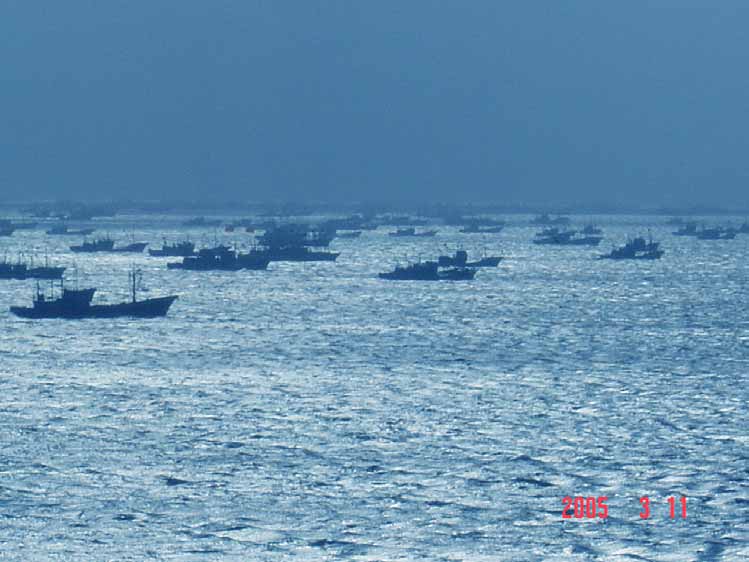
Fishing boats on the Yellow Sea near Jeju Island in the southern part
of Republic of Korea, March 2005. Courtesy of Mr. Yihang JIANG.
REDUCING ENVIRONMENTAL STRESS
IN THE YELLOW SEA
LARGE MARINE ECOSYSTEM
Report of the First Meeting of the
Regional Working Group for the Biodiversity Component
UNDP/GEF Yellow Sea Project
Qingdao, China, 19th to 22nd April 2005

GEF
UNDP/GEF PROJECT ENTITLED "REDUCING ENVIRONMENTAL STRESS IN THE
YELLOW SEA LARGE MARINE ECOSYSTEM"
UNDP/GEF/YS/RWG-B.1/3
Date: 22 April 2005
English only
First Regional Working Group Meeting
For the Biodiversity Component of
the UNDP/GEF Yellow Sea Project
Qingdao, China, 19-22 April, 2005
Meeting Report
TABLE OF CONTENTS
1. OPENING OF THE MEETING ........................................................................................ 1
1.1
WELCOME ADDRESSES..................................................................................................... 1
1.2
INTRODUCTION OF THE MEMBERS ................................................................................. 1
2. ORGANISATION OF THE MEETING............................................................................. 1
2.1
DESIGNATION OF OFFICERS............................................................................................. 1
2.2
DOCUMENTATION AVAILABLE TO THE MEETING ......................................................... 2
2.3
ORGANISATION OF WORK ................................................................................................ 2
3. ADOPTION OF THE MEETING AGENDA ..................................................................... 3
4. DRAFT TERMS OF REFERENCE, MEMBERSHIP AND RULES OF PROCEDURE
FOR THE REGIONAL WORKING GROUP FOR BIODIVERSITY (RWG-B) ........................ 3
5. OVERALL GOALS AND OBJECTIVES OF THE BIODIVERSITY COMPONENT........ 5
6. CO-OPERATION WITH OTHER PROJECT COMPONTENTS AND RELEVANT
ACTIVITIES IN THE REGION ................................................................................................ 7
7. REVIEW AND EVALUATION OF NATIONAL PRACTICES OF HABITAT AND
VULNERABLE SPECIES CONSERVATION......................................................................... 8
8. REVIEW AND EVALUATION OF INTRODUCED SPECIES OUTPUTS ACCORDING
TO WORKPLAN..................................................................................................................... 9
9. DISCUSSION AND ADOPTION OF ACTIVITIES COSTINGS AND WORKPLAN...... 10
10. OTHER BUSINESS ...................................................................................................... 11
11. VENUE FOR NEXT REGIONAL WORKING GROUP MEETING ................................ 11
12. ADOPTION OF THE MEETING REPORT.................................................................... 12
13. CLOSURE OF THE MEETING ..................................................................................... 12
ANNEXES
Annex I
List of Participants
Annex II
List of Acronyms Used in Documentation and Presentations
Annex III
Agenda
Annex IV
Revised Terms of Reference for the UNDP/GEF Yellow Sea Project Regional
Thematic Working Group - Biodiversity
Annex V
Data and Information Requirements for the Biodiversity Component
Annex VI
Causal Chain Analysis for Yellow Sea Biodiversity-Related Problems
Annex VII
Biodiversity Component Revised List of Activities
Annex VIII
Biodiversity Component Workplan 2005 to 2006
UNDP/GEF/YS/RWG-B.1/3
Page 1
1.
OPENING OF THE MEETING
1.1 Welcome
Addresses
On behalf of the UNDP/GEF Yellow Sea project, Mr. Yihang Jiang, Project Manager
of the UNDP/GEF Yellow Sea Large Marine Ecosystem (YSLME) Project opened the
meeting and welcomed all participants to Qingdao. He briefly introduced the
background of the project and the objectives of the 1st meeting of the Regional
Working Group for the Biodiversity Component (RWG-B) of the YSLME Project.
1.1.1 Mr. Jiang explained the major outcomes of the Project, namely, the development of
the Transboundary Diagnostic Analysis (TDA), Strategic Action Plan (SAP), and
National Strategic Action Plans. This Meeting will focus on the process for TDA
preparation, but we should also keep in mind the activities required for the
development of the SAP.
1.1.2 Mr. Jiang noted that the preliminary TDA information was a bit out of date. The
preliminary TDA was prepared for the Global Environment Facility (GEF) Council to
understand the project document before approving Project. The final TDA, to be
produced, needs updated data and information. Therefore, an important task of the
Regional Working Group (RWG) meeting is to discuss and agree on identifying
Biodiversity-related problems of the Yellow Sea, on the types of information to
support the identified problems, and on the format of the collected information, and
propose activities to gather additional required data.
1.1.3 Mr. Qiao Fang Li, Deputy Director of the First Institute of Oceanography, State
Oceanographic Administration, People's Republic of China, gave a welcome
message on behalf of his institute. He welcomed all members to 1st Regional
Working Group meeting and commented that it was an important moment as it was
the first time that China and Korea have come together for the conservation of the
Yellow Sea. He mentioned that `we must collectively do much to protect the Yellow
Sea', and that this important cooperation of the participating countries will allow a
much better understanding of how to achieve this.
1.2
Introduction of the members
1.2.1 Participants of the regional working group attending the meeting were invited to
introduce themselves and each gave a brief introduction of their expertise and
experience, to the group. The list of participants is attached to this report as Annex I.
2.
Organisation of the Meeting
2.1
Designation of Officers
2.1.1 Mr. Chen Shang, a member from China nominated Mr. Lee Yoon, Director, Plankton
Ecology Division of the National Fisheries Research and Development institute
(NFRDI) of the Ministry of Maritime Affairs and Fisheries (MOMAF), for the position of
Chair. Mr. Lee was elected as the Chair of the meeting.
2.1.2 Mr. Lee accepted his new post and welcomed the members of the RWG. He noted
the presence of the observers and remarked that it was good to have them there as
the working group would only derive benefit from their additional input.
UNDP/GEF/YS/ RWG-B.1/3
Page 2
2.1.3 Mr. Lee asked if the Project Management Office (PMO) could act as the secretary to
the meeting and Mr. Archer of the PMO agreed.
2.1.4 Mr. Lee referred to the agenda and voiced his confidence that the group would be
able to handle, and accomplish the large amount of work as set in the agenda
schedule.
2.1.5 Mr. Jiang added that although the RWG has set its members already, observers
were invited to provide inputs. He explained that the meeting would be a good
chance for young scientists to learn good science, and the TDA/SAP processes. He
suggested that in future more observers should be invited to contribute and learn
from the meeting. The members of the group agreed to invite and allow observers to
attend and contribute to future meetings.
2.2
Documentation Available to the Meeting
2.2.1 The Chair invited the Secretariat to introduce the documents prepared for the
meeting.
2.2.2 Mr. Jeffrey Archer, Fisheries & Biodiversity Officer of the YSLME Project
Management Office (PMO) introduced the list of documents (UNDP/GEF/YS/RWG-
B.1/inf.1) and informed the meeting that the documents in front of the group included
the discussion documents; Expected Outcomes and Outputs of the meeting, Data
and Information Requirements of the TDA, and a Proposal for the Regional
Calculation of the Costs of Project Activities; and informational documents including;
Provisional Terms of Reference, Financial Reporting Procedures and Requirements
for the Regional Working Group for the Biodiversity Component. Also included were
the Report of the First technical Meeting on Preparation of the Implementation Plan
for the UNDP/GEF Yellow Sea Project, the Report of the Second Technical Meeting
on the Preparation of the Implementation Plan for the UNDP/GEF Yellow Sea
Project, and the Report of the First Project Steering Committee Meeting.
2.2.3 Mr. Archer also indicated that there was an additional document provided to the
meeting Which was a list of abbreviations requested by the Fisheries Working
Group during a previous meeting for clarification and reference for the commonly
used abbreviations and Acronyms used by the PMO in documentation and during
presentations. This list is attached in Annex II.
2.3
Organisation of Work
2.3.1 Mr. Archer introduced the document UNDP/GEF/YS/RWG-B.1/inf.3 describing the
Provisional Working Programme for the meeting and noted that the meeting would be
conducted in plenary as far as possible although sessional working groups could be
formed as deemed necessary.
2.3.2 Mr. Jiang mentioned that there may be a requirement to modify the schedule slightly
to include a presentation from representatives of the WWF organisation on the
WWF/KORDI/KEI Yellow Sea Eco-Region Planning Programme (YSEPP) workshop,
which finished the day before this meeting, when they arrived later that morning.
2.3.3 All agreed to the current schedule of work as arranged by the Secretariat with the
understanding that YSEPP inputs would be accommodated in one of the later time
allocations. The finalized agenda can be found as Annex III.
UNDP/GEF/YS/ RWG-B.1/3
Page 3
2.3.4 Mr. Jiang offered his thanks to the First Institute of Oceanography (FIO) for their
generous support and facilitation of logistics for the meeting.
3.
ADOPTION OF THE MEETING AGENDA
3.1
The Chair invited participants to consider the Provisional Agenda (Document
UNDP/GEF/YS/RWG-B.1/1) and Annotated Provisional Agenda (Document
UNDP/GEF/YS/RWG-B.1/2), prepared by the Secretariat, and to propose any
amendments or additions that they might wish.
3.2
Mr. Jiang discussed agenda item 9 `Discussion and Adoption of Activities Costings
and Workplan', stating that although the PMO would give a presentation on this, the
issue would be complex and is beyond the scope of the RWG members, and
recommended to leave this item for consideration by the higher level Project Steering
Committee (PSC). The group agreed to this suggestion.
4.
DRAFT TERMS OF REFERENCE, MEMBERSHIP AND RULES OF
PROCEDURE FOR THE REGIONAL WORKING GROUP FOR
BIODIVERSITY (RWG-B)
4.1
The Chair invited Mr. Archer to introduce document UNDP/GEF/YS/RWG-B.1/inf.4,
describing the Terms of References for the Regional Working Group on Biodiversity
prepared during the PDF-B phase.
4.2
Mr. Archer described the Implementation Structure of the YSLME Project, noting
specifically that the primary reporting requirements of the Regional Working Groups
(RWGs) are to the PMO, with some requirement to the National Project Co-ordinator
(NPC). Mr. Archer further noted that the PMO, in consultation with the Chair, would
convene meetings of the RWG according to an agreed schedule, which formed part
of the agreed workplan and timetable for the Project, and that the PMO would act as
Secretariat to the RWGs.
4.3
Mr. Archer explained how the RWG fitted within the framework of the project and
described the focal areas and major tasks of the RWG, providing examples of the
Major Tasks that the RWG were expected to perform that were listed in the
document. These are to:
·
Provide technical inputs and comments for the project workplans in their
respective areas of competency;
·
Develop annual and quarterly work plans and implement activities in
respective thematic area, based on, and fully integrated in the project workplan, and
make annual and quarterly progress reports;
·
Develop relevant regional recommendations, guidance and strategy within
area of competency;
·
Assist in development and implementation of the National Yellow Sea Action
Plans (NYAP's) and Regional Strategic Action Plan (SAP).
4.4
Mr. Archer introduced UNDP/GEF/YS/RWG-B.1/inf.5 and gave an overview of the
functional requirements of the working group, its reporting relationships and
responsibilities, its role in achieving objectives, and the financial rules and financial
reporting responsibilities of the regional working group.
UNDP/GEF/YS/ RWG-B.1/3
Page 4
4.5
Mr. Archer outlined the budgetary control framework and noted that the UNOPS, with
assistance from UNDP/GEF is the responsible organisation with respect to the entire
budgetary process, and that the PSC approves the budget and workplans developed
by the RWG on an annual basis, within the framework of the Project Implementation
Plan.
4.6
It was explained that the responsibilities of contracted institutions, organisations and
individuals, will be detailed in the agreements developed for each contracted activity,
and that there were several different contract modalities for these agreements based
on the nature of contracted entities and the magnitude of costs. These included:
reimbursable MOAs for agreements with NGOs, with the possibility of a small amount
paid up-front if needed; Fixed-price and reimbursable contracts for institutions, large
contracts vs. smaller-component contracts for long-term activities.
4.7
Mr. Archer emphasized that open-competitive bidding should be applied in selecting
institutions and individuals to maximise benefits of funding allocated to activities and
that the institutions represented here at the meeting were not automatically assumed
to be the providers of future technical services.
4.8
Mr. Archer went onto say that contractors (individuals, organisations or institutions)
are required to provide two documents in addition to the final product of the contract.
These are an expenditure report and a progress report, the frequency of which will be
based on the modality of contract. An example of each was provided as tables in the
document.
4.9
Members were invited to review the TOR and the financial rules and reporting
responsibilities for the RWG-B and propose any amendments.
4.10 There was some discussion as to whether one meeting was enough for RWG but in
the end all agreed to leave the current level of meetings at two in the first year, and
one in subsequent years, with the understanding that extra meetings may be called if
necessary.
4.11 There was general agreement on the contents of the documents and that nothing of
significance would be deleted based on a common understanding of the wording.
4.12 The group recommended that RWG-B meeting reports should be circulated by the
PMO to all other RWGs at the conclusion of each meeting. The PMO agreed to do
this.
4.13 Mr. Pae Seong-Hwan explained what he felt were the benefits of participation in the
RWG meetings, and the project, for the benefit of new RWG members. He stated
that there were tangible and intangible benefits, such as capacity building for all and
development of good cross-sector relationships. This would give rise to more
chances for international cooperation and sharing. He said that he would like to see
more chances for members to broaden their knowledge-base such as by participating
in training activities.
4.14 Mr. Archer stated that it was up to RWG to determine if, and what training is required
although, he noted, any extra activities must be developed in the context of the
current budget framework.
4.15 Mr. Pae informed the participants that they should be aware of, and keep in mind,
that the YSLME project document asks for the creation of 5 MPAs in each region as
an objective of this project and the 1st bullet point of the RWG-B task-list does not
UNDP/GEF/YS/ RWG-B.1/3
Page 5
state this. He suggested that this project evaluation indicator be reflected in the task-
list.
4.16 Mr. Archer said that we do not know what has to be done right now, and whether or
not 5 MPAs will be needed. He stated that the number of established protected areas
will be set during the development of our Ecosystem Quality Objectives (EcoQOs) at
a later time, and that once the group had undertaken the analysis of the current
status of MPA's it may be that there is no need to create 5 MPAs. He recommended
that the number of protected areas to be established as a project evaluation indicator
should not defined in the documentation at this stage.
4.17 The group agreed to this suggestion and left the wording in the documentation as it
was.
4.18 Mr. Chen enquired about requirement for the group to undertake gene pool research
in the task-list, and stated that there is currently no budget allocation to this, and that
this requirement should be deleted.
4.19 Mr. Archer responded to this by saying that although he was unsure about the budget
in this respect, there was the possibility that savings made in other areas of the
budget could be reallocated to this line item if it was needed, and that if there was a
deficiency in the budget for this activity now, the issue may be resolved by additional
co-funding in the future. He suggested that the gene pool research requirement be
maintained in the text so that these activities could be undertaken at a later date
should the funds become available. All acknowledged this.
4.20 The Chair enquired to Korea and China as to whether the nominated RWG members
were fixed, or would change, during the project. There was some discussion about
this and in the end both China and Korea confirmed that their members would be
fixed, as much as possible.
4.21 Mr. Archer informed the group of what the expectations of the PMO were in this
regard. He said that members are both representatives for their nation and area of
expertise, and are expected to be stable at least up to the TDA finalization. If
absences are to occur, then suitable substitutions should be provided so as to not
jeopardize the project.
4.22 The group collectively agreed to this and TOR, Membership and Rules of Procedure
were adopted. The agreed TOR for the RWG for the Biodiversity Component are
attached in Annex IV.
5.
OVERALL GOALS AND OBJECTIVES OF THE BIODIVERSITY COMPONENT
5.1 Mr. Archer introduced documents UNDP/GEF/YS/RWG-B.1/4 and
UNDP/GEF/YS/RWG-B.1/5 describing respectively, the Expected Outcomes and
Outputs of the Meeting and the Data and Information Required, and since some of
the members were new and unfamiliar to the project, summarized the general
requirements for preparing the Transboundary Diagnostic Analysis (TDA), Strategic
Action Plan (SAP), and the general activities pertaining to the RWG-B as contained
in the project brief. The `Causal Chain Analysis' and `Governance Analysis'
procedure was outlined to the group, and examples of Causal Chain Analysis
relevant to the Biodiversity Component of the TDA were provided.
UNDP/GEF/YS/ RWG-B.1/3
Page 6
5.2
Mr. Archer highlighted the important questions that answers were required for by the
TDA and SAP process and asked the regional working group to consider them during
this meeting.
5.3
Mr. Archer then listed the required Outcomes and Outputs of the First Regional
Working Group meeting for the Biodiversity Component. These were:
Outcomes:
·
Discuss and agree on the TOR for the RWG-B.
·
Agree on the types of data and information to collect to fulfil objectives.
·
Agree on the costs, types and schedule of activities to implement.
·
Determine cooperative measures with other RWG's for preparing cross-
component analysis.
Outputs
·
A list of data and information requirements and their format.
·
An agreed method of equitably calculating the costs of activities.
·
A listed cost of actions.
·
A list of agreed responsibilities of relevant institutions and individuals in
collecting required data and information, and carrying out relevant analysis.
·
A proposal submitted to the regional Science and Technical Panel on ways to
coordinate with other RWG's in preparing the TDA; and
·
A workplan for the Biodiversity Component for 2005 and 2006.
5.4
After a short session to allow members to familiarize themselves with the document,
the Chair invited comments from the group on the overall goals and objectives of the
meeting.
5.5
The Chair enquired as what was the definition of the term `stakeholders' and the
phrase `consultation with all stakeholders' and was it logistically feasible to do this in
the eyes of the PMO. He suggested that this phrase be amended to define the
parameters and magnitude of the stakeholdership.
5.6
Mr. Archer responded that the meaning of the phrase depended on how it was
viewed. The term `stakeholder' refers to the population that lives in close proximity to
the Yellow Sea, but may also include all those who are affected by the degradation of
the Yellow Sea indirectly, and benefit from an improvement in its health. These
people may live in neighbouring countries or even thousands of miles away. With
increased co-operation with international NGOs, greater national and regional
participation we can include a larger stakeholdership. The phrase `all stakeholders'
refers to the UNDP/GEF goals of protecting globally significant ecosystems and
includes the Yellow Sea in the global scenario.
5.7
Mr. Pae enquired as to how data, produced by the project, will be handled in the in
future, especially how it will be handled and stored, and its availability for use by
members.
5.8
Mr. Archer responded that the PMO is planning to develop databases and data
archiving mechanisms, considering the existing data and information exchange and
sharing network in the region, to handle the large amount of data that will be
produced. It is envisaged that this dataset will be accessible for members now and
although the PMO may cease to exist at the cessation of the project in 5 years, the
data will still be accessible in some form to all participants in the future.
UNDP/GEF/YS/ RWG-B.1/3
Page 7
5.9
The group requested more detailed information about the TDA/SAP process and
recommended that the PMO to:
·
Ask Dr. Kenneth Sherman from the National Oceanic and Atmospheric
Administration (NOAA), who was not at this meeting, to recommend documents and
reference materials pertaining to Large Marine Ecosystems (LMEs);
·
Provide details on where members can obtain more information on the
TDA/SAP process;
·
And provide copies or summaries of other TDA reports such as the South
China Sea Programme Report, WWF/WI/WBK Yellow Sea Eco-Region publications
for perusal by participants (available in English, Chinese and Korean), PDF-B
National Reports published by China and Korea describing data availability and
current problems in the YSLME and copies of the YSLME Preliminary TDA
document.
5.10 Mr. Archer agreed to do what he could but noted that the RWG should not try to
emulate what other TDAs have done as they were designed for regional applications,
other cultures and political systems, and may be inappropriate for our use. They
could be used as a guides, but there is a need build upon what they have and design
our own process.
6. CO-OPERATION WITH OTHER PROJECT COMPONTENTS AND
RELEVANT ACTIVITIES IN THE REGION
6.1
Mr. Archer introduced this agenda item by providing details of the current co-
financing arrangement, which included participation by GEF, UNDP, Governments,
NOAA and WWF.
6.2
Mr. Archer informed the meeting that a joint workshop with the WWF/KORDI/KEI
Yellow Sea Eco-Region Planning Programme (YSEPP) was organised prior to the
RWG-B meeting. The joint workshop discussed critical species, habits and prepared
a list of critical indicator species and a map of the Ecologically Important Areas (EIA)
for the Yellow Sea the Bohai Sea and the East China Sea), which are valuable for
the regional working group when discussing the requirements of data and information
in preparation of the biodiversity component of the TDA and the implementation of
activities in the SAP.
6.3
The Chair invited Mr. Tobai, Co-ordinator of the YSEPP to give a presentation on the
project.
6.4
Mr. Tobai presented the data & information that has been collected so far, and the
method GIS database storage of this data. He also presented the outcomes of
WWF/KORDI/KEI YSEPP Biodiversity Vision workshop organised prior to this
meeting and held from the 16th to the 18th April in Qingdao, China. The resulting EIA
data and maps generated from this workshop will be edited by experts and will be
available for review and use by the RWG members over the next few months.
6.5
The Chair invited participants to introduce national and regional activities that could
co-operate with the Biodiversity component of the YSLME Project, in particular,
sources of co-financing and methods of co-operation, and how the activities of the
Biodiversity component can be co-ordinated with other components of the YSLME
Project.
UNDP/GEF/YS/ RWG-B.1/3
Page 8
6.6
Participants agreed that the YSLME project should aim to co-operate with other
programmes and project components, and national and regional projects such as the
Yangtze River Forum, PICES, and the CBD in addition to the examples of potential
partnership provided by the PMO. Members also agreed to seek out the details of
other potential collaborators and to forward these to the PMO after the meeting.
6.7
Mr. Pae requested that the PMO provide details of the MOU between YSLME and
YSEPP for the benefit of the members who were not involved in the initial agreement
process.
7.
REVIEW AND EVALUATION OF NATIONAL PRACTICES OF HABITAT AND
VULNERABLE SPECIES CONSERVATION
7.1
The Chair invited the Secretariat to introduce document UNDP/GEF/YS/RWG-B.1/5,
which described the data and information requirements for this component of the
project and provided a sample table of the data and information requirements for
undertaking the TDA.
7.2
Mr. Archer described the requirements for the TDA and the biodiversity data needs
and proposed ways for the group to provide data for input by providing them with a
draft Problem/Data Requirement table summarizing the current perceived problems
of the YLME and suggested data to analyse and assess these problems. He
requested that the group study this table and make additions, deletion and
modifications as they thought necessary.
7.3
Mr. Pae recommended to the Chair that before the group entered into this task, each
member should take some time to review the document UNDP/GEF/YS/PSC.1/4,
provided by the PMO, focusing on the section on the `Activities of the Implementation
Plan', which gave participants good guidance on the direction for research activities
before returning to the meeting to provide their input to the data requirement table.
7.4
After much extensive discussion, the group agreed on a set of shared indicators and
data parameters for use in the preparation of the TDA, and identified gaps and the
quality of existing data. The group then started development of a provisional Causal
Chain Analysis matrix to identify the causes of problems, potential areas of
intervention and governance issues. The PMO will integrate the national inputs to the
Causal Chain Analysis Table and refine the text before providing the final draft copy
to members for their review. The both tables are attached in Annex V and VI.
7.5
The group reached consensus on a number of items during the formulation of the
table on habitat and vulnerable species protection, these were:
·
That the impact of `Habitat Fragmentation' be removed from the data
requirement table in the meantime. However, the group agreed that more information
was required to determine whether this parameter was important or not. All members
agreed to perform their own investigation after the meeting.
·
To keep the current geographical boundaries for the Yellow Sea Large Marine
Ecosystem, which were set by the Project Document, and determine if the YSEPP
Biodiversity Workshop data, which has bio-diversity information for the Yellow Sea
but also includes integrated information on the Bohai and East China Sea, can be
used in the YSLME project where required.
7.6
In addition to the agreements, the group made several recommendations, these
being:
UNDP/GEF/YS/ RWG-B.1/3
Page 9
·
That the PMO should consult with RWG for Fisheries Component with regard
to the gathering of mariculture and saltpan information for analysis of land-use or
land-conversion, to ensure that data for these impacts be collected, and not be left
out.
·
That the PMO should consult with RWG for Ecosystem and Pollution to see if
the necessary physico-chemical, and habitat quality data is being considered for
collection by these RWGs, that may be utilised by the RWG for Biodiversity in
determining the decline in the quality of habitats.
·
That the PMO should consult with the relevant RWG for the collection of
coastal zoning information for use in determining habitat conversion, use and loss,
with particular interest in the extent of `sustainable use' areas.
7.7
The Chair then invited participants to provide regional overviews of current habitat
data/information, and diagnoses of the vulnerable species in their region, report any
lack of data and propose final data (requirements and formats) for causal chain
analysis, governance analysis, and final input to the TDA, propose methods of filling
data and information gaps and to introduce any additional documentation tabled at
the meeting.
8. REVIEW AND EVALUATION OF INTRODUCED SPECIES OUTPUTS
ACCORDING TO WORKPLAN
8.1
The Chair invited participants to provide additional information for the data table on
introduced species in their region, highlighting the problems that existed in the causal
analysis table, describe the national and regional sources of data and information
that are available to specifically indicate the levels and extent of these problems,
discuss transboundary-related issues relevant to introduced species in the Yellow
Sea region and identify the required data to analyse the transboundary nature of
these problems, and to discuss, methods for acquiring regional and temporal
information on current introduced species, and for the long-term monitoring for
invasive species.
8.2
The group reached consensus on a number of discussion items during the additions
of information to the data tables, these were:
·
That the term `introduced species' should include the purposeful introduction
of organisms by humans, in addition to invasive species moving into the YSLME
naturally.
·
To delete the portions of the data requirement table regarding the
appearance, distribution and abundance of `Adventive Species' (animals whose
distribution is naturally spreading into the Yellow Sea), due to a perceived lack in
data on this subject. All participants would check their national datasets to confirm
whether this data existed or not.
·
That a full inventory of data was lacking on the number of species occurring in
each region and whether they are endemic, new or introduced, and that scientists are
currently still finding new species all the time. Each region needs to undertake
consultation of national data resources to determine data what is available and that
can be used to determine this. Members agreed to do this after the meeting upon
return to their regions.
UNDP/GEF/YS/ RWG-B.1/3
Page 10
·
That the IUCN Red List for Threatened Species be used to provide data on
assessing the number and types of vulnerable species in the Yellow Sea, with the
understanding that the IUCN database has variable data quantities for different
species, with good data on species such as marine mammals and birds for example,
and poor data for fishes, with most information limited to sharks and sturgeons. That
members should review the YSEPP biodiversity data-set on vulnerable species first
to determine gaps and then try to fill those gaps in the IUCN and YSEPP data-set
using national and regional information, even though that data also is variable in
nature.
8.3
In addition to these agreements, the group made an additional recommendation, this
being:
·
That the PMO obtain a more detailed definition of `endemic' species and
circulate to members later, and that the current understanding of the term `endemism'
for the purposes of this discussion is: a `species found only in a selected eco-area', in
this case, the Yellow Sea Large Marine Ecosystem, not including the Bohai and East
China Sea.
9.
DISCUSSION AND ADOPTION OF ACTIVITIES COSTINGS AND WORKPLAN
9.1 The Chair invited participants to review the attached document
UNDP/GEF/YS/RWG-B.1/6 detailing a proposed regional criterion for calculating the
costs of activities.
9.2
Mr. Jiang gave a brief history of the nature of this document and the rationale for its
inclusion in the meeting. He noted the urgency to address this issue but remarked
however, that the issue was beyond the scope and expertise of this group and
recommended that this issue should be referred to the higher government
organisations involved in this project for their deliberation.
9.3
The group made supporting comments to Mr. Jiang's recommendation and further
recommended to the Chair that the issue be referred to the RSTP for discussion and
resolution at their next meeting.
9.4
The Chair enquired to the PMO when the first contracts were expected to be initiated.
9.5
Mr. Jiang said that he would be meeting with the National Project Co-ordinators
(NPCs) and the relevant government agencies responsible for the project, to discuss
the calculation-of-costs issue. As soon as this issue is resolved then the process of
developing contracts for the numerous project activities can begin. If the initial
meeting is not able to resolve the issue, then the PMO will call a special meeting to
try and address it.
9.6
Mr. Archer briefly outlined the required actions by the RWG-B that were needed to
meet the requirements for the preparation of the TDA which is planned for finalization
by September, 2006. These were; to agree on list of costed activities to be supported
within the framework of the project; and formulate a workplan for the next two years
of the project, with an indication of the tasks, responsibilities and deadlines for
completion of the tasks. He provided the group with a suggested workplan for
2005/2006 for the consideration of the group.
9.7
The group then revised the list of activities and actions required for the Biodiversity
Component of the Implementation Plan and developed, and agreed upon a new
work-plan for the 2005 and 2006 years.
UNDP/GEF/YS/ RWG-B.1/3
Page 11
9.8
The revised agreed list of activities is attached to this report as Annex VII and Work-
plan Annex VIII.
10. OTHER
BUSINESS
10.1 The Chair invited members to present or raise any other issues that need to be
considered by this meeting.
10.2 Mr. Pae noted his appreciation to the Chair for the completion of all the critical issues
in such a timely manner. He enquired to the PMO whether there were any possible
benefits for RWG members in the project process, as reward for their contribution to
the project. Given that member's input is effectively a `part-time' job, and that many
members were new to the international Global Environment Facility (GEF) process,
were there any possibilities of benefits such as capacity building and/or training
opportunities for RWG members. These may include such things as language
development and/or specific scientific training to develop the capacity of the WG
members and their institutions.
10.3 Mr. Jiang replied that one of the major objectives of project is to develop capacity at
the individual and institutional level and this is particularly important as more GEF
projects are expected to come. He remarked that he is currently discussing the
organisation of a GEF TDA and SAP Process training course in the region to build-up
capacity of participants within the region.
10.4 Mr. Pae also added that he would like to recommend that WG members be
considered as potential advisors and/or technical consultants to the process of the
project so as to create another avenue for the development of capacity and exposure
to international and more diverse scientific activities. He asked the PMO when the
proposed internship training would begin.
10.5 Mr. Jiang replied that an invitation to submit candidates for the internship program
have already been sent to NPCs, and that the deadline for response to the invitation
is at the end of May.
10.6 The Chair reiterated the call for suitable and accessible archives for the data,
references and information acquired during the project. He also requested that the
PMO consider the standardisation of data in terms of language and format. Mr.
Archer referred the group to comments he made earlier in the meeting to this regard
(Paragraph 5.8) and reiterated that it was the goal of the PMO, and the aim of the
project, to develop a standardized data set that all parties could can access and
utilise now and in the future, and which could contribute information to the global
database for Large Marine Ecosystems (LMEs). Data archiving will be handled by the
PMO in the short-term before being turned over to whatever suitable agency for
maintenance at the end of the project.
11.
VENUE FOR NEXT REGIONAL WORKING GROUP MEETING
11.1 The Chair invited members to consider and agree on the venue for the 2nd Regional
Working Group Biodiversity Component meeting.
11.2 The Secretariat noted that the next meeting date was tentatively set for the 7th of
November, 2005 and the finalized meeting date would be announced two months
UNDP/GEF/YS/ RWG-B.1/3
Page 12
prior to the meeting. There was an open invitation for any member to host the
meeting.
12.
ADOPTION OF THE MEETING REPORT
12.1 The Chair invited Mr. Archer to present the draft meeting report prepared by the
secretariat.
12.2 The report was considered paragraph by paragraph and adopted as contained in this
document.
12.3 The Chair moved the formal motion for the adoption of the report of the First Meeting
of the Regional Working Group for the Biodiversity Component of the YSLME which
was passed by acclamation.
13.
CLOSURE OF THE MEETING
13.1 The Chair thanked the members of the RWG for the Biodiversity Component, First
Institute of Oceanography, representatives of YSEPP, the YSLME Project manager,
PMO staff and participants for their hard and constructive work.
13.2 On behalf of all participants, Mr. Archer thanked the Chairperson for his hard work
and guidance that ensured the success of the meeting.
13.3 The meeting was formally closed at 11:30 hrs, April 22nd, 2005.
UNDP/GEF/YS/ RWG-B.1/3
Annex I
Page 1
Annex I
List of Participants
PARTICIPANTS OF THE MEETING
People's Republic of China
Dr. CHEN Shang
Dr. WANG Zong-Ling
Research Professor
Research Professor
First Institute of Oceanography, SOA
First Institute of Oceanography, SOA
6 Xianxialing Road, Hi-Tech Industrial Park
6 Xianxialing Road, Hi-Tech Industrial Park
Qingdao, Shandong 266061, P.R. China
Qingdao, Shandong 266061, P.R. China
Tel: 86-532-896-7447
Tel: 86-532-896-7447
Fax: 86-532-896-7447
Fax: 86-532-896-7447
Email: schen@fio.org.cn
Email: wangzl@fio.org.cn
Dr LI Ruixiang
Mr. ZHU Ming Yuan
Research Professor
Research Professor
First Institute of Oceanography, SOA
First Institute of Oceanography, SOA
6 Xianxialing Road, Hi-Tech Industrial Park
6 Xianxialing Road, Hi-Tech Industrial Park
Qingdao, Shandong 266061, P.R. China
Qingdao, Shandong 266061, P.R. China
Tel: 86-532-896-7451
Tel: 86-532-896-7447
Fax: 86-532-896-7447
Fax: 86-532-896-7548
Email: liruixiang@fio.org.cn
Mobile: 86-136-0898-3422
Email: myzhu@public.qd.sd.cn
Republic of Korea
Dr. LEE Yoon
Dr. PAE Seong Hwan
Senior Researcher
Research Scientist
Plankton Ecology Division
Marine Living Resources Research Division
National Fisheries Research & Development
Korean Ocean Research and Development
Institute (NFRDI)
Institute(KORDI)
408-1, Sirang-Ri, Gijang-eup, Gijang-gun
1270 Sa-dong Sangnok-gu Ansan-si
Busan, 619-902, Republic of KOREA
Gyeonggi-do 426-744, Republic of KOREA
Tel: 82-51-720-2240
Tel: 82-31-400-6228
Fax: 82-51-720-2266
Fax: 82-31-408-5934
Email: yoonlee@nfrdi.re.kr
Email: shpae@kordi.re.kr
Dr. LEE Chang Hee
Research Fellow
Policy Research Division
Korea Environment Institute
613-2, Bulkwang-Dong, Eunpyung-Gu, Seoul,
122-040, , Republic of KOREA
Tel: 82-2-380-7634
Fax: 82-2-380-7644
Email: chlee@kei.re.kr
UNDP/GEF/YS/ RWG-B.1/3
Annex I
Page 2
PARTNERS
Mr. TOBAI Sadayosi
Mr. Zou Xinqing
Yellow Sea Ecoregion Planning Programme
Conservation Director
Ecoregion Coordinator
WWF China
WWF Japan
Room 1609, Wen Hua Gong
Nihonseimei Akabanebashi Bldg., 6Fl.
Beijing Working People's Culture Palace
3-1-14 Shiba Minto-ku,
Beijing 100006, P.R. China
Tokyo 105-0014, Japan
Tel: +86-10-65227100 ext.3266
Tel: 81-3-3769-1783
Fax: +86-10-65227300
Fax: 81-3-3769-1717
Email: xqzou@wwfchina.org
Email: tobai@wwf.or.jp
wwfchina@wwfchina.org
UNDP/GEF Project Management Office
(PMO)
Mr. Yihang JIANG
Mr. Jeffrey ARCHER
Project Manager
Fisheries Officer
UNDP/GEF Yellow Sea Project
UNDP/GEF Yellow Sea Project
Korea Ocean Research and Development
Korea Ocean Research and Development
Institute
Institute
1270 Sa-dong Sangnok-gu Ansan-si
1270 Sa-dong Sangnok-gu Ansan-si
Gyeonggi-do 426-744
Gyeonggi-do 426-744
Republic of Korea
Republic of Korea
Tel: (82-31) 400 7825
Tel: (82-31) 400 7832
Fax: (82-31) 400 7826
Fax: (82-31) 400 7826
email: yihang@yslme.org
email: jeff@yslme.org
Ms. Eui-Dea YUN
IT Supporting Staff
UNDP/GEF Yellow Sea Project
Korea Ocean Research and Development
Institute
1270 Sa-dong Sangnok-gu Ansan-si
Gyeonggi-do 426-744
Republic of Korea
Tel: (82-31) 400 7830
Fax: (82-31) 400 7826
email: euidea@yslme.org
UNDP/GEF/YS/ RWG-B.1/3
Annex I
Page 3
Secretariat
Ms. WANG Wenqi
Ms. SUN Ping
Senior Engineer
First Institute of Oceanography, SOA
Vice Director of Foreign Affairs Office
6 Xianxialing Road, Hi-Tech Industrial Park
First Institute of Oceanography, SOA
Qingdao, Shandong 266061, P.R. China
6 Xianxialing Road, Hi-Tech Industrial Park
Tel: 86-532-896-7440
Qingdao, Shandong 266061, P.R. China
Fax: 86-532-889-7548
Tel: 86-532-889-7431
Email: sharry_cn@hotmail.com
Fax: 86-532-889-7548
Email: fiokje@public.qd.sd.cn
UNDP/GEF/YS/ RWG-B.1/3
Annex II
Page 1
Annex II
LIST OF ACRONYMS/ABBREVIATIONS USED BY THE PMO IN
DOCUMENTATION AND PRESENTATIONS
DPRK
Democratic People's Republic of Korea
EcoQO
Ecosystem Quality Objectives
FAO
Food and Agriculture Organization
GEF
Global Environment Facility
GIS
Geographic Information System
GLOBEC
Global Ocean Ecosystem Dynamics
HAB
Harmful Algal Bloom
IMCF
Inter-ministerial Coordinating function
LME
Large Marine Ecosystem
MOA
Memorandum of Agreement
NFP
National Focal point
NGOs Non-Governmental
Organizations
NOAA
US National Oceanic and Atmospheric Administration
NOWPAP
Northwest Pacific Action Plan
NPC
National Project Coordinator
NYAP
National Yellow Sea Action Plan
PDF
Project Development Facility
PMO
Project Management Office (also known as PCU-Project Coordinating Unit)
PRC
People's Republic of China
PSC
Project Steering Committee
PTDA
Preliminary Transboundary Diagnostic Analysis
ROK
Republic
of
Korea
RSTP
Regional Scientific and Technical Panel
RWG
Regional Working Groups
RWG-F
Regional Working Groups for Fisheries Component
SAP
Strategic Action Program
TDA
Transboundary Diagnostic Analysis
TOR
Terms of Reference
UNEP
United Nations Environment Programme
UNDP
United Nations Development Programme
UNOPS
United Nations Office for Project Services
YSLME
Yellow Sea Large Marine Ecosystem
WG
Working
Group
UNDP/GEF/YS/ RWG-B.1/3
Annex III
Page 1
Annex III
Agenda
1. OPENING OF THE MEETING
1.1. Welcome addresses
1.2. Introduction of the members
2. ORGANISATION OF THE MEETING
2.1. Election of Officers
2.2. Documentation Available to the Meeting
2.3. Organisation of Work
3. ADOPTION OF THE MEETING AGENDA
4. TERMS OF REFERENCE, MEMBERSHIP AND RULES OF PROCEDURE FOR THE
REGIONAL WORKING GROUP FOR BIODIVERSITY (RWG-B)
4.1. Terms of Reference (TOR) for the Regional Thematic Working Groups.
4.2. Membership of the Regional Working Group.
4.3. The Rules of Procedure
5. OVERALL GOALS AND OBJECTIVES OF THE BIODIVERSITY COMPONENT
5.1. Summary of general activities and the major outcomes and outputs required from
this meeting.
5.2. Other relevant activities in the region
6. COOPERATION WITH OTHER PROJECT COMPONENTS AND RELEVANT
ACTIVITIES IN THE REGION
7. REVIEW AND EVALUATION OF NATIONAL PRACTICES OF HABITAT AND
VULNERABLE SPECIES CONSERVATION
8. REVIEW AND EVALUATION OF NATIONAL PRACTICES OF INTRODUCED
SPECIES OUTPUTS ACCORDING TO WORKPLAN
9. DISCUSSION AND ADOPTION OF ACTIVITES COSTINGS AND WORKPLAN
10. OTHER BUSINESS
11. VENUE FOR NEXT REGIONAL WORKING GROUP MEETING
12. ADOPTION OF THE MEETING REPORT
13. CLOSURE OF THE MEETING
UNDP/GEF/YS/ RWG-B.1/3
Annex IV
Page 1
Annex IV
Terms of Reference
For the UNDP/GEF Yellow Sea Project
Regional Thematic Working Group on Biodiversity
Background:
To facilitate the achievement of the regional goals and objectives, Regional Thematic
Working Groups (RWG) for each component (Ecosystem, Fisheries, Biodiversity, Pollution,
and Investment) shall be established with overall responsibility for ensuring effective
implementation of project activities and to provide a mechanism for exchange of information
and experience of management experiences in each country.
Membership:
Each of the five RWGs will include:
· Two scientists (social and natural) from each country;
· One additional expert drawn from the legal, regulatory, investment, and/or
environmental management fields, from each country;
· The Chair of each RWG ; and
· The Working Group Chairs will be members of the Regional Science and Technical
Panel.
Working modalities:
The RWGs are not an institution in themselves. In essence, each WG is headquartered
where the Chair is located. Each RWG will represent the regional perspective and not just
national perspective. Working "without walls," the RWGs will communicate primarily through
email, with one or two working meetings annually. Working group members are part-time,
and are compensated based on specific scientific tasks undertaken in support of the working
group. The Chair is also part-time, but will be provided partial support for his/her
coordination activities. Each RWG will operate on the basis of working parties involving
participation of experts from all coastal countries together with external experts where this is
considered necessary. The RWGs report to the PMO, although they may also have national
reporting requirements from NPCs.
Meetings:
The Project Management Office (PMO), in consultation with the Chair, shall convene
meetings of the RWGs according to an agreed schedule, which will form part of the agreed
work plan and timetable for the work of the Project.
The PMO shall act as Secretariat to the RWGs, and shall ensure that reports of the meetings
are circulated to the RWGs, and are copied to the members of the RSTP.
Tasks:
· Provide technical inputs/comments for the project workplans in their respective areas
of competency;
· Develop annual and quarterly work plans and implement activities in respective
thematic area, based on and fully integrated in the project workplan, and make
annual and quarterly progress reports;
UNDP/GEF/YS/ RWG-B.1/3
Annex IV
Page 2
· Be responsible for regional coordination within area of competency;
· Facilitate creation of effective national thematic network;
· Organise and conduct working parties and training within area of competency;
· Develop relevant regional recommendations, guidance and strategy within area of
competency;
· Contribute scientific knowledge in the area of expertise to the development of the
TDA;
· Assist in development and implementation of the National Yellow Sea Action Plans
and Regional Strategic Action Programme;
· Contribute to the development of the Priority Investment Portfolio;
· Assist, through the Chair, in effective Project Management by assisting with
scheduling, scoping, and budgeting for various interlinked activities;
· Contribute scientific and technical advice to the formulation of proposals for national
and regional actions and donor funding;
· Network with national and international institutions and specialists in respective focal
area;
· Prepare and implement regional pilot projects;
· Liaise closely with PMO, through RWG Chairs;
· Contribute scientific and technical expertise to YSLME information system
development, public awareness activities and stakeholder participation;
· Cooperate with other RWGs; and
· Develop and maintain a database within area of competence.
____________________
MAJOR RESPONSIBILITY OF REGIONAL THEMATIC WORKING GROUP ON
BIODIVERSITY
Location of Chair: Republic of Korea
Tasks:
· Develop and implement Regional Strategy for Conservation Areas, including
identification of priority locations for the creation of new protected areas. Facilitate
conservation of habitats of global significance. Establish regional network of
protected areas as a part of global scenario.
· Facilitate implementation of regionally coordinated strategies for protection of
vulnerable species. Develop approaches for conservation of species of global
significance.
· Facilitate implementation of recommendations for conservation of specific gene pool.
· Facilitate implementation of identified actions to mitigate threats from possible
introduction of exotic species to the YSLME transboundary biodiversity.
· Develop and implement regionally coordinated strategies for biodiversity protection.
Assistance for provision of regional agreements.
· Coordinate preparation and implementation of Regional Biodiversity Action Plan,
including investment strategy.
UNDP/GEF/YS/ RWG-B.1/3
Annex V
Page 1
Annex V
Data Requirements Table
Problem
Indicators/Information needed
Type:
Unit:
Temporal
Spatial
Available:
Available:
Priority:
Transboun
to detect problem:
Requirements:
Requirements:
dary?:
ROK?
CHINA?
Habitat Loss
Change in extent (Area and
Reclamation Data (includes
Area, %
20 - 30 Years
Coastal Areas of
For last 30 years
For last 20 years
H
Y
Length) of selected marine and
developing and approved)
Yellow Sea
coastal habitats
Artificial vs. Natural Coastline
Length, %
20 - 30 Years
Coastal Areas of
Yes
Yes
(define artificial)
Yellow Sea
Habitat Type (e.g using
Area, %
20 - 30 Years
Coastal Areas of
Yes, less than 20
Yes
RAMSAR Classification
Yellow Sea
years
System for Wetland types)
Percentage change in marine and
International Registered,
Number,
30 Years
Coastal Areas of
National,
National,
H
Y
coastal habitats under protection
National (all relevant
Total Area
Yellow Sea
Provincial,
Provincial,
departments), Provincial,
and map
County (local),
County (local),
County (local), by protection
and GIS
20 years
more than 10
type.
info where
years
possible
Percentage change in marine and
Zoning Plans, National (all
Number,
NA
Coastal Areas of
National,
National,
H
coastal habitats utilised for
relevant departments),
Total Area
Yellow Sea
Provincial,
Provincial,
sustainable use (e.g. to encourage
Provincial, County (local).
County (local),
County (local),
Ecotourism)*
10 years
10 years
Habitat
Change in extent (Area) of
Habitat Type before and after,
Number,
20-30 Years
Coastal Areas of
Y
Y
H
Y
Conversion
selected marine and coastal
by utilisation (salt pan,
Area,
Yellow Sea
habitats. e.g mariculture, salt pans
mariculture, estuary barrages,
number of
etc) and by non-utilisation
barrages
and size
UNDP/GEF/YS/ RWG-B.1/3
Annex V
Page 2
List of all species introduced for
Species, Origin and date of
Number
30 Years
Y
Y
H
Y
Introduced
culture
introduction
of species
Species
(includes
natural and
human-
related)
All species introduced to the wild
Species, location, date of
Number
20 Years for some
Yellow Sea
Info for some
Info for some
H
Y
through culture
introduction
of
species, but
species
species,
cannot determine
date.
date
Abundance of introduced species
Species, abundance and
No.
20 Years for some
Yellow Sea
Need
Info for some
H
Y
distribution
Species,
consultation
species
abundanc
e and
distributio
n
Loss of
Endemic Species
Species
Number
50 Years
Yellow Sea
Need
Need
H
Y
Species
Consultation
Consultation
Number
species in
IUCN Threat Categories,
each
National Vulnerable Species
threat
Vulnerable Species
Listings
category
20 Years
Yellow Sea
Y
Y
H
Y
Genes
per
Degradation of Changes in genetic diversity of
selected
Undefined at
Undefined at
Bio-Diversity
important bio-resources
Gene Pool Analysis
species
present
present
Y
Y
M
Y
* Recommend to refer this issue to
relevant RWG
UNDP/GEF/YS/ RWG-B.1/3
Annex VI
Page 1
Annex VI
Causal Chain Analysis Table*
*Separate national entries to be edited and converged by the PMO into one table.
Priority
Problem
Impact
Immediate cause
Underlying cause
Root cause
Governance analysis
rank
Reduction in habitat area, quality
Reclamation, erosion, sand
increased demand for
Requirement for more land Inadequate planning, management
and community
extraction, ocean dumping
coastal land resources,
for rapidly growing
practices, and coastal development
building materials, waste
population
systems, lack of knowledge and or
disposal field
infrastructure base.
Change in extent (Area and
extensive reclamation,
increased demand for
requirement for more land
Development-oriented policies in
Length) of selected marine and
development of Mariculture,
coastal land resources
for rapidly growing
coastal and marine areas,
coastal habitats
construction of estuary barrage
between 1970's and early
population
Inadequate planning, management
1990's
practices, and coastal development
systems, lack of knowledge and or
infrastructure base.
Habitat Loss
Change in marine and coastal
Designation of protected areas,
Decreased coastal and
Extended knowledge for
Establishment of MOMAF for
habitats under protection
Development of habitat
marine development
the importance of coastal
integrated coastal and marine
management plan
pressure since late 1990's
and marine habitats
management, International
agreement, treaties and convention
for environment
Change in marine and coastal
Demand for sustainable coastal
New demand for multi-
Improved standard of
habitats utilised for sustainable
development
purpose use in coastal and
living
use (e.g. to encourage
marine areas
Ecotourism)*
Change of habitat structure
Reclamation for culture and salt
Increased demand for food
Requirement for more
Habitat Conversion
production
and salt
food and salt for rapidly
growing population
UNDP/GEF/YS/ RWG-B.1/3
Annex VI
Page 2
Impact on native species
Increased demand for culture, and
Demand for food,
Requirement for more
from ballast water
increased shipping
food and salt for rapidly
Introduced Species
transportation
growing population,
(includes natural and
inadequate knowledge
human-related)
Reduction in Species Diversity
Improper use of bio-resources,
Improperly utilisation,
Inadequate knowledge
Over-exploitation, habitat
pollution, dumping
degradation and loss of spawning
and nursery grounds
Improperly managed and
Lack of basic knowledge
Inadequate planning, management
controlled fisheries
of function and
practices, and coastal development
Loss of Species
systems, lack of
mechanism for ecosystem
systems, lack of knowledge and or
knowledge of intentionally
infrastructure base. Lack of
introduced spp.
integrated inter-ministerial
(physiology, ecology etc),
approaches
poor education of
importance of spp.
diversity
Changes in genetic diversity of
Release of cultured species to the
Inadequate knowledge
Degradation of Bio-
important bio-resources
natural environment
Diversity
UNDP/GEF/YS/ RWG-B.1/3
Annex VII
Page 1
Annex VII
ACTIVITIES OF THE IMPLEMENTATION PLAN
Objective II. Biodiversity Protection
Activities Agreed
Actions to be taken
IIA. Habitat Conservation &Vulnerable Species
Activity 1.
Contract to relevant national institution(s)
Review existing national practices of coastal
[Invite relevant government agencies and local govt to provide
habitat use, conservation, restoration, status of
inputs] [Communicate with DIM management consultant]
vulnerable species, and trophic linkages
(including keystone species), and analyse and
Present outcomes of national assessment in WG meeting 1
prioritise gaps of regional importance;
Identify capacity gaps, and prioritise training
Consider joint meetings with Pollution and Ecosystem WGs to
needs
discuss trophic linkage outcomes relevant to the other WGs
(IIA. Habitat Conservation)
Activity 1. Review existing national practices of
Prepare a regional synthesis (consultant)
coastal habitat use, conservation, and restoration
Finalise national outputs and synthesis (WG meeting 2)
(IIB. Vulnerable Species)
Activity 1. Conduct national review of status of
Publish the outcomes (printing)
vulnerable species and vulnerable trophic
Inputs to final TDA
linkages
Activity 2.
Prepare draft regional strategy (consultant)
Develop regionally coordinated strategies of
Discuss & modify the draft (WG meeting High) (including
conservation and restoration of habitats and for
approaches to improve management for protected areas, developing
protection of vulnerable species
a regional network of well managed protected areas, developing a
regional monitoring system for biodiversity, include selected
(IIA. Habitat Conservation)
vulnerable species action plans)
Activity 2. Develop regionally coordinated
strategies of conservation and restoration of
Revise the draft accordingly
habitats
Finalise strategy (WG meeting 3)
(IIB. Vulnerable Species)
Activity 2. Develop regionally-coordinated
Inputs to Regional SAP
strategies for protection of vulnerable species
Activity 3. Implement Regional Strategy for
Conservation Areas and for protection of
vulnerable species
Prepare draft implementation plan (consultant)
Activity 4. Implement Regional Strategy for
Adopt implementation plan (WG meeting 4)
Conservation Areas
Activity 5. Implementation of regionally
Implement the strategy (Contract to Nat'l focal points)
coordinated strategies for protection of
vulnerable species
IIB. Genetic Diversity
Activity 1. Determine situations of genetic
Prepare draft of current status of genetic degradation of important
degradation of important bio-resources
bio-resources, including a list of species, and current activities
which address 'genetic degradation', and identify and prioritise gaps
[Communicate with DIM management consultant]
Discuss & finalise the current status (WG meeting High) Deliver
data to DIM consultants
Inputs
to
TDA
UNDP/GEF/YS/ RWG-B.1/3
Annex VII
Page 2
Activity 2. Develop regional consensus on the
Prepare a draft list on conservation of genetic diversity
requirements for conservation of genetic
(Consultant)
diversity?
Training Course on genetic techniques
Agree on the list of genes (WG meeting 2)
Prepare a plan for the conservation (consultant)
Finalise the plan (WG meeting 3)
Input
to
SAP
Activity 3. Prepare recommendations for
The activities will be incorporated into Activity 2
conservation measures
IIC. Introduced Species
Activity 1. Document introduced exotic species Contract to relevant national institution(s) [Communicate with
and their pathways, assess impacts and risks
DIM management consultant]
Discuss & modify the draft (WG meeting 1)
Revise the draft accordingly
Finalise strategy (WG meeting 2)
Inputs to Regional SAP
Activity 2. Develop proposals for regulation and
control of exotic species
Prepare draft regulation to control exotic species (consultant)
Discuss the draft (WG meeting 3)
Training course on implementation of the regulation
Revise the draft accordingly
Finalise strategy (WG meeting 4)
Submit for approval of governments
Inputs to Regional SAP
Activity 3. Implement strategies for regulation
Upon approval, prepare an implementation plan (consultant)
and control of introduction of exotic species,
including necessary legal, policy, and
institutional reforms at national and regional
levels
Implement the regulation
Inputs to Regional SAP
IID. Synthesis of reviews and development of coordinated strategies
Activity 1. Synthesise reviews from IIA, B, and
Consultant to synthesise output from activity High of IIA, IIB, and
C
IIC
[Ensure the consultant works with the WG for synergies and
compatibility]
Inputs to final TDA
Activity 2. Develop a coordinated strategy for
Synthesise 3 regional strategies and 3 implementation plans to
biodiversity protection
prepare a coordinated regional SAP (consultant)
Discuss and prioritise actions in regional SAP (WG meeting 4)
Revise the draft accordingly
Finalise strategy (WG meeting 5)
Inputs to Regional SAP
Accept the Regional SAP
Submit for approval of governments
UNDP/GEF/YS/ RWG-B.1/3
Annex VIII
Page 1
Annex VIII
Work-plan for 2005 & 2006
Proposed Biodiversity Component Workplan for 2005
Jan
Feb
Mar
Apr
May
Jun
Jul
Aug
Sep
Oct
Nov
Dec
Prepare final TDA
RWG Meeting
1
2
Annual Project Steering Comm. Meetings
Regional STP meetings
Contract to relevant national institution(s)
[Invite relevant government agencies and local gov. to
provide inputs] [Communicate with DIM consultant]
e
s
Present outcomes of national assessment in WG meeting 2
2
1 Consider joint meetings with Pol ution and Ecosystem WGs
to discuss trophic linkage outcomes relevant to the other
l
e
Speci
c
t
i
v
i
ty
WGs
A
ab
Prepare a regional synthesis (consultant)
er
l
n
Finalisation national outputs and synthesis (WG meeting 2)
2
Vu
Publish the outcomes (printing)
&
Inputs to final TDA
i
on
Prepare draft regional strategy (consultant)
vat
Discuss & modify the draft (WG meeting High), incl
approaches to improve mgmt for protected areas, devep regl
2 network of well managed protected areas, devp regl
t
conser
monitoring system for biodiv vul. Spp action plan
t
a
c
t
i
v
i
ty
A Revise the draft accordingly
bi
a
Finalise strategy (WG meeting 3)
H
Inputs to Regional SAP
-
5 Prepare draft implementation plan (consultant)
t
3 Adopt implementation plan (WG meeting 4)
Ac Implement the strategy (Contract to Natl focal points)
UNDP/GEF/YS/ RWG-B.1/3
Annex VIII
Page 2
Proposed Biodiversity Component Workplan for 2005
Jan
Feb
Mar
Apr
May
Jun
Jul
Aug
Sep
Oct
Nov
Dec
Prep draft of current status of genetic degradation of
important bio-resources, incl list of species, and current
activities which address 'genetic dedradation', and ID and
ty 1 prioritise gaps. [Communicate with DIM consultant]
c
ti
vi Discuss & finalise the current status (WG meeting 2) Deliver
A data to DIM consultants
2
i
versity
Inputs to TDA
i
c D
prepare a draft list on conservation of genetic diversity
(Consultant)
Training Course on genetic techniques
Genet
i
vity 2 Agree on the list of genes (WG meeting 3)
Prepare a plan for the conservation (consultant)
Act Finalise the plan (WG meeting 3)
Input to SAP
Contract to relevant national institution(s) [Communicate
with DIM consultant]
y
1 Discuss & modify the draft (WG meeting 2)
2
Revise the draft accordingly
c
ti
vit
A Finalise strategy (WG meeting 3)
Inputs to TDA
ecies
(consultant)
p
Discuss the draft (WG meeting 3)
Training course on implementation of the regulation
uced S
Revise the draft accordingly
Finalise strategy (WG meeting 4)
Activity 2 Submit for approval of governments
Introd
Inputs to Regional SAP
ty 3 Upon approval, prepare an implementation plan (consultant)
Implement the regulation
c
ti
vi
A Inputs to Regional SAP
Consultant to synthesise output from activity High of IIA, IIB,
and IIC
t
of
1 [Ensure the consultant works with the WG for synergies and
Act compatibility]
men
p
o
Inputs to final TDA
ies
g
e
Synthsise 3 regional strategies and 3 implementation plans
rat
to prepare a coordinated regional SAP (consultant)
Discuss and prioritise actions in regional SAP (WG meeting
4)
ews & devel
a
ted st
Revise the draft accordingly
n
Finalise strategy (WG meeting 5)
ordi
c
ti
v
i
t
y
2
co
A Inputs to Regional SAP
Accept the Regional SAP
t
hesis of revi
Submit for approval of governments
y
n
S
Implement SAP
UNDP/GEF/YS/ RWG-B.1/3
Annex VIII
Page 3
Proposed Biodiversity Component Workplan for 2006
Jan
Feb
Mar
Apr
May
Jun
Jul
Aug
Sep
Oct
Nov
Dec
Prepare final TDA
RWG Meeting
3
Annual Project Steering Comm. Meetings
Regional STP meetings
Contract to relevant national institution(s)
[Invite relevant government agencies and local gov. to
provide inputs] [Communicate with DIM consultant]
Present outcomes of national assessment in WG meeting 1
ies
1 Consider joint meetings with Pol ution and Ecosystem WGs
ty to discuss trophic linkage outcomes relevant to the other
Spec
c
t
i
vi
WGs
A Prepare a regional synthesis (consultant)
Finalisation national outputs and synthsis (WG meeting 2)
Publish the outcomes (printing)
Vulnerable
Inputs to final TDA
Prepare draft regional strategy (consultant)
ion &
r
vat
Discuss & modify the draft (WG meeting ?), incl approaches
nse
2
ty to improve mgmt for protected areas, devep regl network of
o
t c
wel managed protected areas, devp regl monitoring system
ta
c
t
i
vi
A for biodiv vul. Spp action plan
bi
Revise the draft accordingly
Ha
Finalise strategy (WG meeting 4)
Inputs to Regional SAP
-
5 Prepare draft implementation plan (consultant)
t 3 Adopt implementation plan (WG meeting 4)
Ac Implement the strategy (Contract to Natl focal points)
UNDP/GEF/YS/ RWG-B.1/3
Annex VIII
Page 4
Proposed Biodiversity Component Workplan for 2006
Jan
Feb
Mar
Apr
May
Jun
Jul
Aug
Sep
Oct
Nov
Dec
Prep draft of current status of genetic degradation of
important bio-resources, incl list of species, and current
1 activities which address 'genetic dedradation', and ID and
prioritise gaps. [Communicate with DIM consultant]
y
c
t
i
v
i
ty
Discuss & finalise the current status (WG meeting High)
A Deliver data to DIM consultants
Inputs to TDA
prepare a draft list on conservation of genetic diversity
(Consultant)
2 Training Course on genetic techniques
Genetic Diversit
i
ty Agree on the list of genes (WG meeting 2)
tiv Prepare a plan for the conservation (consultant)
Ac Finalise the plan (WG meeting 4)
Input to SAP
Contract to relevant national institution(s) [Communicate
with DIM consultant]
1
i
ty Discuss & modify the draft (WG meeting 1)
tiv Revise the draft accordingly
Ac Finalise strategy (WG meeting 3)
3
Inputs to TDA
c
ies
Prepare draft regulation to control exotic species
e
p
(consultant)
Discuss the draft (WG meeting 4)
2
i
ty Training course on implementation of the regulation
uced S
Revise the draft accordingly
od
c
tiv
A Finalise strategy (WG meeting 4)
Intr
Submit for approval of governments
Inputs to Regional SAP
3
i
ty Upon approval, prepare an implementation plan (consultant)
tiv Implement the regulation
Ac Inputs to Regional SAP
f
Consultant to synthesise output from activity High of IIA, IIB,
and IIC
t 1 [Ensure the consultant works with the WG for synergies and
ment o
Ac compatibility]
ies
Inputs to final TDA
g
evelop
Synthesise 3 regional strategies and 3 implementation plans
d
ate
to prepare a coordinated regional SAP (consultant)
Discuss and prioritise actions in regional SAP (WG meeting
a
ted str
2 4)
din
ty
i
vi Revise the draft accordingly
oor
Finalise strategy (WG meeting 5)
c
Act Inputs to Regional SAP
t
hesis of reviews &
Accept the Regional SAP
y
n
Submit for approval of governments
S
Implement SAP
GEF
Global Environment Facility
United Nations Development Programme
Reducing Environmental Stress
in the Yellow Sea Large Marine Ecosystem
UNDP/GEF Yellow Sea Project Management Office
c/o Korea Ocean Research and Development Institute
1270, Sa-2dong, Sangnok
Ansan City 426-744
Republic of Korea
Tel. +82-31-400-7829
Fax. +82-31-400-7826
www.yslme.org
For a copy of the publication, please contact the Project Management Office
info@yslme.org