Volume 4: Governance Analysis
UNDP/GEF Project:
Reducing Environmental Stress in the Yellow Sea Large Marine Ecosystem

About this publication:
This publication contains the reports of "Governance Analyses" conducted under the
UNDP/GEF Project entitled, "Reducing Environmental Stress in the Yellow Sea Large
Marine Ecosystem." The publication consists of the fol owing three reports: National
Governance Analysis for China, National Governance Analysis for Republic of Korea,
and Regional Governance Analysis. The national reports describe governance issues in
the Yellow Sea in terms of stakeholders, national institutions, and national policies and
legislations. The regional analysis addresses the issues from regional perspectives,
providing suggestions on how to improve the current co-operative mechanisms in the
Yellow Sea. Research institutes and universities in the region conducted data collection
and analysis. Data were col ected from online data bases, data information centres,
peer-reviewed journal articles, universities, and through interviews with regional
experts. The results of the Governance Analyses were used to provide the basic
foundation for identifying possible interventions to mitigate the transboundary problems
of the Yellow Sea, and greatly contributed to the "Transboundary Diagnostic Analysis"
and the "Strategic Action Programme."
DISCLAIMER:
The contents of this book do not necessarily reflect the views and policies of UNDP/
GEF. Information presented was provided by the authors. Use of appropriate byline/
photo/image/data credit is requested. UNDP/GEF Yel ow Sea Project provides no
warranty, expressed or implied, as to the accuracy, reliability or completeness of
furnished data. Some of the information in the reports may contain references to
information created and maintained by other organisations. Please note that UNDP/
GEF Yel ow Sea Project does not control and cannot guarantee the relevance,
timeliness, or accuracy of these outside materials.
For reference purposes, this report may be cited as:
UNDP/GEF 2008. The Yellow Sea: Governance Analysis Reports. UNDP/GEF Yellow
Sea Project, Ansan, Republic of Korea (334 pages).
Cover design: Mr. Xu Jian
Photo credits: Dalian Maritime University
The Yellow Sea:
Governance Analysis
Reports


Table of
Contents
CHINA
ChapterOneImplementationProgress········································· 1
ChapterTwoStakeholdersAnalysisoftheYellowSea···················· 3
2.1CurrentStatusofExploitationandUtilizationof
theYellowSea·································································· 3
2.1.1PortsConstructionandMaritimeTransportation········ 3
2.1.2ExploitationofBiologicalResources·························· 3
2.1.3CoastalTourism······················································ 3
2.1.4SeaSaltIndustryandSeawaterUtilization·················· 4
2.2IdentificationofStakeholders············································ 4
2.2.1MarineGovernmentalDepartments··························· 5
2.2.2CoastalEnterprises················································ 11
2.2.3Fishermen····························································· 16
2.2.4CoastalResidents·················································· 17
2.2.5Non-governmentalOrganization····························· 18
2.3AnalysisonRelationshipsamongDifferentStakeholders··· 19
2.3.1RelationshipsamongDifferentGovernmental
DepartmentsrelatedtoMarineManagement············ 19
2.3.2RelationshipbetweenDepartmentsrelatedto
MarineManagementandCoastalEnterprises··········· 22
2.3.3RelationshipbetweenGovernmentalDepartments
andFishermen······················································ 22
2.3.4RelationshipbetweenCoastalEnterprisesand
Fishermen····························································· 23
2.3.5RelationshipbetweenNon-governmental
OrganizationsandOtherStakeholders···················· 23
2.4AnalysisofQuestionnaires·············································· 24
2.4.1AnalysisonGovernmentDepartment
Questionnaire························································ 26
2.4.2AnalysisonCoastalEnterprisesQuestionnaire········· 29
2.4.3AnalysisonFishermenQuestionnaire······················ 32
2.4.4AnalysisonCoastalResidentsQuestionnaire··········· 33
2.4.5AnalysisonNon-governmental
OrganizationsQuestionnaire·································· 35
2.5PlanforEncouragingAllStakeholderstoParticipate
inProtectingtheHealthoftheYellowSeaEcosystem········ 35
2.5.1RationaleandObjectives········································ 35
2.5.2ActivitiesandApproaches······································ 36
2.5.3ExpectedOutcomes··············································· 39
2.5.4ExpectedBudget···················································· 39
ChapterThreeInstitutionalAnalysis·········································· 41
3.1GovernmentalAgenciesandTheirResponsibilities
RelatedtotheYellowSeaMarineEnvironment
Management·································································· 42
3.1.1DepartmentsofCentralGovernmentwith
Ocean-relatedFunctions········································· 43
3.1.2ChangesofImportantGovernmentalAgencies
RelatedtoMarineEnvironmentProtection··············· 43
3.1.3AgenciesandTheirResponsibilitiesrelatedto
theManagementoftheYellowSeaEnvironment······ 44
3.2Non-governmentalAgenciesandTheirResponsibilities
RelatedtotheYellowSeaCoastalandMarine
EnvironmentManagement·············································· 48
3.3MarineEnvironmentResearch,Education,
TechnologyandMonitoring············································ 48
3.3.1Research,EducationandTechnology······················· 48
3.3.2.MarineEnvironmentMonitoring····························· 51
3.3.3MajorAgenciesandTheirResponsibilitiesRelative
toMonitoringoftheYellowSeaEnvironment··········· 51
ChapterFourLegalandPolicyAnalysis······································ 55
4.1LegalStatusonMarineEnvironmentProtectionof
theYellowSea································································ 55
4.1.1TheHierarchyofChineseLaws······························· 55
4.1.2DevelopmentofLegalSystemonMarine
EnvironmentProtection·········································· 57
4.2DomesticLawonMarineEnvironmentProtectionof
theYellowSea································································ 58
4.2.1ListofDomesticLaws,Regulations,Rulesand
StandardsonMarineEnvironmentProtection··········· 58
4.2.2MajorNon-LegalDocumentsandPolicies
RelatingtoMarineEnvironmentProtection·············· 68
4.2.3CurrentLegalApproachesonPreventionand
ControlofMarinePollution····································· 72
4.2.4CurrentLegalApproachesonManagementand
ConservationofMarineBiologicalResourcesand
Ecosystems··························································· 83
4.2.5OwnershipofSeaSpaceinChina···························· 90
4.3InternationalTreaties,ConventionsandAgreementson
theMarineEnvironmentProtectionoftheYellowSea········ 91
4.3.1ListofInternationalTreaties,Agreements
andConventionsRelativetoMarineEnvironment
ProtectionoftheYellowSea··································· 91
4.3.2ImplementationofInternationalEnvironmental
ConventioninStatePoliciesandLegislation············· 97
ChapterFiveSynthesisAnalysis··············································· 119
5.1.MajorThreatstotheYellowSeaLarge
MarineEcosystem························································ 119
5.1.1Pollution····························································· 119
5.1.2Over-fishing························································ 122
5.1.3LossofBiodiversity·············································· 123
5.2MajorProblemsExistintheProtectionoftheYellowSea
andPolicySuggestions················································· 123
5.2.1LegislationFirst··················································· 123
5.2.2EnhancetheEnforcementofLaw·························· 124
5.2.3PromoteRegionalCo-operationandAdvance
theSubscriptionofRegionalAgreement················ 125
5.2.4StrengthentheManagementSystem····················· 125
5.2.5StrengthentheConstructionof
theManagementTeam········································· 126
5.2.6EstablishaPublicSurveillanceProgramme,
EnhancePublicParticipationandTransparencyin
MarineManagement············································ 127
5.2.7EnhanceEducationinMarinePolicyandLaw·········· 128
Reference· · ········································································ 131
Annexes1-5(Questionnaires)·················································· 132
Republic of Korea
I.BackgroundofAssignment·················································· 151
II.ReviewofPreliminaryGovernanceAnalysis··························· 153
1.MajorMarineEcosystemIssues······································ 153
2.Socio-EconomicData····················································· 156
3.PreliminaryGovernanceAnalysis···································· 163
III.StakeholderAnalysis·························································· 165
1.Overview······································································ 165
2.StructureofStakeholders················································ 166
3.Governments································································ 168
4.NGOsandPublic···························································· 169
5.IndustryRepresentatives················································· 171
6.InitiativesforDecision-Making········································ 177
7.GeneralPublicParticipation············································ 180
8.Summary······································································· 183
IV.InstitutionalAnalysis·························································· 187
1.MOMAFandSubsidiaries················································ 187
2.OtherGovernmentsOrganization···································· 193
3.Quasi-GovernmentsOrganization··································· 197
4.Summary······································································· 198
V.LegalandPolicyAnalysis···················································· 201
1.Fishery ········································································ 201
2.Biodiversity··································································· 209
3.Ecosystem····································································· 214
4.Pollution······································································· 224
5.Summary······································································· 233
VI.SynthesisAnalysis····························································· 237
1.IntegratedGovernanceAnalysis······································ 237
2.PolicyRecommendations··············································· 242
References·· ········································································ 251
Attachment1:ListofGovernmentAgenciesRelatingto
YSLMEGovernance······································ 254
Attachment2:ListofNGOsRegisteredtoMOMAF··············· 255
Attachment3:StatusofIMOConventions··························· 256
Attachment4:AcronymsandAbbreviations························· 258
Attachment5:SurveyforGovernanceAnalysisofYSLME······· 259
Regional Report
EXECUTIVESUMMARY······························································ 265
ACRONYM· · ········································································ 267
I. BackgroundofAssignment················································· 271
II. Methodsusedtocarryoutassignment································ 273
A.YSLMEContext····························································· 273
B. LegalandPoliticalAnalyses·········································· 273
C. AnalysisofStakeholders··············································· 274
D. Interviews···································································· 274
III. MajorenvironmentalproblemsintheYellowSea·················· 275
A.Pollution······································································· 275
B.Ecosystem····································································· 276
C.Fisheries······································································· 277
D.Unsustainablemariculturalpractices······························· 278
E.Biodiversity···································································· 279
F.Concludingobservations················································· 280
IV. RegionalStakeholderAnalysis············································· 283
A. Governments······························································· 283
a.China······································································· 283
b.RepublicofKorea····················································· 285
c.DemocraticPeople'sRepublicofKorea······················· 287
B.InternationalOrganizations············································· 288
C.NGOs· ········································································ 289
D.PrivateSector································································ 290
E.ConcludingObservations················································ 291
V.Analysisofexistinginternationalcooperativemechanisms····· 293
A.YSLME· ········································································ 293
B.NOWPAP········································································ 295
C.IOC/WESTPAC································································ 297
D.PEMSEA········································································ 297
E.GPA ········································································ 300
F.Concludingobservations················································· 301
VI.Analysisofexistinglegalinstitutions··································· 303
A.UNCLOS········································································ 303
B.TheLondonConventionandits1996Protocol················· 305
C.1973/1978MARPOL······················································ 309
D.BiodiversityConvention·················································· 311
E.RAMSARConvention······················································· 311
F.AgreementonEnvironmentalCooperationbetween
ROKandChina······························································· 312
G.TreatiesConcerningFisheries········································· 313
VII.Recommendationsforfutureinterventions·························· 317
A.Stakeholders·································································· 317
B.CooperativeMechanisms················································ 320
C.LegalInstitutions··························································· 321
D.CreatingtheYSLMECommission···································· 322
AnnexI.InterviewQuestions····················································· 327
AnnexII.ListofInterviewees····················································· 329
AnnexIII.Bibliography······························································ 331


Governance Analysis
National Report-China
Xiangmin XU
Mingyuan ZHU
Yingjie MA
Shang CHEN
Ming YU
Jian LIU
Yan LIU
Wei ZHENG
Yingying DONG
Meiming ZHONG
Yang BAI
Qixiang WANG
Yalin PENG
Law School, Ocean University of China; First Institute of Oceanography
The Yellow Sea:
Volume 4
Chapter One -
Governance A
er
nalysi
nance A
s
Implementation Progress
National Report-China
From April to May 2006, members of our
coastal shipbuilding, seawater utilization
team conducted surveys on five groups
and seashore tourism. The following
of stakeholders concerning the ecological
enterprises answered our questions:
problems of the Yellow Sea, visiting
Qingdao Harbour Company, Rongchen
relevant institutions and individuals in
Xinshan Fishery Company, Qingdao
Beijing, Liaoning, Shandong and Jiangsu.
A o h a i M a r i n e P h a r m a c y F a c t o r y ,
Qingdao Electric Power Plant, Qingdao
Governmental departments related
Shipbuilding Factory, Qingdao Guankai
to marine affairs comprised the first
S e a f o o d R e s t a u r a n t , a n d Q i n g d a o
group of stakeholders. We worked
Seashore Tourism Group.
with 11 departments, i.e. State Oceanic
Administration (SOA), North China Sea
Coastal residents comprised the third
Branch of SOA, Liaoning Oceanic and
group of stakeholders. We visited several
Fisheries Department, Shandong Oceanic
residential areas and downtown areas in
and Fisheries Department, Shandong
Qingdao, distributing questionnaires in
Maritime Safety Administration, Jiangsu
Lihaihuanyuan, Xiangganglu, Taidong
Oceanic and Fisheries Department,
and Xianggangzhonglu.
Dalian Oceanic and Fisheries Bureau,
Yantai Oceanic and Fisheries Bureau,
The fishermen community comprised the
Qingdao Oceanic and Fisheries Bureau,
fourth group of stakeholders. We visited
Qingdao Environmental Protection
and conducted questionnaires in 5 fishery
Bureau, and Huangdao District Oceanic
villages in Weihai, Yantai and Qingdao.
and Fisheries Bureau.
Non-governmental organizations (NGOs)
Coastal enterprises comprised the second
comprised the fifth group of stakeholders.
group of stakeholders. We conducted
We contacted several NGOs by email
questionnaires with several enterprises
and phone. We conducted interviews
and factories, i.e. marine transportation,
with two of them: the Chinese Society of
sea food processing, marine biological
Oceanography in Beijing, and the Shandong
pharmacy, marine chemical industry,
Society of Oceanography in Qingdao.
1
The Yellow
The Yellow Sea:
Sea
Governance Analysis
For each group of stakeholders, we
(see Annexes 1-5 for results) as follows
designed and delivered questionnaires
(Table 1-1):
Table 1-1 Questionnaires investigation
Stakeholder
Number
Number
of Questionnaires
Of Responses
governmental departments
50
46
coastal enterprises
50
35
coastal residents
310
302
fishermen
40
32
NGOs
20
10
In general, most stakeholders visited were
We completed our analysis on the Yellow
pleased to answer our questionnaires,
Sea stakeholders according to the data
w i t h t h e e x c e p t i o n o f e n t e r p r i s e
and information obtained; the results are
s t a f f s , s o m e o f w h i c h r e f u s e d o u r
shown in the following chapter.
requests to visit and did not accept our
questionnaire.
2
The Yellow Sea:
Chapter Two -
Volume 4
Governance A
er
nalysi
nance A
s
Stakeholders Analysis of
the Yellow Sea
National Report-China
2.1 Current Status of Exploitation and Utilization of the
Yellow Sea
2.1.1 Ports Construction and mariculture in the Yellow Sea reached
Maritime Transportation
963,204 ha in 2004, of which fish culture
accounted for 18,823 ha, crustacean
Eight major ports are located in the
culture 132,791 ha, shellfish culture
coastal area of the Yellow Sea, i.e.
643,574 ha, macro algal culture 47,905
Dandong Port, Dalian Port, Yantai Port,
ha, and other cultures 120,111 ha. In
Weihai Port, Qingdao Port, Rizhao Port,
2004, the gross benefit of mariculture in
Lianyungang Port and Sheyang Port. The
the Yellow Sea reached 352.3×10⁶ CNY.
total length of quay line of these 8 ports is
The main mariculture areas in the Yellow
60,668m; the number of 10000-tonnage
Sea are: Dalian, Changhai, Changdao,
class berths is 170 (2004 data). Cargo
Sanggouwan Bay, Daxiawa (Rizhao),
throughput for each of Dalian Port and
Guanbei and Rudong.
Qingdao Port exceeds 100 million metric
tons per year. In 2005, cargo throughput
In 2004, the total catch of fish in the
of Dalian Port reached 120 million
Yellow Sea was 3.17 million tons (SOA
tons and 2.651 million standardized
2005). The major harvest species were
containers. In 2005, cargo throughput of
J a p a n e s e a n c h o v y , p o r g y , s p o t t e d
Qingdao Port reached 180 million tons
mackerel, hairtail, pomfret and yellow
and 6 million standardized containers
croaker. Since the 1950's, the fish catch
(SOA 2006).
has declined significantly; as well,
the body weight and length of fished
2.1.2 Exploitation of Biological individuals has continued to decrease.
Resources
2.1.3 Coastal Tourism
The mariculture industry has been
fully developed in the coastal area of
Coastal tourism is well-developed
the Yellow Sea. The total area used for
in the Yellow Sea region. There are
3
The Yellow
The Yellow Sea:
Sea
Governance Analysis
approximately 30 coastal scenic spots
shrimp culture). The salt pan areas
in Liaoning, Shandong and Jiangsu
are located mainly in Piziwo, Jingou,
provinces, the main ones being Dalian,
Donggou, Qinduizi (Liaoning Province);
L u s h u n , P e n g l a i , Y a n t a i , W e i h a i ,
Yantai, Weihai, Jiaozhou Bay (Shandong
Qingdao, and East-west Island. In 2004,
Province); and Lianyungang, Nantong
tourism income from the 3 coastal
(Jiangsu Province).
provinces (including some coastal cities
of the Bohai Sea) totaled 55.5 billion
S e a w a t e r d e s a l i n a t i o n i s i n t h e
CNY (SOA 2005). Of this, contributions
p r e l i m i n a r y s t a g e o f d e v e l o p m e n t
from domestic tourists amounted to 47.1
i n t h e c o a s t a l a r e a s o f t h e Y e l l o w
billion CNY, while those from inbound
Sea. Each of Changdao county and
tourists (including tourists from Taiwan,
Weihai municipality has one seawater
Hong Kong, Macau and foreign countries)
desalination factory. The desalinated
amounted to 8.5 billion CNY. In that
seawater is used as drinking water.
same year, 1.6 million inbound tourists
visited major coastal cities in the Yellow
A secondary use of seawater is as cooling
Sea; the income from this source was
water for electrical power plants and
985.26 thousand USD.
for some factories in coastal cities, e.g.
Qingdao and Weihai.
2.1.4 Sea Salt Industry and
Seawater Utilization
T h e d i s c h a r g e o f w a t e r w h o s e
temperatures differ (both warm and cold)
There are 21 sea salt development areas
from that of the coastal waters causes
in the Yellow Sea region, including both
some changes in the dominant species.
exclusive and mixed salt pans (with
2.2 Identification of Stakeholders
The term stakeholders in this paper
For purposes of this paper, we have
refers to the institutions/populations
g r o u p e d t h e s t a k e h o l d e r s i n t o 5
whose benefits are affected due to
classifications: 1) Marine governmental
ecological changes in the Yellow Sea, or
departments, 2) Coastal industrial
due to the utilization activities of other
enterprises, 3) Coastal residents, 4)
institutions (populations) in the Yellow
Fishermen, and 5) NGOs.
Sea.
4
Volume 4
National Report-China
2.2.1 Marine Governmental 2.2.1.2 Provincial Departments
Departments
Related to Marine Management
Provincial departments related to marine
Marine governmental departments
management include:
intervene and balance utilization and
protection activities in the Yellow Sea,
· Liaoning province Oceanic and
through drafting and enforcing laws
F i s h e r i e s B u r e a u o f L i a o n i n g
and regulations. The activities of these
province, Environmental Protection
departments affect the interests of other
Administration of Liaoning province,
stakeholders in the Yellow Sea. There
a n d L i a o n i n g M a r i t i m e S a f e t y
are four levels of marine governmental
Administration. Table 2-2 shows
departments in China: 1) ministry, 2)
marine-related responsibilities and
provincial, 3) municipal and 4) county.
other detailed information.
However, according to the laws of China,
ministries and provincial departments
· Shandong province Oceanic and
have the major responsibilities; therefore,
F i s h e r i e s B u r e a u o f S h a n d o n g
w e f o c u s e d o n t h e s e m a n a g e m e n t
province, Environmental Protection
departments.
Administration of Shandong province,
a n d S h a n d o n g M a r i t i m e S a f e t y
2.2.1.1 Ministry Departments
Administration. Table 2-3 shows
Related to Marine Management
marine-related responsibilities and
Four main ministry departments are
other detailed information.
related to marine affairs, namely:
· Jiangsu province Oceanic and
A) State Oceanic Administration (SOA)
F i s h e r i e s B u r e a u o f J i a n g s u
province, Environmental Protection
B) State Environmental Protection
Administration of Jiangsu province,
Administration (SEPA)
a n d J i a n g s u M a r i t i m e S a f e t y
C) Bureau of Fisheries Management,
Administration. Table 2-4 shows
Ministry of Agriculture (BOF), and
marine-related responsibilities and
D) Maritime Safety Administration
other detailed information.
(MSA).
2.2.1.3 Coastal Governmental
Departments Related to Marine
Table 2-1 shows the marine-related
Management
responsibilities of these departments,
Coastal governmental departments
together with other detailed information.
related to marine management include:
The Yellow
The Yellow Sea:
Sea
Governance Analysis
· Dandong- Oceanic and Fisheries
E n v i r o n m e n t a l P r o t e c t i o n
Bureau of Dandong, Environmental
Administration of Lianyungang,
P r o t e c t i o n A d m i n i s t r a t i o n o f
Maritime Safety Administration of
D a n d o n g , M a r i t i m e S a f e t y
Lianyungang.
Administration of Dandong.
· Yancheng- Oceanic and Fisheries
· Dalian-Oceanic and Fisheries Bureau
Bureau of Yancheng, Environmental
of Dalian, Environmental Protection
P r o t e c t i o n A d m i n i s t r a t i o n o f
Administration of Dalian, Maritime
Y a n c h e n g , M a r i t i m e S a f e t y
Safety Administration of Dalian.
Administration of Yancheng.
· Yantai-Oceanic and Fisheries Bureau
· Nantong- Oceanic and Fisheries
of Yantai, Environmental Protection
Bureau of Nantong, Environmental
Administration of Yantai, Maritime
P r o t e c t i o n A d m i n i s t r a t i o n
Safety Administration of Yantai.
o f N a n t o n g , M a r i t i m e S a f e t y
Administration of Nantong.
· W e i h a i - O c e a n i c a n d F i s h e r i e s
Bureau of Weihai, Environmental
Protection Administration of Weihai,
Maritime Safety Administration of
Weihai.
· Qingdao- Oceanic and Fisheries
Bureau of Qingdao, Environmental
P r o t e c t i o n A d m i n i s t r a t i o n
o f Q i n g d a o , M a r i t i m e S a f e t y
Administration of Qingdao.
· R i z h a o - O c e a n i c a n d F i s h e r i e s
Bureau of Rizhao, Environmental
Protection Administration of Rizhao,
Maritime Safety Administration of
Rizhao.
· L i a n y u n g a n g - O c e a n i c a n d
Fisheries Bureau of Lianyungang,
6
Volume 4
National Report-China
Table 2-1 Ministry Level Departments Related to Marine Management
State Oceanic
Bureau of Fisheries
State Environmental
Maritime Safety
Administration Management, Ministry
Protection
Administration
(SOA)
of Agriculture
Administration
(BOF,MOA)
(SEPA)
(MSA)
Upper
Ministry of Land Ministry of
Ministry of
State Council
Unit
and Resources
Agriculture
Communication
1) Environmental
1) Maritime Traffic
1) Marine
Protection Law of
Safety Law of PRC
Environmental 1) Fisheries Law of
PRC
2) Marine
Protection Law
PRC
2) Marine
Environmental
of the People
Governing
2) Marine
Environmental
Protection Law of
s Republic of
Laws
Environmental
Protection Law of
PRC
China (PRC)
Protection Law of
the PRC
3) Regulation on
2) Sea Area Use
PRC
3) Environmental
the prevention
Management
Impact Assessment
of pollution from
of PRC
Law of PRC
vessels of PRC
1) Policies, Laws and
1) Laws and
Regulations;
Regulations;
1) Integrated Office;
2) Science, Technology 2) Planning and Basic
1) Policies, Laws, 2) Policies, Laws and
and Standards;
Construction;
Regulation and
Regulations; 3)
3) Pollution Control;
3) Navigation
Programming;
Planning;
4) Nature and Ecology
Management;
2) Sea Area Use
4) Boats and Port;
Conservation;
4) Vessels
Management; 5) Resources and
5) Environmental
Supervision;
Internal marine-
3) Marine
Environmental
Impact Assessment 5) Sailor Management;
related sections
Environmental
Protection;
Management;
6) Vessel Inspection
Protection;
6) Mariculture;
6) Development of
7) Navigation Mark
4) Science and
7) Market and
Environmental
and Mapping;
Technology;
Process;
Supervision;
8) Safety;
5) International
8) Ocean Fishery;
7) Office of Marine
Administration;
Co-operation
9) International
Environmental
9) Office of
Co-operation
Protection
8) International
Environmental
Co-operation
Protection
Fisheries Management
1) Liaoning Maritime
and Fishing Harbour
Safety Bureau;
Subordinate agency
Environmental
North China Sea Superintendence
2) Shandong Maritime
related to the Yellow
Monitoring Centre of
Branch
of the Yellow Sea
Safety Bureau;
Sea
China
and Bohai Sea
3) Jiangsu Maritime
(FMFHSYB)
Safety Bureau
1 Fuxingmenwai 11 Nongzhanguannanli 115 Xizhimennanjie St, 11 Jianguomenneidajie
Address Ave, Beijing
Rd, Beijing
West District, Beijing
Ave, Beijing
ZIP code 100860
100026
100035
100736
Contacting
Information
Tel
010£- 66151780
(010) 64193366
010£- 66151780
010-65293200
Web site www.soa.gov.cn
www.agri.gov.cn
www.sepa.gov.cn
www.msa.gov.cn
The Yellow
The Yellow Sea:
Sea
Governance Analysis
Table 2-2 Departments Related to Marine Management in Liaoning Province
Oceanic and Fisheries
Environmental Protection
Maritime Safety
Bureau of Liaoning
Administration of Liaoning
Administration of
Province
Liaoning Province
Liaoning provincial
Liaoning provincial
government;
government;
Maritime Safety
Upper Unit
Accepting technical
Accepting technical
Administration
guidance from SOA and
guidance from SEPA
BOF, MOA
Major Responsibility See Chapter 3
See Chapter 3
See Chapter 3
Inter-tidal zone and
waters between coastal line Coastal waters (boundary
Port, navigation line,
Administrative Waters and 12nm territorial line in not decided)
freshwater, etc.
the Yellow Sea
1) Marine Environmental
1) Maritime Traffic
1) Marine Environmental
Protection Law of PRC
Safety Law of PRC
Protection Law of PRC
Major supporting Laws 2) Sea Area Use
2) Regulation of Vessels'
2) Environmental Protection
Management Law of PRC
Pollution Prevention
Law of PRC
3) Fisheries Law of PRC
of PRC
1) Policy, Laws and
1) Policies, Laws and
Regulations
Regulations
2) Planning and Finance
2) Science, Technology and
3) Sea Area Use
Standards
1) Navigation
Management
3) Pollution Control
Management
Sections on Inter
4) Marine Environmental 4) Nature and Ecological
2) Vessels Supervision
Departments
Protection
Conservation
3) Pollution Prevention
5) Fishing Port Supervision 5) Environmental
4) Laws and Regulations
6) Fishery
Supervision
7) Marine Surveillance
6) International
Section
Co-operation
Subordinate Agency Liaoning Fishery Harbour Environmental Monitoring Dalian Office and
Related to the Yellow Superintendence
Centre of Liaoning province Dandong Office
Sea
25 Changjiang Rd,
2 Taiyuanbeijie Rd, Heping 34 Shandong Rd, Yuhong
Address
Zhongshan District,
District, Shenyang
District, Shenyang
Dalian
ZIP
110001
110033
116001
Contacting
Information
Tel
024-23414301
024-86625021
--
Web site www.lnhyw.gov.cn
www.lnepb.gov.cn
www.lnmsa.gov.cn
8
Volume 4
National Report-China
Table 2-3 Departments Related to Marine Management in Shandong Province
Oceanic and Fisheries Bureau of
Environmental Protection
Maritime Safety
Shandong Province
Administration of Shandong
Administration of
Province
Shandong Province
Shandong provincial government; Shandong provincial government; Maritime Safety
Subjected to
Accepting technical guidance from Accepting technical guidance from Administration
SOA and BOF,MOA
SEPA
1) Guiding, coordinating
1) Supervising
and supervising marine
maritime traffic
environmental protection across
safety of coastal
the region
1) Supervising marine
areas, ports, and
2) Supervising marine pollution
environmental protection of
rivers of coastal
prevention due to land-sourced
Shandong
cities in Liaoning
pollution, vessels, and coastal
Major
2) Supervising the utilization of
province
projects
responsibility
the Sea Area of Shandong
2) Supervising
3) Guiding and coordinating major
3) Having responsibility for the
pollution from
environmental problems in local
utilization and protection of
vessels, and
regions, departments and cross-
fishery resources of Shandong
inspecting vessels
regions and cross-river basins
and marine
4) Handling major environmental
facilities
pollution accidents and
ecological damages accidents
Inter-tidal zone and
Administrate waters between the coastal line
Coastal waters (boundary not
Port, navigation line,
Waters
and 12nm territorial line in the
determined)
freshwater, etc.
Yellow Sea
1) Marine Environmental
1) Maritime Traffic
1) Marine Environmental
Protection Law of PRC
Safety Law of PRC
Major
Protection Law of PRC
2) Law of Administration on the
2) Regulation of
supporting Laws
2) Environmental Protection Law
Use of the Sea Area of PRC
Vessels' Pollution
of PRC
3) Fisheries Law of PRC
Prevention of PRC
1) Policy, Laws and Regulations
1) Planning and Finance
1) Transportation
2) Technology and International
2) Policies, Laws and Regulations
Management
Internal
Co-operation
3) Science, Technology and
2) Vessels Supervision
marine-related 3) Sea Area Use Management
Standards
3) Pollution
Departments
4) Marine Environmental
4) Pollution Control
Prevention
Protection
5) Nature and Ecological
4) Laws and
5) Fishery
Conservation
Regulation
1) Shandong Fishery
Subordinate
Yantai Office, Jinan
Superintendence (also as
Agency Related
Environmental Monitoring of
Office, Qingdao
Shandong Marine Surveillance)
to the Yellow
Shandong province
Office, Rizhao Office,
2) Shandong Fishery Vessels
Sea
and Weihai Office
Inspection Bureau
Address 162 Jiefang Rd, Jinan
12 Zhijinshi Rd, Jinan
21 Wuxia Rd, Qingdao
ZIP 250013
250012
266002
Contacting
Information Tel 0531-86956442
0531-86106112
0532-86671192
Web www.hssd.gov.cn
www.sdein.gov.cn
www.sdmsa.gov.cn
site
The Yellow
The Yellow Sea:
Sea
Governance Analysis
Table 2-4 Departments Related to Marine Management in Jiangsu Province
Oceanic and Fisheries Bureau
Environmental Protection
Maritime Safety
of Jiangsu Province
Administration of Jiangsu Province
Administration of
Jiangsu Province
Jiangsu provincial
Jiangsu provincial government;
government;
Maritime Safety
Subjected to
Accepting technical guidance from
Accepting technical guidance
Administration
SEPA
from SOA and BOF,MOA
1) Guiding, coordinating
and supervising marine
environmental protection across 1) Supervising the
the region
1) Supervising the marine
maritime traffic safety
2) Supervising marine pollution
environmental protection of
of coastal areas, ports,
prevention due to land-sourced
Shandong
and rivers of coastal
pollution, vessels, and coastal
2) Supervising the utilization
cities in Liaoning
Major
projects
of sea area of Shandong
province
Responsibility
3) Guiding and coordinating major
3) Responsible for the
2) Supervising pollution
environmental problems in
utilization and protection
from vessels, and
local regions, departments and
of fishery resources of
inspecting vessels and
cross-regions and cross-river
Shandong
marine facilities
basins
4) Handling major environmental
pollution accidents and
ecological damages accidents
Inter-tidal zone and
Administrative
waters between coastal line
Coastal waters (boundary not
Port, navigation line,
Waters
and 12nm territorial line in the decided)
freshwater, etc.
Yellow Sea
1) Marine Environmental
1) Maritime Traffic
Protection Law of PRC
1) Marine Environmental
Safety Law of PRC
2) Law of Administration on
Protection Law of PRC
Major Supporting
2) Regulation of Vessel
the Use of the Sea Area of
2) Environmental Protection Law
Laws
Pollution Prevention
PRC
of PRC
of the PRC
3) Fisheries Law of PRC
1) Planning and Finance
1) Policy, Laws and
2) Science and Technology
Regulations
3) Pollution Control
1) Navigation
Sections
2) Planning and Finance
4) Nature and Ecological
Management
on Internal
3) Sea Area Use Management
Conservation
2) Vessel Supervision
Marine-related
4) Fishery
5) Environmental Management
3) Pollution Prevention
Departments
5) Marine Resource and
6) Environmental Supervision
4) Laws and Regulations
Environmental Protection
7) Environmental Monitoring
6) Technology and Education
8) Policies, Laws and Regulations
1) Fisheries management of
Subordinate
Lianyungang Office,
Jiangsu
Environmental Monitoring Centre
agency Related to
Yancheng Office,
2) Jiangsu Fishery Vessels
of Jiangsu province
the Yellow Sea
Nantong Office
Superintendence
Address 90 Xinmofan Rd, Nanjing
70 Beijingxi Rd, Nanjing
1 Beijingxi Rd, Nanjing
ZIP
210003
210013
210013
Contacting
Information Tel.
025-83581200
025-83305768
--
Web
www.jsof.gov.cn
www.jshb.gov.cn
www.js-msa.gov.cn
site
10
Volume 4
National Report-China
2.2.2 Coastal Enterprises
We note (from table 2-5) that Liaoning
province and Shandong province are
C o a s t a l e n t e r p r i s e s a r e t h e m a i n
located in coastal areas of both the
contributors to the marine economy; they
Yellow Sea and Bohai Sea. It is difficult to
create various products by using several
distinguish the contribution of the Yellow
kinds of resources from the Yellow Sea.
Sea from the overall statistical data of
Due to inappropriate utilization activities,
each province; thus, the following data
coastal enterprises are the parties most
also include the contribution of the Bohai
responsible for damages that have been
Sea. Even with this limitation, we feel that
inflicted upon the yellow Sea; thus, they
the statistical data indicates a rough trend
bear the greatest responsibility for its
of the utilization of the Yellow Sea.
protection.
In 2004, total output value of marine
According to the classification system
industry reached 1514.94×108 CNY.
of marine industry in the China Marine
Coastal tourism was the most important
Statistical Yearbook 2005, coastal
source, accounting for 1/3 of the total.
enterprises are divided into 9 types:
Marine transportation and marine
Marine Salt, Marine Chemical, Marine
s h i p b u i l d i n g r a n k a f t e r t o u r i s m ,
Biological and Pharmaceutical, Marine
accounting together for 1/3 of the total.
Shipbuilding, Marine Electric Power,
The other types of enterprises listed
Marine Seawater Utilization, Marine
above accounted for the remainder.
E n g i n e e r i n g A r c h i t e c t u r e , M a r i n e
Transportation, and Coastal Tourism.
Table 2-5 Marine Industrial Output Value of Three Coastal Provinces of the
Yellow Sea in 2004 (Unit: x108 CNY) (from SOA 2005)
Major marine industries
Liaoning
Shandong
Jiangsu
Total
Marine Salt
5.06
51.38
6.65
63.09
Marine Chemical
14.88
84.57
21.41
120.86
Marine Biological &
1.37
11.62
14.67
27.66
Pharmaceutical
Marine Shipbuilding
108.42
55.88
98.24
262.54
Marine Electric Power
31.26
37.89
69.15
Marine Seawater Utilization
27.55
8.64
36.19
Marine Engineering Architecture
29.60
55.81
15.75
101.16
Marine Transportation
120.00
147.04
12.04
279.08
Coastal tourism
203.65
279.08
72.48
555.21
Total
482.98
744.19
287.77
1514.94
11
The Yellow
The Yellow Sea:
Sea
Governance Analysis
2.2.2.1 Marine Salt Industry
salt field area; in addition, the province
Shandong has the most significant
contributed 73% of the total marine salt
marine salt industry along the Yellow Sea.
production and 81% of the industry s total
In 2004, it possessed 59% of the total
output value (Table 2-6).
Table 2-6 Marine Salt Industry of Three Coastal Provinces of the Yellow Sea in
2004 (From SOA 2005)
Marine salt
Region
Salt field area
Labor force
Output value
(ha)
production
(×104 ton)
(individual)
(x108 CNY)
Liaoning
48980
297
8516
5.06
Shandong
124573
1358.85
32268
51.38
Jiangsu
38400
194.78
22904
6.65
Total
211953
1850.63
63688
63.09
2.2.2.2 Marine Chemical Industry
ton); however, it led the three provinces
S h a n d o n g s o u t p u t i n t h e m a r i n e
in output value (84.51×10⁸ CNY) in 2004
chemical industry was less (23.5×10⁴
(Table 2-7).
Table 2-7 Marine Chemical Industry of Three Coastal Provinces of the Yellow Sea
in 2004 (from SOA 2005)
Region
Output
Employees
Output value
(×104 ton)
(individual)
(×108 CNY)
Liaoning
125.7
_
14.88
Shandong
23.5
145,020
84.51
Jiangsu
160.8
5260
21.41
total
310
150,280
120.8
2 . 2 . 2 . 3 M a r i n e B i o l o g i c a l The following are examples of marine
Pharmaceutical Industry
biological pharmaceuticals: medicines,
"Marine biological pharmaceuticals"
bacterins, amino acids, glucose, vitamins,
refers to products that have a medicine
antibiotics, reagents, and so on. In 2004,
o r h e a l t h c a r e f u n c t i o n . T h e y a r e
Jiangsu's output value (14.67×10⁸ CNY)
manufactured directly or indirectly,
accounted for about 50% of total value in
fu lly or p artially by marine living
the Yellow Sea region (Table 2-8).
organisms or from extracted elements.
12
Volume 4
National Report-China
Table 2-8 Marine Biological Pharmaceutical Industry of Three Coastal Provinces
of the Yellow Sea in 2004 (From SOA 2005)
Region
Employees (individual)
Output value
(×108 CNY)
Liaoning
1.37
Shandong
4800
11.62
Jiangsu
510
14.67
Total
5310
27.66
2.2.2.4 Marine Electric Power electric power by using cooling seawater;
Industry
however, this method has been used only
"Marine electric power industry" refers
in Shandong and Jiangsu. In 2004, the
to the production of electric power by
output values of marine electric power
using marine energy, including tidal
of Shandong and Jiangsu were 31.26×
energy, wave energy, heat energy, ocean
108 CNY and 37.89×10⁸ CNY, respectively
current energy, wind energy, and salt
(Table 2-9).
range. It also includes the production of
Table 2-9 Marine Electric Power Industry of Three Coastal Provinces of the Yellow
Sea in 2004 (From SOA 2005)
Region
Employees (individual)
Output value£¨ ×108 CNY£©
Liaoning
Shandong
6258
31.26
Jiangsu
5590
37.89
Total
11848
69.15
2.2.2.5 Marine Seawater Utilization fighting. In 2004, this industry provided
Industry
12,200 job opportunities in Shandong,
Marine seawater utilization refers to the
with an output value of 27.55×10⁸ CNY
desalination and utilization of seawater in
(Table 2-10).
industry production, urban life, and fire
13
The Yellow
The Yellow Sea:
Sea
Governance Analysis
Table 2-10 Marine Seawater Utilization Industry of Three Coastal Provinces of the
Yellow Sea in 2004 (from SOA 2005)
Region
Employees (individual)
Output value (x108 CNY)
Liaoning
_
_
Shandong
12200
27.55
Jiangsu
700
8.64
Total
12900
36.19
2.2.2.6 Marine Shipbuilding Sea repaired 9461 ships and built 766
Industry
new ships (Table 2-11). Shipbuilding
The marine shipbuilding industry covers
ranked third among all marine industries,
ship building and repairing. In 2002,
with a total output value of 262.54 ×10⁸
three coastal provinces along the Yellow
CNY.
Table 2-11 Marine Shipbuilding Industry of Three Coastal Provinces of the Yellow
Sea in 2004 (from SOA 2005)
Ships built
Region
Ships
Employees
Output value
repaired
number
×104 ton
(individual)
(x108 CNY)
Liaoning
60
29
196.74
18501
108.42
Shandong
8889
701
23.76
22644
55.88
Jiangsu
512
36
85.17
5570
98.24
Total
9461
766
305.67
46715
262.54
2.2.2.7 Marine Engineering etc. In 2004, the total output value of
Architecture Industry
this industry was 101.16×10⁸ CNY (Table
The marine engineering architecture
2-12), 50% of which was contributed by
industry includes construction of ports,
Shandong province.
coastal electricity stations, coasts, dykes,
Table 2-12 Marine Engineering Architecture Industry of Three Coastal Provinces
of the Yellow Sea in 2004 (From SOA 2005)
Region
Employees
Output value (x108 CNY)
(individual)
2002
2003
2004
Liaoning
_
_
_
29.6
Shandong
11180
20.06
40.44
55.81
Jiangsu
7710
_
15.82
15.75
Total
18890
20.06
56.26
101.16
14
Volume 4
National Report-China
2.2.2.8 Marine Transportation (2004 data); of these, 170 are 10,000
Industry
ton class berths (Table 2-13). In 2004,
The marine transportation industry
these ports handled 56,422×104 tons
has been developed along the Yellow
cargo and 8,970.3×104 tons standardized
Sea, where 7 major ports are located.
containers; they also transported 1,351×
The number of berths in Yellow Sea
104 passengers (Table 2-14).
coastal ports has increased to 360
Table 2-13 Berths for Productive Use at Coastal Ports of the Yellow Sea in 2004
(From SOA 2005)
Region
Port
Length of quay
Number of
10000 Tonnage
line (meter)
berths (#)
class (#)
Dandong port
1793
11
5
Liaoning
Dalian port
26119
192
57
Yantai port
6225
34
21
Weihai port
1554
12
4
Shandong
Qingdao port
12005
49
37
Rizhao port
5794
30
19
Jiangsu
Lianyungang port
6421
32
27
Total
7
59911
360
170
Table 2-14 Passengers and Cargo Transportation of Three Coastal Provinces of
the Yellow Sea in 2004 (from SOA 2005)
International
Cargo
Passenger
Marine transport vessels
Departure
standardized
(tonnage)
Region
handled
containers handled
(x104
and Arrival
tons)
(×104
Containers
Weight
=individual)
(#)
(×104 tons)
Coastal
Distant
Sea
Liaoning
24002
629
298.9
2909
659401
1342817
Shandong 27822
722
576.8
5556
697827
1089778
Jiangsu
4598
50.8
505.3
700449
815512
Total
56422
1351
926.5
8970.3
2057677
3248107
2.2.2.9 Coastal Tourism
shopping, entertainment, etc. In 2004,
"International tourism receipts" refers
inbound tourism receipts for the nine
to income received from transportation,
coastal cities along the Yellow Sea
sightseeing, accommodation, food,
totaled 98,526×104 USD, with Dalian
1
The Yellow
The Yellow Sea:
Sea
Governance Analysis
and Qingdao ranking first and second,
respectively (Table 2-15).
Table 2-15 Inbound Tourism in Coastal Cities of the Yellow Sea in 2004 (from SOA
2005)
Province
City
Foreigners
International tourism
(individual)
receipts (×104 USD)
Dandong
86583
2770
Liaoning
Dalian
520035
35000
Yantai
149109
10479
Weihai
121739
5097
Shandong
Qingdao
522498
29182
Rizhao
47178
1008
Lianyungang
40298
3520
Jiangsu
Yancheng
34001
1536
Nantong
109966
9934
Total
9 cities
1631407
98526
2.2.3 Fishermen
living resources, the coastal waters of
the Yellow Sea are quite suitable for
In 2004, the fishermen population of the
the mariculture industry. Shrimp, crab,
three coastal provinces of the Yellow Sea
scallop, clam oyster, abalone, sea urchin,
reached 239×104 approximately 5% of
sea cucumber, fish and macro algae are
the total population. Fishermen receive
extensively cultured in the area. Shellfish
many benefits from mariculture and
a n d a l g a e a r e t h e m o s t i m p o r t a n t
fishing. With vast shallow waters, a flat
products in the mariculture area (Table
inter-tidal zone, high primary production,
2-16) (Table 2-17).
and being the natural habitat of many
Table 2-16 Fishery and Mariculture Area of Three Coastal Provinces of the Yellow
Sea in 2004 (from SOA 2005)
Fishermen
Mariculture area (ha)
Region
(×104
individual)
Fish
Crustacean
Shellfish
Algae
Other
Total
Liaoning
56
5696
26206
313788
13445
48221
407356
Shandong
103
9112
80121
206882
22312
71141
389568
Jiangsu
80
4015
26464
122904
12148
749
166280
16
Volume 4
National Report-China
Table 2-17 Mariculture Yield and Output Value of Three Coastal Provinces of the
Yellow Sea in 2004 (from SOA 2005)
Mariculture yield (ton)
Output
Region
value (×
Fish
Crustacean
Shellfish
Algae
Other
Total
108CNY)
Liaoning
31027
23781
1490500
383705
41366
1970379
342
Shandong
93573
67631
2648177
534701
74758
3418840
709
Jiangsu
9853
34343
422905
12717
4760
484578
168
2.2.4 Coastal Residents
major participants in the protection of the
Yellow Sea.
Approximately 4.4×10⁷ people live in the
coastal provinces of the Yellow Sea (Table
The coastal residents live in the cities
2-18). Living here, they receive many
o f D a n d o n g a n d D a l i a n ( L i a o n i n g
benefits such as good food, sightseeing,
province), Yantai, Weihai, Qingdao and
clean air and living necessities. On the
Rizhao (Shandong province), and in
negative side, ecological degradation in
Lianyunguang and Yancheng (Jiangsu
the Yellow Sea has been harmful to the
province).
life of coastal residents; hence, they are
Table 2-18 Coastal Resident and Living Area of the Yellow Sea in 2004 (from SOA
2005)
Province
City
Population
(×104 individuals)
Living region (km2)
Dandong
240
15030
Liaoning province
Dalian
558
12574
Yantai
648
13746
Weihai
248.39
5436
Shandong province
Qingdao
731.12
10654
Rizhao
280
5310
Lian Yungang
468.81
7444
Jiangsu province
Yancheng
460
9351
Nantong
773.79
8001
Total
9 cities
4408.11
87,546
1
The Yellow
The Yellow Sea:
Sea
Governance Analysis
2 . 2 . 5 N o n - g o v e r n m e n t a l knowledge on ocean science.
Organizations
CSO has received many awards. For
2.2.5.1 Academic Consulting example, in 1999 and 2002, CSO
Organizations
was awarded "Advanced Corporation
Chinese Society of Oceanography
for Popularizing Knowledge" by the
The Chinese Society of Oceanography
Ministry of Science and Technology of
(CSO) is a voluntary academic and
China, the Ministry for Propagandizing
public-welfare, socially-incorporated
of China, and the Chinese Association
association organized by ocean scientists,
for Science and Technology. In 2001,
technologists and sea-related units.
CSO was awarded "Advanced Society"
This Society is an important social force
by the Chinese Association for Science
in the development of the course of
and Technology. In 2002, CSO received
ocean science and technology in China.
t w o " e x c e l l e n t o r g a n i z e r " a w a r d s
Registered with the Ministry of Civil
for organizing "academic exchange
Affairs and established in July 1979,
activities of reducing natural hazards",
CSO is attached to the State Oceanic
and "academic exchange activities of
Administration and works under the
preventing plant diseases and insect
professional guidance of the Chinese
pests", by the Chinese Association for
Association for Science and Technology.
Science and Technology. It was also
CSO has 12 branches and 9 professional
awarded "excellent organizer in Xihu
committees, with 8000 individual
Lake expo" for organizing "International
members and 180 incorporated members.
Asia and the Pacific Environmental
Tasks of CSO include the following:
Remote Sensing Meeting".
1) to carry out ocean scientific and
technological exchange; 2) to organize
Address: 1 Fuxingmenwai Rd, Beijing
marine scientists and technologists for
Post code: 100860
participation in ocean policy making,
Tel: 010-68047626
ocean development strategy, ocean
Website: http://www.cso.org.cn
development planning, providing advice
for legislation related to sea laws, and
Chinese Society of Oceanography
providing advice for decision-making;
and Limnology
3) to undertake evaluation of the ocean
The Chinese Society of Oceanography
projects and verification of the results of
and Limnology (CSOL) is an academic
the research projects; and 4) to edit ocean
and public-welfare, social incorporated
literature and popularize the current
association, voluntarily organized by
18
Volume 4
National Report-China
ocean and limnology scientists. CSOL is
There are also some general organizations
attached to the Institute of Oceanography
which periodically organize academic and
and the Chinese Academy of Sciences,
consulting activities on marine affairs;
and is under the professional guidance
among these are the Chinese Society of
of the Chinese Association for Science
Environmental Protection, the Chinese
and Technology. Affiliated to CSOL
Society of Environmental Science, the
are 15 professional committees, 9 local
Chinese Society of Environmental Laws,
branches and 15 task committees, totaling
WWF-China, Wetland China, IUCN-
8000 members. The tasks of CSOL are
China, etc.
as follows: 1) to carry out ocean and
limnology scientific exchange; 2) to
2.2.5.2 Voluntary Organizations
provide advice for the state development
I n c o a s t a l c i t i e s , t h e r e a r e s o m e
strategy of ocean and limnology; 3) to
voluntary organizations such as Dahai
organize ocean and limnology scientists
Environmental Protection Community
to participate in scientific development
(Da Hai Huang Bao Gong She) and
policy, strategy, laws and regulations;
Qingdao Travel Club (You Shan Wan
and 4) to edit the ocean literature and
Shui) at www.qingdaonew.com. Although
popularize the knowledge on ocean
the members have different careers,
science. CSOL has held 150 academic
they often gather online to discuss
m e e t i n g s o n o c e a n o g r a p h i c a n d
environmental protection issues, such
limnologic topics.
as the "jellyfish bloom" in Jiaozhou
Bay in August 2006. They participate
Address: 1 Nanhai Rd, Qingdao
in many public-welfare activities to
Post code: 266071
popularize knowledge of environmental
Tel: 0532-82898636
protection and they help to strengthen
Website: http://csol.qdio.ac.cn
c o n s c i o u s n e s s o f e n v i r o n m e n t a l
protection.
2.3 Analysis on the Relationship among Different
Stakeholders
2.3.1 Relationships among 2.3.1.1 Relationship between
D i f f e r e n t G o v e r n m e n t a l O c e a n i c a n d F i s h e r i e s
Administrative Systems
Departments related to Marine As a function body of the central
Management (Figure 2-1)
g o v e r n m e n t , t h e S t a t e O c e a n i c
1
The Yellow
The Yellow Sea:
Sea
Governance Analysis
Administration (SOA) manages such
o f L i a o n i n g , O c e a n i c a n d F i s h e r y
m a j o r m a r i n e a f f a i r s a s s e a a r e a
Department of Shandong, and Oceanic
utilization, marine environmental
and Fishery Department of Jiangsu.
protection, maintenance of marine
rights and interests, marine science
In addition, local oceanic and fishery
and technology, laws and planning, etc.
departments receive technical guidance
SOA has two branches: North China Sea
f r o m S O A a n d B O F , M O A . H e n c e ,
Branch (NCSB) based in Qingdao, and
administrative conflicts between SOA and
East China Sea Branch (ECSB) based in
BOF, MOA can be readily solved, whether
Shanghai. NCSB has responsibility for the
at provincial or local levels.
Bohai Sea and waters north of 350N in the
Yellow Sea; ECSB has responsibility for
2.3.1.2 Inter-relationship in
waters south of 350N in the Yellow Sea
Environmental Protection System
and East China Sea.
The State Environmental Protection
Administration (SEPA) has responsibility
A s a f u n c t i o n b o d y o f t h e c e n t r a l
for guiding, coordinating and supervising
government under the Ministry of
national environmental protection, with
Agriculture (BOF, MOA), the Bureau
focus on land, water and air.
of Fisheries Management supervises
utilization of fishery resources and
Each province has an environmental
environmental protection of marine
protection bureau that acts under the
fishery waters.
direction of its provincial government,
i.e. Environmental Protection Bureau
As a subordinate department of BOF,
of Liaoning, Environmental Protection
MOA, Fisheries Management and Fishing
Bureau of Shandong, and Environmental
Harbour Superintendence of the Yellow
Protection Bureau of Jiangsu. These
Sea and Bohai Sea supervises utilization
bureaus receive technical support from
and protection of fishery resources and
SEPA as they guide, coordinate and
environment in both seas.
supervise environmental protection in
their respective provinces.
In each of the three provinces bordering
the Yellow Sea, one comprehensive
2.3.1.3 Inter-relationship in
department has responsibility for both
Maritime Safety Systems
marine and fisheries affairs in coastal
S h a n d o n g , L i a o n i n g a n d J i a n g s u
waters (<12nm from the coastal line), as
maritime safety administrations work
follows: Oceanic and Fishery Department
directly under the supervision of the
State Maritime Safety Administration
20
Volume 4
National Report-China
in financial, personnel and technical
treatment.
affairs. The provincial maritime safety
administrations have responsibility for
M S A ( t h e n a t i o n a l M a r i n e S a f e t y
the guidance and supervision of principal
Administration) has responsibility for
maritime safety administration.
supervising and handling environmental
p o l l u t i o n c a u s e d b y v e s s e l s i n i t s
2.3.1.4 Relationship among administrative waters.
Oceanic, Fisheries, Environmental
Protection and Maritime Safety
Administrative Systems
B O F , M O A s u p e r v i s e s m a r i n e
environmental pollution due to fishery
O c e a n i c a n d f i s h e r i e s s y s t e m s ,
vessels, protecting fishing areas, and
environmental protection systems and
investigating and handling of fishery
maritime safety systems strive to work
pollution accidents.
cooperatively as they administer marine
safety. At present, each department has
Because marine pollution events occur
complex and somewhat overlapping
regularly and pollutants tend to diffuse
responsibilities. Indeed, disputes
among the different administrative
occur, especially with regard to marine
waters, more than one system usually
environmental pollution. An example
becomes involved in a pollution event.
follows.
These systems traditionally contend for
power and profit, and cooperation is
SEPA has responsibility for guiding,
limited. Thus, conflicts among the four
coordinating and supervising marine
systems occur frequently.
environmental protection and pollution
prevention caused by land-sourced
pollution and coastal construction.
SOA has responsibility for guiding
and supervising marine environment,
including the organization of marine
environmental survey, environmental
monitoring, environmental appraisal
and marine scientific research. It also
handles marine environmental pollution
accidents, assumes responsibility for
marine pollution prevention during
coastal construction, and handles waste
21


The Yellow
The Yellow Sea:
Sea
Governance Analysis
SOA
Bureau of fisheries,
SEPA
MSA
MOA
North China East China Sea
FMFHSYB (under
Sea Branch,
Branch, SOA
MOA)
SOA
Marine and fishery
Environmental protection
Maritime safety
departments at provincial
departments at provincial
departments at provincial
level (Liaoning, Shandong and
level (Liaoning, Shandong
level (Liaoning, Shandong
Jiangsu)
and Jiangsu)
and Jiangsu)
Marine and fishery
Environmental protection
Maritime safety
departments at municipal
departments at municipal
departments at municipal
level
level
level
Figure 2-1 Relationship among Departments related to Marine Management
2.3.2 Relationship between regional protectionism, inadequate
D e p a r t m e n t s r e l a t e d t o penalties for breaching the law, weak
Marine Management and enforcement capacity, etc. In addition,
Coastal Enterprises
some coastal enterprises manifest a lack
of social responsibility, giving attention
On one hand, the four governmental
only to their particular development.
d e p a r t m e n t s l i s t e d a b o v e g u i d e ,
They often neglect damage caused by
coordinate and supervise utilization
their utilization activities on the marine
activities of coastal enterprises in the
environment and resources of the Yellow
Yellow Sea; they also draft national
Sea.
laws and regulations related to marine
management. On the other hand, they
2.3.3 Relationship between
check and punish coastal enterprises
Governmental Departments
which have been involved in illegal
and Fishermen
activities. Currently, it is difficult for
ministry departments to supervise
G o v e r n m e n t a l d e p a r t m e n t s a n d
effectively, due to problems such as
fishermen interact over such aspects
22
Volume 4
National Report-China
as management of mariculture areas
deteriorated, as evidenced by strong
and the implementation of mariculture
conflicts between industrial pollution
technologies. According to the marine
and environmental protection. Increased
f u n c t i o n a l z o n e a n d m a r i c u l t u r e
industrial pollution results directly in a
planning, governmental departments
loss to mariculture.
conduct scientifically based mariculture
management.
Discharged waste products diffuse to
nearby mariculture waters, exceeding
In recent years, it has been difficult to
their natural capacity to cope. Both
manage mariculture; thus it has become
illegal and legal waste discharge harm
the most poorly managed activity in
mariculture species; in addition, they
the maritime area. The main reasons
d e t e r i o r a t e t h e w a t e r q u a l i t y a n d
are as follows: 1) most fishermen still
sediment quality in the mariculture area.
consider the mariculture area as their
This type of problem often occurs because
own or their ancestors' legacy; 2) parties
the current marine function zoning and
engaging in mariculture are complex and
development plans do not adequately
change frequently; 3) local governments
c o n s i d e r e n v i r o n m e n t a l i m p a c t o f
have not exerted their full influence
discharged products.
on management of mariculture area;
4) the administrative regulations on
P o r t s a n d v e s s e l s a l s o c o n t r i b u t e
mariculture have lagged behind the
significantly to the problem. For example,
practical situation. Furthermore, many
many mini-sized and medium-sized ports
people have changed careers from fishing
have not been equipped with sewage and
to mariculture after the enactment of
garbage disposal facilities; hence, direct
the strategy on protection of marine
waste discharge into the sea has become
fishery resources; however, insufficient
another significant source of pollution.
mariculture areas are available.
Such situations have had a direct,
negative influence upon fishermen of the
2.3.4 Relationship between Yellow Sea.
C o a s t a l E n t e r p r i s e s a n d
Fishermen
2.3.5 Relationship between
N o n - g o v e r n m e n t a l
With the rapid development of marine
Organizations and Other
economy and urbanization of coastal
Stakeholders
a r e a s , t h e r e l a t i o n s h i p b e t w e e n
coastal enterprises and fishermen has
I n C h i n a , n o n - g o v e r n m e n t a l
23
The Yellow
The Yellow Sea:
Sea
Governance Analysis
organizations, especially academic ones,
1) participating in drafting state ocean
play an important consultative role
policy, ocean development strategy and
relative to the utilization and protection
planning, and laws and regulations, and
of the marine environments of the Yellow
2) providing suggestions for decision-
Sea. NGOs encourage their members,
making. Because there are few NGOs,
most of whom are marine scientists and
their voice is weak and their contribution
technologists, to become involved by
is limited.
2.4 Analysis of Questionnaires
Each of the five stakeholders was given a
rested with government departments
different questionnaire, containing about
(Figure 2-3).
20 questions. The questionnaires were in
Chinese; their English versions are listed
These results indicate a conflict: while
as Annexes 1-5.
25% of interviewees understood that
raw sewage from their kitchens and
T h e c o m m i t t e e d e s i g n e d c o m m o n
toilets was harmful to the Yellow Sea
question types, including 1) identification
ecosystem, only 6% acknowledged their
of major threats to the Yellow Sea
responsibility for environmental pollution
e n v i r o n m e n t , 2 ) i d e n t i f i c a t i o n o f
(Figure 2-3).
responsibility-sharing for environmental
destruction of the Yellow Sea, and 3)
I n e x c e s s o f 9 0 % o f i n t e r v i e w e e s
identification of sectors having greatest
i n d i c a t e d t h a t t h e y n e v e r o f f e r e d
influence upon the government in marine
suggestions on marine policy-making to
policy-making.
governments; on the other hand, 61%
of them felt that scientists play a very
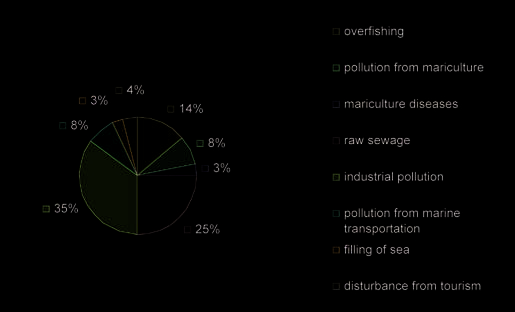
35% of the respondents believed that
important role in marine policy-making
industrial pollution constituted the major
(Figure 2-4). Most interviewees were
threat to the Yellow Sea environment,
unaware that coastal enterprises also
while 25% felt that residential raw sewage
play an important role in marine policy-
was the main threat (Figure 2-2)
making.
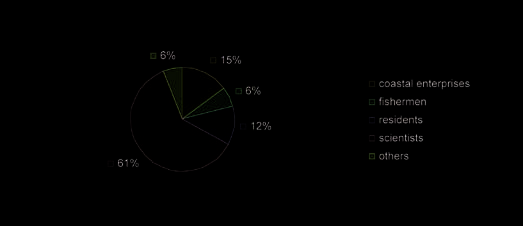
40% of interviewees thought that coastal
enterprises should bear responsibility for
environmental destruction of the Yellow
Sea, while 34% felt that the responsibility
24

Volume 4
National Report-China
Figure 2-2 Major Threats to the Yellow Sea Ecosystem
Figure 2-3 Responsibility Sharing for Environmental Destruction of the Yellow Sea
2
The Yellow
The Yellow Sea:
Sea
Governance Analysis
Figure 2-4 Which Sector has Greatest Influence Upon Government in Marine Policy-making
2.4.1 Analysis on Government confessed that exploitation was superior
Department Questionnaire
to protection in practice (Figure 2-5).
Only 6% of interviewees believed that
When asked about attitudes of local
exploitation policies conform to laws
governments on marine exploitation and
(Figure 2-6). The contradictions between
protection, 49% of interviewed officials
current marine exploitation policies and
ranked exploitation as important as
related laws should receive attention.
protection; however, some 31% of them
Figure 2-5 Attitudes of Local Officials on Tendency of Marine Policies
26
Volume 4
National Report-China
Figure 2-6 Relationship Between Laws and Policies
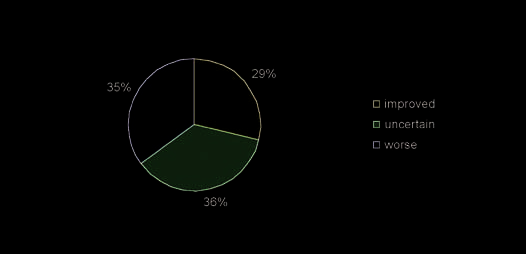
With respect to the implementation
be more concrete, and 22% hoped that
of present laws, 29% of interviewees
more severe punishment measures would
agreed that it has improved, while 71%
be taken (Figure 2-8). This indicates the
expressed their dissatisfaction and
need for improvement of current legal
disappointment (Figure 2-7). In addition,
systems relative to the regulation of
51% thought that current laws need to
Yellow Sea utilization.
Figure 2-7 Implementation of Current Laws and Regulations
2
The Yellow
The Yellow Sea:
Sea
Governance Analysis
Figure 2-8 Suggestions for Improvements of Current Laws and Regulations
I n r e g a r d t o d i f f i c u l t i e s w i t h
to be another problem (Figure 2-9).
a d m i n i s t r a t i o n o f t h e Y e l l o w S e a ,
Figure 2-9 confirms that there are many
56% of interviewees felt that poor
reasons for administrative difficulties,
co-operation among governmental
such as poor administrative systems,
departments was the main problem;
economic interests, local protectionism,
16% considered avoidance of supervision
inappropriate laws and policies, etc.
Figure 2-9 Management Difficulties in the Administration of the Yellow Sea
28
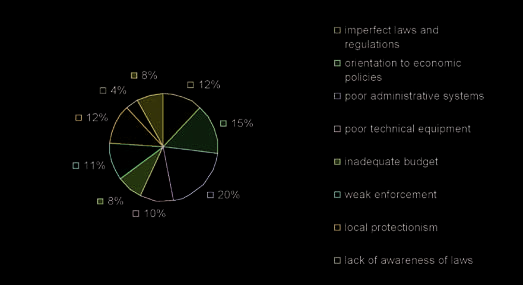
Volume 4
National Report-China
Approximately 50% of the interviewees
benefit among the three coastal provinces
t h o u g h t t h e r e w e r e c o n f l i c t s o f
and nine coastal cities around the
jurisdiction among various marine-
Bohai Sea. An effective coordination
related governmental departments, and
system should be established among the
conflicts of jurisdiction and economic
departments, coastal provinces and cities.
Figure 2-10 Reasons for Management Difficulties in the Administration of the Yellow Sea
2.4.2 Analysis on Coastal a major impact of coastal enterprise
Enterprises Questionnaire
activities was loss of health for the Yellow
Sea ecosystem. 25% acknowledged
Although many enterprises refused a
that their enterprise activities caused a
survey request, some valuable data was
decrease of fishery resources (Figure 2-11).
collected. Most enterprise practitioners
seemed to be quite sensitive to the
Some 74% of the respondents were aware
problems of pollution and environmental
that environmental deterioration of
protection.
the Yellow Sea negatively impacted the
income of their enterprises (Figure 2-12).
53% of the interviewees thought that
2
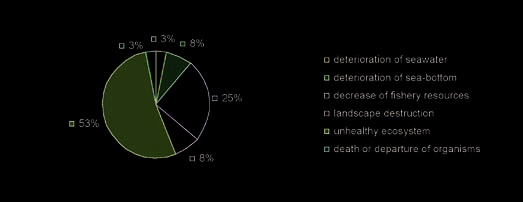
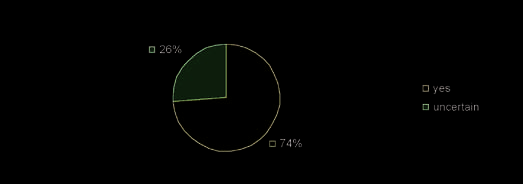
The Yellow
The Yellow Sea:
Sea
Governance Analysis
Figure 2-11 Impact of Enterprise Activities on the Yellow Sea Ecosystem
Figure 2-12 Environmental Deterioration in the Yellow Sea Impacts Coastal Enterprises
Concerning attitudes on present laws
and policies as far as possible; 11%
related to utilization of the sea, 46% of
acknowledged that they occasionally
interviewees thought their enterprises
disobeyed when faced with unreasonable
would not be influenced even under
rules (Figure 2-14).
stricter rules; 34% were uncertain (Figure
2-13).
Regarding practical actions to protect the
Yellow Sea, only 14% expressed positive
On the other hand, 89% of interviewees
responses; 60% were uncertain (Figure
indicated that they would obey rules
2-15).
30

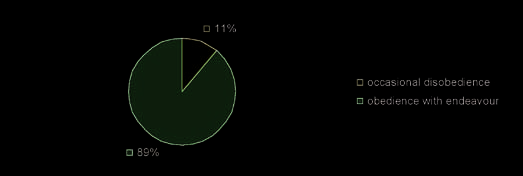
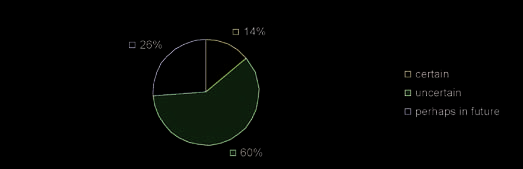
Volume 4
National Report-China
Figure 2-13 Increased Strictness of Rules Will Affect Enterprise Success
Figure 2-14 Attitude of Enterprises Relative to Unreasonable Rules
Figure 2-15 Willingness to Make a Donation to Protect the Yellow Sea Ecosystem
31
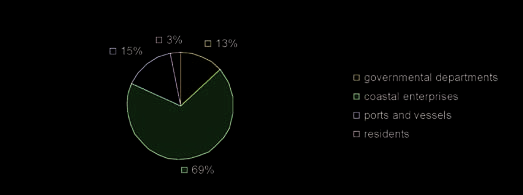
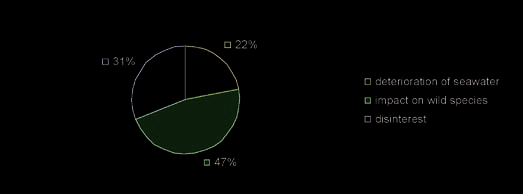
The Yellow
The Yellow Sea:
Sea
Governance Analysis
2.4.3 Analysis on Fishermen an effect on wild species; 31% expressed
Questionnaire
disinterest relative to the impact from
mariculture activities (Figure 2-17).
When answering the question of what
had damaged their benefits, 69% of
Regarding protection of the Yellow Sea,
interviewees selected coastal enterprises,
87% of interviewees gave responses of
while 15% chose ports and vessels
support; just 3% indicated disinterest
(Figure 2-16). This indicates a conflict of
(Figure 2-18). This confirms the strong
interest between fishermen and coastal
concern of fishermen for the ecological
enterprises. Although 47% recognized
environment of the Yellow Sea.
that their own mariculture activities had
Figure 2-16 Party Responsible for Damaging Fishermen Benefits
Figure 2-17 Negative Influences of Mariculture on the Yellow Sea
32
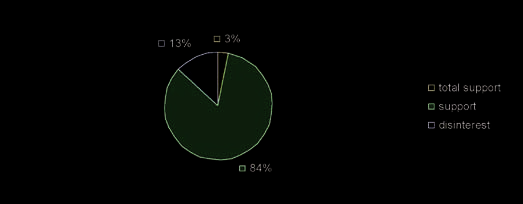
Volume 4
National Report-China
Figure 2-18 Attitude of Fishermen With Respect to Protection of the Yellow Sea
2.4.4 Analysis on Coastal departments, and 12% preferred to
Residents Questionnaire
disclose them to the media. 4% were
disinterested (Figure 2-20).
W h e n a s s e s s i n g t h e w o r k o f
governmental departments, 54% felt
R e g a r d i n g i n d i v i d u a l b e h a v i o u r s
that law enforcement is insufficient,
destructive to the Yellow Sea, 52% of
17% felt that governmental departments
interviewees considered littering on the
lack co-operation, and 14% thought
seashore to be destructive; 31% were
governmental departments are partial
concerned about the use of phosphorus
to enterprises. Only 11% expressed the
detergent (Figure 2-21).
opinion that governmental departments
protect public benefit (Figure 2-19).
In response to whether they were willing
to work as volunteers in protecting the
When facing activities destructive to the
ecological environment of the Yellow
ecological environment of the Yellow
Sea, 90% of interviewees said they were
Sea, 34% of interviewees thought they
willing to participate in these activities
would dissuade the destroyers, 31%
( F i g u r e 2 - 2 2 ) . T h i s i n d i c a t e s t h a t
would choose to keep silent, 19% thought
most coastal residents have a strong
they would report them to governmental
willingness to protect the Yellow Sea.
33
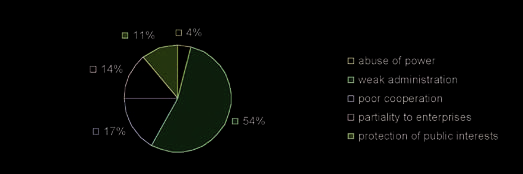
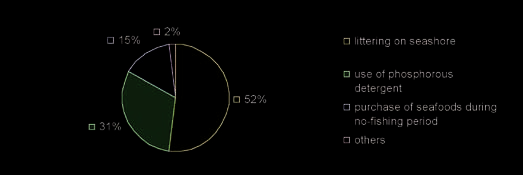
The Yellow
The Yellow Sea:
Sea
Governance Analysis
Figure 2-19 Assessment of Performance of Governmental Departments
Figure 2-20 Attitudes of Residents Concerning Activities Destructive to the Yellow Sea
Figure 2-21 Individual Behaviours Destructive to the Yellow Sea
34
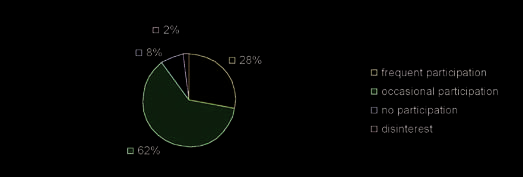
Volume 4
National Report-China
Figure 2-22 Attitudes of Residents Concerning Volunteer Activities to Protect the Yellow Sea
2 . 4 . 5 A n a l y s i s o n N o n -
a statistical analysis was not conducted.
governmental Organizations The responding interviewees indicated
Questionnaire
strong support of their organizations
with respect to protecting the Yellow Sea.
C o n t a c t w a s m a d e w i t h 5 n o n -
NGO activities related to preservation
government organizations (NGOs) along
of the environment are supported both
the Yellow Sea; 20 questionnaires were
by the general public and management
delivered, with 10 responses. Because the
departments.
completed questionnaires were too few,
2.5 Plan for Encouraging All Stakeholders to Participate
in Protecting the Health of the Yellow Sea
Ecosystem
2 . 5 . 1 R a t i o n a l e a n d its services, whether done consciously
Objectives
or unconsciously. It is vital to improve
the knowledge of residents relative to
There are approximately 44 million
protecting the Yellow Sea. The objectives
residents living along the coastal area of
of this plan are as follows:
the Yellow Sea in China. Many of their
activities significantly impact the health
· T o s t r e n g t h e n t h e a w a r e n e s s o f
of the Yellow Sea ecosystem and damage
the local communities about the
3
The Yellow
The Yellow Sea:
Sea
Governance Analysis
importance of the Yellow Sea
Give lectures at primary and middle
schools in the main coastal cities of the
· To improve their knowledge of the
Yellow Sea (e.g. Lianyungang, Qingdao,
environmental problems of the Yellow
Dalian, etc.).
Sea
Topic: Yellow Sea Biodiversity and Us
· To increase the capacity of local
residents to protect the Yellow Sea
Responsible Agency: Municipal Ocean
ecosystem through their daily activities.
and Fisheries Bureaus
2 . 5 . 2 A c t i v i t i e s a n d 3.2 World Environment Day (June 5)
Approaches
C o n d u c t a c t i v i t i e s t o e n c o u r a g e
1. Set up an Internet homepage and
awareness of environment protection of
forum on the protection of the Yellow Sea
the Yellow Sea in main public venues of
ecosystem.
coastal cities:
Invite local residents and scientists to
· Disseminate brochures and posters
join an online discussion of coastal waters
· Conduct face-to-face discussions
environment issues, such as hygiene at
· C o n d u c t i n v e s t i g a t i o n s u s i n g
the swimming beaches, This invitation
questionnaires.
could be made using the Qingdao News
website and online questionnaires.
This may require some donations from
companies or enterprises.
Responsible Agency: Ocean and Fisheries
Bureau of Qingdao
Responsible Agency: Environmental
Protection Administration in each coastal
2. Prepare brochures and posters on
municipality
Protecting the Health of the Yellow Sea
Ecosystem Our Responsibility.
3.3 World Ocean Day (July 18)
3. Communicate, give presentations and
Carry out activities to increase public
provide consultation at local communities
awareness of protection of the Yellow
and schools to improve public awareness.
Sea, at beaches attractive to tourists in
Qingdao, Dalian and Lianyungang cities:
3.1 World Biodiversity Day (May 22)
36
Volume 4
National Report-China
· Disseminate brochures and posters
D e t a i l e d a r r a n g e m e n t s w i l l b e
· Conduct face-to-face discussions
determined together with the Office of
· C o n d u c t i n v e s t i g a t i o n s u s i n g
Ocean Festival of Qingdao. It may require
questionnaires.
some donations from companies or
enterprises.
This may require some donations from
companies or enterprises.
3.6 Associated activities during Dalian
International Fashion Festival
Responsible Unit: Ocean and Fisheries
Bureau in each coastal municipality
Conduct campaigns to increase public
awareness at Xinghai Square (2 days):
3.4 Organize local residents and students
to visit marine environment protection
· Disseminate brochures and posters
f a c i l i t i e s a n d m a r i n e e x p l o i t a t i o n
· Conduct face-to-face discussions
activities, such as waste water treatment
· C o n d u c t i n v e s t i g a t i o n s u s i n g
plant, ports and harbours, mariculture
questionnaires .
sites, etc.
Topic: Fashion and Ocean
Date: annually, last Sunday in August
D e t a i l e d a r r a n g e m e n t s w i l l b e
Responsible Agency: Municipal Ocean
determined together with Office of Dalian
and Fisheries Bureau
International Fashion Festival. It may
require some donations from companies
3.5 Associated activities during Ocean
or enterprises.
Festival of Qingdao
3.7 Associated activities during Festival of
Conduct campaigns to increase public
"Summer in Lianyungang".
awareness at Wusi Square:
Conduct campaigns to increase public
· Disseminate brochures and posters
awareness at Shiming Square as well as
· Conduct face-to-face discussions
at 3 local communities, Lianyungang (1
· C o n d u c t i n v e s t i g a t i o n s u s i n g
community per day; total 3 days):
questionnaires.
· Disseminate brochures and posters
Topic: Protect the Yellow Sea, Hand in
· Conduct face-to-face discussions
Hand
· C o n d u c t i n v e s t i g a t i o n s u s i n g
3
The Yellow
The Yellow Sea:
Sea
Governance Analysis
questionnaires.
Invited Persons: local residents and
students
T o p i c : E n v i r o n m e n t a l H e a l t h o f
Community and Island
Responsible Agency: Ocean and Fisheries
Bureau in each coastal municipality
D e t a i l e d a r r a n g e m e n t s w i l l b e
determined together with Office for
4.2 Invite local residents and students
Summer Festival of Lianyungang. It is
to participate in a field cruise in the
better to find sponsor to these activities.
coastal area of the Yellow Sea, conducted
by universities or institutes. Train
3 . 8 A s s o c i a t i o n w i t h T V m e d i a o f
participants how to do sampling of water
L i a o n i n g , S h a n d o n g a n d J i a n g s u
and plankton, etc.
P r o v i n c e s t o h o l d a k n o w l e d g e
competition about the Yellow Sea.
Date: August
Responsible Agency: State Oceanic
Responsible Agency: Ocean and Fisheries
Administration, Yellow Sea LME PMO
Bureau in each coastal municipality
Time: March--June
5 Train and establish a team of volunteers
to conduct ongoing activities for public
4 Public participation in oceanic scientific
awareness.
research activities
5.1 Select 1 primary school and 1 middle
4.1 Open day at universities and institutes
school in each coastal city (Dandong,
Dalian, Yantai, Weihai, Qingdao, Rizhao,
Invite local residents and students to visit
L i a n y u n g a n g , Y a n c h e n , N a n t o n g ,
universities and institutes.
etc.) as training bases for volunteers.
Approximately 50 volunteers could be
Detailed arrangements will be made
trained each year.
t o g e t h e r w i t h N a t i o n a l M a r i n e
Environment Monitoring Centre, First
5.2 Select 1 local community in each
Institute of Oceanography, SOA and
coastal city (Dandong, Dalian, Yantai,
Yanchen Wetland Nature Reserve.
Weihai, Qingdao, Rizhao, Lianyungang,
Provide information about oceanic
Yanchen, Nantong, etc.) as training
scientific research to the local residents.
bases for volunteers. Approximately 20
volunteers could be trained each year.
Time: 1 university / institute per day
38
Volume 4
National Report-China
6 S u b m i t s u g g e s t i o n s t o l o c a l
50,000 students in public awareness
governmental system.
activities.
6.1 Hold an oceanic education course
· Train 630 volunteers to conduct
entitled "Know Ocean, Love Ocean" in
public awareness activities of marine
primary schools and middle schools
e n v i r o n m e n t p r o t e c t i o n i n t h e i r
in each coastal city (Dandong, Dalian,
local communities in the main cities
Y a n t a i , W e i h a i , Q i n g d a o , R i z h a o ,
along the Yellow Sea within 5 years.
Lianyungang, Yanchen, Nantong, etc.).
Additionally, set up a system to train
The purpose of this course would be to
volunteers continuously.
cultivate the consciousness of youth to
protect the ocean. This course could be
· Initiate oceanic education courses in
conducted at seaside, for example, on
the primary schools and middle schools
beaches or islands.
in coastal cities.
6.2 Public hearings should be conducted
· Involve local residents in the discussion
by local governments prior to the start
and establishment of projects related to
of projects relating to the ocean. At the
the ocean, by means of public hearings.
same time, related information should
be available to the public by major media
2.5.4 Expected Budget
(TV, newspaper, broadcast, Internet).
The plan will last 3 years, and have a
2.5.3 Expected Outcomes
total proposed budget of approximately
300,000CNY.
· Open and run a long-term Internet
forum on protection of the marine
environment.
· Disseminate 80,000 brochures and
1,000 posters.
· Disseminate 5,000 questionnaires
a b o u t p r o t e c t i o n o f t h e m a r i n e
environment.
· Involve 100,000 local residents and
3
The Yellow
The Yellow Sea:
Sea
Governance Analysis
40
The Yellow Sea:
Chapter Three - Institutional Volume 4
Governance A
er
nalysi
nance A
s
Analysis
National Report-China
In the 1970s, China began to recognize
addition, the people's congresses and
the importance of marine environment
governments of provinces, autonomous
management, and gradually strengthened
regions and municipalities may exercise
t h e s u p e r v i s i o n a n d m a n a g e m e n t
legislative power, provided that such local
o f m a r i n e e n vi r o n m e n t i n l i g h t o f
laws and regulations, which proceed from
national conditions.1 After more than
specific conditions in their geographical
30 years of hard work, a comprehensive
areas, do not contravene the Constitution
marine environmental supervision and
or the laws and regulations adopted by
management system has now been
the central government. Over the past few
established. Under the current system,
decades, many local laws and regulations
the major players in national marine
have been adopted that have relevance
environment management include the
for marine environment protection. This
National People's Congress (NPC) and its
overview mainly addresses those laws
Standing Committee; the State Council
and regulations adopted by the central
and its subordinate organizations; local
government.
people's congress and local people'
s government; the general public, and
Departments under the State Council
NGOs.
with ocean-related functions have
played a major operational role in
Generally speaking, the highest legislative
China's national marine environment
authority in China is the National
management. Their roles and mandates
People's Congress (NPC) and its Standing
have changed over time, reflecting
Committee. Laws passed by the NPC
changes in China's national environment
and its Standing Committee are applied
policies. Before the 1980s, the main
nationwide and are mostly general in
function of government agencies was
nature. They are usually supplemented
to promote economic production. As a
by rules and regulations that deal with
result, much government investment
more specific matters, issued by the State
w e n t t o w a r d d e v e l o p i n g m a r i t i m e
Council, which is the highest executive
t r a n s p o r t a t i o n , f i s h e r i e s , s e a s a l t
organ, and by relevant ministries.2 In
making and coastal mining, etc. Along
41
The Yellow
The Yellow Sea:
Sea
Governance Analysis
with the development of society, the
e c o n o m i c s t r u c t u r a l r e f o r m , l o c a l
Government of China gradually realized
authorities in coastal areas are given a
the significance of marine environment
higher level of autonomy with regard to
protection, and gradually adopted marine
local economic and social development
environment protection and marine
programmes.
resources conservation as one of the
major concerns in the last two decades.
The Chinese Constitution, laws and
regulations encourage the general public
Local authorities include the people'
to participate in marine environment
s c o n g r e s s e s a n d g o v e r n m e n t s o f
and resources protection. A common
p r o v i n c i a l , m u n i c i p a l a n d c o u n t y
legal requirement is that the government
levels. They are required to implement
should encourage and reward institutions
the national policies and laws, and
a n d i n d i v i d u a l s w h o h a v e m a d e
given a certain level of flexibility to
remarkable contributions to protect
modify the policies and laws during the
a n d i m p r o v e m a r i n e e n v i r o n m e n t
implementation process, if necessitated
and resources.3 However, the role and
by local circumstances. Local authorities
function of the people's organizations,
are also participants in promoting
NGOs, industries and private sector in
n a t i o n a l m a r i n e e n v i r o n m e n t a l
marine environment management still
protection management by making
need improvement.
r e c o m m e n d a t i o n s . W i t h o n - g o i n g
3.1 Governmental Agencies and Their Responsibilities
Related to the Yellow Sea Marine Environment
Management
Governmental agencies related to marine
a dominant role in the Yellow Sea
environment management of the Yellow
management, while local governments
Sea include both the central and local
execute the policies, strategies and
governments. The central government
regulations formulated by the central
and its subordinate organizations play
government.
1
The Development of China's Marine Programs. State Council. http://news.
xinhuanet.com/employment/2002-11/18/content_633178.htm
2 Legislation Law of the People's Republic of China.
3 Article 8 of the Environmental Protection Law of PRC.
42
Volume 4
National Report-China
3.1.1 Departments of Central m o n i t o r i n g , m a n a g e m e n t o f
Government with Ocean-
e n v i r o n m e n t a l p r o t e c t i o n w o r k
related Functions
i n r e l a t i o n t o o f f s h o r e p e t r o l e u m
e x p l o r a t i o n a n d e x p l o i t a t i o n , a n d
· State Oceanic Administration (SOA)
ocean dumping activities. In 1988, SOA
under Ministry of Land and Resources
assumed the additional responsibility of
organizing relevant departments to: 1)
· Bureau of Fisheries Management under
draw up basic marine laws, regulations
Ministry of Agriculture
and policies; 2) hold national marine
· Maritime Traffic Safety Administration
development programmes; 3) layout
under Ministry of Transportation
marine use zonation; and 4) conduct
· S t a t e E n v i r o n m e n t a l P r o t e c t i o n
coastal zone surveys and management.
Administration
In 1988, SOA was placed within the
framework of the Ministry of Land and
· S t a t e D e v e l o p m e n t a n d R e f o r m
resources. With the adoption of the Sea
Commission
Area Use Law, SOA was further required
· State Tourism Administration
to review and issue permits for sea area
use, and to levy usage fees.4
· Ministry of Water Works
· The People's Liberation Army
3.1.2.2 State Environmental
Protection Administration (SEPA)
3.1.2 Changes of Important SEPA plays a lead role in overall
G o v e r n m e n t a l A g e n c i e s environmental management. It also
R e l a t e d t o M a r i n e undertakes inter-agency consultation and
Environment Protection
coordination in national environmental
policy. Specifically, SEPA supervises
3 . 1 . 2 . 1 S t a t e O c e a n i c the prevention and management of
Administration (SOA)
pollution from land-based sources and
The SOA was established in 1964; its
coastal engineering projects. It also
primary mandates were oceanographic
has the responsibility to supervise and
s u r v e y a n d r e s e a r c h . D u r i n g t h e
manage national nature reserves, and to
governmental restructuring of 1984,
monitor the implementation of national
the mandates of SOA were modified
environmental quality standards and
t o i n c l u d e m a r i n e e n v i r o n m e n t a l
effluent discharge standards.5
4
http://www.soa.gov.cn/jigou/1/zhize.htm; http://www.soa.gov.cn/jigou/1/
zhize.htm
5 http://www.zhb.gov.cn/dept/jgznjj/200404/t20040428_89743.htm
43
The Yellow
The Yellow Sea:
Sea
Governance Analysis
3.1.2.3 Maritime Traffic Safety Administration was given responsibility
Administration under the Ministry for management of fishing activities
of Transportation
and conservation of fishery resources.
D u r i n g t h e 1 9 6 0 s , t h e M i n i s t r y o f
In 1984, the Fishery Administration
Transportation was given responsibility
i n c o r p o r a t e d t h e f o l l o w i n g i n t o
for ensuring safety at sea, and for the
i t s m a n a g e m e n t r e s p o n s i b i l i t y : 1 )
management of ocean-going vessels and
supervising and managing environmental
port development. In 1970, the mandate
i m p a c t s o f f i s h i n g v e s s e l s ; a n d 2 )
o f t h e M i n i s t r y o f T r a n s p o r t a t i o n
preserving fishery biological balance
was enlarged to include prevention
through fishery nature reserves, fishing
and control of marine pollution by
areas and seasonal closures. The Fishery
ship sources. In 1984, the Ministry
Administration also supervised the
of Transportation was mandated to
issuance of aquaculture production
undertake shoreline use planning, and
permits. Concern for environmental
to review and approve shoreline use
protection and biological preservation
projects as part of its responsibilities
became more apparent in the mandates
for ports, navigation channels and
of Fishery Administration during the
waterway salvage activities. With the
1980s and 1990s. The most significant
growing concern for oil-spill incidents,
change in the mandate of the Fishery
t h e p r o b l e m o f o i l - s p i l l p o l l u t i o n
Administration was a shift of emphasis
w a r r a n t e d a t t e n t i o n . I n 1 9 9 8 , t h e
from the promotion of fishing production
Ministry of Transportation was charged
to the control of fishing efforts for
with the responsibility of developing
sustainable fishery development.7
a contingency plan to deal with oil
spills from shipping accidents. In the
3.1.3 A g e n c i e s a n d T h e i r
1998 government reconstruction, the
Responsibilities Related to the
Harbour Superintendence under Ministry
of Transportation was renamed the
Management of the Yellow
Maritime Traffic Safety Administration
Sea Environment
under Ministry of Transportation.6
Central and local governments share
3.1.2.4 Fishery Administration responsibility for China's marine
(Bureau of Fisheries Management environment management. Under the
under the Ministry of Agriculture)
supervision of the People's Congress and
During the early 1980s, the Fishery
its Standing Committee at different levels
6 http://www.msa.gov.cn/Jgjj/Hsj.aspx?category_id=1
7 http://www.agri.gov.cn/nyb/jgzz/t20040528_207683.htm
44
Volume 4
National Report-China
and with administrative coordination
environment management, and their
defined according to relevant provisions
r e s p o n s i b i l i t i e s , a r e s t i p u l a t e d i n
of laws and regulations, the central
Constitution, Organic Laws, Marine
a n d l o c a l g o v e r n m e n t s p a r t i t i o n
Environmental Protection Law, Fisheries
their responsibilities into function
Law, Sea Area Use Law, Wild Animal
zones, pollution sources, and natural
Protection Law and other laws and
resources. The two levels of government
regulations, as well as in Department
execute environmental protection laws
Function Mandates of the State Council.
co-operatively.
The departments and their detailed
responsibilities related to Yellow Sea
D e p a r t m e n t s i n c h a r g e o f m a r i n e
management are listed in Table 3-1.
Table 3-1 Agencies and Their Responsibilities as Related to Managing the Yellow
Sea Environment
Agencies
Responsibility
· Manage sea area use of the Yellow Sea inside the territorial line and
issue Sea Area Use Certificates at state level.
· Conduct function zoning of the Yellow Sea at state level.
· Supervise marine environmental protection of the Yellow Sea, and
manage investigation and monitoring activities of the Yellow Sea at
state level.
· Organize scientific research on environment of the Yellow Sea.
State
· Prevent and control pollution damage to the Yellow Sea caused by
marine construction projects and sea dumping.
Oceanic
Administration
· Organize state-level marine environment monitoring and supervision
network, in co-operation with relevant departments.
(SOA)
· Evaluate marine environment quality at regular intervals.
· Manage marine integrative information system.
· Develop state oil spill contingency plan for offshore oil exploration and
exploitation.
· Claim damages compensation for destruction of marine ecology, marine
natural resources and reserves, on behalf of state.
· Establish state-level marine nature reserve and special marine reserves
in the Yellow Sea.
· Guide, co-ordinate and supervise integrated environmental protection
of the Yellow Sea.
State
· Prevent and control pollution damage to the Yellow Sea by land-based
pollutants and coastal construction projects.
Environmental
Protection
· Compile state environment quality bulletins (including the Yellow Sea).
Administration
· Make state contingency plan for marine pollution accidents caused by
land-based pollutants.
(SEPA)
· Establish state sea-water quality standard.
· Establish state pollutant discharge standard.
· Establish state level coastal nature reserves in the Yellow Sea.
4
The Yellow
The Yellow Sea:
Sea
Governance Analysis
· Supervise and control pollution to the Yellow Sea caused by vessels (not
including fishing and military vessels).
Maritime
· Settle pollution accidents caused by vessels (not including fishing and
military vessels).
Traffic Safety
Administration
· Monitor and supervise port water environment.
(MTSA)
· Create state-level contingency plan to cope with oil-spilling accidents
caused by vessels.
· Punish vessels that engage in illegal transportation of dangerous wastes
through the Yellow Sea within China's jurisdiction.
· Monitor and supervise condition of fishing ports and fishing zones in
the Yellow Sea.
· Supervise and control pollution to the Yellow Sea caused by fishing
vessels.
· Assist in investigation and settlement of fishery pollution accidents
caused by vessels (not including fishing and military vessels) and
supervise settlements of other fishery pollution accidents.
· Claim damage compensation for destruction of fishery ecology, marine
aquatic resources and relevant marine reserves, on behalf of state.
· Establish state-level marine nature reserves and special marine reserves
in fishing zones.
· Conserve and manage fishery resources in the Yellow Sea at state level.
Fishery Bureau
· Protect rare and endangered wild animals and plants in the Yellow Sea;
determine the list of endangered species at state level; examine and
of Ministry of
approve the import of wild marine animals and plants; issue Catching
Agriculture
License for rare and endangered species.
(BOF)
· Manage oversea fisheries affairs.
· Take charge of important fishing grounds and
fishing ports.
Fishery
· Supervise and manage fishing operations,
vessels, and fishing ports including resources
Management and
conservation and environmental protection of
Fishing Harbour
fishing grounds.
Superintendence of
Bohai Sea and the
· Maintain orderly fishing operations.
Yellow Sea,
· Implement fisheries laws, regulations and
international treaties.
under Ministry of
Agriculture
· Protect legitimate rights and interests of
fishermen.
· Settle fishery disputes.
· Maintain navigational safety and order of fishery
communication.
· Register fishing vessels.
· Carry out strategy of sustainable development.
· Study and formulate plans for resource conservation and
comprehensive utilization.
State
Development
· Participate in formulation of ecological improvement plans.
and Reform
· Put forward policies of resource conservation and comprehensive
utilization.
Commission
· Co-ordinate solution of major issues of ecological improvement,
resource conservation and comprehensive utilization.
· Co-ordinate environmental protection.
46
Volume 4
National Report-China
State Tourism
· Organize investigation and evaluation of tourism resources.
Administration
· Direct planning of, and develop, important tourism regions.
· Conduct tourism statistics.
Ministry of
· Monitor quantity and quality of water of rivers, lakes and reservoirs.
Water Works
· Review and approve the pollution loading capacities of water bodies;
make proposals for the limits of total wastewater discharge.
Environment
Protection
· Supervise and control pollutant discharge from military vessels.
Department
· Settle pollution accidents caused by military vessels.
Of Navy
· Monitor and supervise environmental condition of military zones.
Governments of
· Confirm duties of relevant departments in governments of coastal areas
Coastal
at or above county level.
Provinces along
· Establish local pollutant discharge standards for items not specified in
the Yellow
state standards; set local marine environmental quality standards and
Sea, including
land-based pollution discharge standards, which are more stringent
Jiangsu,
than state standards.
Shandong
· Set up regional co-operation organizations for marine environmental
and Liaoning
protection.
Provinces
· Approve local marine nature reserves, marine sanctuaries and coastal
scenic and tourist areas.
· Exercise leadership in marine environmental protection, and improve
marine environmental quality within their jurisdictions.
· Take effective measures to relieve or mitigate damage caused by serious
pollution.
· Set targets and tasks for offshore environmental protection within their
administrative districts.
· Ratify environmental protection plans which are worked out by
environmental protection departments, assisted by planning
departments.
· Protect typical marine ecosystems such as coastal wetlands, islands,
bays, estuaries and important fishery waters.
· Protect sea areas with a natural distribution of rare and endangered
Local
wild animals and plants.
governments of
· Protect habitats of wild animals and plants with high economic values.
coastal areas at
· Protect natural marine historic relics and natural landscapes with great
different levels
scientific and cultural significance.
· Build shore safeguards and coastal shelter belts, as well as gardens and
greenbelts in coastal cities and towns.
· Establish local nature reserves.
· Conserve and manage fishery resources, as well as rare and endangered
species within coastal waters.
· Issue fishing licenses to coastal fishing vessels.
· Inspect fishing vessels including fishing license, gear and operation.
· Prosecute illegal fishing activities.
· Supervise the safety and orderly operation of fishing ports.
· Give awards to units and individuals that have made outstanding
achievements in protecting and improving marine or coastal
environment.
Governments of
· Build and perfect urban drainage net.
coastal cities
· Build urban sewage treatment plants or other sewage treatment
facilities.
4
The Yellow
The Yellow Sea:
Sea
Governance Analysis
3.2 N o n - g o v e r n m e n t a l A g e n c i e s a n d T h e i r
Responsibilities Related to the Yellow Sea Coastal
and Marine Environment Management (Tabel 3-2)
Table 3-2 Non-governmental Agencies and their responsibilities
Non-governmental Agencies
Responsibility
Chinese Society of Oceanography8
Chinese Society of Oceanography and
Non-governmental agencies (NGOs) in China
Limnology9
play a somewhat different role from the more
Society of Environmental Sciences of
autonomous, activist NGOs in other countries.
China10
Their contribution to marine environment
China Zoological Society11
protection in China is primarily through research,
China Wildlife Protection Society12
monitoring and public information. NGOs have
China Zoological Park Society13
a substantial potential role in raising public
Society of Environment and Resources
awareness of the importance of, and threats to,
Protection Law of Shandong Province
China's marine environment.
under China Law Society14
etc.
3.3 Marine Environment Research, Education,
Technology and Monitoring
3.3.1 Research, Education well as surface observation. As early as
and Technology
1958-1960, a national comprehensive
s u r v e y o f C h i n a ' s o f f s h o r e w a t e r s
Since the founding of the People's
w a s m a d e . F r o m 1 9 8 0 t o 1 9 8 6 , a
Republic of China in 1949, much survey
comprehensive survey of coastal zones
and research work has been done in
and shoals resources was conducted
marine environment. This work began in
n a t i o n w i d e ; a s w e l l , s e v e r a l p i l o t
offshore areas, with surface observation
projects on comprehensive development
of the sea; it later expanded to deep-sea
and utilization of coastal zones were
regions by means of aerospace remote
launched. From 1988 to 1995, a general
sensing and underwater detection, as
investigation of the country's island
8 http://www.cso.org.cn/
9 http://159.226.158.2/
10 http://www.chinacses.org/CN/index.html
11 http://www.czs.ioz.ac.cn/
12 http://www.cwca.org.cn/
13 http://www.cin.gov.cn/main/org/b0218.htm
14 http://www.chinalawsociety.org.cn/user/office/jianjie.asp?id=5
48
Volume 4
National Report-China
resources, and an experiment on their
development drawn up by relevant
comprehensive development, were
state departments, China has made
carried out. In recent years, China has
marked progress in many aspects of
made further efforts to: 1) promote
marine environment in recent years.
investigation and exploration of marine
These achievements have provided
resources and marine environment;
scientific direction and references for
2) search actively for new exploitable
the promotion of offshore fishing, oil
resources; 3) study new techniques and
and gas exploitation, protection of the
methods of marine resources exploitation
marine environment, and reduction and
a n d p r o t e c t i o n ; 4 ) t r a i n t e c h n i c a l
prevention of marine disasters. 16
personnel in marine development and
protection; and 5) spread oceanographic
China has made vigorous efforts to
knowledge among the general public in
develop oceanographic technologies;
order to rouse the whole nation to protect
i t h a s b u i l t u p a n o c e a n o g r a p h i c
the marine environment. 15
technology system focusing mainly
on marine environment, exploration
On the basis of a multidisciplinary
and exploitation of marine resources,
oceanographic research setup, consisting
a n d g e n e r a l m a r i n e e n g i n e e r i n g ,
of some 15000 research personnel,
covering more than 20 technological
China has had a series of achievements
fields. The country has now turned its
in marine environment survey and
attention to implementing a marine
r e s e a r c h , s t u d i e s i n b a s i c m a r i n e
high-tech programme, designed for
science, development and protection
tackling key problems in marine science
of ocean resources, marine monitoring
and technology. In its marine high-
technologies, and manufacturing of
tech research, China gives priority
oceanographic technical equipment. With
t o t e c h n o l o g i e s c o v e r i n g m a r i n e
increased attention given to the study
monitoring, marine exploration and
of inshore shelf marine environment,
r e s o u r c e s e x p l o i t a t i o n , d e e p - s e a
China has established a multidisciplinary
exploration, and marine biology. The
marine environment research system
programme for tackling key problems
with regional characteristics. Guided
i n m a r i n e s c i e n c e a n d t e c h n o l o g y
by its marine development strategies,
centres on fields directly related to
support programmes, and plans for
modern marine development, such as
15 Memo of Major Marine Affairs, http://www.soa.gov.cn/memo/index.html
16
Development of China's Marine Program, State Council, 1998. http://www.gmw.
cn/01gmrb/1998-05/29/GB/17707^GM3-2903.htm
4
The Yellow
The Yellow Sea:
Sea
Governance Analysis
sustainable exploitation of resources
young people about marine topics and to
and environments of coastal zones,
educate residents of coastal regions in the
desalinization of seawater, exploitation
proper way to exploit marine resources
of marine energy, and comprehensive
and protect the marine environment.
utilization of seawater resources. In 1996,
concerned government departments
In addition, a service system providing
jointly formulated the National Plan For
marine data and information, headed by
Implementing The "Programme For
the National Oceanographic Information
Marine Development By Reliance On
Centre,17 has been established in China
Science And Technology" in the Ninth
in the wake of the progress in this field
Five-Year Period (1996-2000) and on
in the past decades. This system provides
to the Year 2010. This plan focuses on
comprehensive information services
the following: 1) research, development
for ocean development, oceanographic
and dissemination of the technologies of
research and marine environmental
marine reproduction and mariculture;
protection.
2) fine processing of marine biological
resources; 3) exploration and extraction
To further support marine technology,
of marine pharmaceuticals; and 4)
o f f s h o r e d e v e l o p m e n t a n d m a r i n e
exploitation of chemical resources in
environment protection, the Government
seawater. Through implementation of
of China has worked out the Medium
this plan, China hopes to foster marine
And Long-Term Programme For The
technology enterprises and improve the
Development Of Marine Science And
productivity of its marine industries.
Technology, and The Marine Technology
Policy (Blue Paper), together with
China has developed an oceanographic
a number of concrete development
education system embracing professional
plans. The main areas of focus for
e d u c a t i o n , v o c a t i o n a l e d u c a t i o n
marine technology development in
and popular knowledge education.
the future are as follows: 1) strengthen
O c e a n o g r a p h y a s a n a r e a o f s t u d y
research into basic marine science;
is taught in 37 institutions of higher
2 ) t a c k l e t h e k e y t e c h n o l o g i e s o f
learning and 29 secondary specialized
marine resources exploitation and
schools in China; large numbers of
environmental protection; 3) promote
technical and managerial personnel
the application of marine technologies
are being trained in this area. The mass
to marine industries; 4) improve marine
media is also used as a vehicle to inform
resources development and service
17 This Centre located in Tianjin. http://www.nmdis.gov.cn/
0
Volume 4
National Report-China
support for marine disaster prevention
the Fishery Administration. In this
and reduction; 5) improve marine
connection, Oceanic Administrations
environmental protection; and 6) narrow
m o n i t o r m a r i n e e n v i r o n m e n t a l
the gap between China and developed
quality; Environmental Protection
countries in marine technology.
A d m i n i s t r a t i o n s m o n i t o r l a n d -
based discharges and coastal marine
3.3.2. Marine Environment environment quality; and the Fisheries
Monitoring
Administration monitors fishery waters.
Each of them publishes an annual
The basic tasks of marine pollution
assessment concerning the state of
investigation and monitoring are as
marine environment.18 Each also has a
follows: 1) grasp the baseline situation
network of monitoring stations across
of marine environmental pollution and
the country, namely: State Marine
its long-term tendency to change; 2)
Environment Monitoring Net, State
evaluate marine environmental quality;
Coastal Marine Environment Monitoring
and 3) provide a basis for formulating
Net, and State Fishery Water Monitoring
m a r i n e e n v i r o n m e n t a l p r o t e c t i o n
N e t . A l t h o u g h t h e S t a t e C o u n c i l
p o l i c i e s . M a r i n e e n v i r o n m e n t a l
requires that State Marine Environment
m o n i t o r i n g h a s a w i d e r a n g e o f
Monitoring Net should include the latter
i n v o l v e m e n t , b r o a d p r o f e s s i o n a l
two nets, there is some progress to be
fields, and many links in the work.
made before major participants actually
It emphasizes the collaboration and
share resources and monitoring results in
coordination of different units, both
order to fulfill their common objectives.
with respect to needs and benefits. At
present, the environments of the Yellow
3.3.3 Major Agencies and
Sea are monitored by state and local
Their Responsibilities Relative
agencies, universities, research institutes,
to Monitoring of the Yellow
dischargers, and volunteers.
Sea Environment
R o u t i n e m a r i n e e n v i r o n m e n t a l
3.3.3.1 Agencies in Oceanic
m o n i t o r i n g h a s b e e n u n d e r t a k e n
Administration System
mainly by agencies under Oceanic
1) State Marine Environment Monitoring
A d m i n i s t r a t i o n s , E n v i r o n m e n t a l
Centre19 (Under the State Oceanic
P r o t e c t i o n A d m i n i s t r a t i o n s , a n d
Administration)
18 Marine Environment Protection Law.
19 http://www.nmemc.gov.cn/
1
The Yellow
The Yellow Sea:
Sea
Governance Analysis
a. Study the programming and plan
e. Set up and manage a state marine
used for monitoring state marine
environment monitoring data-base;
environmental pollution and the
assess and manage the monitoring
ecosystem; draw out the technical
data; organize an information system
regulations, technical standards,
of marine environment monitoring and
technical management policies and
sea area use.
rules used for monitoring; supervise
and harmonize the implementation
f. Offer technical support to marine
o f t h e s t a t e m a r i n e e n v i r o n m e n t
environment, ecosystem monitoring
monitoring system.
and supervision; manage the databases
of oil-spilling and pollution damage
b . S u p e r v i s e t h e o r g a n i z a t i o n ,
incidents; investigate and monitor
t e c h n o l o g y a n d i n f o r m a t i o n
m a j o r m a r i n e p o l l u t i o n d a m a g e ;
m a n a g e m e n t o f t h e s t a t e m a r i n e
compile technical reports of major
environment monitoring system; handle
marine pollution damage incidents;
affairs of the State Marine Environment
offer scientific evidence for marine
Monitoring Office; oversee the estimate
pollution damage arbitration.
and forecast of marine environment
quality; and compile the State Marine
g. Carry out science and technology
Environment Quality Communiqué.
studie s; e ncourage inte rnational
co-operation in the realm of marine
c. Manage professional organizations
environment monitoring.
engaging in marine environment
monitoring, pollution monitoring,
2) North China Sea Marine Environment
e c o s y s t e m m o n i t o r i n g a n d l a n d -
Monitoring Centre20 (under the North
b a s e d p o l l u t i o n m o n i t o r i n g , a n d
China Sea Branch of the State Oceanic
provide technical support to those
Administration)
organizations. Organize a major state
marine environment investigation
a. Monitor and manage the marine
and conduct professional monitoring
environment of the North China Sea;
experiments.
b. Maintain the marine environment
d. Oversee the estimate and forecast
monitoring net of the North China Sea;
work on natural disasters such as red
tide and sea ice.
c. Evaluate the monitoring work on
20 http://www.ncsb.gov.cn/fenjujianjie/jigoushezhi/xiashu/jiancezhongxin.htm
2
Volume 4
National Report-China
marine environment regularly; issue
and statistic data on environment.
announcements on the quality of
marine environment.
c. Take charge of the Chinese Network
in Global Environment Monitoring
In addition, the Centre also takes part
System; take charge of the environment
in the construction of marine projects,
monitoring network of state level;
exploration of marine resources, and
strengthen the network management of
marine environment protection in coastal
national environment monitoring and
provinces and cities.
guide its construction.
3) Marine Environment Monitoring
d. Organize relevant departments to
S t a t i o n s o f c o a s t a l p r o v i n c e s ,
monitor coastal sea areas nationwide.
municipalities and counties (under
the oceanic departments of relevant
e. Assume responsibility for quality
governments); e.g. Marine Environment
g u a r a n t e e a n d q u a l i t y c o n t r o l o f
M o n i t o r i n g C e n t r e o f S h a n d o n g
monitoring in the state environment
Province.21
m o n i t o r i n g s y s t e m ; a s s u m e
responsibility for Quality Supervision
3.3.3.2 Agencies in Environmental
and Test Centre on Environment
Protection Administration System
Monitoring Apparatus under the SEPA.
1) Environment Monitoring Centre of
China22 (under the State Environmental
f. Assume responsibility for monitoring
Protection Administration)
related technical and business-like work
in major projects assigned by the SEPA,
a. Organize relevant departments to
such as total control of pollutants.
draw up the developing plan, technical
course, technical rules, technical
g. Write the Environment Quality
standards and annual plan of state
Report of Coastal Sea Areas and Water
environment monitoring work; guide
Quality Weekly Report of Bathing
environment monitoring station at
Beaches in Coastal Cities. Write the
different levels to implement the above
Ecosystem Environment Quality Status
plans and regulations.
chapter and the Environment Quality
Status of Coastal Sea Areas chapter
b. Collect, check and manage state
in the State Environment Quality
environment monitoring information
Statement.
21 http://www.hycflt.com.cn/newsfile/hyywgn/200547152004.asp
22 http://www.zhb.gov.cn/dept/jgzn/znjs/zhishu/200409/t20040921_61560.htm
3
The Yellow
The Yellow Sea:
Sea
Governance Analysis
h. Organize relevant departments to
located in Qingdao, Shandong Province
draw up technical courses and technical
in the north of China, is an integrated
rules for environment monitoring of
research institute involved in scientific
ecosystem and coastal sea areas.
and technological research for fishery
development of the Yellow and Bohai
2) Coastal Environment Monitoring
seas. It focuses mainly on such research
Central Station (under the Environment
fields as marine fishery resource survey
Monitoring Centre of China)
and assessment, marine fishing gears and
fishing methods, marine aquaculture,
Manage the environment monitoring
fishery resource enhancement, and
network of coastal sea areas.
fishery environment protection. YSFRI
comprises a number of research sections:
3) Yellow Sea Coastal Environment
m a r i n e r e s o u r c e , m a r i n e f i s h i n g
M o n i t o r i n g S t a t i o n ( u n d e r t h e
techniques, marine animal enhancement,
Environment Monitoring Centre of
algae culture, aquatic product processing,
China)
fishery environment, fishery economics,
and fishery information. It also has
Monitor the marine environment in
a n a d v a n c e d e x p e r i m e n t b a s e i n
coastal areas of the Yellow Sea.
Xiaomai Island, and a well-equipped
fishery resource survey vessel, Beidou
4) Coastal environment monitoring
Hao . In addition, several nationwide
stations of coastal governments (under
organizations are set up within YSFRI,
the environmental protection department
such as National Quality Monitoring
of relevant governments)
Centre for Aquatic Products, Sino-
Canadian Mariculture Research and
Monitor marine environment in coastal
Training Centre, Fish Drug and Diet
areas within their jurisdictions.
Monitoring and Testing Centre, and
Fishery Environment Monitoring Centre
3.3.3.3 Agencies in Fishery for the Yellow Sea and Bohai Sea.
Administration System
1 ) Y e l l o w S e a F i s h e r i e s R e s e a r c h
2 ) F i s h e r y W a t e r E n v i r o n m e n t
Institute23
Monitoring Stations of coastal Provinces,
municipalities and counties (under the
T h e Y e l l o w S e a F i s h e r y R e s e a r c h
fishery management departments of
Institute (YSFRI), founded in 1947 and
relevant governments).
23 http://www.ysfri.ac.cn/DesktopDefault.aspx?tabid=803
4
The Yellow Sea:
Chapter Four - Legal and
Volume 4
Governance A
er
nalysi
nance A
s
Policy Analysis
National Report-China
4.1 Legal Status on Marine Environment Protection of
the Yellow Sea
4.1.1 T h e H i e r a r c h y o f large city may make local regulations
Chinese Laws
according to its local circumstances, as
approved by the State Council. In order to
Marine environment protection law and
implement the Constitution and national
policy are integral to the Chinese legal
laws, the State Council has the right to
system. To understand the current legal
make administrative regulations, and
status on the prevention of pollution and
departments subordinate to the State
sustainable use of marine resources of
Council may make department rules.
the Yellow Sea, it is necessary to have a
In order to implement laws and local
brief look at the Chinese legal system.
regulations, the provincial governments
Chinese laws have a fairly strict hierarchy
and the governments of provincial
based on legislative authority. The top
capitals, autonomous regions and large
level of this hierarchy is the basic law
cities approved by the State Council, may
the Constitution. The Constitution,
make local government rules.
legislated by the National People's
Congress (NPC), is the supreme national
As China is a unitary state, vertically
law; it forms the foundation for all
national laws are superior, and they
other laws. It also provides a legal basis
override local laws made by local people'
for the profound changes in China's
s congresses and governments. Also, local
social and economic institutions, and
laws must be consistent with national
has significantly revised governmental
laws, and laws of lower rank must be
structures and procedures. Basic national
consistent with laws of higher rank. This
law ranks next to the Constitution, being
is the case for laws related with marine
legislated by the NPC or its Standing
environment protection; however,
Committee. The people's congress of each
in accordance with the Environment
province, each provincial capital and each
P r o t e c t i o n L a w ( 1 9 8 9 ) , p r o v i n c i a l


The Yellow
The Yellow Sea:
Sea
Governance Analysis
g o v e r n m e n t s m a y e s t a b l i s h l o c a l
environmental law field, a law of lower
standards for discharge of pollutants on
rank, which establishes more stringent
items not specified by national standards.
discharge standards than a law of higher
With regard to items already specified
rank, is not seen as a violation of law.
by national standards, they may set local
standards that are more stringent than
T h e h i e r a r c h y a n d r e l a t i o n s h i p o f
national standards and report them to
different legal forms are shown in the
the competent authority of the central
chart below:
government.24 That is to say, in the
Legislative Body
Administrative Body
Constitution
Laws
Administrative Regulations
Local Regulations of Provinces
Department Rules
Local Government Rules
of Provinces
Local Regulations of Provincial Capitals
and Large Cities Approved by the State
Council
Government Rules of Provincial
Capitals and Large Cities Approved
by the State Council
Arrow stretches from higher rank of law to lower rank of law
24 Article 9 of Environmental Protection Law
6
Volume 4
National Report-China
4 . 1 . 2 D e v e l o p m e n t o f Law (1982) and the Water Pollution
L e g a l S y s t e m o n M a r i n e Prevention And Control Law (1984)
Environment Protection
were passed during this time; in addition,
attention was also given to environmental
Although China had passed several
protection in other laws. For example, the
a d m i n i s t r a t i v e r e g u l a t i o n s o n
General Principles of Civil Law (1986)
environmental pollution in China, it was
provided civil liability for damages caused
only after the 1972 Stockholm Conference
by environmental pollution (Article 124);
that environment protection was put on
the Fisheries Law (1986) incorporated
the agenda of the Government of China.
the concept of resources conservation;
In 1973, the first national conference
and the Wild Animal Protection Law
on environment protection was held.
(1988) initiated the protection of wild
As a result, the State Council issued
endangered animals. In the 1990s and
Provisional Rules On The Prevention
2000s, China's marine environmental
A n d C o n t r o l O f C o a s t a l M a r i n e
legal system developed rapidly. In 1997,
Pollution the following year. It was
Criminal Law incorporated a section
the first administrative law on marine
entitled "Environmental Crime"; in
pollution in China, providing more
1999, the Marine Environmental Law
detailed rules on ship-based pollution.
was revised and a new section "Marine
In 1978, a provision on environmental
Ecology Protection" was added; in 2001,
protection was put into the Constitution.
the Sea Area Use Law established state
In 1979, the basic law for environmental
ownership of sea and marine resources
protection Environmental Protection
in China. Supplementing the laws, many
Law was promulgated on a trial basis;
regulations and rules have been adopted
it formally came into force in 1989.
and have played important roles in the
This law represented the beginning of
management of marine environment.
the establishment of an environmental
Coinciding with its development of
protection framework in China. The
a legal domestic framework, China
decade of the 1980s was the most active
a l s o p a r t i c i p a t e d i n m o r e t h a n 5 0
period in environmental legislation.
environmental treaties.
The Marine Environmental Protection
The Yellow
The Yellow Sea:
Sea
Governance Analysis
4.2 Domestic Law on Marine Environment Protection
of the Yellow Sea
4.2.1 L i s t o f D o m e s t i c Chinese policy. The Law stipulates that
L a w s , R e g u l a t i o n s , R u l e s government organizations at various
and Standards on Marine levels, as well as all units and individuals,
Environment Protection
are obligated to protect the environment.
Protection of the marine environment is
4.2.1.1 The Constitution
implicit in this law. For example, Article 2
provides: "Environment refers to the total
The current Constitution (1999) contains
body of all natural elements affecting
several provisions on environmental
human existence and development,
protection. For example, Article 9(2)
which includes the atmosphere, water,
provides, "The State ensures the rational
seas, land, minerals, forests, grasslands,
use of natural resources and protects rare
wildlife, natural and human remains,
animals and plants. The appropriation
nature reserves, historic sites and scenic
or damages of natural resources by
spots, and urban and rural areas." Article
a n y o r g a n i z a t i o n o r i n d i v i d u a l b y
3 provides: "This law should apply to the
whatever means is prohibited." Article
territory and other sea areas under the
26(1) also provides, "The State protects
jurisdiction of China." Article 21 provides:
and improves the living environment
"The State Council and the governments
and the ecological environment, and
at various levels in coastal areas should
prevents and remedies pollution and
provide better protection for the marine
other public hazards." Accordingly, it is a
environment. The discharge of pollutants
constitutional rule that the state has the
and the dumping of wastes into the
obligation to protect the environment
seas, the construction of coastal projects
and to ensure rational use of natural
and the exploration and exploitation
resources. These articles provided the
of offshore oil must be conducted in
constitutional basis for environmental
compliance with legal provisions so as to
legislation and enforcement.
guard against the pollution and damage
4.2.1.2 Environmental Protection of the marine environment."
Law
The Environmental Protection Law
4.2.1.3 Marine Environment
Protection Law
makes the harmonization of economic
For the general purposes of protecting
construction, social development and
the marine environment and resources,
environmental protection a fundamental
8
Volume 4
National Report-China
preventing pollution, maintaining
On Prevention Of Marine Pollution By
ecological balance, ensuring human
Dumping Wastes And Other Matters Into
h e a l t h a n d p r o m o t i n g m a r i t i m e
Ocean, 1972, and other international Acts
developments, China adopted the Marine
on dumping.
Environment Protection Law in 1982.
Article 2, section 1, of the law provides:
The Marine Environment Protection
"This law applies to internal seas and
L a w w a s a m e n d e d d u r i n g t h e 1 3 th
territorial seas of China, and all other
conference of the 9th National People's
sea areas under the jurisdiction of China.
Congress in 1999; the amended law
All vessels, platforms, airborne vehicles,
became effective as of April 1st, 2000.
submersibles, as well as all enterprises,
The significant characteristic of this
institutions and individuals engaged in
amendment was that some concrete
navigation, exploration, exploitation,
a r t i c l e s o n t h e h a r m o n i z a t i o n o f
production, scientific research and
domestic law with related international
other activities in the sea areas under
conventions were incorporated into
the jurisdiction, should comply with
the law. It specifies clearly that, "If
this law." The Marine Environment
a n i n t e r n a t i o n a l t r e a t y r e g a r d i n g
Protection Law also applies to the
environment protection concluded or
discharge of harmful substances and
acceded to by the People's Republic of
the dumping of wastes beyond the sea
China contains provisions differing from
areas under the jurisdiction, if they cause
those contained in this law, the provisions
pollution to such areas.
o f t h e i n t e r n a t i o n a l t r e a t y s h o u l d
apply, unless the provisions are ones
The stipulation of this law is harmonious
which the People's Republic of China
w i t h c o r r e s p o n d i n g i n t e r n a t i o n a l
has announced reservations." 25 This
conventions and customary rules. As
article demonstrates to the international
for provisions on vessels, the Marine
community that China is serious about
E n v i r o n m e n t P r o t e c t i o n L a w i s
the implementation of international
harmonious with the International
conventions; this is helpful in perfecting
Convention On Civil Liability For Oil
domestic institutions concerned with
Pollution, 1969. The law also takes into
marine environmental protection. The
consideration the standards stipulated
Marine Environment Protection Law, as
in MARPOL 73/78 and its Annex I.
amended, covers:
The provisions on dumping wastes at
sea make reference to the Convention
· Supervision and management of marine
25 Article 97 of the Marine Environmental Protection Law.
The Yellow
The Yellow Sea:
Sea
Governance Analysis
environmental protection (Chapter 2)
· Marine nature reserve;
· M a r i n e e c o l o g i c a l p r e s e r v a t i o n
· Report of quantity, type, content and
(Chapter 3)
installation of discharge;
· Land-based pollutants (Chapter 4)
· Permit for discharge;
· Prevention of pollution from coastal
· Dumping permit and zoning;
construction projects (Chapter5)
· Damage compensation.
· Prevention of pollution from offshore
construction projects (Chapter 6)
T h e s e p r o v i s i o n s h a v e a d o p t e d
sustainable development principles
· Dumping of wastes (Chapter 7)
a n d i n c o r p o r a t e d p r o v e n a n d
· Prevention of pollution from vessels
innovative concepts and practices,
(Chapter 8)
such as "total quantity control" of
c o n t a m i n a n t d i s c h a r g e s b a s e d o n
The Marine Environment Protection Law,
m e a s u r e d e n v i r o n m e n t a l c a r r y i n g
as amended, provides for implementing
capacity,26 marine zoning,27 improved
mechanisms as follows:
inter-agency coordination, the use of
market mechanism, and improved
· Environmental Impact Assessment
implementation mechanisms.
(EIA);
· System for "total quantity control" of
4.2.1.4 Fisheries Law
contaminant discharges in major zones;
The Fisheries Law was adopted in 1986
and amended in 2000. According to
· M a r i n e z o n i n g a n d m a r i n e
the Fisheries Law and its Implementing
environmental protection planning;
Regulation, people's governments at or
· Marine environmental quality standard
above the county level may grant licenses
and pollutant discharge standard;
to units or individuals, for using state-
· Levy of discharge fees and dumping
owned water surfaces and tidal flats to
fees;
develop aquaculture.28 Natural spawning,
breeding and feeding grounds of fish,
· Contingency plan for oil-spill from
shrimp, crab, shellfish and algae in state-
offshore platforms, vessels, and coastal
owned water surfaces and tidal flats, as
units likely to cause marine pollution;
well as their major migration passages,
26 Article 2 of the Marine Environment Protection Law.
27 Article 6 of the Marine Environmental Protection Law.
28 Article 11 of the Fisheries Law of PRC.
60
Volume 4
National Report-China
must be protected and cannot be used
persons who have made outstanding
as aquaculture grounds.29 Disputes over
achievements in the protection of wildlife
ownership and rights to the use of water
resources, in scientific research, or
surfaces and tidal flats will be solved
in the domestication and breeding of
through consultation. If no agreement
wildlife. This law is supplemented by
is reached, disputes will be handled by
the Regulations for the Protection of
the people's government at or above
Aquatic Wildlife (1993), which grants the
the county level, and ultimately, by the
responsibility of managing precious or
court.30 The State draws up plans for the
endangered species of aquatic wildlife to
use of water surface areas and defines
the fishery administration. Any instance
those areas of water surface and inter-
of transportation of such species out of
tidal zone or mudflats to be used for
a county, import or introduction of such
aquaculture purpose. Units or individuals
species from abroad, and export of such
who wish to use designated areas must
species, requires an application to be filed
apply for an aquaculture permit through
to the competent fishery administration
the competent fisheries administration at
under the people's government of the
or above the county level; the aquaculture
relevant province, autonomous region or
permit will be granted by the people's
municipality. The import or introduction
government at the same level. 31
of such species also requires scientific
authentication of the science research
4.2.1.5 Wildlife Protection Law
institution designated by the competent
T h e W i l d l i f e P r o t e c t i o n L a w w a s
department of fishery administration
adopted in 1988 and amended in 2004.
under the people's government, at
Its purpose is to save wildlife species
or above the provincial level. Other
which are rare or near extinction.
measures include regular monitoring
A c c o r d i n g t o t h i s l a w , a l l m a r i n e
o f a q u a t i c w i l d l i f e r e s o u r c e s a n d
wildlife is owned by the state, and the
designation of aquatic nature reserves,
government is responsible to strengthen
as well as issuance of special catching,
the protection of wildlife resources,
domestication and breeding licenses, etc.
domesticate and breed wildlife, rationally
On September 1st, 2006, the State Council
develop and utilize wildlife resources,
adopted the Regulations on the Import
and encourage scientific research on
and Export of Endangered Wildlife,
wildlife.32 The state should also award
which provide that the export and import
29 Article 12 of the Implementation Rules of the Fisheries Law of PRC.
30 Article 13 of the Fisheries Law of PRC.
31 Article 11 of the Fisheries Law of PRC
32 Article 4 of the Wildlife Protection Law of PRC.
61
The Yellow
The Yellow Sea:
Sea
Governance Analysis
of specimens of species included in the
T h e E n v i r o n m e n t a l I m p a c t
appendices of the Convention on the
Assessment Law, which came into
International Trade in Endangered
effect on September 1st, 2003, expands
Species of Wild Faunu and Flora, are
EIA requirements from individual
prohibited. When required for scientific
construction projects to government
research, domestication, reproduction or
planning for the inter alia development
exchange, a permit should be obtained
of agriculture, aquaculture, animal
before import or export.33
husbandry, forestry, water conservation
and natural resources.
4.2.1.6 Law on Entry and Exit of
Animal and Plant Quarantine
4.2.1.8 Administrative Regulations
The Law On Entry And Exit Of Animal
o n M a r i n e a n d C o a s t a l
And Plant Quarantine was adopted in
Environment Protection
1991. It aims to prevent infectious or
I n o r d e r t o e n f o r c e t h e M a r i n e
parasitic diseases from spreading into or
Environmental Protection Law, the State
out of the country, and seeks to protect
Council has formulated and promulgated
agriculture production, forestry, animal
6 regulations, namely:
husbandry and fisheries, as well as to
· Regulations on the Prevention of
protect human health. The Law also seeks
Pollution to Sea Areas by Vessels
to promote the development of trade.
· R e g u l a t i o n s o n E n v i r o n m e n t a l
Animals, which according to the Law
Protection in Offshore Oil Exploration
include fish, shrimp and prawn, crab
and Exploitation
and shellfish (domesticated or wild), as
well as animal products, containers and
· Regulations on the Dumping of Wastes
packaging materials used for carrying
at Sea
animals and animal products, including
· R e g u l a t i o n s o n P r e v e n t i o n o f
the means of transport from animal
Environmental Pollution by Ship-
epidemic areas, are, on entry or exit,
Breaking
subject to quarantine inspection. They
must be accompanied by quarantine
· Regulations on Prevention of Pollution
certificates issued by the quarantine
to the Marine Environment by Land-
departments of the countries of export.
Based Pollutants
· Regulations on Prevention of Pollution
4.2.1.7 Environmental Impact
to the Marine Environment by Coastal
Assessment Law
Construction Projects.
33
Article 6 of the Regulations on the Import and Export of Endangered
Wildlife of PRC.
62
Volume 4
National Report-China
Protection regulations for marine living
· Management Plan for Safe Production
resources are as follows:
in Oil Port
· Regulations for Oil Tanker Safety in
· Executive Order on Motor Trawler
Production
Restricted Zone in the Bohai Sea, the
Yellow Sea, and the East China Sea
· Interim Provisions for Management of
Dangerous Goods in Harbour
· Regulations for the Protection of
Aquatic Wildlife
· Procedural Provisions on Punishing Oil
Polluters in Ship Casualties
· Regulations on the Management of
Natural Reserves
· Procedural Provision for Dealing with
Pollution Accident by Vessel
4.2.1.9 Department Rules on · S t i p u l a t i o n s o n A u g m e n t i n g
Marine and Coastal Environment
Protection
Environmental Protection Strength in
Fishing Waters
In order to implement the Marine
E n v i r o n m e n t P r o t e c t i o n L a w a n d
· Stipulations on Utilization of Chemical
corresponding regulations, departments
Oil Depleting Agent in Marine Oil
of the State Council which lawfully
Exploitation
exercise the right of supervision and
· Procedural Provisions on Working Out
management of the marine environment
and Ratifying Emergency Plan for Oil
have drafted and issued administrative
Spilling in Marine Oil Exploitation
rules such as the following:
· Guideline for Choosing and Monitoring
Marine Dumping Area
· Measures for Implementation of the
Regulations on the Dumping of Wastes
· R u l e s o n t h e C o l l e c t i o n o f t h e
at Sea
Proliferation and Maintenance Fee for
Prawn in the Yellow Sea and Bohai Sea
· Measures for Implementation of
the Regulations on Environmental
· Rules on the Management of Fishing
Protection in Offshore Oil Exploration
Licenses
and Exploitation
· Provisional Measures on the Collection
· M e a s u r e s f o r S u r v e i l l a n c e a n d
o f R e s o u r c e s P r o l i f e r a t i o n a n d
Emergency Management at Sea
Protection Fee of the Yellow Sea and
· Measures for Marine Nature Reserves
the Bohai Sea, the East China Sea and
Management
the South China Sea.
63
The Yellow
The Yellow Sea:
Sea
Governance Analysis
4.2.1.10 Local Regulations and · Implementation Provisions of Jiangsu
Rules on Marine and Coastal
Province on the Fisheries Law of the
Environment Protection
People's Republic of China
T o i m p l e m e n t n a t i o n a l l a w s a n d
regulations on marine and coastal
· Circular on the Allowable Catch Size,
e n v i r o n m e n t a l p r o t e c t i o n , l o c a l
Fishing Gear, Net and Closed Fishing
governments and people's congresses
Season
of coastal areas have drafted and issued
· C i r c u l a r o n S t r e n g t h e n i n g t h e
local regulations and administrative rules
Management of Eel Fry Resource
of local government. For example:
· C i r c u l a r S t r e n g t h e n i n g t h e
Management of Production and Sale of
Jiangsu Province
Eel Fry
· Implementation Rules of Jiangsu
· Regulations of Jiangsu Province on the
Province on the Protection of Aquatic
Management of Coastal Zone
Resource Reproduction
· R e g u l a t i o n s o n E n v i r o n m e n t a l
· Supplementary Provisions to the
Protection of Jiangsu Province
Implementation Rules of Jiangsu
· C i r c u l a r o n E n h a n c i n g t h e
Province on the Protection of Aquatic
Development of Coastal Shallow Seas
Resource Reproduction
and Tidelands
· Interim Provisions on Strengthening
· Regulations of Jiangsu Province on the
the Management of LÜSi Fishery
Management of Harbour
Ground
· Regulations of Jiangsu Province on the
· Circular on Issuing Offshore Fishery
Development and Use of Shallow Seas
Permits
and Tidelands
· U r g e n t N o t i c e o n P r o h i b i t i o n o f
· Regulations of Jiangsu Province on
Capturing Spawning Parent Crab
Fishery Management
· Interim Provisions of Jiangsu Province
· Regulations of Jiangsu Province on the
on the Management of Haizhou Bay
Management of Sea Area Use
Fishery Ground
· Regulations of Jiangsu Province on the
· C i r c u l a r o n S t r e n g t h e n i n g t h e
Management of the Project in Huaihe
Management of Eel Fry Resources
River Mouth
· Details on about Strengthening the
· Circular of the Oceanic and Bureau
Management of Eel Fry Resource
of Fisheries Management of Jiangsu
64
Volume 4
National Report-China
Province on Reporting the Basic
Fishery Resources
Information of the Mobile Ships Used
· C i r c u l a r o n E s t a b l i s h i n g t h e
in Fishery
Proliferation Area of Shellfish in
· Interim Provisions of Jiangsu Province
Lüshunkou, Jinzhou and Changhai
on the Management of Jiang Jiasha and
· C i r c u l a r o n S t r e n g t h e n i n g t h e
Zhu Gensha Areas
Management and Conservation of
· Scheme on Enhancing the Safety of
Jellyfish Resources in Liaodong Bay
Fishery Production of Jiangsu Province
· Environmental Protection Regulations
· C i r c u l a r o n S t r e n g t h e n i n g t h e
of Dalian
Management to Inshore Fishing Boats
· Directive of Liaoning Province on
· C i r c u l a r o n S t o p p i n g I l l e g a l
Protected Animals
Construction of Inshore Fishing Boat
· Interim Provisions of Dandong on the
and Illegal Use of Labour in Fishing
Management of Shellfish Resources
Village
· Measures of Liaoning Province on Sea
· Circular on Establishing the Sanshan
Boat Registration
Island Marine Resources Reproduction
Reserve in Dalian
· Circular on Establishing the Seal
Nature Reserve in Dalian
· Implementation Provisions of Liaoning
Province on the Protection of Aquatic
· Interim Provisions of Dandong on the
Resource
Management of Marine Fishery Ships
· C i r c u l a r o n S t r e n g t h e n i n g t h e
· Environmental Protection Regulations
Protection of the Shrimp Resources.
of Liaoning Province
· Regulations of Dalian on the Protection
Liaoning Province
of Special Marine Resources
· I m p l e m e n t a t i o n P r o v i s i o n s f o r
· Circular on Regulating the Catching of
Regulations of Dalian on the Protection
Salmon
of Special Marine resources
· Measures of Liaoning Province on
· C i r c u l a r o n S t r e n g t h e n i n g t h e
Levying and Using the Proliferation and
Protection of Perch and Eel Seedling
Protection Fee of Fishery Resources
Resources
· Supplement to Measures of Liaoning
· Implementation Provisions of Liaoning
Province on Levying and Using the
Province on the Fisheries Law of the
Proliferation and Protection Fee of
6
The Yellow
The Yellow Sea:
Sea
Governance Analysis
PRC
Law of the People's Republic of China
· Supplement for the Implementation
· C i r c u l a r o f B u r e a u o f F i s h e r i e s
Provisions on Regulations of Dalian
M a n a g e m e n t o n A p p r o v i n g a n d
on the Protection of Special Marine
Issuing Cultivation Permit of Coastal
Resources
Waters, Shallow Seas and Tide Zones of
Jiaozhou Bay
· Regulations of Liaoning Province on the
Management of Fishing Boat
· Regulations of Shandong Province on
the Levying and Using of Protection
· Interim Provisions of Liaoning Province
a n d P r o l i f e r a t i o n F e e o f F i s h e r y
on the Management of Fishery Permit
Resources
· Regulations of Liaoning Province on the
· Regulations of Shandong Province on
Management of Fishing Port
the Management of Parent Shrimp in
· Implementation Measures of Liaoning
the Southern Sea Area
Province on the Water Law of the PRC
· Circular on Revising the Regulations of
· R e g u l a t i o n s o f D a n d o n g o n t h e
Shandong Province on the Management
Management of Eel Seedling Resource
of Parent Shrimp in the Southern Sea
· Provision of Dalian on the Protection of
Area
Coastal Aquatic Environment
· Regulations of Shandong Province on
· Interim Provisions of Dalian on the
the Security of Marine Fishery
Security of Marine Fishery
· Implementation Rules of Shandong
· Operation Rules of Dalian on the
Province on the Wild Animal Protection
Security of Mobile Fishing Boat
Law of the People's Republic of China
· Regulations of Liaoning Province on the
· Directive of Shandong Province on
Surveillance of Fishery Boats
Protected Wild Animal
· Regulations of Liaoning Province on the
· Rules of Shandong Province on the
Security of Marine Fishery
Management of Special Marine Fishery
· Regulations of Liaoning Province on the
Resources
Management of Harbour.
· Regulations of Shandong Province
Shandong Province
on the Cultivation in Shallow Sea and
Tidelands
· I m p l e m e n t a t i o n P r o v i s i o n s o f
Shandong Province on the Fisheries
· I n t e r i m P r o v i s i o n s o f S h a n d o n g
66
Volume 4
National Report-China
Province on Encouraging the Foreign
· Regulations of Shandong Province on
Investment to Develop Shallow Seas
Marine Functional Zoning.
and Tidelands
· The Inshore Marine Environment
4.2.1.11 Marine Environment
Standards
Protection Regulations of Qingdao
T o i m p l e m e n t n a t i o n a l l a w a n d
· Regulations of Qingdao on the Coastal
regulations protecting marine and coastal
Zone Planning
environment, the State Council of China
· C i r c u l a r o n S t r e n g t h e n i n g t h e
has promulgated a series of marine
Management in Moratorium
environment standards. A comprehensive
regime of marine environmental quality
· M a r i n e E n v i r o n m e n t P r o t e c t i o n
standards has been developed to guide
Regulation of Shandong Province
m a r i n e p o l l u t i o n m o n i t o r i n g a n d
· Environmental Protection Regulations
environmental quality assessment. For
of Shandong Province
example:
· Rules on the Security of Marine Fishery
· Sea Water Quality Standard
Production of Qingdao
· Quality Standard for Fisheries Waters
· P r o v i s i o n s o f Q i n g d a o o n t h e
Management of Sea Area Use
· Integrated Waste Water Discharge
Standard
· R e g u l a t i o n s o f Q i n g d a o o n t h e
Management of Marine Fishery
· Standard of Waste Water from Ship
Sources
· Regulations of Shandong Province on
the Management of Navigation Channel
· Standard of Oily Sewage Discharge
for Offshore Petroleum Exploitation
· Rules of Shandong Province on the
Industry.
Surveillance of the Coastal Fishing Boat
Safety and Fishing Port Safety
According to stipulations of the law,
· Regulations of Shandong Province on
both environmental quality standards
the Management of Channel Traffic
and pollutants discharging standards are
· Provisions of Shandong Province on the
compulsory. In case of a violation of laws
Protection of Fishery Resources
and environmental standards, liabilities
should be investigated and the violator
· Regulations of Shandong Province on
charged.
the Management of Sea Area Use
6
The Yellow
The Yellow Sea:
Sea
Governance Analysis
4.2.1.12 Legal Provisions on environment for habitation, and to
Marine and Coastal Environment prevent and control marine pollution.
Protection in Other Laws
The legal system for marine and coastal
Because marine and coastal environment
environment protection in China is an
protection is complex and systematic,
integrated entity, ensuring not only
it is not sufficient to regulate all legal
that the laws are in place, but also that
relationships only by means of marine
appropriate regulations and rules have
environmental legislation. This must
been enacted and are observed.
be supplemented by provisions on
environment protection in other laws,
4 . 2 . 2 M a j o r N o n - L e g a l
regulations and rules. The laws are as
D o c u m e n t s a n d P o l i c i e s
follows:
R e l a t i n g t o M a r i n e
· Law on Prevention and Control of
Environment Protection
Water Pollution
4.2.2.1 Tenth Five-year Plan for
· Law on Prevention and Control of Solid
Environmental Protection
Waste
This Plan was formulated by SEPA,
· Mineral Resources Law
together with the National Development
a n d P l a n n i n g C o m m i t t e e , S t a t e
· Law on Territorial Sea and Contiguous
Economic and Trade Commission,
Zone
and Ministry of Finance, in December
· Criminal Law
2001. The Plan reviewed the status of
· General Provisions of the Civil Law
environmental protection since the
"Ninth Five Plan", and presented the
· Security Administrative Punishment
current status quo. It set forth guiding
Law.
p r i n c i p l e s , o b j e c t i v e s , p l a n s , a n d
tasks for environmental protection,
The regulation is:
and also specified detailed measures
to guarantee their implementation.
· I n t e r i m R e g u l a t i o n s f o r t h e
The Plan contains sections for marine
Management of Places Famous for
environmental protection. The State
Scenery and Historical Relics.
Council approved the "Tenth Five-year
Plan" and emphasized that the Plan
Each of the laws and regulations has
is the foundation for environmental
provisions to safeguard or improve
protection during this period. Provinces,
ecological environment and marine
municipalities, cities and relevant
68
Volume 4
National Report-China
agencies subordinate to the State Council
a n d u t i l i z a t i o n . F u n c t i o n z o n i n g
should make their respective detailed
provides a scientific basis for marine
implementation plans according to
management and utilization, as well
the characteristics of local situations.
as marine environmental protection,
Local governments and departments
so as to guarantee national economic
should include major environment
and social development. The sea areas
protection projects in their annual
affected by function zoning cover inland
plans for national economic and social
waters, territorial seas, contiguous zones,
development, and should take concrete
exclusive economic zones, continental
measures to implement them. SEPA
shelf, and other sea areas within the
should conduct its tasks on environment
jurisdiction of China. The sea areas
monitoring, information, technology,
have been partitioned into ten main
s t a n d a r d , e d u c a t i o n a n d p u b l i c
function areas, namely: 1) port and
awareness according to one set of rules,
navigation; 2) fishery resource utilization
plans and monitoring requests. SEPA
and conservation; 3) mineral resource
and other related departments should
utilization mining; 4) tourism; 5) marine
strengthen supervision of enforcement of
resource utilization; 6) marine energy
environmental laws. In order to achieve
utilization; 7) construction projects;
the objectives of the "Tenth Five-year
8) marine conservation; 9) specific-
Plan", harmonious co-operation among
purpose; and 10) reserved area. The main
ministries and local governments should
functions of significant sea areas have
be strengthened, and the study of major
been defined according to their locations.
environment issues across boundaries
The State Council approved the function
and zones should be promoted.
zoning of sea areas, and emphasized
that such zoning is the foundation
4.2.2.2 Function Zoning of National for the utilization, management and
Sea Areas
environmental protection of sea areas.
The work on function zoning of national
Additionally, zoning plans have legal
sea areas was headed by the State
force and should be strictly implemented.
Oceanic Administration under the
Ministry of Land and Resources, in
4.2.2.3 National Environmental
September 2002. The task was to divide
Function Zoning of Coastal Sea
sea areas into various function areas
Areas
according to their locations, natural
SEPA organized and completed the
resources, environmental conditions
national environmental function zoning
and their demand for development
of coastal sea areas in 1999. The function
zoning process considered the general
6
The Yellow
The Yellow Sea:
Sea
Governance Analysis
situation of coastal waters, socio-
4 . 2 . 2 . 4 G u i d e l i n e s f o r t h e
economic status of people living in coastal
Development of National Marine
areas, and quality of coastal waters.
Economy
It also dealt with methods, schemes,
The Guidelines were compiled by the
implementation, and management
Committee for National Development
measures of function areas. The national
a n d I m p r o v e m e n t , M i n i s t r y o f
function zoning covered eleven provinces,
Land and Resources, and SOA. The
municipalities and cities along the
Guidelines focus on marine industries,
coastal line of China, and were based
including the marine fishery, maritime
upon the environmental functions of
transportation, offshore oil & natural
local coastal sea areas. There were 651
gas, coastal tourism, shipbuilding, sea
coastal environmental function areas, of
salt & chemistry industry, seawater
which 80 were of Level I, 268 of Level
desalination & utilization, and marine
II, 73 of Level III and 230 of Level IV.
p h a r m a c e u t i c a l s . T h e G u i d e l i n e s
In order to strengthen the management
presented the current status of Chinese
of coastal environment function areas,
marine economy, including existing
SEPA issued Management Measures on
problems, and confirmed the task and
Coastal Environment Function Areas in
direction of marine industries. It also
1999. Function zoning formed the basis
designed the district layout for marine
of regulations on marine environmental
economy and clarified the main measures
protection that were created by national
for marine resources conservation
and local governments. Function zoning
and economic development. While
supports the task of incorporating
distributing the Guidelines, the State
marine environmental protection into
Council declared: "Being depositories of
the planning of national economic and
abundant living resources, oil and gas,
social development. It has become a
and minerals, oceans are significant for
major approach taken by environmental
the development of marine industries
protection administrations to monitor
that are in turn fundamental to rational
the environment according to their
development of coastal economies and
different functions. It is significant that
industrial structures, so as to maintain
China can achieve the tasks of national
a fast-growing and sustainable national
environmental protection by partitioning
economy."
the coastal environmental function
areas, and by administering these areas
4.2.2.5 Guideline on Ecological
Environment Protection in China
effectively, in accordance with the law.
T h e G u i d e l i n e o n E c o l o g i c a l
E n v i r o n m e n t P r o t e c t i o n i n C h i n a
0
Volume 4
National Report-China
was issued by the State Council on
disasters; 10) ecological compensation
December 21st, 2000. It briefly describes
of construction; 11) restoration of
both achievements and problems in
water ecological environment; and 12)
the ecological protection of China.
promotion of scientific aquaculture. It
Having identified the main causes of
also addresses some guarantee measures,
ecological damage in China, it puts
for example: 1) to establish and perfect
forward the guidelines, basic principles
effective and harmonious management
and targets of ecological environment
mechanisms; 2) to establish and perfect
protection in China, of which marine
multi-source investment mechanisms; 3)
environment protection is a significant
to enhance construction of legal system
part. Enhancement of the legal system,
and execution teams; 4) to promote
performance of international treaties, and
participation of the whole society; 5) to
education are important measures.
improve science and technical conditions
and globalization.
4.2.2.6 Guideline on Actions to
Protect Living Resources in Water 4.2.2.7 Decision of the State
The Guideline on Actions to Protect
Council on Practicing Scientific
Living Resources in Water was adopted
D e v e l o p m e n t T h e o r y a n d
E n h a n c i n g E n v i r o n m e n t a l
on March 3rd, 2006 by the State Council.
Protection
It briefly presents current situations
The Decision of the State Council on
and problems in the protection of living
Practicing Scientific Development
resources in China, and puts forward the
Theory and Enhancing Environmental
guidelines, principles and objectives of
Protection was adopted on February 14th,
future actions. It puts forward a series
2006 by the State Council. It requires
of protection and enhancement actions,
that governments at all levels understand
namely: 1) protection of important
t h e i m p o r t a n c e o f e n v i r o n m e n t a l
fishery resources; 2) enhancement of
protection, and that they use scientific
fishery resources; 3) management of
development theory as a guideline in
responsible fishing; 4) construction of
environmental protection. It also requires
nature reserves; 5) rescue of endangered
that the development of society and the
species; 6) domestication and raising
economy should be harmonious with the
of endangered species; 7) management
environment; important problems should
of utilization of endangered species;
be solved in a timely manner; and that
8) monitoring and controlling of alien
management of environmental protection
species; 9) prevention and treatment
should be enhanced.
o f w a t e r p o l l u t i o n a n d e c o l o g i c a l
1
The Yellow
The Yellow Sea:
Sea
Governance Analysis
4 . 2 . 3 C u r r e n t L e g a l played important roles in controlling
Approaches on Prevention and decreasing pollutants discharge
a n d C o n t r o l o f M a r i n e carried by rivers. The Water and Soil
Pollution
Conservation Law and its detailed
regulations for implementation deal
In managing existing marine pollution,
with prevention and treatment of soil
China has a policy of giving priority to
erosion, as well as protection and rational
prevention, and combining prevention
utilization of water and soil resources;
with control. While endeavouring to be
thereby, pollution and damage to marine
successful in the protection of marine
environment by surface runoff have
biological resources and the prevention
been abated. The Agriculture Law,
and control of marine pollution, China
Administrative Regulation on Pesticide,
has drawn up a series of regulations
Provisions on Pesticide Registration and
on control of land-sourced pollution,
Rules on Safe Use of Pesticide are also
ship-sourced pollution, pollution from
involved, directly or indirectly, in marine
oil drilling, pollution from coastal and
environmental protection, through
marine projects and ocean dumping.
protection of agriculture resources and
In addition, China has enhanced the
environment, as well as management of
monitoring, surveillance and control of
pesticide production and use. The Marine
marine environmental conditions.
Environmental Protection Law contains a
chapter entitled "Prevention of Pollution
4.2.3.1 Prevention and Control of to the Marine Environment by Land-
Pollution to Marine Environment based Pollutants", which has principle-
by Land-Based Pollutants
based provisions on the discharge of
Approximately 80% of the pollutants
domestic sewage and industrial sewage,
entering into the sea come from land.
disposal and handling of solid wastes on
In order to prevent and control land-
the beach, etc. China has also formulated
based pollution, China has strengthened
regulations, rules and standards dealing
the legislation on this aspect. The
with control of land-based pollution.
Environmental Protection Law has
A series of legal approaches has been
stipulated the basic principles and
adopted to prevent and control land-
institutions dealing with prevention
based pollutants, containing such items as:
and control of land-based pollution.
The Law on the Prevention and Control
1) Concentration and total pollution load
of Water Pollution and its detailed
control 34
regulations for implementation have
34 Article 29 of the Marine Environmental Protection Law.
2
Volume 4
National Report-China
Discharge of land-based pollutants
or making a false report about the items
into the sea should be conducted in
in the original report to register for
compliance with standards and relevant
pollutants discharge, should be ordered
stipulations laid down by the State and
by environmental protection departments
localities.
at or above the county level to correct the
report, and should be fined. 35
The State should establish and implement
a system to control the total pollution
3) Collection of pollutants discharge fee36
l o a d i n k e y s e a a r e a s , d e t e r m i n e
standards to control the total load of key
Units or individuals directly discharging
pollutants, and control the pollution load
pollutants into the sea must pay a
assigned for key pollution sources, in
pollution discharge fee. Discharge fees
which control of land-based pollutants
and disposal fees collected must be used
takes an important part.
to treat marine environmental pollution
and not be diverted for other uses.
2) Pollutants discharge report and
registration
Anyone who has not paid the fee on
pollutants in excess of standards should
Units or individuals discharging land-
be ordered to pay the fee and an overdue
based pollutants into sea should report to
fine, and may be given an additional fine.
the competent department, and register
both the discharging and treatment
4) Treatment of pollution within a
facilities. They should also report the
prescribed time 37
types, quantities and concentrations
of pollutants discharged under normal
Enterprises or institutions that have
operation conditions, and provide
caused serious pollution to marine
relevant techniques and data on pollution
environment, or discharged land-based
control. In addition, they should give
pollutants exceeding the standards,
timely reports when there are great
or failed to accomplish the pollutants
changes of pollutants discharge in kinds,
discharge reduction task within a limited
quantities and densities.
period of time, should be ordered by the
governments to treat the pollution within
Units or individuals discharging land-
a prescribed time. They should fulfill the
based pollutants and refusing to report,
target for controlling pollution within
35 Article 32 of the Marine Environmental Protection Law of PRC.
36 Article 11 of the Marine Environmental Protection Law of PRC.
37 Article 12 of the Marine Environmental Protection Law of PRC.
3
The Yellow
The Yellow Sea:
Sea
Governance Analysis
that time, or be ordered to suspend
may be fined.
operations and close down, or switch to
other types of production.
6) Report of pollution accidents 39
Those enterprises or institutions that
Any unit or person involved in an event
have not yet completed the tasks of their
that has caused or may result in pollution,
pollution abatement within a deadline,
should immediately 1) circulate a notice
should have imposed upon them a double
to the units and residents who may suffer
fee for discharging pollutants in excess
from the pollution, 2) report to the local
of standards, and may be fined based on
environmental protection departments,
the consequences of damage and loss, or
and 3) subject itself or himself to
be ordered to suspend operations or close
investigation and handling. If the
down.
environment may be polluted seriously or
the life and properties of residents may be
5) On-the-spot inspection 38
threatened, the environmental protection
d e p a r t m e n t s s h o u l d i m m e d i a t e l y
Environmental protection departments
report to the local government, and the
o f l o c a l g o v e r n m e n t s a t o r a b o v e
local government should take effective
county level in coastal areas have the
measures to eliminate or reduce the
right to make on-the-spot inspections
damage.
of pollutants discharge and pollution
treatment within their jurisdictions.
Anyone who, by land-based pollutants,
The inspected party should report
has caused an accident which harms the
the situation accurately and provide
marine environment and results in grave
necessary information. The inspectors
economic loss, should be fined 30% of
have an obligation to guard both the
that loss, calculated on the basis of direct
technical and business secrets for the
economic loss by the environmental
inspected party.
protection departments; however, such
a fine should not exceed a maximum of
Any violator who refuses on-the-spot
200,000 RMB.
inspection or employs deceit in response
to such an inspection should be ordered
Anyone who has discharged land-based
b y t h e e n v i r o n m e n t a l p r o t e c t i o n
pollutants which cause serious marine
departments to correct his behaviour, and
environmental pollution and damage
38 Article 19 of the Marine Environmental Protection Law of PRC
39
Article 22 of the Regulations On Prevention Of Pollution To The Marine
Environment By Land-Based Pollutants of PRC.
4
Volume 4
National Report-China
should bear the compensation liability.
Units responsible for coastal construction
projects should write an Environmental
Any violator who, by discharging land-
I m p a c t S t a t e m e n t o r c o m p l e t e a n
based pollutants, has direct causal
Environmental Impact Form during the
responsibility for pollution and damage
period of feasibility study. After being
accidents which result in serious losses of
pre-examined by relevant departments
public or private properties, or in deaths,
in charge of projects, the Environmental
should be investigated and charged with
Impact Statement or Environmental
the responsibility for a crime.
Impact Form should be submitted to the
environmental protection department
4.2.3.2 Prevention of Marine for examination and approval. Units
Environmental Pollution by undertaking environmental impact
Coastal Projects
assessment for coastal construction
Chapter IV of the Marine Environment
projects should hold Credentials of
Protection Law addresses the prevention
Environmental Impact Assessment
of marine environmental pollution by
for Construction Projects, and only
coastal construction projects. To enforce
take assessment work within the limits
the Environmental Protection Law and
permitted by the credentials.
Marine Environment Protection Law,
competent departments have drafted
Anyone who builds a coastal construction
Regulations on Prevention of Pollution
project without possessing environmental
to Marine Environment by Coastal
impact assessment properly examined
Construction Projects. In addition, there
and approved, should be ordered to stop
are other laws, regulations and rules
the construction and adopt remedial
on this subject; e.g. Environmental
measures, by the competent department
Impact Assessment Law, Management
under the local people's government
Measures for Environmental Protection
above county level, and be fined not less
of Construction Projects, Regulation
than 50,000 Yuan and not more than
on the Check-for-Acceptance upon the
200,000 Yuan. Alternatively, the local
Completion of Environmental Protection
people's government above county level,
Facilities of Construction Projects, etc.
acting in accordance with the limits of
Now a series of legal approaches has been
its administrative authority could order
adopted in this regard. For example:
the person to have the project removed
within a certain period of time.
1) Environmental Impact Assessment for
coastal construction projects 40
40 Chapter 5 of the Marine Environmental Protection Law of PRC.
The Yellow
The Yellow Sea:
Sea
Governance Analysis
2) Environmental protection installations
their authority for the projects, can
being designed, built and commissioned
convene related departments to conduct
simultaneously with the principle project
on-the-spot inspections for coastal
construction projects. Inspected parties
Environmental protection installations
must report their situation accurately
of coastal construction projects must
and provide necessary information.
be designed, built and commissioned
Inspectors have an obligation not to
together with the principal part of the
divulge related technical and business
project. Coastal construction projects
s e c r e t s . A n y v i o l a t o r r e f u s i n g o r
can only put into production or use
obstructing an on-the-spot inspection by
at the time that the environmental
environmental protection departments,
protection facilities for the projects
or employing trickery in response to such
have been checked and accepted by the
an inspection, should be ordered by the
environmental protection administrative
environmental protection administrative
department.
departments to set a deadline to correct
his behaviour, and may be fined.
Anyone who puts a coastal construction
p r o j e c t i n t o c o m m i s s i o n o r u s e
4.2.3.3 Prevention of Marine
without completing the construction of
Environmental Pol ution by Marine
environment protection installations,
Projects 42
or h aving e nvironme nt p ro t e c t ion
Chapter VI of the Marine Environmental
installations that are not up to stipulated
Protection Law contains 8 articles
requirements, should be ordered to stop
d e s i g n e d t o p r e v e n t a n d c o n t r o l
production and use of the project by the
p o l l u t i o n a n d d a m a g e t o m a r i n e
competent administrative department,
environment by marine projects. Also,
and be fined not less than 20,000 Yuan
Articles 13, 14, 19, 24, 28 and 31 of the
and not more than 100,000 Yuan.
Marine Environmental Protection
Law are applicable to environmental
3) On-the-spot inspection 41
protection and management in marine
projects. In order to enforce the Marine
Environmental protection administrative
E n v i r o n m e n t a l P r o t e c t i o n L a w ,
departments of governments at or above
competent departments of the State
county level, pursuant to the limits of
Council have issued special regulations,
41 Article 19 of the Marine Environmental Protection Law of PRC.
42
Regulations on Environmental Protection in Offshore Oil Exploration and
Exploitation and Regulations on the Prevention of Marine Pollution from
Marine Projects
6
Volume 4
National Report-China
measures and standards; for example:
e n v i r o n m e n t a l i m p a c t a s s e s s m e n t
1) Regulation on the Exploitation
s t a t e m e n t s , s e e k t h e o p i n i o n s o f
of Offshore Petroleum Resources in
competent departments in charge of
Co-operation with Foreign Enterprises;
maritime traffic safety and fisheries,
2 ) I m p l e m e n t a t i o n M e a s u r e s o f
as well as the environment protection
the Regulations on Environmental
department of the Armed Forces.
Protection in Offshore Oil Exploration
a n d E x p l o i t a t i o n ; 3 ) D i s c h a r g e
2 ) I n s t a l l a t i o n o f a n t i - p o l l u t i o n
Standards of Oily Waters for Offshore
equipment
Oil Exploitation; 4) Rules on the Use of
Oil Dispersant in Marine Oil Exploration
Fixed and mobile platforms should
and Exploitation; and 5) Procedures on
be installed with oil-water separators,
Drafting and Approval of the Emergency
equipment for treatment of oily water,
Plan of Marine Oil Exploitation and
monitoring devices for oil discharge,
Exploration. The Mineral Resource
recovery facilities for residual and waste
Law and its implementation details also
oils, and garbage-smashing equipment.
include applicable provisions. At present,
Equipment and facilities should be
the major environmental protection
inspected by the Vessels Inspection
approaches in this aspect are as follows:
Agency of China, proven to be up to
standard, and then granted a certificate of
1) Environmental Impact Assessment for
effectiveness.
marine projects 43
3) Wastes treatment
At the project (e.g. an oil field) feasibility
study period, the enterprise or operator
Residual oil, waste oil, oily mud, oily
should draw up an Environment Impact
garbage, and other noxious liquids or
Statement and submit it to the oceanic
residues should be recovered, as their
d e p a r t m e n t f o r e x a m i n a t i o n a n d
discharge into the sea is forbidden. The
approval. The enterprise or operator
disposal of industrial garbage in large
should then report to the environmental
quantities should be controlled according
protection department for recording and
to provisions on marine dumping.
supervision.
Scattered industrial garbage should
not be dumped into fishing areas and
The oceanic department must, before
navigation channels. When it is necessary
the examination and approval of marine
to dump domestic refuse within 12 nm
43 Chapter 6 of the Marine Environmental Protection Law of PRC.
The Yellow
The Yellow Sea:
Sea
Governance Analysis
from the nearest land, it must be smashed
6) Control of use of chemical dispersant
into grains with diameters less than
25mm.The discharge of sewage should
a. When an oil-pollution accident occurs,
comply with the Discharge Standard
a small amount of chemical dispersant
of Oily Sewage of Marine Oil Industry.
may be applied to a limited amount of
The treatment of discarded marine oil
oil that is deemed to be unrecoverable
platforms should comply with the Interim
by normal recovery measures.
Management Method of the Discard of
Marine Oil Platform.
b. The amount of unrecoverable chemical
dispersant (including its solvent)
4) Fishery resources protection
should be prescribed by competent
authority in accordance with various
When a marine project necessities
sea areas and other conditions. The
dynamite explosion or other operations
operator should submit a report to
harmful to fishery resources in important
the competent authority in pursuance
fishing grounds, effective measures
o f r e l e v a n t p r o v i s i o n s , a n d m a y
should be taken to keep away from the
use chemical dispersant only after
spawning, breeding and fishing seasons
permission is granted.
for those fishes and shrimps of major
economic value. Such operations should
c. In an emergency in which oil spills
be reported in advance to the competent
cannot be recovered, and which may
authority, and distinct signs and signals
cause fire or serious threat to the safety
should be given while operations are
of human life and properties, whereas
carried out. Upon receiving such a report,
using chemical dispersant can mitigate
the competent authority should promptly
pollution and prevent the accident from
inform relevant units of the location and
expanding, then dispersant may be
time of the operations.
used without a previous report. Such an
action is exempt from the restrictions
5) Prevention of oil pollution accidents
under paragraph b . However, the
facts of such an accident and the use of
Offshore oil-storage installations and oil
chemical dispersant should be reported
pipelines should meet the requirements
in detail to the competent authority
c o n c e r n i n g s e e p a g e , l e a k a g e a n d
after the accident has been treated; and
corrosion, and be kept in good condition
through regular inspection, so as to
d. Only the chemical dispersant approved
prevent oil leakage accidents.
by competent authority may be used.
8
Volume 4
National Report-China
7) Oil Pollution Accidents Contingency
The Marine Environment Protection
Plan
Law contains a chapter dedicated to
the prevention of marine environment
The State Oceanic Administration should
pollution by vessels. Articles 14, 21, 31
be responsible for drawing up state
and 33 of the Environment Protection
contingency plans to deal with major
Law are also applicable. In addition,
oil spill accidents on the sea caused by
there are provisions in the Law On
offshore oil exploration and exploitation,
Territorial Sea And Contiguous Zone
a n d s u b m i t t h e p l a n s t o t h e S t a t e
and the Maritime Traffic Safety Law,
Environmental Protection Administration
as well as regulations and rules such
to be recorded. Enterprises, institutions
as Regulations On The Prevention Of
or operators should have the ability to
Pollution Of Sea Areas By Vessels and
meet emergencies related to the control
Vessel Pollutant Discharge Standard.
of oil pollution accidents, to work out
A series of legal approaches has been
emergency plans, and to provide oil-
adopted in this regard, namely:
recovery facilities as well as oil enclosure
and elimination equipment and materials
1 ) I n s t a l l a t i o n o f a n t i - p o l l u t i o n
commensurate with the scale of offshore
equipment 44
exploration and exploitation in which it is
engaged.
Any oil tankers with a gross tonnage of
150 tons or more, and any other vessels
8) On-the-spot inspection
of 400 tons or more should be fitted with
appropriate anti-pollution equipment and
Functionaries of, and persons designated
facilities. All oil tankers less than 150 tons
by a competent authority have the right
and any other vessel less than 400 tons,
to board any fixed or mobile platform
should be fitted with special containers
and any other relevant installations to
for recovering waste oil.
conduct monitoring and inspection.
The inspected party should furnish
2 ) P r e p a r a t i o n o f A n t i - p o l l u t i o n
convenience to such public-duty ships,
documents
functionaries and designated persons,
and should provide complete and factual
Any oil tanker with a gross tonnage of
information.
150 tons or more, or any other vessel of
400 tons or more should provide an Oil
4.2.3.4 Prevention of Marine Record Book and oil spilling contingency
Environment Pollution by Vessels
44 Regulations On The Prevention Of Pollution To Sea Areas By Vessels
The Yellow
The Yellow Sea:
Sea
Governance Analysis
plan. Any vessels carrying more than
discharge waste water containing high
2,000 tons of bulk oil as cargo should
concentration of radioactive matter into
have a valid Certificate of Insurance or
the sea is prohibited. If it is deemed
other Financial Security in respect of Civil
necessary to discharge waste water
Liability for Oil Pollution, or a Credit
c o n t a i n i n g a l o w c o n c e n t r a t i o n o f
Certificate for Civil Liability against Oil
radio-active matter into the sea, then
Pollution, or hold other financial credit
radioactive inspection should first be
guarantees.
carried out in compliance with the state
regulations and standards.
3) Control of waste water discharge
5) Ballast water treatment
The discharge of oily water from an oil
tanker with a gross tonnage of 150 tons
Vessels with ballast water taken from
or more, or from any other vessels with
epidemic ports should report to the
a gross tonnage of 400 tons or more,
Quarantine Authorities for special
must be conducted in compliance with
treatment.
relevant state standards and regulations,
and accurately recorded in the Oil Record
6) Garbage treatment
Book.
Vessels are not permitted to dump
The discharge of hold-washings and other
garbage into port waters. Vessels carrying
residues by vessels carrying noxious
harmful cargoes or dusty bulk cargoes
or corrosive goods must be conducted
must not freely wash decks or holds, nor
in compliance with state regulations
discharge residues into port. Vessels
for vessel sewage discharge, and be
coming from epidemic ports should apply
accurately recorded in the Log Book.
to the Quarantine Authorities for sanitary
treatment of the garbage on board. No
4) Control of discharge of radioactive
plastic goods may be dumped at sea in
substances from nuclear-powered vessels
a voyage. Waste crumbled into granules
and vessels carrying such substances
less than 25mm in diameter can be
dumped into the sea 3 miles away from
Foreign nuclear-powered vessels and
land. Waste without crumbling treatment
those carrying such substances that
can be dumped into sea 12 miles away
traverse the territorial sea of China
from land.
must hold appropriate certificates and
take special prevention measures. The
Vessels should make a true record of
80
Volume 4
National Report-China
the dumping of garbage and should
avoid pollution caused by any accident of
submit a written report to the local
falling or leaking of dangerous cargoes,
Maritime Traffic Safety Administration
vessels should observe the Regulations
after returning to the port. No foreign
On Supervision And Control Of Vessels
vessels are allowed to conduct dumping
Carrying Dangerous Goods issued by
operations, including abandoning ships
the Ministry of Communication, and
or other floating objects in water areas
the International Maritime Dangerous
under the jurisdiction of China.
Goods Traffic Regulations issued by the
International Maritime Organization.
7) Operation of loads
8) Vessel pollution accidents treatment
When bunkering, loading or unloading
oil, vessels must observe operation
In the event that pollution has occurred
instructions and take effective measures
from an abnormal discharge of oil, oily
to prevent oil spills. Oil tankers must
mixtures or other harmful wastes, or from
make an accurate record of the operation
the falling of noxious or corrosive goods,
in the Oil Record Book. Common vessels
the vessel concerned should immediately
should record the operation in the Engine
take measures to control and eliminate
Log Book or On-Duty Record. If any oil
such pollution and should report to the
seeping, oozing or leaking has occurred
nearest agency of Maritime Traffic Safety
during the cargo operation, immediate
Administration for investigation and
cleaning-up measures should be taken to
settlement.
alleviate oil pollution, and the accident
should be reported to the Maritime
In the event that any vessel is involved
Traffic Safety Administration. After the
in a marine accident that has caused,
cause has been found, a written report
or is likely to cause, serious pollution to
should be handed to the Maritime Traffic
the marine environment, the Maritime
Safety Administration, and the vessels
Traffic Safety Administration has the
should be investigated and treated by the
power to take measures to avoid or
Maritime Traffic Safety Administration.
minimize such pollution.
Vessels carrying inflammable, explosive,
4.2.3.5 Prevention of Marine
corrosive, poisonous or radioactive cargo
E n v i r o n m e n t P o l l u t i o n b y
must take proper measures for safety and
Dumping
prevention of pollution, and they must
A chapter in Marine Environmental
display the prescribed signals. In order to
Protection Law entitled "Prevention
of Pollution to Marine Environment
81
The Yellow
The Yellow Sea:
Sea
Governance Analysis
by Dumping of Wastes" is designed to
permit is obtained. Wastes in the second
control waste-dumping at sea and to
category only can be dumped when a
prevent pollution caused by dumping.
special permit is issued. Dumping wastes
I n o r d e r t o e n f o r c e t h e M a r i n e
of the third category that are slightly
Environmental Protection Law, China has
poisonous or non-poisonous, can be
drafted such administrative regulations
carried out with a general permit.
and rules as the following: 1) Regulations
on the Dumping of Waste at Sea; 2)
2) Classification of dumping areas
Measures for Implementation of the
Regulations on Dumping of Wastes at
Dumping areas can be divided into A, B
Sea; 3) Classification Standard and
and C categories, as well as temporary
Assessment Procedure for Dredged
dumping areas. Category A is defined
Dumping at Sea, etc. A series of legal
for emergency treatment of wastes
approaches has been adopted in this
of the first category; category B is for
aspect, namely:
waste of the second category, and
category C for the third. A temporary
1) Wastes classification
dumping area is designated as a one-
off dumping area for special waste. The
W a s t e s a r e c l a s s i f i e d i n t o t h r e e
designation of dumping areas is made by
categories, according to their toxicity,
the Oceanic Administration, according
content of harmful substances, and
to scientific and rational principles. The
impact on marine environment. The
establishment of A, B and C dumping
first category refers to the wastes listed
areas must be approved by the State
in Annex 1 of the Regulations on the
Council.
Dumping of Wastes at Sea; the second
category refers to the wastes listed in
3) Permission to dump
Annex 2; the third category refers to
those wastes not listed in either Annex
Any unit intending to dump wastes and
1 or Annex 2. The dumping of waste is
other substances at sea must apply to
controlled based on its categorization.
competent authorities in advance, to
Dumping of the first category of wastes
obtain a dumping permit. Dumping
is banned, except for emergencies where
permits are classified as Emergency
land treatment can put people's health
Permit, Special Permit and General
at high risk. In such cases, dumping by
Permit. A dumping permit should state
a specific method can be conducted in a
the dumping unit, term of validity and
designated sea area after an emergency
quantity, location of dumping and name
82
Volume 4
National Report-China
of vehicles, type of waste, and dumping
permitted to leave port, and notice should
method. A unit, after being granted a
be given promptly to the permit-issuing
dumping permit, must carry out dumping
authority.
in the designated area, under the terms
and conditions specified by the permit.
5) Supervision and examination
All vessels, aircraft and other vehicles
Competent authorities are responsible
carrying out dumping operations should
for supervision, examination and control
hold a Dumping Permit. Any vessels,
of dumping activities at sea. When
aircraft or other vehicles without a permit
necessary, inspection officers may board
should not conduct any dumping activity.
or stay on a vessel that is to be dumped,
According to the status of the marine
for supervision and examination; in this
ecological environment and development
case, the vessel should provide facilities
of science and technology, the competent
for the inspection officers to perform
authority may replace or cancel the
their official duties.
permit. Dumping of foreign wastes is
prohibited within sea areas under the
6) Record and Report
jurisdiction of China.
The details of a dumping operation
4) Verification of loading wastes
should be recorded in the Record Form
and Log Book, and such record should be
At the time of loading wastes onto vessels,
submitted to the permit-issuing authority
aircraft or other vehicles employed for
within 15 days after the return of the
dumping operation, a notice should be
vessel to harbour.
given to the permit-issuing authority for
verification of the operation. If wastes
4.2.4 C u r r e n t L e g a l
are shipped out of a harbour by a vessel,
Approaches on Management
notice should be given to the nearest
and Conservation of Marine
agency of the Maritime Traffic Safety
Biological Resources and
Administration for verification. When
Ecosystems
shipment starts from a military port,
notice should be given to the relevant
The Fisheries Law of the People's
military department for verification.
Republic of China came into effect in
If the actual load of cargo does not
1986. As a consequence of the Law and
conform to what is specified in the
its implementation regulations, China's
Dumping Permit, the vessel should not be
fisheries management has improved
83
The Yellow
The Yellow Sea:
Sea
Governance Analysis
markedly and concomitantly with the
of the Yellow Sea and the Bohai Sea; 3)
rapid development of its industry. By
Provisional Measures on the Collection of
virtue of this development, a series of
Resources Proliferation and Protection
regulations, measures, rules and technical
Fee of the Yellow Sea and the Bohai
standards governing different aspects
Sea, the East China Sea, and the South
incorporating international requirements,
China Sea; 4) Executive Order on Motor
was adopted. The regulations, rules
Trawler Restricted Zone in the Bohai
and standards encompass fisheries
Sea, the Yellow Sea, and the East China
a d m i n i s t r a t i o n , f i s h i n g r e s o u r c e
Sea, etc.
conservation, aquaculture enhancement,
post-harvest processing, fishing vessel
4.2.4.1 Total Allowable Catch
control, fish trade and environmental
The Amended Fisheries Law (2000)
control. The 1986 Fisheries Law did
introduces the concept of total allowable
not stipulate the fulfilment of China's
catch to China's fisheries management.
r e s p o n s i b i l i t i e s a s a s i g n a t o r y t o
Based on the principle that the fishing
recent international conventions and
effort should be lower than the recruit
agreements, notably the International
of fish stocks, fishing quotas in China
C o n ve n t i o n o n t h e La w o f t h e S e a
jurisdictional waters are to be set by the
and the Code of Conduct. With the
Bureau of Fisheries Management of the
establishment of the Exclusive Economic
Ministry of Agriculture, and approved by
Zone, conservation of fishery resources
the State Council. The Fisheries Law also
and marine ecosystems has become more
requires that the fishery administration
urgent and difficult due to the vast sea
of the State Council should organize
areas covered. In order to adapt theses
s t o c k a s s e s s m e n t a n d s c i e n t i f i c
changes and legalise the international
surveys to provide a scientific base for
requirements, China amended the
determination of total allowable catch.
Fisheries Law in 2000 and again in 2004;
Because of its desire for considerable
however, implementation regulations are
scientific and policy expertise, including
yet to be enacted. The amended Fisheries
m e a n s o f a l l o c a t i o n a n d d e t a i l e d
Law, together with other regulations
procedures for implementation, China
a n d r u l e s , e s t a b l i s h e d t h e f i s h e r y
has not yet brought this regime into
management regimes in China, including:
practice.
1) Regulations on the Management of
Fishing Licences; 2) Regulations on
4.2.4.2 Licensing Fishing
the Collection of the Proliferation and
Units or individuals who intend to
Maintenance Fee for the Chinese Prawn
engage in offshore and distant water
84
Volume 4
National Report-China
fishing must first apply to departments
types of fishing, according to a vessel'
of fishery administration for licenses.
s engine power and the fishing grounds.
Fisheries authorities at various levels are
The use of a resources fee is limited to
responsible for the approval of fishing
fisheries programmes: 70% for resources
licenses. Licenses for large trawlers and
proliferation and 30% for resources
purse seiner fishing under agreements
maintenance.
with other states, as well as licenses for
foreigners, are subject to approval of the
4.2.4.4 Closed Fishing Seasons,
State Bureau of Fisheries Management.
Closed Fishing Areas and Summer
Other fishing licenses are granted by
Moratorium
local governments at or above county
A closed fishing areas approach has been
level. Each type of license stipulates the
in effect in China since the promulgation
areas, seasons, total catch, and permitted
of the Executive Order on Motor Trawler
fishing gear to be used. License holders
Restricted Zone in the Bohai Sea, the
must conduct fishing operations in
Yellow Sea, and the East China Sea in
accordance with the type of license
1955. The trawler restricted zone was set
issued.
up with a line of 17 coordinates close to
China's coast; motor trawlers were not
Yellow Sea offshore (within the Motor
permitted to fish on the western side
Trawler Restricted Line) fishing licenses
of western waters. Since then, trawling
are granted by fishery authorities of the
has been banned within all coastal
coastal counties or municipalities. Distant
waters. In 1975, the Sino-Japanese
(outside the Motor Trawler Restricted
Fisheries Agreement established 5
Line) fishing licenses are granted by
closed zones and 2 conservation zones to
the Fishery Management and Fishing
protect juvenile fish of some important
Harbour Superintendence of the Yellow
species. Since the 1980s, increasing
Sea and Bohai Sea under the Ministry of
numbers of conventional species such
Agriculture.
as Chinese prawn, large and small
yellow croaker, herring, and jellyfish
4.2.4.3 Col ection of Resources Fee
have been protected in protected zones.
Some coastal provinces have also set up
The collection of a resources fee was
seasonal conservation zones for fish stock
first applied to a single species (Chinese
spawning and breeding.
prawn), and later covered all fish stocks.
The 1997 Resources Fee Measures
S i n c e 1 9 9 5 , C h i n a h a s p r a c t i c e d a
specified the application of the measures,
midsummer moratorium system every
including fee adjustments for various
year during July and August, fishing
8
The Yellow
The Yellow Sea:
Sea
Governance Analysis
is banned in the sea areas north of 27
species. The criteria should include:
degrees north latitude. In 1998 and in
1) allowable catch of such species; 2)
each subsequent year, the fishing closure
restricted fishing zones/seasons; 3)
was extended both in area and duration,
banned or restricted fishing gear and
and now includes a large section on the
methods; and 4) minimum mesh sizes.
South China Sea. At present, closed zones
Additional measures should be created
have been extended to cover all of China's
for the general protection of these
fishing ground; the annual closure lasts
species. The inclusion of a wide range of
for three months.
offences addresses threats affecting the
sustainability of fishery resources. At
4.2.4.5 Fishing Capacity Control
the same time, severe penalties help to
In 1987, China began to control the
achieve responsible fisheries in China.
power of fishing vessels. In 1997, China
announced a "double control" policy as
4 . 2 . 4 . 7 F i s h e r y R e s o u r c e s
part of the Ninth Five Year Plan, which
Enhancement
aimed at limiting both the number and
Article 28 of Fisheries Law provides that
power of fishing vessels. In 1999, China
fisheries management departments of
issued Guideline for Fisheries Industries
governments above county levels should
Structural Adjustment to put forward
conduct integrated plans for fishery
some method to reduce the numbers and
waters within their jurisdictions, and take
power of fishing vessels. In 1999, China
measures to enhance fishery resources.
adopted a "zero growth" policy, which
More than 10 resources restoration
was advanced to a "minus growth" policy
stations have been established in coastal
in 2000.
areas: billions of fingerlings of prawns,
crabs and fishes have been released
Concomitantly, to ease the pressure on
into the China Seas. The following three
capture fisheries and to reduce excessive
paragraphs detail the proliferation work
fishing capacity, China has promoted
done by Liaoning, Shandong and Jiangsu
aquaculture, fish product processing and
Provinces along the Yellow Sea.
alternative employment.
L i a o n i n g P r o v i n c e : I n t h e p a s t
4.2.4.6 Promotion of Responsible 20 years, one hundred billion prawn
Fishing Practices
fingerlings have been released into the
Fisheries management authorities
Yellow Sea in Liaoning Province. This
at state and provincial levels should
measure brought approximately 12 billion
designate criteria for specially-protected
CNY benefit to the province and greatly
86
Volume 4
National Report-China
improved the income of fishermen; more
proliferation, high efficiency proliferation
importantly, it ensured proliferation of
and equity proliferation, a series of
the prawn species in China. Aquaculture
measures has been taken to ensure
researchers in Liaoning Province have
efficient implementation of the Shandong
c o n d u c t e d e x p e r i m e n t s o n p r a w n
proliferation project. The measures
proliferation release as early as 1984.
include: 1) further refinement of the
After 20 years of focused efforts, they
management system of proliferation;
have mastered the biological nature
2) establishment of comprehensive
and life habit of prawn. In recent years,
proliferation technology regulations
Liaoning Province has spent several
for all species; and 3) strengthening
billion CNY annually to release 1cm-3cm
o f m a n a g e m e n t a n d p r o t e c t i o n t o
prawn fingerlings into the sea; the highest
fingerlings after release, etc.
release number was 21 billion.
Jiangsu Province: In February 2006,
Shandong Province: In 2006, the
in the Lvsi Fishing Ground at latitude
People's Government of Shandong
32°08'312" north and longitude 121º39'
Province held the "Proliferation Release
076" east, China Fishery Management
Ceremony on Fishery Resources in the
No. 325 03 f is hing boat of F is he ry
Yellow Sea and Bohai Sea" in Laizhou
H e a d q u a r t e r o f J i a n g s u P r o v i n c e
Bay. 19.15 million fingerlings have been
successfully released 1510 bags of jellyfish
released, including 18 million jelly fish,
(about 14269.5 thousand fingerlings) in
100 thousand paralichthys olivaceus,
accordance with release standards. This
2 5 0 t h o u s a n d b l u e c r a b , a n d 8 0 0
was the second jellyfish proliferation
thousand common shrimp. In 2006,
release made by the Fishery Headquarter
more money will be spent on fishery
in Lvsi Fishing Ground since May 2005.
proliferation in Shandong Province,
Successful implementation of jellyfish
and the number of species used for
proliferation release can effectively
public release will continue to increase.
restore the coastal jellyfish resource, and
According to estimates, the total number
thereby bring a hope of harvest to many
of fingerlings may reach 13 billion this
fishermen.
year in the entire province, and the total
capital used in the Shandong Fishery
4.2.4.8 Fishery Water Protection
Resources Restoration Plan will reach
To protect the ecological environment
120 million CNY. In order to improve
of fishing grounds, Water Quality
normative management of proliferation
Standards of Fishing Grounds has been
release and realize the goals of scientific
drawn up by the Government of China;
8
The Yellow
The Yellow Sea:
Sea
Governance Analysis
as well, Regulations on the Supervision
underwater explosions, exploration or
and Control of the Environmental
construction operations, measures shall
Sanitation of Shellfish-Raising Areas
be adopted to prevent and reduce damage
and other regulations have been drawn
to fisheries resources.
u p b y d e p a r t m e n t s c o n c e r n e d . I n
addition, a series of measures has been
4.2.4.9 Marine Ecological System
taken to further strengthen the eco-
Protection
environmental protection of spawning
Protection of important ecological
grounds of saltwater fish and shrimps,
systems is a major target of natural
feeding grounds, wintering grounds,
r e s e r v e s i n t h e w o r l d ; i t i s a l s o
migration channels, and aquatic farms.
a p r o m i n e n t c o n c e r n o f m a r i n e
A multi-level setup for the protection
environmental protection in China.
o f t h e f i s h e r i e s e n v i r o n m e n t h a s
In order to strengthen protection for
been established by state and coastal
species and ecological environments,
management authorities, including
the Environmental Protection Law
some monitoring stations at or above the
has made principle provisions. The
provincial level around the country, as
Marine Environmental Protection
well as a number of marine life protected
Law takes protecting marine resources
areas in major fishing grounds.
and maintaining ecological balance
as the purpose of legislation, and has
According to Regulations on Prevention
a chapter entitled Marine Ecology
of Marine Environmental Pollution by
Protection ; it also has provisions for
Coastal Projects, measures must be taken
the protective objects and needs of
to prevent such building projects as the
the marine eco-system. In laws which
sea wall, water conservancy facilities, sea-
deal with resources, such as the Wild
lane, and tidal-power stations, as well
Animals Protection Law, Fisheries Law,
as comprehensive estuary renovative
and Forest Law, additional systematic
projects, from causing damage to the
provisions have been made, for example:
ecological environment and aquatic
R e g u l a t i o n s o f N a t u r e R e s e r v e s ,
r e s o u r c e s . I f t h e c o n s t r u c t i o n o f
Management Methods of Marine Nature
floodgates and dams across fish, shrimp,
Reserves Protection, Water Quality
mollusk or crab migration routes may
Standard of Fishery, and Sea Water
have serious impact on fishery resources,
Quality Standard.
the constructor must first build fish
ladders or take other preventative or
According to Article 20 of the Marine
remedial measures. Prior to conducting
Environmental Protection Law, the State
88
Volume 4
National Report-China
Council and local people's governments
within which natural ecosystems have
at provincial levels shall adopt effective
been damaged to some extent, but may be
measures to protect the following:
recovered through efforts of protection;
1) typical and representative marine
3) areas with higher marine bio-diversity,
ecosystems, such as mangroves, coral
or in which rare and endangered marine
reefs, coastal wetlands, islands, bays,
s p e c i e s a r e n a t u r a l l y a n d d e n s e l y
estuaries, important fishery waters,
distributed; 4) sea areas, seashores,
etc; 2) sea areas in which rare and
islands, coastal wetlands, estuaries,
endangered marine organisms are
bays and the like with special protection
naturally and densely distributed;
values; 5) areas in which marine natural
3) marine organisms habitats with
remains of great scientific and cultural
important economic value; and 4) marine
values are located; and 6) other areas
natural historic relics and landscapes
which call for special protection.
w i t h g r e a t s c i e n t i f i c a n d c u l t u r a l
significance. Damages to the above shall
According to Article 30 of the Marine
be strictly forbidden; at the same time,
Environmental Protection Law, coastal
efforts shall be made to renovate and
construction projects that pollute the
restore damaged marine ecosystems with
environment, as well as new pollutants
important economic and social value.
discharge sources, may not be set up
within marine nature reserves and
According to Article 20 of the Marine
major fishing areas. In an outlet which
Environmental Protection Law, relevant
has already been built, anyone who
d e p a r t m e n t s o f t h e S t a t e C o u n c i l
discharges pollutants in excess of national
and coastal people's governments of
or local standards for pollutant discharge
provinces, cities and towns shall, in
shall be given a deadline for elimination
accordance with the need for marine
and control of that pollutant.
ecosystem conservation, delimit and
e s t a b l i s h m a r i n e n a t u r e r e s e r v e s .
A c c o r d i n g t o t h e E n v i r o n m e n t a l
E s t a b l i s h m e n t o f n a t i o n a l m a r i n e
I m p a c t i o n A s s e s s m e n t L a w , E I A
nature reserves shall be subject to the
s t a t e m e n t s s h a l l b e c o m p i l e d a n d
State Council for approval. In an area
measures for ecological environment
that possesses one of the following
p r o t e c t i o n s h a l l b e p u t f o r w a r d
characteristics, a marine nature reserve
for natural resources development
may be established: 1) typical marine
projects; these shall be submitted to the
physiographic areas; 2) representative
environmental protection departments
natural ecosystem areas, as well as those
for approval.
8
The Yellow
The Yellow Sea:
Sea
Governance Analysis
4.2.4.10 Protection of Rare and introduction of marine biological species
Endangered Aquatic Wild Animals
shall be subject to scientific assessment to
According to the Wild Animal Protection
avoid damages to marine ecosystems.
Law, aquatic wild animals are partitioned
into two categories: national major
4.2.5 Ownership of Sea Space
protected aquatic wild animals and local
in China
major protected aquatic wild animals.
Animals in the national category are
Ownership of natural resources is
sub-divided into first- and second-
particularly relevant because it may, to
categories. Aquatic wild animals are
a large extent, determine the regulation
protected and managed by the competent
of human activities in the course of
authority in charge of fisheries. During
protection and exploitation of natural
the construction of offshore construction
resources and the subsequent impact of
projects, the existing environment of
these activities on the environment.
major marine organisms protected by
the state or local governments cannot be
The Chinese Constitution explicitly
changed or damaged.
p r o v i d e s t h a t m i n e r a l r e s o u r c e s ,
water, forests, mountains, grassland,
4.2.4.11 Protection of Major un-reclaimed land, beaches and other
Species of Fishery Resources
natural resources are owned by the State;
According to the Fisheries Law, the
that is, by the whole population, with
departments of fishery administration
the exception of the forests, mountains,
under the people s governments shall
g r a s s l a n d , u n - r e c l a i m e d l a n d a n d
designate prohibited fishing methods,
beaches that are owned by collectives in
m i n i m u m m e s h - s i z e , a n d f i s h i n g -
accordance with the law (Article 9). Land
forbidden periods in the spawning
in the cities is owned by the State. Land
grounds, feeding grounds, wintering
in the rural and suburban areas is owned
grounds, and migration channels of
by collectives, except for those portions
important species of fish, shrimp, crab,
which belong to the State in accordance
shellfish, algae, and other aquatic animals
with the law; house sites and privately
and plants.
farmed plots of cropland and hilly land
are owned by collectives (Article 10).
4 . 2 . 4 . 1 2 A s s e s s m e n t o f
Introduction of Marine Biological
Species
The Law on the Use of Sea Areas (2001)
re-confirmed state ownership of sea
According to Article 25 of the Marine
spaces; the State Council exercises the
Environmental Protection Law, the
0
Volume 4
National Report-China
ownership on behalf of the State. The law
should obtain registered rights by making
requires competent ocean departments
a Sea Use Assessment and applying to
of the State Council to prepare a national
Oceanic Administration for a permit.
marine functional zonation scheme,
In addition, sea area use rights may be
in consultation with other concerned
obtained through bidding and auction.
departments of the State Council and
Sea users, with some exceptions, should
coastal provincial and municipality
pay a fee to the state treasures. The Law
governments. Ocean Administrations
on the Use of Sea Areas promotes the
above county level prepare local marine
rational utilization of China's seas by
functional zonation schemes. Coastal
bringing them under one umbrella with
land use planning, urban planning, port
an integrated management approach, and
planning, sectoral development planning
thus establishes a fundamental system in
(such as that of aquaculture), salt-
the use and environmental protection of
making, and marine tourism should be
China's seas.
consistent with the scheme. Sea users
4.3 I n t e r n a t i o n a l T r e a t i e s , C o n v e n t i o n s a n d
Agreements on the Marine Environment Protection
of the Yellow Sea
China is well aware of its responsibilities
4.3.1 L i s t o f I n t e r n a t i o n a l
and obligations relative to marine
Treaties, Agreements and
environmental protection; it takes an
C o n v e n t i o n s r e g a r d i n g
active part in global and regional marine
t o M a r i n e E n v i r o n m e n t
environmental protection affairs, which
Protection of the Yellow Sea
include joining relevant international
organizations and signing, as well as
4 . 3 . 1 . 1 U n i t e d N a t i o n s
acceding to and implementing, relevant
Conventions on the Law of the
international conventions and treaties.
Sea, Montego Bay, 1982
China's international obligations prevail
UN conferences of 1958 and 1960 dealt
in the event that national legislation
with legal regimes for the territorial sea
differs from them. Following is a list of
and contiguous zone, fishing and high
international treaties to which China is a
sea living resource conservation, and the
party.
continental shelf; this eventually resulted
1
The Yellow
The Yellow Sea:
Sea
Governance Analysis
in negotiations for a new convention that
4.3.1.3 Protocol of 1976 Relating
would deal with all aspects of the law of
to the International Convention
the sea. After a decade of text drafting,
on Civil Liability for Oil Pol ution,
1976
negotiations and consensus building, the
China acceded to this Protocol on
1982 UNCLOS Convention was adopted
September 27th, 1986.
and opened for signature on December
10th, 1982. The Convention came into
The Protocol came into force in China on
effect on November 16th, 1994. Under
December 28th, 1986.
the 1982 UNCLOS Convention (Article
192), each coastal nation has a basic
4.3.1.4 International Convention
obligation to protect and preserve its
relating to Intervention on the
marine environment. The Convention
High Seas in Case of Oil Pollution
adopts a basic principle of international
Casualties, Brussels, 1969
law, namely that all activities should
The Government of China deposited the
be conducted in a manner that does
instrument of accession on February 23rd,
not cause damage by pollution to other
1990.
countries, and extends the principle
t o p r o t e c t a r e a s b e y o n d n a t i o n a l
The Convention came into force in China
jurisdiction. On May 15th, 1996, China
on May 24th, 1990.
became a party to the 1982 UNCLOS
Convention. The Convention became
4.3.1.5 Protocol of 1973 relating
effective in China on July 7th, 1996.
to Intervention on the High Seas
in Case of Marine Pollution by
Substances Other Than Oil,
4.3.1.2 International Convention London, 1973
on Civil Liability for Oil Pol ution,
Brussels, 1969
The Government of China deposited the
instrument of accession to the Protocol
The Government of China deposited the
on February 23rd, 1998.
instrument of accession on January 30th,
1980. At the same time, the Government
The Protocol came into force in China on
stated that Taiwan's signature and
May 24th, 1990.
accession to this convention was illegal
and invalid because it usurped the name
4.3.1.6 International Convention
of China.
on Oil Pollution Preparedness,
Response and Co-operation,
The Convention came into force in China
London, 1990
on April 30th, 1980.
The Government of China deposited
the instrument of accession to this
2
Volume 4
National Report-China
Convention on March 30th, 1998.
affirmative vote for LC.51(16).
The Protocol came into force in China on
LC.51(16) came into force in China on
June 30th, 1998.
February 20th, 1994.
4 . 3 . 1 . 7 C o n v e n t i o n o n t h e 4.3.1.11 Protocol of 1996 relating
Prevention of Marine Pol ution by to the Prevention of Marine
the Dumping of Wastes and Other Pollution by the Dumping of
Matter, London, Mexico, Moscow, Wastes and Other Matter, London,
Washington, 1972
1996
The Government of China deposited
This Protocol was adopted on November
the instrument of accession to this
7th, 1996, but is not yet effective.
Convention on November 14th, 1985.
The Protocol has been signed by the
The Convention came into force in China
Chinese representative, but has not been
on December 15th, 1985.
ratified by the Government of China.
4.3.1.8 LC.49(16) (Decision on 4.3.1.12 Protocol of 1978 relating
Gradually Ceasing Dumping to the International Convention for
Industrial Waste to the Sea)
the Prevention of Pollution from
C h i n e s e r e p r e s e n t a t i v e s g a v e a n
Ships, London, 1978
affirmative vote for LC.49(16).
The Government of China deposited the
instrument of accession to the Protocol
LC.49(16) came into force in China on
on July 1st, 1987. Appendix 1 of "MARPOL
February 20th, 1994.
73/78" came into force on October 10th,
1983; Appendix 2 came into force in
4.3.1.9 LC.50(16) (Decision on China on April 6th, 1987. China acceded
Burning Waste on the Sea)
to Appendix 5 "MARPOL 73/78" on
C h i n e s e r e p r e s e n t a t i v e s g a v e a n
September 21st, 1988; it came into force in
affirmative vote for LC.50(16).
China on January 1st, 1989.
LC.50(16) came into force in China on
4.3.1.13 Agreement for the
February 20th, 1994.
Implementation of the Provision
of the United Nations on the Law
of the Sea of 10 December 1982
4.3.1.10 LC.51(16) (Decision on Relating to the Conservation and
Deposing Radioactive Waste on Management of Straddling Fish
the Sea)
Stocks and Highly Migratory Fish
C h i n e s e r e p r e s e n t a t i v e s g a v e a n
Stocks, 1995
3
The Yellow
The Yellow Sea:
Sea
Governance Analysis
C h i n a s i g n e d t h i s a g r e e m e n t o n
The Convention came into force in China
November 6th, 1996. At the same time,
on August 20th, 1992.
Chinese delivered a memorandum of
understanding on Clause 7 in Article 21
4.3.1.17 Amendment to the Basal
and Clause 1(f) of Article 22.
Convention on the Control of
Trans-boundary Movements of
Hazardous Wastes and Their
4 . 3 . 1 . 1 4 A g r e e m e n t o n t h e Disposal, Geneva, 1995
Network of Aquaculture in Asia
and the Pacifi c, Bangkok, 1988
The Chinese representative signed this
Amendment, but the Government of
China signed the Agreement on January
China has not ratified the Amendment.
8th, 1988.
The agreement came into force in China
4.3.1.18 Convention on Biological
Diversity, Rio De Janeiro, 1992
on January 11th, 1990.
China signed this Convention on June
11th, 1992, ratified it on November 7th,
4.3.1.15 Treaty on the Prohibition
of the Emplacement of Nuclear 1992, and deposited the instrument of
Weapons and Other Weapons accession on January 5th, 1993.
of Mass Destruction on the Sea-
Bed and the Ocean Floor and The Convention came into force in China
in the Subsoil Thereof, London,
Moscow, Washington, 1971
on December 29th, 1993.
The Government of China ratified
the Treaty on October 31
4.3.1.19 Convention on Wetlands
st, 1990, and
of International Importance
deposited the instrument of accession on
Especially as Waterfowl Habitat,
February 28th,1991.
Ramsar, 1971
China acceded to this Convention on
The Convention came into force in China
January 3rd, 1992.
on February 28th, 1991.
The Convention came into force in China
4.3.1.16 Basal Convention on on July 31st, 1992.
the Control of Trans-boundary
Movements of Hazardous Wastes
and Their Disposal, Basal, 1989
4 . 3 . 1 . 2 0 C o n v e n t i o n o n
International Trade in Endangered
China signed the Basal Convention on
Species of Wild Fauna and Flora
March 22nd, 1990, and ratified it on
Washington, 1973
September 4th, 1991.
The Government of China deposited the
instrument of accession on January 8th,
4
Volume 4
National Report-China
1981.
4.3.1.25 Stockholm Convention on
Persistent Organic Pollutants
The Convention came into force in China
China signed this Convention on May
on April 8th, 1981.
23rd, 2001; the Convention was adopted
on June 25th, 2004.
4.3.1.21 Amendment to Article XXI
of the Convention on International The Government of China deposited the
Trade in Endangered Species of instruments of ratification on August 13th,
Wild Fauna and Flora, Gaborone,
1983
2004.
The Government of China deposited the
instrument of accession on July 7th, 1988.
4.3.1.26 Protocol of 1992 to Amend
the International Convention on
Civil Liability for Oil Pollution,
4.3.1.22 International Convention 1969
on Maritime Search and Rescue, The Government of China deposited the
1979 (SAR 1979) - 1998 (Revised
Annex) Amendments (MSC.70 instruments of accession on January 5th,
(69))
1999.
The amendment became effective to
China as of January 1st, 2000.
The Protocol become effective in China as
of January 5th, 2000.
4.3.1.23 Cartagena Protocol on
Bio-safety to the Convention on 4.3.1.27 Amendment to 1973
Biological Diversity
International Convention for
China signed this Protocol on August 8th,
Prevention of Pol ution from Ships
and Appendix I (MARPOL73/78)
2000.
T h e a m e n d m e n t w a s a d o p t e d b y
acquiescence on January 7th, 1986, and
The Government of China deposited the
become effective in China as of January
instruments of ratification on June 8th,
7th, 1986.
2005.
4.3.1.24 Rotterdam Convention 4 . 3 . 1 . 2 8 P r o t o c o l o f 1 9 9 2
on the Prior Informed Consent to Amend the International
Procedure for Certain Hazardous Convention on the Establishment
Chemicals and Pesticides in of an International Fund for
International Trade
Compensation for Oil Pollution,
1971
C h i n a a d o p t e d t h e C o n v e n t i o n o n
The Government of China deposited the
December 29th, 2004.
instruments of accession on January 5th,
The Yellow
The Yellow Sea:
Sea
Governance Analysis
1999.
4.3.1.32 Fishery Agreement
between China and the Republic
The Protocol become effective in China as
of Korea
of January 5th, 2000.
4.3.1.33 Non-Legal Binding
Documents on Environmental
Protection Signed by China
4.3.1.29 Amendment to Article XXI
of the Convention on International · J o h a n n e s b u r g D e c l a r a t i o n o n
Trade in Endangered Species of
Sustainable Development (passed on
Wild Fauna and Flora
September 4th, 2002)
The Government of China deposited
· Plan of Implementation of the World
the instruments of accession on July 7th,
Summit on Sustainable Development
1988.
(passed on September 4th, 2002)
This amendment has not yet become
· Monterrey Consensus (passed on March
effective.
4th, 2002)
· Global Programme of Action for the
4.3.1.30 Amendment to the Basel
Protection of the Marine Environment
Convention on the Control of
from Land-Based Activities (passed on
Trans-Boundary Movements of
Hazardous Wastes and Their
November 3rd, 1995)
Disposal (By Decision III/1, of · The Montreal Declaration on the
22 September 1995, the Third
Meeting of the Conference of the
Protection of the Marine Environment
Contracting Parties to the above
from Land-Based Activities (passed on
Convention)
November 30th, 2001)
The Government of China deposited the
· Code of Conduct for Responsible
instruments of ratification on July 7th,
Fisheries (passed on October 31st, 1995)
1988.
· International Plan of Action to Prevent,
This amendment has not yet become
Deter and Eliminate Illegal, Unreported
effective.
and Unregulated Fishing (passed in
March, 2001)
4.3.1.31 Agreement on Co- · Jakarta Mandate on the Conservation
o p e r a t i o n i n E n v i r o n m e n t
Between the Government of the
and Sustainable Use of Marine and
People's Republic of China and
Coastal Biological Diversity of the
the Government of the Republic of
Convention on Biological Diversity
Korea Was Signed on October 8th,
(passed in November,1995)
1993.
6
Volume 4
National Report-China
· Reykjavik Declaration on Responsible
and laws. Therefore, the supremacy of
Fisheries in the Marine Ecosystem
international treaties is recognized by
(passed in October, 2001)
Chinese law.
4.3.2 I m p l e m e n t a t i o n o f China has incorporated the requirements
International Environmental of international conventions into
Convention in State Policies its domestic laws, regulations and
p o l i c i e s , a n d h a s d e s i g n a t e d a
and Legislation
competent department for almost every
Convention (see following list). China
As a signatory state of more than 40
has incorporated the issue of rational
international environmental conventions,
utilization and protection of marine
China consistently and conscientiously
resources and marine environment
fulfills its duties and contributes its share
into the overall cross-century plans
to international marine environment
f o r n a t i o n a l e c o n o m i c a n d s o c i a l
protection. Several Chinese laws have
development, and has adopted the
clearly recognized the supremacy of
sustainable development of marine
international treaties. For example,
programmes as a basic strategy.
A r t i c l e 4 6 o f t h e E n v i r o n m e n t a l
Protection Law (1989), Article 97 of
The Government of China has always
the Marine Environmental Protection
supported and actively participated in
L a w , a n d A r t i c l e 4 0 o f t h e W i l d
various forms of marine-related activities
Animal Protection Law, provide that
p r o m o t e d b y t h e U n i t e d N a t i o n s .
if an international treaty regarding
China has joined approximately 20
environment or wild animal protection,
international organizations, including
concluded or acceded to by the PRC,
the following: 1) Intergovernmental
contains provisions differing from those
Oceanographic Commission of the
contained in the laws of China, the
United Nations Educational, Scientific
provisions of the international treaty
and Cultural Organization (UNESCO/
shall apply, unless the provisions are
IOC); 2) Scientific Committee on Oceanic
those to which the PRC has announced
R e s e a r c h ( S C O R ) ; 3 ) C o m m i s s i o n
reservations. Article 23 of the Fisheries
on Maritime Meteorology (CMM); 4)
Law provides that any person engaging
International Maritime Organization
in fishery operation in sea areas under
(IMO); 5) UN Food and Agriculture
the jurisdiction of other countries
Organization (FAO); 6) North Pacific
should observe related international
Marine Science Organization (PICES);
conventions, bilateral agreements
The Yellow
The Yellow Sea:
Sea
Governance Analysis
and 7) Pacific Conference on Science and
resulted in fruitful achievements.
Technology (PACON).
China has worked assiduously to foster
Acting upon its desire to promote
co-operation in the area of marine
worldwide oceanographic co-operation,
living resources protection according
China has participated in such global
to the principles of equality and mutual
oceanographic activities as: 1) GSMMP
benefits. China has entered into a (Yellow
(Global Studies and Monitoring of
Sea) fishery agreement with the Peoples
Marine Pollution); 2) TOGA (Tropical
Republic of Korea. China has also signed
Ocean and Global Atmospheric Project);
the Agreement on the Conservation of
3) WOCE (World Ocean Circulation
Migratory Birds and Its Habitat between
Experiment); 4) JGOFS (Joint Global
the People's Republic of China and
Ocean Flux Study); 5) LOICE (Land-
Japan.
o c e a n I n t e r a c t i o n i n t h e C o a s t a l
Zone); and 6) GLOBEC (Global Ocean
4.3.2.1 United Nations Convention
Ecosystem Dynamics). China also joined
on the Law of the Sea (UNCLOS)
other regional organizations such as the
The United Nations Convention on the
Working Group on Marine Resources
Law of the Sea (UNCLOS) comprises
C o n s e r v a t i o n o f t h e A s i a - P a c i f i c
320 articles and nine annexes, governing
Economic Conference and GOOS (Global
all aspects of ocean space, such as: 1)
Ocean Observation System) initiated
delimitation; 2) environmental control;
by the UNESCO/IOC. Additionally,
3) marine scientific research; 4) economic
China assisted with the initiation and
and commercial activities; 5) transfer
organization of the Northeast Asia
of technology; and 6) the settlement
Ocean Observation System. In the area
of disputes relating to ocean matters.
of scientific marine projects, China
UNCLOS is a constitutional document on
has cooperated extensively with many
maritime affairs.
countries, including the United States,
Germany, France, Canada, Spain, Russia,
Please see Table 4-1 for the performance
DPRK, ROK and Japan, which has
of China on the UNCLOS
8
Volume 4
National Report-China
Table 4-1 The performance of China on UNCLOS
UNCLOS Requirements in Marine
Environment and Resources Protection
Performance of China
· Part XII of the Convention (articles · Relevant Legislation:
192 - 237) addresses Protection and 1 China ratified the Law of the Sea in 1996.
Preservation of the Marine Environment
a n d o u t l i n e s b a s i c o b l i g a t i o n s t o 2 China enacted the Law on Exclusive Economic Zone
p r e v e n t , r e d u c e a n d c o n t r o l t h e
and Continental Shelf in 1998. In accordance with
following: pollution from land-based
this law, China has the entitlement to an exclusive
s o u r c e s ; p o l l u t i o n f r o m s e a - b e d
economic zone of 200 nautical miles. China has the
activities subject to national jurisdiction;
sovereign rights over its exclusive economic zone
pollution from activities in the area;
for the purpose of exploring, exploiting, conserving
pollution by dumping; pollution from
and managing the natural resources therein, and
vessels; and pollution from or through
with regard to other activities for the economic
the atmosphere.
exploitation and exploration of the zone. China has
jurisdiction in the exclusive economic zone with
· UNCLOS recognizes broad coastal
regard to the establishment and use of artificial
state authority over living resources
islands, installations and structures; marine scientific
within its territorial sea and exclusive
research; and the protection and preservation of
economic zone, to a maximum of 200
the marine environment. Other countries do have
miles seaward from the baselines used
freedom of navigation and over-flight in the exclusive
to measure the territorial sea.
economic zone of China.
· In managing living resources, the 3 China amended the Marine Environment Protection
coastal state is to determine allowable
Law in 1999. The amended Marine Environmental
catches and promote optimal use of the
Protection Law stipulates the responsibilities
resources.
and rights of the relevant departments on marine
· The term "as qualified by relevant
e n v i r o n m e n t a l m a n a g e m e n t , w i t h t w o n e w
environmental and economic factors"
chapters on "Marine Environmental Supervision
appears in Article 61(3); it provides
Management" and "Marine Ecological Protection", as
a basis for harvesting at rates other
well as three chapters on " Supervision Management
than the maximum sustainable yield.
on Pollution Prevention of Marine Engineering
Regardless, determination of allowable
Const ru ct ion Proje ct s", "M arine E colog ical
catch within a coastal state's Exclusive
Protection" and "Marine Environmental Pollution
E c o n o m i c Z o n e i s n o t s u b j e c t t o
Prevention of Marine Engineering Construction
compulsory procedures leading to
Projects". Items concerning conducting total
binding dispute settlement. If a coastal
pollution discharge control system and oil spill
state is unable to harvest the entire
emergency response plan have been added into the
allowable catch, other states must be
Law, and the articles on legal responsibilities have
given access to these resources, subject
been improved.
to appropriate terms and conditions. 4 China amended the Fisheries Law, extending the
Resource populations are to be managed
licensing system to cover fishing activities conducted
in such a way that they can produce
in China's exclusive economic zone and joint fishing
harvests at maximum sustainable yield
zones under China's bilateral fisheries agreement.
levels.
It adds two new requirements to the licensing
· A r t i c l e 6 1 ( 4 ) o f t h e C o n v e n t i o n
system: fishing must be conducted in conformity
encourages attention to incidental
with the fishing quota specified in the license; large
b y - c a t c h c o n c e r n s b y c a l l i n g f o r
and medium-sized fishing vessels must complete
c o n s i d e r a t i o n o f a s s o c i a t e d o r
logbooks. The Amendment of the Fisheries Law
d e p e n d e n t s p e c i e s s o t h a t t h e i r
introduces the concept of "total allowable catch" to
reproduction is not seriously threatened.
China's fisheries management.
The Yellow
The Yellow Sea:
Sea
Governance Analysis
4 . 3 . 2 . 2 C o n v e n t i o n o n t h e pollution, but focuses on controlling the
Prevention of Marine Pollution dumping at sea of wastes generated on
by Dumping of Wastes and Other
Matter (1972 London Convention)
land.
The Convention on the Prevention of
Please see Table 4-2 for the performance
Marine Pollution by Dumping of Wastes
of China on the 1972 London Convention
and Other Matter aims to prevent marine
Table 4-2 The performance of China on the 1972 London Convention
Requirements of 1972 London Convention
Performance of China
· T h e C o n v e n t i o n i n c l u d e s a l i s t o f
· Relevant Legislation:
s u b s t a n c e s f o r w h i c h d u m p i n g i s
1 The State Council issued the Management
prohibited (Annex 1) and other lists for
Regulation on Dumping of Waste at Sea in
which dumping may be authorized by
1985.
permit. Annex 2 specifies substances for
2 T h e A m e n d e d M a r i n e E n v i r o n m e n t
which a special permit is required before
Protection Law incorporated 7 articles in
they can be dumped at sea; Annex 3
this chapter. Besides issuing several rules in
specifies substances for which a general
this aspect, China has carried out a series of
permit is required before they can be
measures such as (1) wastes classification;
dumped at sea.
(2) classification of dumping areas;(3)
· The 96 Protocol significantly alters
permission of dumping; (4) verification
the 1972 Convention and reverses
of loading wastes; (5) supervision and
the approach taken by the earlier
examination; and (6) record and report of
Convention. Rather than attempting
dumping activities.
to control sea dumping, it prohibits all
3 In order to harmonize China's measures
dumping of hazardous and radioactive
with the requirements of the 1996 Protocol,
waste, incineration at sea and exports
the Government of China is considering
of waste for such purposes, with some
revising the Management Regulation on
limited exceptions for substances
Dumping of Waste at Sea.
specified in Annex 1. The Protocol
also bans the incineration of wastes
· Enforcement:
at sea. The Protocol includes strong
1 T h e S t a t e O c e a n i c A d m i n i s t r a t i o n i s
precautionary language in the general
responsible for the implementation of this
obligations, and urges parties to consider
Convention.
the "polluter pays" principle. It also
calls for waste prevention audits to
2 To date, China has designated about 40
assess alternatives to sea dumping. The
dumping areas for dredged materials of
Protocol supersedes the 1972 London
the third category and four areas for mid-
Convention for those countries that have
air oil discharge. Thousands of dumping
agreed to become contracting parties.
permits have been issued, and monitoring
The London Convention requires that
of the environmental quality of dumping
Contracting Parties take all practicable
areas has been enhanced. In addition, China
steps to prevent pollution of the sea
has strictly prohibited the disposal of any
by the dumping of waste and other
radioactive substance and incineration of
matter that may create hazards to
toxic waste at sea, and plans to gradually
human health, harm living resources
stop the dumping of industrial waste into the
and marine life, damage amenities, or
sea.
interfere with other legitimate uses of the
100
Volume 4
National Report-China
sea. The 1996 Protocol further requires
3 The North China Sea Branch of the State
that Contracting Parties take effective
O c e a n i c A d m i n i s t r a t i o n i s h a s l e g a l
measures, according to their scientific,
administrative responsibility for all sea
technical and economic capabilities, to
dumping in three provinces and one city of
prevent, reduce and where practicable,
the North China Sea area, and supervises
eliminate pollution caused by dumping
i t i n a c c o rd a nc e w i t h t h e p ro vi s i o ns
or incineration at sea of wastes or other
of the law. Under the administration,
matter. Where appropriate, they shall
several enterprises and individuals who
harmonize their policies in this regard.
did not adhere to the regulations were
investigated and punished severely. In this
way, peccancies such as dumping without
admission, dumping in undesignated areas
and conditions, etc. have been efficiently
controlled. At present, there are 4 formal
sea dumping areas in the North China Sea
area. In addition, 22 temporary sea dumping
areas are being put into effect, of which 6
will be designated as formal sea dumping
areas. During the years 2000-2004, the
North China Sea Branch authorized 484
copies of sea dumping license and 1.8940 ×
108 m3 of dumping wastes.
4.3.2.3 International Convention operation of ships. The Convention was
for the Prevention of Pollution subsequently modified by a Protocol; the
from Ships (1973) as amended
b y t h e P r o t o c o l o f 1 9 7 8 1978 MARPOL Protocol absorbed the
(MARPOL73/78).
1973 MARPOL Convention and came into
The International Convention for the
force on October 2nd, 1983.
Prevention of Pollution from Ships
was adopted in 1973. This Convention
Please see Table 4-3 for the performance
is the most significant global treaty for
of China on the MARPOL 73/78
the prevention of pollution from the
101
The Yellow
The Yellow Sea:
Sea
Governance Analysis
Table 4-3 The Performance of China on the MARPOL 73/78
MARPOL73/
78Requirements
Performance of China
· The Convention requires
· In December 1982, the Communication Ministry promulgated
t h a t s t a t e s p r o v i d e
The Environmental Surveillance Working Regulation of
reception facilities for the
Communication Ministry with some detailed rules on the
disposal of oily waste and
prevention of pollution from ships.
chemicals.
· In April 1983, China promulgated the national Standard of
· It applies to ships of
Shipping Pollutant Discharge, which included standards of
a l l t y p e s , a n d c o v e r s
shipping sewage with oil discharge (oil tanker ballast water,
all technical aspects of
cabin washing water and cabin bottom sewage), shipping
pollution from ships,
raw sewage discharge and shipping waste discharge. These
except the disposal of
discharge standards are identical to the shipping discharge
waste into the sea by
standards regulated in the MORPOL73/78.
dumping.
· I n 1 9 8 6 , t h e S h i p p i n g I n s p e c t i o n B u r e a u o f t h e
· It includes regulations
Communication Ministry promulgated The Pollution
aimed at preventing and
Prevention Criterion of Sea Ship Structure and Facility.
minimizing pollution
· In June 1990, the Ministry of Communication promulgated
f r o m s h i p s - b o t h
The Administrative Regulation of Environmental Protection
a c c i d e n t a l p o l l u t i o n
of Communication Construct item, The Environmental
and that from routine
Protection Design Criterion of Port and The Environmental
o p e r a t i o n s - a n d
Protection Administration Criterion of Port.
currently includes six
technical Annexes.
· In 1993, the Ministry of Communication promulgated The
Administrative Regulation for Environmental Protection of
· I t e s t a b l i s h e s
Communication Industry. The regulation clearly prescribed
r e q u i r e m e n t s i n t h e
the functions of institutions and main executives of the
design and equipment of
ministry, maritime system, shipping check, all levels of
ships.
local administration of communication departments,
· It establishes a system
enterprise institutions of communication, general stations
o f c e r t i f i c a t e s a n d
of environmental surveillance, all levels of project and
inspections.
statistic departments, and all levels of administration of
communication departments. In addition, the regulation
prescribed prevention of new pollution, control of the source
of pollution, science research, design and education, and
encouragement and punishment.
· "Port State Control Inspection" is an import measure for
prevention of marine pollution from ships. In April 1994,
China adopted the Tokyo Memorandum of Understanding on
Port State Control 1993 (MOU). The MOU calls for "Port State
Control" (PSC), which enables the control of foreign ships in
port to ensure that ships do not have structural or operational
deficiencies before sailing. This jurisdiction supersedes ship
owners, classification societies, and even the ship's flag-state.
It enables signatory countries to inspect ships in port to check
compliance of ship safety and disposal of oil. In June 1998,
Korea provided member countries with a listing of ships
which had been detained due to deficiencies in their safe
performance; this list has been updated on a monthly basis.
102
Volume 4
National Report-China
· In September 1997, the Ministry of Communication
promulgated The Regulation on Water Safety Supervise and
Administrative Punishment.
· On November 5th, 1997, China promulgated the amended
Regulation of Shipping Safety Inspection (1997); this has
been the most important national guiding force for PSC
inspection in China. At present, there are 200 PSCO in
China; examinants are trained in basic knowledge, refresher
knowledge and professional knowledge every year. Excellent
and advanced examinants have regularly been assigned
to Tokyo Mou to take part in "follow ship training" and
"advanced training". By the end of 2003, PSC inspection had
been developed by the maritime administration institutions
of 44 ports under authorization of the Maritime Safety
Administration of the People's Republic of China. China's PSC
inspection programme has attracted extensive recognition in
international shipping circles.
· At present, oil-water separators have been installed on board
all ships. Oil-polluted water treatment equipment, including
emergency treatment equipment, has been installed at all sea-
ports; this equipment can treat tens of millions of tons of oil-
polluted water from vessels, and recover in excess of 1million
tons of waste oil a year.
4.3.2.4 Convention on Biological international biodiversity.
Diversity (CBD)
The Convention on Biological Diversity
Please see Table 4-4 for the Performance
serves as a key coordinating, catalyzing,
of China on the CBD
a n d m o n i t o r i n g m e c h a n i s m f o r
Table 4-4 The Performance of China on the CBD
CBD Requirements
Performance of China
· C B D r e q u i r e s s t a t e s
· A series of policies, regulations and strategies has been
t o a d o p t a n d c a r r y o u t
established to maintain biological diversity. For example:
c o n s e r v a t i o n p o l i c i e s
1 The China Biodiversity Conservation Action Plan
t o m a i n t a i n b i o l o g i c a l
determined the national target of "protecting the wild-
diversity.
species of particular importance for biodiversity".
· Parties to the Convention
2 The National Planning on Conservation of Wild Animal
are contracted to undertake
and Plant and Nature reserve Construction states
the following provisions:
that by 2030, 60% of wild animals and plants under
develop national strategies
national protection will maintain restored and increased
1 for the conservation and
populations; by 2050, the figure will improve to 85%.
sustainable use of biological
3 The Outline on Action Plan of Conservation of Aquatic
diversity;
Biological Resources of China states that a gene bank and
2 integrate the conservation
a cell bank shall be established, and germ plasma resources
and sustainable use of bio-
shall be conserved for aquatic wild animals under national
diversity into sectoral and
key protection, such as Chinese sturgeon, Dabry's
cross-sectoral programmes
sturgeon, mullet, etc.
and policies;
103
The Yellow
The Yellow Sea:
Sea
Governance Analysis
3 establish a monitoring 4 The Planning of Medium and Long-term Development of
and early-warning system
Oceanic Science and Technology will establish a genetic
to alert governments and
resource gene bank for important marine life in the sea
the public about potential
area under Chinese jurisdiction and in the deep regions of
threats to biodiversity;
the ocean, and will carry out relevant research of molecular
4 identify activities likely to
biology.
have a significant adverse 5 Both the Wild Animal Conservation Law and Regulation
impact on the conservation
on Protection of Wild Plants encourage ex situ conservation,
of bio-diversity;
active domestication and breeding, and reasonable
development and utilization for wild animals and plants.
5 integrate considerations
The research of ex situ biodiversity conservation is a specific
o f t h e s u s t a i n a b l e u s e
relevant plan for implementing national targets.
and conservation of bio-
diversity into national 6 The Marine Environment Protection Law contains a
decision making;
chapter, "Marine Ecosystem Protection", which requires
the construction of marine nature reserves and control of
6 introduce the requirement
invasive alien species.
of environmental impact · In order to harmonize and strengthen the implementation
assessment to proposed
of the CBD, the Government of China established a
projects likely to adversely
National Coordination Committee, headed by the State
effect bio-diversity;
Environmental Protection Administration. This committee
7 adopt economic, social
was composed of 22 ministries and departments, including
and scientific measures
Ministry of Foreign Affairs, State Development and Reform
n e c e s s a r y t o e n s u r e
Commission, Ministry of Education, Ministry of Science
c o n s e r v a t i o n o f b i o -
and Technology, Ministry of Public Security, Ministry of
diversity, including both
Finance, Ministry of Construction, Ministry of Agriculture,
in-situ conservation and
Ministry of Commerce, Ministry of Health, State Forestry
ex-situ preservation.
Administration, State Administration of Radio, Film and TV,
State Administration of Industry and Commerce, General
Customs Administration, Xinhua News Agency, Chinese
Academy of Sciences, State Intellectual Property Office,
State Oceanic Administration, State Traditional Chinese
Medicine Administration, People's Daily, and Guangming
Daily.
· In order to strengthen the implementation of the CBD,
China established a working group, which established the
Convention Implementation Office. At each annual meeting,
the working group develops an annual work programme and
conducts a series of activities in many forms.
104
Volume 4
National Report-China
4 . 3 . 2 . 5 C o n v e n t i o n o n their survival. By many accounts, CITES
International Trade in Endangered has been a success. No specie protected
Species of Wild Fauna and Flora
(CITES)
by CITES has become extinct as a result
of trade since the implementation of the
T h e C o n v e n t i o n o n I n t e r n a t i o n a l
Convention.
Trade in Endangered Species of Wild
Fauna and Flora aims to ensure that
Please see Table 4-5 for the Performance
international trade in specimens of wild
of China on the CITES
animals and plants does not threaten
Table 4-5 The Performance of China on the CITES
CITES Requirements
Performance of China
· CITES requires member states · International trade of wild animals and plants
to adopt domestic legislation to
is managed by the Wild Animal Conservation
implement CITES at the national
Law, Forest Law, Regulation on Protection of
level.
Wild Plants, Law on Quarantine of Animals
and Plants Entering and Leaving the Country
· CITES requires that international
(1991) and its implementation regulation, Law on
trade in specimens of species
Animal Quarantine (1997), and the newly issued
covered by the Convention be
Regulation on Management of Import and Export of
authorized through a licensing
Endangered Wild Animals and Plants (2006).
system. The covered species fall
into three categories:
· The competent authorities involved are State
Forestry Administration, Ministry of Agriculture,
1 S p e c i e s t h r e a t e n e d w i t h
State Fishery Administration, Ministry of Commerce,
extinction
and General Customs Administration.
2 S p e c i e s n o t n e c e s s a r i l y · In accordance with the requirement of Article 9 of
threatened with extinction, but in
the Convention, the State Management Office of
which trade must be controlled
Import and Export of Endangered Species was set
in order to avoid utilization
up to implement CITES on behalf of the Government
incompatible with their survival.
of China; it is responsible for managing the import
3 Species that are protected in
and export of wild animals and plants of China. It
a t l e a s t o n e c o u n t r y , w h i c h
examines and approves import and export permits
country has sought assistance
for wild animals, plants and their parts or products.
in controlling trade from other · Customs transacts import and export procedures,
CITES Parties .
and is responsible for dealing with smuggling and
· Each Party to the Convention
illegal import and export of wild animals and plants.
m u s t d e s i g n a t e o n e o r m o r e · The Management Office of Import and Export of
management authorities to be
Endangered Species established 17 offices and three
responsible for administering the
inspection stations in major domestic port cities.
licensing system, and one or more
The Chinese Academy of Sciences established the
scientific authorities to advise
Scientific Commission of Endangered Species, which
management authorities on the
serves as a scientific consulting institution for import
effects of trade on the status of the
and export management.
species.
10
The Yellow
The Yellow Sea:
Sea
Governance Analysis
4.3.2.6 Convention on Wetlands and international co-operation for the
of International Importance conservation and wise use of wetlands
Especially as Waterfowl Habitat
(1971 Ramsar Convention)
and their resources.
The Convention on Wetlands, signed
Please see Table 4-6 for the Performance
in Ramsar, Iran, in 1971, is an inter-
of China on the 1971 Ramsar Convention.
governmental treaty which provides
the framework for national action
Table 4-6 The Performance of China on the 1971 Ramsar Convention
Ramsar Convention
Requirements
Performance of China
· The Convention requires · Each agency has different responsibilities with respect to
that its contracting parties
the implementation of the Convention, forming a complex
designate suitable wetlands
system. The State Forestry Administration is responsible
within their territories
for organizing and coordinating the implementation. The
for inclusion in a "List of
Ministry of Agriculture, Ministry of Water Resources,
Wetlands of International
Ministry of Land and Resources, SEPA and State Oceanic
Importance".
Administration are responsible for those parts of the work
that pertain to their respective areas of responsibility.
· Each contracting party
Local governments establish management institutions
should designate at least
corresponding to those of the central government; they
one wetland to be included
are responsible for the specific work of protection and
i n t h e L i s t a n d s h o u l d
management of local wetlands under the operational guides
formulate and implement
of various competent authorities of the central government.
i t s p l a n n i n g s o a s t o
promote the conservation · The Government of China has taken a series of actions to
of the wetlands included in
implement the Wetland Convention.
the List.
1 The State Forestry Administration, together with 16 other
· The Convention encourages
ministries or committees, promulgated the National
c o n t r a c t i n g p a r t i e s t o
Wetland Conservation Action Plan for China, which put
consult with others about
forward guiding principles and an action programme for
t h e i m p l e m e n t a t i o n
wetland conservation.
o f o b l i g a t i o n s a r i s i n g 2 The National Programme for Conservation of Wild Fauna
o u t o f t h e C o n v e n t i o n ,
and Flora and Improvement of Nature Reserves for China
particularly those regarding
has been launched to identify the priority areas of wetland
trans-boundary wetlands,
conservation, and the development emphasis of the areas.
international watercourses, 3 The State Forestry Administration (appointed by the
a n d c o n s e r v a t i o n o f
State Council as a focal agency), in co-operation with 10
wetlands species.
other sectors, has completed the National Programme
of Wetland Conservation Planning for China. This is a
testament that the Government of China is determined
to conserve and restore the ecological system of wetlands
through engineering measures.
4 The six-year national inventory on wetland resources
has been completed; it will provide a systemic base for
decision-making in the field of scientific and rational
conservation and wise use of wetlands.
106
Volume 4
National Report-China
5 Construction and management of wetland nature reserves
has been strengthened; by June 2002, a total of 353
wetland nature reserves had been established, containing
a total of 16 million ha of protected natural wetland. Some
33 nationally-protected waterfowl species have been put
into secure protection in these reserves.
6 International co-operation has been strengthened; to
date, 30 wetland sites covering an area of 3.46 million
ha have been designated as wetlands of international
importance. A number of international co-operation
projects are under successful implementation.
7 A large-scale, nation-wide campaign of education and
publicity on conservation of wetland and water-birds has
been undertaken, leading to improved social awareness of
wetland issues.
· Following are the wetlands appearing in the "List of
Wetlands of International Importance" along the coast
area of the Yellow Sea:
1 Shanghai Chongming Dongtan Natural Protection Area,
located in the eastern part of Chongming island, a low-
level alluvial island. Under the alluvial action of mud
and sand of Yangtze River, the Chongming Dongtan
has formed a broad fresh-water and brackish wetland,
tide channel, and shoal of littoral zone. There are many
croplands, fish cultured ponds, crab cultured ponds
and bulrush ponds in which abound exuberant fenny
vegetation and benthic animals. Of all Pacific and Asian
areas, Chongming Dongtan is the best stopover in spring
and autumn, as well as an important wintering region of
migratory birds.
2 Dafeng Elk Natural Protection Area is a typical Yellow
Sea shoal with abundant biodiversity; thus it has
significant ecologic, social and economic values.
3 Jiangsu Yancheng Protection Area is in the western
coast of the Pacific and Jianghuai plain. The Area has
a coastline of 582 km, and an expansive silty tide shoal
that has formed the largest shoal wetland in the coastal
area of China. Jiangsu Yancheng Protection Area has
facilitated the breeding of many organisms, ensured the
migration of millions of birds, and provided wintering
safety for endangered species such as red-crown crane.
10
The Yellow
The Yellow Sea:
Sea
Governance Analysis
4.3.2.7 International Convention and Co-operation (OPRC 1990) aims
on Oil Pollution Preparedness, at providing a global framework for
Response and Co-operation 1990
(OPRC 90) and 2000 Protocol on international co-operation in combating
Preparedness, Response and Co- major incidents or threats of marine
operation to Pollution Incidents pollution.
by Hazardous and Noxious
Substances
Please see Table 4-7 for the Performance
The International Convention on Oil
of China on the OPRC 90
Pollution Preparedness, Response
Table 4-7 The Performance of China on the OPRC 90
OPRC 1990
Requirements
Performance of China
· P a r t i e s t o O P R C · Important provisions in the revised Marine Environmental
a r e r e q u i r e d t o
Protection Law:
establish measures 1 The State should, in accordance with the necessity to prevent
f o r d e a l i n g w i t h
marine environment pollution, draw up state contingency plans
pollution incidents,
to deal with major marine pollution accidents. The State Maritime
either nationally or
Traffic Safety Administration should be responsible for drawing
in co-operation with
up contingency plans to deal with nation-wide major vessel oil
other countries.
spill accidents on the sea, and report to the State Environmental
Protection Administration for recording.
· Ships are required to
carry a shipboard oil 2 The State Oceanic Administration should be responsible for
pollution emergency
drawing up State contingency plans to deal with major oil spill
plan.
accidents on the sea caused by offshore oil exploration, and report
to the State Environmental Protection Administration for recording.
· Operators of offshore
u n i t s u n d e r t h e 3 Vessels must be equipped with appropriate anti-pollution
j u r i s d i c t i o n o f
equipment; damage to the marine ecological system may result in
Parties are required
an order to make restoration, together with a fine of RMB 10,000
to have oil pollution
(USD 1,215) to RMB 100,000 (USD 12,150).
emergency plans or · On the basis of actualizing the Shipping Oil Pollution Emergency
similar arrangements;
Reaction Plan and compiling the Northern Sea Region Shipping
t h e s e m u s t b e
Oil Spillover Emergency Reaction Plan, the Maritime Safety
c o o r d i n a t e d w i t h
Administration finished compiling the Sea Shipping Oil Spillover
national systems for
Emergency Reaction Plan and Shipping Oil Spillover Emergency
responding promptly
Plan in every sea region, by February 2000. These were issued
and effectively to oil
by the Communication Ministry in conjunction with the State
pollution incidents.
Environmental Protection Administration, and went into effect on
April 1st 2000, synchronous with the effective date of the amended
Marine Environmental Protection Law. In addition, a Port
Pollution Emergency Plan was made in Shanghai and Shenzhen.
This Plan, supported vigorously by the local governments, fostered
the development of oil spillover emergency plans in the entire
country. In June 2000, the Maritime Safety Administration held
a salvage and oil spillover emergency reaction manoeuvre in
Guangdaong, Hongkong and Macao. This manoeuvre was very
successful, providing valuable experience for reaction to future oil
spillover emergencies.
108
Volume 4
National Report-China
· Ships are required to · China has strengthened international coalitions in Northern and
r e p o r t i n c i d e n t s o f
Western Pacific area, and worked with Japan, Russia and South
p o l l u t i o n t o c o a s t a l
Korea in creating the Environmental Protection Action Plan
authorities; OPRC 1990
of Northern and Western Pacific Area. In order to strengthen
details actions that are
environmental protection in the Yellow sea area, China is
then to be taken. The
currently working with neighbouring countries to develop a
C o n v e n t i o n c a l l s f o r
bilateral agreement.
t h e e s t a b l i s h m e n t o f · In 1995, the Maritime Safety Administration promoted and
stockpiles of oil spill
efficiently supervised enforcement of the Shipping Oil Pollution
combating equipment,
Emergency Reaction Plan in order to carry out the provisions
the holding of oil spill
of MARPOL73/78 Convention. In addition, the Communication
c o m b a t i n g e x e r c i s e s ,
Ministry developed a series of research projects in the ports of
and the development of
Dalian, Tianjin, Shanghai, Ningbo, Xiamen and Guangzhou. As a
detailed plans for dealing
result, 6 ports oil spillover emergency reaction plans were created
with pollution incidents.
and several pollution-clearing facilities were equipped using the
· Parties to the Convention
funds and loans supported by the World Bank. The achievement
are required to provide
was checked and accepted by the Bank in 1995.
assistance to others in · In 1996, the Communication Ministry invested more than 5.8×
the event of a pollution
107 RMB to carry out a demonstration project for the prevention
emergency; provision is
and control of oil spill by offshore ships in the northern sea area
made for reimbursement
of China in Yantai, thus realizing the fourth article of OPRC
o f a n y a s s i s t a n c e
l990. This project was checked and accepted by the end of 2001.
provided.
The project can react to oil spill emergencies in Chengshantou
· The contracted parties
channel, Laotieshan channel and Changshan channel. In
are required to develop
addition, the project also provides oil spill emergency inspection,
detailed plans for dealing
satellite photography processing, oil spill emergency information
with pollution incidents,
processing, oil spillover clearing facility and emergency reaction
establish contingency
training. In 2001, the Communication Ministry invested 10
plans for oil pollution,
×107 RMB to establish an Oil Spill Emergency Centre in
e s t a b l i s h s t o c k p i l e s
Qinghuangdao; this Centre will tackle the problem of oil spill
of oil spill combating
emergencies, resource storage and emergency information
equipment, and conduct
support.
o i l s p i l l c o m b a t i n g · China has established an extremely good oil spill emergency
exercises.
system which includes the following: 1) oil spill emergency plan
for offshore ships; 2) oil spill emergency plan for sea areas;
3) emergency plan for port pollution; 4) emergency plan for
pollution in vessels; and 5) emergency plan for pollution caused
by facilities in oil terminals. The establishment of an oil spill
emergency system and the implementation of emergency plans
have improved the emergency reaction ability against oil spill
accidents, and alleviated marine environmental pollution and
damages caused by those accidents.
10
The Yellow
The Yellow Sea:
Sea
Governance Analysis
4.3.2.8 Basel Convention on defined as hazardous by the originating,
the Control of Trans-boundary receiving and transit countries. It also
Movements of Hazardous Wastes
a n d T h e i r D i s p o s a l ( B a s e l covers medical wastes, municipal solid
Convention)
wastes and incinerator ash, which are not
The Basel Convention was crafted
considered hazardous. It s key purposes
to maintain flexibility for safe trans-
are: 1) to encourage the environmentally
boundary movements of wastes among
sound management of hazardous wastes,
nations with existing environmental
and 2) to protect developing countries
protection programmes, and to prevent
from receiving hazardous wastes without
the shipment of wastes to inappropriate
prior informed consent.
facilities in countries without the means
to control management and disposal
Please see Table 4-8 for the Performance
activities. The treaty covers all wastes
of China on the Basel Convention.
Table 4-8 The Performance of China on the Basel Convention
Basel Convention
Requirements
Performance of China
· The Convention · The competent implementation department of China is the State
p r o v i d e s t h e
Environmental Protection Administration.
obligation of pre- · The following laws and regulations relate to this Convention:
n o t i f i c a t i o n t o ,
and approval by, 1 The Law on Prevention of Environmental Pollution Caused by Solid Waste
the importing and
Article 58: "Transit of dangerous waste passing through the territory is
transit countries;
forbidden."
further, it defines 2 The Marine Environment Protection Law and Regulations on the Control
the information
over Dumping of Wastes into the Sea Waters establish a procedure under
required in pre-
which prior informed consent is required before wastes may be dumped in
n o t i f i c a t i o n
sea areas under Chinese jurisdiction. They clearly identify responsibilities
a n d s h i p m e n t
borne by the "dumping entity" and governmental agencies. There is, however,
documents.
no definition of the "dumping entity". A prior informed consent procedure
· The Convention
is in place; this involves the Maritime Traffic Safety Authorities, with the
a l s o o b l i g e s
aim of safeguarding, inter alia, the environment and human health. The
P a r t i e s n o t t o
State Oceanic Administration, which is the competent authority, receives
engage in waste
the applications for dumping operations; it is clearly required to have
trade with non-
the technical capacity to assess the nature of the wastes prior to granting
P a r t i e s u n l e s s
a permit, and to verify the loaded wastes. The dumping entity submits a
a c o m p a t i b l e
written report to the Maritime Traffic Safety Administration at the port of
b i l a t e r a l
departure when the vessel has completed the dumping operation.
o r r e g i o n a l 3 The Procedures for International Navigation Ships Entering and Exiting
agreement is in
Ports requires that an application should be made, prior to entry into Chinese
place.
ports for a foreign ship, as follows:
(a) The owner or the agent of a ship must complete an "Application Form for
International Navigation Ships Entering and Exiting Chinese Ports" seven
days before the arrival of the ship to the port (before exiting the previous
port if the voyage takes less than seven days), and report to the Maritime
Traffic Safety Administration of the port of arrival for approval.
110
Volume 4
National Report-China
(b) The owner or agent of a ship must also report the time of arrival, the
site of anchorage, and the plan for anchoring and moving, as well as
related information about the crew and passengers, to the inspection
agencies concerned 24 hours before arrival at the port (before exiting
the previous port if the voyage takes less than 24 hours).
(c) Upon entry to a port, the ship, crew and passengers, cargoes and other
goods are subject to an inspection carried out by the Maritime Traffic
Safety Department of China, Customs General Administration of China,
Border Checking Departments of Health Quarantine Departments of
China, and Animal and Plants Quarantine Departments of China.
(d) When the owner or agent of the ship has completed the formalities
for entering the port, the crew and passengers may leave the ship and
cargoes may be loaded on or off the ship upon its arrival at the port.
However, if the formalities have not been completed prior to entry into
the port, no one may leave the ship, and cargoes and other goods must
not be loaded on and off unless the previous port of call was also within
China.
(e) In addition, the ship owner or agent must complete exit formalities
within 4 hours before the ship exits the port. The relevant inspection
agencies confirm that the formalities have been met by signing the
"Ship Exiting Formalities Certificate"; then the owner or the agent is,
inter alia, required to go to the Health Quarantine Department to apply
for an exiting license with the certificate.
4 Regulations Governing Supervision and Control of Foreign Vessels 45
provided that:
(a) One week prior to expected arrival at the port, the master or owner
of a vessel must submit the required forms for completion of entry
formalities to the Maritime Traffic Safety Administration through the
vessel's port agent. He must also report, 24 hours in advance of arrival
(or on departure from the last port of call if the voyage takes less than
24 hours), the vessel's ETA and fore and aft drafts. The Maritime
Traffic Safety Superintendent Department of the port gives approval for
entry into the port.
(b) Three days prior to the estimated time of arrival, vessels carrying Grade
I highly hazardous cargoes must apply to the Maritime Traffic Safety
Administration through their port agent for endorsement; they must
provide, in detail, descriptive names, properties, packing, quantity, and
locations of stowage, and attach a booklet of Description of Dangerous
Materials. The vessel must not enter the port, discharge the cargoes or
make transit until permission has been obtained.
(c) Upon arrival at the port, vessels must immediately submit an Entry
Report and other relevant forms and documents. Prior to departure,
vessels must submit a Departure Report and other relevant forms for
clearance, and may only leave the port after port clearance has been
obtained.
45
Issued on August 22, 1979, by the State Council. The text of the Regulations may
be found at http://www.novexcn.com/supervis_control_for_vess.html.
111
The Yellow
The Yellow Sea:
Sea
Governance Analysis
· In recent years, several illegal trans-boundary movements of hazardous
wastes and other wastes have been discovered by the customs
administrations and environmental protection bureaus in the coastal
regions. These cases were reported to the Secretariat of the Basel
Convention. Most of the wastes involved were returned to the exporting
countries. The wastes which were not returned were properly disposed
according to the requirements of the Basel Convention and Chinese law.
4.3.2.9 Stockholm Convention on signatory parties, signing the Convention
Persistent Organic Pol utions (POPs) on May 23rd, 2001. In June 2004, the
As part of its ongoing efforts to protect
National People's Congress of China
the environment and public health,
ratified the Convention.
t h e G o v e r n m e n t o f C h i n a a c t i v e l y
participated in the negotiations and
Please see Table 4-9 for the Performance
formulation of the Stockholm Convention
of China on the POPs
on POPs, and was among the first
Table 4-9 The Performance of China on the POPs
Stockholm Convention
Requirements
Performance of China
· All Parties are required to stop · Before accession to the Convention, China had already
production and the introduction of
carried out much work in the prevention of POPs pollution.
new uses of intentionally produced
For example, in 1999 the State Environmental Protection
POPs, with limited country-specific
Administration began a survey of production, distribution,
and general exceptions.
use, import and export, stockpiling, obsolete waste and
emission of pesticidal POPs. The investigation, now in its
· All new manufacture of PCBs is
completion phase, will be conducive to prevention work.
banned, and Parties should take
steps to reduce use of existing · The development of the National Implementation Plan
PCBs. DDT use is restricted to
(NIP) is another prevention measure.
vector control (e.g., to control · A series of strategic researches is being undertaken to
malaria-bearing mosquitoes), and
mobilize all societal powers in the prevention of POPs.
is slated for ultimate elimination as
Moreover, substantial work in international co-operation
cost-effective alternatives become
on POPs control and reduction has been undertaken. In
available.
May 2003, the GEF council approved a full-size project (11
· P a r t i e s a r e a l s o r e q u i r e d t o
million USD), with 60% co-financing from Italy, Canada,
implement rigorous controls on
and other countries; this assisted China to develop the
sources of POP by-products to
National Implementation Programme and to increase
reduce releases. The Convention
China's capacity to implement the Stockholm Convention
includes requirements for safe
on POPs. More significantly, GEF has approved PDF-B
handling and disposal of POPs in
grants for preparation of two demonstration projects on
an environmentally sound manner.
PCB management and disposal, as well as alternatives
to Chlordane/Mirex in termite control; these should be
· T h e C o n v e n t i o n i n c l u d e s
in parallel to NIP formulation. The projects have been
provisions restricting trade of
designated to mobilize 20 million USD from GEF, bilateral/
POPs for which use or production
multilateral resources, government funds, and funds from
c o n t i n u e t o e x i s t , a n d b a n s
specific private sectors. China will also launch additional
a l l e x p o r t o f P O P s , e x c e p t
demonstration activities in areas such as alternatives to
f o r e n v i r o n m e n t a l l y s o u n d
DDT, management and disposal of hazardous waste and
management after no further
medical waste, and disposal of pesticidal stockpiles/wastes.
legitimate uses exist.
112
Volume 4
National Report-China
· In addition, a strong financial and · T h r o u g h t h e C o n v e n t i o n n e g o t i a t i o n a n d t h e
technical assistance provision
development and implementation of projects under
in the agreement will provide
the POPs Convention, a domestic technical supporting
support to developing countries
network has been established, with members from
and those in economic transition,
organizations of environmental protection, agriculture,
to assist them in implementing
public health, construction, related industrial sectors,
t h e o b l i g a t i o n s u n d e r t h e
associations, institutes and plants. These experts in POPs
Convention.
production, distribution, use, alternatives, research and
development, and environmental protection policies,
· Finally, the Convention includes a
have provided valuable assistance with Convention
science-based procedure to allow
implementation activities.
for the inclusion of additional
chemicals in the agreement.
4.3.2.10 International Convention liable for maritime pollution caused by
on Civil Liability for Oil Pol ution the release or discharge of oil from tank
with the Protocol of Amendments,
1992(CLC)
vessels. This Convention provides for a
compensation fund for clean-up costs and
T h e I n t e r n a t i o n a l C o n v e n t i o n o n
environmental damage, subject to certain
Civil Liability for Oil Pollution of 29
conditions and ceilings. It has already
November 1969 with the Protocol of
been incorporated into China s law.
Amendments, 1992, is an international
treaty that constitutes the legal basis
Please see Table 4-10 for the performance
for individual claims against persons
of China on the CLC
Table 4-10 The performance of China on the CLC
CLC Requirements
Performance of China
· T h e s h i p o w n e r i s · All laws on pollution control and natural resources protection
strictly liable for oil
have provisions on liability and compensation, of which civil
p o l l u t i o n w i t h o u t
liabilities include the following: eliminating dangerous or harmful
n e e d t o p r o v e
conditions; restoration (including monetary compensation);
negligence or fault,
administrative liabilities (including a warning notice, fine,
e x c e p t i n c e r t a i n
suspending operation); and closing down.
c i r c u m s t a n c e s , · The General Principles of the Civil Law provides that: "Any
n o t a b l y w a r a n d
person who pollutes the environment and causes damage
insurrection.
to others in violation of state provisions for environmental
· Persons who suffer
protection and the prevention of pollution shall bear civil liability
d a m a g e f r o m o i l
in accordance with the law." (Article 124)
p o l l u t i o n h a v e · The Environment Protection Law specifies: "A unit that has
r e c o u r s e d i r e c t l y
caused an environmental pollution hazard shall have the
against the owner of
obligation to eliminate it and make compensation to the unit or
t h e v e s s e l w i t h o u t
individual that suffered direct losses. A dispute over the liability
involving states.
to make compensation or the amount of compensation may be
settled by competent authorities." (Article 41)
113
The Yellow
The Yellow Sea:
Sea
Governance Analysis
CLC Requirements
Performance of China
· T h e o w n e r ' s · The Marine Environment Protection Law specifies: "Whoever
liability is limited
causes pollution to the marine environment shall remove the
a c c o r d i n g t o a
pollution and compensate the losses; in case of pollution to the
f o r m u l a r e l a t e d
marine environment resulting entirely from the intentional act or
to the tonnage of
fault of a third party, that third party should remove the pollution
t h e s h i p u n l e s s
and be liable for the compensation. For damages to marine
the incident arose
ecosystems, marine fishery resources and marine protected areas
o u t o f h i s o w n
which cause heavy losses to the State, the department invested
negligence.
with power by laws should, on behalf of the State, put forward
compensation demand to those held responsible for the damages."
· Contracted States
should guarantee · Concerning the insurance of vessels, the Marine Environmental
that ships going in
Protection Law stipulates: "The State shall make perfect and put
or out their ports
into practice a responsibility system of civil liability compensation
are equipped with
for vessel-induced oil pollution; it shall establish vessel-induced oil
relevant insurance
pollution insurance, and an oil pollution compensation fund system
a n d f i n a n c i a l
in accordance with the principles or owners of the vessel and the
certificates.
cargoes jointly undertaking liabilities for compensations of vessel-
induced oil pollution. Specific measures for the implementation
of vessel-induced oil pollution insurance and oil pollution
compensation fund system shall be formulated by the State
Council." (Article 66)
· The Regulations on Prevention of Pollution of Sea Areas by Ships
provides that the CLC is applicable to ships sailing in international
lines and to oil tankers with a gross tonnage of 2000 tons or more
(Article 13). The Maritime Traffic Safety Law, currently under
revision, will establish a mandatory ship insurance system in China.
4.3.2.11 Rio Declaration and 1) The Government of China adopted
Agenda 21
t h e T e n I m p o r t a n t M e a s u r e s o n
China participated in the UN Conference
Environment and Development in
on Environment and Development
August, 1992, which was the first official
held in Rio de Janeiro in 1992, and
adoption of the concepts and strategy of
s i g n e d a l l c o n c l u d e d m a j o r l e g a l
sustainable development.
documents, including Rio Declaration
on Environment and Development and
2 ) T h e S t a t e C o u n c i l a d o p t e d t h e
Agenda 21. Since the Rio Summit, China
National Agenda 21-The White Paper
has actively worked to implement Rio
on China's Population, Environment
Declaration and Agenda 21. After the
and Development in the 21st Century
Earth Summit, a number of important
(China's Agenda 21) on February 25th,
new policies, plans and laws were
1994. This strategic plan is far-reaching,
formulated for carrying out the Rio
c o m p r e h e n s i v e a n d o p e r a t i o n a l .
principles and Agenda 21. Following are
According to China's Agenda 21, the
the major developments and progress
strategy of sustainable development
made since 1992:
consists of three integrated parts:
114
Volume 4
National Report-China
s u s t a i n a b l e e c o n o m y , s u s t a i n a b l e
consisting of laws, regulations, treaties,
society and sustainable environment
and environmental standards.
and natural resources. The Agenda
states that sustainable development is
6) China has established a nation-wide
based on the sustainability of natural
environmental regulatory institution.
resources and ecological environment.
It calls for the protection of nature's life-
4.3.2.12 Agreement on Fisheries
supporting capacity, and the solution
between the Government of the
People's Republic of China and
of major ecological problems. It also
the Government of the Republic
calls for prevention and control of
of Korea (Sino-Korea Fishery
pollution, and improvement of urban
Agreement)
and rural environment conditions. The
Because China and the Republic of
Agenda declares that China will actively
Korea are situated on opposite sides of
participate in global environmental
the Yellow Sea, they share its fisheries
protection, and will increase international
resources. The depletion of fish stocks
co-operation in the fields of greenhouse
aggravated the competition for resources;
gas control, safe alternative substances
hence, it became necessary to establish
of CFC and relevant technology, toxic
effective measures to ensure the long
chemicals and hazardous wastes control,
term utilization of common resources.
marine environmental protection, and
The Agreement on Fisheries Between
biodiversity conservation.
the Government of the People's Republic
of China and the Government of the
3) China integrated the China's Agenda
Republic of Korea was signed in 1998 and
21 into the National Five-Year Plan for
came into force in 2001. The agreement
Social and Economic Development and
established a fisheries management
the Outline of Long-term Social and
regime based on the International
Economic Development Objectives for
Convention on the Law of the Sea
the Year 2010 on March 17, 1996.
framework, and promoted co-operative
exploitation and conservation of shared
4) China adopted the China Ocean
fisheries in the Yellow Sea.
Agenda 21 in 1996, putting forward a
sustainable development strategy for its
According to the Agreement, a Joint
marine programmes.
Fishery Committee was formed, which
consisted of one representative and
5 ) C h i n a h a s e s t a b l i s h e d a l a r g e
several members appointed by each
framework of environmental legislation
party, and a scientific committee.
11
The Yellow
The Yellow Sea:
Sea
Governance Analysis
A P r o v i s i o n a l M e a s u r e s Z o n e w a s
Exclusive Economic Zone, the Bureau of
established in the middle of the Yellow
Fisheries Management of China issued
Sea as a joint fishing zone; both parties
the Management Measures on Exclusive
are free to fish in the current fishing
Economic Zone Fisheries Surveillance
pattern zone. Transitional Zones are
Patrolling, setting out the surveillance
situated on the eastern and western sides
patrol, duties of fisheries authorities, and
of the Provisional Measures Zone. In
requirements for vessels on surveillance
2005, the Provisional Measures Zone was
patrolling.
became the Exclusive Economic Zone.
In order to standardize the procedures
In June 1999, The Ministry of Agriculture
to board and inspect foreign vessels, the
o f C h i n a a d o p t e d t h e P r o v i s i o n a l
Bureau of Fisheries Management issued
Regulation on Foreigners and Foreign
the Regulations on the Procedures of
Vessels in the Jurisdictional Waters of
Fisheries Enforcement Vessels Boarding
PRC, designed to regulate foreign fishing
and Inspection Foreign Vessels, and
in China's Exclusive Economic Zone.
the Management Measures on the
It set forth a range of rules to regulate
Fisheries Enforcement Vessels on Duty of
fishing operations, surveys on marine
Patrolling Exclusive Economic Zone.
living resources, and fisheries-related
activities conducted by foreigners and
In February, 2001, the Ministry of
foreign vessels in China's jurisdictional
Agriculture issued the "Management
waters.
Rules on the Provisional Zone and
Transitional Zone Listed by the Sino-
In September 1999, the Bureau of
Korean Fisheries Agreement". The
F i s h e r i e s M a n a g e m e n t i s s u e d t h e
Bureau of Fisheries Management of
Circular on Specific Procedures in
the Yellow Sea and Bohai Sea is the
Dealing with Fishing Violations by
competent authority to take charge of the
Foreigners and Foreign Vessels as a
China-Korea Provisional Measures Zone
supplementary instrument to the above
and Transitional Zones. The Management
mentioned regulation; the Circular set
Rules also laid down detailed regulations
down standard procedures to be followed
for fishing permit applications, logbooks,
by Chinese enforcement authorities
vessel markings, as well as templates for
when dealing with fisheries violations by
the required forms.
foreigners or foreign vessels.
From 2001 to 2005, the Bureau of
In order to enhance enforcement of the
Fisheries Management of China issued
116
Volume 4
National Report-China
9171 permits to Chinese fishing vessels
for fishing in the Transitional Zone on the
Korean side; the resulting total harvest
was 103000 tons. The Bureau also issued
6000 permits to Korean vessels for
fishing in the Transitional Zone on the
Chinese side.
11
The Yellow
The Yellow Sea:
Sea
Governance Analysis
118
The Yellow Sea:
Chapter Five Synthesis
Volume 4
Governance A
er
nalysi
nance A
s
Analysis
National Report-China
China has officially attached great
contracted party, have implementing
importance to marine development and
departments and detailed domestic
protection; it has enacted in excess of
implementing provisions in China.
20 laws and a range of regulations and
H o w e v e r , t h e p r a c t i c e o f m a r i n e
rules. Almost all of the international
environment protection in China is not
c o n v e n t i o n s t o w h i c h C h i n a i s a
yet perfect.
5.1 Major Threats to the Yellow Sea Large Marine
Ecosystem
5.1.1 Pollution
coastal water has not been alleviated;
approximately 139000 km2 of sea area
According to the China Coastal Water
did not meet the requirements of the
Quality Report 2005, pollution of
Seawater Standard.
11

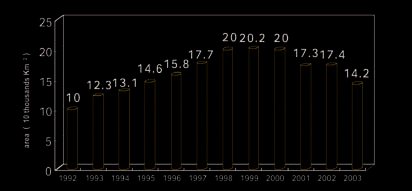
The Yellow
The Yellow Sea:
Sea
Governance Analysis
Figure 5-1 The sketch map of national coastal water environment condition 46
Figure 5-2 Trends in national coastal and marine water area inferior to
the marine water quality standards of Grade
46
From the State Marine Environment Quality Report 2005, http://
www.soa.gov.cn/hygb/2005hyhj/2.htm
120
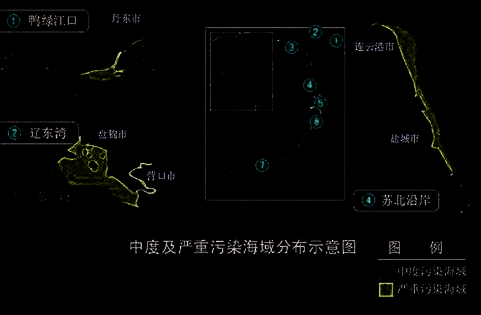
Volume 4
National Report-China
Trends in national coastal and marine
polluted areas were distributed along
water area inferior to the marine water
the Yalujiang River Estuary, Jiaozhou
standard of Grade I 47
Bay, and Jiangsu Province, with major
pollutants being inorganic nitrogen and
As of 2005, about 43000 km² of the sea
phosphate figure 5.3. With respect to
area of the Yellow Sea did not meet the
marine pollution, land-based pollutants
requirement of the Seawater Standard;
account for about 90%; the remaining
of this amount, 3000 km² were seriously
pollutants are from seabased activities
polluted, 4000 km² were polluted to a
such as maritime culture, petroleum and
medium extent, and 14000 km² were
gas development, dumping, etc.
lightly polluted (Table 5-1). The seriously
Table 5-1 Seawater Quality of the Yellow Sea 2003~2005 (km2)
Year
Clean
Lightly Polluted
Polluted to
Seriously
Medium Extent
Polluted
Total
2003
14,440
5,700
3,520
3,200
26,860
2004
15,600
12,900
11,310
8,080
47,890
2005
21,880
13,870
4,040
3,150
42,940
Figure 5-3 The map of medium and heary polluted area in the Yellow Sea
48
China Coastal and Marine Environment http://www.zhb.gov.cn/eic/652466692596
695040/20040607/1051317.shtml
121
The Yellow
The Yellow Sea:
Sea
Governance Analysis
The development of fish farming is one
of the most intensively exploited in
of the causes of seawater pollution.
the world. Major fisheries are at an
Pervasive usage of high-tech fishing
extremely low level (the average total
instruments and years of immoderate
catch is 200,000 tons) compared with 3
fishing contributed to a continual
decades ago. The fisheries are no longer
decline in the quantity of fish; this forced
economically sustainable. Since the
increasing numbers of fishermen to
1960s, there has been a major change in
retreat from fishing and move to fish
catch composition. Larger, commercially
farming from the 1990s onward. The
important species such as the yellow
disorder in the approval procedures and
croaker and hair-tail have been replaced
the weakness in the management system
by smaller-bodied and low value forage
accelerated the chaotic development of
fish, such as anchovy. The Japanese
fish farming. Indeed, China is already
anchovy is presently believed to be the
beginning to exhaust appropriate sites
most abundant specie in the Yellow Sea,
and freshwater supplies available for fish
with a potential catch of 1/2 million tons
farming.
per year. The stress of over-fishing has
affected the self-regulatory mechanism of
L a n d - b a s e d p o l l u t i o n i s a n o t h e r
the Yellow Sea. The Global International
cause of seawater pollution. Under-
Waters Assessment (GIWA) characterizes
investment in infrastructure by the State
the Yellow Sea as severely impacted in
has resulted in an insufficient number
terms of over-fishing, with destructive
of sewage treatment installations in
fishing practices; this impact continues to
many coastal cities. Due to the lack
increase.
of capital funds required to update
techniques, many enterprises continue
China has adopted measures to control
to use old techniques and equipment. In
fishing vessels and has re-issued fishing
addition, some coastal enterprises have
licenses. To improve the effectiveness of
discharged sewage directly into the sea,
its fisheries laws and regulations, China
which has seriously polluted the marine
established a Fisheries Law Enforcement
environment.
Command in 1999; this is part of its plan
to develop a multi-agency surveillance
5.1.2 Over-fishing
and enforcement team. To improve its
capacity to deal with illegal, unreported
Besides pollution, the greatest threat
and unregulated fishing, China has built
to China's marine ecosystem is over-
new enforcement vessels with better
fishing. The Yellow Sea was once one
equipment to patrol EEZ. To formalize
122
Volume 4
National Report-China
the enforcement procedure, China has
37% of the inter-tidal areas existing in
adopted the Measures on Fisheries
the Chinese portion of the Yellow Sea
A d m i n i s t r a t i o n a n d E n f o r c e m e n t
in 1950 have been reclaimed. The two
Vessels, and increased personnel in law
largest rivers flowing into the Yellow Sea,
enforcement. Notwithstanding, illegal,
the Huang He (Yellow River) and Chang
unreported and unregulated fishing
Jiang (Yangtze River) are undergoing
continue to present a challenge to
significant changes that will greatly
Chinese fisheries industries, especially
reduce the amount of sediment input; it
in coastal areas. Many of China's fishing
is predicted that future loss of inter-tidal
boats are `day sailers' with small crews;
areas will occur at an increasing rate due
environmentally, this is a double-edged
to the combined effects of reclamation
sword. Although these boats do not have
and reduced accretion. It is estimated
the range to fish far offshore and thus
that at least 2,000,000 shorebirds use
decimate stocks there, over-fishing along
the region during northward migration,
the coast has become intense. The small
this number being approximately 40%
mesh of some fishing nets graphically
of all the migratory shorebirds in the
demonstrates the situation. In the
East Asian-Australasian Flyway. Large
absence of sufficient sizable fish for an
numbers of birds are also present during
economical catch, fishermen attempt
southward migration, when perhaps
to seize whatever they can. The fishing
1,000,000 shorebirds pass through the
effort, as a whole, is much higher than the
region. Many shoreline birds have lost
reproduction of fish stock; hence, over-
their habitats. A kind of acorn worm,
fishing remains the main threat to the
Saccoglossus hwangtaoensis, which is
sustainability of fish stocks.
in the Directive of Protected Animals
in China, has not been found for many
5.1.3 Loss of Biodiversity
years. Whales, dolphin, seals, and sea
lions, once common in this area, are
According to statistics, approximately
seldom seen.
5.2 Major Problems Exist in the Protection of the
Yellow Sea and Policy Suggestions
5.2.1 Legislation First
basically determined by the relationship
between supply and demand. Before ways
Environmental problems existing in
can be found to effectively change the
the Yellow Sea marine ecosystem are
relationship between supply and demand,
123
The Yellow
The Yellow Sea:
Sea
Governance Analysis
legislation enhancement is undoubtedly
f e e f o r o n e d a y i s a b o u t 1 0 0 , 0 0 0
the most important way to solve the
CNY. This is seen to be so exorbitant
environmental problems. Although China
that enterprises would rather accept
has issued more than 20 laws related to
punishment than run waste treatment
marine ecosystem protection, much more
facilities. In addition, department rules
must be done, including the following:
and local legislations may contain
inconsistent stipulations concerning
1) China should enact additional laws and
a particular situation; this affects the
increase the comprehensiveness of their
unification of Chinese laws. Therefore,
jurisdiction.
harmonization of stipulations is also
necessary.
2) China should establish detailed rules
to make laws more exercisable. Usually,
5 . 2 . 2 E n h a n c e t h e
g e n e r a l r u l e s c o m p r i s e t h e m a j o r
Enforcement of Law
component of Chinese laws; these rules
serve only as guides to deal with the many
To manage the marine ecosystem and
types of cases. General rules give law
protect marine environment, legislation
enforcers a great deal of discretion when
is basic, while law enforcement is key.
dealing with specific cases, and make it
Only the proper combination of the two
difficult to enforce the laws. It is difficult
can bring about desired results. The
to increase the enforceability of laws
major problem affecting the enforcement
through amendments or the issuance of
of law is the inconsistency among
implementation rules.
relevant law enforcement departments.
At present, many departments exercise
3) China should regularly review existing
their authority on the sea, including
laws and unify inconsistent provisions in
the departments of communication,
the law. As actual situations change faster
agriculture, policy, energy, environment,
than legislation, the law may fall behind
land management, marine affairs,
the development of society. Therefore, it
customs, and navy, etc. As the limits
is of great importance to amend out-of-
of authority among these departments
date provisions. For example, according
are not well-stipulated by law, several
to the law, the punishment for illegal
gaps and overlaps exist in the process of
waste discharge activities undertaken by
law enforcement. If a unitary planning
coastal enterprises ranges from 20,000
and coordinating mechanism could be
to 200,000 CNY. In some large-scale
established, the enforcement of law would
enterprises, however, the waste treatment
become more effective.
124
Volume 4
National Report-China
C o n s i d e r t h e s u r v e i l l a n c e a n d
environmental conditions along the
e n f o r c e m e n t t e a m a s a n e x a m p l e .
Yellow Sea, co-operation among these
Besides the army and the armed policy,
three countries is greatly needed. Except
f o u r d e p a r t m e n t s u n d e r t h e S t a t e
for the Fish Agreement signed by China
Council have their own surveillance
and P.R.Korea, there is currently no
a n d e n f o r c e m e n t t e a m s , n a m e l y :
regional agreement aimed at protecting
Marine Safety Administration under
the marine environment of the Yellow
the Communication Ministry, Fishery
Sea. This indicates a direction for related
Management and Fishing Harbour
international organizations. Historically,
Superintendence under the Agriculture
t h r e e m e t h o d s h a v e b e e n u s e d t o
Ministry, Anti-smuggling Squad under
reach an international agreement on
the General Administration of Customs,
environmental problems: military force,
and Marine Surveillance under the State
economic control and negotiation at the
Oceanic Administration. Because of
round table. Under the current peaceful
differing allegiances, communication and
and equal international situation, force
co-operation among various surveillance
and control are no longer viable or
and enforcement teams tend to become
desirable; hence, negotiation is the only
quite difficult, and joint actions are
road which can lead to an international
seldom taken. If these organizations
agreement. If the countries wish to
can re-organize existing teams, detail
promote co-operation on the protection
their duties, exchange information and
of marine environment in the Yellow
enhance co-operation, they will be better
Sea region, they must work together
able to guard the entire China Sea.
to determine the areas of common
understanding on these problems, reduce
5 . 2 . 3 P r o m o t e R e g i o n a l differences through bargaining, and
Co-operation and Advance gradually come to consensus on solutions
the Subscription of Regional for the protection of the Yellow Sea.
Agreement
5 . 2 . 4 S t r e n g t h e n t h e
T h e P e o p l e ' s R e p u b l i c o f C h i n a ,
Management System
P.R.Korea and R.Korea are neighbouring
countries, and share the Yellow Sea.
1) Increase harmony among Ministries
The environmental problems of one
concerned with marine management. As
country may spill over to the other
the authority over seas belongs to several
countries through the same atmosphere
Ministries and some duties are not clearly
a n d o c e a n s . I n o r d e r t o i m p r o v e
stipulated, conflicts among Ministries
12
The Yellow
The Yellow Sea:
Sea
Governance Analysis
are inevitable. Although the laws have
governments should be responsible for
definite stipulations, nevertheless
ocean environment in their respective
because of poor communication, various
regions;48 however, some of the local
agencies may waste much money doing
g o v e r n m e n t s p r o m o t e d i f f e r e n t
the same things. For example, Article 6 of
standards or seek methods to elude
the Regulations Concerning Prevention
State-issued laws. Local governments
of Pollution Damage to the Marine
are the direct executors of law; if under
Environment by Land-based Pollutants
weak surveillance and management,
provides: "Units and individuals should
they may violate the law for their local
register to the environmental protection
interests. For instance, the Sea Area Use
administrations of their land-based
Management Law stipulates that sea
pollutant discharge details, and copy to
area use exceeding a certain limit should
the oceanic administrations." Since 2005,
be approved by state level authorities,
oceanic administrations have focused
and the sea area use fee should be
their efforts on the monitoring of land-
collected into the state treasury. In
based pollution; this has been very costly
order to circumvent the law, many local
and there have been many redundancies.
authorities partition a large project
This has also occurred within the sea-
into smaller ones, so their use of sea
monitoring institutions. The State
areas may fall within the limit provided
Marine Environment Monitoring Net,
by the law, and be approved by local
State Coastal Marine Environment
authorities. Hence, the management and
Monitoring Net, and State Fishery
surveillance of local governments is of
Water Monitoring Net come under the
great importance.
Oceanic Administration, Environmental
Protection Administration and Fishery
5 . 2 . 5 S t r e n g t h e n t h e
Administration. While each of the Nets
C o n s t r u c t i o n o f t h e
publishes respective annual assessments
Management Team
c o n c e r n i n g t h e s t a t e o f m a r i n e
environment, their data is not shared;
One reason for weak enforcement of
hence, repeated monitoring exists.
law is that China lacks qualified sea
management managerial and technical
2) More carefully manage and provide
staff. Because of the low education
s u r v e i l l a n c e o f t h e r o l e s o f l o c a l
level of the whole population (although
governments. According to the Marine
China has done a great work to promote
Environmental Protection Law, local
education) the accomplishments of some
48 Article 16 of the Environmental Protection Law.
126
Volume 4
National Report-China
managerial teams are not satisfactory.
they shall immediately report them to
M a n y o f f i c i a l s h a v e i n s u f f i c i e n t
the nearest harbour superintendence
knowledge of marine-related fields,
administration; fishing boats may also
especially marine management; it is
report such occurrences to the nearest
difficult for them to correctly understand
fisheries administration and fishing
and enforce marine policies and laws, to
harbour superintendence agency. The
say nothing of issuing a policy or a law.
S t a t e O c e a n i c A d m i n i s t r a t i o n h a s
Most of them have not received technical
established a Volunteer Ships Monitoring
training required to meet the needs of
System. While environment surveying
marine environmental protection. The
is comprehensive, a public surveillance
State should adopt a life-long study
programme should be established to
mechanism, and provide managerial
cover all aspects of marine environment.
teams with regular training and classes.
Many Laws have special requirements
Additionally, there is a great need to
with respect to public participation and
provide incentives in order to obtain well-
transparency in marine management. For
trained staff, and to reward them for the
example, the Environment Protection
effective use of their abilities.
L a w a n d M a r i n e E n v i r o n m e n t
Protection Law state: Citizen has the
5 . 2 . 6 E s t a b l i s h a P u b l i c right to supervise, accuse and bring
Surveillance Programme, a complaint before the court against
Enhance Public Participation anybody who has caused pollution and
damage to the environment and the
and Transparency in Marine competent State department should
Management
release environment quality reports.
The Environment Impact Assessment
The Marine Environmental Protection
Law also encourages concerned units,
Law specifies: All units and individuals
experts and the public to participate in
e n t e r i n g t h e s e a a r e a s u n d e r t h e
the environmental impact assessment
jurisdiction of the People's Republic
process, using appropriate means.
of China shall have the obligation
to watch for and report on actions
Despite the provisions of laws, the right
causing pollution damage to the marine
of the public to access information on
environment; and all vessels have the
environment and resource management
obligation to guard against pollution of
cannot be guaranteed, because these
the sea. Upon discovering violations of
provisions are not exercisable. Although
regulations or occurrences of pollution,
12
The Yellow
The Yellow Sea:
Sea
Governance Analysis
the government has established websites
that the 21st century is one of oceans
on the management of environment and
and seas, and that the degree of marine
resources, some pivotal management
development is a good indication of the
data are confidential, and the public
integrated national power of a country.
cannot access it. In the environmental
As a result, more funding is provided for
assessment process, public opinions
marine-related areas. However, marine
are seldom collected and considered.
policy and law are relatively under-
In the process of drafting management
developed in China, compared with other
regulations, only the advice of some
large coastal countries. Because of the
related departments are heard, while the
key function of marine policy and law in
public voice is neglected.
marine development, more investment
should be provided for the teaching and
Transparency and participation can be
research of marine policy and law.
improved in two main ways:
Universities can appropriately train
1 ) P u b l i c i z e b a s i c i n f o r m a t i o n ,
s p e c i a l i s t s i n m a r i n e s c i e n c e a n d
p r o c e e d i n g s a n d o u t c o m e s o f t h e
management, and can provide common
management process more widely;
classes for the public to gain marine
e s t a b l i s h a d i s c l o s u r e i n s t i t u t i o n
k n o w l e d g e . A t p r e s e n t , u n i v e r s i t y
for important management issues,
resources are not fully used to train
such as Sea Area Function Zoning,
talented people for marine-related fields.
Environmental Impact Assessment,
Marine-related majors are not popular
Issuance of Sea Area Use Permits and
among students; few classes are held
Fishing License, etc.
to train governmental officials; and no
lectures are opened to public for the
2) Allow higher degrees of involvement
dissemination of marine knowledge. To
of stakeholders in the decision-making
change this situation,
process; enhance public participation in
State actions and programmes.
1) More elites should be attracted
to devote themselves to the study of
5.2.7 Enhance Education in marine science and technology, marine
Marine Policy and Law
management, marine economy, marine
policy, and laws.
Prior to the 21st century, oceans and seas
did not attract much public attention;
2) For students with other majors,
however, society has come to realize
courses on marine policy and law should
128
Volume 4
National Report-China
be added to their curricula, especially in
universities located in coastal cities.
3) Government officials of coastal
areas should be provided with more
o p p o r t u n i t i e s t o r e c e i v e r e g u l a r
training in universities, both on natural
knowledge of the sea and knowledge of
sea management.
4) Fishermen should be convened and
educated regularly, especially in non-
fishing seasons.
12
The Yellow
The Yellow Sea:
Sea
Governance Analysis
130
The Yellow Sea:
Volume 4
Governance A
er
nalysi
nance A
s
References
National Report-China
1. Marine economic statistical yearbook. SOA, ed. 2005. Ocean Press
2. Environmental Protection in China, Information Office of the State Council, P.R.
China, June 1996, Beijing, Peoples Daily (Overseas Edition)
3. China's Agenda 21- White Paper on China's Population, Environment, and
Development in the 21st Century, Ocean Press, 1997
4. Ocean Polluters Must Be Told to Pay, China Daily July 6, 2004
5. State Marine Environment Quality Report 2005, SOA, Ocean Press, 2006
6. China Fisheries Yearbook 2003 (in Chinese), Bureau of Fisheries Management,
Agriculture Publishing House, 2004.
7. China Fisheries Yearbook 2004 (in Chinese), Bureau of Fisheries Management,
Agriculture Publishing House, 2005.
8. China Fisheries Yearbook 2005 (in Chinese), Bureau of Fisheries Management,
Agriculture Publishing House, 2006.
9. China Ocean Yearbook 2003 (in Chinese), State Oceanic Administration, Ocean
Press, 2004.
10. China Ocean Yearbook 2004 (in Chinese), State Oceanic Administration, Ocean
Press, 2005.
11. China Ocean Yearbook 2005 (in Chinese), State Oceanic Administration, Ocean
Press, 2006.
12. China Agriculture Statistical Report, 2004 (In Chinese), Ministry of Agriculture,
PRC, China Agriculture Press
13. Collections of Laws of the People's Republic of China, Jilin People's Press
14. Collections of Fisheries Laws and Regulations of China, Fisheries Administration
and Fishery Harbour Superintendency of China, Legal Press of China 1999
15. On the Ocean Century and Marine Development Strategy of China, Li Yaozhen and
Xu Xiangmin, Press of the Ocean University of China 2004
16. Development of China's Marine Programme, State Council, 1998, Ocean Press
131

The Yellow
The Yellow Sea:
Sea
Governance Analysis
Annexes 1-5 (Questionnaires)
The original questionnaires are in Chinese. Their English translations are listed here.
Annex 1 Questionnaire for Governmental Departments
Questionnaire for Governmental Departments
Related to Marine Affairs
In order to understand the concerns of officials, fishermen, coastal enterprises, coastal
residents, and non-government organizations on the Yellow Sea ecosystem, and to
provide data for governance analysis on the Yellow Sea, we conduct this questionnaire.
We sincerely appreciate your answering the following questions, which will take several
minutes of your time.
1 You live at county/district city province.
2 Do you know which countries are along the Yellow Sea?
A China B P. R. of Korea C R. of Korea D Japan
3 Do you know which cities and provinces in China are along the Yellow Sea?
A Liaoning B Shandong C Jiangsu D Shanghai E Zhejiang
4 Which do you think are main stresses on the ecological environment of the Yellow
Sea?
A Over-fishing B Mariculture C Raw sewage
D Waste discharge from coastal enterprises
E Pollution from ports and ships
E Coastal reclamation
F Disturbance from coastal tourists
5 Compared to 1980s, what is current status of ecosystem environment of the Yellow
Sea?
A No change B Deteriorating C Seriously Deteriorating D Better
6 Who are responsible for ecosystem environment damage of the Yellow Sea?
A Governmental departments B Coastal enterprises
C Ports and ships
D Mariculture practitioners
E Fishing companies
F Coastal residents
G Tourists
H Other
132
Volume 4
National Report-China
7 Whose interests do you think are considered when drafting marine development
plans or programmes?
A Central government
B Coastal provincial and municipal governments
C Coastal enterprises
D Mariculture practitioners
E Fishing companies
F Coastal residents
G Other
8 What do you think the tendency of national policies between the development and
protection of the Yellow Sea has been in the past 20 years?
A Orientated to development B Development prior to protection
C Development and protection are equal
D Protection prior to development E Orientated to protection
9 What do you think the tendency of national policies between the development and
protection of the Yellow Sea will be in next 10 years?
A Orientated to development B Development prior to protection
C Development and protection are equal
D Protection prior to development E Orientated to protection
10 What do you think is the current policy tendency of coastal provincial and municipal
governments between the development and protection of the Yellow Sea?
A Orientated to development B Development prior to protection
C Development and protection are equal
D Protection prior to development E Orientated to protection
11 What roles do you think governmental departments play in protecting ecosystem
environment of the Yellow Sea?
A Protector for national interests B Protector for coastal residents
C Protector for coastal enterprises which discharge pollutants
D Protector for fishermen
E Coordinator for above stakeholders
12 Do you think the current laws, policies and measures have been carried out
perfectly?
A Yes B Uncertain C No
Please give examples
13 Do you think that if current laws, policies and government measures are carried out
perfectly, the environment of the Yellow Sea ecosystem will improve much?
133
The Yellow
The Yellow Sea:
Sea
Governance Analysis
A Yes B uncertain C No
14 What kinds of difficulties does your unit face during marine enforcement and
management activities?
15 What do you think are the main reasons for the above difficulties?
A Imperfect laws, and policies do not match the actual situation
B Economic benefits prior to environmental benefits
C Imperfect ocean management system
D Poor technique and equipment
E Inadequate budget
F Local protectionism when conflict between local and national benefits
G The parties to be managed have low awareness of marine protection and law
obedience
F other
16 Are there overlap phenomena of power range between marine management
departments?
A Yes
B No
If yes, please give examples
17 Are there conflicts between policy tendencies and laws for environmental protection
of the Yellow Sea?
A No B Slight conflicts
C Severe conflicts during the implementation
D Theoretical conflicts
18 What jurisdiction conflicts and benefits conflicts exist among coastal provinces and
cities along the Yellow Sea?
134
Volume 4
National Report-China
19 In your opinion, how can laws and policies related to the Yellow Sea environment
protection be improved?
20 What roles do you think the United Nations play in the management of the Yellow
Sea?
A Facilitating public awareness
B Facilitating regional coordination among countries along the Yellow Sea
C Provide guide for laws framework
D Other
21 How much would you like to donate for restoration of the environment of the Yellow
Sea? ( CNY each year)
13

The Yellow
The Yellow Sea:
Sea
Governance Analysis
Annex 2 Questionnaire for Enterprises
Questionnaire for Coastal Enterprises
Along the Yellow Sea
In order to understand the concerns of officials, fishermen, coastal enterprises, coastal
residents, and non-government organizations on the Yellow Sea ecosystem, and to
provide data for governance analysis on the Yellow Sea, we conduct this questionnaire.
We sincerely appreciate your answering the following questions, which will take several
minutes of your time.
1 You live at county/district city province.
2 Do you know which countries are along the Yellow Sea?
A China B P. R. of Korea C R. of Korea D Japan
3 Do you know which cities and provinces in China are along the Yellow Sea?
A Liaoning B Shandong C Jiangsu D Shanghai E Zhejiang
4 Which do you think are main stresses on the ecological environment of the Yellow
Sea?
A Over-fishing B Mariculture C Raw sewage
D Waste discharge from coastal enterprises
E Pollution from ports and ships
F Coastal reclamation
G Disturbance from coastal tourists
5 Compared to 1980s, what is the current status of the ecosystem environment of the
Yellow Sea?
A No change
B Deteriorating
C Seriously deteriorating
D Better
6 Who are responsible for ecosystem environment damage of the Yellow Sea?
A Governmental departments
B Coastal enterprises
C Ports and ships
D Mariculture practitioners
E Fishing companies
F Coastal residents
G Tourists
H Other
7 Whose interests do you think are better considered when marine development plans
or programmes are being drafted?
136
Volume 4
National Report-China
A Central government B Coastal provincial and municipal governments
C Coastal enterprises D Mariculture practitioners
E Fishing companies
F Coastal residents
G Other
8 What do you think the tendency of national policies between the development and
protection of the Yellow Sea has been in the past 20 years?
A Orientated to development
B Development prior to protection
C Development and protection are equal
D Protection prior to development
E Orientated to protection
9 What do you think the tendency of national policies between the development and
protection of the Yellow Sea will be in next 10 years?
A Orientated to development
B Development prior to protection
C Development and protection are equal
D Protection prior to development
E Orientated to protection
10 What do you think is the current policy tendency of coastal provincial and municipal
governments on development and protection of the Yellow Sea?
A Orientated to development B Development prior to protection
C Development and protection are equal
D Protection prior to development E Orientated to protection
11 What roles do you think governmental departments play in protecting ecosystem
environment of the Yellow Sea?
A Protector for national interests B Protector for coastal residents
C Protector for coastal enterprises which discharge pollutants
D Protector for fishermen E Coordinator for above stakeholders
12 In what way(s) do your enterprises utilize the Yellow Sea?
A Marine transportation B Fishing C Mariculture
D Seafood process E Oil extraction F Exploitation of sea sand
G Seawater as cooling water H Desalination of seawater
I Marine chemical J Coastal engineering construction
K Coastal tourism L Sea area as waste dumping area
13
In what way(s) do your enterprises affect the Yellow Sea ecosystem?
A Discharge liquid pollutant B Discharge gas pollutant
C Discharge solid pollutant D Make noise E Heat discharge
13
The Yellow
The Yellow Sea:
Sea
Governance Analysis
F Hydrological disturbance (destroying vertical structure of waters)
G Reduce quantity of fishery resource directly
H Modify natural coast line I Other
14 What is the ecological effect from the activities of your enterprises?
A Water quality deterioration
B Sediment quality deterioration
C Fishery resource decreasing
D Destroying seascape
E Health loss of ecosystem
F Death or moving out of living organisms
15 Whose benefits are destroyed by the activities of your enterprises?
A Coastal residents
B Mariculture practitioners
C Fishing companies
D Tourist
E Unconcern
F Other
16 Do you think the environment deterioration of the Yellow Sea ecosystem has an
effect on the development of your enterprise?
A Yes B No C Uncertain D Unconcern
17 If laws and regulations are strictly enforced, will the development of your enterprise
be affected?
A Yes B No C Uncertain D Unconcern
18 Does your enterprise observe the imperfect regulations and rules?
A Observe sometimes B Not observe accidentally
C Try our best to observe D Try our best to elude
E Other
19 What are your concerns relative to sea area utilization by your enterprise during
government management activities?
20 How much would you like to donate for restoration of the environment of the Yellow
Sea? (_________ CNY each year)
138

Volume 4
National Report-China
Annex 3 Questionnaire for Fishermen
Questionnaire for Fishermen along the Yellow Sea
In order to understand the concerns of officials, fishermen, coastal enterprises, coastal
residents, and non-government organizations on the Yellow Sea ecosystem, and to
provide data for governance analysis on the Yellow Sea, we conduct this questionnaire.
We sincerely appreciate your answering the following questions which will take several
minutes of your time.
1 You live at county/district city province.
2 Do you know which countries are along the Yellow Sea?
A China B P. R. of Korea C R. of Korea D Japan
3 Do you know which cities and provinces in China are along the Yellow Sea?
A Liaoning B Shandong C Jiangsu D Shanghai E Zhejiang
4 Which do you think are main stresses on the ecological environment of the Yellow
Sea?
A Overfishing
B Mariculture
C Raw sewage D Waste discharge from coastal enterprises
E Pollution from ports and ships F Coastal reclamation
G Disturbance from coastal tourists
5 Compared to 1980s, what is the current status of the ecosystem environment of the
Yellow Sea?
A No change
B Deteriorating
C Seriously deteriorating
D Better
6 Who are responsible for ecosystem environment damage of the Yellow Sea?
A Governmental departments B Coastal enterprises
C Ports and ships
D Mariculture practitioners
E Fishing companies
F Coastal residents
G Tourists
H Other
7 Whose interests are better considered when drafting marine development plans or
programmes?
A Central government
13
The Yellow
The Yellow Sea:
Sea
Governance Analysis
B Coastal provincial and municipal governments
C Coastal enterprises
D Mariculture practitioners
E Fishing companies
F Coastal residents
G Other
8 What has the tendency of national policies between the development and protection
of the Yellow Sea been in the past 20 years?
A Orientated to development
B Development prior to protection
C Development and protection are equal
D Protection prior to development
E Orientated to protection
9 What do you think the tendency of national policies between the development and
protection of the Yellow Sea will be in the next 10 years?
A Orientated to development
B Development prior to protection
C Development and protection are equal
D Protection prior to development
E Orientated to protection
10 What do you think is the current policy tendency of coastal provincial and municipal
governments on development and protection of the Yellow Sea?
A Orientated to development
B Development prior to protection
C Development and protection are equal
D Protection prior to development
E Orientated to protection
11 What role do you think governmental departments play in protecting the ecosystem
environment of the Yellow Sea?
A Protector for national interests
B Protector for coastal residents
C Protector for coastal enterprises which discharge pollutants
D Protector for fishermen
E Coordinator for above stakeholders
12 As a mariculture practitioner, what method do you prefer to select for your long-
term benefits?
A Pursue massive mariculture to achieve more benefits in a short term.
B Negotiate with neighbouring mariculture practitioners; both maintain suitable
mariculture quantities, and both reduce profit.
C Pursue multi-species mariculture mode, maintain suitable mariculture quantity,
and reduce own profit.
13 Which influences do your mariculture activities bring the Yellow Sea ecosystem?
A Water quality deterioration
B Sediment quality deterioration
C Change of wild species
D Unconcern
140
Volume 4
National Report-China
14 How much do your mariculture activities affect the Yellow Sea ecosystem?
A No damage B slight damage C One of major destroying factors
15 What is the relationship between mariculture disease spread and mariculture
quantity?
A Some relationship B No relationship C Hard to confirm
16 Do you think the current laws, policies and management measures for the Yellow
Sea are reasonable?
A Reasonable; fully consider benefits of mariculture practitioners
B Relatively reasonable; partially consider benefits of mariculture practitioners
C Not reasonable, ignore benefits of mariculture practitioners
17 What is your attitude relative to strengthening the protection of the ecosystem of the
Yellow Sea?
A Definitely support, prefer to reduce my own economic interests
B Support, prefer to reduce my own economic interests
C No support, the current ecosystem condition of the Yellow Sea is good
18 What thing most influences your mariculture interests at present?
A National policy change B Intervene from administration departments
C Disease D Marine pollution
E Change of market supply and demand
19 As far your mariculture activities are concerned, what problems do you think
presently exist in government management departments?
20 How much would you like to donate for restoration of the environment of the Yellow
Sea? (_____ CNY each year)
141

The Yellow
The Yellow Sea:
Sea
Governance Analysis
Annex 4 Questionnaire for Residents
Questionnaire for Coastal Residents
In order to understand the concerns of officials, fishermen, coastal enterprises, coastal
residents, and non-government organizations on the Yellow Sea ecosystem, and to
provide data for governance analysis on the Yellow Sea, we conduct this questionnaire.
We sincerely appreciate your answering the following questions which will take several
minutes of your time.
1 You live at county/district city province.
2 Do you know which countries are along the Yellow Sea?
A China B P. R. of Korea C R. of Korea D Japan
3 Do you know which cities and provinces in China are along the Yellow Sea?
A Liaoning B Shandong C Jiangsu D Shanghai E Zhejiang
4 Which do you think are main stresses on the ecological environment of the Yellow
Sea?
A Overfishing B Mariculture C Raw sewage
D Waste discharge from coastal enterprises
E Pollution from ports and ships F Coastal reclamation
G Disturbance from coastal tourists
5 Compared to 1980s, what is the current status of the ecosystem environment of the
Yellow Sea?
A No change B Deteriorating
C Seriously deteriorating D Better
6 Who are responsible for ecosystem environment damage of the Yellow Sea?
A Governmental departments B Coastal enterprises
C Ports and ships
D Mariculture practitioners
E Fishing companies
F Coastal residents
G Tourists
H Other
7 Whose interests do you think are considered when marine development plans or
programmes are drafted?
A Central government
142
Volume 4
National Report-China
B Coastal provincial and municipal governments
C Coastal enterprises D Mariculture practitioners
E Fishing companies
F Coastal residents
G Other
8 What do you think the tendency of national policies between the development and
protection of the Yellow Sea has been in the past 20 years?
A Orientated to development B Development prior to protection
C Development and protection are equal
D Protection prior to development E Orientated to protection
9 What do you think the tendency of national policies between the development and
protection of the Yellow Sea will be in the next 10 years?
A Orientated to development
B Development prior to protection
C Development and protection are equal
D Protection prior to development
E Orientated to protection
10 What do you think is the current policy tendency of coastal provincial and municipal
governments on the development and protection of the Yellow Sea?
A Orientated to development
B Development prior to protection
C Development and protection are equal
D Protection prior to development
E Orientated to protection
11 What role do you think governmental departments play in protecting the ecosystem
environment of the Yellow Sea?
A Protector for national interests
B Protector for coastal residents
C Protector for coastal enterprises which discharge pollutants
D Protector for fishermen
E Coordinator for above stakeholders
12 Does detergent in your kitchen influence the environment of the Yellow Sea?
A Yes B No C Unconcern
13 Do you think that littering garbage at the coast influences the ecological
environment of the Yellow Sea?
A Yes B No C Unconcern
14 Do you think that purchasing illegal marine living organisms (e.g. coral) or fishing in
no-fishing periods, contribute to damaging the ecosystem?
A Yes B No C Unconcern
15 What is your response when you witness activities which destroy the environment of
143
The Yellow
The Yellow Sea:
Sea
Governance Analysis
the Yellow Sea?
A Reporting to management departments
B Dissuading destroyers
C Disclosing to media D Silently tolerate
E Unconcern
16 Do your above responses have positive feedback?
Reporting to management departments:
A No taking action
B Taking action, destroying behaviour have been stopped
Dissuading destroyers:
C No positive reply
D Temporarily stop the destruction action
Reporting to media:
E Yes, positive reply F No reply
17 How do you assess the behaviour of the local management department?
A Power abuse
B Weak enforcement of laws
C Passive management, neglect residents' demands
D Partial to enterprises
E Protect residents' interests
18 Would you like to join the group of protectors of the Yellow Sea ecosystem?
A Yes, may often participate in volunteer activities
B Yes, may participate in volunteer activities sometimes
C Yes, but do not participate in volunteer activities
D Unconcern
19 How much would you like to donate for restoration of the environment of the Yellow
Sea? (_______CNY each year)
144

Volume 4
National Report-China
Annex 5 Questionnaire for NGO
Questionnaire for NGOs along the Yellow Sea
In order to understand the concerns of officials, fishermen, coastal enterprises, coastal
residents, and non-government organizations on the Yellow Sea ecosystem, and to
provide data for governance analysis on the Yellow Sea, we conduct this questionnaire.
We sincerely appreciate your answering the following questions which will take several
minutes of your time.
1 You live at county/district city province.
2 Do you know which countries are along the Yellow Sea?
A China B P. R. of Korea C R. of Korea D Japan
3 Do you know which cities and provinces in China are along the Yellow Sea?
A Liaoning B Shandong C Jiangsu D Shanghai E Zhejiang
4 Which do you think are main stresses on the ecological environment of the Yellow
Sea?
A Overfishing B Mariculture
C Raw sewage
D Waste discharge from coastal enterprises
E Pollution from ports and ships
F Coastal reclamation
G Disturbance from coastal tourists
5 Compared to 1980s, what is current status of the ecosystem environment of the
Yellow Sea?
A No change
B Deteriorating
C Seriously deteriorating
D Better
6 Who are responsible for ecosystem environment damage of the Yellow Sea?
A Governmental departments B Coastal enterprises
C Ports and ships
D Mariculture practitioners
E Fishing companies
F Coastal residents
G Tourists
H Other
7 Whose interests are better considered when drafting marine development plans or
programmes?
A Central government
14
The Yellow
The Yellow Sea:
Sea
Governance Analysis
B Coastal provincial and municipal governments
C Coastal enterprises D Mariculture practitioners
E Fishing companies F Coastal residents G Other
8 What do you think the tendency of national policies between the development and
protection of the Yellow Sea has been in the past 20 years?
A Orientated to development
B Development prior to protection
C Development and protection are equal
D Protection prior to development
E Orientated to protection
9 What do you think the tendency of national policies between the development and
protection of the Yellow Sea will be in the next 10 years?
A Orientated to development
B Development prior to protection
C Development and protection are equal
D Protection prior to development
E Orientated to protection
10 What do you think is the current policy tendency of coastal provincial and municipal
governments on the development and protection of the Yellow Sea?
A Orientated to development
B Development prior to protection
C Development and protection are equal
D Protection prior to development
E Orientated to protection
11 What role do governmental departments play in protecting the ecosystem
environment of the Yellow Sea?
A Protector for national interests B Protector for coastal residents
C Protector for coastal enterprises which discharge pollutants
D Protector for fishermen E Coordinator for above stakeholders
12 What are main purposes of the activities conducted by your organization?
A Provide communication opportunities for colleagues who work in the same field
B Propagandize scientific knowledge to public
C Promote social reputation
D Protect ecological environment
E Strengthen public awareness of environment protection
13 With what frequency does your organization organize activities aimed at ecological
environment protection?
A Once each month
B At least 5 times each year
146
Volume 4
National Report-China
C Once each year D A-periodically
14 At what the target people do the activities of your organization mainly aim?
A Residents
B Staff in enterprises C Officials D Students
E Tourists
F Craft brother (please give examples)
15 What kinds of ways do you adopt to organize activities?
A Picture-based exhibition B Scientific seminar
C Field activities of protection the Yellow Sea
D Discussion with officials E Submit suggestion to related institutions
F Other
16 Do you think your organization's activities often get support from public?
A Strong support from the most public B Support from many public
C Less support from some public
17 Are you confident in improving the ecological environment condition of the Yellow
Sea through organizing activities?
A Yes, very confident
B Confident
C Uncertain
D Unconcern
18 What do you think are the main problems regarding Yellow Sea management
activities of government departments?
19 How much would you like to donate for restoration of the environment of the Yellow
Sea? (______ CNY each year)
14
The Yellow
The Yellow Sea:
Sea
Governance Analysis
148

Governance Analysis
National Report-
Republic of Korea
Dong-Oh Cho
Dong-Hyun Choi
Korea Maritime Institute
The Yellow Sea:
Volume 4
GovernanceAnalysis
I. Background of Assignment
NationalReport-RepublicofKorea
The Yellow Sea Large Marine Ecosystem
degraded the water quality, reduced the
(YSLME) is one of the largest semi-
biodiversity and productivity, and have been
enclosed bodies of waters in the world,
the major causes of Harmful Algal Blooms
which is bordered by China and the Korean
(HAB); (iii) Reclamation of wetlands and
Peninsula. It is also one of the largest
coastal waters for agricultural use, and for
shallow continental shelf areas in the world,
building coastal cities, ports and industrial
covering an area of about 400,000 km2 at an
complexes has been the major cause of loss
average depth of 100m (Tang, 2003).
of habitat and spawning areas, which also
have resulted in loss of biodiversity and
The Yellow Sea LME is considered a Class
productivity; (iv) Recent sand mining in
I, highly productive ecosystem (>300 gC/
the coastal waters has degraded valuable
m2/year) based on SeaWiFS global primary
habitats and has resulted in coastal erosion;
productivity estimates (NOAA, 2003). The
(v) Marine debris, such as derelict fishing
Yellow Sea LME is an important global
gear and styrofoam, remain in the water
resource, supporting substantial populations
and surface for a long time, damaging the
of fish, invertebrates, marine mammals and
marine environment, and causing maritime
seabirds. The fauna in the Yellow Sea LME is
accidents in the Yellow Sea; (vi) The demand
recognized as a sub-East Asia province of the
for use of the ocean as a place to dump
North Pacific Temperate Zone (Zhao, 1990).
landfill waste has increased and degraded
water quality of Yellow Sea; (vii) Finally,
However, the rapid economic development
maritime traffic has increased and caused oil
and huge population (about 600 million
pollution accidents, which has been a major
people) in the bordering coastal area have
cause of loss of biodiversity and productivity.
overexploited the marine resources and
degraded the marine environment of the
In the approved Implementation Plan
Yellow Sea. The major environmental
of the UNDP/GEF Yellow Sea Project,
stress and its results are as follows: (i)
"Reducing Environmental Stress in the
Overexploitation and illegal fishing have
Yellow Sea Large Marine Ecosystem," one
greatly depleted the stock of fisheries in the
of the main activities of the Investment
YSLME; (ii) Land-based pollutants have
Component is to identify stakeholders
151
The Yellow
The Yellow Sea:
Sea
Governance Analysis
and assess their capacities to contribute
the underlying root causes of the Yellow Sea'
to the Transboundary Diagnostic Analysis
s ecosystem problems, through the analysis
(TDA). The Regional Working Group for
of the whole political environment that
the Investment Component (RWG-1)
affects environmental problems including:
agreed at its second meeting (Jeju, Korea,
stakeholders, institutions, laws, policies,
14-17 November 2005) to implement a
and projected investments. The results of
Governance Analysis which addresses
the analysis will provide a basic foundation
issues of not only stakeholders but also
for identifying possible interventions, the
institutional arrangements, and legal and
key inputs to the TDA, as part of causal
policy frameworks.
chain analysis, and to the Strategic Action
Programme (SAP), as management
The objective of this task is to conduct the
suggestions used in the preparation of the
Governance Analysis so as to understand
SAP.
152
The Yellow Sea:
II. Review of Preliminary
Volume 4
GovernanceAnalysis
Governance Analysis
NationalReport-RepublicofKorea
1. Major Marine Ecosystem Issues
1) High Demand for Intensive 2) Loss of Wetlands
Coastal Development
Korea has very large wetlands (2,393
The Korean government expected intensive
square km) in comparison with land area.
coastal development for agriculture,
The portion of wetland to national land is
industrial complexes, ports, and coastal
2.4%. Wetlands are very important fishery
cities in the implementation of the National
habitats and produce various and large
Economic Development Plans. Therefore in
quantities of fish. However, from 1987 to
1962, the Korean government enacted "the
1998 about 25.3% of total wetlands were lost
Public Water Reclamation Act" as soon as
due to reclamation or filling for expanding
"the First National Economic Development
of agriculture land or making industrial
Plan" started.
complexes. It is said that more than 40% of
the total wetlands were lost since 1945.
Then why was coastal development
popular? The main reasons are low cost for
The reclamation and infilling of tidal
securing sites and simple administrative
wetlands, carried out at a large scale mostly
procedures: (i) The costs of reclamation of
on the west coast, has caused the loss of
wetland and coastal water for development
important marine habitat and fishing
are far cheaper than purchasing land from
grounds. According to the assessment by
many private owners; (ii) Administrative
Ministry of Maritime Affairs and Fisheries
procedures, such as solving conflict,
(MOMAF) (1998), the total area of Korean
compensation fund raising, legal and
coastal wetlands diminished by 30-40%
administrative support, is very simple in
since 1987, and only 2,393 square kilometres
comparison to purchasing land from many
of wetlands were left in the west and
private owners.
south coasts. Also the decentralization of
administrative power and responsibility gave
153
The Yellow
The Yellow Sea:
Sea
Governance Analysis
regional governments strong incentives to
Korea entered into the London Dumping
reclaim areas to develop a regional economy
Convention in December 1993, which came
and income tax base.
into force in January 1994. However, ocean
dumping has increased continuously due to
The high demand for intensive coastal
population growth in the coastal area and
development will increase pressure to
economic and industrial development.
reclaim wetland areas. For example, the
current Saemanguem Reclamation Project is
4 ) D e c l i n i n g N e a r s h o r e
building a dyke of 33 km to create a 28,300
Fisheries
ha of land for rice production.
Total fisheries products have decreased
3) Declining Water Quality
continuously from a peak of 3.5 million
tons in 1994. All fisheries products, such
Over the last three decades, various
as those from ocean and coastal fishing
pollutants, which were produced by
vessels, aquaculture, and fresh water, have
industrial activities and municipalities
decreased. The main reasons are over-
located along coastal areas, have been
exploitation, deterioration of water quality,
discharged into the coastal waters. They
and loss of areas for aquaculture due to
have imposed cumulative impacts on coastal
reclamation. Although aquaculture is a
ecosystems and caused serious problems of
very important alternative, frequent red
eutrophication, red tides and mass mortality
tides and deteriorated water quality make
of marine organisms. Since 1991, coastal
it very difficult. MOMAF plans for a rate of
water quality measured by the COD was
aquaculture increase in total products from
maintained at the second-class standard.
27% in 2000 to 45% in 2030.
Although the COD level showed a decreasing
annual trend, the level of nitrogen and
Compared to the decrease of total fisheries
phosphorus, which are the main triggering
products, the domestic demand for fisheries
factors of red-tides, are much higher than
products increased rapidly. As a result,
the standard.
the rate of fisheries products to domestic
consumption decreased continuously from a
With the increased activity of cargo
peak of 138% in 1980.
transported by ships, Korean marine
waters suffered approximately 300 oil-spill
5) Decreasing Population of
accidents, annually. The spill accidents were
Fishermen
mostly from oil-tankers, and the major cause
was carelessness by crew members.
Despite strong government policies
154
Volume 4
National Report-Republic of Korea
and support, the number of fishermen
own purposes and limit public access to the
employment and population of fishermen
coastal zone.
have continually decreased. The main
reasons are a decrease in quality of life
7) Intensifying Industrial Urban
for fishermen. Fishermen's income per
Development
capita increased 107.9% in ten years from
8,079,000 Won in 1989 to 16,794,000
Korea's coastal lands have been very densely
Won in 1998. However, in the same period,
used. A total of 22 industrial complexes, 25
the per capita income for agriculture and
coastal cities, 50 harbours, and 415 fishing
urban workers increased 117.2% and 162.5%
harbours are sited in the coastal zone. Most
respectively.
of the chemical complexes and steel factories
are situated on coastal lands. In addition all
6) Limited Public Access
shipbuilding docks and many generators are
situated in the coastal land.
There are many forecasts that coastal
tourism would increase rapidly as income
About 33% of the total population lives
increases and work hour's decrease, which
in coastal areas. Forecasting predicts that
would require public access to the coastal
coastal populations will increase to 40% of
zone. However, public access is limited
the total population and coastal GDP will
seriously due to unplanned development
increase to 50% of the total GDP in 2030.
and limited recognition for public access.
Designated places for tourism by law in the
8) Growth in Tourism Facilities
coastal zone are national parks, provincial
parks, municipal parks, and various tourism
Demand for tourism and leisure has
purpose districts. Most of them are public
increased rapidly with an increase in income
beaches for swimming in the summer.
and leisure hours. Inland tourism is limited
Surveys revealed that there were about
due to traffic jams, crowds of travellers, and
100 natural places remaining. However,
inconvenient facilities. Coastal tourism is
those areas were not developed with the
an emerging industry due to the crowded
environment in mind. Many motels,
inland tourism. Yacht leisure is predicted
restaurants, and various pleasure facilities
to become popular in 2010 when GNP per
deteriorated water quality, have destroyed
person is approximately US$15,000 and
scenic value, and limited public access
ocean leisure will become popular when
to the coastal zone. Also most harbours,
GNP per person is about US$20,000.
fishing harbours, industrial complexes, and
military facilities were constructed for their
Generally coastal tourism is recognized as
155
The Yellow
The Yellow Sea:
Sea
Governance Analysis
an environmentally friendly industry and
and tax revenue. However, most local
contributes to the local economy. Therefore,
governments plan large tourism facilities
local governments are strongly planning to
without considering the impacts on the
invest in coastal tourism for local economic
coastal ecosystems.
development, employment increases,
2. Socio-Economic Data
Compared to the country's area of
power generators are situated in these
99,291 square kilometres, Korea has a
areas. About 33% of the total population
long coastal line of 11,542 kilometre and
lives in the coastal area in Korea.
numerous islands. Korea's coastal sea is
Forecasts of the coastal population state
composed of the East Sea, the South Sea,
an increase to 40% of the total population
and the Yellow Sea. The management
and a 50 % increase in coastal GDP in
area of the above coastal sea of 447,000
2030.
square kilometres is about 4 times of the
national land area. The continental shelf
Korea's coastal waters have also been
of the South and Yellow Seas is 345,000
used for coastal zone development,
square kilometres. Korea's wetlands are
fisheries industry of fishing vessels
one of the five biggest wetlands in the
and aquaculture, vessel traffic, ocean
world and are considerably important
dumping, pollution of land-based and
h a b i t a t f o r f i s h e r i e s a n d m a r i n e
sea-based sources, and recreational
ecosystem.
activities.
Korea's coastal areas have been highly
Therefore, this "Socio-Economic Data"
used. A total 22 industrial complexes, 25
shows much pressure to the YSLME,
coastal cities, 50 harbours, 415 fishing
such as over-exploitation and decrease of
harbours are sited in the coastal zone.
fisheries stock, heavy vessel traffic and oil
Most of the chemical complexes and steel
spill accidents, dense development and
factories are situated in coastal areas. In
degradation of coastal water quality.
addition all shipbuilding docks and many
156
Volume 4
National Report-Republic of Korea
Table II-1 Major Particulars and Usage of Korean Coastal Area
Classification
Unit
Status
Remarks
1) Land Area
km2
- Natural Environment Consecration
- Publicized Area
5,093 km2 (82.2%)
- Land
km2
99,915
Fisheries Resources Consecration Area
- Sea
km2
6,196
2,953 km2 (31)
2) Total Population
million 47
- Coastal Population 13
(27.2% of total population)
3) Length of
Coastal Line
11,914
- Land 6,228(52.3%), islands 5,686(47.7%)
4) Coastal Facilities
ea
3,014
- Total length 2,075 km2
(33% of land shore line)
5) Designated
ea
51
- International port 28, Coastal port 23
6) Fishing Port
2,266
7) Islands
3,170
- Non-livings island 2,691(85%),
Living island 479(15%)
8) Tideland
2,393
- West coast 1,980(83%),
South coast 413(17%)
9) Sea Surface
-Territorial
- 72% of land area
water(12n.m.)
71
- 4 times of land area
- EEZ (200n.m.)
447
- 3.5 times of land area
- Continental Shelf
345
- 13% of land area, 18% of territorial water
- Within 3n.m.
13
Sources: MOMAF
Table II-2 Population and Families in the Coastal Areas (2003)
Population Administrative
Classification
Population
Family
Population Area
Density
(thousand)
(ea)
per Family (km2)
(person/
District
km2)
(ea)
234 Cities,
Nationwide(A)
47,925
15,436,263 3.10
99.915 479
Towns,
Autonomous
Districts
Coastal City,
78 Cities,
Town, District
12,741
4,267,958
2.99
32,026 398
Towns,
(B)
Autonomous
Districts
B/A(%)
26.6
27.6
96.5
32.05
83.1
33.3
Sources: MOMAF
157
The Yellow
The Yellow Sea:
Sea
Governance Analysis
Table II-3 Designation of Special Management Marine Area and Marine
Environment Conservation Area
Area(km2)
Classification
Name
Land
Coastal
1) Coastal waters of Busan
505.77
235.73
2) Coastal waters of Ulsan
144.29
56.56
3) Coastal waters of Kwangyang
334.56
131.37
SMMA
4) Coastal waters of Masan
157.66
142.99
5) Coastal waters of Siwha-Inchon
576.12
605.76
Sub-total
(1,718.40)
(1,172.41)
1) Bay of Kamak
101.13
154.17
2) Bay of Deugyang
234.51
315.74
MECA
3) Bay of Wando-Doam
431.50
338.48
4) Bay of Hanpyung
165.87
140.73
Sub-total
(933.01)
(949.12)
Total
2,651.41
2,121.53
Source: MOMAF
Table II-4 Oil Spill Accidents (1986~2005)
`86
`87
`88
`89
`90
`91
`92
`93
`94
`95
Accident 158
152
158
200
248
240
328
371
365
299
Oil
2,617.6 482.4
1,058.2 368.0 2,420.6 1,257.0 2,942.5 515,460.3 4,565.1 15,775.9
`96
`97
`98
`99
`00
`01
`02
`03
`04
`05
Accident 337
379
470
463
483
455
385
297
343
Oil
1,720.1 3,441.0 1,050.2 386.9 583.0
668.1
409.9
1,457.7
1,461.7
(Unit : case, kl )
158
Volume 4
National Report-Republic of Korea
Table II-5 Ocean Dumping
Quantity of Annual Dumping
`95
`96
`97
`98
`99
`00
`01
`02
`03
`04
`05
Total
4,170 5,014 5,643 5,976 6,444 7,104 7,671 8,475 8,874 9,749 9,929
West Sea
(Byung) 1,049 1,614 2,013 2,429 2,380 2,423 2,390 2,424 2,406 2,397 2,383
East Sea
(Byung) 1,739 1,997 2,216 2,140 2,325 2,862 3,394 4,088 4,372 5,262 5,883
East Sea
(Jung)
1,382 1,403 1,413 1,407 1,739 1,819 1,887 1,963 2,096 2,090 1,663
Sources: MOMAF
(Unit: thousand Ton)
Table II-6 Water Quality in the West Sea
Transpa
Year
Temp
COD
T-N
T-P
()
Sal
pH
DO
(mg/L) (mg/L) (mg/L) (mg/L) (mg/L)
-rency
(m)
1997
14.4
30.04
8.04
7.97
1.37
0.328
0.018
48.6
1.7
1998
15.0
28.84
8.09
8.73
1.36
0.313
0.021
34.5
1.9
1999
15.7
29.00
7.86
8.19
0.95
0.319
0.024
20.5
2.4
2000
13.8
30.11
7.97
7.68
1.25
0.216
0.022
21.0
2.0
2001
14.6
31.12
7.99
8.10
1.35
0.238
0.060
25.7
1.7
2002
13.9
30.45
8.10
8.38
1.33
0.472
0.063
23.0
1.6
2003
14.2
29.96
8.02
9.16
1.73
0.627
0.047
21.2
2.1
2004
14.6
30.18
8.13
9.44
1.91
0.550
0.060
29.2
1.6
2005
14.9
30.41
8.12
8.95
1.52
0.752
0.060
23.2
1.6
Table II-7 Clean-up of Marine Debris
Year
1997
1998
1999
2000
2001
2002
2003
2004
2005
quantity 328,965 343,845 107,727 87,340
65,002
203,854 236,558 87,517
98,730
Sources: MOMAF
159
The Yellow
The Yellow Sea:
Sea
Governance Analysis
Table II-8 Vessels by Fishery
2000
2001
2002
2003
2004
Number
95,890
94,935
94,388
93,257
91,608
Power Vessel 89,294
89,347
89,327
88,521
87,203
Non-power
6,596
5,588
5,061
4,736
4,405
Vessel
Total
GT
923,099
884,853
816,563
754,439
724,980
Power Vessel 917,963
880,467
812,629
750,763
721,398
Non-power
5,136
4,386
3,934
3,676
3,582
Vessel
Distant Waters
Number
597
568
543
517
491
Fisheries
GT
349,420
335,552
318,855
273,086
261,237
Off-shore, Coastal Number
68,629
67,990
67,411
66,698
66,063
Fisheries
GT
397,868
386,181
362,163
344,992
330,203
(Unit: vessels, ton)
Table II-9 Vessels by Province
2000
2001
2002
2003
2004
Number
2,357
2,369
2,396
2,450
2,386
In-cheon
GT
45,399
43,922
41,459
40,349
37,800
Number
2,202
2,196
2,209
2,335
2,336
Gyeonggi
GT
3,440
3,489
3,819
4,301
4,648
Number
6,643
6,695
6,620
6,585
6,517
Chungnam
GT
19,666
21,161
21,808
22,006
22,231
Number
4,979
4,936
4,844
4,792
36,095
Jeonbuk
GT
27,772
26,164
20,268
18,504
101,646
Number
35,820
36,303
36,628
36,834
36,095
Jeonnam
GT
115,036
110,884
108,997
103,309
101,646
(Unit: vessels, ton)
160
Volume 4
National Report-Republic of Korea
Table II-10 Number of Fishermen by Province
2000
2001
2002
2003
2004
No. of Persons
140
137
128
125
122
Incheon
5
5
4
4
3
Gyeonggi
3
3
3
3
3
Province
Chungnam
17
17
17
17
16
Jeonbuk
8
9
7
7
7
Jeonnam
52
51
46
45
45
(Unit: 1,000 persons)
Table II-11 Fisheries Income
2000
2001
2002
2003
2004
Fisheries Income
10,078
11,087
10,165
10,741
11,959
(Unit: 1,000won)
Table II-12 Fisheries Consumption per Capita (kg)
2000
2001
2002
2003
2004
Total
36.8
42.9
44.5
44.7
-
(Unit: kg/year)
Table II-13 Exports and Imports of Fishery Products
2000
2001
2002
2003
2004
Exports
1,504,470
1,273,619
1,160,435
1,129,385
1,278,638
Imports
1,410,598
1,648,372
1,884,417
1,961,145
2,261,356
(Unit: $1,000)
Table II-14 Economic Importance of Fisheries (GDP Contribution)
2000
2001
2002
2003
2004
GDP
578,664
600,866
642,748
662,655
693,424
Fisheries
2,155
2,164
2,000
2,006
1,966
GDP Contribution
0.4
0.4
0.3
0.3
0.3
(Unit: Thousand million won, %)
161
The Yellow
The Yellow Sea:
Sea
Governance Analysis
3. Preliminary Governance Analysis
T h e p u r p o s e o f t h e " P r e l i m i n a r y
2 ) C l e a r D e f i n i t i o n o f
G o v e r n a n c e A n a l y s i s " i s t o g i v e a
"Problems"
basic understanding of governance
issues surrounding the Yellow Sea'
I t i s n o t a l w a y s c l e a r w h e t h e r t h e
s environmental problems. It consists
"Problems" of each component are
o f f o u r c o m p o n e n t s : B i o d i v e r s i t y ;
limited to the natural and physical
Ecosystem; Fisheries; and Pollution.
phenomenon or if it includes issues
Generally each component consists of
related to management practices. Most of
its problems, impacts (environmental
the "Problems" are related to the natural
impact or socio-economic impact), causes
and physical phenomenon, however, the
(immediate causes (technical causes),
"Uncontrolled Aquaculture Practices"
underlying causes, root causes), and
and "Inadequate Capacity to Assess
a governance analysis. A review of the
Ecosystem" of "Fisheries Component" are
results of the "Preliminary Governance
related to management practices. If the
Analysis" is as follows.
"Problems" of each component include
management practices, then the existing
1) Clear Definition of the Four "Problems" should be re-analyzed. This
Components
project has analyzed many problems
related to management practices in the
The "problems" of the four components
YSLME.
are not clearly distinguished based on
their definitions. For example, "Habitat
3) A More Practical Model
Loss" and "Habitat Conversion" of the
"Biodiversity Component" are associated
T h e s t r u c t u r e o f t h e " P r e l i m i n a r y
with "Ecosystem Components." The
Governance Analysis" is so theoretical
"Habitat Conversion" of the "Biodiversity
that it is useful to understand the basic
Component" and "Habitat Modification"
problems of the YSLME, but it is not
o f " E c o s y s t e m C o m p o n e n t s " a r e
practically useful in conducting this
connected. In fact, it is better to review
project. For example, the "immediate
the "Preliminary Governance Analysis"
causes, underlying causes, and root
using one large concept.
causes" have not been distinguished
practically. It is suggested that more
practical mode should be developed.
162
Volume 4
National Report-Republic of Korea
4) Factors in Governance 7) Fisheries
Analysis
In addition to the results of the existing
In this project, the Governance Analysis
"Governance of Fisheries Component,"
is conducted by grouping (1) Stakeholders
a general summary finds that the main
Analysis, (2) Institutional Analysis, and
needs include addressing illegal fishing by
(3) Legal and Policy Analysis, which
domestic and foreign vessels, addressing
was very useful in the broad governance
over-exploitation, and conducting a
analysis. Therefore, it is suggested that
fisheries stock assessment.
the same groupings are used.
8) Pollutants
5 ) G o v e r n a n c e o f t h e
Biodiversity Component
In addition to the results of the existing
"Governance of Pollution Component," a
In addition to the results of the existing
general summary finds that there is weak
"Governance of Biodiversity Component,"
management of land-based sources of
a general summary finds that there is
pollutants and that dense development is
weak management because relevant
encouraged at the local level.
laws or programs are absent and a
needed comprehensive survey or marine
biodiversity is absent due to the lack of
prioritization of the marine environment.
6) Ecosystem Component
In addition to the results of the existing
"Governance of Ecosystem Component,"
a general summary finds that terrestrial
ecosystem are highly prioritized, while
marine ecosystem are not, there is weak
management because relevant laws or
programs are absent, and there is limited
recognition of the marine ecosystem by
NGOs and the public.
163
The Yellow
The Yellow Sea:
Sea
Governance Analysis
164
The Yellow Sea:
Volume 4
GovernanceAnalysis
III. Stakeholder Analysis
NationalReport-RepublicofKorea
1. Overview
U n d e r a n e c o s y s t e m m a n a g e m e n t
is observed that major stakeholders'
concept of expanded inclusiveness,
interests, decision-making process and
a stakeholder is anyone who has an
means, and ability of decision-making
interest in the topic at hand and wishes
in YSLME Governance are as shown in
to participate in decision making1. It
Table III-1.
1
Meffer (2002) suggests that stakeholder fit into one or more of five
categories according to the variety of interests : (1) People who live,
work, play, or worship in or near an ecosystem, (2) People interested in the
resource, its users, its use, or its non-use, (3) People interested in the
process used to make decisions, (4) People who pay the bills, (5) People who
represent citizens or are legally responsible for public resources.
165
The Yellow
The Yellow Sea:
Sea
Governance Analysis
Table III-1 Summary of Stakeholders in YSLME Governance
Stakeholder
Interest
Decision-making
Ability to make or
process/means
influence decisions
- Secure the goal of the
committees of Congress in - Policy and legislation
which the Congressmen are discussion in the
- Legally authorized for
Congress
members.
relevant committees.
legislation, annual
- Protect the interest of
- Cast a vote in the
national budgeting and
the region where the
general assembly.
settlement of account.
Congressmen were elected.
- Secure their own
ministries' goals.
- MOCT : Construction-
oriented
- MOMAF: Dual function
(development and
Policy issues filing
conservation): fisheries
Inter-vice-ministerial
Central
promotion, port
meeting
Ministers are members of the
Government
construction, marine
Inter-ministerial
cabinet which decides high-
environmental
meeting
level policies.
conservation.
decision.
- MAF: Agriculture
(reclamation for paddy
fields).
- MOE: Environmental-
oriented.
- Specific
- Secure their own interests
- Participation in public importance of the industry
hearings.
in the national economy (oil,
Industry
mostly through representing
organizations (associations, - Document review
fisheries, shipping)
corporations)
member ship of
- Political influence with
special committees
voting power in general
and presidential elections
- Conservation of the
- Demonstration
- Solidarity among
NGOs
environment to be endowed
to next
- Protest campaign
(small)NGOs
generations
- Outreach program
- Public support
Scholars and
- Research report,
- Decision-makers'
Journalists
- Research, writing, speech
lecture, speech,
support
seminar
- Public support
2. Structure of Stakeholders
YSLME stakeholders can be divided into
Organizations. GOs are stakeholders,
the government sector and the private
w h i c h m a k e d e c i s i o n s o n Y S L M E ,
sector in Korea. The government sector
and can be divided into the congress,
can be divided into GOs (Government
central government agencies, and local
Organizations) and Quasi-Government
government agencies. Quasi-government
166
Volume 4
National Report-Republic of Korea
organizations are stakeholders, which
tourism, R&D, marine environment
are established, owned, and managed
industry, etc. Most industries have
by government organizations. The
representative organizations, to protect
quasi-government organizations do
the benefits of the industry.
not make decision on YSLME, but
participate in decision-making in depth,
NGOs are stakeholders who are also
such as the development of policies,
affected by decisions on the YSLME and
recommendations on policies, analysis of
are representative of the general public.
laws and policies, feasibility studies, etc.
Recently environmental NGOs are active
in protecting the marine environment
The private sector includes stakeholders,
and its ecology. The general public
who are affected directly by government
includes stakeholders, who are affected
sector decision-making on the YSLME.
and interested in decision-making on the
The private sector can be divided into
YSLME. scholars, researchers, experts,
three categories: Industry, NGOs, and the
and reporters are representative of the
Public. The industry includes fisheries,
public.
shipping and logistics, ports, oil mining,
Fig. III-1 Structure of Stakeholders
Private
Government
Industry:
GO:
- Organizations
- Congress
- Private
- Central Government
- Local Governments
NGOs:
- National Level NGO's
- Local NGO's
Quasi-Government
Public:
Organization
- Scholars/Experts
- Reporters/Private
167
The Yellow
The Yellow Sea:
Sea
Governance Analysis
3. Governments
The governments sector can be classified
Although MOMAF is in charge of the
as follows: (i) Ministry of Maritime
marine environment and resources
Affairs and Fisheries (MOMAF) and its
management, MAF, MOCT, and MOE
subsidiaries, such as Korea Coast Guard
have strongly effected decisions made
(KCG,), National Fisheries Research
especially in the marine environment and
and Development Institute (NFRDI),
in coastal zone management. The central
N a t i o n a l O c e a n o g r a p h i c R e s e a r c h
governments, such as MOMAF, MOCT,
Institute (NORI), (ii) other relevant
and MOE, have delegated much of their
institutes, such as Congress, Ministry of
jobs to local governments, especially
Agriculture and Forestry (MAF), Ministry
implementation of policies, such as
of Construction and Transportation
fisheries management. The research
(MOCT), Ministry of Environment
institutes and universities are in charge
(MOE), and local governments, (iii)
of suggestion of policy recommendations
quasi-governments, such as research
and R&D on the marine environment and
institutes and universities.
resources management.
MOMAF and its subsidiaries are directly
H o w e v e r , M O M A F i s t h e m o s t
in charge of the marine environment
responsible government organization for
a n d r e s o u r c e s m a n a g e m e n t , s u c h
the marine environment and resources
as enactment of relevant laws and
in Korea. However, most of the central
establishment and implementation of
g o v e r n m e n t s a r e i n v o l v e d i n t h e
government programs and polices. The
decision-making on important marine
Congress is in charge of enactment and
environment and resources program.
revision of relevant laws and regulations
For example, the "Marine and Fisheries
and also supervises the effectiveness
Development Basic Plan" (Korea's Oceans
o f i m p l e m e n t a t i o n o f g o v e r n m e n t
Policy) was established in 2004 by most
programs and policies. The Congress also
of the central governments.
deliberates and authorizes government
budgets.
More details in governments sector as
stakeholders are described in Section IV.
168
Volume 4
National Report-Republic of Korea
4. NGOs and the Public
1) Evolution of Coastal NGOs including the Sea Prince Accident in
in Korea
1995 and the deterioration of water
quality resulting from the Lake Shiwha
Nongovernmental organizations (NGOs),
Reclamation Project. Especially since the
including environmental NGOs, in
failure of the Lake Shiwha Project, several
Korea have a very strong impact on
local NGOs have participated in the
political decisions and public opinion.
restoration of the Shiwha Estuary and the
Korea's government supports activities
conservation of its wetland. These NGOs
of environmental NGOs based on the
will be expected to be future stewards
"Basic Law on Environment Policy,"
for the conservation of the Lake Shiwha
which regulates in Article 16-2 as follows:
along with experts and scientists.
(1) the central government and local
governments should take measures
Currently the public and most NGOs
t o p r o v e i n f o r m a t i o n t o e n h a n c e
oppose large development projects
environmental NGOs voluntary activities
in the coastal zone and conflict with
related to environmental conservation;
development-related governmental
(2) the central government and local
policies, the majority of which are
governments can give financial support to
development projects in the coastal zone.
environmental NGOs when they purchase
and manage scenic and valuable lands for
F o r e x a m p l e , t h e d e v e l o p m e n t o f
conservation.
the Young San River was the largest
reclamation project in Korea before
However, most NGOs have not been
t h e L a k e S h i w h a P r o j e c t a n d w a s
interested in the coastal environment
scheduled to be built over the course
until recently. Most of them have focused
of five consecutive development plans.
on the problems of water quality on land,
However, in the face of strong opposition
air pollution, industrial waste, among
from environmental groups and the
other land based environmental issues.
public after the environmental disaster
of the Lake Shiwha, the Fourth Young
However, recently, they have recognized
San River Development phase was
the importance of the coastal marine
officially cancelled in 2000 by the central
environment and its resources. This
government. This fourth phase would
may be due in part to the severe damage
have completed a 126 square kilometres
caused by several big oil spill accidents,
coastal development that was intended to
169
The Yellow
The Yellow Sea:
Sea
Governance Analysis
provide land for agriculture.
Movement (KFEM) and the Green Korea
United (GKU). KFEM is the largest
After the success of the opposition to the
environmental NGO that have 47 local
Fourth Young San River Development
branches and 85,000 members. Although
Project, the public and NGOs also
KFEM was established in 1993, its former
opposed the Saemangeum Reclamation
organization, the Korean Research
Project purporting that it would bring
Institute of Environmental Problems, was
another environmental disaster similar
established in 1982. GKU was established
to the Shiwha Reclamation Project.
in 1991 and has 15,000 members and
Also they argued that the Saemangeum
many local branches in Korea.
Reclamation Project had no feasibility,
that is, the feasibility studies did not
In addition to KFEM and GKU, there are
incorporate the benefits of wetlands.
many other NGOs, with a focus in the
However, unlike the Fourth Young
marine environment. Also many local
San River Development Project, the
YMCAs in coastal areas are active in the
s u p p o r t e r s f o r t h e S a e m a n g e u m
marine environment and its resources.
Reclamation Project were persistent
and argued that the feasibility study
NGOs` interest is based on the belief
was accurate. Most supporters for
that if marine ecosystem is degraded,
d e v e l o p m e n t o f t h e S a e m a n g e u m
restoration work is difficult or impossible.
Reclamation Project were from Ministry
As Gray K. Meffce put it, some of the
of Agriculture and Forestry (MAF) ,
public are interested in total protection
the local government of Jeollabuk-Do,
of resources for its intrinsic value or
and the residents, who believed the
ecosystem functions (Gray K. Meffee et.
project would bring beneficial economic
al., 2002). They may object to its extreme
development.
uses as commodities (e.g. hunting and
fishing) or as an amenity (e.g. hiking and
2) Major Environmental NGOs
boating). NGOs` opposition activities
are accelerated since they are linked with
T h e r e h a v e b e e n m a n y N G O s i n
local people whose daily individual life
Korea who have a very strong impact
and wellbeing are directly connected
o n p o l i t i c a l d e c i s i o n s a n d p u b l i c
with marine ecosystem. It has been
opinion. However, there are only two
observed that many national and local
nationwide environmental NGOs with
NGOs are trying to protect the values of
environmental protection as their goal:
marine ecosystem, such as therapeutic
the Korean Federation for Environmental
recreation, spiritual inspiration, or
170
Volume 4
National Report-Republic of Korea
solitude. For example, wetlands and
riparian habitat, and beautiful scenery for
watershed provide marine biodiversity,
beach tourism and field education sites
5. Industry Representatives
There are many industries, which are
much invest in marina. So at present the
stakeholders of Yellow Sea marine
tourism industry does not much affect
environment and resources, such as
the marine environment and resources
fisheries, shipping, oil, port, mining,
management.
tourism, and logistics industry. However,
in this review, fisheries, shipping, and
(iv) Logistics industry: The logistics
oil industry are analyzed because of the
industry is included in the shipping
followings:
industry.
(i) Port industry: All the Korean ports are
1) Fisheries Industries
owned and constructed by the Korean
government (MOMAF) and most of them
(1) Fisheries Cooperatives 1
are also managed by the government.
R e p r e s e n t i n g t h e f i s h i n g i n d u s t r y
So the port industry as stakeholders is
are three cooperatives: the National
assumed to be included into government
Federations of Fisheries Cooperatives;
sector.
Regional Fisheries Cooperatives; and
Fishing Village Cooperatives. The fishing
(ii) Mining industry: At present there is
village cooperative was founded in 1962
not any mining in the Korea jurisdiction
after the central and regional fisheries
of Yellow Sea except sand mining. The
cooperatives were established. The main
sand mining is described in detail in
role of the fishing village cooperatives
Section V.
is managing commonly held fishing
grounds and co-op facilities. As the main
(iii) Tourism industry: At present the
economic organization of the fishing
largest tourism in Korea is beach
community, it plays an important social
swimming while recreational fishing
function of organizing and representing
are just in the early stage. Although
local fisheries households.
local governments have much interests
in marina, it is also in the early stage
Before the cooperative was organized,
and the private sector is hesitated in the
village councils under the leadership of
2
So-Min Cheong, Managing Fishing at the Local Level: The Role of Fishing
Village Cooperative in Korea. Coastal Management, 32:191-2002, 20045.
171
The Yellow
The Yellow Sea:
Sea
Governance Analysis
village chiefs led community enterprises.
the mid-70s. Currently, the main function
Once fishermen established their own
of the National Federation of Fisheries
cooperative, the economic function of
Cooperatives located in Seoul is the
the village council was transferred to
servicing of credit and financing through
the village cooperative, and the council
cooperative banking.3
was left with administrative duties.
Other changes occurred when several
The Korean fisheries cooperative was
communities merged to produce a
established to replace the exploitative
fishing village cooperative. If these
middlemen dominating the capital
communities did not get along in the
and distribution markets, to organize
past, the management of commonly held
dispersed fishing communities, and
local fisheries resources was difficult.
to upgrade the productive and social
They might fight over the distribution of
status of fishermen. The hierarchical
earnings from fishing and the way fishing
cooperative system placed the local
grounds should be operated.
cooperative under the supervision of the
regional cooperative, and the regional
The cooperative structure is the result of
fisheries cooperative initially played
a top-down process set in motion by the
an important role in local resource
national government. The government
management. Sixty-six fisheries regional
brought it to life with subsidies and
cooperatives, based on geographic
regulations in 1962 and established
units, were responsible for selling fish
three types of cooperative organizations:
products, training, granting loans, and
the National Federation of Fisheries
managing fishing rights; essentially,
C o o p e r a t i v e s , R e g i o n a l F i s h e r i e s
regional cooperatives managed local
C o o p e r a t i v e s , a n d F i s h i n g V i l l a g e
common fishing grounds. The fishing
Cooperatives. The state initially exercised
village cooperatives paid a user fee to the
its control over the national cooperative
regional fisheries cooperative and worked
by appointing the president of the
on village fishing grounds, since the use
national cooperative, giving subsidies,
of village fishing grounds was restricted
and defining cooperative regulations, but
to members of the regional fisheries
its role has diminished over time. The
cooperative. Restricted access and user
president has been elected through direct
fees, however, generated discontent
vote since 1988 and the cooperatives have
a m o n g f i s h i n g v i l l a g e c o o p e r a t i v e
generated up to 80% of their funds since
members.
3
NFFC has three businesses: (1) Economic business, such as cooperative
purchases of materials for fishing vessels, cooperative sales, and
strengthening logistic functions; (2) Credit business, such as management of
credit loan and foreign exchange; (3) mutual aid business.
172
Volume 4
National Report-Republic of Korea
The government gradually ceded control
that remains between the fishing village
of local fisheries resources to the fishing
cooperatives and regional cooperative is
village cooperative. The change in
through membership. The regulations
fisheries regulations in 1975 relinquished
state that one must join the regional
r e g i o n a l c o n t r o l o f l o c a l f i s h e r i e s
cooperative first to be a member of the
resources and granted local fishing rights
fishing village cooperatives, but in reality,
to the fishing village cooperative. For
the fishing village cooperative does not
example, the 1972 revision allowed the
accept fishermen who do not sign up with
fishing village cooperative to obtain a
them first. Membership in the regional
license from the government to retain
cooperative has henceforth become a
common fishing grounds and fixed net
mere formality.
fishing grounds. Further, the revision
in 1975 and 1977 gave priority to fishing
With respect to the sale of fish products,
village cooperatives to manage common
fishermen no longer need to go to the
fishing grounds and aquaculture sites.
regional cooperative to report and
A 1981 revision also stipulated that if an
sell their catch. Changes in fisheries
individual fishing right in the common
regulations abolished the fish sale
fishing ground expired, fishing village
reporting system, and fishermen are now
cooperatives had priority in acquiring the
free to sell their catch anywhere they like.
fishing right. Control of village fishing
This further weakened the connections
grounds, consequently, was transferred
between the regional cooperative and the
from the regional fisheries cooperatives to
fishing village cooperative.
the local fishing village cooperatives. This
trend was motivated by democratization
S u b s e q u e n t l y , o t h e r t h a n s h a r i n g
in fishing operations and the regional
membership, most of the local operations
cooperatives' efforts to shrink their size of
and functions are separate from the
operation.
national or regional cooperatives,
though fishing village cooperatives are
Once the resources use right of the
still officially linked to the national and
common fishing ground was transferred
regional fisheries cooperatives. This
to the fishing village cooperatives,
makes the fishing village cooperative the
the regional cooperatives no longer
key local resource manger. The transfer of
maintained a solid linkage to the local
authority from the regional cooperative to
cooperative and could not exercise its
the local cooperative indicates the state'
power as before. Other than helping with
s recognition of the critical role fishing
the sale of fish products, the only real tie
village cooperatives play in local resource
173
The Yellow
The Yellow Sea:
Sea
Governance Analysis
management. The government now
Dredging of fishing ports and cleaning of
directly communicates with the fishing
coastal waters; (3) Management of fishing
village cooperative on matters pertaining
ports cleaning vessels; (4) Clean-up of
to local fisheries management.
marine debris in the coastal waters and
fishing grounds.
It is generally noted that fishing ground
has two aspects in consideration of its
2) Shipping Industry
characteristics of property right(s): One
is common property and the other is
(1) KSA
individual property right. The first is
I n 1 9 6 0 K S A ( K o r e a S h i p o w n e r s '
explained by the concept of the common
Association) was established for the
property, of which conservation activities
interests of the ocean shipping industry,
are less positive (the tragedy of the
such as improvement of rights and
commons property). The second is based
interests of the industry, improvement of
on the reality that the governmental
friendship of the industry, improvement
approval of access to fishing grounds is
of the economic and social position of
regarded as civil property rights among
the industry, and implementation of
fishermen. At present, the motivation of
international activities. As of 2005,
fishermen to respond to the restricted
the member companies of KSA are 89
access to fishing grounds is to improve
shipping companies. Its major function
their poor livelihood. They might prefer
is: (i) research and study on shipping
more free access to strict restriction. One
policies, tax, and the financial system, (ii)
of the alternatives to solve this problem is
policy on demand and supply for seamen,
to accelerate the development of marine
(iii) policy on labour and management of
ranching to increase fisheries resources
seamen, (iv) international conferences,
as scheduled.
a n d ( v ) r e s e a r c h a n d s t u d y o n
international marine insurance.
(2) KFIPA
I n 1 9 8 7 K F I P A ( K o r e a F i s h e r i e s
K S A ' s a c t i v i t i e s o n t h e m a r i n e
Infrastructure Promotion Association)
environment and resources are as
was established for R&D and public
follows: (i) prevention of maritime
relations for fisheries village and ports
a c c i d e n t s a n d m a r i n e p o l l u t i o n ,
development and clean-up of coastal land
(ii) measures for incorporation of
and seas. KFIPA conducts the following
international maritime conventions;
functions: (1) R&D and outreach of
(iii) activities for marine environment
fishing village and ports technologies; (2)
c o n s e r v a t i o n t h r o u g h r e g i o n a l
174
Volume 4
National Report-Republic of Korea
cooperation systems, such as ASF (Asian
the first Very Large Crude Carrier
Ship owners' Association), (iv) seminars
(VLCC) oil spill accident in Korea, which
for maritime safety, and (v) participation
damaged huge areas of the coastal waters
i n g o v e r n m e n t d e c i s i o n - m a k i n g
and was a shock both to the general
processes.
public and government on the adverse
impact of VLCC accidents. Its damage
(2) KSA
to the fisheries, aquaculture, and the
I n 1 9 6 2 K S A ( K o r e a S h i p p i n g
marine environment was unimaginable.
Association) was established with an
However, the government's response
interest in the coastal shipping industry.
to the accident was inadequate because
The KSA has been playing an important
there was no established plan for a
r o l e b o t h i n i m p r o v i n g t h e s o c i o -
large oil spill and the resources for
economic position of its members and in
oil spill response were not adequate
developing the coastal shipping industry
for a spill of this size. The Korean
and implementing a set of comprehensive
government established a task force
shipping-related tasks. KSA has 50
team (TFT) to analyze the problems
m e m b e r c o m p a n i e s . K S A d o e s t h e
o f o i l s p i l l m a n a g e m e n t i n K o r e a
following : (i) management consulting,
and to give recommendations for an
investigation & research, and providing
effective plan. The TFT, consisted of
information, (ii) collective purchases
researchers and experts on oil spill
of oil & other materials necessary for
management, conducted a study in 1995
shipping, (iii) financial support and loans
and recommended the following (NFFC,
for businesses, (iv) mutual-insurance
1995): to establish an oil spill response
projects against disasters, (v) general
organization, to ratify `92CLC/FC, to
management of passenger terminals, (vi)
ratify OPRC, and to establish the Korean
safety management for passenger ships,
P&I Club.
(vii) implementation of projects assisted
or entrusted by the central or local
I n a d d i t i o n t o T F T f o r o i l s p i l l
governments, (viii) and implementation
management, the Korean government
o f o t h e r p r o j e c t s o n b e h a l f o f i t s
conducted a feasibility study on the
members.
establishment of an oil spill response
organization in 1995. The feasibility
3) Oil Industry
study recommended that a special oil
spill response organization should be
(1) KMPRC
established, which would be funded
The Sea Prince Accident of 1995 was
by the oil industry, such as oil refinery
175
The Yellow
The Yellow Sea:
Sea
Governance Analysis
industry, tanker industry, and shipping
spill response technologies. KMPRC now
industry (KEEI, 1995).
has the capacity to respond to spills of
greater than 7,000 tons.
Before the Sea Prince Accident, Korea's
g o v e r n m e n t a g e n c i e s , s u c h a s t h e
Major Services: KMPRC has established
Korean Coast Guard (KCG), Maritime
a comprehensive system for protecting
a n d P o r t A d m i n i s t r a t i o n ( M P A ) ,
the marine environment based on a
Fisheries Administration (FA), and
host of technologies, experiences, and
local governments, were in charge of
manpower, implementing many tasks
oil spill response. So, the government
related to the marine environment.
agencies maintained resources for oil spill
The main activities of KMPRC are as
management, such as personnel, vessels,
follows: (i) Oil spill response operation
facilities and materials, and actually
and collecting oil waste from vessels and
removed and cleaned all oil spilled from
oil storage facilities, (ii) Stockpiling and
vessels at sea. However, the oil spill
rental services of response materials
response by the government budget
and equipments; (iii) Operating waste
brings into the question the effectiveness
storage and waste oil disposal facilities;
of the principle of polluter pay (PPP),
(iv) R&D for oil spill response technology;
w h i c h i s r e g u l a t e d i n " t h e B a s i c
(v) Maintaining and stationing Oil
Environment Policy Act" and "the Marine
Spill Response Vessels (OSRV); (vi)
Pollution Prevention Act." Furthermore,
Operating Port Cleaning Vessels and
the capacity of oil spill response, such
waste oil storage facilities; (vii) Clean-up
as personnel and equipment from the
of deposited marine debris in the coastal
government agencies, was always lacking
waters and fishing grounds.
for oil spill accidents.
Prospects: MOMAF is scheduled to
After the Sea Prince Accident, the
establish a "Public Marine Environment
Korean government persuaded the oil
Management Corporation" through
refinery and tanker shipping industries
the expansion of KMPRC, in order to
t o e s t a b l i s h a n o i l s p i l l r e s p o n s e
facilitate comprehensive and professional
organization. As a result, the Korea
management of the marine environment.
Marine Pollution Response Corporation
MOMAF has revised the Marine Pollution
(KMPRC) was established in 1997. Being
Prevention Act (MPPA) to establish
an exclusive oil spill response, KMPC
t h e " P u b l i c M a r i n e E n v i r o n m e n t
has secured personnel and equipment,
Management Corporation" and will
trained its personnel and advanced oil
present it to Congress in 2006.
176
Volume 4
National Report-Republic of Korea
Participation of Decision-Making:
of the need to create a central entity for
KMPRC does not make direct policy
the oil refining industry to address the
decisions on marine ecosystems, but
turmoil caused by the second oil crisis.
participates in decision-making in the
KPA has now five regular member firms
following ways: (i) KMPRC is under the
(SK Corporation, GS Caltex Corporation,
supervision of MOMAF and submits
I n c h o n O i l R e f i n e r y C o . , S - O i l
reports to MOMAF regularly, which
Corporation, and the Hyundai Oilbank
are important references for marine
Corporation), one special member firm
environmental management; (ii) KMPRC
(Korea National Oil Corporation) and
submits recommendations of marine
other associate member firms.
environmental management to MOMAF;
(iii) KMPRC participates in public
M e m b e r s o f K P A a r e t h e m a j o r
hearing and in the process of relevant
stakeholders in oil spills in the coastal
laws revisions and conducts feasibility
waters in Korea and contribute much
s t u d i e s o n m a r i n e e n v i r o n m e n t a l
funding to the KMPRC, which it uses
management.
to prepare oil response resources, such
as experts, vessels, equipment, and
(2) KPA
materials. Also members of KPA actively
The Korean Petroleum Association (KPA)
participate in the decision-making of
was started in 1980 in recognition by
management of KMPRC
both the government and business circles
6. Initiatives for Decision-Making
The government sector initiates feasibility
decision-makings. However, if they are
studies, public hearings, expert and
not satisfied with the results, they then
stakeholder committees, and public
express their interests through mass-
meetings for decision-making. However,
media or by demonstration.
the government sector has tended to
utilize the mechanism for their benefit.
The private sector participates and
expresses their interests in the feasibility
studies, public hearings, stakeholders
committees, and public meetings for
177
The Yellow
The Yellow Sea:
Sea
Governance Analysis
Table III- 1 Initiatives for Decision-making by Private and Government Sectors
Private
Government
- Feasibility Studies
- Mass Media
- Public Hearings
- Demonstration
- Stakeholder Committees
- Public Meetings
- Policy Outreach
1) Government Sector
conference. However, until now, the
government sector has strong influence
(1) Feasibility Study
over the study and the private sector has
The Budget & Accounting Act and the
weak power.
Construction Technology Management
Act in Korea regulates that the applicant,
Example of Feasibility Studies:
who applies for a project costing more
B e f o r e s t a r t i n g t h e S a e m a n g e u m
than U.S. $50 million, must conduct
Reclamation Project in 1991, the relevant
an economic feasibility study. The
government agency conducted the
government should permit the project
feasibility study on the Saemangeum
only if the ratio of benefit-cost is more
Reclamation Project from1986 through
than one.
1988. However, as opposition against the
project from various stakeholders became
Also "Integrated Impact Assessment Law
strong, the Prime Minister established
on the Environment, Transportation,
PGJSC (Public and Government Joint
and Population" mandates that an
S u r v e y C o m m i t t e e ) t o c o n d u c t a
EIA (environment impact assessment)
feasibility study on the Saemangeum
should be conducted on 17 projects
Reclamation Project again in 1999
including the development of ports,
through 2000 (PGJSC, 2000), which also
reclamation projects, and other projects
brought additional conflicts because of
that the minister of MOE (Ministry
its methodology. Among the disputes on
of Environment) recognizes to have
the Saemangeum Reclamation Project
important impacts on the environment.
included its controversial feasibility.
As soon as the report was released,
G e n e r a l l y , t h e r e s e a r c h e r s o f t h e
academics criticized the study (KSEE,
f e a s i b i l i t y a n d E I A s t u d i e s h a v e
2000, Lee et. al., 2001, Pyo, 2001, 2003).
reporting conferences during research
or at the final stages of the process.
(2) Public Hearing
The stakeholders have opportunity to
T h e g o v e r n m e n t i n c l u d i n g t h e
express their interests at the reporting
congress, central government, and
178
Volume 4
National Report-Republic of Korea
local governments usually holds public
2) Private Sector
hearings on important public policy, to
explain and present the new policies to
(1) Demonstration
get support from various stakeholders. At
the public hearing, the stakeholders have
Usually the public and NGOs have
opportunity to express their interests.
demonstrations when they oppose the
However, the voices opposed to the new
public policies or their interests are not
policies have little impact because time
properly considered in the policies. As
and opportunity to express their opinions
democratization is developing quickly
is limited.
in Korea, many stakeholders have
frequent opposition demonstration.
(3) Experts and Stakeholders The public and NGOs seem to believe
Committee
that as large populations assemble in
Usually the government establishes the
the demonstration and opposition is
stakeholders and experts committees
stronger, then the impact is also effective.
t o a n a l y z e t h e p r e s e n t s i t u a t i o n ,
future policy demand, and develop a
Marine environmental policies are
new alternative when necessary. The
not an exception. Today the public
committees are composed of various
and NGOs oppose most reclamation
stakeholders including government
projects by demonstrating. The most
officials, experts such as professors
representative are those in opposition of
and researchers, industries, and the
the Saemangeum Reclamation Project,
public. The stakeholders have much
the Shiwha Reclamation Project, and the
opportunity to express their interests in
Fourth Young San River Development
the committee.
Project.
(4) Public Meetings
(2) Mass-Media
In the case of a small project, the
These days, mass-media has strong power
government sector has direct meetings
to impact the general public, so most
t o h e a r t h e v o i c e s f r o m v a r i o u s
stakeholders including the government,
stakeholders. During the meeting,
business and industry, and NGOs like
the stakeholders have opportunities
to utilize mass-media to explain and
to express their interests, and the
publicize their policy alternatives to get
g o v e r n m e n t c a n c o o r d i n a t e t h e
support from the general public. The
stakeholders or establish a new policy.
marine environment is not an exception.
When the public and NGOs opposed the
179
The Yellow
The Yellow Sea:
Sea
Governance Analysis
Saemangeum Reclamation Project, the
broadcasted the demonstration and got
mass-media, such as TV and newspapers,
much interest from the public.
7. General Public Participation
M a r i n e D e b r i s P u r c h a s i n g
Learning from the local government of
Program: Derelict fishing gear can
Incheon City, MOMAF has implemented
entangle new fishing gear and create
the Incentive Program since 2003. The
more derelict fishing gear. It is necessary
program applied to areas beyond 12 miles
to remove the existing derelict fishing
from the coastal line and fishing vessels
gear. However, it is hard and costly to
registered in the Port of Busan, Yeosoo
search and remove derelict fishing gear in
and Mokpo in 2003 and thereafter has
vast fishing grounds.
expanded to areas within twelve miles
of the coast and vessels registered at 12
So at a local level, Incheon City has
major ports in Korea.
established an "Incentive Program" that
pays fishermen who collect and bring
MOMAF, local governments, Fisheries
marine debris such as derelict fishing
Cooperative Unions, Korea Marine
gear including other ship-based marine
P o l l u t i o n R e s p o n s e C o r p o r a t i o n
debris during fishing operations.
(KMPRC), Korea Fisheries Infrastructure
Promotion Association (KFPA), and
At first, when Incheon City implemented
fishermen have participated in this
the program in 2002, the fishermen did
project, and the role of each participating
not support the program because the
organization is as <Table III 2>.
fishermen did not fully understand the
In 2003, MOMAF implemented this
effect of the program, and collection
program at three local municipals as a
of derelict fishing gear during fishing
pilot project and the cost was shared
operation is time-consuming. However,
by MOMAF alone. MOMAF expanded
Incheon City persuaded the fishermen,
this project at 11 and 31 municipals in
the owners of fishing vessels, and the
2004 and 2005 respectively and the
Local Fisheries Cooperatives, and the
compensation costs have been shared
fishermen have begun to support it. The
by MOMAF and the local governments
quantity of collected marine debris by
of 80% and 20% respectively. In 2004
fishermen was only 380 cubic meters
total 1,707 million Won invested for
in 2002, but it increased to 882 cubic
purchasing 2,453 tons of marine debris,
meters in 2003.
which means that the cost per ton is 696
180
Volume 4
National Report-Republic of Korea
Won. In 2005 total 1,842 million Won
marine debris, the cost per ton is 599
invested for purchasing 3,076 tons of
Won (Jung, et. al., 2006).
Table III 2 The role of participating organizations
Organization
Role
- Selecting the project areas
MOMAF
- Allocating the national fund estimate
- Makings as project guide
- - Supervising the project
Local municipals
- Making a locality estimate
- Supervising the project
The fisheries
- Purchasing marine waste from fisherman
cooperative union
- Requesting the national funds
- Distributing sacks to fisherman
- Disposal of marine wastes
KMPRC & KFPA
- Making sacks and distributing it to the fisheries cooperative union
- Supplying the national funds
Source: Jung, et. al., The result of The Project of Purchasing Marine Waste Pulled up during Fishing
in Korea. In The 1st NOWPAP Workshop on Marine Litter. 8-9 June 2006, Northwest Pacific
Action Plan (NOWPAP) and Marine Environmental Emergency Preparedness and Response
Regional Activity Centre (MERRAC).
Table III - 3 Results of Marine Debris Purchasing Program from 2003 to 2005
2003
2004
2005
No. of places
3
11
31
Budget
731,072
1,706,641
1,841,513
Result of purchasing
578
2,453
3,076
Cost per ton
1,265
696
599
Source: Jung, et. al., 2006.
(unit : thousand Won, ton)
MOMAF invested 6,893 million Won for
debris deposited underwater need a fleet
collecting and removing 3,619 tons of
of vessels consisted of a waste collecting
marine debris deposited underwater in
boat, a towing boast, and a crane barge,
2004 and 7,965 Million won for collecting
so the cost of the works are high. The
5,352 tons in 2005. This means that the
costs for "Marine Debris Purchasing
costs per ton are 1,905 Won and 1,488
Program" are about 40 % lower than the
Won in 2004 and 2005 respectively. The
collecting project and the program is
works for collecting and removing marine
successful in cost (Jung, et. al., 2006).
181
The Yellow
The Yellow Sea:
Sea
Governance Analysis
Table III-4 Results of collecting marine debris deposited underwater from 2004
to 2005
2004
2005
Budget
6,893,070
7,964,946
Result of collecting
3,619
5,352
Cost per ton
1,905
1,488
Source: Jung, et. al., 2006.
(Unit : thousand Won, ton)
4) Deregulation and Self-
F i s h e r i e s S e l f - M a n a g e m e n t
Management
Program: The traditional fisheries
resources management initiated by the
Most programs in marine environment
government has resulted in the following
and resource management are top-
impacts: (1) it has weakened the self-
down. The government enacts relevant
reliance of fishermen; (2) therefore,
laws and establishes programs by which
the fishermen has sought government
the stakeholders, residents, community,
support and overexploited fisheries
and the general public should be in
resources; (3) the conflicts between
compliance. However, the jobs in marine
g o v e r n m e n t a n d f i s h e r m e n h a v e
environment and resources management
deepened: (4) and it has not considered
are too large for a top-down system.
various characters of area, fisheries, and
In some cases, deregulation and self-
fishermen.
management can be effective.
To address this, MOMAF established
Fishing Village Cooperatives: As
Fisheries Self-Management Program in
described in detail above, MOMAF
2001, which is described below:
h a s d e l e g a t e d m o r e a u t h o r i t y a n d
r e s p o n s i b i l i t y t o F i s h i n g V i l l a g e
First, involvement of fishermen in
Cooperatives from Regional Fishing
fisheries management is needed. In
Cooperatives and National Federation
particular, market function should be
of Fishing Cooperatives. As the Fishing
applied in fisheries management. Second,
Village Cooperatives have more authority
deregulation and self-management
and responsibility, they conduct more
are needed to incorporate various
sustainable fisheries management in their
characteristics of areas and fisheries
fishing grounds.
and interests of fishermen. Third, the
resources and responsibilities should be
182
Volume 4
National Report-Republic of Korea
shouldered by both fishermen and the
5 ) H o n o u r S u r v e i l l a n c e
government. Fourth, government and
Program
fishermen should build mutual credit and
keep a common philosophy in fisheries
Enforcement of laws and programs for
management.
marine environment and resources
management is very difficult because
Under the Fisheries Self-Management
of its complexity and the wide area of
Program, the fishermen conducted self-
sea. Surveillance of illegal activities by
management within the guidelines and
stakeholders is very effective.
permits of relevant laws and MOMAF
supported administrative, technical, and
Honour Fishing Surveillance: The
financial to fishermen. In 2001, pilot
government designated 1,429 people
projects of Fisheries Self-Management
as Honour Observers for Fisheries
Program were implemented in 63
Resources Protection and 408 fishing
communities and with participation of
vessels as Honour Surveillance Ships.
4,710 fishermen. In 2002, the projects
expanded in village fisheries, aquaculture,
H o n o u r M a r i n e E n v i r o n m e n t
and fishing vessels in 79 communities.
Guard System: The Korean Coast
Guard designated 846 persons of NGOs,
303 persons of relevant organizations,
358 persons of business companies, and
228 persons of the general public as
Honour Marine Environment Guard.
9. Summary
The stakeholders of YSLME can be
The ocean-related central governments
divided into two parts: government sector
agencies are (i) Ministry of Maritime
and private sector. The government
Affairs and Fisheries (MOMAF) and its
sector is consisted of the government
subsidiaries, such as Korea Coast Guard
organizations, such as the congress,
(KCG,), National Fisheries Research
central government agencies, and local
and Development Institute (NFRDI),
governments and the quasi-government
N a t i o n a l O c e a n o g r a p h i c R e s e a r c h
organizations. The private sector is
Institute (NORI), (ii) other relevant
consisted of the relevant industry, NGOs,
institutes, such as Congress, Ministry of
and the public.
Agriculture and Forestry (MAF), Ministry
of Construction and Transportation
183
The Yellow
The Yellow Sea:
Sea
Governance Analysis
(MOCT), Ministry of Environment
Association (KSA) and Korea Shipping
(MOE), and local governments, (iii)
Association (KSA), which are playing
quasi-governments, such as research
important roles for the ocean shipping
institutes and universities. Among
i n d u s t r y a n d t h e c o a s t a l s h i p p i n g
the ocean-related central government
i n d u s t r y , r e s p e c t i v e l y . T h e K o r e a
agencies, MOMAF has the most direct
Marine Pollution Response Corporation
authority on the marine environment and
(KMPRC) was established in 1997.
resources management.
As exclusively an oil spill response
o r g a n i z a t i o n , K M P C h a s s e c u r e d
The major environmental NGOs are the
personnel and equipment, trained its
Korean Federation for Environmental
personnel and advanced oil spill response
M o v e m e n t ( K F E M ) a n d t h e G r e e n
technologies. KMPRC now has the
Korea United (GKU), both of which have
capacity to respond to spills of greater
strong political voices in Korea. The
than 7,000 tons. The Korean Petroleum
representatives of the fisheries industry
Association (KPA) is the representative of
are the National Federations of Fisheries
the oil industry. The members of KPA are
C o o p e r a t i v e s , R e g i o n a l F i s h e r i e s
the major stakeholders in oil spills in the
C o o p e r a t i v e s , a n d F i s h i n g V i l l a g e
coastal waters in Korea and contribute
Cooperatives, all of which are the major
much funding to the KMPRC and actively
stakeholders and have strong voices for
participate in the decision-making of
the fisheries industry. The government
management of KMPRC.
h a s d e l e g a t e d m a n y f u n c t i o n s o n
fisheries resources management to
T h e g o v e r n m e n t s e c t o r i n i t i a t e s
t h e F i s h i n g V i l l a g e C o o p e r a t i v e s .
environmental impact assessment (EIA),
KFIPA (Korea Fisheries Infrastructure
feasibility studies, public hearings,
Promotion Association) also conducts
expert and stakeholder committees, and
the following for the fisheries industry:
public meetings for decision-making.
R&D and outreach of fishing village and
Except EIA, the feasibility study of large
ports technologies; dredging of fishing
projects, and public hearings, expert
ports and cleaning of coastal waters;
and stakeholders committees and public
management of fishing ports cleaning
meeting are not mandatory procedures.
vessels; and clean-up of marine debris in
The private sector participates and
the coastal waters and fishing grounds.
expresses their interests in the feasibility
studies, public hearings, stakeholders
The representatives of the shipping
committees, and public meetings for
industry are the Korea Ship owners'
decision-makings. However, if they are
184
Volume 4
National Report-Republic of Korea
not satisfied with the results, they then
I n a d d i t i o n t o t h e s t a k e h o l d e r s '
express their interests through mass-
participation in the decision-making
media or by demonstration.
procedure, other alternative, such as the
partnership program, incentive program,
The decision-making procedure has been
deregulation and self-management, and
generally utilized for development by
honour surveillance program should
the government. The period of decision-
be developed for the stakeholders'
making has been short. The private
active participation in decision-making
has not been fully participated in the
procedure.
decision-making. The government sector
has tended to utilize the mechanism
for their benefit. Therefore, after the
decision-making the public and NGOs
opposed strongly the government's
projects, such as the Shiwha Lake Project
and Saemangeum Reclamation Project.
The decision-making procedure should
be established and initiated for the
stakeholders' active participation with full
information and knowledge of it.
185
The Yellow
The Yellow Sea:
Sea
Governance Analysis
186
The Yellow Sea:
Volume 4
GovernanceAnalysis
IV. Institutional Analysis
NationalReport-RepublicofKorea
1. MOMAF and Subsidiaries
1) MOMAF
access, intensifying industrial urban
development, and growth in tourism
(1) Establishment of MOMAF 4
f a c i l i t i e s , w e r e o c c u r r e d b e f o r e
In implementing the seven National
establishing MOMAF in 1996.
Economic Development Plans from
1962 to 1996 the Korean government
U s u a l l y s e c t o r a l m a n a g e m e n t i s
densely developed and used the marine
implemented by fragmented government
ecosystem for a short period of time. The
agencies. Institutional integration is
public accepted losses in environmental
closely related to integrated oceans policy
quality and resources as a necessary
and is an essential element for ocean
and acceptable cost of the development
governance. Chapter 17 of Agenda 21
process in the 1960s, 1970s, 1980s, and
recommends that coastal states integrate
even in the early 1990s. The public and
management of the coastal and marine
government's recognition of ocean and
environment. To this end, it is recognized
coastal resources was poor. Also, the
that institutional adaptation will be
government agencies for the marine
required, with greater emphasis being
ecosystem were fragmented, and there
placed on the need for mechanisms to
were more than 50 relevant ocean laws,
coordinate governmental efforts in the
of which individual laws and programs
management of ocean and coastal areas
were implemented without coordination
and for organizations, local communities,
and unsustainably. As a result, serious
resource user groups, and indigenous
issues, such as high demand for intensive
people (Juda, 2003).
coastal development, loss of wetlands,
declining of water quality, declining
The Stratton Commission saw a similar
of nearshore fisheries, decreasing of
p a t t e r n i n b o t h f e d e r a l a n d s t a t e
fisheries population, limit of public
governments, one in which responsibility
4
Dong-Oh Cho, Evaluation of the Ocean Governance System in Korea, Marine
Policy, in press.
187
The Yellow
The Yellow Sea:
Sea
Governance Analysis
for ocean activities was spread among
integration for ocean governance in
a number of departments and agencies,
Canada. The Oceans Act assigns DFO as
with departments having overlapping
the lead agency, giving a leadership role
jurisdiction leading to conflicts, and
to the Minister of Fisheries and Oceans
with important ocean-related programs
with regard to the stewardship of the
placed in departments in which those
oceans, for the development of Canada
p r o g r a m s w e r e s e e n t o b e o f o n l y
s Oceans Strategy (COG), integrated
marginal importance. The establishment
management (IM) and planning, and
of National Oceanic and Atmospheric
marine protected areas (MPAs) (Foster,
Administration (NOAA) was an example
et. al., 2005).
of institutional integration for ocean
governance in the U.S.
Establishment of MOMAF: Until
recently, the oceans policy in Korea like
The implementation of the Australian
most countries has been fragmented with
Oceans Policy (AOP) was developed to
multi-government agencies. The Korean
address the problematic institutional
government, however, integrated these
arrangements in the Commonwealth-
fragmented government authorities
State Government relations and the
into one single agency recently, called
existing powerful sectoral interests that
the Ministry of Maritime Affairs and
hinge on these arrangements (Wescott,
Fisheries (MOMAF).
2000). AOP focuses on integration
for the protection and management of
MOMAF was established officially
Australia s ocean domain through the
on August 8, 1996 in response to a
establishment of a cross-sectoral National
P r e s i d e n t i a l d e c l a r a t i o n m a d e o n
Oceans Ministerial Board (OBOM)
the very first Ocean Day, which was
comprising Commonwealth (Federal)
celebrated nationally on May 31, 1996.
Government Ministers responsible for the
MOMAF integrated almost all marine
environment (chair), industry, resources,
administrations into one "superagency."
fisheries, science, tourism and shipping.
The basic framework of the Ministry
Although the institutional arrangement
incorporates the Maritime and Port
of Australia is different from those of
Administration (MPA), the Fisheries
the U.S. and Canada, its purposes are to
Administration (FA), the National Marine
implement the AOP effectively.
Police Administration (NMPA), the
Hydrographic Affairs Office and other
The Department of Fisheries and Oceans
marine-related agencies (Hong & Chang,
(DFO) is an example of institutional
1997).
188
Volume 4
National Report-Republic of Korea
Together with the establishment of
oceanographic, were integrated into
MOMAF, the Korean government revised
MOMAF. Also under the GOA, MOMAF
the Government Organization Act (GOA)
t o o k o v e r m a r i n e e n v i r o n m e n t a l
mandating MOMAF to be in charge of
m a n a g e m e n t f r o m t h e M i n i s t r y o f
the oceans policies as follows (Article
Environment (MOE) and public water
44): (1) the Minister of MOMAF is in
management and reclamation policy
charge of function of fisheries, shipping,
from the Ministry of Construction and
ports, marine environment preservation,
Transportation (MOCT). Therefore,
o c e a n o g r a p h i c r e s e a r c h , m a r i n e
most of the ocean-related organizations
resources development, marine science
and their authorities were integrated
technology research and development
into one single administration except
and maritime safety and judge; (2) and
shipbuilding, atmospheric forecasting
the NMPA, which is in charge of the
and exploitation of offshore oil and gas.
function of police and oil response at sea,
is under the Minister of MOMAF.
However, the revised GOA does not make
any demarcation of ocean spaces. So
Under the GOA, most of the ocean-
other ocean-related government agencies,
related government agencies together
such as MOE and MOCT, claim that
with their authorities, such as MPA
authorities of MOMAF are geographically
with shipping and port management,
limited to the sea beyond the coastline.
FA with fisheries management, NMPA
As a result, various laws and programs
w i t h m a r i t i m e l a w e n f o r c e m e n t ,
on the coast have not been integrated
M a r i t i m e S a f e t y T r i b u n a l w i t h
into MOMAF and remain under the
maritime accident investigation and
fragmented system of other existing
judgment, and National Oceanographic
agencies.
Research Institute with research on
189
The Yellow
The Yellow Sea:
Sea
Governance Analysis
(2) Organization and Function of MOMAF
Fig. IV-1 Organization Chart of MOMAF
190
Volume 4
National Report-Republic of Korea
2) MOMAF Subsidiaries
belongs to the Ministry of Commence
and Industry, reorganizing the Coast
(1) KCG
Guard Authority under the Ministry
K o r e a ' s C o a s t G u a r d i s i n c h a r g e
o f C o m m e r c e & I n d u s t r y i n 1 9 5 5 ,
o f a l l m a r i t i m e p o l i c e a f f a i r s a n d
reorganizing the Coast Guard Authority
marine pollution control task. In 1953,
belonging to the Ministry of Home Affairs
t h e K o r e a n g o v e r n m e n t e n a c t e d a
in 1962, reorganizing the command
Presidential Decree No. 844, establishing
of public security to the Department
that Coast Guard Authority (Busan)
Security in Ministry of Home Affairs,
191
The Yellow
The Yellow Sea:
Sea
Governance Analysis
and reorganizing as a independent
NFRDI is actively researching practical
branch office of MOMAF in 1996. KCG
technologies to boost the competitiveness
has 1 Deputy Commissioner General,
of Korea's fisheries industry and to deal
6 Bureaus, and 23 Divisions in the
with current marine issues. Focusing on
KCG Headquarters. As a subsidiary,
aquaculture, the institute has infused
there are a KCG Academy and a KCG
advanced technologies into traditional
Maintenance Workshop. As the special
oceanographic research to create high-
local administrative agency, KCG has 13
end fisheries technologies that can
Regional Coast Guard Offices nationwide
virtually turn oceans into fishing farms.
on top of 71 Branch Offices, and 266
It has also placed high priority on the
Subagencies. KCG has patrol ships, crime
protection of the marine environment.
response boats, pollution response boats,
and aircrafts (airplane, helicopter), etc.
Fields of R&D are as follows: research for
the investigation and the protection of
KCG's main services are as follows:
the marine environment, maintenance of
search & rescue, marine security; marine
fisheries resources and development of
environment protection, international
oceanographic technology, development
affairs, marine traffic management, and
of methods to reproduce and cultivate
marine pollution response.
useful aquatic organisms, development
of technologies for hygienic management
(2) NFRDI
of fisheries resources and processing
NFRDI (National Fisheries Research
technology, genetic improvement of
a n d D e v e l o p m e n t I n s t i t u t e ) w a s
aquaculture species, and development
established in 1921, reorganized in 1949
of new high value added materials from
as the Central Fisheries Experiment
aquatic organisms.
Station under the Ministry of Commerce
a n d In d u s t r y , r e n a m e d i n 1 9 6 3 a s
NFRDI conducts a variety of events and
the National Fisheries Research and
exhibitions on the ocean to raise public
Development Institute, reorganized in
interest and understanding: maritime
1966 as the National Fisheries Research
and fisheries education and training, new
and Development Institute under the
curriculum to fit the paradigm shift in
National Fisheries Administration, and
human resources development, on-site
reorganized in 1996 as the National
training and curriculum focusing on
Fisheries Research and Development
major themes, program to raise teenager'
Institute under MOMAF.
s interests in maritime affairs, training
sessions for public servants in relevant
192
Volume 4
National Report-Republic of Korea
division, programs for fishery households
Operation Department of the Korea
to boost the competitiveness of the
Navy, became a member of International
fisheries industry, and operation of the
Hydrographic Organization (IHO) in
Fisheries Science Museum.
1957, enacted Hydrographic Act in 1961,
was reorganized as Hydrographic Office
(3) NORI
under the Ministry of Transportation
NORI (National Oceanographic Research
in 1963, and was reorganized as the
Institute) has greatly contributed to
N a t i o n a l O c e a n o g r a p h i c R e s e a r c h
maritime traffic safety and marine
Institute under MOMAF.
development through the issue and
d i s t r i b u t i o n o f c h a r t s , e l e c t r o n i c
Major functions of NORI are ocean
navigational charts, and publications
observation, hydrographical survey,
made by oceanographic research around
coastal survey, basic maps of the sea,
the ports and coastal area in Korea and its
marine information network, safety
analysis of data.
navigation, information for fishery,
international cooperation, and marine
In 1949 NORI was established as the
geographic names.
H y d r o g r a p h i c D i v i s i o n u n d e r t h e
2. Other Governments Organizations
1) Congress
establishment, the Committee has made
every effort to enact laws and support
(1) Committee on Agriculture, the ocean policies toward sustainable
Forestry, and Fisheries
development.
The Korean Congress enacts and revises
relevant laws, reviews the government
(2) Oceans Forum
policies, and deliberates the government
In 20 0 4 , "t h e O c e a n s F o r u m " w a s
budgets. In 1996 the Korean Congress
e s t a b l i s h e d b y 5 0 m e m b e r s o f
e s t a b l i s h e d " t h e C o m m i t t e e o n
Congressmen, who were deeply interested
Agriculture, Forestry, and Fisheries"
in the ocean and ocean policies. Although
as one of 17 Standing Committees to
the Oceans Forum is not a standing
review the laws, policies, and budget for
committee in the Congress, it has strongly
the oceans. The committee consists of
supported the establishment of ocean
20 members, most of whom are elected
policies in Korea. The Oceans Forum has
from coastal and rural areas. Since its
193
The Yellow
The Yellow Sea:
Sea
Governance Analysis
initiated many workshops, seminars,
reclamation of wetlands because wetlands
discussions and expert presentations to
belong to the public and the cost, paid
extract implications for oceans policies.
by the central government, is only in
building a dike in the mouth of an estuary
2) Ministry of Agriculture and or along the outer border. Therefore,
Forestry.
from the beginning, KARICO had adopted
this convenient way of reclaiming
Traditionally, Koreans have been rice
wetlands. The Korean society had agreed
farming, and rice paddies have long been
and supported the strategy, until recently.
very important to Koreans. However,
So most of the reclamation of wetlands
Korea has little arable land considering
except for recent industrial complexes has
the large population. Therefore, existing
been initiated and conducted by KARICO.
rice paddies have always been insufficient
to supply enough rice for the population
3) Ministry of Construction
and, therefore, historically, farmers
and Transportation
have reclaimed marsh wetlands for rice
paddies.
Most of the reclamation of wetlands in
Korea has been conducted to create land
The Ministry of Agriculture and Forestry
for agriculture, and more recently for
(MAF) is in charge of agriculture in
industrial complexes, ports and harbours.
Korea and has a government-supported
While land suitable for ports, harbours,
organization under its control, called
and shipbuilding yards is created by the
the Korean Agricultural and Rural
reclamation of public water along the
Infrastructure Corporation (KARICO),
coasts, the lands for industrial complexes
of which its main function is to supply
a r e c r e a t e d b y t h e r e c l a m a t i o n o f
land for agriculture. KARICO has a long
wetlands.
history of nearly 100 years: it was first
established as the Okgu West Irrigation
T h e s u p p l y o f l a n d f o r i n d u s t r i a l
Cooperative in the Province of Jeonbuk in
c o m p l e x e s i s u n d e r t h e c h a r g e o f
1908, expanded to become the Farmland
t h e M i n i s t r y o f C o n s t r u c t i o n a n d
Improvement Association in 1971 and
T r a n s p o r t a t i o n ( M O C T ) . S i m i l a r
later revised its name to the present
to KARICO, MOCT established the
name, KARICO.
government-controlled organizations,
the Korea Land Corporation (KLC) and
T h e c h e a p e s t a n d e a s i e s t w a y f o r
the Korea Water Resources Corporation
supplying land for agriculture is the
(KOWACO). The mission of KLC is
194
Volume 4
National Report-Republic of Korea
to supply land for cities, house and
shipbuilding yards, and, of course, port
a p a r t m e n t c o m p l e x e s , i n d u s t r i a l
facilities are all located on reclaimed land
complexes, and other land intensive
along the west and south coast (Cho &
infrastructure-related uses. KLC was
Olsen, 2003).
first established in 1975 as a Land
Bank, reorganized into the Korea Land
4) Ministry of Environment
Development Corporation in 1979 and
renamed as the presently known KLC in
U n d e r t h e G O A , e n v i r o n m e n t a l
1996. KOWACO is another government-
management in Korea has become a
c o n t r o l l e d o r g a n i z a t i o n , w h o s e
dual system based on spatial divisions:
missions are to develop and manage
the terrestrial environment is managed
water resources for multi-purposes
under MOE and the marine environment
including drinking and to supply land for
under MOMAF. However, MOE is still
industrial complexes. KOWACO was first
connected to the marine environment.
established in 1967 as the Korea Water
Resources Development Corporation,
The water quality management on land
re-established as the Korea Industrial
remains under the charge of MOE based
Land Development Corporation in 1974
on the Water Quality Conservation
and re-established as the Korea Water
Act (WQCA). Coastal water quality
Resources Corporation in 1988.
management, however, is controlled by
MOMAF under the Marine Pollution
Similar to agriculture, the cheapest
Prevention Act. However, as of yet,
and easiest ways for supplying land for
the end-pipe discharge criteria based
industrial complexes is the reclamation
on WQCA are regulated in all waters
of wetlands. This is because the cost of
including the coastal waters and ports.
land developed in this manner is far less
Until now, MOMAF claims that a special
to developers than the cost of purchasing
law regulating discharge criteria into
privately owned land that is suitable for
the coastal waters such as "Land-Based
development. The costs of reclamation
Pollution Discharge Management Law"
a r e u s u a l l y b o r n e b y t h e c e n t r a l
should be enacted. However, MOE has
government. The local governments see
strongly opposed enacting such special
filling in wetlands as a major benefit
law.
since it provides employment, taxes,
and economic activities of various kinds.
MOE is also in charge of environment
As a result, the majority of the nation'
impact assessments (EIA) based on
s chemical industries, steel factories,
Environmental Impact Assessment Act.
195
The Yellow
The Yellow Sea:
Sea
Governance Analysis
The EIA Act regulates a large scale of
5) Local Governments
projects, such as reclamation of wetlands,
port development, and sand mining in the
The marine environment and resources
coastal waters. However, the EIA Act does
management are so complicated that
not consider the detailed characteristics
MOMAF alone cannot implement it
of the marine environment and ecology.
effectively. Therefore, many Oceans
So MOMAF is challenged to regulate the
Policies are implemented by the local
EIA and consider the characteristics of
governments. Particularly most policies
marine environment and ecology.
on the coastal land, which affect the
marine environment and resources
MOE is in charge of the Marine Natural
directly, are established and implemented
Park based on the Natural Park Act
by local governments.
d e s p i t e t h e G O A , w h i c h m a n d a t e s
MOMAF to be in charge of the marine
S o f r o m t h e b e g i n n i n g o f i t s
environment and its resources.
e s t a b l i s h m e n t , M O M A F s t r o n g l y
suggested the local governments to
MOE is in charge of waste management
establish an organization, which is
under the National Waste Comprehensive
exclusively in charge of their local marine
Management Plan based on the Waste
environment and resources. At present
Management Act. However, MOE has not
most local governments have established
addressed marine debris in the National
an organization to implement their
Waste Comprehensive Management Plan
ocean policies. MOMAF as one of central
and struggles to manage waste on land
government agencies has delegated some
only.
authorities related to implementation
of marine environment and resources
management to the local government as
shown in Table IV-1.
196
Volume 4
National Report-Republic of Korea
Table IV-1 Examples of the Central Government's Delegation of Authority to the
Local Government
Relevant Laws
Contents of Delegated Authority
1) Fisheries Law and its Decree
- Permission or restriction of inshore fisheries
- Permission or restriction of coastal
fisheries
2) Wetland Conservation Law and its Decree
- Administrative orders of termination of
utilization activities or operation of restoration
work of wetlands
- Entrance restriction or prohibition into
certain wetlands
- Collection of levies on the wetland uses
3) Coastal Zone Management Act and its
- Surveillance of the marine pollution in the coastal
Decree
zones
4) Public Water Management Law and its
- Permission of possession and utilization of public
Decree
water
- Collection of levies on the public water uses
- Approval of restoration work of the
public water uses
5) Public Water Reclamation Law and its
- Approval of the implementation plan for
Decree
reclamation work
- Approval of the completion of
reclamation work
3. Quasi-Governments Organizations
1) Research Institutes
Institute (NFFC), and the Division of
Fisheries Economics (NFRDI). KMI's
There are two research institutes in the
major areas are as follows: (use commas
field of our concern: the Korea Maritime
between items in list) Policy and Market
I n s t i t u t e ( K M I ) a n d K o r e a O c e a n
A n a l y s i s , C o a s t a l & O c e a n P o l i c y
Research and Development Institute
Research, Shipping, Logistic & Marine
(KORDI), under MOMAF and the Prime
Safety Research, Port Research, and
Minister.
Fisheries & Fishing Community.
In 1984, KMI was established as a social
In 1973, KORDI which was established
science institute under the Maritime and
at the Korea Institute of Science &
Port Administration (KMPA). In 1997,
Technology (KIST), separated from
KMI integrated the Division of Marine
K I S T a n d b e c a m e a n i n d e p e n d e n t
Policy Research (KORDI), the Division of
comprehensive ocean research institute
Fishery (KREI: Korea Rural Economics
in 1990, and was reorganized under
Institute), the Fisheries Economics
M O M A F i n 1 9 9 7 . K O R D I ' s m a i n
197
The Yellow
The Yellow Sea:
Sea
Governance Analysis
functions are as follows: to perform basic
to coordinate international cooperation
and applied research in order to promote
concerning oceanographic research
the efficient use of coastal and ocean
projects, and to perform basic and
resources, to undertake a comprehensive
applied research in order to promote
survey and study of Korea's seas and open
the efficient use of coastal and ocean
oceans, to conduct scientific research in
resources.
Polar Regions, especially in Antarctica,
to develop technologies related to the
2) Universities
coastal & harbour engineering, ships
& ocean engineering and maritime
There are twenty universities which
safety, to support and cooperate with
have a department of oceanographic
other government agencies, universities
and ocean science, ocean engineering,
and private industries towards the
marine biology, marine environment, and
development of marine resources and
maritime safety.
the protection of the ocean environment,
4. Summary
Until recently the Korean government
of nearshore fisheries, decreasing of
densely developed and used the marine
fisheries population, limit of public
ecosystem for economic development.
access, intensifying industrial urban
The public also accepted losses in
development, and growth in tourism
environmental quality and resources as
f a c i l i t i e s , w e r e o c c u r r e d b e f o r e
a necessary and acceptable cost of the
establishing MOMAF in 1996.
development process. The public and
governments recognition of ocean and
I n 1 9 9 6 , t h e K o r e a n g o v e r n m e n t
coastal resources was poor. Also, the
established the Ministry of Maritime
government agencies for the marine
A f f a i r s a n d F i s h e r i e s ( M O M A F )
ecosystem were fragmented, and there
i n t e g r a t i n g a l m o s t a l l m a r i n e
were more than 50 relevant ocean laws,
administrations into one super agency.
of which individual laws and programs
The basic framework of the Ministry
were implemented without coordination
incorporates the Maritime and Port
and unsustainably. As a result, serious
Administration (MPA), the Fisheries
issues, such as high demand for intensive
Administration (FA), the National Marine
coastal development, loss of wetlands,
Police Administration (NMPA), the
declining of water quality, declining
Hydrographic Affairs Office and other
198
Volume 4
National Report-Republic of Korea
marine-related agencies.
which have strong interests on marine
environment and resources management.
T h e N a t i o n a l M a r i n e P o l i c e
Administration recently changed its name
Together with the establishment of
to the Korea Coast Guard (KCG) and
MOMAF, the Korean government revised
remained by one of MOMAF subsidiaries.
the Government Organization Act (GOA)
Its major services are search & rescue,
mandating MOMAF to be in charge of
marine security; marine environment
the oceans policies. However, the revised
protection, international affairs, marine
GOA does not make any demarcation
t r a f f i c m a n a g e m e n t , a n d m a r i n e
of ocean spaces. So other ocean-related
pollution response. NFRDI (National
government agencies, such as MOE and
Fisheries Research and Development
MOCT, claim that authorities of MOMAF
Institute) is one of MOMAF subsidiaries
are geographically limited to the sea
and is actively researching practical
beyond the coastline. As a result, various
technologies to boost the competitiveness
laws and programs on the coast have not
of Korea's fisheries industry and to
been integrated into MOMAF and remain
deal with current marine issues. NORI
under the fragmented system of other
(National Oceanographic Research
existing agencies.
Institute) has greatly contributed to
maritime traffic safety and marine
U n d e r t h e G O A , e n v i r o n m e n t a l
development through the issue and
management in Korea has become a
d i s t r i b u t i o n o f c h a r t s , e l e c t r o n i c
dual system based on spatial divisions:
navigational charts, and publications
the terrestrial environment is managed
made by oceanographic research around
under MOE and the marine environment,
the ports and coastal area in Korea and its
u n d e r M O M A F . T h e w a t e r q u a l i t y
analysis of data.
management on land remains under
the charge of MOE based on the Water
Although MOMAF has authorities on
Quality Conservation Act. The coastal
the coastal and ocean environment and
water quality management, however, is
resources management, there are still
controlled by MOMAF under the Marine
many other governmental agencies,
Pollution Prevention Act. The jurisdiction
s u c h a s t h e C o n g r e s s , M i n i s t r y o f
of wetlands management is also divided
Agriculture and Forestry (MAF), Ministry
into land-wetlands and tidal-wetlands
of Construction and Transportation
under the Wetlands Preservation Act.
(MOCT), Ministry of Environment
Solid waste management is divided into
(MOE), and local governments, all of
land waste and marine debris. Marine
199
The Yellow
The Yellow Sea:
Sea
Governance Analysis
natural resources management is under
By revising the GOA and establishing
the authority of MOMAF by revisions of
M O M A F , M O M A F h a s b e c o m e t h e
the Natural Environment Preservation
sole government agency in charge of
Act in 1997, while all the other natural
conservation of the marine environment
resources management remains under
and its resources. However, there are
the charge of MOE. Despite the dual
still other government agencies, such
system of environmental management,
as MOCT and MAF, who have strong
there are still conflicts on the separation
incentive and power for development
o f f u n c t i o n s o r p o l i c i e s b e t w e e n
of marine ecosystems. Also the local
M O M A F a n d o t h e r g o v e r n m e n t a l
g o v e r n m e n t s h a v e s h o w n s t r o n g
agencies, such as estuary and watershed
incentives for the development of marine
management, public beach management,
ecosystem for tax revenues and regional
management of marine national park,
economic development since the local
management of uninhabited island,
self-government movement started in
environment impact assessment (EIA)
1995.
for marine environment. These conflicts
occur mainly from undefined spatial
demarcations and turf protection of the
governmental agencies.
200
The Yellow Sea:
Volume 4
GovernanceAnalysis
V. Legal and Policy Analysis
NationalReport-RepublicofKorea
1. Fisheries
1) Overview
primary industry ranks the biggest in
Korea. However, total fisheries products
"The Fisheries Law" and "the Fishery
have decreased continuously from the
Resources Protection Law" provide the
peak of 3.5 million tons in 1994. The
legal framework for the management of
problems were that all kinds of fisheries
the fisheries sector and the protection of
products, such as ocean fishing vessel,
fishery resources. Based on the Fisheries
coastal fishing vessel, aquaculture, and
Law, the central government (MOMAF)
fresh water, have been decreasing. The
and local governments (provincial, city,
main reasons are the over exploitation
and district) are responsible for fishery
and deteriorated water quality, and loss
resources management. MOMAF is
of aquaculture area due to reclamation.
largely in charge of managing fishery
Although aquaculture is a very important
resources in the off-shore, distant, and
alternative, harmful algal blooms (HAB)
foreign flagged vessels and fishing areas
and deteriorated water quality make it
within the Korea's EEZ while local
very difficult.
governments are mainly in charge of
fishery management in the coastal areas.
Comparing the decrease of total fisheries
The monitoring and enforcement are
products, the domestic demand for
conducted by MOMAF, KCG, and local
fisheries products have increased rapidly.
governments (Kang, 2006).
As a result, the rate of domestic fisheries
products to domestic consumption has
Until recently the fisheries policy in
decreased continuously from a peak of
Korea has been growing in quantity of the
138% in 1980. In 1990 Korea exported
fishery industry by strong governmental
fisheries products 1,058,000 tons (1.5
s u p p o r t t o g e t h e r w i t h e c o n o m i c
billion dollars) and imported 380,000
development. As a result, the catch of
tons (368 million dollars). However, in
fisheries of Korea ranks twelfth in the
1997 imports increased to 1,189,000 tons
world and the export of fishery among
and 1.0 billion dollars. In seven years,
201
The Yellow
The Yellow Sea:
Sea
Governance Analysis
imports increased by 313 % and 284 % by
inland, coastal, offshore, and distant
weight and value respectively.
water licenses. MOMAF is responsible
for fishing licenses in offshore and
The direction of fisheries policy has
foreign-flagged vessels fishing within
fundamentally changed from growth
the Korea's EEZ. On the other hand,
in quantity to sustainable development
local governments at provincial, city and
of fisheries resources as Korea entered
district levels are mainly responsible for
the OECD and the WTO. The Korean
fishing licenses in the coastal area.
government has established various
programs and policies, such as a TAC
The license system aims to control
system, a marine ranch program, and
fishing vessels with high-efficiency
aquaculture program, and a buy-back
fishing methods or gear that lead to
program to restore the fisheries stock and
over-exploitation, and thus ensure the
sustain fisheries. However, the scientific
sustainability of the fishery resources.
assessment of fisheries resources,
"The Fishery Resources Protection
which is the most important factor for
Law" defines jurisdictional waters
sustainable fisheries management, has
and permission to fish. "Ordinance
not been conducted effectively due to
for the Implementation of the Fishery
lack of agreement between neighbouring
Resources Protection Law" describes
countries on transboundary fisheries and
fishing boundaries, restrictions of fishing
illegal fishing by domestic and foreign
permission, and application procedures
fishers.
for fishing licenses. To ensure effective
management and sustainable production
2) License System: Traditional of fishery resources, the maximum
Fisheries Management 5
number of licenses is established.
This depends on the intensive fishing
The license system limiting entry into
capabilities of the fishery. In 2005,
the fisheries has been the main fisheries
as shown in Table V-1, for 25 types of
management tool for the past 50 years.
fisheries, 68,379 numbers of licenses
In accordance with Article 41 of the
were provided. The fishing license
Fisheries Law and Article 27 of the
specifies the allowable size of net, engine
Fisheries Resources Protection Decree,
power, fishing ground, fishing seasons,
types of license system are classified into
and size of fish.
5
Kang, J. S., Analysis on the Development Trends of Capture Fisheries on
North-East Asia and the Policy and Management Implications for Regional
Co-operation, Ocean & Coastal Management 49:42-67, 2006.
202
Volume 4
National Report-Republic of Korea
Table V1 Fishery types and number of licenses
Fishery types
Number of licenses
Major target species
Coastal gill net
19,273
Croaker, anchovy, crab
Coastal stow net
850
Coastal trap
10,672
Sea eel, blue crab
Coastal purse seine
426
Anchovy, sardine, jack mackerel
Coastal lift net
781
Anchovy
Coastal shrimp beam trawl
1,475
Shrimp
Coastal anchovy drag net
17
Anchovy
Coastal mixed fishing
30,753
Squid, hairtail
Offshore jigging
915
Squid, hairtail
Offshore gill net
855
Croaker, anchovy, crab
Diving apparatus
230
Oyster, hen cockle, pen shell
Offshore long time
865
Hairtail, sea bream, puffer
Offshore purse seine
90
Hairtail, sardine, Mackerels
Offshore trap
320
Sea eel, blue crab, octopus
Offshore anchovy drag net
80
Anchovy
Offshore Stow net
290
Hairtail, croaker, pomfret
Offshore lift net
70
Saury
Shellfish dredge
170
Shellfish
Eastern sea trawl
35
Alaskan Pollack, herring
Eastern sea Danish seine
35
Alaskan Pollack, cod, shrimp
South-western sea Danish seine
37
Plaice, angler, shrimp
South-western sea pair trawl
10
Plaice, angler, shrimp
Danish seine
35
Haritail, flounder, file fish
Pair trawl
45
Haritail, flounder, file fish
Large trawl
50
Shrimp, Mackerels, Hairtail
Total : 25 fisheries
68,379
Source: Kang, J. S., Analysis on the development trends of capture fisheries in North-East Asia and the
policy and management implications for regional co-operation. Ocean & Coastal Management
49:42-67, 2006.
3) Decision-making Structure
MOMAF Office, Korea Coast Guard
(KCG), and the Regional Fisheries
E x e c u t i v e a n d a d m i n i s t r a t i v e
Supervision Office (RFSO).
organization of the licensed fishery
system in Korea is composed of MOMAF,
Decision making related to the licensed
local self-governments at the provincial,
fishery involves two level of government:
city, and district levels, the Regional
the central government (e.g. MOMAF),
203
The Yellow
The Yellow Sea:
Sea
Governance Analysis
a n d l o c a l s e l f - g o v e r n m e n t s a t t h e
to a licensed fishery system that has been
provincial, city, and district levels. In the
a major part of the conventional fisheries
off-shore case, the minister of MOMAF
management regime in Korea since
is the decision maker for fishing permits,
1908. Nevertheless, these measures have
but within particular areas, the decision
had little effect on the Korean fisheries
is delegated to governors of provinces
industries and its resource recovery (Ryu,
or mayors of metropolitan cities. In an
et. al, 2006).
in-shore case, governors of provinces
or mayors of metropolitan cities make
T h e T A C ( T o t a l A l l o w a b l e C a t c h )
f i s h i n g p e r m i t d e c i s i o n s , b u t t h e
system was adopted for the first time
decision is delegated to mayors of cities,
in Korea in 1999. In accordance with
magistrates of counties and headmen
Article 61 of the UN Convention, which
of wards. In addition, mayors of cities,
states that "the coastal state shall
magistrates of counties and headmen
determine the allowable catch of the
of wards make fishing permit decisions
living resources in its EEZ," Korea in
about reported, district, and licensed
1997 amended its regulations (Article
fisheries involving village, aquaculture,
27 of Fishery Resources Protection
and set-net fisheries. Thus, mayors,
Decree) and introduced a TAC system.
magistrates, and headmen manage most
The background to this was the decline
fisheries other than those off-shores
of commercially important fish stocks
(Ryu, et. al., 2006).
in the coastal waters in Korea, despite
continued efforts to manage fishery
4) TAC System
resources using a license system. The
TAC system aims to ensure an optimal
Since the mid-1970s, Korea has faced
management system for sustainable
depletion of fishing stocks in coastal and
fisheries and to control fishing capacity.
off-shore waters due to overexploitation
TACs are determined based on biological,
and indifferent management of fishing
economic, and social considerations.
stocks by fishers and the government,
The Committee for TAC and the Central
respectively. To restore the reduced
Committee for Fisheries Co-ordination,
fishing stocks and to redevelop the
whose members come from academia,
Korean fisheries industry, the Korean
the business sector and other professions,
government has suggested various
set the TACs. The TAC system is applied
alternatives (e.g. a limited license
to species requiring urgent conservation
regulation, technical regulation methods,
measures due to overexploitation. In
and a vessel buy-back program) related
1999-2000, the TAC system was adopted
204
Volume 4
National Report-Republic of Korea
on a trial basis for four species in the
level of TACs and actual catches in 2001
large seine fisheries (mackerel, sardine,
and 2004. Actual catch accounted for
and jack mackerel), and in the offshore
81% in 2001 and 89% in 2004 of the TAC
fish pot fisheries (red large crab). TAC
respectively (Kang, 2006).
was implemented for 7 species in 2001
and 9 species since 2003. To operate
Nine species and five fisheries are in the
the TAC system, observers are employed
TAC system as of 2004 and the Korea
and they check the amount of catches
government will expand TAC system to 21
at landing places and collect biological
species in 2010.
data of the catches. Table V-2 shows the
Table V 2 TACs and actual catches in 2001 and 2004
2001
2004
Actual catch/TAC (%)
Species
TAC
Actual
catch
TAC
Actual catch
2001
2004
Mackerel
165,000
156,081
155,000
151,268
94.6
97.6
Jack
mackerel
10,600
9,335
10,000
9,933
90.3
99.3
Sardine
19,000
125
5,000
2
0.7
0
Red snow
crab
28,000
19,319
22,000
22,745
69
103.4
Snow crab
-
-
1,000
780
-
78
Purplish
Washington
9,500
6,051
8,000
4,636
63.7
57.9
clam
Pen shell
4,500
1,479
2,500
1,740
33
69.6
Cheju top
shell
2,150
1,938
2,150
1,688
90.2
78.5
Blue crab
-
-
13,000
878
-
6.8
Total
238,750
194,328
218,650
193,670
81.4
88.6
Source: Kang, J. S., Analysis on the development trends of capture fisheries in North-East Asia and the
policy and management implications for regional co-operation. Ocean & Coastal Management
49:42-67, 2006.
5) Marine Ranching
fishing policies. In addition, the fishing
resources in the coastal ground of Korea
The fishing grounds for Korea fishing
have been reduced rapidly because of
vessels have been reduced worldwide as
overexploitation and illegal fishing.
most coastal countries have declared an
EEZ and strictly implemented sustainable
Therefore, MOMAF has enforced the
205
The Yellow
The Yellow Sea:
Sea
Governance Analysis
marine ranch program, such as artificial
stocks. The investment for marine ranch
reefs, artificial seaweed beds, and
program of five sites from 1998 to 2010
algal forest for restoration of fisheries
will be 158.9 billion Won.
Table V 3 Marine ranch investment in Korea
Total
Tongyoung
Yeosoo
Taiahn
Ooljin
North
Jaejoo
Budget
158.9
24.0
30.7
33.7
35.5
35.0
Period
8-9 yrs
'98-'06
'01-'08
'02-'10
'02-'10
'02-'10
Ranch Type
Archipelago
Archipelago
Wetlands
Tourism
Tourism
Source: MOMAF
(Units: billion Won)
The economic benefit of Tongyoung
support from the government. The
marine ranch will be 3,300 tons per year
aquaculture in Korea is an alternative to
and 30 billion Won of income annually
catches by fishing vessels. MOMAF's plan
after 2016, and business period will be 11
is that the rate of aquaculture to total
to 17 years (KORDI, 2004).
products would increase from 27% in
2000 to 45% in 2030.
MOMAF has also designated 422 sites
(10,603.6km2) as MPA (Marine Protected
However, the aquaculture business
Area) for restoration of fishing stocks.
has polluted the marine environment.
MOMAF has invested in artificial reefs for
Generally, the government has not
spawning areas and habitat of 181,035 ha
permitted new aquaculture business
from 1971. The total artificial reefs will be
for fisheries which have not maintained
306,751ha.
competitiveness due to imports or lack of
securing seeds. Also the government has
6) Aquaculture
not permitted new aquaculture business
in the areas, which are polluted by
According to "Fisheries Law" there are
aquaculture.
three kinds of aquaculture business:
l i c e n s e d a q u a c u l t u r e , p e r m i t t e d
The Korean government has established
aquaculture, and reported aquaculture.
and implemented the "Aquaculture
The licensed aquaculture is the major
Cleaning-up Project" in polluted areas.
business in Korea. As the government
The project includes the following:
p o l i c y h a s c h a n g e d f r o m c a t c h i n g
collection of deposits, seabed ploughing,
business to the feeding business, the
and collection of deposited fishing nets.
aquaculture industry has gotten strong
In 2004, the government conducted the
206
Volume 4
National Report-Republic of Korea
"Aquaculture Cleaning-up Project" of
The government first established the
16,000 ha and also collected deposited
"Coastal & Near Sea Fishing Structure
fishing nets over an area of 1,522 ha.
Coordination Plan" in 1993, which
supported a reduction of fishing capacity.
7) Fishing Capacity Reduction The period of the plan was from 1994 to
Program: Buy-back Program
2001 and total budget was 223.7 billion
Won, and the reduction would be 6,673
The fisheries industry of coastal and
vessels and 104,000 tons. Compensation
near seas grew strong until the 1980s,
was done based on guidelines of relevant
when production (catch) was about 3.5
regulation.
million tons. However, fisheries resources
were depleted due to overexploitation,
The plan was revised in 1995, 1996, and
reclamation, and pollution. In addition
2001. The original reduction goal for
fishing grounds decreased due to the
1994 through was 2,990 vessels, and the
agreement on maritime boundaries for
achievement was 2,163 vessels for 1994
fisheries between Korea and Japan,
through 2001. A total 64,080 vessels
and Korea and China. Therefore, in the
remained at the end of 2000.
early 1990s, it was suggested that fishing
capacity in coastal areas should be
Also in 2002, the government established
reduced and the fishing industry should
the "Comprehensive Plan for Coastal and
be restructured. Therefore, a study on
Near Sea Fishery Industry Restructure"
the status of fishing resources and fishing
for sustainable fisheries resources in the
capacity was conducted in 1992 by the
coastal and near seas in Korea, of which
"Korea Rural Economic Institute." The
the main contents are as follows. Based
study showed that fishing capacity was
on the plan, a total of 19 billion Won was
23-25% more than the fishing resources.
invested for the reduction of 110 vessels
in 2003.
207
The Yellow
The Yellow Sea:
Sea
Governance Analysis
Table V 4 Comprehensive Plan for Coastal and Near Sea Fishery Industry
Restructure
Goals
Details
- Unification of fishing business
Restructuring of fishing industry
- Arrangement of fishing sort system
- Guideline for fishing tool and method
- Coordination of fishing prohibited areas
Coordination of fishing areas
- Flexible operation of coastal and island
fishing areas
- Control of fishing fleet
- Limit of engine capacity
Sustainable fishing capacity
- Limit of tools
- Reduction of fishing capacity
- Assessment of fisheries resources
Scientific fishing management
- Tools real-name system
- Development and supply of eco-friendly tools
Development of eco-friendly tools
- GPS instalment
Support for fishermen
- Support to fishermen for restructuring
Source: MOMAF
A Fishing Area Coordination Committee
8) Prevention of Illegal Fishing
h a s b e e n e s t a b l i s h e d f o r e f f e c t i v e
coordination and establishment of a
Illegal fishing occurs in the coastal and
detailed plan of Comprehensive Plan for
near seas in Korea and exacerbates
Coastal and Near Sea Fishery Industry
an already diminishing resource. In
Restructure. The Committee is composed
addition, this illegal fishing results in
of a General Coordination Committee
further resource depletion and reflects
and Sectoral Committees. Sectoral
an inefficiency of fisheries management
Committees, which consists of experts
policies.
and stakeholders, discuss in depth
the agendas requested by the General
MOMAF, the Ministry of Government
Coordination Committee. The General
Administration and Home Affairs,
Coordination Committee is composed of
and the Ministry of Justice declared
the government, fisheries organizations,
a joint statement on illegal fishing
scholars, and local governments.
twice a year. Additionally, the central
and local governments established a
208
Volume 4
National Report-Republic of Korea
Comprehensive Task Force Team for
Tuna (May, 1993), the Asian-Pacific
prevention of illegal fishing in coastal and
Fishery Commission (Nov., 1948),
near seas in Korea.
the International Commission for the
Conservation of Atlantic Tunas (May,
Achievement of surveillance of illegal
1963)), the Eastern Central Atlantic
fishing is as follows: 3,291 cases in 2001,
Fishery Commission (Nov., 1973), the
3,102 cases in 2002, 2,067 cases in 2003,
Indian Ocean Tuna Commission (June,
and 3,673 cases in 2004. Punishment
1992), and the Commission for the
for illegal fishing is criminal charges,
Conservation of Antarctic Marine Living
suspension of sale of tax-exempted oil
Resources (Apr., 1982).
and fishing materials, and suspension of
fishery loans.
Also the Korean Government made
1 2 b i l a t e r a l f i s h e r i e s a g r e e m e n t s
9) International Cooperation
i n c l u d i n g t h e N e w K o r e a - J a p a n
fisheries Agreement and the Korea-
The Korean Government joined 7 regional
China Fisheries Agreement. In 1998
fisheries agreement or commission for
Korea and China made the Korea China
conservation of fisheries resources, such
Fisheries Agreement for the sustainable
as the International Whaling Commission
development of fisheries resources in the
(Dec., 1946), the Commission for the
Yellow Sea.
C o n s e r v a t i o n o f S o u t h e r n B l u e f i n
2. Biodiversity
1) Overview
not marine biodiversity and ecosystems.
"The Wildlife Fauna and Flora Protection
While MOE is in charge of biodiversity
Law" mandates MOE to designate and
and ecosystems in Korea, MOMAF is in
manage to conserve endangered species
charge of most of the marine biodiversity
in Korea. And the "Wetland Conservation
a n d e c o s y s t e m m a n a g e m e n t . " T h e
L a w " a n d " C u l t u r a l H e r i t a g e
Natural Environment Conservation Law"
Management Law" are relevant to marine
is the major law for biodiversity and
biodiversity and ecosystem.
ecosystem management in Korea. Several
Marine Protected Areas have been
There is rich biodiversity in Korea
designated based on the act. However,
despite a small land area because of
MOE has mainly addressed terrestrial,
its diverse climate and complex of
209
The Yellow
The Yellow Sea:
Sea
Governance Analysis
geography. More than 100,000 species
by 158 countries and its basic goal is
are assumed to exist in Korea. Until now
sustainable use of biodiversity. The major
29,828 species of living things have been
contents are as follows: conservation
surveyed: 18,029 species of animal life,
and sustainable use of bio-diversity, use
8,271 species of plant life, 3,528 species
control of heritage resources, technology
of etc. The Wildlife Fauna and Flora
use and transfer, technology cooperation,
Protection Law designate 221 species as
e d u c a t i o n , p u b l i c a w a r e n e s s , a n d
endangered. The data and information on
financial support.
habitat in Korea are mostly limited to the
mountains and not those of marine areas.
Korea ratified CBD in October 1994 and
incorporated most of CBD in the "Natural
There are three oceans, the East Sea, the
Environment Conservation Law."
South Sea, and the Yellow Sea, which
have quite different characteristics in
( 2 ) C I T E S ( C o n v e n t i o n
biodiversity and ecosystems. There is
on International Trade in
rich marine biodiversity in the three
Endangered Species of Wild
oceans. However, no comprehensive
Fauna and Flora)
s u r v e y o f m a r i n e l i v i n g r e s o u r c e s
except fisheries has been conducted. In
C I T E S w a s a d o p t e d i n 1 9 7 3 i n
addition, until recently there has not
Washington D.C. and its goal is to ensure
been a management program or policies
that international trade in specimens of
for marine biodiversity. The enactment
wild animals and plants does not threaten
of the "Marine Ecosystem Conservation
their survival. The major contents are
and Management Law," which mandates
to regulate import and export of more
MOMAF to establish a "Marine Living
than 30,000 species of animals and
Resources Diversity Management Plan"
plants, whether they are traded as live
and other related policies, may address
specimens, fur coats or dried herbs.
these problems.
Korea ratified it in 1993 and incorporated
2 ) I n t e r n a t i o n a l most of CITES in the "Wild Fauna
Conventions and Domestic and Flora Protection Law." Korea's
Implementation
government has designated 221 species
as endangered species as of 2005 and
(1) CBD (Convention on Biological managed to conserve them based on
Diversity)
the act. Also many wildlife animals
CBD was adopted at UNCED in 1992
and plants have been designated as
210
Volume 4
National Report-Republic of Korea
"Ecosystem Destructive Wildlife Animal
increase. However, the response based on
and Plant," however, none of the marine
scientific data on marine living resources
living resources have been designated as
and resources assessment is poor in
"Ecosystem Destructive Wildlife Animal
Korea. Recently Asian countries, such as
and Plant."
Japan, China, Indonesia, and Thailand,
have showed positive interest in CITES
NFRDI of MOMAF is in charge of marine
and submitted many proposals. Korea
CITES including the regulation on
is in the situation to arrange domestic
permits of fishery transplants and the
institutes and strengthen resources in
regulations on prohibition of whale catch.
response to CITES.
Recently, this agenda of marine living
resources and CITES lists are expected to
211
The Yellow
The Yellow Sea:
Sea
Governance Analysis
Table V5 Government agencies and related la ws in relation to CITES in
Korea
Gov. Agency
Related Laws
Major Contents
Designation of internationally endangered
species; Regulation on international trade of
Wildlife Fauna and internationally endangered species (Any one
MOE
Flora Protection
who wants to import or export internationally
Law
endangered species should get a permit from
MOE)
International trade of endangered species;
Permit for import and export of endangered
KFDA
Pharmacist Law
species; Endangered species of wild fauna
and flora
Regulation on permit of fishery transplant;
MOMAF
Fisheries Law
Regulation on prohibition of whale catch
Certificate and confirmation of permit;
Customs
Customs Law
Prohibition of import and export; Illegal
Administration
import and export
(3) CMS (Convention on the ( 4 ) R a m s a r C o n v e n t i o n
Conservation of Migratory Species ( C o n v e n t i o n o n W e t l a n d s
of Wild Animals)
of International Importance
CMS was adopted in 1979 at Bonn and its
Especially as Waterfront Habitat)
goals are to conserve terrestrial, marine
The Ramsar Convention was adopted
and avian migratory species listed on
in 1971 in Ramsar, Iran. Its goals are
Appendix I of the Convention. CMS
"Realization of sustainable development
Parties should strive towards strictly
through conservation and wise use
protecting these species, conserving
of wetlands based on local, regional,
or restoring the places where they live,
national and international cooperation."
mitigating obstacles to migration and
The major contents are as follows: (i)
controlling other factors that might
definition of wetlands, (ii) obligation of
endanger them. Besides establishing
ratified countries, and (iii) information
obligations for each State joining the
sharing. The obligations of member
Convention, CMS promotes concerted
state are as follows: (i) registration
action among the Range States of many of
of more than one wetland of ratified
these species. As of 2006, Korea has not
countries at Ramsar Convention List,
ratified the CMS.
(ii) establishment of conservation and
use plan of such wetlands, and (iii)
212
Volume 4
National Report-Republic of Korea
establishment of plans for preservation of
M a i n g o a l s o f t h e P l a n a r e a s
wetlands and birds.
follows: (i) sustainable use of marine
living resources and comprehensive
Korea ratified the Ramsar Convention
conservation and management of marine
in 1997 and enacted "the Wetland
living resources, (ii) establishment of
Conservation Act" in 1999. Until now, five
a national strategy in response to the
sites covering 141 square kilometres have
International Convention on Marine
been designated as Wetland Conservation
Living Resources Diversity, and (iii)
Sites. The Wetland Conservation Act and
securing national right on marine living
Wetland Management are described in
resources.
detail in the next "Ecosystem" section.
Major programs of the Plan are
(5) WHC (Convention Concerning as follows: (i) a comprehensive status
the Protection of the World survey of structural factors of marine
Cultural and Natural Heritage)
living resources diversity, (ii) designation
WHC was adopted in 1972 by UNESCO
and establishment of a conservation
and its goals are to preserve and protect
plan of protective target of marine
the world cultural and natural heritage
living resources, (iii) establishment of a
from regional and artificial destruction.
comprehensive marine living resources
diversity management plan, and (iv) the
K o r e a r a t i f i e d W H C i n 1 9 8 8 a n d
establishment of marine living resources
incorporated WHC in the "Cultural
museums.
Heritage Management Law." Korea
government has designated 7 sites
"Marine Ecosystem Conservation and
including "Jongmyo" as cultural heritage
Management Law" has the following
sites, and is planning to designate "Jeju
provisions related to CBD and CITES:
Island" as a natural heritage site.
1) Article 38 (Establishment of Marine
3) Marine Biodiversity
Living Resources Management Plan
and International Cooperation), which
I n a d d i t i o n t o e n a c t i n g " M a r i n e
includes a Marine Living Resources
E c o s y s t e m C o n s e r v a t i o n a n d
C o n s e r v a t i o n P l a n , a n d i t e m s f o r
Management Law," MOMAF is now
implementation of CITES.
under development of "Marine Living
Resources Diversity Management Plan."
2) Article 39 (R&D for Marine Living
Resources Diversity), which includes
213
The Yellow
The Yellow Sea:
Sea
Governance Analysis
a survey and restoration of structure
4) Article 42 (Limit on Import and Export
and function of marine ecosystem,
of Marine Living Resources), which
classification of marine living resources,
includes a permit for international trade
R&D for marine living resources, and
of species which could impact the marine
regulation on development.
ecosystem and marine living resources,
species to be prohibited for import and
3) Article 41 (Marine Living Resources
export, and a procedure of import and
Diversity Management Contract), which
export, quantity, area, and business.
includes a contract on marine living
resources management.
3. Ecosystem
1) Overview
However, the act does not fully address
t h e m a r i n e e c o s y s t e m . T h e r e f o r e ,
The marine ecosystem in Korea has
MOMAF and Congress are enacting the
been impacted seriously due to the
"Marine Ecosystem Conservation and
degradation of coastal water quality,
Management Law" for conservation and
loss of wetlands, reclamation of coastal
management for a sustainable marine
waters, sand mining, over-exploitation
ecosystem. The law is independent and
and illegal fishing, coastal erosion, loss
separated from the "Natural Environment
of beach, and red tides. The demand for
Conservation Law" and, if enacted, will be
ocean use and development will continue
under the authority of MOMAF.
because of misaligned economic and
social incentives. However, until recently,
W e t l a n d s a n d m a r i n e s a n d a r e
the government programs and policies
important habitat and a critical factor
or laws regarding the marine ecosystem
for marine ecosystems. However, until
have been absent.
recently the wetland and marine sand
management has been development-
In 1999, MOE and MOMAF revised the
oriented. Therefore, MOMAF and MOE
"Natural Environment Conservation
enacted "the Wetland Conservation Act"
Law," which mandates MOE and MOMAF
in 1999 and struggled to conserve the
to be in charge of terrestrial and marine
wetlands while MOCT, MAF, and local
natural living resources, respectively.
governments were still interested in
214
Volume 4
National Report-Republic of Korea
reclamation of wetlands. MOMAF also
value particularly to be conserved, as
struggles to conserve marine sand, but
"Marine Protective Areas" to protect and
MOCT and the dredging and construction
conserve marine ecosystem, scenic view,
industry have established a strong
and marine living resources; To establish
development system of sand mining and
and implement a Conservation Plan,
have strong political pull.
which include a Marine Environment
Conservation Project and Enhancement
2 ) M a r i n e E c o s y s t e m of Living Standards of Residents; To
C o n s e r v a t i o n a n d survey marine ecosystem, to make marine
Management Law
ecosystem maps, and to establish and
implement programs for conservation of
If enacted, MOMAF will be in charge of
marine living resources diversity.
the "Marine Ecosystem Conservation and
Management Law." In fact, MOMAF is
Program to Support Residents
already establishing various programs
a n d M a r i n e L i v i n g R e s o u r c e s
based on the act. Major contents of the
Conservation Fund: To establish
act and development of policies, which
programs to support residents adjacent
are under development, are as follows.
to MPA for enhancement of living
s t a n d a r d s ; T o d e s i g n a t e " M a r i n e
(1) Major contents of the "Marine Ecosystem Villages" and "Marine
Ecosystem Conservation and Ecosystem Visiting Sites" for the public;
Management Law"
To establish "Marine Living Resources
Establishment of Marine Living
Conservation Fund" for conservation of
R e s o u r c e s C o n s e r v a t i o n a n d
marine ecosystem and prevention of loss
Management System: To establish
of marine living resources diversity; The
and implement a comprehensive plan
Fund is designed to be collected from all
for conservation and management of
projects conducted at ocean and coastal
marine living resources and maintaining
zone.
marine basic productivity, prevention
of extermination of marine endangered
Fostering Private Organizations: To
species, and conservation of marine
raise and foster Private Organizations for
endangered species.
public awareness of marine ecosystem
and marine living resources.
D e s i g n a t i o n a n d M a n a g e m e n t
of "Marine Protective Area": To
designate and manage areas, which have
215
The Yellow
The Yellow Sea:
Sea
Governance Analysis
Fig. V- 1 Structure of Marine Ecosystem Conservation and Management
Law
General
Conservation and Management of Marine Living Resources
- Establishment of Marine Living Resources Protection Basic Plan
- Survey and Management of Marine Living Resources Inhabitation Status
- Preservation and Management of Marine Basic Productivity
- Conservation and Management of Migratory Marine Living Resources
- Protection of Endangered Marine Living Resources
Management of Marine Protective Area
Designation and Management
Designation and Management
Designation and Management
of MPA
of MPA
of MPA
- Survey of areas
- Designation of MPA
- Designation of Marine
- Periodic Survey and
- Establishment of
Ecosystem Village
Management
Management of Basic Plan
- Designation of Marine
- Participation of Stakeholders
- Residents Participation in
Ecosystem Visiting Sites
- Management of Relevant
decision-making
- Projects for Support
Facilities
- Minimization of behaviour
Residents
limit of residents
Survey of Marine Ecosystem and Conservation of Marine Living Resources Diversity
- Basic Survey of Marine Ecosystem
- Marine Ecosystem Survey Institute
- R&D
- Marine Ecosystem Map
- Marine Living Resources Diversity Plan
- Conservation and Management of Marine Living Resources
Marine Ecosystem Assets Management
Sources: MOMAF
216
Volume 4
National Report-Republic of Korea
(2) Development of Government - Comprehensive Basic Survey of Nation-
Policy on Marine Ecosystem
Wide Marine Ecosystem (2006-2014)
a. Management of MPA
- Expansion of Designation of MPA and
Goals of Policy: Expansion of MPA
Establishment and Implementation of
designation; Growth of regional economy
Management Basic Plan
by conservation and management of MPA
- Building Sample Libraries for Keeping
Major Policies: Additional designation
Sample Materials of Marine Ecosystem
of MPA based on Marine Ecosystem Basic
Survey
Survey; Building of Museums for keeping
sample materials of Marine Ecosystem
d. Establishment of Comprehensive
Basic Survey
Marine Ecosystem Management Plan
b. Establishment of Marine Living
- Establishment of Marine Peace Park in
Resources Diversity Management Plan
the area adjacent to South and North
Korea for Environment Protection,
Goals of Policy: Sustainable use of
Settlement of Peace, and Economic
Marine Living Resources and Systematic
Development.
and Comprehensive Conservation &
Management of Marine Living Resources
e. Establishment of Quality Management
Diversity; Establishment of National
System of Marine Environment Data and
Management Strategies on International
Information
Conventions on Marine Living Resources
Diversity
- Establishment of Relevant-Legal Basis
and Institutional Organization
Major Policies: Comprehensive Status
Survey for Structural Factors of Marine
- Establishment of Quality Management
Living Resources; Designation of Species
Centre
to be Protected and Establishment of
Conservation Programs; Establishment
f. Basic Plan for Establishment of Coastal
of Marine Living Resources Conservation
Wetlands Conservation (2006-2010)
C o m p r e h e n s i v e P l a n ; B u i l d i n g o f
Museums for Marine Living Resources
- Establishment of Basic Plan for Coastal
Management
Wetlands Conservation (2006-2010)
for sustainable conservation and use of
c. Basic Survey for Marine Ecosystem
coastal wetlands.
217
The Yellow
The Yellow Sea:
Sea
Governance Analysis
g. Establishment of Comprehensive
become a new source. The supply of
C o a s t a l W e t l a n d s I n f o r m a t i o n
marine sand has increased rapidly and
Management System
is expected to increase continuously.
However, excess dredging of marine sand
- Establishment of Comprehensive
may bring adverse effects to the marine
C o a s t a l W e t l a n d s I n f o r m a t i o n
ecosystem, such as degradation of the
Management System to provide with
marine environment, destruction of
scientific information for policy and
spawning and nursery habitats for certain
public awareness
fisheries, changes of underwater sea beds,
currents and tides, and thereby erosion of
h. Establishment of Marine Environment
coastal shorelines.
Management Corporation
(1) Demand and supply for marine
- Establishment of Marine Environment
sand
M a n a g e m e n t C o r p o r a t i o n f o r
The sources of sand in Korea are from
conducting programs on conservation of
coastal waters and from terrestrial
marine environment
sources, such as rivers, mountains and
land. The total quantity of mining sand
2) Sand Mining Management 6
was 101.8 million cubic meters in 1992,
peaking in 1996 at 139.0 million cubic
Marine sand is not only an essential input
meters and thereafter decreased due
in construction, but also functions in
to a contraction of the construction
the marine ecosystem habitat, nursery,
industry caused by an economic crisis
and buffer for shorelines. Traditionally,
and recession in the late 1990s. Recently,
large amounts of aggregates (sand and
however, with economic development,
gravel) have been consumed in Korea in
the total quantity of sand has increased to
construction projects, such as buildings,
119.6 million cubic meters in 2002.
houses, apartments, roads, ports, dams,
dikes, and reclamation, which are
The share of total sand from rivers was
essential infrastructure for economic
46.7% in 1992, but it decreased to 17.3%
development. Until now, most sand
in 2002. In the mean time, the share of
has been supplied by dredging rivers.
sand from the coastal sea was only 15.3%
However, sources of land-based sand
in 1992, but it increased to 27.7% in
are being depleted and marine sand has
2002. The share of sand from mountains
6 Dong-Oh Cho, Challenges to Sustainable Development of Marine Sand in Korea, Ocean & Coastal
Management 49, 2006.
218
Volume 4
National Report-Republic of Korea
and land has remained around 50%.
Demand and Supply for Aggregate for
every five years. The First Basic Plan of
By law, the Ministry of Construction and
Demand and Supply for Aggregate was
Transportation (MOCT) should make
from 1994 to 1998, the Second Plan was
the Basic Plan of Demand & Supply for
from 1999 to 2003, and presently the
Aggregates every five years. According
Third Plan is from 2004 to 2008.
to the present plan from 2004 through
2008, the demand of total aggregates is
A mining company should get a permit
about 257 billion cubic meters per year,
for mining from the local government.
which is very stable. Sand and gravel
The local government permits mining by
share 44% (112 billion cubic meters)
considering the plan for mining, capacity
and 56% (145 billion cubic meters)
of facilities and equipments and position
respectively.
of mining area, but should not permit
mining in certain areas such as habitat
Recently about 70% of the fine sand
conservation areas, nature conservation
is supplied by marine sand mined in
areas, fishery resources conservation
the coastal waters within 12 km from
areas and one kilometre within the
the shorelines in the west and south
breakwater. The period for mining should
coast and the share is expected to
not exceed five years.
increase as resources in rivers deplete
and environmental criteria on mining
Compared with the strong development
on rivers becomes stricter. According
s y s t e m f o r a g g r e g a t e m i n i n g , t h e
to a survey of the Korea Institute of
c o n s e r v a t i o n s y s t e m i s w e a k a n d
Geosciences and Mineral Resources
vulnerable. In order to mine in the
(KIGAM) in 2003, there were 5.1 billion
ocean, the mining company should get
cubic meters of aggregates in Korea,
a permit for mining from both the local
among which oceans, rivers and land,
government based on the Aggregate
including mountains share 46.5%, 9.1%
M i n i n g A c t a n d t h e P u b l i c W a t e r
and 44.4% respectively.
Management Authority (PWMA) and
the Public Water Management Act.
(2) Legal system of marine sand PWMA should consult with relevant
mining
governmental agencies on the application
In order to supply aggregates efficiently
of sand mining with the following
the Aggregate Mining Act was enacted
information: the applicant particulars;
in 1991, which was under the MOCT. By
position, scale and contents of mining;
law, MOCT should make a Basic Plan of
purpose and period of mining; other
219
The Yellow
The Yellow Sea:
Sea
Governance Analysis
items on consultation.
initiated a revision of the Natural
Environment Conservation Act to clearly
Also the PWMA should consult the
define that natural marine resources,
Ocean Use Consultation with MOMAF
including marine sand are under the
based on the Marine Pollution Prevention
authority of MOMAF and all the other
Act before issuing a permit for sand
natural resources are under the charge of
mining. For the Ocean Use Consultation,
MOE.
PWMA through the applicant companies
should present documents on marine
Under this revision, MOMAF is trying
environmental impact caused by the
to establish a government plan for
mining to MOMAF, who can request
sustainable development of marine
PWMA to present additional evidence
sand. Until now, there has not been
documents related on environment
any government plan for conservation
impact if needed.
of marine sand. There, MOMAF is
establishing a plan for conservation.
Finally, in case of mining on rivers and
in mountains the mining firms should
L o n g - t e r m m o n i t o r i n g : Mining
restore any environmental damage
o f m a r i n e s a n d i m p o s e s m a r i n e
caused by mining with its own expenses
environmental externalities by harming
or the local government should restore it
benthic species, disrupting habitat, and
using funds deposited by the mining firm.
creating sediment plumes, which can
However, in case of sand mining, the
adversely affect exposed biota. Although
Public Water Management Act articulates
the environmental impact of sand mining
that if it is impossible or not necessary
is apparent, there have been only two
to restore environmental damage or
studies on them, both of which were
if the mining companies get a permit
conducted by mining firms. Therefore to
from PWMA, then the regulation on
evaluate marine environmental impact
restoration and deposit is exempted.
from sand mining, MOMAF has set
a long-term program to monitor the
(3) Policy for sustainable sand following from 2004: surveying quantity
mining
of marine sand resources, impact on
Natural Environment Conservation
habitat, impact on fisheries on-site and
Act: Generally, all the natural resources,
off-site, changes of seabed geology, and
which are under the authority of MOE,
coastal and beach erosion.
are governed by the Natural Environment
Conservation Act. Recently, MOMAF
Preventing Illegal Sand Mining: As
220
Volume 4
National Report-Republic of Korea
more of the local governments prohibit
kilometres. This comes from an indented
permits for mining in the coastal waters,
coastline along the west and south
more illegal sand mining will prevail.
regions including many rivers that empty
Illegal mining may not only harm the
to the sea (Lee & Chang, 1998). The ratio
environment, but will also supply sand at
of its coastline to land is one of highest
lower than market prices, which increases
in the world with 24.4 kilometres per
the demand of total marine sand. Until
thousand square kilometres. Some 83%
now, the local governments have the
of Korea's 2,393 square kilometres of
responsibility of preventing illegal sand
tidal wetlands lie along the west coast,
mining, but do not have the resources,
where the high tidal range and shallow
such as manpower and vessels, for
depth produce wide expanses of mudflats
surveillance. However now, MOMAF is
and extensive salt marshes along this
exercising surveillance and prohibiting
highly indented coastline (Cho & Olsen,
illegal sand mining using resources from
2003).
Korea s Coast Guard (KCG), which is a
branch agency of MOMAF.
In Korea, reclamation of tidal wetlands
is historically based - that is, from the
3) Wetland Management
colonial period of Japan. However,
reclamation has increased continuously
(1) Reclamation Trends
from small to large scales, as the Korean
South Korea is 99,291 square kilometres.
economy has grown. For example, from
About 66% of this land is mountainous,
1946 to 1960, before industrialization
most of which is in the eastern and
begun, the total reclaimed area was
central part of the peninsula. Plains are
630ha and the reclamation scale per site
located along the south and west coasts
was only 3.6ha. In the 1960s that is, at
comprising 27% of the total landmass.
the beginning of industrialization - the
numbers of sites and reclamation area
Compared to a small landmass, Korea
and the scale per site started to increase.
h a s a l a r g e a r e a o f t i d a l m u d f l a t s
(2,393 square kilometres), a territorial
In the 1970s when the government
sea including tidal mudflats (71,000
established the agricultural policies and
square kilometres), EEZ (286,543
the manufacturing industry began to
square kilometres) and a continental
grow, the first large-scale reclamation
s h e l f i n c l u d i n g t h e E E Z ( 3 4 5 , 0 0 0
projects occurred, which resulted in
square kilometres). Also, Korea has
increasing of scale per site of reclamation.
a long coastline, stretching for 11,542
In the 1980s, when the growth policies
221
The Yellow
The Yellow Sea:
Sea
Governance Analysis
f o r h e a v y a n d c h e m i c a l i n d u s t r y
present, although the scale of reclamation
were established, the scale per site of
has decreased, considerable wetlands
reclamation peaked. In the 1990s to
have still been reclaimed.
Table V 6 Reclamation of coastal wetlands since the early 1900s
Time Period
No. of
Area filled
sites(A)
(B)
B/A
Comments
1946-1960
177
630
3.6
1961-1969
1,136
17,220
15.2
Through initial national economic plans
1970-1979
233
19,370
83.1
First large-scale projects
1980-1989
63
9,310
147.7
Includes many private sector projects
1990-1999
89
1,403
15.7
Includes Saemangeum Project
2000-2002
33
77
5.9
Source: Adapted from Lee and Chang (1998) & MOMAF (2003).
(Unit: ha)
(2) Conservation Policy of Wetland publicity over the environmental disaster
In the 1960s, 1970s, 1980s, and even
of the Lake Shiwha in the late 1990s.
early 1990s, the public accepted losses
in environmental quality and resources
Wetlands conservation policy in Korea
as a necessary and acceptable cost of
can be divided into the before and after
the development process. The public
the establishment of MOMAF in 1996.
r e c o g n i t i o n o f o c e a n a n d c o a s t a l
Before the establishment of MOMAF,
resources was very poor. This has
MOCT was in charge of reclamation of
been due mainly to a long history of
wetlands based on "the Public Water
Confucianism in Korea society. Generally,
Reclamation Act." The main function
the practice of Confucianism in Korea has
of this act was the creation of land
not reached a familiarity with the ocean
for industrial complex, construction
and coastal zone (Cho & Olsen, 2003).
of houses and apartments, roads and
railroads, ports and airports, dams, and
Also because Korea has plains of less
bridges.
than 30% of the total landmass, the
land for rice farming, which is the main
Until 1996, there was no act to manage
agricultural food product, has always
coastal resources. Also there was not
been insufficient to feed the large
a government agency in charge of the
population. So the public has accepted
management of coastal resources. Only
the feasibility of reclamation of wetlands
MOE had natural resource related
to create rice paddies until the negative
management duties through its charge
222
Volume 4
National Report-Republic of Korea
to manage coastal water quality based on
From 1996, at the time of establishment
"the Water Quality Conservation Act."
o f M O M A F , t h e f u n c t i o n o f t h e
Therefore it was easy for governmental
reclamation of wetlands based on "the
agencies to come to an agreement
Public Water Reclamation Act" now
on a project or program of wetland
fell under its direction. By this time,
reclamation regardless of its scale if
however, the Second Basic Public Water
based on project guarantees of improving
Reclamation Plan for the period of 2001
the water quality. Most of the large
to 2011 had already been approved. This
reclamation projects in Korea were
ten year plan called for reclamation
planned and accepted by "the Public
projects on 355 sites totalling 390 square
Water Reclamation Act" before 1996.
kilometres. MOMAF, however, accepted
o n l y 1 8 6 s i t e s t o t a l l i n g 3 8 s q u a r e
By the Public Water Reclamation Act,
kilometres. Comparatively, in the First
MOCT should submit a "Basic Public
Basic Public Water Reclamation Plan
Water Reclamation Plan" every ten
established by MOCT, there were 459
years, the contents of which should
sites of 960 square kilometres.
include: position and scale of expected
reclamation areas, land use plans for
One of the legislations for conservation of
expected reclamation areas, reclamation
the coastal resources was the ratification
methodology, impacts caused by the
of "Ramsar Convention" and enactment
reclamation and policy alternatives, and
of "the Wetland Conservation Act" in
feasibility studies on the reclamation.
1999, of which main objectives are to
The First Basic Public Water Reclamation
conserve and manage the important
Plan was from 1990 to 2000, where 459
and precious wetlands and thereby
sites totalling 960 square kilometres were
to preserve endangered wildlife and
planned to be reclaimed.
biodiversity.
A private entity or a local government can
Under the Wetland Conservation Act,
request to reclaim wetlands. However,
MOMAF has designated important sites
the requested site for the project should
as "Wetland Conservation Sites," which is
be included in the Basic Public Water
a very difficult undertaking because most
Reclamation Plan. Therefore, private
of the fishermen living in these areas
entities and the local governments
were strongly opposed to the designation
should apply for reclamation during the
of "Wetland Conservation Sites." The
discussion period of the next Basic Public
fishermen believe that the price of
Water Reclamation Plan.
their affronting land will drop or will
223
The Yellow
The Yellow Sea:
Sea
Governance Analysis
not increase because of the prohibition
has plans to designate a further 13 sites
of development if the wetlands are
by 2010. Also MOMAF has designated
designated as the Wetland Conservation
4 wetland sites covering 71 square
Sites. Until now, five sites covering 141
kilometres as Biodiversity Conservation
square kilometres have been designated
Sites.
as Wetland Conservation Sites. MOMAF
4. Pollution
1) Overview
The sources of coastal water pollution
can be divided into two: land-based
Over the last three decades, various
and sea-based sources of pollutants.
pollutants, which were generated by
Korea's government ratified most of the
industrial activities and municipalities
international conventions for preventing
located along coastal area, have been
pollution from sea-based sourced of
discharged into the coastal waters. Also
pollutant and enacted national laws and
with industrialization and economic
thereby established relevant government
growth, ocean dumping has increased
policies. However, land-based sources
continuously. Also there have been about
of pollutants have not been effectively
300 cases of oil spill every year as vessel
m a n a g e d . T h e M a r i n e P o l l u t i o n
traffic increases in the coastal waters.
Prevention Act (MPPA), which includes
They imposed cumulative impacts on
MARPOL and ocean dumping, is the
the coastal environment and caused
major law to prevent marine pollution
serious problem, such as eutrophication,
f r o m v e s s e l s a n d o c e a n d u m p i n g .
red tides, and mass mortality of marine
However, MPPA has weak regulation over
organisms. Since 1991, coastal water
land-based sources of pollutant. MOMAF
q u a l i t y m e a s u r e d b y t h e C O D w a s
is now revising the law to address land-
maintained at the second class standard.
based sources of pollutants and reinforce
A l t h o u g h t h e C O D l e v e l s h o w e d a
marine environment impact assessments.
decreasing annual trend, the levels of
nitrogen and phosphorus, which were the
The Water Quality Conservation Act
main triggering factors of red-tides, were
(WQCA), which is under the authority
much higher than the standard. Due to
of MOE, is the major law on water
the declining water quality and increase
quality. The basic scheme of WQCA for
of nitrogen and phosphorus, the number
water quality is the end-pipe discharge
of red-tides increased continuously.
control, which also does not address the
224
Volume 4
National Report-Republic of Korea
coastal water quality. So MOMAF tried to
However, MOE enforced WQCA for water
enact "Land-Based Sources of Pollutant
quality on land strictly but not for ports
Management," however, failed due to the
and coastal waters mainly due to low
strong opposition from MOE.
prioritization of the marine environment.
In addition to water quality, there is
Together with its establishment of
an issue on marine debris in Korea. As
MOMAF and revision of the GOA, which
industrialization and population growth
mandates MOMAF the authority of
increases, as well as dense aquaculture
marine environmental management,
increases in the coastal zone, huge
MOMAF took over MPPA from MOE.
quantities of marine debris will be
First of all, MOMAF tried to establish
generated and flow into the coastal
a m o r e c o m p r e h e n s i v e m a r i n e
waters.
e n v i r o n m e n t a l p r e s e r v a t i o n p l a n
including especially prevention and
2 ) M a r i n e E n v i r o n m e n t mitigation of the land-based sources of
Management Policy
pollutants. In 1996, MOMAF initiated to
establish the "First Marine Environment
In 1995, before the establishment of
Preservation Comprehensive Plan" for
MOMAF, MOE was in charge of marine
five years from 1996 through 2000 and
e n v i r o n m e n t m a n a g e m e n t m a i n l y
the Second Comprehensive Plan for five
based on the MPPA (Marine Pollution
years from 2001 through 2005. Both
Prevention Act) and the WQCA (Water
of the plans are based on the MPPA.
Quality Conservation Act). However,
MOMAF is now preparing the third
M O E d i d n o t g i v e p r i o r i t y t o t h e
Comprehensive Plan for five years from
preservation of the marine environment
2006 through 2010.
because there had been so many urgent
issues on land, such as drinking water
Congress and MOMAF planned a total
quality, air quality, soil quality, solid
of 4,400 billion Won to invest for
wastes, all of which occurred in the
implementation of "Comprehensive Plan
short time period of rapid economic
for Marine Environment Preservation
development. MOE established limited
for 2001~2005," which included the
coastal water management, such as
following: prevention of land-based
prevention of pollutants from ships
sources of pollutants, improvement of
and control of waste material based on
coastal water quality and preservation
MPPA. MOE was also in charge of the
of marine ecosystem, strengthening
coastal water quality based on WQCA.
o f i n t e r n a t i o n a l c o o p e r a t i o n a n d
225
The Yellow
The Yellow Sea:
Sea
Governance Analysis
preservation of global environment, and
to population growth, industrialization
strengthening of marine environment
and development in coastal areas, much
infrastructure. In addition, more will be
of the land-based sources of pollutants
invested for the "Third Comprehensive
flow into the coastal waters and degrade
Marine Environmental Preservation Plan
the marine environment. However, MOE
for 2006-2010."
did not revise MPPA to prevent land-
based sources of pollution.
3) Land-Based Sources of
Pollution
Together with its establishment of
MOMAF and revision of the GOA, which
The United Nations Joint Group of
mandates MOMAF the authority of
Experts on the Scientific Aspects of
marine environmental management,
M a r i n e P o l l u t i o n ( G E S A M P ) h a s
MOMAF took over MPPA from MOE.
concluded that, globally, 80% of marine
Now MOMAF is revising the law to
pollution stems from land sources and
reflect these needs and to include the
that waste materials reach the oceans
"Establishment of Marine Environment
via "direct discharges, runoff and to
M a n a g e m e n t C o r p o r a t i o n , " t h e
a lesser extent, the atmosphere." The
"Strengthening of EIA (Environment
dense population and many industrial
I m p a c t A s s e s s m e n t ) , " a n d t h e
complexes in the coastal areas in Korea
"Strengthening of Regulation of Pollutant
have resulted in a large quantity of
Disposal." Additionally, the name of
pollutants, all of which eventually flows
MPPA will be changed to the "Marine
into the coastal waters. Therefore, some
Environment Management Law."
coastal waters have become seriously
polluted.
(2) Water Quality Conservation
Law
(1) Marine Pollution Prevention The WQCA, which is under the authority
Act
of MOE, is the major law on water quality
In 1977, the MPPA (Marine Pollution
in Korea. The basic scheme of WQCA for
Prevention Act) was originally enacted
water quality is the end-pipe discharge
to prevent pollution from vessels, most
control for all waters in Korea, such as the
of which incorporated the MARPOL
lakes, rivers, ports, and coastal waters.
convention and gave MOE (Ministry of
This principle of the end-pipe discharge
Environment) authority over the act. The
criteria could not be effective in the large
MPPA does not address much the land-
and dense industrial complex areas,
based sources of pollution. However, due
where the much pollution loads flow into
226
Volume 4
National Report-Republic of Korea
the coastal waters. Therefore, MOMAF
s e a - b a s e d p o l l u t a n t s f l o w i n g i n t o
tried to enact "Land-Based Sources of
the area. After long discussions with
Pollutant Management," however, failed
major stakeholders including local
due to the strong opposition from MOE.
governments, MOMAF established
Special Area Management Plans for the
The "Four Great River Special Law"
coastal waters of Ulsan, Busan, Masan,
m a n d a t e s t h e e s t a b l i s h m e n t a n d
K w a n g y a n g a n d S h i w h a - I n c h e o n ,
implementation of the "Total Pollution
totalling 1127.61 square kilometres of
Loads Management System." However, at
sea and 1065.15 square kilometres of
present it is only starting in the Han River
land, of which the main objectives are to
Watershed.
regulate land-based pollutants. For the
effective implementation of the plans,
(3) Special Area Management Plan a Special Area Management Committee
The MPPA regulates that such seriously
for each site, which consisted of the local
polluted areas might be designated as a
stakeholders, has been established.
Special Management Area. Before the
establishment of MOMAF, the Special
MOMAF is trying to implement a "Total
Management Marine Areas were under
Pollution Loads Management System"
the authority of MOE, which designated
at Masan Bay, introducing the following:
the coastal waters of Ulsan, Busan, Masan
goals for water quality, target sources
and Kwangyang as Special Management
of pollution, total discharge allowable
Marine Areas. The MPPA regulates that
quantity of pollution, expansion of
a Special Area Management Plan should
sewage treatment facilities, and strict
be established once an area is designated
regulation of discharge.
as a Special Management Area. However,
MOE did not establish any Special Area
Also MOMAF has revised the MPPA to
Management Plan because most of the
designate such valuable areas as fishery
pollutants in the area are land-based and
resources conservation areas. MOMAF
it is hard to persuade stakeholders to
designated the Bay of Kamak, Hampyung,
reduce their pollutants.
W a n d o - D o a m a n d D e u g r y a n g a s
Environmental Conservation Areas
However, since taking over the MPPA
and established the management plan,
from MOE, MOMAF has monitored,
totalling 1172.41 square kilometres of sea
surveyed and forecasted the carrying
and 1718.40 square kilometres of land of
capacity of the Special Management
which main objectives also are to control
Area and the total land-based and
the land-based pollutant.
227
The Yellow
The Yellow Sea:
Sea
Governance Analysis
Also MOMAF tried to enact the "Land-
km2, depth: 150m); West Sea "Byung"
Based Sources of Pollution Discharge
((3,165 km2, depth: 80m).
Management Law" to control the land-
based sources of pollution. However,
MOMAF established "Comprehensive
in September 22, 2004, a relevant
Plan for Land-Based Waste Ocean
government agencies meeting concluded
Dumping,", by which the total quantity
that the enactment should be postponed
of ocean dumping will be reduced by
a n d M O M A F s h o u l d e s t a b l i s h a n d
50% by 2011, ocean dumping of livestock
implement the "Comprehensive Action
waste water to be prohibited by 2012, and
Plan for Prevention of Land-Based
ocean dumping areas will be changed in a
Sources of Pollution," including both the
certain period of time.
policy and a budget.
5 ) M a r i n e D e b r i s
4 ) O c e a n D u m p i n g Management
Management
Marine debris is by-products of human
K o r e a e n t e r e d L o n d o n D u m p i n g
activity that have ended up in the oceans.
Convention in Dec. 1993, which went into
Most marine debris harms the marine
effect from in January 1994. However,
environment and communities through
ocean dumping increased continuously
maritime accidents, habitat degradation,
due to population growth and economic
loss of fisheries products, and loss of
and industrial development: 552 tons in
tourism. Much marine debris, such as
1988, 1,068 tons in 1990, 1,990 in 1992,
derelict fishing gear, plastics, bottles, and
3,291 tons 1994, 5,014 tons in 1996, and
wood, floats on the surface and moves
9,749 tons in 2004.
from its original source. Much land-based
marine debris flows into the coastal areas
D e m a n d f o r o c e a n d u m p i n g h a s
from upland rivers. Much derelict fishing
increased rapidly due to industrialization
gear and related marine debris flows into
a nd s t ri c t re g u l a t i o n o n l a n d . F o r
fishing grounds and aquaculture areas
example, direct waste reclamation
from different areas.
is prohibited on land. Excretion and
industrial wastes dumping at sea started
Some marine debris is trans-boundary
in 1981 and 1984 respectively. MOMAF
and moves long distances, which is
designated 3 area as ocean dumping
controversial internationally. Floating
sites: East Sea "Byung" (3,700km2, depth:
debris travels long distances over the
200-2,000m); East Sea "Jung" (1,616
ocean and is deposited far from its
228
Volume 4
National Report-Republic of Korea
source, which can cause problems over
times of flooding, so it is difficult to
a large area. The most buoyant types
monitor their origin and source of
of floating debris are plastics and some
generation. Some land-based marine
types of rubber (U.S. EPA, 2002). In
debris is generated through recreation
addition to the Pacific-wide impact of
at the beach and along the coast. There
derelict fishing gear, the problem is
are not international legislations, which
exacerbated by oceanographic surface
control land-based marine debris,
currents which ultimately concentrate
leaving it up to individual coastal
much of the debris from the greater
countries. However, it is hard to legislate
North Pacific Ocean in ecologically
domestically an act on land-based marine
sensitive regions. Huge amounts of
debris from rivers or beaches.
derelict fishing gear and related marine
debris are discarded and flow into the
As population increases and economic
coastal waters of Pacific Islands including
development continues, huge quantities
Hawaii (APEC, 2004). The transfer of
of marine debris are generated from the
marine debris from one place to another
land in Korea. Also large quantities of
place is an urgent challenge for domestic
marine debris are generated from the
and international management.
aquaculture and fishing industries, which
are densely active in coastal areas.
Marine debris in the sea is usually so
heavy, lengthy and bulky that it is hard to
This marine debris not only harms the
remove. First of all, it is difficult to survey
marine environment, but also causes
the exact position of deposited marine
a large number of marine accidents
debris. Usually it is deposited across deep
in Korea. However, until recently the
coastal water. Therefore, special facilities
management system for this marine
and equipment are necessary to collect
debris has not been well established and
and remove them from the bottom.
ineffective. So the public and government
Marine debris is not only costly to move,
of Korea have found challenges in solving
but also to dispose. In addition, it is also
the problem of marine debris.
salty, which hinders incineration. Also
a shortage of waste facilities makes it
(1) Budget for Marine Debris
difficult to dispose of marine debris on
Management
land.
MOMAF acquired a budget for marine
d e b r i s m a n a g e m e n t i n 1 9 9 9 a n d
Most of the land-based marine debris
thereafter the amount has increased. The
flows into the sea through rivers during
total budget for removal of deposited
229
The Yellow
The Yellow Sea:
Sea
Governance Analysis
marine debris from 1999 to 2003 was
MOMAF removed deposited marine
U.S. $125 million, and U.S. $70 million
debris at commercial ports, major fishing
from 2004 to 2006. The budget for
ports, and major fishing grounds, such as
"Establishment of Comprehensive Marine
blue crab fishing grounds in the Yellow
Debris Disposal System" from 1999 to
Sea and king crab fishing grounds in the
2008 is U.S. $20.7 million. In addition
East Sea (Table 1). Two government-
to the above, considerable amounts of
controlled organizations remove and
the budget for various marine debris
dispose deposited marine debris: in
management have been acquired by
fishing grounds by the Korea Fishing
MOMAF.
Port Association and in the coastal
waters by the Marine Pollution Response
(2) Removal of Marine Debris
Corporation.
M O M A F s e a r c h e d a n d s u r v e y e d
deposited marine debris at 146 areas,
A total of 46,649 tons of deposited
such as ports and fishing ports, from 1999
marine debris has been removed from
to 2000. Major fishing grounds in the
1999 to 2003, most of which were derelict
coastal waters and EEZ will be surveyed
fishing gear, wire, and tires. Floating
from 2003 to 2007.
marine debris at commercial and fishing
ports were collected by 28 cleaning
At a local level, Incheon City surveyed
vessels. At a local level, Incheon City
deposited marine debris at the coastal
removed 1,713 tons of deposited marine
area (500,000 ha) of Incheon City in
debris in 2002 and 867 tons in 2003.
2000. The total quantity of deposited
marine debris was 194,000 cubic meters
or 97,000 tons.
Table V 6 Removal of deposited marine debris
Year
1999
2000
2001
2002
2003
Total
Quantity
1,135
12,687
10,798
10,112
11,917
46,649
(Unit: ton)
( 3 ) M O U b e t w e e n L o c a l in the National Waste Comprehensive
Governments
Management Plan and so there is no
Most of the local governments in Korea
financial support from the central
have not established any program for
government. However, Incheon City
marine debris because it is not addressed
has trouble in managing marine debris.
230
Volume 4
National Report-Republic of Korea
About 191,000 cubic meters of land-
for searching, collecting, and disposing
based marine debris flow into the coastal
marine debris. The major outputs of R&D
water of Incheon City through the Han
are as follows: Development of Materials
River every year. The land-based marine
for Public Outreach Programs; Floating-
debris consists of wood (50.3%), vinyl
Fence Collection System for Land-
and plastic (27.2%), and nets (8.9%),
based Marine Debris; Styrofoam Volume
which are generated by Incheon City and
Reduction System (SVRS); Search and
upstream Seoul and Kyungki Province.
Collection of Derelict Fishing Gear in
Ho w e ve r, t h e l o c al g o ve rnme nt o f
Deep Sea; Marine Wastes Incineration
Incheon City, alone, is damaged by land-
System.
based marine debris.
6) Oil Spill Management
Incheon City has claimed that Seoul and
Kyungki Province should compensate
With the increased activities of cargo
the victim, Incheon City, but was refuted.
transported by ships, Korean coastal
Through long discussions, the three local
waters have suffered continually from
governments have made a memorandum
oil spill accidents, approximately 300
of understanding (MOU) to raise funds
cases annually. During the period of 1991
for the removal of land-based marine
through 1998, total of 3,100 cases of oil
debris in proportion to the population
spill accidents took place, discharging
and quantity of land-based marine
42,500 kiloliters of oil. The spill accidents
debris generated. Incheon City, Seoul
occurred mostly by oil-tankers, and
and Kyungki Province have established
t h e m a j o r c a u s e w a s i d e n t i f i e d a s
funds shared by 50.2%, 22.8%, 27.0%
carelessness of crew members. These oil
respectively. The first phase of the MOU
spills imposed adversely on the marine
was 2001 to 2002 and the second phase
environment including dense aquaculture
is 2002 to 2006, of which the total fund is
in the south and west coast in Korea.
U.S. $23.9million.
The Sea Prince Accident of 1995 was
( 4 ) R & D f o r M a r i n e D e b r i s the first VLCC oil spill accident in
Management
Korea, which damaged huge areas of the
Once marine debris is at sea, it is hard
coastal waters and was a shock both to
and costly to remove and dispose on land.
the general public and government on
So, scientists at research institutes have
the adverse impact of VLCC accidents.
developed materials for a public outreach
However, the oil spill management before
program and facilities and equipment
Sea Prince Accident was poor because oil
231
The Yellow
The Yellow Sea:
Sea
Governance Analysis
spill management was fragmented into
and development of oil spill management
multi-government agencies: Maritime
technology.
and Port Administration (MPA) was in
commercial ports, Fishery Administration
After the Sea Prince Accident, the
(FA) in national fisheries ports, local
responsibility and function of all the oil
governments in small fisheries ports and
spill response agencies were unified into
Korea Coast Guard (KCG) at sea beyond
KCG regardless of size and areas of oil
twelve miles from shoreline or in charge
spill. And in 1997, MOMAF established
of large oil spills more than 200 litres.
K M P R C ( K o r e a M a r i n e P o l l u t i o n
Also the oil spill management at the time
Response Corporation) to effectively
of the Sea Prince Accident was so poor
respond to oil spill accidents from the
that the National Contingency Plan (NCP)
oil refinery industry and tanker and
or any Regional Contingency Plan (RCP)
shipping industry. Also KCG of MOMAF
was not established and the resources
established NCP in 2000 and RCPs for
for response to large oil spill were not
twelve major coastal waters from 1999 to
enough.
2002. And then the Korea government
ratified the OPRC in 2000 and has tried
The oil spill response conducted by
to cooperate with neighbouring nations
fragmented agencies without NCP and
throughout the Northwest Pacific Action
RCPs resulted in inefficiencies in oil spill
Plan (NOWPAP) to respond to big oil spill
management, preparedness of resources,
accidents.
232
Volume 4
National Report-Republic of Korea
Fig. V 2 Oil Pollution Response System in Korea
5. Summary
T h e l e g a l a n d p o l i c y a n a l y s i s i s
fisheries, biodiversities, ecosystem,
consisted of fisheries, biodiversities,
and pollution have been strong press of
ecosystem, and pollution. Until now,
economic development and fragmented
233
The Yellow
The Yellow Sea:
Sea
Governance Analysis
governmental agencies with fragmented
lack of agreement between neighbouring
legal system and policies. However, since
countries on transboundary fisheries and
establishment of MOMAF, sustainable
illegal fishing by domestic and foreign
development of marine environment and
fishers.
resources has been on the top priority.
While MOE is in charge of biodiversity
Until recently the fisheries industry has
and ecosystems in Korea, MOMAF is in
grown by strong governmental support
charge of most of the marine biodiversity
together with economic development.
and ecosystem management. Until
However, total fisheries products have
recently both the MOE and MOMAF
decreased continuously from the peak
have not address the marine biodiversity
of 3.5 million ton in 1994. The main
and ecosystem management. MOE
reasons of decreasing fisheries products
and MOMAF have not established a
are the reducing fisheries ground in the
management program or policies for
foreign countries, decreasing fisheries
marine biodiversity. Also they have not
stocks in the Korean coastal waters,
conducted any comprehensive survey of
and devastating aquaculture such as
marine living resources except fisheries.
pollution. Also much import of fisheries
from foreign contributed the reducing
Also the marine ecosystem in Korea
fisheries products in Korea.
has been impacted seriously due to the
degradation of coastal water quality,
The direction of fisheries policy has been
loss of wetlands, reclamation of coastal
fundamentally changed from growth
waters, sand mining, over-exploitation
in quantity to sustainable development
and illegal fishing, coastal erosion, loss
of fisheries resources. Until recently
of beach, and red tides. However, until
the major fisheries policies have been
recently the Korean government has
traditional fisheries management such as
not established any program and policy
the license system. However, the Korean
on the marine ecosystem. Therefore,
government has established various
MOMAF and Congress are enacting the
programs and policies, such as a TAC
"Marine Ecosystem Conservation and
system, a marine ranch program, and
Management Law" for conservation and
aquaculture program, and a buy-back
management for a sustainable marine
program to restore the fisheries stock and
ecosystem. The law is independent and
sustain fisheries. However, the scientific
separated from the "Natural Environment
assessment of fisheries resources has
Conservation Law" and, if enacted, will be
not been conducted effectively due to
under the authority of MOMAF.
234
Volume 4
National Report-Republic of Korea
Over the last three decades, various
(WQCA), which is under the authority of
pollutants, which were generated by
MOE, is the major law on water quality.
industrial activities and municipalities
However, the basic scheme of WQCA for
located along coastal area, have been
water quality is the end-pipe discharge
discharged into the coastal waters. Also
control, which can not address the "total
with industrialization and economic
pollution load" of land-based sources of
growth, ocean dumping has increased
pollution.
continuously. And there have been about
300 cases of oil spill every year as vessel
Therefore, MOMAF is now revising the
traffic increases in the coastal waters.
MPPA to address land-based sources
They imposed cumulative impacts on
of pollutants and reinforce marine
the coastal environment and caused
environment impact assessments.
serious problem, such as eutrophication,
red tides, and mass mortality of marine
organisms.
Korea's government has ratified most
of the international conventions for
preventing pollution from sea-based
sourced of pollutant and enacted national
laws and thereby established relevant
g o v e r n m e n t p o l i c i e s . T h e M a r i n e
Pollution Prevention Act (MPPA), which
includes MARPOL and ocean dumping, is
the major law to prevent marine pollution
from vessels and ocean dumping.
H o w e v e r , l a n d - b a s e d s o u r c e s o f
pollutants, which are more than 70%
of sources of the total coastal water
pollution, have not been effectively
managed. First of all, MPPA has weak
regulation over land-based sources
of pollution because it was originally
enacted to prevent pollution from vessels.
The Water Quality Conservation Act
235
The Yellow
The Yellow Sea:
Sea
Governance Analysis
236
The Yellow Sea:
Volume 4
GovernanceAnalysis
VI. Synthesis Analysis
NationalReport-RepublicofKorea
1. Integrated Governance Analysis
1) Stakeholder Analysis
public meetings for decision-making.
The private sector participates and
YSLME stakeholders can be divided into
expresses their interests in the feasibility
government sector and private sector in
studies, public hearings, stakeholders
Korea. Government sector can be divided
committees, and public meetings for
into government organizations and quasi-
decision-makings. However, if they do
government organizations. Government
not satisfy with the results, then they
o r g a n i z a t i o n s , s u c h a s c o n g r e s s ,
express their interests in mass-media or
central government agencies, and local
by demonstration. The demonstration for
government agencies, make decisions on
opposing the Samangeum Reclamation
YSLME. Quasi-government organizations
Project is a good example.
are research institutes and universities.
The private sector can be divided into
The marine ecosystem and resources
three categories: Industry; NGOs; Public.
m a n a g e m e n t i s t o o l a r g e f o r t h e
The industry includes fisheries industry,
g o v e r n m e n t a l o n e , s o t h e a c t i v e
shipping and logistic industry, port
p a r t i c i p a t i o n o f a l l t h e r e l e v a n t
industry, oil industry, mining industry,
stakeholders is indispensable for its
tourism industry, R&D industry, marine
success. However, the government sector
environment industry, etc. NGOs are
has tended to utilize the mechanism
s t a k e h o l d e r s w h o a l s o a f f e c t e d b y
of decision-making for their own sake.
decision on YSLME and representative
And generally the participation of
of the general public. The scholars,
stakeholders in decision-making is poor
researchers, experts, and reporters are
in Korea because of the following reasons:
representative of the public.
the short history of marine ecosystem
management, the short history of NGO,
T h e g o v e r n m e n t s e c t o r i n i t i a t e s
the lack of culture of discussion among
feasibility studies, public hearings,
stakeholders, and development-oriented
expert and stakeholders committees, and
policy for economic development.
237
The Yellow
The Yellow Sea:
Sea
Governance Analysis
H o w e v e r , t h e K o r e a n g o v e r n m e n t
M O M A F , t h e K o r e a n g o v e r n m e n t
e s t a b l i s h e d a f e w p r o g r a m s , s u c h
revised the Government Organization
as Partnership Program for Marine
Act (GOA) mandating MOMAF to be
Debris Management, Marine Debris
in charge of oceans policies. Under
Purchasing Program, Fisheries Self-
the GOA, most of the ocean-related
Management Program, Deregulation on
government agencies together with their
Fisheries Management, Honour Fishing
authorities, such as MPA with shipping
Surveillance Program, and Honour
and port management, FA with fisheries
Marine Environment Guard System, for
management, NMPA with maritime law
inviting stakeholders to participation in
enforcement, Maritime Safety Tribunal
decision-making process. Although it is
with maritime accident investigation and
too early to evaluate all of the mentioned
judgment, and National Oceanographic
programs, some of them have been
Research Institute with research on
implemented effectively.
oceanographic, were integrated into
M O M A F . A l s o b a s e d o n t h e G O A ,
2) Institutional Analysis
MOMAF took over marine environmental
m a n a g e m e n t f r o m t h e M i n i s t r y o f
The negative issues related to the
Environment (MOE) and public water
marine ecosystem were the results of
management and reclamation policy
sectoral management of oceans policy.
from the Ministry of Construction and
The oceans policy in Korea like most
Transportation (MOCT). Therefore, most
countries was fragmented with multi-
of ocean-related organizations with their
government agencies. In 1996, the
authorities integrated into one single
Korean government, however, integrated
administration except shipbuilding,
the fragmented government authorities
atmospheric forecasting, and exploitation
into one single agency recently, called
of offshore oil and gas.
the Ministry of Maritime Affairs and
Fisheries (MOMAF). MOMAF integrated
T h e e n v i r o n m e n t a l m a n a g e m e n t
almost all marine administrations,
has become a dual system based on
s u c h a s t h e M a r i t i m e a n d P o r t
spatial divisions. The water quality
Administration (MPA), the Fisheries
management on land remains under
Administration (FA), the National Marine
the authority of the MOE based on the
Police Administration (NMPA), the
Water Quality Conservation Act. The
Hydrographic Affairs Office.
coastal water quality management,
however, is under the authority of
Together with the establishment of
MOMAF based on the Marine Pollution
238
Volume 4
National Report-Republic of Korea
Prevention Act. Despite the dual system
the previous sectoral management, such
of environmental management, there
as Shipping and Logistics Bureau, Ports
are still conflicts on the separation of
and Harbours Bureau, Fisheries Policy
functions or policies between MOMAF
Bureau, Fishery Resources Bureau,
and other governmental agencies, such
Maritime Safety Management Office,
as estuary and watershed management,
N a t i o n a l O c e a n o g r a p h i c R e s e a r c h
public beach management, management
Institute, Maritime Safety Tribunal, and
of marine national park, management
KCG.
of uninhabited island, environment
impact assessment (EIA) for marine
3) Legal and Policy Analysis
environment. These conflicts occur
m a i n l y f r o m u n d e f i n e d s p a t i a l
(1) Fisheries
demarcations and turf protection of the
"The Fisheries Law" and "the Fishery
governmental agencies.
Resources Protection Law" provide the
legal framework for the management of
In addition to MOMAF, there are still
the fisheries sector and the protection of
other government agencies, such as
fishery resources. Based on the Fisheries
M O C T a n d M A F , w h o h a v e s t r o n g
Law, the central government (MOMAF)
incentives and power related to the
and local governments (provincial, city,
development of marine ecosystem. Also,
and district) are responsible for fishery
local governments have shown strong
resources management (Kang, 2006).
incentives for development of marine
Based on the above mentioned laws,
ecosystems for tax revenues and regional
the fisheries policy in Korea has been
economic development since the local
growing in quantity because of strong
self-government movement started in
governmental support together with rapid
1995.
economic development. As a result, the
catch of fisheries of Korea ranks twelfth
A l s o e v e n a f t e r t h e e s t a b l i s h m e n t
in the world and the export of fishery as a
o f M O M A F , t h e p r e v i o u s s e c t o r a l
primary industry ranks highest in Korea.
management has continued. This is due
However, total fisheries products have
to the individual laws and organizations
decreased continuously from the peak
of MOMAF. All the previous sectoral
of 3.5 million ton in 1994. The problems
management was based on the individual
were that all kinds of fisheries products
relevant laws, and MOMAF took them
from ocean fishing vessels, coastal
over without integration. Also MOMAF
fishing vessels, aquaculture, and fresh
organized its organization to carry out
water, have been decreasing. The main
239
The Yellow
The Yellow Sea:
Sea
Governance Analysis
reasons are the over exploitation and
MOE has mainly addressed the terrestrial
deterioration of water quality, and loss
realm. "The Wildlife Fauna and Flora
of aquaculture areas due to reclamation.
Protection Law" mandates MOE to
Although aquaculture is a very important
designate and manage endangered
alternative, harmful algal blooms (HAB)
s p e c i e s i n K o r e a . I n a d d i t i o n , t h e
and deteriorated water quality make it
" W e t l a n d C o n s e r v a t i o n L a w " a n d
difficult.
"Cultural Heritage Management Law"
are relevant to marine biodiversity and
Recently, the direction of fisheries
ecosystem.
policy has been fundamentally changed
from growth in quantity to sustainable
The data and information on habitat in
development of fisheries resources. The
Korea are mostly limited to terrestrial
Korean government has established
systems. In addition, no comprehensive
various programs and policies, such as a
survey of marine living resources, except
TAC System, a marine ranching program,
fisheries, has been conducted. There are
an aquaculture program, and a buy-back
no established management programs or
program to restore the fisheries stocks.
policies related to marine biodiversity.
However, the scientific assessment of
C u r r e n t l y , M O M A F i s e n a c t i n g
fisheries resources, which is the most
"Marine Ecosystem Conservation and
important factor for sustainable fisheries
Management Law," which mandates
management, has not been conducted
MOMAF to establish a "Marine Living
effectively due to a lack of agreement
Resources Diversity Management Plan"
between neighbouring countries on
and other related policies.
transboundary fisheries and illegal
fishing by domestic and foreign fishers.
(3) Ecosystem
Until recently the marine ecosystem
(2) Biodiversity
in Korea has been degraded due to
While MOE is in charge of biodiversity
decreasing coastal water quality, loss
and ecosystems in Korea, MOMAF is in
of wetlands, reclamation of coastal
charge of most of the marine biodiversity
waters, sand mining, over-exploitation
a n d e c o s y s t e m m a n a g e m e n t . " T h e
and illegal fishing, coastal erosion, loss
Natural Environment Conservation
of beach, and red tides. However, until
Law" is the major law for biodiversity
recently government programs and
and ecosystem management in Korea.
policies have not addressed the marine
Several Marine Protected Areas have
ecosystem. In 1999, MOE and MOMAF
been designated under this act. However,
revised the "Natural Environmental
240
Volume 4
National Report-Republic of Korea
Conservation Law," which gives MOE
ocean dumping has been increased
and MOMAF authority of terrestrial
continuously. There have been 300 cases
and marine ecosystems and natural
of oil spills every year as vessel traffic
living resources, respectively. However,
increases in the coastal waters. They
the act does not specifically address
imposed cumulative impacts on coastal
the marine ecosystems. Therefore,
environment and caused serious problem,
MOMAF and Congress are enacting the
such as eutrophication, red tides, and
"Marine Ecosystem Conservation and
mass mortality of marine organisms.
Management Law" for conservation
and management of sustainable marine
S i n c e 1 9 9 1 , c o a s t a l w a t e r q u a l i t y
ecosystem. If enacted, the law will be
measured by the COD was maintained
under MOMAF.
at the second class standard. Although
the COD level showed a decreasing
Wetlands and marine sand are important
annual trend, the level of nitrogen
habitat and factors in marine ecosystems.
and phosphorus, which were the main
However, until recently the wetland
triggering factors of red-tides, marked
and marine sand management has
much higher than the standard. Due to
been development-oriented. Therefore,
the decline of water quality and increase
MOMAF and MOE enacted "the Wetland
of nitrogen and phosphorus, the number
Conservation Act" in 1999 and struggle to
of red-tides increased continuously.
conserve the wetlands while MOCT, MAF,
and local governments are still much
Korea's government ratified most of the
interested in reclamation of wetlands.
international conventions regarding sea-
MOMAF also struggles to conserve
based pollutants and enacted national
marine sand but MOCT and dredging
l a w s i n r e s p o n s e . H o w e v e r , l a n d -
and the construction industry have
based sources of pollutants have not
established a strong development system
been effectively managed. The Marine
and political lobby.
Pollution Prevention Act (MPPA) is the
major law on preventing marine pollution
(4) Pollution
from vessels and ocean dumping.
Over the last three decades, various
pollutants, which were generated by
The Water Quality Conservation Act
industrial activities and municipalities
(WQCA), which is under the authority of
located along coastal area, have been
MOE, is the major law on water quality.
discharged into the coastal waters. Also,
The basic scheme of WQCA for water
as industrialization and economic growth,
quality is the end-pipe discharge control,
241
The Yellow
The Yellow Sea:
Sea
Governance Analysis
which also does not address the coastal
to the strong opposition from relevant
water quality. Therefore, MOMAF tried
government agencies. At present the
to enact the "Land-Based Sources of
policy on preventing land-based sources
Pollutant Management," but failed due
of pollution is weak in Korea.
2. Policy Recommendations
T o t a l 2 3 r e c o m m e n d a t i o n s i n f i v e
Fisheries Resources Management has
p o l i c y a r e a s o f ( 1 ) S t a k e h o l d e r s
been suggested in this review. Survey by
Participation in Decision-Making, (2)
questionnaire for priority rank among the
Institutional Reforms for Ensuring
five policy areas and 23 recommendations
Coordination and Harmonization, (3)
of each policy area were conducted. Most
Recommendations for Marine Ecosystem
of the respondents are Working Group
P r o g r a m s : N a t i o n a l L e g i s l a t i o n ,
Members of YSLME and researchers.
( 4 ) R e c o m m e n d a t i o n s f o r M a r i n e
Several meetings of experts were held
Ecosystem Programs: National Plan,
based on the questionnaire for priority
(5) Recommendations for Sustainable
rank, of which results are as table VI-1.
242
Volume 4
National Report-Republic of Korea
Table VI-1 Policy priority for policy recommendations
Policy Area
Priority
rank
Recommendations
Priority
rank
1) Stakeholders
(4)
1 Enhancement of Involvement in Decision-
(3)
Participation
Making Process
in Decision-Making
2 Enhancement of Partnership Program
(1)
3 Expansion of Incentive Program
(2)
4 Enhancement of Deregulation and Self-
(4)
Management
5 Enhancement of Honour Surveillance Program
(5)
2) Institutional Reforms
(3)
1 Coordination of Dual Environment Management
(3)
for Ensuring
System
Coordination and
2 Coordination among Stakeholders for Marine
(2)
Harmonization
Ecosystem
3 Coordination for Marine Ecosystem inside
(1)
MOMAF
3) Recommendations for
(1)
1 Enactment of "Marine Ecosystem Conservation
(1)
Marine Ecosystem
and Management Law
Programs: National
2 Enactment of "Marine Environment anagement
(3)
Legislation
Law
3 Enactment of "Land-Based Sources of Pollution
(2)
Management"
4) Recommendations for
(2)
1 Reinforcement of Marine Environment Impact
(2)
Marine Ecosystem
Assessment
Programs: National
2 Comprehensive Plan for Marine Environment
(1)
Plan
Management
3 Ocean Dumping Management
(4)
4 Special Area Management Plans
(3)
5 Marine Debris Management
(7)
6 Marine Sand Management
(5)
7 Oil Spill Response Management
(6)
5) Recommendations for
(5)
1 TAC System
(1)
Sustainable Fisheries
2 MPA Program
(3)
Resources
3 Marine Ranch Program
(5)
Management
4 Aquaculture Program
(4)
5 Prevention of Illegal Fishing
(2)
1) Stakeholders Participation (iii) Public hearings, experts committees,
in Decision-Making
and public meetings.
(1) Enhancement of Involvement (2) Enhancement of Partnership
in Decision-Making Process
Programs
Stakeholders' Involvement in decision-
Partnership Program such as Marine
making process should be initiated by
D e b r i s M o n i t o r i n g b y N G O s w i t h
the government sector and should be
support from MOMAF and KMI should
enhanced. For example: (i) Document
be expanded to other areas such as
review; (ii) Feasibility studies and EIAs;
fisheries.
243
The Yellow
The Yellow Sea:
Sea
Governance Analysis
(3) Expansion of Incentive is managed under MOE and the marine
Programs
environment, under MOMAF.
Incentive Programs such as the purchase
of marine debris collected by fishermen
MOE and MOMAF should establish a
can be expanded to other areas such as
Committee for the Coastal Ecosystem-
fisheries.
Based Management in order to fill
this gap, such as land-based sources
(4) Enhancement of Deregulation of pollution, marine debris disposal,
and Self-Management
estuary and watershed management,
Marine environment and resources
public beach management, national
management is too large for solely a top-
marine park management, uninhibited
down system. Deregulation and self-
i s l a n d m a n a g e m e n t , a n d m a r i n e
management, such as Fishing Village
environment impact assessment, all of
Cooperatives management and Fisheries
which are created by dual environmental
Self-Management Program, could be
management.
expanded into other area.
( 2 ) C o o r d i n a t i o n a m o n g
(5) Enhancement of Honour S t a k e h o l d e r s f o r M a r i n e
Surveillance Programs
Ecosystem
Honour Surveillance Programs, such
Despite of establishment of MOMAF as
as Honour Fishing Surveillance and
the sole government agency in charge
Honour Marine Environment Guard
of conservation of marine environment
System, could be expanded for positive
and resources, there are still other
involvement of stakeholders in decision-
government agencies, such as MOCT
making and policy enforcement.
and MOAF, who have strong incentives
and power for development of marine
2) Institutional Reforms for ecosystems. Also the local governments
Ensuring Coordination and have shown strong incentives for
Harmonization
development of the marine ecosystem
for tax revenues and regional economic
( 1 ) C o o r d i n a t i o n o f D u a l development.
Environment Management System
Under the GOA, the environmental
It is imperative to establish an "Ad
management in Korea has become
Hoc Committee on Coordination for
a d u a l s y s t e m b a s e d o n s p a t i a l
Sustainable Development of Marine
divisions: the terrestrial environment
Ecosystem" under the Prime Minister,
of which members include relevant
244
Volume 4
National Report-Republic of Korea
central government agencies, local
are independent and separated from the
governments, experts, NGOs, and the
"Natural Environmental Conservation
public.
Law." The major mandates in the new
law, such as "Comprehensive Plan for
(3) Coordination for Marine Marine Living Resources Conservation
Ecosystem inside MOMAF
and Management," "Designation and
MOMAF established a new bureau,
Management of Marine Protective
the Marine Policy Bureau, to establish
Areas," "Program for the Support of
and implement policies for sustainable
Residents and the establishment of
development of the marine environment
Marine Living Resources Conservation
and resources that were not tried or
F u n d , " a n d " F o s t e r i n g P r i v a t e
neglected before MOMAF. However, the
Organizations" should be implemented
function of coordination of the Marine
as scheduled.
Policy Bureau is weak because the
level of the bureau is the same as the
( 2 ) E n a c t m e n t o f " M a r i n e
other bureaus, such as Shipping and
Environment Management Law"
Logistics Bureau, Ports and Harbours
MOMAF is scheduled to revise "Marine
Bureau, Fisheries Policy Bureau, Fishery
P o l l u t i o n P r e v e n t i o n A c t , " w h i c h
Resources Bureau, and the Maritime
addresses prevention of pollution from
Safety Management Office.
vessels. The major revisions are as
following: prevention of land-based
It is necessary to increase the authority
sources of pollution, establishment of
of the Marine Policy Bureau to be able
"Marine Environment Management
to coordinate on major issues of Marine
C o r p o r a t i o n , " a n d r e i n f o r c e m e n t
Ecosystem Management.
o f m a r i n e e n v i r o n m e n t a l i m p a c t
assessments, all of which should be
3 ) R e c o m m e n d a t i o n s f o r prioritized. The major mandates in the
Marine Ecosystem Programs: revised law should be implemented as
National Legislation
scheduled.
( 1 ) E n a c t m e n t o f " M a r i n e ( 3 ) E n a c t m e n t o f " L a n d -
Ecosystem Conservation and Based Sources of Pollution
Management Law"
Management"
M O M A F i s s c h e d u l e d t o e n a c t
M O M A F t r i e d t o e n a c t a " L a n d -
"Marine Ecosystem Conservation and
Based Sources of Pollution Discharge
Management Law" in 2006. If enacted
Management Law" to control the land-
as scheduled, the objective and mandates
based sources of pollution. However,
245
The Yellow
The Yellow Sea:
Sea
Governance Analysis
relevant government agencies, especially
Therefore, a "Marine Environmental
MOE, strongly opposed the enactment
I m p a c t A s s e s s m e n t " s h o u l d b e
and the "Relevant Government Agencies
established from general EIAs and
Meeting" concluded that the enactment
strictly reinforced considering the
s h o u l d b e p o s t p o n e d a n d i n s t e a d
characteristics of marine ecosystem.
MOMAF should establish and implement
a "Comprehensive Action Plan for
(2) Comprehensive Plan for
Prevention of Land-Based Sources of
Marine Environment Management
Pollution" including policy and budget
At present MOMAF is establishing
development.
a " T h i r d C o m p r e h e n s i v e M a r i n e
Environment Preservation Plan for
However, MOMAF has a limited effect
2006~2010," which will include the
on the control of land-based sources
most important and basic policy for the
of pollutants without relevant law.
marine environment and ecosystems.
Therefore, "Land-Based Sources of
The plan should address followings:
Pollution Discharge Management Law"
prevention of land-based sources of
should be enacted together with the
pollution and marine living and non-
government action plan on land-based
living resources conservation.
sources of pollution.
(3) Ocean Dumping Management
4 ) R e c o m m e n d a t i o n s f o r Due to industrial development and
Marine Ecosystem Programs: strict environmental regulation on land,
National Plan
demand for ocean dumping of land-
based waste material has increased
(1) Reinforcement of Marine rapidly. However, ocean dumping also
Environment Impact Assessment
degrades the water quality and marine
At present any marine environment
environment. "Comprehensive Plan for
i m p a c t a s s e s s m e n t i s c o n d u c t e d
Ocean Dumping Management" should
based on the "Environmental Impact
be established to include the following:
Assessment Act," which, however, has
ratification of 1996 Protocol of London
not considered the characteristics of the
Convention, reduction of ocean dumping
marine environment and ecosystem.
by 50% by 2010, prohibition of dumping
T h e r e p r e s e n t a t i v e e x a m p l e s a r e
of livestock waste water by 2012,and
port dredging, marine sand mining,
change of designation of ocean dumping
a n d w e t l a n d s a n d c o a s t a l w a t e r s
sites.
reclamation.
246
Volume 4
National Report-Republic of Korea
(4) Special Area Management area and economic development
Plans
continues, huge quantities of marine
MOMAF has established Special Area
debris are generated from the land
Management Plans for the coastal
in Korea. Also large quantities of
w a t e r s o f U l s a n , B u s a n , M a s a n ,
marine debris are generated from the
Kwangyang and Shiwha-Incheon,
aquaculture and fishing industries,
totalling 1127.61 square kilometres
which are densely active in coastal
of sea and 1065.15 square kilometres
areas. This marine debris not only harms
of land, of which the main objectives
the marine environment, but also causes
are to regulate land-based pollutants.
a large number of marine accidents.
MOMAF also designated the Bay of
Kamak, Hampyung, Wando-Doam
A " C o m p r e h e n s i v e M a r i n e D e b r i s
and Deugryang as the Environment
M a n a g e m e n t P l a n " s h o u l d b e
Conservation Areas and established
established, which should include the
the management plan, totalling 1172.41
following: statistics of marine debris,
square kilometres of sea and 1718.40
such as generation, collection, and
square kilometres of land. However, the
disposal of marine debris, a program for
above plans have not been implemented
prevention of marine debris, a program
effectively because "Total Pollution Load
for collection and disposal of marine
Management System" has not been
debris, partnership monitoring among
experienced in Korea and most relevant
government, NGOs, and researchers,
agencies are reluctant to cooperate in the
and international cooperation.
implementation of "Total Pollution Load
Management System."
(6) Marine Sand Management
T r a d i t i o n a l l y , l a r g e a m o u n t s o f
A " C o m m i t t e e o n S p e c i a l A r e a
aggregates (sand and gravel) have
M a n a g e m e n t P l a n s " c o n s i s t e d o f
been consumed in Korea in construction
relevant central government agencies,
projects, such as buildings, houses,
local government, and stakeholders
a p a r t m e n t s , r o a d s , p o r t s , d a m s ,
under the Prime Minister should be
dikes, and reclamation, which are
established for control the land-based
essential infrastructure for economic
sources of pollution and development in
development. Until now, most sand
the watershed.
has been supplied by dredging rivers.
However, sources of land-based sand
(5) Marine Debris Management
are being depleted and marine sand
As population increases in the coastal
has become a new source. The supply of
247
The Yellow
The Yellow Sea:
Sea
Governance Analysis
marine sand has increased rapidly and
the OPRC in 2000 and has tried to
is expected to increase continuously.
cooperate with neighbouring nations
However, excess dredging of marine
throughout the Northwest Pacific
sand may bring adverse effects to
Action Plan (NOWPAP) to respond to
marine ecosystems, such as degradation
big oil spill accidents. However, Marine
of the marine environment, destruction
Pollution Prevention Act (MPPA) has no
of spawning and nursery habitats for
regulation on NCP or RCP.
certain fisheries, changes of underwater
sea beds, currents and tides, and thereby
It is necessary to have NCP and RCP
erosion of coastal shorelines.
legal regulation in MPPA and thereby
reinforce the function of NCP and RCPs.
A " C o m p r e h e n s i v e M a r i n e S a n d
M a n a g e m e n t P l a n " s h o u l d b e
5 ) R e c o m m e n d a t i o n s
e s t a b l i s h e d , w h i c h i n c l u d e s t h e
f o r S u s t a i n a b l e F i s h e r i e s
following: demand and supply of marine
Resources Management
sand, long-term monitoring on marine
sand, reinforcement of environmental
(1) TAC System
impact assessments on marine sand
The conventional fisheries management
mining, reinforcement of "Ocean Use
alternatives in Korea, such as limited
Consultation" on marine sand mining,
license regulations, technical regulation
and prevention of illegal sand mining.
m e t h o d s , a n d v e s s e l b u y - b a c k
( 7 ) O i l S p i l l R e s p o n s e program, have related to a licensed
Management
fishery system, which are basically
input controls systems. Conventional
With the increased activities of cargo
fisheries management has been proved
transported by ships, Korean coastal
to have a limited effect on the fisheries
waters continually suffered from oil-
industry and resources management.
spill accidents, approximately 300
In 1995, the government established a
cases annually. These oil spills imposed
TAC system revising the Fisheries Law,
adversely on the marine environment
which is an output control system that
including dense aquaculture in the south
regulates the annual total amount of
and west coast in Korea. Korea's Coast
catch per species. It is one of the major
Guard (KCG) of MOMAF established
management measures in the world of
the NCP in 2000 and RCPs for twelve
fisheries management. Nine species and
major coastal waters from 1999 to
five fisheries are now in the TAC system
2002. Then Korea's government ratified
as of 2004 and it will be expanded to 21
248
Volume 4
National Report-Republic of Korea
species in 2010. The TAC system should
on twelve individual laws. However,
be continued and reinforced as scheduled
because MPAs have been designated
for sustainable fisheries stock restoration
f o r d i f f e r e n t o b j e c t i v e s b a s e d o n
and management.
different individual laws by different
agencies, the effects have been reduced.
Although it is difficult to assess the
Therefore, MPAs should be integrated
effectiveness of TAC system because
and reinforced by unification of laws and
of its short period of implementation,
government agencies.
both TAC and CPUE (catches per unit
effort) of most species have continuously
(3) Marine Ranching Program
decreased since the introduction of TAC.
A s f i s h e r i e s r e s o u r c e s h a v e b e e n
One of the reasons is that most of the
depleted due to overexploitation and
TACs have exceeded ABC (acceptable
illegal fishing, MOMAF has enforced
biological catch). For success of TAC
the marine ranching program, such as
system in Korea the following should
artificial reefs, artificial seaweed beds,
be conducted: All the neighbouring
and algal forest. The investment for
countries of YSLME should conduct TAC
marine ranching programs of five sites
system at the same time and same level;
from 1998 to 2010 will be 158.9 billion
For scientific assessment of ABC and
Won. MOMAF has also designated 422
thereby effective implementation of TAC
sites (10,603.6km2) as MPAs (Marine
system, stock assessment of major target
Protected Area) for restoration of fishing
species of TAC should be conducted
stocks. MOMAF has invested in artificial
scientifically and regularly; And illegal
reefs for spawning areas and habitat of
fisheries should be prevented in the
181,035 ha from 1971. The total artificial
whole YSLME.
reefs will be 306,751ha. Marine Ranch
Program should be encouraged and
(2) MPA Program
implemented as scheduled and R&D
MPA (Marine Protected Area) is an
for Marine Ranch Program should be
effective alternative for preservation
reinforced.
a n d r e s t o r a t i o n o f m a r i n e l i v i n g
resources including fisheries resources.
(4) Aquaculture Program
The government designated MPA for
As the government policy has changed
preservation of fisheries resources,
from "catching business" to "feeding
p r o t e c t i o n a n d p r e s e r v a t i o n o f
business," the aquaculture industry
marine ecosystem, and the marine
h a s g o t s t r o n g s u p p o r t f r o m t h e
environmental management based
government. The aquaculture in Korea
249
The Yellow
The Yellow Sea:
Sea
Governance Analysis
is an alternative to catches by fishing
(5) Prevention of Illegal Fishing
vessels. MOMAF's plan is that the rate
The illegal fishing is one of root causes
of aquaculture to total products would
in resources depletion and results in
increase from 27% in 2000 to 45%
inefficiency of fisheries management
in 2030. However, the aquaculture
policies. Although the government has
b u s i n e s s h a s p o l l u t e d t h e m a r i n e
addressed prevention of illegal fishing, a
environment. The aquaculture program
lot of illegal fishing occurs in the coastal
should be reinforced and implemented
and near seas in Korea: 3,291 cases in
as scheduled. However, R&D for eco-
2001; 3,102 cases in 2002; 2,067 cases
friendly aquaculture should be invested
in 2003; 3,673 cases in 2004. So high
continuously.
priority and investment should be given
for prevention of illegal fishing
250
The Yellow Sea:
Volume 4
GovernanceAnalysis
References
NationalReport-RepublicofKorea
Birkland, T. A., An Introduction to the
development of marine sand in Korea.
Policy: Theories, Concepts, and Models
Ocean & Coastal Management: 49:1-21,
of Public Policy Making, M. E. Sharpe,
2006.
Inc., 2001.
Cho, D. O., Evaluation of the ocean
Cheong, S. M., Managing fishing at
governance system in Korea, Marine
the local level: The role of fishing
Policy, in press.
village cooperatives in Korea. Coastal
Management 32: 191-202, 2004.
Cho, D. O., Economic development-its
dependence on the marine ecosystem:
Cho, D. O., Sharing lessons on ICZM in
Experience and lessons learned from
the Asia Pacific region: Experiences of
Korea. In The Regional Conference on
ICZM in Korea. In Impacts of population
Parliamentary Roles in Protection of
and markets on marine environment:
Marine Environment and Sustainable
P e r s p e c t i v e o f t h e A s i a - P a c i f i c
Use of Marine Resources in the Yellow
economies, 22-35. Pukyong National
S e a . U N D P / G E F P r o j e c t e n t i t l e d
University-University of Washington
"Reducing Environmental Stress in the
Joint Seminar Proceeding. Busan, Korea:
Yellow Sea Large Marine Ecosystem."
College of Fisheries Science, Pukyung
Qingdao, China, 2006.
National University, 2001.
Cho, D. O. and S. B. Olsen, The status
Cho, D. O., Lessons learned from Lake
and prospects for coastal management in
Shiwha Project. Coastal Management 33:
Korea. Coastal Management 31: 99-119,
315-334, 2005.
2003.
C h o , D . O . , C h a l l e n g e s t o m a r i n e
Choi, S. A. and S. W. Park, A Study on
debris management in Korea. Coastal
Institutional Arrangement for Marine
Management 33: 389-409, 2005.
Protected Area in Korea, Korea Maritime
Institute, 2004.
Cho, D. O., Challenges to sustainable
251
The Yellow
The Yellow Sea:
Sea
Governance Analysis
Clark, T. W., The Policy Process: A
Northwest Pacific Action Plan (NOWPAP)
Practical Guide for Natural Resource
and Marine Environmental Emergency
Professionals, Yale University, 2002.
Preparedness and Response Regional
Activity Centre (MERRAC).
F o s t e r , F . , M . H a w a r d , S . C o f f e n -
S m o u t , I m p l e m e n t i n g i n t e g r a t e d
Kang, J. S., Analysis on the development
oceans management: Australia's South
trends of capture fisheries in North-East
East Regional Marine Plan (SERMP
Asia and the policy and management
and Canada's Eastern Scotian Shelf
implications for regional co-operation.
I n t e g r a t e d M a n a g e m e n t ( E S S I M )
Ocean & Coastal Management 49:42-67,
Initiative, Marine Policy;29:391-405,
2006.
2005.
KEEI (Korea Energy Economic Institute).
Judfa, L., Changing National Approach
A Study on Establishment of Private Oil
t o O c e a n G o v e r n a n c e : T h e U n i t e d
Spill Response Corporation, 1995.
States, Canada, and Australia. Ocean
Development and International Law; 34:
Korea Coast Guard, White Paper of Korea
161-187, 2003.
Coast Guard for 2005, 2005.
H o e l , A . H . , M a r i n e b i o d i v e r s i t y
Korea Fisheries Association, Korean
and institutional interplay. Coastal
Fisheries Yearbook for 2005, 2005.
Management, 31:25-36, 2003.
KSEE (Korean Society for Ecological
Hong, S. Y. and Y. T. Chang, Integrated
Economics). The Re-Evaluating Report
coastal management and the advent
on the Comprehensive Joint Study
of new ocean governance in Korea:
Report on Environment Impact Caused
Strategies for increasing the probability
by the Saemangeum Reclamation Project
of success. The International Journal
(the Part of Feasibility Study) by the
of Marine and Coastal Law, 1997;
Public and Government Joint Study
12(2):131-161.
Committee on the Environment Impact
by the Saemangeum Reclamation Project
Jung, N. K., S. T. Hwang, S. O. Im, The
in Korea (PGJSC), 2000.
result of "The Project of Purchasing
Marine Waste Pulled up during Fishing"
Lee, K. W., J. M. Gates, J. S. Lee,
in Korea. In The 1st NOWPAP Workshop
R e c e n t D e v e l o p m e n t s i n K o r e a n
o n M a r i n e L i t t e r . 8 - 9 J u n e 2 0 0 6 ,
fisheries management. Ocean & Coastal
252
Volume 4
National Report-Republic of Korea
Management 49:355-366, 2006.
Project in Korea). The Comprehensive
Joint Study Report on Environment
Lee, J. J., S. O. Kim and K. R. Ma. Debate
Impact Caused by the Saemangeum
on economic validity of the Saemangeum
R e c l a m a t i o n P r o j e c t ( t h e P a r t o f
R e c l a m a t i o n P r o j e c t . T h e K o r e a n
Feasibility Study), 2000.
Journal of Public Finance; Vol. 15. No. 2:
199-284, 2001.
Prime Minister, Comprehensive Plan
for Marine Environment Conservation
M e f f e , G . K . , L . A . N i e l s e n , R . L .
(2001~2005), 2001.
Knight, D. A. Schenborn. Ecosystem
Management: Adaptive, Community
Pyo, H. D., A Study on Standardization
Based Conservation. Island Press, 2002.
for Economic Analysis of Conservation
and Development of Wetlands and Plan
MOCI, MOE, MOCT, MOST, PA, FA,
for Marine Environment Accounting
MPA, MA, Marine Pollution Prevention
Design. the Ministry of Maritime Affairs
Plan for 5 Yeats (1996~2000), 1996.
and Fisheries in Korea, 2001.
MOMAF, Annual Report on Fisheries
Pyo, H. D., Re-evaluating Benefit-Cost
Industry for 2005, 2005.
Analysis of the Saemangeum Reclamation
Project Appraised by its Research
MOMAF, White Paper on Marine and
Council. Ocean Policy Research Vol. 17.
Fisheries for 1993~1997, 1997.
No.1: 89-115, 2003.
MOMAF, White Paper on Marine and
Ryu J. G., J. O. Nam, J. M. Gates.,
Fisheries for 1996~2001, 2001.
Limitations of the Korean conventional
f i s h e r i e s m a n a g e m e n t r e g i m e a n d
MOMAF, White Paper on Marine and
expanding Korean TAC system toward
Fisheries for 2002~2003, 2003.
output control systems. Marine Policy. in
press.
NFFC (National Federation of Fisheries
Cooperatives), Guidelines for Survey of
Tang, Q. The Yellow Sea LME and
Damages Caused by Oil Spill Accident,
Mitigation Action, p. 121-144 in: Hempel,
Oct. 1995.
G. and Sherman, K. (eds). Large Marine
Ecosystem of the World Trends in
PGJSC (Public and Government Joint
Exploitation, Protection and Research.
Study Committee on the Environment
Elsevier B. V. Amsterdam, Netherlands.
Impact by the Saemangeum Reclamation
253
The Yellow
The Yellow Sea:
Sea
Governance Analysis
Wescott, G.., The development and initial
Ocean & Coastal Management 2000;
implementation of Australia's Integrated
43:853-878.
and Comprehensive Oceans Policy.
Attachment-1 List of Government Agencies Relating to YSLME Governance
Name of Agency
Responsibilities Regarding YSLME
Congress
· Legislation, deliver of government budget and
· Committee on Agriculture, Forestry and
settlement of government account on oceans
Fisheries
including marine environment conservation
· Ocean Forums(informal)
· Support to establish oceans policies through
workshops, seminars and expert presentations
Central Administrative Agencies
· Affairs relating to agriculture, foods farmland,
· Ministry of Agriculture and Forestry
irrigation, livestock, and the distribution of
- Subsidiary
agricultural products
. Rural Development Administration
. Reclamation of wetlands
· Ministry of Maritime Affairs and Fisheries
· Conservation of marine environment and marine
safety inquiry
- Public water management and reclamation
- Coastal zone management
- Coastal wetlands management
- International and regional cooperation
- Subsidiary Organizations
. Control of marine pollution
. The Korea Coast Guard
. Research and training for the protection of the
. National Fisheries Research and
marine environment
Development Institute
. Ocean observation, coastal survey and basic
. National Oceanographic Research Institute
maps of the sea
. Implementation of MOMAF policies
. Regional MAF Offices
· Ministry of Construction and Transportation
· Comprehensive plan for the conservation,
utilization and development of national territory
and water resources
· Construction of coasts and rivers
· Reclamation of wetlands for industrial
complexes
· Ministry of Environment
· Preservation of the natural and living
environment and prevention of environment of
environmental pollution
· Environment impact assessment(EIA)
· Management of Marine Natural Parks
Local Administration Agencies
· Implementation of national oceans policies for
the marine environment and resources on the
local level
- Relevant Sub-organizations are in change of the
local implementation
· Decision-making under the authorities delegated
by the central Government
254
Volume 4
National Report-Republic of Korea
Attachment 2 List of NGOs Registered to MOMAF
No.
Name
Major Activities*)
Telephone No. /
E-mail
- Survey and search for the cause of marine
1
The Civil Federation for the
051)620-6332
Sea Preservation
pollution
- Education and enlightenment campaign
(bsy-99@hanmail.net)
- Coastal clean-up and floating education
02)752-9641
2
Headquarters of National Sea
Resuscitation Campaign
- Marine environment preservation campaign
(babosae32@hanmail.
through removal of disposed fishing gear
net)
031)484-3301
3
Network for Coastal
- Promote the solidarity and cooperation for
Conservation
the sustainable e coastal development
(coastalkorea@hanmail.
net)
4
Jeju Marine Environment
- Public inspiration of marine environment
064)747-7316
Preservation Council
preservation
(kyung28@msn.com)
Korean Society of
5
Underwater Science and
- Development of underwater science
02)421-8897
Technology
and related technology
(cmas045@hanmail.net)
The Korean Society for
- Research of theory and practical
6
Marine Environmental
technology in the field of marine
042)868-7265
Engineering
environmental engineering
(eghyong@yosu.ac.kr)
- Dissemination of research results
7
Rainbow Association
- Survey of marine pollution
- Aerial monitoring of marine environment
02)458-0803
Union of National Movement
8
for the Ocean Environment
- Preservation of marine environment through
02)391-0751
Campaign
prevention campaign of marine pollution
(91kimhj@hanmail.net)
9
National Solidarity for Ocean - Preservation of marine environment through
02)356-4353
Conservation*)
national campaign
(ngoseoyo@kornet.net)
- Underwater environment preservation
10
Korea Underwater
Environment Association
campaign for the conservation of marine
02)485-4804
environment
- Marine water quality preservation and
11
Korea Water Conservation
Association*)
ecosystem restoration for the security of
02)725-9125
water
Corporation of Coast
- Prevention of ecosystem for the enhancement
12
Environment Preservation
of marine productivity and preservation of
061)552-2310
Society
coastal wetlands and water quality
13
Songeon Marine Research
- Survey on the status of marine pollution
Centre*)
- Development of marine technology
02)940-7189
- Survey on the status of marine
14
Jigu Haeyang
pollution
02)434-6857
- Monitoring of illegal dumping of marine
Jghy0513@naver.com
debris
- Monitoring of marine structures causing the
15
Global Green Life Network
marine pollution
- Education and research for the preservation
051)851-7510/2
of marine environment
- Clean-up of coastal beach and marine
16
Headquarters of Korea Coast
02)810-3088
Preservation Campaign*)
environment preservation campaign for the
prevention of marine pollution
02)588-9468
* Translated by author
(As of May 1, 2006)
255
The Yellow
The Yellow Sea:
Sea
Governance Analysis
Attachment 3 Status of IMO Conventions
International
In Korea
No. of
No.
Name of
Convention
Contracting
Adopted
Effective
accepted
Effective
Parties
1
IMO Convention
Mar. 6, 48
Mar. 17, 58
Apr. 10, 62
Apr. 10, 62
166
2
IMO Convention
1991 amendments
Nov. 7, 91
-
Dec. 22, 94
-
97
3
IMO Convention
1993 amendments
Nov. 4, 93
Nov. 7, 02
Apr. 5, 94
Nov. 7, 02
116
4
SOLAS 1974
Nov. 1, 74
May. 25, 80
Dec. 31, 80
Mar. 31, 81
156
5
SOLAS Protocol
1978
Feb. 17, 78
May 1, 81
Dec. 2, 81
Mar. 2, 83
109
6
SOLAS Protocol
1988
Nov. 11, 88
Feb. 3, 00
Nov. 14, 94
Feb. 3, 00
81
7
LL 1966
Apr. 5, 66
July.21, 68
July 10, 69
Oct. 10, 69
156
8
LL Protocol 1988
Nov. 11, 88
Feb. 3, 00
Nov. 14, 94
Feb. 3, 00
76
9
TONNAGE 1969
June 23, 69
July 18, 82
Jan. 18, 80
July 18, 82
145
10 COLREG 1972
Oct. 20,72
July 15, 77
July 29, 77
July 29, 77
148
11
CSC 1972
Dec. 2, 72
Sept. 6, 77
Dec. 18, 78
Dec. 18, 79
77
12 CSC 1993
amendments
Nov. 4, 93
-
-
-
8
13 SFV Protocol
1993
Apr. 2, 93
-
-
-
11
14 STCW 1978
July 7, 78
Apr. 28, 84
Apr. 4, 85
July 4, 85
150
15 STCW-F 1995
July 7, 95
-
-
-
5
16 SAR 1979
Apr. 27, 79
June 22, 85
Sept. 4, 95
Oct. 4, 95
85
17 STP 1971
Oct. 6, 71
Jan. 2, 74
-
-
17
18 SPACE STP 1973
July 13, 73
June 2, 77
-
-
16
19 INMARSAT
C 1976
Sept. 3, 76
July 16, 79
Sept. 16, 85
Sept. 16, 85
90
20 INMARSAT
OA 1976
Sept. 3, 76
July 16, 79
Sept. 16, 85
Sept. 16, 85
88
21 INMARSAT OA
1994 amendments
Dec. 9, 94
-
Feb. 2, 96
-
40
22 INMARSAT OA
1988 amendments
Apr. 24, 98
-
Dec. 20, 99
-
65
23 FAL 1965
Apr. 9, 65
Mar. 5, 67
Mar. 6, 01
May 5, 01
104
24 MARPOL 73/78
Annex I/II
Feb. 17, 78
Oct. 2, 83
July 23, 84
Oct. 23, 84
136
25 MARPOL 73/78
Annex III
Feb. 17, 78
July 1, 92
Feb. 28, 96
May 28,96
120
26 MARPOL 73/78
Annex IV
Feb. 17, 78
Sept. 27, 03
Nov. 28, 03
Feb. 28, 04
107
27 MARPOL 73/78
Annex V
Feb. 17, 78
Dec. 31, 88
Feb. 28, 96
May 28,96
125
28 MARPOL Protocol
1997 Annex VI
Sept. 26, 97
May 19, 05
-
June 29, 06
30
29 LC 1972
Nov. 13, 72
Aug. 30, 75
Dec. 21, 93
Dec. 20, 94
81
30 LC 1978
amendments
Sept. 12, 78
-
-
-
20
256
Volume 4
National Report-Republic of Korea
31 LC Protocol 1996
Nov. 7, 96
Mar. 24, 06
-
-
26
32 INTERVENTION
1969
Nov. 29, 69
May 6, 75
-
-
82
33 INTERVENTION
Protocol 1973
Nov. 2, 73
Mar. 30, 83
-
-
48
34 CLC 1969
Nov. 29, 69
June 19, 75
-
-
42
35 CLC Protocol 1976
Nov. 19, 76
Apr. 18, 81
Dec. 8, 92
Mar. 8, 93
54
36 CLC Protocol 1992
Nov. 27, 92
May 30, 96
May 16, 97
May 16, 98
113
37 FUND Protocol
1976
Nov. 19, 76
Nov. 22, 94
-
-
32
38 FUND Protocol
1992
Nov. 27, 92
May 30, 96
May 16, 97
May 16, 98
98
39 FUND Protocol
2003
May 16, 03
Mar. 3, 05
-
-
15
40 NUCLEAR 1971
Dec. 17, 71
July 15, 75
-
-
17
41 PAL 1974
Dec. 13, 74
Apr. 28, 87
-
-
32
42 PAL Protocol 1976
Nov. 19, 76
Apr. 30, 89
-
-
25
43 PAL Protocol 1990
Mar. 29, 90
-
-
-
6
44 PAL Protocol 2002
Nov. 1, 02
-
-
-
4
45 LLMC 1976
Nov. 19, 76
Dec. 1, 86
-
-
50
46 LLMC Protocol
1996
May 3, 96
May 13, 04
-
-
21
47 SUA 1988
Mar. 10, 88
Mar. 1, 92
May 14, 03
Aug. 12, 03
134
48 SUA Protocol 1988
Mar. 10, 88
Mar. 1, 92
June 10, 03
Sept. 8, 03
123
49 SALVAGE 1989
Apr. 28, 89
July14, 96
-
-
52
50 OPRC 1990
Nov. 30, 90
May 13, 95
Nov. 9, 99
Feb. 9, 00
86
51 HNS Convention
1996
May 3, 96
-
-
-
8
52 OPRC/HNS 2000
Mar. 15, 00
-
-
-
13
53 Bunkers Convention
2001
Mar. 23, 01
-
-
-
9
54 AFS Convention
2001
Oct. 5, 01
-
-
-
16
55 BWM Convention
2004
Feb. 13, 04
-
-
-
6
(As of March 1, 2006)
257
The Yellow
The Yellow Sea:
Sea
Governance Analysis
Attachment 4 Acronyms and Abbreviations
MPPA (Marine Pollution Prevention Act)
MOE (Ministry of Environment)
EIA (Environment Impact Assessment)
MOCT (Ministry of Construction and Transport)
GESAMP (The United Nations Joint Group of Experts on the Scientific Aspects of
Marine Pollution)
MOMAF (Ministry of Maritime Affairs and Fisheries)
KCG (Korea Coast Guard)
CBD (Convention on Biological Diversity)
CITES (Convention on International Trade in Endangered Species of Wild Fauna and
Flora)
Ramsar Convention (Convention on Wetlands of International Importance Especially
as Waterfront Habitat)
WHC (Convention Concerning the Protection of the World Cultural and National
Heritage)
IUCN (International Union for Conservation of the Natural Resources)
WWF (World Wide Fund for Nature)
CMSC (Convention on the Conservation of Migratory Species of Wild Animals)
TDA (Transboundary Diagnostic Analysis)
RWG-1 (Regional Working Group for Investment Component)
SAP (Strategic Action Programme)
LDC 96 (1996 Protocol of London Convention)
NOWPAP (Northwest Pacific Action Plan)
GKU (Green Korea United)
KFEM (Korean Federation for Environmental Movement)
KFIAPC (Korea Fisheries Infrastructure Promotion Association)
KSA (Korea Ship owners Association)
KSA (Korea Shipping Association)
KPA (Korea Petroleum Association)
KMPRC (Korea Marine Pollution Response Corporation)
OSRV (Oil Spill Response Vessels)
KOWACO (Korea Water Resources Corporation)
RFSO (Regional Fisheries Supervision Office)
GOA (Government Organization Act)
258
Volume 4
National Report-Republic of Korea
Attachment 5 Survey for Governance Analysis of YSLME
The Yellow Sea Large Marine Ecosystem (YSLME) has been devastated
continuously due to the fast economic development and increase of population in
the neighbouring countries. The YSLME PMO is scheduled to conduct TDA and
establish SAP in the near future. KMI is conducting YSLME Government Analysis
for TDA and SAP.
This survey is a part of YSLME Government Analysis and the objects are to make
rank of major policies based on the expert opinions.
2006. 6.
1027-4, Bangbae3-Dong, Seocho-Gu, Seoul, 137-851, Korea
Dong-Oh Cho
Coastal & Ocean Policy Research Department
Korea Maritime Institute
(: 02-2105-2762 FAX: 02-2105-2779
E-mail: docho@kmi.re.kr, oceancho@hotmail.com)
Methodology for answer:
(1) The major policy and/or programs are as follow: (1) Stakeholders Participation
in Decision-Making, (2) Institutional Reforms for Ensuring Coordination
and Harmonization, (3) Recommendations for Marine Ecosystem Programs:
National Legislation, (4) Recommendations for Marine Ecosystem Programs:
National Plan, and (5) Recommendations for Sustainable Fisheries Resources
Management. Please rank 1, 2, 3, 4 for each of the major policies and/or
programs and particular programs.
(2) Please review the major and particular policies and programs and give any
opinion and suggestions.
259
The Yellow
The Yellow Sea:
Sea
Governance Analysis
Major policies and programs
List of policies and programs
Rank
1) Stakeholders Participation in Decision-Making
( )
2) Institutional Reforms for Ensuring Coordination and Harmonization
( )
3) Recommendations for Marine Ecosystem Programs: National Legislation
( )
4) Recommendations for Marine Ecosystem Programs: National Plan
( )
5) Recommendations for Sustainable Fisheries Resources Management
( )
Particular policies and programs
1) Stakeholders Participation in Decision-Making
List of policies and programs
Rank
1) Mandatory Involvement in Decision-Making Process
( )
2) Enhancement of Partnership Program
( )
3) Expansion of Incentive Program
( )
4) Enhancement of Deregulation and Self-Management
( )
5) Enhancement of Honour Surveillance Program
( )
2) Institutional Reforms for Ensuring Coordination and Harmonization
List of policies and programs
Rank
1) Coordination of Dual Environment Management System
( )
2) Coordination among Stakeholders for Marine Ecosystem
( )
3) Coordination for Marine Ecosystem inside MOMAF
( )
3) Recommendations for Marine Ecosystem Programs: National
Legislation
List of policies and programs
Rank
1) Enactment of "Marine Ecosystem Conservation and Management Law"
( )
2) Enactment of "Marine Environment Management Law"
( )
3) Enactment of "Land-Based Sources of Pollution Management"
( )
260
Volume 4
National Report-Republic of Korea
4) Recommendations for Marine Ecosystem Programs: National Plan
List of policies and programs
Rank
1) Reinforcement of Marine Environment Impact Assessment
( )
2) Comprehensive Plan for Marine Environment Management
( )
3) Ocean Dumping Management
( )
4) Special Area Management Plans
( )
5) Marine Debris Management
( )
6) Marine Sand Management
( )
7) Oil Spill Response Management
( )
5) Recommendations for Sustainable Fisheries Resources
Management
List of policies and programs
Rank
1) TAC System
( )
2) Stock Assessment for TAC System
( )
3) MPA Program
( )
4) Marine Ranch Program
( )
5) Aquaculture Program
( )
6) Prevention of Illegal Fishing
( )
Opinions and suggestions
261
The Yellow
The Yellow Sea:
Sea
Governance Analysis
262




Regional Governance Analysis
for the UNDP/GEF YS LME Project
CHUNG, Suh-Yong
Division of International Studies,
Korea University
The Yellow Sea:
Volume 4
Governance A
er
nalysi
nance A
s
EXECUTIVE SUMMARY
Regional Report
Several issues need to be considered to
of the Democratic People's Republic
realize effective regional governance
o f K o r e a ( h e r e i n a f t e r D P R K ) , a s
in the context of the YS LME Project.
this is critical for the geographical
As the TDA and other YS LME reports
completeness and effectiveness of
point out, the serious condition of the
regionalefforts.Otherstakeholders,such
marine environment in the Yellow Sea
as NGOs and the private sector, have
necessitatesasoundandurgentresponse
participated in regional governance
bytheregion.
less actively, although they may be
more active in other realms. Among
Several stakeholders are involved in
international organizations, the UNDP
the regional governance in the Yellow
has been closely involved through the
Sea region. While local governments'
YS LME Project, and the UNEP and
involvement remains low in regional
IMO seem to be relevant organizations
governance, the role of the central
to regional governance issues to some
governments of China and Republic
extent.
of Korea has been critical. In China,
the State Oceanic Administration has
T h e r e a r e s e v e r a l c o o p e r a t i v e
been involved in the YS LME Project
mechanisms identified as relevant
more closely than any other related
by this report in the context of the
ministries and governmental bodies,
YS LME Project. Northwest Pacific
suchastheStateEnvironmentProtection
Action Plan by UNEP seems to be more
Agency, the Ministry of Agriculture and
relevant to the regional governance in
others. In the ROK, both the Ministry
the YS LME Project context than any
of Foreign Affairs and Trade and the
other cooperative mechanism such as
Ministry of Maritime and Fisheries
PEASEA, IOC/WESTPAC, and GPA.
Affairs are equally important, taking
More coordinating efforts are required
responsibilities for different aspects
t o i n c r e a s e s y n e r g i s t i c e f f e c t s b y
of regional governance. Future efforts
utilizing other cooperative mechanism's
in regional governance must include
achievementsintotheYellowSearegion.
attempts to secure the participation
265
The Yellow
The Yellow Sea:
Sea
Governance Analysis
Thereareseveralimportantmultilateral
environmentally sound Yellow Sea
andbilateraltreatiesrelatedtoregional
region. To achieve this goal, the YS
governance in the Yellow Sea region.
LME Commission will need to pursue
The United Nations Convention on the
action programs such as developing
Law of the Sea, the London Convention
j o i n t s c i e n t i f i c r e s e a r c h p r o j e c t s ,
and its 1996 Protocol, MARPOL and the
strengthening legal institutions and
FAO Code of Conduct for Responsible
partnerships, capacity building and
F i s h e r i e s h a v e r e l e v a n c e t o t h e
financing.
protection of the Yellow Sea marine
environment. These instruments vary,
however,intheirlevelsofstrictnessand
scopes of coverage. On the other hand,
two bilateral treaties on environmental
protection and fisheries also need to be
considered in the regional governance
context in the Yellow Sea region. While
thesetwotreatieshavedevelopedfurther
detailedstandardsaswellascooperative
institutions such as the Joint Fisheries
Committee and the Joint Committee on
the Environment, further coordination
with other cooperative mechanisms
and institutions is desirable to increase
the overall effectiveness of regional
governance.
F i n a l l y , t h i s r e p o r t s u g g e s t s t h e
e s t a b l i s h m e n t o f t h e Y S L M E
C o m m i s s i o n a f t e r 2 0 0 9 . F u r t h e r
institutionalizing the YS LME Project's
currenteffortswillensurethecontinuity
andeffectivenessofregionalgovernance.
With assistance from the UNDP and
the GEF, the YS LME Commission will
ultimately become the central policy
organization for the realization of an
266
The Yellow Sea:
Volume 4
Governance A
er
nalysi
nance A
s
ACRONYM
Regional Report
ASEAN
Association of Southeast
GPA
Global Programme of Action
Asian Nations
for the Protection of the
Marine Environment from
CBD
Convention on Biodiversity
Land-based Activities
CBT
Clean Ballast Tanks
HNS
Hazardous and Noxious
Substances
CEARAC
C o a s t a l E n v i r o n m e n t
A s s e s s m e n t R e g i o n a l
IMO
I n t e r n a t i o n a l M a r i t i m e
Activity Centre
Organization
CPUE
Catch Per Unit Effort
IOC
I n t e r g o v e r n m e n t a l
Oceanographic Commission
CSC
C o m m i s s i o n S t e e r i n g
Committee
IOC/WESTPAC
I O C S u b -
Commission for the
DINRAC
D a t a a n d I n f o r m a t i o n
Western Pacific
Network Regional Activity
Centre
IUCN
International Union for the
Conservation of Nature and
DPRK
D e m o c r a t i c P e o p l e ' s
Natural Resources
Republic of Korea
JCEC
J o i n t C o m m i t t e e o n
EEZ
Exclusive Economic Zone
Environmental Cooperation
FAO
F o o d a n d A g r i c u l t u r e
KFEM
K o r e a n F e d e r a t i o n f o r
Organization
Environment Movement
GEF
Global Environment Facility
KMI
Korea Maritime Institute
267
The Yellow
The Yellow Sea:
Sea
Governance Analysis
KORDI
Korea Ocean Research and
Fisheries Affairs (S. Korea)
Development Institute
MOU
M e m o r a n d u m o f
MAF
Ministry of Agriculture and
Understanding
Forestry (S. Korea)
NFDRI
National Fisheries Research
MALITA
Marine Litter Activity
and Development Institute
MARPOL
International Convention
NGO
N o n - g o v e r n m e n t a l
for the Prevention of Marine
Organization
Pollution from Ships
NORDI
National Oceanographic
MEG
Multidisciplinary Expert
Research Institute
Group
NOWPAP Northwest Pacific Action
MERRAC M a r i n e E n v i r o n m e n t a l
Plan
Emergency Preparedness
a n d R e s p o n s e R e g i o n a l
NPEC
Northwest Pacific Region
Activity Centre
Environmental Cooperation
Centre
MOA
M i n i s t r y o f A g r i c u l t u r e
(China)
OILPOL
International Convention for
the Prevention of Pollution
MOCT
Ministry of Construction and
of the Sea by Oil
Transportation (S. Korea)
PAH
P o l y c y c l i c A r o m a t i c
MOE
Ministry of the Environment
Hydrocarbons
(S. Korea)
PEMSEA
P a r t n e r s h i p s i n
MOERI
M a r i t i m e a n d O c e a n
Environmental Management
E n g i n e e r i n g R e s e a r c h
for the Seas of East Asia
Institute
PGI
P a c i f i c G e o g r a p h i c a l
MOFAT
Ministry of Foreign Affairs
Institute
and Trade (S. Korea)
PMO
Project Management Office
MOMAF
M i n i s t r y o f M a r i n e a n d
268
Volume 4
Regional Report
POMRAC P o l l u t i o n M o n i t o r i n g
Programme
Regional Activity Centre
UNEP
United Nations Environment
POP
Persistent Organic Pollutant
Programme
PSC
Project Steering Committee
WRI
World Resources Institute
RAC
Regional Activity Centre
WWF
World Wildlife Fund
RCU
Regional Coordinating Unit
YS LME
Yellow Sea Large Marine
Ecosystem
ROK
Republic of Korea
RWG
Regional Working Group
SAP
Strategic Action Programme
SBT
Segregated Ballast Tank
SEPA
S t a t e E n v i r o n m e n t a l
Protection Administration
(China)
SOA
S t a t e O c e a n i c
Administration (China)
TDA
Transboundary Diagnostic
Analysis
UNCED
United Nations Conference
o n E n v i r o n m e n t a n d
Development
UNCLOS
United Nations Convention
on the Law of the Sea
UNDP
United Nations Development
269
The Yellow
The Yellow Sea:
Sea
Governance Analysis
270
The Yellow Sea:
Volume 4
Governance A
er
nalysi
nance A
s
I. Background of Assignment
Regional Report
1 . T o r e a l i z e e c o s y s t e m - b a s e d ,
2006) and the Republic of Korea (Cho,
environmentally sustainable management
2006). The two reports deal with issues
and use of the YS LME, the UNDP/GEF
of stakeholder analysis, institutional
YS LME Project focuses on identifying
analysis, and legal and policy analysis.
better ways of furthering national and
regional commitments to international
3. Although national governance analysis
agreements such as the United Nations
may provide useful policy options to
C o n ve n t i o n o n t h e La w o f t h e S e a
related states, the purpose of the YS
(UNCLOS), the FAO Code of Conduct
LME project can be better achieved by
for Responsible Fisheries, and the
identifying and understanding regional
Global Programme of Action (GPA). This
governance issues and finding practical
objective of the YS LME may be fulfilled
and effective management options at the
by the preparation of the Transboundary
regional level through the preparation
D i a g n o s t i c A n a l y s i s ( T D A ) a n d
and implementation of the SAP. This
Strategic Action Program (SAP) and the
is especially important in the Yellow
implementation of the SAP.
Sea region because of the transnational
nature of the Yellow Sea region as well as
2. The YS LME project has completed
its unique geopolitical features.
its TDA, which identifies environmental
problems, their root causes, and possible
4. The importance of conducting regional
solutions (UNDP/GEF, 2007). The
governance analysis was raised during the
TDA serves as the scientific foundation
third meeting of the Regional Working
for the SAP. One of the key roles of the
Group for the Investment Component
SAP is that of identifying management
held in Dalian, China, 9-12 September
strategies for interventions and actions
2006 (UNDP/GEF YS LME Project
towards 2020. As this requires policy
Working Group meeting reports). In the
recommendations for improving current
same meeting, the RWG-Investment
relevant institutions at the national level,
agreed to conduct regional governance
YS LME also conducted two national
analysis, which was considered in the
governance analyses in China (Xu,
third RSTP meeting held in Jeju, ROK,
271
The Yellow
The Yellow Sea:
Sea
Governance Analysis
20-22 November, 2006 and approved in
the third PSC meeting held in Jeju, ROK,
23-24 November, 2006 (UNDP/GEF YS
LME Project PCS meeting reports).
5. The objective of regional governance
analysis is to understand the underlying
root causes of the Yellow Sea's ecosystem
problems through the analysis of the
political environment and to provide the
basic foundation for identifying possible
future interventions as part of the
preparative work for the development of
the Yellow Sea SAP.
272
The Yellow Sea:
II. Methods Used to Carry
Volume 4
Governance A
er
nalysi
nance A
s
Out Assignment
Regional Report
6 . I n o r d e r t o p r o v i d e t h e b a s i c
B. Legal and Political Analyses
foundation for identifying possible
interventions at the regional level and
8. Regional governance issues require
increase understanding of current
social science-based analysis. While
regional governance in the Yellow Sea
scientific considerations are valuable in
region, this project is carried out using
conducting regional governance analysis,
several methods.
the main focus of this work will be on
determining the most significant political
A. YS LME Context
and legal variables and their impact on
the dynamics of regional governance and
7. This report is written within the
identifying future interventions required
context of the YS LME project. As the
to improve regional governance.
current stage of the YS LME project
is one of preparation of the SAP, this
9. In the legal field, international
report's focus will lie in producing a
environmental law, the law of the sea,
report which will assist the YS LME in
development law, and national legal
identifying policy, legal and institutional
institutions will be the primary subjects
issues as well as future interventions at
to be analyzed. Special attention will be
the regional level. To meet this objective,
given to relevant international treaties,
this report covers all previous and
including the Law of the Sea Convention,
current products of the YS LME project.
t h e L o n d o n C o n v e n t i o n , a n d t h e
They include, but are not limited to, the
MARPOL Convention. Relevant bilateral
report of TDA, the National Governance
treaties such as the bilateral fisheries
A n a l y s i s r e p o r t s o f C h i n a a n d t h e
treaty between China and the Republic
Republic of Korea, and the reports of the
of Korea may also be considered for
Regional Working Groups. This project
analysis.
also closely follows the preparations for
the SAP so as to achieve the objectives of
10. This study s political analysis will
the UNDP/GEF YS LME Project as much
include the effects of traditional security
as possible.
i s s u e s o n e n v i r o n m e n t a l r e g i o n a l
273
The Yellow
The Yellow Sea:
Sea
Governance Analysis
governance, as political issues have
and the merits and problems of this
important implications in building a
involvement.
regional cooperative mechanism in the
Yellow Sea region. In particular, the
D. Interviews
engagement of Democratic People s
Republic of Korea (DPRK), a state that
1 3 . A s i m p o r t a n t i n f o r m a t i o n a n d
should be included to cover the complete
materials are not frequently available
geographical scope of the YS LME
from secondary sources, both email and
project, is also considered in this context.
on-site interviews have been conducted
to identify issues and collect valuable
11. Another important component of
information and materials for regional
political analysis is to discuss the possible
governance analysis. Interviews were
scenario of the evolvement of regional
c o n d u c t e d w i t h g o v e r n m e n t a n d
governance. This analysis will help to
international organizations both in China
identify feasible future interventions
and the Republic of Korea.
for more effective regional governance.
Analysis of the interactions of cooperative
mechanisms such as NOWPAP, IOC/
WESTPAC, GPA and PEMSEA with YS
LME is conducted and may provide a
basis for helping the YS LME project to
find more effective ways of improving
regional governance to address Yellow
Sea marine environmental issues.
C. Analysis of Stakeholders
12. It is important to identify relevant
stakeholders to have effective regional
governance in this region. Central
g o v e r n m e n t s , l o c a l g o v e r n m e n t s ,
international organizations, NGOs and
other actors are considered. Particular
e m p h a s i s i s g i v e n t o t h e s t a t u s o f
stakeholders involvement in regional
governance in the YS LME context
274
The Yellow Sea:
III. Major Environmental
Volume 4
Governance A
er
nalysi
nance A
s
Problems in the Yellow Sea
Regional Report
14. In the Yellow Sea region, major
become more frequent. Excessive algal
e n v i r o n m e n t a l p r o b l e m s m a y b e
blooms that decrease water transparency
categorized into four different groups:
have led to the creation of red tides.
pollution, ecosystem, fisheries and
Eutrophication has also reduced diversity
biodiversity. The YS LME Project has
among algal and zooplankton species;
identified environmental problems
newly dominant algae may have harmful
according to these four areas.1
effects on fish. In addition, excess
organic matter created by eutrophication
A. Pollution
strains the supply of oxygen available for
sustaining aerobic organisms in deeper
15. The major issues identified within the
waters (UNDP/GEF, 2007).
category of pollution are eutrophication
and contamination (UNEP/GEF, 2007).
17. Various contaminants enter the
Yellow Sea, largely through the disposal
16. Eutrophication results primarily from
of household and industrial wastes.
the increased concentration of nitrogen
Some other volatile contaminants, such
and phosphorus in marine waters. This
as hydrocarbons, enter the marine
is caused by excessive dissolved nitrogen
environment via atmospheric transport or
from rivers and direct deposit from
wet/dry deposition.
wastewater discharge. These shifting
nitrogen, phosphate and silicate ratios
18. A wide variety of contaminants are
are conditions under which blooms
known to affect the Yellow Sea region.
of potentially toxic micro-organisms
Faecal substances enter the Yellow Sea
such as dinoflagellates are expected to
primarily through sewer discharges,
1
The following section has been written to provide a general overview on
environmental issues in the Yellow Sea for readers without a technical
background in marine environmental science. The main source of the
discussions in this section includes the YS LME TDA. Those interested in an
in depth analysis of the scientific and technical aspects of these issues
may consult the TDA report directly.
275
The Yellow
The Yellow Sea:
Sea
Governance Analysis
often carrying faecal pathogens. These
environment.
pathogens can cause possibly fatal
diseases such as dysentery and typhoid.
20. The reasons for the serious pollution
Humans are in danger of coming in
problems in the Yellow Sea region lie in
contact with faecal matter by consuming
inadequate controls over agricultural,
contaminated water or seafood. Heavy
industrial and municipal waste practices,
metals are discharged into the Yellow
limited investment in the infrastructure
Sea mainly via industrial activities.
for waste management, rapid economic
Metals that may pose serious threats
development in China, an inadequate
to the marine environment and human
balance in policies related to economic
health include lead, copper and mercury.
expansion and environmental protection,
These metals can pose a threat to the
and inadequacies in contemporary policy
public health as well as reduce the value
priorities.
of seafood. While Persistent Organic
Pollutants (POPs) are not regarded as
B. Ecosystem
an immediate threat to public health or
the marine environment in the Yellow
21. The major issues identified within
Sea region, they are of concern in the
the ecosystem category are the increased
global context and could pose health risks
frequency of harmful algal blooms,
to humans and/or animals. Polycyclic
changes in species composition, changes
Aromatic Hydrocarbons (PAHs) come
in biomass or abundance, and loss of
from petroleum refinery operations, the
benthic habitat in coastal areas. (UNDP/
burning/incineration of solid wastes and
GEF, 2007)
metallurgical refining activities. These
substances can cause mutations and
22. A significant increase has occurred
cancer.
in the annual rate of algal blooms. These
blooms can cause increased mortality in
19. The problems caused by marine
mariculture stocks, thus reducing fishery
litter (floating, submerged and standing
yields and increasing the risk of toxic
debris in the marine area) have become
seafood consumption.
serious in the Yellow Sea region. Marine
litter interferes with amenities such as
23. Significant changes in species
beaches and can cause damage to marine
c o m p o s i t i o n h a v e b e e n i d e n t i f i e d
vessels. Currently, little data is available
i n t h e Y e l l o w S e a e c o s y s t e m . F o r
to understand the exact impact of
example, changes in dominant groups
marine litter problems on the Yellow Sea
of zooplankton on the ROK coast reflect
276
Volume 4
Regional Report
changes in food web dynamics that
concentration of carbon dioxide in the
can affect organisms at higher trophic
atmosphere, rapid coastal development,
levels. In China, changes in the ratio of
a n d a n i n a p p r o p r i a t e l e g i s l a t i v e /
diatoms to dinoflagellates are likely due
regulatory balance between economic
to the reduced ratio of silicate in Yellow
d e v e l o p m e n t a n d e n v i r o n m e n t a l
Sea waters relative to other nutrients.
protection. These are the results of
As the majority of toxic algae and those
the limited achievements of the Kyoto
that cause adverse effects on other
Protocol, weak enforcement of controls
marine organisms are dinoflegellates,
on fishing activities, and legislative and
this shifting ratio may become cause for
administrative weakness in facilitating
serious concern in the Yellow Sea region.
adequate protection of the coastal
Furthermore, a sudden rise in jellyfish
zone within the context of economic
levels and change in benthic species
development in the region.
composition and dominant species are
other sources of concern.
C. Fisheries
2 4 . C h a n g e s i n t h e b i o m a s s a n d
26. The major issues in fisheries are
abundance of several key species have
declines in landings of many traditional
been identified. The abundance of
c o m m e r c i a l l y i m p o r t a n t s p e c i e s ,
zooplankton has increased on the side
increased landings of low values species
of the Yellow Sea bordering ROK while
including changes in dominant species,
it has decreased on the side bordering
and unsustainable maricultural practices
China. On the Korean coast, a shift in the
and their consequences. (UNDP/GEF,
seasonal pattern of zooplankton has also
2006)
been observed. Given that zooplankton
and phytoplankton form the foundation
27. The scale of fishing operations in
of the entire marine food web, changes
the Yellow Sea has increased steadily in
in their levels of biomass, abundance and
recent years. China and ROK s pooled
species diversity can affect the entire food
percentage of total world fishing landings
web and have consequences at higher
rose 10% from 8.85% in 1998 to 19.54%
trophic levels.
i n 2 0 0 4 . T h e Y e l l o w S e a f i s h e r i e s
industry appears relatively stable overall,
2 5 . T h e r e a s o n s f o r t h e p r o b l e m s
despite short-term fluctuations that
concerning the ecosystem in the Yellow
could be attributable to climate change
Sea lie in overfishing, climate change
or natural recruitment cycles. The Yellow
partly associated with an increased
Sea has yielded roughly 2.3 million tons
277
The Yellow
The Yellow Sea:
Sea
Governance Analysis
of wild fish, or roughly 2 tons/square
maximum annual sustainable yield of 0.6
kilometre, in recent years.2 Catch per unit
million tons, the anchovy has also become
effort (CPUE) has increased significantly
a victim of overfishing.
from 3200 kg per fishing vessel in 1986
to 17,200 kg in 2004. This could be a sign
29. The reasons for shifts in dominant
of either the vitality of Yellow Sea fishing
species and landings of commercially
stocks or an increasing zealousness in
important species lie in overexploitation
fishing efforts.
of target fish species and climate change.
These problems have been caused by the
28. Although the overall yield from
absence of a comprehensive and effective
fisheries in the Yellow Sea appear to
system of fisheries management, a lack
be fairly constant, landings of many
of compliance assurance infrastructure,
traditional commercially important
and poor recognition in the policy/public
species have decreased, whereas landings
sector of the limits of sustainable natural
of low value species have increased.
resource exploitation.
The dominant species of fish in the
Yellow Sea also appears to be changing.
D. Unsustainable maricultural
This is believed to be a direct effect
practices
of overfishing and overexploitation
of certain fish species. For example,
30. Mariculture has grown significantly
stocks of Pacific herring have declined
in both China and Republic of Korea
substantially over time. The peak catch
since the late 1980s. China's mariculture
year for Pacific herring was 1972, with
alone accounts for approximately 70%
180,000 tons caught. The causes of
of the world's mariculture today. Yellow
the Pacific herring's catch declines are
Sea mariculture has risen from 400,000
thought to be overfishing and climate
tons in 1985 to 4 million tons in 1997.
change. The annual catch of anchovies, on
Mariculture growth has resulted in
the other hand, has increased as a result
increased production for all cultivated
of increasing stocks and increased fishing
species except shellfish. Seaweed is the
efforts. More than 1 million tons were
dominant species in overall production.
caught in 1996 and 1997, making anchovy
The Transboundary Diagnostic Analysis
the largest single species fishery in
(TDA) suggests, but does not state
China. Given that this figure exceeds the
directly, that mariculture production
2
North Sea regions with similar bathymetry yielded roughly 6 tons/square
kilometre catch, while Mediterranean Sea regions with far greater bathymetry
yielded 4 tons/square kilometre.
278
Volume 4
Regional Report
rates have become unsustainably high.
and cohesive legislative framework for
(UNDP/GEF, 2006)
coastal zone and maritime resource
development, a lack of coordination
31. Between 1995 and 2004, the area
among sectors, and deficiencies in
devoted to mariculture on the west coast
the application of sound science to
of ROK has increased from 32,000 ha
sustainable coastal development.
to 56,000 ha. Mariculture production
has remained essentially unchanged
E. Biodiversity
during that time period, which suggests
that the density of cultured organisms
33. The major problems in the Yellow Sea
has decreased. China has not posted
within the category of the biodiversity
public data on this topic. However,
are habitat loss and degradation, the
projections suggest that the area devoted
introduction of xenobiotic species, and
to mariculture in China rose from
the decline of endemic species. (UNDP/
400,000 ha in 1995 to 1 million ha in
GEF, 2006) It is clear that anthropogenic,
2004. Total mariculture production
development driven habitat change
in China appears to have grown by a
and other activities have changed the
factor of 2.25, which suggests that there
biodiversity in the Yellow Sea. However,
has been no significant decline in farm
currently available information cannot
density of cultured organisms. The main
provide a comprehensive appraisal of
mariculture-related issues in China
changes in biodiversity or quantify the
appear to be increased coastal area
socioeconomic costs of these changes.
devoted to mariculture and the increasing
proximity of mariculture farms along the
3 4 . A n t h r o p o g e n i c a c t i o n s h a v e
coastal areas, which increases the threat
s i g n i f i c a n t l y c h a n g e d t h e c o a s t a l
of disease.
landscape of the Yellow Sea over the past
few decades, resulting in habitat loss
3 2 . R e a s o n s f o r u n s u s t a i n a b l e
and degradation of many species. Land
mariculture practices frequently lie
reclamation, for example, has turned
in the combinations of over-intensive
880,000 ha of the sea area into land.
mariculture, overexploitation of natural
This is 37% of the intertidal area in China
habitats, and the consequences of the
and 43% of mudflats in Korea. China
release of materials having adverse
and Korea both have aggressive plans to
effects on the environment and human
continue their land reclamation projects.
health concerns. These problems have
Consequently, the majority of coastal
been caused by a lack of comprehensive
wetlands and tidal mudflats will have
279
The Yellow
The Yellow Sea:
Sea
Governance Analysis
been reclaimed for land development
overexploitation of marine and coastal
purposes within the next decade. This will
living resources could be addressed
have the biggest impact on organisms in
within the category of biodiversity.
tidal flats, and will reduce the suitable
However, these issues are addressed in
areas for migratory birds to rest/feed.
other relevant categories in this report.
Increased mariculture has decreased
marshlands by 30 % in the last 30 years,
37. The most significant causes of
leaving a reduced habit for waterfowl/
problems in the area of biodiversity lie
migratory birds. Heavy erosion has
in overexploitation of fisheries and loss
o c c u r r e d o n r o u g h l y 2 / 3 o f s a n d y
of habitat, climate change, increased
foreshores due to sand mining of beaches
demand for seafood, engineering works
and extensive agricultural activities
on watercourses, and an inadequate
on coastal plains. Species community
balance between economic development
structure and abundance of aquatic life in
and environmental protection. These
sandy and muddy shores have also been
have been caused by development in the
greatly altered, with some species (such
absence of comprehensive and cohesive
as the endangered lancelet) no longer
l e g i s l a t i o n t o e n s u r e c o n c o m i t a n t
having viable habitats.
e n v i r o n m e n t a l a n d b i o d i v e r s i t y
protection, poor enforcement of existing
35. Foreign species have been introduced
legislation and inadequate provisioning of
either intentionally for mariculture/
public information.
aquaculture purposes or unintentionally
v i a b a l l a s t w a t e r a n d v e s s e l h u l l
F. Concluding observations
transport. An integrated investigation
of introduced species has not yet been
3 8 . M o s t o f t h e c a u s e s f o r t h e
conducted, but some examples exist:
environmental problems in the Yellow
scallops, kelp, certain blue-green algae
Sea can be traced back to the following:
and Spartina angelica are among these
introduced species. The introduction of
· Development being undertaken with
foreign species is considered a significant
limited consideration or understanding
problem within the field of environmental
of environmental and biodiversity
science and diminishes the integrity of an
p r o t e c t i o n c o u p l e d w i t h p o o r
ecosystem.
enforcement and inadequate public
information
36. The decline of endemic species,
pollution's effects on organisms, and
· A n i n a d e q u a t e b a l a n c e b e t w e e n
280
Volume 4
Regional Report
e c o n o m i c d e v e l o p m e n t a n d
existing environmental protection
environmental protection
regulations, and ineffectiveness of the
environmental lobby on influencing
· W e a k n e s s i n l e g i s l a t i o n a n d / o r
regional governments. According to the
inadequate enforcement of legislation
TDA, the most important interventions to
related to coastal zone management and
incorporate into the Yellow Sea SAP are
protection
improvements to legislation and related
regulations that take the need for balance
· L i m i t e d e f f e c t i v e n e s s o f t h e
between socioeconomic development
e n v i r o n m e n t a l c o n s t i t u e n c y o n
and environmental protection into
government policy
consideration. (UNDP/GEF, 2006)
· Weak enforcement of controls on fishing
activities, including illegal activities
· Deficiencies in policing and regulation
o f t r a d i t i o n a l n a t u r a l r e s o u r c e
exploitation practices and inadequate
public information
· L i m i t e d a p p l i c a t i o n o f r e s e a r c h
knowledge to assimilative capacity and
coastal zone development
Limited and/or inadequate compliance
assurance infrastructure (UNDP/GEF,
2006).
39. The current environmental problems
in the Yellow Sea region are due to a
few linked root causes. The common
features among identified root causes
of the Yellow Sea's environmental
problems appear to be an inadequate
b a l a n c e b e t w e e n s o c i o e c o n o m i c
d e v e l o p m e n t a n d e n v i r o n m e n t a l
p r o t e c t i o n , p o o r e n f o r c e m e n t o f
281
The Yellow
The Yellow Sea:
Sea
Governance Analysis
282
The Yellow Sea:
IV. Regional Stakeholder
Volume 4
Governance A
er
nalysi
nance A
s
Analysis
Regional Report
40. Since the nature of transnational
A. Governments
environmental issues is complex, it is
important to have related stakeholders
42. Governments are the most important
involved in the process of addressing
stakeholders in regional environmental
these issues. Frequently, in the global
governance in the Yellow Sea region.
environmental governance context,
Traditionally, the Chinese central
governments, international organizations,
g o v e r n m e n t h a s e x e r c i s e d s t r o n g
N G O s , a n d r e l a t e d i n d u s t r i e s a r e
influence and control over domestic
considered key stakeholders.
institutions, though there have been
tensions between the central and local
41. In the Yellow Sea region, various
governments in policy implementation.
stakeholders need to be considered.
In the Republic of Korea, the government
As the level of economic development,
plays an important and influential role in
t h e p o l i t i c a l s y s t e m , a n d c u l t u r a l
developing and implementing policies.
backgrounds are very different among
While the National Assembly, NGOs
the Yellow Sea coastal states, concerted
and the private sector are important
efforts to address environmental stress
participants in policy development and
in the Yellow Sea region require some
implementation, the executive branch
effort. While a general understanding
has proposed, prepared, controlled, and
of the importance of the participation
implemented the nation's main laws and
o f a l l r e l e v a n t s t a k e h o l d e r s , s u c h
regulations. In the DPRK, the Kim Jung-
a s g o v e r n m e n t s , i n t e r n a t i o n a l
il regime is extremely authoritarian. It
o r g a n i z a t i o n s , N G O s a n d r e l a t e d
is difficult to recognize other important
industries, applies to the Yellow Sea
s t a k e h o l d e r s i n d e v e l o p i n g a n d
region, the unique dynamics of this
maintaining policies in any kind.
region require a thorough understanding
of the stakeholders involved in regional
a. China
environmental governance.
43. The central government of China
has increasingly participated in the
283
The Yellow
The Yellow Sea:
Sea
Governance Analysis
various regional efforts to deal with
· D e v e l o p i n g a S t a t e O i l S p i l l
environmental problems including the
Contingency Plan for offshore oil
marine environment in the Yellow Sea. As
exploration and exploitation
China has achieved fast economic growth,
environmental issues have posed serious
45. The State Environmental Protection
threats not only to Chinese society but
Administration (SEPA) also plays a
also to the region as a whole.
significant role in protecting the Yellow
Sea marine environment. Responsibilities
44. Several Chinese ministries and
of SEPA in the Yellow Sea environmental
a g e n c i e s a r e c o n c e r n e d w i t h t h e
context include (Xu, 2006):
environmental issues involved in the
regional governance context. The State
· Guiding, coordinating and supervising
Oceanic Administration (SOA) may be
t h e i n t e g r a t e d e n v i r o n m e n t a l
the most relevant government agency.
protection of the marine environment
The SOA is responsible for managing,
developing and monitoring state level
· Preventing and controlling pollution
policy measures such as (Xu, 2006):
damages to the marine environment by
the land-based pollutants and coastal
· Managing the territorial sea area
construction projects
· Conducting function zoning
· Making a State Contingency Plan
for marine pollution by land-based
· Supervising marine environmental
pollutants
protection
· Establishing state Sea Water Quality
· M a n a g i n g i n v e s t i g a t i o n a n d
s t a n d a r d s a s w e l l a s P o l l u t a n t
monitoring activities
Discharge standards
· Organizing scientific research on the
4 6 . A l t h o u g h S O A a n d S E P A h a v e
environment
different responsibilities concerning the
marine environment in the Yellow Sea,
· Preventing and controlling pollution
their frequently overlapping roles have
damages
been a problem. For example, among
the cooperative mechanisms for the
· Monitoring marine environmental
protection of the marine environment in
quality
the Yellow Sea, which will be discussed
284
Volume 4
Regional Report
in far more detail in the later part of this
officials demonstrated that the degree of
report, SOA is actively involved in the YS
their direct involvement in international
LME Project while SEPA is representing
activities remains low.
C h i n a i n N O W P A P . T h i s l a c k o f
coordination poses problems in policy
b. Republic of Korea
effectiveness at the regional level.
50. The ROK government has played an
47. The Ministry of Agriculture (MOA)
active role in international environmental
is also relevant to regional governance
cooperation. Cooperative efforts by the
in the Yellow Sea, as it is responsible for
ROK government have been sought after
fishery related matters in China. The
the 1992 UNCED in various ways. Due to
MOA deals with not only management
the active role of the ROK government,
and control of fishery resources but also
the first meeting of the Meeting of Senior
pollution incurred by fishing vessels. (Xu,
Officials on Environmental Cooperation
2006) On the other hand, the Ministry of
in Northeast Asia (NEASPEC) and the
Communications has a relevance to the
first Intergovernmental Meeting of
protection of the marine environment
Northwest Pacific Action Plan (NOWPAP)
as they are responsible for the marine
were held in Seoul in 1994. Since then,
pollution caused by vessels. (Xu, 2006)
the ROK government has furthered
Other governmental bodies, such as the
its active leadership role in regional
Navy and State Tourism Administration,
environmental cooperation. For example,
are also involved in issues of regional
it hosts the Regional Coordinating Unit
g o v e r n a n c e t o p r o t e c t m a r i n e
(RCU) of NOWPAP in Busan (another
environmental issues in the Yellow Sea.
office of the RCU is in Toyama, Japan)
and the Project Management Office
4 8 . I n R O K M i n i s t r y o f F o r e i g n
(PMO) of the YS LME Project in Ansan.
Affairs does not participate in regional
On the Yellow Dust issues in Northeast
environmental issues in the Yellow Sea
Asia, the Korean government actively
unless treaty related issues exist.
s o u g h t c l o s e c o o p e r a t i o n a m o n g
interested governments. This issue was
49. Jiangsu, Shandong and Liaoning
stressed in the Joint Press Statement by
provinces, the three provinces located on
the head of the governments of China,
the Yellow Sea coast in China, primarily
Japan and ROK in the 10th ASEAN + 3
implement policy measures developed by
meeting. (Office of the President, 2007)
the central government. The results of the
interviews with Chinese local government
51. Within the ROK government, there
285
The Yellow
The Yellow Sea:
Sea
Governance Analysis
are several ministries and other agencies
international cooperation on marine
concerning the marine environment.
environment issues. While the Ministry
These include the Ministry of Foreign
of Maritime and Fisheries Affairs is
A f f a i r s a n d T r a d e ( M O F A T ) , t h e
responsible for the majority of marine
Ministry of Marine and Fisheries Affairs
environmental issues, the Ministry of
(MOMAF), the Korea Coast Guard3,
Foreign Affairs and Trade also plays
the National Fisheries Research and
an important role in international
Development Institute (NFRDI), the
cooperation in marine environmental
N a t i o n a l O c e a n o g r a p h i c R e s e a r c h
matters. Most cooperative efforts to
Institute (NORDI), the Korea Ocean
address the marine environment in
Research and Development Institute
the Yellow Sea region are now in the
( K O R D I ) a n d t h e K o r e a M a r i t i m e
development stage; their futures will
Institute (KMI).
be determined by negotiations. These
negotiations include not only negotiations
52. Examples of other ministries and
on legally binding treaties but other, non-
agencies which are related to marine
binding cooperative mechanisms such as
environmental issues include the Korea
scientific cooperation, the development
Coast Guard, 3 the Ministry of Agriculture
of partnership programs, and the search
a n d F o r e s t r y ( M A F ) , t h e M i n i s t r y
for the financial resources. Other non-
of Construction and Transportation
marine environment diplomatic issues,
(MOCT), the Ministry of the Environment
such as a joint cruise effort by the YS
(MOE). 4
LME, are also being considered. While
joint cruise may be regarded as a solely
53. Special attention must also be paid
scientific research activity, the results
to the role of government agencies in
of the cruise might have important
3
As a subsidiary agency of MOMAF, the Korean Coast Guard is responsible
for marine conservation and marine pollution response. For example, the
Korea Coast Guard is an active participant in Northwest Pacific Action Plan
(NOWPAP), supporting MERRAC's efforts to develop international cooperation
against oil spills. However, the frequent overlapping of its activities with
those of MOMAF needs to be addressed to avoid the creation of ineffective
policy.
4
Particular attention needs to be paid to the Ministry of the Environment.
According to the official distribution of government bodies' jurisdictions,
the Ministry of the Environment only deals with non-marine environmental
issues, but inland waters, the environmental quality of which are closely
linked to the marine environment, are within its jurisdiction. Coastal
marine environmental issues are mainly within the jurisdiction of the MOMAF
and the Korea Coast Guard.(Cho, 2006)
286
Volume 4
Regional Report
implications on other politically sensitive
5 5 . G o v e r n m e n t a f f i l i a t e d b o d i e s ,
issues such as maritime delimitation and
including several research institutes
marine security. As a result, both the
such as the Korea Ocean Research and
Chinese and Korean governments have
Development Institute (KORDI) and
treated the joint cruise issue cautiously
the Korea Maritime Institute (KMI),
in light of its broader regional diplomacy
also contribute to regional activities
context. This demonstrates that, although
b y t h e R O K g o v e r n m e n t , a s t h e y
the Ministry of Marine and Fisheries
frequently participate in international
Affairs specializes in the maritime
negotiations and policy development.
issues, developing policies on the marine
Their constructive roles are particularly
environment in the Yellow Sea often
important. While government officials
requires the active participation of the
work on a rotation basis, which leads
Ministry of Foreign Affairs and Trade.
to a high turnover rate of desk officers
of specific issues, researchers are often
54. The importance of local government
assigned to follow up the specific issues.
in international cooperation efforts
Therefore, scientist's involvement may
r e l a t e d t o t h e Y e l l o w S e a m a r i n e
guarantee the continuity of government
environment is minimal in the Republic
projects.
of Korea. While local governments may
be important players in implementing
c. Democratic People's Republic of
p o l i c i e s , t h e i r r o l e i n d e v e l o p i n g
Korea
international cooperative projects
remains limited. The results of interviews
5 6 . A s a h e r m i t s t a t e , t h e D P R K '
with Korean local government officials
s degree of involvement in any kind
show that this is partly because limited
of international cooperative effort is
budgetary resources are available for
extremely low. While the DPRK has
developing international projects.
gained much international attention due
A n o t h e r r e a s o n f o r t h e l i m i t e d
to its nuclear arms development, it has
importance of local governments in the
been reluctant to participate in building
regional governance is that most issues
partnership with other states. However,
concerning regional governance are
as its nuclear arms development issues
addressed by the central government.
are on the path to resolution through
Local governments mainly focus on
constructive negotiations with regional
the implementing policies according
states, the DPRK may increase its
to national laws and regulations. (Cho,
willingness to engage in international
2006)
cooperative efforts. In this context,
287
The Yellow
The Yellow Sea:
Sea
Governance Analysis
the DPRK's participation in regional
58. In the Yellow Sea region, a few
environmental protection efforts is more
international organizations play a role
likely than before. While the degree of
in protecting the marine environment.
the DPRK's participation would likely
A m o n g t h e m , t h e U n i t e d N a t i o n s
be limited, the symbolic implications of
Development Program, the United
its engagement in regional cooperation
Nations Environment Program and
would be very high.
the World Bank (through the Global
E n v i r o n m e n t a l F a c i l i t y ) a r e m o r e
B. International Organizations
i n v o l v e d t h a n o t h e r i n t e r n a t i o n a l
organizations.
57. The role of international organizations
i n i n t e r n a t i o n a l e n v i r o n m e n t a l
59. The above organizations participate
governance is a significant one. After the
in cooperative activities through regional
creation of the United Nations system,
cooperation mechanisms such as the YS
international organizations have played
LME Project and NOWPAP. Details of
several important roles as follows (Porter
these two cooperative mechanisms are
& Brown, 1996):
discussed later in this report.
· Setting the agenda for global and
60. The UNDP plays a critical role in
regional action, and determining
developing cooperative efforts in this
which issues will be dealt with by the
region. Among the five roles mentioned
international community;
above, the UNDP seems to be most
active in setting the agenda for global
· Articulating the aggregate interests of
and regional actions and determining
groups in negotiations;
which issues will be dealt by the regional
community. After the launch of the YS
· C o n v e n i n g a n d i n f l u e n c i n g
LME project, the YS LME project has
negotiations in regard to global and
helped the region, especially China
regional environmental regimes;
and the Republic of Korea, to further
increase the attention to the marine
· Developing normative codes of conduct
environmental issues in the Yellow.
for various environmental issues;
However, in playing the other four
functions listed above, the UNDP faces
· Influencing state policies on issues
limitations.
that are not under international
negotiation.
61. Present limitations to the UNDP's role
288
Volume 4
Regional Report
are most significantly impacted by the
is often carried out by demonstrations.
powerful impact of political and security
Greenpeace and Friends of the Earth are
issues in the Yellow Sea region relative
good examples of these types of NGOs.
to other parts of the world. This situation
On the other hand, NGOs also help the
poses some difficulties in the UNDP's
global community by providing policy
efforts to play its various environmental
alternatives. IUCN, World Resources
g o v e r n a n c e r o l e s i n t h e r e g i o n .
Institutes and WWF publish various
Another factor impacting the UNDP'
reports to increase understanding of
s effectiveness is the limited availability
global environmental issues and to exert
of financial resources. While the UNDP
influence over policy developments.
(through the YS LME Project) is currently
having a positive impact on the region, it
64. In the Yellow Sea region, however, the
will face serious limitations in this regard
role of NGOs in regional environmental
when financial resources from the GEF
governance is limited. Although NGOs in
expire.
the Republic of Korea are very influential
in increasing public awareness and
62. The United Nations Environment
in influencing domestic policy, they
Program's role in regional efforts to
have historically been an insignificant
protect the marine environment in the
stakeholder in regional governance
Yellow Sea region is less significant
and continue to have a limited capacity
than that of the UNDP. With limited
in this realm. The case of the Korean
financial sources and political influence
Federation for Environment Movement
on Yellow Sea coastal states, UNEP has
(KFEM), the largest environmental
faced limitations in carrying out the roles
NGO within Asia as well as the Republic
mentioned above except in a limited
of Korea, illustrates the limited role
capacity through NOWPAP.
of NGOs in regional environmental
governance. Because KFEM's activities
C. NGOs
have historically been domestic in nature,
including challenging the activities
63. NGOs have become significant
of military and authoritarian regimes
s t a k e h o l d e r s i n i n t e r n a t i o n a l
in Republic of Korea, its impact on
environmental governance. Frequently,
transnational issues has been limited.
NGOs have helped the global community
However, KFEM has recently made
understand serious environmental
an increased effort to understand the
p r o b l e m s . T h i s i m p o r t a n t r o l e o f
UN's role in regional environmental
increasing public awareness by NGOs
matters and has taken steps to expand its
289
The Yellow
The Yellow Sea:
Sea
Governance Analysis
activities in regional environmental issues
and the DPRK and cooperate with the
such as Yellow Dust, waste dumping in
governments closely.
the sea, and marine mammal protection
(KFEM, 2006). These initiatives will
D. Private sector
increase the level of participation
o f K o r e a n N G O s i n i n t e r n a t i o n a l
67. Since environmental problems are
environmental issues, including the
largely byproducts of various industrial
protection of the Yellow Sea marine
activities, the involvement of the private
environment.
s e c t o r i n r e g i o n a l e n v i r o n m e n t a l
governance is important to enhance the
65. Unlike activist NGOs, non-activist
effectiveness of policies.
NGOs such as academic organizations
have played significant roles in regional
68. The Yellow Sea region is one of
e n v i r o n m e n t a l g o v e r n a n c e . T h e y
the most rapidly developing regions
frequently organize regional activities
in the world. Major world ports such
and play various important roles, such
as Shanghai and Incheon are located
as reporting their research results and
along the coast of the Yellow Sea. Due
networking with policy makers. In this
to increased activity in the Yellow Sea,
sense, their level of involvement in
the likelihood of a major environmental
regional environmental governance is
accident will also increase unless effective
higher than that of activist NGOs.
cooperative efforts are made to control
the heavy volume of trade in the region.
66. The situation in China and the
The fishing industry has been growing
DPRK is very different. Given that both
rapidly, especially in China as previously
countries maintain socialist political
discussed. Tourism is also becoming
regimes, it is very difficult for NGOs to
important in the Yellow Sea, growing
play significant roles. (Xu, 2006) Most
rapidly along the coast. Oil and other
Chinese NGOs cannot be characterized
heavy industries have also contributed
as "activist" since they don't share many
to significant environmental stress in
characteristics with activist NGOs like
the Yellow Sea region. In particular,
those found in ROK; no domestic NGOs
the oil industry along the Bohai Bay
of this kind are known to exist at all
may be playing a role in damaging the
in the DPRK. This sometimes leads
marine environment in the Yellow Sea,
to deficiencies in public awareness on
as frequent oil related environmental
environmental issues. On the other
problems in the Bo Hai Bay are reported.
hand, non-activist NGOs exist in China
(Xu, 2006)
290
Volume 4
Regional Report
69. Despite the significance of various
· Given the different status of NGOs in
industries in the Yellow Sea, their
each state, the proper role of NGOs
involvement in regional environmental
must be identified and a constructive
governance is very limited. They have
way of increasing their capacities and
been regarded as the targets of the
involvement in regional environmental
i m p l e m e n t a t i o n o f v a r i o u s p o l i c y
governance should be determined.
measures and remain outside the policy
formation process.
· The limited involvement of the private
sector could become a problem.
E. Concluding observations
Increased private sector participation
will increase the effectiveness of
70. In the Yellow Sea region, greater
regional environmental governance
effort is needed for more effective
efforts.
environmental governance by securing
adequate participation from relevant
stakeholders. The following may be
considered:
· While there are only three states in
the Yellow Sea region, governmental
structures are very different among
them. Therefore, careful efforts
m u s t b e m a d e t o h a v e r e l e v a n t
g o v e r n m e n t a l b o d i e s c o n s t r u c t
effective environmental governance in
the Yellow Sea region.
· M o r e a c t i v e i n v o l v e m e n t o f
i n t e r n a t i o n a l o r g a n i z a t i o n s i n
regional efforts to protect the marine
environment in the Yellow Sea is
required.
291
The Yellow
The Yellow Sea:
Sea
Governance Analysis
292
The Yellow Sea:
V. Analysis of existing
international cooperative Volume 4
Governance A
er
nalysi
nance A
s
mechanisms
Regional Report
71. There exist several international
74. The main objective of the YS LME
c o o p e r a t i v e m e c h a n i s m s w h i c h
Project is to prepare the Strategic
a r e r e l a t e d t o Y e l l o w S e a m a r i n e
Action Program for endorsement by
environmental protection. These include
participating governments. (YSLME,
t h e U N D P / G E F Y S L M E P r o j e c t ,
2006) This will eventually help the Yellow
NOWPAP, IOC/WESTPAC, PEMSEA and
Sea region increase the effectiveness
GPA.
of regional environmental governance,
which will in turn help the region deal
A. YS LME
with environmental stress. As of this
report's writing, the YS LME Project
72. The UNDP/GEF YS LME Project
has completed the TDA and set regional
is one of the most relevant cooperative
targets which will become the basis for
mechanisms pertaining to the Yellow Sea
management and action via the SAP.
region. As a part of GEF's International
The YS LME's first stage is scheduled
Waters Program, YS LME was launched
f o r c o m p l e t i o n i n 2 0 0 9 , w i t h t h e
in 2004. While the YS LME Project
endorsement of the SAP by participating
does not play its role as an independent
governments.
entity according to international law, it
has significantly boosted international
75. An important feature of the YS
cooperative efforts in the region.
LME Project relative to other existing
international cooperative mechanisms
73. Major participants in the YS LME
i s t h a t o n l y t w o g o v e r n m e n t s a r e
Project include the governments of China
participating in it. As the main part of
and the Republic of Korea, and related
the Yellow Sea is shared by the coastlines
research institutions. Recently, YS LME
of two states, the small number of
has expanded its scope of cooperation by
participating states could increase the
developing various partnership programs
effectiveness of cooperation. Most YS
with international organizations, NGOs,
LME meetings and documents have been
universities and others. (YSLME, 2006)
attended and produced by a core body of
personnel (government officials, experts,
293
The Yellow
The Yellow Sea:
Sea
Governance Analysis
and NGOs). As a result, a naturally
78. Furthermore, the involvement of
formed epistemic community5 has helped
China's local governments in regional
YS LME and the related governments
environmental governance is minimal.
s e c u r e e a s y a c c e s s t o e x p e r t s a n d
T h i s i s a p r o d u c t o f t h e i r l a c k o f
facilitated the use of existing resources.
expertise and resources in carrying out
international cooperative activities.
76. At the governmental level, the central
governments of both countries are more
79. An important feature of the YS LME
deeply involved in the YS LME Project
Project is that it depends heavily on
than local governments. The key ROK
experts to resolve various issues during
ministries with an interest in the YS
the course of implementing Project
LME are the Ministry of Foreign Affairs
objectives. Important technical decisions
and Trade and the Ministry of Maritime
are often made via the discussions of
and Fisheries Affairs. While the MOFAT
experts in the five Working Groups.
is concerned with general policy issues
While the Project Steering Committee
related to the marine environment in the
(PSC) is the ultimate decision-making
Yellow Sea, the MOMAF is responsible
body of the YS LME, it is rare that
for more detailed implementation
important decisions are made by PSC
a c t i v i t i e s , s u c h a s p r o v i d i n g a n d
meetings. This bottom-up approach of
arranging technical support. The level of
the YS LME Project is certainly beneficial
participation of local ROK governments
to its effectiveness.
in the YS LME project is very low.
80. While the participation of only two
77. The State Oceanic Administration
states in the YS LME project could be an
(SOA) is the main Chinese governmental
asset, it could also be a serious barrier
body affiliated with the YS LME project.
to its activities. Problems related to the
In addition, the Ministry of Agriculture,
Joint Cruise by the two countries are a
which is responsible for fisheries matters,
good example. Although carrying out
is loosely related to YS LME activities.
joint cruise activities is a critical part of
In contrast with the ROK's MOFAT,
the YS LME Project, tensions between
the Chinese Ministry of Foreign Affairs'
China and Republic of Korea due to
degree of involvement is low except in
the political and security implications
occasional cases where security and treaty
of the joint cruise have, as of yet, not
related issues are involved.
been resolved. Unless this issue can be
5
For the definition of the epistemic community, see Peter Haas, Saving the
Mediterranean (1989).
294
Volume 4
Regional Report
overcome, other cooperative activities
Administration (SEPA) and the ROK's
may also be affected.
Ministries of Foreign Affairs and Trade
and Ministry of Maritime and Fisheries
81. The participation of the DPRK is
Affairs participate in the NOWPAP. In the
another issue that the YS LME project
ROK, the specialized roles of participating
needs to resolve. As the DPRK is an
ministries are similar to ones they play in
integral part of the Yellow Sea region,
YS LME.
YS LME needs to ensure a way of having
the DPRK formally participate in the
85. The NOWPAP is a Regional Activity
Project. This will increase the feasibility
Centre (RAC) based institution. Four
and completeness of current cooperative
RACs are located in four different
efforts.
countries. The Special Monitoring
and Coastal Environment Assessment
B. NOWPAP
Regional Activity Centre (CEARAC)
i s l o c a t e d i n T o y a m a , J a p a n . T h e
82. The Northwest Pacific Action Plan is
Northwest Pacific Region Environmental
one of the Regional Seas Program of the
Cooperation Center (NPEC) currently
United Nations Environment Program.
hosts CEARAC. The main activities of
Since its first Intergovernmental Meeting
CEARAC are to monitor and assess
was held in Seoul in 1994, NOWPAP has
harmful algal blooms and to develop new
played an important role in stimulating
monitoring tools using remote sensing
cooperative activities among Northeast
skills. (CEARAC, 2007) The Data and
Asian states. (NOWPAP, 2007)
Information Network Regional Activity
Centre (DINRAC) is located in SEPA's
83. The Republic of Korea, China, Japan
Policy Research Center for Environment
and the Russian Federation are the
and Economy in Beijing, China. DINRAC'
member states of the NOWPAP. While
s main objectives are the development
Mongolia attended the initial negotiations
of a region-wide data and information
of the NOWPAP, it is no longer present
exchange network, promotion of regional
at meetings. The DPRK, an important
cooperation and exchange of information
country due to its geographical location
on the marine and coastal environment
in the NOWPAP region, also does not
in the NOWPAP region. DINRAC aims to
participate in the NOWPAP.
ultimately become the clearinghouse of
the NOWPAP region. (DINRAC, 2007)
8 4 . A m o n g t h e Y e l l o w S e a s t a t e s ,
China's State Environmental Protection
8 6 . T h e M a r i n e E n v i r o n m e n t a l
295
The Yellow
The Yellow Sea:
Sea
Governance Analysis
Emergency Preparedness and Response
(NOWPAP-a, 2007) Under the oversight
Regional Activity Centre (MERRAC)
of the Regional Coordinating Unit (RCU),
is based in the Maritime and Ocean
the Regional Activity Centres and the four
Engineering Research Institute within
Marine Litter Focal Points are in charge
the Korea Ocean R&D Institute (MOERI/
of the implementation of MALITA. Since
KORDI) in Daejeon, Korea. MERRAC'
its launch, two MALITA workshops have
s main function is to develop regional
been held. The purpose of this project
cooperative measures in response to
is to increase public awareness about
marine pollution incidents, including oil
marine litter and to prevent and reduce
and hazardous and noxious substances
marine litter in the Northwest Pacific
(HNS) spills. (MERRAC, 2007) It is
region in line with the global theme of
noteworthy that MERRAC's activities
sustainable development.
h a v e b e e n s u c c e s s f u l l y c o m p l e t e d
through joint efforts of both UNEP and
88. NOWPAP may be regarded as one of
the International Maritime Organization
the most institutionalized cooperation
( I M O ) . R e c e n t l y , M E R R A C a l s o
mechanisms in Northeast Asia. Its
participated in work related to the land-
institutional development was furthered
based sources of marine litter. Lastly, the
by the launching the Secretariat and the
Pollution Monitoring Regional Activity
Regional Coordinating Unit (RCU) in
Centre (POMRAC), based in the Pacific
2004. However, if it is unable to resolve
Geographical Institute (PGI) of the Far
its lack of financial resources and the
East Branch of the Russian Academy
dearth of serious results of activities,
of Sciences in Vladivostok, Russia, is
NOWPAP may face serious challenges
in charge of cooperative measures to
and competitors in the future.
address the atmospheric deposition and
riparian/direct inputs of contaminants
89. NOWPAP could be utilized as an
into the marine and coastal environment.
important cooperative policy vehicle
(POMRAC, 2007) Recently, integrated
for Yellow Sea marine environmental
coastal and river basin management
protection. Its geographic scope is more
a n d w o r k o n N O W P A P ' s m a r i n e
comprehensive than that of the YS LME
environmental report have been added as
project, covering most of the marine area
new projects for POMRAC.
in Northeast Asia, and can be a useful
setting for the resolution of Yellow Sea
87. NOWPAP launched a new project, the
issues in a broader context.
Marine Litter Activity (MALITA), at its
10th Intergovernmental Meeting in 2005.
296
Volume 4
Regional Report
C. IOC/WESTPAC
of common institutions, services and
facilities.
9 0 . T h e I n t e r g o v e r n m e n t a l
O c e a n o g r a p h i c C o m m i s s i o n ( I O C )
92. As of 2006, IOC/WESTPAC has
s t a r t e d i t s r e g i o n a l p r o j e c t i n t h e
twenty member states including France,
Western Pacific in 1965 and developed
United Kingdom, the United States, and
its Regional Committee for the Western
seventeen Asian countries. The highest
Pacific in 1977. Later, this committee
body of IOC/WESTPAC is the Session,
was transformed into the IOC Sub-
which is held once every year.
Commission for the Western Pacific
(WESTPAC) in 1989, based in Bangkok,
9 3 . I O C / W E S T P A C i s a n e x p e r t -
Thailand.
oriented organization, as it forms Task
Teams to carry out specific assignments,
91. As it is a regional subsidiary body of
establishes Groups of Experts and
the IOC, IOC/WESTPAC performs its
organizes technical meetings among the
functions within the general policy and
experts. Therefore, IOC/WESTPAC's
budgetary guidelines of the IOC. (IOC/
outputs contribute to sharing information
WESTPAC, 2007) The primary objective
and knowledge related to relevant
o f I O C / W E S T P A C i s t o p r o m o t e ,
scientific research, which may have an
develop and coordinate marine scientific
influence on policy formation.
research programs, ocean services and
related activities. While pursing its
94. IOC/WESTPAC does not have any
objective, IOC/WESTPAC takes into
project directly related to the protection
account the specific interests and needs
o f t h e Y e l l o w S e a r e g i o n ' s m a r i n e
of the member states in the region.
environment. However, as the Yellow
IOC/WESTPAC, if necessary, makes
Sea shares many of the oceanic features
recommendations and proposals to the
of the greater Pacific Ocean, the results
Commission and cooperates with regional
of the IOC/WESTPAC may be pertinent
subsidiary bodies of UN organizations.
to issues in the Yellow Sea. In this sense,
IOC/WESTPAC also provides general
it is noticeable that IOC/WESTPAC has
guidance and serves as a mechanism
developed partnerships with YS LME,
for member states for the formulation,
NOWPAP and PEMSEA.
evaluation and follow-up of proposals for
activities aimed at strengthening national
D. PEMSEA
and regional capabilities in marine
scientific research and the establishment
95. As East Asian seas are challenged by
297
The Yellow
The Yellow Sea:
Sea
Governance Analysis
serious environmental problems, twelve
to plan and manage coastal and marine
countries in East Asia, with the support
areas, developing a 25-year strategic
of GEF, UNDP and IMO, launched
e n v i r o n m e n t p l a n a n d s h o r t - t e r m
the Partnerships in Environmental
action plans, facilitating environmental
Management for the Seas of East Asia
investment by both the public and private
(PEMSEA). For over a decade, PEMSEA
sectors, installing an environmental
has developed a number of activities
monitoring program, training local
through intergovernmental, interagency
people, and establishing partnerships and
and multisectoral partnerships. These
building awareness among NGOs and
activities include integrated coastal
community organizations.
management, subregional sea area and
pollution hotspot management, capacity
97. PEMSEA has selected demonstration
building, environmental investments,
s i t e s s u c h a s t h e B o H a i B a y ,
s c i e n t i f i c r e s e a r c h , a n i n t e g r a t e d
Saemankeum Reclamation Area, Manila
i n f o r m a t i o n m a n a g e m e n t s y s t e m ,
Bay and the Gulf of Thailand, and has
coastal and marine policy work, work on
applied an innovative approach to the
regional mechanisms, risk assessment,
environmental management of sub-
regional networking, intellectual capital
regional sea areas. The purpose of these
development, public mobilization,
activities is to create a common vision
environmental investment and increasing
for semi-enclosed sea bordering areas in
political will on environmental issues.
the region and develop and implement
a collective strategy and environmental
96. The objective of integrated coastal
m a n a g e m e n t p r o g r a m t o a c h i e v e
management is to enhance sustainable
this goal. Capacity building is also an
development of coastal resources and the
important component of PEMSEA.
marine environment at the local level.
Government officials, technical personnel
(PEAMSEA, 2007) To achieve the goal,
and researchers have participated in
PEMSEA, in particular, emphasizes the
multi-focal training programs, which
important role of local governments in
will help meet the demand for human
harmonizing environmental protection
resource development in coastal and
and development. Eight sites have
marine environmental management.
been selected as demonstration sites,
including the city of Nampo in DPRK.
98. PEMSEA emphasizes scientific
The major goals of each initiative include
r e s e a r c h a n d c o o p e r a t i o n a m o n g
implementing organizational and legal
m e m b e r s t a t e s . I t h a s e s t a b l i s h e d
arrangements, building local capacity
a M u l t i d i s c i p l i n a r y E x p e r t G r o u p
298
Volume 4
Regional Report
(MEG) and has conducted case studies
program, and long-term vision will be
o n e c o s y s t e m c a r r y i n g c a p a c i t y ,
introduced for the seas of East Asia.
the relationship between economic
Measures developed for adoption into
development and ecological benefits, the
national coastal policy include guidelines
impact of maritime trade on endangered
for the formulation and adoption of
species, the transboundary impacts of
national coastal policy, model national
national economic activities, and the
coastal policy and model implementing
socioeconomic benefits of integrated
legislation. This activity will involve
coastal management. The results of
policy level officials and regional and
research conducted, along with other
legal experts in PEMSEA s work. As
available data, are collected and managed
national coastal and marine policy is
in a database system. This serves as a
strengthened, PEMSEA will aim to
foundation for effective decision-making.
develop a regional mechanism to solve
problems in the coastal and marine
99. The participation of civil society
environment.
is also an important component of
PEMSEA. Target civil society groups
102. As PEMSEA is active in addressing
include NGOs, grassroots organizations,
issues in East Asian seas, it has important
r e l i g i o u s g r o u p s , e n v i r o n m e n t a l
implications for the Yellow Sea region.
journalists and other stakeholder groups.
As a part of the greater body of East
Asian Seas, the Yellow Sea region may
100. One of the unique components of
draw from the PEMSEA s experiences
PEMSEA is its emphasis on private-
and results. That all three of the Yellow
p u b l i c p a r t n e r s h i p s . E n c o u r a g i n g
Sea s coastal states are members of
private sector participation in PEMSEA
PEMSEA is another benefit, because of
initiatives has helped meet its demand
the importance of DPRK s participation
for financial and technological resources.
in the YS LME project in enhancing its
Waste prevention and management,
effectiveness. In particular, ongoing
environment related services, and
projects in Bohai Bay, Nampo City, and
information and technology are among
the Saemankeum area (all are located in
t h e p r o j e c t s w h e r e p r i v a t e s e c t o r
the Yellow Sea region but not addressed
investments have been made.
i n t h e Y S L M E P r o j e c t ) m a y a d d
synergistic effects to the existing activities
101. PEMSEA makes efforts to strengthen
of the YS LME Project.
coastal and marine policy in the PEMSEA
region. A common strategy, action
299
The Yellow
The Yellow Sea:
Sea
Governance Analysis
E. GPA
· Establishing priorities for action as
identified by problem assessment
103. Most sources of marine pollution
originate from various human activities
· Setting management objectives for high-
on land. One billion people live in the
priority problems
coastal areas surrounding the Yellow
Sea, and many local economies also
· Identifying, evaluating and selecting
depend on these coastal areas. Despite
strategies and measures to achieve these
the importance of addressing pollution
objectives
in these coastal and in-land areas, the
global community remained inactive on
· Developing criteria for evaluating the
this issue until 1995, when the UNEP
effectiveness of strategies and measures.
Global Programme of Action for the
Protection of the Marine Environment
1 0 5 . T o h e l p s t a t e s u n d e r t a k e i t s
from Land-based Activities and the
r e c o m m e n d e d a c t i v i t i e s , t h e G P A
Washington Declaration were adopted. In
provides three levels of capacity building
the next year, the GPA Implementation
and technical programs. Areas that the
Plan was presented to the Commission
GPA focuses on are as follows:
on Sustainable Development. The GPA
furthered its activities by establishing the
· National Program of Action
UNEP/GPA Coordination Office in The
Hague, Netherlands in 1998.
· Physical Alteration and Destruction of
Habitats
104. The objective of the GPA is to
prevent the degradation of the marine
· Wastewater
environment from land-based activities
by facilitating States' duty to preserve and
· Financing
protect the marine environment as set out
by many international treaties, including
· Legislation
the United Nations Convention on the
Law of the Sea. (UNEP, 1999) The GPA
· Small Island Developing States
provides recommendations to states on
the following activities:
· Training
· Identifying and assessing problems
· Regional Seas
300
Volume 4
Regional Report
106. Within the Yellow Sea context, the
108. Neither body has been able to
GPA may be of assistance in providing
secure the participation of DPRK. Given
a global scheme for addressing land-
their short histories, they have not also
based pollution. As the GPA emphasizes
produced tangible results concerning the
the importance of utilizing the Regional
formal participation of DPRK.
Seas Programme, NOWPAP is expected
to play a significant role in GPA efforts
109. Political elements in the Yellow
to develop schemes to address land-
Sea region affect cooperative efforts to
based sources of pollution in the region.
address marine environmental problems
However, as discussed above, NOWPAP s
among coastal states.
ability to meet the demands of the region
is limited.
110. While the importance of relevant
stakeholders' participation in cooperative
F. Concluding observations
activities is well understood, their levels
of participation vary.
107. While the YS LME Project is the
most relevant cooperative mechanism
111. IOC/WESTPAC, GPA and PEMSEA
in the Yellow Sea region, NOWPAP'
have only limited relevance in the Yellow
s existence has significant relevance
Sea region. Further developments are
to the issues of the Yellow Sea marine
needed to incorporate global or other
environment.
regional initiatives effectively into current
efforts in the Yellow Sea region.
301
The Yellow
The Yellow Sea:
Sea
Governance Analysis
302
The Yellow Sea:
VI. Analysis of existing legal Volume 4
Governance A
er
nalysi
nance A
s
institutions
Regional Report
112. International cooperative activities
dealing with the marine environment and
are implemented by legal institutions.
fisheries.
As the implementation of international
efforts is in the hands of states, domestic
A. UNCLOS
legislation is a decisive factor for the
effective implementation of international
114. The United Nations Convention
institutions. Because interaction among
o n t h e L a w o f t h e S e a a c t s a s t h e
states in the form of trans-boundary
framework treaty governing maritime
movement of goods, transnational
issues. It provides basic principles on
t r a n s p o r t a t i o n a n d t r a n s n a t i o n a l
the preservation of living resources,
communication is increasing rapidly and
pollution, and regional cooperation.
states are obligated under international
The basic principle of the Law of the
law to enact compliant domestic laws,
Sea divides the world's marine area into
international legal institutions are
smaller pieces, with different levels of
having a significantly greater impact
sovereign jurisdiction in each portion.
on domestic legislation. As a result,
understanding the international legal
115. Within its territorial seas, a sovereign
institutions of relevance to the Yellow Sea
state may exercise exclusive jurisdiction
marine environment is a critical step in
on marine environmental issues, no
enhancing the effectiveness of regional
matter where the sources of the seas
efforts.
originate. The coastal state may enact
and enforce relevant legislation to
113. Those global and regional treaties
address issues pertaining to the marine
that need to be given attention within
environment. In contiguous zones, states
the context of the Yellow Sea region
may exercise the control necessary to
marine environment are the United
prevent and punish infringement of its
Nations Convention on the Law of the
customs, fiscal, immigration or sanitary
Sea, the London Convention and its 1996
laws and regulations. While UNCLOS
Protocol, MARPOL, and bilateral treaties
does not explicitly address the issue of
between Republic of Korea and China
pollution in the contiguous zone, states
303
The Yellow
The Yellow Sea:
Sea
Governance Analysis
may address pollution related activities
sources of pollution to protect the marine
if they are related to sanitary issues.
environment: land-based sources, marine
UNCLOS also provides that coastal
vessels, and various installations and
states have jurisdiction concerning the
devices. States are required to prevent,
protection and preservation of the marine
reduce and control marine environment
environment.
pollution resulting from the use of
technologies or the introduction of alien
116. Marine areas outside of state
or new species.
jurisdiction are known as the "high seas."
International law has developed unique
119. One of the features of the UNCLOS
principles in these areas. Only flag and
in addressing marine environmental
port states may exercise jurisdiction
problems is that it does not provide
concerning pollution in the high seas.
specific regulatory standards for the
B e c a u s e o f t h e g r e a t e r l e g i s l a t i v e
prevention, reduction and control of
freedom that exists in the high seas, the
pollution. Instead, it urges states to
current UNCLOS framework may not be
cooperate, globally and regionally, with
effective in preventing and controlling
international organizations such as the
environmentally harmful activities.
International Maritime Organization in
formulating and elaborating international
117. Under the UNCLOS, member states
rules, standards and recommended
bear responsibilities to preserve and
practices and procedures. UNCLOS also
protect the environment. While states
emphasizes the enactment of domestic
have the sovereign right to exploit their
laws and regulations which are consistent
natural resources, this right is limited to
with international standards.
an extent that does not harm the marine
environment. States are required to take,
1 2 0 . U n d e r t h e U N C L O S , s t a t e s
individually or jointly as appropriate, all
that become aware of the imminent
measures to prevent, reduce and control
pollution-related damage of the marine
pollution of the marine environment
environment are obligated to notify other
from any source. States also shall take
states and international organizations
all measures necessary to ensure that
that are likely to be affected by such
their activities do not cause pollution-
damage.
related damage to other states and their
environments.
121. In order to minimize the damaging
effects of pollution, states are obliged to
118. UNCLOS regulates different types of
develop and promote contingency plans
304
Volume 4
Regional Report
for responding to pollution incidents in
reducing and controlling pollution in
the marine environment. States are also
marine areas.
required to promote studies, undertake
programs of scientific research and
1 2 4 . U N C L O S s e r v e s a s t h e l e g a l
encourage the exchange of information
framework for states in the Yellow Sea
a n d d a t a a c q u i r e d a b o u t m a r i n e
region. Both China and the Republic
environment pollution. To this end, states
of Korea have developed detailed laws
need to participate in regional or global
and regulations related to the marine
fact-gathering programs. A stringent set
environment, thereby meeting the
of rules, standards, and scientific criteria
obligations under the UNCLOS. However,
are also required to protect the marine
the extent to which UNCLOS will be
environment. UNCLOS has provisions
able to guarantee the development and
concerning technical assistance on this
enforcement of the effective standards
issue for developing countries.
required for pollution prevention,
r e d u c t i o n , a n d c o n t r o l a n d o t h e r
122. To ensure the effective enforcement
environmental issues in the Yellow Sea
of international law and standards and
region remains undefined. This will
relevant domestic laws and regulations
depend on whether a well designed
f o r t h e p r o t e c t i o n o f t h e m a r i n e
web of international and domestic
environment, flag states, port states and
legal institutions emerges through the
coastal states are allowed to exercise
development of regional environmental
their jurisdictions under the conditions
governance.
provided by UNCLOS.
B. The London Convention and its
123. In conclusion, while UNCLOS has
1996 Protocol
introduced a number of provisions to
protect the marine environment, they
1 2 5 . T h e 1 9 7 2 C o n v e n t i o n o n t h e
are insufficient for developing detailed
Prevention of Marine Pollution by
regulatory standards on their own.
Dumping of Wastes and Other Matter
Rather, it leaves the task of preparing
is a global treaty to address the issue of
and enforcing international and domestic
marine dumping. Its purpose is to control
laws and regulations to international
all sources of marine pollution and
organizations and states. UNCLOS
prevent pollution by dumping wastes and
also lacks the enforcement measures to
other matter. The London Convention
address states that violate its principles,
has been amended several times, most
decreasing its effectiveness in preventing,
recently in 1996 with the adoption of the
305
The Yellow
The Yellow Sea:
Sea
Governance Analysis
1996 Protocol. (IMO, 2007)
p e t r o l e u m p r o d u c t s , p e t r o l e u m ,
distillate residues, and any mixtures
126. Article 2 of the London Convention
containing any of these, taken on board
o b l i g a t e s s t a t e s t o t a k e e f f e c t i v e
for the purpose of dumping
m e a s u r e s , b o t h c o l l e c t i v e l y a n d
individually according to their scientific,
· Radioactive wastes or other radioactive
technical and economic capabilities,
matter
to prevent marine pollution caused by
dumping and to harmonize their policies
· Materials produced for biological and
with those of other states.
chemical warfare
127. The London Convention uses a
· Incineration at sea of industrial wastes
permit system to regulate sources of
defined in paragraph 11 of Annex I.
dumping-related pollution, categorizing
wastes and other matter into three
129. Materials that may be dumped with
c a t e g o r i e s a n d r e g u l a t i n g t h e m
a special permit under Annex II are as
accordingly. Annex I lists materials which
follows:
are prohibited from being dumped in the
sea; Annex II list materials which require
· Wastes containing significant amounts
special permits for dumping. All other
of arsenic, beryllium, chromium,
materials require general permits for
copper, lead, nickel, vanadium, zinc,
dumping.
and their compounds
128. Materials that are prohibited from
· Organosilicon compounds
being dumped in the sea under Annex I
are as follows:
· Cyanides
· Organohalogen compounds
· Fluorides
· Mercury and mercury compounds
· Pesticides and their by-products not
covered in Annex I
· Cadmium and cadmium compounds
· Waste and other materials which
· Persistent plastic and other persistent
contain materials prohibited under the
synthetic materials
Annex I
· Crude oil and its wastes, refined
· Waste and other materials which
306
Volume 4
Regional Report
c o n t a i n d e m i n i m i s l e v e l s o f
132. The Protocol to the Convention of
radioactivity
Marine Pollution by Dumping of Wastes
and Other Materials was adopted in
· Containers, scrap metal and other
1996 and entered into force in 2006.
bulky wastes liable to sink to the sea
The 1996 Protocol can be regarded as an
bottom which may present serious
amendment to the London Convention.
obstacles to fishing or navigation
It introduces the innovative approach of
preventing dumping wastes and other
· Materials which, though of a non-toxic
materials in the sea with only limited
nature, may become harmful due to the
exceptions. (IMO, 2007)
quantities in which they are dumped,
or which are liable to seriously reduce
133. The 1996 Protocol strengthens
amenities.
prevention and control of the sources of
dumping-related pollution by introducing
130. Waste and other materials, dumping
a provision of general obligations. Article
of which is not prohibited or requires a
3 of the 1996 Protocol emphasizes a
special permit, are allowed to be dumped
precautionary approach, a polluter pay
in the sea with a general permit. The
principle and an obligation not to transfer
London Convention provides a guideline
damage to others.
for issuing such permits.
134. As mentioned above, the most
1 3 1 . T h e L o n d o n C o n v e n t i o n a l s o
innovative feature of the 1996 Protocol
provides provisions concerning the
is its limited-exception ban on dumping.
development of cooperation in the
Article 4 of 1996 Protocol allows states
region as well as with other international
to dump wastes and other materials
organizations. Article 8 of the London
only under Annex I with a permit. Those
Convention asks states to endeavour to
wastes and materials under Annex I are:
enter into regional agreements consistent
with the Convention. Article 12 states
· Dredged material
that nations should make efforts to
promote measures to protect the marine
· Sewage sludge
environment against pollution caused
by materials governed by the London
· Fish waste or material resulting from
Convention via competent specialized
industrial fish processing operations
agencies and international organizations.
· Vessels and platforms or other man-
307
The Yellow
The Yellow Sea:
Sea
Governance Analysis
made structures at sea
and institutional mechanisms regarding
i m p l e m e n t a t i o n , c o m p l i a n c e a n d
· Inert, inorganic geological material
enforcement in marine internal waters.
· Organic material of natural origin, and
1 3 7 . I n c o n c l u s i o n , t h e L o n d o n
Convention and its 1996 Protocol have
· Bulky items primarily comprising iron,
served as a good regulatory basis for
steel, concrete and similarly unharmful
addressing the dumping of wastes and
materials for which the concern is
other materials in the sea. They provide
physical impact, and limited to those
not only related principles but also a
circumstances where such wastes are
detailed list of regulated wastes and
generated at locations such as small
materials. Strengthening regulations
islands with isolated communities
on the dumping of wastes and other
h a v i n g n o p r a c t i c a b l e a c c e s s t o
materials by prohibiting dumping in
disposal options other than dumping.
general only with limited exceptions as
well as expanding its geographical scope
135. Dumping wastes and materials under
of regulation to internal waters through
Annex I requires a permit. States have
the 1996 Protocol will contribute to the
an obligation to adopt administrative or
increasing effectiveness of dumping
legislative measures to ensure that their
regulation.
issuance of permits and permit conditions
complies with provisions of Annex II.
138. As a large part of the Yellow Sea
States can take further steps to prohibit
region's pollution problems occur as
wastes and materials from dumping.
a result of dumping, establishing an
effective compliance mechanism to the
136. The 1996 Protocol leaves open the
London Convention and its 1996 Protocol
possibility of extending its geographical
will help the region prevent, reduce and
scope of application to internal waters,
control dumping-related pollution in the
which usually are not within the interests
Yellow Sea. However, among regional
of international law. According to Article
states, only China is the member to both
7, states must apply the 1996 Protocol
the London Convention and the 1996
to control the deliberate disposal of
Protocol. (IMO, 2007) The ROK is a
wastes and other matter in marine
member only to the London Convention,
international waters. States have the
a n d t h e D P R K i s n o t a m e m b e r t o
additional obligation of providing the
either of the two treaties. Given that
IMO with information on legislation
not all regional states are members to
308
Volume 4
Regional Report
the London Convention and the 1996
the MARPOL Protocol was adopted in
Protocol, efforts need to be made to
1978, providing states more flexibility in
ensure the full participation of the region'
observing their obligations than under
s states in these two treaties.
the 1973 MARPOL. As a result, the
1973 International Convention for the
C. 1973/1978 MARPOL
Prevention of Marine Pollution from
Ships, as modified by the 1978 Protocol
139. The 1973 International Convention
(MARPOL 73/78), finally entered into
for the Prevention of Marine Pollution
force in 1983. (MOMAF, 2007)
from Ships and its 1978 Protocol aim
to prevent marine pollution by ships
140. To achieve its goal of regulating
from accidental and operational causes.
pollution from ships caused by accidents
Since the issue was first discussed in
as well as routine operations, MARPOL
Washington in 1926, public awareness
73/78 has six technical Annexes as
o f t h e s e r i o u s n e s s o f s h i p - r e l a t e d
follows:
pollution has been increased. The
1954 International Convention for
· A n n e x I : R e g u l a t i o n s f o r t h e
the Prevention of Pollution of the Sea
Prevention of Pollution by Oil
by Oil (OILPOL) primarily addressed
pollution from routine tanker operations
· Annex II: Regulations for the Control
and from the discharge of oily wastes
o f P o l l u t i o n b y N o x i o u s L i q u i d
from machinery spaces. As oil trade
Substances in Bulk
and development increased, further
actions were required. After the Torrey
· Annex III: Prevention of Pollution by
Canyon accident of 1967, an international
Harmful Substances Carried by Sea in
conference organized by IMO led to
Packaged Form
the 1973 adoption of the International
C o n v e n t i o n f o r t h e P r e v e n t i o n o f
· Annex IV: Prevention of Pollution by
Pollution from Ships. This convention
Sewage from Ships
was intended to address pollution via
chemicals, harmful substances carried
· Annex V: Prevention of Pollution by
in package form, sewage, and garbage in
Garbage from Ships
addition to oil. However, this convention
got little attention from the international
· Annex VI: Prevention of Air Pollution
community and faced the possibility of
from Ships.
not entering into force. Consequently,
141. The 1973 Convention maintained
309
The Yellow
The Yellow Sea:
Sea
Governance Analysis
the oil discharge criteria under the 1969
1978 Protocol.
amendments to the 1954 OILPOL without
substantial changes. It allows operational
144. Annex II concerns the control of
discharge of oil from tankers only
pollution by noxious liquid substances
when three conditions are met. Those
by providing four discharge criteria and
conditions are:
measures for the control of pollution by
noxious liquid substances carried in bulk.
· the total quantity of oil which a tanker
Approximately 250 evaluated substances
may discharge in any ballast voyage
have been cleared for discharge to
whilst under way must not exceed
reception facilities under the conditions
1/15,000 of the total cargo carrying
provided by the MARPOL 73/78.
capacity of the vessel;
145. Annex III prevents pollution from
· the rate at which oil may be discharged
harmful substances in packaged form.
must not exceed 60 litres per mile
Unlike Annexes I and II, Annex III-VI are
traveled by the ship; and
optional. Requirements for the issuing of
detailed standards for packing, marking,
· no discharge of any oil whatsoever
l a b e l i n g , d o c u m e n t a t i o n , s t o r a g e ,
must be made from the cargo spaces of
quantity limitations, exceptions and
a tanker within 50 miles of the nearest
notifications of harmful substances are
land.
provided by Annex III.
142. Furthermore, in Annex I of the 1973
146. Prevention of pollution by sewage
Convention, the maximum quantity of oil
and garbage from ships is addressed in
permitted to be discharged on a ballast
Annex IV and V, respectively. Detailed
voyage of new oil tankers was reduced
requirements for the control of sewage
from 1/15,000 of cargo capacity to
and garbage from ships are provided
1/30,000 of the amount of cargo carried.
by these Annexes. Annex V completely
prohibits the dumping of all forms of
143. The 1978 Protocol amended Annex
plastic.
I extensively. Its segregated ballast tanks
(SBT) requirement was strengthened and
147. Annex VI was adopted in 1997 and
provisions concerning crude oil washing,
entered into force in 2005. This Annex
clean ballast tanks (CBT) systems, and
controls sulfur oxide and nitrogen
drainage and discharge arrangements
oxide emissions from ship exhausts and
were introduced or altered under the
bans the deliberate emission of ozone
310
Volume 4
Regional Report
depleting substances.
150. The Conference of Parties of the
Convention of the Biological Diversity
148. In conclusion, through a number
h a s d e v e l o p e d f i v e t h e m a t i c w o r k
of amendments to the 1973 Convention,
programs, addressing marine and coastal
in the form of MARPOL 73/78, marine
biodiversity, agricultural biodiversity,
pollution from ships has decreased. All
forest biodiversity, the biodiversity of
three of the Yellow Sea's coastal states are
inland waters and the biodiversity of dry
members to all of MARPOL's annexes,
and sub-humid lands. These programs
except Annex VI by the Democratic
have several common components as
People's Republic of Korea. (IMO, 2007)
follows:
Therefore, it is important for each state
to ensure the effective implementation of
· establishing a vision for and basic
MARPOL 73/78 through domestic laws
principles to guide future work
and regulations to address pollution from
ships.
· setting out key issues for consideration
D. Biodiversity Convention
· identifying potential outputs
149. The Convention on Biological
· suggesting a timetable and means for
Diversity was adopted in 1992 and
achieving the outputs.
entered into force in 1993. The main
objective of the Convention on Biological
151. Other features of the Convention of
Convention is the sustainable use and
Biological Diversity include an emphasis
equitable sharing of benefits of biological
on the ecosystem approach, a review of
assets. Substantive provisions deal
Convention operations and development
with measures for the conservation
of a Strategic Plan, and cooperation with
of biological diversity, incentives for
other biodiversity-related conventions,
the conservation and sustainable use
institutions and processes.
of biological diversity, research and
training, public awareness and education,
E. RAMSAR Convention
assessment of the impacts of projects on
biological diversity, regulation of access
152. As wetlands are important regulators
to genetic resources, and access to and
of water regimes as well as serving
transfer of technological and financial
as habitats, which contain flora and
resources.
fauna, the Convention on Wetlands
of International Importance, more
especially known as the Waterfowl
311
The Yellow
The Yellow Sea:
Sea
Governance Analysis
Habitat or RAMSAR Convention, was
Cooperation between the government
adopted in Ramsar, Iran in 1971.
o f t h e R e p u b l i c o f K o r e a a n d t h e
government of the People's Republic
153. To crystallize the importance of
o f C h i n a h a s p r o v i d e d a b i l a t e r a l
protecting wetland ecosystems, the
cooperation framework for solving
Contracting Parties shall designate
common issues between two countries.
suitable wetlands within its territory
T h e A g r e e m e n t f a l l s u n d e r t h e
for inclusion in a List of Wetlands
jurisdiction of the Ministry of Foreign
of International Importance. Each
Affairs of Trade of the Republic of Korea
Contracting Party bears responsibility
and the Chinese State Environment
for the conservation, management and
Protection Administration (SEPA).
wise use of migratory stocks of waterfowl
w i t h i n t h e d e s i g n a t e d W e t l a n d s .
156. In adherence to the Agreement,
Furthermore, the Contracting Parties
China and ROK have conducted several
bears obligations of formulation and
c o o p e r a t i v e a c t i v i t i e s s u c h a s t h e
implementation of their planning to
exchange of information, experts and
promote the conservation of the wetlands
government officials, joint seminars/
in the List, promotion of the conservation
symposiums and joint research. Areas
of wetlands and waterfowl, and of
of focus have included air pollution,
encouraging research and the exchange of
water contamination, coastal and marine
data and publications.
pollution control, control of hazardous
wastes and regulation of the movement of
154. While the RAMSAR Convention
hazardous wastes.
has contributed to the protection of
important flora and fauna, which are
157. To maintain effective cooperation
in danger of extinction, it also has
between the two governments, the
limitations as it lacks the extensive legal
A g r e e m e n t e s t a b l i s h e d t h e J o i n t
regulatory measures that are required to
C o m m i t t e e o n E n v i r o n m e n t a l
conserve the important wetlands.
C o o p e r a t i o n ( J C E C ) b e t w e e n t h e
government of Republic of Korea and
F. Agreement on Environmental
the government of People's Republic
Cooperation Between ROK and
of China. The JCEC is the primary
China
o r g a n i z a t i o n r e s p o n s i b l e f o r t h e
implementation of the Agreement. The
1 5 5 . S i n c e i t w a s s i g n e d i n 1 9 9 3 ,
majority of relevant ROK ministries and
t h e A g r e e m e n t o n E n v i r o n m e n t a l
agents participate in the JCEC, including
312
Volume 4
Regional Report
the Ministry of Foreign Affairs and
results from the cooperation-building
Trade, the Ministry of Environment, the
efforts between the two states.
Ministry of Fisheries and Marine Affairs,
the Korea Meteorological Administration,
G. Treaties Concerning Fisheries
and related research institutes. On the
other hand, the State Environment
1 6 0 . T h e i s s u e o f f i s h e r i e s i s o n e
Protection Agency is virtually the sole
that merits careful discussion, as it
Chinese participant in the JCEC, with the
has become a serious threat to the
Chinese Ministry of Foreign Affairs and
maintenance of a sustainable marine
Trade participating in limited terms.
e n v i r o n m e n t i n t h e Y e l l o w S e a a s
discussed above. The primary legal
158. Several important projects have
institutions related to the fisheries issue
been conducted under the JCEC. Seven
in the Yellow Sea region include the
of these projects are on-going, including
UNCLOS, the FAO Code of Conduct for
the Joint Research of the Yellow Sea
Responsible Fisheries and the bilateral
Marine Environment. At the most recent
F i s h e r i e s A g r e e m e n t b e t w e e n t h e
(12th) meeting of the JCEC, held in China
Republic of Korea and China.
in June 2007, commitments were made
to carry out several new joint projects,
161. As in other environmental issues
including cooperation on response to
in the Yellow Sea, UNCLOS serves as
problems associated with Yellow Dust,
a general legal guideline in fisheries
marine environmental protection in
issues. UNCLOS introduced an Exclusive
the Yellow Sea, cooperation in the
Economic Zone (EEZ) for fisheries,
development of environmental industries,
breaking with historical conventions of
and joint research on environmental
dividing maritime areas into High Seas
technologies. (MOFAT, 2007a)
and Territorial Seas. Coastal states may
extend their jurisdiction to the EEZ
159. This bilateral treaty could serve as a
beyond their own territorial seas by
solid basis for addressing comprehensive
obtaining rights to control EEZ living
regional environmental problems,
resources. In the EEZ, coastal states are
i n c l u d i n g t h e Y e l l o w S e a m a r i n e
obligated to conserve and manage living
environment, between Republic of
resources rather than simply exploiting
Korea and China. However, the fact that
them.
SEPA remains virtually the sole Chinese
participant in the JCEC could be a very
162. Article 61 of the UNCLOS states
serious limitation in yielding effective
that the coastal states have obligations to
313
The Yellow
The Yellow Sea:
Sea
Governance Analysis
determine the allowable catch of living
164. The FAO Code of Conduct for
resources and to maintain or restore
Responsible Fisheries is not a legally
populations of harvested species at
b i n d i n g i n s t r u m e n t , b u t p r o v i d e s
levels which will be able to produce the
guidelines to states. While UNCLOS is
maximum sustainable yield in EEZs.
general in its nature, the FAO Code of
States are required to share and consider
Conduct is more detailed and specific
relevant scientific data and evidence.
concerning fisheries-related issues. It sets
Under Article 62, coastal states also
out principles and standards of behaviour
need to utilize an EEZ s living resources
for states related to the conservation,
optimally while allowing other states
m a n a g e m e n t a n d d e v e l o p m e n t o f
access to the surplus of the allowable
fisheries. As an instrument of reference
catch through agreements and other
for both FAO member and non-member
arrangements and pursuant to the
s t a t e s , t h e F A O C o d e o f C o n d u c t
laws and regulations of the coastal
covers the entire process of capture,
states. Articles 63 to 67 address special
processing and trade of fish and fish
species-related issues. The implication
products, fishing operations, aquaculture,
of extending coastal states jurisdiction
r e s e a r c h a n d t h e i n t e g r a t i o n o f
over living resources in EEZs is the
fisheries into coastal area management.
establishment of an effective legal basis
Geographically, while UNCLOS applies
for the prevention of overfishing by these
different rules to territorial seas, EEZs
states.
and the high seas, the FAO Code of
Conduct treats fisheries in the high seas,
163. In territorial seas, UNCLOS allows
within the EEZ, and in territorial waters
coastal states to exercise sovereign
in a uniform manner.
rights over natural resources, including
fisheries. On the other hand, in the high
165. Article 6 of the FAO Code of Conduct
seas beyond the EEZ, all states have the
is usually regarded as a provision
right to engage in fishing under certain
which sets the outline of the Code. The
conditions provided by UNCLOS. At the
principles stipulated in Article 6 are as
same time, states also have an obligation
follows:
to take necessary measures to conserve
living resources in the high seas. To this
· Conservation of aquatic ecosystems
end, UNCLOS urges states to establish
r e g i o n a l o r s u b - r e g i o n a l f i s h e r i e s
· Promotion of food security interests
organizations.
· Prevention of overfishing and excess
314
Volume 4
Regional Report
capacity
according to established WTO rules
· Dependence on the best scientific
· Cooperation to prevent disputes and
evidence available for conservation and
resolving disputes in a timely, peaceful
management decisions
and cooperative manner
· Application of the precautionary
· Promoting public awareness
principle
· Ensuring safe and healthy fish facilities
· Development of further selective and
and fish farms
environmentally safe fishing gear
· Protection of fishermen and fish
· Maintenance of the nutritional value,
workers.
quality and safety of fish and fish
products
166. The Republic of Korea and China's
Bilateral Fisheries Agreement for the
· Protection and rehabilitation of critical
Yellow Sea also deserves attention.
fisheries habitats
This agreement articulates these states'
agreement to conserve and manage living
· E n s u r i n g c o m p l i a n c e w i t h a n d
resources, manage fishing activities
e n f o r c e m e n t o f c o n s e r v a t i o n
and promote cooperation on fisheries
a n d m a n a g e m e n t m e a s u r e s a n d
activities in accordance to UNCLOS in the
establishing effective mechanisms to
EEZs of the two countries.
monitor and control the activities of
fishing vessels and fishing support
167. The following principles have been
vessels
established for the countries' EEZs:
· Exercising effective flag state control
· Fishing vessels from each country need
to acquire fishing permits from the
· C o o p e r a t i o n w i t h s u b - r e g i o n a l ,
other country within the EEZ of the
r e g i o n a l , a n d g l o b a l f i s h e r i e s
other country.
management organizations
· Fishing vessels are under obligation
· Ensuring a transparent and timely
to observe the laws and regulations
decision making process
for the conservation of the marine
environment of the other country while
· Conducting fisheries-related trade
within the EEZ of the other country.
315
The Yellow
The Yellow Sea:
Sea
Governance Analysis
· Each coastal country reserves the
found to breach a decision of the Joint
right to enforce relevant measures to
Fishery Commission, the other party had
maintain fisheries within its own EEZ.
authority to alert the other party of this
fact and call attention to the other party's
168. The Fisheries Agreement also
act.
instituted a unique system to deal with
the two countries' overlapping EEZs. This
169. In conclusion, in the Yellow Sea,
overlapping area was designated as the
fisheries matters are mainly governed
Provisional Area6 and was governed by
by the Fisheries Agreement between
a unique set of rules. (Y.H.Park, 2006)
the Republic of Korea and China. This
The Joint Fishery Commission was
agreement reflects related provisions of
established to decide marine environment
the UNCLOS. On the other hand, the FAO
conservation issues and enforce measures
Code of Conduct remains loosely applied
to maintain fisheries order. Under
and is not incorporated into any sub-
the circumstance that one party was
regional cooperative mechanism.
6
Before June 30, 2005, a so-called Transitional Area also existed. This area
was established in the area where the two parties could not agree on whether
to apply the rules of the EEZ or of the Provisional Area. As a result, for
a period of four years after the agreement entered into force, rules of
the EEZ were not applied to the Transitional Area. However after June 30,
2005, this area became part of the EEZ of both countries and was henceforth
governed by the rules of the EEZ.
316
The Yellow Sea:
VII. Recommendations for
Volume 4
Governance A
er
nalysi
nance A
s
future interventions
Regional Report
1 7 0 . F u t u r e i n t e r v e n t i o n s f o r t h e
expanded or changed.
ecosystem-based, environmentally
sustainable management and use of the
A. Stakeholders
YS LME require an understanding of
various aspects of regional governance
171. This report's analysis has identified
issues. Interventions suggested in this
different levels of involvement among
section are ones that may be adopted
stakeholders within the current regional
and pursued for implementation until
governance framework in each of the
2020 in the YS LME project context.
region s states. This is natural because
Different interventions may be required if
each country has unique political, social
the geographical and/or project scope is
and economic dynamics.
Table VII-1 Degree of Current Stakeholder Involvement in Regional Governance
in the Yellow Sea region
Central Gov.
Local Gov.
NGOs
Private Sector
China
very strong
weak
weak
weak
ROK
very strong
weak
weak
weak
DPRK
n/a
n/a
n/a
n/a
a. China
in regional governance is assumed to
be the result of the relative weakness
172. In China, the central government,
of civil society in China. While the
especially the SOA, has been heavily
participation of the private sector in
involved in regional governance in
regional governance is important, both
the YS LME context. In the case of the
the relatively small scale of industries
local governments, more coordination
and the public sector's domination of
among the local governments, along with
the private sector in Chinese social
capacity building for their contributing
institutional dynamics has resulted in the
role in the regional efforts, is necessary.
weak participation of the private sector in
The weak participation of Chinese NGOs
regional governance.
317
The Yellow
The Yellow Sea:
Sea
Governance Analysis
173. In the Republic of Korea, central
NGOs' limited capacity for handling
government agencies such as the Ministry
transnational issues has limited their
of Foreign Affairs and Trade and the
involvement in regional governance
Ministry of Maritime and Fisheries
issues in the Yellow Sea. The ROK private
Affairs play important roles in Yellow
sector is an important actor in the Yellow
Sea regional governance. The results
Sea region's marine environment, but has
of interviews with Korean government
not been given the opportunity to become
officials demonstrated that the degree
involved in regional governance.
of participation of local government
remains low as most transnational
174. Future interventions concerning
i s s u e s a r e d e c i d e d b y t h e c e n t r a l
regional governance stakeholders need
g o ve rnm e n t . Th e s t ro ng i n f l u e nc e
to take the balance between reality and
of the central government over local
desired outcomes into consideration.
governments may also play a role in local
T h e f o l l o w i n g t a b l e d e m o n s t r a t e s
governments' relative unimportance as
the predicted participation levels of
a player in regional governance issues.
stakeholders in regional governance
Although they are very influential in
through 2020.
domestic environmental issues, ROK
Table VII-2 Predicted Importance of Stakeholders in Regional Governance
through 2020
Central Gov.
Local Gov.
NGOs
Private Sector
China
very strong
medium
weak
medium
ROK
very strong
medium
medium
medium
DPRK
very strong
weak
weak
weak
1 7 5 . I n C h i n a , f r a g m e n t a t i o n a n d
t o i n c l u d e o t h e r r e l e v a n t c e n t r a l
competition among ministries and
government bodies, such as SEPA and
agencies is much more serious than in
MOA, should be made. Local government
Korea. Given the resources available
may be also considered for inclusion in
to the YS LME, it may not be feasible
future regional governance measures.
to involve all relevant governmental
I n p a r t i c u l a r , r e l e v a n t p r o v i n c i a l
bodies in YS LME regional governance.
governments are in need of involvement
Instead, the involvement of China s most
in transnational efforts to some extent.
important government organizations,
especially the SOA, should be sought.
176. As it will take a relatively long time
A d d i t i o n a l l y , c o n t i n u o u s e f f o r t s
for Chinese NGOs to play a constructive
318
Volume 4
Regional Report
role in addressing environmental issues,
related to their missions.
it is not realistic to expect their strong
participation in regional governance in
179. In the Republic of Korea, policy
the Yellow Sea. Instead, efforts should be
implementation is effective due to
focused on NGO capacity building.
the well established rule of law at the
local government level. However, local
177. The private sector, particularly large
governments' experience and capacity
scale multinational corporations, should
in regional governance is limited. Local
be involved more actively in regional
governments' increased participation in
efforts. Given the situation where limited
regional governance may beneficial.
resources are available to Chinese local
governments, their involvement may
180. As the capacity of ROK NGOs
increasingly provide adequate financial
in regional governance issues is not
and informational sources to Chinese
s u f f i c i e n t t o w a r r a n t t h e i r a c t i v e
society.
participation, the focus should be placed
on the capacity building of NGOs in the
b. Republic of Korea
regional governance context. However,
they may be invited to participate more
1 7 8 . I n t h e R e p u b l i c o f K o r e a ,
actively in domestic endeavours.
cooperation among related ministries is
welcomed. Due to its similarity in roles
181. It is critical to develop a way of
with its Chinese counterpart, the MOMAF
securing more active involvement from
seems to be the most appropriate body
the ROK private sector. Due to the
for future cooperative efforts. This
development of the market economy,
does not mean that other ministries or
public regulations may not address all the
agencies such as the Ministry of Foreign
issues that the private sector brings up
Affairs and Trade need to be excluded
concerning the marine environment in
from cooperative activities. The Ministry
the Yellow Sea region.
of Foreign Affairs and Trade's influence
in coordinating foreign policy measures
c. DPRK
among ministries makes it important for
MOFAT to remain involved in general
182. Efforts must be made to secure the
diplomatic and negotiation issues. The
participation of the Democratic People s
Ministry of Environment and the Korea
Republic of Korea's central government
Coast Guard could also be encouraged to
in the YS LME process. Given the DPRK's
participate in future cooperative efforts
lack of engagement on many global and
319
The Yellow
The Yellow Sea:
Sea
Governance Analysis
regional issues, its expected level of
t o p l a y t h e m o s t c r i t i c a l r o l e . I n
involvement as a stakeholder in regional
addition, other relevant international
governance would be different from those
organizations, such as the IMO and
of China and the ROK.
the UNEP, should also be encouraged
to engage in regional environmental
d. International Organizations
governance.
183. International organizations will
B. Cooperative Mechanisms
remain an important stakeholder in
regional governance in the Yellow Sea
184. There are a number of international
region. Given the unique geopolitical
cooperative mechanisms concerning
situation of this region as described
the Yellow Sea marine environment as
above, international organizations can
discussed in the previous section. While
play an intermediary role in addition to
each mechanism has its own role in the
their work on funding, agenda setting,
Yellow Sea region, the significance of
information sharing, and capacity
each mechanism in the Yellow Sea differs
building. Among relevant international
among each other. The following chart
organizations, the UNDP will continue
demonstrates these differences:
Significance to the Yellow Sea region in the YS LME context
YS LME
NOWPAP
PEAMSEA
IOC/WESTPAC
GPA
Figure VII-1 Significance to the Yellow Sea region in the YS LME context
185. The YS LME Project seeks to build
relevant, and complementary mechanism
close cooperative partnerships with
to the YS LME Project. PEMSEA is less
relevant cooperative mechanisms.
significant to the YS LME, although
Partnerships should be developed based
it plays an active role in the greater
on the relevance of these mechanisms to
East Asia seas. However, its Bo Hai
the current and future activities of the YS
Bay, Saemankeum and Nampo City
LME. NOWPAP is the most important,
projects are very relevant to the YS LME.
320
Volume 4
Regional Report
Although IOC/WESTPAC has significant
C. Legal Institutions
implications to the YS LME project, its
recent relative inactivity has diminished
186. Several global and bilateral treaties
its importance to Yellow Sea regional
have been identified as relevant to the
governance. Finally, the GPA needs to be
Yellow Sea marine environment by this
utilized to acquire global experiences and
report. However, they vary in terms of
networks to address land-based sources
issue coverage, regulatory implications,
of pollution in the Yellow Sea.
etc. The following chart demonstrates the
degree of effectiveness of these treaties in
resolving issues in the Yellow Sea marine
environment:
Effectiveness in Resolving Issues in the Yellow Sea
Bilateral treaties
London Convention/ 1996 Protocol/ MARPOL
FAO Code of Conduct
UNCLOS
Biodiversity/Ramsar Convention
Figure VII-2 Effectiveness in Resolving Issues in the Yellow Sea
187. The following table demonstrates
various marine environment issues in the
the effectives of the above treaties on the
Yellow Sea.
Table VII-3 Effectives of the above treaties
Effectiveness of Legal Institutions
Pollution
strong
Biodiversity
medium
Ecosystem
weak
Fisheries
strong
188. For the purposes of the YS LME
JECE, while the MOA deals with fisheries
project, it may become problematic that
matters under each bilateral treaty and
different government ministries are in
the SOA is the primary body involved in
charge of each bilateral treaty and do
the YS LME. An efficient coordination
not coordinate their efforts. In China,
mechanism among relevant ministries
for example, the SEPA is in charge of the
and agencies is needed.
321
The Yellow
The Yellow Sea:
Sea
Governance Analysis
D. Creating the YS LME Commission
the YS LME Commission, may start to
carry out activities on its own. During this
189. Considering the complex issues
stage, UNDP/GEF may provide limited
analyzed in this report, it is desirable
assistance only when necessary.
to create a YS LME Commission as a
central mechanism to address the issues
193. The YS LME Commission is to be
identified.
a soft, non-legally binding, cooperation
based institution. Due to the geopolitical
190. The current YS LME Project is set
characteristics of this region and the
to finish in 2009, as it is a project-based
complex competitions and coordination
activity implemented by the UNDP
difficulties among government bodies, it
and GEF. However, further efforts are
is unfeasible to establish a treaty based
desirable to implement suggested policy
YS LME Commission at this time, but this
measures through the SAP after 2009.
may be a long term goal for the project.
Consequently, institutionalizing current
However, sufficient political will among
efforts must be considered.
participating governments should be
secured to give the Commission sufficient
1 9 1 . F r o m 2 0 0 9 t o 2 0 2 0 ,
authority and justification. This may be
institutionalizing efforts may be divided
achieved in the form of a joint declaration
into two stages. As the participating
or an MOU among the participating
governments in current YS LME activities
governments.
may not have the capacity to implement
SAP's suggested policy measures on their
194. The basic institutional framework of
own, financial and technical assistance
the YS LME Commission will be similar
from the UNDP/GEF will be needed
to the current scheme of the YS LME
through 2015. During this period, the
Project. A YS LME Commission Steering
current YS LME Project Management
Committee (CSC) will be created as a
Office, which is to be transformed into
supreme decision making body. This
the Secretariat, may focus on helping
Committee will include Representatives
participating governments and other
of each participating government and
relevant stakeholders secure financial
the Secretariat. China's SOA and one
resources and increase their capacities in
of ROK's MOFAT and MOMAF will be
carrying out activities on their own.
the Commission's primary players. The
participation of a relevant DPRK ministry
1 9 2 . B e t w e e n 2 0 1 6 a n d 2 0 2 0 , a n
must also be secured.
institutionalized cooperative mechanism,
322














Volume 4
Regional Report
1 9 5 . A p e r m a n e n t S e c r e t a r i a t w i l l
five Sub-Commissions will be established
b e c r e a t e d t o a s s i s t t h e C S C a n d
in the areas of Pollution, Ecosystem,
coordinate various activities of the
Biodiversity, Fisheries and Socio-
Y S L M E C o m m i s s i o n , a s t h e P M O
economic. Each Sub-Commission will be
currently does for the YS LME project.
responsible for technical issues in its area
The Secretariat should be small but
and will be composed of experts in each
secure enough expertise to address the
field from participating countries.
policy and scientific interests of the YS
LME Commission. The location of the
197. The YS LME Commission must
Secretariat will be desirably in Ansan,
develop a mechanism whereby other
Korea where the current YSLME PMO
related stakeholders, such as other
is located. This will certainly ensure the
i n t e r n a t i o n a l o r g a n i z a t i o n s , l o c a l
continuity of the works of the YS LME
governments, private sectors and NGOs
Commission Secretariat.
can become involved. The degree of
involvement of these stakeholders will be
196. Under the YS LME Commission,
issue and/or country specific.
CSC
Secretariat
Pollution
Ecosystem
Socio-economic
SubCom
SubCom
SubCom
Biodiversity
Fisheries
SubCom
SubCom
Figure VII-3 The structure of the YS LME Commission
198. The YS LME Commission may
· Y S L M E 2 : S t r e n g t h e n i n g l e g a l
d e v e l o p s e v e r a l a c t i o n p r o g r a m s
institutions
including the following:
· YSLME 3: Strengthening partnership
· YSLME 4: Capacity Building
· YSLME 1: Developing joint scientific
· YSLME 5: Financing
research projects
323
The Yellow
The Yellow Sea:
Sea
Governance Analysis
199. The YS LME Commission needs to
whether states in the Yellow Sea region
continue and expand the activities of
are members to them.
the current Working Groups of the YS
LME Project through developing joint
2 0 2 . I n t h e c a s e o f t h e L o n d o n
scientific research projects. Given the
Convention, its 1996 Protocol and
different characteristics of each issue
M A R P O L , e f f o r t s s h o u l d b e m a d e
area (pollution, biodiversity, ecosystem
to ensure full participation of the
and fisheries), each Sub-Commission
Yellow Sea states in these treaties. As
should identify its own realistic targets
these treaties provide detailed global
and timeline. Building a reliable scientific
standards for specific pollutants, effective
d a t a s y s t e m w i l l p a v e t h e w a y f o r
implementation of these treaties by the
furthering policy coordination among
Yellow Sea coastal states will lead to the
regional states.
greater effectiveness of regional efforts.
This will also facilitate harmonization of
200. According to the recommendations
the national environmental standards as
o f t h e T D A , t h e m a i n s o u r c e s o f
coastal states develop and change their
environmental stress in the Yellow
existing national standards in accordance
S e a r e g i o n l i e i n s o c i o - e c o n o m i c
to international treaty standards.
f a c t o r s . T h e r e f o r e , t h e Y S L M E
Commission should focus on improving
203. The FAO Code of Conduct for
the effectiveness of socio-economic
Responsible Fisheries may be a useful
institutions. Much may be done through
guideline for the management of fisheries
strengthening legal institutions and
in the Yellow Sea region. Although the
partnerships with other cooperative
FAO is not legally binding, efforts should
mechanisms and related stakeholders,
be made by the YS LME Commission to
and increasing the capacities of local
incorporate suggested guidelines into
governments and NGOs.
YS LME states' national legislation.
Furthermore, coordinating efforts should
2 0 1 . E f f o r t s t o s t r e n g t h e n l e g a l
be made with the bilateral Fisheries
institutions at the regional level need
Agreement between China and ROK in
to improve the impleme ntation of
the YS LME Commission Context. This
existing global and regional treaties and
is particularly important because the
standards. As discussed in the previous
SOA, the likely primary representative
section, treaties and other international
g o v e r n m e n t b o d y f o r t h e Y S L M E
legal standards vary in their provision
Commission, does not have jurisdiction
of detailed standards. They also differ in
over fisheries matters, which belong to
324
Volume 4
Regional Report
MOA.
· D e v e l o p i n g s c h e m e s t o a d d r e s s
disputes.
204. UNCLOS, along with the CBD, may
function as an overall legal framework
207. Strengthening its partnerships
for furthering regional standards in other
with other cooperative mechanisms
areas of the YS LME Commission. The YS
and related stakeholders will increase
LME Commission should seek to prepare
the overall effectiveness of the YS LME
guidelines on matters not covered in
Commission. As it is likely to maintain
detail by these treaties.
a s m a l l s e c r e t a r i a t , p a r t n e r s h i p s
with NOWPAP, PEMSEA and other
205. The two bilateral treaties between
cooperative mechanisms will complement
China and the ROK are important as
the activities of the YS LME Commission.
ways of strengthening coordination with
For example, the endeavours of the
other YS LME Commission activities.
MERRAC of NOWPAP help the YS LME
In particular, the activities of the JCEC
Commission address marine pollution,
under the bilateral environmental
as the MERRAC has achieved effective
agreement and the Joint Fisheries
cooperation on oil spills among NOWPAP
Commission under the bilateral fisheries
participating states.
agreement should be incorporated into
those of the YS LME Commission so as to
208. Furthering partnerships with
increase synergistic effects.
relevant stakeholders should be also
sought. Building partnerships with NGOs,
2 0 6 . O t h e r t a s k s r e l a t e d t o t h e
interested private sectors, universities
strengthening of legal institutions may be
and other educational and research
also considered. They include:
organizations will benefit the efforts of
the YS LME Commission.
· Periodic review of the implementation
of global and bilateral treaties
209. Analysis of this report along with
other YS LME Project reports reveals the
· Exchange of information on relevant
necessity of developing the capacities
domestic legislation
of local governments and NGOs for
more constructive roles in Yellow Sea
· Developing projects to harmonize
regional governance. Capacity building
domestic legislation according to the
programs should be country specific
guidelines of relevant treaties
a n d t a k e d i f f e r i n g c i r c u m s t a n c e s
into consideration. Examples of such
325
The Yellow
The Yellow Sea:
Sea
Governance Analysis
programs include the following:
210. Sound financing will be a critical
element for the YS LME Commission.
· I n c r e a s i n g u n d e r s t a n d i n g o f
Even though it will be desirable for the
international/regional institutions
YS LME Commission to receive financial
assistance from the GEF through 2015, it
· L e a r n i n g a d v a n c e d m a n a g e m e n t
should seek alternative financial sources
measures, and
to continue its activities after 2015.
Possible contributions may be available
· Development of cooperation abilities
from governments and the private sector.
with related stakeholders.
326
The Yellow Sea:
Volume 4
Governance A
er
nalysi
nance A
s
Annex I. Interview Questions
Regional Report
The Yellow Sea is a common natural
in addressing important regional
resource from which China, the DPRK
marine environmental issues and
and the ROK have yielded long-ranging
establishing a regional mechanism in
benefits. Recent studies demonstrate
the Yellow Sea region?
that the Yellow Sea region may face
serious environmental problems unless
3. What improvements to the current
effective regional efforts are carried out
regional cooperative mechanism that
to address serious environmental stresses
would be feasible given the unique
in the region. The UNDP/GEF Yellow
constraints of the Yellow Sea region?
Sea Large Marine Ecosystem project was
launched towards this end. The YS LME
4. What are the key roles central and
project is preparing a regional Strategic
local governments should play within
Action Program (SAP) which requires
the context of the YS LME project?
endorsements by two states, i.e. China
and the Republic of Korea. It is crucial
5. What are your organization's roles in
to identify key issues and problems in
the context of the YS LME project?
order to recommend policy measures
for improved regional governance in the
6. Are there any bilateral cooperative
Yellow Sea region. In this context, the
mechanisms between China and the
Regional Governance Analysis project
Republic of Korea AND between
team would like to conduct email and/or
China and the Democratic People's
on-site interviews as follows:
Republic of Korea? How effectively
are these mechanisms functioning?
1. To your knowledge, what are the
multilateral and bilateral cooperative
7. To what extent do experts, research
mechanisms relevant to the Yellow
institutions and NGOs participate in
Sea marine environment?
the YS LME project in China?
2. What is your opinion on the YS LME
8. W h a t i s y o u r o p i n i o n o n t h e
project's effectiveness and usefulness
effectiveness of the bilateral fisheries
327
The Yellow
The Yellow Sea:
Sea
Governance Analysis
agreement between China and the
11. What are the major requirements
Republic of Korea?
of local governments which may be
related to the YS LME project?
9. T o w h a t e x t e n t d o y o u t h i n k
non-environmental issues such
12. Provide any further ideas, if any,
a s t e r r i t o r i a l i s s u e s a f f e c t t h e
to improve the current regional
effectiveness of the YS LME project
governance system in the context of
in addressing marine environment
the YS LME project.
issues?
10. H o w s i g n i f i c a n t a r e l o c a l
governments in the context of the
YS LME project, in particular in the
preparation and implementation of
the SAP?
328
The Yellow Sea:
Volume 4
Governance A
er
nalysi
nance A
s
Annex II. List of Interviewees
Regional Report
[China]
Marine and Fisheries Affairs
1. M r . F e n g k u i L I A N G , D i r e c t o r ,
D e p a r t m e n t o f I n t e r n a t i o n a l
3. M s . G y e - y e o n C H O , S e c o n d
C o o p e r a t i o n , S t a t e O c e a n i c
S e c r e t a r y , E n v i r o n m e n t a l
Administration
Cooperation Division, Ministry of
Foreign Affairs and Trade
2. Professor Xiangmin XU, Dean, Law
School, Ocean University of China
4. Mr. Kwang Ho PARK, Division of
Maritime Affairs and Fisheries,
3. Mr. Dexin MENG, Director, Division
Maritime Section, Jeollanam-do
of Marine Environmental Protection,
Province
Marine and Fishery Bureau, Liaoning
Province
5. Mr. Gyu Seok PARK, Agriculture,
Fisheries Division, Jeollabuk-do
4. Mr. Jaijian Zhang, Deputy Director,
Province
Marine and Fishery Bureau, Jiangshu
Province
6. M r . C u n - H o A H N , D i v i s i o n o f
Maritime Affairs and Fisheries,
5. M r . E n n i a n X I E , D i v i s i o n o f
Gunsan City, Jeollabuk-do Province
Environmental Protection, Marine
and Fishery Bureau, Shandong
Province
[Republic of Korea]
1. Mr. Dong-Shik WOO, Director,
Marine Policy Bureau, Ministry of
Marine and Fisheries Affairs
2. Mr. Won-Tae SHIN, Deputy Director,
Marine Policy Bureau, Ministry of
329
The Yellow
The Yellow Sea:
Sea
Governance Analysis
330
The Yellow Sea:
Volume 4
Governance A
er
nalysi
nance A
s
Annex III. Bibliography
Regional Report
B i r n i e , P a t r i c i a & A l a n B o y l e ,
K e y u a n , Z o u , " C h i n a ' s e x c l u s i v e
International Law and the Environment
economic zone and continental shelf:
(2nd ed., 2002)
developments, problems and prospects,"
Marine Policy Vol. 25 (2001)
Canfield, Jeffrey Lee, "The Independent
Baltic States: Maritime Law and Resource
Keyuan, Zou, "Implementing marine
Management Implications," Ocean
environmental protection law in China:
Development and International Law Vol.
progress, problems and prospects,"
24 (1993)
Marine Policy Vol. 23 (1999)
Cho, Dong-Oh & Dong-Hyun Choi,
Kim, Dangchoong et als., UN Convention
Governance Analysis of YSLME: Korea's
on the Law of the Sea and East Asia
Case (2006)
(1996)
Chung, Suh-Yong, "Marine Environment
Ministry of Foreign Affairs and Trade,
P r o t e c t i o n i n N o r t h e a s t A s i a a n d
Press Release, the 12th Joint Committee
N O W P A P : A c h i e v e m e n t s a n d
on Environmental Cooperation between
Challenges," Journal of the Korean
the government of Republic of Korea
Society for Marine Environmental
and the government of People's Republic
Engineering Vol. 9 (2006) (in Korean)
of China, June 13th 2007, available in
Korean, (www.mofat.go.kr) (MOFAT,
Hinds, Lennox, "Oceans governance and
2007a)
the implementation gap," Marine Policy
Vol. 27 (2003)
Ministry of Marine and Fisheries Affairs
of Republic of Korea, Introduction of the
IOC/WESTPAC Consultative Meeting,
IMO Convention (available at http://
"Progress, Current Status of IOC/
www.momaf.go.kr/info/statistics/
WESTPAC Activities," 17-18 May, 2007
I_safety_view.asp?b_idx=4942&idx=43)
(IOC/WESTPAC-a)
(MOMAF, 2007) This paper is written in
Korean.
331
The Yellow
The Yellow Sea:
Sea
Governance Analysis
Moller, T.H., et als., "Oil Spill Risks
www.yslem.org
and the State of Preparedness in the
Regional Seas," IOSC 2003 ID#118, The
U N E P G P A C o o r d i n a t i n g O f f i c e ,
International Tanker Owners Pollution
"Partners in Implementing the GPA
Federation Limited
Regional Seas," 1999 (UNEP, 1999)
Office of the President, Republic of Korea,
Xu, Xiangmin, Report on Governance
"Korea-China-Japan Summit on the
Analysis of the Yellow Sea (2006)
Sidelines of ASEAN+3: Press Briefing
by Chief Secretary Baek Jong-chun,"
available at http://english.president.
go.kr/cwd/en/archive/archive_view.php?
meta_id=en_dip_2007&id=1c13de731e4
e1777edd739d (visited on May 2, 2007)
Park, Choon-ho et als., The Regime of the
Yellow Sea (1990)
Park, Yong-Hyun, "A Study on the New
Fisheries Zone System in the South
Korea-China Fishery Agreement (in
Korean)," in Legal Research No. 22
(2006)
Porter, Gareth & Janet Welsh Brown,
Global Environmental Politics (1996)
UNDP/GEF 2007, UNDP/GEF Project:
Reducing Environmental Stress in the
Yellow Sea Large Marine Ecosystem.
Transboundary Analysis. 98pages
UNDP/GEF YS LME Project PCS meeting
reports, available from www.yslme.org
UNDP/GEF YS LME Project Working
Group meeting reports, available from
332
Volume 4
Regional Report
[websites]
Baltic Marine Environment Protection Commission website, http://www.helcom.
fi/environment2/en_GB/cover/
FAO Code of Conduct for Responsible Fisheries website, http://www.fao.org/
DOCREP/005/v9878e/v9878e00.htm
GPA website, www.gpaunep.org
http://www.fao.org/DOCREP/005/v9878e/v9878e00.htm
IMO website, www.imo.org (IMO 2007)
IMO, London Convention, available from www.imo.org
IOC/WESTPAC website, http://ioc.unesco.org/iocweb/index.php
NOWPAP website. www.nowpap.org
PEMSEA website, www.pemsea.org
UNDP/GEF YS LME Project website, www.yslme.org
UNEP Regional Sea's Programme website, http://ioc.unesco.org/iocweb/index.php
UNEP website, www.unep.org
333
The Yellow
The Yellow Sea:
Sea
Governance Analysis
334


Global Environment Facility
United Nations Development Programme
Reducing Environmental Stress
in the Yellow Sea Large Marine Ecosystem
UNDP/GEF Yellow Sea Project Management Office
c/o Korea Ocean Research and Development Institute
1270, Sa-2dong, Sangnok
Ansan City 426-744
Republic of Korea
Tel. 82-31-400-7829
Fax. 82-31-400-7826
www.yslme.org
For a copy of the publication, please contact the Project
Management Office at info@yslme.org