|
1
|
- ENVIRONMENT POLLUTION CONTROL PROGRAM
- 2001-2006
- BLACK SEA CATCHMENT AREA
OF GEORGIA
- Moldova 2006
|
|
2
|
- Project Components:
- Competitive Grant Scheme to support adaptive research and technology
dissemination at the farm level
- Reform of Agricultural System for
a selected high priority research direction
- Environment Pollution Control Program to reduce agricultural nutrient
pollution of the rivers draining into the Black Sea
|
|
3
|
- Strengthen Georgia’s national capacity to meet international commitments
assumed through becoming a party to the Bucharest Convention on the
Protection of the Black Sea Against Pollution
- Support the country in its efforts to achieve compliance with
international standards of the quality of environment towards
integration into the European Community
|
|
4
|
- Improve management of the land and water resources that will ultimately
lead to the decreased nutrient pollution of the Black Sea.
|
|
5
|
- Decrease the nutrient pollution to the rivers of West Georgia draining
into the black Sea through introducing and promoting environment
friendly agricultural practices;
- Support the newly emerged private farmers and small entrepreneurs
through introducing, adapting and applying environmentally and
economically sustainable and efficient agricultural technologies;
- Establish and develop cooperation between farmers and scientists with
the purpose of addressing specific agro-ecologic problems;
- Adapt methodologies for monitoring and managing agricultural non-point
source pollution of the environment (soil, ground water, surface water);
- Elaborate recommendations for decreasing adverse environmental impact of
agriculture through studying correlation between various technologies
and pollution.
|
|
6
|
- Achieve gradual reduction of pollution of ground and surface waters in
the Black Sea basin;
- Arrest erosion process in the selected plots by introducing erosion
control practices;
- Cut pollutant contents in crops and soil;
- Increase productivity of the degraded and infertile agricultural lands;
- Improve socio-economic conditions of farmers through adoption of
environment friendly BGD technology.
|
|
7
|
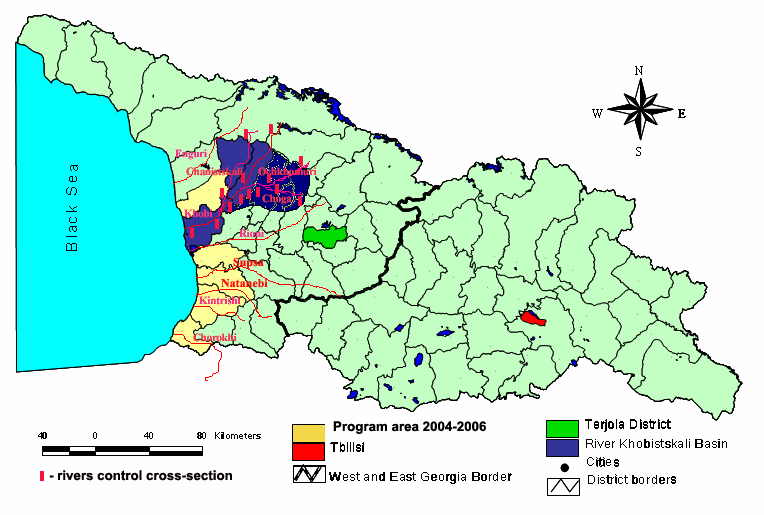
- Three districts in the EPC Program target region of Khobistskali river
basin – since 2001
- Five additional districts in the expanded area of the EPC Program
implementation – during 2004 through 2006
- 2001-2006 total coverage: - 154 villages
- - over 800 farm households
- - 1058 ha area of land
|
|
8
|
|
|
9
|
|
|
10
|
- Application of integrated practices against soil erosion:
- Terracing, contour cultivation, buffer stripes
- Pollution of the adjacent rivers with suspended load particles and
absorbed organic matter reduced by15-18%;
- Soil erosion reduced by 65%;
- Soil fertility increased by 25% on average;
- Yields increased by 29% on average
- (maize 20-30%, hazelnuts
20-25%, soybeans 50%).
|
|
11
|
|
|
12
|
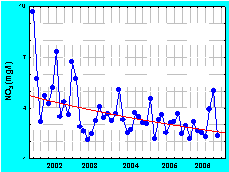
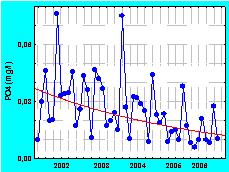
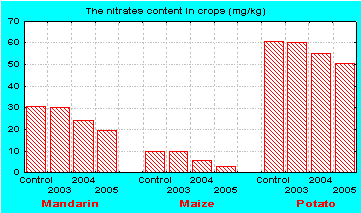
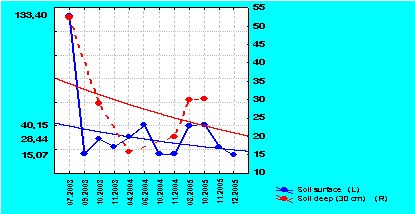
- Soil pollution with nitrates dropped over 2003-2005 in the target farms
in result of applying a set of improved agricultural practices
|
|
13
|
- Restitution of degraded and infertile agricultural lands:
- Seed rotation, diversification of crops, drainage, terracing, etc.
|
|
14
|
- Socio-economic impact of the adoption and operation of MSFs and BGDs
over 2002-2006:
- 180-200 m3 of methane produced annually per farm to
substitute 900-1000m3 of firewood;
- 6.9-7.8 tones of organic fertilizer produced annually per farm to
substitute brand mineral fertilizers;
- 600 GEL annual savings per household from reduced use of mineral
fertilizers, firewood and liquid gas;
- Cash/in-kind exchange of processed manure initiated.
|
|
15
|
- BGDs – success story:
- Expansion of dissemination program upon demand;
- Leveraged donor support;
- Farmers investing in BGDs without a leverage of program assistance;
- Fabrication capacity increased at local level and employment generated;
- Local Government support gained;
- Central Government support gained.
|
|
16
|
- What mattered:
- Proper sampling and ensuring reliable attribution of results;
- Establishing correlation between:
- - content of various nutrients in soil,
- - content of particular nutrients in soil and in water,
- - content of nutrients in soil and in crops grown on it.
- Demonstrating measurable direct impact of adopted good agricultural
practices on the quality of environment;
- Narrowing monitoring indicators down to a manageable and affordable set
of criteria.
|
|
17
|
- Adoption of advanced agricultural practices takes changing of farmers’ behavioral
pattern that is usually deeply entrenched;
- Raising environmental awareness is essential but not sufficient element
of technology dissemination – proving of economic benefit is critical
for successful adoption of new practices;
- Ensuring continuity of the established monitoring schemes is important
for data accumulation over extended periods of time that contributes to
reliability of established models and to the value of practical
recommendations issued on their basis;
- Meaningful and persistent decrease of pollution is possible with support
at all levels of authority – ranging from community ownership of good
agricultural practice all way up to political backing of sustainable
agriculture.
|
|
18
|
- Water in focus:
- Water quality indicators picked, inter alia, for measuring progress
towards MDG on environmental sustainability;
- Black Sea water quality monitoring laboratories re-established along the
coast;
- Code of Good Agricultural Practice under development;
- Watershed-based management being piloted in Kura-Araks catchment;
- Concept of water policy under development;
- A component addressing pollution considered for a large livestock
project under development.
|
|
19
|
|

 Notes
Notes