

TABLE OF CONTENTS
The Mekong River Commission
Message from the Chair
Structure of the Mekong River Commission
Organogram of the Mekong River Commission
Basin Development Plan
Annual Report 2001
Water Utilisation Programme
Mekong River Commission
Environment Programme
Flood Management and Mitigation
Working Towards a Gender Balance
Fisheries
Hydropower
Navigation
Agriculture, Irrigation and Forestry
Donor Cooperation in 2001
Income and Expenditure Statement
Administrative and Financial Issues
A Vision
for the Mekong River Basin
An economically prosperous, socially just and
environmentally sound Mekong River Basin
A Vision
for the Mekong River Commission
A world class, financially secure, international
river basin organisation serving the Mekong
countries to achieve the basin vision
The Mission
of the Mekong River Commission
To promote and coordinate sustainable
management and development of water and
related resources for the countries' mutual
benefit and the people's well-being by
implementing strategic programmes and
activities and providing scientific information
and policy advice.
Photos by
Jim Holmes
Chor Sokunthea
Niek van Zalinge
Mikkel Ostergaard
Copyright Mekong River Commission May 2002
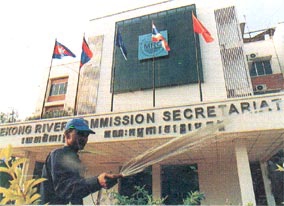
THE MEKONG RIVER
COMMISSION
The Mekong River Commission
is an intergovernmental body
created in 1995 by an agree-
ment between the governments
of Cambodia, Lao PDR, Thai-
land and Viet Nam.
The Agreement on the Cooperation for the Sustainable
Development of the Mekong River Basin came about
Structure and governance
as the four countries saw a common interest in jointly
managing their shared natural resources. Signed on 5
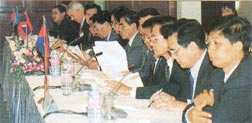
The MRC consists of three permanent bodies: the
April 1995, it set a new mandate for the organisation
Council, the Joint Committee (JC) and the Secretariat.
"to cooperate in all fields of sustainable development,
utilisation, management and conservation of the water
The Council, comprising one member at Ministerial and
and related resources of the Mekong River Basin."
Cabinet level from each MRC member country,
convenes annually and has overall governance of the
The agreement brought a change of identity for the
Mekong River Commission.
organisation previously known as the Mekong
Committee, which had been established in 1957 as the
The JC, also comprising also one member from each
Committee for Coordination of Investigations of the
member country at Head of Department level or higher,
Lower Mekong Basin the Mekong Committee.
convenes at least three times a year. This body functions
as a board of management. The Secretariat, which
Since the 1995 Agreement, the Mekong River
provides technical and administrative services to the
Commission (MRC) has had a special focus on issues
JC and the Council, is under the direction of a Chief
that affect more than one country. Specifically, the MRC
Executive Officer (CEO) appointed by the Council. The
is developing "rules" for water-sharing, monitoring the
Secretariat is located in Phnom Penh, Cambodia. The
quality of water resources, and supporting a joint
Assistant CEO is of the same nationality as the JC Chair
planning process called the Basin Development Plan.
and serves a one-year term.
The MRC is also involved in fisheries management,
promotion of safe navigation, agricultural development,
The MRC is funded by contributions from the four
flood mitigation and hydropower planning within an
member countries and from aid donors. Formal
overall framework of renewable resources management.
consultation with the donor community is carried out
through an annual Donor Consultative Group meeting.
The two upper states of the Mekong River Basin, the
People's Republic of China and the Union of Myanmar,
The National Mekong Committees coordinate MRC
are dialogue partners with the MRC.
programmes at the national level and provide links
between the MRC Secretariat and the national ministries
and line agencies. The principal implementers of the
MRC programmes and projects are the line agencies
of the MRC member countries.

MESSAGE FROM THE
CHAIRMAN
OF THE MEKONG RIVER COMMISSION
COUNCIL
On behalf of the Mekong River Commission (MRC) it is my great pleasure to extend to all readers my warmest
greetings and best wishes. I would also like to express my sincerest appreciation and gratitude to all of our partners
and friends for their valuable assistance and support extended to MRC in 2001.
In 2000, we refocused the organisation on its mandate based on two pillars for change: a new structure at the Secretariat
and introduction of a programme approach to provide the overall framework and direction for our activities. At the
Council Meeting in November 2001, we took stock of developments and concluded that the changes have served the
organisation well and have put MRC on a rapid track towards realisation of its goals. Most importantly, the three core
programmes: the Basin Development Plan, the Water Utilisation Programme and the Environment Programme are
now all in operation. Those programmes are the foundation for our ability to develop and manage the natural resources
of the river basin. At the Council Meeting, the four member countries reconfirmed their commitment to the programmes
and their determination to give the highest priority to ensure their success.
The three core programmes can in many ways be regarded as one. However, we attach particular importance to the
Basin Development Plan. With that programme we have started the process of planning the future development of the
basin and we are truly grateful to all the donors who are supporting us in this endeavour. The development plan
resulting from this process will reflect the priorities of the riparian countries and be based on reasonable and equitable
utilisation of water resources. It will also ensure long-term sustainability of the natural resources and maintenance of
critical ecological balances. The planning process has the support and commitment at the highest political levels of
the riparian governments. The plan will be the outcome of an open, participatory process in which stakeholders in the
basin would have been heard.
The four Governments took yet another step towards closer cooperation when the Council in November approved
procedures for data and information exchange and sharing under the Water Utilisation Programme. With this decision
an important milestone was reached. These procedures are required to ensure that the Secretariat and the National
Mekong Committees and line agencies in each of the riparian countries are aware of their responsibilities in managing
information and in providing it.
The Capacity Building Programme is the cornerstone which provides us with the managerial and administrative skills
to ensure implementation of our programmes. The gender policy, approved by the Council in 2000, is being integrated
in programme planning and implementation and also in recruitment of staff where female candidates are encouraged
to apply for vacant posts.
In 2000, the devastating flood led the MRC Council to agree that regional flood management and mitigation in the
Mekong River Basin is crucial and can only be realised through close cooperation between the MRC Member States.
The Secretariat was requested to develop and present to the Council a flood management and mitigation strategy.
The strategy was discussed and approved by the Council in November 2001. I would like to stress the unquestionable
priority the four Governments attach to the strategy.
Also MRC's new Strategy on Hydropower Development was formulated in 2001, based on five principles approved by
the Council and Joint Committee in 1998. Under the strategy, MRC will be involved in the generation and dissemination
of information related to hydropower development; policy advice; investigations up to the pre-investment stage; and
monitoring of impacts of hydropower-related activities in the Basin. MRC will also promote transparency in hydropower
planning and development processes, strengthen planning and implementation capability for hydropower development
in the member countries, and promote cooperation and collaboration among the riparian countries and in the region.
The Commission is now on a sound financial footing. It has become more cost-effective and is expanding activities
commensurate with the requirements to produce more and work better. We know that this very encouraging situation
is not only due to the decision by the riparian countries to raise contributions to the organisation. It is also the result of
understanding and support from the donor community. Allow me to express my deepest gratitude for the active donor
involvement in securing the basis of our organisation. Our four Governments are determined to take over the costs of
running the organisation in the long run in accordance with the decision of the Council in 2000.
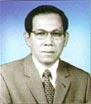
Sontaya Kunplome, Minister of Science, Technology and Environment, Thailand
Chair of the MRC Council for 2001/2002








STRUCTURE OF THE
MEKONG RIVER COMMISSION
Members of the MRC Council
Members at Ministerial and Cabinet Level. Responsible for policy and decision-making
H.E. Mr Khy Tainglim
H.E. Mr Somphong Mongkhonvilay
H.E. Mr Sontaya Kunplome
H.E. Mr Le Huy Ngo
Minister of Public Works
Minister of the
Minister of Science, Technology
Minister of Agriculture and
and Transport
Prime Minister's Office
and Environment
Rural Development
Member of the
Member of the
Member of the
Member of the
MRC Council for Cambodia
MRC Council for Lao PDR
MRC Council for Thailand
MRC Council for Viet Nam
Members of the MRC Council
Members at department Head level or higher. Responsible for implementing policies and decisions
H.E. Mr Sin Niny
H.E. Mr Sitaheng Rasphone
Ms Siriporn Sailasuta
H.E. Dr Nguyen Dinh Thinh
Vice-Chair of Cambodia
Vice-minister of
Director-General,
Vice-Minister of Agriculture and
National Mekong Committee
Agriculture and Forestry
Department of Energy Development
Rural Development
Member of the MRC Joint
Member of the
and Promotion, Ministry of Science,
Member of the
Committee for Cambodia
MRC Joint Committee for
Technology and the Environment
MRC Joint Committee
Lao PDR
Member of the MRC
for Viet Nam
Joint Committee for Thailand
Secretariat
Responsible for technical and administrative services
Mr. Joern Kristensen
Chief Executive Officer

ORGANOGRAM OF THE MEKONG
RIVER COMMISSION
Government of
Government of
Government of
Government of
CAMBODIA
LAO PDR
THAILAND
VIET NAM
Council
Members at Ministerial
and Cabinet level
National Mekong
Donor Consultative Group
Committees (NMCs)
Donor countries and
Member Agencies
cooperating institutions
Joint Committee
Members at Head of Department
level or higher
MRC Secretariat
Technical and Administrative
arm

BASIN
DEVELOPMENT PLAN
The newest of MRC's three core legally-constituted regional organisation mandated from
the highest political level to deal with Mekong River
programmes, the Basin Devel-
management in a holistic manner.
opment Plan, began activities in
The BDP will create a conducive environment for invest-
late 2001 with the establishment ment and sustainable development by formulating a strat-
egy for development. This will be based on dialogue be-
of a full 8-person team at the
tween government, private sector and civil society play-
ers, using data and analysis that has the unique benefit
Secretariat, and the appoint-
of representing the collective views of the four lower ri-
parian states. Projects and programmes will be identi-
ment of National BDP Coordina- fied that could bring about shared sub-regional growth
within a framework of principles based on knowledge
tors in each member country.
sharing, capacity building, and sound environmental
management.
At a later stage, investment will be sought for a list of
approved projects, most likely in the key areas of irri-
gated agriculture; watershed management; fisheries; hy-
dropower; navigation, transport and river works; water-
related tourism and recreation; water supply for domes-
tic and industrial use; and flood management. Economic
and social issues will be considered as the BDP is for-
mulated.
The BDP Team at the Secretariat provides the technical
and administrative support base for coordination of the
BDP. It supports the work of BDP units and working
groups in the member countries. The national BDP units
located at each National Mekong Committee represent
the member countries, agencies and other stakeholders
who are expected to benefit from the BDP.
Investing in people
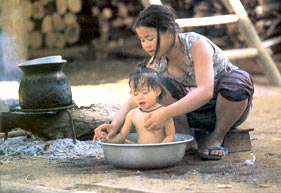
Rural areas in all the Mekong Basin countries rank among
The programme began its work with consultation
the poorest in the world, with an annual average per
meetings and national launching workshops in each
capita income of US$200 to US$400. The rural poor,
country, and the planning of a high-level regional launch
who are also often from minority groups, lack access to
in Bangkok for February 2002. A regional consultation
many basic services including primary education and
workshop between the four National Mekong Committees
health care. Social development indicators for health,
was held in early 2002 to develop a Public Participation
female literacy and access to safe drinking water are
Strategy for the MRC.
generally low for Cambodia and Lao PDR, countries
which lie mostly within the basin. The same indicators
Despite its recent start, the programme was initiated in
for Thailand and Viet Nam are lower within the basin
the 1995 Agreement which established the Mekong River
area compared with areas outside the basin, although
Commission in its present form. Under this Agreement,
the basin areas in both countries are of crucial importance
the Basin Development Plan (BDP) would be the general
to the rest of the country for food production and further
planning tool for the Joint Committee of the Mekong River
agricultural development.
Commission to use as a blueprint "to identify, categorise
and prioritise the projects and programmes to be
Currently, only about 16 per cent of the basin's people
implemented at the basin level."
live in urban areas. However, the urban population in
the basin is expected to increase rapidly in the coming
The launch of the BDP now highlights the unique status
years, fueled by an increasing population and by
of the '95 Agreement, which forms the basis of the only
immigration from rural areas in response to market-
oriented policy reforms.
There is a great need for well-chosen investments in
However, food security is not assured in many parts of the
development that will bring benefits as equitably as
basin. Increases in production are unevenly distributed and
possible to all, while maintaining the ecological balance
hunger is still prevalent. Extreme flooding destroys fields
of the river basin.
planted with crops and increases the difficulty of
infrastructure improvement.
Water for development
Ensuring food security is the single most important task of
the four lower Basin governments one which requires a
Around 85 per cent of the total water use in the Mekong
regional approach, acknowledging the regional
River Basin is for agriculture. Domestic and industrial use
interdependence of the four Lower Basin countries.
accounts for the remaining 15 per cent. Although the total
amount of water used represents less than 10 per cent
of the annual river flow, there is still the possibility of
scarcity because of uneven flow distribution, changes in
People of the Mekong
water quality, and growing demand for water. For
example, all of the river flow in the Mekong Delta is
already being used for agriculture and to curb salinity
A great diversity of ethnic groups make up the population
intrusion.
of the Lower Mekong Basin. Each has its distinct language
and customs, in a rich cultural mix including animists,
At present, only around 30 per cent of households in
Taoists, Buddhists, Catholics, Cham Muslims, and many
Viet Nam, Lao PDR and Cambodia have a piped water
indigenous religions.
supply, as compared with 80 per cent in Thailand and
China. Household use of water is expected to grow by
The inter-mingling of peoples of the basin is vividly displayed
50 per cent over the next decade, water for agricultural
today in the floating villages of various ethnic groups who
use by 30 per cent, and water for industrial use by 100
live an independent and almost completely aquatic
per cent.
existence, complete with shops and services, along the
Mekong.
Rice and fish the basis for food
security
Rice is the principle crop and staple food of the people in
the region. The Mekong River Delta alone generates
annually about 40 per cent of the total rice production in
Viet Nam.
Fish also plays a vital role as food and as a source of cash
income for many of the poorest people in the basin. Fish is
a major source of animal protein, while traditional products
such as fish paste are an invaluable source of calcium,
vitamin A and other nutrients. Fish and fish products can
justifiably be called "the milk of Asia".
WATER UTILISATION PROGRAMME:
REACHING THE FIRST MILESTONE
The Water Utilisation Programme (WUP) is an extensive
programme with many inter-linked components. The programme
will provide the tools and related knowledge base to enable MRC
and its member countries to gain a deeper understanding of hydro-
logical linkages between the natural environment, water use and
transboundary impacts on water, society and the environment.
WUP will also formulate and implement appropriate "Rules" to en-
sure reasonable and equitable use of the Mekong River Basin's
water and related resources.
4. Procedures for notification, consultation and
agreement by the end of 2003
5. Rules for the maintenance of flows by the end of
2004; and
6. Rules for water quality by the end of 2005.
The member countries of the MRC have always
recognised that the sustainable development
objectives of the 1995 Mekong Agreement can only
be achieved when basin-wide data and information is
used for planning, development and monitoring
purposes. For this reason, paragraph C of Article 24
in the Mekong Agreement states that one function of
the Joint Committee of the MRC is:
To regularly obtain, update and exchange information
and data necessary to implement this Agreement.
In 2001, the first milestone was achieved after a year of
training events and active consultation among the four
member countries and other major stakeholders.
To reach this milestone, the MRC provided a very
structured and closely facilitated process, with a total of
over 20 national and regional meetings bringing key
players together. A series of training and consultation
workshops on data information and exchange was
organised in each country, studying examples from
other organisations involved in similar work, including
At its 6th meeting in October 1999, the MRC Council
the Murray-Darling Basin Commission, the European
fully endorsed the WUP, and committed their
Union and the World Meteorological Organisation.
governments to "undertaking good faith efforts" to
Regional workshops and meetings of the Technical
negotiate and complete specific sets of rules for water
Drafting Group, which developed the final agreement,
use. These are:
were held. To support the process, the MRC secured
the services of a permanent legal advisor, plus a range
1. Procedures for data and information exchange by
of experts in the areas of international law, multi-lateral
the end of 2001;
agreements and data and information sharing.
2. Preliminary procedures for notification,
consultation and agreement by the end of 2003;
3. Procedures for monitoring existing water uses by
the end of 2003;
The draft Procedures for Data and Information Exchange
being the guardian or caretaker of a dataset. It includes
and Sharing were endorsed by the MRC Joint Committee
responsibility for data collection, data quality, data labelling,
in July and subsequently adopted by the MRC Council in
data integrity and security, and data accessibility.
November 2001, bringing the Procedures into force. In
"Custodianship" provides an organised means of sharing
his speech at the meeting, Cambodia Council Member
agreed data with clear accountability for standards of the
H.E. Khy Tainglim noted that "Its adoption will represent
data, its security and its accessibility to recognised partners.
not only the first major milestone under the WUP Start-up
Project, but also the first major policy decision of the MRC
Guidelines on Custodianship and Management were
member countries, since the signing of the Mekong
developed under the provisions of Clause 5.1 of the
Agreement in Chiang Rai, Thailand, about six years ago.
Exchange and Sharing Procedures, designed to support
Its adoption will send a strong political signal to the world
the operation of MRC's integrated database system (MRC-
on the strong committment of the MRC member countries
IS), and particularly to facilitate data and information
to scrupulously implement the 1995 Mekong Agreement."
exchange and sharing to create basin-wide data and
information.
The Exchange and Sharing Procedures provide for a
broad range of data and information to be exchanged
A working group known as the Information System Design
among the MRC member countries. Data and information
and Implementation Team (ISDIT) is responsible for the
on water resources, topography, natural resources,
development of technical standards and guidelines relevant
agriculture, navigation and transport, flood management
to the MRC-IS. This group comprises representatives of
and mitigation, infrastructure, urbanisation,
all MRC programmes and divisions, and nominated
industrialisation, environment and ecology, administrative
representatives of each National Mekong Committee who
boundaries, socio-economic changes, and tourism, all fall
are typically persons responsible for data and information.
within the scope of this agreement.
Modelling of impacts
Each of these areas will later be defined in more detail.
Although the Exchange and Sharing Procedures are
principally concerned with the implementation of the
Mekong Agreement, they also provide for other types of
data and information to be collected and exchanged at
the expense of the requesting party.
Most importantly, the Exchange and Sharing Procedures
require that the MRC Secretariat report annually to the
MRC Joint Committee and Council respectively as to the
overall effectiveness of the Procedures, the suitability of
the technical guidelines and standards, and any remedial
measures to be taken, including modification and
amendments of the Procedures and related guidelines.
This indicates a clear intention of the MRC that the
Exchange and Sharing Procedures and related guidelines
In the Mekong River Basin, the agricultural sector consumes
should be living documents that remain responsive to the
more water by far than any other sector. Domestic use
needs of the MRC and its member countries.
comes second. Developing "Rules" for water usage will
require reliable information to address issues of dry season
Custodians of the data
water sharing, protection of the environment and preserving
the ecological balance.
The MRC Secretariat has been given responsibility under
Parallel to the "Rules" process in WUP, therefore, is the
the Exchange and Sharing Procedures to be the Custodian
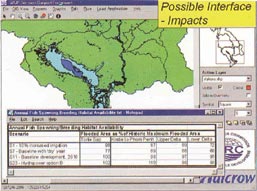
creation of a Basin Modelling Package. Such a package,
of shared data that is
capable of predicting impacts of planned river-related
collected, processed and
development, would help to formulate, test and monitor the
stored in an integrated
"Rules" themselves, support decision-making for river basin
database. This responsib-
planning and management, and provide a thorough
ility includes developing
assessment of any proposed developments.
MRC standards and
procedures, review and
A team of consultants began work on the Basin Modelling
audit of incoming data, and
Package in September 2001 with a review of available
importantly representing
models and software concepts. A variety of indicators need
the interests of the users of
to be defined, dealing with the aquatic habitat and
shared data.
ecosystem, the fisheries cycle and water quality.
"Custodian" in data
Later in the process, the Modelling team will also provide
management means more
training in modelling in the four member countries of the
than simply
MRC, and create a "knowledge base" by integrating existing
databases with the Basin Modelling Package.

ENVIRONMENT PROGRAMME
In line with the Mekong River Commission's mandate for
regional cooperation, the MRC Environment Programme
focused its efforts on transboundary environmental
monitoring in 2001, with major activities in the areas of water
quality monitoring, preparing training materials and
developing environmental assessment systems.
Water quality monitoring
Assessing environmental
impacts
Potential threats to water quality in the Mekong come
from catchment and bank erosion, which increase
sediment levels, and from the contamination of
The year 2001 saw a number of activities within the
pesticides and fertilisers used in agriculture. A desk
Environment Programme focused on aspects of
study and evaluation of MRC's water quality monitoring
environmental assessment systems, including related
network shows that there is a low risk of problems
areas such as Strategic Environmental Assessment
developing in the short term, but that the MRC's water
(SEA), Cumulative Environmental Assessment (CEA)
quality monitoring network could be improved. Water
and Environmental Impact Assessment (EIA).
quality monitoring data is often only analysed when
water quality problems arise. As the Basin population
One important issue relating to EIA is how
grows and industrial development increases, better data
transboundary impacts can be accounted for and
collection and improved laboratory procedures will be
incorporated into the various Environmental Impact
required for monitoring of water quality.
processes. Cambodia, Lao PDR, Thailand and Viet
Nam already have standard EIA procedures and
Under the Environment
legislation in place, but none yet have procedures to
Programme, MRC has
deal with transboundary impacts. There are several
commenced a process
sets of issues that need to be addressed on a regional
of Water Quality Net-
basis. These include how to establish mechanisms that
work Revision that
allow environmental impact investigations to be carried
should be completed by
out across national borders. For example, where a
the end of 2002. This will
development is proposed which may have a cross-
address concerns such
boundary impact, how should pre-project investigations
as quality assurance in
proceed? Should those investigations be carried out by
laboratory procedures.
agencies in both countries?
The revision will re-
examine the location
Another issue requiring consideration is how procedures
and number of sampling
and processes can be set in place so that an
sites, sampling methods,
Environmental Impact Investigation carried out under
parameters included,
the regulations of one country would be accepted by
sampling frequency,
another, potentially impacted, country. This issue is not
quality assurance and
unique to the lower Mekong. Similar difficulties have
condition of laboratories.
been encountered in Europe and North America, and
Some of the issues can
are likely to arise in future in Africa.
be addressed relatively
quickly and easily, while
The MRC has commissioned consultants to work with
others, such as upgrad-
the National Mekong Committees to develop guidelines
ing of laboratories, will
and suggest potential procedures and protocols that
take longer.
may be adopted by the four National Governments as
mechanisms to incorporate transboundary impacts into
their Environmental Impact procedures.

Training for environmental
management
During the previous year MRC commissioned the
Even extremely small concentrations of pesticide can
revision of a set of training materials on EIA-related
accumulate to serious levels in the tissues of fish and
issues. The materials include both general background
aquatic invertebrates. The accumulated pesticide may
materials such as an introductory module on
then be passed on to people and higher predators such
environmental science, and quite specific specialist
as birds, dolphins and otters, which eat the fish.
modules, such as the module
Pesticide contamination is difficult to analyse in
on ISO 14001, Environmental
water and is best detected by analysing fish
Management Systems (EMS).
tissue. Limited analyses of fish carried out under
the MRC water quality network and by other
The training materials that
agencies have not detected pesticides at
have been developed are
worrying levels. However, this part of the
specific to the lower Mekong
monitoring program
Basin. They have been
needs to be reviewed in
developed through an
order to ascertain that the
extensive consultation
results are as accurate as
process, and include a set of
possible.
20 case studies taken from the basin. The information
in the case studies was developed by staff from the
Sediment levels in rivers
National Mekong Committees and line agencies. The
are also difficult to
package also includes a set of reading materials that
measure. Unlike soluble
will allow it to be used by participants who lack access
materials such as salt,
to libraries or online information sources.
sediment particles are
not uniformly distributed
The EIA training materials are currently being translated
within the water. To measure the amount of salt in a
into the four riparian languages. Once the translation
river, a sample can be taken anywhere in the river and
is complete, later in 2002, the materials will become
the concentration of salt in the sample can be measured.
available for use by staff in line agencies, and within
The concentration multiplied by the volume of water at
educational institutions throughout the region. The MRC
a location tells you how much salt is present. But with
will also develop training programmes that will use the
particles of sediment, the smaller lighter particles will
materials.
be transported rapidly near the river surface while the
larger heavier particles will be transported more slowly
and nearer the riverbed. The concentration of particles
How clean is Mekong water?
also changes with depth and position in the stream, so
that a sample of water will have a different concentration
of sediment particles, depending on the depth and
Water quality in the mainstream of the Mekong is usually
location from which it was taken. To accurately calculate
expected to be good because the large amount of water
the amount of sediment being transported down a river
in the Mekong the eighth-largest river in the world
it is necessary to analyse samples taken from different
dilutes any effluents to insignificant levels. Cities along
depths. Very little depth-integrated sampling has as yet
the river are generally small, and industrial development
been carried out on the Mekong.
is still at a relatively low level reasons why water
pollution is not yet a problem.
Existing data, which the MRC has been collecting since
1985, indicate that the water quality in the Mekong is
Major threats to Mekong water quality are the levels of
still good. However, the water quality sampling network
sediment from catchment and bank erosion, and the
needs to be improved, in expectation of future needs
possibility of contamination from agricultural chemicals
as the Basin population grows and industry develops.
such as pesticides and fertilisers.

FLOOD MANAGEMENT AND
MITIGATION
Modern floodplain management measures recognise that
floods are a regular feature of life. Annual flooding creates
the wealth of biodiversity, abundance of fish life and soil
fertility in the Lower Mekong Basin. Managing floods,
therefore, starts from the premise that floods cannot be
prevented but their ill effects, such as loss of housing and
destruction of crops, can be mitigated.
Four major categories of flood management measures
Findings and recommendations were tabled and
can be described:
discussed at national workshops in each member
country, followed by a regional workshop in October
·
Land-use planning measures aim to keep people
2001. In the process, close partnerships were
and their work activities away from the most
established with many organisations, including national
hazardous areas of the floodplain.
Red Cross agencies, the International Federation of the
·
Structural measures such as dams,
Red Cross, the relief agency CARE, the Asian Institute
embankments and flood-proof houses help to
of Technology, the Economic and Social Commission
keep floodwaters away from people.
for Asia and the Pacific (ESCAP) and UNDP.
·
Flood preparedness measures get people ready
for the floods before they come. In some cases,
An overall Flood Management and Mitigation Strategy
this is the only type of management that is
for the MRC was approved by the MRC Council in
feasible or economically justified.
November 2001, setting the stage for flood issues to
·
Flood emergency measures include evacuation,
become a major focus of MRC's work.
emergency accommodation, cleanup activities
and provision of material assistance to people
As an organisation that embodies the working
affected by floods.
cooperation between the four Lower Mekong
governments, the MRC's strategic role in flood
The MRC's role as a river basin organisation is to provide
management and mitigation falls into three categories:
support services for others, such as national line agencies
and emergency relief agencies, to more efficiently fulfil
·
Providing technical products and services
their own tasks in these areas.
·
Addressing differences and facilitating solutions
·
Capacity building and technology transfer
In order for the MRC to focus its role more strongly on
the transboundary aspects of flood management and
Services in the first category were successfully carried
mitigation, a Strategy Formulation Team undertook
out in 2001 through daily flood forecasting on the MRC
fact-finding missions in
website, and sending of flood forecasts to an email list
partnership with the
of agencies and individuals.
National Mekong Comm-
ittees in each of the four
In the second category, the MRC can be a focal point for
member countries. Team
flood management and mitigation activities in the region,
members intervie-wed
where they are of transboundary significance. The MRC's
key line ministries,
reputation as an independent, neutral facilitator with a
international organisa-
scientific and technical base of information makes it
tions, community groups
ideally situated for this role.
and individuals right down
to village level for a "reality
check" on what measures
were most needed and
how these could be best
supported by the MRC.

The MRC carried out preparation in 2001 for an Annual
The daily monitoring during the 2001 flood season was
Flood Forum in the following year. The Flood Forum
a first in the history of Mekong cooperation. The MRC
will support decision-making in the four member
flood forecasts reached a new and broader constituency,
countries for better regional integration of flood
bringing feedback from many different sources: a relief
preparedness measures, by providing a platform for
agency located in Kompong Cham, Cambodia;
information exchange on flood preparedness measures
scientists in the United States, provincial government
through a network of participants drawn from
staff working in flood-prone locations. Some had
international organizations, line agencies and civil
requests for additional information, some sent
society organizations.
congratulations, some pointed out mistakes that can
occur even with the best information. A number of these
Future services in the third category may include standard
exchanges developed into strong working partnerships
training programmes for the line agencies in MRC
that improved the accuracy, relevance and ultimate
member countries and transfer of technical equipment.
value of MRC's forecasts.
While the floods are over at least for the present the
Forecasting floods on the World
MRC is continuing to broadcast seven-day forecasts
during the dry season. Activity will be stepped up when
Wide Web
the rainy season begins again this time with improved
telemetering equipment that can transmit data directly
Click on the station list on the new flood pages on the
to computer terminals in the Secretariat in Phnom Penh
MRC website. Some of the buttons may flash red: the
and an increased number of measuring stations.
station is already flooded. Yellow means "warning"; it's
time to take some preparatory action. Green means the
water level is not yet high. Five-day forecasts, broadcast
daily during the July to November flood season, helped
agencies and individuals in the Lower Mekong Basin
get ready for the floods in 2001.
Newsletter
MRC Publications
Flood Information
Data
From July until the rains ended in November, gauge
Maps
MekongInfo
readers, administrators and technical experts in four
Links To Other Sites
countries ensured that forecasts were continuously
Nongkhai
updated. River level readings were taken daily in 21
No Warning
different Lower Basin locations in Cambodia, Lao PDR,
Water level on Thursday, 15 November, 2001 at 07:00 AM = 6,2M
Flood level = 12,2m
Thailand and Viet Nam. Gauge readers sent the
Alarm level = 11,4m
All level are above zero gauge
(Zero gauge Nongkhai=153,648 in above MSL)
readings by phone, two-way radio or email to a national
For an explanation of the water level and alarm stages click here
data collection centre usually a government ministry.
Staff in each country then sent the information to the
MRC Secretariat in Phnom Penh every morning. Here,
the information was integrated into a daily flood report
that went out immediately to an email list of around 100
Schematic cross section with actual water level
agencies, government departments and individuals, as
well as being posted on the website.
Water level over the last 7 days and 3 days forecast

WORKING TOWARDS A GENDER
BALANCE
A woman GIS specialist joining
An active gender policy in
the Mekong River Commission
recruitment, plus a move
towards giving greater
in 1994 found that she was one
consideration to social and
environmental issues, has
of just a handful of women
brought more professional
women into the Mekong River
professionals at the Secretariat.
Commission. Staff members
come from many countries of
the world Australia, Canada, Denmark, Myanmar,
"In those days, the focus was much more technical," she
Malaysia and Norway as well as Cambodia, Lao PDR,
said. "There were many engineers on staff, and the work
Thailand and Viet Nam.
was project-based. Staff who were employed tended to
come from areas where men predominate; women
At the Secretariat office in Phnom Penh, where the MRC
professionals were found mainly in the Human Resources
is based, Personnel Officer Penprapa Worasarn sees a
section, Environment, Fisheries and in the water quality
steady stream of candidates for positions at all levels,
laboratory."
from administrative and support positions, to senior
programme roles. "Women have often not had the same
Today, her desk looks out over an open-plan office in which
educational opportunities as men," she said. "Thus, even
staff from many countries work, talk and share coffee.
when they are qualified, they sometimes do not have
There are many cross-divisional meetings at the
the confidence to apply to a large agency or see them-
Secretariat, where women number 19 out of a total of 60
selves in a more senior role. We try to encourage them
professional staff.
to come forward."
The MRC's recruitment policy does not favour women over
This policy is not a mere numbers game. MRC Gender
men, except in the rare instances where two candidates
Policy recognises that "Men and women often play dif-
for a position may be of equal standing. Rather, MRC has
ferent roles in development, and accordingly, have dif-
worked to increase the pool of women applying for
ferent needs, interests, access to and control of re-
positions. These efforts include stipulating on vacancy
sources. A gender perspective is required to ensure that
advertisements that "Women are encouraged to apply",
the specific needs of men and women, and their vul-
and headhunting wherever appropriate to attract the best
nerabilities and capacities, are properly recognised and
possible candidates. The results are seen in a steady climb
addressed."
in the proportion of women to men staff, as well as a
growing proportion of women in professional rather than
In part, the increase in recruitment of women staff re-
general service positions (see chart).
flects a more holistic perspective taken by the MRC in
its core programmes and supporting services. Growing
gender equity at the Secretariat ultimately should re-
sult in increased effectiveness and relevance in
programme work.
Growing equity
Statistic on gender at MRC
Distribution of men and women in professional posts
Men 81%
Women 19%
2000
year
2001
Men 68%
Women 32%
10% 20% 40% 60% 80% 100%
Distribution of women in professional and general service posts
2000
Professional 31%
General Service 69%
year
2001
Professional 46%
General Service 54%
10% 20% 40% 60% 80% 100%




Women in Fisheries
aquaculture activities and especially fish selling, feeding
and daily care of fish. Furthermore, children, the elderly
and disabled people are involved in fertiliser applications
With a strong eight-year history of fieldwork as its
and fish harvesting activities.
foundation, MRC's Fisheries Programme took further
steps in 2001 to integrate a gender perspective in all of
In the Rural Extension Aquaculture Development
its work.
(READ) Component, therefore, staff members have
increasingly encouraged the involvement of women and
Women's involvement is more complex than merely
children in all activities of the component, including
ensuring their numbers, and involvement differs
record keeping, training, fertilisation, feeding and
according to the target groups concerned. It also varies
participation in farmer extension meetings. The
according to the locus of events: women easily and keenly
component has also adopted a policy of training at least
participate in meetings at village level, whereas events
one woman for every man. Women's Associations have
held outside their home towns are predominantly
been extremely keen to receive training; out of the total
attended by men. Presence at meetings does not always
number of persons trained in basic aquaculture as of
translate into active participation; in higher level meetings,
September 2001, 57 per cent were women.
lack of English language can hamper women participants.
Women in fisheries play an integral role in water
In the management of reservoir fisheries, gender-
resources development in the Mekong region. Yet they
disaggregated indicators have been introduced in order
face a wide spectrum of problems. For this reason, the
to measure separately for men and women such effects
member countries of the MRC have taken steps to identify
as perceived benefits from co-management systems,
possible solutions, including the establishment of national
satisfaction with management plans and their
networks and a regional network to raise awareness of
implementation, participation in training events for users
the role of women in fisheries, information gathering and
and government staff, and the number of educational
sharing, and to conduct research on women in fisheries
scholarships provided.
among the four countries. The MRC Fisheries
Programme has continued to support this work and
Women actively participate in a large number of
provides an advisor to the network who is herself another
woman professional of MRC.
Working women at the
MRC Secretariat
Muanpong Juntopas is a Thai national and a
socio-economist with the new Basin Development
Plan team.
Dongdavanh Sibountong is an Assistant
Dr. Mak Solieng, Environ-
Programme Officer with the MRC Fisheries
ment/Natural Resources
Programme, educated in Lao PDR and the Fish
Planner with the Basin
Culture College in Odessa, Russia. Before joing
Development Plan team,
MRC, she worked at the Lao Ministry of Agriculture has worked on agricultural
and Forestry on an FAO-sponsored programme to
Programmes in Cuba,
improve fisheries production
Australia, Viet Nam and
her home country of
Cambodia
Nguyen Thi Bich from Viet Nam worked on manage-
ment of reservoir fisheries in the Central Highlands of
her country before joining the Fisheries Programme
of the MRC last year.

FISHERIES
New consumption studies in
on river catfish (Pangasius hypopthalmus) stocks shared
between Cambodia and Viet Nam; status of Mekong giant
selected areas of Cambodia,
fishes; and the role of deep pools in the ecology of the
Mekong. The programme further contributes to raising
Lao PDR, Thailand and Viet
awareness of the need and potential for public
participation in inland fisheries management, or "co-
Nam indicates that the capture
management", by conducting a series of sustained and
fishery yield in this region is as
joint training events for fisheries officers from the region
over a period of three years.
much as 1.75 million tonnes,
With the development of a fisheries communication strat-
valued at US$1.45 billion. In
egy under way, the MRC is ensuring that the importance of
fisheries is considered within its own core programmes,
addition, there is another
in particular, the Basin Development Plan and Water
250,000 tonnes of fish
Utilisation Programme. Major elements of the Fisheries
produced from aquaculture in
studies have been reported in international forums, print
materials and CD-Rom. A film on capture fisheries of
the Lower Mekong Basin.
Cambodia is being made, and a report on "Local Knowledge
in the Study of River Fish Biology" was published in an
attractive format as the first in MRC's new Mekong
The MRC Programme for Fisheries Management and
Development Series.
Development aims at "Coordinated and sustainable
management, use and development of the economic
At the national level, the Programme has been closely
and nutritional potential of the inland living aquatic
involved in the establishment of the Community Fisheries
resources in the Mekong River Basin."
Development office and its functions in Cambodia, as well
as contributing to the development of a new sub-decree
Through its past years of research and fieldwork, the
on community management of the fishery. Planning for the
MRC Fisheries Programme has generated substantial
construction of the Freshwater Fisheries Research Institute
new knowledge about Mekong fisheries. The
in Cambodia was concluded. Throughout the region, more
programme is now moving into a new stage, in which
emphasis has been given to publication of results in riparian
dissemination of knowledge and influencing of planners
languages and in English.
and policy makers is prioritised.
The programme supports three sub-sectors:
1. Capture Fisheries and Aquatic Resources,
aiming primarily at evaluation of fish resources
and the development of fisheries management
on the regional, national and local levels;
2. Small-scale Aquaculture Development, mainly
addressing aquaculture development in the
flood plains and the development of aquaculture
systems using indigenous Mekong fish species;
and
3. Cross-cutting Development, covering capture
fisheries management, aquaculture
development and coordination with other water
resource sectors, and strengthening of inland
fisheries information systems.
At the regional level, the programme has generated
considerable biological and socio-economic information,
with studies of fish migration in the mainstream and in
major tributaries. The results of these studies are
needed for transboundary fisheries management and
impact assessments of water management activities.
Research commissioned by the Technical Advisory
Board for Fisheries Management was also completed

With an emphasis on local-level management, the
The Technical Advisory Board for Fisheries Management,
Reservoir Fisheries Component has carried out activities
made up of high-level representatives from the riparian line
with a view to enable and facilitate the involvement of
agencies, continued its work on current transboundary fish-
resource users and members of government line agencies
eries issues during 2001. Staff within the Fisheries
as equal partners in management. Such activities centred
on suggesting improve ments in policy formulation on
Programme are the primary coordinators of the Network
fisheries management, reservoir-specific fisheries
for Women and Gender in Fisheries Development of the
management planning and implementation, and capacity-
Mekong Region, providing leadership and organisational
building of fisheries co-managers.
support to the network. In addition, the Programme
continued to host its Annual Meeting and Technical
Within the aquaculture sub-sector of the Fisheries
Symposium. These two meetings are now the major annual
Programme, the results of a recent economic survey have
forums for fisheries managers and research and
confirmed the direction taken by the Programme, showing
development personnel in the Lower Mekong Basin, thus
that integrated fish culture significantly increases fish pro-
serving as the primary coordinating point for regional
duction and improves the well-being and cash income of
fisheries planning.
poor and marginal rural households (see chart 2).
A sector status report on fisheries over the last 10 years is
Exotic species bred in ponds can escape into the water-
being published. Preparations also began for a major
ways during seasonal flooding, causing long-term changes
Symposium on Large Rivers and Fisheries, to be held in
in Mekong ecosystems. Work therefore is continuing on
2003 in Phnom Penh, in which the MRC Fisheries
the development of husbandry systems for fish species
Programme will play a major role.
indigenous to the Mekong.
Chart1: The higher the river, the greater the fish catch. Time series data is essential for monitoring the health of the fishery
Catch
11
14,000
10
12,000
9
7
10,000
Water Level
Fish catch (tons)
Max water level (meters)
8,000
5
6,000
95-96
96-97
97-98
98-99
99-00
00-01
01-02
Chart2: Rice farmers in the same area earn about US$1 to US$1.50 a day, compared with higher returns from aquaculture
16
14
12
10
8
6
4
2
0
0 1 2 3 4 5 6 7 8 9 10 11 12 13 14 15 16 17 18 19 20 More
Return on labour US$/day
NAVIGATION
News headlines in 2001
The Mekong River Commission carried out initial work in
2001 on developing a Master Plan for the Water Transport
focused on a major event
Sector in the Mekong Delta, and Capacity Building for
Improvement of Navigation in Cambodia.
underlining the quest for better
The MRC also secured finances in December 2001 for
river transportation and trade by
formulation of a Regional Strategy and Programme for
the four Upper Mekong
Navigation Development and Coordination in the Lower
Mekong Basin. Its activities are due to be completed by
countries. The governments of
end of 2002.
China, Lao PDR, Myanmar and
Two major projects were also completed in 2001: a study
of the Chaktomuk River Junction in Cambodia, and a joint
Thailand signed an Agreement
MRC-ESCAP project, Harmonisation of Aids to the
Navigation Systems Along the Greater Mekong River.
on Commercial Navigation,
agreeing to measures that
Improving access to Phnom
would make the river navigable
Penh Port
all year round and improve
Navigation from the Mekong Delta up to Phnom Penh Port
shipping safety.
depends on access through the Chaktomuk river junction
in Phnom Penh, Cambodia. Situated at a "crossroads"
between the Upper and Lower Mekong, and the Bassac
The Mekong River Commission offered to assist the
and Tonle Sap rivers, Chaktomuk junction is the key to
countries that signed this agreement by carrying out an
flow distribution between the four river branches and to
Environmental Impact Assessment of proposed river
their morphological and hydraulic development.
works that would be undertaken under the agreement.
Over the years, the flow distribution at the junction has
Meanwhile, increased maritime shipping could also
altered, with increased siltation potentially blocking the
become a reality for the cities along the Lower Mekong,
navigation channel to the port of Phnom Penh.
bringing increased revenue from international trade,
contributing to economic diversification and generating
In August 2001, the MRC concluded 10 months of surveys
demand for labour.
and studies by international and Cambodian experts with
a seminar demonstrating why the river flow has changed,
At present it is possible for seagoing vessels in the South
and recommending a stabilisation plan based on
China Sea to reach Phnom Penh Port through the Mekong
mathematical models. This plan is the basis for further
Delta and up the river. In practice, few ships make this
work that, amongst other positive impacts for the
journey, due to various physical and non-physical
Chaktomuk area, would keep the shipping channel open.
constraints.
Travel times from key Asian ports to the Mekong-
Non-physical constraints could be addressed by the
Bassac estuary
negotiation of a comprehensive legal and operational
framework for maritime navigation between Cambodia
Hong Kong
and Viet Nam, the introduction of common navigation
China
Myanmar
Vietnam
rules and regulations, facilitation of cross-border
(Burma)
Hanoi
procedures, provision of better port handling and
Lao PDR
Haiphong
Kobe-Pusan
maintenance facilities and better river police and rescue
Less than 2
services. Physical constraints could be addressed by
Vientiane
Less than 3 days
improvements in vessel design, morphological and
Philippines
days
1/2
Thailand
days
31/2
hydraulic studies of the river, installation of buoys and
Manila
beacons, regular hydrographic surveying and mapping,
Bangkok
and better information and classification of the waterways.
Cambodia
Ho Chi Minh City
With these issues resolved, increased trade would bring
Phnom Penh
Less than 3 days
11/2
foreign currency, economic diversification and increased
days
demand for labour to the cities of the Mekong, linking it
more closely to shipping within and out of the ASEAN
region.
Sydney -
Jakarta
Auckland
Malaysia
1/2 days
1
Malaysia
Singapore
Indonesia
Indonesia


Harmonisation of Aids to
Navigation
Until October 2001, there were six different systems for
After national consultations in the six Mekong countries, a
navigation channel markers along the Greater Mekong
meeting of country experts in October 2001 in Bangkok
River; each Mekong country had its own system. Aids to
agreed that the Khone Waterfalls in Lao PDR do not permit
navigation (ATN) such as buoys and beacons are vital
cross-border navigation between Cambodia and Lao PDR,
elements for safe passage. But the application of different
and that therefore two separate systems could be
systems on the same river causes accidents, endangers
permitted. The ESCAP/MRC recommendations for ATN
the lives of passengers and crew, and hampers cross-
on the Upper Mekong River, based on the Chinese system,
border river and maritime transport. Therefore ESCAP and
were approved for use in China, Lao PDR, Myanmar and
MRC joined efforts for the urgent task of harmonising the
Thailand. The two Lower Mekong countries Cambodia and
different systems.
Viet Nam agreed in principle to use the international IALA/
SIGNI system. Final deliberations on the adoption of the
international system were planned for January 2002.
Lateral Main Channel Buoys
Indication of the safe limits of the Main navigable channel
Topmark
Topmark
optional
optional
Cone buoy
Pillar buoy
Pillar buoy
Pillar buoy
Pillar buoy
Con buoy
with daymark with top mark
with top mark
with daymark
Left bank side
Right bank side
Flashing
Iso phase
Flashing
Iso phase
One-way Bifurcation Buoys
To indicate the Main channel at a bifurcation, left or right
Single Topmark
Single Topmark
Double Topmark compulsory
Sphere buoy
Pillar buoy
Pillar buoy
Pillar buoy
Pillar buoy
Sphere buoy
with daymark
with daymark
Left bank side
Right bank side
Quick Flashing
Quick Flashing
Mainchannel to the right
Mainchannel to the left
(Keep buoy on left side for main channel)
(Keep buoy on left side for main channel)
AGRICULTURE, IRRIGATION AND
FORESTRY
The Agriculture, Irrigation and
A large number of the most critical watersheds, requiring
immediate interventions from the riparian states, are
Forestry Programme (AIFP) was shared by two or more riparian countries. These include
the Se San and Se Prok sub-basins which are shared
approved by the MRC Council in between Cambodia and Viet Nam, Se Kong sub-basin
which is shared between Cambodia, Viet Nam and Lao
October 2000 with a total budget PDR, and the Nam Num sub-basin, shared between Lao
of US$ 31.3 million. In 2001, the
PDR and Viet Nam. Furthermore, degradation of any
watersheds within national borders will affect water flows
programme was pledged
into the Mekong river system, possibly causing severe
soil erosion, siltation, flooding and drought.
support of around US$5 million
by the German and Japanese
MRC areas of expertise
governments, enabling it to
Over the past few years, MRC has executed GIS-related
information-collection exercises, designed to provide
begin some planning and
analytical tools for land use planning and forest and
appraisal work.
watershed management. One of the MRC's strong points
has been the practice of engaging experts from the four
riparian countries to undertake its studies and project work.
The AIFP is based on a catchment management approach,
Because these riparian experts are seconded by line
focusing on activities to promote the sustainability and
agencies in their respective countries, it has fostered
further development of food production from the land and
technology transfer and dialogue between agencies in the
water resources of the Basin in areas where cooperation
riparian countries.
between member countries is required for success. There
are three components to the programme: (i) water use
With the newly-pledged donor support in 2001, the AIFP
efficiency, (ii) catchment management, and (iii) capacity
is now poised to embark on an integrated basin-wide
building within the MRC.
approach for the first time. An appraisal team has begun
work in all four member countries of the MRC, to consider:
Importance of transboundary
·
Institutional capacity and know-how within each
catchment areas
country to execute the AIFP
·
Possibilities to work in areas which have been
marked as critical watersheds
The Mekong region is endowed with a rich natural resource
·
Institutional arrangements needed for programme
base, on which the economies of the four Lower Mekong
implementation of the proposed components
Basin (LMB) states will rely heavily for some time to come.
·
Identification of opportunities and benefits relating
Agriculture provides employment for some 85 per cent of
to transboundary cooperation in catchment
the Basin's population, and is dependent on water
management
resources of the Basin. Forestry practices have far-
reaching impacts on the economic and ecological health
of the Basin.
The future for AIFP
Thirty per cent of the LMB catchments, due to their
In 2002, watersheds in the LMB will be inventoried and
biophysical conditions, should be classified as hydrological
key areas will be selected for programme activities
protection forests (so-called Class I) areas, or protection
focusing on the impacts of human activity in the areas of
and limited production forests (referred to as Class II
agriculture, irrigation, forestry and fisheries. Criteria for
areas). Class I areas include the headwaters of rivers,
selection include the size and transboundary significance
which are usually at high elevations, have very steep
of the watershed, characteristics representative of
slopes and should remain under permanent forest cover.
upstream and downstream conditions, ease of border
Class II areas are usually found at high elevations with
crossing and road access, similar institutional capacities
steep to very steep slopes, and land forms that require
on both sides of the border, and extensive use of natural
soil and water conservation restrictions. By far the highest
resources by local people.
percentage of both Class I and Class II areas lie within the
Lao part of the LMB, followed by Thailand with 14 per cent,
The first phase of implementation will emphasise multi-
Viet Nam with 13 per cent and Cambodia with 4 per cent.
stakeholder dialogues, the need for land use planning on
Watersheds in Lao PDR also contribute the largest flow
a regional basis, and strong cooperative processes all
volume to the Mekong river system, accounting for 43
of it ultimately aimed at improvement of livelihoods while
per cent of the total average flow.
maintaining ecological balance in some of the most critical
areas of the LMB.

HYDROPOWER
Through its lifetime, the former
After an extensive consultation process, an MRC
Strategy on Hydropower Development was finalised in
Mekong Committee built a
2001 by the Water Resources Management Programme
reputation for its investigations
of the MRC, outlining an approach that treats
hydropower potential as one of many available
into hydropower development,
renewable natural resources, and which should only be
developed in a basin-wide context, where overall
including feasibility studies for
impacts are taken into account and different uses and
users of water are given due consideration.
mainstream and tributary
The process involved representatives of concerned
projects. But the signing of the
agencies and individuals in the four MRC member
1995 Agreement, which
countries, including the National Mekong Committees
and the relevant national line agencies, as well as a
established the Mekong River
wide range of civil society organisations and
international agencies such as the Asian Institute of
Commission (MRC) in its
Technology, the Asian Development Bank, the World
Commission on Dams, the Global Water Partnership,
present form, marked a turning
the World Wide Fund for Nature, Oxfam America, the
TERRA Foundation, and others.
point. Since then, the MRC has
shifted away from such
In line with the MRC's broader approach to hydropower
planning, a workshop was held at the Secretariat in June
involvements, towards a focus
2001 to raise awareness among the National Mekong
Committees and line agencies of the recommendations
on providing information and
of the World Commission on Dams.
policy advice on broader, basin-
The MRC Strategy on Hydropower Development is
based on five principles approved by the MRC Council
wide issues in the sector.
and Joint Committee in 1998. These principles focus
on information exchange; close cooperation with
relevant international institutions; coordination and
monitoring of basin-wide activities; studies and
methodology development with respect to cumulative
environmental impacts and socio-economic aspects,
including mechanisms for public participation; and
private sector involvement.
These five principles have now become the foundation
for formulating the strategy.
Under the strategy, the MRC will be involved in the
generation and dissemination of information related to
hydropower development; policy advice; investigations
up to the pre-investment stage; and monitoring impacts
of hydropower-related activities in the Basin. It will also
promote transparency in hydropower planning and
development processes, strengthen planning and
implementation capability for hydropower development
in the member countries, and promote cooperation and
collaboration among the riparian countries and in the
region.
Hydropower as an activity of the MRC plays a modest
role now compared with the past, and compared with
other MRC areas of work. MRC's hydropower activities
are to ensure that the increasing demand for electric
energy in member countries is met without being
detrimental to the environment or communities an aim
which requires a hydropower strategy in keeping with
best practices.

ADMINISTRATIVE AND FINANCIAL
ISSUES IN 2001
In the year 2001, the Secretariat
provided overall support in the
further transition of the Mekong
River Commission from a
project-oriented organisation to
a programme-oriented one.
Despite an increased activity level, the MRC managed
to further reduce the operational expenses for 2001
throughout the year. This year the MRC also deemed it
necessary to realise some irrecoverable losses from
previous years, creating a temporary deficit to be carried
forward into 2002. It is expected that this deficit will be
recovered early in 2002, due to transfers of 2001- related
income.
The Secretariat will continue its tight budget control and
seek cost-effective solutions in providing overall support
to the programmes.
The year was also a very challenging one in that the
Basin Development Plan programme was fully staffed
and became operational towards the end of 2001. This
required an intense level of recruitment activity, which
has resulted in highly qualified personnel now being in
place.
The year 2001 was also the first year of full and
independent running of the new financial management
system SOLOMON. It has already contributed
significantly to the overall financial management of
MRC.
MRC also revised and updated all Policy Manuals relating
to Programme, Personnel, Administration and Finance,
ensuring the smooth execution of programme activities
DONOR COOPERATION IN 2001
Four years ago, donor support for the Mekong River Commission was at an all time low. The year 2000 was a turning
point in terms of funding, indicating renewed confidence among the donor community in the direction and management
of the MRC. Donors continued to show their support with further commitments and pledges in 2001 with an approximate
total of US$ 15.62 million in agreements and another US$ 13 million in pledges. In addition, a donor country has
reserved an amount of US$ 2.7 million for Cambodia, Lao PDR and Viet Nam for MRC purposes for 2001-2004.
In 2001, MRC received funding and pledges from Australia, Denmark, Finland, Germany, Japan, New Zealand,
Norway, Sweden, Switzerland, and UNDP.
New Funding Agreement s in 2001
Total value of new funding agreements:
US$ 15.62 million
Programme
Thousands of $ (approximate conversion)
2. Multi-functionality of paddy fields in the Mekong River Basin
370
2. MRC institutional support
50
3. Consolidation of hydro-meteorological data and multi-functional hydrologic roles of Tonle Sap lake and its vicinities
404
4. Extension of the sustainable management of resources in the Lower Mekong Basin
885
5. Mekong River Commission long-term Environment Programme
2 000
6. Modelling of flow regime and transport phenomena in the Great Lake of Tonle Sap
1 263
7. Institutional support
225
8. Updating strategy and programme for navigation development and coordination in the Lower Mekong Basin
385
9. Formulation of the Mekong River Commission Basin Development Plan
3 300
10. Support to the Environment Programme, Basin Development Plan and institutional support
3 400
11. Appropriate hydrological network improvement project
3 340
12. MDBC/MRC strategic liaison project - phase II (combined total for items 11 14)
13. Support for expert in natural resources planning for the BDP
14. Australian consultants' trust fund
Firm Pledging Received in 2001
Total approximate value of firm pledging:
US$ 13 million1
Programme
Thousands of $ (approximate conversion)
1.
Basin Development Plan
1 200
2.
Environment Programme
1 620
3.
Core support
1 580
4.
Formulation of regional Flood Management and Mitigation Programme
221
5.
Implementation of regional Flood Management and Mitigation Programme
1 330
6.
Flood forecasting
227
7.
Agriculture, Irrigation and Forestry Programme catchment management component
1 990
8.
Agriculture, Irrigation and Forestry Programme integrated forest rehabilitation
4 420
9.
Gender mainstreaming in water resources development in the Lower Mekong Basin
260
10.
Communications officer post
150
11.
Bilateral cooperation through Cambodia, Lao PDR and Viet Nam
2 700
(Footnotes)
1 This amount does not include bilateral arrangements for MRC purposes.
INCOME AND EXPENDITURE
STATEMENT
2001
2000
USD
USD
Contributions
Donors
12,111,815
8,561,315
Riparian governments
623,160
780,000
12,734,975
9,341,315
Revenue
Professional income
22,604
-
Interest
65,319
173,716
Miscelllaneous
19,880
16,547
107,803
190,263
Total Income
12,842,778
9,531,578
Expenditure
Project expenditure
Personnel services
5,545,192
6,266,308
Sub-contracts
558,169
1,460,977
Training
1,169,193
1,743,582
Equipment
894,938
1,211,759
Miscellaneous expenses
499,816
855,680
Water Utilisation Project
1,486,245
-
10,153,553
11,538,306
Administrative expenditure
Staff salary and fees
914,908
930,280
Common staff costs
405,100
464,258
Travel
3,327
12,094
Contractual services
56,465
32,126
General operating expenses
164,840
263,702
Supplies
20,639
26,805
Furniture and equipment
86,867
4,669
MRC meeting expenses
88,244
68,975
Support to National Mekong Committees and programmes
88,847
39,281
1,829,237
1,842,190
Total Expenditure
11,982,790
13,380,496
Foreign Exchange Gain
6,574
231,137
Movement in Fund Balances
866,562
(3,617,781)
Fund Balances as at 1 January
6,222,733
9,840,514
Fund Balances as at 31 December
7,089,295
6,222,733
Note: Previous years' income and expenditure statements contained separate lines for Secretariat Support Costs.
These items have now been incorporated into the donor contributions, following our external auditor's
recommendation.