


Mekong River Commission
Fish migrations of the
Lower Mekong River Basin:
implications for development,
planning and environmental
management
MRC Technical Paper
No. 8
October 2002
Published in Phnom Penh in October 2002 by the
Mekong River Commission
This document should be cited as:
Poulsen A.F. , Ouch Poeu, Sintavong Viravong, Ubolratana Suntornratana and Nguyen Thanh Tung.
2002. Fish migrations of the Lower Mekong River Basin: implications for development, planning
and environmental management. MRC Technical Paper No. 8, Mekong River Commission, Phnom
Penh. 62 pp. ISSN: 1683-1489
The opinions and interpretations expressed within are those of the authors
and do not necessarily reflect the views of the Mekong River Commission.
Editor: Ann Bishop
Layout: Boonruang Song-ngam
© Mekong River Commission
P.O. Box 1112, 364 M.V. Preah Monivong Boulevard
Phnom Penh, Cambodia
Telephone: (855-23) 720-979 Fax: (855-23) 720-972
E-mail: mrcs@mrcmekong.org
Website: www.mrcmekong.org
Acknowledgements
This report was prepared with financial assistance from the government of Denmark (through
Danida), under the auspices of the Assessment of Mekong Fisheries Component (AMFC)
of the MRC Fisheries Programme.
The authors wish to thank staff at the Department of Fisheries (Cambodia), LARReC (Lao
PDR, Department of Fisheries (Thailand) and the Research Institute for Aquaculture number
2 (RIA2) in Ho Chi Minh City (Viet Nam) for their contribution in compiling the ecological
information, on which much of this report is based.
The authors also wish to thank Dr. Chris Barlow and Kent Hortle from the MRC Fisheries
Programme, and Dr. Ian Campbell from the MRC Environment Programme, for reviewing
early drafts of the report.
Table of Contents
Summary - English............................................................................................... 1
Summary - Khmer................................................................................................. 5
Summary - Lao................................................................................................... 9
Summary - Thai.................................................................................................. 13
Summary - Vietnamese......................................................................................... 17
1. INTRODUCTION........................................................................................... 21
1.1 Background............................................................................................21
1.2 The purpose of this report................................................................................ 22
2 ANIMAL MIGRATIONS...................................................................................... 23
2.1 Fish migrations and life cycles..........................................................................24
3. FISH MIGRATION IN THE MEKONG RIVER.......................................................25
3.1 Important fish habitats in the Mekong Basin.........................................................26
3.2. Fish migrations and hydrology in the Mekong Basin................................................31
3.3. Major migration systems of the Mekong ..........................................................32
4. MANAGING MIGRATORY FISHES....................................................................... 41
4.1. Key issues for the maintenance of ecological functioning of
the Mekong ecosystem, with reference to migratory fishes........................................42
5. POTENTIAL IMPACTS OF DEVELOPMENT ACTIVITIES......................................... 47
5.1 Human impacts on the Mekong fisheries ..........................................................47
REFERENCES..................................................................................................... 59
Fish migrations of the Lower Mekong River Basin
Summary
In the Mekong River Basin, most fishes are migratory. Many of them migrate long distances, often
across international borders during their seasonal movements. People throughout the basin depend,
directly or indirectly, upon the migrating fish for food and livelihood. Water management projects
such as hydroelectric dams could adversely impact those migrations and thus negatively effect the
livelihoods of a large number of people.
This report identifies some key features of the Mekong River ecosystem that are important for the
maintenance of migratory fishes and their habitats. The report further discusses ways in which
available information about migratory fishes can be incorporated in planning and environmental
assessments.
Three distinct, but inter-connected, migration systems have been identified in the lower Mekong
River Basin, each involving multiple species. These are respectively the lower (LMS), the middle
(MMS) and the upper (UMS) Mekong migration systems. These migration systems have evolved as
a response to the hydrological and morphological shape of the Mekong in its lower, middle and
upper sections.
In a complex, multi-species ecosystem, such as the Mekong River Basin, single-species management
is not feasible. Instead, a more holistic ecosystem approach is suggested for management and planning.
The migration systems mentioned above could be used as the initial, large-scale framework under
which ecosystem attributes can be identified and, in turn, transboundary management and basin
development planning can be implemented.
The important ecological, or ecosystem, attributes of migratory fishes are identified for each migration
system. The emphasis is on maintaining critical habitats, the connectivity between them and the
annual hydrological pattern responsible for the creation of seasonal floodplain habitats.
The Lower Mekong Migration System (LMS)
Dry season refuge habitats: Deep pools, particularly in the Kratie-Stung Treng stretch of the
Mekong mainstream.
Flood-season feeding and rearing habitats: Floodplains in the Mekong Delta in Viet Nam, in
southern Cambodia, and in the Tonle Sap system.
Spawning habitats: Rapids and deep pool systems in Kratie-Khone Falls, and in the Sesan
catchment. Floodplain habitats in the south (e.g. flooded forests associated with the Tonle Sap
Great Lake).
1
Fish migrations of the Lower Mekong River Basin
Migration routes: The whole Mekong mainstream from the Mekong Delta to the Khone Falls,
including the Tonle Sap River (longitudinal connectivity). Between floodplain habitats and river
channels (lateral connectivity). Between the Mekong mainstream and the Sesan
sub-catchment (including the Sekong and Srepok Rivers).
Hydrology: The annual floods that inundate large areas of southern Cambodia (including the
Tonle Sap system) and the Mekong Delta, and the annual reversal of the Tonle Sap River, are
essential for fisheries productivity.
The Middle Mekong Migration System (MMS)
Dry season refuge habitats: Deep pool stretches of the Mekong mainstream and within major
tributaries.
Flood-season feeding and rearing habitats: Floodplains of this system that are mainly associated
with major tributaries.
Spawning habitats: Rapids and deep pool systems in the Mekong mainstream. Floodplain
spawning habitats associated with tributaries.
Migration routes: Connections between the Mekong River (dry season habitats) and major
tributaries (flood season habitats).
Hydrology: The annual flood pattern that causes inundation of floodplain areas along major
tributaries.
The Upper Mekong Migration System (UMS)
Dry Season refuge habitats: Occur throughout the extent of the Upper Mekong Migration
System, but are most common in the downstream stretch from the mouth of Loei River to Louang
Prabang.
Flood-season feeding and rearing habitats:Floodplain habitats are restricted to the floodplains
that border the main river, as well as smaller floodplains along some of the tributaries.
Spawning habitats: Spawning habitats that are situated mainly in stretches where rapids alternate
with deep pools.
Migration routes: Migration corridors between downstream dry-season refuge habitats and
upstream spawning habitats.
Hydrology: The annual flood pattern that triggers fish migrations and causes inundation of
floodplains.
These ecosystem attributes should be taken into account when assessing impacts of development
activities. A pre-requisite for impact assessments is a valuation of the impacted resource (e.g. migratory
fishes) from a fishery perspective. Undertaking such a valuation of migratory fishes is extremely
difficult because they are targeted throughout their distribution range in many different ways, and
2
Fish migrations of the Lower Mekong River Basin
with many different fishing gears and operations. Given the scale and complexity of such an
undertaking in the Mekong River, it is probably not possible to fully assess the economic value of
migratory fishes.
However, a partial assessment of value, together with an assessment of information gaps is in many
cases sufficient for planning and assessment purposes. It is also important to emphasise that in the
decision-making process, qualitative information and knowledge from various sources should be
included on equal terms with quantitative data. Furthermore, along with the direct value of fishery
resources, the Mekong River ecosystem provides numerous intrinsic, non-quantifiable goods and
services.
To ensure that the Mekong River Basin can continue to provide these important goods and services,
we propose that development planning and environmental assessment should be based on an ecosystem
approach within which the ecological functioning, productivity and resilience of the ecosystem are
maintained. Experiences from other river basins suggest that from an economic, social and
environmental point of view, this is best way to utilise a river.
3
Fish migrations of the Lower Mekong River Basin
xøwmsarsegçb³
enAkñúgGagTenøemKgÁ RtIPaKeRcInCaRbePTRtIbMlas;TI. PaKeRcInénBBYkRtIbMlas;TIEtgeFIV
cracrpøÚvq¶ayedayqøgkat;RBMRbTl;GnþrCatikñúgrdUvbMlas;TIrbs;BYkva. RbCaCnkñúgGagTaMgmUl
BwgEp¥kedaypÞal; rWedayRbeyaleTAelIRbePTRtIbMlas;TIsMrab;;CamðÚbGahar nigCIvPaBrs;enA.
KMeragRKb;RKgTwkCaeRcIn dUcCaTMnb;varIGKÁIsnIGacCH\Ti§BlGaRkk;y:agF¶n;F¶rdl;karbMlas;TI rbs;RtI
nigCalT§plpþl;plb:HBal;CaGviC¢mandl;CIvPaBrs;enArbs;RbCaCnCaeRcIn.
GtßbTenHnwgbgðajnUvlkçN³BiessCaKnwøHmYYycMnYnénRbB½§neGkUTenøemKgÁ Edlmansar³sMxan;
dl;karEfrkSaRbePTRtIbMlas;TI nigCMrkrbs;RtIRbePTenH. GtßbTenHnwgpþl;CabEnßmnUvviFIEdl
eyIgGacTTYl)anB'tmansþIGMBIRbePTRtIbMlas;TIEdlRtUv)aneKdak;bBa©ÚleTAkñúgEpnkar nigkar
vaytMélbrisßannana.
RbB½§nbMlas;TIcMnYnbIepSg²KñaEdlmanTMnak;TMngKñaeTAvijeTAmk RtUv)aneKkt;sMKal;eXIjman
enAkñúgGagTenøemKgÁeRkamEdlRbB½n§nimYy²Cab;Tak;TgKñaCamYyBUCRtICaeRcIn. TaMgGs;enHCa
RbB½§nbMlas;TIdac;edayELk²BIKñarvagEpñkxageRkam EpñkkNþal nigPaKxagelIénTenøemKgÁ.
RbB½§nbMlas;TITaMgenH)aneqIøytbeTAnwgRTg;RTayClviTüa nigrUbsaRsþénTenøemKgÁenAEpñkxageRkam
kNþal nigxagelIrbs;TenøenH.
kñúgRbB½§neGkUcMruHRbePT nigsaMjauMmYydUcCaGagTenøemKgÁ karRKb;RKgRbePTeTalNamYyenaHKW
minGaceFIV)aneLIy. pÞúyeTAvij eK)anesñIeGaymankarRKb;RKgmYy nigkardak;EpnkartamTis
edAsMrab;RbB½§neGkUTaMgmUl. ral;RbB½§nbMlas;TIEdl)anbriyayxagelIGaceRbIR)as;kñúgRkbx½NÐ
énkarcab;epþIm b£kñúgvisalPaBmYyTUlayEdlkñúgenaHGtþsBaØaNénektn³P½ÐNRbB½§neGkUTaMg
enH)anRtUvbgðajeGayeXIj nigCabnþ eTIbkarRKb;RKgqøgEdn nigkareFIVEpnkarGPivDÆn¾kñúgGag
GacGnuvtþeTA)an.
ektn³P½ÐNd¾sMxan;rbs;RbB½§neGkU rWeGkULÚsIuénRbePTRtIbMlas;TIRtUv)aneKsMKal;eXIjcMeBaH
RbB½§nbMlas;TInimYy². sar³sMxan;KWkarEfrkSaral;CMrksMxan;² PaBTak;TgKñaeTAvijeTAmkrvagCMrk
nigdMeNIrClviTüaRbcaMqñaMEdlFanadl;karbegIáteGaymanCMrkenAdMbn;licTwktamrdUvCaeRcInkEnøg.
5
Fish migrations of the Lower Mekong River Basin
RbB½§nbMlas;TIenATenøemKgÁPaKxageRkam
CMrkrs;enArdUvR)aMg³ GnøúgeRCA² CaBiessenAextþRkecH nigextþsÞwgERtgtambeNþayTenøemKgÁ.
cMNIGaharnardUvTwkdMeLIg nigCMrkbnþBUC³ TMnablicTwkkñúgdMbn;dIsNþrTenøemKgÁénRbeTs evotNam
dMbn;PaKxagt,ÚgRbeTskm<úCa nigtamRbB½§nTenøsab.
CMrkBgkUn³ RbB½§nGnøúgeRCA² nigfµb:RbHTwkenAkñúgextþRkecH l,ak;exan nigdMbn;rgTwkePøóg énTenøessan.
CMrkCaeRcInenAkñúgdMbn;licTwkPaKxagt,Úg ¬]> dMbn;éRBlicTwkCMuvijbwgTenø sab¦.
pøÚvcracrRtI³ RbB½§nTenøemKgÁTaMgmUlcab;BIdMbn;dIsNþrTenøemKgÁrhUtdl;l,ak;exan rYmbBa©Úl
TaMgTenøsab ¬TMnak;TMngExSry³beNþay¦. rvagCMrkdMbn;licTwk nigTenønana ¬TMnak;TMngépÞ lat¦.
rvagTenøemKgÁ nigGnudMbn;rgTwkePøógénTenøessan ¬rYmbBa©ÚlTaMgTenøeskug nigTenøERsBk¦.
ClsaRsþ³ CMnn;RbcaMqñaMy:agFMlwVgelIVyEdllicdMbn;CaeRcInénPaKxagt,ÚgRbeTskm<úCa ¬Kit
bBa©ÚlTaMgRbB½§nTenøsab¦ nigdMbn;dIsNþremKgÁ RBmTaMgkarhUrRtLb;rbs;Tenøsabmansar³
sMxan;Nas;cMeBaHplitPaBClpl.
RbB½§nbMlas;TIenATenøemKgÁPaKkNþal
CMrkrs;enArdUvR)aMg³ manenAtamGnøúgeRCA²énTenøemKgÁ nigenAtamédFM²énTenøemKgÁ.
cMNIGaharnardUvTwkdMeLIg nigCMrkbnþBUC³ CMrktamdMbn;licTwkPaKeRcInCaBiessCab;tam édTenøFM².
CMrkBgkUn³ enAtamRbB½§nGnøúgeRCA² nigdMbn;fµb:RbHTwkTenøemKgÁ. enAtamCMrkBgkUndMbn;
licTwktamédTenø.
pøÚvcracrRtI³ Cab;KñarvagTenøemKgÁ ¬CMrkrdUvR)aMg¦ nig tamédTenøFM² ¬CMrkrdUvCMnn;¦.
ClsaRsþ³ RbePT RTg;RTay nigvisalPaBTwkCMnn;RbcaMqñaMbNþaleGaymankarlicdMbn;TMnab
énédTenøFM².
6
Fish migrations of the Lower Mekong River Basin
RbB½§nbMlas;TIenATenøemKgÁPaKxagelI
CMrkrs;enArdUvR)aMg³ ekItmanenATUTaMgRbB½§nTenøemKgÁelI b:uEnþPaKeRcInmanenAkñúgdMbn;PaKxag
eRkamcab;BImat;énTenøelIydl;lYgR)a)ag.
cMNIGaharnardUvTwkdMeLIg nigCMrkbnþBUC³ CMrkdMbn;licTwkCaeRcInmanenAdMbn;licTwkEdl
CaRBMRbTl;énTenøFM² k¾dUcCadMbn;valTMnabtUc² tambeNþayédTenøtUc²mYycMnYn.
CMrkBgkUn³ CMrkBgkUnfitenACaBiesstamtMbn;fµb:RbHTwkEdlmanGnøúgeRCA².
pøÚvcracrRtI³ pøÚvrebogbMlas;TImanenAcenøaHCMrkrs;enAnardUvR)aMgenAPaKxageRkam nigCMrkBg
kUnenAPaKxagelI.
ClsaRsþ³ RbePT RTg;RTay nigvisalPaBTwkCMnn;RbcaMqñaMCaKnwøHCMrujeGaymankarbMlas;TI rbs;RtI
nigeGaymanTwkCMnn;dl;TMnabkNþal.
ektn³sm,tiþRbB½§neGkUTaMgenHKb,IRtUv)aneKykcitþTukdak;enAeBleFIVkarvaytMélBIplb:HBal;
bNþalmkBIskmµPaBGPivDÆn¾nana. kartRmUveGaymankarvaytMélCamunBIplb:HBal;KWCakar
vaytémønUvFnFanEdlGacTTYlrgkarb:HBal; ¬]> RbePTRtIbMlas;TII¦ elIvis½yClpl. kareFIV
karvaytMélRbePTRtIbMlas;TIEbbenHKWmankarlM)akCaTIbMput BIeRBaHeKRtUvkMNt;eKaledArbs;
vatamry³karerobcMCaRkum²edayviFIepSg²cMeBaHRbePTRtITaMgenaH nigtamrebobénkareFIV ensaTnig
RbePT]bkrN¾ensaTepSg²eTot. edaysarEtvisalPaB nigPaBsµúRKsµajénkar
Gnuvtþn¾EbbenHenAkñúgTenøemKgÁdUecñHehIy eTIbeKminGacvaytémøCarYm)anGMBIsar³sMxan;dl;
esdækic©rbs;RbePTRtIbMlas;TI .
7
Fish migrations of the Lower Mekong River Basin
eTaHCay:agNakþI kñúgkrNICaeRcInkarvaytMélmYyEpñkNaRBmCamYynwgkarvaytMélelIkgVH
xatEpñkB'tmanGacRKb;RKan;sMrab;kareFIVEpnkar nigbMerIeKaledAkarvaytémø. vaCakard¾caM)ac;
pgEdrEdlfa kñúgdMeNIrkareFIVesckIþsMerccitþ cMeNHdwg nigB'tmanEdlmanKuNPaBBIRbPBepSg
²Kb,Idak;bBa©ÚleGayesµIKñanwgTinñn½yCabrimaNpgEdr. bEnßmelIsenHeTotrYmCamYynwgtMél
pÞal;énRbPBFnFanClpl RbB½§neGkUTenøemKgÁpþl;eGaynUvmCÄniþk³y:agsem,Im RTBüsm,tþi
minGackat;éfø)an nigesvaCaeRcIn.
edIm,IFana)anfa GagTenøemKgÁGacbnþpþl;nUvRTBüsm,tiþ nigesvad¾mantMélTaMgenH eyIgxJMúesIñfa
kark¾sagEpnkarGPivDÆn¾ nigkarvaytMélbrisßanKb,IQrelImUldæanTsSn³RbB½§neGkUEdlkñúg
enaHeyIgRtUvrkSaeGay)annUvkarRbRBwtþieTAénRbB½§neGkULÚsIu plitPaB nigKµankarb:HBal;dl; RbB½§neGkU
. bTBiesaFn¾TaMgLayEdl)anmkBIbNþaGagTenøepSg²pþl;eyabl;fa cMeBaHvis½y brisßan sgÁm
nigesdækic©enHCaviFImYyd¾l¥bMputkñúgkareRbIR)as;Tenø.
8
®ö©¦½¹ì÷®¨Ó
Ã-ºÈ¾¤Á´È-Õ¢º¤, ¯¾¦È¸-¹ì¾¨Á´È-´ó¡¾-À£^º-¨É¾¨ (¢oe-OEìȺ¤). §^¤´ó¯¾¹ì¾¨§½-ò© À£^º-
¨É¾¨À¯ñ-Ä쨽꾤ġ ¢É¾´°È¾-À¢©Á©-ì½¹¸È¾¤¯½Àê© Ã-콩ø¡¾-À£^º-¨É¾¨. ¯½§¾§ö-Ã-
긺Ⱦ¤Á´È-º¾Ä¦§È¸¤©,,¤¡È¾¸ê¿¡¾-¥ñ®¯¾À²^º®ðìò²¡ Áì½ ¡¾-©¿ìö¤§ó¸ó©. £¤¡¾- ¡¾-
²ñ©ê½-¾¡È¼¸¡ñ®¡¾-çÉ-ժȾ¤Å À§,,- À¢^º-ij³É¾ ¦¾´¾©À¯ñ-º÷¯½¦ñ¡¡ó©¢¸¾¤ê¾¤À£^º-¨É¾¨
¢º¤¯¾Ä©É Áì½ ¡ÒùÉÀ¡ó©°ö-¡½êö®ê¾¤ìö®ªÒ ¡¾-©¿ìö¤§ó¸ò©¢º¤ ¯½ §¾§ö-¥¿-¸-¹ì¾¨.
®ö©ì¾¨¤¾-¦½®ñ®-s ĩɧsùÉÀ¹ñ-®¾¤ìñ¡¦½-½êÀ¯ñ-¢ð¡½Á¥ ¢º¤ì½®ö®-òÀ¸© ¢º¤Á´È-Õ¢º¤
ꦿ£ñ- À²^º»ñ¡¦¾ êµøº¾Ä¦¢º¤¯¾ê´ó-òĦÀ£^º-¨É¾¨. ®ö©ì¾¨¤¾- ¨ñ¤Ä©É¡È¾¸À«ó¤§Èº¤ê¾¤Ã-
¡¾--¿Àºö¾¢Ó´ø-¡È¼¸¡ñ®¡¾-À£^º-¨É¾¨¢º¤¯¾À¢í¾Ã-¡¾-¸¾¤Á°- Áì½ ¡¾-¯½À´ó- 꾤©É¾-
¦...¤Á¸©ìɺ´.
´ó 3 ì½®ö®Áª¡ªÈ¾¤¡ñ-Ã-¡¾-À£^º-¨É¾¨¢º¤¯¾ ê£í-£É¸¾²ö®Ã-ºÈ¾¤Á´È-Õ¢º¤, ÁªÈ¸È¾ ÁªÈì½
ì½®ö®Á´È-´ó¡¾-²ö¸²ñ-§^¤¡ñ- Áì½ ¡ñ-, ÁªÈì½ì½®ö®Á´È-´ó¹ì¾¨§½-ò©¯¾À£^º-¨É¾¨»È¸´
¡ñ-. 3 ì½®ö®À£^º-¨É¾¨©,,¤¡È¾¸ £õ: À¢©Á´È-Õ¢º¤ªº-ÃªÉ (LMS), À¢©Á´È-Õ¢º¤ªº-¡¾¤
(MMS) Áì½ À¢©Á´È-Õ¢º¤ªº-ÀÎõº (UMS). ì½®ö®À£^º-¨É¾¨©,,¤¡È¾¸ Á´È-Ä©É¥¿Á¨¡
©¨ºó¤Ã¦Èìñ¡¦½-½ 꾤º÷¹ö¡¡½¦¾© Áì½ »ø®»È¾¤ ìñ¡¦½-½¢º¤ Á´È-Õ¢º¤ ÁªÈì½²¾¡ À§,,-:
ì÷È´, ¡¾¤ Áì½ ÀÎõº.
Ã-£¸¾´¦½ìñ®§ñ®§Éº- ¢º¤ì½®ö®-òÀ¸©OE-¾-¾²ñ- À§,,- ºÈ¾¤Á´È-Õ¢º¤-s, ¡¾-£øÉ´£º¤¯¾
§½-ò©-¤ §½-ò©©¼¸ Á´È- À¯ñ-įĩɨ¾¡. Ã-꾤¡ö¤¡ñ-¢É¾´, ¥^¤Á-½-¿¸È¾£¸-¸¾¤Á°- £øÉ´
£º¤êñ¤ì½®ö®-òÀ¸©Â©¨ì¸´. ì½®ö®¡¾-À£^º-¨É¾¨¢º¤¯¾ê¡È¾¸Ä¸É¢É¾¤Àêò¤-~- Á´È-¦¾´¾©
çÉÀ¯ñ-¡¾-Àìs´ªí-Àê¾-~-, ÁªÈÃ-¢º®À¢©ê¡É¸¾¤¢oe-¢º¤ì½®ö®-òÀ¸© ¦¾´¾©¡¾¨À¯ñ-®ñ-¹¾
¡¾-£øÉ´£º¤°ö-¡½êö®¢É¾´§¾¨Á©- Áì½ ¦¾´¾©-¿À¢í¾¯½ªò®ñ©Ä©ÉÃ-Á°-¡¾-²ñ©ê½-¾ ºÈ¾¤.
£¸¾´¦¿£ñ-¢º¤-òÀ¸©¸ò꽨¾ ¹ìõ ì½®ö®-òÀ¸© À»ñ©Ã¹É´ó£¸¾´¦¾´¾©¥¿Á-¡Ä©ÉÀ«ó¤¯¾ ê
´ó-òĦÀ£^º-¨É¾¨ Ã-ÁªÈì½ì½®ö®À£^º-¨É¾¨. ªÉº¤Àºö¾Ã¥Ã¦È ¯ö¡¯ñ¡»ñ¡¦¾ ®Èº-µøȺ¾Ä¦ êÀ¯ñ-¥÷©
¹ìÒÁ¹ì´, ê´ó¡¾-À¦º´ªÒ ì½¹¸È¾¤ 꺾Ħ-~- ¡ñ® 콩ñ®º÷êö¡¡½¦¾©¯½¥¿¯ó ê´ó£¸¾´
¦¿²ñ-Ã-¡¾-¡ÒùÉÀ¡ó© êµøȺ¾Ä¦¢oe-Ã-À¢©-իɸ´¯½¥¿¯ó.
ì½®ö®À£^º-¨É¾¨¢º¤¯¾Ã-Á´È-Õ¢º¤ªº-ì÷È´ (LMS)
OEêµøȺ¾Ä¦ ìsIJÃ-콩øÁìɤ: ¸ñ¤Àìò¡, ©¨¦½À²¾½Ã-À¢© ¡½Á¥½ ¹¾ §¼¤Áª¤ (¡¿¯øÀ¥¼)
Ã-ì¿Á´È-Õ¢º¤.
OEêµøȺ¾Ä¦êÀ¯ñ-®Èº-º½-÷®¾-Áì½Á¹ìȤº¾¹¾-Ã-콩ø±ö-: À¢©-Õ«¸É´Ã- À¢©¦ñ-©º-
¯¾¡Á´È-Õ¢º¤ (Mekong Delta) ¢º¤¹¸¼©-¾´, ²¾¡ÃªÉ ¡¿¯øÀ¥¼ Áì½ ê½À즾®-Õ¥õ©
(Tonle Sap System) ¢º¤¡¿¯øÀ¥¼.
OE®Èº-¯½¦ö´²ñ- ¸¾¤Ä¢È: À¢©À¯ñ-Á¡É¤ Á콸ñ¤Àìò¡ ÁªÈ ¡½Á¥½ ¹¾ -Õªö¡£º-²½À²ñ¤, Áì½
À¢©Á´È-ÕÀ§¦¾-. À¢©-իɸ´Ã-²¾¡ÃªÉ (À§,,-: À¢©¯È¾-Õ «É¸´ ºÉº´ ê½À즾®-Õ¥õ© (Great
Lake) ¢º¤¡¿¯øÀ¥¼).
OEÀ¦~-꾤À£º-¨É¾¨¢º¤¯¾: Ã-ì¿Á´È-Õ¢º¤ ¥¾¡À¢© Mekong Delta ¹¾ -Õªö¡£º-²½ À²ñ¤
츴êñ¤ Á´È-Õªö¤À즾® (À¯ñ-À¦~-꾤ªò©ªÒ꾤¨¾¸). 콹ȸ¾¤ À¢©-իɸ´ ¹¾ ì¿-Õ
(À¯ñ-À¦~-꾤ªò©ªÒ꾤 ¢¸¾¤). ì½¹ú¸¾¤ ì¿-Õ¢º¤ Á콺Ⱦ¤ÂªÈ¤À§¦¾- (츴Àºö¾ À§¡º¤
À§¦¾- Áì½À§ë¯º¡)
OEº÷êö¡¡½¦¾©: -իɸ´¯½¥¿¯ó Áì½À¢©-իɸ´ ê¡û¸¾¤Ã¹¨ÈÃ-²¾¡ÃªÉ¢º¤ ¡¿¯øÀ¥¼ (츴êñ¤
Á´È-Õªö¤À즾®) Áì½ Mekong Delta, Á콡¾-Ĺì¡ñ®£õ-¯½¥¿¯ó¢º¤Á´È-Õªö¤À즾®
Á´È-´ó£¸¾´ ¦¿£ñ- ªÒ°ö-²½ìò©¯¾.
ì½®ö®À£^º-¨É¾¨¢º¤¯¾Ã-Á´È-Õ¢º¤ªº-¡¾¤ (MMS)
OEêµøȺ¾Ä¦ ìsIJÃ-콩øÁìɤ: ¸ñ¤Àìò¡ª¾´ì¿Á´È-Õ¢º¤ Á콦¾¢¾Ã¹¨ÈÅ¢º¤Á´È-Õ¢º¤
OEêµøȺ¾Ä¦êÀ¯ñ-®Èº-º½-÷®¾-Áì½Á¹ìȤº¾¹¾-Ã-콩ø±ö-: À¢©-իɸ´ ª¾´ìɺ¤Á´È-Õ
¦¾¢¾¢º¤Á´È-Õ¢º¤
OE®Èº-¯½¦ö´²ñ- ¸¾¤Ä¢ú: ª¾´Á¡É¤ Á콸ñ¤Àìò¡ª¾´ì¿Á´È-Õ¢º¤. À¢©-իɸ´ª¾´ìɺ¤-Õ
¦¾¢¾Á´È-Õ¢º¤.
OEÀ¦~-꾤À£º-¨É¾¨¢º¤¯¾: 콹ȸ¾¤ ì¿Á´È-Õ¢º¤ (꺾µøÈĦÃ-콩øÁìɤ) Áì½
¦¾¢¾Ã¹¨ÈÅ¢º¤Á´È-Õ¢º¤ (꺾µøÈĦÃ-콩ø±ö-)
OEº÷êö¡¡½¦¾©: 콩ñ®-իɸ´ ¯½¥¿¯ó êÀ¡ó©´ó-Õ¢ñ¤ ª¾´À¢©-իɸ´ ì¼®ª¾´¦¾¢¾Ã¹ÈÅ
¢º¤Á´È-Õ¢º¤
ì½®ö®À£^º-¨É¾¨¢º¤¯¾Ã-Á´È-Õ¢º¤ªº-ÀÎõº (UMS)
OEêµøȺ¾Ä¦ ìsIJÃ-콩øÁìɤ: ´óµøÈê¸Ä¯Ã-À¢© ªº-ÀÎõº(UMS), ÁªÈ¦È¸-¹ì¾¨´óµøȦȸ- êÉ
¥¾¡ ¯¾¡Á´È-ÕÀìó¨ ¹¾ ¹ì¸¤²½®¾¤.
OEêµøȺ¾Ä¦êÀ¯ñ-®Èº-º½-÷®¾-Áì½Á¹ìȤº¾¹¾-Ã-콩ø±ö-: ®ðÀ¸--իɸ´ Ã-ªº--s¥½´ó
¢º®À¢©¥¿¡ñ© µøÈì¼®ª¾´Á£´Á´È-Õ Áì½À¢©-իɸ´-ɺ¨Å ª¾´êªÔ Àì¾½ª¾´ì¿-Õ.
OE®Èº-¯½¦ö´²ñ- ¸¾¤Ä¢ú: ®ºÈ-¯½¦ö´²ñ-¸¾¤Ä¢È Á´È-´óµøÈê¸Ä¯ ª¾´ì¿Á´È-Õ¢º¤ Á콦ȸ-
¹ì¾¨¥½Á´È-®Èº-êÀ¯ñ-Á¡É¤ êªò©¡ñ®¸ñ¤Àìò¡
OEÀ¦~-꾤À£º-¨É¾¨¢º¤¯¾: Áú´-À¦~-꾤À¦^º´ªÒ콹ȸ¾¤ êìsIJ콩øÁìɤÃ-À¢©ÃªÉ¢º¤
ªº-ÀÎõº ¹¾ ®Èº-¯½¦ö´²ñ-¸¾¤Ä¢ÈÃ-À¢©ÀÎõº¦÷©
OEº÷êö¡¡½¦¾©: 콩ñ®-իɸ´¯½¥¿¯óê ¡½ª÷É-ùɯ¾ê¿¡¾-À£^º-¨É¾¨ Áì½À»ñ©Ã¹É´ó-Õ«ñ¤
Ã-À¢©-իɸ´.
£÷-¦ö´®ñ©¢º¤ì½®ö®-òÀ¸©À¹ì¾-s £¸--¿À¢í¾Ã-¢½®¸-¡¾-¯½À´ó-°ö-¡½êö® Ã-£¤¡¾-²ñ©
ê½-¾ªÈ¾¤Å. ¡¾-¦ô¡¦¾ ¯½À´ó-°ö-¡½êö®À®oeº¤ªí- Á´È-´ó¯½Â¹¨©ªÒ°ö-¡½êö® ꥽´óÁ¡È§ñ®
²½¨¾¡º- (À§,,-: ¯¾ê´ó¡¾-À£^º-¨É¾¨) ê¡È¼¸¡ñ®¡¾-¯½´ö¤. À´^º¡È¾¸À«¤£÷-£È¾¢º¤¯¾ê´ó-ò
ĦÀ£^º-¨É¾¨Áìɸ Á´È-¨¾¡¥½ê¿¡¾-¯½À´ó-, À²¾½¸È¾ ´ñ-¡½¥¾¨µøÈê¸ê÷¡Á¹ìȤ-Õ ¦¾¢¾
-Õ¢º¤, ¹ì¾¨»ø®Á®® Áì½ ¹ì¾¨¸òêò¡¾-¥ñ® ©¨Ã§ÉÀ£^º¤´õ¹ì¾¨»ø®Á®®. À-º¤¥¾¡ £¸¾´
¦½ìñ®§ñ®§Éº-©,,¤¡È¾¸¢º¤Á´È-Õ¢º¤, ¥^¤®Òº¾©¦¾´¾©À¯ñ-Ä¯Ä©É ê¥½¯½À´ó-´ø-£È¾ê¾¤©É¾-
À¦©«½¡ò© ¢º¤¯¾êê¿¡¾-À£^º-¨É¾¨. À«ó¤µÈ¾¤Ã©¡Òª¾´, ¡¾-¯½À´ó-´ø-£È¾À¯ñ-®¾¤¦È¸-
²Éº´¡ñ®¡¾-¯½À´ó-§Èº¤¸È¾¤¢º¤¢Ó´ø-¢È¾¸¦¾- ê²¼¤²ð¦¿¹ìñ®¡¾-¸¾¤Á°-¡¾-. ¦¿£ñ-į
¡È¸¾-~-Á´È-¢½®¸-¡¾-À²^º¡¾-ªñ©¦ò-Ã¥, £÷--½²¾®¢º¤¢Ó´ø- Áì½ £¸¾´»øÉê´¾¥¾¡
¹ì¾¨ÅÁ¹ìȤ£¸-¯½¡º®À¢í¾Ã¹É´ó£¸¾´¦½ÀÏ󲾮꾤©É¾-®ðìò´¾©¢º¤¢Ó´ø-. ¨¤Ä¯¡È¸¾-~-,
´ø-£È¾Â©¨¡ö¤¢º¤§ñ®²½¨¾¡º-©É¾-¯½´ö¤, ¡¾-¯½¡º®¦È¸-¢º¤ ì½®ö®-òÀ¸© ¢º¤Á´È-Õ¢º¤
ê´ó£¸¾´¦¿£ñ-Ã-¡¾-°½ìò©ê®Ò¥¿¡ñ©¯½ìò´¾- Áì½ ¡¾-®ðìò¡¾-.
À²^º£¸¾´Á-È-º- ꥽À»ñ©Ã¹ÉºÈ¾¤Á´È-Õ¢º¤ À¯ñ-®Èº-°½ìò© Áì½ ®ðìò¡¾-ꦿ£ñ--s¦õ®ªÒį,
²¸¡À»ö¾¦½ÀÎó¸È¾ Á°-¡¾-²ñ©ê½-¾ Áì½ ¡¾-¯½À´ó-©û¾-¦...¤Á¸©ìɺ´ £¸-ºó¤Ã¦Èêȸ¤êȾ
¢º¤ì½®ö®-òÀ¸© ²¾¨Ã-¢½®¸-¡¾-¢º¤ì½®ö®-òÀ¸©ê¡¿ìñ¤Ïø-į, £¸¾´º÷©ö´¦ö´®ø- Áì½
£¸¾´¯È¼-Á¯¤®Òµ÷©µ~¤ ¢º¤ì½®ö®-òÀ¸©ªÉº¤Ä©É¯ö¡¯ñ¡»ñ¡¦¾. ®ö©»¼-¥¾¡ ¹ì¾¨ÅºÈ¾¤Á´È-Õ
§s®º¡Ä¸É¸È¾ ¸òêó꾤©,,¤¡È¾¸´¾-s Á´È-À¯ñ-꾤ê©ó ê¦÷©Ã-¡¾--¿Ã§ÉÁ´È-ÕÃ-Á¤È À¦©«½¡ò©,
¦ñ¤£ö´ Áì½ ¦...¤Á¸©ìɺ´.
(Lower Mekong migration system; LMS),
(Middle Mekong migration system; MMS)
(Upper Mekong migration system;
UMS)
:
(Kratie) (Stung Treng)
:
(Tonle Sap River)
: (Khone Falls)
(Sesan) (
)
:
() (
) ( (Srepok))
:
()
:
:
:
: ()
()
:
:
:
:
:
:
( )
DI C CA CÁ H LU SÔNG MÊ CÔNG
NHNG VN LIÊN QUAN
TI QUI HOCH PHÁT TRIN VÀ QUN LÝ MÔI TRNG
Anders F. Poulsen, Ouch Poeu, Sitavong Viravong,
Ubolratana Suntonratana và Nguyn Thanh Tùng
Tóm tt
a s cá lu vc sông Mê công là cá di c. Rt nhiu loài trong mùa di c ca
chúng di chuyn c ly khá xa, vt qua biên gii quc t. Ngi dân sng trong lu vc
trc tip hoc gián tip ph thuc vào cá di c ly thc phm và sinh nhai. Các d án
qun lý nc nh các p thu in có th gây hi cho s di c, t ó nh hng xu
n cuc sng ca mt b phn ln dân c.
Báo cáo này xác nh mt s c tính then cht ca h sinh thái sông Mê Công
liên quan n vic bo v cá di c và ni c trú ca chúng. Báo cáo này còn tho lun
phng hng s dng thông tin v cá di c trong vic hp tác xây dng k hoch và
ánh giá môi trng.
h lu sông Mê Công ngi ta ã xác nh c 3 h di c riêng bit liên
quan n nhiu loài cá, có liên h mt thit vi nhau ó là: h h lu (LMBS), h trung
lu (MMMS) và h thng lu (UMBS). Nhng h di c này c hình thành t vic
thích nghi vi iu kin thy vn và hình thái ca các vùng h, trung và thng lu ca
sông Mê Công.
Trong
h sinh thái tng hp, a loài nh lu vc sông Mê Công thì vic ch qun
lý n loài là không kh thi. Trái li, ngi ta xut s tip cn c h qun lý và
qui hoch. Nhng h di c ã nói trên s c s dng nh mu ban u, xác nh
nó thuc h sinh thái nào, và t ó có th vn dng bin pháp qun lý xuyên biên gii
và qui hoch phát trin lu vc.
Mi h di c c xác nh bi nhng thuc tính sinh thái quan trng ca cá di
c. Bo v ni c trú có tính nguy c, duy trì mi liên h gia chúng và mô hình các
yu t thy vn hàng nm ã to ra ni c trú theo mùa vùng ngp là nhng iu cn
c nhn mnh.
H thng di c h lu sông Mê Công (LMS)
Ni n náu trong mùa khô: Vc sâu chy dc theo dòng chính sông Mê Công c bit
là tnh Kra Chiê, Stung Treng .
1
Ni kim n và v béo trong mùa l: Vùng ngp ng bng sông Cu Long Vit
Nam, min nam Cam Pu Chia và trong h thng bin h Tông Lê Sáp.
Bãi : h thng thác ghnh và vc sâu t Kra Chiê n thác Khôn và lu vc sông Sê
San. Vùng ngp phía nam (nh rng ngp nc khu vc bin h Tông Lê Sáp).
ng di c: Trên dòng chính t ng bng sông Cu long n thác Khôn bao gm c
sông Tông Lê Sáp (chy theo hàng dc); gia ni c trú vùng ngp và các nhánh sông
(chy theo hàng ngang); gia dòng chính sông Mê Công và tiu lu vc sông Sê San
(bao gm c sông Sê Công và sông Srê Pc).
Thu vn: l hàng nm làm ngp c vùng rng ln phía nam Cam Pu Chia (bao gm c
h thng sông Tông Lê Sáp) và ng bng sông Cu Long và thi gian sông Tông Lê
Sáp chy ngc li là thi gian rt quan trng i vi sn lng cá.
H thng di c trung lu sông Mê Công (MMS)
Ni n náu trong mùa khô: Vc sâu chy dc theo dòng chính sông Mê Công và các
nhánh chính .
Ni kim n và v béo trong mùa l: Vùng ngp ca h thng này ph thuc ch yu
vào các nhánh chính.
Bãi : h thng thác ghnh và vc sâu dòng chính sông Mê Công. Bãi trng vùng
ngp liên quan n các chi lu.
ng di c: Ni gia dòng chính sông Mê Công (ni c trú mùa khô) vi các chi lu
(ni c trú mùa l).
Thu vn: l hàng nm gây nên s ngp khu vc dc theo chi lu chính.
H thng di c thng lu sông Mê Công (UMS)
Ni n náu trong mùa khô: Xut hin trong sut h thng UMS nhng ph bin là
phn h lu t ca sông Loei n Luông Prabang.
Ni kim n và v béo trong mùa l: ni c trú trong vùng ngp b thu hp trong
phm vi vùng ngp ca dòng chính cng nh dc theo vùng ngp ca các chi lu .
Bãi : ni trng phân b dc theo dòng chy ni thác ghnh k tip vc sâu.
ng di c: hành lang di c ni ni c trú mùa khô h lu vi các bãi thng
lu.
Thu vn: l hàng nm gây nên s ngp và kích thích cá di c.
2
H thng sinh thái trên ây cn phi c tính n khi ánh giá nh hng ca các hot
ng phát trin. iu kin tiên quyt ánh giá nh hng là ánh giá ngun tài
nguyên b nh hng ( ây là cá di c) i vi vin cnh ngh cá. Tin hành ánh giá
cá di c nh vy là vic rt khó vì nhng cá này c khai thác theo nhng vùng phân
b khác nhau, ng c khác nhau và thao tác khác nhau. Tin hành a ra mc và
tng th khi ánh giá v giá tr kinh t ca cá di c sông Mê Công là không th c.
Tuy nhiên, ánh giá mt phn giá tr i ôi vi ánh giá s thiu ht thông tin trong
nhiu trng hp là thích hp cho vic d oán và xây dng k hoch. Mt iu quan
trng cn phi nhn mnh là trong quá trình a ra quyt nh thì thông tin v cht
lng và s hiu bit t nhiu ngun khác nhau cn phi coi ngang giá tr vi thông tin
v s lng. Ngoài ra, i ôi vi giá tr ngun li cá trc tip, h thng sinh thái sông
Mê Công còn cung cp nhng ca ci quí và dch v khác.
m bo cho sông Mê Công có th tip tc cung cp ca ci và dch v ó chúng tôi
kin ngh vic xây dng phát trin và ánh giá môi trng phi da trên c s s tip
cn sinh thái, trong ó chc nng sinh thái, sn phm và tính mm do ca h sinh thái
phi c duy trì. Kinh nghim t các h thng sông khác cho thy xut phát t quan
im kinh t xã hi và môi trng, ây là con ng tt nht khai thác dòng sông.
3
Fish migrations of the Lower Mekong River Basin
Introduction
1
1.1 Background
The Agreement on the Cooperation for the Sustainable Development of the Mekong River Basin
(The Mekong Agreement), which was signed in 1995 by the four countries of the lower Mekong
Basin (LMB), Cambodia, Lao PDR, Thailand and Viet Nam, is the legal foundation for the Mekong
River Commission (MRC). Through this Agreement the four countries are committed to:
"...cooperate in all fields of sustainable development, utilization, management and
conservation of the water and related resources of the Mekong River Basin including,
but not limited to irrigation, hydro-power, navigation, flood-control, fisheries, timber
floating, recreation and tourism, in a manner to optimize the multiple-use and mutual
benefits of all riparians and minimize the harmful effects that might result from natural
occurrences and man-made activities" (Article 1 of the Agreement).
Article 1 of the Agreement thus clearly reflects the fact that the Mekong River ecosystem provides
a wide range of benefits and resources, including fisheries. The fishery of the Mekong River Basin
is probably one of the largest and most important inland fisheries in the world 1 . The main reasons
for this are:
The river contains an unusually large number of species (probably more than 1,200).
A large number of people are involved in fisheries activities in the basin.
Large areas of floodplain remain accessible for fish production.
The annual flood pulse, which drives fish production on the floodplain, has not been greatly
affected, in contrast to most other large rivers.
In most of the basin, large-scale fish migrations provide the basis for the seasonal fisheries along
their migration routes. These migrations have not been affected as in most other large rivers.
The issue of fish migration is of particular interest to the MRC, since many migratory fish stocks
constitute transboundary resources, i.e. resources shared between two or more of the riparian
countries. Resolving transboundary issues is one of the main reasons for the existence of the MRC
and, therefore, one of its core working areas.
Although much is still to be learned about fish migrations in the Mekong, documented knowledge
has substantially increased in the past decade. During this period, the Fisheries Programme of the
MRC has carried out field surveys and research that have confirmed the importance of the Mekong
fisheries and documented some of the ecological processes and functional characteristics that support
these fisheries, including the role that fish migrations play in ecosystem functioning and productivity.
1
The total annual catch of the lower Mekong River Basin has been estimated at 1.5 2 million tonnes, and is particularly
important for food security and income generation for the large rural population of the basin.
21
Fish migrations of the Lower Mekong River Basin
1.2 The purpose of this report
The intention of this report is to promote the integration of ecological information into future basin
planning processes and environmental assessment (EA) procedures for the Mekong Basin. The
emphasis is on migratory fishes and the critical habitats and ecosystem attributes that sustain this
important resource.
The main targets of the report are the three core programmes of the MRC, the Basin Development
Plan (BDP), the Water Utilisation Programme (WUP) and the Environment Programme (EP).
Specifically, the report aims to provide inputs to: (1) the basin-wide and sub-catchment planning
process of the BDP; (2) the transboundary analysis work carried out under Working Group 2 of the
WUP; and (3) the Strategic Environmental Assessment (SEA) process, which is part of the
Environmental Assessment guidelines currently being developed under the Environment Programme.
The report will also be of use as a framework for Environmental Impact Assessment purposes for
specific development projects within the basin.
The report is mainly based on basin-wide surveys of local ecological knowledge carried out by the
assessment component of the MRC Fisheries Programme during 1999 and 2000. Information from
other sources is included (and referenced) where appropriate in order to support and complement
the surveys of local knowledge.
The methods that were applied during the local knowledge surveys have been described extensively
in other publications and will not be described here (Valbo-Jørgensen and Poulsen 2000; Poulsen
and Valbo-Jørgensen 1999).
Since the report covers the highest ecological scale (i.e. the entire Lower Mekong Basin), focus on
details is limited. We will, for example, not discuss species-specific information, but will instead
describe general patterns of large-scale migration systems. Individual species are included as
examples only.
22
Fish migrations of the Lower Mekong River Basin
Animal migrations
2
Animal migrations represent some of the greatest spectacles of nature. Furthermore, they also play
a key role in the culture and livelihoods in many human societies. Many hunting societies, for
example, have adjusted their seasonal movements and social structures to the movements of their
prime target animals (see for example, Berkes 1999).
Fish migrations in the Mekong River Basin are equally significant to the local people. Many fishing
communities along the rivers of the basin have adapted their way of life to the seasonal patterns of
fish migrations. A few of the most conspicuous examples are:
Throughout the basin, villages have adapted to the seasonal migration of groups of small cyprinid
fishes belonging to the genus Henicorhynchus which takes place at the beginning of the dry
season (October-February). These migrations support very large fisheries and the surplus yield
creates the foundation for a variety of fish processing activities.
From December to February, villages near certain sites along the river exploit the seasonal
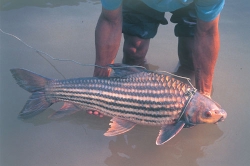
spawning migration of the large
cyprinid Probarbus jullieni (and also
Probarbus labeamajor), one of the high-
profile `flagship' species of the Mekong.
The seasonal spawning migration of the
giant Mekong catfish (Pangasianodon
gigas) has experienced a dramatic
decline in recent decades, and today
only one site along the entire Mekong
River sustains a small traditional fishery
for the giant catfish (during the 2001
and 2002 season no fish were caught).
Probarbus jullieni one of the many migratory fishes of
the Mekong
Many authors have devoted considerable
effort trying to define the term migration
(see for example, Dingle 1996; McKeown 1984; and others). For the purposes of this report, we
share the view of Barthem and Goulding (1997) that a rigid definition does not seem useful. But we
find it important to emphasise two issues concerning migration:
Migration is one type of movement, distinguished from more diffuse types such as foraging for
food within a single habitat. It normally involves the "cyclic and predictable movements of a large
proportion of animals within the species, or populations of species" (as defined by the International
Convention on the Conservation of Migratory Species of Wild Animals, the CMS Convention).
Migration is an integrated element of the entire life cycle of the animal.
Animals migrate because key habitats essential for their survival are separated in time and space.
Often, movements are guided by seasonal changes in living conditions (e.g. escaping winters or
23
Fish migrations of the Lower Mekong River Basin
seasonal droughts) and/or by seasonal reproductive patterns (e.g. migrating to suitable breeding
sites). These movements have evolved with, and thus are finely tuned to, the environment within
which they occur. Migratory animals thus depend on a wide range of habitats, and their distribution
ranges cover large geographical areas. Since they move regularly between different habitats, they
are considered "living threads that tie or link widely scattered ecosystems together" (Glowka 2000).
Such links often reach beyond national borders, as is, for example, the case with many of the
migrating fishes of the Mekong Basin.
Migratory animals are well adapted to naturally occurring environmental fluctuations and changes,
but are particularly vulnerable to the abrupt environmental changes caused by human activities.
Therefore, many migratory animals are at risk of becoming endangered (see for instance the IUCN
Red list of Endangered Animals, 1996).
2.1 Fish migrations and life cycles
In rivers, fishes have adapted to life in running water and to seasonal changes in habitat availability.
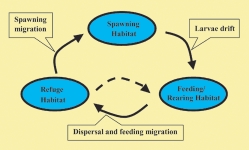
The need to migrate is part of this adaptation. Figure 1 illustrates how migrations are integrated into
the life cycles of migrating fishes.
Fish movements take place at all stages of life, even the earliest stages. In rivers, movements of fish
eggs and larvae, in the form of downstream passive drift are common, and are integrated events of
the overall movement patterns of migrating fishes. Often, migration routes and the spatial position
of spawning areas are finely tuned to hydrological and environmental circumstances, ensuring that
eggs and/or larvae drift back downstream to their rearing habitats with the flowing water.
In an ecological context, fish migrations
Figure 1 A: Simplified schematic representation of life
cannot be described without at the same
time describing essential fish habitats and
the environment within which these
habitats are embedded.
Therefore, impacts of development
scenarios on fish migrations are not
confined to the blocking of migration
routes caused by damming of rivers.
Impacts on the environment, and thereby
on fish habitats, and changes in
hydrological patterns are equally
important.
Figure 1 B: Corresponding habitat
requirements for the successful completion
of lifecycle of fish. Depending on species,
arrows may represent short movements (e.g.
from lake to adjacent floodplain), or long-
distance migration. The broken arrow
represents longer-lived species, which may
move several times between refuges and
feeding habitats.
cycle of fish.
24
Fish migrations of the Lower Mekong River Basin
Fish migration in
3
the Mekong River
In a multi-species fisheries environment such as the Mekong system, it is useful to distinguish
different species groups based on different life history strategies. The broadest classification of
fishes in the Mekong fisheries context is the classification of fishes into black-fishes and white-
fishes (Welcomme 1985).
Black-fishes are species that spend most of their life in lakes and swamps on the floodplains
adjacent to river channels and venture into flooded areas during the flood season. They are
physiologically adapted to withstand adverse environmental conditions, such as low oxygen levels,
which enable them to stay in swamps and small floodplain lakes during the dry season. They are
normally referred to as non-migratory, although they perform short seasonal movements between
permanent and seasonal water bodies. Examples of black-fish species in the Mekong are the
climbing perch (Anabas testudineus), the clarias catfishes (e.g. Clarias batrachus) and the striped
snakehead (Channa striata).
White-fishes, on the contrary, are fishes that depend on habitats within river channels for the main
part of the year. In the Mekong, most white-fish species venture into flooded areas during the
monsoon season, returning to their river habitats at the end of the flood season. Important
representatives of this group are some of the cyprinids, such as Cyclocheilichthys enoplos and
Cirrhinus microlepis, as well as the river catfishes of the family Pangasiidae.
Figure 1 is representative for both black-fishes and white-fishes. However, for black-fishes, the
arrows represent only short movements between `neighbouring' habitats, whereas for white-fishes,
they represent migrations between distant habitats.
Recently, an additional group within this classification has been identified. It is considered an
intermediate between black-fishes and white-fishes and therefore has been referred to as grey-
fishes (Welcomme 2001). Species of this group undertake only short migrations between floodplains
and adjacent rivers and/or between permanent and seasonal water bodies within the floodplain
(Chanh et al. 2001; Welcomme 2001).
Virtually all fishes of the Mekong are exploited and therefore constitute important fishery resources.
All fishes are also vulnerable to impacts from development activities, including transboundary
impacts. However, long-distance migratory species (i.e. white-fish species) are particularly vulnerable
because they depend on many different habitats, are widely distributed, and require migration
corridors between different habitats. For these important fishes, the term `transboundary' has double
meaning: they are transboundary resources that may be affected by transboundary impacts of human
activities.
25
Fish migrations of the Lower Mekong River Basin
3.1 Important fish habitats in the Mekong Basin
Since the separation of critical fish habitats within the overall ecosystem that constitutes the lower
Mekong Basin is the main cause for fishes to migrate, it is useful to identify these habitats before
discussing migrations, i.e. the cause (habitats) first, then the response (migrations).
3.1.1 Floodplains
The flood-pulse during the monsoon season is the driving force of the Mekong River ecosystem. As
is the case for most tropical floodplain river systems, the seasonal habitats on the floodplains created
by the monsoon floods are the main "fish production sites" of the Mekong (Sverdrup-Jensen 2002).
These areas are very rich in nutrients, food and shelter during the flood season, and most Mekong
fishes depend on these resources for at least certain parts of their early life cycle.
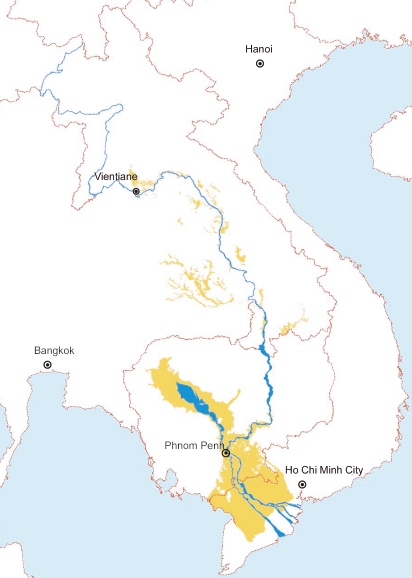
Figure 2: Main floodplain areas of the Lower Mekong Basin.
26
Fish migrations of the Lower Mekong River Basin
Figure 2 shows a map of the flooded areas of the Lower Mekong River Basin. As can be seen, the
main floodplain habitats occur in the lower part in southern Cambodia and the Mekong Delta in
Viet Nam. The most important floodplain complex is associated with the Tonle Sap River/Great
Lake system in Cambodia. In the upper parts of the basin, in Thailand and Lao PDR, floodplain
areas are smaller and are mainly associated with Mekong tributaries. In the upper parts of the basin,
i.e. approximately upstream from Vientiane, floodplain habitats become more and more scarce as
the river gradually changes to become a typical mountain river with steep riverbanks.
The migratory behaviour of many fishes
is an adaptation to these hydrological
and environmental conditions. The
timing of migrations is "tuned" to the
flood-pulse, and although different
species may have tuned their migrations
in different ways, some general patterns
can be elucidated. In general, most
species spend the dry season "fasting"
in refuge habitats. The arrival of the
monsoon and its floodwaters is an
ecological trigger for both spawning and
migration. Spawning at the right time
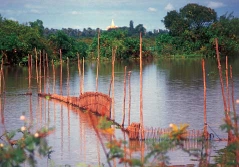
Floodplains are important fish habitats during the monsoon season
and place will enable offspring to enter
floodplain habitats, where they can feed. Some species spawn on the floodplain itself, whereas
others migrate upstream to spawn within the river channel and then rely on the river current to bring
the offspring to the downstream rearing habitats. Many larger juveniles and adult fish actively migrate
from dry-season shelters to the floodplains to feed. Thus, the life cycles of migrating fish species
ecologically connect different areas and habitats of rivers. From their point of view, the river basin
constitutes one ecological unit interconnecting upstream spawning habitats with downstream rearing
habitats.
3.1.2 Dry season refuge habitats
When water recedes from flooded areas at the end of the flood season, fishes have to move out of
the seasonal habitats and return to their dry season refuges. In a broad sense, two types of dry
season refuge habitats exist:
1) permanent floodplain lakes and swamps
2) river channels
Floodplain lakes are mainly used by the group of black-fish species, whereas river channel refuges
are mainly used by whitefishes. In the context of this report, the focus is on refuge habitats associated
with river channels, which are mainly used by migrating, transboundary fish stocks belonging to
the group of white-fish species.
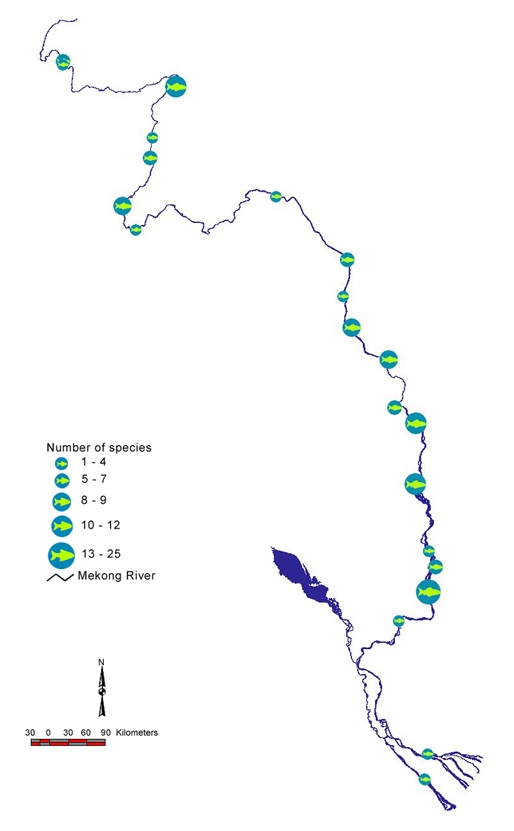
Within rivers, deep areas are particularly important as dry season refuges. These areas are most
often referred to as deep pools. The importance of deep pools in the Mekong River Basin has
recently been documented by the MRC Fisheries Programme (Poulsen et al. 2002), in which Figure
3 shows the distribution of important deep pool habitats within the Mekong mainstream, based on
local ecological knowledge.
27
Fish migrations of the Lower Mekong River Basin
Figure 3. Number of species reported using deep pools at each study site in the Mekong mainstream (based
on Local Ecological Knowledge. See: Poulsen et.al. (2002); Poulsen and Valbo-Jørgensen (1999);
Valbo-Jørgensen and Poulsen 2000)
28
Fish migrations of the Lower Mekong River Basin
Certain stretches of the Mekong River emerge as important locations for deep pools. In particular,
the stretch from Kratie to the Khone Falls in northern Cambodia contains a large number of deep
pools that are used by many species during the dry season.
The river stretch immediately
upstream from the Khone Falls, as
far upstream as Khammouan/
Nakhon Phanom, and the stretch
from the Loei River to Louang
Prabang also contains many deep
pool habitats.
Interestingly, there are also
stretches that appear to contain
relatively few deep pool habitats.
Most notably, there are very few
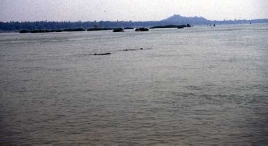
River dolphins surfacing at a deep pool near Kratie
deep pools along the stretch from
Kratie in northern Cambodia all the
way to the Mekong Delta. Further upstream, within the stretch from Paksan/Beung Khan to Vientiane/
Sri Chiang Mai, deep pool habitats are also scarce.
3.1.3. Spawning habitats for migratory fishes
Although little is known about spawning habitat requirements for most Mekong fishes, spawning
habitats are generally believed to be associated with: (1) rapids and pools of the Mekong mainstream
and tributaries; and (2) floodplains (e.g. among certain types of vegetation, depending on species).
River channel habitats are, for example, used as spawning habitats by most of the large species of
pangasiid catfishes and some large cyprinids such as Cyclocheilichthys enoplos, Cirrhinus microlepis,
and Catlocarpio siamensis. Floodplain habitats are used as spawning habitats, mainly by black-fish
species.
Other species may spawn in river channels in the open-water column and rely on particular
hydrological conditions to distribute the offspring (eggs and/or larvae) to downstream rearing habitats.
Information on spawning habitats for migratory species in the river channels of the Mekong Basin
is scarce. Only for very few species, such as Probarbus spp. and Chitala spp., spawning habits are
well described because these species have conspicuous spawning behaviour at distinct spawning
sites. For most other species, in particular for deep-water mainstream spawners such as the river
catfish species, spawning is virtually impossible to observe directly.
Information about spawning can instead be obtained through indirect observations such as
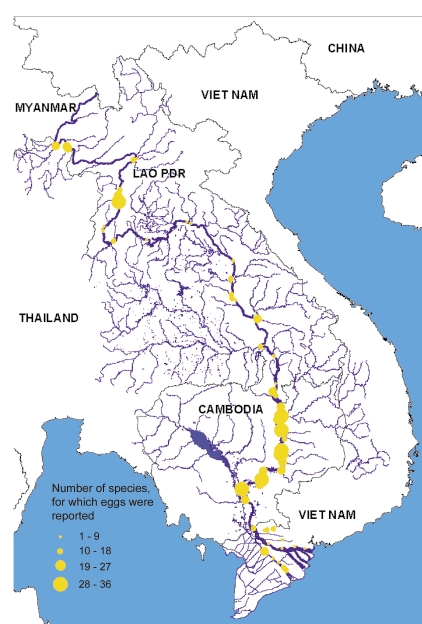
observations of ripe eggs in fishes. Figure 4 shows the number of species with eggs that have been
observed by fishers (each "pie" in Figure 4 represents the number of species carrying ripe eggs, as
observed by fishers). For fishes that spawn in main river channels, spawning is believed to occur in
stretches where there are many rapids and deep pools, e.g. (1) the KratieKhone Falls stretch; (2)
the Khone Falls to Khammouan/Nakhon Phanom stretch; and (3) from the mouth of the Loei River
to Bokeo/Chiang Khong.
Figure 4 indicates that the Kratie-Khone Falls stretch and the stretch from the Loei River to Luang
Prabang are particularly important for spawning.
29
Fish migrations of the Lower Mekong River Basin
Figure 4: Number of species along the Mekong mainstream reported to have eggs in their
abdomen (see text for further explanation).
30

Fish migrations of the Lower Mekong River Basin
View of the Mekong
near Kratie, northern
Cambodia. This area is
believed to be important
for spawning for many
migratory fish species.
3.2. Fish migrations and hydrology in the Mekong Basin
There is an intimate link between fish life cycles, fish habitats, and hydrology. Migrating fishes
respond to hydrological changes and use hydrological events as gauges for the timing of their
migrations. This is illustrated in Figure 5, where peak migration periods are correlated with the
annual hydrological cycle. Most species migrate at the start of the annual flood and return at the end
of the flood, producing the two peaks shown in Figure 5.
Figure 5: Relationship between migratory activity levels and water discharge in the Lower Mekong Basin
(modified from Bouakhamvongsa and Poulsen, 2000) Blue Line: average monthly discharge
(m3/sec) of the Mekong River at Pakse, Southern Lao PDR (data provided by MRC Secretariat).
Red Line: Number of migration reports (based on 50 species from 51 sites along the Mekong
mainstream).
Also, the spawning season is tuned according to river hydrology, and almost all species spawn at
the onset of the monsoon season. Only a few species, such as Probarbus spp. and Hypsibarbus
malcolmi, are exceptions to that rule: they spawn during the dry season.
31
Fish migrations of the Lower Mekong River Basin
3.3. Major migration systems of the Mekong
For a complex ecosystem, which involves such a large number of species, it is beyond the scope of
this report to discuss individual species. Although different species have developed different life
strategies to cope with the environmental circumstances, generalisations can be made, e.g. on migratory
patterns. Some of these general patterns will be outlined below (see also Sverdrup-Jensen 2002).
One of the major results of these surveys has been the identification of three main migration systems
associated with the lower Mekong River mainstream (Sverdrup-Jensen 2002). These three systems
have been termed the Lower Mekong Migration System (LMS), the Middle Mekong Migration
System (MMS), and the Upper Mekong Migration System (UMS).
It is important to note that the different migration systems are inter-connected and, for many species,
overlapping. Furthermore, their classification as `systems' is based on the fact that migration patterns
are different in each. In general, the migration patterns are determined by the spatial separation
between dry season refuge habitats and flood season feeding and rearing habitats within each system.
This, again, demonstrates how migration habits are deeply embedded in the environment within
which they occur.
3.3.1 The Lower Mekong Migration System (LMS)
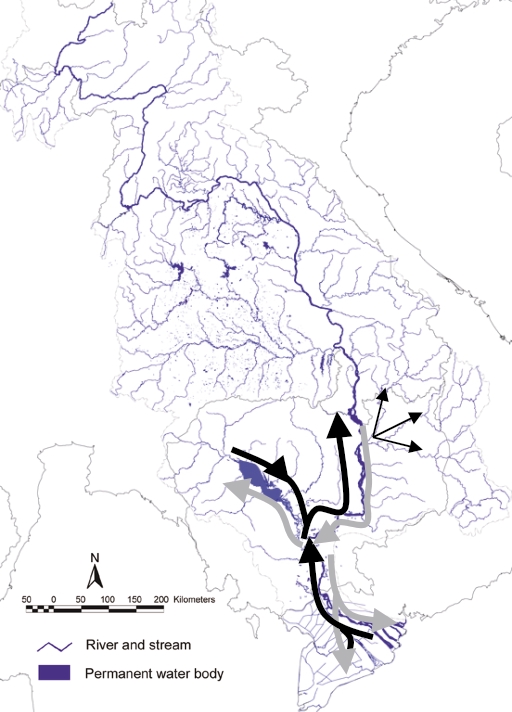
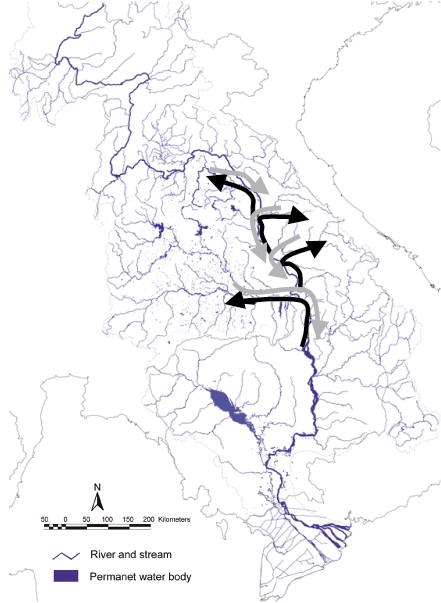
This migration system covers the stretch from the Khone Falls downstream to southern Cambodia,
including the Tonle Sap system, and the Mekong Delta in Viet Nam (Figure 6). As described above,
this migration is driven by the spatial and temporal separation of flood-season feeding and rearing
habitats in the south with dry-season refuge habitats in the north. The rise in water levels at the
beginning of the flood season triggers many migrating fishes to move from the dry season habitats
just below the Khone Falls, e.g. in deep pools along the Kratie-Stung Treng stretch, towards the
floodplain habitats in southern Cambodia and the Mekong Delta in Viet Nam. Here they spend the
flood season feeding in the fertile floodplain habitats. Some species spawn on, or near the floodplain,
whereas others spawn far upstream, i.e. above Kratie, and rely on the water current to bring offspring
to the floodplain rearing areas. One of the key factors for the integrity of this system is the Tonle
Sap/Great Lake system a vast and complex system of rivers, lakes and floodplains. As a result of
increasing water discharge from the Mekong River at the onset of the flood season, the water
current of the Tonle Sap River changes its direction, flowing from the Mekong into the Tonle Sap
River and towards the Great Lake. This enables fish larvae and juveniles to enter the Tonle Sap
from the Mekong by drifting with the flow. Together with the floodplains of the Mekong Delta in
Viet Nam, these floodplains are the main "fish factories" of the lower basin.
An important group of species, which undertakes this type of migration, belongs to the genus
Henicorhynchus. In terms of fisheries output, these fishes are among the most important of the
Lower Mekong. For example, in the Tonle Sap River dai fishery, species of the genus Henicorhynchus
account for 40 percent of the total annual catch (Lieng et al. 1995, Pengbun and Chanthoeun 2001).
Larger species, such as Catlocarpio siamensis, Cirrhinus microlepis, Cyclocheilichthys enoplos,
and Probarbus jullieni, as well as several members of the family Pangasiidae, also participate in
this migration system.
The Sesan tributary system (including the Sekong and Srepok Rivers) deserves special mention
here (Figure 7). This important tributary system is intimately linked with the Lower Mekong
Migration System, as evidenced by many species such as Henicorhynchus sp. and Probarbus jullieni
extending their migration routes from the Mekong River mainstream into the Sesan tributary system
(Chanh Sokheng, personal communication, December 2001). In addition, the Sesan tributary system
also appears to contain its own migration system.
32
Fish migrations of the Lower Mekong River Basin
Figure 6: A simplified illustration of the Lower Migration System (only the major routes are illustrated).
Black arrows represent migrations at the beginning of the dry season; grey arrows represent
migration at the beginning of the flood season. See text for further explanation.
33
Fish migrations of the Lower Mekong River Basin
Figure 7: The dry-season migration of Henicorhynchus spp. from the Mekong into the Sesan Tributary
system
Many of the species (e.g. all the species mentioned above) are believed to spawn within the Mekong
mainstream in the upper stretches of the system (from Kratie to the Khone Falls, and beyond) at the
beginning of the flood season in May-June. Eggs and larvae subsequently drift downstream with
the current to reach the floodplain feeding habitats in southern Cambodia and Viet Nam. The
importance of drifting larvae and juveniles has been documented through intensive sampling of
larvae fisheries in the Mekong Delta in Viet Nam (Tung et al. 2001). During a sampling period of
only 45 days in June-July 1999 from two sites (one in the Mekong River and one in the Bassac
River in An Giang Province of Viet Nam), 127 species were identified from the larvae and juvenile
drift. Fish eggs were not sampled. This illustrates how important hydrology is for the completion of
life cycles of fishes in the lower Mekong River.
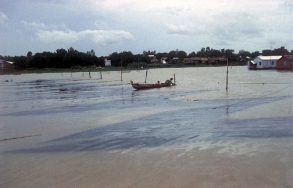
Fishing for fish larvae in the
Mekong Delta (An Giang
Province of Viet Nam).
34
Fish migrations of the Lower Mekong River Basin
Table 1: The 127 species caught during the larvae sampling of the Mekong and Bassac rivers, in An
Giang Province of Viet Nam. M = Mekong; B = Bassac (from Tung, et. al., unpublished AMFC
report)
35
Fish migrations of the Lower Mekong River Basin
3.3.2 The Middle Mekong Migration System (MMS)
From just above the Khone Falls and upstream to the Loei River, Thailand, the migration patterns
are determined by the presence of large tributaries connecting to the Mekong mainstream. Within
this section of the river, floodplain habitats are mainly associated with the tributaries (e.g. the Mun
River, Songkhram River, Xe Bang Fai River, Hinboun River, and other tributaries), so fishes migrate
seasonally along these tributaries from mainstream dry season habitats to floodplain feeding/rearing
habitats. At the onset of the flood season, fishes generally move upstream within the Mekong
mainstream until they reach the mouth of one of these major tributaries. They swim up the tributary
until they can move into floodplain habitats. At the end of the monsoon, fishes move in the opposite
direction, from floodplains through the tributary river and, eventually, to the Mekong mainstream,
where many fishes spend the dry season in deep pools. An example is given in Figure 8, based on
local ecological knowledge.
Figure 8. Simplistic illustration of the Middle Migration System.
36
Fish migrations of the Lower Mekong River Basin
This is of course a very simplistic description of the main movements, and there are considerable
variations in the general pattern, both between different species and within species. Furthermore,
there are complex interconnections to the lower migration system described above, i.e. many of the
same species participate in both systems, either as genetically-distinct populations, or at different
stages of their life cycle (see later).
Figure 9.
Variation in occurrence of a group of 9 Pangasiid species in the Songkhram River and adjacent
Mekong, based on Local Ecological Knowledge. See text further for explanation. The species
are: Heligophagus waandersii, Pangasianodon hypophthalmus, Pangasius bocourti,
P. conchophilus, P. djambal, P. krempfi, P. larnaudiei, P. polyuranodon, P. sanitwongsei.
The movement of fish between the Songkhram River and the Mekong mainstream, is illustrated
in Figure 9. Each bar chart illustrates reported occurrence by month at each station over the year.
The occurrence level for each month was reported as `high occurrence', `low occurrence', or `no
occurrence'. It shows that all these species use the Mekong mainstream as a dry season refuge and
the Songkhram River floodplain as feeding grounds during the flood season.
37
Fish migrations of the Lower Mekong River Basin
It is important to emphasise
that the two different
migration systems (LMS
and MMS) are not "closed"
ecological systems, isolated
from each other. The two
systems are in fact
interconnected. Many
species are known to
migrate over the Khone
Falls, both during the flood
season and during the dry
season, thereby demonstrating
that the Falls is not a barrier
for fish movements (Baird
1998; Roberts 1993; Roberts
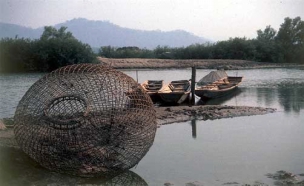
Fish trap in the upper Mekong River
and Baird 1995; Roberts and
Warren 1994; Singanouvong et al. 1996a and 1996b). For some species, the same fish may be part
of the lower migration system as a juvenile, and part of the middle migration system as a mature
adult. For example, important species such as Cyclocheilichthys enoplos and Cirrhinus microlepis
are mainly reported as juveniles and sub-adults in the Lower Mekong Migration System and as
adults in the Middle Mekong Migration System. The same may be true for a number of other
species, including the Giant Mekong Catfish. For other species, it may be the case that genetically
distinct sub-populations are involved in the different migration systems. However, further research
is needed before conclusions can be made on this issue.
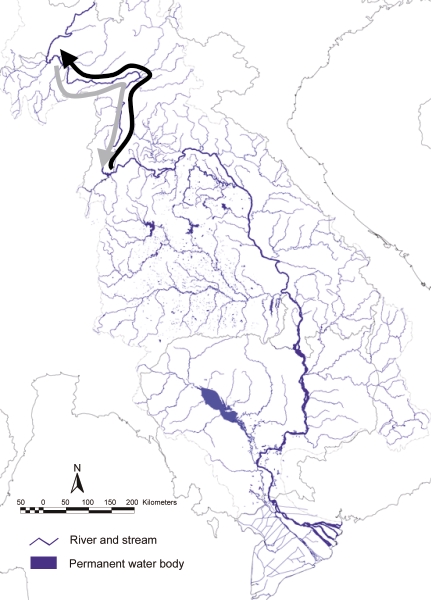
3.3.3 The Upper Mekong Migration System (UMS)
The third migration system occurs in the upper section of the river, approximately from the mouth
of the Loei River and upstream towards the border between Lao PDR and China (probably continuing
into China, although we have no data to confirm this). This section of the river (Figure 10) is
characterised by its relative lack of floodplains and major tributaries (although there are some
floodplains associated with tributaries in the far north, i.e. the Nam Ing River, in Thailand). This
migration system is dominated by upstream migrations at the onset of the flood season, from dry
season refuge habitats in the main river to spawning habitats further upstream. This is also a multi-
species migration system, and some of the species participating in the previous migration systems
further downstream also participate in this migration, although the total number of species may be
lower.
The most conspicuous member of this migration system is the Giant Mekong Catfish, Pangasianodon
gigas. The Henicorhynchus sp., which is so important for the fishery further downstream, is also
important along this stretch of the river. For example, a fisherman from Bokeo in northern Lao PDR
reported a catch of between 100 and 200 kg per day of this fish during the month of October 2001
(Bouakhamvongsa, in prep.) This may be a genetically distinct stock compared with downstream
stocks (although further research is needed to confirm this).
Whereas the LMS and the MMS are inter-connected to a large degree, the UMS appears to be
relatively isolated, with little "exchange" between the UMS and the other migration systems. As
can be seen from Figure 3, deep pool habitats are rare for a long stretch of the Mekong between the
MMS and the UMS. Along the same stretch, observations of mature fishes with eggs are also rare.
This indicates that for many migratory species, the stretch from Paksan to the mouth of the Loei
River is a functional barrier.
38
Fish migrations of the Lower Mekong River Basin
Figure 10. Simplistic illustration of the Upper Migration System.
Interestingly, the geographical extent of these three migration systems corresponds with elevation
contours of the lower Mekong Basin (Figure 11). In particular, there is a clear area overlap between
the extent of the Lower Mekong Migration System and the extent of the 0-149 m elevation of the
Mekong Delta/Cambodian lowlands. A correlation also occurs between the Middle Mekong
Migration System and the 150-199 m elevation represented largely by the Korat Plateau. The Upper
Mekong Migration System correlates with a plateau of 200-500 m elevation. This demonstrates
how fish migration has evolved within the surrounding physical environment.
39
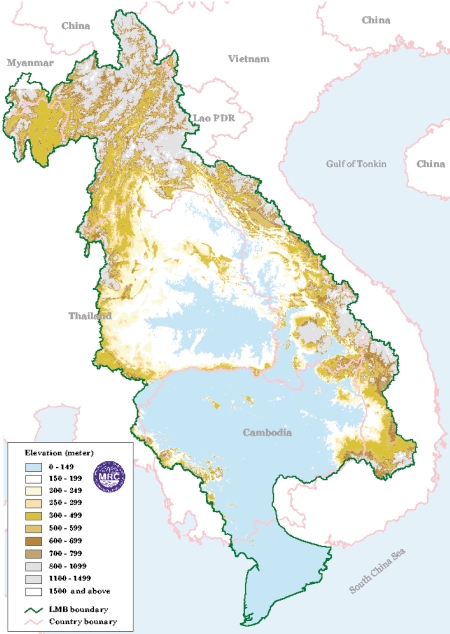
Fish migrations of the Lower Mekong River Basin
Figure 11: Elevation map of the Lower Mekong Basin. Note the overlap between the Lower Migration
System and the region with the dominant elevation between 0-149 m (the Mekong Plain); between
the Middle Migration System and the region with the dominant elevation between 150-199 (the
Korat Plateau) and between the Upper Migration System and the region with elevation mainly
above 250 m (Northern Highlands).
40
Fish migrations of the Lower Mekong River Basin
Managing
4
migratory fishes
The two main intervention areas for the sustainable management of the fishery resources of the
Mekong are:
management of habitats and ecosystems (environmental management)
management of resource use (fisheries management).
Traditionally, fisheries management in the Mekong (and elsewhere) has focussed solely on `within-
the-sector' issues and management activities (e.g. gear restrictions, access restriction, seasonal
restrictions). In a complex setting like the Mekong Basin, it is particularly important that fisheries
resources are managed within an overall management framework, where environmental management
is seen as a pre-requisite for fisheries management (see, for instance Coates, 2001). Fisheries
management, in its conventional application, would be of limited use in the Mekong, unless the
environment that sustains the fisheries are managed first in a sustainable manner. This requires a
multi-disciplinary approach, involving all the different `users' of the river. The focus of this report,
therefore, is on environmental management (i.e. management of habitats and ecosystem attributes),
and not on conventional fisheries management.
With regards to the management of migratory, transboundary fish stocks, an additional requirement
is that regional, cross-border management initiatives are implemented. This is the area where the
MRC is well placed to play a key role. All the three migration systems mentioned previously extend
across international borders and thus, by nature, fall under the responsibility of the MRC.
The 1995 Agreement that established the Mekong River Commission, serves as the natural framework
under which management guidelines for migratory fishes of the lower Mekong Basin can be designed
and implemented. In addition to the 1995 Agreement, another instrument deserves mentioning here:
the Convention on Biological Diversity (CBD). The CBD is the most comprehensive international
instrument in existence for the management of natural resources. It commits signatory states to
"...the conservation of biodiversity, the sustainable use of its components and the fair and equitable
sharing of the benefits arising out of the utilisation of genetic resources...". It further makes special
reference to the need for states to manage transboundary (i.e. migratory) stocks (e.g. Article 3:
"...contracting parties shall ensure that activities within their jurisdiction or control do not cause
damage to the environment of other states or of areas beyond the limits of national jurisdiction". The
Convention specifically refers to the cooperation, among contracting parties in research, management
and monitoring of biodiversity, including migratory, transboundary elements of biodiversity. The
CBD has been signed by all the six riparian countries of the Mekong Basin, including China and
Myanmar. However, Cambodia, Lao PDR and Thailand have yet to ratify it.
41
Fish migrations of the Lower Mekong River Basin
The main reason for mentioning the CBD in the context of this report is that the two remaining
riparian countries, China and Myanmar, which are not members of MRC, are signatories of, and
have ratified, the CBD. Therefore, the CBD commits them to the conservation and sustainable use
of biodiversity (part of which are fishery resources). Some of the fish migrations extend into China
and Myanmar and, in addition, activities undertaken in the two upper countries may impact on
downstream fishery resources, including fish migration systems.
Another reason for the relevance of the CBD is that there is a direct link between the high fish
diversity and the fisheries productivity of the Mekong (Coates 2001). This link is important to
emphasise, because fisheries issues have traditionally been viewed in separation from biodiversity
conservation, often even seen as threats to biodiversity conservation. The Mekong fisheries demonstrate
the intimate linkages between biodiversity and fisheries: biodiversity conservation can be achieved
through the promotion of sustainable use (fisheries), and fisheries productivity can be sustained only
through biodiversity conservation.
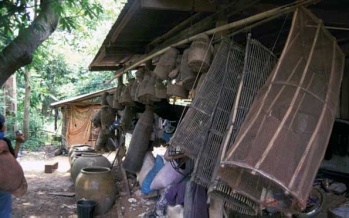
The fish diversity of the Mekong is reflected in the diversity of fishing gears
used to catch them.
4.1. Key issues for the maintenance of ecological functioning of
the
Mekong ecosystem, with reference to migratory fishes
Based on the ecological information that has been described above, key attributes of importance for
the ecological functioning and productivity of the Mekong ecosystem will be listed in the following
section. Although the emphasis is on issues related to migratory fishes, the issues are equally relevant
for all fish species and indeed for the ecosystem as a whole.
Basically, the most important issue in relation to the ecological functioning of the Mekong River
from the point of view of migratory fishes is that critical habitats are maintained in time and space.
This includes the maintenance of connectivity between them, i.e. through migration corridors. The
importance of the annual hydrological pattern is emphasised, including its role in the creation of
seasonal floodplain habitats, as well as its role as a distributor of fish larvae and juveniles through
passive drift.
42
Fish migrations of the Lower Mekong River Basin
The following key ecological attributes for migratory species are identified, based on the three major
migration systems described above along the Mekong mainstream.
The Lower Mekong Migration System (LMS).
General ecological attributes
Mekong-specific ecological attributes
Dry season refuge habitats:
Deep pools in the Kratie-Stung Treng stretch of the Mekong
mainstream. These habitats are extremely important for
recruitment for the entire lower Mekong Basin, including
floodplains in southern Cambodia (including the Tonle Sap/
Great Lake System) and the Mekong Delta in Viet Nam.
Flood season feeding and
Floodplains in the Mekong Delta in Viet Nam, in southern
rearing habitats:
Cambodia, and in the Tonle Sap system. These habitats
support the major part of Mekong fisheries.
Spawning habitats:
Rapids and deep pool systems in the Kratie Khone Falls,
and in the Sesan catchment. Floodplain habitats in the south
(e.g. flooded forests associated with the Great Lake).
Migration routes:
The Mekong River from Kratie Stung Treng to southern
Cambodia and the Mekong Delta in Viet Nam.
Between the Mekong River and the Tonle Sap River
(longitudinal connectivity).
Between floodplain habitats and river channels (lateral
connectivity).
Between the Mekong mainstream and the Sesan sub-
catchment (including Sekong and Srepok Rivers).
Hydrology:
The annual flood pattern responsible for the inundation of
large areas of southern Cambodia (including the Tonle Sap
system) and the Mekong Delta is essential for fisheries
productivity of the system (see above).
The annual reversal of the flow in the Tonle Sap River is
essential for ecosystem functioning. If the flow is not
reversed (or if reversal is delayed), fish larvae drifting from
upstream spawning sites in the Mekong River cannot access
the important floodplain habitats of the Tonle Sap System.
A delayed flow reversal would also lead to a reduced
floodplain area adjacent to the river and lake, and thus,
reduced fish production.
Changed hydrological parameters, e.g. as a result of water
management schemes, result in changed flow patterns,
which in turn may change sedimentation patterns along
the river. Examples of this already exist in some tributaries
where hydropower dams have been constructed, resulting
in sedimentation, and thus in disappearance of deep pool
habitats.
43
Fish migrations of the Lower Mekong River Basin
The Middle Mekong Migration System (MMS)
General ecological attributes
Mekong-specific ecological attributes
Dry season refuge habitats:
Deep pool stretches of the Mekong mainstream and within
major tributaries. Of particular importance is the stretch
from the Khone Falls to Kammouan/Nakhon Phanom. Deep
pools immediately downstream from the Khone Falls also
are important for this migration system (thereby linking
the MMS and the LMS)
Flood-season feeding and
Floodplains of this system are mainly associated with major
rearing habitats:
tributaries (e.g. the Mun/Chi system, Songkhram River, Xe
Bang Fai River, Hinboun River).
Spawning habitats:
Rapids and deep pool systems in the Mekong mainstream
(particularly along the stretch from the Khone Falls to
Khammouan/Nakhon Phanom).
Floodplain habitats associated with tributaries.
Migration routes:
Connections between the Mekong River (dry season
habitats) and major tributaries (flood season habitats).
Access to floodplain habitats from main river channels must
be maintained.
Hydrology:
The annual floods that inundate floodplain areas along
major tributaries must be maintained.
The Upper Mekong Migration System (UMS)
General ecological attributes
Mekong-specific ecological attributes
Dry season refuge habitats:
Occur throughout the extent of the UMS, but are most
common in the downstream stretch from the mouth of the
Loei River to Louang Prabang.
Flood season feeding and
The UMS occurs within a section of the Mekong, which is
rearing habitats:
dominated by mountainous rivers with limited floodplain
habitats. Floodplain habitats therefore play a less important
role, compared to MMS and LMS. Large catches of
Henicorhynchus sp. in Bokeo Province of Lao PDR suggest
that even the limited areas of available floodplains are
important.
Spawning habitats:
Spawning habitats occur mainly in the upper stretches of
the system. They are mainly situated in stretches with
alternating rapids and deep pools.
Migration routes:
Migration corridors between downstream dry season refuge
habitats and upstream spawning habitats should be
maintained.
Hydrology:
The annual flood pattern that triggers fish migrations and
causes innudation of floodplains.
44
Fish migrations of the Lower Mekong River Basin
Khone Falls
The Khone Falls are situated on the border between Cambodia and Lao PDR and thus also demarcate
the "border" between the LMS and the MMS. It is important to emphasise that the Khone Falls are
not a barrier to migration. The Khone Falls area is probably the most studied site along the whole of
the Mekong, and large-scale migrations involving a large number of species have been documented
through intensive sampling programmes over the past decade (Baird 1998; Roberts 1993;
Singanouvong et al. 1996a and 1996b). Thus, the LMS and the MMS are in fact inter-connected.
What makes the LMS and the MMS different from each other is not that they are geographically
isolated.The difference is that in the LMS, the dry season refuge habitats are situated upstream
from the flood season feeding and rearing habitats, whereas in the MMS, they are situated
downstream from the flood season habitats. Therefore, at the onset of the flood season, in the LMS
fishes migrate downstream towards flood season habitats, whereas in the MMS, fishes migrate
upstream towards flood season habitats. As mentioned earlier, in some cases the same fish may
participate in both migration systems at different stages of their life cycle.
The UMS may be relatively isolated from the two migration systems further downstream. It thus
may represent genetically distinct populations of fishes. If so, these populations should be regarded
as separate management units. Further research, particularly on population genetics, is needed to
clarify this issue.
45
Fish migrations of the Lower Mekong River Basin
Potential impacts
5
of development
activities
In order to be able to optimise the basin planning process it is necessary to identify and assess
potential impacts of different development scenarios on fisheries and the environment that sustain
them. In this section some of the potential human impacts on migratory fishes of the Mekong are
discussed.
5.1 Human impacts on the Mekong fisheries
Some of the potential impacts of development activities and projects within the Mekong River
Basin will be discussed below. Human impacts on rivers have been divided into four categories: (1)
supra-catchment (e.g. inter-basin water transfer); (2) land-use change within the basin catchment
(e.g. agricultural development, urbanisation, deforestation, land drainage, flood protection); (3)
corridor engineering (e.g. dams and weirs, channelisation, dredging, mining); and (4) in-stream
impacts (e.g. pollution, navigation, water abstraction, exploitation of native species, introduction of
exotic species) (Arthington and Welcomme 1995).
These impacts affect all the fisheries resources of the Mekong, including both black-fish and white-
fish. However, the migratory white-fish species are particularly vulnerable, because they depend on
large areas, many different habitats, and the un-hindered access to these habitats through the migration
corridors linking them. Thus, potential impacts on black-fish species can be regarded as a sub-set of
impacts on white-fish species. In the following section, we will try to identify some potential impacts
in the context of migratory fishes of the Mekong River.
An assessment of impacts should ideally contain the following processes:
A valuation of migratory fishes as a fishery resource
An assessment of ecosystem attributes and processes that are required in order to sustain the
resources
Based on the two first points, an assessment of the degree of impacts (i.e. will the resource
disappear, or will part of it be able to persist in spite of the impacts?).
In the following section, we will discuss these three points with particular emphasis on the Lower
Mekong Migration System.
47
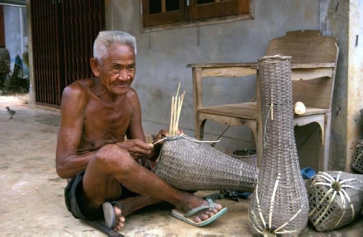
Fish migrations of the Lower Mekong River Basin
5.1.1 Valuation
In order to be able to assess impacts of different development scenarios, the potentially-impacted
resources must be quantitatively valued. This should also include a valuation of the critical ecosystem
attributes that sustain the resources. A large body of literature has emerged in recent years focusing
on assessing the value of natural resources and ecosystem services (see for instance: Barbier et al.
1996; Secretariat of the Convention on Biological Diversity 2001). Much of this literature emphasises
the difficulties associated with assessing the value of ecosystems and their multiple functions,
including, particularly, the many intrinsic, non-tangible values associated with, and services provided
by the ecosystem. Although such values are important and must be included in the overall basin
planning and impact assessment process, they are not considered in this report. Instead, the focus is
on the `direct use' value of migratory fishes, i.e. their direct value as fisheries resources.
In this report we focus on the direct-use values of migrating fishes because they are relatively simple
to quantify (in theory, at least) compared to the intrinsic, non-tangible ecosystem values. However,
we strongly emphasise that these values must not be ignored just because they are difficult, sometimes
impossible, to quantify.
The direct-use value is most often expressed as a monetary value ($US) based on the amount of the
resource, multiplied by a known unit price. For fisheries, the amount is usually expressed in weight
(kg), although for certain specialised fisheries, the number of fish may be applied (e.g. fisheries
targeting live juveniles for stocking purposes). Ideally, a more relevant expression of the value of a
resource would be to assess the replacement value, i.e. the cost of replacing the resource with
something of equal value for the livelihood of local communities. This would, for example, include
the costs of transporting and storing foods of equivalent nutritional value to the places where people
currently eat wild fish. To carry out such an assessment would be a complex undertaking and
considered beyond the scope of this report.
The value of fisheries in the Mekong River Basin is more than just the direct-use value.
48
Fish migrations of the Lower Mekong River Basin
The total direct-use value of the fishery resources of the Lower Mekong Basin has been estimated
at $US 1,478 million (Sverdrup-Jensen 2002). Such an estimate is useful in terms of demonstrating
the overall importance of the fisheries. However, for planning and impact assessment purposes,
more segregated valuation estimates are needed.
A full economic valuation that would be of use for planning and assessment purposes would require
the gathering of a large amount of information at several scales and would also require the
disaggregation of estimates both by species and by habitat (Aeron-Thomas 2001). In this regard,
migratory species pose a particular challenge, since they cover large geographic areas and depend
on a large number of habitats. Therefore, based on existing data, it is not possible to carry out a full
valuation. The resources required to carry out a full valuation may in fact be so large (both in terms
of time, money and human resources) that it may not be possible to fully valuate the Mekong fisheries,
let alone the contribution of migratory species to fisheries. However, a partial valuation based on
existing data, together with an assessment of major information gaps would still be useful, and in
many cases sufficient for planning and decision-making purposes. In the following section, we will
illustrate a process by which a partial valuation of the fisheries of migratory fishes could be undertaken.
In a multi-species environment such as the Mekong, where the coverage of quantitative, species-specific
data is limited, the large-scale, multi-species migration systems described above can instead be used as
the stratification on which assessments can be based. Thus, the valuation process can be carried out for
each of the three migration systems (with due allowance for their inter-connectedness). We will use the
Lower Mekong Migration System (LMS) as the example, and in this process we will attempt to:
(1) list all the major fisheries for migratory species within the Lower Mekong Migration System
(2) quantify each of them, where possible
(3) identify the knowledge gaps for these fisheries in terms of quantitative data.
All fisheries targeting migratory species throughout their range and migration routes should be
included in a valuation. Even fisheries for which no quantitative data exist should be included as
"information gaps". The migratory fishes of the Lower Mekong Migration System support at least
the following fisheries during their seasonal movements:
Floodplain fisheries, of which migratory species constitute a proportion of the total catch (e.g.
Tonle Sap River floodplains, Great Lake floodplains and the Mekong-Bassac floodplains in
southern Cambodia)
Great Lake fisheries, of which migratory species constitute a proportion of the total catch
Fisheries which target migratory fishes when they leave the floodplain (lateral migration)
The Samrah (brush park) fishery in the upper Tonle Sap River
Fisheries targeting migratory fisheries in the Tonle Sap (dai fisheries)
Fisheries of the Mekong Delta in Viet Nam
Fisheries targeting migratory fishes in the Mekong between Phnom Penh and the Khone Falls
Fisheries at dry season refuges in northern Cambodia
Khone Falls fisheries a proportion of which constitutes migratory fishes
Larvae and juvenile drift fisheries in southern Cambodia and Viet Nam
This illustrates the challenge associated with assessing the value of migratory fishes in terms of
their importance in fisheries. And even if this list includes most of the larger fishing operations, it
is not complete. Many small-scale fishing activities, which are not included, may in fact catch a
significant amount of fish.
49
Fish migrations of the Lower Mekong River Basin
In the following section, we will discuss each of the listed types of fisheries in terms of existing
quantitative information, species composition and information gaps.
Floodplain fisheries
As stated previously, most fish production in large rivers originates from floodplains. Even most
fishes caught in river channels are produced on the floodplains. For example, almost all the species
listed from the Tonle Sap River dai fishery (e.g. Lieng et al. 1995), spend their first important 4-5
months feeding and growing on the floodplains adjacent to the Tonle Sap River.
For the purposes of this report, the aim is then to (1) estimate the fishing yield from floodplain
habitats, and (2) to estimate the proportion of migratory (white-fish) species contributing to this
yield.
a. Yield from floodplain habitats
Several studies, both from the Mekong and from other river systems, have aimed at quantifying the
productivity of floodplains in terms of production (yield) per unit of area (Welcomme 1985; Dubeau
et al. 2001). One study with this aim was recently carried out in a small floodplain area in Kompong
Tralach adjacent to the Tonle Sap River, approximately 45 km north of Phnom Penh (Dubeau et al.
2001). The most conservative estimate of per unit area fish yield from this study is within the range
of 222-260 kg/ha/year2 . This corresponds with the estimate of 230 kg/ha/year of Baran et al. (in
press), cited in Sverdrup-Jensen (2002). However, it is significantly higher than estimates of floodplain
yields from Bangladesh (de Graaf et al. 2001), which estimated an average floodplain yield over a
seven-year period (1992-1999) at 86 kg/ha/year. Only once during this period (in the year with the
biggest floods, 1998-99), was the yield estimate within the range found in Kompong Tralach (228
kg/ha/year) (de Graaf et al. 2001). The difference may be partly explained by the fact that the inland
fisheries of Bangladesh have been exposed to over-exploitation and habitat modification for many
years, and floodplain productivity would therefore be expected to be lower compared to the Mekong.
If the data from the Kompong Tralach study are used, the per-unit-of-area yield is thus within the
range 222-260 kg/ha/year. This can be converted into a monetary value using the initial sale price of
$US 0.68 per kg (Sverdrup-Jensen 2002).
b. Migratory species
A large proportion of the floodplain yield originates from the black-fish species, i.e. species that
spend their entire life on the floodplain, seeking refuge in permanent lakes in the floodplain area
during the dry season. However, many black-fishes are predators, including the abundant Channa
(snakeheads), and it can be presumed that they feed heavily on whitefishes which have moved into
their floodplain habitat. Unfortunately, the lack of detailed information on LMB fish diets precludes
a proper analysis of the dependence of many black-fishes on white-fishes as food, and hence an
accurate estimation of the extent to which black-fishes represent food-chain-converted white-fish.
A significant proportion of the floodplain catches are white-fish species coming from and returning
to river channels. These fishes rely on the ecological connectivity between floodplains and river
channels.
The direct contribution of migratory species to the floodplain fisheries is hard to estimate because
the fisheries are scattered, and based on a large number of people each catching relatively small
2
The figure is lower than the figure from Dubeau et al (2001) because the specialised lot/leased fishery has been
subtracted from the data. This fishery will be covered separately in this report because the proportion of migratory
fishes are different between the two types of fisheries.
50
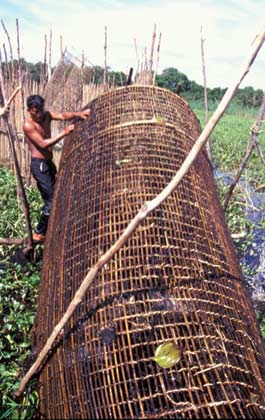
Fish migrations of the Lower Mekong River Basin
amounts for local consumption. The Kompong Tralach study collected species-specific data as part
of the `log-book' system, although the amounts of each species were not recorded. Based on these
data, a measure of abundance can be obtained, i.e. the number of reports for each species reported
from the catches during the one-year study (expressed as a percentage of the total number of
reports). Such data cannot be used to estimate yield, but provide a relative figure of importance for
different species groups.
A total of 64 species, or species groups, were recorded (some records pooled several species together,
so the number of species is a lot higher). Although the three black-fish species, which are commonly
caught in ricefields (Anabas testudineus, Channa striata and Clarias batrachus) alone account for
24 percent of the reports, migratory species account for no less than 30 percent of the reports. The
most reported white-fish species group is the Henicorhynchus group, which account for almost 8
percent of reports. Although these figures cannot be `converted' into catch, or value estimates, they
provide solid indication that migratory fishes are also important in floodplain fisheries.
The floodplain fisheries of the Mekong Delta in Viet Nam are also hugely important and, similarly,
a significant proportion consists of migratory white-fish species. Again, however, existing data do
not allow a quantitative estimate of this contribution to be made.
Future research should aim at establishing the proportion (by weight) of migratory fishes in catches
of floodplain fisheries of the Mekong.
Great Lake fisheries
The Great Lake of Cambodia has its own complex assemblage of fisheries and fisheries concessions
(lots). The main gears are fences, arrow-shaped traps and barrages.
The volume of catches from the fenced fishing lots
alone is expected to exceed 100,000 tonnes annually
(Sverdrup-Jensen 2002). Based on existing data on
species composition from the fishing lots (Van Zalinge
et al. 2000; Troeung and Phem 1999), the direct
contribution of migratory fishes to this yield is
estimated to be 48 percent (i.e. excluding white-fishes
converted to black-fishes through the food chain).
Migratory fishes from these fisheries thus represent
a first-sale value of approximately $US 33,000 (using
the price of $US 0.68 per kg).
Fisheries targeting migrations from floodplain
to river
Numerous small channels draining the floodplains
constitute the escape route for migratory fishes from
floodplains and back to river channels, when the
water begins to recede at the end of the monsoon
season. This provides the foundation for yet another
important fishery, the barrage/bag-net fishery. The
Kompong Tralach study also included two such
Lop trap being set as part of the arrow-shaped
fisheries, draining the same floodplain area (Dubeau
trap system, Great Lake, Cambodia
et al. 2001).
51
Fish migrations of the Lower Mekong River Basin
The total catch from this fishery encompasses migratory species dependent on connectivity
between floodplain and river. The catch is estimated at 128 tonnes over one season (November
to February).
An estimate of the total catch from this type of fishery for a large area such as the entire Tonle
Sap catchment could be obtained by multiplying this figure with the total number of these fisheries,
adjusting for variation in drainage area for each of them. Current data does not enable us to make
this calculation.
The Samrah (brush park) fishery in the upper Tonle Sap River
The Samrah fishery is a traditional type of fishery that has been practiced for centuries in Cambodia,
particularly in the Tonle Sap River system (Sam 1999). The fishery operates over three to four
months in the dry season (January to April).
The total estimated catch from the Samrah fishery in the Tonle Sap River in Konpong Chnnang
Province was estimated at 172 tonnes in 1997 and 199 tonnes in 1998 (Sam 1999). Sam (1999) also
provided species composition of the catches. An estimated 52 percent of the catch over the two
seasons constituted long-distance migratory species. This can be considered as a conservative estimate,
since a large proportion of the catch (i.e. 20-25 percent) were identified as `other species' and would
certainly also include migratory species.
If we use the average for the two seasons, the monetary value of this catch would then be $US 66,000
(using $US 0.68/kg).
Data from other provinces in Cambodia and from Viet Nam are not available.
The Tonle Sap River dai fishery
This is the most well-documented fishery of the lower Mekong Basin (Lieng et al. 1995). It specifically
targets white-fish species migrating from the Tonle Sap River to the Mekong River at the beginning
of, and well into, the dry season (October to March).
Over a five-year period from 1995 to 2000, the total annual catches from the dai fisheries varied
between 9,000 to 15,500 tonnes (Pengbun and Chanthoeun 2001). Again, using the unit price of
$US 0.68/kg, the direct-use value of the dai catch ranged between $US 10.54 million and $US 6.12
million.
Fisheries of the Mekong Delta in Viet Nam
The fisheries of the Mekong Delta in Viet Nam are extremely important. They encompass a range
of different gears and methods targeting different species groups and operating at both small-
scale and large-scale. However, very few segregated data are available. A recent survey estimated
the total annual yield from all the fisheries of An Giang Province at almost 195,000 tonnes
(RIA2/MRC, in prep.). Approximately 70 percent of this yield constituted migratory
(transboundary) species, corresponding to an annual yield of 136,000 tonnes. The direct-use
value is thus $US 92.8 million.
52
Fish migrations of the Lower Mekong River Basin
Fisheries targeting migratory fishes along the stretch from Phnom Penh to Khone Falls
(including the Sesan tributary system)
Migratory fishes are targeted using various types of gears along this stretch. The most important
gears are: gillnets, seine nets, various traps, and brush parks. The fish migrations along this stretch
are also targeted by migratory fishermen, who follow the fishes for some distance on their upstream
journey, particularly from Kratie to Stung Treng and into the Sesan catchment.
In terms of quantity and species composition of the yield from this section of the river, no data are
currently available and it is thus not possible to put a monetary value on the yield.
This should therefore be included in the final assessment as an information gap.
Fisheries at dry season refuges in northern Cambodia
These fisheries largely constitute small-scale operations using multiple methods and gear types.
They have not been documented in terms of quantity and species composition, and therefore, a
quantitative valuation is not possible.
This should therefore be included in the final assessment as an information gap.
Khone Falls fisheries
The Khone Falls fisheries are among the most well documented of the entire basin, both in terms of
quantity and species composition. For instance, the annual yield for the 65,000 people living on
Khong Island, has been estimated at approximately four tonnes, of which almost 92 percent
constituted catches from the Mekong mainstream (Baird et al. 1998). The most important species
groups reported were the Henicorhynchus group. Since a large proportion of the Khone Falls fisheries
specifically target migratory fishes, we can assume that most of the yield originates from long-
distance migratory white-fishes, which `grew up' on the floodplains in southern Cambodia and the
Mekong Delta in Viet Nam.
It is also possible to estimate yield from certain specialised gears targeting migratory species at the
Khone Falls.
However, the diversity of fishing operations at the Khone Falls is very high, and for a true and full
valuation of the fishery one would have to obtain quantitative data, including species composition,
for each operation.
Larvae and juvenile drift fisheries
This specialised fishery targets fish larvae and juveniles of certain catfish species (mainly
Pangasianodon hypophthalmus and Pangasius bocourti). The catch is used in the aquaculture
industry in the Mekong Delta in Viet Nam for stocking in cages and ponds (Trong et al. 2002).
Annual catches of 200-800 million fry have been reported for Viet Nam (Trong et al. 2002) and up
to 165,000 million in Cambodia (Van Zalinge et al. 2002).
The fishery is now banned in both Cambodia and Viet Nam due to its perceived negative impacts
on wild fish stocks of many species (Trong et al. 2002). Also, it is now possible to hatch both
target species in captivity and therefore the demand for wild-caught fry may disappear in the
future.
53
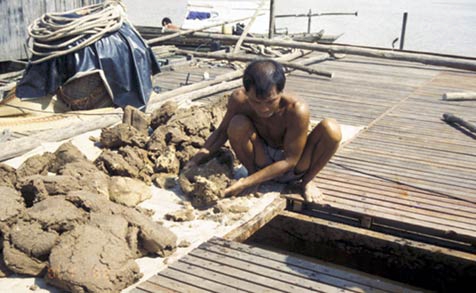
Fish migrations of the Lower Mekong River Basin
The need to incorporate this fishery into a valuation process may therefore no longer exist. However,
this fishery illustrates an important aspect, which should ideally also be included in a full resource
valuation: the opportunity value. The development of the larvae fishery was a pre-requisite (and
thus provided the opportunity) for the development of the catfish aquaculture industry in Viet
Nam. This industry produces about 65,000 tonnes annually (Trong et al. 2002). Most of the
production is exported, and thus provides a substantial amount of foreign exchange earnings to
Viet Nam. The fishery resources, and the rich biodiversity of the Mekong Basin as a whole,
potentially hold large and untapped opportunity values in areas such as aquaculture, eco-tourism,
recreational fishing, etc.
Floating fish feed factory in An Giang Province, Viet Nam. The feed is produced
from dried fish (mostly imported from Cambodia) and used
in the cage culture of Pangasiid catfishes in Viet Nam.
5.1.2 Assessing ecosystem attributes and functions
The valuation process above focused on the direct-use value of migratory fishes. In the overall
assessment, it is also necessary to include some considerations of the importance (in quantitative
terms) of ecosystem attributes, such as critical habitats and migratory connectivity. These attributes
were identified in qualitative terms in Section Four. How can their role be (semi)-quantified? In the
following section, we will illustrate how this could be done and what it would require in terms of
data. Specifically, we will try to quantify the importance of one of the critical habitats for the Lower
Migration System: the deep pool refuge habitats along the Kratie-Stung Treng stretch of the Mekong
River.
As mentioned above, deep pools in river channels play an important role as dry season refuges for a
large number of species and are therefore important for recruitment of fishes at the beginning of the
flood season. One could then ask the following question:
How much of the yield from the lower Mekong (expressed in percent) depends on deep
pool refuge habitats in northern Cambodia?
54
Fish migrations of the Lower Mekong River Basin
The answer to this question would provide a quantitative measure of the importance of these habitats.
But it is much easier to ask this question than it is to answer, particularly when one considers the
availability of data. Since the best quantitative data are for the Tonle Sap dai fishery, we will attempt
to provide a partial answer to the question, i.e. by answering the following question:
What proportion of the yield from the Tonle Sap dai fishery depends on deep pool refuge
habitats in northern Cambodia?
Answer:
Of the 10 most important species in the dai fishery of the Tonle Sap over the period 1995 to 2000
(Pengbun and Chanthoeun 2001), six have been reported to use deep pool habitats in northern
Cambodia (Poulsen et al. 2002)3 . These six species account for 61 percent of the catch in the dai
fishery. Three of the remaining four species (Dangila spp., Thynnichthys thynnoides and Osteochilus
hasselti), have also been listed as important species in the Khone Falls "tone" trap fishery and are
believed to migrate from the Tonle Sap River to the Khone Falls during the dry season (Baird et al.
2000). They possibly also utilise deep pool habitats during the dry season. They account for another
14 percent of catches from the dai fishery (Pengbun and Chanthoeun 2001). Thus, 75 percent of the
total catch from the dai fisheries depend on the availability of deep pool habitats in Northern Cambodia
(i.e. Kratie to the Khone Falls and the Sesan/Srepok/Sekong catchment). As this estimate is only
based on the 10 most important species from the dai catches, and also does not take into account any
food-chain conversion of the juveniles of deep pool-dependent species, we consider this a conservative
estimate.
Ideally, one would have to go through a similar process for all the other major fisheries targeting
migratory fishes of the Lower Migration System in order to get a full quantification of the importance
of these refuge habitats. Other critical habitats and ecosystem attributes should be assessed through
similar processes. It is obvious that existing data do not allow for such a full quantification. And it
is questionable whether enough data will ever be available to allow for a full valuation of resources
and quantification related to ecosystem attributes. Therefore, planning and decision-making have to
be based on existing data, with allowances for information gaps.
5.1.3 Application of valuation data in decision-making and assessments
Any decisions related to planning and development within the context of a large river basin will
always have a large element of uncertainty. The many gaps in existing data and information identified
in the previous section serve as good illustrations of this.
Even if a full valuation of migratory fishes is not possible, the information above can be used as a
guide for planning purposes. It could for instance be applied within the framework of the Basin
Development Plan of the MRC, together with information on other uses, and resources, of the river.
It could also be incorporated into a future Strategic Environmental Assessment process under the
Environment Programme.
In relation to specific development projects, the data can be used in the first screening of a project.
One illustrative example is applied to the proposal to build a mainstream hydropower dam at Sambor
in northern Cambodia.
3 Three of the remaining species, Dangila sp., Belodontichthys dinema and Thynnichthys thynnoides, were not included
in the deep pool study.
55
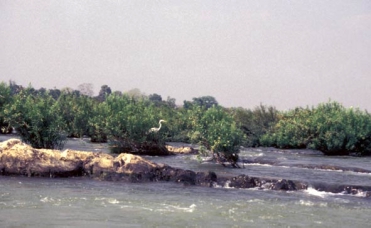
Fish migrations of the Lower Mekong River Basin
Sambor is a small village situated on the Mekong River between Kratie and Stung Treng. The village
has given its name to a nearby system of rapids (the Sambor Rapids). These rapids, and associated
deep pools, are important fish habitats, particularly for spawning and refuge purposes.
A small section of the Sambor Rapids, northern Cambodia.
If the Sambor hydropower project were built, its impact on migratory fish stocks would be significant
because:
the dam would change the hydrology and water levels for a significant distance upstream and
downstream of the proposed dam site, including the deep pool stretch between Kratie and
Stung Treng. This would eventually lead to deep pool refuge habitats filling up with sediment
and disappearing.
the dam would cut, or significantly impair, migration corridors between floodplain habitats in
the south and refuge habitats in the north.
the dam would interfere with the larval drift system, causing increased direct mortality as well
as indirect mortality due to the fact that changed hydrological patterns would prevent larvae
from reaching their "intended" destination.
Any proposal to build a hydropower project should incorporate the following as potential project
costs:
the value of the migratory fishery resources (including an assessment of information gaps) that
will potentially be impacted by the project.
a description and quantification of all possible impacts on the fishery, including: the blocking
of fish migration and larval drift; the trapping of nutrients and sediment needed for production
downstream; reductions in oxygen levels downstream; daily water level fluctuations; and effects
on people's fishing activities.
if impacts can be mitigated (e.g. through design modification, management measures and/or
the inclusion of fish-ways), the cost of such mitigation measures should be incorporated into
the project.
56
Fish migrations of the Lower Mekong River Basin
the degree to which the above mitigation measures would be expected to reduce impacts should
be assessed and taken into account (i.e. mitigation measures are rarely, if ever, able to fully
eliminate adverse impacts).
gaps in the available data should be identified, and if these gaps are seen as constraints on
decision-making regarding the project proposal, a data collection programme aimed at filling
the gaps should be incorporated into the proposal.
It is likely that if these additional costs were included in project proposals, some hydropower projects
would be abandoned early in the screening process.
5.1.4 Lessons learned from elsewhere
It is a tremendously difficult task to steer basin-wide development in a sustainable direction.
Therefore, it is important to learn as much as possible from experiences in other parts of the
world.
The Kissimmee River, United States of America
The Kissimmee River is situated in south-central Florida. During the 1960s and early 1970s,
the river was channelised in an effort to claim land for agricultural development. Through this
process, 75 percent of the river's floodplain area and wetland habitats were lost. This led to a
significant change in the ecological structure and functioning of the river. Based on the negative
impacts of the channelisation project, a restoration project was authorised in 1992 and
commenced in 1999: the Kissimmee River Restoration Project. The project will take 15 years
to implement and cost $US 400 million. The strategy focuses on reestablishing historic
hydrologic conditions and reconnecting the river with its floodplain. Specifically, the following
activities will be undertaken:
Reestablishing historic discharge patterns from Lake Kissimmee
Acquiring 85,000 acres of floodplain and watershed land in both the upper and lower basin
Continuous backfilling of 22 miles of canal
Removal of 2 water control structures
Recarving of 9 miles of former river channel
For further information on the Kissimmee River project, see the website of the South Florida Water
Management District (www.sfwmd.gov).
The Skjern River, Denmark
The Skjern River is a small river in western Denmark. In the 1960s, similar to the Kissimmee River,
it was channelised, and its floodplain area drained with the main purpose of agricultural development.
However, it soon became apparent that the new agricultural land was not fertile and the negative
impacts of the channelisation started to emerge. Therefore, it was decided to restore part of the river
to its former river channel and reestablish more than half the historic floodplain area of the river
basin. The Skjern River Restauration Project was initiated in 1999 and the river works completed in
2002, at a cost of 254 million Danish Kroner (equivalent to about $US 33 million).
57
Fish migrations of the Lower Mekong River Basin
The main lessons from the two projects are:
The channelisation resulted in a range of different negative impacts, such as a decrease in fish
stocks, a decrease in other aquatic fauna, an increase in pollution (eutrophication) of aquatic
ecosystems, a draining of rivers and a loss of the recreational and aesthetic values of the river basin.
The planning process leading to the decision to channelise the rivers was based on single-sector
priorities and did not take the multiple-use nature of the river basin into account.
The planning process did not include ecological considerations and, as a consequence, the
impacts which emerged after the channelisation projects was not anticipated.
Most of the features that the restauration projects seek to restore are of similar nature to the
ecosystem attributes for the Mekong River mentioned in Section 4 of this report.
These two examples illustrate a general trend in river basin development of the past: river basins
were developed with little consideration for their ecological functions. Of large rivers of comparable
size with the Mekong, the Mississippi River in North America and the Rhine in Europe have both
suffered serious ecological problems (Arthington and Welcomme 1995). A great deal of resources
and effort are now being spent to try and restore these rivers to good ecological functioning (see
also, Cowx and Welcomme 1998).
It has been generally realised that rivers are more valuable when their original ecology is maintained.
It would be an important achievement of the MRC and its member countries, if development could
be planned and implemented without compromising the ecological integrity and productivity of the
river. If that is possible, the Mekong will never need to be rehabilitated.
5.1.5 Conclusions:
As the previous section showed, there are many gaps in existing knowledge about Mekong fisheries
in general, and migratory fishes in particular. Therefore, further data collection aimed at filling
some of these gaps should be encouraged. On the other hand, it is also important to emphasise that
development activities within the Mekong Basin will not wait until complete knowledge about the
ecology of the basin is available, so existing knowledge must be used as the foundation for planning
and assessment purposes, as long as the information gaps are acknowledged and taken into account
in the decision-making process.
As illustrated previously in this report, we can use existing data to demonstrate, for example, that
development projects could significantly decrease the quality of, or access to, dry season refuge
habitats along the Kratie-Stung Treng stretch of the river. These impacts, if accounted for in estimating
the cost of the project would likely mean that the project would not be economically viable. The
same considerations would apply to many other proposed dam projects in the LMB.
Another important issue to emphasise is that for a large and complex ecosystem such as that of the
Mekong Basin, decision-making cannot be based solely on quantitative data (e.g. fisheries yield
data). Decisions should be taken within the framework of a holistic ecosystem approach where both
quantitative data and qualitative information are taken into account on equal terms. In such a
framework, fisheries are just one of many ecosystem services that should be considered.
The vision for the Mekong River Basin has been stated by the Mekong River Commission as: "an
economically prosperous, socially just and environmentally sound Mekong River Basin" (MRC Strategic
Plan 2001-2005). It is of course much easier to formulate such a vision than to implement it. One of the
major roles of the MRC is to translate this broad vision into a number of more specific and tangible
goals. This report may be seen as an attempt to formulate some suggested goals for the river from one
point of view, that of the conservation and sustainable use of migratory fishes of the Mekong.
58
Fish migrations of the Lower Mekong River Basin
References
Aeron-Thomas, M. 2001. Strategies for the assessment of the economic value of capture fisheries.
Consultancy report for the Fisheries Programme of the Mekong River Commission, Phnom Penh.
Arthington, A. H. & R. L. Welcomme. 1995. The condition of large river systems of the world. p.
44-75. In: N. B. Armantrout. (Editor). Condition of the world's aquatic habitats. Proceedings of the
World Fisheries Congress.Theme 1. Science Publishers Inc., Lebanon, USA.
Baird, I. G. 1998. Preliminary fishery stock assessment results from Ban Hang Khone, Khong
District, Champasak Province, Southern Lao PDR. Technical Report. Environmental Protection
and Community Development in the Siphandone Wetland, Champasak Province, Lao PDR. Funded
by European Union, implemented by CESVI. 112 pp.
Baird, I. G., V. Inthaphaysi, B. Phylaivanh & P. Kisouvannalet. 1998. A rapid fisheries survey in
Khong District, Champasak Province, Southern Lao PDR. Technical Report. Environmental
Protection and Community Development in the Siphandone Wetland, Champasak Province, Lao
PDR. Funded by European Union, implemented by CESVI. 31 pp.
Baird, I. G., M. S. Flaherty & B. Phylaivanh. 2000. Rhythms of the river: lunar phases and small
Cyprinid migrations in the Mekong River. Technical Report. Environmental Protection and
Community Development in the Siphandone Wetland, Champasak Province, Lao PDR. Funded by
European Union, implemented by CESVI. 21 pp.
Baran, E., N. van Zalinge & P. B. Ngor. In press. Floods, floodplains and fish production in the
Mekong Basin: present and past trends. In: Proceedings of the Asian Wetlands Symposium, 27-30
August 2001. Penang, Malaysia.
Barbier, E. B., M. C. Acreman & D. Knowler. 1996. Economic valuation of wetlands: a guide for
policy makers and planners. Ramsar Convention Bureau, Gland, Switzerland. 127 pp.
Barthem, R. & M. Goulding. 1997. The catfish connection: ecology, migration, and conservation
of Amazon predators. Columbia University Press, New York, USA. 114 pp.
Berkes, F. 1999. Sacred Ecology. Traditional ecological knowledge and resource management.
Taylor & Francis, Philadelphia, USA. 209 pp.
Bouakhamvongsa, K. and A.F. Poulsen. 2001. Fish migrations and hydrology in the Mekong River
Basin. p. 114-120 In: Matics. K.I. Editor. Proceedings of the Third Technical Symposium on Mekong
Fisheries. 8-9 December 2000. Mekong Conference Series No. 1. Mekong River Commission,
Phnom Penh.
59
Fish migrations of the Lower Mekong River Basin
Bouakhamvongsa, K. In Prep. Observations on an important `Pa Soi' (Henicorhynchus spp.)
fishery in Bokeo Province, northern Lao PDR. Paper prepared for the Fifth MRC Fisheries
Technical Symposium, Khon Kaen, Thailand, 11-13th December 2002.
Chanh, S., C. K. Chhuon & J. Valbo-Jorgensen. 2001. Lateral migrations between Tonle Sap River
and its flood plain. p. 102-111. In: Matics, K.I. Editor. Proceedings from the Third Technical
Symposium on Mekong Fisheries, 8-9 December 2000. Mekong Conference Series No. 1. Mekong
River Commission, Phnom Penh.
.
Coates, D. 2001. Biodiversity and fisheries management opportunities in the Mekong River Basin.
Blue Millennium Conference Paper. Assessment of Mekong Fisheries Component of the MRC
Fisheries Programme. Technical Paper. Mekong River Commission, Phnom Penh.
Cowx, I. G. & R. L. Welcomme. 1998. Rehabilitation of Rivers for Fish. Food and Agriculture
Organisation of the United Nations (FAO), Fishing News Books, Blackwell Science, Oxford.
259 pp.
De Graaf, G., B. Born, A. M. Kamal Uddin & F. Marttin. 2001. Floods, Fish and Fishermen.
University Press Ltd, Dhaka. 110 pp.
Dingle, H. 1996. Migration: the Biology of Life on the Move. Oxford University Press, NewYork,
USA. 474 pp.
Dubeau, P., O. Poeu & J. Sjorslev. 2001. Estimating fish and aquatic animal productivity/yield per
area in Kampong Tralach: an integrated approach. p. 20-43. In: Matics, K.I. Editor. Proceedings
from the Third Technical Symposium on Mekong Fisheries, 8-9 December 2000. Mekong Conference
Series No. 1. Mekong River Commission, Phnom Penh.
Glowka, L. 2000. A guide to the complementaries between the Convention on Migratory Species
and the Convention on Biological Diversity. A report prepared for the UNEP/CMS Secretariat by
Biodiversity Strategies International, Bonn, Germany.
Lieng, S., C. Yim & N. P. van Zalinge. 1995. Freshwater fisheries of Cambodia, I: the bagnet (dai)
fishery in the Tonle Sap River. Asian Fisheries Science, 8:255-262.
McKeown, B. A. 1984. Fish migration. Timber Press, Beaverton, USA. 224 pp.
Pengbun, N. & H. Chanthoeun. 2001. Analysis of the dai catches in Phnom Penh/Kandal. p. 44-
51. In: Matics, K. I. Editor. Proceedings from the Third Technical Symposium on Mekong
Fisheries, 8-9 December 2000. Mekong Conference Series No. 1. Mekong River Commission,
Phnom Penh.
Poulsen, A. F. & J. Valbo-Jørgensen. 1999. Survey manual for the use of local fishers' knowledge
in the Study of Fish Migrations and Spawning in the Mekong River Basin (Basin-wide). Assessment
of Mekong Fisheries Component of the MRC Fisheries Programme. Technical Paper. Mekong River
Commission, Phnom Penh.
Poulsen, A. F. & Valbo-Jørgensen. 2001. Deep pools in the Mekong River. Catch and Culture,
7(1)1, 8-9.
60
Fish migrations of the Lower Mekong River Basin
Poulsen, A.F., O. Poeu, S. Virvong, U. Suntornratana and N.T. Tung. 2002. Deep pools as dry
season fish habitats in the Mekong River Basin, MRC Technical Paper No. 4, Mekong River
Commission, Phnom Penh. 22 pp.
RIA2/MRC, in Prep. An Giang Fisheries Survey. Technical report prepared by Research Institute
for Aquaculture # 2 (Ho Chi Minh City), Department of Fisheries (An Giang Province), Fisheries
Department at Can Tho University and the MRC Fisheries Programme. Ho Chi Minh City,
Viet Nam.
Roberts, T. R. 1993. Artisanal fisheries and fish ecology below the great waterfalls of the Mekong
River in Southern Laos. Natural History Bulletin Siam Society, 41:31-62.
Roberts, T. R. & I. G. Baird. 1995. Traditional fisheries and fish ecology on the Mekong River at
Khone Waterfalls in southern Laos. Natural History Bulletin Siam Society, 43:219-262.
Roberts, T. R. and T. J. Warren.1994. Observations on fishes and fisheries in Southern Laos and
Northeastern Cambodia, October 1993 February 1994. Natural History Bulletin of the Siam Society.
42:87-115.
Sam, C. H. 1999. The brush park (Samrah) fishery in the mouth of the Great Lake in Kompong
Chhnang Province, Cambodia. In: van Zalinge, N., T. Nao, & L. Deap. Editors. 1999. Present status
of Cambodia's freshwater capture fisheries and management implications. Department of Fisheries,
Phnom Penh.
Secretariat of the Convention on Biological Diversity. 2001. The value of forest ecosystems. CBD
Technical Series No. 4. Montreal, Canada, SCBD. 67 pp.
Singanouvong, D., C. Soulignavong, K. Vonghachak, B. Saadsy & T. J. Warren. 1996a. The main
dry-season fish migrations of the Mekong mainstream at Hat Village, Muang Khong District, Hee
Village, Muang Mouan (Sic) District and Ban Hatsalao Village, Paxse. IDRC Fisheries Ecology
Technical Report No. 3. 131 pp.
Singanouvong, D., C. Soulignavong, K. Vonghachak, B. Saadsy & T. J. Warren. 1996b. The main
wet-season migration through Hoo Som Yai, a steep-gradient channel at the great fault line on the
Mekong River, Champassack Province, Southern Lao PDR. IDRC Fisheries Ecology Technical
Report No. 4. 115 pp.
Sverdrup-Jensen, S. 2002. Fisheries in the Lower Mekong Basin: status and perspectives. MRC
Technical Paper No. 6. Mekong River Commission, Phnom Penh. 103 pp.
Troeung, R. & Phem S. 1999. Arrow shaped trap fishery in the Great Lake. In: Van Zalinge, N., T.
Nmao & L. Deap. Editors. 1999. Present Status of Cambodia's freshwater capture fisheries and
management implications. Department of Fisheries, Phnom Penh.
Trong, T. Q., N. V. Hao & D. Griffiths. 2002. Status of Pangasiid aquaculture in Viet Nam. MRC
Technical Paper No. 2. Mekong River Commission, Phnom Penh. 16 pp.
Tung, N. T., T. T. Tuan, T. Q. Bao, D. V. Tien & J. Valbo-Jorgensen. 2001. Larvae drift in the delta:
Mekong versus Bassac (June-July 1999). p. 73-101. In: Matics, K.I. Editor. Proceedings from the
Third Technical Symposium on Mekong Fisheries, 8-9 December 2000. Mekong Conference Series
No. 1. Mekong River Commission, Phnom Penh, Cambodia.
61
Fish migrations of the Lower Mekong River Basin
Valbo-Jørgensen, J. & A. F. Poulsen. 2000. Using local knowledge as a research tool in the Study of
River Fish Biology: experiences from the Mekong. Environment, Development and Sustainability,
2(3-4): 253-276.
Van Zalinge, N. P., T. Nao, T. S. Touch & L. Deap. 2000. Where there is water, there is fish?
Fisheries issues in the Lower Mekong Basin from a Cambodian perspective. p. 37-48. In: M. Ahmed
and P. Hirsch. Editors. Common property in the Mekong: issues of sustainability and subsistence.
ICLARM Studies and Reviews, No. 26. 67 pp.
Van Zalinge, N., S. Lieng, P. B. Ngor, K. Heng & J. Valbo-Jørgensen. 2002. Status of the Mekong
Pangasianodon hypophthalmus resources, with special reference to the stock shared between
Cambodia and Viet Nam. MRC Technical Paper No. 1. Mekong River Commission, Phnom Penh.
29 pp.
Welcomme, R. 1985. River Fisheries. FAO Fisheries Technical Paper No. 262. 330 pp.
Welcomme, R. 2001. Inland Fisheries Ecology and Management. Fishing News Books, Blackwell
Science, Oxford. 358 pp.
62
Fish migrations of the Lower Mekong River Basin
MRC Technical Papers
Status of the Mekong Pangasianodon hypophthalmus resources, with special reference to the
stock shared between Cambodia and Viet Nam : MRC Technical Paper 1
Van Zalinge, Nicolaas; Lieng Sopha, Ngor Peng Bun, Heng Kong, and John Valbo Jorgensen.
2002. Status of the Mekong Pangasianodon hypophthalmus resources, with special reference
to the stock shared between Cambodia and Viet Nam. MRC Technical Paper No. 1, Mekong
River Commission, Phnom Penh. 29 pp.
Status of Pangasiid aquaculture in Viet Nam : MRC Technical Paper 2
Trong, Trinh Quoc, Nguyen Van Hao and Don Griffiths. 2002. Status of Pangasiid aquaculture
in Viet Nam. MRC Technical Paper No. 2, Mekong River Commission, Phnom Penh. 16 pp.
Mekong giant fish species: on their management and biology : MRC Technical Paper 3
Mattson, Niklas S., Kkongpheng Buakhamvongsa, Naruepon Sukumasavin, Nguyen Tuan, and
Ouk Vibol, 2002. Mekong giant fish species: on their management and biology. MRC Technical
Paper No. 3, Mekong River Commission, Phnom Penh. 29 pp.
Deep pools as dry season fish habitats in the Mekong Basin : MRC Technical Paper 4
Poulsen, Anders, Ouch Poeu, Sintavong Viravong, Ubolratana Suntornratana & Nguyen Thanh
Tung. 2002. Deep pools as dry season fish habitats in the Mekong Basin. MRC Technical Paper
No. 4, Mekong River Commission, Phnom Penh. 24 pp.
Financial analysis and risk assessment of selected aquaculture and fishery activities in the
Mekong Basin : MRC Technical Paper 5
Hambrey, John. 2002. Financial analysis and risk assessment of selected aquaculture and fishery
activities in the Mekong Basin. MRC Technical Paper No. 5, Mekong River Commission, Phnom
Penh. 66 pp.
Fisheries in the Lower Mekong Basin: status and perspectives : MRC Technical Paper 6
Sverdrup-Jensen, S. 2002. Fisheries in the Lower Mekong Basin: status and perspectives. MRC
Technical Paper No. 6, Mekong River Commission, Phnom Penh. 95 pp.
Freshwater aquaculture in the Lower Mekong Basin : MRC Technical Paper 7
Phillips, M. J. 2002. Freshwater aquaculture in the Lower Mekong Basin. MRC Technical Paper
No. 7, Mekong River Commission, Phnom Penh. 62 pp.
Fish migrations of the Lower Mekong Basin: implications for development, planning and
environmental management : MRC Technical Paper 8
Poulsen, A. F., Ouch Poeu, Sintavong Viravong, Ubolratana Suntornratana & Nguyen Thanh
Tung. 2002. Fish migrations of the Lower Mekong Basin: implications for development, planning
and environmental management. MRC Technical Paper No. 8, Mekong River Commission,
Phnom Penh. 62 pp.
63