Mekong River Commission
Deep pools as dry season fish habitats in the
Mekong River Basin
MRC Technical Paper
No. 4
April 2002
Report prepared by the MRC Fisheries Programme at the request of the
Technical Advisory Body on Fisheries Management in the Lower Mekong Basin
Published in Phnom Penh in April 2002 by
the Mekong River Commission
This document should be cited as:
Poulsen, Anders, Ouch Poeu, Sintavong Viravong, Ubolratana Suntornratana & Nguyen Thanh Tung.
2002. Deep pools as dry season fish habitats in the Mekong Basin. MRC Technical Paper No. 4, Mekong
River Commission, Phnom Penh. 22 pp. ISSN: 1683-1489
The opinions and interpretations expressed within are those of the authors
and do not necessarily reflect the views of the Mekong River Commission.
Editor: Ann Bishop
© Mekong River Commission
P.O. Box 1112, 364 M.V. Preah Monivong Boulevard
Phnom Penh, Cambodia
Telephone: (855-23) 720-979 Fax: (855-23) 720-972
E-mail: mrcs@mrcmekong.org
Website: www.mrcmekong.org
Acknowledgements
This report was prepared with financial assistance from the government of Denmark (through DANIDA),
under the auspices of the Assessment of Mekong Fisheries Component (AMFC) of the MRC Fisheries
Programme. It was prepared at the request of the Technical Advisory Body (TAB) of the MRC Fisheries
Programme, which constitutes members from: the Department of Fisheries, Cambodia; the Living Aquatic
Resources Research Center (LARReC), Lao PDR; the Department of Fisheries, Thailand; and the Ministry
of Fisheries, Viet Nam.
The authors wish to thank staff at the Department of Fisheries (Cambodia), LARReC (Lao PDR),
Department of Fisheries (Thailand) and the Research Institute for Aquaculture Number 2 (RIA-2) in Ho
Chi Minh City (Viet Nam) for their contribution in compiling ecological information throughout the
Mekong basin. Last, but not least, the authors wish to thank the countless numbers of fishers along the
Mekong River, whose knowledge is the foundation for the report.
Background of the Working Group on Mekong Giant Fish Species
The Technical Advisory Body on Fisheries Management (TAB) of the Mekong
River Commission (MRC) was established in June 2000. The TAB gives advice to
the MRC Fisheries Programme on technical issues relating to basin-wide fisheries
management. During the first meeting, five main issues were identified. Among
these was the following:
Deep Pools in the Mekong River
Deep pools in the Mekong River, particularly north and south of the Khone
Falls, are supposed to be very important for the conservation of a number of
Mekong fish species. They are, in many cases, protected by local or national
regulations to prevent fishing, but effective enforcement is difficult. The Cambodia
Delegation reported not less than 100 such pools on the Cambodian side of the
border, and the Lao Delegation knew of not less than 70 pools on the Lao side of
the border. However, the significance of these habitats is not well known, and
should be clarified. Co-management might be the solution to management and
protection from problems.
It was agreed that the MRC Fisheries Programme (Cambodian Capture Fisheries
Component, Assessment of Mekong Fisheries Component) should take action to
study the function of deep pools in the Mekong River. The MRC Secretariat
Fisheries Unit may explore the opportunities for finding international funds to
support the development of co-management systems.
Table of Contents
Summary .............................................................................................................................. 2
1. Introduction............................................................................................................................. 5
1.1. What is a deep pool? ....................................................................................................... 5
1.2 Deep pools: general information ...................................................................................... 6
2. The Mekong .............................................................................................................................. 7
2.1 Deep pool areas within the Mekong mainstream ............................................................... 7
2.1.1 Kratie-Stung Treng ............................................................................................. 7
2.1.2 Khone Falls ........................................................................................................ 7
2.1.3 Northern Lao PDR.............................................................................................. 9
2.1.4 Basin-wide ......................................................................................................... 9
2.1.5 Dolphins ............................................................................................................ 10
2.2 Deep pool areas within Mekong tributaries ....................................................................... 11
2.3. Hydrographic information ............................................................................................... 11
3. Discussion.................................................................................................................................. 13
4. Recommendations .................................................................................................................... 15
5. References................................................................................................................................. 17
6. Annex.......................................................................................................................................... 19
Deep pools as dry season fish habitats in the Mekong River Basin
Summary
The Mekong River is a typical floodplain river, dominated by the monsoon climate of Southeast Asia. It
is a dynamic river system, alternating between a flood season from May to October and a dry season
from November to April. The monsoon flood-pulse "drives" the system, creating vast areas of
seasonally inundated floodplains adjacent to the river channels every year. Floodplains are extremely
productive feeding habitats for most important fishes, whereas the river channels mainly serve as refuge
habitats during the dry season.
As with most other relatively pristine and unregulated rivers, the Mekong River is a diverse river with
alternating environmental characteristics along its path. Some stretches have little variation in depth,
whereas other stretches contain rocks and boulders and vary between shallow rapids and deep pools.
The deep pools play a crucial role in the Mekong River ecosystem because they are important habitats
for many fishes during the dry season. When the dry season sets in, water levels in the Mekong recede
and the seasonal fish habitats on the floodplain disappear. As a result, fishes retreat to deeper sections
of the river and congregate there until the next flood sets in. Therefore, although fishes are mainly
produced in floodplain habitats, deep pools are equally important for maintaining the integrity and
productivity of the system. This report focuses on deep pools and their role in fisheries ecology of the
Mekong River basin.
Certain stretches of the Mekong mainstream contain a large number of deep pools. The most important
stretch is in northern Cambodia, from Kratie to Stung Treng. Along this stretch, 58 deep pools have
been identified, where a large number of fish species congregate during the dry season. Some of the
pools are also the habitat of the river dolphins, Orcaella brevirostris.
The area around the Khone Falls, on the border between Cambodia and the Lao Peoples' Democratic
Republic (Lao PDR), also contains numerous deep pools. Some of these pools have been designated as
`fish conservation zones' (FCZ) by the local villagers over the past decade. This was done based on
local recognition of their importance as fish habitats, particularly during the dry season. The
establishment of FCZs is believed to have had a positive impact on the fisheries in the area around
them.
On a basin-wide scale, additional stretches have been identified which contain a relatively high number
of deep pools. Apart from the area from Kratie to Stung Treng mentioned above (which is the most
important deep pool area in the basin), the stretches from Savannakhet to Khone Falls, and from
Xayaboury to Louang Prabang are important. Some sections of the basin have been identified as having
relatively few deep pools. These the areas from Vientiane/Nong Khai to Paksan/Bung Khan and, most
importantly, from Kratie all the way downstream to the Mekong Delta.
2
Deep pools as dry season fish habitats in the Mekong River Basin
Deep pools also exist in some of the major tributaries of the Mekong. In some tributaries, where dams
have been constructed (e.g. the Sesan and Theun Rivers), some deep pool habitats have been affected
by siltation as a result of changed hydrological conditions. In some areas, the pool habitats, and the
fishes they sustain, have virtually disappeared.
The spatial separation between dry-season refuges and flood-season feeding and spawning habitats
forces most mainstream Mekong fishes to migrate. These movements can be separated into three
different migration patterns. (1) Within the lower part of the basin, fishes move between dry-season
refuges in deep pools along Kratie/Stung Treng stretch of the river, and floodplain habitats in southern
Cambodia (including the Tonle Sap River and the Great Lake) and the Mekong Delta in Viet Nam. (2)
Further upstream, fishes move between deep pools in the Mekong mainstream and floodplain areas
along major Mekong tributaries, such as the Mun/Chi and Songkhram Rivers in Thailand, and the Xe
Bang Fai and Hinboun Rivers in Lao PDR. (3) Finally, in the upper section of the basin, approximately
from the mouth of Loei River, the Mekong turns into a typical mountain river, crossing through steep
river valleys with limited floodplain habitats. In this section, fishes mainly move from deep pool
habitats along the Xayaboury-Louang Prabang stretch to upstream spawning habitats. Conspicuous
examples of this movement is that of the Mekong giant catfish, Pangasianodon gigas, and its slightly
smaller "cousin", Pangasius sanitwongsei.
In relation to future work on deep pools, the following points should be taken into account:
1. Deep pools should be viewed as integrated parts of the overall ecosystem, rather than isolated
fish habitats (i.e. an ecosystem approach should be promoted).
2. Since deep pools shelter a large proportion of the Mekong fishes during the dry season, they
may provide good opportunities for future monitoring purposes.
3. The issue of deep pool habitats should be integrated into future Environmental Impact
Assessment procedures.
4. Prior to any future research activities on deep pools, objectives and priorit ies should be
discussed and set.
5. Existing knowledge about the occurrence and location of deep pools should be consolidated
with existing hydrographic data from the basin.
3
Deep pools as dry season fish habitats in the Mekong River Basin
Introduction 1
Fisheries ecology of the Mekong River Basin is intimately linked to, and influenced by, the
morphological and hydrological characteristics of the basin. One of the main driving forces for
fisheries-ecological processes is the physical separation of important wet and dry season habitats. The
vast floodplains associated with the lower Mekong are crucial feeding and rearing habitats for the
majority of fish species that are important in fisheries. However, as the flood recedes at the end of the
monsoon season, it is equally crucial that fishes can seek refuge in appropriate dry season habitats. In
general, dry season habitats are associated with the main river channels and with permanent water
bodies on the floodplain (lakes and swamps).
Within the main river channels, certain sections are better suit ed as dry season habitats than others. In
particular, deeper sections of the river are used by a large number of species during this period of the
year. These deep sections are often referred to as deep pools (or deep holes), a term that is increasingly
being used in the context of fisheries ecology of the Mekong Basin.
The Technical Advisory Body (TAB) of the Fisheries Programme of the Mekong River Commission
(MRC) recognised the importance of deep pools as dry season habitats in the Mekong River and
recommended that a review be carried out on the current knowledge of deep pools.
This report reviews the current knowledge and information available in relation to the importance of
deep pools as dry season refuges in the Mekong Basin. Implications for management are discussed.
1.1
What is a deep pool?
As mentioned above, the significance of deep pools relates mainly to their ecological function as dry
season refuges for fishes (although some species spend their whole life in these habitats). Such dry
season refuges occur both within the main river channels and in permanent water bodies on the
floodplain. For the purposes of this report, the term `deep pool' refers to the riverine habitat, although it
is emphasised that floodplain refuge habitats are equally important and must not be ignored.
In relation to river fisheries, the term `pool' has been most often associated with the `riffle and pool'
system, a system of alternating shallow rapids followed by deeper pools in the upper, mountainous
stretches of river systems. This part of the river is characterised by fast and turbulent flow over a river-
bed consisting of rocks, stones and gravel (Welcomme 1985). Different types of pools have been
identified based on physical and hydrological characteristics (Welcomme 1985). In the lower parts of
rivers, which are characterised by slow water flow and a sandy or muddy bottom, Welcomme (1985)
distinguished between `shallows' and `deeps'. In general, these terms have also been defined based on
morphological and hydrological factors.
5
Deep pools as dry season fish habitats in the Mekong River Basin
For the purposes of this report, we define the term 'deep pool' based on its fisheries-ecological
importance rather than on its morphological/hydrological characteristics. Inventories of deep pools
should therefore be based on their ecological significance as the primary criterion. Physical
characteristics (e.g. morphology, hydrology) are also important as secondary criteria, since they may
impact ecological functions of deep pools and thus determine, for example, which species inhabits
which types of pools. In other words, once a deep pool area has been identified as an important dry
season habitat for certain fishes, morphological (e.g. hydrographic) and hydrological data can be of
crucial importance in describing and classifying the habitat in ecological terms.
Based on the above considerations, for the purposes of this report, a deep pool is simply `a confined,
relatively deep area within a river channel, which acts as a dry season refuge for a number of important
fish species. For some species, deep pools may also act as spawning habitats.'
On a final note for this section, it should be emphasised that the human need to classify and define
always produces the risk of segregating and disconnecting. This may be counter-productive,
particularly in the context of river ecology, because although different habitats may be defined within
the system, these are deeply integrated parts, which cannot be separated from the system within which
they function. So, when we define deep pools, we must at the same time recognise that the most
important part of the definition concerns the integrated role which deep pools play within the overall
eco-system of the river basin.
1.2
Deep pools general information
The importance of dry season refuge habitats for fishes in floodplain rivers has long been recognised
(Welcomme 1985; Bayley and Petrere 1989, Hoggarth et al. 1999). Welcomme (1985) described how
most fishes move from floodplain habitats back to the main river channels during the dry season and
settle in different habitats along its length, distributing according to depth, bottom-type and vegetation
cover. The movement may cover short or long distances, depending on the availability of appropriate
dry season habitats within the river channel.
Fishes inhabiting pool habitats during the dry season segregate according to their ecological habits.
Welcomme (1985) distinguished three main fish communities in pool habitats based on ecological
habits:
1) a pelagic community, consisting of mainly small species of streamlined, silvery fishes with
upward facing mouths,
2) a mid-water community of larger silvery fishes, streamlined with terminal mouths, and
3) a bottom-living community of drab coloured fishes with dorsally-humped profiles and
ventrally-positioned mouths.
Despite their significance, very little information exists concerning the ecological functioning of deep
pools in major rivers, other than the Mekong. In Bangladesh, the establishment of dry season reserves,
including deep pools within river channels, have been identified as an important management measure
to sustain floodplain fisheries (Hoggarth et al. 1999).
Anecdotal information from fishers in the Parana River suggests that major catfish of that river
congregate in deep pools in certain places within the river (Welcomme 2001, personal communication).
Similar anecdotal information exists for the Amazon and Orinoco rivers. In the Niger River, fishers
claim that Nile perch and catfish stay in deep pools of the river channels, especially during low water.
Again, this information was never documented in formal literature (Welcomme 2001, personal
communication).
6
Deep pools as dry season fish habitats in the Mekong River Basin
The Mekong 2
2.1. Deep pool areas within the Mekong Mainstream
In recent years, some information relating to deep pools in the Mekong River has accummulated. Two
areas have been the main focus of this information: 1) the Mekong mainstream in Kratie and Stung
Treng Provinces, northern Cambodia and 2) the Khone Falls, in Champassack Province, in southern
Lao Peoples' Democratic Republic (Lao PDR).
2.1.1. Kratie - Stung Treng
Hill and Hill (1994) listed 28 named deep pools as important dry season habitats for fishes in Kratie
province, northern Cambodia (presumably identified based on interviews with local fishers in the area).
They further stated that, "deep holes in the mainstream of the Mekong would appear to be the primary
rearing and dry season holding habitat for large catfish and carp" (page 74).
This list of deep pools has subsequently been extended to 58 pools, 39 of which are situated in Kratie
Province and 19 in Stung Treng Province (Vannaren and Kin 2000; see Annex, Table 1).
These pool habitats are critical for sustaining not only fisheries within the two provinces, but for the
whole of Cambodia and the Mekong Delta in Viet Nam. Many species spawn in association with these
pools, and larvae and juveniles move downstream to the floodplain areas in southern Cambodia and
Viet Nam.
Some of the species mentioned as examples of important fishes using deep pool habitats are
Boesemania microlepis, Mystus wyckioides, Chitala ornata , Micronema apogon, Pangasianodon
hypophthalmus, Cirrhinus microlepis, Probarbus jullieni, Catlocarpio siamensis, and even the famous
giant catfish Pangasianodon gigas.
Vannaren and Kin (2000) recommend, among other things, that further studies be carried out related to
deep pools, and that co-management practices should be implemented for these important dry season
habitats.
2.1.2. Khone Falls
The Khone Falls area in southern Lao PDR has been the subject of several ecological and fisheries
studies during the past decade, and thus is one of the most well-described sites within the Mekong in
terms of fisheries ecology.
Roberts and Baird (1995) listed seven named pools around the Khone Falls area, and identified them as
important fish habitats, based on interviews with local expert fishers:
7
Deep pools as dry season fish habitats in the Mekong River Basin
? Boong Pba Gooawng: important feeding ground for the Irrawaddy dolphin, Orcaella
brevirostris, a spawning ground for Boesemania microlepis and also reported to be a spawning
ground for Catlocarpio siamensis.
? Boong Pba Jook: spawning ground for Hypsibarbus sp. and Boesemania microlepis. Dolphins
stay there in November-December.
? Boong Hin Sang
? Boong Ken
? Boong Pba Leum: thought to be a spawning ground for Pangasius sanitwongsei (the species
reportedly surface in this pool during June-July).
? Deep pools below Tam Ee Daeng and Gawng Nyai: important habitat for the catfishes
Micronema apogon and Bagarius yarelli.
? Hin Dta Moon: Pangasius macronema is targeted in this pool (which is near the mouth of the
Hoo Sahong, the main migration channel for P. macronema).
It is apparent from this list that different pools are inhabited by different species. Some pools are even
named after certain species, such as Boong pba gooawng ("Boesemania microlepis Pool") or Boong
pba leum ("Pangasius sanitwongsei Pool"). Presumably, such differentiation is caused by differences
in physical and ecological characteristics between pools. For future classification of these habitats, it
will be important to identify the key ecological and physical indicators which determine the functioning
of these habitats, and therefore, in turn, the fish species that inhabit them.
Near the Khone Falls, in Khong District, Champassack Province in southern Lao PDR, a co-
management programme related to Fish Conservation Zones (FCZs) was set up in 59 villages between
1993 and 1997 (Baird et al. 1998). These fish conservation zones were largely associated with deep
pools within the Mekong mainstream that, according to local villagers on Khong Island, are important
as dry-season refuges for fishes (Baird et al. 1998). The fish species most commonly reported as
beneficiaries of the FCZs were: Morulius chrysophekadion, Morulius barbatula, Chitala blanchi,
Chitala ornata, Micronema micronema, Micronema apogon, Belodontichthys dinema, Hemisilurus
mekongensis, Boesemania microlepis, Labeo erythropterus, Cosmochilus harmandi, Hypsibarbus
malcolmi, Probarbus jullieni (or spp.), Gyrinocheilus pennocki, Amphostistius laosensis (or spp.),
Bagarius yarrelli (or spp.), Pangasius conchophilus, Pangasius pleurotaenia, Mystus nemurus and
Mystus wyckioides. These species are predominantly sedentary species. However, migratory species are
also believed to benefit from the FCZs (Baird et al. 1998).
Baird et al. (1998) also listed some tentative parameters as indicators to classify important habitats
within the Mekong. These were: depth, current speed, substrate type, slope, proximity to wetland forest
and, finally, occurrence of objects inside the habitat (e.g. logs and rocks). According to local villagers
in the area, water depth is the most important habitat parameter to consider. Baird and Flaherty (1999)
further elaborated on habitat parameters and concluded that "habitat parameters and other unique
environmental factors are likely to be the main determinants of the number of fish species reported to
have increased in individual FCZs."
8
Deep pools as dry season fish habitats in the Mekong River Basin
The effectiveness of the FCZs are currently being evaluated under the auspices of the Living Aquatic
Resources Research Centre of Lao PDR (LARReC). A preliminary assessment, based on interviews
with villagers involved in the FCZ programme, has been completed (Chomchanta et al. 2000). Most of
the villagers support the FCZ concept, and one of the main reasons given for the perceived increase in
fish populations was that the FCZs act as a dry-season deep water habitat for many species
(Chomchanta et al. 2000, page 13). Altogether, 24 species (or genera) of fish were reported as having
increased in numbers as a result of the FCZs. These include both relatively sedentary species (such as
Boesemania microlepis, Chitala blanchi and Chitala ornata ), and migratory species (such as Pangasius
conchophilus, Pangasius macronema, Probarbus jullieni and Cirrhinus microlepis).
One species, which apparently spends most of its life cycle associated with deep pools in the main river
channels, is B. microlepis. This species was also listed as one of the main beneficiaries of the FCZs
around Khone Falls (above) and has been the subject of detailed studies in this area. Seven deep pools
were identified as important spawning habitats for B. microlepis (Baird et al. 1999). Although it is a
relatively sedentary species, B. microlepis may depend on the regular return of migratory species,
which may constitute part of its diet at certain times of year. Local fishers consider it to be a "hunter"
(Baird et al. 1999; Poulsen and Valbo-Jørgensen 2000).
The cyprinid Hypsibarbus malcolmi also spawns in certain deep pools during the dry season period
(Baird and Phylavanh 1999) and one pool near the Khone Falls was reported to be a spawning site for
both these species.
2.1.3. Northern Lao PDR
Although existing work related to community-based aquatic resource management is centred around the
Khone Falls, management systems also exist in other parts of the basin. During a fisheries survey of
Luang Prabang Province in northern Lao PDR, 37 percent of the surveyed villages reported that they
have a conservation zone near the village. These conservation zones were mainly associated with deep
pools within the river, which were believed to be important breeding grounds for fish (Sjørslev 2000).
2.1.4. Basin-wide
One of the main sources of information about the ecology of deep pool dry-season habitats is people
living nearby. Many of these local fishers are out on the water fishing every day and have acquired a
detailed knowledge of the local environment. During recent surveys along the Mekong mainstream that
were carried out by the Mekong River Commission's Fisheries Programme? , local knowledge was
collected from the whole stretch of the lower Mekong River. Although deep pools were not specifically
raised as an issue during these interviews, more than 200 records from the survey refer to deep pools as
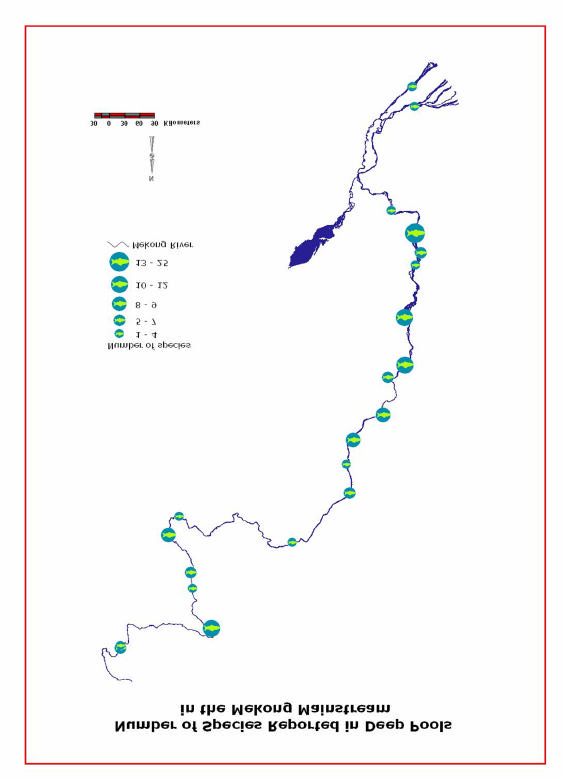
being important habitats for certain fishes (Table 2, Figure 1).
Species with different ecological habits make use of deep pool habitats during the dry season (Table 2).
Many highly-migratory species are included in the list such as most members of the Pangasiidae family
and cyprinids such as Probarbus sp., Catlocarpio siamensis, Cirrhinus microlepis and
Cyclocheilichthys enoplos, as well as relatively sedentary species such as Chitala ornata, wallago attu,
Mastacembelus armatus and Bagarius yarelli.
? Assessment of Mekong Fisheries Component
9
Deep pools as dry season fish habitats in the Mekong River Basin
The station where deep pools were reported most often was at Sandan Village, in Sambor in Kratie
Province in Cambodia. Here, 22 species were reported to use deep pools as dry season habitats. These
species included many migratory species such as ten members of the Pangasiidae family, Probarbus
jullieni and Probarbus labeamajor, Henicorhynchus sp., Cirrhinus microlepis, Cyclocheilichthys
enoplos, Paralaubuca typys, Morulius chrysophekadion and Botia modesta. Sedentary species reported
at this station included Chitala ornata , Boesemania microlepis and Bagarius yarelli.
At Khong Island near the Khone Falls, one station reported 12 different species using deep pools. At
Phonthong district, also in Champassak Province, Lao PDR, and at Ban Done Kao in Luang Prabang
Province, Lao PDR, 10 species were reported. Table 3 in the Annex shows the species reported for each
of these four deep pools.
The most striking thing to note from Table 3 is the limited species overlap between the four pools. No
species are reported to occur in all four of the pools and only two species, Pangasius bocourti and
Micronema sp. are reported from three of the pools. It is also interesting to note that the two pools
which are closest to each other, Ban Khanh Gneir, Phonthong District and Ban Seine Tay, Muang
Khong District, both in Champassak Province of Lao PDR, have no species overlap. This lack of
overlap can probably be attributed to a combination of the geographical position of the pools and
differences in environmental parameters associated with each pool.
In addition to identifying stretches in the river with important deep pools, the study also identified
stretches of the river that have relatively few deep pools. Two such stretches are: 1) the lower section of
the river, from Kratie in the north, to the Mekong Delta in the south, and 2) the middle section of the
river, from Loei in the north to Thakhek/Nakhon Phanom in the south.
The fact that certain stretches of the Mekong have a number of deep pools, while others have
comparatively few, may have had a substantial impact on the ecological evolution of Mekong fishes
(see discussion below).
It is also generally believed that the giant Mekong catfish, Pangasianodon gigas, spends the dry season
in deep pools. Fishers in Xayabouri province, Lao PDR, reported the existence of a deep pool near Ban
Muangliap, which they believe is a dry season habitat for the giant Mekong catfish. Fishers in Bokeo
Province, which is near the borders of Thailand, Lao PDR and Myanmar, also believe that the giant
catfish they catch originate from Xayabouri (Bouakhamvonsa 2001, personal communication).
Davidson (1975) reported on 'Pa beuk' (Lao name for giant catfish) fishing at a deep pool near Ban
Ang, about 50 km upstream from Vientiane. This fishery was accompanied by a traditional ceremony,
in which offerings were made in order to appease the spirits of the river (the ceremony is described in
detail in Giles, 1935). At the time of writing his book, Davidson stated that this ceremony had ceased to
exist.
2.1.5. Dolphins
The Mekong River dolphin, Orcaella brevirostris, is one of the most conspicuous animals in the
Mekong, and at the same time, one of the most threatened. Although it is not, and should not be,
considered a fishery resource, its ecology is deeply integrated with the ecology of Mekong fishes, and it
is deeply dependant upon the existence of deep pool areas for its survival (Baird and Mounsouphum
1997).
10
Deep pools as dry season fish habitats in the Mekong River Basin
The distribution of dolphins in the Mekong is restricted to the area from Kratie in the south, to the
Khone Falls in the north. They are also found in the lower stretches of the Sesan sub-catchment. As
described above, this area is also the most important in terms of deep pool fish habitats in the Mekong.
This is not a coincidence since dolphins are known to spend most of their time in deep pools, from
where they frequently undertake "hunting" migrations following groups of migratory fishes (Baird and
Mounsouphum, 1997).
Without deep pool habitats, and the fishes they sustain, there would be no dolphins in the Mekong
River.
2.2. Deep Pool Areas within Mekong Tributaries
Very little information exists on deep pools as fish habitats in tributaries of the Mekong.
Due to the presence of deep pools, certain stretches of the Nam Tha River in Nalee District in northern
Lao PDR, are important fishing spots for a large geographic area. Local traditional management
initiatives are already in place in order to conserve the fish resource (Viravong 2001, personal
communication).
In the Sesan River, some important deep pool areas have been reported as becoming shallower in the
past few years due to increased silt deposition resulting from the Yali Dam in the upper part of the basin
(Fisheries Office of Ratanakiri Province, Cambodia, 2000). As an example, within the last three years,
one deep pool in Voen Say district, was reported to have diminished from 7-8 meters to just half a
meter in depth. As a consequence, many fish species have been reduced, or have almost completely
disappeared in the area. These include Pangasius krempfi, Pangasius conchophilus, Pangasius
polyuranodon, Pangasius larnaudiei, Belodonthichthys dinema and Micronema micronema . (Fisheries
Office of Ratanakiri Province, Cambodia, 2000, page 26).
A similar problem has been reported from the Theun River in Lao PDR resulting from the Theun-
Hinboun Dam (Terry Warren 2000, personal communication).
2.3. Hydrographic information
Finally, one important source of information should be recognised, although it does not refer to deep
pools from a fisheries point of view. This is the updated Hydrographic Atlas of the Lower Mekong
River, published by the Mekong River Commission. This publication may be of critical importance for
inventory and classification purposes once certain areas have been identified as important deep pool
fish habitats. The Atlas currently exists in printed form for the whole lower Mekong mainstream and
will be available in digitised format in early 2003.
11
Deep pools as dry season fish habitats in the Mekong River Basin
Discussion 3
The existence of deep pools within the Mekong, and their geographic position in relation to other
important fish habitats, appears to be one of the main factors influencing the fisheries ecology of the
Mekong basin. For example, the location of deep pool areas (and equally important, the location of
areas where deep pools are absent), may be one of the main factors responsible for the migratory habits
of a large proportion of fishes. Three main migration systems for fishes have been id entified within the
Mekong mainstream (Coates et al. 2000). The geographic position of stretches within the mainstream
containing a relatively-high number of deep pools may have been one of the main factors influencing
the evolution of these three migration systems. The migration system of the lower basin (i.e. below the
Khone Falls), is basically a migration between the important dry season habitats in deep-pool stretches
of the north (Kratie-Stung Treng), and important flood season feeding habitats of the south (southern
Cambodia-Mekong Delta-Tonle Sap). This, again, underlines the importance of viewing deep pools as
an integrated part of a larger system.
Deep pools in the middle Mekong (i.e. from Khone Falls to about Loei) mainly serve as dry season
habitats for fishes that spend the flood season on the floodplains of major tributaries.
The relative lack of deep pool areas along the stretch between Thakhek and Loei may be one of the
main reasons for the apparent separation between the upper migration system above Loei, and the
middle migration system between Khone Falls and Loei.
As can be seen from existing information, deep pools are used by a large number of species with
different ecological characteristics. Both relatively sedentary species, such as Boesemania microlepis,
and relatively migratory species, such as Pangasius krempfi, have been reported to use this habitat. This
may be of importance in relation to future management options, because local management initiatives
may, at the same time, serve both the management of local stocks and of migratory stocks (e.g. trans-
boundary stocks)
It is interesting that the only existing information on deep pools in tributary systems of the Mekong
basin relates to the siltation of pools caused by existing hydroelectric dams further upstream (Fisheries
Office, Ratanakiri Province, Cambodia 2000; Terry Warren 2000, personal communication).
Obviously, this is an issue that needs to be included in future Environmental Impact Assessments
(EIAs) and Fisheries Impact Assessments (FIAs) when considering water management projects. For
example, any siltation of the deep pools in the Kratie -Stung Treng area will have substantial
implications for fisheries within the whole lower basin. This may have equal, or even more serious
consequences, than the often-cited blockage of migration routes by dams.
13
Deep pools as dry season fish habitats in the Mekong River Basin
Recommendations 4
Current knowledge about deep pools within the Mekong basin provides substantial indications of the
importance of this habitat type for fisheries, and for the ecological integrity of the basin. The purpose of
this report has mainly been to outline this current knowledge. The report is thus intended to serve as a
tool for follow -up discussions about future needs and priorities in relation to deep pool habitats. The
following points may be seen as an attempt to trigger this discussion.
1) Any future work in relation to deep pools should take a "systems approach", i.e. the role of deep
pools as integrated elements of larger systems should be recognised and prioritised. In other words,
research and management activities in relation to deep pools should be based on their importance
for the eco-system as a whole, rather than on their local importance.
2) The point of departure in relation to deep pools could be to make an inventory of important deep
pool areas basin-wide (note: not necessarily individual deep pools). This has been initiated already,
to some extent, based on current knowledge, but a more elaborate and focused study may be needed
directly aimed at identifying important dry season refuge areas at the basin-wide level (carried out
through focused interviews with local villagers and fishers). Following the identification of
important deep pool areas, the Hydrographic Atlas of the Lower Mekong Basin could then be used
to classify them, based on their hydrographic characteristics.
3) Because deep pools function as "sink habitats" during the dry season, they may offer an opportunity
for future monitoring purposes in relation to the health of the environment and the state of the
fisheries. However, appropriate parameters to use in such a monitoring programme must be
identified. Discussions about what kind of parameters to focus on, and in turn what methods to use,
should be the main activity related to the monitoring of deep pools in the near-term.
4) Further research into the ecological functioning and significance of deep pools may also be
promoted. However, it is important to discuss priorities before jumping into ad hoc and non-
coordinated research projects.
5) Discussions about how the issue of deep pools can be better included in future EIAs and FIAs of
water management projects should be initiated.
15
Deep pools as dry season fish habitats in the Mekong River Basin
References 5
Baird, I. G. & B. Mounsouphum. 1997. Distribution, mortality, diet and conservation of Irrawaddy
dolphins (Orcaella brevirostris Gray) in Lao PDR. Asian Marine Biology, 1997. 14: 41-48.
Baird, I. G. & M. S. Flaherty. 1999. Fish conservation zones and indigenous ecological knowledge in
southern Laos: a first step in monitoring and assessing effectiveness. Technical Report.
Environmental Protection and Community Development in the Siphandone Wetland,
Champasak Province, Lao PDR.
Baird, I. G. & B. Phylaivanh. 1999. Observations of vocalasations of spawning Hypsibarbus malcolmi
(Smith 1945) in southern Lao PDR below the Khone Falls. Technical Report. Environmental
Protection and Community Development in the Siphandone Wetland, Champasak Province,
Lao PDR.
Baird, I. G., V. Inthaphaysi, P. Kisouvannalath, B. Vongsenesouk & B. Phylaivanh. 1999. The setting
up and the initial results of a villager based system for monitoring fish conservation zones in
the Mekong River, Khong District, Champassak Province, Southern Lao PDR. Technical
Report. Environmental Protection and Community Development in the Siphandone Wetland,
Champasak Province, Lao PDR.
Baird, I. G., P. Kisouvannalath, V. Inthaphaysi & B. Phylaivanh. 1998. The potential for ecological
classification as a tool for establishing and monitoring fish conservation zones in the Mekong
River. Technical Report No. 2. Environmental Protection and Community Development in the
Siphandone Wetland, Champasak Province, Lao PDR.
Chomchanta, P., P. Vongphasouk, S. Chanrya, C. Soulignavong, B. Saadsy & T. J. Warren. 2000. A
preliminary assessment of the Mekong Fishery Conservation Zones in the Siphandone area of
Southern Lao PDR, and recommendations for further evaluation and monitoring. LARReC
Technical Paper No. 0001. The Living Aquatic Resources and Research Center, Vientiane.
Coates, D., A. F. Poulsen & S. Viravong. 2000. Governance and trans-boundary fish stocks in the
Mekong River Basin. Paper presented at the 3rd Technical Symposium of the MRC Fisheries
Programme, Phnom Penh, 2000.
Davidson, A. 1975. Fish and fish dishes of Laos. Imprimerie Nationale, Vientiane
Fisheries Office, Ratanakiri Province. 2000. A study of the downstream impacts of the Yali Dam in the
Sesan River Basin in Ratanakiri Province, Northeast Cambodia. Report prepared in cooperation
with the Non-Timber Forest Products (NTFP) Project, Ratanakiri Province, Cambodia.
17
Deep pools as dry season fish habitats in the Mekong River Basin
Giles, F. H. 1935. An account of the ceremonies and rites performed when catching the Pla Buk.
Journal of the Siam Society , 1935. 28: 91-113.
Hill, M. T. & S. A. Hill. 1994. Fisheries ecology and hydropower in the Mekong River: An evaluation
of run-of-the-river projects. Mekong Secretariat, Bangkok.
Hoggarth, D. D.; V. J. Cowan, A. S. Halls, M. Aeron-Thomas, J. A. McGregor, C. A. Garaway, A. I.
Payne & R. L. Welcomme. 1999. Management guidelines for Asian floodplain river fisheries.
Part 1: A spatial, hierarchical and integrated strategy for adaptive co-management. Part 2:
Summary of DfID research. FAO Fisheries Technical Paper No. 384/1 & 384/2. Rome.
Poulsen, A. F. & J. Valbo-Jørgensen (Editors). 2000. Fish migrations and spawning habits in the
Mekong mainstream a survey using local knowledge. AMFC Technical Report. Mekong
River Commission, Vientiane.
Roberts, T. R. & I. G. Baird. 1995. Traditional fisheries and fish ecology on the Mekong River at
Khone Waterfalls in southern Laos. Natural History Bulletin Siam Society , 1995. 43: 219-262
Sjørslev, J. (Editor). 2000. A fisheries survey of Luang Prabang Province, Lao PDR. AMFC Technical
Report. Mekong River Commission, Vientiane.
Vannaren, C. & S. Kin. (2000). Fisheries preservation in the Mekong River pools in Stung Treng and
Kratie Provinces. Technical Report. Department of Fisheries, Phnom Penh.
Welcomme, R. L. 1985. River fisheries. FAO Fisheries Technical Paper No. 262, Rome.
18
Deep pools as dry season fish habitats in the Mekong River Basin
ANNEX
Table 1 List of Deep pools in Kratie and Stung Treng Provinces, Cambodia
Nº
Name of pool
Length m
Width m
Depth m
Place
1
Pras song
300
40
10
Kratie
2
Phsot
800
100
18
"
3
Chroy Ban Tay
500
50
12
P. Prasop
4
Pak Vek
1000
40
15
Sam Bo
5
Ba Rang Kor
800
40
10-12
"
6
Yav
600
40
15
"
7
Ton Song Tlak
2000
40
15-40
"
8
A Chan
300
40
15
"
9
Pras Tho Vea Lech
200
40
15
"
10
Pras Tho Vea Thom
800
50
10
"
11
Kos Tbal
80
50
10
"
12
Chab Chnot
800
50
15
"
13
Pro Cheav
500
50
15
"
14
Chroy Sam Yong
400
40
15
"
15
Pra
1000
35
25
"
16
Kul Pram Bay Chrong
1500
35
15
"
17
Kos Dam Bong
800
35
20
"
18
Kandor Moui Roi
1000
200
40
"
19
Damrei -Boengcha
500
150
30
"
20
Ksach Mkak
200
20
10
"
21
Ksach Svay
150
"
22
Pras Tho Vea Keth
1000
150
40
"
23
Ka Peang-Sbeu
350
250
20
"
24
Chrok Tea
200
150
20
"
25
Kampong Phnov
500
150
20
"
26
Ta Chan
200
200
10
"
27
Yay Mao
300
50
10
"
28
Sa Kangkep
1500
50
15
"
29
Kos Kgner
400
200
30
"
30
Srer Korki
1500
500
50
"
31
Tro Lok
70
40
20
"
32
Pras Theart
1500
500
15
"
33
Ver Val
1500
30
15
"
34
Kul Runtas
1500
40
25
"
35
Kos Thnot
400
50
15
"
36
Kos Preng
300
150
20
"
37
Kantoy Kos Preng
700
100
15
"
38
Smar Kos Riel
100
50
10
"
39
Kantoy Kosrongeav
800
150
10
"
19
Deep pools as dry season fish habitats in the Mekong River Basin
Stung Treng : 19
Nº
Name of pool
Length m
Width m
Depth m
Place
40
Kambor
500
100
40-60
Thala
41
Voen Kong
1000
300
30-50
"
42
O Svay
400
200
20
"
43
Svay
1200
500
30-50
"
44
Kaing Cham
500
200
40
"
45
Bong Kok
300
100
25
Siem Bok
46
Thnong
1000
600
20-40
"
47
Kaing Kombot
700
300
25
"
48
Treng
450
300
30
"
49
Sre Po
400
200
20-30
"
50
Phsot
250
100
20-25
"
51
Ba Pheap
800
200
20-30
"
52
Chro Long
2000
200
30-60
"
53
Kos TaKe
80
30
15-20
"
54
Thkong 'Preng'
200
150
20-30
"
55
Siam Bok
300
60
15-25
"
56
Thmor Thom
200
50
30
"
57
Kos Damloung
60
50
15
"
58
Tong Deng
1000
200
15-20
"
Source:
Vannaren and Kin 2000.
20
Deep pools as dry season fish habitats in the Mekong River Basin
Table 2
List of species reported to use deep pools as a dry season habitat
Species
Number of Reports
Chitala ornata
12
Heligophagus waandersi
10
Paralaubuca typus
10
Wallago attu
10
Mastacembelus armatus
9
Micronema sp.
9
Puntioplites falcifer
9
Morulius chrysophekadion
8
Bagarius yarelli
7
Pangasius macronema
7
Pangasius polyuranodon
7
Probarbus jullieni
7
Probarbus labeamajor
7
Cyclocheilichthys enoplos
6
Hampala dispar
6
Hampala macrolepidota
6
Henicorhynchus siamensis
6
Pangasianodon hypophthalmus
6
Pangasius conchophilus
6
Pangasius krempfi
6
Pangasius pleurotaenia
6
Catlocarpio siamensis
5
Chitala blanchi
5
Pangasius larnaudiei
5
Barbodes gonionotus
4
Notopterus notopterus
4
Pangasius bocourti
4
Boesemania microlepis
3
-0000pBotia modesta
3
Cirrhinus microlepis
3
Cosmochilus harmandi
3
Hemibagrus nemurus
3
Pangasius sanitwongsei
3
Pangasius siamensis
3
Wallago leeri
3
Hypsibarbus malcolmi
2
Pangasius djambal
2
Tenualosa thibeaudeaui
2
Trichogaster trichopterus
2
21
Deep pools as dry season fish habitats in the Mekong River Basin
Species
Number of Reports
Bagarius bagarius
1
Bangana behri
1
Botia helodes
1
Channa striata
1
Chitala lopis
1
Cirrhinus molitorella
1
Hemibagrus wycki
1
Laides hexanema
1
Lycothrissa crocodylus
1
Mekongina erythrospila
1
Osphronemus exodon
1
Osteocheilus hasselti
1
Pristolepis fasciata
1
Puntioplites proctozysron
1
22
Deep pools as dry season fish habitats in the Mekong River Basin
Table 3 Comparison of species composition for the four most important deep-pool areas
Species
Ban Done Kao
Ban Khanh Gneir
Ban Seine Tay
Sambor
Luang Prabang
Champassak
Khong Island
Kratie Prov.
Pangasius djambal
X
Boesemania microlepis
X
X
Mastacembelus armatus
X
X
Channa striata
X
Laides hexanema
X
Pangasius siamensis
X
Pangasius pleurotaenia
X
X
Pangasius macronema
X
X
Pangasius larnaudiei
X
Pangasius krempfi
X
Pangasius bocourti
X
X
X
Pangasius conchophilus
X
Pangasianodon hypophthalmus
X
Heligophagus waandersi
X
X
Micronema sp.
X
X
X
Bagarius yarelly
X
X
Botia modesta
X
Henicorhynchus sp.
X
X
Cirrhinus microlepis
X
Morulius chrysophekadion
X
X
Mekongina erythrosp ila
X
Hampala macrolepidota
X
Hypsibarbus malcolmi
X
Barbodes gonionotus
X
X
Puntioplites falcifer
X
Cyclocheilichthys enoplos
X
Probarbus jullieni
X
X
Probarbus labeamajor
X
Paralaubuca typus
X
Lycothrissa crocodylus
X
Tenualosa thibeaudeaui
X
Chitala blanchi
X
Chitala ornata
X
X
X
23
Deep pools as dry season fish habitats in the Mekong River Basin
Figure 1 Map of the Mekong mainstream showing the number of species reported to use
deep pools at each survey station.
24