ISSN: 1683-1489
Mekong River Commission
Biomonitoring of the lower Mekong
River and selected tributaries
MRC Technical Paper
No. 13
December 2006
Meeting the Needs, Keeping the Balance
Mekong River Commission
Biomonitoring of the Lower Mekong
River and selected tributaries
MRC Technical Paper
No. 13
December 2006
Published in Vientiane, Lao PDR in December 2006 by the Mekong River Commission
Cite this document as:
Supatra Parnrong DAVIDSON, Tatporn KUNPRADID, Yuwadee PEERAPORNISAL, NGUYEN Thi
Mai Linh, Bounnam PATHOUMTHONG, Chanda VONGSAMBATH and Anh Duc PHAM (2006)
Biomonitoring of the Lower Mekong and selected tributaries. MRC Technical Paper No.13, Mekong
River Commission, Vientiane. 100 pp. ISSN: 16831489
The opinions and interpretation expressed within are those of the authors and do not necessarily reflect
the views of the Mekong River Commission.
Editors: Dr. Ian Campbell, Dr. Bruce Chessman, Prof. Vincent Resh and Dr. Tim Burnhill
Design and layout: Dr. Tim Burnhill
© Mekong River Commission
184 Fa Ngoum Road, Unit 18, Ban Sithane Neua, Sikhottabong District,
Vientiane 01000, Lao PDR
Telephone: (856-21) 263 263 Facsimile: (856-21) 263 264
E-mail: mrcs@mrcmekong.org
Website: www.mrcmekong.org
Table of Contents
Abstract
v
1. Introduction
1
2. Study sites
3
3. Environmental variables
7
Introduction
7
Study sites and methods
7
Sites
7
Field methods
7
Data analysis
8
Results
8
Physical and chemical variables
8
Algal biomass
10
Withinsite variability
10
Among-site variability
12
Discussion
16
4 Benthic diatoms
17
Introduction
17
Study sites and methods
17
Sites
17
Field methods
17
Laboratory methods
19
Data analysis
19
Results
20
General characteristics of the diatom flora
20
Within-site variability
22
Among-site variability
22
Discussion
22
5 Zooplankton
25
Introduction
25
Study sites and methods
25
Sites
25
Field methods
26
Laboratory methods
26
Data analysis
26
Results
27
General characteristics of the zooplankton
27
Within-site variability
27
Among-site variability
28
Discussion
28
iii
6 Littoral macroinvertebrates
33
Introduction
33
Study sites and methods
34
Sites
34
Field methods
34
Laboratory methods
35
Data analysis
35
Results
35
General characteristics of the littoral macroinvertebrates
35
Within-site variability
37
Among-site variability
37
Discussion
39
7 Benthic macroinvertebrates
41
Introduction
41
Study sites and methods
41
Sites
41
Field methods
41
Laboratory methods
42
Data analysis
42
Results
43
General characteristics of the benthic macroinvertebrates
43
Within-site variability
45
Among-site variability
45
Discussion
48
8 Conclusions
51
9 References
53
Annex 1 Classification of waters
55
Annex 2 Diatom species counts
57
Annex 3 Zooplankton counts
71
Annex 4 Littoral macroinvertebrate counts
83
Annex 5 Benthic macroinvertebrate count
91
iv
Abstract
The ecological health of the Mekong River and its tributaries is vitally important to lives and livelihoods
of the more than 60 million people who live in the Lower Mekong Basin (LMB). The Mekong River
Commission (MRC) is developing systems that will help to manage the ecological health of the river.
Biological assessment (biomonitoring) is one of the tools that will support this management.
The 2004 biomonitoring survey was part of a five-year MRC project aimed to develop a biomonitoring
method designed specifically for the environmental conditions of the Mekong River and its tributaries.
Accordingly, the principal objective of this survey was to test methodologies rather than to provide
definitive information about the ecological health of the river and its tributaries.
The survey sampled 20 sites along the length of the Mekong system from northern Thailand, through Lao
PDR and Cambodia, to southern Viet Nam. Data were collected on four groups of organisms, benthic
diatoms, zooplankton, littoral macroinvertebrates and benthic macroinvertebrates, which are believed
to be best suited for biomonitoring purposes. Physical and chemical data were also collected to assist in
interpretation of the biological data. Analysis of these data aimed to:
1. Examine the diversity, abundance and composition of the aquatic communities at each site;
2. Identify those physical and chemical variables that most strongly associate with spatial variations in the
biological communities;
3. Compare the within-site and among-site variability of community composition.
The analyses found that all four groups of organisms are diverse and abundant in the Mekong River
system, with considerable variation in abundance and composition from site to site. Spatial variation
among sites was related to environmental variables such as temperature, electrical conductivity (an
indicator of salinity), pH, and dissolved oxygen concentration. Statistical analyses also showed that in the
case of each group, replicate samples from the same site were almost always more similar to one another
than to samples from other sites. This shows that the sampling methods are well able to assess biological
differences among sites.
The results of the 2004 survey demonstrate that biomonitoring is potentially a valuable tool with which
to assess the ecological health of the Lower Mekong river-system. Future surveys will build on the 2004
survey by including additional sites and providing more comprehensive, and representative, coverage of
the Lower Mekong Basin. In future the project will also develop and test biological indices that are able
to distinguish deleterious human impacts from the effects of natural variation in environmental variables.
KEY WORDS: Mekong; ecology; environmental health; bioassessment; water-quality; benthic diatoms;
zooplankton; littoral macroinvertebrates; benthic macroinvertebrates.
v
Biomonitoring of the lower Mekong River and selected tributaries
vi
1. Introduction
The Mekong River flows though the territory of six countries: China, Myanmar, Lao PDR, Thailand,
Cambodia, and Viet Nam. The river and its tributaries are the main source of livelihoods for
approximately 60 million people who live in the Lower Mekong Basin. Fish are one of the most important
of these resources; fishing or fishing-related activities support the partial or entire livelihoods of some 40
million people. But the river provides the inhabitants with more than just fish; they also eat many types of
invertebrates, frogs, snakes, turtles, algae, and higher plants. In addition, they use reeds and the products
of many other river-dependent plants to build houses, cages, traps, and boats.
The Mekong River is also especially important for its diverse freshwater fauna and flora. Of the world's
large rivers, only the Amazon and the Congo rivers contain more species of fish. The many endemic
species of crabs, snails and other invertebrates add to the Mekong's unique biodiversity.
The perpetuation of these resources for the long-term benefit of the basin's inhabitants depends on the
river remaining in an ecologically healthy condition. However, in order to know whether river health
is being maintained, it must be monitored in appropriate ways that describe its condition accurately.
Accordingly, the Mekong River Commission (MRC) is developing monitoring methods designed
specifically for the Mekong.
The study described aimed to establish the suitability of a `biological assessment' approach
(biomonitoring) to monitor the health of the Lower Mekong River system. The advantages of monitoring
biological indicators together with physical and chemical parameters are well known: (i) it reflects
overall ecological integrity (biological, physical, and chemical), (ii) it provides a holistic measure of
environmental conditions by integrating stresses over time, and (iii) the public understands that living
organisms are good indicators of a `healthy environment'.
Like human health, river health can be monitored with a suite of indicators. In 2003, the MRC conducted
a preliminary study to evaluate a number of possible methods for assessing the health of the river and to
investigate which groups of organisms are best suited for this purpose. The study identified four biological
groups that could be used use as indicators: benthic diatoms, zooplankton, littoral macroinvertebrates
and benthic macroinvertebrates. It also identified several physical and chemical parameters that would
complement the data collected on the biological indicators.
This report documents a second field survey that was conducted during the dry season (March) of 2004.
Applying the knowledge gained in the 2003 study, the 2004 survey sampled sites 20 sites located on both
the mainstream of the Mekong and its tributaries. The sampling represents a full geographical coverage
of the Lower Mekong River system from the Kok River in northern Thailand, through Lao PDR and
Cambodia, to the Mekong Delta in southern Viet Nam.
The overall objectives of the 2004 survey were to:
1.
Examine the number of species and the composition of aquatic communities at each site;
Examine the number of species and the composition of aquatic communities at each site;
2.
Investigate the `with-in'
Investigate the `with-in' and `among-site'
and `among-site' variability of these attributes;
variability of these attributes;
3.
Group sites according to composition of their aquatic fauna and flora;
Group sites according to composition of their aquatic fauna and flora;
4.
Identify those physical and chemical factors that most strongly associate with variations in the
Identify those physical and chemical factors that most strongly associate with variations in the
biological communities.
As such, the 2004 survey is another step in the development of biomonitoring techniques that are tailored
1
Biomonitoring of the lower Mekong River and selected tributaries
for the particular environmental conditions of the Lower Mekong River system. Field surveys planned
for 2005, 2006 and 2007 will refine these techniques and help establish a objective, robust and reliable
system for monitoring the ecological health of the river.
2
2. Study sites
Twenty sites were sampled during the dry season (March) of 2004 (Table 1 and Figure 1--over page).
The particular geomorphological and environmental features of the sites that may have influenced the
results of the biomonitoring are listed below.
LNO Nam Ou ~ 5 km from the river's confluence with the Mekong
Unlike the substratum at the other sites in this survey, extensive beds of gravel and cobble form the
substratum at LNO. The high biological richness at this site is influenced by the nature of the substratum,
making comparison with sites further downstream difficult. Here, the river water was also much less
turbid than in the mainstream.
LPB Mekong River above Luang Prabang (upstream of Pak Nam Karn)
At this site, the river bed is made of sand and silt. The location is also subject to a great deal of river
traffic. High-speed tourist craft, in particular, may have caused scouring of the substratum, especially in
littoral areas that were subjected to boat-wash.
LVT Mekong River above Vientiane
Here the land is inundated during the wet season, when it is used to grow tomatoes. This may have
increased deposition of silt in the sandy riverbed where the samples were taken.
LNG Nam Ngum
The riverbed at this site, which is located below Nam Ngum Dam, is made of fine silt. Even so, the river
water at this locality was much less turbid than in the mainstream.
LKD Nam Ka Ding at Haad Sai Kam
This site is on a dammed tributary about 4 km above the confluence with the Mekong River. Hand-
paddled canoes were used for sampling, which limited the area that could be sampled. The flow rate was
extremely low.
LPS Mekong River above Pakse, upstream of the mouth of the Se Done River
The river was extremely wide at this site, and had a bed of muddy clay.
TMU Mun River at Ban Tha Phae, Ubon Ratchathani
The samples were taken from about 800 m above the confluence of the Mun and Mekong Rivers. The site
is probably influenced by back-flow from the Mekong during the flood season. However, the Pak Mun
Dam is located only a few hundred metres upstream, which limited the area available for sampling. The
site is also influenced by its proximity to this dam, and the river's low turbidity was probably a result of
the settling of suspended material in Pak Mun Reservoir.
TCH Chi River at Wat Sritharararm, Yasothon
To avoid impoundment effects, samples were taken about 5 km above a weir. Sand had been dredged
from the main channel just downstream of the sampling site, and some cattle were grazing on the bank.
The stream bed was mainly sand with areas of mud and silt.
3
Biomonitoring of the lower Mekong River and selected tributaries
Table 1. Sites sampled during the March 2004 Survey
Code
Location
Date
LNO
Nam Ou, ~ 5 km from river mouth
07/03/04
LPB
Mekong River, above Luang Prabang, upstream of Pak Nam Karn
07/03/04
LVT
Mekong River, upstream of Vientiane
08/03/04
LNG
Nam Ngum, below Nam Ngum Dam, just downstream of Nam Lik mouth
09/03/04
LKD
Nam Ka Ding, at Haad Sai Kam
10/03/04
LPS
Mekong River, at Pakse, upstream of Se Done River mouth
11/03/04
TMU
Mun River, at Ban Tha Phae, Ubon
12/03/04
TCH
Chi River, at Wat Sritharararm, Yasothon
13/03/04
TSK
Songkhram River, ~ 8 km from river mouth
14/03/04
TKO
Kok River, ~ 15 km upstream of Chiang Rai Weir, Chiang Rai
15/03/04
CPP
Tonle Sap River, at Phnom Penh Port
17/03/04
CTU
Tonle Sap River, at Prek Kdam
17/03/04
CPS
Por Sat River, at Prek Thot Village
18/03/04
CSS
Se San River, at Veun Sai
20/03/04
CSP
Sre Pok River, at Kampong Saila Lumpat
21/03/04
CKT
Mekong River, at Kampi pool, ~ 15 km upstream of Kratie
23/03/04
VTC
Mekong River, at Tan Chau
25/03/04
VCD
Bassac River, at Chau Doc
26/03/04
VKT
Dak Bla River, tributary of Se San River, Kon Tum hydrographic station,
28/03/04
~20 km from river mouth
VSP
Sre Pok River, Ban Don hydrographic station
29/03/04
Viet Nam
#
#LNO
#
TKO
LPB
#LNG
#LKD
#
LVT
#
TSK
Lao PDR
Thailand #TCH #
TMU # LPS
#VKT
#CSS
#
Cambodia
CSP
#
#
#
VSP
CPS
CKT
CTU##
CPP
Viet Nam
Biomonitoring survey
- March 2004
## VTC
VCD
#
Sampling site and code
TCH
0
50 100
200
300 Kms
Figure 1. Location of sites sampled in March 2004
4
Biomonitoring of the lower Mekong River and selected tributaries
TSK Songkhram River
The sampling site is about 7 km above the confluence with the Mekong River; this distance is presumed
to be beyond back-flow from the Mekong. Fish farms (for Tilapia spp.) lined the entire length of river,
and vegetable patches and grazing buffaloes were present on the banks. The water appeared very green
from phytoplankton.
TKO Kok River
This site, which is about 15 km above the weir at Chiang Rai, is disturbed by frequent tourist boat traffic.
This, together with the narrowness of the channel, means both banks suffer significantly from boat-wash.
The site is also downstream from the city of Chiang Rai.
CPP Tonle Sap River at Phnom Penh port
At the time of sampling this site a lot of urban refuse was stranded on the shore of the river, and
children collecting snails may have disturbed the substrata that were sampled for diatoms and littoral
macroinvertebrates.
CTU Tonle Sap River at Prek Kdam Ferry
Dead bivalves with erosion holes along the sides of the hinge were found in the middle of the channel,
indicating the habitat was under high hydraulic stress. Heavy boat-traffic in the main channel may have
caused impact from wash.
CPS Pursat River, 4 km above Prek Thot
The site, a pool about 400 m long, was within Pursat town. Water buffalo were common and town
residents used the pool for bathing and other domestic purposes.
CSS Se San River at Veun Sai
Large fluctuations in water level caused by a dam upstream (residents indicated these were about 1 m per
day) occurred at this site, and much detritus was present along the bank. The narrow riparian zone is used
for strip cropping of coconuts, bananas, and sweet corn.
CSP Sre Pok River at Kampong Saila Lumpat
The riparian zone at this site is lined with bamboo, and bars of large rocks, across the river. It was
selected as a possible comparison with the Se San River, in order to evaluate the effects of damming and
for baseline data in anticipation of the construction of dams on this river in the future.
CKT Mekong River at Kampi pool
At this site, which is located about 15 km above Kratie, the river was almost 1.5 km wide. Rocky islands
occurred within the braided, shallow side channels.
VTC Mekong River at Tan Chau
The river was about 2.5 km wide at this site, with large islands of sand and reed beds. The substratum
was heterogeneous: the left bank substrata comprised mud with some fine sand and a lot of detritus; at the
centre of the river, the bed was formed mainly from fine sand with little detritus; and near the right bank,
the bed was made from fine sand, mud, and clay, with some stones and rubble.
5
Biomonitoring of the lower Mekong River and selected tributaries
VCD Bassac River upstream of Chau Doc
At this site the river was about 330 m wide and had a steep left bank of heavily eroded clay, modified
with boat moorings. The substratum near the left bank was lumpy clay and mud, whereas the bed in mid-
river comprised fine sand and mud. The right bank was gently sloping, with vegetable plots and a benthic
substratum of mud and clay.
VKT Tributary of Se San River at Kon Tum Hydrological Station
Here the river, which was 200-220 m wide, had a bed mainly composed of mobile sand.
VSP Sre Pok River
At this site the river was 110 m wide and had a bed with sand and rocky outcrops with substantial areas of
riparian rainforest.
6
3. Environmental variables
Introduction
Physical and chemical variables, such as conductivity, temperature, dissolved oxygen and pH, can
provide essential information with which to characterise aquatic ecosystems, because these variables
directly influence the composition and function of an ecosystem's biological components. They guide
the interpretation of biological data and facilitate the assessment of water-quality. Physical and chemical
variables are often good indicators of river health: for example, high concentrations of nutrients may be
indicative of eutrophication. Some can be measured easily and quickly with simple electronic meters.
Physical and chemical variables are used widely to define water-quality criteria and measures and to set
water-quality standards. For instance, the standards for inland water quality in Thailand, which are based
almost entirely on physical and chemical variables, include just a single biological indicator--bacteria
(Parnrong, 2002). Likewise, the water chemistry of the Mekong has been studied in detail, while data on
biomonitoring are scarce. (The MRC has monitored chemical water-quality data in the Mekong River
Basin since the 1980s.)
In this survey, physical and chemical data were collected to complement data on the biological
community and to assist in their interpretation. The primary task for this part of the survey was to
examine various physical and chemical characteristics of 20 sites along the Mekong River system.
In addition, within-site variability of water quality was examined and the sites were grouped using
multivariate statistical analysis. Physical and chemical information on each site was then related to data
on the various biological assemblages examined.
Study sites and methods
Sites
Several physical and chemical variables were measured at the 20 sites on the Mekong River and its
tributaries described in Chapter 2.
Field methods
The map coordinates and altitudes of the sampling sites were determined with a Garmin Geographical
Positioning System (GPS), and stream width was measured with a Bushnell laser rangefinder. At each
site, water-quality measurements were made in three sections of the river, on the left bank (L), the right
bank (R), and in the centre (C). Centre measurements were taken only if the channel width was less than
100 m and the depth less than 5 m. Dissolved oxygen (DO), pH, and electrical conductivity (EC) were
measured with Enviroquip TPS meters, calibrated according to the manufacturer's instructions. DO
readings were taken at the surface and the bottom of the river, and the other measurements were taken at
0.1 m below the surface of the water, unless the difference in DO values between the surface and bottom
was greater than 2 mg/l. In that case, measurements were taken at depth intervals of 1 m. A Secchi disc
was used to indicate water transparency. Readings were taken by slowly lowering the disc into the water
and recording the depth at which it could be seen no longer. The disc was lowered another metre, and then
7
Biomonitoring of the lower Mekong River and selected tributaries
slowly pulled up until it reappeared. If the depth at which the disk reappeared was not within 0.05 m of
the depth of disappearance, the procedure was repeated.
Data analysis
Cluster analysis and ordination were performed on the environmental data. Variables were log-
transformed prior to this analysis if their skewness was > 1, and all variables were relativised by
subtracting the mean and dividing by the standard deviation. Euclidean distance was used as the
distance measure with the transformed and relativised data. Cluster analysis was done with the flexible
beta method of group linkage (beta = -0.25). Ordination was done with two-dimensional non-metric
multidimensional scaling with varimax rotation. The correlations of the original variables with the
ordinations were calculated and the strongest correlations were plotted as vectors on ordination diagrams.
Analyses were also undertaken on nutrient data (nitrates and phosphate) collected in 2002 (14 sites).
Results
Physical and chemical variables
The study sites, whose locations were dispersed widely through the Mekong River system, had diverse
characteristics. For example, the altitude of the sites varied from 565 masl (metres above sea level) at Se
San in Viet Nam (VSS) to 3 masl at other sites in Viet Nam (VTC and VCD). Channel widths also varied
greatly among sites, from as narrow as 50 m in the Pursat River (CPS) to as wide as 2600 m in the Tan
Chau (VTC), Viet Nam. Secchi-disc depths ranged from 0.2 m to 3.4 m; the deepest was measured at the
site below the Nam Ngum Dam in Lao PDR (LNG). The shallowest Secchi depth (0.2 m) was recorded in
disturbed and shallow still water in the Pursat River in Cambodia (CPS) (Table 2).
Levels of DO were reasonably high, averaging 7.1 mg/l (± 1.6 mg/l). High DO values were recorded at
most of the sites in Lao PDR and Thailand, and at the Se San sites in Cambodia and Viet Nam. Lower
DO values were found at sites in populated areas, such as CPP, CTU, and CPS in Cambodia (4.0, 4.2, and
5.3 mg/l respectively) (Figure 2). Water temperature also varied greatly from site to site. The average was
27.3°C (± 2.8°C), with the highest temperature (30.6°C) recorded at CKT in Cambodia and the lowest
(21.3°C) at Luang Prabang in Lao PDR (LPB) (Figure 2).
The river water was neutral to slightly alkaline at all sites and pH varied between 7.1 and 8.6, with an
average of 7.9 (± 0.5). The conductivity varied from 38 to 771 µS/cm, with an average of 169 (± 164) µS/
cm. The highest conductivity was found at the site in the Songkhram River (TSK), the upstream reaches
of which pass through salty soil (Figure 3).
Withinsite variability
A cluster analysis of physical and chemical data from individual sampling points at each site (left, right,
and centre) showed that, in every case, samples from the same site clustered together. This indicated that
variability within a site was low compared to variability among sites.
Among-site variability
Cluster analysis of averaged physical and chemical data for each of the 20 sites produced six groups at
the 50% level of information remaining (Figure 4). Site TSK, which had the highest EC and DO values,
8
Biomonitoring of the lower Mekong River and selected tributaries
Table 2. Altitude, river width and Secchi disc depth for the 20 survey sites
Site
Altitude (masl)
River width (m)
Secchi depth (m)
LNO
280
214
2.80
LPB
276
295
0.90
LVT
159
480
0.98
LNG
161
196
3.40
LKD
160
173
2.00
LPS
100
1324
1.30
TMU
98
248
0.90
TCH
127
185
0.33
TSK
137
125
2.50
TKO
390
270
0.70
CPP
10
490
0.60
CTU
5
533
0.60
CPS
15
50
0.20
CSS
85
335
1.60
CSP
108
215
1.50
CKT
20
2000
0.62
VTC
3
2600
0.70
VCD
3
1000
0.50
VSS
565
207
0.60
VSP
178
110
1.25
Dissolved Oxygen and Temperature
20
40
18
35
16
30
14
C)o
12
25
10
20
8
15
6
Temperature (
Dissolved oxygen (mg/l)
10
4
2
5
0
0
O
B
T
G
D
S
U
H
O
P
S
T
P
T
U
P
S
S
S
P
K
T
C
D
C
S
S
S
P
L
N
L
P
L
V
L
N
L
K
L
P
T
M
T
C
T
S
K
T
K
C
C
C
C
C
C
V
V
V
V
Site
Dissolved oxygen
Temperature
Figure 2. Average dissolved oxygen concentration (mg/l) and temperature (oC) at the
water surface, based on measurements taken at the left bank, right bank and in
the centre of the channel, sampled during March 2004
9
Biomonitoring of the lower Mekong River and selected tributaries
Conductivity and pH
900
10
800
9
)
700
8
7
S
/
c
m
600
µ
6
500
5
H
p
400
c
t
i
v
i
t
y (
u
4
d
300
n
o
3
C
200
2
100
1
0
0
O
T
G
D
U
P
S
T
T
U
S
S
S
P
T
C
CD
S
S
S
P
L
N
L
P
B
L
V
L
N
L
K
L
P
S
T
M
T
CH
T
S
K
T
K
O
CP
C
CP
C
C
CK
V
V
V
V
Site
EC
pH
Figure 3. Average conductivity (µS/cm) and pH at the water surface, based on
measurements taken at the left bank, right bank and centre of the channel,
sampled during March 2004
was distinct from the other sites and formed its own cluster, as did CPS, a site where the river was narrow
and where DO levels were low. Clustering of the sites LNO, LPB, and LVT was associated with high DO
and low temperatures. The sites LPS, CKT, VTC, and VCD, which formed another cluster, were located
on wide rivers, with moderate DO and high temperatures. Sites CTU and CPP formed a small group with
high temperatures and low DO values. The sixth cluster consisted of sites with mid-range values for all
the environmental variables.
An ordination of the same sites (Figure 5) agreed with the pattern of sites in the cluster analysis.
Furthermore, the low stress value (2.8) indicated that the similarities among the sites were well
represented in the ordination. DO and altitude were most strongly associated with Axis 1 of the ordination
(r = -0.99), while temperature was negatively correlated with this axis (r = -0.72). Axis 2 was mainly
associated with river width (r = 0.83) and EC (r = -0.64). Axis 1 tended to separate upstream sites in
Lao PDR with high DO and low temperature from lowland sites in Cambodia with low DO and high
temperature. Axis 2 tended to separate sites on wide rivers with high pH and EC from sites on narrow
rivers with low pH and EC (Figure 5).
Discussion
The general physical and chemical variables at the sampling sites were mostly within the ranges expected
for surface water quality in a natural system in this region. The pH, DO, and temperature were within
the ranges defined for aquatic ecosystems by the standards for surface water quality set by Thailand, Viet
Nam, and Cambodia (MRC, 2005; PCD, 2004: Annex 1). DO values were mostly on the high side, all the
sites had DO levels of at least 4.0 mg/l, falling within Class 3 (medium clean) of Thailand's water quality
10
Biomonitoring of the lower Mekong River and selected tributaries
Information Remaining (%)
100
75
50
25
0
LNO
LPB
LVT
TSK
LNG
LKD
TMU
CSS
CSP
VSP
VSS
TCH
TKO
LPS
CKT
VTC
VCD
CPP
CTU
CPS
Figure 4. Dendrogram from cluster analysis of the average values of physical and
chemical variables at all 20 of the March 2004 Survey sites
VSS
LNG
VSP
CPS
CSS
TMU
CSP
TKO
LKD
Altitude
TCH
Secchi depth
Temperature
DO
TSK
x
i
s 2
CPP
LNO
A
CTU
pH
LPB
EC
LVT
River width
LPS
VCD
CKT
VTC
Axis 1
Figure 5. Ordination based on average values of physical and chemical variables at
all 20 of the March 2004 Survey sites. The sites are group according to the
cluster analysis results in Figure 4 (above). Lines indicate directions and
relative magnitude of the correlation with environmental variables
11
Biomonitoring of the lower Mekong River and selected tributaries
standards (Annex 1) and within the range specified for biodiversity conservation for Cambodian rivers
(RGCM, 1999). However, only daytime data were obtained and high daily DO and pH fluctuations can
occur in systems with high plant photosynthesis rates.
Although conductivity is not included in the Thai standard, the site measurements were within the ranges
for natural inland waters, except for those at site TSK. It is possible that its high conductivity was a result
of contamination from saline land upstream.
Dissolved oxygen (DO), temperature, and sampling site altitude had consistently high correlations with
Axis 1 of the ordination analyses, while Axis 2 was mostly associated with the width of the river section,
conductivity and algal biomass. Nitrate and phosphate may not have exhibited strong correlations because
the data were collected two years earlier, or because these variables behaved independently of the others.
Its is recommended that concurrent collection of data on nutrient concentrations may improve future
interpretation.
Overall, the physical and chemical variables at the 20 sites on the Mekong River and its tributaries
indicated that most of the sites were relatively undisturbed. Although physical and chemical information
was insufficient for determining the overall ecological health of the river, it did provide important
supporting information that will be used in the interpretation of biological data in subsequent chapters.
12
4 Benthic diatoms
Introduction
Benthic diatoms are microscopic plants that lie on rock, stones, cobbles, gravel, mud, or other substrata.
They are widely used for biological monitoring (Whitton et al., 1991; Wetzel, 2001). They have varying
water-quality tolerances, depending on the species, and are generally considered excellent indicators of
environmental quality in running-water environments. In aquatic ecosystems, some species grow well
where nutrients are in low concentrations while other species are more abundant where nutrient levels
are high. Some species respond strongly to high levels of inorganic matter or toxic materials. It is on this
basis that these organisms are used to assess the environmental health of inland waters.
Diatoms were used as indicators in the 2004 survey on the basis of a preliminary evaluation of various
methods for monitoring the Mekong River using biological indicators. The evaluation, which was
undertaken during 2003, found that benthic diatoms were more useful than macroalgae as ecological
health indicators, even though identifying them accurately requires more expertise.
The primary task was to obtain information on the richness and relative abundance of diatom species
at the 20 sites examined. The variability of replicate samples collected within a site was assessed, and
multivariate methods were used to see how sites grouped together according to their diatom assemblages.
Finally, the relationships of diatom assemblages to the environmental characteristics of the sites were
assessed.
Study sites and methods
Sites
Benthic diatom samples were collected from the 20 sampling sites along the Mekong River and its
tributaries as listed in Chapter 2.
Field methods
Habitats sampled
The preferred sampling areas for diatoms are shorelines where the water depth is less than 1 m at 5 m
from the river-bank, and where the length of suitable substratum (ideally cobbles or other stones) exceeds
100 m. At sites with predominantly muddy or sandy substrata and no stones, hard substratum materials
such as bamboo sticks, aquatic plants, or artificial substrata were sampled. The specific habitats from
which diatoms were collected at each site were as follows (these may differ slightly from the overall site
descriptions given in Chapter 2):
LNO: from gravel and cobbles in the middle of the river.
LPB: from gravel and cobbles on the left bank of the island in the middle of the river.
LVT: from bamboo sticks and aquatic plants such as reeds. The samples were taken from the left bank of
the sand dune island in the middle of the river.
13
Biomonitoring of the lower Mekong River and selected tributaries
LNG: from gravel and cobbles on the left bank of the island in the middle of the river.
LKD: from rock by breaking bedrock that was colonised by benthic diatoms.
LPS: from rock and artificial substrata on the right bank of the river.
TMU: from rock by breaking bedrock that was colonized by benthic diatoms.
TCH: from aquatic plants such as reeds and artificial substrata on the right bank of the river.
TSK: from rock by breaking bedrock that was colonized by benthic diatoms.
TKO: from gravel and cobbles on the left bank of the river.
CPP: from bamboo piers and artificial substrata on the right bank of the river.
CTU: from piers, bamboo sticks and artificial substrata on the right bank of the river.
CPS: from bamboo sticks and aquatic plants such as reeds.
CSS: from gravel and cobbles on the left bank of the river.
CSP: from bamboo sticks and aquatic plants such as reeds.
CKT: from bedrock and aquatic plants such as reeds and sedges on the middle island of the river.
VTC: from the left bank of the sand dune island in the middle of the river.
VCD: from sticks and artificial substrata on the right bank of the river.
VKT: from gravel and cobbles of the left bank of the river.
VSP: from gravel and cobbles of the left bank of the river.
Sampling method
Sampling points were chosen as follows. A random number table was used to select 10 one metre
square plots from a sampling area of 100 x 5 m. At each plot, a single stone was chosen for examination
(abundant benthic diatoms are seen as a thin brownish film covering the stone which may also be slippery
to the touch). As each diatom sample was to be removed with a brush from 10 cm2 of the upper surface of
a stone, stones were required with a surface area greater than 10 cm2, but not larger than the bowl (2030
cm diameter) used to collect the diatom sample after brushing. In those plots without stones, any hard
substratum in, or nearest to, the plot was sampled.
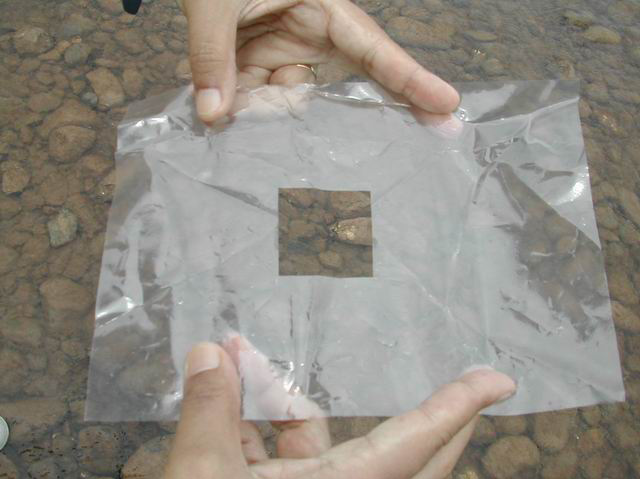
When sampling, a plastic sheet with a 10 cm2 cutout (Figure 6) was placed on the upper surface of
the stone or other substratum. Benthic diatoms on the substratum surface were brushed off and rinsed
with water until the cutout area was completely clear. Each sample was collected in a plastic bowl and
transferred to a plastic container.
Processing samples in the field
The plastic container with the sample was labelled with the site name, location code, date, and replicate
number. The collector's name, sampling site, substratum type and replicate number were recorded on the
field data sheet.
14
Biomonitoring of the lower Mekong River and selected tributaries
Figure 6. Plastic sampling sheet with a 10 cm2 square
cut out of the middle
Preservation and transport to the laboratory
Samples were preserved with Lugol's solution and kept in plastic boxes in an ice box that was kept at low
temperature (510 oC).
Laboratory methods
In the laboratory, each sample was cleaned by a concentrated acid digestion method. The samples were
centrifuged at 3500 rpm for 15 minutes. The diatom cells (brown layer between supernatant and solid
particles) were placed in an 18 cm core tube. Strong acid (H SO , HCl or HNO ) was added and the tube
2
4
3
was heated in a boiler (7080 oC) for 3045 minutes. The samples were rinsed with de-ionized water
45 times, and 23 drops of each sample were placed on a microscope slide and dried. A mounting
agent solution such as Naphrax or Durax was used to make a permanent diatom slide for counting and
identification under a compound microscope, and 300 individual cells were counted per slide.
The identification of diatoms was based on the type of frustule, size, special characteristics, and structure.
Relevant textbooks, publications, and monographs on temperate and tropical diatoms were used, e.g.
Krammer and Lange-Bertalot (1986, 1988, 1991a, 1991b), Hustedt (1937), Foged (1971, 1975, 1976),
and Pfister (1992). In most cases, specimens were identified to species. The permanent slides are kept in
the Applied Algal Research Laboratory Collection at Chiang Mai University.
Data analysis
The four most abundant diatom species at each site were recorded and those believed to indicate
differing levels of ecological health were identified from relevant literature including Del Giorgio et
al. (1991), Silva-Benavides (1994), Conforti et al. (1995), and Loez and Topalian (1997) for polluted
quality, Hempattarasuwon (2001) for moderate-polluted quality, and Pektong (2002) and Supan and
Peerapornpisal (2002) for moderate quality.
Cluster analysis and ordination were performed on diatom count data transformed as log (count + 1).
The Sorenson (Bray-Curtis) distance measure was used. Cluster analysis was done with the flexible
15
Biomonitoring of the lower Mekong River and selected tributaries
beta method of group linkage (beta = -0.25). Ordination was done with two-dimensional non-metric
multidimensional scaling with varimax rotation. The correlations of the environmental variables with
the ordinations were calculated and the strongest correlations were plotted as vectors on the ordination
diagrams.
Results
General characteristics of the diatom flora
In total, 206 species of benthic diatoms were collected from the 20 sites examined. Of these, 197 species
were in the Order Pennales and nine in the Order Centrales (Annex 2). The number of species at a site
ranged from 17 to 60 (Table 3). The highest number of species (60) was collected at site TKO (Kok River,
Thailand) and the lowest at site CPS (Pursat River, Cambodia). Achnanthes minutissima and Cocconeis
placentula were the most widely distributed species, and Nitzschia clausii and Synedra ulna var. aequalis
were also widespread (Table 4).
Pollution-tolerant diatoms were the most abundant species at two sites (CPP and CTU). At two other
sites (TCH and TKO), pollution-tolerant species were among the four most abundant species, but
these diatoms were not present in significantly large numbers. At two further sites (VCD and VTC),
moderately-tolerant to pollution-tolerant species were the most abundant or the second most abundant
diatoms species recorded.
Table 3. The number of benthic
diatoms recorded at
all 20 of the March
2004 Survey sites
Site
Number of species
TKO
60
LPB
47
TSK
44
LNO
43
VTC
39
LNG
36
CKT
36
TCH
35
LKD
35
VSP
34
TMU
30
VKT
29
LVT
28
CSP
26
VCD
25
LPS
24
CTU
24
CSS
20
CPP
19
CPS
17
16
Biomonitoring of the lower Mekong River and selected tributaries
Table 4. The four most abundant species of benthic diatoms at each site
(including pollution tolerance--where known)
Site
Species
% of total cells
Tolerance to pollution
LNO
Cocconeis placentula
56.6
-
Epithemia adnata
18.0
-
Achnanthes lanceolata
7.3
Moderate
Navicula viridula var. germainii
5.5
-
LPB
Achnanthes minutissima
30.6
-
Gomphonema sp. 1
14.5
-
Achnanthes lanceolata
13.9
Moderate
Amphora sp.1
11.5
-
LVT
Navicula sp. 1
74.1
-
Cymbella turgidula
5.5
Moderate
Navicula sp. 2
3.8
-
Luticola sp. 1
3.6
-
LNG
Achnanthes minutissima
23.8
-
Encyonopsis sp.1
22.8
-
Navicula sp.26
16.0
-
Encyonema sp.7
11.5
-
LKD
Achnanthes minutissima
63.4
-
Fragilaria ulna var. acus
9.0
-
Encyonema sp.7
5.2
-
Fragilaria capucina
2.5
-
LPS
Synedra ulna var. aequalis
33.1
Moderate
Cymbella turgidula
23.1
Moderate
Navicula sp.31
15.4
-
Synedra ulna
7.3
-
TMU
Cymbella sp.1
56.2
-
Achnanthes minutissima
15.4
-
Gomphonema sp.1
7.9
-
Gomphonema sp.2
5.5
-
TCH
Achnanthes minutissima
54.6
-
Nitzschia clausii
10.4
Tolerant
Gomphonema parvulum
7.3
Tolerant
Navicula symmetrica
6.6
-
TSK
Achnanthes sp.1
33.7
-
Achnanthes minutissima
17.4
-
Gomphonema sp.1
11.1
-
Nitzschia sp. 6
8.4
-
TKO
Navicula sp.14
30.2
-
Cocconeis placentula
10.5
-
Achnanthes minutissima
9.7
-
Navicula viridula var. rostellata
5.8
Tolerant
CPP
Nitzschia clausii
49.0
Tolerant
Navicula sp.36
17.0
-
Navicula sp.35
14.8
-
Gomphonema parvulum
2.6
Tolerant
CTU
Gomphonema parvulum
17.6
Tolerant
Cymbella sp.17
17.1
-
Nitzschia palea
9.8
Tolerant
Nitzschia sp.16
7.9
-
CSS
Achnanthes minutissima
50.0
-
Encyonema sp.12
13.8
-
Navicula sp. 39
9.7
-
Cocconeis placentula
5.7
-
CPS
Synedra ulna var. aequalis
27.1
Tolerant
Navicula sp.35
22.6
-
Cocconeis placentula
11.6
-
Gomphonema sp.12
10.7
-
CKT
Cymbella sp.6
20.3
-
Achnanthes minutissima
13.3
-
Cocconeis placentula
8.3
-
Rhopalodia gibberula
7.4
-
VTC
Aulacoseira granulata
24.8
Moderate
Rhopalodia sp.2
13.4
-
Gomphonema sp.10
9.5
-
Aulacoseira muzzanensis
8.9
-
VCD
Aulacoseira granulata
20.6
Moderate
Nitzschia sp.17
21.9
-
Navicula sp.32
12.7
-
Melosira varians
6.5
-
VKT
Navicula sp.39
38.3
-
Cymbella japonica
13.8
-
Achnanthes minutissima
13.0
-
Encyonema sp.11
7.7
-
VSP
Cymbella turgidula
26.8
Moderate
Encyonema sp.9
26.7
-
Navicula sp.30
15.5
-
Nitzschia palea
2.2
-
17
Biomonitoring of the lower Mekong River and selected tributaries
Within-site variability
The ten replicates from each site, when plotted as a cluster dendrogram, were more similar to one another
than to samples collected from other sites. For example, only one sample from each of two sites clustered
with the `incorrect' site. Therefore it seemed reasonable to use averaged data from each site in further
analyses.
Among-site variability
When averaged data from each site were clustered, the sites split into two major groups (Figure 7), one
including mostly Vietnamese and Cambodian sites and the other including mostly Thai and Lao sites. The
VietnameseCambodian group also included two Lao sites, but one of these, LVT, was an outlier with
a low level of similarity to the rest of the group, while the other was the Pakse site (LPS), the furthest
downstream site in Lao PDR. The ThaiLao group of sites included one Cambodian site, at Kratie
(CKT). Essentially these two clusters seemed to represent the upstream sites (ThaiLao PDR) and the
downstream sites (CambodiaViet Nam).
The ordination plot (Figure 8) also shows the similarity of sites according to the distribution and
abundance of diatoms. Vectors for chemical and physical variables, including substratum types, were
superimposed on the ordination. A low stress value of 12.4 showed that the ordination was a good
representation of the similarities among the sites. The grouping of sites in the ordination was similar
to the grouping in the cluster analysis. The factors most strongly related to the distribution of diatoms
were physical and chemical properties of the water (DO, EC and temperature) and the amount of cobble
grade substratum. Axis 1 of the ordination separated sites such as TCH, with muddy and sandy substrata,
from sites like LNG and CSP that had gravel and stony substrata. On Axis 2, sites associated with higher
conductivity grouped separately from sites with higher dissolved oxygen (Figure 8).
Discussion
Benthic diatoms provide five types of information that can be used to help assess of the ecological health
of the river: (1) information from indicator species, (2) information from multivariate analyses, (3) a
priori knowledge of likely impacts and impacted sites, (4) environmental data, and (5) information from
other biological indicators. Information from these five sources needs to be compared and reconciled
when making judgments about the health of the river and assessing the validity of benthic diatoms as
indicators of this health.
The indicator species analysis was limited in scope because the tolerance of most species is not yet
known. The results from the multivariate analyses provided limited support for the results based on
indicator species. For example, the sites that indicator species suggested were most stressed (CPP and
CTU) grouped together, but also grouped with sites dominated by species that are indicative of moderate
water-quality. The cluster analysis and ordination reflect both natural and human-generated variations in
the diatom flora, and are therefore not simply a reflection of the impact of water-quality. In addition, sites
that suffer similar levels of pollution may support different types of pollution-tolerant species, and as a
result these sites may not group together under multivariate analysis.
The ordination separated four sites, LVT, CSP, LNG, and TMU, as relatively distinctive from one another
and from all other sites. Of these, CSP was a tributary site in a relatively undisturbed catchment, where
sampling was conducted on a rock bar. Sites LNG and TMU were both downstream of dams. Dams may
influence the diatom community although possibly not in consistent ways, because the two sites were
18
Biomonitoring of the lower Mekong River and selected tributaries
Figure 7. Dendrogram from cluster analysis of average diatom data at the March
2004 Survey sites
Figure 8. Ordination based on average diatom data in Figure 7
(above). Lines indicate directions and relative magnitude
of correlations with environmental variables
19
Biomonitoring of the lower Mekong River and selected tributaries
not similar. The impact of dams may vary depending on the nature of the river that is dammed, because
the Nam Ngum and Nam Mun rivers are different in their physical characteristics. The distinctive nature
of site LVT, near Vientiane, is more difficult to explain. The diatom assemblage was dominated by a
single species, which made up almost 75% of the cells counted. This would seem to indicate a stressed
assemblage, though possibly by a natural factor.
Several sites included in this survey are localities where human impacts are possible. In Lao PDR
these included LVT, where there could be impacts from Vientiane city, and LNG, where there could be
influences from river regulation. In Thailand, possibly affected sites included TMU, downstream of Pak
Mun Dam, and TKO, in the Kok River where water-quality monitoring has found elevated suspended
solids and nutrients (MRC, 2005). In Cambodia, CPP and CTU are both close to Phnom Penh and could
be affected by urban runoff, CSS may have been affected by river regulation and CPS may have been
affected by urban runoff from Pursat, upstream diversion of water for irrigation and intense domestic use.
In Viet Nam the most likely sites to be impacted are those in the delta, VCT and VCD, where agriculture
is most intense, in-stream aquaculture is common and there are relatively dense human settlements along
the banks.
There are also several sites where it would be expected that conditions are likely to be exceptionally
good. These include Nam Ou in Lao PDR (LNO), the Songkhram River in Thailand (TSK) and the Sre
Pok River in Cambodia (CSP). All of these sites are in catchments with no industrial development, with
agricultural development of low intensity and without large dams.
The ordination separated some of the probable disturbed sites (LVT, LNG and TMU) as individually
distinctive and grouped several others together (CPP, CPS, VCD, CTU, VTC) along with one other site
(LPS). Indicator species suggested that LPS had moderate water quality. Chemical water-quality data
indicate some human impact on water quality at CPP, CTU, VCD and VTC (MRC 2005) but not at
LPS. Because the assemblage similarities in the diatom data reflect the full range of factors, natural and
anthropogenic, that influence the assemblages, anthropogenic influences will become evident only where
they are relatively strong compared with natural factors.
The ordination did not group the presumed high-quality sites, and the indicators identified one as being
of moderate water quality. The sites are different river types: Nam Ou shallow with cobbles, Songkhram
deep and slow flowing, and Sre Pok with deep pools and bedrock bars. Therefore it was expected that
their diatom assemblages would differ. The presence of a moderate water-quality indicator in the Nam Ou
was unexpected since the water quality at this site appeared good. However, the indicator species made up
only 7% of the sample.
20
5 Zooplankton
Introduction
Zooplankton includes both free-floating and swimming organisms that readily move with water currents.
Species of zooplankton play an important ecological role in lakes and large rivers, feeding on non-living
organic matter, phytoplankton and bacteria, and in turn being eaten by secondary consumers such as
fish. Their reproductive cycles, development, and survival rates may directly influence other components
of the ecosystem, such as the abundance of the organisms on which they feed. Zooplankton also play a
significant role in fish and crustacean production because they make energy produced by algae through
photosynthesis available to higher levels in the food chain. Finally, the community characteristics of
zooplankton can be key elements in assessing the recovery of an ecosystem following stress caused by
natural or human factors.
The use of zooplankton in biological monitoring is more common in lakes than in rivers. However, these
organisms offer several advantages as indicators of environmental quality in both environments: (1) as a
group, they have worldwide distribution, (2) techniques for sampling them are well developed, simple,
and inexpensive, (3) the species composition and community structure of zooplankton are sensitive to
changes in environmental conditions and/or nutrients, and (4) some species and groups of zooplankton are
indicative of water-quality conditions.
In southeast Asia, zooplankton have been studied for many purposes but primarily in lake environments.
There have been no comprehensive studies of zooplankton in the Mekong River system. In the Mekong
Delta, there have been some small unpublished studies on zooplankton in the Tien and Hau Rivers, the
two main branches of the Mekong River. These were mainly in relation to aquaculture or for small-scale
environmental assessments.
In May 2003, the Mekong River Commission started a biomonitoring programme to assess river health in
the Mekong River system within the countries of Cambodia, Lao PDR, Thailand and Viet Nam. Sampling
of zooplankton at 13 sites in the main river and selected tributaries yielded information on species
richness, and composition and community structure, which enabled the development of appropriate
methods for future monitoring of zooplankton in the Mekong.
In the current study, the distribution and abundance of zooplankton were used again to evaluate the
ecological health of the Mekong River and its system of tributaries. This chapter: (i) describes the
richness and abundance of zooplankton at 20 sites in the Mekong River and selected tributaries, (ii)
examines within-site variability of zooplankton samples, (iii) examines how sites group according to their
taxonomic composition, (iv) examines the association of environmental characteristics with zooplankton
assemblages at the sites sampled, and (v) describes the ecological conditions of the study area inferred
from the results of the analyses.
Study sites and methods
Sites
Zooplankton samples were collected at 20 sites in the lower Mekong River basin in Lao PDR, Thailand,
Cambodia, and Viet Nam. The sites have been described previously in detail in Chapter 2.
21
Biomonitoring of the lower Mekong River and selected tributaries
Field methods
At each site, three samples were collected as follows: a sample at the left side of the river (at a distance
about 45 m from the water's edge where the stream margin was gently sloping), a similar sample at the
right, and another in the middle. The samples were taken at least 1 m from potentially contaminating
substances such as debris and aquatic plants and at least 2 m from vertical banks. Samples were collected
with a 10 l plastic bucket, filtered through a plankton net (20 µm mesh, 20 mm × 60 mm), stored in plastic
jars (250 ml) and fixed with formaldehyde (4%). Samples were processed in the field according to the
following procedures:
1. The net, bucket, and plastic jar were washed with water at the sampling site to remove animals or
material from the previous site.
2. Ten litres of surface water (from 00.5 m depth) were collected using the bucket and filtered
through the net. The water was filtered slowly to avoid the water overflowing from the net, until the
remaining water volume in the net was about 150 ml.
3. At those sites where the current was too fast to permit sampling exactly in the mid-stream, samples
were collected slightly closer to the left or the right bank, but not as close as where the side-samples
were taken.
4. The sample jar was labelled with the site name, site code, sampling date, and sample number.
Laboratory methods
The samples were analysed in the Laboratory of Aquatic Science, Institute of Tropical Biology, Ho Chi
Minh City, Viet Nam. All the zooplankton were collected identified and counted. The identification was
made to the lowest taxonomic level possible; this was generally species level. Identification was based
on morphology, using Vietnamese and international references. Large species of zooplankton (> 50 µm
in diameter) were observed under a microscope at 40 x magnification. The smaller species or details of
larger species were examined at 100400 x magnification. Samples were processed as follows:
1. Large particles of organic and inorganic matter were removed with forceps. The samples were rinsed
with distilled water and filtered through a net with a mesh size of 10 µm and then allowed to settle in
a graduated cylinder. Excess water was discarded, leaving about 50 ml of water and residue; this was
transferred to a petri dish for examination.
2. The residue was examined under a microscope and every specimen identified and counted.
3. After analysis, samples were transferred back into the bottles and preserved. All specimens are stored
at the Institute of Tropical Biology, Ho Chi Minh City, Viet Nam.
Data analysis
Cluster analysis and ordination were performed with the PC-ORD statistical software (version 4: MjM
Software Design, Geleneden Beach, Oregon, USA) on zooplankton count data transformed as log (count
+ 1). The Sorenson (BrayCurtis) distance measure was used. Cluster analysis was done with the flexible
beta method of group linkage (beta = -0.25). Ordination was done with two-dimensional non-metric
multidimensional scaling with varimax rotation. The correlations of the environmental variables with
the ordinations were calculated and the strongest correlations were plotted as vectors on the ordination
diagrams.
22
Biomonitoring of the lower Mekong River and selected tributaries
Results
General characteristics of the zooplankton
In total, 138 taxa were collected at the 20 sites (Annex 3). The taxa belonged to four main groups:
Crustacea, Eurotatorea, Protozoa, and larval forms (Table 5). Taxon richness at a site ranged from 13
at LKD to 61 at TMU. Distribution in the Mekong system varied greatly among taxa. Arcella vulgaris
(Protozoa: Arcellidae) and nauplius larvae of Copepoda (Crustacea) had the widest distributions,
occurring at 19 sites. Several other taxa were also widely distributed, occurring at 1314 sites: Keratella
cochlearis cochlearis and Keratella valga tropica (Eurotatorea: Brachionidae), Polyarthra vulgaris
(Eurotatorea: Synchaetidae), Difflugia elegans (Protozoa: Difflugiidae), and bivalvia larvae (Mollusca:
Bivalvia). In all, 17,681 individuals were collected. The mean abundance recorded at the sites ranged
from 22 individuals (CSP) to 1327 individuals (TMU) (Table 5).
Within-site variability
In general, there was little difference among the samples collected within a site (left and right banks, and
middle of river). In 98% of cases the cluster analysis grouped samples from the same site together, the
exception being one sample collected at Tan Chau (VTC). The consistency of these results is expected at
sites in turbulent rivers where the water body is well mixed.
Table 5. Zooplankton species richness, composition and abundance (total number of specimens
collected) at the 20 March 2004 Survey sites
Site
No. Crustacea Eurotatorea Protozoa
Larvae
Mean
Abundance
code
taxa
(% taxa)
(%taxa)
(% taxa) (% taxa) abundance
range
LNO
16
0
44
31
25
57
5169
LPB
18
6
44
33
17
182
155218
LVT
17
18
29
35
18
24
1731
LNG
28
29
39
29
4
398
347452
LKD
13
8
38
46
8
18
738
LPS
31
10
48
35
7
227
193257
TMU
61
31
56
12
2
1327
12691398
TCH
28
25
50
18
7
751
4981237
TSK
18
6
67
22
6
580
404787
TKO
22
14
55
18
14
53
5255
CPP
34
21
53
21
7
318
309335
CTU
30
17
57
20
7
744
3741144
CPS
30
17
50
27
7
192
156219
CSS
26
12
54
27
8
50
4852
CSP
20
10
55
20
15
22
1431
CKT
24
21
38
29
13
35
2944
VTC
35
23
57
14
6
459
299775
VCD
25
16
60
16
8
363
133536
VSS
19
16
36
42
5
65
4388
VSP
21
5
43
33
19
27
1932
23
Biomonitoring of the lower Mekong River and selected tributaries
Among-site variability
The cluster analysis of average data for each of the 20 sites produced seven groups at the 50% level of
information remaining (Figure 9). The sites LPB and LVT had similar taxonomic composition of Protozoa
and larvae, and the dominant taxon was Ceratium spp. Sites TKO, CSS, CKT, VSS, VSP, and CSP were
characterized by the dominant species being filter feeders that ingest non-living organic matter and
bacteria. They included species of Brachionidae (Eurotatorea), Centropyxidae, and Arcellidae (Protozoa).
All of these sites were tributary sites, but some (such as TKO and VSS) were located in quite developed
catchments while others (such as CSP) were in relatively undisturbed catchments. Sites LNG and TMU
had a species composition characteristic of both flowing and still water, and the highest proportion of
Branchiopoda (Crustacea) in terms of the number of taxa present. Both were located only a short distance
below reservoirs. Sites TSK, CPP, VTC, VCD, CTU, and CPS had similar species composition, similar
representation of Copepoda, and the highest proportion of Eurotatorea (Crustacea). All were located close
to nutrient sources such as fish cages or townships.
Ordination analysis of the same data produced a pattern with a stress value of 16.5, indicating that the
ordination was a good representation of the similarities among the sites (Figure 10). The arrangement of
sites in the ordination generally agreed with the grouping of sites in the cluster analysis. For example,
sites VTC, VCD, CPP, and TSK were aligned in both analyses, as were sites CTU and CPS, sites VSS
and VSP, and sites LPB and LVT. With the exception of sites in the Nam Ngum River (LNG) and at
Pakse (LPS), the sites in Lao PDR (LNO, LPB, LVT, and LKD) tended to be separated from the sites in
Thailand, Cambodia, and Viet Nam in the ordination plot. No Crustacea were collected in four of the Lao
sites (LNO, LPB, LVT, and LKD). The cluster analysis also indicated that the similarity between these
Lao sites and other sites was low.
The environmental factors that were correlated most strongly with the ordination of all 20 sites were
temperature, altitude, pH, DO, and conductivity (EC) (Figure 10). When the 2002 water-quality data for
nitrates, phosphates, and suspended solids were included, the environmental factors that correlated most
strongly with an ordination of the 14 sites for which these data were available were temperature, DO,
altitude, pH, NO , and EC (Figure 11).
3
Discussion
The Eurotatorea, a mainly freshwater group, was dominant in the Mekong River in terms of the
numbers of families (49% of total), genera (48%), and species (57%) collected. This was not surprising
because rotifers commonly dominate the zooplankton in large rivers (e.g. Hynes 1970). The four main
zooplankton groups (Crustacea, Eurotatorea, Protozoa, and larvae) were present at all of the sites except
for LNO. Among these groups, the Eurotatorea were most dominant at the sites TSK, VCD, VTC, and
TMU. These sites also had the highest prevalence of species that feed on non-living suspended organic
matter (e.g. species of Trichocercidae and Brachionidae), which are typically abundant in lakes having
high nutrient levels, as for example from fish-cages.
The Branchiopoda (Crustacea), which include filter feeders of the genera Bosmina, Diaphanosoma,
Daphnia, and Ceriodaphnia are characteristic of lentic waters and made up the highest proportion of taxa
at sites LNG (21% of total) and TMU (18%). Both sites are downstream of impoundments. In contrast,
the Copepoda (Crustacea), which included species of Cyclopidae, and the Bosminidae (Branchiopoda)
are characteristic of low current and nutrient-rich waters and contributed the bulk of the species at TMU
(13% of total) and CKT (13%). The highest proportion of zooplankton larvae occurred at sites LPB (25%
of total) and VSP (19%), which were high altitude sites, having strong current, turbulence, and a rocky
bed.
24
Biomonitoring of the lower Mekong River and selected tributaries
Figure 9. Dendrogram from cluster analysis of zooplankton diatom at all 20 of the
March 2004 Survey sites
Figure 10. Ordination based on average zooplankton data
in Figure 9 (above). Lines indicate directions
and relative magnitudes of correlations with
environmental variables
25
Biomonitoring of the lower Mekong River and selected tributaries
Site TMU, the richest site, was characterized by taxa that occur in both rivers and lakes. These taxa were
predominantly species of Eurotatorea (56% of total) and Crustacea (31%). The site was located only a
few hundred metres below Pak Mun Dam and so the presence of lacustrine species from the reservoir was
not surprising.
Site LKD had the poorest species richness; species of Copepoda and Ostracopoda (Crustacea) were
absent. This low richness partly reflected the environmental characteristics of low current and nutrient-
poor waters. The main taxa present (Lobosea, Protozoa: Lecanidae, Eurotatorea) are characteristic of
environments with decomposing organic matter with abundant bacteria, fungi, and other protozoa.
Species of Eurotatoria and Protozoa were numerically dominant at most sites. Protozoa feed on bacteria
and develop well in habitats where flow is slow. The mixture of sand and rock substrata, and the large
amount of decomposed organic matter, provided excellent conditions for species such as Pseudodifflugia
gracilis, Difflugia elegans, Ceratium spp., and Centropyxis aculeata, which are numerically dominant at
sites LNO, LPB, LVT, LPS, VSS, VSP. Polyarthra vulgaris, which characteristically occurs in areas with
high suspended organic matter, was numerically dominant at sites CPS, CTU, VTC, and CSP. At VTC,
CPS, and CTU, there were high suspended solids levels and waste water, and at VTC there were also fish
cages. However conditions were quite different at CSP, which was a more pristine site.
The site with the highest abundance of zooplankton was TMU, where there were high densities of larvae
of Copepoda and Ceratium spp. (Protozoa). In contrast, at LKD, the nutrient-poor environment was
reflected in the lowest abundance found at all of the sites, with the exception of Keratella cochlearis
(Eurotatorea) and Arcella vulgaris (Protozoa).
The ordination analysis for zooplankton samples for 20 sites indicated that the arrangement of sites
was most strongly associated with two variables, temperature and altitude. Temperature was inversely
correlated with both altitude and DO. Because higher-altitude locations are cooler and the solubility of
oxygen is higher at lower temperatures, it was expected that most sites with high temperatures would
have been at low altitude in the downstream part of the Mekong River and would have had low DO
concentrations (CPS, CTU, CPP, VTC, and VCD). In the upland sites (LNO, LPB, and LVT) temperatures
were low and DO had the highest values. Altitude can be used to divide the sites into two well-defined
areas: (1) an upland area with sites LNO, LPB, LVT, TKO, VSP, and VSS, where there were many filter-
feeding species such as Testudinella, Cephalodella, and Mytilina that are well adapted to fast currents, and
(2) a lowland area with sites CKT, CSS, CSP, CPS, CTU, CPP, VTC, and VCD located in the downstream
part of the Mekong River Basin.
For the ordination analysis of 14 sites (Figure 11), sites in Lao PDR tended to separate from the sites in
Thailand, Cambodia, and Viet Nam, except for the site in Nam Ngum River (LNG). The arrangement
of the 14 sites was most strongly associated with temperature, altitude, and DO. Almost all these sites
were located at high altitude with high DO concentrations and low temperature. Nitrate had the strongest
relationship with the zooplankton in the downstream sites such as CTU, CPP, VTC, and VCD, possibly
because of the influence of nitrates on phytoplankton growth.
The ordinations produced several groupings of sites subject to similar human influences, for example sites
downstream of dams (TMU and LNG), Cambodian tributaries (CSS and CSP), Vietnamese highland sites
(VSS and VSP) and several sites corresponding to a downstream series (LPB, LVT, LPS). Finally, two
sites, LNO and LKD, appeared to be unlike any others with respect to zooplankton. LNO was a shallow,
stony section of a tributary, which is a less than ideal habitat for potamoplankton, while the upper reaches
of Nam Kandinh were influenced by a dam and flows had been altered.
26
Biomonitoring of the lower Mekong River and selected tributaries
Figure 11. Ordination of 14 of the March 2004 Survey siues
based on average zooplankton data in Figure 9
(over page). Lines indicate directions and relative
magnitudes of correlations with environmental
variables
27
Biomonitoring of the lower Mekong River and selected tributaries
28
6 Littoral macroinvertebrates
Introduction
Worldwide, benthic macroinvertebrates (including littoral taxa) are the biological assemblage most widely
used for biomonitoring. They have several characteristics that make them particularly useful for this
purpose (Barbour et al., 1999): (i) macroinvertebrates occur in almost all types of freshwater habitats,
(ii) among the many taxa of macroinvertebrates there is a wide range of sensitivity to pollution and
environmental stress, (iii) macroinvertebrates have mostly sedentary habits and so they are likely to be
exposed to pollution or environmental stress, (iv) their life cycles are sufficiently long that they are likely
to be exposed to pollution and environmental stress, and the community will not recover so quickly that
the impact will go undetected, (v) sampling the benthic macroinvertebrate assemblage is relatively simple
and does not require complicated devices or great effort, and (vi) taxonomic identification is almost
always easy to the family level and usually relatively easy to the genus level.
Bioassessment approaches using benthic macroinvertebrates have been used previously in tropical
areas. For example Thorne and Williams (1997) applied a variety of rapid assessment methods using
macroinvertebrates in Brazil, Ghana, and Thailand. They tested 20 analytical methods that had been
used in temperate regions, including representatives of the five major types of analytical tools identified
by Resh and Jackson (1993): richness indices, enumerations, diversity and similarity measures, biotic
indices, and functional-feeding group measures. Of this number, seven specific measures behaved as
expected in response to pollution gradients, but these measures did not include any of the enumeration
or functional-feeding-group indicators. The two diversity indices also failed to respond to a pollution
gradient in the predicted manner, although the three `similarity/loss indices' all met the test criteria. Both
the BMWP score and BMWP (ASPT) performed satisfactorily.
In northern Thailand, Mustow (1997) studied the macroinvertebrate community at 23 sites on the Mae
Ping River and also suggested some modifications to the BMWP score to suit local conditions. According
to Mustow (1997), 71 of the 85 families in the original index are known to occur in Thailand and 65 of
these, together with an additional 33 that do not occur in the U.K., were found in the Mae Ping system.
He incorporated 10 of these additional families in a modified BMWP scoring system, which he called the
BMWPTHAI score.
In 2003, a littoral macroinvertebrate study in the Mekong River system was conducted under the
ecological health monitoring activity of the Mekong River Commission. The study included 13 sites in
the Mekong River system in the four lower Mekong countries: Cambodia, Lao PDR, Thailand, and Viet
Nam. The study applied `kick' and `sweep' sampling techniques, both of which are useful and applicable
for evaluating the diversity of macroinvertebrates. However, for site comparisons, the sweep sampling
technique was more appropriate because it can be applied to all sites in the Mekong River system. The
littoral macroinvertebrate data were then summarised in term of diversity and abundance, and with a
biotic index (SIGNAL value). The sites were also analysed with cluster analysis.
In 2004, littoral macroinvertebrates were collected by sweep sampling from 20 sites in the lower Mekong
River and selected tributaries. The tasks for this component of the survey were to describe the ecological
condition of the study sites by using sample data to (i) describe the taxonomic richness and composition
and the relative abundance of littoral macroinvertebrates at the sites, (ii) examine within-site variability
of replicate samples, (iii) compare the sites in terms of how they group in multivariate analyses, and (iv)
relate these results to the physical and chemical characteristics of the sites.
29
Biomonitoring of the lower Mekong River and selected tributaries
Study sites and methods
Sites
At the 20 sites described in Chapter 2, littoral macroinvertebrate samples were taken in March 2004 on
one side of the river.
Field methods
We attempted to select as similar habitats as possible at each site and used a standard sweep method for
sampling. This was important because the study area was large, covering a wide range of habitats with
many different physical and chemical environments. Standardisation was critical in order to be able to
compare sites. The detailed sampling protocol used is described below.
1. As a result of experience in 2003, only a sweep-net method (D-frame net with 30 cm x 20 cm
opening, mesh size 475 µm) was used for sampling littoral macroinvertebrates in this study.
2. At each site, one side of the river was selected as a sampling area, usually the depositional side where
samples easily could be taken and more aquatic vegetation occurred. Eight sites were sampled on the
left side of the river: LNO, LPB, LKD, TMU, TKO, CPP, VCD, and VSP. Eleven sites were sampled
on the right side: LVT, LNG, LPS, TCH, TSK, CTU, CPS, CSS, CSP, CKT, and VSS. One site was
on an island in the middle of the river, VTC. The length of the sampling was 100 m divided into ten
plots of 10 m. Six of the ten plots were chosen for sampling with a random number table, and a single
sample was taken in each.
3. The collector stood in the river about 1.5 m from the water's edge. Working in an upstream direction,
the net was swept 10 times near the substratum surface (for one sample) while moving forward.
Each sweep was about 1 m at right angles to the bank and in water between 1 and 1.5 m deep. All
substrata, including cobbles, gravel, sand, silt, mud, and aquatic plants, were sampled.
In order to reduce the amount of material returned to the laboratory, and laboratory sorting time, field
sorting was done following the procedures described below.
1. The net contents were washed to the bottom of the net, the net was inverted, and the contents were
emptied into a bucket, rinsing off any material remaining on the net. A lid was placed on the bucket
to prevent mobile macroinvertebrates from jumping or flying away.
2. After the lid was lifted, a handful of material was removed from the bucket and placed quickly on a
0.5 mm mesh sieve. The material on the sieve was washed thoroughly by half submerging the sieve
in the river or a bucket of clean water and shaking it. Mobile macroinvertebrates were prevented from
jumping or flying out of the sieve.
3. The contents of the sieve were placed in a white sorting tray, adhering material was rinsed off with
clean water, and the sample was dispersed in the water. Any animals clinging to the net were picked
off and added to the tray.
4. While picking, the tray was shaken from time to time to redistribute the contents and tilted
occasionally to look for animals adhering to it.
5. All animals were removed from the sorting tray in the field using forceps and pipettes, and placed
into plastic jars containing 70% alcohol.
30
Biomonitoring of the lower Mekong River and selected tributaries
6. Species present in large numbers were washed off in bulk. A second person then checked the tray to
be sure no animals were present. Steps 26 were repeated until the entire sample had been processed.
7. The sample jars were labelled with site name, location code, date, and replicate number.
8. The collector's name, the sampling site, and replicate characteristics (including substrata sampled)
were recorded in a field notebook.
Small samples were kept in 30 ml jars, and large samples in 150 ml jars, stored at room temperature
(2530 oC). When large numbers of macroinvertebrates were to be kept in a jar or dilution with water
occurred, some 95% ethanol was added in order to keep the preservative medium (ethanol) at 70%.
Laboratory methods
The collected samples were sorted and identified as follows:
1. In the laboratory, the samples were divided into taxonomic orders, kept in separate jars and labeled as
in step 7 of the field procedure.
2. Identification was done to the lowest taxonomic level that could be applied accurately, usually to
genus.
3. The identification was made with the aid of a stereo-microscope with 2040x magnification.
4. All specimens were kept in the Department of Biology at the National University of Laos.
Data analysis
Cluster analysis and ordination were performed with the PC-ORD statistical software (version 4: MjM
Software Design, Geleneden Beach, Oregon, USA) on littoral macroinvertebrate count data transformed
as log (count + 1). The Sorenson (Bray-Curtis) distance measure was used. Cluster analysis was done
with the flexible beta method of group linkage (beta = -0.25). Ordination was done with two-dimensional
non-metric multidimensional scaling with varimax rotation. The correlations of the environmental
variables with the ordinations were calculated and the strongest correlations were plotted as vectors on the
ordination diagrams.
Results
General characteristics of the littoral macroinvertebrates
In total, 128 taxa and 23,365 individuals were collected at the 20 sites examined in March, 2004 (Table 6
and Annex 4). Taxon richness at a site ranged from 7 to 53 (Figure 12). The highest richness occurred at
sites CSP and VSP and the lowest richness at site CPP. Species of Decapoda, Hemiptera, and Diptera had
the widest distribution and occurred at 19 sites. Ephemeroptera and Mesogastropoda were also widely
distributed and occurred at 18 sites. The number of individuals at a site ranged from 36 to 9,759 (Figure
13). The highest abundance occurred at site VTC and the lowest at site CPP.
The samples collected contained some macroinvertebrate taxa that are eaten by humans: the groups
Decapoda, Bivalvia, and Mesogastropoda, and individual species such as the three economically
important species of Decapoda (Macrobrachium pilimanus, M. lanchesteri, and an atyid species), two
31
Biomonitoring of the lower Mekong River and selected tributaries
species of Bivalvia (Scabies sp. and Corbicula sp.), and two species of Mesogastropoda (Melanodes
tuberculata and Taribia granifera).
Table 6. Abundance of littoral macroinvertebrate taxa
Taxon
Number of
Percentage of
Percentage of sites at which
individuals
individuals
taxon occurred
Bivalvia
597
2.56
85
Mesogastropoda
3790
16.22
90
Decapoda
1634
6.99
95
Amphipoda
22
0.09
10
Isopoda
26
0.11
35
Coleoptera
39
0.17
50
Lepidoptera
11
0.05
15
Odonata
502
2.15
80
Hemiptera
11391
48.75
95
Ephemeroptera
3778
16.17
90
Diptera
1399
5.99
95
Plecoptera
27
0.12
50
Trichoptera
49
0.21
60
Oligochaeta
90
0.39
60
Polychaeta
10
0.04
15
Total
23365
Figure 12. Species richness of littoral macroinvertebrate taxa
Figure 13. Abundance of littoral macroinvertebrate taxa
32
Biomonitoring of the lower Mekong River and selected tributaries
Within-site variability
A cluster analysis was conducted on all samples collected to assess within-site variability. For the most
part, samples from within a site clustered together, indicating that within-site variability was less than
the variability among sites. The six samples within a site clustered together for each of LNO, LNG, LPB,
TSK, LPS, and CPS, but not for the other sites. However, at all sites at least three of the samples formed a
single cluster.
Among-site variability
The cluster analysis of averaged data for each of the 20 sites produced seven groups at the 50% level
of information remaining (Figure 14). Group I included two Lao sites (LNO, LKD), two Cambodian
sites (CSS, CSP), and one Vietnamese site (VSP). These sites were located on Mekong River tributaries
and had similar abundances of Hemiptera and Ephemeroptera species. Group II included two Lao sites
(LPB and LVT) and one Thai site (TKO), which had the highest abundance of Ephemeroptera species.
Group III included only two Lao sites (LNG and LPS), which were distinguished by the highest number
of Hemiptera species. Group IV incorporated two Vietnamese sites (VCD and VTC) and one Thai site
(TMU), this grouping resulting from the abundance of Mesogastropoda and Decapoda species. Group
V clustered two Thai sites (TCH and TSK) and two Cambodian sites (CPS and CKT), which had high
numbers of Mesogastropoda, Decapoda, Diptera, and Ephemeroptera species. Group VI included only
one Cambodian site (CPP), which was lowest in both richness and abundance. Group VII included one
Cambodian site (CTU) and one Vietnamese site (VSS), which had similar abundances of Decapoda and
Diptera species.
The ordination analysis for the averages of each of the 20 sites produced a pattern with a stress value
of 16.4, indicating that the ordination was a good representation of the similarities among the sites. The
grouping of sites in the ordination was similar to the grouping in the cluster analysis, except that TSK and
CKT were grouped with TCH and CPS in the cluster analysis but were not close together in the ordination
(Figure 15). Vectors for chemical and physical variables, overlaid on the ordination space, indicated
that the factors most strongly associated with the distribution of littoral macroinvertebrates were DO,
pH, Secchi disc depth, and temperature (Figure 15). Axis 1 was strongly and positively correlated with
temperature (Figure 15), and tended to separate the more downstream sites in Cambodia and Viet Nam
from the more upstream sites. The correlations on Axis 1 with other factors (DO, pH, and Secchi depth)
were weak and negative. Axis 2 was positively and moderately correlated with secchi depth, pH, and DO.
The site groups 1, 2 and, 3 were associated with clearer water and higher dissolved oxygen and tended to
have higher scores on this axis. Only temperature showed a negative correlation on this axis, and it was
low.
The environmental factors that were most strongly correlated with the ordination of all 20 sites were
temperature, secchi depth, pH, and DO (Figure 15). However, when the 2002 water-quality data for the
14 sites where levels of nitrates, phosphates, and suspended solids were measured, phosphorous was the
environmental factor that correlated most strongly (Figure 16). Correlations with the remaining variables
were weak (r < 0.5 with both axes).
33
Biomonitoring of the lower Mekong River and selected tributaries
Figure 14. Dendrogram from cluster analysis of average data for littoral
macroinvertebrates at all 20 of the March 2004 survey sites
Figure 15. Ordination based on average littoral
macroinvertebrates from in Figure 14 (above).
Lines indicate directions and relative magnitudes
of correlations with environmental variables
34
Biomonitoring of the lower Mekong River and selected tributaries
Figure 16. Ordination based on average littoral
macroinvertebrates at 14 of the March 2004 Survey
sites. Lines indicate directions and relative magnitudes
of correlations with environmental variables
Discussion
The greatest species richness was found in two sites on the Sre Pok (CSP and VSP) and in the Nam
Ou (LNO) and was likely associated with the habitat type (rocky beds and aquatic vegetation) at these
sites. Cobble and boulder substrata, such as those at these sites, are well known to be the richest stream
invertebrate habitats (e.g. see Hynes 1970). The sites that had a high diversity of species also displayed
high DO, pH, and Secchi depth readings. In contrast, at CPP where there was low richness, DO, pH and
Secchi disc readings were also low. In essence, the species richness of littoral macroinvertebrates depends
on habitat type and the environmental factors present (e.g. rocky, vegetative habitat, and clean water).
The highest abundance throughout the catchment was in the order Hemiptera, which includes species
that are considered to be relatively pollution tolerant. Pollution-sensitive species such as Ephemeroptera
were also abundant at the sites studied, but were mostly found in the upper sites (e.g. LNO). The highest
abundance of tolerant orders (Hemiptera, Mesogastropoda and Diptera) was found in the lower sites
where environmental measurements such as DO and Secchi depth were also lower. The abundance of
tolerant species tended to increase at sites with poorer water quality, whereas the sensitive species were
more abundant at cleaner sites.
Both the cluster analysis and the dendrograms show distinct patterns and groupings of sites. One of the
most obvious groups was a cluster of three left-bank tributaries: CSP, VSP and LNO. While differing in
altitude, all three sites showed little evidence of physical disturbance, and all had cobble-boulder substrata
that invertebrates often favour. Three sites associated with potentially poor water-quality did not form a
cluster. CPP and CTU are sites close to Phnom Penh, and TKO is located in the Kok River downstream
of Chiang Rai. Even though the physical characteristics of CPP and CTU were similar, these two sites
likewise did not form a group.
35
Biomonitoring of the lower Mekong River and selected tributaries
By contrast, LNG and TMU, two sites that were potentially affected by upstream dams, did not form a
group, but four Lao sites, LNG, LPB, LPS, and LVT, formed a relatively loose cluster. Three are located
on the mainstream and one on a large tributary. The Vientiane (LVT) and Pakse (LPS) sites could be
influenced to some extent by their proximity to cities. The Luang Prabang site (LPB) was upstream of the
town, but possibly influenced by wash from fast tourist boats. Interestingly, the Kok River site (TKO),
which also suffered from boat wash, ordinated fairly closely to this group.
Physical factors apparently influenced the groupings as well. For example, three sites, TSK, VTC, and
VCD, grouped together at the low-DO and high-temperature region of the ordination. VTC and VCD are
delta sites located near intense agriculture and high human population densities, and the delta waters have
very high phosphorus concentrations. The Songkhram River (TSK) does not have elevated phosphorus
levels but does have high levels of nitrate (MRC, 2005), and it is possible that this group of sites has
elevated levels of nutrients in common.
36
7 Benthic macroinvertebrates
Introduction
Benthic macroinvertebrates living on the bottom of channels are one of the most promising of the
potential indicators of river health for the lower Mekong River. They are (i) ubiquitous and abundant
throughout the river systems, (ii) relatively easy to collect, (iii) relatively easy to identify, (iv) confined
for the most part to one locality on the river bed and therefore indicative of the past as well as present
water quality conditions, (iv) long lived and thus responsive to antecedent conditions over a long period,
and (v) a heterogeneous collection of evolutionarily diverse taxa, so that it is likely that at least some will
react to specific changes in water and habitat quality.
The objective of this component of the study was to describe the ecological status of the lower Mekong
River and its tributaries in 2004 by (i) surveying the benthic macroinvertebrates of the study sites,
(ii) investigating the taxonomic richness and composition and the assemblage structure of the benthic
macroinvertebrates, (iii) determining how the sites sampled group together according to the fauna
collected, and (iv) relating these grouping results to the environmental characteristics of the sites.
Study sites and methods
Sites
The zoobenthos was sampled at 20 sites in the Mekong River and selected tributaries. A description of the
sampling sites and their environmental characteristics is presented in Chapter 2.
Field methods
Consistent field methods were used at all sites, following the steps listed below.
1. To select sample locations at a site, random numbers between 1 and 100 were chosen from a table of
random numbers. These numbers were used to select five points within 100 m transects at each of the
right, middle, and left portions of the river.
2. At each sampling site, five sample units (each a composite of 4 grabs) were taken on the right (R),
five on the left (L), and five at the middle (M) (when possible; see point 5) of the river at these points.
A Petersen grab sampler, which samples 250 cm2, was used.
3. Prior the sampling, the grab, sieve, and other equipment used were thoroughly cleaned to remove any
material left from the previous sample.
4. At each random point selected, the Petersen grab was used to sample a total area of 0.1 m2. This
was done by combining four individual grabs into a single sample unit. The material collected was
washed in the sieve with care taken to be sure that macroinvertebrates did not escape.
5. A sample was not collected in the middle of the river at sites where there were rocky or hard beds in
which the grab was ineffective, fast currents prevented the grab from taking a sample, or the water
was less than 30 m wide.
37
Biomonitoring of the lower Mekong River and selected tributaries
6. Samples were discarded if the grab did not close properly, as for example when material such as
wood, bamboo, large water plants, or stones jammed the grab's jaws.
7. After the sample was collected, the contents of the sieve were placed in a white sorting tray. Adhering
material was rinsed from the sampler with clean water, and the sample was dispersed in the water.
Any animals clinging to the sieve were picked or washed off and placed into the tray.
8. All animals in the tray were picked out with forceps and pipettes, and put in jars containing a solution
of 95% alcohol. Samples picked by a less experienced sorter were checked by an experienced sorter.
9. Sometimes, samples could not be sorted on site, as for example if the boat was poorly balanced,
too many animals were collected, or there was too little time at a site. In these cases, samples were
preserved whole in the field and sorted in the laboratory.
10. The sample jar was labeled with site name, position, location code, date, and replicate number.
11. The sampling location conditions, collector's name, and sorter's name were recorded on the field
sheet.
Laboratory methods
All individuals collected were identified and counted. The results were recorded on data sheets and
specimens are kept at the Institute of Tropical Biology, Viet Nam.
Data analysis
The number of individuals collected in the four grab samples (each 0.1 m2) was multiplied by 10 to
calculate the number per square metre. Diversity and dominance indices were calculated for individual
samples and then averaged for each site. Species diversity was calculated with the ShannonWiener
diversity index:
H' = - p ln p
i
i
where p is the proportion of species i in the total sample (formula from Stiling, 1998).
i
Species dominance was calculated with the BergerParker dominance index:
N
D
max
= 1- N
where Nmax is the total number of individuals of the most common species and N is the total number of
individuals in the sample (formula from Stiling, 1998).
Diversity indices have higher values when samples have larger numbers of species, i.e. when species
richness is higher, and when individuals are more evenly distributed among species. Dominance indices
assess species evenness, giving higher values when individuals are more evenly distributed among
species. It has been suggested that stressed ecosystems tend to have reduced species diversity and
evenness values.
Cluster analysis and ordination were performed with the PC-ORD statistical software (version 4: MjM
Software Design, Geleneden Beach, Oregon, USA) on benthic macroinvertebrate count data transformed
as log (count + 1). The Sorenson (BrayCurtis) distance measure was used. Cluster analysis was done
with the flexible beta method of group linkage (beta = -0.25). Ordination was done with two-dimensional
38
Biomonitoring of the lower Mekong River and selected tributaries
non-metric multidimensional scaling with varimax rotation. The correlations of the environmental
variables with the ordinations were calculated and the strongest correlations were plotted as vectors on the
ordination diagrams.
Results
General characteristics of the benthic macroinvertebrates
In total, 100 taxa of channel-bottom macroinvertebrates were collected at the 20 sites (Table 7). Most of
these taxa were insects.
Table 7. Total number of taxa in each phylum
or class of benthic macroinvertebrates
Phylum or class
Number of taxa
Polychaeta
3
Oligochaeta
5
Mollusca
38
Crustacea
7
Insecta (including larvae)
47
Total species
100
Taxon richness at a site ranged widely, from 2 to 30 taxa (Table 11 -- over page). The highest richness
occurred at the sites LNO (30 species) and VCD (30 species). Species of insect, including larval forms,
were predominant at site LNO whereas species of Mollusca were dominant at site VCD. The lowest
richness occurred at sites of VSS (2 taxa) and LVT (4 taxa), where species of insects were predominant.
In total, 9,331 individuals were collected at the 20 sites. The mean number of individuals at a site was
highly variable, ranging from 2 to 2,190 individuals/m2. As with numbers of taxa, the highest abundances
occurred at sites with muddy substrates with abundant organic matter such as VTC (2,190 individuals/
m2), while the lowest abundances occurred at sites with sandy and clay substrata, such as sites LVT and
VSS (23 individuals/m2) (Table 12).
Insects were found at all 20 sites, and Oligochaeta and Mollusca were also widely distributed, being
found at 18 of the 20 sites. Of the Oligochaeta, species of Naididae were usually found at sites with
faster-flowing water, whereas species of Tubificidae commonly occurred at the lowland sites with slower
currents. Crustacea were absent from uppermost sites, but increased in abundance in the downstream
direction.
The chironomid midge larva Polypedilum sp. had the widest distribution, occurring at 16 sites. Several
other taxa (Limnodrilus hoffmeisteri, Branchiura sowerbyi, Corbicula tenuis, Corbicula blandiana,
Dromogomphus sp., Psychomyiidae., Culicoides sp., and Ablabesmyia sp.) were also widely distributed
(Appendix 7.1).
Estuarine and marine species of polychaetes, isopods and amphipods occurred at 4 sites: CPP, CTU,
VTC, and VCD. These sites were all in the lower reaches of the river and presumably within the area of
salt water intrusion for at least part of the year, which most likely occurred in the dry season when this
sampling was conducted. The channel-bottom macroinvertebrate fauna consisted entirely of freshwater
species at the rest of the sites.
39
Biomonitoring of the lower Mekong River and selected tributaries
Table 8. Number of taxa of benthic macroinvertebrates
Site
Polychaeta
Oligochaeta
Mollusca
Crustacea
Insecta
Total
LNO
-
2
3
-
25
30
LPB
-
1
2
-
10
13
LVT
-
-
-
-
4
4
LNG
-
3
7
1
11
22
LKD
-
1
4
-
9
14
LPS
-
2
11
-
11
24
TMU
-
2
1
-
5
8
TCH
-
1
7
-
10
18
TSK
-
2
11
-
7
20
TKO
-
2
3
-
14
19
CPP
2
2
8
3
4
19
CTU
1
2
12
2
5
22
CPS
-
1
4
-
5
10
CSS
-
2
3
1
8
14
CSP
-
2
2
-
9
13
CKT
-
1
3
-
6
10
VTC
2
2
13
5
5
27
VCD
2
2
15
5
6
30
VKT (=VSS)
-
-
-
-
2
2
VSP
-
2
5
-
12
19
Table 9. Abundance of benthic macroinvertebrates in various portions of
the river
Site
Density (individuals/m2)
Left
Middle
Right
Average
LNO
3001040
-
-
550
LPB
120450
-
-
250
LVT
-
-
020
3
LNG
1901480
-
90450
420
LKD
50990
-
220360
370
LPS
2501380
-
190640
580
TMU
30100
-
60170
80
TCH
50720
90 200
80190
200
TSK
11303520
-
60830
1220
TKO
50490
-
260540
310
CPP
270930
-
280720
510
CTU
160960
1801080
130430
460
CPS
1090
-
20320
80
CSS
030
010
10150
30
CSP
20180
1090
60170
80
CKT
110200
010
1090
70
VTC
6904480
5601940
606990
2190
VCD
140900
310760
270540
430
VSS
010
010
0
2
VSP
4001370
250890
770
40
Biomonitoring of the lower Mekong River and selected tributaries
Oligochaeta and Mollusca were widely distributed, occurring at 18 sites. In terms of number of species,
molluscs were most abundant at CTU (12 species, 55% of species at this site), VTC (13 species, 48%)
and VCD (15 species, 50%). Of the Oligochaeta, species of Naididae were found mostly in the sites with
riffles, while species of Tubificidae occurred commonly in the sites in the lowland with slower currents.
Relatively few crustacean species were encountered, while insects were more speciose and occurred at all
sites. Crustaceans were apparently absent from most upstream sites and tended to increase in richness at
downstream locations while the number of species of insects varied erratically.
Of the 100 taxa identified in this work, 45 were found at only a single site (Annex 5). In most cases these
taxa occurred in low abundance. In some cases, these low-abundance taxa belong to groups that are not
normally associated with the sort of soft sediments sampled in this component of the study. For example
Heptageniidae and Leptophlebiidae (Insecta, Ephemeroptera) normally occur on rocks and stones, while
Gerridae and Corixidae (Insecta, Hemiptera) are neustonic or pelagic. Many of these species could be
considered `vagrants' in the soft-sediment habitats.
Within-site variability
A cluster analysis of the samples collected within sites (left and right banks, middle of river) indicated
that samples from the same site generally clustered together. For example, for four of the nine sites in
which all three areas (left, right, and middle locations) could be sampled, all within-site samples clustered
together. In another four of these nine sites, samples from two locations clustered together.
Among-site variability
The patterns of values for the diversity and dominance indices at the 20 sites were similar (Figures 17
and 18). The diversity index values ranged from 0 to 2.0 (Figure 17) while values of the dominance index
ranged from 0 to 0.67 (Figure 18). Both indices ranked site LNO highest and site VSS as lowest. While
there were differences in relative rankings, both indices ranked sites LVT, CKT, and CSS as having low
values and LPB, LPS, CTU, VCD, CPP, and VTC as having high values
From the cluster analysis (Figure 19), the macroinvertebrate fauna could be divided into six groups: (i)
LNO, and LPB (upstream sites); (ii) LPS and CKT (mid-region with fast currents); LNG, LKD, TKO,
CPS (tributary sites); CPP (downstream sites with fast currents and tide effects); (iii) TMU, TCH, TSK,
CSS, CSP, and VSP (tributary sites); (iv) CTU, VTC, and VCD (downstream sites with soft sediment); (v)
LVT (middle of main Mekong River with low richness); and (vi) VSS (tributary site with low richness).
When ordination analysis was performed, the high stress value (27.6) indicated that the relationships
were somewhat distorted in a two-dimensional plot and should be interpreted cautiously. Temperature
and altitude were the environmental variables most strongly associated with the spatial patterns of the
channel-bottom macroinvertebrates (Figure 20).
The ordination analysis results for channel-bottom macroinvertebrates at 14 sites, including water
quality data collected in 2002, had a stress value of 15.8, which indicates that the ordination is a good
representation of the similarities among the sites. Altitude and amount of mud were the environmental
variables most strongly associated with the spatial patterns of the macroinvertebrates (Figure 21).
41
Biomonitoring of the lower Mekong River and selected tributaries
Figure 17. Values of the Shannon - Wiener index of benthic
macroinvertebrates at the March 2004 Survey sites
Figure 18. Values of the dominance index of benthic
macroinvertebrates at the March 2004 Survey sites
42
Biomonitoring of the lower Mekong River and selected tributaries
Figure 19. Dendrogram from cluster analysis of average data for benthic
macroinvertebrates at the March 2004 Survey sites
Figure 20. Ordination based on average data benthic
macroinvertebrates. Lines indicate directions
and relative magnitudes of correlations
with environmental variables
43
Biomonitoring of the lower Mekong River and selected tributaries
Figure 21. Ordination based on average data benthic
macroinvertebrates at 14 of the March 2004 Survey
sites. Lines indicate directions and relative magnitudes
of correlations with environmental variables
Discussion
Taxon richness was highly variable among the sites, probably because of substrate and other habitat
differences. The high richness at the sites LNO (30 species), LNG (22), LPS (22), VTC (27), and VCD
(30) probably resulted from the soft sediment of mud, sand, and abundant organic debris that made these
habitats conducive to channel-bottom macroinvertebrates. In contrast, the coarse sandy substrate at sites
LVT (4 species) and VSS (2) was an obvious limiting factor for channel-bottom macroinvertebrates.
Several of the species that were widespread are characteristic of nutrient-rich conditions. These included
Limnodrilus hoffmeisteri, Branchiura sowerbyi, Corbicula tenuis, Corbicula blandiana, Dromogomphus
sp., Psychomyiidae spp., Culicoides sp., Ablabesmyia sp., and Polypedilum sp. Furthermore, species
of the family Tubificidae, which occurred in most sites in the lower reaches of the river, are also
characteristic of nutrient-enriched waters. Estuarine and marine species (including species of Polychaeta)
occurred in four sites (CPP, CTU, VTC, and VCD), which may indicate the upstream extent of estuarine
salt intrusion. In other sites, the channel-bottom macroinvertebrates comprised entirely freshwater
species.
As with richness, the mean numbers of individuals were probably highly variable among the sites
surveyed because of the variety of different substrates and other features of the habitat. The more
sandy substrate that occurred at the sites LVT and VSS limited the development of channel-bottom
macroinvertebrates in terms both of richness and abundance. Abundances were higher at sites with more
muddy substrates and abundant organic material.
The values of the diversity and dominance indices for channel-bottom macroinvertebrates did not reflect
the patterns that would be expected from a priori knowledge about likely human impacts on the sites. We
expected that sites such as CPP, CTU, VCD, VTC, LNG, TMU, and CSS would have low diversity and
low dominance index values. We would also have expected sites such as VSP, CSP, and LNO would have
44
Biomonitoring of the lower Mekong River and selected tributaries
high index values. However, only one of the sites (LNO) where high index values were expected had high
values and only one site where low values were expected (CSS) had low values. In fact, the values of the
index at many of the potentially impacted sites, such as CPP, CTU, VCD, and VTC, were amongst the
highest encountered. This possibly indicates the enrichment effect of small amounts of nutrients, and the
absence of any toxicity.
Results obtained also indicate that water-quality impacts and other human influences were not
sufficiently large at any of the sites, with the possible exception of CSS, to have a major impact on
the diversity of channel-bottom macroinvertebrates. Had the impacts been more intense, it would be
expected that both diversity and species richness would have been low at these sites. In the case of CSS,
diversity and dominance were relatively low, but results from other indicators such as the diatoms and
littoral invertebrates did not indicate severe environmental stress, suggesting that there is not a major
problem at the site. It is likely that the low index values at some sites reflect habitat unsuitability for
macroinvertebrates rather than human-induced stress. For example, sand and clay are both known to be
poor habitats for freshwater invertebrates (Hynes, 1970), and sand was a major feature of the habitat at
sites VSS, CSS, LVT and CKT which had the lowest index values.
In the ordination analysis, Axis 1 was mainly associated with temperature and tended to separate
the cooler upland sites from the warmer lowland sites. This suggests that a strong natural gradient
influenced the zoobenthos. Sometimes, temperature may have been affected by the times of day when the
measurements were taken. For example, some sites in the uplands had high temperatures (TCH, VSS, and
VSP). Axis 2 was mainly associated with altitude, clay, and mud. It tended to separate the upland sites
with rocky, gravel, and sand substrates from the lowland sites with clay and mud. Thus, substratum type
is another important natural factor influencing the fauna.
45
Biomonitoring of the lower Mekong River and selected tributaries
46
8 Conclusions
The 2004 biomonitoring survey was part of a five-year programme of surveys that aims to provide
information on the ecological health of the Lower Mekong River system. Further field campaigns
are being run in 2005, 2006, and 2007. By the end of the programme, sufficient knowledge will have
been acquired to allow the MRC to develop a biomonitoring method that is designed for the particular
environmental conditions of the Mekong and its tributaries.
The major objectives of the 2004 survey were (1) the collection of information on the taxonomic
composition and abundance of four biological communities, (2) identification of the physical and
chemical factors that most strongly associate with spatial variation in these biological communities, and
(3) investigation of within-site and among-site site variability of the biological communities.
All four communities were shown to be taxonomically diverse, with 206 taxa of benthic diatoms, 138
taxa of zooplankton, 128 taxa of littoral macroinvertebrates, and 100 taxa of benthic macroinvertebrates
recorded. Taxonomic richness, composition and abundance varied widely among the sites sampled.
This is likely to be due to a combination of both human influences and natural variation in habitat
characteristics.
The ordination analyses identified somewhat different variables as being most strongly associated with
spatial variation among the survey sites for each group of organisms (Table 10). However, temperature
was an important variable for all groups of organisms and electrical conductivity, pH, and dissolved
oxygen were important for most. These environmental variables reflect natural physical and chemical
gradients from cooler, dilute upland rivers to warmer and more enriched lowland rivers, but can also
be affected by human activities such as waste disposal, the removal of riparian vegetation and the
construction and operation of dams. A major task in the further development of biomonitoring for the
Mekong will be to develop assessment measures that can distinguish human impacts from natural
variation.
Table 10. Environmental variables that were most strongly associated with each group of organisms
according to ordination analysis. Variables are listed in decreasing order of correlation
strength for each group.
Correlation
Diatoms
Zooplankton
Littoral invertebrates Benthic invertebrates
1st
Dissolved oxygen
Temperature
Temperature
Temperature
2nd
Electrical conductivity Altitude
Dissolved oxygen
Altitude
3rd
Temperature
pH
pH
Mud
4th
Cobbles
Dissolved oxygen
Secchi depth
pH
5th
Electrical conductivity
Clay
6th
Electrical conductivity
The cluster analysis showed that in the case of each of the four biological indicator groups, replicate
samples from the same site were generally more similar to one another than to samples from other
sites. This demonstrates that with the sampling methods used, differences among sites can readily be
distinguished from variability within each site. This is a significant finding because differences among
sites are of most interest in a broad-scale monitoring programme, and it is important the survey methods
47
Biomonitoring of the lower Mekong River and selected tributaries
used do not allow among-site differences to be masked by natural variability within sites.
The results of the 2004 survey demonstrate that biomonitoring is potentially a valuable tool with which to
asses the ongoing environmental health of the Lower Mekong river-system. It represents the first step in a
long-term programme. Future surveys will include additional sites and provide more comprehensive, and
representative, coverage of the Lower Mekong Basin. At the same time, the continued development of
more objective bio-assessment metrics will provide a more accurate, biologically based, assessment of the
condition of aquatic ecosystems.
The protection of the environment and the ecological balance of the Mekong River Basin is one of the
goals of the 1995 Agreement on Cooperation for the Sustainable Development of the Mekong River
Basin. The agreement was signed by the four countries in the Lower Mekong Basin: Cambodia, Lao
PDR, Thailand and Viet Nam. Protection of the environment can only be effective if there are efficient
monitoring tools in place to inform decision-makers about the condition of the environment and
environmental trends. This report constitutes the first step towards the development and implementation
of such monitoring for aquatic ecosystems.
48
9 References
Barbour, M.T., Gerritsen, J., Snyder, B.D., and J.B. Stribling (1999) Rapid bioassessment protocols for
use in streams and wadable rivers: periphyton, benthic macroinvertebrates and fish. US Environmental
Protection Agency, Washington D.C. 202 pp.
Conforti V., Alberghina J., and E.González Urda (1995) Structure Changes and Dynamics of the
Phytoplankton Along a Highly Polluted Lowland River of Argentina. J. Aquatic Ecosys. Health 4: 5975.
Del Giorgio P.A., Vinocur A.L. Lombardo R.J., and H.G. Tell (1991) Progressive Changes in the Structure
and Dynamics of the Phytoplankton Community Along a Pollution Gradient in a Lowland River a
Multivariate Approach. Hydrobiologia 224: 129154.
Foged N. (1971) Freshwater Diatoms in Thailand. Odense Publisher. Lehre.
Foged N. (1975) Some Littoral Diatoms from the Coast of Tanzania. Odense Publisher. Lehre.
Foged N. (1976) Freshwater Diatoms in Srilanka (Ceylon ). Odense Publisher. Lehre.
Hempattarasuwon N. (2001) Ecology of Diatoms in the Pasak River: Relationships between Diatoms and
Stream Runoff. M.Sc. thesis, Faculty of Science and Technology, Thammasart University, Bangkok.
Hustedt F. (1937) Systematische und Ökologische untersuchungen Über die diatomeen-flora von Java ,
Bali und Sumatra. SonderAbdruck aus dem arch. für Hydrobiologie. suppl. Bd. XV, 131177.
Hynes, H.B.N. (1970) The Ecology of Running Waters. Liverpool University Press, Liverpool, UK.
Krammer K. and H. Lange-Bertalot (1986) Bacillariophyceae. Teil 1. Naviculaceae. Süwassweflora von
Mitteleuropa, Bd. 2, berg. Von A. Pascher. Gustav Fisher Verlag, Stuttgart.
Krammer K. and H. Lange-Bertalot H. (1988) Bacillariophyceae. Teil 2. Epithemiaceae, Surirellaceae.
Süwasserflora von Mitteleuropa, Bd. 2, berg. Von A. Pascher. Gustav Fisher Verlag, Stuttgart.
Krammer K. and H. Lange-Bertalot (1991a) Bacillariophyceae. Teil 3. Centrales, Fragilariaceae,
Eunotiaceae. Süwassweflora von Mitteleuropa, Bd. 2, berg. Von A. Pascher. Gustav Fisher Verlag,
Stuttgart.
Krammer K. and H. Lange-Bertalot (1991b) Bacillariophyceae. Teil 4. Achnanthaceae.Kritische
Ergünzungen zu Navicula. Süwassweflora von Mitteleuropa, Bd. 2, berg. Von A. Pascher. Gustav Fisher
Verlag, Stuttgart.
Loez C.R. and M.L. Topalián M.L. (1997) Use of Algae for Monitoring Rivers in Argentina with a
Special Emphasis for the Reconquista River (Region of Buenos Aires). In Use of Algae for Monitoring
River III. In Prygiel J., Whitton B.A. and Bukowska J. Proceedings of an International Symposium Held
at the Agence de l' Eau Artois-Picardie, Douai Douai, France, 29 September1 October 1997. 7283.
MRC. (2005) Integrated Water Quality Management Report No. 1. draft: 10 June 2005. Mekong River
Commission, Vientiane.
Mustow, S. E. (2002) Biological monitoring of rivers in Thailand: use and adaptation of the BMWP score.
Hydrobiologia 479:191229.
OECD. (1982) Eutrophication of Waters, Monitoring, Assessment and Control. Organisation for
Economic Cooperation and Development, Paris.
49
Biomonitoring of the lower Mekong River and selected tributaries
Parnrong, S. (2002) A Review of Biological Assessment of Freshwater Ecosystems in Thailand. Report
submitted to Mekong River Commission.
PCD (2004) Standard Surface Water Quality for Thailand. Pollution Control Department, Ministry of
Natural Resources and Environment, Thailand, Bangkok. (available at http://www.pcd.go.th/info_serv/
en_reg_std_water05.html#s3).
Pekthong, T. (2002) Biodiversity of Benthic Diatoms and their Application in Monitoring Water Quality of
Mae Sa Stream, Doi Suthep-Pui National Park Chiang Mai. Ph.D. thesis, Biology Department, Faculty of
Science, Chiang Mai University, Chiang Mai.
Pfister, V. P. (1992) Phytobenthos Communities from 2 Tyrolean Mountain Streams. Arbeitsgemeinschaft
Limnologie, Telfs, Österreich.
Prescott, G.W. (1970) How to Know the Fresh Water Algae. W.M.C. Brown Company. Iowa.
RGCM (1999) Sub-decree of Water Pollution Control. Royal Government Council of Ministers, Kingdom
of Cambodia, Phnom Penh. (Unofficial translation.)
Resh, V.H. and J.K. Jackson (1993). Rapid assessment approaches to biomonitoring using benthic
macroinvertebrates. In: Freshwater biomonitoring and benthic macroinvertebrates, (eds. D.M. Rosenberg
and V.H. Resh), Chapman and Hall, New York, pp. 195233.
Silva-Benavides, A.M. (1994) Algal Periphyton in Two Rivers in Costa Rica with Special Reference to
Diatoms Organic Pollution and Altitudinal Differentiation. Ph.D. thesis. Institute of Botany, Innsbruck
University, Austria.
Stiling, P.D. (1996) Ecological Theories and Applications. Prentice Hall International, New Jersey.
Supan, S. and Y. Peerapornpisal (2002) Diversity of Macroalgae and Benthic Diatoms in Huay Khayang
Watershed, Thailand. Abstract on Algae 2002, Tsukuba, Japan, 1924 July 2002.
Thorne, R/St.J., Williams, W.P. (1997) The response of benthic macroinvertebrates to pollution in
developing countries: a multimetric system of bioassessment. Freshwater Biology 37:671686.
Waiyaka, P. (1998) Diversity of Phytoplankton and Benthic Algae in Mae Sa Stream, Doi Suthep-Pui
National Park, Altitude 5501050 Metres. M.Sc thesis, Biology Department, Faculty of Science, Chiang
Mai University, Chiang Mai.
Wetzel, R.E. (2001) Limnology. Saunders College Publishing. Philadelphia.
Whitton, B. A., Rott, E. and G. Friedrich (1991) Use of Algae for Monitoring Rivers. Institut für Botanik
AG HyDrobotanik Universität Innsbruck, Austria.
50
Annex 1 Classification of waters
Classification of surface waters in Thailand based on water
quality and beneficial uses (PCD, 2004)
Classification
Objectives/condition and beneficial usage
Class 1
Extra clean fresh surface water resources used for (1) consumption, which
may pass through water treatment requiring only ordinary processes for
pathogenic destruction; (2) ecosystem conservation, where basic organisms can
breed naturally.
Class 2
Very clean fresh surface water resources used for (1) consumption,
which requires ordinary water treatment before use; (2) aquatic organism
conservation; (3) fisheries; (4) recreation
Class 3
Medium clean fresh surface water resources used for (1) consumption, but
passing through ordinary treatment before use; (2) agriculture.
Class 4
Fairly clean fresh surface water resources used for (1) consumption, but
requiring special water treatment before use; (2) industry.
Class 5
Sources not in classes 14, and used for navigation.
Classification of the main rivers in north-eastern Thailand based on (PCD, 2004)
River and location
Class
Songkram River from Ta-uten, Nakhonpanom Province (km.0) to Sohpisai ,
3
Nongkai Province (km.189).
Phong River from Kosoompisai, Mahasarakarm Province (km.0) to Ubonrat
3
Dam, Khonkhean Province (km.140)
Chi River from Warinchamrab, Ubonratchatani Province (km.0) to Bankwao,
3
Chaiyaphum Province (km.429)
Mun River from Kongjuim, Ubonratchatani Province (km.0) to Chokchai,
3
Nakhonratchasima Province (km.787)
Lamtakong Water from the conjunction with Moon River in Amphur Muang,
4
Nakhonratcharatsima Province (km. 0) to Khonchum Dyke in Amphur Muang,
Nakhonratchasima Province (km. 24) from Khonchum Dyke in Amphur Muang,
Nakhonratchasima Province (km. 24) to Pakchong, Nakhonratchasima Province
(km. 180)
Note: As notified by the Pollution Control Department, published in the Royal
Government Gazette, Vol. 116, Part 53, July 6, B.E.2542 (1999).
51
Biomonitoring of the lower Mekong River and selected tributaries
Table 4. Water-quality criteria appropriate for aquatic organisms (PCD 2004)
Variable
Range
Remarks
Temperature (°C)
2332
Changing naturally, with no rapid changes
pH
59
Daily change should not exceed 2 units
DO (mg/l)
Minimum 3
Secchi disc depth (cm)
3060
Table 5. Thailand's standard surface water quality classification according to
temperature, pH, DO and NO -N
3
Variable
Class 1
Class 2
Class 3
Class 4
Class 5
Temperature (C°)
n
n*
n*
n*
nd
pH
n
59
59
59
nd
DO (mg/l)
n
> 6.0
> 4.0
> 2.0
nd
NO -N (mg/l)
n
< 5.0
< 5.0
< 5.0
nd
3
Note: These classes are based on those proposed by the American Water Works Association (AWWA) and the
Water Pollution Control Federation (WPCF). n = natural; n* = not more than 3oC from natural; nd = not
defined
52
Annex 2 Diatom species counts
53
Biomonitoring of the lower Mekong River and selected tributaries
54
Biomonitoring of the lower Mekong River and selected tributaries
VSP
0
1
0
0
0
0
9
0
0
0
2
54
4
70
5
0
0
VSS
0
0
0
0
0
0
0
0
0
0
3
16
7
414
0
0
0
0
0
0
0
1
0
0
0
0
0
0
0
1
0
0
VCD
671
212
0
0
0
0
0
0
0
0
0
0
0
0
VTC
601
215
65
21
36
3
0
0
3
0
0
2
0
0
0
6
0
0
CKT
107
175
423
213
CSP
50
0
0
50
0
0
9
0
0
0
16
0
25
0
0
0
1061
CSS
12
0
0
54
0
0
0
0
0
0
0
0
0
0
0
0
1061
0
0
0
0
0
0
0
0
0
0
0
0
0
0
0
0
CPS
10
0
0
0
0
0
0
0
0
0
0
0
0
0
0
0
CTU
34
39
0
0
0
0
0
0
0
0
0
0
0
0
0
0
0
0
CPP
10
0
0
2
0
0
0
0
0
1
6
0
0
0
TKO
13
153
216
360
0
0
0
0
1
0
0
1
0
0
TSK
37
12
36
263
31
554
1070
0
0
8
8
0
3
0
0
0
1
6
0
0
0
0
TCH
29
1659
7
0
0
6
0
0
0
0
0
0
0
0
0
0
0
0
TMU
528
LPS
0
0
0
3
0
0
0
0
0
0
0
96
0
0
1
0
0
0
0
0
0
0
0
0
0
0
0
0
0
0
0
LKD
68
79
2124
8
0
0
0
2
0
0
0
0
1
0
0
0
LNG
23
66
46
784
0
0
2
0
0
0
7
0
0
0
1
6
0
0
0
0
0
L
VT
0
0
0
0
0
2
3
0
0
0
0
0
0
LPB
10
137
497
1093
3
0
0
1
0
0
0
1
0
0
0
0
0
0
LNO
259
38
16
g)
runow
Cleve
Agardh
(Ehrenber
sp. 1
Grunow
enulata G
sp. 1
sp.2
sp. 1
sp.2
g
(Oestrup) Hustedt
Centrales
osira laevis
Pennales
T
axon
Division Bacillariophyta
Order
Aulacoseira granulata Ehrenber Aulacoseira muzzanensis (Meister) Krammer Cyclotella meneghiniana Kützing Cyclotella stelligera
Cyclotella
Cyclotella
Meloseira varians
Pleur Compčre Thalassiosira
Order
Achnanthes biasolettiana Achnanthes cr
Achnanthes lanceolata (Brébisson) Grunow Achnanthes lanceolata ssp. rostrala Achnanthes minutissima Kützing Achnanthes oblongella řstrup
Achnanthes
Achnanthes
55
Biomonitoring of the lower Mekong River and selected tributaries
VSP
0
0
0
0
0
0
0
0
0
0
0
5
0
0
0
0
0
0
0
0
0
0
31
2
VSS
0
0
0
0
0
0
0
0
0
0
0
0
0
0
0
0
0
0
0
0
0
0
80
0
0
0
0
0
0
0
0
0
0
0
0
0
0
0
0
0
0
0
0
0
0
0
VCD
81
59
0
0
0
0
0
0
0
0
6
3
0
0
0
0
0
0
0
0
0
0
0
2
0
VTC
87
0
0
0
0
5
3
0
0
0
0
0
1
0
0
0
0
0
0
0
0
0
0
0
CKT
264
CSP
0
0
0
0
39
39
0
0
0
0
0
0
0
0
0
0
0
0
0
0
0
0
277
0
CSS
0
0
0
0
0
0
0
0
0
0
0
0
0
0
0
0
0
0
0
0
0
0
122
0
0
0
0
0
0
0
0
0
0
0
0
0
0
0
0
0
0
0
0
0
0
0
CPS
40
268
0
0
0
0
0
0
0
0
0
0
0
0
0
0
0
0
0
0
0
0
0
0
CTU
39
48
0
0
0
0
0
0
0
0
0
0
0
0
0
0
0
0
0
0
0
0
0
0
CPP
50
49
0
0
0
0
0
0
0
0
0
3
0
0
0
5
1
0
0
0
0
0
0
TKO
23
20
389
0
0
0
0
0
3
6
6
0
0
0
0
0
0
1
0
0
0
0
0
0
0
3
0
TSK
0
0
0
0
0
6
0
0
0
0
0
0
1
0
0
0
0
0
0
0
0
0
0
TCH
34
0
0
0
0
3
0
0
0
0
0
0
2
0
0
0
0
0
0
0
0
0
0
1
0
TMU
LPS
259
73
2
0
0
0
0
0
0
0
0
6
0
0
0
0
0
4
12
0
0
0
28
0
0
0
0
0
0
0
0
0
0
0
0
0
0
0
0
0
0
2
0
7
0
0
LKD
123
29
0
0
0
0
0
0
0
0
0
0
0
0
0
0
0
0
0
0
1
0
0
8
0
LNG
1
18
0
0
0
0
0
0
0
0
0
0
2
0
0
0
0
0
0
0
0
0
0
0
L
VT
74
36
0
0
0
0
1
3
0
0
0
0
0
0
0
0
0
0
0
1
3
0
0
0
0
LPB
41
138
0
0
0
0
0
0
0
0
0
0
0
0
0
0
0
0
0
0
0
0
0
0
0
LNO
2002
Lange-
Gmelin
sp.3
sp.4
sp.5
sp.6
sp.1
sp.2
sp.3
sp.4
sp.5
sp.6
sp.7
sp.1
sp.2
sp.3
sp.4
sp.5
sp.6
sp.7
sp.8
sp.9
sp. 1
g
T
axon
Achnanthes
Achnanthes
Achnanthes
Achnanthes
Amphora
Amphora
Amphora
Amphora
Amphora
Amphora
Amphora
Bacillaria paradoxa
Brachysira cf. neoexilis Bertalot Caloneis
Caloneis
Caloneis
Caloneis
Caloneis
Caloneis
Caloneis
Caloneis
Caloneis
Cocconeis placentula Ehrenber Cocconeis
56
Biomonitoring of the lower Mekong River and selected tributaries
VSP
2
9
2
0
0
0
0
0
0
0
0
0
0
0
0
0
0
0
0
0
0
0
58
0
VSS
0
0
0
0
0
440
0
0
0
0
0
0
0
0
0
0
0
0
0
0
0
0
0
0
0
0
0
0
0
0
0
0
0
0
0
0
0
0
0
0
0
0
0
0
0
0
0
0
VCD
0
0
0
0
0
0
0
0
0
0
0
0
0
0
0
0
0
0
0
0
0
1
0
0
VTC
0
0
0
0
0
0
0
0
0
0
0
0
0
0
0
0
0
0
0
0
0
0
CKT
645
244
CSP
0
0
0
0
0
0
0
0
0
0
0
0
0
0
0
0
0
0
0
0
0
0
0
103
CSS
0
0
0
0
0
0
0
0
0
0
0
0
0
0
0
0
0
0
0
0
0
0
0
103
0
0
0
9
0
0
0
0
0
0
0
0
0
0
0
0
0
0
0
0
0
0
0
0
CPS
0
0
0
0
0
0
0
0
0
0
0
0
0
0
0
0
0
0
0
0
0
0
0
CTU
396
0
0
0
0
0
0
0
0
0
0
0
0
0
0
0
0
0
0
0
0
0
0
0
0
CPP
0
0
0
0
0
0
0
0
0
0
0
0
0
0
0
0
0
0
0
0
0
0
TKO
40
21
0
0
0
0
0
0
0
0
3
0
0
0
0
0
0
0
0
0
0
0
0
0
0
TSK
62
0
0
0
0
0
0
0
0
0
0
0
0
0
0
0
0
0
0
0
0
0
0
TCH
75
33
0
0
0
0
0
0
0
0
0
0
0
0
0
0
0
0
0
0
0
0
0
0
TMU
1921
77
LPS
0
0
0
0
0
0
0
0
0
0
0
0
0
0
0
0
0
0
0
0
0
0
0
0
0
0
0
0
0
0
0
0
0
0
0
0
0
0
0
0
0
0
2
0
0
0
LKD
17
27
0
0
0
0
0
0
0
0
0
0
0
0
0
0
0
0
0
0
0
0
0
0
LNG
15
149
0
0
0
0
0
0
0
0
0
0
0
0
0
0
0
0
0
0
0
0
0
0
0
0
L
VT
0
0
0
0
1
0
0
0
0
0
0
0
1
1
0
0
0
0
0
0
0
0
0
LPB
18
0
0
0
0
0
0
0
0
0
0
0
0
0
0
3
0
0
0
0
0
0
LNO
109
15
14
Reichelt
. Smith
1
sp.2
sp.3
sp.4
sp.5
W
sp. 1
sp.2
sp.3
sp.4
sp.5
sp.6
sp.7
sp.8
sp.9
sp. 10
sp. 1
sp. 12
sp. 13
sp. 14
sp. 15
sp. 16
sp. 17
sp. 18
ebisson)
T
axon
Cocconeis
Cocconeis
Cocconeis
Cocconeis
Cymatopleura elliptica (Br Cymbella japonica
Cymbella
Cymbella
Cymbella
Cymbella
Cymbella
Cymbella
Cymbella
Cymbella
Cymbella
Cymbella
Cymbella
Cymbella
Cymbella
Cymbella
Cymbella
Cymbella
Cymbella
Cymbella
57
Biomonitoring of the lower Mekong River and selected tributaries
VSP
43
965
0
0
0
0
0
0
0
0
0
0
960
0
0
0
55
17
0
0
0
0
0
VSS
48
33
0
0
0
0
0
0
0
0
0
0
0
0
246
0
0
0
0
0
45
0
0
0
0
0
0
0
0
0
0
0
0
0
0
0
0
0
0
0
0
0
0
VCD
81
192
24
0
0
0
0
0
0
0
0
0
0
0
0
0
0
0
0
0
0
0
0
VTC
37
55
13
0
0
0
0
0
0
0
0
0
0
0
0
0
0
0
0
0
0
0
0
0
CKT
1
1
130
CSP
79
81
0
0
0
0
0
0
0
0
0
0
0
0
0
296
0
0
0
0
0
0
0
CSS
12
90
0
0
0
0
0
0
0
0
0
0
0
0
0
296
0
0
0
0
0
0
0
0
0
0
0
0
0
0
0
0
0
0
0
0
0
0
0
0
0
0
0
CPS
22
30
28
0
0
0
0
0
0
0
0
0
0
0
0
0
0
0
0
0
0
0
0
0
0
CTU
38
2
1
0
0
0
0
0
0
0
0
0
0
0
0
0
0
0
0
0
0
0
0
0
CPP
0
0
0
0
0
0
0
0
0
0
0
0
0
0
0
0
0
0
0
0
TKO
24
19
48
1
2
0
0
0
0
4
0
0
0
0
0
0
0
0
0
0
0
0
1
0
TSK
15
10
7
0
0
5
0
0
0
0
0
0
0
0
0
0
0
0
0
0
0
0
TCH
17
41
16
0
0
0
0
0
0
0
0
0
0
0
0
0
0
0
0
0
0
0
0
0
0
TMU
90
LPS
2
757
0
0
0
0
0
0
0
0
0
0
0
0
0
0
0
0
0
0
0
0
0
0
0
0
0
0
0
0
0
0
0
0
0
0
0
0
0
0
0
0
0
0
LKD
12
173
0
3
0
0
0
0
0
0
0
0
0
0
0
0
0
0
0
0
0
0
LNG
380
753
82
1
0
0
0
0
0
0
0
0
0
0
0
0
0
0
0
0
0
0
0
0
L
VT
24
198
5
9
0
8
0
0
0
3
0
0
0
0
0
0
0
0
0
0
0
0
0
LPB
43
162
0
4
0
0
0
0
0
0
0
0
0
0
0
0
0
0
0
0
0
0
LNO
10
1
1
638
Grunow
Cleve
(Brébisson)
Bory
1
2
(Kützing)
(Kützing)
(Kützing)
gidula
sp. 1
sp.2
sp.3
sp.4
sp.5
sp.6
sp.7
sp.8
sp.9
sp. 10
sp. 1
sp. 1
sp. 1
sp.2
sp. 1
sp.2
T
axon
Cymbella tumida Van Heurck Cymbella tur
Diatoma vulgaris
Diploneis subovalis
Encyonema
Encyonema
Encyonema
Encyonema
Encyonema
Encyonema
Encyonema
Encyonema
Encyonema
Encyonema
Encyonema
Encyonema
Encyonopsis
Encyonopsis
Epithemia adnata Brébisson Epithemia
Epithemia
Eunotia minor Grunow Fragilaria biceps Lange-Bertalot
58
Biomonitoring of the lower Mekong River and selected tributaries
VSP
0
72
0
0
54
21
34
6
44
0
0
0
0
0
6
76
0
0
0
0
0
0
VSS
0
17
0
0
0
0
0
0
0
0
0
1
0
0
0
91
0
0
0
0
0
0
0
0
0
0
0
0
0
0
0
0
0
0
0
0
0
0
0
0
0
0
0
VCD
27
0
0
6
0
0
0
0
0
0
0
0
0
2
0
0
0
0
0
0
VTC
23
15
24
4
7
0
0
0
0
0
0
0
0
0
0
0
0
4
6
0
0
0
0
CKT
1
12
183
CSP
0
12
0
0
0
0
0
0
0
0
0
0
0
0
0
16
0
0
0
0
0
0
CSS
0
12
0
0
0
0
0
0
0
0
0
0
0
0
0
16
0
0
0
0
0
0
0
0
0
0
0
0
0
0
0
0
0
0
0
0
0
0
0
0
0
0
0
CPS
26
0
8
0
0
0
0
0
0
0
0
0
0
0
0
0
0
0
0
0
0
CTU
233
407
0
9
0
0
0
0
0
0
0
0
0
0
0
0
0
0
0
0
0
0
0
CPP
54
9
1
0
0
0
0
0
0
0
0
0
0
0
0
0
1
0
0
0
0
0
TKO
17
0
2
2
0
0
0
0
0
0
0
0
0
0
0
1
0
0
1
0
TSK
248
352
20
0
0
0
0
0
0
0
0
1
0
0
0
2
0
7
0
0
TCH
21
91
221
75
63
0
0
0
0
0
0
0
0
0
0
0
0
0
0
2
6
0
0
0
TMU
171
270
187
LPS
0
0
0
0
0
0
0
0
0
0
0
0
0
0
14
147
0
0
0
0
0
0
0
0
0
0
0
0
0
0
0
0
0
0
0
5
0
0
0
0
0
0
LKD
85
301
7
0
0
0
0
0
0
0
0
0
0
0
0
0
0
0
0
0
0
0
LNG
44
47
0
0
0
0
0
0
0
0
0
0
0
0
1
0
0
5
0
0
0
0
0
0
L
VT
1
6
0
0
0
0
0
0
0
0
0
0
0
0
0
4
0
0
0
0
0
LPB
516
0
0
0
0
0
0
0
0
0
0
0
0
0
0
4
0
0
0
0
0
0
LNO
24
g
Heiber
. acus
(Řstrup)
sp.1
sp.2
sp.3
sp.4
sp.5
sp.6
sp.1
sp.2
sp.3
sp.4
sp.5
sp.6
sp.7
sp.1
sp.2
sp.1
g
T
axon
Fragilaria bidens
Fragilaria capucina Desmazičres Fragilaria
Fragilaria
Fragilaria
Fragilaria
Fragilaria
Fragilaria
Fragilaria
Fragilaria ulna var (Kützing) Lange-Bertalot Frustulia
Frustulia
Geissleria decussis Lange-Bertalot & Metzeltin Geissleria
Gomphonema gracile Ehrenber Gomphonema parvulum (Kützing) Grunow Gomphonema
Gomphonema
Gomphonema
Gomphonema
Gomphonema
Gomphonema
59
Biomonitoring of the lower Mekong River and selected tributaries
VSP
0
0
0
0
0
0
0
0
3
5
0
0
0
0
0
0
0
0
0
0
0
0
0
0
VSS
0
0
0
0
0
0
70
0
0
3
0
0
0
0
0
0
0
0
0
0
0
0
0
0
0
0
0
0
0
0
0
1
0
0
0
0
0
0
0
0
0
0
0
0
0
0
0
VCD
169
0
0
0
0
0
0
2
0
0
3
0
0
0
0
0
0
0
0
0
0
0
0
VTC
230
128
1
0
0
0
0
0
0
0
0
0
0
0
0
0
0
0
0
0
0
0
0
0
0
0
CKT
CSP
0
0
0
0
0
0
0
0
1
0
0
0
0
0
0
0
0
0
0
0
0
0
0
0
CSS
0
0
0
0
0
0
0
0
1
0
0
0
0
0
0
0
0
0
0
0
0
0
0
0
0
0
0
0
0
0
0
0
0
0
0
0
0
0
0
0
0
0
0
0
0
0
0
CPS
247
0
0
0
0
0
0
0
0
0
1
0
0
5
0
0
0
0
0
0
0
0
0
0
0
CTU
0
0
0
0
0
0
0
0
0
0
0
0
0
0
0
0
0
0
0
0
0
0
0
CPP
1
1
0
0
0
0
0
0
0
0
3
7
0
0
0
0
0
0
0
6
2
1
1
1
0
TKO
76
0
0
0
0
0
0
0
0
2
1
0
0
0
0
0
0
0
0
0
0
0
0
0
0
TSK
0
0
0
0
0
0
0
0
0
0
0
0
0
0
0
0
0
0
0
0
0
0
0
0
TCH
0
0
0
0
0
0
0
0
0
0
0
0
0
0
0
0
1
0
0
0
0
0
0
0
TMU
LPS
0
0
0
0
0
0
0
0
2
0
0
0
0
0
0
0
0
0
0
0
0
0
0
0
0
0
0
0
0
0
0
2
1
0
1
0
0
0
0
0
0
0
0
0
0
0
0
0
LKD
0
0
0
0
0
0
0
4
1
1
0
0
0
0
0
0
0
0
0
0
0
0
0
0
LNG
0
0
0
0
0
0
0
0
2
0
0
0
0
6
6
0
0
0
0
0
0
0
0
L
VT
128
0
0
0
0
0
0
0
0
0
0
0
0
0
0
0
0
0
0
0
0
0
LPB
40
12
38
0
0
0
0
0
0
0
0
0
1
0
0
0
1
0
0
0
0
0
0
0
0
0
0
LNO
(Quekett)
1
oides
sp.7
sp.8
sp.9
sp.10
sp.1
sp.12
sp.13
1
sp.1
sp.2
sp.3
g
sp. 1
sp.2
sp.3
sp.4
sp.5
sp.6
sp.7
sp.8
sp.9
sp.10
sp. 1
osigma scalpr
osigma spencerii
T
axon
Gomphonema
Gomphonema
Gomphonema
Gomphonema
Gomphonema
Gomphonema
Gomphonema
Gomphonema truncatum Ehrenber Gyr (Rabenhorst) Cleve Gyr Griffith & Herfrey Hantzschia
Hantzschia
Hantzschia
Luticula
Luticula
Luticula
Luticula
Luticula
Luticula
Luticula
Luticula
Luticula
Luticula
Luticula
60
Biomonitoring of the lower Mekong River and selected tributaries
VSP
0
0
0
0
0
0
0
0
0
0
0
0
0
0
0
0
0
0
0
0
0
0
0
0
VSS
0
0
0
0
0
0
0
0
0
0
0
0
0
0
0
0
0
0
0
0
0
0
0
0
0
0
0
0
0
0
0
0
0
0
0
0
0
0
0
0
0
0
0
0
0
0
0
VCD
99
0
0
2
0
0
0
0
1
0
0
0
0
0
0
0
0
0
0
0
0
0
0
0
0
VTC
0
0
0
0
0
0
1
0
0
0
0
0
0
0
0
0
0
0
0
0
0
0
CKT
19
1
17
CSP
0
0
0
0
0
0
0
0
0
0
0
0
0
0
0
0
0
0
0
147
0
0
0
0
CSS
0
0
0
0
0
0
0
0
0
0
0
0
0
0
0
0
0
0
0
0
0
0
0
0
0
0
0
0
0
0
0
0
0
0
0
0
0
0
0
0
0
0
0
0
0
0
0
0
CPS
0
0
0
0
0
0
0
0
0
0
0
0
0
0
0
0
0
0
0
0
0
0
0
0
CTU
0
0
0
0
0
0
0
0
0
0
0
0
0
0
0
0
0
0
0
0
0
0
0
0
CPP
0
0
0
0
0
0
2
0
0
0
0
0
0
0
0
0
0
0
0
0
0
0
TKO
261
1
124
0
0
0
0
0
0
0
0
3
0
0
0
0
0
0
0
0
0
7
0
0
0
0
TSK
69
0
0
0
0
3
0
0
0
0
0
0
0
0
0
0
7
0
0
0
0
0
0
TCH
10
45
0
0
0
0
1
0
1
0
0
0
0
2
4
0
0
0
0
0
0
0
0
TMU
22
14
13
LPS
0
0
0
0
0
0
0
0
0
0
0
0
0
0
0
0
0
0
0
0
0
0
0
0
0
0
0
0
1
0
1
0
0
0
0
0
0
0
0
0
0
0
0
0
0
0
0
0
LKD
0
0
0
0
0
0
0
0
0
0
0
0
0
0
0
0
0
0
0
0
0
0
0
LNG
167
0
0
0
0
0
0
0
0
9
0
0
0
0
0
0
0
0
0
0
0
0
0
L
VT
2652
136
0
0
0
0
1
0
0
0
0
0
0
0
0
0
0
0
0
0
0
0
0
0
0
0
LPB
1
3
0
0
1
7
0
0
0
0
0
0
0
0
0
0
0
0
0
0
0
0
0
0
LNO
g)
Hustedt
(Grefory)
(Ehrenber
Kützing
1
sp.12
sp.13
sp.14
sp.15
sp.1
sp.2
sp.3
sp.4
sp.5
sp.6
sp.7
sp.8
sp.9
sp.10
sp.1
sp.12
sp.13
sp.14
sp.15
sp.16
T
axon
Luticula
Luticula
Luticula
Luticula
Navicula constans
Navicula exigua Grunow Navicula gastrum Kützing Navicula radiosa
Navicula
Navicula
Navicula
Navicula
Navicula
Navicula
Navicula
Navicula
Navicula
Navicula
Navicula
Navicula
Navicula
Navicula
Navicula
Navicula
61
Biomonitoring of the lower Mekong River and selected tributaries
VSP
0
0
0
0
0
0
0
0
0
0
0
0
0
558
0
0
0
0
0
0
0
0
0
37
0
VSS
0
0
0
0
0
0
0
0
0
0
0
0
0
0
0
0
0
0
0
0
0
0
0
0
1218
0
0
0
0
0
0
0
0
0
0
0
0
0
0
0
0
0
0
0
0
0
0
0
VCD
412
58
0
0
0
0
0
0
0
0
0
0
0
0
0
0
0
0
0
0
0
0
0
0
0
VTC
22
24
0
0
0
0
0
0
0
0
0
0
0
0
0
0
0
0
0
0
0
0
0
0
0
0
CKT
33
CSP
0
0
0
0
0
0
0
0
0
0
0
0
0
0
0
0
0
0
0
0
0
0
208
0
0
CSS
0
0
0
0
0
0
0
0
0
0
0
0
0
0
0
0
0
0
0
0
0
0
208
0
0
0
0
0
0
0
0
0
0
0
0
0
0
0
0
0
0
0
0
0
0
0
0
0
CPS
520
190
0
0
0
0
0
0
0
0
0
0
0
0
0
0
0
0
0
0
0
0
0
0
CTU
26
33
138
0
0
0
0
0
0
0
0
0
0
0
0
0
0
0
0
0
0
0
0
CPP
307
353
76
43
44
0
0
0
0
0
0
0
0
0
0
0
0
0
0
0
0
0
0
0
0
0
0
0
1
TKO
68
0
0
0
0
0
0
0
0
0
0
0
0
0
0
0
0
0
0
0
0
0
0
0
0
3
TSK
0
0
0
0
0
0
0
0
0
0
0
0
0
0
0
0
0
0
0
0
0
0
0
0
TCH
199
0
0
0
0
0
0
0
0
0
0
0
0
0
0
0
0
0
0
0
0
0
0
0
0
0
TMU
LPS
0
0
0
0
0
0
0
0
0
0
0
0
0
0
504
0
0
0
0
0
0
0
0
0
0
0
0
0
0
0
0
0
0
0
0
0
0
0
0
0
0
0
0
0
0
0
1
8
LKD
15
176
0
0
0
0
0
0
0
0
3
0
0
0
0
0
0
0
0
0
0
0
0
0
8
1
LNG
528
0
0
0
0
0
0
0
0
0
0
0
0
0
0
0
0
0
0
0
0
0
0
0
1
0
L
VT
0
1
7
0
0
0
0
0
0
0
0
0
0
0
0
0
0
0
0
0
0
1
2
LPB
78
20
0
0
0
0
0
3
1
0
0
0
0
0
0
0
0
0
0
0
0
0
0
0
0
0
LNO
49
Patrick
(Kützing)
. viridula
sp.17
sp.18
sp.19
sp.20
sp.21
sp.22
sp.23
sp.24
sp.25
sp.26
sp.27
sp.28
sp.29
sp.30
sp.31
sp.32
sp.33
sp.34
sp.35
sp.36
sp.37
sp.38
sp.39
g
var
T
axon
Navicula
Navicula
Navicula
Navicula
Navicula
Navicula
Navicula
Navicula
Navicula
Navicula
Navicula
Navicula
Navicula
Navicula
Navicula
Navicula
Navicula
Navicula
Navicula
Navicula
Navicula
Navicula
Navicula
Navicula symmetrica
Navicula viridula Ehrenber
62
Biomonitoring of the lower Mekong River and selected tributaries
VSP
0
0
0
1
1
0
0
0
0
0
0
0
0
41
2
0
79
0
0
0
0
0
0
0
VSS
0
0
0
72
0
0
0
0
2
0
0
0
0
0
0
33
0
0
0
0
0
0
0
0
0
0
8
0
0
0
0
0
0
0
0
0
0
0
9
0
0
0
0
0
0
0
VCD
0
0
0
2
0
0
4
0
0
0
0
0
0
0
0
0
0
0
0
1
0
0
VTC
57
0
0
0
0
0
0
0
0
0
0
0
0
1
0
0
0
0
0
0
0
0
CKT
99
65
CSP
0
0
0
0
0
0
0
0
0
0
0
0
1
0
0
28
0
0
0
0
0
0
0
CSS
0
0
0
0
0
0
0
0
0
0
0
0
1
0
0
28
0
0
0
0
0
0
0
0
0
0
0
0
0
0
0
0
0
0
0
0
0
7
0
0
0
0
0
0
0
CPS
13
0
0
0
0
0
0
2
0
0
0
2
0
0
0
0
0
0
0
0
0
0
CTU
182
226
0
0
0
7
0
0
0
0
0
0
0
0
0
0
0
0
0
0
0
0
0
CPP
1019
29
0
0
0
0
0
0
2
0
0
2
1
0
0
0
1
TKO
1
1
217
1
1
33
103
13
313
1
1
0
0
0
1
0
0
0
0
0
0
1
0
1
0
0
0
0
0
0
TSK
1
1
47
12
268
0
0
0
0
0
0
0
0
0
0
0
0
0
0
0
0
0
0
2
0
0
TCH
19
316
0
0
0
0
0
0
0
0
0
0
0
3
0
0
2
1
0
0
0
0
0
TMU
15
60
LPS
0
0
0
3
0
0
0
0
0
0
0
0
5
0
0
23
0
0
0
0
0
0
0
0
8
0
0
0
0
0
0
0
0
0
0
5
1
0
0
0
0
0
0
0
0
LKD
38
0
2
0
0
0
0
0
0
0
2
0
0
0
0
4
0
0
0
0
0
0
0
LNG
22
0
0
0
0
0
0
0
0
0
0
0
1
0
0
1
0
0
0
0
L
VT
65
64
109
18
0
0
0
0
0
0
0
0
0
0
1
0
0
3
9
0
0
0
0
3
0
LPB
175
76
0
6
0
2
3
0
0
0
0
1
0
2
0
0
0
0
2
0
0
0
0
LNO
193
28
.
W
ostellata
.Smith)
.
. germainii
. germainii
. linearis
. r
Grunow
(Kützing)
(W
Grunow
Hantzsch
(Kützing)
ctata
Grunow
sp.1
sp.2
sp.3
sp.4
sp.5
sp.1
sp.2
sp.3
sp.4
sp.5
sp.6
sp.7
allace) Lange-Bertalot
T
axon
Navicula viridula var (W Navicula viridula var Lange-Bertalot Navicula viridula var Hustedt Navicula viridula var ( Kützing) Cleve Neidium
Neidium
Neidium
Neidium
Neidium
Nitzschia calida
Nitzschia clausii
Nitzschia coar
Nitzschia dissipata Grunow Nitzschia levidensis Grunow Nitzschia levidensis var salinarum Nitzschia palea Smith Nitzschia
Nitzschia
Nitzschia
Nitzschia
Nitzschia
Nitzschia
Nitzschia
63
Biomonitoring of the lower Mekong River and selected tributaries
VSP
0
0
0
0
0
0
0
0
0
0
0
0
0
0
0
0
0
0
0
0
0
0
1
0
0
VSS
0
0
0
0
0
0
0
0
0
0
0
0
0
1
0
0
0
0
0
0
0
0
0
0
0
0
0
0
0
0
0
0
0
2
0
0
0
0
0
0
0
1
0
0
0
0
0
VCD
199
713
16
0
0
0
0
0
0
1
0
0
0
0
2
0
0
0
0
0
0
0
0
0
0
0
0
VTC
179
2
0
0
0
0
0
0
0
0
0
0
0
0
0
0
0
0
0
0
0
0
0
0
0
1
CKT
CSP
0
0
0
0
0
0
0
0
0
0
36
0
0
0
0
0
0
0
0
0
0
0
0
0
0
CSS
0
0
0
0
0
0
0
0
0
0
36
0
0
0
0
0
0
0
0
0
0
0
0
0
0
0
0
0
0
0
0
0
0
0
0
0
0
0
0
0
0
0
0
0
0
0
0
0
0
0
CPS
0
0
0
0
0
0
0
0
0
0
0
0
0
0
0
0
0
3
0
0
0
0
0
CTU
183
23
0
0
0
0
0
0
0
0
0
0
0
0
0
0
0
0
0
0
0
0
1
0
0
0
0
CPP
0
0
0
0
0
0
0
0
0
0
0
0
0
0
0
1
1
1
0
0
0
0
0
0
3
TKO
0
0
0
0
0
0
0
0
0
0
0
0
0
0
3
0
0
0
0
0
0
0
0
0
0
TSK
0
0
0
0
0
0
0
0
0
0
0
0
0
0
0
0
0
0
0
0
0
0
0
0
0
TCH
0
0
0
0
0
0
0
0
0
0
0
1
0
0
0
0
0
0
0
0
0
0
0
0
0
TMU
LPS
0
0
0
0
0
0
0
0
0
0
0
0
0
0
0
0
0
0
0
0
0
0
4
0
0
0
0
0
0
1
0
0
0
0
0
0
0
0
0
0
0
0
0
0
0
0
0
0
0
1
LKD
0
0
0
0
7
1
0
0
0
0
0
0
0
0
0
0
0
0
0
0
0
0
0
0
0
LNG
0
0
0
0
0
0
0
0
0
0
0
0
0
0
0
0
0
0
0
0
0
0
0
0
0
L
VT
0
0
0
0
0
0
0
0
0
0
0
0
0
0
0
0
0
0
0
0
0
0
0
1
1
LPB
0
1
1
2
0
0
0
0
0
0
0
0
0
0
0
0
0
0
0
0
0
6
0
0
0
LNO
g)
g)
Hustedt
Hustedt
Grunow
(Ehrenber
(Gregory)
(Ehrenber
1
ospharia
. gibba
sp.8
sp.9
sp.10
sp.1
sp.12
sp.13
sp.14
sp.15
sp.16
sp.17
sp.18
sp.1
sp.2
sp.3
sp.4
sp.5
sp.6
sp.7
var
osigma salinarum
osira laevis
.Smith
T
axon
Nitzschia
Nitzschia
Nitzschia
Nitzschia
Nitzschia
Nitzschia
Nitzschia
Nitzschia
Nitzschia
Nitzschia
Nitzschia
Nitzschia subacicularis
Pinnularia acr W Pinnularia graciloides
Pinnularia
Pinnularia
Pinnularia
Pinnularia
Pinnularia
Pinnularia
Pinnularia
Pleur
Pleur Compčre Reimeria sinuate Kociolck & Stcermer Rhopalodia gibba O. Müller
64
Biomonitoring of the lower Mekong River and selected tributaries
VSP
0
0
0
0
12
2
0
0
4
0
0
0
0
4
0
0
0
VSS
0
0
0
0
0
1
0
2
0
1
12
0
0
0
1
0
239
0
0
0
0
1
0
0
0
0
0
0
0
0
0
0
0
0
VCD
0
0
0
1
2
0
0
0
0
0
0
0
0
0
0
VTC
324
129
0
0
0
6
0
0
0
0
0
0
0
0
0
0
0
0
CKT
236
CSP
0
0
0
49
0
1
0
0
0
0
0
0
0
0
0
0
6
CSS
0
0
0
49
0
1
0
0
0
0
0
0
0
0
0
0
6
0
0
0
0
1
6
0
0
0
0
0
0
0
0
0
0
CPS
81
0
0
0
0
0
0
0
0
0
0
0
0
0
0
0
CTU
13
27
0
0
0
0
0
0
0
0
0
0
0
0
0
0
0
0
0
CPP
0
2
0
0
5
0
0
0
4
3
0
5
0
0
0
1
TKO
29
0
0
0
0
0
2
0
0
0
0
0
0
0
0
0
0
0
TSK
0
0
0
0
0
0
0
0
0
0
0
0
0
0
0
0
0
TCH
0
0
0
0
3
0
0
0
0
0
0
0
0
0
0
0
0
TMU
LPS
0
1
0
0
0
0
0
0
4
0
0
0
0
0
0
0
0
7
0
0
0
1
1
0
0
0
0
0
0
1
0
0
0
0
LKD
0
0
0
0
3
0
0
0
0
0
0
0
0
0
0
0
0
LNG
0
0
0
0
0
0
0
0
0
0
0
0
0
0
0
0
0
L
VT
0
0
0
0
2
0
0
0
0
0
0
0
0
0
0
0
1
LPB
0
0
0
0
0
0
8
0
0
0
0
0
0
0
0
LNO
51
10
g
Lange-
(Kützing)
Ehrenber
(Kützing)
Kützing
Grunow
Leclercq
sp.1
sp.2
sp.3
sp.1
sp.2
g O. Müller
oba
sp.1
sp.2
sp.3
sp.4
oneis anceps
ella angusta
ella r
ella
ella
ella
ella
ella tenera
T
axon
Rhopalodia gibberula Ehrenber Rhopalodia
Rhopalodia
Rhopalodia
Sellaphora gibbula Bertalot Sellaphora popula Mereschkowsky Sellaphora
Sellaphora
Staur
Surir
Surir
Surir
Surir
Surir
Surir
Surir
Synedra lanceolata Reichardt
65
Biomonitoring of the lower Mekong River and selected tributaries
66
Annex 3 Zooplankton counts
67
Biomonitoring of the lower Mekong River and selected tributaries
68
Biomonitoring of the lower Mekong River and selected tributaries
VSP
0
0
0
0
0
0
0
0
0
0
0
0
VSS
0
0
0
0
0
0
0
0
0
0
0
0
0
0
0
0
0
0
1
0
1
0
0
0
VCD
2
0
0
0
4
0
0
0
4
2
0
0
VTC
0
0
0
0
0
0
2
0
0
2
0
0
CKT
CSP
0
0
0
0
0
0
0
0
0
0
2
0
CSS
0
0
0
0
0
0
0
0
0
0
1
0
0
0
0
0
1
0
5
0
0
1
0
0
CPS
0
0
0
1
0
0
0
0
0
1
0
0
CTU
0
0
1
1
0
0
1
0
0
5
0
0
CPP
0
0
0
0
0
0
0
0
0
0
0
0
TKO
0
0
0
0
0
0
0
0
0
0
2
0
TSK
0
0
0
0
0
0
0
2
0
0
4
0
TCH
0
1
0
0
0
5
1
0
1
TMU
19
34
32
LPS
0
0
0
0
0
0
0
0
1
0
5
0
0
0
0
0
0
0
0
0
0
0
0
0
LKD
0
0
0
0
0
0
0
0
0
0
LNG
42
1
1
0
0
0
0
0
0
0
0
0
0
1
0
L
VT
0
0
0
0
0
0
0
0
0
0
1
0
LPB
0
0
0
0
0
0
0
0
0
0
0
0
LNO
(Sars)
(Claus)
(Brehm)
Brehm
THROPODA
sp.
sp.
AR
Clanoida
T
ai
Cyclopoida
g)
ocyclops varicans
ocyclops
T
axon
PHYLUM
Class Crustacea
Subclass Copepoda
Order
Family Pseudodiaptomidae
Pseudodiaptomus beieri
Brehm Family Diaptomidae
Allodiaptomus calcarus
Shenet
Allodiaptomus raoi Kiefer
Eodiaptomus
draconisignivomi Neodiaptomus visnu
Neodiaptomus botulifer
(Kiefer) Order
Family Cyclopidae
Micr
Micr
Mesocyclops leuckarti
Thermocyclops hyalinus
(Rehber
Thermocyclops taihokuensis
(Harada)
Thermocyclops
69
Biomonitoring of the lower Mekong River and selected tributaries
VSP
0
0
0
0
0
0
0
2
0
0
0
0
0
0
VSS
0
0
2
0
0
0
0
0
0
0
0
0
0
0
0
0
0
0
0
4
0
0
0
0
0
0
0
VCD
434
0
0
0
1
0
0
3
0
0
0
0
0
VTC
62
31
1
0
0
0
1
2
0
0
0
0
0
0
0
0
CKT
CSP
0
0
0
0
0
0
0
4
0
0
0
0
0
0
CSS
0
0
0
0
0
0
0
0
0
0
0
0
0
0
0
0
0
0
0
0
0
4
0
0
0
0
0
0
CPS
0
1
0
0
0
0
0
0
0
0
0
0
0
0
CTU
0
0
0
0
0
0
0
4
1
0
0
0
0
0
CPP
0
0
0
0
0
0
0
0
0
0
0
0
0
0
TKO
0
0
0
0
0
0
0
0
0
0
0
0
0
0
TSK
2
0
0
0
1
0
0
0
3
0
0
0
TCH
10
90
1
0
0
0
0
3
4
2
1
0
0
0
4
TMU
13
LPS
0
0
0
0
0
0
0
0
0
0
0
0
0
0
0
0
0
0
0
0
1
0
0
0
0
0
0
0
LKD
0
0
0
0
0
1
0
1
0
0
2
8
LNG
40
14
0
0
0
0
0
2
1
0
0
0
0
0
0
0
L
VT
0
0
0
0
0
0
0
0
0
0
0
0
0
0
LPB
0
0
0
0
0
0
0
0
0
0
0
0
0
0
LNO
.
O.
Klie
(O. F
Richard
Richard
Richard
Baird
Sars
sp.
ostris
sp.
sp.
Brehm
sp.
egoni
Harpacticoida
Podocopida
ocypris anomala
ocypris
Cladocera
sp.
T
axon
Order
Family Canthocamptidae
Elaphoidella
Epactophanes
Family Parastenocaridae
Parastenocaris
Subclass Ostracoda
Order
Family Cypridae
Heter
Heter
Subclass Branchiopoda
Order
Family Bosminidae
Bosmina longir
Muller)
Bosmina cor
Bosminopsis deitersi
Family Sididae
Diaphanosoma sarsi
Diaphanosoma
paucispinosum Family Daphniidae
Moina
Daphnia lumholtzi
Ceriodaphnia rigaudi
Ceriodaphnia laticaudata
F
. Muller
70
Biomonitoring of the lower Mekong River and selected tributaries
VSP
0
0
0
0
0
0
0
0
1
0
0
2
0
0
0
0
0
VSS
0
0
0
2
1
0
0
0
8
0
5
0
0
0
0
0
0
0
0
0
0
0
0
0
0
0
0
1
0
0
0
0
0
0
VCD
0
0
0
0
0
0
0
0
0
0
2
0
0
0
0
0
0
VTC
0
0
0
0
0
0
0
0
0
0
4
0
0
0
0
0
0
CKT
CSP
0
0
0
0
0
0
0
0
0
0
0
0
0
0
0
0
0
CSS
0
0
0
1
0
1
0
0
1
0
2
0
0
0
0
0
0
0
0
0
0
0
0
1
0
0
0
0
0
0
0
0
0
CPS
10
0
0
0
0
0
1
2
0
0
0
0
0
0
0
0
0
CTU
10
0
0
0
0
0
0
0
1
0
0
0
0
0
0
0
0
1
CPP
0
0
1
4
0
7
0
0
2
0
0
0
0
0
1
0
0
TKO
0
0
0
0
0
0
0
0
0
0
0
0
0
0
0
0
0
TSK
0
0
0
0
0
0
0
0
0
1
0
6
1
0
0
0
0
TCH
1
1
1
0
0
0
2
5
4
3
1
0
0
0
0
0
0
0
TMU
LPS
0
1
0
0
0
0
0
0
3
0
0
0
0
1
0
0
0
0
0
0
0
0
0
0
0
0
0
0
0
0
0
0
0
0
LKD
0
0
0
0
0
0
0
0
0
0
0
0
0
0
0
0
0
LNG
0
0
0
0
0
0
0
0
0
0
0
0
0
0
0
0
0
L
VT
0
0
0
0
0
0
0
0
0
0
0
0
0
0
0
0
0
LPB
0
0
0
0
0
0
0
0
0
0
0
0
0
0
0
2
0
LNO
g)
Sars
(Sars)
(Koch)
coides
. Muller)
(Ehrenber
(Fischer)
Sars
(King)
ea
(Pallas)
ostrata
(O. F
otator
sp.
g)
oseola
sp.
otaria
sp.
ectangula
.Muller)
.Muler)
iszniewski
T
axon
Ceriodaphnia cornuta
Family Chydoridae
Chydorus sphaericus
sphaericus Alonella excisa
Disparalona r
Leydigia acanthocer
(Fischer)
Alona r
Biapertura karua
Biapertura intermedia
PHYLUM
ASCHELMINTHES Class Eur
Family Philodinidae
T
richotria tetractis
(Ehrenber
Rotaria r
Philodina r
Philodina
Family Notommatidae
Monomata
Notommata aurita
(O.F
Notommata
Cephalodella compacta
W
Cephalodella auriculata
(O.F
71
Biomonitoring of the lower Mekong River and selected tributaries
VSP
0
0
0
0
0
0
1
0
0
0
0
0
0
4
0
0
0
0
VSS
0
0
0
0
0
0
0
0
0
0
0
0
0
0
0
0
0
0
0
0
4
0
0
0
2
2
0
2
1
0
0
0
0
0
0
VCD
153
0
0
0
1
1
0
9
0
0
0
3
0
0
1
0
0
0
VTC
368
0
0
0
0
0
0
0
0
0
0
0
0
1
4
0
0
0
0
CKT
CSP
0
0
0
0
0
0
0
0
0
0
0
0
0
15
2
0
0
0
CSS
0
0
2
0
0
0
0
0
0
0
0
0
1
16
0
0
0
0
0
2
0
0
1
0
0
0
0
0
9
0
3
0
0
0
0
CPS
351
0
0
5
2
8
0
0
0
0
0
6
0
0
0
0
0
0
CTU
1
122
0
0
1
0
2
0
0
0
0
0
2
0
0
8
0
0
0
CPP
75
3
0
0
0
0
0
0
0
0
0
0
0
0
0
0
0
0
0
TKO
0
0
2
0
1
0
0
0
0
0
4
0
0
0
0
0
0
TSK
37
0
0
0
0
0
0
0
0
0
0
0
0
0
1
0
1
0
0
TCH
0
0
2
8
2
5
0
1
1
0
0
0
0
4
0
0
0
TMU
152
LPS
0
0
0
0
0
0
0
0
0
0
0
0
0
1
3
0
0
2
0
0
0
0
0
0
0
0
0
0
0
0
0
0
0
0
0
0
LKD
0
0
1
0
3
0
0
0
0
0
0
0
0
0
0
0
0
0
LNG
0
2
0
0
0
0
0
0
0
0
0
1
0
0
0
0
0
0
L
VT
1
1
0
0
0
0
0
0
0
0
0
0
0
0
0
0
0
0
LPB
4
0
0
0
0
0
0
0
0
0
1
0
0
0
0
0
2
1
LNO
Fad
essin)
(Gosse)
Gosse
(T
cidae
ierzejski)
Jennigns
(Gosse)
Carlin
(Imhof)
(Hermann)
(W
(Muller)
patina
sp.
T
richocer
ca gracilis
ca cylindrica
ca capucina
ca longiseta
ca rattus minor
ca rattus rattus
ca pusilla
ca bicristata
T
estudinellidae
.Muller)
ella similis
ella tigris
iersejski et Zacharias)
ella brachyura
T
axon
Cephalodella catellina
(O.F
Scaridium longicaudum
(Muller) Family
Diur
Diur
T
richocer
T
richocer
(Imhof)
T
richocer
(W
T
richocer
(Schrank)
T
richocer
T
richocer
Muller
T
richocer
T
richocer
Diur
Family Synchaetidae
Polyarthra vulgaris
Ploesoma hudsoni
Family
T
estudinella
T
estudinella
Pompholyx complanata
72
Biomonitoring of the lower Mekong River and selected tributaries
VSP
0
4
0
0
0
0
0
0
4
1
0
0
0
0
0
4
0
0
0
0
VSS
0
2
0
0
0
0
0
0
6
1
0
0
0
0
0
0
7
0
0
0
0
1
0
0
0
0
0
0
0
0
0
0
0
0
0
1
0
0
0
0
VCD
0
4
0
0
0
0
0
0
3
0
0
0
0
0
0
0
0
0
0
0
VTC
0
1
0
0
0
0
0
0
0
0
0
0
0
0
0
3
0
0
0
0
CKT
CSP
0
2
0
0
3
0
0
0
1
0
0
0
0
0
0
0
2
0
0
0
CSS
0
0
0
0
2
0
0
1
0
0
0
0
0
0
0
0
2
0
0
0
0
4
0
0
0
0
0
1
0
4
0
0
0
0
0
0
0
0
0
CPS
47
0
0
0
0
0
0
0
1
3
0
0
1
0
0
0
4
0
1
0
0
CTU
0
0
0
4
0
0
0
0
0
0
0
0
0
0
0
0
0
0
0
0
CPP
0
0
0
0
0
0
2
0
0
0
1
0
0
0
0
2
0
0
0
0
TKO
0
1
0
0
3
0
0
0
1
0
0
0
0
0
0
0
0
0
0
0
TSK
3
0
0
0
0
0
3
1
0
0
0
0
1
0
0
0
0
0
TCH
69
192
2
0
0
0
2
1
0
1
0
0
1
1
0
1
1
0
0
0
0
TMU
33
10
LPS
0
0
0
0
0
0
0
0
3
1
0
0
0
0
0
1
1
0
1
0
0
0
0
0
0
0
0
1
1
0
0
0
0
0
0
0
2
0
5
0
LKD
0
1
0
0
0
0
7
0
1
0
0
0
0
0
0
1
0
0
0
0
LNG
0
0
0
0
0
0
0
0
0
0
0
0
0
0
0
0
0
0
0
0
L
VT
0
0
2
0
0
0
1
0
0
0
0
0
0
0
0
0
0
0
0
1
LPB
0
0
0
0
0
3
1
0
0
0
0
0
0
0
0
0
0
0
0
0
LNO
g
g)
g)
Perty
Hudson
(Leydig)
de Guerne
Zach
urner)
(Murray)
Ehrenber
(Gosse)
(Gosse)
(Ehrenber
(Ehrenber
odi
(T
(Eckstein)
opodidae
(Murray)
Harring
essa
sp.
(Muller)
g)
oalidae
Asplanchnidae
sp.
oales decipiens
T
axon
Pompholyx sulcata
Family
Asplanchna sieboldi
Asplanchna gir
Asplanchnopus multiceps
(Schrank) Family Gastr
Ascomorpha ecaudis
Ascomorpha agilis
Ascomorpha
Family Lecanidae
Lecane leontina
Lecane luna
Lecane curvicornis
Lecane hastata
Lecane pusilla
Lecane ludwigii
Lecane hornemanni
(Ehrenber
Lecane
Monostyla bulla
Monostyla lunaris
Family Pr
Pr
Family Mytilinidae
Mytilina ventralis
Mytilina compr
73
Biomonitoring of the lower Mekong River and selected tributaries
VSP
0
0
0
0
1
0
0
0
0
0
0
0
0
0
0
0
0
VSS
0
0
5
0
0
0
0
0
0
0
0
0
0
0
0
0
0
0
0
0
0
0
0
1
0
0
0
0
0
0
0
1
VCD
40
178
0
0
0
0
0
0
2
0
1
1
0
0
0
3
VTC
64
16
287
0
0
0
0
1
5
0
0
0
0
0
0
0
0
0
0
5
CKT
CSP
0
0
2
0
0
1
0
0
0
0
0
0
0
0
0
0
5
CSS
0
0
2
0
1
0
0
0
0
0
0
0
0
0
0
5
15
0
0
0
0
6
0
0
0
0
0
0
0
0
0
4
1
CPS
31
0
0
0
0
0
0
0
0
0
0
0
0
0
1
0
7
6
CTU
3
0
2
0
0
5
0
0
0
0
0
3
0
2
CPP
26
46
124
0
0
3
0
0
0
0
0
0
0
0
0
0
0
0
3
TKO
40
0
0
0
0
0
0
0
0
0
0
0
0
0
0
TSK
65
736
249
9
0
1
0
0
0
0
0
0
0
0
0
0
0
0
0
0
TCH
0
0
0
0
3
0
4
2
0
2
3
0
0
4
TMU
16
10
41
LPS
0
1
5
0
0
0
0
0
0
0
0
0
0
2
0
1
4
0
0
0
0
0
0
0
0
0
0
0
0
0
0
0
0
LKD
12
0
0
0
0
0
0
0
0
0
0
0
0
0
0
0
1
LNG
506
0
0
0
2
0
0
1
0
0
0
0
0
0
0
0
4
0
L
VT
0
0
0
0
0
0
0
0
0
0
0
0
0
0
0
5
0
LPB
0
0
0
0
0
0
0
0
0
0
0
0
0
0
0
0
0
LNO
g
Gosse
Apstein
Zacharias
(Muller)
Ehrenber
Gosse
(Linnaeus)
Hermann
opica
ellidae
ceus
Pallas
sp.
sp.
ca diversicornis
g
(Gosse)
ierzejski
.
quadridentatus
T
axon
Family Colur
Lepadella patella
Lepadella
Family Euchlanidae
Euchlanis dilatata
Euchlanis
Diplois daviesiae
Family Brachionidae
Brachionus angularis
Brachionus ur
Brachionus calyciflorus
calicyflorus Brachionus caudatus
Brachionus forficula forficula
W
Brachionus falcatus
Brachionus quadridentatus
var
Schizocer
Daday
Platyias quadricornis
Ehrenber
Platyias patulus patulus
(Muller)
Keratella valga tr
(Apstein)
Keratella cochlearis
cochlearis
74
Biomonitoring of the lower Mekong River and selected tributaries
VSP
0
0
0
0
0
0
0
0
0
0
0
0
9
0
23
VSS
0
0
0
0
0
0
0
0
0
0
0
0
47
9
77
0
0
0
0
0
0
0
0
0
0
8
1
0
0
VCD
84
0
0
2
0
0
0
3
0
0
0
4
0
0
VTC
47
28
4
0
0
0
0
0
0
0
0
0
0
0
0
CKT
13
15
CSP
1
0
0
0
0
2
0
0
0
0
0
0
7
0
0
CSS
36
0
0
10
0
0
0
0
0
0
0
0
14
0
10
0
0
0
0
0
0
0
0
0
0
0
2
0
0
CPS
20
0
0
0
0
0
1
0
0
0
0
1
3
6
0
3
CTU
0
0
0
0
4
0
0
0
0
0
8
2
0
4
CPP
14
0
0
0
2
8
0
0
0
0
0
1
0
4
TKO
24
28
0
0
0
0
0
0
0
0
1
0
0
0
0
0
TSK
10
0
0
0
0
0
0
0
0
0
1
0
0
0
TCH
36
12
8
0
0
0
0
0
2
3
0
3
2
2
0
0
TMU
15
LPS
0
0
0
0
0
0
0
0
0
0
0
0
1
2
2
0
0
0
0
0
0
0
0
0
0
0
0
7
0
LKD
12
9
0
0
0
0
0
0
0
1
0
0
1
3
0
0
LNG
0
0
0
0
0
0
0
0
0
0
0
0
1
0
2
L
VT
0
1
2
0
0
0
0
0
0
0
0
0
3
0
2
LPB
0
0
0
0
0
0
0
0
0
0
0
0
6
0
0
LNO
g)
g
. passa
Stein
(Gosse)
(Ehrenber
(Rousselet)
(Hudson)
Ehrenber
opyxidae
egularis
sp.
cellidae
Ar
sp.
.Muller)
. Muller)
opyxis aculeata
cella vulgaris
cella
T
axon
Keratella cochlearis tecta
Gosse
Keratella cochlearis hispida Lauterborn Keratella irr
(Lauterborn)
Keratella quadrata
(O.F
Anuraeopsis fissa
Anuraeopsis
Family Flosculariidae
Sinantheria socialis
(Linnaeus) Family Filiniidae
Filinia longiseta
Filinia longiseta var
(O. F
Filinia brachiata
T
etramastix opoliensis
Zacharias Family Hexathridae
Hexathra mira
PHYLUM
SARCOMASTIGOPHORA Class Lobosea
Family
Ar
Ar
Family Centr
Centr
75
Biomonitoring of the lower Mekong River and selected tributaries
VSP
0
0
0
0
0
2
1
4
6
0
0
0
0
1
0
0
VSS
0
0
0
0
0
3
2
2
2
0
0
0
0
4
0
0
0
0
0
0
0
0
0
0
0
0
0
0
0
0
0
VCD
14
0
0
0
0
4
0
0
0
0
0
0
0
0
0
0
VTC
72
0
0
0
0
7
0
0
1
0
0
0
0
0
5
3
1
CKT
CSP
0
0
0
0
0
0
3
7
1
0
0
0
0
0
0
0
CSS
0
0
0
0
0
2
2
0
2
0
0
0
0
2
5
0
0
0
0
0
6
0
1
8
0
0
0
0
0
2
5
0
CPS
0
0
0
0
2
1
0
0
0
0
0
0
0
0
0
CTU
16
0
0
0
0
5
2
1
0
0
0
0
0
0
0
0
0
CPP
0
0
0
0
0
0
0
0
0
0
0
0
0
2
0
0
TKO
0
0
0
0
5
0
0
0
0
0
0
2
0
0
TSK
26
248
0
0
0
0
0
0
0
0
0
0
0
0
0
0
TCH
1504
43
9
0
0
0
6
1
1
0
0
0
0
0
0
2
0
0
TMU
22
LPS
1
1
0
9
472
0
0
2
0
0
33
0
0
2
0
0
0
0
0
0
1
1
0
0
0
0
0
3
0
0
0
0
LKD
0
0
0
0
8
2
0
0
9
0
0
0
0
0
LNG
1
18
159
0
0
1
0
0
0
0
0
4
0
0
0
0
0
0
L
VT
10
0
0
0
1
0
0
0
0
0
0
0
0
0
0
LPB
12
15
0
0
0
0
0
0
0
0
0
0
6
0
0
0
LNO
78
58
g
g
-Lie'vre
Leidy
Ehrenber
Dujardin
Penard
Dujardin
sp.
Carter
allich
Penard
W
Ehrenber
Gauthier
culatus
ona
ger
ceolata
g
sp.
otocucurbitella
oniformis
Thomas
otocucurbitella
allich)
T
axon
Family Diffugiidae
Pr
cor
&
Pr
Pseudodifflugia gracilis
Schlumber
Pseudodifflugia fascicularis
Penard
Difflugia elegans
Difflugia ur
Difflugia cor
Diffugia lobostoma
Difflugia acuminata
Ehrenber
Difflugia piriformis
Difflugia globulosa
Difflugia tuber
(W
Diflugia scalpellum
Class Filosea
Family Euglyphidae
Euglypha alveorata
Euglypha laevis
Euglypha
76
Biomonitoring of the lower Mekong River and selected tributaries
VSP
0
0
0
0
0
3
2
4
1
VSS
0
0
0
0
0
9
0
0
0
1
0
0
8
0
0
0
VCD
135
12
1
0
0
0
0
0
VTC
47
252
43
0
0
0
0
0
8
0
2
CKT
15
CSP
0
0
0
0
0
5
1
1
0
CSS
0
0
0
0
0
12
0
0
2
0
8
1
0
0
0
2
0
CPS
35
0
0
0
0
1
0
0
CTU
19
998
0
0
0
1
0
0
CPP
40
542
13
0
0
0
0
0
9
0
1
TKO
12
0
0
0
0
0
0
0
0
TSK
346
0
1
0
0
0
0
0
TCH
244
10
0
0
0
0
0
0
0
TMU
1471
1956
LPS
7
0
0
0
0
88
24
0
0
0
0
4
0
0
0
3
0
0
LKD
0
0
0
0
0
0
LNG
26
60
158
9
0
0
0
0
6
7
0
L
VT
18
0
0
0
0
4
1
4
0
LPB
490
1
0
0
0
0
3
2
3
1
LNO
g
Shaw
Ehrenber
spp
g) Volvocidae
V
A
T
axon
Class Phytomastigophora
Family Peridiniidae
Ceratium
Family Euglenidae
Euglena acus
Phacus longicauda
(Ehrenber Family
Pleodorina californica
V
olvox spermatosphaera
Powers LAR
Nauplius copepoda
Bivalvia
Chironomidae - Diptera
Ephemeroptera
77
Biomonitoring of the lower Mekong River and selected tributaries
78
Annex 4 Littoral macroinvertebrate counts
79
Biomonitoring of the lower Mekong River and selected tributaries
80
Biomonitoring of the lower Mekong River and selected tributaries
1
0
0
0
1
0
0
0
0
0
0
0
0
0
0
7
VTC
72
14
13
19
4
0
0
0
0
0
0
3
0
0
0
0
0
0
2
2
1
0
0
4
VCD
VSS
2
0
0
0
0
0
0
0
0
0
0
0
2
0
0
0
5
0
0
16
VSP
53
0
0
0
0
0
0
6
0
0
9
0
0
6
18
252
0
0
24
21
0
0
0
0
0
0
0
0
0
1
0
0
0
2
0
CKT
17
13
16
378
256
CSS
6
0
17
0
0
0
2
0
2
2
7
0
0
0
1
18
5
0
0
2
19
0
0
0
0
0
0
0
0
0
0
0
0
0
0
0
0
0
0
1
CTU
1
1
CSP
324
0
0
1
2
0
0
1
2
0
26
0
0
0
529
604
0
5
22
7
7
0
7
0
0
0
0
0
1
0
1
0
0
0
0
0
0
0
0
CPS
164
4
0
0
0
0
0
0
0
6
0
0
0
0
0
0
7
0
0
0
7
CPP
0
0
0
0
0
0
0
0
0
0
0
0
0
0
0
0
0
0
0
4
TKO
0
0
0
4
0
0
0
1
7
0
0
0
0
0
2
0
4
TSK
10
10
984
1
2
0
0
0
0
0
0
0
0
0
0
0
0
0
0
0
1
TCH
30
26
3
0
4
0
0
0
0
0
0
0
0
0
0
0
0
0
0
0
2
TMU
20
LPS
1
0
0
0
0
4
0
19
0
0
0
0
0
0
43
86
0
0
0
1
0
0
0
0
0
0
1
0
0
0
0
0
0
0
0
0
LKD
22
38
35
15
3
0
0
0
0
0
0
0
0
0
0
3
0
0
0
0
0
1
6
LNG
14
0
0
0
0
0
0
0
0
0
0
0
0
0
0
0
2
0
0
5
0
L
VT
0
0
0
0
0
0
0
0
0
0
0
0
0
0
0
5
0
0
0
0
LPB
5
0
0
0
0
0
0
0
0
0
1
0
0
0
0
0
0
8
LNO
427
33
opoda
culata
THROPODA
sp.
sp.
sp.
AR
sp.
sp.
sp.
sp.
sp.
sp.
Bivlavia
sp.
Mesogastr
Decapoda
sp.
obrachium pilimanus
obrachium lanchesteri
ebia granifera
T
axon
PHYLUM MOLLUSCA
Order
Corbicula
Limnoperna siamensis
Scabies
Physunio
Ensidens
Order
Assimineidae
Pila
Mekongia
Filopaludina polygramma
Filopaludina munensis
Clea helena
Melanodes tuber
T
ar
Fairbankid
Bithynia
Stenothyra
L
ymnaea
PHYLUM
Order
Parathelphusa
Macr
Macr
81
Biomonitoring of the lower Mekong River and selected tributaries
0
0
0
0
0
0
0
0
0
0
0
0
0
0
0
2
0
0
VTC
108
17
5
0
5
0
0
0
0
0
0
0
0
0
0
0
0
0
0
0
0
VCD
10
VSS
1
1
0
0
0
0
0
0
1
0
0
0
0
1
0
0
0
0
1
0
0
VSP
0
0
0
0
1
1
0
1
0
0
0
1
2
0
0
0
0
0
13
0
0
0
6
0
0
0
0
0
0
0
0
0
0
0
0
0
0
6
0
0
CKT
131
CSS
0
0
0
0
0
0
0
0
0
0
0
0
0
0
7
0
0
18
0
0
0
0
0
0
0
0
0
0
0
0
0
0
0
0
0
0
0
0
0
CTU
10
CSP
0
0
0
0
2
0
0
0
0
1
0
0
0
3
0
0
0
47
0
0
0
6
0
3
0
0
0
1
0
0
0
0
0
0
0
0
0
0
0
CPS
84
5
0
0
0
0
0
0
0
0
0
0
0
0
0
0
0
0
0
0
0
CPP
0
0
0
0
0
0
0
0
1
0
0
0
0
0
0
0
0
0
0
0
TKO
0
1
0
2
0
0
0
0
0
0
0
0
0
1
2
1
1
0
0
TSK
37
4
0
6
0
1
0
0
0
0
0
0
0
0
0
0
0
0
1
0
0
TCH
0
5
0
0
0
0
0
0
0
0
0
0
0
0
0
0
0
0
0
TMU
1
12
LPS
0
0
0
0
0
0
0
0
0
0
0
0
0
0
0
0
0
0
0
0
0
0
0
0
0
0
0
0
0
0
0
0
0
0
0
0
8
0
0
LKD
85
0
0
0
0
1
0
1
0
0
0
0
0
0
0
0
1
0
3
1
LNG
370
2
0
1
0
0
0
0
0
0
0
0
0
0
0
0
0
0
1
0
0
L
VT
0
0
0
0
0
0
0
0
0
0
0
0
0
0
0
0
0
0
0
0
LPB
0
0
1
0
0
0
1
0
0
0
0
0
0
0
1
0
0
0
0
LNO
182
sp.
ea
sp.
sp.
sp.
sp.
sp.
sp.
sp.
sp.
sp.
sp.
sp.
sp.
sp.
sp.
sp.
omatid
sp.
sp.
Amphidopa
Isopoda
Coleoptr
dulia princeps
ovatus
oceridae
onyx
Lepdipotera
Odonata
etes
onichus
ophila
othemis
T
axon
Atyid
Order
Haustorus
Order
Sp.haer
Order
Neomysid
Laccophilus
Hydr
Dineutus
Gyr
Derallus
Paracymus
Oulimnius
Macr
Heter
Ancyr
Order
Stenelmis
Thinopinus
Order
Petr
Plathemis
Macr
Epicor
82
Biomonitoring of the lower Mekong River and selected tributaries
0
0
0
0
0
0
0
0
0
0
0
0
0
0
0
0
0
0
0
0
0
0
0
VTC
9022
0
0
0
0
1
0
0
0
3
0
0
0
0
0
0
0
0
0
0
0
0
0
0
VCD
1
19
VSS
0
0
0
0
0
0
0
0
15
0
0
1
2
0
0
0
0
0
0
0
5
2
0
0
VSP
0
26
0
0
0
1
1
2
5
2
0
5
0
0
0
0
6
4
0
0
16
1
0
0
0
0
1
0
0
0
0
0
1
2
0
0
0
0
0
0
0
1
0
0
0
0
0
CKT
35
CSS
0
0
9
0
0
6
0
0
3
0
0
0
1
0
8
0
0
0
0
1
288
1
0
0
0
0
0
0
0
0
0
0
0
0
0
0
0
0
0
0
0
0
0
0
0
0
0
0
CTU
CSP
0
23
25
1
0
0
0
0
12
0
0
1
5
0
0
0
0
0
1
1
18
1
0
0
0
1
0
0
0
0
0
0
2
0
0
0
0
0
0
0
0
0
0
1
0
0
CPS
12
43
0
0
0
0
0
0
0
0
0
0
0
0
0
0
0
0
0
0
0
0
3
0
0
0
CPP
0
0
0
0
0
0
0
0
0
0
0
0
0
0
0
0
0
0
0
0
0
0
0
0
TKO
0
0
0
0
0
0
0
0
1
0
0
0
0
0
0
0
0
1
0
0
0
0
0
TSK
1
1
0
0
0
0
0
0
0
0
3
0
0
0
0
0
0
1
0
0
0
0
0
0
0
TCH
27
0
0
0
0
0
0
0
0
0
0
0
0
0
0
0
0
0
0
0
0
0
0
1
TMU
95
LPS
0
1
0
0
0
0
0
0
0
0
0
0
0
0
0
0
0
0
0
0
582
0
0
0
0
4
0
0
0
0
0
0
6
0
0
0
0
0
0
0
0
2
0
0
2
0
0
LKD
21
0
0
0
0
0
0
0
0
4
0
0
0
0
2
0
0
0
0
0
0
2
1
0
LNG
856
0
1
0
0
0
0
0
0
0
0
0
0
0
0
0
0
0
0
0
0
0
0
0
L
VT
58
3
0
0
0
0
0
0
0
0
0
0
0
0
0
0
0
0
0
0
0
0
0
0
LPB
14
0
0
0
0
0
0
0
1
0
7
0
0
0
0
3
0
0
0
0
1
0
0
0
LNO
14
sp.
sp.
sp.
sp.
sp.
evistylus
sp.
sp.
sp.
sp.
sp.
sp.
sp.
sp.
sp.
sp.
sp.
Hemipetra
onecta
ogomphus
omogomphus
otoneura
gia
T
axon
Gomphus
Pr
dr
Erpetogomphus
Meglogomphus
Aphylla williamsoni
Hagenius br
Amphipteryx
Pr
Calopteryx maculata
Hetaerina titia
Ar
Enallagma civile
Acanthagrion
Aeshna
Gynacantha
Order
T
riacanthagyna trifida
Naucoris scutellaris
Stenicoris
Anisops
Micr
Mesovelia
Chenevelia stridulans
Perittopus
83
Biomonitoring of the lower Mekong River and selected tributaries
0
0
0
0
0
0
0
0
0
0
0
0
0
0
0
0
0
0
1
0
0
0
0
0
0
VTC
0
0
0
0
0
0
0
0
0
0
0
0
0
0
0
0
0
0
0
0
0
0
0
0
0
VCD
VSS
0
0
0
0
0
0
0
0
0
2
0
0
0
0
0
4
0
0
0
0
2
0
0
0
0
VSP
2
0
1
10
0
0
7
19
5
0
0
0
0
0
1
1
10
8
2
4
8
52
64
18
0
0
5
0
0
2
2
0
0
0
1
0
0
1
0
2
0
4
0
2
0
1
0
0
0
CKT
30
42
CSS
0
0
24
1
0
0
0
0
0
0
0
0
0
3
0
1
0
9
5
4
43
8
3
14
0
0
0
0
0
0
0
0
0
0
0
0
0
0
0
0
0
0
0
0
0
0
0
0
0
0
CTU
CSP
2
0
4
5
0
0
0
0
0
0
1
1
0
0
0
1
0
8
4
8
2
1
2
2
0
0
0
1
0
0
0
0
0
0
0
3
0
0
0
0
0
0
0
6
0
0
2
8
0
CPS
10
0
0
0
0
0
0
0
0
0
0
0
0
0
0
0
0
0
0
4
0
0
0
0
0
0
CPP
1
0
0
0
0
0
0
0
0
0
0
1
0
4
0
1
0
0
1
0
8
0
0
TKO
55
30
0
0
0
0
0
0
0
0
0
0
0
5
0
0
0
0
0
0
1
0
0
0
0
0
0
TSK
0
0
0
2
1
0
0
0
0
0
2
0
0
4
0
0
0
6
4
0
1
0
2
TCH
10
19
0
0
0
0
0
0
0
0
0
0
0
0
0
0
0
0
0
1
0
0
0
6
2
2
0
TMU
LPS
0
0
0
0
0
0
0
0
1
0
0
0
0
0
0
0
0
0
1
0
54
83
0
0
0
0
0
0
0
3
0
0
0
0
0
0
8
0
0
0
0
0
4
0
5
0
0
0
LKD
46
10
0
0
0
0
0
0
0
0
0
0
0
0
0
0
0
0
0
0
0
1
0
LNG
295
72
45
224
0
0
0
0
0
0
0
0
0
0
0
0
0
0
0
0
0
0
3
0
0
0
L
VT
10
45
10
0
0
0
0
0
0
0
0
0
0
0
0
7
9
2
0
0
4
0
0
0
0
LPB
485
85
13
1
1
0
0
4
0
0
0
1
1
0
2
4
0
3
0
LNO
10
12
25
23
1
1
563
501
15
495
optera
sp.
sp.
sp.
sp.
sp.
sp.
sp.
sp.
sp.
sp.
sp.
sp.
sp.
sp.
sp.
sp.
sp.
sp.
Ephemer
osp.hyrus
sp.
sp.1
sp.
ocoris
sp.
ocuta
oterpes
oplea
sp.2
optilum
ongyvelia
comtus
T
axon
Rhagovelia
Str
V
entidius
Ptilomera tigrina
Noegerris
Metr
Limnogonus
Cryptobates
Rheumatogonus intermedius
Cer
Ranatra
Order
Plea
Leucr
Cinygmina
Thaler
Chor
Arthr
Caenodes
Caenis
Caenoculis
Baetis
Baetis
Centr
Cloeon
Palingenea
84
Biomonitoring of the lower Mekong River and selected tributaries
0
0
0
0
0
0
0
0
0
2
0
0
0
0
0
0
0
0
0
0
0
VTC
461
12
0
0
0
0
0
0
0
0
0
0
0
0
0
5
1
0
0
0
0
0
0
0
VCD
251
VSS
0
0
0
0
0
0
1
0
0
45
0
0
0
0
0
0
0
0
1
0
0
0
0
VSP
2
0
0
2
0
0
0
0
0
151
2
0
0
0
0
0
1
2
0
0
0
0
1
1
0
0
0
0
0
0
0
0
0
0
0
0
0
1
0
0
0
0
0
1
0
0
CKT
19
CSS
16
0
0
0
0
0
0
0
0
22
3
0
0
0
0
0
0
0
0
3
0
0
0
0
0
0
0
0
0
0
0
1
9
0
0
0
0
2
0
0
2
0
1
0
0
0
CTU
CSP
1
0
0
0
0
0
0
1
0
55
13
0
0
1
1
0
0
0
0
0
2
0
0
0
0
0
0
0
0
0
0
0
2
0
0
0
0
0
0
0
0
0
1
0
0
0
CPS
0
0
0
0
0
0
0
0
0
0
0
0
0
0
0
0
0
0
0
0
0
0
0
CPP
0
0
0
0
0
0
1
0
0
2
0
0
0
0
0
0
0
0
0
0
0
4
0
TKO
0
0
0
0
0
0
0
0
1
1
0
0
0
1
0
0
0
0
0
0
0
0
TSK
12
0
1
0
0
0
0
0
0
1
7
0
0
0
0
0
0
0
0
0
0
0
0
1
TCH
0
0
0
0
0
0
0
0
0
0
1
0
0
5
0
0
0
0
0
0
0
0
TMU
42
LPS
0
0
0
0
0
0
0
0
0
0
0
0
0
0
4
0
0
0
0
0
0
0
0
4
0
0
0
0
0
0
0
0
1
0
0
3
0
0
0
0
2
0
0
0
LKD
23
90
0
0
0
0
0
0
0
0
0
8
0
0
1
0
0
8
0
0
0
0
0
LNG
33
18
0
0
0
0
0
0
0
0
0
8
1
0
0
0
0
0
0
0
0
0
0
0
0
L
VT
0
0
0
0
0
0
0
0
0
9
0
0
0
0
0
0
0
0
0
0
0
0
LPB
32
0
0
1
0
2
7
0
0
0
1
0
1
0
4
0
0
0
0
0
0
1
0
LNO
13
sp.
sp.
sp.
sp.
sp.
sp.
sp.
sp.
sp.
sp.
sp.
sp.
sp.
ella commodema
sp.
Diptera
sp.
sp.
Plecoptera
sp.
omera siamensis
onomus
T
axon
Ephemera
Afr
Crinitella
Ephacer
Potamanthus formosus
Potamanthellus caenodes
Order
T
eloganodes
Atherix
Chaoborus
Chir
Ablabesmyia
Thaumalea
Odontomyia
Culicidae
Bezzia
Culicoides
Sciomyzid
Nanocladius
Limnophila
Order
T
ipula
Crytopera
Eccoptura xanthenes
Neoperla
85
Biomonitoring of the lower Mekong River and selected tributaries
0
0
0
0
0
0
0
0
0
0
0
0
0
0
4
3
VTC
0
0
0
0
0
0
0
0
0
0
0
0
0
0
2
VCD
36
VSS
0
0
0
0
0
0
0
0
0
0
0
0
0
0
0
0
VSP
5
1
0
0
1
1
0
0
0
3
1
0
0
1
4
0
0
1
0
0
1
0
0
0
0
1
0
1
1
0
4
0
CKT
CSS
0
0
0
4
0
0
0
0
0
0
0
2
0
2
6
0
0
0
0
0
0
0
0
0
0
0
0
0
0
0
1
5
CTU
CSP
0
1
0
0
1
0
0
2
1
0
0
2
1
1
19
0
0
0
0
0
0
0
0
0
0
0
0
1
0
0
2
0
CPS
0
0
0
0
0
0
0
0
0
0
0
0
0
0
0
0
CPP
1
0
0
0
1
0
0
0
0
2
0
0
0
0
0
0
TKO
0
0
0
0
1
0
0
0
0
0
0
0
0
0
3
0
TSK
0
0
0
0
2
0
0
0
0
0
0
0
0
0
4
0
TCH
0
0
0
0
0
0
0
0
0
0
0
0
0
0
0
0
TMU
LPS
0
0
0
0
0
0
0
0
0
0
0
0
0
0
0
0
0
0
0
0
0
0
0
0
0
0
0
0
0
0
4
0
LKD
0
0
1
0
0
0
0
0
0
0
0
0
0
0
0
0
LNG
0
0
0
0
0
1
0
0
0
0
0
0
0
0
3
0
L
VT
0
0
0
0
0
0
0
0
0
1
1
0
0
0
0
0
LPB
0
0
0
0
0
0
1
0
1
0
0
1
0
0
0
0
LNO
sp.
ea
sp.
sp.
sp.
sp.
sp.
sp.
sp.
opus
sp.
sp.
ANNELIDA
sp.
T
richoptr
sp.
Polycheta
Oligochaeta
eclipsis
opsyche bettni
T
axon
Order
Peltoperlopsis
Micrasema
Pseudogoera
Polycentr
Neur
Limnephilus
Cryptochia
Moselyana comosa
Pseudostenophylax
Hydr
Agraylea
Fattigia
Leptocerus
Oecetis
PHYLIM
Order
Order
86
Annex 5 Benthic macroinvertebrate count
87
Biomonitoring of the lower Mekong River and selected tributaries
88
Biomonitoring of the lower Mekong River and selected tributaries
0
0
0
0
0
0
0
0
0
VTC
80
14
0
0
0
0
0
0
0
0
0
0
0
VCD
VSS
0
18
5
0
0
0
67
10
0
0
0
VSP
0
4
102
0
0
0
33
6
0
0
2
0
0
0
0
0
0
0
0
0
1
CKT
12
CSS
0
0
0
0
0
0
9
1
0
0
0
0
0
0
0
0
0
3
1
0
0
0
CTU
CSP
0
0
0
0
0
0
9
0
0
1
0
0
3
0
0
0
0
7
0
0
3
CPS
24
2
3
0
0
0
0
0
4
1
CPP
201
52
0
0
0
0
0
0
7
0
0
0
TKO
18
0
0
0
0
0
0
2
0
0
0
TSK
18
0
0
0
0
0
0
0
0
2
1
TCH
25
0
0
0
0
0
0
0
0
0
TMU
12
10
LPS
0
0
0
0
0
0
14
21
0
12
136
0
0
0
0
0
0
0
0
0
0
LKD
16
0
0
0
2
0
3
0
0
0
0
LNG
54
0
0
0
0
0
0
0
0
0
0
0
L
VT
0
0
0
0
0
0
0
0
0
6
LPB
44
0
0
0
4
0
0
0
0
LNO
27
14
21
(Pease)
sp.
ANNELIDA
sp.
akahasi)
T
axon
PHYLUM
Order Polychaeta
Errantia
Nereidae
Namalycastis longicirris (T Namalycastis abiuma Muller Sedentaria
Spionidae
Polydora sp.
Order Oligochaeta
Naididae
Pristina
Chaetogaster
Genus sp.
T
ubificidae
Limnodrilus hoffmeisteri Claparede Branchiura sowerbyi Beddard PHYLUM MOLLUSCA
Order Gastropoda
Genus sp.
Neritidae
Neritina rubida
Stenothyiidae
Stenothyra mcmulleni Brandt
89
Biomonitoring of the lower Mekong River and selected tributaries
0
0
0
0
0
0
0
0
0
0
0
3
0
0
0
VTC
20
0
0
0
0
0
0
0
0
0
0
0
0
0
0
0
0
VCD
VSS
3
0
0
2
0
0
0
0
0
0
0
0
4
0
2
0
VSP
27
0
0
0
0
0
0
0
0
0
0
0
4
0
2
0
0
0
0
0
0
6
0
0
0
0
0
0
0
0
0
0
CKT
CSS
0
0
0
0
0
0
0
0
0
0
0
0
1
0
0
0
0
0
0
2
0
0
0
0
0
0
0
0
0
0
0
0
CTU
CSP
0
0
0
0
0
0
0
0
2
0
0
0
0
0
0
0
1
0
0
0
0
0
0
0
1
0
0
0
0
0
0
CPS
33
1
0
0
0
0
0
0
0
4
0
0
0
1
0
0
0
CPP
0
0
0
0
0
0
0
3
0
0
0
1
0
0
0
0
TKO
0
0
0
0
0
0
0
0
6
0
3
0
0
0
TSK
1081
19
0
0
0
0
0
0
0
0
0
0
0
0
0
0
0
TCH
1
1
0
0
0
0
0
0
0
0
0
0
0
0
0
0
0
0
TMU
LPS
31
0
21
1
3
0
39
0
0
0
1
3
0
0
0
1
1
0
0
0
0
0
0
0
0
0
0
0
0
0
0
0
0
LKD
0
8
0
0
0
0
0
0
0
0
0
0
0
4
1
LNG
24
0
0
0
0
0
0
0
0
0
0
0
0
0
0
0
0
L
VT
0
0
0
0
0
0
0
0
0
0
0
0
0
0
0
0
LPB
0
0
0
0
0
0
0
0
0
0
0
0
0
0
0
0
LNO
Brandt
sp.
(Lea)
(Lamarck)
culatus
(Muller)
Brandt
sp.
sp.
sp.
sp.
obia
sp.
ososthenia
opic
sp.
granifera
ebia
iviparidae
T
axon
Stenothyra koratensis holosculpta Stenothyra jiraponi
Stenothyra Hydrobiidae
Pachydr
Parapr
Assimineidae
Cyclotr
Pyramidellidae
Morrisonietta spiralis Brandt V
Mekongia swainsoni braueri (Kobelt) Mekongia swainsoni flavida n.subsp Angulyara
Bythiniidae
Bithynia
Thiaridae
Thiara scabra
Sermyla tornatella
T
ar
Melanoides tuber (Muller) Planorbidae
Gyraulus
90
Biomonitoring of the lower Mekong River and selected tributaries
0
0
0
0
0
0
0
0
0
0
0
0
0
VTC
579
0
0
0
0
0
0
0
0
0
0
0
0
0
0
VCD
VSS
0
18
6
7
3
97
6
39
14
36
0
0
0
0
VSP
0
120
510
0
0
33
43
57
34
63
0
0
0
0
0
0
0
0
0
2
0
0
0
0
0
0
0
0
CKT
CSS
0
0
0
69
0
0
0
0
0
0
0
0
0
0
0
0
0
1
0
3
0
0
0
0
0
0
0
0
CTU
CSP
0
0
0
2
0
3
0
0
0
0
0
0
0
0
0
1
3
0
3
0
0
0
0
CPS
40
149
246
131
18
0
0
0
1
0
8
0
6
0
0
0
0
0
0
CPP
0
0
0
6
0
0
0
0
0
0
0
0
0
0
TKO
2
1
0
0
0
9
1
3
0
0
0
0
TSK
28
17
0
0
0
0
0
0
0
1
0
0
0
1
2
TCH
19
0
0
0
0
0
0
0
0
0
0
0
0
0
TMU
18
LPS
0
0
0
0
0
1
0
0
0
0
0
0
0
0
0
0
0
0
0
4
0
4
0
0
1
0
0
LKD
1
1
0
0
0
0
0
8
0
0
0
0
0
0
0
LNG
19
0
0
0
0
0
0
0
0
0
0
0
0
0
0
L
VT
0
0
0
0
0
1
0
0
0
0
0
0
0
0
LPB
0
0
0
0
0
2
0
0
0
0
0
0
0
0
LNO
Prime
Prime
Morlet
Benson
ckiana
Clessin
eletiana
(Sowerby)
eniformis
(Martens)
Simpson
essa
opisidium clarkeanum
T
axon
Order Bivalvia
Arcidae
Scaphula pinna
Mytilidae
Limnoperna siamensis (Morelet) Dreissenidae
Sinomytilus harmandi (Rochebrune) Corbiculidae
Corbicula lamar Prime Corbicula leviuscula
Corbicula tenuis
Corbicula baudoni
Corbicula blandiana
Corbicula mor Prime Corbicula cyr Prime Corbicula arata
Pisidiidae
Afr (Nevill) Amblemidae
Hyriopsis (Hyriopsis) bialatus Pilsbryoconcha exilis compr
91
Biomonitoring of the lower Mekong River and selected tributaries
0
3
0
0
3
0
0
0
0
0
0
0
VTC
0
0
0
0
0
0
0
0
0
0
0
0
VCD
VSS
1
0
1
0
0
6
8
53
31
29
0
0
VSP
0
1
0
1
0
452
992
429
2
14
0
0
0
0
0
0
0
0
0
0
0
0
0
0
CKT
CSS
0
0
0
0
0
0
0
0
0
0
0
0
0
0
0
0
0
0
0
0
0
0
1
0
CTU
CSP
0
0
0
0
0
0
0
0
0
0
0
0
0
0
0
0
0
2
0
0
0
2
0
0
CPS
0
0
0
0
0
5
0
0
0
0
CPP
62
16
0
0
0
0
0
0
0
0
0
0
0
0
TKO
0
0
0
0
0
0
0
0
0
0
0
0
TSK
0
0
0
0
0
0
0
0
0
0
0
0
TCH
0
0
0
0
0
0
0
0
0
0
0
0
TMU
LPS
0
0
0
0
0
0
0
0
0
0
0
0
0
0
0
0
0
0
0
0
0
0
0
0
LKD
0
0
0
0
0
0
0
0
0
0
0
2
LNG
0
0
0
0
0
0
0
0
0
0
0
0
L
VT
0
0
0
0
0
0
0
0
0
0
0
0
LPB
0
0
0
0
0
0
0
0
0
0
0
0
LNO
Dang
Roux
opterus
(Lea)
ella vietnamica
ella lignorum
ACEA
sp.
sp.
obrachium pilimanus
T
axon
Pilsbryoconcha lemeslei (Morelet) Physunio cambodiensis (Lea) Physunio micr (Morelet) Ensidens ingallsianus ingallsianus Uniandra contradens ascia (Hanley) CRUST
Amphipoda
Gammaridae
Melita
Corophiidae
Kamaka
Grandidier Dang Grandidier Barnard Isopoda
Anthuridae
Cyathura truncata
Decapoda - Macrura
Palaemonidae
Macr (De Man) Atyidae
Caridina nilotica
92
Biomonitoring of the lower Mekong River and selected tributaries
0
0
0
1
0
0
0
0
1
0
0
0
0
0
VTC
0
0
0
0
0
0
0
0
0
0
0
1
0
0
VCD
VSS
0
0
0
0
0
0
0
0
0
0
0
0
0
0
VSP
0
0
0
0
0
0
0
0
0
0
0
0
0
0
0
0
1
1
0
0
0
0
0
0
0
0
0
0
CKT
CSS
0
0
0
0
0
0
0
0
0
0
0
0
1
6
0
0
0
0
0
0
0
0
1
0
0
0
0
0
CTU
CSP
0
0
0
0
0
0
0
0
20
2
0
0
0
0
0
0
0
0
0
0
0
0
0
0
0
0
0
0
CPS
0
0
0
0
0
0
0
0
0
0
0
0
0
0
CPP
0
4
1
1
0
0
0
0
0
0
0
0
0
TKO
25
0
0
0
0
0
0
0
0
0
0
0
0
0
0
TSK
0
0
0
8
0
0
0
0
0
0
0
0
0
TCH
171
0
0
0
0
0
0
0
0
0
0
0
0
2
0
TMU
LPS
0
0
0
3
0
0
0
0
0
0
0
0
3
0
0
0
0
4
0
0
0
0
0
0
0
0
0
LKD
1
13
0
2
7
0
0
0
0
0
0
0
0
0
0
0
LNG
0
1
2
1
0
0
0
0
0
0
0
0
0
0
L
VT
0
0
1
0
0
0
0
0
1
0
0
0
9
0
LPB
5
5
1
1
3
1
1
0
1
0
0
1
LNO
27
10
sp.
sp.
sp.
sp.
AND INSECT
sp.
sp.
sp.
V
A
sp.
optilum
sp.
T
axon
INSECT LAR
Ephemeroptera
Baetidae
Cloeon
Baetis
Centr
Caenidae
Caenis sp.
Heptageniidae
Heptagenia sp.
Genus sp.
Epeorus
Leptoplebiidae
Choropterpes sp.
Ephemeridae
Ephemera
Hexagenia
Potamanthidae
Potamanthus
Behningiidae
Genus sp.
Palingeniidae
Pentagenia
Plecoptera
Perlidae
Perla
93
Biomonitoring of the lower Mekong River and selected tributaries
0
9
0
0
9
1
0
0
0
2
0
0
VTC
0
0
0
0
0
0
0
0
0
0
0
0
VCD
VSS
0
1
0
0
0
0
0
0
0
0
0
0
VSP
0
0
0
0
0
0
0
0
0
0
0
0
0
1
0
1
0
0
0
0
0
0
0
0
CKT
CSS
0
4
1
0
1
0
0
0
0
1
0
0
0
1
0
0
0
0
0
1
0
0
0
0
CTU
CSP
0
1
0
0
0
0
0
0
0
0
0
0
0
0
0
0
2
0
0
0
0
0
0
0
CPS
0
0
0
0
0
0
0
0
0
0
0
0
CPP
0
2
0
0
1
0
0
0
0
1
1
0
TKO
0
0
0
2
0
0
0
0
0
1
0
0
TSK
0
1
0
0
0
0
0
0
0
2
0
0
TCH
0
0
0
0
0
0
0
0
0
0
0
0
TMU
LPS
0
3
0
0
0
0
10
0
0
0
0
0
0
0
0
0
0
0
0
0
0
0
0
0
LKD
0
0
0
0
0
0
0
0
0
0
0
0
LNG
0
0
0
0
0
0
0
0
0
0
0
0
L
VT
0
6
0
0
0
0
0
0
0
0
0
0
LPB
1
3
0
7
0
0
0
0
1
0
0
8
LNO
sp.
sp.
sp.
sp.
sp.
sp.
sp.
sp.
sp.
omogomphus
ogomphus
T
axon
Odonata
Aeschnidae
Aeschna
Gomphidae
Dr
Octogomphus
Pr
Aphylla
Libellulidae
Libellula sp.
Hemiptera
Corixidae
Corixa
Naucoridae
Naucoris
Coleoptera
Gerridae
Genus sp.
Elmidae
Genus sp.
Staphilinidae
Bledius
T
richoptera
Rhyacophilidae
Rhyacophila
94
Biomonitoring of the lower Mekong River and selected tributaries
0
0
0
0
0
2
1
4
0
0
0
0
0
0
VTC
17
1
1
0
0
0
0
0
0
0
0
0
0
0
0
0
0
0
0
VCD
VSS
0
0
0
3
0
0
0
0
0
0
0
5
0
0
0
0
VSP
0
1
0
10
0
0
0
0
0
0
0
4
0
0
0
0
0
0
0
0
0
0
0
0
0
0
0
0
0
0
0
0
CKT
CSS
0
0
0
2
0
0
0
0
0
0
0
14
0
0
0
0
0
0
0
5
0
0
2
1
0
0
0
9
0
0
0
0
CTU
CSP
0
0
0
0
0
0
2
0
0
0
0
0
0
0
0
0
0
0
0
2
0
0
0
0
0
0
0
6
2
0
0
0
CPS
0
0
0
0
0
0
0
0
0
0
0
0
0
0
0
CPP
44
0
0
0
0
0
0
2
0
0
0
7
0
0
0
TKO
25
43
0
0
0
2
0
0
1
0
0
0
0
1
0
0
0
TSK
13
0
0
0
7
0
0
0
0
1
0
0
0
0
0
TCH
17
12
0
0
0
0
0
0
5
0
0
0
0
0
0
1
0
TMU
12
LPS
0
0
0
0
0
0
6
0
0
0
0
37
23
0
26
0
0
0
2
2
0
0
4
0
0
0
2
0
0
0
LKD
16
169
1
0
0
0
0
0
2
0
0
1
0
5
6
0
LNG
22
16
0
0
0
0
1
0
0
0
0
0
0
0
1
0
0
0
L
VT
0
0
0
0
0
0
0
1
0
0
0
0
0
3
0
LPB
21
0
0
0
0
3
3
8
0
0
0
2
0
0
0
6
2
LNO
sp.
sp.
sp.
sp.
sp.
sp.
sp.
sp.
sp.
sp.
sp.
sp.
sp.
opsyche
onomus
ocladius
T
axon
Hydroptilidae
Oxyethira
Agraylea
Ecnomidae
Economus
Psychomyiidae
Genus sp.
Hydropsychidae
Hydr
Lepidoptera
Pyralidae
Genus sp.
Diptera
Heleidae
Culicoides
Limoniidae
Eriocera
T
ipulidae
Genus sp.
Culicidae
Chaoborus
T
abanidae
Chrysops
Chironomidae
Ablabesmyia
Chir
T
anytarsus
Clinotanypus
Pr
95
Biomonitoring of the lower Mekong River and selected tributaries
0
0
0
0
VTC
1
1
0
0
0
2
0
VCD
VSS
1
157
0
0
1
VSP
0
322
0
0
14
0
0
0
4
CKT
69
CSS
0
0
0
14
0
0
0
0
0
CTU
12
CSP
0
0
0
40
0
0
0
0
0
CPS
18
0
0
6
CPP
13
82
0
0
0
TKO
146
1
1
0
0
0
8
0
TSK
0
0
0
1
TCH
14
0
0
0
0
TMU
19
LPS
0
14
0
155
1
0
0
0
0
LKD
24
0
0
LNG
32
189
14
0
0
0
0
0
L
VT
0
5
0
LPB
10
15
0
0
4
LNO
82
19
sp.
sp.
sp.
onomus
onomus
sp.
T
axon
Cryptochir
Goeldichir
Smittia
Polypedilum
Pupa of Chironomidae
96
For further information please contact
Mekong River Commission
P.O. Box 6101, Vientiane 01000, Lao PDR.
Telephone: (856) (21) 263 263 Facsimile: (856) (21) 263 264
Email: mrcs@mrcmekong.org
Website: www.mrcmekong.org