ISSN: 1683-1489
Mekong River Commission
Hydro-acoustic Survey of Deep Pools
in the Mekong River in Southern
Lao PDR and Northern Cambodia
MRC Technical Paper
No. 11
January 2006
Meeting the Needs, Keeping the Balance
Mekong River Commission
Hydro-acousticsurveyofdeep
poolsintheMekongRiverinSouthern
LaoPDRandNorthernCambodia
MRCTechnicalPaper
No.11
January2006
PublishedinVientiane,LaoPDRinJanuary2006bytheMekongRiverCommission
Citethisdocumentas:
SinthavongVIRAVONG,SommanoPHOUNSAVATH,ChanthonePHOTITAY,PUTREASolyda,CHAN
Sokheng,J.KOLDING,J.VALBOJØRGENSENandKaviphonePHOUTAVONG.(2006).Hydro-
acousticsurveysofdeeppoolsinSouthernLaoPDRandNorthernCambodia.MRCTechnicalPaper
No.11,MekongRiverCommission,Vientiane.76pp.ISSN:1683-1489
The opinions and interpretation expressed within are those of the authors and do not necessarily reflect
theviewsoftheMekongRiverCommission.
Editor: Dr.TimBurnhill
©MekongRiverCommission
184FaNgoumRoad,Unit18,BanSithaneNeua,SikhottabongDistrict,
Vientiane01000,LaoPDR
Telephone:(856-21)263263Facsimile:(856-21)263264
E-mail:mrcs@mrcmekong.org
Website:www.mrcmekong.org
Acknowledgments
ThisTechnicalPaperdocumentstheresultsofajointLARReC/IFReDIresearchprojectthatwas
supported financially by the EU (INCO DEV) KNOWFISH PROJECT, the National Aquatic Research
Institute(NARI)andtheMRCFisheriesProgramme.TheUniversityofBergen,Norway,providedthe
hydro-acoustic equipment used in the pilot survey without cost. NARI provided the hydro-acoustic and
other equipment used in follow-up survey that is described in this report. The Institute for Fisheries
ManagementandCostalCommunityDevelopment(IFM),Denmark,andDrStenSverdrup-Jensen,Chief
TechnicalAdviser,NARI,oversawandmanagedtheproject.TheauthorswishtothankDrChavalit
Vidthayanon, WWF Thailand, for his advice on aspects of fish behaviour and fish biology.
TableofContents
Summary
1
1.Introduction
3
2.Background
5
DeeppoolsinthelowerMekongRiversystem
5
Studyarea
8
Previouswork
8
Fishconservationszones
9
3.Methods
11
Localknowledge
11
Hydro-acousticsurveys
13
Principlesofhydro-acousticsurveying
13
Data acquisition
13
Dataprocessing
17
CPUEsurvey
19
4.Results
23
Localknowledge
23
Hydro-acoustics
23
Depthrelationships
23
Geographicvariations
23
Seasonalvariations
23
Environmentalvariationsandmicro-habitats
23
CPUE
27
Compositionofthecatch
27
Catchratesandsizedistributions
27
5.Conclusionsandrecommendationsforfurtherwork
35
6.References
37
Appendix 1. Index of fish species with their Lao names
39
Appendix2.Informationgatheredfromvillagersabouttheareas
coveredbyCPUEsurveys
43
Appendix 3. Taxonomic list of fish species known to live in deep pools and
informationabouttheirhabits,theirsizesandthepresence/absenceofswimbladder
67
Summary
DeeppoolsinthemainstreamofMekongareimportanthabitatsinthelifecycleofmanycommercially
important fish. In addition to supporting a sedentary fauna of their own, the pools offer a dry season
refuge for many of the migratory species that provide the recruitment for the large-scale fisheries further
downstream.Despitetheircommercialimportance,littledetailisknownoftheecologyandbiologyof
thesehabitatsandthefaunatheysupport.Muchofwhatisknowncomesfrominterviewswithlocal
fishers and surveys of their catches. These provide a lot of information about the type and number of fish
living in the pools, but little data on the distribution of fish in the pools, especially data on the micro-
habitats preferred by many fish.
Hydro-acoustic surveys, which work on the same principles as sonar, provide a means of acquiring
spacial data to complement the information gathered from fishers. It is a relatively untried technique in
tropicalriverssuchastheMekong.However,apilotsurveyconductedintheSiphandoneareaofsouthern
LaoPDRduringearly2003demonstratedthemethodworkedwellinpoolsgreaterthan10mdeepandin
conditions of laminar flow.
Thispaperdocumentstheresultsofafollow-upsurveyconductedbyIFReDI(InlandFisheriesResearch
and Development Institute, Phnom Penh), LARReC (Living Aquatic Resources Research Centre,
Vientiane)andtheUniversityofBergen,Norway,inlate2003andearly2004.Thesurvey,whichwas
planned and located based on information provided by local fishers, acquired hydro-acoustic data from 69
deeppoolslocatedintheMekongRiverinStungTrengprovince,northernCambodiaandChampassack
province,southernLaoPDR.Duringthesameperiod,catchperuniteffort(CPUE)surveyswere
conducted with Lao fishers who target deep pools.
Echograms produced from the hydro-acoustic data clearly showed individual fish and shoals of fish both
intheopenwaterandcongregatingneartopographicfeaturessuchascrevicesandsteepbanksinthe
riverbed. Statistical aggregation of data from all the pools was used to map biomass and fish density.
This revealed that fishes showed preference for particular water depths. In general, both biomass and fish
densityincreaseuntiladepthofabout30mbelowwhichthesemeasuresfall-offreachingaminimum
at around 50 to 60 m. At greater depths, both biomass and fish density increase once more and there is
some evidence of larger fish (greater than 1-2 m) living in the deepest pools. The data also showed that
while biomass was greater during the wet season, fish density was lower, suggesting more larger fish
live in the pools during these times. Other observations, such as the greater biomass and fish density in
CambodianpoolsthaninthepoolsinLaoPDR,remainunexplained,butprobablyrelatetothepreference
of particular species (or communities of fishes) for particular micro-habitats within individual deep pools.
TheCPUEdatabroadlysupportedtheinformationprovidedbythehydro-acousticsurveys,showing
similarvariationswithdepthandseason.Thesesourcesofdataarecomplementary,hydro-acousticdata
provide information on the location, distribution and size of fish and CPUE give data on the type and
number of fish. Together, these survey methods could provide a set of tools with which to monitor fish
populations and abundance in the deep pools. Many fisheries experts believe these factors are indicative
of the health of the whole river system and the fisheries it supports. However, more sustained and
complete surveys are required before this possibility can be realised.
KEY WORDS: Mekong, deep pools, hydro-acoustics, CPUE, fisheries, environment, habitats, Cambodia,
LaoPDR.
1
1. Introduction
Recentsurveysof`deeppools'inthemainstreamoftheMekongRiverhavebroughtattentionto
the vital role these habitats play in the life-cycle of many species of commercially important fish
(BouakhamvonsgaandPoulsen,2001;Henget al.,2001;Poulsenet al.,2002;Chanet al.,2005).
However, fisheries biologists still know surprisingly little about the detailed ecology of the pools,
particularly the factors that control the distribution and behaviour of particular species of fish (Poulsen et
al.,2002).
A lot of what fisheries scientists have learnt about the fish living in the pools comes from interviews with
local fishers and surveys of their catches. These provide a lot of good information on the composition,
diversity and abundance of the fauna, but little about the location or distribution of populations of fishes
betweenandwithinindividualpools.Furthermore,manyoftheimportantdeeppoolsarenowthesites
of Fish Conservations Zones (FCZs) in which fishing is prohibited or severely curtailed. This places
additionalconstraintsontheamountofinformationthatconventionalsurveyingmethodscangenerate.
Hydro-acoustics,whichworkonthesameecholocationprinciplesassonar,openthepossibilityof
acquiring spatial data to complement the information provided by local fishers. Because they can
be repeated easily and quickly, hydro-acoustic surveys can also be used to observe changes in the
distribution of fish through time. Furthermore, as sonic pulses do not harm fish, hydro-acoustic equipment
canbedeployedinecologicallysensitivelocationsandFCZs,thatareotherwiseinaccessible.
Although elsewhere in the world hydro-acoustic equipment is used to monitor marine and temperate
freshwater fisheries, the method is largely untested in tropical rivers such as the Mekong. Therefore, prior
to committing to a large-scale survey, fisheries biologists from the Living Aquatic Resources Research
Center(LARReC)inVientianeandfromtheUniversityofBergen,Norway,ranaseriesofpilotsurveys
indeeppoolsinthestretchoftheriverintheSiphandoneareaofsouthernLaoPDR(Kolding,2002).
The surveys, which tested the equipment in a range of pools with different hydrographic characteristics,
produced encouraging results in pools deeper than 10 metres and in conditions where the river flow was
laminar.
Thisreportdocumentstheresultsofamoreextensivefollow-upsurveyconductedjointlybyLARReC,
IFReDI(InlandFisheriesResearchandDevelopmentInstitute,PhnomPenh,)andtheUniversityof
Bergen,duringlate2003(wetseason)andearly2004(dryseason).Theobjectivesofthesurveywere:
·
Toconducthydro-acousticandcatchperuniteffort(CPUE)surveysoverasuiteofdeeppoolsthat
are representative of the dry season refuges of important migratory Mekong fish species;
·
To improve the understanding of the ecology and importance of deep pools to Mekong fish --
including the relationship between the type of pool and the type and quantity of the fish these habitats
support;
·
To provide knowledge on fish species composition, abundance and migratory habits in a sample of
deeppoolsduringboththedryandthewetseasons;
·
To develop a suitable system to monitor fish abundance and distribution that may serve as an
indicator of the environmental health of the Mekong River and its stocks of fish.
3
Hydro-acoustic Survey of Deep Pools in the Mekong River in Southern Lao PDR and Northern Cambodia
Figure1.LocationofknowndeeppoolsinthemainstreamoftheMekong.
4
2. Background
DeeppoolsinthelowerMekongRiversystem
Deep pools provide a dry-season refuge for many of the migratory species of fish that form the basis of
the large capture fishery the Mekong River supports1.Poulsenet al.(2002b),forexample,estimatethat
atleast75percentofthecatchtakenattheTonleSapdai fishery in Cambodia, originates from fish that
takerefugeinthedeeppoolsinthestretchoftheMekongbetweenKratieandtheKhonefallsandthe
catchmentoftheSesan,SrepokandSekongrivers.
Conserving these habitats is, therefore, critically important not only for wellbeing of the local fishing
communities,whotargetbothsedentaryandmigratoryspecies,butalsoforthelarge-scalecommercial
fisheries located hundreds of kilometres further downstream.
At the onset of the annual flood, fish taking refuge in the deep pools may travel several hundreds of
kilometres(andacrossinternationalborders)tospawningandfeedinggroundsonfreshlyinundated
floodplains. For this reason, conserving these habitats has local, regional and trans-boundary significance
(Poulsenet al.,2002a).
However,whiletheyareimportantintheirownright,deeppoolsarecontiguouswiththerestoftheriver
and their habitats are an integral part of the river's broader ecosystem. Many fish biologists believe the
healthofthedeeppoolsisindicativeofthewellbeingoftheriverasawhole.Becausetheyfunctionas
`sinkhabitats'duringthedryseason,`[deeppools]aregoodsitesforfuturesurveysintothehealthofthe
environment and the state of the fisheries' (Poulsen et al.,2002,pg.15).
Although most fisheries experts have a clear image of what a deep pool is, the definition is somewhat
arbitrary.So,accordingtoChanet al.(2005)adeeppoolis:
`Significantly deeper than surrounding areas and holds water in the dry season,
duringwhichitmaybecomedisconnectedfromthemainriver.Adeeppoolisalso
defined ecologically as being of significance for the conservation of a number of fish
species.'(pg.58).
While this definition places greater emphasis on the ecological importance of the pool rather than its
bathometricorhydrographiccharacteristics,thedeeppoolsinthemainstreamoftheMekongarefoundin
discrete, geographically separated, clusters. From the perspective of fisheries, the most important clusters
arelocated:
· FromtheborderbetweenCambodiaandLaoPDRdownstreamtothetownofKratie;
· IntheareaaroundtheKhonewaterfalls;
· InnorthernLaoPDR,especiallyinLuangPrabangprovince(Figure1).
1 Themostrecentpublishedestimates,byvanZalingeet al. (2004), put the annual capture fishery catch at over 2.6 million tonnes.
5
Hydro-acoustic Survey of Deep Pools in the Mekong River in Southern Lao PDR and Northern Cambodia
Figure2.LocationofvillagesanddeeppoolsinnorthernCambodiaandsouthernLaoPDR
6
Hydro-acoustic Survey of Deep Pools in the Mekong River in Southern Lao PDR and Northern Cambodia
Table1.The most important locations and deep pools covered by the survey
ID
Country
Village name
Deep pool name
Max. depth
FCZ
(m)
1
LaoPDR
BanKokPadek
VeunWa
40
FCZ
2
LaoPDR
BanLomphat
VangLomphat
23
3
LaoPDR
DonHouat
VangNongHai
8
FCZ
4
LaoPDR
BanHatSaykhoun
VangDoneSamlanh
24
FCZ
5
LaoPDR
DoneLekFai
VeunPaDuk
20
6
LaoPDR
DoneLekFai
BungPaKouang
23
FCZ
7
LaoPDR
BanHatSaykhoun
KhoumDonePhii
21
8
LaoPDR
BanNa
VeunTaKong
24
9
LaoPDR
BanVeunKhao
VangKhanFuan
34
10
LaoPDR
BanHat
VeunSongkham
38
FCZ
11
LaoPDR
PhiManPhone
VangThawat
7
FCZ
12
LaoPDR
BanThakham
VangSahong
4
FCZ
13
LaoPDR
BanVeunSom
VeunSom
34
14
LaoPDR
BanTholaty
VangTholathy
20
15
LaoPDR
BanTholaty
VangDoneXang
11
16
Cambodia
KaohChheuTeal
UnLoongPhsot
35
17
LaoPDR
HangDoneSadam
VangHangSadam
10
18
Cambodia
OuSvay
VeunKhao
29
19
Cambodia
OuRun
UnLoongKyKe
21
20
Cambodia
OuSvay
BungKrak
20
21
Cambodia
VeunSien
VeunSen(VeunPhong)
30
22
Cambodia
Kohkantheay
UnLoongKohKanTheay
33
23
Cambodia
ChomThum
UnLoongKambor
60
24
Cambodia
Phae
UnLoongTaPrum
35
25
Cambodia
KohSnaeng
UnLoongThmorThum
18
26
Cambodia
KohKanDin
UnLoongKohKaden
77
27
Cambodia
Tmei
VeunDuc
76
28
Cambodia
BaChong
UnLoongOuTrel
50
29
Cambodia
Mon
UnLoongSvay
11
30
Cambodia
SiemBouk
UnLoongSiembok
36
7
Hydro-acoustic Survey of Deep Pools in the Mekong River in Southern Lao PDR and Northern Cambodia
Studyarea
In this report we describe the findings of hydro-acoustic and CPUE surveys conducted at sites in Stung
Trengprovince(Cambodia)andChampassackprovince(LaoPDR)duringthewetseason(October-
November)of2003andinChampassackprovinceonlyduringthefollowingdryseason(February-March
2004)(Figure2andTable1-precedingpages).
We collected hydro-acoustic data from 69 deep pools identified for us by villagers and experienced
fisheries officers. However, due to the limitations of the hydro-acoustic equipment (Kolding, 2002), we
concentratedmostofoureffortsonthe30poolsthataredeeperthan10m.(Datafromtheshallower
pools, that can nevertheless still provide valuable information, was also collected from the local fishers.)
Some of the deep pools in the surveyed area were fish conservation zones (FCZs) where fishing is partly
prohibited.Therefore,becausewewantedtocollectdataoncatchestocomplementthehydro-acoustic
dataweattemptedtoincludeasmanynon-FCZsitesaspossibleinthesurvey.
TheriverbedinthesurveyedpartoftheMekong(Figure2)ismainlyrockyandduringthedryseason
numerousislands,rocksandsandbanksemerge,dividingthemainstreamintomultiplechannels.In
shallowersections,thechannelsarecharacterisedbyrapidswithstrongcurrents.Theseareimportant
spawning areas for many fish species at the onset of the flood season. Pools of variable depth are often
found close to the rapids. These pools offer refuge to many kinds of fish during the dry season and they
are among the most important fishing grounds. In Lao PDR the pools are referred to as Veun,Vangor
Bungaccordingtotheircharacteristics.Thesamenamesarewidelyusedinnorth-easternCambodia
althoughtheproperterminKhmerisUn Loong.
Previouswork
Althoughtheimportanceofdeeppoolshasbeenrecognisedforsometime(Welcomme,1985),they
haveonlyrecentlybeensurveyedinanydetail.InCambodia,HillandHill(1994)listed28poolsinthe
stretchoftheMekonginKratieprovince.Later,VannarenandKin(2000)increasedtheinventoryof
Cambodianpoolsto58,ofwhich39wereinKratieandanother19upstreaminStungTrengprovince.In
acomprehensivereviewofdeeppoolsinnorthernCambodia,Chanet al.(2005)providedetailsonthe
location,depthanddimensionsof95poolsinKartieandStrung Trengprovinces.Recordsofcatches
by local fishers from these pools list 168 species including a number of rare and exotic taxa. Among the
former are the giant catfish (Pangasianodon gigas),Jullien'sgoldencarp(Probarbus jullieni)andthe
Laotianshad(Tenualosa thibaudeaui).
SurveysofdeeppoolsinLaoPDR,arelesscomplete.RobertsandBaird(1995)givedetailsofseven
poolsintheareaoftheKhoneFalls.FurtherworkbyBairdet al.(1998),Bairdet al.(1999),Bairdand
Phylavanh(1999),inChampassakprovinceandSjorslev(2000)inLuangPrabangprovincehasprovided
much information on the fish faunas found in these pools and their importance to the livelihoods of local
communities.
InJune2000,theTechnicalAdvisoryBodyforFisheriesManagement(TAB),recognisingtheimportance
of deep pools to the Mekong's fisheries, commissioned a review of the status of knowledge on these
habitats.Theresultingreport(Poulsenet al.,2002),recommendsfurtherstudiesandmonitoring.The
pilot hydro-acoustic surveys described in this report are partly a consequence of their recommendations.
8
Hydro-acoustic Survey of Deep Pools in the Mekong River in Southern Lao PDR and Northern Cambodia
Fishconservationszones
Local fishing communities recognise the importance of particular riverine habitats to their livelihoods;
in Lao PDR, in particular, there is a long tradition for establishing fish sanctuaries or FCZs. Although
these can be established in many different types of aquatic habitats, they are most often associated
withdeeppools(Baird,2004).Theregulationsimposedbyeachcommunityvaryfromatotalbanon
fishing, to seasonal restrictions or prohibitions of certain gears (Chomchanta et al.,2000a;Baird,2004).
Most villagers are convinced that the FCZs have a positive impact on their fishery (Baird et al.,1998,
Chomchantaet al.,2000a;Baird,2004).Catchperuniteffort(CPUE)studiesintotheeffectiveness
ofFCZshavebeeninconclusive(TerryWarrenpers. comm.),butthevoluntaryestablishmentand
maintenance of the FCZs clearly demonstrate the fishers' awareness of the importance of the deep pools
in the life-cycles of the fish. The pools in this survey that are designated FCZs are given in Table 1.
9
Hydro-acoustic Survey of Deep Pools in the Mekong River in Southern Lao PDR and Northern Cambodia
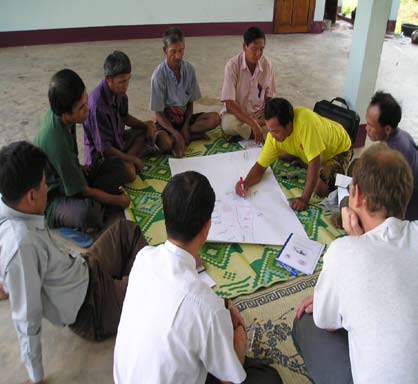
Figure 3. Collecting local knowledge - a fisher
drawsamapofadeeppool.
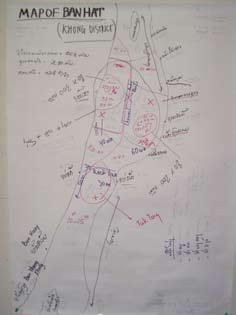
Figure4.Anexampleofamap
(BanHat)drawnbylocal
fishers showing the location
ofdeeppoolsandother
geographicfeatures.
10
3. Methods
Duringthesurveywecollecteddatafromthreesources:
·
Local knowledge about the pools and their fish from fishers;
·
Hydro-acousticdata;
·
CPUE information collected by selected local fishers in Champassak province, Lao PDR.
Localknowledge
Local fishing communities, who for generations have made a living from deep pools, possess a wealth of
knowledge about the ecology of the pools, their fish fauna and fish behaviour. The fishers usually know
thepreciselocationofdeeppools,theirdepthandsize.
In order to `tap' this knowledge we prepared a questionnaire to gather information on:
·
Physicalcharacteristicsoftheriver;
·
Fishingactivitiesbyseason;
·
The number of people fishing in the area;
·
Fishspeciescaughtandinformationabouttheirhabits.
We notified the villagers well in advance of the survey so the head of the village and several deep-pool
fishers were available to be interviewed. The interviews began with the villagers selecting one person
to draw a map of the stretch of the river where they normally fish (Figure 3). The fishers then annotated
mapswiththelocationofdeeppoolsandotherimportantphysicalandhydrographicfeaturessuchas
rapidsandstreams.Theyalsoprovidedadditionalinformationaboutthedeeppoolssuchastheirsizeand
depthandthephysicalnatureandconditionoftheriverbed(Figure4).
We asked the fishers about the fish species present in the deep pools at different times of the year and
whether any of these species spawned in the deep pools. However, we found it very difficult to get the
fishers to focus on the deep pool, and they often included information from surrounding areas as well. The
advantages, limitations and pitfalls of using local knowledge in fisheries surveys have been thoroughly
discussedbyValbo-JørgensenandPoulsen(2000).
We attempted to assess the importance villagers attached to the deep pools as fishing grounds by
gathering information about the number of people, both villagers and outsiders, fishing the pools. We also
obtainedinformationonthegearusedduringdifferentseasonsandatdifferentlocalitieswithparticular
emphasisonthoseusedindeeppools.Finallyweaskedifthedeeppoolsintheirlocalityweredesignated
FCZsand,ifso,whatrulesapplytothem.
After each interview the villagers were invited to ask questions. Their questions usually related to why
weneededthedataandwhatweweregoingtodowiththeinformationtheyprovided.Somevillagers
expressed concern that fishing in certain areas would be prohibited or restricted as a consequence of our
research.
At the end of each meeting we asked selected fishers to take part in the follow-up CPUE survey.
11
Hydro-acoustic Survey of Deep Pools in the Mekong River in Southern Lao PDR and Northern Cambodia
Length cm
500
TS = 20 log L - 66 dB
450
TS = 20 log L - 67 dB
400
TS = 20 log L - 68 dB
350
Love's formula: TS = 19.1*Log10(L)+0.9*Log10(Lambda)-23.9
300
250
200
150
100
50
0
-60
-57
-54
-51
-48
-45
-42
-39
-36
-33
-30
-27
-24
-21
-18
-15
Target strength (TS) dB
Figure5.Generalisedrelationshipbetweentargetstrength(TS)
and fish length (updated from Kolding, 2002).
The size of the swim bladder determines a fish's target strength. Consequently, species without swim bladders,
or with small swim bladders, have a lower target strength than fish of the same length with larger swim bladders.
This factor leads to the underestimation of the size of some fish species, and is a particular problem with
several species of catfish (see Appendix 3 for a list of species and the condition of their swimbladder).
170
160
Visitor
Introduced
150
Indigenous
140
Endemic
130
120
s
110
100
90
80
Number of Specie
70
60
50
40
30
20
10
0
5
15
25
35
45
55
65
75
90 100 110 135 145 160 170 180 200 240 275 400 420
Length
Figure6. The composition of the fish fauna in the Mekong - ordered by length
(source,MRC2003).
The riverine fish fauna supported by the Mekong is one of the most diverse in the world (Sverdrup-Jensen, 2002).
However,thisdiversitymeansthattheinterpretationoftherelationshipbetweentargetstrengthandthelength
of fish given in Figure 5 is more difficult in the Mekong than in other rivers with fewer species of fish.
12
Hydro-acoustic Survey of Deep Pools in the Mekong River in Southern Lao PDR and Northern Cambodia
Hydro-acousticsurveys
Principles of hydro-acoustic surveying
Hydro-acoustic surveys work on the same basic echo-sounding principles as does the sonar equipment
thatisusedtolocateshipsandsubmarines.Themethodisstraightforward;atransmitteremitsapowerful
acoustic signal (a `ping') and a receiver records the time and strength of echoes of the signal reflected
from the riverbed and from objects in the water column. Modern hydro-acoustic equipment uses a
transducertobothpropagateandreceivetheacousticsignal.
Assoundwavestravelthroughwaterataconstantvelocity,wecancalculatetherange(distance)ofthe
object,bymultiplyingthetimeelapsedfromtheemissionofthepingtothereturnoftheechobythe
speedofsoundinwateranddividingtheresultbytwo.(Thetimerecordedatthetransduceristhe`two-
way'time,i.e.totheobjectandback,thereforewedividethe`two-wayrange'inhalftogetthetruerange
oftheobject.)
The contrast between the density of water and the object reflecting the sonic wave governs the strength
(target strength) of the echo. Objects with significantly different density than water give a strong echo
while objects with density close to water give a weak signal. As a consequence the riverbed usually
returnsaverystrongsignal,particularlyifitisformedfromrockratherthansoftsediment.Organic
debris,ontheotherhand,havingadensitysimilartothewateris,byandlarge,transparenttosound
wavesandreturnsweakechoes.
Fish, in contrast, return a good echo. This is because even though the density of most of a fish's body
tissue is close to that of water, their swim bladders are filled with air. The size of the swim bladder largely
determines the target strength of fish. In many species of fish, target strength is roughly proportional to
the size of the swim bladder and therefore the size of a fish can be estimated from the strength of its echo
(Figure5).
However, those species of fish with small or no swim bladders return a weaker signal than the fish species
ofthesamesizewithwelldevelopedswimbladders.Intheseinstances,thestrengthofthesignalwill
greatly underestimate the size of the fish. This is, for example, true for many catfish and can be a problem
in rivers, such as the Mekong, that support large and diverse faunas of fish (Figure 6).
Thetransducerrecordstherangeandtargetstrengthofobjectsintheverticalacousticaxisbeneathits
location.Thisisaone-dimensionalacoustictrace.Twodimensionaltransects,orechograms,canbe
obtained by rigging the hydro-acoustic equipment to a boat and recording a succession of pings (usually
oneasecond)astheboatisdrivenoveradeeppool.IfthetransducerislinkedtoaGPS(Geographical
PositioningSystem)theexactlocationofthepingsandechoescanbeplottedandmapped(Figure7).
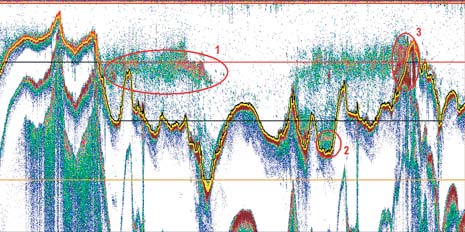
Figure8isanexampleechogramrecordedinFebruary2004overVeunWa,adeeppoolnearKokPadek
village in Siphandone. The geometry of the riverbed and the location of schools of fish are clearly visible.
Data acquisition
Inall,wesurveyed30deeppoolsandrecordedover160transects.Thenumberoftransectsinindividual
poolswerebetween1and33(Table2).Mostofthesurveyswererecordedduringdaylighthoursbecause
ofthedangerinvolvedinnavigatingamongrapidsafternightfall.Forthesereasonsnight-timesurveys
wererestrictedtoVeunSongkham,VeunWa,VeunLomphat,VangDonSamlanh,KhoumDonPhiand
VeunDuc.ThelocationsanddepthsofthepoolsaregiveninFigure2andTable1.
13
Hydro-acoustic Survey of Deep Pools in the Mekong River in Southern Lao PDR and Northern Cambodia
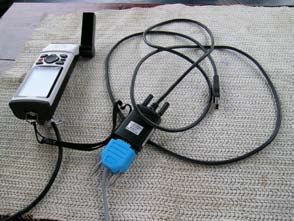
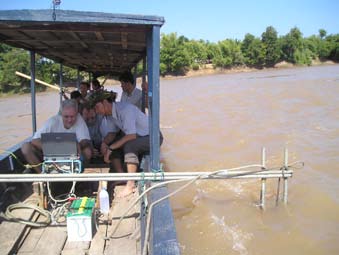
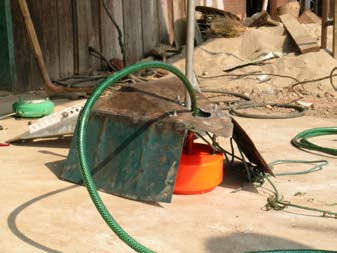
Figure 7. Hydro-acoustic equipment.
Top:Collectinghydro-acousticdatafromalocallyhired
boat-heretheboatiscruisingatabout3-5knots.
Middle: The hydro-acoustic equipment is attached to a GPS allowing
accurate location of the ping and the position of fish.
Bottom:Atransducerandprotectiveshield
(madebyalocalblacksmith).
14
Hydro-acoustic Survey of Deep Pools in the Mekong River in Southern Lao PDR and Northern Cambodia
Figure8.Anexampleechogram(top)recordedinVeunWa,near
thevillageofKokPadekinFebruary2004.
Top:TheechogramisdisplayedusingSonar4software.Thetransectisabout1,922mlongandtooknearly18
minutestorecord.Theverticalscaleisdisplayedinmetres(themaximumrecordeddepthisjustover30m)and
thehorizontalscale,intime.Theechogramrepresentstherecordsofover1060pings.Thehorizontallines,drawn
every 10 m, mark the boundaries of the layers used in processing the data to determine biomass and fish density.
Thestrongyellowlineistheriverbed.However,thetopographyoftheriverbedisgreatly
exaggeratedonthisechogram.Thehorizontalscaleisapproximately25timesthevertical
scale.Whatappeartobecrevicesandverysteepbanksaremoregentleinreality.
Red circles indicate concentrations of fish (the darker the more dense) in 1 open water, 2 near
thebottomofadepressionand3onthesideofabank(perhapsshelteringfromthecurrent).
Thesethreedifferentbehavioursaremostlikelydifferentspeciesorgroupsofspecies.
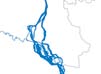
Bottom: Map showing the course of the boat as it circled around Veun Wa acquiring hydro-acoustic data.
15
Hydro-acoustic Survey of Deep Pools in the Mekong River in Southern Lao PDR and Northern Cambodia
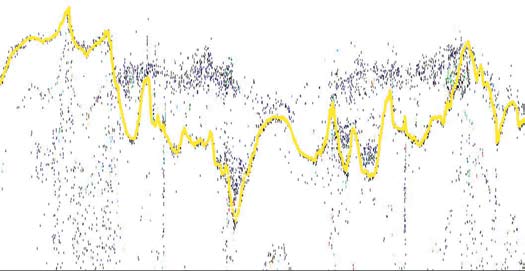
Figure9.SED(singleechoes
detected)processing.
Above:ThesameechogramasillustratedinFigure
8processedforsingleechoes.Smallorganisms
withlowdBhavelightcolourswhilelarge
organismsareshowninredtodarkcolours.
Left: Frequency histograms of the SED in -3bB
intervalsforeachofthethree10mlayersshownin
theechogramabove.Notetherelativeincreaseof
thelargetargetsasdepthincreases.(SeeFigure5
foranapproximateconversionfromdBtolength.)
16
Hydro-acoustic Survey of Deep Pools in the Mekong River in Southern Lao PDR and Northern Cambodia
We collected acoustic data from hired local boats cruising at speeds of 3-5 knots, using a scientific echo
sounder1. A split-beam transducer was mounted on a fixed structure on the fore-port side of the boat at a
depthof0.1-0.3mbelowthewatersurface.Echo-recordingstarted1mfromthetransducer,i.e.1.3m
belowthesurface.TheechosounderwasconnectedtoalaptopcomputerrunningtheER60softwarein
WindowsXP.ThecomputerwasalsolinkedtoaGarminGPS(Figure7).
Ateachpooltheboatdriverwasaskedtomanoeuvretheboataroundwithinthebordersofthepooluntil
we had collected sufficient data (see Figure 8 as an example). We recorded three files of approximately
10 minutes each at each site, however due to noise on some files, we were unable to analyse all of the
transects.Mostoften,theboatdriverwassofamiliarwiththeareathathedidnotneedanyguidanceto
coverthepool;ontheoccasionswhenthepoolshadaveryirregularshapewewereabletoguidethe
driveroftheboatusingthedisplaysonourcomputer'smonitor.
Data processing
In addition to recording echograms - which give a visual image of the location and size of fish and shoals
of fish - we also processed the echo-sounding data to determine biomass (Sa/ha) and fish density (fish/ha).
TodothisweusedSONAR4software(BalkandLindem,2005).Thegeneralprinciplesonthe
transmissionofacousticenergy,receptionoftheecho,measurementoftargetstrengthandecho
integrationfollowKolding(2002).
We processed the data in the following sequence:
1. Visuallyexaminetheechogramsandrejectthosewithtoomuchnoise.(Thebackgroundofthe
echogram in open water should be clear except where fish are present. However whirls, debris, air
bubbles and other artifacts can generate `noise' that degrades the quality of the echogram.)
2. Carefully define the riverbed using the bottom detection control in Sonar 4, save this and set the
offsetmarginto0.1mabovebottom.
3. Divide the water column on the echogram into 10 m depth strata (the top of the first strata stratum is
defined 1 m below surface).
4. SetanalysisinSONAR4to`allpingsandwholedepthrange'.
5. Analysis1:RecordtotalSa/haandtotalsingleechodetection(SED)ineachstratum.
6. Analysis 2: Set the number of sub-layers to `X' (X = number of 10 m strata). Record Sa/ha and fish/
haofeachlayer.
Total Sa/ha is the average total energy (with a lower limit threshold of 60 dB) reflected per hectare
within the stratum defined above and is proportional to the combined size of the air cavities, such as swim
bladders, in all organisms more than around 3-5 cm long (see Figure 5). However, species of fish that do
nothaveaswimbladders,willnotreturnastrongechoandthereforewillnotberegisteredbythehydro-
acoustic equipment. As a result the calculation of biomass using hydro-acoustics is only a rough estimate
andisverylikelytobeanunderestimateofthetruevalue.Thesingleechodetection(SED)algorithm
calculatesthenumberanddistributionofsingleechoes(singleorganisms)detectedintheechogramand
their respective reflected energy (= target strength) (Figure 9). The relative distribution of SED is raised
by the total Sa/ha to estimate of the total number of fish/ha (irrespective of size).
1
During2003weusedaSIMRADEY500echo-sounderandaES70-11transduceroperatingat70kHz.In2004weuseda
SIMRADEK60echo-sounderandaER60transducerat120kHz
17
Hydro-acoustic Survey of Deep Pools in the Mekong River in Southern Lao PDR and Northern Cambodia
Table2. 20032004 Survey -- location, season, mean Sa/ha, number of transects and
maximum depth
Lao PDR
Cambodia
Location
Season
Sa/ha
Noof
Pool
Season
Sa/ha
Noof
Pool
(mean) transects depth
(mean) transects depth
analysed (m)
analysed
(m)
VeuneSongkham
Wetanddry
496
33
38
VeunKhao
Wet
94
1
19
KhoumDonePhi
Wetanddry
600
8
21
VangDoneSamlanh
Wetanddry
283
11
23
BungPaKuan
Wetanddry
223
4
24
Outrel
Wet
283
3
50
VeunPaDuc
Wet
258
16
75
TmeiVillagetoStungTreng
Wet
135
2
54
Kohkaden
Wet
344
3
77
KohkadentoStungTreng
Wet
169
3
78
Kambor
Wet
375
2
60
Kosneng
Wet
361
10
42
Phae
Wet
291
1
36
Kohkantheay
Wet
459
3
33
Svay
Wet
29
1
16
Siembok
Wet
404
3
36
KohSnolau
Wet
247
3
19
Kantheydeeppool
Wet
446
3
42
KyKedeeppool
Wet
238
2
21
Osvay
Wet
285
1
20
Dolphindeeppool
Wet
747
6
36
VangLomphat
Wetanddry
340
8
22
VangKathaov
Wet
449
1
15
VeunDonTan
Wet
189
2
22
VeunIKhom
Dry
258
3
17
VeunPaDuk
Dry
428
3
19
VeunWa
Dry
368
6
38
VangNongHai
Dry
128
3
8
V.TholatytoV.DoneXang
Dry
261
1
16
VangDoneXang
Dry
254
2
11
VangTholaty
Dry
262
3
20
VeunSom
Dry
212
3
34
VangHangDoneSadam
Dry
455
2
11
VeunTaKong
Dry
720
3
24
BanNatoHatSayKhoun
Dry
221
1
20
BanHattoHatSayKhoun
Dry
537
2
34
VangSahong
Dry
108
1
4
Total
397
101
345
62
18
Hydro-acoustic Survey of Deep Pools in the Mekong River in Southern Lao PDR and Northern Cambodia
20032004Survey
Atotalof252transectswererecordedandanalysedin83210mdepthstrataduringthetwosurveys.
Ofthese89transects(35%)with152depthstratawerelaterexcludedbecauseofexcessivenoise
and/orunrealisticvalues.
Thefollowingresultsarebasedontheretained163transectsasdistributedinTables2and3.All
resultsfromSonar4wereprocessedusingPasGearII(KoldingandSkalevik,2004).
Table3.Summary of the 20032004 Survey
Lao PDR
Cambodia
Total
Year
Season
Sa/ha Numberof
Season
Sa/ha Numberof Sa/ha
Numberof
transects
transects
transects
2003
Wet(30Oct3Nov)
233
28
Wet(414Nov)
345
62
310
90
2004
Dry(21Feb2Mar)
460
73
460
73
Total
397
101
345
62
377
163
Note: Sa/ha is the total average energy reflected per hectare. Sa is the Total Area Back Scattering Coefficient
19
Hydro-acoustic Survey of Deep Pools in the Mekong River in Southern Lao PDR and Northern Cambodia
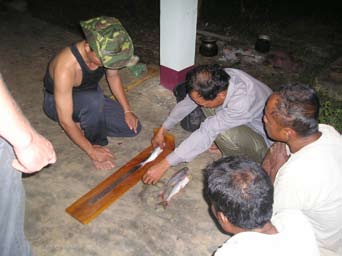
Figure10.Surveyteammembersdemonstratestandard
measuring procedures to local fishermen
BOX1.FishingGearsUsedinDeepPools
Very few gears are used for fishing in deep pools and most of them are not very efficient or
only fish well under certain circumstances. For instance, gill nets, which are among the most
popular gears, tend to get stuck among the rocks, and consequently fishers avoid the areas with
jagged riverbed even though they know that fish are concentrated there.
The only truly efficient gears in the deep pools are explosives and these are outlawed both by
national and local laws and regulations, due to their indiscriminate killing of large amounts of
fish and destruction of valuable fish habitats.
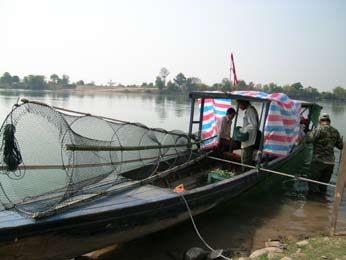
Teuk Tong is a bag net, which is only used in Lao PDR, and we are not familiar with any
similar gear in Cambodia. The Teuk Tong is an active gear which is operated by two people;
the gear is fished along the bottom weighed down by large stones. The two fishers stand in the
bow and stern of the ship respectively to keep the net open. When one of the fishers notices that
a fish has entered the net, he will trigger a device that closes the net and traps the fish inside.
As it requires considerable skill to use the gear without entangling it in rocks and logs, the
gear is no longer widely used in Lao PDR and only few people still know how to make Teuk
Tong. We therefore asked an experienced fisherman make some Teuk Tong for us, and we later
distributed them in the villages where we wished to collect data.
Figure 11. Test fishing with a fyke net brought from Denmark
20
Hydro-acoustic Survey of Deep Pools in the Mekong River in Southern Lao PDR and Northern Cambodia
CPUEsurvey
The information hydro-acoustics provides on fish is limited to their position in the water column, their
numbers and size. The equipment can only rarely be used to identify fish -- even in rivers with fewer
speciesthantheMekong.
However, rigorous and methodical surveys of fishers' catches can provide a lot of information on the
compositionandabundanceofthefaunaindeeppoolsifweassumethevariousgearstheyusecatcha
representative selection of the species and proportions of fish living in the pools.
We therefore undertook a small scale CPUE survey of local fishers' catches to provide data on fish species
and abundance. The survey involved three fishermen from each of the four Lao villages, Ban Done
Tavantok, Ban Kok Padek, Ban Hat, and Ban Hat Saykhoune (Figure 2). The choice of the fishermen
aimedtoensurethattheCPUEdataincludedrecordsfromcatchesusingalltypesofgearusedindeep
pools(Box1).
The fishermen were asked to keep a logbook of their catches from November 2003 to March 2004
recording the date, location, gear, gear size, number of fish caught by species, and length of all the fish1
(length was preferred to weight because it is quicker to measure correlates better with target strength).
Weusedauniformlengthtoweightratio(w=0.01l3,wherew=weightingramsandl=lengthin
centimetres) to estimate the weight of all the fish regardless of their species.
1 Because fishers were too busy to measure all their catch on days where catches were large, we agreed that, on these days, they
needonlymeasuretenrandomlyselectedindividualsperspecies.
21
Hydro-acoustic Survey of Deep Pools in the Mekong River in Southern Lao PDR and Northern Cambodia
Figure 12. Relationship between pool depth and biomass (Sa/ha) and fish density (fish/ha)
Above: The general relationship between pool depth (2 m depth intervals) and mean `biomass' (Sa/ha) and mean fish
densities. The fitted trend lines are 3rdorderpolynomials.Thenumberabovethebarsindicatesthenumberofsamples.The
trend lines display similar overall shape. Biomass and fish density increase with depth, reaching maxima in pools that are
25to30m.Indeeperpoolsbothmeasuresfall-off,reachingminimainpoolsabout65mdeep.Beneaththisdepthbiomass
and fish density increase once more. However, the difference between the fitted trend lines shows that biomass decreases
less than the number of individual fish. This suggests a general linear increase in mean size of fish with pool depth.
Below: Overall mean fish densities by 10 m depth strata. This plot shows similar trends to the chart
above. The maximum density of fish is found in depth strata between 21 and 41 m. The densities reach
aminimumbetween51and61mbeforeincreasingagainthedeepeststrata(61-81m).
22
4. Results
Localknowledge
The maps drawn by the local fishers provided excellent background information about the location and
depthofthepoolsneartheirvillages.Thesewereofgreathelpinthedetaileddesignofthehydro-acoustic
and CPUE surveys. Unfortunately the information provided by the fishers on the species of fish living in
the deep pools was less useful because in some cases they were unable to say whether the fish lived in
deeppoolsorinadjacentstretchesoftheriver.
Hydro-acoustics
Depth relationships
Theaggregatedresultsofdatafromallthepoolsshowaclearrelationshipbetweenbiomass(Sa/ha)
and fish density (fish/ha) and depth of pools (Figure 12). This relationship is observed in relation to the
maximumpooldepth(Figure12-top)andthe10mdepthstrata(Figure12-bottom).Bothbiomassand
fish density increase with depth to depths of about 30 m. Below this depth both measures fall off, reaching
a minima at around 65 m. However, at still greater depths both biomass and fish density begin to increase
onceagain,althoughtheydonotreachthelevelsrecordedat30m.
We observed several individual fishes in the deepest pools, which, according to their target strength,
were between 1 and 2 m in length. However most of the fishes in the deep pools (especially during the
wetseason)aresmaller(youngoftheyearorsmallspecies)anditispossiblethatthesehabitatsserveas
nurseriestosomespecies.
Geographic variations
Relative fish densities were higher in Cambodia than Lao PDR (Figure 13). The reasons for this are not
clear.Itdoesnotappeartorelatesolelytopooldepth.AlthoughthesectionoftheMekonginStungTreng
(northernCambodia)containsahigherproportionofpoolsdeeperthan40m(Figure13),thegreatest
biomass and density of fish are found at around 30 m, as we have just seen. Pools of this depth are more
evenlydistributedbetweenCambodiaandLaoPDR.
Seasonal variations
Biomass and fish density showed considerable seasonal variation (Figure 14). Surveys acquired during
the dry season (Feb-Mar 2004) recorded higher biomass and lower fish density than those recorded during
the wet season (Oct-Nov 2003). This suggests that more large fish live in the pools during the dry season,
supporting the contention that the habitats are a refuge for adult fish during these times.
Environmental variations and micro-habitats
At present, because we have little detailed information of the composition of the fish faunas, we cannot
account for the difference in biomass and fish densities recorded in the pools in northern Cambodia
and southern Lao PDR (Figures 13 and 15). However, the echograms clearly show that fish choose to
23
Hydro-acoustic Survey of Deep Pools in the Mekong River in Southern Lao PDR and Northern Cambodia
Figure13.ComparisonofbiomassandpooldepthinLaoPDRandCambodia.
Above:Thedistributionofdeeppools(groupedbydepth).Note,whilethedeepestpoolsareinCambodia,thedistributionof
pools in the range 21 - 40 m (which have the largest biomass and fish densities) is more evenly split between the countries.
Below: Comparison of biomass (Sa/ha) of pools in Lao PDR and Cambodia. The biomass is significantly greater in
theCambodianpools.Thereasonsforthisarenotfullyunderstood.Itdoesnotappeartobeafunctionofthedepthof
thepoolsasLaoPDRhasmorepoolsinthe21-40mrange,whichshouldhavethegreatestbiomass.Othercauses,
such as certain fishes' preference for particular micro-habitats, are more likely. These require further study.
24
Hydro-acoustic Survey of Deep Pools in the Mekong River in Southern Lao PDR and Northern Cambodia
2.00
1.50
1.00
0.50
0.00
2003
2004
Figure 14. Comparison of biomass and fish densities in the Oct-Nov 2003 (wet
season)andFeb-Mar2004(dryseason)phasesofthesurvey.
These plots include data from Lao PDR only (no data was acquired in Cambodia during 2004). Higher
biomass was recorded during the 2004 survey (dry season) while the fish density was significantly
lower than in 2003 (wet season). This suggests more large fish were living in the pools during these
months supporting the contention that adult fish use the pools as a dry season refuge.
25
Hydro-acoustic Survey of Deep Pools in the Mekong River in Southern Lao PDR and Northern Cambodia
10.00
9.00
Lao PDR
Lao PDR
8.00
7.00
6.00
5.00
4.00
3.00
2.00
1.00
0.00
Cambodia
Cambodia
Figure 15. Comparisons of biomass (left) and fish densities (right) in Lao PDR and Cambodia.
26
Hydro-acoustic Survey of Deep Pools in the Mekong River in Southern Lao PDR and Northern Cambodia
congregate in specific positions in the river. We assume, therefore, that the different pools offer different
micro-habitats1.
Mostpeopleprobablyassociatetheterm`deeppool'withaholeoraregulardeepeningintheriver
bottom. However, most of the Mekong deep pools are better described as canyons, fissures or cracks
inthebottom,anditisclearfromourobservationsthathydrographiccharacteristicsvaryfrompoolto
pool.Asyetthehydrology,geomorphologyandgeologyofthepoolshavenotbeenstudiedorsurveyed
inanydetailandthereasonsbehindtheirorigins,locationanddistributionarepoorlyunderstood.This
information is needed before their distribution and significance as fish habitats can be explained.
Allwecansayatpresentisthatthedepth,detritusintheriver,thenatureoftheriverbedandthestrength
and location of currents seem important factors in determining the number of fish seeking shelter in the
pools(Chanet al., 2005). Some of the fish in the deep pools clearly prefer to position themselves in the
vicinity of serrated rocks with steep, almost vertical, sides, where the current is obstructed. Here fish
may save a lot of energy in the quiet water and at the same time benefit from drifting food that often
concentrates in the whirlpools. Other fish seem to prefer the deepest holes where the recorded densities
almostuniversallywereveryhigh,whileothersagainwerefoundintheopenwater.Itislikelythatthese
micro-habitats support different fish assemblages.
CPUE
The 12 fishers who took part in the CPUE survey provided a daily record of where they fished and the
type and size of fish in their catch (Table 4). Unfortunately, none of them fished throughout the whole
survey period and during the last two months (February and March) only one fisher fished regularly.
In addition, one other fisher recorded the type and length, but not the number of fish in his catch (these
recordswereexcludedfromouranalyses).In total the fishers returned 1811 records of their catches.
These included 1764 individual fish belonging to 48 taxa.
Compositionofthecatch
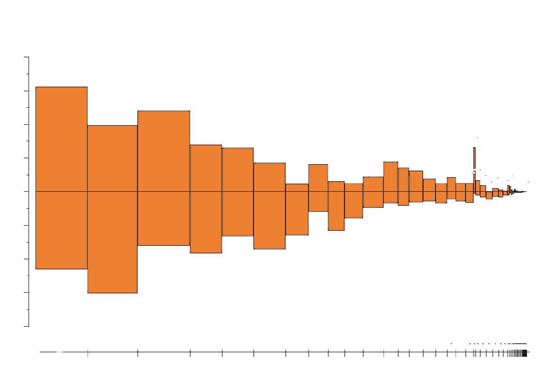
ThemostcommonspecieswerePaNangDeng(Hemisilurus mekongensis),PaGnone(Pangasiusspp.),
PaNangKhao(Micronema spp.)(Figure17andTable5).
However,therewererelativelylargeseasonalvariationsinthecompositionofthecatch,particularly
amongthedominantspecies(Table6).Astheusageofvariousgearsremainedrelativelystableduringthe
surveyperiod,webelievethatthesechangesaremostlikelyduetoseasonalmigrationpatterns.
Catch rates and size distributions
Although catch rates (in terms of the number of fish caught per gear set) varied between the different
gears,theresultsoftheCPUEsurveyshowabroadcorrelationbetweencatch-rateandthedepthofpools
(Figure 17). The only significant deviations from this trend were the catch rates recorded by fishers using
gillnetsorTeukTonginshallowpools(0-9m).Iftheresultsfromtheseveryshallowpoolsarediscounted
1 Poulsenet al. (2002) document the preference some fish species show for particular pools. Local fishers, recognising these
preferences, often name pools after fish that are particularly abundant. Bung Pa Kouang,forexamplestranslatesaspoolofthe
Boesemancroaker(Boesemania microplepis).
27
Hydro-acoustic Survey of Deep Pools in the Mekong River in Southern Lao PDR and Northern Cambodia
Table4.CPUE data recorded by 12 local fishers during the survey period
FisherName
Nov2003
Dec2003
Jan2004
Feb2004
Mar2004
Total
Catchrate(No/Set)
3.8
1.0
1.7
1.8
MrBoungnong
Noofsets
5
12
23
40
Catchrate(No/Set)
4.4
1.9
3.9
3.8
3.0
MrSeum
Noofsets
3
20
8
13
44
Catchrate(No/Set)
7.0
3.1
9.1
5.1
5.4
MrYongphao
Noofsets
2
13
10
29
54
Catchrate(No/Set)
4.0
1.9
1.7
2.0
2.6
MrKhambone
Noofsets
24
23
18
1
66
Catchrate(No/Set)
9.0
2.9
3.5
4.0
3.5
MrLeuam
Noofsets
2
17
13
1
33
Catchrate(No/Set)
1.4
1.6
2.0
1.5
MrPane
Noofsets
30
16
1
47
Catchrate(No/Set)
3.2
5.3
3.0
4.0
MrKhambay
Noofsets
10
30
27
67
Catchrate(No/Set)
9.0
4.5
4.8
MrSithat
Noofsets
2
25
27
Catchrate(No/Set)
2.1
1.9
3.4
2.7
MrSichanh
Noofsets
10
15
25
50
Catchrate(No/Set)
2.0
4.7
6.2
4.6
MrBounlap
Noofsets
4
9
6
19
Catchrate(No/Set)
4.6
8.8
7.0
7.5
MrKamfong
Noofsets
7
18
5
30
Catchrate(No/Set)
0.9
1.0
1.0
1.0
1.0
MrSomphone
Noofsets
7
29
27
1
64
Catchrate(No/Set)
3.6
3.2
3.5
2.2
4.8
3.3
Total
Noofsets
76
99
218
115
33
541
Village
Fisher
BanKokPadek
MrBoungnag
MrSeum
MrYoungphao
BanHatSaykhone
MrKhambone
MrLeuam
MrPane
BanHat
MrKhambay
MrSithat
MrSichanh
BanDoneTavantok
MrBounlap
MrKhamfong
MrSomphone
28
Hydro-acoustic Survey of Deep Pools in the Mekong River in Southern Lao PDR and Northern Cambodia
Figure 16. Relative importance and frequency of the 48 species caught by fishermen in the CPUE survey.
Relativeimportance(%No+%W) %FRQ (=frequency of occurrence).
Gears:gillnets,longlinesandTeukTong.
Onlythe12mostimportantspeciesarelabelled
Table5.CPUE from the Ban Done Tavantok, Ban Kok Padek, Ban Hat and
Ban Hat Saykhone, Campassak province, Lao DPR.
Gillnet
Longline
TeukTong
Number of fish caught
956
336
472
Numberofspeciescaught
31
25
17
Dominatingspecies1
PaGnone
17%
PaNangKhao
16%
PaNangDeng
28%
Dominatingspecies2
PaPhia
12%
PaKe
13%
PaGnone
18%
Dominatingspecies3
PaNaNou
12%
PaKotLeuang
12%
PaNagKhao
14%
Note:
PaNjon(PaGnone)=severalsmallpangasiidspecies
PaPhia=Labeo chrysophekadion andLabeo barbatulus
PaNaNou=Helicophagus waandersii andHelicophagus leptorhynchus
PaNangKhao = Micronema spp.
PaKe=Pangasius conchophilus
PaKotLeuang=Hemibagrus sp.
PaNangDeng=H. mekongensis
29
Hydro-acoustic Survey of Deep Pools in the Mekong River in Southern Lao PDR and Northern Cambodia
Table6.Composition of the total catch listing the 23 numerically most abundant species
Total
Nov-Dec
Jan-Feb
Mar-Apr
Species
No
%No
No
%No
No
%No
No
%No
Pangasius spp.
266
15.10
91
15.20
131
13.00
44
27.80
Hemisilurus mekongensis
203
11.50
39
6.50
163
16.20
1
0.60
Helicophagus waandersi
161
9.10
67
11.20
48
4.80
46
29.10
Pangasius conchophilus
150
8.50
59
9.90
89
8.80
2
1.30
Micronema spp.
141
8.00
48
8.00
91
9.00
2
1.30
Labeo chrysophekadion
116
6.60
34
5.70
82
8.10
0
0.00
Scaphognathops spp.
113
6.40
77
12.90
11
1.10
25
15.80
Gyrhinocheilus spp.
102
5.80
13
2.20
88
8.70
1
0.60
Mekongina erythrospila
69
3.90
22
3.70
39
3.90
8
5.10
Cosmocheilus harmandi
52
2.90
28
4.70
24
2.40
0
0.00
Hemibagrus sp.
42
2.40
14
2.30
27
2.70
1
0.60
Labeo dyocheilus
36
2.00
15
2.50
20
2.00
1
0.60
Hypsibarbus/Barbonymus spp.
29
1.60
11
1.80
16
1.60
2
1.30
Chitala blanci
29
1.60
3
0.50
25
2.50
1
0.60
Cyclocheilichthys enoplos
28
1.60
8
1.30
6
0.60
14
8.90
Hemibagrus wyckioides
27
1.50
13
2.20
14
1.40
0
0.00
NoName
25
1.40
16
2.70
8
0.80
1
0.60
Hemibagrus wyckii
24
1.40
12
2.00
11
1.10
1
0.60
Henicorhynchus spp.
20
1.10
0
0.00
18
1.80
2
1.30
Belodontichthys dinema
18
1.00
1
0.20
17
1.70
0
0.00
Cirrhinus microlepis
13
0.70
0
0.00
13
1.30
0
0.00
Notopterus notopterus
13
0.70
2
0.30
11
1.10
0
0.00
Bagarius spp.
12
0.70
2
0.30
10
1.00
0
0.00
23MostAbundantSpecies
1689
95.50
575
96.10
962
95.60
152
96.10
OtherSpecies
75
4.50
23
3.90
44
4.40
6
3.90
Total
1764
100.00
598
100.00
1006
100.00
158
100.00
NoGearSet
541
175
333
33
CatchperNoGearSet
3.27
3.42
3.02
4.79
Month
Nov
Dec
Jan
Feb
Mar
NoGearSet
76
99
218
115
33
CatchperNoGearSet
3.60
3.20
3.50
2.20
4.80
Note: No=numberofindividuals,%No=percentageofthetotalcatch
30
Hydro-acoustic Survey of Deep Pools in the Mekong River in Southern Lao PDR and Northern Cambodia
theoveralltrendsareverysimilartoresultsachievedfromthehydro-acousticsurveys.
The distribution of sizes of fish was uniform regardless of the depth of the pool. The largest fish (there
werefewspecimensover50cminlength)werecaughtusinglonglineandTeukLong,gearsthatare
morecommonlyusedindeeperpools(Figures17and18).
Both catch-rate and the distribution of fish sizes showed interesting variations during the survey period
(Figure 19). The catch-rate was constant through the first three months of the survey but fell sharply in
FebruarybeforepeakinginMarch.However,theaverageindividualweightrosethroughDecemberto
January(fromahighinNovember),beforedecliningsharplyinMarch.
The CPUE data in March (large numbers and small fish) conflicts with hydro-acoustic records that
recorded high biomass and low fish density (small numbers and large fish) during the dry season of
monthsofFebruaryandMarch.Thereasonsforthisdiscrepancyarenotclear;theycouldbetheresultof:
·
Fishers changing their fishing grounds in March during the low water period to areas with smaller
fish;
·
Large fish living so deep in the pools that they are out of reach of the fishers;
·
Thedatacollectedduringthesemonthsbeingunrepresentative,ascomparativelyfewgearswereset
duringMarch(Table6).
One of the reasons people stopped fishing was the presence of large growth of filamentous algae during
the dry-season when the water was clear. These algae are a severe impediment to the fishery and several
fishers complained that drifting algae choked their nets at this time of the year.
31
Hydro-acoustic Survey of Deep Pools in the Mekong River in Southern Lao PDR and Northern Cambodia
Figure17.Catchrates(numberofgearset)bydepthofpoolgroupedinto10mintervals.
Boxes=mean±SE
Bars=mean±95%confidenceinterval(alpha=0.005)
Numbersabovebars=samplesize
32
Hydro-acoustic Survey of Deep Pools in the Mekong River in Southern Lao PDR and Northern Cambodia
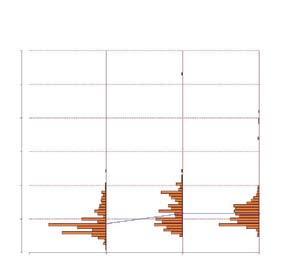
Figure 18. Length frequency distribution by gear type (left) and depth of pool (right) with mean
lengthsuperimposed(bluelines).
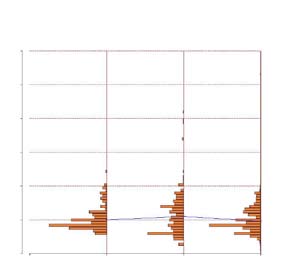
Figure19.Meancatchrate(left)andindividualmeanweight(right)bymonth.
Boxes=mean±SE
Bars=mean±95%confidenceinterval(alpha=0.005)
Numbersabovebars=samplesize
Superimposedlineartrendlineonmeans(N=5)with95%confidenceintervals(notsignificantlydifferentfrom0inbothpanels)
33
Hydro-acoustic Survey of Deep Pools in the Mekong River in Southern Lao PDR and Northern Cambodia
34
5. Conclusionsandrecommendationsforfurtherwork
Theresultsofthe20034surveyshowthathydro-acousticscangeneratevaluableinformationaboutthe
distribution and behaviour of fish living in deep pools. Much of this information cannot be obtained from
conventional surveys of fishers and their catches. The images provided by echograms show the location
of individual fish and shoals of fish in pools and analyses of strength of echoes returned by fish provide
information on the size of fish, fish density and the distribution of biomass.
However, the method has limitations. It cannot be used to identify fish species and, because some species
have small or no swim bladders, the measures of biomass and fish density derived from hydro-acoustics
are qualitative, or comparative, rather than quantitative.
Notwithstandingtheselimitations,the20034surveysprovidesomeintriguinginsightsintothebehaviour
of the fish living in deep pools. While fishers and fish biologists have long known that some species prefer
particular pools, or positions within pools, hydro-acoustics provide the first visual images of fish and
shoals of fish congregating in specific riverine habitats. Moreover, GPS siting of the surveys provides the
means to map the location of fish and shoals of fish with precision.
The surveys also brought to light interesting geographical and seasonal fluctuations in both biomass and
fish density. At present however, the meaning of these fluctuations, in terms of fish behaviour and ecology,
is obscure. This is partly because of inadequate coverage (although at least three transects were recorded
at each location, many of the files could not be analysed due to noise, and only five pools in Lao PDR
werecoveredinbothwetanddryseasons,whiletheCambodianpoolswereonlysurveyedduringthe
wetseason)andpartlybecauseinformationfromthehydro-acousticsalsoneedstobeproperlyintegrated
with data on other ecological factors, such as vegetation, flow, currents and substrate, that influence fish
behaviour.
Given that the hydro-acoustics can provide scientifically valuable data, the broader question arises
astothepracticalvalueofthisnewinformationinthewiderobjectiveofmanagingthesustainable
development of the Mekong's natural water resources in general and its fisheries in particular.
Clearly,asdeeppoolsareimportantdryseasonrefugesformanyoftheMekong'scommercially
important fish species, any changes in the ecology of these habitats may have serious repercussions for
the fisheries further downstream. At present, the pools and the fisheries are in reasonably good health.
The diversity of the species and number of large fishes indicates that, as yet, the pools are not over-fished
andagriculturalorindustrialpollutantsdonotyetseriouslythreatentheenvironmentofthepools(MRC,
2003).However,thepressuresoffeedingthebasin'sexpandingpopulationandtheneedforsustainable
developmentofallthenaturalresourcesprovidedbytheMekongmaychangethisinthefuture.
Therefore, monitoring the ecological status of the pools and the condition of their aquatic fauna is
important, not only for the conservation of local fisheries, but also for the livelihoods and food security of
manyofthebasin'sinhabitants.Itisagenuinetrans-boundaryissuethatpotentiallyaffectspeopleinall
fourMRCmembercountries.Moreover,manyenvironmentalscientistsconsiderthehealthofthedeep
poolsisindicativeofthehealthMekonganditstributariesandrecommendmonitoringthepoolsasa
checkontheconditionoftheriversystemasawhole(Poulsenet al.,2002).
Hydro-acoustics could provide one practical way to perform this type of monitoring. The technique has
many advantages; once purchased the equipment has low operating costs, the surveys are repeatable and
data is quickly and easily acquired, they do not harm fish and are suitable for use in ecologically sensitive
sites and FCZs, that are off-limits to fishers.
35
Hydro-acoustic Survey of Deep Pools in the Mekong River in Southern Lao PDR and Northern Cambodia
However, environmental monitoring requires detailed knowledge of existing baseline conditions from
whichtoidentifyandmeasurechangesintheecologyandthefaunasofthedeeppools.Thisknowledge
doesnotcurrentlyexist,particularlyconcerningtheinformationprovidedbyhydro-acoustics.Therefore,
future work, at least in the short-term, should aim at defining these baseline conditions.
Inthecaseofhydro-acoustics,thisinvolves:
·
CompilingaGISdatabaseofdeeppoolscontaininghydrographicmaps,anddataonhydrology,
ecologyandfaunas.
·
Evaluating the information echograms provide about the distribution of fish in individual pools in
relation to the configuration of the riverbed, the nature of the substrate, local currents and other
environmentalparameters.
·
Analysing biomass and fish density data in 10 metre depth strata rather than by the maximum-
recordedpooldepth.
·
Recording and mapping biomass and fish density in individual pools at varying times of day and
duringdifferentseasons.
Muchofthisworkcanbeaccomplishedusingexistinghydro-acousticdata;however,thelastactivity
requires acquisition of new data. Ideally, these new surveys should focus on acquiring a denser grid of
dataoverasmallnumberofpoolsthatareeasytoaccessandpresentfewoperationalproblems.
36
6. References
Baird,I.G.(2004)Strength in diversity: Fish sanctuaries and deep-water pools in the Lao PDR,Paper
presented at the International Conference on Sustainable Aquatic Resources are more than Managed Fish:
TheEcosystemApproachinInlandFisheriesaretheRoleofIntra-CountryLinkages,Penang.
Baird,I.G.,Inthaphaysi,V.,Kisouvannalath,P.,Vongsenesouk.B.andB.Phylaivanh(1999)The
setting up and the initial results of a villager based system for monitoring fish conservation zones in the
MekongRiver,KhongDistrict,ChampassakProvince,SouthernLaoPDR.EnvironmentalProtectionand
CommunityDevelopmentintheSiphandoneWetland,ChampassakProvince,LaoPDR.
Baird,I.G.,Kisouvannalath,P.,InthaphaisyV.andB.Phylavanh(1998)The Potential for ecological
classification as a tool for establishing and monitoring fish conservation zones in the Mekong River,
EnvironmentalProtectionandCommunityDevekopmentintheSiphandoneWetland,Champasack
Province,LaoPDR,CESVI,Pakse,28pp.
Baird,I.G.andB.Phylavanh(1999)Observations of the vocalisations of spawning Mekong river Goldfin
Tinfoil barb Hypsibarbus malcolmi (Smith 1945) in southern Lao PDR below the Khone falls.Technical
reportpreparedfortheEnvironmentalProtectionandCommunityDevelopmentinSiphandoneWetland
Project,CESVI,Pakse,LaoPDR,9pp.
Bouakhamvongsa,K.andA.F.Poulsen(2001)FishmigrationandhydrologyintheMekongRiver.
Mekong Conference Series1:114-121.
Chan S., Putrea S. and H.G. Hortle (2005) Using local knowledge to inventory deep pools, important fish
habitatsinCambodia.InProceedings of the 6th Technical Symposium on Mekong Fisheries (6thTechnical
SymposiumonMekongFisheries,Pakse,LaoPDR,26th28thNovember2003)T.J.BurnhillandM.M.
Hewitt,eds.MekongRiverCommission,Vientiane,pp.57-76.
Chomchanta,P.,Vongphasouk,P.,Chanrya,S.,Soulignavong,C.Saadsy,B.andT.Warren(2000a)
A preliminary assessment of Mekong Fishery Conservation Zones in Southern Lao PDR, and
recommendations for further evaluation and monitoring,LARReC,Vientiane,29pp.
Chomchanta,P.,Vongphasouk,P.,Soukhaseum,V.,Soulignavong,C.,Saadsy,B.andT.Warren(2000b)
Migration studies and CPUE data collection in southern Lao PDR 1994 to 2000.Midprojectsummary,
LARReC,Vientiane,24pp.
Fisheries Office, Ratanakiri Province (2000) A study of the downstream impacts of the Yali Dam in the
SesanRiverBasininRatanakiriProvince,NortheastCambodia.Reportpreparedincooperationwiththe
Non-TimberForestProducts(NTFP)Project,RatanakiriProvince,Cambodia.
Heng, K., Ngor P. B. and L. Deap (2001) The dry season migration pattern of five Mekong fish species:
TreyChhpin(Barbodes gonionotus)TreyKaek(Morulius chrysophekadion)TreySloeukRussey
(Paralaubuca typus)TreyKlangHay(Belodontichthys dinema)andTreyPo(Pangasius larnaudiei),
Cambodia Fisheries Technical Paper Series3:73-87.
Hill,M.T.andS.A.Hill(1994)FisheriesecologyandhydropowerintheMekongRiver:anevaluationof
run-of-the-riverprojects.MekongSecretariat,Bangkok.
Kolding,J.(2002)The use of hydro-acoustic surveys for the monitoring of fish abundance in the deep
pools and Fish Conservation Zones in the Mekong River, Siphandone area, Champassak Province, Lao
PDR, consultancy report, Living Aquatic Resources Research Center, Vientiane.
37
Hydro-acoustic Survey of Deep Pools in the Mekong River in Southern Lao PDR and Northern Cambodia
Kolding,J.andÅ.Skålevik,(2004)PasGearII.A database package for experimental or artisanal fishery
data,DepartmentofBiology,UniversityofBergen,Norway(http://www.cdcf.no/data/pasgear).
MRC(2003)MekongFishDatabase,CD-ROM,MekongRiverCommission,PhnomPenh,Cambodia.
Poulsen,A.,OuchP.,Viravong,S.,Suntornratana,U.andT.T.Nguyen(2002)DeepPoolsasDrySeason
HabitatintheMekongRiverBasin.MRC Technical PaperNo.4,MekongRiverCommission,Phnom
Penh,Cambodia,24pp.
Roberts, T.R. and I.G. Baird (1995) Traditional fisheries and fish ecology on the Mekong at Khone
WaterfallsinsouthernLaos.Natural History Bulletin Siam Society,199543,219262
Valbo-Jørgensen,J.andA.F.Poulsen(2000)Usinglocalknowledgeasaresearchtoolinthestudyof
river fish biology: Experiences from the Mekong. Environment, Development and Sustainability2(3-4),
253276.
Vannaren,C.andS.Kin(2000)FisheriespreservationintheMekongRiverpoolsinStungTrengand
KratieProvinces.TechnicalReport.DepartmentofFisheries,PhnomPenh.
VanZalinge,N.,Degen,P.,Pongsri,C.,SamN.,Jensen,J.G.,Nguyen,V.H.andX.Choulamany(2004)
TheMekongRiverSystem.InProceedings of the Second International Symposium on the Management
of Large Rivers for Fisheries Volume 1 (SecondInternationalSymposiumontheManagementofLarge
RiversforFisheries,PhnomPenh,11-14February2003)R.L.WelcommeandT.Petr,eds.FAORegional
Office for Asia and the Pacific, Bangkok, Thailand. RAP Publication 2004/16, pp. 335357.
Welcomme, R.L. (1985) River fisheries. FAO Technical Paper No.262,Rome.
38
Appendix 1. Index of fish species with their Lao names
39
Hydro-acoustic Survey of Deep Pools in the Mekong River in Southern Lao PDR and Northern Cambodia
Species
code
Lao name
Scientific name
3 ¯¾ªº¤-©¾¸
Chitala ornata
4 ¯¾ªº¤-쾨
Chitala blanci
5 ¯¾ªº¤
Notopterus notopterus
7 ¯¾Ï¾¡°¾¤
Tenualosa thibaudeaui
9 ¯¾¦½ ¾¡- ɺ¨
Lycothrissa crocodilus
11 ¯¾-Áª®
Paralaubuca typus
23 ¯¾-Àºò -ª¾-Á©¤
Probarbus jullieni
24 ¯¾-Àºò -¢¾¸
Probarbus labeamajor
27 ¯¾-Â¥¡ , ¯¾Ï¾¡®¾
Cosmochilus harmandi
29 ¯¾¥º¡-¹ö¸-Á¹ì´
Cyclocheilichthys enoplos
34 ¯¾¦½¡¾¤-Á¹ìÉ , ©¿
Puntioplites proctozysron
35 ¯¾¦½¡¾¤
Puntioplites falcifer
39 ¯¾¯¾¡- ¾
Barbonymus gonionotus
44 ¯¾-¯¾¡Î¸©, ¯¾¢s¯ø
Hypsibarbus malcolmi
50 ¯¾-¦ø©-¢É¾¤-¥Õ
Hampala dispar
51 ¯¾-¦ø©-¢É¾¤-Á§¡
Hampala macrolepidota
52 ¯¾¡½-¹, ¯¾-¢½-´ñ
Catlocarpio siamensis
54 ¯¾¹¸È¾Îɾ ð
Bangana behri
58 ¯¾À²~¨©¿
Labeo chrypsophekadion
59 ¯¾²º
Cirrhinus microlepis
63 ¯¾¦Éº¨¹ìñ¤Î¾´, ¯¾¦Éº¨ê¸Ä¯
Henicorhynchus siamensis
66 ¯¾-º-Äê, ¯¾ ö¡-À¢ö¾
Osteochilus hasselti
74 ¯¾-¦½-ºó
Mekongina erythrospila
77 ¯¾Ïø
Botia modesta
79 ¯¾Á¢É¸Ä¡É , ¯¾Ïø쾨
Botia helodes
84 ¯¾¡ö©À¹ìõº¤
Hemibagrus nemurus
86 ¯¾¡ö©ÏÓ , ¯¾¡ö©©¿
Hemibagrus wyckii
90 ¯¾-Á¢É-£¸¾¨
Bagarius yarrelli
91 ¯¾-Á¢É-¤Ñ
Bagarius bagarius
93 ¯¾ ¾¤-Á©¤
Hemisilurus mekongensis
40
Hydro-acoustic Survey of Deep Pools in the Mekong River in Southern Lao PDR and Northern Cambodia
Species
code
Lao name
Scientific name
95 ¯¾-À§õº´ , ¯¾¯ó¡-Ä¡È
Kryptopterus cryptopterus
96 ¯¾ ¾¤ , ¯¾-¦½-¤í¸, ¯¾-¹ìñ¤-¢¼¸
Micronema apogon
97 ¯¾ ¾¤ , ¯¾-¦½-¤í¸
Micronema bleekeri
99 ¯¾£É¾¸
Wallago attu
100 ¯¾£ø
Wallago leeri
101 ¯¾ÎɾÎø , ¯¾¹º¨
Helicophagus waandersii
102 ¯¾À°½ , ¯¾Á¡
Pangasius conchophilus
103 ¯¾¹ö¸´È¸´, ¯¾ ¾¤ , ¯¾Á¡
Pangasius bocourti
104 ¯¾-§¸¾¨-Á©¤ , ¯¾-§¸¾¨-Á¢É¸
Pangasianodon
hypophthalmus
105 ¯¾§¸¾¨¢¾¸ , ¯¾§¸¾¨Ï¾¡Ä´
Pangasius krempfi
106 ¯¾-§¸¾¨-¹¾¤-¹É¼
Pangasius polyuranodon
107 ¯¾-¯^¤ , ¯¾¹øϾ©
Pangasius larnaudii
108 ¯¾-Àìó´
Pangasius sanitwongsei
110 ¯¾¨º
Pangasius macronema
111 ¯¾¨º -êɺ¤-¡ö´
Pangasius pleurotaenia
112 ¯¾¨º -¹ìñ¤-¡¤
Pangasius siamensis
113 ¯¾¨º -ª¾-ÂìÉ
Laides hexanema
118 ¯¾¹ì¾©-©¿
Mastacembelus armatus
121 ¯¾¡-¸¾¤
Boesemania microlepis
122 ¯¾¡È¾
Pristolepis fasciata
125 ¯¾¡½-À©ó©
Trichogaster trichopterus
126 ¯¾-ÀÏ~ ¦ö®-¹ñ¡
Osphronemus exodon
128 ¯¾£Ò
Channa striata
142 ¯¾ªº¤-©¿
Chitala lopis
175 ¯¾¯ó¡-Ä¡È , ¯¾-À§õº´-¢¾¸
Micronema cheveyi
¯¾¹ö¸´È¸´, ¯¾ ¾¤, ¯¾§¸¾¨¹¾¤¹É¼ , ¯¾-§¸¾¨-¹¾¤-
178
Pangasius kunyit
Á¹É´
41
Hydro-acoustic Survey of Deep Pools in the Mekong River in Southern Lao PDR and Northern Cambodia
42
Appendix2.Informationgatheredfromvillagersabouttheareascovered
bytheCPUEsurvey
43
Hydro-acoustic Survey of Deep Pools in the Mekong River in Southern Lao PDR and Northern Cambodia
BANHAT
Total population:
868
Household:
178
Fishers:
210
Paddle boats:
?
Motor boats:
?
Other villages fishing in the area:
BanNokKok,BanVeunKhao,BanHouay,BanNaandBanHangKhong.
Deep pools:
Name of deep pool
Depth
Size
Bottom
Other information
VangKongPhou
25wa/37m
80mx300m
-
-
VangHinSoung(highrock) 15wa/25m
80mx200m
-
-
NaTaSaodeeppool
-
-
-
-
SandBeach"SanWa"
-
-
-
-
VangSongKham
-
-
Rockywithcaves
Many fish species live in the
deeppool
Other important fish habitats:
Streams:HouayNa
Fishing gears:
Name of Fishing gear
Fishing season
Number of fishers
Stationarygillnet
-
-
Longline
-
-
Driftnet
-
-
Chantrap
Flood
-
Khatrap
Flood
-
Lanhtrap
Flood
-
Important species include:
PaNoo,PaKae,PaNangDeng,andPaSaNgua
PaNangDengisknowntospawninthedeeppool.Thespeciesnormallystayinthedeeppoolduringthe
dayandmovetoshallowwaterduringthenight.
44
Hydro-acoustic Survey of Deep Pools in the Mekong River in Southern Lao PDR and Northern Cambodia
Species occurring in the deep pools and the gears with which they are caught:
Species Code
Months
Size (cm)
Other information
Min.
Max.
7
3-6
5
20
20
5-6
15
CatchjuvenilesfromMarchtoJune
23
5-6
30
Caught one fish weighing 37 kg in December
44
2-5
10
Maxsize2kg
100
10
10
Juveniles
97
1-12
5
50
54
2-5
15
40
Maxsize5kg
93
2-5
10
35
1kgismaxweightcaughtwithallgears
105
6
30
Few
103
1-12
20
30
Maxsize1.5kg
121
3-5
-
-
Fewapp.5peryearMaxsize1kg
110
1-12
15
25
107
5-6
25
Maxsize1kg
104
10
35
Caughtwithcastnet
108
10
5
Juveniles
45
Hydro-acoustic Survey of Deep Pools in the Mekong River in Southern Lao PDR and Northern Cambodia
BANHATSAYKHOUN
Total population:
1257
Households:
219
Fishers:
219
Motor boats:
40
Paddle boats:
160
Other villages fishing in the area (numbers in brackets refer to number of fishers):
BanNangKhuat(5-6),KhongIsland(30),BanNokKok(10)andBanHouayKaeng(40).
Deep pools:
Name of deep pool
Depth
Size
Bottom
Other information
DonSamLan
-
-
-
FCZestablishedin19961
KhoumPhi
20m
100m*200m
Smallstonesandsand
-
VeunTong
6-7m
-
Smallstonesandsand
-
Other important fish habitats:
Rapids:KaengKhanYang,KaengHouaDonSamLane,andKaengKhanHinLack
Streams:HouayKaeng,HouayVangKaDaoandsomecanals
Fishing gears:
Name of gear
Fishing season
Number of fishers
Other information
Gillnet
-
-
-
Longline
-
-
-
Castnet
-
-
-
Lop
-
-
-
Chan
-
-
-
TeukTong
-
-
WaspreviouslyusedinVeunTong
Spear
-
-
-
46
Hydro-acoustic Survey of Deep Pools in the Mekong River in Southern Lao PDR and Northern Cambodia
Species occurring in the deep pools and the gears with which they are caught:
Code
Few Many
Month
Size (cm)
Surface
Middle
Bottom Types of Fishing
Min
Max
118
x
5-6
2
60
x
Gillnet,longline,cast
net
034
x
5-6
2
20
x
Gillnet,castnet
007
x
3-4
2
20
x
Gillnet
011
x
3-4
2
15
x
Gillnet,castnet,Toom
trap
003
x
1-12
6
60
x
Gillnet,longline,cast
net,liftnet
004
x
1-12
6
60
x
Gillnet,longline,cast
net,liftnet
005
x
6-9
5
10
x
Gillnet,longline,cast
net,liftnet
142
x
099
x
3-5
2
100
x
Gillnet,longline,cast
net
050
x
6-10
3
15
x
Gillnet,longline,cast
net
051
x
6-10
3
15
x
Gillnet,longline,cast
net
029
x
1-12
5
20
x
Gillnet,longline,cast
net
023
x
5-6
5
30
x
Gillnet,longline,cast
net,Loptrap
024
x
10-12
5
100
x
Gillnet,longline
035
x
5-6
5
10
x
Gillnet,castnet
044
x
1-4
5
15
x
Gillnet,longline,cast
net
039
x
3-6
5
15
x
Gillnet,longline,cast
net,Lanetrap
027
x
5-12
5
30
x
Gillnet,castnet,Loptrap
126
x
3-4
5
30
x
Hookandline
100
x
3-4
10
100
0
x
longline,liftnet(xon)
175
x
6-7
3
15
0
x
Gillnet,longline
095
x
6-8
2
5
x
x
x
Gillnet,longline,cast
net
097
x
6-8
3
10
x
Gillnet,longline
096
x
10-2
10
70
x
Gillnet,longline,hook
line
097A
x
3-4
10
70
x
Gillnet,longline
093
x
3-4
5
40
x
Gillnet,longline
121
x
3-4
10
60
x
Gillnet,longline,cast
net
110
x
1-12
5
20
x
Gillnet,longline,cast
net
47
Hydro-acoustic Survey of Deep Pools in the Mekong River in Southern Lao PDR and Northern Cambodia
Code
Few Many
Month
Size (cm)
Surface
Middle
Bottom Types of Fishing
Min
Max
112
x
1-12
5
20
x
Gillnet,longline,cast
net
111
x
1-12
5
20
x
Gillnet,longline,cast
net
113
107
x
6-11
30
50
x
Floatinglongline
104
x
6-11
5
100
x
Gillnet,longline,cast
net
106
x
108
x
6-7
10
20
x
Longline
066
x
3-4
10
20
x
122
x
1-12
3
12
x
Gillnet,castnet
009
x
125
x
090
x
1-12
5
100
x
Longline,castnet
091
x
1-12
8
30
x
Longline,castnet
052
x
128
x
084
x
1-12
2
60
x
x
Gillnet,longline,cast
net,hookandline
086
x
1-12
2
60
x
Gillnet,longline,cast
net,hookandline
079
x
4-5
2
10
x
x
Gillnet,longline,cast
net,Lanetrap
077
x
3-6
2
10
x
Gillnet,longline,Toom
trap
054
x
3-5
10
40
x
Gillnet,castnet,Teuk
Tong
058
x
1-12
5
40
x
Gillnet,castnet,Kha,
Lop,andChantraps
059
x
1-4
15
60
x
Gillnet,castnet
063
x
3-6
5
10
x
Gillnet,castnet
102
x
1-12
5
70
x
Gillnet,longline,cast
net, floating hook
105
x
1-12
2
100
x
Long line, floating hook
101
x
1-12
7
40
x
Gillnet,longline
178
x
8-12
8
80
x
Floatinglongline
103
48
Hydro-acoustic Survey of Deep Pools in the Mekong River in Southern Lao PDR and Northern Cambodia
BANPHIMANPHON
Total Population:
723
Households:
119
Fishers:
400
Paddle boat:
119
Motor boat:
60
Other villages fishing in the area: Ban Deua and Ban Hang Khong (50 fishermen in total).
Deep pools:
Name of deep pool
Depth
Size
Bottom Other information
VangKokKhao
5m
50mx250m
Rocky
VangThaWat
8m
50mx250m
FCZ,establishedin19972
VangThaWatHangKhong
5m
100mx250m
Rock
Other important fish habitats:
Rapids:KaengHangPhiMan,KaengPhiMan1,andKaengPhiMan2.
Fishing gears:
Name of gear
Season
Number of people
Gillnet
Dryseason
400
Longline
-
-
Castnet
Floodseason
400
Important fish species in the dry season:PaPhia,PaPak,PaTong,PaKheungandPaMakBan
Important fish species in the flood season:PaKop,PaNang,PaKhae,PaKaeandPaPeung.
49
Hydro-acoustic Survey of Deep Pools in the Mekong River in Southern Lao PDR and Northern Cambodia
Species occurring in the deep pools and the gears with which they are caught:
Code
Many
Few
Month
Size (cm)
Surface
Bottom Fishing gears
Min.
Max.
074
01-06
20
25
x
Hook
118
06-10
0
40
x
Hook
043
09-11
12
0
x
Lop(trap)
011
02-06
10
15
x
Gillnet,Castnet
003
01-12
30
70
x
Castnet,Gillnet,Lop
004
01-12
30
50
x
Castnet,Gillnet,Lop
005
01-12
30
50
x
x
Castnet,Gillnet,Lop
142
01-12
20
70
x
Castnet,Gillnet,Lop
099
07--12
30
80
x
Castnet,Gillnet,Lop
050
01-12
20
60
x
x
Castnet,Gillnet
051
01-12
20
60
x
Castnet,Gillnet
029
09-12
20
50
x
Castnet,Gillnet
023
x
05-06
15
30
x
Longline
024
x
05-06
15
30
x
Castnet,Gillnet
035
x
10-12
5
10
x
Lop(trap)
044
x
01-12
20
40
x
Castnet
039
x
01-12
20
40
x
Castnet
027
x
12-06
20
50
x
Castnet
126
x
12-06
20
40
x
x
Castnet
175
x
07-12
10
25
x
Castnet
095
x
07-12
10
25
x
Lop(trap),Hook
097
x
06-12
20
50
x
Hook,Driftnet(xon)
096
x
06-12
20
50
x
Hook,Driftnet(xon)
097A
x
06-12
20
50
x
Hook,Driftnet(xon)
093
x
06-12
20
50
x
Hook,Driftnet(xon)
121
x
01-06
20
50
x
Castnet
110
x
05-12
10
20
x
x
Gillnet,Hook,driftnet
112
x
05-12
10
20
x
Gillnet,Driftnet(xon)
50
Hydro-acoustic Survey of Deep Pools in the Mekong River in Southern Lao PDR and Northern Cambodia
Code
Many
Few
Month
Size (cm)
Surface
Bottom Fishing gears
Min.
Max.
111
x
05-12
10
20
x
x
Gillnet,Hook,Driftnet
113
x
05-12
10
20
x
Gillnet,Driftnet(xon)
107
x
06-12
20
40
x
Longline,TaoHook
104
x
06-12
20
40
x
TaoHook
108
x
10-12
15
20
x
Longline
066
x
05-06
15
20
x
Gillnet
122
x
01-12
15
20
x
Gillnet
099
x
03-04
15
20
x
Castnet
090
x
12-06
30
70
x
Longline
091
x
12-06
15
30
x
Longline
128
x
01-12
20
40
x
Lop(trap)
084
x
01-12
15
30
x
Longline
086
x
01-12
15
30
x
Longline
079
x
04-06
10
20
x
Castnet,Longline
077
x
04-06
10
20
x
Castnet,Gillnet
054
x
02-06
15
30
x
Castnet,Gillnet
058
x
01-12
20
40
x
Castnet,Gillnet
059
0
01-06
20
50
0
x
Castnet,Gillnet
063
0
04-06
10
15
0
x
Castnet,Gillnet
102
0
06-12
15
30
0
x
Longline,Gillnet
105
0
06-12
40
80
0
x
Longline
101
0
06-12
15
30
0
x
Longline
178
0
06-12
15
30
0
x
Longline,Tong
103
0
06-12
15
30
0
x
Longline,Tong
51
Hydro-acoustic Survey of Deep Pools in the Mekong River in Southern Lao PDR and Northern Cambodia
BANNANGKHOUAT,KHONGDISTRICT
Total Population:
537
Household:
86
Fishers:
100
Paddle boat:
86
Motor boat:
37
Other villages fishing in the area (numbers in brackets refer to the estimated number of fishers from the
concernedvillage):
MuangSene,BanHinSiw,BanHuayThangKhong,BanPhiManPhone,BanNopPakDy,BanDeua
Tai(70),BanThaPhoTai(111),BanDoneSangPhai(150),BanThaPao(86),BanKaengKhoum(115),
andBanDonPeuy(10).
Deep pools:
Name of deep pool
Depth
Size
Bottom
Other information
VangKonHouat
6m
100mx100m
-
-
VangThaWat
7-8mdryseason
10mwetseason
300mx100m
Rockandmud
FCZ,establishedin19953
VangThaWatHangKhong
5m
100mx250m
Rockandmud
-
VangEuay
2m
50mx50m
Rockandmud
-
VangKaengLuang
5m
250mx100m
-
-
VeunHay
6m
200mx100m
-
-
VeunHoy
5m
(200mx100m)
-
-
VeunSeng
5m
(200mx0m)
-
-
VeunSaNen
5m
-
Rock+Sand
-
Other important fish habitats:
Rapids:KaengTami,andKaengLuang
Fishing gears:
Name of gear
Season
Number of fishers
Other
information
Gillnet
-
-
-
Castnet
-
-
-
Longline
-
-
-
Spear
-
-
-
Driftinghook
-
-
-
Loptrap
-
-
-
Chantrap
-
-
-
52
Hydro-acoustic Survey of Deep Pools in the Mekong River in Southern Lao PDR and Northern Cambodia
Species occurring in the deep pools and the gears with which they are caught:
Code
Month
Size
Surface
Bottom
Fishing gears
Min.
Max.
047
2-5
2
25-30
x
Gillnet,castnet
118
1-12
5
40-50
Gillnet,longline
011
3-6
0
15
x
Gillnet,Xon
003
1-12
0
60
x
Longline,LopandChantraps
004
1-12
0
60
x
LopandChantraps
005
1-12
0
20
x
Xon
099
6-12
0
100
x
Longline,LopandChantraps
050
1-12
10
40
x
Longline,castnet,Loptrap
029
10-5
10
50
x
x
Gillnet,longline,Loptrap
023
5-12
10
25
x
x
Gillnet,longline,castnet
044
3-12
15
30
Gillnet,castnet,Loptrap
027
10-6
0
60
x
Longline,LopandChantraps
110
1-12
5
20
x
x
Longline,Xon
112
1-12
5
20
x
x
Xon
111
1-12
5
20
x
x
Xon
104
6-12
10
60
x
Gill net, floating hook
066
3-6
5
20
x
Gillnet,castnet
090
9-12
10
50
x
Gillnet,longline
084
1-12
0
50
x
Longline,HookandLine
086
10-2
0
50
x
Gillnet,longline,castnet
054
3-6
0
40
x
Gillnet,castnet
058
1-12
0
40
x
x
Gillnet,castnet
059
3-6
0
50
x
x
Gillnet,castnet
102
6-10
0
40
x
Gillnet,longline
101
6-11
0
40
x
Gillnet,longline
53
Hydro-acoustic Survey of Deep Pools in the Mekong River in Southern Lao PDR and Northern Cambodia
BANDONHOUAT
Total Population:
615
Household:
97
Fishers:
200
Paddle boats:
104
Motor boats:
40
Other villages fishing in the area:
BanBoung,BanSamKhang,BanHouaKaeng,BanHatSayKhoun,BanNokKok,BanVeunKhao,
Ban Phon and Ban Sam Khang. The total number of fishers from other villages estimated to 10.
Deep pools:
Name of deep pool
Depth
Size
Bottom
Other information
VangThaWat
5-6m
-
-
-
VeunDoneTaPia1
10m
80mx100m
-
-
VeunDoneTaPia2
7m
50mx100m
-
-
VeunNongHai
15m
100mx200m
-
FCZestablishedin19934
VeunHangDoneMakKok
10m
60mx50m
-
-
VeunNongNokOrHor
15m
50mx70m
-
-
Other important fish habitats:
Rapids:KaengTon,KaengNangKaiSone,KaengNangNone,KaengAiKham,KaengNoy,Kaeng
DonePhai
Streams:HouayYang
Fishing gears:
Name of gear
Season
Number of fishers
Bottom
Other information
Gillnet
Alltheyear
-
-
-
Castnet
Alltheyear
-
-
-
Longline
Alltheyear
-
-
-
Spear
Alltheyear
-
-
-
Driftinghook
Alltheyear
-
-
-
Loptrap
Flood
-
-
-
Chantrap
Flood
-
-
-
54
Hydro-acoustic Survey of Deep Pools in the Mekong River in Southern Lao PDR and Northern Cambodia
Species occurring in the deep pools and the gears with which they are caught:
Code
Many
Few
Month
Size(cm)
Surface
Bottom
Fishinggears
Min.
Max.
003
01-12
5
20
x
101
01-6
5
10
x
011
04-07
3
10
x
099
01-11
3
15
x
118
02-05
50
70
x
175
01-01
15
50
x
x
095
01-01
15
50
x
x
096
01-01
15
30
x
097
01-01
15
30
x
093
01-01
15
30
x
035
01-01
25
x
058
01-05
30
x
090
01-2
30
x
110
x
01-12
20
x
x
112
x
01-12
20
x
x
111
01-12
20
x
x
023
x
05-09
15
20
x
x
024
x
05-09
15
20
x
x
029
x
01-02
40
x
x
050
x
01-02
30
x
x
051
01-05
30
x
x
063
02-05
10
15
x
x
104
02-05
40
x
102
01-02
20
x
105
02-05
50
x
004
01-01
30
x
107
06-09
60
x
039
02-05
20
x
55
Hydro-acoustic Survey of Deep Pools in the Mekong River in Southern Lao PDR and Northern Cambodia
Code
Many
Few
Month
Size(cm)
Surface
Bottom
Fishinggears
Min.
Max.
005
02-03
20
x
103
x
02-04
25
x
121
x
01-05
50
x
77
x
02-05
15
x
59
x
02-05
50
x
27
x
01-06
30
x
48
x
01-02
30
x
100
x
01-02
50
x
044
x
05-07
30
x
178
x
01-02
40
x
091
x
01-02
60
x
79
x
02-05
15
x
128
x
01-05
35
x
x
142
x
02-03
70
x
x
086
x
01-02
40
x
x
113
x
02-05
10
x
74
x
02-03
30
x
066
x
01-05
30
x
034
x
01-02
15
x
56
Hydro-acoustic Survey of Deep Pools in the Mekong River in Southern Lao PDR and Northern Cambodia
BANKOKPADEK
Total Population:
442
Households:
74
Fishers:
100
Paddle boats:
25
Motor boats:
23
Other villages fishing in the area (numbers in brackets refer to the estimated number of fishers):
BanChan(100),BanTaoPoung(100),BanDeuaTia(100),BanSong(10),BanSaPhangNeua,BanSa
PhangTaiandBanDoneSan(20).
Deep pools:
Name of deep pool
Depth
Size
Bottom
Other information
VeunWa
50m
300mx300m
Rocky
FCZestablishedin19985
VeunLomPhat
15m
150mx300m
Rocky
-
The main species are:
Pa Nang Daeng, Pa Eun and Pa Kouang (of which they have observed fingerlings)
ThegiantspeciesPaKahoandPaLeumcanbefoundyearround.
PaNoo,PaNangandPaNyonstayinthedeeppoolduringthedaytimeandleavetoforageinmore
shallowwaterduringthenight.
Fishing gears:
Name of gear
Season
Number of fishers
Other information
Driftnet(4-13cm)
March-July
74
-
Longline
Oct-March
10
-
Loptrap
July-Dec
10
Alongshoreline
Chantrap
July-Dec
10
Alongshoreline
57
Hydro-acoustic Survey of Deep Pools in the Mekong River in Southern Lao PDR and Northern Cambodia
Species occurring in the deep pools and the gears with which they are caught:
Code
Many
Few
Month
Size (cm)
Surface
Bottom
Fishing gears
Mini
Max
118
01-12
20
30
x
Hook,Gillnet
007
06-02
10
15
x
Gillnet
034
01-12
15
20
x
Gillnet
011
05-06
10
15
x
Gillnet
003
08-11
20
60
x
x
Hook,Loptrap
004
08-11
20
60
x
x
Hook,Loptrap
099
08-11
60
100
x
x
Hook,Loptrap
029
01-12
20
60
x
Hook,Loptrap
023
01-12
15
20
x
Gillnet
042
01-12
15
20
x
Gillnet
035
01-12
5
20
x
Gillnet
044
x
03-06
5
20
x
Gillnet
039
x
01-12
10
25
x
x
Gillnet
027
01-12
15
30
x
Gillnet
175
x
04-06
10
15
x
x
Gillnet,Longline
095
x
04-06
10
15
x
Gillnet,Longline
096
x
01-12
20
40
x
Gillnet,TeukTong,
Hook
097
x
01-12
20
40
x
Gillnet,TeukTong,
longline
093
01-12
20
30
x
Gillnet,Longline,
TeukTong
121
01-12
15
50
x
Gillnet
110
04-06
15
50
x
x
Gillnet,Longline
112
04-06
15
20
x
x
Gillnet,Longline
111
04-06
15
20
x
x
Gillnet
107
06-07
40
50
x
Gillnet
104
06-08
40
50
x
x
Gillnet
090
10-12
40
50
x
Gillnet,Longline
048
01-12
15
40
x
Gillnet,Longline
086
10-07
15
30
x
Gillnet,Longline
58
Hydro-acoustic Survey of Deep Pools in the Mekong River in Southern Lao PDR and Northern Cambodia
Code
Many
Few
Month
Size (cm)
Surface
Bottom
Fishing gears
Mini
Max
077
02-06
6
15
x
Gillnet,Longline
054
03-06
15
40
x
Gillnet
058
01-12
15
40
x
Gillnet,Castnet,Lop
059
03-06
20
40
x
Gillnet
102
10-07
10
60
x
Gillnet
101
1-12
15
40
x
Gillnet,Lop,Long
line
178
03-06
15
40
x
Gillnet
59
Hydro-acoustic Survey of Deep Pools in the Mekong River in Southern Lao PDR and Northern Cambodia
BANDONLEKFAI
Total Population:
600
Households:
95
Fishers:
200
Paddle boats:
95
Motor boats:
35
Other villages fishing in the area (numbers in brackets refer to the estimated number of fishers):
BanDoneKhaoMao(2-3),BanDoneHee(30),andMuangSene(2-3).
Deep pools:
Name of deep pool
Depth
Size
Bottom
Other information
BoungPaKuang
20Wa
200mx200m
Rocky
FCZestablishedin19966
VangMaeTaBai
-
150mx150m
-
-
VeunKongKaeng
8Wa
50mx50m
-
-
VeunChan
18Wa
50mx50m
-
-
VeunPaDuk
15wa
50mx50m
-
-
Fishing gears:
Name of gear
Season
Number of fishers
Other
information
Driftnet
-
-
Stationarygillnet
October-May
95
-
Longline
October-May
50
-
Castnet
August-May
50
-
Chantrap
June-November
-
-
Loptrap
June-November
-
-
Hookandline
June-November
-
-
TeukTong
February-March
-
-
Other information:
Pa Kae, Pa Mak Ban, Pa Pho, and Pa Nang have fingerlings in October (the last one only few).
A giant catfish weighing 50-60 Kg was caught with a seine net in February-April some years ago.
PaKuang(Boesemania microlepis),PaNai(Cyprinus carpio)andPaTong(Chitalaspp.)spawninVeun
PaKuang.
60
Hydro-acoustic Survey of Deep Pools in the Mekong River in Southern Lao PDR and Northern Cambodia
Species occurring in the deep pools and the gears with which they are caught:
Code
Many
Few
Month
Size (cm)
Surface
Bottom
Fishing gears
Min.
Max.
096
x
2-5
x
x
Longline,Castnet
097
2-5
x
x
Longline,Castnet
093
10-12
x
x
Longline,Castnet
121
3-4
x
x
Gillnet
110
x
3-4
x
x
Gillnet,Longline
111
x
1-12
x
x
Gillnet,Longline
112
x
1-12
x
x
Gillnet,Longline
107
x
9-10
x
x
Longline
104
x
11-2
x
x
Longline,Seinenet
085
x
10-6
x
x
Chantrap,Gillnet,Longline
090
x
10
x
x
Driftnet,Longline
091
x
10
x
Driftnet,Longline
084
x
10-6
x
x
Gillnet,Longline
086
x
10-6
x
x
Gillnet,Longline
079
x
3-6
x
x
Gillnet
077
x
3-6
x
x
Gillnet,Longline
054
x
4-6
x
x
Castnet,Gillnet
058
x
1-12
x
x
Castnet,Gillnet
059
x
3-6
x
x
Castnet,Gillnet,Lop
063
x
3-6
x
Gillnet
102
x
8-10
x
Gillnet,Longline
101
x
10-6
x
Gillnet,Longline
61
Hydro-acoustic Survey of Deep Pools in the Mekong River in Southern Lao PDR and Northern Cambodia
BANDONTANTAVANTOK
Total Population:
664
Households:
113
Families:
122
Fishers:
20
Paddle boats:
15
Motor boats:
5
Deep pools:
Name of deep pool
Depth
Size
Bottom
Other information
VangKaThout
-
-
Rocky
-
VangTamy
-
-
Rocky
-
Other important fish habitats
Rapids:KaengKhiThout,KaengSongKhoneandKaengLop.
Fishing Gears:
Name of gear
Season
Number of fishers
Other information
Gillnet
-
10
-
Longline
-
10
-
Castnet
-
122
-
TheFishconservationzonehasnowbeenabandoned,butthebanontheuseofexplosives,electricityand
poisonisstillenforced.
62
Hydro-acoustic Survey of Deep Pools in the Mekong River in Southern Lao PDR and Northern Cambodia
Species occurring in the deep pools and the gears with which they are caught:
Code
Many
Few
Month
Size (cm)
Surface
Bottom
Fishing gears
Mini
Max
074
x
01-12
20
60
x
Gillnet(Rapid)
118
01-12
15
20
x
Longline
034
11-06
10
15
x
x
Gillnet,castnet
007
x
03
10
15
x
x
Gillnet,castnet,
Longline
011
x
03-04
5
8
x
Castnet,Lee(traps)
003
x
01-12
40
100
x
Castnet,gillnet,
Longline
004
x
01-12
40
100
x
Castnet,gillnet,
Longline
005
x
01-12
60
100
x
Castnet,gillnet,long
line
142
x
099
x
03-06
40
100
x
Hookline
050
x
01-12
10
40
x
Castnet,gillnet
051
x
01-12
10
40
x
Castnet,gillnet
029
x
06
15
30
x
x
Castnet,gillnet
023
x
11-12
10
80
x
Castnet,gillnet,deep
pool
024
x
11-12
10
80
x
Gillnet,Castnet
035
x
01-12
5
15
Castnetshallow,
deeppool
044
x
05-06
5
50
Castnet,gillnet
shallow
039
x
11-12
5
10
x
Castnet,gillnet,deep
pool
027
x
x
01-12
10
50
x
x
Gillnet,Castnet
126
x
11-06
10
50
x
x
Longline,Hookline
100
x
09-10
15
100
x
Hookline,drifting,
deeppool
175
x
09-10
10
20
x
Longline,gillnet,
castnet
095
x
09-10
9
15
x
Hookline
097
x
11-03
15
100
x
Gillnet,Castnet
096
097A
x
11-02
15
100
x
x
Gillnet,longline,
hook
093
x
01-12
15
50
x
Castnet,Longline
deeppool
121
63
Hydro-acoustic Survey of Deep Pools in the Mekong River in Southern Lao PDR and Northern Cambodia
Code
Many
Few
Month
Size (cm)
Surface
Bottom
Fishing gears
Mini
Max
110
x
06-07
10
20
x
Driftingnet(xon)
deeppool
112
x
11-03
10
20
x
Hookline,gillnet
111
x
09-10
10
20
x
Gillnet,drifting,hook
line
113
x
107
x
06-07
20
80
x
x
Lop,Tong,Hook
deeppool
104
x
06-07
30
100
x
x
Lop,Nam(bignet),
Gillnet
106
108
066
x
04-05
5
15
x
Gillnet,Castnetdeep
pool
122
x
11-05
5
15
x
Shallow,gillnet,
Hook
009
x
04-05
5
20
x
Gillnet,castnet,
Hook
125
090
x
01-12
20
100
x
Longline,gillnet,
Hook
091
x
01-12
15
100
x
Gillnet,longline
deeppool
052
128
x
01-12
5
50
x
Lop(trap),hook
084
x
05-06
8
30
x
Gillnet,longline
deeppool
086
x
05-06
8
30
x
Longline,deeppool
079
x
03
5
10
x
Gillnet,Lee(trap),
Castnet
077
x
03
5
10
x
Gillnet,Lop(trap),
Castnet,
054
x
12-06
15
50
x
Gillnet,Lee(trap),
Castnet,
058
x
01-12
10
50
x
Gillnet,castnetdeep
pool
059
x
03
20
50
x
Gillnet,Lop(trap),
Castnet,
063
x
03-06
5
10
x
Gillnet,Castnet
deeppool
102
x
06-07
20
50
x
Gillnet,Lop(trap),
castnet,
105
x
06-07
20
70
x
Gillnet,Lee(trap),
hook
101
x
09-10
20
50
x
Longline,(snail,
shrimp)
178
64
Hydro-acoustic Survey of Deep Pools in the Mekong River in Southern Lao PDR and Northern Cambodia
Code
Many
Few
Month
Size (cm)
Surface
Bottom
Fishing gears
Mini
Max
103
103
06-12
15
30
x
Longline,Tong
103
06-12
15
30
x
Longline,Tong
103
06-12
15
30
x
Longline,Tong
Notes
1. The use of explosives and electricity, and fishing in the breeding season is not allowed and it is not permitted to actively scare the
fish into the net. Nets are not allowed in small streams and canals and no fishing is allowed in the conservation zone. The village had
ameetingwiththeneighbouringvillagestoannouncetheregulations.
65
Hydro-acoustic Survey of Deep Pools in the Mekong River in Southern Lao PDR and Northern Cambodia
66
Appendix 3. Taxonomic list of fish species known to live in deep pools, and
informationabouttheirhabitsandthepresence/absenceof
swimbladder
67
Hydro-acoustic Survey of Deep Pools in the Mekong River in Southern Lao PDR and Northern Cambodia
Family/Species
Swim
Max. size
Habitat
Schooling
Status
bladder
Dasyatidae
Dasyatus laosensis
No
62cm
Benthic
No
Locallycommon
Notopteridae
Notopterus notopterus
Yes
Pelagic
No
Common
Chitala blanci
Yes
90cm
Pelagic
No
Locallycommon
Chitala ornata
Yes
100cm
Pelagic
No
Common
Chitala lopis
Yes
150cm
Pelagic
No
Rare
Anguillidae
Anguilla marmorata
Yes
150cm
Benthic
No
Rare
Clupeidae
Clupeichthys aesarnensis
Yes
7cm
Surface/Pelagic
Yes
Common
Tenualosa thibaudeaui
Yes
30cm
Pelagic
Yes
Rare
Engraulidae
Lycothrissa crocodilus
Yes
30cm
Pelagic
Yes?
Cyprinidae
Yes
Paralaubuca typus
Yes
18cm
Pelagic
Yes
Common
Macrochirichthys macrochirus
Yes
70cm
No?
Aaptosyax grypus
Yes
100cm
Pelagic
No
Veryrare
Cyprinus carpio
Yes
120cm
Pelagic/benthic
Yes
Common
Probarbus jullieni
Yes
100cm
Pelagic/benthic
Yes
Uncommon
Probarbus labeamajor
Yes
150cm
Pelagic/benthic
Yes
Rare
Probarbus labeaminor
Yes
70cm
Pelagic/benthic
Yes
Rare
Cosmochilus harmandi
Yes
100cm
Pelagic/benthic
Yes
Common
Cyclocheilichthys enoplos
Yes
74cm
Pelagic/benthic
Yes
Common
Puntioplites falcifer
Yes
35cm
Pelagic/benthic
Yes
Common
Barbonymus gonionotus
Yes
33cm
Pelagic/benthic
Yes
Common
Hypsibarbus malcolmi
Yes
50cm
Pelagic/benthic
Yes
Common
Hampala dispar
Yes
35cm
Pelagic
No
Common
Hampala macrolepidota
Yes
70cm
Pelagic
No
Common
Catlocarpio siamensis
Yes
300cm
Pelagic
No
Rare
Thynnichthys thynnoides
Yes
25cm
Pelagic
Yes
Common
Bangana behri
Yes
40cm
Benthic
Yes?
Common
Cirrhinus microlepis
Yes
65cm
Pelagic
Yes
Common
Labiobarbus spp.
Yes
20cm
Pelagic
Yes
Common
Henicorhynchus spp.
Yes
20cm
Pelagic
Yes
Common
Labeo erythropterus
Yes
45cm
Benthic
Yes?
Common
Labeo chrysophekadion
Yes
60cm
Benthic
Yes
Common
Garra spp.
Yes
18cm
Benthic
Yes
Locallycommon
Mekongina erythrospila
Yes
45cm
Benthic
Yes?
Locallycommon
Cobitidae
Botia spp.
Small
25cm
Yes
Common
Acantopsis spp.
Small
23cm
Benthic
Yes
Common
Gyrhinocheilidae
Gyrhinocheilus spp.
Small
28cm
Benthic
Yes
Locallycommon
Bagridae
Mystus albolineatus
Yes
35cm
Benthic
Small
Locallycommon
68
Hydro-acoustic Survey of Deep Pools in the Mekong River in Southern Lao PDR and Northern Cambodia
Family/Species
Swim
Max. size
Habitat
Schooling
Status
bladder
Hemibagrus filamentus
Yes
60cm
Benthic
Small
Common
Hemibagrus wyckii
Yes
71cm
Benthic
No
Common
Hemibagrus wyckioides
Yes
120cm
Benthic
No?
Common
Siluridae
Belodontichthys dinema
Yes
80cm
Benthic
No?
Common
Hemisilurus mekongensis
Small
80cm
-
Yes?
Common
Micronema apogon
Small
77cm
Pelagic
Yes
Common
Micronema bleekeri
Small
60cm
Pelagic
Yes
Common
Wallago attu
Yes
200cm
Benthic
Yes
Common
Wallago leeri
Yes
145cm
Benthic
Yes
Common
Schilbeidae
Clupisoma sinensis
Small
31cm
-
Yes?
-
Pangasiidae
Helicophagus waandersii
Yes
79cm
Pelagic/benthic
Yes?
Common
Pangasianodon gigas
Yes
300cm
Pelagic/benthic
No?
Veryrare
Pangasianodon hypophthalmus
Yes
150cm
Pelagic/benthic
No?
Locallycommon
Pangasius bocourti
Yes
100cm
Pelagic/benthic
Yes?
Common
Pangasius conchophilus
Yes
60cm
Pelagic/benthic
Yes?
Locallycommon
Pangasius mekongensis
Yes
90cm
Pelagic/benthic
Yes?
Uncommon
Pangasius krempfi
Yes
80cm
Pelagic/benthic
Yes?
Uncommon
Pangasius larnaudii
Yes
150cm
Pelagic/benthic
Yes?
Uncommon
Pangasius macronema
Yes
35cm
Pelagic
Yes?
Common
Pteropangasius micronemus
Yes
100cm
Pelagic/benthic
Yes?
Rare
Pteropangasius pleurotaenia
Yes
30cm
Pelagic
Yes?
Common
Pangasius elongatus
Yes
100cm
Pelagic/benthic
Yes?
Locallycommon
Pangasius sanitwongsei
Yes
250cm
Pelagic/benthic
No
Rare
Sisoridae
Bagarius spp.
Small
200cm
Benthic
No?
Common
Belonidae
Xenentodon cancila
Yes
40cm
Surface
Yes
Common
Synbranchidae
Monopterus albus
No
70cm
Benthic
No
Common
Mastacembelidae
Macrognathus spp.
No
45cm
Benthic
Small
Common
Mastacembelus spp.
-
90cm
Benthic
No
Common
Datnioididae
Datnioides spp.
Yes
49cm
Pelagic
No
-
Scianidae
Boesemania microlepis
Yes
100cm
Benthic
No?
Rare
Nandidae
Pristolepis fasciata
Yes
24cm
Benthic
Yes?
Common
Eleotridae
Oxyeleotris marmorata
Yes
50cm
Benthic
No
Common
Scombridae
Scomberomorus sinensis
No
200cm
Pelagic
No
Rare
69
Hydro-acoustic Survey of Deep Pools in the Mekong River in Southern Lao PDR and Northern Cambodia
Family/Species
Swim
Max. size
Habitat
Schooling
Status
bladder
Anabantidae
Anabas testudineus
Yes
23cm
Surface/pelagic
Small
Common
Osphronemidae
Trichogaster trichopterus
Yes
15cm
-
Yes?
Common
Osphronemus exodon
Yes
60cm
Surface/Pelagic
No?
Channidae
Channa spp.
Yes
100cm
Pelagic
Small
Common
Soleidae
Brachirus harmandi
Small
10cm
Benthic
No
Common
Tetraodontidae
Tetraodon nigroviridis
Yes
17cm
Pelagic
No
Common
70
For further information please contact
Mekong River Commission
P.O. Box 6101, Vientiane 01000, Lao PDR.
Telephone: (856) (21) 263 263 Facsimile: (856) (21) 263 264
Email: mrcs@mrcmekong.org
Website: www.mrcmekong.org
Document Outline
- þÿ
- þÿ
- þÿ
- þÿ
- þÿ
- þÿ
- þÿ
- þÿ
- þÿ
- þÿ
- Appendix 2. Information gathered from villagers about the areas covered by the CPUE survey
- Appendix 3. Taxonomic list of fish species known to live in deep pools, and
information about their habits and the presence/absence of swimbladder