

Mekong River Commission
P.O.Box 6101, 184 Fa Ngoum Road, Unit 18
Ban Sithane Neua, Sikhottabong District,
Vientiane Lao PDR
Telephone: (856 21) 263 263
Facsimile: (856 21) 263 264
E-mail: mrcs@mrcmekong.org
Website: www.mrcmekong.org
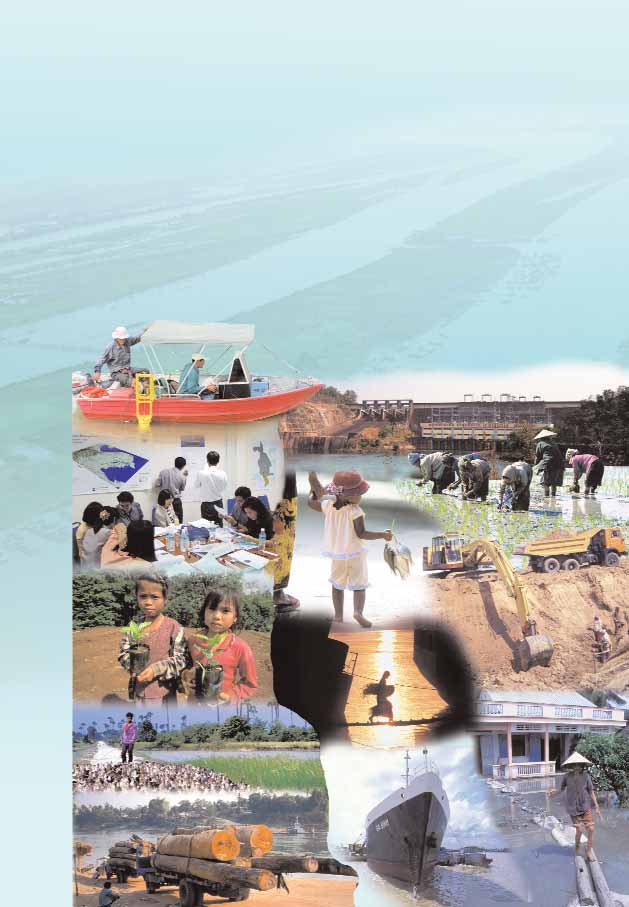
AnnualReport 2004
Mekong River Commission
A Vision for the
Mekong River Basin
An economically prosperous, socially just and
environmentally sound Mekong River Basin
A Vision for the
Mekong River Commission
A world class, financially secure, international river
basin organisation serving the Mekong countries to
achieve the basin vision
The Mission of the
Mekong River Commission
To promote and coordinate sustainable management
and development of water and related resources for
the countries' mutual benefit and the people's well-
being by implementing strategic programmes and
activities and providing scientific information and policy
advice
Our goals for the
Mekong River Basin
Less poverty
More cooperation
A balanced and
peaceful development
C Mekong River Commission 2005
Photos by: MRC archive, Jim Holmes, Chaleunxay Phommavongsa,
Vincent Gautier
Design & Layout: Sawaddh So
khottab
For more information contact:
E-m
mail: mrcs@mrcmekong.org Website: www.mrcmekong.org
2
Mekong River Commission
The Lower
Mekong Basin
T a b l e
o f C o n t e n t s
The Mekong River Commission
4
Message from the Chairman of the Mekong River Commission Council
5
Structure of the Mekong River Commission
6
Organisation of the Mekong River Commission
7
Progress Report 2004
8
Corporate highlights
28
BDP moves toward concrete actions
32
Shared lessons from the inland fisheries
34
Managing the Mekong
36
Finance and Administration
39
Donor cooperation in 2004
40
New funds and pledging
41
Income and expenditure in 2004
42
3
The Mekong
River Commission
The Mekong River Commission is an intergovernmental body created in 1995 by an agreement between the
governments of Cambodia, Lao PDR, Thailand and Viet Nam.
The Agreement on the Cooperation for the Sustainable Development of the Mekong River Basin came about as
the four countries saw a common interest in jointly managing their shared water resources and developing the
economic potential of the river. Signed on 5 April 1995, it set a new mandate for the organisation "to cooperate in all
fields of sustainable development, utilisation, management and conservation of the water and related resources of
the Mekong River Basin".
The agreement brought a change of identity for the organisation previously known as the Mekong Committee,
which had been established in 1957 as the Committee for Coordination of Investigations of the Lower Mekong Basin
- the Mekong Committee.
Since the 1995 Agreement, the Mekong River Commission (MRC) has launched a process to ensure "reasonable
and equitable use" of the Mekong River System, through a participatory process with National Mekong Committees
in each country to develop rules and procedures for water utilisation. The MRC is supporting a joint basinwide
planning process with the four countries, called the Basin Development Plan, which is the basis of its Integrated
Water Resources Development Programme. The MRC is also involved in fisheries management, promotion of safe
navigation, irrigated agriculture, watershed management, environment monitoring, flood management and exploring
hydropower options.
The two upper states of the Mekong River Basin, the People's Republic of China and the Union of Myanmar, are
dialogue partners to the MRC.
Structure
The MRC consists of three permanent bodies: the Council, the Joint Committee (JC) and the Secretariat.
The Council, comprising one member at Ministerial and Cabinet level from each MRC member country, convenes
annually and has overall governance of the Mekong River Commission.
The JC, comprising also one member from each member country at Head of Department level or higher,
convenes at least two times a year. This body functions as a board of management.
The Secretariat, which provides technical and administrative services to the JC and the Council, is under the
direction of a Chief Executive Officer (CEO) appointed by the Council. The Secretariat is located in Vientiane, Lao
PDR. The Assistant CEO is of the same nationality as the JC Chair and serves a one-year term.
The MRC is funded by contributions from the four member countries and from aid donors. Formal consultation
with the donor community is carried out through an annual Donor Consultative Group meeting.
The National Mekong Committees coordinate MRC programmes at the national level and provide
links between the MRC Secretariat and the national ministries and line agencies. The principal implementing
agencies of the MRC programmes and projects are the line agencies of the riparian countries in the Lower Mekong
Basin.
4
Message from the
Chairman of the Mekong
River Commission Council
On behalf of the Mekong River Commission (MRC) I take pleasure in extending my best wishes and warmest
greetings to all member countries, donors and partners.
The year 2004 saw some changes for the MRC. The Secretariat relocated from Phnom Penh, Cambodia to
Vientiane, Lao PDR, we welcomed aboard our new CEO, Dr Olivier Cogels, and we approved the new orientation of
the MRC to work towards Integrated Water Resources Management (IWRM). We feel IWRM will provide us with an
integrated approach for addressing development needs in the areas of navigation, flood management, fisheries,
irrigation, hydropower, watershed management, environment management and human and institutional capacity.
The new Secretariat swung into action with minimal disruption to work on the programmes thanks to the support
of our donors, the help of the Cambodian and Lao Governments, and the provision of equipment through the Thai
and Viet Nam National Mekong Committees. We are indebted to everyone who helped make this difficult task so
much easier.
Lao PDR is proud to host the Secretariat and looks forward to building on the platform of growth and
development achieved during its time in Phnom Penh. I would like to commend the MRC Secretariat for its
contribution to the achievements of the MRC during the past year and I thank the Secretariat staff for all their
technical and professional input.
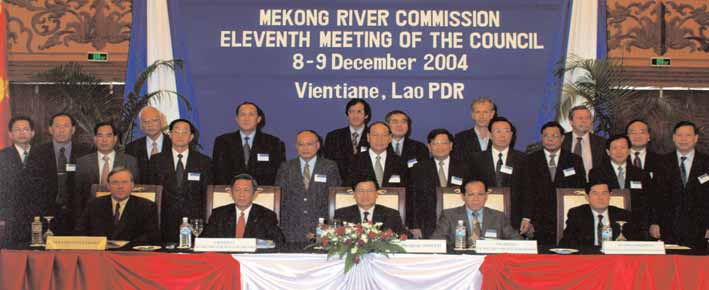
We have some exciting plans for 2005. At the 11th MRC Council Meeting, held in Vientiane in December,
members met and discussed the launch of the new Navigation Programme and the Flood Management and
Mitigation Programme (FMMP), as well as the start of Phase II of both the Fisheries Programme and the Basin
Development Plan.
I am pleased to report that the FMMP, now one of the MRC's core programmes, is funded and the Flood
Management and Mitigation Centre will take up temporary residence in the former Secretariat building in Phnom
Penh while a new purpose-built centre is constructed.
The Navigation Programme, which the MRC regards as a vital element of its strategy to make optimum use of
the river while preserving the environment, will commence operation this year. This five-module programme is
designed to enhance navigation of the river through the formulation of rules governing safety and cargo handling,
while also dealing with difficult transboundary issues.
In its second phase the Basin Development Plan will take a new direction. Employing the principles of IWRM, it
will build on the work of Phase I and commence identifying and implementing development projects and
programmes in partnership with the international donor community and investment banks.
Partnerships are important to the MRC and in 2004 we have worked hard to maintain good relationships with
our upstream neighbours. During meetings held in 2004 with our dialogue partners China and Myanmar we have
enjoyed and open and productive discussion and made further steps forward to forging a deeper relationship with
regard to shared water resources.
The Commission has delivered on what it set out to do in 2004, but without the support of the donor community
the MRC's work would not be possible. Therefore I am pleased to announce that last year we welcomed increased
support from many of our donors, as well as welcoming some previous donors back into the family. I would like to
convey the MRC's great appreciation to the donor community, our programme partners, the National Mekong
Committees and our line agencies for all their cooperation and we look forward to continuing our strong relationship
in 2005.
Moreover, the year of 2005 is a golden year since MRC countries and the people of the Mekong River region
met and celebrated the 10th anniversary of the MRC on 5 April 2005. This event provided a historic symbol of the
close cooperation enjoyed by the four countries (Cambodia, Lao PDR, Thailand and Viet Nam) and their willingness
to work together with a great Mekong Spirit.
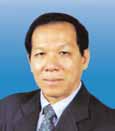
H.E. Mr Somphong Mongkhonvilay
Chairman of the MRC Council for 2004/2005
5
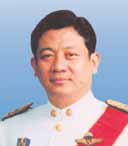
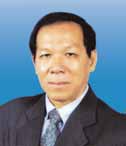
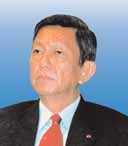


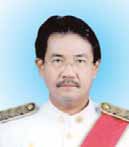
STRUCTURE OF THE
MEKONG RIVER COMMISSION
Members of the MRC Council
Members at Ministerial and Cabinet level, responsible for policy and decision-m
making
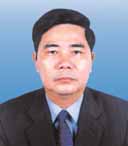
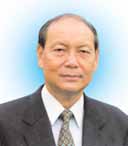
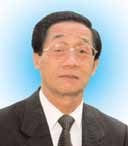
H.E. Mr Lim Kean Hor
H.E. Mr Somphong Mongkhonvilay
H.E. Mr Suwit Khunkitti
H.E. Dr Cao Duc Phat
Minister of Water Resources
Minister of the
Minister of Natural Resources
Minister of Agriculture
and Meteorology
Prime Minister's Office
and the Environment
and Rural Development
Member of the
Member of the
Member of the
Member of the
MRC Council for Cambodia
MRC Council for Lao PDR
MRC Council for Thailand
MRC Council for Viet Nam
Members of the MRC Joint Committee
Members at Department Head level or higher, responsible for implementing policies and decisions
H.E. Mr Sin Niny
H.E. Mr Sitaheng Rasphone
Mr Petipong Pungbun Na Ayudhya
Mr Nguyen Hong Toan
Permanent Secretary,
Vice-Chairman of Cambodia
Vice-Minister of
Ministry of Natural Resources
Secretary-General of Viet Nam
National Mekong Committee
Agriculture and Forestry
and the Environment
National Mekong Committee
Member of the
Member of the
Member of the
Member of the
MRC Joint Committee
MRC Joint Committee
MRC Joint Committee
MRC Joint Committee
for Cambodia
for Lao PDR
for Thailand
for Viet Nam
MRC Secretariat
Responsible for technical and administrative services
Dr Olivier Cogels
Chief Executive Officer
6


ORGANISATION OF THE
MEKONG RIVER COMMISSION
Government of
Government of
Government of
Government of
CAMBODIA
LAO PDR
THAILAND
VIET NAM
COUNCIL
Members at Ministerial
and Cabinet level
Donor Consultative
Group
National Mekong
Committees (NMCs)
Donor countries and
cooperating institutions
Member Agencies
JOINT COMMITTEE
Members at Head of
Department or higher
MRC SECRETARIAT
Technical and
administrative arm
7
Progress
Report 2004
Water Utilisation
Programme
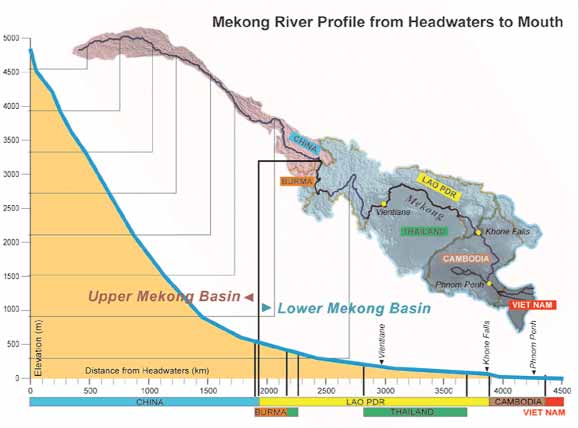
The Water Utilisation Programme (WUP) aims to
improve water management and ensure mutually beneficial
water use in the Lower Mekong River Basin while
maintaining the basin's ecological balance. The seven-year
time frame for this programme (2000-2006) allows sufficient
time for the member countries to develop basin-modelling
capabilities, and to discuss and negotiate agreements on a
set of procedures governing water use.
Three of these procedures (on data and information
exchange and sharing; notification, prior consultation and
agreement, and procedures for water use monitoring) have
already been signed during the period 2000 to 2003.
The year 2004 saw the WUP team make good progress
towards developing the technical basis for and drafting of a
procedure on the maintenance of flows on the Mekong
mainstream. The flow procedure requires the member
states to cooperate in the maintenance of: acceptable
8
minimum monthly flows in the dry season; acceptable
natural reverse flow of the Tonle Sap during the wet
season; and to prevent peak flows greater than occur
naturally.
The technical basis for the flow procedure is being
developed under the MRC's Integrated Basin Flow
Management (IBFM) activities. Beginning in 2005, the IBFM
activities will commence a programme of flow assessments
based on evaluation of the environmental, social and
economic beneficial uses of the river.
Among other achievements during 2004:
Basin modelling tools known as the Decision
Support Framework (DSF) were developed with UK
Consultant Halcrow and completed in March 2004 and have
been used extensively since then by the MRC Secretariat
modelling team to provide technical support to the planning
process of the MRC Basin Development Plan (BDP) and to
support the hydrological analyses of the IBFM. This support
will continue in Phase 2 of the BDP and Phase 2 of the
IBFM in 2005.
Five rounds of staff training for the MRC Secretariat
and the National Mekong Committees in the application of
the DSF software package were held throughout the year.
The WUP-Fin modelling activities, funded by the
Government of Finland, wound up their initial phase in May
2004 and commenced a new phase entitled "Hydrological,
Environmental and Socio-Economic Modelling Tools for the
Lower Mekong Basin Impact
Assessment". During this
phase applications of the
WUP-Fin modelling tools used
in the Tonle Sap study will be
expanded to other riparian
countries as a supplementary
part to the DSF in the basin
modelling package.
During 2004, in
cooperation with the
Environment Programme,
WUP developed an approach
to providing the technical
basis for the Procedures for
Water Quality Management
(PWQM) in 2005. In 2004, the
Joint Committee approved, in
principle, the Integrated Water
Quality Management
approach.
9
Basin
Development Plan
The Basin Development Plan (BDP) aims at identifying,
categorising and prioritising projects and programmes which
will benefit the sustainable economic development of the
basin. It aims to assist member countries in seeking
assistance for these projects so they can implement them
at basin level.
The BDP is gradually moving into its second phase
through the formulation of a BDP Phase II document in
close consultation with the member countries, the donor
community and investment banks.
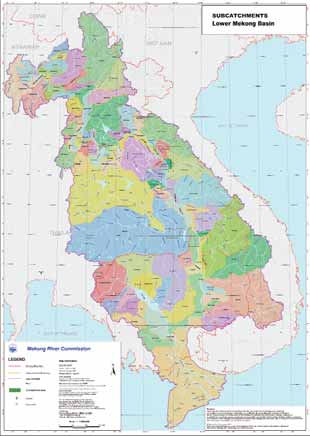
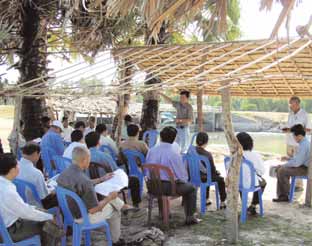
During 2004 the MRC's Basin Development planners put
strong emphasis on consultation and public participation by
stakeholders in the basin's "sub-areas" (or clusters of
catchments). Forums held in Cambodia and Lao PDR
involved international organisations, local NGOs, local
communities and those involved in fisheries, forestry and
agriculture. Their input helped produce outcomes to be
used in national planning through the identification of key
development issues for the future regarding needs,
concerns, trends and risks relating to water issues.
Five sub-area transboundary meetings have been
conducted successfully and a number of project proposals
were identified.
Using different sources and information, the BDP team
has developed options for an Integrated Water Resources
Development Strategy which will promote a series of
sustainable development interventions and investment
opportunities for the Lower Mekong Basin. Priority projects
identified respond to the needs of the poor in the river basin
and ensure economic growth and development that is in
harmony with the environment. (see story page 32).
Achievements for 2004 include:
The production of the draft of an Integrated Water
Resources Development Strategy for the Lower Mekong
Basin Development Strategy; a BDP Planning Cycle
guideline (with selection criteria) and a portfolio of potential
projects which are now incorporated in a new BDP project
database.
Assessment of basinwide development scenarios,
using the Decision Support Framework (a powerful
mathematical tool). Subsequently the MRC Secretariat
10

tested a sequence of six scenarios. These scenarios lay the
groundwork for the World Bank's own development of a
Mekong Region Water Resources Assistance Strategy.
The development of a number of analytical support
tools like the Social Impact Assessment identification of
social effects in the early phase of planning and the
Strategic Environmental Assessment identification of
potential environmental problems in the early planning
phase.
During 2004 the third and fourth modules of the BDP
training programme under the Murray-Darling Basin
Commission and the MRC Strategic Liaison Programme
were conducted successfully. The third module
concentrated on applied scenario-based planning using the
DSF developed under the Water Utilisation Programme and
the fourth module was a study tour of the four MRC
member countries.
For the rest of Phase I the BDP will upgrade the Mekong
Basin Geographic Information System (GIS) and general
knowledge base to provide enhanced information of
development needs and options for strategic planning and
scenario development. Simulation of development
scenarios is continuing to be a priority and will progress
further to stabilise and improve the predictive capacity of
the BDP.
Collaboration between the MRC Secretariat BDP team
and the teams at the National Mekong Committees has
tightened and will develop during Phase II. In stages the
BDP team at MRCS (supported by the NMCs) is bringing
together all elements of a Transboundary Planning
Framework for the Lower Mekong Basin, as originally
envisaged for Phase I of the project.
The production of a Planning Atlas for the Lower
Mekong Basin (based on the MRC's GIS) is also in
preparation and should be available in mid-2005.
11
Environment
Programme
The Environment Programme's goal is to assist the
member countries to protect the environment and maintain
the ecological balance of the basin while ensuring
environmental and social sustainability of economic
development undertaken within the region, particularly
within the energy/water resource and transportation sectors.
It also supports the other core programmes with
environmental data and tools for environmental planning
and management. Assessment and monitoring of water
quality and ecosystem health form an important part of the
provision of data.
The Environment Programme began implementing a
revised programme for 2004-2008 in January 2004.
During 2004 the Environment Programme conducted the
second field survey for the basinwide water quality
diagnostic study and a study on the status of the ecological
health of the river, both of which will contribute to the Basin
Report Card on Environmental Conditions due to be
released in 2005.
12
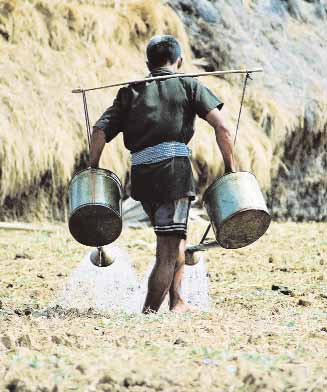
Other achievements in 2004 include:
Commencement of work on the development of
guidelines for a transboundary environmental assessment
system. National experts are now reviewing national
practices and regulations
The preparation of a basinwide map and the
assessment of values and functions of important wetland
types continued throughout 2004 and will form a useful tool
for the BDP planning process.
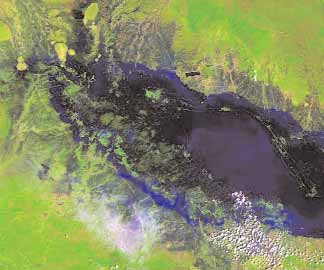
The assessment of the use of AIRSAR remote
sensing data for wetland mapping was completed and
fieldwork to ground-truth Radarsat images for wetland
mapping was initiated in late April and will be concluded in
2005. An assessment of people vulnerable to changes in
aquatic resources was also started in the third quarter of
2004.
Monitoring of water quality in the Sesan River began
in June 2004 and will continue for 12 months and a study to
review information on sediment transport will be linked to
other work on sedimentation in the Tonle Sap.
Environmental Knowledge is an integral component of
the Environment Programme. In the past 12 months the
programme has supported the completion of a Species
Management Plan for the Mekong dolphin, in conjunction
with the World Conservation Society.Further work is now
part of the Mekong Wetlands Biodiversity Programme.
The Environment Programme has also signed a contract
with Monash University in Melbourne, Australia to jointly
fund a Cambodian PhD student to study the ecology of
Tonle Sap Lake.
13



14
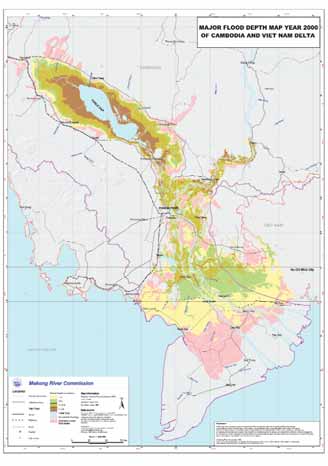
Flood
Management and
Mitigation
Programme
The Mekong River Commission's new core programme,
the Flood Management and Mitigation Programme is now
funded and ready to start operations.
Work on German-funded components four and five
(Flood Emergency Management Strengthening and Land
Management) began in September 2004.
A new Regional Flood Management and Mitigation
Centre will be built in Phnom Penh, Cambodia which will
carry out flood monitoring, forecasting and dissemination
services. The programme will also undertake policy
discussions on land use planning and infrastructure
development in relation to flood impacts; flood proofing
measures; mediation services; analysis of risk and impacts,
and strengthening of capacity to manage flood
emergencies.
The Flood Centre has estabished a temporary
headquarters in the former MRC Secretariat building in
Phnom Penh. This centre will act as a liaison office to relay
regional and community flood forecasts made by the team
in Vientiane to the flood-prone communities as well as to
relay the community feedback to Vientiane.
In 2004 the FMMP made good progress with its
activities.
With continued assistance from the US Office for
Foreign Disaster Assistance, the Cambodian Red Cross,
the American Red Cross and Action Against Hunger, the
FMMP expanded its flood early warning system from six
15
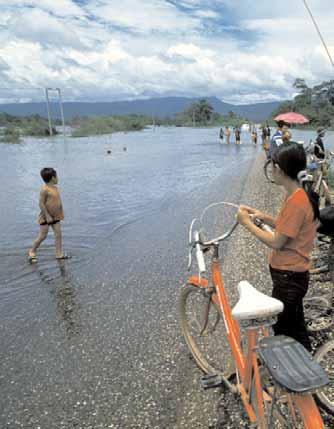
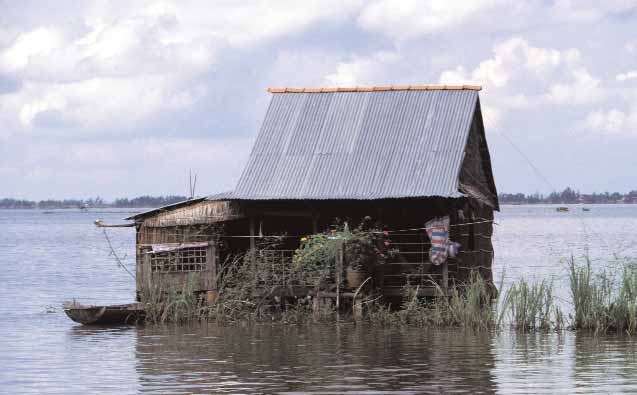
villages to 34 more villages in five flood-prone provinces of
Cambodia. The Provision of Flood Early Warning to Flood
Vulnerable Communities in the Lower Mekong River Basin
project will now be expanded to Lao PDR.
The 10-month project on Capacity Building for
Preparedness Planning and Response Using Flood
Information and Data, run by the Asian Disaster
Preparedness Centre and supported by the European
Commission for Humanitarian Aid Office (ECHO), was
completed in June 2004.
A Phase II proposal for 2005-2006 was submitted to
ECHO for review.
Two national training courses and one national
seminar on the implementation of flood preparedness
programmes at provincial and district levels were held
during the year.
Throughout the 2004 wet season the MRC
Secretariat provided daily flood forecasts on its website -
www.mrcmekong.org. Water levels were updated every 24
hours and rainfall figures were updated every 12 hours.
The Third Annual Flood Forum took place in
Vientiane, Lao PDR from 7-8 April 2005.
16
Fisheries
Programme
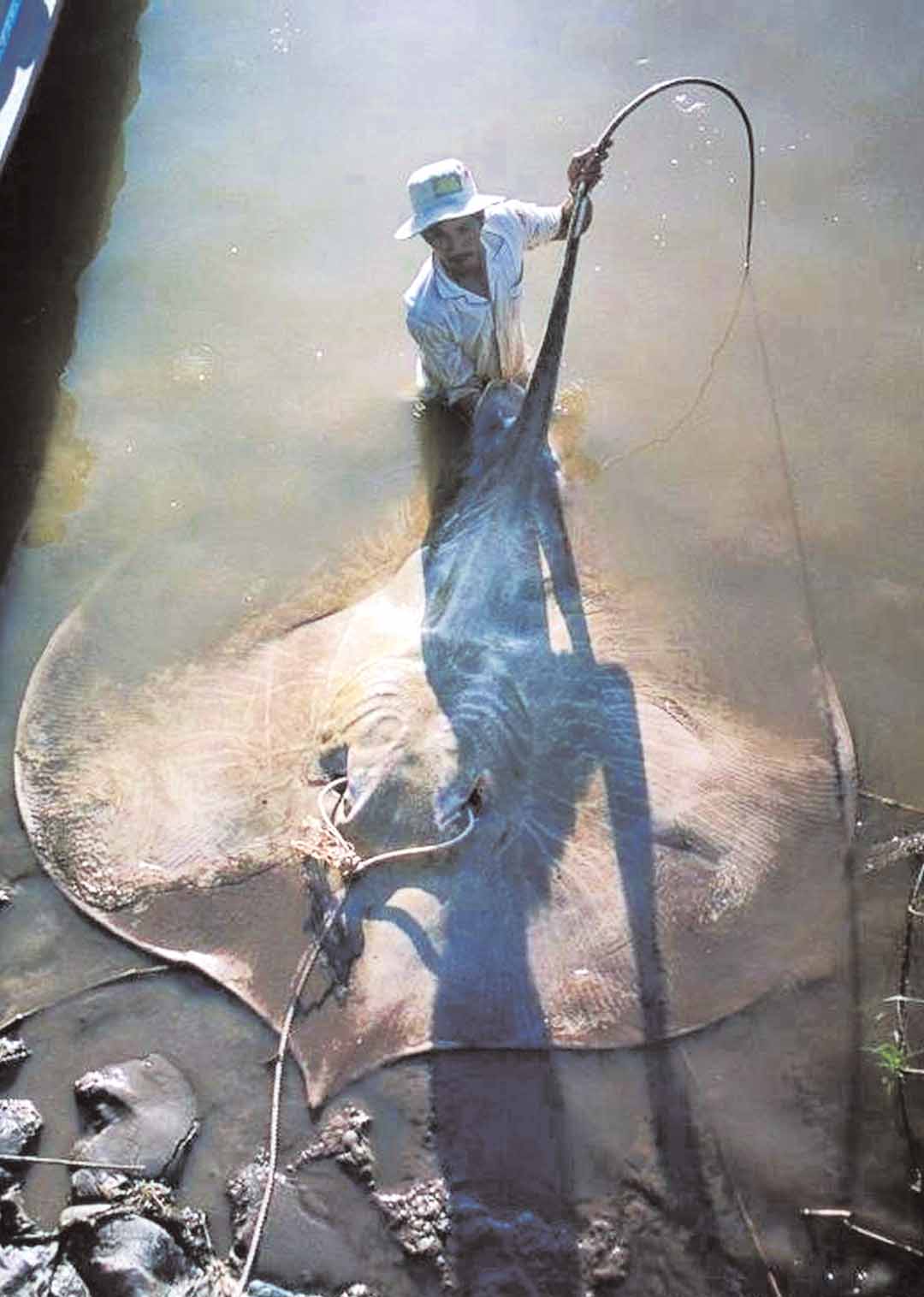
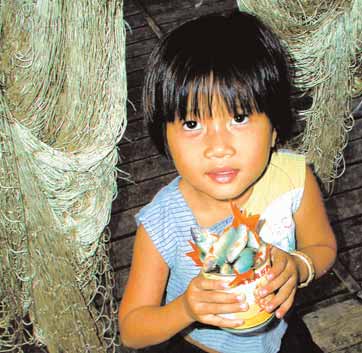
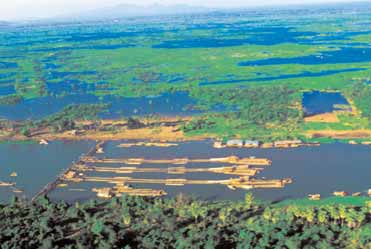
The Fisheries Programme aims to manage the
productive Mekong fisheries so they can sustain their high
yield and economic output well into the future.
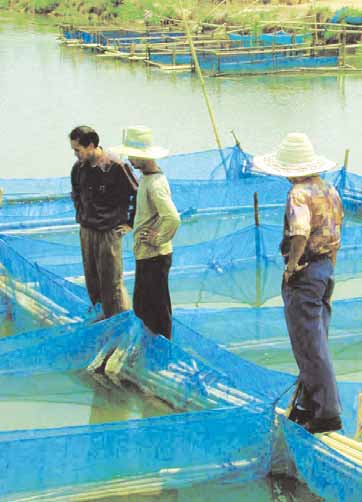
The programme does research into capture fisheries,
manages river and reservoir fisheries, promotes
aquaculture of indigenous Mekong fish species and trains
fisheries managers. It also disseminates a vast range of
information to policy makers and planners in the four Lower
Mekong countries, so stakeholders, riparian governments
and the MRC can use it in development planning and
management.
In 2004 the Fisheries Programme achieved some
significant milestones.
A three-year programme of capacity building
in fisheries co-management was completed. This
programme has now trained approximately 120 mid-to
senior level management staff from line agencies and over
500 users from community groups across the four
countries.
Three basinwide studies were completed, covering
catch monitoring, consumption and marketing. These
17
18
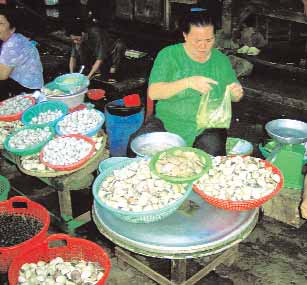
studies have provided useful direction as to how to best
continue with monitoring trends in fisheries yields.
In the communications field the programme
produced a new CD-Rom entitled Mekong Fisheries
Information, published a critically acclaimed book Fishing
Gears of the Cambodian Mekong, produced two new
technical reports and issues of Catch and Culture in both
English and the four riparian languages.
The Technical Advisory Body for Fisheries
Management has commenced implementation of a three-
year work plan under a funding arrangement with Swedish
International Development Assistance. This will provide a
sharper focus for transboundary fisheries management
initiatives.
The current phase of the Fisheries Programme ends in
December 2005, but a funding commitment from the Danish
Government aid agency Danida will enable a new five-year
Phase II to commence in 2006, upon final approval by
Danida. However, other donors will be required for the full
implementation of the programme.
19
Agriculture, Irrigation
and Forestry
Programme
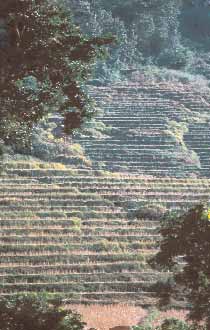
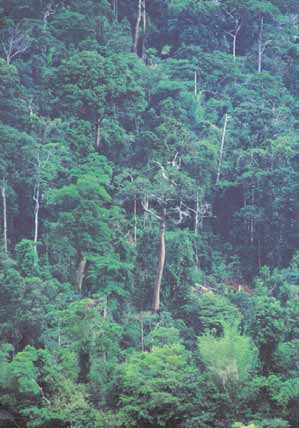
The work of the Agriculture, Irrigation and Forestry
Programme's (AIFP) Watershed Component centres on
ensuring that sound watershed management will maintain
the functions of watersheds for the future. It also looks at
how the management of these watersheds can interact
positively with the development of tourism and recreation
sectors, fisheries development, and flood management
efforts.
Over the past year the Watershed Component has
engaged in research on the best methods for monitoring
land-use changes, which included the acquisition and
analysis of geographic information system (GIS) and
satellite images of the basin through cooperation with the
Canadian Space Agency. Important baseline studies on
watershed management, forestry and land use planning
have also been completed.
National Working Groups on watershed management
were established in each of the riparian countries and one
pilot watershed was selected in each.
Other achievements in 2004 included:
Organising a "Quality Management Circle" for MRC
top management to develop and understand the needs for
capacity building and managing changes for MRC networks
in the field of watershed management. This also provided
the participants with an understanding of the envisaged
training concept and programme for staff and partners
involved in watershed management activities which will take
place over the next few years.
Hosting of the First Policy Dialogue Meeting on
Watershed Management in Vientiane with representatives
from the four MRC member countries together with German
International Cooperation agencies GTZ and INWENT and
representatives from many international organisations and
NGOs. This meeting provided a forum for the countries to
discuss the status of their watershed management.
The establishment of a library of watershed
management related documents, which will later be
20
integrated into the MRC Document Management System.
The establishment of research cooperation with
German and US universities.
A joint training programme for watershed management
planners in the four countries.
As a sub-component of AIFP, the activities of the
Programme to Develop the Multi-functionality of Paddy
Fields over the Lower Mekong Basin to collect data on rice
farming and water use for modelling some functions of
paddy fields have been continued.
At the beginning of 2004 a series of national meetings
and a field survey were conducted to establish the best
practical methods to collect relevant data, and member
countries started data collection by the first quarter. In May
2004 the countries made presentations of their working
methods at the second regional workshop held in Udon
Thani, Thailand.
Later in the year the countries submitted the collected
data on seasonal changes in rice planting areas at a district
level and this was used to construct a temporary GIS
dataset illustrating basinwide information on rice planting
areas and growing periods. However, further input is
required to complete other datasets, such as irrigation water
use. Improvement of the rice farming dataset and paddy
field map is ongoing.
On-farm experiments to check water balances and some
related phenomena in paddy fields in selected spots will
continue until the first quarter of 2005.
21

Hydropower
Programme
In December 2004, following the approval of the MRC
Council at its 11th Meeting held in Vientiane, Lao PDR, the
Water Resources Management Programme (WRMP) took
on a new name to better reflect its direction and is now
known as the Hydropower Programme.
The MRC has embarked on a Hydropower Development
Strategy that should lead to a wider Hydropower
Programme. The objectives are to identify the best options
for sustainable hydropower development and to recommend
criteria for prioritisation. Strengthening member countries'
capacity for hydropower planning and development is a key
objective.
The water resources and hydrology components of the
former WRMP are now encompassed in the Technical
Services Division where they will become part of an
integrated information and decision-support programme.
Last year the former WRMP began its operations by
completing a study into how the Tonle Sap floodplain stores
and releases water from wet season to dry season and how
to provide and store more accurate and up-to-date
information for use by various government departments and
other MRC projects. The study was able to quantify the
multi-functional hydrologic role of the Tonle Sap Lake and
vicinity during the flood and dry season of 2002 and 2003
and technical reports are now available.
In other achievements during 2004:
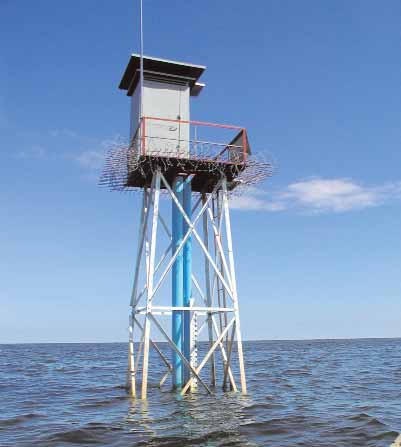
The programme took the first steps to establish the
Mekong Hydrological Cycle Observing System (Mekong-
HYCOS), which will improve river monitoring, and flood
forecasting capacity.
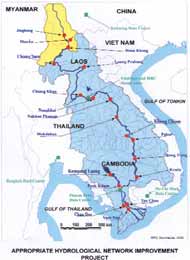
The Appropriate Hydrological Network Project
(AHNIP) will end in 2006 and has been focusing on
sustainability through national training programmes. The
data centres are commissioned and ready for local staff to
move in.
Equipment for the two hydrological stations at
Yunjinghong and Man'An in Yunnan, China was delivered
and a data centre was established in Kunming. The MRC
has received daily data from China through the telemetry
system for the 2004 flood forecasting activity. This is a
concrete and effective form of participation by China in the
MRC's Flood Management and Mitigation Programme.
22
Navigation
Programme
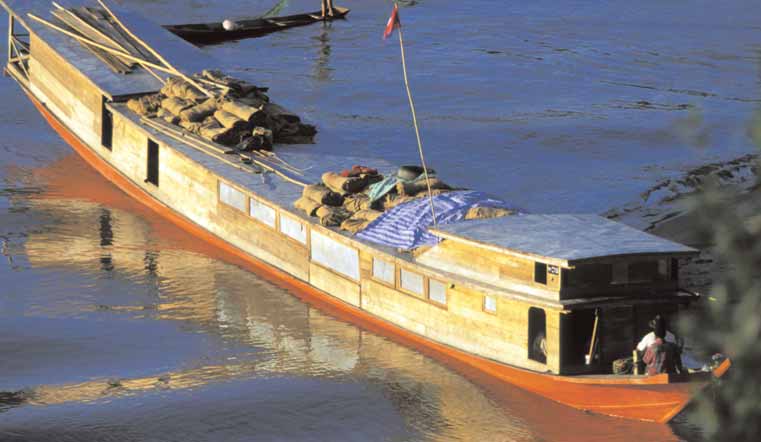
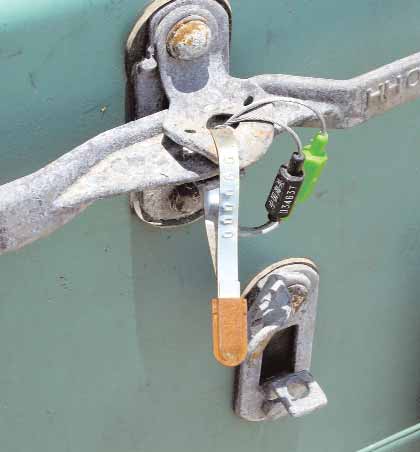
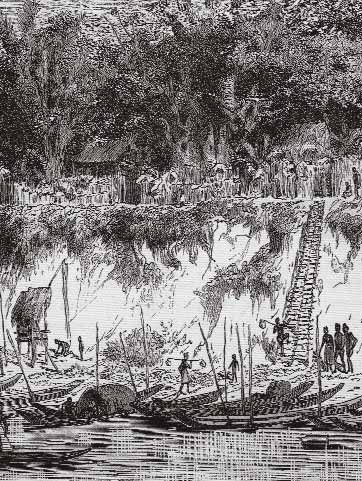
The Navigation Programme aims to balance the demand
for expanded use of the river with environmental needs
through the new MRC Navigation Strategy.
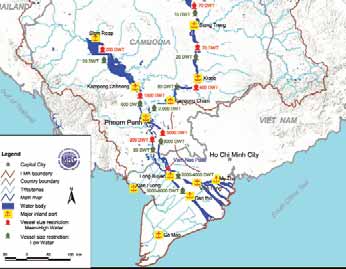
The new programme is now in the first stages of
implementing its five components: Socio-economic
Analysis and Regional Waterborne Transport Planning;
Legal Framework for Cross Border Navigation; Traffic
Safety and Environmental Sustainability; Information,
Promotion and Coordination; and Institutional Development.
The actual implementation of the programme will
commence in September 2005, following the preparation
phase, which started in July 2004.
Most of the work during 2004 has been involved with
23

setting up the logistics of the programme and identifying
financial partners.
Discussions with the Asian Development Bank and the
World Bank on funding of components 1,2 and 4
progressed well. Discussions with potential donors from
Belgium, France and Finland have been positive and talks
with the EU are planned. Coordination also took place with
JICA on transport projects in the Lower Mekong Basin.
A partnership-building mission to Europe in April 2004
resulted in close connections with other river and navigation
commissions such as the Rhine and Danube Commissions
for Navigation, Inland Navigation Europe, the European
Commission, the International Maritime Organisation, the
Permanent International Association for Navigation
Conferences and maritime academies. These talks
continued throughout 2004.
Other achievements included:
The completion of an institutional strengthening and
capacity building project for navigation in Cambodia.
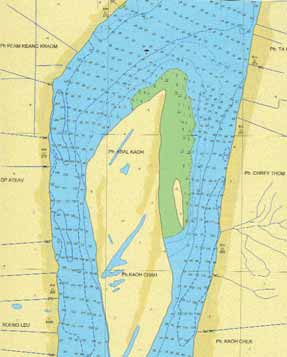
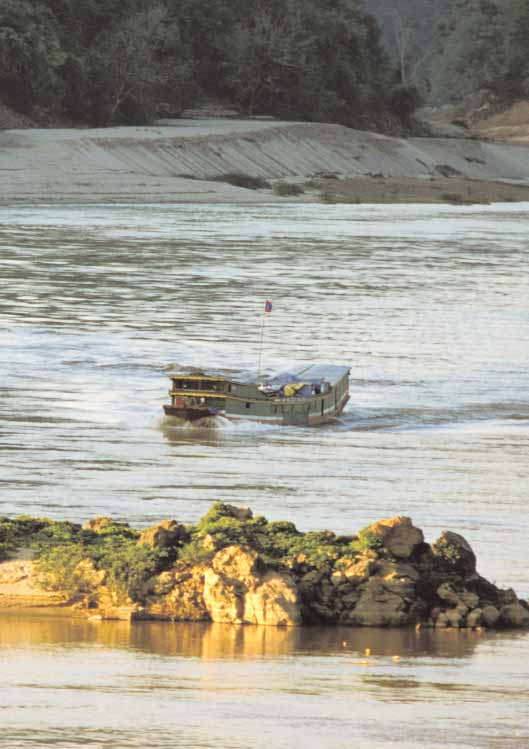
The production of a full hydrographic atlas of the
Lower Mekong Basin in GIS and PDF formats. These
charts, which also include the Bassac and Tonle Sap, have
been digitised according to the International Hydrographic
Office (S-57) standard and will make the updating of all
data concerning the river very easy.
The implementation of the final steps for the start up
of the Design of the Master Plan for Waterborne Transport
on the Mekong River System in Cambodia.
Increased cooperation with China and Myanmar
through the Navigation Affairs Bureau in Yunnan.
Incorporation of the navigation strategy and
programme into the Basin Development Plan.
24


25
Integrated Capacity
Building Programme
The MRC's Integrated Capacity Building Programme
(ICB) is progressing well toward meeting its goal of raising
the level of skill in the region through a systematic and
modular training programme.
The ICB Programme was developed to ensure the
availability of sufficient expertise in river basin
management, to broaden the pool of expertise within the
region, and to raise the level of competence among staff
of MRC and Line Agencies in the riparian countries. The
programme encompasses a Junior Riparian Professional
(JRP) Programme and its ongoing training of local Lao
support staff, both on-the-job and through external training
courses.
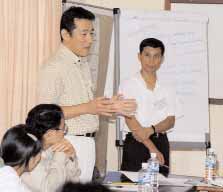
The JRP programme provides an opportunity for young
professionals to acquire hands-on experience on
international river basin management.
In 2004:
Three new JRPs from Cambodia, Lao PDR and
Viet Nam joined the Secretariat, as the third batch in the
programme. All JRPs attended the in-house training
programme on MRC Strategic Planning and Management
and the MRC Logical Framework, conducted in Vientiane
in September 2004.
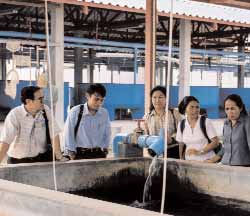
The JRPs from all three batches also undertook a
regional study tour visiting National Mekong Committees
and also different development projects and institutions.
They met with local people to discuss various topics
concerning developmental aspects at village level.
The training programme for Lao support staff under
the MRC HQ Relocation staff training project continued.
The programme was implemented at the beginning of
2004 and will last to June 2005. This programme, which
involves approximately 50 support staff members, has
been funded by the UNDP and executed through the Lao
National Mekong Committee.
The recently completed AusAID-funded MRC-
26
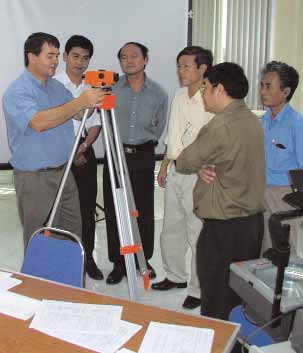
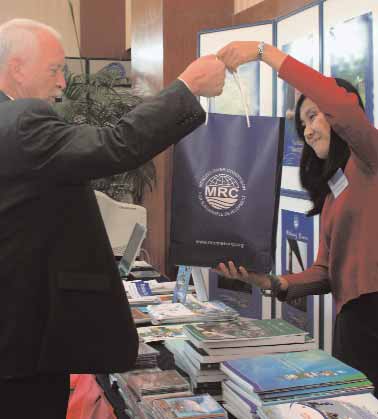
Murray Darling Basin Commission (MDBC) Strategic
Liaison Programme, boosted capacity building within both
the MRC Secretariat, and the National Mekong
Committees. An advanced hydrological modelling training
course was delivered to support the early stages of the
MRC's Water Utilisation Programme. Participants on this
course now form the core of the MRC Modelling Team.
The MDBC also delivered a Basin Planning Training
Programme to the MRC to develop the skills and
understanding of the basin development planners of
tomorrow. The training took the form of four modules,
including a study tour through the four member countries.
MDBC funds have also been used to promote and expand
the MRC's public participation policy internally and at
national levels.
Improved information and communication services have
supported all MRC programmes throughout the year. The
MRC's communications function continued to promote the
work of the MRC and disseminate information about its
programmes and research through its ongoing production of
newsletters and technical and development reports. It
expanded the content of the website, engaged in regular
liaison with the media, programme partners and
stakeholders and met corporate information needs for visual
displays and event management.
In 2005 the Integrated Capacity Building Programme will
launch a new Gender Mainstreaming Project.
27
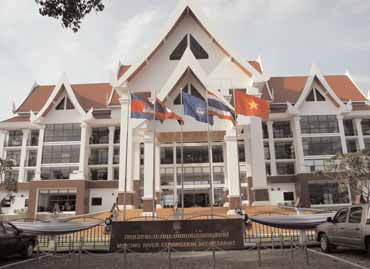



Corporate
highlights
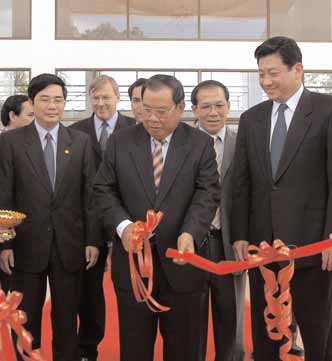
H.E. Mr Bounnhang Vorachith,
Prime Minister of the Lao PDR,
declares the new building open.
Opening of a new
government representatives from Cambodia, Lao
PDR, Thailand and Viet Nam, as well as Vientiane-
headquarters
based dignitaries and representatives from the
international diplomatic, donor and NGO
communities.
In order to minimise the impact of the relocation
In June 2004 the Mekong River Commission
on the MRC's ongong programme implementation
Secretariat completed its transfer to its new
support staff undertook on-the-job training in Phnom
headquarters in Vientiane, Lao PDR, which was
Penh (alongside their Cambodian counterparts), prior
provided by the Government of Lao PDR
to the move. In addition a number of Cambodian
support staff moved to Lao PDR for a period of up to
The move took place over a month, with staff
one year to help train the second batch of new
beginning to pack up their Phnom Penh offices from
support staff in order to minimise the impact of a staff
mid-May and the move into the building starting from
changeover.
June 21. On July 1 the doors opened to the public.
The MRCS has continued to hire more local,
The building was officially inaugurated on 27
regional and international professional and support
August by H.E. Mr Bounnhang Vorachith, Prime
staff, and aims to bring the full employee level up to
Minister of the Lao PDR, in the presence of
around 120.
28
Welcome to a new
need for a holistic vision of Integrated Water
Resources Management and Development at basin
Chief Executive
scale, harnessing (in a sustainable way) the river's
huge economic potential for navigation, energy
Officer
production, agriculture, fisheries and tourism.
The new CEO sees the role of the MRC as an
investment facilitator, encouraging regional
cooperation through the delivery of accurate and
reliable decision-support information to planners and
policy-makers so they can help member countries
implement balanced and sustainable development
strategies at basin scale. However, this development
must be with due regard for the environment,
The MRC provides a platform for dialogue and
negotiation. It offers an ideal institutional basis for
joint planning and coordinated implementation of an
Integrated Water Resources Development and
Management Programme, closely linked with (and as
a complement to) other development programmes in
the region.
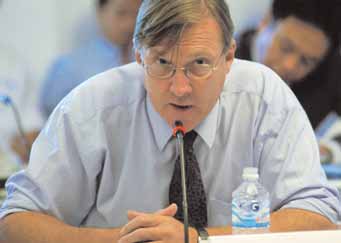
Dr Cogels addresses donors at the informal donor meeting
One of Dr Cogels' principal objectives is to
held in Vientiane in August 2004.
continue to stimulate concrete cooperation with
MRC's dialogue partners China and Myanmar,
based on a constructive and pragmatic approach
On 9 August 2004, Dr Olivier Cogels took up his
through joint activities within the framework of the
role as Chief Executive Officer of the Mekong River
MRC's Mekong Basin Development Plan
Commission.
Programme. "Increasing our cooperation, step-by-
step, on the basis of trust and the search for mutual
Dr Cogels is a Belgian citizen. He holds an MSc
benefits is the most important thing," he says.
in Land and Water Engineering and a PhD in
Hydrodynamics and Water Resources from the
Catholic University of Louvain. He also did a post-
doctorate at the University of California, Davis. After
Dialogue Partners
an academic career at the University of Louvain, he
gained extensive experience in development
open to discussion
programmes and institutions, working with such
bodies as the European Commission, the World
Bank, the United Nations and with bilateral agencies.
Before accepting this new position he had worked
The low river conditions experienced in
with the Food and Agriculture Organisation of the
the 2004 dry season prompted much comment in the
United Nations (FAO) in Rome since 2002,
where he managed the International Programme
for Technology and Research in Irrigation and
Drainage (IPTRID).
Dr Cogels says his vision for the MRC is for it
to become the key actor in alleviating poverty
and increasing economic wellbeing in the
Mekong Basin, in order to meet the Millennium
Goals of the United Nations. He emphasises the
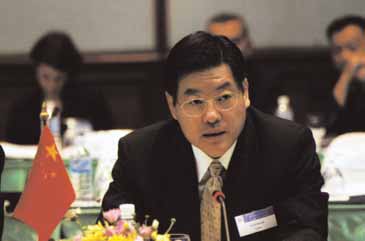
Right: China's representative Mr Zhang
Wanhai at the 9th Dialogue Meeting.
29
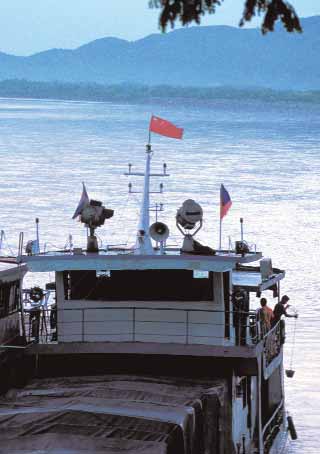
media regarding the impact of developments in
upstream countries
In response to this, MRC scientists compiled a
Technical Study on Rainfall and Discharge in the
Lower Mekong Basin.
After analysis of river flows and height data,
combined with rainfall data from the basin, the report
concluded the drought was caused by unusually low
rainfall throughout the basin both in the wet season
and the dry season, and not by any dam
construction taking place in upstream countries.
Speaking at the 9th Dialogue meeting between
MRC members and dialogue partners China and
Myanmar, held on 28 August in Vientiane, Lao PDR,
China highlighted the need to promote the
sustainable use of water resources as well as the
development of regional economies. The dialogue
meeting showed that both the MRC and its dialogue
partners attached great importance to this issue.
The subject of the two existing dams and the
MRC joins fight to
building of two other dams on the Lancang (Mekong)
was openly discussed in a constructive way, with the
intention to work on appropriate mitigation measures
preserve Mekong
in order to minimise the potential impacts, namely
river fluctuations.
wetlands
In July 2004 the MRC joined with UNDP and
IUCN (the World Conservation Union) to launch the
Mekong Wetlands Biodiversity and Sustainable Use
Programme (MWBP).
The MWBP is a five-year (2004-2009), $30
million initiative working in the four Lower Mekong
countries - Cambodia, Lao PDR, Thailand, and
Vietnam. While it is jointly managed, the programme
will run in parallel and be closely coordinated with
MRC structures and decision-making processes.
The programme will work at three levels. At the
regional level, the basinwide policy framework and
economic environment will be developed to be more
supportive of wetland biodiversity conservation and
sustainable use through working with ministers and
developing wetland policy guidelines. The
institutional capacity to implement these policies will
be strengthened. This regional approach will be
made possible through the project's strong
partnership with the MRC.
30



Encouraging a multi-sector approach, through
building capacity, and increasing public involvement
Challenge
will enhance planning processes at the national
level, The programme will work with the national
Programme
institutions responsible for wetland and Ramsar
issues in each country, as well as the four National
moves ahead
Mekong Committees.
At the local level, integrated planning and
equitable community-based natural resource
management will be implemented at four
The MRC is the coordinator for the The CGIAR
demonstration sites: Stoeng Treng Ramsar Site,
Challenge Programme for Water and Food (CPWF)
Cambodia; Attapeu Province, Lao PDR; the Lower
in the Mekong Basin.
Songkhram Basin, Thailand; and the Plain of Reeds,
in Viet Nam. Each site represents one of the four key
The CPWF, which was launched in 2003, aims to
wetland ecosystems representative of the Lower
increase food production in agriculture, while at the
Mekong Basin as a whole.
same time increasing water productivity, so more
food can be grown with less water. Much of the
In the demonstration sites, the programme will
emphasis in the CPWF is on the partnerships it has
help to identify the values of the freshwater
created between research institutions in the Mekong
ecosystem, and work with local people to develop
countries, and advanced research institutions, such
improved management systems and alternative
as those within the CGIAR.
livelihood options. Training will be provided and
information will be disseminated as part of targeted
The CPWF has selected eight projects in the
awareness campaigns. Technical assistance will also
Mekong River Basin from the 50 submissions
be provided to support the implementation of the
shortlisted for funding under the CPWF last year.
Ramsar Convention on Wetlands at the national and
site level.
The projects cover a range of fields of research
including minimising the impact of salt-affected
areas, development of new strains of rice, improving
aquaculture and governance.They seek to meet
some of the bigger water resource issues facing the
Mekong Basin in the coming years.
An additional contribution to the MRC's
involvement in the Challenge Programme is the
production of a new publication called Mekong
Research, which will summarise research findings
and outputs from the region.
New Document
Management System
Last year saw the start of construction of the
MRC Document Management System (DMS) already
under development by Hatfield Consultants under
the MRC-IS Portal project, in close coordination with
the Technical Support Division. This should be
operational by June 2005. Documents on the DMS
will include MRC project/programme reports, outputs,
occasional papers, technical and research papers
and other publications.
31
BDP moves
toward concrete
actions
The Mekong River Commission's Basin Development
Plan project (BDP) is the backbone of the MRC
Development Programme. It is now gearing up to move into
its second phase and, for the team, this will mean
transforming all the hard planning work done so far into
concrete results.
The BDP's aim has always been to create an
environment for investment and sustainable development
by formulating a basinwide strategy for development.
Indeed under the 1995 Agreement it was agreed the BDP
would be the general planning tool for the Joint Committee
of the MRC to use as a blueprint "to identify, categorise and
prioritise the projects and programmes to be implemented
at basin level".
During its first phase the BDP team has been conducting
dialogues between governments and their line agencies at
all levels to ascertain what type of development would be of
maximum benefit to the basin. In this phase BDP developed
some powerful planning tools, as well as a strategy for
identifying where these development needs lay.
A list of priority projects was developed and the BDP is
now examining their feasibility. Some are joint projects
involving different countries and some are national projects
within a single country. Using planning processes and tools
it has gathered all this knowledge and has collated a list of
projects that can bring about shared growth in the Lower
Mekong Basin.
The team's next challenge is the practical
implementation phase of these projects. In short, the MRC
will be actively identifying water-related development
opportunities for its member nations that can be
implemented at a basin level.
This point in its development has always been the real
goal of the BDP. As the team points out there is no point
planning for the sake of planning. It is important for the
MRC to make a positive impact on reality and to be an
active participant in the development of the basin.
32

The BDP's Integrated Water Resources Development
Strategy will promote a series of sustainable development
interventions and investment opportunities for the Lower
Mekong Basin. It will identify the development needs, find
the projects that meet those needs and then it will seek the
necessary assistance to make the projects happen.
The team has created a database of these identified
projects and, now, the Joint Committee will define priorities.
Projects that have been identified include those that will:
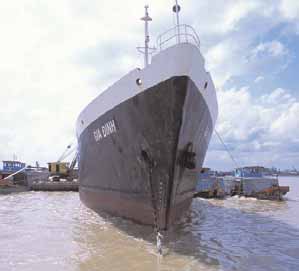
Develop navigation potential
Develop ways to minimise flood damage
Develop improved irrigation techniques
Develop the fisheries
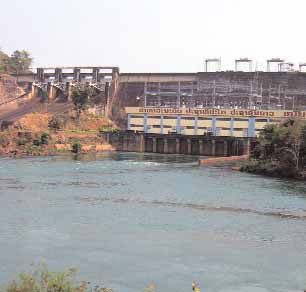
Develop clean energy sources
Ensure watershed protection
The MRC sees itself as being in an ideal position to act
as a facilitator of the development and investment process
in the water sector. It is also keen to work hand in hand
with other regional development agencies and explore the
opportunities offered by such initiatives as the Greater
Mekong Sub-Region (GMS) promoted by the Asian
Development Bank.
However these new developments will be of no long-
term benefit to anyone if their sustainability and impacts are
not well researched prior to instigation. The ability to
predict possible situations is one of the best ways of making
a considered evaluation of a project and that is where the
BDP team has strength.
Powerful simulation tools like the Decision Support
Framework enable the team to analyse development
scenarios that can take into account a range of variables
and then be used in decision-making. Over the coming
years the team plans to improve such tools, and, more
importantly, it will share them with the member states, and
other partners working in the river basin.
If member countries are to take a pro-active role in
developing their own resources they will need new skills
and one of the BDP team's priorities is to improve the
institutional capacity in integrated water resource
management and development within the nations.
This will help create a network of river basin
organisations, which will then be able to manage the
catchment areas of the Mekong River Basin. True
basinwide managers in the countries will be able to ensure
damage does not occur, that the environment is protected
and that economic benefits are equally shared among the
population.
The MRC will be a chief participant dealing with such
water-related issues as hydropower, irrigation, fisheries,
navigation watershed management and water quality on a
holistic level.
33
Shared lessons
help promote
inland fisheries
Inter-country cooperation is the cornerstone of the estimated at more than 400,000 tonnes per year, with
Mekong Agreement, but before such cooperation can catches of other aquatic animals totalling at least
have practical applications it is important for those
60,000 tonnes and it is among the largest and most
making decisions to see what's going on in the field.
significant inland fisheries in the world.
It is not always easy to make a high level decision on
regional issues when based in a city and often the
The idea was to absorb some lessons from the
expertise needed is not even available in the same
success of these inland fisheries and transpose them
country.
to the inland fisheries of North East Thailand in order
to boost their productivity.
It was with these issues in mind, that a delegation
of senior fisheries experts and scientists from the
The Cambodian delegation, led by Mr Nao Thuok
Department of Fisheries in Thailand, headed by
Director General of the Cambodian Department of
Director General Dr Sitdhi Boonyaratpalin, went to
Fisheries, took the visitors to the dai fisheries in
learn first-hand how their counterparts in Cambodia
Phnom Penh and to the lot fisheries on the Great
were managing their very productive inland fisheries.
Lake.
The January 2005 trip, which was organised and
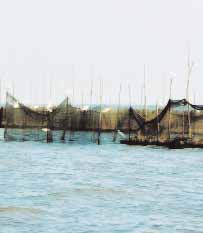
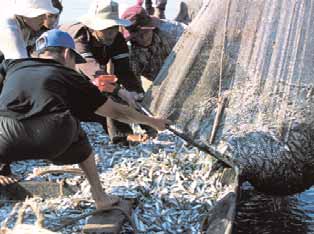
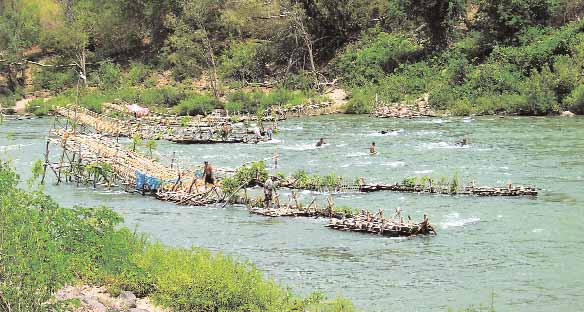
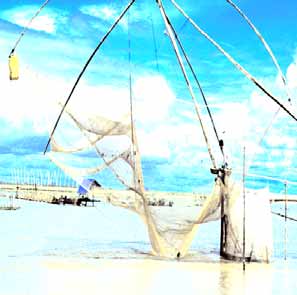
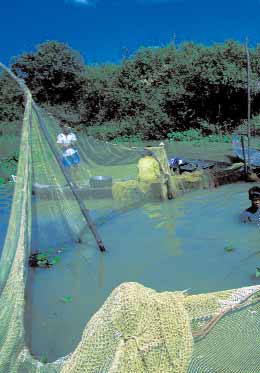
The dais (or bagnets) are unique to Cambodia and
funded by the MRC Fisheries Programme, was
are a particularly effective way of fishing. The nets
hosted by the Inland Fisheries and Research
are suspended in one location to filter the current (in
Development Institute (IFReDI) of Cambodia and
a similar way to trawl nets). Each net is about 25
provided the Thai group with their first, close-up look
metres wide and about 120 metres long, extending a
at the inland fisheries of Cambodia, the basin's most
few metres to the bed of the river. Several nets are
prolific fish producing area.
set across the river in a row. At present there are
The inland fishery in Cambodia is conservatively
approximately 64 nets in 14 rows.
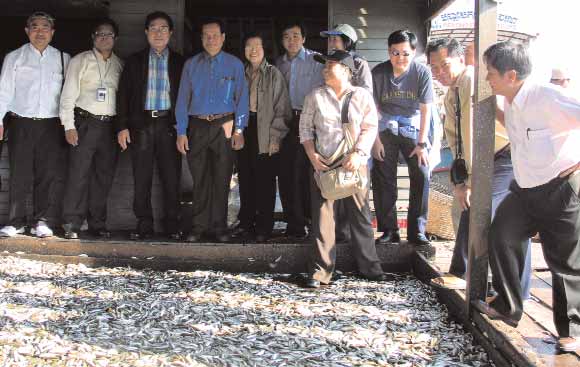
High-level
representatives
from the Thai and
Cambodian
Departments of
Fisheries shared
their knowledge on
the field trip.
34
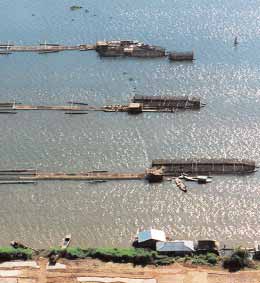
The lot fisheries are home to commercial scale fishing
on the Tonle Sap Great Lake and can only be fished
between October and May. Recently some of these lots
have been transferred to community fisheries and the
Department of Fisheries is promoting their management
under a new Community Fisheries Development Office.
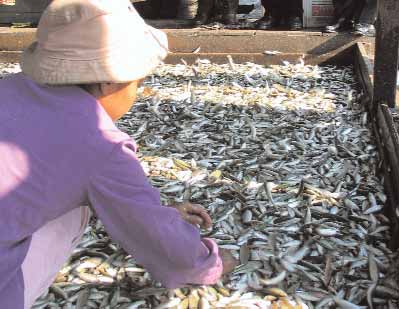
The volume of fish being caught by the two fisheries has
been particularly high this season and the Thai visitors were
amazed at how productive the fisheries were.
But there was another motive behind the visit. Many
members of both the Cambodian and Thai teams were also
members of the Technical Advisory Body for Fishery
Management and one of the objectives of the study tour
was to raise awareness of the TAB's role and work and to
institute some joint management ventures.
The TAB (which was founded in 2000) is now finding a
more prominent role as a regional player and is, arguably,
the only body anywhere in the world that has been
specifically set up to provide inputs into regional river
fisheries management and development.
It operates under the umbrella of the Mekong Agreement
and draws membership from fisheries agencies and
National Mekong Committees. It is also open to civil society
organisations, such as the Regional Network for Promotion
of Gender in Fisheries. This makes it more flexible and
nearer to where management and development in fact take
place.
Given that water and fish are shared in the
Lower Mekong Basin, one of the roles the TAB is
beginning to adopt is one of developing and
strengthening governance of transboundary aquatic
resources and dealing with transboundary issues.
These include:
The importance of migratory fish stocks, their
management and conservation;
The impact of unsustainable fishing, exploitation of
fish in critical habitats at critical life stages, environmental
disturbances and loss of genetic diversity;
Local management techniques, such as breeding
indigenous species; and,
Principles of governance such as participation, rights
and gender equality.
The MRC, as well as Danish and Swedish
donors, provide administrative and financial support
to the TAB.
35
Managing the
Mekong
The Mekong River Basin will change rapidly over
unacceptable deterioration in the region.
the next few decades and by 2025 the population is
tipped to rise to between 80 and 100 million.
This River Health Strategy is intended to provide
a framework for managing the Mekong. Within the
The basin is still in its early stages of
framework the governments of the four member
development and there is still a high level of poverty.
countries will be able to work in partnership to make
More development is needed if there is to be wide-
decisions on the management of rivers in the lower
scale alleviation of poverty and an increase in the
Mekong basin. The strategy is also intended to
economic welfare of the growing population. This
encourage integration of activities within countries,
growth is likely to occur in areas such as industry,
and within the MRC Secretariat.
agriculture, infrastructure and tourism.
River health is a term used to describe the
However, potential impacts of this development
ecological condition of a river and it includes a range
must be carefully monitored and managed if the
of physical and biological components that, together,
millions of people who rely on the river for their food
make up the river's ecosystem.
and water are to be protected.
The River Health Strategy will focus on five main
For this reason the Mekong River Commission's
elements which require management if river health is
Environment Programme is developing a River
to be maintained. Monitoring procedures are already
Health Strategy in order to monitor the health of the
operating for several of these elements and a newly
river and ensure that development does not cause
established monitoring activity is addressing the
36
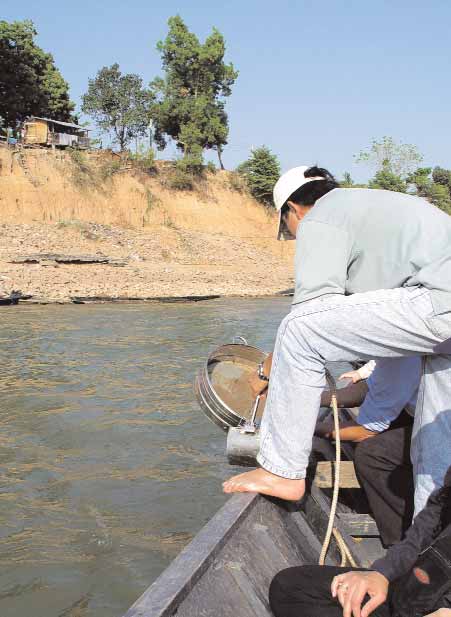
overall ecological health of the river. These elements are:
Managing the harvest
If too many individuals of any species are removed from
the river the species numbers will decline and the species
will eventually disappear from the stream. While fish make
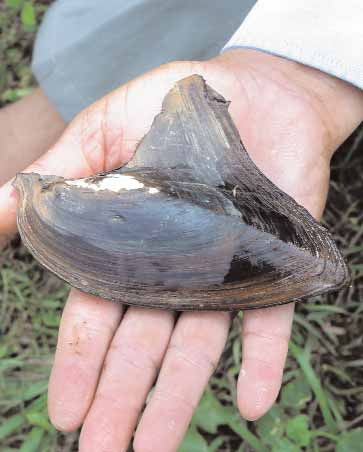
up the biggest catch from the river, the people of the
Mekong also rely on eating snakes, crocodiles, turtles,
frogs, insects, riverweed, snails, mussels and more.
In addition to those species that are gathered
intentionally, there may be species that are caught
unintentionally and killed as by-catch. For example dolphins
are no longer killed, but are occasionally trapped in fishing
nets and then die. If one species gets wiped out or reduced
significantly this can have impacts on the abundance of
other species that may have been the food, or competitors
with the harvested species.
Managing habitat quality
Fish require quite a complex habitat, not just clean
water. Different species require water of suitable depth, and
appropriate bottom material and appropriate shelter. They
may also need to move to different types of habitats at
different times of their life cycles for example fish moving
from deep to shallow waters to spawn, or from the channel
to the floodplain to feed; so barriers may disrupt the habitat.
Managing Flow Pat ern
The flow pattern of a river plays a key role in regulating
the life cycles of the creatures in the river. Many aquatic
insects and some fish lay their eggs during the low flow
season when eggs are less likely to be washed away. Other
fish and aquatic insects reproduce during the high flows
when habitat is more abundant. A change in flow for many
species seems to trigger migration behaviour. Changes in
flow characteristics of the river can interfere with these
cues, or reduce breeding success of riverine species.
Managing Water quality
This is the fourth key factor directly impacting the aquatic
biota. As water quality deteriorates the number of species
that can survive and thrive in a water body decreases.
Water quality can be quite difficult to assess, partly because
it is often variable in time. Dissolved oxygen is often
appreciably lower at night especially in rivers with high
densities of algae. Also toxins and pollutants, such as
industrial waste, are also often present in a stream only
intermittently, or unexpectedly.
37
Managing the condition of the catchment
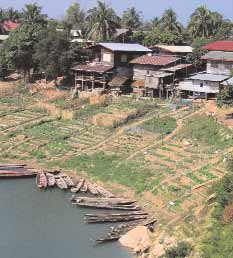
This is indirect, but crucial. The catchment condition
influences the amount, timing and quality of the water
flowing in to the river. Catchments with large areas of bare
soil will contribute to river sedimentation. Intensive
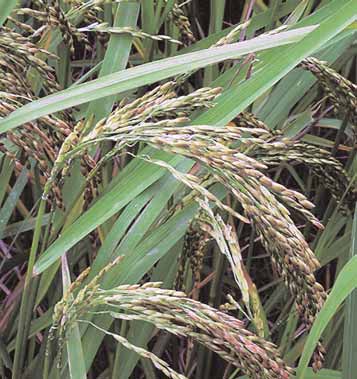
agriculture, poorly managed, can lead to excessive
nutrients and pesticides contaminating the river. Urban
catchments have higher flood peaks and lower base flows
because much of the rainfall runs off the paved surfaces
directly into the river rather than passing through the soil.
The Environment Programme is developing tools and
management programmes to allow the four member
countries to cooperate in managing and monitoring all five
components.
There are several tool sets required. One is a set of
identification keys to allow important components of the all
the plant and animal life (the biota) of a region to be
identified.
A key to the invertebrates has been completed and is in
the final editing process and the programme plans to
produce keys to other components of the biota over the
next few years. These keys will encourage more research
into the classification of basin species and ecology.
The MRC also plans to develop a measuring tool that
can be used to quantify river health. At present it has data
on the five biological components, but needs to gather more
data on chemical changes such as those influenced by
nutrients or toxic substances.
Based on biological indicators, the river's health is
considered fairly good. The programme's goal now is to
combine its biological data with the results of the chemical
water quality monitoring programme and a diagnostic study
that collected data on toxic materials such as pesticides,
metals and persistent organic compounds to develop a
basin report card.
This card will be widely distributed and easily updated. It
can also form the basis for reports which can address a
broad range of basin issues, including land use, fisheries
and river health.
38

Finance and
Administration
Following on from the past two financial years, the
Since the move to Lao PDR, the MRC has engaged
MRC has continued its stringent budgeting rules and
in a busy recruitment schedule - hiring around 55
maintained a surplus in the operating expenses
new staff members. These included the Lao
budget. This vigorous financial control will be
administrative staff (to replace the Cambodians who
maintained throughout 2005.
relocated from Phnom Penh) together with new
riparian and international employees.
The year 2004 was an exceptionally busy one in
terms of operations as the Secretariat relocated from
The Lao staff have participated both in on-the-job
Phnom Penh, Cambodia to Vientiane, Lao PDR. This training with their counterparts from Cambodia, and in
brought with it some additional expenses but, due to
external training, which has been funded by UNDP
welcome assistance from our member countries'
working in conjunction with the Lao National Mekong
governments, this did not take a toll on our end of
Committee.
year result.
Throughout the year the Secretariat provided
The relocation was very successful, on schedule and administration support to all the MRC programmes
within budget. It had minimal impact on the operation and ensured they performed to their best capacity.
of the Secretariat and the MRC's programmes.
Lao staff take part in
on-the-job training in
Vientiane.
39
Donor
Cooperation
in 2004
In 2004 Donor cooperation was healthy as many
current donors and some new ones showed their
strong support for the objectives of the MRC.
The MRC is delighted to see that the donors are
substantially increasing their contributions, a fact it
Funding Agreements concluded in 2004
sees as a demonstration of the confidence the
(in US$)
international donor community has in the work of the
MRC. Funding agreements amounting to
ADB 1,000,000
Australia 90,000
US$ 26,492,801 were concluded with Australia,
UK
30,000
IWMI/CGIAR, Denmark, Finland, Germany, Japan,
IWMI/CGIAR
Denmark 800,000
New Zealand, Sweden, the Netherlands and the UK.
126,540
Finland
2,275,851
Donors formally indicated their multi-year
Sweden
4,729,000
Germany
pledging and commitment of support in an amount
New Zealand
3,500,000
256,410
of US$25.5 million (as at year end 2004). Pledges of
Japan
329,000
support were made to the Flood Management and
Mitigation Programme; the Water Utilisation
Programme, the Environment Programme, the
Fisheries Programme, Navigation Programme and
Netherlands
the Basin Development Plan.
14,356,000
Continued support was also forthcoming from the
Government of Japan in the form of its provision of
three technical experts working within the Basin
Pledges and Commitment of Support
Development Plan, the Agriculture, Irrigation and
(in US$)
Forestry Programme and the Water Resources
Management Programme.
ADB
Australia
The MRC has also established cooperation and
Belgium
Germany
2,500,000
550,000
6,500,000
coordination with the Mississippi River Basin
2,600,000
Alliance and the University of Minnesota and the
Swedish Environment Institute's Sustainable
France
2,600,000
Mekong Research Network (Sumernet) as one of 12
founding members.
Japan 1,000,000
UNDP 1,000,000
In the past donors have contributed significantly
Finland 650,000
to the development of the MRC's capacity and
Denmark
11,200,000
knowledge base. More and more, donors are
participating in MRC's Development Programme
based on increased regional cooperation and aiming
at meeting the Millenium Goals of the Basin.
40
New Funding Agreements in 2004
Donor
Amount US$
Australia
90,000
Denmark
800,000
Finland
2,275,851
Germany 3,500,000
Japan
329,000
Netherlands
14,356,000
New Zealand
256,410
Sweden
4,729,000
UK
30,000
IWMI/CGIAR
126,540
Total
26,492,801
Firm Pledging Received in 2004
Donor
Amount US$
Australia
550,000
Belgium
5,000,000
Japan
1,000,000
UNDP
1,000,000
ADB 1,000,000
Finland
650,000
Denmark
11,200,000
France
2,600,000
ADB
2,500,000
Total
25,500,000
41
Income and Expenditure
in 2004
2004
2003
USD
USD
Contributions
Donors
12,897,394
10,232,904
Riparian governments
1,006,586
941,359
Revenue
13,903,980
11,174,263
Interest
5,293
8,580
Miscellaneous
21,014
13,936
26,307
22,516
Total Income
13,930,287
11,196,779
Expenditure
Project expenditure
Personnel services
4,706,284
5,278,623
Sub-contracts
429,291
256,483
Training
944,343
1,002,231
Equipment
493,199
468,958
Miscellaneous expenses
383,427
453, 254
Water Utilisation Project
1,915,798
2,321,371
8,872,342
9,780,920
Relocation project
Secretariat relocation expenditure
551,678
33,338
Administrative expenditure
Staff salary and fees
702,053
929,515
Common staff costs
392,080
391,311
Travel
3,420
3,639
Contractual services
60,826
100,143
General operating expenses
168,343
183,615
Supplies
31,431
26,111
Furniture and equipment
18,634
39,601
MRC meeting expenses
157,243
129,244
Support to National Mekong Committees and programmes
52,487
64,856
WUP management support
168,997
154,159
1,755,514
2,022,194
Total Expenditure
11,179,534
11,836,452
Foreign exchange (loss)/gain
(7,756)
1,330
Movement in Fund Balances
2,742,997
(638,343)
Fund Balances as at 1 January
4,404,447
5,042,790
Fund Balances as at 31 December
7,147,444
4,404,447
42