October-December
Issue 2006/4
Mekong News
T H E N E W S L E T T E R O F T H E M E K O N G R I V E R C O M M I S S I O N
Strategic Plan ready to go into operation
he MRC Joint Committee (JC)
January 2006 the MRC Secretariat
T endorsed the final draft of the
had commenced supplying China
Mekong River Commission's
with monthly flow data from
Strategic Plan 2006-2010 at its 24th
hydrological stations in Chiang Saen,
meeting in Vientiane on 29-30
Thailand and Stung Treng, Cambodia.
August.
In June 2006 the MRC had organised
This plan sets the path for the MRC's
a technical mission to consolidate the
work for the next five years.
capacity of Chinese technical staff in
In order to guarantee strong country
using automatic equipment provided
ownership, the Strategic Plan went
by MRC. China further informed
through an extensive consultation
MRC of its plans for improving
process with the Member States and
navigation on the Mekong and there
stakeholders in the basin and is now
was discussion on more concrete
an honest reflection of their views.
steps being taken toward increasing
Because MRC wants this plan to be
technical cooperation.
as inclusive as possible it also took on
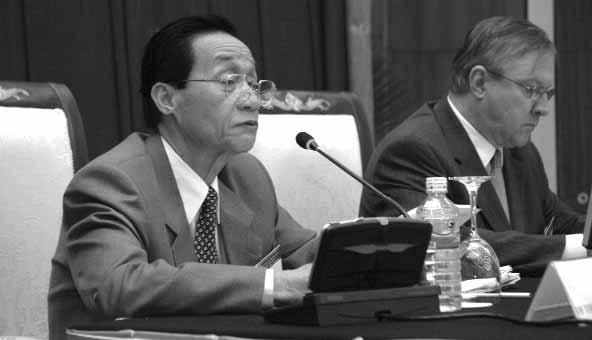
Joint Committee Chairman H.E. Mr Sin Niny addresses the meeting.
Following the meeting the delegates
board the opinions of donors and
had the opportunity to visit one of the
Plan which will now continue in a
Navigation Programme and the Flood
members of civil society.
local fisheries at Nam Houm, about
transition phase until the promised
Management and Mitigation
The MRC now has a very good
30km from Vientiane, where a
funding for BDP2 comes through
Programme, which have gradually
consensus to support its work over
successful community management
next year.
started up full implementation in
the next five years.
scheme established by the MRC
The meeting approved the MRC 2006
2006, as well as progress reports on
Fisheries Programme has been in
The Strategic Plan has an overall goal
Work Programme, but postponed
all other MRC programmes.
operation for some years.
aimed at supporting our member
agreement on the 2007 programme
The JC Meeting was followed by the
countries to make "More effective use
The visit also took in a trip to the
and approval of the Operating
11th Dialogue Meeting with
of the Mekong's water and related
Agricultural Development and
Expenses Budget for 2007 until
Dialogue Partners, China and
resources to alleviate poverty while
Service Centre, a centre established
discussion on the future of the Water
Myanmar on September 1.
protecting the environment."
by the Lao Government with
Utilisation Programme was complete.
Delegates heard that China had
assistance from the King of Thailand.
The JC meeting also endorsed the
The meeting heard about the progress
continued its provision of daily
The centre helps local people learn
2007 Work Programme and discussed
of the MRC's most recently
hydrological data to the MRC during
better ways how to cultivate crops
the future of the Basin Development
implemented programmes: the
the current flood season and that in
and raise animals and fish.
MRC aids transboundary water quality study
ne of the strengths of the
NGOs, of some downstream effects
O Mekong River Commission is on the water quality in the area
that it enables members to work
following the dam construction and
together to mitigate any potentially
operations and this issue was
difficult transboundary issues in the
conveyed to MRC by the Cambodia
region. This kind of transboundary
National Mekong Committee
management work is exemplified by
(CNMC). The CNMC requested that
the MRC's Environment Programme
MRC investigate water quality in the
which last year responded to a request
Se San River.
from the Cambodian Government to
As Viet Nam and Cambodia have
engage in a one-year water quality
already set up an advisory body in
monitoring study to test the water in
order to solve any differences
the Se San River below a hydropower
regarding the Se San River basin
dam.
management, the two countries
Team members sampling the water at Pumpi sampling site in Cambodia.
There had been reports, though local
Continued page 2
INSIDE
Modern methods improve irrigation efficiency
First Annual Mekong Flood Report
Fisheries Programme puts IWRM to work
13th meeting of the MRC Council, Ho Chi Minh City, Viet Nam, 12 December 2006
For information about the MRC please contact: Tel: 856 21 263 263 Email: mrcs@mrcmekong.org Website: www.mrcmekong.org
Modern methods will improve irrigation
he Improvement of Irrigation
The RAP was jointly developed by
T Efficiency in Paddy Fields in the
the Irrigation Training and Research
Lower Mekong Basin project (IIEPF)
Centre of California Polytechnic
is introducing up-to-date concepts in
University and FAO in the late 1990s
assessing irrigation efficiencies in
and since then has been successfully
order to produce guidelines to help
used by FAO and the World Bank in
project managers control water
various Asian countries to appraise
resources more efficiently, sustainably
several irrigation projects.
and productively.
Key performance indicators from
The project not only focuses on
RAP help facilitate informed
efficiency, but covers all aspects of
decisions regarding the potential for
scheme improvement with three
water conservation within a project,
major objectives: (1) to appraise
specific weakness in project
irrigation efficiencies (2) to enhance
operation, management, resources,
the capacity of stakeholders and (3) to
and hardware, and specific
produce guidelines for improving
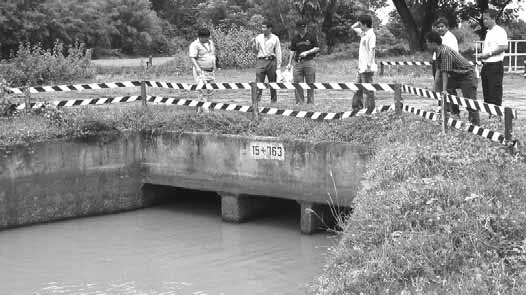
The Thai team inspects the Huay Luang irrigation project site in Udon Thani.
modernisation actions that can be
irrigation efficiency on paddy fields
the Komping Pouy irrigation project
improve the efficiency of water use.
taken to improve project performance
based on actual water use conditions
in Cambodia, and the Go Cong
The RAP also provides initial
in the LMB member countries.
The Food and Agriculture
irrigation project in the Mekong
indicators that can be used as
Organisation's (FAO) Rapid Appraisal
The project document has been
Delta, Viet Nam. Most schemes are
benchmarks to compare the
Process (RAP) will be applied as a
finalised, and field observation and
gravity irrigation systems, except the
improvements in the performance of
tool to evaluate scheme performance
data collection will start from October
GoCong project which uses tidal
the system once the modernisation
as a part of the project's analysis.
2006 in four irrigation schemes in
irrigation.
plans are implemented.
LMB countries which have been
Training in RAP techniques by senior
Under the project conveyance and
The IIEPF project is supported by the
selected as pilot sites. The sites are
water management officers from FAO
overall system, irrigation efficiencies
Ministry of Agriculture, Forestry and
the Huay Luang irrigation project in
has already been conducted for each
will be analysed, water productivity
Fishery, Japan and implemented by
Udon Thani, Thailand, the Nam
country team as part of the project
will be computed, and then
the MRC's Agriculture, Irrigation and
Houm irrigation project in Lao PDR,
cooperation between MRC and FAO.
recommendations will be made to
Forestry Programme.
Water quality study ...
Drought
Management
Programme under
From page 1
forumulation
agreed that the role of the MRC
Secretariat was to assess the
ollowing requests from the MRC
F
information raised by the NGO. It
Joint Committee and the MRC
was decided to initiate a programme
Council, the MRC Secretariat is
of investigation that focused on long-
currently formulating the first stages
term ambient conditions for
of a new Drought Management
conventional parameters that are
Programme.
linked to environmental conditions.
The drought years of 2003-2004 hit
With only anecdotal evidence of the
several areas of the basin very hard,
effects of water quality on public
particularly northeast Thailand and
health, it was not possible to develop
parts of Cambodia, and the Member
a programme of investigation that
Results were reported at a meeting attended by country representatives and NGOs.
States realising the need for such a
targeted specific water quality or
programme acted swiftly to put this
public health attributes.
dissolved oxygen (DO); chlorophyll;
The measured levels of chlorophyll in
need into action.
and total coliform bacteria.
the Se San reflect good water quality.
There was relatively little other water
There was no significant difference in
Now the initial programme strategy
quality information available and
The sampling programme was
conductivity, pH, DO and total
and programme document is nearing
epidemiological information was not
conducted using four stations, three in
chlorophyll of Se San River at the
completion and will be ready for
available to MRCS.
Cambodia and one in Viet Nam, with
approval very soon, after which
sites selected by the two countries.
two transboundary sites Pleicu
The field study was developed by the
donors will be sought to fund
Sampling took place every two
(SS1) in Viet Nam and Pum Pi (SS2)
MRC's Environment Programme and
implementation.
months in the rainy season from May
in Cambodia.
sent to the VNMC and the CNMC for
2004 to November 2004 and every
This study focused on water quality
The process of formulating this
comment in December, 2003. The
month in the dry season from
and did not take other physical
programme has been driven by the
study design was approved by both
December 2005 to May 2005, by
changes in the river into account in
Member States who have been
governments and a joint field team
national teams with assistance from
terms of its environmental condition.
involved throughout in developing its
selected sampling stations. The field
MRC Secretariat staff.
The investigation will continue.
objectives, components and activities
programme was initiated in May of
to meet the basin's requirements.
2004 for a one year period.
The overall results showed that the
The results of the studies were
ambient water quality of the Se San
reported to Cambodian and
The Drought Management
Potential impacts on water quality
River was good at the time of
Vietnamese authorities and local
Programme formulation has been
may be from nutrients, organic matter
sampling in terms of the measured
NGOs at a meeting held in
supported by the Water Utilisation
and bacteria, therefore parameters
parameters. The river displayed pH
Rattanakiri, Cambodia. The NGOs
Programme, as it is directly linked to
were selected to monitor these
and turbidity levels similar to other
present put forward constructive
implementing the Procedures for the
impacts directly. Most of these were
rivers in the region with characteristic
criticism focusing on the lack of
Maintenance of Flows on the
measured in the field to avoid
increases in the rainy season and
assessing short term changes,
Mainstream especially the dry
analytical errors caused by sample
decreases in the dry season.
filamentous algae and human health
season requirements.
transportation over long distances
issues. The meeting concluded with
The programme's main objective is
from field sites to laboratories and
The dissolved oxygen concentration
an agreement to work together to
to support cooperation in drought
inadequate preservation of samples.
of the Se San River was high
(meaning a healthy environment for
address these concerns.
management within the Lower
The parameters chosen were:
animal life) and low chemical oxygen
The study was financed from donor
Mekong Basin and thus reduce the
Temperature; pH; conductivity;
demand values indicate that there is
support provided to the MRC's
vulnerability of the people to drought
turbidity (suspended sediment);
little organic pollution in the river.
Environment Programme.
and economic losses.
Gender talks
Taking the Mekong to the media
share real life
preading the word about the work
S
experiences
of the MRC is an important part
of our communications strategy and
two recent training courses for young
s part of the MRC's Gender
journalists from the six Mekong
A Mainstreaming Project, a series
countries offered a valuable
of talks and Q&A sessions has been
opportunity to meet the media. Both
going on at the MRC Secretariat,
courses concentrated on Mekong
whereby invited speakers share their
themes and attracted participants from
knowledge of gender work in the
print and electronic media.
Mekong Basin.
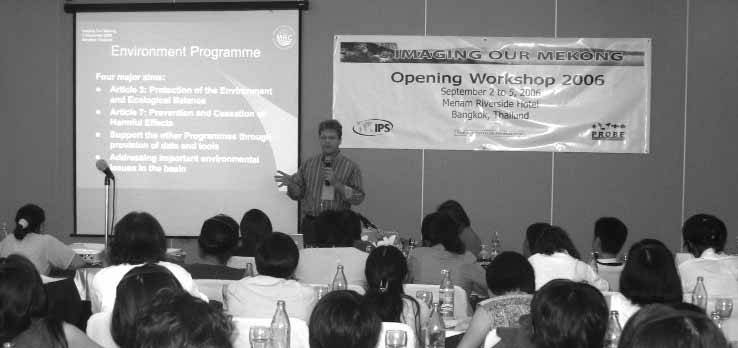
At the opening workshop of the
The staff at MRCS have already
Indochina Media Memorial
heard from the MRC Fisheries
Foundation's (IMMF) print journalism
Programme's Dr Wolf Hartmann on
The EP's Hans Guttman addresses journalists at the Imaging Our Mekong workshop.
training course held in Bangkok the
the important role women play in the
MRC representative discussed some
fisheries sector, and the programme's
The 40 journalists attending the
countries deal with potential
of the challenges facing the Mekong
own work in the Regional Network
Interpress Asia-Pacific "Imaging Our
transboundary issues, working in
regions and what MRC was doing to
for Promotion of Gender in Fisheries.
Mekong" media fellowship
areas such as water quality testing,
help its members meet these
programme had a different agenda
hydropower and wetlands. He also
In October the staff were lucky
challenges.
they were about to undertake in-depth
discussed the way the MRC was
enough to hear Dr Barbara Earth, a
"River Road from China Managing
coverage of transboundary issues at a
facilitating the building of trust
professor from the Gender and
the Mighty Mekong" was the theme
time of regional integration and
between NGOs and government
Development Studies Programme,
of the IMMF's print journalism
development.
bodies so they could work together.
Asian Institute of Technology,
training course and during their four
Thailand, entitled Technocracy Meets
At the opening workshop to orient the
The journalists will produce articles,
week course the journalists, who had
Ethnicity: a World Bank Water
journalists on different cross- border
photo essays and documentaries,
a primary interest in environmental
Supply and Sanitation Project in the
issues to help them in their
which will be published in their local
matters, undertook a 10-day field trip
Mekong Delta.
assignments, the MRC's Environment
media at home. The best stories will
in Chiang Khong and Chiang Saen in
Programme Manager explained about
be compiled into DVDs and books
Dr Earth's team assessed a water
Thailand.
how the MRC helps its member
produced by IPS.
supply project in Soc Trang Province,
Viet Nam which consisted of three
MRCS boat race team rows with Mekong Spirit
components. These met with varying
levels of success, with the system
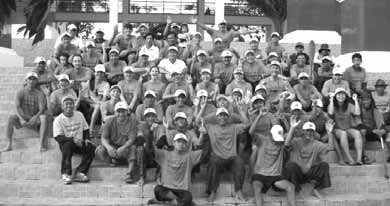
The MRC Secretariat fielded a mixed male and female team for
which had the most community input
the Vientiane Boat Race Festival in October 2006. The team was
being the best received, while two
a combined effort with representation from the Secretariat, the
other systems were less successful.
Lao National Mekong Committee, MRC partner the Worldwide
Dr Earth's talk highlighted the need
Fund for Nature (WWF) and assorted friends. The crew paddled
to include community views and
in a traditional boat along with the men from a nearby village and
competed in five heats, but unfortunately did not win any.
knowledge when implementing
development projects and also the
H.E. Mr Khamlouat Sidlakone, Minister to the Prime Minister's
importance of gender sensitivity and
Office and Council Member for Lao PDR (in white T-shirt and cap
ethnic sensitivity. It was followed by
in centre) joined the team after the races and congratulated
a lively discussion.
everyone on their efforts and for celebrating the Mekong Spirit.
I n f o r m a t i o n p r o d u c t s
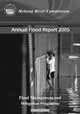
MRC Annual Flood Report
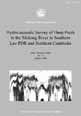
Hydro-acoustic surveys of
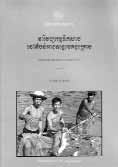
An introduction to
Mekong giant fish species: on
2005
deep pools in the Mekong
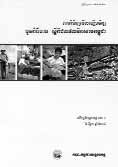
Cambodia's Inland Fisheries
their management and biology
River in Southern Lao PDR
in Khmer
MRC Technical Paper No 3
This is the first Annual
and Northern
Freshwater
Flood Report of the Lower
Cambodia
Cambodia's inland
Aquaculture in the
Mekong Basin which has
fisheries provide
MRC Technical Paper
Lower Mekong
been produced by the
income and food
No 11
Flood Management and
security for millions of
Basin
This paper documents
Mitigation Programme.
people. This report
MRC Technical Paper
the results of a hydro-
The report contains data
synthesises much of
No 8 both in Khmer
acoustic survey over 30 deep pools in
and first hand reports on the impact of the
the relevant research on these
the stretch of the Mekong from
2005 flood season as it affected inhabitants
fisheries in an easy-to-read style, and
These reports on giant fish species in
Siphandone, in Lao PDR, to Stung
in the four MRC countries.
features many photos.
the Mekong and the status of
Treng in Cambodia. The survey found
freshwater aquaculture in Cambodia,
interesting variations in distribution of
July 2006. $10.00 (plus postage)
September 2006. $5.00 (plus postage)
Lao PDR, Thailand and Viet Nam are
size, classes of fish and fish density
now available in Khmer.
during the wet and dry seasons.
For access to the latest reports
September 2006. US$5.00 (plus
and research on development
August 2006. US$5.00 (plus postage)
postage)
issues visit www.mekonginfo.org
How to order
Contact
All products can be ordered from the MRC Secretariat's Documentation Centre.
Documentation Centre
Postage costs apply. Mekong region government agencies may write to the MRC
Mekong River Commission Secretariat
to obtain free copies.
P.O. Box 6101, 184 Fa Ngoum Road, Unit 18, Ban Sithane Neua,
Check the MRC website for a full list of products. Credit card sales are also
Sikhottabong District, Vientiane 01000, Lao PDR
available through the website, www.mrcmekong.org.
Phone: (856 21) 263 263 ext: 1122 Fax: (856 21) 263 264
All products are also available as free downloads from the MRC website.
Email: doc.centre@mrcmekong.org Website: www.mrcmekong.org
Community involvement makes IWRM work
he MRC's Fisheries Programme
By the end of 2005 farmers noted that
Thas helped local communities in
local officials were more responsive,
Soc Trang province, Viet Nam, put
pollution problems were reduced and
Integrated Water Resources
shrimp yields were up. Farmers also
Management (IWRM) into practice
developed a better understanding of
successfully through a programme of
the rules of their organisations, and
community involvement.
attendance at meetings rose.
Communication and agreements
Since early 2006, activities have been
between farmers and government
expanded to communes along the
units combined with capacity-
"basin" of Thanh My canal. Emphasis
building in better sharing and use of
is now on strengthening the capacity
water for multiple purposes have
of farmer organisations and local
made localised, bottom-up and
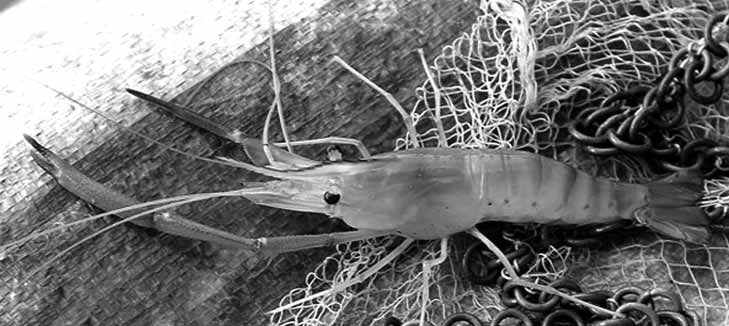
With better water management, farmers can improve their shrimp harvests.
officials to work together to manage
livelihoods-oriented IRWM in the
water resources. A task group with
Mekong Delta province a reality.
than being absorbed as fertiliser.
started work in Soc Trang in
representatives from all participating
December, 2003. Capacity
Soc Trang province is a traditional
Coordination of water use also poses
farmer groups and government
strengthening of fisher and farmer
rice-growing area. Over the past
challenges. If brackish water enters an
organisations has been established.
groups and local government units is
decade, farmers in areas subject to
area too soon, the remaining rice crop
Results look good.
a special concern of the FMG and in
saline intrusion discovered the
suffers. Draining a pond in case of
order to develop a locally acceptable
As vice-chairman of the People's
benefits of dry season shrimp culture.
disease outbreak can lead to outbreaks approach, it first focused on Hoa Tu 1 Committee of My Xuyen district Mr
Shrimp is a lucrative crop, so farmers
in neighbouring fields. Pumping of
Commune, My Xuyen District.
Luong Minh Quyet confirms: "In 2006,
have increasingly converted from
mud from ponds pollutes the water
almost all farmers harvested shrimp
rotational rice-shrimp culture to more
supply for other farmers.
Training events addressing problems
successfully, very few pumped mud
intensive shrimp pond systems.
in shrimp culture and water
At the suggestion of the Research
management and capacity-building
into the canal, and in 70% of ponds
But there are risks. If crops fail the
Institute for Aquaculture No. 2, in Ho
included holding regular meetings
rice is being cultivated in the rainy
community suffers severe economic
Chi Minh City, and through a team
and monitoring of outcomes, fisheries
season instead of a second shrimp crop.
losses and heavy debt loads. Without
based there, MRC Fisheries
regulations, livelihoods development,
This is due to good participation of
a rotational system, pollution from
Programme's Fisheries Management
organisational skills, and financial
local government units and farmers in
shrimp culture accumulates, rather
and Governance Component (FMG)
management.
water management."
Forum researches
Annual Flood Report a first for region
into water for food
n August the MRC published its
agencies responsible for disaster
This report will prove to be an
The Challenge Programme on Water
I First Annual Flood Report
management and mitigation in the
invaluable tool in helping the MRC
and Food held an International
covering the impact of the 2005 flood
MRC Members States, institutes
provide more accurate data for flood
Forum on Water and Food, in
season on the Lower Mekong Basin
involved in water resources planning,
preparedness and also help member
Vientiane, Lao PDR from November
and the four Member States.
donor organisations and NGOs.
countries in planning future land use.
12-17, 2006, hosted by the MRC.
This report contains data and first
"The MRC has instigated this
The Annual Flood Report is one of
This event was designed as a medium
hand reports of the 2005 flood season
initiative because we realise how
the major outputs of the MRC's
for discussion and debate, rather than
as it affected inhabitants of the Lower
important it is to listen to the
FMMP which was designed to
presentations. It highlighted research
Mekong Basin countries.
comments of the people of the basin.
support the MRC member countries
achievements in the field of water
This MRC Annual Flood Report
Their needs are our top priority,"
to create adequate responses to flood
productivity in agriculture, and
2005, the first flood report to be
MRC Secretariat Chief Executive
events. The development objective of
recommended areas for research, as
published at LMB level, was prepared
Officer Dr Olivier Cogels said.
the FMMP is: "to prevent, minimise
well as showing how water-
as part of the MRC's Flood
"Our programmes are driven by these
or mitigate people's suffering and
productivity research results can be
Management and Mitigation
needs and we recognise that the
economic losses due to floods, while
better translated into positive
Programme (FMMP) at the Regional
comments and information gathered
preserving the environmental benefits
developments and recommending
Flood Management and Mitigation
from those communities most
of floods". This objective is the key to
future areas for research and
Centre (RFMMC).
affected by floods is essential if we
a balanced approach and reinforces
development investment.
the region's commitment to "living
The report is intended to be an
are to provide solutions to the
The conference had five themes:
with floods".
account of the floods which occurred
challenges facing the poorest people
Crop water productivity
during 2005. It will serve as a source
in our region."
The Annual Flood Report 2005 was
improvement; water and people in
of information and as a reference
The MRC's FMMP will update the
produced under the financial support
catchments; aquatic ecosystems and
document for the MRC Joint
report annually and will use data
from the Royal Netherlands Embassy
fisheries; integrated basin water
Committee and Council members and
gathered to improve its flood
in Hanoi, Vietnam, for component 1
management systems and global and
also for a wider audience, such as the
management and mitigation activities. of the FMMP of MRCS.
national water and food systems.
Upcoming events
International Symposium - Water Resources and Renewable Energy
MRC Environment Programme Annual Technical Meeting
Development in Asia
January 2007, Chiang Mai, Thailand
30 November - 1 December 2006, Bangkok, Thailand
Email: guttman@mrcmekong.org
Email: BKK2006@hydropower-dams.com Tel: +44 (0)20 8643 5133
The International Conference on Water and Flood Management
13th Meeting of the MRC Council
12-14 March 2007 Dhaka, Bangladesh
12 December 2006 ,Ho Chi Minh City, Viet Nam
www.buet.ac.bd/icwfm/
Email: schiefer@mrcmekong.org
11th Meeting of the Donor Consultative Group
Mekong News is published quarterly by the Mekong River Commission
14 December 2006, Ho Chi Minh City, Viet Nam
Secretariat in Vientiane, Lao PDR. Please send comments, queries and ideas
Email: schiefer@mrcmekong.org
to the Communications Officer, Phone: (856-21) 263 263 ext. 1122
Fax: (856-21) 263 264 Email: virginia@mrcmekong.org