Mekong News
November 2003
February 2004
THE NEWSLETTER OF THE MEKONG RIVER COMMISSION
Contents
MRC Council and donors
meet in Phnom Penh
MRC Council and donors
meet in Phnom Penh
Two new procedures on water
use signed
LNMC: Managing the middle
Mekong
Relocation well under way
MRC Event
$10 million for Mekong
research on water and food
Southeast Asian water plans
target poorest users
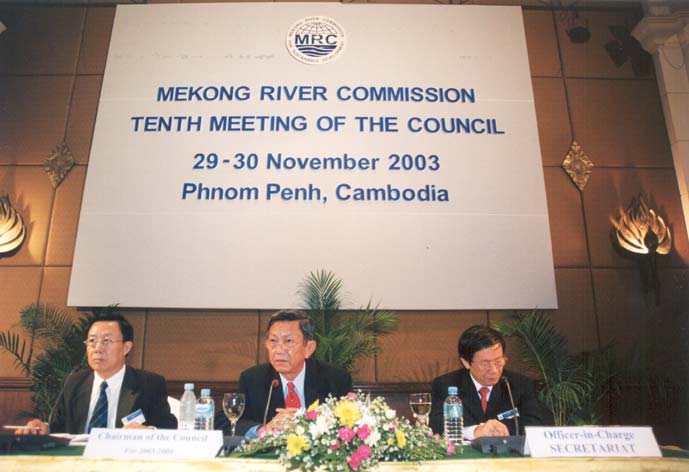
The Prime Minister of Cambodia, H.E. US$22-million, six-year programme for
Samdech Hun Sen, opened the 10th navigation development on the Mekong,
Council meeting of the Mekong River and signed off a 3rd set of procedures
Commission in Phnom Penh on Satur- on water utilization rules (see below).
day, 29 November at the Intercontinen- The support for navigation is expected
tal Hotel. The Council meeting, a two- to provide a boost to trade within the
day annual event, brought together Cabi- Mekong region.
net ministers from the four Mekong
River Commission member countries to In his opening speech to delegates, H.E.
The MRC Secretariat moves to
consider and approve plans for ongoing Samdech Hun Sen commended the
Vientiane, Lao PDR, in June 2004.
cooperation.
Mekong River Commission for the
quality of its information and the devel-
184 Fa Ngum Road , Unit 18, Ban Sithane Neua,
At the Council meeting, the Mekong
opment of its information system.
Sikhottabong District, Vientiane 01000, Lao PDR
region cabinet ministers approved a
>> 2
1
Mekong News
November 2003 - February 2004
MRC Council and donors
Two new procedures
meet in Phnom Penh
Chairmanship of the MRC Council ro-
on
tates annually and the MRC Council is
chaired this year by the Cambodian
Minister of Water Resources and Me-
water use signed
teorology, H.E. Mr Lim Kean Hor.
The Mekong River Commission mem- The Procedures on Water Use Moni-
Heading up the country delegations
ber countries of Cambodia, Lao PDR, toring provide a legal basis for a wa-
were the Minister for Environment
Thailand and Viet Nam have agreed ter use monitoring system to be estab-
H.E. Dr Mok Mareth for Cambodia,
upon two sets of procedures regarding lished in the Lower Mekong Basin.
Minister to the Prime Minister's Of-
shared use of Mekong water: Procedures A four-country grouping of technical
fice H.E. Mr Somphong
for Notification, Prior Consultation experts known as TACT - the Techni-
Mongkhonvilay for Lao PDR,Vice-
and Agreement, and Procedures for cal Assistance and Coordination Team
Minister of Natural Resources and En-
Water Use Monitoring. The sign-off - established through the Mekong
vironment Dr Prinya Nutalaya for Thai-
took place at the close of the MRC's River Commission, will discuss and
land and Vice-Minister of Agriculture
10th Council meeting in Phnom Penh make technical recommendations on
and Rural Development H.E. Dr Pham
on 29-30 November.
the system to the Joint Committee, the
Hong Giang for Viet Nam. Observers
Mekong River Commission's execu-
from UN-ESCAP, UNDP, the ASEAN
The notification procedures require the tive body.
Secretariat, the Asian Development
member countries to alert each other on
Bank and selected government depart-
planned river developments that could The new agreements pave the way
ments also attended the two-day meet-
significantly affect their neighbours, for the countries to agree over the next
ing.
and to provide information regarding two years on rules for the maintenance
the developments, including technical of flow on the mainstream and water
Since the last Council meeting in Ho
specifications and environmental assess- quality guidelines.
Chi Minh City a year ago, the MRC
ments. Last year, these procedures were
has received funding commitments of
agreed upon in a preliminary form.
The Water Utilisation Programme
around US$12.25 million, to be spent
of the Mekong River Commission
over a time frame of one to five
The new agreements provide a definition is supported by the Global Envi-
years.
of water use, covering uses of the ronment Facility through the World
Mekong "which may have a significant Bank over a seven-year period, to end
The MRC work programme for the
impact to the water quality or flows re- in the year 2006.
year 2004 requires a total budget of
gime of the mainstream of the Mekong".
US$22.2 million. Almost three-
quarters of this budget has been
The new agreements confirm that
secured and the MRC is currently
uses of water on the Mekong tributaries
seeking another US$5.6 million to
will also be subject to notification and
cover the remaining cost of planned
monitoring.
activities. A meeting with the MRC's
Donor Consultative Group, repre-
Professor Dr Prinya Nutalaya, Thai Vice-
senting over 15 international donors,
Minister for Natural Resources and
was held back-to-back with the
the Environment, gave strong support
Council Meeting on Monday 1
to the water utilization rules in his
December.
opening speech, noting their "substantial
progress".
2
Mekong News
November 2003 - February 2004
LNMC: Managing the middle Mekong
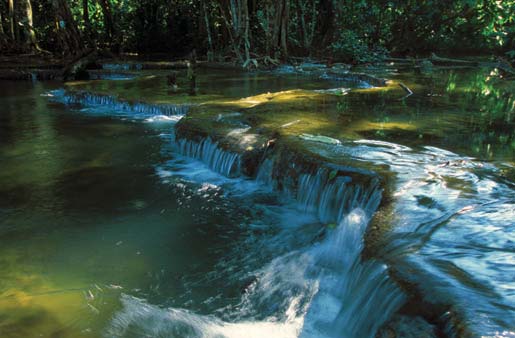
Nearly all of Lao PDR's territory falls
square in the middle of the Mekong River
Basin. Its magnificent mountain scenery
is prime watershed area for the whole
basin - a gift of nature that demands a
careful balancing act on the part of the
Lao National Mekong Committee, tasked
with the management of Mekong affairs
since 1957.
In this land-locked country that ranks as
Prime watershed: Waterfall at Kwanxi in the hills near Luang Prabang
one of the poorest Asian countries on the
United Nation's Human Development many feasibility studies were done for
Index, incomes are low and the average the proposed Pa Mong dam, but the
life expectancy is just 54 years. Access member countries of the former Mekong
to primary health care is poor, with in- Committee eventually agreed not to go
fant and under-5 mortality rates three ahead with this project on the main-
times higher than the regional norm. The stream. However, electricity generation
improvement of living standards is there- on the tributaries of the Mekong remains
fore of prime importance, said Mr important. Not only is it expected to be
Boriboun Sanasisane, Secretary-General a main source of foreign exchange, elec-
of the LNMC. The Lao national agenda tricity is seen as a means to grow agro-
focuses on poverty alleviation and the industry, building on the country's ex-
challenging task of balancing develop- isting base of agricultural cultivation,
ment with conservation of natural re- and powering potential new mining de-
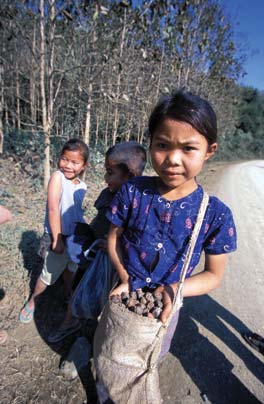
Children collect seeds from teak trees to sell.
sources. In terms of Mekong affairs, that velopments. The LNMC is also investi-
means a high priority on road connec- gating the possibility of "micro-hydro" To do so, the LNMC is looking to ex-
tions through the river basin, food secu- dams that would have a generating ca- pand the range of skills available within
rity through agricultural production, and pacity of 5 to 10 MW.
the committee to include new expertise
the sale of electricity as a main source
on legal issues, economics and the en-
of foreign exchange.
Other priorities for today are the in- vironment. At present it has around 30
depth study and management of agricul- staff, of whom 70 per cent are engineers
Most of Lao PDR is mountainous. Ac- ture, hydropower and fisheries - a rec- or have some other technical back-
cordingly, hydropower generation has ognition of the importance of the ground. Most LNMC staff come from
been a focus since 1950. "In the 1950s Mekong River Basin's natural resources. the line ministries. The committee main-
and '60s, we were thinking about infor- Forest cover is an important subject of tains close working relationships with
mation-gathering - acquiring the techni- study and watershed classification ex- the Ministry of Agriculture, the Minis-
cal tools needed to identify projects for ercises have successfully identified try of Industry and Handicraft, the
the national interest," recalled Mr prime areas for conservation and man- government's Science, Technology and
Boriboun. The Nam Ngum dam, Lao agement. At present the LNMC is work- Environment Agency and the Ministry
PDR's first medium-scale hydropower ing closely with the Lao government's of Communications, Post and Construc-
project, was completed in 1968 and re- State Planning Committee and the line tion, which includes inland waterways.
mains a symbol of Mekong cooperation ministries to assist people in finding al-
from the early years. Irrigation, naviga- ternatives to shifting cultivation.
Besides day-to-day cooperation with the
tion, bank protection and flood control
Mekong River Commission on the run-
schemes were also prominent during this "More then 35 per cent of the water in ning of its existing programmes, the
time.
the Mekong comes from Lao PDR," said LNMC has bilateral cooperation ar-
Mr Boriboun. "So whatever we do, we rangements with various donors includ-
In the later years of the 1970s and '80s, have to look to the source."
ing UNDP and the governments of
>> 4
3
Mekong News
November 2003 - February 2004
LNMC: Managing the middle
Relocation well under way
Mekong
Belgium, China, Korea, France and Ja-
pan. A river management advisor from
Korea is currently serving the LNMC
in preparing a national integrated water
resources strategy and plan.
The committee is also poised to wel-
come the secretariat of the Mekong
River Commission when it moves to
Vientiane in May this year, expecting
that this will reinvigorate the whole
spectrum of working relationships. "The
MRC is seen as a very important
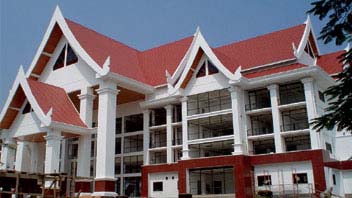
New MRC Secretariat building in Vientiane, Lao PDR.
organisation for Lao PDR, since 97 per
cent of the country falls within the Moves to shift the Mekong River Com- a generous grant from the Thai National
Mekong River Basin,"said Mr mission Secretariat from Phnom Penh Mekong Committee. The Korean gov-
Boriboun. "It is a strong bridge linking to Vientiane are now well under way ernment is providing US$50,000 worth
donors with the local people, and Lao according to the relocation "road map" of computer equipment, while the Viet-
PDR with its neighbours."
approved by the Joint Committee in namese government is assisting with a
2003. Recruitment and training of Lao grant for completion of the building.
Several priority sectors are identified for support staff are in process, and the new
the committee's attention in the new building is in the final stages of being Most professional staff will make the
year: agricultural development for food fitted out.
move from Phnom Penh to Vientiane in
security and export; building of infra-
late May 2004.
structure including roads, dams and tele- The MRC Secretariat's new home is a
communications; human resource de- five-storey building overlooking a broad Cambodian administrative staff have
velopment particularly in new technolo- stretch of the Mekong as it flows through been adapting to the change process.
gies; poverty reduction; and environ- Lao PDR's capital city. On the ground Some will travel to Vientiane to be
mental protection based on a balance floor will be staff training rooms and part of a one-year handover to new
between development and conservation cafeteria, while the first floor will house Lao staff, while a number will move
efforts.
a Documentation Centre open to the on to the new MRC Flood Centre
public. Most Secretariat functions and in Phnom Penh or to jobs with other
The Lao government, said Mr Boriboun, programmes will have their offices on international agencies. A small number
has always put a high priority on coop- the upper floors.
of staff will not be able to relocate and
eration with the other Mekong states on
the Secretariat is assisting with job
use of the river basin. In conclusion, he The new location is a strong symbol placement through liaison with other
reflected: "We don't have a big lake or of regional cooperation. Thanks to its agencies.
wide rice fields. What we can hope for riverbank location, many offices
is to be the battery of the ASEAN power will have a clear view of houses and New Lao administrative staff are being
grid, and the crossroads of mainland shops on the opposite bank of the recruited and trained. The first batch
Southeast Asia."
Mekong, in the Thai town of Nongkai.
began training in December 2003 in
Vientiane. Training costs are being cov-
· This story on the LNMC is the third Most office equipment will be shipped ered by the UNDP mission in Lao PDR.
in a series featuring each of the Na- from Phnom Penh, with some additional
tional Mekong Committees in turn as requirements being covered through
the key coordinators of MRC activi-
ties in member countries.
4
Mekong News
November 2003 - February 2004
MRC Events
The 26 course participants from Na-
Asking "what-if"
Mekong Spirit enters
tional Mekong Committees in the four
questions
member countries and the MRC Secre- Water Festival
tariat learned how to use the DSF and
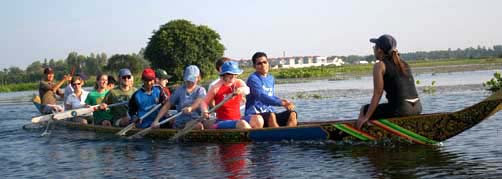
the recently completed MRC Population Staff from the MRC Secretariat and its
and Environment Atlas to find out an- partners successfully completed the
swers to "what-if" questions on the po- course in the Water Festival boat races
tential impacts of population growth, this year. A multi-national crew from
hydropower development and increases Cambodia, Thailand, Denmark, Austra-
in irrigated agricultural areas.
lia, Germany, France, Canada and the
United Kingdom entered the Phnom
They also learned how to construct sce- Penh Water Festival races this year with
narios as inputs into the decision-sup- their purpose-built dragon boat, the
port framework and to interpret the out- Mekong Spirit.
puts, analysing relationships between
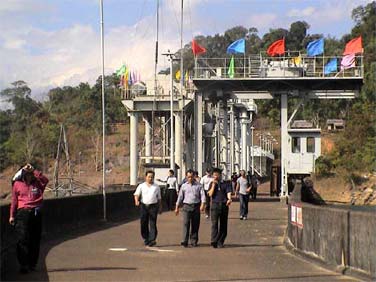
Course participants at
water flow and people, and between Brightly decorated boats, crewed by
the Nam Ngum hydropower dam
water flow and the environment.
teams of rowers, compete in the Water
Festival races in Phnom Penh every year.
How might construction of dams A visit to the nearby Nam Ngum hydro- The Mekong Spirit was the only boat
affect the Mekong fishery? If irrigation power scheme brought the issues to this year to field an international team.
increases, what changes in water qual- life as a senior staff member briefed par-
ity can be expected? And what impacts ticipants on the operating rules for A capsizing incident during one of the
would population growth have on de- the hydropower plant - essential to un- team's practice runs on the Bassac led
mand for water?
derstanding its likely downstream im- to a new dragon boat being designed to
pact. Later, lakeside villagers talked accommodate the larger foreigners, who
Participants in a 4-day training course with them about the capture fishery were, as one of them noted, "being
in Vientiane last December examined and aquaculture at Nam Ngum reservoir. beaten by schoolboys."
these and other questions aimed at view-
ing the Mekong River Basin as a sys- Many participants had not had the op- While they didn't win, the 26-member
tem. They also trained in the use of the portunity to travel within their own river crew claimed it as a victory for Mekong
Mekong River Commission's new deci- basin and affirmed that they would re- cooperation. Said team captain Hang
sion-support framework (DSF), a com- turn with a better mental picture of the Chhaya to the Phnom Penh Post, "Our
puter simulation package used to pre- basin's resources and people. The fourth initial aim was, of course, not to sink."
dict impacts of different planning deci- training module in this series, planned
sions.
for May-June 2004, will be a tour of the Given that, the fun, festivities and over-
basin focusing on understanding the link all team-building were a bonus, and the
One challenge for basin development between its natural resources and team plans to take the Mekong Spirit to
planning in the region will be the abil- people's livelihoods.
the races again in 2004.
ity of decision-makers to bring together
information about proposed and planned
developments in targeted border areas.
The training course, held from 8 to 12
December 2003, was the third in a se-
ries of AusAID-funded support for the
Mekong River Commission's basin de-
velopment lanning process, resourced by
experts from the Murray-Darling
Basin Commission (MDBC) in Austra-
lia.
5
Mekong News
November 2003 - February 2004
$10 million for Mekong research on water and food
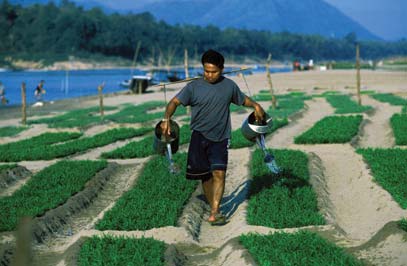
Growing vegatables on banks and sand bars of Mekong River .
Eight separate projects focusing on ag- sustainable agricultural, fisheries and The Mekong projects funded through
ricultural productivity and efficiency of economic development, while alleviat- the Challenge Programme will study a
water use in the Mekong region have ing poverty and preserving the unique wide range of topics related to food pro-
received funding to the value of US$10 environment and biodiversity of the ba- duction and water use. Landscaping of
million through the Challenge sin.
rice fields to promote water use effi-
Programme, a global research
ciency, development of salt-tolerant rice
programme targeting important river Agriculture currently consumes 90 per varieties and other crops, and fish cul-
basins around the world. Another three cent of all water use in the Mekong River ture in seasonal floodwaters are among
projects have been approved subject to Basin. Rice cultivation is the most im- the areas identified for action.
the availability of funds.
portant agricultural activity in the Lower
Mekong Basin, for physical, biological, Submissions for funding were coordi-
The winning submissions came from a social and economic reasons. However, nated by the Mekong River Commission
range of CGIAR centres (the Consulta- rice-growing consumes a great deal of through its network of partners in river
tive Group on International Agricultural water. To produce one kilogram of rice basin management.
Research), the University of Chiang Mai requires three to five thousand litres of
and the Water Utilisation Programme of water, depending on the rice variety and
the Mekong River Commission.
type of irrigation used.
Launched in Nairobi last year, the Chal- While there is plenty of water in the
lenge Programme is a global research Mekong, water use for agriculture is
programme spread across nine major rising in tandem with government
river basins in Africa, Asia, the Middle policies throughout the basin favouring
East and South America. The river ba- expansion or improvements to irrigation
sins serve as living laboratories where facilities. Water is likely to become
the impacts of development can be scarce during the critical dry-season pe-
clearly measured. Each basin has its own riod of February to May. In the Mekong
set of problems. In the Mekong River Delta, saltwater intrusion and acidic
Basin, the challenge is how to achieve
flows during the dry season are already
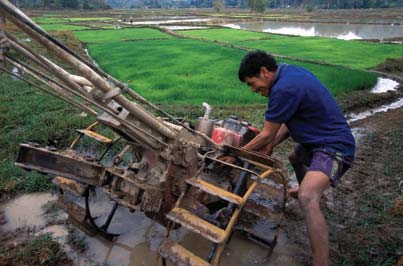
Starting the engine on a walking tractor.
a major problem.
6
Mekong News
November 2003 - February 2004
Southeast Asian water plans target poorest users
The Forum identified nine priority ar- officials, experts from United Nations
eas for action, including increasing the agencies, advisors, researchers and cam-
efficiency of water use, establishing le- paigners on water issues. It was hosted
gal frameworks and guidelines for wa- by the Global Water Partnership's South-
ter allocation, and more involvement of east Asia Technical Advisory Commit-
water users, particularly women, in de- tee.
Southeast Asia's rice irrigation systems cision-making.
should be updated, and its rich fishing
The conference is a follow-up from the
grounds protected through better man- The Forum also endorsed a new Water 3rd World Water Forum that was held
agement, said delegates at the close of and Climate Alliance, a coalition of in Kyoto, Japan in March 2003, which
the region's First Southeast Asia Water groups that will cooperate to seek fi- produced over 100 commitments to ac-
Forum. These moves are expected to nance for floods and scientific drought tion on water issues.
help solve poverty and food insecurity, research to predict and monitor the wa-
the most pressing water issues for the ter cycle.
region.
Fine art of peace-building
These priorities accord with activities
Over 500 people from SE Asian gov- already under way at the Mekong River
Delegates to the Southeast Asia Water
ernment agencies, universities, NGOs Commission. A US$20 million Flood
Forum in Chiang Mai discussed ways
and private water sector management Management Programme is now in its
to resolve disputes on water issues, in
bodies attended the four-day forum in start-up phase, while agriculture and
sessions held over two days. The ses-
Chiang Mai, Thailand, from 17 to 21 water use efficiency are the focus of re-
sions on "Conflict resolution and river
November 2003.
search being commissioned through the
basin organisations", convened by the
Challenge Programme (above).
Mekong River Commission, sparked
lively discussion between regional and
Delegates called for better service for
international experts, government offi-
the poorest water users in particular, in- The Forum provides a boost for coun-
cials and NGO workers. Speakers pre-
cluding farmers who depend on outdated tries to meet the target set in the
sented a number of case studies focus-
and wasteful irrigation systems, and Johannesburg World Summit on Social
ing on (among others) the South China
slum dwellers paying high prices to pri- Development (WSSD) in September
Sea, the Pak Mun and the Cuu Long
vate water sellers. In the Mekong region, 2002, to prepare national plans for inte-
Delta. The MRC's role as a regional river
agricultural irrigation accounts for 90 grated water resources management and
basin organisation came under scrutiny
per cent of all water use, compared with water efficiency by 2005.
- and general affirmation - as structures
70 to 80 per cent in other parts of the
and processes for resolution of real-life
world. Access to clean drinking water The four-day conference in Chiang Mai
water issues were discussed.
is still limited in many areas; for ex- drew well over 400 delegates - almost
ample, in Lao provincial towns, only 18 twice the expected number - including
Detailed conference outcomes are posted
per cent of people receive a piped water many internationally-recognised speak- on-line at www.gwpseatac.ait.ac.th
service.
ers including senior government
Hard copies of the Mekong News
newsletter can be obtained from the
Mekong River Commission Secretariat
364 Preah Monivong Boulevard,
Phnom Penh, Cambodia.
You can request free email subcriptions through the MRC
website or by sending an email to webmaster@mrcmekong.org
7