




July - October/ Issue 2008/3
Mekong News
T H E N E W S L E T T E R O F T H E M E K O N G R I V E R C O M M I S S I O N
Sustainability the Focus of MRC Hydropower Programme
Over 200 representatives of
organisations with an interest in
hydropower development in the Lower
Mekong Basin gathered in Vientiane
in September for the Regional Multi-
Stakeholder Consultation on the MRC
Hydropower Programme. Designed by
the MRC Secretariat to gather input
from a wide range of expert sources
and concerned groups, the meeting's
constructive and open dialogue has
given the Hydropower Programme a
head start in its mission of enabling
a regional and integrated approach to
hydropower development.
Opened by Lao National Mekong Com-
mittee Director-General Chanthavong
Saignasith on September 25, on behalf
of Council Member Mme Khempheng
Pholsena, the Consultation provided a
Fishermen at a dam spillway in Cambodia.
Photo: MRC/Jim Holmes
forum on hydropower issues for govern- that all the development needs of the
kong River. In addition, the Fisheries
mental agencies, private sector com-
Mekong - everything from navigation of Programme presented a summary of the
panies and fi nancing agencies, NGOs,
the river to fl ood management, fi sheries, results of the expert group meeting held
international organisations and the
irrigation, environmental management,
on the barrier effect of dams on fi sh
donor agencies that support the MRC
and tourism - must be considered when
migration a few days before the hydro-
as development partners. Hydropower
decisions on hydropower are made.
power consultation (see page 6). These
industry experts from the region and
He acknowledged the importance of
programmes, and the Secretariat's
outside Asia also made presentations
increased participation in this process
Environment Programme, will continue
to the meeting. These included a status
and committed the MRC Secretariat to
to feed scenario and planning data into
report from China on dams being built
providing the basinwide information
the Hydropower Programme.
in the Upper Mekong Basin.
that will enable the Mekong countries to The Chief Operating Offi cer of the
Mr Chanthavong said he hoped the
decide on future developments.
World Bank Group's Multilateral
Consultation would come to be regarded According to Mr Bird, with hydro-
Investment Guarantee Agency, James
as a landmark event in cooperation
power development now being private
Continued page 2
between Lower Mekong countries. "It
rather than public-sector driven, early
is clear", he said, "that we all recogn-
identifi cation of key planning criteria
ise the importance of data sharing and
is required to ensure social and envi-
I N S I D E
joint planning in the sensitive matter of
ronmental concerns are addressed in
· August flooding and the
hydropower development. This technol-
a coordinated manner, while risks and
ogy offers great rewards, but at the same responsibilities are identifi ed within a
MRC reaction
time can carry much risk. Cooperation,
basinwide framework. As part of this
· Sustainable water
therefore, is essential to optimising our
process, the MRC will undertake a stra-
management ideas shared
chances of creating a sustainable hydro-
tegic environmental assessment of pro-
· Navigation not so
power industry that can bring the ben-
posed mainstream dams and promote
dangerous as first
efi ts of power and water control while
dialogue on key issues with developers,
believed
minimising disturbance to our natural
line agencies and other stakeholders.
· Renewed Cooperation
environment and traditional way of life". As shown by the Basin Development
with China
MRC Secretariat CEO Jeremy Bird
Plan Programme's presentation to the
· River art celebrates 10
called on participants to focus on a
meeting, the MRC has already begun
years of Thiess
basin-wide approach to decision making modelling the fl ow changes that various
Riverprize
on hydropower. Mr Bird emphasised
proposed dams could cause in the Me-
For information about the MRC please contact: Tel: 856 21 263 263 Email: mrcs@mrcmekong.org Website: www.mrcmekong.org
Mekong News; July - October/ Issue 2008/3
Regional Stakeholder.....
From page 1
P. Bond, stressed the role of the MRC
advocacy groups,
in bringing all these elements together.
developers, and
"Sustainable hydropower developments National Mekong
in the Mekong Basin will not be pos-
Committees.
sible unless there is an institution that
can liaise and coordinate between the
On the morning
varying interests of all the countries"
of September 27,
said Mr Bond.
a working session
was held on the
He added that the MRC could improve
draft Hydropower
how impact assessments are conducted, Programme docu-
lead the way on cumulative impact
ment, before around
assessments, provide policy advice to
60 participants
the various countries, keep a regional
travelled to south
perspective, disseminate information,
to the Lao province
share best practices, engage
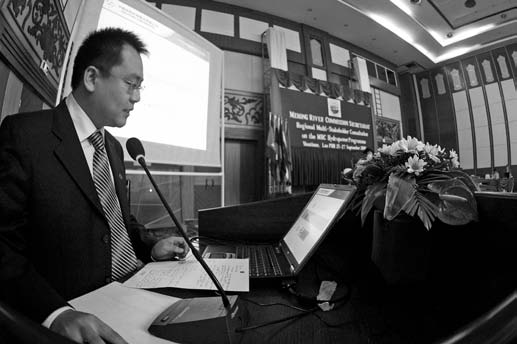
Zhong Haixiang of China's Sinhydro Co. gives a private investor's perspective
of Khammouane
stakeholders, ensure transparency of
on the MRC Hydropower Programme.
Photo: MRC/Vincent Gautier
province, to visit
processes, and develop capacity.
the Theun Hinboun hydropower project. Input from the Consultation will
The first two days of the meeting
Presentations from the Consultation
help drive the programme forward
featured presentations on a wide range
are available on the MRC website,
as it conducts further research work
of issues (see box). These came from
and full proceedings will soon be
and examines ways of enhancing the
a range of stakeholder sectors, includ-
uploaded: http://www.mrcmekong.org/
sustainability of energy development
ing national electricity enterprises from
programmes/Hydropower/stakeholder-
strategies.
MRC member states, environmental
consult-ppt.htm.
· Presentations - Regional Multi-Stakeholder Consultation on the MRC Hydropower Programme
Hydropower development in the Mekong Basin regional opportunities and shared
Mr Chanthavong Saignasith, Director General, LNMC
responsibilities
A development bank's perspective on sustainability
Mr James P. Bond, Multilateral Investment Guarantee Agency, World Bank Group
Global precedents in trans-boundary conservation: Lessons for the Mekong region?
Mr Stuart Chapman, WWF Greater Mekong Programme
Sustainability assessment an industry approach
Mr Jean-Michel Devernay, International Hydropower Association
Hydropower in the context of basin wide water resources planning
Mr Jeremy Bird, CEO, MRCS
Modelling of flow changes in the Mekong mainstream for a range of development
Ms. Hang Pham Thi Thanh,
scenarios preliminary results
BDP Coordinator, MRCS
Examining the barrier effects of mainstream dams to fish migration in the Mekong, and Dr Patrick Dugan, WorldFish Centre, Facilitator of Fishery Expert Group Meeting at
taking an integrated perspective to the design of mitigation measures
MRC
Experiences from the "Procedures for Notification, Prior Consultation and Agreement"
Dr George Radosevich, Legal Advisor on the 1995 Agreement
Hydropower development in Cambodia
Mr Tung Sereyvuth, Ministry of Industry, Energy and Mines, Cambodia
Lao PDR powering progress
Mr Viraphonh Viravong, Ministry of Energy and Mines, Lao PDR
Thailand regional partner in hydropower development
Mr Suthep Liumsirijarern, Ministry of Energy, Thailand
Viet Nam meeting rapid demand growth
Mr Vu Van Thai, Ministry of Industry and Trade, Viet Nam
Hydropower development on the Lancang
Mr Peng Cheng, China Hydropower and Water Resources Planning and Design General
Institute
Influence of regional power market in the GMS region on hydropower development in
Mr Yongping Zhai, Asian Development Bank
the Mekong basin
Adaptive management of the Columbia River System
Dr Bolyvong Tanovan, and Mr Robert Davidson, US Army Corps of Engineers North-
western Division
WWF's partnership in the Yangtze Forum, PR China
Dr Ma Chaode, WWF China
Hydropower and navigation development on the Rhône river impacts and environ-
Mr Vincent Piron, Compagnie Nationale du Rhône
mental management
Benefit sharing from hydropower projects in Viet Nam
Ms Hoang Ha Quynh Giao, Ministry of Industry and Trade, Viet Nam
A model initiative: Addressing social and environmental concerns in the context of
Mr Bun Chantrea, NGO Forum of Cambodia
hydro development in the Mekong Basin
Striving for excellence or race to the bottom
Mr Carl Middleton, International Rivers
Strategic environmental assessment of hydropower development in the Vu Gia-Thu
Mr Pham Anh Dzung, Ministry of Natural Resources and Environment, Viet Nam
Bon River Basin, Viet Nam
Hydropower development - Perspective of a developer
Mr Robert Kay, GMS Power, Lao PDR
Opinions on MRC's Hydropower Programme
Mr Zhong Haixiang, Sinohydro Ltd, China
Perspective of a consultant
Mr Peerawat Premchun, Team Consultants, Thailand
2
Mekong News; July - October/ Issue 2008/3
High flood season hits north of LMB
Destructive flooding affected areas of
the basin from July to September this
year. This article compiles press cover-
age of the floods, while the story below
it gives the MRC analysis.
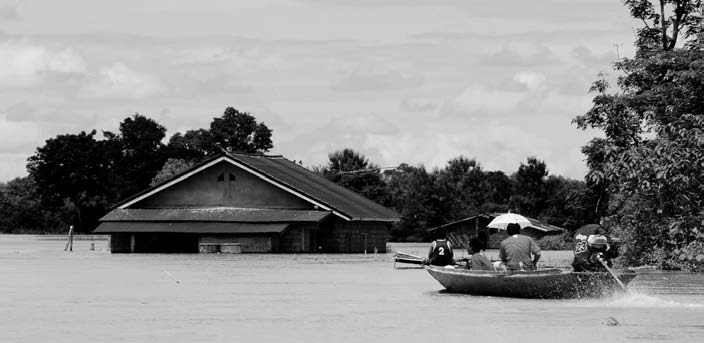
The 2008 flood season caused damage
in various parts of the Lower Mekong
Basin (LMB), with the Lao PDR and
northern Thailand most affected by
record river levels during August.
Lao Foreign Minister Thongloun Sisou-
lith described the flood as the worst ever
to hit the country, saying it had affected
more than 200,000 people. According
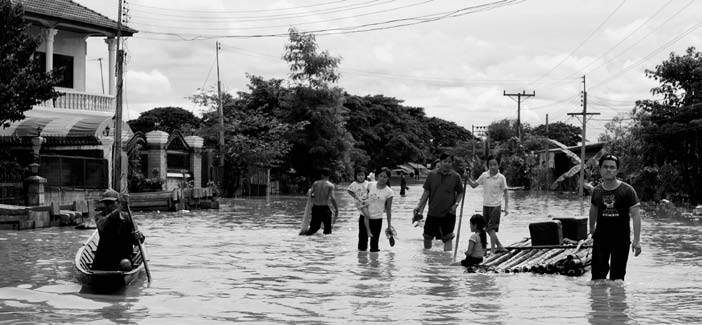
The Mekong River reached record levels as it flooded parts of Vientiane in August.
Photo: MRC/Stan Fradelizi
to the Lao government, over 43,600 ha
of agricultural land was damaged, and
raised these figures substantially during
Hagupit moved inland from Viet Nam
about 17,400 houses flooded. Damage
September. Events in the late monsoon
on September 26. Floodwater from the
to infrastructure such as schools, roads,
season particularly affected the prov-
Nam Kor hit a wall and caused it to col-
and water supply and sanitation systems inces of Nakhon Ratchasima, where
lapse on top of her.
was widespread, with road repairs
about 20,000 families were affected
In contrast, more southern areas experi-
needed because of the floods estimated
and 22.7 billion baht ($670m) worth of
enced normal amounts of water during
at about 293 billion kip (US$34.5m).
damage done, plus Kalasin, Maha Sara-
kham, and Roi Et. Thousands of people
the flood season or even drought. Floods
According to the United Nations, $2m
suffered from waterborne diseases in
were recorded in Preah Vihear province
was needed in both food security and ag- the aftermath of the floods, which also
of Cambodia in mid-September, but
ricultural recovery sectors in Laos. UN
plunged farmers into financial crisis.
across much of Cambodia late rainfall
Resident Coordinator, Sonam Yangchen
delayed rice planting until mid-Septem-
Rana, said poor families would be
Even as September drew to an end, the
ber. People in the Red River Basin in the
impoverished further by the loss of rice
situation was far from normal across
north of Viet Nam suffered terrible loss
paddy, food stocks and other assets.
much of the upper area of the LMB.
of life and property caused by Tropical
According to a statement from the Thai
Wetlands, catchment areas and dams
Storm Kammuri in August, and were
Interior Ministry in August, the flood
across the region were close to full
also affected by the storms of Septem-
was the worst in 100 years, claiming six capacity, meaning that storms such as
ber. In the Mekong Delta though, the
lives, and causing damage estimated at
Hagupit and Mekkhala triggered more
rainy season has so far been regarded as
223 million baht ($66.5m). Initial esti-
flooding. The Lam Phra Ploeng dam
typical of a normal year, with flooding
mates suggest 92,000 households and
in Nakhon Ratchasima was at 96% of
occurring on a limited scale.
200,000 ha of agricultural land were
its capacity at the end of the month. A
This article draws from stories published
directly affected, but flash floods and
woman in Oudomxay province, north-
in the Vientiane Times, Bangkok Post, and
inundations along tributaries will have
ern Laos, was killed when Typhoon
Cambodia Daily, among other sources.
MRC analysis released in wake of 2008 floods
In the aftermath of damage caused by
floods along the Mekong mainstream in
August 2008, it was reported in various
regional media that the MRC had failed
to warn villagers in Thailand and Laos
of the floods, and that the floods were
aggravated by releases from hydropow-
er dams on the river in China. The MRC
was also criticised in some quarters for
failing to obtain information from China
about releases from these dams.
In response the MRC conducted a swift
analysis of the Secretariat's performance
before and during the flooding and de-
The MRC predicted the flood level in Vientiane to within 20 cm of its actual peak in mid-August.
veloped an action plan to address short-
Photo: MRC/Stan Fradelizi
comings. At the beginning of September events (see Information Products, back
entirely generated in the area between
the Flood Situation Report August 2008
page). The report shows that runoff
Jinghong, in Yunnan province, and
was published to give an overview of
for the floods in question was almost
Continued page 4
3
Mekong News; July - October/ Issue 2008/3
have played no significant role in the
cal component of the overall model will
From page 3
Luang Prabang, and so the most critical conditions, which were the result of
need some recalibration.
floods occurred in upstream reaches.
natural meteorological and hydrologi-
As part of proposed improvements at
cal circumstances. Hydrometric data
The August 2008 event was the first
least three-hourly updates of water lev-
supplied by China under the 2002 data
episode for which the Regional Flood
els from the Appropriate Hydrological
exchange agreement with the MRC
Centre provided forecasting services.
Improvement Project and Hydrological
proved important, providing a solid
On the whole results were encouraging,
Cycle Observation System stations are
starting point for flood routing on the
and the Centre's forecasts were gener-
recommended. Other specific measures
mainstream. This information can be
ally accurate. For example, the predic-
will be confirmed following systematic
made even more useful by review and
tion for August 10 correctly indicated
review of the performance of the flood
improvement of the forecasting model.
the flood level in Vientiane would be
forecasting technology in the Mekong
exceeded. Furthermore, the maximum
Various lessons to be learnt were
Basin, both hydrologically and statisti-
flood level in Vientiane was forecast on
identified. These include the need for
cally.
August 13 to within 20 cm of the level
developing `learning algorithms' within The Flood Mitigation and Manage-
recorded two days later.
the forecasting model to refine and
ment Programme is also assessing the
dampen predictions as an event evolves. institutional arrangements for dis-
Analysis of available storage behind the The August event also revealed gaps in
seminating MRC forecasts and early
three operational dams on the Mekong
the MRC's data gathering and a poor
warnings, in terms of their usefulness
in Yunnan revealed it to be insignificant understanding of the flood hydrology of for counterpart agencies, distribution
compared to runoff volumes during the
the major Lao tributaries north of Luang channels and comprehensive coverage
flood. Releases from these dams would
Prabang. To address this, the hydrologi-
of recipients.
Sharing research and field experience on sustainable
water management
Consideration of the consequential
effects of water use on the whole river
basin is required if sustainable solutions
are to be found for the economic and
environmental challenges occurring in
the Mekong basin due to population
growth. That was one of the key mes-
sages to emerge at the Third Interna-
tional Symposium on Sustainable De-
velopment in the Mekong River Basin,
held in Khon Kaen in September.
Representatives from Japan, the MRC
Member Countries, and the Secretariat
met to follow up on the progress and
results of studies by Japan Science and
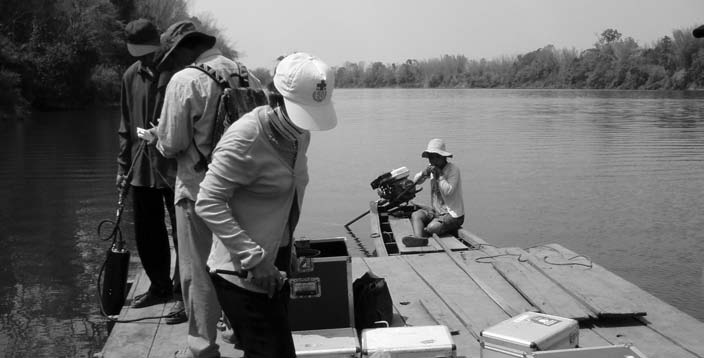
Water quality testing is being conducted by various research organisations across the basin. Photo: MRC
Technology (JST) in the basin. This sci-
entific cooperation is based on field ex-
pioneering research in the Mekong
various parts of the world, but mainly
perience, research data and professional
Basin, much of which was shared at the in Asia. The Mekong region is one of
views on topics including modelling and Symposium. Discussions focused on
its pilot sites, and the focus of work by
monitoring of the water environment in
the socio-economic and environmental
the CREST research project. Coopera-
the Mekong Basin, sustainable irriga-
ramifications of agricultural develop-
tion between the MRC Secretariat and
tion, agriculture, and fisheries, waste
ments, on water quality testing and
CREST supplies information to MRC
water, and socio-economic development hydrological modelling. MRC Agricul-
project implementation and provides
analysis. Symposium participants shared ture, Irrigation and Forestry Programme data for comparison and integration
progress and results through presenta-
(AIFP) representative Fongsamouth
within a range of MRC activities.
tions from a broad spectrum of research
Phengphaengsy called on participants to
institutions including the Institute of
share primary data, so that the various
The meeting in Khon Kaen was the
Technology Centre of Cambodia, the
organisations present could compare,
last planned CREST symposium, but
Lao Department of Irrigation, Khon
discuss, and enrich their own databases. provided AIFP with a good opportunity
Kaen and Vonchanvalikul Universities
Also participating from the MRC were
to extend networking with regional and
in Thailand, and Viet Nam's Southern
the Basin Development Plan and Envi-
Japanese organisations, with a view to
Institute of Water Resource Research.
ronment Programmes.
future cooperation. Full proceedings of
the meeting have already been pub-
The JST-funded Core Research for
JST, an independent administrative
lished by JST in conjunction with the
Evolutional Science and Technology
agency established to promote prog-
Royal Irrigation Department of Thai-
(CREST) research project has instigated ress in science, conducts research in
land.
4
Mekong News; July - October/ Issue 2008/3
Mekong navigation not so dangerous as first believed
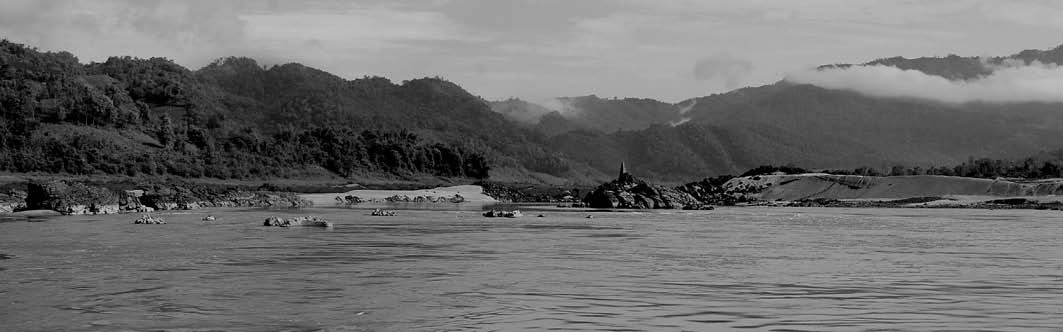
Typical danger area on the Upper Mekong in Laos.
Photo: MRC/Jacques Dezeure
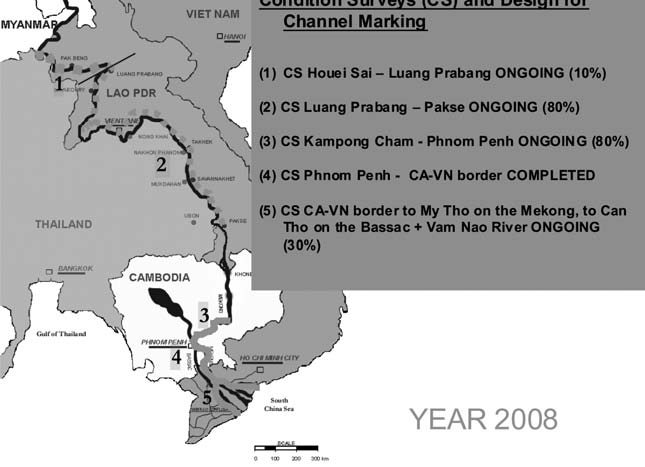
Results are emerging from the MRC's
condition survey of dangerous areas
for navigation along the Mekong River
between Luang Prabang and Pakse (Me-
kong News 2, 2008). While the survey
has identified a greater aggregate length
of hazardous river stretches than had
been anticipated, it seems that the over-
all degree of difficulty these stretches
pose for boats is not as severe as was
previously believed.
Reconnaissance missions over the entire
1,150 km of the river between Luang
Prabang and Pakse were conducted
between March and April this year.
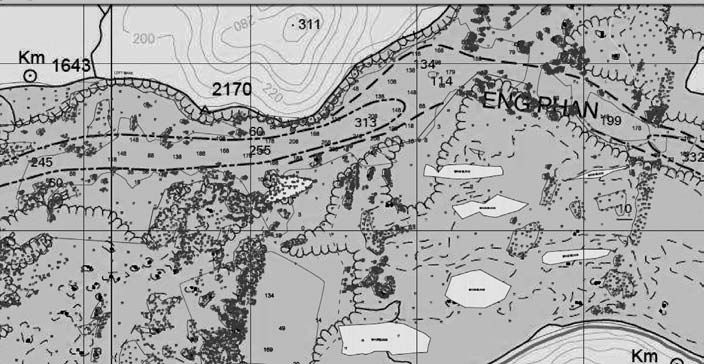
The survey produces detailed mapping of the river, which can then be used to design safety marker systems.
By the end of August, a description of
not accurately reflect the real situation
while elsewhere the extent of the dan-
navigation conditions was ready and
on the river. With no standard system
gerous area had been underestimated, or
hazards had been identified, enabling
of waterway classification instituted
in some locations not marked at all.
the Navigation Programme to produce a before along the Mekong in this area,
The newly compiled list of dangerous
new 1:20,000 scale topo-hydrographic
the authorities of different provinces
areas includes about 48,000 m of lateral
atlas covering the dangerous areas.
had used varying criteria to determine
river section compared to the 36,000 m
Early in the survey process it became
which areas were considered dangerous pre-selected in the desk study. A first
clear that a pre-selected list of danger-
for navigation. In some areas the survey ranking of the pre-selected dangerous
ous areas, prepared through desk study
team found better nautical accessibility
areas downstream from Don Sa Island
and interviews with local pilots, did
than was indicated on existing charts,
in the Lao PDR revealed that naviga-
tion channel problems in this area were
less significant than had been expected.
It was therefore decided this group of
dangerous areas could be considered a
`navigational aids problem'. This means
that those stretches of river can be made
safe through a carefully designed chan-
nel markers system, which is faster and
less expensive than carrying out very
detailed hydrographic surveys.
According to Navigation Programme
coordinator Phirun Hiek, survey work
is not possible when the river is at peak
flow and hazards are hidden by the
water. Survey will therefore continue
along a 12,000-m stretch between Keng
Ta Kho and Hin Han Don Sa at the end
of 2008, when the low water season
starts.
5

Mekong News; July - October/ Issue 2008/3
Renewed Cooperation with China Headlines at JC
and Dialogue Meetings
The signing of a five-year extension to
a data sharing agreement between the
MRC and China marked the culmina-
tion of three days of high-level meetings
in Vientiane at the end of August. The
28th Meeting of the MRC Joint Commit-
tee ran from August 27-28 and was fol-
lowed by the annual Dialogue Meeting,
held with Dialogue Partners China and
Myanmar.
The August 2008 floods were high
on the agenda at the Joint Committee
Meeting. Dr Saksit Tridech, Permanent
Secretary to Thailand's Ministry of
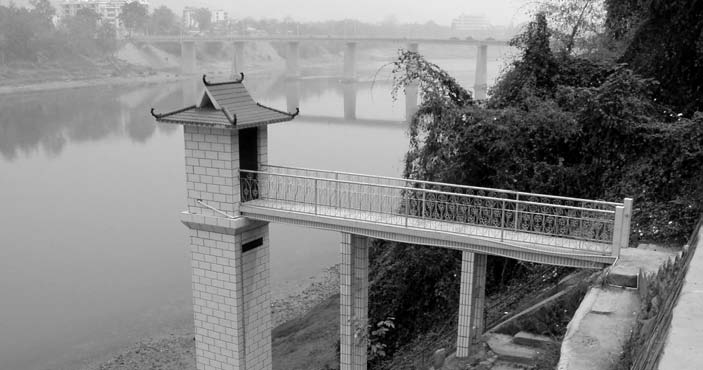
Man'an hydrological station in Yunnan. Information on water levels from two stations on the Lancang-
Natural Resources and Environment,
Mekong will continue to be provided to the MRC during flood seasons.
Photo: MRC
and Joint Committee Chairman for
June-15 October) from two hydrologi-
stretches of the river between Houayxay
2008/2009, told participants that the
cal stations at Yunjinghong and Man'an. and Luang Prabang in the Lao PDR.
MRC had reacted quickly and effective-
This information has improved the qual- Detailed charting and aids to navigation
ly in warning national agencies of the
ity of forecasting for the Mekong River
are needed in this area, which is part
flooding in the Lao PDR and Thailand,
and thereby plays an important role in
of the important tourist route along the
and that the events had prompted much
reducing losses caused by floods in the
river between Chiang Rai and Luang
public discussion. Also prominent in
Lower Mekong Basin.
Prabang.
discussions was the Regional Multi-
Stakeholder Consultation on the MRC
In addition to the agreement on hydro-
China also presented technical infor-
Hydropower Programme.
logical data, it was also agreed that the
mation on the capacity of existing and
In parallel to the Dialogue Meeting,
MRC and China should work together
planned hydropower projects on the
China's Ministry of Water Resources
to ensure that all plans for hydropower
Lancang-Mekong in Yunnan, including
and the MRC Member States renewed
development in the basin take river
the outcome of general research into
an existing agreement to share data on
transport into consideration. The Yun-
the downstream impacts of the Chinese
flood season water flows in the Lan-
nan Administration of Navigational
dams. To further cooperation between
cang-Mekong River. Since 2002 China
Affairs Bureau and the MRC Naviga-
China and the MRC, arrangements were
has provided daily water level and
tion Programme have been discussing
made for a visit to Beijing by senior staff
rainfall data during the flood season (15 possible condition surveys on dangerous from the Secretariat in October.
Fish experts and mainstream dams
The potential effect on fisheries should
fish biology and ecology, and in the
their passage. The most severe impacts
hydropower dams be built on the
design and operation of hydro dams
would be on long-distance migrants,
mainstream of the Mekong River was
to support fisheries. Participants were
the `white-fish' species, which move
discussed by international experts in
informed that up to 2.5 million tonnes
up the river to breed. It is estimated
Vientiane in September. The new MRC
of fish are caught in the Lower Mekong that 70% of the total fish catch in the
Hydropower Programme and the Fisher- Basin each year, worth an estimated
Mekong basin is dependent on these
ies Programme convened an Expert
US$2-3 billion at point of first sale.
long-distance migrants. More locally-
Group Meeting on `dams as barriers to
fish migration in the Mekong main-
Supported by the Mekong's large flood
stream, and possibilities for mitiga-
pulse, many fish migrate upstream to
tion' to feed international expertise
breed, after which their eggs and larvae
into the Regional Multi-Stakeholder
are carried down to floodplains where
Consultation on the MRC Hydropower
they feed and grow. Fish also migrate
Programme, held a few days later.
to feed. According to the experts, dams
can be a barrier to these migrations, but
Seventeen fisheries scientists and
the specific effect varies considerably
White-fish, such as cyprinids and most catfish, are
hydropower engineers brought together
depending on species and on the type
most likely to be affected by Mekong dams as their
worldwide and regional expertise in
of measures introduced to facilitate
life cycles involve long-distance migrations.
6

Mekong News; July - October/ Issue 2008/3
resident `black-fish' are much less af-
fected by barriers, but these species may
not be able to compensate fully for the
production and value of white fish lost
as a result of reduced migration routes.
The impact of a dam on overall fish pro-
duction is also dependent on its location,
design and operating regime. Those built
on the mainstream will have more im-
pact on the fisheries resources than dams
built on tributaries, while those located
in the middle and lower basin will have
greater effect on fish production than
dams in the upper basin.
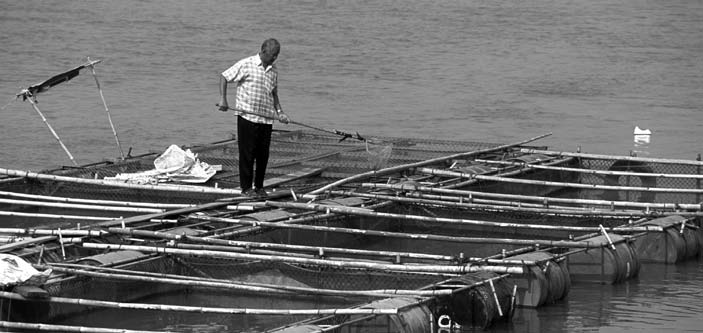
The possibility of enhancing aquaculture and reservoir fisheries to compensate for the barrier effect of
hydropower dams was one of the topics discussed at the Expert Meeting.
Photo: MRC
The experts concluded that while fish
Depending on their design, dams create
well designed bypass structures and
ladders and passes have been de-
reservoirs, which have potential for fish spillways. However, specific manage-
signed in various river systems across
production. However, the ecological
ment measures are needed for each
the world to let migrating fish move
conditions in reservoirs differ greatly
dam: solutions cannot simply be copied
upstream, such measures would need
from those in undammed rivers. Where
from existing designs, but should be
major modification. Moreover, there
natural fish production is generally
redeveloped from proven concepts and
is currently little evidence to suggest
highest - in large rivers and on low-
adapted to local conditions and species.
that existing fish passage technologies
land floodplains - it is often difficult to
would be effective. Fish ladders work
compensate for losses caused by dams.
Where management solutions have been
for salmon, which are very powerful
Estimates from dams in south and
successfully integrated into dam design,
swimmers, but no other freshwater fish-
south-east Asia indicate that reservoir
they have required that dams be oper-
es in the world have equal swimming
productivity levels are generally low.
ated to manage fish migration as first
priority for the parts of the year. It is
The MRC is working on a number of
also important that measures to accom-
initiatives to improve capacity in this
modate fish migration are integrated
area. The group felt that while it may be into dam design from the outset, as
possible to obtain higher yields through retrofitting facilities is far more costly.
stocking and aquaculture enhance-
ments, these could be costly and may
The MRC is working with government
Black-fish like the climbing perch do not leave
not compensate fully for the loss of the
agencies and will facilitate dialogue
floodplains and wetlands and are likely to be less
river fishery. Another major challenge is with private developers to ensure the
affected by dam construction.
how to ensure the benefits of reservoir
issues surrounding fish migration are
incorporated into an integrated approach
ability. For non-salmonid fishes, like
fisheries can be shared by those who
to water resource planning for the Me-
those in the Mekong, ladders could only currently use the wild capture fishery.
kong River.
help fish pass barriers with a maximum
If dams are built, various measures
height of 6-10 metres, lower than the
can be incorporated into the design
The Fisheries Programme is currently
estimated height of proposed Mekong
to lessen their effect on fish migra-
synthesising a full report on the discus-
dams. The experts suggested that further tion. For fish moving downstream, the
sions, and will publish the results in
consideration is required to identify
choice of turbines can greatly enhance
a variety of formats before the end of
options that can meet this challenge.
survival rates, as can installation of
2008.
Upcoming events
Joint 15th Meeting of the MRC Council
Regional Forum on MRC Stakeholder
International Symposium on "Resolving
and 13th Meeting of the Donor
Policy
the Water-Energy Nexus"
Consultative Group
25-26 November, Vientiane, Lao PDR
26-28 November, Paris, France
6-8 November, Vientiane, Lao PDR
Contact: valerie-anne.kodjovi@
developpement-durable.gouv.fr
International Conference on "Mekong
Regional Forum on the MRC Climate
Mainstream Dams: People's Voices across Change and Adaptation Initiative
Borders"
27-28 November 2008, Bangkok, Thailand
Mekong News is published quarterly by
12-13 November, Chulalongkorn Univer-
Contact: sanna@mrcmekong.org
the Mekong River Commission Sec-
sity, Bangkok, Thailand
retariat in Vientiane, Lao PDR. Please
send comments, queries and ideas to the
Regional Consultation on the MRC/GTZ
MRC Fisheries Programme 9th Technical Communications Officer, Phone: (856-21)
Watershed Management Project
Symposium on Mekong Fisheries
263 263 ext. 4703 Fax: (856-21) 263 264
18-19 November, Vientiane, Lao PDR
1920 November, Siem Reap, Cambodia
Email: media@mrcmekong.org
Contact: menniken@mrcmekong.org
Contact: manothone@mrcmekong.org
7


Mekong News; July - October/ Issue 2008/3
River art celebrates ten years of Thiess Riverprize
To celebrate the tenth anniver-
sary of the Thiess Riverprize, the
MRC contributed to a symbolic
mural composed of 16 individual
canvases commissioned by the
International River Foundation
(IRF). The canvases were cre-
ated by winners of the Australian
national and the international
riverprize from 1999-2007, with
two blank canvases reserved for
the winners of the 2008 prize. The
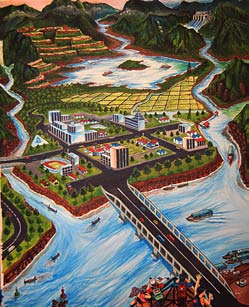
mural was unveiled at September's Left, all 16 canvases commissioned for the tenth anniversary of the Thiess Riverprize. The MRC contribution,
International River Symposium in created by Phannavanh Anoulack, is on the right.
Brisbane, Australia.
A river flows symbolically through each in Australia. Others have forged strong
members on, including agriculture, and
canvas, representing the journey of each transnational collaborations, as with the
irrigation, fisheries, hydropower, navi-
of the prize winners, and the Riverprize
Mekong and the Danube Rivers, and
gation, and watershed management.
itself over the last ten years. The MRC
have overcome cultural and language
The 2008 Australian National Thiess
received the prize on behalf of the Low-
barriers.
Riverprize was awarded to Lake Mac-
er Mekong countries in 2002. According The MRC canvas was created by
quarie in New South Wales, and the
to the IRF, winners have built bridges
ICCS Graphic Designer Phannavanh
International Thiess Riverprize went
across political borders and ideological
Anoulack to represent socio-economic
to St Johns River in Florida, USA. All
divides, such as with the Alexander Riv-
developments occurring in the Lower
past prizewinners are further featured in
er shared by Israel and Palestine. Some
Mekong Basin, and the spirit of coop-
River Journeys, a coffee table book on
have been ground-breaking in terms of
eration between the four MRC mem-
river restoration journeys worldwide.
policy and implementation, such as with ber states. The image shows areas of
The book is available at www.riverfoun-
the Murray Wetlands Working Group
development that the MRC advises its
dation.org.au.
Information products
Flood situation report, August 2008 (Technical Paper No. 21)
Mekong River Commission Secretariat
Written, reviewed and released immediately after the event, this short technical report (20 pages) summarises the main-
Flood situation report
August, 2008
MRC Technical Paper
stream Mekong floods that hit the Lao PDR and Thailand in August 2008. The report analyses the water levels recorded
No. 21
September 2008
in the aftermath of Tropical Storm Kammuri, drawing the conclusion that the floods were caused by a combination of the
storm and heavy rainfall during the early part of the monsoon season.
September 2008. Hard copy: US$5.00 plus postage.
Meeting the Needs, Keeping the Balance
Free download: http://www.mrcmekong.org/free_download/research.htm#tech
6th Annual Mekong Flood Forum - Proceedings
Held in Phnom Penh in May, the sixth AMFF adopted the theme integrated approaches and applicable systems for
medium-term flood forecasting and early warning. This CD presents full versions of all the papers presented at the forum.
August 2008. CD: $5.00 plus postage.
Free download: http://www.mrcmekong.org/free_download/proceedings.htm
Field Guide to Fishes of the Mekong Delta
The product of extensive research on the many arms of the Mekong Delta in Viet Nam, this book describes and illustrates
over 360 fishes, highlighting the distinctions between similar fish.
September 2008. Hard copy: US$15.00 plus postage.
Free download: To be announced
How to order
Contact
All products can be ordered from the MRC Secretariat's Documentation
Documentation Centre
Centre.
Mekong River Commission Secretariat
Postage costs apply. Mekong region government agencies may write to the
P.O. Box 6101, 184 Fa Ngoum Road, Unit 18, Ban Sithane Neua,
MRC to obtain free copies.
Sikhottabong District, Vientiane 01000, Lao PDR
Check the MRC website for a full list of products. Credit card sales are ac-
Open: Mon-Fri, 8.30 am-12.00 pm, 1.30 pm - 4.30 pm
cepted through the website, www.mrcmekong.org.
Tel: (856 21) 263 263 ext: 1041 Fax: (856 21) 263 264
Some products are available as free downloads.
Email: doc.centre@mrcmekong.org Website: www.mrcmekong.org
For access to the latest reports and research on development issues, visit www.mekonginfo.org
8