Mekong News
January - March
2002 / 1
THE NEWSLETTER OF THE MEKONG RIVER COMMISSION
Contents
Joint planning process launched
for investment
Joint planning process launched
for investment
Planning for research
collaboration
Lower Mekong countries agree
to share crucial data
Making river travel safer on the
Mekong
First two Junior Riparian
Professionals join MRC
Thai Deputy Preminister H.E. Dej Boonlong (3rd from right) with the Joint Committee members
How clean is Mekong water?
and Chief Executive of Mekong River Commission (MRC)
Council will mean that the projects are
Events
The Mekong River Commission
launched a regional planning important for development of
process on 15 February to boost thebasin, environmentally balanced
economic growth while maintaining and acceptable to all Governments."
environmental sustainability in its four
member countries of Cambodia, Lao The Basin Development Plan is the first
PDR, Thailand and Viet Nam. The regional investment planning initiative
event, held at Le Meridien hotel in to be fully owned by the four Lower
Bangkok, attracted over 150 people, Mekong governments without the
including representatives of intervention of external agencies. It
government agencies from the four will identify and seek investment for
countries, donors, academics and high priority projects that have been
journalists from local and inter-national assessed as being the best mix of
media.
activities to achieve sustainable
development. Investment will be
In opening the event, Thai Deputy
During the flood season,
sought for projects in the key areas of
the Mekong River Commission
Prime Minister H.E. Mr Dej Boonlong irrigated agriculture; watershed
broadcasts daily flood forecasts on its website,
affirmed the support of the Royal Thai
www.mrcmekong.org
Government at the highest political
level for the Basin Development Plan,
saying that it is deeply committed to
Mekong News is published quarterly by the
"strong and meaningful cooperation"
Mekong River Commission Secretariat in
with other countries sharing the
Phnom Penh, Cambodia.
Mekong River. The BDP, he said, "will
Please send comments, queries and ideas to:
provide a strong basis for our four
Communications Officer, Office of the Chief
Executive MRC Secretariat, Phnom Penh.
governments and the MRC in
approaching donors and lending
(855-23) 720-979 ext 2017
Phone:
institutions. Approval by the MRC
(855-23) 720 -972
Fax:
delia@mrcmekong.org
E-mail:
Mekong News
2
January -March 2002/1
Planning for research
Joint planning....
collaboration
management;fisheries; hydropower;
exacerbate existing inequities and
waterborne transport as well as river
Planning for research collaboration
was the focus of a January workshop threaten fragile ecosystems," said
works; water-related tourism and
jointly organized by the MRC and Mark Rosegrant, senior research fellow
recreation; water supply for domestic
CGIAR, the Consultative Group on at the International Food Policy
and industrial use; as well as flood
International Agricultural Research.
Research Institute, a CGIAR centre.
management.
"Through this workshop, we hope to
Participants in the workshop proposed
The newest of MRC's three core
develop a collaborative research
an economic-hydrologic approach to
programmes, the Basin Develop-ment
programme that will assist in the
water allocation, based on a foundation
Plan began activities in late 2001 with
sustainable management of these
of broad stakeholder involvement and
the establishment of an eight-person
crucial resources."
dialogue. Computer simulations can
team at the Secretariat and the
show the impacts of proposed activities The workshop, held from January 23
appointment of National BDP
in the basin, allowing economic to 25 in Phnom Penh, brought together
Coordinators, located at the National
valuations and comparisons to be made. over 50 experts on Mekong-related
Mekong Committee in each member
Water allocation scenarios can then be issues to identify and discuss the most
country.
proposed, which specify flow rates, important issues for joint research.
Despite its recent start, the
timing, return periods and locations in Participants came from government
programme was initiated in the 1995
the basin ensuring the best, most agencies in Cambodia, Lao PDR,
Agreement which established the
equitable outcomes for all users.
Thailand and Viet Nam; from CGIAR
Mekong River Commission in its
centers including ICLARM (Internatio-
"Competing demands for limited water
present form. Under this Agree-ment,
nal Centre for Living Aquatic
and land resources can lead to haphasard
the Basin Development Plan (BDP)
Resources), ICRAF (International
development, which is likely to
would be the general planning tool
Centre for Research in Agroforestry),
that the Joint Committee of the
IRRI (International Rice Research
Mekong River Commission would
The initial planning process will cost
Institute) and IWMI (International
use as a blueprint "to identify,
US$6.16 million over three years.
Water Management Institute); from
categorise and prioritise the projects
Funding is provided through five donor
bilateral donor agencies; and from
and programmes to be implemented
governments: Australia, Denmark,
other organisations including the
at the basin level."
Japan, Sweden and Switzerland.
International Union for the Conserva-
tion of Nature, the World Wide Fund
The BDP Team at the Secretariat
Planning for the Basin Development
for Nature and OXFAM.
provides the technical and
Plan (BDP) will involve the National
administrative support base for
Mekong Committees in each country
By the close of the three-day meeting,
coordination of the BDP. It supports
and a wide range of other government,
a number of research priorities had
the work of BDP units and working
private sector and civil society players.
been proposed for further develop-
groups in the member countries. The
The programme has already begun its
ment through the networks established
national BDP units located at each
work with consultation meetings and
during the workshop between the
National Mekong Committee
national launching workshops in each
MRC, its regional contacts and
represent the member countries,
country, from late 2001 to early 2002.
international researchers. Besides
agencies and other stakeholders who
Public participation will be sought
research into options for water
are expected to benefit from the BDP.
through workshops, forums and
resource allocation, workshop particip-
interaction through new BDP web
ants also proposed an assessment of
Well-chosen investments into
pages on the MRC website,
risk arising through land use changes,
development are a pressing need in
www.mrcmekong.org
using material from the MRC's Land
the Lower Mekong Basin. Rural areas
Resources Inventory for Agricultural
in all the Mekong Basin countries rank
The Basin Development Plan will
Development (1997-2000), and an
among the poorest in the world, with
maintain strong links with regional
investigation into how water flows
an annual average per capita income
initiatives of external agencies,
affect household activities and
of US$200 to US$400. Three-quarters
including the Asian Development
livelihood strategies.
of the Lower Basin residents are
Bank's Greater Mekong Sub-region
farmers and fishers, who are greatly
(GMS) Programme, and ESCAP's 10-
The MRC Secretariat in Phnom Penh
dependent on the shared natural
year Decade of the Mekong Program-
will now establish focal points to
resources of the basin.
me.
propose and coordinate emerging
research on these priority areas.
Mekong News
3
January -March 2002/1
Lower Mekong countries agree to share
crucial data
Cabinet ministers from Cambodia, Lao PDR, Thailand Other milestones under the Water Utilisation Programme
and Viet Nam committed their countries to exchanging include procedures for monitoring existing water uses -
and sharing crucial data and information needed for joint expected by the end of 2003 - and the final one, rules for
management of the Lower Mekong Basin resources at the water quality, by the end of 2005.
8th meeting of MRC Council on 1 November 2001.
Under this agreement, a broad range of data and information
will be exchanged among the MRC member countries,
including material on water resources, topography, natural
resources, agriculture, navigation and transport, flood
Newsletter
River Monitoring
MRC Publications
Overview
management and mitigation, infrastructure, urbanisation,
River Information
industrialisation, environment and ecology, administrative
Maps
boundaries, socio-economic change and tourism.
Mekonginfo
Links to other sites
The Procedures for Data and Information Exchange and
This page was last updated on Monday, 04 March, 2002 15:52
Sharing were agreed to after a long series of workshops and
negotiations between the four member countries, under
MRC's Water Utilisation Programme, a $16-million
programme funded by the World Bank over five years. Built
into the structure of the Water Utilisation Programme is a
series of "milestones" over the five-year time frame,
representing key achievements in the cooperation
arrangements between Cambodia, Lao PDR, Thailand and
Viet Nam. In agreeing to these Exchange and Sharing
Procedures, the four countries have reached the first
milestone.
At the November Council meeting which brought the
Procedures into force, Cambodia Council Member, H.E. Khy
Tainglim said that the decision "will send a strong political
Click on an area to zoom in to a part of the Mekong basin. These maps show the location and the
status of various hydrological stations. Clicking on a station will bring you to page with station
signal to the world on the strong commitment of the MRC
information: observed and forecasted water levels, as well as yearly observations.
Alternatively, you can click on a station name on the bottom of this page to go directly to the station
member countries to scrupulously implement the 1995
information page.
Mekong Agreement."
Station list
Click on a station name to go to a page with station information
The adoption of the Procedures highlights the unique
strength of the Mekong River Commission's cooperation
Legend
Chiang Saen
Pakse
Luang Prabang
Stung Treng
No Warning
arrangements among the four countries. While programmes
Chiang Khan
Kratie
No data available
are mandated from the highest political levels, they are
Vientiane
Kompong Cham
Nongkhai
Phnom Penh (Bassac)
carried out through very concrete working arrangements
Paksane
Phnom Penh Port
Koh Khel
between the technical and administrative levels of the four
Nakhon Phanom
Thakhek
Neak Luong
governments.
Mukdahan
Prek Kdam
Savannakhet
Tan Chau
Khong Chiam
Chau Doc
The flood forecasting, carried out through the rainy season
Ubon (Nam Mun)
of 2001, is a good example of information-sharing. Gauge
readers, administrators and technical experts from four
Seven-day forecasts of river levels updated daily on the
countries took daily readings which were sent to a national
MRC Website, www.mrcmekong.org
data collection centre in each country, and to the MRC
Secretariat in Phnom Penh every morning. Here, the
information was integrated into a daily flood report that
went out immediately to an email list of around 100 agencies,
government departments and individuals, as well as being
posted on the MRC website.

Mekong News
4
January -March 2002/1
Making river travel safer on the Mekong
Aids to navigation (ATN) such as
buoys and beacons are vital
Lateral Main Channel Buoys
elements for safe passage. But the
Indication of the safe limits of the Main navigable channel
application of different systems on the
same river causes accidents, endangers
the lives of passengers and crew, and
hampers cross-border river and
Topmark
Topmark
maritime transport. Until October 2001,
optional
optional
there were six different systems for
navigation channel markers along the
Greater Mekong River. Each Mekong
Pillar buoy
Pillar buoy
Pillar buoy
Pillar buoy
country had its own system.
with daymark
with top mark
with top mark
with daymark
Left bank side
Right bank side
In October 2001, after national and
Flashing
Iso phase
Flashing
Iso phase
regional consultations supported by
the Mekong River Commission and
UN-ESCAP, the six countries agreed to Thailand - adopted MRC/ ESCAP Nam agreed in principle to use the
harmonise their systems. Countries recommendations for ATN on the international IALA/SIGNI system
upstream of the Khone Waterfalls - Upper Mekong. The two Lower (International Association of
China, Lao PDR, Myanmar and Mekong countries Cambodia and Viet Lighthouse Authorities).
Events
Annual Flood Forum,
wetlands, provide a source of food, Registrations will be accepted from
23-24 April 2002
employment and/or income that is April, and abstracts of papers can be
crucial to sustaining the livelihoods of submitted up to 15 June 2002.
Lower Mekong countries will get multitudes of people, particularly the
ready for the 2002 flood season with an
For more information, please see the
rural poor.
Annual Flood Forum on 23-24 April at
symposium website www.lars2.org or
the Cambodiana Hotel in Phnom Penh. Yet rivers and their social, cultural, contact:
The forum, convened by the Mekong economic and ecological importance,
River Commission, will provide a remain grossly neglected or under- Chris Barlow, LARS2 Coordinator
platform for about 100 participants valued. Production from inland Mekong River Commission
from government line agencies, fisheries is thought to be two to five P.O. Box 1112
disaster management organisations times the officially reported value.
Phnom Penh, Cambodia.
and civil society organisations in
Email: barlow@mrcmekong.org
Cambodia, Lao PDR, Thailand and Viet An International Large Rivers
Nam to exchange information on flood Symposium was held in Canada in Robin L. Welcomme, Chairman
preparedness measures. Participants 1985. This event drew attention to the Scientific Committee Renewable
will cooperate to map out their planned study of large rivers and the need to Resources Assessment Group
activities to ensure the best possible restore damaged river ecosystems. A
Imperial College
coordination of flood management,
University of London
including relief activities, in the 2002 second international symposium is 8 Prince's Gardens
flood season.
now being organized by the Mekong London, United Kingdom SW7 2QA
River Commission and the Cambodian Email: welcomme@dial.pipex.com
Large Rivers Symposium,
Department of Fisheries, in collabora-
tion with the Food and Agriculture
11-14 February 2003
Organisation of the UN (FAO), the
Large rivers provide substantial social World Wide Fund for Nature (WWF),
and economic benefits to many people, and the World Conservation Union
particularly in developing or (IUCN), on 11-14 February 2003 in
industrialising regions. Fisheries in Phnom Penh, Cambodia.
Mekong News
5
January -March 2002/1
First two Junior Riparian
Professionals join MRC
Two new faces at the MRC
Secretariat signal the start of the
Junior Riparian Professional
Programme. Ms Worawan Sukraroek
from Thailand, and Mr To Quang Toan
from Viet Nam, joined the Secretariat
in February for a two- to three-year
internship. During their time with
MRC, the Junior Riparian Professionals
will work with different programmes
to gain hands-on experience and
understanding of the broad issues
concerning river basin management.
Ms Worawan, 27, is a biologist with an
MSc in Marine Science from
Chulalongkorn University in Thailand.
Part of her work at the Thai Ministry
of Science, Technology and Environ-
City, Viet Nam.
river basin management we need to
ment over the past three years involved
have broad knowledge, not only about
reviewing implementation procedures
Mr Toan has been involved in several hydraulics," he said.
for Agenda 21, and screening of project
land and water resources development MRC Chief Executive Mr Joern
applications routed through the
and management projects. He is Kristensen commended the start of the
ministry, for Global Environment
especially interested in investigating Junior Riparian Programme, saying,
Facility (GEF) funding.
soil reclamation methods with a view
to their long-term impacts. These "Through this programme, in time the
Ms Worawan is no stranger to MRC.
involve appropriate flood control Lower Mekong region will have an
Her previous job also involved
measures in the Mekong Delta and use established corps of professionals with
providing broad logistic and
of hydraulic models for flood a wholistic understanding of joint river
administrative support to consultants
simulation.
basin management. The working
working on an MRC Pilot Study of
experience that they will share augurs
Water Resources and Environment in
Mr Toan has been following closely the well for relationships of the future. I am
northern Thailand, including meeting
discussion about minimum flow and proud to say that the MRC is doing its
with farmer groups and liaising with
water quality threshold levels needed part in developing the river basin
them in their own language.
along the Mekong. One of his recent managers of tomorrow."
projects has been carrying out an
Working at the Secretariat, she said, is
investigation of Mekong-related For now, both JRPs are settling into
"a chance to advance my knowledge
flooding upstream of the East Vaico Phnom Penh as well as into their
regarding sustainable development in
River in Tay Ninh province. He was newroles, and getting used to the
this region. For sound river basin
also responsible for EIA of the Balai international environment of the MRC
management, we need to have strong
irrigation project, where the first sluice Secretariat. They will soon be joined by
academic data, together with plenty of
gate is being constructed, close to one colleagues from Lao PDR and
effective projects, and work on raising
of the Mekong's nine river mouths at Cambodia.
people's awareness in the community."
the Delta.
The JRP Programme is supported by
Mr Toan, 32, is a hydraulic engineer
He sees his time at the MRC as a good the Swedish government through
with a Master's degree from IHE Delft
opportunity to learn more about water SIDA under the MRC Capacity
in the Netherlands. Before joining the
resource development issues in a Building Programme, and is designed
Secretariat, he worked as a Researcher
broader perspective. "I'm very happy to promote competence in river basin
for the Southern Institute of Water
to rotate among the three core management and to strengthen regio-
Resources Research in Ho Chi Minh
programmes of MRC, because for good nal networking for effective cooperat-
ion in the Mekong basin region.
Mekong News
6
January -March 2002/1
How clean is Mekong water?
good. However, as the basin
Water quality in the mainstream
of laboratories will take longer.
of the Mekong is usually population increases and industry
expected to be good because the large concerns such as datadevelops, the A Regional Water QualityWorkshop in
amount of water in the river - eighth- water quality sampling network needs Luang Prabang, Lao PDRin October
largest in the world in terms of water to be improved.
2001 brought together key government
flow - dilutes any effluents to
agencies from Cambodia, Lao PDR,
Under its Environment Programme,
insignificant levels. Cities along the
Thailand and Viet Nam to provide
MRC began, in the year 2000, a process
Mekong are generally small, and
information on the modernisation
of modernising the water quality
industrial development is still at a
process to participating agencies, and
monitoring network (WQMN). This
relatively low level - reasons why
seek their guidance and advice on
process will address a number of
industrial pollution is not yet a
future operations of the water quality
reliability, quality assurance and
problem.
monitoring network.
control in laboratory procedures, and
The MRC has been collecting water network revision. The WQMN Major concerns with water quality at
quality data since 1985. There are 98 modernisation will re-examine the present are the transport of sediment
sampling sites at mainstream and location and number of sampling sites, from bank and catchment erosion, and
tributary locations in the Lower sampling methods, sampling frequen- contamination from agro-chemicals
Mekong Basin, where monthly water cy, and parameters. Some of the issues such as pesticides and fertilisers. The
samples are taken. The data indicate can be addressed relatively quickly and WQMN modernisation process will
that water quality in the Mekong is still easily, while others, such as upgrading address these concerns.
MRC publicatioins
A new series of MRC Technical Mekong Conference Series No. 2:
Papers will be available in April 2002: Proceedings of the 4th Technical
· Deep pools as dry season fish habitats Symposium on Mekong Fisheries
in the Mekong
The MRC's new Hydropower Strategy
is available on-line at ·
· River basin financial analysis and risk www.mrcmekong.org
assessment of selected aquaculture
and fishery activities in the Mekong Knowledge about migration routes,
Basin
timing of fish migrations, and location
of spawning areas is crucial for
· Mekong giant fish species: On their assessing impacts of water
management and biology
management projects as well as for
fisheries management in floodplain
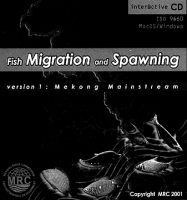
· Status of the Mekong Pangasianodon river systems. A CD-Rom on Fish
hypophthalmus resources with Migration and Spawning is now
special reference to the stock shared available with results of a survey that
For all products, please contact:
between Cambodia and Viet Nam
interviewed 355 fishers in 113 locations
Documentation Center,
in the Lower Mekong Basin. US$20 not
MRC Secretariat
· Status of Pangasiid aquaculture in including postage.
Phone: (855-23) 720-972
Viet Nam.
Fax : (855-23) 720-972
E-mail: mrcs@mrcmekong.org