Mekong News
April - June
2002 / 2
THE NEWSLETTER OF THE MEKONG RIVER COMMISSION
Contents
China signs data-sharing agreement
China signs data-sharing
agreement
Mekong movie screened to
mark anniversary
Is the Mekong overfished?
Yes and no !
Measuring the Mekong:
a technical revolution promotes
regional cooperation
Action plans a focus of 1st
Annual Mekong Flood Forum
Workshops and Studies
On June 11, flood forecasting staff four downstream countries of Cambo-
at the MRC Secretariat in Phnom
dia, Lao PDR, Thailand and Viet Nam.
MRC Events
Penh clicked open an email in the of-
fice queue to find that the river at
The information is particularly relevant
Shipping fire highlights
Yunjinghong had been 536.52 metres
given the concerns by Lower Mekong
need for safety rules
above sea level the night before, and
countries about possible fluctuations in
532.88 metres at Man'an.
river levels.
This small piece of information marked
Under the agreement, the Chinese Min-
a historic event: the beginning of tech-
istry of Water Resources in Beijing will
nical cooperation between China and
provide water level and rainfall data to
the Mekong River Commission.
the MRC Secretariat in Phnom Penh by
Yunjinghong and Man'an are locations
email every 24 hours. The information
on the Upper Mekong or Lancang in
will come from the river monitoring
Yunnan province, China. The first
stations in Yunnan province. In return,
email, sent from a data receiving centre
the MRC will provide assistance to the
in Kunming, was a test-run of China's
Chinese government to upgrade the
During the flood season,
agreement to provide river data to the
two monitoring stations transmitting
the Mekong River Commission
broadcasts daily flood forecasts on its website,
downstream countres, signed with the
the data and provide training for the
www.mrcmekong.org
MRC in April this year.
station staff.
Dr Dong Zheren, Director-General of
The agreement is a step towards a
Mekong News is published quarterly by the
the Department of International Coop-
closer working relationship between
Mekong River Commission Secretariat in
eration, Science and Technology of the
China and the MRC, which the two
Phnom Penh, Cambodia.
People's Republic of China signed the
parties have been working on over the
Please send comments, queries and ideas to:
historic agreement on behalf of the Chi-
past year. China has been a regular
Communications Officer, Office of the Chief
nese government at the MRC Secretariat
dialogue partner with the Mekong
Executive MRC Secretariat, Phnom Penh.
in Phnom Penh on 1 April 2002. Accord-
River Commission at yearly meetings
(855-23) 720-979 ext 2017
Phone:
ing to the agreement, China will
since 1996. In signing the agreement,
(855-23) 720 -972
Fax:
provide hydrological information to the
MRC Chief Executive Officer Mr Joern
delia@mrcmekong.org
E-mail:
Continues on page 2
Mekong News
2
April-June 2002/2
China signs......
Mekong movie screened to mark
Kristensen noted that the final draft
had been agreed upon within a rela-
anniversary
tively short period of time, indicating
a high level of mutual understanding
pilots and port
and cooperation between China and
workers who earn
the downstream countries.
their living from its
ebb and flow. They
Following the signing, a technical team
tell of their liveli-
from the Secretariat visited China from
hoods, their beliefs,
17 to 26 May to work out details of the
and their love for the
implementation. The team was re-
river that feeds them.
ceived by the Vice Director-General
and Chief Engineer of the Hydrology
Staff of the Me-kong
Bureau at the Ministry of Water Re-
River Commission
sources.
Secretariat and gov-
ernment officers in
Regular data transmission from China
the four member
occurs during this year's flood season
The television premiere of a new movie countries of the Mekong River Com-
from 15 June to 15 October. The Chi-
about the Mekong River and its
mission collaborated in the making of
nese side also agreed during this visit
people marked the 5 April anniversary
the movie.
to consider the MRC's request that they
of the agreement that created the Mekong
provide dry-season readings and mea-
River Commission.
"Mekong: The Mother" is part of the
surements of cross-sections of the ri-
Mekong River Commission's ongoing
verbed.
"Mekong: The Mother" has been screened
campaign to increase awareness of
privately before. Its broadcast over the
Mekong issues and the need for strong
The MRC manages a complete net-
weekend of 5-7 April in Cambodia and
regional cooperation in order to man-
work of hydrological monitoring sta-
Lao PDR was the first time the movie has
age natural resources for the popula-
tions on the Lower Mekong, which
been on television.
tion of 60 million living in the Mekong
transmits information directly to the
River Basin. Cambodia and Lao PDR
Secretariat in Phnom Penh. (See page
Filmed around the picturesque Khone
lie mostly within the basin and are the
3 for a story about how this network
Falls in Lao PDR and other riverside lo-
two poorest member countries. Cop-
has changed.) During the flood season,
cations in Cambodia, Thailand and Viet
ies of the movie are now available on
the Mekong River Commission broad-
Nam, the half-hour film highlights the
VCD from the Mekong River Commis-
casts daily flood forecasts on its
significance of the mighty Mekong to its
sion's Documentation Centre.
website, www.mrcmekong.org .
people, featuring the fisher people, boat
Is the Mekong River over-fished? Yes and no!
The high intensity of fishing activ ferent species. Larger species which spawn its population decline is probably due to
ity in the Lower Mekong Basin gives a later in life tend to be depleted more quickly
anumber of factors, of which fishing is only
general impression that the system is over- than small fish which reproduce at a compara-
one). On the other hand, a small, prolific
fished. This impression is strengthened by tively young age. Hence, species such as the
fish such as trey riel (Henicorhynchus
anecdotal evidence from many fishers who well-known Mekong giantcatfish (Pangasiano-
siamensis) is not overfished, and indeed
claim that their catches have been decreas- don gigas)are probably over-fished (although
could probably withstand even heavier fish-
ing over time.
ing pressure.
To improve the Lower Mekong Basin countries' capacity in fisheries impact assessment, the Assessment of Mekong Fisheries Component
In reality, the overall catches in the Mekong
(part of the Mekong River Commis- sion's Fisheries Programme) recently organised field training for counterparts in fisheries agencies.
are higher now than in the past. However,
Fisheries personnel from Cambodia, Lao PDR, Thailand and Viet Nam inspected several water management schemes including hydro-
power dams, irrigation dams, flood control dikes and weirs in the four countries, with a view to understanding basic engineering
it is also true that individual catch rates have
concepts of water management schemes, in order to be able to provide appropriate advice during planning processes. The AMFC will
declined, because the increase in the num-
produce Guidelines for Fisheries Impact Assessment, with practical lessons from the case studies in the Mekong River Basin.
ber of fishers has outstripped the increase
Table: Changes in population size and fish catch in the Great Lake,
in catch (see table).
Cambodia, between 1940 and 1995/96
Usually we speak of over-fishing when
Period
Fishing
Great Lake fish
Fish catch/fishing
Decline in catch/
dealing with a single-species fishery. In the
commune
production (tonnes) commune inhabitant fisher
Mekong, more than 120 species are traded.
inhabitants
Fishing pressure impacts differently on dif
1940
0.36 million
125,000
347 kg
1995-6
1.20 million
235,000
196 kg
44 %
Mekong News
3
April-June 2002/2
Measuring the Mekong: A technical revolution
promotes regional cooperation
Suon Sarin, a 34-year old Cambodian,
unlocks his workstation at seven
every morning at Phnom Penh Port. He
opens the data logger - a wall-mounted
unit that looks like a fusebox - and a
low purring noise greets him, indicat-
ing that another river level reading is
being taken. Today the river is 2.3
metres high. A checklist pasted on the
inside of logger door reminds him of
routine maintenance tasks, while a
brush and dustpan hang on a hook.
Twice a day he checks the logger read-
ing against a staff gauge - a measuring
stick planted just clear of the water
weeds at the river bank.
ruler set into the slope of the bank or role of gauge-readers has changed as
When the water level fell to the lowest
vertically in the riverbed, recorded by the technology has evolved. The equip
point of the year last month - the middle
someone who needed the home that ment is set to take automatic readings,
of the dry season - Sarin's job included
was provided for them at the station but people are still needed to check
extending the pipe carrying the tube
site. In times of floods, the readings thatthe equipment is functioning and
which uses air pressure to take a read-
could be faxed or radioed through to to do basic maintenance. While the
ing, another six metres to reach the low
the Secretariat, for broadcast of warn- equip ment upgrade has taken close to
water. Between these two daily read-
ings to the National Mekong Commit- six months, the Appropriate Hydro-
ings, he sometimes pilots a small boat
tees.
logical Network Improvement Project
with fellow-workers from the Cambo-
(AHNIP) is planned to continue over
dian Department of Hydrology to mea-
The rise of satellite communications five years at a cost of roughly US$ 2
sure water flow at different locations on
and the Internet revolution have million. Most of the remaining time will
the Mekong and Bassac rivers.
changed this way of working. The data be spent on training the staff in the use
logger in Sarin's station contains a and maintenance of the new equip-
Sarin is in the vanguard of a technical
SIMcard, identical to those used in ment, which requires computer literacy
revolution that is changing how the
handphones, which can phone through and some language skills.
countries of the Mekong work together
the readings to a computer at the MRC
on river management. The equipment
Secretariat at a pre-arranged time. The An old staff gauge with blue markings
he manages allows flood forecasts to be
readings are then incorporated into a remains as a relic at Phnom Penh Port;
made and broadcast almost instantly
flood forecast which is updated daily Sarin says it dates from French colonial
around the world through the Mekong
on the Mekong River Commission times. An antique winch-and-pulley
River Commission website. With the
website.
system for moving cargo is set into the
same information, other studies can
slope of the embankment beside it.
also be undertaken - now accessible to
The new data loggers and associated There is a long history of river-measur-
anyone who can log on to the Internet.
equipment are being installed in reno- ing on the Mekong, as generations of
vated shelters along the Mekong: sev- engineers, hydrologists and flood fore-
Through the Mekong cooperation es-
enteen stations in all, including two in casters have sought to unlock its secrets.
tablished since 1957, river levels were
China, with the help of the Australian Many of the measuring stations on the
recorded for many years by hand, trans-
government. While power can be sup- Mekong date from the 1950s; some of
mitted to a national authority and then,
plied to the stations in most places, as a the older ones, including Vientiane and
months later, to the Mekong River
safeguard measure, each station has a Pakse, were set up in the 1920s.
Commission Secretariat, where the data
solar panel which charges a battery in-
were published yearly in a Hydrologi-
side the shelter, to run the station The measuring station at Sarin's work
cal Yearbook, useful to scientists want-
during night time.
site is used to train gauge-readers in the
ing to carry out long-term studies of the
Continues on page 4
river. Readings were taken from a long
Like the old railway gate operators, the
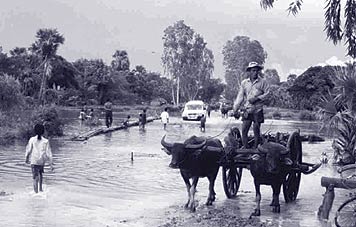
Mekong News
4
April-June 2002/2
Flood Forum focuses on action plans
Mekong
River
When the rain starts, the fishing measures. "Flood Preparedness" there-
starts too in the rice fields and
fore was the theme of the 1st Annual
mangroves of the Mekong region.
Mekong Flood Forum, held on 23-24
Commission
Streams and irrigation canals over-
April 2002 at the Cambodiana Hotel in
flow, not only with water but with fin-
Phnom Penh.
gerlings headed for the nutrient-rich
fields and flooded forests. This tide of
The Forum brought together over 100
life brings food and economic security
representatives of disaster-prepared-
for
to the ordinary people of the Mekong.
ness and development agencies from
Lower Mekong residents consume an
the region. Among them were govern-
average of 36 kg of fish and fish prod-
ment agencies, donors, UN agencies
ucts per capita annually. By compari-
and non-government organisations
Sustainable
son, Danes, considered to have a high
(NGOs), as well as external flood ex-
rate of fish consumption compared
perts. Participants reported lessons
with other Europeans, consume 5-6 kg
learned from dealing with past Mekong
per capita every year.
floods and presented action plans
which included steps as diverse as pro-
development Scientists and planners once thought viding more boats to people in flood-
of the floods as an annual scourge in
prone areas (by Oxfam), establishing
the Mekong region, bringing only de-
rolling stocks of rice seed (by the Food
struction. Some of the earlier dam and
and Agriculture Organisation) and ad-
irrigation projects were conceived with
justing hydrologic models to produce
a view to evening out the flow of the
more accurate flood forecasts (the MRC
Mekong - even talked about it in terms
Secretariat).
of "taming the 9-headed dragon", the
nine branches of the Mekong in the
The Forum provided a platform for all
Delta of Viet Nam.
participating agencies to learn from
shared experiences, discuss emerging
Better understanding of the ecology of
needs and coordinate their activities. It
the Mekong region now means that
also raised awareness of the importance
policy-makers and planners talk about
of holistic flood management in the
"Living With Floods" rather than pre-
Lower Mekong River Basin.
venting them. Major agencies working
in disaster preparedness now
The Annual Mekong Flood Forum was
recognise that floods cannot be pre-
the first event of its kind in the region,
vented, but that much of the damage
financed by the Japan-based 3rd World
can be mitigated by early warning sys-
Water Forum and the Netherlands gov-
tems and better land-use planning
ernment. A second event is planned for
April of 2003.
Mekong News
5
April-June 2002/2
MRC Events
The Murray-Darling Basin
Commission in Australia sent
ahigh-level delegation to the MRC from
9 to 15 May as part of the Strategic Liai-
son Programme between the two
organisations.
MDBC President Dr Roy Green, Chief
Executive Don Blackmore, Chairperson
of the Community Advisory Commit-
tee, Leith Boullie, and Programme
Manager, Susan Kemp first attended a
day of the Joint Committee's Special
Session in Ho Chi Minh City and then
visited the Secretariat in Phnom Penh.
The MDBC delegation's visit to the
Donor agencies of the MRC met
The Joint Committee of the Mekong region was in return for a visit
at a 28 May meeting in Phnom Penh,
MRC focused on financial and admin-
made by the Joint Committee members
expressing strong support for the
istrative issues at two meetings of the
to Australia last year to study public
progress made by MRC over recent
MRC Joint Committee in the last three
participation arrangements being sup-
years. They were particularly inter-
months. At the 15th meeting of the Joint
ported by the MDBC. The Australian
ested in MRC's regional flood manage-
Committee in Vientiane on 13-14
delegation received detailed updates
ment and mitigation strategy (FMM),
March, members reviewed general op-
from representatives of the MRC's core
erating plans of the Secretariat and were
programmes and provided some input
and they congratulated the Secretariat
updated on progress of MRC
into programme planning. The dia-
on its progress in promoting gender
programmes.
logue helped MDBC clarify priorities
equity. MRC's closer working relation-
for the Strategic Liaison Programme in
ship with China was also commended.
A smaller Special Session was then con-
time for their upcoming monitoring
vened in Ho Chi Minh City in May, to
meeting with AusAID in July. AusAID
MRC donors meet twice a year, once
focus on issues which are not usually
support to the MDBC-MRC twinning
at a formal meeting held back-to-back
covered in the regular meetings. At the
program-me is planned over three
with a meeting of the Council, the
Special Session, financial planning pro-
years, with this being Year 2.
MRC's highest governing body, and
cedures were further discussed. Del-
once at an informal meeting in May.
egates also heard more about technical
The twinning programme works
The May meeting is usually an oppor-
issues relating to MRC's core
through an exchange of expertise be-
tunity for donors to hear of progress
programmes. Presentations were made
tween the two organisations in sup-
made, and for the Secretariat to high-
by staff from the Basin Development
port of practical, action-based mea-
light current needs. This year's Infor-
Plan team at the Secretariat, by the
sures for river management.
mal Donor Meeting involved repre-
team leader from Halcrow, the
consultancy firm working to provide
The Murray-Darling Basin Commission
sentatives of 20 donor agencies that
MRC with a computer-based Decision
is a regional river basin authority sup-
currently fund MRC programmes.
Support System, and by a South Afri-
porting the states of Queensland, New
can expert in river ecology. The two-
South Wales, Victoria and South Aus-
MRC needs that were highlighted
day meeting concluded with a field trip
tralia to implement coordinated river
during the meeting were for
to the Mekong Delta, together with visi-
basin management. In some respects,
transboundary environmental man-
tors from the Murray-Darling Basin
its role mirrors the arrangements that
agement, and for the Large Rivers
Commission. Participants gained first-
MRC coordinates between the four sov-
Symposium scheduled to be held in
hand knowledge about some of the is-
ereign nations of Cambodia, Lao PDR,
Phnom Penh next year.
sues presented in the conference room.
Thailand and Viet Nam.
Mekong News
6
April-June 2002/2
Shipping fire highlights need for proper
safety rules in water transport guidelines
Clouds of black smoke billowed into Water transport, particularly in the ru-
the sky as more than 10,000 litres
ral areas of the river basin, is essentialto
of diesel fuel burned on board a boat
delivery of social services such as
on the Tonle Sap on the morning of May
schools, health clinics and nutrition
16. The accident highlighted the vulner-
programmes. It is more energy-efficient
ability of the Mekong environment, in
than road transport, and has a large
which a majority of the craft on the in-
cargo-carrying capacity. It is therefore
land waterways consist of small boats
kinder to the environment.
run by families and private operators.
However, spillages are always possible
In this incident, firefighters with five
and, in the case of modern cargo such s
fire trucks took more than two hours
petroleum or other industrial products,
to control the blaze, which threatened
can become environmental hazards. It
a nearby squatter village. The boat
is therefore important to establish a
owner, 47-year old Heng Ly, escaped
proper ship safety inspection system
with burns but had to abandon his boat,
which allows for registration and con-
which burned to cinders on the
trol of all types of vessels to ensure their
riverbank.
compliance with safety rules. In the
Lower Mekong Basin, shipping rules
The boat had been used to take diesel
and regulations hardly exist, or when
fuel to the small wooden boat opera-
they exist, are not monitored or en-
tors in the area - typical users of the
forced. In the Lao PDR and Thailand,the
Mekong's network of waterways.
rules for navigation are different, al-
People have used the rivers, tributar-
though Laotian and Thai boats use the
mon system of buoys and beacons for
ies and canals in the Mekong Basin for
same river which forms the border be-
the Mekong countries to help skippers
generations. Navigation is part of their
tween the two countries for a great dis-
crossing borders. The programme will
cultural heritage. In the Mekong Delta,
tance.
also work towards increasing awareness
around 80 per cent of the inland water-
of the natural navigation potential of the
way fleet consists of small boats on
The MRC Navigation Programme is
Mekong among government planners
which whole families live; small private
dealing with these aspects. Establishing
and the private sector, changing the mis-
operators are also the main users in
a common regional "navigation code"
conception that going by road is the best
Cambodia. In Lao PDR and Viet Nam
will standardise and enforce rules and
and cheapest form of transport. In line
some fleets are government-owned but
regulations, safety inspections, guide-
with its mandate of transboundary
there is a gradual process of
lines for carriage of dangerous goods,
work, the MRC will also assist in insti-
privatisation. Maritime vessels gener-
pilotage, and so on. Recently, MRC and
tutional strengthening and in the im-
ally belong to large companies.
ESCAP worked jointly to set up a com-
provement of waterway infrastructure.
Workshops and Studies
ESCAP-MRC Sub-regional Work-shop on Strategic
Study tour for MRC Joint Committee members to
Planning and Management of Water Resources for
examine resolution of transboundary issues
South-East Asia
5-15 October 2002 in Europe.
16-19 July 2002 at MRC Secretariat.
Contact person: Siriporn Kunlapatanasuwan,
Contact person: Nguyen Chi Cong,
E-mail: siriporn@mrcmekong.org
E-mail: cong@mrcmekong.org
International Large Rivers Symposium II
2nd Regional Workshop on Review of Protected
11-14 February 2003 in Phnom Penh.
Areas and Development in 4 Lower Mekong Basin
Contact person: Dr Chris Barlow,
countries
E-mail: barlow@mrcmekong.org
3-4 September 2002 at Cambodiana Hotel, Phnom Penh.
Website: www.lars2.org
Contact person: Chin Samouth,
E-mail: samouth@mrcmekong.org



Mekong News
7
April-June 2002/2
New Publications
Technical papers
Fisheries in the Lower Mekong
Basin: Status and Perspectives,
MRC Technical Paper No. 6, 95 pages.
May 2002
Financial analysis and risk assess-
ment of selected aquaculture and
fishery activities in the Mekong
Basin,
MRC Technical Paper No. 5, 66 pages.
April 2002
On CD
Deep pools as dry season fish
Fish migration and spawning
habitats in the Mekong River
study.
Basin,
Results of a survey covering 355
MRC Technical Paper No. 4, 24 pages.
fisheries in 113 locations along the
April 2002
Mekong. US$20, plus postage costs.
Mekong giant fish species: on
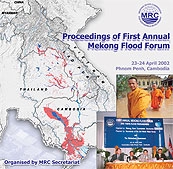
Proceedings of the 1st Annual
their management and biology,
Mekong Flood Forum, 23-24
MRC Technical Paper No. 3, 29 pages
April 2002.
April 2002
Free, plus postage costs.
Status of Pangsiid aquaculture in
Mekong: The Mother. A half-hour
Viet Nam,
movie on the importance of the
MRC Technical Paper No. 2, 16 pages
Mekong to its people. Available on
April 2002
VCD in English, Thai and Khmer.
Available on VHS in Lao and Viet-
Status of the Mekong
namese. Free, plus postage costs.
Pangasianodon hypophthalmus
resources, with special reference
All publications can be ordered from
to the stock shared between
the MRC Secretariat's Documentation
Cambodia and Viet Nam,
Centre, phone: (855-23)720-979 ext
Available on our website,
MRC Technical Paper No. 1, 29 pages
1030, fax: (855-23)720-979, or
www.mrcmekong.org
April 2002
email: mrcs@mrcmekong.org
Annual Report 2001, 40 pages.
All Technical Papers cost US$5, plus
Mekong government agencies should
postage costs. Summaries available on
write to the MRC to obtain free
Catch & Culture, a newsletter for
the MRC website.
copies.
fisheries professionals June 2002.