November 2003
Mekong River Commission
MRC WORK PROGRAMME
2004

FOREWORD
It is a pleasure for me, on behalf of the Mekong River Commission (MRC), to present this Work Programme
for 2004.
Within Work Programme 2001, MRC launched its programme approach. All activities became part of com-
prehensive programmes supporting basin-wide strategies. To support the programme approach, the structure
of the MRC was changed in June 2000 - from a sectoral structure to one based on cross-cutting functions
required to plan and implement programmes and to carry out the core activities of the organisation. Sector
programmes would remain an important part of the activities in the short and medium term. In the longer
term, however, the focus of the MRC would be shifting from project execution to monitoring and manage-
ment of the Mekong River Basin. The MRC would develop better capacity to cope with political, economic
and social changes in the basin, establish and maintain essential databases, and to develop planning tools for
all important aspects of the river basin.
The programme approach is maintained in this Work Programme for 2004. The programmes are updated in
light of developments and adjustments since last year's Work Programme. Major changes affect the follow-
ing programmes: the Capacity Building Programme; the Fisheries Programme; the Agriculture, Irrigation and
Forestry Programme; and the Water Resources Management Programme. The Work Programme also
includes a new Flood Management and Mitigation Programme and a new Navigation Programme.
The Mekong River is one of the least spoiled and least developed great rivers of the world where the poten-
tial is far from utilized and the negative impact of environmental degradation is not irreversible. However,
considerable challenges lie ahead if sustainable economic development is to be realised. These challenges,
which are addressed by the Work Programme, include:
1. To manage greater pressure on water resources from a growing population's needs for clean and adequate
water, food and energy supplies to support economic development, without causing damage to the envi-
ronment and ecological system.
2. To achieve reasonable sharing of available resources to satisfy the requirements of the MRC member
countries and its people.
3. To ensure that funds are used effectively and that programmes are being implemented in co-ordination
with other national, bilateral and international development efforts in the basin.
The MRC has always accorded high importance to international cooperation. Traditionally, resources from
international donors have constituted the largest part of the operational and programme budget. It is expect-
ed to remain so in the short and medium term, but in the longer term the MRC administrative costs will be
funded mainly through contributions from the member countries. Donors have encouraged the MRC to
adopt a programme approach and are now placing renewed trust in the organisation's ability to handle the
challenges ahead in an efficient and coordinated manner. These are reflected in increased support to MRC
and commensurately lower funding needs as compared to last year's Work Programme.
I take this opportunity to express, on behalf of the Commission, our sincere gratitude and appreciation of
the support from donors, partner agencies, NGOs and other friends around the world to our efforts to
ensure sustainable development of the Mekong River Basin for the benefit of its people.
Dao Trong Tu
Officer-in-Charge
PREFACE
The Work Programme contains brief descriptions of the programmes and explains how they are contributing
to the MRC Strategic Plan. It also includes a budget and activity plan for 2004 as well as status of activities
carried out in 2003.
MRC Programmes are grouped under three categories: Core, Support and Sector Programmes:
o Core Programme:
- Basin Development Plan
- Water Utilisation Programme
- Environment Programme
- Flood Management & Mitigation Programme
o Support Programme:
- Integrated Capacity Building Programme
o Sector Programme:
- Fisheries Programme
- Agriculture, Irrigation and Forestry Programme
- Water Resources Management Programme
- Navigation Programme
- Tourism Programme
Compared to the Work Programme for 2003, major changes are the following:
Environment Programme
The Environment Programme is being revised in accordance with the Programme document approved by the
Council in 2000. The aim of the revision is to ensure that the Environment Programme remains current and
that it is adequately addressing current and emerging environmental issues. The revision process has been ini-
tiated through national consultation workshops. The revised EP was approved by the Council in November
2003.
Flood Management and Mitigation Programme
At the request of the Council, the Flood Management and Mitigation Programme approved by the Eighth
Council Meeting, has been designed as a separate programme on its own rather than being a component of
the Water Resources Management Programme. The FMMP was approved by the Council in November 2003
as a Core Programme.
Integrated Capacity Building Programme
The Integrated Capacity Building Programme has been extensively revised. It will focus on ensuring avail-
ability of sufficient expertise in river basin management within the Secretariat and among the riparian gov-
ernments and the required level of communication and stakeholder participation in MRC activities. Only five
out of the eleven programme components have been kept as a result of the revision. Two new components
have been included: 1) Integrated Training Programme (Management) and 2) Environmental Governance.
Fisheries Programme
The Fisheries Programme has been revised, and re-focussed to better reflect the changing realities in the basin
and to build on of the eight years of achievement under the programme.
Agriculture, Irrigation and Forestry Programme
Due to likely availability of funding, an investment sub-component for forest rehabilitation has been includ-
ed in this programme under the Catchment Management component with approximately US$ 4.5 million
over a five-year period.
Water Resources Management Programme
In addition to the separation of the Flood Management and Mitigation Component from the Water Resources
Management Programme, the hydropower component has been revised and aligned to the Hydropower
Development Strategy launched in October 2001.
Navigation Programme
Funding for development of the Programme was secured and the new MRC Navigation Strategy was final-
ized in May 2003. The new six-year Navigation Programme based on the Navigation Strategy was approved
by the Council in November 2003.
Contact Details
The Work Programme 2004 is made available, after approval by the MRC Council, to interested agencies
upon request. It is also possible to provide copies of detailed comprehensive programme proposals upon
request. For this purpose, kindly contact the MRC Secretariat's Programme Coordination Section, at the fol-
lowing address:
MRC Secretariat
364 M.V. Preah Monivong
Tel: +855-23 720-979-85
P.O. Box 1112
Fax: +855-23 720-972
Phnom Penh, Cambodia
E-mail:mrcs@mrcmekong.org
Interested readers are invited to visit the MRC home page at http://www.mrcmekong.org
MRC Work Programme
Year 2004
Acronyms
ADB- Asian Development Bank
AIFP- Agriculture, Irrigation and Fisheries Programme
AIT- Asian Institute of Technology
AUSAID- Australian Agency for International Development
BDP- Basin Development Plan
CNMC- Cambodia National Mekong Committee
DSF-Decision Support Framework
EIA- Environmental Impact Assessment
EP- Environment Programme
FP- Fisheries Programme
FMMP- Flood Management and Mitigation Programme
GEF- Global Environment Fund
GMS- Greater Mekong Sub-Region
ICBP- Integrated Capacity Building Programme
ICLARM- International Centre for Living Aquatic Resources Management
JRP- Junior Riparian Professional
LMB- Lower Mekong Basin
LNMC- Laos National Mekong Committee
MDBC- Murray-Darling Basin Commission
MRB- Mekong River Basin
MRC- Mekong River Commission
MRCS- Mekong River Commission Secretariat
NP- Navigation Programme
NMC- National Mekong Committee
SEA- Strategic Environmental Assessment
TP- Tourism Programme
TNMC- Thai National Mekong Committee
UNDP- United Nations Development Programme
USAID- United States Agency for International Development
VNMC- Viet Nam National Mekong Committee
WG- Working Group
WRMP- Water Resources Management Programme
WUP- Water Utilization Programme
MRC Work Programme
Year 2004
This page was purposely left blank
MRC Work Programme
Year 2004
TABLE OF CONTENTS
1. Introduction to the MRC..................................................................................................................... 1
1.1.
BACKGROUND............................................................................................................................ 1
1.2.
AREAS OF COOPERATION........................................................................................................ 1
1.3.
STRUCTURE................................................................................................................................. 1
1.4.
DEVELOPMENT OPPORTUNITIES AND CHALLENGES...................................................... 2
1.5.
THE MRC STRATEGIC PLAN.................................................................................................... 3
1.6.
STRATEGIC GOALS AND OBJECTIVES.................................................................................. 5
1.7.
CRITERIA FOR PRIORITISING MRC ACTIVITIES................................................................. 6
1.8.
IMPLEMENTATION OF THE STRATEGIC PLAN.................................................................... 6
2.
The MRC Programmes................................................................................................................ 9
2.1.
BRIEF DESCRIPTION OF THE CORE, SECTOR AND SUPPORT PROGRAMMES............ 9
Core Programmes.................................................................................................................................. 9
Support Programme: Goal 4................................................................................................................. 10
Sector Programmes: Supporting Goal 2 (BDP)................................................................................... 11
3.
MRC Programme, Programme Costs and Funding Status........................................................... 13
4.
Progress of MRC Work Programme 2003.................................................................................... 17
4.1.
CORE PROGRAMMES............................................................................................................... 17
Basin Development Plan (BDP)........................................................................................................... 17
Water Utilization Programme (WUP).................................................................................................. 18
Environment Programme...................................................................................................................... 19
Flood Management and Mitigation Programme.................................................................................. 19
4.2.
SUPPORT PROGRAMME: INTEGRATED CAPACITY BUILDING PROGRAMME........... 20
4.3.
SECTOR PROGRAMMES.......................................................................................................... 21
Fisheries Programme............................................................................................................................ 21
Agriculture, Irrigation, and Forestry Programme................................................................................ 22
Water Resources Management Programme......................................................................................... 22
Navigation Programme........................................................................................................................ 23
Tourism................................................................................................................................................. 24
5. Planned Activities per Programme in 2004..................................................................................... 25
5.1. CORE PROGRAMMES.................................................................................................................. 25
Basin Development Plan...................................................................................................................... 25
Water Utilisation Programme............................................................................................................... 25
Environment Programme...................................................................................................................... 25
Flood Management and Mitigation Programme.................................................................................. 26
5.2.
SUPPORT PROGRAMME............................................................................................................ 26
5.3.
SECTOR PROGRAMMES............................................................................................................ 27
Fisheries Programme............................................................................................................................ 27
Agriculture, Irrigation and Forestry Programme................................................................................. 27
Water Resources Management Programme......................................................................................... 27
Navigation Programme........................................................................................................................ 28
Tourism Programme............................................................................................................................. 28
6.
Programme Profiles ................................................................................................................... 29
Core Programmes................................................................................................................................. 29
6.1.
BASIN DEVELOPMENT PLAN............................................................................................... 29
MRC Work Programme
Year 2004
6.2.
WATER UTILIZATION PROGRAMME.................................................................................... 30
6.3.
ENVIRONMENT PROGRAMME............................................................................................... 34
COMPONENT DESCRIPTIONS............................................................................................................. 35
6.4.
FLOOD MANAGEMENT AND MITIGATION PROGRAMME.............................................. 37
Support Programme.............................................................................................................................. 41
6.5.
INTEGRATED CAPACITY BUILDING PROGRAMME.......................................................... 41
Sector Programmes.............................................................................................................................. 43
6.6.
FISHERIES PROGRAMME........................................................................................................ 43
6.7.
AGRICULTURE, IRRIGATION AND FORESTRY PROGRAMME (SUSTAINABLE LAND
AND WATER USE PROGRAMME)...................................................................................................... 46
6.8.
WATER RESOURCES MANAGEMENT PROGRAMME........................................................ 49
6.9.
NAVIGATION PROGRAMME................................................................................................... 51
6.10.
TOURISM PROGRAMME......................................................................................................... 55
Tables
Table 1: MRC Programme, Programme Costs and Funding.................................................................... 14
Table 2 : MRC Programme, Programme Costs and Funding Needs 2004............................................... 15
Figures
Figure 1: MRC Organisational Structure................................................................................................... 2
Figure 2: MRC Vision................................................................................................................................ 4
Figure 3 : Strategic Objectives................................................................................................................... 5
Figure 4 : Links between the Basin Vision, MRC Vision and Programmes Development....................... 7
MRC Work Programme
Year 2004
1.
Introduction to the MRC
1.1.
Background
On the 5th of April 1995, Cambodia, the Lao PDR, Thailand and Viet Nam, signed the "Agreement on the
Cooperation for the Sustainable Development of the Mekong River Basin". This agreement formed the
Mekong River Commission (MRC) which replaced the Committee for Coordination of Investigation of the
Lower Mekong Basin (the Mekong Committee) and the Interim Mekong Committee, which were established
in 1957 and 1978; respectively. The MRC also holds an official dialogue with the two other states of the
Mekong River Basin, China and Myanmar, which are not signatories of the 1995 Agreement.
The purpose of the 1995 Agreement is to achieve an optimum use and prevention of waste of the waters.
1.2.
Areas of Cooperation
Article 1 in the 1995 Agreement obliges the signatories "To cooperate in all fields of sustainable develop-
ment, utilization, management and conservation of the water and related resources of the Mekong River
Basin..."
Article 2 stipulates the promotion of sustainable development of the full potential and prevention of waste-
ful uses of the Mekong River Basins waters for the benefit of all riparian states.
Article 3 charges the signatories with protection of the environment, ecological balance and natural resources
from harmful effects from the development of the basin's water and related resources.
These three articles set the scope for the work of the Commission.
1.3. Structure
The MRC enjoys the status of an international body. It has signed several agreements and holds obligations
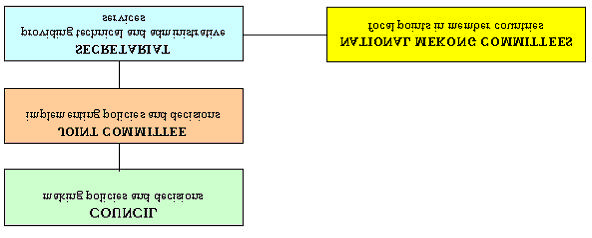
with the donors and the international community. The MRC consists of three permanent bodies; Council,
Joint Committee and Secretariat. Acting as focal points for the Commission in each of the member countries
are the National Mekong Committees (NMCs).
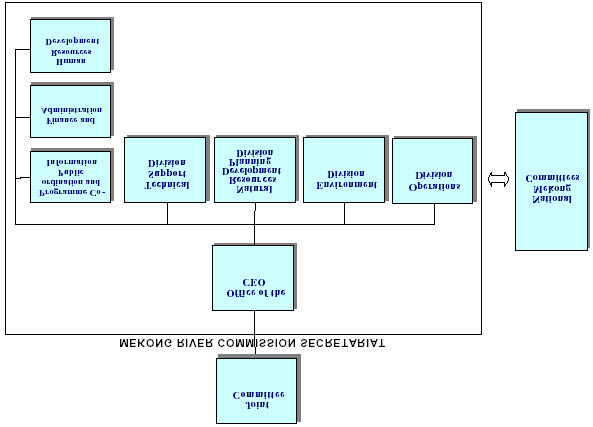
The MRC Secretariat is the executive arm of the MRC with Headquarters in Phnom Penh, Cambodia. The
headquarters will move to Vientiane, Lao PDR in June 2004. The Secretariat works closely with the NMCs
of the MRC member countries. The structure of the Secretariat is presented in the diagram below. The struc-
ture was introduced in June 2000, to support the MRC programme approach.
MRC Work Programme
Year 2004
Figure 1: MRC Organisational Structure
The budget of the Commission consists of contributions from its members and the donor community. Formal
consultation with the donor community is processed through the Donor Consultative Group meeting.
The Commission has formal agreements for cooperation with regional and international organisations such
as ADB, AIT, ICLARM.
1.4.Development Opportunities and Challenges
Development of the vast resources of the Basin must be economically, socially and environmentally bal-
anced. Only through sound management will it be possible to ensure long-term sustainability of the natural
resources, the environment and the quality of life of the Basin's people. In this respect, development oppor-
tunities and challenges for the MRC Work Programme are:
o Approximately 40% of the population in Cambodia, Lao PDR and Viet Nam live below the poverty line,
and the Thai population living within the Mekong watershed area lag far behind the rest of the country in
socio-economic status. The population growth rate in the region is high, leading to ever-increasing
demand for food and jobs. Changes in the flow pattern brought about by proposed development can have
a major impact on fragile social and economic systems.
o The Mekong River Basin supports one of the most productive and diverse ecosystems in the world. But
the Basin's environment is degrading due to unsustainable development practices such as forest exploita-
tion and intensification of agriculture. At the same time, the institutional capacity to deal with these types
of environmental problems and cumulative impacts is weak throughout the region.
MRC Work Programme
Year 2004
o Agriculture is the predominant economic sector. In order to be able to feed the rapidly growing popula-
tion, it is a key element in each riparian country's development strategy. Because of the long dry season,
the further development and expansion of irrigation is essential for the long-term growth of the agricul-
ture sector and the key element to support intensification.
o Inland fisheries are vital for food security. The MRC estimates that the market value of the lower Mekong
fisheries is US$ 1.4-1.7 billion. Fish is the single most important source of animal protein for the people
in the region. Together with rice, it forms the basis of the food security.
o In many areas, inland river transport on the Mekong River system constitutes the most important way of
communication. In the delta, maritime navigation provides significant revenues from international trade.
Changes in the flow regime, sedimentation and construction of reservoirs may affect river transport. Co-
operation and proper agreements between the MRC member countries are required to ensure safe passage,
also across borders.
o The Basin has a considerable potential for the generation of hydropower that could be used to meet the
growing demand for power. Yet, the construction of large dams must be undertaken with care. Negative
side effects on the overall flow regime on other resources, such as fisheries, or communities living up-
stream or downstream of dams, must be avoided or minimised.
o The water quality of the Mekong River is affected by factors such as industrial production, urban waste
disposal and sewage, use of fertilisers and pesticides, water reservoirs, soil erosion, and salt water intru-
sion in the Mekong Delta. Maintaining good water quality is critical for agriculture as well as for domes-
tic and commercial water supplies.
o Also of major concern for the MRC member countries is flood management and mitigation. Excessive
flooding during the wet season can cause great economic and human loss in the Basin, as witnessed dur-
ing the floods in year 2000. But floods are also important to replenish the wealth of the aquatic ecosys-
tems.
o The use of water and related resources in one country can have negative effects for other countries, for
example in terms of adverse effects on navigation, fisheries, scarcity of irrigation water, and seawater
intrusion. Prevention and resolution of potential conflicts arising from the increasing pressure on the nat-
ural resources in the Basin is therefore a key task of the Mekong River Commission.
1.5.The MRC Strategic Plan
In order to better fulfil its role, MRC developed a first Strategic Plan for the period 1999-2003. Although con-
siderable progress had already been made, many areas of MRC's work still needed improvement.
Consequently, the first Strategic Plan was reviewed in a participatory process in late 2000 and a new strate-
gic plan for 2001-2005 was formulated. The fundamental strategic direction of MRC, its vision and mission
statements remained unchanged. But the programme approach launched with the Work Programme for 2001
meant that the objectives of the three Core Programmes , five Sector Programmes, and one Support
Programme needed to be better reflected in the Strategic Plan. In turn also the Goals, supported by the objec-
tives, required updating.
1 The Core Progamme group has now been enhanced to four with the inclusion of the Flood Management and Mitigation
Programme.
Figure 2: MRC Vision
VISION for the Mekong River Basin:
An economically prosperous, socially just and
environmentally sound Mekong River Basin
VISION for the Mekong River Commission:
A world class, financially secure, international river basin
organisation serving the Mekong countries to
achieve the Basin Vision
MISSION
in accordance with the 1995 Agreement:
To promote and coordinate sustainable management and
development of water and related resources
for
the countries' mutual benefit and the people's well being
by
implementing strategic programmes and activities and
providing scientific information and policy advice
MRC Work Programme
Year 2004
1.6.
Strategic Goals and Objectives
Four Goals have been identified that MRC should strive to achieve progressively over the next
five years. MRC's four Goals and the respective Strategic Objectives are:
Figure 3 : Strategic Objectives
Strategic Objectives
1.1
Information for water use "rules" identified, and
information exchange established;
1.2
The data, information, and knowledge base devel-
oped, maintained and shared;
to establish and implement "rules"
1.3
Modelling package developed and maintained;
for water utilisation and inter-basin
1.4
"Rules" for water utilisation developed;
diversions;
1.5
Institutional capacity (for modelling and rule formu-
GOAL1
lation) strengthened;
to establish a dynamic basin devel-
opment planning process as a
2.1
A basin planning process established;
framework for natural resource
2.2
A data, information, and knowledge base estab-
management and sustainable devel-
lished;
opment; and to plan and execute
2.3
Prioritised list of natural-resources-related basin
GOAL2 corresponding priority sector pro-
development projects established;
grammes and projects;
2.4
MRC sector programmes in support of the Basin
Development Plan are formulated and implemented:
3.1
Capacity in environmental monitoring and assess-
ment strengthened;
3.2
Data and knowledge base on environmental and
to establish and promote MRC envi-
socio-economic issues established;
ronmental and socio-economic man-
3.3
Systems for environmental information exchange in
agement systems, recommendations,
place;
GOAL3
and policy guidelines;
3.4
Guidelines for environmental policies and legislation
set up;
3.5
Awareness and capacity of MRC and key stakehold-
ers on trans-boundary environmental issues strength-
ened;
MRC Work Programme
Year 2004
4.1
MRCS/NMC/LA staff qualification and experience
strengthened;
4.2
MRCS/NMCS project management, planning and
execution systems improved;
4.3
Financial, administrative, personnel, logistics and
information and communication technology systems
upgraded;
to establish an effective organisa-
4.4
Regular meeting of a panel of international/regional
tion, capable to promote, in part-
experts on river basin/natural resources management
organised;
GOAL4 nership with other institutions,
basin-wide development and co-
4.5
Quality information provided to the public;
ordination;
4.6
Strong partnerships with relevant institutions estab-
lished and maintained;
4.7
MRC assuming role as effective facilitator and
mediator for conflict prevention and resolution;
4.8
Relations with Upper Mekong River Basin
Countries improved.
1.7.
Criteria for Prioritising MRC Activities
All MRC Programme activities or components should contribute centrally to the goals and strategic objec-
tives of the MRC Strategic Plan. They should also, as far as possible, incorporate crosscutting themes of envi-
ronment, gender, poverty, employment and people-centred development generally.
In order to remain distinct from country-based programmes or projects, while being complementary to them,
MRC initiatives should conform to the following criteria:
o
Promote the sharing and/or joint management of resources;
o
Be trans-boundary in nature;
o
Contribute to or promote regional institutions, norms and policies;
o
Foster research that cannot be adequately or effectively undertaken nationally;
o
Create or sustain networks or contacts among governmental or non-governmental organizations in
different member countries.
Programmes, projects or activities should actively seek linkages to global and inter-regional initiatives as
well as build on national programmes, which reinforce the strategic direction of the MRC.
Programmes, projects or activities should help to develop capacity of line agencies, NMCs and MRC, and
should draw, whenever possible, on region-based expertise.
Programmes should help MRC member countries to respond to the challenges generated by rapidly evolving
development needs.
1.8.Implementation of the Strategic Plan
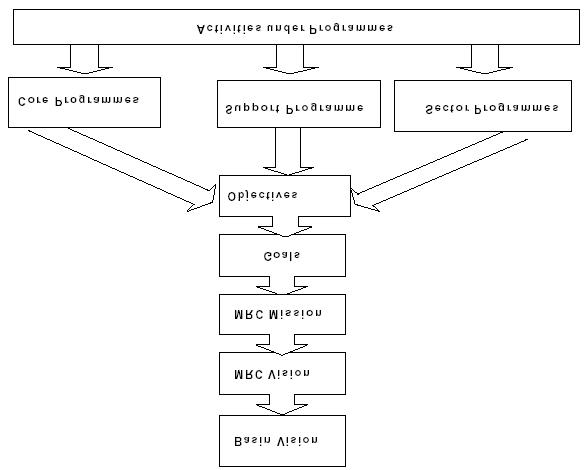
The relationships between the visions, objectives, programmes and activities when the Plan is being imple-
mented are illustrated below.
MRC Work Programme
Year 2004
Figure 4 : Links between the Basin Vision, MRC Vision and Programmes Development
Progress towards the achievement of the goals is accomplished through achieving the objectives. Progress
towards the objectives is measured through indicators, which measure achievements made through various
activities.
These sets of linkages will ensure that activities undertaken by the MRC under the various programmes are
contributing measurably towards the achievement of the objectives in the Strategic Plan, which in turn will
ensure that the MRC is progressively working towards the achievement of the five goals, fulfilling its organ-
isational Mission and Vision and contributing significantly to the Basin Vision.
MRC Work Programme
Year 2004
This page was purposely left blank
MRC Work Programme
Year 2004
2.
The MRC Programmes
The change from a "project" to a "programme" focus is perhaps the most significant recent change in
MRC. The new approach considers MRC activities as part of comprehensive programmes supporting
basin-wide strategies of the MRC member countries.
An essential element of adopting a programme approach is the shift of focus away from the activities to
the objectives, i.e. away from what is to be done towards what is to be achieved. The programme
approach provides flexibility and avoids time-consuming and expensive planning cycles with detailed
scheduling of activities several years into the future.
Through adopting this approach the MRC will be able to remain focused on what it is aiming to achieve
and adopt strategies and undertake activities to do so in the most appropriate and efficient way. This is
in line with the Strategic Plan and will develop the MRC's capacity to meet the challenges in a rapidly
changing political, social and development environment.
The MRC has three types of programmes: core, support and sector programmes. These represent three
current and future needs for the MRC member countries. The core programmes are those central to the
purpose of the Commission, and are intended to be the ones remaining in the long term. They are
addressing central issues in the 1995 Agreement in line with the Strategic Plan directly addressing Goals
1 to 3. The activities under these programmes are, in the long term, to be funded by the contributions of
the member countries, thus ensuring sustainability.
The support programme is directly addressing Goal 4 of the Strategic Plan. This programme is impor-
tant in the short and medium term to address capacity building needs of the MRC and the riparian
Governments. As capacity increases, the support programme will diminish in size.
The sector programmes are addressing important sectoral issues in the basin within the mandate of the
1995 Agreement and in line with the Strategic Plan. The programmes have a regional focus intended to
address development needs in the sectors from a basin-wide perspective, complementing and support-
ing national and bilateral development initiatives.
2.1.
Brief Description of the Core, Sector and Support Programmes
Core Programmes
Water Utilization Programme (WUP): Goal 1 - The WUP commenced in early 2000 and is planned
to run for 6 years. It will help establish permanent and functional mechanisms to support Mekong Basin
water resources management consistent with the 1995 Agreement. Its aim is to achieve "reasonable and
equitable" water use among member countries while maintaining the Basin's ecological integrity.
Development of "Rules" for Water Utilisation through the WUP is central to the achievement of Goal 1
of the MRC Strategic Plan.
The WUP comes from member countries' recognition, in the 1995 Agreement, of the seriously damag-
ing impacts that can occur through uncontrolled economic development or environmental exploitation.
For example, if water quality deteriorates through industrial or agricultural pollution, or other actions,
then there are threats to the basin's vital fish stock, to domestic water supplies, and to food production
generally. Likewise, if uncontrolled land clearing, large hydropower development, or irrigation devel-
opment would take place, flooding could increase, low river flows could fall further, navigation could
be disrupted, salt water intrusion could occur and fish breeding patterns arrested. The impacts on agri-
cultural production, poverty, food security, social harmony and environmental degradation are apparent.
The WUP, and its resultant water sharing arrangements, are specifically designed to afford agreed means
of conflict prevention and resolution between member countries. The WUP covers planning, data col-
lection, development of a basin modelling and knowledge base, establishment of monitoring systems
MRC Work Programme
Year 2004
and river basin management. The overriding principle governing the WUP process is that the member coun-
tries own it, with the Secretariat acting as a facilitator.
Basin Development Plan (BDP): Goal 2 - Formulation of the Basin Development Plan commenced in
October 2001 and will run until mid-2005. The expected output is both a general planning tool, and an endur-
ing, dynamic process, for use by the Joint Committee to help identify and prioritise development programmes
and projects that meet the cooperative and sustainability criteria of the 1995 Agreement. The BDP
units/working groups that have been established in each country by the National Mekong Committees are
mainly carrying out the BDP formulation process. Line Agencies at national and provincial levels are respon-
sible for carrying out sector reviews. Sub-area working groups ensure broad local involvement that con-
tributes to regional planning. BDP functions to integrate inputs from WUP, Environment and Sector
Programmes, with regard to information and assessment tools for issues such as water quantity, water quali-
ty, environment and socio-economic impacts. Coordination is ensured through multi- and bi-lateral pro-
gramme meetings. The BDP will formulate a regional development strategy that represents the collective
views of the four lower MRC member countries. Specific trans-boundary development activities that balance
the Basin peoples' development needs with sustainable water quality, quantity and long-term environmental
integrity will be identified.
Environment Programme (EP): Goal 3 The Programme has a two-pronged approach in that it is aiming to
fulfil the articles in the Agreement related to the protection of the environment and maintaining the ecologi-
cal balance of the basin. It is also supporting the other Core Programmes through provision of environmen-
tal data and development of tools for environmental planning and management. Assessment and monitoring
of water quality and ecosystem health form an important basis data provision. The Programme also aims to
improve environmental policy and management through advice to and promotion of cooperation among envi-
ronmental agencies, directly supporting the BDP process. Through compilation of existing knowledge and
facilitation of research activities it also promotes a better understanding of the environmental and ecological
aspects of the Basin. The Programme is central to the achievement of Goal 3 of the Strategic Plan 2001 to
2005.
Flood Management and Mitigation Programme
This Programme aims to "promote sustainable development of the Mekong River Basin's water resources for
social and economic development for the benefit of the basin's inhabitants", as stated in the second article of
the 1995 Agreement. This is to be achieved through hydropower development, flood management, and a
hydro-meteorological network for the collection and analysis of information. A basin-wide-approach through
regional management of the Mekong floods will be primordial for the benefit of the people in the flood-prone
areas. Preparing people for floods and issuing warnings will be part of the operational services of the MRC.
Support Programme: Goal 4
Integrated Capacity Building Programme- This Integrated Programme is to ensure availability of sufficient
expertise in river basin management and the required level of communication and stakeholder participation
in MRC activities. The level of competence in river basin management among MRC staff and staff in the
riparian governments is to be raised through a systematic, modular training programme. The future pool of
expertise available within the region is to be broadened through on-the-job training of young professionals
to work at the MRC Secretariat. The ability of MRC to carry out communication, public participation and
partnership activities is to be ensured through expert services. Capacity and resources of MRC to respond to
priority needs and changing conditions is to be strengthened through a facility to draw on external support
on an ad hoc basis. Through a twinning arrangement between MRC and the Murray-Darling Basin
Commission in Australia it is intended to enhance MRC capacity in integrated water resources management,
modelling and data management, basin planning, development of water sharing guidelines, and building
community awareness and strengthening at the strategic level.
MRC Work Programme
Year 2004
Sector Programmes: Supporting Goal 2 (BDP)
Fisheries Programme - The programme development objective is "Coordinated and sustainable develop-
ment, utilisation, management and conservation of the fisheries of the Mekong Basin". The Programme con-
tributes directly to all four goals of the MRC Strategic Plan 2001-2005. The primary focus of activities is on
trans-boundary issues affecting fisheries, so that appropriate fisheries information is available for the BDP,
WUP and EP. Information produced within the Programme is incorporated into national and regional man-
agement and development plans, with a view to a continuously increasing fisheries productivity and main-
taining a healthy ecosystem.
Agriculture, Irrigation and Forestry Programme - Formulation of the new, fully integrated and compre-
hensive, MRC "Agriculture, Irrigation and Forestry Programme (2001-2005)" was completed in October
2000. Based on a catchment approach, it focuses on activities to promote the sustainability and further devel-
opment of food production from the land and water resources of the Basin where cooperation between mem-
ber countries is required for success. The overall programme development objective is to achieve "coopera-
tive sustainable development and utilisation of land and water resources to the benefit of the basin commu-
nity, and to contribute to poverty alleviation and food security". The programme will be undertaken using a
collaborative learning approach to effect change in resource use. It too will contribute to development of the
WUP and the BDP.
Water Resources Management Programme - The programme aims to "promote sustainable development
of the Mekong River Basin's water resources for social and economic development for the benefit of the
basin's inhabitants", in line with the second article of the Agreement. This is to be achieved through appro-
priate hydropower development and a hydro-meteorological network for the collection and analysis of infor-
mation. An integrated information system providing information on water resources and hydrological status
will also support the WUP and the Flood Management Programme. Best options in the Lower Mekong Basin
for sustainable development in the hydropower sector will be identified, based on the MRC Hydropower
Development Strategy.
Navigation Programme - This Programme aims to "promote freedom of navigation on the main stream of
the Mekong River", as stipulated in Article 9 of the Agreement. A common interest to facilitate river trans-
port and increase international trade is the underlying reason for this article. On a national level, the pro-
gramme aims at improving the access facilities to the remote communities along the Mekong River and trib-
utaries to enable the integration of the rural and local communities to be part of the national economic mar-
ket and provide mobility to reach essential services such as schools and hospitals. This will contribute to
poverty reduction by reducing vulnerability, opening new economic opportunities, creating new employment,
enhancing democratic process, developing skills, and facilitating and improving the delivery of rural servic-
es. Simultaneously, changes in river morphology and study of its impacts will be dealt with under the
Navigation Programme. Environmental monitoring, integration of social considerations and conflict preven-
tion will be permanent trans-sectoral aspects. The programme directly addresses issues related to the devel-
opment of the Mekong River Basin's resources. It will contribute to Goal 3 of the Strategic Plan through pro-
moting the natural navigation potential whilst preserving the ecological balance.
Tourism Programme- This programme has not yet been developed.
MRC Work Programme
Year 2004
This page was purposely left blank
MRC Work Programme
Year 2004
3. MRC Programme, Programme Costs and Funding Status
Table 1 below presents an overview of the programme and their components. It also provides information on
the total budget and funding needs for each programme and every programme component. Table 2 provides
the same information for calendar year 2004.
The total, multi-year budget for MRC programmes comes to US$ 94 million, with funding requirements
amounting to US$ 54 million or approximately 57%.
Total planned expenditures under MRC programmes in 2004, amount to US$ 22.1 million. Funding require-
ments come to US$ 5.6 million, corresponding to 25%.
MRC Work Programme
Year 2004
Table 1: MRC Programme, Programme Costs and Funding
Programme
Programme Components
Total Budget Funding Needs*) Funded/Pledged
(1,000 US$)
(1,000 US$)
(1,000 US$)
Core Programme
Basin Development Plan 3 Years
6,156
0
6,156
Water Utilization
6 Years
16,300
0
16,300
Programme
Basin Modelling and Knowledge Base
9,100
0
9,100
Rules for Water Utilization
1,200
0
1,200
Institutional Strengthening
4,700
0
4,700
Environment
5 Years
19,228
13,468
5,760
Programme
Environmental Monitoring and Assessment
4,096
2,946
1,150
Environmental Decision Support
4,267
3,132
1,135
People and Aquatic Ecosystems
4,274
2,599
1,675
Environmental Knowledge
2,491
2,191
300
Environmental Flow Management
4,100
2,600
1,500
Flood Management &
6 Years
19,751
1,000
18,751
Mitigation Programme Regional FMM Centre
11,251
1,000
10,251
Structural & Flood Proofing Measures
3,700
0
3,700
Transboundary Flood Issues
1,800
0
1,800
Flood Emergency Management and Strengthening
1,150
0
1,150
Land Use Management
1,850
0
1,850
Support Programme
Integrated Capacity
5 Years
7,244
4,081
3,163
Building
Integrated Training Programme (Management)
750
750
0
Information and Communication
1,150
1,090
60
Junior Riparian Professional Scheme
581
201
380
Environmental Governance
1,000
0
1,000
Programme Support
1,000
949
51
Core Activities in New Organization
2,263
1,091
1,172
River Basin Management
500
0
500
Sector Programme
Fisheries Programme
5 Years
5,114
0
5,114
Institutional Support
1,842
0
1,842
Assessment of Mekong Capture Fisheries
1,297
0
1,297
Management of River and Reservoir Fisheries
955
0
955
Aquaculture of Indigenous Mekong Fish Species
870
0
870
Population Genetics of trey Riel (Fish) in the MB
150
0
150
Agriculture, Irrigation
5 Years
35,600
22,790
12,810
and Forestry
Water Use Efficiency
16,000
13,900
2,100
Programme
Catchment Management
14,200
3,490
10,710
Capacity Building for MRC
5,400
5,400
0
Water Resources
5 Years
5,540
1,370
4,170
Management
Hydrology
3,840
420
3,420
Programme
Hydropower
1,700
950
750
Navigation Programme 6 Years
22,569
20,159
2,410
Socio-economic Analysis and Planning
4,230
2,569
1,661
Legal Framework for Cross-Border Navigation
1,631
1,578
53
Traffic Safety and Environmental Sustainability
6,770
6,644
126
Information, Promotion and Coordination
3,983
3,802
181
Institutional Development
5,955
5,566
389
Tourism Programme
3 Years (to be developed)
3,000
3,000
0
TOTAL
94,023
54,000
40,023
*) Programme budgets less funds received and pledges of support
MRC Work Programme
Year 2004
Table 2: MRC Programme, Programme Costs and Funding Needs 2004
Programme
Programme Components
Total Budget Funding Needs*) Funded/Pledged
(1,000 US$)
(1,000 US$)
(1,000 US$)
Core Programme
Basin Development Plan 2004
1,900
0
6,156
Water Utilization
2004
2,590
0
16,300
Programme
Basin Modelling and Knowledge Base
1,461
0
9,100
Rules for Water Utilization
500
0
1,200
Institutional Strengthening
629
0
4,700
Environment
2004
4,214
1,690
2,524
Programme
Environmental Monitoring and Assessment
1,018
118
900
Environmental Decision Support
890
266
624
People and Aquatic Ecosystems
945
295
650
Environmental Knowledge
443
293
150
Environmental Flow Management
918
718
200
Flood Management &
2004
4,726
0
4,726
Mitigation Programme Regional FMM Centre
3,350
0
3,350
Structural Measures
300
0
300
Transboundary Flood Issues
260
0
260
Flood Emergency Management and Strengthening
0
0
0
Flood Proofing Measures
243
0
243
Land Use Management
573
0
573
Support Programme
Integrated Capacity
2004
1,711
661
1,100
Building
Integrated Training Programme (Management)
200
200
0
Information and Communication
230
170
60
Junior Riparian Professional Scheme
201
53
148
Environmental Governance
300
0
300
Programme Support
200
149
51
Core Activities in New Organization
380
39
341
River Basin Management
200
0
200
Sector Programme
Fisheries Programme
2004
2,363
0
2,363
Institutional Support
917
0
917
Assessment of Mekong Capture Fisheries
522
0
522
Management of River and Reservoir Fisheries
449
0
449
Aquaculture of Indigenous Mekong Fish Species
400
0
400
Population Genetics of trey Riel (Fish) in the MB
75
0
75
Agriculture, Irrigation
2004
2,500
1,182
1,318
and Forestry
Water Use Efficiency
1,500
1,182
318
Programme
Catchment Management
1,000
0
1,000
Capacity Building for MRC
0
0
0
Water Resources
2004
1,021
1,021
0
Management
Hydrology
301
301
0
Programme
Hydropower
720
720
0
Navigation Programme 2004**
926
868
58
Socio-economic Analysis and Planning
404
368
36
Legal Framework for Cross-Border Navigation
0
0
0
Traffic Safety and Environmental Sustainability
0
0
0
Information, Promotion and Coordination
71
69
2
Institutional Development
451
431
20
Tourism Programme
3 Years (to be developed)
200
200
0
TOTAL
22,151
5,572
16,579
*) Programme budgets less funds received and pledges of support
**) new NP will commence in July 2004.
MRC Work Programme
Year 2004
This page was purposely left blank
MRC Work Programme
Year 2004
4. Progress of MRC Work Programme 2003
This Section makes a brief account of progress of the activities under the MRC Work Programme in the peri-
od December 2002 - November 2003.
4.1.Core Programmes
Basin Development Plan (BDP)
The BDP has established a firm and operationally active institutional framework encompassing regular coor-
dination meetings between the four countries and national level consultations involving BDP units, national
and sub-area working groups. The programme has progressed substantially on a number of fronts, most
notably:
o The national project implementation plans were developed in early 2003. These plans included the sec-
tor overviews, establishing sub-area working groups to carry out sub-area studies, integrating public par-
ticipation, setting up national data management systems, and scheduling national workshops to consider
scenarios, strategies and criteria for selecting basin-wide projects/programmes.
o Sub-area studies are being carried out in all sub-areas, and a number of participatory sub-area forums to
consider sub-area information have been conducted. Provincial authorities and line agencies concerned are
contributing well to the BDP formulation.
o Refinement of datasets to support sub-area and basin-wide studies, scenario and strategy formulation is
on-going.
o Test scenarios were conducted in conjunction with WUP-A to calibrate the Decision Support Framework
(DSF)
o A Social Atlas of the Lower Mekong Basin (LMB) was published in May 2003 to highlight social and
socio-economic aspects of development in the LMB based on national census data. The publication is
available in print and on CD-ROM.
o A Training Needs Assessment and the 2003 indicative training plan for the BDP key stakeholders were
prepared on a country-by-country basis in December 2002 and in July 2003. A training programme for the
BDP key stakeholders commenced in January 2003. The training was conducted in collaboration with the
Murray-Darling Basin Commission. Two of four training modules were conducted so far as of September
2003. The third training will be run in December 2003.
o A joint donor review mission was carried out in late 2002. The donors have produced separate reports that
reflect different, but largely complementary views on the overall programme, priorities and progress of
the BDP. Donors expressed concern that the BDP was behind schedule. MRC has drawn up a consoli-
dated response to the donors' views and recommendations and submitted the report to donors in June 2003.
Danida has carried a desk review in October 2003 and the High-level Consultation on 6 November 2003.
o National and regional consultations to discuss BDP goals, the scenario assessment framework and project
long-list pro-forma were conducted in July/August 2003.
o A working session followed by a regional learning forum was conducted on sub-area scenario formulation
in August 2003.
MRC Work Programme
Year 2004
o A Resource Allocation Optimisation Model (ROAM) was prepared in September 2003 which was used
as a tool for initiating assessment of scenarios.
o A regional orientation workshop on the Strategic Environmental Assessment (SEA) tool developed
under the Environment Programme was conducted on 17 October 2003 in Phnom Penh.
o A temporary working group to focus on basin-wide scenarios and strategy formulation has been estab-
lished within the MRC Secretariat.
Water Utilization Programme (WUP)
In January 2003, at a regional workshop on trans-boundary related matters developed Trans-boundary
Diagnostic Analysis and Strategic Action Planning tools which can be used by the BDP and EP in their
planning and environmental assessment activities. The first round of on-the-job training, commenced in
June 2002 with eight trainees from four member countries and four MRC Secretariat staff was completed
in June 2003. The training aimed at providing trainees with skills to become trainers for their countries
after the overall training programme expected completion in October 2003. The international expert panel
review of the basin modelling and knowledge base activities was completed during the period 28 February
2003 to 15 March 2003. The second Expert Panel Review was held from 15-29 August 2003. The panel
review mission has found the Decision Support Framework (DSF) useful in assisting the MRC with the
implementation of the 1995 Mekong Agreement. In response to the review, a number of amendments were
introduced including a revised workplan to be presented by the consultant and strengthened leadership and
management of the programme. WUP-Fin phase one study was completed in June 2003 and a bridging
phase will run from July to December 2003 prior to the commencement of phase two of the project.
The revision of the Flow Management proposal has been submitted to the World Bank in January 2003 as
previously agreed with the Bank. Subsequent reviews and suggestions by the Bank and the NMCs result-
ed in the 21 May edition now termed "Integrated Basin Flow Management" (IBFM) which is expected to
receive Bank concurrence to proceed soon.
The head of WG2 participated in May 2003 in the study tour to Europe led by the Environment Programme
with the Mekong River Secretariat, Joint Committee and other National Mekong Committee members to
assess approaches to developing trans-boundary assessment SEA/EIA approaches/protocols for the
Mekong River Commission. This work follows on the trans-boundary assessment and evaluation of
SEA/EIA protocols completed by Environment Programme and WG2 in 2003, and may be used by the
Water Utilization Programme to assist in negotiating an agreed trans-boundary protocol for the MRC.
Rules for Water formulation activities included finalizing the drafting of two sets of rules: Procedures for
Water Use Monitoring (PWUM); and Procedure for Notification, Prior Consultation and Agreement
(PNPCA). The latter involves working on the outstanding issues and possible improvements of the
Preliminary Procedures for Notification, Prior Consultation and Agreement endorsed by Council in
November 2002. One round of national consultations with all four NMCs in preparation for the Technical
Drafting Group (TDG) discussions was undertaken by the MRC Secretariat team in February 2003. Four
TDG meetings were held for each procedure in February, May, July and September 2003. The Rules
development for 2003 was successfully completed with the approval of PWUM and PNPCA by the
Council.
MRC Work Programme
Year 2004
The WUP Management team arrangements are the followings: the full-time WUP Management Advisor,
Mr. John Metzger has been acting as Officer-in-Charge of WUP until 1st September 2003; Dr Nguyen Tat
Dac completed his assignment as Head of WG1 in mid-March and he was replaced by Dr Le Duc Trung;
and Dr Choomjet Karnjanakesorn has commenced duties as Deputy Team Leader effective 1 May 2003
and since 1st September 2003 Dr Choomjet was appointed Team Leader of WUP. The WUP unit team is
now fully staffed.
Environment Programme
The revitalization of the 15 years old Water Quality Monitoring Network is continuing and the new net-
work should be operational in early 2004. The Programme continues to monitor relevant water quality
parameters throughout the basin on a monthly basis. A basinwide diagnostic study of water quality was ini-
tiated in 2002; reviewing of existing information and the first field survey campaign has been completed.
To complement the monitoring of physical and chemical parameters of the basin, different bio-assessment
techniques are being tested for an ecological health monitoring system. The first phase of the monitoring
system is expected to be operational by 2004. A common wetland classification system, compatible to the
system used by the Asian Wetland Inventory (AWI), forms the basis for a basinwide inventory and assess-
ment of the functions and values (ecological, economic and social) of important wetland types. This infor-
mation will provide the BDP process with additional tools to assess impacts of development initiatives.
Following the development of technical guidelines and policy advice for a trans-boundary Environmental
Impact Assessment (EIA) system a study tour to Europe, which focused on such systems in operation, was
undertaken in May 2003. Upon request by the Joint Committee the programme has prepared a concept note
on how to proceed with this development. Environmental risk assessments, by the regional teams, have
been initiated for areas surrounding Vientiane/Nong Khai and Phnom Penh. A comprehensive review of
environmental conflicts in the region has been completed and will serve as a basis for MRC on how to
engage in environmental conflict mediation and resolution. Following the World Bank approval of phase
one on Flow Management, undertaken jointly with WUP, work begun in the second half of 2003.
Eight training modules and twenty case studies related to EIA and Environment Management have been
prepared and translated into the riparian languages. A CD-ROM based self-learning kit on river awareness
was completed and launched at the 2nd Large Rivers Symposium (LARS2), held in Phnom Penh,
Cambodia in February 2003.
During 2003, the Environment Programme was revised in accordance with the Programme document
approved by the Council in 2000. The aim of the revision is to ensure that the Environment Programme
remains updated and that it is adequately addressing current and emerging environmental issues as priori-
tized by the member countries. The revision process was initiated through national consultation workshops
and the revised Programme for the period 2004-2008 was approved by the Council.
Flood Management and Mitigation Programme
Since the Council approved the MRC Flood Management and Mitigation Strategy in November 2002, the
FMM Task Force has worked actively in the following areas: (i) Detailing the FMMP Implementation Plan
(ii) Improvement of existing flood forecasting and early warning system, (iii) Organization of the Annual
Mekong Flood Forum, and (iv) Capacity Building for preparedness planning and response through using
flood information and data generated within the lower Mekong basin.
MRC Work Programme
Year 2004
During December 2002 and July 2003, major progress was made in the following areas: 1) a detailed
FMMP Implementation Plan and Budget was developed in February 2003; 2) an Informal Donor
Consultative Meeting was conducted on 24 April 2003 at the MRC Secretariat attended by ADB, Denmark,
Netherlands, Japan, UNDP and Germany. During the months of June to August 2003 the programme has
consulted with a number of potential donors including the ADB and the Government of the Netherlands,
the Government of Japan and the Government of Germany. As the result, the FMMP document was slight-
ly revised to include donors' view and concerns. For example, the FMMP components 2 and 5 were
merged into a single component with the components outputs and budgets remaining the same.
The Flood Forecasting and Early Warning (FFEW) activities of the MRC have recently been improved.
During dry season from November 2002 to late May 2003, seven-day river monitoring and low flow fore-
casts were conducted and updated weekly on the MRC River Monitoring Web Page. Starting from June to
October 2003, real time data from 44 stations, including two Chinese stations, are transmitted to MRCS
for making five-day flood forecasts for 21 key stations along the Mekong mainstream. Flood information
is disseminated to the end user through email and accessable through a Web site www.mrcmekong.org.
Regional Flood Maps were updated and improved with assistance from AusAID. The flood mapping tool
is being changed and improved through hydrodynamic modelling Mike-11. The five-year flood-related
project funded by USAID's Office for Foreign Disaster Assistance (OFDA) was launched in January 2003
to disseminate flood early warning information to flood vulnerable communities in Cambodia and Lao
PDR.
The European Commission for Humanitarian Aid Office (ECHO) a supported project on Capacity
Building for Preparedness Planning and Response using flood information and data commenced in
September 2003. The project focuses on collaboration in developing programme for flood preparedness,
forecasting and warning information and capacity of emergency personnel in the MRC member countries.
The project is run by the Asian Disaster Preparedness Centre (ADPC) and expected to be completed in July
2004.
The Second Annual Flood Forum was conducted during 28th - 29th October 2003 in Phnom Penh,
Cambodia. This year title for the Annual Flood Forum: Information Flow, Networking and Partnership
attracted over 120 participants from line agencies, civil society and national/international organizations.
The Forum was fully funded by the Asian Development Bank, the Government of the Netherlands and the
Government of Japan. The Forum's proceedings have been made available on CD-ROM to member coun-
tries and interested individuals and groups. The FMMP was approved by the Council in November 2003
as a Core Programme.
4.2.Support Programme: Integrated Capacity Building Programme
The MRC integrated training strategy and programme options were presented and discussed at two region-
al workshops and national consultative meetings with member countries in January 2003. A document was
drafted while comments were collected and included in the final report on the MRC's Integrated Training
Strategy and Programme in June 2003. External funding is to be mobilized among potential donors inter-
ested in sponsoring the development of the programme.
Under the UNDP supported capacity building programme, the MRC Secretariat's Finance and
Administration Section conducted Financial Management Training for more than 20 person-days. The
UNDP supported Capacity Building Programme was completed by 31 March 2003 and concluded with a
satisfactory external audit conducted by UNDP.
Under the Junior Riparian Professional Programme, the selection of the second batch of young profession-
als was completed in May 2003, bringing the total number of JRPs at the Secretariat to six. The recruit-
ment of the third batch of the JRPs began in July 2003 for the four young professionals to commence their
MRC Work Programme
Year 2004
assignments by January 2004. This will ensure a total of ten JRPs at the MRC Secretariat. Preparations
are underway for the permanent placement of trained first batch Junior Riparian Professionals within the
MRC divisions/programmes.
Under the Murray Darling Basin Commission (MDBC) and Mekong River Commission (MRC) Strategic
Liaison programme, training in hydrological modelling has been carried out. Likewise, a workshop on data
and information exchange and final drafting of guidelines on custodianship and management of MRC's
information system has been concluded. Preparations are made for training in basin planning and further
development of MRC's public participation strategies.
The MRC's communications function provided the support for production of the MRC Annual Report
2002, Mekong News and general information material about the MRC and its work. Main events includ-
ed the 3rd World Water Forum in Kyoto, Japan and Large River Symposium 2 and Mekong Day in Phnom
Penh, Cambodia. Media liaison increased over the past year, with support being provided for key MRC
corporate events and for visiting film crews. Following on from the work done on editing, design and
packaging of technical and general information materials, marketing and sales of the MRC information
products was strengthened. In support of these efforts, a new MRC website was launched in February 2003
in conjunction with a print and on-line publications catalogue.
4.3.Sector Programmes
Fisheries Programme
The revised Fisheries Programme Implementation Plan (PIP) was approved by the donor (Demark) in June
2003. The donor in November/December 2003 reviewed the progress and the situation of the programme
after redesign. In the Debriefing Note presented to the Secretariat at the completion of the review, the Team
expressed its satisfaction with the new Fisheries Programme. In early 2003, new funding was secured from
the United Kingdom to support activities within the management of Rover and Reservoir Fisheries com-
ponent. In September 2003, the Australian Centre for International Agricultural Research approved fund-
ing for fisheries genetics studies within the Assessment of Mekong Capture Fisheries component.
The Fifth Technical Symposium of Mekong Fisheries was conducted in December 2002. Approximately
120 fisheries workers from the 4 countries attended. The proceedings was finalized and made available in
June 2003. The Second International Symposium on the management of Large Rivers for Fisheries
(LARS2), which was jointly organized with Department of Fisheries of Cambodia in the presence of about
200 delegates from all over the world. The Annual Meeting of the FP has been conducted in June 2003, in
Udon Thani, in Thailand. The FP Annual Meeting continues to be a corner-stone for planning of fisheries
activities in the Lower Mekong Basin. The fifth meeting of the Technical Advisory Body (TAB) for
Fisheries Management was held in Phnom Penh on 22 April 2003, and the sixth meeting was held in Udon
Thani on 3rd June 2003, in conjunction with the Annual Meeting of the FP. The TAB is making an increas-
ingly important contribution to the management of fisheries in the LMB.
A workshop on environmental impact assessment, and methods to mitigate the impact of water manage-
ment developments was conducted in Lao PDR in October 2003. This workshop was attended by engineers
from water management agencies. Due to the success of the event it is planned to repeat the workshop in
other countries.
A major focus of work in 2002 and 2003 has been on communication of the important outcomes of the
Programme. It has resulted in a series of publications, production of an interactive CD-ROM on fish migra-
tions and a database on fishes of the Mekong, and a film on the fisheries of Cambodia. In addition, the
Programme is now translating many of its publications into riparian languages. Both translation and
MRC Work Programme
Year 2004
language originals are downloadable from the MRC website www.mrcmekong.org. This is the first phase of
the important task of extending the results of the Programme to the core programmes of MRC and into
national management agencies. In 2003, the publication Catch and Culture was produced in a new, more
reader-friendly format, in response to a review which indicated that while the newsletter is highly regarded,
it would benefit from a re-launch taking into account latest editing, formatting and publishing techniques. At
the urging of the Technical Advisory Body on Fisheries Management, many articles from the newsletter are
now being translated into riparian languages.
Construction of a new Fisheries Institute in Cambodia was completed in December 2002 and handed over to
the Government in February 2003. Regional training in co-management had continued as part of a structured
three-year regional programme. Further studies have been conducted on the relationship between flood
heights and fisheries production, and the fisheries productivity of different wetland habitat types.
Development work on aquaculture of indigenous Mekong fishes has proceeded, and this has resulted in an
information sharing network being established among fisheries workers in the four member countries. The
Mekong Gender in Fisheries Network continued to provide a platform for women working in the fisheries
field to support development endeavours in their respective countries.
Agriculture, Irrigation, and Forestry Programme
As part of Water Efficiency component, activities have been conducted for development of models to evalu-
ate and demonstrate the multi-functionality of paddy fields. Collection of data and information related to
paddy fields needed to establish models has been planned involving line agencies of the four riparian coun-
tries. A series of national meetings for consultation of project design was conducted and practical activities
for data collection and database development were discussed at the regional workshop on 16-17 June 2003
in Phnom Penh City, Cambodia. The workshop discussed data collection related to paddy rice farming includ-
ing irrigation water use. Another round of consultation meetings for each member state was discussed at the
conclusion of the workshop. Moreover, in cooperation with Japanese International Cooperation Agency
(JICA) the programme organized a practical training workshop on 7-9 October 2003 in Phnom Penh. The
purpose of the training was to further skills of participants from the four member countries on evapo-transpi-
ration and percolation measurement technique in paddy field. It envisaged that the data collection exercise
being conducted in cooperation with relevant agencies of member countries during the last quarter of 2003
and first quarter of 2004.
The Watershed Management Component commenced in January 2003. It has focused on the comparative
advantage of the MRC's Watershed Management project, the programme structure and the integration of
Watershed Management activities with the MRC core programmes. In addition, studies were conducted in
the field of a Watershed Management Training Strategies. A comparative review of Community Forestry
Experiences in Cambodia and Laos was also undertaken.
Water Resources Management Programme
Hydrology: In 2001, The Australian-funded Appropriate Hydrological Network Improvement Project
(AHNIP) commenced to upgrade 18 major hydro-meteorological stations along the Lancang-Mekong main-
stream. The aim is to improve the water level and monitoring to assure accurate, reliable and real time data
and data handling capacities of MRC and the riparian countries for flood forecasting, auditing of rules for
water utilization etc. So far, 15 of these stations have been upgraded. Communication equipment, data receiv-
ing centres and facilities are being installed at the Secretariat and in the riparian countries. Second and third
regional training of trainers programme were conducted in November 2002 and April 2003 respectively.
MRC Work Programme
Year 2004
A joint WUP JICA-AHNIP training of trainers was successfully conducted in July 2003. The training was
to integrate AHNIP into the MRC core and sector programmes. Second round of national training is in
progress and expected completion in early 2004. The 5th Programme Coordination Committee (PCC) meet-
ing has endorsed a draft Sustainability Plan in September 2003. The Plan outlines key factors that will
ensure the sustainability of the MRC core data gathering network i.e. motivation, management, human
resources, mentoring, funding and equipment. Ground works for the installation of the hydrological equip-
ment and related communications system have progressed well, at the two hydrological stations in Yunnan
province, China.
The project "Consolidation of Hydro-Meteorological Data and Multi-functional Roles of Tonle Sap Lake
and its Vicinities (TSLV)", funded by Japan, has collected water level data from 20 stations and discharge
data in the Cambodian flood plain, which will fill data gaps in this region to enable model simulation and
understand the function of the area in terms of flood mitigation and water supply essential for FMP, BDP
and WUP. The sustainability of the project is paramount and could only be ensured through a comprehen-
sive training programme for staff at NMCs, line agencies, and the MRC Secretariat. In March 2003, Mr.
Fujii Hideto, a Japanese national has completed his assignment as senior advisor to TSLV. The draft TSLV
project report was finalised in March 2003 and is available in both hard copy and CD-ROM.
Hydropower: The MRC Hydropower Development Strategy (HDS) was launched at a workshop in October
2001. The strategic areas for the HDS that were defined and approved include (1) consideration of integrat-
ed water use, environmental and socio-economic factors; (2) efficient hydropower generation and distribu-
tion mechanisms; and (3) information system and capacity building for hydropower development. A
fundraising proposal was prepared in June 2002 and submitted to relevant donors and interested NGO's.
A meeting was held with the BDP team in late May 2003 on hydropower development in the Mekong Basin
and how to support the BDP process. While taking part in the BDP sub-areas studies and basin-wide infor-
mation review in early June 2003 in Vietnam, hydropower data collection was carried out in the Se San and
Plei Ku areas. The data collection primarily for evaluation of models and power distribution mechanisms,
was also conducted in Vientiane, Lao PDR during the July 2003 BDP sub-areas 7 meeting.
Navigation Programme
The Mekong River Commission is currently redefining its role regarding waterborne transport on the
Mekong river system in order to cope properly with international trade prospects, national policy develop-
ments and to be in accordance with the MRC Strategic Plan (2001-2005). Against this background, MRC in
August 2002 started to update the existing strategy formulated in 1994, which took place in a participatory
process including important stakeholders. The draft Navigation Strategy was formulated in December 2002
and the final draft Navigation Strategy was submitted to the Joint Committee on 26 February 2003 for
endorsement. The Navigation Strategy, including the methodology for the formulation of the Navigation
Programme was approved upon receipt of a positive notification from the last member country. A new
Navigation Programme was formulated by the Secretariat on the basis of the Navigation Strategy and
approved by the Council.
Belgium is financing navigation-related projects through the National Mekong Committees. In this context,
in Cambodia, a national workshop on the identification of the project called "Master Plan for Water
Transport Sector in the Mekong Delta" was conducted in Phnom Penh in December 2003. The project is
closely related to the formulation of the MRC navigation strategy that started in June 2002 and has three
main components: (i) access by maritime (sea-going) vessels to Phnom Penh using the Mekong river, and
improvement of inland water transportation between Cambodia and Viet Nam, (ii) The inland waterway sys-
tem in Cambodia, and (iii) multi-modal transport links with the Lao PDR.
MRC Work Programme
Year 2004
The Institutional Strengthening and Capacity Building Programme for the Mekong River Transportation
was initiated in June 2002 are on-going. The programme's aims were to enhance the planning and manage-
ment capacity of Cambodia's navigation sector, of selected staff of the Cambodia National Mekong
Committee and staff of the Ministry of Public Works and Transport. As part of the Capacity building initia-
tive, training was conducted at the Cambodia's Ministry of Public Works and Transport in March 2003. 89
participants from the public, private and the Cambodian National Mekong Committee attended the training.
The cooperation between Belgium and the Lao National Mekong Committee on the issue of bank protec-
tion that took place early 2002, has identified and named the project "Supplement Capacity Building
Assistance to the LNMC for the sustainable management and development of the Mekong River Basin". A
MRC-related programme between Belgium and the Viet Nam National Mekong Committee on navigation
projects was considered.
Tourism
The tourism programme has yet to be developed
MRC Work Programme
Year 2004
5. Planned Activities per Programme in 2004
5.1.Core Programmes
Basin Development Plan
Based on the Project Implementation Plan (PIP) included as part of the Inception Report, national work
plans for 2004 will be formulated during the latter months of 2003 and incorporated into an overall region-
al implementation plan. Key elements will be coordinated with other MRC programmes, in particular the
core programmes, WUP and EP to ensure harmonisation between BDP requirements and the production,
testing and calibration of assessment tools and models. The main activities to be undertaken under the BDP
during 2004 will encompass: 1) completion of sub-area studies and updating basin-wide sector overviews;
2) scenario formulation for prioritised sub-areas and the whole lower Mekong basin through a process
involving public participation; 3) formulation of sub-area and basin-wide strategies; 4) compilation of a
long-list of possible projects with trans-boundary implications; 5) reaching agreement on project/pro-
gramme selection criteria and the identification of at least one "spearhead" project with trans-boundary
dimensions in each country and at regional level; 6) prepare project and programme shortlist and brief
implementation plans; and 7) submit final BDP document.
The training programme in cooperation with MDBC on integrated river basin management will be complet-
ed and reviewed. Other training needs will be addressed either as a component of the integrated MRC train-
ing programme or through specific courses to meet BDP requirements. The six persons selected for schol-
arships for Master degree study will either have completed or be part way through their studies.
Water Utilisation Programme
In 2004, one of WUP major activities is to continue with the training and technical support to the Decision
Support Framework in its use to support Basin Development Planning and other activities. The coordina-
tion of the related co-financed activities of the Governments of Finland and Japan (modeling and knowl-
edge base) and France (water quality) will continue. Phase one of Integrated Basin Flow Management is
expected to be finalized and the Technical Drafting activities under Working Groups 2 and 3 respectively
required finalizing the "Rules for Maintenance of Mainstream Flows" in 2004. Further, the technical dis-
cussions in support of the "Water Quality Guidelines" required are expected to be completed in 2005.
The on-going task of technical collaboration with Upper Riparian countries of the Mekong River basin will
be advanced. The WUP support by providing leadership and awareness in public participation within MRC
and through the NMCs will continue in 2004. WUP support to MRC public participation activities includes
chairing and membership in the Temporary Working Group on Public Participation, provision of funding
for public awareness efforts through the management and institutional strengthening activities of WUP as
approved in the Workplan. Overall monitoring and to follow up the implementation of approved
Procedures as well as the dissemination of approved Procedures for general public and affected stakehold-
ers are also major activities for 2004.
Environment Programme
Implementation begun in 2001 and the Programme are now undertaking a number of activities in prioritised
areas. Half of the required technical advisors to the programme have been recruited. To date, approximate-
ly US$ 5.8 million have been secured of a total five year budget of US$ 19.2 million.
MRC Work Programme
Year 2004
Implementation in 2004 will be based on a revised Programme consisting of work initiated in 2003 as well
as starting new activities according to the revised Programme. The revised Water Quality Monitoring
Network (WQMN) focusing on transboundary aspects of water quality will begin operating in 2004. The
basin wide diagnostic study on water quality will be completed in 2004. In cooperation with WUP work on
development of rules for water quality will commence in late 2003 and continuing in 2004. A basinwide wet-
land map and inventory will produce a tool for the BDP providing information on wetland types with respect
to geographic distribution, ecological, economic and social value and uses. An ecological health monitoring
system will commence to complement the water quality monitoring. Work on the development of a trans-
boundary Environmental Assessment system will continue, and to include findings from the work on envi-
ronmental risk assessment. In cooperation with other MRC programmes, a strategy for MRC involvement in
prevention and mediation in environmental conflicts will be initiated. Work carried out in conjunction with
WUP on flow management for the basin, which commenced in 2003, will provide inputs into the develop-
ment of rules for water quantity.
Flood Management and Mitigation Programme
Activities will focus on flood preparedness, development of guidelines and institutional strengthening.
Planning for the regional Flood Management and Mitigation Information Centre will commence. This will
support MRC in promoting flood management and mitigation in the member countries and regional manage-
ment of flood plain development. Emphasis will be placed on flood forecasting and early warning. By 2005,
precise warnings with accurate flood plain maps will be disseminated to meet the local need for reliable and
accurate information in a timely manner. The flood emergency management capacity building of MRC ripar-
ian staff will be continued. Based on the master plan for the improvement of the hydro-meteorological net-
work in the river basin, further planning, development and management of the network will take place.
Improvement of the Hydro-Meteorological network, including the setting up of an on-line monitoring sys-
tem to provide real-time and automatically recorded data at key stations for the WUP will continue.
Development of a new flood forecasting model will be initiated and the third annual Flood Forum will be
organized in 2004. In cooperation with the Water Utilization Programme, an intensive measurement cam-
paign is being organized in the Cambodian Mekong Delta to study the role of the Tonle Sap Great Lake and
its associate systems.
5.2.Support Programme
Integrated Capacity Building Programme
The preparation of the MRC Integrated Training Strategy and Programme has been ongoing since the second
half of 2002. Once funds are available the development of Programme Implementation Plan, establishing
contacts with universities and training institutes will commence. The recruitment process of four new Junior
Riparian Professionals will be completed by January 2004, bringing the number of JRPs at the Secretariat to
ten. Participation in the strategic liaison programme between the Murray Darling Basin Commission and
MRC will involve short-term training and advice in the priority areas of integrated water resources manage-
ment, public participation and basin development planning. Workshops will be held in the areas of public par-
ticipation and community awareness, natural resources policy development and river basin planning water
management, modelling and basin development planning.
In-house systems will be further improved and finalised for report publication, translation management, mar-
keting and sales of MRC publications, management of images and transmission of information through email
lists and the website. General promotion of the Commission through event management, media liaison and
the packaging and distribution of information products will be given a high priority, to increase public aware-
ness of the Commission's role in the member countries and internationally.
MRC Work Programme
Year 2004
5.3. Sector Programmes
Fisheries Programme
The new Fisheries Programme has been implemented from January 2003 onwards. Emphasis in 2004 will
be on three areas; firstly, maintenance of core fisheries activities; secondly, synthesis and publication of com-
pleted work; and thirdly, seeking funding from new donors.
Core activities in the field of fisheries ecology will include continuing the monitoring of fisheries catches in
relation to water flow and flood patterns; training in the application of fisheries impact assessments, and asso-
ciated monitoring and mitigation; reporting of studies on recruitment and dispersion of major species groups;
extension of co-management training and development packages, and developing co-management for river
fisheries; and development of husbandry techniques for indigenous Mekong fish species, including financial
assessment.
The Programme will continue to focus on publishing studies already completed within the Fisheries
Programme. This is needed to provide a public and retrievable documentary record of results and achieve-
ments. In conjunction with MRC's Technical Support Division (TSD), databases and associated reports will
also be collated into a central repository, as well as published via CD with a user-friendly interface.
In 2004 there will be intensified efforts to attract new donors to the Programme. Concept papers for the var-
ious activities will be discussed with potential donors. The concept papers will be elaborated as necessary
into component documents for funding and implementation.
Agriculture, Irrigation and Forestry Programme
Under the watershed management component, the cooperation with national line agencies through the estab-
lished working groups will continue. Relevant institutions will be provided with support to strengthen region-
al cooperation, information exchange/sharing and to develop approaches, based on best practices in the
region, for sustainable watershed management with trans-boundary relevance. The experiences in the four
member countries regarding participatory land use planning, regional planning; social forestry and institu-
tional implications of watershed management will be compiled and analysed. An analysis of possible impact
of land use changes in upland areas on water quality and quantity will be undertaken.
Under the Water Use Efficiency component, activities for development of models to evaluate and demon-
strate the multi-functionality of paddy fields will be continued. A database related to paddy fields will be
developed to provide basic information on modelling. Supplementary assessments will be made to improve
the database including analysis of satellite imagery photos. These activities will be conducted with line agen-
cies of the four riparian member countries. Some activities will be carried out in collaboration with National
Institute of Rural Engineering, Japan. The Mekong River Commission and National Institute of Rural
Engineering have signed a MOU for a collaborative study in the Mekong River Basin in March 2003.
Water Resources Management Programme
The major task under the Hydrology component in 2004 will be to guarantee the continuous collection and
supply of improved quality, quantity and timely hydro-meteorological information to all core programmes
for model improvement, forecasting and monitoring verification of scenarios and rules auditing by further
strengthening and consolidating the established network and capacity involved. Under the AHNIP project the
installation of hydrological equipment and related communication systems in the four MRC member coun-
tries and in China will be completed during the first quarter of 2004.
MRC Work Programme
Year 2004
The project "Consolidation of Hydro-Meteorological Data and Multi-functional Roles of Tonle Sap Lake and
its Vicinities" will focus on the refinement of data, model calibration and water balance studies and on-the-
job training in data collection and analysis using modern equipment. Identified data gaps will be filled to
improve data availability. The present phase 3 of TSLV will continue for another twelve months ending in
first half of 2004. Within the twelve-month period TSVL will conduct its study works in the following areas:
the dry season flows during the early months of 2003 and selected floodplains of the LMB. For the medium
and long-term plan, the AHNIP activity will be expanded to cover the MRC's core hydro-meteorological net-
work taking into account the recommendations of the Strategic Master Scheme, the upcoming mid-term
review, and the MRC's core programmes.
Under the hydropower component cooperation structures with hydropower segments in the riparian countries
will be established and advice on the planning, development and operation of hydropower plants in the LMB
will be provided in close consultation with the riparian governments and the BDP. Costs and benefits of
existing hydropower plants and dams will be analysed to support identification of options for best hydropow-
er development in LMB. Studies will be carried out of the potential for improved efficiency, reduced power
demand and savings in investments in the power sector in the riparian countries through Demand and Savings
Management (DSM) and other viable options. It is envisaged that a study will be conducted on practices and
obstacles for private and public participation in hydropower development in the riparian countries; propos-
ing efficient and fair principles for private and public participation. Acceptable hydropower projects in the
LMB will be identified for the BDP.
Navigation Programme
The formulation of the Strategy and Programme for Navigation Development and Coordination in the Lower
Mekong Basin was completed in 2003. Subject to the availability of funding, MRC will therefore commence
implementation of the Navigation Programme by mid-2004. In 2004, the following bilateral projects
between Belgium and the National Mekong Committees will start implementation: The actual design of the
Master Plan for the Waterborne Transport Sector in the Mekong Delta will start in April 2004 (CNMC),
Institutional Strengthening and Capacity Building for Navigation in Cambodia (CNMC), Bank Protections in
Pakadan and in Khammouane (LNMC).
Tourism Programme
Subject to availability of funding, this Programme could be started up. The main activity would be a study of
the tourist sector and development of a comprehensive programme proposal.
MRC Work Programme
Year 2004
6. Programme Profiles
For each programme, the profiles provide information on the context of the programme and the situation
addressed by it, on objectives, strategy and main outputs and activities envisaged under the programme. The
programmes are presented as core, support and sector programmes.
The programme profiles are deliberately very brief and are intended to provide an overview of what the par-
ticular programme or component is aiming to achieve. Comprehensive programme documents are available
upon request from the MRC Secretariat.
Core Programmes
6.1.Basin Development Plan
Programme Context and Problem Addressed
The 1995 Agreement on the Cooperation for the Sustainable Development of the Mekong River Basin
defines the Basin Development Plan (BDP) as a "general planning tool and process that the Joint Committee
would use as a blueprint to identify, categorize and prioritize the projects and programs to seek assistance for
and implement the plan at the basin level".
Its aim is to promote, support, cooperate and coordinate the development of the full potential of sustainable
benefits to all riparian countries and prevention of wasteful use of the basin's waters, consistent with the
needs to protect, preserve, enhance and manage the environmental and aquatic conditions and maintenance
of the ecological balance exceptional to the MRB. The Agreement aims also to assist in developing the
Mekong River Basin in accordance with the new vision of the Mekong cooperation in order to accelerate
interdependent sub-regional growth, create a new environment which is conducive to investments and estab-
lish a firm foundation for sustainable development. To this end, views from the public will need to be incor-
porated adequately and a well planned, formulated and mutually acceptable basin development framework
that would balance socio-economic and environmental considerations will have to be established. The devel-
opment efforts will have to continue on a sustainable basis to provide a strategy for the MRC to initiate pri-
ority programs and projects in cooperation with appropriate national and international organizations, includ-
ing regional initiatives.
Objective
The development objective of this Programme is "sustainable development of the water and related resources
of the Basin for the mutual benefits of the riparian countries and people living in the Mekong River Basin".
In the medium-term, the programme will develop a framework for regional cooperation among the riparian
countries to develop the MRB through implementation of a well-defined and established BDP.
Programme Strategy
The BDP Programme is seen as three parallel processes comprising (i) the BDP planning process carried out
in five stages, (ii) a knowledge and capacity building process and (iii) a dialogue with the public, stakehold-
ers and political levels. While the internal knowledge base will be strengthened and firmly established for
operation of the staged technical planning process, a participatory planning approach will help achieve the
Programme objectives and ensure sustainability of the development efforts and the planning processes in the
longer term. The MRC Secretariat, NMCs and line-agencies in the riparian countries will continue to be the
key actors of the BDP, with a limited involvement of external consultants/advisors. The BDP and the plan-
ning process is dynamic and with a participatory approach. The current phase is initially a three-years dura-
tion.
MRC Work Programme
Year 2004
Component Description
Immediate Objectives: 1. Basin Planning Process established and is ongoing; and 2. A BDP drafted and
agreed to by the riparian countries.
Main Outputs and Activities: The BDP planning process is seen as dynamic. The Plan itself is to be com-
prehensive, integrated and multi-purpose of nature. The main expected outputs are:
o A planning process based on national legal and policy frameworks;
o A set of planning guidelines, policies and criteria;
o A training component consisting of short training courses and in-house training seminars;
o Assessment/analysis of sub-areas (situation analysis) based on the vision and mission statement of
BDP;
o Development scenarios for each sub-area including an analysis of factors that may affect the availabil-
ity of water and influence the demand for it;
o Development strategies for each sub-area, management and development strategy for the water related
sectors, and development and management strategy for the lower Mekong River Basin;
o A list of basin-wide priority projects and programs with a limited implementation plan.
Activities to be carried out will be to: (i) strengthen the required technical knowledge base including
human resources, databases and planning tools, (ii) establish the participation plan and related mechanism
to secure adequate public inputs for the BDP, and (iii) complete the five stage planning process. Sub-areas,
a basic unit for analysis and planning, will be defined for further analyses and formulation of a basin-wide
development/management strategies and plans. On-the-job training, workshops and seminars will be
organised.
Budget
Total Budget : US$ 6.1 million (a 3-year programme)
2004 Budget : US$ 1.9 million
Donors : Denmark, Switzerland, Sweden, Australia and Japan (in-kind)
6.2.Water Utilization Programme
Programme Context and Problems Addressed
The 65 million inhabitants of the Mekong River Basin depend to a great extent on the natural resources of
the Basin for their livelihood. The Basin has, in the last decade, experienced lower economic growth than
surrounding regions of Southeast Asia. As a result, exploitation of the forest areas, wetlands and flooded
forests is increasing. The prospect of increased water diversions and constructions of the needed infrastruc-
ture for irrigated agriculture and water supply represent competing water uses that threaten the basin's nat-
ural habitat and aquatic ecosystem. Shifting cultivation and widespread logging in the sensitive upland
areas are degrading the watersheds, increasing erosions, and modifying the flow regime. Finding a way to
support continued development of the Mekong River Basin in a sustainable way and minimising water-use
conflicts is critical. Therefore, there is a need to assist the MRC member countries in promoting socio-eco-
nomic development and improving sustainable water management while protecting the ecological balance
of the basin.
MRC Work Programme
Year 2004
The Water Utilisation Programme's major issues concern equitable and reasonable sharing of the water
resources and sustainable development of the natural resources in the Basin. The most critical factors are
related to changes in the hydrological regime and dry-season flow in the Lower Basin. Lao PDR and
Cambodia rely on river transport and the reduction in dry-season flows can adversely affect navigation.
Cambodia has the long-term potential for expanding its irrigated agriculture. Over decades, Thailand and
Vietnam have developed extensive irrigation systems that currently face dry-season water constraints.
Saltwater intrusion into the Mekong Delta during the dry season adversely affects irrigation and domestic
water supplies. Hydropower remains to be an important development activity, especially in the upper part of
the Basin. The options for diverting water from the Mekong, and for inter-basin diversion of the water from
the Mekong tributaries have also been considered.
The WUP will assist the MRC member states to implement key elements of the 1995 Mekong Agreement
(Articles 5, 6 and 26) and contribute to addressing these issues. Equally important the WUP will provide the
analytical tools and knowledge base required to support negotiation of the "rules" for water utilization and
their implementation. It will provide the technical and institutional capacities required for longer-term coop-
eration to manage the basin's water and ecological resources in a sustainable manner.
Objectives
The Programme's development objectives are:
o Promote a mechanism to improve coordinated and sustainable water management in the Mekong River
Basin (MRB) and among the riparian countries;
o Promote equitable and reasonable water utilisation by the countries of the MRB; and
o Enhance the protection of environment, aquatic life and the ecological balance of the MRB.
Programme Strategy
The objectives will be achieved through preparation of "rules" for water quantity and quality data and infor-
mation exchange; notification, prior consultation and agreement, in accordance with the principles set forth
in the Mekong Agreement; and the development and adoption of related mechanisms and procedures for
implementation of the "rules".
The WUP aims to support the MRC in developing an integrated and comprehensive basin modelling pack-
age, as well as an integrated knowledge base on water and related resources to establish a series of "rules"
for joint water management. The WUP will help establish a decision support framework and a permanent and
functional program to support the management of water resources in the Mekong Basin in a manner consis-
tent with the Mekong Agreement. It is intended to help the MRC-member countries achieve "equitable and
reasonable" water uses, while maintaining the ecological integrity of the Basin. It will also support the for-
mulation and execution of the MRC's Basin Development Plan (BDP). The Programme started in early 2000
and will last for 6 years. It consists of three primary components:
A. Basin Modelling and Knowledge Base
B. "Rules" for Water Utilisation
C. Institutional Strengthening.
The strategy pursued in the Programme is to facilitate and support a flexible, yet structured process in for-
mulating the "rules" for water utilisation. Moreover, in a manner consistent with the principle of adaptive
management and in light of the prevailing uncertainties in some key data, the "rules" will be adopted on an
interim basis, subject to review and revision according to the conditions promulgated by the MRC.
MRC Work Programme
Year 2004
Water resource management requires the consideration of all elements of the hydrological cycle, including
surface and groundwater, quantity and quality, and temporal and spatial variations. Water quality considera-
tions are an integral part of formulating procedures related to: i) information and data exchange, ii) notifica-
tion and prior consultation, and iii) water use monitoring.
Understanding the flow regime of the Mekong River Basin in the most complete sense, including temporal
(seasonal and annual) and spatial (mainstream, tributaries, sub-tributaries, wetland, floodplains) variations is
the foundation for establishing mainstream flow and water quality rules, formulating the BDP, and the review
of proposed water uses. The publication of a MRC report on the "Hydrology and Environmental Assessment
of the Lower Mekong River Basin" to be developed jointly by the WUP Working Groups I and II, will serve
as a foundation for the above purposes.
Critical data gaps and improved information management needs will be identified under Component A
(Information and Knowledge Base Development). This information will provide the foundation for develop-
ing procedures for information exchange and water use monitoring. The exchange of information engendered
by these procedures would help in the development of the Basin Modelling Package, the Trans-boundary
Response Analysis, and support the formulation of the BDP.
The calibrated basin-modelling package will be used to simulate a wide range of water use and development
scenarios to test the viability of the alternative mechanisms being considered in the consultations on the water
use monitoring procedures, to test procedures and guidelines developed during consultations on the proce-
dural rules, and to formulate and evaluate alternatives and options for the technical rules.
Component Descriptions
Component A: Basin Modelling Package and Knowledge Base
Sub-Component A.1: Information and Knowledge Base Development
Immediate Objective: Information needs identified and knowledge base developed
Main Outputs/Activities: The information and knowledge base will be developed through identifying the
actual modelling needs, data requirements, and selection criteria; review all existing data, agreeing upon data
base and information system design, assessing national legal and institutional frameworks. Based on the
results of the afore mentioned activities, the WUP will focus on the development, testing, and implementa-
tion of the Knowledge and Information Management System, assessing water quality data and problem and
identifying and filling critical data gaps.
Sub-component A.2: Development of the Basin Modelling Package
Immediate Objective: A modelling package of the waters of the basin developed
Main Outputs/Activities: Basin Modelling Package will be developed by examining the general basin mod-
elling requirements, developing water quality modelling and strategy, and integrating the upper and lower
basin models into an integrated modelling package. In the process, the efforts will be exerted in calibrating
and verifying the WUP Modelling Package, and the Water Use Monitoring Procedures, as well as supporting
the Rules Formulation and Consultations.
Sub-component A.3: Environmental, Economic and Social Trans-boundary Analysis and Modelling
Immediate Objective:
Main Outputs/Activities: The Environmental, Economic and Social Trans-boundary Analysis will be car-
ried out through conducting diagnostic assessment of trans-boundary problems, prioritising the problems and
issues and identifying the related data needs, and taking action in closing the critical data gaps. The develop-
ment of trans-boundary model component will be the key focus of this sub-component.
MRC Work Programme
Year 2004
Component B: Development of the "Rules" for Water Utilisation
Immediate Objective: Rules for water utilisation, in line with the Agreement, developed and ready for
adoption by the riparian countries
Main Outputs/Activities: There by five sets of "water utilisation rules" anticipated to be formulated under
this component; first "procedural rules" which include: 1. Procedural rules for information exchange and
monitoring, 2. Procedural rules for prior notification and consultation of proposed water use, and 3.
Procedural rules for monitoring water use and diversions in the Mekong Basin. Secondly, "technical rules"
which include: 4. Maintenance of flows on the mainstream, and 5. Water quality-related rules.
Component C: Institutional Strengthening of the MRC and National Mekong Committees to
Implement the WUP
Sub-component C.1: Programme Management Support
Immediate Objective: Improve institutional capacity of MRC and NMCs to implement the Programme
Main Outputs/Activities: Senior WUP Advisers as well as national consultants will be recruited to assist in
all aspects of WUP implementation and coordination, and expert review panel consisting of internationally
renowned water management, will be convened once a year over the course of the Programme to provide
advice to WUP and the Joint Committee on particularly difficult issues related water utilisation (or other rel-
evant issues).
The equipment package to support a networked computer/communications system that will link the national
WUP units with the MRC Secretariat will be provided.
Sub-component C.2:Technical Training, Capacity Building and Team Building
Immediate Objective: Improve capacity of staff involved in the Programme to implement activities
Main Outputs/Activities: Under this sub-component, activities will be undertaken both to improve the capac-
ities of the WUP participants and to build momentum during the first year of the Programme and proceed
throughout the Programme. Besides, international visits to study inter-state and/or international river basin
management and administration are also envisaged. An integrated training programme will be developed for
the Mekong River Commission and National Mekong Committees for training in-country or combine in-
country and overseas training or at regional institutions (universities, colleges, and government offices) and
on-job training.
Since, technical collaboration between the two upper riparian countries - China and Myanmar - is crucial for
the WUP, the WUP budget provides for support to collaboration with the upper riparian states at a technical
level in the WUP, including workshops, study visits, and other information sharing activities.
The WUP also focuses on the improved public participation that may include information gathering, infor-
mation dissemination, consultation, and participation of key stakeholders. The Programme will also support
the participation of the MRC, specifically its WUP management teams in the MRCS and the NMCs, in the
GEF global program (GEF International Waters, IW).
Budget
Total Budget : US$ 16.3 million has been funded (of which US$ 11 million from the GEF)
2004 Budget : US$ 2.6 million
Donors : The balance from the co-financiers, Finland, France and Japan, and the MRC
and its member-states are financing the remaining costs.
MRC Work Programme
Year 2004
6.3. Environment Programme
Programme Context and Problems Addressed
The Mekong River Basin Diagnostic Study (1995-2005), a joint-effort between MRC Secretariat and UNDP,
and other studies has identified current and potential environmental and socio-economic problems in the
region. Problems emerge due to increased environmental degradation leading to a reduction of bio-diversity
and decreased complexity and extent of aquatic habitats. This results in a decline in the productivity and qual-
ity of the living natural resources, which are vital to the livelihoods of the Basin's people. Damage to the nat-
urally sustainable productive capacity of aquatic ecosystems caused by destructive local practices is com-
pounded by disturbances in other parts of the Basin such as pollution, deforestation and drainage of large
flood-plain wetlands. Environmental degradation "far away" commonly induces lasting changes in water
quality, hydraulic cycle and productivity of downstream areas, hence the importance of adopting a holistic
approach to managing the Basin's water and related natural resources. The Environment Programme, in con-
cert with all other MRC programmes, focuses on the issues that need to be addressed by the Mekong River
Commission over the next decades in order to ensure a balance between economic development and environ-
mental concerns. The Environment Programme implements Article 3 and Article 7 of the 1995 Agreement
and is central to the achievement of Goal 3 of the MRC Strategic Plan 2001 to 2005.
Objectives
Development Objective: An environmentally sound, economically prosperous and socially just Mekong
River Basin.
Immediate Objective: The riparian Governments have the capacity to secure a balance between economic
development and protection of the environment to ensure a healthy Mekong River Basin capable of support-
ing the natural resource diversity and productivity which are central to the livelihoods of the people.
Objective 1: To improve monitoring of the environmental state of the basin, focusing on water quality, eco-
logical health and social development.
Objective 2: To increase environmental and socio-economic knowledge in the Mekong River Basin.
Objective 3: To improve the dissemination and accessibility of environmental information (within the basin
and between the basin and elsewhere).
Objective 4: To ensure that social, economic and ecological concerns are incorporated in basin-wide envi-
ronmental policies and regulations.
Objective 5: To improve awareness and capacity of MRC and riparian government personnel to address
transboundary and basinwide environmental issues.
Objective 6: To ensure that development initiatives are planned and implemented with a view to minimize
negative environmental impacts in the Mekong River Basin.
Programme Strategy
The MRC Environment Programme is comprehensive, flexible, and builds on improved mechanisms for co-
ordination provided by the new organisational structure of MRC Secretariat. In contrast to previous and more
technically oriented environmental projects, the central focus of the Programme is people. The Programme
monitors water quality and ecological health and is developing a monitoring system for how environmental
changes impacts on rural households in the basin. Through development of environmental planning and man-
agement tools the Programme is also supporting the BDP process.
MRC Work Programme
Year 2004
The long-term strategy of the Environment Programme is the progressive incorporation of information gath-
ering, assessment and exchange activities between the national line agencies, the NMCs and the MRC
Secretariat as an integral part of national processes and strategies retaining only the most central aspects as
core functions of the Programme.
The Programme is implemented through components, each with its own logical framework matrix. The com-
ponents can be funded by different donors and provide a flexible arrangement for donor support with differ-
ent funding horizons. Each is designed independently in terms of focus, scope and timing. Realignment or
changes to components can be negotiated without compromising the coherence of the overall Programme.
The Programme was revised in 2003 to align itself with the development of the BDP process, provide better
support to WUP, as well as incorporating emerging environmental issues. Implementation is based on a
rolling planning process, where objectives and outputs remain fixed, while actions undertaken to achieve the
outputs and objectives are flexible. Reporting has the same format and structure for all Components. A com-
puter based management and reporting system is used to ensure detailed and efficient management and
reporting.
Component Descriptions
The Programme consists of five components all contributing directly to one or more of the Programme objec-
tives, ensuring that all objectives are addressed even if some components are not fully funded. The structure
of the EP has undergone an update and revision in 2003, as envisaged in the original approved programme
document.
Component A - Environmental Monitoring & Assessment
This component focuses on ensuring that monitoring data on water quality, ecological health and the social
and economic conditions of (rural) basin households is collected, analysed and reported on. This is an essen-
tial instrument in ensuring that Article 3 can be implemented
Immediate Objective: To provide timely data and/or information on trends and changes of environmental
conditions of the Mekong River Basin, which are relevant stakeholders.
Main Outputs/Activities: The outputs under this component include provision of data from the revised
Water Quality Monitoring Network and the Ecological health monitoring. A system to monitor changes in
social and economic conditions at a household level will be developed. The analytical and interpretative
capacity will be developed and a proactive information exchange and dissemination procedures, established.
Component B: Environmental Decision Support
This component provides processes, approaches and tools for better policy development, planning and man-
agement of development of the basin's resources is essential to ensure that Article 7 is implemented.
Information required to use the tools and techniques is provided by the other components of the Programme
as well as from other sources within and from outside the MRC.
Immediate Objective: To improve environmental policy and planning for the sustainable use and develop-
ment of the Mekong River Basin water and related resources.
Main Outputs/Activities: Outputs includes a Strategic Environmental Assessment (SEA) framework to
ensure that integrated environmental and socio-economic considerations are part in early stages of policy,
planning and programme cycles; to promote the acceptance of a comprehensive Regional Environmental
Impact Assessment (EIA) process to be used in association with national EIAs for development initiatives
with trans-boundary impacts; identify policy gaps and to prevent/mediate environmental conflicts; and
assessment of mitigating strategies on aquatic ecosystem management relating to hydropower, navigation,
agriculture, forestry, urbanisation and waterborne disease risk with a focus on cross-boundary conflict reso-
lution.
MRC Work Programme
Year 2004
Component C: People and Aquatic Ecosystems
To support the planning process information on the basin's ecosystem and users of its products and services
is needed; this component will provide such information to be used by the BDP and other regional (such as
ADB-GMS) and national planning agencies.
Immediate Objective: To ensure that data and information on the basin's aquatic and related resources and
of livelihood status is used by relevant stakeholders in improving planning and management.
Main Outputs/Activities: The main outputs include assessment of use, dependence and management of
aquatic habitats as well as the economic, social and ecological evaluation of the aquatic ecosystems' produc-
tion and functions. The other activity is the mapping of wetland habitats.
Component D: Environmental Knowledge
An inadequate understanding of how the different parts of the basin are linked and dependent on each other
can lead to that certain development initiatives will have unforeseen negative consequences. To minimise this
risk (and thus promote the implementation of Article 7) this component will identify the knowledge gaps and
promote research to fill these gaps, as well as provide the information in a suitable format for planners and
decision makers.
Immediate Objective: Improved knowledge and research base of the components, functions and linkages of
basin's aquatic and related ecosystems is used by relevant stakeholders in the use and development of the
Mekong River Basin aquatic and related resources.
Main Outputs/Activities: Conceptual modelling of the ecology of the basin is envisaged. Research the fac-
tors that are driving and balancing the ecosystems of the Basin. Evaluation of linkages existed between dif-
ferent ecosystems natural to the watershed. Assessment of the connectivity of the aquatic ecosystems is to be
carried out.
Component E: Environmental Flow Management
River basin development world wide has pointed to the risks of sector based development, leading to long
term changes in the basin's assets due to water withdrawals at critical times for the basin's environment.
Environmental flows assessment together with development and management plans developed based on such
an assessment will ensure that longer term impacts are anticipated and a proper trade-offs analysis is per-
formed contributing to sustainable development under the Mekong cooperation.
Immediate Objective: To improve management of water flows, maintaining the ecological balance of the
Mekong River basin.
Main Outputs/Activities: Development of Flow Assessment methodology for the Mekong river Basin; lead-
ing to an Integrated Flow Management Plan (to assist the development of Rules for Water Quantity). Field
assessment of impact flow changes at selected sites in the basin.
Budget
Total Budget : US$ 19.2 million (5-year Programme)
2004 Budget : US$ 4.2 million
Donors : Denmark, Switzerland, Sweden and France (through WUP)
Funding Sought : US$ 13.5 million (multi-year)
MRC Work Programme
Year 2004
6.4. Flood Management and Mitigation Programme
Programme Context and Situation Addressed
In 2000, more than 800 people lost their lives due to excessive flood, and the economic damage caused by
the flood was assessed at more than US$ 400 million. In 2001, more than 300 people lost their lives, and the
economic damage from the flood was assessed at more than US$ 100 million. In 2002, large floods have
again caused loss of life and property in all the four riparian countries. Flash floods have devastated large
areas in the MRC member countries. In each of these years, between one and eight million people were
affected by floods, either by a need of evacuation, or by loss of crops and livestock, or by being prevented
from going to work or to school.
Efficient flood management is an important precondition for poverty alleviation in the Lower Mekong Basin.
Taking into account that 40% of the population predominantly rural in Cambodia, Lao PDR and Viet Nam
live below the poverty line, serious floods have negative impact on the fragile social and economic systems.
They pose a major threat to people's lives and property. People in flood prone areas are used to live with
floods but population pressure and increasing severity of floods due to natural and man-made factors have
significantly increased the damage risk.
Improved flood management and mitigation remain indispensable and will in the future be more in demand
than ever. The complex flood problems of the Lower Mekong Basin not only require an integrated floodplain
management (holistic) approach but also significant attention to trans-boundary and regional issues. The
large floods of the Mekong are regional in character, and MRC is in a unique position to contribute effective-
ly to improved flood management at the regional level. New opportunities are available for improved man-
agement and mitigation. MRC is already pursuing such opportunities, with its recently implemented real-time
water level monitoring, and the MRC flood forecasts published daily on the Internet are widely applied.
Objectives
The development objective of the Programme is: "people's suffering and economic losses due to floods are
prevented, minimized, or mitigated, while preserving the environmental benefits of floods"
The immediate objectives for FMMP include:
o A regional FMM Centre main-training the (national and regional) availability of important flood-related
tools, data, and knowledge; producing accurate regional forecasts with a suitable lead time and a timely
and effective dissemination; and providing accurate, well documented and consistent tools for basin-wide
flood risk assessment and trans-boundary impact analysis (Component #1).
o A reduced vulnerability of society to floods, and a reduced risk of flood disasters caused by failure or inap-
propriateness of structural intervention (Component # 2).
o Enhanced mediation and coordination capacity of the MRC in issues of non-compliance in flood manage-
ment (Component #3).
o Competence in flood preparedness and flood mitigation strengthened, consolidated and readily available
with communities, emergency managers and civil authorities, as required at each management level
(Component # 4).
1 The FMMP is presented with its original six-component structure. The structure is being amended based on donor approvals.
MRC Work Programme
Year 2004
o A reduced vulnerability to flooding and reduced flood damages at family, community and sub-regional
levels, achieved by reducing the disruption of normal activities during and after a flood, and by providing
people with the security and motivation necessary to make and sustain improvements in their economic
and social welfare in an environment that floods frequently (Component #5).
o Institutional, human resources and technical support being available to sustainable land management, and
improved land use planning integrated into floodplain management and mitigation in the LMB
(Component #6).
Programme Strategy
A permanent "Regional Flood Management Centre (RFMC)" will serve as data repository, provide flood risk
maps, satellite remote sensing and GIS based information on flood extent, flood behavior analysis, evalua-
tion of efficiency/effectiveness of flood preparedness, lessons learned, scenarios' simulation of flooding by
incorporating up-to-date data and information on land-use, structural development, etc. The Centre will also
organize annual regional flood forums. On a day-to-day basis, during the flood season, the Centre will pro-
vide real time flood forecast along the mainstream Mekong River. During the dry season, the Centre will pro-
vide river monitoring data and low flow forecasts, which will be useful in navigation and other water man-
agement activities.
A Land Management Component will firstly, increase awareness of the cause-and-effect relationship between
intensified land-use and flooding, and, secondly, result in development of the land-use planning in the mem-
ber states towards incorporation of floodplain management issues in the planning process. This also requires
capacity building and the formulation of policies and guidelines for land-use in flood prone areas. Land-use
planning will also be improved through introduction of new technologies in data collection and analyses and
increased human and financial resources. Application of suitable models should predict the impact of land-
use changes on flooding and allow for production of improved flood hazard maps. Best practices regarding
"living with the floods" will be documented and demonstrated.
The individual and combined effects of these infrastructure works and the impact on floods in the Lower
Mekong Basin call for study and international coordination. This component will enable MRC to develop and
update the information and data on structural means of flood mitigation and management adopted and
planned in the Mekong Basin as well as on infrastructure that have direct relation to modification of floods
and associated risks.
Adopting a state-of-the art modelling technology will strengthen the flood forecasting. Emphasis will be
given to develop and disseminate meaningful flood warnings to all types of users with special emphasis to
flood affected people of the Lower Mekong Basin. The forecasting and warning services will be provided at
a regional scale by MRC for the mainstream Mekong River and its main tributaries including the estuaries.
Forecasts of large scale flooding of flood plains will also be made available.
Component Descriptions
Component 1: Establishment of a Regional FMM Centre
Immediate Objectives: The immediate objective is a regional FMM Centre maintaining the (national and
regional) availability of important flood-related tools, data, and knowledge; producing accurate regional
forecasts with a suitable lead time and a timely and effective dissemination; and providing accurate, well
documented and consistent tools for basin-wide flood risk assessment and trans-boundary impact analysis.
Expected Outputs/Activities: expected outputs are: (i) An operational Regional FMM Centre established
under MRC, interacting with national collaborating centres/focal points, (ii) Basic data, (iii) Improved mon-
itoring, (iv) Improved operational forecasting, (v) Improved warning and dissemination services, (vi)
Medium and long term forecasts, (vii) Risk assessment tools, (viii) Flood risk analysis and flood risk map-
ping, (ix) Related competence, and (x) Annual Flood Forums.
MRC Work Programme
Year 2004
Main activities include: Detailed planning, Draft and complete the process of approval of act of establish-
ment, including the agreement on location of the Centre, Finalize internal organization and recruit staff,
Building design, tender, approval, Building construction and furnishing, Install equipment and logistics, Data
compilation Review and gap-filling, Review Flood database, Satellite-based weather information,
Strengthening regional network, Strengthening national networks, Reducing uncertainties, Increasing the
lead time, Increasing the accuracy, Improvement of modelling system, Links to national forecasting, Flash
flood forecasting, Local models in pilot areas, Common standards, Expand warnings, Links to national flood
warnings, Improve understanding of warnings, Improve dissemination, Internet dissemination, Review
Development of forecasts, Review of experience, Requirements and specifications, Tools development and
implementation, Workshops, Hindcast studies, Parameter study of critical events, Statistical analysis, Flood
risk mapping, Flood risk impact assessment, Professional liaison, Capacity building, Organize and report
annual flood forums, Build and maintain a professional network of FMM practitioners and scientists in the
LMB, and Facilitate FMM-related knowledge-sharing.
Component 2: Structural Measures
Immediate Objectives: The immediate objective is a reduced vulnerability of society to floods, and a
reduced risk of flood disasters caused by failure or inappropriateness of structural intervention. It implies (i)
Identified impacts of reservoirs and other hydraulic structures in the Mekong basin, including those in China,
with regard to implications for flooding in the LMB. (ii) An enhanced mechanism of coordination on
hydraulic structures development and operation with all the riparian countries in the Mekong Basin, and (iii)
Established guidance/guidelines on all aspects of structural measures of flood mitigation in the LMB.
Main Outputs/Activities: Expected outputs are (i) Overview of infra-structural implications and manage-
ment, (ii) Risk assessment of structural measures, (iii) Recommendations on structural flood mitigation, (iv)
Recommendations on operating rules of storage and control structures, (v) Social and economic assessment
framework, (vi) EIA framework, and (vii) Related competence.
Main activities include: Compile inventory of existing and planned flood-related infrastructure: Reservoirs,
regulators, embankments, waterways, barriers, etc; Develop and implement procedure for maintenance of the
inventory; Compile and review the national practices for planning, impact assessment and monitoring of
structural intervention; Study hydraulic effects of reservoirs, embankments and other hydraulic structures
with regard to modification of flood peaks and volumes, cumulative effects, and erosion and sedimentation
effects; Conduct vulnerability analysis; Conduct dam-break analysis for dams and flood protection embank-
ment showing areas under risks; Compute potential damages under normal floods and worst possible scenar-
ios; Analyse and recommend on types of structures for flood mitigation in different areas, develop guidelines
for structural flood mitigation, as a support for coordinated 'good practices' by the member countries;
Develop approach and methodology for obtaining design flood frequencies for different types structures at
different locations; Recommend on the use of construction materials and construction methods; Prepare risk
and environmental impact assessment guidelines; etc.; Prepare guidelines for operating rules of storage and
control structures; Promote the use of guidelines; Screening of national experience case studies; Preparation
of framework; Review of two-way information flow; Screening of national and regional experience; Case
studies; Preparation of framework; Scoping of training programmes; Preparation of training programmes;
Training in management of structural intervention; Training in impact assessment; and Training impact mon-
itoring
Component 3: Mediation of Trans-boundary Flood Issues
Immediate Objectives: The immediate objective is enhanced mediation and coordination capacity of the
MRC in issues of non-compliance in flood management. This will be achieved (i) by the establishment of a
Mediation and Coordination Section; and (ii) by development of formalized procedures, norms and rules for
mediation and decision-making regarding non-compliance in and cumulative flood management issues which
are submitted to the Joint Committee from member states
MRC Work Programme
Year 2004
Main Outputs/Activities: Expected outputs are: (i) A Mediation and Coordination Section (MCS); (ii)
Facilitation and mediation tools; (iii) Related competence; (iv) Flood management pilot project(s); (v)
Recommendations on emergency management; and (vi) Related recommendations on water and land use
legislation.
Main activities include: Mandate and framework; Regional partnerships; Establishment of MCS; Land man-
agement and land-use planning; Impacts of structural measures; Flood emergency management;
Organization of institutional and legislative forums; Literature studies; Capacity-building; Evaluation; Case
studies in flood management; Related suggestions on institutional implications; Development of recommen-
dations; Policy and legislative reviews; and Initial draft recommendations on legislation.
Component 4: Flood Emergency Management Strengthening
Immediate Objectives: The immediate objective is competence in flood preparedness and flood mitigation
strengthened, consolidated and readily available with communities, emergency managers and civil authori-
ties, as required at each management level.
Main Outputs/Activities: Expected outputs are: (i) Increased flood awareness, (ii) Regional knowledge
sharing, (iii) Flood emergency manuals, (iv) Recommendations on trans-boundary emergency assistance;
and (v) Related competence.
Main activities include: Planning Awareness creation and public education, targeting (i) government author-
ities; (ii) civil society organizations; and (iii) the population at large, covering flood mitigation and emer-
gency management. The information campaign should be gender specific and directed at communities,
schools, and local civil society groups
Workshops; Information material; Check lists; Study tours; Screening and review of existing manuals;
Preparation of revised manuals; Scoping; Support to drafting of agreements, guidelines, or 'good practices';
Training needs assessment; Courses, expectedly covering (1) community flood mapping exercises to iden-
tify flood prone areas; (2) effective communication with pre-targeted communities; (3) identification of safe
havens and/or escape routes; (4) formulation and implementation of sequential action plans, including oper-
ational inter-agency information flows and liaison; (5) interpretation of flood warning messages; (6) use of
modern technologies; (7) exchange of best practice approaches; and (8) emergency (flood-related) proce-
dures for sanitation, environment, health and child care, and Training impact assessment.
Component 5: Flood Proofing Measures
Immediate Objectives: The immediate objective is a reduced vulnerability to flooding and reduced flood
damages at family, community and sub-regional levels, achieved by reducing the disruption of normal activ-
ities during and after a flood, and by providing people with the security and motivation necessary to make
and sustain improvements in their economic and social welfare in an environment that floods frequently.
Main Outputs/Activities: Expected outputs are: (i) A broad vulnerability analysis; (ii) Recommendations on
flood proofing of buildings and infrastructure; (iii) Public participation programmes; (iv) Financing mech-
anisms; (v) Pilot projects; and (vi) Related competence.
Main activities include: Improvement of knowledge of local floods; Vulnerability analysis of buildings;
Vulnerability analysis of infrastructure; Estimation of benefits of flood proofing measures; Documentation;
Area specific analysis; Classification of target users and areas; Promotion of indigenous techniques;
Development of guidelines for flood proofing in buildings; Preparation of design manuals for flood proof-
ing elements; Development of guidelines for flood proofing of infrastructure; Development of public par-
ticipation programmes; Dissemination of flood proofing techniques; Financing of flood proofing at house-
hold level; Financing of flood proofing at community level; Financing of nation-wide flood proofing;
Design of pilot projects; Implementation of pilot projects; Evaluation; Educational programmes; Training;
and Awareness-building
MRC Work Programme
Year 2004
Component 6: Land Use Management
Immediate Objective: The immediate objective is institutional, human resources and technical support
being available to sustainable land management, and improved land use planning integrated into floodplain
management and mitigation in the LMB.
Main Outputs and Activities: The expected outputs are (i) Harmonized land use management; (ii) Land use
concepts and land management systems; (iii) Case studies; and (iv) Related competence
The main activities include: Regional networking; Terms, definitions and classification systems; Databases
and risk assessment methodologies; Integration of land use management and flood management; Wetlands
and flood management flood-related land use impacts Geographical Information Systems (GIS) for land use
planning and risk assessment; Legislation and land allocation policies; Implementation of case studies;
Implementation of case studies; Evaluation of case studies; Guidelines in national languages; Training in
GIS-based land use planning and risk assessment; Training in urban planning and flood mitigation; and
Training in policy issues
Budget
Total Budget : US$ 19.8 million (6-year Programme)
2004 Budget : US$ 4.7 million
Donors : USA US$ 1.25 million (signed on 16/12/03), UNDP US$ 1.0 million
(Formal Pledge), Netherlands US$ 10.0 million (Indication of interest),
Germany US$ 3.0 million (component 4 and 6), ADB US$ 3.7 million
(Components 2 & 5), Denmark US$ 0.7 million (Formal pledge), Japan US$ 1.0
million (Indication of interest).
Funding : FMMP is fully funded within the initial budget estimates
Support Programme
6.5. Integrated Capacity Building Programme
Programme Context and Problems Addressed
With the signing of the Mekong agreement in 1995 the role of MRC was significantly broadened compared
to that of its predecessor organisations. Rather than limiting its involvement to exploring and investigating
the basin, MRC was charged with ensuring the sustainable development, utilization, conservation and man-
agement of the Mekong River Basin water and related resources. This calls for a holistic, multi-disciplinary
approach to river basin management. In focussing the organisation on this approach, there is a need to ensure
availability of expertise at regional and national levels as well as the capability of MRC to carry out activi-
ties in advocacy and communication with stakeholders.
Objective
To improve the capacity of the MRC to implement its Mission, play the leading role in coordinating the
development and use of the basin's water resources and to meet stakeholder expectations through availabili-
ty of sufficient expertise in integrated river basin management and the required level of communication and
stakeholder participation in MRC activities.
MRC Work Programme
Year 2004
Programme Strategy
The level of competence of staff in river basin management at the MRC Secretariat and the riparian govern-
ments is to be raised through a systematic, modular training programme. The future pool of expertise avail-
able within the region is to be broadened through on-the-job training of young professionals to work at the
MRC Secretariat. The ability of MRC to carry out communication, public participation and partnership activ-
ities is to be ensured through expert services. Implementation and effectiveness of MRC core programmes is
to be enhanced through targeted support. Through a twinning arrangement between MRC and the Murray-
Darling Basin Commission in Australia it is intended to enhance MRC capacity in integrated water resources
management, modelling and data management, basin planning, development of water sharing guidelines, and
building community awareness and strengthening at the strategic level.
Component Descriptions
Component 1: Integrated Training Programme (Management)
Immediate Objective: (i) To raise the level of competence among MRC staff and staff in the riparian
Governments in integrated river basin management. (ii) To consolidate MRC's training activities and allow
for both specific and cross programme training in issues of identified priority for integrated river basin man-
agement in the Mekong Region.
Main Outputs and Activities: MRC staff and staff in the riparian Governments are to be trained through a
module based training programme responding to the needs of the core and sector programmes for expertise
in integrated river basin management at regional and national levels. The component itself will provide the
management required for the training programme that will be funded through resources drawn from core and
sector programmes.
Component 2: Information and Communication.
Immediate Objective: 'Improved information and communication to support implementation of the
Strategic Plan'.
Main Outputs and Activities: The capacity of the MRC in information development and dissemination,
public participation and partnership activities will be strengthened through the knowledge transfer of a
Communications, Partnerships and Public Participation Adviser and Information Specialist. Activities will
also involve support to the Local Area Network and Internet based Communication.
Component 3: Junior Riparian Professional Programme
Immediate Objective: "Improved skills in international integrated river basin management among young
Riparian Professionals.
Main Outputs and Activities: In pursuing the long-term "riparianization" goal, the MRC has commenced a
Junior Riparian Professional programme. The programme aims to provide human resource development
opportunity and hands-on experience in international integrated river basin management to young profession-
al from Mekong Riparian Countries thus promoting the development and replication of core basin manage-
ment competencies and regional network for effective Mekong cooperation.
Component 4: Environmental Governance
Immediate Objective: Increased effectiveness and timeliness of MRC core programmes and Flood
Management and Mitigation activities
Main Outputs and Activities: Based on a strategic partnership with UNDP for environmental governance
and a holistic approach to management of the Lower Mekong Basin, this component would provide support
to the MRC core programmes and the Flood Management and Mitigation Programme to optimize implemen-
tation and ensure effectiveness of those programmes by targeting support to where it is most needed for this
purpose.
MRC Work Programme
Year 2004
Component 5: Programme Development and Support
Immediate Objective: "Capacity and resources of MRC to respond to priority needs and changing condi-
tions in a speedy, flexible and adequate manner".
Main Outputs and Activities: This component is meant to address priority needs related to programme/proj-
ect identification/preparation, assessment/evaluation or other ad hoc activities in support of programmes, for
which a need emerges during the course of a programme period and for which other funding is not timely
available.
Component 6: Core Activities in New Organisation
Immediate Objective: In mid 2000 MRC implemented a new organisational structure, creating a clearer sep-
aration between MRC core and operational activities. Core activities include overall management of MRC,
planning, environmental monitoring and assessment, and data collection and information analysis. MRC
intends to build up a stronger, integrated natural resources database, improve its environmental monitoring
and assessment capability, and develop new planning, monitoring and evaluation tools. These are basic func-
tions that MRC needs to carry out independent of the size of MRC operational programmes. MRC member
countries are gradually increasing their contributions and will eventually be able to fully fund MRC core
activities. In an interim period external support is needed for strengthening MRC capacity to carry out its core
activities.
Component 7: River Basin Management
This component is carried out through a twinning arrangement between MRC and the Murray-Darling Basin
Commission in Australia. It is intended to strengthen the river basin management capacity of the MRC and
includes capacity building in integrated water resources management, modelling and data management, basin
planning, development of water sharing guidelines, building community awareness and strengthening at the
strategic level.
Budget
Total Budget : US$ 7.2 million (5-year programme)
2004 Budget
: US$ 1.7 million
Donors : Denmark, Japan, Finland, UNDP, Switzerland, Sweden and Australia.
Funding Sought : US$ 4.1 million
Sector Programmes
6.6. Fisheries Programme
Programme Context and Situation Addressed
The Fisheries Programme has been active since 1993, when the project Technical Assistance - Fisheries
Development, was initiated under the precursor of the Mekong River Commission. With the signing of the
MRC agreement in 1995, a range of activities were initiated within the Fisheries Programme, covering all
four MRC-member countries, and capture fisheries in rivers and reservoirs, as well as aquaculture. These
have yielded valuable information, highlighting the importance of the fisheries of the Mekong River system
as a source of food and employment for millions of people in the Basin.
MRC Work Programme
Year 2004
The following facts illustrate the importance of the fisheries.
o It is estimated that approximately 1.5 million tonnes of fish and other aquatic animals are captured annu-
ally in the LMB (this is about 2% of the total world capture fishery).
o Another 500,000 tonnes are produced annually from reservoir fisheries and aquaculture.
o The value at first point of sale is about US$1,400 million.
o Up to 40 million people, or two-thirds of the population of the LMB, are actively involved, at least part-
time or seasonally, in the fisheries.
o Fisheries products supply essential micro-nutrients and the bulk of the animal protein for the population
in the LMB.
o Average consumption of fish and fisheries products in the LMB is 36 kg/person/year.
Maintenance of the flood pulse and migration routes is fundamentally important for the health of the fish-
eries. The annual flood inundates vast areas of wetlands, creating hugely productive habitats for spawning,
feeding and hence production of fish. As flood waters recede, many species migrate out of the flood plains
and into the rivers, often traveling long distances across national boundaries to dry season refuge areas.
These trans-boundary fish migrations are a classic feature of the Mekong, enhancing the overall productivi-
ty of the system, but also making it vulnerable to exploitation. Indeed, peoples of the Mekong basin have
developed elaborate fishing systems targeting the masses of migrating fish.
There are three principal threats to the fishery, namely loss of fisheries habitat (e.g., conversion of wetlands
into agricultural land), water management schemes that alter the annual flood pattern, and barriers across
rivers blocking fish migration routes. Increased fishing effort is also a threat, and will become more so as
populations in the region increase.
While the Fisheries Programme has achieved many results, much remains to be done. Information is needed
on the potential impacts of external developments on the fisheries and the livelihoods of people dependent
on the natural resources. Such information is essential for MRC core programmes, particularly the BDP and
WUP. Moreover, the information is a pre-requisite to enable decision makers in the region to appraise the
benefits of various development scenarios. The Fisheries Programme aims to address these needs through
biological and socio-economic studies, particularly in relation to trans-boundary issues.
Two other issues of primary concern are the development of improved statistics on the fisheries, and further
development of co-management systems for fisheries in communities within the LMB.
MRC Work Programme
Year 2004
Objectives
The development objective of the Fisheries Programme 2002-2005 is "Coordinated and sustainable develop-
ment, utilisation, management and conservation of the fisheries of the Mekong Basin".
The Programme has one immediate objective, namely "Relevant fisheries information generated, communi-
cated and used by stakeholders, riparian governments and MRC in development planning and management".
The FP is about information relevant for fisheries development, utilisation, management and conservation in
the Mekong River Basin. Relevant information is that identified as being necessary for the evolvement of an
understanding of the biology, ecology, economics and social aspects of fisheries, and for the planning and
management of fisheries activities.
Information by itself is not sufficient to ensure development. It has to be communicated to individuals and
institutions whose are able to use it for making informed decisions about the future. The FP will therefore
be concerned with generation, communication and use of information, as expressed in the following outputs:
1. Relevant information on fisheries biology, ecology and socio-economics generated.
2. Relevant fisheries information communicated to management agencies and resource users.
3. Use of relevant information facilitated.
Programme Strategy
The programme will operate within one shared system of support functions and infrastructure. Activities and
staff will be maintained in each of the riparian countries in order to maintain the excellent network with line
agencies and institutes. This presence will include a national programme director and the support required for
programme activities in the country.
The programme will focus on some selected thematic areas. The thematic areas are interlinked to the extent
that elements of each will contribute to the inputs required for implementation of programme activities. The
activities, however, will usually be primarily related to one of the thematic areas. They are as follows:
1. Fisheries Ecology and Impact Assessment
The Mekong River represents one of the richest freshwater biodiversity complexes in the world and one of
the most important for sustaining livelihoods. Knowledge needed for conservation and management of
indigenous fish species and the genetic integrity of stocks has only recently begun to accumulate. Much
information is needed on life histories, key environmental variables (day length, temperature, flow regime)
distribution of species and stocks, the major patterns of fish migration and habitat use during their life cycle,
and the energetic basis of productivity and fish yields per habitat type.
2. Livelihood Enhancement
This thematic area covers all aspects of direct wealth creation related to inland fisheries, with emphasis on
improving the socio-economic situation of the small-scale low-income groups dependent on fisheries for
their livelihoods. These aspects include catch and aquaculture techniques, and post-harvest activities such as
marketing, processing and prevention of wastage between catch and consumption. In addition, livelihood
enhancement includes aspects of human nutrition and health practices.
3. Fisheries Management
Fisheries management takes place at various levels. All MRC member countries now recognise the impor-
tance of promoting participatory management practices on community level. This can be co-management
techniques developed by the FP during the past seven years, or variations of those techniques adapted to fit
particular circumstances in each country and particular situation. There is a need to extend the experiences
gained in specific habitats into more general use in fisheries management in the Basin.
MRC Work Programme
Year 2004
4. Communication
The overall goal of Fisheries Programme communication activities will be to inform, in easily understood
language and a variety of formats, all stakeholders of the importance of fisheries to the livelihoods of people
of the Mekong River basin, with a view to ensuring political and community support for the maintenance of
healthy rivers and fisheries in the Mekong. Communication processes within the Programme will be inte-
grated with the MRC Communication Strategy, so ensuring the information flows to a broad audience with-
in the LMB. Communication processes and milestones will be formally built into all components of the
Programme. There will also be a specialized function to coordinate the communications coming from the
Programme, and to ensure their integration with the MRC Communication Strategy.
Component and Core Activities
Initially there will be four components under the new Fisheries Programme. These evolve out of the present
programme. Changes are that the Assessment of Mekong Fisheries component and the Cambodian Capture
Fisheries component will be amalgamated into the Assessment of Mekong Capture Fisheries component.
And the Management of Reservoir Fisheries in the Mekong Basin will change name and expand its role to
Management of River and Reservoir Fisheries.
A range of other potential components have been identified based on consultation between the FP, the core
programmes of MRC and fisheries line agencies in the 4 countries. These are briefly described in the new
Fisheries Programme documentation, and will form the basis of initial discussions with donors. It is expect-
ed that the component proposal list will be continually updated in response to the emerging needs for fish-
eries management and development in the Mekong Basin.
Budget
Total budget : US$ 5.1 million (5-year programme)
2004 Budget : US$ 2.4 million
Donors : Demark, Australia and the United Kingdom
6.7. Agriculture, Irrigation and Forestry Programme (Sustainable Land and Water Use Programme)
Programme Context and Situation Addressed
Balanced and efficient land and water use is essential to long-term food security and forestry production in
the Basin. Agriculture is the most important industry that relies on the water resources of the Mekong River
Basin (MRB) and forestry is a key to the regularity and quality of water runoff for agriculture. Agriculture
provides employment for some 85% of the basin's population and its efficiency is a key to poverty allevia-
tion. The MRB is one of the world's most significant food sources, particularly for the growing urban popu-
lation of the Greater Mekong Subregion. It provides the staple diet for perhaps 300 million people (ADB)
and can, with care, produce much more as demand increases. Activities related to Agriculture and Forestry
are the most significant direct human environmental influences on the basin and much of this impact occurs
across national borders, requiring a regional approach to change. Other uses of the water resources of the
basin, such as energy generation, also impact directly on people engaged in agriculture (and fisheries).
Lasting solutions to many of these environmental impacts are to be found in inter-sectoral action at the local
level between these industries and rural communities, often across national boundaries.
MRC Work Programme
Year 2004
Objective
The development objective of the Agriculture, Irrigation and Forestry Programme (AIFP) is to "facilitate
cooperative sustainable development and utilization of water and land in agricultural and forestry to the ben-
efit of the basin community, and to contribute to poverty alleviation and food security."
Programme Strategy
The Programme strategy consists of a collaborative learning approach to change in resource use to meet the
evolving needs of basin communities, as these become progressively apparent. While objectives and intend-
ed outputs are fixed, actions undertaken to achieve these will remain flexible. The Programme strategy focus-
es on three factors; water use (and drainage) efficiency, catchment management planning, and capacity build-
ing of the MRC Secretariat, NMCs and line agencies within relevant sectors. The Programme provides MRC
with a micro level community-based mechanism for the basin development process, particularly in cross bor-
der situations where impacts from land and water use in one zone impacts upon others. The strategy partic-
ularly addresses cross border zones in isolated areas with significant ethnic minorities and where lack of
means for integrated cross border planning is a serious constraint to poverty alleviation with consequent envi-
ronmental impacts from unbalanced land use such as deforestation and erosion, threatening long term food
security. The strategy also facilitates macro level policy development and capacity building in the forestry
sector, building on the detailed forest cover and watershed classification work already undertaken under
MRC by making it a basis for catchment planning and resource use monitoring for all land and water use for
agriculture, forestry (and fisheries). The programme contributes to all of the MRC Strategic Plan Goals.
Component Descriptions
Component 1: Water Use Efficiency
Immediate Objective: To develop a collaborative applied research network between the riparian states to
improve water use efficiency in the technical and social (management) spheres and in particular to evolve
links between water user groups and the water utilization rules being developed under the WUP programme
to facilitate their implementation. This will involve water use efficiency in the main irrigation areas, in the
use of ground water and in upland agriculture and a study of the multi- functionality of paddy rice produc-
tion in different ecological zones.
Main Outputs and Activities: The main output of this component will be improved water use efficiency in
agriculture over time and an ability to monitor and influence water use through water user groups according
to the rules being developed under the WUP program. Program activities will focus on both the technical and
managerial and social aspects of water and related input delivery systems. The outputs will include technical
materials and field demonstrations for extension purposes, policy advice and data and other input to the Basin
Development Planning (BDP) process and the Water Utilization Programme (WUP) and succeeding activi-
ties, calibrated according to ecological zone to suit MRC database formats.
MRC Work Programme
Year 2004
The specific activities proposed include:
o Applied research and technology transfer for the modernisation of existing public irrigation systems in
lowland areas and ground water and other water use in upland areas, including the monitoring and man-
agement of water through water user groups and the facilitation of links with the rules being developed
under the WUP program. Factors such as soil salinity and acidity, optimal input use, alternative cropping
patterns and a model to show the multi functionality of water use in paddy irrigation in a range of ecolog-
ical zones will be addressed.
o The further development of a land and water inventory of the four countries, in common units and eco-
logical zones to facilitate land use zoning and other resource use planning in agriculture and forestry (and
fisheries).
Component 2: Catchment Management
Immediate Objectives: To institutionalize the catchment management planning in the MRC member coun-
tries and the MRC Secretariat make use of regional co-operation, information exchange / sharing and
improved approaches for sustainable Water Shed Management (WSM) in the Lower Mekong River Basin.
This will lead to an enhanced capability of the MRC member countries to manage their watersheds sustain-
ably and increasingly in view of regional needs.
Main Outputs and Activities: The main output will be a capacity to plan and implement natural resources
on a catchment basis in cross border and other fragile areas where adverse impacts from resource use are
being experienced that have some basin wide implication. Program activities will focus on developing com-
munity-based means of addressing environmental issues as the environment programme or other means
detects these and will particularly address poverty alleviation, gender and ethnic minority issues and food
security where these are factors in resource use imbalances. The activities will include resource use monitor-
ing and management involving cross-border cooperation including preventing and reducing illegal logging
and forest related crimes with cross-border implications. Such monitoring will utilize forest use concepts
from the MRC watershed classification and forest cover mapping projects and will integrate these into plan-
ning and implementing sustainable land and water use in agriculture (and fisheries). The activities will
include a means to direct small grants towards community-based projects planned in the course of catchment
management planning. The activities will also include forest rehabilitation in critical catchments on the basis
of participatory land-use planning.
A special small community grant scheme will be established to enable small-scale development activities at
local sub-basin level planned in the course of catchment planning to be funded. This will provide an incen-
tive for cooperation at local level and 'real life experience' for collaborative learning about catchment man-
agement issues. The provision of such infrastructure rehabilitation or new construction would depend on the
submission of a feasible operational plan and monitoring system that utilises the principles of catchment
management planning and transparent accountability. The activity would either provide grants directly or
facilitate community approaches to other relevant bilateral or multi lateral small grant schemes. It would also
facilitate applications for funding of larger projects that might be considered through normal funding chan-
nels.
Utilizing the established catchment planning capability in the above regions specific studies would be under-
taken in these subject areas related mostly to sustainable natural resources management:
o Support local actors in accessing funds for NRM implementation
o Facilitate in networking on NRM relevant topics at local, province and national level
MRC Work Programme
Year 2004
o Analyse relevant international conventions and agreements on NR in review of their relevance to the pro-
gram
o Provide feedback into BDP, WUP and EP of identified key issues for regional co-operation in the WSM
Component 3: Capacity Building for MRC
Immediate Objective: To improve the capacity of MRC Secretariat, NMCs and related line agency staff to
plan sustainable development of agriculture and forestry on a collaborative basis. In particular to promote a
more 'holistic' inter-sectoral approach between agriculture, forestry and other MRCS programmes and to
assist similar activities at NMC level. This will enhance the basin development planning process as an ongo-
ing activity.
Main Outputs and Activities: The main output of this activity will be an enhanced capacity to plan and
monitor land and water use in agriculture and forestry in the basin in a collaborative way between the four
Riparian States. Activities under this component will focus on building a professional cadre with the partic-
ular expertise and approach of a River Basin Commission. The programme seeks to improve the quality and
ownership of data generated under the program and building a better institutional understanding of the com-
plex socio-economic and ecological linkages in land and water use by people.
The specific activities proposed include:
o The provision of 'customized' education and research fellowships to relevant staff prepared to commit to
continuing to work on MRC related activities. This will involve collaboration with relevant agricultural
and forestry related research and education institutions within the region and elsewhere and linking
research to specific activities being conducted under the program.
o The provision of funds to enable Riparian staff of MRC Secretariat, NMCs and relevant line agencies to
attend conferences related to river basin management.
o The provision of funds for study tours for the above staff and for community representatives involved in
program.
o The provision of funds to recruit a consultative panel of regional and international opinion makers in land
and water use in agriculture and forestry.
Budget
Total Budget : US$ 35.6 million (5-year Programme)
2004 Budget : US$ 2.5 million
Donors : Japan, Germany
Funding Sought : US$ 27.0 million
6.8. Water Resources Management Programme
Programme Context and Problem Addressed
Balanced development and management of water resources to provide the growing population with energy
as well as economic development is central to achieving the basin vision of "An economically prosperous,
socially just and environmentally sound Mekong River Basin".
The Water Resources Management Programme (WRMP) addresses water-related issues of trans-boundary
and/or basin-wide nature. These include the coordination of a basin-wide network for collection and analy-
sis of hydro-meteorological information, and hydropower development.
An integrated information system will provide essential information for water resources development and
monitoring of the hydrological status of the Mekong River basin.
MRC Work Programme
Year 2004
Objectives
The development objectives of the Programme are:
1. Sustainable development of the Mekong River Basin's water resources to provide energy for social
and economic development for the benefit of the basin's inhabitants.
2. Development of methodologies to investigate, monitor and mitigate potential effects of water
resources development projects with trans-boundary impacts.
3. Development of an efficient information system for planning and monitoring of water resources
development based on basin-wide hydro-meteorological monitoring data.
Programme Strategy
The growing population in the basin together with economic development will require protection from the
destructive effects of floods and will also require more energy for development. At the basinwide level MRC
will facilitate proper planning and development of hydropower as well as monitoring of impacts and mitiga-
tion measures. Participation of stakeholders and coordination with national authorities and international
organizations in the formulation of development initiatives will be in focus and activities will be linked to the
BDP process.
Component Descriptions
Component A: Hydrology
Immediate Objective: To have in place a reliable and sustainable hydro-meteorological information system
for planning, development, management and environmental protection and flood and drought disaster man-
agement, and to operationalize the "rules" for equitable use of the River water to be established under the
Water Utilization Programme.
Main Outputs and Activities: The expected outputs are a hydro-meteorological network and database capa-
ble of providing high quality and timely information for MRC needs, and an effective forecasting and dis-
semination network for flood and drought disaster prevention. Activities include improvement of the network
for data collection, capacity building of personnel involved in network development, operation, management,
information processing and sharing.
Component B: Hydropower
Immediate Objectives: (i) identification of best options in the Lower Mekong Basin for sustainable devel-
opment in the hydropower sector, based on the MRC Hydropower Development Strategy and the process and
criteria for identifying and shortlisting development projects under the BDP (ii) Enhanced capacity of the
MRC member countries in hydropower planning and development, based on the MRC Hydropower
Development Strategy.
Main Outputs and Activities:
Establishment of cooperation structures with hydropower segments in the MRC member countries and pro-
vision of advice on the planning, development, operation and decommissioning of hydropower plants and
dams based on the MRC Hydropower Development Strategy.
Review of previous hydropower studies, reports and plans at national and regional levels and conduction of
supplementary studies to identify options for best hydropower development in the LMB in close consultation
with the riparian governments and the BDP process. Costs and benefits of existing hydropower plants and
dams analyzed to support identification of options for best hydropower development in the LMB. Possible
alternatives to hydropower development studied and riparian governments advised on alternatives to support
identification of options for best hydropower development in the LMB. Study carried out of the potential for
MRC Work Programme
Year 2004
improved efficiency, reduced power demand and savings in investments in the power sector in the MRC
member countries through Demand Side Management (DSM) and other options. Study conducted on prac-
tices and obstacles for private and public participation in hydropower development in the MRC member
countries; efficient and fair principles for private and public participation developed and proposed.
Long and short lists of hydropower projects in the Lower Mekong Basin identified for the BDP programme.
Budget
Total Budget : US$ 5.5 million (5-year programme)
2004 Budget : US$ 1.0 million
Donors : Australia, Japan
Funding Sought : US$ 1.0 million
6.9. Navigation Programme
Programme Context and Situation Addressed
For centuries, the countries in the Mekong region have used the extensive natural river networks to transport
goods and passengers to and from important trade centres. Still today waterborne transport is an important
aspect of the regional infrastructure and for people living in remote rural areas boats are often the only means
of transport available.
In 1926, the first presently known international agreement on Mekong Navigation was signed and for many
years the Mekong hosted traders with ships from near and faraway. These ships were serving the countries
in the Lower Mekong Basin and important trade partners in the Southeast Asia region and beyond. Due to
periods of civil unrest and war in the region, the navigation declined, and despite prosperous development in
many areas during the past decade development in the waterborne transport sector is still falling behind. In
many stretches, the Mekong River of today has not exploited its inherent potentials to boost trade relations
and income for the countries situated in its Basin.
On a global scale, regional integration is vital and more visible than ever before. Several countries in the
Mekong region have taken part in regional cooperation frameworks for many years. The recent high-level
ASEAN meetings have discussed a strong commitment to further integrate the areas of trade and transport
development and the establishment of efficient customs procedures to facilitate regional trade and strength-
ening access from individual countries to the regional and global trade networks. Trade does not only bring
about income, local employment opportunities, product development, services, and investments in new tech-
nologies. Trade relations are also believed to foster understanding among different cultures and dissemina-
tion of new ideas, methods and thinking that can lead to innovation in the sectors and areas that are not direct-
ly related to the actual exchange of goods and services.
MRC has been implementing navigation projects under the section called River Works and Transport.
However, the Navigation Strategy that provided the framework for this work dated back to 1994. Due to
major developments in the region during the past decades, this strategy does not reflect the current state of
the regional navigation conditions; neither does it reflect the strategic commitment to and the implementa-
tion of the 1995 Agreement. It was therefore decided to recast this programme by initiating a process of for-
mulating a regional navigation strategy and a regional navigation programme. The formulation process was
initiated in August 2002 while expected to be finalised in November 2003. The new Navigation Programme
will be submitted to the MRC Council for approval in November 2003.
The Navigation Programme is now in line with other areas of work within the MRC which are based on spe-
cific strategies and subsequent programmes.
MRC Work Programme
Year 2004
Objective
Reflecting the content of article 9 in the 1995 Agreement, the development objective of the draft Navigation
Strategy is stated as:
o MRC will assist in coordination and cooperation in developing sustainable, effective and safe waterborne
transport in a protective manner for the waterway environment
o to promote freedom of navigation in the Lower Mekong River system
o To increase the international trade opportunities for the mutual benefit of the Member Countries of the
MRC
Programme Strategy
The updated MRC Navigation Strategy 2003 version is based on basin-wide studies and reviews of the nav-
igation conditions that helped to identify the most apparent regional weaknesses and strengths. The strategy
formulation took place in close cooperation with the MRC member countries and other partners. The strate-
gy argues that the navigation sector holds comparative advantages that justify a higher allocation of invest-
ments in order to develop important business and trade potentials in the Lower Mekong region. At the same
time it is stated that a number of institutional and physical barriers must be overcome, to which a regional
approach is indispensable.
Based on review findings, contents of the MRC Strategic Plan, inputs by the countries and partners, selected
criteria and principles, four distinctive roles were proposed for the Mekong River Commission to assist the
countries in materializing the regional transport and trade opportunities:
o Develop and Implement Article 9, Freedom of Navigation
o Provide Technical products
o Strengthen Institutions and Capacity
o Promote and Coordinate Regional Navigation
To materialize this development objective, the analysis and review findings led to identification of the fol-
lowing immediate objectives:
o Legal objective: Establish an appropriate legal foundation and navigation regime for International
Mekong Navigation, and ensure its implementation and sustainability
o Trade, Transport and Safety objective (Physical and Non-Physical): Reduction of non-physical and
physical barriers - Integrating navigation in the regional transport network - Reduction of navigation-
related accidents
o Environmental Objective: - To promote the concept of "Clean" river transportation, focusing on strate-
gic prevention of environmental damage from waterway infrastructures/works or from shipping or port
accidents rather than remedying or combating the impacts
o Social Objective: Distributing benefits from navigation to the riparian people - Improve water transporta-
tion during floods - Increase river-based employment
The MRC Navigation Strategy clearly reflects that MRC is seeking to promote safe and environmentally sus-
tainable navigation in the Mekong region.
Component Descriptions
A total of 5 components have been identified and will be implemented within a time frame of 6 years. For
each programme component a separate volume giving a comprehensive overview of its contents has been for-
mulated. In the following sections only a brief overview of the programme components are provided.
MRC Work Programme
Year 2004
Component 1: Socioeconomic Analysis and Regional Transport Planning
The Socio-economic Analysis and Planning component (Component 1) will be a strategic regional planning
tool to identify comparative advantages for the navigation sector and thereby a tool to direct investments to
strategic important locations and objects. The outcome of this component is intended to feed into the Basin
Development Plan (BDP) and regional infrastructure planning frames and serve as identifying priority areas
for regional development with due consideration of social concerns and environmental impacts.
Immediate Objectives: (i) Assess the socio-economic outcome of enhancing navigation on the Mekong
River; (ii) Examine and propose cost-effective and practical ways in which cargo and passenger transport on
the Mekong waterway network can be increased as a separate transport mode and as a part of the regional
multimodal transport network; (iii) Provide a feasible and competitive scheme for Regional Navigation
Development to target investments; (iv) Assist in developing rural waterborne transportation to improve
access to markets, schools, hospitals transport in remote areas and to improve navigation during floods; and
(v) Protect and promote the interest of the people that live directly with the river (e.g. bank erosion).
Main Outputs/Activities: Traffic and trade scenarios; a Master plan for regional (intermodal) waterborne
(Cargo, Passengers and Tourism) transport and development of rural water transport; Evaluate the socio-eco-
nomic outcome of the development of both regional and rural waterborne transport; Formulate recommenda-
tions for prioritised investments in the inland waterway infrastructure; Identify sources of finance for the rec-
ommended investments; and a Master Plan for Mekong Navigation in Cambodia. Further, the activities con-
stitute an improvement of the navigation conditions on the Mekong River in Viet Nam; Pilot project in the
Lao PDR: Impact of morphological changes and sedimentology on the navigation operations and infrastruc-
ture impact of the navigation operations; Pilot Projects on tourism and Navigation; Institutional strengthen-
ing and capacity building and training.
Component 2: Legal Framework for Cross-border Navigation
The Legal Framework for Cross-Border Navigation addresses the need for improvement of the legal frame-
work and operationalisation of Article 9 of the 1995 Agreement. One important aim is to build on Article 9
to develop a set of detailed technical and operational rules comparable to what has been established by other
international river commissions. This component has clear relations to the rules for water use developed with-
in the Water Utilization Programme (WUP) and it is foreseen that the experiences made by the WUP team
should be taken into consideration when developing the detailed implementation plan.
Immediate Objective: To establish an appropriate legal regime to ensure freedom of regional and interna-
tional cross-border navigation on the Mekong and to ensure its implementation and sustainability.
Main Outputs/Activities: A comprehensive legal study of the current regime of navigation on the Mekong
and of the conformity of national rules and regulations on navigation with international conventions; and a
definition of basic principles for the development of navigational uses of the Mekong, are the main activities
under component 2. A definition of roles for MRC as an international river commission in the field of navi-
gation; an updated and harmonised legal regime legal to guarantee freedom of navigation consisting of legal
and an operational navigation agreements; legal capacity building, legal expertise and legal working group;
and legal assistance and implementation by MRC, form the remaining activities under component 2.
MRC Work Programme
Year 2004
Component 3: Traffic Safety and Environmental Sustainability
The Traffic Safety and Environmental Sustainability Component (Component 3) highlights the need for
improving the signalling systems along the Mekong, promotion of environmental awareness and putting in
place a system for trans-boundary Environmental Impact Assessments (EIA). It is also intended that contin-
gency plans making the countries able to deal effectively with accidents on-board and on-land.
Immediate Objectives: (i) To increase the efficiency of domestic and cross-border waterborne transport in
the LMB and to reduce the accidents in ports, on the vessels and on the waterways; (ii) To propose measures
for the progressive removal of physical obstacles to navigation duly taking into account environmental and
social aspects;
(iii) To promote and realise the concept of environmental standards 'for clean' river transportation, focusing
on strategic prevention of environmental damage; and (iv) To balance the environmental consequences of
projects against their economic and social significance.
Main Outputs/Activities: Installation of aids to navigation; updated charts and maintenance plans; updated
and harmonised Rules and Regulations; Risk Analysis and scope for prevention and contingency; manage-
ment strategy for prevention, management and combating pollution from navigation, development of a stan-
dardised regulatory framework; environmental protection and impact assessment; Institutional
Strengthening- Capacity Building; and public consultation on waterborne transport and environmental
aspects.
Component 4: Information, Promotion and Coordination
The Information, Promotion and Coordination component addresses the establishment of a regional River
Information System providing data on waterborne transport on the Mekong River (for planning and opera-
tional uses). The component also identifies activities to promote regional, safe and environment-friendly
transport and improved coordination mechanisms to facilitate efficient navigation development.
Immediate Objectives: (i) establish an integrated Mekong River Information System necessary for naviga-
tion development that covers operational data, traffic monitoring and information on navigation development
and management throughout the lower Mekong Basin; (ii) demonstrate the advantages and potentials of the
waterborne transport sector and disseminate essential information to relevant stakeholders with a view to
change misguided perceptions and promote public and private investments in this sector; (iii) avoid duplica-
tion of efforts and ensure the countries' commitment to increase international trade by identifying co-ordina-
tion and co-operation mechanisms that include national and regional initiatives, the private sector and the two
dialogue partners the People's Republic of China and the Union of Myanmar.
Main Outputs/Activities: River Information Services Implementation Plans; standardisation and harmoni-
sation of data; Mekong traffic monitoring: Cargo and passengers statistics; operational services and fairway
information; integration of Navigation issues in National Development Planning; organising and implement-
ing specific promotion and information campaigns; Navigation information and promotion training; Pilot
projects; Public Participation; national and regional navigation forums; coordination between Upper and
Lower Mekong Navigation; coordination frameworks for Public-Private Partnerships; strengthen regional
coordination mechanisms; and Mekong Navigation Development Catalogue.
MRC Work Programme
Year 2004
Component 5: Institutional Development
The Institutional Development component is the overall frame for implementation of the Navigation pro-
gramme provided extensive capacity building within the member countries and at the MRC Secretariat.
During the six years programme implementation a regional Navigation Working Group and several Expert
Groups consisting of country experts will be established to guide implementation and facilitate regional
cooperation on navigation issues. This set-up is intended to ensure ownership of the activities carried out by
all MRC member countries. Extensive cooperation mechanisms are established between the specific work-
ing groups, the National Mekong Committees (NMCs), the national line agencies, relevant regional stake-
holders and beneficiaries.
Immediate Objectives: (i) To establish the institutional structures on the regional level and to provide the
necessary resources for the MRC member states to establish the management structures on the national level
for implementing the NAP; (ii) To facilitate, coordinate and harmonise the identification, formulation and
implementation of a capacity development programme for the waterborne transport sector in the member
countries.
Main Outputs/Activities: General preparations and coordination for Programme Implementation; selection
and nomination of the Navigation Advisory Body (NAB) and the Navigation Working Groups (NWG) to be
ready for Phase 2; establishment and functioning of the Navigation Advisory Body (NAB); establishment and
functioning of the Navigation Programme Office and Working Groups (NWG); strengthening of
Management Capacities of National Counterparts directly related to the implementation of the Navigation
Programme and its functioning; establishment and functioning of the industry associations; publication of
MRC Navigation Management and Coordination handbook; and preparation for Phase 3.
Budget
Total Budget : US$ 22.6 million (6-year programme)
2004 Budget : US$ 0.926 million (start up in July 2004)
Donors : National Mekong Committees & Potential Donors
Funding Sought : US$ 20.2 million
6.10.Tourism Programme
Context of Programme and Situation Addressed
The Agreement on the Cooperation for the Sustainable Development of the Mekong River Basin provides a
new and broad framework for regional cooperation among the riparian and member countries of the MRC to
work and cooperate in all fields of sustainable development, including "recreation and tourism". The
tourism industry is already making a significant contribution to the economies of the member countries.
Being blessed with abundant historical and cultural heritage and unspoiled natural beauty, the Mekong River
Basin has also a great potential to attract visitors from various parts of the world, generating even more
income from foreign exchange. Being a highly labour-intensive industry, tourism also plays a significant role
in generating employment opportunities to localities where it is promoted. However, it is a major concern
whether in addition to the economic rationale, tourism might have adverse environmental effects. There is
therefore a need to ensure that tourism can be promoted within the framework of the MRC for a sustainable
development of the Mekong River Basin.
Related projects and activities are those being carried out under the ADB's initiatives tourism sector of the
Greater Mekong Subregion and those being carried out by the Transport, Communications and Tourism
Division of ESCAP, especially the Mekong/Lancang River Tourism Planning Study.
MRC Work Programme
Year 2004
Objective
The overall objective of the programme is to promote tourism within the Mekong River Basin in a balanced
manner, which also ensures necessary protection of the environment against adverse effects of tourism.
Main Outputs and Activities
Outputs and activities have not yet been identified. Development of the programme would be subject to avail-
ability of funds and would be based on an analysis of needs and opportunities. This will include: (a) a review
of documents concerned; (b) consultations with the national and international agencies concerned with
tourism industry in the MRC member countries; and (c) studies to determine the scope of work and identify
priority activities.
Budget
Total Budget : US$ 3.0 million
Funding Sought : US$ 3.0 million
Duration : 3 years