






Ballast Water News
3
Ballast Water News
Global Ballast Water
Management Programme
I S S U E 7
O C T O B E R - D E C E M B E R 2 0 0 1
From the Editor
From the Programme
In finishing-up the year, the October - December quarter of
Generally speaking most programmes have three distinct
2001 was yet again a busy time for GloBallast and we report
stages. First there is an inception phase, which sets the scene
on a range of activities, including the Legal Workshop held at
and establishes structures, then there is a middle phase,
the World Maritime University in Malmö, Sweden, and
usually the most productive, and lastly a final phase,
perhaps most significantly, the first two of our Regional
dedicated to conclusions, lessons learnt and preparations for
Strategies that were initiated in both the Black and Baltic
ongoing and follow-up activities.
Seas.
The past quarter was probably the most productive period of
In addition, GloBallast staff participated in the Annual
GloBallast to date. The Port Baseline Surveys were
PACPOL Workshop in Tahiti, the ROCRAM meeting in Ecuador
completed, leaving behind well-trained teams in each Pilot
and the APEC Workshop on a Risk Management Framework
Country and the determination to continue in years to come.
for Introduced Marine Pests in Hobart, Australia. These three
The Risk Assessments for each site are ready to commence
events played an important role in initiating regional
and are awaiting the final green light from IMO. Legislative
reviews were successfully completed and the awareness-
cooperation on ballast water issues in the Pacific Islands,
raising campaign continued, with the "GloBallast Concept"
South American and APEC regions respectively.
making its way from Guayaquil in Ecuador to Hobart in
A major initiative in one of the GloBallast Pilot Countries last
Australia and from Tallinn in Estonia to Singapore in Asia.
quarter was the commencement of ballast water sampling at
New regions around the world are looking to join the
nine Brazilian ports, under new regulations decreed by the
programme.
National Agency of Sanitary Surveillance. Mr Alex Leal Neto
The highlight of this period, which has marked the beginning
of the GloBallast Programme in Brazil provides an update on
of an advanced phase of GloBallast, was the 1st Black Sea
pages 8 and 9.
Conference on Ballast Water Management and Control, held
An ongoing subject of discussion at many of the meetings
in Odessa, Ukraine. Among the most severely affected
outlined above was the effectiveness of the practice of ballast
regions of the world, the Black Sea countries have already
water exchange at sea. Much has been written and said in
suffered huge losses from the notorious invasion of the
recent years about the safety and operational limitations of
Mnemiopsis jellyfish.
ballast water exchange, but there is still significant
Senior officials from Bulgaria, Georgia, Romania, Russian
misconception about its biological effectiveness. To help
Federation and Turkey worked with the GloBallast team of
clarify this issue, on page 3 we are most pleased to include an
Ukraine to negotiate a Regional Action Plan and adopt a far-
article from Dr Bella Galil of the National Institute of
reaching Resolution. The final Resolution approved the Plan,
Oceanography in Israel and Dr N Hülsmann of the Free
requested the Istanbul Commission to coordinate activities
University of Berlin, reviewing recent studies and findings.
and agreed to prioritise implementation of the IMO
Our Guest Speaker in this issue is Mr Mike Hunter of the UK
Guidelines (A.868(20)) and preparations for the forthcoming
Maritime and Coast Guard Agency and Chairman of the IMO
Convention. The Resolution also urged GEF, UNDP and IMO
Ballast Water Working Group. He outlines the critical issues
to secure continuation of the GloBallast Programme to ensure
that must be addressed by IMO members in the next two
a seamless introduction of the new Convention.
years, in the lead-up to the planned Diplomatic Conference to
A similar exercise was also carried out for the Baltic Sea
adopt the new international legal instrument in late 2003.
resulting in a parallel Resolution. Following the clear
messages sent by the Black and Baltic Sea Regions, the PCU is
As another year draws to an end and GloBallast enters a new
preparing a concept paper for further advancing the
defining phase, I would like to wish our readers all the best
programme at the global level, with a focus on regional
for 2002! Lets hope that the New Year heralds the prospect
replication and implementation of the anticipated
of a real decrease in harmful marine bio-invasions that is
Convention. The new programme document will be discussed
our goal.
at the 3rd Global Task Force meeting in January 2002.
Steve Raaymakers
Dandu Pughiuc
Contributing Editor
Chief Technical Adviser
Ballast Water News is the quarterly newsletter of the Global Ballast Water Management Programme (GloBallast). GloBallast is a cooperative initiative of GEF, UNDP and IMO to assist
developing countries to reduce the transfer of harmful organisms in ships' ballast water, through the implementation of IMO ballast water management guidelines.
For further information please contact:
Programme Coordination Unit, Global Ballast Water Management Programme
International Maritime Organization, 4 Albert Embankment, London SE1 7SR, UK
Tel +44 (0)20 7587 3247 or 3251. Fax +44 (0)20 7587 3261
Email dpughiuc@imo.org or sraaymak@imo.org Web http://globallast.imo.org
The views expressed in Ballast Water News are not necessarily those of GEF, UNDP or IMO.

G L O B A L B A L L A S T W AT E R M A N A G E M E N T P R O G R A M M E
G U E S T S P E A K E R
2
Guest Speaker
issues that have faced IMO. On the one hand the use
of water as ballast is fundamental to the safety of
shipping and to the operation of maritime trade; on
Mr Mike Hunter
the other hand the practice can have environmental
Chairman, IMO Ballast Water Working Group
consequences that are difficult to predict but can range
from `none' to devastating and irreversible. Trying to
Mike Hunter became Chairman
strike the right balance to minimise the risk has proved
of the IMO Ballast Water
difficult. But at some stage we have to take the first
Working Group at MEPC 45
steps and accept that although they may not be
in 2000, taking over from the
perfect, they will be in the right direction. The time
Group's founding Chairman,
seems to have arrived.
Mr Denis Paterson.
IMO's work has generated a growing awareness of the
He is the Head of the
problem and encouraged many international research
Environment and Cargo Safety
projects that have contributed to the sum of
Branch of the UK's Maritime and
knowledge available to IMO and the Working Group.
Coastguard Agency. An engineer
It has also generated concern amongst individual
by profession, he has been a
countries and ports that are beginning to look towards
member of the Working Group since 1994, and
local legislation in advance of an international legal
assumed its chairmanship with the benefits of an
instrument. I view the trend towards local standards
in-depth appreciation of the previous proceedings,
with dismay. A variety of local approaches will be
the IMO system and maritime operations.
difficult for shipping to accommodate, particularly if
control measures are to include on-board equipment
and/or constructional features. Such a piecemeal
As we approach MEPC 47 and the next meeting of the
approach will tend to fragment the industry if ships
Ballast Water Working Group in March 2003, I am
meet some local standards but not others.
conscious that this may be the most important meeting
The lack of a clear international standard has inhibited
yet. The group has been tasked to develop a binding
investment in treatment equipment as will a variety of
legal instrument for a Diplomatic Conference that is
different local standards. The time has come to use the
scheduled for 2003, which leaves only two meetings at
best information available to us now, to agree an
MEPC 47 and 48 to prepare the base text for the
international legal instrument including a standard,
Conference. To allow time for review and agreement,
and to accept that both must be allowed to develop
the text must be substantially written by the end of the
and improve over time. The IMO has come a long way
forthcoming meeting if the programme is to be met.
in tackling the problem of organisms transported in
At MEPC 46 in April 2001, several key issues were
ballast water. Setting a standard is the last major
agreed by the Group and the next meeting should
hurdle to be overcome. Thanks to the 1st International
allow us to develop these into a coherent legal
Ballast Water Treatment Standards Workshop that was
instrument, although there will be detail still to be
organised by the GloBallast team in March 2001, and
added. So why has it taken so long to reach this point
the enthusiasm that event generated, I believe that the
and why is this the right time to take a positive step
best information available has been articulated and
into legislation?
that the first standard is within our grasp.
I think that the answer to the first question is that the
ballast water issue must be one of the most difficult
Mike Hunter
~ ~ ~ A N N O U N C E M E N T ! ~ ~ ~
Have your say!
11th International Conference
Please feel free to submit articles or letters to
on Aquatic Invasive Species
the editor for consideration for publication in
Ballast Water News, sraaymak@imo.org
Are you on our mailing list?
Alexandria, Virginia, USA
To receive Ballast Water News, please fax or
e-mail your name and postal address to the
25-28 February 2002
Programme Coordination Unit
Fax +44 020 7587 3261 E-mail cgregory@imo.org
www.aquatic-invasive-species-conference.org
Ballast Water News is also posted on
http://globallast.imo.org
BWN 7: 10-12/2001
G L O B A L B A L L A S T W AT E R M A N A G E M E N T P R O G R A M M E
B A L L A S T E X C H A N G E
3
How Effective is Ballast
Ballast-associated sediments have been long implicated
in marine bio-invasions (11). Some vessels accumulate
Exchange?
tens of tonnes of sediments that contain their own biota
(12; 13). The transport of viable toxic dinoflagellate cysts
in ballast sediments is of great concern: 65% of 343
Open ocean ballast water exchange (BWE) is at present
cargo vessels surveyed in Australia carried sediments in
the only IMO recommended technique to reduce the risk
their ballast tanks, of which half as many contained
of ballast-mediated marine bio-invasions. The premise
dinoflagellate cysts (14). Cysts have also been recorded in
for advocating BWE is that it may replace any entrained
ballast tank sediments of vessels arriving in Canada, New
coastal species with oceanic species that are ill-adapted
Zealand, U.K. and U.S.A (15). Heterotrophic protist
for survival in near-shore environments. Moreover, where
communities, some of great diversity, were also
harbors are riverine or estuarine, the osmotic stress of
identified in all sediment samples collected from
salinity change following BWE is perceived to act as a
container vessel ballast tanks (16). It has been established
biocide. The urgent need to control ballast-mediated
that BWE "may not been quite so effective with benthic
invasions prompted the maritime industry and legislators
taxa, unless the sediments deposited in the tanks are
to adopt BWE without rigorously testing its effectiveness
removed at the same time as the water is
in terms of eliminating ballast-entrained biota.
exchanged"(17). In addition, it has been postulated that
Early BWE evaluations used surrogate measurements.
at least part of the biota that avoids dilution during BWE
Rhodamine dye was used to study the effectiveness of
remains in the residual water and sediment, and that
BWE aboard a bulk carrier, resulting in an estimate that
BWE may provide the retained organisms with fresh
only 5% of the original ballast water remained after
supplies of oxygen and food.
exchanging three tank volumes (1). An assumption
BWE is believed to be most effective when the salinity
underlying the above experiment was that ballast-
differential is greatest. Yet, living rotifers and cyclopoid
entrained biota is diluted at the same rate as tank water.
calanoid copepods were found in eight of the 24
Recent studies of BWE effectiveness relative to a variety
sampled vessels entering the Great Lakes and originating
of organisms in various vessel types have not borne that
in fresh or brackish water ports that reported saltwater
assumption out.
BWE (18). It has been demonstrated that marine protists
A study of BWE aboard oil-tankers, utilizing Rhodamine
are capable of surviving over four weeks in fresh water,
dye and 1µ fluorescent microspheres, showed that
and suffer no ill effects when restored to seawater (19).
though empty-refill is more efficient than flow-through
As protists form a major component of marine microbial
in removing inert particles, efficiency of biotic removal
food webs and may have significant impacts on total
varies significantly among voyages and taxa (2). Even
food web structure their survival may be instrumental in
with BWE dilution efficiency >99%, "The decline in the
supporting complex ballast-entrained food webs.
abundance of each of several indicator taxa after open
Very few studies have directly measured the efficacy of
ocean exchanges contrasted with a less effective
BWE, and those few were biased by the taxa sampled
reduction (i.e., 54%-58%) in the total number of source
and vessel type. All but three studies were carried out
port taxa" (3). A study of ballast exchange aboard a
aboard bulk carriers that tend to exchange all or most
container vessel found that although tracer dye dilution
their ballast in one operation, rather than on container
efficiency was greater than 90%, much of the entrained
vessels which have a complex ballast history. Most
phyto- and zooplankton were retained (4). Following
studies sampled only plankton, though many successful
mid-ocean empty-refill ballasting in a coal carrier, the
invaders are benthic species. Yet, even those studies
plankton assemblage represented less than 2% of the
raised questions as to the reliability of BWE as an
density but nearly 40% of the taxa initially ballasted (5).
effective control measure: "[I]t is widely agreed that the
Open-ocean empty-refill ballasting in 14 newly-built
current exchange practice, with the limitations of current
container vessels, resulted in 15 harmful diatoms and
ship design, is inadequate" (20).
dinoflagellate species being found in non-reballasted
tanks, whereas eight species were found in reballasted
Given these reservations the IMO Ballast Water Working
tank, though their abundance was 87% lower than in
Group agreed that "Ballast Water Exchange should be
non-reballasted tanks (6).
regarded as an interim measure only and that the aim is
to produce safe and more effective alternative ballast
In older vessels biotic efficacy of BWE is nearly halved,
water treatment options that will replace Ballast Water
with only 48% removal of diatoms and dinoflagellates
Exchange" (MEPC 46/3 2000).
(7). BWE within a regional sea is even less effective: the
diversity of diatoms and dinoflagellates increased in 69%
and 85% of cases, and abundance increased in 31% and
Dr Bella Galil
85% of cases, following BWE (8), and whereas the
National Institute of Oceanography - Israel
abundance of zooplankton did not change, its diversity
bella@ocean.org.il
increased following exchange (9). Taking into account
the results of recent research, it is clear that "[I]n some
Dr N. Hülsmann
cases the process of exchange may present an even
Free University of Berlin - Germany
worse scenario than discharging the residual originally
ballasted organisms" (10).
References for this article are listed on page 11
BWN 7: 10-12/2001
G L O B A L B A L L A S T W AT E R M A N A G E M E N T P R O G R A M M E
B L A C K S E A C O N F E R E N C E
4
Black Sea
The Secretary-General also assured the Conference that
the International Maritime Organization is committed
Conference Convened
to supporting the development and implementation of
a standardized global ballast water management
regime and continues to take the lead in addressing
The design of
this challenge.
the GloBallast
Programme is
The opening of the Conference was followed by
based on the
technical presentations by representatives of the
use of initial
GloBallast Programme and the regional scientific
Demonstration
community, which provided comprehensive information
Sites located in
on programme activities, and a review of the research
Pilot Countries,
and development aspects of ballast water management
followed by
and control in the region.
replication of
The Black Sea region presents a most unusual
activities in
environmental problem. Of all the world's inland seas,
each region as
such as the White Sea, the Baltic Sea and the
the programme
Mediterranean Sea, the Black Sea is the most isolated
develops. Being
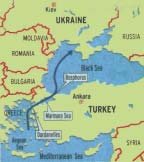
from the world's oceans. Its only link with other seas is
common for all regions this objective has a higher
with the Mediterranean, through the narrow channels
priority for those that, due to economic, geographic,
of the Bosphorus Strait, the Sea of Marmara and the
oceanographic and/or ecological conditions, are more
Dardanelles. Relative to its size, this is a most tenuous
vulnerable to the introduction and spread of harmful
link.
species.
Almost a third of Europe and huge areas of Asia drain
In view of this plus the fact that regional networks for
into the Black Sea and more than 160 million people
cooperation are already in place for the Black Sea
live in the overall Black Sea catchment area.
(Odessa Demonstration Site, Ukraine) and the ROPME
The Black Sea coastal zone is densely populated. In the
Sea Area (Khark Island Demonstration Site, Islamic
summer season, the permanent population of around
Republic of Iran), GloBallast regional initiatives are
16 million swells to around 20 million with the influx of
being launched in these two enclosed seas first.
tourists.
Accordingly, the 1st Black Sea Conference on Ballast
Water Management and Control was held in Odessa,
During the last 30 years, the Black Sea has been
Ukraine from 10 to 12 October 2001.
transformed by the harmful effects of modern industry,
agriculture and fishing. As if this was not enough, it
The Conference was organized by the GloBallast
has also been impacted by introduced marine species.
Programme and the Government of Ukraine and was
Among the most severely affected regions of the
attended by all Black Sea littoral States (Bulgaria,
world, the Black Sea countries have already suffered
Georgia, Romania, Russian Federation, Turkey and
huge losses from a number of marine bio-invasions,
Ukraine) plus observers from regional governmental
including the notorious Mnemiopsis jellyfish from
and non-governmental organizations.
North America. Mnemiopsis was first recorded in the
The objectives of the Conference were to:
Black Sea in 1982, introduced via ships ballast water.
By 1988 it had reached plague proportions contributing
enhance regional awareness and cooperation in the
substantially to the near collapse of Black Sea fisheries,
field of ballast water management and control;
through depletion of plankton stocks.
consider and endorse a draft Regional Action Plan;
The Black Sea is considered to have a low `immunity' to
and
marine bio-invasions. The enclosed nature of the Black
Sea means that regional co-operation is essential in any
agree on the machinery for implementation and
efforts to prevent and control introduced species.
coordination of regional activities.
The Conference was attended by the Secretary-General
of IMO, Mr William A. O'Neil, who stated that regional
cooperation is crucial for the success of any measures to
minimize the transfer of harmful aquatic organisms in
ballast water. He also stated that the participation of
high-level representatives of the six Black Sea Countries
and the Istanbul Commission encouraged him to
believe that regional efforts in the Black Sea will be a
success.
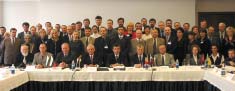
Delegates at the 1st Black Sea Conference on
Ballast Water Management and Control
BWN 7: 10-12/2001

G L O B A L B A L L A S T W AT E R M A N A G E M E N T P R O G R A M M E
B L A C K S E A C O N F E R E N C E
5
The Conference included national status reports by the
approved the RAP;
Black Sea countries. One of the most important
requested the Istanbul Commission to coordinate
agenda items was consideration of a Regional Action
activities under the RAP;
Plan (RAP), developed jointly by the Black Sea countries
and GloBallast. The objectives are:
called for countries to attach priority to the
implementation of the appropriate IMO instruments
to provide a framework for specific regional
on ballast water; and
activities under GloBallast;
requested GEF, UNDP and IMO to secure
to facilitate the preparatory process in the region
continuation of the GloBallast Programme within
for the introduction of the new IMO legal
the timeframe needed to ensure seamless
instrument on ballast water management and
introduction of the forthcoming international legal
control; and
instrument.
to enhance regional cooperation utilizing existing
The GloBallast PCU is now working with stakeholders
regional bodies stablished under the Istanbul
to assist with securing funding for the RAP. It is hoped
Commission and the Black Sea Environment
that the Istanbul Commission and the Black Sea
Programme.
countries will build on the sound foundation achieved
The RAP lists principal actions to be undertaken by
by the Conference and take up the challenge of
administrations, defines cooperative arrangements and
implementing the outcomes.
outlines possible funding options.
The GloBallast Programme is deeply grateful for the
The Conference unanimously adopted a Resolution in
assistance of Ukraine for making this event a success.
which the Black Sea littoral States:
The Conference report is available on
http://globallast.imo.org Regional Activities
I
A
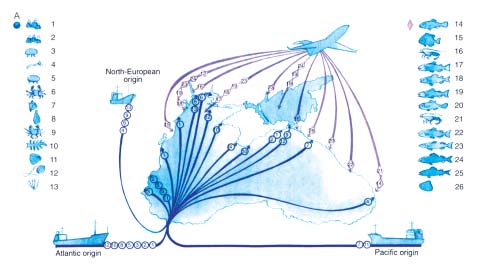
Known biological introductions in the Black Sea (source: Zaitzev & Mamaev 1997)
Key:
Accidental introductions (A):1. Balanus improvisus. 2. Balanus eburneus. 3. Blackfordia virginica. 4. Mercierella
enigmatica. 5. Bourgainvillia megas (1933). 6. Rhithropanopeus harrisi tridentata (1983). 7. Rapana thomasiana. 8.
Mya arenaria. 9. Callinectes sapidus. 10. Doridella obscura.11. Cunearca corneal. 2. Mnemiopsis leidyi. 13.
Desmarestia viridis.
Intentional introductions (I): 14. Gambusia affinis (1925). 15. Lepomis gibbosum (1930). 16. Pandallus kessleri
(1959). 17. Plecoglossus altivellis (1963). 18. Roccus saxatilis (1965). 19. Salmo gairdneri (1965). 20. Oryzias latipes
(1970s). 21. Penaeus japonicus (1970s). 22. Oncorhynchus keta (1972). 23. Mugil soiuy (1972). 24. Dicentrarchus
labrax (1977). 25. Lateolabrax japonicus (1978). 26. Crassostrea gigas (1980).
SR
BWN 7: 10-12/2001
G L O B A L B A L L A S T W AT E R M A N A G E M E N T P R O G R A M M E
B A LT I C R E G I O N A L W O R K S H O P
6
Baltic Battles Ballast
The Estonian Minister for the Environment, Mr Heiki
Kranich, gave an opening address, affirming Estonia's
Water Bugs
commitment to implementing IMO ballast water
management requirements and to regional
cooperation.
Like their colleagues in the Black Sea, the countries of
the Baltic Sea have also joined forces to develop a
The workshop proceeded according to a three-day
cooperative plan to protect their marine resources from
programme. The first day commenced with
the threat of harmful aquatic organisms and pathogens
background presentations by the GloBallast Technical
transferred in ships' ballast water.
Adviser, covering the nature of the ballast water
problem and marine bio-invasions and the IMO
IMO, through its Technical Cooperation Fund and the
response to the problem, including the IMO Guidelines,
GloBallast Programme, is assisting Baltic countries to
the new Ballast Water Convention and the GloBallast
halt this onward march of marine bio-invasions. With
Programme.
support from the Estonian Ministry of Environment,
and following closely on the heels of the Black Sea
The programme also included Country Status Reports
Conference in Odessa, GloBallast convened the Baltic
and the presentation of Project Proposals from Estonia,
Regional Workshop on Ballast Water Management in
Latvia, Lithuania, Poland and Russia and brief, oral
Tallinn, Estonia, from 22 to 24 October 2001.
reports from the Finnish and Swedish delegates. The
country status reports showed that all Baltic Sea
countries have suffered from marine bio-invasions, all
are undergoing expansions of their port facilities and
significant increases in shipping activity, and to date
none, including Finland, Germany and Sweden, have
acted to implement the IMO Ballast Water Guidelines.
There were also presentations from the GEF Baltic Sea
Regional Project, the European Commission and
HELCOM, which outlined the scope for regional
cooperation and prospects for funding of project
proposals.
A field trip was undertaken to Muuga Port, the main
commercial/industrial port within the Port of Tallinn.
Port officials provided a presentation on their strategic
development plans. Ongoing port development will
see significant increases in trade and therefore
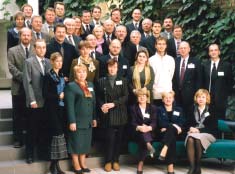
Baltic workshop delegates
significant increases in ballast water discharges and the
risk of marine bio-invasions. Of note was a
Maritime and environmental experts from Estonia,
commitment from the Port Board of Directors to
Finland, Germany, Latvia, Lithuania, Poland, Russia,
provide funds for ballast water management activities.
Sweden, the Helsinki Commission (HELCOM), the
The workshop was concluded by a discussion session to
European Commission (EC), the Global Environment
agree priorities for action and discuss recommendations
Facility (GEF) and other organizations gathered for the
for regional cooperation.
workshop.
During workshop discussions, all countries unanimously
The workshop objectives were:
agreed that the problem of ballast water and marine
To integrate the Baltic Sea Region in the GloBallast
bio-invasions must be addressed in the Baltic Sea on a
programme.
regional basis involving cooperation between all
countries in the region. The reasons given for this
To undertake initial awareness raising about
position were:
invasive marine species, the ballast water problem
and IMO ballast water activities amongst key
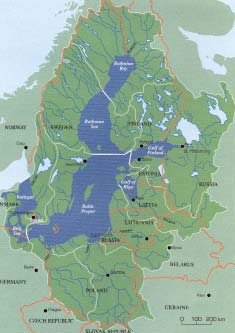
The Baltic is an enclosed sea and the marine and
stakeholders in the Region.
coastal environments of all Baltic Sea countries are
inextricably linked.
To establish the current status of invasive marine
species and ballast water management
Shipping is an international industry and must cross
arrangements in the Baltic Sea countries.
jurisdictional lines to conduct trade.
Action by an individual country would therefore be
To identify and plan some practical projects for
potential funding, that will catalyse concerted
of limited effectiveness.
action to improve the management of ballast water
There is a strong history of effective regional
and invasive marine species in these countries, and
cooperation in the Baltic on maritime and marine
enhance sub-regional and regional cooperation.
resource management matters.
BWN 7: 10-12/2001




G L O B A L B A L L A S T W AT E R M A N A G E M E N T P R O G R A M M E
B A LT I C R E G I O N A L W O R K S H O P
7
It was unanimously agreed that regional cooperation on
The GloBallast Programme is deeply grateful for the
ballast water control and management should be
assistance of the Estonian Government, and in particular
developed and coordinated through existing regional
Ms Liina Eek-Piirsoo of the Ministry of Environment, for
structures and mechanisms. HELCOM and the GEF Baltic
the excellent support provided in convening the
Sea Regional Project were identified as the most
workshop. The full workshop report is available on
suitable entities.
http://globallast.imo.org Regional Activities.
Finally, the workshop adopted a Resolution with the
following major recommendations:
within the framework of HELCOM, Contracting
Parties should agree as a matter of priority;
to develop a Regional Strategy and Action Plan
for Ballast Water Control and Management in
the Baltic Sea Region,
to implement IMO Resolution A.868(20) within
waters under their jurisdiction,
to support the rapid adoption and entry into
force of the new international legal instrument
on ballast water, being developed by IMO, and
to develop cooperative activities with adjacent
regions that may be species donors to the Baltic
Sea, specifically the Black, the Caspian and the
North Seas;
that HELCOM, the Contracting Parties, the GEF Baltic
Sea Regional Project, EC, GloBallast, UNDP, IMO and
others consider funding and/or otherwise supporting
the implementation of technical cooperation
projects developed by the Workshop;
that GEF, UNDP and IMO secure continuation of the
GloBallast Programme within the timeframe needed
to ensure a seamless introduction of the
forthcoming international legal instrument on
ballast water.
The Baltic Sea and its catchment (Source: HELCOM).
Overall, the workshop was proclaimed as a major
SR
success by all involved. Most delegations stated
that the exercise of developing a Country Status
Report had played an important role in bringing
~ ~ ~ N E W S F L A S H ! ~ ~ ~
various government and industry sectors
together to discuss ballast water and marine bio-
Check these sites out!
invasion issues in each country for the first time.
This had highlighted the lack of action to date
and the need for action. The workshop and the
in-country preparations thereby played an
Database on Alien Species
important role in raising awareness and
in the Baltic Sea Area
catalysing concerted action both within each
country and regionally.
www.ku.lt/nemo/mainnemo.htm
The GloBallast Programme Coordination Unit is
now working with stakeholders in the region in
order to assist with securing funding for technical
Regional Biological
projects. It is hoped that HELCOM and the Baltic
Sea countries will build on the sound foundation
Invasions Center
achieved by the workshop and take up the
www.zin.ru/projects/invasions/
challenge of implementing the workshop
Resolution and its recommendations.
BWN 7: 10-12/2001
8
G L O B A L B A L L A S T W AT E R M A N A G E M E N T P R O G R A M M E
B R A Z I L S A M P L I N G P R O G R A M M E
Brazil Samples
The IMO Ballast Water Guidelines A.868 (20) have been
translated and distributed to all 27 Sanitary Inspection
Ships in Ports
Coordinators in the Brazilian States and also to the
respective port agencies. There are currently 44 ANVISA
sanitary control bases at established ports and aquatic
The Brazilian Ministry of Health, through the National
terminals.
Agency of Sanitary Surveillance (ANVISA), has decreed
a Resolution to regulate sanitary surveillance of
ANVISA has been requesting ships claiming
travellers, ships, ports and terminals. Inobservance or
Free Pratique to complete the BWRF since June 2000,
disobedience to what is set in this Resolution
initially on an experimental and voluntary basis.
constitutes an infringement of Brazilian national law.
Analysis of 153 forms gathered at the GloBallast
The new regulations include a number of elements
Demonstration Site at Sepetiba, for the period between
relating to ballast water, as outlined in this article.
June 2000 and January 2001, provided
the following statistics:
67% of ships submitted the form.
41% of the forms were complete.
61% completed the section regarding ballast water
history.
43% completed the columns regarding ballast water
exchange.
39% completed the columns regarding ballast water
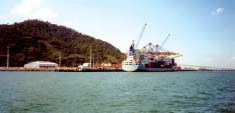
Sepetiba Container Terminal
discharge.
77% declared carrying ballast water on board.
The Brazilian Ministry of Environment acts as the Lead
Agency within Brazil for the GloBallast Programme,
69% declared having the IMO Guidelines on board.
and works closely with ANVISA, the Navy and other
78% declared having a ballast water management
stakeholders to implement a range of activities under
plan.
the programme, focussing on the Demonstration Site at
Sepetiba.
48% declared having implemented the ballast water
Even before its inclusion as one of the six GloBallast
management plan.
Pilot Countries, Brazil was extremely active in the field
24% listed a Brazilian port as last port.
of ballast water control and management. The
Brazilian Navy coordinates national input to the IMO
28% listed another Brazilian port as next port.
process through its Permanent Representative to IMO
Given that ANVISA's mandate is focussed on health
in London, and the Brazilian delegation has been
rather than environmental protection, and as very little
extremely active in the IMO Ballast Water Working
scientific assessment has been conducted world-wide
Group since before 1996. At MEPC 44 in March 2000,
on the public health dimension of ballast water,
the dilution method developed by the Brazilian State
ANVISA has established an informal correspondance
Oil Company PETROBRAS was considered as one
group. The group was formed to meet a commitment
reference method for ballast water exchange at sea.
made at MEPC 46 and to contribute to the forthcoming
The new ANVISA Resolution RDC 217 became effective
convention. An email address has been established
in November 2001 and the discharge of ballast water
(ballast.wg@anvisa.gov.br).
loaded in a geographical area considered a risk to
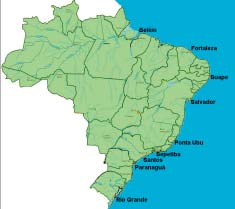
A research project is also underway. In the first phase, 9
public health (potential presence of pathogenic agents)
major Brazilian ports are being targeted for ship-board
into Brazilian waters is subject to prior authorisation.
ballast water sampling, among them the ports of
Another requirement of the ANVISA regulations is that
Santos and Paranaguá, and the GloBallast
the IMO Ballast Water Reporting Form (BWRF) shall be
Demonstration Site at Sepetiba.
completed and submitted by the ship's master or the
The largest Brazilian port Santos, received 3,249 ships in
applicant for Free Pratique (quarantine clearance) in
the year 2000, coming from a variety of ports world-
Brazilian ports.
wide. In 1999 an outbreak of cholera occurred in the
Information given which does not correspond to what
city of Paranaguá. After the evaluation of possible
is verified by inspection constitutes an infringement.
vectors there were indications that it might have come
The regulation provides for substantiation by ballast
from ballast water discharge at the port. The other
water sampling and physico-chemical or biological
ports included in the project are Belem, Fortaleza,
analysis, and fraud on the BWRF constitutes an offence.
Suape, Salvador, Ponta do Ubú and Rio Grande.
BWN 7: 10-12/2001
G L O B A L B A L L A S T W AT E R M A N A G E M E N T P R O G R A M M E
B R A Z I L S A M P L I N G P R O G R A M M E / N E W R E P O R T R E L E A S E D
9
Results of the study will be reported and submitted to
the 47th meeting of MEPC in March 2002 and in future
issues of Ballast Water News.
Brazil needs to prepare itself for compliance with the
new Ballast Water Convention currently being
elaborated at IMO. The actions taken by Government
institutions will help to progress the ballast water
regulatory process and provide adequate conditions for
the enforcement of these measures. However, domestic
pressures for the adoption of a unilateral approach and
regulatory regimes for ballast water management
similar to those implemented in Australia, California
and the United States, are beginning to be felt.
In the meantime, Resolution RDC 217 allows the
Sanitary Authority, in conjunction with the
environment agencies and the Maritime Authority,
greater control of ballast water in Brazil.
Brazilian ports covered by the ANVISA sampling
programme
Alexandre de C. Leal Neto
GloBallast Brazil
Under this project, training courses have been held
aneto@dpc.mar.mil.br
where ANVISA officers received theoretical guidance on
the theme as well as practical training in ship-board
ballast water sampling. Technical support and training
Acknowledgements
is being provided by the Brazilian Navy's Admiral Paulo
The author thanks the GloBallast Programme Coordination Unit
Moreira Institute of Marine Studies in Arraial do Cabo.
for their support for this work.
Physico-chemical and microbiological analysis will be
Thanks are also due to Daniel Lins Menucci, Claudio Land,
Flavio Fernandes, José Augusto Massena, Maria Célia Villac,
carried out for 100 ballast water samples. Each port
Maria Helena Rolim, Marestela Schnaider, Robson Calixto, Silvio
will receive the necessary ballast water sampling
Jablonski, Aline Rodrigues and Sousa Wagner Moreira.
equipment. In order to standardise the methodology
used, it was decided that a single laboratory from the
university of Sao Paulo should be responsible for
analyses, including for:
New Report Released
marine bacteria,
The Pew Oceans
bacteria from the Vibrionaceae family,
Commission, an
Vibrio cholerae,
independent group
fecal coliforms,
of US political leaders
Escherichia coli,
conducting national
Clostridium perfringens,
dialogue on the
phagos F-specific, and
policies needed to
physico-chemical parameters (temperature,
restore and protect
salinity, pH, conductivity and turbidity).
living marine resources,
The State University of Santa Cruz will characterize the
has released a new
plankton present in the samples.
report on marine
invaders.
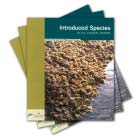
Entitled Introduced Species in US Coastal Waters:
Environmental Impacts and Management Priorities,
the report is well presented for a general audience,
contains clear, easy-to-digest facts and figures, tables,
maps and diagrams; and reviews the current situation
in the US with regard to marine bio-invasions and their
impacts; the dispersal of introduced species;
prevention, reduction and control measures and
recommendations for action.
The report can be ordered in hard copy from the Pew
Oceans Commission and downloaded from their
website www.pewoceans.org.
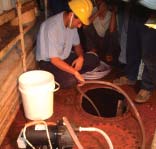
Ballast water sampling by ANVISA Officers
SR
BWN 7: 10-12/2001
10
G L O B A L B A L L A S T W AT E R M A N A G E M E N T P R O G R A M M E
L E G A L P R O J E C T
Legal Project Nears
international and domestic legal characterisation of the
problem that is - whether the transfer of harmful
Completion
aquatic organisms and pathogens through ballast
water constitutes marine pollution or some other form
of ecosystem harm or both. Although this sounds like
The 1st International Workshop on the Legal Aspects of
an academic issue, it has important practical
Ballast Water Management and Control took place on
implications for domestic implementation
15 & 16th November 2001 at the World Maritime
arrangements as well as international law regarding
University in Malmö, Sweden. The Workshop marked
enforcement rights and obligations.
the start of the final phase of the GloBallast Legislative
There was extended discussion about the challenge of
Review Project that began in February 2001.
effective regulatory design in a rapidly changing
The Workshop played an important role in bringing
environment. Some factors identified as posing
together the legal team from the six GloBallast Pilot
difficulties included; the nature of a legal mechanism
Countries and providing a forum for the exchange of
to address a source of marine ecosystem degradation
research, shared problems, ideas, differences and a
that differs from traditional polluting substances, such
great deal of debate.
as oil; the need for extensive scientific research to
determine any harm; the fact that ecosystem harm may
not be identified for years and even then may not be
attributable to any one source (for compensation
purposes); the current lack of a viable and fully
effective solution and the need to also deal with ships
in the coasting trade.
The fact that the international legal response, the
proposed IMO Convention, is also evolving in its
approach was seen as posing a special challenge for
national regulatory design. The complex concerns of
countries that are situated in closely linked marine
ecosystems such as the Black and Caspian Seas or the
Gulf were also discussed at length. Commentary within
the Workshop indicated that several countries expect
ballast water regulations to be adopted in the near
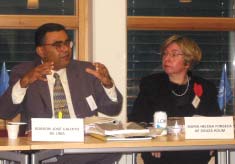
Legal debate at the Malmö workshop
future, because of a pressing need to prevent any
further environmental degradation. The participants
also considered the view that in some cases it was
In Ballast Water News No. 5, Legal Project Underway,
deemed more appropriate that legislation wait to
the Lead Legal Consultant Dr. M. McConnell, outlined
directly implement the future Convention.
the significance and purpose of the Project in the
overall GloBallast Programme.
The participants identified a number of principles to
guide national regulatory design. Important ideas,
Through this Project, Local Legal Consultants were
many relating to sustainable development objectives,
hired in each Pilot Country to carry out extensive
were considered including, the precautionary approach,
reviews of their national legal and administrative
polluter pays, coastal, flag and port State
systems relating to the ballast water issue. These
responsibilities, differences between countries in terms
provided a basis for proposals for the legal changes
of economic, administrative and scientific resources
needed in each country to effectively implement the
and capacity, transparency, integrated coastal
IMO Ballast Water Guidelines (A.868(20)) and to lay a
management and the need to take into account
legal foundation for rapid implementation of the
international trade rules to avoid discriminatory
future IMO Ballast Water Convention.
practices - to name but a few.
The review results, including draft regulations, were
The Workshop ended with many wishing for even more
presented by each country. Their proposals were
time to work together to debate these questions
compared in order to identify common elements and
further. The final report for the Project, which will
develop recommendations for best implementation
include the legal reviews from the six Pilot Countries
practices. Legal approaches adopted in several other
plus model ballast water legislation and regulations, is
countries that have already implemented the IMO
currently under preparation.
Guidelines were also considered. Model legislation can
now be developed for countries to implement the
Guidelines and the future Convention.
Dr. Moira McConnell
A number of key issues emerged from the
World Maritime University
presentations. One of the main problems that all
moira.mcconnell@wmu.se
the Consultants had struggled with related to the
BWN 7: 10-12/2001
G L O B A L B A L L A S T W AT E R M A N A G E M E N T P R O G R A M M E
S I N G A P O R E C O N F E R E N C E / A P E C W O R K S H O P
11
Singapore Conference
References for Page 3
Successful
1. Rigby G & Hallegraeff G (1994) The transfer and control of harmful
marine organisms in shipping ballast water: behaviour of marine
plankton and ballast water exchange trials on the MV "Iron
On 1st and 2nd November, the Singapore Environmental
Whyalla". Journal of Marine Environmental Engineering 1: 91-110
Technology Institute and Maritime and Ports Authority,
2. Smith G, Ruiz G, Frey M, Takata L, Altman S, Philips K, McCann L, Coss
C, Lipski D, Huber T, Steves B & Chavez S (2001) Effectiveness of
in conjunction with GloBallast and the Universities of
Ballast Water Exchange. International Conference on Marine
Strathclyde and Newcastle, convened the International
Bioinvasions, New Orleans. p 132 [Abstract]
Conference on Ballast Water Management in Singapore.
3. Taylor MD & MacKenzie LA (2001) Trans-Pacific shipboard trials on
Approximately 100 delegates attended and twenty six
planktonic communities as indicators of open ocean ballast water
papers were presented on a broad range of subjects,
exchange. International Conference on Marine Bioinvasions, New
including international developments and regulations;
Orleans. pp 136-137 [Abstract]
risk assessment; emerging technologies; ballast water
4. Taylor MD & Bruce EJ (2000) Mid ocean ballast water exchange:
shipboard trials of methods for verifying efficiency. Report prepared
sampling and monitoring and better management
for Ministry of Fisheries, No 524. Cawthron Institute, Halifax, New
practices.
Zealand. 59 pp3
The conference was considered a success in terms of
5. Wonham MJ, Walton WC, Ruiz GM, Frese AM & Galil BS (2001) Going
information exchange and networking, which is seen as
to the source: role of the invasion pathway in determining potential
invaders. Marine Ecology Progress Series 215: 1-12
being vital in the global response to the ballast water
6. Zhang F & Dickman M (1999) Mid-ocean exchange of container vessel
`problem'. Singapore expressed an interest in hosting
ballast water. 1: seasonal factors affecting the transport of harmful
similar conferences in future, which gained support from
diatoms and dinoflagellates. Marine Ecology Progress Series 176: 243-
delegates.
251
7. Dickman M & Zhang F (1999) Mid-ocean exchange of container
APEC Takes Action
vessel ballast water. 1: effects of vessel type in the transport of
diatoms and dinoflagellates from Manzanillo. Marine Ecology
Progress Series 176: 253-262
From 12 to 15 November the APEC (Asia-Pacific Economic
8. Macdonald EM & Davidson RD (1998) The occurrence of harmful
algae in ballast discharges to Scottish ports and the effects of mid-
Cooperation) workshop on Regional Risk Management
water exchange in regional seas. In: Reguera B, Blanco J, Fernandez
Framework for the Control and Prevention of Introduced
ML & Wyatt T (eds) Harmful Algae. Xunta de Galicia and
Marine Pests was held in Hobart, Tasmania
Intergovernmental Oceanographic Commission of UNESCO 220-223
APEC comprises the major economies of the Pacific Rim and
9. McCollin T, Macdonald E, Dunn J, Hall C & Ware S (2001)
Investigations into ballast water exchange in European regional seas.
thus represents an extremely powerful regional grouping
International Conference on Marine Bioinvasions, New Orleans. pp
through which cooperative initiatives and programmes can
94-95 [Abstract]
be developed and implemented.
10. Rigby G & Taylor AH (2001) Ballast water treatment to minimize the
While the workshop considered the issue of Introduced
risks of introducing nonindigenous marine organisms in Australian
ports. Ballast Water Research Series, Department of Agriculture,
Marine Pests (IMPs) in its broadest sense, it was a success
Fisheries and Forestry, Australia 13: i-viii, 1-93
from the perspective of GloBallast. Most workshop delegates
11. Carlton JT (1985) Transoceanic and interoceanic dispersal of coastal
stated that prior to the workshop they had limited
marine organisms: the biology of ballast water. Oceanography and
awareness of the ballast water issue and IMO initiatives.
Marine Biology Annual Review 23: 313-371.
Regional awareness was thus greatly increased.
12. Hay CH & Tanis D (1998) Mid-ocean ballast water exchange:
procedures, effectiveness, and verification. Cawthorn Report 468, 1-66
All countries agreed that the problem of IMPs must be
13. Gollasch S (1996) Untersuchungen des Arteneintrags durch den
addressed on a regional basis involving cooperation
internationalen Schiffsverkehr unter besonderer Berücksichtigung
between all economies. It was also agreed that within the
nichtheimischer Arten. Ph.D. thesis. Dr. Kovac, Hamburg. 210 pp
broader scope of the IMP issue, regional cooperation on
14. Hallegraeff GM & Bolch CJ (1992) Transport of dinoflagellate cysts in
ballast water control and management should be developed
ship's ballast water: implications for plankton biogeography and
and coordinated through existing regional structures, such
aquaculture. Journal of Plankton Research 14: 1067-1084.
as the GloBallast Programme.
15. Hamer JP, McCollin TA & Lucas IAN (2000) Dinoflagellate cysts in
ballast tank sediments: between tank variability. Marine Pollution
It was agreed that all regional activities on ballast water
Bulletin 40(9): 731-733.
management should be consistent and coordinated with the
16. Galil BS & Hülsmann N (1997) Protist transport via ballast water
IMO regime, and should seek to implement the IMO Ballast
biological classification of ballast tanks by food web interactions.
Water Guidelines (A.868(20)) and to support rapid adoption
European Journal of Protistology 33: 244-253
and entry into force of the new IMO Convention.
17. Williams RJ, Griffiths FB, Van der Wal EJ & Kelly J (1988) Cargo vessel
ballast water as a vector for the transport of non-indigenous marine
A Regional Risk Management Framework for the Control
species. Estuarine, Coastal and Shelf Science 26: 409-420
and Prevention of Introduced Marine Pests in APEC
18. Locke A, Reid DM, van Leeuwen HC, Sprules WG & Carlton JT (1993)
Economies, is now being developed. This will be submitted
Ballast water exchange as a means of controlling dispersal of
to the APEC Marine Resources Conservation; Fisheries and
freshwater organisms by ships. Canadian Journal of Fisheries and
Transport Working Groups, and to the Ministerial-Level
Aquaculture Sciences 50: 2086-2093
APEC Oceans Meeting to be held in Seoul, in April 2002.
19. Hülsmann N & Galil BS (2001) The effects of freshwater flushing on
marine heterotrophic protests implications for ballast water
Finally, as a result of the workshop, there is a possibility of
management. Marine Pollution Bulletin 42: 1082-1086.
financial and technical cooperation with APEC for
20. Reeves E (1999) Exotics and public policy in the Great Lakes: the
undertaking activities in the Asia-Pacific region. The
results of a workshop at the biennial Great Lakes Water Quality
GloBallast PCU is working with relevant officials to develop
Forum, Milwaukee, Wisconsin, 23 and 26 September 1999.
project proposals.
http://www.ijc.org/milwaukee/transcript/exotic/ballast.html
BWN 7: 10-12/2001


G L O B A L B A L L A S T W AT E R M A N A G E M E N T P R O G R A M M E
2
12
Progress Report
Activities Undertaken October - December 2001:
Activities Planned January - March 2002:
Hold 3rd Global Task Force meeting in Goa, India,
Attended and presented at 41st meeting of
16-18 Jan.
SIGTTO, Bracknell, 2-4 Oct.
Commence Ballast Water Risk Assessments for 6
1st Black Sea Regional Conference on Ballast Water
Demonstration Sites (subject to IMO green light).
Management & Control held in Odessa, Ukraine,
10-12 Oct.
Complete review of Global Information Clearing
House function and initiate improvements as
Ballast water training provided at annual PACPOL
recommended.
Workshop, Tahiti, 8-12 Oct.
Complete Legislative Review Project.
Baltic Regional Workshop on Ballast Water
Management held in Tallinn, Estonia, 22-24 Oct.
Commence planning for TV documentary.
Support mission undertaken to Brazil.
Lecture at World Maritime University, Malmö,
South American regional activities initiated
Sweden, 25 Jan.
through ROCRAM meeting, Ecuador, 22-23 Oct.
Attend and present at Nordic Ballast Water Summit,
International Conference on Ballast Water
Oslo, Norway 28-29 Jan.
Management held in Singapore, 1-2 Nov.
Attend and present at 11th International
Attended and presented at APEC Workshop on
Conference on Aquatic Invasive Species, Alexandria,
USA 25-28 Feb.
Risk Management Frameworks for Introduced
Marine Pests, Hobart, Australia, 12-15 Nov.
Hold Regional Seminar on Ballast Water Control
and Management in the Gulf Area, Dubai, UAE,
Legal workshop held at WMU, Sweden, 14-16 Nov.
25-28 Feb.
Ballast water risk assessments ready to commence
, December 2001.
Attend/assist 47th meeting of MEPC 4-8 March.
subject to IMO green light.
Port surveys conducted in Brazil and India.
Lecture at Netherlands Institute for Sea Research,
12 & 18 March.
ecycled paper
Planning undertaken for 3rd Global Task Force
meeting in Goa, India.
Hold Train-X Workshop in Montevideo, Uruguay,
7th issue of Ballast Water News produced.
18-20 March.
Produce 8th issue of Ballast Water News.
.dwa.uk.com · Printed on r
More Information?
el (+44) 020 7928 5888 www
Programme Coordination Unit
Photo credit: T Huspeni.
Global Ballast Water Management Programme
International Maritime Organization
4 Albert Embankment
London SE1 7SR United Kingdom
Telephone : +44 (0)20 7587 3247 or 3251
est & Associates, London. T
Fax
: +44 (0)20 7587 3261
Email
: dpughiuc@imo.org or sraaymak@imo.org
Daniel W
Web
: http://globallast.imo.org
BWN 7: 10-12/2001