






3
Ballast Water News
Global Ballast Water
Ballast Water News Management Programme
I S S U E 4
J A N U A RY - M A R C H 2 0 0 1
From the Editor
From the Programme
Issue Four of Ballast Water News marks the first
In March 2001 the GloBallast programme celebrated
anniversary of the GloBallast programme. Much has been
its first full year of activity. Both IMO and UNDP
achieved and the programme is now in full swing. During
expressed satisfaction at the significant progress
the last three months a number of technical activities
achieved by the PCU and the participating countries,
have been completed or commenced, as highlighted
where the necessary management structures are now
within. The slightly delayed production of this issue also
operational. With approval of the National
allows us to report on some activities from April.
Workplans, the momentum is being transferred to the
In January Captain Dandu Pughiuc of the GloBallast
countries.
Programme Coordination Unit (PCU) lectured on ballast
GloBallast's next objectives are ballast water risk
water management at the IMO World Maritime
assessments and the development of compliance
University (WMU) in Malmö, Sweden. This provided an
monitoring and enforcement systems. We will work
important opportunity to raise awareness amongst
closely with countries advanced in ballast water
future maritime administrators from around the world.
management to develop flexible models.
In March the review of ballast water legislation in each
Significant progress has been made in building
of our six pilot countries commenced, with the signing
"win-win" relationships with other UN programmes
of a contract with WMU to coordinate this review and
and GEF sister projects. Exploratory discussions have
develop model legislation for use in developing
been held with the UNEP Mediterranean Action Plan
countries.
and the Caspian Environment Programme, and the
Also in March the 1st International Ballast Water
prospects for collaboration appear encouraging.
Treatment R&D Symposium was held at IMO in London,
Although unable to attend the 6th meeting of the
followed immediately by the 1st International Ballast
Subsidiary Body for Scientific, Technical and
Water Treatment Standards Workshop. These two events
Technological Advice to the Convention on Biological
may be considered `watersheds' in catalysing research
Diversity, GloBallast submitted a statement regarding
and development of new and alternative ballast water
the programme's objectives.
treatment technologies.
The GloBallast programme has been attentively
Keeping with the symposium theme, in this issue we
observing the development of the new international
announce no less than four different forthcoming
ballast water convention by MEPC. GloBallast makes
international conferences on ballast water and related
every effort to support the work of MEPC and its
matters.
Member States whose directives form the
In April the first port baseline survey to be carried out
programme's evolving guiding principles. Perhaps our
under the programme was conducted at the Saldanha
most substantial contribution to date has been the
Bay demonstration site in South Africa. This included
organization of the 1st International Ballast Water
training of personnel from the other pilot countries.
Treatment R&D Symposium and Standards Workshop,
which were acclaimed a great success.
One of the `founders' of the GloBallast programme,
Mr Philip Reynolds of the United Nations Development
The appreciation shown in response to our first year
Programme, retired in April. Mr Reynolds was
of operation is an added incentive for our continued
instrumental in initiating the programme, securing
contribution towards the global efforts to minimize
US$7.6 million in funding from the Global Environment
transfers of alien species in ships' ballast water, which
Facility and guiding the PCU through our first twelve
is one of the greatest threats to our oceans.
months. We would like to pay tribute to his pivotal role,
express our deepest gratitude and wish him all the best
in his retirement.
Steve Raaymakers
Dandu Pughiuc
Contributing Editor
Chief Technical Adviser
Ballast Water News is the quarterly newsletter of the Global Ballast Water Management Programme (GloBallast). GloBallast is a cooperative initiative of GEF, UNDP and IMO to
assist developing countries to reduce the transfer of harmful organisms in ships' ballast water, through the implementation of IMO ballast water management guidelines.
For further information please contact:
Programme Coordination Unit, Global Ballast Water Management Programme
International Maritime Organization, 4 Albert Embankment, London SE1 7SR, UK
Tel +44 (0)20 7587 3247 or 3251. Fax +44 (0)20 7587 3261
Email dpughiuc@imo.org or sraaymak@imo.org Web http://globallast.imo.org
The views expressed in Ballast Water News are not necessarily those of GEF, UNDP or IMO.





G L O B A L B A L L A S T W AT E R M A N A G E M E N T P R O G R A M M E
G U E S T S P E A K E R
2
Guest Speaker
an international convention for the regulation of ballast
water. The development of this convention is now
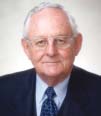
Mr William A. O'Neil
reaching the point where it appears that a diplomatic
Secretary General, IMO
conference to adopt it could be held within three years,
which would be a major breakthrough in dealing with
this problem.
Mr William A. O'Neil of
Canada became Secretary-
In anticipation of the new convention, IMO, with
funding provided by the Global Environment Facility
General of the International
(GEF), has initiated the Global Ballast Water
Maritime Organization, the
Management Programme (GloBallast).
United Nations agency
The overall objective of the programme is to reduce the
concerned with maritime
transfer of harmful aquatic organisms in ships' ballast
safety and the prevention of
water, by assisting developing countries to implement
marine pollution from ships,
the existing IMO guidelines and to prepare for the new
on 1 January 1990.
ballast water convention.
Mr O'Neil has been associated with IMO since 1972,
Under both the existing IMO guidelines and the new
when he attended the IMO Council as Canada's
convention, ballast water exchange at sea remains the
representative. In 1979 Mr O'Neil was elected
main management measure for reducing the risk of
Chairman of the Council and held the post until his
transfer of harmful aquatic organisms. It is widely
recognized that ballast water exchange has many
appointment by the Council to serve his first four-year
limitations, including serious safety concerns that limit its
term as Secretary-General.
applicability, and the fact that translocation of species
Mr O'Neil was unanimously re-elected to serve a
can still occur even when a vessel has undertaken full
second four-year term as Secretary-General beginning
ballast exchange. It is therefore extremely important that
in 1994 and was again re-elected for a third four-year
alternative, more effective ballast water treatment
methods are developed as soon as possible. To facilitate
term beginning in 1998.
the development of alternative methods, it is vital that
During his term of office Mr O'Neil has encouraged
internationally agreed and approved standards for the
IMO to take a more pro-active role in promoting
evaluation and approval of new ballast water treatment
maritime safety and combating marine pollution.
systems are developed and agreed as soon as possible.
Mr O'Neil has been at the helm of IMO since ballast
To help address this situation, IMO, through the
GloBallast PCU, took the initiative to organize the 1st
water was first raised as an issue of concern by
international symposium on ballast water treatment
member countries. He has guided the Organization's
R&D, followed by an expert workshop on ballast water
response to the issue, including the development of
treatment standards, in the last week of March 2001. This
the IMO voluntary ballast water management
was the first time that the world's leading experts in the
guidelines, negotiation of the new international
specialised field of ballast water treatment have come
convention on ballast water management and the
together at an international conference. I am pleased
initiation of the GloBallast programme to assist
that the outcomes are providing important catalysts for
progressing the new convention and for moving us closer
developing countries.
to a practical solution to the `ballast water problem'.
Ballast water transfers and invasive marine species are
one of the most serious environmental challenges facing
The introduction of harmful aquatic organisms and
the global shipping industry. The IMO Secretariat remains
pathogens to new environments, including via ships'
committed to providing all the assistance necessary to
ballast water, has been identified as one of the four
assure the development and effective implementation
greatest threats to the world's oceans. It is estimated that
of a uniform, standardized, global ballast water
a foreign marine species is introduced to a new
management regime.
environment somewhere in the world every nine weeks.
Human health, ecological and economic impacts can be
William A. O'Neil
severe.
~ ~ ~ N
The International Maritime Organization has been
E W S F L A S H
~ ~ ~
working on this issue for over ten years. The Marine
Environment Protection Committee formed a Ballast
New mandatory ballast water
Water Working Group in 1990 and in 1997, the first set
regulations to enter into force
of guidelines elaborated in 1993 were improved and
in Australia
adopted as assembly resolution A.868(20).
While the 1997 guidelines have provided a sound basis
1 July 2001
for the management and control of ballast water, the
www.aqis.gov.au/shipping
MEPC has also been actively working on the creation of
BWN 4: 1-3/2001
G L O B A L B A L L A S T W AT E R M A N A G E M E N T P R O G R A M M E
P O R T S U R V E Y S
3
Port Surveys Underway
Standardisation is Vital It is highly desirable
that port surveys for introduced marine species are
conducted according to standardised, uniform
From 15 to 30 April 2001, teams of
methods. This helps to ensure quality control and a
marine scientists and divers gathered at
basic minimum standard, and allow inter-comparability
of data. Such standardisation is extremely important
the GloBallast demonstration site of
when dealing with a global industry such as shipping
Saldanha Bay in South Africa to conduct
and the transboundary movement of species, which
requires a high level of international cooperation and
the first port survey to be carried out by
coordination.
the programme.
Fortunately for GloBallast, the Australian Centre for
Research on Introduced Marine Pests (CRIMP) developed
standard port survey protocols in 1996. They have been
tried and tested in Australia since then, during which 25
ports have been surveyed for introduced marine species.
The protocols were revised and republished this year
(Hewitt & Martin 2001).
GloBallast has selected the CRIMP Protocols for
application at its six demonstration sites, on a trial basis.
They will be considered for possible adaptation as
international port survey protocols. We are also following
the approaches being taken by the University of Wales
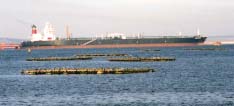
Saldanha Bay: Sensitive mariculture rafts adjacent to the
for UK ports, the Smithsonian Environmental Research
main port facilities where ballast water is discharged
Centre at various locations in the United States and the
New Zealand Ministry of Fisheries.
Why Port Surveys? It is not possible to manage
Training & Capacity Building In order to
and control introduced marine species unless you know
provide expert advice, assistance, training and
what they are and where they are. Under the current
coordination in each of the pilot countries, GloBallast has
IMO ballast water management guidelines (Resolution
contracted Dr Marnie Campbell, previously of CRIMP and
A.868(20)), Port States are encouraged to undertake
now a freelance consultant, as Port Survey Coordinator.
biological surveys and monitoring in their ports. The
purpose is to assess native biodiversity and determine the
The first GloBallast pilot country to plan and conduct its
presence, absence, distribution, abundance and
port baseline survey was South Africa, coordinated by Mr
seasonality of introduced marine species.
Adnan Awad, the GloBallast representative there.
This information can be used by management agencies to
The team comprises marine scientists from the University
devise strategies to control introduced species and to
of Western Cape, the University of Cape Town and
advise shipping of areas or times to be avoided in taking
specialist consultants, plus three MSc students who are
on ballast, so as to minimise the potential uptake and
being funded by the programme. PortNet, the national
transfer of these species. Such information is also required
port administration for South Africa, is also an important
for undertaking risk assessments and supporting Decision
contributor, organizing port access and providing vessels
Support Systems to assist ballast water management.
and onshore facilities.
Port surveys for introduced marine species are a
continued on page 4
fundamental and vital part of the port-based aspects of
ballast water management. Without such surveys Port
~ CONFERENCE ANNOUNCEMENTS ~
States are essentially `blind' in their efforts to control the
transfer of marine organisms in ballast water.
2ND ICHCA
As part of its objective of assisting developing countries
Ballast Water Conference
to implement the IMO ballast water guidelines, the
London 10 September 2001
GloBallast programme is assisting each of its six pilot
countries to conduct port baseline surveys. This support
www.ichca.org.uk
includes direct funding of survey activities and the
provision of expert advice, assistance, training and
coordination in each country. The six pilot countries are
1ST International Ballast Technology
Brasil, China, India, Iran, South Africa and Ukraine. Each
Investment Fair
pilot country has a demonstration site. These are the
ports of Sepetiba, Dalian, Mumbai, Kharg Island,
Chicago 20-21 September 2001
Saldanha and Odessa respectively.
www.nemw.org/fair_about.htm
BWN 4: 1-3/2001
G L O B A L B A L L A S T W AT E R M A N A G E M E N T P R O G R A M M E
P O R T S U R V E Y S
4
As the CRIMP Protocols place a significant emphasis on
Saldanha Sampling Design In accordance
SCUBA diving, a team of divers was also contracted,
with the CRIMP Protocols, a sampling design was
many of who are PhD students at the University of
developed for Saldanha based on the likely inoculation
Western Cape.
and settling points for introduced marine species,
considering ballast water discharge points, prevailing
water movements and suitable settling habitats. Field
teams undertook sampling as follows:
SCUBA Diving:
Scraping and still photography within 0.10m2
quadrants placed along vertical transects to
sample hard-substrates.
50m bottom transects with visual searches,
collection and photography at 1m intervals to
sample soft-substrates.
Tubular hand cores to sample benthic infauna
and dinoflagellate cysts.
Rotenone to sample for fishes.
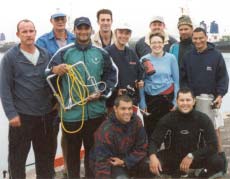
South African dive team from University of Western
Cape
Opportunistic visual searches.
Plankton Tows: Vertical and horizontal tows of
As port surveys are a new concept for most of the
20um and 100um nets from a small boat.
GloBallast pilot countries, it was decided to utilise the
first South African survey as a training opportunity for
Trapping: Setting of crustacean traps to sample for
the other five pilot countries. Two marine scientists
crabs, shrimps etc.
from each of these countries were funded by the
programme to travel to South Africa for this purpose.
Nets: Beach seines to sample nearshore fishes over
sandy and muddy substrates.
A two-day workshop was conducted at Saldanha by
Dr Campbell on 17 and 18 April, to train these
Other techniques can be used depending on site
delegates in the theoretical aspects of the CRIMP
conditions. For example vessel-operated grabs can
Protocols. From 19 to 22 April the delegates joined the
substitute some diver-based sampling at sites where
South African team to observe and assist the field
conditions may be unsuitable for diving.
sampling and gain practical experience.
Sorting, Preserving and Identifying
Samples Perhaps one of the most important parts
of the port survey is to ensure well organized and
documented sorting, preservation and identification
of the biological samples.
Initial rough sorting into the most obvious taxonomic
groups is done on-site at the end of each day of field
work. These are preserved and taken to the laboratory
for finer sorting and identification. Local taxonomists
are used wherever possible. However, invariably it will
be necessary to send hard-to-identify specimens to
specialist taxonomists internationally.
It is also extremely important to establish national
voucher and reference collections for the samples
collected. These are vital for reference purposes and
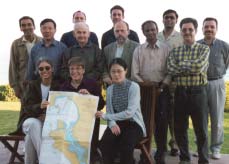
Port survey trainees from the GloBallast pilot countries
as a baseline for future surveys.
in South Africa with Dr Marnie Campbell (front row
centre)
BWN 4: 1-3/2001

G L O B A L B A L L A S T W AT E R M A N A G E M E N T P R O G R A M M E
P O R T S U R V E Y S R A I S I N G A W A R E N E S S
5
A New Vehicle for
Raising Awareness
The GloBallast PCU is working closely
with the World Maritime University to
raise awareness about ballast water and
invasive marine species amongst the
world's future maritime administrators.
A lack of information about the transfer of organisms
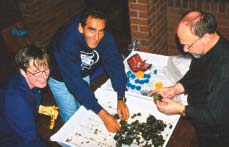
Initial `rough' sorting of biological samples
in ships' ballast water is currently the most significant
barrier to solving this problem. While the ballast water
Results and Reporting Port surveys are of
issue is of concern to specialists and experts, it is not
limited value if the results are not communicated to
currently recognised by the more general community
management agencies for action. There are usually two
and especially not in developing countries.
types of reporting; immediately after the survey on any
In January 2001 the PCU's Chief Technical Adviser,
serious pest species requiring an urgent response, and a
Captain Dandu Pughiuc, continued the GloBallast
more comprehensive report covering all species found.
awareness raising campaign, by lecturing to Maritime
The final report can only be made after all of the
Administration students at the World Maritime
taxonomic identification has been completed.
University (WMU) in Malmö, Sweden.
Founded in 1983 under the auspices of IMO, WMU is
Where to from Here? Port surveys should
the global centre for advanced education and training
consist of a comprehensive baseline survey followed by
in maritime affairs. Almost 1,600 graduates can now
ongoing, long-term monitoring. To conduct an initial,
been found in 138 countries. WMU represents an
one-off survey without follow-up surveys is of limited
extremely valuable centre through which the world's
value. As shipping movements and ballast water
future maritime managers can be reached.
transfers will continue in the port, introductions may
The pivotal question of the WMU 2001 module on
subsequently occur. Long term monitoring does not
Maritime Environmental Principles, organised by
need to be as comprehensive as the baseline survey.
Professor Moira McConnell, was "are international
Passive and less expensive techniques such as settling
environmental issues managed?" In this context
plates may be used.
Captain Pughiuc gave an overview of the ballast water
The port baseline surveys for Brasil, China, India, Iran
problem, the international response and potential
and Ukraine are now being planned.
solutions. The lecture stimulated lively discussion and
the students, from 16 countries, demonstrated genuine
It is intended that the baseline surveys initiated by
interest in ballast water matters.
GloBallast will be the catalyst for long-term ongoing
surveys at each demonstration site, as well as
replication at both the national and regional levels.
We are extremely pleased that most of the pilot
countries are now planning for this, including seeking
in-country sources of resourcing and financing.
Global System is Needed Ideally, a global
system of ongoing port surveys should be implemented
with all major ports in the world using a standardised
approach. Results should be fed into a global database
1st WMU students to receive lectures in ballast water
of introductions. This should be linked to a
management under the GloBallast programme, 2001
communication system which allows the international
shipping industry to be alerted to outbreaks of harmful
One of the main benefits of this exercise is that once
species, and to manage their ballast operations
the students return to their countries, usually to senior
accordingly. It would also be used by port and
government positions, they may become focal points
government authorities.
for the implementation of the new international
The port surveys being implemented at the GloBallast
ballast water convention.
demonstration sites are the foundation of this global
Given the enthusiastic response received, the PCU may
system.
continue this cooperative activity with WMU.
SR
SR
BWN 4: 1-3/2001
G L O B A L B A L L A S T W AT E R M A N A G E M E N T P R O G R A M M E
F I R S T R & D S Y M P O S I U M
6
1st R&D Symposium
The race is therefore on to find alternative, more
effective ballast water treatment methods. We have
a Success
identified 40 different projects around the world,
either completed or underway, aimed at developing
potential new systems.
From 26 to 30 March 2001 the GloBallast
R&D groups are spurred on by the prospect of a
potential US$2 billion market for an effective ballast
PCU convened the 1st International
water treatment system that receives international
Ballast Water Treatment R&D Symposium
approval.
and Standards Workshop at IMO
Technologies being researched include filtration and
physical separation, treatment with chemicals, ultra-
headquarters in London.
violet light, ozone, heat, de-oxygenation, electro-
ionisation, gas super-saturation and various
combinations of the above. The R&D projects are
based in countries as far-flung as Australia, Brasil,
Canada, China, Germany, Japan, New Zealand, Norway,
Poland, Singapore, the UK and the USA. They comprise
government programmes, private initiatives, private-
public consortiums, local efforts, national programmes
and international alliances.
One of the difficulties faced by this diverse global R&D
effort, was the lack of effective lines of communication
between these groups and with governments and the
shipping industry. It has been difficult for any party to
gain an up-to-date picture of the latest `state-of-the-
art' in ballast water treatment R&D. The shipping
industry, the ultimate end-user of this effort, is being
bombarded with offers from vendors of so-called
`solve-all' ballast water treatment systems, without any
formal international system for their independent
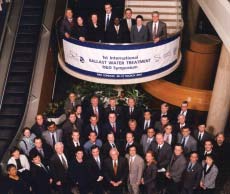
Some of the delegates at the symposium - nearly 200
evaluation and approval.
attended
To help address this situation, we have produced the
Ballast Water Treatment R&D Directory, and convened
While ballast water exchange at sea is currently the
the 1st International Ballast Water Treatment R&D
only generally accepted method for reducing the risk of
Symposium.
transferring organisms in ships' ballast water, it is
widely recognised that this method has several
Twenty six papers were presented at the symposium by
limitations and constitutes an interim measure only.
the world's leading ballast water treatment experts,
The limitations include:
covering all of the technologies referred to above and
updating the latest results from the major R&D
It may be unsafe for some ships in certain weather
projects. The symposium attracted nearly 200
conditions, threatening the stability and/or the
participants.
structural integrity of the ship.
The general picture that emerged from the symposium
Some ships do not have plumbing, ballast tank
was as follows:
arrangement and/or pumping capacity suitable for
All of the various technologies are currently at a
ballast exchange.
very early stage of development and significant
Some voyages are too short to allow complete
further research is required.
ballast exchange.
It is likely to be some years before a new ballast
While it is theoretically possible to achieve up to
water treatment system is developed, proven
99% volumetric exchange of ballast water, the
effective, approved and accepted for operational
biological effectiveness may vary widely. Several
use. Ballast water exchange will therefore remain a
studies indicate that species diversity and
primary method for some time yet, despite its
abundance can actually increase in ballast tanks
limitations.
after exchange. Even when carried out in full,
harmful species may still be transferred.
It appears that any new ballast water treatment
system will involve a combination of technologies,
Some oceanic species taken on during ballast
for example primary filtration or physical
exchange may survive and establish in coastal
separation followed by a secondary biocidal
waters, and vice versa.
treatment.
BWN 4: 1-3/2001












G L O B A L B A L L A S T W AT E R M A N A G E M E N T P R O G R A M M E
F I R S T R & D S Y M P O S I U M
7
The current global budget for ballast water
A number of scene setting papers were presented on
treatment R&D (about US$10 million) is
the first day. The workshop then broke into smaller
insignificant compared to the global costs of
working groups which were asked to brainstorm the
marine introductions (likely to be at least in the
development of possible ballast water treatment
tens of billions of US$).
standards, and in particular a biological effectiveness
standard (biological effectiveness meaning removing,
There is a desperate need to develop and
killing or rendering inactive organisms in ballast
implement international standards and procedures
water).
for the evaluation and approval of new ballast
water treatment systems.
Abstracts of papers presented are currently available
on the GloBallast web site http://globallast.imo.org, on
the page titled `Ballast Water Treatment'. The full
proceedings are currently being prepared and will be
available in the near future.
The symposium was hailed as a major success and
participants requested that it become a regular event
held every one to two years. We are currently
exploring options for this.
Standards Workshop
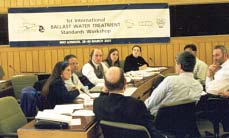
One of the working groups in deep discussion
Worked Too
The working groups convened in plenary to
consolidate their recommendations into a workshop
report. The workshop unanimously agreed five Primary
In response to the need to develop and implement
Criteria that any new treatment systems should meet
international standards and procedures for the
and 10 Fundamental Principles that should be applied
evaluation and approval of new ballast water
in developing biological effectiveness standards. The
treatment systems, the R&D symposium was
workshop also proposed two possible options for such
immediately followed by the 1st International Ballast
a standard, one representing a majority view and the
Water Treatment Standards Workshop from 28 to 30
other a dissenting view.
March.
The workshop report was submitted to the Ballast
The shipping industry has made repeated calls for
Water Working Group of the 46th meeting of MEPC
international standards to be developed and adopted.
held from 23 to 27 April. MEPC welcomed the report
This will provide the industry with a clear target to aim
and agreed to use it as the basis from which to
for and encourage innovation.
develop standards for use in the new international
The standards workshop was by invitation only, in
convention on ballast water. A correspondence group
order to ensure a manageable process and that a
has been tasked to do this, coordinated by the USA.
meaningful result would be achieved. The invitation
The workshop report is available on the GloBallast web
list ensured a broad representation from the shipping
site, on the page titled `Ballast Water Treatment'. It
industry, water treatment industry, marine science
should be noted that the treatment standards described
community, governments and environmental
in it are for discussion purposes only. The formal, official
organisations. The total number of participants was
process of MEPC is where a final standard will be
around 70.
developed and agreed by member countries.
SR
~ ~ ~ C O N F E R E N C E A N N O U N C E M E N T S ~ ~ ~
11TH International Conference on
1ST International Conference on
Aquatic Invasive Species
Ballast Water Management
Alexandria, Virginia, USA
Singapore
1-4 October 2001
1-2 November 2001
www.aquatic-invasive-species-conference.org
www.eti.org.sg
BWN 4: 1-3/2001


G L O B A L B A L L A S T W AT E R M A N A G E M E N T P R O G R A M M E
8
Progress Report
Activities Undertaken January March 2001:
Activities Planned April June 2001:
National workplans refined and implementation of
Attend 2nd International Marine Bioinvasions
in-country activities accelerated.
Conference (New Orleans).
Additional Administrative Assistant employed at PCU.
Conduct 1st port survey S Africa (including
Port survey coordinator consultancy awarded.
training).
Planning completed for 1st port survey South Africa.
Attend/support MEPC 46.
Official launch function held in South Africa.
Undertaken mission to Azerbaijan link with
Contract concluded with WMU for legislation review.
Caspian Environment Programme.
Preparations completed for Train-X modules project.
Attend Baltic/Nordic Invasive Species Workshop
ROPME meeting attended in Bahrain.
(Copenhagen).
Lectures commenced at WMU, Malmö.
Award risk assessment consultancy.
Mission undertaken to Iran.
Plan/commence further port surveys.
Lecture given to Nautical Institute (Belgian Branch).
Commence legislation review project.
ICES/IOC/IMO meeting attended (Barcelona).
Commence Train-X modules project.
1st case studies prepared for publication.
Prepare compliance monitoring & enforcement
Additional awareness materials produced.
project.
Submission made to the 6th meeting of the
Commence second case studies (China, India, Iran).
Subsidiary Body for Scientific, Technical and
Review/consolidate information clearing house
Technological Advice of the Convention on
function.
, May 2001.
Biological Diversity.
Lecture to Plymouth University MSc course.
Ballast water treatment R&D symposium and
Initiate development of Regional Ballast Water
standards workshop held (London 26-30 March).
Management Strategy for the Black Sea.
ecycled paper
4th issue of Ballast Water News prepared.
Produce 5th issue of Ballast Water News.
.dwa.uk.com · Printed on r
More Information?
Photo credit : Michael Marmach
Programme Coordination Unit
el (+44) 020 7928 5888 www
Global Ballast Water Management Programme
International Maritime Organization
4 Albert Embankment
London SE1 7SR United Kingdom
Telephone :
+44 (0)20 7587 3247 or 3251
est & Associates, London. T
Fax :
+44 (0)20 7587 3261
Email :
dpughiuc@imo.org or sraaymak@imo.org
Daniel W
Web :
http://globallast.imo.org
BWN 4: 1-3/2001