
3
Ballast Water News
Global Ballast Water
Ballast Water News Management Programme
I S S U E 2
J U LY S E P T E M B E R 2 0 0 0
From the Editor
From the Programme
Welcome again to Ballast Water News (BWN), it seems
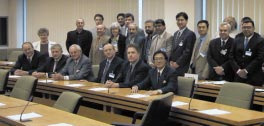
The most significant event for the programme in the
like only yesterday that we were putting together the
last three months was the 1st meeting of the Global
first issue back in June. It has been an extremely busy
Programme Task Force (GPTF) held at IMO in London
three months for us here at the Programme
from 5 to 7 July.
Coordination Unit (PCU) and significant progress has
been made with the programme.
The GPTF is the highest advisory body for the
programme. It comprises senior representatives of IMO,
In the first newsletter, we provided an introductory
UNDP/GEF, UNDP, the Country Focal Point (CFP) and
overview of the ballast water issue and the GloBallast
Assistant CFP from each of the programme's six pilot
programme. While we maintain a summary of the
countries plus observers/advisors from the shipping and
programme's progress on pages two and eight, we are
port industries and international non-government
now including broader articles. This issue focuses on
environmental groups.
ballast water treatment technology, with updates on a
few of the many R&D projects being conducted around
As this was the first meeting of the GPTF, it provided
the world.
the forum to officially launch the programme, to review
and endorse the Project Implementation Plan that had
I am pleased to report that the response to the first
been prepared by the PCU and to confirm coordination
issue of BWN was extremely positive. Several articles
and administrative procedures. The meeting also
have been contributed by external parties. Many
provided an opportunity to establish the current status
thanks to those who have taken the time to write for
of ballast water activities in each of the pilot countries
and hear the views and positions of the industry/NGO
us. Regrettably, not all articles received are able to be
groups
included at this time. Our apologies to the authors,
your articles will appear in future issues. The invitation
The Secretary General of IMO, Mr William O'Neil,
to make contributions remains open, on any aspect of
addressed the GPTF, stressing the need for a
the problem.
standardised, international response to the ballast
water problem and re-affirming IMO's commitment to
A new column in BWN is the `Guest Speaker'. We hope
actively support the programme, by offering essential
this will become a permanent feature, through which
access to the resources of the Organization.
leading figures in industry, government, academia and
the environmental community will be invited to
The message from the shipping industry was that the
present their views on the problem. In this issue, I am
problem is recognised and has to be addressed, but that
most pleased to introduce Mr Alec Bilney of the
measures to be taken must be safe, cost effective and
International Chamber of Shipping, as our first `Guest
practical.
Speaker'.
The meeting was considered a major success. All
I trust that the newsletter will continue to assist the
objectives set under the agenda were achieved, and
dissemination and exchange of information and views
most notably the PCU was given the green light to
about the major ecological, economic and human
proceed with the Project Implementation Plan.
health threats posed by invasive marine species.
Improved communication between all parties involved
Since the GPTF, the PCU has given priority to working
in this challenge is vital. Every effort should be made to
with the six pilot countries to finalise financial
avoid duplication of effort and `reinvention of the
arrangements, and assisting them to develop their
wheel'.
National workplans.
Steve Raaymakers
Dandu Pughiuc
Contributing Editor
Chief Technical Adviser
Ballast Water News is the quarterly newsletter of the Global Ballast Water Management Programme (GloBallast). GloBallast is a cooperative initiative of GEF, UNDP and IMO to
assist developing countries to reduce the transfer of harmful organisms in ships' ballast water, through the implementation of IMO ballast water management guidelines.
For further information please contact:
Programme Coordination Unit, Global Ballast Water Management Programme
International Maritime Organization, 4 Albert Embankment, London SE1 7SR, UK
Tel +44 (0)20 7587 3247 or 3251. Fax +44 (0)20 7587 3261
Email dpughiuc@imo.org or sraaymak@imo.org Web http://globallast.imo.org
The views expressed in Ballast Water News are not necessarily those of GEF, UNDP or IMO.
G L O B A L B A L L A S T W AT E R M A N A G E M E N T P R O G R A M M E
P R O G R A M M E H I G H L I G H T S
2
Programme Highlights
· Programme funds will be spent within one of the
pilot countries where they will be of greater
development benefit than if spent in London.
First GPTF Meeting a Success The first
· Capacity will be built within the pilot country,
meeting of the Global Programme Task Force (GPTF)
consistent with the development objectives and
was held at IMO in London from 5 7 July. Activities
underlying principles of the programme.
and major outcomes are described by Captain Pughiuc
on page one.
· IOI has a network of centres around the world,
including in most of the programme's six pilot
UNDP/GEF stated that they were extremely pleased
countries. These can be utilised when country-
with the progress that had been made since the
specific web-sites are developed later.
programme's inception, and that new standards were
being set for GEF International Waters projects. The
The new web site will be http://globallast.imo.org
next GPTF meeting will be held in December 2000.
Data Collection Commences Since the
commencement of the programme Brazil, China, India
and South Africa have instructed all or most of their
ports to begin collecting detailed data on ballast water
discharges, by requesting visiting ships to complete
and submit the standard IMO Ballast Water Reporting
Form, as contained in the IMO guidelines (A.868(20)).
This is a most positive development and will provide
extremely valuable data for use in the risk assessments
to be conducted for each demonstration site in early
2001.
First meeting of the GPTF
Consultants to Conduct Case Studies
National Workplans Developed During
The PCU awarded a contract to Dr Stephan Gollasch, a
July September the six pilot countries made
leading marine bio-invasions specialist from Germany,
substantial progress on developing their National
to commence the case studies component of the
Workplans. These detail the activities, budgets and
programme. Dr Gollasch will work closely with the
timelines for the in-country implementation of the
experts in Brazil, South Africa and Ukraine to identify
various components of the GloBallast programme.
case studies of invasive marine species that are
relevant to these pilot countries. The ecological,
Planning workshops were held in South Africa, India
economic and/or human health impacts of these
China and Brazil. Draft National Workplans are
species will be described and quantified as far as
submitted to the PCU for review prior to approval and
possible. The outcomes will be used to raise awareness
commencement of in-country activities.
about the issue in each country, particularly among key
decision-makers and policy planners. A separate
First MoA Agreed The first Memorandum of
consultancy will be awarded to undertake similar case
Agreement between IMO and one of the pilot
studies for the other three pilot countries of China,
countries, which provides a strengthened framework
India and Iran.
for project sustainability, was agreed with the Ukraine
Ministry of Transport. Discussions are continuing with
GISP Links Established During September
the other countries.
the Global Invasive Species Programme (GISP) held a
Web Site Development Underway
major conference in Cape Town. GISP is an
The
international initiative combining the resources and
PCU awarded a contract to the International Oceans
expertise of a large number of organisations working
Institute Southern Africa Centre (IOI-SA) based at the
to address invasive marine species of all kinds, both
University of Western Cape in Cape Town, to develop
terrestrial and marine. The GloBallast programme was
the programme's web-site. Consideration was given to
represented by Mr Adnan Awad, our Assistant Country
using a supplier based in London, but it was decided
Focal Point in South Africa. The opportunity was taken
to use the expertise available in one of the pilot
to establish better links between GloBallast and GISP
countries instead. This approach has the following
and to explore opportunities for collaborative
advantages:
activities.
BWN 2: 7-9/2000

G L O B A L B A L L A S T W AT E R M A N A G E M E N T P R O G R A M M E
G U E S T S P E A K E R
3
Guest Speaker
3. It must be agreed what authority will do the
measuring. IMO may be the best body to give
Mr Alec Bilney
international approval to ballast water treatment
International Chamber of Shipping
systems. A ship fitted with properly working, approved
equipment, certified if necessary, should be allowed to
The International Chamber of
discharge its ballast in any port in the world.
Shipping (ICS) has been involved
from the start in IMO's work to
It is important that these matters are progressed
control the discharge of ballast
urgently, but also that adequate time is allowed.
water by ships. Industry
More authorities are creating mandatory legislation.
participation has helped to ensure
International shipping recognises that ballast water
that achievable targets are set.
management is here to stay, and is preparing for it.
Protection of the marine
environment is a common concern,
The shipping industry has successfully handled crew
but ship owners and seafarers
inoculation, de-ratting of ships and fumigation of cargoes.
need to know what is expected of them. With respect
Marine organisms will not defeat it, but it needs the tools
to harmful marine organisms they need guidance on
to do the job; tools which do not presently exist.
what they can do now, and they need tools to be
developed for the future. Rushed and impractical
Further information:
legislation will not help.
International Chamber of Shipping
ics@marisec.org
ICS understands that the intent of IMO is to eventually
produce a single, global ballast water control system
that will apply internationally. But at present ships
must meet local or national requirements, some
Editor's note:
voluntary and some mandatory, which all differ in small
Under the GloBallast programme an international
ways. ICS therefore urged IMO first to produce some
symposium on ballast water treatment research and
voluntary guidelines, which all nations could use to
development (R&D) is being planned for early 2001.
harmonise requirements. The result, IMO Assembly
We will be inviting all of the key players currently
Resolution A.868(20), has been universally accepted by
conducting treatment R&D around the world, plus
all nations wishing to pursue the matter. To
scientific experts, ship designers, builders, owners
complement those guidelines, ICS has published a
and operators and government representatives.
model ship's ballast water management plan.
The objectives of the symposium will be to update
IMO is now progressing towards a mandatory legal
the latest situation with regard to treatment
instrument. ICS believes that three steps must be taken
options, encourage communication between the
first:
R&D community, governments and industry, and
most importantly; convene a workshop to propose
1. The level and type of ballast water treatment
possible standards and criteria for the evaluation
required must be established. Experts must agree and
and approval of ballast water treatment methods.
promulgate a standard that all treatment systems
must meet. At present mid-ocean exchange is used as
The outcomes of the workshop will be submitted to
the reference level, but exchange is unquantified and
the Marine Environment Protection Committee
wildly variable in its effectiveness. Something much
(MEPC) of IMO for consideration.
more objective must be established.
For further information about the symposium
2. A measure for the standard must be set, so that
please contact me at sraaymak@imo.org.
SR
equipment can be seen to achieve that standard,
allowing the use of a type-approval procedure.
Are you on our mailing list?
Have your say!
To receive
Please feel free to submit articles
Ballast Water News
or letters to the editor for
Please fax or e-mail your name and postal address to the
consideration for publication
Programme Coordination Unit
in Ballast Water News
Fax +44 20 7587 3261 s E-mail mbaker@imo.org
sraaymak@imo.org
Ballast Water News will also be posted on
http://globallast.imo.org
BWN 2: 7-9/2000
G L O B A L B A L L A S T W AT E R M A N A G E M E N T P R O G R A M M E
D E V E L O P M E N T S D O W N U N D E R
4
Developments
We have developed a novel ballast sampling method
utilising ships' sounding pipes and have reviewed
Down Under
methods available for metering the flow of water
through ballast tanks, and possible methods of
measuring exchange efficiency, including utilising the
It is generally well known among the maritime and
optical characteristics of sea water and plankton
`ballast water' community that Australia is a world
assemblages. This review, carried out in collaboration
leader in the response to the ballast water problem,
with Battelle, Massachusetts, demonstrated the need
and was largely responsible for initiating action on the
for further research into methods for verifying ballast
issue at IMO. Not so well known is the fact that
water exchange, and established that the optical
Australia's close neighbour, New Zealand, is also
characteristics of seawater show great potential as a
extremely active in this area. In fact given its relatively
tool for verifying compliance.
small population (about 3.8 million), per capita New
Zealand is perhaps investing more in ballast water
The use of waste heat from ships' engines may be a
management initiatives than any other country.
cost-effective way of killing unwanted organisms in
ships' ballast water. Cawthron has developed a
New Zealand is no stranger to the problem of invasive
shipboard system on the RoRo vessel M.V. Rotoma for
species. Its terrestrial environment and biodiversity
the heat treatment of ballast. Water from ballast tanks
have been substantially altered through two waves of
is pumped through a heat exchanger, which is heated
human settlement; firstly the Polynesians and then the
by the vessel's engine exhaust. Studies have shown that
Europeans. The latter in particular brought all manner
a complete kill of test organisms can be achieved in 6-
of foreign plants and animals, and invasive species are
10 hours by heating to 36-380C. Further tests are
recognised today as one of the most serious environ-
planned for early 2001.
mental problems in the country. This high exposure to
the issue of invasive species, combined with New
Recently we
Zealanders' close affinity to the coast and ocean, meant
have embarked
that there was ready recognition of the problem when
on a new study,
marine invasives first emerged as an issue.
where we are
examining the
Unlike most countries, New Zealand treats ballast water
contents of sea
introductions as a `biosecurity' rather than a maritime
chests (sea
matter. New Zealand is one of the few countries in the
water intakes)
world to have legislation in place (Biosecurity Act 1993)
in ocean going
making it mandatory for ships visiting the country to
fishing vessels
reballast at sea, subject to safety considerations and in
that are slipped
accordance with IMO guidelines (IMO Assembly
for repairs in
Resolution A.868(20)).
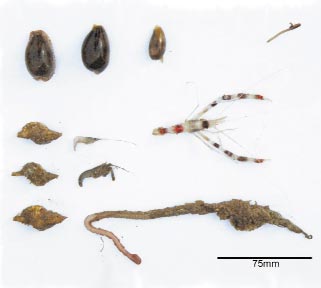
Nelson. We
have found a
The country is also very active in scientific research and
variety of
development. The Cawthron Institute, located in Nelson
interesting
Animals found in a sea chest of a vessel
in the South Island, has been carrying out research on
organisms in
servicing the Fiji islands slipped in Nelson
ballast water and marine biosecurity since 1995. Our
the sea chests
in June 2000.
marine biosecurity programme aims to provide the
of a number of
shipping industry and coastal managers with ways to
vessels, including live shellfish, crabs, worms and
reduce invasion rates, and improve management of
amphipods. This strengthens our conviction that sea
species already established.
chests may well be an under recognised source of
potential marine invaders, and one that should be
A semi-quantitative risk assessment model is under
considered during the development of management
development for the transport of high impact marine
measures aimed at preventing the introduction of
invaders to international shipping ports in New
foreign marine organisms.
Zealand. The relationship between species transport
and establishment is being determined using field
A list of contacts and further information about our
studies at Shakespeare Bay, a recently completed
research can be found on www.cawthron.org.nz
international shipping port in the Marlborough Sounds
in the north east of the South Island.
Information on NZ's regulatory regime for ballast water
can be found on www.fish.govt.nz
Working with a local consultant under a contract from
the New Zealand Ministry of Fisheries, we have recently
Tim Dodgshun
completed a proposed management strategy for the
Marine Biosecurity Research Group
introduced Asian kelp, Undaria pinnatifida, which was
Cawthron Institute
first discovered in New Zealand in 1987. This may result
Nelson, New Zealand
in the first national pest management strategy for a
marine organism.
BWN 2: 7-9/2000
G L O B A L B A L L A S T W AT E R M A N A G E M E N T P R O G R A M M E
U S L A U N C H E S T W O N E W P R O J E C T S
5
US Launches Two New
The Maritime Solutions' ballast water treatment system
Projects
consists of two stages; a first stage patented voraxial
separator and a second stage treatment of ultraviolet
(UV) irradiation or, alternatively, the chemical biocide
Miami Makes its Move
Seakleen.
The US Coast Guard Research and Development Center
Maritime Solutions believes that UV irradiation is the
in Groton, Connecticut has awarded a contract Field
secondary treatment of choice for vessels with ballast
Tests on Alternatives to Ballast Exchange to
flow rate requirements up to 2,000 tonnes per hour.
Dr Thomas Waite of the College of Engineering at the
For larger vessels including tankers and bulk carriers
University of Miami. The focus of the project is to
with ballast flow rate requirements between 2,000 and
evaluate the treatment efficiency of self-cleaning
20,000 tonnes per hour, they believe that the biocide
screens (50 micron), hydrocyclone, and UV radiation at
Seakleen could offer a more economical and effective
large scale (300 cubic meters/hour flow).
treatment.
The dockside system is currently under construction at
the University of Miami Rosenstiel School of Marine
and Atmospheric Sciences (RSMAS), located on Virginia
Key (Biscayne Bay), Miami. Researchers from RSMAS
will monitor zooplankton and phytoplankton removal
and inactivation as a function of operational variables.
Researchers from the College of Engineering will
monitor equipment behaviour and operational
constraints.
It is anticipated that testing will begin sometime in
September and the first phase of work should be
completed by December 2000.
Further information
The Cape May
Dr Thomas Waite
Twaite@miami.edu
The inclusion of the voraxial separator as the first stage
aims to remove more than 95% of the silt, sediment
and larger marine organisms and return these to the
source water. The relatively solids-free water is then
Private/Public Partnership
treated to kill remaining organisms in the secondary
stage with UV or Seakleen.
Maritime Solutions Inc., a private US company, has
received major grants from the State of Maryland Port
Maritime Solutions, working with the University of
Administration and the US National Oceanic and
Maryland and Aquionics Inc, has specified a UV system
Atmospheric Administration (NOAA) to support the
specifically designed for ballast water treatment.
rigorous testing of the its patent pending ballast water
Combining the voraxial separator and the specified UV
treatment system.
system, a `kill' rate approaching 99% is hoped for.
The funding exceeds US$650,000 and will support a
The biocide Seakleen, patent pending, is a proprietary,
larger public/private initiative to test the Maritime
natural product specifically formulated for ballast
Solutions' treatment system. The programme seeks to
water use and has a half-life of 14 - 17 hours. As a
demonstrate whether the system is a safe, effective,
result of the pre-cleaning provided by the voraxial
economical, energy efficient and crew friendly
separator, Maritime Solutions believes that a dosage
shipboard treatment system as an effective alternative
approaching 1 part per million will be sufficient to
to the troubled practice of ballast exchange.
produce an effective overall `kill' rate in excess of 97%.
This remains to be tested.
Maritime Solutions, working in cooperation with the
University of Maryland, has additionally won the
If approved by the US Coast Guard as an alternative to
support of the US Maritime Administration to allow the
ballast water exchange, Maritime Solutions will begin
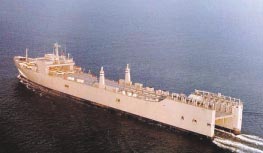
testing programme to take place aboard the 39,000
offering its system to ships calling at US ports.
dead weight tonne Cape May, a ship of the US Ready
Reserve fleet. Berthed in the Port of Baltimore, it will
Further information:
provide for realistic shipboard testing taking water
Maritime Solutions Inc.
from Chesapeake Bay.
info@maritimesolutionsinc.com
BWN 2: 7-9/2000
G L O B A L B A L L A S T W AT E R M A N A G E M E N T P R O G R A M M E
P R I N C E S S S E L E C T S ` O P T I M A R '
6
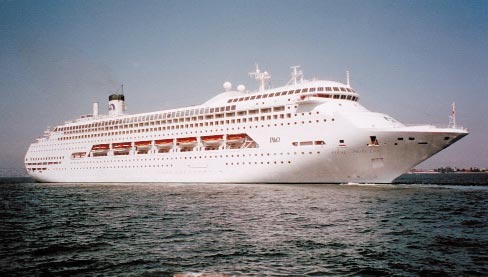
Princess Selects `OptiMar' The OptiMar system was installed aboard the Regal
Princess during a regular scheduled two-week cruise
along the Mexican West Coast in late March 2000.
Hyde Marine Inc and OptiMarin A/S are pleased to
There were no interruptions to the ship's normal
announce delivery of the first ballast water treatment
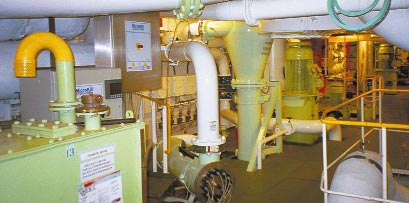
operations. The system is compact enough to be
system aboard an operating vessel. The system, installed
located in the ship's pump room. The ship's existing
aboard the Princess Cruises' Regal Princess, is designed
ballast system is used to minimise installation costs.
to remove and destroy/inactivate organisms including
zooplankton, algae, and bacteria from ballast water
Testing of a scaled version of the OptiMar system was
without affecting the normal operation of the ship.
conducted during 1998 and 1999 at the Norwegian
Institute of Marine Research, which confirmed its
suitability for ballast water treatment. Efficacy testing
on the Regal Princess began when the ship first visited
Vancouver on May 17th during a short four-day cruise
to Alaska. It continued during the summer Alaska cruise
season and included third party testing in late August.
Initial sample results have confirmed that the system's
performance is at least equivalent to mid-ocean
exchange.
OptiMarin and Hyde Marine provided an identical but
scaled up 350 t/hr (1500 USGPM) capacity system for
testing aboard the Great Lakes Ballast Technology
Demonstration Project's test barge in Duluth Harbor,
Minnesota in September 2000. Additional system
The Regal Princess
testing is also planned and Hyde Marine will participate
in a full-scale design study to determine the cost and
Open ocean exchange of ballast water is not a practical
economic impact of installing OptiMar systems aboard
alternative for cruise ships in regular coastwise
a large containership and a tanker for the Alaska trade.
operations. Princess Cruises chose the OptiMar ballast
water treatment system to address the problem of non-
indigenous species in ballast water at a realistic total
installed cost.
The Regal Princess takes on and discharges ballast
water at a rate of 200 tonnes per hour as fuel and
other consumables are used. Ballast water is pumped
through the OptiMar system, which separates solids
and irradiates the water with UV light in two stages.
The patented MicroKill cyclonic separator removes
heavier particles larger than approximately 40 microns
and the MicroKill ultraviolet light treatment system kills
The compact OptiMar system installed on the Regal
or inactivates biological organisms with UV radiation.
Princess
The UV system can also be used during deballasting to
ensure that all organisms have been killed or
Further information:
inactivated when they are discharged from the ship. All
Mr Tom Mackey
system components are proven reliable, safe and easy
Hyde Marine Inc.
to maintain.
Tmackey@hydeweb.com
Editor's note:
It is also interesting to note that Hyde Marine
compares the effectiveness of their system with the
It is interesting to note the similarities between the
IMO recommended technique of mid-ocean
OptiMar and Maritime Solutions systems (see article
exchange. The limitations of using this as an
on page 5). Both involve an initial physical separation
evaluation benchmark are clearly pointed out by the
of solids and larger organisms from the ballast water
International Chamber of Shipping in Mr Bilney's
followed by a secondary sterilisation using UV, or in
article on page 3.
the case of Maritime Solutions, a proprietary biocide
for larger quantities of ballast.
R&D groups and companies should be applauded for
taking the initiative in pursuing the as yet elusive
Both systems appear to require significant further
solution to the ballast water problem.
work to assess the feasibility of scaling them up to
deal effectively and economically with the large
To make their task easier, the international
volumes of ballast water carried by large bulk carriers
community must come up with clear, internationally
and tankers.
accepted criteria for the evaluation and approval of
such systems.
SR
BWN 2: 7-9/2000
G L O B A L B A L L A S T W AT E R M A N A G E M E N T P R O G R A M M E
SINGAPORE SEEKS SOLUTION s AUSSIES ASSEMBLE CONSORTIUM s EU ALLOCATES EUROS
7
Singapore Seeks Solution
· Filtration or clarification to less than 20um should
remove zooplankton and toxic dinoflagellate algae,
as well as larger organisms.
The Environmental Technology Institute (ETI) of
Singapore believes that a near-term technological
· Secondary sterilisation will destroy any remaining
solution to treat ballast water is feasible. A major study
organisms, and UV appears to hold the most promise.
(Phase 1) undertaken by ETI in collaboration with the
Maritime and Port Authority (MPA) and the National
· A pilot plant design for follow-up research was
University of Singapore (NUS) in 1998/99, evaluated
proposed.
treatment technologies using a pilot scale facility with
a flow through of 1,200 tonnes/ day.
PCQ is now moving ahead with plans to build the pilot
plant and proceed with the follow-up R&D, through
This flow rate was chosen as it would allow a number
the establishment of a private/public sector consortium.
of system modifications and optimisation experiments
It is hoped that the pilot plant will be containerised to
in a relatively short period of time, without having to
allow it to be moved to various locations for testing
face serious scalability issues.
under different conditions.
The sixteen months study included hydraulic as well as
It is estimated that a budget of AU$600,000 is required
biological performance evaluation of mechanical,
over two years. AU$300,00 has been secured from
physical and chemical treatments.
consortium members. These include four Queensland
port authorities, Amiad (an international filtration
The study gave promising results for filtration systems,
company), Pasminco Century Mine (a bulk exporter of
but `off-the-shelf' filtration technologies may require
minerals and therefore a bulk importer of ballast
significant modifications. Phase II efforts are now
water), North Forest Products (another importer of
underway to develop a hybrid treatment system,
ballast water) and the Great Barrier Reef Cooperative
including mechanical, physical and chemical
Research Centre.
combinations and to evaluate them onboard a ship.
Non-financial support has also been offered from the
ETI has secured S$2.5 million in funding for this research
Australian Quarantine and Inspection Service, the Great
from internal sources and from the Singapore National
Barrier Reef Marine Park Authority, the Western
Science and Technology Board, MPA and a local ship
Australian Department of Environmental Protection,
builder. Phase II will be undertaken during 2000 2001.
United Water (a major water treatment company) and
the Queensland Sugar Corporation (an importer of
Further information:
ballast water). Interest has also been shown by parties
Dr Jose Matheikcal
in Norway and the Netherlands
Environmental Technology Institute,
jtmath@eti.org.sg
Further information:
Mr Bob Brunner
Ports Corporation of Queensland
Aussies Assemble
Bbrunner@pcq.com.au
Consortium
EU Allocates Euros
The Australian's are increasing their research and
News has been received that the European Union is
development efforts in the pursuit of a technological
also forging ahead with R&D of ballast water
fix for harmful organisms in ballast water.
treatment technology, and has awarded a major grant
to the University of Newcastle (UK), with support from
The Ports Corporation of Queensland (PCQ), a
the International Association of Independent Tanker
government-owned corporation that administers 14
Owners (INTERTANKO). Further details will be reported
ports in the State of Queensland, including large bulk
in the next issue.
ports in the environmentally sensitive Great Barrier
Reef region, is leading the charge.
Editor's Note:
PCQ has had a comprehensive environmental
It should be noted that the range of ballast water
programme in place since 1993, called `EcoPorts', and
treatment R&D projects presented in this issue of
has carried out a number of ballast water initiatives.
BWN is not exhaustive. Articles on projects being
conducted by other groups will be presented in
future.
From 1995 to 1998 PCQ funded engineering PhD
It has been estimated that the market for an
student Darren Oemcke to investigate potential ballast
effective, internationally accepted ballast water
water treatment options. The results of Dr Oemcke's
treatment system is worth in the order of US$2
work are published in a number of reports. His findings
billion!
SR
were as follows:
BWN 2: 7-9/2000


G L O B A L B A L L A S T W AT E R M A N A G E M E N T P R O G R A M M E
8
Progress Report
Activities Undertaken July September 2000:
Activities Planned October December 2000:
1st GPTF meeting held 5-7 July, PIP approved.
q Attend/assist IMO MEPC 45 (London 2-6 Oct).
1st media release significant global coverage.
q Approve National Workplans.
Development of web-site commenced.
q PCU missions to Iran and Ukraine.
Development of National Workplans commenced.
q Commence implementation of in-country activities.
National workshops held in China, Brazil, India and
q Finalise web site.
South Africa.
q Distribute 1st generic awareness raising materials.
MoA between IMO and Ukraine agreed.
q Complete 1st case studies.
Consultants' register established.
q Start detailed planning for risk assessments.
GISP Cape Town conference attended.
q Start detailed planning for port baseline surveys.
BW Treatment R&D directory established.
q Start detailed planning for R&D symposium.
Case studies commenced.
q Attend GEF International Waters meeting (Budapest,
1st generic education/awareness materials
Oct).
produced.
q Assist ICHCA ballast water conference (London, Nov).
PCU/country financial arrangements in place.
q Hold 2nd GPTF meeting (Dec).
2nd issue of Ballast Water News produced.
q Produce 3rd issue of Ballast Water News.
Train X course developers' workshop attended.
Arrangements commenced for 2nd GPTF meeting.
, September 2000.
ecycled paper
.dwa.uk.com · Printed on r
More Information?
Check out these web-sites:
(these are additional sites not listed in BWN Issue 1):
q www.aqis.gov.au/shipping/ Australian Quarantine & Inspection Service
q www.uscg.mil/hq/g-m/mso/mso4/bwm.html US Coast Guard Ballast Water Management
el (+44) 020 7928 5888 www
q www.cawthron.org.nz Cawthron Institute, New Zealand
q www.fish.govt.nz New Zealand Ministry of Fisheries
q www.issg.org IUCN Invasive Species Specialist Group
q http://jasper.stanford.edu/GISP/ Global Invasive Species Programme
q www.wkap.nl/journals/biological_invasions Biological Invasions (new international journal)
est & Associates, London. T
More web-sites next issue. To contact the PCU see details on front page.
Daniel W
Photo credits (in order images appear): Mathew Baker, ICS, Tim Dodgshun, Maritime Solutions, Hyde Marine, Hyde Marine, IPIECA, Roger Steene.
BWN 2: 7-9/2000