







Ballast Water News
3
Ballast Water News
I S S U E 1 6 J A N U A RY M A R C H 2 0 0 4
From the Editor
From the Secretariat
After fourteen years of complex and sometimes sensitive
In response to the growing concern related to invasive aquatic
negotiations, IMO member States adopted the International
species in ships' ballast water, IMO member States have been
Convention for the Control and Management of Ships' Ballast
working together since 1988 to develop an international legal
Water and Sediments on 13 February this year. Considering
regime to regulate and control this major marine
the enormous scientific and technological challenges, and the
environmental problem. A new international law, the
highly complex and multi-disciplinary nature of the problem;
International Convention for the Control and Management
encompassing biology, chemistry, engineering, law, economics
of Ships' Ballast Water and Sediments, was adopted by IMO
and ecology, not to mention ship design, construction and
member States at a diplomatic conference held from 9 to 13
operation, achieving consensus on the Convention must be
February 2004 at IMO in London.
seen as a major achievement.
The Preamble of the Convention firmly connects the issue to
Understandably, this issue of Ballast Water News focuses on
IMO's mandate regarding ship safety, cleaner seas and
the new Convention, including the column on this page by
internationally agreed standards. It also clearly links the
Dandu Pughiuc, the new Head of the recently established
Convention with the integrated coastal management concept
IMO Office for Ballast Water Management; the Guest Speaker
advocated by the United Nations Conference on Environment
article by Mr Jean-Claude Sainlos, the new Director of the
and Development and with the sustainable development
IMO Marine Environment Division; and a more in-depth
concept promoted by the World Summit on Sustainable
exploration of the provisions of the Convention on pages
Development. At the global level, the Convention reflects the
3 to 5. We also assess the implications of the Convention for
increasing need for cooperation among the various UN
IMO Assembly Resolution A.868(20), which in 1997 adopted
agencies. The text follows the same structure and regulatory
the IMO Guidelines for the control and management of ships'
strategy as MARPOL 73/78, with general obligations and rights
ballast water to minimize the transfer of harmful aquatic
in the Articles and Regulations on specific technical matters
organisms and pathogens.
encapsulated in the Annex.
Although adoption of the Convention provides a uniform
Ships will be required to implement Ballast Water
global regulatory regime, some jurisdictions are proceeding
Management Plans, maintain reliable records of ballast water
with unilateral regulatory arrangements. On page 6 we
operations and carry out ballast water management
consider one such approach, by Washington State in the USA.
procedures to given standards. Parties to the Convention are
given the option to take additional measures, consistent with
The need for rapid entry-into-force and effective
international law and in observance of guidelines yet to be
implementation of the new Convention is brought into sharp
developed by IMO. Parties are also required to promote and
focus on page 7, with articles highlighting new biological
facilitate scientific research on ballast water management and
invasions in Scotland and Antarctica. The Southern Ocean
monitor the effects of new technologies. Parties are further
around Antarctica has long been treasured as one of the last
requested to provide support for States which request
remaining pristine areas of the world, relatively free of
technical assistance and to share the available relevant
human disturbance. Now it seems that without urgent
technologies, equipment and facilities.
implementation of prevention and control measures,
IMO Secretary-General, Mr. Efthimios E. Mitropoulos,
including the Ballast Water Management Convention, no
congratulated member Governments on the successful outcome
corner of our planet is safe from invasive species.
of the Conference and emphasized the importance of early,
In this issue, our partners at IUCN The World Conservation
wide and effective implementation of the new Convention.
Union, provide some perspectives on issues to be considered
The introduction of harmful aquatic organisms and pathogens
in relation to the possible use of chemical biocides in ballast
to new environments is a major threat. Oceans cover 70% of
water treatment.
our planet and nearly 60% of the world population live in
We wrap-up with news of some of the main GloBallast
coastal areas. Protection of the marine environment is beyond
activities this last quarter, including the Global Task Force
the scope of one country and has global benefits. The new
meeting, ongoing regional activities in the Black and Baltic
instrument is, undoubtedly beneficial for all involved; industry
Seas and plans for the Wider Caribbean, as well as some book
will benefit from a uniform global regime while impacts on
and conference announcements. Happy reading!
the marine environment will be reduced.
Steve Raaymakers
Dandu Pughiuc
Contributing Editor
IMO Office for Ballast Water Management
Ballast Water News is the quarterly newsletter of the Global Ballast Water Management Programme (GloBallast), and is produced with the support of the World Conservation Union
(IUCN). GloBallast is a cooperative initiative of GEF, UNDP, IMO and other partners to assist developing countries to reduce the transfer of harmful organisms in ships' ballast water,
through the implementation of IMO guidelines.
For further information please contact:
The Editor, Ballast Water News, Global Ballast Water Management Programme
Fax +44 (0)20 7587 3261 Email sraaymak@imo.org Web http://globallast.imo.org
Marine Programme Officer, IUCN Global Marine Programme
Email imene.meliane@iucn.org Web http://www.iucn.org/themes/marine/
The views expressed in Ballast Water News are not necessarily those of IUCN, GEF, UNDP or IMO.

G L O B A L B A L L A S T W AT E R M A N A G E M E N T P R O G R A M M E
G U E S T S P E A K E R
2
who had skilfully chaired the MEPC Ballast Water Working
Guest Speaker
Group during critical negotiations over the last four years,
to develop the Convention text. The Conference also
Mr Jean-Claude Sainlos
established a Drafting Committee, chaired by Captain
Director, Marine Environment Division
Frederick Kenney (US) and a Credentials Committee to
International Maritime Organization
examine credentials of representatives, Chaired by Captain
Benito Pulido (Venezuela).
Mr. Jean-Claude Sainlos of France is
Under the wise leadership of the President and Vice-
an Environmental Lawyer who held
Presidents and expert steerage of the Committee Chairmen,
the post of "Charge de Mission a la
combined with solid support from the IMO Secretariat, the
Mission Interministerielle de la
Conference successfully navigated several challenging issues
Mer", at the Office of the Prime
and, in the spirit of compromise and consensus that is the
Minister, Paris, from October 1978 to
hallmark of the success of IMO, culminated in the adoption
June 1986. He entered the UN
of the new International Convention for the Control and
system in June 1986 as Programme
Management of Ships' Ballast Water and Sediments on
Officer at the Regional Seas Programme of UNEP,
Friday 13 February 2004.
in Nairobi, Kenya.
This act, providing a uniform and effective international
He first joined IMO in December 1988 as Director of the
law to regulate ballast transfers, is perhaps one of the most
IMO/UNEP Regional Marine Pollution Emergency
significant global environmental achievements in the early
Response Centre (REMPEC) for the Mediterranean Sea,
part of this Century. It is a major credit to the vision and
based in Malta. In June 1998 Mr. Sainlos left Malta to
efforts of delegates from IMO member States and the staff
take up duties at IMO Headquarters in London, as
of the Secretariat, including those mentioned here and
Senior Deputy Director of the Sub-Division for Pollution
many others, who have been involved since 1988.
Response and Technical Co-operation Co-ordination, in
the Marine Environment Division (MED). On 1 January
Much work remains to be done however, to ensure that
2004 he was promoted to Director of MED.
the Ballast Water Management Convention enters-into-
force as soon as possible, and that parties to the
Convention implement it effectively through appropriate
Upon assuming duties as Director of MED on 1 January
national legislation. There is also much work still to be
2004, one of the first major tasks before me was to oversee
done to develop technical guidelines under the
arrangements for the diplomatic conference scheduled for
Convention, including among others, guidelines for
9 to 13 February 2004, to consider the adoption of the
approval of ballast water management systems and
draft International Convention for the Control and
prototype treatment technologies.
Management of Ships' Ballast Water and Sediments.
My staff and I remain committed to facilitating global and
Over the last 14 years, my predecessors as Directors of MED,
uniform implementation of this highly important
Mr. Koji Sekimizu and Mr. Oleg Khalimonov, had successfully
Convention, both through the newly formed Office for
supported the sensitive and complex negotiations within
Ballast Water Management, which is headed by Mr. Dandu
the IMO Marine Environment Protection Committee (MEPC)
Pughiuc and acts as Secretariat to the Convention, and
and its Ballast Water Working Group; which had
through the GloBallast Programme headed by Mr. Steve
culminated in finalization of the draft text of the
Raaymakers, providing capacity-building, institutional
Convention and the decision by the IMO Council to approve
strengthening and technical cooperation to member States.
convening of the diplomatic conference. To do justice to
Jean-Claude Sainlos
these major achievements, and the challenge to ensure a
successful conference and adoption of the new Convention,
was extremely significant so soon in my new Directorship.
FORTHCOMING CONFERENCES
The Conference was opened by Mr. E.E. Mitropoulos,
Secretary-General of IMO. Mr. Daniel T. Joseph (India) was
27-29 August 2004
elected President of the Conference, along with Admiral
International Conference on Assessment and
Sergio Chagasteles (Brazil), Ms. Khibi Mabuse Manana
Control of Biological Invasion Risks
(South Africa) and H.E. Mr. Ihor O. Mitiukov (Ukraine) as
Yokohama, Japan
Vice Presidents. The fact that these posts were held by Pilot
Countries under the GEF/UNDP/IMO Global Ballast Water
isp@vege1.kan.ynu.ac.jp
Management Programme (GloBallast), is a direct indication
of the success of GloBallast in catalysing high-level
8-10 September 2004
engagement by developing countries in the IMO
Ballast Water and Waste Water Treatment
Convention process.
Aboard Ships and in Ports
Bremen, Germany
As Director of MED my role in the Conference was as
Lonicer@t-online.de
Executive Secretary, supporting the Secretary-General in
ensuring that all Secretariat functions were carried out
properly, in turn with the support of two Deputy Executive
19-23 September 2004
Secretaries; Mr. Du Dachang and Mr. R. Coenen and the full
13th International Conference on Aquatic
staff of MED.
Invasive Species
Ennis, County Clare, Ireland
The Conference established a Committee of the Whole
www.aquatic-invasive-species-conference.org
with the mandate to consider the draft Convention and
Conference resolutions, chaired by Mr. Mike Hunter (UK),
BWN 16: 1-3/2004
G L O B A L B A L L A S T W AT E R M A N A G E M E N T P R O G R A M M E
C O N V E N T I O N A D O P T E D
3
cleaning or repair of ballast tanks occurs, have adequate
Convention Adopted
reception facilities for sediments.
by Consensus
Research and Monitoring
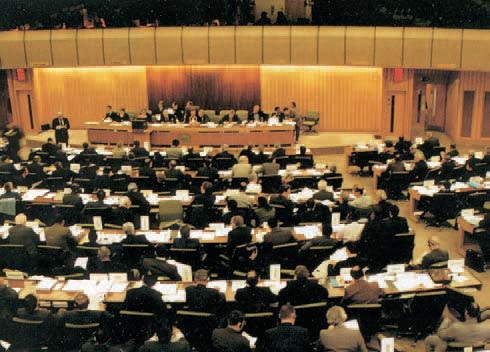
After 14 years of complex negotiations between
Article 6 Scientific and Technical Research and Monitoring
IMO member States, the International Convention
calls for Parties individually or jointly to promote and
for the Control and Management of Ships' Ballast
facilitate scientific and technical research on ballast water
management; and monitor the effects of ballast water
Water & Sediments was adopted by consensus at a
management in waters under their jurisdiction.
Diplomatic Conference at IMO in London on
Friday 13 February 2004.
Survey, Certification and Inspection
Ships are required to be surveyed and certified (Article 7
Survey and Certification) and may be inspected by port
State control officers (Article 9 Inspection of Ships) who
can verify that the ship has a valid certificate; inspect the
Ballast Water Record Book; and/or sample the ballast
water. If there are concerns, then a detailed inspection
may be carried out and "the Party carrying out the
inspection shall take such steps as will ensure that the
ship shall not discharge Ballast Water until it can do so
without presenting a threat of harm to the environment,
human health, property or resources."
All possible efforts shall be made to avoid a ship being
unduly detained or delayed (Article 12 Undue Delay
to Ships).
Technical Assistance & Regional Cooperation
The Conference was attended by representatives of
Under Article 13 Technical Assistance, Co-operation and
74 member States, one Associate Member; and observers
Regional Co-operation, Parties undertake, directly or
from two inter-governmental organizations and 18
through the Organization and other international bodies,
non-governmental international organizations.
as appropriate, in respect of the control and
management of ships' ballast water and sediments, to
The Ballast Water Management Convention is divided
provide support for those Parties which request technical
into 22 Articles and an Annex of Regulations, which
assistance to train personnel; to ensure the availability of
includes technical standards and requirements. The main
relevant technology, equipment and facilities; to initiate
features of the Convention are as follows:
joint research and development programmes; and to
undertake other action aimed at the effective
Entry into Force
implementation of the Convention.
The Convention will enter into force 12 months after
ratification by 30 States, representing 35 per cent of
Annex Section A General Provisions
world merchant shipping tonnage (Article 18 Entry
This includes definitions, application and exemptions.
into Force).
Under Regulation A-2 General Applicability: "Except
where expressly provided otherwise, the discharge of
General Obligations
Ballast Water shall only be conducted through Ballast
Under Article 2 General Obligations Parties undertake to
Water Management, in accordance with the provisions
give full and complete effect to the provisions of the
of this Annex."
Convention and the Annex in order to prevent, minimize
and ultimately eliminate the transfer of harmful aquatic
Annex Section B Management and
organisms and pathogens through ships' ballast water
Control Requirements for Ships
and sediments.
Ships are required to have on board and implement a
Parties are given the right to take, individually or jointly
Ballast Water Management Plan approved by the
with other Parties, more stringent measures with respect
Administration (Regulation B-1). The Ballast Water
to the prevention, reduction or elimination of the
Management Plan is specific to each ship and includes
transfer of harmful aquatic organisms and pathogens
a detailed description of the actions to be taken to
through ships' ballast water and sediments, consistent
implement the Ballast Water Management requirements
with international law. Parties should ensure that ballast
and practices.
water management practices do not cause greater harm
Ships must have a Ballast Water Record Book (Regulation
than they prevent to their environment, human health,
B-2) to record when ballast water is taken on board;
property or resources, or those of other States.
circulated or treated for ballast water management
purposes; and discharged into the sea. It should also
Reception Facilities
record when ballast water is discharged to a reception
Under Article 5 Sediment Reception Facilities Parties
facility and accidental or other exceptional discharges of
undertake to ensure that ports and terminals where
ballast water.
BWN 16: 1-3/2004
G L O B A L B A L L A S T W AT E R M A N A G E M E N T P R O G R A M M E
C O N V E N T I O N A D O P T E D
4
The specific requirements for ballast water management
Annex Section D Standards for
are contained in Regulation B-3 Ballast Water
Ballast Water Management
Management for Ships:
Ships constructed before 2009 with a ballast water
capacity of between 1500 and 5000 cubic metres must
conduct ballast water management that at least meets
the ballast water exchange standards or the ballast water
performance standards until 2014, after which time it
shall at least meet the ballast water performance
standard.
Ships constructed before 2009 with a ballast water
capacity of less than 1500 or greater than 5000 cubic
metres must conduct ballast water management that at
least meets the ballast water exchange standards or the
ballast water performance standards until 2016, after
which time it shall at least meet the ballast water
performance standard.
Ships constructed in or after 2009 with a ballast water
capacity of less than 5000 cubic metres must conduct
The Convention sets standards providing clear performance targets
ballast water management that at least meets the ballast
for ballast water treatment technologies (Image: Navion)
water performance standard.
Ships constructed in or after 2009 but before 2012, with a
ballast water capacity of 5000 cubic metres or more shall
There is a ballast water exchange standard and a ballast
conduct ballast water management that at least meets
water performance standard. Ballast water exchange
the ballast water exchange standards or the ballast water
could be used to meet the performance standard.
performance standards until 2016, after which time it shall
at least meet the ballast water performance standard.
Regulation D-1 Ballast Water Exchange
Ships constructed in or after 2012, with a ballast water
Standard
capacity of 5000 cubic metres or more shall conduct
Ships performing ballast water exchange shall do so with
ballast water management that at least meets the ballast
an efficiency of 95 per cent volumetric exchange of
water performance standard.
ballast water. For ships exchanging ballast water by the
pumping-through method, pumping through three times
Under Regulation B-4 Ballast Water Exchange, all ships
the volume of each ballast water tank shall be considered
using ballast water exchange should, whenever possible,
to meet the standard described. Pumping through less
conduct ballast water exchange at least 200 nautical
than three times the volume may be accepted provided
miles from the nearest land and in water at least 200
metres in depth, taking into account Guidelines
the ship can demonstrate that at least 95 percent
developed by IMO. In cases where the ship is unable to
volumetric exchange is met.
conduct ballast water exchange as above, this should be
as far from the nearest land as possible, and in all cases
Regulation D-2 Performance Standard
at least 50 nautical miles from the nearest land and in
Ships conducting ballast water management shall
water at least 200 metres in depth.
discharge less than 10 viable organisms per cubic metre
When these requirements cannot be met, areas may be
greater than or equal to 50 micrometres in minimum
designated where ships can conduct ballast water
dimension and less than 10 viable organisms per milliliter
exchange. All ships shall remove and dispose of sediments
less than 50 micrometres in minimum dimension and
from spaces designated to carry ballast water in
greater than or equal to 10 micrometres in minimum
accordance with the provisions of the ships' Ballast Water
dimension; and discharge of the indicator microbes shall
Management Plan (Regulation B-4).
not exceed the specified concentrations.
The indicator microbes, as a human health standard,
Annex Section C Additional Measures
include, but are not be limited to:Toxicogenic Vibrio
A Party, individually or jointly with other Parties, may
cholerae (O1 and O139) with less than 1 colony forming
impose on ships additional measures to prevent, reduce,
unit (cfu) per 100 milliliters or less than 1 cfu per 1 gram
or eliminate the transfer of Harmful Aquatic Organisms
(wet weight) zooplankton samples; Escherichia coli less
and Pathogens through ships' Ballast Water and
than 250 cfu per 100 milliliters; Intestinal Enterococci less
Sediments.
than 100 cfu per 100 milliliters.
In these cases, the Party or Parties should consult with
Ballast Water Management Systems must be approved by
adjoining or nearby States that may be affected and
the Administration in accordance with IMO Guidelines
should communicate their intention to establish
(Regulation D-3 Approval Requirements for Ballast Water
additional measure(s) to the Organization at least 6
Management Systems). These include systems which make
months prior, except in emergency or epidemic situations.
use of chemicals or biocides; make use of organisms or
When appropriate, Parties will have to obtain the
biological mechanisms; or which alter the chemical or
approval of IMO.
physical characteristics of the ballast water.
BWN 16: 1-3/2004

G L O B A L B A L L A S T W AT E R M A N A G E M E N T P R O G R A M M E
` 9 7 G U I D E L I N E S
5
Prototype Technologies
What about the '97
Regulation D-4 covers Prototype Ballast Water Treatment
Technologies. It allows for ships participating in a
Guidelines?
programme approved by the Administration to test and
evaluate promising Ballast Water Treatment Technologies
Now that the International Convention for the
to have a leeway of five years before having to comply
Control and Management of Ships' Ballast Water
with the requirements.
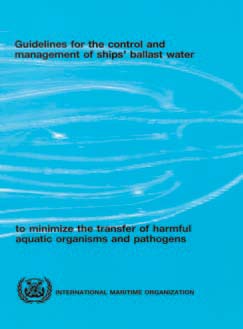
and Sediments has been adopted, what is the
status of IMO Assembly Resolution A.868(20)
Review of Standards
which in 1997 adopted the IMO "Guidelines for
Under Regulation D-5 Review of Standards by the
the control and management of ships' ballast water
Organization, IMO is required to review the Ballast Water
to minimize the transfer of harmful aquatic
Performance Standard, taking into account a number of
organisms and pathogens"?
criteria including safety considerations; environmental
acceptability; practicability; cost effectiveness and
biological effectiveness.
The A.868(20) Resolution and
Guidelines have often been
referred to as voluntary,
Annex Section E Survey and Certification
however they do have certain
Requirements for Ballast Water Management
legal status under
Gives requirements for initial, annual, intermediate and
international law, having
renewal surveys and certification requirements.
been adopted by consensus
Appendices give Form of Ballast Water Management
as a Resolution of the
Certificate and Form of Ballast Water Record Book.
Assembly of IMO, the UN
Organization with a global
Conference Resolutions:
mandate for the regulation
of shipping. Section 11 of
The Conference also adopted four resolutions:
the Guidelines provides for
· Resolution 1 pertaining to future work by the
countries to implement
Organization, particularly on the development of
and enforce their
various guidelines under the Convention
provisions through National legislation.
According to the UN Convention on the Law of the Sea,
· Resolution 2 pertaining to the use of decision-making
coastal States can enact laws to protect the marine
tools when reviewing the standards pursuant to
environment based upon generally accepted
Regulation D-5
international standards. Without any doubt A.868(20)
· Resolution 3 pertaining to the promotion of technical
meets this requirement.
co-operation and assistance
The A.868(20) Guidelines provide a comprehensive set of
· Resolution 4 pertaining to the future review of the
practical measures that, if implemented fully, will do
Annex to the Convention
much to minimize the transfer of harmful aquatic
organisms and pathogens in ships' ballast water. They
To obtain the full text of the Convention email
provide a very sound, standardised, internationally
cgregory@imo.org (available in Arabic, Chinese, English,
endorsed and formally adopted basis for countries to
French, Russian and Spanish).
implement ballast water control and management
measures.
Schedule for ballast water management under Section B of the new
From a legal point of view, the status of Resolution
Convention (BWES = BW Exchange Standard, BWPS = BW
A.868(20) is not affected by the adoption of the
Performance Standard)
Convention. The 1997 Resolution and Guidelines still hold
international legal status as described above, and
countries can continue to apply them. There is nothing in
Ship
Ballast capacity Control required
construction
(cubic metres)
the new Convention that explicitly states that the
Convention supersedes Resolution A.868(20). Once the
Before 2009
1500 5000
at least meet BWES or BWPS
Convention comes into force countries can apply both, as
up to 2014 then BWPS
long as they do not contradict each other. If such
contradiction exists, then legally the Convention
Before 2009
<1500
at least meet BWES or
provisions would apply.
or >5000
BWPS up to 2016 then BWPS
Given that the new Convention is based largely on
In or after 2009 <5000
at least meet BWPS
A.868(20) (in terms of practical measures), anything done
to implement the Resolution and Guidelines will not pre-
In or after 2009
5000 or more at least meet BWES or BWPS
empt the Convention, but better prepare coastal States
but before 2012
up to 2016 then BWPS
for it. However, IMO advises that maritime
in or after 2012
5000 or more
at least meet BWPS
administrations should ideally now move towards
implementing the new Convention and its Regulations,
even if it has not come into force.
Adapted from IMO External Relations
SR
BWN 16: 1-3/2004
G L O B A L B A L L A S T W AT E R M A N A G E M E N T P R O G R A M M E
W A S H I N G T O N L A W
6
Washington Lays Down
required to exchange their ballast water at least
50 NM offshore.
the Law
Exchange Exemptions
Although adoption of the
· When it is not safe to conduct an open ocean ballast
International Convention for the
water exchange, or if a vessel has design limitations or
Control and Management of
equipment malfunctions that preclude exchange. In
Ships' Ballast Water & Sediments
such cases the master must declare a safety exemption
on the Ballast Water Reporting Form.
provides a uniform and
harmonized global regulatory regime for this issue,
· When a ships' ballast is water common to the state and
some jurisdictions are proceeding with unilateral
has not been mixed with waters or sediments from
outside the Columbia River north to the Strait of Juan
regulatory arrangements, including amongst
de Fuca, inland waters of Puget Sound, the Strait of
others, the State of Washington on the west coast
Juan de Fuca and the Strait of Georgia south of
of the USA. The Washington regime is based on
latitude 50ºN.
ballast water reporting by ships and the practice of
· When an approved ballast water treatment system is
ballast water exchange at sea, and also sets
used that meets the Washington State ballast water
discharge standards for ballast water treatment.
discharge standards.
Despite some important inconsistencies with the
Convention, the Washington laws place the State in
Future Treatment Requirements
good stead for rapid implementation of the
From 1 July 2007, the discharge of improperly exchanged
Convention should it choose to do so in the near
or treated ballast water into Washington State waters is
future. The main provisions are as follows:
prohibited. This means current safety exemptions for
exchange will no longer be valid. Vessel operators must
begin now to plan for implementing treatment
Reporting Requirements
alternatives to exchange.
All vessels of 300 gross tons and greater, except military
By 1 July 2006, ship operators must submit a report to the
vessels, must file a Ballast Water Reporting Form 24 hours
Washington Department of Fish and Wildlife (WDFW)
prior to entering Washington State waters. U.S. Coast
describing how they will meet the 1 July 2007
Guard and IMO Ballast Water Reporting Forms will be
requirements.
accepted. The U.S. Coast Guard form is preferred.
Ballast Water Reporting Forms shall be filed with the
WDFW Inspections
Marine Exchange for vessels entering Puget Sound or
A WDFW Vessel Inspector will examine ballast water
Washington State coastal ports.
management records, take ballast water and sediment
samples and will make other inquiries to assess
Ballast Water Reporting Forms shall be filed with the
compliance with Washington State ballast water
Merchants Exchange for vessels entering the Columbia
management laws.
River ports.
Vessels that do not discharge ballast water must either
Penalties for Violations
file a Ballast Water Reporting Form with "Not Discharging
A vessel that fails to file a Ballast Water Reporting Form
Ballast Water" written in the ballast water history section
may be subject to a civil penalty of up to $500.
or submit a notification letter.
Any owner or operator who knowingly and intentionally
falsifies a Ballast Water Reporting Form is liable for a civil
Notification Letter Option
penalty of up to $5,000. Additionally, the owner or
Vessel operators who do not regularly discharge ballast
operator is subject to criminal penalties of up to five
water while in Washington State ports, and do not file
years imprisonment or a fine of $5,000 or both.
ballast water reports, shall notify the department in
A vessel that discharges improperly exchanged or treated
writing. The notice must contain the Vessel Name, IMO
ballast without a valid exemption is liable for a civil
No., Lloyds No. or USCG No., Owner, Agent, Vessel Type
penalty of up to $5,000.
and a statement that the vessel will not discharge ballast
water while in Washington State ports.
Contacts
Exchange Requirements
Department of Fish and Wildlife
All vessels intending to discharge ballast water within
600 Capitol Way North
Washington State waters are required to conduct an
Olympia, WA 98501-1091 USA
open ocean exchange. Vessels making an ocean crossing
Phone: +1 360-902-2741
are required to exchange their ballast water at least
Fax: +1 360-902-2845
200 NM offshore. Vessels making a coastal voyage are
Email: ballastwater@dfw.wa.gov
BWN 16: 1-3/2004
G L O B A L B A L L A S T W AT E R M A N A G E M E N T P R O G R A M M E
N E W I N VA S I O N S
7
New Invasions
Suspect Species in Scottish Seas
Antarctic Waters No Longer Safe
Scotland's coastline is experiencing biological
Until recently, it was believed that the Southern
invasions that threaten to wipe out native species.
Ocean around Antarctica was one of the few
The Scottish Association for Marine Science (SAMS)
remaining oceans to be free of introduced species.
has published a target list of seven foreign sea
However, in 2004 two Brazilian marine scientists,
creatures, which they claim could devastate native
Marcos Tavares and Gustavo De Melo, published a
marine eco-systems.
paper claiming that the Antarctic marine ecosystem
is no longer free from biological invasions (Tavares
Four of the seven species are already thriving in Scottish
& Melo 2004. Antarctic Science 16 (2) 129-131).
waters: the skeleton shrimp (Caprella mutica), the
leathery sea squirt (Styela clava) and two varieties of
Asian seaweed; green fingers (Codium fragile) and
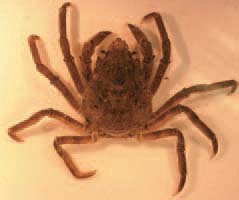
Tavares & Melo analysed
japweed (Sargassum muticum). The remaining three, the
benthic samples from an
Antarctic Peninsula
Chinese mitten crab (Eriocheir sinensis), Japanese kelp
research cruise, and found
(wakame) (Undaria pinnatifida) and another sea squirt
a male and a female of
(Perophora japonica), are listed as they are already
the majid spider crab Hyas
established in English waters and are spreading
araneus.
northwards.
The species has previously
The predominance of northeast Asian species amongst
been reported only from
the invaders most probably relates to similar
the North Atlantic and the
environmental conditions between northeast Asian and
Spider crab Hyas araneus from
Arctic Oceans, north of
Scottish waters, allowing the invaders to thrive in their
Norway (Image © C. d'Udekem)
41°N. This is the first
new habitats.
record of a non-indigenous marine species in Antarctic
Invading seaweeds such as Japanese kelp can shade-out
seas. Truly bipolar species are extremely rare and restricted
native species, depriving them of light, oxygen and
to a few pelagic species. The spider crab may have arrived
nutrients. Introduced marine animals such as shrimp and
in Antarctica via ships' sea-chests or ballast water.
sea squirts could out-compete their native counterparts.
Mitten crabs dig into shorelines to create burrows and
could damage the bank habitats of Scottish sea lochs.
During the next three years, SAMS will head a research
programme involving marine stations around the UK to
map the full distribution of these invasive species,
prevent their expansion and take steps to stop other
foreign invaders reaching Scotland's coastline. The project
is called ALIENS
Conserving native
biodiversity by
raising awareness of
invasive species
Photo: L. Cook
and is funded by the
Esmée Fairbairn
Foundation.
While the main
The Antarctic Peninsula (adapted from AAD)
problem is believed
to be ships' ballast
water, foreign
For at least 25 million years the pristine Antarctic
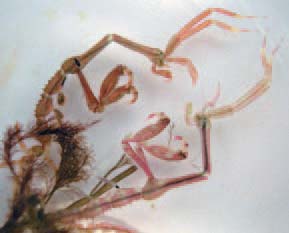
Two introduced skeleton shrimps found
species may also be
ecosystems and highly endemic marine fauna have been
protected by isolation and a major lack of human activity.
in Scottish waters
introduced by the
However, in recent years ship traffic has boomed in
aquaculture industry.
Antarctica, mainly as a result of increased tourism, fishing
For example, oyster spats used to be packed in seaweed,
and scientific research.
which may contain the larvae of exotic species.
When increased shipping is combined with polar
Shipping traffic could increase dramatically in coming
warming, the potential for increased biological invasions
years if global warming melts ice in the Northwest
with unpredictable consequences for Antarctic marine
Passage, opening a new route to the Atlantic for
ecology, is a cause for major concern. Timely and effective
commercial vessels. This could lead to further alien
implementation of prevention and control measures,
species arriving in Scottish, UK and European waters.
including the new IMO Ballast Water Management
Convention, is urgently required.
Further information: www.sams.ac.uk
Further information: mdst@usp.br
BWN 16: 1-3/2004
G L O B A L B A L L A S T W AT E R M A N A G E M E N T P R O G R A M M E
E C O S Y S T E M A P P R O A C H
8
understanding and more optimal regional protective
Ballast Water Management
policies. Such understanding can then be used in raising
awareness and education.
some Eco-Perspectives
The principle of ecological sustainability requires
Evaluation of ballast water management
adoption of the ecosystem approach and scientific
At present the development of a formal, international
and societal perspectives in the development of
evaluation framework for ballast water management
global environmental regulatory regimes, including
and treatment is lagging behind the state of initiatives
in treatment technology, as illustrated at the ballast
the recently adopted International Convention for
water treatment R&D symposiums convened by IMO-
the Control and Management of Ships' Ballast
GloBallast in recent years. It is crucial to evaluate
Water and Sediments.
treatment systems in a way that is representative for
what might happen in a natural system.
Ecosystem approach
Ecosystems may be particularly vulnerable to alien
Scientific understanding and development
invasion due to specific conditions, whether or not
of standards for ballast water management
caused by human use. Understanding what can influence
Standards for ballast water to be discharged are a crucial
or compound the susceptibility of coastal ecosystems to
tool in proper ballast water management. The state of
biological invasions can assist in risk assessment and
scientific knowledge in relation to the development of
recognising a need for specific care or measures that
standards for phytoplankton and zooplankton above a
may be required. Stressed ecosystems are likely to be
certain size limit is relatively robust. However, for
more vulnerable, while other factors may also play a
microbes (bacteria and viruses), in particular those that
role. Asking scientists of long-standing expertise and
are not human pathogens, the understanding appears to
experience in field investigations for their `hidden'
be not up to meeting the requirements for setting such
wisdom and judgement can help to create better
standards scientifically. An inventory of what is known at
present and what more would be needed for developing
standards for microbes, as well as how to generate such
knowledge and feed it into the process of developing
these standards, appears to be required. Awareness of
the place microbes have in marine ecosystems also needs
to be stimulated.
Societal perspective innovation in
support of environmental policies
During the process of developing policies for harmful
anti-fouling paints for ships, in response to the political
will to decide on progressive environmental policies,
innovative industries rapidly responded by developing
environmentally less harmful anti-fouling systems. The
innovative actions created a context for effective
implementation of a ban on organotins, and as such
supported the development of the policy process to
phase out organotins from anti-fouling systems for ships.
Similar signals can be seen emerging in ballast water
treatment. Several industries have taken up the
challenge to develop ballast water treatment methods,
thereby responding to developments in marine
environmental policies, as set out within IMO, and many
more innovative initiatives are to be expected in the
future. By acting innovatively, the relevant industries
show potential to support an environmentally safer
route towards ballast water management. Stimulating
awareness of such development can support building
linkages, coalitions and networks in ballast water
management based on mutual benefit, in particular for
coastal and port States.
The ecosystem approach requires humans to consider the impacts
of their activities, including management responses and
Cato ten Hallers-Tjabbes
regulatory regimes, on entire ecosystems rather than individual
Cato Marine Ecosystems
species or values.
cato@nioz.nl
BWN 16: 1-3/2004
G L O B A L B A L L A S T W AT E R M A N A G E M E N T P R O G R A M M E
C H E M I C A L B I O C I D E S
9
Chemical Biocides a Case
for Caution
One of the options that have been proposed for
the treatment of ballast water is the use of
chemical biocides. Given the amounts of ballast
water discharged globally each year (estimates
range from 3 to 12 billion tonnes), the specific
conditions of ballast water tanks, and the
predominance of discharge of ballast water in
coastal systems, an informed debate on this
unresolved issue appears appropriate. Such debate
may well stimulate awareness, in a similar manner
as earlier awareness has been stimulated on the
environmental consequences of toxic anti-fouling
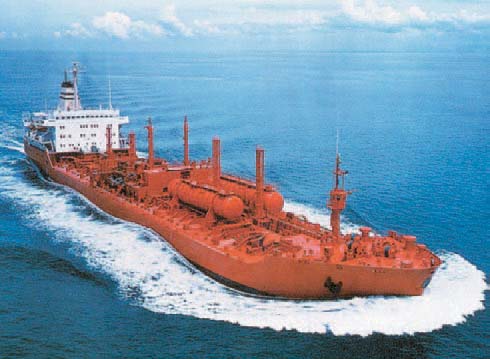
Many toxic chemicals are carried as cargo by specialised tankers.
paints (ten Hallers-Tjabbes, 2003 a & b).
These purpose-built ships are subject to a rigorous and specific safety
regime. If other ship types were to carry large quantities of chemicals
for the purpose of ballast water treatment, they might well be classed
Scale of discharged ballast water
as chemical tankers themselves, creating major design, operational,
The volumes of ballast water taken-up, transferred and
safety and environmental implications.
discharged into world oceans each year far exceed the
volumes of any other ship-sourced discharge regulated by
water tanks. Both absence of light and lack of oxygen
IMO, such as Liquid Noxious Substances under Annex II of
greatly hamper the degradation of contaminants
MARPOL, even if the lowest estimates for ballast water
(cf TBT as an example).
of around 3 billion tonnes per year are accepted
Organisms, in particular bacteria, are the major actors in
(billion = 109).
environmental degradation processes. Yet such organisms
Should treatment of ballast water with chemical biocides
are also likely to be rendered non-viable by the treatment,
(to prevent the transfer of harmful aquatic organisms) be
so one would miss their degradation potential.
widely applied, the potential discharge of these chemicals
into the sea could be at levels well in excess of what is
Natural alternatives
released by current anti-fouling paints (estimated for TBT
Humans have synthesised many chemicals based on
at 1900 tonnes/year, for copper at 27000 tonnes/year
elements that have never successfully been integrated
(Ranke, 2001)).
into construction and life support processes of living
In order to be effective, the concentration of chemical
matter. Only a few elements could be successfully
used needs to be maintained at a toxic level, which
integrated into living systems throughout evolution.
would mean that yearly an amount of 5 to 10 x 1012 litres
Many `naturally' synthesised compounds function as
of water of a toxic concentration would be discharged.
natural toxins or deterrents and are excreted for that
purpose, such as sesquiterpenoids (Sun & Fenical, 1979).
Limitations of traditional toxicity testing
Organochlorines are predominantly (or exclusively)
functioning as chemical protection and defence (Gribble,
Conventional toxicity testing routines have only limited
1994); organobromines appear to serve a similar chemical
potential for the purpose of assessing ecotoxicity of
protection function (Gribble, 1999). They do not serve the
ballast water, if they serve that purpose at all. The
maintenance or construction of living matter and they act
conventional approach to ecotoxicity, comparing a local
as toxins in the marine environment.
concentration to an `acceptable' level, neglects the
complexity of marine ecosystems and their major
The amount of ballast water discharged necessitates a
consequences for the behaviour, fate and residence time
reconsideration of employment of chemicals in ballast
of toxins. The few studies that investigated the spatio-
water treatment. A precautionary approach would be
temporal fate of biocides in a marine environment,
served by restricting secondary ballast-water treatment
indicate a much lower degradation potential than
systems to compounds that have proven viable in
predicted, due to uncertainty regarding the influence of
sustaining living systems.
temperature, metabolic activity, redox potential, presence
of other toxic compounds, and toxicity of transformation
Cato ten Hallers-Tjabbes
products (Ranke, 2002; Ranke & Jastorff, 2000).
Royal Netherlands Institute for Sea Research
Few of the conditions that are employed in traditional
IUCN Representative to IMO
toxicity assessment suites are directly relevant for ballast
cato@nioz.nl
References for this article are listed on page 11
BWN 16: 1-3/2004
G L O B A L B A L L A S T W AT E R M A N A G E M E N T P R O G R A M M E
A C T I V I T I E S U P D AT E
10
The meeting adopted Terms of Reference for the
Global Task Force Meets
Regional Task Force and agreed a series of short-term
actions under the Regional Strategic Action Plan for
in London
ballast water control and management, that had been
adopted by Black Sea States at the first regional
conference held in Odessa, Ukraine in October 2001.
Within the GloBallast Programme the Black Sea region is
now one of most informed and advanced in terms of
regional cooperation. The actions to be carried out
during the remainder of 2004 include:
· Establishing National Task Forces in each country.
· Developing a Regional Aquatic Invasive Species
Information System (RAISIS).
· Sharing the Odessa experience with port biological
surveys by holding seminars and field demonstrations
in each country.
From 2 to 6 February this year the GloBallast
· Delivering training in each country using the GloBallast
Programme's Global Task Force held its 5th meeting
modular training package.
at IMO Headquarters in London. The Task Force
Roman Bashtannyy
convened immediately prior to the Diplomatic
rabotn@te.net.ua
Conference which considered adoption of the
new Ballast Water Management Convention,
GloBallast Helps HELCOM
thereby allowing delegates from the GloBallast
Pilot Countries to stay on and attend the
On 3rd and 4th of March this year the Baltic Marine
Conference, effecting cost-efficiencies.
Environment Protection Commission (HELCOM)
held its 25th meeting in Helsinki, Finland.
The Global Task Force meets annually and comprises
representatives from GEF, UNDP, IMO, the PCU and the
The Baltic Sea, being largely enclosed
six Pilot Countries, as well as industry and environmental
and with low native biodiversity, is
NGO's. Its main function is to review progress for the
particularly vulnerable to aquatic bio-
previous year and consider and approve the PCU and
invasions, and is already suffering from
Pilot Country workplans and budget for the forthcoming
the impacts of several invasive species.
year. It acts as an overall steering and advisory
Photo: M Rosenberg
committee for the Programme.
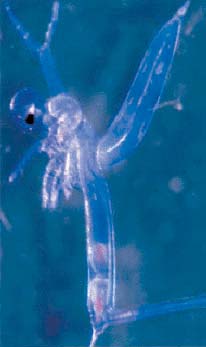
One example is the Cladoceran water flea
Cercopagis pengoi, pictured here, which
Reports presented by the six Pilot Countries and the PCU
has been introduced to the Baltic from
showed that significant progress continues to be made
the Caspian Sea. It reproduces rapidly to
in implementing Programme activities. A major outcome
form very large, densely-packed
of the meeting was a decision to extend the timeframe
populations that dominate the
for finalization of Programme activities by 10 months to
zooplankton and clog fishing nets and
31 December 2004, within the existing available budget.
trawls, causing economic impacts to
the fishing industry.
Regional Task Force Meets
The issue of invasive aquatic species and ballast water
in Romania
management was placed firmly on the HELCOM agenda
at this meeting, with GloBallast making a presentation
From 28 to 30 January
and joining discussions on the issue. The Commission
2004 the GloBallast
made several key decisions relating to ballast water and
invasive aquatic species:
Regional Task Force
for the Black Sea
· stressing the seriousness of the problem in the Baltic
Sea and recommending the nine Baltic countries to
convened the 2nd
ratify, as soon as possible, the IMO Ballast Water
Black Sea Conference
Management Convention,
on Ballast Water
· encouraging the HELCOM maritime committee, led by
Control and
Finland, Germany and Sweden, in cooperation with
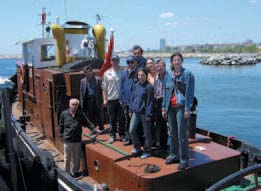
Black Sea port survey replication
Management, in
IMO-GloBallast, to develop a regional action plan on
team in Istanbul
Constanta, Romania.
this matter,
· asking the HELCOM Secretariat to further cooperate
The meeting was attended by Black Sea littoral States
with IMO in the preparation of the future GloBallast
Bulgaria, Georgia, Turkey, Romania, Russian Federation
Partnerships project.
and Ukraine as well as the Istanbul Commission/Black Sea
Environment Programme.
SR
BWN 16: 1-3/2004


G L O B A L B A L L A S T W AT E R M A N A G E M E N T P R O G R A M M E
A C T I V I T I E S U P D AT E
11
GloBallast Goes Tropical
Risk Reports Released
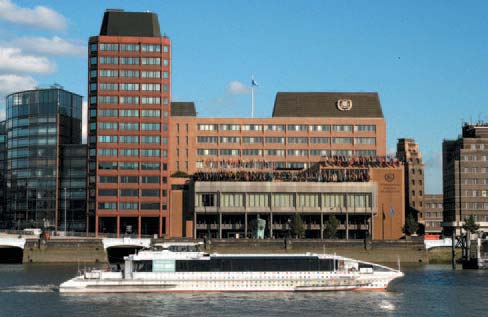
From 23 to 26 March 2004 GloBallast attended the
"White Water to Blue Water" partnerships conference
in Miami, Florida. The objectives were to raise awareness
of the invasive aquatic species and ballast water issue
amongst countries of the Wider Caribbean, and explore
opportunities to develop partnerships for the
development of a Regional Strategic Action Plan for
ballast water control and management, under the
proposed future GloBallast Partnerships project.
As a result of the conference, GloBallast is now
working more closely with government and shipping
groups in the USA and Wider Caribbean, to identify
co-funding for future regional capacity-building and
technical cooperation activities.
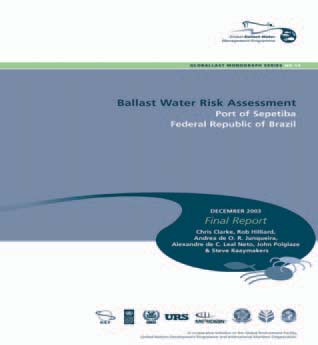
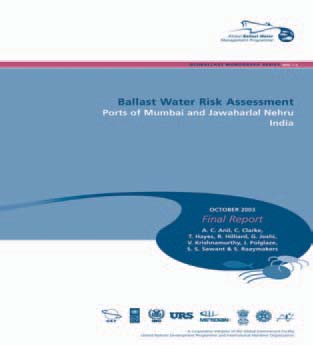
The full set of final reports for the Ballast Water Risk
Assessments for the GloBallast demonstration ports of
Khark Island (Iran), Odessa (Ukraine), Mumbai and
Jawaharlal Nehru (India), Dalian (China), Sepetiba (Brazil)
and Saldanha Bay (South Africa) have now been
published under the GloBallast Monograph Series.
http://globallast.imo.org/publications
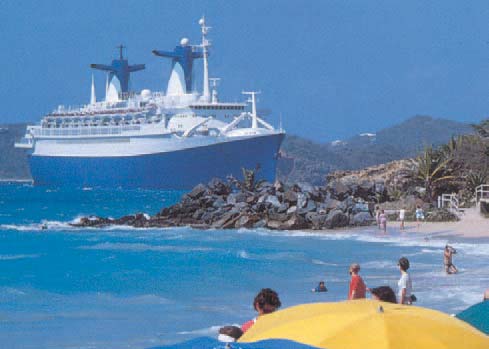
Cruise ship tourism is a major part of the economy in the
References for page 9
Wider Caribbean. The many positive environmental initiatives of the
Collins,T.J., 2001. Towards Sustainable Chemistry. Science, 291: 48.
cruise industry, including in the area of ballast water management,
featured at the White Water to Blue Water conference in Miami.
Gribble, G.W., 1994. The natural production of chlorinated
compounds. Environmental Science & Technology, 28: 310-319.
New Bio-Invasion Books
Gribble, G.W., 1999. The diversity of naturally occurring
organobromine compounds. Chem. Soc. Rev., 28: 335-346.
Oberdörster,E.,& McClellan-Green,P. (2000).The neuropeptide
Island Press has recently released
APGW amide induces imposex in the mud snail, Ilyanassa
obsolete. Peptides, 21: 1323-1330.
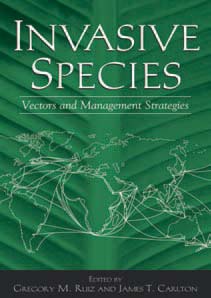
Invasive Species Vectors and
Management Strategies. Edited
Ranke, J., 2001. Ecotoxicological risk profiles of chemicals.
by two of the world's leaders in
Ph D Thesis, University of Bremen (GE), 164 pp.
the science of aquatic bio-
invasions, Drs Greg Ruiz and
Ranke, J., 2002. Persistence of antifouling agents in the marine
James Carlton, the book also
biosphere. Environmental Science & Technology 36: 1539-1545.
covers terrestrial bio-invasions,
Ranke, J. & B. Jastorff, 2000. Multidimensional risk analysis of
with a total of 40 authors
antifouling biocides. ESPR Environmental Science & Pollution
contributing to18 chapters.
Research, 7 (2): 105-114.
ISBN 1-55963-902-4
Sun, H.H. & Fenical, W. 1979. Rhipocephalin and rhipocephenal;
toxic feeding deterrrents from the tropical marine alga
Rhipocephalus phoenix. Tetrehedron Lett., 5: 685-688.
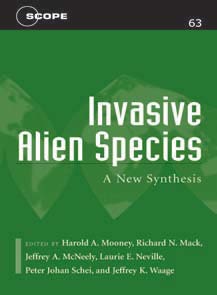
Another recent release by
Ten Hallers-Tjabbes, C.C., J.-W. Wegener, A.G.M. Van Hattum, J.F.
Island Press is Invasive Alien
Kemp, E. Ten Hallers, T.J. Reitsema & J. P. Boon. 2003a.. Imposex
Species A New Synthesis.
and organotin concentrations in Buccinum undatum and
Neptunea antiqua from the North Sea: relationship to shipping
ISBN 1-55963-362-X
density and hydrographical conditions. Marine Environmental
Research, Vol. 55: 203-233.
www.islandpress.org/books
Ten Hallers-Tjabbes, C.C., J. P. Boon, J. L. Gomez Ariza & J. F.
Kemp, 2003b. Communicating the Harmful Impact of TBT: What
can scientists contribute to EU environmental policy planning in a
global context? Ocean yearbook Vol. 17: 417-448.
BWN 16: 1-3/2004

G L O B A L B A L L A S T W AT E R M A N A G E M E N T P R O G R A M M E
12
Progress Report
Activities Undertaken Jan March 2004
Activities Planned April June 2004
Briefed HELCOM Maritime Committee on new BW
Attend Global Invasive Species Network (GISIN)
Convention, Stockholm, 22 Jan.
workshop, Baltimore 6-8 April (Brazil lead).
Convened 2nd Regional Task Force meeting for Black
Hold GloBallast Partnerships meeting with UNDP and
Sea, Constanta, Romania 28-30 Jan (Ukraine lead).
GEF, New York 14-15 April.
Convened 5th Global Task Force meeting, IMO
Convene 1st Regional Task Force meeting for South
London, 2-6 Feb 2004.
America (MERCOSUR Region), Brasilia, 26-28 April
(Brazil lead).
Attended/supported Diplomatic Conference to adopt
BW Convention, IMO London, 9-13 Feb.
Attend APEC Introduced Marine Pests workshop,
Puerto Varas, Chile 3-5 May.
Effected PCU re-structure, with establishment of IMO
Office for Ballast Water Management on 1 March.
Convene 1st Regional Task Force meeting for South
Asia, Goa, India, 13-14 May (India lead).
Assisted 25th meeting of HELCOM to develop
response to ballast water issue, Helsinki 3-4 March.
Attend/present at 2nd International Ballast Water
Management Conference and Exhibition, Singapore
Delivered modular ballast water management
19-21 May (PCU and all Pilot Countries).
training course in Cape Town, South Africa, 5-11
Complete first phase of web-based Country Profiles
March (South Africa lead).
database.
Participated in White Water to Blue Water
Deliver modular ballast water management training
planning/funding conference, Miami, 24-26 March.
course in Dalian, China 7-11 June (China lead).
Attended/supported MEPC 51, IMO London, 30
Present at Maritime Institute of Malaysia Conference
March 2 April.
on Ballast Water, Kuala Lumpur 10 11 June.
Hosted GEF Consultant undertaking in-depth case
Finalise planning for Africa port survey replication in
study of GloBallast as part of Third Study of GEF's
Mombasa, Kenya (South Africa lead).
Overall Performance, 30 March 2 April.
Publish proceedings of 2nd International Ballast
Edited proceedings of 2nd International Ballast
Water Treatment R&D Symposium.
Water Treatment R&D Symposium.
ecycled paper
Renew/extend agreement with IUCN for
Completed all final reports on Risk Assessments for
co-production of Ballast Water News.
each Demonstration Site and progressed same for
Port Biological Baseline Surveys and other activities.
Produce 17th issue of Ballast Water News.
Prepared16th issue of Ballast Water News.
PCU staff annual leave.
el +44 (0)20 7787 1100 · Printed on r
More Information?
Programme Coordination Unit
Global Ballast Water Management Programme
oup, London. T
International Maritime Organization
4 Albert Embankment
London SE1 7SR United Kingdom
Telephone : +44 (0)20 7587 3251 or 3279
Fax
: +44 (0)20 7587 3261
Email
: sraaymak@imo.org or jmatheic@imo.org
oduced by Scanplus Print Gr
Web
: http://globallast.imo.org
Pr
BWN 16: 1-3/2004