





Ballast Water News
3
Ballast Water News
I S S U E 1 1
O C T O B E R D E C E M B E R 2 0 0 2
From the Editor
From the Programme
The drawing to an end of another year presents a time for
The 48th session of the IMO's Marine Environment Protection
reflection and re-focus, highlighting both the tremendous
Committee was held during the last quarter, and was, as always, a
progress that has been made by the international community to
major event with direct implications for the GloBallast Programme.
date to address aquatic bio-invasions, and the monumental tasks
The Committee continued its consideration of the draft
still ahead before this global threat is resolved.
International Convention for the Control and Management of
Ships' Ballast Water and Sediments.
When IMO first formed its Ballast Water Working Group in 1989,
After extensive deliberations, the Committee decided to further
only four member States participated. When the GloBallast
review the draft text during its 49th session in July 2003 and
Programme commenced activities in 2000, participation averaged
agreed to request the Council of IMO to approve the convening of
around 14 countries. At MEPC 48 held in October 2002, there
the Diplomatic Conference on Ballast Water Management in early
were over 120 participants in the Ballast Water Working Group,
2004, instead of the previous plan of October 2003, to allow six
most of them engaging actively in the negotiations.
months for the circulation of the necessary documents.
As conclusion of the Convention draws nearer, the ever-
The second major event during the reporting period was the 4th
intensifying level of engagement and vigour of the debate at
Global Project Task Force Meeting, which was held from 28 to 30
IMO must been seen as a positive indication of the interest,
October 2002 in Beijing, China and included a briefing on the Mid
concern and commitment of stakeholders in relation to this issue.
Term Evaluation of the Programme. A thorough assessment of
It also serves to highlight the all-important inclusiveness of the
activities was conducted by an international team of independent
IMO consensus building process. This is reflected in the progress
evaluators who visited the Pilot Countries and held intensive
being made with the Convention, as reported on pages 4 and 5.
consultations with organizations and individuals involved in
GloBallast.
Under-scoring the global recognition of the need for a unified,
international response to the transfer of harmful organisms in
Although the overall delivery and success rate was considered
ships' ballast, is the continuing progress being made with
impressive and Programme staff were given a warm "pat on the
cooperative, regional action plans under the GloBallast
back" for their efforts, the evaluation revealed a number of
Programme. This is outlined by our Guest Speaker Captain Liu
aspects, which need to be reconsidered in light of the further
delays with the draft Convention.
Gongchen, the Executive Director-General of the Maritime Safety
Administration of the People's Republic of China, and an article
The original Project Document was developed under the
on cooperative arrangements between the mighty maritime
assumption that the Convention would be adopted before
nations of East Asia.
participating countries could commence certain activities. The
drafting of the new instrument has proved to be far more complex
Also in this issue we report on two initiatives towards regional
than anticipated and has required extensive negotiations among
cooperation in the Mediterranean Sea, one under the auspices of
the Member States. This, in conjunction with the understandable
the UNEP Mediterranean Action Plan, the other a creative
reluctance of some countries to translate the IMO Guidelines into
brainstorming session by the region's peak scientific commission
national legislation prior to finalising the Convention, has
CIESM. We also provide some recent results on technical testing
significantly delayed the Compliance Monitoring and Enforcement
of physical separation techniques for ballast water treatment,
component of the Programme. The independent evaluators
and present a review of control and eradication measures for
recommended reviewing the requirements of this component
established invasive species, courtesy of Dr Bella Galil.
along with training needs and reformulating activities and outputs.
Towards the end of this issue, our last for 2003, we report on the
The evaluators found that GloBallast has raised awareness to an
4th Global Task Force meeting held in Beijing at the end of
exemplary and outstanding level, project management has been
October, including the outcomes of the independent, external
effective and remarkable, the countries have contributed
Mid Term Evaluation of the Programme. We conclude with an
significant and valuable support and the stakeholder participation
announcement of the 2nd International Ballast Water Treatment
has been impressive. It is believed that GloBallast has created a
solid foundation of support for the new Convention and represents
R&D Symposium, which we are most pleased to present under a
a unique and model example of GEF assistance during the
new alliance with The Institute of Marine Engineering, Science
development stages of an international instrument related to GEF's
and Technology (IMarEST). As usual, we also highlight a number
aims and objectives. It is also believed that the experience achieved
of publications that have recently been released.
will significantly reduce the time between adoption of the
As I wrap up the year to take several weeks R&R, I would like to
Convention and its entry-into-force.
thank all who helped keep the momentum of GloBallast in 2002,
GloBallast would like to take this opportunity to wish all our
and look forward to keeping this rolling in 2003.
readers Season's Greetings and a Prosperous New Year.
Steve Raaymakers
Dandu Pughiuc
Contributing Editor
Chief Technical Adviser
Ballast Water News is the quarterly newsletter of the Global Ballast Water Management Programme (GloBallast). GloBallast is a cooperative initiative of GEF, UNDP and IMO to assist
developing countries to reduce the transfer of harmful organisms in ships' ballast water, through the implementation of IMO ballast water management guidelines.
For further information please contact:
Programme Coordination Unit, Global Ballast Water Management Programme
International Maritime Organization, 4 Albert Embankment, London SE1 7SR, UK
Tel +44 (0)20 7587 3247 or 3251. Fax +44 (0)20 7587 3261
Email dpughiuc@imo.org or sraaymak@imo.org Web http://globallast.imo.org
The views expressed in Ballast Water News are not necessarily those of GEF, UNDP or IMO.

G L O B A L B A L L A S T W AT E R M A N A G E M E N T P R O G R A M M E
G U E S T S P E A K E R
2
Guest Speaker
China has been part of the GloBallast Programme for more
than two years, with a Demonstration Site at the port of
Captain Liu Gongchen
Dalian in northeast China. Under the National Workplan,
activities have been completed according to schedule,
Executive Director-General
including a broad-based awareness raising campaign, a
Maritime Safety Administration
national legislative review, port biological baseline surveys
and a ballast water risk assessment for Dalian.
People's Republic of China
As part of the awareness campaign, seminars have been
held at a number of ports along the coast and training
Captain Liu Gongchen
provided to hundreds of personnel from relevant
graduated from Dalian
organizations. Many Chinese shipping companies are
Maritime University in 1971
implementing the IMO Guidelines (A.868(20)) - which have
to commence a career as a
been broadly disseminated in Chinese and English -
ships officer with the China
including implementation of onboard Ballast Water
Ocean Shipping Company
(COSCO). He assumed his
Management Plans. My Administration is considering the
first full Captaincy in 1980,
formulation of ministerial Regulations for ships ballast
and in 1987 moved ashore
water management to include the relevant requirements
as Director of the COSCO
of the IMO Guidelines.
General Office in Qingdao.
With support from GloBallast, China is also carrying out
In 1988 he became Deputy
research and development of alternative ballast water
Director-General of the Qingdao Maritime Safety
treatment techniques, and is developing a system to alert
Administration, and then Director-General from 1994
ships' Captains to outbreaks of harmful red tides in the
until 1998. He then moved to Beijing where he is now
Bohai Sea, using existing navigation communication means.
Executive Director-General of the Maritime Safety
With national activities well underway, my Government is
Administration of the People's Republic of China.
now turning its attention to regional cooperation. From
31 October to 2 November this year China was extremely
pleased and honoured to host the 1st East Asia Regional
The introduction of harmful aquatic organisms and
Workshop on Ballast Water Control and Management in
pathogens through ships' ballast water has drawn
Beijing. Representatives from DPR Korea, Japan, the
increasing attention of the world and ballast water control
Republic of Korea, the Philippines, Singapore and Vietnam,
and management has become an increasingly important
as well representatives from IMO and the shipping and port
issue on the agenda of the International Maritime
industries, attended the workshop. Indonesia and the
Organization (IMO). We are happy to see that IMO has
Russian Federation were also invited but regrettably were
made substantial progress in assisting member States with
unable to attend.
the implementation of IMO Resolution A.868(20) and in the
development of the new International Convention for the
The workshop was considered a major success, laying a
Control and Management of Ships' Ballast Water and
strong foundation for regional cooperation to address the
Sediments. We believe that the transfer and introduction of
ballast water issue in a coordinated, cooperative manner,
harmful aquatic organisms by shipping is a global issue of
and a draft Regional Strategic Action Plan was developed.
international nature and can only be solved through
To date, the GloBallast Programme has achieved more than
cooperative international efforts.
we expected, including providing China with the
The Peoples' Republic of China is a major maritime nation
opportunity to learn from other countries and to prepare
and its maritime sector is undergoing continued expansion
for the new Convention. The Peoples' Republic of China
and development, both in terms of its shipping fleet and
remains committed to implementing the challenging
GloBallast workplan, to working towards the earliest
port infrastructure, in accordance with China's economic
adoption and implementation of the new ballast water
and trade development plans. China is both a significant
Convention, and to working closely with our neighbouring
Port State and Flag State, with over 134 international ports,
countries through a Regional Strategic Action Plan.
an international shipping fleet totalling more than
16 million gross tonnes and a domestic shipping fleet
Liu Gongchen
comprising thousands of vessels.
Having a continental coastline of 18,000 kilometres and
Some Regional Marine Programmes
more than 650 islands, China is very concerned about the
in the Seas of East Asia:
introduction of aquatic invasive species. Shipping, fishing
GEF/UNDP/IMO
and marine farming play an important role in the economy
of the country. Forty percent of the country's population
Partnerships for Environmental Management
and 50% of the large and medium cities are concentrated
in the Seas of East Asia (PEMSEA)
along the coastline. While the fast development of the
www.pemsea.org
economy has brought prosperity to the country, the coastal
UNEP East Asian Seas Coordinating Unit (EAS/RCU)
areas and waters are suffering from pollution.
Coordinating Body for the Seas of East Asia (COBSEA)
Environment protection is one of the two basic National
www.unep.org/unep/regoffs/roap/easrcu/
Policies of China, and China is a contracting party to most
of the IMO Conventions. Being a Flag State, China has the
IUCN Regional Marine Programme
responsibility to ensure its fleet is in compliance with the
www.iucn.org/places.asia
requirements of these Conventions.
www.iucn.org/places/srilanka/coastalprg.htm
BWN 11: 10-12/2002
G L O B A L B A L L A S T W AT E R M A N A G E M E N T P R O G R A M M E
E A S T A S I A
3
East Asia Takes Action
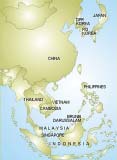
The region embraces five large marine ecosystems (LME)
or sub regional seas (the Yellow Sea, South China Sea,
East China Sea, Sulu Celebes Sea, and the Indonesia Seas).
The 1st East Asia
It includes two archipelagic countries (Indonesia and
Philippines) and contains the greatest number of islands
Regional Workshop
of all the regions in the world (PEMSEA 2002).
on Ballast Water
Around 30% of the world's coral reefs, one-third of the
Control and
world's mangroves as well as many other important
Management was
critical habitats are found in the region. The region
held in Beijing
comprises the world's richest marine biodiversity and
produces about 41% of the total fish catch of the world
from 31 October to
(PEMSEA 2002).
2 November 2002.
The workshop proceeded according to a three-day
The People's
programme. The GloBallast PCU provided background
Republic of China,
presentations, China described the significant progress
made to date at the Dalian Demonstration Site, and status
as the GloBallast
reports were presented by the other littoral States.
Pilot Country in the
The workshop devoted significant effort to considering
region, hosted the workshop through its
the draft Regional SAP and developing recommendations
Maritime Safety Administration.
for regional cooperation. During discussions, all countries
unanimously agreed that the problem of ballast water
The focus of the GloBallast Programme on regional
and marine bio-invasions must be addressed on a regional
replication and cooperation activities, as reported in
basis involving cooperation between all countries in the
recent issues of Ballast Water News, is continuing
region.
according to schedule with the East Asia initiative
It was unanimously agreed that regional cooperation on
following on from similar activities for the Black Sea,
ballast water control and management should be
Eastern Baltic and the ROPME Sea Area.
developed and coordinated through existing regional
The GloBallast regional conferences/workshops include a
structures and mechanisms, such as the GEF/UNDP/IMO
number of objectives common to all regions:
programme `Partnerships for Environmental Management
To raise awareness about invasive marine species, the
in the Seas of East Asia (PEMSEA)'.
ballast water problem and IMO ballast water activities
The Workshop adopted a Resolution with
amongst key stakeholders in the Region.
recommendations covering the following major areas:
To establish the current status of invasive marine
Development of the draft Regional SAP.
species and ballast water management arrangements
in the regional countries.
The establishment of a Regional Task Force.
To progress a draft Regional Strategic Action Plan
Implementation of IMO Resolution A.868(20) within
(SAP).
the Region.
To agree on the machinery for implementation and
Support for the rapid adoption and entry into force of
coordination of regional activities.
the new international ballast water Convention, being
The East Asian workshop was opened by Captain Liu
developed by IMO.
Gongchen; Executive Director General of the China
The workshop agreed to work towards formal adoption
Maritime Safety Administration. Captain Liu affirmed
of the Regional SAP through a high level meeting to be
China's commitment to implementing IMO ballast water
held in 2003.
arrangements and the importance of regional
cooperation. In addition to China, representatives from
Together the countries of the region represent some of
DPR Korea, Japan, the Republic of Korea, the Philippines,
the world's major maritime economies, with major ship-
Singapore and Vietnam, as well representatives from IMO
building industries, huge international and domestic
and the shipping and port industries, attended the
shipping fleets, some of the largest trading ports in the
workshop. Indonesia and the Russian Federation were
world and several countries in the region being major
also invited but unfortunately were unable to attend. Two
suppliers of ships' crews to the world fleet. The develop-
GloBallast Pilot countries that are currently planning their
ment of a cooperative, regional approach to the
regional initiatives, India and South Africa, also attended
management of invasive aquatic species and ballast water
to gain ideas from the East Asia process, and to initiate
inter-regional cooperation.
transfers in this region represents therefore, a major
development in the maritime world, and bodes well for
The East Asian Seas region is the most populous region in
similar initiatives in other regions.
the world. It is home to almost 1.8 billion people, 60% of
whom are concentrated in coastal areas. In the past
The GloBallast Programme is deeply grateful for the
decade, the region has been the centre of considerable
assistance of the Government of China, and in particular
economic growth, bringing about increasing urbanization.
the China Maritime Safety Administration, for the
Around 300 million people are now living in coastal urban
excellent support provided in convening the Workshop.
areas (PEMSEA 2002).
SR
BWN 11: 10-12/2002

G L O B A L B A L L A S T W AT E R M A N A G E M E N T P R O G R A M M E
C O N V E N T I O N U P D AT E
4
Convention Update
The Working Group also gave consideration to the need for
various guidelines in support of the Convention, and
identified the following issues for guidelines in order of
From 7 to 11 October 2002 the IMO Marine
priority:
Environment Protection Committee (MEPC)
guidelines for the design, construction and operation of
held its 48th meeting in London, and through
ships that use Ballast Water Exchange. An outline and
its Ballast Water Working Group, continued
materials for these guidelines were available and the
to make progress on finalising the text of the
International Chamber of Shipping undertook to
prepare a draft text for future consideration,
new International Convention for the Control
guidelines for the assessment and approval of ballast
and Management of Ships' Ballast Water and
water treatment systems (type testing),
Sediments.
guidelines supporting coastal States when considering
additional measures, and
guidelines on ballast water sampling/inspections on
board ships by port State Administrations.
The Chairman of the Working Group recommended that, as
a next step, the Committee should invite Member
Governments to submit supporting information and views
on the various options contained in the draft convention,
in particular for the standards under Regulation E-2. The
Working Group also recommended a thorough legal review
of the current text.
In conclusion, MEPC 48 agreed that the revised text of the
draft Convention provided a sound framework but time
was required to deliberate on its contents. It was agreed
that:
The week before MEPC, the Working Group held an inter-
sessional meeting, as agreed at MEPC 47, in order to
a second Intersessional Meeting of the Ballast Water
progress technical details of the draft Convention prior to
Working Group would be convened at IMO
MEPC itself.
Headquarters in the spring of 2003 to carry out specific
Under the Chairmanship of Mr Mike Hunter of the UK, the
tasks as outlined in a detailed terms of reference and
Working Group continued to give priority to finalising
report to MEPC 49 (14 to 18 July 2003);
ballast water treatment standards and addressing all
the deadline for submissions on ballast water issues to
remaining outstanding issues in the text of the draft
MEPC 49 would be relaxed until an appropriate date in
Convention.
May 2003;
In relation to standards, the Working Group agreed that
MEPC 49 would review and approve the draft
there should be a standard for ballast water exchange, a
Convention with the aim of circulating it as the basic
short-term standard for ballast water treatment and a
document for consideration and adoption at a
long-term standard for ballast water treatment. Draft,
Diplomatic Conference; and
provisional text for such standards was proposed as
outlined in Table One.
the Diplomatic Conference should be held in the
beginning of 2004 instead of October 2003 to meet the
The Working Group was of the view that the final figures
six-month notice period for the basic conference
in the standards should have a solid scientific basis, which
documents. This re-scheduling is regarded as a technical
was missing from the concentration element and,
adjustment to the schedule for preparation of the draft
therefore, submissions should be invited in this regard to
text rather than as a postponement of the Diplomatic
MEPC 49 in July 2003. The Working Group was also of the
Conference.
view that the following elements should be considered for
the short-term standard:
Of particular interest towards the end of the meeting, was
an intervention by the delegation of Japan, which
it should offer an alternative to Ballast Water Exchange;
informed the Committee that it had a project underway
it should be achievable at the time of entry into force
aimed at developing new ship designs, which need not
of the Convention;
carry ballast water, when sailing with limited or no cargo.
there should be some confidence as to the effectiveness
Such designs would solve the problem arising from transfer
of the standard;
of non-indigenous species through ballast water. The
delegation would prepare a submission giving further
it should lead technology towards the long-term
information on this project to MEPC 49.
standard.
It was noted the World Health Organization (WHO) was
The revised text of the draft International Convention for
working on water quality standards for pathogens, which
the Control and Management of Ships' Ballast Water and
would be an important factor in establishing ballast water
Sediments, as prepared during MEPC 48, is available at
standards for pathogens.
http://globallast.imo.org/convention
SR
BWN 11: 10-12/2002
G L O B A L B A L L A S T W AT E R M A N A G E M E N T P R O G R A M M E
C O N V E N T I O N U P D AT E
5
Table One : Extract of text from Draft IMO Ballast Water Convention
(NB : This is not approved text and is subject to change as part of Convention negotiations. Values inserted in
options 1 and 2 are place holders only and are subject to technical review and ongoing discussion).
SECTION E - STANDARDS FOR BALLAST WATER MANAGEMENT
Regulation E-1
Ballast Water Exchange Standard
1
Ships performing ballast water exchange in accordance with this Regulation shall do so with an
efficiency of 95 per cent volumetric exchange of Ballast Water.
2
The method used to establish that a ship meets the standard in paragraph shall be one of the
accepted methods [contained in this Annex] [in the Code][approved by the Organization].
New ships shall be designed and constructed in accordance with the following requirements
(to be listed).
Regulation E-2
Short-term Ballast Water Management Standard
Y
Option 1:
1
Ships conducting Ballast Water Management in accordance with this Regulation shall achieve at least
[95]% removal, rendering harmless, or inactivation of a defined set of taxa.
Option 2:
2
Ships conducting Ballast Water Management in accordance with this Regulation shall discharge no
detectable quantities of viable organisms above [100]µm in size, and discharge no more than [25
viable individuals of zooplankton per litre, 200 viable cells of phytoplankton per ml1] smaller than
[100]µm in size.
Regulation E-3
Long-term Ballast Water Management Standard
Ships conducting Ballast Water Management in accordance with this Regulation shall Discharge no detectable
quantities of viable organisms above [y] µ in size, and discharge no other organisms above a concentration of [z].
Regulation E-4
Additional criteria for ballast water treatment systems
DRAFT ONL
Ballast water treatment systems used to comply with this Convention must be:
.1
safe in terms of the ship and its crew;
.2
environmentally acceptable, i.e. not causing more or greater environmental impacts
than it solves;
.3
practicable, i.e. compatible with ship design and operations;
.4
cost effective, i.e. economical; and
.5
biologically effective in terms of removing, or otherwise rendering inactive harmful
aquatic organisms and pathogens in ballast water.
C O N F E R E N C E A N N O U N C E M E N T S
International Conference
The 12th
on Ballast Water and
International Conference
Waste Water Treatment
on Aquatic Invasive Species
11-13 June 2003
9-12 June 2003
Berlin, Germany
Windsor, Canada
Contact Mrs. Elke Lonicer
For further information visit
Conference Manager
www.aquatic-invasive-species-conference.org
Lonicer@t-online.de
BWN 11: 10-12/2002


G L O B A L B A L L A S T W AT E R M A N A G E M E N T P R O G R A M M E
M E D I T E R R A N E A N
6
Mediterranean
Scientists Brainstorm
Moves Forward
Ship Vectors
The Mediterranean Sea may be considered as
From 6 to 9 November 2002 a group of scientists
one of the world's cradles of civilization and
and other experts gathered in Istanbul, Turkey, at
has played a pivotal role in the history of
the invitation of CIESM the Commission
humanity for millennia.
Internationale pour l'Exploration Scientifique de la
As an enclosed sea surrounded by huge
mer Méditerranée (International Commission for
populations it has suffered and is suffering
the Scientific Exploration of the Mediterranean
severe environmental impacts, including over-
exploitation of resources and marine pollution.
Sea). Their purpose to brainstorm in a freely
structured, creative, think-tank, setting new
In 1975 the United Nations Environment Programme
spearheaded its Regional Seas Programme with the
perspectives and scientific inputs to the problem of
development of the Mediterranean Action Plan (MAP).
ship-transported alien species in the Mediterranean
MAP brings together 20 countries and the European
and Black Seas, with a view to provide relevant
Community, in a cooperative partnership for the
sustainable use and protection of the Mediterranean Sea.
agencies with science-based analyses and priorities
This partnership includes a number of thematic activity
for action.
centres throughout the region. One of these is the
Regional Activity Centre for Specially Protected Areas and
Biodiversity (RAC/SPA), located in Tunis.
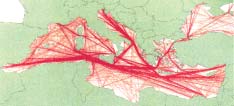
The Mediterranean Sea has been subjected to introduction
of alien species since the opening of interoceanic maritime
routes five centuries ago. The rate of invasions has
increased in recent decades, due to the opening of the Suez
Canal, intentional and accidental introductions relating to
fisheries, aquaculture and aquaria, and increasing ship
traffic, causing damage to already imperiled ecosystems,
and presenting a major threat to aquatic bio-diversity.
In response to this threat, from 24 to 26 October 2002
RAC/SPA convened a meeting of experts in Barcelona, for
the elaboration of an Action Plan concerning species
introductions and invasive species in the Mediterranean
Sea. The meeting was attended by MAP members States,
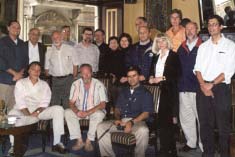
The CIESM Ship Vectors Workshop in Istanbul
environmental NGO's and the GloBallast Programme.
Led by Bella Galil, Chair of the CIESM Sub-Committee on
Marine Ecosystems, with the personal involvement of
Frédéric Briand, Director General of the Commission, the
workshop set a demanding agenda over four full days
characterized by lively debate and creative discussions.
A range of scene-setting presentations were given, in a
very interactive format, on the current extent of aquatic
bio-invasions in the region, the nature of shipping
patterns and risks in the region, currently available
Shipping routes in the Mediterranian (Source: REMPEC)
management options and actions, and the current state
A feature of the draft Action Plan resulting from the meet-
of knowledge and gaps in invasion biology and ecology.
ing is that it takes a holistic, integrated approach to invasive
In addition to Mediterranean experts, there were also
aquatic species, considering all vectors and pathways, and
participants from northern Europe and North America,
both intentional and un-intentional introductions.
bringing a more global perspective to the debate.
In relation to shipping and ballast water, the draft Action
A synthesis of the workshop conclusions, along with a
Plan provides for close cooperation with the GloBallast
compilation of all individual presentations, is in
Programme and the implementation of uniform IMO
preparation. It will be published in January in the well
ballast water management arrangements in the region,
known CIESM Workshop Monographs Series and will be
providing a model for future cooperation between IMO,
accessible for downloading directly from the CIESM
GloBallast and other regional marine programmes.
Website at www.ciesm.org
www.unepmap.org
SR
SR
BWN 11: 10-12/2002
G L O B A L B A L L A S T W AT E R M A N A G E M E N T P R O G R A M M E
T E S T R E S U LT S
7
Mechanical Treatment
a 100-micron rated cyclonic separator (hydro-
cyclone).
Test Results
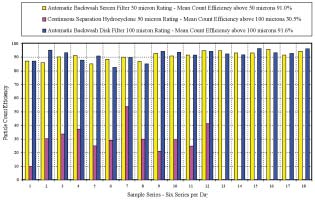
The screen-type and disk-type automatic backwash filters
showed particle removal efficiencies at and above their
The Great Lakes Ballast Technology Demonstration
removal rating of over 90 percent. Although more
Project has undertaken a multi-year program to
complicated, the disk-type depth filter exhibited a
demonstrate and evaluate ballast water treatment
significant advantage through a longer time between
methodologies that might minimize the transfer of
backwash cycles and, thus, a greater net filtration
non-indigenous aquatic species.
throughput.
Full-scale mechanical and biological testing of primary
The hydro-cyclone demonstrated significantly lower
and secondary treatment options has been performed on
effectiveness (about 30 percent) in removing particles that
included both neutrally buoyant biota and other materials.
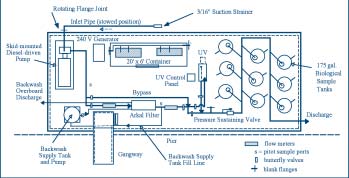
both operating vessels and a test barge located in Duluth
While much simpler than filters, the results from this part-
and Two Harbors, Michigan, USA.
icular work indicate that cyclonic separation devices may not
Mechanical testing for particle removal efficiency, at a
be appropriate for this application, requiring the effective
nominal 340 m3/h flow rate; was undertaken for three
removal of both particulate material and larger biota.
candidate primary mechanical separation devices over a
Michael G. Parsons
four-year period. The three treatment methods tested
Univ. of Michigan
were:
a 50 micron screen-type surface automatic
Richard W. Harkins
backwash filter,
Lake Carriers Association
harkins@lcaships.com
a 100 micron disk-type depth automatic backwash
filter, and
From: Marine Technology, Vol. 39, No. 4, Oct, 2002, pp. 211-222.
Schematic of Ballast Technology Test Barge
Comparison of overall particle count efficiency of primary separation devices
BWN 11: 10-12/2002
8
G L O B A L B A L L A S T W AT E R M A N A G E M E N T P R O G R A M M E
C O N T R O L & E R A D I C AT I O N
Between Serendipity
abundance (Boles & Lipcius 1997). The successful laboratory
and field trials of a selectively toxic microbe, the bacterial
and Futility: Control
strain CL0145A, may hold promise for environmentally safe
control of zebra mussels.
and Eradication of
The green crab, Carcinus maenas has invaded both the
Atlantic and Pacific coasts of the USA, eastern Canada,
Aquatic Invaders
southern Australia, South Africa and Japan. A voracious
predator, it has damaged fisheries, aquaculture and native
fauna, and greatly diminished the numbers of the
Significant efforts are underway to develop systems
commercially valuable soft-shell clam Mya arenaria in New
England and Canada.
and procedures to prevent the transfer and
introduction of invasive aquatic species to new
Physical removal of C. maenas by divers may be useful in
small, enclosed areas such as mariculture facilities, but is
environments. Despite these efforts, aquatic bio-
deemed ineffectual over large areas. Exclusion barriers such
invasions appear to be increasing at an exponential
as low wire fences used by the New England clam fishery,
rate, and many of these are exhibiting significant
trapping and poisoning with Lindane or Carbaryl-soaked bait
ecological and/or socio-economic impacts.
have been unsatisfactory. Possible bio-control agents include
viruses, dinoflagellates, ciliates, the egg-predator nemertean
This begs the question; if not all invasions can be
Carcinonemertes carcinophila, nematodes, tapeworms and
prevented, can populations of invading species be
an epicaridean isopod (Goggin 1997) (Kuris 1997). A rhizo-
controlled and eradicated once they are
cephalan parasitic castrator, Sacculina carcini, that infests
established? In this article we examine some
C. maenas throughout its native range has been found to
infect native Australian crabs as well (Thresher 2000).
examples of aquatic bio-invaders and review
attempts made for their control or eradication.
A shell-boring sabellid polychaete, Terebrasabella
heterouncinata, was found in California in 1993 in a
Since the discovery of the zebra mussel, Dreissena
mariculture facility whence it arrived with South African
polymorpha, in Lake St. Clair in 1988, the mussel has
abalone stock. In 1996 the high prevalence of the sabellid
spread throughout the eastern United States and the
worm on the native black turban snail, Tegula funebralis,
Province of Ontario and caused devastating ecological
near the outflow of an abalone hatchery in California,
damage and economic loss.
signified a spread of epidemic proportions.
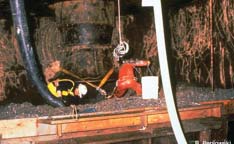
Manual scraping, abrasive blasting and high-pressure
Efforts to control the sabellid included coating the abalone
water jets have been successful for the temporary removal
shells in waxy substances, immersing the shells in
of localised mussel populations but are expensive and
freshwater or in heated seawater close to the upper
time consuming. Screens and filters have been used to
thermal tolerance limit of the abalone. Microencapsulated
prevent uptake of mussels through pipes in hydroelectric
and water-soluble toxins were also proposed. The experi-
facilities. Water heated to temperatures greater than the
mental use of ultrasound to destroy the eggs and juveniles
thermal tolerance of the mussel (> 40ş C) has been used
was considered inefficient.
to destroy newly settled mussels within pipe work.
An eradication program, based on reducing the density of
Cathodic protection and UV irradiation have been used to
the sabellid worm populations and the density of the likely
suppress mussel settlement. Numerous organic and
native host population, was put into action in late 1996.
inorganic chemicals toxic to the mussels provide versatile,
A screen was installed at the facility discharge, preventing
easy to implement and cost-effective ways to deal with
the release of sabellid-bearing abalone shells and shell
established infestations and prevent new ones (Boelman
fragments. All living gastropods, hermit-crab inhabited
et al 1997) (Specher & Getsinger 2001). However, since
shells and empty shells were removed from 1500 m2 of the
chemical biocides must prove harmless to the non-target
intertidal zone near the facility, including 2000 escaped
species, current chemical options are used only in closed
cultured abalone shells and approximately 1.6 million
systems and internal piping.
T. funebralis shells. Surveys of T. funebralis snails conducted
Bio-control experiments using a generalist predator, the
for two years following the program demonstrate the
blue crab Callinectes sapidus, indicate that increased
complete eradication of T. heterouncinata population
populations of the crab may be effective in reducing mussel
(Culver & Kuris 2000).
The giant fanworm, Sabella spallanzanii has been intro-
duced to Brazil, Java and Australia. The fanworm fouls
hard substrates, vessels and man-made structures, forming
extensive dense mats of up to 100 specimens/m_. Its thick
meadows may out-compete native suspension feeders for
food, smother native bivalves and impact shellfish
aquaculture and fisheries.
The ability of S. spallanzanii to regenerate damaged body
parts precludes use of dredges for large scale removal, in
fact, scallop fishers may have contributed to the rapid spread
of the fanworm by discarding fragments overboard. Sabella
spallanzanii was successfully controlled in Eden Harbour,
NSW, where it was manually removed by divers. However,
physical removal is feasible only to clear small areas if the
Workers clearing Zebra Mussels from power station
fanworm is detected before reproduction occurs.
water intakes Detroit (Source: R Peplowski).
BWN 11: 10-12/2002
G L O B A L B A L L A S T W AT E R M A N A G E M E N T P R O G R A M M E
C O N T R O L & E R A D I C AT I O N
9
The Northern Pacific Sea star, Asterias amurensis, may
and eutrophication. The Group of Experts on the Scientific
have dispersed to Australia as larvae released with
Aspects of Marine Environment Protection (GESAMP 1997)
discharged ballast water, in vessel fouling or transferred
convened to discuss strategies for the control of M. leidyi
with mussel lines between mariculture facilities. The
agreed that its eradication is unlikely, since the area
Australian population of A. amurensis maybe as high as 120
affected was too large. Instead, strategies were sought for
million. Asterias amurensis is a shellfish predator and poses
reducing its abundance. Mechanical removal or destruc-
a serious threat to mariculture and wild shellfish fisheries.
tion was deemed impractical because of its high growth
rate. Toxic non-specific chemicals in the concentrations
required to exterminate M. leidyi would damage the
whole food web. It was agreed that biological control
using pathogens, parasites, predators or competitors
offers the only feasible approach. Species of the
ctenophore genus Beroe were considered as biocontrol
agents as they feed exclusively on other ctenophores such
as M. leidyi and have reproductive rates high as that of M.
leidyi.
Providentially, Beroe ovata appeared in the Black Sea in
1997 (Zaitzev 1998), and the rapid increase in its
abundance was concomitant with significant reduction in
M. leidyi biomass and increase in zooplankton and fish
egg biomass. It has been suggested lately that B. ovata be
introduced to control M. leidyi in the Caspian Sea.
Control of invasive species in aquatic and marine
ecosystems is in its infancy, with only a handful of
partially successful cases from around the world.
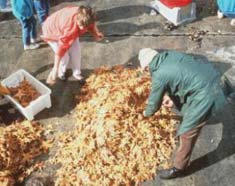
Physical collection of A. amurensis in Tasmania
Eradication may be effective when an introduced species
(Source: CRIMP - CSIRO Australia)
is identified at an early stage of colonization and has
limited spatial distribution. At such an early stage
Manual removal by divers is ineffective as a control method
eradication methods need not be highly specific since
for large populations in the Port of Hobart 6000
their possible damage to non-target species is limited to a
specimens were removed from a 300 x 20 m area, yet the
small area. Once the introduced species reproduces
next month four times as many seastars were collected.
successfully or is widely dispersed, eradication becomes
Apart from physical removal, no other attempt has been
impossible and long-term control becomes the preferred
made to control A. amurensis in Australia. Possible
strategy, to reduce the population to an economically or
biological control agents under study include sporozoans,
ecologically acceptable level.
dendrogastrids, eulimid gastropods and the highly
contagious parasitic ciliate Orchitophyra stellarum that has
It has been suggested that biological control, involving
caused male infertility in the Japanese populations of A.
the introduction of a predator, parasite or pathogen or
amurensis. However, since the ciliate may parasitize native
genetic manipulation, may present an option for aquatic
seastars further research into its host specificity is needed.
pests management. While bio-control has long been used
in terrestrial systems (with mixed results ranging from
The black-striped mussel, Mytilopsis sallei, has spread to
highly successful to disastrous), recent studies raise
Fiji, India, Japan, Taiwan and Hong Kong. In 1999 large
concerns over the efficacy, host-specificity and safety of
populations of the mussel were discovered in three
biological control, especially in a contiguous, fluid, `three-
marinas in Darwin, Australia. Mytilopsis sallei may have
dimensional' aquatic medium. Basic research, rigorous
spread in hull fouling of commercial or recreational
monitoring and development of innovative and highly
vessels. The mussel fouls hard substrates, vessels and
specific control techniques are urgently needed.
structures, causing extensive economic damage and may
The Australian Centre for Research on Introduced Marine
out compete native marine species, smother native
Pests has been somewhat active in this area, and has
bivalves and impact shellfish aquaculture.
published an excellent overview, bibliography and tool-
Recognizing the potential economic and ecological impact
box of control options - refer:
of the M. sallei infestation, Australia implemented an
http://crimp.marine.csiro.au/nimpis/controls.htm and
immediate containment and eradication program. The
gated marinas were closed and the enclosed water, vessels
http://www.marine.csiro.au/CRIMP/reports/toolbox.pdf
and submerged surfaces were treated with 170 t sodium
New Zealand is also developing strategies for the control
hypochlorite and 3 t copper sulphate, killing the mussels.
and eradication of marine pests, for example see:
Vessels that had passed through the infested marinas
http://www.cawthron.org.nz/Assets/Undaria_full_report.pdf
were inspected and treated and internationally travelled
vessels underwent antifouling on entry to Australian
While further research on control and eradication
waters. Extensive surveys reported no live mussels in the
techniques is vital, PREVENTION is the key. Sound and
marinas or elsewhere in Australia (Bax 1999).
prudent management of species transfer vectors will
remain the bulwark against aquatic bio-invasions for the
The Atlantic comb jelly Mnemiopsis leidyi has drastically
foreseeable future.
affected the ecology and productivity of the Black Sea
since its introduction in the early 1980's. In November
Bella S. Galil
1999 M. leidyi was also recorded in the Caspian Sea. It was
National Institute of Oceanography, Israel
postulated that the population explosion of M. Leidyi was
bella@ocean.org.il
in response to abundant zooplankton due to over fishing
References for this article are listed on page 11.
BWN 11: 10-12/2002


10
G L O B A L B A L L A S T W AT E R M A N A G E M E N T P R O G R A M M E
4 T H G P T F | 2 N D R & D S Y M P O S I U M
Global Task Force Meets
stages of an International Convention related to GEF
aims and objectives.
in Beijing
There have been some delays in certain components
and outputs (specifically those related to legislation,
compliance, monitoring and enforcement), which are
As outlined by Dandu Pughiuc on page 1, the
not the fault of the project, but are due to external
Programme's Global Task Force, which meets annually
circumstances.
and acts as an overall steering and advisory committee,
There have also been delays in the development of
held its 4th meeting in Beijing, China, from 28 to 30
mechanisms and processes to transfer/replicate lessons
October this year, immediately prior to 1st East Asia
and best practices beyond the demonstration ports.
Regional Workshop reported on page 3 (thereby
Primarily, the fault for this must lie with the project
effecting cost-efficiencies). The meeting was hosted by
design rather than implementation.
the Government of China, through the Maritime Safety
The evaluation has also identified some areas of
Administration, the Lead Agency for the GloBallast
project administration, management and technical
Programme in China.
output that could be enhanced and improved.
The Programme Coordination Unit and Pilot countries are
extremely pleased with the evaluation, are mindful of the
areas for improvement that have been identified and the
need to continue programme momentum for the
remainder of the workplan.
SR
2nd R&D
Symposium
21-23 July 2003,
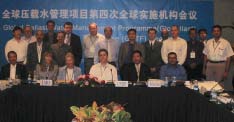
The 4th Global Task Force Meeting in Beijing, China
IMO, London
Reports presented by the six Pilot Countries and the PCU
Call for Abstracts
showed that significant progress continues to be made in
implementing Programme activities. A major outcome of
GloBallast, in conjunction with The Institute of Marine
the meeting was presentation of the Mid Term Evaluation
Engineering, Science and Technology (IMarEST), and
results by the GEF-UNDP external evaluators. The findings
with support from the UK Maritime and Coastguard
of the independent review were extremely positive, and
are summarised by the evaluators as follows:
Agency and the North Sea Directorate (Netherlands),
are pleased to announce the 2nd International Ballast
The project has raised awareness to an exemplary and
Water Treatment R&D Symposium, to be held at IMO
outstanding level at the national, regional and global
Headquarters, London on 21-23 July 2003.
scale.
The 1st Symposium was held at IMO on 26-27 March
Project execution and management has been effective
2001, and was hailed as a success in bringing stake-
and remarkable in that so many achievements have
holders up-to-date with latest developments in ballast
been realised under the constraints of time and
water treatment and management and catalyzing a
manpower imposed by the project design.
more coordinated and cooperative global R&D effort.
The countries themselves have contributed significant
Participants requested that the symposium become a
and valuable support and have provided very real and
regular event.
serious commitment to this project.
Since March 2001 significant progress has been made in
Stakeholder participation and support has also been
the field of ballast water treatment R&D and with the
impressive, especially for a global project of this nature.
new IMO ballast water Convention. The 2nd Symposium
The project has created a solid foundation of support
will provide a timely opportunity for another major
for the expected Convention on Ballast Water
update and refocus of the global R&D effort.
Management, and has initiated many activities, which
Individuals and groups involved in relevant R&D are
will stand the participating countries in good stead
invited to submit abstracts for consideration, in strict
when the Convention is adopted.
accordance with the Template for Abstracts,
The project has contributed significantly to our
by 21 March 2003.
understanding of some of the barriers and constraints
Abstracts submitted will be reviewed by a technical
which may be experienced at the national level in
committee and authors of abstracts selected for
implementing the requirements of a future
presentation will be advised in early April. Registration
Convention, and has provided (and will continue to
packages and the symposium programme will also be
provide) many lessons and best practices which can be
available in April 2003.
transferred and replicated both nationally and
regionally.
Contact : Sarah Harden
Senior Events Organiser, IMarEST
The project represents a unique and model example of
Email : sarah.harden@imarest.org
GEF assistance being used during the development
BWN 11: 10-12/2002

G L O B A L B A L L A S T W AT E R M A N A G E M E N T P R O G R A M M E
P U B L I C AT I O N S
11
Publications
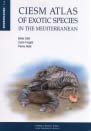
CIESM Atlas of Exotics
Biocides Report Online
Vol 2
In 2001 BMT Fleet Technology Ltd in partnership with ESG
International Inc. (both of Canada) undertook research
In Ballast Water News No. 9 we
into the use of copper and sodium hypochlorite as ballast
announced the launch of the new
water biocides, on contract to the State of Michigan (USA)
CIESM Atlas of Exotic Species in the
Department of Environmental Quality (see Ballast Water
Mediterranean with release of the first
News No. 9 Page 8). The final report is now available
volume on fishes.
from:
Publication of subsequent volumes is
www.fleetech.com/download_ballastreport.htm
proceeding at pace, with Volume 2
Due to its size the web version does not include a number
Crustaceans, now available, and
of technical appendixes that contain important
Volume 3 Molluscs, soon to be
information in response to peer review of the original
released. Copies can be ordered via
report.
www.ciesm.org.
Complete copies with all appendices can be obtained on
CD from dstocks@fleetech.com.
More
Monographs
In Ballast Water News
No. 10 we announced
References for pages 8 & 9
the launch of the new
Bax, N. 2000. Eradicating the mussel Mytilopsis sp. from Australia.
GloBallast Monograph
American Society of Limnology and Oceanography, Aquatic
Series.
Sciences Meeting, Copenhagen, 2000. Abstract ss21-06.
Boelman S. F, Neilson, F. M., Dardeau E. A. & Cross, T. 1997. Zebra
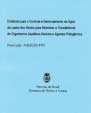
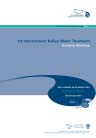
Additional reports in
mussel (Dreissena polymorpha) control handbook for facility
the series are now
operators, Zebra mussel Research Program, Miscellaneous paper EL-
available, including
97-1, U.S. Army Corps of Engineers, Washington D.C., USA, 58 pp.
the Report of the
Boles, L. C. & Lipcius, R N. 1997. Potential for population regulation
1st International Ballast
of the Zebra mussel by finfish and the blue crab in North American
Water Treatment Standards Workshop and the Report
estuaries. Journal of Shellfish Research, 16(1): 179-186.
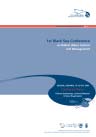
of the 1st Black Sea Conference on Ballast Water Control
Byrne, M., Cerra, A., Nishigaki, T. and Hoshi, M. 1997. Infestation of
& Management.
the testes of the Japanese sea star Asterias amurensis by the ciliate
Orchitophyra stellarum: a caution against the use of this ciliate for
Also available are the Proceedings of all Global Project
biological control.. Diseases of Aquatic Organisms, 28: 235-239.
Task Force Meetings held to date, and further reports in
Culver, C. S. & Kuris, A. M. 2000. The apparent eradication of a
locally established introduced marine pest. Biological Invasions 2:
the series are under preparation. Hard copies can be
245-253.
ordered free of charge from cgregory@imo.org or
GESAMP 1997. Opportunistic settlers and the problem of the
downloaded as PDF files from:
ctenophore Mnemiopsis leidyi invasion in the Black Sea GESAMP
http://globallast.imo.org/publications
Rep.Stud No. 58: 84 pp. IMO, London.
Goggin, L. 1997. Parasites (Excluding Sacculina) which could
regulate populations of the European green crab Carcinus maenas.
In: R. Tresher (ed.) Centre for Research on Introduced Marine Pests
Technical Report Number 11 (pp. 87-91), Australia: CSIRO.
Portuguese
Kuris, A. 1997. Nemertean egg predators as potential biocontrol
agents for Carcinus maenas. In: R. Tresher (ed.), Centre for Research
Guidelines Online
on Introduced Marine Pests Technical Report Number 11 (pp. 82-
84), Australia: CSIRO.
The IMO ballast water Guidelines
McEnnulty, F. R., Bax, N.J., Schaffelke, B., & Campbell, M. L. 2001.
A.868(20), translated by GloBallast
A literature review of rapid response options for the control of
Pilot Country Brazil, are now also
ABWMAC listed species and related taxa in Australia.
available online in Portuguese at:
Sprecher, S.L., Getsinger, K. D. 2000. Zebra Mussel Chemical Control
Guide. ERDC/EL TR-00-1, U.S. Army Engineer Research and
http://globallast.imo.org/guidelines
Development Center, Vickburg, MS. 114 p.
Thresher R. E., Werner, M., Hoeg, J. T., Svane, I., Murphy, N. E. &
Wittwer, C. 2000. Developing the options for managing marine
pests: specifity trials on the parasitic castrator, Sacculina carcini,
against the European crab, Carcinus maenas, and related species.
Journal of Experimental Marine Biology and Ecology 254: 37-51.
Zaitsev, Y. P. 1998. Marine hydrobiological studies of the Ukrainian
National Academy of Sciences during the 1990s. Shelf and basins of
the Black Sea. Hydrobiological Periodical 34: 3-21.
BWN 11: 10-12/2002


G L O B A L B A L L A S T W AT E R M A N A G E M E N T P R O G R A M M E
2
12
Progress Report
Activities Undertaken October December 2002
Activities Planned January March 2003
Continued second round of country visits for
PCU staff annual leave.
ballast water risk assessments.
Finalise port biological baseline survey six Pilot
Presented at IMO-UNEP Regional Seas Forum, IMO
Countries.
London 2 September.
Finalise ballast water risk assessments six Pilot
Prepared for and attended Inter-sessional Ballast
Countries.
Water Working Group meeting, IMO London,
30 Sept 4 October.
Implement Country Profiles database, GloBallast
web site.
Prepared for and attended MEPC 48, IMO London,
7-11 October.
Prepare for and participate in Inter-sessional
Meeting of IMO Ballast Water Working Group
Attended and presented at MAP/RAC/SPA meeting
3-7 March.
to elaborate an action plan on introduced and
invasive species in the Mediterranean Sea,
Attend/present at 3rd International Marine
Barcelona 24-26 October.
Bioinvasions Conference, San Diego, USA
16-19 March.
Reviewed and approved country-specific project
proposals in GloBallast Pilot Countries, including
Co-chair ICES/IOC/IMO Study Group on Ballast and
ballast water treatment R&D in China, Golden
other Ship Vectors, Vancouver 24-25 March.
Mussel monitoring and book publication in Brazil
Validate ballast water training modules.
and plankton monitoring and pathogen
characterization studies in South Africa.
Lecture at NIOZ marine environment course for
seafarers, Texel, Netherlands.
Prepared for and held 4th Global Task Force
meeting, Beijing, China 28-30 October
Finalise planning and arrangements for
1st International Workshop on Standards and
Prepared for and held 1st East Asian Regional
Guidelines for Ballast Water Sampling, Brazil
, December 2002.
Workshop, Beijing, China 31 October 2 November.
7-11 April.
Participated in CIESM shipping vectors workshop,
Finalise planning and arrangements for
Istanbul, Turkey 6-8 November.
1st International Workshop on Standards and
ecycled paper
Lectured twice at NIOZ marine environment course
Guidelines for Invasive Aquatic Species Surveys
for seafarers, Texel, Netherlands.
and Monitoring, Brazil 13-17 April.
Assisted and participated in joint RECSO/GloBallast
Continue publishing the GloBallast Monograph
tanker industry workshop, Dubai 16-18 December.
Series.
Completed mid term evaluation review.
Produce 12th issue of Ballast Water News.
Progressed GloBallast Advanced funding
.dwa.uk.com · Printed on r
submission to GEF.
Published three new volumes in the GloBallast
Monograph Series and Proceedings of three Global
Task Force meetings.
Commenced development of Country Profile
database for GloBallast web site.
More Information?
Produced 11th issue of Ballast Water News.
Programme Coordination Unit
el (+44) 020 7928 5888 www
Global Ballast Water Management Programme
International Maritime Organization
4 Albert Embankment
London SE1 7SR United Kingdom
Telephone : +44 (0)20 7587 3247 or 3251
Fax
: +44 (0)20 7587 3261
est & Associates, London. T
Email
: dpughiuc@imo.org or sraaymak@imo.org
Web
: http://globallast.imo.org
Daniel W
Photo credit: William & Coleman
BWN 11: 10-12/2002
Document Outline
- From the Editor
- Guest Speaker
- East Asia
- Convention Update
- Conference Announcements
- Mediterranean
- Test Results
- Control & Eradication
- 4TH GPTF
- 2ND R&D Symposium
- Publications
- Progress Report