




Ballast Water News
3
Ballast Water News
I S S U E 1 0
J U LY - S E P T E M B E R 2 0 0 2
From the Editor
From the Programme
Perhaps understandably, with the World Summit on
Despite annual holidays, GloBallast had a busy agenda during
Sustainable Development held in one of the GloBallast Pilot
the last three months. The combined GEF/UNDP annual project
Countries during the reporting period, this issue of Ballast
implementation review was carried out and positively received
Water News has a somewhat ecological and environmental
by UNDP-GEF. The overall findings were that GloBallast has
perspective. Dandu Pughiuc attended the Summit, and in
achieved a great deal in a relatively short period and most of
addition to his regular column on this page, provides a more
the success criteria established by the project document have
detailed report on page 3.
been achieved to a highly satisfactory level.
As Guest Speaker we are extremely pleased to welcome
In addition, the scheduled, external, mid-term evaluation of
Mr Roger Lankester of Friends of the Earth International,
the Programme by two independent international evaluators
the `environmental conscience' of IMO's Ballast Water Working
was commenced during the quarter, the outcomes of which
Group who tirelessly promotes ecological sustainability, the
will be considered during the 4th Global Task Force meeting in
precautionary principle and biological diversity while, as an
Beijing at the end of October.
engineer, embracing sensible, pragmatic solutions for effective
environmental management.
A point of reference in the relatively short history of GloBallast
was its participation in the World Summit on Sustainable
A most pleasing report this issue is the granting of US$34,000
by the US State Department to initiate invasive aquatic species
Development held in Johannesburg, South Africa from
monitoring and research in the north-east Baltic. A key
26 August to 4 September. During a ten-day marathon
objective of the GloBallast Programme is to stimulate
covering the major issues affecting the future of our planet,
additional investment in the issue in various regions. In
GloBallast seized this unique opportunity to impress on the
October 2001 GloBallast held a regional workshop in Tallinn,
international community the threat posed by invasive aquatic
Estonia, with this objective in mind. It is hoped that the
species transferred in ships' ballast water.
support from the US will catalyse further ballast water
The achievements of the Programme, with particular reference
management activities in the Baltic, on a cooperative, regional
to implementation in South Africa, were the theme of a
basis.
dedicated stand at the Summit's Water Dome. The official
We are also pleased to include a report on the ballast water
opening of the exhibition benefited from the participation of
R&D seminar convened by India on 13 and 14 June 2002, at
high-profile personalities including the former President of
the National Institute of Oceanography (NIO) in Goa. As a
South Africa, Mr. Nelson Mandela, and attracted thousands of
GloBallast Pilot Country India, under the guidance of the
visitors. A significant number of side events were hosted in the
Country Focal Point Mr Sanjoy Chakrabarty, has become
Water Dome throughout the Summit. The GloBallast stand,
increasingly active in ballast water issues. NIO is playing a
among the few focused on the ecological, economic and social
leading scientific role, including in the Port Biological Baseline
importance of the oceans, attracted visitors from a wide range
Surveys and Risk Assessment. The national R&D symposium
of sectors.
further cements India's position in this field.
The GloBallast concept and a warning message on the threat
We complete this issue with short articles on NOBOB or `no
posed by invasive aquatic species were promoted via a number
ballast on board' vessels, an alternative ballast water exchange
of conferences organized during the Summit under the
design being investigated by Navion of Norway, and a
auspices of GEF and the World Conservation Union (IUCN).
reminder of the need for scientific rigour, quality control and
The Programme joined its voice to those of other specialized
clear standards, criteria and procedures for the evaluation,
agencies and organizations to remind delegates of the global
verification and approval of new, alternative ballast water
importance of the world's coasts and oceans and the need for
treatment systems.
a concerted, holistic and integrated effort to protect them.
As IMO's Marine Environment Protection Committee convenes
from 7 to 11 October, the issue of standards will hopefully
The climax of participation in the World Summit was the
move closer to resolution, the draft text of the new ballast
official launching of the partnership initiative on regional
water Convention will be reviewed and a decision taken on the
replication of the GloBallast Programme. It was particularly
timing of a Diplomatic Conference to adopt the Convention.
rewarding to notice an immediate response to our call for
Through the Plan of Implementation adopted at the World
partnership coming both from countries and inter-
Summit on Sustainable Development, the nations of the world
governmental organizations, and to see the GloBallast
called upon themselves to adopt the ballast water Convention
initiative included in the so-called Type II outcomes of the
as a matter of priority. Will they heed their own call?
Summit.
Steve Raaymakers
Dandu Pughiuc
Contributing Editor
Chief Technical Adviser
Ballast Water News is the quarterly newsletter of the Global Ballast Water Management Programme (GloBallast). GloBallast is a cooperative initiative of GEF, UNDP and IMO to assist
developing countries to reduce the transfer of harmful organisms in ships' ballast water, through the implementation of IMO ballast water management guidelines.
For further information please contact:
Programme Coordination Unit, Global Ballast Water Management Programme
International Maritime Organization, 4 Albert Embankment, London SE1 7SR, UK
Tel +44 (0)20 7587 3247 or 3251. Fax +44 (0)20 7587 3261
Email dpughiuc@imo.org or sraaymak@imo.org Web http://globallast.imo.org
The views expressed in Ballast Water News are not necessarily those of GEF, UNDP or IMO.

G L O B A L B A L L A S T W AT E R M A N A G E M E N T P R O G R A M M E
G U E S T S P E A K E R
2
Guest Speaker
Force meetings, the growth of awareness and capacity is
astonishing. In some cases the knowledge of the subject by
Mr Roger Lankester
participating States is at the very cutting edge. Also the co-
operation that has been achieved between the diversity of
Friends of the Earth International
interests involved is an indication that given the right
Oceans Division
approach and management, environmental problems can
have a high potential for resolution. It is hoped that once
the new IMO ballast water Convention is adopted, the
Roger Lankester is a chartered
GloBallast Programme will be extended with other
engineer and his interest in
developing countries joining and benefiting from the
the marine environment
capacity and work that has been achieved so far.
stems from the concern some
Despite these positive indications, Friends of the Earth
two decades ago over TBT
International remains concerned. With a number of
anti-fouling paints on
notable exceptions, the impression obtained from the
recreational craft. This led to
debate at IMO is one of some reluctance to take the final
his joining Friends of the
bold step of concluding and approving the Convention.
Earth International at IMO-
No one underestimates the risk to the shipping industry of
MEPC in 1989.
taking pre-emptive action that may not conform to any
Friends of the Earth is one of
minimum IMO standards, or companies undertaking
the world's leading
research into novel engineering solutions without clear
environmental non-government organizations, campaigning
mandatory global standards. But doing nothing has even
for ecological sustainability, environmental protection and
greater risks.
nature conservation. Roger has represented them on various
IMO working groups and for the last six years has been a
It is estimated that by the year 2013 goods transported by
member of the MEPC Ballast Water Working Group. He also
sea will have doubled. In theory the amount of ballast
prepared two of the initiation reports for the GloBallast
water transferred by ships could also double. Oil and
Programme and is an NGO representative on the
chemical tankers, gas carriers, container ships, bulk carriers
Programme's Global Task Force.
and cruise ships will all contribute to this future increase in
trade. Cruise ships especially will be a particular focus of
Had the environmental problem of the translocation of
concern as they visit pristine habitats, often in the form
alien, harmful or unwanted aquatic species through the
of small islands with limited capacity in their maritime
vector of ships ballast water been realised a century ago, it
administrations. The responsibility for self-management of
is likely that ship design would have evolved differently.
this aspect of the shipping industry is very high indeed.
Even with Darwin's theory of evolution well established in
Transport by sea could have the least environmental impact
natural scientific thinking, such esoteric matters were still
if the right action is taken at IMO. It will not be whilst ships
remote from engineering, commerce and trade. We know
remain a major vector for transferring alien species. In the
differently now that ultimately all things are inter-
last decade the economic and ecological consequences of
connected and decisions made for development,
invasive species have been shown to be dire. Imagine if the
engineering, social and political aspiration all may have an
predicted increases in maritime trade are realised.
environmental implication. Hence the concept of the
precautionary approach is central to sustainable
In order for the shipping industry to fulfil its potential in
development.
the quest for sustainable development, a global mandatory
instrument is vital to control ballast water and the
Few maritime environmental problems start with the
introduction of harmful species. It is important for
benefit of a clean sheet. This perhaps illustrates the
economic reasons as well as the priority of protecting
magnitude of the ballast water problem. It is likely to be
public health and aquatic biodiversity. The discussion and
the most difficult environmental issue ever considered and
conclusion for IMO member states at MEPC 48 will be
resolved by IMO. Although the marine environment is an
crucial and Friends of the Earth International urges that the
integrated whole it is comprised of many thousands of
outcome must be an agreed draft Convention ready for a
discrete biological communities and ecosystems both large
diplomatic conference. Failure is not an option!
and small. These have evolved as a result of variable
current and tidal patterns, water temperatures, nutrient
Roger Lankester
levels, substrates and so on. The intrinsic value of such
diversity has only recently been fully realised and
established by international agreements such as the
~ ~ ~ W E L C O M E ! ! ! ~ ~ ~
Convention on Biological Diversity resulting from the
Rio Earth Summit in 1992.
Join the
It is clear that the marine environment and its physical,
GloBallast E-Forum
chemical and biological processes are the life support
system for us all. This new vision of how we perceive and
use the Earth demands determined and unified global
Log on anytime...
action if these processes are not to be impaired. Indeed,
apart from habitat destruction the introduction of alien
Share news and views, questions and answers...
species is seen as the most serious threat to biological
Link with experts and colleagues around the world...
diversity.
Join in the ballast debate!
The GloBallast Programme is an example of how seriously
the international community views this matter. Having had
http://globallast.imo.org/forum/
the privilege of attending the Programme's Global Task
BWN 10: 7-9/2002


G L O B A L B A L L A S T W AT E R M A N A G E M E N T P R O G R A M M E
W O R L D S U M M I T
3
GloBallast at
As a result of UNCED, the Convention on Biological
Diversity (CBD) was adopted to provide a global
World Summit
framework for the protection of biological diversity.
In order to achieve a more efficient and coherent
implementation of the objectives of the CBD and a
From 26 August to
significant reduction in the current rate of biodiversity
loss, the Johannesburg Plan of Implementation requests
4 September 2002
countries to strengthen national, regional and
GloBallast participanted
international efforts to control invasive alien species and
actively in the World
encourage the development of effective work
Summit on Sustainable
programmes at all levels.
Development in South
Related to this IMO is particularly requested in Article 33
of the Plan to accelerate the development of measures to
Africa.
address invasive alien species in ballast water and is urged
to finalize the International Convention on the Control
Coming ten years after the United Nations Conference on
and Management of Ships' Ballast Water and Sediments.
Environment and Development (UNCED) held in Rio de
Janeiro in 1992, the World Summit on Sustainable
The Johannesburg Summit therefore provided yet another
Development (WSSD) provided a major opportunity for
call from the international community for IMO member
the world community to re-affirm its commitment to
States to rapidly finalise the new ballast water Convention.
sustainable development, to review progress since Rio and
The 48th meeting of IMO's Marine Environment Protection
to adopt further plans, commitments and targets for the
Committee will be held from 7 to 11 October 2002, will
implementation of the actions necessary to fight poverty,
review the draft text of the convention and will decide on
protect the environment and manage the world's natural
the date of the Diplomatic Conference for the adoption of
resources in a sustainable manner.
the Convention.
Despite media coverage during the lead-up to the Summit
predicting that little would be achieved at Johannesburg,
the final outcomes are widely considered to have been
a major success, including the adoption of the
Johannesburg Declaration on Sustainable Development
and the Plan of Implementation.
GloBallast participated actively at Johannesburg, with
myself from the PCU and Adnan Awad and Colleen Jacka
from the programme's office in South Africa attending.
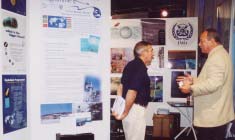
A major exhibit about the Programme was mounted at the
Water Dome. Thousands of brochures and posters were
Mr Koji Sekimizu presenting at WSSD
distributed and I was able to make several presentations
The Summit provided a number of opportunities for
about the ballast water and invasive aquatic species issue
governments, international organizations and other major
at various specialist events throughout the Summit.
groups to organize side events and presentations to
announce and introduce their partnership proposals and
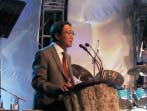
initiatives. Mr Koji Sekimizu, Director of the IMO Marine
Environment Division, presented a number of initiatives
currently supported by IMO. The partnership proposed
for the sustainable continuation of the GloBallast
Programme, dubbed "GloBallast Advanced", stimulated
significant interest.
The current phase of GloBallast has precipitated an
unprecedented momentum of concerted international
action, and created an overwhelming demand from
developing countries for continuing programmatic
support for regional replication and technical assistance
activities. A number of countries and regions have
The GloBallast stand at the WSSD Water Dome
expressed a strong interest in joining the Programme
and the interest is growing almost daily.
The issue of invasive species is extensively reflected in
the Plan of Implementation adopted at the Summit.
GloBallast Advanced will focus on building partnerships
Biodiversity, which plays a critical role in overall
for the effective implementation of international ballast
sustainable development, is essential to the ecological
water control and management arrangements in
functioning of the planet, human well being and the
developing countries, following completion of the current
livelihood and cultural integrity of people. However, the
phase of the Programme and adoption of the new IMO
Summit heard that biodiversity is currently being lost
ballast water Convention.
at unprecedented rates due to human activities, and
Dandu Pughiuc
identified invasive alien species as one of the main causes
www.johannesburgsummit.org
of biodiversity loss.
BWN 10: 7-9/2002
G L O B A L B A L L A S T W AT E R M A N A G E M E N T P R O G R A M M E
B A LT I C B E A R S F R U I T
4
Baltic Workshop
Bears Fruit
In October 2001 the GloBallast Programme
convened the Baltic Regional Workshop on
Ballast Water Management in Tallinn, Estonia
with support from the Estonian Ministry of
Environment, Maritime Administration and
Gulf of Finland
Marine Institute (see Ballast Water News
No. 7: October December 2001).
The workshop involved maritime and environmental
experts from Estonia, Finland, Germany, Latvia, Lithuania,
Poland, Russia, Sweden, the Helsinki Commission, the
Gulf of
European Commission, the Global Environment Facility
Riga
and the US State Department, with the following
objectives:
To integrate the Baltic Sea Region into the GloBallast
programme.
To undertake initial awareness raising about invasive
marine species, the ballast water problem and IMO
ballast water activities amongst key stakeholders in
The north-east Baltic
the Region.
To establish the current status of invasive marine
Marenzelleria viridis. Although D. polymorpha has been in
species and ballast water management arrangements
the Baltic Sea since the mid 1800s, it is still expanding its
in the Baltic Sea countries.
distribution and was very recently first found in Russian
waters of the Gulf of Finland.
To identify and plan some practical projects for
potential funding, that will catalyse concerted action
In addition, a number of other alien species are to be
to improve the management of ballast water and
found in the area: the Ponto-Caspian hydroid
invasive marine species in these countries, and
Cordylophora caspia, the New Zealand mud snail
enhance sub-regional and regional cooperation.
Potamopyrgus antipodarum, the Baikalian amphipod
Gmelinoides fasciatus, the Ponto-Caspian amphipod
Securing additional resources and finances to address the
Pontogammarus robustoides, the American barnacle
problem of invasive aquatic species and ballast water
Balanus improvisus, the Chinese mitten crab Eriocheir
transfers is key objective of the GloBallast Programme.
sinensis, the Amur sleeper Perccottus glenii and the
Significant emphasis was therefore given to the last
Ponto-Caspian hydrozoa Maeotias marginata, whose
objective, with each country presenting project proposals
status and impacts are largely unknown (Leppäkoski
for possible funding and various potential donors being
et al. 2002).
invited.
Ports and shipping in the sub-region are currently
As an outcome of the workshop, Estonia, Finland, Latvia
undergoing significant growth, and shipping trade is
and Russia developed a cooperative project entitled Alien
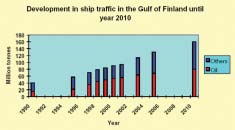
expected to increase fourfold by 2010. The Baltic
Invasive Species in the North-East Baltic Sea: Monitoring
economies are becoming more globally orientated and a
and Assessment of Environmental Impact. This was
major increase in Russian oil exports is underway through
submitted with the support of GloBallast to the US
expansion of existing ports and construction of new ports
Government for consideration for funding. An initial
in the Gulf of Finland (see graph). The sub-region can be
grant of US$34,000 to initiate the Estonian component of
considered as "a hot spot" area in the Baltic Sea in terms
the study, has been secured with the signing of a contract
of vulnerability to alien species and high potential of
between the Estonian Marine Institute and the US
established invaders to negatively affect the ecosystems
Embassy in Tallinn on 17 September 2002.
(Panov, Leppäkoski & Ojaveer 1999). If effective
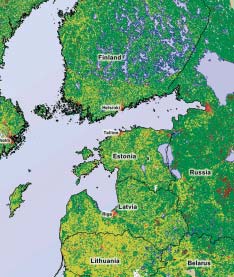
The North-east Baltic (including two large gulfs in this
preventive actions are not implemented, biological
area Gulf of Finland, Gulf of Riga) forms a distinct sub-
pollution could become the most serious environmental
region within the Baltic and cooperation between these
issue for the sub-region in the near future.
neighbouring countries is essential if invasive aquatic
The North-east Baltic also serves as a source of secondary
species are to be addressed effectively.
introductions of alien species to other aquatic ecosystems
Several invasive alien species, whose impact on Baltic Sea
worldwide. The appearance of the water flea Cercopagis
ecosystems seems to be very important, are established in
in 1998 in the North-American Great Lakes (MacIsaac et
the sub-region. These include the Ponto-Caspian zebra
al. 1999) can be attributed to the existing invasion
mussel Dreissena polymorpha, the predatory cladoceran
corridor between the eastern Baltic and the Great Lakes
Cercopagis pengoi and the North American polychaete
(Panov et al. 1999). Recent genetic studies show the
BWN 10: 7-9/2002
G L O B A L B A L L A S T W AT E R M A N A G E M E N T P R O G R A M M E
B A LT I C B E A R S F R U I T
5
network of invasive aquatic species survey and monitoring
programmes, contributing to the ultimate goal of an
effective detection and early warning system.
As the North-east Baltic project develops, it is hoped that
survey and monitoring methods will include application of
standard protocols developed specifically for invasive
aquatic species, as promulgated by the GloBallast
Programme.
Finally, given that regional cooperation is absolutely
essential if invasive aquatic species are to be addressed
successfully, it is hoped that additional funding will be
secured to expand the project from Estonia to include the
source population of the spiny water flea Bythotrephes
other countries in the original project proposal. It is also
in North American Lakes as Lake Ladoga, Port of
hoped that other projects developed at the Tallinn
St. Petersburg area (Berg et al. 2002), and the source
workshop, including those from Lithuania and Poland,
population of Cercopagis in North American Lakes is the
will be funded, thereby ensuring a more regionally
Neva Estuary in the eastern Gulf of Finland (Cristescu et
coordinated and effective response to the problem of
al. 2001).
ballast water transfers and invasive aquatic species.
The goals of the US-funded study are to improve
SR
understanding of the distribution and population
Further information:
parameters of biological invasions in the North-east Baltic,
Dr Henn Ojaveer
develop a monitoring system for aquatic invasive species
Estonian Marine Institute
and to assess their environmental impacts, in order to
henn@sea.ee
provide essential information for invasive species
management, including a joint on-line information system
References cited
and early warning facility.
Berg D.J., Garton D.W., MacIsaac H.J., V.E.Panov & Telesh I.V. 2002.
Methods will include field surveys and experiments and
Changes in genetic structure of North American Bythotrephes
populations following invasion from Lake Ladoga, Russia. Freshwater
laboratory work. Field sampling will be done according to
Biology.
the standard HELCOM recommendations that guarantee
Cederwall, H., Jermakovs, V., & Lagzdinsh, G. 1999. Long-term changes
comparability of the data by countries and also with
in the soft-bottom macrofauna of the Gulf of Riga. ICES J. Mar. Sci., 56
existing historical datasets.
(Suppl.), 41-48.
Cristescu, M.E.A., Hebert, P.D.N., Witt, J.D.S., MacIsaac, H.J. &
Grigorovich, I.A. 2001. An invasion history for Cercopagis pengoi based
on mitochondrial gene sequences. Limnol. Oceanogr. 46: 224-229.
Leppäkoski, E., Gollasch, S., Gruszka, P., Ojaveer, H., Olenin, S. & Panov,
V. 2002 The Baltic - a sea of invaders. Can. J. Fish. Aquat. Sci.
MacIsaac, H.J., Grigorovich, I.A., Hoyle, J.A., Yan, N.D., & Panov, V.
1999. Invasion of Lake Ontario by the Ponto-Caspian predatory
cladoceran Cercopagis pengoi. Can. J. Fish. Aquat. Sci. 56: 1-5.
Panov, V., Leppakoski, E., & Ojaveer, H. 1999. Introduction of alien
species into the Gulf of Finland - an increasing environmental
problem. In: Regional Biological Invasions Center. V. Panov, M. Dianov
and A. Lobanov (eds.).
Panov, V. E., P. I. Krylov & I. V. Telesh 1999. The St. Petersburg harbour
profile. - In: (Gollasch, S. and Leppäkoski, eds) Initial risk assessment of
alien species in Nordic coastal waters. Nord 1999:8. Nordic Council of
Ministers, Copenhagen: 225-244.
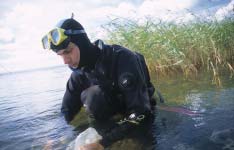
Biological sampling in the Gulf of Riga
The proposed project is of 5-years duration. The $34,000
provided by the US State Department for the Estonian
Receive BWN?
component is for the first year of work only (Sep. 2002 -
Sep. 2003). Additional funding will continue to be sought
for subsequent years. The Estonian Marine Institute,
which is implementing the project, is also contributing
Are you on our mailing list?
resources through two state-financed science projects.
To receive Ballast Water News, please fax or
The funding of this project represents an extremely
e-mail your name and postal address to the
favourable outcome of the GloBallast Baltic workshop and
Programme Coordination Unit
is a credit to the concerted follow-up efforts of the
dedicated staff at the Estonian Marine Institute, in
Fax +44 020 7587 3261 E-mail cgregory@imo.org
particular Dr Henn Ojaveer, and at the US Embassy in
Ballast Water News is also posted on
Tallinn. This enlightened support from the US provides
http://globallast.imo.org/newsletter
another building block to the ever-expanding global
BWN 10: 7-9/2002
G L O B A L B A L L A S T W AT E R M A N A G E M E N T P R O G R A M M E
I N D I A R & D
6
India Holds
stored under dark conditions eliminates photosynthesis
and stops production of organic matter. In this regard
R&D Seminar
changes in the chemical composition of ballast water
during transportation shall be at different scales based on
the nature of the substances. For instance, the changes
that may occur in the magnitudes of inorganic chemicals
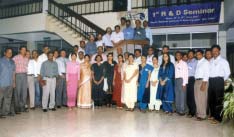
India hosted its 1st R&D Seminar on Ballast
such as nutrients and trace elements could be minimal
Water Control and Management on 13 and
and will be masked by analytical errors.
14 June 2002. Delegates included scientists
It is therefore difficult to use inorganic substances as
and technologists from India, Myanmar and
markers of source waters to identify the port/country of
Singapore.
origin of ballast water. On the other hand, even though
changes in dominant species could occur during
transportation, it is likely that some of the characteristic
organic molecules produced by organisms unique to the
port/country of ballast water origin, could potentially be
utilized to trace the port/country of origin. With the same
logic, whether a ship changed its ballast waters in high
seas or not can be identified by comparing the
characteristic biomarkers in tank waters and that of
port/country from where it sailed or with that of waters
en route.10
Detection of bioinvading invertebrate larvae in ballast
waters was discussed. It was suggested that for successful
detection of invertebrate bioinvasions, molecular probes
Seminar Delegates
of threat species needs to be prepared, together with a
voucher collection of the concerned adult organisms and
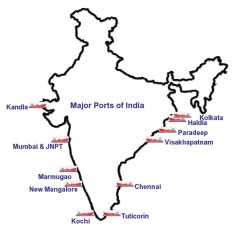
India is a maritime nation with 12 major ports (refer map)
larvae. Development of molecular probes for potential
and several minor ports, which serve as gateways for
threat organisms will go a long way in rapid and reliable
marine bioinvasions. In addition to introduction of alien
detection of threat species.11 Molecular tools that can
species in these ports, the threat of secondary spread to
identify the organisms in ballast water and markers that
neighbouring environments and the highly sensitive coral
can substantiate the effectiveness of mid ocean exchange
reefs of the Andaman, Nicobar and Lakshadweep Islands
have a potential implication in quarantine procedures and
is a distinct possibility. Hence appropriate protocols to
need to be pursued. Simultaneously, it would be
control ballast water mediated invasion is of great
interesting to weigh the option of self-certification by
importance to the ecology of the seas around India.1
using molecular techniques to grade the risk of ballast.11
The R&D seminar concluded with the following
The 1st R&D Seminar was organized through the National
recommendations:
Institute of Oceanography (NIO), Goa. Delegates included
scientists and technologists from different R&D
The basis for bioinvasion evaluation depends upon the
organizations of India, Myanmar and Singapore.
understanding of historical and present scenario. To
facilitate establishment of current status a nationally
The presentations made during the seminar illustrated the
coordinated monitoring exercise needs to be
status of invasive species along the east and west coasts of
undertaken. A template for such monitoring at all the
India.2-6 Research related to ballast water management
major Indian ports needs to be evolved, to ensure
and the technological options currently being investigated
uniformity in monitoring and reporting. This exercise
in Singapore were presented.7 In exploring the options for
should also aim at incorporating regional scenario.
ballast water treatment, the utility of ionizing radiation
was discussed. Given its ability to control a broad
Bioinvasion models depend upon the available data
spectrum of organisms and life history stages, the fact
sets so that a comparison can be made with data
that is presently being used for medical sterilization, food
collected from port baseline surveys, ballast water
irradiation and treatment of municipal wastes, the
sampling and risk assessment models. It was felt that
seminar considered that this technology could be
such a compilation from secondary data sets from
explored for ballast water treatment.8
published literature, technical reports, thesis etc., is
One of the presentations dealt with modeling dispersion
possible with the involvement of all the relevant
of ballast water discharged in the coastal environment.
research and academic institutions of the country.
This was demonstrated with a simulation of a case study
The Indian coastline is dotted with twelve major ports
in the Gulf of Kachchh region on the west coast of India
and in the existing scenario each of these ports needs
where there is one major port and several minor ports,
to identify a suitable ballast water discharge area in
using a two-dimensional hydrodynamic model - MIKE21.9
case of emergencies. In this context a presentation was
The seminar heard that potential change in ballast water
made by NIO, which reflected such a possibility
characteristics during transportation is an important
through modeling studies. This needs to be initiated in
aspect in management and quarantine. Ballast water
similar lines as that of port baseline survey, ballast
BWN 10: 7-9/2002
G L O B A L B A L L A S T W AT E R M A N A G E M E N T P R O G R A M M E
I N D I A R & D
7
water sampling and risk assessment in all major ports
to begin with.
The NIO, which is serving as the nodal agency for R&D
activities under the GloBallast Programme in India, is
also involved in the Risk Assessment issues for Mumbai
and Jawaharlal Nehru ports. This needs to be
replicated for rest of the major ports of India as well.
The existing IMO ballast water guidelines (A.868(20))
suggest mid ocean exchange as the possible means at
the moment to minimize risk of bioinvasion.
Quarantining of such practices has become a
requirement by some of the countries. The
presentations made also recognized that methods
need to be established for verifying such exchange. It
was opined that characteristic biomarkers of different
regions, countries and ports of the world need to be
established.
The debate on risk of ballast mediated invasion and
technological options in its mitigation is ongoing. The
presentations showed that it might be interesting to
explore the option of self certification by using
Major ports of India
appropriate molecular techniques to grade the risk
associated with ballast water. It is also relevant to note
that such self certification or declaration of no or
References cited
limited risk ballast on board can cut the ballast water
management cost on many occasions. Such an
1 Anil, A.C., Venkat, K., & Sawant, S.S. Marine bioinvasion: an
overview. In: Proceedings of the 1st R&D Seminar on Ballast Water
initiative needs to be encouraged from an R&D
Control and Management, India.
perspective. This would require a global effort
2 Santhakumaran, L.N. Animal Ocean travelers as unauthorized
wherein each country identifies the probable risk
harmful immigrants. In: Proceedings of the 1st R&D Seminar on
species.
Ballast Water Control and Management, India.
Among the technological options, the use of shore
3 Karande, A.A. Ship-ballast-water menace: transfer of marine
species. In: Proceedings of the 1st R&D Seminar on Ballast Water
based ionizing radiation facility was considered as an
Control and Management, India.
attractive option for ballast water treatment and
4 Satyanarayana Rao, K. Bio-invasive species in fouling communities
needs to be explored.
along east coast of India. In: Proceedings of the 1st R&D Seminar
India should develop a region-specific web site on the
on Ballast Water Control and Management, India.
issue.
5 Avhad, G.K. Assessment of results on first and second Mumbai port
baseline surveys conducted by Fisheries Survey of India during
Dr. A.C. Anil
November'2001 and May'2002. In: Proceedings of the 1st R&D
Seminar on Ballast Water Control and Management, India.
National Institute of Oceanography
6 Karunasagar, I. Transfer of pathogens and toxic algae through
acanil@darya.nio.org
ballast water. In: Proceedings of the 1st R&D Seminar on Ballast
Water Control and Management, India.
Mr. Sanjoy Chakrabarty
7 Matheickal, J. Ballast water management research in Singapore. In:
Country Focal Point
Proceedings of the 1st R&D Seminar on Ballast Water Control and
GloBallast Programme - India
Management, India.
sanjoy@dgshipping.com
8 Venogopal, V.P. Ballast water treatment: options and limitations.
In: Proceedings of the 1st R&D Seminar on Ballast Water Control
and Management, India.
9 Jayakumar, S., Babu, M.T., & Vethamony P. Modelling Ballast water
transport. In: Proceedings of the 1st R&D Seminar on Ballast Water
Conference
Control and Management, India.
10 Dileepkumar, M. Changes in ballast water characteristics during
Announcement
transportation. In: Proceedings of the 1st R&D Seminar on Ballast
Water Control and Management, India.
11 Raghukumar, S. Sleuthing of bioinvading invertebrate larvae in
3rd International Conference
ballast waters. In: Proceedings of the 1st R&D Seminar on Ballast
Water Control and Management, India.
on Marine Bioinvasions
The full proceedings are available from the Country Focal Point.
La Jolla, California, USA
March 2003
www.sgmeet.com/mb
BWN 10: 7-9/2002
8
G L O B A L B A L L A S T W AT E R M A N A G E M E N T P R O G R A M M E
N AV I O N
Navion Tests New
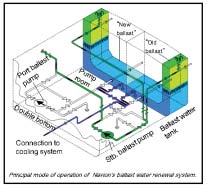
The system calls for a simple piping installation, which
allows seawater to be added from both top and bottom of
Exchange Concept
the ballast tanks. This pipework is connected to the existing
ballast water pumps, and the efficiency of the system could
be enhanced by incorporating the coolant water pumps in
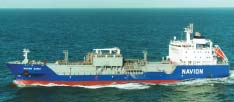
Norway's Navion shipping company has been
the circuit.
testing a possible new system for ballast water
Sintef claims that its small-scale trials show that density
exchange, which Navion hopes will be
differentials as low as 0.05 grams per cubic centimetre are
efficient, easy to operate and maintain and
sufficient to provide effective replacement. Incoming water
is added at the top of the tank if it is lighter than the
inexpensive to install. The new concept is now
ballast, and at the bottom if its density is higher. The tests
being tested in full scale on the company's
indicate that little mixing occurs between water with
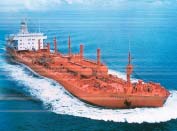
7,500t ethane carrier Navion Dania.
differing densities.
The Navion Dania
The Navion concept for ballast water exchange aims to
exploit variations in density between water in the ballast
tanks and in the sea surrounding the vessel, caused by such
factors as differing salinity and/or temperature. Small-scale
model tests at Norway's Sintef research foundation in
December 2001 found that even minor variations in density
were enough to achieve a "plug flow" effect or
displacement.
The principal conclusion by Sintef is that the replacement
rate for the ballast water could be high. Given that the
The existing methods of ballast water exchange as
model unit was designed as an ordinary ballast tank, and
recommended by IMO complete empty and refill or
such tanks normally have physical reinforcements which
flow-through of three times the tank volume are time-
theoretically create turbulence and mixing, the water
consuming and require controlled conditions. The vessel's
loading condition must be carefully monitored during this
replacement rate could be increased through optimal
operation, which calls for additional manning and possible
tank design. It would also be important to control the
overtime. It also raises the risk of operational error. In the
incoming water flow in order to minimise mixing.
Navion concept the tanks will always be full and
Navion estimates that the cost of installing the system
continuous monitoring of the vessel's loading condition
might total roughly NOK 3-5 million for a medium-sized
is not required.
tanker. Retrofitting could be done on certain vessel types
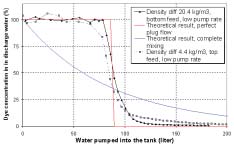
The Sintef small-scale tests involved adding colorant to
in service, while others must be docked. Investment would
simulated ballast water and measuring its concentration in
be lower for ships which incorporate the system from the
the displaced water. The figure below shows two of the
design phase.
measurement results in relation to theoretical calculations.
Navion has awarded a letter of intent to Norway's VEKOS
The test unit was constructed as a scaled-down
ship installation specialist covering world-wide marketing
conventional ballast tank of around 100 litres.
of the system and installation on vessels. Patent
applications have been filed by Navion.
The results of the real-life testing will be of extreme
interest to IMO and national regulatory bodies. Most
importantly, the biological effectiveness of the system in
terms of actually preventing or reducing the transfer of
species remains to be demonstrated and verified. Before
adoption by the shipping industry, any new ballast water
management arrangements should be approved through
IMO and relevant jurisdictions.
Further information:
adne.brathammer@navion.no
BWN 10: 7-9/2002
G L O B A L B A L L A S T W AT E R M A N A G E M E N T P R O G R A M M E
W A R N I N G
9
Warning Beware
Unfortunately, none of these groups have been able to
provide the PCU with hard data that has been published
the Ballast Bafflers!
in peer-reviewed, internationally recognized scientific
journals. Technical details of their experimental designs
and test protocols are often very sketchy, or if available,
Currently, through Assembly Resolution
are sometimes of questionable quality. Test protocols also
vary widely between research projects, making it virtually
A.868(20), IMO recommends the following
impossible to compare different systems in a meaningful
main procedures for ships, in order to
way.
minimize the transfer of harmful aquatic
It appears that some of the claims relating to cost
organisms and pathogens in ballast water:
effectiveness, low-maintenance and ease of operation of
some of the systems may well be justified. Never-the-less,
Minimize the uptake of organisms.
if the system cannot be proven to be biologically
Remove ballast sediment on a timely basis.
effective, according to scientifically rigorous verification
Undertake ballast water exchange at sea, as far as
procedures, the most important criteria is missing and it
possible from shore, using either complete empty and
should not be accepted as an alternative treatment
refill or the flow-through method (equivalent to at
system.
least three complete tank volumes in the case of the
latter).
It is hoped that many of the R&D projects that have
commenced more recently, are designed and managed
Discharge to reception facilities.
in such a way that these major deficiencies will be
Other options as approved by the port State.
addressed, and that the quality of the science will begin
to improve, including peer review and publication.
The IMO guidelines also require relevant ships to carry
ballast water management plans and maintain and report
Regulatory agencies and ship designers, builders and
records according to standard templates. They also
owners should be extremely cautious when evaluating
provide guidance and details on a range of other issues
new, alternative ballast water treatment systems. There
(http://globallast.imo.org/guidelines/).
is a danger that shipping will invest in installing systems
that may be of limited usefulness in terms of actually
While ballast water exchange at sea remains the main risk
killing organisms, and which may become redundant once
reduction measure, it is widely recognized that this
IMO agrees international standards for such systems.
technique is far from perfect. The hunt is therefore on to
find alternative, more effective ballast water treatment
The vital efforts of the R&D community to find a solution
techniques, driven also by a potential multi-billion dollar
to this problem should be applauded and fully supported,
market. As reported in various issues of Ballast Water News,
and shipping companies should be strongly encouraged
the GloBallast Programme has been working to assist this
to fit and test alternative systems in real-life operational
process. These efforts have included covering the 1st
situations, as an essential part of the R&D effort.
International Ballast Water Treatment R&D Symposium and
However, until these systems are proven effective and
Standards Workshop in London in March 2001, developing
approved by a relevant jurisdiction, they are experimental
and maintaining the Ballast Water Treatment R&D
only. International standards and procedures for the
Directory (http://globallast.imo.org/research/), directly
evaluation and approval of new ballast water treatment
funding R&D activities in some of the GloBallast Pilot
systems therefore need to be agreed and implemented as
Countries and maintaining cooperative links with a number
soon as possible, adopting realistic, practical, achievable
of R&D projects and bodies.
and verifiable targets.
While the 1st R&D Symposium and Standards Workshop
The current discussions within the IMO Marine
were hailed as major successes, playing a crucial role in
Environment Protection Committee provide a unique and
catalyzing a more coordinated, cooperative, global R&D
time-critical opportunity to put this matter to rest. In the
effort, one of the features of the symposium was a
meantime, beware the ballast water bafflers!
surprisingly poor quality of science evident in many of the
SR
papers presented. Unfortunately, this situation does not
seem to be improving.
Here at the Programme Coordination Unit (PCU) we are
bombarded by salesmen, vendors and researchers offering
the ultimate solution to the ballast water problem, almost
on a weekly basis. Various groups are claiming that their
systems are 'more effective than ballast water exchange'
(a virtually impossible comparison given the wild
variability of exchange), that they can kill 99% or even
100% of organisms, that there systems are cost effective,
low-maintenance, easy to operate, environmentally sound
etc etc.
BWN 10: 7-9/2002
10
G L O B A L B A L L A S T W AT E R M A N A G E M E N T P R O G R A M M E
N O B O B
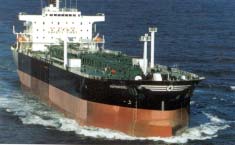
No Ballast No Bugs
are euryhaline and can survive exposure to high salinity
and (b) form resting stages that accumulate in bottom
sediments and are difficult to remove with exchange.
Over the last decade, much attention has
Therefore, the effectiveness of exchanging freshwater
from these regions for open-ocean saltwater is an
been focused on ballast water as a vector for
important, largely unresolved question to consider.
non-indigenous species introductions, and on
A multi-institutional team of scientists from the National
open-ocean ballast exchange as a defence
Oceanic and Atmospheric Administration (NOAA) Great
against new introductions. However the issue
Lakes Environmental Research Lab (GLERL), the University
of NOBOB (no-ballast-on-board) vessel
of Michigan, the University of Windsor (Canada), Old
operations in the North American Great
Dominion University (USA), Phillip T. Jenkins and
Lakes has risen from a position of relative
Associates (Canada), and the Smithsonian Environmental
obscurity to become one of the top concerns
Research Center (USA) is conducting a multi-disciplinary
research program with three interrelated research tasks:
in the Great Lakes basin today.
Task 1: Characterization of biological communities and
ballast residuals in NOBOB tanks and relationship to
ballast management procedures;
Task 2: Ballast tank mesocosm experiments to
determine whether resident biota in NOBOB ballast
tanks are discharged to the Great Lakes under actual
ship operating conditions; and
Task 3: Experiments to test the effectiveness of open-
ocean exchange in transoceanic vessels carrying fresh
or low-salinity ballast water.
During the 2001 shipping season 22 vessels were boarded
and the residual ballast material sampled in 43 ballast
tanks. Ballast management surveys were also completed
Even ships with no ballast on board (NOBOB) can transfer
on 61 vessels. Generally, total ballast residuals were <1%
organisms in residual ballast water and sediments
of total ballast capacity in those tanks entered and
visually assessed, and the sediment component was
On average, less than 10% of ocean vessels entering the
estimated to be <50% of total residual. Participation of
Great Lakes in recent years contained declarable ballast
shipping industry and cooperation of captains and crews
water on board. NOBOB vessels escape scrutiny under
were outstanding.
existing U.S. and Canadian federal, state, and provincial
All tanks sampled contained live invertebrates and
laws, yet their ballast tanks may retain residual volumes
phytoplankton, and/or viable resting stages of
of un-pumpable ballast water, as well as accumulations of
zooplankton and phytoplankton. Concentrations of
sediment and aquatic organisms and eggs representing
bacteria were similar to those of other environmental
numerous previous ballasting operations.
samples, whereas concentrations of virus-like-particles in
While operating in the Great Lakes, NOBOB vessels take
NOBOB residual sediments ranged higher than values
on water as ballast to maintain their trim and stability.
reported for other sediment types. Many resting eggs and
This new ballast water can mix with the residual ballast
cysts of both invertebrates and phytoplankton readily
water, mud, and associated non-indigenous organisms in
hatched in freshwater and/or saltwater treatments under
these tanks and then be discharged as the vessel takes on
controlled laboratory conditions. Some second-generation
new cargo at a various ports along its route. Thus, the
populations were produced by the first generation
ballasting operations of NOBOB vessels present a
hatched invertebrates. The most common live
previously overlooked risk as a vector for invasions, but
invertebrates found in residual water analyzed to date
the magnitude of risk remains unresolved.
were nauplii, rotifera, and cyclopoida, while in the
sediment residuals, nematodes, harpacticoids, and
Another concern is the effectiveness of ballast exchange
cyclopoids were the most common.
as a preventive measure. Of particular relevance to the
Great Lakes is the efficacy of open-ocean ballast exchange
Work is continuing in 2002 including sampling of residuals,
when the original ballast is fresh or low salinity water,
a voluntary ballast practices survey (Task 1), two additional
which differs in density and biota from high salinity
ballast tank mesocosm experiments (Task 2), and two
water. The freshwater regions of Europe and especially
transoceanic ballast exchange experiments (Task 3).
the coastal regions of the Baltic and Black Seas have been
David F. Reid
implicated as source regions for most of the Great Lakes
NOAA Great Lakes Environmental Research Lab
invaders found since 1985 (e.g. zebra mussel, quagga
mussel, round goby, tubenose goby, amphipod
David.Reid@noaa.gov
Echinogammarus ischnus, the fishhook waterflea,
Cercopagis pengoi, and the diatom Thalassiosira baltica).
Many of the aquatic organisms found in these regions (a)
BWN 10: 7-9/2002





G L O B A L B A L L A S T W AT E R M A N A G E M E N T P R O G R A M M E
P U B L I C AT I O N S
11
Publications
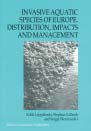
Invasive Aquatic Species of Europe
New Posters Available
Although the problem of
biological invasions has become a
rapidly growing research area,
major research gaps remain, both
geographically and thematically.
Invasive Aquatic Species in Europe:
Distribution, Impacts and
Management is the first attempt
to provide an overall picture of the
situation in Europe.
The geographical scope of
this new book, edited by
E. Leppäkoski, S. Gollasch & S.
Olenin, stretches from Irish waters in the west to the
Volga River and the Caspian Sea in the east, and from the
Mediterranean in the south to the Arctic in the north.
All major European aquatic systems on the broadest
geographical and ecological scope possible are
represented, from fully saline seas, semi-enclosed brackish
water bodies and coastal lagoons to freshwater lakes,
major river systems and waterways. Not all parts of the
continent could be equally covered, as in some areas
As part of its ongoing communication and awareness
species invasions are not well studied.
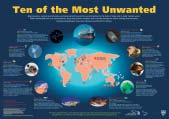
campaign, the PCU has released two new posters. The
Altogether more than 100 scientists from 24 countries
first, entitled `Ten of the Most Unwanted', describes
joined to synthesize the available information on aquatic
some of the world's best known invasive aquatic species
bioinvasions.
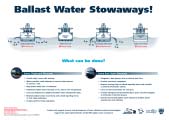
and the impacts they are causing. The second, entitled
More details, material to download and order form at
`Ballast Water Stowaways What Can be Done?'
http://www.ku.lt/nemo/EuroAquaInvaders.htm
provides a clear pictorial representation of how aquatic
organisms are transferred in ballast water and lists some
GloBallast Monograph Series
simple but effective measures that can be taken, both
Launched
on board ships and by port States, to reduce this threat.
Both posters can be ordered as full-size hard copies, free-
As part of the
of-charge, from cgregory@imo.org, or downloaded as PDF
GloBallast
files from http:/globallast.imo.org/awareness/.
information
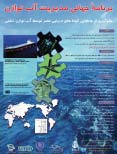
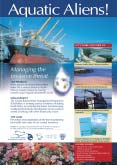
In addition, the Pilot Countries are continuing to produce
clearing-house
local awareness materials for use nationally and
function, a new
regionally, as per these example from South Africa and
monograph
Iran.
series, including
reports and
proceedings of
conferences and
workshops as
well as
technical,
scientific and
consultancy activities, has been launched by the PCU.
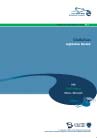
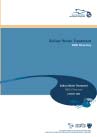
The first to be released are the final reports on the
GloBallast Legislative Review and the Baltic Regional
Workshop on Ballast Water Management. Further reports
in the series are forthcoming.
The monographs can be ordered as hard copies, free-of-
charge, from cgregory@imo.org, or downloaded as PDF
files from http:/globallast.imo.org/publications/.
BWN 10: 7-9/2002


G L O B A L B A L L A S T W AT E R M A N A G E M E N T P R O G R A M M E
2
12
Progress Report
Activities Undertaken July September 2002
Activities Planned October December 2002
PCU staff annual leave.
Continue second round of country visits for ballast
water risk assessments.
Prepared for and attended World Summit on
Sustainable Development, Johannesburg,
Present at IMO-UNEP Regional Seas Forum, IMO
London 2 September.
26 August 4 September.
Prepare for and attend Inter-sessional Ballast
Completed UNDP-GEF Project Implementation
Water Working Group meeting, IMO London,
Review.
30 Sept 4 October.
Undertook mid-term external review of the
Prepare for and attend MEPC 48, IMO London,
programme.
7-11 October.
Prepare for and hold 4th Global Task Force
Commenced second round of country visits for
meeting, Beijing, China 28-30 October.
ballast water risk assessments.
Prepare for and hold 1st East Asian Regional Task
Attended and presented at NordTest workshop,
Force meeting, Beijing, China 28-30 October.
Copenhagen, 16 September.
Participate in CIESM shipping vectors workshop,
Prepared for and attended GEF International
Istanbul, Turkey 6-8 November.
Waters Conference, Dalian, China, 26-29
Assist and participate in joint RECSO/GloBallast
September.
tanker industry workshop, Dubai 16-18 December.
Distributed new awareness materials.
Complete and implement mid term evaluation
review.
Progressed sponsorship and partnership
, October 2002.
Prepare GloBallast Advanced funding submission
arrangements for production of TV documentary.
to GEF.
Commenced publication of the GloBallast
Implement Country Profile database on GloBallast
Monograph Series.
web site.
ecycled paper
Produced 10th issue of Ballast Water News.
Produce 11th issue of Ballast Water News.
.dwa.uk.com · Printed on r
More Information?
Programme Coordination Unit
el (+44) 020 7928 5888 www
Global Ballast Water Management Programme
International Maritime Organization
4 Albert Embankment
London SE1 7SR United Kingdom
Telephone : +44 (0)20 7587 3247 or 3251
Fax
: +44 (0)20 7587 3261
est & Associates, London. T
Email
: dpughiuc@imo.org or sraaymak@imo.org
Web
: http://globallast.imo.org
Daniel W
BWN 10: 7-9/2002