



3
Ballast Water News
Global Ballast Water
Ballast Water News Management Programme
I S S U E 1
A P R I L J U N E 2 0 0 0
I S S U E 1
A P R I L J U N E 2 0 0 0
From the Editor
From the Programme
Welcome to the first issue of Ballast Water News, the
The initiation of this Global programme heralds a new
quarterly newsletter of the Global Ballast Water
era in the activities of IMO, representing a concerted
Management Programme, a new initiative to address
effort to provide technical assistance to member
the severe environmental, economic and health threats
countries to implement IMO guidelines and
posed by harmful organisms carried in ships' ballast
conventions.
water.
An extremely important consideration during the
As the first newsletter, this issue provides an
development of programme will be to ensure
introductory overview of the programme. Future issues
coordination between each demonstration site and
will provide updates on the programme's progress as
consistency with the international regime. As shipping
well as articles on latest developments in science,
is probably the most international industry, the only
engineering, shipping, law and other responses to the
effective way to address shipping related issues is
problem of introduced marine species.
through a standardised international system. This has
been one of the hallmarks of the success of IMO in its
It is hoped that the newsletter will assist the
more than 50 year history. The avoidance of unilateral
dissemination and exchange of information and views.
responses by individual states is critical to the success
Professionals from all disciplines involved in ballast
of the programme.
water or introduced marine species are invited to
submit articles and letters to the Editor, for
A key feature of the Global Ballast Water
consideration for publication in Ballast Water News.
Management Programme is the level of cooperation
between different agencies, countries, industry and
Under the programme, an Information and
other parties that it embraces. The programme sees
Communications Network is being established at IMO
the resources of the Global Environment Facility (GEF)
in London. This will provide a central reference point,
being deployed through the United Nations
clearing-house and communication facility for all
Development Program (UNDP) to allow IMO to assist
Global information on invasive marine species in
the governments of Brazil, China, India, Iran, South
general and ballast water in particular.
Africa and Ukraine, to protect their coastal and marine
resources from the major threat of alien species
The network will be largely electronic and internet
introduced through ballast water.
based, including links with web-sites and databases
maintained by other organizations. It is hoped that
As the programme develops, this cooperation will be
this will enhance communication between parties
extended to include additional governments in each
working on introduced marine species around the
region represented by the initial demonstration sites.
world, and thereby reduce the possibility of
After the completion of the programme IMO is
duplication. It will also include a hard copy collection
committed to sustain the necessary mechanism to assist
of publications, housed in the IMO library.
all member states as they strive to meet their
obligations under the expected mandatory instrument.
I am most pleased to be a member of the Programme
Coordination Unit at IMO and I look forward to
Our role here at the Programme Coordination Unit is a
serving as Technical Adviser to the programme and
challenging one, and we look forward to serving all
Contributing Editor for Ballast Water News over the
programme partners to deliver successful and fruitful
next three years. Happy reading!
outcomes together.
Steve Raaymakers
Dandu Pughiuc
Contributing Editor
Chief Technical Adviser
Ballast Water News is produced by the Programme Coordination Unit,
Global Ballast Water Management Programme,
International Maritime Organization,
4 Albert Embankment, London SE1 7SR, UK.
Tel: +44 (0)20 7587 3247 or 3251. Fax: +44 (0)20 7587 3261.
Email: dpughiuc@imo.org or sraaymak@imo.org.
The views expressed in Ballast Water News are not necessarily those of IMO, UNDP or GEF
G L O B A L B A L L A S T W AT E R M A N A G E M E N T P R O G R A M M E
T H E P R O B L E M
2
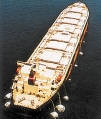
fills with ballast water to maintain its stability, balance
The Problem
and structural integrity. When it loads cargo, the ballast
water is discharged
The introduction of invasive marine
species into new environments by
The problem of concern to this programme arises when
ships' ballast water, attached to
this ballast water contains marine life. There are literally
ships' hulls and via other vectors has
thousands of marine species that may be carried in
been identified by the GEF as one of
ships' ballast water; basically anything that is small
the four greatest threats to the
enough to pass through a ships' ballast water intake
world's oceans. The other three are
ports and pumps. This includes bacteria and other
land-based sources of marine
microbes, small invertebrates and the eggs, cysts and
pollution, over exploitation of living
larvae of various species. In one case, healthy, live fish
marine resources and physical
have been found swimming in a ship's ballast tank.
alteration/destruction of marine
habitat.
The development of larger, faster ships completing their
voyages in ever shorter times, combined with rapidly
Shipping moves over 80% of the
increasing world trade, means that the natural barriers
world's commodities and transfers
to the dispersal of species across the oceans are being
around 10 billion tonnes of ballast
reduced.
water across the globe each year.
Ballast water is absolutely essential
As a result, whole ecosystems are being changed. In the
to the safe and efficient operation of modern shipping,
USA, the European Zebra Mussel Dreissena polymorpha
providing balance and stability to un-laden ships.
has infested over 40% of internal waterways and has
However, it may also pose a serious ecological, economic
required over US$1 billion in expenditure on control
and health threat.
measures since 1989. In southern Australia, the
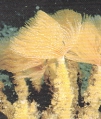
northern Asian kelp Undaria pinnatifida is invading new
What is ballast water? Ballast is any material used to
areas rapidly, displacing the native seabed communities.
weight and/or balance an object. One example is the
In several countries, introduced, microscopic, `red-tide'
sandbags carried on conventional hot-air balloons,
algae (toxic dinoflagellates) have been absorbed by
which can be discarded to lighten the balloon's
filter-feeding shellfish, such as oysters. When eaten by
load, allowing it to ascend.
humans, these contaminated shellfish can cause
paralysis and even death.
Ships have carried solid ballast, in the form of
rocks, sand or metal, for thousands of
The list goes on, hundreds of examples of
years. In modern times, ships use water
major ecological, economic and human
as ballast. It is much less difficult to load
health impacts across the globe. It is
on and off a ship, and is therefore more
even feared that diseases such as cholera
efficient and economical than solid
C A R G O
might be able to be transported in ballast
ballast. When a ship is empty of cargo, it
water.
Bulk carrier cross section
Shaded area = ballast tanks fitted for stability.
Filled with seawater when ship empty of cargo.
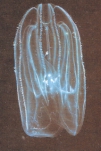
Case Study
q Species Mnemiopsis leidyi
q Main impacts Massive decline in
commercial fisheries due to reduction in
q Common name Comb jelly
plankton, which the Comb jelly feeds on.
q Origin North America
Losses estimated at US$500M per year!
q Introduced to Black Sea
Compounds other human impacts such as
q Via Ships' ballast water
pollution.
q First recorded 1982
q Management Options Increased
q Status Populations fluctuate, may
regional cooperation. Prevent
exceed 1kg/m2 in biomass throughout
translocation of the Comb jelly from
the entire Black Sea at times.
Black Sea. Research biological controls.
BWN 1: 4-6/2000


G L O B A L B A L L A S T W AT E R M A N A G E M E N T P R O G R A M M E
T H E G L O B A L R E S P O N S E
3
The Global Response
In response to this threat, the United
q Avoiding unnecessary discharge of ballast.
Nations Conference on Environment
and Development (UNCED) held in
q Undertaking ballast water management
Rio de Janeiro in 1992, in its Agenda
procedures, including:
21 called on the International
q
Exchanging ballast water at sea, replacing it
Maritime Organisation (IMO) to take
with `clean' open ocean water. Any marine
action to address the transfer of
species taken on at the source port are less
harmful organisms by ships.
likely to survive in the open ocean, where
environmental conditions are different from
As a specialised agency of the United Nations
coastal and port waters.
responsible for the international regulation of ship
safety and the prevention of marine pollution, IMO is
q
Non-release or minimal release of ballast water.
the most appropriate body through which to address
this issue. By 1992 it had already been active in ballast
q
Discharge to onshore reception and treatment
water issues for over ten years.
facilities.
The member countries of IMO have developed
The shipping industry has also been very active in
voluntary guidelines for the control and management
helping to address invasive marine species and
of ships' ballast water, to minimise the transfer of
participates actively in the IMO Marine Environment
harmful aquatic organisms and pathogens. These
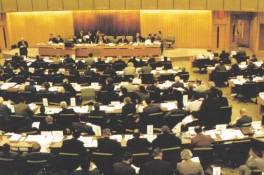
Protection Committee (MEPC) Ballast Water Working
guidelines were adopted by the IMO Assembly in 1997,
Group. In particular, the International Chamber of
by resolution A.868(20). They replace earlier, less
Shipping (ICS) and the International Association of
comprehensive voluntary guidelines adopted in 1993.
Independent Tanker Owners (INTERTANKO) have
Management and control measures recommended by
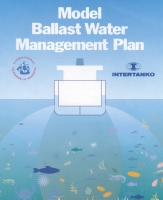
published an excellent Model Ballast Water
the guidelines include:
Management Plan. This gives practical guidance for
the implementation of the IMO voluntary guidelines
q Minimising the uptake of organisms during
on board ships.
ballasting, by avoiding areas in ports where
populations of harmful organisms are known
All of the approaches recommended under the IMO
to occur, in shallow water and in darkness,
guidelines are subject to limitations. Reballasting at
when bottom-dwelling organisms may rise in
sea currently provides the best-available risk
the water column.
minimisation measure, but is subject to serious ship-
safety limits. Even when it is able to be fully
q Cleaning ballast tanks and removing muds and
implemented, this technique is less than 100%
sediments that accumulate in these tanks on a
effective in removing organisms from ballast water.
regular basis, which may harbour harmful
organisms.
BWN 1: 4-6/2000
G L O B A L B A L L A S T W AT E R M A N A G E M E N T P R O G R A M M E
T H E G L O B A L R E S P O N S E s T H E G E F I W P R O J E C T
4
The Global Response continued The GEF IW Project
Significant research and development efforts are
therefore underway by a number of scientific and
engineering research establishments around the world,
aimed at developing a more complete solution to this
problem. Options being considered include:
Global Ballast Water
Management Programme
q Physical treatment methods such as filtration,
separation and sterilisation using ozone, ultra-
violet light, electric currents and heat treatment.
q Chemical treatment methods such adding biocides
In addition to the initiatives described above, IMO has
to ballast water to kill organisms.
joined forces with the GEF International Waters (IW)
q Biological treatment methods such as adding a
portfolio, the United Nations Development Programme
predatory or parasitic organism to ballast water to
(UNDP), member governments and the shipping
kill any other organisms it might contain.
industry to assist less-industrialised countries to tackle
the ballast water problem.
All of these possibilities currently require significant
further research effort. Any control measure that is
The full title of this new project is Removal of Barriers
developed must meet a number of criteria, including:
to the Effective Implementation of Ballast Water
Control and Management Measures in Developing
q It must be safe.
Countries. It is more simply referred to as the Global
q It must be environmentally acceptable.
Ballast Water Management Programme.
q It must be cost-effective.
q It must work.
This programme will assist developing countries to
implement effective measures to control the
introduction of foreign marine species, initially
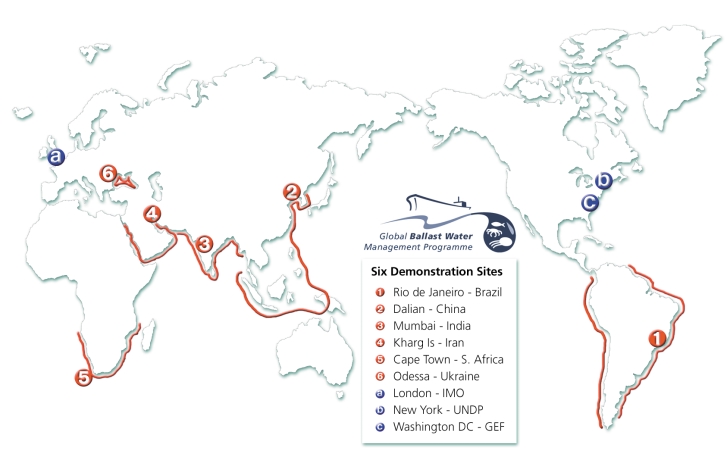
through six demonstration sites. These are intended
to represent the six main developing regions of the
world, being (Refer Map):
q Dalian/China
East Asia,
q Mumbai/India
South Asia,
q Kharg Island/Iran
Middle East,
q Cape Town/South Africa
Africa,
q Odessa/Ukraine
Eastern Europe, and
q Sepitiba/Brazil
South America.
It is planned that as these sites progress, they will be
replicated throughout each region in the future.
In recognition of the limitations of the current IMO
Lessons learned from the initial demonstration sites
voluntary guidelines, the current lack of a totally
effective solution and the serious threats still posed by
will be valuable in improving ballast water
invasive marine species, IMO member countries have
management and reducing the translocation of
agreed to develop a mandatory international legal
harmful marine species in each region.
regime to regulate and control ballast water.
The programme will provide a mechanism for the
The IMO's MEPC and its Ballast Water Working Group,
ongoing provision of technical assistance to less
are well advanced with developing this regime and it
industrialised countries to implement the new IMO
is hoped that it will be agreed by member countries in
ballast water regime when it comes into force,
2002. It may take the form of a new Annex to the
through the continuation of an in-house ballast water
International Convention for the Prevention of
unit at IMO after the three years of the GEF IW
Pollution from Ships (MARPOL), or a new international
project. This will build on the groundwork conducted
convention or other legal instrument in its own right.
by the initial Programme Coordination Unit.
BWN 1: 4-6/2000
G L O B A L B A L L A S T W AT E R M A N A G E M E N T P R O G R A M M E
T H E G E F I W P R O J E C T
5
Development Objectives
Timeline and Funding
The broad development objectives of the programme
This is a three-year programme (2000-2003).
are:
The total budget is US$10.2 million, comprising:
q Assist developing countries to reduce the transfer
of harmful organisms from ships' ballast water.
q US$7.39 million from GEF
q Increase adherence by these countries to the
q US$2.8 million in co-funding from the six
current IMO voluntary guidelines on ballast water
participating countries.
management.
q Assist these countries to prepare for the
implementation of the IMO mandatory regime
Programme Management
when it comes into force.
The programme is being implemented by UNDP and
executed by IMO, under the GEF International Waters
Immediate Objectives
portfolio.
In order to achieve the broad development objectives,
A three person PCU has been established within the
the programme has a number of Immediate
Marine Environment Division (MED) at IMO
Objectives, which are linked to specific Outputs and
headquarters in London.
Activities. These are:
The PCU has the benefit of the support, facilities and
q Programme coordination and management.
services of IMO. High priority is being given to
q Communication, education and awareness.
coordinating the activities of the programme with the
q Risk Assessment.
broader activities of IMO, especially the development
q Ballast water management measures.
of the international ballast water regulatory regime by
q Compliance, enforcement and monitoring.
MEPC.
q Regional cooperation and replication.
q Resources and financing.
Country Focal Points (CFPs) and CFP Assistants have
been established in each of the six participating
An extremely important consideration will be to
countries.
ensure coordination between each site and consistency
with the international regime. As shipping is an
Overall, the programme will be advised by a Global
international industry, the only effective way to
Project Task Force (GPTF). This will comprise
address shipping related issues is through a
representatives of GEF, UNDP, IMO and the six
standardised international system. This has been one
participating countries, the shipping industry and
of the hallmarks of the success of IMO in its 50 year
possible other parties that are able to contribute to
history. The avoidance of unilateral responses by
the programme in a meaningful way.
individual states is critical to the success of the
programme.
Would You like to receive
Have your say!
Ballast Water News
Please feel free to submit articles
in the future?
or letters to the editor for
Please fax or e-mail your name and postal address to the
consideration for publication
Programme Coordination Unit
in Ballast Water News
Fax +44 20 7587 3261 s E-mail mbaker@imo.org
mbaker@imo.org
Ballast Water News will also be posted on www.imo.org
BWN 1: 4-6/2000


G L O B A L B A L L A S T W AT E R M A N A G E M E N T P R O G R A M M E
P R O G R A M M E S U M M A RY
6
.
regime.
pport.
n IMO guidelines.
ng countries.
country
ment and training.
.
,
Programme Assistant and su
.
.
'
ballast water
chnical Adviser
e
,
T
ask Force (CPTF) and CFP Assistant in each pilot
rkplans in each country
o
echnical Adviser
ask Force (GPTF).
, port and shipping personnel in ballast water management measures as contained i
Global Project T
TF meetings and study tours to the demonstration sites by personnel from neighbouri
, Country Focal Point (CFP), Country Project T
including web-site, databases/directories, library collection, newsletter and Global communications system.
rkshops and National Communication W
o
TFs), support R
posters, pamphlets, brochures, videos etc to raise awareness of the issue in the pilot countries and elsewhere.
ater Risk Assessments to assess risk of introductions of marine species at each demonstration site.
ask Forces (R
May 2000 to May 2003.
r
aining Packages to train Lead Agency
, six pilot countries/demonstration sites, to be replicated throughout regions.
ogramme Summary
Generic materials
Case Studies of the economic, ecological and human health impacts of ballast water introductions to raise awareness.
Country Communication W
Pr
Assist developing countries to reduce the transfer of harmful aquatic organisms in ships
Assist developing countries to implement the IMO voluntary guidelines (A.868(20)) and prepare for the IMO mandatory regulatory
Three years
US$7.6 million from Global Environment Facility (GEF). US$2.8 million support-in-kind from participating countries.
United Nations Development Program (UNDP).
International Maritime Organization (IMO), through Programme Coordination Unit (PCU).
Initially
Shipping and port industries, international environmental non-government organisations, other parties as programme develops.
Establish Programme Coordination Unit at IMO, comprising Chief T
Establish Info/Comms Network
Establish and support Lead Agency
Establish Global coordination arrangements
Develop and implement communication, education and awareness raising programmes, including:
q
q
q
Undertake Ballast W
Undertake Port Baseline Surveys of native biota and introduced marine species at each demonstration site.
Develop T
Review legislation relevant to ballast water in each country and advise/assist improvements.
Develop and implement National ballast water management plans for each pilot country
Hold global R&D symposium to review scope for new ballast water management and treatment measures and coordinate R&D agenda.
Develop Compliance Monitoring and Enforcement (CME) systems for each demonstration site, including ballast water sampling equip
Form Regional T
Identify long term economic instruments that can be used to resource in-country ballast water management arrangements.
Hold a Global Donor Conference to identify and secure donors for subsequent phases of the programme.
q
q
q
q
q
q
q
q
q
q
q
q
q
q
q
q
q
q
q
q
q
q
q
Timeline
Partners
Execution
ater
Initial funding
Implementation
Ballast W
Development Objectives
Recipients/beneficiaries
Global
Activities to be undertaken
Management Programme
BWN 1: 4-6/2000
G L O B A L B A L L A S T W AT E R M A N A G E M E N T P R O G R A M M E
S I X D E M O N S T R AT I O N S I T E S
7
BWN 1: 4-6/2000


G L O B A L B A L L A S T W AT E R M A N A G E M E N T P R O G R A M M E
8
Progress Report
Activities Undertaken April June 2000:
Activities Planned July September 2000:
PCU established at IMO London.
q Hold 1st GPTF Meeting 5-7 July.
Lead Agencies and CFPs designated in each country.
q Establish Info/Comms Network and website.
CFP Assistants engaged in most countries.
q Commence development of National Workplans.
CTF Guidelines produced.
q Reprint/distribute IMO Guidelines.
CTFs formed and 1st meetings held in each country.
q Hold Country Communication Workshops.
PCU inception country visits undertaken.
q Commence Case Studies.
Workplan and budget reviewed.
q Produce generic education/awareness materials.
1st issue of Ballast Water News produced.
q Produce 2nd issue of Ballast Water News.
Arrangements completed for 1st GPTF Meeting.
More Information?
, June 2000.
Check out these web-sites:
ecycled paper
q www.imo.org International Maritime Organization.
q www.ml.csiro.au/~spinks/CRIMP/ - Australian Centre for Research on Introduced Marine Pests (CRIMP).
q www.ku.lt/nemo/mainnemo.htm Baltic Research Network on Invasions and Introductions.
q http://members.aol.com/sgollasch/sgollasch/index.htm European Union Concerted Action Programme.
q www.zin.ru/projects/invasions/ - Russian Group on Aquatic Alien Species.
q
.dwa.uk.com · Printed on r
http://invasions.si.edu/ - USA Smithsonian Environmental Research Centre, includes:
q http://invasions.si.edu/ballast.htm National Ballast Water Information Clearing House.
q http://invasions.si.edu/nis.htm National Marine & Esturaine Invasions Database.
q http://invasions.si.edu/aird.htm Aquatic Invasions Research Directory.
q www.ichcabulk.org International Cargo Handling Co-ordination Association (ICHCA) Bulk Panel.
q www.intertanko.com International Association of Independent Tanker Owners (INTERTANKO).
est & Associates, London. www
More web-sites next issue. To contact the PCU see details on front page.
Daniel W
Photo credits (in order images appear): Steve Raaymakers, Graham Edgar, Richard Harbison, IMO, IMO, CSIRO.
BWN 1: 4-6/2000