5 April 1999
UNDP-GEF PROJECT DOCUMENT
Title:
Building
Partnerships
for Environmental Protection
and Management of the East Asian Seas
Number:
Duration:
Five
years
(1999-2004)
Project Site:
East Asian Seas
ACC/UNDP Sector:
20 Environment
Subsectors:
10
Environment
Policies Planning and Legislation
20
Environmental
Assessment
and
Monitoring
30
Environment
Enhancement
and
Management
Government
Implementing Agency:
Various
Executing Agency:
International Maritime Organization
Estimated Starting
Date:
1
July
1999
Government Inputs:
USD 3.133 million
in kind - USD 0.670 million
Third Party Inputs:
USD 3.910 million - Swedish International Development
Agency (Sida);
USD
3.148
million
UNDP;
USD 0.720 million - International Maritime Organization
(IMO);
USD 0.300 million - private sources;
in kind - USD 0.260 from National Oceanic and
Atmospheric Administration (NOAA)
GEF Inputs:
USD 16.224 million
Brief Description:
The East Asian Seas region faces serious transboundary environmental challenges to the
sustainable development of its coastal and marine areas. Existing national management
approaches are still sectoral and actions tend to focus on problems that are visible, of
immediate concern, and are geared to respond to environmental crises. Regional action
plans have yet to be effectively implemented. This project aims to reduce or remove the
critical barriers, such as inadequate policy, limited investment or disparate institutional
capacity, to effective environmental management. The project design is based on two
management frameworks tested in the GEF pilot phase, namely: a) integrated coastal
management, which addresses land-water interactions and the negative impacts of
human activity; and b) risk assessment/risk management which focuses on human
activities and their impact in subregional seas. The project integrates these two
management frameworks, thereby providing comprehensive coverage of the marine and
coastal environment, and the related land and sea-based environmental issues. These
activities, reinforced with appropriate coastal marine policy and environmental
investment options, will enable the deployment of a programmatic and strategic
approach to address multi-focal environmental concerns through a sustainable regional
mechanism, especially transboundary environmental issues arising from population
pressure and national economic development. This project is part of a GEF
programmatic approach to the East Asian Seas Region where multiple international
waters projects are being targeted to reverse transboundary environmental degradation
of the shared waters.
More specifically, the project intends to:
1. build national and regional capacity to implement integrated coastal management
programmes that will focus not only on marine pollution, but biodiversity, fisheries,
aquaculture, sea-level rise, tourism, mangrove conservation etc. Multi-focal training
programmes and emphasis on participatory processes and direct local government
involvement will be key elements;
2. promote multi-country initiatives in addressing priority transboundary
environmental issues in subregional seas and pollution `hot spots, through
application of risk assessment and risk management frameworks;
3. reinforce and establish a range of functional networks designed to link and provide
support to researchers, public policy and decision makers, legal practitioners, non-
government and community-based organizations, environmental journalists, and
related media representatives, technical experts etc., supplemented by a Regional
Task Force that will respond to critical and timely issues,
4. identify environmental investment opportunities, promote mechanisms such as
public-private sector partnerships, and package environmental projects for financing
and other forms of developmental assistance,
5. advance scientific and technical inputs to support decision making in coastal and
marine management, through the creation of sustainable expert groups to guide and
advise key facets of the programme and beyond,
ii
6. develop integrated information management systems linking selected project sites
into a regional network for data sharing and technical support,
7. establish an enabling environment to reinforce the delivery capabilities and advance
the concerns of non-government and community-based organizations,
environmental journalists, religious groups and other stakeholders,
8. strengthen national capabilities for developing integrated coastal and marine policies
as part of the State policies for sustainable socio-economic development, and
9. promote regional commitment for implementing international conventions and
strengthen regional and subregional cooperation and collaboration using a
sustainable regional mechanism.
The global environmental benefits to be derived from the project are the cumulative
environmental improvements at the site, national and regional levels, which will be
achieved mainly through intergovernmental, interagency and intersectoral partnerships.
iii
Table of Contents
Page
List
of
Acronyms
vii
A.
Context
1
1.
Description of subsector
1
2.
Country strategies
5
3.
Prior
or
ongoing
assistance
6
4.
Institutional
framework
for
subsector 7
B.
Project justification
10
1.
Problem to be addressed; the present situation
10
2.
Expected
end
of
project
situation
12
3.
Target
beneficiaries
14
4.
Project strategy and implementation arrangements
15
5.
Reasons for assistance from UNDP/executing agency
22
6.
Special
considerations 23
7.
Co-ordination
arrangements
23
8.
Counterpart
support
capacity 24
C.
Development objective
25
D.
Immediate objectives, outputs
and
activities
25
Immediate Objective 1
25
Immediate Objective 2
38
Immediate Objective 3
47
Immediate Objective 4
51
Immediate Objective 5
54
Immediate Objective 6
60
Immediate Objective 7
63
Immediate Objective 8
68
Immediate Objective 9
72
Immediate
Objective
10
75
iv
Page
E.
Inputs
81
1.
GEF inputs
81
2.
Third Party Inputs
85
F.
Risks
85
G.
Management
Arrangements
87
H.
Prior
obligations
and
pre-requisites
87
I.
Project review, reporting and evaluation
89
J.
Legal context
92
K.
Budget
94
L.
Work
Plan
100
M. Annexes
Annex I
Logframe Matrix 1: Key Performance Indicators
102
Annex
II Legal
Context
108
Annex
III
Main
Training
Programmes
114
Annex
IV
Equipment
Requirements
115
Annex
V
Job
Descriptions
119
Annex VI
Site Selection Criteria and Field Guide for the Selection of
Demonstration
Sites
130
Annex VII
Proposed Sites for ICM Demonstrations and
Risk Assessment/Risk Management Hot Spots
140
Annex VIII
Country Strategies for Subsector
156
Annex IX
Prior and Ongoing Assistance
163
Annex X
Institutional Framework for Subsector
168
Annex XI
Matrix 2:
Baseline and Incremental Cost
173
Matrix 3:
Root Causes and Expected Options
176
Annex XII
Matrix 4:
Achievements of Pilot Project
181
Annex XIII
Terms of Reference for Project Steering Committee,
Multidisciplinary Expert Group, Regional Task Force,
National Project Coordinating Committee,
Project
Management
Office
184
Annex XIV
Ratification Status for Legal Conventions
187
v
Page
Figures
Figure 1:
The East Asian Seas Region
viii
Figure
2:
Partnerships
19
Figure 3:
ICM Program Development and Implementation Cycle
27
Figure 4:
Risk Assessment and Risk Management
40
Figure
5:
Creating
Investment
Opportunities
56
Figure 6:
Integrated Information Management System
64
Figure 7:
Interrelationships Between Main and Supporting Objectives
88
Figure 8:
Programme Management Framework
90
Tables
Table 1:
Types and Nature of Partnerships
20
Table 2:
Types and Targets for Training
48
Table 3:
Types of Networks and Function
52
Table 4:
Opportunities for Indigenous and Emerging Technologies
62
Table 5:
Schedule of Project Reviews, Reporting and Evaluation
93
vi
List of Acronyms
ADB
Asian Development Bank
APOC
Asian-Pacific Ocean Cooperation Programme
ASEAN
Association of South East Asian Nations
ASEM
Asia Europe Meeting
ASOEN
ASEAN Senior Officers on Environment
AUSAID
Australian Agency for International Development
BCRMF
Batangas Bay Coastal Resources Management Foundation
BOT
Build operate and transfer
CBOs Community-based organizations
CIDA
Canadian International Development Agency
CITES
Convention on International Trade in Endangered Species of Wild Fauna
and Flora
CLC
Civil Liability Convention for Oil Pollution Damage
COBSEA
Co-ordinating Body on the Seas of East Asia
IEIA
Integrated environmental impact assessment
ESCAP
Economic and Social Commission for Asia and the Pacific
PMO
Project Management Office
FUND
Establishment of an International Fund for Compensation for Oil Pollution
Damage
GDP
Gross domestic product
GEF
Global Environment Facility
GIS
Geographic information systems
GIWA
Global International Water Assessment
GNP
Gross national product
ICLARM
International Center for Living Aquatic Resource Management
ICM
Integrated coastal management
IDRC
International Development Research Centre
IEIA
Integrated environmental impact assessment
IFC
International Finance Corporation
IIMS
Integrated information management systems
IMO
International Maritime Organization
IOC/WESTPAC
Intergovernmental Oceanographic Commission/Sub-commission for the
Western Pacific
ISO
International Organization for Standardization
LMEs
Large marine ecosystems
MARPOL
International Convention for the Prevention of Pollution from Ships
MEH
Marine electronic highway
NGOs Non-government
organizations
NOAA
National Oceanic and Atmospheric Administration
NPCC
National Project Coordinating Committee
OECF
Overseas Economic Cooperation Fund
OPRC
Oil Pollution Preparedness, Response and Cooperation
PCC
Project Coordinating Committee
PDF
Project development fund
POs People's
organizations
PPP Public-private
partnerships
RBAP
Regional Bureau for Asia and the Pacific (UNDP)
SEAFDEC
South East Asia Fisheries Development Centre
Sida
Swedish International Development Agency
SMEs
Small and medium-size enterprises
TTEG
Tripartite Technical Expert Groups
UNCLOS
United Nations Convention on the Law of the Sea
UNDP
United Nations Development Programme
UNEP
United Nations Environment Programme
UNESCO
United Nations Educational, Scientific and Cultural Organization
vii
A. Context
1.
Description of subsector
In September of 1997, a pall of noxious smoke from forest fires in Indonesia descended
on many parts of Southeast Asia. Children and senior citizens afflicted with bronchial
and respiratory disorders crowded into hospitals and clinics across the region. Many
living close to the `hot spots', died. One month later, two ships collided in the Straits of
Singapore, which resulted in the spillage of 25,000 tons of heavy fuel that industry
sources claim will cost US$10 million in emergency response and clean-up. The
lingering haze, the most serious over the past few years, was a stark reminder to
governments of the importance of providing a framework to address transboundary
environmental issues that have far reaching health, economic, social and political
consequences. What is more important however, is that approaches and methodologies
to address environmental problems be integrated, holistic and cast in a management
framework. Institutional and human capacity, policies and legislation devoted to
environmental concerns need to emphasize the interrelation between land, sea and air
much more than in the past.
The East Asian Seas region (refer to Figure 1) has over the past decade, been a centre of
considerable economic growth. The semi-enclosed areas of East Asia are bordered by
the coastlines of Brunei Darussalam, Cambodia, China, DPR Korea, Indonesia, Japan,
Malaysia, Philippines, the Republic of Korea, Singapore, Thailand and Vietnam. The
region has the world's largest population of over 1.8 billion; almost 60% of which is
concentrated in coastal areas. Eight of the 21 world megacities (those with metropolitan
populations exceeding 10 million) are located in the region, six of which are in coastal
areas. Between 250 and 300 million people are living in coastal urban centres.
The region embraces five large marine ecosystems (LME) or subregional seas (the
Yellow Sea, South China Sea, East China Sea, Sulu-Celebes Sea, and the Indonesian
Seas), and subsystems, including the Gulf of Tonkin, the Gulf of Thailand, Brunei Bay
and Korea Bay, and important international waterways (e.g., the Strait of Malacca, the
Strait of Singapore, and the Lombok-Makassar Straits). It includes two archipelagic
countries (Indonesia and the Philippines) and contains the greatest number of islands of
all regions in the world.
About 30% of the world's coral reefs, one-third of the world's mangroves, as well as
many other important critical habitats (e.g., seagrass beds; soft bottoms; mud flats;
estuaries; and lagoons) and spawning and nursery grounds are found in the seas of East
Asia. The region comprises the world's richest marine biodiversity and produces about
41% of the total fish catch in the world, or about 45 million metric tons of fish per year.
Nine of the world's 25 major fish producing countries are located in this region.
The East Asian Seas region is also considered a major hub of maritime trade, with a
significant number of international and domestic seaports situated along the coastline,
including the busiest seaport and nine of the world's 20 largest container ports. East
Asian ports not only provide sea links between neighboring countries of the region; they
1
also serve as gateways to regional markets with major trading partners in the West.
More than half of the imports and exports of the region go through the Straits of Malacca
and Singapore and the Lombok-Makassar Straits.
Excessive exploitation of the renewable and non-renewable resources and unregulated
economic activities in the coastal environment are posing severe environmental stresses,
threatening food security, reducing employment opportunities, causing social unrest,
and offsetting the economic gains realized in past decades. Unregulated or loosely
regulated economic activities, especially land-based activities in coastal areas, do not
sufficiently harmonize economic growth with environmental management. There is a
projected increase in nutrient load in the coastal waters due to increased population and
industrial concentration in coastal areas. Water and land use conflicts are likely to
intensify in many areas. The biggest challenge is the accelerated environmental
degradation brought about by increased globalization of the world economy, the
expansion of maritime activities and production and consumption patterns that are not
geared towards a sustainable future. Oil imports by the East Asian region are expected
to triple from the present rate, to more than 15% of global consumption in the next few
years. In China alone, the Asia-Pacific Economic Cooperation (APEC) estimates show
that net external oil requirements will rise from 600,000 barrels per day to over one
million by the year 2000, and nearly three million barrels per day by 2010.
Most countries in East Asia have, since the United Nations Conference on Environment
and Development (UNCED) in 1992, established broad policy frameworks to address
areas of concern with respect to the environment. Each nation has taken significant
steps to formulate a set of principles and actions as a response to the Agenda 21
directives; and each nation has committed resources, both financial and human, that are
channelled into their respective efforts and environmental programmes. These efforts
are supplemented through support from multilateral and bilateral development
agencies and other international development institutions.
The protection and management of the coastal and marine environment is at the
crossroads of many disciplines, themes and subthemes. Any environmental problem
within any part of the East Asian Seas, whether a subregional area or subsystem, can no
longer be considered an isolated, localized concern, but potentially a matter with far
reaching implications. The discussion below sets the scene for the presentation of a
project designed to build partnerships for the protection and management of the coastal
and marine environment in the East Asian Seas. It represents the second phase of a Pilot
Project initially approved and funded by the UNDP-GEF in 1994 the "Regional
Programme for the Prevention and Management of Marine Pollution in the East Asian
Seas" (RAS/92/G34/8/IG/19) (referred to herein as the "Pilot Project"). As this Pilot
Project approaches termination, the processes, approaches, methodologies and lessons
learned, serve as the foundation for a more substantive second phase. This document
represents the Phase II programme framework. The direct relationship with the
activities of the Pilot Project are elaborated throughout the sections that follow.
The focus of this project is on the protection and management of the coastal and marine
environment of the East Asian Seas region. This is an area where environmental
2
management efforts have yet to be fully effective. Most government programmes
dealing with the coastal and marine environment have been only recently initiated.
Programmes and policies are generally fragmented and do not pay enough attention to
multiple coastal use conflicts and management issues that are critical to sustainable
economic development. Moreover, there are constraints and impediments to successful
protection and management of the coastal and marine environment that require a
reformulation of approaches. The need to promote interagency coordination,
stakeholder participation and public involvement, as outlined in the GEF Operational
Program No 9, is critical to the improvement of quality, effectiveness and sustainability
of environmental management initiatives.
The GEF Pilot Phase project highlighted the need to integrate land-use with sea-use
planning at the national and local levels. This has been identified as within the scope of
GEF Operational Programs No. 8 and No. 9. Traditional land-based approaches for
managing coastal areas are giving way to more integrated and holistic approaches that
recognize the significant interactions that take place across the land-water boundary.
These interactions would cover salt marshes, coral reefs and other habitats, as well as the
land forms such as sand dunes, beaches, mangroves and other forests, fringing reefs and
headlands.
There are complex, multiple resource use conflicts that need to be systematically
addressed. As natural resources become heavily exploited and in some areas,
overexploited, these resource use conflicts become intensified, and lead to issues
concerning jurisdiction, vested economic and political interests, and resulting lack of
applied sustainable management principles. A semi-enclosed bay area, for example,
could possibly be host to fishing grounds, ports, navigational waterway, submarine
cables and pipelines, offshore oil and gas exploration and processing facilities, and
public recreational sites. Moreover, there would be projected increases in energy
consumption in the area due to economic development trends, while residents are likely
to adopt modern lifestyles and consumption use patterns. As many countries consider
the ocean resources to be part of the public domain, management of these resources has
to be based on a conservationist ethic and resolution of multiple-use conflicts on fairness
and equity. In practice, this is challenging, and requires a systematic, analytical
framework within which governments and other stakeholders can formulate
appropriate strategies and actions.
It is well documented that marine pollution, particularly from point and diffuse land-
based sources (organic, inorganic and persistent organic pollutants), have significant
negative impacts on coastal ecosystems, contributing to loss and degradation of species
and habitats, as well as posing health hazards to human populations. Carefully
prepared and integrated environmental impact assessments for any proposed
development project should assist in setting priorities and shaping the design and
implementation of the project. In this connection, over and above the human factor, the
biological diversity of rare and fragile ecosystems and endangered and threatened
species should be protected.
3
Approaches, methodologies and tools need to extend beyond the realm of marine
pollution, and bring within their ambit, concerns such as biodiversity, climate change,
particularly sea level rise, fisheries, aquaculture, port and harbour development and
tourism, among others. A `multiple focal areas' approach, as advocated under the GEF
Operational Program No. 9, would apply holistic and integrated perspectives. Because
coastal and marine management takes place in a continuous and dynamic environment,
action programmes must be flexible and adaptive that is, responsive to changing
conditions and new information. This requires a well conceived monitoring system to
obtain information on variables that affect the choice of actions. Such monitored
variables would include changes in sea level, climate and weather patterns, biodiversity,
land use, types and amounts of contaminants, and other effects of human activities.
Reliable scientific and technical data will improve significantly the information base, and
enable the development of decision support systems, as indicated in the GEF
Operational Program No. 10.
Capacity-building is required to develop skills, and instill a management ethic and
approach in the implementation of programmes and policies for protection of the coastal
and marine environment. The lack of technical or qualified experts and an appropriate
institutional framework are impediments to successful coastal and marine
environmental management in most East Asian nations. There needs to be more
participation and consensus-building at the community and non-government level to
bring into the process, non-traditional stakeholders, as recommended by the GEF
Operational Program No. 9. In this sense, there has been a general deficiency in terms of
national overall policy on conservation and management of coastal resources and the
environment. Inadequate public awareness on the urgency to protect the marine
environment contributes to this problem. Efforts of international organizations are not
coordinated and integrated, resulting in duplication and ineffectiveness. Moreover,
these efforts have proven to be less sustainable due to poor or uneven commitment for
follow up by respective national agencies.
Approaches to transboundary issues must be formulated within a management
framework, with appropriate tools and methods developed and applied to each context.
Activities well inland of the coast, both within the coastal nation's jurisdiction and in
adjacent or neighboring jurisdictions, can significantly affect coastal resources. Where
transboundary problems occur, cooperative efforts within and among the concerned
nations will be required to address them effectively, efficiently and equitably. There will
be a need to find ways to identify, understand, assess and manage environmental and
societal risks of transboundary actions, but also taking into consideration political and
economic realities in the development of suitable interventions.
A mechanism needs to be created to facilitate and encourage implementation of
international conventions relevant to coastal and marine environmental management.
This mechanism should provide a programmatic and strategic management framework.
Many countries in the East Asian region have not implemented fully, the relevant
international conventions that they have ratified. Local government units are usually
not in a position, or do not have the capacity to implement the required provisions of
international conventions. Countries need to develop ways of sharing experiences and
4
information, and translating scientific facts and findings into policy, management and
legal interventions.
Essential in this process is the need to develop interagency and intersectoral
coordination mechanisms. Single institutional entities rarely possess the authority and
resources to carry out programmes alone. More typically, coastal areas are affected by
the actions of a number of governmental agencies, communities, and other stakeholders
as well as the private sector. Governmental mechanisms should be able to balance and
coordinate these interests effectively. Coordinating mechanisms should have, among
other things, recognized legal and legislative authority.
The project described below responds to an area of critical concern to the global
community -- the protection of international waters. This involves reduction of
environmental stresses on coastal and offshore waters shared by two or more countries.
The project has been designed to correspond directly with the objectives of the Global
Environment Facility (GEF) Operational Program No. 9 on Integrated Land and Water;
and also has relevance to GEF Operational Programs No. 8 and 10. It seeks to leverage
long term commitment on the part of governments, implementing agencies, and donors
to address intended sectoral changes -- the root causes -- of complex environmental
problems.
The project combines multiple stakeholder participatory processes and multiple focal
area components within the context of complex transboundary land and water
interactions, to promote interagency cooperation, public participation, sound scientific
and technological interventions, development or strengthening of multi-country
institutional arrangements, financial sustainability of arrangements, and establish
monitoring and evaluation indicators to build upon, scale up and carry through on the
momentum and results achieved during the Pilot Project. A key emphasis of the GEF is
the demonstration of innovative, cost efficient and effective approaches to solving the
most significant global environmental problems. It is hoped that the demonstration of
effective management of the coastal and marine environment will reduce existing
barriers and constraints, and leverage significant corresponding and complementary
actions and funding, so that the strategic approaches can actually be replicated on a
wider area basis.
2.
Country Strategies
As part of the Pilot Project, a Programme Steering Committee (PSC) was formed to
provide direction and guidance. The PSC consists of representatives of the member
governments of each participating country responsible for coastal and marine affairs.
During the course of the development of this new and subsequent phase, the PSC has
provided comments and input at various levels, including the GEF Project Brief and the
Project Document information contained herein. Their approval and endorsement
confirms the alignment of the project scope and activities with their respective national
strategies and priorities.
5
All countries in the region have initiated efforts to develop coastal and marine
environmental management programmes, supported by some type of legal and
regulatory framework to control or prevent pollution. Moreover, most countries have
formulated a response to the Agenda 21 recommendations (particularly Chapter 17) that
emerged from the United Nations Conference on Environment and Development
(UNCED), or "Earth Summit" in 1992. Their responses, in the form of National Agendas
for action, by and large, follow the spirit of the Agenda 21, and are tailored to the
priorities and context of each nation. Each of these responses address issues and
concerns in coastal and marine environment in varying degrees (Annex VIII provides
more detailed information on the coastal and marine environmental strategies of
countries in the region). Six years following the Earth Summit, countries have a better
understanding of sustainable development in general, but have yet to develop a full
appreciation of the specific problems in the context of coastal and marine tropical
ecosystems and how to implement appropriate interventions. This expressed need has
led to the formulation of this project.
3.
Prior or ongoing assistance
There exists a wide ranging set of initiatives related to coastal and marine environmental
management at the international and national levels. At the international level, the
major funding sources include the United Nations System, the World Bank, the Asian
Development Bank (ADB), and bilateral donors, among which Japan, the United States
of America (USA), Sweden, Australia and Canada have a significant presence in East
Asia. Annex IX contains a more detailed breakdown of efforts by institution and
country, based on best available information.
Efforts of international and bilateral agencies, and national governments in the area of
coastal and marine management have been fundamental to the increased awareness of
marine pollution problems in the region, and the establishment of various working
groups, networks and institutional arrangements. These initiatives, for the most part,
have focused on delineation of the problems, data gathering, research and training
which, although critical to development of coastal and marine management, have not
been designed to implement and test innovative management development techniques.
With increasing pressure from population growth and accelerated economic
development, there is a critical need to move to a newer generation of approaches to
address coastal and marine environmental management. Moreover, many such
programmes described in Annex IX, have different entry points within each national or
regional framework, different terms of reference, and different time frames and mixed
perceptions with respect to achievable outputs and impact. What this requires is a
regional framework within which these programmes can be designed and implemented
in a coherent and systematic way that facilitates the resolution of transboundary
environmental problems. The discussion on the institutional framework for subsector
narrows this focus.
6
4.
Institutional framework for subsector
Annex X provides information on the main institutions and their functions as they relate
to the subsectors on environmental enhancement and management, policies, planning
and legislation, with emphasis on coastal and marine areas. The table is not exhaustive,
but indicative of the types of national institutional structures in each of the East Asian
countries within this project. Consideration should also be given to provincial and
municipal counterparts of these institutions, as well as a range of other actors. These
would include international, regional and UN technical agencies such as the
International Centre for Living Aquatic Resource Management (ICLARM), the Food and
Agriculture Organization (FAO), the UNDP, the UNEP, the ESCAP, the IMO, the
UNESCO, the IOC, the United Nations University, the UNCLOS Office of Ocean Affairs,
COBSEA and the South East Asia Programme on Ocean Law, Policy and Management.
(SEAPOL). Some of these institutions have been mentioned in Section A3 (Annex IX).
A cursory assessment of the member country strategies, ongoing and prior assistance
and institutional frameworks for these subsectors of the East Asian Seas, gives rise to the
following salient points:
1. Countries have developed, in varying degree and extent, policy and programme
initiatives in response to the Agenda 21 recommendations, and have taken active
participation and/or experimented in many related areas, such as use of market-
based and other instruments. At the local, national and regional level, there are
difficulties with the implementation of these initiatives, as well as insufficient
financial resources to carry them through. Most of them have been developed
through various forms of external assistance, often by international consultants not
responsible for implementation. Environmental management as a whole is not
always the top priority, and there are other distractions and constraints, such as the
current financial crisis, that move attention away from these issues;
2. The impact of human activities on ecosystems cannot be managed within a single
jurisdictional or administrative area. Moreover, programmes and activities cannot
be executed by a single government agency or social sector. While most countries
have dedicated departments and agencies in this field, there are no effective
instruments for coordination, with management responsibilities diffuse over a
range of sectorally-based policies and programmes. On a regional scale, there is a
need for intergovernmental, interagency and intersectoral partnership mechanisms
to galvanize efforts in this area;
3. The prevalent patterns of entrenched `sectoral' approaches need to be re-assessed
vis à vis an integrated, managed approach. While there are new trends in most
nations to set up lead agencies and institutions; programmes, policies and
legislative frameworks must be holistic in taking into account the systemic and
interrelated nature of coastal and marine problems, and include marine pollution,
biological diversity, climate change, including sea-level rise, port and harbour
development, fisheries, aquaculture etc. as multifocal components;
7
4. There are environmental and resource issues affecting both present and future
generations that necessitate reshaping or redesigning of current economic
investments, and increased environmental investments in the future. Public and
private sectors require a freshness of approach and new types of mechanisms with
which to structure investment relationships and opportunities;
5. There are interactions between various natural processes and human activities, the
consequences of which can be most effectively understood through
multidisciplinary efforts and multiple focal area initiatives;
6. The decision-making process is hampered by a serious lack of scientific, technical
and economic information. Information and communications technologies should
serve as an enabling platform to: a) facilitate the rapid exchange and sharing of
technical and comparative analytical data among and between policy and decision
making communities, as well as relevant stakeholders; and b) increase public
awareness and advocacy in the area of coastal and marine environmental
management;
7. As countries gain a common understanding of issues and commitments, public
participation in decision-making processes is becoming indispensable. Stakeholder
involvement, including non-governmental organizations and communities, increases
the probability that solutions to problems will be better designed;
8. Many current baseline efforts have a marginal impact and limited sustainability. To
strengthen current regional efforts, there must be a strong political will, legislative
frameworks and a regional collaborative mechanism to develop and apply
innovative approaches to relevant issues.
Since the proposed project has a strong orientation towards the establishment of a
legislative and management framework for the protection and management of the East
Asian Seas, it would be instructive to review the performance of the participating
countries in areas concerning obligations and commitments to international conventions
that have a bearing on this subsector. The two figures presented in Annex XIV provide
information on the ratification status of each country with respect to the range of
conventions that are outlined. What emerges with clarity is that there is increasing
awareness of the benefits of these global instruments. Within a span of three years, the
number of ratified conventions in the region has almost doubled. In 1994 there were 34
ratifications by the eleven participating countries in the Pilot Project. At present, the
number of ratifications has expanded to 64, with Malaysia and the Republic of Korea
leading the way with a combined total of 12 accessions. The Pilot Project made
significant progress through workshop activities, a legal information database, and the
regional network of legal practitioners. These efforts must continue.
Experience during the Pilot Project suggests that the following factors are constraints to
ratification of international conventions:
8
1. Due to the cultural heterogeneity across the region, there are difficulties in working
with one common language;
2. There is a lack of understanding or a misconception on the rights and duties, or
benefits and commitments under a given convention and its working mechanisms;
3. There are differing levels of development and capacity with respect to the legal
profession in each country; and in some cases disparities between metropolitan and
rural contexts. Cambodia and Brunei have very few legal professionals experienced
in this field, while in countries that have a well developed legal profession, the trend
is to focus on commercial law. During the past five years, however, a growing
number of lawyers have focussed on coastal and marine environmental law, a trend
which will hopefully continue;
4. The basis for law differs in each country. For example, Brunei, Malaysia and
Singapore are influenced by British jurisprudence (the first two also having strong
links with Islamic law), Vietnam by French and Russian models, Thailand by
Buddhist philosophy, China by traditional and modern influences, and the
Philippines by a blend of Spanish and American law;
5. There is an equal divergence in the political structures within which law is drafted
and executed. Countries in the region range from constitutional monarchies, to
sultanate, to centrally planned and those in transition from centrally planned to
market economies, pluralistic democracies etc.;
6. Since there are a battery of conventions that span across many sectors, there is often
confusion as to administering agencies and departments, focal points, jurisdiction
and treatment, which results in differential application across countries;
7. Given the complexities, legal and institutional, and implications of each provision of
each convention, countries understandably can only place emphasis on a few of
critical importance. While there may be an understanding of the implications, many
countries do not know how to implement certain provisions. In this connection,
more attention is often paid to the rhetorical and visible aspects of international
conventions, while getting down to addressing provisions substantively, is hard
work;
8. As the legislative agenda varies across countries in the region, and each country
guided by geopolitical and economic considerations, there may be a reluctance to
ratify certain conventions. Is there a forum within which these conventions and/or
their implementation can be facilitated?
The above argues for continued pursuit of a sustainable regional collaborative
mechanism.
In accordance with GEF procedures for Incremental Cost Assessments, most of the
proposed activities can be considered complementary. The project does not replace or
9
substitute baseline activities. It is focussed on removing or lowering policy, investment,
capacity and other environmental management barriers which otherwise might impede
the application of innovative and pragmatic management interventions. Countries of
the region have made substantial investment to address marine pollution and other
environmental problems, including combating pollution, habitat rehabilitation, cleaning
of rivers, pollution monitoring, resource management etc. With support of donors they
continue to undertake projects and programs to address these issues. Baseline costs that
are relevant to this project are estimated to be in the range of USD 440 million between
1999 and 2003 (most of which are described in Annex IX and XI). This estimate, which is
based on approved projects and programmes submitted by governments as well as
information provided by donors, is by no means absolute, but reflects the levels of effort
and commitment of the participating countries, and multilateral and bilateral donors.
Incremental and baseline costs are presented in Annex XI.
B. Project
Justification
1.
Problem to be addressed:
the present situation
The East Asian Seas Region faces serious national and transboundary environmental
challenges to the sustainable development of its coastal areas. Globalization of the
economy and changes in production and consumption patterns not only have had a
profound impact on the growth of the region, but also have emphasized the
interdependency of countries of the region on the welfare and health of the people and
their environment, as evidenced by the recent haze emergency and currency crisis in
Southeast Asia. As coastal areas in the region are characterized by high concentrations
of human populations and economic activities, the development of sound coastal and
marine policies is of benefit both nationally and internationally. Section A provides a
view of the backdrop for this project.
Unfortunately, coastal and marine environmental problems are yet to be listed on the
priority agenda of most countries. Management approaches by various resource
governing and environment management agencies are still sectoral, as indicated in
Section A2, and mostly limited to regulatory control. Government actions tend to focus
on problems that are visible and of immediate concern, and are thus geared towards
responding to environmental crises. Regional action plans have yet to be effectively
implemented. As a result, pollution loading in the East Asian Seas, especially the coastal
waters, is in fact increasing instead of decreasing. Consequently, the existing national
and regional efforts are not adequate or effective in arresting the continued deterioration
of the marine environment.
The lack of environmental and ecosystem management capacity, especially at the local
level, is an impediment to the effective resolution of multiple use conflicts, resource
overexploitation and other environmental threats related to biodiversity, sea level rise
and marine pollution. Most national policies are not keeping pace with the fast-
developing coastal and maritime economy. For example, conventional, resource-
dependent, economic development planning stops at high water mark (high tide), and
thus is ineffective in addressing many marine and coastal development problems.
10
Municipal planners use the high water mark as the boundary for land use planning.
This project re-emphasizes the need to integrate land and water use planning. In
addition, most countries lack the financial resources and technical know-how to mitigate
and manage the adverse impacts of coastal development. Although many countries are
parties to a number of important environment-related international conventions,
difficulties in effectively meeting the stipulated obligations are a common problem.
The Pilot Project was designed to address some of the above-mentioned inadequacies. It
focused on developing and proving a number of innovative approaches for preventing
and managing pollution in marine and coastal areas, including the application of
integrated coastal management (ICM) at pilot sites in Batangas Bay (Philippines) and
Xiamen (China). It adopted a pollution risk assessment/risk management strategy and
a management framework for dealing with marine pollution arising from both land and
sea-based sources (including transboundary issues) in the Straits of Malacca. It
integrated environmental monitoring into the local management framework,
harmonized legislative conflicts, explored sustainable financing mechanisms and
involved stakeholders, especially the private sector and the local communities, in the
development and execution of site-specific or issue-related action plans. Through
networking of environmental legal personnel, the Pilot Project was able to create better
awareness of the benefits, rights and obligations of international conventions.
Among the multilateral and bilateral donors, as mentioned, there is very little
substantive coordination or collaboration. The region is characterized by a general
inability of donors to work collectively within an effective framework. In a period of
declining resources for international development assistance, this is becoming
imperative. There is a need for an operational strategy and regional framework so that
they can work together on a systematic basis.
The major environmental issues/problems, proximate causes, root causes, baseline and
alternative courses of action common to the region are provided Matrix 3, Annex XI.
The proposed UNDP-GEF intervention implies a longer-term, strategic, programmatic
approach to environmental management in the region in recognition of the geographic
coverage and the magnitude and complexity of environmental problems in such a
diverse socio-economic, cultural and political setting. The approach involves removing
or reducing management barriers, facilitating policy improvement and encouraging
investment so that the environmental issues confronting each country, and the region as
a whole, can be systematically addressed over time. Because of the semi-enclosed
nature of the East Asian Seas, the project focus on subregional seas, such as the Gulf of
Thailand and Bohai Sea, will provide valuable insight into the management of
transboundary issues in larger bodies of water (e.g., the five LMEs). Significant,
measurable, regional and global environmental benefits will only be achieved over the
longer term, when the basic requirements and management modalities are effectively in
place.
Matrix 4, presented in Annex XII, provides the rationale and logic for the design of this
project. It outlines the main Pilot Project activities, the achievements, the perceived
limitations, and proposed actions in the follow-on project. These proposed actions are
11
iterated in Section D. Viewed together, Matrix 3 and 4, provide a justification for the
project.
2.
Expected End of Project Situation
The UNDP-GEF intervention is expected to lead to a major paradigm shift in the
concept, approach and methodologies for addressing environmental and sustainable
development problems of the coastal and marine areas, thus removing or lowering
critical policy, investment, capacity and other related barriers to environmental
management. There will be a major build-up of environmental management capacity in
the region, an increase in national efforts to undertake a more holistic and integrated
approach to addressing environment/resource management problems, an increase in
investment opportunities and more effective use of scientific resources and information
technology for addressing management "bottlenecks" and transboundary issues.
There will be stronger national and regional commitments to the implementation of
international conventions, which will be enhanced, with the development of national
coastal and marine policies. In summary, the role of this new UNDP-GEF initiative is to
consolidate many ongoing activities in the region, providing an intersectoral and holistic
management approach to marine and coastal resource management that is currently
lacking in existing baseline initiatives. The principal modus operandi will be the building
of partnerships. Part of the vision in `building partnerships' will be to ensure that the
project achieves sustainability from a financial standpoint, so that role of the GEF and
UNDP will be transformed. Government capacities will be enhanced to carry on the
results of the project.
The project presents a series of linked undertakings designed to pave the way, or cement
the building blocks that lead to the establishment of a sustainable regional collaborative
mechanism. More specifically, national ICM demonstration sites will be developed in
six countries of the region. To the extent possible, there will be parallel demonstration
sites in other locations developed on the impetus and with core funding of governments
and co-financing from other donor agencies and organizations. The Batangas Bay and
Xiamen facilities established during the Pilot Project will be used for regional training
purposes. It is envisioned that all demonstration sites, including Batangas Bay and
Xiamen, will eventually evolve into a subregional network each specializing in a sub-
area related to its particular context and comparative research and training capacity.
Linked to the above will be the application of working models for integrated
management of marine pollution, fisheries, aquaculture, biodiversity, ports and
harbours, and eco-tourism. Capacity-building activities will enable maritime affairs,
marine science and related institutions to evolve into "centres of excellence".
Environmental risk assessment and risk management frameworks will be implemented
on both a local and subregional/LME scale, featuring the creation of new institutional
arrangements, regional training programmes, sharing of technical information and cross
exchange of personnel, as well as environmental monitoring programmes and increased
public awareness and participation. The project will break new ground in
12
implementation of the risk assessment/risk management (RA/RM) framework to
address complex transboundary issues in larger bodies of water.
Specific investment opportunities will emerge from each site. Their technical and
economic feasibility will be assessed, and appropriate mechanisms to catalyze, promote
and advance these investments will be identified and developed. In conjunction with
stakeholders and partners, these opportunities will be packaged into discernible,
bankable, investment projects, such as oil spill response centers, shore reception
facilities, centralized waste treatment facilities, GIS and modelling systems, training and
information management, and eco-tourism among others. These packaged technologies
and services will be presented to various investment partners, such as bilateral donor
and technical assistance agencies, international financing institutions, commercial
lending institutions, venture capital organizations and private sector developers. The
project is expected to have a significant leveraging and multiplier effect in each country
of the region, and take steps towards the development of sustainable financing
mechanisms. In this connection, it is important to note that the project intends to provide
an exit strategy for the UNDP-GEF as donors. An important corollary to this set of
outputs will be a synthesis of policy and regulatory issues in an effort to create a climate
conducive to environmental investments.
The project will give rise to issue-oriented, multidisciplinary monitoring capabilities and
networks, which will support ongoing or planned management programmes in marine
and coastal areas. This will include the network of ICM demonstration sites, the
pollution `hot spots', a legal practitioners network, a network of maritime affairs
institutions, a network of local government institutions, a Regional Task Force to
respond to specific and critical coastal and marine issues, and a Multidisciplinary Expert
Group on the management of coastal and marine environment.
This monitoring and networking will be facilitated, enhanced and supported by an
integrated information management systems network. The software product developed
in the project will consist of a database of technical and non-technical information
available to a range of users. Each ICM demonstration site and pollution `hot spots' will
generate local information content, and will be useful for research/technical purposes
(for example to conduct an EIA), management and regulation (for example as a decision
support tool), and will be linked to a network hub. The information system will also be
`web-enabled', allowing for Internet access and additional connectivity.
An enabling framework will be provided for non-government organizations, grass-roots
organizations, religious groups and environmental journalists to carry out more
effectively their programmes to clients and beneficiaries. These groups will benefit from
training and awareness of ICM, RA/RM approaches, Integrated Environmental Impact
Assessment (IEIA), natural resource damage assessment, social impact analysis, as well
as multi media reference and educational materials generated. They will serve as key
actors in increasing public awareness, understanding and advocacy in the management
of the coastal and marine environment.
13
A policy framework will be created for implementation of coastal and marine
environmental management programmes under the various conditions in the region.
This includes the integration of sea-use with land-use planning, as well as allocation and
use of marine resources. National and local authorities will benefit from the guidance
on the inclusion of essential components into policy-making processes, and action
programmes for enhancing the management of coastal and marine areas.
The project will culminate in a draft framework for the establishment of a sustainable
regional collaborative mechanism that will embody the most efficient, cost-effective and
politically acceptable options for implementation of international conventions. This will
be supplemented by: an Intergovernmental Forum with administrative unit to service
the protocol, agreement or convention; a Foundation that will manage a trust fund, a
revolving fund, and a marine environment resource facility that will provide a set of
technical support services for the countries that are `part' of the region. Within this
context, there will be working models, instruments and networks strengthened and
created for advancing regional capacity to protect and manage the coastal and marine
environment of the East Asian Seas.
3. Target
beneficiaries
National and local governments will have a better policy and legal framework within
which to develop and implement programmes to reduce the barriers to management of
the coastal and marine environment. Policy-makers will have better decision support
systems on which to base their actions.
Non-governmental and community-based organizations, religious groups and
environmental journalists will be able to build an improved understanding of coastal
and marine environmental management approaches into their programmes for intended
clients and beneficiaries; as well as contribute to an increased public awareness,
understanding and advocacy of coastal and marine environmental issues.
Scientific and technical research and training institutions will have improved
knowledge, up to date techniques and information on ICM, RA/RM approaches,
economic valuation techniques, natural resource damage assessment, estimation of
carrying capacity etc. They will benefit from better linkages, networks and platforms for
the application of this knowledge, and participate in the support network for
demonstration sites.
Public and private sector enterprises, small, medium and large will have better
infrastructure, partnership arrangements, project opportunities, information,
technologies and services, as well as incentives to conduct eco-efficient business
practices and investments.
Fisherfolk, farmers and other occupational groups, women and youth in coastal
communities will have opportunities to participate in ICM demonstration and parallel
sites and pollution `hot spot' projects, as well as a range of other activities. The
acquisition of skills and knowledge will provide them with confidence and ability to
14
play an active role in the development of their local government programmes and
policies.
International financial institutions, bilateral donor organizations and governments will
have entry points and exit strategies to make their programmes more effective. They
will also have a new generation of projects and deals flowing through their respective
pipelines.
The legal community, both national and international, will be able to have common
regional and subregional fora within which to establish a dialogue towards
implementation of relevant international conventions.
4.
Project strategy and implementation arrangements
Project
Strategy
The project strategy, as outlined in this document, has been developed through
extensive consultations at the level of the Programme Steering Committee, among
professional and administrative staff at the Project Development and Management
Office (PDMO) in Manila, with project-based staff and senior officers in recipient
institutions and partners at the various demonstration and activity sites, with officers
within the UNDP representative offices in Manila and other parts of the region, with
UNDP Headquarters in New York, as well as the GEF Secretariat. More significantly, it
has also benefited from a range of design inputs from stakeholder groups, including
ocean-related UN agencies, private sector companies, international financing institutions
and bilateral donor agencies, national and local governments. Finally, there have been
external peer reviews conducted by experts from many disciplines, including the
physical and social sciences.
What are the elements of the project strategy? Presented briefly below are the main
elements:
1.
The project will be a logical extension of the Pilot Project, building upon, scaling
up, and transferring the models, approaches and lessons learned. The four main
objectives and the six supporting objectives are inextricably linked, and in their
implementation, will advance towards and support the establishment of a
sustainable regional mechanism;
2.
The project will build partnerships with governments (central and local),
communities, non-government and people's organizations, the media, scientific
communities, international organizations, multilateral and bilateral donors, and
the private sector. Partnership building (depicted in Figure 2) is seen as the best
way to achieve the project immediate objectives, catalyzing and enabling human
resources and institutions to develop their own solutions to problems, and confer
a sense of ownership and dignity to target beneficiaries;
15
3.
The project will provide a framework for partners, especially governments, to
consolidate, establish, leverage and multiply their own baseline actions. In this
sense it will also provide multiple entry points and exit strategies for various
multilateral and bilateral donors and other development institutions;
4.
The project will apply tested models and proven techniques for identifying,
understanding, and solving problems at the local level;
5.
The project in its design has integrated, to the extent possible, factors that will
contribute to sustainable development and global environmental benefits.
This project strategy and approach, as stated, develops and supports an enabling
framework for intergovernmental, interagency, and intersectoral actions, whether joint,
cooperative or parallel in nature, in addressing the problems of marine and
environmental pollution in the East Asian Seas.
ICM has evolved as a multidisciplinary and an interdisciplinary science. While actions
to address, coastal management have historically been uncoordinated, and often
resulting in conflicting resource use and policies, "integrated" coastal management
ensures more rational utilization of resources and takes steps to promote environmental
sustainability.
ICM is not a new occurrence or discipline. It has been investigated, developed and
promoted by a range of scientific and technical research institutions, government
departments, coastal authorities, marine organizations, as well as international donor
agencies for many years. Recognizing this, the Pilot Project made a special effort to
consolidate a workable framework for ICM in consultation with some of the leading
experts in this field. An international workshop convened in May 19961 culminated in a
series of "Good Practices in the Formulation, Design, and Implementation of Integrated
Coastal Management Initiatives". These `good practices' are elements that are built into
the current approach, endorsed by an international community of experts, and
distinguish this project as one of the leading proponents of ICM in the region. These
distinguishing features form the basis of ICM programming and training, and are
elaborated in Annex III.
The project strategy also incorporates leading edge work in the area of risk assessment
and risk management, based on the Pilot Project experience in the Malacca Straits. This
experience made inroads into the development of risk assessment and management
working models at the subregional seas level. ICM tools and methods are useful in
addressing site-specific questions, but as one moves to larger bodies of water, the
questions have a broader significance in terms of transboundary and cross national
issues. The Malacca Straits model is exemplary in this sense, as it provides a framework
for three countries, Singapore, Malaysia and Indonesia, to work together.
1 Refer to proceedings; Chua Thia-Eng (ed.). Lessons Learned from Successes and Failures of Integrated
Coastal Management Initiatives. (Quezon City: 1996, GEF/UNDP/IMO Regional Programme) ISBN 971-
9014-02-4.
16
The risk assessment approach implies that it is possible to use scientific techniques to
specify likely consequences for targets of human influence. Usually the quality of the
environment is considered. As a further step, risk/benefit approaches also alluded to in
the context of societal risk assessment, recognize that environmental protection
measures, while bringing benefits to the environment, can bring costs to the economy.
The development of `risk pathways' make it clear that deterioration in environmental
conditions can have important impacts on fisheries, exploitation of other ecological
resources such as mangroves and tourism. Even more generally, the risks to human
health from contaminants can lead to a deterioration in quality of life, loss of economic
output and increasing pressures on the health care and welfare systems.
These models serve as instruments for defining and selecting management options. Risk
assessment can be used to indicate roughly the priorities and scale of management
action. Prioritization of actions can be done using cost/benefit analyses that can involve
quantitative valuation of both commercial returns from an activity, and the
environmental costs resulting from loss of habitat or species. The ultimate decision on
which options will be used, though informed by these procedures, is likely to be guided
by socio-political considerations. Management options, for example, selection of
appropriate regulatory instruments, should follow up with monitoring programmes,
which might suggest adjustments or a judicious mix of actions.
The new project intends to extend this framework to other situations where
transboundary and other types of issues are evident, in an effort to see if the experience
can be replicated, adapted, scaled up and/or transferred. Each of these proposed `hot
spot' locations are unique. The focus will be to provide a framework for respective
governments to identify and define management options to reduce or remove the
barriers to addressing the particular problems identified in each case.
How does this project represent a `paradigm shift' in concept, approach and methodology for
management of the coastal and marine environment? Conventional systems are sectorally
based with a range of disparate institutions responsible for various elements of the
system without having an overall framework or strategy. They have marine pollution
management as the responsibility of the public sector, but which will not likely generate
income for the government. Central governments address pollution problems through
national agencies, programmes and capacity building, with little or no recognition of the
potential of `waste' as a resource. Waste removal is a routine service, while
management of the coastal environment is responsive, usually to crisis situations.
Regulatory regimes usually rely on legislative controls, including EIA, while
management instruments are usually applied in isolation and in loose coordination.
Under the new paradigm, marine pollution is but one element in an environmental
management system. Coastal and marine environmental management, is the
responsibility of both public and private sectors. It is integrated, coordinated and
holistic, and can create investment opportunities. Local governments are provided with
the framework, tools and skills for addressing environmental problems at the local level.
Waste becomes a valuable resource. A total management approach applies ICM and
RA/RM frameworks and processes. A preventive and management framework is
17
installed at the local and subregional levels. The methodology blends various
institutional, legal, monitoring, scientific, communications and enforcement tools to
maximize efficiency, effectiveness and incremental benefits.
While the ICM framework addresses land-water interactions and the negative impacts
of human activity in relatively distinct coastal areas, the RA/RM framework focuses on
human activities and their impact in larger bodies of water and subregional seas. Under
the new paradigm, these two management frameworks are integrated, thereby
providing comprehensive coverage of the marine and coastal environment and the land
and sea-based environmental issues.
How does the project envision the `building of partnerships'? As indicated throughout this
document, the project aims to develop intergovernmental, interagency and intersectoral
partnerships in providing a framework for the management and protection of the
coastal and marine areas of the East Asian Seas. These partnerships will take many
forms and will be facilitated by a range of instruments. Figure 2 provides an indication
of which constituencies will be partners within the project. Table 1 depicts the types of
partnership, and provides some indication of the nature or characteristics of these
partnerships.
Intergovernmental and interagency partnerships would be `horizontal' in nature, for
example across national government departments. They would be `vertical', for
example, from local or municipal government agencies or departments to respective
provincial and central departments or agencies. Similarly, intergovernmental and
interagency partnerships would span across international organizations, UN and donor
agencies and other types of institutions. Intersectoral partnerships would consist of
interaction between disciplines, across networks, and imply sharing of financial and
technical resources under a range of instruments such as voluntary agreements, joint
ventures or public-private partnerships. In the implementation of activities or projects,
there may be many different methods. Joint implementation would imply co-mingling
of funds or activities; Parallel implementation would imply that each party would
manage a component of an activity independently, but towards the same goal.
Sequential implementation implies that one party will complete an activity or
component of an activity, and a second party would take over the implementation and
carry out the objective.
Each partnership would also involve a different level of commitment, which would be
guided by a range of instruments from informal devolution of responsibilities to local
governments, to formal Memoranda of Understanding outlining rights and obligations
of parties. Intersectoral partnerships may be characterized by public-private
partnerships, different types of technology transfer mechanisms (e.g., joint ventures,
licensing, subcontracting etc), corporatization or privatization of public institutions. As
the project unfolds, it is expected that partnerships will take some or many of these
types and characteristics.
18
Table 1:
Types and Nature of Partnerships
Charact Financial Technical Implementation
Instruments
eristics
Partner
ship
Types
INTER-
GOVERNMENTAL Shared resources shared
Joint
Devolution
and/or
(finance,
information;
of responsibility,
INTER-AGENCY
materials,
Parallel
monitoring,
(Government
facilities);
shared
voluntary
and
responsibility
Sequential
agreements,
International)
Shared
(there would be a
Memoranda of
responsibility
gradation)
understanding,
(there would be a
Agreements,
gradation)
International
conventions
INTER-SECTORAL
Shared
shared
Shared
Public-private
Resources;
information;
responsibility;
Partnerships,
Corporatization,
shared
shared
Joint;
Privatization,
responsibility;
responsibility;
Technology
Parallel;
transfer
mechanisms,
Sequential;
Networks,
Voluntary
agreements,
Implementation
Arrangements
As a continuation of the Pilot Project, and building on the established sets of
relationships, the Executing Agency for this project will be the International Maritime
Organization (IMO). The IMO is the only specialized agency in the UN system wholly
dedicated to maritime affairs, and is responsible for regulating and promoting the safety
of maritime transport and the prevention, reduction and control of degradation of the
marine environment from sea-based activities, including the disposal of waste at sea.
The IMO also has a mandate to deal with emergency preparedness and response issues
related to marine pollution from whatever source and has given increasing attention to
safety and environmental aspects of port operation.
The UNCLOS 82 contains provisions related to international rules and national
legislation to prevent, reduce and control pollution of the marine environment by land
based sources (Art. 207), dumping (Art.210) and vessel sources (Art. 211). It also
provides for the use of living resources (Part V and Section 2 of Part VII), marine
scientific research (Part XIII), development and transfer of marine technology (Part XIV)
etc. Wherever applicable, States are required to act through the "competent
19
international organization" or general diplomatic conference, to develop global and
regional rules for the environmental protection and resource conservation in question.
The UNCLOS 82 recognized respective competencies of concerned bodies in related
fields, including the FAO, the UNEP, the IOC and the IMO. The IMO has played a
critical role in developing many of the marine related international conventions, which
most countries of the region have ratified. The `regulatory function' in marine
environment is regarded as an essential factor in the execution of this project a
function that does not exist within many other ocean-related bodies.
Through the PDMO, which was established in the Pilot Project, the IMO has
strengthened technical competence and capacity to execute large projects, especially in
areas related to land-based sources of pollution, integrated coastal management,
coordination with the private sector, donors and other UN technical agencies.
A fundamental objective of the IMO strategy for the protection of the marine
environment is to strengthen national and regional capacities to prevent and mitigate
marine pollution and to promote technical cooperation. The IMO is committed to
cooperation and the assurance of a coordinated approach to addressing marine
environmental issues. IMO's commitment to safer shipping and cleaner seas is also
delivered through a technical cooperation framework. The objective of its technical
cooperation work is to assist developing countries by contributing to the enhancement
of their capacity to comply with international rules and standards, giving priority to
technical assistance programmes which focus on human resources development and
institutional capacity building.
With regard to land-based sources of pollution, the IMO is one of the core agencies co-
operating in a global programme of action for the protection of the marine environment
from land-based activities. The Global Waste Survey project produced an extensive
inventory and database, an in-depth assessment of the capacity of 17 countries to
manage hazardous and industrial waste, and case studies on the development of various
aspects of national programmes for waste management. The survey developed a
strategic action plan for technical co-operation under the London Convention 1972.
International conventions relating to safety and marine environment are initiated and
monitored by the IMO, although enforcement depends on the Contracting Parties to
such conventions. The majority of conventions adopted under the auspices of the IMO,
or for which the IMO is otherwise responsible, fall into three main categories: maritime
safety, marine pollution, and liability and compensation. IMO is responsible for the
Secretariat duties of the Convention on the Prevention of Marine Pollution by Dumping
of Waste and Other Matter, also known as the London Convention 1972. The
Convention controls and regulates on a global level, the disposal of waste (e.g., dredged
material, industrial waste, radioactive waste, and sewage sludge) and other material
(including ships and platforms). Other articles of the Convention are designed to
promote regional cooperation, particularly in the fields of monitoring and scientific
research.
20
The IMO also provides the administration secretariat for the United Nations Group of
Experts on the Scientific Aspects of Marine Protection (GESAMP).
The IMO has been an active participating agency in the development of all the UNEP
Regional Seas Programmes, including the Integrated Technical Cooperation Programme
for the East Asian Seas, and has established memoranda of understanding and co-
operative arrangements with a range of relevant international and regional
organizations. This collaboration will continue in the context of the new project.
During the Pilot Project the IMO was represented on the Programme Steering
Committee. As Executing Agency, the IMO has established experience in the
administrative, financial, reporting and monitoring aspects of programme management.
The relationship between IMO Headquarters and the Project Development and
Management Office (PDMO), established and operational in Manila will continue as
part of the overall management framework for the project.
5.
Reasons for assistance from UNDP-GEF
A number of socio-economic and environmental factors favoring UNDP-GEF
intervention will contribute to the successful implementation of the proposed activities
and the attainment of the project goals. First, the economy of the region is closely linked
with the sea. Secondly, the economic conditions of many countries have improved, thus
enabling them to mobilize national resources, though still limited, for addressing
environmental issues. Thirdly, there are increased public pressures for a cleaner
environment and safer seas as a result of an improved standard of living and increased
understanding that protecting the marine environment is in their own long term
economic interest.
The timely UNDP-GEF intervention will help arrest the continued decline of
environmental quality, followed by steady progress towards recovery, at least in areas
where management interventions are in place. The pollution monitoring results of
Xiamen demonstration site under the Pilot Project (see 1997 Pilot Project annual report)
have proven that this is possible. The proposed sustainable regional mechanism will set
in place the necessary institutional arrangements and regional commitment to the
replication and expansion of effective management models and initiatives, through
institutional networking and intergovernmental collaborative programmes. The
incremental but cumulative, exponential environmental benefits will contribute
substantially to the global improvement of the marine environment.
The project will be complementing rather than substituting baseline activities and other
existing regional or international GEF projects. In fact, the project supports the
Washington declaration on land-based pollution by demonstrating comprehensive,
integrated coastal management working models for marine pollution prevention and
management. It also complements the recently approved GEF/GIWA project, as
demonstrated through the work of the Pilot Project.
21
The project puts emphasis on the demonstration of actual management actions on the
ground, the success of which will strengthen government confidence and increase the
commitment and investment in addressing environmental problems. It provides an
opportunity for the exchange of staff among participating countries to learn from each
other. In this connection, the project will also participate in, complement or even
strengthen the proposed activities under the UNDP-GEF International Waters (IW)
Learn Project through information exchange and lessons learned with other GEF
projects.
The Pilot Project set in motion, actions to reinforce the GEF programmatic approach for
resolving cross-country environmental problems. This new project seeks to consolidate
and build on these experiences, scale up the activities to provide balanced coverage
across the region, and support a comprehensive, systematic region-wide action
programme that will lay the foundation for creating a sustainable future for the East
Asian Seas. It could well serve as a model for other regions of the world.
6. Special
Considerations
The project goes beyond the Pilot Project in these key areas:
a) emphasis on seeking management solutions for transboundary
environmental problems;
b) increasing collaboration with non-governmental organizations, community-
based and people's organizations, environmental journalists and religious
groups;
c) stronger emphasis on environmental investments, policy, management and
legal framewoks;
d) integrating social impact analysis, with attention to gender and youth; and
e) taking steps towards the creation of substantive and sustainable regional
mechanisms.
7. Coordination
Arrangements
There are many programmes, current and planned, that address similar development
questions. This project is unique in its scope, approach and area coverage. Discussions
have been initiated with other donors and programme proponents to ensure alignment,
complementarity, and collaboration, where possible. Most donor programmes in the
area of environmental management of marine and coastal areas, deal only with subsets
of the issues to be covered in this project (for example, watershed management, fisheries
or industrial pollution management). They also tend to be national or subregional in
scope, without the same level of coverage as proposed in this project. In its design and
execution, this project intends to provide entry points for donor collaboration. One such
entry point will be the Working Group on Regional GEF International Waters projects.
Project leaders will be invited to participate in a sharing and cross learning experience
(See Immediate Objective 10). A second entry point will be Round Table discussions
with various donors on specific activities or issues (Immediate Objectives 1,2,5 and 8). A
third entry point will be actual collaboration in the project areas of mutual interest.
22
8.
Counterpart Support Capacity
The project will be implemented with just recognition of the current technical, scientific
and financial resource capacity of participating countries. Efforts will be aimed at
building upon existing national activities and institutional strengths. The milestones
and performance indicators will be evaluated each year by the PSC.
The project has been designed in full recognition of both financial and temporal
limitations. However, as part of the work assignment, there will be an evaluation of
self-sustaining financing options for ongoing coastal and marine environmental
management activities, beyond the period of UNDP-GEF support. Given the high level
of exposure by key personnel throughout East Asia to the ICM demonstration and
pollution `hot spot' activities, investment opportunities, workshops and training
programmes, the benefits of the project will be transferred to many government
departments and institutions, as well as private sector and non-government and
community-based organizations. This is expected to mobilize baseline financing and
will contribute to effective coastal and marine environmental management over the
longer term.
23
C. Development
Objective
To protect the life support systems, and enable the sustainable use and management of coastal
and marine resources through intergovernmental, interagency and intersectoral partnerships, for
improved quality of life in the East Asian Seas region.
The activities, outputs and immediate objectives described in Section D below are
designed to advance policies, management frameworks and, action programmes of each
participating country towards this longer term development objective. Annex II, the
Logframe Matrix provides a detailed explanation and overview of how the project will
measure its achievements through key performance indicators and monitoring and
supervision mechanisms. There are different types of performance indicators identified
and elaborated in the section on Project Review, Reporting and Evaluation. Moreover,
these indicators will be developed, refined and tested within the scope of this project, as
well as other related initiatives.
D.
Immediate objectives, outputs and activities
IMMEDIATE OBJECTIVE 1
To establish six national demonstration sites covering the application of integrated
coastal management (ICM) for systematic and effective management of land and
water resource uses, and to develop these sites for long term "in-house" training and
capacity-building.
Six national demonstration sites are proposed, one each in Cambodia, Malaysia,
Indonesia, Vietnam, DPR Korea and Thailand. Outlined below is a provisional list of
potential sites, which will be subject to review and assessment prior to finalization and
approval by the Programme Steering Committee. In this connection Annex VI contains
a document on "Site Selection Criteria" as well as "Field Guide for the Selection of ICM
Sites", that will serve as guiding principles for this work. The aim will be to build
capacity to apply the integrated coastal management framework to address
environmental and sustainable development issues. By generating participatory
processes and establishing these sites, it is expected that local government capacity to
apply the various techniques will be enhanced. The national demonstration sites will
essentially serve as tools to build ICM capacity. The Batangas and Xiamen sites will
serve as regional demonstration sites for ICM training.
The ICM framework will have a range of applications, including marine pollution
prevention, sea level rise, fisheries, resource management, habitat conservation, tourism
and multiple use conflicts. Each site, however will have a distinct set of priorities and
special emphasis, for example:
a. Sihanoukville
(Cambodia): port development and biodiversity
conservation;
b.
Nampo (DPR Korea): marine pollution monitoring and reducing impacts
of sea-level rise;
25
c.
Bali or East Java (Indonesia): tourism development and reducing impacts
of sea-level rise;
d.
Klang Area (Malaysia):
port/industrial
development
and
preservation/conservation of mangrove ecosystems;
e.
Chonburi (Thailand): multiple use conflicts;
f.
Danang City or Khanh Hoa (Vietnam ):
fisheries
and
habitat
protection;
The local capacity and potential to implement the ICM framework will likely be
disparate across sites. As such the timing, sequence and strategies may vary by location.
The general approach will be consistent at all the sites. Each site will prepare and
implement their ICM programs based on the generic framework and processes depicted
in Figure 3 (ICM Program Development and Implementation cycle). As a consequence
of the experience of the GEF Pilot Phase, the ICM planning and data gathering process
can be shortened to about 18 to 24 months, instead of the conventional cycle of 5 to 8
years. This fast track ICM approach will be refined and validated at each site during the
project, and then reapplied in follow-on replication activities.
Output 1
1.1
Selection of six national demonstration sites.
Activities for Output 1
1.1.1 Assess potential sites as identified by local and national governments, based on
Site Selection Criteria and Field Guide for the Selection of Demonstration Sites
(see Annex VI).
1.1.2 Based on the assessments above, national ICM demonstration sites will be
confirmed through stakeholder consultations.
Responsible parties: PDMO, local and national governments.
Success Criteria:
Six sites confirmed.
Output 2
1.2
Project development and management mechanism, including workplan,
scheduling, milestones, budget, outline of human resource requirements,
project monitoring, and brochures/literature for public awareness.
Activities for Output 2
1.2.1 Establish a National/Provincial Project Coordinating Committee (NPCC) that
features stakeholder or interagency participation, and a Project Management
Office (PMO) to administer and operationalize the project activities.
26
27
1.2.2 Convene planning meetings, and initiate discussions on project design and
development, determine management boundaries, identify stakeholders, determine
constraints and develop a draft workplan and budget, including objectives and expected
outputs, tasks, milestones, success criteria, schedule of implementation, monitoring and
evaluation, and human and financial resource arrangements. PMO identifies training
requirements for ICM programme implementation.
1.2.3 Organize stakeholder consultations/workshops to incorporate relevant
suggestions into the workplan generated under Activity 2.1.2 and submit for
NPCC and PDMO approval.
1.2.4 Prepare a project brochure and information brief on the objectives, strategies and
activities of the new project, for wide circulation.
1.2.5 Establish a working relationship with media-related groups, for generating
public awareness and promoting stakeholder participation at the local level.
Responsible parties: PDMO, concerned national and local government focal points,
NPCCs and PMOs, national professionals, subcontractors, NGOs,
local media.
Success Criteria:
PMOs and NPCCs established and operationalized, workplans
and programme frameworks developed, stakeholder processes
initiated and working relationships created, brochures and
information briefs produced and disseminated.
Output 3
1.3
Trained project staff in ICM principles and practices, specialized tools and
methods.
Activities for Output 3
1.3.1 PDMO conducts one-month, intensive training courses for core project staff. The
training shall include: a) ICM concepts, principles and practices, b) ICM project
development and management, c) socio-economic analysis, gender equity, etc.,
and d) public awareness creation.
1.3.2 PDMO organizes training for project staff from each ICM site in specialized skills
pertaining to ICM planning and management including: a) geographic
information systems (GIS); b) integrated information management systems
(IIMS); c) risk assessment and risk management; d) environmental monitoring
techniques; and e) design and conduct of contingent valuation surveys.
Where possible, the training will be incorporated into the regional training
program described in Objective 3.
28
Responsible parties: PDMO, PMO, national professionals, international consultants,
subcontractors.
Success Criteria:
Training materials produced, applied, tested and refined.
Opportunities for community participation in training activities.
Output 4
1.4
Environmental profiles.
The essential elements of the profile are baseline data on ecological, socio-economic,
demographic, environmental stresses and current status of resource and environmental
management interventions. The profile is used for identification of information gaps,
management issues and initial assessment of risks to the ecosystem, public health and
the society as a whole. The environmental profile of each demonstration site is based on
secondary information.
Activities for Output 4
1.4.1 Prepare an environmental profile for each ICM demonstration site using the IIMS
format and software developed during the GEF Pilot Phase.
1.4.2 Organize a technical working group to review the profile, the environment stress
and management issues identified and obtain consensus on the strategies and
possible actions in addressing them.
Responsible parties: National
professionals,
subcontractors, PMOs, PDMO.
Success Criteria:
Environmental profiles developed. Environmental stress,
management issues and actions identified, initial definition of
status indicators packaged in a report format.
Output 5
1.5
Analyses of public perceptions on sustainable use of marine resources,
environmental stresses and their solution.
Activities for Output 5
1.5.1 Conduct a contingent valuation survey at each demonstration site based on the
tested survey technique and experience of the GEF Pilot Phase.
1.5.2 Analyze results obtained at each site and compare with those of other sites to
assess the public perception in the region. The data will be used as a reference
point to assess changes in public perceptions as the project progresses.
29
Responsible parties: PDMO, national professionals, PMO, local government, NPCCs,
environmental journalists.
Success Criteria:
Contingent valuation survey reports. Cross-site comparisons of
level of public perceptions with respect to ICM issues prepared in
report format.
Output 6
1.6
Environmental risk assessment.
Activities for Output 6
1.6.1 Identify hazards, targets and environmental risk pathways for each site.
1.6.2 Assess the effects or significant adverse changes to the targets, possible causes of
such changes and the consequences of such changes to the ecosystem, human
welfare and society in general.
1.6.3 Complete a priority ranking of environmental concerns, including major hazards
and assessment endpoints that are the most significant indicators of ecological,
human health and societal risk, important interactions between land and sea-
based activities and living and non-living resources, combined effects of multiple
and diverse stresses, data gaps and uncertainties associated with the risk
assessment and a plan of action for reducing identified uncertainties and gaps.
Responsible parties: National professionals, international consultants, subcontractors,
PMO, local government, PDMO, environmental journalists.
Success Criteria:
Identification of hazards, targets and pathways at each site,
assessment of cause and effect undertaken. Priority ranking of
environmental concerns developed.
Output 7
1.7
Strategic environmental management plan (SEMP)
The strategic environmental management plan (SEMP) at each demonstration site is
developed based on identified and prioritized environmental and management issues
contained in the risk assessment activities. The SEMP will be prepared by a
multidisciplinary expert team, through stakeholder consultations. The Regional Task
Force (Immediate Objective 4) will be mobilized to provide technical support. The
SEMP will include policies and strategies for sustainable resource uses, projects and
programmes to address the environmental and management issues identified over a
time frame of 10-15 years.
30
Activities for Output 7
1.7.1 Appoint a multidisciplinary expert team to prepare the strategic environmental
management plan (SEMP).
1.7.2 Review the draft SEMP, by PMO, NPCC, and PDMO.
1.7.3 Consult stakeholders and interest groups through workshops/public hearings.
1.7.4 Submit the SEMP for formal adoption by the concerned local government.
Responsible parties: NGOs, national professionals, local government, PMO, NPCC,
PDMO, Regional Task Force, environmental journalists, religious
groups.
Success Criteria:
Draft SEMP prepared and reviewed by concerned parties,
stakeholder consultations initiated, SEMP submitted to local
government for review and adoption.
Output 8
1.8
Action Plans to address priority environmental and management issues.
Work related to the SEMP will flow into the creation of the action plans at each site. A
sea-use plan integrated with land uses, together with specific issue-oriented or site-
specific action plans will be developed.
Activities for Output 8
1.8.1 Identify use conflicts and political, cultural and other social resistance to change.
1.8.2 Prepare a policy/information brief on the results of risk assessment/risk
management, including recommendations or guidelines for policy and
management interventions, and their subsequent dissemination for increasing
public awareness and concerns.
1.8.3 Prepare sea-use plan, issue-oriented and/or site- specific action plans.
1.8.4 Submit the draft plans for review by PMO, NPCC, PDMO.
1.8.5 Consult stakeholders and interest groups through workshops/public hearings.
1.8.6 Submit the zoning scheme and action plans for adoption and implementation by
the local government.
31
Responsible parties: PMO, NPCC, Regional Task Force, national professionals,
international consultants, subcontractors, local government,
environmental journalists.
Success Criteria:
Use conflicts and other impediments identified.
Policy/information briefs prepared and disseminated. Process
and stress reduction indicators identified and defined. Action
plans prepared in report format and submitted to local
government for review and adoption.
Output 9
1.9
Institutional arrangements, both organizational and legal, at the local level to
implement, manage, monitor, evaluate and replicate ICM initiatives.
Activities for Output 9
1.9.1 Assess the requirements for an interagency, multi-sectoral coordinating
mechanism for increasing the efficiency and effectiveness of managing
environmental impacts across legal/administrative boundaries.
1.9.2 Determine the appropriate organizational structure for environmental and
natural resource management, including monitoring and evaluation of
environmental conditions, implementation of the SEMP and the related Action
Plans.
1.9.3 Explore the feasibility of transforming the NPCC/PMO into a permanent
organizational structure.
1.9.4 Recommend operational modality including specific terms of reference, facilities,
staff and budget.
1.9.5 Assess the adequacy of existing legislation and enforcement capacity within the
context of multiple coastal use and sectoral conflicts, the legal responsibility of
the local government in reviewing and approving major coastal development
projects, and pre- and post-EIA review processes, taking into account
harmonization with national legislation.
1.9.6 Prepare draft provisions, which will improve existing legislation, as required.
Responsible parties: PDMO, National Project Coordination Committee (NPCC), Project
Management Office (PMO), legal network, national professionals,
international consultants, subcontractors.
Success Criteria:
Formalization of interagency coordinating mechanism at each site,
with mandate to implement related ICM programmes, and
32
supported by an operations office. Review and amendment of
existing legislation or enactment of new regulations, as necessary.
Output 10
1.10
A monitoring programme to track environmental changes.
Activities for Output 10
1.10.1 Establish an environmental monitoring programme with spatial and temporal
information to track changes of water quality. Specific activities will: a)
determine essential parameters in the water column, sediments and biota for
monitoring; b) follow common methodology, standards pertaining to sampling
and analytical techniques, QA/QC protocols, etc., used in the Pilot Project and
other demonstration sites.
1.10.2 Use monitoring data for detecting and assessing changes in the level of
environmental risks, to the extent possible.
1.10.3 Make monitoring results available to coastal managers and policymakers
through regular consultations and dissemination mechanisms.
Responsible parties: PMO, NPCC, PDMO, national professionals, international
consultants, subcontractors.
Success Criteria: Qualitative and quantitative environmental monitoring
programme developed and implemented. Status and stress
reduction indicators defined and where possible, measured.
Linkage with IIMS established.
Output 11
1.11 Integrated information management systems (IIMS) for sharing, storage and
retrieval of scientific, technical and management data.
The IIMS framework will be developed through work related to Immediate Objective 7.
Data obtained for the demonstration sites will be fed into the system using a
standardized format. It will also form part of the data base that provides connectivity to
a regional information network related to Output 7.5 and the regional guidelines
developed therein, as well as Output 10.5 relating to the marine environment resource
facility.
Activities for Output
1.11.1 Input data gathered for the demonstration site into the IIMS.
1.11.2 Maintain and periodically upgrade database.
33
1.11.3 Establish connectivity with other demonstration sites using IIMS.
1.11.4 Develop guidelines for the use of IIMS for coastal and marine development
planning, environmental impact assessment and management.
1.11.5 Explore options and mechanisms for ensuring the continuous operation of the
IIMS on a self-sustaining basis.
Responsible parties: PMO, national professionals, international consultants, PDMO,
NPCC, Regional Task Force.
Success Criteria:
Database developed at each site, with connectivity established,
where possible. Guidelines for use of IIMS prepared. IIMS
operational.
Output 12
1.12 Financing options and mechanisms to sustain environmental management
operations and to facilitate investment in environmental improvement
projects.
This output is closely linked with Immediate Objective 5 in developing investment
opportunities for environmental improvement and resource development
projects/programmes. This output will provide opportunities for securing financial
resources from both public and private sources for the implementation of the SEMP and
action plans.
Activities for Output 12
1.12.1 Determine investment opportunities related to environmental improvement or
coastal/marine resource development and management projects/programmes,
and explore available financing options including public-private sector
partnerships, privatization, joint ventures, BOO, BOT, etc.
1.12.2 Prepare investment opportunity briefs.
1.12.3 Assess the policy and financial climate at the site to determine factors, which
enhance or constrain implementation of financial investment options.
1.12.4 Convene investors' meetings and present opportunity briefs/profiles.
1.12.5 Explore viability of financing mechanisms to augment/sustain local government
efforts for implementation of the SEMP and action plans.
Responsible parties: International consultants, national professionals, PDMO, PMO,
NPCC, local stakeholders, private sector partners.
34
Success Criteria:
Investment opportunities identified and defined. Opportunity
briefs/profiles prepared. Investors' identified and participate in
meetings. Memoranda of understanding or letters of intent by
contracting parties initiated. Feasibility studies initiated.
Output 13
1.13 Adoption by local government of the strategic environmental management
plan (SEMP), action plans, institutional arrangements and financing options.
Activities for Output 13
1.13.1 Submit SEMP, action plans, sea-use zoning schemes, organizational
arrangements, and legal provisions when completed, for review and adoption of
the NPCC and local government.
1.13.2 Create public support for the adoption of the above through media, stakeholders
consultations.
Responsible parties: National and local government, national professionals, PMO,
NPCC, PDMO, environmental journalists, NGOs.
Success Criteria:
SEMP, action plans, sea-use zoning schemes, organizational
arrangements and legal provisions considered and adopted in
whole, or in part, by local governments.
Output 14
1.14 Strategic Environmental Management Plan (SEMP) and Action Plans
implementation initiated.
Activities for Output 14
1.14.1 Governments will develop coordinating and monitoring mechanisms to initiate
and set into motion, elements of the SEMP and Action Plans. (It should be noted
that some countries may take longer than others in initiating and implementing
the SEMP and Action Plans.)
Responsible parties: local government, PMO, NPCC, PDMO, national professionals,
international consultants.
Success Criteria:
Implementation of SEMP and action plans initiated.
Output 15
1.15 A project monitoring programme for evaluating outputs, attainment of
objectives and feedback.
35
Activities for Output 15
1.15.1 Develop a general monitoring programme over the project cycle to address
periodically and systematically, project outputs and activities, and to detect
constraints to the attainment of project objectives.
1.15.2 Develop and implement periodic feedback mechanisms within PMO and NPCC
for corrective measures.
Responsible parties: PMO, NPCC, local government, PDMO, subcontractors.
Success Criteria:
Programme monitoring mechanism in place.
Output 16
1.16
Documentation of lessons learned, refinement of action plans, and creation of
a new ICM project/programme cycle.
The ICM project would have evolved into a bona fide programme, characterized by a
range of activities, stakeholder participation and consolidation of institutional
arrangements and mechanisms. The main activities would be monitoring and
evaluation of the project itself, based on the initial project development and
management framework and objectives established for Output 1. The results would
feed into discussions on the development of revised strategies and action plans based on
the lessons learned. This will pave the way for the development of the next ICM
project/programme cycle. Batangas and Xiamen Demonstration Sites will undergo
evaluation early in the project, and revised SEMPs and action plans will be formulated
for local adoption and implementation.
Activities for Output 16
1.16.1 Conduct review of project performance using agreed performance indicators
(outlined in the section on Project Review, Reporting and Evaluation and
developed through the previous set of activities) and conclude lessons learned
with respect to the application of ICM approach.
1.16.2 Review action plans to determine areas for improvement.
1.16.3 Incorporate recommended improvements into the project planning process for
the continuing ICM cycle.
Responsible parties: National and local governments, NPCC, PMO, PDMO.
Success Criteria:
Report on feedback and lessons learned. Continuing
improvements and modifications to the project.
36
Output 17
1.17
National training courses or in-service training on the application of ICM.
Activities for Output 17
1.17.1 Organize national training courses on ICM for training of local government
officials interested to adopt ICM approach.
1.17.2 Provide in-service training to national or regional officials on ICM program
implementation.
Responsible parties: PMO, PDMO, NPCC, local government.
Success Criteria:
Expanded participation in training programmes. National
trainers increasingly assume leadership of training programmes.
Output 18
1.18 Parallel implementation of ICM programmes in at least 10 selected sites in
participating countries in the region.
During the course of design, development and implementation of the national ICM
demonstration sites, opportunities for the creation of parallel sites in other locations will
be explored. Local government efforts to establish parallel sites will be encouraged.
Efforts will be made by PDMO to explore possible financing or co-financing from
donors, multilateral lending institutions and governments. A regional ICM network
will be established linking closely with the Marine Environment Resource Facility
described in Immediate Objective 10.
Activities for Output 18
1.18.1 PDMO to provide technical assistance for site selection, project design, training
of project staff, monitoring and evaluation and technical advice on ICM program
development and implementation on cost recovery basis.
1.18.2 Establish information linkages and connectivity between parallel and national or
regional demonstration sites, and link these ICM sites into a regional ICM
network involving local governments and the Regional Task Force (Immediate
Objective 4).
1.18.3 Formalize the creation of the regional ICM network of local governments (linked
to Immediate Objective 4) with the Marine Environment Resource Facility
(Immediate Objective 10) providing technical support and related services.
37
Responsible Parties: National and local governments, Regional Task Force, NPCC,
PMO, PDMO/Marine Environment Resource Facility, UNDP field
offices, international donors.
Success Criteria:
Initiation of 10 parallel ICM sites with distinct ICM
projects/programmes based on experience provided by initial
demonstration sites. Eventual integration of these parallel sites
into a regional network.
IMMEDIATE OBJECTIVE 2
To apply the environmental risk assessment and risk management process to address
transboundary environmental issues in subregional sea areas under stress.
Based on the working model developed in the Malacca Straits during the Pilot Project,
environmental risk assessment/risk management (RA/RM) will be conducted in one
sub-area (i.e., Gulf of Thailand) of a subregional sea/LME (i.e., South China Sea) and
two national, cross-boundary pollution `hot-spots' (e.g., Bohai Sea and Manila Bay).
Appropriate management programmes will be developed. The approach will enable the
concerned States and the various administrative units bordering the semi-enclosed sea
areas to collectively develop and implement environmental risk management measures.
Examples of such collective measures include assessment of pollution loads,
implementing joint oil spill contingency plans, developing water quality improvement
programmes, improving navigational safety, protecting sensitive sea areas and sharing
pollution monitoring databases. The Straits of Malacca sub-area will be further
developed and strengthened as a RA/RM working model. Linkages between ICM and
RA/RM will result in an holistic environmental management action programme, with
comprehensive coverage of human activities both on land and in the sea.
The aforementioned three sites have been selected provisionally on the basis of the
following characteristics and aims:
1.
Transboundary issues are evident;
2.
They are among the most seriously affected areas of the region in terms of
pollution loads and stress, thereby called `hot spots';
3.
They represent land/sea interactions where the management of life
support systems and water quality improvement and monitoring is
critical;
4.
They represent larger bodies of water, in an effort to `scale up' the
experience and approaches developed in the Straits of Malacca.
Figure 4 represents a Risk Assessment/Risk Management Framework developed during
the Malacca Straits demonstration project of the GEF Pilot Phase. It shows the steps and
processes involved in hazard identification, risk analysis and risk evaluation; and the
interrelation between risk assessment and risk management. Risk management involves
the identification and evaluation of management options, selection of the most
appropriate options, and implementation and enforcement. Risk assessment is usually
38
preceded by the development of `environmental profiles', consisting of data collection,
analysis and characterization of the area under study. The project will apply a rapid
assessment technique using GIS to create the profiles. More importantly, it will seek to
extend the application of the GIS to meet the requirements of specific users. For
example, the GIS may be linked with electronic navigational chart databases to create a
`marine electronic information highway', with pollutant fate and forecasting models,
and oil spill trajectory and natural resource damage appraisal (NRDA) models.
As with the demonstration sites that will be developed to address Immediate Objective
1, there is a fundamentally generic framework for risk assessment and risk management
that will be put in place for the three pollution `hot spots'. In view of the contextual
differences for each of the three locations, there will also be customized and site-specific
elements incorporated in the approach. Some site-specific background information on
these `hot spots' is presented in Annex VII.
Output 1
2.1
Project development and management mechanism.
Activities for Output 1
2.1.1 Prepare a draft strategy, work plan and budget for each subregional sea
area/environmental `hot spot', including management boundaries, human and
financial resource requirements for each site.
2.1.2 Conduct scientific meetings, to include key scientific and technical institutions,
agencies and experts with experience/ongoing related projects in the area, to
build consensus on the technical and scientific aspects of each project, and to
identify the available technical and scientific knowledge base.
2.1.3 Identify principal scientific and technical institutions, agencies and experts to
serve as the local scientific/technical core group for each project.
2.1.4 Conduct stakeholder consultations at each site with central and local government
agencies and authorities, NGOs, private sector, academe, policy institutions, etc.,
to review institutional and policy aspects of the project areas, identify existing
management/institutional arrangements, transboundary issues and policy
considerations, and build consensus on the project management arrangements,
collaboration among projects/program activities, work plans and human and
financial resource requirements.
2.1.5 Finalize strategy, work plan and budget based upon consultations, including
formation of National or Project Coordination Committees (N/PCC) and
scientific/technical support groups.
2.1.6 Organize the first meeting of the National/Project Coordination Committee at
each site, and develop terms of reference, a work schedule and budget.
39
40
2.1.7 Organize the first meeting of the scientific/technical support group at each site,
and develop terms of reference, work schedule and budget.
2.1.8 Identify and establish a lead agency/focal point.
2.1.9 Monitor and evaluate the progress and results of each project.
Responsible parties: PDMO, N/PCC, local institutions and government, national
professionals.
Success Criteria: Stakeholder consultations initiated. N/PCCs and
scientific/technical support group established and operational.
Lead agency /focal point established. Workplans and programme
framework developed.
Output 2
2.2 Scientific and technical personnel from each site trained in basic and specialised
tools for risk assessment.
Activities for Output 2
2.2.1 Conduct training of local scientific/technical project personnel, to include project
management, risk assessment/risk management, natural resource damage
appraisal, use of the media to build public awareness (e.g. videos; brochures) and
consensus building among stakeholders (e.g. preparation and dissemination of
information to targeted audiences).
2.2.2 Conduct specialized training of selected individuals from institutions at each site,
to include GIS/IIMS, remote sensing, hydrodynamic modelling, oil spill
trajectory modelling, pollutant transport and fate modelling, cost-benefit analysis
and economic modelling.
Responsible parties: PDMO, lead agency/focal point, N/PCC, national professionals,
international consultants, subcontractors.
Success Criteria:
Project staff trained in respective skill area.
Output 3
2.3 Initial risk assessment: Screening of ecological, human health and societal
concerns in subregional sea areas/environmental `hot spots'.
Activities for Output 3
2.3.1 Develop an environmental profile of each subregional sea area/environmental
hotspot, using GIS and consolidating available temporal and spatial data on the
41
main economic and human activities and marine and coastal resources in each
area, including coastal development, shipping, offshore oil and gas exploration
and development, fishing, tourism, resource use and needs of coastal
communities and related services.
2.3.2 Conduct an initial risk assessment at each site, systematically identifying the
different categories of targets in the area (e.g. humans, habitats; species), any
significant adverse changes to those targets, possible causes of such changes and
the consequences of such changes to the ecosystem, human welfare and society
in general. Estimate the likelihood of further adverse effects on those targets as a
result of environmental conditions that exist, or might exist in the future within
each project area.
2.3.3 On the basis of the initial risk assessment, complete a priority ranking of
environmental concerns, including major hazards (both incremental and
catastrophic), assessment endpoints that are the most significant indicators of
ecological, human health and societal risk, important interactions between land-
and sea-based activities and living and non-living resources, combined effects of
multiple and diverse stresses, data gaps and uncertainties associated with the
risk assessment and a plan of action for reducing identified uncertainties and
information gaps.
2.3.4 Prepare a video on each subregional sea area/pollution hot spot to focus public
awareness on the identified environmental concerns; develop and disseminate
information/newsletters to target groups in the public and private sectors
emphasizing the various uses/activities being undertaken or proposed in the
marine and coastal areas and the environmental consequences of such uses.
Responsible parties: PDMO, N/PCC, lead agency/focal point, national professionals,
international consultants, subcontractors.
Success Criteria:
Environmental risk assessment profiles and GIS database
completed. Video presentations developed and disseminated.
Initial risk assessment identifying priority risk factors. Process,
status and stress reduction indicators better defined and
understood.
Output 4
2.4
Refined environmental risk assessment/Natural resource damage appraisal
(NRDA).
Activities for Output 4
2.4.1 As required, refine the initial environmental risk assessment, focusing on
identified priority environmental concerns, including projected environmental
damages in the subject areas, by linking the established GIS and database system
42
to predictive models, including: pollutant transport and fate; oil spill trajectory
and fate; and natural resource damage appraisal.
2.4.2 Confirm the estimates of environmental risk, the principal sources of hazard, the
expected ecological damages to the life support systems in the project areas and
the levels of uncertainty, using outputs derived from predictive models and
statistical analyses of the generated data.
2.4.3 Evaluate the ultimate costs to society as a result of unsustainable economic
development and human activities in each of the subregional sea areas/pollution
hot spots, including priority transboundary issues and the total social and
economic impact of transboundary environmental concerns.
2.4.4 Package an automated, multimedia, interactive environmental atlas covering
each project area, to build environmental awareness and consensus for action
among the public and private sectors.
2.4.5 Develop and implement an awareness and consensus building campaign
through a collaborative effort with local NGOs, academia, private interest
groups, media, religious organizations, etc.
2.4.6 Identify data gaps and uncertainties in the risk assessment and natural resource
damage appraisal efforts, and develop a plan of action for overcoming
constraints to more effective application of these instruments at each site.
Responsible parties: PDMO, N/PCC, lead agency/focal point, national professionals,
international consultants, subcontractors, local and national
government, subcontractors, environmental journalists, NGOs.
Success Criteria:
Revised environmental risk assessment profiles, supplemented by
quantitative and qualitative analysis and economic estimates of
resource damage. Development and application of a multimedia
environmental atlas and action plan in report format. Increased
participation of local media in building public awareness.
Output 5
2.5
Risk management options and strategic environmental management plan
(SEMP).
Activities for Output 5
2.5.1 Evaluate the effectiveness of existing local, national and international
mechanisms and instruments (e.g. legal, economic, organizational,
technical/scientific, administrative and policy) in the subregional sea
areas/environmental hot spots. This will involve examination of capabilities to
prevent and manage priority environmental concerns, identifying gaps, overlaps,
43
constraints and inefficiencies in existing management regimes and the resulting
impact on the life support system of each area.
2.5.2 Undertake consultations with policy-makers, national and local regulatory
agencies, as well as other stakeholders in the public and private sectors. These
consultations will be aimed at developing and strengthening institutional
arrangements and capacities to manage priority environmental risks at each
location, including; organizational and legal arrangements, risk assessment,
and/or environmental impact assessment of transboundary environmental
concerns, environmental monitoring and assessment, environmental standards
and criteria, enforcement and surveillance, Port State Control, contingency
planning, emergency response and liability and compensation.
2.5.3 Identify existing approaches, procedures, technologies, facilities and services that
are in place to address the priority environmental concerns at each location, and
evaluate their effectiveness in controlling, eliminating and/or responding to
negative environmental impacts derived from economic development and
human activities.
2.5.4 Undertake consultations with stakeholders in the public and private sectors to
develop perspectives on strengths, weaknesses and gaps in existing
environmental management programs and mechanisms, and to formulate a
series of management options for providing incremental improvement to the
priority areas.
2.5.5 Analyse the benefits derived and costs of each management option,
implementing a predictive economic model linked to the GIS database, to
identify the market and non-market benefits within relevant temporal and
spatial limits and the associated capital and operating costs for each management
option.
2.5.6 Identify investment opportunities from the management options, that may be
attractive to private investors, commercial banks, private sector developer and
constructors, NGOs, bilateral and multilateral donors, international and
intergovernmental institutions.
2.5.7 Formulate a draft Strategic Environmental Management Plan (SEMP) for each
management area, incorporating the results of consultations with stakeholders
on institutional arrangements, management options and investment
opportunities, and distribute the draft plan to appropriate stakeholders in the
public and private sectors at the local, national and international levels.
2.5.8 Conduct a national/regional policy conference at each location, for the purpose
of reviewing and revising the draft Strategic Environmental Management Plan,
and developing consensus among key stakeholders on strengthened local,
national and international institutional arrangements and mechanisms for
managing and reducing environmental risks in the marine and coastal areas.
44
Responsible parties: PDMO, N/PCC, lead agency/focal point, national professionals,
international consultants, subcontractors, financiers/investors,
environmental journalists, NGOs.
Success Criteria:
Some stress reduction indicators defined. Increased stakeholder
participation and public understanding of risk management
options and costs/trade-offs. SEMPs developed in report format.
Environmental investment opportunities identified.
Output 6
2.6
Action plan development and implementation.
Activities for Output 6
2.6.1 With the collaboration of the respective National/Project Coordinating
Committee and scientific/technical support institutions at each location,
including the Straits of Malacca, formulate and implement action plans leading
to:
a) the adoption of the Strategic Environmental Management Plan (SEMP) by
appropriate regional, national and/or local authorities,
b) the establishment/strengthening of institutional arrangements and
mechanisms as defined in the SEMP,
c) the development and adoption of work programmes/action plans by
regional, national and local authorities, as appropriate at each site, for
implementation of improved management policies, coordinated
environmental monitoring programs, innovative combinations of legal and
economic instruments, enhanced enforcement capacities, strengthened
environmental facilities and support services, training programs, information
management and dissemination, public awareness and stakeholder
participation in the development, implementation and evaluation of
environmental programs, and
d) the establishment of new public-private partnerships and increased
investments from the private sector into facilities and services which foster
sustainable development and use of marine and coastal resources.
2.6.2 In conjunction with Immediate Objective 5 activities, prepare investment
opportunity briefs/profiles and conduct investors' meetings to mobilize
investment partnerships and financing mechanisms.
Responsible parties: PDMO, N/PCC, lead agency/focal point, national professionals,
international consultants, subcontractors, local and national
government, environmental journalists, NGOs.
45
Success Criteria:
SEMP submitted to governments for review and possible
adoption. Additional work programmes and action plan
developed. Investment opportunities identified, opportunity
profiles/briefs drafted, and investment review processes set in
motion. Letters of intent leading to environmental investment
feasibility work initiated.
Output 7
2.7
Environmental monitoring programme.
Activities for Output 7
2.7.1 Identify and determine the status of existing environmental monitoring
programs in each subregional sea area/pollution hotspot and the contribution
being made by such programs to environmental management of the respective
locations, including the Straits of Malacca.
2.7.2 Based on the priority concerns identified as a result of the environmental risk
assessment, develop an integrated environmental monitoring program at each
project site to cover the following concerns:
a. Data gaps and uncertainties identified as a result of the environmental risk
assessment process.
b. Improved indicators/benchmarks for assessing changes in the coastal and
marine ecosystem, impacts on human health and overall effects on society.
c. Verification of predictive models on pollutant fate and effects on life support
systems and services provided by marine and coastal resources.
d. Benefits derived and costs incurred as a result of management interventions.
2.7.3 Analyze and package the results of the environmental monitoring project into
appropriate formats for distribution and use by coastal managers, policymakers,
the media and the general public, utilizing the integrated information
management system (IIMS) established at each project site.
Responsible parties: PDMO, NPCC/PCC national professionals, international
consultants, subcontractors, local and national governments and
relevant stakeholders.
Success Criteria:
Integrated monitoring programme put in place. Reports prepared
and submitted to coastal managers and policymakers. Increased
media and community participation.
46
Output 8
2.8
Engagement of the Regional Task Force in technical support and training
programme.
Activities for Output 8
2.8.1 Engage the Regional Task Force created under Immediate Objective 4, to serve as
trainers in national and regional training programmes, and as response teams to
assist national and local authorities in planning, developing and implementing
environmental management programmes in subregional sea
areas/environmental hot spots of the East Asian Seas region.
2.8.2 Engage the Regional Task Force created under Immediate Objective 4, to provide
or facilitate technical support and assistance to scientific/technical institutions at
project sites for preparing environmental profiles, SEMPs and developing and
implementing issue-oriented and/or area-oriented action plans. In conjunction
with local scientific/technical institutions, the Regional Task Force will
undertake monitoring and evaluation of achievements at each location.
Responsible parties: PDMO, Regional Task Force, N/PCCs, lead agency/focal point,
national professionals, international consultants, subcontractors.
Success Criteria:
Engagement of Regional Task Force in training and technical
support activities. National professionals assume leadership of
training programmes. Monitoring and evaluation of project sites
completed. Recommendations made for improvement and
upgrading of environmental risk profiles, SEMP and action plans.
IMMEDIATE OBJECTIVE 3
To assist human resource development in participating countries in areas of planning
and sustainable management of coastal and marine areas, especially at the local level.
As a result of the GEF Pilot Phase, successful ICM working models have been developed
and verified. Under this component of the project, training will be implemented to
impart the various skills that are necessary for integrated management of coastal and
marine resources. The training programmes will take into account the needs of the
region as a whole, as well as the gaps in knowledge and human resource skills in
individual countries. One focus of the work will be the upgrading of capacity in
institutions of higher education, through curriculum development and degree training,
to ensure sustainability of the present efforts. Another focus will be training of trainers,
ensuring the use of local resources and languages to the extent possible, thereby
promoting a multiplier effect and wide dissemination and employment of project
information and tools. As illustrated in Table 2, the training activities will be designed
to suit the requirements of particular target groups. An outline of some of the training
programmes is presented in Annex IV.
47
Specialized regional training will cover such areas as GIS, while ICM and RA/RM
training will be focussed on skills development in specific disciplines or sub-disciplines
in a field or `laboratory' context, including integrated environmental impact assessment.
In service training, will involve training on location, usually in lesser developed
situations. Professional upgrading refers to focused, early to mid-career training.
Table 2:
Types and Targets for Training
Types of training
TARGETS
Specialized
ICM
RA/RM
In-service
Professional
FOR
regional
laboratory
laboratory
national;
upgrade
TRAINING
concept
concept
lesser
developed
countries
TRAINERS Multiplier Multiplier
Multiplier
effect
effect
effect
SPECIAL
Respond to Respond to Respond to Respond to
GROUPS*
immediate
immediate
immediate
immediate
needs
needs
needs
needs
INTERNS
Hands-on
experience
UN
Hands-on
VOLUN-
experience
TEERS
SENIOR
Respond to Respond to Respond to
OFFICIALS
immediate
immediate
immediate
and long
and long
and long
term needs
term needs
term needs
*includes degree and diploma training
Output 1.
3.1
Assessment of impacts of and lessons learned from the training program
undertaken during the GEF Pilot Phase.
Activities for Output 1
3.1.1. Conduct a rapid `tracer study' in order to assess impact from the training
activities of the GEF Pilot Phase, using interviews and questionnaires with
recipients for assessing cost effectiveness and application of knowledge learned.
3.1.2. Analyze data to distill lessons learned and incorporate suggestions for design
improvement.
3.1.3. Prepare a report of the study.
Responsible parties: PDMO, national professionals.
48
Success Criteria:
Lessons from the GEF Pilot Phase identified with suggestions for
improved design of training programmes.
Output 2
3.2 Specialized short-term training courses organized for technical and
management skills upgrading of government officials, trainers, and concerned
stakeholders.
Activities for Output 2
3.2.1. Conduct four training courses on "integrated coastal management " (ICM) based
on the curriculum and training materials developed by the Pilot Project, and
using Batangas and Xiamen as training sites. Preference will be given to local
officials who are currently practicing, or will be practicing ICM programmes.
The training courses will be organized in collaboration with the Swedish
International Development Agency (Sida) and Coastal Management Center
(CMC).
3.2.2. Conduct two training courses on "risk assessment and risk management" based
on the curriculum and training materials developed by the GEF Pilot Phase
project. Preference will be given to resource and environmental economists of
participating nations, academicians and researchers on marine affairs, senior
national and local officials. This work will be undertaken by subcontractors to be
identified, in collaboration with the PDMO.
3.2.2 Conduct two training courses on "natural resources damage appraisal for
tropical ecosystems" based on the training materials and curriculum developed
by the GEF Pilot Phase project. Preference will be given to resource and
environmental economists of participating nations, academicians and researchers
on marine affairs, senior national and local officials. This work will be
undertaken by subcontractors in close collaboration with the PDMO.
3.2.3. Conduct two training courses on " oil pollution preparedness, response and
cooperation (OPRC)", based on the IMO model training courses. This training
course will be organized in collaboration with IMO Headquarters in London,
England and the Maritime and Port Authority of Singapore (MPA).
3.2.4. Conduct two training courses on "integrated environmental impacts
assessment" based on curriculum and training materials jointly developed by
CMC and the GEF Pilot Phase project. The course will be conducted in
collaboration with Sida/CMC.
3.2.5. Conduct one training course on "strategies, tools, and techniques for
implementing international conventions" based on the training materials
prepared by the Legal Network during the GEF Pilot Phase. This work will be
49
undertaken in connection with the Legal Network (refer to Immediate Objective
4).
3.2.6. Conduct one training course on "port state control" for participating nations.
This training course will be jointly organized with IMO Headquarters and the
Maritime and Port Authority of Singapore (MPA).
3.2.7. Conduct two training course on "project development and management" based
on the course curriculum and training materials developed by CMC and the GEF
Pilot Phase project. The course will be conducted by CMC and PDMO.
Responsible parties: PDMO, NPCCs, PCCs, Sida/CMC, Legal Network, IMO, MPA,
international consultants, subcontractors, national academic and
technical institutions, donors.
Success Criteria:
Participation of national professionals and relevant stakeholders
in training programmes. Design, development and improvement
of training curricula and materials.
Output 3
3.3
Implementation of internship/ professional upgrading programme.
Activities for Output 3
3.3.1. Design an internship/professional upgrading programme for national
professionals from participating nations to acquire hands-on working experience
in integrated coastal management, upgrading of project management skills and
knowledge on special area of marine environmental management.
3.3.2. Explore co-financing of internship programme with other supporting agencies
such as UN Volunteers, Peace Corps or international and national donors and
foundations.
Responsible parties: PDMO.
Success Criteria:
Participation of national professionals, UN volunteers, and other
supporting agencies.
Output 4
3.4
Degree training programme to support special skills development for
participants from selected countries in East Asia.
50
Activities for Output 4
3.4.1. Arrange with potential sponsors to provide training support in the form of
fellowships for degree programmes in such fields as integrated coastal
management, maritime law, resource valuation, environmental accounting and
environmental management at institutions within and outside the region.
Responsible parties: PDMO, sponsoring agencies (Sida).
Success Criteria:
Participants engage in degree training.
IMMEDIATE OBJECTIVE 4
To develop and reinforce regional networks and a Regional Task Force to provide
support services for effective management of the coastal and marine environment.
Networks will essentially serve as a tool to build capacity. The project will strengthen
two existing networks and develop three additional networks that will: a) provide access
to a pool or roster of experts as required; b) serve as a platform to discuss issues and
concerns common to the region; c) reinforce links between institutions and agencies;
and d) build up a critical mass of people exchanging knowledge and information related
to their experience in managing the coastal and marine environment.
A Regional Task Force of experts will be established to provide technical field assistance
and support services for the project, governments of participating countries and other
constituents in the region.
Output 1
4.1
Functional networks to provide a range of support services for coastal and
marine environmental management in the region.
Table 3 outlines the functional characteristics of each network, both existing and
proposed. The environmental monitoring and legal networks are already operational.
The project will build up three additional networks, for local government, maritime
affairs institutions and information infrastructure. The networks will be established
through a combination of communications managed by a provisional coordinator, and
workshops that will bring stakeholders together to identify, define and put into an
operational format, the types of support services that will be provided for their
constituents. The local government network will serve as a platform to discuss common
issues across the agencies and departments both nationally, and within the region, in
areas related to the management of the coastal and marine environment of the East
Asian Seas. The network will evolve out of activities implemented under Immediate
Objective 1.
The network of maritime affairs institutions will serve as a `think tank' to provide
advisory and analytical support for decision-making in areas related to management of
51
the coastal and marine environment. This network will be directly relevant to activities
within Immediate Objective 9, concerning the drafting of policies and strategic plans.
The information network will serve as one of the foundations of the project through the
creation of site-specific databases and linking of demonstration sites, `hot spots' and
relevant scientific institutions, stakeholders and other project partners. This work is
elaborated in relation to Immediate Objective 7.
The project also proposes to create a media resource information unit on an ad hoc basis.
This will be tied to the public awareness and stakeholder consultation activities within
the project, and be part of the IIMS. It will consist of media representatives, particularly,
environmental journalists.
Table 3 :
Types of Networks and Function
Environmental
Legal Local
Maritime
Marine
Monitoring
Government
Affairs
Environment
Institutions
information
Track changes as a Explore practical Provide
Serve advisory,
Software and
result of
aspects of the institutional and forecasting, and
database
management
management of
line agency
diagnostic function development for
interventions and coastal and marine linkages and
for the region. The technical support
contribute to state areas linking
reinforce regional network will
for of activities
of the environment international
collaboration. The include the Korea related to ICM,
reports.
instruments with network will
Maritime Institute, RA/RM etc., and
Strengthen
national and local engage all local the Malaysian
also dissemination
information
government
governments
Institute for
of information
exchange for
legislation. The
where ICM is Maritime Affairs, related to project
environmental
network will play practiced.
China Institute for outputs.
monitoring.
an important role Administrative
Marine
Develop
in the Regional arrangements and Development
environmental
Task Force and in instruments will Strategy,
status indicators addressing
promote
Philippines Centre
such as those for Immediate
implementation of for Marine Affairs,
stress reduction.
Objectives 9 and `best practices'.
Inc. and others to
10.
be identified.
EXISTING EXISTING PROPOSED
PROPOSED
PROPOSED
Activities for Output 1
4.1.1 Consolidate the structure, sustainable financing mechanisms and operational
modality of the Legal Advisors Network through re-registration of existing
members and recruitment of new members, review of operational modality in
terms of benefits and obligations, and definition of network activities including
workplan, resource requirements, milestones, etc. The Legal Network will play a
key role in activities related to Immediate Objective 10.
4.1.2 Refine the Legal Advisors Network brochure and membership list and promote
electronic/Internet connectivity among members.
52
4.1.3 Consolidate the structure, sustainable financing mechanisms and operational
modality of the Environmental Monitoring Network by re-registration of existing
members and recruitment of new members, review of operational modality in
terms of benefits and obligations, define network activities including workplan,
resource requirements and milestones, etc. The Environmental Monitoring
Network will play a key role in relevant activities at the 6 national demonstration
sites and 3 subregional seas environmental hot spots.
4.1.4 Refine Environmental Monitoring Network brochure and membership list and
promote Internet connectivity.
4.1.5 Establish a formal linkage between local governments implementing ICM
programmes in the region in the form of a regional network to promote
information exchange and sharing of experience. This activity is directly linked
with work undertaken in Immediate Objective 1. The terms of reference of the
network, operational modality and network activities will be developed prior to
formal establishment. A memorandum of agreement between network members
will be signed.
4.1.6 Establish a formal linkage between marine affairs institutions of the region in the
form of a regional network to promote information exchange, sharing of
experience and promotion of regional collaboration. The terms of reference of
the network, operational modality and network activities will be developed
before its formal establishment. A memorandum of agreement between network
members will be signed.
4.1.7 Establish a formal linkage between ICM demonstration and parallel sites, and
subregional seas hot spots, in the form of a regional network to promote
information exchange and sharing of experience, environmental investment
opportunities and information services. The terms of reference of the network,
operational modality and network activities will be developed as part of the
establishment process. The information network will evolve as one of the key
aspects of the integrated information management system (IIMS, under
Immediate Objective 7). The IIMS and related services will be one of the core
elements of the Marine Environment Resource Facility within Immediate
Objective 10, and will be closely linked to the formation of a media information
resource unit (Immediate Objective 8).
Responsible parties:
PDMO, PMOs, NPCCs/PCCs, national professionals,
international consultants, concerned stakeholders, governments
and institutions.
Success Criteria:
Active participation of individuals and institutions in the various
networks. Four networks established and operational.
Memoranda of agreement established.
53
Output 2
4.2
A multidisciplinary Regional Task Force of experts to provide field technical
assistance and support services in response to critical and timely issues related
to management of the coastal and marine environment.
A multidisciplinary Regional Task Force will be established to support requesting
governments, institutions or private sector for technical advice and assistance with
respect to marine environmental matters such as integrated environmental impact
assessment, environmental damage assessment, or responses to critical environmental
issues such as oil or chemical spills. The Regional Task Force will be drawn from the
pool of experts developed over the years through the GEF Pilot Phase, and international
experts familiar with the region.
Activities for Output 2
4.2.1 Prepare a conceptual document on the objectives, operational modalities,
resource requirements, compensation scheme, and a self-sustainable mechanism
for the Regional Task Force. A list of potential experts including curricula vitae,
experience and areas of expertise will also be prepared. The Regional Task Force
will be linked to the Marine Environment Resource Facility under Immediate
Objective 10. They may also be used as subcontractors or consultants for
expected project activities where required (for example see Activities 2.8.1 and
2.8.2).
Responsible Parties:
PDMO, Network participants, NPCCs/PCCs, national
professionals.
Success Criteria:
Regional Task Force established and operational.
IMMEDIATE OBJECTIVE 5
To create investment opportunities and mechanisms for environmental improvement
and coastal/marine resource development and management, in selected areas of the
region.
There will be many investment opportunities identified in the 16 demonstration and
parallel sites as well as the local and subregional seas environmental hot spots. The GEF
Pilot Phase project took considerable steps to identify environmental improvement
investment opportunities and explore appropriate financing mechanisms in order to
provide the financial resources needed for costly technological interventions. The ICM
and RA/RM approaches cultivate a conducive policy environment and a management
framework that enables private sector participation in marine resource development or
management projects, especially through public-private partnership arrangements. The
second phase will advance this work to foster an investment climate suitable for specific
opportunities emerging from each demonstration and parallel site and `hot spot'
location. It will identify, package, position and present specific investment projects; and
54
identify, define, catalyze and leverage a range of mechanisms that will move these
environmental investments forward.
Potential project opportunities are expected to flow from the demonstration, parallel and
pollution `hot spot' sites at an early stage in the project cycle, particularly during the
development of the strategic environmental management plans and the action plans.
Activities will include the identification and definition of specific sets of project
opportunities. These opportunities will be shaped into fast track, `bankable' projects
that will have technology and services content. Figure 5 illustrates how, within this
objective, the activities will be designed to `spin off' and multiply the project
opportunities and partnership arrangements at each site.
Output 1
5.1
Environmental and coastal/ marine resource development or management
investment opportunities emerging from each ICM demonstration and parallel
site, and subregional pollution `hot spot' location.
Activities for Output 5
5.1.1 Define and prepare a list of visible or emerging investment opportunities at each
project site based on the coastal profile analysis and consultations with local
stakeholders in the public and private sectors.
5.1.2 Conduct pre-feasibility studies of identified site-specific opportunities. These
studies shall:
a) define the scope of the project;
b) review/assess characteristics of the investment opportunities, taking into
consideration the existing capabilities, the services/facilities required,
options available, and requirements of users and/or target beneficiaries;
c) evaluate financial and economic implications of the identified options;
d) recommend potential partnerships, structure of relationships and the
implementation strategy.
Outlined below is a list of sectors/subsectors within which investment
opportunities may emerge:
a.
Waste prevention and management -- cleaner production technologies;
recycling; sewage treatment and disposal; hazardous and non-hazardous
waste collection, treatment and disposal; energy/biomass conversion,
laboratory services.
b.
International conventions -- port reception facilities (MARPOL); oil spill
contingency planning (OPRC); oil spill combating equipment (OPRC);
insurance (CLC/FUND); Seafarer's Training, Certification and
55
56
Watchkeeping (STCW); navigational aids, electronic navigation charts, and
electronic chart display and information systems (SOLAS).
c.
Information and communications technologies -- modeling and expert
systems; integrated information management systems, databases; risk
assessment; natural resource damage assessment; quality, standards and
certification.
d.
Integrated coastal planning and management -- facilities management, port
development and management, port state control, eco-tourism.
Responsible parties: PDMO, subcontractors, international consultants, national
professionals.
Success Criteria:
Investment opportunities identified. Pre-feasibility studies
completed.
Output 2
5.2
Mechanisms to catalyze, promote and advance investments in environmental
opportunities.
The results from Output 1 will flow into a set of stakeholder consultations designed to
define, consolidate and/or create of a range of environmental investment mechanisms.
The experience in the Pilot Project helped increase understanding and set in motion
some substantive arrangements in public-private partnerships (PPP). Within this set of
activities, efforts will focus on enhancing and expanding the public-private partnership
model to each of the ICM sites and local and subregional seas `hot spot' locations.
Activities for Output 2
5.2.1 Prepare "opportunity briefs", which will consist of a review of the potential
application of the environmental investment opportunities based on the site-
specific feasibility studies.
5.2.2 Package "opportunity briefs" in a format that will be received and considered by
investors, partners and donors.
Responsible parties: PDMO, subcontractors, international consultants, national
professionals, relevant public and private sector stakeholders.
Success Criteria:
Opportunity briefs finalized.
57
Output 3
5.3
Regional round table meetings of private sector companies and investors,
intergovernmental and international financial institutions and agencies,
donors and public sector institutions and agencies.
Activities for Output 3
5.3.1 Convene a number of regional roundtable meetings of investors, donors, project
proponents, and government representatives to consider or conclude near-to-
market opportunities/proposals. This meeting will also serve as a forum to
develop, facilitate and consolidate other activities and proposals related to the
further creation and cultivation of investment mechanisms and instruments.
Investors will include different types of venture capital groups, (particularly
those managing environmental funds), bilateral donor agencies, regional
development banks, multilateral donor agencies, national development banks,
and guarantee corporations, rural banks, local and central governments,
technology and service `brokers'. Prospective partners in the private sector may
range from large multinational companies, to medium-sized domestic
companies, to small and medium enterprises, industry associations such as
fisheries cooperatives, and tourism associations.
Responsible parties: PDMO, subcontractors, international consultants, national
professionals, PCC, NPCC, relevant stakeholders.
Success Criteria:
Participation of relevant stakeholders in investment and deal-
making processes. Potential partners identified. Investment
opportunities defined as business opportunities.
Output 4
5.4 Investment
processes.
Activities for Output 4
5.4.1 Determine the most appropriate or best investment mechanism for each
opportunity.
5.4.2 Facilitate discussions and negotiations between local stakeholders, respective
investors and private sector partners.
5.4.3 Assist the local governments in determining the most feasible investment
mechanism (5.4.1)). Finalize investment deals to safeguard public interest and
objectives of the projects, and draft of memoranda of agreement between the
partners creating an operating company which will be responsible for final
design, construction, start-up, operation and financing of the facility and/or
service.
58
Responsible Parties: PDMO, international consultants, national professionals, NPCC,
PCCs, Marine Environment Resource Facility, concerned national
and local government agencies.
Success Criteria:
Business propositions developed and negotiated with financing
arrangements and partners defined. Guidelines and processes
developed to ensure equity and transparency in transactions.
Letters of intent to co-finance business plan development and
agreements, where appropriate. Agreements forged to develop
project operating companies responsible for the design, financing
and implementation of projects.
Output 5
5.5 Synthesis of policy/regulatory issues related to creating a climate conducive to
environmental investments.
These activities link directly with Outputs 1.12, 1.13, 1.14, 2.4, 2.5 and 2.6, notably the
establishment of strategic environmental management plans and action plans at each
national ICM demonstration site and subregional seas environmental hot spot.
Activities for Output 5
5.5.1 Review the process, procedure, mechanisms and activities leading to the
development and conclusion of site-specific investment opportunities and distill
experience and insights gained at each site on the barriers to the development
and implementation of the project proposals, technologies, products or services
in each sector or subsector defined above. Synthesize the localized experiences
with a view to promote a climate conducive to environment investments. There
will be implications for national level policy and regulation. Such issues could
include:
a. Regulatory
instruments,
b.
Market-based
instruments,
c.
Role of government departments and institutions,
d.
Power and energy requirements,
e.
Issuance of permits and licenses,
f.
Banking systems and movement of capital,
g.
Export and import facilities,
h.
Quality, standards (ISO 9000 and 14000) and certification,
i.
Availability of local manpower and services,
j.
Environmental compliance certificates (ECC),
k.
Taxation and fee structures,
l.
Role for small and medium enterprises (SMEs),
m.
Technology transfer and licensing,
n.
Privatization of public institutions,
o.
Corporatization of public institutions.
59
5.5.2 Convene a regional workshop to assess and synthesize these localized
experiences.
5.5.3 Prepare policy briefs that could assist policymakers in the participating countries
in addressing similar problems.
Responsible parties: PDMO, subcontractors, international consultants, national
professionals, local and national government, relevant stakeholder
groups.
Success Criteria:
Policy analyses and recommendations submitted to relevant and
concerned government departments in report format for review
and possible adoption.
Output 6
5.6 Draft financial plan for supporting or sustaining a regional mechanism.
Activities for Output 6
5.6.1 Conduct a study to define the concepts, operating principles, form, function and
potential partners for the following components that can contribute to the
sustainability of a regional mechanism as proposed under Immediate Objective
10. This would include consideration of:
a) a foundation to guide environmental investments in the region;
b) a trust fund to invest or leverage investment in potential project
opportunities;
c) a revolving fund to sustain activities within the proposed project; and
d) a Marine Environment Resource Facility to provide a range of technical
services in the protection and management of the coastal and marine
environment.
Responsible parties: PDMO, subcontractors, international consultants, national
professionals, NPCC, PCC, PSC, Multidisciplinary Expert Group.
Success Criteria:
Financial options proposed.
IMMEDIATE OBJECTIVE 6
To advance scientific inputs in support of decision-making for coastal and marine
environmental management
There are many outstanding gaps in the use of scientific knowledge to address coastal
and marine environmental management issues. Inasmuch as issues related to coastal
and marine environmental management are relatively specialized, much of the available
scientific information is fragmented among various institutions within the scientific and
60
academic community. Consolidation and `packaging' of this information into a useful
format, for presentation and employment by environmental managers, is the main goal
of this component. In addition, there is a need to create a mechanism to ensure that
scientific and technical advice is provided to project proponents and partners on an
ongoing basis.
Output 1
6.1
A multidisciplinary expert group (MEG) of coastal and marine experts to
provide technical advice and guidance to the project.
Activities for Output 1
6.1.1. Establish a Multidisciplinary Expert Group (MEG), drawn primarily from the
networks of experts established during the GEF Pilot Phase, and from the Group
of Experts on the Scientific Aspects of Marine Pollution (GESAMP) and the
International Council for the Exploration of the Seas (ICES). The terms of
reference and scope of activities of the MEG will focus on scientific issues put
forward by the Programme Management, including issues listed under 6.2.1, and
advise on project application of indigenous and emerging technologies, as
illustrated in Table 4.
Project leaders, identified under Activity 6.2.1, will be invited to join the MEG as
well.
6.1.2 The Multidisciplinary Expert Group will meet four times during the life of the
project (beginning in Year 2), preceding or following PSC meetings.
Responsible Parties:
PDMO, NPCCs, PCCs, international consultants, national
professionals.
Success Criteria: Multidisciplinary Expert Group established, annual meetings held,
scientific and technical recommendations made to Programme
Management for project input.
Output 2
6.2
Analytical case studies in key areas of applied scientific research in coastal and
marine environmental management.
A series of major environmental and resource management concerns of the East Asian
Seas will be tackled by working groups comprised primarily of respected regional
scientists. Each working group will collect, analyze and package pertinent ecological,
socioeconomic, policy and management information on respective priority issues. Based
upon consultations with regional experts, several key concerns have been identified as:
a.
Ecosystem carrying capacity;
61
Table 4:
Opportunities for Indigenous and Emerging Technologies in Environmental Management
National
Environment
Upgrading
Investment
Packaging
Advancing
Integrated
Enhancing
Facilitating
Supporting
ICM
risk
technical
Mechanisms
project
scientific and
information
NGO, CBO,
national
sustainable
demo
assessment
skills
proposals
technological
management
environmental
coastal
regional
sites
subregional
inputs
systems
journalist
policies and
mechanism
Technologies/Processes
seas/LMEs
collaboration
programmes
1. GIS
U
U
U
U
U
U
U
U
U
U
2.. Remote sensing
U
U
U
U
U
U
U
3. Physical, chemical and
U
U
U
U
U
U
biological modelling
4. Economic modelling
U
U
U
U
U
5. Expert systems
U
U
U
U
U
U
U
U
6. Data processing and
U
U
U
U
U
U
U
U
U
U
management
7. Monitoring and analytical
U
U
U
U
U
devices (physical/chemical)
8. Bioindicators
U
U
U
U
U
9. Cleaner production
U
U
U
10. Waste reduction, recycling,
U
U
U
U
recovery and reuse
11. Hazardous and non-
U
U
U
U
hazardous waste management
12. Internet/email
U
U
U
13. Electronic navigational
U
U
charts and information
management systems
14. Maritime safety and aids to
U
U
navigation
15. Alternative livelihood
U
U
62
b.
Trade-offs between economic development and ecological benefits/cost
benefit appraisals and models of management interventions;
c.
Impacts of maritime trade on endangered species;
d.
Transboundary impacts of national economic activities; and
e.
Socio-economic benefits of ICM.
Activities for Output 2
6.2.1 Provide Multidisciplinary Expert Group (MEG) with list of proposed areas of
scientific research, for confirmation and development of terms of reference.
6.2.2 Establish a scientific working group for each confirmed area, along with terms of
reference, operational modalities, workplan and budget, expected outputs and
schedule.
6.2.3 Task each scientific working group with preparing a project proposal, including
a definition of the problems, statement of objectives, a scientific methodology for
examining the problems, and intended results.
6.2.4 Coordinate MEG verification and technical review of each scientific group
output.
6.2.5 Monitor scientific working group progress and submission of the final report to
the MEG for review and approval.
6.2.6 Publish and disseminate reports.
Responsible Parties: PDMO, Multidisciplinary Expert Group. subcontractors,
international consultants, national professionals.
Success Criteria:
Research project reports completed.
IMMEDIATE OBJECTIVE 7
To establish an integrated information management system (IIMS) for coastal and
marine environmental assessment, planning, monitoring and management.
The aim of this component is to develop and implement an integrated information
management system (IIMS). The IIMS will enable local constituents to build and
maintain credible databases, which can be used for a wide range of purposes. Some of
the uses include coastal and marine resource development and management,
environmental impact assessment, dissemination of information and collaboration
among local governments operating IIMS within the country, the region, or
internationally.
The IIMS will be comprised of a network of local information bases or nodes, and each
node will contain site specific data (see relevant Outputs related to Immediate
63
Phase I
Phase I
Environmental Database
RDBMS
Statistics
Graphics
Integrated Data Recording
Format for Primary and
Secondary Data
Coastal Resources
Biochemical parameters
Marine Pollution
Geophysical parameters
Socioeconomics
Environmental Monitoring
Legal/Institutional
Model results
Parameters
The coverage of the Format and built-in components
of the environmental database system
Phase II
·Decision Support Systems
APPLICATION
·Statistical Programme
INTERFACE
·Environmental Models
·Econometric Models
·Risk Assessment
IIM S
Environmental Database
Phase II
·GIS
The general structure of
the IIMS. The GIS is linked
Functions:
to the IIMS but can be used
Display, Query, Retrieval, Storage,
independently for modelling.
Descriptive Statistical Analysis
Phase II
·Decision Support Systems
·Statistical Programme
IIM S
·Environmental Models
Site A
·Econometric Models
·Risk Assessment
IIM S
Site B
INTERNET
IIM S
Phase II
Site C
Each site will have an
IIMS and the different sites will be
IIM S
networking through the Internet
Site D
Figure 6: Development of the IIMS
64
Objectives 1, 2 and 5). The following features (Figure 6) will be incorporated into the
network:
a.
Relational database management system (RDBMS) -- software that can be
customized and able to handle large data sets;
b.
Graphics system software that is capable of visualizing data as charts and
bar graphs;
c.
Statistical analysis system -- software that is capable of providing simple,
descriptive statistical tests such as mean, frequency distribution,
summation, geometric mean, standard deviation, variance, simple
transformation of numerical data and standard mathematical functions.
The statistical analysis software will be linked to the graphics software;
d.
Geographic information system (GIS) -- software that is customized to link
to the IIMS and enable use of the database in temporal and spatial
analyses, modelling and forecasting. Derived data generated through the
GIS can be stored and retrieved in the IIMS;
e.
Application Interface -- built into the IIMS to be accessed by external
analytical programmes such as decision support systems (i.e. multicriteria
evaluation), statistical programmes (e.g. SAS, SPSS), environmental
programmes (e.g. oil spills models, hydrodynamic models, geostatistical
package), econometric models (e.g. cost/benefit analysis, natural resource
accounting), and risk assessment;
The IIMS will be designed to serve as a data storage facility, promote the regional
connectivity and information exchange activities, and provide technical services.
It will be in PC Windows 95/98 platform, and be Year 2000 compliant. An
Internet link component will be available for users to access and down load
information from the environmental database.
Output 1
7.1
A prototype database, standard format and guidelines for the collection,
compilation, processing and exchange of information.
Since data quality is at present, uneven across disciplines, there is a need to
develop a format for data recording that is not only cross disciplinary, but
adheres to the standards set by each discipline for sampling and analysis.
Activities for Output 1
7.1.1 Review and refine the integrated information management system (IIMS)
developed DURING the GEF Pilot Phase project, for application at the 6 ICM
demonstration sites and 3 subregional sea pollution hot spots.
65
7.1.2 Procure the necessary hardware and software for each site/location.
Responsible parties: PDMO, PMOs, NPCC, PCC, international consultants, national
professionals.
Success Criteria:
An IIMS strategy developed. Required hardware and software
obtained for each location.
Output 2
7.2.
Project personnel trained in extended applications of the IIMS.
Activities for output 2
7.2.1. Train at least three project staff at each demonstration site and pollution "hot
spots" in the use of hardware and software as well as the application of the IIMS.
7.2.2. Establish a Memorandum of Agreement with national or local government
authorities to commit human and financial resources for the continued operation
of the IIMS.
Responsible parties: PDMO, international consultants, national professionals, PMOs,
subcontractors.
Success Criteria:
Training procedures developed and applied. At least three project
staff trained. Memoranda of agreement established with relevant
governments.
Output 3
7.3.
A functional IIMS established at project sites.
Activities for output 3
7.3.1. Encode into the IIMS the data gathered in the course of developing project
activities at the ICM sites or the subregional pollution `hotspot' locations. Apply
and test the IIMS for modeling, assessment, planning, decision-making and
information exchange.
7.3.2. Refine the operation of the IIMS to streamline operational procedures.
7.3.3. Train key personnel from national or local governments in the application of the
IIMS.
Responsible parties: PDMO, national professionals, international consultants, PMOs,
NPCC, PCC.
66
Success Criteria:
Data gathered, verified, catalogued/collated and encoded into a
localized database. IIMS maintenance manual developed. Key
personnel trained at project sites.
Output 4
7.4.
Application of IIMS for integrated environmental impact assessment.
Activities for Output 4
7.4.1. Demonstrate the effective use of the IIMS for environmental management of
coastal and marine areas, including integrated environmental impact assessment,
decision-making, environmental monitoring, the streamlining of data gathering
processes, and overall cost-effectiveness.
7.4.2. Prepare a technical report on the assessment, including sustainability and
potential replication in other sites.
7.4.3. Develop executive briefs for decision-makers on the value-added characteristics
of the IIMS.
Responsible parties: PDMO, PCC, NPCC, PMO, subcontractors, international
consultants, national professionals.
Success Criteria:
Site-specific demonstrations take place. Technical reports
prepared. Executive briefs prepared and distributed to relevant
decision-makers.
Output 5
7.5.
An integrated information management system (IIMS) linking ICM sites and
pollution hot spots into a regional network.
Activities for Output 5
7.5.1. Establish linkages/connectivity among project sites using an Internet interface,
for exchange of information on environmental monitoring, state of the
environment reports, lessons learned and management guidelines.
7.5.2. Establish linkages/connectivity within and among GEF and other International
Waters project personnel and sites for exchange of information, lessons learned
and understanding of good management practices.
Responsible Parties: International consultants, national professionals, networks
managers, PDMO, PMOs, PSC, NPCC, PCC.
67
Success Criteria:
Linkages established between central network hub and various,
relevant project sites. Exchange of information and cross-learning
processes ongoing.
Output 6
7.6. A technical support group within the PDMO with responsibility for the
management of technical information for all aspects of the project, including
hardware, software and peripherals required to link all the ICM sites, `hot
spots' and other relevant project sites/institutions into a network.
Activities for Output 6
7.6.1. Establish a technical support group, which will form part of the Marine
Environment Facility to ensure the efficient use of IIMS, software applications
and maintenance, and to coordinate data exchange at a regional level. The
technical group will consist of professionals with practical knowledge on the use
of hardware and software in the application of IIMS.
7.6.2. Provide technical assistance in the use of IIMS and the training of national project
staff.
Responsible parties: PDMO, Marine Environment Resource Facility, PMO, NPCC,
PCC.
Success Criteria:
Key technical personnel engaged. Technical support group
emerges within PDMO. IIMS training programme conducted.
IMMEDIATE OBJECTIVE 8
To enhance collaboration with and among non-government and grass-roots
organizations, religious groups, environmental journalists and other stakeholder
groups, in coastal and marine environmental management.
The aim of the component is to establish more environmentally committed interest
groups, working together with local governments in addressing coastal and marine
management problems. The knowledge and technical skills of these interest groups will
be enhanced, to enable them to be more effective in the design and delivery of their own
programmes, advocating the cause for environmental protection, and serving as a
catalyst for mobilizing the government and people to work together. It will also serve as
an instrument for ensuring transparency and objective assessments of the project during
implementation and evaluation phases of the work. Religious groups and
environmental journalists will be targeted specifically, in recognition of their
effectiveness in influencing the public and government policy.
Representatives from these constituencies will be encouraged to participate in the
activities at each ICM demonstration and pollution hot spot location. Special efforts will
68
be made to involve environmental journalists, through the International Federation of
Environmental Journalists, to build public awareness and advocacy capabilities, as well
as to shape the public policy process. The aim of these activities will be to understand
common interests and to identify how each stakeholder or constituency can design and
develop responses/action programmes that will contribute to the management of the
coastal and marine environment. Linked to this objective will be the strengthening of a
`media resource information capability' to ensure that credible information is packaged
and accessible by interest groups, and thereby enable greater and more meaningful
participation in the management of the coastal and marine environment.
Output 1
8.1
A mechanism to promote collaboration and involvement of concerned NGOs,
environment journalists, religious and other grass-roots organizations in the
planning and management of the coastal and marine environment in the East
Asian Seas.
Activities for Output 1
8.1.1. Facilitate the involvement of NGOs, environmental journalists, religious groups
and other grass-roots organizations in the planning and execution of project
activities at each site.
8.1.2. Include where possible, representation of NGOs, religious groups or
environmental journalists as observers in National (and subregional) Project
Coordinating Committees and the Programme Steering Committee (PSC).
8.1.3. Develop a media resource information capability within the Marine Environment
Resource Facility (MERF, as indicated in Immediate Objective 10).
Responsible parties: PDMO, NPCCs, PCCs, PMOs. NGOs, environmental journalists.
Success Criteria:
Working relationships established between the programme and
NGO and grass-roots communities, religious groups and
environmental journalists. Increasing media attention and public
exposure to issues, concerns and results of programme.
Output 2
8.2
Training and workshop opportunities for concerned NGOs, grass-roots
organizations, religious and other stakeholder and media groups at the local or
national level, to increase their understanding of, and participation in,
strategies and actions of the regional programme in the protection and
management of the coastal and marine environment.
69
Activities for Output 2
8.2.1. Include one or two representatives of concerned local or national NGOs, grass-
roots organizations, religious and environmental journalists in relevant training
and study tour programmes (see Immediate Objectives 1, 2 and 3) to increase
their knowledge-base and ability to apply techniques in coastal and marine
environmental management.
8.2.2 Conduct two specialized training/information workshops for environmental
journalists and media-related representatives and groups to cultivate an
understanding of issues and concerns that are being advanced by the regional
programme.
Responsible parties: PDMO, subcontractors, national professionals, NGO and grass-
roots representatives, environmental journalists.
Success Criteria:
Participation of interest groups in training.
Output 3
8.3
Young environmentalists concerned with securing a sustainable future for the
East Asian Seas.
Activities for Output 3
8.3.1. Organize a two-week "summer camp" for high school students by exposing them
to the field condition of coastal ecosystems such as mangroves, coral reefs and
sea-grass beds, in addition to increasing their knowledge-base of the coastal
environment. A structured curriculum will be developed with special lectures
from key national and regionally-based professionals. The main purpose will be
to enable them to have a better appreciation of the marine environment and to
cultivate future "champions'' for environmental protection . Participants will be
selected on the basis of academic achievement. The summer camp will initially
organized in the Philippines in collaboration with donors, local foundations and
academic institutions.
8.3.2. Explore the possibility of hosting the "summer camp" on an annual basis, with
replications in other parts of the region.
8.3.3. Create a special "young environmentalist" section in the programme website
highlighting current environmental issues and promoting interaction.
Responsible parties: PDMO, Coastal Management Center, University of the
Philippines-Marine Science Institute, Locsin Foundation
(Philippines), bilateral and multilateral donors.
70
Success Criteria:
Summer camp convened, and concept extended. Website feature
created, and flow of contributions developed.
Output 4
8.4
Site and project personnel trained to integrate social science concerns into
coastal and marine environmental management programmes and projects.
Activities for Output 4
8.4.1. Design a training workshop on the integration of social science issues into the
general coastal and marine environment management framework. Refer to
tested modules developed by such agencies as the Asian Development Bank, the
UNDP and the Canadian International Development Agency (CIDA), as well as
non-governmental organizations such as the Foundation for the Philippine
Environment (FPE).
8.4.2. Conduct a regional training workshop on the application of social science tools
and methods in project formulation, implementation, monitoring and evaluation
for project personnel in the field, including social impact analysis. The purpose
is to ensure that the relevant social, cultural and gender concerns are taken into
account in the design and development of projects and activities. Principal
among the objectives will be to ensure that mechanisms are created to
encapsulate and present knowledge of various aboriginal, occupational, interest,
religious or ethnic groups, as well as women and children into any policy, project
or programme framework. Efforts will be made to ensure that gender issues are
incorporated at each ICM demonstration site, and where possible at least 30% of
the stakeholder participation reflects women's involvement.
Responsible parties: PDMO, subcontractors, international consultants, national
professionals, NGO and grass-roots representatives, relevant
donors.
Success Criteria:
Workshop curriculum and materials developed. Regional
workshop executed with participation from relevant
constituencies.
Output 5
8.5
Multimedia materials related to project activities and outputs.
Activities for Output 4
8.5.1. Support four audio-visual productions focusing on: a) state of the coastal and
marine environment of selected project sites, b) state of the coastal and marine
environment towards project termination, c) integrated coastal management, d)
managing environmental risks.
71
8.5.2. Publish and disseminate the newsletter "Tropical Coasts" in collaboration with
Sida and CMC.
Responsible parties: PDMO, PMOs, subcontractors, and co-sponsors, Coastal
Management Center/Sida.
Success Criteria:
Audio-visual and print materials produced and disseminated.
IMMEDIATE OBJECTIVE 9
To facilitate the formulation and adoption of integrated approaches in managing land
and water uses as part of a State's coastal/marine policy and strategies for addressing
transboundary environmental issues, so as to achieve sustainable development goals
and to contribute to financial recovery in the region.
The essential policy elements in coastal and marine environmental management need to
be evaluated in the context of their importance and effectiveness in relation to the socio-
economic, political, demographic and cultural characteristics of the countries in the
region. There are existing policies in areas such as fisheries, pollution and biodiversity,
but there are tendencies for sectors to move unilaterally in policy implementation,
resulting in increased interagency and legislative conflicts, with overlap and duplication
of effort in some programme activities and oversight in others. There is a need to
explore ways and means of improving and integrating policies on sectoral development,
into an overall policy framework for sustainable development. There is also a need to
ensure the harmonization of national policies with international conventions. Work
within the ambit of this objective will concentrate on providing information and
guidance to countries to better understand integrated policy issues, and the range of
options for improving national policy regarding sustainable development of the coastal
and marine environment and its resources.
Output 1
9.1
Cross sector reviews of current national policy governing coastal and marine
area management as well as marine environmental action programs including
identification of successes and constraints.
Activities for Output 1
9.1.1 Conduct a critical cross sector review of existing national policies governing the
use of coastal and marine natural resources, demographic pressure in coastal
areas and the protection and management of the marine environment and
related ecosystems. The review will cover the socioeconomic contribution of
each concerned sector to the national economy and its projected significance in
the 21st century.
72
9.1.2 Document "good practices" through analysis of specific policies relevant to the
coastal and marine sector and identification of policy conflicts between sectors,
including fisheries, tourism, agriculture, marine industries, naval security,
environment, etc.
9.1.3 Assess the socioeconomic and ecological impacts of sector-based policies with
respect to the protection and management of the marine environment.
9.1.4 Prepare policy briefs on specific environmental management issues that warrant
better understanding by policymakers.
9.1.5 Organize seminars for senior level State policymakers to evaluate the analysis
above and to draw conclusions based on recommendations contained in the
reviews.
9.1.6 Recommend appropriate policy reform in consultation with interested
governments and stakeholders.
9.1.7 Publish and disseminate the results of the studies.
Responsible Parties: PDMO, subcontractors, international consultants, marine affairs,
research and policy institutions.
Success Criteria:
Cross-sector review undertaken. Good practices identified and
documented. Socio-economic and ecological impacts determined
and incorporated into materials, particularly policy briefs. High
level policy dialogue developed, and elements of a regional policy
framework identified and promoted.
Output 2
9.2
Sample policy guidelines for the development of a national and regional
management framework related to issues in the coastal and marine
environment.
Activities for Output 2
9.2.1 Establish a working group to prepare sample policy guidelines for adoption,
modification and implementation in the participating countries of the region.
The guidelines shall address various issues, including:
a.
integration of sea-use planning into the physical framework plans at
national and local levels;
b.
allocation and use of marine resources;
c.
harmonization of legislative conflicts;
d.
obligations of international conventions;
e.
seabed biodiversity and exploitation of seabed resources;
73
f.
monitoring and surveillance;
g.
environmental risk assessment and management responses;
h.
the role of local governments;
i.
resource management approaches;
j.
advancement of marginalized groups;
k. retraining;
and
l. employment
creation.
9.2.2 Organize consultative workshops for presentation of draft guidelines and create
a feedback process to assess acceptability and applicability to the specific
conditions in each participating nation.
9.2.3 Publish and disseminate the sample guidelines.
Responsible Parties: PDMO, subcontractors, international consultants, national
professionals, local and national government, network of
maritime affairs institutions.
Success Criteria:
Working group established and consultative processes initiated
to develop sample policy guidelines. Guidelines drafted,
published and disseminated.
Output 3
9.3. Recommendations for a policy framework for building partnerships in
environmental protection and management of the East Asian Seas.
Activities for Output 3
9.3.1. Commission a study to evaluate the needs, scope, and operational modality for a
regional policy framework for environmental protection and management of the
East Asian Seas taking into consideration existing regional activities within
APEC, ASEAN, and ocean-related UN agencies and programmes, among others.
9.3.2. Organize a series of regional consultative working group meetings to discuss the
results of the study and to develop strategies in securing national agreements.
9.3.3. Organize a regional policy workshop for policymakers to review and develop a
consensus on the draft regional policy framework and related implementation
strategy.
9.3.4. Document, publish and disseminate the results of the workshops.
Responsible parties: PDMO, network of marine affair institutions, international
consultants, national professionals, NPCC, PCC.
Success Criteria:
Study undertaken on regional policy framework. High level
consultations implemented in an effort to achieve consensus on
74
elements of a regional policy. Participation by national
policymakers and relevant regional and international institutions.
Report on regional policy framework produced and disseminated.
IMMEDIATE OBJECTIVE 10
To support the development of a sustainable regional mechanism that augments the
regional commitment to implementation of international conventions related to the
protection and management of the coastal and marine environment of the East Asian
Seas.
The purpose of a sustainable regional mechanism is to assist concerned governments to
achieve the net benefits of global agreements such as the UNCLOS, London, Basel,
Climate Change, MARPOL, OPRC, FUND, CLC, CITES and Biodiversity Conventions.
In part due to efforts of the GEF Pilot Phase, most countries in the region will have
already ratified these conventions (refer to Annex XIV for information on the status of
ratification). At present, however, each country is addressing implementation
separately. The cumulative economic and environmental benefits are expected to be
several fold greater when reinforced with the help of a regional mechanism. The
mechanism will serve as the regional focus to undertake collaborative programs to
address transboundary issues, and for mobilizing external resources to support national
efforts in implementing global conventions. In addition, it serves as a regional
framework within which national obligations to regional or global agreements can be
enhanced.
The major thrust of this objective is:
a.
To facilitate debate on the concept, functions, establishment and
sustainable operation of a regional mechanism, including possible
expanded functions of existing regional bodies, through technical
workshops and policy forums;
b.
To establish regional collaborative arrangements and mechanisms, to
further enable the implementation of international conventions. This will
be supplemented by a Marine Environment Resource Facility within the
regional framework, which will have linkages to interagency and
intersectoral partners, networks, the Regional Task Force, the
Multidisciplinary Expert Group and scientific and technical working
groups;
c.
To explore and develop sustainable financing instruments and
administrative and operational procedures, for setting in place practical
tools to sustain the regional mechanism beyond the life of the project.
The regional mechanism will develop and strengthen multi-country collaboration in
environmental protection and management of the LMEs/subregional seas that make up
the East Asian Seas, namely the Yellow Sea, East China Sea, South China Sea, Sulu-
75
Celebes Seas and the Indonesian Seas. The project will establish close linkages with the
GEF Yellow Sea SAP (UNDP), the South China Sea SAP (UNEP), and the Mekong River
Initiatives (World Bank and UNDP). It will also promote collaboration with existing,
relevant regional mechanisms such as the APEC, ASEAN, ASEM, COBSEA, ICLARM
and SEAFDEC. The LMEs of the East Asian Seas provide a unique opportunity for
countries to work collectively, enhancing the effectiveness of available resources and
expertise for the sustainable use of common marine resources and protection of a shared
environment.
The Multidisciplinary Expert Group (Output 6.1) will collaborate with ongoing GEF,
bilateral and multilateral international waters initiatives in the region, and promote
strategic and complementary approaches to resolve priority environment and resource
management problems of the international waters.
Output 1
10.1. Analysis of the ratification and implementation of international conventions,
bilateral and multilateral agreements related to coastal and marine
environmental management in the East Asian Seas including effectiveness,
constraints and barriers.
Activities for Output 1
10.1.1 Organize a working group in conjunction with Activity 9.2.1 to undertake a
comparative legal review of international conventions and agreements related to
coastal and marine environmental management, and their application in the East
Asian Seas region.
10.1.2 Building on work completed during the GEF Pilot Phase, review and analyze the
existing international and national legal régimes for the protection and
management of the East Asian Seas, with emphasis on assessing their
effectiveness, identifying constraints and barriers to their ratification and
implementation in particular transboundary environmental issues/contexts. The
review shall include, amongst others, the Biodiversity Convention, UNCLOS,
IMO conventions, Framework Convention on Climate Change, CITES, Basel
Convention, Global Programme of Action for the Protection of the Marine
Environment from Land-based Activities, etc.
10.1.3 Prepare and disseminate reports and policy briefs.
Responsible parties: Subcontractors, international consultants, national professionals,
Legal Network.
Success Criteria:
Working group established. Comparative legal review
undertaken. Reports and policy briefs prepared and
disseminated.
76
Output 2
10.2. Review of the processes, procedures, mode of operation, cost and benefits, and
constraints of existing regional arrangements for environmental protection and
resource management in other regional seas
Activities for Output 2
10.2.1. Commission a review of the processes, procedures, modes of operation, costs
and benefits and constraints of existing regional arrangements such as the
Helsinki Convention for the Baltic Sea, the Oslo Paris Convention (OsPAR), the
Convention for North Atlantic, the Convention for the Protection of the Marine
Environment and the Coastal Region of the Mediterranean, Cambodia, Laos,
Thailand, Vietnam Agreement on Cooperation for the Sustainable Development
of the Mekong River Basin, the South Pacific Regional Environmental
Programme (SPREP) and the various agreements related to the UNEP regional
seas programme, amongst others.
Responsible parties: Network of maritime affairs institutions, PDMO, NPCC, PCC
international consultants, national professionals.
Success Criteria:
Comparative study undertaken. Report published and
disseminated.
Output 3
10.3
Working group on international waters projects in the region.
Activities for Output 3
10.3.1 Convene working group meetings on international waters projects in the region.
The sustainable regional mechanism will be developed with a view to
strengthening multi-country cooperation in protecting and managing LMEs that
make up the East Asian Seas. Close working linkages will be established with
the GEF Yellow Sea SAP (UNDP), the South China Sea SAP (UNEP), the Mekong
River Initiatives (World Bank and UNDP) and other LME initiatives in the
region. This activity will link the project leaders of these initiatives in the region
to promote strategic and complementary approaches to resolve priority
environment and resource management problems of the international waters.
The meeting will involve representatives of existing relevant regional
mechanisms such as the APEC, ASEAN, ASEM, COBSEA, ICLARM and
SEAFDEC.
Responsible parties: PDMO, Multidisciplinary Expert Group, national professionals,
international consultants.
77
Success Criteria:
Documentation and information exchanged in the context of a
working group on international waters. Discussions ongoing with
respect to lessons learned, alignment and complementarity of
programmes.
Output 4
10.4 Recommendations for a regional arrangement for implementing international
conventions in the East Asian Seas including mode of operation and a
sustainable mechanism.
Activities for Output 4
10.4.1 Draft a regional arrangement that best meets the socioeconomic, ecological,
cultural and political characteristics of the East Asian Seas including the
structure, operational modality, legal requirements, rights and obligation of
participating countries, etc.
10.4.2 Organize a regional technical workshop, primarily for concerned technical
agencies of the governments, to discuss the operational feasibility of the
proposed regional mechanism and strategies towards its establishment.
Responsible Parties: PDMO, NPCC, PCC, legal network, international consultants,
national professionals.
Success Criteria:
Draft elements of a regional arrangement prepared and reviewed
by stakeholders.
Output 5
10.5
A regional marine environment resource facility.
Activities for Output 5
10.5.1 Set up a working group to consider the justification and cost effectiveness in
establishing a regional Marine Environmental Resource Facility for the East
Asian Seas region. This will include the relevant output from Immediate
Objective 5.
10.5.2 Critically examine the mission, objectives, long term financing implications,
terms of reference, structure and strategy for the establishment of the facility. In
particular the following proposed functions:
a. Information services -- establish and update databases on international
conventions and national legislation, develop a roster of marine experts,
national institutions, NGOs, grass-roots organizations, and industries
78
working in the marine environment; maintain information on training
courses and projects related to marine environment;
b. Technical assistance -- provide technical assistance in integrated coastal
management application, risk assessment and management, coastal and
marine policy and national programme development; furnish legal and
technical support to develop national legislation for implementing
international conventions;
c. Regional Networking/Connectivity-- establish and maintain specialized
regional networks of institutions and individuals on marine legal aspects,
environmental monitoring and assessment, socio-economic analysis,
integrated coastal management, marine affairs; mobilize regional expertise
for national project implementation and response to environmental crises
and emergency situations. Also serve as technical support centre for the
networks developed through the GEF Pilot Phase and current project (refer to
Immediate Objective 4);
d. Public awareness and education -- establish a regional/international marine
environment newsletter/bulletin to disseminate marine environment
information; ensure close collaboration with the media and NGOs, CBOs and
POs for promoting public awareness on marine environmental issues;
develop a media resource information capability to promote the exchange of
environmental information materials; facilitate linkages with educational
institutions and environmental centres in the region; and promote better
understanding of international conventions at the NGO and community
levels;
e. Mobilizing external resources -- active involvement in mobilizing external
resources to support government efforts in addressing marine
environmental issues in the region by identifying practical and bankable
projects, developing project proposals for external funding and mobilizing
regional expertise in their execution. Develop profiles of donors and
potential investors.
f. Sustainable financing--explore a sustainable financial mechanism, including
the setting up of a Foundation that allows for a wider commercial, or
revenue diversification mandate. This would include, for example, fund
management, equity investments, licensing and marketing support services,
technical consulting etc., including the creation of an Investment Unit for
environmental improvement and resource management projects that emerge
from Immediate Objectives 1, 2 and 5.
Responsible parties: PDMO, subcontractors, international consultants, national
professionals, NPCC, PCC, PDMO, PSC, MEG.
79
Success Criteria:
Working group established and terms of reference identified.
Elements of a Marine Environment Resource Facility (MERF)
defined and elaborated in the context of a draft report. Parts of
the MERF structure/services may also emerge or `spin-off' from
the PDMO at various stages during the programme cycle.
Output 6
10.6 Policy conference on regional arrangement for implementing international
conventions in the East Asian Seas.
Activities for Output 6
10.6.1 Organize a high-level ministerial conference, leading to packaging of the main
elements of the regional mechanism and the creation of an action plan and
strategy to move the initiative forward. The action plan will include the setting
up and operation of the Marine Environment Resource Facility and related
support for the proposed Regional Arrangement.
10.6.2 Develop and implement a strategic action plan to create public awareness and
mobilize public support.
Responsible parties: PDMO/MERF, international consultants, national professionals,
PSC, local and national governments.
Success Criteria:
Policy workshop convened. Strategic action plan on public
awareness drafted and set in motion.
Output 7
10.7
A functional regional mechanism.
Activities for Output 7
10.7.1 Prepare a proposal for a functional regional collaborative arrangement for
environmental protection and management of the East Asian Seas for official
endorsement in relevant forums.
10.7.2 Establish an implementing mechanism for the regional arrangement, and the
Marine Environment Resource Facility.
Responsible parties: PDMO, national and local governments.
Success Criteria:
Draft proposal for a functional regional collaborative agreement
prepared and endorsed. Implementing regional mechanism
established. Marine Environment Resource Facility officially
launched.
80
E. Inputs
1. GEF
Inputs
10.00 Project Personnel
11.00 International Personnel
Post Title
Total
Cost
(mm)
11.01 Regional Programme Director
60
900,000
11.02 Sr. Programme Officer - ICM Programme/Policy Development
60
750,000
11.03 Sr. Programme Officer - Environmental Management/Investment
60
750,000
11.04 Policy and Marine Affairs Specialist
48
540,000
11.05 Training and Information Management Specialist
48
540,000
11.49 Subtotal Experts
3,480,000
11.50 Consultants (6) ICM site selection
6
30,000
11.51 Consultants (6), project devt and mgmt mechanism
6
45,000
11.52 Consultants (6), ICM strategic env mgmt plan
6
45,000
11.53 Consultants (6), ICM institutional arrangements
6
45,000
11.54 Consultants (6), ICM action plans
6
45,000
11.55 Consultants (3), RA/RM pollution loading assess't
12
72,000
11.56 Consultants (3), RA/RM NRDA
12
72,000
11.57 Consultants (3), RM financial investment
9
36,000
11.58 Consultants (9) investment mechanisms, PPP
54
184,000
11.59 Consultants (9) IIMS
18
75,000
11.60 Consultant, draft regional arrangement
9
70,000
11.61 Consultants (6), ICM project devt & mgmt mech
6
12,000
11.62 Consultants (6), ICM public perception analysis
6
12,000
11.63 Consultants (6), ICM initial risk assessment
12
24,000
11.64 Consultants (6), ICM environmental profile
12
30,000
11.65 Consultants (6), ICM strategic env mgmt plan
24
48,000
11.66 Consultants (6), ICM action plans
24
48,000
11.67 Consultants (6), ICM institutional arrangements
12
24,000
11.68 Consultants (6), ICM documentation, revised plan
9
18,000
11.69 Consultants (3), RA/RM pollution load assessment
45
90,000
11.70 Consultants (3), RA/RM NRDA
15
30,000
11.71 Consultants (3), RA/RM management mechanism
18
36,000
11.72 Consultants (3), RA/RM pollution load control
30
60,000
11.73 Consultants (3), RA/RM strat env mgmt plan devt
30
60,000
11.74 Consultant, Regional mechanism cost ben. Analysis
12
30,000
11.75 Consultant, legal
8
40,000
11.98 Subtotal Consultants
1,281,000
11.99 Subtotal Experts and Consultants
4,761,000
13.00 Administrative Support Personnel
13.01 Administration officer
60
90,000
13.02 Executive secretary
60
42,000
13.03 Management assistant
60
44,000
13.04 Administration assistant
60
39,000
13.05 Monitoring & eval'n/External coord'n & resource mobilization
60
198,000
13.06 Secretary
60
30,000
13.07 Secretary
60
30,000
13.08 Secretary
60
30,000
13.09 Driver
60
18,000
81
13.10 Utility staff 60
15,000
13.11 Utility staff 60
12,000
13.99 Subtotal Administrative
548,000
14.00 UN Volunteers
14.01 UN Volunteers
48
80,000
14.99 Subtotal UN Volunteers
80,000
15.00 Travel
15.01 Duty travel
400,000
15.99 Subtotal Travel
400,000
16.00 Mission Costs
16.01 Evaluation Missions (3)
120,000
16.02 Programme Steering Committee
200,000
16.99 Subtotal Mission Costs
320,000
17.00 National Professionals
17.01 ICM project site managers (6)
288
288,000
17.02 Project tech staff (4 x 6) ICM demonstration sites
1152
345,600
17.03 Regional Task Force (parallel sites)
48
250,000
17.04 RA/RM project manager and staff x 3 sites
144
225,000
17.05 Social scientist/Gender Specialist
60
72,000
17.06 Investments
60
72,000
17.07 IIMS Specialist
60
72,000
17.08 Training Specialist
60
72,000
17.09 Scientific research (MEG)
60
72,000
17.10 Technical services
60
72,000
17.11 ICM Programme
60
72,000
17.12 Information services
60
72,000
17.13 Environmental monitoring
60
72,000
17.14 International conventions specialist
60
72,000
17.15 Policy / legal specialist
60
72,000
17.16 Sr. GIS technician
60
60,000
17.17 ICM technical assistant
60
40,000
17.18 RA/RM technical assistant
60
40,000
17.19 Environmental monitoring technical assistant
60
40,000
17.20 Policy / legal technical assistant
60
40,000
17.21 GIS assistant
60
40,000
17.22 Training assistant
60
40,000
17.23 Technical artists (2)
120
60,000
17.24 Communications / editorial assistants (2)
120
80,000
17.49 Subtotal Professionals
2,340,600
19.00 TOTAL PROJECT PERSONNEL
8,449,600
20.00 Subcontracts
Title
Total
Cost
(mm)
21.01 Data gathering for ICM environmental monitoring (6)
240,000
21.02 Initiation of ICM SEMP and Action Plan (6)
240,000
21.03 Workshop, local travel & local support for ICM sites
52,200
21.04 Public awareness for ICM sites
12,000
21.05 Strengthening Batangas and Xiamen demo sites
600,000
82
21.06 Remote sensing for RA/RM NRDA (3)
150,000
21.07 Refined RA/NRDA data gathering (3)
450,000
21.08 RM/NRDA appraisals (3)
150,000
21.09 Risk management for Malacca Straits
300,000
21.10 RM water monitoring project development (3)
300,000
21.11 Coastal and marine policy country reviews
180,000
21.12 Coastal and marine regional policy development
50,000
21.13 National policy planning
135,000
21.14 Survey of ICM public perceptions (6)
42,000
21.15 ICM investment option studies (6)
60,000
21.16 RA/RM video production and profiling (3)
87,000
21.17 Network secretariats (4)
100,000
21.18 Specialized research issues (5)
64,400
21.19 Establishment of investment units
10,000
21.20 Packaging of investment proposals
100,000
21.21 Conduct of investors' round table meetings
40,000
21.22 Production & dissemination of multimedia materials (newsletter)
110,000
21.23 Study on ratification / implementation of legal conventions
43,000
21.24 Workshop on international waters projects
10,000
21.25 Policy awareness campaign
40,000
21.26 Technical policy workshops (2)
60,000
21.27 Organization of interministerial meetings (2)
45,000
21.28 Creation of marine environment resource facility
50,000
Subtotal Subcontracts
3,720,600
30.00 Training and Fellowships
31.00 Fellowships/Internships
31.01 Internships (10)
90,000
32.00 Study Tour/Group Training/Workshops
32.01 Logistics (travel, per diem) regional ICM training (6)
136,800
32.02 ICM parallel sites training (6)
60,000
32.03 Study tour for senior staff project development and mgmt RA/RM
60,000
32.04 Logistics (travel, per diem) for RA/RM training (3)
57,000
32.05 Training impact assessment
5,000
32.06 ICM training (4) courses
90,000
32.07 RA/ RM training (2) courses
45,000
32.08 NRDA (2) courses
45,000
32.09 Training courses (1) on international conventions
45,000
32.10 Training courses (2) on project development and mgmt
45,000
32.11 Training materials development
36,000
32.12 Training on social and gender analysis
32,500
32.13 Training for national professionals
70,000
32.14 Training for NGOs, religious groups etc
50,000
32.15 RA/RM project development & mgmt training and travel
90,000
32.16 OPRC training courses (2)
45,000
32.17 Multidisciplinary expert group meetings (4)
132,000
32.18 Specialized research issues workshops (4)
200,000
32.19 Policy guidelines workshop
40,000
32.20 National policy workshops (5)
75,000
32.21 Upgrading and training of information technicians (IIMS)
60,000
32.22 Summer camps
20,000
Subtotal Training and Fellowships
1,529,300
40.00 Equipment
83
41.00 Expendable Equipment
41.01 Computers, communications for 6 ICM project sites
62,880
41.02 Computers/communications equipment RA/RM hotspots (3)
146,400
41.03 IIMS software and accessories (9 sites)
225,000
41.04 Servers (9 sites)
60,000
41.05 Computers (15 for PDMO)
40,000
41.06 Remote sensing and aerial photo equipment
90,000
41.07 Software for RA/RM data gathering
30,000
41.99 Subtotal Expendable Equipment
654,280
42.00 Non-expendable Equipment
42.01 Vehicles (9)
135,000
42.02 GIS equipment, digitizers
100,000
42.03 Audio-visual equipment
15,000
42.99 Subtotal Non-expendable Equipment
250,000
43.00 Premises
43.01 Project office facilities for demonstration sites (6)
60,000
43.02 Office facilities for PDMO
30,000
43.99 Subtotal Premises
90,000
49.00 TOTAL EQUIPMENT
994,280
50.00 Miscellaneous
51.00 Operations/Maintenance
51.01 Operation and maintenance of equipment
120,000
51.02 Communications for PDMO
120,000
51.03 Communications and supplies for NGOs / env journ
12,000
51.04 Technical services & maintenance, internet
30,000
52.00 Reporting Costs/Publications
52.01 Technical reports and materials
180,000
52.02 Reporting costs and supplies for ICM sites
23,400
52.03 Reporting costs for PDMO
10,000
52.04 Office supplies for PDMO
60,000
53.00 Sundry
56,220
Subtotal Miscellaneous
611,620
Executing Agency overhead
918,324
GRAND TOTAL
16,223,724
84
2.
Third Party Inputs
Agency/Source
Amount (US $)
United Nations Development Programme (UNDP)
3,148,000
Swedish Agency for International Development (SIDA)
3,910,000
International Maritime Organization (IMO)
720,000
National
3,313,000
National in-kind
670,000
National Oceanographic and Atmospheric
Administration (NOAA) in-kind
260,000
Private sector
300,000
TOTAL 12,321,000
UNDP contributions will be used to finance international technical support and experts,
parallel ICM demonstration sites, training and the marine environment resource facility.
Sida support will be used for ICM parallel sites and training in risk assessment and risk
management, integrated environmental impact analysis, project development and
management, degrees and diploma training and the summer camp.
IMO support is an estimated value of related technical assistance activities that will be
implemented on budgetary allocation and resource mobilization by IMO within the
region during the project, and that will contribute to the achievement of the objectives of
the project.
National contributions will be used for public awareness activities, ICM field surveys,
risk assessment and risk management, ICM workshops, equipment for national
demonstration and parallel ICM sites, office supplies and facilities, national support staff
etc. In addition, the host country will provide adequate, air-conditioned office space to
house about 60 project personnel (approximately 500 m2), electricity, potable water and
sanitary services, office furniture, office supplies and a reasonable level of technical and
administrative support staff.
The National Oceanographic and Atmospheric Administration (NOAA) will provide
expertise in kind.
Private sector financing is expected for a waste treatment initiative in Batangas Bay.
F. Risks
The possible political risks are greatly minimized as the present political climate and
economic achievements in the region are in favour of environmental protection and
sustainable use of the marine and coastal resources. The project, in fact, responds to the
common environmental concerns of the countries in the region.
85
The project is built upon the technical achievements and methodologies developed
during the GEF Pilot Phase project and other past projects and programs, thus ensuring
technical soundness and reducing vulnerability during project implementation. The
Pilot Project not only provided tested techniques and methodologies but also made
available a pool of regional expertise to undertake most of the described activities.
However, the success of implementing such a complex project depends a great deal on a
strong and dynamic project leadership combined with flexibility and a level of
autonomy given to its management. In this manner, the risks associated with political,
economic, institutional and technical constraints are greatly reduced. This issue has
been addressed in detail during the project design phase.
The GEF Pilot Phase has provided proof that increased government and private sector
investment can be leveraged for baseline actions, when potential opportunities and
benefits to be derived are clearly defined. However, in view of the current financial
crisis in Asia, it is expected that the availability of government and private sector funds
for environmental management activities will be limited. This will make leveraging of
cash contributions for cofinancing difficult. As the project stresses sustainability and
innovative mechanisms to mobilize public-private sector investment in environmental
protection and management, it will nevertheless, be welcomed by the member
governments. The project strategy will, therefore, emphasize short to medium term
objectives, building on effective utilization of existing government budgets, and in-kind
contributions. With respect to the private sector, efforts will be made to ensure that
investment opportunities presented are sufficiently well developed as to generate
demonstrable benefits, and a positive sum game for all parties concerned.
It is recognized that this is a complex, multifaceted project that will generate multiple
outputs and `spin off' effects, culminating in the creation of a sustainable regional
mechanism. It may be possible that not all countries will support the proposed regional
mechanism in whole, or in part. Every effort will be taken to increase the possibility that
the regional mechanism will be achieved. Based on past experience in the Pilot Project,
and on similar experiences in other regions, these types of mechanisms must be
championed by a dedicated, well managed, and non-partisan group. The partnership-
based strategy is seen as the most effective ways of carrying this out.
The management and execution of the project will necessarily be critical to success. The
design of the project has taken this into consideration. Financial and human resource
requirements have been prudently considered in this light. The project has been cast
with ten objectives four main objectives, and six supporting objectives with activities
that will be closely linked and interrelated, each building upon but not totally reliant on
the other. With a clearly articulated `vision' the project can move forward. Figure 7
provides a graphic representation of the main and supporting objectives, as they interact
with project elements to achieve the desired outcomes.
Building partnerships, particularly sustainable partnerships, and managing the
relationships are very difficult tasks that require much commitment, patience and
groundwork. This project cannot be all things to all people. It does, however, propose
to develop partnerships in a systematic fashion as indicated in the Project Strategy
section. In order to increase the probability of success, it will seek to establish working
86
relationships that will have a value-added, or multiplier effect. For example, partners in
the delivery and execution of this project may be selected based on these types of
characteristics:
a.
solid track records in a given field,
b.
strong management and organizational capabilities,
c.
highly developed networks (i.e. network of networks),
d.
convening power, and
e.
demonstrated commitment and support from constituents/beneficiaries.
G. Management
arrangements
Coordination and administration will be guided by a Project Development and
Management Office (PDMO). The PDMO will serve the pivotal function, and be
complemented and supported by the UNDP, through its Representative offices in
Manila and throughout the region, and headquarters in New York, the GEF Secretariat,
the Programme Steering Committee, and the International Maritime Organization. The
Tripartite Review Committee will assess annual project performance and evaluation
reports (see Section I). The various interrelationships between elements of the Project
Management Structure are depicted in Figure 8.
In addition to programme development and management, the PDMO will provide
administrative and technical support for the Programme Steering Committee. It will
serve as the central hub for information and communications related to all project
activities, in close collaboration with the Executing Agency headquarters in London,
United Kingdom, and the GEF and UNDP headquarters and regional representatives.
The principal coordination and leadership role will be assumed by a Regional
Programme Director. There will be four senior level professional officers (designated as
Senior Programme Officers/Progamme Officers) that will be recruited internationally.
They will each manage a respective programme portfolio.
This will be supplemented by a group of regionally-engaged professionals and technical
assistants, finance and administration, specialized services and support staff. The PDMO
will be built on the foundation of the existing operation for the Pilot Project in Manila,
Philippines. The staff complement will require significant expansion from its current
levels, to include a wider range of professional capabilities and functions in order to
execute the project. Given the importance of delivery, functionality and building
relationships with governments, the PDMO will require authority and a relative
measure of decentralization with respect to operations.
H.
Prior obligations and prerequisites
Prior
obligations
None.
87
Prerequisites
1.
Each participating government will counterpart supporting the national budget
to provide the inputs in Section E.
2.
Each participating government will assist the Programme Development and
Management Office (PDMO) in the search for the most appropriate personnel
(national staff) to staff the positions as indicated in Section E.
3.
Each participating government will encourage and facilitate the involvement of
relevant national institutions in the project.
4.
Each participating government agrees to make available to the fullest extent
possible, all relevant data and information on coastal resources and their use,
amenity values and human impacts.
5.
Each participating government will encourage and facilitate the participation of
the most appropriate officials, experts and other personnel in project activities, in
particular the training opportunities provided by the project.
6.
Each government will participate fully in the Programme Steering Committee
meetings and other associations, networks and task forces established for the
project.
7.
Each government will assist in the identification of and support from relevant
national agencies or offices to serve as focal points for the project management.
This will include the designation of senior professional staff members of the
agency/office to serve as the main points of contact.
8.
Each participating government will facilitate speedy issuance of entry visas to
officers and staff of PDMO, consultants, technical experts, training course
participants and other participants in the Programme.
The project document will be signed by the UNDP, the GEF and the Executing Agency.
UNDP-GEF assistance to the project will be provided only if the prerequisites stipulated
above are have been fulfilled or are likely to be fulfilled. When anticipated fulfillment of
one or more prerequisites fails to materialize, UNDP-GEF may, at its discretion, either
suspend or terminate its assistance.
I.
Project review, reporting and evaluation
The Regional Programme Director will prepare an Inception Report within 3 months of
the project getting under way. The Inception Report will refer to the UNDP
Environmental Management Guidelines and ensure that they have been addressed.
The Regional Programme Director will prepare quarterly management reports and
financial statements for submission to UNDP.
89
The Regional Programme Director will consolidate all sectoral progress reports from
each project team into six-month Project Progress Reports to be submitted to project
staff.
At the end of each quarter, or sooner if engaged on a shorter time frame, all consultants
and contractors engaged on the project are to furnish the Regional Programme Director
with a Progress Report on what has been achieved (according to agreed priorities) over
the past quarter. Such reports should also look ahead to the upcoming quarter and
outline the planned programme of work.
The project will be subject to tripartite review (joint review by representatives of the
Governments, executing agency and UNDP) at least once every 12 months, the first such
meeting to be held within the first 12 months of the start of full implementation. The
Regional Programme Director shall prepare and submit to each tripartite review
meeting a Project Performance Evaluation Report (PPER).
A project terminal report will be prepared for consideration at the terminal tripartite
review meeting. It shall be prepared in draft sufficiently in advance to allow review and
technical clearance by the executing agency prior to the terminal tripartite review.
A project terminal report will be prepared by the Regional Programme Director for
consideration at the terminal review meeting. It shall be prepared in draft, sufficiently
in advance to allow review and technical clearance at least 3 months prior to the
terminal review.
In terms of evaluation, Annex I, the Logframe Matrix provides a detailed explanation
and overview of how the project will measure its achievements through key
performance indicators and monitoring and supervision mechanisms. There are many
types of performance indicators identified. Moreover, these indicators will be
developed, refined and tested within the scope of this project, as well as other related
initiatives.
Sustainable development indicators are those that ensure continuation of environmental
management efforts. They may possibly have a long term perspective, and include such
indicators as attitudinal and behavioral changes, or the integration of environmental
management programmes in national policy and legislation.
Environmental status indicators are measured changes in environmental conditions before
and after management interventions. Examples would include temporal and spatial
monitoring data of environmental quality, or through bioindicators.
Stress reduction indicators can be detected if identified environmental stresses or risks are
either removed or have decreased. In many cases these are applied to ecosystems and
public health. Untreated sewage and industrial wastes can devastate marine life in a
lagoon and furthermore contribute to bad odor and increased health risk. A cleaning up
of the lagoon would reduce these stresses.
91
Process indicators, show that desired actions, procedures and operations are underway in
the pursuit of outputs and objectives. These indicators are likely to be generated early in
the project cycle, and would include such processes as the institutionalization of an
interagency coordinating body or council, the creation of a management and operations
office, the establishment of local legislation, setting up water quality monitoring
programmes and authorities, launching of task forces, networks and various working
groups etc.
Bibliometric indicators represent an assessment of output in terms of different types of
media materials produced, such as journal articles, reports, proceedings, books, audio-
visuals etc. Among the most common techniques are citation analysis and scientific peer
reviews. More recently, these types of indicators have been adapted and applied in
relation to information technologies and may be referred to as "infometric indicators".
The number of hits on a website or specific pages or sections of a website, or the number
and types of pages of a report downloaded from a website are examples.
Table 5 outlines the schedule for project review, reporting and evaluation.
J. Legal
context
This Project Document shall be the instrument envisaged in the Supplemental
Provisions attached as Annex II hereto. The host country implementing agency shall for
the purpose of the Supplemental Provisions to the Project Document, refer to the
government cooperating agency described in the Supplemental Provisions.
The following types of revisions may be made to this project document with the
signature of the authorized UNDP official only, provided he or she is assured that the
other signatories of the project document have no objections to the proposed changes:
a.
Revisions in, or addition of, any of the annexes of the project document
with the exception of the Standard Legal Text for non-SBAA countries
which may not be altered and the agreement to which is a pre-condition
for UNDP assistance;
b.
Revisions which do not involve significant changes in the immediate
objectives, outputs or activities of the programme, but are caused by
rearrangements of inputs already agreed to or by cost increases due to
inflation;
c.
Mandatory annual revisions which update the delivery of agreed project
inputs, or reflect increased expert or other costs due to inflation, or take
into account agency expenditure flexibility.
92
K. BUDGET
10.00
Project Personnel
Total
Cost
YEAR ONE
YEAR TWO
YEAR THREE YEAR FOUR YEAR FIVE
11.00
International Personnel
(mm)
Post Title
11.01
Regional Programme Director
60
900,000
180,000
180,000
180,000
180,000
180,000
11.02
Sr. Programme Officer - ICM Prog/Policy
60
750,000
150,000
150,000
150,000
150,000
150,000
11.03
Sr. Programme Officer - Env. Mgt/Investment
60
750,000
150,000
150,000
150,000
150,000
150,000
11.04
Policy and Marine Affairs Specialist
48
540,000
135,000
135,000
135,000
135,000
11.05
Training and Information Management Specialist
48
540,000
135,000
135,000
135,000
135,000
11.49
Subtotal Experts
3,480,000
750,000
750,000
750,000
750,000
480,000
11.50
Consultants (6) ICM site selection
6
30,000
30,000
11.51
Consultants (6), project devt and mgmt mechanism
6
45,000
45,000
11.52
Consultants (6), ICM strategic env mgmt plan
6
45,000
45,000
11.53
Consultants (6), ICM institutional arrangements
6
45,000
45,000
11.54
Consultants (6), ICM action plans
6
45,000
45,000
11.55
Consultants (3), RA/RM pollution loading assess't
12
72,000
36,000
36,000
11.56
Consultants (3), RA/RM NRDA
12
72,000
36,000
36,000
11.57
Consultants (3), RM financial investment
9
36,000
18,000
18,000
11.58
Consultants (9) investment mechanisms, PPP
54
184,000
46,000
46,000
46,000
46,000
11.59
Consultants (9) IIMS
18
75,000
15,000
35,000
25,000
11.60
Consultant, draft regional arrangement
9
70,000
35,000
35,000
11.61
Consultants (6), ICM project devt & mgmt mech
6
12,000
12,000
11.62
Consultants (6), ICM public perception analysis
6
12,000
12,000
11.63
Consultants (6), ICM initial risk assessment
12
24,000
12,000
12,000
11.64
Consultants (6), ICM environmental profile
12
30,000
15,000
15,000
11.65
Consultants (6), ICM strategic env mgmt plan
24
48,000
24,000
24,000
11.66
Consultants (6), ICM action plans
24
48,000
24,000
24,000
11.67
Consultants (6), ICM institutional arrangements
12
24,000
8,000
8,000
8,000
11.68
Consultants (6), ICM documentation, revised plan
9
18,000
9,000
9,000
11.69
Consultants (3), RA/RM pollution load assessment
45
90,000
45,000
45,000
11.70
Consultants (3), RA/RM NRDA
15
30,000
15,000
15,000
11.71
Consultants (3), RA/RM management mechanism
18
36,000
12,000
12,000
12,000
11.72
Consultants (3), RA/RM pollution load control
30
60,000
20,000
20,000
20,000
11.73
Consultants (3), RA/RM strategic env mgmt plan devt
30
60,000
20,000
20,000
20,000
11.74
Consultant, Regional mechanism cba
12
30,000
20,000
10,000
94
K. BUDGET
11.75
Consultant, legal
8
40,000
10,000
10,000
10,000
10,000
11.98
Subtotal Consultants
1,281,000
257,000
423,000
243,000
208,000
150,000
11.99
Subtotal Experts and Consultants
4,761,000
1,007,000
1,173,000
993,000
958,000
630,000
13.00
Administrative Support Personnel
13.01
Administrative officer
60
90,000
18,000
18,000
18,000
18,000
18,000
13.02
Executive secretary
60
42,000
8,400
8,400
8,400
8,400
8,400
13.03
Management assistant
60
44,000
8,800
8,800
8,800
8,800
8,800
13.04
Administration assistant
60
39,000
7,800
7,800
7,800
7,800
7,800
13.05
Mon. and eval'n/Ext'l cood. and resource mobil'n
60
198,000
39,600
39,600
39,600
39,600
39,600
13.06
Secretary 60
30,000
6,000
6,000
6,000
6,000
6,000
13.07
Secretary 60
30,000
6,000
6,000
6,000
6,000
6,000
13.08
Secretary 60
30,000
6,000
6,000
6,000
6,000
6,000
13.09
Driver
60
18,000
3,600
3,600
3,600
3,600
3,600
13.10
Utility staff
60
15,000
3,000
3,000
3,000
3,000
3,000
13.11
Utility staff
60
12,000
2,400
2,400
2,400
2,400
2,400
13.99
Subtotal Administrative
548,000
109,600
109,600
109,600
109,600
109,600
14.00
UN Volunteers
14.01
UN Volunteers (5) 80,000
16,000
16,000
16,000
16,000
16,000
14.99
Subtotal UN Volunteers
80,000
16,000
16,000
16,000
16,000
16,000
15.00
Travel
15.01
Duty travel
60
400,000
15.01
Duty travel
400,000
80,000
80,000
80,000
80,000
80,000
15.99
Subtotal Travel
400,000
80,000
80,000
80,000
80,000
80,000
16.00
Mission Costs
16.01
Evaluation Missions (3)
120,000
40,000
40,000
40,000
16.02
Programme Steering Committee
200,000
40,000
40,000
40,000
40,000
40,000
16.99
Subtotal Mission Costs
320,000
40,000
80,000
40,000
80,000
80,000
17.00
National Professionals
17.01
ICM project site managers (6)
288
288,000
57,600
57,600
57,600
57,600
57,600
17.02
Project tech staff (4 x 6)) ICM demonstration sites
1,152
345,600
69,120
69,120
69,120
69,120
69,120
17.03
Regional Task Force (parallel sites)
60
250,000
50,000
50,000
50,000
50,000
50,000
17.04
RA/RM project manager and staff x 3 sites
144
225,000
45,000
45,000
45,000
45,000
45,000
95
K. BUDGET
17.05
Social scientist/Gender Specialist
60
72,000
14,400
14,400
14,400
14,400
14,400
17.06
Investments
60
72,000
14,400
14,400
14,400
14,400
14,400
17.07
IIMS specialist
60
72,000
14,400
14,400
14,400
14,400
14,400
17.08
Training specialist
60
72,000
14,400
14,400
14,400
14,400
14,400
17.09
Scientific research (MEG)
60
72,000
14,400
14,400
14,400
14,400
14,400
17.10
Technical services
60
72,000
14,400
14,400
14,400
14,400
14,400
17.11
ICM programme
60
72,000
14,400
14,400
14,400
14,400
14,400
17.12
Information services
60
72,000
14,400
14,400
14,400
14,400
14,400
17.13
Environmental monitoring
60
72,000
14,400
14,400
14,400
14,400
14,400
17.14
International conventions specialist
60
72,000
14,400
14,400
14,400
14,400
14,400
17.15
Policy/legal specialist
6
0 72,000
14,400
14,400
14,400
14,400
14,400
17.16
Sr. GIS technician
60
60,000
12,000
12,000
12,000
12,000
12,000
17.17
ICM technical assistant
60
40,000
8,000
8,000
8,000
8,000
8,000
17.18
RA/RM technical assistant
60
40,000
8,000
8,000
8,000
8,000
8,000
17.19
Environmental monitoring technical assistant
60
40,000
8,000
8,000
8,000
8,000
8,000
17.20
Policy/legal technical assistant
60
40,000
8,000
8,000
8,000
8,000
8,000
17.21
GIS assistant
60
40,000
8,000
8,000
8,000
8,000
8,000
17.22
Training assistant
60
40,000
8,000
8,000
8,000
8,000
8,000
17.23
Technical artists (2)
120
60,000
12,000
12,000
12,000
12,000
12,000
17.24
Communications/editorial assistants
120
80,000
16,000
16,000
16,000
16,000
16,000
17.49
Subtotal Professionals
2,340,600
468,120
468,120
468,120
468,120
468,120
19.00
TOTAL PROJECT PERSONNEL
8,449,600
1,720,720
1,926,720
1,706,720
1,711,720
1,383,720
20.00
Subcontracts
Title
Cost
21.01
Data gathering for ICM environmental monitoring (6)
240,000
80,000
80,000
80,000
21.02
Initiation of ICM SEMP and Action Plan (6)
240,000
80,000
80,000
80,000
21.03
Workshop, local travel and local support for ICM sites
52,200
26,100
26,100
21.04
Public awareness surveys for ICM sites
12,000
12,000
21.05
Strengthening Batangas and Xiamen demo sites
600,000
150,000
150,000
150,000
150,000
21.06
Remote sensing for RA/RM NRDA (3)
150,000
50,000
50,000
50,000
21.07
Refined RA/NRDA data gathering (3)
450,000
50,000
200,000
200,000
96
K. BUDGET
21.08
RM/NRDA appraisals (3)
150,000
50,000
50,000
50,000
21.09
Risk management for Malacca Straits
300,000
75,000
75,000
75,000
75,000
21.10
RM water monitoring project development (3)
300,000
75,000
75,000
75,000
75,000
21.11
Coastal and marine policy country reviews
180,000
45,000
90,000
45,000
21.12
Coastal and marine regional policy development
50,000
25,000
25,000
21.13
National policy planning
135,000
45,000
45,000
45,000
21.14
Survey of ICM public perceptions (6)
42,000
21,000
21,000
21.15
ICM investment option studies (6)
60,000
20,000
20,000
20,000
21.16
RA/RM video production and profiling (3)
87,000
27,000
20,000
20,000
20,000
21.17
Network secretariats (4)
100,000
20,000
20,000
20,000
20,000
20,000
21.18
Specialized research issues (5) 64,400
16,100
16,100
16,100
16,100
21.19
Establishment of investment units
10,000
10,000
21.20
Packaging of investment proposals
100,000
25,000
25,000
25,000
25,000
21.21
Conduct of investors' round table meetings
40,000
20,000
20,000
21.22
Production & dissemination of multimedia materials
110,000
22,000
22,000
22,000
22,000
22,000
21.23
Study on ratification / implementation of legal conv
43,000
20,000
23,000
21.24
Workshop on international waters projects
10,000
10,000
21.25
Policy awareness campaign
40,000
8,000
8,000
8,000
8,000
8,000
21.26
Technical policy workshops (2) 60,000
30,000
30,000
21.27
Organization of interministerial meetings (2)
45,000
25,000
20,000
21.28
Creation of marine env resource facility
50,000
25,000
25,000
Subtotal Subcontracts
3,720,600
580,200
874,200
1,041,100
794,100
431,000
30.00
Training and Fellowships
31.00
Fellowships/Internships
31.01
Internships (10)
90,000
18,000
18,000
18,000
18,000
18,000
32.00
Study Tour/Group Training/Workshops
32.01
Logistics (travel, per diem) regional ICM training (6) 136,800
45,600
45,600
45,600
32.02
ICM parallel sites training (6)
60,000
20,000
20,000
20,000
32.03
Study tour for senior staff proj devt and mgmt RA/RM
60,000
20,000
20,000
20,000
32.04
Logistics (travel, per diem) for RA/RM training (3)
57,000
19,000
19,000
19,000
32.05
Training impact assessment
5,000
5,000
32.06
ICM training (4) courses
90,000
22,500
22,500
22,500
22,500
32.07
RA/ RM training (2) courses
45,000
22,500
22,500
32.08
NRDA (2) courses
45,000
22,500
22,500
97
K. BUDGET
32.09
Training courses (2) on international conventions
45,000
22,500
22,500
32.10
Training courses (3) on project devt and mgmt
45,000
15,000
15,000
15,000
32.11
Training materials development
36,000
12,000
12,000
12,000
32.12
Training on social and gender analysis
32,500
32,500
32.13
Training for national professionals
70,000
35,000
35,000
32.14
Training for NGOs, religious groups etc
50,000
25,000
25,000
32.15
RA/RM proj dev & mgmt training and travel
90,000
45,000
45,000
32.16
OPRC training courses (2) 45,000
22,500
22,500
32.17
Multidisciplinary expert group meetings (4)
132,000
26,400
26,400
26,400
26,400
26,400
32.18
Specialized research issues workshops (4)
200,000
50,000
50,000
50,000
50,000
32.19
Policy guidelines workshop
40,000
20,000
20,000
32.20
National policy workshops (5) 75,000
30,000
45,000
32.21
Upgrading and training of information technicians
60,000
15,000
15,000
15,000
15,000
32.22
Summer camps
20,000
4,000
4,000
4,000
4,000
4,000
Subtotal Training and Fellowships
1,529,300
230,000
432,500
400,000
285,900
180,900
40.00
Equipment
41.00
Expendable Equipment
41.01
Computers, communications for 6 ICM project sites
62,880
31,440
31,440
41.02
Computers, communications equipment RA/RM hot spots
146,400
20,000
50,000
50,000
26,400
41.03
IIMS software and accessories (9 sites)
225,000
25,000
50,000
100,000
50,000
41.04
Servers (9 sites)
60,000
20,000
40,000
41.05
Computers (15 for PDMO)
40,000
20,000
10,000
5,000
5,000
41.06
Remote sensing and aerial photo equipment
90,000
30,000
30,000
30,000
41.07
Software for RA/RM data gathering
30,000
5,000
10,000
10,000
5,000
41.99
Subtotal Expendable Equipment
654,280
101,440
201,440
235,000
116,400
42.00
Non-expendable Equipment
42.01
Vehicles (9)
135,000
35,000
50,000
50,000
41.10
GIS equipment, digitizers
100,000
25,000
50,000
15,000
10,000
41.12
Audio-visual equipment
15,000
5,000
5,000
2,500
2,500
42.99
Subtotal Non-expendable Equipment
250,000
35,000
80,000
105,000
17,500
12,500
43.00
Premises
98
K. BUDGET
43.01
Project office facilities for demonstation sites (6)
60,000
15,000
15,000
15,000
15,000
43.02
Office facilities for PDMO
30,000
7,500
7,500
7,500
7,500
43.99
Subtotal Premises
90,000
22,500
22,500
22,500
22,500
49.00
TOTAL EQUIPMENT
994,280
158,940
303,940
362,500
156,400
12,500
50.00
Miscellaneous
51.00
Operations/Maintenance
51.01
Operation and maintenance of equipment
120,000
24,000
24,000
24,000
24,000
24,000
51.02
Communications for PDMO
120,000
24,000
24,000
24,000
24,000
24,000
51.03
Communications/supplies for NGOs / env journ
12,000
6,000
6,000
51.04
Technical services & maintenance, internet
30,000
7,500
7,500
7,500
7,500
52.00
Reporting Costs/ Publications
52.01
Technical reports and materials
180,000
36,000
36,000
36,000
36,000
36,000
52.02
Reporting costs and supplies for ICM sites
23,400
7,800
7,800
7,800
52.03
Reporting costs for PDMO
10,000
2,500
2,500
2,500
2,500
52.04
Office supplies for PDMO
60,000
12,000
12,000
12,000
12,000
12,000
53.00
Sundry
56,220
11,244
11,244
11,244
11,244
11,244
Subtotal Miscellaneous
611,620
115,044
131,044
131,044
117,244
117,244
Executing Agency overhead
918,324
183,664
183,665
183,665
183,665
183,665
GRAND TOTAL
16,223,724
2,988,568
3,852,069
3,825,029
3,249,029
2,309,029
99
L. WORKPLAN
M O N T H S
OUTPUT
3 6 9 12 15 18 21 24 27 30 33 36 39 42 45 48 51 54 57 60
Objective 1
Site selection
Project dev and mgmt mechanism
Trained project staff
Environmental profiles
Analyses of public perceptions
Environmental risk assessment
Strategic environmental management plan
Action plans
Institutional arrangements
Environmental monitoring programme
Integrated information mgmt system
Financing options and mechanisms
Adoption of SEMP
SEMP and Action plans implementation
Monitoring and evaluation programme
Documentation of lessons learned
National and in-service training on ICM
Parallel implementation of ICM
Objective 2
Project dev and mgmt mechanism
Trained scientific and technical personnel
Initial risk assessment
Refined environmental risk assessment
Risk management options and SEMP
Action plan devt and implementation
Programme monitoring
Objective 3
Impact assessment and lessons learned
Specialized training courses
Internship and professional upgrading
Degree training programmes
Objective 4
Functional networks
Regional Task Force
Objective 5
Environmental investment opportunities
Technical/economic studies
Mechanisms to promote opportunities
Regional round table meetings etc.
Investment processes
100
L. WORKPLAN
M O N T H S
OUTPUT
3 6 9 12 15 18 21 24 27 30 33 36 39 42 45 48 51 54 57 60
Objective 5 (continued)
Policy/regulatory synthesis
Draft action plan for regional mechanism
Objective 6
Multidisciplinary expert group
Five analytical case studies
Objective 7
Prototype database, format, guidelines
Trained project personnel
Function IIMS at project sites
IIMS application for IEIA
IIMS linking sites into regional network
Technical support group in PDMO
Objective 8
Mechanism to promote collaboration
Training and workshops
Young environmentalists
Social science training for personnel
Multimedia materials
Objective 9
Cross sector policy reviews
Sample policy guidelines
Recommendations for regional policy
Objective 10
Analysis of international conventions
Review of existing regional arrangements
Working group on international waters
Recommendations regional arrangement
Regional Marine Env Resource Facility
Policy workshop on intl conventions
Regional mechanism established
101
M. Annexes
I.
Logframe Matrix 1: Key Performance Indicators
II. Legal
Context
III.
Equipment
Requirements
IV.
Main Training Programmes
A.
ICM
B.
Risk
Assessment/Management
C.
Oil Spill Preparation and Response
D.
Natural Resource Damage Assessment
V.
Job
Descriptions
VI.
Site Selection Criteria and Field Guide for the Selection of ICM Demonstration
Sites
VII. Proposed Sites for ICM Demonstrations and Risk Assessment / Risk
Management Hot Spots
VIII. Country Strategies for Subsector
IX.
Prior and Ongoing Assistance
X.
Institutional Framework for Subsector
XI.
Matrix 2: Baseline and Incremental Cost
Matrix 3: Root Causes and Expected Options
XII.
Matrix 4: Achievements of Pilot Project
XIII
Terms of Reference for Programme Steering Committee, Multidisciplinary
Expert Group, Regional Task Force, National Project Coordination Committee,
Project Management Office
XIV. Ratification Status for Legal Conventions
93
Annex 1
LOGFRAME MATRIX I:
KEY PERFORMANCE INDICATORS
Narrative Summary
Key Performance Indicators
Monitoring and Supervision
Critical Assumptions and Risks
Overall Development Objective
To protect the life support systems · Framework and implementation · Quarterly progress reports
Risk is minimized as a consequence of the following
and enable the sustainable use and
strategy for a regional
· Annual reports
critical assumptions:
management of coastal and marine
intergovernmental mechanism
· Programme Steering Committee · The East Asian Seas are critical to the economic
resources through
developed and adopted by the (PSC) and Tripartite Review development of the coastal countries, therefore mutual
intergovernmental, interagency and
participating governments;
(TPR) assessments;
benefit may be achieved through cooperation;
intersectoral partnerships, for
· Multisectoral participation in the · Mid-term and final project · Countries are already investing in environmental
improved quality of life in the East
management of coastal areas and
evaluations.
programs indicating a willingness to address the
Asian Seas Region.
subregional seas evidenced through
problem;
institutional arrangements and
· The GEF pilot project established working mechanisms
activities.
and regional networks that can be developed and
extended to other countries in the region.
Project Development Objectives
To establish six national
· Operationalization of six national · Same as above
· Build upon the ICM working model which was verified
demonstration sites covering the
ICM demonstration sites;
in Xiamen and Batangas Bay during the GEF pilot
application of integrated coastal · ICM framework, planning and
project;
management (ICM) for systematic
management processes, institutional
· There are existing national environment management
and effective management of land
arrangements in place;
efforts;
and water resource uses, and to · SEMPs, action plans, monitoring
· Related coastal management training existed in the
develop these sites for long term "in-
programmes, networks and IIMS
region;
house" training and capacity-
developed and implemented;
· National expertise available in most countries;
building.
· Local officials trained in coastal
· The level of achievement, as measured by performance
planning and management;
indicators, may vary among the countries;
· National universities/institutions
· The risk is limited.
linked with demonstration sites;
· doption and replication of ICM
methodology and working model at
parallel sites in participating
countries.
To apply the environmental risk · Operationalization of risk assessment ·
Same as above
· Build upon the RA/RM working model which was
assessment and risk management
and risk management framework at
developed and verified in the Malacca Straits;
process to address transboundary
three pollution "hot spots" in the
· There are existing national environmental management
environmental issues in subregional
region;
efforts;
sea areas under stress.
· Strategic environmental management
· The level of achievement of management actions among
plans, action plans and
the sites depends on political will , funding and
environmental monitoring
technical and scientific capabilities;
programmes established and
· Regional expertise is available;
implemented at each location;
· Some risks exist in the implementation of action plans,
· Regional Task Force developed to
especially pertaining to transboundary issues, but these
replicate environmental risk
will be greatly minimized with the adoption of the
assessment/risk management in
RA/RM approach.
other hot spots and/or to train and
assist others to implement the
process.
102
Annex 1
LOGFRAME MATRIX I:
KEY PERFORMANCE INDICATORS
Narrative Summary
Key Performance Indicators
Monitoring and Supervision
Critical Assumptions and Risks
Project Development Objectives
To assist human resource
· 2 regional train-the-trainer
· Same as above
· Regional train-the trainer programmes enhance national
development in participating programmes developed and
capacity and promote diffusion of knowledge;
countries in areas of planning and
implemented;
· Some training materials and manuals have already been
sustainable management of coastal · 16 specialized training courses
prepared and tested under the GEF pilot phase;
and marine areas, especially at the
conducted.
· The risk is minimal.
local level.
To develop and reinforce regional · 4 regional networks established,
· Same as above
· Build upon the momentum of two existing networks of
networks and a Regional Task Force
operationalized and coordinated;
the GEF pilot project;
to provide support services for · Regional integrated information
· Participating individuals and institutions will be
effective management of the coastal
management network set in place;
committed to provide regular input; incentives for
and marine environment.
· A multi-disciplinary Regional Task
network members will be available;
Force established;
· The risk is limited.
· Regional advisory and analytical
support services provided to project
implementors and to participating
governments.
To create investment opportunities · Specific investment opportunities · Same as above
· Private sector exists within the participating country;
and mechanisms for environmental
identified, assessed and developed;
· Private sector (local and/or foreign) has available
improvement and coastal/marine · Investors roundtables organized to
resources and increasing awareness of investment
resource development and promote public and private sector
opportunities in the environmental sector;
management, in selected areas of the
investment in environment;
· Private investors concur that financial risks and potential
region.
· Working models of public-private
returns on investment are within acceptable limits;
partnerships, and other types of
· Government and multilateral, bilateral and other
partnership arrangements or
partners are willing to work within a cooperative
mechanisms for investment, are
framework;
established at ICM demonstration
· Financial crisis in Asia may reduce availability of private
sites and "pollution hot spots";
sector resources;
· $600 million in environmental
· Risk is associated with the degree to which cooperation
investments implemented.
and trust can be nurtured between the public and
private sectors within and among participating
countries.
103
Annex 1
LOGFRAME MATRIX I:
KEY PERFORMANCE INDICATORS
Narrative Summary
Key Performance Indicators
Monitoring and Supervision
Critical Assumptions and Risks
Project Development Objectives
To advance scientific inputs in · 5 scientific working groups · Peer review of approaches, · Ongoing studies and use of scientific information in
support of decision- making for
established to analyze key coastal and
methodologies and outputs, participating countries imply recognition of need for
coastal and marine environmental
marine environmental concerns;
through scientific workshops scientific input to decision-making;
management.
· 5 working group reports translated
and seminars;
· Appropriate scientific expertise is available within the
into policy briefs and disseminated to · Progress and final reports region;
governments;
reviewed by the
· Recognized need for a multidisciplinary expert group on
· Policy briefs used by participating
Multidisciplinary Expert Group;
coastal and marine environmental issues in East Asia,
countries to address relevant issues · PSC and TPR reviews.
with participation and links to like-minded
in coastal and marine policy.
international organizations;
· Risk is limited.
To establish an integrated
· Information infrastructure installed · Progress reports;
· A regional network of ICM sites and pollution `hot spot'
information management system and operationalized at 6 ICM national · PSC and TPR review;
locations is deemed desirable and helpful by
(IIMS) for coastal and marine demonstration sites and 3 subregional · Project evaluation report;
participating governments;
environmental assessment, planning
seas pollution hotspots;
· Assessment report on the · Substantial holistic information is available at the ICM
monitoring and management.
· Integrated information management
effective use of IIMS.
sites and hot spots and will be accessible;
systems used by local and national
· There is a legal obligation and interest within
agencies for environmental
participating governments in EIA and other types of
management, EIA, etc., within the
environmental assessment;
ICM and RA/RM frameworks;
· Preliminary efforts in IIMS software development are
· IIMS used by external groups and
already initiated in the GEF pilot phase
communities (research, academe,
· Risk is limited.
media, NGOs, private sector, public
etc.).
enhance collaboration with and ·
Key officials of NGOs, CBOs, POs · Progress reports;
· NGOs, CBOs, POs and/or religious groups exist in the
among non-government and grass-
and religious groups from selected · PSC and TPR reviews;
country and coastal and marine environmental
roots organizations, religious groups,
sites trained in coastal and marine · Workshop reports;
protection and management is within the scope of their
environmental journalists and other
environmental management issues · Project evaluation.
interest and activities;
stakeholder groups in coastal and
and methodologies;
.
· Increased understanding and interest in environmental
marine environmental management.
·
Media resource information
issues by all sectors;
capability established;
· Risk is limited.
·
2 specialized training workshops
for environmental journalists
implemented.
104
Annex 1
LOGFRAME MATRIX I:
KEY PERFORMANCE INDICATORS
Narrative Summary
Key Performance Indicators
Monitoring and Supervision
Critical Assumptions and Risks
Project Development Objectives
facilitate the formulation and · Cross sector reviews of relevant · Same as above
· Increasing recognition of use conflicts and
adoption of integrated approaches in
national policies undertaken and
environmental degradation warrants countries to
managing land and water uses as
policy guidelines established;
develop national coastal and marine policies and
part of a State's coastal/marine · National policy "good practices"
programmes;
policy and strategies for addressing
developed in consultation with, and
· Coastal nations recognize the need to establish
transboundary environmental issues,
disseminated to, participating
appropriate policy and programmes for their own social
so as to achieve sustainable governments;
and economic development and benefit;
development goals and to contribute
· Regional policy framework and
· Existing marine affairs institutions in the region can
to financial recovery in the region.
implementation strategy developed;
assist in maritime policy development;
· Workshops organized to build
· The level of adoption of recommended policy varies with
consensus among countries on a
the conditions in each participating country.
regional policy framework;
· Consensus achieved among
participating countries.
support the development of a · Review and analysis completed on · Same as above
· Most countries have already signed international
sustainable regional mechanism national, regional and extra-regional
conventions concerning marine environment protection;
which augments the regional regimes and their capacities and
· Countries realize the common benefits and increased
commitment to implementation of
effectiveness in implementing
effectiveness through cooperation in implementing
international conventions related to
pertinent international conventions;
international conventions;
the protection and management of · Regional working group on
· Some existing regional mechanisms are in place (e.g.,
the coastal and marine environment
international waters projects
ASEAN; COBSEA) and the project will be working with
of the East Asian Seas.
established;
these bodies;
· Regional framework and sustainable
· There is a risk that some governments may take a longer
financing mechanisms drafted in
time to agree to a regional mechanism than others.
consultation with participating
countries;
· Policy conference convened and a
strategy and action plan for a
regional mechanism endorsed;
· Implementing arrangements
established for the regional
mechanism, including a marine
environment resource facility.
105
Annex 1
LOGFRAME MATRIX I:
KEY PERFORMANCE INDICATORS
Summary
Key Performance Indicators
Monitoring and Supervision
Critical Assumptions and Risks
Project Outputs
· Establish national ICM
· 6 national ICM demonstration sites · NPCC review of project · Experience developed in Xiamen, Batangas Bay and
demonstration sites, ICM parallel
established;
progress;
Malacca Straits are transferable;
sites and develop fast track ICM · 10 national ICM parallel sites · PMO's quarterly and annual
· Training courses developed during GEF pilot phase will
programmes;
implemented;
reports;
be employed;
· Develop regional capacity to · 3 subregional sea area pollution · Reports of technical studies at · There will be variation in terms of achievement and rate
implement environmental risk hotspots implemented risk each site;
of progress from site to site;
management programs in sub-
assessment/risk management
· Mid-term and final project · Risk is low.
regional sea areas of LMEs;
programmes;
evalution;
· Organize special training program · 16 specialized training courses · Participants' assessments of
for upgrading of technical skills;
conducted;
training programmes
· Build capacity through regional · 5 regional networks established;
networks and a Regional Task · Regional Task Force engaged.
Force.
· Set up a series of public-private · At least US $600 million in · PMO review of project · Sustainable financing mechanisms developed during
investments;
investment opportunities identified;
feasibility studies;
GEF pilot phase will be employed.
· Package bankable project
· At least 6 project proposals for ICM · Progress reports;
proposals;
sites and 3 proposals for pollution hot · Opportunity briefs and project
· Develop project operating spots developed;
proposals;
companies, responsible for design, · At least 3 project operating · Round Table meetings with
financing, construction and companies established.
investors.
operation of projects.
· Case studies in relatively · 5 selected case studies undertaken, · MEG progress reports;
· Scientific capability available within the region;
unexplored key areas of applied
peer reviewed, published and · Peer review of case studies;
· Secondary scientific data accessible and of appropriate
scientific research in coastal and
disseminated to participating
· On-site evaluation of
quality;
marine environmental
governments;
recommendations;
· Indigenous and emerging technologies appropriate for
management.
· Multidisciplinary expert group · Review of scientific input to
priority concerns at ICM demonstration sites and
(MEG) and case study working group
project policy or decision-
pollution hot spots;
recommendations incorporated into
making activities.
· Indigenous and emerging technologies are cost-effective
project activities.
and competitive.
106
Annex 1
LOGFRAME MATRIX I:
KEY PERFORMANCE INDICATORS
Summary
Key Performance Indicators
Monitoring and Supervision
Critical Assumptions and Risks
Project Outputs
· A functional IIMS established at · Hardware and software obtained · Progress and milestone reports;
· Practitioners at ICM sites are interested and willing to
project sites;
and installed at relevant sites / · PSC and TPR reviews;
share information;
· A regional IIMS network linking
locations;
· Mid-term and final evaluations.
· Countries have sufficiently developed communication
project sites and international · Programme and project personnel
infrastructure;
waters projects in the region.
trained in IIMS system;
· Communities / sites / locations have access to broad
· Connectivity established between
bandwidth Internet.
network hub and, where possible,
various and relevant project sites;
· Key technical personnel engaged,
and technical applications of IIMS
emerged.
· Mechanism to promote
· NGOs, etc. participating as active · Same as above
· NGOs, etc. are active in participating countries and are
collaboration and involvement of
members on established ICM councils
interested in environmental issues.
concerned NGOs, CBOs, POs, or similar bodies for environmental
religious groups and
management;
environmental journalists.
· Multimedia materials related to the
project developed and disseminated;
· edia resource information center
established.
· Guidelines for national and · Guidelines drafted, published and · Same as above
· Incremental benefits of national marine and coastal
regional policy on coastal and
disseminated;
policies are recognized by participating countries.
marine environmental
· Study of regional policy framework
management issues;
undertaken and report produced and
· Recommendations for a regional
disseminated;
policy framework for
· High level consultative processes
environmental protection and implemented for consensus building.
management of the East Asian
Seas.
· Set up a regional mechanism · Policy conference convened;
· Same as above
· Recognition among participating countries that it is
which strengthens technical · Marine resource center established;
desirable to collaborate when addressing increasing
capacity of participating
· Sustainable financing mechanisms
environmental transboundary issues;
governments and promotes greater
verified;
· Existing regional mechanisms can be used as starting
cooperation in implementing · Implementing arrangements defined
points.
related global instruments.
and executed.
107
ANNEX II
The Legal Context
General responsibilities of the Government. UNDP and the executing agency
1. All phases and aspects of UNDP assistance to this project shall be governed by and
carried out in accordance with the relevant and applicable resolutions and decisions of the
competent United Nations organs and in accordance with UNDP's policies and procedures
for such projects, and subject to the requirements of the UNDP Monitoring, Evaluation and
Reporting System.
2. The Government shall remain responsible for this UNDP-assisted development project
and the realization of its objectives as described in this Project Document.
3. Assistance under this Project Document being provided for the benefit of the
Government and the people of (the particular country or territory), the Government shall
bear all risks of operations in respect of this project.
4. The Government shall provide to the project the national counterpart personnel,
training facilities, land, buildings, equipment and other required services and facilities. It
shall designate the Government Co-operating Agency named in the cover page of this
document (hereinafter referred to as the "Co-operating Agency"), which shall be directly
responsible for the implementation of the Government contribution to the project.
5. The UNDP undertakes to complement and supplement the Government participation and
will provide through the Executing Agency the required expert services, training, equipment
and other services within the funds available to the project.
6. Upon commencement of the project the Executing Agency shall assume primary
responsibility for project execution and shall have the status of an independent contractor for
this purpose. However, that primary responsibility shall be exercised in consultation with
UNDP and in agreement with the Co-operating Agency. Arrangements to this effect shall be
stipulated in the Project Document as well as for the transfer of this responsibility to the
Government or to an entity designated by the Government during the execution of the
project.
7. Part of the Government's participation may take the form of a cash contribution to UNDP.
In such cases, the Executing Agency will provide the related services and facilities and will
account annually to the UNDP and to the Government for the expenditure incurred.
(a)
Participation of the Government
1. The Government shall provide to the project the services, equipment and facilities in the
quantities and at the time specified in the Project Document. Budgetary provision, either in
kind or in cash, for the Government's participation so specified shall be set forth in the
Project Budgets.
108
2. The Co-operating Agency shall, as appropriate and in consultation with the Executing
Agency, assign a director for the project on a full-time basis. He shall carry out such
responsibilities in the project as are assigned to him by the Co-operating Agency.
3. The estimated cost of items included in the Government contribution, as detailed in the
Project Budget, shall be based on the best information available at the time of drafting the
project proposal. It is understood that price fluctuations during the period of execution of
the project may necessitate an adjustment of said contribution in monetary terms; the latter
shall at all times be determined by the value of the services, equipment and facilities
required for the proper execution of the project.
4. Within the given number of man-months of personnel services described in the Project
Document, minor adjustments of individual assignments of project personnel provided by
the Government may be made by the Government in consultation with the Executing
Agency, if this is found to be in the best interest of the project. UNDP shall be so informed in
all instances where such minor adjustments involve financial implications.
5. The Government shall continue to pay the local salaries and appropriate allowances of
national counterpart personnel during the period of their absence from the project while on
UNDP fellowships.
6. The Government shall defray any customs duties and other charges related to the
clearance of project equipment, its transportation, handling, storage and related expenses
within the country. It shall be responsible for its installation and maintenance, insurance.
and replacement, if necessary, after delivery to the project site.
7. The Government shall make available to the project - subject to existing security provisions
- any published and unpublished reports, maps, records and other data which are
considered necessary to the implementation of the project.
8. Patent rights, copyright rights and other similar rights to any discoveries or work resulting
from UNDP assistance in respect of this project shall belong to the UNDP. Unless otherwise
agreed by the Parties in each case, however, the Government shall have the right to use any
such discoveries or work within the country free of royalty and any charge of similar nature.
9. The Government shall assist all project personnel in finding suitable housing
accomodation at reasonable rents.
10. The services and facilities specified in the Project Document which are to be provided to
the project by the Government by means of a contribution in cash shall be set forth in the
Project Budget. Payment of this amount shall be made to the UNDP in accordance with the
Schedule of Payments by the Government.
11. Payment of the above-mentioned contribution to the UNDP on or before the dates
specified in the Schedule of Payments by the Government is a prerequisite to
commencement or continuation of project operations.
(b) Participation of the UNDP and the executing agency
109
1. The UNDP shall provide to the project through the Executing Agency the services,
equipment and facilities described in the Project Document. Budgetary provision for the
UNDP contribution as specified shall be set forth in the Project Budget.
2. The Executing Agency shall consult with the Government and UNDP on the candidature
of the Project Manager (or other appropriate designation) who, under the direction of the
Executing Agency, will be responsible in the country for the Executing Agency's
participation in the project.
The Project Manager shall supervise the experts and other agency personnel assigned to the
project, and the on-the-job training of national counterpart personnel. He shall be
responsible for the management and efficient utilization of all UNDP-financed inputs,
including equipment provided to the project.
3. The Executing Agency, in consultation with the Government and UNDP, shall assign
international staff and other personnel to the project as specified in the Project Document,
select candidates for fellowships and determine standards for the training of national
counterpart personnel.
4. Fellowships shall be administered in accordance with the fellowships regulations. of the
Executing Agency.
5. The Executing Agency may, in agreement with the Government and UNDP, execute part
or all of the project by subcontract. The selection of subcontractors shall be made, after
consultation with the Government and UNDP, in accordance with the Executing Agency's
procedures.
6. All material, equipment and supplies which are purchased from UNDP resources will be
used exclusively for the execution of the project, and will remain the property of the UNDP
in whose name it will be held by the Executing Agency. Equipment supplied by the UNDP
shall be marked with the insignia of the UNDP and of the Executing Agency.
7. Arrangements may be made, if necessary, for a temporary transfer of custody of
equipment to local authorities during the life of the project, without prejudice to the final
transfer.
8. Prior to completion of UNDP assistance to the project1 the Government, the UNDP and the
Executing Agency shall consult as to the disposition of all project equipment provided by the
UNDP. Title to such equipment shall normally be transferred to the Government, or to an
entity nominated by the Government, when it is required for continued operation of the
project or for activities following directly therefrom. The UNDP may, however, at its
discretion, retain title to part or all of such equipment.
9. At an agreed time after the completion of UNDP assistance to the project, the Government
and the UNDP, and if necessary the Executing Agency, shall review the activities continuing
from or consequent upon the project with a view to evaluating its results.
110
10. UNDP may release information relating to any investment oriented project to potential
investors, unless and until the Government has requested the UNDP in writing to restrict the
release of information relating to such project.
Rights, Facilities, Privileges and Immunities
1. In accordance with the Agreement concluded by the United Nations (UNDP) and the
Government concerning the provision of assistance by UNDP, the personnel of UNDP and
other United Nations organizations associated with the project shall be accorded rights,
facilities, privileges and immunities specified in said Agreement.
2. The Government shall grant UN volunteers, if such services are requested by the
Government, the same rights, facilities, priveleges and immunities as are granted to the
personnel of UNDP.
3. The Executing Agency's contractors and their personnel (except nationals of the host
country employed locally) shall:
(a) Be immune from legal process in respect of all acts performed by them in their
official capacity in the execution of the project;
(b) Be immune from national service obligations:
(c) Be immune together with their spouses and relatives dependent on them from
immigration restrictions;
(d) Be accorded the privileges of bringing into the country reasonable amounts of
foreign currency for the purposes of the project or for personal use of such personnel, and
of withdrawing any such amounts brought into the country, or in accordance with the
relevant foreign exchange regulations, such amounts as may be earned therein by such
personnel in the execution of the project; and
(e) Be accorded together with their spouses and relatives dependent on them the
same repatriation facilities in the event of international crisis as diplomatic envoys.
4. All personnel of the Executing Agency's contractors shall enjoy inviolability for all papers
and documents relating to the project.
5. The Government shall either exempt from or bear the cost of any taxes, duties, fees or
levies which it may impose on any firm or organization which may be retained by the
Executing Agency and on the personnel of any such firm or organization, except for
nationals of the host country employed locally, in respect of:
(a) The salaries or wages earned by such personnel in the execution of the project;
(b) Any equipment, materials and supplies brought into the country for the purposes
of the project or which, after having been brought into the country, may be subsequently
withdrawn therefrom;
111
(c) Any substantial quantities of equipment, materials and supplies obtained locally
for the execution of the project, such as, for example, petrol and spare parts for the operation
and maintenance of equipment mentioned under (b), above, with the provision that the
types and approximate quantities to be exempted and relevant procedures to be followed
shall be agreed upon with the Government and. as appropriate, recorded in the Project
Document; and
(d) As in the case of concessions currently granted to UNDP and Executing Agency's
personnel, any property brought, including one privately owned automobile per
employee, by the firm or organization or its personnel for their personal use or consumption
or which after having been brought into the country, may subsequently be withdrawn
therefrom upon departure of such personnel.
6. The Government shall ensure:
(a) prompt clearance of experts and other persons performing services in respect of
this project; and
(b) the prompt release from customs of:
(i)
equipment, materials and supplies required in connection with this project;
and
(ii) property belonging to and intended for the personal use or consumption of
the personnel of the UNDP, its Executing Agencies, or other persons
performing services on their behalf in respect of this project. except for
locally recruited personnel.
7. The privileges and immunities referred to in the paragraphs above, to which such firm or
organization and its personnel may be entitled, may be waived by the Executing Agency
where, in its opinion or in the opinion of the UNDP, the immunity would impede the course
of justice and can be waived without prejudice to the successful completion of the project or
to the interest of the UNDP or the Executing Agency.
8. The Executing Agency shall provide the Government through the resident representative
with the list of personnel to whom the privileges and immunities enumerated above shall
apply.
9. Nothing in this Project Document or Annex shall be construed to limit the rights, facilities,
privileges or immunities conferred in any other instrument upon any person, natural or
juridical, referred to hereunder.
112
Suspension or termination of assistance
1. The UNDP may by written notice to the Government and to the Executing Agency
concerned suspend its assistance to any project if in the judgement of the UNDP any
circumstance arises which interferes with or threatens to interfere with the successful
completion of the project or the accomplishment of its purposes. The UNDP may, in the
same or a subsequent written notice, indicate the conditions under which it is prepared to
resume its assistance to the project. Any such suspension shall continue until such time as
such conditions are accepted by the Government and as the UNDP shall give written notice
to the Government and the Executing Agency that it is prepared to resume its assistance.
2. If any situation referred to in paragraph 1, above, shall continue for a period of fourteen
days after notice thereof and of suspension shall have been given by the UNDP to the
Government and the Executing Agency, then at any time thereafter during the continuance
thereof, the UNDP may by written notice to the Government and the Executing Agency
terminate the project.
3. The provisions of this paragraph shall be without prejudice to any other rights or
remedies the UNDP may have in the circumstances, whether under general principles of law
or otherwise.
113
ANNEX III
Equipment Requirements
A project of this scope and magnitude requires more equipment in terms of `hardware',
than most national projects supported by the GEF. It should be noted that this project
will involve nine requesting countries and three other participating countries, and
therefore covers a relatively large region. There will be six new ICM demonstration sites
and three new subregional pollution `hot spot' locations, in addition to continuation of
the two existing ICM demonstration sites and the Straits of Malacca activities. Each site
and location will require not only basic capital equipment (some of which will be
provided through in-kind contributions), but also specialized apparatii for such
activities as scanning, digitizing, GIS work, remote sensing and aerial photography.
As one of the key supporting objectives will be to establish an information infrastructure
between and among all these sites and locations, there will be a need for extensive
computer hardware, data base and applications software and networking equipment.
Preliminary requirements analysis and cost estimates have been made to assist in the
preparation of the project document. It should be noted, however, that given the fast
pace of technological change in the information and communications sectors, it would
not be advisable to commit to certain equipment specifications and models too early in
the process. This will ensure that the project and its constituents do not acquire
obsolescent technology, or technology that is near obsolescence. Procurement of such
equipment will be undertaken at the appropriate juncture and follow procedures and
guidelines specified by the Executing Agency.
In view of the above, the project will require both expendable and non-expendable
equipment, presented as follows:
Expendable Units
· Computers/communication equipment
35
· IIMS software and accessories
10
· Internet servers and accessories
9
· Data collection and processing equipment
9
· Remote sensing and aerial photo equipment
1
· Publishing software/supporting equipment
3
Non-expendable
· Vehicles
9
· GIS equipment and digitizers
9
· Audio-visual equipment
9
These requirements will be addressed by both national contributions and project funds.
114
ANNEX IV
Main Training Programmes
A.
Integrated Coastal Management
A typical ICM training programme would be conducted over a three week period, and be
modular in format. The curriculum would combine the use of different types of experts,
seminar/lectures, case study reviews, site visitations, and participatory, hands-on experience
using the training laboratories and materials developed during the Pilot Project. These
materials will continually be upgraded and modified based on the data and information that
emerges from each new activity.
A sample outline of materials is presented below:
1.
Literature on ICM concept and definition, particularly the paradigm shift in
ICM, from sectoral to holistic, integrated approaches;
2.
ICM principles and guidelines;
3.
Case study of Manila Bay and Pasig River;
4.
Application of ICM processes, actions and issues;
5.
Initiating ICM programmes;
6.
Planning ICM programmes;
7.
Participation of stakeholders and communities;
8.
Preparation of coastal marine profiles;
9.
Information management and geographic information systems;
10.
Institutional and legislative requirements;
11. International
conventions;
12.
Marine pollution monitoring and assessment;
13.
Resource valuation and assessment;
14.
Programme approval, implementation and refinement;
15.
Regulatory and market-based instruments;
16.
Sustainable financing mechanisms;
17.
Public education and awareness building;
18.
Monitoring and evaluation;
19.
Case study of Batangas Bay or Xiamen demonstration project;
20.
Case study of waste management in Batangas.
Participants, usually limited to 30 per session, would be drawn from relevant local and
national government agencies, private sector, coastal community and industry associations,
NGOs, CBOs and other stakeholder groups. Participants will provide an assessment of each
course / programme.
B.
Risk Assessment and Risk Management
The methodology and materials for risk assessment training have been developed during the
Pilot Project, and will continue to be upgraded and improved with each new activity. It
essentially blends instruction in principles, with practical hands-on experience. A typical
115
training programme would be delivered in four days, and often continue with training other
related fields, such as natural resource damage assessment (NRDA). Morning sessions use
lecture/seminar format, using the risk assessment manual as the main source document,
concluding each session with a lecture from a local or guest expert on a topic of relevance.
Afternoons would involve computer exercises and group work, concluding with a final,
round-up session.
The Environmental Risk Assessment Manual consists of these sections:
1.
Introduction to Environmental Risk Assessment its importance for environmental
management, the core components, data preparation, and determining significance in
risk assessment.
2.
An Approach to Risk Assessment - problem formulation, retrospective risk
assessment, prospective risk assessment.
3.
How can risk quotients be used in risk management? risk assessment as a
management tool, comparative risk assessment, cost-benefit analysis, example cost-
benefit analysis, risk management procedures.
4.
Limitations of the Risk Assessment Approach relative merits of risk-based versus
other approaches, critical analysis of risk quotients.
5.
Case Studies e.g., mangrove forest decline, shell deformation in molluscs, oily
substances impact on ecosystems, human exposure to sewage bacteria in coastal
areas, oil spills, runoff and aerial drift of herbicides, high concentrations of heavy
metals, shellfish contamination from pesticides, and copper tailings from mines
entering marine ecosystems.
Training will also focus on: using techniques for data evaluation in chemical analysis and
monitoring, issues in biological monitoring, and developing skills for modeling and
geographic information systems used in oil spill modeling and preparation of environmental
profiles. The Malacca Straits experience will be used as the basis for a good part of the
training. The participants will assess each course.
C.
Oil Spill Preparedness and Response
The Oil Spill Preparedness and Response training programme will be conducted under the
auspices of the International Maritime Organization (IMO). The contents of the programme
will be based on the experience and materials prepared by the IMO, supplemented by case
studies and materials that have emerged from the GEF Pilot Phase project. This would
cover, among other things:
1.
Properties and behaviour of oil;
2.
Mechanical containment recovery and temporary disposal;
3.
Use of dispersents and other combating techniques;
4.
Shore line clean up, oil sampling, wild life casualties and storage, maintenance and
cleaning of equipment;
5.
Practical exercises in oil combating;
6. Site
safety;
7. Operations
planning;
116
8.
Recovery of oil;
9.
Response management and organization;
10.
Evidence gathering and documentation;
11.
Incident communications and briefing;
12.
Liability and compensation;
13.
Evaluation of the training programme.
D.
Natural Resource Damage Assessment (NRDA)
NRDA is used in describing and quantifying the damages associated with and action, event
or activity on the environment and human health. NRDA provides policy makers, planners,
marine environmentalists and others with well-defined frameworks, methodologies and
outputs. The techniques are often complementary to other types of instruments such as risk
assessment. Results can be used in decisions and action to forecast and minimize
environmental risks, and to determine the economic impact and compensation due as a
result of damage to the coastal and marine environment, and to coastal communities.
Training programmes normally deal with conceptual aspects as well as practical, hands-on
experience using case studies. A typical programme would cover:
1.
Introduction to NRDA;
2.
Economic value of resources;
3.
Resources as natural assets, and as services;
4.
Direct and indirect value of resources;
5.
Allowable methods for extending natural damage;
6.
Standards to apply in weighing the results of such methods;
7.
Means of limiting transaction costs;
8. Situation
analysis.
E. Legal
Training
Training for legal practitioners and policy makers for whom legal training would be useful,
consists of several modules. These modules and the main sessions are outlined below:
1.
International Law and the Marine Environment
a.
International Law, the Marine Environment and Marine Pollution;
b.
Implementing International Conventions: National Experiences;
2.
National Policies and Legislation
a.
National Legal Frameworks on Marine Pollution;
b.
Developing National Coastal Action Plans:
c.
Developing Marine Pollution Laws;
d.
Drafting Workplans for Developing Coastal Plans and Marine Pollution Laws;
117
3.
Strategies, Tools and Techniques
a.
Consensus Building, Conflict Management and Appropriate Dispute
Resolution Processes;
b.
The Role of Local Governments;
c.
The Role of Integrated Environmental Impact Assessment, Economic
Instruments, and Public-Private Partnerships;
4.
Internship Programme
This is a special programme created for highly motivated young professionals from the
participating countries. The technical training usually lasts for six months and involves
advanced training in the technical areas falling within the Programme's purview. The work
of the interns is guided by designated professional staff, and is overseen by the Regional
Programme Director. Areas of interest available to interns include:
· Integrated coastal management;
· Environmental risk assessment/risk management
· Marine pollution monitoring;
· Oil spill prevention, response and management;
· Legal regimes in marine pollution;
· Economic assessment and valuation of coastal and marine resources;
· Waste management;
· Integrated environmental impact assessment; and
· Environmental accounting.
118
ANNEX V
Job Descriptions
1.
Regional Programme Director (D1/D2)
The Regional Programme Director (60 months) will work under the guidance of the Executing
Agency, with the following duties and responsibilities:
a. Development, coordination and implementation of all project activities.
b. Establishment of a rapport and dialogue with high level policy and decision makers
with the region and at a global level with respect to the programme in general, and
negotiations with respect to the sustainable regional mechanism in particular. This
would include national, provincial and local governments, bilateral and multilateral
agencies, foundations and associations, scientific and technical institutions and
international and domestic financial organizations.
c. Creation of a rapport and dialogue with chief executives and chief operations officer
of large multinational and domestic private sector companies, for purposes of
engagement with respect to environmental investments and related co-financing
initiatives.
d. Building of partnerships and working relationships with various financial
institutions, multilateral and bilateral agencies, non-government and community-
based organizations, the private sector and other stakeholder groups.
e. Refinement of the five-year project plan and development of the required
programme of work and budget and operational guidelines for the approval of the
Programme Steering Committee.
f. Serve as Executive Secretary to the Programme Steering Committee and work
towards the implementation of PSC decisions.
g. Review, monitor and report on progress to the Programme Steering Committee as
required.
h. Development and evaluation of project proposals within the framework of the
programme for national, bilateral and multilateral support.
i. Establishment of viable options for cofinancing and related fund raising with
respect to programme activities, as well as the sustainable regional mechanism,
with a view to ensuring an exit strategy for the GEF and UNDP.
j. Provision of technical advice to participating agencies, institutions and other
partners in the region.
119
k. Establishment of linkages with relevant international and regional organizations,
networks and the private sector, to exchange information pertaining to legal,
institutional, political, economic and social aspects of coastal and marine
environmental management. This would include coordination with other GEF
initiatives in International Waters, as well as creation of a high level dialogue to
advance the sustainable regional mechanism.
The Regional Programme Director will require a balance of management and technical
skills, vision, leadership, business acumen and negotiation experience, knowledge of the
region, and relevant experience. This person should possess the following:
1. managerial and relevant technical qualifications;
2. strong interpersonal skills, leadership qualities and experience in managing a
regional project of such complexity and magnitude;
3. familiarity with United Nations system, agencies, policies and practice combined
with a good network of contacts with multilateral and bilateral agencies, the non-
government and private sectors;
4. knowledge, understanding and sensitivity with respect to the diverse cultures,
traditions and languages of the East Asian region;
5. solid network of contacts within institutions, governments, companies pertinent
and relevant to the implementation and achievement of goals and objectives of the
programme;
6. ability to negotiate with skill, tact and diplomacy at the highest levels of
government, and with senior executives from the private sector;
7. demonstrated capability in a English as well as any other major language of the
region.
Required qualifications:
1.
Ph D or equivalent in a discipline related to coastal and marine environmental
management;
2.
At least 15 years of professional experience in a related field;
3.
At least 10 years of direct professional experience in the East Asian context;
4.
Experience and knowledge of policy and practice within the UN System;
5.
Excellent writing skills in English and any other major language of the East Asian
region;
120
6.
Significant track record in the management of large, multifaceted international projects
and programmes;
7.
Proven ability to engage and negotiate at the highest levels of government;
2.
Senior Programme Officer (P5) (Integrated Coastal Management (ICM)
Programme/Policy)
Duties and Responsibilities
Reporting to the Regional Programme Director, the Senior Programme Officer will be
responsible to:
1.
Develop and coordinate programme activities concerning national coastal and marine
policy, international conventions and regional collaborative mechanisms;
2.
Develop, manage, monitor and evaluate selected national Integrated Coastal
Management sites in the East Asian Seas region, and all related activities;
3.
Assist in site selection, development and implementation of a number (possibly ten) of
parallel ICM demonstration sites in close association with national and local
governments in the East Asian Seas region;
4.
Build and manage partnerships and working relationships with various stakeholders,
including multilateral and bilateral agencies, financial institutions, local and national
governments, the private sector, non-government and community-based
organizations, religious groups, environmental journalists etc.;
5.
Develop, implement and follow-up a range of local, national and regional training
initiatives, as they relate to ICM, integrated environmental impact assessment, natural
resource damage assessment, coastal and marine policy and legislation, social impact
analysis etc., and liase with relevant agencies, institutions and individuals;
6.
Develop relevant project activities and subactivities designed to achieve relevant
project objectives as outlined in the project document;
7.
Provide timely and relevant financial inputs and technical support to project
implementation, monitoring and evaluating project performance including budgetary
and quality control;
8.
Prepare timely technical and financial progress reports, for submission to relevant
bodies, including the Programme Steering Committee;
9.
Document and package materials relating to lessons learned in the form of case study
material and technical reviews for dissemination;
121
10.
Engage, supervise, monitor and guide technical and management staff, interns and
volunteers within the PDMO as well as project sites;
11.
Engage, supervise, monitor and guide international consultants and national
professionals within the PDMO as well as project sites;
12.
Prepare terms of reference, contracts and relevant documentation for consultants,
technical assistance, subcontractors etc.;
13.
Liase with relevant officials within the Implementing and Executing Agencies on
policy and programme matters;
14.
Represent the programme and the Executing Agency at conferences, seminars,
meetings and similar events in the region related to areas of expertise and
responsibility;
15.
Conduct and lead missions to countries participating in the programme in the
performance of activities and other related duties;
16.
Engage in any other activities assigned by the Regional Programme Director.
Qualifications and experience
Candidate will require an appropriate balance of management and technical skills, shared
vision, knowledge of the region, experience with multidisciplinary projects and good
communication and interpersonal skills. The applicant should have demonstrated working
experience in Integrated Coastal Management and Marine Affairs and be familiar with the
structure and operations of the United Nations system, particularly the with the relevant
specialized agencies. Qualifications include:
a. Master's degree in ICM, Marine Affairs or relevant field, with specialization in
marine policy and management. Candidates with Ph.D will be considered
favourably;
b. At least 10 years professional experience, preferably in the area of coastal and marine
management in the public sector in East Asia;
c. Familiarity with the policies, programmes and operating styles of local and national
governments that are participating in the project;
d. Solid network of contacts in international and national scientific and technical
agencies, policy institutions, non-government and community-based organizations
and private sector, as they relate to coastal and marine environmental management;
e. Understanding and sensitivity to the diversity of cultures, traditions and languages
of the East Asian Seas region;
122
f. Excellent knowledge of spoken and written English. A working knowledge of one of
the major languages of the region would be an asset.
3.
Senior Programme Officer (P5) (Environmental Management and Investment)
Duties and Responsibilities
Reporting to the Regional Programme Director, the Senior Programme Officer will be
responsible to:
1.
Develop, manage, monitor and evaluate project activities related to risk assessment
and risk management in local and subregional sea pollution environmental `hot spot'
locations in the East Asian Seas region;
2.
Develop, build, negotiate and manage partnerships and working relationships with
various stakeholders, including multilateral and bilateral agencies, financial
institutions, local and national governments, the private sector, non-government and
community-based organizations, etc.;
3.
Develop, coordinate, implement, monitor and evaluate activities related to the creation
of project opportunities, mechanisms and financial investment in environmental
services in selected sites and locations;
4.
Manage and coordinate technical support/service activities to the various project sites
and locations, through: a) the development and implementation of regional networks
of local governments working in ICM project; b) development and implementation of
environmental monitoring programmes; and c) formulation, application and
dissemination of an integrated information management system for compiling,
collating, analyzing and presenting coastal and marine environmental information to
key stakeholders and users at the regional ,national and local levels;
5.
Organize, manage and coordinate a Regional Task Force of technical experts to
provide technical support to the implementation, monitoring and evaluation of ICM
and RA/RM projects in participating countries;
6.
Develop relevant project activities and subactivities designed to achieve relevant
project objectives as outlined in the project document;
7.
Provide timely and relevant financial inputs and technical support to project
implementation, monitoring and evaluating project performance including budgetary
and quality control;
8.
Prepare timely technical and financial progress reports, for submission to relevant
bodies, including the Programme Steering Committee;
123
9.
Document and package materials relating to lessons learned in the form of case study
material and technical reviews for dissemination;
10.
Engage, supervise, monitor and guide technical and management staff, interns and
volunteers within the PDMO as well as project sites;
11.
Engage, supervise, monitor and guide international consultants and national
professionals within the PDMO as well as project sites;
12.
Prepare terms of reference, contracts and relevant documentation for consultants,
technical assistance, subcontractors etc.;
13.
Liase with relevant officials within the Implementing and Executing Agencies on
policy and programme matters;
14.
Represent the programme and the Executing Agency at conferences, seminars,
meetings and similar events in the region related to areas of expertise and
responsibility;
15.
Conduct and lead missions to countries participating in the programme in the
performance of activities and other related duties;
16.
Engage in any other activities assigned by the Regional Programme Director
Qualification and experience
Candidate will require an appropriate balance of management and technical skills, shared
vision, knowledge of the region, experience with multidisciplinary projects and good
communication and interpersonal skills. The applicant should have demonstrated working
experience in project development and management in the areas of agricultural and industrial
waste treatment, environmental and information technologies, environmental policy and
economic valuation tools and methods. The candidate should be familiar with the structure
and operations of the United Nations system, particularly with the relevant specialized
agencies. Qualifications include:
a. Master's degree in Environmental Engineering or relevant field, with specialization
in waste management, environmental technologies and environmental policy.
Candidates with Ph.D will be considered favourably;
b. At least 10 years professional experience, preferably in the area of industrial and
hazardous waste management in East Asia;
c. Familiarity with the policies, programmes and operating styles of local and national
governments that are participating in the project;
124
d. Solid network of contacts in international and national scientific and technical
agencies, policy institutions, non-government and community-based organizations
and private sector, as they relate to coastal and marine environmental management;
e. Understanding and sensitivity to the diversity of cultures, traditions and languages
of the East Asian Seas region;
f. Excellent knowledge of spoken and written English. A working knowledge of one of
the major languages of the region would be an asset.
3.
Training and Information Management Specialist (P4)
Duties and Responsibilities
Reporting to the Regional Programme Director, the Training and Information Specialist will be
responsible to:
1.
Develop, manage, monitor and evaluate all activities related to the establishment and
implementation of regional, national and specialized training programmes under the
project.
2.
Design, develop and implement a community mobilization programme, focused on
building the capacity of NGOs, CBOs, POs, religious groups, environmental journalists
and the general public, regarding coastal and marine environmental issues, options for
improving environmental management, and enhancing contribution to the decision-
making process;
3.
Create and supervise and Internet and "Web-based" strategy for presentation and
dissemination of information, products and services related to the regional programme;
4.
Build and manage partnerships and working relationships with various stakeholders,
including multilateral and bilateral agencies, financial institutions, local and national
governments, the private sector, non-government and community-based organizations,
religious groups, environmental journalists etc.;
5.
Ensure timely and cost effective sourcing and procurement of necessary and relevant
hardware and software to carry out responsibility #2;
6.
Develop and manage a technical support group within the PDMO that will provide a
range of information services both for project personnel and external users;
7.
Develop relevant project activities and subactivities designed to achieve relevant project
objectives as outlined in the project document;
125
8.
Provide timely and relevant financial inputs and technical support to project
implementation, monitoring and evaluating project performance including budgetary
and quality control;
9.
Prepare timely technical and financial progress reports, for submission to relevant
bodies, including the Programme Steering Committee;
10.
Document and package materials relating to lessons learned in the form of case study
material and technical reviews for dissemination;
11.
Engage, supervise, monitor and guide technical and management staff, interns and
volunteers within the PDMO as well as project sites;
12. Engage, supervise, monitor and guide international consultants and national
professionals within the PDMO as well as project sites;
13.
Prepare terms of reference, contracts and relevant documentation for consultants,
technical assistance, subcontractors etc.;
14.
Liase with relevant officials within the Implementing and Executing Agencies on policy
and programme matters;
15.
Represent the programme and the Executing Agency at conferences, seminars, meetings
and similar events in the region related to areas of expertise and responsibility;
16.
Conduct and lead missions to countries participating in the programme in the
performance of activities and other related duties;
17.
Engage in any other activities assigned by the Regional Programme Director.
Qualifications and experience
Candidate will require an appropriate balance of management and technical skills, shared
vision, knowledge of the region, experience with multidisciplinary projects and good
communication and interpersonal skills. The applicant should have demonstrated working
experience in training, working with community groups, production of technical publications,
information services and network development, and be familiar with the structure and
operations of the United Nations system, particularly the with the relevant specialized agencies.
Qualifications include:
a. Masters degree in information and/or social sciences; Candidates with Ph.D will be
considered favourably;
b. At least 10 years professional experience, preferably in the area of information
systems and network development in East Asia;
126
c. Familiarity with the policies, programmes and operating styles of local and national
governments that are participating in the project;
d. Knowledge of the trends and markets related to information products and services;
e. Solid network of contacts in the private sector, international and national scientific
and technical agencies, scientific research and technical institutions, community-
based organizations, as they relate to coastal and marine environmental
management;
f. Understanding and sensitivity to the diversity of cultures, traditions and languages
of the East Asian Seas region;
g. Excellent knowledge of spoken and written English. A working knowledge of one of
the major languages of the region would be an asset.
4.
Policy and Marine Affairs Specialist (P4)
Duties and Responsibilities
Reporting to the Regional Programme Director, the Policy and Marine Affairs Specialist will be
responsible to:
1.
Develop, manage, monitor and evaluate activities designed to facilitate the
reinforcement of existing, and formulation of new policies for coastal and marine
environmental management;
2.
Develop, manage, monitor and evaluate activities designed to support a sustainable
regional mechanism to augment regional commitment for implementation of
international legal conventions for protection and management of coastal and marine
areas;
3.
Develop, implement, monitor and evaluate selected site(s) of subregional seas under
environmental stress in the East Asian Seas region;
4.
Build and manage partnerships and working relationships with various stakeholders,
including multilateral and bilateral agencies, financial institutions, local and national
governments, the private sector, non-government and community-based organizations,
religious groups, environmental journalists etc.;
5.
Develop relevant project activities and subactivities designed to achieve relevant project
objectives as outlined in the project document;
6.
Provide timely and relevant financial inputs and technical support to project
implementation, monitoring and evaluating project performance including budgetary
and quality control;
7.
Prepare timely technical and financial progress reports, for submission to relevant
bodies, including the Programme Steering Committee;
8.
Document and package materials relating to lessons learned in the form of case study
material and technical reviews for dissemination;
127
9.
Engage, supervise, monitor and guide technical and management staff, interns and
volunteers within the PDMO as well as project sites;
10. Engage, supervise, monitor and guide international consultants and national
professionals within the PDMO as well as project sites;
11.
Engage, supervise, monitor and guide a team to develop multi media materials in
support of the project's objectives and activities;
12.
Prepare terms of reference, contracts and relevant documentation for consultants,
technical assistance, subcontractors etc.;
13.
Liase with relevant officials within the Implementing and Executing Agencies on policy
and programme matters;
14.
Represent the programme and the Executing Agency at conferences, seminars, meetings
and similar events in the region related to areas of expertise and responsibility;
15.
Conduct and lead missions to countries participating in the programme in the
performance of activities and other related duties;
16.
Engage in any other activities assigned by the Regional Programme Director and Senior
Programme Officer.
Qualifications and experience
Candidate will require an appropriate balance of management and technical skills, shared
vision, knowledge of the region, experience with multidisciplinary projects and good
communication and interpersonal skills. The applicant should have demonstrated working
experience in project development and management in the areas of science and technology,
environmental technologies, role of NGOs, national policies related to environmental
management, and relevant legal conventions and mechanisms. The candidate should be
familiar with the structure and operations of the United Nations system, particularly the with
the relevant specialized agencies. Qualifications include:
a. Bachelor degree in International Law, Master's degree in International Relations or
relevant field, with specialization in policy and legal matters as they relate to
environmental management. Candidates with Masters' degree in International Law
and Ph D in a relevant social science will be considered favourably;
b. At least 10 years professional experience, preferably in the area of policy and legal
matters in East Asia;
c. Familiarity with the policies, programmes and operating styles of local and national
governments that are participating in the project;
d. Solid network of contacts among the legal community, among international and
national scientific and technical agencies, policy institutions, and the private sector,
as they relate to coastal and marine environmental management;
e. Understanding and sensitivity to the diversity of cultures, traditions and languages
of the East Asian Seas region;
f. Excellent knowledge of spoken and written English. A working knowledge of one of
the major languages of the region would be an asset.
128
5.
Terms of Reference for United Nations Volunteers (UNV)
1. Marine Pollution Specialist ( Cambodia )
The UNV to be posted at Sihanoukville (Cambodia) will work as a member of the Local
Project Team and under the general supervision of the Regional Programme Director or his
designated staff to undertake the following duties:
a) assist in setting up a basic chemical laboratory at Sihanoukville for water sampling and
undertaking basic water quality analysis;
b) undertake regular monitoring of water quality;
c) assess the existing or potential health hazard caused by the deposition of toxic and
hazardous wastes;
d) participate in pollution risk assessment of the coastal waters around Sihanoukville.
e) participate in the preparation of the environmental profile and strategic and action
plans.
2. Marine Pollution Specialist ( Philippines)
The UNV to be posted at Manila (Philippines) will work as a member of the Project Team
and under the direct supervision of the Regional Programme Director or his designated
staff to undertake the following duties:
a) assist in the assessment of the environmental quality of Manila Bay;
b) participate in the evaluation pollution risk to ecosystem and public health;
c) participate in the establishment of an integrated information management system
(IIMS) based on data gathered on the Bay;
3. Fishery biologist/ ecologist ( Vietnam )
The UNV to be posted at Nha Trang (Vietnam) will work as a member of the Project Team and
under the direct supervision of the Regional Programme Director or his designated staff to
undertake the following duties:
a) assess the shrimp nursery potential of Nha Phu Bay, Khanh Hoa Province,
b) participate in the assessment the carrying capacity of the Nha Phu Bay;
c) participate in the development of an ICM program at the Nha Phu Bay and associated
water bodies in Khan Hoa Province.
129
ANNEX VI
A.
Criteria for the Assessment of Sites for ICM Application and Demonstration
Sites proposed by the participating governments are initially assessed by experts using the
"Field Guide for the Assessment of Sites for Integrated Coastal Management Application and
Demonstration". Potential sites are further evaluated for their suitability for development
into a national demonstration site where the concept, approaches and methodology of
integrated coastal management is transferred to other coastal areas within the country.
Selection is based on (a) the nature of environmental management issues; (b) manageability of
the proposed site; (c) replicability in other coastal areas in the country and the region at large,
and (d) presence of factors conducive for integrated management. The assessment of the
relative chance of success for ICM implementation and demonstration is therefore based
upon the positive factors that can be derived from the above-mentioned conditions.
Assessment
The statements given under categories I to IV are being evaluated wherein a total of 100
points are allotted. Categories I, II and III are assigned 20 points each while category IV
carries 40 points. Statements under each group are given similar weight such that the total
score should be divided equally among them. Please tick as many statements per category
whenever applicable.
Proposed Site(s):
____________________________________________________
____________________________________________________
I.
Nature of environmental management issues
Score
Environmental problems are common to most coastal
areas in the country or the region at large.
____
Environmental management issues are common to
most coastal areas in the country or the region.
____
Key environmental problems are solvable through
policy, management and technical interventions.
____
Key environmental problems fall within the provision
of relevant international conventions.
____
II.
Manageability of the proposed site
Score
Geographical coverage is manageable for ICM practices
within the limitation of project resources.
____
130
Site covers less than 5 municipalities.
____
Population of the proposed sites is less
than
one
million.
____
III.
Replicability
Score
Political, socio-economic, and cultural characteristics of
the proposed sites are similar to other coastal areas.
____
Approaches and methodologies developed can be easily
transferred
to
other
areas.
____
Willingness of concerned local government to
serve as a demonstration site for the application of
ICM
working
models.
____
IV.
Factors conducive for ICM application
Score
Strong political will at local government level.
____
Support from the central government.
____
Keen interest of a neutral agency to serve as lead
implementing
agency. ____
Keen interest and commitment of local government
agencies to implement ICM program.
____
Availability of co-financing mechanisms.
____
The public is aware of the environmental problems.
____
Availability
of
local
"champions".
____
Availability of scientific/ professional institutions within
the
site
or
nearby.
____
Total Score
131
B.
Field Guide for the Assessment of Sites for ICM Application and Demonstration
The following questions are designed to assist in the evaluation of sites for integrated coastal
management application and demonstration. Answers can be in the form of interviews, field
observation or from secondary data. Each question is given a value of 10 points. For
questions consisting of less or more than 10 choices, values are determined by counting the
number of choices ticked divided by the total number of choices and multiplied by 10.
Proposed Site(s): ________________________________________________
________________________________________________
I.
Are there environmental problems requiring integrated management approaches?
Yes ____
No ____
Tick as many choices whenever applicable:
Waste
management
issues
____
Land
submergence
____
Habitat
degradation
____
Pollutant discharge from land and sea-based activities
____
Oil/chemical
spills
from
ships ____
Marine
dumping
____
Coastal
erosion ____
Salt
water
intrusion
____
Freshwater
resource
depletion ____
Proliferation
of
introduced
species
____
Impacts of sea water level rise
____
Multiple
resource
use
conflict ____
Sedimentation
____
Eutrophication ____
Occurrence
of
red
tide
____
Major
fish
kills ____
Others
(please specify) __________________________________
Score
II.
Are there reports on the following public health problems at the site?
(Tick as many choices whenever applicable).
Yes
Heavy metal poisoning through seafood consumption
____
High incidence of diarrhea after seafood consumption
____
Reported
ciguatera
poisoning
____
Reported
shellfish
poisoning
____
132
Score
III.
Are there environmental management issues requiring coordination and
integration ?
Yes______
No______
Tick as many choices whenever applicable:
None or inadequate planning and management capacity
at
the
local
level
____
None or lack of technical expertise to mitigate
environmental
degradation
____
None or inadequate land-sea use planning
____
None or inadequate permit systems or other regulations for
renewable resources and marine environment management
____
None or ineffective Environmental Impact Assessments
____
Lack of water quality management program
____
None or inadequate water quality monitoring program
____
Legislative conflicts between national and local legislation
____
Inefficient
law
enforcement
____
Interagency
conflict
____
Lack of coordination and integration of policy and
management
interventions
____
None or lack of economic incentives for environmental
management
____
Score
IV.
What are the trans-boundary environmental issues requiring cross country or cross
boundary management interventions ? (Tick as many choices whenever applicable)
Oil/chemical
spill
____
Marine
pollutant
transport
____
Shared
fisheries
stocks
____
Shared
marine
ecosystems
____
Dumping
of
wastes
____
Threats
to
endangered
species
____
Score
V.
Has any of the following transboundary issues resulted to or has potential to cause
political boundary disputes ? (Tick as many choices whenever applicable).
Shared
fisheries
stocks ____
Shared
marine
ecosystems
____
133
Oil/chemical
spills
____
Dumping
of
wastes
____
Threats
to
endangered
species ____
Marine
pollutant
transport
____
Score
VI.
Are the environmental issues identified in "I" can be addressed through any of the
following international conventions/declarations? (Tick as many choices whenever
applicable).
Convention
on
Biodiversity
____
Convention on Climate Change
____
Law
of
the
Sea
____
CITES
____
London
Convention
____
Basel
Convention
____
CLC/
FUND
Convention
____
OPRC
Convention
____
MARPOL
Convention ____
Washington Declaration on Land-based Pollution
____
Score
VII.
Are there any on-going or potential economic development activities that could affect
the coastal and marine environment? (Tick as many choices whenever applicable).
Industrial
development
projects
____
Port
development
projects
____
Industrial
park
projects
____
Food
processing
projects
____
Tourism
development
projects
____
Golf
course
development
projects
____
Fish
port
project
____
Commercial
fishing
projects
____
Coastal
aquaculture
projects
____
Score
VIII. Is EIA required or is it being effectively implemented? (Tick the most appropriate
answer).
No
EIA
requirement
exists
____
EIA
not
effectively
implemented
____
No follow up on EIA monitoring
____
134
Score
IX.
Are the present environment and natural resources governing practices effective and
efficient to ensure sustainable use of the coastal and marine resources ? (Tick as many
choices whenever applicable).
Centrally controlled governance and management
____
Local government does not have legislative power
____
Local government has limited administrative/
____
legislative power
Local government does not have environmental
management
responsibility
____
Environmental monitoring is the responsibility
of
the
central
agency
____
Score
X.
What are the main political, economic and social constraints to the resolution of these
environmental problems ? (Tick as many choices whenever applicable).
Political constraints
Government policy not conducive for environmental
management
____
Conflicts
in
political
interest
____
Political
system ____
Economic constraints
Severe conflicts between major stakeholders
____
Economic dominance by individuals or interest groups
____
Public-private sector partnership not encouraged
____
Social and cultural constraints
Severe peace and order situation
____
Cultural
habits
or
restriction
____
Conventional perception of stakeholders and communities
on
environmental
management
____
Conflicts
in
religious
teaching ____
Lack
of
public
awareness
____
Score
135
XI.
What are the main social factors that require special consideration? (Tick as many
choices whenever applicable).
Poverty ____
Gender ____
Religious
and
cultural
practices
____
Traditional
practices
____
Drug
problem
____
Unemployment ____
Privileged
group/
individuals ____
Score
XII.
Are there local "champions" who can be identified to help in the initiation, planning
and implementation of the proposed projects. ("Champions" are persons who share
the view of sustainable development, are keen and are willing to promote and
participate in environmental management).
Champion(s) at community level:
Name(s): _______________________________________
Position(s): _____________________________________
Roles: _________________________________________
Champion(s) at district/municipal government level:
Name(s): ______________________________________
Position(s):_____________________________________
Roles: _________________________________________
Champion(s) at State/ Provincial level:
Name(s): ______________________________________
Position(s): ____________________________________
Roles: ________________________________________
Score
XIII. Does the local authority have the human and financial resources to resolve these
problems?
Yes
_________
No ___________
136
Existing or potential local government programs related to environmental or coastal
or marine resource management: (Tick as many choices whenever applicable).
Fisheries
development
program
____
Water
quality
monitoring
program
____
Waste
management
program
____
Watershed
management
program
____
Special
area
management
program
____
Coral
reef
rehabilitation
program
____
Mangrove
rehabilitation
program
____
Related
specialized
studies
____
Others
(please specify) __________________________________
Score
XIV. What sort of external inputs are expected from the local authority ? (Tick as many
choices whenever applicable)
Technical
expertise
____
Operational
funds
____
Equipment
____
Salaries
of
local
staff
____
Honorarium for government officials
____
Score
XV.
What are the existing or potential sources of financial or human resource support?
(Tick as many choices whenever applicable).
Donors
____
National
government
____
Provincial
government
____
Private
foundations
____
Score
XVI. What is the geographical scope proposed for management ?
Total
area
_________
Total
coastline
_________
Population at each administrative unit:
Village
_________
District
_________
137
Municipality
_________
City
_________
Province/state
_________
Degree of manageability
Site
within
single
municipality ____
Site
covers
two-five
municipalities
____
Score
XVII. Are there environment NGO's within the target site or within the province/state or
within the country? Identify relevant NGOs with capability to help in the project
design and implementation.
NGOs at target site:
Name(s): ______________________________________
Address: ______________________________________
Contact person(s): _______________________________
NGOs located in the province/state
Name(s): ______________________________________
Address: ______________________________________
Contact person(s): _______________________________
Ngos located in the country:
Name(s): ______________________________________
Address: ______________________________________
Contact person(s): ______________________________
Score
XVIII. Are there relevant scientific/professional institutions within the target site or within
the province/state or within the country?
Institution(s) at target site:
Name(s): ______________________________________
Address: ______________________________________
Contact person(s): _______________________________
Institution (s) located in the province/state
Name(s): ______________________________________
Address: ______________________________________
Contact person(s): _______________________________
138
Institution(s) located in the country:
Name(s): ______________________________________
Address: ______________________________________
Contact person(s): ______________________________
Score
XIX. Are there indications of political will to address current or potential environmental
problems ? (Tick as many choices whenever applicable).
Willingness to make policy changes
____
Willingness to provide human and financial resources
for
management
interventions ____
Willingness to integrate sea use into land use planning
____
Supports
Agenda
21
____
Supports implementation of international conventions
____
Willingness to implement ICM program once developed
____
Supports the integrated approach
____
Score
XX.
Who are the key stakeholders ? (Tick as many choices whenever applicable).
Fishermen
____
Tourist
facilities
operators
____
Fish
farm
operators
____
Aquatic products processing operators
____
Ship
operators
____
Coastal/ marine manufacturing industries operators
____
Other
marine
industries
operators
____
Aquatic
products
gatherers
____
Financiers
____
Officers governing and managing natural resource and
the
environment
____
Policy
makers
____
Others (please specify)__________________________________
Score
TOTAL
SCORE
139
ANNEX VII
POTENTIAL ICM DEMONSTRATION SITES, LOCAL AND SUBREGIONAL SEAS
ENVIRONMENTAL HOT SPOTS
1.
ICM Demonstration Sites
CAMBODIA: KOMPONG SOM, SIHANOUKVILLE
The proposed site is located at the southwest tip of the Kompong Som Bay (see the
attached map). The site is characterized by extensive stretches of coral reefs and
mangrove forests. Increased clearings of mangrove forests for conversion to shrimp
ponds and for charcoal production were evident in recent years. Quality of the coastal
waters at Kom Pong Som Bay is generally good as industrialization and urbanization are
yet to take place around the coastal areas.
There are ongoing efforts to build the area into the largest deep water international port
in the country. Priority has also been given by the government to the tourism
development. An investment project amounted to US$ 1 billion was initiated in
December 1994 for the construction of tourism infrastructure.
Major environmental problems and management issues are related to the potential
impacts of overarching port development on tourism, traditional fisheries and the
habitats of coral reefs and mangrove. Specifically, the problems include: (a) watershed
destruction due to deforestation and soil erosion; (b) fishing habitat degradation; (c)
discharge of untreated sewage; and (d) discharge of hazardous wastes. The legal and
institutional coordination and implementing mechanisms are not well-developed to
meet the needs for an integrated management of the coastal areas. The training of core
staff in the coastal management practices are urgently needed in order to build up both
national and local coastal management capabilities.
Concerned government agencies expressed strong support to the application of ICM
approaches to the coastal problems. The development of indigenous capacity in ICM
represents both challenges and opportunities.
DPR KOREA: NAMPO REGION
Nampo, about 40 kilometers away from Pyongyang, is situated in the middle part of
Korean West Sea where Taedong River enters the sea. In the West Sea, salinity is at
about 31.5 %0, water temperature at 5 oC in winter and 25 oC in summer. Biological
productivity is high with diverse marine flora and fauna. The region has semi-diurnal
tides with a range of 4-6 meters. Average air temperature is about 25 oC in the summer
and 5 oC in the winter. The dry season is in spring and autumn. Average annual
precipitation is 900 mm.
An eight kilometer long West Sea Barrage spans the mouth of the Taedong River,
allowing the passage of ships at 50,000 ton class. Significant siltation inside the dyke
140
occurs as the water exchange has been reduced. Nampo is among the country's major
ports. The siltation also affects the navigational channels, increasing the risk of oil
pollution by ships. Industrial and municipal sewage discharges also pose concerns.
Institutions concerned with coastal management in the region include State Hydro-
meteorological Administration, Ministry of Maritime Transport, Ministry of Fisheries,
Ministry of Land and Environment Protection, Nampo Port, West Sea Barrage
Management Agency, Kim Il Sung University, the West Sea Oceanographic Institute, the
Fisheries Research Institute and Nampo Fisheries College.
The country has ratified MARPOL 73/78 and is considering the signing of OPRC 1990.
The Government attaches increased importance to the environment. ICM approaches
have been accepted as a better management alternative to coastal problems by some
central government agencies.
INDONESIA: MADURA STRAITS AREA, EAST JAVA
The proposed site is located on the north-eastern end of the Java island, including the
Madura Straits, Madura Island; it covers four municipalities, namely, Gresik, Surabaya
and Sidoarjo in Java island, and Bangkalan in Madura island (see the attached map). The
site is characterized by a diverse coastal ecosystem including mudflats, mangroves
forests, coral reefs, and estuaries.
Since 1993, there has been a major shift in the economic development in East Java
province, i.e. from agriculture to manufacturing industry. The four municipalities in the
proposed site are among the six most developed industrial centers in the whole
province. The main economic activities include the manufacturing and service
industries, commerce, port development, tourism, and, to a limited extent, the
agriculture, aquaculture and fishing.
In the area, environment and management issues are dominated by the interaction
between navigation through the strait and traditional fisheries. Marine pollution from
discharges of industrial wastes and oil spill and environmental problems arising from
shipping activities cause concerns. Other management issues include: (a) existence of
multiple use conflicts among the various coastal activities; (b) lack of linkage among
different marine environment monitoring programs; (c) risk of oil pollution and lack of
an oil spill contingency plan; and (d) lack of interdisciplinary management planning and
institutional capabilities.
At the national level, a number of marine and coastal environmental initiatives and
programs, environmental legislation and acts were developed since 1988. A
decentralization program a handing-over of authority and responsibility to provincial-
and local-level governments was initiated since 1996-97. The opportunities for
sustainable development and usage of the resources of the coastal area invariably will
depend on the preservation and protection of the coastal environment and resources
based on an holistic approach and an interactive planning process within an integrated
coastal management (ICM) framework.
141
INDONESIA: SOUTHEAST BALI, BALI
The proposed site is located on the southeast coat of Bali island including the Badung
Straits, its associated island and adjacent waters (see the attached map). The site is
endowed with habitats for coral reefs, mangroves, sea grass beds, sea turtles and
migratory fish species. Tourism, which contributed to 31% of its total GDP (Rp. 8,621
million), plays an important role in the economic development of the Bali island. The
Badung Straits and its nearby waterways are used for international navigation.
Environment and management issues are dominated by the impacts of the booming
international tourist industry on waste management and habitat conservation. Major
environmental problems included: (a) damage to coral reefs, mangroves and habitats for
sea turtle; (b) impacts of sea level rise (erosion and shoreline retreat); (c) pollution of
rivers and coastal waters by nutrients, and oil and grease; (d) unregulated coastal sand
mining; and (e) oil pollution risk from oil loading terminal and shipping.
Major environmental management issues are: (i) lack of interdisciplinary management
planning and institutional capabilities; (ii) existence of multiple use conflicts; (iii) lack of
a periodic and regular marine environment monitoring program; (iv) lack of
contingency plan to combat oil pollution; and (v) ineffective measures for waste
management;
At the national level, a number of marine and coastal environmental initiatives and
programs, environmental legislation and acts were developed since 1988. A
decentralization program a handing-over of authority and responsibility to provincial-
and local-level governments was initiated since 1996-97. The opportunities for
sustainable development and usage of the resources of Bali's coastal area invariably will
depend on the preservation and protection of the coastal environment and resources
based on an integrative, holistic approach and an interactive planning process within an
integrated coastal management (ICM) framework.
MALAYSIA: KLANG AREA, SELANGOR
The site is a major industrial, commercial and shipping center in Malaysia. Port Klang,
which is situated within the proposed site, is the largest port in Malaysia, where active
port development and shipping activities occur. Selangor as a whole underwent rapid
economic development with a growth rate of 9% per annum (1997). Presently, the
negative impacts of sand minding, erosion and reclamation of mangrove swamps are
already visible in the proposed site.
Major environmental problems and management issues center around impacts of rapid
port expansion and the booming industrial zone on mangrove habitats and traditional
fisheries. Management problems include: (a) lack of mechanisms for effective
involvement of stakeholders in the approval/review of major coastal development
projects; (b) lack of planning for various marine development activities; (c) rapid
reclamation of coastal areas contributing to the losses of mangrove habitats; (d) lack of
systematic management programs to address major environmental problems; (e)
142
inadequate facilities for wastes disposal and treatment (e.g., shore reception facilities);
and (f) uncoordinated dredging and sand-mining.
A number of regulations concerning the use of specific coastal resources are already in
place. In general, Malaysia has practiced specific problem-oriented sectoral approaches
to coastal management, especially in the fields of erosion and mangrove area. However,
Malaysia has been making efforts to apply integrated coastal management approaches
particularly since the National Coastal Erosion Study in 1984-85.
Selangor State Government is responsible for planning and management of social and
economic development programmes, including programmes in the coastal area of the
State. The State Government has expressed interest in adopting integrated approaches
to managing coastal land and water uses.
VIETNAM: DA NANG CITY
Da Nang is a city under direct jurisdiction of the central government with the same
status as that of Hanoi and Hochiminh City. The city's coastal districts cover Lion
Chien, Thanh Khe, Hai Chau, Son Tra and Nguhanh Son (see the attached map).
Uniqueness of organisms in coastal area is a mix between the country's north and the
south. Son Tra Peninsula is declared as a marine park. The city's coastal waters offer
breeding grounds for lobsters, shrimps and turtles.
GDP growth for the city has been 12-15% from 1994 to the present. In contribution to
GDP, the service sector takes up 59%, industries 35%, and agriculture 6%. Danang is the
third largest port in Vietnam, handling some 3.6 million tons per year. Fisheries
production is about 60,000-70,000 tons. The city occupies 15% of the national total in
tourism revenues in 1997. There are four research institutions in Danang (including
DOSTE) and one university.
Major environmental problems are related to the risk of offshore oil transshipments,
operational discharges of oil from ships and unknown impacts by the ocean dumping of
dredge materials, and solid wastes. Dredging is done around the port and materials are
disposed 1 mile offshore at a depth of about 50m. About 200 tons/day of solid wastes
are collected and disposed in open dump sites, representing about 65% of the total solid
waste production in the city. Conflicts between port expansion and relocation of local
fishing communities were reported.
Major management issues are related to the conflicts of maritime shipping/port
development, booming tourism and local fishing communities. The city has no
comprehensive planning for coastal water and land uses. Pre-development EIA
requirements are not effectively enforced. Apart from some incidental observations, an
effective marine environmental monitoring programme is yet to be developed and
implemented.
Recent development of legal and policy environment at the national level in Vietnam is
favorable for application of ICM approaches. The government identified Sustainable
Development with equity as the major objective and formulated a "National Plan for
143
Environment and Sustainable Development" in 1991. ICM concepts and approaches
have been accepted as part of the strategies in environment management at some
national and local government agency level.
VIETNAM: KHANH HOA PROVINCE
The proposed site is characterized by three bays, Van Phong, Nha Phu, and Nha Trang,
and the Tre Islands (see the attached map). The province has supplied 70-80% of shrimp
juveniles across the country by 1997. Dominant species are of Tiger shrimp (Penaeus
Monodom) and lobster (Bulurius). The broodstock is believed to exist in Nha Phu Bay.
In addition, the province is also a major source of birds nests in the country: about 2,000
tons per year collected from the Tre Islands.
In contribution to the GDP in the province, service sector occupies 36%; industries 34%;
and agriculture (including fisheries), 30%. The province has 7 ports including 4 civilian
ones. The province had 350,000 visitors in 1977, generating revenue of about VND 115B.
The province has an oceanographic tradition.
Major environmental problems include the overexploitation of fishery resources,
degradation of habitats, deterioration of water quality, reduction of biodiversity, coastal
siltation and erosion, unregulated mining, risks of pollution by oil and other substances.
Some 50% coral coverage has been reduced by 1994 and only about 5% remained in
1998. Mangrove area was reduced from about 4,000 ha. 20 years ago to only about 250
ha. at present. Shrimp production is decreasing.
Major management issues are related to conflicts among living resource uses,
biodiversity conservation, tourism and port development. There is no facilities for the
treatment of domestic and industrial wastes, a lack of trained management personnel,
no environmental planning for appropriate coastal land and water uses, and insufficient
interaction among concerned agencies, research institutions and local communities in
environment management.
Recent development of legal and policy environment at the national level in Vietnam is
favorable for application of ICM approaches. The government identified Sustainable
Development with equity as the major objective and formulated a "National Plan for
Environment and Sustainable Development" in 1991. ICM concepts and approaches
have been accepted as part of the strategies in environment management at some
national and local government agency level.
2.
Local and Subregional Sea Areas: Environmental Hot Spots
CHINA: BOHAI SEA
The Bohai Sea is the largest internal sea in the People's Republic of China and is one of
twelve internal seas in the world. It is almost enclosed by the Liadong Peninsula in the
northeast, Shandong Peninsula in the southeast and Hubaei Plain the west. The
144
coastline is 3,784 km long and total sea area is 77,284 km2 with an average depth of 18
metres. Three out of nine potential megacities Beijing, Tianjin and Shenyang are
within the coastal area of the Bohai Sea. There are nine rivers that drain into the Bohai
Sea; among them are the Huanghe (Yellow River), Haihe, Daliaohe, with a combined
annual flow of 72,000 million m3 . The overall water exchange between the Bohai Sea and
the Yellow Sea, through the Bohai Straits will take sixteen years. This means the
persistent pollutants will remain in "enclosed ponds" for at least this period.
The problems caused by marine pollution in the Bohai Sea are manifold. Fisheries
production has been sharply reduced and some economic fisheries are near extinction.
Estuaries and coastal areas are the nursery ground for many species of fish, however
these are the most polluted areas. Dalian Bay, one of the more important mariculture
areas, is also the location for numerous factories and industrial establishments. Due to
increasingly heavy metal concentrations in some areas along the Bay, such as Zn, Cu,
Hg, and Cr, and a significant number of mariculture sites have been abandoned.
Similarly in Jinzhou Bay, which used to be a rich fishing ground, waste water effluents
containing high concentrations of oil and Hg have devastated the marine ecosystem.
Coordination of government actions continues to be a problem. Presently, more than
ten ministerial levels are engaged in the development and management of Bohai Sea,
apart from the provincial, county and community levels. It is very difficult to set up a
development plan with uniform objectives within the present management structure.
There are many contradictions between different sectoral planning approaches, and in
the absence of an institutional framework of management mechanism, coastal and
marine resources are being destroyed.
Multiple use conflicts needs to be addressed in the following areas:
1.
Between fisheries and tourism sectors;
2.
Between petroleum production and fisheries sectors;
3.
Between salt pans and fisheries sectors;
4.
Conflicts between coastal land use, for example preservation of wetlands versus
development of pulp and paper mills;
5.
Conflicts in coastline use, arising from the absence of a zoning plan.
An integrated, management approach to addressing problems of coastal and marine
environmental pollution would need to consider:
1.
Development and prioritization of regulations for functional zonation, protected
areas, standards for mariculture wastes, oil spill response and clean-up, disaster
prevention and management, standards for discharge of waste water, and
environmental reporting;
2.
Reduction and control of land-based pollution sources. This would involve the
promotion of pollution prevention approaches and technologies. In the shorter
term, however, the establishment of waste treatment facilities will serve to
mitigate existing problems;
145
3.
Reduction and control of sea-based pollution sources. Port and ship waste
reception and treatment facilities will be required.
PHILIPPINES: MANILA BAY
Manila Bay is situated within the administrative boundaries of three regions of the
Philippines, the National Capital Region (NCR) and Regions 3 and 4. The basin covers
an area of about 17,000 km2 and is ca. 11.3 times the area of the bay, which is
approximately 1,510 km2 (Figure 1).
Manila Bay is an important economic resource with manifold and usually competing
uses. The increasing urbanization of Manila, e.g., reclamation of foreshore areas has
destroyed the coastal areas and estuaries which serve as spawning grounds of many
economically important fishes. Aquaculture structures such as fish corrals, pens and
cages obstruct navigation. Red tide phenomenon, which is caused by the bloom of
harmful dinoflagellates, is causing paralytic shellfish poisoning. The water quality of the
Manila Bay has continuously deteriorated due to increased discharges, particularly of
domestic and industrial origin.
The hygienic water quality is poor at Navotas Fish Port, Luneta Park and Bacoor. The
hygienic quality at the beach resorts is not in compliance with the criteria for bathing
water quality.
Changes in the water quality of Manila Bay in 1996-1997 have been seasonal. The wet
season is characterized by a stratification of the water column, development of critical
oxygen deficiency in the bottom water, phytoplankton blooms and peaks of high
concentrations of nutrients.
The rate of sedimentation (3-4 kg DM/m2/yr) and the net accretion of the sediment (1.3-
1.4 cm/yr) are high in the northern part of the bay and is comparable with previous
estimates based on different methods. The content of the heavy metals, mercury and
cadmium, in the sediment is below the detection limits of the analytical methods
applied. The concentrations of copper, chromium, lead and zinc close to the port area
and Pasig River are relatively higher during the wet season. The increase in heavy metal
concentration in these areas may be attributed to increase loads in the wet season. PCBs
and organochlorine pesticides have not been detected in the sediment samples analyzed
during the dry and wet season. High concentrations of polyaromatic hydrocarbons have
been identified particularly at the port area and Pasig River.
The total biomass and total abundance of the bottom fauna are relatively rich in the
northern and central part of Manila Bay in the dry season. The bottom fauna is poor in a
confined zone south of Pampanga Bay and in a large area west and south of Pasig River.
The poor bottom fauna close to the large rivers may be attributed to the excessive
sedimentation in Pampanga and the accumulation of organic matter and heavy metals
in Pasig River. Seasonal variations in the oxygen concentrations in the bottom water are
suggested as a main factor determining the observed changes in biomass and abundance
in bottom fauna. The interpretation is supported by the small sizes of mussels indicating
146
frequent disturbance of the benthic community.
Oysters and mussels are contaminated by faecal coliforms. The contamination appears
to be higher during wet season and close to the large rivers. The contents of Cd, Cr, Pb
and Hg in oysters and mussels are below the detection limit in the wet season.
Concentrations of Cu and Zn are similar in the mussels and close to a natural level. The
content of Cu and Zn is 10 to 20 times higher in oyster compared to mussels. The organic
compounds PCBs and PAH were not detected in oysters and mussels in the wet season.
However, pesticide contamination was detected in all samples.
Manila Bay fisheries possess the characteristics typical of an overfished fishing ground.
There is fluctuation of annual production, decreasing trend in catch per unit effort
(CPUE), decreasing trend of the average size of fish, succession of species composition,
decline in the number of species per fishing operation and the increasing of boat density.
Study showed a massive economic and biological overfishing of its demersal resources.
In addition to the above, the management of Manila Bay is hampered by socio-political
and interagency conflicts.
THAILAND: GULF OF THAILAND
The Gulf of Thailand constitutes a portion of the shallow Sunda Shelf, opening to the
South China Sea. The Gulf is approximately 720 km in length, with a maximum depth
of 84 metres. It serves as a major marine resource for fisheries / aquaculture, coral and
mangrove resources, and oil and mineral resources.
The pollution problems in the Gulf can be prioritized based on the following categories:
1.
Untreated municipal and industrial wastewater.
Most natural waterways serve as sinks for domestic and industrial wastewater.
The Chao Phraya River, for example, receives 60-70% of domestic, untreated
waste from the Bangkok Metropolitan Area (BMA), which eventually flows into
the Gulf. Biological oxygen demand (BOD) loads and bacterial contamination
are very high.
2. Eutrophication.
Eutrophication is only recently apparent in Thailand. In the Gulf, blue-green
algae blooms are more frequent, causing discoloration. Red tides also occur on
the west coast of the Gulf. These phenomena inflict heavy losses to the shellfish
and fish farming industries.
3.
Trace metals contamination.
147
The main rivers in Thailand (Chao Phraya, Bang Pakong, Mae Klong, Tha Chin,
Petchaburi, and Pran Buri) contain high levels of organic wastes, suspended
solids, heavy metals and bacteria. Elevated levels (much higher than world
standard) of chromium, copper, iron, mercury, manganese, lead and zinc are
found in estuarine waters. Pesticide contamination in some of these river
systems is evident as well.
4. Petroleum
hydrocarbons.
Petroleum hydrocarbons contamination in the Gulf is becoming a more
significant problem in view of the absence of preventive and mitigating
measures.
5. Habitat
degradation.
Mangrove forest area in Thailand has decreased more than 50% in the past 32
years, mainly due to economic development efforts, mostly the rapid expansion
of the marine fisheries industry. Overfishing has rapidly depleted fish stocks.
Removal of the tree cover has contributed to loss of nutrient supply, obstruction
of tidal flushing and freshwater run-off, coastal erosion and the discharge of
waste from aquaculture ponds or industrial sites.
148
ANNEX VIII
Country Strategies: Coastal and Marine Environment
Since 1992 UNCED, there has been an increased awareness in the countries of the region
regarding environmental problems and management issues relating to coastal and marine
environment. Many countries have put these issues on their political agenda. This is
evidenced by the development of new laws and regulations addressing various aspects of
coastal and marine affairs. However, most countries have yet to implement the integrated
approaches to managing coastal land and water uses on the national and local levels.
Brunei Darussalam has formulated an Integrated Coastal Zone Management Plan (ICZMP)
and developed several site-specific action plans. This includes the Red Tide Action Plan
activated during the Red Tide occurrences in Brunei or neighbouring countries, which has
been useful in protecting public health. The development of a Coastal Sensitivity
Environmental Map has assisted in the creation of better strategies for oil pollution
preparedness and response. Part of the ICZMP was oriented to the development of
institutional arrangements, such as the National Project Steering Committee, the
appointment of a National Project Coordinator, and a full time Project Assistant. Coastal
resource management components of this plan have been incorporated into the existing
government program fabric, which is strengthened by the use of regional experts to fill gaps
where local expertise in not sufficient. Despite having a small population with less
dependence on living coastal resources than many of its regional counterparts, the
experience of Brunei suggests that there is a need to use precautionary or anticipated
approaches to ICM, especially where there is a lack of appropriate legal and institutional
framework. Under the current 7th National Plan, a new Environmental Unit is proposed.
Should this eventually become elevated to Department-level status, with responsibility for
the administration of and Environment Act and legislated EIA guidelines, environmental
management will be greatly enhanced. This would enable longer term sustainable
development, as well as provide the appropriate framework for shorter term economic
diversification plans.
Before 1993, national legislation in Cambodia was developed for fisheries, forest and land
uses in urbanization and construction, as well as for protected areas. In September 1994, the
government began considering the development of environmental impact evaluation
mechanisms and processes. The Ministry of Environment has the lead role in coastal zone
planning, including preliminary master plans, local management plans for areas with intense
activities, institutional arrangements, infrastructure and services, and compliance
monitoring. The government is keenly aware of the urgent need for the development of
human resources and infrastructure to implement strategies for sustainable economic
growth.
China has established a dedicated "Ocean Agenda 21" that articulates in analytical detail,
problems of the coastal and marine environment and its programming approaches. The
strategy addresses strategies and countermeasures, sustainable development of marine
industries, sustainable development of ocean and coastal areas, sustainable development of
islands, conservation and sustainable utilization of marine living resources, promotion of
156
sustainable ocean development through science and technology, integrated management of
coastal areas and national jurisdictional waters, marine environmental protection, natural
marine disaster prevention and mitigation, international marine affairs, and public
participation.
The 1992 UNCED heightened awareness of the impact of coastal development on
ecosystems. The State Oceanic Administration (SOA), in collaboration with the Ministry of
Finance, developed a new system for screening coastal development projects in 1993 (the
Preliminary Management Rules on the Uses of National Marine Areas). Under the new
system, users of coastal waters are required to apply for permits and to pay rent for their
exclusive use of a certain marine space. The applications are reviewed based on marine
functional zoning principles and a number of related guidelines, with a view to easing use
conflicts and ensuring sustainable benefits from these uses for society as a whole.
The Rules carefully avoid touching on coastal spatial management above the high-water
mark, where concerned agencies have developed their own vested interests over time.
Despite their limited scope, the Rules have provided operational mechanisms and modalities
for the implementation of ICM goals, and they apply market-based instruments in managing
marine-resources. However, the Rules have not yet acquired the status of major national
legislation; this would require their adoption either by the People's Congress or the State
Council; but, again, interagency consensus is lacking. Despite the current stalemate on the
Rules at the national level, they have had great impact on the local level. Thus far six coastal
provincial governments have taken their own legislative or administrative actions based on
the Rules. A new pattern of coastal management is emerging, with local governments taking
the initiative.
The Supreme People's Assembly of DPR Korea enacted the Land Law in 1977, and the
Environment Protection Law in 1986. The State Hydro-meteorological Administration is
responsible for marine environmental research, monitoring and services, and managing two
oceanographic research institutes and six coastal environmental observation stations. Other
agencies concerned with coastal management include the Ministry of Land and
Environmental Protection, Ministry of Fisheries and Maritime Administration. These
agencies have expressed interest in the adoption of integrated approaches to coastal
environment and natural resources management.
The Indonesian Agenda 21 National Strategy for Sustainable Development devotes one of 18
chapters to "Integrated Management and Sustainable Development of Coastal and Marine
Areas". The strategy for this sector identifies the various actors, including multilateral and
bilateral development assistance agencies, government agencies, universities, and NGOs. It
makes a cursory identification of problems and outlines a "problem-centered" programming
approach in these areas: integrated planning and resource development in the coastal zone,
sustainable utilization of marine resources, enriching and empowering coastal communities,
sustainable development of small islands, maintaining the security of the exclusive economic
zone, and managing the impacts of climate change and tidal waves. The National Strategy
also attempts to link these programming strategies with other relevant areas, including
liquid and solid waste management, water resources management, and biodiversity
conservation. Indonesia's comparative advantage flows from its recognition of coastal areas
157
and marine waters as part of its territory, vital to survival. It represents one of the countries
in the region with a well developed environmental management framework. Indeed the
basic legislation follows international standards. It is in the implementation of the
regulations that more action needs to be taken. Efforts need to be directed towards the
utilization of market-based instruments to enforce environmental standards. Moreover, the
institutional framework, as described in Section A4, is unwieldy and gives rise to confusion
with respect to coordination and jurisdiction.
Japan has yet to appreciate fully the Agenda 21 and related recommendations, and work
towards establishing a comprehensive coastal and marine environmental management
framework. At the national level, the Ocean Development Council, comprised of academic
and business leaders, was established in 1961 (as the Marine Science and Technology
Council) to advise the government on pertinent issues, mainly those arising out the
UNCLOS. The most typical problems Japan faces are the multiple use conflicts between
fisheries activities, and what are termed "new ocean uses". The latter would include subsea
oil and gas exploration, breakwater construction for ports and harbours, reclamation
projects, offshore installations and marine recreational activities. Under what many analysts
refer to as a `fisheries-centric' system, the fisheries sector (through cooperatives) usually
receives compensation for any impingement or perceived impingement on their rights.
Given the fact that Japan consumes over 15 million tons of fish and fish products per annum,
the country is currently reviewing its policy towards living marine resources. A similar
review is underway with respect to the development and utilization of sea-bed and sea-
water resources.
Local prefectures govern coastal areas through a range of ordinances and rules, each
however with a different set of priorities and, to an extent, modus operandi. This is mirrored
at the national ministerial level. In order to try and streamline coastal and marine
responsibilities, the national government initiated a research project to `mitigate' these
factors. Participating agencies included the five major agencies responsible for coastal and
marine matters. The Ministry of Transport examined case studies in port and harbour
management with respect to the environment; the Ministry of Construction and the Ministry
of Agriculture, Forestry and Fisheries conducted studies on shoreline policies, the Fisheries
Agency carried out studies on fishing-port construction. The study results were mixed,
although some experimental initiatives have been launched, for example the construction of
Kansai International Airport in Osaka Bay using a `loose slope'design, which appears to
conserve seaweed and fish populations. Japanese policy makers continue to deal with the
suggestion to create a Ministry of Maritime Affairs.
Malaysia has outlined its coastal and marine environmental management framework as part
of its National Development Policy Plan and the Malaysia Plan. The concept and philosophy
is that of a singular law dealing with a comprehensive range of issues such as air, water,
noise and land pollution. A one-agency approach is being formulated to ensure coherence
and uniformity in strategies and implementation in dealing with all types of pollution and
environmental problems. Policy and programmes are essentially led by the Ministry for
Science, Technology and Environment (MOSTE), and the Environmental Quality Act serves
as the main legislation governing this sector, with complementary pieces of legislation
dealing with the exclusive economic zone, shipping mining and oil pollution.
158
The Philippine Agenda 21 has, in its National Agenda for Sustainable Development for the
21st Century, one section dealing with the Coastal and Marine Ecosystem. In this section
issues and concerns are described, a strategy and action agenda presented for each, targets
established, with a timetable drawn, and institutional responsibility allocated. It classifies
issues and concerns into the following categories: policy and legal, uncoordinated and
conflicting uses of the coastal and marine ecosystems, deterioration of shore and water
quality due to pollution, sedimentation and coastal erosion, socio-economic issues, and lack
of capacity to effectively manage coastal and marine ecosystems. Within each category, there
are subcategories and related action items. The National Agenda of the Philippines also
outlines and implementation framework, and proposes an area-based scale of intervention,
with specific projects targeting specific regions and subregions. The implementation
framework envisions: strengthening the role of major groups, information, an education and
communications plan for sustainable development, financing means and strategies, as well
as local and regional action agendas.
The Philippines is among those countries that have introduced an operational EIA system as
a tool in planning and management. The environmental policy provides the legal
foundation for the classification of projects as those that are environmentally-critical projects
(ECPs), or located in environmentally-critical areas (ECAs). It requires the preparation of
EIA in these areas or projects, and the procurement of an Environmental Compliance
Certificate (ECC) before any project with anticipated significant environmental impact can be
undertaken (although there are exceptions). There are sanctions for non-compliance with the
requirement of securing and ECC. The experience with ECCs has been mixed, and
amendments to the requirements, such as the establishment of a "guarantee fund"
mechanism provided by the project proponent for rehabilitation, compensation and
contingency clean-up in case damages are incurred as a consequence of project construction,
operation and abandonment.
As over six years have passed since the Earth Summit, countries have also had a chance to
examine and assess their experiences in the implementation of their responses to Chapter 17.
The Republic of Korea, to illustrate, has achieved a far greater understanding of the
interrelationships between coastal and marine environment with other ecosystems and
spheres of activity. Their experience to date suggests that, in view of this complexity and the
manifold consequences of current patterns of development, there is a need to re-consider or
re-invent its marine policy and strengthen ocean governance capabilities. Within this
framework, mechanisms to address coastal and marine environmental problems are being
explored. This includes the creation of the Ministry of Maritime Affairs and Fisheries in
1996, passing of new legislation such as the New Port Construction and Promotion Act in
1996, as well as modify existing legislation, such as the Prevention of Marine Pollution Act.
These efforts culminated in the establishment of a working committee to draft a new Coastal
Management Law.
By recognizing the rapid degradation of coastal resources and responding to Agenda 21, the
Government of the Republic of Korea launched a series of initiatives to apply the concepts of
integrated coastal management (ICM). In the Marine Development Basic Plan of 1996, the
government proposed to establish a national mechanism for implementing ICM principles
159
through the Coastal Management Act, and development of the Coastal Management Plan.
To support national level efforts, an ICM pilot study was carried out by the Korean Ocean
Development Research Institute (KORDI) since 1994, in one of the most severely impacted
estuarine systems on the south coast, Chinhae Bay. The goals of the study were to develop
an ICM model that would be implementable in the Korean coastal governance system, and to
identify area-specific solutions for the sustainable development of coastal resources. The
need for a framework to resolve multiple use conflicts is among the more important factors
to consider. The Ministry of Construction and Transportation, Ministry of the Environment,
and Ministry of Science and Technology are among the leading agencies in implementing the
proposals that emerge from this experimental initiative. The Republic of Korea has yet to
consolidate a vision, development effective coordination mechanisms, and integrate
information and decision-making processes. Their coastal and marine environmental
management experience is evolving.
The Republic of Singapore has paid significant attention to environmental protection and
conservation, symbolized by the establishment of a well-endowed, strongly empowered
Ministry of Environment. Traditionally, economic development and growth have taken
precedence over environmental management, although there has been a decided shift in
recent years. The Singapore coastal zone has undergone a complete transformation through
land reclamation, construction of sea and airports and other structures, amalgamation of
small islands, removal of coastal vegetation and coral reefs and the heavy use of coastal
waters for port operations. While the current trend at the level of government is to conduct
`discretionary' EIAs, there is a concern among an increasingly better informed public that
mandatory EIAs, at least in environmentally fragile areas, should be standard practice.
Singapore has moved away from the single sector approach that typifies traditional coastal
management practice, and has recently created the Maritime and Port Authority (MPA)
coupled with a system of interagency consultation through the Master Plan Committee, as
well as ad hoc consultations with the private sector. There is a belief, however, that the MPA
does not go far enough to recognize the inextricable link between land and water, and that
given the small size of Singapore natural coastal environment, more proactive approaches
towards conservation should be taken.
Thailand's sustainable development challenges (post-UNCED) are outlined in its 8th National
Plan (1997-2003). Elements of the plan that are relevant to this subsector include: integrated
approach to the planning and management of land resources, combating deforestation,
conservation of biological diversity and sustainable use of biological resources, management
of solid and sewage-related wastes, management of toxic substances and hazardous wastes,
and protection and management of ocean and coastal resources. Within each sector there is a
statement of the problems, issues and concerns, with supporting data. This is followed by an
assessment of the progress achieved to date in addressing these problems. With respect to
the protection of ocean and coastal resources, the plan calls for:
1.
The enhancement of management and development; at the policy level, on coastal
resources and water quality, on coral reef and seagrass, on small scale fisheries;
2.
Local and public participation; under the new Environmental Quality Promotion Act
local administrations can declare effluent standards governing the sources in its
160
jurisdiction at levels above the national or provincial standards. Local authorities are
also empowered to conduct inspections and issue operating permits. Public
participation in monitoring and collaboration through NGOs is encouraged;
3.
Integrated resource management to balance biodiversity conservation and resource
development;
4.
Coastal environmental management strategies and techniques, such as basic
requirements for EIA reports and the promotion of central waste treatment plants.
Highlights include the promoting decentralization of management systems, close
cooperation between public and private sectors in specialized areas, and possible
ratification of two relevant international conventions;
5.
Sustainable use and conservation of marine living resources, with emphasis on
fisheries.
In 1991, the National Plan for Environment and Sustainable Development (NPESD)(1991-
2000) in Vietnam, was developed, in conjunction with a Tropical Forest Action Plan (TFAP),
by the State Committee for Sciences. The NPESD identified the need for a clear law on the
environment, and outlined Vietnam's policy for conservation with special emphasis on
priority action areas. The Law on Environmental Protection, passed in 1994, defined
institutional responsibilities and paved the way for a series of actions in related fields,
including some aspects of the MARPOL and UNCLOS. Sectoral programmes include those
related to population, agricultural development, fisheries development, forestry, land
restoration, protection of indigenous culture, power generation and development of the
Mekong River. It also provided the rationale for the formation of the Ministry for Science,
Technology and Environment (MOSTE), ratification of the Convention on Biological
Diversity and the establishment of a Biodiversity Action Plan (BAP). Marine conservation
represents one part of the BAP. Institutional responsibilities for various elements of
Vietnam's marine conservation strategy, span across the State Planning Committee, National
Environment Agency, the MOSTE, the Ministry of Forestry, the Ministry of Agriculture and
Food Industries, the Ministry of Fisheries, the Ministry of Education and relevant law
enforcement agencies. The central Government recognizes the threats to the coastal and
marine environment and the need for local or community participation in definition and
execution of programmes. It has initiated a marine and coastal conservation programme
which consists of: the protection of marine areas, control of fisheries industries and the
creation of an integrated coastal zone management strategy. This is supported by a series of
complementary actions related to biodiversity conservation.
161
ANNEX IX
Prior and Ongoing Assistance
The International Maritime Organization (IMO) has promoted the implementation of
international conventions such as MARPOL 73/78, OPRC 1990, and the London Convention
1972. It is also recognized as a "competent international organization" with respect to the
United Nations Convention on Law of the Sea (UNCLOS). The IMO has executed
programmes to strengthen oil spill countermeasures in the Lombok/Makassar Strait and the
Sulawesi Sea. It has developed an aerial remote sensing surveillance capability for detecting
marine pollution in the ASEAN region, and ASEAN computer network data bank for marine
pollutants and incidents, and an ASEAN Oil Spill Response Action Plan. It has also
developed a monitoring and surveillance system for marine pollution along China's
coastline. Under the Oil Spill Preparedness and Response (OSPAR) Project, IMO has co-
sponsored activities with Japan which provided equipment to the original six ASEAN
countries for combating oil spills in the region. An Information Network System for oil spill
preparedness and response will also be established under the programme. IMO has co-
sponsored two Environmental Impact Assessments (EIA) on port development in
conjunction with the World Bank and ESCAP, and has also helped develop and EIA
handbook on Port Development. More recently, the IMO produced the Global Waste
Survey, which assesses issues related to the management of hazardous and industrial waste
in 17 countries.
In response to the UNCED Agenda 21, IMO has provided a framework for consideration of
additional measures to address degradation of the marine environment from sea-based
activities. Such measures are focussed on marine pollution identification and protection of
particularly sensitive and high risk sea areas, environmental impact assessment, mitigation
of adverse consequences of port development and operation, and offshore oil/gas activities.
Of particular relevance are the following activities:
1.
Assessing the state of pollution caused by ships in particularly sensitive areas
identified by IMO and taking action to implement applicable measures where
necessary, to ensure compliance with generally accepted international regulations;
2.
Taking action to ensure respect of areas designated by coastal states, within their
exclusive economic zone and consistent with international law, in order to protect ad
preserve rare or fragile ecosystems, such as coral reefs and mangroves; and
3.
Assessing existing regulatory measures and standards related to safety and emissions
from offshore oil and gas platforms.
The United Nations Economic and Social Commission for Asia and the Pacific (ESCAP) has
supported a programme on coastal environmental management plans (CEMP) in Thailand
and the Philippines. This programme focussed on generating multidisciplinary studies in
such areas as marine pollution, environmental health, forestry, fisheries, water resources,
among others, that lead to the preparation of guidelines for respective national governments.
The UNESCAP has also supported programmes on coastal management for tourism,
162
environmental impact of coastal development, the management of non-living resources in
coastal areas and the application of geoscience to coastal management. The Economic and
Social Commission for Asia Pacific (ESCAP), which covers a wide area in the Indian and
Pacific Oceans, has supported several initiatives related to marine and coastal environments.
Coastal environmental management plans have been prepared for several Asia and Pacific
Rim countries. Moreover, ESCAP supports training on marine and coastal resource issues
and publishes guidelines for management of hazardous industrial waste.
The East Asian Seas Region represents one of 13 functional regions within the United
Nations Environment Programme (UNEP) Regional Seas Programme. The East Asian Seas
Regional Action Plan, initiated in 1981, has been endorsed by 10 countries. The Coordinating
Body on the Seas of East Asia (COBSEA), based in Bangkok, serves as the focal point for
management and administration of this Action Plan. The UNEP has facilitated the
establishment of the Regional Seas Programmes for most of the original ASEAN nations, and
the North-West Pacific (China, DPR Korea, Japan, Republic of Korea and Russian
Federation). The former is implemented by the Coordinating Body for the Seas of East Asia
(COBSEA) through an adopted Action Plan. To date, the many programmes implemented
by COBSEA have dealt with oil spill contingency planning, examination of mangrove
ecosystems, seminars of EIA, studies of marine pollution. COBSEA also established a
Regional Coordinating Unit for managing of these activities.
The Intergovernmental Oceanographic Commission (IOC), associated with UNESCO, has
been active in marine research, ocean services, training, education and mutual assistance in
the region. Through the Sub-Commission for the Western Pacific Region (WESTPAC), the
IOC has developed a programme on marine pollution research and monitoring. This project
consists of three sub-projects, including assessment of river inputs, implementation Mussel
Watch, and assessment of atmospheric pollutants. WESTPAC, in assessing their response to
UNCED, supports multidisciplinary studies in the Gulf of Thailand, the Gulf of Tonkin and
the Straits of Malacca. IOC/UNESCO has also been active in this area, providing support to
the Mussel Watch programme in Indonesia through training and laboratory upgrading.
UNESCO through its Regional Office for Science and Technology in East Asia (ROSTEA) in
Jakarta, has also supported the laboratory network.
The World Bank, through its Environment Department has in the past five years, financed
over 50 projects that contain significant coastal and marine components. These projects are
valued at approximately USD 10 billion, of which thirty per cent represent loan financing.
Asian Development Bank loan projects targetting the coastal and marine environment, on a
sectoral basis, total about USD 600 million over the past five years, or 12% of the Bank's total
lending operations in this period. Technical assistance projects for the same period account
for 15% of total technical assistance operations, over USD 18 million.
Three major projects funded by bilateral donors have been undertaken in cooperation with
the ASEAN Subcommittee on Marine Science, part of the Committee on Science and
Technology (COST). The first, a coastal resources management project (USCRMP) funded by
the USAID focussed on: analyzing trends in coastal resources development, increasing
awareness of coastal resource management policies, strengthening management capabilities,
providing technical solutions to resource-use conflicts, and promoting institutional
163
arrangements for multisectoral planning. The second project, supported by the Australian
Agency for International Development (AUSAID, formerly AIDAB) has two elements; living
coastal resources which deals with stability and interdependence of ecosystems, and
regional ocean dynamics which produces data on tide patterns for coastal and marine
applications, as well as oceanographic data for understanding climate change. Similarly a
series of linked projects on marine science, funded by the Canadian International
Development Agency (CIDA) has focussed on establishing criteria for protection of marine
resources and coastal enterprises, such as capture fisheries, aquaculture, tourism and
recreation. The programme also enhances capabilities of marine science institutions in areas
related to quality and standards for marine environment, measurement tools and methods,
establishment of a regional network for exchange of information on red tide and marine
pollution, training of marine scientists, and preparation of technical guidelines and materials.
These activities have been added to the formation of the ASOEN's Working Group on
ASEAN Seas and Environment and the ASEAN Council of Petroleum Plan for the Control
and Mitigation of Marine Pollution.
The Malacca Straits Revolving Fund was set up in 1981 to deal with oil pollution from ships
in the Straits of Malacca and Singapore. Signatories to this Memorandum of Understanding
(MoU) are Indonesia, Singapore, Malaysia, and the Malacca Straits Council (MSC), a
Japanese non-government organization. Under this MoU, a fund, initially in the order of
USD 3.3 million, is used to facilitate immediate clean-up operations in the event of an oil
spill. The Revolving Fund is available to any member of the three littoral countries. Funds
used are returned based on prescribed guidelines. The Revolving Fund Committee, made
up of one member from each littoral country, is managed by one country for a period of five
years.
At the bilateral level, the Regional Marine Science Programme of the Swedish International
Development Agency (SIDA) has supported many relevant initiatives in South East Asia.
This includes support for the Coastal Management Center (CMC), which is a multi-country
operation involved in the packaging and dissemination of scientific and technical
information, among other things. SIDA has also been an active participant and funding
partner in activities related to the Pilot Project, as well as related support for marine science
projects at the national level in several East Asian countries. SIDA is expected to be a
significant partner in the proposed Phase II project.
The United States Agency for International Development (USAID), as mentioned, provided
early support for the Coastal Resource Management Projects in Indonesia and the
Philippines. Since then (1993 onwards), it has also supported related projects in the area of
industrial environment improvement for small and medium enterprises in these two
countries. This project focussed on promoting the use of pollution management appraisals
for industrial firms, many of which are located in coastal zones. USAID has also approved
financing for a new project of about USD 15 million for the Philippines, designed to
institutionalize cleaner production among industries located in coastal areas. The effort is
aimed at using the ISO 14000 series on environmental management systems as one tool to
encourage companies to minimize waste and prevent pollution.
164
Canada has supported several national programmes that have a bearing on coastal and
marine environmental management. In addition to the project mentioned above, CIDA has
funded a series of linked projects to promote environmental management and development
in Indonesia (EMDI). The latest tranche of about USD 10 million, is designed to promote
collaborative relationships. A significant portion of this project deals with the coastal and
marine environment, particularly with respect to capacity-building, policy and
implementation. In the Philippines, CIDA has just set in motion a USD 6.2 million project
that will promote local government initiatives in watershed management in the provinces of
Cebu and Davao. The International Development Research Centre (IDRC) through its Asia
Regional Office (ASRO) in Singapore has historically provided support to the South East
Asia Programme on Ocean Law, Policy and Management (SEAPOL) in conjunction with
CIDA. The SEAPOL is a non-governmental network of scholars, government officials,
private sector and those interested in ocean affairs in South East Asia. SEAPOL has
principally been concerned with issues related to the implementation of the UNCLOS. The
IDRC-ASRO programme on Sustainable Technologies funded several projects promoting
public-private partnerships in areas related to coastal and marine environment, including
partial support for the GEF/UNDP/IMO Pilot Project regional conference on sustainable
financing mechanisms. IDRC-ASRO has ongoing programmes of relevance in the area of
community-based natural resource management and biodiversity that provide support to
build capacity for research and development, as well as the Pan Asia Networking (PAN)
programme which is provides Internet linkages between research communities and potential
partners in the sharing of knowledge and application of research results. IDRC is also the
lead agency in the Economy and Environment Program for South East Asia (EEPSEA), which
is a multi-donor effort that promotes training and capacity-building to apply valuation
techniques for application in environmental monitoring and policy activities.
There are a number of planned initiatives by each participating government that are relevant
and complementary to this proposed Phase II project. Cambodia will undertake a resource
inventory of mangroves in 1999 with donor funding of about USD 200,000. The People's
Republic of China has a battery of projects slated to take effect between 1998 and 2000. These
include a nation-side baseline marine pollution investigation, a large scale marine functional
zonation programme, a total pollutant load control programme, the promotion of an
institution on sea utilization, key technologies for utilization and forecast on environment
and resources, ICM parallel sites, marine pollution monitoring, coastal and marine policy
development, sustainable development of coastal resources (with World Bank), ICM and
development in the Bohai and Yellow Seas (with Asian Development Bank), marine
environmental survey of Yalu River estuary (with UNDP), marine pollution monitoring
system (with Norway), oil spill prevention, ocean dumping management, marine
environmental research, implementation of international conventions. National funding for
these pipeline projects is in the order of USD 61 million while USD 28.3 million will come
from international donors.
Indonesia has set into motion the collaborative environmental project (with Canada), marine
resource management and planning, optimization of coral reefs management and
sustainable use, oil spill prevention and recovery (OSPAR) equipment maintenance and
exercise, hazardous waste treatment, operation and maintenance, and coastal resources
management project (with USAID). National funding of USD 44 million is planned, with
165
USD 95 million from international donor sources. In Malaysia several projects are planned
including, a pollution monitoring programme, maintenance of oil spill equipment,
environmental impact assessment, hazardous waste treatment, and implementation of
international conventions. Total funding from national sources is expected to be USD 16.2
million.
Initiatives in the Philippines include: the ASEAN-Australia coastal zone environmental and
resource management programme, natural coastal resources management programme (with
USAID), Southern Mindanao Integrated Coastal Zone Management project, fisheries sector
programme Phase II (with ADB), Bais Bay development, the DENR coastal environment
programme, marine pollution monitoring, the Philippine Environment Endowment Fund
(with NGO support), environmental impact assessment, marine environment research, and
integrated regional management of Sulu-Sulawesi LME. Funding from international donor
sources is expected to be about USD 123.3 million, supplemented by USD 14.3 from national
sources.
Projects planned in Thailand will address: their response to Agenda 21, anti-pollution vessel
operation and maintenance costs, training on oil pollution prevention and management,
marine pollution monitoring, ICM, marine environment research and hazardous waste
management. The bulk of funding (about USD 58.8 million) will be drawn from national
sources, with about USD 850,000 from international donors. Vietnam is planning to
implement a project for industrial pollution prevention for coastal cities Vungtau and
Haiphong with USD 3.75 million from the World Bank.
166
ANNEX X
Institutional Framework for Subsector
COUNTRY
KEY INSTITUTIONS
MAIN FUNCTIONS
Brunei Darussalam
a. Council on Environment
a. Interagency committee with technical
secretariat; planning and coordination;
monitoring and evaluation; integrated
zonation; EIA; transnational collaboration;
human resource development; facilities
upgrading;
b. Ministry of Industry and
b. Fisheries and aquaculture management; red
Primary Resource
tide contingency; coral/artificial reef
management; mangrove management; coastal
land forest management;
c. Ministry of Development
c. Water quality management;
d. Others
d. Public awareness; formation of Coastal Zone
Management Act; research; island
management.
Cambodia
a. Ministry of Environment
a. Develop a coastal zone master plan with
delineation and zoning of critical sections of
coastline where intensified activity in
planned or expected; local area management
plans; define the institutional means for
implementing requirements; liaison with
government agencies; provide appropriate
local infrastructure and services including
wastewater management and solid waste, for
areas undergoing tourism development;
provide regulatory surveillance; develop local
institutions for maintenance of infrastructure,
compliance with environmental criteria, and
surveillance of coastal zone activities;
China a.
National
Environmental
a. Formulate national standards for
Protection Agency
environmental quality and discharge of
pollutants; overall freshwater systems and
marine environmental management;
b. State
Council
b. Interministerial committee to coordinate
Environmental Protection
environmental policy primarily a
Committee
consultative role;
c. State
Oceanic
c. Lead agency for coastal and marine
Administration (SOA)
environmental affairs, including research,
monitoring and assessment;
168
COUNTRY
KEY INSTITUTIONS
MAIN FUNCTIONS
Democratic
a. Ministry of Land and
a. Planning of land use and environmental
People's Republic
Environmental Protection
policy;
of Korea
b. Ministry of Fisheries
b. Fisheries and aquaculture production;
c. State
Hydro-
Meteorological
c. Hydrology and oceanography research,
Administration
monitoring and services in conjunction with
the State Environment Commission;
d. Ocean Research Institutes
d. Research and development.
Indonesia
a. State Ministry for
a. policy
formulation;
Environment
b. Environmental Impact and
b. policy implementation, monitoring and
Management Agency
regulation, in conjunction with its three
(BAPEDAL)
regional offices;
c. Agency for Assessment
c. development, adaptation and evaluation of
and Application of
technological interventions in environmental
Technology (BPPT)
management, operates several laboratories
for studying coastal zone processes and
establishing water treatment facilities,
conducting oceanographic research and
mapping, creating GIS for marine resources,
oceanographic applications of remote sensing
data and physical modeling of ship
construction.
d. Indonesian Institute for
d. Hosts the Research and Development Centre
Sciences (LIPI)
for Oceanography (PPPO-LIPI), which
conducts research programmes in marine
sciences.
e. Indonesian
National
e. Development and application of remote
Aeronautics and Space
sensing technology for marine environmental
Institute (LAPAN)
monitoring;
f. Pertamina
f. Trains and prepares for accidental oil
discharges and related emergencies;
g. Navy
Hydro-
g. Provides oceanographic information (such as
Oceanographic service
navigational charts, tidal patterns) to both the
Army and the public;
h. Directorate of Navigation
h. provide navigational and safety information,
and Directorate General of
with the Coast Guard to take up action as
Sea Communication
required.
169
COUNTRY
KEY INSTITUTIONS
MAIN FUNCTIONS
Japan
a. Ministry of Construction
a. Protection from erosion and disaster;
b. Ministry of Transport, Port
b. management of designated port areas;
and Harbour Authority
c. Fisheries
Agency,
c. management of designated fishing areas;
Department of Fishing
Ports
d. Ministry of Agriculture,
d. management of agricultural uses of coastal
Forestry and Fisheries,
areas; any development, for example the
Structural Improvement
building of an offshore power plant, would
Bureau
have to take into consideration the rules and
regulations pertaining to all jurisdictions that
are implicated in the development, including
the local prefectures.
Malaysia
a. Ministry of Science,
a. General policy environmental affairs,
Technology and
including marine pollution and water quality
Environment, Department
monitoring, and oil spill prevention and
of Environment
management;
b. Ministry of Transport
b. Operations of ports and harbours;
c. Ministry of Agriculture,
c. Management of marine fisheries;
Department of Fisheries
(DoF)
d. Resource Management and d. Sustainable management of fisheries
Protection Division of DoF
resources;
e. National Coastal Erosion
e. Technical assistance for erosion control
Council, Prime Minister's
projects;
Office
Philippines a.
Department
of
a. environmental policy development and
Environment and Natural
coordination;
Resources (DENR)
b. Environmental
b. environmental monitoring, compliance and
Management Bureau of
enforcement;
DENR
c. Philippine Ports Authority
c. regulation and management of ports and
harbours;
d. Maritime
Industry
d. regulation and licensing of maritime
Authority (MARINA) of
transportation and navigation activities;
Department of Transport
170
COUNTRY
KEY INSTITUTIONS
MAIN FUNCTIONS
Republic of Korea
a. Ministry of Maritime
a. management of shipping, ports, commercial
Affairs and Fisheries
transportation; and fisheries;
(MOMAF)
b. industry siting plans, shipbuilding;
c. land use planning, manage marine national
parks, hydrographic surveys, public waters
reclamation;
d. establish marine development policy and
plan;
e. marine pollution monitoring, control,
research, development and education;
establishment of quality standards of coastal
waters;
b. Maritime
Police
f. monitoring, control and enforcement of
Administration (MPA)
fisheries affairs and marine pollution.
Singapore
a. Ministry of the
a. Pollution control, environmental health,
Environment
control of land-based pollution and waste
disposal;
b. Maritime and Port
b. Harbour authority for navigation and control
Authority of Singapore
of marine pollution in territorial waters; port
planning and regulation; maritime industry
regulation; shipping matters, administration
of Prevention of Pollution of the Sea Act;
training;
c. Primary
Production
c. Marine Fisheries Section concerned with
Department, MoE
marine fisheries and aquaculture;
d. Jurong Town Corporation
d. Controls siting of polluting industries;
e. PSA
Corporation
e. Provision of commercial port services;
171
COUNTRY
KEY INSTITUTIONS
MAIN FUNCTIONS
Thailand
a. Office for Environmental
a. policy development and coordination;
Policy and Planning
(OEPP) in Ministry of
Science, Technology and
Environment
b. National
Environmental
b. overall interministerial policy development
Board
function; includes a subcommittee on coastal
resource management policy and related
ministerial activities (e.g. forests, transport
etc.);
c. Department
of
c. water quality control monitoring and control;
Environmental Quality
Promotion of OEPP
d. Pollution
Control
d. control and management of pollution;
Department of OEPP
e. Harbour
Department,
e. management of ports, harbours and shipping
Ministry of Transport and
activities;
Communications
f. Department of Fisheries
f. management of fisheries industries and
resources;
Vietnam
a. Ministry of Science,
a. overall development and management of
Technology and
environmental policies and programmes ; the
Environment (MOSTE)
National Environmental Agency (NEA) is
responsible for national action plan and
related strategies, pollution monitoring and
control, EIA, training etc; provincial
counterparts manage regional monitoring
stations;
b. Ministry of Transport,
b. monitoring and regulation of shipping, port
Telecommunications and
authority, maritime safety and marine
Post
pollution; Vietnam Maritime Administrator
develops and manages shipping policy and
law;
c. Ministry of Construction
c. infrastructure
implementation, water supply
and sewage;
172
ANNEX XI
Matrix 2: Baseline and Incremental Costs
Costs/Benefits
Baseline (B)
Alternative (A)
Increment (A-B)
Domestic Benefits
1. National initiatives on coastal and marine 1. Build capacity at national and local levels to undertake a 1. Ten ICM parallel sites established; training on
resource and environmental management are
more holistic and integrated management approach to the
fast track ICM programs, integrated EIA,
implemented on a sectoral basis and under a
development and use of the coastal and marine environment
damage assessment and project development
variety of management strategies that have
and resources.
and management conducted and postgraduate
marginal impact and limited sustainability.
degree training activities to upgrade national
capabilities in ICM supported.
2. Competing priorities of the governments of 2. Create opportunities for partnerships with the private sector 2. Working models of public-private partnership
the region represent a barrier to the extent and
by shifting national policies and strategies in environmental
at ICM parallel sites replicated by developing
effectiveness of existing national programs
management and sustainable development, thereby
bankable project proposals and by
addressing pollution issues in coastal and
transforming an environmental management regime which
implementing national environmental
marine areas. Available financial resources
is highly driven by the public sector into a public-private
management projects, such as environmental
are being further stretched to cover an ever-
sector environmental industry.
facilities and services at ICM parallel sites.
increasing number of other priorities as a
consequence of rapid population growth and
economic development in the coastal and
marine areas of countries.
3. Non-government organizations are frequently 3.
Enhance collaboration between non-government
3. Training of non-government organizations and
perceived by government agencies as
organizations, community-based organizations, religious
interest groups on coastal and marine
antagonists in many national and local
groups and environmental journalists and local and national
environmental management implemented;
projects. The value-added qualities of non-
levels of government to collectively address marine
consultative and participatory processes for
government organizations, particularly with
environmental management by strengthening the knowledge
project review, approval, implementation and
regard to building consensus and awareness
and technical skills of the interest groups and
monitoring formulated among the various
at the community and national levels, are
institutionalizing participatory measures throughout the
stakeholder groups at the local and national
largely lost as a result of this perception.
planning, development and implementation stages of a
levels, and especially in the affected
project.
communities.
4. There is increased awareness of the need and 4. Strengthen national and local capacities to appreciate and 4. National capacities and bottlenecks in ratifying
benefits of global instruments, especially
fulfill the obligations of international conventions by
and implementing international conventions
related to marine pollution prevention and
providing the necessary combination of institutional
assessed; national workshops to build national
management, but ratification and arrangements, legal framework, technical know-how and
awareness, technical and legal capacities
implementation are constrained by inadequate
financing mechanisms at the local and national levels.
conducted; and ministerial and senior officials
national capacities.
meetings organized to garner support for
action plans to strengthen national efforts to
address the obligations of international
conventions.
172
Matrix 2: Costs/Benefits
Baseline (B)
Alternative (A)
Increment (A-B)
Global/Regional
1. Existing coastal and marine environmental 1. Develop a regional capacity to address transboundary 1. National ICM demonstration sites developed
Benefits
management programs in most East Asian
concerns, particularly marine pollution in subregional
in 6 countries in the region; working models
countries provide limited consideration for
seas/large marine ecosystems and cross-boundary pollution
for management of land-based sources of
transboundary issues and the potential
hot spots.
marine pollution, fisheries, aquaculture,
implications of rapid industrial and economic
biodiversity, ports and harbours and tourism
development throughout the region..
established; environmental risk assessment
and risk management programs implemented
on a subregional sea/LME scale; regional
training initiatives implemented; regional
networks and pools of expertise strengthened.
2. Subregional and regional environmental 2. Create opportunities and initiatives that will foster greater 2. Subregional and regional environmental
initiatives in the East Asian Seas region are
business linkages, technology transfer between North and the
management action programmes packaged
limited mainly to problem assessment and
South and among countries in the region, and increase
into discernible, bankable projects, such as oil
planning. Little headway is being made in the
investment by government, donors, financial institutions and
spill response centers, shore reception
development of facilities and services which
private and foreign investors.
facilities, marine electronic highway, training
address transboundary issues, due primarily to
and information management; benefits derived
the lack of investment by government, the
through multi-stakeholder involvement
private sector and multilateral and financial
and/or investment in projects and
institutions in such works and services.
environmental facilities and services identified.
3. National governments have made large 3. Strengthen local, national and regional monitoring programs 3. Issue-oriented interdisciplinary monitoring
investments of time and resources in marine
through a more focused, management-oriented approach,
programs which directly support ongoing or
pollution monitoring and research, but the
which specifically addresses bottlenecks and outstanding
planned management programs in marine and
resulting knowledge base and expertise is
information gaps for policy development and decision-
coastal areas undertaken/packaged, including
having limited impact in the decision-making
making in coastal and marine environmental management.
those implemented in ICM demonstration
processes for development and management
sites, ICM parallel sites, pollution hot spots
of the marine and coastal environment.
and subregional sea areas.
4. National and local agencies mandated to 4. Establish a region-wide integrated information management 4. Planning and management software package
protect, manage and monitor the coastal and
system which links ICM sites in each country via a micro-
set up, emphasizing the use of local
marine environment do not have ready access
computer based network, to communicate experiences and
information for regulatory and management
to information on strategic, technical and
approaches in site management and to include data on the
control functions, and especially for
financial options, experiences and lessons
ecological, physical, demographic and socio-economic
application in the preparation and assessment
learned outside of their jurisdiction, for
characteristics of each participating site along with
of EIAs; ICM sites linked into a regional
addressing similar problems. This results in
information derived from environmental quality monitoring
network.
duplication of effort, inefficient use of limited
programs.
resources and steady deterioration of the
environment.
5. Nongovernment organizations and interest 5. Identify non-government interest groups within the region 5. Opportunities for NGOs, CBOs, religious
groups are involved in numerous
who are dealing with coastal and marine environment issues,
groups and environmental journalists to
environmental initiatives in the region, ranging
including socio-economic aspects, and promote consultative
participate in regional programs and
from biodiversity conservation to the legal
and participatory mechanisms which provide a voice to these
environmental issues identified and promoted;
aspects of marine pollution, but their
groups in regional bodies, forums and programs..
training and awareness building activities for
contributions are neglected or downplayed by
the benefit of these groups implemented;
regional bodies.
reference and educational materials provided.
173
Matrix 2: Costs/Benefits
Baseline (B)
Alternative (A)
Increment (A-B)
Global/Regional
6. Few countries in the region have policies 6. Adopt innovative and workable approaches to managing 6. Strategic elements of coastal and marine
Benefits cont'd
and/or action programs on the development
marine and coastal areas, such as the integrated coastal
environmental management (e.g., integration
and management of coastal and marine areas.
management (ICM) and risk assessment/risk management,
of sea-use and land-use planning; allocation
Countries with coastal policies are somewhat
to serve as the framework for formulation of coastal and
and use of marine resources) and their
constrained because of their limited capacities
marine policies and strategies.
application under various conditions in the
in integrating land, coastal and marine
region evaluated; guidance provided to
management into a single workable
national authorities on the inclusion of
framework.
essential components into national policies and
action programs for enhancing the
management of the coastal and marine areas.
7. Increased awareness of the objectives and 7. Develop and enhance mechanisms for coordinating the 7.
Options for strengthening and/or establishing
benefits of international conventions has
efforts of countries in the region to implement international
a sustainable regional mechanism evaluated; a
resulted in a substantial increase in the number
conventions and other baseline commitments related to the
draft regional convention, embodying the
of conventions related to marine pollution
coastal and marine environment, thereby amplifying the
most effective and cost-efficient options,
being ratified. The ability of countries to fully
effectiveness and impacts generated by individual country
drafted and promoted to serve as a catalyst
comply with the obligations of these
initiatives.
for implementation of international
conventions is constrained by the lack of
conventions; and working models,
capacity in individual countries and by the
instruments and networks for advancing
absence of a regional mechanism/approach to
regional capacity to protect and manage the
collectively addressing the requirements of the
coastal and marine environment of the East
agreements.
Asian Seas developed.
Iommediate 1 to 4:
·
USD385,970,982
·
USD401,770,982
·
USD7,657,000 (GEF)
Building capacity
·
USD8,143,000 (non-GEF)
Immediate Objective 5:
·
USD400,000
·
USD2,452,000
·
USD1,263,000 (GEF)
Create environmental
·
USD789,000 (non-GEF)
investments
Immediate Objective 6:
·
USD43,746,500
·
USD46,033,500
·
USD1,378,000 (GEF)
Advance scientific
·
USD909,000 (non-GEF)
inputs
Immediate Objective 7:
·
USD948,369
·
USD3,833,369
·
USD2,082,000 (GEF)
Establish IIMS
·
USD803,000 (non-GEF)
Immediate Objective 8::
·
USD5,112,500
·
USD6,694,500
·
USD1,273,000 (GEF)
Enhance NGO
·
USD309,000 (non-GEF)
collaboration
Immediate Objective 9:
·
USD1,899,000
·
USD3,421,000
·
USD1,333,000 (GEF)
Facilitate national
·
USD684,000 (non-GEF)
coastal/marine policies
Immediate
·
USD1,822,000
·
USD3,744,000
·
USD1,238,000 (GEF)
Objective 10:
·
USD684,000 (non-GEF)
Support a sustainable
regional mechanism
GRAND TOTALS
·
USD439,899,351
·
USD467,949,351
·
USD16,224,000 (GEF)
·
USD12,321,000 (non-GEF)
174
Matrix 3: Root Causes and Expected Options
Issues/Problems
Proximate Causes
Root Causes
Baseline Course of Actions
Alternative Course of Actions
Over exploitation/decline of coastal Population growth;
Free- access; Economic marginalization of
Implement sectoral fisheries
Apply integrated coastal management
fisheries.
Weak enforcement of fishing
small-scale fishers;
development programs;
(ICM) approach; Coastal and marine
regulations;
High consumption rate;
Strengthen institutional
policy to include open access issues;
High profits.
Inadequate policies and/or legal framework
capacity in fisheries
Increase knowledge base on fisheries
at the national and local levels;
management;
resources; Integrate fisheries as part of
Low institutional capacity and arrangements
Implement projects on
subregional sea management.
of fisheries resources.
alternative livelihood projects
among fishing communities.
Degradation and destruction
Inadequate regulations;
Low public awareness;
Regulatory control and
Implement national programs and
(conversion and modification) of Weak enforcement of existing
Inadequate policies and/or legal framework
protection of some habitats;
projects on biodiversity conservation;
coastal and marine habitats (e.g., regulations;
at the national and local levels;
Some countries implement
Develop coastal and marine policy;
mangroves; coral reefs; and seagrass Absence of integrated water and land Inadequate or poor institutional capacity and
community based
Promote community-based management
beds).
use zone plan;
arrangements in the management of natural
management; Set up
among coastal populations; Strengthen
Population growth with
resources;
protected areas and nature
institutional capacity and arrangements in
spatial/economic marginalization;
High consumption rate such as for export.
reserves; National
ICM; Implement habitat restoration
High profits.
commission on mangroves to
programs.
provide guidance to
government; reforestation
and buffer zone;
Enhance public awareness on
the importance of the coastal
and marine environment
Loss or imminent loss of endangered High profits;
High consumption rate, particularly for
Establish legislation to
Ratify and implement international
(e.g., endemic and rare species) and Inadequate regulations;
exotic species; Demand for biotechnology;
protect endangered species;
conventions on biodiversity; Implement
threatened species.
Weak enforcement of existing
Unsustainable land use practices, especially
Public awareness campaign;
national programs and projects on
regulations;
upland agriculture and logging;
Establish protected areas.
biodiversity conservation; Increase
Destruction or degradation of
Inadequate policies and/or legal framework
knowledge base on trades on endangered
habitats;
at the national and local levels;
species; enhance public awareness on the
Overexploitation of resources;
Inadequate or poor institutional capacity and
importance of the coastal and marine
Deforestation and land degradation.
arrangements;
environment.
Low public awareness.
175
Matrix 3 (Continued)
Issues/Problems
Proximate Causes
Root Causes
Baseline Course of Actions
Alternative Course of Actions
Degradation of the coastal and Unsustainable watershed or upland
Inadequate policies and legal framework on
Regulatory control on waste
Ratify and implement pollution related
marine environment due to marine activities; Sedimentation; High
watershed or upland management;
discharge; some pollution
international conventions (e.g., London,
pollution from land-based activities.
profits; Inadequate regulations
Deforestation and loss of vegetation cover
monitoring activities;
Basel) including the provisions of the
and/or weak enforcement and
due to logging and agriculture; High
Most countries have EIA
Washington Conference on Global
compliance of existing regulations;
consumption rate, especially for forestry
requirements;
Programme of Action for the Protection of
Absence of integrated water and land products; Inadequate or poor institutional
Some ratified international
the Marine Environment from Land-Based
use zone plan;
capacity and arrangements in the
conventions;
Activities; Implement national Agenda 21
Unregulated discharge of waste;
management of the coastal and marine
Establish waste treatment
programs; Implement integrated waste
Coastal mining, reclamation and
environment;
facilities.
management program; Adopt Integrated
development.
Ineffective land use zone plan;
Environmental Impact Assessment;
Population growth; Low public awareness;
Strengthen information management
Discharge of untreated waste;
system; Enhance public awareness;
Emission of toxic and persistent pollutants.
strengthen institutional capacity and
arrangements in ICM including
enforcement; Develop coastal and marine
policy; Promote private sector investment
and public -private sector partnership.
Degradation of the coastal and Unregulated coastal and marine
Accident oil and chemical spills;
Some countries implement
Ratify and/or implement the marine
marine environment due to marine activities;
Discharge of oil and grease from normal
IMO conventions, especially
pollution-related international
pollution from sea-based activities.
Sedimentation due to coastal mining
shipping operations;
MARPOL, CLC, FUND,
conventions (e.g.,UNCLOS, MARPOL,
and development;
Discharge of ballast water;
London Convention, but few
CLC/FUND, OPRC) ;
Deliberate and accidental discharge
Lack of shore reception facilities;
on OPRC;
Strengthen institutional capacity and
of waste, particularly oil and grease;
Non-uniformity in flag state/port state
Port State Control not
arrangements in control of navigational
Dumping of waste;
control, the ratification of marine pollution
efficiently implemented.
safety such as implementation of marine
Introduction of alien species.
related conventions, their implementation,
electronic highway project; Promote
enforcement and compliance. as well as the
environment investments; Increase public
availability of shore reception facilities
awareness and support
among countries in the East Asian Region.
Global change (climate and sea level Emission of greenhouse gases;
High consumption rate;
National action programmes
Ratify and/or implement climate change
rise).
Destruction and degradation of
Population growth;
to address sea-level rise have
convention and regional agreements;
ecosystems;
Spatial and economic marginalization of
yet to be developed;
Enhance public awareness on the impacts
Intensification of agriculture and
more than 50% of the population in the
Some studies and estimation
of sea level rise on the coastal and marine
expansion of settlements.
developing countries;
of the impacts of sea level rise
environment;
Low public awareness;
undertaken but no strategic
Strengthen institutional capacity and
Inconsistencies in the implementation of
proactive response.
arrangements in ICM; Coastal policy to
national policies on sustainable development
include response to sea level rise.
at the local level.
176
Matrix 3 (Continued)
Issues/Problems
Proximate Causes
Root Causes
Baseline Course of Actions
Alternative Course of Actions
Low institutional capacity in the Inadequate and/or inefficient
Absence or inadequate policies and legal
Existing skills are for conventional
Improve national programs on
management of the coastal and manpower resources, facilities and
framework on the management of the coastal
sectoral management primarily
education, especially related to
marine environment.
funding for institutions or agencies
and marine environment and its resources;
focus on command and control
environmental sciences at all levels;
mandated to manage the coastal and
Absence of an integrated water and land use
measures;
Strengthen institutional capacity
marine environment and/or its
zone plan, especially at the local level;
Specialized skills on specific
and arrangements in ICM through
resources at national and local levels.
Low awareness among political leaders as
technology available at central level; demonstration projects; Strengthen
well as political regime bias;
Existing institutions generate
local government in coastal
Lack of sustainable financing mechanisms.
specialized skills for resource
planning and management.
exploitation and use but not on
resource management;
Some institutions begin to
undertake ICM training programs.
Inadequate and inefficient
Inadequate and/or inefficient
Absence or inadequate policies and legal
Sectoral resource management
Adopt integrated management
enforcement and compliance of legal manpower resources, facilities and
framework on the management of the coastal
continue despite limited
approach to increase law
instruments in the management of funding for institutions or agencies
and marine environment and its resources;
effectiveness;
enforcement; Involve law
coastal and marine environment.
mandated to manage the coastal and
Absence of an integrated water and land use
Implement regulations;
enforcement agencies in
marine environment and/or its
zone plan, especially at the local level;
Public awareness programme.
environmental management
resources at national and local levels;
Absence of or inefficient operational
programme especially at local level;
Absence of or inadequate legal
procedure and protocol in the management
Apply public pressure to increase
instruments and implementation
and protection of the coastal and marine
enforcement of environment
mechanisms pertaining to the
environment;
legislation; Develop incentives
management and protection of the
Inadequate or poor institutional
through management program.
coastal and marine environment and
arrangements;
its resources.
Low awareness among political leadership as
well as political regime bias;
Lack of sustainable financing mechanisms.
Absence of or inadequate legal Vague and/or inadequate
Low awareness among political leadership
Implement national and local
Develop sustainable development
instruments pertaining to the regulations pertaining to the use of
on the coastal and marine environment and
legislation related to sectoral
and marine environmental
sustainable development of the coastal and marine resources;
principles of sustainable development;
development;
protection policy and legislation at
coastal and marine resources.
Sectoral bias on the use, management
Environmental courses among educational
Some countries have developed
national and local level; Develop
and protection of the coastal and
systems are limited and not considered as
national legislation for
national legislation for ratifying
marine resources.
basic subjects comparable to mathematics,
implementation of international
international conventions;
grammar and writing;
conventions.
Harmonize legislation and policies.
Inadequate institutional capacity on the legal
aspects of environmental management and
protection.
177
Matrix 3 (Continued)
Issues/Problems
Proximate Causes
Root Causes
Baseline Course of Actions
Alternative Course of Actions
Absence of or inefficient institutional Vague and/or inadequate
Low awareness among political
Environmental management issues
Develop and implement coastal
arrangements among agencies regulations pertaining to the use of
leadership on the coastal and marine
continued to be addressed at central
and marine policy; Implement
mandated to manage and protect the coastal and marine resources;
environment and principles of
government level; Sectoral
ICM programs at local level;
coastal and marine environment.
No clear operational mechanisms
sustainable development;
management will continue but with
Promote interagency cooperation
pertaining to multi-sectoral approach
Inadequate institutional capacity on the
greater possibility for interagency
through joint management actions
to managing and protecting the
legal aspects of environmental
cooperation; Government continues to
in conflicts resolution; Develop
coastal and marine environment;
management and protection;
use existing sectoral management
environmental advocacy.
Traditional governance patterns.
Absence of or ineffective integrated
mechanism.
management mechanisms for the
coastal and marine environment;
Lack of sustainable financing
mechanisms.
Dissonance between national policies
National economic priorities often
Policy and decision makers at the
Concerned central government
National coastal / marine policy
on sustainable development and
have inadequate or vague policies on
national level are generally unaware of
agencies continue to play a dominant
shall address national priority;
environmental protection at the local
environmental protection, especially
the economic, social and environmental
role in coastal and marine
Strengthen institutional capacity
level.
pertaining to high investment
conditions at the local level;
environmental management; Some
and arrangements in ICM
projects;
Low environmental awareness among
devolve environmental management
including enforcement at national
Operational aspects of national
political leadership and policymakers;
functions to local authority; Marine
and local levels;
economic policies often override
Lack of local government
environment continues to be
Local government empowerment
environmental protection programs
empowerment;
addressed separately by various
through legislation, especially on
and plans at the local level.
Inadequate local capacity on
sectoral activities.
matters of the environment and
environmental protection and
natural resources;
management.
Enhance awareness on integrative
planning and management
approaches in addressing
environmental and sustainable
development problems.
Lack of alternative economic Valuing the environment, its goods
Absence or improper valuation of
Conventional sectoral planning and
Enhance awareness on integrative
paradigm in the sustainable use of and services is an emergent field
environmental goods and services in
management of coastal and marine
planning and management
coastal and marine resources.
during the last 2 decades;
investment decisions;
resources; Some countries, such as the
approaches in addressing
High profits under existing systems.
Traditional practices.
Philippines, begin to use
environmental and sustainable
environmental accounting in national
development problems by
economic planning and development
considering trades offs; Undertake
programs.
resource valuation and
environment accounting.
178
Matrix 3 (Continued)
Issues/Problems
Proximate Causes
Root Causes
Baseline Course of Actions
Alternative Course of Actions
Low public awareness on
Environmental sciences are not an
Low awareness among political
Enhance public awareness on the
Enhance awareness on integrative
environmental management and integral part of primary and middle
leadership on the coastal and marine
importance of the coastal and marine
planning and management
protection.
school curricula;
environment and principles of
environment.
approaches in addressing
Low emphasis on environmental
sustainable development;
environmental and sustainable
subjects among current educational
Environmental courses among
development problems;
systems.
educational systems are limited and not
Strengthen collaboration with
considered as basic subjects comparable
NGOs, religious groups and
to mathematics, grammar and writing;
environmental jounalists;
Inadequate capacity for most existing
involving local authority in
educational institutions on
environmental management;
environmental management and
Promote participation of all
protection.
stakeholders
Lack of regional cooperation in Countries are preoccupied with
Inadequacies in national policy and
Ratify environment related
Regional mechanism to strengthen
addressing transboundary issues.
national environmental problems;
national legislation for addressing
international conventions;
the effectiveness of international
Low priority of national
transboundary environmental
Participate in regional programs.
conventions implementation;
governments.
problems;
Mobilize external resources to
Lack of regional program to holistically
address transboundary issues;
address subregional sea's problems.
Develop regional capacity to
collectively prevent and manage
the coastal and marine
environment.
179
ANNEX XII
Matrix 4: Achievements of Pilot Project, Limitations and Proposed Actions for GEF Intervention
GEF Pilot Project Activities
Achievements
Limitations
Proposed Actions in New Project
1. Develop ICM application for
ICM framework process verified ICM framework was applied to marine
ICM framework needs to be applied to sustainable
marine pollution
under two different political and
pollution issues and needs to cover
coastal tourism, fisheries/aquaculture, port and
economic systems
sustainable coastal tourism. fisheries,
harbor, marine pollution, habitat protection, multiple
Pilot sites operationalized
port and harbor, among others
use conflicts and sea-level rise
(Batangas Bay Region,
Pilot sites in two countries out of the 11
Need to establish national demonstration and parallel
Philippines and Xiamen, China)
participating countries
sites in participating countries
A regional ICM training
Time constraint to cover more sites
Conduct regional/national training on fast-track ICM,
program conducted annually on Capacity transfer was limited,
IEIA, Port State control, damage assessment, project
a regular basis in the
especially ICM training programs at
development and management, OPRC and risk
Philippines, Xiamen and
national and local levels due to time
assessment
Singapore
and resources constraints
Formulate new partnerships such as Private-Public
National and regional sustainability of
Sectors Partnerships in environmental facilities and
ICM initiatives need to be ensured
services including information management systems
2. Risk assessment/risk
Methodology on regional risk
Time constraints in verification of the
Building planning and management capacity
management in the Malacca
assessment developed using
developed methodology, in building
Promote policy options
Straits
information from the Malacca
consensus among scientists and in the
Formulate new partnerships such as Private-Public
Straits Environmental Profile
implementation of project activities in
Sectors Partnerships in environmental facilities and
and subsequently verified with
general
services including information management systems
updated information
Political acceptance and awareness
Promote and facilitate environmental investment in
Consensus achieved among
were limited to a number of
facilities and information services
scientists of the three littoral
government agencies in the three
Catalyze cooperative monitoring and enforcement of
States on regional risk
littoral States
actions for subregional seas
assessment methodology
Capacity transfer within the littoral
Link risk management options with economic
including resource valuation
States of the systems and methodology
instruments
and benefit cost appraisal
developed by the project was limited
Operating instruments
due to time and resources constraints
established such as GIS,
Cooperative mechanisms on marine
management atlas and database
pollution risk assessment and risk
Packaged lessons learned from
management among countries are not
risk assessment/management of
well developed
subregional seas such the
Malacca Straits
180
Matrix 4 cont'd
GEF Pilot Project Activities
Achievements
Limitations
Proposed Actions in New Project
There is obvious international reaction
to the project because part of the
Malacca Straits is international waters
but so far, there is minimal awareness
and reaction on the activities of the
project by other countries using the
Straits
Very limited involvement of the private
sector in the activities of the project,
except in marine electronic highway
3. Marine pollution Monitoring ICM management-oriented
Not enough time to expand the
Expand building planning and management capacity
and information management
monitoring programmes
monitoring activities to cover all 11
activities and link up with ICM sites
established
participating countries
Formulate new partnerships such as Private-Public
Established a regional marine
Network established but its
Sectors Partnerships in environmental facilities and
pollution monitoring network in
effectiveness needs to be verified at the
services including information management systems
participating countries
national and regional levels
Established and strengthen NGOs, CBO participation
including the ICM sites
Communication among countries
in marine environmental management and advocacy
laboratories for marine pollution
participating in the network is not very
Establish sustainable integrated information
monitoring were equipped
efficient and effective
management mechanism in all network members
(Batangas, Philippines - 1,
Not many relevant agencies and
Vietnam - 2, DPR Korea - 1 and
research institutions are aware of the
Cambodia - 1)
regional network
In-service (hands-on) training
There was limited sharing of
conducted in Vietnam and
information among network members,
Cambodia on field
particularly monitoring data
measurements and sampling
Monitoring program is science focused
techniques
and needs to oriented towards
addressing management issues
4. International conventions
About 30
Not enough time and resources to
Conduct capacity building through regional network
ratifications/accessions
expand network and its membership to
Formulate national policy options
Regional network of legal
cover all participating countries and of
Catalyze monitoring and compliance networking
advisors established
different political regimes and
Draft regional/protocol/declaration/convention
Model legal instruments and
sociocultural characteristics.
training tools developed
Verification of the effectiveness and
Legal information database
linkages of the network at the regional,
established
national and local levels
181
Matrix 4 cont'd
GEF Pilot Project Activities
Achievements
Limitations
Proposed Actions in New Project
Limited transfer of experiences and
outputs
Limited sharing of information among
members
Lack of capacity for some participating
countries
5. Sustainable financing
Methodologies and mechanisms Case studies generated were limited in
Build issues coverage and related investment
on sustainable financing were
geographical scope (Batangas and
opportunities
developed, especially for two
Xiamen) and political coverage (type of
Implement capacity building for public and private
ICM demonstration sites
governments) as well as in time and
sectors
(Batangas and Xiamen)
resources
Expand geo-political coverage to local, national and
Public-private sector
Political will at the local level with
regional levels
partnerships established,
respect to entry of environment-related
Establish working examples of partnership
especially in waste management
investment through public-private
Verification of local government
sector partnerships is not strong
mechanisms for financing
Public sector capacity to attract
projects, especially on waste
investors is very limited
management and shore
Lack of capacities among SMEs at the
reception facilities
local level to engage in public-private
Investment opportunities for
sector partnerships on environment-
environment-related projects
related investments
confirmed
Issues covered, especially the case
studies were limited due to time and
resources constraints
182
ANNEX XIII
Terms of Reference
For Programme Steering Committee (PSC):
1.
To provide programme direction, strategies and guidance;
2.
To facilitate programme coordination and ensure that programme activities meet
national environmental concerns and priorities;
3.
To establish and consolidate Government commitment to the general programme;
4.
To share and disseminate programme-funded and programme-generated results and
experiences;
5.
To review and approve the annual programme work plan;
6.
To provide means for promoting regional and national inter-project coordination;
7.
To monitor, review and evaluate programme progress to meet stated objectives; and
8.
To mobilize international donor, bilateral and national support to develop additional
parallel sites/projects within the programme framework.
For the Multidisciplinary Expert Group (MEG):
1.
To provide scientific and technical advice to the programme and the PSC as required;
2.
To serve as a regional forum in East Asia for exchange of scientific and technical
knowledge on coastal and marine environmental management issues;
3.
To develop working linkages and cross participation with other similar international
fora, namely the GESAMP and ICES;
4.
To act as a forum for consultations between representatives and leaders of GEF
bilateral and multilateral International Water projects in the region, and promote
strategic and complementary approaches to resolve environental and resource
management problems in International Waters;
5.
To participate and assist in project identification, formulation of methodologies,
monitoring and dissemination of results for programme activities; and
6.
To develop a general framework for assessment, evaluation and application of
indigenous and emerging technologies in the region.
For the Regional Task Force:
1.
To provide field technical assistance to the programme, its partners and collaborating
institutions in the various ICM sites and subregional pollution `hot spot' locations;
2.
To provide timely and critical information to the programme and its partners on
specific issues and concerns as they arise;
3.
To mobilize and draw on the knowledge and expertise of a regionally based,
multidisciplinary group of coastal and marine environmental specialists;
4.
To train, or assist in training programmes supported by the programme and its
partners;
5.
To develop multimedia and other types of information dissemination materials
related to the programme;
183
6.
To participate in workshops, seminars and other activities supported by the
programme;
7.
To assist the programme in developing partnerships with public and private sector
institutions, representatives and companies.
For the National Project Coordination Committee(s) (NPCC):
1.
To provide policy and management advice with respect to the implementation of
project activities at the respective ICM demonstration site or subregional pollution
`hot spot' locations;
2.
To ensure smooth implementation of project activities by ensuring timely financial
inputs and delivery of outputs from participating agencies;
3.
To review and approve annual project workplans and annual project progress
reports;
4.
To ensure integration of project activities as part of governments' program of work;
5.
To coordinate with concerned local and national authorities, where necessary, to
resolve conflicts which are beyond the scope and responsibility of the Project
Management Office;
6.
To monitor and guide the day to day operation of the Project Management Office
(PMO);
7.
To maintain linkages with the Programme Development Management Office
(PDMO);
8.
To provide any other assistance that could lead to smooth and effective
implementation of the project.
For the Project Management Office (s) (PMO):
1.
To manage the project in accordance with the objectives set out in the project
document;
2.
To prepare a project coordination and management framework and guidelines, and
to develop a detailed workplan for implemementation of project activities, including
milestones, counterpart budgets, timeframe, monitoring strategies and evaluation
criteria;
3.
To ensure timely GEF/UNDP inputs and delivery of outputs from each ICM site or
subregional pollution `hot spot' activity;
4.
To maintain a close working relationship and communications with the
GEF/UNDP/IMO Regional Programme, the UNDP, and any other related national
and regional projects;
5.
To prepare annual progress reports for approval by the NPCC;
6.
To assist in organizing and monitoring progress of project activities at each ICM site
or subregional `hot spot' location;
7.
To serve as a Secretariat for the NPCC;
8.
To prepare a database of local experts and specialists for participation in project and
programme-related activities;
9.
To coordinate the activities of international consultants and national professionals,
review reports and submissions and assist in the implementation of
recommendations when accepted; and
184
10.
To review project outputs, prepare technical reports and organize workshops to
distill lessons learned from the ICM demonstration sites and subregional pollution
`hot spot' locations, and package the information into working models for
dissemination.
185
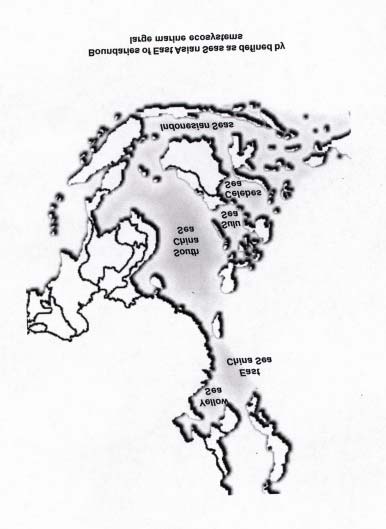
Figure 1:
The East Asian Seas Region
viii
Figure 2:
Partnership
27
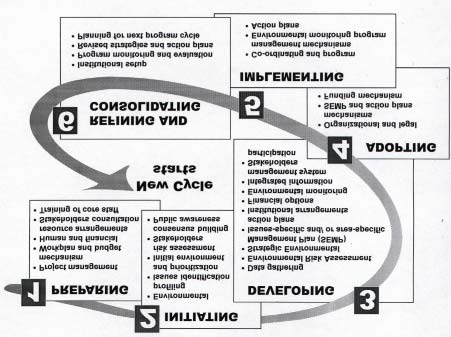
Figure 3:
ICM Programme Development and Implementation Cycle
27
Figure 4.
Risk Assessment and Risk Management
40
Id en tifyin g in vestm en t o p p o rtu n ities
W A S T E P R E V E N T IO N A N D M A N A G E M E N T
clean er p ro d u ctio n tech n o lo gies
at IC M sites an d R A /R M `h o t sp o t' lo catio n s
recyclin g
T echnical and econom ic
sew age treatm en t/d isp o sal
p re- feasib ility
h azard o u s an d n o n -h azard o u s w aste
co llectio n , treatm en t an d d isp o sal
en ergy /b io m ass co n versio n
lab o rato ry services
IN T E R N A T IO N A L C O N V E N T IO N S
recep tio n facilities
D efin in g m ech an ism s to catalyze,
O il S p ill C o n tin gen cy P lan (O P R C )
T E C H N O LO G IE S
o il sp ill co m b attin g eq u ip m en t (O P R C )
p ro m o te an d ad van ce
A N D
in su ran ce (C LC /F U N D )
en viro n m en tal in vestm en ts
S E R V IC E S
S eafarer's Train in g, C ertificatio n
an d W atch keep in g (S T C W )
S afety o f L ives at S ea (S O L A S )
IN FO R M A T IO N A N D C O M M U N IC A T IO N S
m o d ellin g an d exp ert system s
R o u n d tab le m eetin gs w ith in vesto rs,
d atab ases
p artn ers an d stakeh o ld ers
risk assessm en t
n atu ral reso u rce d am age assessm en t
M arin e E lectro n ic H igh w ay
q u ality, stan d ard s, an d certificatio n
In vestm en t p ro cesses
in tegrated in fo rm atio n m an agem en t sy stem s
S yn th esizin g p o licy/regu lato ry issu es
to create a clim ate co n d u cive to
IN T E G R A T E D C O A S TA L P L A N N IN G
en viro n m en tal in vestm en ts
A N D M A N A G E M E N T
facilities m an agem en t
p o rt d evelo p m en t an d m an agem en t
p o rt state co n tro l
eco -to u rism
F IG U R E 5 . C R E A T IN G E N V IR O N M E N TA L IN V E S T M E N T O P PO R T U N IT IE S A N D M E C H A N IS M S
56
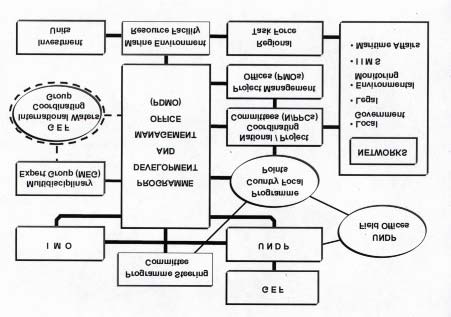
Figure 8:
Programme Management Framework
89
Table 5:
Schedule of programme reviews, reporting and evaluation
Review, Report
Responsible
Schedule (in months)
Evaluation
Party
3
6
9
12
15
18
21
24
27
30
33
36
39
42
45
48
51
54
57
60
63
Inception Report
Regional Programme
Director
Management reports
Regional Programme
(including financial report)
Director
Local project report
Local Project Team
Demonstration site
Regional Programme
environmental "hot spot"
Director
progress report
Consultants' progress
All consultants
report
as applicable
Technical reviews
Governments, UNDP,
Tripartite review for PSC
Programme Manager
Project Performance
UNDP
evaluation report
Terminal report
Regional Programme
Director
Terminal PSC
93