PEMSEA E-UPDATES Vol. VIII Issue 04 2007
East Asian Seas Youth in Action
The months of April, May and June mark three celebrations for the environment -- Earth
Day, World Environment Day and World Ocean Day -- and the young people of the
region actively participated in various activities to show their concern for the
environment. Some of these activities are highlighted below.
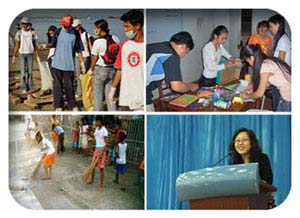
In the Philippines, the Youth and Sport Development Division under the Office of the
Governor of Cavite, with the support of the Provincial GovernmentEnvironment and
Natural Resources Office (PG-ENRO), initiated a coastal cleanup drive on 3 May with
young people from the municipalities, schools, environmental and youth clubs, and
religious organizations. The cleanup was held at Barangay Julugan in Tanza, which was
identified as a hotspot in the province. A public market in the vicinity produces a
significant volume of wastes which are sometimes dumped directly into the sea. The
youth sector in Cavite also participated in other activities, including tree planting and
recycling drives organized by NGOs and the local government.
In Balayan, Batangas (also in the Philippines), young people were involved in ANAK-
Balayan's Earth Day activities, which were directed towards decreasing "heat-holder
gases" in the atmosphere by greening the environment and waste recycling, among others.
Children and young adults also took part in river/creek, coastal and community cleanups.
In Cambodia, the English Department of the Institute of Foreign Languages, Royal
University of Phnom Penh, organized a Cleanup Day on 12 May. It was an event
involving more than 500 participants in various environmental activities, including
cleaning the campus areas and open discussions and expert talks about environmental
preservation. A number of competitions were held, such as the Environment Quiz,
Environment Slogan/Quote Contest and a Recycling Contest in which the contestants
were provided with certain waste products to create new usable products or artworks. A
Poster Exhibition took place, in which 20 posters were showcased and judged by the
participants, and a documentary film about the Mekong River entitled "Exploring the
Mother of Waters" was also shown during the event.
Some environmental activities likewise took place in Shandong University in PR China.
A coastal cleanup activity was held on 4 May in celebration of Youth Day in the Marine
Mammal Institute of the university, initiated by Ms. Li Xiang, one of the youth leaders in
the EAS Youth Forum. Ms. Li, who is one of the Ten Excellent Students in the university,
imparted to fellow students the insights she gained during the Youth Forum.
In the Universiti Sains Malaysia, a group of students led by two EAS Youth Forum
participants organized a planning session to line-up activities for Kelab Alam Sekitar
(KAS), which is the Environmental Club of the University. Under KAS, a component
called East Asian Seas Youth (EASy) will be created to focus on the coastal and marine
environment. The group is currently focusing on the implementation of the Container
Campaign, which aims to reduce the usage of polystyrenes by encouraging the campus
community to use containers through creative strategies and promotional schemes
identified by the group. The campaign is supported by the school administrators, other
organizations and concessionaires.
Last 8 June, the EAS Youth Forum participants joined in the electronic petition led by
The Ocean Project and the World Ocean Network that aimed to have the United Nations
officially designate 8 June of each year as World Ocean Day. Although unofficially
designated, 8 June is celebrated worldwide as World Ocean Day since its inception in the
1992 Earth Summit in Rio de Janeiro and serves as an opportunity to celebrate the
world's ocean and every person's personal connection to the sea.
Vietnam Gears up for SDS-SEA Implementation
Vietnam's Ministry of Natural Resources and Environment (MONRE) is spearheading
the integration of ICM and ecosystem-based management into the recently revised
National Environmental Law. In 2006, MONRE successfully launched the Master Plan
on Basic Survey and Management of Marine Resources and Environment until 2010 and
Vision until 2020, which includes a specific action on developing the Sustainable
Development Strategy for Vietnam's sea area. The appointment of MONRE by the Prime
Minister of Vietnam to serve as national focal point for SDS-SEA implementation, the
translation of the SDS-SEA into Vietnamese, as well as the conduct of a series of
consultative workshops have all contributed towards promoting this effort.
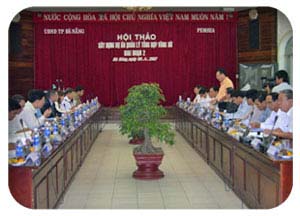
In April 2007, MONRE and Vietnam Environment Protection Agency (VEPA) together
with PEMSEA identified areas of activity, which will aid Vietnam in developing and
implementing its three-year work program for SDS-SEA implementation for the period
20072010. One of the major activities being undertaken is the formulation of a strategy
and work plan for the development of a national marine policy to facilitate SDS-SEA
implementation. Another activity is streamlining the approach for a national ICM
program. This is crucial since 14 coastal provinces in the central region have been
identified to implement ICM program following Danang's working model. The
government is targeting 50 percent coverage of Vietnam's coastline in its national ICM
program.
As a centerpiece for ICM scaling up in Vietnam, Danang is likewise undertaking
activities to strengthen the implementation of its second cycle ICM program. The City is
formulating a three-year work program for the implementation of the Coastal Strategy,
focusing on the institutionalization of an interagency and multisectoral coordinating
mechanism and coordinating office to oversee program implementation, capacity
strengthening and identifying on-the-ground projects and investments that are consistent
with the Coastal Strategy.
With the above activities in place, Vietnam is expected to efficiently embark on the
follow-on phase of PEMSEA starting October 2007.
A Nation of Dams: Managing Water Resources in Lao PDR
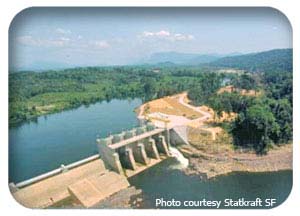
The Xedon River Basin, which spans across the Seikong, Champasack and Saravanne
provinces of southern Lao People's Democratic Republic, is probably the least popular of
the river basins in Lao, mainly because it does not have the "mega" dams that other
localities have. The lack of potential for such infrastructure may have contributed to its
lesser appeal to donor and development agencies. But not for the Water Resources
Coordination Committee Secretariat (WRCCS). The WRCCS is of opinion that the
380,000 people in the three provinces should also be benefiting from awareness and
capacity development initiatives concerning sustainable development of the river's
resources.
In consideration to this, local consultations were conducted with the Provinces of
Saravanne and Champasack from April 2-4, 2007 for the implementation of the
Sustainable Development Strategy for the Seas of East Asia (SDS-SEA). The purpose of
the consultation, conducted by the PEMSEA Regional Programme Office and the
WRCCS, was to better understand the sociopolitical, economic and environmental
context within which an integrated management project could be implemented.
Multiple-use conflicts figure as a prominent problem in both provinces. Water resources
at the upper portion of the Xedon River in Saravanne Province are mainly used for
agricultural purposes. Fertilizers and pesticides have contaminated the river, which flows
downstream to Champasack Province. In addition, slash-and-burn practices have
diminished the forest cover in the basin, resulting in perennial flooding in Champasack
during the rainy season. Limited livelihood opportunities and poor information among the
communities have perpetuated these practices.
The SDS-SEA consultation stressed the value of managing the most important resource
in the area the people themselves. Without millions of dollars in investment, capacity
development can reorient people's mindset and attitudes towards their environment. It
can shift knowledge, skills and attitudes from being driven purely by self-interest to that
of common good. Development initiatives must not only focus on environmental and
resource protection and management, but also include an essential linkage with poverty
reduction and a component of strong community mobilization, organization, awareness
and advocacy. This will be the focus of the PEMSEA project. A mechanism will also be
established to see that foundations for sustainable development are properly coordinated
among the local beneficiaries.
Further community integration will be done in the target communities and with the local
and national government agencies to ensure that the initial approaches and strategies
identified for the SDS-SEA implementation are well suited to the sociocultural
characteristics of the target community-beneficiaries. With the agreement of the
stakeholders, the implementation of the SDS-SEA in the Xedon River Basin will
commence in October 2007.
ICM Scaling up in Xiamen: The Jiulong River Basin Integrated Management
Project Experience
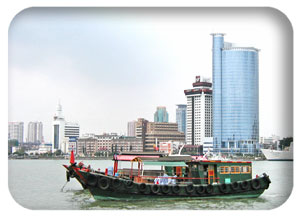
In line with the objective of scaling up Integrated Coastal Management (ICM) in Fujian,
PR China, Xiamen municipality, PEMSEA's internationally recognized ICM
demonstration site, has joined hands with Longyan and Zhangzhou municipalities to
design and implement the Jiulong River Basin Integrated Management Project. Since its
inception in 2003, the project has demonstrated that an inter-municipality coordinating
mechanism can be effective in protecting the ecological environment of the river basin. In
only a few years, the river's water quality has significantly improved with a reduction of
235,137 tons of chemical oxygen demand (COD), 13,829 tons of ammonia nitrogen and
7,073 tons of total phosphates. However, according to the local stakeholders, much more
work is still needed to strengthen integrated river basin management, particularly with
regard to soil erosion and wastewater discharges.
With a length of 1,923 km and a drainage basin area of about 14,741 km2, inhabited by
about 6.7 million people (460 people/km2), the Jiulong River is an essential component
to the region's annual production of domestic goods and services, estimated to be almost
$20 billion in 2003. The project's focus is to preserve the economic value of the river by
preventing and reducing pollution in the upstream area, management of inter-
municipality transport of solid wastes, and other environmental programs. The
multidisciplinary river basin survey has been completed and all the major sources of
water pollution have been identified in order to come up with an effective action plan.
The project has already implemented a number of on-the-ground activities including:
· closing of four paper mills that were found to be major sources of pollution;
· pollution reduction from domestic and industrial discharges;
· development of sewage collection and treatment systems;
· improvement in municipal solid waste management systems;
· development of hazard free, "green" and organic food production;
· implementation of a community-based bio-gas demonstration;
· cleaning up unregulated, small-scale hydropower facilities;
· strengthening management of mining operations, installations and facilities;
· development of ecological forest zones; and
· development of nature reserves and protected areas.
To address the negative externalities brought about by upstream sources of pollution,
economic compensation mechanisms have been established. The Provincial Government
of Fujian offered economic incentives for upstream pollution management efforts, based
on water quality targets at transboundary points. In 2007, the River Basin Management
Fund was created, providing the Jiulong River project with a RMB 28 million (about $3.6
million) fund. The financing mechanism is intended to facilitate achievement of its COD
reduction targets and to keep water quality in 90 percent of the monitoring areas within
Class I to Class III range.
Recent inspections have validated that water quality in the drinking water intake area of
the Jiulong River is within acceptable standards. This is a highly encouraging initial
result and has proven once again that local government cooperation and the application of
relevant ICM principles and methodologies can generate stress-reduction outcomes.
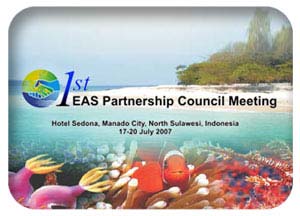
All Set for the First EAS Partnership Council Meeting
PEMSEA State and non-State Partners are scheduled to convene the First East Asian
Seas Partnership Council Meeting on 17-20 July at Hotel Sedona, Manado City, North
Sulawesi, Indonesia.
The Meeting will set in place the operational components of the Council and identify a
plan of action for the implementation of the Sustainable Development Strategy for the
Seas of East Asia (SDS-SEA). In particular, the Meeting will elect the three Council
Officers that will compose the Executive Committee. Apart from which, key agenda
items include the introduction of the Framework Partnership Programme 2007-2010, and
the formulation of a Work Programme for the EAS Partnership Council 2007-2010,
including the consideration of major activities such as the State of the Coasts Reporting
System, the EAS Congress 2009 and the Ministerial Forum 2009.
The signing of the Haikou Partnership Agreement and the Partnership Operating
Arrangements during the East Asian Seas Congress 2006 in Haikou City, PR China,
formally established the intergovernmental and multisectoral EAS Partnership Council
that serves as the mechanism to monitor and provide operational and policy guidance for
the implementation of the SDS-SEA.
In July, new Partners will also be presented in the Meeting to become full-fledged
members of the Council. Various regional and international organizations will also
participate as observers to the Meeting.
The Meeting is being organized by the PEMSEA Regional Programme Office in
collaboration with the Ministry of Environment of Indonesia and the local government of
Manado and North Sulawesi.
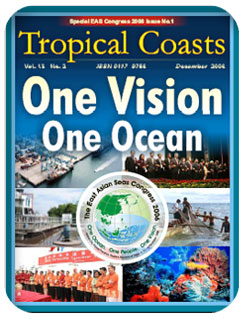
Tropical Coasts Focuses on the EAS Congress 2006 in Special Issue
MANILA, PHILIPPINES -- PEMSEA proudly releases the first of the two special issues
of TropicalCoasts magazine on the East Asian Seas Congress 2006. This edition offers
the wider public an opportunity to learn and benefit from the outputs of and information
shared during the various events of the Congress.
Carrying the title "One Vision, One Ocean," this issue highlights the continuing
degradation of the marine and coastal environment and focuses on the key outputs and
outcomes of the Thematic Workshops on Securing the Oceans; Safer Shipping and
Cleaner Oceans; Certifying Sustainability; and Local Government Financing for Water,
Sewage and Sanitation. Also featured in the magazine is the adoption of the Haikou
Partnership Agreement and the Partnership Operating Arrangements for the
Implementation of the SDS-SEA. The magazine also provides synthesis of the various
side events and meetings.
It is hoped that this issue would contribute in the enhancement of understanding on the
value of the East Asian Seas and the need to step up actions towards the sustainable
development of the coastal and ocean environment of the region.
If you wish to have a copy of this special Tropical Coasts issue, email info@pemsea.org.
SENSA: Interconnecting with the PRF
The PEMSEA Resource Facility (PRF) has attracted interests from across the seas. The
Swedish Environmental Secretariat for Asia (SENSA), an office integral to the Swedish
International Development Cooperation Agency (Sida), and the PRF have forged a
partnership for the sustainable development of the Seas of East Asia.
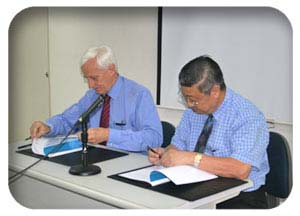
Mr. Christer Holtsberg, SENSA Director, and Dr. Chua Thia-Eng, PRF's Interim
Executive Director, signed the three-year Memorandum of Understanding (MOU) on 25
May. Under the agreement, the parties agreed to cooperate in identifying priority research
issues and capacity-building activities for the sustainable development of marine and
coastal resources and governance. The parties also agreed to exchange information and
share knowledge, as well as second their respective staff to conduct mutually agreed
activities.
SENSA, based in Bangkok, was established by the Sida in 2002. SENSA is responsible
for monitoring the environmental situation in Southeast Asia. PEMSEA is a partnership
of stakeholders composed of states, institutions, and nongovernmental organizations,
committed to the implementation of the Sustainable Development Strategy for the Seas of
East Asia.
PEMSEA and CHARM Collaborate to Advance ICM Implementation in Thailand
A Letter of Cooperation (LOC) between PEMSEA and the Coastal Habitats and
Resources Management (CHARM) Project was signed on 26 April in Chonburi, Thailand.
PEMSEA and CHARM have agreed to work together to: 1) build awareness and
constituencies for co-management and integrated coastal management (ICM) at local,
provincial and national levels through multisectoral approaches; 2) strengthen capacities
in Thailand for sustainable use and management of marine and coastal areas; and 3)
support the establishment and functioning of a national network of local governments
implementing ICM. A workshop will be organized in order to share experiences and
examine possibilities for the establishment of a national local governments' network.
The collaboration between PEMSEA and CHARM was catalyzed during the East Asian
Seas Congress in December 2006 in Haikou City, Hainan Province, P.R. China. A
seminar was subsequently organized by CHARM in Phuket last March, where it was
agreed to link ICM Projects in Phang-Nga Bay, Ban Don Bay, Chonburi and other areas
into a national network. Officials from local governments working with CHARM visited
Chonburi in May to learn from their ICM practices and experiences.
Dr. Chua Thia-Eng, Interim Executive Director of the PEMSEA Resource Facility (PRF),
signed the LOC on behalf of PEMSEA. Dr. Yves Henocque and Dr. Sanchai Tandavanitj,
Co-Directors, signed on behalf of CHARM.
PEMSEA has established an ICM demonstration area in Chonburi Province, in the
eastern region of Thailand.
CHARM is a Thai Government project supported by the European Union, designing and
establishing a coastal habitats and resources co-management framework and procedures
in two Southern Thailand locations. The project is promoting a co-management
framework/process for coastal habitats and resources in two Southern Thailand locations.
Both projects are advocating replication and scaling up of good management practices to
other areas of the country.
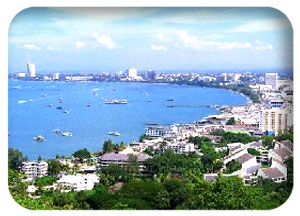
Chonburi Province Scales up ICM Project Area
A declaration for the scaling up of Integrated Coastal Management (ICM)
implementation in Chonburi Province, Thailand, was signed by local government
executives at the Tide Resort and Hotel in Saensuk, Chonburi, on 26 April. The event
marked the official participation of additional 12 local government units (i.e.,
municipalities, cities, provincial/subdistrict administrative organizations) in the Chonburi
ICM Project. This brings the total number to 22, from the initial 5 in 2001. The Chonburi
ICM Project now covers almost the entire length of the Chonburi Province coastline.
The declaration recognizes the value of Chonburi's marine and coastal resources; the
threats to these resources as a consequence of rapid economic development; the
stakeholders' responsibility to protect and safeguard these resources; the urgent need for
inter-municipal, multi-agency, and cross-sectoral cooperation and collaboration and
adequate stakeholder participation; and the ICM framework and its implementing
processes as a viable mechanism for generating the necessary partnerships and
stakeholder support to minimize the adverse impacts on ecosystems and ensure
sustainable socioeconomic development of the coastal areas in Chonburi.
Mr. Sonthaya Khunpluem, former Minister for Tourism and Sports, congratulated
Chonburi for its efforts in applying ICM and involving all coastal municipalities. Dr.
Chamniern Vorratnchaiphan, Director of the Grassroots Action Program of the Thailand
Environment Institute also congratulated all who have contributed to the success of ICM
implementation in Chonburi.
Dr. Chua Thia-Eng, PEMSEA Regional Programme Director, commended Chonburi's
initiative and achievements with regard to the scaling up of the ICM area, but at the same
time challenged them to also scale up with regard to other key ICM elements such as
policy, institutional arrangements, legislation, and capacity. He also highlighted the need
for establishing a proper holistic framework that would allow local governments to
systematically and efficiently achieve the goals of sustainable development. Dr. Chua
presented a conceptual framework on sustainable development of coastal urban areas
through ICM implementation to illustrate the linkages between good governance and
environmental management. He also highlighted the need for a national ocean policy to
provide basis for actions at various levels.
Two simultaneous forums were conducted for the municipal executives of participating
administrative units and government personnel. A planning workshop will be organized
in May to develop the ICM Action Plan for Chonburi Province for 20082011. The
framework shared by Dr. Chua will be applied in the assessment and planning of ICM
implementation in Chonburi.
On the same occasion, the proceeds of a bowling fund-raising competition held on 31
March, totaling Baht 702,190 (about $21,000), was turned over to the ICM Project
Director. Fund-raising activities will be undertaken periodically as part of the financing
mechanism to support ICM implementation in the province.
The next target for ICM scaling up in Chonburi would be to involve the non-coastal
municipalities in protecting and managing the province's marine and coastal resources
and environment, emphasizing their connection and impact on the state of Chonburi's
coasts.

PARTNER NEWS
NOWPAP Builds up Partnerships and Efficiency
NOWPAP Regional Coordinating Unit signed the Letter of Cooperation (LOC) with the
Project Management Office of the UNDP/GEF Yellow Sea Large Marine Ecosystem
(YSLME) project on 24 May in Beijing, PR China. The LOC will serve as the basis for
the two sides to conduct cooperative activities.
At the First COBSEA (Coordinating Body on the Seas of East Asia) Marine Litter
Workshop held in Jakarta, Indonesia on 8-9 May, representatives of NOWPAP
introduced the overall progress on the implementation of its Marine Litter Activity
(MALITA), which was launched one and half years ago. As sister programs of the UNEP
Regional Seas, both NOWPAP and COBSEA are carrying out activities addressing the
marine litter issue in line with the global UNEP marine litter initiative. The two bodies
continuously exchange information and share their experiences in dealing with the
marine litter problem.
According to the decision of the 11th NOWPAP Intergovernmental Meeting (IGM),
evaluation of the performance of the four NOWPAP Regional Activity Centres (RACs)
has been carried out. The RACs were established between 2000 and 2002 and have
played an important role in implementing NOWPAP activities since then. In order to
review the achievements and further improve the efficiency of the RACs work, an
independent international consultant has recently interviewed all RAC directors in
Beijing. An evaluation report will be prepared by the consultant based on the interviews
and responses to the questionnaires distributed earlier. The results of the evaluation will
be presented to the next IGM in October 2007 in China.
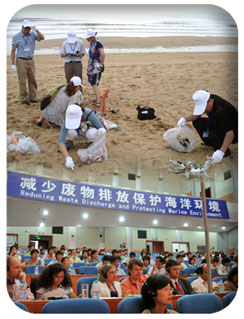
International Coastal Cleanup in Rizhao
An International Coastal Cleanup (ICC) was successfully organized on 28 June 2007 in
Rizhao City, PR China, sponsored by the State Environmental Protection Administration
of China and the Rizhao Municipal Government. It was the first time the ICC was
formally introduced to the newly emerging city, as the Northwest Pacific Action Plan
(NOWPAP) advances the implementation of its Marine Litter Activity launched two
years ago. Two dozen representatives from Japan, Republic of Korea, Russia and
regional programmes and projects such as the Coordinating Body on the Seas of East
Asia (COBSEA), the UNDP/GEF Yellow Sea Project (YSLME) and PEMSEA,
represented by Ms. Corazon Davis of the Philippine Department of Environment and
Natural Resources, joined two hundred local participants in this beach cleanup in an
effort to raise public awareness on marine litter and promote public participation in the
cleanup.
The Rizhao ICC attracted great attention in China; the local participants ranged from
central government officials, vice mayors and experts to elementary school kids. The
national and local media covered the activity widely both on television and in newspapers.
Prior to the ICC activity, an associated workshop addressing marine litter prevention and
control was held on 27 June.
NOWPAP will continue to organize ICC campaigns in Busan, Republic of Korea, and
Vladivostok, Russia, later this year and in 2008 as part of its Marine Litter Activity.
COPYRIGHT © PEMSEA