PEMSEA E-UPDATES Vol. VII Issue 06 2006
12th Programme Steering Committee Meeting Endorses Draft Documents for the
Implementation of the SDS-SEA
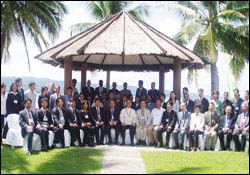
DAVAO CITY, PHILIPPINES -- East Asian countries and partner organizations
gathered at the recent 12th PEMSEA Programme Steering Committee (PSC) Meeting to
formally bring the current phase of PEMSEA to its final implementation stages and
provide directions for its future undertakings.
The Meeting resulted to a number of major decisions, including the endorsement of two
draft documents, namely, 1) the draft Partnership Agreement and 2) the draft Partnership
Operating Arrangements for the Implementation of the Sustainable Development
Strategy for the Seas of East Asia (SDS-SEA). The two documents, which give definition
to the regional mechanism for the implementation of the SDS-SEA, are expected to be
signed by Ministers of the PEMSEA participating countries during the Ministerial Forum
at the East Asian Seas (EAS) Congress in December 2006.
The Meeting also unanimously agreed on the importance of extending the current
PEMSEA phase until June 2007 to give way for the smooth transformation of the current
programme set-up into a PEMSEA Resource Facility (PRF). The PRF will build on the
spirit of partnership that would involve both governments and stakeholders, and provide
services in support of SDS-SEA implementation: the PRF Secretariat Services and the
PRF Technical Services.
In line with the PRF, the Meeting noted the financial support and commitment of the
supporting countries, particularly PR China, Japan and the Republic of Korea, in the
establishment of the Secretariat Services, through Cost-Sharing Agreements between
supporting countries and the United Nations Development Programme (UNDP). The
PRF Technical Services will be established, based on the requirements of Global
Environment Facility (GEF)/UNDP Project on the Implementation of the SDS-SEA.
The Meeting also adopted the work schedule for the completion of the GEF/UNDP
Project Document for the Implementation of the SDS-SEA, as well as the timetable and
action plan for the transformation of PEMSEA. Preparations for the EAS Congress were
also discussed, giving particular attention to the needed actions for the conduct of the
Ministerial Forum, the EAS Partnership Council Inaugural Meeting, the Senior
Government Officials' Meeting and other related sessions/events.
PEMSEA's achievements for the last 12 years were also reviewed within the context of
the Programme's Terminal Evaluation Report (TER). The TER, which was prepared by
three external experts, acknowledged the impact of PEMSEA in terms of building
working partnerships and mobilizing resources for collaborative activities among various
governments, sectors and agencies at the local, regional and international levels, as well
as the challenges to be addressed in the next phase.
The 12th PSC Meeting was held from 14 August and was organized by the PEMSEA
Regional Programme Office in collaboration with the Philippine Department of
Environment and Natural Resources (DENR) in Davao City.
Cavite Initiates Coastal-use Zoning to Address Multiple-use Conflicts and Water
Pollution
In response to declining resources and habitats, multiple-use conflicts, illegal fishing
practices, water pollution, declining aquaculture and fisheries production and other
related environmental problems, the Provincial Government of Cavite has initiated the
development of a Coastal-use Zoning for Cavite (CuzCa). This action is expected to
facilitate the resolution of multiple-use conflicts and result to better environmental
quality.
The technical working group for CUZCa, whose members have undergone a training
workshop conducted by PEMSEA, have developed an action plan that calls for the
involvement of stakeholders and lays out the phases of the zoning activities. The zoning
will be started in Bacoor and Cañacao Bays, where multiple-use conflicts and water
pollution is of high concern, followed by the other coastal areas of the Province.
Local government units, national agencies and civil society groups have been actively
participating in this undertaking. The CUZCa is targeted to be completed by September
2006.
OPRF to Co-Convene "Tokyo Ocean Declaration" Workshop
The Ocean Policy Research Foundation (OPRF) of Japan will co-convene a workshop
entitled "The Tokyo Ocean Declaration: Upholding the Advocacy" during the upcoming
East Asian Seas (EAS) Congress 2006.
The complexity of shared challenges facing the EAS region, including the protection of
the marine environment and resources, addressing natural disasters, and the elimination
of piracy and maritime terrorism, has necessitated the review of traditional military-
oriented ideas on ocean security and prompted the development of a more progressive
approach in dealing with these issues. The Tokyo Ocean Declaration, the fruit of three
years' deliberation by 26 eminent ocean law and policy experts, advocates a new security
concept, "Securing the Oceans," which requires that all aspects of ocean management,
including military activities, the peaceful use of the oceans, resource extraction,
environmental management, and scientific research be addressed in an integrated and
collaborative manner. The concept was adopted by the Third International Conference on
Geo-Agenda for the Future: Securing the Oceans, hosted by the OPRF in December 2004.
The OPRF workshop will advocate the new security concept as a means to achieving
peace and sustainable development in the world's oceans, with special focus on
geographical and socioeconomic contexts in the East Asian seas. The session will also
discuss harmonized and effective ocean governance, the sharing of common perceptions,
the building of political will and the identification of specific measures to uphold the
advocacy.
For further information, visit www.pemsea.org/eascongress.
UNDP-GEF SGP Revisits Civil Society Role in Sustainable Development at EAS
Congress 2006
The UNDP Global Environment Facility (GEF) Small Grants Programme (SGP) will
convene the seminar on Civil Society Participation in Sustainable Development during
the East Asian Seas (EAS) Congress 2006.
The seminar will explore the evolving nature of civil society and how its broadening
influence contributes to the attainment of sustainable development at the local level. It
will focus on three key issues, mainly: (1) the role of communities and how local
initiatives can contribute to the long term and broader objectives of sustainable
development; (2) broadening the sphere of participation for women and youth; and (3)
the promotion of indigenous knowledge and practices to promote local development
practices. Several case studies will be presented to highlight the various roles and
challenges of CSOs in effectively partnering with communities. Through the seminar, the
GEF Small Grants Programme aims to encourage meaningful exchange of ideas among
its community-based partners to enable a better appreciation of common issues in
pursuing sustainable development at the local level.
Launched in 1992, GEF SGP supports activities of nongovernmental and community-
based organizations in developing countries towards climate change abatement,
conservation of biodiversity, protection of international waters, reduction of the impact of
persistent organic pollutants and prevention of land degradation while generating
sustainable livelihoods. In 2005, GEF SGP and PEMSEA forged a partnership agreement
to strengthen the implementation of coastal resource management in SGP and PEMSEA
participating countries.
For further information on the EAS Congress, visit www.pemsea.org/eascongress.
UNDP Capacity 2015 to Address Capacity Development Issues at EAS Congress
2006
The United Nations Development Programme (UNDP) Capacity 2015 and UNDP Manila
will co-convene a workshop on Achieving the Millennium Development Goals (MDGs)
through Enhancing Local Capacities for Integrated Coastal Resources Management
(ICRM) during the East Asian Seas Congress 2006.
The workshop aims to share and discuss capacity development strategies, experiences,
evidences, lessons learned, and ways forward in promoting and strengthening the role of
local institutions in ICRM including local governments, nongovernmental and
community-based organizations, the academe, and the private sector. It will also analyze
the specific capacities that were strengthened, and how these capacities contributed to the
resulting transformation and to the attainment of the MDGs.
The United Nations Development Programme defines capacity as the ability of
individuals, organizations and societies to perform functions, solve problems, and set and
achieve goals. Capacity development entails the sustainable creation, utilization and
retention of that capacity, in order to reduce poverty, enhance self-reliance and improve
people's lives. Believing in these principles, Capacity 2015 works through a series of
partnerships to build capacities at the local level to realize the MDGs, as well as the goals
of Agenda 21.
The EAS Congress will be held on 12-16 December in Haikou City, Hainan Province, PR
China, and will bring together high-level policymakers, experts and various stakeholders
for capacity-building activities, knowledge exchange, strategic action and cooperation for
the Seas of East Asia. The International Conference (12-14 December) will feature a
series of Workshops and Seminars which cover a wide range of important issues, trends
and developments currently affecting the East Asian Seas region.
For further information on how to participate in the workshop and the EAS Congress,
please visit the www.pemsea.org/eascongress and
http://regionalcentrebangkok.undp.or.th/practices/cap2015/icrm_main.htm.
Lao PDR Expresses Support to SDS-SEA During National Workshop
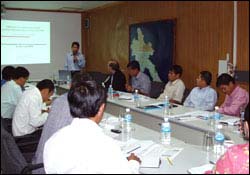
VIENTIANE, LAO PDR -- Lao People's Democratic Republic expressed its support and
identified key areas of activities in support of the implementation of the Sustainable
Development Strategy for the Seas of East Asia (SDS-SEA) during its National
Consultative Workshop on 30 June. The workshop was organized by the Water Resource
Coordination Committee (WRCC) of Lao PDR and PEMSEA.
In reviewing the initiatives and the needs of the country, the Workshop identified three
major areas of concern: capacity building; watershed management; and institutional
reforms, including interagency and multisectoral coordinating mechanisms.
The Workshop was organized as part of the consultation process for the preparation of
the Global Environment Facility/United Nations Development Programme project on the
Implementation of the SDS-SEA.
About 20 participants from various agencies, sectors, and academic institutions, attended
the Workshop.
During the mission, PEMSEA also met with the representatives of the Mekong River
Commission (MRC). The MRC representatives expressed interest in PEMSEA's on-the-
ground approach to project implementation, particularly in the establishment/replication
of ICM programs in collaboration with local governments.
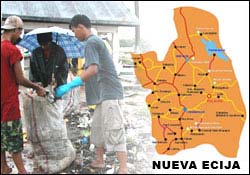
Nueva Ecija Tackles Issues on Waste Management, PEMSEA Strategies Noted
NUEVA ECIJA, PHILIPPINES -- Key environmental problems, including waste
management and related impacts on the residents were discussed during a meeting
attended by mayors, local government officials and media representatives of the Province
of Nueva Ecija, Philippines, on 20 June.
Provincial Governor Tomas Joson III outlined the various environmental concerns of the
province. He mentioned that rivers in the area used to provide freshwater supply and a
bountiful fish catch, but have been affected by siltation, wastewater discharges, and
excessive use of fertilizers and pesticides. Other environmental issues, such as solid
waste, hospital waste disposal and polluted waterways were also raised.
Representatives from PEMSEA were invited to talk about possible strategies in solving
the issues. Dr. Huming Yu, Senior Programme Officer, presented PEMSEA's activities
as well as achievements in the East Asian seas region, citing Bataan and Batangas as
examples. Ms. Maricor Ebarvia, Technical Officer, discussed an overview of Public-
Private Partnership (PPP) as a mechanism for the local government units to provide
necessary environmental facilities and services by mobilizing resources from the private
sector and other institutions and stakeholders.
A framework programme for integrated solid waste management for the province was
reviewed, covering conversion of open dumpsites to controlled dumpsites, clustering of
municipalities/cities for a sanitary landfill, waste segregation and composting, formation
of cooperative among junkshop operators for recycling, dredging of silted waterways,
and the rehabilitation of a 35,000 ha watershed in Carranglan.
Gov. Joson has actively participated in previous Site Coordinating Committee/Project
Coordinating Committee (SCC/PCC) meetings for the Manila Bay Environmental
Management project. The Hon. Edward Tomas F. Joson, a Provincial Board member,
represented Nueva Ecija during the Manila Bay PCC Meeting last 10 May, where he
signed a resolution for the adoption of the Operational Plan for the Manila Bay Coastal
Strategy, on behalf of the Provincial Government.
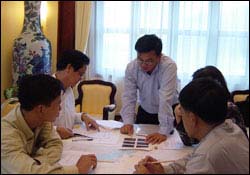
OPRC Level 3 Seminar Enhanced the Implementation of the Framework
Programme for Joint Oil Spill Preparedness, Response and Cooperation in the Gulf
of Thailand
SIHANOUKVILLE, CAMBODIA -- Fifteen key officials representing government and
oil companies from Thailand, Vietnam and Cambodia participated in the OPRC Level 3
Seminar for Administrators and Senior Managers and the Workshop on the
Implementation of the Framework Programme for Joint Oil Spill Preparedness, Response
and Cooperation (OPRC) in the Gulf of Thailand. The seminar and workshop was held
from 2730 June at the SOKHA Hotel in Sihanoukville.
The purpose of the workshop was to enhance participants' understanding on operational
and policy issues related to the Framework Programme. It also facilitated the participants
to review existing policies and procedures that affect the successful implementation of
the Framework Programme. Mr. Pakorn Prasertwong of the Marine Department of
Thailand and Mr. Mak Sideth of the Merchant Marine Department of Cambodia shared
their experiences on oil spill response strategies, international cooperation and
contingency planning respectively. Lecturers from the East Asia Response Pte Ltd
(EARL), Capt. Daniel Chan and Mr. Freddie Tan, served as resource speakers in the
seminar.
The workshop enabled the participants to develop action programs to support the
effective implementation of the Framework Programme. Included among the proposed
actions were the establishment of the Gulf of Thailand Oil Spill website and information
sharing system, the conduct of a joint oil spill response exercise, and organization of a
training workshop on cost recovery from oil spills. Representatives of participating
countries also agreed to host the secretariat and coordinating function on rotational basis.
The seminar and workshop was organized by PEMSEA, supported by the International
Maritime Organization and hosted by the Ministry of Environment of Cambodia,
Municipality of Sihanoukville and Ministry of Public Works and Transport of Cambodia.
500 Groups to Take Part in a Worldwide Environmental Cleanup this September
SYDNEY, AUSTRALIA -- Some 500 organizations, ranging from local community
groups and schools to nationwide campaigners and government departments from 119
countries, will participate in the annual Clean Up the World Weekend on 15-17
September.
As members of the Clean Up the World campaign, they will engage in a wide range of
activities, including clean ups of local streets, waterways, parks and beaches,
environmental projects such as tree planting, energy conservation and water recycling,
and education programs.
"Over 100 countries have joined Clean Up the World since the first campaign 14 years
ago, but an extremely enthusiastic response has been received from developing countries
in Africa, Asia Pacific and Latin America, including some of the world's most troubled
nations," said Clean Up the World Chairman and Founder Dr. Ian Kiernan AO.
In 2006, Africa has the highest participation in both the number of countries (28) and
organizations (171) that have joined the campaign so far, with the Democratic Republic
of Congo, Ghana, and Nigeria leading the way. Clean Up the World has also registered
record participation in this year's campaign by groups from Argentina, India, Mexico, the
Philippines, and Spain.
Escuela Maria Josefa Gonzalez Casero is a primary school in a marginalized suburb of
Cordoba, Argentina. Throughout September, students will generate environmental
awareness in their community, including through a radio show they will present every
fortnight. They also plant trees in public spaces year-round.
"Hundreds of communities across the developing world see the connection between the
health of their environment and their own wellbeing. By joining Clean Up the World,
they become agents of change for their community instead of bystanders," said Kiernan.
Held in conjunction with the United Nations Environment Programme (UNEP), Clean Up
the World is a global community-led environmental campaign that mobilizes over 30
million volunteers in over 100 countries annually to "clean up, fix up and conserve the
environment." The campaign's flagship event is Clean Up the World Weekend, held in
September each year.
Groups, organizations, businesses and communities around the globe are encouraged to
register with Clean Up the World by visiting www.cleanuptheworld.org.
NOWPAP Members Join the International Coastal Cleanup
A new Northwest Pacific Action Plan (NOWPAP) project -- Marine Litter Activity
(MALITA) -- is being implemented after its approval by the 10th NOWPAP
Intergovernmental Meeting. One of the MALITA objectives is to encourage and assist
NOWPAP member states to participate in the International Coastal Cleanup (ICC) which
has been held worldwide for about 20 years. Japan and the Republic of Korea have joined
the ICC since 1990 and 2001 respectively, while Russia and PR China are encouraged to
participate in this year's cleanup.
Sponsored by the Japanese Ministry of Foreign Affairs, NOWPAP is organizing an ICC
campaign in September at the Yamagata Prefecture, Japan, where representatives of
government agencies, nongovernmental organizations, students and stakeholders from all
four NOWPAP countries will jointly collect litter on the beach and share experiences in
dealing with marine litter.
With the generous support from member countries, NOWPAP will continue to organize
similar campaigns as both Japan and RO Korea indicated possible sponsorship of future
events.
NOWPAP Oil Spill Contingency Plan Expands its Geographical Coverage
Starting 1 July 2006, the geographical coverage of the Regional Oil Spill Contingency
Plan (RCP) adopted by the Northwest Pacific Action Plan (NOWPAP) member states,
through a Memorandum of Understanding in 2005, was expanded to include the areas of
production and transportation of oil and gas along the Sakhalin Island. The RCP now
covers the area between 33 and 55°N and 121 to 145°E. The expansion was decided in
the 10th NOWPAP Intergovernmental Meeting held in Toyama, Japan, in November
2005. The NOWPAP member states are China, Japan, Korea and Russia.
In order to check the preparedness of NOWPAP member states for accidental oil spills,
the First NOWPAP Oil Spill Exercise was organized last 1112 May in Aniva Bay,
Sakhalin Island, Russia. Several specialized ships and helicopters with oil containment
and recovery equipment from Russia and Japan participated in the exercise. China sent
several officials to observe the event. The exercise proceeded as planned in the beginning
but later turned to a real rescue operation as a Russian helicopter crashed into the sea. In
spite of that tragic incident, the exercise demonstrated a high level of emergency
preparedness of the NOWPAP member states.
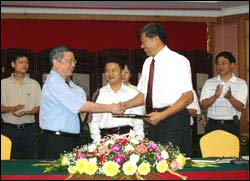
PEMSEA and Haikou City Sign Letter of Intent to Facilitate Public-Private
Partnership Arrangement for Environmental Infrastructure Improvements
HAIKOU CITY, PR CHINA -- Waste management is a serious and complex issue that
entails cooperation and intensive planning -- this realization prompted the Government
of Haikou City to establish cooperation with PEMSEA's Public-Private Partnership
(PPP) Program for Environmental Infrastructure Improvements.
Last July 15, a Letter of Intent (LOI) was signed by PEMSEA, represented by Dr. Chua
Thia-Eng, Regional Programme Director, and the Haikou City Government, represented
by Vice Mayor Wu Wei Xiong. The LOI aims to enhance collaboration, cooperation and
commitment to facilitate a PPP arrangement for environmental infrastructure
improvements in Haikou, as well as to create a holistic management approach for sewage
and solid waste in the city. Vice Mayor Wu Wei Xiong emphasized the need for Haikou,
in particular, and China, in general, to change the perception on waste management by
giving particular attention to proper planning and coordination as well as engaging the
private sector in the process. Through the PPP approach of PEMSEA, the City
Government hopes to encourage the involvement of the private sector as well as set up an
efficient process and mechanism for the development and implementation of
environmental infrastructure projects.
The objective of the project is to bring about a successful model of PPP implementation
in China. The experiences and lessons that would be gained from the initiative will serve
as basis for other local governments in China, and elsewhere in the region.
The signing ceremony was organized by the Haikou City Government in cooperation
with the Department of Marine and Fishery of Hainan Province. About 50
participants/representatives from various agencies/sectors, including wastewater, health,
finance, fisheries, solid waste, investment, the municipal government and local media,
graced the occasion.
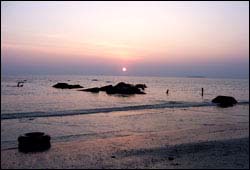
Sihanoukville Develops Occheauteal Beach as a Model for Sustainable Beach
Management
Cambodia has always been famous for the majestic temples of Angkor in Siem Reap.
Unknown to a lot of people are the scenic beaches located 230 km from the capital
Phnom Penh. In his article for the New York Times, Jeff Koyen featured the growing
interests on the white beaches of Sihanoukville among tourists, posing the question if it is
indeed the next Phuket, Thailand.
The 100-km stretch of the Gulf of Thailand shared by Sihanoukville has become a
popular destination, drawing an increasing number of foreign and local tourists each year
to its white sand beaches and majestic sunset.
Occheauteal Beach, one of the six major beaches in Sihanoukville, has received much
attention not only from sun worshippers but from investors as well. In the past years, the
number of establishments catering to the tourism industry has grown steadily. From
bungalows to high-end hotels and restaurants catering to various types of tourists, the
Occheauteal area is a testimony to both the positive economic impact of tourism and the
drawbacks of uncontrolled tourist activities.
With the mushrooming infrastructures close to the beach, erosion, siltation, and
wastewater discharge are only some of the negative consequences of the booming
tourism industry. The number of tourists is increasing every year, and large portions of
Occheauteal are being converted into parking spaces and sites for restaurants, hotels and
other infrastructure -- all without considering the environmental impacts.
But the potential of Occheauteal Beach as a tourist destination did not go unrecognized
by the Municipality of Sihanoukville, which started formulating a long-term plan for the
sustainable development of the area in 2004. Led by the Department of Tourism and the
Municipality of Sihanoukville, a series of consultations with vendors, restaurants owners,
local community members and beach operators were facilitated to determine the quality
of tourist services and infrastructures available and to identify key challenges with the
influx of tourists. Emphasis on sustainable tourism principles and practices were the
primary considerations in designing the development plan for Occheauteal Beach. Aside
from beach zoning and spatial planning, which is part of the physical development
component, an estimation of the carrying capacity, a visitor management plan and
environmental monitoring system were prepared by the Municipality with assistance
from PEMSEA.
Two years after these consultations were initiated, the Municipality of Sihanoukville and
local partners have finalized the master plan for the Occheauteal Beach and the
development activities are set to start late this year. Municipal Governor Say Hak has
taken steps to inform investors and local business operators that they must follow the
development plan to ensure that development activities are kept within sustainable limits.
COPYRIGHT © PEMSEA