PEMSEA E-UPDATES Vol. VII Issue 05 2006
Bohai Sea Project Hailed in National Consultation, but Serious Challenges Still
Ahead
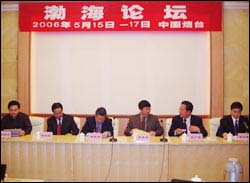
SHANDONG PROVINCE, PR CHINA -- The State Oceanic Administration (SOA) and
the Provincial and Municipal Governments of Liaoning, Hebei, Shandong, Tianjin and
Dalian, in collaboration with PEMSEA, organized the Bohai Sea Forum and the National
Consultation on the Implementation of the Sustainable Development Strategy for the
Seas of East Asia (SDS-SEA), held 1518 May in Yantai, Shandong Province. The event
distilled lessons learned from the implementation of the Bohai Sea Environmental
Management Project (BSEMP) and generated valuable inputs as the country begins to
draw up its national program for the SDS-SEA.
More than 50 participants representing agencies and local government units involved in
the Bohai Sea project presented their studies and activities. The projects in Shuangdaizhi
Estuary and tourism beaches in Qinhuangdao demonstrated positive and tangible results
in habitat protection and pollution abatement.
Mr. Haiqing Li, Director-General of SOA Department of International Cooperation,
commended BSEMP for developing a legal and organizational framework for
interagency and intergovernment collaboration as well as the Bohai Sea SDS and site-
specific action plans, adding that the mobilization of stakeholders and a team of national
professionals is an important project legacy for the governments of various levels to carry
forward. Dr. Chua Thia-Eng, Regional Programme Director of PEMSEA, lauded the
achievements of the Bohai Sea project and at the same time emphasized the need for an
effective supervision, monitoring and assessment platform for management interventions.
The Consultation following the forum incorporated the lessons from the Bohai Sea
project to enrich the inputs in the design of the national program for the SDS-SEA
implementation from 20072010. The SDS-SEA is a regional platform for collaborative
actions for the sustainable development of the Seas of East Asia, endorsed by 12
countries through the Putrajaya Declaration in 2003. The national program is expected to
reflect country and regional priority activities, particularly the development of a national
coastal and ocean policy, the scaling up of integrated coastal management programs,
ecosystem-based management, knowledge management and sharing, public and private
sector partnership, and the development of the regional coordinating mechanism for the
SDS-SEA implementation. Mr. Li stressed the three important principles in designing the
national program -- land and sea integration, integrated management of environment and
natural resources, and sustainable development. Further stakeholder consultations will be
conducted by SOA to sharpen the future project focus.
On another note, Mr. Wang Shicheng, Deputy Director-General of Shandong Provincial
Department of Ocean and Fisheries, proposed the reconstruction of the "Jiao-Lai Canal,"
across Shandong Peninsula, connecting Jiaozhou Bay bordering the Yellow Sea with
Laizhou Bay bordering the Bohai Sea. The Jiao-Lai Canal was built in ancient times to
facilitate grain transportation. The reconstruction would provide a circum-peninsular
circulation between the Yellow Sea and the Bohai Sea that is expected to increase their
environmental carrying capacity. The proposal generated the interests of the participants
and initial studies are expected to ensue.
Participants believe that the GEF Bohai Sea project, together with other initiatives, has
helped slow down the deterioration of environmental quality in the Bohai Sea. However,
existing efforts are far from sufficient when taken in view of the overall pollution status
in the region. Devolution of more management responsibilities for, and enhancement of
collaboration among, the local governments and stakeholders bordering the Bohai Sea
and its river drainage basins may offer new hope for effective pollution abatement.
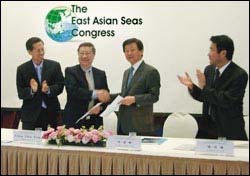
China and ROK Gear Up for EAS Congress
QUEZON CITY, PHILIPPINES -- The People's Republic of China and the Republic of
Korea expressed overwhelming interest to participate in the East Asian Seas (EAS)
Congress 2006.
In recent PEMSEA forums and activities in the two countries, PR China and RO Korea
recognized the significant opportunity that the EAS Congress will provide for the further
enhancement of cooperation in the sustainable development of the East Asian Seas.
The Ministry of Maritime Affairs and Fisheries (MOMAF), Korea Ocean Research
Development Institute (KORDI), Korea Maritime Institute (KMI), and Korea
Environment Institute (KEI) believe that the Congress will provide a good avenue for the
experts of RO Korea to interact and share their experiences with various other PEMSEA
partners. The event will also allow participants from different disciplines to come
together and discuss varied issues on coastal and marine development. It was estimated
that about 50 participants from RO Korea will attend the event.
The State Oceanic Administration (SOA) of China and the Chinese Institute of Marine
Affairs (CIMA) have also stepped up preparations for the Congress. The SOA, as host
agency of the event, will provide the necessary support to ensure the smooth conduct of
the conference. CIMA, on the other hand, is planning to organize and conduct a side
meeting of directors of the Marine Affairs Institute of East Asia. The Director of CIMA,
Dr. Gao Zhiguo, also expressed willingness to invite other participants to the meeting as
well as provide supporting staff to the Congress.
The active involvement of PR China and RO Korea in the EAS Congress shows the
countries' willingness to strengthen actions and commitment for the protection and
sustainable development of the seas in the region.
The EAS Congress will be held in Haikou City, Hainan Province, PR China, on 12-16
December 2006. Further information on Congress activities can be found at
www.pemsea.org/eascongress. Questions and comments on the Congress can be sent to
congress@pemsea.org.
China to Contribute One Million RMB Annually to PEMSEA
BEIJING, PR CHINA -- Starting 2007, the People's Republic of China through the State
Oceanic Administration (SOA) will contribute one million RMB or about $125,000,
every year for five years to PEMSEA, to support the Programme's transformation into a
regional mechanism for the implementation of the Sustainable Development Strategy for
the Seas of East Asia (SDS-SEA).
Last May, the State Oceanic Administration (SOA) of China confirmed the appropriation
of the said amount for the implementation of the SDS-SEA. This financial contribution is
a clear demonstration of China's commitment to the sustainable development of the seas
of East Asia. China's contribution, in particular, is intended to support the operations of
the PEMSEA Resource Facility (PRF), one of the major operating mechanisms of the
SDS-SEA. The PRF will provide the secretariat and technical services for the
implementation of the regional strategy.
The SDS-SEA was endorsed through the Putrajaya Declaration by the 12 East Asian
countries in December 2003. The development and endorsement of the Strategy is
considered as an important milestone as it provides a holistic framework for the
management of the coastal and marine environment of the region. Through its
implementation, the region hopes to be able to sustain the ocean resource as well as the
growing economy of East Asia.
Financing Water, Sewage and Sanitation -- A Major Theme at the East Asian Seas
Congress
QUEZON CITY, PHILIPPINES -- Financing water, sewage and sanitation projects will
be one of the major issues to be addressed during the East Asian Seas Congress 2006,
which will be held from 1216 December in Haikou City, Hainan Province, PR China,
and organized by PEMSEA.
Water supply, sanitation and sewage are major issues facing the rapidly growing
population of the East Asian seas region. According to the World Water Development
Report 2002, 715 million people lacked access to improved water supply while 1.9
billion lacked access to improved sanitation in Asia. The situation is aggravated by the
fiscal and capacity limitations faced by local government units in allocating funds and
resources for much-needed water supply, sanitation and sewage treatment projects.
The theme entitled "Local Government Financing for Water, Sewage and Sanitation"
explores the ways and means to finance environmental improvement infrastructure for
wastewater and solid waste management in small and secondary townships. The concept
of and experiences related to public-private sector partnerships and the paradigm shift in
waste management will be further discussed. Various workshops and seminars around
this theme will also be organized together with multilateral financial institutions with the
objective of providing valuable information on project development and sustainability,
and effectively obtaining, generating and managing funding for water, sanitation and
sewage projects.
For more information on the EAS Congress 2006 or to pre-register, please visit
www.pemsea.org/eascongress or email congress@pemsea.org.
National Forum on SDS-SEA Implementation Successfully Concluded in Seoul
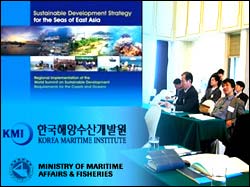
SEOUL, RO KOREA -- The government of RO Korea and other stakeholders in the
country expressed commitment to play a stronger role in strengthening coastal and ocean
management in the region through the implementation of the Sustainable Development
Strategy for the Seas of East Asia (SDS-SEA). This was the general consensus reached at
the recently concluded National Consultative Workshop on RO Korea's implementation
of the SDS-SEA, which was co-organized by the Korea Maritime Institute (KMI) and
sponsored by the Ministry of Maritime Affairs and Fisheries (MOMAF).
The Workshop was opened by Dr. Lee Jung-Hwan, KMI President, and congratulatory
remarks were delivered by Mr. Shin Pyong-Sik (Director General of MOMAF) on behalf
of Minister Kim Sung-Jin, Dr. Yum Ki-Dae (KORDI President) and Dr. Chua Thia-Eng.
The Workshop focused on the following objectives: to build the awareness of national
and local leaders on the SDS-SEA; identify baseline activities, major gaps and country
priorities for the national implementation of SDS-SEA; to identify specific country
activities for the GEF/UNDP Project on the Implementation of the SDS-SEA; and to
confirm the interest/commitments of potential collaborative institutions. About 70
officials and experts from the national government agencies, research institutions,
universities, private sector, NGOs, Korea International Cooperation Agency (KOICA),
Korea Ocean Research and Development Institute (KORDI), and other relevant
institutions of RO Korea participated in the Workshop.
These objectives were reached through the effective and successful presentations,
information exchange, and discussion during the Workshop. In particular, the panel
discussion on RO Korea's program of activities for the implementation of the SDS-SEA
provided an opportunity to brainstorm on the current issues facing coastal and ocean
governance in the country as well as the actions to be taken to address these. The active
participation of the stakeholders and various government agencies helped enormously in
bringing about a successful outcome of the Workshop.
The Workshop is one of the many initiatives being undertaken by PEMSEA as part of the
preparations for the implementation of the SDS-SEA. The SDS-SEA, which was
endorsed by the 12 East Asian countries in December 2003 through the Putrajaya
Declaration, provides a common framework of action for the sustainable use and
development of the region's coastal and marine environment and resources. The
establishment of regional mechanisms for the implementation of the SDS-SEA is
currently being prepared by PEMSEA member countries and partners, and is expected to
be formally endorsed at the East Asian Seas Congress in December 2006.
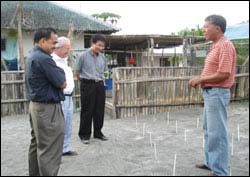
PEMSEA's Terminal Evaluation Calls for Renewed Support from GEF to Sustain
the Programme's Gains
QUEZON CITY, PHILIPPINES -- After more than two months of comprehensively
assessing performance and finding areas for improvement, the Terminal Evaluation of
PEMSEA ended with the official submission of the Terminal Evaluation Report on 26
April to the United Nations Development Programme and the International Maritime
Organization, PEMSEA's Implementing and Executing Agencies, respectively. The 50-
page report contains the findings, recommendations and lessons learned by PEMSEA's
Terminal Evaluation Team, led by Dr. Gunnar Kullenberg, and with Dr. Kem Lowry and
Dr. Cielito Habito as team members.
In partial fulfillment of the monitoring and evaluation requirements for all full-sized
projects in the Global Environment Facility's International Waters portfolio, PEMSEA's
Terminal Evaluation ushered the final stages of the current phase's project life. To ensure
the accuracy and relevance of gathered information, the Terminal Evaluation Team
undertook rigorous evaluation procedures and methods, including dialogues with the
Regional Programme Office management and staff, field visits to selected PEMSEA
project sites (Manila Bay, Bataan and Batangas in the Philippines; Chonburi and Port of
Bangkok in Thailand; Sihanoukville in Cambodia and Danang in Vietnam), telephone
interviews with PEMSEA's partners and project managers, desk reviews of PEMSEA
documents and publications, and participation in PEMSEA's stakeholder workshops on
SDS-SEA implementation.
Among the salient findings and recommendations of the Terminal Evaluation Team were:
· Continued GEF funding support for the PEMSEA project;
· Sustaining the momentum of progress already built in the region through the
PEMSEA initiatives;
· Pursuing the proposal to establish the East Asian Seas Partnership Council with
the accompanying Ministerial Forum; and
· Continued monitoring of the progress at the local, national and subregional levels
established through partnerships and networks.
In addition, the Terminal Evaluation Report cited three important lessons learned:
· Success and sustainability hinges on the proper combination of key Programme
ingredients.
· Partnerships must be inclusive, harnessing efforts and resources from all relevant
stakeholder groups at various levels and in all aspects of the work.
· PEMSEA's combination of "top-down" and "bottom-up" impetus is effective in
securing necessary political commitment.
With the publication of the Report, it is hoped that PEMSEA's achievements and lessons
learned will benefit similar GEF projects and other interested parties.
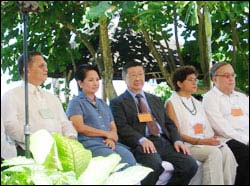
Philippines Adopts ICM as a National Policy Framework, Manila Bay Project Cited
PASAY CITY, PHILIPPINES -- Philippine President Gloria Macapagal-Arroyo
announced the country's adoption of integrated coastal management (ICM) as a
management framework for the sustainable development of coastal and marine
environment and resources during the National Forum on Sustainable Development of
Coastal Marine Resources, held on 7 June at the Hotel Philippine Plaza.
Executive Order No. 533 (EO 533), signed by the President, stresses the role of ICM in
promoting sustainable development of the country's coastal and marine environment and
resources in order to achieve food security, sustainable livelihood, poverty alleviation and
reduction of vulnerability to natural hazards, while preserving ecological integrity. The
integrated approach of ICM is crucial in addressing interlinkages among associated
watersheds, estuaries, wetlands and coastal seas. EO 533 specifically mandates the
Department of Environment and Natural Resources (DENR) to develop a national ICM
Program, in consultation with other concerned agencies, sectors and stakeholders within
one year. The national ICM Program will identify the relevant principles, strategies and
action plans after balancing national development priorities with local concerns, define
national ICM targets, and develop a national ICM coordinating mechanism. It is expected
to provide direction, support and guidance to the local government units and stakeholders
in the development and implementation of their local ICM programs.
In the same forum, the President also recognized the achievements of the Manila Bay
Environmental Management Project, and cited its important role of serving as "a good
test case to demonstrate that the country's most important bay can meet the needs of all
sectors relying on it for food, livelihood, commerce and transportation, while protecting it
from further degradation." In 2001, President Arroyo endorsed the Manila Bay Coastal
Strategy, which laid down the framework of action for the Manila Bay region aimed at
sustaining its capacity to provide food, resources and livelihood to an estimated 23
million Filipinos.
Dr. Chua Thia-Eng, PEMSEA Regional Programme Director, emphasized "that the case
of Manila Bay requires constant attention and careful management because the
challenges encountered by the country's coastal and marine management are
overwhelming." He noted further that there is a need for concerted action to protect the
seas. "The Philippines, together with its neighboring countries, recognizes that the
problems besetting the East Asian Seas are too complex for governments to handle
alone," Dr. Chua explained.
The Forum was co-organized by the DENR and was attended by representatives from
national and local governments, NGOs, media and the private sector.
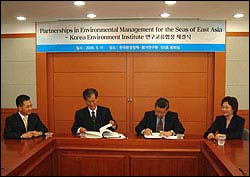
PEMSEA Signs Three MOUs with KORDI, KMI and KEI
SEOUL, RO KOREA -- Three Korean research institutions pledged cooperation with
PEMSEA to broaden knowledge sharing and capacity building in integrated coastal
management in the East Asian Seas region.
PEMSEA, represented by the Regional Programme Director, Dr. Chua Thia-Eng, signed
two Memoranda of Understanding with the Presidents of Korea Maritime Institute (KMI)
and Korea Ocean Research and Development Institute (KORDI) on 9 May at the
National Consultative Workshop, held in Plaza Hotel, Seoul, RO Korea. Another MOU
was signed with the President of the Korea Environment Institute (KEI) on 11 May,
during his visit to KEI.
The cooperation aims to enhance the knowledge and capacities of East Asian countries in
the sustainable use and management of the region's coastal and marine environment. In
particular, the agreements provide a formal framework for organization of joint training
and technical workshops, knowledge sharing, development of research initiatives, and
staff exchange. Long-term partnership programs for collaboration will be developed for
the three institutions, which will also serve as basis for the signing of Partnership
Operating Arrangements at the East Asian Seas Congress 2006.
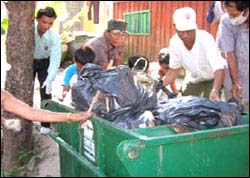
Private and Public Sectors Engage Sihanoukville Community in Solid Waste
Management
About a three-hour drive from the capital Phnom Penh lies Sihanoukville -- home to the
only deepwater port in Cambodia and harboring perhaps the most pristine beaches in the
region.
Recent improvements in transportation and road networks has made Sihanoukville even
more accessible to tourists, with local tourists increasing from 4,585 in 1993 to 83,888 in
2003, and foreign tourists from 8,428 to 33,604 during the same period.
Like any developing tourist area, Sihanoukville is faced with the daunting problem of
waste management. For the past years, the management of solid wastes is continually
challenged by a web of difficulties ranging from poor infrastructure and solid waste
facilities, limited budget for enforcement and lack of a systematic process in waste
collection, to poor information among communities on health and sanitary measures. As
the only deepwater port area, industrialization is more rapid. The municipality's capacity
to address solid waste management (SWM), therefore, has become more difficult as
industries and business sectors shift to nonbiodegradable materials in the production of
goods, thereby increasing the volume of wastes being disposed every day.
Based on a 2001 study, only 30 percent of generated wastes are being collected. Projects
on SWM, therefore, need to focus not only on improving waste collection facilities and
services, but on involving communities in waste management.
A pilot project on community-based SWM in Village 1 Sangkat 4 is an initial step in
involving the community in SWM. Supported by the PEMSEA Project in Sihanoukville,
the Municipal Government, through the Department of Environment and the Commune
Council, works with community members and the CINTRI Waste Company. The project
has collected and properly disposed 175 T of wastes that have accumulated in the
commune since 1992. Sangkat 4 is located at the town center where most business
establishments are situated. Village 1 is in the inner part of the town center, which makes
waste collection more difficult for the waste company.
The SWM Project includes baseline data gathering, training, a clean and green campaign,
and household involvement in community cleanup and waste segregation. Getting the
school children to participate is also an important aspect of the project. About 70 percent
of the households in Village 1 are composed of children 617 years of age, which
emphasizes the essential role of the youth in the project. Extensive information
campaigns are being done to inculcate proper waste management practices.
The project, while relatively small in scale, provides a venue where common problems of
waste management are being solved through more flexible public-private partnerships.
Aside from the CINTRI Waste Company, the Royal University of Phnom Penh (RUPP)
Department of Environmental Science, provides the necessary technical support in the
analysis of baseline information and conduct of community training.
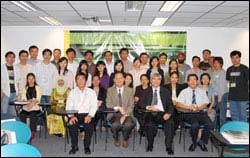
Training Course on IEIA for Coastal and Marine Areas Held in Hong Kong
HONG KONG, PR CHINA -- "What fascinated me was the concept of Integrated
Environmental Impact Assessment which considers the combined impacts of various
development projects on a given area and provides appreciation and comprehension of
cumulative, synergistic and antagonistic impacts," said Nguyen Thanh Lam of the
Institute for Scientific Information in Vietnam on the training course on "Integrated
Environmental Impact Assessment for Coastal and Marine Areas," held at the City
University of Hong Kong on 4-10 June.
Participated in by 32 representatives from Cambodia, PR China, Indonesia, DPR Korea,
Malaysia, Philippines, Thailand and Vietnam, the training is the fourth of the five-part
training on IEIA being organized by PEMSEA, Coastal Management Center (CMC) and
the Centre for Coastal Pollution and Conservation, City University of Hong Kong. This is
one of the initiatives under the Area of Excellence (AoE): Marine Research and
Innovative Technology (MERIT) awarded to the Centre for Coastal Pollution and
Conservation. The training was coordinated by Prof. Rudolf Wu and Dr. Paul Shin.
During the workshop, participants were given the chance to learn from experts from
various departments of the City University of Hong Kong, including the Centre for
Coastal Pollution and Conservation/Department of Biology and Chemistry and
Department of Public and Social Administration, and the Department of Ecology and
Biodiversity of the University of Hong Kong. An expert from the Environmental
Protection Department, Hong Kong SAR Government was also invited as lecturer. The
Training Manual on the IEIA for Coastal and Marine Areas produced by PEMSEA was
used as a main reference material for the training. Case study presentations also increased
the understanding of the application of IEIA in various contexts.
Following the training course, a one-day workshop on "Environmental Pollution and
Applied Ecotoxicology" provided the participants additional information on using
different toxicity tests for screening and risk assessment. The workshop included three
presentations with guest speakers from City University of Hong Kong, Hong Kong
Baptist University and Ghent University, Belgium, and was attended by all the
participants including some 40 people from local government offices, universities,
consulting firms and testing laboratories.
COPYRIGHT © PEMSEA