PEMSEA E-UPDATES Vol. VII Issue 02 2006
EAS Congress 2006 Gains More Partners
The East Asian Seas (EAS) Congress 2006 promises to be an exciting and comprehensive
capacity-building event as more partners express their commitment. Organized by
PEMSEA and the State Oceanic Administration (SOA) - PR China together with the
Hainan provincial and Haikou city governments, the event will bring together the in-
depth experience and knowledge of various experts and international organizations on
sustainable coastal and ocean management. To date, the EAS Congress has gained the
support of 41 partner organizations and 47 Advisors and Committee Members.
The organizations that have shown support are:
1. Asia-Pacific Fishery Commission
2. Asia Pacific Forum of Environmental Journalists
3. Asian Fisheries Society
4. Centre for Marine Environmental Research and Innovative Technology, City
University, Hong Kong
5. China Institute of Marine Affairs, China
6. Coastal Management Center
7. Department of Sustainability and Environment, Victoria, Australia
8. East Asia Response Pte. Ltd.
9. Foundation for Environmental Education
10. Food and Agriculture Organization of the United Nations - Regional Office for
Asia and the Pacific
11. GEF Small Grants Programme
12. GEF/UNDP/IMO Global Ballast Water Management Programme
13. Global Forum on Oceans, Coasts and Islands
14. Global Environment Facility
15. Global Programme of Action for the Protection of the Marine Environment from
Land-based Activities Coordination Office, UNEP
16. International Maritime Organization
17. International Marine Project Activities Centre
18. International Ocean Institute
19. International Petroleum Industry Environmental Conservation Association
20. Korea Environment Institute, RO Korea
21. Korea Maritime Institute, RO Korea
22. Korea Ocean Research and Development Institute, RO Korea
23. Marine Aquarium Council
24. Marine Environmental Emergency Preparedness and Response Regional Activity
Centre of the Northwest Pacific Action Plan
25. Marine Stewardship Council
26. Ministry of Maritime Affairs and Fisheries, Indonesia
27. Ministry of Maritime Affairs and Fisheries, RO Korea
28. Network of Aquaculture Centres in Asia-Pacific
29. Nippon Foundation
30. Ocean Policy Research Foundation
31. Plymouth Marine Laboratory
32. IAEA/ Regional Co-operative Agreement Regional Office
33. Southeast Asian Fisheries Development Center
34. State Oceanic Administration, China
35. Thailand Environment Institute
36. United Nations Development Programme
37. UNEP/East Asian Seas Regional Coordinating Unit
38. UNDP/GEF Project on Reducing Environmental Stress in the Yellow Sea Large
Marine Ecosystem
39. Victorian Coastal Council, Australia
40. Wetlands International
41. The World Bank
More are expected to confirm their support in the months leading up to the Congress in
December 2006.
Furthermore, a good number of the partner organizations have expressed their solid
commitment to organize the various workshops and seminars as Co-Convenors.
International organizations, programmes and projects representing the UN, NGOs, multi-
lateral financial institutions, government departments, environmental institutions, and the
academe will be managing different sessions during the International Conference. Each
organization will share their expertise on issues and topics based on the seven sub-themes
of the Congress: Sustainable Ocean and Coastal Development, Coastal and Ocean
Governance, Ecosystem-based Management, Eco-labeling and Certification, Coastal and
Maritime Safety and Environmental Protection, Economics and Finance and
Management-related Science and Technology.
Register now and be part of the EAS Congress 2006! Visit our website at
www.pemsea.org/eascongress to download our forms or for more information. You can
also send emails to congress@pemsea.org.
OPRF Submits Proposal for a 21st Century Ocean Policy for Japan
TOKYO, JAPAN The Ocean Policy and Research Foundation (OPRF) recently
submitted to the Japanese Government a proposal for a 21st Century Ocean Policy. The
proposal indicates a significant development in Japan's keenness to further strengthen the
country's ocean governance.
The proposed policy is a comprehensive policy that aims to provide a strong legal
foundation for the integrated development and management of Japan's coastal and
marine environment. The proposal was developed in response to the UN Convention on
the Law of the Sea and Agenda 21, as well as Japan's recognition of the need to address
the emerging issue concerning of the marine environment.
The proposal includes the following main elements:
1. On Becoming a True Oceans State: The Need for a Comprehensive Ocean Policy;
2. Ocean Policy Objectives;
3. Enacting a Basic Ocean Law;
4. Establishing an Administrative Organ; and
5. Management and International Harmonization of the Nation's Expanded Ocean
Territory:
· Building a framework for management of the EEZ and continental shelf.
· Establishment of a security policy for the oceans.
· Promotion of marine protection, conservation, and restoration.
· Promotion of ocean resources development that is respectful of
ecosystems.
· Strengthening initiatives for creation of ICZM.
· Promotion of disaster prevention and reduction.
· Provision of information resources for ocean governance.
· Promotion of research, education and outreach.
The proposed policy is currently going through the passage of approval by the Cabinet
and eventually the Diet (Japan's Parliament). The Ministry of Land, Infrastructure and
Transport is at the forefront of pushing for its swift approval.
The development and submission of the proposal for a 21st Century Ocean Policy for
Japan is an essential first step for the country's intensified commitment towards the
sustainable development of Japan's marine environment. It is also seen as a good
example to encourage other countries in the region to pursue an integrated policy for
oceans governance.
PEMSEA Prepares for 12th Steering Committee Meeting
QUEZON CITY, PHILIPPINES - The implementing mechanisms for the Sustainable
Development Strategy for the Seas of East Asia (SDS-SEA), particularly the endorsement
of a draft Partnership Agreement and Partnership Operating Arrangements, will be the
focus of the upcoming 12th Programme Steering Committee Meeting (PSC) of the
PEMSEA Regional Programme. The two documents represent a significant milestone in
the coastal and ocean governance of the region a paradigm shift from an
intergovernmental-centred approach, to a strategic partnership approach involving
governments, international financial institutions, international donor organizations,
regional and bilateral projects, and the private sector.
The initial stage of preparations for PEMSEA's 12th PSC Meeting is underway. In
addition to the regional implementing mechanisms, the meeting will also address the
transformation of PEMSEA from a project-based programme to a country-driven long-
term regional implementing mechanism for the SDS-SEA, and the organization of the
East Asian Seas Congress 2006. The meeting will be held on 1-4 August in Davao City,
Philippines and will be hosted by the Philippine Department of Environment and Natural
Resources.
The draft Partnership Agreement - to be adopted by Ministers at the Ministerial Forum as
part of the East Asian Seas Congress 2006 will address how and by whom the SDS-
SEA will be implemented and sustained.
The draft Partnership Operating Arrangements for the implementation of the SDS-SEA
outlines PEMSEA's role to serve as the regional coordinating mechanism for
implementing the SDS-SEA and facilitate the realization of its shared vision, mission,
and action programs. PEMSEA will consist of four major operating mechanisms: the East
Asian Seas Partnership Council; the PEMSEA Resource Facility; the Regional
Partnership Fund and the East Asian Seas Congress.
Delegates from 12 PEMSEA participating countries, the International Maritime
Organization, and the United Nations Development Programme, along with
representatives various regional and international organizations, are expected to attend
the 12th PSC, the last of PEMSEA's current phase.
PEMSEA Shares Regional Strategy Progress in COBSEA Meeting
HAINAN, CHINA -- PEMSEA shared the experiences and lessons learned by
participating countries in their efforts to implement the Sustainable Development
Strategy for the Seas of East Asia (SDS-SEA) during the 18th Coordinating Body on the
Seas of East Asia (COBSEA) Meeting on the East Asian Seas Action Plan held on 24-25
January.
PEMSEA Senior Officer Dr. Huming Yu, presented the progress of PEMSEA countries,
particularly in the development of a new five-year GEF/UNDP/PEMSEA project on the
implementation of the SDS-SEA and the development of a pollution reduction
investment fund project with the World Bank and GEF. The message for furthering
partnerships between PEMSEA and COBSEA were likewise conveyed. PEMSEA's
participation in the COBSEA Meeting was a means of not only sharing experiences and
lessons learned but to seek stronger collaboration between COBSEA and PEMSEA.
Over 30 participants from 12 countries and nine international organizations attended the
meeting. The Meeting was chaired by the China State Environmental Protection
Administration, Department of International Cooperation Deputy Director-General, Mr.
Yue Ruisheng, and attended by representatives from the United Nations Environment
Programme (UNEP) Regional Office for Asia-Pacific, UNEP/Global Programme for
Action and UNEP East Asian Seas Regional Coordinating Unit.
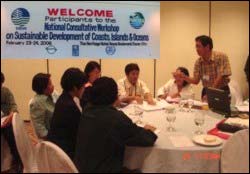
Philippine Stakeholders Look into Approaches to Sustainable Development of
Coasts and Oceans
PASAY CITY, PHILIPPINES Philippine stakeholders gathered to discuss the
implementation of the Sustainable Development Strategy for the Seas of East Asia (SDS-
SEA) and explore best means to support its regional implementation through local
initiatives. Over 80 stakeholders, representing various national government agencies, the
legislature, local government units (LGUs), financial institutions, the private sector and
nongovernment organizations, participated in the National Consultation Workshop on the
Sustainable Development of Coasts, Islands and Oceans held from 23-24 February.
The workshop provided the stakeholders the opportunity to discuss issues in marine and
coastal environment, review current coastal and marine management initiatives that
contribute to the implementation of the SDS-SEA, and formulate a national framework
and set of recommendations in support of SDS-SEA implementation.
Key recommendations that came out of the workshop included:
· the need to formulate a national policy and framework for integrated coastal
management (ICM);
· target the establishment of functional ICM initiatives in 5% of the country's
coastal municipalities by 2010;
· develop a sustainable institutional mechanism for Manila Bay and for the
implementation of the Operational Plan for the Manila Bay Coastal Strategy;
· implement policy and institutional reforms to encourage and enhance public and
private sector investment in environmental infrastructure; and
· enhance capacity building for LGUs on ICM and environmental investments
The workshop was organized by the Department of Environment and Natural Resources,
the Manila Bay Environmental Management Project and PEMSEA.
The SDS-SEA was adopted in the Putrajaya Declaration during the East Asian Seas
Congress in 2003. The document serves as a common platform of regional cooperation
and partnership building in achieving sustainable development goals in the East Asian
seas region. Through its implementation, the region also hopes to achieve the objectives
and targets set in the World Summit on Sustainable Development Plan of Implementation
and the Millennium Development Goals.
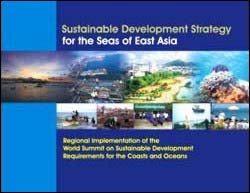
SDS-SEA Introduced to Japanese Association of Coastal Zone Studies
TOKYO, JAPAN - Members of the Japanese Association of Coastal Zone Studies
(JACZS) expressed appreciation and interest in PEMSEA and its activities after
participating in a lecture conducted by PEMSEA Regional Programme Director Dr. Chua
Thia-Eng on 15 February.
The presentation focused on the objectives and activities of PEMSEA and also gave
particular emphasis on the Sustainable Development Strategy for the Seas of East Asia
(SDS-SEA) and the ongoing initiatives towards its implementation.
The organization of the lecture was spearheaded by the Ministry of Land Infrastructure
and Transport with a view to promote PEMSEA and SDS-SEA to a wider audience in
Japan. JACZS is considered as an important entity in the promotion of activities for the
development of the coastal and marine environment as it covers a broad membership.
JACZS is composed of members from various sectors of the society including the
academe, government agencies, private sector and NGOs, and is the only association in
Japan established with the sponsorship of several ministries.
As an active member of PEMSEA, Japan believes that awareness-building activities such
as this can help strengthen the commitment and involvement of other stakeholders in the
country towards the sustainable development of the seas of East Asia.
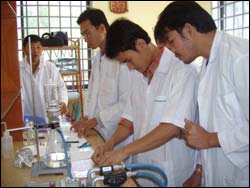
Sihanoukville Enhances Capacity to Monitor Beach Environment
SIHANOUKVILLE, CAMBODIA The local government of Sihanoukville is
strengthening its capacity to implement an integrated beach environmental monitoring
program (IBEMP) to monitor and manage the environmental health of its beaches.
With the support of PEMSEA, a training course on environmental monitoring was
conducted from 23-31 January. This training aimed to evaluate and build on the capacity
developed during a previous training in May 2005 and the conduct of the Pilot IBEMP
from July to September 2005. The training was held in the Sihanoukville Environmental
Laboratory (SEL) and included: 1) discussions on data analysis, interpretation, reporting
and management; 2) quality assurance and quality control (QA/QC); 3) assessment of
capacity for the analysis of dissolved oxygen, biochemical oxygen demand, total
suspended solids, total phosphorus, and inorganic nitrate and nitrite; and 4) training on
the analysis of coliform, oil and grease, chemical oxygen demand and total nitrogen. The
parameters measured at the SEL are important for monitoring environmental health and
identifying potential human health as well as ecological risks. The training likewise
involved actual field sampling exercises and assessment, which were conducted in
O'ccheauteal Beach.
The training also initiated the development of a long-term IBEMP and action plan, which
includes institutional arrangements for sustainable implementation. The long-term plan
will be developed further by the Project Management Office (PMO) of the Sihanoukville
integrated coastal management (ICM) Demonstration Project and Department of
Environment, in collaboration with concerned agencies and institutions, and will be
submitted to the Project Coordinating Committee of Sihanoukville for review and
eventual adoption.
Five participants from the Department of Environment, the Department of Mines and
Industry and the PMO participated in the training.
Sihanoukville Municipality is pursuing a long-term IBEMP program that supports
sustainable beach and tourism management in Sihanoukville. IBEMP is part of a broader
ICM initiative to sustainably manage and protect the marine and coastal resources of
Sihanoukville and complements existing efforts in tourism development and management.
The tourism industry remains one of the major sources of income for Sihanoukville, with
tourists attracted to the beautiful beaches and pristine waters of the Gulf of Thailand.

PEMSEA Welcomes New Staff
QUEZON CITY, PHILIPPINES -- PEMSEA welcomes Ms. Joveilene Camba and Mr.
Jaekyun Kim as new staff.
Mr. Kim from Yonsei University joins PEMSEA as its newest Intern. Mr. Kim will learn
the concepts and approaches of integrated coastal management and national coastal
policy development. He will also assist in the organization of the EAS Congress 2006.
Ms. Camba joins PEMSEA as an Encoder and will assist in the completion of the
PEMSEA regional database of experts and organizations operating or working in the East
Asian Seas region.
COPYRIGHT © PEMSEA