PEMSEA E-UPDATES Vol. VII Issue 01 2006
AusAid Supports Thailand's Coastal Planning
BANGKOK, THAILAND -- The Australian Government through the Australian Aid for
International Development (AusAid) is committed to help Thailand in improving coastal
management and to help the Andaman Coasts recover from the ravages of the December
2004 tsunami.
In line with AusAid's post-tsunami assistance to Thailand, a strategic planning workshop
entitled "Securing the Economic Future for the Andaman Sea Coastal Industries and
Communities" was held last November 28, 2005 in Bangkok and Phuket. The Workshop
aimed at assisting the Thai Government in developing the post-tsunami planning of the
coastal zones facing the Andaman Sea. In addition, the AusAid will be providing
A$400,000 for one year to support coastal planning using Geographic Information
System (GIS) and community-based management of the coral reef in some of the islands
near Phuket.
Around 40 participants from various line agencies of the Thai Government, universities,
bilateral and multilateral coastal management programs/projects, and international
organizations attended the workshop. The workshop emphasized the importance and
applicability of integrated coastal management (ICM) in providing a holistic approach to
the coastal use and management problems by reviewing the experience of other initiatives
in East Asia, Australia and Europe. One of the presentations was delivered by PEMSEA
Regional Programme Director, Dr. Chua Thia-Eng entitled "Reducing the Impacts of
Unnatural Disasters through Integrated Management and Partnerships" focusing on the
10-point action plan on efficient coastal management and achievements of ICM in the
East Asian Seas region.
The Workshop was organized in coordination with the CRC Reef Research Center of
Australia and the Coastal and Marine Resources Department of the Ministry of Natural
Resources and the Environment (MoNRE) of Thailand.
This Workshop is just one of the many Australian initiatives in Thailand. Various
projects related to the post-tsunami assistance and rehabilitation included the sending of
medical teams and supplies and the deployment of an AusAID officer in the United
Nations Disaster Assessment and Coordination (UNDAC) team to Thailand.
Bali Province Conducts Training on Web-based Decision-Support System
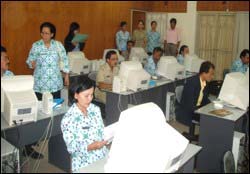
BALI, INDONESIA -- Local capacities in coastal and marine environmental planning
and management in the province of Bali received a boost with the successful conduct of a
Training Workshop on Web-based Integrated Information Management System (IIMS),
held last 29-30 November 2005.
Over 25 participants from government offices and agencies from both the provincial and
regency levels participated in the workshop, which not only provided training on the
operationalization of web-based IIMS and data management, but included the
development of an action plan to ensure the sustainability of the IIMS in Bali.
The participants enhanced their understanding of database management, the web-based
IIMS software, the IIMS query system, and data uploading. The workshop developed an
action plan that outlined the necessary activities, outputs, timetable, responsible agencies,
budget and budget sources needed to ensure system sustainability. The plan will be
presented to an upcoming meeting of local government agencies, which will discuss the
operationalization of IIMS at various agencies and regencies in Bali.
The participants were keen on learning how to access IIMS data through the Internet,
proving significant flexibility in accessing data. They likewise expressed appreciation on
the importance of IIMS in integrating and sharing data among government departments
and regencies and how these data can facilitate planning and decisionmaking. The
training workshop was a joint effort of PEMSEA RPO and the Project Management
Office of the Bali ICM Demonstration Project.
IIMS is a relational environmental database management system that handles a wide
range of information on coastal and marine environmental planning, management and
assessment.
IIMS was developed to provide local governments with a standardized system for data
collection, collation and recording, as well as a means for adequate data analysis,
interpretation and information packaging. The system was also designed to address the
issue of data inaccessibility by making its results available through the Internet.
EAS Congress 2006 Takes on Coastal and Ocean Governance Issues
The future prospects, challenges and lessons learned in coastal and ocean governance
both from within and outside the East Asian Seas region will be one of the key themes to
be tackled during the International Conference of the East Asian Seas (EAS) Congress
2006 to be held on 12-14 December in Haikou City, China.
The EAS Congress 2006 will delve on the various regimes, institutional
arrangements/mechanisms and programmes as well as the dynamics of coastal and ocean
management, all combined under the theme: Coastal and Ocean Governance.
Coastal and ocean governance workshops and seminars will focus on: Regime-building
in Coastal and Ocean Governance; Approaches in Interagency Collaboration and
Partnerships; Economic Contribution of the Marine Sector; Integrating Social Science
Concerns into Coastal Development and Management; Advocacy and Leadership in
Coastal and Ocean Management; and Integrated Coastal Management: Experiences,
Lessons and Scaling-up.
The issue of coastal and ocean governance is a critical and timely one. Presently the state
of the East Asian Seas is deteriorating due to the rapid urbanization and economic
development of countries, putting at risk the livelihoods of millions of people who
depend on the goods and services provided by the ecosystem of East Asian Seas. This
continued deterioration is a clear sign that coastal and ocean management in the region
needs to be more effective. Thus, country support and cooperation is of utmost
importance towards the achievement of sustainable development of the East Asian Seas
region.
The EAS Congress 2006 is designed to provide an important venue for the region's
stakeholders to constructively address major issues in ocean and coastal management.
The Congress will be attended by high-level decisionmakers and experts both from
within and outside the East Asian Seas region, making it a major international event.
The International Conference will feature six other major themes, with various
Workshops and Seminars focusing on related sub-topics under each theme. These themes
include: Sustainable Coastal and Ocean Development; Ecosystem-Based Management;
Eco-labeling and Certification; Coastal and Maritime Safety and Security; Economics
and Finance; and Management-related Science and Technology.
Innovative Research in Marine Pollution in Hong Kong
HONG KONG, CHINA -- Scientific outputs and research work on marine pollution
assessment and monitoring undertaken by the Center for Marine Environmental Research
and Innovative Technology (MERIT) of the City University in Hong Kong were
recognized during the 2nd Meeting of the International Advisory Committee held last 2
December 2005.
The Meeting was a scientific symposium that saw the presentation of more than 50
research topics. These research works or studies were reviewed and assessed by the
Advisory Committee Members based on quality and scientific merits, progress made in
terms of timeline and outputs, synergies and collaboration, as well as the management of
the research programme. After thorough assessment, the Committee applauded MERIT
for coming up with very impressive outputs of international standards. The Advisory
Committee is comprised of international and regional experts from Canada, USA, United
Kingdom and PEMSEA.
MERIT's research designs, tools, facilities, and methodologies for assessment,
monitoring, and control of impacts of marine pollution were found to be innovative and
considered to be worth promoting internationally. To further promote the initiatives and
outputs of the Centre, Committee members recommended that MERIT establish linkages
with the government and stakeholders by conducting periodic dialogues with them. It was
also recommended that the Center be developed into an internationally recognized
research institution and play a stronger role in contributing to the development of the
environment of Hong Kong and the region.
MERIT was established in early 2004 after being awarded with HK$45 million under the
University Grants Committee's third round of Areas of Excellence scheme. The proposal
to establish the centre was spearheaded by a team of experts of the Hong Kong City
University led by Professor Rudolf Wu. The focus of MERIT is to address marine
pollution issues and to create innovative technologies to protect the marine environment.
The MERIT project is implemented by a team of multidisciplinary researchers from
Hong Kong local universities and overseas scientists.
New PEMSEA Partnership to Enhance Environmental Investments for Philippine
Coastal Communities
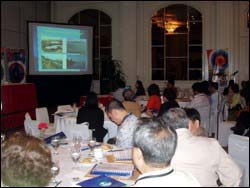
MANILA, PHILIPPINES -- PEMSEA and the League of Cities of the Philippines (LCP)
recently signed a Memorandum of Understanding (MOU) to share experiences and
knowledge in integrated coastal and marine management and sustainable financing
mechanisms to enhance investments in environmental infrastructure in coastal
communities of the Philippines.
Under the MOU, LCP and PEMSEA mutually agree to exchange information on the
respective programmes including linking websites; build awareness and develop
initiatives to strengthen capacities of LCP member cities in integrated coastal and marine
planning and management; and co-organizing conferences, site visits, seminars and
workshops for City Mayors and senior managers on public-private partnerships in
environmental infrastructure projects, sustainable financing mechanisms, technologies
and practices for pollution reduction and in the sustainable use and management of
marine and coastal areas.
The MOU was signed by PEMSEA Regional Programme Director, Dr. Chua Thia-Eng
and LCP National Chair and Focal Mayor for the Environment Unit, Mayor Edward S.
Hagedorn.
The LCP is a non-profit organization of cities created to help coordinate efforts to
improve governance and local autonomy and address issues such as preserving the
environment and improving public works. LCP provides services to its member-cities in
the areas of environmental policy development and advocacy, research and training,
technical assistance and information management.
The new partnership is seen as a step forward in PEMSEA's efforts in creating
investment opportunities and mechanisms for environmental improvement and
sustainable resource use throughout the East Asian Seas region.
Partnerships at Work in Oil Spill Preparedness and Response
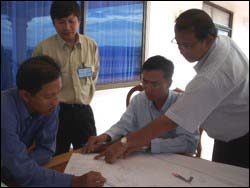
SIHANOUKVILLE, CAMBODIA -- Cambodia's capacity to respond to oil spill
emergencies was heightened with the successful conduct of the Training Course on Oil
Pollution Preparedness, Response and Cooperation (OPRC) for Supervisors and On-
Scene Commanders, held last 13-16 December 2005. The course was organized and
conducted through a partnership between PEMSEA, the Marine Department of Thailand,
Industry Environmental Support Group (IESG) - Thailand, and East Asia Response
Limited (EARL).
The 28 course participants, representing various government agencies and private oil
companies, were all personnel holding significant responsibilities under Cambodia's
newly developed national oil spill contingency plan. The training enhanced the
participant's knowledge and skills in contingency planning and response, and improved
their abilities in delivering timely, organized and effective response in the event of oil
pollution emergencies.
The training course was supplemented by a tabletop exercise wherein participants were
grouped according to highlighted responsibilities under the national oil spill contingency
plan of Cambodia. The exercise provided the participants with the opportunity to
examine the existing structures, systems and capabilities of respective organizations and
identify areas that could be improved to support the national plan.
This partnership is part of PEMSEA's objective of promoting cross-boundary, multi-
sector, multi-agency cooperation in the Gulf of Thailand. Building on the IMO OPRC
model course, with technical support from EARL and practical experiences from
Thailand's Marine Department and IESG, the OPRC training was made more relevant
and responsive to the training needs of the participants.
Puerto Galera Shows Keen Interest in Public-Private Partnerships
PUERTO GALERA, PHILIPPINES -- An exploratory site visit by PEMSEA on 5-6
December 2005 to the resort municipality of Puerto Galera confirmed a strong interest
among local stakeholders in the application of public-private partnerships (PPP) to
address local environmental issues.
PEMSEA Technical Officer Maria Corazon Ebarvia and PEMSEA Investment Specialist
Rodolfo Pantillano met with local government officials, tourist resort owners and other
stakeholders and provided a briefing on the objectives, process and expected outputs of a
successful PPP initiative. The mission informed the local officials of PEMSEA's
willingness to provide technical assistance to help develop local capacity in developing
and implementing environmental investment projects, and conduct a pre-feasibility study,
willingness-to-pay survey and investors' roundtable to assist the local government in
selecting the appropriate partner, as well as partnership and financing arrangements.
Puerto Galera Mayor, Hon. Aristeo Atienza welcomed the mission and signified his
commitment and support for the PPP project and process.
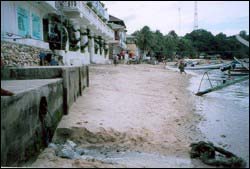
Puerto Galera in Mindoro Island is a major tourist spot known for its white beaches and
coral reefs. The municipality received 3.5 million tourists for the first half of 2005 alone.
The municipality however is facing environmental problems particularly the lack of
sewage treatment facilities, which leads to the pollution of coastal waters. Poor water
quality in the bathing waters of Puerto Galera can affect the municipality's image as well
as the tourism industry that provides employment to many of the local citizens.
With local support and commitment confirmed, PEMSEA is now in the process of
initiating steps towards assisting the municipality in its PPP initiative.
Latest Tropical Coasts Issue Examines Sustainable Port Practices
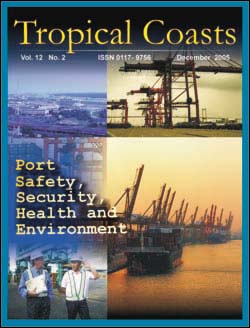
Port Safety, Security, Health and Environment is the theme for the latest issue of Tropical
Coasts Magazine, focusing various port management practices, systems and approaches
that have been applied as a consequence of increasing pressures and challenges related to
regulatory compliance, safety concerns, security, health of port workers and environment,
and enhancing port efficiency.
The East Asian Seas region has been a center of considerable economic growth for the
past two decades. Fueling this growth is a dynamic and fast-growing maritime industry,
which has made the East Asian Seas one of the busiest in terms of maritime shipping and
port development. Along with this development comes an increasing concern among port
authorities and port operators on achieving and demonstrating sound quality, safety,
security and improved environmental performance. The December 2005 Tropical Coasts
Issue explores efforts in developing a systematic and strategic management framework
that would enable the adoption and effective implementation of various international
instruments that can put in place good port operation practices.
The issue also has a special feature titled: "PEMSEA PSHEMS Recognition Process."
The feature discusses the process by which ports can attain recognition under PEMSEA's
Port Safety, Health and Environmental Management Code (PSHEM), a code aimed at
providing port authorities with a standard by which to measure performance with regard
to quality, safety and health of port workers and environment.
Tropical Coasts is a bi-annual publication of PEMSEA, Sida Marine Science Programme,
the Coastal Management Center, and the United Nations Environment Programme-
Global Programme of Action. It is geared towards stimulating an exchange of
information and sharing of experiences and ideas with respect to environmental
protection and the management of coastal and marine areas.
Past issues can be downloaded at http://pemsea.org
Three Nations Sign Partnership Statement to Combat Marine Pollution in Gulf of
Thailand
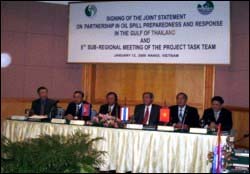
HANOI, VIETNAM -- The countries of Cambodia, Thailand and Vietnam joined hands
in a committed partnership to protect the coastal and marine environment of the Gulf of
Thailand with the landmark signing of the Joint Statement of Cambodia, Thailand and
Vietnam on Partnerships in Oil Spill Preparedness and Response in the Gulf of Thailand
held on 12 January 2006.
The Joint Statement contains a tripartite intergovernmental agreement on combating oil
spills, and endorses a Framework Programme for Joint Oil Spill Preparedness and
Response in the Gulf of Thailand. The event marked a significant milestone for the three
countries and of the PEMSEA-supported Gulf of Thailand Environmental Management
Project.
The mission of the partnership is to enhance national and regional capabilities concerning
oil pollution prevention, preparedness and response through a Gulf-wide exchange of
information, joint research and development projects, training, oil spill response exercises,
and mutual assistance in response, collaborative arrangements, partnership building and
implementation.
Senior government officials signing the Joint Statement included Ministry of
Environment Director General, H.E. Dr. Lonh Heal of Cambodia; Ministry of Transport
Marine Department Director General, Mr. Tawalyarat Onsira of Thailand; and National
Committee for Search and Rescue Vice Permanent President, Mr. Nguyen Duc Soat of
Vietnam. Serving as witnesses to event were Cambodia Senior Minister and Minister of
Environment, H.E. Dr. Mok Mareth; Vietnam Ministry of Natural Resources and
Environment Vice Minister, H.E. Mr. Nguyen Cong Thanh; and PEMSEA Regional
Programme Director, Dr. Chua Thia-Eng.
COPYRIGHT © PEMSEA