PEMSEA E-UPDATES Vol. VI Issue 09 2005
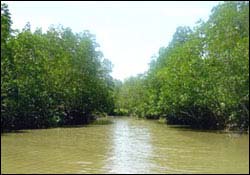
Cambodia Undertakes a New Initiative to Protect Mangrove Habitats
PHNOM PENH, CAMBODIA -- By decision of the Royal Government of Cambodia and
signed by Cambodian Prime Minister, H.E. Hun Sen on 4 August, the Monitoring and
Assessing Commission for Suppressing Encroachment into Mangrove Areas and Coastal
Reclamation was established with hopes of protecting Cambodia's coastal habitats.
The commission aims to prevent encroachment into mangrove areas and coastal
reclamation that significantly affected the "environmental, physical, ecological and
scenic condition" of Cambodia's coastal areas.
The commission's roles and duties include: monitoring and assessing all encroachment
into mangrove areas and coastal reclamation; stopping all activities related to coastal and
forest encroachment including all kinds of construction; taking back forest or coastal
areas which have been encroached and make them state property; and requiring offenders
to rehabilitate affected mangrove areas and turn such areas into state property.
In terms of its composition, the new commission is chaired by the Minister of
Environment with the State Secretary of Interior; State Secretary of Land Management,
Urbanization and Construction; State Secretary of Agriculture, Forestry and Fisheries;
State Secretary of Tourism; and the Governors of Sihanouvkville, Kep, Kampot, and Koh
Kong Municipalities serving as members.
Already, the commission has made its presence felt. In Kep Municipality violators who
built concrete walls and foundations inside designated mangrove areas were given a
deadline to remove the structures and rehabilitate all mangrove trees destroyed in the
process. The Kep Municipal Authority, in cooperation with the Land Title Office, shall
likewise initiate a municipal development plan which includes identifying mangrove
areas and earmarking them for protection.
Chonburi Local Officials Visit Xiamen to Witness its ICM Benefits
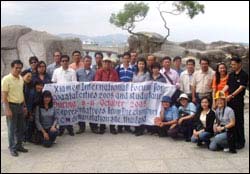
XIAMEN, PR CHINA -- Very much interested in enhancing their own integrated coastal
management (ICM) initiatives, senior government officials, local leaders and natural
resource managers from Chonburi Province, Thailand, visited Xiamen to conduct a study
tour of its ICM demonstration site and witness first-hand on-the-ground impacts of ICM
as applied in Xiamen Municipality.
The Xiamen ICM study tour was conducted on 10 October with 25 government officials
from the municipalities of Sriracha, Laemchabang, Koh Sichang, Chaoprayasurasak,
Angsila, Bangphra and Muang in Chonburi Province participating in the event.
The study tour included field visits and briefings on:
· the origins of ICM in Xiamen and how it advanced with an improved institutional
and legal framework, a working sea use zonation scheme and mechanisms for
integrated law enforcement, scientific support, public awareness and capacity
building;
· the management of Yuandang Lagoon and the significant environmental, social
and economic benefits gained due to its clean-up;
· The benefits of Xiamen's water-use zonation scheme in addressing various use-
conflicts;
· Xiamen's water-use zonation scheme, its benefits and the various use-conflicts
experienced and addressed; and
· a round-island coastal road which combined protection and development of sandy
beaches and shoreline.
The participants appreciated the exposure provided by the study tour, how direct
experience contributed immensely to their learning, and how the brief tour enabled them
to exchange ideas, share respective local experiences and projects, and plan future
activities. They also showed appreciation of Xiamen's efforts in harmonizing economic
development and environmental protection and the contribution of the integrated
management approach in this achievement.
Xiamen's ICM working model has been operating successfully since 1994 and is
frequented by various stakeholders throughout the region wishing to gain increased and
deeper understanding on ICM.
Cities Share Sustainable Development Experiences in Xiamen Forum
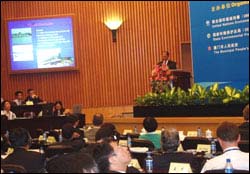
XIAMEN, PR CHINA -- Mayors and other local leaders from more than 20 coastal cities
worldwide as well as international organization representatives participated in the 2005
International Forum for Coastal Cities held from 89 October, with the theme,
"Intensifying Prevention and Treatment of Pollutants from Land-Based Activities and
Protecting and Improving Marine Environments."
Over 300 participants attended the Forum which provided an efficient platform for
exchanges on management practices and global cooperation to improve awareness of
ocean environment and protection among people in China and the world at large. The
conduct of this conference is considered an important first step towards the establishment
of a stronger alliance of coastal cities worldwide.
The Forum was organized into three main sessions: the Special Report Session, the
Experts Forum; and the Mayors Forum. During these forums, speakers and
representatives from various coastal cities and regional and international groups shared
their experiences and delivered special reports regarding the sustainable management of
coastal cities.
Discussions in the forum focused on the following issue-areas: coastal management,
management of land-based pollutants, protection of marine ecology, marine economy,
near-sea economy, protection and development of islands, and the local implementation
of the regional and international agreements on coastal and marine governance. The
highlight of the forum was the signing of the Xiamen Declaration on Coastal Cities (See
related article).
The Forum was jointly organized by the United Nations Environment Programme, State
Environmental Protection Administration of China and the Municipal People's
Government of Xiamen, in collaboration with Local Governments for Sustainability
(ICLEI) and PEMSEA, and technically supported by the Sino-Europe Technology
Promotion Center, Wageningen University of the Netherlands and Xiamen University.
The forum is set to become an annual event, with the next Forum to be held in October
2006.
Enhanced Web Services Launched for EAS Congress 2006
People in the East Asian Seas Congress 2006 can now enjoy enhanced web-services with
the completely redesigned official Congress website and the launch of the EAS Congress
E-updates.
Comprehensive information on the Congress can now be downloaded at
www.eascongress.way.to. Aside from the participation details on the different web pages,
downloadable Acrobat PDF files such as the First Announcement brochure, Registration,
Abstract Transmittal and General Inquiry/Reply Forms are now available.
More importantly, the official Congress website is now fully enabled to accept online
payments. Interested parties can now make convenient and secure payments for
participation using major credit cards. Special discounted rates are available for
registrations made on or before January 31, 2006.
In order for participants to help get the most out the EAS Congress, an Online
Inquiry/Feedback Form is now available. Interested parties can fill up the form and the
Congress Secretariat will immediately respond to any inquiry and/or suggestion.
To keep stakeholders updated on preparations, regular EAS Congress E-updates will be
sent, highlighting important news and developments useful for individuals and
institutions interested in participating.
Mayors and Representatives Sign Xiamen Declaration on Coastal Cities
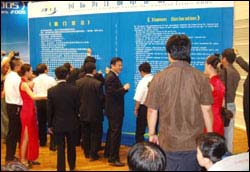
XIAMEN, PR CHINA -- A stronger cooperation towards the sustainable management
and development of coastal cities was laid when mayors and representatives of local
governments from more than 20 cities worldwide pledged their support by signing the
Xiamen Declaration on Coastal Cities on 8 October.
The Xiamen Declaration serves as an important instrument of commitment towards the
strengthening of coastal governance and the promotion of the sustainable use of coastal
environment and resources by creating an alliance of coastal cities that will create a
sound program for technical exchanges and cooperation between countries. The
Declaration acknowledges the significant role of coastal cities -- being the center of
major political, socioeconomic, cultural and ecological interactions as well as primary
beneficiaries or users of the coastal environment -- in the protection, development and
proper management of the coastal ecosystem. Furthermore, it is an expression of support
to other regional and international agreements promoting sustainable development, such
as the 1992 Rio Declaration, UN Conference on the Law of the Seas, and the World
Summit on Sustainable Development.
The Declaration acknowledges various threats in the sustainable development of coastal
cities and identifies several actions that need to be undertaken to address the increasing
degradation of coastal resources and the environment. Some of the important actions and
approaches identified are knowledge and experience sharing, integrated water governance
and ecosystem-based management.
To ensure the continuance of the objectives set in the Declaration and to monitor the
progress undertaken by coastal cities on coastal management, it was agreed upon by the
attendees to undertake the Forum for International Coastal Cities on a regular basis.
Mitigating "Unnatural" Disasters in Coastal Cities
XIAMEN, PR CHINA -- In the recently concluded International Forum for Coastal Cities
held from 8-9 October, several special reports were delivered by various experts and
representatives from different regional and international programs and organizations
related to the sustainable development of coastal cities. PEMSEA, as one of the forum
collaborators, presented a paper entitled, "Coastal Cities at the Forefront of Unnatural
Disasters" (Click here to read the full paper). PEMSEA's Regional Programme Director,
Dr. Chua Thia-Eng highlighted the significant role of coastal cities in the sustainable
development of their coastal areas and their influence to the increasing magnitude of the
so-called "unnatural disasters".
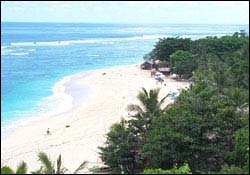
According to the report, most of the world's cities are found in coastal areas. These
coastal cities are the center of major economic activities and the home to over half of the
world's population. Thus, coastal cities are under intense pressures from increasing
demand for economic development causing great impacts to the environment in general,
and coastal and marine environment in particular.
The pursuit for rapid economic development without regard to environmental protection,
however, has threatened the economic sustainability of coastal cities. Indiscriminate
human activities have aggravated the damage on the coastal environment and further
intensified natural disasters, as witnessed in the aftermath of the Indian Ocean Tsunami in
December 2004 and of Hurricane Katrina in August this year. These natural hazards were
both accelerated by direct and indirect impacts of human activities, and have become
what most environmentalists call "unnatural disasters."
The coastal cities are key actors in preventing or reducing the devastating effects of
natural and man-made disasters. Being at the forefront of possible unnatural disasters,
coastal cities can play a key role in changing the way coastal and marine resource and
environment is governed. This entails a paradigm shift in coastal governance. A new
paradigm that would include the following actions: Action 1 include coastal and marine
environmental concerns in economic development policy; Action 2 integrate sea-use
into land-use planning and management; Action 3 establish coordinating mechanism;
Action 4 ban habitat destruction and restore habitats; Action 5 stop overfishing;
Action 6 develop and implement ecosystem-based management; Action 7 create an
informed public; Action 8 build partnerships; Action 9 address transboundary issues;
and Action 10 create regional and global networks of local governments.
The increasing frequency and magnitude of natural and the so-called "unnatural
disasters" can only be mitigated through the concerted efforts of the local governments,
the timely policy of national governments and the political will of policymakers at
national and local levels. It is also hoped that by adopting the ten-point action outlined
above, albeit slowly, sustainable development can be achieved in the coastal cities.
Municipality of Sihanoukville Celebrates International Coastal Cleanup
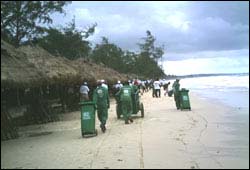
SIHANOUKVILLE, CAMBODIA -- More than 600 government officials, tourists,
community members, and members of civil society and private sector groups participated
in the celebration of the International Coastal Cleanup in Sihanoukville. The beach
cleanup was spearheaded by the Municipal Government of Sihanoukville and co-
sponsored by the Sihanoukville Chamber of Commerce on September 14.
The beach cleanup was done in more than 700 meters of coastline in Occheauteal Beach.
During the activity, dolphins were seen near the shore and one had to be transported to a
deeper area as it cannot swim back to sea. A short program was also held to impart
information on the importance of coastal management.
Being a major bathing area, Occheauteal Beach is the pilot site covered by the Municipal
Government's Integrated Beach Environmental Monitoring Program. The program
ensures that beach water quality is monitored twice a month in four sampling sites and is
analyzed at the Sihanoukville Environment Laboratory. A Tourism Development and
Management Plan was also formulated following a series of consultations among various
stakeholders on-site. The Municipality of Sihanoukville is also keen on implementing this
plan and has initially allocated about US$20,000 for its implementation.
Occheauteal Beach is among the major tourist destinations in Sihanoukville, attracting
thousands of tourists every year. Sihanoukville itself is situated on a large peninsula
surrounded on three sides by the beaches Occheauteal, Sokha, Independence and Victory.
These beaches attract both foreign and local tourists every year. While there are no
official data for the influx of tourists for Occheauteal Beach alone, the increasing number
of restaurants, guest houses and hotels attest to the booming tourism industry in
Sihanoukville. Official figures indicate that between 1993 and 2003, the domestic visitors
to Sihanoukville increased from 4,585 to 83,888 and foreign tourists from 8,428 to
33,604.
PEMSEA Partners to Boost Regional Coastal Management with IEIA Training
PEMSEA, in partnership with City University of Hong Kong and the Coastal
Management Center, is organizing a training workshop on integrated environmental
impact assessment (IEIA) for coastal and marine areas in an effort to train key
stakeholders on the benefits and implementation of IEIA and enhance development
planning in the East Asian region.
The workshop aims to train officials/administrators handling environmental impact
assessment (EIA), coastal planers, academicians and other stakeholders in the concept,
scope, implementation and benefits of IEIA so they can in turn integrate the practice of
IEIA in the development of planning schemes for their respective countries.
The practice of IEIA is seen as a significant enhancement in coastal management in the
region. Currently, the ecological and social consequences of proposed development plans
within countries are determined by EIAs. However, EIAs are often conducted based on
individual development projects, as and when they arise. An IEIA approach or "Strategic
Environmental Assessment" considers the combined impacts of various development
projects within the environment and permits a clearer understanding and appreciation of
cumulative, synergistic and antagonistic impacts not easily detected or predicted through
separate-based EIAs. Equally important is that integration effectively reduces or avoids
duplication of efforts in information gathering.
The training workshop shall be held from 5-10 June 2006 at the Centre for Coastal
Pollution and Conservation of the City University of Hong Kong. The organizers are
likewise making available a limited number of fellowships for interested participants
from developing countries.
For more information interested parties can visit the workshop website at:
http//www.pemsea.org.
PEMSEA Publishes Framework for National Coastal and Marine Policy
Development
QUEZON CITY, PHILIPPINES -- PEMSEA has recently published a study aimed at
providing policy analysis and decisionmaking guidance and reference materials to
countries in the East Asian Seas region. Titled "Framework for National Coastal and
Marine Policy Development," the study presents national practices, experiences and the
lessons learned in the policy development process.
With coastal and marine areas playing significant roles in national economic
development, the absence of a national coastal and marine policy hinders the sustainment
of coastal and marine development.
During PEMSEA consultations with regional stakeholders, it was noted that developing
and improving national coastal and marine policies is important to address multiple-use
conflicts, remove barriers to sustainable development, enhance the contribution of coastal
and marine areas to socioeconomic development, and strengthen capacities in
implementing international and regional obligations. Pursuant to these recommendations,
PEMSEA commenced work in developing the Framework.
While the Framework does not purport to be the `model' policy development process to
be followed strictly, step-by-step, it outlines a general process, good practices and
constraints that may show some light in the development of national coastal and marine
policies.
Copies of the study can be downloaded from the PEMSEA website at:
http://www.pemsea.org
PEMSEA Videos Continuously Aired through International Cable Broadcast
QUEZON CITY, PHILIPPINES -- PEMSEA's public awareness campaign on integrated
coastal management (ICM) and sustainable development shoots up as PEMSEA videos
are continuously aired on Asian TV networks and on international cable broadcast.
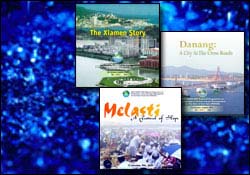
PEMSEA videos namely Melasti: A Festival of Hope, Danang: A City at the Crossroads
and The Xiamen Story are being aired in the Living Asia Channel (LAC) since August
with an average of 20 broadcast schedules per month. Programs aired in LAC have an
estimate audience share of 10 million viewers per broadcast and airs in Asia, Australia
and New Zealand, Oceania, the Middle East, and North America through the facilities of
Dream Broadcasting System, GlobeCast World TV, Pacific Century Matrix, and
Mabuhay Satellite.
In addition, the Danang: A City at the Crossroads video has been translated into
Vietnamese and was aired at least twice a month from June to September on Danang TV.
Xiamen TV in P.R. China had their share of promoting ICM and aired the Xiamen Story
in Chinese to reach more audiences in their area.
PEMSEA has been very active in strengthening partnerships with the media to enhance
knowledge sharing and public awareness on ICM. For further information on the
broadcast schedule of PEMSEA videos on the Living Asia Channel, visit
www.pemsea.org or log on to www.livingasiachannel.net.
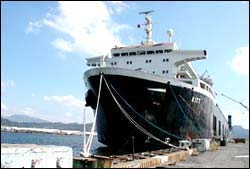
PEMSEA Works for Enhanced Port Safety, Health and Environment
JOHOR BAHRU, MALAYSIA -- PEMSEA recently conducted a recognition audit for
the Port of Tanjung Pelepas in Malaysia. The audit is part of a series of steps required for
ports to attain recognition under PEMSEA's Port Safety Health and Environmental
Management System (PSHEMS) initiative.
The audit, which was conducted in two stages from 26-27 September and 9-12 October
respectively, found that the support and commitment of the top management of Port of
Tanjung Pelepas was the driving force for the port's PSHEMS development and
implementation. The audit produced good results as it was able to identify several areas
for improvement towards the full scope implementation of the PSHEMS Code.
The PSHEMS recognition initiative is part of PEMSEA's efforts to build the capacity of
port authorities and operators in the region in the safe handling and transport of
dangerous cargoes in port areas and to demonstrate a comprehensive management
framework to enhance the quality and safety of operation and pollution prevention of
ports in general. The system uses the same fundamental system requirements as the ISO
9001 Quality Management System, ISO 14001 Environmental Management Systems,
and OHSAS 18001 Occupational Health and Safety Management Systems, but is
focused specially on port operations.
The Port of Bangkok in Thailand and the Port of Tanjung Pelepas in Malaysia were
chosen as pilot sites for the PSHEMS initiative. The two ports have been undertaking a
series of activities towards the full implementation of the PSHEMS. The project teams
for the PSHEMS project of both ports have undergone a series of training workshops
organized by PEMSEA in cooperation with the International Maritime Organization,
which built both teams' capacities in designing and implementing a PSHEMS. The
development and implementation of a PSHEMS is advantageous as it provides the
framework to enable ports to obtain certification for ISO 9001, ISO 14001 and OSHAS
18001.
COPYRIGHT © PEMSEA