PEMSEA E-UPDATES Vol. VI Issue 04 2005
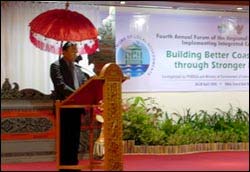
4th RNLG Annual Forum Calls for Stronger Leadership and Partnership in Local
Actions
BALI, INDONESIA -- Over 100 government leaders, coastal and marine experts from 22
PEMSEA ICM sites and candidate parallel sites, along with representatives from
international and regional organizations have called for strengthening the implementation
of integrated coastal management (ICM) to achieve sustainable coastal development in
East Asia. The call came at the Fourth Annual Forum of the Regional Network of Local
Governments Implementing Integrated Coastal Management (RNLG) on 26-28 April,
with the theme "Building Better Coastal Governance through Stronger Alliance."
The forum participants reviewed and synthesized a decade's worth of ICM experiences
and lessons learned from PEMSEA ICM sites as well as various ICM initiatives in
Indonesia. In view of the recent Indian Ocean tsunami, a special session was organized to
consolidate lessons learned from the tsunami tragedy and identify effective strategies for
reducing and mitigating natural and man-made coastal hazards. The forum recognized
that ICM was a useful framework for coastal hazard management.
The Fourth RNLG Forum also saw the significant adoption of the Bali Resolution on the
establishment of the PEMSEA Network of Local Governments for Sustainable Coastal
Development (PNLG), which transforms the existing RNLG into the PNLG. The PNLG
is a more self-sustaining and local government-driven network (see related story).
The forum was co-organized by PEMSEA and the Ministry of Environment of Indonesia
and hosted by the Bali Provincial Government. The next forum will be organized as a
side-event during the East Asian Seas Congress 2006, to be held in PR China in
December 2006. Danang, Vietnam has offered to host the 6th forum, which will be held
in 2007.
Bali Shares ICM Practices with Other Local Governments in Indonesia
BALI, INDONESIA -- Representatives from various local governments representing the
coastal areas of Indonesia were able to learn from Bali's integrated coastal management
(ICM) experiences during the Bali ICM Workshop: Sustaining and Replicating Bali ICM
Experiences held 29 April.
The workshop was organized by the Bali Provincial Government with the objective of
sharing Bali's ICM experiences with other local governments in Indonesia as a means to
assist them in their respective coastal management efforts. The workshop was highlighted
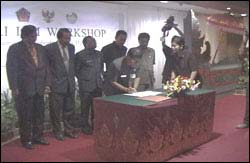
with the official adoption of the Bali Coastal-Use Zoning Plan and the Coastal Strategy
Implementation Plan by the Bali Provincial Government, seven Regency governments
and one municipal government. A Partnership arrangement for implementing an
integrated beach environmental monitoring program was also signed by representatives
of BAPEDALDA (Environmental Impact Agency of Bali Provincial Government), Bali
Tourism Development Corporation, the academe and the private sector.
The adoption of the plans provided the participating local governments with the
opportunity to observe first-hand the various activities that result from implementing
ICM. The signing ceremony signified the commitments of local stakeholders to the
sustainable operation of Bali's ICM program. In his opening remarks, Bali Provincial
Vice-Governor, Kesuma Kelakan emphasized the importance of strengthening legal and
institutional arrangements for the sustainability of Bali's ICM efforts.
Ministry of Environment representative Mr. Heru Waluyo stressed the importance of
initiating national-level efforts to replicate and expand Bali ICM experiences to other
coastal areas in Indonesia. The Ministry of Environment, in collaboration with PEMSEA
and interested local governments, will conduct national ICM task force training and will
link local ICM initiatives into a national network.
Experts to Gather for Effective Water Ecosystem Management
MASAN, RO KOREA -- The Ministry of Maritime Affairs and Fisheries (MOMAF) of
RO Korea and PEMSEA are preparing an international workshop that will gather various
water experts together to discuss the challenges of managing interrelated river basins,
estuaries and coastal seas.
The Workshop on Ecosystem Management for Interrelated River Basin, Estuaries and
Coastal Seas will be held 1-3 June in Masan, ROK. It will be attended by experts from
the Seto Inland Sea (Japan), Chesapeake Bay (USA), Bohai Sea (PR China), Jakarta Bay
(Indonesia), Manila Bay (Philippines), and Masan-Chinhae Bay (RO Korea).
The Masan workshop aims to identify the major challenges to ecosystem management of
interrelated river basins, estuaries and coastal seas, review experiences and lessons
learned from the practices in tackling such challenges, and outline response strategies and
a mode of implementation for the East Asian region. The workshop will focus on three
major areas of concern: a) policy, legal and other institutional arrangements; b) living
resource restoration and ecological implications and c) water pollution reduction relating
to the integrated management of river basins, estuaries and coastal seas.
The workshop proper will run for the first two days, and will be followed by a half-day
field excursion on 3 June to the Masan-Chinhae Bay and Moon Island. The international
event is part of MOMAF and PEMSEA's joint endeavor to build regional capacity in the
sustainable development of water bodies in East Asia.
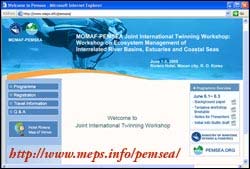
As part of the preparations, MOMAF has launched a website on the workshop which can
be visited at www.meps.info/pemsea.
Korean Government Officers Visit Xiamen for ICM Capacity Building
XIAMEN, PR CHINA -- Twenty-six senior government officers and coastal management
experts from RO Korea visited Xiamen to learn of its experiences in integrated coastal
management (ICM). The Xiamen ICM Study Tour was held on 20-21 April and provided
the Korean participants a good opportunity to witness first-hand on-the-ground impacts
of ICM as applied in Xiamen Municipality and compare it with ongoing ICM initiatives
in RO Korea.
The study tour included field visits and briefings on:
· the management of Yuandang Lagoon and the significant environmental, social
and economic benefits gained due to its cleanup;
· Xiamen's wastewater treatment situation and plans for the city's use of treated
wastewater;
· Xiamen's water use zonation scheme, its benefits and the various use-conflicts
experienced and addressed;
· Gulangyu Island, its experiences and benefits in ISO 14001 certification and plans
for diversifying tourism activities; and
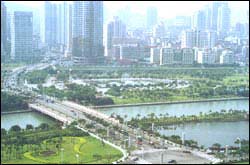
· beach and road improvements to provide stakeholders with natural amenities that
include a scenic view of the beach, greenbelts and parks.
During the conduct of the study tour, the participants learned that the application of
integrated legislative frameworks, scientific support for decisionmaking, and stakeholder
consensus building were among the key causes of ICM success in Xiamen. The
participants also realized that local capacity building is a key factor to better implement
ICM plans in RO Korea.
The Korean officials in the tour expressed that the experiences they have learned from
Xiamen will serve to enhance their ICM efforts as most local governments in RO Korea
have established their own ICM implementation plans.
The study tour was jointly organized by the Ministry of Maritime Affairs and Fisheries
(MOMAF) of RO Korea and PEMSEA.
PEMSEA Welcomes New Staff
QUEZON CITY, PHILIPPINES -- PEMSEA welcomes Mr. William Azucena as its new
Technical Assistant for Human Resources Development. He joined PEMSEA on 12 April.
William holds a bachelor's degree in Development Communication from the University
of the Philippines Los Baños and has previously worked with the Project Management
Office of the BIGKIS-Bataan Integrated Coastal Management (ICM) Program,
PEMSEA's first ICM parallel site.
William will be involved in the development of PEMSEA training materials and assist in
the implementation of PEMSEA training programs.
PEMSEA Grieves Lost Friend
PEMSEA friend and stalwart partner Dr. Raymundo S. Punongbayan along with four
other scientists and crew members died Thursday 28 April when their helicopter crashed
in Gabaldon town, Nueva Ecijia Province. They were on a return flight after conducting
an aerial assessment on the threat of landslides in Aurora Province.
Dr. Punongbayan concentrated his active public service with his stewardship of the
Philippine Institute of Volcanology and Seismology (PHIVOLCS) in 1982 until his
retirement from government service in 2002. When Mount Pinatubo erupted in 1991, a
timely forecast by a team headed by Dr. Punongbayan literally saved thousands of lives.
Even after retirement, Dr. Punongbayan served key roles in various NGOs, academic
institutions and providing advice to several major government authorities on
developmental policies.
It is a little known fact that PEMSEA's first four months of operations were conducted
under the generous stewardship of Dr. Raymundo Punongbayan. In September 1999, as
head of PHIVOLCS, Dr. Punongbayan offered the temporary use of the PHIVOLCS
building to a then fledgling PEMSEA Regional Programme Office. Long after PEMSEA
moved into its newly-renovated building, Ray, as he is known to many, was ceaseless in
his support for PEMSEA's efforts in the region.
He is survived by his children Ma. Lourdes Stauro, Ramon Enrico and Julie Andalus.

PEMSEA Participates in the Sea Grant International Roundtable
JAKARTA, INDONESIA -- A PEMSEA representative recently took part in the Sea
Grant International South East Asia Seminar and Roundtable, held on 30 April 1 May
in Jakarta. Other delegates to the meeting were from Indonesia, Malaysia and Thailand as
well as representatives from the Coordinating Committee for Geoscience Programmes in
East and Southeast Asia (COOP) and the U.S. National Oceanic and Atmospheric
Administration (NOAA).
The seminar's objectives was to identify the feasibility of applying the Sea Grant model.
The Sea Grant Model is NOAA's university-based program to support coastal resource
use and conservation with specific regard to applied research, awareness building, and
public outreach and extension to strengthen the role of universities in support of
implementing integrated coastal management .
During the seminar, the Ministry of Marine Affairs and Fisheries (MMAF) Director
General of Coasts and Small Islands represented by Prof. Ir. Widi Agoes Pratikto shared
Indonesia's experiences in developing its Sea Partnership Program (SPP) which was
based on the Sea Grant Model. SPP-Indonesia was developed to provide a mechanism for
addressing implementation gaps between central and local levels, and enhance the
capacity of local universities in addressing local development needs. It attempts to build
partnerships among the MMAF, universities, private sector, non-governmental
organizations, and community groups.
PEMSEA Senior Programme Officer Dr. Jihyun Lee emphasized the importance of
linking the SPP initiative with the overall ICM policy framework and discussed the
potential role of SPP in Bali. The SPP can contribute to the implementation of the Bali
Coastal Strategy, which was officially adopted in June 2002 by local leaders and
stakeholders as a policy framework for sustainable development and a platform for
stakeholders participation and cooperation.
It was also suggested that to expand the SPP initiative at the regional level, the SPP
should identify a specific niche of contribution to the implementation of the Sustainable
Development Strategy for the Seas of East Asia (SDS-SEA) in collaboration with
existing regional programmes and organizations.
Sihanoukville ICM Project Commences Integrated Beach Environmental
Monitoring Program
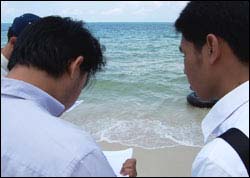
SIHANOUKVILLE, CAMBODIA -- The Municipality of Sihanoukville is implementing
an Integrated Beach Environmental Monitoring Program (IBEMP) to ensure sustainable
marine and coastal resources utilization and tourism development.
The IBEMP will be initiated with the operationalization of the Sihanoukville
Environmental Laboratory (SEL) in May 2005.
Spearheaded by the Project Management Office and the Department of Environment in
Sihanoukville, the IBEMP is a major step in consolidating efforts among public and
private institutions, such as the Danish International Development Agency (DANIDA),
Cambrew Ltd., and the Ministry of Environment, to conduct beach monitoring operations.
The parties are currently operating their own laboratories and have indicated their
commitments to the IBEMP implementation. As an initial activity, a preliminary briefing
on IBEMP in April was conducted during which four sampling stations were identified in
the famous swimming area, the Occheuteal Beach. An expansion of the monitoring
program to cover other beaches will be undertaken in succeeding months.
IBEMP is part of a broader integrated coastal management (ICM) initiative to sustainably
manage and protect the marine and coastal resources of Sihanoukville and complements
existing efforts in tourism development and management. The tourism industry remains
one of the major sources of income in Sihanoukville, attracted by the beautiful beaches
and pristine waters of the Gulf of Thailand.
Xiamen to Host the New PEMSEA Network of Local Governments
BALI, INDONESIA -- The Xiamen Municipal Government, PR China, has offered to
host the secretariat of the PEMSEA Network of Local Governments for Sustainable
Coastal Development (PNLG). The PNLG is a transformation of the existing Regional
Network of Local Governments Implementing Integrated Coastal Management (RNLG)
to a new network, that is not only self-sustaining but locally-driven as well. The PNLG
concept was adopted in the Bali Resolution on the Establishment of the PNLG on 27
April 2005, during the Fourth Annual RNLG Forum (see related story).
The PNLG aims to put in place sustainable working models for ICM programme
implementation. In recognition of this responsibility, the local governments were
encouraged to officially commit to adopt a Code of Conduct, including:
· To work towards the development and implementation of institutional
arrangements for ICM implementation, including: an interagency, multi-sectoral
mechanism to coordinate the efforts of different agencies, sectors and
administrative levels. Where appropriate, develop policy and legislative measures
to support ICM planning and management, capacity-building programs to
enhance required human resource skills and tools, scientific input to policy and
planning processes, and enforcement mechanisms to ensure compliance with
adopted rules and regulations;
· To formulate and implement coastal strategies and action plans that provide a
long-term vision and strategy for sustainable development of the coastal area, and
a fixed term programme of actions for addressing priority issues and concerns;
· To implement public awareness programs to increase the level of understanding
of, and appreciation for, the coastal and marine resources of the area, and to
promote a shared responsibility among stakeholders in the planning and
implementation of the ICM programme;
· To mainstream the ICM programme into the local government's planning and
socioeconomic development programme and to allocate adequate financial and
human resources for its implementation; and
· To conduct integrated environmental monitoring and to measure the status,
progress, and impacts of management programs against sustainable development
indicators, as may be established, and to use the information in decisionmaking,
public awareness and participation, and performance evaluation.
The Sustainable Development Strategy for the Seas of East Asia (SDS-SEA), as adopted
by PEMSEA participating countries in December 2003, recognizes the vital role of local
governments in the collective effort to reverse the continuing destruction and decline of
our common heritage. The Strategy challenges local governments in coastal areas
throughout the region with the formidable task of reducing conflicting and non-
sustainable use of natural resources in their respective watershed and coastal seas,
through the application and replication of ICM programs. The creation of the PNLG is in
recognition of the region's need to fully respond to the challenges of consolidating and
scaling up of ICM practices.
COPYRIGHT © PEMSEA