PEMSEA E-UPDATES Vol. VI Issue 03 2005
Plans for Three New ICM Parallel Sites in Bali Underway
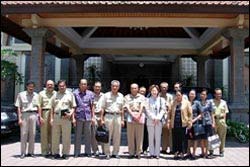
BALI, INDONESIA -- PEMSEA evaluated the regencies of Buleleng, Jembrana and
Tabanan in Bali for their potential as new integrated coastal management (ICM) parallel
sites during a site evaluation mission held on 15-17 March. The mission found strong
interest and commitment among stakeholders and confirmed the regencies' local
resources and capacity in adopting PEMSEA's ICM framework and approaches and
implementing ICM programs.
The mission, together with representatives from the Indonesian Ministry of Environment
(MOE) and the Bali ICM Management Project met with the local stakeholders of the
three regencies including representatives of relevant government departments and heads
of traditional villages. Field visits were conducted to locations representing key
management issues and interests. The experiences from the Bali and Sukabumi ICM
projects were shared with local stakeholders, along with the achievements of other ICM
sites in the region.
In Jembrana Regency, the stakeholder consultation meeting recognized that linking forest
and rivers with the coast and marine waters should be the basic framework of Jembrana's
coastal management, considering that the regency holds 70 percent of Bali Island's forest
cover. A major concern on Jembrana coast is beach erosion, mostly caused by natural
processes and worsened by sand and gravel mining and the construction of coastal
structures. The stakeholders agreed that the focus of their ICM program should be on
strengthening the capacity of village members in managing and protecting the coastal
areas and their understanding on coastal natural processes and habitats.
Buleleng Regency differs slightly from Jembrana in that its major concern is resource use
conflicts arising from the numerous coastal activities ranging from aquaculture,
mariculture and an emerging tourism industry. Consultations with stakeholders
highlighted the need for applying a coastal-use zoning scheme in Buleleng's coastal area.
It was also suggested that existing stakeholder efforts in environmental protection be
strengthened through education and training.
In Tabanan Regency, stakeholders expressed the need to preserve Tabanan's natural
resources and habitat thus providing a strong foundation for promoting eco-cultural
tourism - an alternative economic activity the Regency aims to develop. The evaluation
team visited one such village where tourists can experience Balinese daily life and culture
with activities such as cooking, planting, singing, dancing and joining in family
gatherings. Village members hope that the cultural tourism would bring in significant
local income that would in turn, discourage the illegal practice of sand and gravel mining
in Tabanan.
The mission concluded that ICM could make a positive contribution to the three
regencies, providing local government units with a mechanism and process to harmonize
both the economic development and environmental management of marine and coastal
resources.
Bangkok and Tanjung Pelepas Ports: Working Towards PEMSEA's PSHE-MS
Recognition
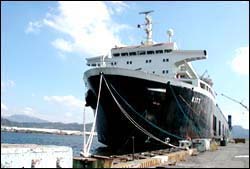
BANGKOK, THAILAND -- The Bangkok Port of Thailand and the Port of Tanjung
Pelepas in Malaysia are working towards the PEMSEA recognition of their respective
Port Safety, Health and Environmental Management Systems (PSHE-MS). The PSHE-
MS is a system that promotes and facilitates safe and environment-friendly port and
cargo operations, while protecting the health of port workers and the populations in
surrounding communities.
The Bangkok Port and Port of Tanjung Pelepas were selected as pilot sites for the PSHE-
MS in September 2003 and February 2004 respectively. The project teams for the PSHE-
MS project of both ports have undergone a series of training workshops organized by
PEMSEA in cooperation with the International Maritime Organization, which built both
teams' capacities in designing and implementing a PSHE-MS system.
Through training, the project teams were able to identify their respective port operating
practices and deficiencies against the requirements of PSHE-MS, identified health, safety
and environmental hazards and aspects of activities and services, formulated integrated
policies and established performance improvement objectives, targets and management
programmes.
The teams are currently completing their documentation of the integrated management
system operating procedures, instructions and records in accordance with the PSHE-MS
Code. The PSHE-MS provides the framework to enable the ports to obtain certification
for ISO 9001, ISO 14001 and OSHAS 18001.
PEMSEA will be awarding the PSHE-MS certificate of recognition to the two ports after
fulfilling the requirements of the established system. Further, the ports should be able to
demonstrate that they operate a PSHE-MS, that is properly implemented, maintained and
continuously improved.
PEMSEA Joins Hands with Clean up the World
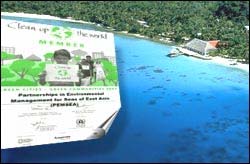
QUEZON CITY, PHILIPPINES -- PEMSEA joins hands with Clean Up the World, a
community-based environmental campaign that inspires and empowers individuals and
communities from every corner of the globe to make their environment a cleaner,
healthier place to live.
The campaign is coordinated and promoted by Clean Up the World Pty Ltd based in
Sydney Australia, a non-profit, nongovernmental organization. Clean Up the World
shares information, support and facilitation services to assist members in organizing and
promoting cleanup events and other environmental initiatives. On 16-18 September, all
members worldwide will organize simultaneous cleanup activities in a flagship event
called Clean Up the World Weekend.
PEMSEA countries have always been active in cleanup activities and joining up with the
Clean Up the World Campaign is seen as an opportunity to enhance community
enthusiasm and support to participate in environmental activities and raise awareness on
environmental issues.
PEMSEA's integrated coastal management (ICM) parallel site in Bataan, Philippines was
actually catalyzed by a local cleanup movement called Kontra Kalat sa Dagat (Movement
Against Sea Littering), where local stakeholders organize regular cleanups in the whole
Province of Bataan twice a year. In Batangas Bay, Philippines, a PEMSEA ICM
demonstration site, residents likewise engage in activities such as coastal cleanups, waste
recycling and segregation, materials recovery and redemption, and tree planting on
riverbanks.
Visit Clean Up the World at www.cleanup.com.au.
East Asian Governments to Meet in Manila for Sustainable Development Strategy
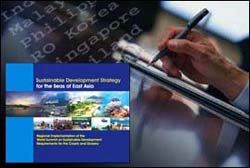
QUEZON CITY, PHILIPPINES -- Over 30 government experts from PEMSEA
participating countries will convene in Manila to formulate operational details for
implementing the Sustainable Development Strategy for the Seas of East Asia (SDS-
SEA). Organized by PEMSEA Regional Programme Office, the Working Group Meeting
will be held on 15-18 May, and will be hosted by the Department of Environment and
Natural Resources of the Philippines.
This Meeting is considered as a critical step in the transformation of the existing project-
based PEMSEA arrangement into a long-term and effective regional mechanism for
implementing the SDS-SEA. The draft documents to be prepared by the upcoming
Meeting will be endorsed for consideration by the 11th PEMSEA Programme Steering
Committee Meeting, to be held in Cambodia in August.
The SDS-SEA was adopted by 12 governments of the East Asian Region in December
2003 with the signing of the Putrajaya Declaration by Ministers and senior officials of
PEMSEA participating countries.
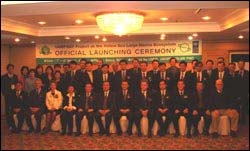
GEF Yellow Sea Large Marine Ecosystem Project Launched
SEOUL, RO KOREA -- Over 100 participants from key ocean related agencies attended
the formal launching of the United Nations Development Programme (UNDP)/Global
Environment Facility (GEF) Project on the Yellow Sea Large Marine Ecosystem held at
the Korean Hotel on 7 March.
In their congratulatory addresses, RO Korea Ministry of Marine Affairs and Fisheries
Vice Minister Kang Moo Hyun and PR China State Oceanic Administration Deputy
Administrator Mr. Sun Zhihui underscored the importance of the Yellow Sea Large
Marine Ecosystem to the products and services both countries have traditionally
benefited. They stressed the need for cooperative research and cooperation between
countries bordering the large marine ecosystem. UNDP (RO Korea) Resident
Representative, Ms Anne Isabelle Degryse-Blateau applauded the commitment of PR
China and RO Korea in the implementation of the Millennium Development Goals as
well as facing the challenges ahead in implementing the project. Dr. Je Jong Geel, a
member of the National Assembly of RO Korea, spoke on behalf of the recently-formed
Ocean Forum of Korea.
Keynote presentations by GEF International Waters Principal Technical Advisor, Dr.
Andrew Hudson, PR China State Oceanic Administration - Department of International
Cooperation Director General, Mr. Li Haiqing, Korea Ocean Research and Development
Institute Director, Mr. Shinjae Soo, and PEMSEA Regional Programme Director, Dr.
Chua Thia-Eng were made during the event.
Dr. Chua extended to the Yellow Sea Large Marine Ecosystem Project possible areas for
cooperation with PEMSEA, which included: co-organizing thematic workshops at the
upcoming East Asian Seas Congress 2006; exchanging information through website
linkages, publications and PEMSEA's C2C Network; conducting training courses and
workshops; and developing environmental investments using the World Bank/GEF
revolving fund project.
The new GEF project aims to protect, conserve and manage the Yellow Sea through
sustainable use of its waters and watershed, by reducing the development stress and
promoting sustainable exploitation of its resources. The Project Management Office is
located at Ansan, RO Korea with Mr. Yihang Jiang as project manager.
Manila Bay IIMS Now Online
QUEZON CITY, PHILIPPINES -- Environmental management for the Manila Bay area
received a strong boost in March with the successful development and testing of
PEMSEA's internet-based Integrated Information Management System for Coastal and
Marine Environment (IIMS) a decision-support system providing vital information for
managers and decisionmakers in addressing environmental issues in the Manila Bay Area.
PEMSEA has spent the last three years working to develop IIMS and refine its
functionalities. The web-based capability of IIMS was successfully tested by PEMSEA's
IIMS Team and the IIMS Technical Working Group of the Manila Bay Environmental
Management Project (MBEMP) during field trials that ran from 1-7 March. The MBEMP
PMO, its Site Management Offices (SMOs) and the Environmental Management Bureau
(EMB) of the Philippine Department of Environment and Natural Resources (DENR)
served as test sites.
The successful testing proved the functionality of IIMS by enabling rapid access to
information by stakeholders of Manila Bay, and the timely updating of data by the
MBEMP's SMOs, which are located in the bay's surrounding provinces.
IIMS was developed to provide local governments with a standardized system for data
collection, collation and recording, as well as a means for adequate data analysis,
interpretation and information packaging. The system was also designed to address the
issue of data inaccessibility by making its results available through the Internet.
The IIMS for the Manila Bay Area can be accessed online through the EMB website at
www.emb.gov.ph/iimsweb.
At present, DENR is working on the institutionalization of IIMS as a common database
platform for DENR and EMB regional offices covering the Manila Bay area. It is
expected that the IIMS will enhance the Department's capability of managing its data
management and decisionmaking process, and sharing of data with other agencies with
management responsibilities and interests in the Manila Bay area.
PEMSEA is now working on linking IIMS among sites in the East Asian region, to
facilitate the sharing of information this time on a regional scale.
MOMAF Minister Affirms RO Korea's Support to PEMSEA
SEOUL, RO KOREA -- RO Korea Minister of Marine Affairs and Fisheries Mr. Oh Keo-
Don expressed appreciation of PEMSEA's efforts in the past decade and assured his
ministry's continued support and involvement with PEMSEA. This during a courtesy call
by PEMSEA Regional Programme Director Dr. Chua Thia-Eng on 8 March where he
briefed the new minister on the current activities of PEMSEA and that of its follow-on
phase.
Minister Oh informed Dr. Chua that RO Korea will second a senior staff to work in the
PEMSEA Secretariat and that his ministry will actively participate in PEMSEA's current
and future activities. RO Korea will sponsor a workshop on Ecosystem Management of
River-Basins, Estuaries and the Coastal Seas in May as its contribution to PEMSEA's
programs. The Minister also showed considerable interest in PEMSEA's current work in
developing an auditing system for port safety, security, public health and environmental
management.

PEMSEA Welcomes New Senior Fellow
QUEZON CITY, PHILIPPINES -- PEMSEA welcomes Dr. Hur Ockyung as new Senior
Fellow. She joined PEMSEA on 1 April.
Dr. Hur just completed her fellowship at the Department of Law at Keio University in
Japan. She was the Mayor of Haeundae-Gu, Busan, RO Korea from 2002-2003 and was
the special advisor for local governance and administration to the President of the Uri
Party in 2004.
Dr. Hur will review the effectiveness and sustainability of PEMSEA's approach,
strategies and methodologies in forging local government partnerships and networking in
the development and implementation of integrated coastal management throughout the
region, among others, in her six-month stay at PEMSEA.
PEMSEA Developing Framework for National Coastal and Marine Policies
QUEZON CITY, PHILIPPINES -- PEMSEA is developing a framework for national
coastal and marine policy development to provide countries in the East Asian Seas region
with guidance in policy analysis and decisionmaking on coastal and marine issues. Titled
"Framework for National Coastal and Marine Policy Development", the document
underscores the importance of national coastal and marine policies in removing barriers
to sustainable development.
The report will outline a general procedure for policy development at the national level,
incorporating relevant national experiences and practices and distilling important lessons
in coastal management. Sub-national experiences and stakeholder interventions will also
be presented, in recognition of their contribution to shaping national policies.
Coastal and marine areas play significant roles in national economic development,
specifically in poverty alleviation, ensuring food security, providing employment and
livelihood, and promoting people's health and social well-being. However, prevailing
single-sector approaches, for instance, has set up vertical divides, where each sector
implements policies serving their respective interests.
Policy at the national level is crucial in establishing mechanisms to coordinate the actions
of all government agencies and stakeholders. This will serve to balance and manage
competing interests in a manner that will strengthen the contribution of the coastal and
marine areas to national development. It will bring together all issues and interests on the
table and allow full consideration of the country's social, economic and environmental
goals under a common framework. Responses and strategies will be coordinated thereby
minimizing duplication of efforts and unnecessary expenses.
The framework is a product of a two-year intensive research and consultation with
experts and practitioners. First presented at the Experts' Meeting in Coastal and Ocean
Governance in November 2002 in Kuala Lumpur, Malaysia, it has undergone revisions to
address comments of the experts in the region and elsewhere. The report is expected to be
published for dissemination by the third quarter of 2005.
COPYRIGHT © PEMSEA