PEMSEA E-UPDATES Vol. V Issue 07 2004
PEMSEA de facto Implementing Mechanism for SDS-SEA
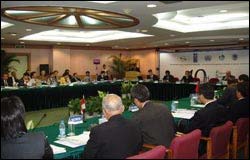
XIAMEN, PR CHINA -- The 10th Programme Steering Committee (PSC) Meeting of the
GEF/UNDP/IMO Regional Programme on Building Partnerships in Environmental
Management for the Seas of East Asia confirmed PEMSEA as the de facto implementing
mechanism for the Sustainable Development Strategy for the Seas of East Asia (SDS-
SEA). The decision was made during the intergovernmental meeting, which was held on
25-29 October. PEMSEA is comprised of 12 participating countries of the East Asian
region.
Government representatives attending the PSC also adopted a Programme of Activities
for the implementation of the SDS-SEA, including the formation of a regional
implementing mechanism.
The governments expressed their commitment to establish a regional mechanism, as an
essential step towards country-driven SDS-SEA implementation. The regional
mechanism will build on the partnership foundation of PEMSEA, which is based on
intergovernmental and intersectoral cooperation and collaboration in managing coastal
and marine resources.
In this regard, the PSC adopted a road map and timetable for the preparation of a
PEMSEA Partnership Agreement 2006 and PEMSEA Partnership Operating
Arrangements, for consideration by the 11th PSC Meeting to be held in July 2005,
including:
· The transformation of PEMSEA's Programme Steering Committee (PSC) into a
PEMSEA Partnership Council;
· The establishment of a PEMSEA Partnership Fund;
· The operationalization of a self-sustaining, service-providing PEMSEA Resource
Facility (PRF); and
· The setting up and launching of a triannual regional congress patterned after the
East Asian Seas Congress 2003.
The Meeting also decided to extend formal invitations to the countries of Timor Leste,
Lao PDR and Myanmar to join PEMSEA in the implementation of the SDS-SEA. All
three countries are within the watershed and sea area of the Seas of East Asia. Timor
Leste is situated in the Indonesian Seas, one of the five large marine ecosystems within
the Seas of East Asia. Lao PDR and Myanmar are within the Mekong River Watershed, a
major tributary to the regional seas.
PSC meetings serve as a venue to review the progress of PEMSEA activities in the region
and to make recommendations for their effective implementation. The State Oceanic
Administration and the Xiamen Municipal Government hosted the 10th PSC Meeting,
which was also attended by representatives from the private sector, nongovernmental
organizations, the academe, and international/donor/financial institutions. Delegates from
the governments of Myanmar, Timor Leste and Lao PDR joined the Meeting as observers.

PEMSEA Activities Gain Wide Interest in APEC Forum
EASTER ISLAND, CHILE -- PEMSEA participated in the Third Asia-Pacific Economic
Cooperation Integrated Oceans Management Forum (IOM3), and shared its experiences
and activities in the East Asian region, at the same time, gaining wide interest from
participants. The forum was held in Easter Island, Chile from 18 20 October.
PEMSEA Technical Officer Maria Corazon Ebarvia-Bautista attended the forum and
discussed PEMSEA's activities and experiences, including: a presentation on examples
of on-the-ground activities in PEMSEA integrated coastal management (ICM) sites and
pollution hotspots; the implementation of the Sustainable Development Strategy for the
Seas of East Asia; the Philippine experience on adjusting national income accounts
through resource and environmental accounting; PEMSEA's work on the coastal and
marine resource valuation in the Straits of Malacca; and the estimation of socioeconomic
benefits of ICM in Xiamen, PR China.
Ms. Ebarvia-Bautista called attention to issues that require consideration, such as key
business and trade-related matters, conservation, resource security, pollution management,
transboundary issues, human capacity challenges, and oceans policy and governance gaps.
Building on the elements that have been discussed and the lessons learned from across
the PEMSEA sites, she pointed out the role and implications of integrated oceans and
coastal management efforts in the region.
The forum participants agreed that PEMSEA's approach was very impressive and
ambitious - although challenging to accurately assign dollar values to resources and
services. It was noted that the project results have also been widely applied to attract
investment in ecosystem protection and drive coastal policy.
Some participants also suggested that for the next phase of the APEC project on the
economic valuation of the coastal and marine sector, the project proponent and the APEC
Marine Resource Conservation Working Group (MRCWG) should consider working
with PEMSEA, instead of just approaching each country. PEMSEA was seen to have the
experience in conducting resource valuation, and has working institutional linkages with
countries in the East Asian region.
IOM3 is the third in a series of fora sponsored by the MRCWG. This APEC forum
intended to engage member economies' key institutions, opinion and business leaders in
a discussion about the challenges and opportunities faced in delivering marine and coastal
programming, business development, and oceans management. Results from the forum
will be used, subject to MRCWG endorsement, to develop a proposed strategic approach
for APEC Ocean and Coastal activities for consideration by economies within the APEC
system.
Over 57 participants, including representatives from APEC countries, the Association of
South East Asian Nations (ASEAN), UNESCO Intergovernmental Oceanographic
Commission, the Marine Stewardship Council (MSC), the World Wide Fund for Nature
(WWF), the Permanent Council for the South Pacific (CPPS), as well as members of the
Parliament and Elder Council of Rapa Nui attended the forum. IOM3 was organized by
the MRCWG, and co-hosted by Australia, Canada and Chile.
Cavite Stakeholders Develop Capacity in ICM
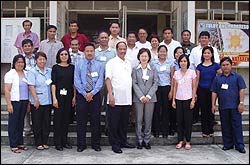
CAVITE, PHILIPPINES -- Stakeholders in the PEMSEA integrated coastal management
(ICM) parallel site in Cavite Province strengthened their capacity in implementing ICM
through the successful conduct of an ICM training program held on 4-8 October in Naic,
Cavite. Over 25 participants from various sectors and stakeholder groups in the province
attended the training.
The training's resource speakers included staff from PEMSEA's Regional Programme
Office and from PEMSEA's Batangas, Bataan and Manila Bay ICM sites. The expertise
and experiences imparted by the resource speakers provided the participants new insights
on the challenges of balancing development and resource conservation through the
implementation of ICM. The participants learned how ICM's concepts, tools and case
studies can be used for local application in Cavite.
The training resulted in the development of a refined ICM project work plan, an action
plan for updating Cavite's coastal strategy, and an operational mechanism in
implementing ICM at the municipal level. The operational mechanism allows for the
multi-sectoral and participative approach in ICM, which is seen as one of the ways to
sustain the ICM program in Cavite.
The training program was jointly organized by PEMSEA and the Cavite ICM Project in
collaboration with the Municipal Government of Naic and Sabrina Fair, a beach resort
along the Naic coast.
Cavite is one of PEMSEA's parallel sites in the Philippines. The project involves nine
coastal municipalities with a population of less than one million. Cavite is also home to
more than two thousand industries.
Cavite Joins International Coastal Clean-up Day
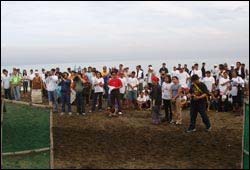
CAVITE, PHILIPPINES -- In observance of the International Coastal Cleanup Day, the
Province of Cavite undertook a cleanup drive along Manila Bay and the province's major
rivers on 18 September 2004. With the theme `Ilog Buhayin, Dagat Sagipin' (Rehabilitate
the Rivers, Save the Seas), the activity included the collection of garbage along coastal
areas and river banks, and the planting of tree and mangrove species. More than 8,000
volunteers from the communities, government agencies, the business sector, the academe,
civic organizations, nongovernment organizations (NGOs) and people's organizations
participated in the cleanup.
The cleanup drive was lead by the Cavite Provincial Governor, Hon. Ayong Maliksi,
along with mayors from the 13 municipalities and cities. In his speech during the
culminating program, Governor Maliksi emphasized the value of partnerships in saving
the environment and addressing the issues that confront coastal areas in the province. He
stressed the signing of the memorandum of agreement among the municipalities and the
province to collectively address these issues. Governor Maliksi emphasized the
importance of the cleanup drive as a way to awaken the minds and hearts of the people
of Cavite on the pressures they exert into the environment. He encouraged the
stakeholders to participate in saving the coastal areas, and emphasized that the
contribution of each individual counts. He also emphasized that cleanup drives should not
only be done during celebrations but become a regular undertaking of the municipalities.
The ICM Cavite and Sagip Ilog (Save the Rivers) Council, an NGO, organized the
cleanup drive in cooperation with national and local government agencies, the business
sector, NGOs, the academe and people's organizations in the province.
PEMSEA Launches Coastalinks
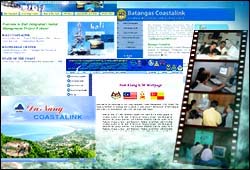
XIAMEN, PR CHINA -- PEMSEA has launched Coastalinks, the linking of integrated
coastal management (ICM) websites aimed at strengthening regional networking and
parallel knowledge sharing between local governments implementing ICM in the East
Asian Seas region. The launching ceremony was held on 28 October during PEMSEA's
10th Programme Steering Committee Meeting (see related article).
Coastalinks currently includes ICM websites from Bali, Indonesia
(www.balicoastalink.or.id); Port Klang, Malaysia (http://portklangcoastalink.net);
Batangas Bay, Philippines (http://batangascoastalink.net); and Danang, Vietnam
(www.danangcoastalink.org.vn). Having established a presence on the Internet, these
ICM sites now have a new means of sharing their lessons and experiences in
environmental management to a much wider online audience.
Each Coastalink website provides a wide range of information - from principles and
strategies on sustainable development and reports on the state of a specific coast in the
East Asian Seas region, to investment opportunities, events and current environmental
issues prevailing in each site.
Coastalinks is aimed at establishing a clearing house mechanism for ICM knowledge
base in the region and constitute one part of PEMSEA's efforts in distilling lessons
learned from various ICM sites and disseminating those lessons to pertinent national
government agencies, local governments and stakeholders throughout the region.
PEMSEA hopes that as ICM initiatives in the region continue to grow, Coastalinks would
play an increasing role in organizing and sharing an accumulated wealth of ICM
information and experience for interested stakeholders.
China to Host East Asian Seas Congress 2006
XIAMEN, PR CHINA -- The People's Republic of China will be hosting the East Asian
Seas (EAS) Congress 2006. The decision was finalized during PEMSEA's 10th
Programme Steering Committee Meeting where Chinese delegates confirmed the
country's desire to serve as host for the 2006 event.
The first EAS Congress was held in 2003, and highlighted the signing of the Putrajaya
Declaration of Regional Cooperation for the Sustainable Development of the Seas of East
Asia by ministers from PEMSEA's twelve participating countries. The five-day event,
held in Putrajaya, Malaysia, brought together various stakeholders from diverse
disciplines to discuss the welfare of the East Asian Seas and to explore ways and means
to ensure the sustainability of marine and coastal resources of the region.
The 2006 Congress will feature the Ministerial Forum on the Implementation of the
Sustainable Development Strategy for the Seas of East Asia and the International
Conference on Coastal and Ocean Governance: One Vision, Towards a Stronger
Regional Alliance. The International Conference will hold workshops on several areas of
interest such as:
· Port Safety, Security, Health and Environment;
· The Economic Contribution of the Marine Sector;
· Areas of Excellence and Scientific Support;
· The Effective Management of Marine Protected Areas;
· Community in Sustainable Development;
· Innovative Financing for Waste Reduction;
· Women and Youth in Environmental Management;
· Advocacy and Leadership in Coastal and Ocean Management; and
· Regime-building in Coastal and Ocean Governance.
A number of side events are also planned to be held during the 2006 Congress, these will
include: the Meeting of the PEMSEA Partnership Council; the 5th Forum of the Regional
Network of Local Governments Implementing Integrated Coastal Management; the
Financial Advisory Board on Environmental Investments Meeting; the Meeting of
Experts; the Media Forum on Partnerships in Environmental Communication; the
Meeting of the Nippon Foundation Research Task Force on the Dynamics of Regional
Cooperation on Ocean and Coasts; and the Launching of the Regional C2C (Coasts to
Coasts) Network. It is estimated that the 2006 Congress will bring together 500
participants from the East Asian Seas region.
The EAS Congress 2006 will be organized in partnership with several international
organizations, honorary advisors, international and local organizing committees, as well
as sponsoring and supporting organizations. Organizations interested in being a partner
for the EAS Congress can contact PEMSEA's Regional Programme Office at
info@pemsea.org.
PEMSEA Welcomes New Staff
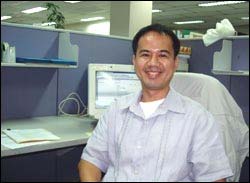
QUEZON CITY, PHILIPPINES -- PEMSEA welcomes Mr. Cesar Banzon as its
Environmental Investment Technical Officer. He will work on the implementation of the
GEF Medium-Sized Project on the Development and Implementation of Public-Private
Partnerships in Environmental Investments.
Cesar has extensive experience in project administration, research, communication, and
public relations. He worked as Commercial Officer for the Korean Embassy in Manila
and Project Management Officer for KEPCO Ilijan Corporation, a project company of the
Ilijan Natural Gas Energy Power Plant. He earned his Masters in Economics from the
University of the Philippines.
PEMSEA Expertise to Serve Other Regions
QUEZON CITY, PHILIPPINES -- PEMSEA is now sharing its expertise in integrated
coastal management (ICM) to other regional programmes outside of the East Asian
region through an ICM training course to be held from 22 November to 10 December in
Manila, Philippines and Xiamen, PR China. Participants to the training will be coming
from Djibouti, Egypt, Jordan, Saudi Arabia, Sudan and Yemen (member-countries of the
Regional Organization for the Conservation of the Environment of the Red Sea and Gulf
of Aden or PERSGA), as well as from new PEMSEA sites in Indonesia, Philippines,
Thailand and Vietnam. The training course aims to develop leadership in planning,
formulation and implementation of ICM programs.
Balancing economic development with environmental management to resolve marine
pollution problems requires an integrated management approach and many countries at
present are unable to adequately address their marine pollution problems. This is due not
only to the lack of financial resources, but also, to a large extent, the lack of technical and
management capabilities to plan, implement, and manage coastal and marine resource
management programs.
The training course will enhance knowledge and skills essential in implementing ICM, an
internationally accepted approach for achieving sustainable development of coasts and
oceans. The course will cover a wide spectrum of subjects related to coastal and marine
area management with practical exposure to the ICM concept, approaches and
operational mechanisms.
Some of the topics that will be covered during the course include:
· ICM concept, principles and applications;
· Data-gathering and information management;
· Development and implementation of coastal strategy;
· Risk assessment and management;
· Environmental monitoring;
· Coastal-use zoning plan;
· Resource and environmental accounting;
· Institutional and legislative requirements;
· Economic analysis; and
· Marine legislation.
Victoria DSE and PEMSEA Forge Knowledge-Sharing Initiative
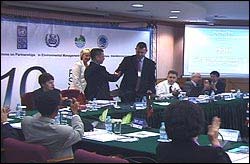
XIAMEN, PR CHINA -- PEMSEA and the Department of Sustainability and
Environment (DSE) of the State Government of Victoria, Australia recently signed a
memorandum of understanding (MOU) for a collaborative partnership on sharing
experiences and knowledge in the sustainable development of marine and coastal
resources and in the governance of regional seas and oceans. The signing ceremony was
held on 26 October and was one of the events of PEMSEA's 10th Programme Steering
Committee Meeting (see related article).
This new knowledge-sharing partnership includes the exchange of information on the
objectives, initiatives and impacts of DSE and PEMSEA programmes; the building of
awareness and understanding in integrated coastal and marine planning and management,
including the co-organization of conferences, workshops and site visits; the sharing of
experiences and lessons learned among national and local government agencies within
PEMSEA participating countries as well as within Victoria, Australia; and the
development of initiatives to strengthen the capacities of PEMSEA participating
countries in the sustainable use and management of marine and coastal areas, including
opportunities for staff exchange.
The MOU was signed by PEMSEA Regional Programme Director Dr. Chua Thia-Eng
and DSE Secretary Prof. Lyndsay Neilson, and shall take effect immediately.
COPYRIGHT © PEMSEA