
Volume 8 Issue No. 7
Successful PEMSEA Office Building Inauguration Held
Manila, Philippines On 9 November, the GEF/UNDP/IMO Regional Programme on Partnerships in Environmental Management for
the Seas of East Asia (PEMSEA) inaugurated and officially opened its new office building, located at DENR Compound, Quezon City,
Philippines. The inauguration was led by the Philippine Department of Environment and Natural Resources (DENR) Secretary Jose L.
Atienza Jr.; United Nations Development Programme (UNDP) Deputy Representative Kyo Naka; and PEMSEA Regional Programme
Director and Interim Executive Director, Dr. Chua Thia-Eng. The occasion was attended by key DENR officials, members of the
diplomatic corps, local government officials, partners from national government agencies, private sector and international and
nongovernmental organizations, and members of the media.
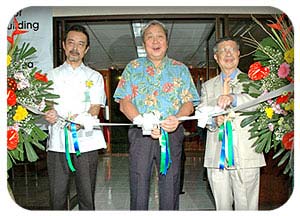
The inauguration was led by UNDP Deputy Representative Kyo Naka; DENR
Secretary Jose Atienza Jr., and PEMSEA Regional Programme Director and
Interim Executive Director Dr. Chua Thia-Eng. Photo by DENR.
The Philippines, through the DENR has been serving as host to the Regional
Programme since 1994. "The construction of this office building by DENR
marks another milestone in the history of our collaboration in the Philippines,"
remarked Dr. Chua. The event highlights the transformation of the PEMSEA
from a project-based arrangement into a regional mechanism, with support
from 11 State Partners and 15 non-State Partners. The new office building
houses the PEMSEA Resource Facility (PRF) Secretariat and Technical Services.
The occasion also showcased the key outcomes of the efforts and initiatives in
the region. Exhibit panels and publications featuring the outputs of the
integrated coastal management (ICM) sites and environmental hotspots were
on display.
Mr. Naka pointed out that "the new PEMSEA Office Building clearly stands not only as a symbol, but as a living hub for capacity
development, and for building new and expanded forms of partnerships in addressing the environmental challenges and sustainable
development of this region." He reiterated UNDP's full support and stressed the importance of forging partnerships with PEMSEA, DENR
and countries in the region for improved management of land and water resources in line with the Millennium Development Goals to
reduce poverty.
The guests signed their names on the `Partnership Tree' to express their support for the common cause of ensuring the sustainability of
the East Asian Seas.
Available online through http://www.pemsea.org/about-pemsea/pemsea-news/successful-pemsea-office-building-inauguration-held/
Launching of the Manila Bay Area Environmental Atlas
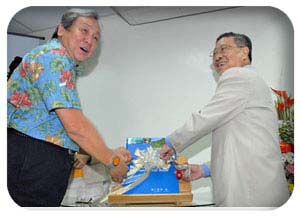
Manila, Philippines The Manila Bay Area Environmental Atlas was formally launched on the 9th of November, during the
inauguration of the PEMSEA Office Building at the DENR Compound. The launching was led by the Philippine Department of
Environment and Natural Resources (DENR) Secretary Jose L. Atienza Jr. and PEMSEA Regional Programme Director and Interim
Executive Director, Dr. Chua Thia-Eng.
The members of the interagency Technical Working Group who worked and
contributed their capacities to produce the Atlas were recognized.
The Atlas provides a relevant source of information necessary in policy
formulation, planning, decision-making, monitoring, integrated river basin and
coastal area management, and in particular, the implementation of the Manila
Bay Coastal Strategy. Secretary Atienza noted that the Atlas can serve as a
model for the country's bays and watersheds as it shows issues as well as the
major actions towards saving the marine environment, especially Manila Bay.
The Atlas is a key output of the Manila Bay Environmental Management Project
(MBEMP), which is being implemented through the concerted efforts of various
national government agencies, local government units, academic institutions,
the private sector and civil society groups, with the DENR serving as the lead
agency. The Director of the Environmental Management Bureau of the DENR,
Mr. Julian Amador, presented the key outcomes of years of collaboration among the various sectors and stakeholders in support of the
MBEMP.
Dr. Chua pointed out that the Atlas can serve as an invaluable tool to enable a comprehensive approach in restoring Manila Bay that
was once looked upon with pride as "a bay of clean and clear water, lined with rich habitats of mangroves and seagrass beds, teamed
with fish and marine life and a bay where the children could swim and the inhabitants could stroll along its edge to enjoy the beautiful
sunset."
Available online through http://www.pemsea.org/about-pemsea/pemsea-news/launching-of-the-manila-bay-area-environmental-atlas/
Twinning Partners Chart Direction for the Next Three Years
Tianjin, PR China The Third Twinning Workshop on Ecosystem-based Management of Interrelated River Basins, Estuaries and
Coastal Seas was successfully held on 17-19 October in Tianjin, PR China.
The workshop dealt with policy reforms, sustainable financing and investments
on pollution reduction in the East Asian Seas. The workshop was attended by
42 representatives from Cambodia, DPR Korea, Indonesia, Japan, Philippines,
PR China, RO Korea, Vietnam, USA, and PEMSEA, who shared their
experiences, and good policies and practices.
Based on the presentations and discussions made, some good policies and
practices that can be replicated or adapted were identified. These are:
·
Forging alliances (or partnerships) among local governments and
stakeholders in coastal areas with their counterparts in the upland
areas of associated watersheds;
·
A combination of "polluter-pays" and "beneficiary-pays" policies;
·
Successful outcomes are more likely to be achieved when projects are
initiated at manageable and affordable scales, providing the
foundation for larger scale projects and programs;
·
Twinning arrangements between nations can expand the use of environmental best management practices; and
·
Communications and governance is essential in attracting investments and regulating development.
One of the highlights of the workshop was the program of work for the twinning partners over the next three years. The discussion
focused on: (1) building capacities in ecosystem-based management; (2) establishing and operationalizing the Twinning Secretariat to
be hosted by RO Korea in 2008; and (3) development and implementation of investment plans for pollution reduction in selected river
basins. The first year will focus on identifying priority river basins within three hotspot sites, namely Bohai Sea (China), Manila Bay
(Philippines) and Jakarta Bay (Indonesia), as demonstration areas for pollution reduction. The second year will focus on developing and
promoting investment plans for pollution reduction in the priority areas. The third year will focus on documenting the development,
implementation and results of pollution reduction programs and its replication.
The 4th Twinning Workshop on Ecosystem-based Management of Interrelated River Basins, Estuaries and Coastal Seas to be hosted by
Indonesia will be held in October 2008 in Jakarta.
Available online through http://www.pemsea.org/about-pemsea/pemsea-news/twinning-partners-chart-direction-for-the-next-three-
years/
Batangas Gears for Improved Approaches to Addressing Environmental Concerns
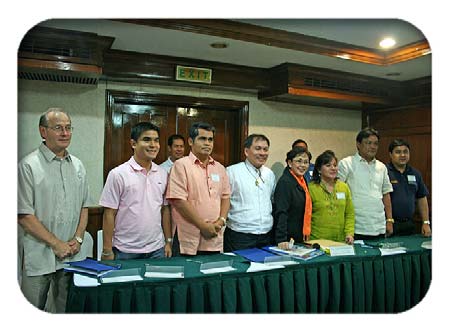
Batangas City, Philippines A joint meeting of the Batangas Bay Region Environmental Protection Council (BBREPC) and the
Provincial Solid Waste Management Board (PSWMB) was held on 14 November in Batangas City, Philippines. The joint meeting was
aimed to orient the new executive officials of the province, and the cities and municipalities on existing environmental programs and
projects, including the Provincial Strategic Environmental Management Plan (SEMP) which provides a common platform for the coastal
and watershed management of the province. The meeting was attended by over 100 participants consisting of members of the BBREPC
and PSWMB and representatives of partner institutions and municipalities and cities in Batangas.
Chaired by Hon. Vilma Santos-Recto, Governor of Batangas, the meeting
tackled various environmental issues and programs. Several speakers were
invited to share approaches and experiences in implementing environmental
programs , including Mr. S. Adrian Ross, Acting Regional Programme Director
of PEMSEA, Atty. Zoilo Andin, Executive Director of the National Solid Waste
Management Commission; Ms. Evelyn Estigoy, Head of the Provincial
Government-Environment and Natural Resources Office of Batangas; Mr.
Ricardo Sandalo, Project Manager for Batangas, WWF-Philippines; and Col.
Venus de Castro, Operations Manager, Task Force Likas Yaman-Vigilance for
Sustainable Resources. A number of recommendations and measures were
brought forward to further improve and sustain existing efforts such as the
enforcement of fishery and mining laws, programs addressing food security
and supplemental livelihood, management of natural and human-made
disasters, and the protection of vulnerable population and coastal resources,
and waste management and pollution reduction.
Consistent with the strategies identified in the SEMP, a holistic approach in natural resources management, and pollution management
and control is initiated through the Health, Education, Environment, Agriculture, Roads/infrastructure, Tourism, Security/Services
(HEARTS) program of the provincial government. HEARTS calls for a holistic approach to attain an ecologically sustainable
socioeconomic development of the province.
In line with the implementation of the SEMP, and Executive Order 578 on biodiversity mandating the formulation of a Verde Passage
Management Plan, the Batangas Marine Protected Area (MPA) Network was created through the signing of a Memorandum of
Agreement among and between the Provincial Government of Batangas, City Government of Batangas, Municipal Governments of
Balayan, Bauan, Calatagan, Mabini, Lobo, San Juan, Nasugbu and Tingloy. The Batangas MPA network is supported by the World Wide
Fund for Nature Philippines (WWF-Phil) and Conservation International (CI). WWF-Phil and CI are partners of the Provincial
Government in coastal resources management. The network aims to facilitate sharing of information, experiences and resources, and
resolution of possible conflicts between MPAs; access assistance from the network; and assist other LGUs to establish marine reserves,
sanctuaries and the like.
Available online through http://www.pemsea.org/about-pemsea/pemsea-news/batangas-gears-for-improved-approaches-to-
addressing-environmental-concerns/
How to Manage a `Natural Grocery': SDS-SEA Implementation in Lao PDR
Saravane, Lao PDR "You can see the richness of the biodiversity by just looking at the menu. It's okay if people gather from the
wildlife for their consumption, but when they start doing it for commercial and business purposes, that's when we start having
problems," Mr. Bouttavong Somvang of the Water Resources Coordination Committee Secretariat (WRCCS) explains while holding out a
menu one dinner during field visit in Saravane Province, Lao PDR.
Communities are concerned, however, that indiscriminate harvesting of
resources and the declining water quantity and quality, are endangering their
biggest "grocery" their natural resources. People would show empty
pesticide containers used in rubber plantations while describing the
deteriorating water quality in the river basin or point to the eroding river banks
lined with garbage from nearby restaurants.
"It is worse during the summer when the contaminated water is not being
flushed and you see dead fishes floating," says one community member in
Xedone.
These are only some of the stories told by village members in Xedone River
Basin when asked to describe the status of their resources. Saravane, Sekong
and Champasack are the three provinces within the Xedone River Basin, a site
previously identified for SDS-SEA implementation in Lao PDR. The
implementation of the Sustainable Development Strategy for the Seas of East Asia (SDS-SEA), is therefore hoped to fill in the need for
an integrated river basin management where concerns across sectors and provinces will be taken into consideration.
Building Capacities
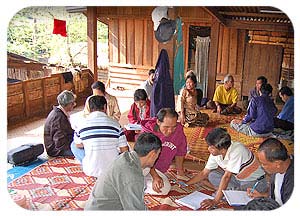
An eight-day training workshop aimed at providing the participants with basic knowledge and skills on rapid appraisal was facilitated by
the PEMSEA Regional Task Force from 5-14 November. The workshop was attended by the members of the Project Management Team
consisting of key agency representatives from Champasack, Saravane and Sekong and the WRCCS. On-site application of rapid
appraisal technique and methods were organized to enable participants to apply newly acquired skills and better understand
community problems.
"It is important to involve the villages and provinces at this time because they will be the ones involved in implementing the project in
their respective provinces. They have to appreciate the importance of what we are doing to build stronger project ownership," Mr.
Souphasay Komany of the WRCCS expressed during the training workshop.
Consultations through focus group discussions and key informant interviews were conducted in 14 selected villages to determine
socioeconomic, political and environmental issues in the Xedone River Basin. This was done to build the confidence of the PMT
members in identifying strategies for integrated river basin management.
Results revealed the urgent need for a comprehensive river basin management plan that would integrate socioeconomic, environmental
and policy planning that would cover the upstream (Saravane) and downstream (Champasack and Sekong) provinces. The
deteriorating quality of resources in Xedone is also caused by limited awareness among stakeholders, hampering the formulation and
effective implementation for local policies. This is compounded by the limited data and information on the Xedone River Basin and the
poor coordination among the provinces to address these concerns. Add to these is the poor monitoring of activities in the river basin.
Access to market among communities limits opportunities to improve household conditions and access to other basic services like
health and education facilities. At the village level, collective action is also difficult to pursue as some villages are still not organized.
No stopping at problems
Following the results of community consultations, the PMT identified key strategies by which priority concerns will be addressed under
the Xedone Integrated River Basin Management Project (XIRBMP). These include the development of a Xedone Integrated River Basin
Management Strategy that will serve as the blueprint for the river basin and will be used for leveraging support from other
organizations, sectors and government agencies. While the provinces have existing development plans, the strategy will be the first
integrated plan for the river basin.
Massive public awareness program will be a major component of the project to strengthen support among the public officials and
communities in urban centers. The implementation of strategic action programs that address solid waste and sanitation facilities and
fishery resource management at the community level are also of primary importance. Capacity building will also be done through
learning-by-doing approach to strengthen the local implementers' skills in development and management of projects.
An Inception Workshop followed the community consultations and participated in by 30 local and national officials. This was conducted
to verify the results of the community consultations. Participants identified other activities for the development of a work program
including a more scientific process of data gathering for water quality monitoring in the river basin, strengthening the fishery
management component, establishment of information management center and strict policy enforcement for forest resources. Upon
discussion and comments by the provinces, the three-year draft work program for the XIRBMP was adopted in principle by the three
provinces. This will have to be further considered by the local authorities for formal adoption.
It was clarified during the Inception Workshop that the three provinces, Champasack, Saravane and Sekong will be the primary
implementers with the WRCCS and PEMSEA providing guidance and technical support. As part of the institutional arrangement, the
Province of Champasack was identified as host of the Project Coordinating Office providing logistics and staffing support to the
program. The two provinces further signified support to assign at least two staff each to manage and coordinate activities within their
provinces.
The development of the work program is part of a series of consultations for the implementation of the SDS-SEA in Lao PDR. In April of
this year, an initial round of discussion was conducted with the key agencies of Saravane and Champasack.
Available online through http://www.pemsea.org/about-pemsea/pemsea-news/how-to-manage-a-2018natural-grocery2019-sds-sea-
implementation-in-lao-pdr/
NOWPAP Officially Joins the EAS Partnership Council
Xiamen, PR China The 12th Intergovernmental Meeting of the Northwest Pacific Action Plan (NOWPAP) was held on 23-25 October
at Hotel Ramada in Xiamen, PR China to review and endorse NOWPAP's work plan and budget for 2008 and 2009. PEMSEA participated
in the meeting as an observer and prospective partner.
After the meeting, the Letter of Cooperation (LOC) between the PEMSEA
Resource Facility (PRF) and NOWPAP Regional Coordinating Unit (RCU) for the
sustainable development and management of marine and coastal environment
of the Seas of East Asia was signed by Dr. Alexander Tkalin, NOWPAP
Coordinator, and Dr. Chua Thia-Eng, the Interim Executive Director of the PRF,
making the two organizations official partners. The major areas of cooperation
for the two organizations as stated in the LOC are:
·
Sharing data and information (including publications) obtained by
partners;
·
Providing linkages on each other's homepages;
·
Participating, as appropriate, in the meetings and workshops
organized by each party;
·
Sharing experience and opportunities in capacity building on
protection of the marine environment and sustainable use of marine
and coastal resources, in particular in the field of marine pollution monitoring and assessment, marine environmental
emergency preparedness and response, integrated coastal and river basin management and state of environment reporting;
·
Any other co-operative areas and modalities which both parties agree upon in the course of the implementation of NOWPAP
programme of work and the Sustainable Development Strategy for the Seas of East Asia (SDS-SEA).
The meeting was successfully concluded with work program and budget of NOWPAP RCU and Regional Activity Centers (RACs)
endorsed for the next biennium. The Integrated Coastal and River Basin Management (ICARM) project of NOWPAP was identified as
one of the immediate areas of cooperation that PEMSEA and NOWPAP can work together. Cooperation between the organizations
would help maximize benefits gained and also remove duplication in efforts.
Available online through http://www.pemsea.org/about-pemsea/pemsea-news/nowpap-officially-joins-the-eas-partnership-council/
MDG Midterm Review: Environmental Sustainability Trails Behind
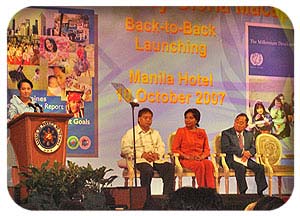
Manila, Philippines The launching of the Global Millennium Development Goals Report 2007 and the Philippines Midterm Progress
Report on the MDGs was held on 10 October at the Manila Hotel in the City of Manila. UNDP Resident Representative Nileema Noble
presented the 2007 Global Report while National Economic Development Authority (NEDA) Acting Director Augusto B. Santos presented
the Philippines Midterm Progress Report. The launch was graced by Philippine President Gloria Macapagal-Arroyo.
The Global Report is a comprehensive assessment based on a set of data
prepared by over 20 organizations both within and outside the United Nations
system including The World Bank and the Organization for Economic
Cooperation and Development (OECD). The results have been uneven and
mixed, as insecurity and instability in conflict and post-conflict countries make
long-term development efforts extremely difficult. With carbon dioxide
emissions rising from 23 billion metric tons in 1990 to 29 billion metric tons in
2004, environmental sustainability remains to be a laggard in terms of
progress and coverage.
The Philippines Midterm Progress Report on the MDGs indicated that the
country is likely to meet the MDG targets on poverty, nutrition, child mortality,
HIV/AIDS, malaria, and access to safe drinking water and basic sanitation
having met the midterm indicators as reported by NEDA. However, there is a
need to double or triple efforts to meet the targets on primary education,
maternal mortality ratio and access to reproductive health services. Sustainable access to safe drinking water and sanitation facilities
were considered as targets/indicators for meeting the MDG goal on environmental sustainability. While the country has a sound
environmental policy, environmental sustainability remains the least funded, at less than one percent of the total national budget, as
noted in the report.
The report specifically mentions Executive Order 553 adopting the Integrated Coastal Management approach as one of the recent
efforts to ensure sustainable management of the country's coastal and marine environment. Initiatives of the Manila Bay Environmental
Management Project (MBEMP) such as the implementation of the Manila Bay Oil Spill Contingency Plan and Integrated Environmental
Monitoring Program, wherein PEMSEA is directly involved were also highlighted.
For more information on Philippines MDG Midterm Progress Report, visit http://www.undp.org.ph/?link=news&news_id=118 or
http://www.neda.gov.ph/econreports_dbs/MDGs/default.asp.
Available online through http://www.pemsea.org/about-pemsea/pemsea-news/mdg-midterm-review-environmental-sustainability-trails-
behind/
PEMSEA Welcomes Intern from Vietnam
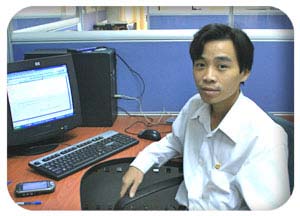
Manila, Philippines PEMSEA welcomes Mr. Do Manh Thang, who is from the Danang Integrated Coastal Management (ICM) Project
Management Office (PMO) in Vietnam. Mr. Thang joins PEMSEA as part of its Professional Upgrading Program.
During his internship from 22 October to 31 December, Mr. Thang will be
exposed to various programs and activities of PEMSEA including State of the
Coasts (SOC) reporting, the Integrated Information Management System for
Coastal and Marine Environments (IIMS) and good practices of ICM sites in the
Philippines.
Mr. Thang is directly involved in maintaining the Integrated Information
Management System of the Danang ICM Project.
Available online through http://www.pemsea.org/about-pemsea/pemsea-
news/pemsea-welcomes-intern-from-vietnam/