



Public-Private Partnership in
Sustainable Development: The Case
ember 2009
v
of Puerto Galera
. 3 No
ase Study l. 1 Noo
C V
A leap of faith
Tourism is the lifeblood of Puerto Galera. It is the main
dysentery, typhoid fever, viral and bacterial
source of income for the residents and a major source of
gastroenteritis, and hepatitis A.
revenue for the local government. Tourist arrivals have risen
from 138,000 in 2002 to 637,000 in 2003 and, reportedly,
The proposed project involved the collection of wastewater
to more than 1 million in 2004. Along with the growth
from the households and commercial establishments in
of commercial activities, the municipality is faced with
the three areas. The wastewater would then be pumped
the challenge of making the tourism boom a sustainable
to a sewage treatment plant and treated before being
activity by limiting the damage that rapid and unplanned
discharged to the sea or reused. The sewerage project had
development brings to the environment.
a dual purpose of improving environmental and personal
sanitation, and protecting the water quality of waterways
The Sabang Sewerage Collection and Treatment System
and the coastal waters serving both the interests of
of the municipality of Puerto Galera was initiated as a
individual residents and resort owners as well as wider
consequence of the clamor by the local community to
public and environmental interests.
provide a lasting solution to the issue of uncontrolled sewage
discharges to the coastal waters. This issue raised fears of
Based on preliminary assessments, the municipality
bacteriological contamination of beaches, which would
of Puerto Galera needed to install three decentralized
undermine the municipality's tourism economy. This also
treatment plants located in three strategic areas. It was
became a cause of concern to environmental groups due to
proposed that the treatment plant's service coverage areas
the community's close proximity to a highly sensitive marine
be divided into three zones, namely: Zone 1 the Sabang-
biodiversity area, i.e., the Verde Island Passage.
Sinandigan areas; Zone 2 the San Isidro-Aninuan areas;
and Zone 3 the Sto. Nino-Poblacion areas. A phased-
The sewerage project was not a new idea; collecting EUFs
development approach was advocated due to limited funds
was not a new approach; and private sector participation
for capital investment.
Global Environment
in water supply and sanitation services was not a new
Facility
mechanism. However, these were "innovative" options for
The level of treatment proposed was secondary, which
a small municipality like Puerto Galera. People tended to
would allow reduction of coliform, biochemical oxygen
see the innovations in diff erent ways -- a breakthrough,
demand (BOD), and nutrient discharges. Use of reed beds/
a transformation, a leap of faith. They also acknowledged
wetland was also one of the options considered in order
the innovative approaches' close ties with risk, hence, the
to polish the effl
uent prior to discharge to coastal waters.
hesitancy to move forward. It was therefore imperative to pay
Disinfection of the effl
uent was proposed, in order to
more attention to the prevailing institutional environment,
achieve an allowable fecal coliform concentration of 200
United Nations
including the legal, political, fi nancial, and social challenges
MPN/100 ml (See Table 1).
Development Programme
-- which could make or break the sewerage project.
The municipality of Puerto Galera also considered nutrient
Scoping and Consensus Building
effl
uent requirements for the treatment plant. The adopted
total organic nitrogen effl
uent criteria were set at 10 mg/L,
The sewerage project proposal
whereas the total phosphorous criteria were set at 1 mg/L
(as PO ).
4
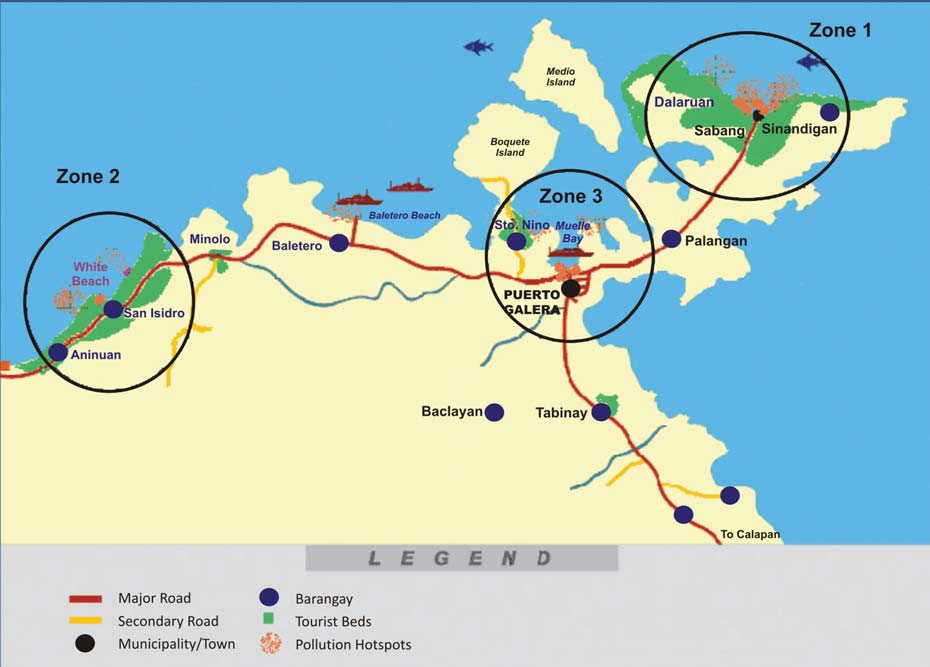
The project (Figure 1) covered three areas of Puerto
United Nations Offi
ce for
Galera -- Barangay Sabang and Sinandigan (Zone 1), San
As an alternative to the discharge of the treated wastewater
Project Services
Isidro (White Beach) and Aninuan (Zone 2), and Sto. Nino and
to the sea, reuse of the treated effl
uent was identifi ed as
Poblacion (Zone 3) where coastal waters were identifi ed
a possible option, with due consideration to the recurring
by the Philippine Department of Environment and Natural
water supply shortages during peak tourist season. Treated
Resources (DENR) as being contaminated with fecal coliform.
wastewater was proposed as an alternative to potable
This raised concerns among the community that is highly
water for various uses, including laundry and watering of
dependent on the tourist industry. It was recognized that
gardens in the resorts. Treated sludge was also identifi ed as
Partnerships in
some waterborne pathogenic diseases that may coincide
a potential ingredient for a compost soil conditioner. Both
Environmental Management
for the Seas of East Asia
with fecal coliform contamination include ear infections,
were considered as potential revenue sources.
1
Getting the sewerage project on the agenda
Table 1. Project description.
A. Sewerage collection system
Political leadership, will, and vision are essential ingredients
in the planning and development of sewerage projects,
Area coverage
Barangay Sabang and adjacent
areas
considering the many competing demands and limited resources
of small and medium-sized local governments. This particular
Total area of coverage
4.48 km2
project faced the additional challenge of being planned and
Total wastewater catchment area
127,697 m2
implemented across two government administrations. As a
Current wastewater fl ow rate
3,135 m3/day
consequence of local government elections, the project was
20-year maximum wastewater fl ow rate
7,163 m3/day
initiated by one administration, and planned and developed
B. Wastewater treatment plant
by the second. Unfortunately, the project's transition across the
two administrations was not smooth, with the former local chief
Proposed wastewater treatment capacity
3,500 m3/day
executive becoming a major critic of the project.
Technology
Second ary (biological)
treatment
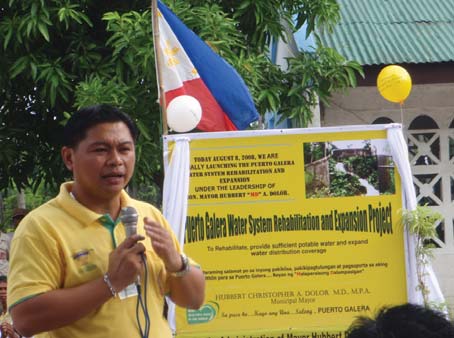
Hon. Hubbert Christopher Dolor, the new mayor of Puerto Galera
Effl
uent requirements
Minimum requirements:
BOD: 20mg/l
and a medical doctor, made hygiene, sanitation, and environmental
Suspended Solids (SS): 20 mg/l
protection priorities and integral to his objective of bringing in
Site of treatment plant
Subject to environmental
sustainable economic development to Puerto Galera. In pushing
compliance certifi cate (ECC)/
the sanitation project, the mayor identifi ed the following key
environmental impact
elements (Dolor, 2009):
assessment (EIA) approval
C. Financial requirements (estimated)
· making it a priority project within the municipality's Coastal
Capital cost (including collection/
PhP100 million
Resource Management Plan;
conveyance system, treatment facility,
· mobilizing political and stakeholder support through conduct
pumping stations, outfall and land)
of public awareness and consultation campaign;
Annual cost
· enforcing national policies and local ordinances;
- annualized capital cost (15% p.a., 7
PhP24 million
· implementing an EUF (environmental user fee) system
years)
as a fi nancing mechanism for sanitation (solid waste and
- operating and maintenance cost
PhP11.5 million
wastewater management facilities) and other coastal resource
- management cost (15% p.a.)
PhP14 million
management projects;
· piloting and demonstrating public-private partnership (PPP)
to improve delivery of sanitation services; and
· focusing on results -- in partnership with a private company.
(NGO) in developing and implementing a communication plan
for the sewerage project. PEMSEA and SCOTIA worked together
Mayor Dolor showed tenacity in pushing forward the
in conducting stakeholder consultations and creating awareness
implementation of the project in partnership with a private sector
about the issues and solution options, including EUFs and the
company, and in rallying his constituents to support the sewerage
sewage treatment system. A demand-driven approach was used
project which were essential aspects to getting the project on the
along with suitable technology, increased fi nancing, political
government's agenda.
commitment, and accountability to ensure that sanitation remained
on the political and public agenda.
With the initial viability of the project assessed and found
acceptable by the mayor, municipal council and key local
Determining the fi nancial means
department heads, a decision to go ahead with the project was
made. A municipal council resolution was passed, allowing the
The municipality of Puerto Galera has very limited fi nancial
mayor to sign, on behalf of the municipality, a Memorandum
resources, approximately PhP 50 million per annum, plus an internal
of Agreement (MOA) with the Sustainable Coastal Tourism Asia
revenue allotment from the national government of about PhP 25
(SCOTIA)1 and PEMSEA to enhance collaboration, cooperation, and
million. The main sources of revenue for the municipality were the
commitment on the project. The MOA, which was signed on 30
business, community, and real estate taxes, which accounted for 18
March 2006, stated the respective roles and responsibilities of the
percent of the total. The local revenues from the water distribution
municipal government, PEMSEA, and SCOTIA.
system were also one of the biggest sources of income, accounting
for 14 percent of the total.
PEMSEA's role in the project was to facilitate the conduct of a
pre-feasibility study, sewerage and wastewater treatment plan,
Moreover, the municipality did not have a track record in
willingness-to-pay (WTP) survey, drafting of ordinances and other
undertaking similarly-sized investments. As such, it had limited
legal requirements, and essentially building the capacity of the
options in the form of pure debt fi nancing or a joint venture
local government in project structuring, procurement process, and
arrangement. The local government had to address the issue of
partnership development and sustainability.
investor confi dence in order to attract funding. Building up the
fi nancial resources of the municipality was critical in order for it
SCOTIA's role was to provide assistance in building the capacity of
to access loans, attract private sector investors, and show that it
the local offi
cials and the tourism nongovernmental organization
could pay its debt obligations as well as cover the necessary annual
1 SCOTIA is a regional environmental project supported by the United States Agency for International Development, which objective is to strengthen local
capability for the protection of the coastal and marine ecosystem in project sites in order to sustain their tourism value.
2
operating and maintenance expenditures, achieve reasonable levels
stakeholders from planning to implementation of the project.
of return on the investment (profi t), and return suffi
cient funds to
PEMSEA, together with SCOTIA, supported the local government
pay taxes and replace infrastructure as the system reached the end
in conducting stakeholder consultations, development and
of its useful life (depreciation).
dissemination of IEC materials, social marketing, and capacity and
consensus-building workshops.
Investing in a water supply and sewerage system would indeed
seem insurmountable a situation recognized by the municipal
Key stakeholders (local government staff , resort and dive shop
government, and pointed out by the resort owners who were
owners/managers, transportation groups, etc.) were invited to
skeptical that a sewerage system could be put in place in Puerto
participate in a capacity-building and action planning workshop
Galera given the institutional and fi nancial challenges.
on social marketing, and information and education campaigns.
Subsequently, posters, fl yers, and videos were produced and
Considering the level of investment involved, the commitment
distributed around the town and province. Jeepneys, tricycles, and
of the local government and the support of the communities
many bangka (motorized boats) carried these posters as part of the
and local private sector had to be concretely shown to attract
wide-scale promotion drive.
investors and private operating companies. Given the limited
revenue collection and internal revenue allocation from the
The activities of other organizations also contributed to raising
national government, PEMSEA proposed the establishment of
awareness of the people regarding unsustainable tourism
an environmental management fund, with funds raised from the
development, deteriorating water quality, and degradation of
collection of EUFs from tourists. The rationale for collecting EUFs
coastal resources. For example, the World Wide Fund for Nature
from tourists was quite obvious: a million tourists were using/
(WWF)-Philippines focused on sustainable fi sheries and coastal
consuming and enjoying the natural resources; a million tourists
resource conservation, including the establishment of marine
were generating more wastes than 2,000 households; a million
protected areas. The Locsin Foundation and the group of Maribel
tourists can contribute to the protection of the natural resources
Ongpin raised the issue of resorts and establishments that violated
and the environment so they and the next generations can continue
the restrictions on development in the foreshore and salvage zone,
enjoying the benefi ts that nature has to off er.
height requirements and discharges of untreated wastewater. It
was important to explain to the local stakeholders and NGOs that
Packaging and Promoting: Working with Everyone
the sewerage project was not a separate issue, but in line with the
broader objectives of the Coastal Resource Management Plan and
Involving the stakeholders from planning to implementation
sustainable tourism goal of the municipality.
To raise awareness, promote behavioral change toward improved
Gauging the demand
sanitation, and get public support for the sewerage project and
the fi nancing strategy, a systematic information, education, and
To assess public perception regarding coastal management,
communication (IEC) campaign was undertaken, involving key
sanitation, sewage treatment, and collection of EUFs to support
Figure 1. Wastewater treatment systems in
three tourist hotspots.
L E G E N D
3
Box 1: The PPP process.
these programs, a willingness-to-pay (WTP) survey was conducted
among three sectors, namely: foreign and local tourists, households,
Developing and implementing investment opportunities entail
and establishments. As part of its technical assistance, PEMSEA
a behavioral change on the part of local government and its
conducted a training workshop on contingent valuation method
constituents. To be eff ective, the identifi cation and promotion
and survey techniques for enumerators and local staff . The local
of investments requires a methodical and transparent process,
government, in collaboration with PEMSEA, WWF, and SCOTIA,
involving local offi
cials, communities, private companies,
civil society, and other interested parties. A methodical
conducted the WTP survey. Through this survey, estimates of
process provides stakeholders the chance to participate in
demand for the proposed services or WTP were determined as well
the development of the project, including the assessment
as the factors aff ecting preferences. In addition, the survey also
of technical and fi nancial options; selection of partners;
attempted to determine people's support, priorities, and WTP for
determination of aff ordability; and appropriate allocation of
environmental management programs; assess people's degree of
resources, risks, and rewards. Stakeholder involvement and
awareness; and disseminate information.
transparency are essential to partnership development, where
the foremost objective is to build a trusting relationship among
potential partners and ensure social acceptability. Thus, the
From this WTP survey, a range of "prices" were obtained, which
process must be clear and understood by all, and there must be a
were then used in: (a) ascertaining the social acceptability of EUF;
fi rm commitment to follow it through.
(b) determining EUF levels that can be collected from users; (c)
the conduct of fi nancial analysis; and (d) drafting of the ordinance
PPP is at the heart of a government's attempts to develop
for the establishment of an EUF system. In the past, most EUFs
infrastructure investments, but this strategy comes with
were structured based on arbitrary rates, perceived aff ordability,
considerable risks. Neither governments nor private fi rms alone
are likely to have the resources to build essential infrastructure
or full cost recovery. The WTP survey allowed the assessment of
and bear all the risks. Hence, the scope for mutually benefi cial
aff ordability, acceptability, and potential fi nancial viability among
partnerships between the public and private sectors involves an
the primary users.
allocation of rights between partners as well as a corresponding
allocation of risks, roles, and responsibilities.
On average, the household respondents were willing to pay
PhP 50 (US$ 1) per month for the sewage collection and
Governments that have market-oriented policies and fi nancing
conveyance system and wastewater treatment plant. For the
mechanisms (e.g., user pays/polluter pays policies; incentive
programs for environmental protection and sustainable use of
commercial establishments, the average maximum amount that the
natural resources; etc.) are more likely to successfully engage in
respondents were willing to pay for the sewerage system was
PPP. Access to fi nancing and mechanisms for cost recovery and/
PhP 151 (US$ 3) per month. Only 3.5 percent of the respondents
or revenue generation are major considerations in undertaking
from the establishments gave a zero bid.
environmental investments.
There was high WTP for EUF by tourists. The average WTP for both
Moreover, PPP projects are more common in countries with
local and foreign tourists was around PhP 274 (US$ 5.50) per visit.
strong and eff ective political and legal institutions, and where
the legal code protects investors' rights (Hammami, et al.,
Separate estimates for local and foreign tourists put the WTP at
2006). Transparency in transactions, consistent enforcement
PhP 70 (US$ 1.40) and PhP 530 (US$ 10.60), respectively. Around 10
of policies and laws, control of corruption, a level playing fi eld,
percent gave protest bids or zero WTP.
accountability, and rule of law create a more conducive climate
for investments. PPP arrangements are contractual arrangements
The results of the public perception and WTP survey were used
by defi nition. As such, their sustainability depends critically
as inputs in the drafting of the ordinance on the establishment
on the regulatory environment, which in turn is shaped by the
of the EUF system. The municipal council (Sangguniang Bayan)
capacity and quality of government institutions.
enacted the EUF ordinance (No. 06-03, Series 2007), which set the
Figure 1 shows PEMSEA's process of developing a PPP as an
amount of EUF to be collected from tourists and the purpose of EUF;
environmental investment mechanism, as applied in Puerto
established a collection system for EUF and the special account Trust
Galera.
Fund; identifi ed the uses of the fund; and defi ned the management
of the fund. The EUF ordinance went through a series of public
hearings and stakeholder consultations. The Implementing Rules
Stage 1: Scoping and
and Regulations were approved through Executive Order (EO) 12
Stage 2: Packaging,
consensus building
and EO 17-07 on 8 October 2007.
promoting, and
networking
Stage 3: Procurement
The initial EUF was set at PhP 50 (about US$ 1) per tourist, which was
process, investors
roundtable and
well below the average WTP estimate for tourists.
selecting partners
Changing people's mindsets
18 to 24 months
Stage 4: Partnership
An IEC campaign was essential given that some respondents
building and due
diligence
households, establishments, and tourists had declared protest
bids (i.e., they were not willing to pay). For households, the reasons
were: (a) no money, cannot aff ord to pay the monthly fee (34.5
Stage 5: Institutionalizing
percent); (b) satisfi ed with existing conditions (10 percent); (c) it's
partnership arrangements,
and developing and
the government's responsibility (41 percent); and (d) it's the tourism
adopting a business plan
Stage 6: Improving and sustaining
sector's responsibility (14 percent). This implied the need for an IEC
campaign to explain the responsibility of each individual/sector in
the management of Puerto Galera's resources and environment,
Figure 2. PEMSEA's PPP process in the development of environmental
investments.
and the objectives and expected outputs of the EUF collection.
4
Establishing an EUF system requires public consultations and
consensus. It was essential to explain the purpose and objectives
Box 2: The private sector's added value in project
design.
of a sewerage project and the EUF system, how the fees will be
used and how the communities will benefi t (e.g., share in the
The Puerto Galera Water Consortium submitted a successful
revenues from sales of compost and recyclable wastes). Studies
proposal in response to the request for proposals, including a
have demonstrated the social and economic costs of "no action",
number of value-added features:
thus, at the end of the day, it is still prevention--through advocacy
and awareness campaigns--that will save communities' human
Conveyance. The proposed solution for the collection and
and fi nancial resources in coastal cleanups, health damage, and
conveyance of sewage will intercept the sewage along the
beachfronts and convey this to the treatment plant. The
recovering lost revenues from tourism and fi sheries.
main sewerage system will be aligned along the perimeter of
beachfront resort developments emanating from the eastern
The IEC campaign was successful. During the public hearing on
portion of Sabang Beach, towards the west to Small Lalaguna
the issuance of the Environmental Compliance Certifi cate (ECC),
Beach, ending in Big Lalaguna Beach, to connect inland to the
residents, tourists, and the business community turned out to
wastewater treatment plant.
discuss the project. A number of problematic issues and concerns
were raised, including rights-of-way for the sewage collection
Treatment. The wastewater treatment utilizing SBR-NH4 PO
technology is proposed to be located within a 5,000 m2 property
and conveyance system, potential odor from the sewage plant
in Big Lalaguna.
operation, and eff ective management of the EUF system. However,
with the explanations provided by the project proponent and the
Disposal. The project's terms of reference located a discharge
mayor, there was ready consensus on the need for and benefi ts of
point in Big Lalaguna towards the sea. However, inasmuch as the
the project. As one tourist facility owner expressed, "We have been
area has been declared a protected area and tourism zone, the
waiting for this project for more than 10 years!"
proponent has proposed to upgrade the effl
uent classifi cation to
meet SA* criteria, wherein the effl
uent will not be discharged to
The Procurement Process
the marine waters, but rather to a wetland or biotope. This will be
developed in a 3,000 m2-property acquired by the municipality
of Puerto Galera along the fringe of a wetland for infi ltration.
PEMSEA organized a series of capacity-building workshops for
the local government unit (LGU), with the Build-Operate-Transfer
Project enhancements
(BOT) Center of the Department of Trade and Industry providing
the resource persons, to enhance the capability of the LGU staff
The project will allow other enhancements, including
improvement of the beach walkways to be undertaken along
to undertake the procurement process. Technical assistance was
with the installation of the sewerage system. Built-up areas
provided to assess the various arrangements by which the private
along the beaches of Sabang, Small Lalaguna, and Big Lalaguna
sector could be engaged in the project, prepare and issue the
encroach upon the required 25 meters easement away from the
request for proposals, and evaluate, select, and award the contract.
high tide water mark per Presidential Decree 1805, Amending
In the end, the municipality decided that the proposed partnership
Presidential Decree No, 1605-A (6 January 1981), and mostly
arrangement to be off ered to the private sector would include the
built to high tide level, leaving no beachfront. In Sabang
design, construction, fi nancing, and commissioning of the sewerage
Beach, existing structures are built up to within 20 m from the
mean lower low water line. This requires not only providing for
system. The private sector would then turn over the facility to the
utility facilities, but safe access to pedestrians, especially since
municipality for operation. The municipality's commitment was
convenient access between the three beaches is along the shore
to pay back the capital cost of the sewerage facility to the private
due to the area's topographic conditions.
sector over a 10 to 15-year period, as well as to compensate the
private sector at agreed interest rate and profi t margin. The request
Further, to eff ectively "clean up" the coastal waters, there is a
for proposal also invited interested companies to include terms
need to address issues regarding safety and aesthetic conditions
and conditions of a management and operating contract for the
posed by haphazard system of bancas embarking, disembarking,
and parking in Sabang. The current condition disallows safe
sewerage facility, which the local government would consider as an
recreational use of the beach. An appropriate water transport
option to a government-operated sewerage facility.
landing and parking facility has been integrated as an
enhancement. Aside from safety and aesthetics reasons, there is
The request for proposals was issued in July 2008. The sewerage
a need to install proper water transport facility to enable ease of
plan, pre-feasibility study, WTP survey, and ordinances were
embarking and disembarking for passengers; and inspections of
packaged for presentation to interested investors, fi nancial
bancas by local offi
cials to ensure their compliance with waste
institutions, and private companies. These were also uploaded to
disposal and sanitation regulations, as currently, banca operators
discharge bilge water from their engine compartments to the
the project's website.
marine waters.
The municipal government organized a prequalifi cation, bidding
Along with the embanking, landing and parking facility (jetty
and awards committee to receive and evaluate proposals from
pier), another feature is the provision of a proper passenger
interested investors and private sector companies, and select the
waiting area and restroom facilities, upgrading current tourist
"best" proposal and partner for the design and construction of the
and passenger facilities in Sabang. Note that this water transport
sewerage system. Five proponents originally expressed interest
facility or jetty pier component of the project will undergo a
separate environmental impact assessment, and is not covered
in the project, culminating in the contract award to the Puerto
by the IEE for the sewerage project.
Galera Water Consortium (now incorporated as Puerto Galera
Infrastructure Corporation).
* Class SA refers to: 1. Waters suitable for the propagation, survival and harvesting of
shellfi sh for commercial purposes; 2. Tourist zones and national marine parks and
reserves established under Presidential Proclamation No. 1801 existing laws and/or
Box 2 shows the proposed project design and enhancements that
declared as such by an appropriate government agency; and 3. Coral reef parks and
reserves designated by law and concerned authorities (DAO 34, 1990).
were made by the private company. The sewerage proposal, as
submitted, was linked with the water supply project. A value-added
5
an ECC for the project. The ECC was subsequently issued in
Table 2. Effl
uent criteria for SB2 classifi ed marine water.
September 2009.
Parameter
Effl
uent criteria (value)
BOD5
30 mg/L
Assessing the fi nancing and cost-recovery mechanism
OOD
60 mg/L
Financing arrangements to cover the capital investment
TSS
50 mg/L
costs were initiated with the Development Bank of the
Total Coliform
3,000 MPN/100 mL
Philippines (DBP), for a 15-year facility. DBP's indicative loan
Surfactants
2.0 mg/L
terms included: a grace period of 3 years; an interest rate of
Oil and grease
5 mg/L
9.50 percent per annum; and a 1 percent commitment fee
and a 0.75 percent closing cost.
feature included enhancement of the foreshore area to improve
However, project startup was delayed because the required
access and use of coastal amenities, to maintain and protect the
documentary submissions to DBP could not be completed
foreshore from further encroachments, and to serve as a corridor for
due to the following:
the installation of the upgraded water distribution system and the
sewage collection and conveyance system.3
· Based on the fi nancial assessment, the existing
collection level from EUF was not suffi
cient to cover
Partnership Building and Due Diligence
the amortization.
· The present structure of the EUF system did not
Assessing and mitigating environmental impacts
provide a source of "steady" stream of fi nance for
capital cost amortization since disbursement was
One of the key requirements before construction was the issuance
not fully controlled (i.e., 65 percent for other use, not
of ECC. This was a process undertaken by the private sector
clearly mandated by the EUF ordinance).
proponent in collaboration with the local government.
· The site acquired by the local government for the
wastewater treatment plant could not be utilized
An initial environmental evaluation (IEE) for the Sabang Sewage
for the proposed technology. Another site was
Collection and Treatment System was conducted to establish
identifi ed for acquisition, and rights-of-way had
the existing environmental and socioeconomic conditions in the
to be negotiated for the access road and sewage
service and project areas; to examine the project's alternatives; and
conveyance system.
to identify ways of mitigating its adverse eff ects and enhancing
environmental and socioeconomic impacts of the project.
The local government understands that the EUF at its
Furthermore, the IEE presented a comparative scenario of the
current structure is insuffi
cient to cover the annual
environmental conditions with and without the project, as well as
amortizations and operations and maintenance costs. It has
alternatives to the project to show that it is most advantageous and
identifi ed means to close the fi nancial gap by way of:
responsive to the given project objectives and consistent with local,
regional, and national development plans and goals.
· increasing EUF to PhP 100 150 per visitor;
· imposing EUFs to be charged to households and
Following a public hearing on the proposed project, in which
establishments on a municipal-wide basis;
residents and the business community directed questions to the
· imposing fees per dive;
project proponent, representatives of DENR, and the mayor, it was
· allocation of terminal fees from the pier to be
deemed that the IEE was suffi
cient for assessment and issuance of
constructed in Sabang as part of the project's
2 Class SB refers to: 1. Recreational Water Class I (areas regularly used by the public for bathing, swimming, skin diving, etc.); and 2. Fishery Water Class I (spawning areas for
Chanos chanos or "bangus" and similar species) (DAO 34, 1990).
3 A United Nations Economic and Social Commission for Asia and the Pacifi c (2009) study of utilities in diff erent countries found that returns on investments in water and
sanitation/sewerage together are three times higher than investments in either one sector alone.
6


enhancement; and
actions of taking on responsibility for a new policy and approach
· allocation of rental income for leaseable areas along the
to environmental sanitation, changing mindsets to mobilize action,
pedestrian/utility system boulevard to be developed along
charging EUFs, partnership with the private sector, and focusing on
Sabang Beach and improvement of rental income from other
results are good ingredients to start with. But the recipe remains to
beachfront properties owned by the municipality.
be proven. As a pilot project, the sewerage project demonstrated
innovative approaches that can be further refi ned and replicated.
The additional income to be derived from these options need
to be quantifi ed, and further covered by municipal ordinances.
· Strong local government commitment and accountability:
The option that holds better promise is to increase EUFs charged
Like many other local governments in the East Asian region,
to tourists/visitors to PhP150 since this poses no political
the establishment of a sewerage system is not just a public
backlash as tourists/visitors are not "voters" of the municipality.
works project, but also a project that involves political will,
Nevertheless, without clear accounting and auditing procedures,
policy reforms, capacity building, and social acceptability.
and fully controlling the disbursements and earmarking
Institutional capacity development is all about reforms,
suffi
cient percentage of the collection for the sewerage project,
and accepting that changes do not happen overnight.
the additional revenues may still go to "other uses". Thus, the
Strengthening an institution requires strong leadership that
challenge lies in ensuring that there will be renewed and sustained
can drive a top-down and bottom-up transformation process.
commitment to infrastructure fi nancing and fund management,
To be able to put all problems, issues, and options on the table
and that this will be supported by work to improve governance.
and behave in a transparent manner, good governance is a
What matters most are the supporting local ordinances that are put
must.
in place, and the success in implementing them.
· Clear legal and institutional framework and regulatory
Institutionalizing the Partnership Arrangement
capacity: Local governments have to understand their
role and responsibility in bringing about environmental
Keeping the momentum
improvement infrastructure development, and eff ective and
sustainable services and partnerships. A fi rm legal basis for
Puerto Galera's incipient environmental crisis must be met with a
the fi nancing and partnership arrangement produces a safe
clever mix of new solutions before it's too late to save. The critical
environment for investors. Puerto Galera underwent capacity
7







development at the same time that it was developing the
Should any of these key success factors be absent or weak, eff orts
project fi nancing structure and supporting ordinances, and
on institutional capacity development and ensuring environmental
procuring private sector participation. Capacity-building
sustainability will still be an uphill battle.
workshops for the local government staff and other
stakeholders included the development of a communication
Conclusion
plan, the conduct of WTP survey, the drafting of the EUF
ordinance and request for proposals, and the procurement and
It is important to keep in mind that PPP is not a panacea, but an
evaluation process. This approach has reinforced the sense of
alternative delivery mechanism, especially when local governments
ownership for the project.
lack the technical capacity, fi nancial resources, managerial
capability, and business skills required to deliver sanitation services
· Support and involvement of stakeholders: A strong
more effi
ciently. Technical assistance from national government
community demand-driven project is critical to achieve
and development agencies can play a crucial role by helping local
successful implementation. Without strong support and
governments to package bankable projects. Capacity-building
desire by the local community for the project, there is high
activities should focus on developing appropriate skills and
risk of failure. This demand would ensure political support,
attitudes, sharing knowledge of solution options, and enhancing
and will not allow for political maneuvering toward gaining
the legal and regulatory system and management structures key
community resistance to the project. However, there is a
elements in ensuring and sustaining partnerships.
need to raise awareness and increase knowledge in order to
stimulate demand. In the case of Puerto Galera, people have a
The Puerto Galera sewerage project has some success stories to
high awareness of the environmental problem and want the
share, but there are still challenges, which if not addressed, could
government to prioritize solving it. Asking them to pay for
outweigh what have been achieved so far. Foremost concern is
it though was a contentious matter that required a series of
fi nancing. Although the local government plans for further reforms
consultations and consensus-building processes.
in the collection, earmarking, and management of EUF as well
as accessing other sources of funds, it is important to take the
· Effi
cient project design: Appropriate technology and project
necessary actions now.
structuring are needed to ensure that the wastewater is
collected and treated properly and environmental standards
The project also has some lessons for national agencies and donors
are met. Regardless of cost, all systems should address
who are providing technical assistance to local governments for the
sanitation all the way from toilets to rivers and coasts. In
development and implementation of environmental infrastructure
Puerto Galera, the prefeasibility study and sewerage plan
improvements. The way forward is clear. As discussed in this paper,
with the technology parameters and options were developed
sanitation and environmental investment programs must involve
prior to engaging the private sector to: (a) make sure that
more than just constructing new facilities, but must also include
the stakeholders understood the project and the required
eff orts to build institutional capacity, ensure funding for operation
commitments; and (b) provide basis for the terms of reference
and maintenance, and keep momentum behind sanitation and
as part of the procurement process.
waste management by mobilizing political champions and
stakeholders in the various stages of the development and
· A systematic and transparent procurement process: With
implementation of the project.
technical assistance (from PEMSEA and the Philippine BOT
Center), the local government was able to develop the request
References
for proposal, secure interest and proposals from private sector
companies, and evaluate the submitted technical and fi nancial
DAO 34 (DENR Administrative Order No. 34). 1990. Revised Water Usage
proposals. Rigging of bids and corruption are issues that
and Classifi cation (Water Quality Criteria Amending Section Nos.
68 and 69, Chapter III of the 1978 NPCC Rules and Regulations).
have been raised in many projects, thus, transparency and
Environmental Management Bureau, Department of Environment
formal public process were undertaken in the screening and
and Natural Resources.
evaluation of proposals/bids.
Dolor, H.C. 2009. "Knowledge sharing: political perspective." Presentation
during the Asian Development Bank-DMC Sanitation Dialogue, 3-5
· Cost-recovery/revenue-generating mechanisms: Ability to
March 2009, Manila.
recover the costs and ensure a stream of revenue will sustain
the service delivery, and ensure that the facilities are operating
Hammami, M., J. F. Ruhashyankiko and E. B. Yehoue. 2006. Determinants of
Public-Private Partnerships in Infrastructure. IMF Working Paper No.
effi
ciently and being maintained. Subsequent replacement
WP/06/99
and upgrading needs and expansion of the coverage area can
likewise be addressed with available funds. The consumers
Water and Sanitation Program - Economics of Sanitation Initiative. 2008.
Economic Impacts of Sanitation in the Philippines, A fi ve-country
must be aware why they should pay EUFs and not get the
study conducted in Cambodia, Indonesia, Lao PDR, the Philippines
service for free, and at the same time, the government and
and Vietnam under the Economics of Sanitation Initiative (ESI). http://
its private sector partner must ensure the quality and timely
www.wsp.org/UserFiles/fi le/529200894452_ESI_Long_Report_
Philippines.pdf.
delivery of service to encourage people to pay. Eff ective
project design and business plan are essential to push the
United Nations Economic and Social Commission for Asia and the Pacifi c
project forward.
(UNESCAP). 2009. http://www.unescap.org..
For comments and suggestions, please contact:
Partnerships in Environmental Management for the Seas of East Asia (PEMSEA)
P.O. Box 2502, Quezon City 1165 Philippines
Tel.: (+63 2) 929 2992
Fax: (+63 2) 926 9721
Email: info@pemsea.org
8
www.pemsea.org