






Keeping the Essentials Flowing:
Promoting Food Security and
tober 2009
Sustainable Livelihood through
. 1 Oc
Integrated Coastal
ase Study l. 1 No
Management
C oV
"I do not have parcels of land for my children to inherit. I pass on to them the knowledge and
lessons that I have learned in a lifetime of fishing...lessons about conserving and protecting the
marine and coastal resources. Experience has taught me there is a greater wealth from the sea if
its resources are sustainably managed."
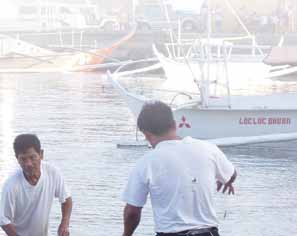
hese are the heartfelt sentiments of
such as basnig (bag net) and pukot (ring net). In
T Doroteo Cruzat (Mang Jury), a fisher who addition, the coral reefs that were the principal
was taught his craft in the waters of Mabini, in
fishing grounds of the local fishers were being
the Province of Batangas, Philippines, when he
destroyed and degraded as a result of blast
was 10 years old. For Mang Jury, together with
fishing and anchorage of commercial fishing
his father and seven brothers, fishing is the sole
boats. The future of fishing in Mabini, and
means of livelihood, security and income for
that of the Cruzat family in particular, became
the family. Mang Jury recalled that, in the mid-
bleak.
1970s, they were able to catch 10 kg of fish per
day enough for his family's consumption, with
Seeds of hope
the rest being sold to cover other expenses. The
Cruzat family was truly living off the natural
In the late 1980s, Haribon Foundation, a
Global Environment
bounties of the sea.
nongovernmental organization (NGO), came to
Facility
Mabini and introduced the concept of marine
The situation changed, however, when
protected areas (MPAs). MPAs, as explained
commercial fishers started encroaching the
to the locals, were designated areas where all
municipal waters of Batangas in the early
forms of fishing would not be allowed. This
1980s. Illegal and destructive fishing became
was necessary in order for the fishing stocks
a common sight. Mang Jury recalled that local
to recover and grow. Eventually, the outcome
United Nations
Development Programme
fishers were fortunate if they were able to
would be more fish to catch. Fishing would only
catch half of their catch from previous years.
be allowed outside the designated perimeter of
To compensate, they often followed the blast
the MPA.
fishers to gather any remaining fish, which the
illegal fishers would leave behind, after a blast
At first, there were apprehensions and
incident.
resistance from the fishing community. The
United Nations Office for
Project Services
perception was that this restriction would
Initially, local fishing communities weren't
limit their fishing area and they would have
concerned about the impact of blast fishing as
less access to fishing sites. After a long process
long as there was enough fish on the table. But
of awareness building and consultation, the
as time went by, even that became a problem.
community's perception changed and Twin
Partnerships in
Commercial fishers were harvesting all the fish
Rocks in Mabini, the first marine sanctuary in
Environmental Management
in their municipal waters, using illegal gears,
Batangas Province, was established in 1991.
for the Seas of East Asia
1



Poverty, malnutrition, education and population
Mang Jury and the rest of
2,500,000
the fishing community were
100
encouraged to help maintain the
90
2,000,000
MPA as members of Bantay Dagat
80
(Sea Watch)1. A series of capacity-
70
To
ta
1,500,000
building activities were conducted
t
60
l popul
in the community to provide the
rcen
50
e
P
atio
members with information on the
40
1,000,000
n
environment and fishery laws, as
30
well as the values of and threats
20
500,000
to the marine coastal resources.
10
For Mang Jury, the transition was
0
0
not an easy decision. It took four
1995
1996
1997
1998
1999
2000
2001
2002
2003
2004
2005
2006
2007
years before he became convinced
Year
to join the Bantay Dagat. He then
realized that even if he did not get
Poverty incidence
Malnutrition rate (children below 5 years old)
paid for the extra work he would
Elementary school participation rate
Secondary school participation rate
devote to Bantay Dagat, he needed
Total population
to protect the resources, not only
for his family's benefit but for the
Number of fishing families in Batangas
9,107 (2003)
15,935 (2007)
benefit of all fisher-families and
Fisheries production
20,133 MT (2005)
26,257 MT (2007)
their children's children.
From 1995 to 2007, the population of Batangas Province increased by almost 600,000 people.
Securing the future
Despite this large increase, economic and social conditions in Batangas Province improved as
evidenced by the decrease in poverty incidence, decrease in the proportion of undernourished
children below five years old, and higher elementary and secondary school participation rate
Mang Jury has been serving as
(Provincial Government of Batangas, Philippines and PEMSEA, 2008).
a member of Bantay Dagat for
10 years now. Again, he catches
about 10 kg, sometimes 50 kg, of fish a day. These fishes are
fishing in Mabini, and any commercial fishers who dare
bigger and economically important, such as gulyasan (skip
enter the municipal waters are immediately apprehended.
jack), tulingan (frigate tuna) and tambakol (yellow fin tuna),
The local fishing communities in Mabini realize the
instead of tamban (Indian sardines), galunggong (round
responsibility and implications of being stewards of the sea,
scad), dilis (anchovies) and pusit (squid) that he caught
and are quick to report and take action against violations.
during the time of blast and commercial fishing. The results
of a five-month (December 2006 to April 2007) fish catch
The once-degraded coral reefs have recovered. This
monitoring program conducted by the World Wide Fund for
has resulted in an additional source of income for the
Nature (WWF) Coastal Resources and Fisheries Conservation
community by boosting ecotourism in the area, particularly
Project supported Mang Jury's observation. The study
through dive sites. Local fishers earn extra income
revealed that gulyasan registered the most frequently
by ferrying divers to the coral reefs. As Bantay Dagat
caught fish, totaling 22,265 kg in Tingloy and 2,776 kg in
members, these fishers also police the actions of the divers,
Mabini (WWF-Philippines, 2007).
ensuring that they abide by the regulations established for
sustainably managing the reefs, as well as pay dive fees,
Mang Jury proudly attested that there is no more blast
which are used to support the operations of Bantay Dagat
and other environmental management programs of the
municipalities of Mabini and Tingloy.
Sightings of charismatic species like dolphins, manta rays,
sea turtles and whale sharks have also increased in the
waters of Batangas. This indicates a better state of their
natural habitat and less stress from illegal activities in the
area.
Mang Jury said, "I will continue to fish the waters of
Batangas and would not mind being a fisher my entire life.
As long as I remain industrious and continue to preserve
2000
the marine environment, my family will not go hungry. The
1994
sea is the main source of our livelihood and sustains the
education of my children." Unable to go to school himself,
he sees to it that the wealth of the sea continues to provide
2005
for the education of his two daughters, one a college
sophomore and the other a high school senior.
1 The Bantay Dagat is a civilian fisheries patrol force made up of volunteers who try to keep a 24-hour watch on municipal waters up to 15 km from the shore.
2




Mang Jury further noted, "But, no matter
SEMP and ICM Plans in Batangas Province
how much we protect the resources of our
Year
Description
Coverage
Status
community, these could not have paid off if our
1996
SEMP
Batangas Bay
Adopted by the 12
(1996-2020)
Region (BBR)
municipalities and 2 cities
neighbors would not protect their resources as
in the BBR
well. For as long as the different municipalities
have the same principles and objectives, these
2004
ICM Plan
Balayan Bay
Adopted by the 12
(2004-2023)
and Adjacent
municipalities in the
conservation efforts will work."
Bays Region
BABR and by the
(BABR)
Provincial Development
Council (PDC) in 2005
for the Prevention and Management of Marine Pollution in
the East Asian Seas (now the Partnerships in Environmental
2005
SEMP
Batangas
Adopted by the Provincial
Management for the Seas of East Asia or PEMSEA). This
(2005-2020)
Province
Legislative Body in March
effort was focused on the development and demonstration
2007
of ICM as a management framework for pollution
prevention and management of the Batangas Bay region.
2006
Verde Passage Framework
Formulated and adopted
At that time, Batangas Bay was being developed as an
Management
Plan (SEMP
by the TWG (EO 578) in
international deepwater port and industrial area. The
is a major
2006
focus of the ICM project was to facilitate environmental
component)
protection and management of the bay area using ICM as
a management process for strengthening interagency and
Mang Jury further noted, "But, no matter how much we
multisectoral coordination and cooperation in the planning
protect the resources of our community, these could not
and development of the Batangas Bay region.
have paid off if our neighbors would not protect their
resources as well. For as long as the different municipalities
One of the major outputs of the Batangas Bay project was
have the same principles and objectives, these conservation
the Strategic Environmental Management Plan (SEMP 1996-
efforts will work."
2020), which served as the road map for the development
of the bay without compromising the marine and coastal
environment and natural resources. The SEMP provided the
The following case study presents the evolution of the
platform by which the various sectors came together with a
implementation of integrated coastal management (ICM)
common vision for the development of their coastal areas.
in Batangas Province and how this holistic management
framework has put together the various efforts towards
Putting in place the legal and institutional mechanism for
conserving coastal resources and achieving sustainable
translating the SEMP into action was also one of the major
livelihood for Mang Jury and the fishing communities.
achievements of the project. The Batangas Bay Region
Environmental Protection Council (BBREPC) was established
A Tale of Two Bays: Parallel
through Provincial Ordinance 001 (1996). The Council
Coastal Management Initiatives
serves as the governing and policymaking body for the
implementation of the SEMP. This multisectoral body also
Conservation efforts in the Province
provides the forum for coordination, conflict resolution,
of Batangas, particularly in Balayan
14.3
Bay, to address the declining fish
MPAs of Batangas
resources and fast-degrading habitats
14.2
date back in the late 1980s. Several
New sites (8)
Nasugb
Nasug u
Reestablished/expanded sites (11)
NGOs (e.g., Haribon Foundation, Center
For re-delineation (11)
for Empowerment and Resource
14.1
Managed by Batangas City (3)
Development) came to the aid of
Mabini and Tingloy, lobbying for the
14
establishment of the first MPA in
Ba
B layan
Lemery
Lem
the province in 1991. The NGOs also
13.9
started organizing different people's or
fishers' organizations (e.g., Samahang
Bauan
B
13.8
Ca
C l
a atagan
8
ta
Pangkaunlaran ng San Teodoro, Inc.
and Samahan ng Mangingisda para sa
Mabi
M
n
abi i
n
San Jua
S
n
an Jua
Kaunlarang Pangkapaligiran), as well as
13.7
Ting
Ti
l
ng o
l y
mobilization of the Bantay Dagat.
Lobo
Lob
13.6
At around the same time, in the
Ve
V rde Isl
rde Is and
l
adjacent Batangas Bay, integrated
13.5
coastal management (ICM) was being
introduced (1994) as part of the
13.4
Global Environment Facility/United
Nations Development Programme/
International Maritime Organization
13.3
120.4
12
1 0.
0 5
120
2 .6
120.7
.
120.8
12
1 0.
0 9
121
121.1
121
2 .2
.
121.3
12
1 1.
1 4
121.5
121.6
(GEF/UNDP/IMO) Regional Programme
3





information exchange and cross-sectoral relations among
Similarly, other coastal municipalities were beginning to
government and nongovernment stakeholders in the bay,
set up MPAs in their areas together with partner people's
including fishers.
organizations and NGOs. These MPAs, like those in Mabini
and Tingloy, were individually and sectorally managed.
At the operations level, the Provincial Government-
There was no mechanism to coordinate and integrate the
Environment and Natural Resources Office (PG-ENRO) was
efforts of the different local government units (LGUs) to
created through Provincial Ordinance No.03-95 (December
address the growing threats to their respective protected
1995). The PG-ENRO serves as the lead coordinating agency
areas from external sources.
for SEMP implementation, the focal point for monitoring and
evaluating progress among stakeholders with regard to the
The WWF-Philippines recognized that the conservation
objectives and targets identified in the SEMP, as well as the
efforts in Mabini and Tingloy would not be effective or
technical arm of the Council.
sustainable without an integrated baywide approach
in Balayan Bay. It was at this time that the effective
A united front
implementation of ICM in Batangas Bay came to the
forefront. The benefits of the multisectoral process, the
By 1998, the problem of commercial fishers encroaching
long-term strategic road map (SEMP), and the institutional
the municipal waters of Mabini and Tingloy was becoming
mechanism providing policy direction, coordination and
critical. Fishing pressures were having spillover effects in the
operationalization of the SEMP provided the necessary
established MPAs with commercial fishing boats coming
governance structure that was lacking in the existing MPA
from the neighboring coastal municipalities (e.g., Batangas
arrangements.
City, Bauan, Balayan and Lemery). In addition, the growing
industrialization and shipping activities in the coastal area
Concurrently, the Provincial Government recognized that
posed increasing risks of land- and sea-based pollution to the
rapid growth and development were potential threats to
conservation areas. On top of this, the tourism industry was
the marine and coastal resources of the area, and to the
beginning to show interest, which added further conflicts
coastal communities that depended on these resources.
among the traditional and commercial fishers (Tongson, 2003).
The Provincial Government decided to expand the ICM
4






program to the other bays, thereby providing broader
biodiversity conservation in Batangas had been in place as
management coverage.
part of the implementation of the Batangas Province SEMP
led by the Provincial Government. The SEMP then became
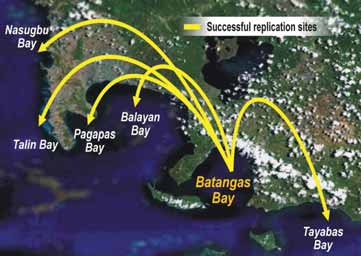
A partnership was forged between WWF-Philippines and
the platform for CI-Philippines to implement its program
the Provincial Government to support the replication of
in the Verde Island Passage Marine Corridor. The Batangas
the ICM model developed in Batangas Bay to Balayan Bay
Province SEMP is now a major component of the Verde
and adjacent bays. The resulting ICM plan was adopted
Passage Management Framework Plan.
by the 12 coastal municipalities and the Provincial
Development Council in 2005.
The existing MPAs in Batangas are within the bounds of
the Verde Island Passage, thus creating a network of MPAs
The scaled up ICM program now covers the entire coastline
promotes the ecological integrity of the area. The network
of Batangas. The SEMP was updated incorporating
aims to enhance the effectiveness and functionality of the
the management of the three bay regions (Batangas
MPAs in promoting sustainable livelihood for fishers and
Bay, Balayan Bay and adjacent bays, and Tayabas Bay)
protection of coastal resources.
and was adopted by 34 local governments on 22
March 2007 through Resolution No. 129. Similarly, the
The CI-Philippines and the WWF-Philippines then
institutional mechanism for its implementation has been
became partners of the province in the establishment
strengthened to address the broader geographical scope
of the network of MPAs. This network facilitates the
and management issues. In September 2008, through
sharing of information, experiences and resources;
Provincial Ordinance No. 5, the three-tiered Batangas
the resolution of conflict; the assistance to other
Environmental Protection Council was adopted, which
LGUs in the establishment of their own MPAs; and the
now serves as the multisectoral body to guide the
consolidation of law enforcement efforts. As part of the
implementation of ICM. The new Council integrates the
SEMP implementation, the PG-ENRO, also takes the
three baywide ICM Boards and Municipal ICM Councils. The
PG-ENRO still serves as the secretariat and technical arm
Network of MPAs in Batangas (August 2009).
of the Batangas Environmental Protection Council in the
implementation of the SEMP.
Municipality
Area of MPA
Number of
(hectares)
MPAs
As MPAs were already under the broader implementation
Balayan
6
2
of the provincewide SEMP, through the PG-ENRO,
Batangas City
6
3
coordination among LGUs was facilitated. The coastal LGUs
now share the same guiding principles and objectives in
Bauan
136
1
managing their resources.
Calatagan
165
3*
Lemery
3
1
ICM in the Global Center of Marine
Lobo
40
3
Biodiversity
Mabini
79
4
Nasugbu
113
4
In 2005, the Conservation International (CI)-Philippines2
San Juan
704
11*
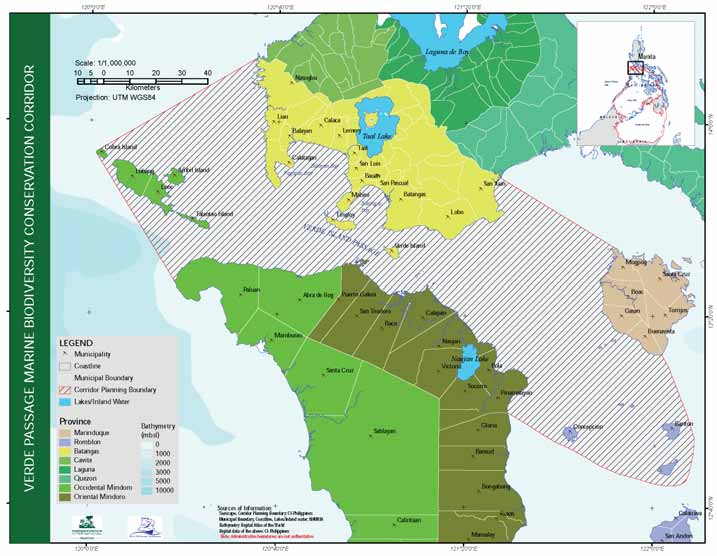
initiated a marine biodiversity program in the Verde Island
Tingloy
4
1
Passage Marine Biodiversity Conservation Corridor as
part of the Sulu-Sulawesi Seascape Project. The Corridor
is bordered by the provinces of Batangas, Oriental
Total
1,256
33
and Occidental Mindoro, Marinduque and Romblon.
*Includes one mangrove protected area
Fortunately, the mechanism for the implementation of
Source: PG-ENRO, 2009.
2
When WWF-Philippines finished its project implementation in Batangas in June 2008, the CI-Philippines took over as the partner of the Provincial Government in the continuous
implementation of the MPA and Bantay Dagat initiatives.
5





lead in organizing coordination
Number of Apprehensions for Fishery Related Violations in Batangas:
meetings and capacity-building
2000-2003 (Gutierrez, 2007); 2006-2007 (Trono and Gutierrez, 2007);
initiatives, between and among
and 2009 (PG-ENRO).
the network. The network was
Year
Municipalities
Number of
Apprehensions
Average per year
established in November 2007
Bantay Dagat
Illegal
Cases
Illegal
Cases
through a Memorandum of
members
Fishers
Filed
Fishers
Filed
Agreement between the Provincial
2000-2003 Mabini, Tingloy,
174
625
70
130
18
Government, Batangas City, and the
San Luis,
municipalities of Balayan, Bauan,
Calatagan,
Nasugbu,
Calatagan, Mabini, Lobo, San Juan,
Balayan
Nasugbu and Tingloy.
2006-2007 Mabini, Tingloy,
200
79; 9 divers
14
88
14
Community volunteerism
Calatagan,
Nasugbu, Lobo,
Balayan, San
The implementation of MPAs
Luis, San Juan,
consequently needs the creation of
Batangas City
a team to guard these from illegal
destructive fishing practices and
2009
Balayan,
300
San Juan,
commercial fishers. Bantay Dagat
Calatagan,
is now the key partner of the local
Lobo, Mabini,
government in enforcing fishery-
Nasugbu, San
related legislation. Some Bantay
Luis, Tingloy,
Dagat members use their own boats
Batangas City,
for patrolling while operational
Lian, Calaca,
expenses (e.g., fuel) are supported
Bauan, Lemery
by regular budget allocation from
the local government. Government
agencies (e.g., the Bureau of
Forming a Bantay Dagat Network
Fisheries and Aquatic Resources)
and NGOs (WWF-Philippines and
Mr. Rodrigo A. de Jesus (Mang Rod), Bantay Dagat Network chair, started taking on the
CI-Philippines) also support their
network's leadership in 2003 and has seen how the network developed. Starting with
operations by providing patrol
the six coastal towns of Calatagan, Nasugbu, Mabini, Balayan, Tingloy and San Luis, the
boats and hand-held radios for
network today has 13 member municipalities.
communication.
In 1977, Mang Rod resigned from his farm managerial job and returned to his barangay
The Bantay Dagat was relatively
only to be disappointed to see the rampant dynamite fishing activities. This alarming
situation prompted him to form a people's organization aimed at combating illegal
successful in Batangas. It
activities at sea. Together with other volunteers, they started patrolling the seas,
helped lessen illegal fishing
unaware that they were implementing activities of Bantay Dagat. In 2003, they
and heightened the people's
underwent training and were deputized as Bantay Dagat volunteers. At that time,
consciousness on environmental
fisherfolks in their barangay left their nets hanging as there was a substantial decrease
issues. This experience highlights
in fish catch. Today, years after the establishment of two MPAs in Calatagan, he proudly
the importance of mobilizing the
uses those fish nets again.
community in enforcement and
consequently making it a co-
With a perspective extending beyond his community, Mang Rod sees the Bantay Dagat
Network as an instrument not only for law enforcement but also for service during
owner of and a partner in coastal
search and rescue operations at sea. While volunteers receive a small incentive from
management projects.
the LGUs, Mang Rod is hopeful that the network be institutionalized so that volunteers
could receive more incentives such as life insurance, medical benefits and scholarships
Similar to the concept of forming
for their children. As volunteers, they no longer have fear in their hearts but instead,
a network of MPAs, a network
carry with them the will and commitment to continue guarding the seas for the future
of Bantay Dagat in the coastal
generations.
municipalities was also established
to consolidate the coastal
enforcement efforts in the province.
Recently, 13 of the 15 coastal
municipalities (Balayan, San Juan,
Calatagan, Lobo, Mabini, Nasugbu,
San Luis, Tingloy, Batangas City,
Bauan, Lian, Calaca and Lemery) are
already part of the Bantay Dagat
Network. Over 300 volunteers are
now patrolling the coastal waters
of Batangas. A Memorandum of
Understanding with the Philippine
National Police was also signed to
6





facilitate the deployment of police
Lessons Learned
during operations.
It is important to develop a strategic long-term road map (SEMP)
Through the coordinative efforts
for the sustainable development of an area. The SEMP provides
of the PG-ENRO and the support
the platform upon which the various stakeholders channel their
of the local government and
contributions towards achievement of a common vision for the
nongovernmental organizations,
sustainable development of the marine and coastal areas of
continuous capacity building is being
Batangas.
done to strengthen the operations
of Bantay Dagat. This includes
The ICM program promotes multisectoral cooperation and
deputization of more members and
partnerships with key players (e.g., NGOs) to create synergy and to
conducting Advanced Fishery Law
strengthen various management efforts.
Enforcement and paralegal trainings.
Mechanisms are also being explored
The recognition of the achievements of a demonstration project
to institutionalize and sustain
(e.g., Batangas Bay Demonstration Project) in meeting its desired
Bantay Dagat operations as well as
objectives provides a good foundation for replication. Likewise,
to provide incentives to members
a replicable program needs an identifiable and coherent set of
(e.g., life insurance, medical benefits,
program elements. It is also crucial that there is an operating
scholarships to children of members).
mechanism (e.g., PG-ENRO) coordinating and guiding the
expansion.
The long-term protection of coastal
and marine resources requires
As MPAs are threatened by various external factors, they function
broader support beyond the MPA
more effectively if they are managed within a wider geographical
boundaries and the Bantay Dagat
area and management scope. The governance mechanism
initiatives. Being nested within the
established under the broader ICM framework provides the
broader ICM program, effective
necessary governance structure for promoting the MPAs' objective
coordination and facilitation
for sustainable livelihood and biodiversity conservation.
happen, and a platform to engage
the stakeholders at varying scales
Resistance and apprehensions on management interventions
is available. Local and national
can be resolved through enhanced public awareness. This
governments, NGOs, private entities,
includes awareness of the consequences of the people's actions,
academe and other sectors can
understanding of the need for management action, and promoting
work together to integrate and
ownership and shared responsibility for the planned management
complement each other's efforts.
interventions.
Further readings
It is important to educate and build awareness in order to mobilize
the community for environmental stewardship (e.g., Bantay Dagat)
and consequently make the community a co-owner and a partner
The following PEMSEA publications
in sustainable coastal development.
document the ICM good practices and
MPAs in Coping with Climate Change
On ecosystem resilience
Dealing about the MPAs and climate change is a two-pronged discussion. Climate change poses considerable threats to protected
marine seascapes but effective management of these MPAs in turn can help in building the resistance and resiliency of the ecosystem.
They can ensure healthier ecosystems that may also withstand climate change and other stresses longer than highly disturbed or
degraded ecosystems (IUCN-WCPA, 2008).
In the face of worsening climate impacts, protecting biodiversity makes perfect sense. Declared Mr. Jose Ma. Lorenzo Tan (of WWF-
Philippines), "MPAs focus on much more than just the conservation of biodiversity: should we succeed in halting climate change, these
pockets of marine resilience will provide the building blocks needed to restore natural mechanisms which provide food and livelihood
for millions of people. It's a natural investment."
As natural physical barrier
Batangas Province is seeing the effects of climate change. Although, a scientific study is yet to confirm this, representatives from
Calatagan and San Juan, during one of the meetings of the MPA and Bantay Dagat Networks, claimed that there seems to be a rise in
the sea level in their areas. They reported that present water levels along the shore seem to be higher as compared to past levels. Mr.
Jesse de los Santos of Calatagan, during the State of the Coasts survey in May 2008 also identified saltwater intrusion and instant sea
surges as emerging issues in the area.
Protected areas play an important role in disaster mitigation in marine and coastal areas. Sea level rise and increased storm damage
put coastal communities and small islands at risk. Building physical barriers against the rising sea is technically difficult and expensive.
Conserving the natural protective barriers such as coral reefs and mangroves can therefore be regarded as the most cost-effective
option for maintaining coastal integrity (Moberg and Roonback, 2003).
7







the impacts of ICM implementation in Batangas:
1. Provincial Government of Batangas, Philippines and
PEMSEA. 2008. State of the coasts of Batangas Province.
PEMSEA, Quezon City, Philippines. 119 p.
2. PEMSEA. 2006. Securing the future through ICM: the
case of the Batangas Bay region. PEMSEA Technical
Report No. 19, 84 p. GEF/UNDP/IMO PEMSEA, Quezon
City, Philippines.
Prepared by Daisy Padayao, PEMSEA, and Loreta Sollestre,
Provincial Government-Environment and Natural Resources Office
(PG-ENRO) of Batangas Province, Philippines
Sources:
Awitan, L. (Provincial Government-Environment and Natural Resources Office
head). Personal communication. May 2009.
Cruzat, D. (Bantay Dagat, vice-chair for Tactical Operations). Personal
communication. May and September 2009.
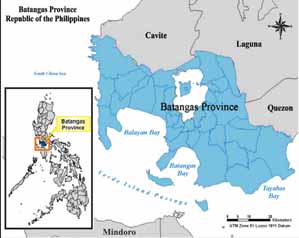
Batangas Province
Custodio, M.E. (Municipal Environment and Natural Resources Office,
The province lies along the southwestern edge of Luzon Island and
Calatagan). Personal communication. Survey for the state of the coasts,
is part of the Southern Tagalog region. Batangas is bordered by the
May 2008.
provinces of Cavite to the north, Laguna to the northeast and Quezon
to the east. Its waters include three major bays: Batangas Bay, Balayan
De Jesus, R. (Bantay Dagat Network chair). Personal communication. May
Bay and adjacent bays, and Tayabas Bay. The Verde Island Passage
2009.
Marine Biodiversity Conservation Corridor, considered as the "center
of global marine biodiversity," separates Batangas from Mindoro
Gutierrez, J.S. n.d. Verde Passage marine biodiversity conservation corridor
Province.
enforcement strategy. Conservation International-Philippines. Quezon
City, Philippines.
IUCN World Commission on Protected Areas (IUCN-WCPA). 2008. Establishing
marine protected area networks Making it happen. Washington D.C.
Key Facts about Batangas Province
IUCN-WCPA, National Oceanic and Atmospheric Administration and
The Nature Conservancy. 188p.
Land area (km2)
3,165.81
Area covered by ICM (km2)
1,663.51 (53%) (2007)
Moberg, F. and P Rönnbäck. 2003. Ecosystem services of the tropical
seascape: interactions, substitutions and restorations. Ocean and
Coastline length (km)
492
Coastal Management 46(1-2): 27-46.
Municipal waters (km2)
7,000 (excluding Taal Lake)
Provincial Government-Batangas. 2007. Socioeconomic profile of Batangas.
Total number of cities/
34 (including 3 cities)
Provincial Government-Batangas, Philippines, and PEMSEA. 2008. State of the
municipalities
coasts of Batangas Province. PEMSEA, Quezon City, Philippines. 119 p.
Coastal cities/municipalities
15 (including 1 coastal city)
Provincial Government-Environment and Natural Resources Office. 2009.
Scaling up MPA networks: the Verde Passage experience. Data
Major bays
Batangas Bay
presented during the Meeting of the MPA and Bantay Dagat Networks,
May 2009. San Juan, Batangas, Philippines.
Balayan Bay and Adjacent Bays
Sollestre, L. (Provincial Government-Environment and Natural Resources
Tayabas Bay and Adjacent Bays
Office head of Planning Department). Personal communication. May
Major rivers
Calumpang River
and September 2009.
Pansipit River
Tongson, E. 2003. ICM as a strategy to enable MPA management: the case of
Balayan Bay. Case study presented during the Second International
Benangbang River
Tropical Marine Ecosystems Management Symposium, 24-27 March
Total population (2007)
2,245,869
2003, Manila, Philippines.
Population growth rate (%)
3.02
Trono, R. and Gutierrez, J. 2007. Verde Passage enforcement strategy. Paper
(1995-2000)
presented during the Sulu-Sulawesi Seascape Congress 2007, 20-22
June 2000, Manila, Philippines. Conservation International-Philippines.
Employment rate (%) (2003)
87.73
Sectoral employment (% of total
Tropical Coasts. 2008. Conserving the Sulu and Sulawesi Seas. Vol. 15 No. 1
employment) (2003)
(July).
Agriculture
28.71
World Wide Fund for Nature-Philippines. 2007. Fish catch monitoring in
Mabini-Tingloy completed. Batayan. March-Apri.
Industry
23.24
World Wide Fund for Nature-Philippines. 2007. "Marine protected areas in
Services
47.32
Batangas." Data presented during the Joint Batangas Bay Region
Environmental Protection Council-Provincial Solid Waste Management
Board Meeting, November 2007, Batangas City, Philippines.
For comments and suggestions, please contact:
Partnerships in Environmental Management for the Seas of East Asia (PEMSEA)
P.O. Box 2502, Quezon City 1165 Philippines
Tel.: (+63 2) 929 2992
Fax: (+63 2) 926 9721
Email: info@pemsea.org
www.pemsea.org
8