TRANSBOUNDARY DIAGNOSTIC ANALYSIS
FOR THE CASPIAN SEA
Volume One
Executive Summary
and Environmental Quality Objectives
THE CASPIAN ENVIRONMENT PROGRAMME
BAKU, AZERBAIJAN
September 2002





UNDP Disclaimer:
The views expressed in this publication are those of the author and do not necessarily represent those of the United Nations or UNDP.
TACIS Disclaimer:
A number of the studies on which the TDA is based were undertaken in the context of the European Union's Tacis Programme's support for the Caspian Environment Programme. The findings and conclusions of the TDA however do not necessarily reflect the policies or opinions of the European Commission.
DEDICATION
This Transboundary Diagnostic Analysis is dedicated to Dr. Khabibulla I. Atamuradov (1952 – 2000), formerly the National Focal Point from Turkmenistan and a member of the CEP Steering Committee since its inception. Dr. Atamuradov brought a sense of scientific rigor, compassion, environmental concern, and dedication that all those who worked with him felt and benefited from. This TDA attempts to reproduce Dr. Atamuradov’s senses of scientific rigor, environmental concern, and dedication.
ACKNOWLEDGMENTS
This TDA relies on and benefits from the dedicated work of numerous individuals, agencies, institutes, projects and corporations. The major building blocks are the studies and research works conducted and carried out by the Caspian Regional Thematic Centres. These works have been mostly produced by the national experts of the Caspian countries and have been effectively led and substantially assisted by the National Focal Points (NFPs) and the Management Advisory Group and Inter-sectoral Assistants (MAGICAs). The International Partners, namely the World Bank, UNEP, UNDP and the European Union/TACIS contributions to the TDA process and output have been considerable. A number of UN agencies including International Maritime Organizations (IMO), the UN Food and Agriculture Organization (FAO), World Health Organization and International Atomic Energy Agency (IAEA) have provided invaluable inputs to the process. The inputs by international consultants have been equally invaluable, in particular inputs by Woodshole Group, which took a leading partnership role in the production of early drafts of the TDA. The private sector, particularly the oil and gas industry, assisted the process through sharing of own data and information.
Production of the TDA would have not been possible without the efficient project execution assistance of the United Nations Office for Projects Services (UNOPS). The overall conceptualization, design, production monitoring and editing of the TDA has been led by the Programme Coordination Unit (PCU) including the Data and Information Management Theme in Baku, Azerbaijan.
A list of major contributors to the TDA includes:
NFPs and Magicas
Mr. Ali Gasanov and Mr. Gouseyn Bagirov, successive NFPs for Azerbaijan
Mr. Rasim Sattarzade, Magica, Azerbaijan
Mr. Saeed Hosseini Imami, NFP, I.R.Iran
Ms. Parvin Farshchi, MAGICA, I.R.Iran
Mr. Amirkhan M Amirkhanov, NFP, Russia
Ms.Tatyana Butylina, MAGICA, Russia
Mr. Serikbek Daukeev and Mr Andar Shukputov successive NFPs for Kazakhstan
Ms. Ludmila Shabanova and Mr. Madi Bolat, successive MAGICAs for Kazakhstan
Late Mr. Khabibulla I Atamuradov and Mr. Matkarim Radjapov, successive NFPs for Turkmenistan
Ms. Gozel Orazdurdyeva, MAGICA for Turkmenistan
CRTCs
Ms. Latifa Guseynova and Mr. Arne Jenson; CRTC for Pollution Control
Mr. Damir Katunin and Mr. Eric Labon; CRT for Fisheries and Commercially Exploited Bioresources
Mr. Aman Babayev and Mr. Frank Schrader; CRTC for Combating Desertification
Mr. Sergei Tikhonov and Ms. Irina Krasnova; CRTC for Legal, Regulatory and Economic Instruments
Mr. Alexandr Bolshov and Mr. Zbig Karpowicz; CRTC for Protection of Biodiversity
Mr. Madi Kireev and Mr. Terry Evans; CRTC for Water level Fluctuations
Mr. Norouz Tavana and Mr. John Ostergaard; CRTC for Emergency Response
Mr. Reza Sheikholeslami and Mr. Steven de Mora; Theme for Effective Regional Assessment of Contaminant Levels
Ms. Nabat Mamedova, Ms. Svetlana Sakhatova, and Ms. Kathy Pond; CRTC for Sustainable Human Development and Health
Ms. Parvin Farshchi and Mr. Phillip Tortell, CRTC for Integrated Transboundary Coastal Area Management and Planning
International Partners
Ms. Amy Evans, Mr. Konrad Von Ritter, and Mr. Rune from the World Bank
Mr. Fritz Shlingemann, Ms. Danica Valnicek and Ms. Sylvie Goyet from UNEP
Ms. Anna Bramwell and Mr. Dino Singallia from EU/Tacis
Ms. Katherin Topar-Michon and Mr. Juan Luis Larrabure from UNOPS
Woodshole Group
David Aubrey, Director
Vladimir Mamaev, Senior Expert
Mary Matthews, Senior Expert
Programme Coordination Unit
Mr. Tim Tuner, Programme Coordinator
Mr. Hamidreza Ghaffarzadeh, Economist
Mr. Vladimir Vladymyrov, Scientific Liaison and Information Management Officer
Mr. Stuart Gunn, Tacis Project Manager
Mr. Bakhtiyar Muradov, Regional Coordinator
Mr. Ziyafat Kerimov, Information Expert
Table of Contents
Volume One
Executive Summary and Environment Quality Objectives 1
I. The Caspian Environment Programme 1
III. Caspian Economic and Legal Settings and its Major Perceived Problems and Issues 5
IV. Major Perceived Problems and Issues 7
VI. Environmental Quality Objectives, Targets and Interventions 14
List of Figures
Volume One
Figure 1 TDA Process Flow Diagram 4
Figure 2 Causal Chain Analyses 12
List of Tables
Volume One
Table 1 Environmental Quality Objectives, Targets, and Interventions Agreed at the Fourth and Fifth CEP TDA Meetings 16
Table of Contents
Volume Two
1.0 The Caspian Sea and its Social, Economic and Legal Settings 1
1.1 Introduction 1
1.2 Physical and Biogeochemical Characteristics of the Caspian Sea 3
1.3 Socio-Economic and Development Setting 23
1.4 Legal and Regulatory Setting 39
2.0 Major Transboundary Perceived Problems and Issues 50
2.1 Introduction 50
2.2 Stakeholder Analysis 51
2.3 Decline in certain commercial fish stocks, including sturgeon: strongly transboundary. ………………………………………………………………………………………...59
2.4 Degradation of coastal landscapes and damage to coastal habitats: strongly transboundary. 69
2.5 Threats to biodiversity: strongly transboundary. 74
2.6 Overall decline in environmental quality: strongly transboundary. 79
2.7 Decline in human health: weakly transboundary. 105
2.8 Damage to coastal infrastructure and amenities: weakly transboundary. 115
2.9 Invasive and Introduced species: strongly transboundary. 122
2.10 Contamination from offshore oil and gas activities: strongly ¶transboundary. 125
List of Figures
Volume Two
Figure 1.2-1 The Caspian Sea 4
Figure 1.2-2 Caspian Sea Water Levels 7
Figure 1.2-3 Caspian Sea Evaporation, 1900-1994 9
Figure 1.2-4 Changes in the Elements of the Water Balance and Water Level of the Caspian Sea, 1990-1998 11
Figure 1.3-1 Relative Population Map 24
Figure 1.3-2 Relative Gross Domestic Product 26
Figure 2.3-1 Estimated Total Stock of Commercial Fishes in the Caspian Sea (excluding Iran) 61
Figure 2.1-2 Sturgeon Catch 1929-1998 (tonnes/year) 62
Figure 2.3-4 Aquaculture production in the USSR and CIS countries (FAO) 66
Figure 2.4-1 Desertification 69
Figure 2.4-2 Regional Desertification Map 70
Figure 2.4-3 Desertification in the Caspian Region 71
Figure 2.6-1 Inorganic Lead in Sediments 84
Figure 2.6-2 A large oil slick in the western Caspian off Baku 85
Figure 2.6-3 Pollution Hot Spots 91
Figure 2.6-4 Uranium in Sediments 92
Figure 2.6-5 Network of Hydrometeorological Stations for the Caspian Sea 96
Figure 2.6-6 Mercury in Sediments 99
Figure 2.6-7 DDT in Sediment 100
Figure 2.6-8 DDT in Seal Tissue 102
Figure 2.6-9 Seal Mortality 103
Figure 2.7-2 Life expectancy at birth (average and Caspian coast) and (years) 107
Figure 2.7-1 Caspian Coastal Region 109
Figure 2.8-1 Water level fluctuations 115
Figure 2.8-2 Potential for coastal inundation (CEP 2001, Schrader) 118
Figure 2.8-3 Caspian Region Earthquake Locations 119
Figure 2.9-1 Mnemiopsis leidyi 122
Figure 2.10-1 A history of exploitation 125
Figure 2.10-2 Danger of leaks 126
List of Boxes
Volume Two
Box 1 Kara Bogaz Gol 9
Box 1 Kara Bogaz Gol 10
Box 2 Sturgeon 17
Box 3 Caspian Seal 18
Box 4 Mnemiopsis leidyi 22
List of Tables
Volume Two
Table 1.2-1 Summary of Caspian Sea Characteristics 12
Table 1.2-2 Invasive Species of the Caspian Sea (Aladin 2001, Mitrofanov 2000) 21
Table 1.4-1 Summary of International Environmental Agreements Ratified By Caspian Littoral States 46
Table 2.2-1 Stakeholder Group Prioritization of MPPI 57
Table 2.2-2 Stakeholder Groups Prioritization of Root Causes 58
Table 2.3-1 Average Annual Caspian Fish Catch CIS Countries 1910-1998 and Iran 1927-1998 (thousand tonnes per year and percent of change compared to 1932-1959 60
Table 2.3-2 Estimated annual juvenile sturgeon release by three hatcheries in Azerbaijan 65
Table 2.3-3 Annual juvenile sturgeon release in Iran 65
Table 2.3-4 Annual juvenile sturgeon release in Kazakhstan 65
Table 2.3-5 Annual juvenile sturgeon release in the Volga River, former USSR and Russia 65
Table 2.4-1 Areas Subject to Heavy and Very Heavy Degree of Desertification 72
Table 2.5-1 List of Approximate Numbers* of Species, Endemic Species, Alien Species, and Listed Species in Different Biota Groups 74
Table 2.5-2 Spawning Grounds of Sturgeon 75
Table 2.6-1 Data and Information Availability and Reliability 80
Table 2.6-2 Air Emission Inventory for Absheron Peninsula including Baku and Sumgait 88
Table 2.6-3 Pollution load from rivers, municipalities and industry in Caspian Sea as well as each country 89
Table 2.6-4 Pollution Hot Spots 90
Table 2.6-5 Nuclear Reactors in the Caspian Sea Vicinity 93
Table 2.6-6 Nuclear Fuel Processing Facilities, Radons, and Other Potential Sources of Radioactive Pollution in the Caspian Sea 94
Table 2.7-1 Survival Rates (UNDP Human Development Report 2001) 106
Table 2.7-2 Leading Global Health Crises and Challenges (UNDP Human Development Report 2001) 106
Table 2.7.3 National and Caspian coastal region birth rates, per 1000 108
Table 2.7.4 National and Caspian Coastal death region rates, per 1000 108
Table 2.7.5 Cases of infections diseases by country 111
Table 2.7.6 Public Health Care by country 111
Table 2.7-7 Descriptive statistics of the data obtained for E. coli and faecal streptococci from sampling sites in Iran, Turkmenistan and Azerbaijan. 113
Table 2.8-1 Most affected geomorphologic structures (CEP 2001, Schrader) 117
Table 2.8-2 Extent of inundation in the five littoral countries (CEP 2001, Schrader) 120
Table 2.10-1 Estimated Total Annual Oil Input to the Caspian Sea (CRTC PC, 2001) 127
Table 2.10-2 Estimated Oil Input from Oil Industry Activities (CRTC PC, 2001) 127
Acronyms and Abbreviations
BAT Best Available Technology
BOD Biological Oxygen Demand
BP British Petroleum
BSEP Black Sea Environment Programme
BSP Baltic Sea Programme
CASPAS Integrated Programme on Hydrometeorology and Monitoring of Environment in the Caspian Sea
CBO Community-Based Organization
CEH Caspian Economic Hinterland
CEP Caspian Environment Programme
CEZ Caspian Economic Zone
CIP Centre for International Projects, Russian State Committee for Ecology
CIS Commonwealth of Independent States
CITES Convention on International Trade in Endangered Species of Wild Fauna and Flora
CRTC Caspian Regional Thematic Center
CRTC/CD Caspian Centre for Combating Desertification
CRTC/DIM Caspian Centre for Data & Information Management
CRTC/FBR Caspian Centre for Fisheries and Bio-resources
CRTC/LREI Caspian Centre for Legal, Regulatory & Economic Instruments
CRTC/PC Caspian Centre for Pollution Control
CRTC/SHDH Caspian Centre for Sustainable Human Development & Health
CRTC/WLF Caspian Centre for Water Level Fluctuations
DIAS Database on Introduction of Aquatic Species
DSS Decision Support System
EBRD European Bank for Reconstruction and Development
EC European Commission
ECOTOX Ecotoxicology Project
EIA Environmental Impact Assessment
EIN Environmental Information Networking
EQO Environmental Quality Objective
ER Emergency Response
ERACL Effective Regional Assessment of Contaminant Levels
ERT Environment Research Technology Ltd. (UK)
EU European Union
EUCC European Union for Coastal Conservation
FAO Food and Agricultural Organization, UN
GCM Global Circulation Model
GDP Gross Domestic Product
GEF Global Environment Facility
GESAMP Joint Group of Experts on the Scientific Aspects of Marine Pollution, UN
GIS Geographical Information System
GNP Gross National Product
HDI Human Development Index
IAEA International Atomic Energy Agency
ICES International Council for the Exploration of the Seas, UN
ICZM Integrated Coastal Zone Management
IDP internally displaced population
IMO International Maritime Organization
IOC Intergovernmental Oceanographic Commission
ISCF Intersectoral Coordinating Function
ITCAMP Integrated Coastal Area Planning and Management
LEARN Learning Exchange and Resource Network
MARPOL International Convention for the Prevention of Pollution from Ships
MEA Multilateral Environmental Agreement
MERB Marine Environment Research Bureau, Tehran
METAP Mediterranean Environmental Technical Assistance Program
ML the ctenophore Mnemiopsis leidyi
MPPI Major Perceived Problems and Issues
NATO North Atlantic Treaty Organization
NCAP National Caspian Action Plan
NEAP National Environmental Action Plan
NFP National Focal Point
NGO Non-Governmental Organization
NIS Newly Independent States
OVOS Russian EIA
PCU Programme Coordination Unit
PDF Project Development Facility
PHRD Policy and Human Resources Development Grant (Government of Japan)
PIP Priority Investment Portfolio
PPP purchasing power parity
PSA Production Sharing Agreement
QA Quality Assurance
QC Quality Control
RAP Rapid Assessment Protocol
SAP Strategic Action Programme
SC Steering Committee
SHG Stakeholder Group
SOCAR State Oil Company of Azerbaijan Republic
Tacis EU Programme for Technical Assistance for the Commonwealth of Independent States
TDA Transboundary Diagnostic Analysis
TOR Terms of Reference
UNDP United Nations Development Programme
UNEP United Nations Environment Programme
UNESCO United Nations Education, Science & Culture Organization
UNIDO United Nations Industrial Development Organization
UNOPS United Nations Office for Project Services
WB World Bank
WHO World Health Organization
WMO World Meteorological Organization
WWW World Wide Web
The Caspian Environment Programme (CEP) is a regional umbrella Programme established by the Caspian littoral states and aided by the international agencies. Born our of a desire for regional cooperation, expressed through a number of regional agreements, including the Almaty Declaration on Environmental Cooperation of May, 1994, the CEP was agreed to in June 1995 during a joint mission by The World Bank, United Nations Environment Programme (UNEP), and United Nations Development Programme (UNDP). This mission marked the start of a close partnership between the region and the international community. The mission also cemented the collaborative mechanisms between the GEF implementing agencies.
The CEP, which encompasses all Caspian States and numerous international agencies, including the World Bank, UNEP, UNDP, the European Union/TACIS (EU/TACIS) is now officially four years old and now approaching completion of its strategic planning and study stage. A Steering Committee has been established and national managements structures created.
As a part of this initial study this Transboundary Diagnostic Analysis of the Caspian Sea has been undertaken and a information managements system created, which can be accessed via the CEP web site (www.caspianenvironment.org). National Caspian Action Plans (NCAPs) and a Caspian Strategic Action Programme (SAP) are currently under preparation.
According to GEF guidance, the purpose of conducting a Transboundary Diagnostic Analysis (TDA) is to scale the relative importance of sources and causes, both immediate and root, of transboundary waters problems and to identify potential preventive and remedial actions. The TDA has been treated as a process through which regional experts have passed and in so doing gained experience in evaluation and prioritization of environmental problems and a deeper understanding of their underlying causes. These same regional experts have since progressed to work on their NCAP and the SAP. The TDA presented here is the product of the regional experts and although the national governments were consulted at all stages they have not adopted or approved its content. The TDA provides the technical basis for development of both the NCAPs, which are to be endorsed and agreed by the national government, and the SAP.
The TDA focuses on the major Transboundary issues. “Transboundary” can include several types of issues, such as an environmental concern that originates in one country, but affects other countries (for example, river discharge) or an issue that originates in several countries (air pollution, Transboundary rivers). Transboundary issues are normally defined as problems shored by all littoral states, however, in some cases, in this TDA Transboundary has been defined as a problem common to several target countries even though they may not have common sources, but this is not the general definition.
This TDA, therefore, summarizes information available from the region, gathered both as part of ongoing national activities within the littoral states, as well as information made available since the inception of the Caspian Environment Programme (CEP) in May 1998. The CEP established a series of ten Caspian Regional Thematic Centers (CRTCs), or themes, throughout the Caspian littoral countries, in order to facilitate the acquisition of the information required to produce this TDA and to support the requirements of the NCAPs and SAP. Much of the information for this TDA came directly from studies produced by the CRTCs. This TDA also draws on the Preliminary TDA, adopted by the Caspian littoral states at the Ramsar Steering Committee Meeting (May 1998), Draft Tacis TDAs (May 2000 and December 2001).
Since May 1998, five regional meetings of experts have been held to discuss the format and content of the TDA. Decisions made by experts are included in this TDA, including the TDA Outline, Major Perceived Problems and Issues, Causal Chain Analysis (including root causes), and Environmental Quality Objectives with targets and interventions.
The TDA, as the technical basis for the NCAPs and SAP, provides expert opinion on the above matters. It ends with a list of actions that are recommended for consideration in the NCAPs and SAP. This list of recommendations must be considered in the context of national priorities and regional priorities, and is expected to be refined during the NCAP/SAP process. In addition, the list of recommendations is not exhaustive. Indeed, many of the CEP reports list a series of actions that may be considered for the NCAP/SAP, and which may not be fully presented here.
The geographic scope of the Caspian Sea TDA cannot be described simply, much depends on the transboundary problem and issues being analyzed. Thus, a common geographical scope for the TDA cannot be identified, even though the TDA guidance states that the entire water basin must be covered under the study. Within the Framework TDA approved at Ramsar in May 1998, it was agreed to take the boundaries as far out to sea as can be actively managed, and as far inland as the administrative boundaries of coastal provinces. Where these boundaries impinge too far inland, the TDA should concentrate on a corridor width of between 100 and 200 km. In general, the geographic scope agreed at Ramsar is used where other guidance is not available.
The geographic scope or scale for some issues may extend farther, for instance, coastal desertification and water level fluctuations may be caused by climatic events on a global scale. Pollution also has a much broader scale, since rivers may bring pollution from all portions of the drainage basin. The Volga River, for instance, services much of interior Russia, and the drainage basin extends beyond basin Moscow and the Kura River pollution may emanate from any of the countries including Turkey, Georgia, Armenia, Iran, and Azerbaijan. For pollution it has not been practical in this initial phase (schedule-wise and budget-wise), to include the entire Caspian drainage basin and therefore, the TDA is limited to the lower basin reaches. This shortcoming is partly offset by considering river mouths as “point sources” of pollution to the Sea, where sufficient data on river pollution exists. However, the TDA has attempted to make up for these shortfalls by cooperating with ongoing programme focusing on the rivers. For instance, USAID and Tacis are working on monitoring for the Kura River Basin and the Russian Federal Volga Revival project focused on obtaining data on the Volga River and on developing plans for improved governance of the river basin. These data were incorporated into the TDA as available.
The Caspian region provides special challenges for a TDA. All five countries are in socio-economic transition; the four former USSR countries have developed much new policy and legislative structure during the past decade, and have not yet finished these efforts; the legal status of the Caspian Sea has not been resolved, contributing indecisiveness and uncertainty to negotiations regarding the environment. But despite all of these uncertainties, the five Caspian littoral states have cooperated on environmental matters within the Caspian Environment Programme, producing this TDA with assistance from international partners.
The TDA is composed of three volumes:
Volume 1: The Executive Summary and Environmental Quality Objectives;
Volume 2: Section 1, Caspian Environment Status and Its Legal Economic and Social Settings;
Section 2, Major Perceived Problems and Issues;
Volume 3: Supplementary Materials, Causal Chain Analyses and Bibliography;
Volume 1, the Executive Summary gives details of the TDA content and process, a summary of the Causal Chain Analysis and details of Agreed EQOs and associated targets and interventions. The summary also includes a brief description of the Major Perceived Problems and Issues of the Caspian and the legal and economic settings. Attached to the Executive Summary is a CD Rom prepared by the PCU with the assistance of GRID-Arendal containing GIS information on key aspects of the Caspian.
Volume 2, Sections 1 and 2 summarize vast knowledge of the Caspian socio-economic regime, legal and regulatory regime, environmental status, and stakeholders. The major components are:
Physical and biogeochemical setting of the Caspian Sea and its catchment area:
This component establishes the geographic scope of the TDA, the primary geomorphic, biophysical and biogeochemical processes operating within the Caspian basin, as well as establishing its unique biodiversity.
Socio-economic and development setting:
This component summarizes the socio-economic conditions and trends within the region in order to identify constraints to action, so that interventions can be directed either at removing these constraints, or at addressing problems and issues that can in fact be addressed effectively. Describes the state of human development within the countries and how this state may contribute to constraints to action.
Legal and regulatory setting:
This component summarizes the major international, regional and national environmental laws and regulations affecting the Caspian region. Reviews existing instruments for environmental control and identifies weaknesses and gaps. Documents specific legal and regulatory constraints to effective intervention.
Major Transboundary Perceived Problems and Issues:
This component summarizes the regional consensus on major perceived problems and issues, and identifies their Transboundary aspects. Includes a detailed stakeholder analysis that identifies conflicts amongst stakeholders that may constrain effective interventions. Summarizes the Causal Chain Analysis for each of the major perceived problems and issues, including root causes, environmental impacts, and sectoral analysis of the contributors to the causes and impacts.
This information has been placed in a separate volume in order to make the contents of the TDA more accessible and focused for the reader. A summary of salient points is given in section II of Volume 1.
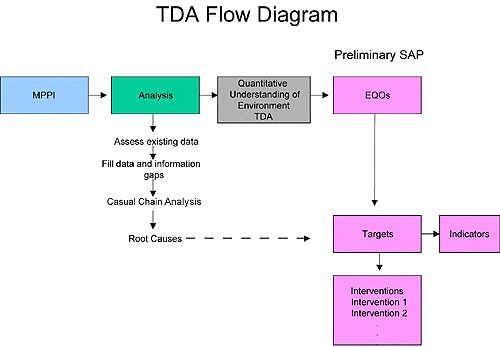
The first step in the TDA process was to identify the Major Perceived Problems and Issues (MPPI). This step was performed as part of the PDF-B activity in 1998, and then revisited in TDA meetings during the CEP. These MPPI then were the basis for the analysis activity, during which time the validity of the MPPI was investigated.
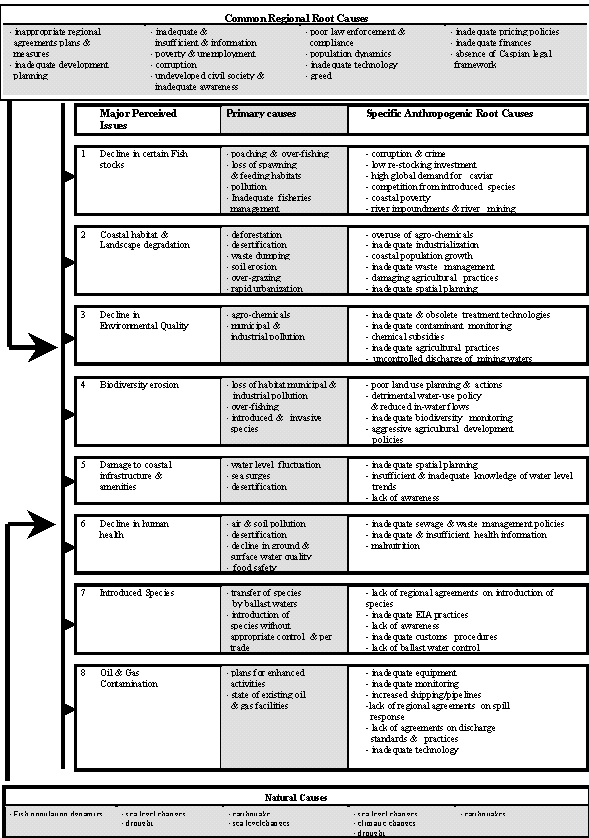
Causal chain analyses were then undertaken for each of the MPPI by regional experts drawn from the countries and the CRTCs. Each MPPI was broken down to determine primary, secondary and root causes and the experts were asked to identify and prioritize interventions to target root causes. The result of this exercise, which took place during two TDA workshops held four months apart, is given in Volume three of the TDA, Annex 3.4 and is synthesized in table 1.
These steps lead to investigation of the Quantitative Understanding of the Environment, which is the TDA. By nature this quantitative understanding has uncertainties: The data are not perfect, they are too infrequent, they are too sparsely located around the Caspian, the analytical methods are imperfect, etc. The TDA is therefore based on an expert judgment of the best available data and an analysis, the Causal Chain Analysis, of the underlying root causes. The TDA process followed by CEP is depicted in Figure 1.
This investigation then is followed by agreement of regional Environments Quality Objectives: If the TDA describes the current status of the environment, what is the desired status? What environmental goals are desirable for the Caspian? These are the Environmental Quality Objectives (EQOs). This TDA has therefore added an additional step to the general GEF TDA Guidelines for International Waters projects, the use of EQOs in order to facilitate consensus on the desired state of the Caspian Sea.
Borrowing from methodology commonly used in the European Union and other regions, the TDA Meetings identified a series of five EQOs, which represent the regional perspective of major goals for the Caspian environment. The use of EQOs helps to refine the TDA process by achieving consensus on the desired status of the Caspian Sea.
Each EQO is a broad policy-oriented statement. To move towards the EQOs, several specific, quantifiable, time-constrained targets are set. Each target generally has a timeline associated with it, as well as a specific level of improvement/status. Specific interventions or actions were identified to permit realization of each target within the time frame designated. For the purposes of this TDA, the time frames were limited to the first five or ten year periods, with some targets achieved earlier.
In general, per each MPPI there is a corresponding EQO and the targets and interventions have been prepared with close reference to the Causal Chain Analysis, noting the importance of addressing the root causes.
The activities or interventions that lead to the achievement of the targets are the main output of the TDA: They represent expert opinions about how best to achieve the EQOs given the existing conditions (environmental, institutional, capacity, state of knowledge, etc.).
Figure 1 TDA Process Flow Diagram
The Caspian coastal region is home to some 14.7 million people. Iran has the highest population (6.0 million) followed by Azerbaijan (4.1 million), Russia (3.5 million), Kazakhstan (0.8 million), and Turkmenistan (0.4 million). In Azerbaijan close to half of population lives in the coastal region and in all other countries the figure is less than 10%. On the basis of Human Development Index (HDI) the Caspian littoral countries fall in the lower half of the ‘medium human development countries,’ thus reflecting the unsatisfactory global human development condition for the region.
The region as a whole is not, at least for the time being, a major economic center. The region’s total GDP was $534.9 billions in 1999, which was equal to 6 percent of the USA GDP and only slightly lower than Spain’s GDP of 595.9. Unemployment rates are generally high and considerably higher among the women and the internally displaced population. Increased economic inequality has also been a feature of economic development of the past decade. In general, the income, job, education, and health situation for most of the region is not satisfactory. The implications are twofold: i) for years to come, the littoral governments will give higher priority to job creation, health, and education than to environment protection; and ii) individuals will be less concerned with safeguarding the environment when they are unemployed and faced with finding adequate health, food, shelter, and education for their families.
The Caspian Sea is believed to contain considerable oil and gas deposits. The recoverable oil reserves were estimated to be around 200 billion in the mid-1990s, but have recently been revised downward to 100 billion or less. The potentially vast oil and gas resources have already brought in millions of dollars worth of foreign investment into the region. Most of the money is being spent on the application of high technology to the often daunting task of drilling in the open seas, in which case the money basically reverts to the technology providers in foreign countries. A small part of the money is being spent in the littoral countries, particularly in the logistical support services, but not much substantial impact has been made at the national level. The Caspian Sea is also rich in fish. The street value of Caspian caviar alone can be estimated at close to 3 billion US dollars annually, although again only a small fraction of this money will return to the coastal communities at any time.
Governments dominated by strong executive powers mark the Caspian littoral states. Each country now has a democratically elected president, but the five countries have reached varying stages of democratization. For most part governmental accountability is weak coupled with weak and undeveloped civil society. This has led to paternalism on the part of the central governments. Governmental structures are large and economically unsustainable across the region. Environmental and natural resources are overseen by a host of ministries and local governments. Reforms have been attempted to streamline environmental management, although efforts are often duplicated and scarce human and technical resources are often wasted. In most countries government agencies often do not have the resources to conduct the necessary monitoring and enforcement activities to protect the regional environment. The governments in the region have primarily focused their efforts on economic growth and revitalization, giving much less attention to policy development aimed at encouraging environmental protection. Integration of the development planning process and environmental development still remains a distant objective. The countries are not using economic incentives as much as possible in the region in order to promote environmental protection.
In the next decade it is likely that the Caspian littoral countries will continue to develop economically in the same vein as the last decade. This means that dependence on the oil and gas sector will remain strong. A full review of the Socio-economic setting of the Caspian is given in Volume II of the TDA, section 1.3.
The existing legal and regulatory setting of the region is not conducive to the effective environmental management of the Caspian, with no regional agreement for the Caspian Sea signed by all five littoral states. Under these conditions, protection and sustainable management of the Caspian Sea environment and its resources depend predominantly on national legislations combined with the efforts to further international cooperation. From a regional perspective, the absence of agreement on the legal status of the Caspian Sea continues to delay the signing of the Framework Convention for the Protection of the Environment of the Caspian Sea. The lack of regional agreements on the use of mineral resources complicates relations among the countries. Given that each country has claims to hydrocarbon resources in the Caspian and many foreign oil companies are active in the region, there is an urgent need for addressing these regional issues. The legal regime for navigation is defined by international conventions and, in part, by national legislation. Of all the Caspian states, only Russia is a party to the Maritime Law Convention and no other Caspian littoral state is obliged to comply although these countries are guided by the generally accepted principles and norms of maritime law. Legal regulation of fishing and protection of biodiversity takes place mainly at the national level. The CIS countries set up a Commission on Aquatic Bioresources with advisory powers in 1992 and Iran has been recently joined the Commission, which will need to be more active in the future. The basic agreements between the Russia and Persia (1921) and between the USSR and Iran (1940) laid down the principle of free fishing throughout the sea except for a 10-mile nationally exclusive coastal zone. The definition of the 10-mile coastal zone is uncertain now because of the absence of an agreement on the legal status of the Caspian Sea. No country has a special law to preserve biodiversity. Legislation includes traditional legal mechanisms for protecting wildlife, such as regulations on fishing, protection of certain species’ habitats and artificial reproduction. No national legislation even has a definition of biodiversity, although the term is employed in a general way to refer to plants and animals. No regional agreements on special protected areas exist, a deficiency that must be corrected in order to preserve regionally significant biodiversity. All Caspian littoral states have set quality standards to reduce negative impacts on the environment. The countries employ two tools: environmental quality standards and pollution limitations. For the CIS countries, economic incentives to encourage achievement of standards are absent. For these countries, the standards are said by some to be too strict, by others too weak. No Caspian-specific standards exist; instead, the standards apply to all water bodies for specific uses such as fishing, communal water supply, and economic use.
Commendable efforts have been made to encourage international and regional cooperation to safeguard the Caspian environment, although results have been mixed. Tehran Communiqué of 1992, committed the states to cooperation in environmental management of the Caspian Sea and the Astrakhan Communiqué of 1993 reinforced the need to cooperate in environmental matters. Almaty Declaration of Cooperation in the Field of Environmental Protection in1994 called on the countries to jointly implement the Convention on Biodiversity. In Tehran in June 1995 the countries confirmed willingness to cooperate in environmental matters, regardless of the legal status of the Caspian Sea. In Ramsar in 1998 the first Steering Committee launched the Caspian Environment Programme and initiated implementation with assistance from the EU/Tacis, UN agencies, and the Global Environmental Facility. In 1995, UNEP, working in conjunction with experts from all the Caspian littoral states, launched work on a Framework Convention on the Protection of the Environment of the Caspian Sea. During the ensuing years, seven working meetings were held to discuss and amend the text of the Convention, which is now ready in advanced form ready for singanture. The Convention could be signed by the littoral countries in 2002. CEP also successfully led a regional initiative to develop a Regional Cooperation Plan in case of Major Oil Spills. The draft Plan is ready for submission to the CEP Final Steering Committee for approval in principle. CEP has also been substantively involved in furthering regional interest in Aarhus, CITES and Espoo Conventions.
Despite the lack the regional agreements signed by all five countries, all the states carry obligations to protect the Caspian under global environmental conventions. During the past few years, the Caspian littoral states joined many major global environmental conventions. The best results have been achieved in the area of flora and fauna protection. The conventions on Biological Diversity and CITES, to which all the Caspian countries are signatories except Turkmenistan oblige them to maintain a certain level of flora and fauna protection. Compliance with these global conventions needs to be closely monitored and improved.
In general, the national environmental laws of all the Caspian littoral states are fairly well developed, and most environmental issues engage attention at the highest legislative levels. During the past few years, the political, legal, and economic regimes of the Caspian Sea countries have undergone radical transformations, and this transition continues. Difficulties still exist in environmental protection and management, caused by various factors including deficiencies in laws and governmental regulations; gaps and inconsistencies in laws and regulations; lack of economic instruments to encourage polluters not to pollute; lack of regional agreements and economic and financial constraints. A full review of the legal and regulatory setting of the Caspian Sea is given in Volume II of the TDA, section 1.4.
The significance of the perceived issues and problems should be substantiated on environmental, economic, social, and cultural grounds. The Ramsar Steering Committee Meeting in May 1998 approved a Preliminary TDA that included a preliminary list of major perceived problems and issues associated with the Caspian Sea. During subsequent regional TDA meetings, this list was expanded and refined. The following list of major MPPI was finalized to include six existing problems/issues, and two emerging problems/issues:

The status assessment was undertaken by the PCU and the CRTCs and recorded in the national and regional reports prepared over a four year period. These reports can all be found on the CEP web-site: www.caspianenvironment.org and their fundings are condensed and summarized in Volume two of this TDA document.
The analysis recognizes that society commonly acts within a number of nearly independent sectors (agriculture, industry, transport, etc.), which are poorly coordinated and often have conflicting interests and associated policies. Within these sectors, various Stakeholders have interests in the Caspian Environment, both affecting and being affected by that environment. Sectors and their Stakeholders work in an uncoordinated and sometimes conflicting fashion, but they typically affect the Caspian environment in similar ways. Loss of habitat, for instance, may be caused by activities of various sectors (transport, farming, industry), and by various types of Stakeholders (governmental policy-makers, ranchers grazing animals, small farmers). A detailed Stakeholder analysis has been completed and is summarized in this TDA (Volume 2, section 2.1) to identify Stakeholder priorities and conflicts that might have an impact on implementation of targeted interventions.
The TDA analysis of the MPPI can be summarized as follows:
Decline in certain commercial fish stocks, including sturgeon: strongly transboundary.
Brief statement of the problem: Catches of various fishes have declined in recent years for a variety of reasons. Included in this decline have been sturgeon, cyprinids, herring, salmon, mullet, and others. Official sturgeon catch, for instance, has dropped from an average 13.8 thousand tons a year in the period from 1910-1930 to 1.8 thousand tons a year in the period from 1996-1998 (excluding Iran), peaking in the 1970s at about 22 thousand tons a year. Official catches may be swamped by illegal poaching, particularly for sturgeon, the most economically valuable fishes of the Caspian Sea.
Analysis: Historical data and a recent Caspian Marine Expedition documented the decline in certain commercial fisheries. Poaching, effects of dams, loss of habitats, and perhaps pollution have all contributed to this decline. This major issue is the most important one to the Stakeholders in the region. Interventions are required in order to improve the fisheries situation before it becomes irretrievable.
Degradation of coastal landscapes and damage to coastal habitats: strongly transboundary.
Brief statement of the problem: The coastal landscapes and habitats are damaged by a variety of natural and man-made factors. Natural factors include water level fluctuations (on both storm and decadal scales), earthquakes, and climate change. Some of the man-made causes of the degradation of coastal landscapes and damage to coastal habitats are: desertification/deforestation, regulation of rivers, urbanization/ industrial development, inadequate agricultural/ aquaculture development, inadequate recreational development, and land-based and sea-based pollution. About 40 percent of the Caspian coastal hinterland is arid; of this arid area, about 69 percent has been desertified.
Analysis: Ranked by Stakeholders as a medium-to-low priority, this perceived problem has both natural causes (water level fluctuations and earthquakes) and human influence (desertification). There are links with biodiversity, below, and loss of habitats caused by human interventions. Lack of regional and integrated planning is a major cause of this problem; multi-sectoral approaches will be required to achieve improvement in this area.
Threats to biodiversity: strongly transboundary.
Brief statement of the problem: Caspian species biodiversity across nearly all phyla is low compared to that of other more open seas. Two major flagship species exist in the Caspian: the Caspian Seal and the Beluga sturgeon. Both are threatened at present, enhancing concern over biodiversity. A high rate of species endemism in the Caspian Sea, due to long separation from world oceans, increases the potential for loss of biodiversity in the Caspian due to industrial pollution, overfishing, invasion of exotic species, and other activities in the region.
Analysis: Data documenting loss of biodiversity are sparse, yet this is one issue that many people are concerned about. Concern over loss of biodiversity in the Caspian Sea at species, genetic, and habitat levels is widespread in the region. Stakeholders ranked this as a medium-to-high priority. Loss of biodiversity comes from a number of causes, including overfishing, poor water and sediment quality, damming of rivers, loss of habitat, exotic species, and other factors. A first step will be to document the true biodiversity of the region, and then to continue monitoring it. Strategic creation of protected areas to target regionally important elements of biodiversity may assist in conservation efforts.
Overall decline in environmental quality: strongly transboundary.
Brief statement of the problem: Decline in environmental quality includes the decline in air, water and sediment quality, damage to ecosystems due to human activities, loss of aesthetic appeal, and related issues. There have been widespread fears of increasing rates of decline in overall environmental quality due to the strong dependence of the economies of all five nations on oil and gas extraction from the sea or its coastal zone. Widespread die-offs of seals in 2000, a kilka mortality in 2001, and other similar natural disasters create fear of widespread decline in environmental quality.
Analysis: Knowledge of pollution load is incomplete; CEP estimates are rough and incomplete. Ambient contaminant levels have been measured somewhat unevenly. Large volumes of data exist on ambient levels, but much of it lacks full quality assurance/quality control documentation and could not be used in this analysis. Most useful data were from the CEP activities and from other multinational and international efforts in the Caspian region. Few data exist on air quality, water quality data are weak, and sediment quality data are reasonably good. In general, except for some hot spots, the Caspian water and sediment quality, as far as can be assessed and in comparison with other regional seas, is good. No widespread eutrophication exists basin-wide. Hotspots of pollution exist in Azerbaijan (Baku Bay/ Absheron peninsula, Kura River, Sumgait), Iran (Sefid Rood River, Bandar Anzali, Chalus/Noshahr ports, and Gorgan Bay), Kazakhstan (Ural River delta, Fort Shevchenko, Aktau), Russia (Derbent, Makhachkala, Volga Delta), and Turkmenistan (Turkmenbashi, Chelekan). Migratory biota are affected by this contamination: Seals, sturgeon, and migratory fish carry significant concentrations of contaminants. The priority contaminants appear to be persistent organic pollutants (specifically DDT and its breakdown products, HCH, endosulfans, oil and oil products) and heavy metals (mercury, zinc and barium).
Decline in human health: weakly transboundary.
Brief statement of the problem: UNDP, EU, World Bank, WHO, and other health data sources in the region show high levels of infant mortality, relatively short life spans compared to developed countries, and incidence of certain types of diseases in certain areas. Some improvement in health has occurred during the past half decade, following a precipitous decline in health after dissolution of the Soviet Union.
Analysis: Few data are available on this issue, as the CEP has not focused on it. Stakeholders rank this problem as a medium-to-high priority. However, clear links between human health and the Caspian environment are weak. They require investigation as a focus for the CEP in the future.
Damage to coastal infrastructure and amenities: not transboundary.
Brief statement of the problem: As water level fluctuates, coastal infrastructure and related amenities are affected. As water level drops, water-related structures may no longer be useable (piers, docks, etc.). As water level rises, previously dry areas will be inundated, causing damage to infrastructure of various types, and, where contaminated land is affected, pollution. Damage occurs on both storm time scales and decadal time scales. Wind-induced or storm-induced surges cause considerable flooding or exposure of coastal areas, particularly in the North Caspian region where not only are the wind directions more likely to cause such changes, but also the land slope is quite flat (slopes of 1:10,000 or 1:20,000 are commonly found there). Lack of planning at all levels has led to construction practices that ignore water level fluctuations. Desertification may push urbanization closer to the water, further increasing pressure on coastal infrastructure. Earthquakes may cause hazards due to the strong tectonic activity in the middle and southern sections of the region.
Analysis: Damage to coastal infrastructure and amenities comes largely from long-term water level change, short-term storm surge impacts, and desertification. This issue was ranked as a low-to-medium priority by the Stakeholders. Improved coastal planning and intersectoral exchange would benefit this area of concern. Planning to adapt to water level fluctuations is important, as all countries are vulnerable to water level change, particularly if it rises much above the levels of 1995.
Introduced species: strongly transboundary.
Brief statement of the problem: Introduction of exotic species is a natural phenomenon in the Caspian Sea, as much of the ecosystem arises from flora and fauna transported from other bodies of water (Atlantic, Mediterranean and Arctic fauna and flora versus the indigenous or para-tethyan fauna and flora). Subsequent separation of the Caspian from these earlier geological connections has allowed endemism to proliferate, for instance amongst gobies. More recently, man has introduced species both purposely and accidentally. Certain mollusks have been introduced into the North Caspian Sea in the past, for instance, in response to changes in river hydrological regimes. Plant species have been introduced to coastal wetlands in Iran. Some of these introduced species have unexpectedly caused anoxia in lagoons as a result of decreasing light penetration (e.g., Azolla pinnata in Iran). New fish have been introduced for economic purposes. Some organisms enter the Caspian by accident, including most recently the ctenophore Mnemiopsis leidyi (ML), a gelatinous organism that has devastated the Black Sea and now threatens the Caspian Sea. Concern over its introduction extends to the commercial fishing industry, which fears loss of kilka and other valuable fisheries, and perhaps ultimately the Caspian seal. Not only is the Caspian a recipient of invasive species, it is also a source. Many Caspian species are now widespread throughout the world.
Analysis: Exotic species are of considerable concern for the Caspian Sea, and dozens of species have been introduced both naturally and artificially. Stakeholders don’t view this as a major concern, possibly because of lack of awareness. This issue ranks as low as the issue of damage to coastal infrastructure. The recent accidental introduction of Mnemiopsis threatens the stability of the Caspian ecosystem, much as it did the Black Sea’s ecosystem one decade earlier. Observations that the effects of Mnemiopsis in the Caspian are even faster than in the Black Sea argue for rapid action. Direct effects of Mnemiopsis could include reduction in kilka and other fish stocks, with consequent effects on human livelihoods, food sources for the local populace, and food sources for the Caspian seal and the sturgeon. Rectification of this problem will require short-term action against Mnemiopsis, and in the longer term, regional agreements on mechanisms to control future invasive species will be required.
Contamination from offshore oil and gas activities: strongly transboundary.
Brief statement of the problem: Commercial oil and gas exploration and production have taken place in the Caspian Sea for nearly 150 years, following nearly two millennia of local extraction and use. Production has waxed and waned during this period, but the current international focus on the Caspian raises the possibility that oil and gas extraction and processing may be a primary economic driver for the economies of most of the Caspian countries. Present estimates of recoverable reserves in the Caspian linger around 100 billion barrels of oil, with a range of estimates from about 50 billion up to nearly 200 billion. The largest reserves appear to be near the Kazakh coast, but exploration is taking place in all five Caspian countries, and extraction in the Caspian coastal area is occurring in all but Iran at present (where exploration is now taking place). This economic activity creates concerns over the environmental impacts of oil and gas development. First, the Caspian Sea is a closed basin, with no direct connections to other world oceans, so other than natural degradation processes and oil spill response clean-up, any spills in the Caspian will not flush from the system. Second, the Soviet conditions of oil extraction in the region were characterized during the 1970s and 1980s by environmentally unsound practices and procedures as well as outdated and obsolescent technology. High levels of pollution in Caspian air and waters have been reported due to these exploitation activities. Besides extraction, downstream activities such as oil refining, transport, and related industries may increase the environmental pressures in the sea, in the sediments, and in air.
Analysis: This issue is ranked as a medium priority for most of the Stakeholders. The major concerns are twofold: First, historically, oil and gas development in the Caspian region has been without concern for the environment. More than 150 years of neglect have left the Caspian coast with vast environmental problems (particularly in Azerbaijan). Second, the expected expansion of oil and gas activities in the Caspian increases the risk of significant spills or other impacts on the environment. This vast expansion requires comprehensive approaches to emergency planning and response infrastructure to safeguard the environment.
Identification of common root causes is important, because these tend to be more systemic and fundamental contributors to environmental degradation. The common root regional causes include such fundamentals as poor law enforcement and compliance, inadequate development planning, undeveloped civil society and public awareness and inadequate finances.
Interventions and actions directed at the root causes tend to be more sustainable and effective than interventions directed at primary or secondary causes. However, because the links between root causes and solution of the perceived problems are often not clear to policymakers, interventions are commonly directed at primary or secondary causes. This TDA attempts to make the links between root causes and perceived problems more clear, to encourage sustainable interventions at the root level. Fortunately, as table 1 shows, root causes are often common to a number of different perceived problems and issues, so addressing a few root causes may have positive effects on several problems and issues.
Figure 2 Causal Chain Analyses
EQOs are a means to develop broad Stakeholder agreement on the major environmental objectives of the region. They represent consensus views of environmental priorities, or visions of what the environment should look like in the future. Clearly, these EQOs are visions, not simple, rapidly achievable actions. By identifying specific targets and clearly defined time frames, the EQOs can lead to concrete actions (interventions) that will help achieve the EQOs in the long term.
The targets are quantitative statements of progress towards achieving a particular EQO, and generally have associated timelines or milestones. The targets generally are focused on relatively short-term goals, which are achievable in time frames that governments can understand.
Once EQOs and targets are identified, it is relatively straight-forward to identify specific or concrete steps required in the next few years to achieve these targets. What policies are required? What legislative acts? What investments? What capacity building? What infrastructure? These specific steps are identified in this TDA as activities or interventions. In drawing up the targets and interventions the experts’ group were instructed to use the causal chain analyses as an identification and prioritization guide.
The EQOs identified for the Caspian at the third TDA meeting were:
Sustainable economic uses of the natural resources of the Caspian Sea
Balanced Caspian environment including biodiversity conservation (species, habitat, and genetic)
High quality of Caspian Sea, surface and groundwaters
Sustainable multiple use of the Caspian coastal environment
Strengthened civil society for the purposes of environmentally sustainable development
Table 1, page 15, outlines for each EQO targets, specific actions/interventions, and estimated costs identified during the Third TDA Workshop and categorizes the intervention by type. Categories of intervention were defined as:
Legal / Regulatory
Baseline investment
Incremental investment
Institutional strengthening
Policy
Scientific investigation
Capacity building
Data management
Although some actions / interventions may span several categories, the dominant category was selected as representative. In some cases, a single action / intervention was assigned to two categories, when no dominant type was apparent. The table also lists the intervention in terms of GEF indicators (see below). Consistent with GEF guidance, each Target and each Intervention/Activity is assigned an environmental indicator. GEF specifies three types of indicators, as follows:
Process Indicator (PI)
Stress Reduction Indicator (SPI)
Environment Status Indicator (ESI)
A review of the environmental indicators for each target should show a logical sequence of PI to SRI to ESI.
Table 1 contains many of the regional elements foreseen to be included in the Strategic Action Programme, and is to be used by the countries as a guide when developing their National Action Programme. The cost estimates given in the table are admittedly crude, however, they are very useful in identifying those interventions, which can and cannot be considered for implementation in the short and medium timeframe.
The actions and interventions listed represent only some part of recommendations of the experts to be considered while drafting the NCAPs and SAP. Other recommendations are included in the individual CEP reports available through the PCU. Not all recommendations from all previous published reports were collated since many are repetitive and some lack the rationale provided by the use of the EQOs.
Table 1 Environmental Quality Objectives, Targets, and Interventions Agreed at the Fourth and Fifth CEP TDA Meetings
EQO I: Sustainable economic uses of the natural resources of the Caspian Sea.
|
Targets |
Interventions |
Estimated Cost in U.S. $ |
Type of Intervention |
Indicators |
|
1- To reduce the oil &gas related pollution of the Caspian
|
1. Development and endorsement of Protocols on higher environmental standards (best international practice), including possibly zero emission standards, for exploitation and exploration, licenses granted after 2004
|
$ 500 K
|
Legislative / Regulatory at regional and national levels
|
PI: New legislations and Regulations
|
|
|
2. Development and endorsement of Protocols on reduction of oil emissions from old installations to half of current value by 2015 |
$ 500 K
|
Legislative / Regulatory at regional and national levels
|
PI: New legislation
|
|
|
3. Development (1 year), endorsement (1year) and implementation (2 years) of national and regional oil spill emergency plans, for ships and offshore units as well as for sea ports and oil handling facilities by 2006.
|
$ 5 - $ 10 million |
Investment at national level |
PI/SRI: proven capacity to effectively deal with oil spills and clean-up |
|
|
4. Decommissioning of obsolete non-competitive on shore and offshore installations including storage facilities to ensuring elimination of their emissions by 2008
|
$ 10s millions
|
Investment mostly at national level |
SRI: Survey the existing oil and gases emission rate. Monitoring Reduced emission rate by execution of the project
|
|
|
5. Protection of oil /chemical facilities oil contaminated land under potential threat of inundation from rising sea level, including the development of monitoring and early warning system for water level rise or surges to protect facilities and installations by 2015
|
$ 100s millions |
Investment at national level |
SRI: Survey the amount of oil or specific chemical discharge into the sea in different scenario |
|
2- To ensure safe transportation for hydrocarbons and other raw materials |
1. Regional agreement on minimum standards of maintenance of tanker fleet and establishment of a regulating mechanism by 2012 |
$ 10s millions
|
Legislative / Regulatory at regional level investment
|
PI/SRI: Licensing and regular audit of the tanker fleet
|
|
|
2. Ratification and implementation of MARPOL by the five littoral states. 2010.
|
$ 10s millions
|
Legislative / Regulatory at regional level investment
|
PI/SRI: Auditing of fleet, floating installations as well as ports
|
|
|
3. Regional agreement on minimum standards for construction and maintenance, and national licensing mechanisms for undersea pipelines 2004. |
$ 500k
|
Legislative / Regulatory at regional level investment
|
PI/New legislation
|
|
|
4. Risk assessment of shipping routes to feed into National and Regional Oil Spill Contingency plans by 2003 |
$1 million |
Scientific investigation |
PI/ESI: Redrafting of National and Regional Oil Spill Contingency Plan to take account of shipping risk |
|
|
5. Establishment of a safe system of navigation and shipping control (navigation aids, buoys, lighthouses, etc.) by 2012 |
$ 10s |
Investment both at regional and national levels |
SRI/ Implement safety record |
|
3- To abate the impact of agriculture on ecosystems of the Caspian Sea
|
1.Development and endorsement of agreement on a list of banned agrochemicals and a program to destroy stored banned products by 2003, and implementation by 2005 |
$ 1-10 million
|
Legislative / Regulatory
|
PI/SRI: Reduction in levels of agrochemicals detected in runoff
|
|
|
2. Establishment of a coastal zone of delimitation within which special limits ( amount & type) are established for use of agrochemicals and implementation by 2007 |
$ 5-10 million |
Legislative/ Regulatory regional & national/Investment |
PI/SRI: Reduction in levels of agrochemicals monitored in coastal waters |
|
4- To ensure sustainable use of aquatic resources , with emphasis on fisheries |
1.Establish a five-country Commission on the management of bioresources by 2003 that should include as priorities: a. an agreed methodology for distributing the total allowable catch between five countries as annual catch and export quotas; b. an interstate Caspian Fisheries Inspectorate to verify fisheries and restocking, reporting to Commission (composition: one member of each Caspian State + international observer); and c. shared network of scientific institutions investigation regional bioresource issues, |
$ 500k |
Legislative / Regulatory at the regional level |
PI/SRI/ESI: Improved knowledge of bioresource stocks evidence and application of that knowledge in changes in fishery practice. |
|
|
2.Strengthen and establish a formal mechanism for co-ordination between national fisheries protection organizations by 2003 |
$ 100k
|
Institutional Strengthening at regional and national levels
|
PI/SRI: New regulation |
|
|
3. Strengthen national fisheries organizations efficiency, training & equipment by 2005
|
$ 1-10 million
|
Institutional strengthening at national level
|
PI/SRI: Improved record in management of fisheries in sustainable manner - Stable with returns.
|
|
|
4. Identify, protect and manage natural spawning grounds of sturgeon, Caspian salmon and other commercial species.
|
$ 10 millions
|
Investment at national levels
|
SRI/ESI: Increase use of spawning ground (number of redds cut) and higher recruitment
|
|
|
5. Develop environmentally sound aqua-culture programmes for commercially viable species
|
$ 10s millions
|
Scientific investigation at regional and national levels
|
PI/SRI: Development of a commercial aquaculture industry
|
|
|
6. Study of genetic variability at population level, particularly for sturgeon and other important fish stocks and establish a genetic conservation strategy |
$ 2 million |
Scientific investigation at regional and national levels |
ESI/PI: Increased genetic variability |
|
5- To ensure sustainable use of rivers and freshwater |
1. Review reservoir control rules on the major rivers to ensure adequate releases are mode for anadromus while fish spawning 2007.
|
$ 500k
|
Institutional Strengthening & Legislative / Regulatory at national and regional levels
|
PI/SRI/ESI: Increased levels of in-river flows, particular during sensitive spring period
|
|
|
2. Develop and implement guideline for upstream rational use of water in coastal wet land area 2007. |
$ 1 million |
Institutional Strengthening & Legislative / Regulatory |
PI/ESI: Policy guideline and improved resistance of coastal wetlands to draught events |
__________________________
1 PI: Process Indicator
SRI: Stress Reduction Indicator
ESI: Environmental Status Indicator
EQO II: Conservation of Caspian Biodiversity
|
Targets |
Interventions |
Estimated Cost in U.S. $ |
Type of Intervention |
Indicators |
|
1- Development and implementation of a strategy for the protection of Caspian biodiversity |
1.Elaborate on and ratify Regional Strategy and Action Plan on Biodiversity by 2003, as well as a Protocol on Regional Strategy on Biodiversity, including the Protocol on preliminary plan on Biodiversity to the Framework Convention and specific action plans on specie(s) and habitat. |
$300k |
Policy |
PI – A Regional Strategy on Biodiversity adopted. |
|
2. Establish an eco-net (net between specially protected Natural Territories (SPNT)) by 2005 in the Caspian through collaboration with NGOs and international organizations.
|
$ 400k |
Institutional Strengthening
|
PI – Eco-net between specially protected territories established. Transboundary Protected Natural Territories (TPNT) established. |
|
|
3. Survey the sensitivity of areas and habitats in the Caspian imposed to anthropogenic and natural impact; Develop Action Plan for sensitive eco-system/habitat; and Develop necessary recommendations for legislative protection. |
$ 500k
|
Institution strengthening |
PI – Action Plan on sensitive territories developed and normative-legislative instruments on legislative protection developed.
|
|
|
4.Adopt in 2005 and implement ESPOO Convention and regional EIA procedures. 2005 |
$ 200 k |
Legal/regulatory |
PI – Convention ratified and its provisions implemented SRI – Impact of economic activities on biodiversity reduced |
|
|
2. Establish control system for the import and export of exotic species into and from the Caspian Sea |
1. Develop protocol/agreement to the framework convention on control of introduced new species by 2003
|
$ 200 k
|
Legislative / Regulatory
|
PI – An agreement on control of introduced species signed
|
|
2. Develop and implement proposals for control of ballast waters transfer to and from the Caspian Sea (2005); including possibly a ballast reception and inspection facility in Astrakhan (2010) |
$10 Million
|
Investment
|
SRI – a list of proposals on the control of ballast waters elaborated and establishment of relevant technical facilities.
|
|
|
3. Implement special studies and monitoring program for invasive species in the frame work of biodiversity monitoring 2004
|
$ 500k
|
|
PI – Monitoring of invasive species is being conducted |
|
|
4.Establish a regional inter-governmental body to review planned introduction of new species and develop proposals for financing by 2004. |
$ 300k
|
Institutional Strengthening / Scientific investigation |
PI – A regional inter-governmental body on a regular basis and meeting established |
|
|
3. A biodiversity monitoring system based on a set of regional monitoring protocols |
1.Develop a set of biodiversity monitoring protocols for the Caspian and implement monitoring programmes in the coastal waters and areas of each littoral state by 2004
|
$ 5 Millions
|
Institutional Strengthening/ Scientific Investigation |
PI – National centers endorsed and regional center established. |
|
2.Create Caspian Biodiversity Data Base, including a complete check-list of species, specific Caspian identification keys, and reference collections
|
$ 400k
|
Scientific Investigation/Data processing |
PI – Database on biodiversity in the Caspian created and volumes of reference collections published. |
|
|
3.Develop target monitoring and conservation programmes for endangered species.
|
$ 1 Million
|
Institutional/ Scientific Investigation |
PI – Monitoring programmes elaborated for individual species of flora and fauna |
|
|
4.Establish a bio-molecular laboratory under the Regional Biodiversity Center to investigate genetic biodiversity
|
$ 2 Million
|
Institutional investigation |
PI – Laboratory has been created |
|
|
5. Organize recurring expeditions to assess the biodiversity of the deep part of the middle and southern sectors of Caspian. |
$ 300 k
|
Scientific investigation |
PI - Expeditions has been conducted and their findings published. Trend analysis undertaken. |
|
|
4. Increase public awareness of the value of the Caspian Sea biodiversity
|
1.Dissemination of information on biodiversity in the Caspian; promotion of eco-tourism and sensitization of decision makers to biological diversity protection
|
$400k
|
Institutional Strengthening
|
Publication of informational materials of CRTC (Caspian Regional Thematic Center) on biodiversity. Information on eco-tourist route published. Training for decision-makers facilitated. |
|
5. Establish inter-governmental mechanisms for rapid response to oil and non-oil emergency events affecting Caspian biodiversity (mass mortality events, etc.) 2005 |
1. Identify national bodies charged with coordination of rapid response to oil and non-oil emergencies; establish lists of rapid response regional experts; establish national fund for rapid response activities and animal welfare centers |
$5 million
|
Institutional Strengthening National investment |
PI/ SRI – List of regional experts published. National Funds created. Animal Advocacy Centers are operating. |
|
2. Develop and adopt intergovernmental agreement on rapid communication, data access and sampling during Emergency situations |
$ 50k |
Legal/regulatory |
PI – Regional agreement signed and adopted. |
EQO III: High quality of Caspian Sea, surface and groundwaters
|
Targets |
Interventions |
Estimated cots in U.S. $ |
Type of intervention |
Indicators |
|
1. Develop, based on water use, a regional legal framework for protection of the Caspian from Pollution under the Framework of the Convention |
1. Develop and adopt a protocol to the Convention on Protection of the Environment of the Caspian Sea in connection with land-based activities (2004)
|
$ 200k |
Legislative / Regulatory |
PI: New legislation |
|
2. Develop and adopt a protocol to the Convention on hazardous waste. 2005.
|
$ 200k |
Legislative / Regulatory |
PI: New legislation |
|
|
3. Develop and adopt a protocol to the Convention on at sea dumping. 2005.
|
$ 200k |
Scientific Investigation |
PI: New legislation |
|
|
4. Develop regional guidelines for solid waste disposal in coastal areas |
$ 200k |
Legal/ Regulatory |
PI: New legislation |
|
|
5. Sign, ratify and implement Convention of Persistent Organic Pollutants. 2008. |
$200k |
Legal/ Regulatory |
PI: New legislation |
|
|
6. Develop EQOs / EQSs for establishing realistic goals for water sediment and bio-quality improvement in the Caspian Sea. 2004. |
$ 400k |
Scientific Investigation |
PI: New guideline |
|
|
2- To prepare, agree to, and initiate the implementation of a regionally coordinated ambient monitoring program for trends in place |
1. Develop and implement regional contaminant monitoring Programme focused on the coastal sediments and transboundary pollutants 2004 |
$ 4 million |
Legislative / Regulatory/ Scientific Investigation |
PI/ESI: Monitoring of the Sea |
|
2. Develop and implement a rapid assessment programme in the Caspian Sea using biomarker techniques tied to regional EQO/EQSs. 2006. |
$ 2 million |
Institutional Strengthening / Scientific Investigation |
PI/ESI: Monitoring of the Sea |
|
|
3. Establish monitoring programmes on the major rivers to measure the inflow of the priority transboundary contaminants. |
$ 10 million |
Institutional Strengthening, National / Scientific Investigation |
PI/ESI: Monitoring of the Sea |
|
|
3- Develop and begin implementation of a Regional Action Plan for land-based activities to meet defined Water Quality objectives |
1. Undertake a comprehensive land-based source assessment of the near Caspian Basin, including point and diffuse sources. 2004. |
$ 300 k |
Scientific Investigation |
PI/ESI: Pollution load |
|
2. Develop national action plan and portfolio of hot-spots, for the near Caspian basin, action plan is to contain a compliance strategy for polluting industry based on the Polluter Pays principle and BATEC. 2005. |
$ 500 k |
Legal / Regulatory |
PI/SRI: Auditing of polluting industries |
|
|
3. Establish and implement restrictions on application of agro-chemicals for user corridor buffer zones and nutrient areas associated with groundwater aquifers in the Caspian basin. 2008. |
$ 10s million |
Legal / Regulatory/Scientific investigation |
PI SRI/ESI: Monitoring of nutrient in groundwater |
|
|
4. Introduce primary treatment for all coastal sewage from settlements with population greater than 10,000 by 2012 |
$ 10s millions |
National Investment |
SRI/ Monitoring of effluent |
|
|
5. Address 50% of priority pollution hot-spots by the year 2012
|
$ 10s millions |
National Investment |
SRI/Auditing |
|
|
6. Develop the legislation and technology basis for the free and regular exchange of environmental data and information within the region by the year 2005. Implementation by 2006. |
$ 2 million |
Data management Legal/Regulatory |
PI/ criteria for exchange rate |
EQO IV: Sustainable multiple use of the Caspian coastal environment
|
Targets |
Interventions |
Estimated cost in U.S $ |
Type of Intervention |
Indicators |
|
1. Establish coastal planning zones (including spatial plans) in the five littoral states |
1. Establish or revise national legislation on coastal zone planning and management, including determination and adoption of the Coastal Planning Zones, 2005 |
$2 million |
Legislative/ Regulatory |
PI: National legislation on coastal zone management established or revised and planning guidelines developed |
|
2. In each littoral country develop full environmental, socio-economic, sea- and land-use and other related information GIS database on the coastal zone by 2006. |
$ 2.5 million |
Scientific Investigation |
ESI: Regional GIS established PI: Coastal planning guidelines developed |
|
|
3. Establish planning authorities in critical coastal zones and implement coastal zone planning. 2016. |
$ 10 million |
Legislative/ Regulatory / National |
PI / SRI PI: Functional coastal planning authorities SRI: Improved coastal zone management |
|
|
4. Develop and demonstrate technical and information mitigation measures to reduce negative impacts of natural hazards (such long-term water level fluctuation of the Caspian, storms, surges, and earthquakes) on the life style of the population and infrastructure of the coastal zone. 2004. |
$ 2 million |
Investment
Transboundary / National |
PI: Guidelines for natural hazards mitigation measures are developed PI: Related pilot projects completed
|
|
|
5. Establishment of a regional Standing Committee on coastal zone planning and management under auspices of CEP, following approval by the Governments of the Caspian littoral states by 2005
|
$100k
|
Institutional Strengthening
|
PI: Regional cooperation on coastal zone planning and management is initiated
PI: National inter-sectoral and regional cooperation on coastal zone planning and management is achieved |
|
|
2. Establish an eco-tourism “green” belt around the entire Caspian Sea by 2007 |
1.Establish a regional “green” belt working group to review national coastal eco-tourism proposals and recommend alternatives, develop a management framework, and identify regional financial mechanisms |
$2 million |
Institutional Strengthening |
PI: Intergovernmental agreement on regional eco-tourism framework |
|
2. Develop investment strategies for ecotourism in the region |
$ 100k |
|
PI: Financial Mechanism in place
|
|
|
3. Develop one or two eco-tourism centers in each country and market them actively linked to eco-network |
$10 million |
National Investment |
SRI: Improved social-economic situation SRI: Enhanced environment awareness |
|
|
3. Net rate of loss of coastal forests to be reduced by 50% by 2007 |
1. Identify main contributors to deforestation, in the public and private sector, socio-economic reasons; legal and regulatory failures; and poor forestry practice and develop action programme 2007. Undertake trend analysis and taxonomic studies by 2005. |
$300k |
Scientific investigation |
PI: Causes for deforestation are identified ???? |
|
2. Identify alternative sources for timber products historically produced from coastal forests, and link with appropriate incentives and disincentives (economic instruments). 2005. |
$600k |
Scientific investigation Legislative / Regulatory |
PI: Alternative sources economic instruments are proposed. |
|
|
3. When necessary draft new legislation to reduce rate of deforestation, based on economic incentives and disincentives. 2005. |
$200k |
Legislative / Regulatory |
PI: New legislation is adopted |
|
|
4. Establish reforestation programs and commence implementation in affected regions. 2006. |
$10s million |
National Investment |
SRI: 50% reduction of coastal deforestation is achieved |
|
|
4. Reduce rate of loss of land due to technogenic desertification by 10% by the year 2008. |
1. Improve legal basis in each country for combating desertification, including: - criteria to define land degradation - amend laws on forestry, water resource and land use - strengthened legal mechanisms such as EIA, planning procedures. 2005. |
$50k |
Legislative / Regulatory National |
PI: Legal basis established in each country |
|
|
2. Increase public awareness of the desertification process, thereby preventing the public being causes or victims of this process, and strengthen institutional structures making them more effective in combating desertification. 2005. |
$500k |
Institutional Strengthening National |
PI: Institutions strengthened SRI: Decreased rate of desertification |
|
3. Develop a desertification monitoring system based on remote sensing and GIS database 2005. |
$500k |
Institutional Strengthening, Capacity Building National
|
ESI: Monitoring system in place |
|
|
4. Demonstrate ways to reverse Technogenic degradation. 2002. |
$4 million |
Investment, national |
SRI: Decreased the share of technogenic degradation |
EQO V: Strengthened civil society for purposes of Environmentally Sustainable Development
|
Targets |
Interventions |
Estimated cost in U.S $ |
Type of intervention |
Indicators |
|
1. Integration of environmental considerations in local, national and regional development strategies, implementation to start by 2004 |
1. Creation and implementation of environmental awareness training program for policy makers, planners, and development project managers to be administered to regional and municipal governments throughout the region. Implementation to be begin by 2004 |
$2.5 million |
Capacity Building/ Transboundary |
PI: Development plans approved to include factors of carrying capacity, sustainable environmental protection PI: 50% of key environmental management personnel of the coastal area to be trained |
|
2. Enhanced and informed stakeholders participation in the development process |
1. Strengthening national NGOs and civil society movements focusing on environmental awareness and sustainable development components of developmental processes by 2003 including:
|
$500k |
Capacity Building, Legislative/ Regulatory National |
PI: Legal support for stakeholder participation achieved PI: Increased environmental education for Public, industry and governments; Increased transparency of planning processes
|
|
2. Community driven development: Empower local authorities including collaboration among cities and local scale activities including:
|
$500k |
Capacity Building (process) |
PI: local development plans produced and implemented, consistent across the region |
|
|
3. Demonstrate Caspian-conscious school curricula by 2003
|
$500k |
Capacity building National |
PI: teachers trained in environmental education incorporated into school curricula |
|
|
4. Enhance participation of media (in particular regarding environmental issue reporting) by 2002
|
$60k |
Capacity Building/ Transboundary |
PI: Higher incidences of accurate news items on the environment locally, nationally and internationally
|
|
$500k |
Capacity Building/ National
|
PI: Implementation of pilot for monitoring and evaluation of environmental impacts of private sector activities. |
PI: Process indicator
SRI: Stress reduction indicator
ESI: Environmental status indicator