
Global International
Waters Assessment
Regional assessments
Other reports in this series:
Caribbean Islands GIWA Regional assessment 4
Barents Sea GIWA Regional assessment 11
Caspian Sea GIWA Regional assessment 23
Gulf of California/Colorado River Basin GIWA Regional assessment 27
Patagonian Shelf GIWA Regional assessment 38
Brazil Current GIWA Regional assessment 39
Amazon Basin GIWA Regional assessment 40b
Guinea Current GIWA Regional assessment 42
Lake Chad Basin GIWA Regional assessment 43
Indian Ocean Islands GIWA Regional assessment 45b
East African Rift Valley Lakes GIWA Regional assessment 47
Pacifi c Islands GIWA Regional assessment 62
Global International
Waters Assessment
Regional assessment 3a
Caribbean Sea/Small Islands
GIWA report production
Series editor: Ulla Li Zweifel
Report editors: Matthew Fortnam
Editorial assistance: Johanna Egerup, Malin Karlsson
Maps & GIS: Niklas Holmgren
Design & graphics: Joakim Palmqvist
Global International Waters Assessment
Caribbean Sea/Small Islands, GIWA Regional assessment 3a
Published by the University of Kalmar on behalf of
United Nations Environment Programme
© 2004 United Nations Environment Programme
ISSN 1651-940X
University of Kalmar
SE-391 82 Kalmar
Sweden
United Nations Environment Programme
PO Box 30552,
Nairobi, Kenya
This publication may be reproduced in whole or in part and
in any form for educational or non-profi t purposes without
special permission from the copyright holder, provided
acknowledgement of the source is made. No use of this
publication may be made for resale or for any other commercial
purpose whatsoever without prior permission in writing from the
United Nations Environment Programme.
CITATIONS
When citing this report, please use:
UNEP, 2004. Bernal, M.C., Londoño, L.M., Troncoso, W., Sierra-
Correa, P.C. and F.A. Arias-Isaza. Caribbean Sea/Small Islands, GIWA
Regional assessment 3a. University of Kalmar, Kalmar, Sweden.
DISCLAIMER
The views expressed in this publication are those of the authors
and do not necessarily refl ect those of UNEP. The designations
employed and the presentations do not imply the expressions
of any opinion whatsoever on the part of UNEP or cooperating
agencies concerning the legal status of any country, territory,
city or areas or its authority, or concerning the delimitation of its
frontiers or boundaries.
This publication has been peer-reviewed and the information
herein is believed to be reliable, but the publisher does not
warrant its completeness or accuracy.
Printed and bound in Kalmar, Sweden, by Sunds Tryck Öland AB.
Contents
Executive summary
9
Acknowledgement 12
Abbreviations and acronyms
13
Regional defi nition
15
Boundaries of the region
15
Physical characteristics
16
Socio-economic characteristics
19
Assessment 25
Freshwater shortage
26
Pollution
30
Habitat and community modifi cation
35
Unsustainable exploitation of fi sh and other living resources
39
Global change
42
Priority concerns for further analysis
45
Causal chain analysis
47
Environmental and socio-economic impacts
48
Immediate causes
49
Root causes
50
Conclusions
53
Policy options
54
Policy option 1: Strengthening of resource management institutions
55
Policy option 2: Strategic regional plan for integrated coastal and marine management
59
Conclusions
63
References 64
Annexes 69
Annex I List of contributing authors and organisations
69
Annex II Detailed scoring tables
71
Annex III Environmental characteristics
74
Annex IV List of important water-related programmes and assessments in the region
75
Annex V List of conventions and specifi c laws that aff ect water use in the region
79
The Global International Waters Assessment
i
The GIWA methodology
vii
CONTENTS
Executive summary
The GIWA region 3 Caribbean Sea is located in the Wider Caribbean
habitats including beaches, deltas, coral reefs, mangrove swamps,
within tropical and sub-tropical latitudes, bounded to the east by the
wetlands, seagrass beds, lakes, rivers and coastal lagoons. There are
Antilles Island chain, to the west by the Central American isthmus, while
diverse communities of fl ora and fauna, including some endemic
the northern portion of the South American sub-continent limits the
species. The islands have relatively limited surface areas and natural
southern border. The region has some of the most diverse physical and
resources (arable land, freshwater, mineral resources, conventional
socio-economic characteristics in the world, containing 28 countries or
energy sources), are isolated from continental landmasses, and are
territories of the Central/South American sub-continents and the Lesser
particularly vulnerable to natural hazards, principally hurricanes and
Antilles (Small Islands). The borders correlate in principal with those
other tropical storms.
of the Caribbean Sea Large Marine Ecosystem (LME) with bathymetry
as the main biophysical denominator. The Greater Antilles; Cuba,
Despite containing 18 countries and territories, the sub-system
La Hispaniola, Puerto Rico, Jamaica and the Bahamas, are included in
contains the smallest population in the Caribbean Sea region, but as
GIWA region 4 Caribbean Islands.
a result of the countries limited land area, the population densities are
the highest in the region; in 2001 the total number of inhabitants in
The Caribbean Sea region was divided into three sub-systems, delimited
Caribbean Small Islands sub-system was only 3.5 million) but there is
according to physical, biological and socio-economic characteristics.
an average of 232 inhabitants per km2. Such high population densities
This report will focus in particular on sub-system 3a, the Small Islands,
place enormous pressure on the islands ecosystems. The countries in
which is composed of Antigua and Barbuda, Anguilla, Aruba, United
the Small Islands sub-system can be classifi ed as having a medium-
States Virgin Islands, Barbados, British Virgin Islands, Cayman Islands,
high income, with the most signifi cant contribution to GDP provided
Dominica, Grenada, Guadeloupe, Martinique, Montserrat, Netherlands
by the agricultural sector, particularly crops such as bananas, sugar
Antilles, Saint Vincent & the Grenadines, St. Kitts & Nevis, St. Lucia, Turks
cane, coconuts and other fruits, and the services sector, which includes
& Caicos and Trinidad & Tobago. Sub-system 3b consists of Colombia
fi nancial services, tourism and shipping.
and Venezuela, and sub-system 3c contains Central America and Mexico
(state of Quintana Roo), Belize, Guatemala, Honduras, Nicaragua, Costa
The regional environmental legislative regime is comprised of diff erent
Rica and Panama.
international conventions that are related to marine and coastal
resource management. The United Nations Environment Programme
The Small Islands sub-system forms the eastern border of the Caribbean
(UNEP) has played a leading role in the establishment of a number
Sea and is characterised by a chain of islands of diff erent size, that
of conventions, action plans and protocols. Some of these include:
extend from the north of Venezuela to south of Florida, USA. Taking
the Caribbean Action Plan; The Convention for the Protection and
into account the geographical extent of most of the islands, the entire
Development of the Marine Environment in the Wider Caribbean
land area of the countries can be considered as coastal ecosystems. The
Region (the Cartagena Convention) and its protocol; the Protocol
infl uence of the surrounding sea is more pronounced on these small
Concerning Specially Protected Areas and Wildlife (SPAW) in the Wider
islands compared with large islands and continental landmasses (Khaka
Caribbean Region; and the Protocol Concerning Pollution from Land-
1998, Kofi 1999). The islands are characterised by a variety of sensitive
Based Sources and Activities (LBS).
EXECUTIVE SUMMARY
9
The GIWA assessment evaluated the relative importance of diff erent
aff ected reefs, especially in US Virgin Islands around St. Thomas and
impacts on the international aquatic system of the Small Islands sub-
St. Croix. These anthropogenic stresses weaken the ecosystems ability
system. The environmental and socio-economic impacts were assessed
to withstand and recover from natural disturbances such as hurricanes
for present and future conditions, and overall impacts and priorities
and places a risk factor for the sustainable use and harvest of goods
were identifi ed. The concerns for the Small Islands sub-system were
and services provided by marine ecosystems (e.g. recreational values,
ranked in the descending order:
protection of coast line).
1. Global change
2. Habitat and community modifi cation
The environmental impacts of pollution were assessed as moderate to
3. Pollution
severe. The discharge of nutrient-rich sewage and agricultural run-off
4. Freshwater shortage
is causing euthrophication. The resultant algal blooms deoxygenate
5. Unsustainable exploitation of fi sh and other living resources
freshwater and coastal waters after collapsing, and prevent sunlight from
penetrating surface waters, consequently reducing bioproductivity. The
The GIWA assessment determined that the concern of Global change
discharge of sewage is also causing micro-biological contamination of
exerted the greatest impacts on the Small Islands sub-system. However,
drinking water and can cause a proliferation of diseases with subsequent
since it is an international concern addressed through other initiatives
human health impacts. Pollution has had a variety of impacts on the
(e.g. the United Nations Framework Convention on Climate Change),
marine environment and severely aff ected economic activities. For
Habitat and community modifi cation was selected as the GIWA
example, pollution has adversely aff ected tourism due to the loss in
priority concern for further analysis in the Causal chain and Policy
aesthetic value of beaches, and marine species have been injured or
options analysis.
killed from entanglement and ingestion of solid wastes.
Hazards originating from Global change are a severe problem for the
The environmental impacts of freshwater shortage on the Small
region. The islands are often impacted by hurricanes, and also, with less
Island sub-system were assessed as moderate, although it is not
frequency, tornadoes. The islands are particularly vulnerable to future
strictly a transboundary issue in this region. Many small islands have
sea level rise, which may potentially submerge low-lying coastal areas,
virtually no freshwater ecosystems (Virgin Islands, Netherlands Antilles,
and more frequent and intense hurricanes. Coastal habitats, which
Antigua, Barbados), and groundwater resources in many islands are
provide coastal protection such as coral reefs, will be further threatened
being exhausted, polluted or contaminated by saltwater intrusion.
by these climate induced changes. Assessing the environmental and
Polluted surface and groundwater are major causes of degradation of
socio-economic impacts of global change on the region is problematic
coastal and near-shore marine ecosystems and declines in biodiversity,
due to the lack of reliable data. The main socio-economic concern is the
including critical salt-pond, mangrove, estuary, seagrass and coral reef
cost of protection from, or adaptation to, global change.
systems. Socio-economic impacts associated with freshwater shortage
are, for example, the high cost of producing desalinated water, hygiene
The assessment ranked Habitat and community modifi cation as
prolems and diseases realted to sanitation problems.
having severe impacts. The main anthropogenic impacts stem
from deforestation, extraction of marine resources and tourism.
The impacts of the unsustainable exploitation of living resources result
Deforestation and the cultivation of steep slopes cause considerable
principally from overexploitation and destructive fi shing practices.
land degradation, which has increased the sediment load of rivers and
Certain stocks are exploited beyond maximum sustainable yields,
eventually coastal waters. Consequently, seagrass beds and coral reefs
and as a consequence, techniques such as closed fi shing seasons, and
have been aff ected by chronic sedimentation that reduces sunlight
restrictions on certain species, have been used as fi sheries management
penetration and increases ecosystem stress. Tourism is aff ecting the
tools. Destructive fi shing methods have increasingly been employed
health of coastal ecosystems: mangroves are cleared for developments,
by fi shers, including the use of explosives, poisons, large small-meshed
which also once constructed further disturb coastal habitats due to
traps, and scuba gear. Degradation of fi sheries habitats is considered to
their proximity to the high water mark; harbour dredging destroys
have also signifi cantly reduced the size of fi sh stocks. It is expected that
benthic fauna and increases the turbidity of coastal waters; boat
in the future, this situation will not have changed signifi cantly, although
anchors and dive activity damages reefs and seagrass beds; and tourist
the rate of exploitation may increase with the employment of more
activities result in a variety of pollution impacts. In addition, dredging,
effi
cient fi shing technologies.
sand extraction, groyne construction and sewage effl
uents have
10
GIWA REGIONAL ASSESSMENT 3A CARIBBEAN SEA/SMALL ISLANDS
The Causal chain analysis identifi ed the root causes of the prioritised
areas on the basis of a legal framework. Additionally, the establishment
concern of Habitat and community modifi cation. It was found that the
of such a plan will clearly defi ne the responsibilities of the relevant
governments of the region have sought to develop their economies
authorities and the principal mechanisms to coordinate the formulation
rapidly, which they have failed to balance with the conservation and
and implementation of policies at a regional level.
protection of ecosystems, in order to achieve sustainable development.
This can be attributed to institutional weaknesses that have facilitated
These policy options should be supported by appropriate monitoring
a lack of cross-sectoral coordination and uncontrolled development of
and data management. Stakeholders should be involved in the planning
the coastal zone. Stakeholders are not involved during the planning and
and implementation of the policy options and a continuous evaluation
implementation of development projects, and therefore the needs of
and review process conducted.
the local community are not considered. For example, there has been
inadequate valuation of the essential income and nutritional benefi ts
It should be noted that the policy options are a preliminary analysis
that habitats provide for local communities, prior to land clearance for
of conceptual ideas and actions that are currently being considered.
development.
Therefore more detailed assessment of the options is necessary.
However, these policy options are promising solutions to some of the
Regional conventions such as the Cartegena Convention and national
fundamental problems facing the region.
legislation aimed at managing natural resources, have not been
implemented due to enforcement agencies lacking the capacity to
do so, and as a result of fragmented management, with government
agencies and stakeholders having ill-defi ned and often confl icting
responsibilities. National laws related to the environment are not
harmonised and there is an absence of integrated management of the
coastal zone at the national and regional level. In addition, informed
decision-making is inhibited by the lack of monitoring programmes and
appropriate technologies to adequately assess the current, and predict
the future, status of the ecosystems in the region.
A fundamental hindrance to sustainable development is the lack of
understanding, from the public to policy makers, of the importance
of conserving aquatic ecosystems. This may stem from unsatisfactory
incorporation of environmental issues in educational curriculum, and
the lack of public awareness programmes.
The policy options section aimed to describe alternative courses of
action that may be taken by policy makers in the region, and discusses
the projected outcomes and trade-off s of each action. These actions
were designed to address the root causes identifi ed in the causal chain
analysis.
The fi rst policy option aims to build institutional capacity in order to
integrate land and water resources management with development
planning within the regional context. This should improve the ability
of the islands to actively manage and conserve their natural resources,
and allow the implementation of further initiatives. A second policy
option proposes designing and implementing a Strategic Regional Plan
for Integrated Coastal and Marine Management. This was formulated
to organise economical activities and defi ne environmental protection
EXECUTIVE SUMMARY
11
Acknowledgement
The Colombian Institute of Marine and Coastal Research (INVEMAR)
Focal point of GIWA region 3 Caribbean Sea, would like to acknowledge
the following:
The Scientifi c project direction, the Project coordinator and
Reports preparation and the Researchers Task team (see Annex I
List of contributing authors) for their permanent advise, eff ort
and, constant availability and readiness to attend all the study
requirements.
The Colombian Ministry of Environment, Housing and Territory
Planning, for its unconditional support.
The Regional Task team (see Annex I List of contributing authors),
for their dedication, information supply, interest and continuous
support.
The Caribbean Small Islands governments and environmental
authorities for facilitating representative experts (see Annex I List
of contributing authors) to attend the project requirements and
for providing information and data used in this assessment. The
Focal point specially thanks the Sustainable Development and
Environmental Unit of Saint Lucia Ministry of Physical Development
and Environment and, the Department of Planning and Natural
Resources of the US Virgin Islands Commission of Natural Resources
and Coastal Zone Management, for their special support, through
their experts, in the development of this project.
The general advisors, consultants, special participants and general
support Task team (see Annex I List of contributing authors) for their
collaboration.
The GIWA Caribbean Sea region coordinators, GIWA Core team,
University of Kalmar, for their technical support and permanent
support.
The GEF, UNEP and Sida for providing the funding required to
undertake the study.
12
GIWA REGIONAL ASSESSMENT 3A CARIBBEAN SEA/SMALL ISLANDS
Abbreviations and acronyms
BVI British
Virgin
Islands
RO Reverse
Osmosis
CARICOM Caribbean Community and Common Market
SIDS
Small Island Developing States
CATHALAC Water Center for the Humid Tropics of Latin America and
SPAW
Protocol Concerning Specially Protected Areas and Wildlife
the
Caribbean
SST Sea
Surface
Temperature
CBD The
Convention
on
Biological
Diversity
UNCLOS United Nations Convention on the Law of the Sea
CEHI
Caribbean Environment Health Institute
UNEP United
Nations
Environment
Programme
COP Conferences
of
the
Parties
UNESCO United Nations Educational, Scientifi
c and Cultural
CPACC
Caribbean Planning and Adaptation to Global Climate Change
Organization
DPW
US Virgin Island's Government Department of Public Works
UNFCC
United Nations Framework Convention on Climate Change
ECCLAC United Nations Commission for Latin America and the
USVI United
States
Virgin
Islands
Caribbean
VOC Volatile
Organic
Compounds
EEZ
Exclusive Economic Zone
WASCO
Saint Lucia Water and Sewage Company
EPA US
Environmental
Protection
Agency
WPI Water
Poverty
Index
FAO
United Nations Food and Agricultural Organization
WSSD World
Summit
on
Sustainable
Development
GEF Global
Environment
Facility
GDP
Gross Domestic Product
GIS Geographic
Information
Systems
IDP Integrated
Development
Planning
IOCARIBE International Oceanographic Commission for the Caribbean
ISM Island
Systems
Management
IUCN
The World Conservation Union
LBS Land-Based
Sources
LBSMP
Land Based Sources of Marine Pollution Protocol
LME
Large Marine Ecosystem
MARPOL International Convention for the Prevention of Pollution from
Ships
MPDEH
Ministry of Planning, Development, Environment and Housing
MSY Maximum
Sustainable
Yields
NGO Non-Governmental
Organisation
NMR
Net Migration Rate
NSDS National
Sustainable
Development
Strategies
OECS
Organization of the Eastern Caribbean States
PNUMA Programa de las Naciones Unidas para el Medio Ambiente
ABBREVIATIONS AND ACRONYMS
13
List of figures
Figure 1
Boundaries of the Caribbean Sea region. . . . . . . . . . . . . . . . . . . . . . . . . . . . . . . . . . . . . . . . . . . . . . . . . . . . . . . . . . . . . . . . . . . . . . . . . . . . . . . . . . . . . . . . . . . . . . . . . . . . . . . . . . . . . . . . . . . . . . . . 15
Figure 2
Superficial water circulation of the Caribbean Sea during summer (A) and winter (B) . . . . . . . . . . . . . . . . . . . . . . . . . . . . . . . . . . . . . . . . . . . . . . . . . . . . . . . . . . . . . . . . . . . . . . . . . . . 17
Figure 3
International protected areas in the Small Islands sub-system. . . . . . . . . . . . . . . . . . . . . . . . . . . . . . . . . . . . . . . . . . . . . . . . . . . . . . . . . . . . . . . . . . . . . . . . . . . . . . . . . . . . . . . . . . . . . . . . . 18
Figure 4
Reefs at risk in the Small Islands sub-system. . . . . . . . . . . . . . . . . . . . . . . . . . . . . . . . . . . . . . . . . . . . . . . . . . . . . . . . . . . . . . . . . . . . . . . . . . . . . . . . . . . . . . . . . . . . . . . . . . . . . . . . . . . . . . . . . . . . 19
Figure 5
Resort development, Bonaire, Netherlands Antilles. . . . . . . . . . . . . . . . . . . . . . . . . . . . . . . . . . . . . . . . . . . . . . . . . . . . . . . . . . . . . . . . . . . . . . . . . . . . . . . . . . . . . . . . . . . . . . . . . . . . . . . . . . . . 27
Figure 6
Run-off from bauxite mining in Jamaica. . . . . . . . . . . . . . . . . . . . . . . . . . . . . . . . . . . . . . . . . . . . . . . . . . . . . . . . . . . . . . . . . . . . . . . . . . . . . . . . . . . . . . . . . . . . . . . . . . . . . . . . . . . . . . . . . . . . . . . 32
Figure 7
Piles of conch shells which have been harvested for their meat, Bonaire. . . . . . . . . . . . . . . . . . . . . . . . . . . . . . . . . . . . . . . . . . . . . . . . . . . . . . . . . . . . . . . . . . . . . . . . . . . . . . . . . . . . . . . . 37
Figure 8
Volcanic activity on the Island of Montserrat, July 9 2001.. . . . . . . . . . . . . . . . . . . . . . . . . . . . . . . . . . . . . . . . . . . . . . . . . . . . . . . . . . . . . . . . . . . . . . . . . . . . . . . . . . . . . . . . . . . . . . . . . . . . . . 37
Figure 9
Diving boat, Divi Flamingo, Bonaire, Netherlands Antilles. . . . . . . . . . . . . . . . . . . . . . . . . . . . . . . . . . . . . . . . . . . . . . . . . . . . . . . . . . . . . . . . . . . . . . . . . . . . . . . . . . . . . . . . . . . . . . . . . . . . . 38
Figure 10
Total capture of fish, crustaceans and mollusks in the Small Islands sub-system. . . . . . . . . . . . . . . . . . . . . . . . . . . . . . . . . . . . . . . . . . . . . . . . . . . . . . . . . . . . . . . . . . . . . . . . . . . . . . . . 39
Figure 11
Estimated fish landings and vessel registration in Saint Lucia . . . . . . . . . . . . . . . . . . . . . . . . . . . . . . . . . . . . . . . . . . . . . . . . . . . . . . . . . . . . . . . . . . . . . . . . . . . . . . . . . . . . . . . . . . . . . . . . . 40
Figure 12
Hurricane Lenny in the Caribbean Sea, 1999. . . . . . . . . . . . . . . . . . . . . . . . . . . . . . . . . . . . . . . . . . . . . . . . . . . . . . . . . . . . . . . . . . . . . . . . . . . . . . . . . . . . . . . . . . . . . . . . . . . . . . . . . . . . . . . . . . . 42
Figure 13
Hurricanes and the number of affected peoples during 10 years in the Small Islands sub-system. . . . . . . . . . . . . . . . . . . . . . . . . . . . . . . . . . . . . . . . . . . . . . . . . . . . . . . . . . . . . . . 43
Figure 14
Causal chain diagram illustrating the causal links for habitat and community modification. . . . . . . . . . . . . . . . . . . . . . . . . . . . . . . . . . . . . . . . . . . . . . . . . . . . . . . . . . . . . . . . . . . 48
Figure 15
Fishermen carry large fish traps out to their boats on the shore at Vauclin, Martinique. . . . . . . . . . . . . . . . . . . . . . . . . . . . . . . . . . . . . . . . . . . . . . . . . . . . . . . . . . . . . . . . . . . . . . . . . 50
Figure 16
Queen angelfish (Holcanthus ciliaris). . . . . . . . . . . . . . . . . . . . . . . . . . . . . . . . . . . . . . . . . . . . . . . . . . . . . . . . . . . . . . . . . . . . . . . . . . . . . . . . . . . . . . . . . . . . . . . . . . . . . . . . . . . . . . . . . . . . . . . . . . 52
Figure 17
Lesser Antilles. . . . . . . . . . . . . . . . . . . . . . . . . . . . . . . . . . . . . . . . . . . . . . . . . . . . . . . . . . . . . . . . . . . . . . . . . . . . . . . . . . . . . . . . . . . . . . . . . . . . . . . . . . . . . . . . . . . . . . . . . . . . . . . . . . . . . . . . . . . . . . . . . . 55
List of tables
Table 1
Estimations of sediment discharge into the Wider Caribbean region. . . . . . . . . . . . . . . . . . . . . . . . . . . . . . . . . . . . . . . . . . . . . . . . . . . . . . . . . . . . . . . . . . . . . . . . . . . . . . . . . . . . . . . . . . . . 17
Table 2
Number of endemic species. . . . . . . . . . . . . . . . . . . . . . . . . . . . . . . . . . . . . . . . . . . . . . . . . . . . . . . . . . . . . . . . . . . . . . . . . . . . . . . . . . . . . . . . . . . . . . . . . . . . . . . . . . . . . . . . . . . . . . . . . . . . . . . . . . . 18
Table 3
Population and net migration rate in the Caribbean Sea region. . . . . . . . . . . . . . . . . . . . . . . . . . . . . . . . . . . . . . . . . . . . . . . . . . . . . . . . . . . . . . . . . . . . . . . . . . . . . . . . . . . . . . . . . . . . . . . 20
Table 4
Cruise passenger arrivals 1991-2003.. . . . . . . . . . . . . . . . . . . . . . . . . . . . . . . . . . . . . . . . . . . . . . . . . . . . . . . . . . . . . . . . . . . . . . . . . . . . . . . . . . . . . . . . . . . . . . . . . . . . . . . . . . . . . . . . . . . . . . . . . . . . 21
Table 5
Tourist arrivals 1991-2001. . . . . . . . . . . . . . . . . . . . . . . . . . . . . . . . . . . . . . . . . . . . . . . . . . . . . . . . . . . . . . . . . . . . . . . . . . . . . . . . . . . . . . . . . . . . . . . . . . . . . . . . . . . . . . . . . . . . . . . . . . . . . . . . . . . . . . 22
Table 6
Scoring table for Caribbean Sea/Small Islands. . . . . . . . . . . . . . . . . . . . . . . . . . . . . . . . . . . . . . . . . . . . . . . . . . . . . . . . . . . . . . . . . . . . . . . . . . . . . . . . . . . . . . . . . . . . . . . . . . . . . . . . . . . . . . . . . 25
Table 7
Comparative costs of reverse osmosis desalinisation. . . . . . . . . . . . . . . . . . . . . . . . . . . . . . . . . . . . . . . . . . . . . . . . . . . . . . . . . . . . . . . . . . . . . . . . . . . . . . . . . . . . . . . . . . . . . . . . . . . . . . . . . . . 29
Table 8
Species with increased harvesting expenses for St. Thomas/St. John in 1997 and 1999. . . . . . . . . . . . . . . . . . . . . . . . . . . . . . . . . . . . . . . . . . . . . . . . . . . . . . . . . . . . . . . . . . . . . . . . . 41
Table 9
Cost of damage from hurricanes Luis and Marilyn. . . . . . . . . . . . . . . . . . . . . . . . . . . . . . . . . . . . . . . . . . . . . . . . . . . . . . . . . . . . . . . . . . . . . . . . . . . . . . . . . . . . . . . . . . . . . . . . . . . . . . . . . . . . . 44
14
GIWA REGIONAL ASSESSMENT 3A CARIBBEAN SEA/SMALL ISLANDS
Regional defi nition
This section describes the boundaries and the main physical and
Boundaries of the region
socio-economic characteristics of the region in order to defi ne the
area considered in the regional GIWA assessment and to provide
The GIWA Caribbean Sea region is part of the Wider Caribbean
suffi
cient background information to establish the context within
and includes a range of countries and territories with diff erent
which the assessment was conducted.
environmental, economic and social characteristics. The Caribbean
Sea region includes 28 countries: Antigua & Barbuda, Anguilla, Aruba,
Belize, Barbados, British Virgin Islands, Cayman Islands, Costa Rica,
Turks & Caicos
3a.
3a. Small Islands
Mexico
Anguilla
Cayman Islands
British Virgin Islands
Belize
US Virgin Islands
3c. Central America/Mexico
Antigua & Barbuda
Guadeloupe
Guatemala
Honduras
Martinique
St. Lucia
3a.
Barbados
Nicaragua
Aruba
Grenada
Netherlands Antilles
Trinidad &
3b. Colombia/Venezuela
Elevation/
Costa Rica
Tobago
depth (m)
4 000
Panama
2 000
1 000
Venezuela
500
100
0
Colombia
-50
-200
-1 000
-2 000
0
500 Kilometres
© GIWA 2004
Figure 1
Boundaries of the Caribbean Sea region.
REGIONAL DEFINITION
15
Colombia, Dominica, Grenada, Guatemala, Guadeloupe, Honduras,
The Caribbean region was formed during the Jurassic period. With the
Martinique, Mexico (Quintana Roo State), Montserrat, Netherlands
division of the mega-continent Pangaea 180 million years ago came the
Antilles (Bonaire and Curaçao), Nicaragua, Panama, Saint Vincent & The
separation of the lands that would shape North and South America. The
Grenadines, Saint Kitts & Nevis, Saint Lucia, Trinidad & Tobago, Turks
continuous collision of continental plates produced, additionally to the
& Caicos, United States Virgin Islands and Venezuela (Figure 1). The
subduction of the Cocos and Nazca plates, the formation of continental
regional borders of the Caribbean Sea are based on the limits of the
and submarine mountain ranges and several islands, coastal shapes, the
Caribbean Sea Large Marine Ecosystem (LME) with some exceptions.
Central America elevation, and the land rise, including the formation of
Since this LME includes both the Caribbean Sea (GIWA region 3) and
the San Juan River mouth. In addition to these events, the Flamenca
Caribbean Islands (GIWA region 4), the border dividing the two regions
oceans transgression occurred, changing coastal morphology to its
was defi ned as the 200 nautical mile Exclusive Economic Zone (EEZ) of
present appearance, e.g. Magdalena River mouth and Maracaibo
the countries in the Caribbean Islands region.
Lake Basin. Central America formed a biogeographic bridge, allowing
the migration of fl oral and faunal species between North and South
The number of countries and their diversity prompted the division
America, which is an important factor causing the high biodiversity in
of the region into three diff erent sub-systems: 3a Small Islands;
the region (Windevoxhel 2003).
3b Colombia and Venezuela; and 3c Central America and Mexico
(Figure 1).
The Caribbean Sea is deep, averaging 2 200 m, with the deepest part,
known as the Cayman trench, plunging to 7 100 m. The drainage basin
Sub-system 3a Caribbean Sea/Small Islands includes: Antigua &
is large, covering 7.5 million km2 and encompasses eight major river
Barbuda, Anguilla, Aruba, Barbados, British Virgin Islands, Cayman
systems, from the Mississippi to the Orinoco (Hinrichsen 1998). The
Islands, Dominica, Grenada, Guadeloupe, Martinique, Montserrat,
Mississippi River is in the Wider Caribbean, but is part of GIWA region
Netherlands Antilles, Saint Kitts & Nevis, Saint Lucia, Saint Vincent
2 Gulf of Mexico.
& The Grenadines, Trinidad & Tobago, Turks & Caicos, and United
States Virgin Islands.
The Caribbean Current transports signifi cant amounts of water
Sub-system 3b Caribbean Sea/Colombia and Venezuela is
northwestward through the Caribbean Sea and into the Gulf of Mexico,
composed of Colombia and Venezuela.
via the Yucatan Current (Figure 2). The source of the Caribbean Current
Sub-system 3c Caribbean Sea/Central America and Mexico contains
is the equatorial Atlantic Ocean via the North Equatorial, North Brazil,
Belize, Costa Rica, Guatemala, Honduras, Mexico (Quintana Roo
and Guiana currents. Water fl ows into the Caribbean Sea mostly through
State), Nicaragua and Panama.
the Grenada, Saint Vincent, and Saint Lucia passages in the southeast.
The water then continues westward as the Caribbean Current, the
The foloowing assessment and causal chain and policy options sections
main surface circulation in the Caribbean Sea (Wust 1964, Gordon 1967,
will focus on the Smal lslands sub-system in particular.
Roemich 1981, Hernandez-Guerra & Joyce 2000, in Gyory et al. 2004).
The strongest fl ow in the Caribbean is found in the southern third of the
Sea and belongs to the Caribbean Current (Gordon 1967, Kinder 1983, in
Physical characteristics
Gyory et al. 2004). In this area, the highest surface velocities can reach
0.7 m/s along the coasts of Venezuela and the Netherlands Antilles
Caribbean Sea region
(Fratantoni 2001, in Gyory et al. 2004). There are also strong (0.6 m/s)
The Caribbean Sea is a semi-enclosed basin bounded by the Lesser
currents along the Panama and Colombian coasts, but there is little
Antilles to the east, the Greater Antilles (Cuba, Hispaniola, and Puerto
fl ow over the Central American Rise, since most of the northwestward
Rico) to the north, and by Central America to the west. The Caribbean
fl ow is channelled to the southwest of Jamaica. The fl ow turns sharply
Sea is located within the tropics; and it covers 1 943 000 km2 whereas
westward as it crosses the Cayman Basin, and enters the Gulf of
the Wider Caribbean, which includes the marine environment of the
Mexico as a narrow boundary current that hugs the Yucatan Peninsula
Gulf of Mexico, the Caribbean Sea and the areas of the Atlantic Ocean
(Fratantoni 2001, in Gyory et al. 2004). This Yucatan Current fl ows into
adjacent thereto, is signifi cantly larger, encompassing an area of
the Gulf of Mexico through the Yucatan Channel. It eventually separates
2 515 900 km2 (IUCN 2003, Sheppard 2000, Bjorn 1997).
from the Campeche Bank and becomes the Loop Current. The Loop
Current then becomes the Florida Current as it exits the Gulf of Mexico
16
GIWA REGIONAL ASSESSMENT 3A CARIBBEAN SEA/SMALL ISLANDS
Summer
Winter
© GIWA 2004
Figure 2
Superfi cial water circulation of the Caribbean Sea during summer (A) and winter (B).
(Source: NIMA 2000)
through the Straits of Florida (Molinari & Morrison 1998, in Gyory et al.
Table 1
Estimations of sediment discharge into the Wider
2004). The overall speed of the water as it travels from Aves Ridge to
Caribbean region.
the Florida Straits was estimated by Morrison and Smith (1990, in Gyory
Region/ River
Sediments charge (tonnes/year)
et al. 2004). They detected a transport maximum in the Florida Straits
Mississippi River
320 000 000
approximately 90-100 days after detecting a transport maximum in the
Rivers that flow into the Gulf of Mexico
121 000 000
Eastern Caribbean. Thus, the calculated propagation speed is about 0.3-
Rivers form Central America and the Antilles
300 000 000
0.4 m/s, depending upon the path and mean current speed between
Magdalena River
235 000 000
Aves Ridge (65°W) and the Florida Straits (Figure 2).
Orinoco River
85 000 000
Other rivers from Colombia and Venezuela
50 000 000
The winds in the Caribbean region generate a circulation cell where
(Source: UNEP 1994)
deep waters upwell along the north coast of South America and surface
waters (enriched by upwelling and by discharges from the Orinoco
(about 20 000 km2) with a great array of marine biodiversity (UNEP
River) are advected northwards into the region, especially during the
1999b). However, in the Caribbean, 22% of coral reefs have already been
rainy period. In agreement with Sheppard (2000), satellite images in the
degraded, with the major threats linked to human activities: sewage,
visible spectrum clearly show the meridian spreading of green water
industrial and agricultural pollution, erosion and overexploitation of
in the eastern Caribbean. Superimposed on the mean circulation, tidal
fi sheries (Bryant et al. 1998).
currents are the dominant component of the off shore currents. Tides
throughout the northeast Caribbean Sea exhibit a complex behaviour.
The geology of the coastline is dominated by three main types;
Caribbean waters are well stratifi ed, which means that at diff erent
limestone or igneous rock, eolianite or beach rock, and unconsolidated
depths the water is moving in diff erent directions, according to the
geomorphologic forms such as beach, alluvial fan, alluvial plain, or dune.
sources and sinks for each water mass. The structure and composition
A fourth category is the mangrove shorelines, where there is often
of the Caribbean surface water exhibit a well-defi ned seasonal pattern
accretion (Sheppard 2000). There are approximately 535 terrestrial
(Sheppard 2000). An estimation of sediment discharge into the Wider
protected areas in the Caribbean. These areas cover 4.26 million ha or
Caribbean region is presented in Table 1.
18.62% of the total land mass (UNEP/WCMC 2003), but it is pertinent to
remember that due to weak governmental capacity, most of these are
Mangrove wetlands, seagrass beds and coral reefs dominate the land-
paper parks without eff ective management.
sea interface in the tropics and harbour the highest biological diversity
within the ocean. Caribbean mangrove, seagrasses and coral reefs are
Small Islands sub-system
closely associated; they exist in a dynamic equilibrium infl uenced by
The Small Islands sub-system forms the eastern border of the Caribbean
coastal activities. The Caribbean contains 7% of the world's coral reefs
Sea and is characterised by a chain of islands of diff erent size, that
REGIONAL DEFINITION
17
extend from the north of Venezuela to south of Florida, USA. Diff erent
The marine turtles that nest in the islands include the Hawksbill
groups of islands form most of the countries or territories; some of
(Eretmochelys imbricata), the Green (Chelonia mydas) and the
them are occupied by human settlements and others are completely
Leatherback (Dermochelys coriacea). There have also been occasional
inhospitable due to their biophysical characteristics. Taking into account
sightings of marine mammals such as the Humpback whale (Megaptera
the geographical extent of most of the islands, the entire land area of
novaeangliae), the Sperm whale (Physeter catodon) and the Killer whale
these countries can be considered as coastal ecosystems.
(Orcinus orca). Over 50 species of corals have been recorded and over
100 diff erent species of commercially important reef fi sh including
Some of the islands are coral limestone formations, while the
groupers, parrotfi sh, wrasses, snappers, grunts, squirrelfi sh, goatfi sh,
others have volcanic origin, generating diff erent environmental and
boxfi sh and surgeonfi sh. However, it is generally agreed that the
biophysical conditions. The climate is tropical, and the annual rainfall
marine biodiversity of many of the islands remains understudied
varies across the sub-system (50-1 250 mm). Natural hazards aff ecting
and the number of endemic species is not entirely known (Table 2).
the islands principally include hurricanes and other tropical storms (from
July to October) (Agard & Gobin 2000), and there are also volcanoes,
Table 2
Number of endemic species.
Amphibians
Higher
earthquakes, landslides and fl ooding. The predominant ecosystems
Countries or territories
Birds
Mammals
and reptiles
plants
of the Small Islands sub-system are typical for the Caribbean Sea and
Antigua and Barbuda
ND
0
1
1
include mangroves, swamps, sandy beaches, coral reefs, seagrass beds
Barbados
ND
0
0
ND
and salt ponds, which are breeding grounds for sea birds, sea turtles and
Dominica
ND
1
0
ND
fi sh, as well as fi sh recruitment areas. Figure 3 shows the international
Montserrat
ND
0
5
ND
protected areas in the Small Islands sub-system.
St.Kitts, St Eustatius and Nevis
ND
0
1
ND
Saint Lucia
5
5
5
16
Among the mangrove species found on the coast are the Red
St. Martin, Anguilla and St. Barthelemy
ND
ND
0
0
mangrove (Rhizophora mangle), White mangrove (Laguncularia
Saint Vincent and the Grenadines
ND
0
2
ND
racemosa), Black mangrove (Avicennia germinans), and Buttonwood
US Virgin Islands
2
0
30
26
(Conocarpus erectus). The seagrass beds off shore include Turtle grass
Note: ND = No Data.
(Thalassia testudinum) and Manatee grass (Syringodium fi liforme).
(Source: World Bank Group 2003, UNEP 1996 , UNEP 2000b, Government of Saint Lucia 2001)
Turks & Caicos
North, Middle & East
Caicos Islands
Cayman Islands
Virgin Islands National Park
Anguilla Western Salt Ponds of Anegada
and Biosphere Reserve
British Virgin Islands
St. Kitts & Nevis
Antigua & Barbuda
US Virgin Islands
Grand Cul-de Sac Marin
de la Guadeloupe
Montserrat
Archipel de la Guadeloupe
Guadeloupe
Morne Trois Pitons
Area
Country
Marine
Area (ha)
Convention
Established
Dominica
National Park
Virgin Islands National
British Virgin Islands
N
6 127
UNESCO-MAB
1976
Park and Biosphere Reserve
Biosphere Reserve
Martinique
Presq'ile de la Caravelle
Het Spaans Lagoen
Aruba
N
70
Ramsar
1980
Mankoté
Archipel de la
Guadeloupe
N
69 700
UNESCO-MAB
1992
Guadeloupe
Biosphere Reserve
St. Lucia
Savannes Bay
Het Lac
Netherlands Antilles
Y
700
Ramsar
1980
Het Pekelmeer
Netherlands Antilles
N
400
Ramsar
1980
Netherlands Antilles
Klein Bonaire Island and
Netherlands Antilles
Y
600
Ramsar
1980
St. Vincent &
Barbados
adjacent sea
Aruba De Slagbaai Het Gotomeer
the Grenadines
Het Gotomeer
Netherlands Antilles
Y
150
Ramsar
1980
Het Lac
De Slagbaai
Netherlands Antilles
Y
90
Ramsar
1980
Nariva Swamp
Trinidad and Tobago
N
6 234
Ramsar
1992
Het Pekelmeer
Grenada
North, Middle & East
Turks and Caicos Islands
Y
54 400
Ramsar
1990
Het Spaans Lagoen
Caicos Islands
Grand Cul-de Sac Marin
France
Y
20 000
Ramsar
1993
Nariva Swamp
Klein Bonaire Island
de la Guadeloupe
Presq'ile de la Caravelle
France
N
517
Biogenetic Reserves
and adjacent sea
Morne Trois Pitons National Park Dominica
N
6 857
World Heritage Convention
1997
Western Salt Ponds of Anegada
United Kingdom
N
1 071
Ramsar
1999
Trinidad & Tobago
Savannes Bay
Saint Lucia
N
25
Ramsar
2002
Mankoté
Saint Lucia
N
60
Ramsar
2002
© GIWA 2004
Figure 3
International protected areas in the Small Islands sub-system.
(Source: UNEP/WCMC 2003)
18
GIWA REGIONAL ASSESSMENT 3A CARIBBEAN SEA/SMALL ISLANDS
Turks & Caicos
Cayman Islands
Anguilla
British Virgin Islands
St. Kitts & Nevis
US Virgin Islands Antigua & Barbuda
Montserrat
Guadeloupe
Dominica
Martinique
St. Lucia
Barbados
St. Vincent &
Reefs at risk
Aruba
the Grenadines
Netherlands Antilles
Grenada
High
Medium
Trinidad & Tobago
Low
é GIWA 2004
Figure 4
Reefs at risk in the Small Islands sub-system.
(Source: Bryant et al. 1998)
Figure 4 shows the reefs at risk in the Small Islands sub-system. For a
Islands, Guadeloupe, Martinique, Montserrat, Netherlands Antilles and
summary of physical characteristics and a brief listing of environmental
Turks and Caicos are not included due to a lack of information regarding
problems by country see Annex III.
growth rates).
Additionally, the population of the Caribbean Sea region increases
every year by the infl ux of million of tourists, the majority of which visit
Socio-economic characteristics
the region's beaches. Almost all the countries in the Small Islands sub-
system are amongst the world's premier tourist destinations. This sector
Caribbean Sea region
is an important source of income but also creates several environmental
In 2001, the number of inhabitants in the Caribbean Sea region was
problems. The tourism industry has a signifi cant impact on water
close to 73.6 million, of which 82% was in the Colombia/Venezuela sub-
resources for a variety of reasons. Often when large hotels or golf
system, 14% in the Central America/Mexico sub-system and 5% in the
courses are developed, vegetation is cleared from the area, which can
Small Islands sub-system (World Bank Group 2003, CIA 2001, Landscan
lead to fl ooding, soil erosion, destruction of habitat, and poor aquifer
2001, GIWA Task team estimations). The population in each sub-system
recharge. The high demand for freshwater leads to overextraction of
has shown diff erent trends of growth. In the Colombia/Venezuela
water from aquifers and the rapid depletion of surface resources, and
and Central America/Mexico sub-systems, the average growth rate
waste produced by the tourism industry can contaminate existing water
was close to 2% annually between 1996 and 2002, while in the Small
supplies (Organization of American States 2001).
Islands it was less than 1%. The growth rate of Aruba, Cayman Islands,
Guadeloupe, Martinique, Montserrat, Netherlands Antilles and Turks
Small Islands sub-system
& Caicos are not included due to a lack of information (World Bank
The Small Islands sub-system includes the highest number of countries
Group 2003, CIA 2001, Landscan 2001, GIWA Task team estimations).
or territories (18) but also the smallest population of the sub-systems in
Taking into account the population growth rate for each country in the
the Caribbean Sea region. According to the World Bank Group (2003) in
Caribbean Sea region, it is expected that the number of inhabitants
2001, the total number of inhabitants in Caribbean Small Islands sub-
will be close to 89 million in 2020 (the projections for Aruba, Cayman
system was 3.5 million (Table 3).
REGIONAL DEFINITION
19
Table 3
Population and net migration rate in the Caribbean
average 50%. The highest rates occur on Cayman Island (100%), Trinidad
Sea region.
& Tobago (74%) and Dominica (71%) (World Bank Group 2002).
Migrants/1 000
Country
Population (2001)
population
Anguilla
11 600
10.8
The infant mortality rate for this sub-system is the lowest average
Antigua & Barbuda
68 490
6.3
value in the Caribbean Seas region, with approximately 15 infants per
Aruba
68 700
0
1 000 live births. This average is surpassed by the British Virgin Islands
Barbados
268 200
-0.3
(19), Grenada (20), St Vincent & The Grenadines (22), St Kitts & Nevis (22),
British Virgin Islands
21 000
10.0
Saint Lucia (17), Trinidad & Tobago (17) and Turk & Caicos (17) (CIA 2001,
World Bank Group 2002).
Cayman Islands
35 530
18.8
Dominica
71 870
-20.4
The access to treated water sources in the Small Islands sub-system is
Grenada
100 400
-15.9
on average 96%, the highest in the Caribbean Sea region. In Barbados,
Guadeloupe
431 200
-0.15
100% of the population has access to treated water (World Bank Group
Martinique
418 400
-0.1
2002), and according to the recently developed Water Poverty Index
Montserrat
7 570
0
(WPI), Barbados is one of the 21 countries with one of the highest access
Netherlands Antilles (Bonaire and Curaçao)
212 200
-0.4
to water in the world, for industrial and agricultural use.
St. Kitts & Nevis
45 050
-10.7
Saint Lucia
156 700
-4.2
Data of per capita income is not available for all the countries. The
Saint Vincent & The Grenadines
115 900
-7.7
available information for 2001 indicates that the countries in the
Trinidad & Tobago
1 300 000
-9.9
Small Islands sub-system can be classifi ed as having a medium to
Turks & Caicos
18 100
11.7
high income, according to the World Bank Group. Barbados, Antigua
US Virgin Islands
109 300
-8.9
(Source: The World Bank Group 2003, Anguilla Government 2002, DPU 2002, CIA 2001)
& Barbuda and St Kitts & Nevis have the highest incomes; 9 750, 9 150
and 7 270 USD respectively (World Bank Group 2002).
In general, these countries or territories are small, with populations
in 2001 ranging from 7 570 (Montserrat) to 1.3 million (Trinidad &
GDP is not available from formal references for all the islands. The
Tobago). As previously mentioned, the average population growth
available data in 2001 for Anguilla, Antigua & Barbuda, Aruba,
rate is low (less than 1%) and is the lowest of all the Caribbean Sea sub-
Barbados, Dominica, Grenada, Saint Vincent & The Grenadines, Saint
systems. Between 1996 and 2002, the highest registered population
Kitts & Nevis, Saint Lucia and Trinidad & Tobago indicates that their
growth rate in this sub-system was in Saint Kitts and Nevis (1.9%),
GDP was 13.2 billion USD; where 67% was contributed by Trinidad &
followed by St Lucia (1.3%) and Grenada (1.1%) (World Bank Group
Tobago and 21.2% by Barbados. The GDP of these countries has been
2002). In some cases, population growth was less than 1%, such as in
growing at an average rate of 3.7% per year between 1997 and 2001,
Antigua & Barbuda (0.8%), St Vincent & The Grenadines (0.7%), Trinidad
surpassed only by St Kitts & Nevis (4.6%), Aruba (4.4%) and Trinidad &
& Tobago (0.6%), US Virgin islands (0.5%) and Barbados (0.3%). In other
Tobago (4%) (CIA 2001).
cases there was negative growth, as in Dominica (-2%). These low rates
are related to a moderate population growth rate and to a negative net
In 2001, with the exception of Trinidad & Tobago, the services sector
migration rate (NMR). In 2001, a signifi cant number of countries had a
generally contributed between 60-80% of the GDP of countries
negative NMR (Table 3).
comprising the Small Islands sub-system and exceeded 90% in the
Cayman Islands (96%), the British Virgin Islands (92%) and Martinique
Attributed to the limited land area of the sub-system, the population
(83%) (CIA 2001). This shows the high dependence of the economies on
densities of countries in the Small Islands sub-system are the highest
services, particularly tourism. Contributions by industrial, manufacturing
in the region, with an average of 232 inhabitants per km2. Such high
and agricultural sectors vary among the countries of the system; the
population densities place enormous pressure on the islands ecosystems.
highest contribution to GDP from industry is in Trinidad & Tobago (45%),
The highest densities occur in Barbados (622 inhabitants per km2),
Saint Kitts & Nevis (29%) and Saint Vincent & The Grenadines (24%).
Martinique (395 inhabitants per km2), Aruba (356 inhabitants per km2) and
Countries with a strong manufacturing base are Saint Kitts & Nevis
the US Virgin Islands (313 inhabitants per km2). The sub-system also has
(10%), Barbados (8.5%) and Grenada (8.4%).The agricultural sector is most
the peculiarity of having a moderate percentage of urban population, on
important in Dominica (17%), Guadeloupe (15%) and Grenada (8%).
20
GIWA REGIONAL ASSESSMENT 3A CARIBBEAN SEA/SMALL ISLANDS
Table 4
Cruise passenger arrivals 1991-2003.
Country
1991
1992
1993
1994
1995
1996
1997
1998
1999
2000
2001
2002
2003
Anguilla
ND
ND
ND
ND
ND
ND
ND
ND
ND
ND
ND
ND
ND
Antigua & Barbuda
256 000
250 000
238 000
236 000
227 000
270 000
286 000
336 000
328 000
429 000
409 000
312 000
386 000
Aruba
133 000
217 000
251 000
257 000
294 000
317 000
298 000
258 000
289 000
490 000
417 000
513 000
542 000
Barbados
372 000
400 000
429 000
460 000
485 000
510 000
518 000
507 000
433 000
533 000
518 000
519 000
559 000
Bonaire
13 000
28 000
17 000
12 000
11 000
15 000
20 000
20 000
17 000
44 000
23 000
23 000
45 000
British Virgin Islands
79 000
88 000
113 000
82 000
122 000
160 000
105 000
105 000
181 000
189 000
ND
ND
179 000
Cayman Islands
475 000
614 000
606 000
599 000
683 000
800 000
867 000
871 000
1 036 000
1 031 000
1 215 000
1 575 000
1 818 000
Curaçao
157 000
160 000
183 000
161 000
172 000
173 000
215 000
231 000
221 000
309 000
300 000
318 000
279 000
Dominica
65 000
90 000
88 000
126 000
135 000
193 000
231 000
239 000
202 000
240 000
ND
ND
177 000
Grenada
196 000
196 000
200 000
201 000
250 000
267 000
247 000
266 000
246 000
180 000
147 000
135 000
147 000
Guadeloupe
261 000
246 000
263 000
314 000
419 000
613 000
544 000
334 000
293 000
392 000
ND
ND
ND
Martinique
417 000
399 000
429 000
420 000
428 000
408 000
387 000
415 000
339 000
286 000
203 000
207 000
269 000
Montserrat
ND
6 000
9 000
11 000
9 000
ND
ND
ND
ND
ND
ND
ND
ND
Saint Kitts and Nevis
53 000
74 000
83 000
113 000
121 000
86 000
96 000
154 000
137 000
164 000
ND
ND
ND
Saint Lucia
153 000
165 000
154 000
172 000
176 000
182 000
310 000
372 000
351 000
444 000
490 000
387 000
393 000
Saint Vincent and the Grenadines
88 000
63 000
69 000
71 000
85 000
63 000
31 000
35 000
48 000
86 000
54 000
50 000
65 000
Trinidad and Tobago
32 000
27 000
33 000
45 000
49 000
48 000
32 000
47 000
57 000
82 000
82 000
60 000
56 000
Turks and Caicos
ND
ND
ND
ND
ND
ND
ND
ND
ND
ND
ND
ND
ND
US Virgin Islands
1 221 000
1 277 000
1 209 000
1 241 000
1 171 000
1 316 000
1 619 000
1 616 000
1 403 000
1 .768 000
1 881 000
1 729 000
1 774 000
Note: ND = No Data. (Source: Caribbean Tourism Organization 2002, 2003, 2004)
The OECS countries have shown some degree of economic
fi nancial services, tourism and shipping, are signifi cant contributors
diversifi cation in recent years. It is evident that the economies have
to the GDP.
restructured away from agriculture and manufacturing towards the
provision of services. There has been some structural transformation
The cruise industry has expanded in the past decade (Table 4), with
of the economies to more service-oriented activities, but more often
cruise passenger arrivals growing at an annual average of 5% between
than not shifts have meant that, while the type of economic activity
1991 and 2003. While tourism is expected to increase, it is not always
might have changed, these economies still depend on a single
reliable and consistent from year to year, especially since the Caribbean
economic activity or sector to support constant growth. At the same
region is prone to hurricanes and is also sensitive to global security
time, the economies of the OECS countries can still be described as
concerns. The increase in tourism is also expected to contribute to more
highly open and consequently heavily dependent on foreign trade.
environmental degradation (UNEP 2003).
Real diversifi cation therefore remains a somewhat elusive goal (OECS/
SSWSSD 2002).
The tourism sector makes the greatest use of coastal and marine
resources in the Wider Caribbean region. According to data provided by
Although the economies of the countries in the Organization of the
the Caribbean Tourism Organization (2003), the number of tourist arrivals
Eastern Caribbean States (OECS) are classifi ed as "middle-income"
to the Small Islands (calculated from the total number of tourist arrivals
developing economies, recent poverty surveys reveal that there are
in each country) increased from 4.1 million in 1991 to 5.7 million in 2001,
growing pockets of poverty in these countries due to a lack of initiatives
showing an annual average growing rate of approximately 3% (Table 5).
to improve access to land, fi nancial resources, public infrastructure and
In 2001, the ratio of tourist arrivals to inhabitants was 1.7:1, considering that
services (OECS/SSWSSD 2002).
the total number of inhabitants in the sub-system was 3.5 million.
The agricultural sector, particularly crops such as bananas, sugar cane,
The ratio of tourist arrivals to inhabitants could be considered as a good
coconuts and other fruits, and the services sector, which includes
indicator of resources demand during the high tourist season, mainly
REGIONAL DEFINITION
21
Table 5
Tourist arrivals 1991-2001.
Tourist arrivals
Proportion
Population
Tourists:
Country
2001
Population
1991
1992
1993
1994
1995
1996
1997
1998
1999
2000
2001
2001
US Virgin Island
109 300
470 300
478 000
549 500
540 500
454 000
372 600
392 900
422 300
483 800
607 200
592 000
5.4
Anguilla
11 567
29 692
30 400
37 700
43 700
38 531
37 500
43 200
43 900
46 800
43 800
48 000
4.1
Antigua & Barbuda
68 490
204 700
217 900
249 400
262 900
220 000
228 200
240 400
234 300
239 600
236 700
222 100
3.2
Aruba
68 724
501 324
541 700
562 000
582 100
618 916
640 800
646 000
647 400
683 300
721 200
691 400
10.1
Barbados
268 200
394 200
385 500
396 000
425 600
442 100
447 100
472 300
512 400
514 600
544 700
507 100
1.9
Netherland Antilles
212 226
819 718
857 200
815 300
892 400
781 665
662 127
726 100
738 000
723 100
692 800
676 200
3.2
British Virgin Islands
21 000
136 443
116 900
200 200
238 700
219 481
243 700
244 300
279 100
285 900
281 100
295 600
14.1
Cayman Island
35 527
237 351
245 900
278 600
314 400
361 444
373 200
334 000
354 000
345 000
354 100
334 100
9.4
Dominica
71 870
46 300
47 000
51 900
56 500
60 500
63 300
65 400
65 500
73 500
69 600
66 400
0.9
Grenada
100 400
85 000
87 600
93 900
109 000
108 000
108 200
110 700
115 800
125 300
128 900
123 400
1.2
Guadeloupe
431 170
326 000
340 500
452 700
555 600
640 000
625 000
660 000
693 000
711 000
807 000
773 400
1.8
Martinica
418 454
315 100
320 700
366 400
419 000
457 200
477 000
513 200
548 800
564 300
526 300
460 400
1.1
Monserrat
7 574
19 200
17 300
21 000
21 300
17 700
8 700
5 100
7 500
9 900
10 300
9 800
1.3
Saint Vincent & The Granadines
115 900
51 600
53 100
56 700
55 000
60 200
57 900
65 100
67 200
68 300
72 900
70 700
0.6
Saint Kitts & Nevis
45 050
83 900
88 300
88 600
94 200
78 900
84 200
88 300
93 200
84 000
73 100
70 600
1.6
Saint Lucia
156 700
159 000
177 500
194 100
218 600
232 300
235 700
248 400
252 200
260 600
269 900
250 100
1.6
Trinidad & Tobago
1 300 000
219 700
234 700
248 000
265 600
259 800
265 900
324 300
334 000
358 200
398 600
383 100
0.3
Turks & Caicos
18 122
54 616
52 000
66 800
70 900
77 845
86 500
92 100
105 900
117 600
151 400
165 400
9.1
Small Islands sub-system
3 460 274
4 154 144
4 292 200
4 728 800
5 166 000
5 128 582
5 017 627
5 271 800
5 514 500
5 694 800
5 989 600
5 739 800
1.7
Annual growth rate (%)
3
10
9
-1
-2
5
5
3
5
-4
(Source: Caribbean Tourism Organization 2003)
for public services. In 2001, the ratio was greatest in the British Virgin
Convention), and its protocols:
Islands (14), Aruba (10), Cayman Islands and Turks and Caicos (9) and US
-
The Protocol Concerning Cooperation in Combating Oil Spills
Virgin Islands (5). Another indicator is the total number of tourist arrivals
-
The Protocol Concerning Specially Protected Areas and Wildlife
to each country per year, which gives an idea about the most popular
(SPAW);
destinations. The islands with the highest number of tourist arrivals in
-
The Protocol Concerning Marine Pollution from Land-Based
2001 were Guadeloupe, with 13% of the total number of visitors to the
Sources and Activities (LBS).
sub-region, followed by Aruba with 12%, Netherlands Antilles (Bonaire
and Curaçao) with 12%, US Virgin Islands with 10% and Barbados with
The Caribbean Action Plan
9% (Table 5) (Caribbean Tourism Organization 2003).
The Caribbean Action Plan emerged as a result of many years of work by
governmental and non-governmental representatives of the Caribbean
Legal framework
community, assisted primarily by UNEP. The programme objectives
The regional environmental legislative regime is comprised of diff erent
embraced by the Caribbean Action Plan, adopted in 1981, include the
international conventions that are related to marine and coastal resource
following (CEP 2003):
management. For the Caribbean region in particular, the United Nations
Assistance to all countries of the region recognising the special
Environment Programme (UNEP) has played a leading role in the
situation of the smaller islands;
establishment of a number of conventions, action plans and protocols.
Coordination of international assistance activities;
Some of these include:
Strengthening existing national and sub-regional institutions;
The Caribbean Action Plan,
Technical cooperation in the use of the region's human, fi nancial
The Convention for the Protection and Development of the Marine
and natural resources.
Environment in the Wider Caribbean Region (the Cartagena
22
GIWA REGIONAL ASSESSMENT 3A CARIBBEAN SEA/SMALL ISLANDS
The Cartagena Convention
to oil spill incidents and shall endeavour to reduce the risk thereof.
The Convention for the Protection and Development of the Marine
Such means shall include the enactment, as necessary, of relevant
Environment in the Wider Caribbean Region (Cartagena Convention)
legislation, the preparation of contingency plans, the identifi cation
was adopted in Cartagena, Colombia in March 1983 and entered into
and development of the capability to respond to an oil spill incident
force in October 1986, for the legal implementation of the Action Plan
and the designation of an authority responsible for the implementation
for the Caribbean Environment Programme (UNEP/CEP 1983). The
of this Protocol.
Cartagena Convention has been ratifi ed by 21 United Nations Member
States in the Wider Caribbean Region, and has already carried out 21
The Protocol Concerning Specially Protected Areas and Wildlife
Conferences of the Parties (COP). Its area of application comprises the
(SPAW)
marine environment of the Gulf of Mexico, the Caribbean Sea and the
The Protocol was adopted in January 1990 and entered into force
areas of the Atlantic Ocean adjacent thereto, south of 30° N and within
in June 2000, and already carried out 11 COP. Every country shall, in
200 nautical miles of the Atlantic Coasts of the United States.
accordance with its laws and regulations and the terms of the Protocol,
take the necessary measures to protect, preserve and manage in a
The legal structure of the Convention is such that it covers the various
sustainable way, within areas of the Wider Caribbean region in which
aspects of marine pollution for which the Contracting Parties must
it exercises sovereignty, or sovereign rights or jurisdiction: areas that
adopt measures. Thus, the Convention requires the adoption of
require protection to safeguard their special value; and threatened or
measures aimed at preventing, reducing and controlling pollution of
endangered species of fl ora and fauna. Each country shall regulate and,
the following areas:
where necessary, prohibit activities having adverse eff ects on these
Pollution
from
ships;
areas and species. Each country shall endeavour to cooperate in the
Pollution caused by dumping;
enforcement of these measures, without prejudice to the sovereignty,
Pollution from sea-bed activities;
or sovereign rights or jurisdiction of other Parties. Each country, to the
Airborne
pollution;
extent possible, consistent with each Party's legal system, shall manage
Pollution from land-based sources and activities.
species of fauna and fl ora with the objective of preventing species from
becoming endangered or threatened.
In addition, the countries are required to take appropriate measures to
protect and preserve rare or fragile ecosystems, as well as the habitat of
The Protocol Concerning Marine Pollution from Land-Based
depleted, threatened or endangered species and to develop technical
Sources and Activities (LBS)
and other guidelines for the planning and environmental impact
The adoption of this Protocol took place in October 1999 in Aruba.
assessments of important development projects in order to prevent or
Sixteen Member States signed the Final Act to adopt the Protocol, and
reduce harmful impacts (CEP 2003).
six (Colombia, Costa Rica, Dominican Republic, France, the Netherlands,
and the United States of America) have signed the Protocol itself. The
The Cartagena Convention has been supplemented by three
protocol will enter into force after it has been ratifi ed by nine Member
Protocols:
States following 2 COP. Each country shall, in accordance with its laws,
the provisions of this Protocol, and international law, take appropriate
The Protocol Concerning Cooperation in Combating Oil Spills
measures to prevent, reduce and control pollution of the Convention
The Protocol was also adopted in 1983 and entered into force in October
area from land-based sources and activities, using for this purpose
1986. This Protocol applies to oil spill incidents which have resulted in,
the best practicable means at its disposal and in accordance with its
or which pose a signifi cant threat of pollution to the marine and coastal
capabilities. Each country shall develop and implement appropriate
environment of the Wider Caribbean region or which adversely aff ect
plans, programmes and measures. In such plans, programmes and
the related interests of one or more of the Contracting Parties. The
measures, each country shall adopt eff ective means of preventing,
countries shall, within their capabilities, cooperate in taking all necessary
reducing or controlling pollution of the Convention area from land-
measures, both preventive and remedial, for the protection of the
based sources and activities on its territory, including the use of
marine and coastal environment of the Wider Caribbean; particularly
most appropriate technology and management approaches such as
the coastal areas of the islands of the region, from oil spill incidents.
integrated coastal area management. Countries shall, as appropriate,
The countries shall, within their capabilities, establish and maintain, or
and having due regard to their laws and their individual social, economic
ensure the establishment and maintenance of the means of responding
and environmental characteristics and the characteristics of a specifi c
REGIONAL DEFINITION
23
area or sub-region, jointly develop sub-regional and regional plans,
Annex III covers the prevention of pollution by harmful substances
programmes and measures to prevent, reduce and control pollution of
carried by sea in packaged forms, or in freight containers, portable
the Convention area from land-based sources and activities.
tanks or road and rail tank wagons.
Annex IV relates to the prevention of pollution by sewage from
The Cartagena Convention is not the only multilateral environmental
ships.
agreement applicable in the region. However, its regional area of
Annex V concerns dumping of garbage from ships.
application makes it an important complement to other agreements
(CEP 2003). Other applicable agreements include the Convention on
Annexes III, IV and V are optional and states may, when signing or
Biological Diversity, the Convention on Climate Change, MARPOL 73/78,
acceding etc. declare that they do not accept one or all of these
RAMSAR, and the Law of the Sea (see also Annex VI).
Annexes.
The Convention on Biological Diversity (CBD)
The Convention on Wetlands (the Ramsar Convention)
This convention has the objective to be pursued in accordance with its
The Convention was signed in Ramsar, Iran, in 1971 and is an inter-
relevant provisions, which are the conservation of biological diversity,
governmental treaty, which provides the framework for national
the sustainable use of its components and the fair and equitable
action and international cooperation for the conservation and wise
sharing of the benefi ts arising out of the utilisation of genetic
use of wetlands and their resources.
resources, including by appropriate access to genetic resources and
by appropriate transfer of relevant technologies, taking into account
The United Nations Convention on the Law of the Sea (UNCLOS)
all rights over those resources and to technologies, and by appropriate
This Convention from 1982 establishes the legal status of the territorial
funding.
sea, of the air space over the territorial sea and of its bed and subsoil.
The basic principle is stated in Article 192: "States have the obligation
The United Nations Framework Convention on Climate Change
to protect and preserve the marine environment." Part XII, which covers
(UNFCC)
"all sources of pollution", deals with such areas as global and regional
This convention has the objective to achieve, in accordance with the
cooperation, technical assistance, enforcement and safeguards.
relevant provisions of the Convention, stabilisation of greenhouse
gas concentrations in the atmosphere at a level that would prevent
dangerous anthropogenic interference with the climate system. Such
a level should be achieved within a time frame suffi
cient to allow
ecosystems to adapt naturally to climate change, to ensure that food
production is not threatened and to enable economic development to
proceed in a sustainable manner.
International Convention for the Prevention of Pollution from
Ships (MARPOL)
A convention that provides for inspection and certifi cates for
compliance with the requirements of the Convention, international
cooperation in detecting violations and enforcement measures,
reporting requirements of incidents involving harmful substances,
settlement of disputes and technical cooperation.
Annex I deals with the prevention of pollution by oil including
operational and structural requirements for ships, designation of
special zones, reception facilities in harbours and record keeping.
It also deals with marine structures.
Annex II deals with the control of noxious liquid substances in bulk
(to be classifi ed into four categories depending on the level of
hazard involved).
24
GIWA REGIONAL ASSESSMENT 3A CARIBBEAN SEA/SMALL ISLANDS
Assessment
Table 6
Scoring table for Caribbean Sea/Small Islands.
This section presents the results of the assessment of the impacts
Assessment of GIWA concerns and issues according
The arrow indicates the likely
of each of the fi ve predefi ned GIWA concerns i.e. Freshwater
to scoring criteria (see Methodology chapter)
direction of future changes.
T
T
C
C
Increased impact
shortage, Pollution, Habitat and community modifi cation,
A
A
0 No known impacts
2 Moderate
impacts
IMP
IMP
T
T
No changes
C
C
A
A
Unsustainable exploitation of fi sh and other living resources,
1 Slight
impacts
3 Severe
impacts
IMP
IMP
Decreased impact
Global change, and their constituent issues and the priorities
a
c
t
s
i
t
y
n
t
a
l
p
u
*
*
identifi ed during this process. The evaluation of severity of each
Caribbean Sea/
n
a
c
t
s
p
m
i
c
i
m
m
i
m
o
Score
y
*
*
*
issue adheres to a set of predefi ned criteria as provided in the
Small Islands
nme
c
t
s
m
o
c
t
s
v
i
r
o
n
e
r
c
o
a
l
t
h
h
erall
chapter describing the GIWA methodology. In this section, the
En
impa
Ec
He
Ot
impa
Ov
Priorit
scoring of GIWA concerns and issues is presented in Table 6.
Freshwater shortage
2.0*
3.0
1.7
2.0
2.1
4
Modification of stream flow
2
Pollution of existing supplies
2
This assessment is based principally on criteria established by the
Changes in the water table
2
GIWA experts, their professional judgment and, whenever possible,
Pollution
2.4*
2.7
2.0
2.0
2.1
3
the best available information. In most countries within the GIWA
Microbiological pollution
3
Eutrophication
2
Caribbean Sea/Small Islands sub-system, the impact of human
Chemical
2
activities on the environment is fairly well studied, but knowledge of
Suspended solids
3
how degradation of the environment aff ects social and economic issues
Solid wastes
2
Thermal 1
is less understood.
Radionuclides
0
Spills
2
Assessing the situation for the Caribbean Sea/Small Islands sub-system is
Habitat and community modification
3.0*
3.0
1.0
3.0
2.4
2
complicated by the fact that the present knowledge and understanding
Loss of ecosystems
3
Modification of ecosystems
3
of the extent of the islands' water resources is limited. In fact, with the
Unsustainable exploitation of fish
1.9*
2.0
2.2
1.6
2.0
5
exception of rainfall data, there is a paucity of information for any
Overexploitation
3
realistic assessment of water resources. The availability of information
Excessive by-catch and discards
1
and data varies between countries and is dependent on the existence
Destructive fishing practices
2
of research facilities and resources. Much of the information is old,
Decreased viability of stock
1
Impact on biological and genetic diversity
1
anecdotal, indirect or included in specifi c research studies that are not
Global change
1.5*
3.0
1.0
3.0
2.5
1
available to the general public.
Changes in hydrological cycle
2
Sea level change
1
It is also important to mention that because most of the Small Islands
Increased UV-B radiation
1
Changes in ocean CO source/sink function
1
2
Developing States (SIDS) of the Caribbean have limited and fragile
*
This value represents an average weighted score of the environmental issues associated
to the concern.
terrestrial and marine resources, it would be ideal to have cause and
** This value represents the overall score including environmental, socio-economic and
eff ect relationships and more extensive data but since this is not the
likely future impacts.
*** Priority refers to the ranking of GIWA concerns.
case at the present time, the precautionary principle must be applied
ASSESSMENT
25
in the assessment. Since deterioration of the environment has been
are comparatively small and not easily accessible, and their monitoring is
identifi ed qualitatively, and quantitative assessments have been limited,
not continuous. As a consequence, the countries do not have supporting
it is not recommended to score issues as "low" or "slight" due to lack of
time series data describing changes in stream fl ow. Nevertheless, the
information. It is important to keep in mind that any alteration of the
modifi cation of stream fl ow has aff ected wetlands, coastal marshes and
Small Islands' ecosystems will aff ect the entire region. The impacts of
swamps and aquatic freshwater species, as many rivers dry up; again
the fi ve concerns considered by GIWA were evident in environmental
much of this has not been scientifi cally documented. In general for this
and socio-economical sectors, considering the islands' economic
sub-system, freshwater supply is decreasing, particularly in Barbados
dependency on their natural resources.
and Antigua & Barbuda.
For most of the islands, the principal sources of water are surface
water from rivers and/or aquifers. The predominant source is primarily
T
C
A
Freshwater shortage
IMP
determined by the geological characteristics of the island. The islands of
coralline origin depend more on groundwater sources and suff er more
The issue of freshwater resources for the Small Islands involves many
acute shortages in freshwater supply. The islands where freshwater is
of the problems facing developing countries in general, including
limited due to geology and hydrological regimes are: Barbados, Antigua
inadequate resources, both human and fi nancial. Considering the
& Barbuda, US Virgin Islands, British Virgin Islands, Anguilla, Montserrat
general situation in the sub-system, the average impact of freshwater
(where volcanic activity impedes water access), Turks & Caicos, Cayman
shortage in the Small Islands sub-system is moderate concerning
Islands and Saint Kitts & Nevis.
environmental issues, and moderate to severe for socio-economic
issues. Freshwater shortage is, however, not a genuine transboundary
Groundwater and surface water use and conditions vary signifi cantly
concern in the sub-system but it was considered as a regional
from island to island. For example, Saint Vincent has abundant
problem since the islands are aff ected by the large river systems of the
surface water and therefore does not need to exploit its groundwater
neighbouring continental countries. It is also pertinent to mention that
resources. On the other hand, Trinidad & Tobago has both surface water
even if the impacts from freshwater shortage are moderate at a sub-
and groundwater. In Barbados, small farmers use the island's potable
system scale, not all the islands in the sub-system have problems which
water supply extensively for irrigation (FAO 2000, GEF/CEHI/CARICOM/
are similar or of the same magnitude.
UNEP 2001).
Participating nations in the project Integrating Watershed And Coastal
In general, growing water demand is principally related to land use
Area Management in Small Island Developing States of the Caribbean
needs and aff ects water supply. According to diff erent national reports,
(GEF/CEHI/CARICOM/UNEP
2001), were fairly consistent in their
land use is one of the factors that most strongly aff ects the river basins,
identifi cation of major threats to the management of watersheds and
the health of freshwater ecosystems and coastal areas in the Caribbean
freshwater ecosystems. Primarily, these threats are related to pollution,
region. In Barbados, for example, irrigation uses 16.2 million m3 water
land use patterns, demand for watershed and coastal resources, and
per year and is the second highest consumer after domestic use (GEF/
the competing interests of diff erent stakeholder groups. These threats
CEHI/CARICOM/UNEP 2001). Over the next 10 to 15 years, the volume
are not mutually exclusive. As watersheds and ecosystems demand an
of water used for irrigation is forecast to increase by an average of
integrated and holistic approach to their management, the threats
1% per year if agriculture only supplies local markets. However, if
must also be viewed in this manner. For example, the impacts of the
export markets can be accessed, increases are likely to be of the
deforestation on a watershed can range from erosion to reduced water
order of 15-20%. In St. Vincent & The Grenadines the irrigation system
retention of the soil (GEF/CEHI/CARICOM/UNEP 2001).
is only just beginning to develop, hence its demand for water is still
growing. Currently, the irrigation system supports 490 ha with plans
Environmental impacts
to extend to 810 ha by 2001. This acreage is expected to utilise most of
Modifi cation of stream fl ow
the available dry season river fl ow in the country (GEF/CEHI/CARICOM/
The impacts of modifi cation of stream fl ow on the sub-system are
UNEP 2001).
assessed as moderate because even if the islands do not have major
basins, there is a signifi cant change in river fl ows and surface water,
Tourism is another sector that is having a signifi cant impact on
causing sedimentation or erosion. Several of the islands' river systems
freshwater resources, for a variety of reasons. Often, when large hotels
26
GIWA REGIONAL ASSESSMENT 3A CARIBBEAN SEA/SMALL ISLANDS
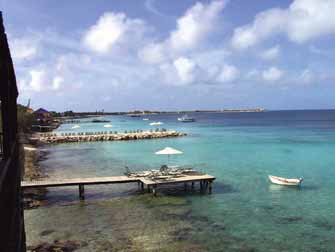
Pollution of existing supplies
The impacts from the pollution of existing water supplies in the Small
Islands sub-system were assessed as moderate. Several islands have
highly polluted but localised surface and underground water sources.
Many of these islands, such as Saint Lucia, Dominica, St. Kitts & Nevis,
Saint Vincent, are dependent on agriculture and are consequently
prone to contamination by agro-chemicals such as pesticides and
fertilisers. They are also subject to contamination from sewage, either
from septic tanks or outfalls. There is some industrial pollution, mostly
from small manufacturing and food processing industries in the
smaller islands and from the chemical and oil industries in Trinidad
& Tobago. These pollution sources are major causes of degradation
of coastal and near-shore marine ecosystems and reduction in
biodiversity, including critical salt-pond, mangrove, estuary, seagrass
Figure 5
Resort development, Bonaire, Netherlands Antilles.
(Photo: J. Oliver, Reefbasse)
and coral reef systems (there is possible transboundary eff ect in islands
such as Saint Lucia, Saint Vincent, Dominica, Grenada, and Trinidad &
or golf courses are developed (Figure 5), vegetation is cleared from the
Tobago). In September 1999, a fi sh kill outbreak aff ected species on
area, which has led to fl ooding, soil erosion, destruction of terrestrial
Barbados, Martinique, Grenada and Saint Vincent & The Grenadines,
habitats, and poor aquifer recharge. The high demand for freshwater
and Trinidad & Tobago, and in some islands it was attributed to factors
contributes to overextraction from aquifers and the rapid depletion
related to the freshwater plumes of the Orinoco and Amazon rivers
of surface resources. The south of Saint Lucia has been targeted for
(PAHO 2000). In most islands the specifi c cause was not determined,
extensive development ranging from hotels to a sports stadium as well
but in Barbados a high incidence of a Streptococcus pathogen was
as other development projects which depend heavily on the availability
believed to be responsible.
of a reliable supply of water (MPDEH 2002). In Barbados, there is also a
growing demand for water due to the development of golf courses
Water quality is deteriorating in the Small Islands sub-system as a
and it is estimated that, given current plans, the water demand for
result of the discharge of agricultural pollutants such as herbicides
irrigation of golf courses will increase fi ve-fold (GEF/CEHI/CARICOM/
and pesticides, especially in urban and industrial areas (FAO 2000). This
UNEP 2001).
results directly from run-off and erosion due to uncontrolled agricultural
intensifi cation, poor agricultural practices (such as cultivation or
In recent years, the public water supply in Saint Lucia has been severely
construction on steep slopes and along river banks), inappropriate
impacted by increased demand, denudation of upper basins and
land use, and direct and/or indirect discharge of untreated effl
uent
increased exploitation of the rivers and wetlands. While the issue is
into waterways. Problems encountered result primarily from inadequate
primarily one of an ineffi
cient, inadequate and aging water distribution
public education and participation in ecosystem conservation eff orts
network, limited supplies experienced during the dry season and heavy
(MPDEH 2002). In Saint Lucia, land use has aff ected the health of
salinisation during the rainy months, combine to signifi cantly impact
freshwater ecosystems, drainage basins and coastal areas. There is a
the ability of the Water and Sewage Company (WASCO) to meet the
direct relationship between the use of land for domestic, commercial,
current demand. This demand is likely to increase signifi cantly in the
industrial or agricultural purposes, the generation of waste by these
short to medium-term. Unoffi
cial estimates indicate that disruptions of
uses, and the impact on the quality of both surface and groundwater
water supply in the south of the island range between 50 to 150 days
resources. Additionally, rural water sources in Saint Lucia, which
per year, and last several hours per occasion.
comprise mainly small and medium intakes, are subject to gross
contamination, especially in the rainy season (MPDEH 2002).
Scarcity of water is not a problem everywhere. Substantial amounts of
land in for example the US Virgin Islands are subject to fl ooding because
In for example the US Virgin Islands contamination of groundwater is
of the islands' stream fl ow characteristics and topography (DPNR/DEP
principally attributed to (DPNR-DEP 2002):
& USDA/NRCS 1998).
Bacteriological contamination from failing septic systems;
Leaking municipal sewer lines and underground storage tanks;
ASSESSMENT
27
Relocation of contamination from previous disposal practices;
Socio-economic impacts
Frequent sewage by-passes (generally described as discharges
Economic impacts
direct to the sea, but with some percolation into sub-soils);
The economic impacts of freshwater shortage in the Small Islands sub-
Improper disposal of used oil;
system were assessed as severe. The islands are highly vulnerable and
Saltwater intrusion (caused by the overpumping of the aquifers);
any eff ect will be visible in the national economy.
Infi ltration of volatile organic compounds (VOC).
The tourism industry is heavily dependent on healthy drainage basins
In Barbados, relatively little wastewater is reused for irrigation at present.
and good water quality for its success. Water demand by tourists is many
A few hotels treat their wastewater and re-use it for irrigating lawns and
times that of residents of island nations. Accordingly, without suffi
cient
gardens. Also, a number of private homes divert their wastewater to fruit
access to high-quality water resources, the tourist industry will not
trees or small banana plantations (FAO 2000).
thrive and develop (GEF/CEHI/CARICOM/UNEP 2001).
Changes in the water table
In Saint Lucia for example, water demand from the tourism sector is
The environmental impacts from changes in the water table were
estimated to be 10% of the total (Government of Saint Lucia 2002).
assessed as moderate. Additionally, it is considered that this issue is
The negative impacts of high water demand from this sector often go
directly related to the modifi cation of stream fl ow. There is evidence
unaddressed until tourist attractions are visibly aff ected. Consequently
that many small islands have virtually no freshwater ecosystems (e.g.
water use has been undervalued by the tourism sector, producing an
US Virgin Islands, Netherlands Antilles, Antigua, Barbados); and that
inter-temporal cost that will aff ect tourism products in the medium
groundwater resources are being exhausted, polluted or displaced by
and long-term.
saltwater intrusion (e.g. Barbados, Antigua, Bahamas).
Some islands are using seawater desalination as a source of freshwater
Some of the countries in the Small Islands sub-system depend
supply, despite the signifi cant costs associated with this technology
heavily on groundwater resources due to erratic or low rainfall and
(Khaka 1998), rather than cheaper methods, such as groundwater
the limited capacity to store water for use in the dry season. Also, a
extraction or rainwater harvesting. The costs and scale of Reverse
lack of river basin management or environmental protection, coupled
Osmosis (RO) technology plants are so considerable that only public
with economic development has severely reduced the spatial extent
water supply companies with a large number of consumers, and
of drainage basins. Expansion of banana cultivation is one of the
industries or resort hotels, have considered this technology as an option.
agricultural activities that has reduced freshwater availability in the
Small RO plants have been built in rural areas where there is no other
sub-system. Where this is the case, the islanders depend heavily
water supply option. In some cases, such as the British Virgin Islands,
on groundwater resources, which often exist as freshwater lenses
the government has promoted such plants by providing land, allowing
containing limited quantities of water. However, withdrawal rates
tax and customs exemptions, and guaranteeing payment for bulk
that exceed the sustainable water yield can result in temporary or
water received. The government also monitors the quality of the fi nal
permanent seawater intrusion, thereby damaging or destroying the
product, distributes the water and in some cases provides assistance
freshwater lenses.
for the operation of the plants (UNEP/IETC 1997). In Antigua & Barbuda,
the relatively higher cost of producing desalinated water compared to
Saltwater intrusion into groundwater supplies is a signifi cant problem
surface and groundwater is a major constraint to providing water that
in the Small Islands sub-system. Desalination of seawater as a source
would not be aff ected by variable rainfall. High cost notwithstanding,
of freshwater supply is an option, but it is very costly (Khaka 1998). In
a commitment to increasing desalinated water production may be
the past, saltwater intrusion has been a problem for the Bahamas as a
required to reduce the vulnerability of settlements as water demands
result of overexploitation of groundwater resources. The government
increase in the future (Organization of American States 2001).
has responded by limiting abstraction in order to allow aquifer recharge.
Additionally, measures are now in place to avoid this problem in the
As an example of the impacts of freshwater shortage on economic
future, including safe-yield amounts, situating wells further inland, and
sectors, Table 7 shows the comparative costs of reverse osmosis
frequent monitoring (GEF/CEHI/CARICOM/UNEP 2001).
desalination for some Latin American and Caribbean developing
countries.
28
GIWA REGIONAL ASSESSMENT 3A CARIBBEAN SEA/SMALL ISLANDS
Table 7
Comparative costs of reverse osmosis desalinisation.
a transboundary issue in this region. However, there are some key
Production cost
issues that should be considered. Many small islands have virtually
Country
(USD/m3) 1
no freshwater ecosystems (US Virgin Islands, Netherlands Antilles,
Bahamas
4.60-5.10
Antigua, Barbados), and groundwater resources in many islands are
Brazil
0.12-0.37
being exhausted, polluted or contaminated by saltwater intrusion.
British Virgin Islands
3.40-4.30 2
Polluted surface and groundwater are major causes of degradation of
Chile
1.00
coastal and near-shore marine ecosystems and declines in biodiversity,
Notes: 1 Includes amortisation of capital, operation and maintenance, and membrane
replacement. 2 Values of 2.30-3.60 USD were reported in February 1994.
including critical salt-pond, mangrove, estuary, seagrass and coral
(Source: UNEP/IETC 1997)
reef systems (with possible transboundary eff ects in Saint Lucia, Saint
Health impacts
Vincent, Dominica, Grenada, Trinidad & Tobago). Increasing rates of
The health impacts of freshwater shortage were assessed as moderate.
deforestation and urbanisation are contributing to water shortages
Health impacts from freshwater shortage tend to occur mainly in the
in several of the islands (e.g. Saint Lucia) and the situation is likely to
dry seasons and following natural disasters, such as hurricanes. A
worsen in the future in response to climate change. Tourism is a major
contributing factor is the high population concentration in the coastal
consumer of water with many resorts showing water consumption 5 or
area causing problems because of sanitation facilities located too close
10 times higher than other residential areas (UNEP 1999). Even if tourism
to the pollution source. There are a range of gastrointestinal diseases
is not a traditional transboundary issue, it refl ects the infl uences that the
that are associated with sanitation and hygiene problems caused by
movement of people have on water resources.
freshwater shortages. Generally, it is diffi
cult to give fi gures for diseases
caused by freshwater shortages in isolation of other issues pertaining to
The impacts of freshwater shortage are severe on economic sectors,
water and sanitation. However, some indicators are available regarding
mainly tourism and agriculture. For human health and social issues the
water-borne diseases, indicating that there have been no reports of
impact is assessed as moderate, taking into account poor freshwater
cholera between 1997 and 2000 for the countries in Small Islands
and recreational water quality, and problems faced by farmers.
sub-system, while incidence of gastroenteritis continues aff ecting the
population in these countries. The incidence of gastroenteritis is high
Demand exceeding supply is one of the most pressing concerns
in some countries; Martinique with 5 425 cases in 2000 and Trinidad &
regarding freshwater resource management in the sub-system. Due to
Tobago with 20 000 cases in 1999 (PAHO 2002).
economic and demographic changes, demand for water resources is
increasing rapidly. Generally, water is not given an economic value and
Other social and community impacts
consequently, water rights, water markets and pricing are not used to
The other social and community impacts of freshwater shortage were
improve management and, for the most part, there is no incentive for
assessed as moderate. The population of the islands with coral origin
consumers to use water effi
ciently. Many threats to human health are a
is experiencing serious water supply problems, while the islands of
direct result of inadequate sewage treatment, necessitating the proper
volcanic origin are less susceptible. The impacts are mainly related
collection, treatment and disposal of sewage (MPDEH 2002).
to cultural aspects and farming activities. While the agriculture sector
depends on the availability of an adequate supply of water for its
The more pronounced impacts of natural disasters on the water sector
survival, the evidence indicates that water resources are facing a serious
in for example Saint Lucia have been linked mainly to extreme weather
threat from unsustainable farming practices including uncontrolled
events such as hurricanes, droughts, and fl oods. Several public sector
agricultural intensifi cation, inappropriate land use (such as cultivation
agencies including WASCO (the Saint Lucia Water and Sewerage Co.
on slopes and river banks) and poor irrigation practices. For example,
Inc.) and the Ministry of Communications, Works and Public Utilities
the Vieux-Fort water supply system in southern Saint Lucia is plagued
have disaster management plans in place. However, these plans have
by water quality problems, resulting in its intake having to be relocated
tended to focus mainly on post-disaster remediation rather than on
in the upper reaches of the drainage basins (Government of Saint Lucia
proactive measures to reduce the impacts of such disasters. The
2002).
evidence suggests that much of the damage to the water supply,
experienced during and after extreme weather events, is caused, not by
Conclusions and future outlook
the events themselves but by weaknesses arising from the absence of
The environmental impacts of freshwater shortage on the Small Island
an integrated approach to water resources management. For example,
sub-system were assessed as moderate, although it is not strictly
the social, economic and environmental impacts of fl oods on the water
ASSESSMENT
29
supply could be signifi cantly reduced through proper drainage and
Environmental impacts
better land use practices (MPDEH 2002).
Microbiological
The impacts of microbiological pollution were assessed as severe,
The size of the Small Islands determines that development and
mainly considering the eff ect on freshwater ecosystems of the islands.
freshwater resources are closely related and inter-linked. Water resource
Rapid population growth and urbanisation have resulted in increased
management must therefore seek to rationalise the use of island
discharge of solid wastes and effl
uents. The coverage of the sewage and
resources with a goal of sustainable development. An appropriate
water supply network varies from island to island. Wastewater treatment
framework for this is provided by the Island Systems Management (ISM),
facilities are inadequate in many locations. For example, in Saint Lucia
which was developed by the Organization of the Eastern Caribbean
only 13% of the population is connected to the sewage system (GEF/
States (OECS) and adopted by the First Ministerial Meeting on the
CEHI/CARICOM/UNEP 2001). The untreated wastewater carries elevated
Implementation for the Barbados Program of Action (held in Barbados
bacteria and viruses, which pose risks to users of coastal areas and to
in November 1997) (Khaka 1998).
consumers of shellfi sh.
In general, the impacts of the diff erent issues of freshwater shortage are
In addition to the threats of inadequate sanitation treatment, the
expected to remain moderate in the future, with both environmental
unregulated disposal of human waste for example in Antigua &
and economic conditions improving somewhat.
Barbuda is further compounded by insuffi
cient drainage which results
in standing pools of contaminated water. During severe weather
conditions (e.g. hurricanes, fl oods, and heavy rainfall), these pools
present a major source of sewage-related outbreaks of diseases (GEF/
T
C
A
Pollution
IMP
CEHI/CARICOM/UNEP 2001).
The overall impact of pollution in the Small Islands sub-system ranges
Although there are numerous problems associated with non-point
from moderate to severe regarding environmental issues and socio-
pollution sources, one primary problem aff ecting the inhabitants of the
economic impacts. Water quality problems, common to the whole
US Virgin Islands is bacterial contamination from sources such as failed
region, include toxic contamination from industry, waste disposal, and
septic systems, run-off from animal operations, and sewage discharged
eutrophication caused by human sewage. Bacterial pollution of water
from boats. These cause serious threats to human health and impair
supplies in the region is a continuous problem with adverse eff ects on
water quality with algal blooms. High bacterial counts have been
human health. The major concerns of high bacterial and organic loads
detected in some bays, especially in those with a large concentration of
include poor-quality drinking water, eutrophication, and aquatic life
boats and boating berths. Contamination is partly the result of sewage
loss, as well as human alimentary species pollution and prevalence of
and wastewater discharges from the boats, particularly from live-aboard
water-borne diseases (UNEP 1991).
vessels (USVI 1998).
Pollution aff ects the marine environment in many ways. Beaches are
Microbiological pollution also poses a threat to the marine environment,
less attractive if polluted by solid waste, deposited by strong currents
mainly as a result of excessive nutrients and sewage discharge into
or dumped in the local harbour. Oil and other waste kill fi sh, and other
coastal waters, which has altered the species composition both in the
animals are injured or die from entanglement and ingestion of waste
water column and in benthic communities, leading to local changes in
materials. Marine pollution is also becoming a signifi cant human health
biodiversity (Offi
ce of the Prime Minister 2001). Fish kills at ecologically
concern (PCA 1999).
sensitive wetlands have occurred repeatedly in the US Virgin Islands,
and swimming beaches around the Hess Oil Virgin Islands Corporation
Thermal pollution was assessed as slight due to insignifi cant eff ects
(HOVIC) have been closed on numerous occasions, primarily because
beyond the mixing zone of thermal plants and no evidence of
of a poorly designed and failing sewage system in St. Croix that permits
interference with migration of species. The radionuclide pollution was
raw sewage to fl ow directly into the Caribbean Sea (DPNR/DEP & USDA/
assessed as as having no known impact in the Small Islands sub-system.
NRCS 1998). Additionally, the discharging of wastes overboard directly
These two issues will therefore not be further discussed.
into the sea and point source pollution which can be attributed to a
failing and overloaded municipal sewage system, have been detected in
the US Virgin Islands (DPNR/DEP 2002). Poor preventative maintenance
30
GIWA REGIONAL ASSESSMENT 3A CARIBBEAN SEA/SMALL ISLANDS
practices due to lack of funding within the Department of Public Works,
water sources are located at a lower elevation than agricultural activities
and negligence result in a pattern of frequent "by-passes" that empty
(GEF/CEHI/CARICOM/UNEP 2001).
sewage directly into the waters of the US Virgin Islands.
The industrial sector also contributes to the problem through discharges
Eutrophication
of wastewater. It has been indicated that often the industrial sectors of
The impacts of eutrophication were assessed as moderate. The major
the countries discharge effl
uents directly into rivers and/or store them
source of coastal and marine pollution in the sub-system is untreated
in unlined holding ponds (Figure 6) (GEF/CEHI/CARICOM/UNEP 2001).
domestic waste and sewage discharge, agricultural run-off , and
Industrial pollution is a particularly pressing problem for Trinidad &
industrial activities, especially from oil and tourism industries (UNEP
Tobago, given its high level of industrialisation in comparison to its
1997). Eutrophication tends to be seasonal and might not be caused
neighbours. The industries in Trinidad & Tobago generate pollution from
by land-based activities. There is an increased abundance of epiphytic
processes used in sugar and oil refi ning, rum distillation, manufacturing
algae in the sub-system unfortunately however, there is very little data
of petro-chemicals, paint and metal fi nishing, and agro-processing. The
available for this study (GIWA Task team 2004). The assessment of this
impact of industrial effl
uents on the water resources is prominent along
issue is therefore based on visual observations in the fi eld and internal
the foothills of the northern range and the western coast of Trinidad.
government reports and is estimated to occur primarily in the near-
Industrial activity in Tobago is relatively small, being concentrated in the
shore marine environment.
southwest part of the island. Effl
uents from oil and sugar cane refi ning
particularly aff ect the rivers in south Trinidad, and other areas in the
In Antigua & Barbuda and the US Virgin Islands, failed septic systems,
country are aff ected by petroleum products, which are discharged into
run-off from animal operations, and sewage discharged from boats are
the watercourses from leaking tanks, washings, and improper disposal
the most likely causes of eutrophication and algal blooms (DPNR-DEP
of oil waste (Organization of American States 2001).
& USDA-NRCS 1998, Offi
ce of the Prime Minister 2001). In Barbados the
coral reefs have indirectly been impacted by eutrophication. There has
Caribbean reefs are aff ected, not only by oil spills but also by supposedly
been an increase in the rate of bioerosion by reef cavity dwellers (clionid
harmless grey water, which is the by-product from ships of baths,
sponges) and their abundance is positively correlated to eutrophication.
showers and other cleaning activities. In the US Virgins Island the oil
The increased bioerosion is further thought to change the species
company HOVENSA LLC directly discharged oil with no treatment or
composition of corals, favouring branching corals since these rely on
adequate disposal measures, however action from the Environmental
fragmentation as their principal mode of propagation (Holmes 1997 in
Protection Agency in 1999 was suffi
cient in initiating a clean-up of the
Linton & Warner 2003)
site (EPA 2004).
Chemical
Suspended solids
Based on qualitative evidence of large-scale use of pesticides on many
Suspended solids were assessed as having severe impacts on the
islands and the eff ects of industrial activities, the impacts of chemical
Small Islands as there is an increase of suspended solids and turbidity,
pollution were assessed as moderate.
principally produced by poor agricultural and construction practices
but there is also the transboundary impacts of sediment transport from
In most countries in the sub-system, unsustainable land-clearance
continental land masses. This increase in turbidity can be seen in small
practices, ineffi
cient irrigation, and the use of agro-chemicals within
areas of streams and/or riverside and marine environments, causing
the agricultural sector is a source of signifi cant damage to both
changes in benthic or pelagic biodiversity in areas due to sediment
surface and groundwater resources. Within the domestic sector,
blanketing or increased turbidity. According to the GIWA experts, the
land-clearing and construction on previously uninhabited land is
eff ects on seagrass in some islands is considered as evidence but there
resulting in sedimentation, deforestation, and pollution. Agriculture is
is no documentation.
the primarly sector that causes water pollution; manly through agro-
chemical leaching, direct agro-chemical infl ux from aerial spraying and
The concentration of suspended and dissolved solids has increased
indiscriminate and improper disposal of solid waste. The trend towards
due to human activities, including deforestation, urbanisation and
using low-lying wetlands for rice cultivation, which requires heavy
agriculture. Rivers from Central America and the Antilles discharge
pesticide use, is exacerbating the environmental degradation. St. Kitts
300 million tonnes of sediments into the Greater Caribbean region
has been susceptible to agricultural pollution, partly because signifi cant
annually (PNUMA 1999). Changes in sedimentation or erosion rates
ASSESSMENT
31
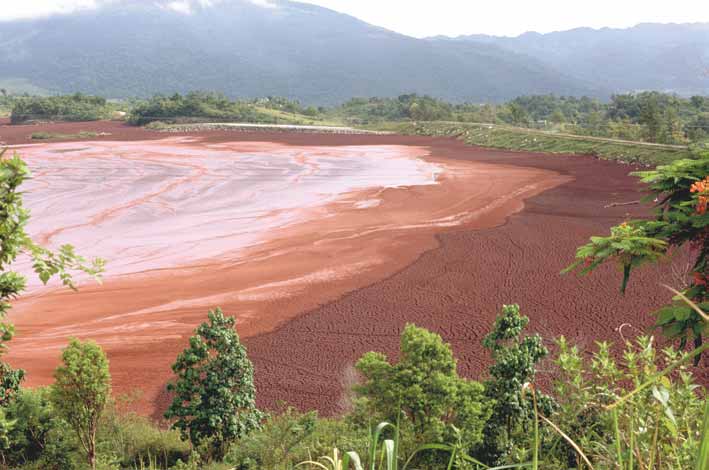
Figure 6 Run-off from bauxite mining in Jamaica.
(Photo: Coris)
have increased because the protective vegetative cover has been
recreational use and the high infl uence of benthic litter recovery, as
removed and as a consequence of river development that have
well as the interference with trawling activities. The PNUMA (1999)
changed river dynamics and fl ow to facilitate construction fl ood
report considered that an average of 0.8 kg solid waste/day/person is
mitigation mechanisms.
produced in the Caribbean.
Sedimentation is a primary problem aff ecting the US Virgin Islands.
In the Small Island sub-system, there is limited data to quantify the
Dirt roads, farmlands, construction sites, urban encroachments, and
amount of solid waste interfering with trawling activities or how
other disturbed soils are the primary non-point sources of sediment
much ends up on the region's beaches. Studies throughout the Wider
threatening the islands water resources. Additionally, the topography
Caribbean region have shown that a combination of marine-based
of the islands, with a combination of short steep slopes terminating in
waste and solid waste from land-based sources aff ect beach areas.
sensitive wetlands and marine environments make them susceptible to
There are also movements of wastes from one country to another with
damage from even slight increases in erosion (DPNR/DEP & USDA/NRCS
much ending up on eastern coastlines or leeward facing beaches on
1998). In Antigua & Barbuda, turbidity of inshore water and elevated
the islands.
algal cover on reefs are linked to the impacts of coastal development,
with sedimentation being a major infl uence on the condition of reefs
With the Caribbean's high volume of marine traffi
c, pollution from ship-
(Smith et al. 2000).
generated solid waste, wastewater, and bilge water by both commercial
and cruise ships pollutes the coasts and threatens regional tourism
Solid wastes
(GEF/CEHI/CARICOM/UNEP 2001). The Caribbean cruise industry
The impacts of solid waste were assessed as moderate, considering the
accounts for about 58% of the world's cruise ship passengers (Ocean
abundance of solid waste on beaches causing public concern regarding
Conservancy 2002 in Burke & Maidens 2004). According to recent
32
GIWA REGIONAL ASSESSMENT 3A CARIBBEAN SEA/SMALL ISLANDS
estimates by the Ocean Conservancy, 25 million passenger bed-days
Thousands of large vessels transporting oil, gas, and chemicals pass
on cruise ships in the Caribbean generated an estimated 90 000 tonnes
between the Small Islands annually. In general for the Small Island
of waste in 2000 (Ocean Conservancy 2002 in Burke & Maidens 2004).
sub-system, oil spills, although infrequent, have very harmful eff ects
On average, passengers on a typical cruise ship (3 000 passengers and
on marine life and ecosystems, as well as on humans who consume
crew) produces 50 tonnes of solid waste during a one-week cruise
contaminated seafood. Nevertheless, this issue is not the principal cause
(Ocean Conservancy 2002). However, disposal, not quantity, is the real
of species mortality in the sub-system. In agreement with GEF/CEHI/
issue. The discharging of wastes directly into the sea by boat owners
CARICOM/UNEP (2001), a regional spill-response plan is needed. All
and the diffi
culty in regulating littering also contributes to problems, as
nations have adopted the 1989 Basel Convention on the Transboundary
seen in the US Virgin Islands (DPNR/DEP 2002).
Movement of Hazardous Wastes and Their Disposal, but none have
signed the Basel Protocol on Liability and Compensation.
In most of the countries the solid waste management receives low
priority when compared to other national needs (CEHI 2003). Household
Trinidad, because of its petroleum-based industry, continues to have
waste continues to be a problem throughout the region, countries lack
a higher risk of oil spills both inland and within its coastal and marine
suffi
cient solid waste collection and wastewater treatment systems. As
regions. In fact, the last spill occurred as recently as 2000. Such spills have
a result, many citizens inappropriately dispose of their waste in gullies
had short-term damaging impacts on the coastlines, particularly within
and along riverbanks, which pollutes rivers, streams and ultimately, the
the Gulf of Paria. The beaches of Vessigny, La Brea and Mayaro in the south
coastal waters into which they drain (GEF/CEHI/CARICOM/UNEP 2001).
of Trinidad continue to be aff ected by the presence of petroleum-based
The US Virgin Islands, for example, have a solid waste crisis. Presently,
residues emanating from the nearby oil industries and oil tankers (GEF/
the territory is relying exclusively on land fi lling as the only option for
CEHI/CARICOM/UNEP 2001). There are also reports of tar balls located on
solid waste disposal (DPNR/DEP 2002). There are also many problems
the beaches of the Cayman Islands and Curaçao, and at the Barlovento
with solid waste disposal in St. Kitts & Nevis, and Saint Lucia, in particular
beaches of Barbados and Grenada among others (PNUMA 1999).
indiscriminate waste disposal and unlined landfi lls, which could allow
hazardous leachates to contaminate the groundwater (GEF/CEHI/
Socio-economic impacts
CARICOM/UNEP 2001).
Economic impacts
The economic impacts of pollution were assessed as severe. Looking
Oil spills
at the economic sectors, tourism, represented by data from hotels
The impacts of oil spills were assessed as moderate. The Eastern
and restaurants, was a major contributor to the GDP of the OECS
Caribbean region is a major tanker traffi
c route and a cruising path of
(Organization of Eastern Caribbean States) (CEPS/OECS 2002). The
oil cargo ships; while there have not been large numbers of oil spills in
tourism industry is expected to generate 2 416 500 directly and
the sub-system, the risk and the potential damage remains extremely
indirectly jobs in Caribbean in 2004, representing almost 15% of
high, which is a clear transboundary issue.
GDP (WTTC 2004). With the Caribbean's high volume of marine
traffi
c, pollution from the discharge of ship-generated solid wastes
The heavy maritime traffi
c that transits the Caribbean Sea, infl uenced
is threatening regional tourism. In the Wider Caribbean Initiative on
particularly by the Panama Canal, produces very high levels of pollution
Ship generated Waste (WCISW) project sponsored by the International
from oil tankers and the threat of an even more devastating source,
Maritime Organization, Antigua & Barbuda, Dominica, Grenada, Saint
namely the regular movement of nuclear and other hazardous materials
Lucia, Saint Vincent & The Grenadines, and St. Kitts & Nevis have
across the Sea. The existence of these risks imposes great demands
cooperated to improve the collection, treatment and disposal of
on the planning capacity of the Small Islands of the Caribbean region
wastes. Each nation have established port waste reception facilities
because of the need to incorporate adequate risk assessments,
and collaborated in drafting a common legal framework for regional
prevention and mitigation measures into all aspects of sustainable
ship waste management (Khaka 1998).
development planning. The most common transboundary pollution
threats to the islands are oil spills; especially for Trinidad & Tobago.
Even if there is some evidence of environmental impacts from pollution,
Due to the islands close location to the mouth of the Orinoco River, oil
there are no developed indicators measuring the way in which they
waste from diff erent activities near the River, e.g. from the Venezuelan
cause economic costs for water supply, the tourism industry, and
petroleum company (PDEVESA), is transported by local currents to the
other economic activities. There is correspondingly a lack of data for
islands.
economic valuation of environmental damage.
ASSESSMENT
33
As mentioned previously, Trinidad & Tobago is the most populous
which is low compared with some Latin American countries, and infant
country and has the largest economy of the Small Island sub-system.
mortality caused by intestinal digestive infections has dropped from
In this country, hydrocarbon resources promise to provide a continuing
5 per 1 000 live birth to 2 per 1 000 during the period from 1985 to 1995
platform for viable industrial activity. However, it poses one of the most
(Caribbean Epidemiology Centre 2000, World Bank Group 2000).
important challenges for the environment, taking into account current
problems such as oil pollution of beaches and water (CIA 2004, World
Other social and community impacts
Resources Institute 2004) with associated losses in revenues for the
The other social and community impacts of pollution were assessed as
tourism sector in the short, medium and long-term.
moderate. In the Caribbean a high percentage of the population has
access to piped water. Although there has been progress in improving
Health impacts
access to water supply, they have been very slow improving sewage
The healt impact of pollution were assessed as moderate. Water
facilities, due partly to spatial limitations. However, sanitation coverage
treatment is diffi
cult in situations where the drainage basin may be
is high, particularly through individual excreta disposal system. With
contaminated by multiple types of pollutants from various sectors
the indirect health risk for the population as a result of poor solid waste
(e.g. agro-chemicals, sewage) and by rapid population growth and
management practices, it is important to consider that the existing
urbanisation that have resulted in increased solid waste and wastewater
systems for the collection and disposal of waste need to be upgraded
pollution. These pollutants are detrimental to human health, causing
(CEHI 2003).
gastroenteritis, diarrhoea, jaundice, rashes, and various infections.
During severe weather conditions (e.g. hurricanes, fl oods, and heavy
Conclusions and future outlook
rainfall), disposal pools in Antigua & Barbuda present a major threat
The environmental impacts of pollution were assessed as moderate
from sewage-related outbreaks of diseases. In St. Kitts & Nevis, during
to severe. The major consideration taken into account is that most
these weather events, gastroenteritis becomes prevalent amongst the
pollutants stem principally from agriculture, small industrial plants,
population. The outbreaks are often localised and are responded to by
hotels and sewage.
the Ministry of Health; it implements public awareness programmes
and deliver water when needed (GEF/CEHI/CARICOM/UNEP 2001).
The impact of pollution on economic activity is considered severe
because of the importance of surface and coastal ecosystems for
In Barbados, the diarrhoea disease surveillance system reported
small islands, and also considering that there is not much investment
1 610 cases in 1993, 1 550 cases in 1994, and 2 100 cases in 1995 (PAHO
in prevention strategies, due to high costs and lack of appropriate
1999). In addition, there was 53 cases of gastroenteritis reported in 1993.
regulations. Greater emphasis is placed on remedial actions, which
In the Cayman Islands, reported cases of gastroenteritis among children
incur higher socio-economic costs. This general situation aff ects the
less than 5 years of age have been less than 100 per year, but have
tourism sector directly, since most of the sub-system's economy is
fl uctuated widely. In Saint Vincent & The Grenadines, gastroenteritis
based on this activity. The impacts on the health of the population are
has become less widespread (PAHO 1999). However, an increase in
moderate, taking into account that there are some risk factors related
circulation of viral pathogens and the improved active surveillance
to inadequate sanitation facilities and treatment of drinking water
systems could be factors contributing to the rise of reported cases
and other kinds of pollution. Finally, social or community impacts are
of diarrhoeal diseases in the last year. Ciguatera in humans is caused
also regarded as moderate as a result of the most vulnerable groups
by consuming tropical fi sh that have bio-accumulated toxins from
being aff ected by the consequences of inadequate sewage disposal
microalgae. Where algal biomasses are signifi cantly elevated due to
services.
eutrophication, such as in nutrient/sewage-enriched areas in Antigua
& Barbuda, the risk of ciguatera poisoning is high (PNUMA 1999b).
In the future, the environmental impacts of pollution are expected to
decrease but will remain moderate. The socio-economic impacts will
The available information for OECS countries indicates that in spite of
also decrease, principally concerning health and other community
their socio-economic and environmental challenges, these countries
issues, while the impact on the economic sectors are predicted to
enjoy strong social indicators. Some improvements concerning health
increase. For the future scenario it is vital to consider the importance and
issues have been noticed; for example, no cases of cholera have been
growth of science and technology in the sub-system, in particular the
reported from the countries in the sub-system during the last years
growth of information technology, which will cause less environmental
(PAHO 2002). The infant mortality rate is 15 deaths per 1 000 live births,
damage than traditional economic sectors. In addition, the increased
34
GIWA REGIONAL ASSESSMENT 3A CARIBBEAN SEA/SMALL ISLANDS
application of science and technology in other sectors is likely to
through buildings that are located too close to high water marks,
minimise the impacts of pollution through cleaner technologies and
harbour dredging, the destruction of mangroves, mooring on reefs
processes, to mitigate and provide remedial measures for existing
and seagrass beds, and pollution. The issue of construction in coastal
damage and to improve end of pipe treatment technology.
areas is illustrated in Antigua & Barbuda where 39 of the 55 hotels have
a beachfront location (GEF/CEHI/CARICOM/UNEP 2001).
Antigua & Barbuda, like other island states, is renowned for its diverse
T
C
A
Habitat and community
IMP
fl ora and fauna. However, due to the small size, isolation and fragility
modification
of the islands' ecosystems, its biological diversity is among the most
threatened in the world. The majority of threats result from changes
The environmental and socio-economic impacts of habitat and
brought about by human action, while others result from natural
community modifi cation were assessed as severe except for impacts
causes. Despite the inadequate research, the major conservation
on human health which was considered slight. One factor contributing
threats have been identifi ed as loss of habitat, which results in the
to the severity of the problem is that all islands have established some
gradual loss of numerous species of invertebrate animals found
aquatic preserves to protect valuable habitat but the authorities lack
within each of the islands' vegetation communities. Habitat is lost
the necessary manpower and funding to enforce the regulations (GEF/
in Antigua & Barbuda primarily through the sub-division of lands for
CEHI/CARICOM/UNEP 2001).
housing, tourism development, agriculture, and mining and dredging
sand. Signifi cant areas of wildlife habitat in both terrestrial and marine
Environmental impacts
ecosystems have been eliminated to accommodate development.
Modifi cation and loss of ecosystems or ecotones
In recent years, the development of the tourism industry has been
The impacts of modifi cation and loss of ecosystems or ecotones were
facilitated by clearing natural vegetation and altering beaches, while
assessed as severe. The most critical ecosystems in the sub-system are
coral reefs have been damaged by divers and boat operators (Offi
ce of
coral reefs, mangroves, seagrass beds and sandy shores, on which the
the Prime Minister 2001).
islands economic activities and development are heavily dependent.
Deforestation, coral reef deterioration, the introduction of certain
The main anthropogenic impacts stem from deforestation, extraction
non-indigenous species and other forms of habitat degradation
of marine resources and tourism. In islands like Dominica and Saint Lucia
are causes of loss of biodiversity in Antigua & Barbuda. Mangrove
deforestation and the cultivation of steep slopes cause considerable
species, cactus species, and littoral woodland species have been
land degradation. In the 1980s, large areas of prime rainforest were
aff ected. Additionally, even though little is known about the fi sh fauna,
cleared in the small islands of the Eastern Caribbean to make way for
several of the species that exist are known to have been deliberately
bananas plantations. Today, many of those once productive banana
introduced for aquaculture. The loss of nesting habitat is considered to
fi elds have been abandoned (Colmore 1999).
be the greatest threat to the three species of endangered sea turtles
(Eretmochelys imbricata, Chelonia mydas, Dermochelys coriacea), the
Moreover, within the domestic sector, land clearance and construction
only marine reptiles to nest in Antigua & Barbuda (Offi
ce of the Prime
on previously uninhabited land is producing sedimentation,
Minister 2001). Regarding the status of coral reefs there has been a
deforestation, and pollution, on top of the obvious problem of
recent trend of deterioration compared with the situation of 1986 when
biological habitat degradation and destruction (MPDEH 2002). The
reefs were described as exceptional in their variety, beauty and health.
variety and frequency of coral reef diseases have increased across the
In 1998, the overall reef condition was considered generally poor, with
Caribbean during the last 10 years; other diseases have attacked many
live coral cover averaging 20% or less except in north Barbuda (Smith
other organisms during this period, including gorgonians, sponges,
et al. 2000).
and echinoderms, even though many of those diseases are still
unknown (Goureu et al. 1997). Extraction of living marine resources is a
Several two-three year periods of severe drought over the past two
signifi cant threat in all countries in the sub-system, and in Barbados a
decades in Antigua and Barbuda are assumed to have impacted bird
three-year moratorium has been established on the harvesting of sea
populations, as have the almost annual hurricanes that have hit the
urchins in an attempt to restore the population (GEF/CEHI/CARICOM/
country since 1995. Drastic reductions in the populations of small
UNEP 2001). Tourism is also aff ecting the health of coastal ecosystems
passerines have been noted (Offi
ce of the Prime Minister 2001).
ASSESSMENT
35
The US Virgin Islands are aware of damage to the aquatic systems,
in 1998, but cases of mortality were relatively minor. Bleaching on
including: declines in habitat and ecosystem health and living
Newfound and Lameshur reefs, St. John was 43% and 47% respectively,
resources; degraded aquatic systems (e.g. wetland condition and
and 41% on Caret Bay Reef, St. Thomas during the hottest summer sea
current and historical rates of loss, percent impervious surface, and
surface temperatures on record. All corals that were bleached at Buck
other measures of aquatic habitat); and decline in the condition of living
Island had fully recovered their pigmentation within six months. There
and natural resources that are part of the aquatic system (e.g. decline
has been previous bleaching events in 1987 and 1990 around St.
in the populations of rare and endangered aquatic species, decline in
Thomas (Causey et al. 2000).
healthy populations of fi sh and shellfi sh). Although the focus of natural
resource concern in the territory is on coastal and marine habitats, the
In Saint Lucia, between 1995 and 2001, reefs in the Soufriere area lost
loss of forest cover due to development activities cannot be ignored.
on average 47% of coral cover in shallow waters and 48% of the coral
Not only is the habitat loss impacting resident forest species such as
cover in deeper waters. On the northwest coast of Saint Lucia, 82% of
pigeons and fruit bats, it is also a signifi cant contributor to the islands
the reefs are either dead or in poor condition (Department of Fisheries
watershed problems (DPNR/DEP & USDA/NRCS 1998).
St. Lucia 2003a,b). Smith et al. (2000) notes that a reef check survey at
Malgretoute in June and December 1999 showed live coral cover had
These problems have led to the US Virgin Islands losing over 50% of
declined from 50 to 25% at 3 m depth, and from 35 to 17% at 10 m.
the territory's mangrove habitat during the last 70 years due to land
Recently, there has been an unusually high incidence of white band
clearance and land fi ll operations to create development sites or
disease on reefs in the Soufriere Marine Management Area, resulting in
provide access to water (DPNR/DEP & USDA/NRCS 1998). There is a
a living coral loss of over 3% between 1997 and 1998 (Smith et al. 2000).
lack of awareness of the value of mangroves in fi ltering sediments and
Other habitats aff ected in Saint Lucia are beaches and wetlands. In 1990,
other pollutants that would otherwise diminish water quality in near-
43% of the beaches in Saint Lucia were mined for sand. Estimates have
shore environments. Seagrass beds and coral reefs are also aff ected by
shown that, to date, Saint Lucia has lost over 50% of its coastal wetlands
chronic sedimentation that reduces sunlight penetration and increases
(GIWA Task team 2004).
ecosystem stress.
In other islands, such as the Cayman Islands, Acropora species have been
There are also reports from the sub-system of an array of environmental
severely impacted by white band disease, although isolated healthy
stresses that have degraded coral reefs and other marine ecosystems,
stands still exist. Black band disease has been locally signifi cant and
as well as the fi sheries resources. Anchoring and ship groundings on
most other coral diseases have been reported (Causey et al. 2000). Coral
coral reefs and seagrass beds are examples of acute stresses with
bleaching in 1998 was as severe as in 1995, when 10% mortality was
immediate, and sometimes long-term, eff ects. The chain and anchor
measured aff ecting Montrastea annularis colonies. In the Turks & Caicos,
of a large cruise ship can weight 4.5 tonnes and even in calm seas,
the level of active coral disease was low but many diff erent diseases
reckless anchoring can damage up to 200 m2 of sea bottom (Sweeting
(including damage and breaking) were reported, especially on the
& Wayne 2003 in Burke & Maidens 2004).
north side of Providenciales where tourism activities (such as diving
and pollution) are intense, and at other heavily dived sites.
Dredging, sand extraction, groyne construction and sewage effl
uent
have aff ected reefs, especially around St. Thomas and St. Croix in
The major human threats to coral reefs in Turks & Caicos include
US Virgin Islands. Moreover, many of the stresses can combine with
(Woodley et al. 2000):
natural disturbances to accelerate damage to reefs or slow their rate
Nutrient discharge from marinas and coastal development, fi sh
of recovery. Existing zoning, erosion control and fi shing regulations are
processing plants, conch aquaculture (Figure 7) and hotel sewage;
not providing suffi
cient protection against natural and human stresses.
Heavy metal contamination from anti-fouling paints;
These have caused extensive mortality on reefs around St. John and St.
Damage to corals caused by snorkellers and divers;
Croix. Corals around Buck Island experienced less disease than those
Anchoring on coral reefs and seagrass beds;
around St. John, except for white band disease. Recent measures show
Stranded
boats;
that disease on corals is 5.4% (St. Thomas), 5.6% (St. John) and 2.0%
Construction of tourism infrastructure and private jetties in the
(St. Croix) (Causey et al. 2002). The branching Acropora palmata, and
near-shore environment;
A. cervicornis are the most vulnerable to storm damage and are also
Uncontrolled fi shing in the marine parks and increasing visitor use
susceptible to white band disease. There was extensive coral bleaching
of selected marine areas.
36
GIWA REGIONAL ASSESSMENT 3A CARIBBEAN SEA/SMALL ISLANDS
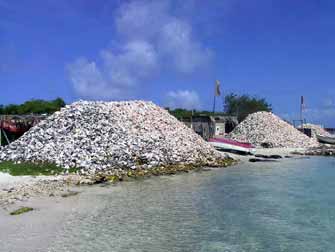
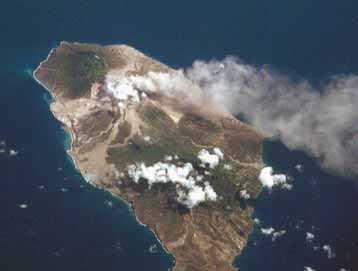
Algal proliferation, which is likely caused by eutrophication of the
coastal waters as a consequence of nutrient inputs from the city
of Fort-de-France and the lack of algal grazers. Most of the reefs in
Martinique suff er from algal proliferation of Turbinaria on the reefs
front, Sargassum on the fore reef zone and Dictyota in the lagoons;
a similar situation occurs in Guadeloupe.
A further threat to the coral reefs arises from massive volcanic eruptions,
particularly in Montserrat (Figure 8) where large quantities of ash are
deposited on reefs along the south and southwest coasts (Smith
et al. 2000).
Figure 7
Piles of conch shells which have been harvested for
their meat, Bonaire.
(Photo: J. Oliver, Reefbase)
During the 1980s, many shallow reefs around Grenada & The
Grenadines were degraded and became overgrown with algae,
presumably resulting from a combination of sewage and agrochemical
pollution, and sedimentation caused by coastal development (Smith
et al. 2000).
Only 15 to 20% of the marine communities of Martinique and
Guadeloupe comprise of fl ourishing coral communities. On Pigeon
Island (Guadeloupe), coral cover dropped from 46% in 1995 to 26%
in 1999, and equally worrying is the large percentage of the surviving
Figure 8
Volcanic activity on the Island of Montserrat,
July 9 2001.
colonies that are partially diseased, ranging from 11 to 56%, with an
(Photo: NASA)
average 19 to 53% of surfaces being dead (Moyne-Pickard 1999). There
is similar degradation of the coral communities on Martinique Island.
These losses are probably due to the combination of both natural and
Socio-economic impacts
anthropogenic factors, such as (Smith et al. 2000):
Economic impacts
Hurricanes;
The economic impacts of habitat modifi cation were assessed as
The loss of the sea urchin Diadema antillarum in 1983 favoured quick
severe. Habitat modifi cation aff ects all of the islands inhabitants since
algal growth and the loss is still evident in the high abundance of
they depend completely on their ecosystems for their welfare. There
these algae;
are limited opportunities for economic diversifi cation in the Small
Coral bleaching, there was a major bleaching event in 1998 when
Islands, and many depend heavily on international trade and tourism
sea surface temperatures exceeded 29°C during September and
for their economic viability. However, the successful promotion of
October;
tourism is strongly correlated with the quality, ambience and aesthetic
Heavy siltation, as a result of increased sediments from deforestation,
value of the environment. Despite its obvious economic potential, the
mangrove clearing and poorly planned development;
development of tourism also contributes to the modifi cation of habitats
Pollution, heavy metals and pesticides have been found in
(Khaka 1998).
sediments and animals, 1 500 to 2 000 tonnes of pesticides are
imported every year to Martinique and Guadeloupe;
It is diffi
cult to identify a direct cause-eff ect relationship between
Tourism, the Pigeon Islets on the leeward side of Guadeloupe are
tourism and habitat modifi cation, as there is a multitude of synergies
visited by approximately 60 000 to 80 000 divers each year;
and inter-linkages. However, tourism revenues are often directly
ASSESSMENT
37
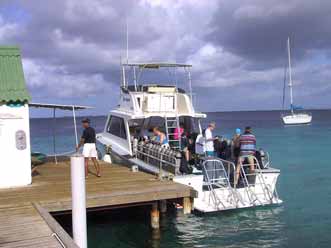
impacted by habitat modifi cation because of the loss of amenity
Health impacts
value for activities, such as fi shing, snorkelling, diving etc. Habitat
The health impacts of habitat and community were assessed as slight
modifi cation represents loss of income opportunities in the tourism
for the Small Islands sub-system since there is no evidence of eff ects on
sector in medium and long-term. In the Cayman Islands, there are more
health due to habitat modifi cation. However, the habitat modifi cation in
than 40 000 locals, along with 1.4 million tourists per year, 40% of whom
this sub-system is related to pollution, and therefore many of the health
go diving. The contribution from tourism to GDP was in 1996 32% in
impacts are similar. Many countries included within the Small Islands
Anguilla, 15% in Antigua & Barbuda, 12.5% in Saint Lucia, 7% in Grenada,
sub-system have inadequate water treatment facilities, which is causing
7% in St. Kitts & Nevis, but only 2.5% or less in Dominica, St. Vincent
contamination of the watershed by pollutants from the various sectors
& The Grenadines and Montserrat (CEPS/OECS 2002). In Saint Lucia,
(agro-chemicals, sewage system, ballast water etc.) (PNUMA 1999).
there has been a shift in employment opportunities with tourism and
restaurants providing 10% of the jobs while fi shing now only accounts
Other social and community impacts
for 1%. Current anthropogenic threats originate mostly from recent
The other social and community impacts of habitat and community
population growth and economic development in the absence of any
modifi cation were assessed as severe. In the context of habitat
growth management plans or coastal area management policies. These
modifi cation explained by pollution, an illustrative case is Saint Lucia,
threats include dredging and fi lling of wetlands, coastal engineering
where the primary concern in the provision of water for post-harvest
projects, anchoring of cruise ships, and over-use of dive sites, in many
purposes is the quality of water and its implications for food safety
cases exceeding 15 000 dives per year (Figure 9) (Woodley et al. 2000).
(Government of Saint Lucia 2002). A primary environmental issue
among many communities in St. Lucia is water, specifi cally its availability
and quality. Drinking water is extracted from streams around the island.
The land areas that drain into these streams are therefore high on the
priority list for management. However, in many of those areas intensive
agriculture is practiced with high levels of erosion and agro-chemicals,
presenting water quality problems for many communities (Cox n.d)
Conclusions and future outlook
Habitat modifi cation was identifi ed as the principal problem for the
Small Islands; its environmental impacts were assessed as severe.
Although there is a lot of data available describing damage and declines
in coral reefs, mangroves and seagrass beds, reduction in fi sh stocks,
destruction of watersheds and the associated reduction in freshwater,
there is a lack of international initiatives aimed at conserving these
Figure 9
Diving boat, Divi Flamingo, Bonaire, Netherlands
habitats. Since the Small Islands are dependent of the economic sectors
Antilles.
of agriculture and tourism, these limited and fragile natural resources
(Photo: J. Oliver, Reefbase)
and habitats must be managed in a sustainable way.
Aside from tourism, habitat and community modifi cation has also
Habitat modifi cation, caused by expansion in the tourism sector has
reduced the capacity of the local populations to meet their basic
inevitable severe impacts on the other economic sectors. Many islands
human needs as well as changed employment opportunities. It has
depend heavily on tourism which is based on the quality, health and
also caused a loss of recreational values, reduced existing income and
aesthetic value of the environment. However, as a consequence of
foreign exchange from fi sheries and other sectors, inhibited investment,
habitat modifi cation, there are changes in employment opportunities
provoked national and international political confl icts, and created a
and loss of recreational amenities. For impacts on human health, the
loss of educational and scientifi c values. Other economic impacts of
assessment indicates a slight impact since there have been no specifi c
habitat and community impacts are degraded land due to loss of
studies of the eff ects on health due from habitat modifi cation. Finally,
physical protection, costs of responding to risks, international inequity,
pollution causing water quality problems for many rural communities
aff ected cultural heritage, increased costs of controlling invasive species
and habitat and community modifi cation causes severe social and
and costs of restoration of modifi ed ecosystems.
community impacts.
38
GIWA REGIONAL ASSESSMENT 3A CARIBBEAN SEA/SMALL ISLANDS











Since the economic activities of the islands are highly dependant on
70 000
the region's ecosystems, there will be a realisation that more eff ective
and integrated management systems are required, and it is therefore
60 000
predicted there will be improvements in environmental conditions. It
50 000
is important to keep in mind that the surface area of the islands is small,
40 000
nnes
and both positive and negative changes in the future will aff ect the
T
o
entire country.
30 000
20 000
10 000
T
C
A
Unsustainable exploitation of
IMP
0
fish and other living resources
1950
1960
1970
1980
1990
2000
Year
Figure 10 Total capture of fi sh, crustaceans and mollusks in the
The environmental and socio-economic impacts of unsustainable
Small Islands sub-system.
exploitation of fi sh and other living resources on the Small Islands
(Source: FAO FISHSTAT 2003)
sub-system are moderate. The Organization of Eastern Caribbean
States (OECS) enjoys a common fi shery zone consisting of all the
changes in reef fi sh populations but there is also clear evidence of
Exclusive Economic Zones (EEZs) of the Member States, as defi ned
overfi shing, with reduced stock even within the national parks. Existing
in the United Nations Convention on the Law of the Sea (UNCLOS)
regulations have failed to protect reef fi shes or return populations of
(with some exceptions). Member governments have recognised the
large groupers and snappers to natural levels and enforcement is poor.
importance of eff ective control of the EEZs for the enhancement of
For example, over 50% of traps found on the islands do not have the
the fi shing industry, as well as the economic importance of maintaining
legally required biodegradable panels to allow fi sh to escape if traps
a pollution-free marine environment. As a result, the OECS Authority
were lost. However, it is unlikely that full compliance with existing
has agreed on a harmonised approach to negotiation of maritime
regulations will reverse these alarming trends. Queen conch (Strombus
delimitation agreements within the sub-system and with non-OECS
gigas) used to be abundant around St. John, but populations are
countries having maritime interests in the area (OECS 2001).
decreasing, even at the same rate within the US Virgin Islands National
Park. Similar estimations show a decrease in the average size of lobsters
Environmental impacts
since 1970 (Causey et al. 2000).
Overexploitation
The impacts of overexploitation were assessed as severe and certain
In the Cayman Islands, coral reef fi shing is restricted to low volume
stocks are exploited beyond maximum sustainable yields (MSY). As
recreational and subsistence fi shing, which still may have a relatively
a consequence, the system has restrictive fi shing seasons, and high
high impact because of the limited habitat area. Conch and lobster are
restriction on certain species. The fi shing eff ort in the region and
also subject to intensive recreational and subsistence fi sheries and are
the species restriction varies from country to country but include, in
overexploited, despite conservation regulations (Woodley et al. 2000).
general, lobsters, white sea urchins and sea turtles.
Fish stocks in Guadeloupe and Martinique are overexploited and large
fi sh such as groupers, snappers, parrotfi sh are relatively rare. In the
A study by the FAO has shown that around 35% of the Caribbean species
British Virgin Islands, conch have been fi shed to the point of collapse
are overexploited (FAO 1997c in UNEP 2000b). The total reported catch
(Smith et al. 2000).
of fi sh, crustaceans and mollusks for the countries in the Small islands
sub-system rose from approximately 8 900 tonnes in 1950 to around
Despite the serious situation in many islands, fi sh landings increased in
35 000 tonnes in the beginning of the 1980s and was 60 000 tonnes in
Saint Lucia between 1996 and 2001 from 1 310 to 1 970 tonnes (Figure 11).
2000 (Figure 10) (FAO FISHSTAT 2003).
The increased catch is correlated with an increase in the number of
registered fi shing vessels, which during the same period rose from 769 to
It is diffi
cult to separate the eff ects on mangrove, seagrass bed and reef
1 055 (Saint Lucias Fisheries Department 2004). Even if the countries have
loss from the eff ects of overfi shing. Degradation of these habitats in for
legislation that promotes the conservation and rational use of resources,
example US Virgin Islands has undoubtedly contributed to signifi cant
biodiversity loss and economical species exploitation is still occurring.
ASSESSMENT
39
trai (throwing nets) and reda (encircling nets). Spear guns and spears,
2 000
2 000
although illegal, are still in sporadic use (Smith et al. 2000).
1 800
1 800
Throughout the islands, stresses like commercial fi shing, hand-line,
1 600
1 600
Number of v
trap fi shing, spear fi shing, net, long-line, trawling, and driftnet have
Number of vessels
1 400
1 400
Tonnes
considerable damage on coral reefs. Overfi shing has markedly reduced
nnes
T
o 1 200
1 200
resources, including those within the US Virgin Islands National Park
e
ssels
and Buck Islands Reef National Monument. Reports from 20 years ago
1 000
1 000
suggested that fi shing was already changing the reef populations, even
800
800
before development on land caused extensive loss of habitat as well
600
600
coral diseases, hurricanes, and other stresses. Fisheries in St. Lucia are
1997
1998
1999
2000
2001
Year
close to collapse and even the areas within the boundaries of marine
Figure 11 Estimated fi sh landings and vessel registration in
protected areas are deteriorating (Causey et al. 2000).
Saint Lucia.
(Source: Saint Lucias Fisheries Department 2004)
Decreased viability of stock through pollution and disease
The impacts of decreased viability of stocks though pollution and disease
Excessive by-catch and discards
were assessed as slight. There is seasonal fi sh mortality, principally every
The impacts of excessive by-catch and discards are considered slight
summer, but the magnitude is small and the causes unknown. In most
but since no information is avaliable the issue will not be further
cases the fi sh kills are restricted to estuarine areas, while large-scale
discussed.
mortality in the marine environment is less common.
Destructive fi shing practices
Impact on biological and genetic diversity
The impacts of destructive fi shing practices are assessed as moderate,
According to available information, the impacts of this concern were
since fi shing using explosives, poisons and inappropriate nets still
assessed as slight as a result of the introduction of alien species,
occurs, aff ecting key ecosystems such as coral reefs. However, some
associated with marine traffi
c through the territorial waters of the
eff orts have been made to address this issue. For example, in Saint
islands. Seagrass beds are known to have been aff ected by predation
Lucia, use of destructive fi shing methods has been reduced due to
from invasive urchins but there is a lack of data concerning the impacts.
improvements in regulations, enforcement, monitoring, as well as
It must be emphasised that the small size of the islands makes it very
provision of alternative fi shing methods and gear. Unfortunately, this
diffi
cult, if not almost impossible, to diff erentiate the signifi cance of
situation is not as common elsewhere. In the Cayman Islands, the
varying components of multiple impacts on the coastal and marine
increasing use of large, small-meshed fi sh traps is causing localised
environment. While the net eff ect is a decline in resources, the specifi c
depletion, and four spawning aggregations of Nassau grouper
or immediate causes are less obvious.
(Epinephelus striatus) are intensively fi shed with hand-lines, resulting
in a decline in the average size and catch per unit eff ort. Fishing with
Socio-economic impacts
scuba gear is banned but 500 licensed local residents are permitted to
Economic impacts
use spear guns (Woodley et al. 2000).
The islands in the sub-system do not depend heavily on fi sheries,
rather on other activities such as tourism. The primary sector (which
In the British Virgin Islands, the decline of demersal fi sh due to trap
includes fi shery) for example in Saint Lucia contribute with 7% of
fi shing over the last 10-20 years has also been reported by local dive
GDP and the service sector (which includes tourism) with 73%.
guides. In Guadeloupe traditional practices are used, but there are
Nevertheless, the situation is not the same for all the islands, since they
approximately 1 000 people who regularly fi sh unlicensed. There are
do not depend on the same activities. Unsustainable fi shing pratices
40 000 Caribbean traps around the French Caribbean Islands and about
can have a severe impact on the community that uses these resources.
20 000 are lost each year in Guadeloupe during the hurricane season,
The role of industrial fi shing in the Small Islands sub-system also has
and as they are built with wire netting, they continue to catch fi sh for
some infl uence on the socio-economic conditions, and even if there
months. In the Netherlands Antilles, artisanal fi shing practices include
are some incentives, the resources are still overexploited, and harmful
hook and line fi shing, rod fi shing, and the use of kanasters (fi sh traps),
fi shing practices remain commonplace. Fishermen have subsequently
40
GIWA REGIONAL ASSESSMENT 3A CARIBBEAN SEA/SMALL ISLANDS
been forced to change livelihood strategy, despite it being diffi
cult to
of contaminated reef fi sh such as barracuda, grouper, and snapper.
fi nd other employment.
This toxin is present in fi sh species that are not traditionally caught
and consumed, especially in the northern Antilles. However, due to
In Barbados, fi sheries resources are an important part of the local
unsustainable exploitation, coastal communities have to rely on these
economy and culture, even though the total contribution of fi sheries is
species and since fi sh often provides the only source of protein, the
relatively small (around 1% per year). It is believed that presently, many
health impact is on the reduction of nutrition quality.
local stocks of near-shore piscine and shellfi sh species are either fully
exploited or overexploited (UNEP 2000a).
Misdiagnosis and under-reporting (especially in endemic areas such as
the Caribbean) make it diffi
cult to know the true worldwide incidence
In the US Virgin Islands, a total of 343, 369 and 342 commercial fi shermen
of this disease. At least 50 000 people per year who live in, or visit,
were registered for the years 1996-1997, 1997-1998 and 1998-1999,
tropical and sub-tropical areas suff er from ciguatera worldwide. In the
respectively (Tobias et al. 2000). The price per kg of resources landed in
US Virgin Islands, there are an estimated 300 cases per 10 000 or 3%
the US Virgin Islands remained the same on St. Croix in 1997 and 1999,
of the population per year; a similar rate is found in Guadeloupe and
but increases were recorded for fi ve species for St. Thomas/St. John,
Martinique. In St. Thomas, a household survey estimated that 4.4% of all
mainly due to decreasing inshore resources, and increasing harvesting
households suff ered from ciguatera annually (at least 2 640 persons per
expenses and demand (Table 8). The value of the commercial landings
year) (PAHO 1999). Another example is from Antigua & Barbuda, where
reported for 1996-1997, 1997-1998 and 1998-1999 was 4 874 200,
ciguatera poisoning is associated with locally caught barracuda and
6 291 700 and 4 783 400 USD respectively. This data is reliable but does
other fi sh. There were 322 cases reported in 1995 and 330 in 1994. Many
not allow suffi
cient analysis of the behaviour and abundance of the
cases go unreported because they are commonly treated with home
fi sheries.
remedies (PAHO 1999). In the Cayman Islands, there have been sporadic
cases of food poisoning, especially due to ciguatera. The incidence of
ciguatera fl uctuated widely. There were 10 cases in 1990, 18 in 1993, and
Table 8
Species with increased harvesting expenses for
2 cases in 1995 (PAHO 1999).
St. Thomas/St. John in 1997 and 1999.
Harvesting expenses (USD/kg)
Species
Other social and community impacts
1997
1999
Other social and community impacts were assessed as moderate.
Grouper and snapper
7.7
8.8
There is a productive fi sheries market as seafood is an important
source of protein and the industry locally generates a valuable source
Mackerel
6.6
8.8
of income. Advancements in the fi shing gear used, and decreases in fi sh
stocks due to the eff ects of pollution and the degradation of marine
Dolphin fish (durado)
8.8
9.9
ecosystems, have contributed to overexploitation of local fi sh stocks.
Lobster
13.2
15.4
Rural communities have to change from fi shing to alternative livelihood
(Source: Tobias et al. 2000)
because the fi sh stocks have been overfi shed and it has been necessary
to develop alternative sources of livelihood for many of these traditional
In Bonaire (Netherlands Antilles), there are only approximately
fi shing communities.
20 commercial fi shermen, although practically everyone "goes fi shing".
Since commercial fi shermen target pelagic fi sh species (for example
Conclusions and future outlook
tuna, durado, wahoo) and fi sh predominantly with hook and line, their
The impacts of unsustainable exploitation of marine resources result
impact on reef fi sh populations is negligible. Fish caught are generally
principally from overexploitation and destructive fi shing practices. It is
consumed locally; only Big eye scad (Selar crumenophthalmus) may be
expected that by 2020, this situation will not have changed signifi cantly
exported to Curaçao (Smith et al. 2000).
and the average impact on environmental and socio-economic issues
will still be moderate. However, the impact on the economic sectors
Health impacts
will increase in severity taking into account the continuity of pressures
The health impacts are assessed as moderate and result primarily
for harvesting and technological advancements.
from toxins such as ciguatera. Ciguatera is the commonly reported
marine toxin disease in the world and is associated with consumption
ASSESSMENT
41
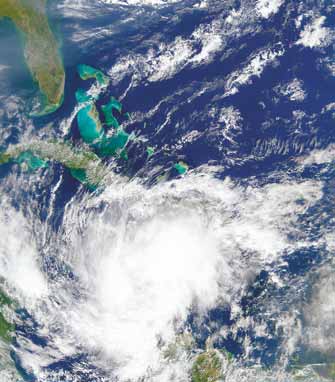
T
C
A
Global change
IMP
the Caribbean islands are extremely vulnerable to any impacts of global
climate change, for example climate variability and sea level rise.
Environmental assessment and monitoring of the actual and potential
impact of climate change and natural disasters on coastal areas and
In Saint Vincent and the Grenadines, it has been reported that, "if climate
drainage basins is emerging as a major concern for all of the countries
change is responsible for the intensity of storms and storm surges over
in the Caribbean Seas/Small Islands sub-system. All Caribbean countries
the last fi ve years, then it is responsible for major coastal erosion on
have signed the United Nations Framework Convention on Climate
Saint Vincent" (GEF/CEHI/CARICOM/UNEP 2001). Some shorelines on
Change (UNFCC). The countries have not yet been able to measure
the northern windward side of the island have receded as much as
whether the sea level has risen as a result of global climate change, but
25 m over the last fi ve years. Hurricane Lenny destroyed 10 m of coastal
nevertheless, they are examining the possible scenarios and how to
forest that had stood for over 50 years. Increased storm activity also
address them. Hazards, induced by global change are a serious issue for
results in heavy rainfall, which has signifi cant negative eff ects on the
the region. The countries in the sub-system are continuously aff ected
coastal environment.
by hurricanes and, less frequently, tornadoes, earthquakes and volcanic
eruptions. These events often produce fl ooding and landslides in areas
Coral reefs in the sub-system are under stress from natural processes,
where anthropogenic activities, such as deforestation and construction,
mainly hurricanes. Hurricane Hugo (1989) signifi cantly aff ected the
have destabilised the land (GEF/CEHI/CARICOM/UNEP 2001).
coral reefs of Antigua & Barbuda. Hurricanes have also infl icted serious
damage to the southern and southeastern reefs, but signs of recovery are
Assessing the impacts of global change on the environmental and
evident. Hurricane Luis (September 1995), Marylin (1995), Jose (1998) and
socio-economic integrity of the sub-system is problematic due to
Lenny (1999) caused additional stress to the country's reefs (Figures 12
a lack of data since this has only recently arisen as a major concern.
and 13) (Offi
ce of the Prime Minister 2001). Prior to Hurricane Lenny
This fact obstructs the estimations for increased UV-B radiation as a
(1999), Malgretoute, in Saint Lucia, was characterised by high densities
result of ozone depletion and for changes in ocean CO source/sink
of the sea urchin Diadema antillarum and low algal abundance at depths
2
function. Although changes in sea temperature resulting from global
of 3 m, but following the hurricane urchins declined from 1.4 to 0.1 per
warming is not a GIWA issue, studies by Roach (2003) stated that "Coral
m2 and a proliferation of fi lamentous algae (Smith et al. 2000). There
bleachingrelated mainly to rising sea temperature has aff ected other
parts of the world to a much greater extent than the Caribbean so far,
(...). However, the threat of climate change...remains a serious concern
for the future."
Although there is a dearth of information describing changes in
UV-B levels, employment of the precautionary principle dictates that
the impacts of UV-B radiation should be assessed as slight. The impacts
of changes in ocean CO source/sink functionary were also assessed as
2
slight due to a lack of information. These issues have not been assessed
or measured, but it is not recommended to establish that there is no
known impact.
Environmental impacts
Changes in the hydrological cycle
The impact of changes in the hydrological cycle due to climate change
is assessed as moderate in the Small Islands sub-system. Changes in
the hydrological cycle are documented in some islands, where there
is increased fl ooding and incidences of extreme weather phenomena.
Nevertheless, data describing the impacts of climate changes on
ecosystems is limited, and estimations are made by extrapolating from
Figure 12 Hurricane Lenny in the Caribbean Sea, 1999.
other islands such as those in the Pacifi c. There is however no doubt that
(Photo: NASA)
42
GIWA REGIONAL ASSESSMENT 3A CARIBBEAN SEA/SMALL ISLANDS


Luis
1995, aff
ected pe
rsons: 44 800
Georges 1998
Lili, affected 300
, affected persons: 10 000
Lenny, affected 1 180
Cindy
Marilyn, affected 10 000
Luis, affected 1 800
1993, aff
Iris 2001, affected persons: 175
ected persons: 3 010
Georges, affected 10 000
Lenny, affected 899
Hurricanes 1992-2002
Lili
Iris, affected 175
2002,
Luis, affected 3 000
affe
Cindy - 1993
cted
Lenny, affected 715
pe
Klaus, affected 1 500
rsons:
Debby - 1994
Lenny 1999, affected persons: 2 724
2 3
Lenny, affected 600
00
Georges - 1998
Cindy, affected 3 010
Lenny, affected 200
Iris - 2001
Debby, affected 750
Lenny - 1999
Lili - 2002
Lenny, affected 100
Luis, affected 40 000
Luis - 1995
Arthur, affected 1 000
Lili, affected 2 000
Marilyn - 1995
Lenny, affected 210
Less disastrous
Proportion of
affected people*
*People requiring immediate assistance during
a period of emergency, i.e. requiring basic
survival needs such as food, water, shelter,
sanitation and immediate medical assistance
© GIWA 2004
Figure 13 Hurricanes and the number of aff ected peoples (requiring immediate assistance during a period of emergency) during 10 years
in the Small Islands sub-system.
(Source: NOAA 2004, Center for Research on the Epidemiology of Disasters 2004)
was a 3% decline in coral cover between 1997 and 1998. The unusual
and even small changes could produce permanent environmental
track of this hurricane resulted in severe wave action on the leeward
damage, severely aff ecting the islands' economies (GEF/CEHI/
coast of Saint Lucia, severely damaging coastal infrastructure. Data from
CARICOM/UNEP 2001).
west coast reefs indicate live coral cover was generally higher than 50%
prior to the series of storms in 1994 (Smith et al. 2000). This began with
The studies referred to by Roach (2003) for National Geographic News
Hurricane Debbie, the sedimentation from which reduced coral cover
states that the composition of coral species has changed over the past
by 50% at some sites, particularly near large river mouths. The passage of
25 years. Many of the new coral growth comes from species known as
numerous storms through the British Virgin Islands since 1995, and more
non-framework builders that do not contribute to the growth of reef
recent hurricanes, such as Jose and Lenny in late 1999, caused severe
structure. "If this is a widespread phenomenon, then there is serious
damage in dive sites at Morman Island, Peter Island, Salt Island, Cooper
concern about the capacity of Caribbean reefs to cope with rising sea
Island, Ginger Island and Virgin Goda (Smith et al. 2000).
levels," (...) (Roach 2003).
Sea level change
Socio-economic impacts
The impact of sea level change were assessed as slight. This issue is
Economic impacts
important for the islands but there are no statistics on sea level rise. Sea
Considering the number and importance of economic and public
level monitoring equipment has only recently been established in the
sectors that could be aff ected by global change (tourism, agriculture,
region. Nevertheless, experts estimate that sea level change currently
fi sheries, etc.), its economic impacts on the Small Islands sub-system are
has less impact than changes in the hydrological cycle.
considered severe even if no infromation about the current economic
impacts is available for the sub-system. The coastal region is the most
The possible eff ects of climate change on coastal water levels and
economically valuable area on most islands and even small changes
temperatures are a threat to the fragile coral reef ecosystems. The
could produce permanent environmental damage, severely aff ecting
coastal region is the most economically valuable area on most islands
the islands' economies (GEF/CEHI/CARICOM/UNEP 2001).
ASSESSMENT
43
Tourism and agriculture are two of the sectors that could be aff ected
Another impact from global change in the Small Islands is the high cost
by global change which being the primary economic sectors of the
of coastal protection and impacts from salt intrusion. The Small Islands,
Small Islands. Tourism's total contribution to the OECS's GDP was 10% in
like other coastal areas, face diffi
cult decisions in confronting the adverse
1996. The contribution of the agricultural sector to the GDP of Antigua
eff ects of global climate change and the associated sea level rise. There
& Barbuda, Grenada, Montserrat, St. Kitts & Nevis, Saint Lucia and Saint
could be signifi cant costs from protecting the islands from sea level rise
Vincent & The Grenadines was 8.5% (World Bank Caribbean Division
which may not be viable considering the size of their economies, however
1994).
no information from the sub-system is available (CPAAC 2000).
Climate change aff ects tourism in many ways, directly and indirectly,
The impacts of climate change largely depend on the initial condition of
for example: loss of beaches due to erosion, fl ooding, degradation of
the water supply system and on the ability of water resource managers
ecosystems and related impacts (e.g. loss of coral reefs to bleaching,
to respond, not only to climate change but also to population growth
saline intrusion), as well as damage to critical infrastructure. These are
and changes in demands, technology and economic, social and
only a few consequences that could undermine the tourism resource
legislative conditions (MPDEH 2002).
base of vulnerable small island states (Alm et al. 1993). Although some
of these impacts can be triggered by non-climate related factors, there
Health impacts
is a growing consensus that climate change is likely to precipitate
The health impacts were assessed as slight. Some assessments of
such changes, and that they could be disruptive (Holthus et al. 1992,
the impacts of climate change on health predict that increases in
Pernetta 1992, Sestini 1992, IPCC 1996, SPREP 1996 in IPCC 1997). There
temperature and humidity could lead to the proliferation of species,
is evidence that any disruption in the tourism sector would have severe
such as the Aedes aegypti mosquito, which could result in outbreaks of
repercussions for the economic, political, and socio-cultural integrity of
dengue fever and malaria but no information is available for the Small
many small islands (IPCC 1998).
Islands sub-system. Furthermore, temperature increases could aff ect
the elderly and very young by an increase in respiratory diseases (GEF/
Some studies of the impacts of climate change have predicted that
CEHI/CARICOM/UNEP 2001).
a minimum temperature rise of 1°C may decrease sugar production
by approximately 7.4 tonnes per ha. In addition, temperature rise can
Other social and community impacts
negatively impact yields of transitory crops grown in subsistence
Other social and community impacts were assessed as severe. One
agriculture (GEF/CEHI/CARICOM/UNEP 2001).
of the most important social and community impacts due to global
change is the availability of potable water and, at present, access to an
Taking into account the increase in storm frequency resulting from
improved water source is partial in some islands. Saltwater intrusion
global change, the economic costs of these phenomena on the islands
in coastal aquifers is negatively impacting water supply. A reduction
should be considered. At present, there are documented fi gures for the
in rainfall could decrease the rate of groundwater recharge. Elevated
OECS islands on the economic losses caused from tropical storms and
temperatures will increase the evapotranspiration rate which, together
hurricanes, which could be provided as evidence. The cost of damage
with less precipitation, will reduce water stored in reservoirs. Greater
to fi ve OECS states from hurricanes Luis and Marilyn in 1995 is given
demand and less water availability per capita is expected (GEF/CEHI/
in Table 9.
CARICOM/UNEP 2001).
Table 9
Cost of damage from hurricanes Luis and Marilyn.
As an example of the social impacts of global change, in the US Virgin
Cost of damage
Islands, Hurricane Georges impacted the territory in September 1998,
Country
USD
% of GDP
resulting in a decrease in the number of commercial fi shermen for 1998-
Anguilla
94 000 000
147
1999 (Tobias et al. 2000). While all commercial fi shermen suff er gear
losses due to severe storms, hurricanes typically cause a reduction in
Antigua & Barbuda
300 000 000
71
the number of part-time fi shermen in the commercial fi shery due to
Montserrat
3 000 000
5.4
the secondary importance of fi shing as an income and the immediate
Dominica
97 000 000
53
increase in construction jobs following the hurricane.
St. Kitts & Nevis
197 000 000
105
(Source: ECLAC 2000)
44
GIWA REGIONAL ASSESSMENT 3A CARIBBEAN SEA/SMALL ISLANDS
Conclusions and future outlook
The justifi cation of scores was presented in the Assessment section.
External factors are crucial for the current and future conditions of
However, some relevant issues supporting the priority concern for the
global change in the Small Islands sub-system. Hazards originating
Small Islands sub-system, Habitat and community modifi cation, are
from global change are a serious problem for the region. The islands
presented below:
are often impacted by hurricanes, and with less frequency, but just as
damaging, are tornadoes, earthquakes and volcanic eruptions. Based
The Small Islands depend almost exclusively on their ecosystems, which
on the current level of understanding, the main environmental issue
are very fragile and vulnerable, and any alteration can infl uence the
caused by global change is changes in hydrological cycle and ocean
whole system. The ecosystems and their resources are indispensable in
circulation. The main socio-economic concern is the cost of protection
maintaining the dynamic equilibrium of the islands. The importance of
from, or adaptation to, global change.
surface and coastal ecosystems for small islands has been highlighted,
considering that there is not much investment in preventive strategies,
The impacts of climate change will tend to increase in the future if no
due principally to high costs. There is more attention directed towards
regulations are implemented, and it will aff ect all the other concerns
remedial actions, incurring subsequential socio-economic costs. Many
and sectors. This is a global concern which needs to be addressed at an
islands depend on sandy shorelines, coral reefs and mangroves for
international forum, while regional management systems should focus
protection from waves and natural hazards, such as tropical storms and
their attention on more immediate and local concerns.
communities, on marine resources and tourism for their livelihood. Even
in the absence of climate change (for example sea level rise) and other
environmental concerns, small islands are highly vulnerable to natural
or anthropogenic impacts (GESAMP 2001).
Priority concerns for further
analysis
Pollution is also important in its relation to habitat modifi cation.
Pollution of freshwater supplies (surface and groundwater) and
The geographical extent of countries in the Small Islands sub-
sedimentation or erosion, caused by human activities such as
system, their ecological fragility, small populations, limited resources,
infrastructure development, or changes in river fl ows, decrease natural
geographic dispersion and isolation from markets are all characteristics
resources. It furthermore contributes to the degradation of terrestrial,
of Small Island Developing States (SIDS) and place them at an economic
coastal and near-shore marine ecosystems, including a reduction
disadvantage. For the SIDS, the ocean and coastal environment is of
in biodiversity (critical salt-pond, mangrove, estuary, seagrass and
strategic importance and constitutes a valuable development resource.
coral reef systems), and aff ects the health of human populations and
However, one of the most important demands on the environment is
economic activities. The health risk to the population is associated with
that of a volatile tourism industry, with rapid economic cycles and high
poor quality freshwater and water used for recreational purposes. In
vulnerability to recessions in developed countries.
countries like Barbados, protective reef systems have been degraded
by eutrophication caused by faecal material in water, contributing to soil
The GIWA concerns were prioritised as follows:
erosion and beach destruction (PNUMA 1999b in UNEP 2000a).
1. Global change
2. Habitat and community modifi cation
In order to strengthen this analysis, it is important to consider human
3. Pollution
population densities and sustainability as variables, since excessive
4. Freshwater shortage
population growth (permanent or temporal) jeopardises environmental
5. Unsustainable exploitation of fi sh and other living resources
conditions, thus aff ecting available resources (including freshwater
and living resources). The islands' economy largely depends on
The GIWA assessment determined that the concern of Global change
marine tourism as its major source of income. Uncoordinated tourism
exerted the greatest impact on the Small Islands sub-system. However,
development and the infl ux of additional tourists can limit the local
since it is an international concern addressed through other initiatives
resources base and services to such an extent that the initial tourist
(e.g. the United Nations Framework Convention on Climate Change),
attractions may be destroyed. Tourism increases demand for energy
Habitat and community modifi cation was therefore selected as the
and water supplies, increases sewage, competes for land resources
GIWA priority concern for further analysis in the Causal chain and
and perturbs coastal and marine ecosystems (GESAMP 2001, Bernal
Policy options analysis.
& Cicin-Sain 2001).
ASSESSMENT
45
Freshwater pollution in the Small Islands sub-system is not strictly a
transboundary issue since there are no shared freshwater resources.
However, the islands are aff ected by the large river systems of the
neighbouring continental countries, such as Venezuela and Guyana.
This transboundary impact between the continent and the islands may
be aff ecting habitats and associated species communities. Additionally,
the islands are on the transit route of oil tankers, which is also a clear
transboundary issue.
Some conclusions from other organisations support the assessment of
the Small Islands sub-system, in accordance with the following issues:
The fi ve environmental impacts considered by GIWA were also
considered by the Barbados +5 Convention in 1999, when the
experts identifi ed four problem areas as priorities for the next
5 years (2000-2005) as follows: coastal and marine resources
(protecting coastal ecosystem from pollution and overexploitation);
freshwater resources (preventing further freshwater shortages
associated with growing demand); climate change (adaptation);
and tourism (managing tourism growth to protect the environment
and cultural integrity) (Bernal & Cicin-Sain 2001).
The recent UNEP/EU publications (i.e. Global Environment Outlook
reports) for the Caribbean mention that the common environmental
problems in SIDS are: loss of marine and terrestrial ecosystems;
threats to freshwater resources (potential climate change impacts
such as salt intrusion or changes in the hydrological regime, and
the pressure from growing population and tourism development);
climate change; and land and sea-based pollution (Bernal & Cicin-
Sain 2001).
Finally, the working group 7 at the Global Conference on Ocean
and Coasts at Rio+10, recognised the importance of the above
mentioned concerns for the islands, especially regarding the
environmental issues, since an considerable gap was identifi ed in
ecosystem monitoring, bio-prospecting, essential data collection
and research for food security and economy reform.
46
GIWA REGIONAL ASSESSMENT 3A CARIBBEAN SEA/SMALL ISLANDS
Causal chain analysis
This section aims to identify the root causes of the environmental
National and regional communications systems and policies are
and socio-economic impacts resulting from those issues and
weak;
concerns that were prioritised during the assessment, so that
Small island size equates with limited human resources and
appropriate policy interventions can be developed and focused
consequent limited capacity. As a result, public administration is
where they will yield the greatest benefi ts for the region. In order
costly and basic infrastructure is weak with low technology.
to achieve this aim, the analysis involves a step-by-step process
that identifi es the most important causal links between the
For the Causal chain analysis (CCA) of the Caribbean Sea/Small Islands
environmental and socio-economic impacts, their immediate
sub-system, it is necessary to mention that the whole sub-system is
causes, the human activities and economic sectors responsible
studied, rather than a specifi c case study, as was undertaken for sub-
and, fi nally, the root causes that determine the behaviour of those
system 3b Caribbean Sea/Colombia and Venezuela and 3c Caribbean
sectors. The GIWA Causal chain analysis also recognises that,
Sea/Central America and Mexico. The focus of the CCA is to determine
within each region, there is often enormous variation in capacity
the root causes of habitat and community modifi cation in the sub-
and great social, cultural, political and environmental diversity.
system, so that the driving forces of the issues can be addressed by
In order to ensure that the fi nal outcomes of the GIWA are viable
policy makers rather than the more visible causes. This process traces
options for future remediation, the Causal chain analyses of the
the cause-eff ect pathways, associated with the habitat and community
GIWA adopt relatively simple and practical analytical models and
modifi cation concern from the socio-economic and environment
focus on specifi c sites within the region. For further details, please
impacts identifi ed in the assessment back to the root causes. The root
refer to the chapter describing the GIWA methodology.
causes can then be targeted by appropriate policy measures.
The United Nations Commission for Latin America and the Caribbean
Due to the geographical location of the Small Islands sub-system, the
(ECLAC) produced the report "Small Island Developing States Programme
islands aquatic systems are vulnerable to a multitude of impacts of
of Action for Sustainable Development: Opportunities and Constraints"
local and transboundary origin. A number of regional initiatives and
(Ismael 1998) which identifi es some of the particular vulnerabilities of
conventions have been undertaken to address the concern of habitat
Caribbean Small Islands Developing States (SIDS) such as:
modifi cation and the pollution that often triggers these environmental
Economies are largely undiversifi ed, highly open and excessively
changes. These include the following:
dependent on trade and export of very few goods;
Demonstration of Innovative Approaches to the Rehabilitation of
Islands are highly dependent on preferential access to export
Heavily Contaminated Bays in the Wider Caribbean (GEF/UNDP/
markets;
UNEP);
Countries are highly vulnerable to fl uctuations in commodity prices
Reducing
Pesticide
Run-off to the Caribbean Sea (GEF/UNEP);
(e.g. oil);
Integrated Freshwater and Coastal Zone Management in Small
The islands are highly vulnerable to natural disasters, such as
Island Developing States (GEF/UNEP);
hurricanes, which can wipe out the entire productive capacity of a
Cartagena Convention and its protocol (see Regional defi nition,
country in a few hours;
Legal framework).
CAUSAL CHAIN ANALYSIS
47
Impacts
Issues
Immediate causes
Sectors/Activities
Root causes
Environmental:
Habitat and
Degradation of coral reefs,
community
Erosion
Legal
Agriculture
mangroves and seagrass
modification
beds
Reduced productivity
Modification and loss of
biodiversity
Pollution
Urbanisation
Demographic
Changes in the community
structure
Socio-economic:
Coastal
Tourism
Economic
Loss of opportunities from
development
the tourism sector
Loss of income from fishery
and
tourism
Loss of land and coastal
Introduction of alien
Mining
infrastructure
species
Technological
Increased resource use
conflicts
Loss of educational value
and opportunities for
Industry
scientific
research
Knowledge
Loss of food security
Cost of control of alien
species and ecosystem
restoration
Aquaculture
Overfishing and
Governance
destructive fishing
practices
Fishery
Natural causes
Figure 14 Causal chain diagram illustrating the causal links for habitat and community modifi cation.
A description of the system can be found in the regional defi nition
1995 and 2001, reefs in the Soufriere area lost on average 47% of coral
section, since the casual chain analysis is for the whole sub-system and
cover in shallow waters and 48% of the coral cover in deeper waters.
not case specifi c.
On the northwest coast of Saint Lucia, 82% of the reefs are either dead
or in poor condition (Department of Fisheries 2003a,b).
Modifi cation and loss of biodiversity
Environmental and socio-
In Antigua & Barbuda for example, loss of nesting habitat was considered
economic impacts
to be the greatest threat to the three species of endangered sea turtles
(Eretmochelys imbricata, Chelonia mydas, Dermochelys coriacea), which
Figure 14 illustrates the main causal links for habitat and community
are the only marine reptiles to nest on the islands (Offi
ce of the Prime
modifi cation in the Small Islands sub-system. This concern in the region
Minister 2001).
has resulted in the following environmental and socio-economic
impacts (for further explanation refer to Assessment, Habitat and
Changes in the community structure
community modifi cation):
There has been gradual loss of numerous species of invertebrate
animals found within each of the islands' vegetation communities.
Environmental impacts
Degradation of coral reefs, mangroves and seagrass beds
Reduced productivity
Coral reefs and other marine ecosystems, as well as fi sheries resources,
The concentration of suspended and dissolved solids has increased,
have been degraded and statistics show that around 35% of the
resulting in greater turbidity of freshwater bodies and coastal waters.
Caribbean species are overexploited (FAO 1997c in UNEP 2000b). The
This has modifi ed these ecosystems by increasing turbidity and
degradation of mangroves and seagrass beds has aff ected important
thus decreasing the amount of light penetrating surface layers and
nursery grounds for many reef dwelling fi sh. There has also been
consequently reducing the productivity of freshwater and marine
widespread coral mortality. In for example in Saint Lucia, between
photosynthetic plants and corals.
48
GIWA REGIONAL ASSESSMENT 3A CARIBBEAN SEA/SMALL ISLANDS
Socio-economic impacts
Erosion through deforestation and land
Loss of opportunities from the tourism sector
clearance for agriculture
The successful promotion of tourism is strongly correlated with
In tropical islands, like Dominica and Saint Lucia, deforestation and
the quality, ambience and aesthetic value of the environment.
the cultivation of steep slopes causes considerable land degradation.
The degradation of the islands habitats will ultimately reduce the
For example, in the 1980s, large areas of prime rainforest were cleared
marketability of the islands. Tourism revenues are often directly
in the small islands of the eastern Caribbean to make way for banana
impacted by habitat modifi cation, particularly coral reefs, because of
plantations. Today, many of these once productive banana fi elds have
the loss of amenity value for activities, such as fi shing, snorkelling, diving
been abandoned, and left exposed to erosion processes (Colmore 1999).
etc. Any damage to the ecosystems of the islands will impact on their
Private forested land is particularly prone to deforestation as owners
entire economies due to the importance of the tourism sector, which
are free to clear the land to accommodate farming, land sub-division
is the primary source of foreign investment and income.
for housing and other activities. Land degradation has increased the
quantities of sediments entering aquatic systems via surface-run-
Loss of income from fi shery and tourism
off . This has modifi ed these ecosystems by increasing turbidity and
There has been a loss of economic benefi ts previously provided by
sedimentation.
the ecosystems. Degradation of the coral reef, mangrove and seagrass
beds has reduced the productivity of the fi sheries and subsequently
Pollution
the foreign currency received from this industry.
High sediment loads and agro-chemicals, and the discharge of raw
or only partially treated sewage are stressing coastal and freshwater
Loss of food security (fi shing)
ecosystems. Eutrophication as a result of nutrient inputs from
The ecosystems provide nutritional benefi ts and economic activities
agriculture and urban wastes, and a reduction in algal grazers, has
and the modifi cation has reduced the capacity of the local populations
degraded many of the reefs in the region, due to a proliferation of
to meet their basic human needs.
algae blocking out sunlight and deoxygenating the water. For example,
during the 1980s, many shallow reefs around Grenada & The Grenadines
Cost of control of alien species and ecosystems restoration
were degraded and became overgrown with algae, presumably
There have been increased costs of controlling invasive species and
resulting from a combination of sewage and agro-chemical pollution,
costs of restoring modifi ed ecosystems. There are then subsequent
and sedimentation caused by coastal development (Smith et al. 2000).
costs of artifi cially protecting the coastline.
Pollution from heavy metals and pesticides have been found in
sediments and animals; only on Martinique and Guadeloupe, 1 500 to
Increased resource use confl icts
2 000 tonnes of pesticides are imported per year (Smith et al. 2000).
The modifi cation has caused a loss in recreational value and aff ected the
cultural integrity of local communities. Confl icts have arisen between
Coastal development
tourism and other water-based activities, particularly fi shing, due to
There has been unplanned and uncontrolled development of
greater competition for the diminished ecosystem resources.
settlements on the islands, which has destroyed habitats directly
through the clearance of land and indirectly through the propagation
Loss of land and coastal infrastructure due to lack of physical
of pollution, due to the absence of facilities to adequately treat sewage
protection
(including grey water), and dispose of solid wastes. Furthermore, these
The loss of physical protection from coral reefs, mangroves and seagrass
settlements are often constructed at locations vulnerable to events
beds has degraded land and coastal infrastructure.
such as landslides, fl oods, and storm surges, which were previously
stabilised and protected by terrestrial fl ora, coral reefs, seagrass beds,
mangroves, beaches, or wetlands. The removal of these coastal habitats
for urban development removes natural wave breakers and therefore
Immediate causes
increases erosion with associated impacts of greater turbidity and
sedimentation in freshwater bodies and coastal waters.
The immediate causes of habitat and community modifi cation in the
Small Islands sub-system are diverse with complicated interactions and
Tourism is also aff ecting the health of coastal ecosystems through
synergies. Below are some of the major causes of the concern.
the construction of developments in close proximity to the shoreline,
CAUSAL CHAIN ANALYSIS
49
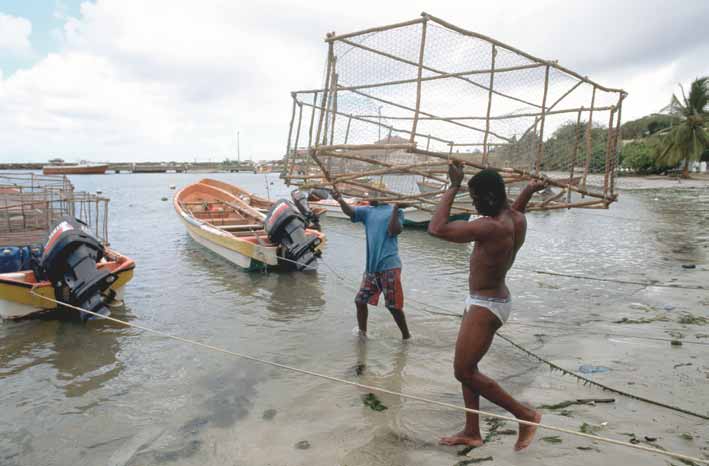
Figure 15 Fishermen carry large fi sh traps out to their boats on the shore at Vauclin, Martinique.
(Photo: Corbis)
harbour dredging, the destruction of mangroves, anchoring on reefs
Overfishing and destructive fishing practices
and seagrass beds, and pollution. The issue of construction in coastal
Overfi shing and the use of destructive fi shing methods such as
areas is illustrated in Antigua & Barbuda where 39 of the 55 hotels have
explosives, poisons and inappropriate nets and traps (Figure 15) have
a beach-front location (GEF/CEHI/CARICOM/UNEP 2001).
negatively aff ected key ecosystems such as coral reefs, seagrass beds
and mangroves. In for example the Cayman Islands, the increasing use
Signifi cant areas of wildlife habitat in both terrestrial and marine
of large, small-meshed fi sh traps has caused localised depletion, and
ecosystems have been eliminated to accommodate development. In
four spawning aggregations of Nassau grouper (Epinephelus striatus) are
recent years, the clearing of natural vegetation and alteration of beaches
intensively fi shed with hand-lines, resulting in a decline in the average
has facilitated the development of the tourism industry, while divers
size and catch-per-unit-eff ort.
and boat operators have damaged coral reefs. The US Virgin Island have
lost over 50% of the territory's mangrove habitat during the last 70 years
due to land clearance and land fi ll operations to create development
sites or provide access to water (DPNR/DEP & USDA/NRCS 1998).
Root causes
Introduction of alien species
It is evident that attempts to protect marine habitats without addressing
Several fi sh species have been introduced to the sub-system via
social, cultural and economic issues are likely to result in the continued
aquaculture, which has upset the existing ecological balance of
unsustainable use of resources and extinction of species. What is
sensitive habitats such as coral reefs. Seagrass beds are known to have
therefore needed is an integrated approach to natural resource
been aff ected by predation from invasive urchins but there is a lack of
management and biodiversity conservation, which takes into account
data concerning the impacts.
the realities of the below mentioned root causes.
50
GIWA REGIONAL ASSESSMENT 3A CARIBBEAN SEA/SMALL ISLANDS
Legal
environments. Communities do not recognise that the resources, upon
Commendable eff orts have been made to protect and preserve the
which their survival depends, are being depleted at an irreversible rate.
coastal and marine resources of the Caribbean islands through a series
This can be attributed in part to the absence of public awareness
of international conventions and subsequent legislative frameworks.
and education programmes to encourage communities to conserve
However, national legislation inadequately incorporates conservation
ecosystems, and mechanisms to valuate environmental goods and
measures and the administration of the relevant legislation is the
services. These are necessary to change perceptions and attitudes
responsibility of several governmental agencies with weak institutional
towards conservation and environmental responsibility.
provisions for the coordination of environmental initiatives across the
various sectors. This compromises the eff ectiveness of relevant legal
Insuffi
cient collection and management of data
and policy instruments. There is also a lack of regulations to provide
Insuffi
cient attention is given to the collection and management
the necessary guidance for managers and enforcers to implement
of relevant data, resulting in a severe lack of information regarding
legislation. Overall, there is an urgent need for appropriate legislation
coastal processes (e.g. wave data, current data, shoreline dynamics)
and to build capacity in the relevant institutions in order to better
to make informed planning and management decisions. Furthermore,
coordinate and enforce relevant initiatives regarding the environment.
Geographic Information Systems (GIS) are not being utilised in coastal
zone management. Due to fi nancial diffi
culties in the region, scientifi c
Demographic
and technical research does not receive suffi
cient funding and has
The majority of the islands populations inhabit the coastline where
not been perceived as a priority by the countries of the Small Islands
there are greater economic opportunities and ecosystem services.
sub-system. The region has an absence of performance indicators for
Population growth has increased the demand for appropriate lands,
monitoring and evaluation, with inadequate human resources and weak
for agriculture, commercial, residential and tourism purposes. These
logistical assistance (e.g. scientifi c technologies, vehicles). There is an
factors have increased the pressure on coastal ecosystems, and
absence of centralised and coordinated regional, and limited national
consequently modifi ed habitats through the sprawl of urban areas
databases.
and the development of economic activities.
Technological
Economic
Inadequate measures to control pollution
Poverty and unemployment
Currently there are inadequate services to treat and dispose sewage. While
Endemic poverty and high unemployment is a catalyst for
industrial discharges are currently a relatively minor problem in most of
environmental degradation. For their short-term survival the population
the Small Islands sub-system, the continued discharge of untreated and
exploits natural resources at an unsustainable level. There are a lack
unregulated effl
uent will likely pose severe problems to marine habitats
of opportunities to diversify livelihood strategies when ecosystems
in the future if control measures are not put in place. Agricultural run-off
services become stressed. The needs and requirements of individuals
and human organic waste products are the more serious priority issues
and communities are not given equal importance at the policy and
of concern. In many of the islands there is only very limited capacity to
decision-making level. Furthermore, governments in order to alleviate
handle and treat wastewater, and much of it enters freshwater basins
poverty, formulate development agendas to stimulate economic
and/or coastal areas directly untreated or only partially treated.
growth and provide employment, rather than ensuring sustainable
development.
This situation can only be addressed eff ectively through linking of
various sector projects to long-term planning and development
Knowledge
strategies. Such programmes must be regularly evaluated through
Lack of understanding of environmental concepts and absence
development and eff
ective implementation of monitoring
of public awareness and educational programmes
programmes. Fundamentally the issue of agricultural pollution and run-
There is limited understanding from the public to policy makers of
off focuses back on the need to move away from an economy which
the importance in maintaining aquatic ecosystems for the long-
has traditionally depended on revenues and incomes from high crop
term sustainability of their services. There is a lack of realisation of
returns (often depending on monocultures such as bananas) within
the importance natural systems play in protecting human interests,
limited land space and to look for other forms of associated income
for example, the fi ltering of sediments and other pollutants by
(such as certifi ed organic produce) as well as to the need to diversify
mangroves that would otherwise diminish water quality in near-shore
the economy to make it less vulnerable. It also refl ects the need for land
CAUSAL CHAIN ANALYSIS
51
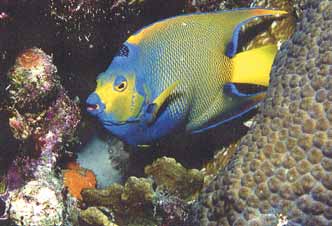
use and water resources management policies that identify the most
Lack of long-term cross-sectorial development planning
appropriate uses for limited land resources.
Development planning in the Small Islands sub-system is highly
fragmented, focusing exclusively on sector planning with little or
Governance
no national coordination or long-term perspective. The absence of a
Inappropriate development strategies
coordination mechanism results in the many management strategies
All of the countries in the Small Islands sub-system have a narrow
of the diff erent governmental departments confl icting rather than
economic base with many of the islands reliant on either export-
cooperating to resolve problems and enable balanced cross-sectorial
agriculture or tourism as a source of government revenue and private
development. Too often, action to achieve objectives in one policy area
sector income. In many islands agriculture is the primary sector of the
hinders progress in another. In addition, the absence of a long-term
economy and is based on a monoculture, such as sugar and bananas.
perspective has resulted in development that is skewed towards certain
This has saturated the market, and required greater land to be allocated
communities and/or sectors in the economy, resulting in an inequitable
to these crops as commodity prices have fallen, and increased
distribution of resources and benefi ts.
dependence on agro-chemicals to maintain harvest levels. Inevitably,
market forces punish such a single crop-dependency and prices fall,
Lack of stakeholder participation
which may lead to a relative collapse in the economy.
Public participation has been lacking in current approaches to planning.
This has resulted in the population feeling a sense of indiff erence to
In recent years, many of the islands have seen tourism as the main
development activities despite it being them that are most aff ected by
opportunity to replace the lost income from agricultural crops.
the associated impacts.
Again there is a dependency developing on a single principle source
of income, which will inevitably prove to be risky and potentially
dangerous strategy in the long-term.
Environmentally these trends are also unsustainable. The intensifi cation
of agriculture, further clearance of land for expanded planting, and the
need for additional water for irrigation translates into the destruction
of habitats, changes in the water table and hydrological regime, and
increased levels of toxic chemicals and nutrients in watershed and
coastal waters. The accumulation of which results in severe degradation
of coastal and marine habitats.
The transformation of economies towards greater dependence
Figure 16 Queen
angelfi sh (Holcanthus ciliaris).
on tourism has resulted in other pressures. The need for land for
(Photo: D. F. Colvard, The Coral Reef Alliance)
development (particularly around coastlines) along with the demand
for building materials and increased pressures on infrastructure (energy,
waste disposal, food supplies, etc.) inevitably leads to environmental
Lack of coordination
damage and ecosystem stress. Consideration of these environmental
Environmental and land use management is fragmented, with ill-
concerns is given lower priority than the drive for economic expansion.
defi ned and often confl icting responsibilities between government
As a consequence, vitally important and sensitive ecological transition
agencies and stakeholders. There are no institutional arrangements
areas (mangroves, wetlands, river deltas and coastal hinterlands) are
coordinating environmental initiatives across the various sectors
sacrifi ced to become development areas while rivers and coastlines are
and levels of government. This compromises the eff ectiveness of
destroyed in the search for building materials.
relevant policy instruments. Several agencies, both governmental
and non-governmental, are responsible for the conservation of
Development strategies have made unrealistic demands on the limited
natural and cultural resources. This has inhibited the development
resources of the countries, including energy provisions, waste recovery
of a comprehensive framework for the eff ective conservation and
and disposal services, transport and water infrastructure, and food
management of these resources. There is presently a trend to enact
requirements. This has ultimately impacted on the environment.
further environmental legislation, which is overlapping and increases
52
GIWA REGIONAL ASSESSMENT 3A CARIBBEAN SEA/SMALL ISLANDS
the complexity of the legislative framework. This creates confusion and
Political commitment and action
legislation is rarely enforced.
Lack of political commitment to implement policies in the Small Islands
sub-system is often a refl ection of prioritisation at the national level and
Lack of enforcement
the need to address apparently more pressing national concerns. The
One factor contributing to the severity of the problem is that although
challenge to the success of the selected policy interventions will be to
all of the islands have established some aquatic preserves to protect
ensure that the linkages between the protection of coastal and marine
valuable habitat, the authorities lack the necessary manpower and
ecosystem habitats and economic and social priorities are identifi ed,
funding to enforce the regulations (GEF/CEHI/CARICOM/UNEP 2001).
and that holistic, integrated approaches are used in their resolution.
Existing zoning, erosion control and fi shing regulations are not
providing suffi
cient protection against natural and human stresses.
Natural causes
These have caused extensive mortality on reefs on US Virgin Islands
Due to the location of the Small Islands region, the islands are exposed
around St. John and St. Croix.
to hurricanes that produce extreme wave and surge conditions that
can potentially destroy the coastal habitats. Additionally, sea level rise is
The enforcement of legislation is not only constrained by a lack of
causing the inundation of low-lying land and increasing coastal erosion
resources, but also by perceptions and attitudes held by national law
with associated problems of sedimentation in coastal habitats. Periods
enforcement agencies. Environmental off ences are given relatively low
of severe drought over the past two decades in Antigua and Barbuda
priority in comparison to other crimes.
are assumed to have impacted bird populations, as have the almost
annual hurricanes that have hit the country since 1995 (Offi
ce of the
Several islands have established marine reserves and protected areas
Prime Minister 2001).
under national legislation but very few have been actively managed.
The main objective of creating these reserves was to protect
There was a major coral bleaching event in 1998 when sea surface
important habitats such as turtle nesting sites and fi sh nursery and
temperatures exceeded 29°C during September and October (Smith
breeding grounds. However, enforcement of the laws governing
et al. 2000). However, cases of coral mortality were relatively minor,
marine reserves has proven diffi
cult due to their remoteness, a weak
with most corals that were bleached fully recovering. A further threat
enforcement capacity, and as a result of some land-based reserves
to the coral reefs arises from massive volcanic eruptions, particularly in
being privately owned with no legal demarcation of the reserves'
Montserrat (for example in 1995 and 1996) where large quantities of ash
boundaries. Although there has been a trend to increase the number
were deposited on reefs (Smith et al. 2000).
of protected areas, there are generally inadequate management and
enforcement systems in place to ensure that these areas are serving
their intended purpose.
Conclusions
Inadequate human resources
Human and technical resources currently lack capacity to eff ectively
Due the geographical location of the Eastern Caribbean Islands, the
implement environmental policies and projects. National human
Small Islands sub-system is in the convergence area of multiple marine
resource needs should be assessed, as a prerequisite to deciding
impacts, some of them with local and other with transboundary sources.
appropriate training programmes. Irrespective of the nature of policy
Small islands of the Caribbean possess fragile, limited and highly
interventions, it will be critical that capacity building and strengthening
vulnerable coastal and marine habitats, which are been aff ected by
of existing human and technical resources be done. The nature of the
transboundary pollution in particular, sedimentation from continental
capacity building should be determined at the national level through
land masses and maritime traffi
c among another due global change.
comprehensive needs assessments. However, eff orts should be made
These aspects must all be addressed through regional and international
to ensure that training programmes should focus more in-country and
cooperation, monitoring and enforcement.
in-region to allow maximum exposure to stakeholders. Furthermore,
these programmes should be linked to national government's own
needs and fi t into their long-term personnel planning if they have to
be sustainable and eff ective.
CAUSAL CHAIN ANALYSIS
53
Policy options
This section aims to identify feasible policy options that target
The Causal chain analysis identifi ed the root causes of this habitat and
key components identifi ed in the Causal chain analysis in order
community modifi cation. It was found that rapid economic growth is
to minimise future impacts on the transboundary aquatic
the priority of the region's governments, which it has failed to balance
environment. Recommended policy options were identifi ed
with the conservation and protection of ecosystems, in order to achieve
through a pragmatic process that evaluated a wide range of
sustainable development. This can be attributed to institutional
potential policy options proposed by regional experts and
weaknesses that have facilitated a lack of cross-sectorial coordination
key political actors according to a number of criteria that were
and uncontrolled development of the coastal zone. Stakeholders are
appropriate for the institutional context, such as political
not involved during the planning and implementation of development
and social acceptability, costs and benefi ts and capacity for
projects, and therefore the needs of the local community are not
implementation. The policy options presented in the report
considered. For example, there has been inadequate valuation of the
require additional detailed analysis that is beyond the scope
essential income and nutritional benefi ts that habitats provide for local
of the GIWA and, as a consequence, they are not formal
communities, prior to land clearance for development.
recommendations to governments but rather contributions to
broader policy processes in the region.
Regional conventions such as the Convention for the Protection and
Development of the Marine Environment of the Wider Caribbean
The policy options analysis aims to describe the habitat and community
Region (the Cartagena Convention), Convention on Wetlands of
modifi cation issues that need to be resolved or mitigated, and will
International Importance Especially as Waterfowl Habitat, the United
describe alternative courses of action that may be taken by policy-
Nations Convention on the Law of the Sea, Convention for the
makers in the Small Islands sub-system.
Prevention of Marine Pollution by Dumping of Wastes and Other Matter,
among others (se also Annex IV), and national legislation related to
There has been progressive destruction and modifi cation of habitats in
these international agreements, aiming at managing natural resources,
the Small Islands sub-system, as a result of human activities including
have not been entirely implemented due to the lack of capacity of
deforestation, land clearance for agriculture, tourism development,
enforcement agencies and management which is fragmented, with
the introduction of alien species and urbanisation. Pollution has been
ill-defi ned and often confl icting responsibilities between government
caused by the modifi cation of habitats, such as increased sedimentation
agencies and stakeholders. National laws related to the environment
following deforestation, but can conversely alter ecosystems from a
are not harmonised and there is an absence of integrated management
multitude of sources. The region is particularly vulnerable to natural
of the coastal zone at the national and regional level. There is a lack of
hazards such as hurricanes, sea level rise, fl ooding and volcanic
monitoring programmes and appropriate technologies to adequately
eruptions, which frequently disturb habitats. These factors have
assess the current, and predict the future, status of the ecosystems in
degraded important aquatic ecosystems such as mangroves, seagrass
the region, that would allow informed decision-making.
beds and coral reefs, with associated environmental impacts, such
as decreased species diversity and abundance, and socio-economic
A fundamental hindrance to sustainable development is the lack of
impacts, for example, a decline in the fi sheries.
understanding, from the public to policy makers, of the importance
54
GIWA REGIONAL ASSESSMENT 3A CARIBBEAN SEA/SMALL ISLANDS
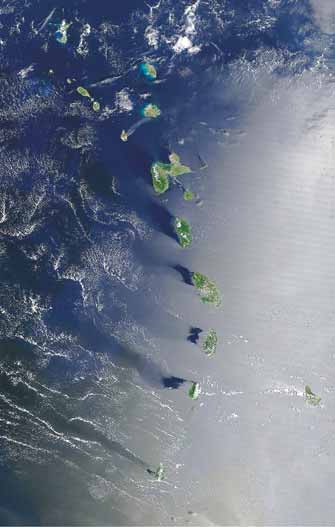
of conserving aquatic ecosystems. This may stem from unsatisfactory
Policy option 1:
incorporation of environmental issues in educational curriculum, and
Strengthening of resource
the lack of public awareness programmes.
management institutions
Political leaders and policy makers must be made aware of the
linkages between considerations such as poverty, unemployment and
This policy option aims to design and implement a strategic plan, in
environmental issues. As part of the development strategies, the small
order to strengthen the institutions, to harmonise the formulation and
islands depended on monocultures, used fertilisers and pesticides, and
implementation of environmental policies, to ameliorate its human
became non-competitive with other countries which have more natural
resource performance, and establish legal instruments for mitigating
products off er. The consequences of theses practices were evident in
and reversing degradation trends in the Small Islands sub-system.
the economy collapse, that was resolved in a certain way with the
tourism income. However, again there is a dependency developing
Justification
on a single principle source of income, which will inevitably prove
A principal root cause identifi ed for the Small Islands sub-system is the
to be risky and potentially dangerous in the long-term. Additionally
inability of governments to achieve economic growth whilst enforcing
the environmental impact of tourism is not estimated in medium and
environmental policies (see Root cause: Inappropriate development
long-term.
These practices have caused destruction of national habitats, alterations
in water tables and fl ow regimes, increased levels of toxic chemicals and
nutrients in drainage basins and coastal areas, and damage to coastal
and marine habitats. Current attempts to relocate economies toward
tourism inevitably results in other pressures. Moreover there is the need
for land for development (particularly around coastlines) along with the
demand for building materials and increased pressures on infrastructure
and the environment (energy, waste disposal, food supplies, etc.). As
a consequence, vitally important and sensitive ecological transition
areas (mangroves, wetlands, river deltas and coastal hinterlands) are
sacrifi ced to become development areas while rivers and coastlines are
destroyed in the search for building materials. Basins are disrupted and
water resources damaged and reduced.
In order to protect the marine biodiversity of the Small Islands sub-
system, conservation must operate at the island-specifi c ecosystem
level. There are selected narrower targets (e.g. endemic and
endangered species) that warrant conservation attention. However,
the most eff ective protection that will provide coverage for the greatest
number of species will require an ecosystem approach. A combination
of national and regional interventions will therefore be required to
address the root causes identifi ed by the Casual chain analysis. This
is especially relevant for the Eastern Caribbean islands, which have:
(i) a arge number of geographically small ecoregions; (ii) relatively small
number of locally and regionally threatened and endangered, unique or
regionally endemic species, especially sparse in relation to the number
of potential habitats or marine ecosystems; and (iii) especially high costs
Figure 17 Lesser
Antilles.
From bottom to top through the center are: Grenada, St. Vincent (with Barbados
of land implying politically sensitive decision-making in the selection
to its east), St. Lucia, Fort-de-France, Dominica, Guadeloupe, Montserrat (slightly
west of center line), Antigua, and Barbuda.
and management of protected terrestrial and marine areas.
(Photo: NASA)
POLICY OPTIONS
55
strategies). There is a need to recognise that some policies are
tourism and build the capacities necessary to diversify tourism
compatible and some are confl icting and identify the trade-off s in
products, while protecting culture and traditions and eff ectively
order to harmonise development strategies.
conserving and managing natural resources.
A prerequisite to the successful design of a strategic plan is to address
Actions at regional level
the Root cause of Insuffi
cient data collection and management.
Reach an agreement among the governments in the Small Islands
Information is essential for informed decision-making and must be
sub-system, for the creation of special protection areas and
timely available to relevant policy makers, through information sharing
development areas.
networks.
Update regional cooperation agreements between the countries
with a view to ensuring sustainable management of the
The sustainable development of small islands is often hampered by
international waters of the Small Islands sub-system.
the lack of appropriate data collection and management systems.
Reform and establish new institutional mechanisms for cooperation
In the absence of adequate data, decisions are made that may have
and consultation so that aquatic resources can be a catalyst for
irreversible consequences and that threaten the resource base over
balanced regional development. For example, the sharing of
the medium to long-term. In accordance with the WSSD Plan of
information and best practices for the management and planning
Implementation, paragraph 19 (WSSD 2002), to address the Root
of the region's protected areas.
cause of Lack of understanding of environmental concepts, there is a
Rehabilitate and develop a permanent network, to monitor
need to "encourage relevant authorities at all levels to take sustainable
water, the environment and the way they are exploited, and to
development considerations into account in decision-making, including
provide better knowledge of the way in which the hydro systems
on national and local development planning". In order to achieve this,
function.
capacity building is needed in relevant authorities so that they can
Initiate an agreement for international environmental standards
utilise data management services.
regarding effl
uent discharges and water quality (both marine and
freshwater).
Actions at national level
Design and implement data collection and management
Promote professional training of personnel responsible for the
system to make informed planning and management decisions.
formulation and implementation of relevant policies to harmonise
Essential links should be created between research programmes,
economic growth and natural resource use.
biodiversity programmes, the fi ght against habitat degradation
Encourage dialogue between enterprises and the communities
and modifi cations in international waters. This should include the
in which they operate and other stakeholders (WSSD 2002,
further use of Geographic Information Systems (GIS) in coastal zone
Paragraph 18b).
management.
Design and implement, with the participation of all the stakeholders
Promote and facilitate at the national level and regional level
involved in coastal zone management, a coastal and marine
the ratifi cation/accession to the Cartagena Convention and its
management plan. This would take a cross-sectorial approach to
protocols; the Oil Spills Protocol, the Specially Protected Areas and
the development of economic activities.
Wildlife (SPAW) Protocol and the Protocol on Land-Based Sources.
Harmonise state policy regarding marine and coastal resources
management, to clarify institutional functions and to identify gaps
Actions at global level
in legislation.
To implement with special emphasis World Summit on Sustainable
Incorporate ratifi ed conventions and international agreements into
Development (WSSD 2002) from recommendations according to the
the national legal framework.
Framework for Action on Biodiversity and Ecosystem Management,
Establish legal borders of protected areas (see Root cause: Lack of
especially:
enforcement).
Building capacities and technology sharing and scaling up
Promote public awareness and education; incorporate general
outstanding examples of best practices of rural communities
environmental issues into the formal education system, and public
throughout the developing world.
educative campaigns though the media.
Building capacities at the local level and empowering local
In accordance with WSSD (2002) paragraph 58g the sub-system
communities to take action as it is at the local level where stress on
should develop community-based initiatives on sustainable
biodiversity occurs.
56
GIWA REGIONAL ASSESSMENT 3A CARIBBEAN SEA/SMALL ISLANDS
Building partnerships among governments, business, farmers, and
Result if positive conditions
local communities as this is the best way to mainstream biodiversity
The results are: (i) plan for institutional, human, and legal strengthening;
concerns into economic and social activity.
(ii) national planning in coastal and marine zone; (iii) regional planning
Look for international cooperation sources that support the
in coastal and marine zones; (iv) greater participation of stakeholders
establishment of natural resources control and monitoring teams.
including the economic sectors and civil society in decision-making,
Identify networks of scientifi c information exchange about natural
through more effi
cient communication mechanisms; (v) monitoring
resources rational use.
and control networks; (vi) versatile information systems, in agreement
with society demands; (vii) improved population awareness of the need
Performance of the policy option
to conserve natural resources; (viii) harmonisation of legal instruments
Eff ectiveness
at national level; (ix) harmonisation of legislation at regional level; (x)
Option impact
establishment of protected areas enforced by legislation; and (xi)
The policy option directly addresses the root causes of Inappropriate
strategies for human resource training.
development strategies and insuffi
cient collection and management
of data, by strengthening the capacity of regional and national
Success probability
institutions, and initiating the collection, management and exchange
The governments have shown a commitment to sustainable
of data. This will allow the design of a strategic coastal management
development, and have now began to realise the necessity of
plan.
preserving their environment especially for the success of tourism
which has become increasingly important in the region. It is therefore
The primary regional benefi ts of the option would be stronger
anticipated that there will be greater willingness to incorporate
institutions for the decision making process at the regional, national
environmental policies in national agendas and implement the
and local level. This should result in coordinated decision making,
principles outlined in the policy option. However, there are many
local communities more empowered to manage their environment
diffi
culties and it is unknown whether governments will forfeit short-
and eff ective mechanisms to implement regional policies at the local
term economic gains for sustainable development. Periods of economic
level for managing natural resources and reversing the trend of habitat
instability may jeopardise public and political commitment to such a
degradation.
policy option, as poverty and unemployment forces the population to
exploit resources at an unsustainable rate for their short-term survival.
Institutional strengthening will encourage inter-sectoral There will be a need to work within existing regional mechanisms to
harmonisation of economic and environmental policies, thereby
ensure long-term capacity to harmonise national polices at the regional
facilitating sustainable development and better preparing the islands
level. The success probability is moderate, due to obstacles, risks and
to attract donor support and investment. There will be improved
diffi
culties.
coordination and environmental planning as the mechanisms
established will allow the harmonisation of economic activities and
Obstacles and risks
the enhancement of human resources should give rise to the eff ective
The principal risks and obstacles to fulfi lling the aims of this option
implementation of further environmental initiatives. A strategic
are: (i) diffi
culty in harmonising inter-institutional environmental and
development plan will enable the countries of the Small Islands sub-
economic policies; (ii) coordination of diverse institutional functions;
system to evaluate, on a continuous and scientifi c basis, the break-
(iii) lack of political will to harmonise plans and projects; (iv) information
down of costs, benefi ts and environmental impacts of proposed
availability; (v) defi cient communication channels at local, national
development works.
and regional levels; (vi) diffi
culties in making national legislative and
regulatory changes in order to harmonise at the national and regional
This policy will open dialogue between authorities and communities
level; vii) fi nancial feasibility; and viii) willingness of all stakeholders to
through a stakeholder participatory process, which will involve
participate.
communities in monitoring and management of natural resources.
Stakeholders will be actively encouraged to participate through links
Effi
ciency
to national institutions that will bring them into the decision-making
Benefi ts
process.
The benefi ts of the policy option will be: (i) improvement of
environmental goods and services management and control, as
POLICY OPTIONS
57
consequence of strong institutions; (ii) development of participative
capital invested in the medium to long-term, as economic activities
democracy in the decision-making process; (iii) effi
cient and effi
cacious
will be stimulated, particularly tourism, as a result of a healthier
harmonisation of national and inter-sectoral public policies; (iv)
ecosystems.
population more environmentally aware; and (v) greater capacity in
institutions for improved decision making at all levels.
Compensation instruments
Compensation instruments must be applied in the case that
Costs
environmental restrictions severely aff ect employment or inhabitant's
Financial costs will be incurred from the: (i) professional improvement
income in the area (as in the case of agriculture and tourism industries).
programmes; (ii) harmonisation of national legal instruments; (iii)
In that case, the possibility to establish professional and technological
design and development of environmental monitoring and control
cooperation programmes should be studied.
networks; (iv) design and development of information systems, data
bases and GIS; (v) construction of national and regional coastal zone
Political viability
management plans; (vi) development of environmental education
Net allies and opponents
programmes and use of the media; and (vii) analyse institutional
Groups that are likely to support the policy instruments include:
functions and capacity.
base communities, non-governmental organisations, international
organisations, state entities (Martinique, Water Society of Martinique;
Benefi ts and costs quantitative estimations
Monserrat, Monserrat Water Authority and the Land Development
There are some references about that on other studies funded by UNEP,
Authority; Netherlands Antilles, Ministry of Development and
Inter-American Development Bank (BID), World Bank and GEF.
Cooperation; Saint Kitts and Nevis, Ministry of Communications
Works and Public Utilities; St Lucia Ministry of Tourism, Mobilization
Equity
and Public Services; Water and Sewerage Authority; Ministry of
Net winners and losers
Planning, Personnel, Establishment and Training; St Vincent and
Winners are the Caribbean, the region's states and inhabitants of the
Grenadines, Ministry of Health and the Environment, Ministry
region as a result of an enhanced quality of life and the long-term
of Agriculture, Industry and Labour, Central Water and Sewage
security of environmental goods and services. Losers are sectors that
Authority, the Physical Planning and Development Board; Trinidad
unsustainably exploit resources and degrade the environment for
and Tobago, Ministry of Planning and Development, Ministry of Food
their short-term benefi t, for example, some agro-business and tourist
Production and Marine Exploitation, Water Sewage Authority; Antigua
enterprises.
& Barbuda, Ministry of Tourism and Environment, Development
Control Authority; Aruba, Aruba Water Agency; Barbados, Barbados
Funding
Water Authority; Turks & Caicos, Departments of Water Supply and
The national governments at all levels, the sectors involved on
Environmental Health)
environmental resources management and international organisations
interested in environment preservation.
Opponents are: economic sectors, farmers, fi sheries, and tourism
enterprises. They come from powerful economic sectors, especially
Justifi cation of selected options
farmers, that have not taken into account exploitation costs in the
The option's benefits have high possibilities of being higher than
productive processes; their fear is probably related to the increase
the losses since one of the principal root causes of environmental
of their fi nal product price when they assume the exploitation costs,
damage in the Small Islands sub-system is weak governance,
situation that could decrease their competitive capacity in markets
related to weak institutional capacity for an adequate organisation
where consumers do not care about environmental degradation, and
of sustainable development environmental and economical policies.
some enterprises of tourism and mining.
It is predicted that the benefits provided following the successful
implementation of the policy option would justify the economic
It is possible that some actions to obstruct the development of these
costs. Strengthening the capacity of institutions is a prerequisite
initiatives may be taken through political infl uence, since the options
for implementation of further initiatives, will enable effective
implementation needs investment, political will and awareness, as well
management of natural resources and will move the region towards
as public administration changes.
more sustainable development. There should be a high return on
58
GIWA REGIONAL ASSESSMENT 3A CARIBBEAN SEA/SMALL ISLANDS
Possibility to implement the instrument
Policy option 2:
There are presently institutional arrangements for the land-use
Strategic regional plan for
management at the national level, which the policy option could
integrated coastal and marine
be implemented through. However environmental management is
fragmented between many institutions within each country, without
management
a single institution to act as a focal point. Institutional reform may be
necessary, which may not be politically feasible.
This policy option aims to formulate and implement a Strategic
Regional Plan of Integrated Coastal and Marine Management, to allow
Confl ict resolution
and support the combination and execution of diff erent planning forms
It is necessary to guarantee the participation of all stakeholders involved
that include physical, environmental, socio-economic, administrative
in coastal activities and to design confl ict resolution mechanisms.
and land use planning, ensuring the environmental stability.
Through a consultative process with relevant stakeholders a regional
coastal management plan can be formulated.
Justification
There are close inter-linkages between marine ecosystem management
Management capacity
and overall land and water use planning and development for small
Capacity and resources to develop the recommendation
islands. Coastal and marine management therefore needs to integrate
The Caribbean Community and Common Market (CARICOM) is
land and water use policies and management including land tenure
the principal regional programme to facilitate this policy option. In
and rights of access, appropriate zoning based on land capability,
addition, some countries have programmes based on sustainable
implementation of coastal zone management plans and policies,
development principles, for example, in Barbados, mining activities
carrying capacity assessments, determination of limits of acceptable
are being regulated and renewable energy technologies developed.
change for critical marine ecosystems, legal demarcation of marine
These programmes can be used to promote the compatibility of
reserves and protected areas, and restoration and/or enhancement of
economic growth and environmental protection to other countries
critical terrestrial and coastal habitats.
in the region.
The planning and implementation of a Strategic Regional Plan for
Capacity building requirement
Integrated Coastal and Marine Management, will require institutional
The islands need: (i) better understanding and application of
capacity building, training and improved information technology/
sustainable development by state personnel and local communities; (ii)
data collection and analysis for natural resources management,
more inter-institutional coordination is needed at national and regional
greater stakeholder participation from planning to implementation,
level to determine control and management measures; (iii) enhanced
and greater consideration of the real value (economic valuation) of
mechanisms for civil society participation in decisions-making; (iv)
coastal and marine resources to social and economic development.
personnel training in monitoring and data management; and (v)
It is therefore recommended that Policy option 1: Strengthening of
improvements in dissemination and availability of scientifi c research.
resource management institutions be implemented before a Strategic
Plan is created.
Political commitment
Governments must remain committed to achieving sustainable
In this policy option a more integrated approach to national
development by withstanding pressures from industrial sectors
development planning will be required; involving all relevant sectors
lobbying for fewer environmental regulations and not being deterred
and stakeholders as the primary toll to achieve sustainable development
by the capital investment required.
for the Caribbean Small Islands. It is recommended that mechanisms
be put in place to rationalise and harmonise the existing institutional,
policy and legislative instruments relevant to the management of
marine ecosystems within and across sectors. This will require a more
integrated approach to national development planning involving all
relevant sectors and stakeholders as the primary tool to achieving
sustainable development for Caribbean Small Islands.
POLICY OPTIONS
59
Actions at local level
Meet obligations of other relevant regional and international
Consult all stakeholders: public sector, private sector, NGOs and civil
environmental agreements including MARPOL 73/78 Convention,
society to formulate national long-term vision, objectives and goals
BASEL Convention on Hazardous wastes, London Dumping
for sustainable development.
Convention, Cartagena Convention and the Specially Protected
Identify most appropriate mechanism(s) for integration and
Areas and Wildlife (SPAW) and Oil Spills Protocols, and the
coordination of sector policies, programmes and plans.
IMO Civil Liabilities and Fund Convention. (Specifi c barriers to
Design and implement a comprehensive land and water resource
implementation are: Policy, Institutional, Technical, Legal; and
management policy.
capacity building requirements would have to be addressed at
Promote the registration of land ownership, tenure and rights
the national and/or regional levels).
of access especially on the use of coastal lands and on the
Establish linkages and be complementary to existing projects such
conservation of protected areas on private lands.
as the GEF Caribbean International Waters project on Integrating
Develop appropriate incentives and coordinating mechanisms to
Management of Watersheds and Coastal Areas in Small Island
facilitate co-management of resources especially those requiring
Developing States in the Caribbean and the proposed GEF/OECS
protection that are located on private lands.
Biodiversity project on Sustainable Livelihoods.
Develop methodology for prioritisation of policies, projects and
plans need for training in policy analysis.
Actions at regional level
Encourage legal demarcation of marine reserves and protected
Identify appropriate regional economic, environmental and social
areas.
indicators of sustainable development.
Create further public awareness and education programmes at all
Produce a register of institutions and human resources concerned
levels.
with environmental and coastal management.
Ensure a high level of political endorsement and ministerial
Strengthen spatial decision making systems i.e. the use of GIS,
commitment.
satellite imagery etc. in assessing land capability, land zoning,
Establish permanent national coordinating committees and
and pollution impacts including changes in the coast line and
appropriate technical sub-committees e.g. National Sustainable
identifying limits of acceptable change for selected coastal and
Development Councils. This committee should have a specifi c legal
marine resources.
mandate to coordinate the Integrated Development Planning (IDP)
Identify and map areas of high risk for development because of the
process.
potential impact on coastal and marine habitats and ecosystems.
Conduct/update policy and legislative evaluations of sector policies
Conduct a comprehensive inventory of, the type, location, extent
and strategies to identify gaps, overlaps and confl icts as well as laws
and status of marine resources and analyse the impacts of coastal
and regulations to update and harmonise as appropriate.
activities. These parameters should be incorporated into a GIS to
Identify, as appropriate, at the national level, alternative economic
be utilised in the decision-making process.
livelihoods, technologies, methods and practices to those
Develop and/or strengthen sub-regional and regional monitoring
that presently impact negatively on the coastal and marine
and enforcement mechanisms to detect incidences of pollution
environment.
and/or habitat modifi cation e.g. Caribbean Port State Control.
Formulate National Sustainable Development Strategies (NSDS)
Develop and/or strengthen sub-regional and regional mechanisms
to guide future sector policy development and ensure integration
for data gathering, compilation, analysis and sharing of information
of sector activities based on vision, long-term objectives and
on pollution incidents, maritime traffi
c and damage to coastal and
immediate priorities.
marine ecosystems between countries of the region.
Develop and apply vulnerability indices for Caribbean Small Island
Support ongoing eff
orts to conduct regional/sub-regional
states.
assessments and inventories of the type, location, extent, status
Support ratifi cation and eff ective implementation of the Land-
and potential threats to existing coastal and marine biodiversity and
Based Sources of Marine Pollution protocol of the Cartagena
ecosystems. This should include development of environmental
Conventions by all countries of the Wider Caribbean Region
sensitivity mapping of these areas and an assessment of the
(specifi c barriers to implementation such as policy, institutional,
economic value of these resources to the region.
technical, legal, and capacity building requirements would have
Conduct public awareness and education programmes at all
to be addressed at the national and/or regional levels).
levels.
60
GIWA REGIONAL ASSESSMENT 3A CARIBBEAN SEA/SMALL ISLANDS
Assure
eff ective implementation of the obligations of relevant
Performance of the policy option
conventions and protocols such as the Land-Based Sources of
Eff ectiveness
Marine Pollution Protocol (LBSMP) of the Cartagena Convention
Option impact
and improved compliance, will be an eff ective mechanism for
This policy option could have a high impact since it is related to
controlling transboundary impacts including the discharge of
one of the principal needs of the small islands: to make a general
untreated sewage and other non-point sources of pollution from
management plan that allows to organise economical activities
continental land masses.
and defi ne environmental protection areas on the basis of a legal
Strengthen Agenda 21 commitments, Chapter 36 related to public
framework. Additionally, the establishment of such a plan will clearly
participation.
defi ne the responsibilities of the relevant authorities and the principal
Promote and facilitate at the national level and regional level the
mechanisms to coordinate the formulation and implementation of
ratifi cation/accession to the Cartagena Convention, the Oil Spills
policies. Finally, this option will embrace public participation and
Protocol, the Specially Protected Areas and Wildlife Protocol and
consultation in decisions-making.
the Protocol on Land-Based Sources.
Implement with special interest the World Summit on
Result levels on positive, normal and negative conditions
Sustainable Development (WSSD 2002) recommendations,
The results are: (i) regional strategic plan for marine and coastal
paragraphs 73 and 74. Paragraph 73 recognises the importance
resources management; (ii) effi
cient land and water resource
of regional actions towards sustainable development and
management policies; (iii) effi
cient co-management of resources; (iv)
takes into account the region's singularities, shared visions and
legal demarcation of marine reserves and protected areas; (v) increased
cultural diversity. It is targeted towards the adoption of concrete
stakeholder participation; (vi) development of clean technologies; (vii)
actions in different areas of sustainable development, such as
system for data collection; and (viii) control and monitoring networks.
biodiversity, water resources, vulnerabilities and sustainable
cities, social aspects, including health and poverty, economic
Success probability
aspects, including energy, and institutional arrangements,
The success probability is moderated, due to the obstacles, risks and
including capacity-building, indicators and participation of civil
diffi
culties noted below. For the policy option to be successful many
society, taking into account ethics for sustainable development.
of these diffi
culties will have to be addressed, and trade-off s made,
Paragraph 74 envisages the development of actions among
through a consultative process.
countries in the region that may foster south-south cooperation
and may count with the support of groups of countries, as well
Obstacles and risks
as multilateral and regional organisations, including financial
The obstacles and risks are: (i) diffi
culties in integrating the political
institutions.
interests and diverse socio-economic and environment characteristics
of each country in the region; (ii) potential confl icts among national
Actions at global level
stakeholders involved in natural resources management, as well
Support implementation of sub-regional and regional as among the environmental authorities of the region; (iii) limited
sustainable development policies such as Organization of Eastern
economic resources; (iv) complex design of inter-sectorial effi
cient
Caribbean States (OECS) St. George's Declaration of Principles of
coordination mechanisms at local and regional levels; (v) fragmented
Environmental Sustainability and Barbados SIDS Program of Action.
and limited legislation; (vi) lack of information regarding natural
This Declaration constitutes the basis of the relations of peace,
resources and the status of ecosystems; and (vii) limited technological
fi endship and cooperation between Dominica, Grenada and Saint
capacity for environmental resources monitoring and management.
Lucia, regarding diff erent subjects realted to the Caribbean region.
Appropriate regional agencies and mechanisms should be created
Effi
ciency
and/or strengthened to facilitate this.
Benefi ts:
Support the proposal by Caribbean countries to the United Nations
The benefi ts are: (i) a decrease in further habitat modifi cation; (ii) greater
to declare the Caribbean Sea as a Special Area in the context of
sustainable use of resources; (iii) sustained economic development;
sustainable development.
(iv) development of participative democracy; (v) effi
cient and
effi
cacious harmonisation of national and inter-sectoral public policies;
(vi) improvement of the sub-regional integration and resources
POLICY OPTIONS
61
optimisation; and (vii) legal harmonisation of instruments and defi nition
of plan there is active civil society stakeholders participation, then, this
of institutional competences and responsibilities among political
option supports democratic participation processes strengthening.
institutions involved in natural resources management and control.
Compensation instruments
Costs
Considering that it is possible to have a socio-economical impact, the
The costs are: (i) design and implementation of Strategic Regional Plan
policy can study the possibility to train the communities on use and
for integrated coastal and marine zones management; (ii) design and
research of cleaner technologies, in order to fi nd more competitiveness
development of educative campaign for public awareness; (iii) design
in green markets. The compensation instruments facing a possible
and development of information systems, and data bases; and (iv) use
socio-economical impact of using and trading green products, could
of GIS, satellite imagery, etc.
include stakeholders training to be more competitive in the new market
of green products; there could be also training on use and research
Quantitative estimations of benefi ts and costs
on cleaner technologies to complement the off er of green products;
There are some references about projects funded by the Biocommerce
governmental funding for green products and green markets is another
Initiative of UNCTAD (Los Andes Promotion Corporation), the Andes
possibility.
Promotion Corporation, among others. The Biotrade initiative was
launched by UNCTAD during the third Conference of the Parties (COP III)
Political viability
of the Convention Biological Diversity in Buenos Aires on 1996. Its
Net allies and opponents:
objective is to stimulate trade and investment on biological resources
Groups that are likely to support the policy instruments inlcude:
driving sustainable development. With this aim, Biotrade is looking
base communities, non-governmental organisations, international
for to ameliorate underdeveloped countries´ capacity on biodiversity
organisations, State entities (Martinique, Water Society of Martinique;
sustainable use, traiding new goods and services, with more aggregated
Monserrat, Monserrat Water Authority and the Land Development
value for national and international markets (IAvH 2000).
Authority; Netherlands Antilles, Ministry of Development and
Cooperation; Saint Kitts and Nevis, Ministry of Communications Works
Equity
and Public Utilities; St Lucia Ministry of Tourism, Mobilization and
Winners and losers
Public Services; Water and Sewerage Authority; Ministry of Planning,
Winners are the involved states and the communities that participate
Personnel, Establishment and Training; St Vincent and Grenadines,
in the projects. Losers are sectors not making investments in green
Ministry of Health and the Environment, Ministry of Agriculture, Industry
products since they will have less income if green products become
and Labour, Central Water and Sewage Authority, the Physical Planning
more desirable, sectors that exploit the resources unreasonably,
and Development Board; Trinidad and Tobago, Ministry of Planning and
traditional producers, agricultural products producers, tourism and
Development, Ministry of Food Production and Marine Exploitation,
mining enterprises.
Water Sewage Authority; Antigua & Barbuda, Ministry of Tourism
and Environment, Development Control Authority; Aruba, Aruba
Funding
Water Agency; Barbados, Barbados Water Authority; Turks & Caicos,
The national governments at all levels, communities, private sectors
Departments of Water Supply and Environmental Health)
involved in the sub-system's environmental resources, and international
organisations interested on environment preservation and promotion
Opponents are: economic sectors, farmers, fi sheries, enterprises of
of green markets.
tourism. Aff ected are economical sectors, such as agriculture, mining,
fi sheries, and enterprises of tourism.
Justifi cation of the selected option
The principal advantage of adopting this policy option is that it gives
It is possible that some actions to obstruct the development of this
more possibilities of environmental resources conservation, since it
initiative may be taken, through political and economical infl uence.
integrates marine and coastal resources management in one plan,
which is the principal tool to clearly establish governmental stakeholders
Possibility to implement the instrument
competences involved in natural resources management and control. In
Studies in the region have reported the need to establish a hydrological
the same way, through a regional plan there is optimisation of resources,
and land regional management plan (CATHALAC 1999). Furthermore,
especially monitoring technologies and human resources. In this kind
the experts of the small islands have observed that Integrated
62
GIWA REGIONAL ASSESSMENT 3A CARIBBEAN SEA/SMALL ISLANDS
Management of Coastal and Marine Zones could be a good strategy
requires considerable investment, and the countries of the region have
for ameliorating resources administration and conservation.
various political and legislative frameworks regarding the environment
which may prove diffi
cult to integrate.
Confl ict resolution
To avoid disputes and resolve confl ict: (i) awareness campaign to
increase involvement of stakeholders in the design of the strategic plan;
and (ii) a consultative process where stakeholders can voice concerns.
Conclusions
Result if positive conditions
Although this section made only a preliminary analysis of conceptual
At the political level it is expected that the plan will integrate the islands´
ideas and actions, it is considered that both policy options are promising.
coastal and marine management policies. At the sub-regional level,
It is evident that the countries of the region are fi nding it diffi
cult to
better coordination for effi
cient implementation of regional marine and
harmonise the need for economic growth with the protection and
coastal environmental policies. At the environmental level reduction in
conservation of their limited resources. The implementation of Policy
environmental degradation is expected, through change of agricultural,
option 1 will build capacity in relevant institutions, in order to better
mining and tourism sectors that off er sustainable environmental goods
implement environmental policies and establish legal instruments for
and services. At the socio-economic level better income and better
mitigating and reversing degradation trends in the Small Islands sub-
socio-economic development.
system. This will promote sectoral harmonisation in the management
of natural resources.
Management capacity
Capacity and resources required to develop the recommendation:
Policy option 2 aims to create a Strategic Regional Plan for Integrated
(i) establish a data base to identify human and institutional personnel
Coastal and Marine Management. Integration of environmental
that is in charge in each island of marine and coastal resource regulation;
management at the regional level would mutually benefi t all of the
(ii) ameliorate the quality of the information systems related to resources
countries in the sub-system, due to the transboundary nature of many
control and monitoring; (iii) further sustainable production initiatives
environmental problems. The plan will organise economic activities and
to reduce poverty levels; and (iv) design inter-institutional and inter-
defi ne environmental protection areas on the basis of a legal framework.
governmental coordination mechanisms.
The responsibilities of the relevant authorities and the principal
mechanisms to coordinate the formulation and implementation of
Required institutional reforms
policies will be defi ned in the Strategic Plan. The use of environmental
(i) Develop appropriate incentives and coordinating mechanisms to
management resources will be optimised, through the sharing of
facilitate co-management of resources; (ii) more inter-institutional
information, human resources and monitoring techniques.
coordination is needed at national and regional level to determine
control and management measures; (iii) enhanced mechanisms for civil
It is recommended that more detailed analysis be undertaken in order
society participation in decisions-making; (iv) human resource training
to develop the policy options further. It is anticipated that by addressing
for improved monitoring, data management and implementation
the root causes identifi ed in the Causal chain analysis through the
of plan; and (v) greater dissemination and accessibility to scientifi c
implementation of these policy options, the management of the
research.
region's aquatic resources will be signifi cantly enhanced.
Political commitment
Lack of political interest on the need to preserve natural resources and
to take necessary action to make it; little fi nancial resources to cover
the costs of the policy; diff erent systems of government and public
administration that could aff ect the effi
ciency of intergovernmental
coordination mechanisms.
The policy option will require signifi cant political commitment from all
of the region's countries. This may prove problematic as there the policy
POLICY OPTIONS
63
References
Alm, A., Blommestein, E. and Broadus, J.M. (1993). Climatic changes and
Caribbean Tourism Organization (2003). Key Tourism Statistics Volume
socio-economic impacts. In: Maul, G.A. (ed.) Climatic Change in
1, Issue 1. CTO Tourism Statistics & Statistical Publications. Retrieved
the Intra-Americas Sea Edward Arnold, London, United Kingdom.
Aug. 2004 from: http://www.onecaribbean.org/information/docu
p 333-349.
mentview.php?rowid=1059.
Anguilla Goverment (2002). Anguilla Census 2001. People data,
Caribbean Tourism Organization (2004). Stay Over and Cruise Arrivals
Demography & Culture, Persons by Broad Age Groups Censuses
- 2003 YTD1. CTO Tourism Statistics & Statistical Publications.
1960, 1974,1 984, 1992 and 2001. Retrieved March 2004 from:
Retrieved Aug. 2004 from: http://www.onecaribbean.org/
http://www.gov.ai/statistics/census/Demography%20&%20Cultu
information/documentview.php?rowid=571.
re%20tables.htm
CATHALAC (1999). Vision on Water, Life and the Environment for the 21st
Bernal, P. and Cisin-Sain, B. (ed.) (2001). The global conference on oceans
Century. Regional Consultations. Central America and Caribbean.
and coasts. Reports of the conference working groups. December
Water Center for the Humid Tropics of Latin America and the
3-7, 2001. UNESCO. Paris.
Caribbean. Panama City, Republic of Panama.
Bjorn, K. (1997). Caribbean coral reef, seagrass and mangrove sites.
Causey, B., Delaney, J., Díaz, E., Dodge, D., Garcia, J.R., Higgins, J., Jaap,
UNESCO, France.
W., Matos, A.C., Schamahl, G.P., Rogers, C., Miller, M.W. and Turgeon,
Bryant, D., Burke, L., McManus, J.W. and Spalding, M. (1998). Reefs at Risk:
D.D. (2000). Status of Coral Reefs in the US Caribbean and Gulf of
A map-based indicator of threats to the world's coral reefs. World
Mexico: Florida, Texas, Puerto Rico, US Virgin Islands and Mavassa. In:
Resource institute. Retrieved June 2003 from: http://wri.igc.org/
Wilkinson, I. and Australian Institute of Marine Sciences AIMS (eds.)
reefsatrisk/
Status of Coral Reefs of the World: 2000. GCRMN Report, Australian
Burke, L. and Maidens, J. (2004). Reefs at Risk in the Caribbean. World
Institute of Marine Science, Townsville. .
Resource Institute. Washington, DC.
Causey, B., Delaney, J., Díaz, E., Dodge, D., Garcia, J.R., Higgins, J., Jaap,
Bush, P. G. (1998). Grand Cayman, British West Indies. In Kjerfve, B. (ed.)
W., Matos, A.C., Schamahl, G.P., Rogers, C., Miller, M.W. and Turgeon,
Caribbean coral reef, seagrass and mangrove sites. UNESCO, Paris.
D.D. (2002) . Status of Coral Reefs in the U.S. Caribbean and Gulf of
p 35-41.
Mexico: Florida, Texas, Puerto Rico, US Virgin Islands, Navassa. In:
BVI (British Virgin Islands) (2002). About the British Virgin Islands.
C.R. Wilkinson (ed.) Status of coral reefs of the world:2002. GCRMN
Retrieved May 2003 from: http://www.britishvirginislands.com/
Report, Australian Institute of Marine Science, Townsville. Chapter
info.htm
14, p 251-276.
Caribbean Epidemiology Centre (2000). Annual Report 2000. Retrieved
CEHI (2003). Environmental health. Caribbean Environment Health
June 2003 from: http://www.carec.org/annrep00/index.html
Institute. Retrieved May 2003 from: http://198.173.244.33/
Caribbean Tourism Organization (2002). Economic Tables 2. CTO
infosources/publications/cch/envheal.pdf
Tourism Statistics & Statistical Publications. Retrieved Aug. 2004
Center for Research on the Epidemiology of Disasters (2004). EM-DAT:
from: http://www.onecaribbean.org/information/documentview
The OFDA/CRED International Disaster Database. Retrieved August
.php?rowid=371
2004 from http://www.em-dat.net/.
64
GIWA REGIONAL ASSESSMENT 3A CARIBBEAN SEA/SMALL ISLANDS
CEP (2003). Caribbean Environmental Programme. Convenio para la
DPU (2002). The Development Planning Unit, Government of British
protección y desarrollo del medio marino en la región del gran
Virgin Islands. Populations and demographics. Retrieved February
Caribe (convenio de Cartagena). Retrieved May 2003 from: http://
2004 from: http://dpu.gov.vg/AboutOurCountry/People.htm
www.cep.unep.org/pubs/legislation/cartxt_esp.html (In Spanish)
Dutch Caribbean (2000). The Netherlands Antilles. Retrieved May 2003
CEPS/OECS (2002). OECS Tourism. Retrieved May 2003 from:
from: http://www.dutch-caribbean.net/
http://www.cpechrd.org/oecstourism.htm
ECLAC (2000). The Vulnerability of Small Island Developing States of the
CIA (2001). The World Factbook 2001. Retrieved March 2004 from:
Caribbean, LC/CAR/G.588. Port of Spain, Trinidad and Tobago.
http://www.cia.gov/cia/download2001.htm
EPA (2004). Hovensa, LLC. Retrieved Aug. 2004 from: http://www.epa.gov/
CIA (2004). The World Factbook 2004. Trinidad and Tobago. Environment
region02/waste/fshoven.pdf
current issues. Retrieved March 2004 from: http://www.cia.gov/cia/
Family Education Network (2003). Guadeloupe. Retrieved May 2003
publications/factbook/geos/td.html
from: http://www.infoplease.com/ipa/A0107545.html
Cicin-Sain, B., Bernal, P., Vandeweerd, V., Belfi ore, S. and Goldstein, K.
FAO (2000). Information about countries of the world. Retrieved May
(2002). A Guide to Oceans, Coasts, and Islands at the World Summit
2003 from: http://www.fao.org
on Sustainable Development. Center for the Study of Marine Policy,
FAO FISHSTAT (2003). FAO Yearbook 2003, Fishery Statistics, Commodities
Newark, Delaware.
2002, Vol.95. Retrieved August 2004 from http://www.fao.org/fi /
Colmore, S. (1999). Bananas, biodiversity and beauty. Our Planet. Small
statist/fi soft/fi shplus.asp
Islands. Retrieved June 2003 from: http://www.ourplanet.com/
Farell, B. (1997). Natural and anthropogenic causes of beachfront erosion
imgversn/103/11_bio.htm
in St. Kitts. In: Cambers G. (ed). Managing beach resources in the
Cooper, B. and Bowen, V. (2001). Integrating management of watersheds
smaller Caribbean islands. UNESCO, Puerto Rico. p 18-22.
& coastal areas in small developing states of the Caribbean. National
Farquhar, D. and Joseph, G. (1997). Modern versus traditional uses in
report for Antigua & Barbuda. Environment Division, Ministry of
Antigua & Barbuda: a case study for the establishment of permanent
Tourism and Environment, Antigua & Barbuda.
landing sites, the Lignumvitae Bay experience. In: Cambers G. (ed.)
Cox, C. (n.d). Perspective on rural land management and soil and
Managing beach resources in the smaller Caribbean islands.
water conservation in St. Lucia. Ministry of Agriculture, Forestry
UNESCO, Puerto Rico. p 167-170.
and Fisheries, St. Lucia. Retrieved Oct. 2004 from: http://
Gabrie, C. and Moyne-Pickard, G.C. (1999). La Martinique. French coral
www.slumaff e.org/rural_land_management.pdf
reef initiative IFRECOR. Retrieved May 2003 from: http://www.envi
CPACC (2000). Caribbean Planning and Adaptation to Global Climate
ronnement.gouv.fr/ifrecor/domtom/matdma.htm
Change. Regional Project Implementation Unit Lazaretto
GEF/CEHI/CARICOM/UNEP (2001). Integrating watershed and coastal
Complex St. Michael, Barbados. Retrived May 2003 from:
area management in Small Island Developing States of the
http://www.cpacc.org/aboutframe.htm
Caribbean. Retrieved June 2003 from: http://www.cep.unep.org/
Department of Fisheries St. Lucia (2003a). Beach Profi le Database.
programmes/amep/GEF-IWCAM/SynthesisReport/FinalReg
Department of Fisheries, Ministry of Agriculture, Forestry and
Synthesis.doc
Fisheries. Saint Lucia.
GESAMP (2001). Protegiendo los océanos frente a las actividades
Department of Fisheries St. Lucia (2003b). Coastal Resources Inventory
realizadas en tierra- fuentes y actividades de origen terrestre
System. Department of Fisheries, Ministry of Agriculture, Forestry
que afectan la calidad y los usos del medio marino, costero y
and Fisheries. Saint Lucia.
dulceacuícolas asociados. Estudio e informes No. 71. Grupo Mixto
DPNR/DEP and USDA/NRCS (1998). Unifi ed Watershed Assessment
De Aspectos Sobre Los Aspectos Científi cos De La Protección Del
Report - United States Virgin Islands. Virgin Islands Department of
Medio Marino y ACOPS. (In Spanish).
Planning and Natural Resources in cooperation with USDA Natural
Goreau, T.J., Cervino, J., Goreau, M., Smith, G., Hayes, R., Richardson, L.,
Resources Conservation Service, Caribbean Area, St. Croix, USVI.
Williams, E., Nagelkerken, I., Porter, J., Porter, K., Garzon-Ferreira, J.,
DPNR/DEP (2002). The 2002 Integrated Water Quality Monitoring and
Quirolo, C., McField, M., Gil, D., Bruckner, A., Santavy, D., Peters, E.,
Assessment Report. Submitted by the Division of Environmental
Littler, M., Littler, D., Patterson, K., Mueller, E. and Campbell, J. (1997).
Protection, Department of Planning and Natural Resources,
Rapid Spread of Diseases in Caribbean Coral Reefs. Costa Rica AMLC
Government of the Virgin Islands of the United States.
Draft September 17.
REFERENCES
65
Government of Saint Lucia (2001). Compendium of Environmental
Landscan (2001). Oak Ridge National Laboratory (ORNL). Retrived Sept.
Statistics. The Government Statistics Department and the
2003 from: http://www.ornl.gov/gist/landscan/index.html
Sustainable Development & Environment Department of the
Linton, D.M. and Warner, G.F. (2003). Biological indicators in the
Ministry of Physical Development, Environment and Housing.
Caribbean coastal zone and their role in integrated coastal
Governement of Saint Lucia (2002). Coastal zone management in
management. Ocean and coastal management 46:261-276.
Saint Lucia: Policy, guidelines and selected projects. Ministry of
Meyer, K. (1997). Bonaire, Netherlands Antilles. In: Kjerfe, B. (ed.)
Agriculture, Forestry and Fisheries of Saint Lucia.
Caribbean coral reef, seagrass and mangrove sites. UNESCO, Paris.
Gyory, J., Mariano A.J. and Ryan E.H. (2004). The Caribbean Current.
p 141-149.
RSMAS Rosenstiel School of Marine Sciences (University of Miami).
Moyne-Pickard, G.C. (ed). (1999). La Martinique. French coral reef
Retrieved May 2004 from: http://oceancurrents.rsmas.miami.edu/
initiative IFRECOR. Retrieved May 2003 from: http://www.environ
caribbean/caribbean.html.
nement.gouv.fr/ifrecor/domtom/matdma.htm
Hinrichsen, D. (1998). Coastal waters on the world. Trends, threats and
MPDEH (2001). Saint Lucia National Report to the World Summit of
strategies. Island Press, Washington.
Development. Ministry of Planning, Development, Environment
Interknowledge Corp. (2002). Bonaire Dutch Caribbean. Retrieved May
and Housing of Saint Lucia.
2003 from: http://www.geographia.com/bonaire/
MPDEH (2002). Saint Lucia's Initial National Communication on CLimate
IavH (2000). Biocomercio: estrategias para el desarrollo sostenible de
Change. Retrieved June 2003 from: http://unfcc.int/resource/docs/
Colombia. Bogotá Instituto Humboldt. Instituto de Investigación de
natc/lucnc1.pdf
Recursos Biológicos Alexander Von Humboldt. (In Spanish).
NIMA (2000). Atlas of Pilot Chart: North Atlantic Ocean Defense mapping
IOCARIBE (2002) International Oceanographic Commission for the
Agency. National Imagery and Mapping Agency. Secretary of
Caribbean. IOCARIBE members. Retrieved Janyary 2003 from:
Defence, US. NVPUB106.
http://ioc.unesco.org/iocaribe/
NOAA (2004). Historical North Atlantic and East/Central North Pacifi c
IPCC (1997). The Regional Impacts of Climate Change: An Assessment
Tropical Cyclone Tracks, 1851-2003. Retrieved May 2004 from http:
of Vulnerability. A Special Report of IPCC Working group II. Watson,
//hurricane.csc.noaa.gov/hurricanes/
R.T., Zinyowera, M.C. and Moss R.H. (eds). Cambridge University
Ocean Conservancy (2002). Cruise Control A report on how cruise
Press, UK. Chapter 9 Small Island States.
ships aff ect the marine environment. Ocean Conservancy. Retrieved
IPCC (1998). IPCC Special Report on the Regional Impacts of Climate
Oct. 2004 from: http://www.oceanconservancy.org/site/DocServer/
Change: An Assessment of Vulnerability. Chapter 9: Small Island
cruisecontrol.pdf?docID=141
States. Retrieved May 2003 from: http://www.grida.no/climate/
OECS (2001). Organization of the Eastern Caribbean States Islands
ipcc/regional/255.htm
information. Retrived May 2003 from: http://www.caribisles.org/
Ismael, L. (1998). Small Island Developing States Programme of Action
caribbean/
for Sustainable Development: Opportunities and Constraints.
OECS/SSWSSD (2002). Organization of the Eastern Caribbean States and
Keynote Address for Seminar on Small Island Developing States:
World Summit on Sustainable Development. Retrieved May 2003
Their Vulnerability, Their Program of Action for Sustainable
from: http://www.sidsnet.org/docshare/other/WSSD2002/
Development, Their Opportunities for Post-Lomé. Brussels 1-2
Offi
ce of the Prime Minister (2001). Antigua and Barbuda's First National
September. United Nations ECLAC Subregional Headquarters for
Report to the Convention on Biological Diversity. St. John's, Antigua
the Caribbean.
and Barbuda. March 2001. Prepared under UNDP Project ANT/97/
IUCN (2003). United Nations Open-ended Informal Consultative Process
G31/1G Biodiversity Enabling Activity Project.
on Oceans and the Law of the Sea. The World Conservation Union,
Organization of American States (2001). Draft synthesis on trends in
IUCN, Schwitzerland.
freshwater and coastal area resources in Small Island Developing
James, A. (1997). The impact of recent tropical storms and hurricanes on
States of the Caribbean. Unit for Sustainable Development and
Dominica´s beaches. In: Cambers, G. (ed). Managing beach resources
Environment of the Organization of American States.
in the smaller Caribbean islands. UNESCO, Puerto Rico. p 36-41.
PAHO (1999). Basic Country Health Profi les for the Americas 1999,
Khaka, E. (1998). Small islands, big problems. Our Planet, 9. 4 March.
Summaries. Retrieved June 2003 from: http://165.158.1.110/english/
Retrieved May 2003 from: http://www.ourplanet.com/imgversn/
sha/profi les.htm
94/khaka.html.
PAHO (2000). Fish Mortality in Southeastern Caribbean Countries.
Epidemiological Bulletin, 21:2. Pan American Health Organization.
66
GIWA REGIONAL ASSESSMENT 3A CARIBBEAN SEA/SMALL ISLANDS
PAHO (2002). Basic Country Health Profi
les for the Americas
UNEP (1997). Global Environmental Outlook - 1. United Nations
2002, Summaries Regional. Retrieved Oct. 2004 from: http://
Environment Programme Global State of the Environment Report.
newweb.www.paho.org/English/DD/AIS/cp_index.htm
New York, Oxford, Oxford University Press.
PCA (1999). Annual report. Pesticides Control Authority, Government of
UNEP (1999a). Conservation of biological diversity in the Orinoco Delta
Jamaica. Retrived Aug. 2004 from: http://www.caribpesticides.net/
Biosphere Reserve and lower Orinoco River basin. Project VEN/98/
countries/jm/annual_report99.pdf
G41/1G/99.
PNUMA (1999). Evaluación sobre las Fuentes Terrestres y Actividades que
UNEP (1999b). Caribbean Environment Outlook. Earthprint, UNEP.
Afectan al Medio Marino, Costero y de Aguas Dulces Asociadas en la
UNEP (2000a). GEO Barbados State of the Environment. Retrieved
Región del Gran Caribe. Informes y Estudios del Programa de Mares
May 2003 from: http://www.rolac.unep.mx/dewalac/esp/
Regionales del PNUMA No 172. PNUMA,Ofi cina de Coordinación del
barbados.pdf
PAM, Programa Ambiental del Caribe. (In Spanish).
UNEP (2000b). GEO Latin America and The Caribbean: Global Environment
Pors, L.P. and Nagelkerken, I.A. (1998). Curaçao Antilles. In: Kjerfe, B. (ed.)
Outlook 2000. Regional Offi
ce for Latin America and The Caribbean.
Caribbean coral reef, seagrass and mangrove sites. UNESCO, Paris.
United Nation Environment Programme, Mexico City. .
p 127-139.
UNEP (2003). Global program of action for the protection of marine
Porter, M. (1997). Beach sand mining in Saint Vincent and the Grenadines
environment from land base activities. United Nations Regional
after the landmark decision of 1994. In: Cambers, G. (ed.). Managing
Programme Coordinating Unit. Caribbean Environmental
beach resources in the smaller Caribbean islands. UNESCO, Puerto
Programme.
Rico. p 119-132.
UNEP/CEP (1983). Convention for the Protection and Development
Roach J. (2003). Caribbean Corals in Dire Trouble, Study Finds. National
of the Marine Environement of the Wider Caribbean Region
Geographic News, July 22.
(Cartagena Convention).
Saint Lucia Fisheries Department (2004). Fisheries Statistics. Retrieved
UNEP/IETC (1997). Sourcebook of alternative technologies for freshwater
March 2004 from: http://www.slumaff e.org/Fisheries_Department/
augmentation in Latin America and the Caribbean. UNEP
Fisheries_Statistics/fi sheries_statistics.html
International Environmental Technology Center. Washington, D.C.
Sheppard, C. (2000). Seas at the millennium: an environmental
UNEP/WCMC (2003). Protected Areas (IUCN Classifi cation). Retrieved
evaluation. Regional chapters: Europe, the Americas and West
Sept 2003 from: http://geodata.grid.unep.ch/
Africa. Pergamon. The Netherlands. Volume I.
USVI (1998). Unifi ed watershed assessment report, United States Virgin
Smith, A.H., Archibald, M., Bailey, T., Bouchon, C., Brathwaite, A., Comacho,
Islands. Department of Planning and Natural Resources, Department
R., Goerge, S., Guiste, H., Hasting, M., James, P., Jeff rey-Appleton, C., De
of Agriculture, Natural Resources Conservation Service.
Meyer, K., Miller, A., Nurse, L., Petrovic, C. and Phillip, P. (2000). Status of
Windevohxel, N. (2003). Costas del caribe de Colombia-Venezuela.
the Coral Reefs in the Eastern caribbean: The OECS; Trinidad & Tobago,
Capítulo 1. PROARCA-Costas. The Nature Conservancy, World
Barbados, The Netherlands Antilles and the French Caribbean. In:
Wildlife Foundation, University of Rhode Island. Retrieved February
Wilkinson, I. and Australian Institute of Marine Sciences (AIMS) (eds.)
2003 from: http://www.wetlands.org/inventory&/SAA/Body/
Status of Coral Reefs of the World: 2000. Australia.
01cos_caribe@.htm (In Spanish).
Tobias, W., Gomez, R. and Kojis, B. (2000). Three year summary report,
Woodley, J., Alcolado, P., Austin, T., Barnes, J., Claro-Madruga, R., Ebanks-
April 1st 1997- March 1999. Cooperative fi shery statistics program,
Petrie, G., Estrada, R., Geraldes, F., Glasspool, A., Homer, F., Luckhurst,
Bureau of fi sheries, Division of fi sh and wildlife, Department of
B., Phillips, E., Shim, D., Smith, R., Sullivan-Sealy, K., Vega, M., Ward, J.
planning and natural resources. US Virgin Islands.
and Wiener, J. (2000). Status of Coral reefs in the Northern Caribbean
UNEP (1991). Status of Desertifi cation and Implementation of the United
and Western Atlantic. In: Wilkinson, I. and Australian Institute of
Nations Plan of Action to Combat Desertifi cation. United Nations
Marine Sciences AIMS. 2000. Status of Coral Reefs of the World:
Environment Programme. Nairobi, Kenya.
2000. Australia.
UNEP (1994). Regional Overview of Land-based Sources of Pollution in
World Bank Caribbean Division (1994). OECS Tourism. Retrieved May
the Wider Caribbean Region. CEP Technical Report No. 33. UNEP,
2003 from: http://www.cpechrd.org/oecstourism.htm.
Caribbean Environment Programme, Kingston, Jamaica.
World Bank Group (2000). World development indicators. The
UNEP (1996). Status of protected area systems inthe wider Caribbean.
International Bank for Reconstruction and Development. Database
CEP Technical Report No. 36. UNEP, Caribbean Environment
CD-ROM ver. 4.2.
Programme, Kingston, Jamaica.
REFERENCES
67
World Bank Group (2002). Data by country. Retrieved Sept. 2002 from:
http://www.worldbank.org/cgi-bin/sendoff .cgi?page=%2Fdata%2
Fcountrydata%2Faag%2Fatg_aag.pdf
World Bank Group (2003). Data and Statistics. Retrieved Feb. 2004 from:
http://www.worldbank.org/data/countrydata/countrydata.html
World Resources Institute (2004). Sustainable Development Information
Service. Environmental Strategies, Actions Plans and Assessments.
Trinidad and Tobago: National report on environment and
development : United Nations Conference on Environment and
Development, Brazil, 1992. Retrieved March 2004 from: http://
www.wri.org/wdces/tr92_453.html
WSSD (2002). Plan of Implementation of the World Summit on Sustainable
Development, United Nations Division of Sustainable Development.
Johannesburg, South Africa 26 August-4 September.
WTTC (2004). Caribbean Travel & Tourism Forgin Ahead. The 2004 Travel
& Tourism Economic Research. World Travel and Tourism Council
Regional reports. Retrieved Nov. 2004 from: http://www.wttc.org/
2004tsa/tsapdf/Caribbean.pdf
WWF (2001). Aruba-Curazao-Bonaire cactus scrub (NT1302). Peer review
in process. Retrieved May 2003 from: http://www.worldwildlife.org/
wildworld/profi les/terretsrial/nt1302_full.html
68
GIWA REGIONAL ASSESSMENT 3A CARIBBEAN SEA/SMALL ISLANDS
Annexes
Annex I
List of contributing authors and organisations
Name
Institutional affiliation
Country
Field of work
Scientific project direction
Captain Francisco Arias Isaza
INVEMAR General Director
Colombia
Integrated Coastal Zone Management
Paula Cristina Sierra-Correa
INVEMAR Coordinator of the Research Program for Coastal and Marine Management
Colombia
Integrated Coastal Zone Management
Project coordination and reports preparation
Mariacatalina Bernal- Velasquez
INVEMAR Coordinator of the Research Line on Politics and Legislation
Colombia
Integrated Coastal Zone Management
Research group
Luz Marelvis Londoño
INVEMAR Coordinator of the Research Line on Natural Resources Economical Valuation
Colombia
Environmental economy
Walberto Troncoso
INVEMAR Coordinator of the Research Line on Environmental Effects Monitoring
Colombia
Environmental quality
Special advice
Aaron Hutchins
Department of Planning and Natural Resources
US Virgin Islands
Environmental quality
Christopher Corbin
Sustainable Development and Environment Unit
Saint Lucia
Environmental planning
Eugene Ariola
Coastal Zone Management Authority and Institute
Belize
Oceanography
Advice group
Adelle Blair
Ministry of Tourism and Environment
Antigua & Barbuda Environmental management
Abril Mendez
Autoridad Nacional del Ambiente. Servicio de Recursos Hídricos
Panama
Hydrological resources management
Bienvenido Marín Z.
INVEMAR Coordinator of the Research Program on Environmental Quality
Colombia
Environmental quality
Edin Emilio Montufar
Consejo nacional de Áreas Protegidas
Guatemala
Protected Areas Management
Edwin Causado
INVEMAR Researcher on the Research Program for Natural Resources Valuation
Colombia
Environmental economy
Federico Newmark Umbreit
INVEMAR Coordinator of the Research Program for Natural Resources Valuation
Colombia
Natural resources valuation
Janin Mendoza
Ministerio del Ambiente y los Recursos Naturales
Venezuela
Environmental quality
José Rincón
Autoridad Nacional del Ambiente. Servicio de Recursos Hídricos.
Panama
Hydrological resources management
José González Porto
INVEMAR Researcher on the Research Program for Natural Resources Valuation
Colombia
Natural resources and ecosystems economy
Jesús Garay
INVEMAR Subdirector of the Research Coordination
Colombia
Environmental Quality
Jaime Garzón F.
INVEMAR Coordinator of the Research Program on Marina and Coastal Biodiversity and Ecosystems
Colombia
Natural Resources Research
Lorna Inniss
Costal Zone Management Unit. Ministry of Physical Development and Environment
Barbados
Integrated Coastal Zones Management
Mario Coto Hidalgo
Ministerio del Ambiente y la Energía- Sistema Nacional de Conservación de Áreas de Conservación- Tortuguero
Costa Rica
Protected areas management
Rafael Romero Mayo
Universidad de Quintana Roo- Área de Estudios Socio-económicos y Políticos
México
Environmental quality
ANNEXES
69
Ricardo Arthur
Costal Zone Management Unit Ministry of Physical Development and Environment
Barbados
Integrated Coastal Zones Management
Stacey Wells-Moultrie
Bahamas Environment, Science and Technology Commission BEST
The Bahamas
Geology
Other advisors from Colombia
Natural resources and ecosystems
Juan Manuel Díaz
INVEMAR Coordinator of the Research Program on Biodiversity and Ecosystems (until December 2003)
Colombia
research
Jacobo Blanco R.
INVEMAR Researcher on the Research Program for Natural Resources Valuation
Colombia
Fisheries monitoring
Diana I. Gómez
INVEMAR Researcher on the Research Program on Biodiversity and Ecosystems
Colombia
Ecosystems research
Juan Carlos Narvaez
INVEMAR Researcher on the Research Program for Natural Resources Valuation
Colombia
Fisheries monitoring
Efrain Viloria Maestre
INVEMAR Researcher on the Research Program for Natural Resources Valuation
Colombia
Fisheries monitoring
Jorge Acosta R.
INVEMAR Researcher on the Research Program of Environmental Quality
Colombia
Fisheries monitoring
Martha L. Gómez
INVEMAR Researcher on the Research Program of Environmental Quality
Colombia
Marine microbiology
Environmental experts
IDEAM Institute
Colombia
Climate monitoring
Consultants
Amparo Ramos
Expert on International Governance
Colombia
Environmental law
Francisco Galán
Expert on Public Policies
Colombia
Environmental policy maker
Sharon Messing
Policy Scientist
Colombia
Environmental policy maker
Special participants
Marine and coastal resources
Luc St-Pierre
UNEP-CAR/RCU; PNUMA-UCR/CAR
Jamaica
management
Alan Duncan
UNESCO IOCARIBE
Trinidad & Tobago
Environmental management
William Hogland
Kalmar University
Sweden
Environmental engineering
Jesús Beltrán
CIMAB/ GIWA region 4 Caribbean Islands
Cuba
Environmental pollution
Antonio Villasol
CIMAB/ GIWA region 4 Caribbean Islands
Cuba
Environmental pollution
Joaquín Gutierrez
CIEGA-AMA/ GIWA region 4 Caribbean Islands
Cuba
Environmental pollution
Sharrah Moss
Bahamas Environment, Science and Technology Commission BEST/GIWA region 4 Caribbean Islands
The Bahamas
Environmental management
William Senior
Instituto de Oceanografía de Venezuela/ GIWA region 4 Caribbean Islands
Venezuela
Oceanography research
Other support
Andrés Vidal
INVEMAR- Pontificia Universidad Javeriana Student
Colombia
Ecology
Carolina Cardoso
INVEMAR- Pontificia Universidad Javeriana Student
Colombia
Ecology
Carolina Segura
INVEMAR Information System Laboratory
Colombia
Ecology
General Services Coordination Group
INVEMAR
Colombia
Logistics
Helmut Hiller
INVEMAR- Pontificia Universidad Javeriana Student
Colombia
Ecology
Jeisson Reyes
INVEMAR- Pontificia Universidad Javeriana Student
Colombia
Ecology
Olga Montealegre
INVEMAR Researcher of the Research Program for Coastal Management
Colombia
Marine biology
Pilar Lozano
INVEMAR Information System Laboratory
Colombia
GIS
Research and Support Resources
INVEMAR
Colombia
Administration
Subdirection (SRAI)
Caribbean Sea region coordinators
Juan Carlos Belausteguigoitia
GIWA
Sweden
Coordinator for the Southern Hemisphere
Coordinator for Latin America and the
Marcia Marques
GIWA
Brazil
Caribbean
70
GIWA REGIONAL ASSESSMENT 3A CARIBBEAN SEA/SMALL ISLANDS
Annex II
Detailed scoring tables
I: Freshwater shortage
II: Pollution
Weight
Weight
Environmental
Environmental
Environmental issues
Score
Weight %
averaged
Environmental issues
Score
Weight %
averaged
concern
concern
score
score
1. Modification of stream flow
2
30
Freshwater shortage
2
4. Microbiological
3
20
Pollution
2.4
2. Pollution of existing supplies
2
40
5. Eutrophication
2
5
3. Changes in the water table
2
30
6. Chemical
2
20
7. Suspended solids
3
20
Criteria for Economic impacts
Raw score
Score
Weight %
8. Solid wastes
2
20
Size of economic or public sectors
Very small
Very large
3
33
affected
0 1 2 3
9. Thermal
1
5
Degree of impact (cost, output changes
Minimum
Severe
3
33
etc.)
0 1 2 3
10. Radionuclide
0
0
Occasion/Short
Continuous
Frequency/Duration
3
34
0 1 2 3
11. Spills
2
10
Weight average score for Economic impacts
3.0
Criteria for Health impacts
Raw score
Score
Weight %
Criteria for Economic impacts
Raw score
Score
Weight %
Very small
Very large
Number of people affected
2
40
Size of economic or public sectors
Very small
Very large
0 1 2 3
3
34
affected
0 1 2 3
Minimum
Severe
Degree of severity
2
30
Degree of impact (cost, output changes
Minimum
Severe
0 1 2 3
2
33
etc.)
0 1 2 3
Occasion/Short
Continuous
Frequency/Duration
1
30
Occasion/Short
Continuous
0 1 2 3
Frequency/Duration
3
33
0 1 2 3
Weight average score for Health impacts
1.7
Weight average score for Economic impacts
2.7
Criteria for Other social and
Raw score
Score
Weight %
community impacts
Criteria for Health impacts
Raw score
Score
Weight %
Number and/or size of community
Very small
Very large
2
50
Very small
Very large
affected
0 1 2 3
Number of people affected
2
40
0 1 2 3
Minimum
Severe
Degree of severity
2
25
Minimum
Severe
0 1 2 3
Degree of severity
2
30
0 1 2 3
Occasion/Short
Continuous
Frequency/Duration
2
25
Occasion/Short
Continuous
0 1 2 3
Frequency/Duration
2
30
0 1 2 3
Weight average score for Other social and community impacts
2.0
Weight average score for Health impacts
2.0
Criteria for Other social and
Raw score
Score
Weight %
community impacts
Number and/or size of community
Very small
Very large
2
40
affected
0 1 2 3
Minimum
Severe
Degree of severity
2
30
0 1 2 3
Occasion/Short
Continuous
Frequency/Duration
2
30
0 1 2 3
Weight average score for Other social and community impacts
2.0
ANNEXES
71
III: Habitat and community modification
IV: Unsustainable exploitation of fish and other
living resources
Weight
Weight
Environmental
Environmental
Environmental issues
Score
Weight %
averaged
Environmental issues
Score
Weight %
averaged
concern
concern
score
score
Habitat and community
Unsustainable
12. Loss of ecosystems
3
50
3.0
14. Overexploitation
3
35
1.9
modification
exploitation of fish
13.Modification of ecosystems or
15. Excessive by-catch and
1
10
ecotones, including community
discards
3
50
structure and/or species
composition
16. Destructive fishing practices
2
15
17. Decreased viability of stock
1
30
through pollution and disease
Criteria for Economic impacts
Raw score
Score
Weight %
18. Impact on biological and
1
10
genetic diversity
Size of economic or public sectors
Very small
Very large
3
30
affected
0 1 2 3
Degree of impact (cost, output changes
Minimum
Severe
3
40
etc.)
0 1 2 3
Criteria for Economic impacts
Raw score
Score
Weight %
Occasion/Short
Continuous
Frequency/Duration
3
30
0 1 2 3
Size of economic or public sectors
Very small
Very large
2
30
affected
0 1 2 3
Weight average score for Economic impacts
3.0
Degree of impact (cost, output changes
Minimum
Severe
2
40
etc.)
0 1 2 3
Criteria for Health impacts
Raw score
Score
Weight %
Occasion/Short
Continuous
Frequency/Duration
2
30
0 1 2 3
Very small
Very large
Number of people affected
1
33
Weight average score for Economic impacts
2.0
0 1 2 3
Minimum
Severe
Degree of severity
1
34
0 1 2 3
Criteria for Health impacts
Raw score
Score
Weight %
Occasion/Short
Continuous
Frequency/Duration
1
33
0 1 2 3
Very small
Very large
Number of people affected
1
20
0 1 2 3
Weight average score for Health impacts
1.0
Minimum
Severe
Degree of severity
2
40
0 1 2 3
Criteria for Other social and
Raw score
Score
Weight %
Occasion/Short
Continuous
community impacts
Frequency/Duration
3
40
0 1 2 3
Number and/or size of community
Very small
Very large
3
40
Weight average score for Health impacts
2.2
affected
0 1 2 3
Minimum
Severe
Degree of severity
3
30
Criteria for Other social and
0 1 2 3
Raw score
Score
Weight %
community impacts
Occasion/Short
Continuous
Frequency/Duration
3
30
0 1 2 3
Number and/or size of community
Very small
Very large
1
40
affected
0 1 2 3
Weight average score for Other social and community impacts
3.0
Minimum
Severe
Degree of severity
2
30
0 1 2 3
Occasion/Short
Continuous
Frequency/Duration
2
30
0 1 2 3
Weight average score for Other social and community impacts
1.6
72
GIWA REGIONAL ASSESSMENT 3A CARIBBEAN SEA/SMALL ISLANDS
V: Global change
Weight
Environmental
Environmental issues
Score
Weight %
averaged
concern
score
19. Changes in the hydrological
2
50
Global change
1.5
cycle
20. Sea level change
1
40
21. Increased UV-B radiation as a
1
5
result of ozone depletion
22. Changes in ocean CO 2
1
5
source/sink function
Criteria for Economic impacts
Raw score
Score
Weight %
Size of economic or public sectors
Very small
Very large
3
34
affected
0 1 2 3
Degree of impact (cost, output changes
Minimum
Severe
3
33
etc.)
0 1 2 3
Occasion/Short
Continuous
Frequency/Duration
3
33
0 1 2 3
Weight average score for Economic impacts
3.0
Criteria for Health impacts
Raw score
Score
Weight %
Very small
Very large
Number of people affected
1
34
0 1 2 3
Minimum
Severe
Degree of severity
1
33
0 1 2 3
Occasion/Short
Continuous
Frequency/Duration
1
33
0 1 2 3
Weight average score for Health impacts
1.0
Criteria for Other social and
Raw score
Score
Weight %
community impacts
Number and/or size of community
Very small
Very large
3
34
affected
0 1 2 3
Minimum
Severe
Degree of severity
3
33
0 1 2 3
Occasion/Short
Continuous
Frequency/Duration
3
33
0 1 2 3
Weight average score for Other social and community impacts
3.0
Comparative environmental and socio-economic impacts of each GIWA concern
Types of impacts
Environmental score
Economic score
Human health score
Social and community score
Concern
Overall score
Rank
Present (a)
Future (b)
Present (c)
Future (d)
Present (e)
Future (f)
Present (g)
Future (h)
Freshwater shortage
2.0
1.9
3.0
2.8
1.7
1.5
2.0
1.7
2.1
4
Pollution
2.4
2.0
2.7
3.0
2.0
1.5
2.0
1.5
2.1
3
Habitat and community
3.0
2.4
3.0
2.8
1.0
1.0
3.0
2.8
2.4
2
modification
Unsustainable exploitation of fish
1.9
2.0
2.0
2.5
2.2
2.0
1.6
2.0
2.0
5
and other living resources
Global change
1.5
2.8
3.0
3.0
1.0
3.0
3.0
3.0
2.5
1
ANNEXES
73
Annex III
Environmental characteristics
Environmental characterisitcs
Area
Coastline
Country
Natural resources and ecosystems
Land characteristics
Environment problems
(km2)
(km)
Anguilla
71.3
61
Salt, fish, lobster.
Coral limestone formation, undulated surface, highest elevation at 758 m.
Sewage disposal.
Antigua: Mountains in southwest, flat central plains, rolling limestone hills in
Antigua &
Coral reefs, salt ponds, mangrove swamps,
Habitat destruction, erosion, pollution
440
153
highlands. Numerous islands, creeks and inlets, sand bars and wetlands. Barbuda:
Barbuda
sandy beaches.
and sewage.
coastline less varied, extensive reefs systems.
Risk of oil pollution and garbage
Aruba
194
68.5
Cactuses, divi-divi tree, woodland.
Flat terrain, few hills, scant vegetation. Highest point: Mount Jamanota, 188 m.
disposal.
Petroleum, fish, natural gas. Mangrove wetland, Low relief, higehst point: Mount Hillaby at 336 m. 88% covered by a pleistocene
Erosion, solid waste disposal, marine
Barbados
432
97
seagrass beds, shallow hard coral reef offshore.
coral cap.
pollution.
Shaped island. Strongly folded and faulted rocks of volcanic origin and silica rich
Bonaire
288
122
Salinas. Natural xerotrophic vegetation.
sediments. Flat terrain, highest point: Brandaris Hill at 240 m. Poor soil.
British Virgin
Erosion, loss of mangroves, coral reefs
153
80
Largely rolling hills and beaches. Tortola: highest point at 529 m in Mount Sagage.
Islands
and seagrass beds, marine pollution.
Located on a major submarine ridge. Low-lying limestone formations, older bluff
Coral reefs communities, mangove swamps,
Cayman Islands
259
159
core and mid-Tertiary limestone origin, younger iron shore formations. Plewistocene
seagrass beds.
calcareous deposits, recent carbonate deposits. Highest point: Bluff at 43 m.
Volcanic origin, formed 88 million years ago during the Caribbean Plate evolution.
Seagrass, mangroves. Drouight-resistant cacti
Deposits of later sedimenttary rocks. Limestone terraces. Generally flat, mostly
Curaçao
443
150
and thron scrub.
consisting on steep cliffs and ruble beaches, a submarine terrace gradually slopes
to 7-12 m depth.
Island rugged and mountainous, steep terrain and narrow coastal plain. The highest Deforestation, solid waste disposal
Dominica
750
146
mountains in the Eastern caribbean are in Dominica, highest point: Morn Diablotin
and soil erosion.
at 1 447 m. Large number of rivers and streams.
Terrain of volcanic origin with central mountains. Highest point: Mount Saint
Solid waste disposal, water shortage,
Grenada
344
121
Catherine at 840 m.
erosion and marine pollution.
Volcanic origin for most of the islands; Grande-terre is low limestone formation.
Guadeloupe
1 780
306
Cultivable land, beaches.
Interior mountains.
Coral reefs communities at more than 10m
Mountainous terrain, shaped coastline. Highest point: Montagne Pelee at 1 397m.
Martinique
1 075
350
Solid waste disposal.
depth. Seagrass beds, mangroves.
Dormant volcano. Submarine valleys.
Volcanic origin. Comprises three mountians systems: Silver Hills, Cebter Hills, South
Improper land use, solid waste
Soufriere Hills. Heavily vegetated mountains; deep ghauts from peaks to the coast.
Montserrat
102
18
disposal and sewage. Overexplotation
Narrow coastal shelf. Rugged shoreline, with cliffs and rocky shores. Contains seven
of marine resources.
active volcanoes.
St Kitts: Sandy beaches with a mixture of coral
sand, foraminifera and volcanic sand. Coral
Volcanic origin. St Kitts: coast backed by lower glacis slopes, covered by deep sandy
Solid waste disposal, coastal
Saint Kitts &
reefs, seagrass beds, mangroves, salt ponds,
volcani ash. Low cliffes. Three volcanic centres: central north-west range, with
269
135
and marine pollution, erosion,
Nevis
diverse aquatic life and coastline. Hawksbill and
Mount Liamuiga at 1 156 m.
deforestation.
Green sea turtle. Resident and migratory birds.
Nevis: freshwater lagoons, rocky shores, massive sea cliffs.
Nevis: Sandy beaches.
Solid waste disposal, water pollution,
Forest, sandy beaches, minerals (pumice),
Volcanic origin. Mountainous terrain with some broad and fertile valleys. Highest
Saint Lucia
617
158
loss of marine and terrestrial habitats,
mineral springs, geothermal potential.
point: Mount Gimie at 950 m.
degradation of river basins.
St Vincent: Volcanic origin, dominated by central mountain range, covered with wet
Pollution, deforestation, loss of
Saint Vicent &
forest and series of radiatins spurs which rich into the coastline. Active volcano: La
389
84
Coral reefs, fishes.
habitats, erosion, lack of solid waste
The Granadines
Soufriere, at 1 212 m.
and sewage water management.
Grenadines: white sandy beaches, clear blue water, sheltered.
Trinidad &
Mountainous terrain, metamorphic and volcanic rocks. Rocky and rugged coastline.
Deforestation, erosion and water
5 130
362
Tobago
Highest point: El Cerro del Aripo at 940 m.
pollution.
Marshes, mangroves swamps. Spiny lobster,
Turks & Caicos
430
389
Low terrain, flat limestone. Highest point: Blue Hills at 49 m.
Sewage and solid waste disposal.
conch.
Central mountain ranges and relatively small coastal plains. Highest point: Crwon
Mountain in St Croix. The tycpical soil profile is thin clavey and overlies rock. There
US Virgin
are no large freshwater lakes or ponds, and no perennial streams on any of the
350
188
Sea birds nesting, roosting areas, marine life.
Low freshwater storage capacity.
Islands
islands; intermittent streams can only be seen after heavy rainfall. The absence of
large freshwater resources and perennial streams means that guts (watercourses)
form the basis for watershed management in the territory.
(Source: IOCARIBE 2002 , Office of the Prime Minister 2001, Cooper & Bowen 2001, Farquhar & Josef 1997, PAHO 1998, Meyer 1997, Interknowledge Corp. 2002, Bush 1998, Pors & Nagelkerken 1998, Dutch
Caribbean 2000, James 1997, CIA 2001, Family Education Network 2003, BVI 2002, Gabrie & Moyne-Pickard 1999, Porter 1997, Farell 1997, DPNR/DEF & USDA/NRCS 1998, WWF 2001, PNUMA 1999, DPNR/
DEP 2002).
74
GIWA REGIONAL ASSESSMENT 3A CARIBBEAN SEA/SMALL ISLANDS
Annex IV
Regional projects
Caribbean Renewable Energy Development Programme,
List of important water-related
Caribbean: Mainstreaming Adaptation to Climate Change,
programmes and assessments
Caribbean Planning for Adaptation to Global Climate Change
in the region
(CARICOM),
Integrating Watershed and Coastal Area Management in Small
Island Developing States of the Caribbean,
GEF-projects in the Caribbean region.
Building Capacity for Conducting Vulnerbility and Adaptation
Antigua & Barbuda
Assessments in the Caribbean Region,
National Biodiversity Strategy, Action Plan and First National Report
Ship-Generated Waste Management,
to COP, Enabling Antigua and Barbuda to Prepare its First National
Building Wider Public and Private Constituences for the GEF in
Communication in Response to its Commitments to UNFCCC,
Latin America and the Caribbean: Regional Promotion of Global
National Capacity Needs Self-Assessment for Global Environmental
Environment Protection through the Electronic Media,
Management.
Country Case Studies on Climate Change Impacts and Adaptations
Barbados
Assessment-Phase I,
First National Report to the Convention on Biological Diversity, Enabling
Development of National Implementation Plans for the
Barbados to Prepare its First National Communication in Response to its
Management of Persistent Organic Pollutants (POPs),
Commitments to UNFCCC, Climate Change Enabling Activity (Additional
Building the Inter-American Biodiversity Information Network
Financing for Capacity Building in Priority Areas).
(IABIN): A Regional Clearinghouse for the Americas, Reducing
Grenada
Pesticide Runoff to the Caribbean Sea,
Development of a National Biodiversity Conservation Strategy,
Demonstrations of Innovative Approaches to the Rehabilitation of
and Action Plan and Country Report to the CBD, Enabling Grenada
Heavily Contaminated Bays in the Wider Caribbean,
to Prepare its Initial National Communication in Response to its
Reduction of Environmental Impact from Tropical Shrimp Trawling
Commitments to UNFCCC.
through Introduction of By-catch Technologies and Change of
St Kitts & Nevis
Management,
National Biodiversity Strategies, Action Plan, and the Report to the
Caribbean: Mainstreaming Adaptation to Climate Change.
Convention on Biological Diversity, Enabling St. Kitts and Nevis
to Prepare its First National Communication in Response to its
Assessments
Commitments to UNFCCC.
Archer, A.B., (1976). Marine Pollution Off Barbados' Coasts. Prepared for
St Lucia
Meeting of the Smaller Caribbean Islands on Oil Spill Contingency
Coastal/Wetland Ecosystem Conservation and Sustainable Livelihoods,
Planning, San Juan, Puerto Rico, 16-20 June 1980 (Agenda Item 10).
National Biodiversity Strategies, Action Plan, and the First National
Sponsored by Organization of American States, Inter-governmental
Report to the Convention on Biological Diversity and Participation in
Maritime Consultative Organization, UNEP.
the Pilot Phase of the CHM, Enabling St. Lucia to Prepare its First National
Atherley, K.A., D.A. Smith, and Nurse, L.A. (1993). An Integrated Coastal
Communication in Response to its Commitments to UNFCCC.
Zone Management Programme for Barbados. In: Proceedings for
St Vincent & The Grenadines
Coastal Zone `93:2653-2667.
National Biodiversity Strategies, Action Plan, and the Report to
Awosika, L., Boromthanarat, S., Comforth, R., Hendry, M., Koudstall, R., Ridgley,
the Convention on Biological Diversity, Enabling St. Vincent and
M., Sorenson, S., De Vrees, L. and Westmacott, S. (1993). Management
Grenadines to Prepare its First National Communication in Response
Arrangements for the Development and Implementation of Coastal
to its Commitments to UNFCCC.
Zone Management Programmes. World Coast Conference Organising
Trinidad & Tobago
Committee. International Conference on Coastal Zone Management,
National Biodiversity Strategy, Action Plan and First Report to the CBD,
The Netherlands, 1-5 November 1993.
Protected Areas and Wildlife Management Project, Enabling Trinidad
Bass, S.M.J., (1993). Ecology and Economics in Small Islands: Constructing
and Tobago to Prepare its First National Communication in Response
A Framework for Sustainable Development. In: Barbier, E.B.
to its Commitments to UNFCCC.
(ed.) Economics and Ecology: New Frontiers and Sustainable
Development. Chapman & Hall, London.
ANNEXES
75
Beller, W.S. (ed.) (1986). Proceedings of the Interoceanic Workshop on
Caribbean Pollution Program of UNEP, CARIPOL.
Sustainable Development and Environmental Management of
Collymore, J., McDonald, F. and Brown, H. (1993). Natural and
Small Islands, Humacao, Puerto Rico, November 3-7, 1986. U.S. Man
Environmental Disaster Preparedness in the Caribbean. Background
and the Biosphere Programme, Department of State, Washington,
Paper for the Regional Technical Meeting on the Sustainable
DC.
Development of Small Island Developing States, Port-of-Spain,
Cambers, G. (1992). Coastal Zone Management: Case Studies from the
Trinidad and Tobago, July 12-16, 1993.
Caribbean. Latin America and the Caribbean Technical Department,
Cox, J and C. Embree, eds., 1990. Sustainable Development in the
Regional Studies Programme. Report No. 26. The World Bank.
Caribbean. A Report on the Public Policy Implications of Sustainable
Caribbean Coastal Marine Productivity CARICOM. Regional scientifi c
Development in the Caribbean Region Conference, May 28-30,
program and network of marine laboratories, parks, and reserves
1990, Kingston, Jamaica. Institute for Research on Public Policy,
to study land-sea interaction processes in the Wider Caribbean
Halifax, NS, Canada.
region.
Dalhousie Ocean Studies Programme (1984). Development and Ocean
Caribbean Community Secretariat (1992). CARICOM Regional
Management in the Eastern Caribbean: The Case of the Leeward
Environment Programme. Georgetown, Guyana.
Islands. Prepared as background material for a regional seminar held
Caribbean Conservation Association and Island Resources Foundation,
in Basseterre, St. Kitts, 7-9 June 1983, sponsored by CIDA. Dalhousie
(1991). Antigua and Barbuda Environmental Profi le. Prepared
University, Halifax, NS, Canada.
for Government of Antigua-Barbuda and the U.S. Agency for
Dixon, J.A., Scura, L.F. and van't Hof T. (1992). Meeting Ecological and
International Development, Regional Development Offi
ce for the
Economic Goals: The Case of Marine Parks in the Caribbean.
Caribbean/Barbados.
Prepared for the Second Conference on the Ecology and Economics
Caribbean Conservation Association and Island Resources Foundation,
of Biodiversity Loss of the Beijer Institute, July 29-31, 1992, Stockholm,
1991. Dominica Environmental Profi le. Prepared for the Government
and also presented at the Second Meeting of the International
of the Commonwealth of Dominica and the U.S. Agency for
Society for Ecological Economics, Stockholm, August 3-6, 1992.
International Development, Regional Development Offi
ce for the
Food and Agriculture Organization FAO in Latin America and the
Caribbean/Barbados.
Caribbean. Available at: http://www.fao.org/REGIONAL/LAmerica/
Caribbean Conservation Association and Island Resources Foundation
proyecto/default.htm
(1991). Environmental Agenda for the 1990's. A Synthesis of
Gamman, J.K. (1990). A Comparative Analysis of Public Policies Aff ecting
the Eastern Caribbean Country Environmental Profi le Series.
Natural Resources and the Environment: Interest Group Politics in
Prepared for U.S. Agency for International Development, Regional
the Eastern Caribbean. Prepared under the DESFIL Programme of
Development Offi
ce for the Caribbean/Barbados.
USAID by Development Alternatives, Inc., Washington, DC.
Caribbean Conservation Association and Island Resources Foundation
Goodwin, M., et al. (1985). Fishery Sector Assessment for the Eastern
(1991). Grenada Environmental Profi le. Prepared for the Government
Caribbean: Antigua/Barbuda, Dominica, Grenada, Montserrat,
of Grenada and the U.S. Agency for International Development,
St. Christopher/Nevis, St. Lucia, St. Vincent and the Grenadines.
Regional Development Offi
ce for the Caribbean/Barbados.
Prepared by Island Resources Foundation for USAID. St. Thomas,
Caribbean Conservation Association and Island Resources Foundation (1991).
Virgin Islands.
St. Kitts and Nevis Environmental Profi le. Prepared for the Government
Griffi
th, M. and J. Ashe (1993). "Sustainable Development of Coastal
of St. Kitts-Nevis and the U.S. Agency for International Development,
and Marine Areas in Small Island Developing States: A Basis for
Regional Development Offi
ce for the Caribbean/Barbados.
Integrated Coastal Management." Ocean and Coastal Management,
Caribbean Conservation Association and Island Resources Foundation
21(1993):269-284. Elsevier Science Publishers Ltd., England.
(1991). St. Lucia Environmental Profi le. Prepared for the Government
Hudson, B.J. (1986). Landscape as Resource for National Development:
of St. Lucia and the U.S. Agency for International Development,
A Caribbean View. Geography:116-121.
Regional Development Offi
ce for the Caribbean/Barbados.
Global Environment Outlook GEO-3. Past, present and future
Caribbean Conservation Association and Island Resources Foundation
perspectives. 2003
(1991). St. Vincent and the Grenadines Environmental Profi le.
Governmental Oceanographic Commission, of UNESCO, IOCARIBE.
Prepared for the Government of St. Vincent and the Grenadines
and the U.S. Agency for International Development, Regional
Development Offi
ce for the Caribbean/Barbados.
76
GIWA REGIONAL ASSESSMENT 3A CARIBBEAN SEA/SMALL ISLANDS
Intergovernmental Oceanographic Commission (1989). IOC-UNEP
McElroy, J. (1978). Economic and Social Impacts of the Virgin Islands
Regional Workshop to Review Priorities for Marine Pollution
Coastal Zone Management Programme. Technical Supplement
Monitoring, Research, Control and Abatement in the Wider
No. 4. Prepared for the Virgin Islands Planning Offi
ce, Coastal Zone
Caribbean. San Jose, Costa Rica, 24-30 August 1989. Workshop
Management Programme, St. Thomas, Virgin Islands.
Report No. 59. UNESCO.
Ogden, J.C. and Gladfelter, E.H. (1983). Coral Reefs, Seagrass Beds and
Intergovernmental Oceanographic Commission (1993). IOC Workshop
Mangroves: Their Interaction in the Coastal Zones of the Caribbean.
on Small Island Oceanography in Relation to Sustainable Economic
Report of a Workshop held at West Indies Laboratory, St. Croix, U.S.
Development and Coastal Area Management of Small Island
Virgin Islands, May 1982. UNESCO Reports in Marine Science No.
Developing States. Fort-de-France, Martinique, 8-10 November
23. UNESCO Regional Offi
ce for Science and Technology for Latin
1993. Workshop Report No. 97. UNESCO.
America and the Caribbean, Montevideo, Uruguay.
Intergovernmental Oceanographic Commission, Reports of Governing
Organization of American States and U.S. National Park Service
and Major Subsidiary Bodies (1993). IOC Sub-commission for the
(1988). Inventory of Caribbean Marine and Coastal Protected
Caribbean and Adjacent Regions. Fourth Session, Veracruz, Mexico,
Areas. Department of Regional Development, OAS and Offi
ce of
2-7 December 1992. UNESCO, IOC/SC-IOCARIBE, Paris.
International Aff airs, NPS, Washington, DC.
Intergovernmental Oceanographic Commission, Subcommission for
Richards, W.J. and Bohnsack, J.A. (1990). The Caribbean Sea: A Large
the Caribbean and Adjacent Regions (IOCARIBE) (1991). Global
Marine Ecosystem in Crisis. In: Sherman, K., Alexander L. and Gold,
Change and Coastal Land Loss: Management and Decision-making
B. (eds.) Large Marine Ecosystems: Patterns, Processes and Yields.
in Support of Sustainable Development Within the Caribbean and
American Association for the Advancement of Science.
Adjacent Regions. A Programme Proposal. IOCARIBE, Cartagena,
Rogers, C.S. et al. (1994). Coral Reef Monitoring Manual for the Caribbean and
Colombia.
Western Atlantic. Virgin Islands National Park, St. John, Virgin Islands.
Intergovernmental Oceanographic Commission/United Nations
Salas, H.J. (1994). Submarine Outfalls. General Overview, Basic Design
Environment Programme (IOC/UNEP) (1992). First Meeting of the
Concepts and Data Requirements for Latin America and the
CEPPOL Group of Experts, Kingston, 12-14 May 1992. UNEP (OCA)/
Caribbean. Prepared for UNEP's Second Meeting of Experts on Land-
CAR WG.6/1.
based Sources of Pollution in the Wider Caribbean Region, San Juan,
Intergovernmental Oceanographic Commission/United Nations
Puerto Rico, 21-25 March 1994. UNEP(OCA)/CAR WG.14/INF.15.
Environment Programme (IOC/UNEP) (1993). Second CEPPOL
Steel, J. (1993). South Atlantic and Caribbean Regional Marine Research
Seminar on Monitoring and Control of Sanitary Quality of Bathing
Plan. North Carolina State University, Raleigh, NC, USA.
and Shellfi sh-Growing Marine Waters in the Wider Caribbean,
The Regional Impacts of Climate Change: Small Islands IPCC. Available
Kingston, Jamaica, 9-13 August 1993. CEP Technical Report No. 23.
at: http://www.grida.no/climate/ipcc/regional/239.htm
UNEP, Caribbean Environment Programme, Kingston, Jamaica.
Tercer Congreso Latinoamericano De Manejo De Cuencas En Zonas De
Island Resources Foundation (1993). Anguilla Environmental Profi le.
Montaña. Informes Nacionales De Colombia, Costa Rica, Guatemala,
Prepared for the Government of Anguilla and the United Nations
Honduras, Panama Y Venezuela.
Development Programme, Barbados.
Towle, E.L. and Rogers, C.S. (1989). Case Study on the Virgin Islands
Island Resources Foundation (1993). Montserrat Environmental Profi le.
Biosphere Reserve. Contribution to the UNESCO/IUCN Workshop
Prepared for the Government of Montserrat and the United Nations
on the Application of the Biosphere Reserve Concept to Coastal
Development Programme, Barbados.
Marine Areas, San Francisco, 14-20 August 1989. Island Resources
Jernelov, A. and Marinov, U. (1990). An Approach to Environmental
Foundation Occasional Paper No. 50. St. Thomas, Virgin Islands.
Impact Assessment for Projects Aff ecting the Marine Environment.
Towle, E.L. and Volk, R. (1994). Case Study. From Theory to Practice with
UNEP, Regional Seas Reports and Studies, No. 122.
Virgin Islands Coastal Management: A Retrospective View. Prepared
Lewsey, C.D. (1990). Reassessing Policy Alternatives for Sustainable
for InterAmerican Development Bank's 5th Consultative Meeting on
Development in Coastal Areas: Implications for the CARICOM
the Environment, "NGOs and the IDB -- A Focus on Participation",
Caribbean. Paper presented at Conference on Public Policy
Bridgetown, Barbados, 31 May, 1994.
Implications of Sustainable Development in the Caribbean,
United Nations Centre for Human Settlements (UNCHS) and United
Kingston, Jamaica, May 28-30, 1990. Sponsored by the Government
Nations Development Programme (UNDP) (1994). Programme for
of Jamaica and the Institute for Research on Public Policy, Ottawa,
Environmentally Sustainable Land Use Planning and Settlements
Canada.
Development in the O.E.C.S. Bridgetown, Barbados.
ANNEXES
77
United Nations Education, Scientifi c and Cultural Organization (UNESCO)
United Nations Environment Programme (UNEP) (1993c). Report
(1983). Coastal Ecosystems of Latin America and the Caribbean.
on Interregional Meeting of Experts to Discuss Guidelines for
Objectives, Priorities and Activities of UNESCO's COMAR Project for
Integrated Coastal and Marine Areas Management, Rome, 29
the Latin American and Caribbean Region, Caracas, Venezuela, 15-
November-1 December, 1993. UNEP, Mediterranean Action Plan,
19 November 1982. UNESCO Reports in Marine Science No. 24.
Priority Actions Programme, Regional Activity Centre, Rome.
United Nations Education, Scientifi c and Cultural Organization
United Nations Environment Programme (UNEP) (1993d). Status
(UNESCO) (1994). Island Agenda. An Overview of UNESCO's work on
of Implementation of the Regional Programme on Specially
Island Environments, Territories and Societies. Division of Ecological
Protected Areas and Wildlife (SPAW). UNEP (OCA)/CAR WG.11/3.
Sciences, UNESCO, Paris.
Second Meeting of the Interim Scientifi c and Technical Advisory
United Nations Environment Programme (UNEP) (1987). Action Plan
Committee (ISTAC) to the Protocol Concerning Specially Protected
For The Caribbean Environment Programme. A Framework For
Areas and Wildlife in the Wider Caribbean Region (SPAW). French
Sustainable Development. UNEP Caribbean Regional Co-ordinating
Guiana, 3-5 May 1993.
Unit, Kingston, Jamaica.
United Nations Environment Programme (UNEP) (1994a). Draft
United Nations Environment Programme (UNEP) (1989a). Regional
Recommendations on A Pollution Prevention, Reduction and
Overview of Environmental Problems and Priorities Aff ecting
Control Strategy for LBSMP in the Wider Caribbean Region. Second
the Coastal and Marine Resources of the Wider Caribbean. CEP
Meeting of Experts on Land-Based Sources of Pollution in the Wider
Technical Report No. 2. UNEP Caribbean Environment Programme,
Caribbean Region, San Juan, 21-25 March, 1994. UNEP(OCA)/CAR
Kingston, Jamaica.
WG.14/CRP.3.
United Nations Environment Programme (UNEP) (1989b). Report
United Nations Environment Programme (UNEP) (1994b). Regional
of the Second Meeting of Experts for the Development of A
Overview of Land-based Sources of Pollution in the Wider Caribbean
Protocol Concerning Specially Protected Areas and Wildlife to the
Region (Revised Version). Second Meeting of Experts on Land-based
Convention for the Protection and Development of the Marine
Sources of Pollution in the Wider Caribbean Region, San Juan, Puerto
Environment of the Wider Caribbean Region. Kingston, 19-23 June
Rico, 21-25 March 1994. UNEP(OCA)/CAR WG.14/4.
1989. UNEP(OCA)/CAR WG.3/5.
United Nations Environment Programme/Economic Commission
United Nations Environment Programme (UNEP) (1991). Action Plan
for Latin America and the Caribbean (1984). The State of Marine
for the Environment in Latin America and the Caribbean. UNEP,
Pollution in the Wider Caribbean Region. UNEP Regional Seas
Regional Offi
ce for Latin America and the Caribbean.
Reports and Studies No. 36. UNEP.
United Nations Environment Programme (UNEP) (1992a). Environmental
U.S. Agency for International Development and U.S. Department of
Quality Criteria for Coastal Zones in the Wider Caribbean Region.
Commerce/NOAA (1987). Caribbean Marine Resources: Opportunities
CEP Technical Report No. 14. UNEP, Caribbean Environment
for Economic Development and Management. Washington, DC.
Programme, Kingston, Jamaica.
Williams, M.C. (1988). Coastal Zone Management Strategies: The
United Nations Environment Programme (UNEP) (1992b). Meeting of
Caribbean Experience. In: Edwards, F. (ed.) Environmentally Sound
Experts on Land-Based Sources of Pollution, Veracruz, Mexico, 6-10
Tourism in the Caribbean. The Banff Centre, School of Management.
July 1992. UNEP (OCA)/CAR WG.9/4.
University of Calgary Press.
United Nations Environment Programme (UNEP) (1993a). Common
Willms and Shier (1992). Institutional Strengthening Project. Final Report
Guidelines and Criteria to the Wider Caribbean Region for the
- Stage 1. Prepared for Coastal Conservation Project Unit, Ministry
Identifi cation, Selection, Establishment, and Management of Protected
of Labour, Consumer Aff airs and the Environment, Government of
Areas of National Interest. UNEP (OCA)/CAR WG.11/6. Second Meeting
Barbados.
of the Interim Scientifi c and Technical Advisory Committee (ISTAC) to
World Bank (1994). Initiatives for Regional Action on Caribbean
the Protocol Concerning Specially Protected Areas and Wildlife in the
Environmental Issues. Report No. 13045-LAC. Latin America and
Wider Caribbean Region (SPAW). French Guiana, 3-5 May 1993.
the Caribbean Region, The World Bank, Washington, DC.
United Nations Environment Programme (UNEP) (1993b). Guidelines for
WSSD (2002). World Summit on Sustainable Development
Integrated Management of Coastal and Marine Areas with Special
Johannesburg, South Africa August 26-September 4, 2002. A Guide
Reference to the Mediterranean Basin. UNEP, Mediterranean
to Oceans, Coasts and Islands at the World Summit on Sustainable
Action Plan, Priority Actions Programme, Ocean and Coastal Area
Development
Programme Activity Centre.
78
GIWA REGIONAL ASSESSMENT 3A CARIBBEAN SEA/SMALL ISLANDS
Annex V
Basel Convention on the Control of Transboundary Movements of
Hazardous Wastes and Their Disposal 22 March 1989
List of conventions and
Convention for the Establishment of an Inter-American Tropical Tuna
specific laws that affect water
Commission 31 May 1949
use in the region
Convention for the International Council for the Exploration of the Sea
(as amended) 12 September 1964
Adjustments and Amendment to the Montreal Protocol on Substances
Convention for the Prevention of Marine Pollution by Dumping from
that Deplete the Ozone Layer 29 June 1990
Ships and Aircraft (as amended) 15 February 1972
Adjustments and Amendment to the Montreal Protocol on Substances
Convention for the Protection and Development of the Marine
that Deplete the Ozone Layer 23-25 November 1992
Environment of the Wider Caribbean Region (Cartagena de
Agreement Concerning Cooperation in Marine Fishing 28 July 1962
Indias(Colombia), 1983 )
Agreement Concerning Cooperation in Taking Measures Against
Convention for the Conservation of the Biodiversity and the Protection
Pollution of the Sea by Oil 16 September 1971
of Wilderness Areas in Central America (Managua, 1992 )
Agreement Establishing the Inter-American Institute for Global Change
Convention for the Protection of the World Cultural and Natural
Research 13 May 1992
Heritage 23 November 1972
Agreement establishing the South Pacifi c Regional Environment
Convention for the Suppression of Unlawful Acts Against the Safety of
Programme (SPREP) 16 June 1993
Maritime Navigation 10 March 1988
Agreement establishing the Caribbean Development Bank (Kingston,
Convention on Biological Diversity 5 June 1992
1969 )
Convention on Environmental Impact Assessment in a Transboundary
Agreement establishing the Fund for the Development of the
Context 25 February 1991
Indigenous Peoples of Latin America and the Caribbean (Madrid,
Convention on Fishing and Conservation of the Living Resources of the
1992 )
High Seas 29 April 1958
Agreement on Regional Cooperation in Combating Pollution of the
Convention on International Trade in Endangered Species of Wild Fauna
South-East Pacifi c by Hydrocarbons and Other Harmful Substances
and Flora 3 March 1973
in Cases of Emergency 12 November 1981
Convention on Long-Range Transboundary Air Pollution 13 November
Agreement relating to the Implementation of Part XI of the United
1979
Nations Convention on the Law of the Sea of 10 December 1982-
Convention on the Conservation of Migratory Species of Wild Animals
-done 28 July 1994
23 June 1979
Agreement to Promote Compliance with International Conservation
Convention on the Continental Shelf 29 April 1958
and Management Measures by Fishing Vessels on the High Seas
Convention on the High Seas 29 April 1958
29 November 1993
Convention on the Prevention of Marine Pollution by Dumping of
Amendment to the Annex to the Convention for the Prevention
Wastes and Other Matter 29 December 1972
of Marine Pollution by Dumping of Wastes and Other Matter 3
Convention on the Prevention of Marine Pollution from Land-based
November 1989
Sources 4 June 1974
Amendment to the Annex to the Convention on the Prevention of
Convention on the Regulation of Antarctic Mineral Resource Activities
Marine Pollution by Dumping of Wastes and Other Matter 24
2 June 1988
September 1980
Convention on the Territorial Sea & the Contiguous Zone 29 April 58
Amendments to the Convention on the Prevention of Marine Pollution
Convention on the Transboundary Eff ects of Industrial Accidents 17
by Dumping of Wastes and Other Matter Concerning Settlement
March 1992
of Disputes 12 October 1978
Convention on Wetlands of International Importance Especially as
Amendments to the International Convention for the Prevention of
Waterfowl Habitat 2 February 1971
Pollution of the Sea by Oil Concerning the Protection of the Great
Fisheries Convention 9 March 1964
Barrier Reef 12 October 1971
International Agreement on the Use of INMARSAT Ship Earth Stations
Annex III to the Protocol of 17 February 1978 relating to the International
within the Territorial Sea and Ports 16 October 1985
Convention for the Prevention of Pollution from Ships of 2 November
International Convention for the Conservation of Atlantic Tunas 14
1973 (MARPOL 73/78), as amended on 30 October 1992
May 1966
ANNEXES
79
International Convention for the Prevention of Pollution from Ships 2
(OECD) Measures to Reduce All Man-Made Emissions of Mercury to The
November 1973
Environment 18 September 1973
International Convention for the Prevention of Pollution of the Sea by Oil
(OECD) Recommendation of the Council on Further Measures for
(as amended on 11 April 1962 and 21 October 1969) 12 May 1954
the Protection of the Environment by Control of Polychlorinated
International Convention for the Protection of Birds 18 October 1950
Biphenyls 13 February 1987
International Convention for the Regulation of Whaling 2 December
(OECD) Recommendation of the Council on the Reduction of
1946
Transfrontier Movements of Wastes 31 January 1991
International Convention for the Safety of Life at Sea 17 June 1960
(OECD) Strategies for Specifi c Water Pollutants Control 4 November
International Convention on Civil Liability for Oil Pollution Damage 29
1974
November 1969
(OECD) Waste Paper Recovery 30 January 1980
International Convention on Oil Pollution Preparedness, Response and
(OECD)Protection of the Environment by Control of Polychlorinated
Cooperation 29 November 1990
Biphenyls 13 September 1973
International Convention on the Establishment of an International Fund
Optional Protocol of Signature Concerning the Compulsory Settlement
for Compensation for Oil Pollution Damage 18 December 1971
of Disputes Arising out of the United Nations Conference on the
International Convention Relating to Intervention on the High Seas in
Law of the Sea 29 April 1958
Cases of Oil Pollution Casualties 29 November 1969
Protocol Concerning Cooperation in Combating Oil Spills in the Wider
International Tropical Timber Agreement 18 November 1983
Caribbean Region (Cartagena de Indias, Colombia) 24 March 1983
International Tropical Timber Agreement 26 January 1994 Kuwait
Protocol Concerning Cooperation in Combating Pollution in Cases of
Regional Convention for Cooperation on the Protection of the
Emergency 21 March 1981
Marine Environment from Pollution 24 April 1978
Protocol Concerning Marine Pollution Resulting from Exploration and
MARPOL Optional Annex Annex IV: Regulations for the Prevention of
Exploitation of the Continental Shelf 29 March 1989
Pollution by Sewage from Ships
Protocol Concerning Regional Cooperation in Combating Pollution
Montreal Protocol on Substances that Deplete the Ozone Layer 16
by Oil and Other Harmful Substances in Cases of Emergency 14
September 1987
February 1982
(OECD) Assessment of Projects with Signifi cant Impact on the
Protocol Concerning Specially Protected Areas and Wildlife to the
Environment 8 May 1979
Convention for the Protection and Development of the Marine
(OECD) Comprehensive Waste Management Policy 28 September
Environment of the Wider Caribbean Region (Kingston, 1990 )
1976
Protocol for the Suppression of Unlawful Acts against the Safety of Fixed
(OECD) Control of Air Pollution from Fossil Fuel Combustion 20 June
Platforms Located on the Continental Shelf 10 March 1988
1985
Protocol of 1978 Relating to the International Convention for the
(OECD) Control of Eutrophication of Waters 14 November 1974
Prevention of Pollution from Ships 17 February 1978
(OECD) Control of Transfrontier Movements of Wastes Destined for
Protocol Relating to Intervention on the High Seas in Cases of Pollution
Recovery Operations 30 March 1992
by Substances Other than Oil 2 November 1973
(OECD) Declaration of Anticipatory Environmental Policies 8 May 1979
Protocol to Amend the Convention on Wetlands of International
(OECD) Declaration on Environment Resources for the Future 20 June
Importance Especially as Waterfowl Habitat 3 December 1982
1985
Protocol to Amend the International Convention on Civil Liability for Oil
(OECD) Declaration on Environmental Policy 14 November 1974
Pollution Damage 25 May 1984
(OECD) Energy and the Environment 14 November 1974
Protocol to Amend the International Convention on the Establishment
(OECD) Environment and Economics Guiding Principles Concerning
of an International Fund for Compensation for Oil Pollution Damage
International Economic Aspects of Environmental Policies 26 May
25 May 1984
1972
Protocol to the 1979 Convention on Long-Range Transboundary Air
(OECD) Implementation of the Polluter-Pays Principle 14 November
Pollution on Long-Term Financing of Cooperative Programme for
1974
Monitoring and Evaluation of the Long-Range Transmissio ns of Air
(OECD) International Conference on Environment and Economics:
Pollutants in Europe (EMEP) 28 September 1984
Conclusions 21 July 1984
Protocol to the International Convention on Civil Liability for Oil
Pollution Damage 19 November 1976
80
GIWA REGIONAL ASSESSMENT 3A CARIBBEAN SEA/SMALL ISLANDS
Protocol to the International Convention on the Establishment of an
International Fund for Compensation for Oil Pollution Damage 19
November 1976
Rio Declaration 3-14 June 1992
Supplementary Protocol to the Agreement on Regional Co-Operation
in Combating Pollution of the South-East Pacifi c by Hydrocarbons
or Other Harmful Substances 22 July 1983
United Nations Convention on the Law of the Sea 10 December 1982
United Nations Convention to Combat Desertifi cation in those Countries
Experiencing Serious Drought and/or Desertifi cation, Particularly in
Africa 12 September 1994
United Nations Framework Convention on Climate Change 9 May
1992
Vienna Convention for the Protection of the Ozone Layer 22 March
1985
Vienna Convention on the Law of Treaties 23 May 1969
Wages, Hours of Work and Manning (Sea) Convention (Revised), 1958
(No. 109)
World Charter for Nature 1982
ANNEXES
81
The Global International
Waters Assessment
This report presents the results of the Global International Waters
Adequately managing the world's aquatic resources for the benefi t of
Assessment (GIWA) of the transboundary waters of the Caribbean
all is, for a variety of reasons, a very complex task. The liquid state of
Sea/Small Islands region. This and the subsequent chapter off er a
the most of the world's water means that, without the construction
background that describes the impetus behind the establishment of
of reservoirs, dams and canals it is free to fl ow wherever the laws of
GIWA, its objectives and how the GIWA was implemented.
nature dictate. Water is, therefore, a vector transporting not only a
wide variety of valuable resources but also problems from one area
to another. The effl
uents emanating from environmentally destructive
activities in upstream drainage areas are propagated downstream
The need for a global
and can aff ect other areas considerable distances away. In the case of
international waters
transboundary river basins, such as the Nile, Amazon and Niger, the
assessment
impacts are transported across national borders and can be observed
in the numerous countries situated within their catchments. In the case
of large oceanic currents, the impacts can even be propagated between
Globally, people are becoming increasingly aware of the degradation of
continents (AMAP 1998). Therefore, the inextricable linkages within
the world's water bodies. Disasters from fl oods and droughts, frequently
and between both freshwater and marine environments dictates that
reported in the media, are considered to be linked with ongoing global
management of aquatic resources ought to be implemented through
climate change (IPCC 2001), accidents involving large ships pollute public
a drainage basin approach.
beaches and threaten marine life and almost every commercial fi sh stock
is exploited beyond sustainable limits - it is estimated that the global
In addition, there is growing appreciation of the incongruence
stocks of large predatory fi sh have declined to less that 10% of pre-
between the transboundary nature of many aquatic resources and the
industrial fi shing levels (Myers & Worm 2003). Further, more than 1 billion
traditional introspective nationally focused approaches to managing
people worldwide lack access to safe drinking water and 2 billion people
those resources. Water, unlike laws and management plans, does not
lack proper sanitation which causes approximately 4 billion cases of
respect national borders and, as a consequence, if future management
diarrhoea each year and results in the death of 2.2 million people, mostly
of water and aquatic resources is to be successful, then a shift in focus
children younger than fi ve (WHO-UNICEF 2002). Moreover, freshwater
towards international cooperation and intergovernmental agreements
and marine habitats are destroyed by infrastructure developments,
is required (UN 1972). Furthermore, the complexity of managing the
dams, roads, ports and human settlements (Brinson & Malvárez 2002,
world's water resources is exacerbated by the dependence of a great
Kennish 2002). As a consequence, there is growing public concern
variety of domestic and industrial activities on those resources. As a
regarding the declining quality and quantity of the world's aquatic
consequence, cross-sectoral multidisciplinary approaches that integrate
resources because of human activities, which has resulted in mounting
environmental, socio-economic and development aspects into
pressure on governments and decision makers to institute new and
management must be adopted. Unfortunately however, the scientifi c
innovative policies to manage those resources in a sustainable way
information or capacity within each discipline is often not available or
ensuring their availability for future generations.
is inadequately translated for use by managers, decision makers and
GLOBAL INTERNATIONAL WATERS ASSESSMENT
i
policy developers. These inadequacies constitute a serious impediment
The Global Environment Facility (GEF)
to the implementation of urgently needed innovative policies.
The Global Environment Facility forges international co-operation and fi nances actions to address
six critical threats to the global environment: biodiversity loss, climate change, degradation of
international waters, ozone depletion, land degradation, and persistent organic pollutants (POPs).
Continual assessment of the prevailing and future threats to aquatic
The overall strategic thrust of GEF-funded international waters activities is to meet the incremental
ecosystems and their implications for human populations is essential if
costs of: (a) assisting groups of countries to better understand the environmental concerns of
their international waters and work collaboratively to address them; (b) building the capacity
governments and decision makers are going to be able to make strategic
of existing institutions to utilise a more comprehensive approach for addressing transboundary
policy and management decisions that promote the sustainable use of
water-related environmental concerns; and (c) implementing measures that address the priority
transboundary environmental concerns. The goal is to assist countries to utilise the full range of
those resources and respond to the growing concerns of the general
technical, economic, fi nancial, regulatory, and institutional measures needed to operationalise
public. Although many assessments of aquatic resources are being
sustainable development strategies for international waters.
conducted by local, national, regional and international bodies, past
United Nations Environment Programme (UNEP)
assessments have often concentrated on specifi c themes, such as
United Nations Environment Programme, established in 1972, is the voice for the environment
biodiversity or persistent toxic substances, or have focused only on
within the United Nations system. The mission of UNEP is to provide leadership and encourage
partnership in caring for the environment by inspiring, informing, and enabling nations and
marine or freshwaters. A globally coherent, drainage basin based
peoples to improve their quality of life without compromising that of future generations.
assessment that embraces the inextricable links between transboundary
UNEP work encompasses:
freshwater and marine systems, and between environmental and
Assessing global, regional and national environmental conditions and trends;
Developing international and national environmental instruments;
societal issues, has never been conducted previously.
Strengthening institutions for the wise management of the environment;
Facilitating the transfer of knowledge and technology for sustainable development;
Encouraging new partnerships and mind-sets within civil society and the private sector.
International call for action
University of Kalmar
University of Kalmar hosts the GIWA Co-ordination Offi ce and provides scientifi c advice and
administrative and technical assistance to GIWA. University of Kalmar is situated on the coast of
The need for a holistic assessment of transboundary waters in order to
the Baltic Sea. The city has a long tradition of higher education; teachers and marine offi cers have
been educated in Kalmar since the middle of the 19th century. Today, natural science is a priority
respond to growing public concerns and provide advice to governments
area which gives Kalmar a unique educational and research profi le compared with other smaller
universities in Sweden. Of particular relevance for GIWA is the established research in aquatic and
and decision makers regarding the management of aquatic resources
environmental science. Issues linked to the concept of sustainable development are implemented
was recognised by several international bodies focusing on the global
by the research programme Natural Resources Management and Agenda 21 Research School.
environment. In particular, the Global Environment Facility (GEF)
Since its establishment GIWA has grown to become an integral part of University activities.
The GIWA Co-ordination offi ce and GIWA Core team are located at the Kalmarsund Laboratory, the
observed that the International Waters (IW) component of the GEF
university centre for water-related research. Senior scientists appointed by the University are actively
suff ered from the lack of a global assessment which made it diffi
cult
involved in the GIWA peer-review and steering groups. As a result of the cooperation the University
can offer courses and seminars related to GIWA objectives and international water issues.
to prioritise international water projects, particularly considering
the inadequate understanding of the nature and root causes of
environmental problems. In 1996, at its fourth meeting in Nairobi, the
causes of degradation of the transboundary aquatic environment and
GEF Scientifi c and Technical Advisory Panel (STAP), noted that: "Lack of
options for addressing them. These pro cesses led to the development
an International Waters Assessment comparable with that of the IPCC, the
of the Global International Waters Assessment (GIWA) that would be
Global Biodiversity Assessment, and the Stratospheric Ozone Assessment,
implemented by the United Nations Environment Programme (UNEP) in
was a unique and serious impediment to the implementation of the
conjunction with the University of Kalmar, Sweden, on behalf of the GEF.
International Waters Component of the GEF".
The GIWA was inaugurated in Kalmar in October 1999 by the Executive
Director of UNEP, Dr. Klaus Töpfer, and the late Swedish Minister of the
The urgent need for an assessment of the causes of environmental
Environment, Kjell Larsson. On this occasion Dr. Töpfer stated: "GIWA
degradation was also highlighted at the UN Special Session on
is the framework of UNEP´s global water assessment strategy and will
the Environment (UNGASS) in 1997, where commitments were
enable us to record and report on critical water resources for the planet for
made regarding the work of the UN Commission on Sustainable
consideration of sustainable development management practices as part of
Development (UNCSD) on freshwater in 1998 and seas in 1999. Also in
our responsibilities under Agenda 21 agreements of the Rio conference".
1997, two international Declarations, the Potomac Declaration: Towards
enhanced ocean security into the third millennium, and the Stockholm
The importance of the GIWA has been further underpinned by the UN
Statement on inter action of land activities, freshwater and enclosed
Millennium Development Goals adopted by the UN General Assembly
seas, specifi cally emphasised the need for an investigation of the root
in 2000 and the Declaration from the World Summit on Sustainable
ii
REGIONAL ASSESSMENTS
Development in 2002. The development goals aimed to halve the
International waters and transboundary issues
proportion of people without access to safe drinking water and basic
The term "international waters", as used for the purposes of the GEF Operational Strategy,
sanitation by the year 2015 (United Nations Millennium Declaration
includes the oceans, large marine ecosystems, enclosed or semi-enclosed seas and estuaries, as
well as rivers, lakes, groundwater systems, and wetlands with transboundary drainage basins
2000). The WSSD also calls for integrated management of land, water and
or common borders. The water-related ecosystems associated with these waters are considered
living resources (WSSD 2002) and, by 2010, the Reykjavik Declaration on
integral parts of the systems.
The term "transboundary issues" is used to describe the threats to the aquatic environment
Responsible Fisheries in the Marine Ecosystem should be implemented
linked to globalisation, international trade, demographic changes and technological advancement,
by all countries that are party to the declaration (FAO 2001).
threats that are additional to those created through transboundary movement of water. Single
country policies and actions are inadequate in order to cope with these challenges and this makes
them transboundary in nature.
The international waters area includes numerous international conventions, treaties, and
agreements. The architecture of marine agreements is especially complex, and a large number
The conceptual framework
of bilateral and multilateral agreements exist for transboundary freshwater basins. Related
conventions and agreements in other areas increase the complexity. These initiatives provide
and objectives
a new opportunity for cooperating nations to link many different programmes and instruments
into regional comprehensive approaches to address international waters.
Considering the general decline in the condition of the world's aquatic
the large-scale deforestation of mangroves for ponds (Primavera 1997).
resources and the internationally recognised need for a globally
Within the GIWA, these "non-hydrological" factors constitute as large
coherent assessment of transboundary waters, the primary objectives
a transboundary infl uence as more traditionally recognised problems,
of the GIWA are:
such as the construction of dams that regulate the fl ow of water into
To provide a prioritising mechanism that allows the GEF to focus
a neighbouring country, and are considered equally important. In
their resources so that they are used in the most cost eff ective
addition, the GIWA recognises the importance of hydrological units that
manner to achieve signifi cant environmental benefi ts, at national,
would not normally be considered transboundary but exert a signifi cant
regional and global levels; and
infl uence on transboundary waters, such as the Yangtze River in China
To highlight areas in which governments can develop and
which discharges into the East China Sea (Daoji & Daler 2004) and the
implement strategic policies to reduce environmental degradation
Volga River in Russia which is largely responsible for the condition of
and improve the management of aquatic resources.
the Caspian Sea (Barannik et al. 2004). Furthermore, the GIWA is a truly
regional assessment that has incorporated data from a wide range of
In order to meet these objectives and address some of the current
sources and included expert knowledge and information from a wide
inadequacies in international aquatic resources management, the GIWA
range of sectors and from each country in the region. Therefore, the
has incorporated four essential elements into its design:
transboundary concept adopted by the GIWA extends to include
A broad transboundary approach that generates a truly regional
impacts caused by globalisation, international trade, demographic
perspective through the incorporation of expertise and existing
changes and technological advances and recognises the need for
information from all nations in the region and the assessment of
international cooperation to address them.
all factors that infl uence the aquatic resources of the region;
A drainage basin approach integrating freshwater and marine
systems;
A multidisciplinary approach integrating environmental and socio-
The organisational structure and
economic information and expertise; and
implementation of the GIWA
A coherent assessment that enables global comparison of the
results.
The scale of the assessment
Initially, the scope of the GIWA was confi ned to transboundary waters
The GIWA builds on previous assessments implemented within the GEF
in areas that included countries eligible to receive funds from the GEF.
International Waters portfolio but has developed and adopted a broader
However, it was recognised that a truly global perspective would only
defi nition of transboundary waters to include factors that infl uence the
be achieved if industrialised, GEF-ineligible regions of the world were
quality and quantity of global aquatic resources. For example, due to
also assessed. Financial resources to assess the GEF-eligible countries
globalisation and international trade, the market for penaeid shrimps
were obtained primarily from the GEF (68%), the Swedish International
has widened and the prices soared. This, in turn, has encouraged
Development Cooperation Agency (Sida) (18%), and the Finnish
entrepreneurs in South East Asia to expand aquaculture resulting in
Department for International Development Cooperation (FINNIDA)
GLOBAL INTERNATIONAL WATERS ASSESSMENT
iii
1
15
11
16
14
12
28
10
13
25
17
29
9
18
19
30
23
22
8 6 7
20
24
31
26
35
33
2
27
5
21
34
50
51
36
32
37
41
52
4
49
53
43
65
55
3
48
54
42
56
46
62
40b 40a
47
57
62
45b
39
59
45a
58
60
64
44
61
38
63
66
1 Arctic
12
Norwegian Sea (LME)
24 Aral
Sea
36 East-China
Sea
(LME)
46
Somali Coastal Current (LME)
58 North
Australian
Shelf
(LME)
2
Gulf of Mexico (LME)
13 Faroe
plateau
25
Gulf of Alaska (LME)
37
Hawaiian Archipelago (LME)
47
East African Rift Valley Lakes
59 Coral
Sea
Basin
3
Caribbean Sea (LME)
14
Iceland Shelf (LME)
26
California Current (LME)
38
Patagonian Shelf (LME)
48
Gulf of Aden
60
Great Barrier Reef (LME)
4 Caribbean
Islands
15 East
Greenland
Shelf
(LME)
27
Gulf of California (LME)
39 Brazil
Current
(LME)
49
Red Sea (LME)
61 Great
Australian
Bight
5
Southeast Shelf (LME)
16
West Greenland Shelf (LME)
28
East Bering Sea (LME)
40a Brazilian Northeast (LME)
50 The
Gulf
62
Small Island States
6
Northeast Shelf (LME)
17
Baltic Sea (LME)
29
West Bering Sea (LME)
40b Amazon
51 Jordan
63 Tasman
Sea
7
Scotian Shelf (LME)
18 North
Sea
(LME)
30
Sea of Okhotsk (LME)
41
Canary Current (LME)
52
Arabian Sea (LME)
64 Humboldt
Current
(LME)
8
Gulf of St Lawrence
19
Celtic-Biscay Shelf (LME)
31
Oyashio Current (LME)
42 Guinea
Current
(LME)
53
Bay of Bengal S.E.
65 Eastern
Equatorial
Pacific
9
Newfoundland Shelf (LME)
20 Iberian
Coastal
(LME)
32
Kuroshio Current (LME)
43 Lake
Chad
54 South
China
Sea
(LME)
66 Antarctic
(LME)
10
Baffin Bay, Labrador Sea,
21 Mediterranean
Sea
(LME)
33
Sea of Japan/East Sea (LME)
44 Benguela
Current
(LME)
55 Mekong
River
Canadian Archipelago
22 Black
Sea
(LME)
34 Yellow
Sea
(LME)
45a Agulhas Current (LME)
56
Sulu-Celebes Sea (LME)
11
Barents Sea (LME)
23 Caspian
Sea
35 Bohai
Sea
45b Indian Ocean Islands
57 Indonesian
Seas
(LME)
Figure 1
The 66 transboundary regions assessed within the GIWA project.
(10%). Other contributions were made by Kalmar Municipality, the
Considering the objectives of the GIWA and the elements incorporated
University of Kalmar and the Norwegian Government. The assessment of
into its design, a new methodology for the implementation of the
regions ineligible for GEF funds was conducted by various international
assessment was developed during the initial phase of the project. The
and national organisations as in-kind contributions to the GIWA.
methodology focuses on fi ve major environmental concerns which
constitute the foundation of the GIWA assessment; Freshwater shortage,
In order to be consistent with the transboundary nature of many of the
Pollution, Habitat and community modifi cation, Overexploitation of fi sh
world's aquatic resources and the focus of the GIWA, the geographical
and other living resources, and Global change. The GIWA methodology
units being assessed have been designed according to the watersheds
is outlined in the following chapter.
of discrete hydrographic systems rather than political borders (Figure 1).
The geographic units of the assessment were determined during the
The global network
preparatory phase of the project and resulted in the division of the
In each of the 66 regions, the assessment is conducted by a team of
world into 66 regions defi ned by the entire area of one or more
local experts that is headed by a Focal Point (Figure 2). The Focal Point
catchments areas that drains into a single designated marine system.
can be an individual, institution or organisation that has been selected
These marine systems often correspond to Large Marine Ecosystems
on the basis of their scientifi c reputation and experience implementing
(LMEs) (Sherman 1994, IOC 2002).
international assessment projects. The Focal Point is responsible
for assembling members of the team and ensuring that it has the
Large Marine Ecocsystems (LMEs)
necessary expertise and experience in a variety of environmental
Large Marine Ecosystems (LMEs) are regions of ocean space encompassing coastal areas from river
and socio-economic disciplines to successfully conduct the regional
basins and estuaries to the seaward boundaries of continental shelves and the outer margin of the
major current systems. They are relatively large regions on the order of 200 000 km2 or greater,
assessment. The selection of team members is one of the most critical
characterised by distinct: (1) bathymetry, (2) hydrography, (3) productivity, and (4) trophically
elements for the success of GIWA and, in order to ensure that the
dependent populations.
most relevant information is incorporated into the assessment, team
The Large Marine Ecosystems strategy is a global effort for the assessment and management
of international coastal waters. It developed in direct response to a declaration at the 1992
members were selected from a wide variety of institutions such as
Rio Summit. As part of the strategy, the World Conservation Union (IUCN) and National Oceanic
and Atmospheric Administration (NOAA) have joined in an action program to assist developing
universities, research institutes, government agencies, and the private
countries in planning and implementing an ecosystem-based strategy that is focused on LMEs as
sector. In addition, in order to ensure that the assessment produces a
the principal assessment and management units for coastal ocean resources. The LME concept is
also adopted by GEF that recommends the use of LMEs and their contributing freshwater basins
truly regional perspective, the teams should include representatives
as the geographic area for integrating changes in sectoral economic activities.
from each country that shares the region.
iv
REGIONAL ASSESSMENTS
The GIWA is comprised of a logical sequence of four integrated
components. The fi rst stage of the GIWA is called Scaling and is a
Steering Group
process by which the geographic area examined in the assessment is
defi ned and all the transboundary waters within that area are identifi ed.
GIWA Partners
IGOs, NGOs,
Core
Thematic
Once the geographic scale of the assessment has been defi ned, the
Scientific institutions,
Team
Task Teams
private sector, etc
assessment teams conduct a process known as Scoping in which the
66 Regional
magnitude of environmental and associated socio-economic impacts
Focal Points
of Freshwater shortage, Pollution, Habitat and community modifi cation,
and Teams
Unsustainable exploitation of fi sh and other living resources, and Global
Figure 2
The organisation of the GIWA project.
change is assessed in order to identify and prioritise the concerns
that require the most urgent intervention. The assessment of these
predefi ned concerns incorporates the best available information and
In total, more than 1 000 experts have contributed to the implementation
the knowledge and experience of the multidisciplinary, multi-national
of the GIWA illustrating that the GIWA is a participatory exercise that
assessment teams formed in each region. Once the priority concerns
relies on regional expertise. This participatory approach is essential
have been identifi ed, the root causes of these concerns are identifi ed
because it instils a sense of local ownership of the project, which
during the third component of the GIWA, Causal chain analysis. The root
ensures the credibility of the fi ndings and moreover, it has created a
causes are determined through a sequential process that identifi es, in
global network of experts and institutions that can collaborate and
turn, the most signifi cant immediate causes followed by the economic
exchange experiences and expertise to help mitigate the continued
sectors that are primarily responsible for the immediate causes and
degradation of the world's aquatic resources.
fi nally, the societal root causes. At each stage in the Causal chain
analysis, the most signifi cant contributors are identifi ed through an
analysis of the best available information which is augmented by the
expertise of the assessment team. The fi nal component of the GIWA is
GIWA Regional reports
the development of Policy options that focus on mitigating the impacts
of the root causes identifi ed by the Causal chain analysis.
The GIWA was established in response to growing concern among the
general public regarding the quality of the world's aquatic resources
The results of the GIWA assessment in each region are reported in
and the recognition of governments and the international community
regional reports that are published by UNEP. These reports are designed
concerning the absence of a globally coherent international waters
to provide a brief physical and socio-economic description of the
assessment. However, because a holistic, region-by-region, assessment
most important features of the region against which the results of the
of the condition of the world's transboundary water resources had never
assessment can be cast. The remaining sections of the report present
been undertaken, a methodology guiding the implementation of such
the results of each stage of the assessment in an easily digestible form.
an assessment did not exist. Therefore, in order to implement the GIWA,
Each regional report is reviewed by at least two independent external
a new methodology that adopted a multidisciplinary, multi-sectoral,
reviewers in order to ensure the scientifi c validity and applicability of
multi-national approach was developed and is now available for the
each report. The 66 regional assessments of the GIWA will serve UNEP
implementation of future international assessments of aquatic resources.
as an essential complement to the UNEP Water Policy and Strategy and
UNEP's activities in the hydrosphere.
UNEP Water Policy and Strategy
The primary goals of the UNEP water policy and strategy are:
(a) Achieving greater global understanding of freshwater, coastal and marine environments by
Global International Waters Assessment
conducting environmental assessments in priority areas;
(b) Raising awareness of the importance and consequences of unsustainable water use;
(c) Supporting the efforts of Governments in the preparation and implementation of integrated
management of freshwater systems and their related coastal and marine environments;
(d) Providing support for the preparation of integrated management plans and programmes for
aquatic environmental hot spots, based on the assessment results;
(e) Promoting the application by stakeholders of precautionary, preventive and anticipatory
approaches.
GLOBAL INTERNATIONAL WATERS ASSESSMENT
v
References:
AMAP (1998). Assessment Report: Arctic Pollution Issues. Arctic
Monitoring and Assessment Programme (AMAP), Oslo, Norway.
Barannik, V., Borysova, O. and Stolberg, F. (2004). The Caspian Sea Region:
Environmental Change. Ambio, 33:45-51.
Brinson, M.M. and Malvárez, A.I. (2002). Temperate freshwater wetlands:
types, status, and threats. Environmental Conservation, 29:115-133.
Daoji, L. and Daler, D. (2004). Ocean Pollution from Land-based Sources:
East China Sea, China. Ambio, 33:98-106.
FAO (2001). Reykjavik conference on responsible fi sheries in the marine
ecosystem. Iceland, 1-4 October 2001.
IOC (2002). IOC-IUCN-NOAA Consultative Meeting on Large Marine
Ecosystems (LMEs). Fourth Session, 8-9 January 2002, Paris,
France.
IPCC (2001). Climate Change 2001: The Scientifi c Basis. Contribution
of Working Group I to the Third Assessment Report of the
Intergovernmental Panel on Climate Change. In: Houghton,
J.T., Ding, Y., Griggs, D.J., Noguer, M., van der Linden, P.J., Dai, X.,
Maskell, K. and Johnson, C.A. (eds). Cambridge University Press,
Cambridge, United Kingdom and New York, NY, USA.
Kennish, M.J. (2002). Environmental threats and environmental future of
estuaries. Environmental Conservation, 29:78-107.
Myers, R.A. and Worm, B. (2003). Rapid worldwide depletion of predatory
fi sh communities. Nature, 423:280-283.
Primavera, J.H. (1997) Socio-economic impacts of shrimp culture.
Aquaculture Research, 28:815-827.
Sherman, K. (1994). Sustainability, biomass yields, and health of coastal
ecosystems: an ecological perspective. Marine Ecology Progress
Series, 112:277-301.
United Nations conference on the human environment (1972). Report
available on-line at http://www.unep.org
United Nations Millennium Declaration (2000). The Millennium
Assembly of the United Nations, New York.
WHO-UNICEF (2002). Global Water Supply and Sanitation Assessment:
2000 Report.
WSSD (2002). World Summit on Sustainable Development.
Johannesburg Summit 2002. Key Outcomes of the Summit,
UN Department of Public Information, New York.
vi
REGIONAL ASSESSMENTS
The GIWA methodology
The specifi c objectives of the GIWA were to conduct a holistic and globally
The assessment integrates environmental and socio-economic data
comparable assessment of the world's transboundary aquatic resources
from each country in the region to determine the severity of the
that incorporated both environmental and socio-economic factors
impacts of each of the fi ve concerns and their constituent issues on
and recognised the inextricable links between freshwater and marine
the entire region. The integration of this information was facilitated by
environments, in order to enable the GEF to focus their resources and to
implementing the assessment during two participatory workshops
provide guidance and advice to governments and decision makers. The
that typically involved 10 to 15 environmental and socio-economic
coalition of all these elements into a single coherent methodology that
experts from each country in the region. During these workshops, the
produces an assessment that achieves each of these objectives had not
regional teams performed preliminary analyses based on the collective
previously been done and posed a signifi cant challenge.
knowledge and experience of these local experts. The results of these
analyses were substantiated with the best available information to be
The integration of each of these elements into the GIWA methodology
presented in a regional report.
was achieved through an iterative process guided by a specially
Table 1 Pre-defi ned GIWA concerns and their constituent issues
convened Methods task team that was comprised of a number of
addressed within the assessment.
international assessment and water experts. Before the fi nal version
of the methodology was adopted, preliminary versions underwent
Environmental issues
Major concerns
an extensive external peer review and were subjected to preliminary
1. Modification of stream flow
testing in selected regions. Advice obtained from the Methods task
2. Pollution of existing supplies
I Freshwater shortage
3. Changes in the water table
team and other international experts and the lessons learnt from
preliminary testing were incorporated into the fi nal version that was
4. Microbiological
5. Eutrophication
used to conduct each of the GIWA regional assessments.
6. Chemical
7. Suspended
solids
II Pollution
8. Solid
wastes
Considering the enormous diff erences between regions in terms of the
9. Thermal
10. Radionuclide
quality, quantity and availability of data, socio-economic setting and
11. Spills
environmental conditions, the achievement of global comparability
12. Loss of ecosystems
required an innovative approach. This was facilitated by focusing
III Habitat and community
13. Modification of ecosystems or ecotones, including community
modification
structure and/or species composition
the assessment on the impacts of fi ve pre-defi ned concerns namely;
Freshwater shortage, Pollution, Habitat and community modifi cation,
14. Overexploitation
15. Excessive by-catch and discards
IV Unsustainable
Unsustainable exploitation of fi sh and other living resources and Global
16. Destructive fishing practices
exploitation of fish and
change, in transboundary waters. Considering the diverse range of
17. Decreased viability of stock through pollution and disease
other living resources
18. Impact on biological and genetic diversity
elements encompassed by each concern, assessing the magnitude of
19. Changes in hydrological cycle
the impacts caused by these concerns was facilitated by evaluating the
20. Sea level change
V Global change
impacts of 22 specifi c issues that were grouped within these concerns
21. Increased uv-b radiation as a result of ozone depletion
22. Changes in ocean CO source/sink function
(see Table 1).
2
THE GIWA METHODOLOGY
vii

political boundaries but were instead, generally defi ned by a large but
T
r
ansboundar
The GIWA approach
discrete drainage basin that also included the coastal marine waters into
which the basin discharges. In many cases, the marine areas examined
1
Scaling
st
W
orkshop
Detailed
during the assessment coincided with the Large Marine Ecosystems
y
D
(LMEs) defi ned by the US National Atmospheric and Oceanographic
iagnostic
A
ssessment
Scoping
Administration (NOAA). As a consequence, scaling should be a
relatively straight-forward task that involves the inspection of the
Analy
boundaries that were proposed for the region during the preparatory
Causal Chain
2
sis
nd
Analysis
phase of GIWA to ensure that they are appropriate and that there are
W
orkshop
no important overlaps or gaps with neighbouring regions. When the
Policy Option
proposed boundaries were found to be inadequate, the boundaries of
Analysis
the region were revised according to the recommendations of experts
from both within the region and from adjacent regions so as to ensure
that any changes did not result in the exclusion of areas from the GIWA.
Once the regional boundary was defi ned, regional teams identifi ed all
SAP
the transboundary elements of the aquatic environment within the
SAP
region and determined if these elements could be assessed as a single
Figure 1
Illustration of the relationship between the GIWA
coherent aquatic system or if there were two or more independent
approach and other projects implemented within the
systems that should be assessed separately.
GEF International Waters (IW) portfolio.
The GIWA is a logical contiguous process that defi nes the geographic
Scoping Assessing the GIWA concerns
region to be assessed, identifi es and prioritises particularly problems
Scoping is an assessment of the severity of environmental and socio-
based on the magnitude of their impacts on the environment and
economic impacts caused by each of the fi ve pre-defi ned GIWA concerns
human societies in the region, determines the root causes of those
and their constituent issues (Table 1). It is not designed to provide an
problems and, fi nally, assesses various policy options that addresses
exhaustive review of water-related problems that exist within each region,
those root causes in order to reverse negative trends in the condition
but rather it is a mechanism to identify the most urgent problems in the
of the aquatic environment. These four steps, referred to as Scaling,
region and prioritise those for remedial actions. The priorities determined
Scoping, Causal chain analysis and Policy options analysis, are
by Scoping are therefore one of the main outputs of the GIWA project.
summarised below and are described in their entirety in two volumes:
GIWA Methodology Stage 1: Scaling and Scoping; and GIWA Methodology:
Focusing the assessment on pre-defi ned concerns and issues ensured
Detailed Assessment, Causal Chain Analysis and Policy Options Analysis.
the comparability of the results between diff erent regions. In addition, to
Generally, the components of the GIWA methodology are aligned
ensure the long-term applicability of the options that are developed to
with the framework adopted by the GEF for Transboundary Diagnostic
mitigate these problems, Scoping not only assesses the current impacts
Analyses (TDAs) and Strategic Action Programmes (SAPs) (Figure 1) and
of these concerns and issues but also the probable future impacts
assume a broad spectrum of transboundary infl uences in addition to
according to the "most likely scenario" which considered demographic,
those associated with the physical movement of water across national
economic, technological and other relevant changes that will potentially
borders.
infl uence the aquatic environment within the region by 2020.
Scaling Defining the geographic extent
The magnitude of the impacts caused by each issue on the
of the region
environment and socio-economic indicators was assessed over the
Scaling is the fi rst stage of the assessment and is the process by which
entire region using the best available information from a wide range of
the geographic scale of the assessment is defi ned. In order to facilitate
sources and the knowledge and experience of the each of the experts
the implementation of the GIWA, the globe was divided during the
comprising the regional team. In order to enhance the comparability
design phase of the project into 66 contiguous regions. Considering the
of the assessment between diff erent regions and remove biases
transboundary nature of many aquatic resources and the transboundary
in the assessment caused by diff erent perceptions of and ways to
focus of the GIWA, the boundaries of the regions did not comply with
communicate the severity of impacts caused by particular issues, the
viii
REGIONAL ASSESSMENTS
results were distilled and reported as standardised scores according to
Table 2
Example of environmental impact assessment of
Freshwater shortage.
the following four point scale:
Weight
0 = no known impact
Environmental
Environmental issues
Score
Weight %
averaged
concerns
1 = slight impact
score
2
=
moderate
impact
1. Modification of stream flow
1
20
Freshwater shortage
1.50
3 = severe impact
2. Pollution of existing supplies
2
50
The attributes of each score for each issue were described by a detailed
3. Changes in the water table
1
30
set of pre-defi ned criteria that were used to guide experts in reporting
Table 3
Example of Health impacts assessment linked to one of
the results of the assessment. For example, the criterion for assigning
the GIWA concerns.
a score of 3 to the issue Loss of ecosystems or ecotones is: "Permanent
Criteria for Health impacts
Raw score
Score
Weight %
destruction of at least one habitat is occurring such as to have reduced their
Very small
Very large
surface area by >30% during the last 2-3 decades". The full list of criteria is
Number of people affected
2
50
0 1 2 3
presented at the end of the chapter, Table 5a-e. Although the scoring
Minimum
Severe
Degree of severity
2
30
0 1 2 3
inevitably includes an arbitrary component, the use of predefi ned
Occasion/Short
Continuous
Frequency/Duration
2
20
0 1 2 3
criteria facilitates comparison of impacts on a global scale and also
Weight average score for Health impacts
2
encouraged consensus of opinion among experts.
The trade-off associated with assessing the impacts of each concern
After all 22 issues and associated socio-economic impacts have
and their constituent issues at the scale of the entire region is that spatial
been scored, weighted and averaged, the magnitude of likely future
resolution was sometimes low. Although the assessment provides a
changes in the environmental and socio-economic impacts of each
score indicating the severity of impacts of a particular issue or concern
of the fi ve concerns on the entire region is assessed according to the
on the entire region, it does not mean that the entire region suff ers
most likely scenario which describes the demographic, economic,
the impacts of that problem. For example, eutrophication could be
technological and other relevant changes that might infl uence the
identifi ed as a severe problem in a region, but this does not imply that all
aquatic environment within the region by 2020.
waters in the region suff er from severe eutrophication. It simply means
that when the degree of eutrophication, the size of the area aff ected,
In order to prioritise among GIWA concerns within the region and
the socio-economic impacts and the number of people aff ected is
identify those that will be subjected to causal chain and policy options
considered, the magnitude of the overall impacts meets the criteria
analysis in the subsequent stages of the GIWA, the present and future
defi ning a severe problem and that a regional action should be initiated
scores of the environmental and socio-economic impacts of each
in order to mitigate the impacts of the problem.
concern are tabulated and an overall score calculated. In the example
presented in Table 4, the scoping assessment indicated that concern III,
When each issue has been scored, it was weighted according to the relative
Habitat and community modifi cation, was the priority concern in this
contribution it made to the overall environmental impacts of the concern
region. The outcome of this mathematic process was reconciled against
and a weighted average score for each of the fi ve concerns was calculated
the knowledge of experts and the best available information in order
(Table 2). Of course, if each issue was deemed to make equal contributions,
to ensure the validity of the conclusion.
then the score describing the overall impacts of the concern was simply the
arithmetic mean of the scores allocated to each issue within the concern.
In some cases however, this process and the subsequent participatory
In addition, the socio-economic impacts of each of the fi ve major
discussion did not yield consensus among the regional experts
concerns were assessed for the entire region. The socio-economic
regarding the ranking of priorities. As a consequence, further analysis
impacts were grouped into three categories; Economic impacts,
was required. In such cases, expert teams continued by assessing the
Health impacts and Other social and community impacts (Table 3). For
relative importance of present and potential future impacts and assign
each category, an evaluation of the size, degree and frequency of the
weights to each. Afterwards, the teams assign weights indicating the
impact was performed and, once completed, a weighted average score
relative contribution made by environmental and socio-economic
describing the overall socio-economic impacts of each concern was
factors to the overall impacts of the concern. The weighted average
calculated in the same manner as the overall environmental score.
score for each concern is then recalculated taking into account
THE GIWA METHODOLOGY
ix
Table 4
Example of comparative environmental and socio-economic impacts of each major concern, presently and likely in year 2020.
Types of impacts
Environmental score
Economic score
Human health score
Social and community score
Concern
Overall score
Present (a)
Future (b)
Present (c)
Future (d)
Present (e)
Future (f)
Present (g)
Future (h)
Freshwater shortage
1.3
2.3
2.7
2.8
2.6
3.0
1.8
2.2
2.3
Pollution
1.5
2.0
2.0
2.3
1.8
2.3
2.0
2.3
2.0
Habitat and community
2.0
3.0
2.4
3.0
2.4
2.8
2.3
2.7
2.6
modification
Unsustainable exploitation of fish
1.8
2.2
2.0
2.1
2.0
2.1
2.4
2.5
2.1
and other living resources
Global change
0.8
1.0
1.5
1.7
1.5
1.5
1.0
1.0
1.2
the relative contributions of both present and future impacts and
should be regarded as a framework to guide the analysis, rather than
environmental and socio-economic factors. The outcome of these
as a set of detailed instructions. Secondly, in an ideal setting, a causal
additional analyses was subjected to further discussion to identify
chain would be produced by a multidisciplinary group of specialists
overall priorities for the region.
that would statistically examine each successive cause and study its
links to the problem and to other causes. However, this approach (even
Finally, the assessment recognises that each of the fi ve GIWA concerns
if feasible) would use far more resources and time than those available
are not discrete but often interact. For example, pollution can destroy
to GIWA1. For this reason, it has been necessary to develop a relatively
aquatic habitats that are essential for fi sh reproduction which, in turn,
simple and practical analytical model for gathering information to
can cause declines in fi sh stocks and subsequent overexploitation. Once
assemble meaningful causal chains.
teams have ranked each of the concerns and determined the priorities
for the region, the links between the concerns are highlighted in order
Conceptual model
to identify places where strategic interventions could be applied to
A causal chain is a series of statements that link the causes of a problem
yield the greatest benefi ts for the environment and human societies
with its eff ects. Recognising the great diversity of local settings and the
in the region.
resulting diffi
culty in developing broadly applicable policy strategies,
the GIWA CCA focuses on a particular system and then only on those
Causal chain analysis
issues that were prioritised during the scoping assessment. The
Causal Chain Analysis (CCA) traces the cause-eff ect pathways from the
starting point of a particular causal chain is one of the issues selected
socio-economic and environmental impacts back to their root causes.
during the Scaling and Scoping stages and its related environmental
The GIWA CCA aims to identify the most important causes of each
and socio-economic impacts. The next element in the GIWA chain is
concern prioritised during the scoping assessment in order to direct
the immediate cause; defi ned as the physical, biological or chemical
policy measures at the most appropriate target in order to prevent
variable that produces the GIWA issue. For example, for the issue of
further degradation of the regional aquatic environment.
eutrophication the immediate causes may be, inter alia:
Enhanced nutrient inputs;
Root causes are not always easy to identify because they are often
Increased
recycling/mobilisation;
spatially or temporally separated from the actual problems they
Trapping of nutrients (e.g. in river impoundments);
cause. The GIWA CCA was developed to help identify and understand
Run-off and stormwaters
the root causes of environmental and socio-economic problems
in international waters and is conducted by identifying the human
Once the relevant immediate cause(s) for the particular system has
activities that cause the problem and then the factors that determine
(have) been identifi ed, the sectors of human activity that contribute
the ways in which these activities are undertaken. However, because
most signifi cantly to the immediate cause have to be determined.
there is no universal theory describing how root causes interact to
Assuming that the most important immediate cause in our example
create natural resource management problems and due to the great
had been increased nutrient concentrations, then it is logical that the
variation of local circumstances under which the methodology will
most likely sources of those nutrients would be the agricultural, urban
be applied, the GIWA CCA is not a rigidly structured assessment but
or industrial sectors. After identifying the sectors that are primarily
1 This does not mean that the methodology ignores statistical or quantitative studies; as has already been pointed out, the available evidence that justifies the assumption of causal links should
be provided in the assessment.
x
REGIONAL ASSESSMENTS
responsible for the immediate causes, the root causes acting on those
The policy options recommended by the GIWA are only contributions
sectors must be determined. For example, if agriculture was found to
to the larger policy process and, as such, the GIWA methodology
be primarily responsible for the increased nutrient concentrations, the
developed to test the performance of various options under the
root causes could potentially be:
diff erent circumstances has been kept simple and broadly applicable.
Economic (e.g. subsidies to fertilisers and agricultural products);
Legal (e.g. inadequate regulation);
Global International Waters Assessment
Failures in governance (e.g. poor enforcement); or
Technology or knowledge related (e.g. lack of aff ordable substitutes
for fertilisers or lack of knowledge as to their application).
Once the most relevant root causes have been identifi ed, an
explanation, which includes available data and information, of how
they are responsible for the primary environmental and socio-economic
problems in the region should be provided.
Policy option analysis
Despite considerable eff ort of many Governments and other
organisations to address transboundary water problems, the evidence
indicates that there is still much to be done in this endeavour. An
important characteristic of GIWA's Policy Option Analysis (POA) is that
its recommendations are fi rmly based on a better understanding of
the root causes of the problems. Freshwater scarcity, water pollution,
overexploitation of living resources and habitat destruction are very
complex phenomena. Policy options that are grounded on a better
understanding of these phenomena will contribute to create more
eff ective societal responses to the extremely complex water related
transboundary problems. The core of POA in the assessment consists
of two tasks:
Construct policy options
Policy options are simply diff erent courses of action, which are not
always mutually exclusive, to solve or mitigate environmental and
socio-economic problems in the region. Although a multitude of
diff erent policy options could be constructed to address each root
cause identifi ed in the CCA, only those few policy options that have
the greatest likelihood of success were analysed in the GIWA.
Select and apply the criteria on which the policy options will be
evaluated
Although there are many criteria that could be used to evaluate any
policy option, GIWA focuses on:
Eff ectiveness (certainty of result)
Effi
ciency (maximisation of net benefi ts)
Equity (fairness of distributional impacts)
Practical
criteria
(political
acceptability,
implementation
feasibility).
THE GIWA METHODOLOGY
xi
Table 5a: Scoring criteria for environmental impacts of Freshwater shortage
Issue
Score 0 = no known impact
Score 1 = slight impact
Score 2 = moderate impact
Score 3 = severe impact
Issue 1: Modification
No evidence of modification of stream
There is a measurably changing trend in
Significant downward or upward trend
Annual discharge of a river altered by more
of stream flow
flow.
annual river discharge at gauging stations
(more than 20% of the long term mean) in
than 50% of long term mean; or
"An increase or decrease
in a major river or tributary (basin >
annual discharges in a major river or tributary Loss of >50% of riparian or deltaic
in the discharge of
40 000 km2); or
draining a basin of >250 000 km2; or
wetlands over a period of not less than
streams and rivers
There is a measurable decrease in the area
Loss of >20% of flood plain or deltaic
40 years (through causes other than
as a result of human
of wetlands (other than as a consequence
wetlands through causes other than
conversion or artificial embankment); or
interventions on a local/
of conversion or embankment
conversion or artificial embankments; or
Significant increased siltation or erosion
regional scale (see Issue
construction); or
Significant loss of riparian vegetation (e.g.
due to changing in flow regime (other than
19 for flow alterations
There is a measurable change in the
trees, flood plain vegetation); or
normal fluctuations in flood plain rivers);
resulting from global
interannual mean salinity of estuaries or
Significant saline intrusion into previously
or
change) over the last 3-4
coastal lagoons and/or change in the mean
freshwater rivers or lagoons.
Loss of one or more anadromous or
decades."
position of estuarine salt wedge or mixing
catadromous fish species for reasons
zone; or
other than physical barriers to migration,
Change in the occurrence of exceptional
pollution or overfishing.
discharges (e.g. due to upstream
damming.
Issue 2: Pollution of
No evidence of pollution of surface and
Any monitored water in the region does
Water supplies does not meet WHO or
River draining more than 10% of the basin
existing supplies
ground waters.
not meet WHO or national drinking water
national drinking water standards in more
have suffered polysaprobic conditions, no
"Pollution of surface
criteria, other than for natural reasons; or
than 30% of the region; or
longer support fish, or have suffered severe
and ground fresh waters
There have been reports of one or more
There are one or more reports of fish kills
oxygen depletion
supplies as a result of
fish kills in the system due to pollution
due to pollution in any river draining a
Severe pollution of other sources of
point or diffuse sources"
within the past five years.
basin of >250 000 km2 .
freshwater (e.g. groundwater)
Issue 3: Changes in
No evidence that abstraction of water from Several wells have been deepened because Clear evidence of declining base flow in
Aquifers are suffering salinisation over
the water table
aquifers exceeds natural replenishment.
of excessive aquifer draw-down; or
rivers in semi-arid areas; or
regional scale; or
"Changes in aquifers
Several springs have dried up; or
Loss of plant species in the past decade,
Perennial springs have dried up over
as a direct or indirect
Several wells show some salinisation.
that depend on the presence of ground
regionally significant areas; or
consequence of human
water; or
Some aquifers have become exhausted
activity"
Wells have been deepened over areas of
hundreds of km2;or
Salinisation over significant areas of the
region.
Table 5b: Scoring criteria for environmental impacts of Pollution
Issue
Score 0 = no known impact
Score 1 = slight impact
Score 2 = moderate impact
Score 3 = severe impact
Issue 4:
Normal incidence of bacterial related
There is minor increase in incidence of
Public health authorities aware of marked
There are large closure areas or very
Microbiological
gastroenteric disorders in fisheries product
bacterial related gastroenteric disorders
increase in the incidence of bacterial
restrictive advisories affecting the
pollution
consumers and no fisheries closures or
in fisheries product consumers but no
related gastroenteric disorders in fisheries
marketability of fisheries products; or
"The adverse effects of
advisories.
fisheries closures or advisories.
product consumers; or
There exists widespread public or tourist
microbial constituents of
There are limited area closures or
awareness of hazards resulting in
human sewage released
advisories reducing the exploitation or
major reductions in the exploitation or
to water bodies."
marketability of fisheries products.
marketability of fisheries products.
Issue 5:
No visible effects on the abundance and
Increased abundance of epiphytic algae; or
Increased filamentous algal production
High frequency (>1 event per year), or
Eutrophication
distributions of natural living resource
A statistically significant trend in
resulting in algal mats; or
intensity, or large areas of periodic hypoxic
"Artificially enhanced
distributions in the area; and
decreased water transparency associated
Medium frequency (up to once per year)
conditions, or high frequencies of fish and
primary productivity in
No increased frequency of hypoxia1 or
with algal production as compared with
of large-scale hypoxia and/or fish and
zoobenthos mortality events or harmful
receiving water basins
fish mortality events or harmful algal
long-term (>20 year) data sets; or
zoobenthos mortality events and/or
algal blooms; or
related to the increased
blooms associated with enhanced primary
Measurable shallowing of the depth range
harmful algal blooms.
Significant changes in the littoral
availability or supply
production; and
of macrophytes.
community; or
of nutrients, including
No evidence of periodically reduced
Presence of hydrogen sulphide in
cultural eutrophication
dissolved oxygen or fish and zoobenthos
historically well oxygenated areas.
in lakes."
mortality; and
No evident abnormality in the frequency of
algal blooms.
xii
REGIONAL ASSESSMENTS
Issue 6: Chemical
No known or historical levels of chemical
Some chemical contaminants are
Some chemical contaminants are above
Chemical contaminants are above
pollution
contaminants except background levels of
detectable but below threshold limits
threshold limits defined for the country or
threshold limits defined for the country or
"The adverse effects of
naturally occurring substances; and
defined for the country or region; or
region; or
region; and
chemical contaminants
No fisheries closures or advisories due to
Restricted area advisories regarding
Large area advisories by public health
Public health and public awareness of
released to standing or
chemical pollution; and
chemical contamination of fisheries
authorities concerning fisheries product
fisheries contamination problems with
marine water bodies
No incidence of fisheries product tainting;
products.
contamination but without associated
associated reductions in the marketability
as a result of human
and
catch restrictions or closures; or
of such products either through the
activities. Chemical
No unusual fish mortality events.
If there is no available data use the following
High mortalities of aquatic species near
imposition of limited advisories or by area
contaminants are
criteria:
outfalls.
closures of fisheries; or
here defined as
If there is no available data use the following
Some use of pesticides in small areas; or
Large-scale mortalities of aquatic species.
compounds that are
criteria:
Presence of small sources of dioxins or
If there is no available data use the following
toxic or persistent or
No use of pesticides; and
furans (e.g., small incineration plants or
criteria:
If there is no available data use the following
bioaccumulating."
No sources of dioxins and furans; and
bleached kraft/pulp mills using chlorine);
Large-scale use of pesticides in agriculture
criteria:
No regional use of PCBs; and
or
and forestry; or
Indications of health effects resulting
No bleached kraft pulp mills using chlorine Some previous and existing use of PCBs
Presence of major sources of dioxins or
from use of pesticides; or
bleaching; and
and limited amounts of PCB-containing
furans such as large municipal or industrial Known emissions of dioxins or furans from
No use or sources of other contaminants.
wastes but not in amounts invoking local
incinerators or large bleached kraft pulp
incinerators or chlorine bleaching of pulp;
concerns; or
mills; or
or
Presence of other contaminants.
Considerable quantities of waste PCBs in
Known contamination of the environment
the area with inadequate regulation or has
or foodstuffs by PCBs; or
invoked some public concerns; or
Known contamination of the environment
Presence of considerable quantities of
or foodstuffs by other contaminants.
other contaminants.
Issue 7: Suspended
No visible reduction in water transparency; Evidently increased or reduced turbidity
Markedly increased or reduced turbidity
Major changes in turbidity over wide or
solids
and
in streams and/or receiving riverine and
in small areas of streams and/or receiving
ecologically significant areas resulting
"The adverse effects of
No evidence of turbidity plumes or
marine environments but without major
riverine and marine environments; or
in markedly changed biodiversity or
modified rates of release
increased siltation; and
changes in associated sedimentation or
Extensive evidence of changes in
mortality in benthic species due to
of suspended particulate No evidence of progressive riverbank,
erosion rates, mortality or diversity of flora
sedimentation or erosion rates; or
excessive sedimentation with or without
matter to water bodies
beach, other coastal or deltaic erosion.
and fauna; or
Changes in benthic or pelagic biodiversity
concomitant changes in the nature of
resulting from human
Some evidence of changes in benthic or
in areas due to sediment blanketing or
deposited sediments (i.e., grain-size
activities"
pelagic biodiversity in some areas due
increased turbidity.
composition/redox); or
to sediment blanketing or increased
Major change in pelagic biodiversity or
turbidity.
mortality due to excessive turbidity.
Issue 8: Solid wastes
No noticeable interference with trawling
Some evidence of marine-derived litter on
Widespread litter on beaches giving rise to
Incidence of litter on beaches sufficient
"Adverse effects
activities; and
beaches; or
public concerns regarding the recreational
to deter the public from recreational
associated with the
No noticeable interference with the
Occasional recovery of solid wastes
use of beaches; or
activities; or
introduction of solid
recreational use of beaches due to litter;
through trawling activities; but
High frequencies of benthic litter recovery
Trawling activities untenable because of
waste materials into
and
Without noticeable interference with
and interference with trawling activities;
benthic litter and gear entanglement; or
water bodies or their
No reported entanglement of aquatic
trawling and recreational activities in
or
Widespread entanglement and/or
environs."
organisms with debris.
coastal areas.
Frequent reports of entanglement/
suffocation of aquatic species by litter.
suffocation of species by litter.
Issue 9: Thermal
No thermal discharges or evidence of
Presence of thermal discharges but
Presence of thermal discharges with large
Presence of thermal discharges with large
"The adverse effects
thermal effluent effects.
without noticeable effects beyond
mixing zones having reduced productivity
mixing zones with associated mortalities,
of the release of
the mixing zone and no significant
or altered biodiversity; or
substantially reduced productivity or
aqueous effluents at
interference with migration of species.
Evidence of reduced migration of species
noticeable changes in biodiversity; or
temperatures exceeding
due to thermal plume.
Marked reduction in the migration of
ambient temperature
species due to thermal plumes.
in the receiving water
body."
Issue 10: Radionuclide No radionuclide discharges or nuclear
Minor releases or fallout of radionuclides
Minor releases or fallout of radionuclides
Substantial releases or fallout of
"The adverse effects of
activities in the region.
but with well regulated or well-managed
under poorly regulated conditions that do
radionuclides resulting in excessive
the release of radioactive
conditions complying with the Basic Safety
not provide an adequate basis for public
exposures to humans or animals in relation
contaminants and
Standards.
health assurance or the protection of
to those recommended under the Basic
wastes into the aquatic
aquatic organisms but without situations
Safety Standards; or
environment from
or levels likely to warrant large scale
Some indication of situations or exposures
human activities."
intervention by a national or international
warranting intervention by a national or
authority.
international authority.
Issue 11: Spills
No evidence of present or previous spills of
Some evidence of minor spills of hazardous Evidence of widespread contamination
Widespread contamination by hazardous
"The adverse effects
hazardous material; or
materials in small areas with insignificant
by hazardous or aesthetically displeasing
or aesthetically displeasing materials
of accidental episodic
No evidence of increased aquatic or avian
small-scale adverse effects one aquatic or
materials assumed to be from spillage
from frequent spills resulting in major
releases of contaminants
species mortality due to spills.
avian species.
(e.g. oil slicks) but with limited evidence of
interference with aquatic resource
and materials to the
widespread adverse effects on resources or
exploitation or coastal recreational
aquatic environment
amenities; or
amenities; or
as a result of human
Some evidence of aquatic or avian species
Significant mortality of aquatic or avian
activities."
mortality through increased presence of
species as evidenced by large numbers of
contaminated or poisoned carcasses on
contaminated carcasses on beaches.
beaches.
THE GIWA METHODOLOGY
xiii
Table 5c: Scoring criteria for environmental impacts of Habitat and community modification
Issue
Score 0 = no known impact
Score 1 = slight impact
Score 2 = moderate impact
Score 3 = severe impact
Issue 12: Loss of ecosystems or
There is no evidence of loss of
There are indications of fragmentation Permanent destruction of at least one
Permanent destruction of at least one
ecotones
ecosystems or habitats.
of at least one of the habitats.
habitat is occurring such as to have
habitat is occurring such as to have
"The complete destruction of aquatic
reduced their surface area by up to 30
reduced their surface area by >30%
habitats. For the purpose of GIWA
% during the last 2-3 decades.
during the last 2-3 decades.
methodology, recent loss will be
measured as a loss of pre-defined
habitats over the last 2-3 decades."
Issue 13: Modification of
No evidence of change in species
Evidence of change in species
Evidence of change in species
Evidence of change in species
ecosystems or ecotones, including
complement due to species extinction
complement due to species extinction
complement due to species extinction
complement due to species extinction
community structure and/or species
or introduction; and
or introduction
or introduction; and
or introduction; and
composition
No changing in ecosystem function
Evidence of change in population
Evidence of change in population
"Modification of pre-defined habitats
and services.
structure or change in functional group
structure or change in functional group
in terms of extinction of native species,
composition or structure
composition or structure; and
occurrence of introduced species and
Evidence of change in ecosystem
changing in ecosystem function and
services2.
services over the last 2-3 decades."
2 Constanza, R. et al. (1997). The value of the world ecosystem services and natural capital, Nature 387:253-260.
Table 5d: Scoring criteria for environmental impacts of Unsustainable exploitation of fish and other
living resources
Issue
Score 0 = no known impact
Score 1 = slight impact
Score 2 = moderate impact
Score 3 = severe impact
Issue 14: Overexploitation
No harvesting exists catching fish
Commercial harvesting exists but there One stock is exploited beyond MSY
More than one stock is exploited
"The capture of fish, shellfish or marine
(with commercial gear for sale or
is no evidence of over-exploitation.
(maximum sustainable yield) or is
beyond MSY or is outside safe
invertebrates at a level that exceeds the
subsistence).
outside safe biological limits.
biological limits.
maximum sustainable yield of the stock."
Issue 15: Excessive by-catch and
Current harvesting practices show no
Up to 30% of the fisheries yield (by
30-60% of the fisheries yield consists
Over 60% of the fisheries yield is
discards
evidence of excessive by-catch and/or
weight) consists of by-catch and/or
of by-catch and/or discards.
by-catch and/or discards; or
"By-catch refers to the incidental capture
discards.
discards.
Noticeable incidence of capture of
of fish or other animals that are not the
endangered species.
target of the fisheries. Discards refers
to dead fish or other animals that are
returned to the sea."
Issue 16: Destructive fishing
No evidence of habitat destruction due Habitat destruction resulting in
Habitat destruction resulting in
Habitat destruction resulting in
practices
to fisheries practices.
changes in distribution of fish or
moderate reduction of stocks or
complete collapse of a stock or far
"Fishing practices that are deemed to
shellfish stocks; or
moderate changes of the environment;
reaching changes in the environment;
produce significant harm to marine,
Trawling of any one area of the seabed
or
or
lacustrine or coastal habitats and
is occurring less than once per year.
Trawling of any one area of the seabed
Trawling of any one area of the seabed
communities."
is occurring 1-10 times per year; or
is occurring more than 10 times per
Incidental use of explosives or poisons
year; or
for fishing.
Widespread use of explosives or
poisons for fishing.
Issue 17: Decreased viability of
No evidence of increased incidence of
Increased reports of diseases without
Declining populations of one or more
Collapse of stocks as a result of
stocks through contamination and
fish or shellfish diseases.
major impacts on the stock.
species as a result of diseases or
diseases or contamination.
disease
contamination.
"Contamination or diseases of feral (wild)
stocks of fish or invertebrates that are a
direct or indirect consequence of human
action."
Issue 18: Impact on biological and
No evidence of deliberate or accidental Alien species introduced intentionally
Measurable decline in the population
Extinction of native species or local
genetic diversity
introductions of alien species; and
or accidentally without major changes
of native species or local stocks as a
stocks as a result of introductions
"Changes in genetic and species diversity No evidence of deliberate or accidental
in the community structure; or
result of introductions (intentional or
(intentional or accidental); or
of aquatic environments resulting from
introductions of alien stocks; and
Alien stocks introduced intentionally
accidental); or
Major changes (>20%) in the genetic
the introduction of alien or genetically
No evidence of deliberate or accidental
or accidentally without major changes
Some changes in the genetic
composition of stocks (e.g. as a result
modified species as an intentional or
introductions of genetically modified
in the community structure; or
composition of stocks (e.g. as a result
of escapes from aquaculture replacing
unintentional result of human activities
species.
Genetically modified species
of escapes from aquaculture replacing
the wild stock).
including aquaculture and restocking."
introduced intentionally or
the wild stock).
accidentally without major changes in
the community structure.
xiv
REGIONAL ASSESSMENTS
Table 5e: Scoring criteria for environmental impacts of Global change
Issue
Score 0 = no known impact
Score 1 = slight impact
Score 2 = moderate impact
Score 3 = severe impact
Issue 19: Changes in hydrological
No evidence of changes in hydrological Change in hydrological cycles due
Significant trend in changing
Loss of an entire habitat through
cycle and ocean circulation
cycle and ocean/coastal current due to
to global change causing changes
terrestrial or sea ice cover (by
desiccation or submergence as a result
"Changes in the local/regional water
global change.
in the distribution and density of
comparison with a long-term time
of global change; or
balance and changes in ocean and coastal
riparian terrestrial or aquatic plants
series) without major downstream
Change in the tree or lichen lines; or
circulation or current regime over the
without influencing overall levels of
effects on river/ocean circulation or
Major impacts on habitats or
last 2-3 decades arising from the wider
productivity; or
biological diversity; or
biodiversity as the result of increasing
problem of global change including
Some evidence of changes in ocean
Extreme events such as flood and
frequency of extreme events; or
ENSO."
or coastal currents due to global
drought are increasing; or
Changing in ocean or coastal currents
change but without a strong effect on
Aquatic productivity has been altered
or upwelling regimes such that plant
ecosystem diversity or productivity.
as a result of global phenomena such
or animal populations are unable to
as ENSO events.
recover to their historical or stable
levels; or
Significant changes in thermohaline
circulation.
Issue 20: Sea level change
No evidence of sea level change.
Some evidences of sea level change
Changed pattern of coastal erosion due Major loss of coastal land areas due to
"Changes in the last 2-3 decades in the
without major loss of populations of
to sea level rise has became evident; or
sea-level change or sea-level induced
annual/seasonal mean sea level as a
organisms.
Increase in coastal flooding events
erosion; or
result of global change."
partly attributed to sea-level rise
Major loss of coastal or intertidal
or changing prevailing atmospheric
populations due to sea-level change or
forcing such as atmospheric pressure
sea level induced erosion.
or wind field (other than storm
surges).
Issue 21: Increased UV-B radiation as No evidence of increasing effects
Some measurable effects of UV/B
Aquatic community structure is
Measured/assessed effects of UV/B
a result of ozone depletion
of UV/B radiation on marine or
radiation on behavior or appearance of
measurably altered as a consequence
irradiation are leading to massive loss
"Increased UV-B flux as a result polar
freshwater organisms.
some aquatic species without affecting
of UV/B radiation; or
of aquatic communities or a significant
ozone depletion over the last 2-3
the viability of the population.
One or more aquatic populations are
change in biological diversity.
decades."
declining.
Issue 22: Changes in ocean CO
No measurable or assessed changes
Some reasonable suspicions that
Some evidences that the impacts
Evidences that the changes in
2
source/sink function
in CO source/sink function of aquatic
current global change is impacting the
of global change have altered the
source/sink function of the aquatic
2
"Changes in the capacity of aquatic
system.
aquatic system sufficiently to alter its
source/sink function for CO of aquatic
systems in the region are sufficient to
2
systems, ocean as well as freshwater, to
source/sink function for CO .
systems in the region by at least 10%.
cause measurable change in global CO
2
2
generate or absorb atmospheric CO as a
balance.
2
direct or indirect consequence of global
change over the last 2-3 decades."
THE GIWA METHODOLOGY
xv