GIWA Newsletter no: 8 November 2001
Letter for Africans
Dear GIWA friends,
I have developed this obsession of reading Gaia's letter
first of all, let me thank all
every evening before I go to bed. Gaia's letter starts
you GIWA partners and
thus "I worry about all my continents, but you, poor
Africa, are the land of my deepest concern. I had the
friends who participated in
most magnificent dreams for you when you were taking
our General Assembly. The
form. You were my pride and joy, the cradle of men,
meeting was certainly very
draped in your ample cloak of forests, with such diverse
successful. 32 Focal Points
scenery and wildlife. When my turbulent Europe was
from the GIWA sub-regions participated at the
spitting smoke from her blackened lungs, I sought solace
event. In total the General Assembly had 113
by your great placid, watching the canoes go by...Rivers
of men leave the countryside to enter the tormented
participants from 38 different countries. This
ghettos of the cities. Your population is exploding; poor
venture really showed the progress of the GIWA.
men condemned to pain and deprivations....I am begging
Results were presented that attracted attention
you, do not forget the originality of multiple cultures.
way beyond the area of the GIWA partners. The
Even if you need the north to keep your body alive,
GIWA General Assembly was reported in Swedish
don't forget that even the north needs you to save its
soul. Love, Gaia
Radio and Television, and in leading national and
Gaia which is a Greek name for" Earth" or "Mother"
international newspapers.
was inspired by the writings of Sheikh Kane, A
Senegalese writers and composed by Fancois Falloux
with the collaboration of Dr. Abdoulaye Sawadogo. (For
full text, see Gaia an inspirational letter for Africans.) It
sends a strong message to us on using our resources in
a sustainable manner. It
is against this backgro-
und that I have
personally hailed the
GIWA strategy of
providing the
ownership of the
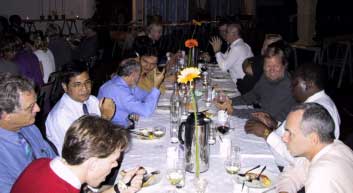
The participants were rewarded after a long day of hard work.
project to the local
people. It is greatly
During the General Assembly important links
appreciated by African
were created between the different GIWA
experts who have been
participants globally. This will build GIWA as a
working tirelessly this
global collaborating effort, a framework for
past few months to
produce the first
sharing our experiences and competence. We are
reports on scaling and
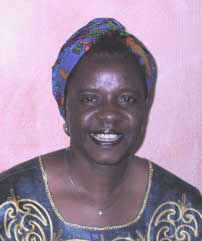
Edith Mussukuya
now in an excellent position to undertake the
scooping exercise.
remaining phases of the GIWA assessment and
ensure a successful completion of the GIWA
Edith Mussukuya, Acting Coordinator, Sub Saharan
project.
Africa,
GIWA Coord. Office, Kalmar
To all our readers I encourage you to follow
GIWA's development. Reports are now starting
to come through and they will continuously be
available on our web site.
Dag Daler
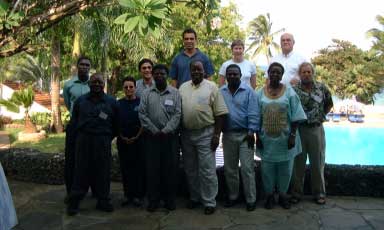
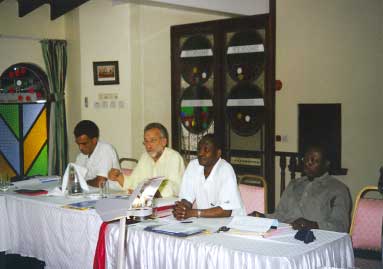
Six experts attended the scaling and scoping work shop in
Maputo for the Agulhas Current. Mozambique, South
Africa, Namibia, Lesotho and Botswana. The team had a
blend of marine-, freshwater- and socio-economic experts.
The task of applying the GIWA methodology to this sub
region with ten different countries as one system was a
challenge. The scaling and scoping report was ready on the
third day of the work shop. Freshwater shortages and
unsustainable exploitation of natural resources were
identified as the critical concerns in Agulhas Current.
The East African Lakes carried out there work shop the
first week of October. The task team comprised of twelve
experts drawn from all the stakeholder countries
representing a broad range of expertise. The assessment
focused on Lake Victoria, Kivu, Edward, Tanganyika, Malawi,
Turkana, Natron a nd Chala. The most serious concern
GIWA ASSESSMENTS IN SUB SAHARAN
according to the assessment findings are freshwater
AFRICA
shortages and habitat and community modification.
After the first GIWA General Assembly, it is now time to
The assessment of Benguela Current was held in Cape
reflect on the past, the present and most importantly the
Town, South Africa in September. This was the second
future GIWA activities in Sub Saharan Africa. The months of
round table discussion on the GIWA assessment. The first
September and October 2001 were fully utilized with
work shop that was held in April, 2001, was based on
scaling and soping work-shops in four sub regions. Somali
version 6 of the GIWA Methodology. This second work
Coastal current held their work-shop the second week of
shop concentrated mainly on the socio-economic sections
September. This was closely followed by a similar workshop
that had undergone modification. According to the
in Maputo for the Agulhas Current. Benguela Current held
expertise findings, all the five concerns are severe in the
similar workshop in Cape Town and the East African Lakes
sub region which in most cases were more severe in fresh-
held theirs in the first week of October. Prior to September,
water compared to marine water.
Gulf of Guinea Current had held the workshop in mid
In the Gulf of Guniea freshwater shortages and pollution
August.
were identified as the main concerns. Concerns over loss or
The GIWA strategy, which by the way seem to be
modification of habitats expecially in marine ecosystems
working out perfectly in SSA is the fact that the local
were rife.
experts have to have full control and ownership of the
project. One needs to be in one of these workshops to
GIWA Assessments in the Middle East
witness the professional expression of commitment to the
We are happy to announce that we have reached an
work.
agreement with UNEP ROWA in Bahrain to coordinate the
GIWA Assessments in the Sub-regions 48 (Gulf of Aden),
49 (Red Sea), 50 (Persian/Arabian Gulf), and 51 (Jordan
River). The work will be implemented in close collaboration
with ROPME and PERSGA. A Scaling and Scooping Work-
shop will be held early in 2002.
GIWA is presented in ASLO Bulletin
The Bulletin of the American Society of Limnology and
Oceanography have published the article "Assessing the
Status of International Waters" by Dag Daler, Elina
Rautalahti-Miettinen and Sara Gräslund, Aslo Bulletin Vol
10(3), September 2001, pp 37-41. The article is available
The Task team of Somali Coastal Current Sub region 46
on GIWAs Web site: www.giwa.net.
comprises of nine members drawn from both marine and
freshwater, socio -economist as well as medical doctors. The
GIWA Southeast Asia Sub-region Assess-
team spirit is so evident, the two camps, freshwater and
marine water work in harmony. After three days of serious
ment Workshop, November 5-8 in Bangkok
deliberations on the scaling and scoping, the task team
A Workshop for the Southeast/East/South Asian Sub-
came to the conclusions that freshwater shortage and
regions will be held in Bangkok November 5-8, coordinated
unsustainable exploitation of fisheries and other living
by Dr. Anond Snidvongs. Representatives from a number of
resources were the critical concerns in the region.
GIWA Sub-regions are expected to participate.
GIWA Co-ordination Office
Web Site: www.giwa.net E-mail: info@giwa.net
Postal Address: Global International Waters Assessment, GIWA
Telephone Secretariat: +46 480 44 73 50
SE-391 82 Kalmar, Sweden
Fax +46 480 44 73 55