Issue No.5, July 2001
Dear GIWA Friends,
river in the sub-region is modified by impoundments, resulting
Environmental issues have been given much attention by the
in a significant decrease in river flow. This has a major socio-
public lately, with focus on the ongoing discussion about the
economic impact, causing both severe human health losses and
Kyoto Protocol and the recent signing of the Stockholm
economic costs. The over-abstraction of rivers is connected to
Convention on Persistent Organic Pollutants. This renewed
modification and losses of ecosystems. Many permanent rivers
public awareness may lead to benefits and increased human
have become intermittent, some intermittent rivers have ceased
welfare if linked with the socio-economic issues prevailing in
to flow at all, and floodplain areas have been lost. These are
today's society. Water is one of the earth's most important life
changes that have resulted in loss of biodiversity and ecosystem
sustainable elements, and the environmental status of the aquatic
functions. After the Modification of stream flow, the following
ecosystems are heavily influenced directly and indirectly by
four issues were selected as priority issues, in order of
human activities. Part of the GIWA mission is to highlight the
importance:
impact of environmental problems on the economy, human
·
Impact on biological and genetic diversity
·
Changes in ocean CO source/sink function
health, and other aspects of society, and to include these links
2
·
Over-exploitation
in our assessment program. This is an important part of the
·
Eutrophication
GIWA Scaling and Scoping results that are starting to come in,
and in this newsletter some of the first GIWA results from sub-
regional scoping activities are reported. I encourage you all to
follow the development of GIWA on our web site: www.giwa.net.
Dag Daler, Project Manager
Sub-Saharan African Progress
The GIWA activities in Sub-Saharan Africa have moved for-
ward significantly during the last months. The Benguela Current
sub-region has produced the first assessment results, and the
other sub-regions are moving ahead.
Network developments
Agreements have now been reached with Prof. Niang-Diop,
Université C.A. Diop, Dakar-Fann, Senegal, who will be the focal
point for the Canary Current (GIWA sub-region 41), and
with Mr. Wellens-Mensah, Hydrological Service Unit, Accra,
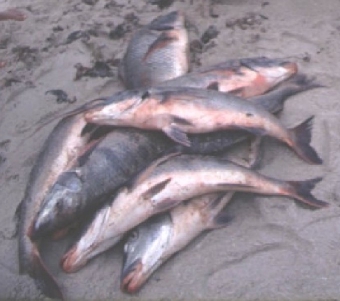
Over-exploitation was one of the five issues prioritised by the Benguela
Ghana, for the Gulf of Guinea (42). Active negotiations are
Current expert group. Almost every marine resource in the sub-region is
over-exploited.
being held with candidate focal points in the remaining sub-
regions (i.e. 43, 45, 46 and 47), and agreements are expected to
These preliminary results will be completed by strengthening
be reached within the next few weeks. All the Sub-Saharan African
the socio-economic part according to the new version of the
sub-regional focal points will gather for an assessment methods
Scoping and Scaling Methodology, a process that may result in
training workshop in Mombasa, 18-21 July. The focal
small revisions. The complete results for the Benguela Current
points will be intensively trained in the Scaling and Scoping
will be presented at the GIWA General Assembly in October,
method, and a wide range of experts and other regional stake-
together with results from the other GIWA sub-regions.
holders will build the foundation for the coming GIWA activities
in Sub-Saharan Africa.
Methods Task Team Endorses the
Modification of stream flow - a priority issue
New Scaling and Scoping
The Scaling and Scoping has been conducted for the
In line with the decisions made at the last GIWA Steering Group
Benguela Current (GIWA sub-region 44). The assembled
meeting, the Methods Task Team (MTT) has been convened to
expert group met in April, and was led by Dr. Kim Prochazka at
give recommendations on how the GIWA Methodology can be
the International Ocean Institute, University of the Western
improved. During this meeting, which was held in Kalmar on
Cape. The group concluded that Modification of stream
June 14, the method for Scaling and Scoping was in focus. The
flow was one of the most important issues in the area. Every
MTT included representatives from countries in transition,
developing countries and developed countries, with expertise
Eastern Equatorial Pacific (65), the GIWA assessment
from the fields of environmental economy, public health,
work will be co-ordinated by Prof. Eguiguren and Prof. Alarcón,
environmental assessment, and other environmental sciences.
the Comision Permanente del Pacifico Sur (CPPS), Quito, Ecua-
The MTT emphasized that the preparations are crucial for a
dor. The assessment for the Patagonian Shelf (38) will be
Scaling and Scoping workshop to be successful, for example,
co-ordinated by Pres. Calcagno, the Instituto Argentino de
the experts must receive the Methodology well in advance, and
Recursos Hídricos, Buenos Aires, Argentina. For the Small
they should conduct parts of the Scaling and Scoping
Island States (62) in the South Pacific, Mr. Tutangata at the
individually before the meeting. It was also stressed by the
South Pacific Regional Environment Programme (SPREP), Apia,
MTT that the justification for each score is a very important
Samoa, will be the focal point. For a map over the GIWA sub-
tool, both to provide information for later stages of the
regions, please visit www.giwa.net.
Methodology, and to inform about the validity of each score.
Further, it was pointed out that the collaboration with other
programmes, such as the Large Marine Ecosystems and the
GIWA Events and Milestones
Millennium Ecosystem Assessment, should be strengthened;
Some Recent Focal Point Agreements
and that existing scenarios, primarily GEO 3, but also national
· Patagonian Shelf (38)
and regional scenarios, should be used as background material
· Canary Current (41)
when conducting the future scenarios of the Scaling and
Scoping exercise.
· Gulf of Guinea (42)
· Small Island States (62)
· Humboldt Current (64)
· Eastern Equatorial Pacific (65)
See the main text for details.
World Environment Day, Seminar, Kalmar, 5 June
Scaling and Scoping workshops have been held for
· Benguela Current (44), Cape Town, 4-6 April
· Aral Sea (24), jointly with UNESCO SABAS,
Tashkent, 19-21 May
· Black Sea (22) and Caspian Sea (23) (May-June)
· Baltic Sea (17), Tallinn, 18-19 June
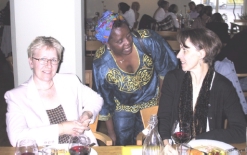
Ms. Caisa Oskarsson and Ms. Edith Mussukuya, both from the GIWA
co-ordination office, and MTT member Prof. Jacquie McGlade from
Assessment Training workshops will be held for
University College, London, after the MTT meeting.
· the Sub-Saharan African sub-regions,
Mombasa, 18-21 July
GIWA Office Staff Update
· Antarctic (66), the Small Island States (62), and the
We are welcoming Ms. Edith Mussukuya, M.Sc., fresh water
remaining sub-regions in Eastern Asia, (a total of 11
resources scientist from the University of Minnesota, who will
sub-regions will be represented),
Bangkok, 26-28 July
work at the GIWA co-ordination office full-time. She will act as
regional co-ordinator for Sub-Saharan Africa. Mr. David Souter,
Scaling and Scoping workshops will be held for
B.Sc., marine biologist from the University of Kalmar is working
· Coral Sea Basin (59) and Great Barrier Reef (60),
part-time at the GIWA project since March, i.a. with the General
Townsville, 23-27 July
Assembly preparations. Ms. Susanna Stymne Airey, Ph.D.,
environmental economist from the Baltic Business School, will
· Brazil Current (39), Rio de Janeiro, 2-4 August
also work at the GIWA project part-time. She will work with
· Patagonian Shelf (38), Buenos Aires, 16-18 August
socio-economic issues, i.a. related to the Methodology. The
· Humboldt Current (64) and Eastern Equatorial
staff developments are continuously presented at the GIWA
Pacific (65), Quito, 27-30 August
web site.
· Amazon (40b), Belém, Brazil, 13-15 September
· Brazilian Northeast (40a), Fortaleza, Brazil,
19-21 September
Recent Focal Point Agreements
Note: Many more Scaling and Scoping workshops will be
Additional to the agreements for Sub-Saharan Africa reported
held. Only those with fixed dates are presented here.
above, several focal points have recently been contracted in
other regions. In the two sub-regions covering the western coast
The first GIWA General Assembly, Kalmar, 9-11 October
of Latin America, the Humboldt Current (64) and the
GIWA Co-ordination Office
Visit the GIWA web site: www.giwa.net
Global International Waters Assessment, GIWA
E-mail: info@giwa.net
SE-391 82 Kalmar, Sweden
Telephone: +46 480 447353, Fax: +46 480 447355