N E W S L E T T E R N o 3 J u n e 2 0 0 3
Seminar in
S
o
u
r
ce
: Z
a
m
b
e
Stockholm
z
i R
i
v
e
r B
a
s
i
n A
on selected
t
l
a
s
, S
A
D
C
/
D
reports
E
N
C
O
N
S
U
L
T
/
Z
R
A
, L
u
s
a
k
The GIWA assessment from selected regions,
a
, 1
9
9
representing different environmental and so-
8
cio-economic situations, will be presented at
a seminar in Stockholm on August 15. The
seminar is part of the World Water Week to
be held in Stockholm August 10-16.
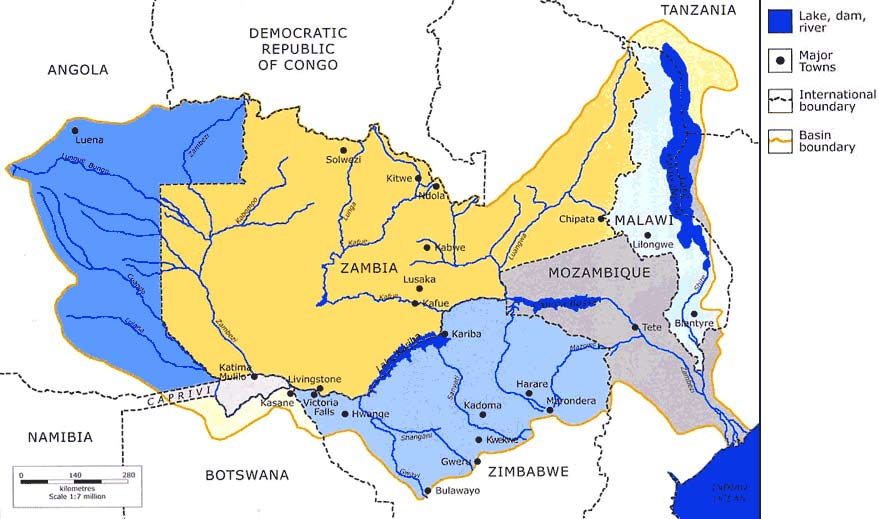
Transboundary waters in southern Africa, an example of many shared waters. These issues will be discussed at
The worldwide assessment is being final-
the GIWA seminar in Stockholm on August 15.
ized in many parts of the world. Local experts,
working in transboundary teams using the
and the group members are experts in fields
be an excellent opportunity to learn about
GIWA methodology to evaluate the environ-
such as Natural Resource Management and
the GIWA assessment on transboundary wa-
mental concerns in each water regions, carry
Tropical Coastal Management and also GIS,
ters and the task to analyze root causes and
out the main part of the project.
Geographical Information Systems.
predict scenarios of future development.
The preparation for the output from the
In August a sample of the early reports
For participation see http://www.siwi.org/
selected regions is done at the GIWA Core
will be introduced to the participants of the
waterweek2003/frameset.html
Team in Sweden. An editorial team has been
World Water Week. There are 66 sub-regions,
The joint GIWA-Kalmar University sym-
formed to secure the reports from the sub-
several of them divided into separate sec-
posium on transboundary waters, initially
regions via peer reviewers to the stakehold-
tions, and a number of reports will be ready
planned for August 18-20, has been post-
ers. Ms UllaLi Zweifel, Scientific Editor, PhD in
for peer review within the next few months.
poned until June 2004.
Marine Microbiology, is heading the team,
The August seminar in Stockholm will
Dear GIWA friends,
experiments. It is fun and serious at the same
resources will help today's children to enjoy
The rain was pouring down from the skies but
time, also in the rain. Water is an essential is-
all the goods provided by water also in the
the school children were there to study just
sue for children in all parts of the world. That
future, drinking water, food, fish, recreation
that - water. It was a joy to see them running
is why this year's World Environment Day on
etc. At the ages of 12 or 13 they might not
to the shore with landing nets to catch small
June 5 is also focusing on water. The slogan
understand how they can contribute indi-
creatures in this Kalmar drainage system.
is "Water Two Billion People are Dying for
vidually, but by making them think globally
They got freshwater on their heads as well
It!" The theme is calling on each of us to help
we believe they will participate in the future.
as on their feet!
safeguard the most precious source of life on
Public awareness, especially among the next
GIWA is presently working with a school
our planet.
generations, is an important part of the work
project to celebrate the UN year of freshwa-
We at GIWA are working on fulfilling this
for all of us in international missions.
ter 2003. Children are learning about the fu-
mission. Our aim to develop scenarios for
ture situation of freshwater through guided
the future conditions of the world's water
Dag Daler, Scientific Director
Freshwater for
the world's children
The UN international year of freshwater is re-
- Good water is an issue that many chil-
ceiving a lot of attention in the schools in the
dren get very engaged in, says Camilla Nils-
Kalmar region where the GIWA Core Team
son, educationalist at the science center XL. In
has its office. Through collaboration with a
Sweden children are spoiled by the fact that
local science center, XL, a number of school
there is always clean water available. But they
classes are focusing on freshwater this year.
do have ideas on how to help other parts of
The name of the project is "Vattentan-
the world solving water shortage.
ken" in Swedish, a word that has two mean-
Many school children are proud to know
ings: thinking of water and a water tank.
that the GIWA project, working to solve wa-
School children, mainly in ages 813, learn
ter-related problems globally, is located in
about the freshwater issues through several
their hometown.
activities. They study UNICEF lessons on wa-
ter and discuss in the classroom, they do In-
ternet research, they visit the science center
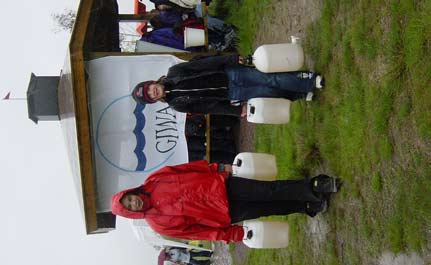
The GIWA freshwater project includes outdoor activities
to do water experiments and they do out-
also in pouring rain!
door activities.
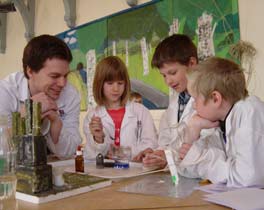
The school children do experiments to learn
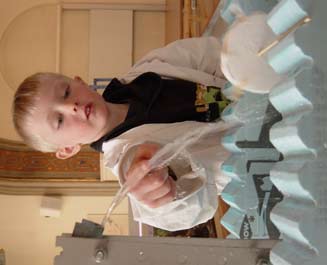
Viktor learns about water by making
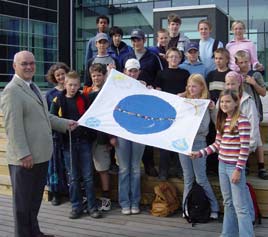
On the World Environment Day GIWA's Scientific Director
about the water quality.
his own water wheel.
Dag Daler met a school class that presented their ideas on
water with a flag.
New steering group members
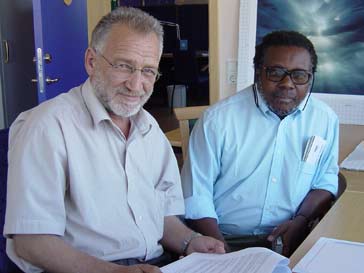
GIWA experts in Kalmar
The GIWA steering group has two new members: Mr Jing
The two professors
Mhammed Tayaa,
Zhang, State Key Laboratory of Estuarine and Coastal Re-
Rabat Institutes,
Rabat, Morocco,
search (SKLEC) at the Chinese Academy of Sciences in
(focal point for Ca-
nary Current) and
Shanghai, China, and Mr Jerson Kelman, National Agency
Chris Magadza,
of Waters (ANA) in Brasilia, Brazil.
University of Zim-
babwe, Harare,
Zimbabwe, (focal
point for Agulhas
current) have visit-
ed the Core Team in
Fisheries experts
Kalmar to train for
analysis work.
In order to address fisheries in the GIWA context, its re-
lations to environmental issues and ecosystem manage-
ment, GIWA is planning a Fisheries Expert Symposium in
Kalmar on August 28-29.
GIWA Co-ordination Office
Web Site: www.giwa.net E-mail: info@giwa.net
Postal Address: Global International Waters Assessment, GIWA
Telephone Secretariat: +46 480 44 73 53
SE-391 82 Kalmar, Sweden
Fax: +46 480 44 73 55