GLOBAL INTERNATIONAL
WATERS ASSESSMENT
N E W S L E T T E R N o 2 M a y - J u n e 2 0 0 2
Dear GIWA friends,
UCC-Water
As spring returns to Sweden, the
a New Collaborating Partner of GIWA
tulips are blooming and the sun
is shining, GIWA enters into the
A collaboration since 1996 between the DHI Water and Environment and
next phase of the project. The
UNEP was early this year consolidated through the establishment of the
Scaling & Scoping is now close
UNEP Collaborating Centre on Water and Environment (UCC-Water). The
to be completed and the global
purpose of the centre is to support UNEP in the implementation of the
comparative matrix is being
Water Policy and Strategy, and it shall thus provide assistance to the rel-
formed. As expected the GIWA concerns show dif-
evant UNEP projects and programmes including GIWA.
ferent sev erity in the indiv idual sub-regions, but
DHI Water and Environment is an independent, international consult-
outstanding as global problems are the concerns
ing and research organisation affiliated to the Danish Academy of Techni-
"Habitat destruction" and "Unsustainable exploita-
cal Sciences. The services of the institute are based on the development
tion of living resources and fisheries".
and application of know-how and advanced technologies within ecology
The methodology for the remaining phases of
and environmental chemistry, water resources, hydraulic structures and
GIWA has been issued and in this newsletter you
hydrodynamics and other areas related to water environment. The Insti-
can read about it. This will now be implemented by
tute has approximately 475 employees, the majority of whom are profes-
the sub-regional expert teams. A challenging time is
sional engineers and scientists with post-graduate qualifications and it has
ahead. The critical GIWA concerns have been iden-
project experience from more than 140 countries.
tified. The causes and the policy options required
The assistance to GIWA from the centre will mainly concentrate on
for mitigation are now to be established.
further development of the GIWA second stage methodology i.a. through
My congratulations goes to the "GIWA Father",
participation in the Methodology Task Team, peer reviews etc. and, more
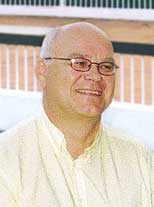
Professor Erik Arrhenius, who as an appreciation
importantly, through "hands on" testing in one or two of the GIWA sub-
of the work done for GIWA, has been named Hon-
regions. Thus, the centre will play a key role in the second stage assessment
orary Doctor of the University of Kalmar. We are
in sub-region 42 (the Gulf of Guinea) already this year. Moreover, the centre
thankful for his efforts for GIWA, but also proud to
shall assist in linking UNEP activities including the GIWA process with the
have contributed to his success.
networks of DHI and Global Water Partnership (GWP), the latter through a
close collaboration with the existing GWP Resources Centre at DHI.
Dag Daler
More information about the centre can be found at: www.ucc-
Scientific Director
water.org, www.dhi.dk or by e-mail to ucc-water@dhi.dk
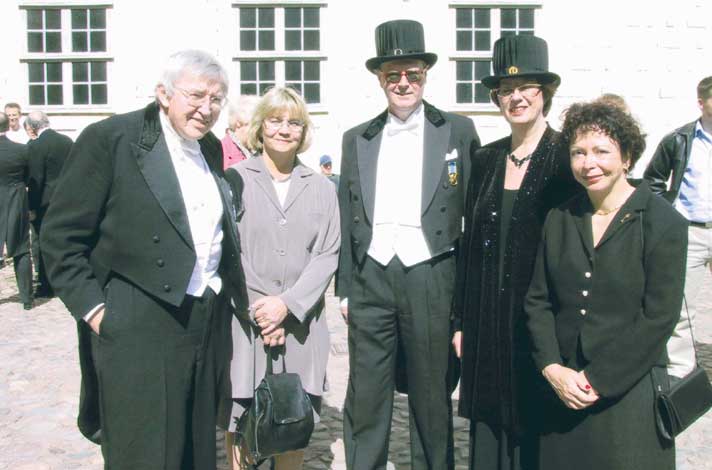
Professor Erik Arrhenius Honorary Doctor
The University of Kalmar has named professor Erik Arrhenius
Honorary Doctor. Professor Arrhenius receiv ed the sym-
bols of the doctorate at the annual Academic Ceremony at
Kalmar Castle on May 7.
Professor Erik Arrhenius is honored by the university
for his strong engagement in Agenda 21 and for his efforts
to establish GIWA in Kalmar.
Professor Erik Arrhenius is internationally reputed in
his field of expertise and thanks to his international com-
mitments the University of Kalmar was selected to host the
GIWA project. He has been a keen supporter of GIWA and
he has spent much of his working capacity as the GIWA Sci-
At the Academic ceremony Professor Erik Arrhenius was greeted by the
entific Advisor and in that capacity also contributed signifi-
University board Chairman Yvonne Sandberg-Fries, Vice-chancellor Örn
Taube, pro Vice-chancellor Britt-Inger Saveman and Professor Edna Granéli.
cantly to the success of GIWA.
GIWA Methodology an Important Reference Framework
The latest version of the GIWA Methodology for the remaining
causes and examples of how they may act, because at present,
stages of the assessment was posted on our web site on May
there is no unified theory that universally explains how the dif-
7. It builds from the previous versions and follows the advice
ferent root causes developed and interact. In the absence of such
of the Methods Task Team as well as the recommendations of
a theory, we must accept pluralism. However, according to the
the different teams that tested it. Due to the great variation in
methodology, all the hypotheses on the importance of the dif-
sub-regional circumstances under which the methodology will be
ferent root causes and the way in which they interact, must be
applied, it is recognized that the guidelines should be considered
substantiated with available evidence.
as a reference framework, rather than as a set of detailed instruc-
Policy Option Analysis (POA) indicates potential policy inter-
tions.
ventions (based on the identification and understanding of root
Detailed Assessment (DA) is not meant to be a massive data
causes) to solve or mitigate the addressed concerns. It is the
gathering process but rather a documentation of existing infor-
culmination of the assessment. The GIWA guidelines remind the
mation related to the assessment. It also should be emphasized
sub-regional task teams of essential activities and choices that
that DA is not a self-contained component of the assessment
have to be conducted while performing a POA. One of these
confined to one stage but an activity within all the components.
activities is the analysis of different scenarios developed on the
DA has two purposes: to substantiate the experts' conclusions
basis of projected actions taken to address the identified root
by providing updated and reliable information and to identify
causes of environmental degradation.
and document the nature and availability of information related
The following figure illustrates the assessment process
to the selected priority concern and issues within the sub-
in every sub-region. The
1
regions.
first sub-regional work-
st
Scaling
W
Causal Chain Analysis (CCA) traces the cause effect pathways
shop was designed to
orkshop
associated with each significant concern, from the socio-eco-
help each team conduct
Detailed Assessment
nomic and environmental impacts back to its root causes. Its
the Scaling and Scoping
Scoping
purpose is to identify the most important root causes of each
components. The sec-
concern, in order to target them by policy measures for cost-
ond sub-regional work-
effective remediation or mitigation. It should be stressed that the
shop will give directions
2
Causal Chain
CCA of GIWA is policy oriented. The core of the GIWA approach
to conduct the Detailed
nd
Analysis
W
to CCA is to look at the factors that directly or indirectly shape
Assessment and will
orkshop
the human actions that impact the way in which water and water
focus on the Causal
related resources are used. These factors are the root causes.
Chain and Policy Option
Policy Option
Analysis
The methodology only provide a non-exhaustive list of root
Analyses.
www.giwa.net/methodology/methodology.phtml
Upcoming events 2002
GIWA seminar in
Stockholm on August 11
16-17 May in Rio de Janeiro, Brazil; 2nd Causal Chain Analysis Workshop for Latin
American Regions.
GIWA is hosting an assessment
seminar on August 11, 2002, at
10-14 June in Victoria, Canada; ASLO Summer Meeting on freshwater issues. GIWA
the Stockholm Water Symposium.
presentation together with UoK Limnologist Jan Herrmann.
The seminar will review the issues
17-19 June in Abuju, Nigeria; Invitation from the Federal Ministry of Environment in
in the worlds shared waters, both
Nigeria to participate in the final Super Preparatory Meeting.
through oral presentations and
posters. GIWA´s regional work will
13-15 June in Rostov-on Don, Russia; International Conference on Modern Problems
be presented and it is an excellent
of Oceanology and Shelf Seas of Russia. GIWA to give presentation on "Environmental
opportunity for discussions of the
Issues and Ecosystem Based Management of Marine Resources in the Globes International
result of the GIWA project.
Waters".
See the complete program for
27-29 June in Monterey, California; World Conference of Environmental Economists in
the 2002 Stockholm Water Sym-
Monterey, California. GIWA to present the Methodology.
posium (August 12-15) and World
26 August - 4 September in Johannesburg, South Africa; World Summit on Sustainable
Water Week in Stockholm (August
Development.
11-17): www.siwi.org/sws2002/
25-29 September in Dalian, China; GEF Second Biennal International Waters Conference.
GIWA Co-ordination Office
Web Site: www.giwa.net E-mail: info@giwa.net
Postal Address: Global International Waters Assessment, GIWA
Telephone Secretariat: +46 480 44 73 50
SE-391 82 Kalmar, Sweden
Fax +46 480 44 73 55