Issue No 2, Jan 2001
Dear GIWA friends,
Test Teams' Experiences
At the start of a new year I make some reflections of the past
Test teams from the Baltic region and the Gulf of Thailand were
and the future. Last year, 2000, was a difficult year for GIWA.
assigned in the summer of 2000 to test the UNEP/GEF GIWA
Major problems surfaced in developing the Assessment Proto-
Assessment Methodology, developed under overall co-ordina-
col into a useful tool and in building the global network with
tion of the University of Plymouth. The reports produced by
megaregional hosts, sub-regional focal points and task forces.
the test teams are now available at the GIWA internal Web site,
There were difficulties in the development of the Core Team
and will be published at the open GIWA Web site once the Peer
organisation, and there was a slow start of the network buil-
Review process is finalised.
ding. A significant schedule delay was unavoidable.
Baltic Test Team
However, we shall not forget that the year also brought major
achievements to GIWA. The Plymouth group delivered the full
methodology including the causal chain component. The meth-
odology was successfully tested in the Baltic and in the Gulf of
Thailand. My honour to the excellent work done by these task
teams and in particular to the chairmen of the task teams, Prof.
Wilhelm Hogland at the University of Kalmar and Prof. Anond
Snidvongs at the Chulalongkorn University.
The Core Team was reorganised and strengthened and focus
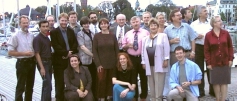
The Baltic test team at one of the workshops in Kalmar.
was concentrated on priority issues. Much effort has been de-
voted to strengthened partnership with other international wa-
The Baltic test team has presented three reports on the GIWA
ters programmes.
Methodology: the GIWA Assessment Protocol Testing, the
This year, 2001, will be an important year for GIWA. During the
Detailed Impact Assessment, and the Causal Chain Analysis.
first months the methodology will be peer reviewed and the
The test team consists of experienced environmental scientists
final version issued. The last part of the network will be com-
and socio-economists from as much as nine countries in the
pleted in the same period of time. Then the fun starts, assess-
Baltic drainage area. They have large experience from the re-
ment work will be conducted throughout the globe and the first
gion, and together they cover issues like hydrology, pollution
global scoping results will be presented at the 1st GIWA General
and biodiversity in aquatic systems, fisheries and global
Assembly in Kalmar in June.
changes.
I am confident that the GIWA project is in good shape and
The reports are the results of three workshops held in St
ready for these challenges. I am proud of the all the competent
Petersburg, Russia and Kalmar, Sweden during the second half
people associated with GIWA, our Core Team members and all
of 2000. During the first workshop held in St Petersburg the
the task teams around the globe and the GIWA achievements
component "Scoping/scaling" of the GIWA assessment meth-
made so far.
odology was tested. At the second workshop held in Kalmar
In this issue of the Newsletter you will be able to read about our
the component "Environmental and socio-economic impact as-
Test Teams' experiences, the Peer Review process and other
sessment" was reviewed. The third and final workshop, also
ongoing activities.
held in Kalmar, was dedicated to the "Causal chain analysis",
which aims at identifying the linkages between issues affecting
Dag Daler, GIWA Project Manager
the transboundary aquatic environment and their causes.
Gulf of Thailand Test Team
Invitations to participate in the Open Peer Review have been
distributed widely. We thank those international organisations
that helped distributing the invitation to individual experts.
In the open peer review process we hope to have comments
from scientists, experts, students, institutions and stakeholders
interested in aspects of the present GIWA Assessment
Methodology. The Core Team have been asked to extend the
open peer review schedule. Hence, the Open Peer Review site
(www.giwa.net/review/index.html) will now be open for comments
until 25 February 2001.
Core Team Staff Developments
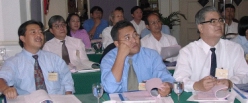
Experts participating in one of the workshops during the GIWA
Ms Linda Holm, an environmental engineer at the University of
Methodology testing in the Gulf of Thailand.
Technology in Luleå will assist the Core Team in managing the
methods peer review proccesses. She will primarily assist in
The Gulf of Thailand test team has finalised two reports, both
reporting on the evaluation of the methodology, and also work
the GIWA Assessment Protocol Testing and the Detailed Impact
with the organisation of the Peer Review Board meeting. Ms
Assessment. The Gulf of Thailand test team is composed of
Sara Gräslund, a PhD student in marine ecotoxicology at Stock-
experts from Thailand, Cambodia, Malaysia, Vietnam, and
holm University, earlier working as an intern at UNEP Nairobi,
additionally experts from international organisations. The
will have the editor function of the GIWA Newsletter, be
participants represent a wide range of relevant environmental
responsible for reporting to UNEPLink, and she will also assist
sciences, socio-economy, social science and environmental
in the network builiding in Africa.
health.
www.giwa.net
The first workshop conducted by the team aimed at testing the
scoping and detailed impact assessment methodologies. The
The GIWA Web site has been selected by ISI (the Institute for
purpose of the scoping is to identify priority issues for remedial
Scientific Information, www.isinet.com) for inclusion in their
action and intervention. The two most serious issues identified
Current Web Contents, a collection of evaluated Web sites. It is
for the region were loss of ecosystems or ecotones (mangrove)
a quality mark indicating that the Web site has been reviewed
and overexploitation of fisheries and other living resources.
by ISI editorial experts, and it guarantees authenticity, relevance
Indicators for these two issues were identified to facilitate a
and timeliness. The motivation for ISI to include GIWA's site is
quantitative assessment of their impact. At the second work-
that it publishes important, high-quality material on the Web.
shop environmental impact indicators for other important issues
We are proud!
were identified, and data from valuation studies were evaluated
socio-economically.
GIWA Events and Milestones
Kalmar University Board Meeting
All three reports from the Methodology testing have
been finalised by the Baltic test team
In the middle of December, the Kalmar University Board received
an update on recent developments of the GIWA project by Dr.
The Gulf of Thailand test team has finalised the two
Ulf Lidman, appointed University/GIWA co-ordinator. After the
first reports from the Methodology testing. The third
presentation, the Board discussed the interface for co-opera-
report will be available when the Causal Chain Analy
tion and different suggestions for joint projects, such as
sis workshop has been held.
possibilities for GIWA associated students to join international
courses at the University, Master and PhD programmes, and
The GIWA Methods Open Peer Review process is
access to important international networks. The Board pointed
extended to the 25th of February
out that GIWA is a very important project of interest and of high
priority to the University, and concluded that the GIWA pro-
The Peer Review Board will meet in Kalmar 2 March
cess will be closely followed and further supported.
under leadership of the University of Kalmar
Methods Peer Review Process
GIWA Steering Group will meet in Kalmar on the 3rd of
The peer review process is moving ahead. Detailed plans are
March
now finalised regarding the Peer Review Board meeting taking
place in Kalmar on the 2nd March under leadership of Prof. Bo
The first UNEP/GEF GIWA General Assembly will be
Wiman, Kalmar University.
held in Kalmar in June 2001