FORGING A GLOBAL COMMUNITY TO ADDRESS INTERNATIONAL
WATERS CRISES: THE IW:LEARN PROJECT
Dann M. Sklarew, Sheldon Annis, Janot R. Mendler, and Mishal Hamid
I
(3) fosters peer-to-peer (P2P) knowledge sharing among
n 1998, the tiny Red Sea country of Djibouti had no
water re s o u rces managers, and (4) serves as a focal
universities. So when Nasser Abdi decided to advance
point for those in search of solutions to intern a t i o n a l
his marine science education by pursuing a Master's
water resources problems.
d e g ree, he was faced with two options: he could study
I W:LEARN's activities flow from the convergence of
overseas, foregoing an opportunity to apply for advance-
three global trends: (1) emerging awareness of the trans-
ment in his career at the government's Maritime Affairs
boundary, tr ansnational nature of potential water
Division, or stay and work and chance an experimental
re s o u rce crises and of cooperative efforts to addre s s
Internet-based Master's program. Nasser chose the lat-
them; (2) the "greening" of donor agencies international
t e r. After a seven-week residency at the University of
development activities, promoting sustainable pro g re s s
London, he pursued international development courses
t h rough integration of environmental and economic
over the Internet and received "virtual advising" on his
issues; and (3) the proliferation of access to aff o rd a b l e
dissertation research from a mangrove expert in South-
i n f o rmation and telecommunications technologies in
east Asia.
developing countries.
As a result, Nasser simultaneously realized both his
We introduce below how this confluence led to the
academic and professional goals. He was appointed Dji-
emergence of IW:LEARN as a convener for the interna-
bouti's first National Coordinator in a regional conserva-
tional waters knowledge community. We then highlight
tion program spanning the Red Sea and Gulf of Aden.
specific activities IW:LEARN has been facilitating within
T h rough perseverance in troubleshooting a myriad of
and for the benefit of this community. The article con-
technical, administrative, and academic pro b l e m s ,
cludes by proposing ways in which water re s o u rc e s
Nasser's success established a pioneering precedent for
managers and organizations in developed as well as
distance education in Djibouti.
developing countries could benefit from and contribute
Ying Zhou-Tala works in Beijing, China, helping to
to the IW:LEARN-sponsored international waters knowl-
coordinate four Northeast Asian countries' protection of
edge community.
the Tumen River watershed. When her office sought new
tools to facilitate international collaboration, Yi n g
WATER CRISES AND OPPORTUNITIES
attended a five-week workshop in Washington, D.C.,
w h e re she developed skills for generating multi-media
Over a billion people on Earth today do not have
CD ROM and Web presentations, as well as for creating
access to safe water (WHO and UNICEF, 2000). Poor
new TumenNET Web spaces. Water re s o u rce managers
sanitation, agricultural, and industrial processes result
throughout the region now use TumenNET's Web-based
in overenrichment and contamination of freshwater and
"virtual workspace" for instant messaging and sharing of
marine ecosystems world-wide (Gleick, 1998; Smith e t
planning documents, contact lists, and project links.
al., 1999). As their populations increase, many develop-
Meanwhile, she designed TumenNET's public Web site to
ing nations consequently face precipitous declines in
provide a common face and interface for Chinese, Mon-
their ability to meet water quantity, water quality, public
golian, Korean, and Russian officials joining "to protect
health and aquatic biodiversity needs (Duda and El-
transboundary biodiversity and international waters and
Ashry, 2000; WRI, 2000). This includes deterioration
to attract green investment" (TRADP, 2001).
and losses to wetlands, fisheries and coral reefs.
Both Mr. Abdi and Ms. Zhou-Tala are participants in
Water does not recognize political boundaries. Forty
IW:LEARN, the International Waters Learning Exchange
p e rcent of the world's population lives in river basins
and Resource Network. Support from the Global Envi-
s h a red by at least two nations (Shumway, 1999). The
ronment Facility (GEF) launched IW:LEARN as a non-
number of interna tional river basins has actually
g o v e rnmental organization (NGO) and offshoot of the
i n c reased from 214 to 261 over the past two decades
Un i ted N ation s De vel opm en t Prog ra m (U NDP).
(Gleick, 2000). Today, more than 30 nations receive at
IW:LEARN now works to build a global knowledge com-
least a third of their water from beyond their bord e r s
munity to protect lakes, rivers, coasts, and oceans.
(USNIC, 2000). In the oceans, multi-national fleets fish
To facilitate the creation of this community of prac-
intensively in international waters, while ships transport
tice, IW:LEARN: (1) provides training for strategic use
in their ballast water exotic species from one seaport to
o f c o s t - e ffective communications technologies in inter-
the next. Individual nations cannot act alone to protect
national water resources management, (2) identifies and
their own waters or arrest threats from these and related
develops relevant distance justifylearning opportunities,
WATER RESOURCES IMPACT
21
March 2001
Forging a Global Community to Address International Water Crises...cont'd
transboundary water problems.
of distance learning and knowledge sharing. This has
International conventions launched at the Rio Earth
been fostered by a variety of low and no cost software for
Summit in 1992 led the way for international donor
web based training (WBT) and P2P knowledge sharing.
agencies to directly address sustainable development
I n t e rnational waters projects have barely skimmed the
and, by extension, management, and protection of inter-
surface of strategic opportunities to apply these tools to
national waters. Hence, numerous financial and techni-
their benefit.
cal re s o u rces are now available to mitigate a gro w i n g
spectrum of transboundary water crises. At the forefront
THE INTERNATIONAL WATERS
of these efforts, the World Bank, United Nations Devel-
KNOWLEDGE COMMUNITY
opment Program (UNDP) and United Nations Enviro n-
ment Program (UNEP) together cr eated the Global
As a Web-savvy UNDP/GEF-sponsor ed pro j e c t ,
Environmental Facility (GEF) as the world's largest sin-
IW:LEARN is ideally situated to improve management of
gle source of financial support for addressing intern a-
transboundary water systems by increasing local knowl-
tional waters issues. In subsequent years, GEF and its
edge sharing capacity across the international waters
partners have leveraged nearly one billion dollars in
community. The organization's present activities focus
financing to support almost 50 international waters pro-
on four core areas: team building, distance learn i n g ,
jects, with an additional half billion dollars pledged over
knowledge sharing, and development of knowledge prod-
the next five years (El-Ashry, 2000). Still, financial
ucts.
e m p o w e rment alone will not solve the world's water
In 1998, IW:LEARN began training and mobilizing
crises.
Web-connected implementation teams. Team members
Often nations must promote and apply indigenous
catalyze and carry out knowledge sharing and distance
expertise to address their common international waters
l e a rning activities within and across their re s p e c t i v e
problems. Such expertise is limited in many developing
i n t e rnational waters projects. For example, following
countries, however, where water re s o u rce management
IW:LEARN workshops in England and the United States,
is the jurisdiction of a thin structure of undersupported
East African team members succeeded in setting up
e n v i ronmental ministries, regional programs, commer-
local area networks (LAN) for Lake Victoria pro j e c t ' s
cial interest groups, scientific re s e a rchers, and NGOs.
offices in Uganda, Kenya, and Tanzania, then later iden-
These organizations generate valuable data, findings,
tified supplemental hard w a re and software to impro v e
and recommendations. Unfortunately, such knowledge
i n t e r- o ffice knowledge sharing across the Nile River
p roducts are often poorly disseminated (Somlyody,
basin. Thus, these participants learned to evaluate then
1995). Thus, valuable lessons are lost to the gre a t e r
recommend Web-based tools for programmatic use upon
community. Such dissipation of learning and knowledge
their return home.
loss are critical weaknesses in the web of international
A Nigerian team member was inspired by the first
water resource management.
IW:LEARN training workshop to employ ICQ.com ("I seek
By the same token, GEF's project portfolio encom-
you") software in the Gulf of Guinea Large Marine
passes a vast but underutilized wealth of institutional
Ecosystem project, an initiative spanning six We s t
experience and individual expertise. Until recently, GEF
African countries (Nigeria, Cote d'Ivoire, Camero o n ,
i n t e rnational waters and biodiversity projects had no
Togo, Benin, and Ghana). He reported:
f o rmal means in place to preserve and transfer the
knowledge they generated. Newly formed projects have
"ICQ was quite handy during our last Tripartite
rarely had access to the experience of more established
Review Meeting as it made communication far
p rojects. For junior and mid-level personnel, training
less cumbersome. We couldn't hold live meetings
opportunities are limited or, at best, classro o m - b o u n d .
because of low bandwidth for video and voice
Opportunities for cro s s - p roject internships, appre n t i c e-
communication but we were able to chat with
ships, and international site visits simply do not exist.
some government officials via ICQ."
While international donors cite P2P technical assistance
and South-South learning as valuable goals, few practi-
After IW:LEARN's fall 2000 workshop, newly trained
cal mechanisms are in place to realize such ideals. Even
team members wrote:
GEF's implementing agencies UNDP, UNEP, and the
World Bank encounter difficulties in sharing their
"The workshop program was useful in equipping
information resources across institutions.
us with the knowledge of existing web tools that
Over the past decade, Internet usage has gro w n
can ease the difficulties in communication in most
explosively. As part of this trend, GEF now invests at
developing countries. It also provided us with the
least 15 percent of project budgets in information tech-
ability to find, test and apply new communication
nology. Such financing aims to enhance returns through
tools on the web, and keep up-to-date with the
i m p rovements in inter-institutional knowledge sharing
ever-evolving web communication tools . . . it is
within and between international waters projects. GEF's
hoped that [our offices] will be linked and will be
investment has also helped international waters projects
able to take advantage of some of the tools . . . for
to establish the technological infrastructure for vastly
example, one or more staff can chat with [another]
improved communications with their national and inter-
team simultaneously, without having to leave their
national partners.
offices to meet in the same room. Telephone costs
Meanwhile, a creative boom is underway in the field
can also be reduced by using . . . PC-to-PC
Volume 3 Number 2
21
Water Resources IMPACT
Forging a Global Community to Address International Water Crises...cont'd
telephoning, which is free and easy to use."
agement WBT module for one of the project's demonstra-
tion sites. This training module has since been featured
Obvious efficiencies can be realized through elec-
on the project website and may be replicated for demon-
tronic dissemination and remote access to formal infor-
stration sites in other parts of the region.
mation, such as contained within project documents
In the area of distance learning, IW:LEARN is now
and written reports. The Web has also introduced an
developing a catalog of existing online water manage-
overlay of enriched informal communications that is
ment programs and courses, as well as other inform a-
changing the way projects do business. Ongoing experi-
tion technology training opportunities. The organization
mentation and usage of Web-based communications
will continue to leverage its re s o u rces to help secure
technologies among team members supports the validity
financial aid and promote the creation of sustainable
of IW:LEARN training as a catalyst for informal knowl-
regional or country-based financing mechanisms to sup-
edge sharing between international waters projects.
port students from developing countries. Furtherm o re ,
I W:LEARN now aims to integrate participants fro m
as IW:LEARN identifies gaps in existing distance educa-
an ongoing series of workshops into a unified global
tion programs, the organization may also sponsor devel-
implementation team representing diverse international
opment of new international waters distance learn i n g
waters projects. This team will help our org a n i z a t i o n
activities.
identify, evaluate and customize additional emerg i n g
Knowledge sharing addresses the lack of opportuni-
telecommunications tools for use in transboundary
ty and capacity among projects in developing countries
water resources management. Regional IW:LEARN work-
to regularly communicate with each other, convey their
shops will also introduce team-tested technologies to
lessons-learned and collaboratively approach regional or
new multi-country projects, while recruiting representa-
issue-specific problems. IW:LEARN is helping to build
tives from those projects to join the implementation
bridges for knowledge sharing by providing re a l - t i m e
team. Through these activities, IW:LEARN will continue
hands-on demonstrations among implementation team
to promote global involvement and enhanced capacity
members in field locations and at international waters
across the international waters community of practice.
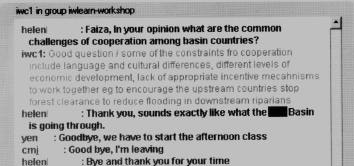
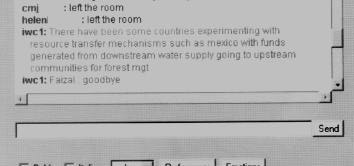
c o n f e rences, as illustrated in Figure 1. In the wake of
I W:LEARN's distance lear ning program targ e t s
GEF's first International Waters Conference in Budapest
developing regions were re s o u rces are insufficient to
last fall, IW:LEARN is also using eGroups.com tools to
provide regional expertise or training to address environ-
establish facilitated electronic lists for practitioners to
mental management needs. In partnership with Royal
discuss specific commonly-held international waters
Holloway College, University of London, IW: L E A R N
challenges (e.g., public outreach, project evaluation,
established a distance Master of Science degree program
etc.), seek technical assistance, and share perspectives
which targets tomorrow's environmental managers in
among their peers (IW:LEARN 2001).
developing and transitional (Eastern European) coun-
I W:LEARN has alre ady codified the knowledge
tries. The distance learning program focuses on sustain-
shared at the Budapest, Hungary, conference as a set of
a ble de ve lopm ent wi th an int er n a tiona l w ate rs
on-line proceedings, which will later be transformed into
specialization. Having completed an IW:LEARN work-
a searchable database of presentations. The organization
shop, students participating in this experimental Mas-
is also interested in capturing easily re f e renced topical
ter's program returned home with Internet-ready laptop
or regional information on the re c o rd of lessons which
computers to support their distance coursework and to
can be gleaned from past and present projects. Over the
eng ag e t heir coho rt s a cro ss th e n as ce nt glob al
next few years, in partnership with UNEP, IW: L E A R N
IW:LEARN implementation team.
plans to develop and launch an International Wa t e r s
Distance learning students participated in a variety
Best Practices database. This activity may be coupled
of IW:LEARN implementation team activities during the
with an award scheme to provide incentive for the
two year Master's pilot program. One of the criteria for
database to be "self-populating."
dissertation projects was that students' research make a
I W:LEARN is creating a globally accessible We b
substantive contribution to the particular environmental
space that will form the infrastructure for an inclusive
concerns of their sponsoring GEF project's region. Thus,
global community dedicated to distance learning and
through their research, students developed international
knowledge-sharing about international waters. We will
teams to compile references on invasive aquatic species
utilize this space to promote various knowledge sharing
(such as water hyacinth); informed the development of a
p roducts, including an international waters knowledge
regional river basin management program; established
needs and re s o u rces matching service; collaborative
monitoring transects for previously uncharted man-
annotated bibliographies of links to international waters
groves, and, in one case even learned to scuba dive.
p rojects sites and pertinent electronic lists; and white
Five IW:LEARN team members graduated from the
papers highlighting conclusions from targeted on-line
Royal Holloway distance Master's pilot program, con-
discussions and e-seminars.
cluded in 2000. Among them, a Sudanese student over-
IW:LEARN uses new communication technologies to
came persistently intermittent power and Intern e t
draw upon the intellectual re s o u rces of participating
connectivity at his office in Port Sudan to graduate with
projects, UNDP, World Bank, UNEP, and other partners.
distinction. He also received a Geography Department
I W:LEARN and its partners are generating a number
prize for his rigorous coral reef ecology study. Another
o f knowledge products, including a methodology for
student, working with the East Asia Seas GEF project in
"distancizing" re g i o n a l l y - t a i l o red environmental trainin-
the Philippines, created an integrated coastal zone man-
p rograms (with IW:LEARN's sister project, Tr a i n - S e a -
WATER RESOURCES IMPACT
22
Volume 3 Number 2

Forging a Global Community to Address International Water Crises...cont'd
Figure 1. An Example of Real-Time Inter-Continenal Knowledge Sharing Between East African and Southeast Asian International Water
Project Personnel.
Coast); replicable regional workshops between intern a-
portable classrooms, and virtual offices, IW:LEARN will
tional waters managers (World Bank); and a variety of
p rovide the international waters projects with a larg e
on-line short courses on various topical issues (e.g., con-
variety of tested tools and information re s o u rces to
trolling aquatic weeds, environmental conflict resolution,
advance their resource management initiatives. Together
etc.).
these tools will also lay the foundation for a vibrant glob-
These products will be designed for dissemination
al community working in concert to protect our world's
via the Web, as well as through "portable classrooms" of
water resources.
stand-alone computers and, where feasible, fax-on-
d eman d o r pri n ted p ape r co pi es . I n th ese wa ys,
IW:LEARN AND YOU
IW:LEARN's knowledge products should be accessible to
the full spectrum of water re s o u rce managers, encom-
Team building, distance learning, knowledge shar-
passing those working at all levels of access to informa-
ing, and knowledge production activities together com-
tion and communications technologies.
pri se IW :L EARN 's a ppro ac h t o b ui l di ng a g lob al
The organization is also developing a "virtual tool-
knowledge community to manage and protect intern a-
kit" from which individual team members and/or project
tional waters. To be viable in the long run, this initiative
region partners can tailor their own platform for partici-
must extend beyond GEF-sponsored projects to eventu-
pation in the international waters knowledge communi-
ally engage the larger global community of integrated
ty. IW:LEARN is constantly exploring and testing new
land and water resources managers as a whole.
tools and provides assistance in setting up web-based
IW:LEARN offers water resource managers a variety
"virtual offices," intranets where smaller teams can con-
of community-building and participation opportunities,
verse and collaborate in relative privacy. Through our
such as: (1) receiving training in the use of Web-based
Web
sp ace s,
tools for water re s o u rces management, (2) discovering
and pursuing professional distance learning opportuni-
Volume 2 Number 3
23
Water Resources IMPACT
Forging a Global Community to Address International Water Crises...cont'd
ties, (3) participating in thematic knowledge sharing ses-
100: 179-196.
sions on-line with colleagues world-wide, and (4) obtain-
Somlyody, L., 1995. Water-Quality Management Can We
ing on-line knowledge products to address specific water
Improve Integration to Face Future Problems? Water Science
resource problems.
and Technology 31(8):249-259.
I W:LEARN also has a vital need for water re s o u rc e
Tumen River Areas Development Program (TRADP), 2001.
TumenNET. Available at http://www.tumenNET.org,
managers to participate in (1) testing and evaluating the
accessed January 21, 2001.
utility of new communications technologies for water
United States National Intelligence Council (USNIC), 2000.
re s o u rce management; (2) advising or participating in
Glob-
i n t e rnational waters capacity-building for individuals
al Trends 2015: A Dialog About the Future With Nongovern-
and teams through the United Nations' "virtual volun-
mental Experts. USNIC 2000-02. Central Intelligence Agency:
teer" program; (3) providing insights or technical assis-
Washington, D.C. Also available at http://www.cia.gov/cia/
tance to other water re s o u rce managers via electro n i c
publications/globaltrends2015/index.html, accessed Janu-
lists, Web-based teleconferences, mentoring, or partner-
ary 21, 2000.
ship exchanges; and (4) developing distance learn i n g
World Health Organization (WHO) and United Nations Chil-
courses, characterizing best practices, and cre a t i n g
dren's
Fund (UNICEF), 2000. Global Water Supply and Sanitation
other solutions-oriented knowledge products for water
Assessment 2000 Report. UNICEF: New York, New York.
re s o u rce managers currently without access to such
Also available at http://www.who.int/water_sanitation_
knowledge.
health/Globassessment/GlobalTOC.htm, accessed January
Practitioners need technological access and ongoing
21, 2001.
advancement in their knowledge in order to sustainably
World Resources Institute (WRI), 2000. World Resources 2000-
manage international waters. We hope you will join us to
2001. People and Ecosystems: The Fraying Web of Life. WRI:
share in these efforts to solve our world's water crises.
Washington, D.C. Also available at http://www.wri.org/
For more information, please visit the IW:LEARN We b
wr2000/, accessed January 21, 2001.
site (www.iwlearn . o rg) or contact IW:LEARN's Dire c t o r,
Dann Sklarew, at the address below. The authors wish
Author Link:
Dann Sklarew, Director
to thank the Global Environmental Facility and its
Sheldon Annis
implementing agencies for their support of IW: L E A R N
Janot R. Mendler
activities. We also extend our gratitude to the intern a-
Mishal Hamid
tional implementation team mem ber s who are the
International Waters: LEARN
lifeblood of this organization.
P.O. Box 109
Arlington, VA 22210
LITERATURE CITED
(703) 528-2627 / Fax: (703) 528-2627
Duda, A. M. and M. T. El-Ashry, 2000. Addressing the Global
E-Mail
dann@iwlearn.org
Water and Environment Crises Through Integrated Approach-
es to the Management of Land, Water and Ecological
Dann Sklarew is Director of IW:LEARN and an expert in
Resources. Water International 25(1):115-126.
watershed science and policy, water information man-
El-Ashry, M. T., 2000. Addressing Global Water Resource
agement, and collaborative environmental problem-solv-
Issues
in the Twenty First Century. First GEF Biennial International
ing.
Waters Conference. Budapest, Hungary, October 15, 2000.
Also available at http://www.iwlearn.org/iwc2000/agenda/
Sheldon Annis has served on the faculty of several
index.htm, accessed January 21, 2001.
major universities, written or edited four books and,
Gleick, P. H., 1998. The World's Water 1998-1999: The Biennial
during the 1990s, shepherded IW:LEARN from concept
Report on Freshwater Resources. Island Press, Washington,
to viable organization.
D.C. Also available at http://www.worldwater.org/
theBook1999.htm, accessed January 21, 2001.
As IW:LEARN's first Director for Operations, Janot R.
Gleick, P. H., 2000. The World's Water 2000-2001: The Biennial
M e n d l e r c o o rdinated a distance Master's program and
Report on Freshwater Resources. Island Press, Washington,
led a global team of experts to implement internet-based
D.C. Also available at http://www.worldwater.org/
theBook2000.htm, accessed January 21, 2001.
l e a rning and communications across a dozen major
International Waters Learning Exchange and Resource Network
freshwater and marine eco-regions.
(IW:LEARN), 2001. IW:LEARN, Building a Global Knowledge
Community to Protect Lakes, Rivers, Coasts, and Oceans.
Mishal Hamid is an IW:LEARN team member and grad-
Also available at http://www.iwlearn.org, accessed January
uating student of international affairs at the Georg e
21, 2001.
Washington University.
Shumway, C. A., 1999. Forgotten Waters: Freshwater and
y y y
Marine Ecosystems in Africa. Strategies for Biodiversity Con-
servation and Sustainable Development. New England
Aquar-
ium, Boston, Massachusetts.
Smith, V. H., G. D. Tilman, and J. C. Nekla, 1999. Eutrophica-
tion Impacts of Excess Nutrient Inputs on Freshwater,
Marine and Terrestrial Ecosystems. Environmental Pollution
WATER RESOURCES IMPACT
24
March 2001