UNITED NATIONS
DEVELOPMENT PROGRAMME
PROJECT
DOCUMENT
GEF Global:
Strengthening Capacity for Global Knowledge Sharing in International
Waters
Project
Title: Component
1:
International
Waters Distance Learning Project (IW:LEARN)
Project
Number: GLO/98/G33/A/1G/71
Duration: 3
years
Project
site: Global
ACC/UNDP
sector 0400
& sub-sector: 0650 Marine
Environment / 1940 Development & Technology Transfer / 2040
Awareness & Education
E
UNDP/GEF & cost sharing:
GEF/UNDP
$_1,930,400
(See Table 8)
Cost-sharing
$_2,887,090
(See Table 9)
TOTAL
$ 4,817,490
xecuting agency: Tides Center (NGO)
Implementing
agency: UNDP in partnership with the
World
Bank, UNEP, & GEFSEC
UNDP-GEF
inputs $1,930,400
Parallel
funding $2,887,090
UNDP
PAC approval date: 30 November 1998
Estimated
Start Date: 1 October 1999January 2000
Estimated
End Date: 30 September31 December 2002
GEF
Task Manager: Andrew HUDSON
Summary
Project Description
The purpose of this project is to improve global management of
transboundary water systems by increasing capacity to replicate best
practices and lessons learned in each of the GEF International Waters
Operational Programs. The project consists of three components:
Component
I, the
International Waters Distance Learning Project (IW:LEARN)
is an innovative inter-institutional partnership to build a Web-based
“knowledge community” among transboundary waters
projects. The purpose is to expand knowledge-sharing so that people
who live in and manage transboundary water systems can better learn
from and teach each other. IW:LEARN will draw upon the experiences
and intellectual resources of GEF and its three Implementing Agencies
(UNDP, World Bank, and UNEP), co-financing partners, and 40+ regional
waters projects. During Phase 1 (19992000-2002), IW:LEARN will:
(1)
Train and mobilize a Web-based Implementation
Team (representing at
least 20 countries) whose members will catalyze and carry out
knowledge-sharing activities within and across their respective home
projects;
(2)
Develop waters-related knowledge
products (e.g.,
courses, seminars, Web sites) to be shared and tested by the IW:LEARN
Implementation Team, making use of new communications technologies
and drawing upon intellectual resources of the participating
projects, UNDP, World Bank, UNEP, and other partners;
(3)
Create a globally accessible
“Web space” (i.e., an extranet) dedicated
to learning and knowledge-sharing about International Waters,
integrating no fewer than 8 support sites, 30 hubs, 180 “portable
classrooms”, and dial-up connections from anywhere on the
Internet;
(4)
Articulate future-oriented methodologies
for building Web-based knowledge communities in
developing countries, demonstrating results and work-in-progress at
the GEF International Waters strategic planning and assessment
meetings to be held in 2000 and 2002.
With
external co-financing and institutional partnerships, IW:LEARN will
intensify Implementation Team training and on-the-ground activities,
especially in Africa. With continued global extension of the
Internet, Phase 2 (20023-20054) will emphasize regionalization,
scaling up successful virtual community-building methods, and
financial models that vastly expand access to learning.
Component
2, TRAIN-SEA-COAST,
will establish six new regional centers for course development, each
to produce three courses using the TRAIN-X methodology. Course
selection will be guided in part by a participatory Needs and
Resources Assessment (December 1996) in which mature GEF-financed
International Waters projects identified training and education as
their main priority. IW:LEARN and TSC will targeting new areas for
the development of TSC curricular materials and will facilitate the
conversion of selected TSC courses/modules into distance learning
formats.
Component
3, biennial GEF
International Waters meetings, will be arranged in 2000 and 2002
for portfolio-wide
strategic planning and exchange of project experience and lessons
learned. A plan to scale up IW:LEARN activities will be presented at
the second of these meetings of project managers, scientists, and
policy makers.
On
behalf of: Signature
Name/Title
Date
UNDP
_______________________
_____________________________ _________________
Executing
Agency:
The
Tides Center
_______________________ _____________________________
_________________
TABLE
OF CONTENTS
I. CONTEXT . . . 1
1.
Background . . . 1
II. PROJECT JUSTIFICATION . . . 1
2.
Needs Addressed by GEF-financed International Waters Projects . .
. 1
3. Lost Knowledge and Dissipation of Learning . . .
1
4. Potential of the Internet to Improve
Knowledge-Sharing . . . 3
5. The Evolution of International Waters: LEARN . .
. 3
6. Iinfrastructure
for a Knowledge Community . . . 5
III. DEVELOPMENT
OBJECTIVE . . .142
IV.
OBJECTIVES, OUTPUTS, AND ACTIVITIES . . .142
9. Immediate
Objectives . . .142
10. Outputs
and Indicators of Success . . .142
11.
Implementation of Activities by Objective . . .1764
12.
Project Timeline . . .220
V. RISKS,
ASSUMPTIONS, SUSTAINABILITY . . .21239
13.
Risks and Assumptions . . .21239
14.
Financial Sustainability and the Overall 5-Year Plan . . .21249
VI. IMPLEMENTATION
AND EXECUTION . . .25321
15.
IW:LEARN as a Component within Larger GEF-Financed Project . .
.25321
16.
Expanded activities in Africa . . .2753
17.
Virtual Project Management Model . . .275
18.
NGO Execution by the Tides Center . . .286
VII. PRIOR
OBLIGATIONS AND PREREQUISITES . . .30287
VIII. MONITORING,
EVALUATION, REPORTING, AND DISSEMINATION . . .30287
IX. BUDGET .
. .31298
LIST OF TABLES AND FIGURES
Tables
Table
1
A Thumbnail History of International Waters:LEARN . . . 4
Table
2 First
Cohort of GEF IW Projects participating in IW:LEARN . . .119
Table
3 Learning Hubs: Illustrative Products and Activities . .
.1311
Table
4 Outputs of IW:LEARN: Year by Year . . .153
Table
5 Participation in IW:LEARN Training Program: Present and Planned .
. .197
Table
6 Overview of IW:LEARN Financial History and Sustainability Plan .
. .24220
Table
7 GEF International Waters “Umbrella Project”: By
Components . . .25321
Table
8
Budget:
UNDP-GEF Input s by Calendar Year . . .31299
Table
9 Budget Breakdown of Inputs: By by Co-financing Partners . .
.32030
Figures
Figure
1
The
International Waters Knowledge Community Waters Knowledge Commons
(Map)
. . . 67
Figure 2 Global Server Network
. . . 7
Figure 3 Learning Hub
Concept .. . . 8
Figure 4 Portable Classroom
Concept .. . . 9
Figure 5 Local Dial-In Network
. . . 10
Figure
6 Project Timeline: Implementation of Activities by Objective . .
. 220
LIST
OF ANNEXES
Annex A Overview of the Tides
Center: General Description, Relationship with UNDP, Management and
Administrative Services, Finance, Employee Benefits, Overhead Rates
Annex B Project Cooperation
Agreement: UNDP-Tides Center (NGO)
Annex C Capacities: Assessment
and Action Plan for NGO Execution
Annex D Rationale for Waiver
from Competitive Bidding
Annex E Terms of Reference: Roles
and Functions
IW:LEARN
Implementation Team
IW:LEARN
Steering Committee
Technical
Advisory Panel
Key
staff positions: (4a) Chief Technical Advisor; (4b)
Administrative Officer; (4c) Tides Project Coordinator; (4d)
Technology Director, (4e) Education/Training and Program
Development OfficerOperations Director
Knowledge
Management Partnership (with World Bank)
International
Waters Best-Practices Data Base (with UNEP)
Annex F
GEF International Waters Project Descriptions
I. CONTEXT
1. Background
The earth’s great water systems are in
crisis. In every region of the globe, fisheries are declining.
Lakes, rivers, and oceans are being polluted by industries and urban
sprawl. Coastal and river ecosystems are being super-fertilized
with nitrogen-laden agricultural run-off and untreated wastes.
Ships and currents are spreading species into ecosystems where they
cause havoc. Groundwater is being depleted faster than it is being
recharged. The earth’s coral reefs are bleaching and dying
for reasons not fully understood. Everywhere, biologically rich
wetlands, estuaries, and mangroves are declining at alarming rates.
An array of national, regional, and international
agreements attempts to protect the world’s water systems.
Fishing, shipping, pollution, groundwater, and the protection of
critical habitat are well regulated—in principle. A vast body
of law and protocol exists on paper. Yet the complexity of these
agreements, insufficient financing, fragmentation of institutional
responsibilities, uneven national commitments, institutional
weakness, conflict among parties, ambiguities in jurisdiction, and
lack of enforcement capacity all serve to undercut what is written
and nominally agreed to.
In most countries, water resource management is
the bailiwick of a thin stratum of under-financed environmental
ministries, regional programs, commercial interest groups, scientific
researchers, and NGO activists. Regionally, few institutions have
the mandate, political authority, financial clout, or implementation
capacity to enforce or carry out multiparty agreements. At all
levels—national, regional, and global—research, long-term
planning, continuing dialogue, public education, political
negotiation, new financial commitments, and consensus building are
urgently needed so that agreements on paper can translate to
sustainably managed water systems.
II. PROJECT JUSTIFICATION
2. Needs Addressed by GEF-financed
International Waters Projects
Taken
together, GEF initiatives and their associated co-financing represent
the world’s single largest source of financing to protect
transboundary waters systems. By the end of FY1998, GEF will havehad
invested about $215 million in these activities, with roughly
equivalent co-financing from national governments, other development
donors, and private sources. By the year 2001, GEF and its partners
will have launched 40+ international waters projects, representing
nearly $1 billion in total financing. These projects will involve
conservation and management activities and implementation of regional
strategic action plans in nearly every large marine ecosystem and in
most major freshwater systems in developing and transitional
countries.
The projects address a wide range of needs,
including:
Degradation of water
quality from land-based sediment, debris, toxic chemicals, nutrient
dumps, or the introduction of oxygen-demanding wastes;
Degradation of
wetlands, mangroves, estuaries, and coral reefs as a result of land
conversion, dredging, coastal construction, and irrigation;
Introduction of
non-indigenous species from untreated ballast discharges
Depletion of living
and non-living resources due to over-fishing and excessive
freshwater withdrawal.
3. Lost Knowledge and Dissipation of Learning
GEF’s project portfolio encompasses a vast
but egregiously underutilized wealth of institutional and human
experience. Driven by an overall mandate for innovation, virtually
every major International Waters policy theme and every area of
cutting-edge scientific inquiry is reflected in GEF’s
portfolio. GEF’s projects reflect the latest thinking in
regional planning and Integrated Coastal Zone Management. They
incorporate a full range of participatory planning and public
participation methods. They test the latest technologies for
pollution monitoring, measurement, and scientific visualization.
They invent new data gathering techniques, new indicators, and new
analytic approaches. They conduct inventories and launch research in
the world’s least known and most poorly understood water
systems. Everywhere, they generate data, findings, recommendations,
debate, and written products.
Despite the overall wealth of experience and
expertise, GEF projects are not normally able to extend and
recycle the knowledge that they produce. In effect, the fruit is
grown, but rarely harvested. Loss of knowledge and dissipation of
learning is a costly weakness that debilitates and undercuts the
system as a whole:
Although the
directors of GEF projects all encounter (and solve) many of the same
problems on a day-to-day basis, they rarely have the opportunity to
meet, discuss, or learn from each other. When projects end,
international consultants serve as the purveyors and translators of
institutional memory.
Virtually all GEF
International Waters projects engage in a lengthy process of policy
analysis and consensus building. They are required to produce a
blueprint for regional action, the Strategic Action Plan (SAP).
Projects financed under Operational Programs 8 and 9 include the
obligation to carry out a Transboundary Diagnostic Analysis (TDA).
This includes a catalogue of regional issues, an analysis of root
causes, and the role of stakeholders in the problems and potential
solutions. However, a great investment of time and resources is
required to produce, first, a Transboundary Diagnostic Analysis and,
then, to agree upon a Strategic Action Plan. If the process is
done inefficiently (i.e., new projects not learning the how-to from
older projects), then the lion’s share of resources ends up in
planning rather than in implementation of the plan.
For mid-level and
junior personnel -- the core to the next generation of planners and
doers -- training opportunities are highly limited, or at best,
classroom-bound. Opportunities for cross-project internships,
apprenticeships, and international site visits do not exist.
Participation in international scientific meetings, specialized
technological training, and collaborative research are limited
primarily to senior staff. Opportunities to earn advanced degrees
are inaccessible to all but a few senior staff.
The idea of
“technical assistance” is associated with institutional
cultures that provide expensive, specialized, mobile international
consultants. While peer-to-peer technical assistance and
South-South learning are often cited as values, few practical
mechanisms are in place to translate values into reality.
Each GEF Implementing
Agency has formidable comparative advantage in International Waters.
(e.g., UNDP: Capacity-building experience in fisheries, coastal
zone management, and project implementation. UNEP:
International Waters convention, agreements relating to the marine
environment, international action involving shared water bodies.
The World Bank: Loan and technical assistance financing, policy
reform, knowledge management. The GEF umbrella should harmonize
the strengths and create synergy among the three Implementing
Agencies. Yet too often the Implementing Agencies divide rather
than share responsibilities. They view projects as “theirs.”
Beyond exchanges of documents -- generally at the top -- few
concrete means are in place whereby proponents on the ground can
meaningfully benefit from each other’s experiences.
4. Potential of the Internet to Improve
Knowledge-Sharing
Growth of the Internet has created new
capacity with which GEF can address weakness in inter-project and
inter-institutional knowledge sharing. Four trends are at work:
Exponential Internet
growth in developing countries. At the present rate, all GEF and
other international projects and the overwhelming majority of
associated government agencies, NGOs, and universities are likely to
be connected to the Internet within the next few years. The coming
Internet will be far more interactive, multilingual, multimedia,
graphic, information-rich, and searchable than even the Internet of
today.
Significant GEF
investment in information technology. GEF international waters
projects typically invest no less than 15 percent of their budgets
(often more) in computer-related hardware and associated
training—conservatively, at least $60 million (including
co-financing) thus far. This amount will more than double within
the next three years. Project proponents are increasingly able to
put these new capacities to work. Schools and NGOs are often better
equipped than government agencies and regional organizations.
Interlinking of
information initiatives among UN agencies, government bodies, NGOs,
and community-based organizations. Within the UN and its partner
agencies, new synergies are possible within a growing number of
information technology, scientific, and policy initiatives—for
example, the Global Waters Partnership, the UNDP Strategic
Initiative for Oceans and Coastal Management (SIOCAM), the
Sustainable Development Network and program, Global International
Waters Assessment (GIWA), and others.
A creative boom is
underway in the field of distance learning. Information technology
is revolutionizing education’s content, assumptions, methods,
and cost factors. Nowhere is the potential greater than in
developing countries. The boom in distance learning will provide
unimagined training opportunities for those who live in and manage
the world’s water systems.
5. The Evolution of
International Waters:LEARN
The International Waters Learning Exchange and
Resources Network (IW: LEARN) has conceptual and organizational roots
in a regional meeting of Latin American NGOs that was held in La Paz,
Bolivia in 1993 (a consulta popular sponsored by UNDP).
The consulta served as a brainstorming forum on the use of
information technology to address poverty alleviation and
environmental deterioration. Subsequent steps lead to the creation
of IW:LEARN, as summarized in Table 1.
-- Table
1 goes here, “A Thumbnail History of IW:LEARN” –
(Table 1)
|
A Thumbnail History of IW:LEARN
|
UNDP sponsored a
consulta popular, La Paz, Bolivia, to discuss NGO access to
information technology, 1993.
A software model
was developed around idea of interlinked gopher sites, t. To
serve as a Latin American environmental information-sharing
system. Gopher tools in prototype and tested, 1994.
A project plan
for a decentralized environmental information system was
presented at a regional planning meeting of UNDP-GEF Latin
American environmental project officers held in Mexico in 1994.
The proposal was to create a unified platform in which
information could be shared across a wide range of technological
conditions.
A software model
for a unified inter-project information environment (called the
UNiem) was designed around metaphors associated with “the
GEF Project Cycle” and “a regional virtual
environmental library and publication system.”.
Conceptually, the model assumed the evolution of hundreds of
inter-linked Web sites. UNDP provided seed financing to develop
an on-the-ground pilot project (known as GEFRII) in 1995.
The refined
notion that interlinked projects could function synergistically
as decentralized publication and information system was vetted at
GEF’s first Project Development Workshop, held in Barbados
in 1995. The pilot project – with its emphasis on Web
technology and marine and coastal zone issues – took shape
through brainstorming with about 30 Caribbean NGO and government
representatives.
GEFRII provided
hands-on training and tested its tools in the Dominican Republic
in 1995. Partners included the GEF-funded Coastal Zone
Biodiversity Protection Project, the UNDP Country Office, a half
dozen Dominican NGOs and universities. That process led to the
first Web site to be developed and hosted in the DR, 1995
Sharing of GEFRII
experience at a GEF-sponsored information technology workshop in
Costa Rica in 1995 produced several requests for participation
from other projects and countries. In 1995, the UNDP Regional
Bureau for the Arab States and the Bureau for Africa joined with
the Bureau for Latin America and the Caribbean to
re-conceptualize GEFRII as a cross-regional International Waters
initiative.
A feasibility
study was undertaken in 1996 to evaluate the feasibility of
global framework for learning exchange among International Waters
projects. A cross-section of GEF project managers strongly
confirmed the need for training in technology applications and in
International Waters.
In December 1996,
several of GEF’s most experienced International Waters
project directors contributed to the planning process through a
“Needs and Resources Assessment Workshop” under the
auspices of the UNDP Strategic Initiative on Oceans and Coastal
Area Management (SIOCAM).
In 1997, GEF
approved a Project Development Facility (Block B) grant to
formulate the present project proposal, approved by the GEF
Council in June 1998. (See Table 6 for relationship between the
three project components.)
In 1998, infoDev
(a multilateral fund for innovative information technology
activities, administered through the World Bank) approved a
demonstration project for three themes considered “riskier”
than normally: (i.) “student aid packages for distance
learning in developing countries”, (ii) curricula to be
shared among secondary schools in coastal communities; and (iii)
virtual participation in international scientific meetings and
conferences.
In 1998, a
partnership was established with UNEP to develop an
International Waters “best practices” database.
UNDP submitted a
major co-financing request to the European Commission, “Building
a Knowledge Community Across the Internet Among Transboundary
Waters Projects in Africa.”
In Autumn 1998, a
first IW:LEARN support site was set up at Royal Holloway,
University of London. A first cohort of 15 Implementation Team
members recruits from 8 GEF projects completed an intensive
7-week “Training, Brainstorming, and Planning Workshop”,
including 15 8 personstrainees who participated in a one-year,
experimental distance Masters program.
In late 1998,
IW:LEARN became a program of the Tides Center, a US-based NGO
“umbrella organization” that provides administrative
and project management services to social change and
environmental action programs .
In 1999, an
agreement was reached with World Bank to co- develop and test
3-4 activities in the area of knowledge management/International
Waters.
A second IW:LEARN
support site was is being set up (Washington DC), to be used for
training, a residency program, housing of computers, and
production of distance learning materials. A third support site
is being planned for Africa in, 2000.
IW:LEARN is
exploringes a partnership with the UN Volunteers program to
create a category of “cyber volunteers” who would
work virtually full-time but not necessarily travel to
participating project sites.
|
6.
Infrastructure for a “KnowledgeLearning Community”
The term “Learning Knowledge Community”
is used here to refer to individuals and organizations who are
distributed around the globe geographically but who function as a
“community” on the World Wide Web. Knowledge communities
of this sort were scarcely conceivable a few short years ago, but
they are rapidly coming to life with the spread of the Internet. The
“newest” part of this phenomenon is not the spread of
technology but the corresponding spread of vision and the shared
commitments that technology makes possible. The sociology,
economics, and politics of knowledge communities are far less
understood than their enabling infrastructure.
The present initiative will help a Knowledge
Community come to life in the area of International Waters. As
shown in Figure 1, at least 20+ GEF-financed regional waters projects
constitute the building blocks of the nascent community. During year
1, approximately 8-10 projects will launch the effort to extend,
test, and refine the technological infrastructure upon which the
Knowledge Community will be built. UNDP, World Bank, and UNEP will
collaborate to create the initial infrastructure framework.
Additional projects (GEF and non-GEF-financed) will join the
initiative during the second and subsequent years of implementation.
S several core themes, .i.e., areas of shared knowledge and
interest, are shown illustratively in Figure 1.
-- Figure 1, map, “The
International Waters Knowledge Community”, to be inserted on
following page --
(Figure 1 here.)
Technologically, the Knowledge Community will be
made up of six infrastructure elements:
1. A Global Server Network. The key to
IW:LEARN infrastructure is an “extranet” that will
support the social and organizational evolution of the shared
“community space”. Technically, the term “extranet”
refers to the intranets and the Local Area Networks (LANs) of
participating projects, GEF Implementing Agencies, and other
partners that are linked on and across the Internet. As shown in
Figure 2, the extranet is defined by a configuration of
servers. The Global Server Network, will be extended through
high-speed links with commercial hosting services, global Internet
Service Partners, institutional partners (e.g., UNDP, World Bank),
and IW:LEARN-maintained servers. The servers support and unify the
proliferation of project-related web hosts, information services,
support services, communications nodes, and the like.
,
Figure
2
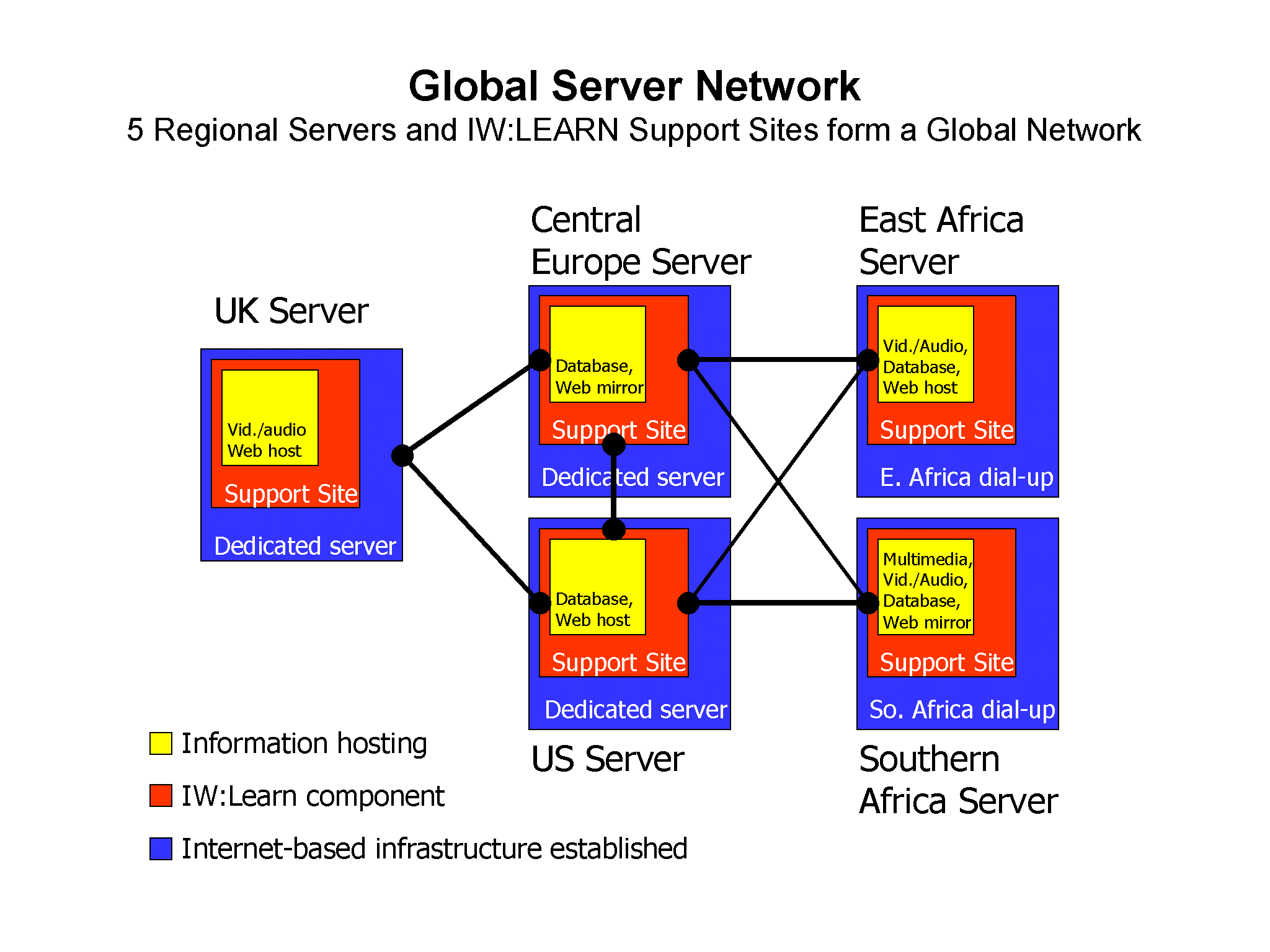
The
Global Server Network can be deployed across the globe to exploit
the high-speed infrastructure established by the communication
industry. It can be extended by links to commercial hosting
services, satellite and terrestrially-based Internet Service
Providers, institutional partners (e.g., UNDP, World Bank), and
IW:LEARN-maintained servers.
2. Support
sites. “Support sites” are physical locations for
training, provision of technical support services, and the hosting
of servers and services. As shown in the
accompanying figure, above, some support sites “mirror”
(i.e., replicate) the information structure of databases or the
services from other support sites. Mirroring serves as a form of
backup to provide redundancy in the event of system failure and
improves overall speed of access across the system. (By dial-in to
a regionally based site, users can avoid the “traffic jams”
that frequently clog intercontinental Internet traffic during
periods of peak demand.) A wide range of technical services can be
managed from the support sites – web hosting, information
archives, online data bases, streaming media, conferencing, course
hosting, etc. In some cases, NT servers are operated from the
support sites. In other cases, a corporate telecommunications
provider maintains high-end machines on or close to the Internet
backbone but specific content is managed virtually by the IW:LEARN
technical team. As of late 1999, a UK Support Site (Royal Holloway,
University of London Royal Holloway) offers a distance Masters
program. A Washington DC Support Site is being set up as a training
center and co-location facility for collaborative activities with
the World Bank. The first regional support sites will be set up in
Africa in 2000.
3. Learning Hubs. “Learning hubs”
are institutional nodes from which trained members of the IW:LEARN
Implementation Team can develop and support country-based programs.
Learning hubs have both technical and substantive components. The
skills to operate or managed a Learning Hub are introduceddevelop
during intensive 5-week “Training, Brainstorming, and Planning
Workshops”. Not all persons trainees attending the workshop
are expected to have the skills, resources, or institutional mandate
to return home to manage a Learning Hub. A curriculum on “How
to Develop and Manage a Learning Hub” will be developed for
subsequent training workshops. Examples of knowledge-sharing
activities that can be developed at a Learning Hub are shown in
Table 3.
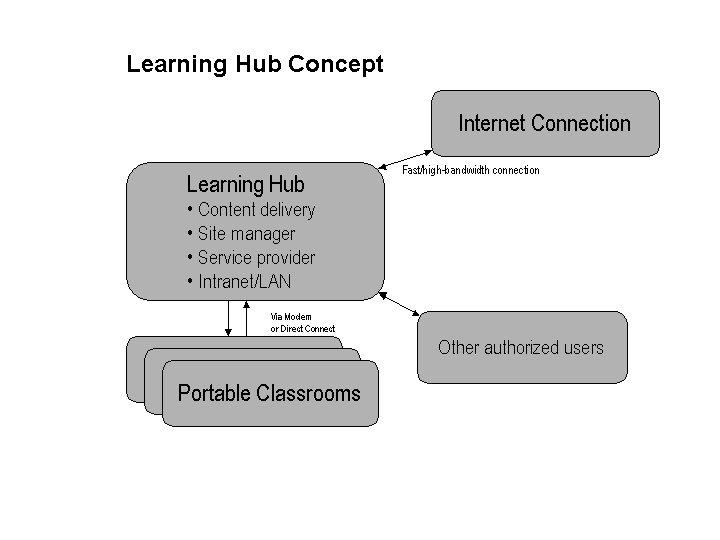
A
Learning Hub
is a server location technically or programmatically managed by a
trained, country-based member of the IW:LEARN Implementation Team.
The hub is equipped with the tools, software, and services specific
to the regional knowledge community. It can serve as a reflector
site and as a dial-in access point in a Virtual Private Network
(VPN).
In
the 5-week “Brainstorming, Planning, and TrainingTraining,
Brainstorming and Planning Workshop” (proposed for Spring
2000), each of the Implementation Team Members will return to his
or her country with the specifications for equipment and managerial
capability of setting up a full Learning Hub. Learning Hubs are
critical to the extension of a content-specific dedicated
teaching/learning environment at the national or project level.
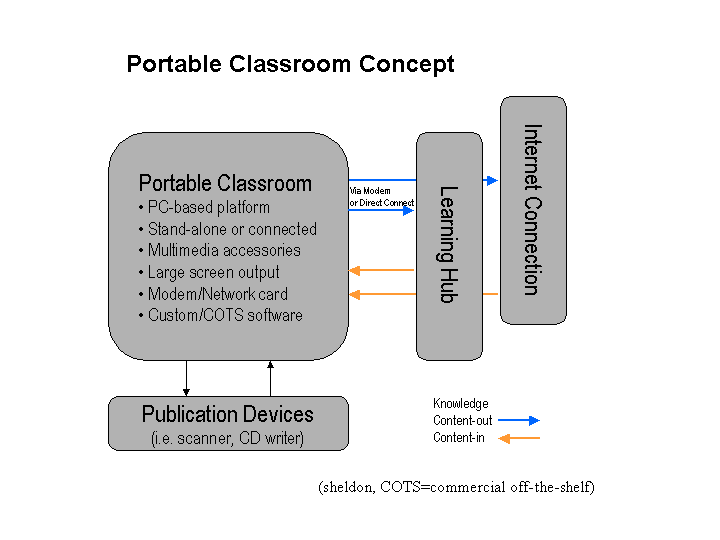
“Portable Classrooms” extend that capacity to the
community, school, or ministry level.
Figure
3
4. Portable
Classrooms. “Portable classrooms” are
hardware/software systems that are designed and configured to allow
field-based members of the Knowledge Community to bed linked
remotely to the virtual learning environment. A “portable
classroom” consists of these elements: a trained individual
with ideas or commitments related to international waters; an
inexpensive,a portable multimedia-equipped computer system that can
connect to the Internet at a minimum speed of 28.8 kilobytes per
second; a suite of software tools that facilitate communication and
knowledge-sharing with other members of the Knowledge Community; a
physical space, such as a “real classroom”, where
teaching, learning, and other community activities can take place.
As shown below, Figure 4, the Portable Classroom is linked by modem
or direct connection to a Learning Hub, and directly or indirectly,
to the Internet. The Portable Classroom also can function as an
offline, standalone publication center.
Figure
4
A
“Portable Classroom” refers to a durable multifunction
computer (portable desktop or laptop machine), associated
peripherals, software, and integration of the hardware with a set of
services and distance learning applications that are supported on a
virtual private network dedicated to this project.
Portable
Classrooms are conceptualized as the model work environment for
people participating in this project who are working on the ground
in schools, training
centers, government offices, NGOs, research centers, etc. They
are relatively low-cost, modular systems that are integrated with
peripherals and pre-selected software. They serve as portals to
dedicated services on the World Wide Web, but they can also function
as standalone units fully usable in the offline environment.
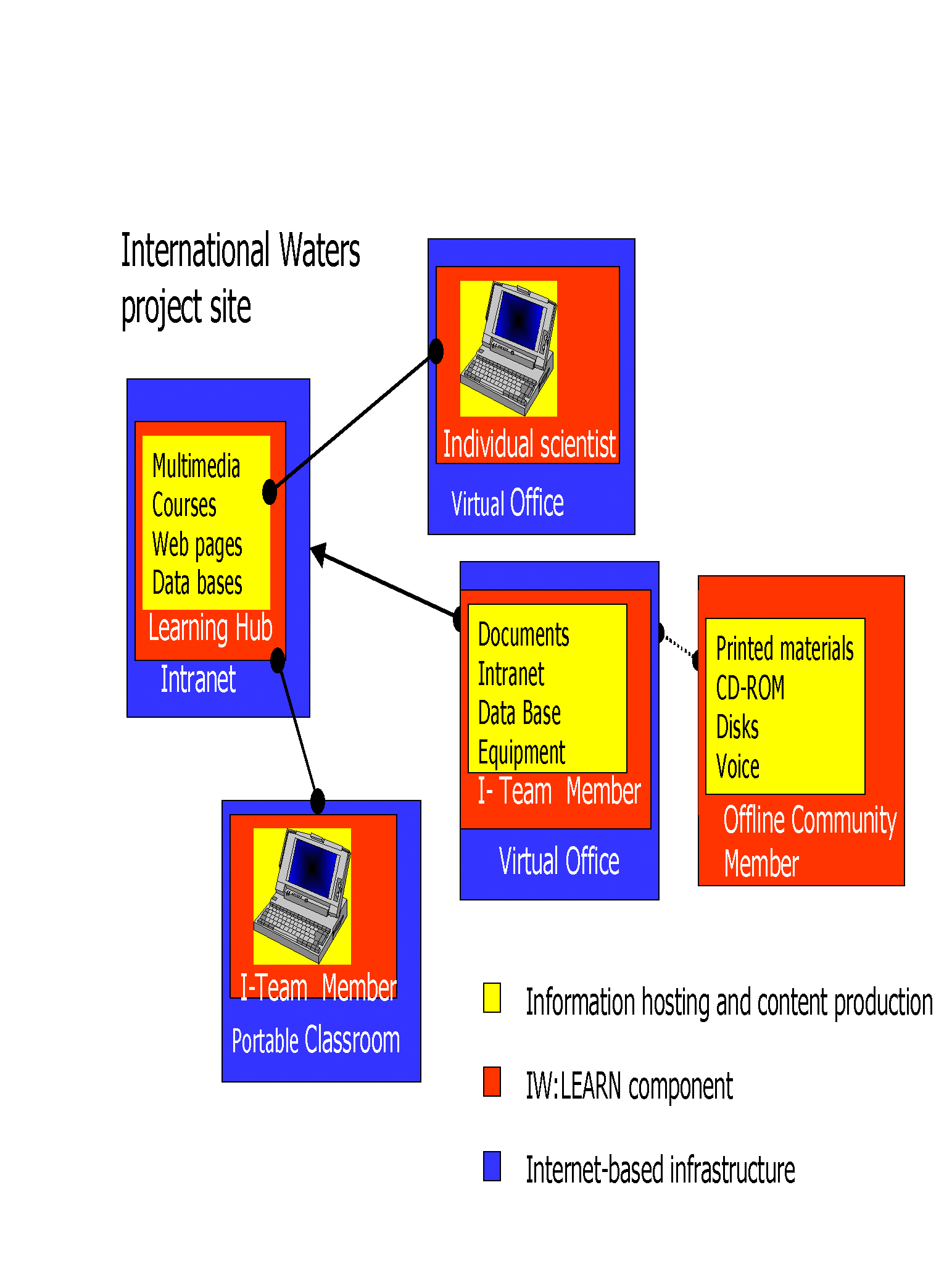
5. Dial-in connections. Each participating
GEF International Waters project (Table 2) maintains relationships
with hundreds of organizations, research centers, teaching
institutions, and government offices. Most projects are active in
several countries. In most of these countries, the availability of
bandwidth is steadily increasing; its costs areis going down; and
Internet services are being extended to secondary cities, field
stations, and increasingly, to mobile locations such as research
vessels. Each year, thousands of new schools, offices, and homes
acquire dial-in capacity. The Learning Hub – Portable
Classroom configuration can be replicated and scaled up within each
of the participating projects, as shown below in Figure 5.
Figure
5
Local
Dial-in Network
Portable
Classrooms, Virtual Offices, and individuals dial-in to a Learning
Hub housed in a local project
The
Local Dial-in Network exploits the gateway to the Knowledge
Community in the context of the needs and connectivity of individual
projects, communities, cities, countries, etc.
6. Offline information flow. Portable
Classrooms are intended to function primarily in the offline mode.
In most instances, dial-in connection is occasional rather than
continuous. Once information is uploaded/downloaded via the Local
Dial-in Network, the Portable Classroom serves as an
information-enriched environment for teaching/learning. Regularly
updated CD ROM disks can be reproduced inexpensively to capture and
mirror the online content of a dynamic Learning Hub that is
connected to the Knowledge Community through a more robust
connection. CDs can then be distributed by mail or hand, enabling
schools, libraries, and small research centers to acquire
specialized resources. An inexpensive printer converts any Portable
Classroom into a formidable publication unit. A Portable Classroom
is similarly designed to integrate with local cable television or
new kinds of services, such as digital radio via satellite.
Table 2
First Cohort of GEF
International Waters Projects participating in IW:LEARN Training
|
Water body
|
Regional IW project
|
Main
location
|
Countries involved
|
Participation in IW:LEARN 1998-99
|
Participation target, 1999-2000-2001
|
|
AFRICA
Gulf of Guinea
|
“Water Pollution Control and Biodiversity Protection in the
Gulf of Guinea Large Marine Ecosystem” (1994)
|
Abidjan
(Cote d’Ivoire)
|
Benin,
Cote d’Ivoire, Cameroon, Ghana, Nigeria, Togo (with
planned expansion to include all GOG states)
|
Sent participant to IWL 7-week training Workshop
Project CTA is a member of IWL Technical Advisory Panel
|
Project expected to set up pilot “learning hubs” and
“portable classrooms;”
Participation in tTraining program/distance MSc candidates from at
least 2 more countries
|
|
Lake Tanganyika
|
“Lake Tanganyika Biodiversity Project”
|
Dar es Salaam
(Tanzania)
|
Burundi, Tanzania, Congo, Zambia
|
Project staff member contributed to training during 1998 IWL
Workshop
|
Project to send participants to IWL training WorkshopTraining
program/distance MSc candidates
|
|
Lake Victoria
|
“Lake Victoria Environmental Management Project”
(World Bank, 1996)
|
Dar es Salaam
(Tanzania)
|
Kenya, Uganda, Tanzania
|
Sent 4 participants to IWL Workshop, including 3 countries’
MIS Officers
Sponsoring participant in distance Masters program
|
Capability to implement a variety of significant on-the-ground
activities; virtual link to global GEF mtg demonstration; training
program/distance MSc candidates
Participation in training program
|
|
ARAB STATES
Red Sea and Gulf of Aden
|
“Implementation of the Strategic Action Planrogram for the
Red Sea and Gulf of Aden” (UNDP, World Bank, UNEP, 1997).
Six previous national and regional projects.
|
Jeddah
(Saudi Arabia)
|
Djibouti,
Egypt, Jordan, Saudi Arabia, Somalia, Sudan, Yemen
|
Sent 3 participants to IWL Workshop
Sponsoring 2 participants in distance Masters program
Project CTA new member of IWL Technical Advisory Panel
|
Capability in place to implement significant on-the-ground
activities;
Additional Workshop training participants, Training
Program/distance MSc candidates
|
|
EUROPE AND
CIS
Black Sea
|
“Environmental Management and Protection of Black
Sea”(1992)”. “Developing the Implementation of
the Black Sea Strategic Action Programme” (1996)
|
Istanbul
(Turkey)
|
Bulgaria,
Georgia, Romania, Russia, Turkey, Ukraine
|
Sent 2 participants to IWL Workshop
Sponsoring participant in distance Masters program
Former project CTA is on IWL Technical Advisory Panel
|
Capacity for “critical mass” of work in Romania
Progress with environmental curriculum and virtual linking in
coastal schools work in Romania.
Other countries to participate in training
workshopprogram/distance MSc
|
|
Danube River Basin
|
“Environmental Program for the Danube River Basin”
(1993). “Developing the Danube River Basin Pollution
Reduction Programme” (1996)
|
Vienna
(Austria)
|
Austria,
Bosnia, Bulgaria, Croatia, Czech Republic, Hungary,
Moldavia, Romania, Slovakia, Slovenia, Serbia and Montenegro,
Ukraine
|
Sent 2 participants to IWL Workshop
Sponsoring participant in distance Masters program
|
Extensive participation in IWL training Workshopprogram; distance
MSc candidates; exploration of virtual scientific conferencing
|
|
Mediterranean
|
“Formulation of a Strategic Action Programme for the
Mediterranean Sea, to Address Pollution from Land-based
Activities”
|
Athens
(Greece)
|
Albania,
Algeria, Bosnia and Herzegovina, Croatia, Egypt, Greece, Lebanon,
Libya, Morocco, Slovenia, Syria, Tunisia, and Turkey
|
Sent participant to IWL workshop
Sponsoring participant in distance Masters program
|
Participants Training program/distance MSc
candidates expected from other countries
|
|
LATIN AMERICA AND CARRIBEAN
Bermejo River Basin
|
“Strategic Action Program for the Binational Basin of the
Bermejo River” (UNEP, 1996)
|
Bermejo
(Argentina)
|
Argentina, Bolivia
|
Project not
yet in full implementation; decision reached to participate next
yearin 20001999
|
Participation planned for 1999-2000
|
|
ASIA-PACIFIC
East Asian Seas
|
“Regional Programme for the Prevention and Management of
Marine Pollution in the East Asian Seas” (UNDP, 1992)
|
Manila
(Philippines)
|
Cambodia,
China, DPR Korea, Indonesia, Malaysia, Philippines,
Republic of Korea, Singapore, Thailand, Vietnam
|
Sent participant to IWL Workshop
Sponsoring participant in the distance Masters program
Project CTA is a member of IWL Technical
Advisory Panel
|
Participants in training program expected
from other countriesIntroduction of Implementation Team member’s
virtual ICM training module; training program/distance MSc
candidates from other countries.
|
|
Tumen River Basin
|
“Strategic Action Plan for the Tumen River and its
Hinterlands,” UNDP, 1998.
|
Beijing
(China)
|
China,
Mongolia, North Korea, Russia, South Korea
|
Sent participant to IWL Workshop
Sponsoredring participant in distance
Masters program
|
Participants Training program/distance MSc
candidates expected from at least 2 countries
|
Note:
Italics country
name shown in Column D reflects countries represented in first cohort
of participants.
Table 3
Learning Hubs: Illustrative Products and Activities
|
Possible activities and methods
|
Illustrative examples
|
|
|
|
|
Inter-project and
inter-agency work groups, using “groupware” to
support distance collaboration
(Supporting technologies: white
boards, application sharing, shared data bases on the World Wide
Web)
|
|
|
A “results and best
practices seminar” via Internet broadcast
(Supporting technologies: real
audio, digital radio broadcast; streaming audio; streaming video)
|
|
|
Short technical Net Courses
(primarily asynchronous)
(Supporting technologies: The World
Wide Web, threaded discussions, email, small-group audio
conferencing)
|
Evaluate and adapt for distance
delivery courses developed by partners, e.g., World Bank (EDI),
TRAIN-SEA-COAST, VKI (Denmark), IHE (Netherlands)
Develop appropriate courses in
areas such as Transboundary Diagnostic Analysis, Strategic Action
Programs, Integrated Freshwater Basin Management, and
Community-based Fisheries Management
|
|
Low cost access to advanced
degree programs at universities with specialized resources
(Supporting technologies:
multi-user conferencing tools; distance learning software
packages)
|
|
|
Dedicated hook-ups to
international scientific meetings
Supporting technologies: Livecast,
WWW, small group audio conferencing, VC
|
|
|
Curriculum sharing among
secondary schools over Internet
(Supporting technologies:
listservs, email, CD ROM, Web access, one-to-one desktop
conferencing
|
|
III. DEVELOPMENT
OBJECTIVE
IW:LEARN is an innovative distance learning
initiative program whose development objective is to build a
Web-based “knowledge community” among transboundary
waters projects. The purpose is to expand knowledge sharing so that
people who live in and manage transboundary water systems can better
learn from and teach each other. The knowledge community will
incorporate intellectual resources, organizations, and individuals
from GEF, its three Implementing Agencies (UNDP, World Bank, and
UNEP), co-financing partners, 40+ regional waters projects, and the
global science and advocacy communities.
The benefits of a knowledge community will be:
Knowledge-sharing
among national, regional, and global stakeholders in International
Waters environments regardless of institutional affiliation
Enhanced capacities
for South-to-South communication, project-to-project information
exchange, and peer-to-peer technical assistance
Expanded access among
waters projects to global science and policymaking
Improved
institutional capacity within GEF, its Implementing Agencies, and
partners to manage, support, and learn from its fast-growing
portfolio of International Waters projects.
Outreach activities
to grassroots level within GEF projects, includingespecially
capacity building through distance education, community
participation including involving women and schoolchildren in public
awareness, and promoting gender equity in access to, and sustainable
financing for, environmental education and training.
Through improved knowledge sharing, IW:LEARN will
strengthen countries’ capacity to integrate sustainable water
resources management into regional and national planning, thereby
reinforcing establishment and compliance with agreements and
conventions in the area of International Waters. The global benefit
will be advances in the sustainable management and protection of
transboundary water systems.
IV. OBJECTIVES, OUTPUTS AND ACTIVITIES
9. Immediate objectives
Over the next three years, IW:LEARN will produce
the following outputs (shown in boldface): and activities:
(1)
Train and mobilize a Web-based Implementation
Team (representing at
least 20 countries) whose members will catalyze and carry out
knowledge-sharing activities within and across among their respective
home regional projects;
(2)
Develop waters-related knowledge
products (e.g.,
courses, seminars, Web sites) to be shared and tested by the IW:LEARN
Implementation Team, making use of new communications technologies
and drawing upon intellectual resources of the participating
projects, UNDP, World Bank, UNEP, and other partners;
(3)
Create a model for a scalable globally accessible
“Web space” (i.e., an extranet) dedicated
to learning and knowledge-sharing about International Waters,
integrating no fewer than 8 6 support sites, 30 20 learning hubs, 180
50 “portable classrooms”, and dial-up connections from
anywhere on the Internet;
(4)
Articulate future-oriented methodologies
for building sustainable Web-based knowledge communities in
developing countries, demonstrating results and work-in-progress at
the GEF International Waters strategic planning and assessment
meetings to be held in 2000 and 2002.
10. Outputs and Indicators of Success
Table 4
Outputs
of IW:LEARN: Year by Year
|
Outputs
|
Year 1 (19998-200099-2001)
|
Year 2 (199-2000-2001-2002)
|
Year 3 (200210-200321)
|
|
Output 1:
A trained team of
country-based professionals, with the skills, equipment, and
external support to facilitate activities within their “home”
projects.
Indicators:
|
Additional workshops
Local spin-offs
|
|
|
|
Output 2:
Knowledge Products
Indicators:
Proliferation of high-quality,
tested learning and knowledge sharing products developed in
partnership with World Bank, UNEP, and other agencies
Adoption and high rate of use
of these materials
Heavily trafficked best
practices data base and Web sites where learning products are
available
|
NetCourses, training modules,
advanced training curriculum
Shared curriculum modules for
secondary schools
Inter-project meetings and
workgroups
International Waters Best
Practices database created (UNEP)
|
|
High volume of above products
New products unthought-of in
1998
UNEP presentation of first
International Waters Best Practice Award
|
|
Output 3:
Globally accessible Web Space,
(an extranet for the ‘Knowledge Communityons’)
Indicators:
“Traffic” on
learning hubs visible from Net
Demonstrable participation in
learning activities from classrooms
Support sites visibly offering
high-demand support services
|
23 “support sites”
46 “learning hubs”
installed
3610 “portable
classrooms” installed
One technical support site
installed (East Africa)(Dar es Salaam)
|
23 regional “support
sites” installed
610 “learning hubs”
installed
60 20 “portable
classrooms” installed
2 technical support sites
installed (Northern Africa/Arab States, Asia)
|
2 regional “support
sites” installed
104 “learning hubs”
installed
84 20 “portable
classrooms” installed
3 technical support sites
installed (Latin America, Africa, Asia)
|
|
Output 4:
Methodologies for building
Web-based knowledge Communities
|
|
|
|
11. Implementation of Activities by Objective
OBJECTIVE 1: Train and mobilize a Web-based Implementation
Team (representing at least 20 countries) whose members will
catalyze and carry out knowledge-sharing activities within and across
their respective home projects
Output
1: A trained team of country-based professionals with the
skills, equipment, and the external support necessary to
facilitatelead distance learning activities within their “home”
International Waters projects.
Activity 1.1
Conduct at least three “Training, Brainstorming, and Planning
Workshops (81999, 2000, 2001, 2002). These workshops will train
Members of the IW:LEARN Implementation Team, who will produce work
plans for in-country activities to be developed within the sponsoring
projects. (The first 15 Implementation Team Members were trained
Fall 1998, see Table 2, Table 5). These individuals will launch
field-based activities at the outset of the present project. The
Workshops will cover topics such as: project planning (in-country,
intra-project and inter-project knowledge sharing activities);
Internet connectivity; tools for building virtual communities; Web
site development; use of the Internet for curriculum development and
community education and outreach; innovative resource mobilisation.
Sustainable development theory
Inputs.
Table 8, BL 32.01. $132,000. Training costs for at least 40
individuals from 20 projects will be shared by GEF, EC, the
sponsoring waters projects, further development of and national
donorssustainable financial mechanisms initiated through infoDev
grant, and other prospective partner agencies.
.
Activity 1.2
Develop a distance Masters program. This program serves as (i.) a
significant capacity building benefit/incentive to selected Members
of the Implementation Team, and as (ii.) a distance learning
“demonstration product”and (iii) a significant
capacity-building option for GEF projects. Persons Implementation
Team trainees participating in the Masters program attend the 5-week
training Workshop, followed by one year of rigorous academic work
combined with practical in situ project-related research. Elements
in the degree program include: An intensive core course in
development studies; intensive training in information technology;
intensive training in International Waters; elective academic work;
and a practical Masters research project that combines academic
training with a high-priority research area or practical problem
emanating from the needs of the sponsoring project
Inputs. Table 8, GEF inputs BL 32.02.
$102,000. Significant counterpart expected from regional and
national sources.
.
Activity 1.3 Create
models for the sustainable financing of distance study. Develop
“student aid” models and packages, and leverage
counterpart funding .Activity 1.3. Create models for the
sustainable financing of distance study. Develop “student
aid” models and leverage counterpart funding.
Inputs. Table 8, B.L. 32.03, seed funding of
$40,000 from GEF. IW:LEARN will seek matching fundinged from others
sources.
Table 5
Participation in IW:LEARN
Training Program: Present and Planned
|
Existing International Waters
Projects, as of FY99
|
Projects in IW:LEARN pipeline
for FY 99/20002000/02
|
|
|
Waterbody-based Operational
Program
(OP#8)
|
Integrated Land & Water
Multiple Focal Area (OP#9)
|
Other International Waters
Programs
|
Waterbody-based Operational
Program
(OP#8)
|
Integrated Land & Water
Multiple Focal Area (OP#9)
|
Other International Waters
Programs
|
|
Freshwater Basin
Lake Victoria*
Lake Ohrid
Danube*
Dnieper†
|
Land degradation
Aral Sea
Bermejo River†
|
GEF Contaminant-based Operational
Program (OP#10)
|
Freshwater Basin
Sao Francisco
Caspian Basin†
San Juan River Basin
Mekong River†
Nile Basin†
|
Land degradation
Lake Chad†
Niger Basin
(Blue Nile Basin Initiative)
Okavango Basin†
|
GEF Contaminant-based Operational
Program (OP#10)
Caribbean Contaminated Bays†
|
|
Marine Ecosystems
Black Sea*
Gulf of Aqaba
Mediterranean
Sea*
Patagonia Shelf
Red Sea *
|
Small Island Developing States
|
GEF Coastal, Marine, and
Freshwater Ecosystems Program
(OP#2)
Lake Tanganyika †
|
Marine Ecosystems
South China Sea †
Benguela Current†
Bay of Bengal
Plata Maritime Front
Canary Current
Yellow Sea
|
Small Island Developing States
Pacific SIDS†
Caribbean SIDS
|
GEF Coastal, Marine, and
Freshwater Ecosystems Program
(OP#2)
|
|
|
Multiple Focal Areas
Tumen River*
East Asian Seas(UNDP)*
Gulf of Guinea*
|
EC-funded African projects
Lake Chad **
Lake Malawi**
Western Indian Ocean
Okavango (EC)
|
|
Multiple Focal Areas
Okavango Basin†
Baltic Sea
Upper Paraguay
East Asia Seas
Western Indian Ocean
|
Other donors projects
Western Indian Ocean **
|
*
Participateding in Fall 1998 IW:LEARN training program , through
PDF-B funds, infoDev co-financing, and contributions from each
project.
† Participation
in IW:LEARN training program expected or likely to be expanded in
1999-2000.
**
EC-funded projects for which support is under consideration.
OBJECTIVE 2: Develop
waters-related knowledge
products (e.g.,
courses, seminars, Web sites, best practices database) to be shared
and tested by the IW:LEARN Implementation Team, making use of new
communications technologies and drawing upon intellectual resources
of the participating projects, UNDP, World Bank, UNEP, and other
partners.
Output 1: High-quality Web-accessible
learning products, derived from the needs of the participating
International Waters projects and associated national and regional
stakeholders. These products will draw upon the lessons learned by
the projects themselves, from GEF, from the three GEF Implementing
Agencies, and their partners.
Activity
2.1 Develop 2-4 water related distance-learning products in
partnership with the World Bank. (See Annex E.5, “ “World
Bank International Waters Knowledge Management Partnership””
for Terms of Reference and forcriteria to guide the use of these
funds.)
Inputs.
Table 8, BL 21.01. $350,000 from GEF with counterpart from the
World Bank. Consultancies, equipment, training, and travel for
IW:LEARN Team members working with consultants, staff members, or
stakeholders associated with World Bank.
Activity
2.2 Develop an interactive International Waters Best Practices
Database in partnership with UNEP. This data based will capture
institutional memory (“lessons learned”) across the three
GEF Implementing Agencies, but will not be exclusive to GEF projects
alone. An award scheme incentive will encourage users to
“self-populate” the database. (See Annex E.6,
“International Waters ‘Best Practices’ Data Base””
for Terms of Reference and criteria for use of these funds.)
Inputs.
Table 8, BL 21.02. $150,000
Activity
2.3 Assist to expand and develop GEF’s “Web
presence” in International Waters through training of IW
project personnel. This activity will entail: (i) working with the
GEF Secretariat to improve the design, functionality, and content of
waters-related sites, (ii) help to develop new functions (e.g.,
distance learning, online data bases) within the existing waters
site., (iii) assist regional GEF IW projects to develop and link
their sites within the framework of GEF, (iv) train Web developers at
the respective sites. In late spring, 19992000, IW:LEARN will host a
“GEF International Waters Web Developers Workshop”.
Inputs.
Table 8, BL21.03. Web Developers Workshop (spring 20001999).
Consultancies for trainers and workshop developers, i.e., 6 person
months, part-time @ $5,000 = $30,000); travel and accommodations for
Web developers representing 12 GEF IW projects, @$3,500 = $42,000;
additional equipment, $12,000; communications and follow-up costs,
$16,000.
Activity
2.4 Identify needs and intellectual resources of existing
regional projects; help existing projects to develop and integrate
distance-deliverable learning products – for example,
project-to-project technical assistance visits. Work with training
and course-building institutions to adapt existing courses to
Web-accessible formats..
Inputs.
Table 8, BL 21.04. Four “new product” initiatives, @
$10,000, including project-to-project technical support visits,
continued opportunities for in-person brainstorming, and the
development of regional networking.
OBJECTIVE
3: Create a
globally accessible
“Web space” (i.e., an extranet) dedicated
to learning and knowledge-sharing about International Waters,
integrating no fewer than 68 support sites, 230 hubs, 5180 “portable
classrooms”, and dial-up connections from anywhere on the
Internet
Output 3: Globally accessible
Web Space for the ‘Knowledge Community’
Activity
3.1 Install the following “support sites”:
An education and training
services site based at Royal Holloway, University of London; a
Washington DC site for training, and technical R&D; four
regional technical support sites (the first to be set up in East
Africa, -2000)Administrative services from Tides Center, Washington
or Sa
n Francisco
Education and training services based at Royal
Holloway, University of London
Inputs.
Table 8, BL 46.01, $32.000. Servers, peripherals and
installation @ 4 sites @$8,000, with matching funds to be sought
from other donors.
Activity
3.2 Install at least one “learning hub” (a
well-managed Web server and at least one trained member of
Implementation Team) within each major project site. Develop
capacity to support intra-regional spin-off activities.
Inputs.
Table 8, BL 46.02, $30,000 . Server for
learning materials based within GEF-related project sites, national
implementing agencies, universities, or government agenciesother
project partners. (Illustrative costs: Low-end server, $3,000; tape
streamer backup, $125; ink jet printer, $250; flatbed scanner, $150;
portable zip drive, $150 = total, @ $ 3,675)
Activity
3.3 Install at least 180 50 “portable
classrooms” across the Global Knowledge Communityons (i.e.,
inexpensive hardware/software systems that allow individual points to
be linked interactively to the full virtual learning environment, or
alternatively, to serve as a stand-alone off-line publication sites
through use of CD ROM and digital radio.
Inputs.
Table 8, BL 46.03, $60,000. Illustrative
costs: Multimedia PC with 17” monitor, @$ 2,775 Estimated:
high-quality audio card, $180; desktop camera, $150; amplified loud
speakers, $ 75; microphone headsets, $30; audio splitter box, $120;
and miscellaneous parts, $200.
OBJECTIVE
4: Present preliminary project results
(1999)at first GEF International Waters meeting in Europe in 2000 and
a present a plan to scale up and intensify successful activities
(2001) at 2000 global meetings of project managers, scientists, and
policy makers to be held under GEF aegisin June 2002. (location to be
decided). These participatory meetings will serve in lieu of a PDF-B
in providing a framework for the planning and preparation of IW:LEARN
Phase II2.
Output 4: Articulate
future-oriented methodologies
for building Web-based knowledge communities and a
plan to intensify and scale up successful learning activities,
including the mobilization of adequate financial resources among GEF,
other donors, and national counterparts for the development of Phase
II2.
Activity
4.1 With virtual and on-site participation by Members of the
Implementation Team, present IW:LEARN’s work-in-progress to
project managers, scientists, and policy makers who will attend GEF’s
first International Waters meeting in (2000). Prepare presentations
for workshops, plenary sessions, evaluative meetings, and hands-on
training.
Inputs.
Table 8, BL 11.02—11.05, approximately 3 person months..
Activity
4.2. Secure funding commitments for intensification and scaling
up of intra-project activities to be proposed for Phase II2
(2003-2005).
Inputs.
From Table 8, BL 11.02
Activity
4.3 Present plan to scale up and intensify
successful activities at a global International Waters meeting in
2002 f (2001) followed by plan for Phase II to be submitted to GEF.F
followed
by plan for Phase II2 to be submitted to GEF
Inputs.
From BL 11.02. From BL.16.0151.03,
results of external evaluation, $20,000.
12. Project Timeline
Figure 6
Project Timeline: Implementation of Activities by
Objective
|
|
Year 1: 1999-2000-20018-99
|
Year 2: 1999-20010-20021
|
Year 3: 200210-200321
|
|
Quarter
|
1
|
2
|
3
|
4
|
5
|
6
|
7
|
8
|
9
|
10
|
11
|
12
|
|
Activities
|
|
|
|
|
|
|
|
|
|
|
|
|
|
Objective 1: Train Knowledge
Management Mgmt. Implementation .Team
|
|
|
|
|
|
|
|
|
|
|
|
|
|
1.1 Hold annual training &
planning workshops
|
|
|
|
|
|
|
|
|
|
|
|
|
|
1.2 Create distance deliverable
Master of Science degree program
|
|
|
|
|
|
|
|
|
|
|
|
|
|
1.3 Develop student aid financing
packages
|
|
|
|
|
|
|
|
|
|
|
|
|
|
|
|
|
|
|
|
|
|
|
|
|
|
|
|
Objective 2: Develop and test
Web-deliverable learning products with IW projects, GEF, World
Bank, UNEP
|
|
|
|
|
|
|
|
|
|
|
|
|
|
2.1 Develop various learning
products with World Bank
|
|
|
|
|
|
|
|
|
|
|
|
|
|
2.2 Develop best practices data
base with UNEP
|
|
|
|
|
|
|
|
|
|
|
|
|
|
2.3 Develop web sites with and for
GEFSECSEC
|
|
|
|
|
|
|
|
|
|
|
|
|
|
2.4 Develop new learning products
with GEF & EC IW projectsother donors
|
|
|
|
|
|
|
|
|
|
|
|
|
|
|
|
|
|
|
|
|
|
|
|
|
|
|
Objective 3: Create “IW Knowledge
CommonsKnowledge Community”
|
|
|
|
|
|
|
|
|
|
|
|
|
|
3.1 Install 8 6 support sites
|
|
|
|
|
|
|
|
|
|
|
|
|
|
3.2 Install 20 learning hubs
|
|
|
|
|
|
|
|
|
|
|
|
|
|
3.3 Install 180 50 portable
classrooms
|
|
|
|
|
|
|
|
|
|
|
|
|
|
|
|
|
|
|
|
|
|
|
|
|
|
|
|
Objective 4: Present results at
biennial meetings (20001, 20023) and a scaling up plan for Phase
II2 (20021)
|
|
|
|
|
|
|
|
|
|
|
|
|
|
4.1 Present results to GEF IW
meeting in 2000
|
|
|
|
|
|
|
|
|
|
|
|
|
|
4.2 Secure co-financing for Phase 2
|
|
|
|
|
|
|
|
|
|
|
|
|
|
4.3 Present plan for scaling up and
intensification at global IW meeting (20023)
followed by plan for Phase II2
|
|
|
|
|
|
|
|
|
|
|
|
|
V. RISKS,
ASSUMPTIONS, AND SUSTAINABILITY
13. Risks and
Assumptions
The following risks
and assumptions are entailed:
Successful training,
bonding, shared purpose, and adequate logistical support for the
IW:LEARN Implementation Team by means of Workshops and distance
training
Hardware and
technical support sufficient at the project level to support
effective participation from within a significant number of project
sites
Continuous
improvement in Internet access among all groups of stakeholders
Successful local
spin-off activities developed by members of the Implementation Team
Technology must
perform to expectations and needs
National project
sites continuously upgrade hardware, staff technical skills, and
Internet access
Funds released in
timely fashion, allowing activities to be carried out
systematically.
14. Financial
Sustainability and the Overall 5-Year Plan
IW:LEARN will
establish financial sustainability through several means:
Substantial
cost-sharing by all GEF Implementing Agencies
Most
on-the-ground activities to be financed at the national level
Contributions for
Implementation Team members’staff training and their
subsequent on-the-ground implementation activities by 40+sponsoring
GEF projects
Creation of new
sources of financial assistance to support distance study, e.g.,
virtual internships, apprenticeships, guaranteed loans,
scholarships, work-study programs
Establishment of
project region or country-based educational/environmental management
financing mechanisms;
guaranteed loans,
scholarships
Extremely lLow core
program cost relative to its size and reach due to highly
efficientintensive use of information technology, including virtual
offices, electronic financial management, extensive use of virtual
conferencing.
NGO project execution
to provide efficient project management with tightly capped
administrative costs.
The financial history
and sustainability plan for the project is shown in Table 6 below.
Table 6
Overview of IW:LEARN
Financial History and Sustainability Plan
|
Donor
|
Amount
|
Purpose
|
|
Previous
commitments:
UNDP
administrative funds (PDF-A)
June
1996
|
$25,000
|
Feasibility
study
|
|
GEF,
PDF-B
Nov
1997
|
$240,000
|
Project
planning and preparation grant
|
|
Centra
Software
Feb
1998
|
$30,000
|
1
yr. cContribution of Symposium software (distance learning
package, through Concord Consortium)
|
|
infoDev
April
1998
|
$140,000
|
Grant to
UNDP for three demonstration activities
|
|
GEF
June
1998January 2000
|
$1,930,400
|
Grant
to UNDP for IW:LEARN/Phase I1 (three years)
|
|
GEF
regional International Waters projects
June-Aug
1998
|
$56246,000
|
Cost-sharing
(training fees, airfare, subsistence) from 87 GEF IW projects to
sponsor participants to IW:LEARN training Workshop. Additional
in-kind: airfares (10) not included in total.
|
|
Funds
committed
|
$2,421,400
|
|
|
Pending
confirmation:
European
Commission (DG-VIII)
(Revised
submission, spring 2000)8
|
~$1,300,000
|
Expanded
activities in Africa
|
|
UNDP
Nordic Fund
(Expected
decision) Autumn 19998
|
$700,000
|
Request
pending on support for 120 “portable classrooms” and
20 “learning hubs”equipment, service and maintenance
|
|
Support
under consideration
|
$~2,000,000
|
|
|
Fundraising
plan:
UN
Volunteers Program and bilateral co-funders
|
~ $120,000
|
Mobile
training labs
|
|
Netherlands
Development Assistance (NEDA), Danish International Development
Assistance (DANIDA), and others
|
~ 1,000,000
|
Region-specific
training and implementation programs
|
|
INTELSAT
|
$90,000
|
Satellite
communications subsidy (commitment for free communication
services; target project areas to be specified)
|
|
Foundations,
bilateral aid programs, corporate donors
|
$1-2,000,000
|
Support
to be sought to for additional equipment for regional IW projects
(i.e., “portable classrooms”, “learning hubs”,
“support sites”)
|
|
National
and local counterpart
|
~$500,000
|
Local
IT infrastructure investments by schools, research centers, NGOs,
and government offices
|
|
GEF
|
$2 -3,000,000
|
IW:LEARN/Phase
II2. Request to GEF to fund intensification and scaling up of
successful distance learning within regional IW projectsand
knowledge sharing activities
|
VI.
IMPLEMENTATION AND EXECUTION
15. IW:LEARN as a Component within Larger
GEF-financed Project
IW:LEARN
was approved by GEF Council in July 1998 as one of three components
within a global umbrella project, entitled “Strengthening
Capacity for Global Knowledge Sharing in International Waters”.
Table 7, below, summarizes each of the three components:
Table 7
GEF International Waters
“Umbrella Project”: By Components
Project
Name: Global: Strengthening
Capacity for Global Knowledge-Sharing in International Waters
Project
Number: GLO/9844/G3397xxxx
Approved
by GEF Council: July
1998
GEF
allocation: $4,817,490
GEF
Implementing Agency: UNDP,
with World Bank and UNEP
|
Project component
|
Component 1:
IW:LEARN
|
Component 2:
Train-Sea-Coast
|
Component 3:
Biennial GEF International Waters
Meetings (tentative: (2000, 20032002)
|
|
Objectives:
(from Project Brief)
|
Share critical knowledge and
collaborate more effectively across boundaries via Internet
|
Develop training courses tailored to
the strategic needs of countries
|
Hold two portfolio-wide strategic
planning and assessment meetings
|
|
Key concepts
|
Distance learning, knowledge
sharing, virtual communities
|
Regional course development,
training
|
Face-to-face meetings of project
directors, senior scientists, Implementing Agencies, GEF, partners
|
|
Mode of operation
|
Internet-based collaboration among
GEF projects via intranet and shared learning methodologies
|
Headquarters in New York, regional
training centers, use of TRAIN-X methodology
|
Collaboration among UNDP, UNEP,
World Bank and GEF Secretariat
|
|
Means
|
Implementation Team members train,
plan, and coordinate activities at intensive workshop; return to
home countries to test and implement knowledge sharing. Expand
virtual ‘knowledge community” based on shared
interests and mutual help
|
Course Development Units (CDUs)
prepare courses using the Train-Sea-Coast methodology (TRAIN-X).
The Central Support Unit (CSU) is funded by the UN Division of
Ocean Affairs and the Law of the Sea (UNDOALOS). Institutions
hosting CDUs meet local costs.
|
GEF International Waters Task Force
coordinates planning and execution of two meetings
|
|
Budget
(from Project Brief)
|
GEF: $ 1,805930,400671,667 X 1.08
=
Co-financing anticipated:
$1,986510,000 [estimate]
Total component cost: $3,791,400
[estimate]203,667
|
GEF: $ 2,041,500
Co-financing: $3,290,000
Total component cost $5,331,500
|
GEF: $721,000
Total component: $721,000
|
|
Implementing Agency
|
UNDP, with World Bank and UNEP.
Implementation with co-financing partners.
|
UNDP
|
UNDP, in association with World
Bank, UNEP and GEF Secretariat
|
|
Executing Agency
|
IW:LEARN as a program of the Tides
Center (NGO execution)
|
UNOPS, with UN-DOALOS
|
UNOPS
|
|
Accountability to GEF
|
The GEF International Waters Task
Force, which includes the International Waters Advisors from all
three Implementing Agencies, and the GEF Secretariat will serve as
Steering Committee for this project. The GEF Secretariat Team
Leader for Biodiversity and International Waters (Operational
Liaison) will serve as the Secretariat’s liaison to the
project. Representatives from other donors. The IW:LEARN CTA
will serve as Secretary to the Steering Committee.
|
The GEF International Waters Task
Force will serve as Steering Committee for this project. The GEF
Secretariat Team Leader for Biodiversity and International Waters
(Operational Liaison) will serve as the Secretariat’s
liaison to the project. The Train-Sea-Coast Co-ordinator will
serve as Secretary to the Steering Committee.
|
The GEF International Waters Task
Force will serve as Steering Committee for this project. The GEF
Secretariat Team Leader for Biodiversity and International Waters
(Operational Liaison) will serve as the Secretariat’s
liaison to the project.
|
|
Technical guidance
|
Technical Advisory Panel will
consisting of present or former International Waters project
directors, GEF and EC other agencies’ waters experts,
scientists, distance learning specialists
|
Advisors affiliated with
International Ocean Institute and TRAIN-X experts
|
GEF International Waters Task Force
|
|
GEF Task Managers
|
UNDP/GEF: The International Waters
Principal Technical Advisor
The World Bank: Will name a Task
Team Leader (TTL)
|
SIOCAM Manager and Deputy Director,
Water Program,
UNDP-SEED
|
UNDP/GEF IW Technical Advisor
Deputy Director, Water Program
|
|
Programmatic accountability
|
The Tides Center Board
|
UN DOALOS
|
UNDP, UNEP, World Bank, GEF
Secretariat
|
|
Key partners
|
GEF (UNDP, World Bank, UNEPDP) and
partnership is sought with European Commission (DGVIII)
|
UNDOALOS-- 16 Course Development
Units (CDUs)
|
GEF projects, UNDP, UNEP, World
Bank, GEF Secretariat, other donors in international waters arena,
scientific community, international waters NGO’s,
governments
|
|
Co-financing
|
infoDev ($140,000 for
demonstration activities); EC co-financing under request; ;
UNDP Nordic Fund (computer equipment and Danish technical
assistance); INTELSAT (satellite services)
|
UN DOALOS (core
support). Sharing of Standard Training Packages (STPs)
among GEF projects and other TSC members.
|
|
16. Expanded
activities in Africa
Expansion
of activities in Africa will be co-implemented is under consideration
by the European Commission (Directorate for Development Cooperation,
Natural Resource Unit, DG-VIII) and will be proposed to other
partners.
If
approved, co-implementation will take place primarily through the
formation of project-to-project relationships, especially in areas
where GEF and potential co-financing partners sponsor projects that
overlap geographically and thematically (e.g., EC-financed
transboundary waters projects in Lake Chad, Western Indian Ocean,
Okavango River Basin).
Examples
of proposed partnership activities:
Development
of region-specific “Training, Brainstorming, and Planning
Workshops” and support for local spin-off activities
Participation
in the Web Developers Workshops
Development
of distance learning, knowledge products, reflecting institutional
experience and expertise
Development
of a scholarship fund for internet-supported virtual studydistance
education
Establishment
of sub-regional technical support sites, regional workshops, and
mobile training labs
Participation
in the infoDev-financed demonstration project in which participating
IW:LEARN project sites will participate virtually in international
marine and aquatic science meetings.
Co-financing
partners would participate on the IW:LEARN Steering Committee and on
its Technical Advisory Panel. (See Annex E.3 and Annex E.4).
17. Virtual
Project Management Model
IW:LEARN
is unique as a GEF project in that it innovates with “virtuality”
as an organizational and management model. The project seeks to
achieve significant cost savings through virtuality. and Examples
and illustrations include:
Wide-area
networking for office work, including the production, distribution,
and filing of documents; contact management, scheduling of meetings,
etc.
Use
of Internet services rather than paid project staff to “farm
out” organizational tasks such travel booking, procurement of
equipment, and banking.
Substitution
of audio conferencing, real-time messaging and and desktop video
for some travel, allowing strategic use of limited travel budgets
Internet-supported
cConferencing rather in order to expand participation and
geographic representation on f the Technical Advisory Panel
18. NGO Execution by The Tides Center
Overview of the Tides Center.
The Tides Center is a San Francisco and Washington-based NGO that
provides financial and management services to non-profit programs
working in areas of social justice, community affairs, economic
policy, international affairs, and the environment. The Tides Center
was created in 1996 as an offshoot of the Tides Foundation, which has
provided non-profit management and support services for more than 20
years. The Tides Center currently manages about 300 programs,
representing roughly $30 million in annual program expenditure.
Tides’ operating revenues are generated by fees for services
(generally 9% overhead on grant funds administered) and donations
from large foundations. Today, the Tides Center is the largest and
best known fiscal administrator for the non-profit and philanthropic
communities in the US. Tides-managed programs now extend to at least
130 countries.
--
See
Annex
A (first section) for provides a general description of the Tides
Center and its contractual relationship with UNDP—
Current status and services to be provided
to IW:LEARN. IW:LEARN was accepted as a program of
the Tides Center in Fall 1998. In December, the World Bank (infoDev)
approved the Tides Center as NGO executing agency for its $140,000
grant to IW:LEARN. The European Commission has tentatively approved
Tides to execute $550,000 in co-financing contribution to IW:LEARN
(see Table 9). Under the terms of the present “UNDP-Tides
Project Cooperation Agreement,” (Annex B), Tides would provide
to IW:LEARN with:
Management and administrative services.
These include: an Administrative Coordinator assigned by the Tides
Administrative Office, effectively working as a part-time member of
the IW:LEARN team; an overall management framework, including annual
reports and reporting to donors; equipment procurement; templates,
advice, and signature on contracts; insurance; assistance with
leases for office space; assistance with intellectual property
issues; letters of credit and backing for credit card applications;
and staff training in selected areas of human resource management.
Financial management
services. These include:
assistance with annual and quarterly budgeting; timely accounting;
up-to-date information on available cash flow; expense tracking;
payroll for staff; prompt payment of invoices; monthly balance
sheets and income statements; direct payments for expenditures
greater than $3,000; corporate credit card accounts; cash reserve
set-aside to cover one-month of operating expenses, filing of all
required taxes and reports; annual audits by professional firms.
Employee benefits. These include: full
employee status, health insurance, dental insurance, insured travel,
grievance procedures against unfair employment practices, direct
payroll deposit, withholding of taxes and reporting to IRS,
disability insurance, life and accidental death insurance,
participation in annuity and retirement plans
--
See
Annex
A, second through fourth section) for summary ofizes Tides
servicesCenter services
--
See Annex B foris the standard NGO Project Cooperation Agreement
to be signed between UNDP and the Tides Center.
Rationale for Waiver of Competitive Bidding.
UNDP procedures for NGO project execution are set forth in
UNDP Procedures for Project Execution by a Non-Governmental Agency
(UNDP Administrator’s Office, September 1997). In
following theose procedures, an array of universities, training
centers, international NGOs, and technology providers were considered
as potential executing agents for IW:LEARN. Most were deemed
unacceptable for one or more of the following reasons: (1) Overhead
rates too high, ranging from 20% to nearly 100%; (2) Not equipped,
prepared, or experienced to deal effectively with a
technology-intensive “virtual program”; (3) Not
experienced with a global program, the UN system, or on-the-ground
realities of developing country implementation; (4) Start-up times
that would entail delay, significant reconfiguration of program, and
loss of current momentum; and (5) Regional commitments, geographic
biases, program objectives, or institutional interests that would
drain, compete with, or divert IW:LEARN from the objectives and
workplan approved in this Project Document.
As a potential executing agency for
IW:LEARN, the Tides Center was constrained by none of these
limitations. In addition, the Tides Center uniquely met all of the
following criteria: (1) Extensive successful experience with project
management and provision of financial services—at a low
overhead rate; (2) High satisfaction with services among current
programs; (3) Capacity to handle a virtual mode of operation; (4)
Experience with management of international computer networking
projects’ (5) Experience with UN system and GEF; (6) An
internal programmatic agenda focused on high-quality administrative
and project management services; (7) Capable of quick start-up
without loss of momentum
; (8) Capacity to “graduate”
IW:LEARN program into a self-sustaining permanent organization; and
(9) Employee benefits package to attract and hold quality staff .
--
See Annex C foris a matrix used to assess the Tides Center’s
capacities to execute this project.
--
See Annex D foris a Rationale for Waiver of Competitive Bidding.
VII.
PRIOR OBLIGATIONS AND PREREQUISITES
None.
VIII. MONITORING,
EVALUATION, REPORTING, AND DISSEMINATION
The project will be subject to the evaluation and
review mechanisms of UNDP, including Project Performance and
Evaluation Review, Tri-partite Review, and an external Evaluation and
Final Report prior to the conclusion of the project. Since the
Tides Center is a ‘first time’ NGO Executing Agency for
UNDP, the UN Office of Project Services (OPS) will be contracted to
provide financial oversight services to assist Tides in financial
reporting according to UNDP rules and regulations. The project will
also participate in the annual PIR (Project Implementation Review)
exercise of the GEFF. In 1999 and 2001, GEF will host
biennial global meetings 2000and 2002) in which senior managers of
international waters projects will assess the overall international
waters portfolio. These meetings will provide additional opportunity
for evaluative input from the GEF projects that are served by
IW:LEARN.
Since all IW:LEARN activity will be conducted over
the Internet, all activity will be highly visible, transparent, and
readily accessible to a full range of stakeholders and other
participants. Since an electronic record is automatically created as
a result of digital activities, monitoring and evaluation will be
significantly simplified and expedited.
BUDGET
Table 8
Budget: UNDP-GEF
Inputs by Year
|
Project
Title: International Waters Distance Learning Project
(IW:LEARN)
Project
number: GLO/98/G33/A/1G71
|
|
BL
|
DESCRIPTION
|
UNDP
|
19992000-00
|
2000-012001
|
2001-022002
|
|
10
|
PERSONNEL
|
|
|
|
|
|
11
|
International
Specialists
|
|
|
|
|
|
11.01
|
Chief
Technical Advisor (CTA)
|
228,000
|
80,000
|
74,000
|
74,000
|
|
11.02
|
Admin
Officer
|
81,000
|
27,000
|
27,000
|
27,000
|
|
11.03
|
Technology
Director
|
81,000
|
27,000
|
27,000
|
27,000
|
|
11.04
|
Operations
Director
|
171,000
|
6157,000
|
5557,000
|
5557,000
|
|
11.99
|
Sub-total
|
561,000
|
195,000
|
1853,000
|
1853,000
|
|
|
|
|
|
|
|
|
15.01
|
Staff
travel
|
75,000
|
25,000
|
25,000
|
25,000
|
|
16.01
|
Final
Evaluationve Missions
|
20,000
|
10,000
|
|
210,000
|
|
19
|
Personnel
component subtotal
|
656,000
|
21630,000
|
21008,000
|
23018,000
|
|
|
|
|
|
|
|
|
20
|
SUB-CONTRACTS
|
|
|
|
|
|
21.01
|
KM
activities w/ World Bank
|
350,000
|
175,000
|
175,000
|
|
|
21.02
|
Best
practices study w/ UNEP
|
150,000
|
100,000
|
50,000
|
|
|
21.03
|
Web
development w/ GEFSEC
|
100,000
|
34,000
|
33,000
|
33,000
|
|
21.04
|
New
products w/ IW projects
|
40,000
|
14,000
|
13,000
|
13,000
|
|
29
|
Sub-contract
component subtotal
|
640,000
|
323,000
|
271,000
|
46000
|
|
|
|
|
|
|
|
|
30
|
TRAINING
|
|
|
|
|
|
32.01
|
Workshops
|
132,000
|
52,000
|
40,000
|
40,000
|
|
32.02
|
Masters-level
distance training
|
102,000
|
42,000
|
30,000
|
30,000
|
|
32.03
|
Scholarship
fund
|
40,000
|
20,000
|
20,000
|
|
|
39
|
Training
component subtotal
|
274,000
|
114,000
|
90,000
|
70,000
|
|
|
|
|
|
|
|
|
40
|
EQUIPMENT
|
|
|
|
|
|
45.72
|
Operations
and maintenance
|
36,000
|
12,000
|
12,000
|
12,000
|
|
45.73
|
Communications
|
30,000
|
10,000
|
10,000
|
10,000
|
|
46.01
|
“Support
site” equipment
|
32,000
|
11,000
|
11,000
|
10,000
|
|
46.02
|
“Learning
hub” equipment
|
30,000
|
10,000
|
10,000
|
10,000
|
|
46.03
|
“Portable
classrooms"
|
60,000
|
20,000
|
20,000
|
20,000
|
|
49
|
Equipment
component subtotal
|
188,000
|
63,000
|
63,000
|
62,000
|
|
|
|
|
|
|
|
|
50
|
MISCELLANEOUS
|
|
|
|
|
|
53.01
|
Sundries,
repairs, misc.
|
18,075
|
6,025
|
6,025
|
6,025
|
|
59
|
Misc.
component subtotal
|
18,075
|
6,025
|
6,025
|
6,025
|
|
|
|
|
|
|
|
|
90
|
TOTAL
|
1,776,075
|
722736,025
|
64038,025
|
41402,025
|
|
94
|
Executing
agency support (7%, average)
|
124,325
|
51,522
|
44,662
|
28,1412
|
|
95
|
Financial
oversight (UN OPS)
|
30,000
|
10,000
|
10,000
|
10,000
|
|
99
|
GRAND
TOTAL (UNDP)
|
1,930,400
|
78397,547
|
69492,687
|
45240,1667
|
|
|
|
|
|
|
|
Table 9:
Budget Inputs: By
Co-financing Partners
|
BL
|
DESCRIPTION
|
UNDP
TOTAL
|
INFODEV
|
EC
/a (proposed)
|
UNDP
Nordic Fund
|
I.W.
Projects
/b
|
World
Bank/c
|
UN
Volunteers & others/d
|
IW:LEARN
GRAND TOTAL
|
|
10
|
PERSONNEL
|
|
|
|
|
|
|
|
|
|
11
|
International
Specialists
|
|
|
|
|
|
|
|
|
|
11.01
|
Chief
Technical Advisor (CTA)
|
228,000
|
20,000
|
48,000
|
|
|
|
|
296,000
|
|
11.02
|
Admin
Officer
|
81,000
|
11,000
|
60,000
|
|
|
|
|
152,000
|
|
11.03
|
Technology
Director
|
81,000
|
|
44,000
|
|
|
|
|
125,000
|
|
11.04
|
Operations
Director
|
171,000
|
11,000
|
44,000
|
|
|
|
|
226,000
|
|
11.05
|
Technical
support/e
|
|
|
243,000
|
96,000
|
|
|
150,000
|
489,000
|
|
11.99
|
Sub-total
|
561,000
|
42,000
|
439,000
|
96,000
|
|
|
150,000
|
1,288,000
|
|
|
|
|
|
|
|
|
|
|
|
|
15.01
|
Staff
travel and subsistence
|
75,000
|
18,000
|
76,800
|
|
|
|
|
169,800
|
|
16,01
|
Evaluative
missions
|
20,000
|
|
22,000
|
|
|
|
|
42,000
|
|
15.99
|
Sub-total
|
656,000
|
18,000
|
98,800
|
|
|
|
|
772,800
|
|
19
|
Personnel
component total
|
|
60,000
|
537,800
|
|
|
|
|
597,800
|
|
20
|
SUB-CONTRACTS
|
|
|
|
|
|
|
|
|
|
21.01
|
KM
activities w/ World Bank
|
350,000
|
|
|
|
|
350,000
|
|
700,000
|
|
21.02
|
Best
practices study w/ UNEP
|
150,000
|
|
|
|
|
|
|
150,000
|
|
21.03
|
Web
development with GEFSEC
|
100,000
|
|
|
|
|
|
|
100,000
|
|
21.04
|
New
products w/ IW projects
|
40,000
|
4,400
|
|
|
92,800
|
|
|
137,200
|
|
29
|
Sub-contract
component total
|
640,000
|
4,400
|
|
|
92,800
|
350,000
|
|
1,087,200
|
|
30
|
TRAINING
|
|
|
|
|
|
|
|
|
|
32.01
|
Workshops
|
132,000
|
|
130,000
|
|
90,000
|
|
|
352,000
|
|
32.02
|
Masters-level
distance training
|
102,000
|
42,000
|
66,000
|
|
50,000
|
|
|
260,000
|
|
32.02
|
Scholarship
fund
|
40,000
|
|
39,600
|
|
|
|
|
79,600
|
|
39
|
Training
component total
|
274,000
|
42,000
|
235,600
|
|
140,000
|
|
|
691,600
|
|
40
|
EQUIPMENT
|
|
|
|
|
|
|
|
|
|
45.72
|
Operations
and maintenance/f
|
36,000
|
12,040
|
132,000
|
|
|
|
|
180,040
|
|
45.73
|
Communications
|
30,000
|
|
39,600
|
|
|
|
|
69,600
|
|
46.01
|
“Support
site” equipment
|
32,000
|
10,000
|
32,340
|
120,000
|
|
|
|
194,340
|
|
46.02
|
“Learning
hub” equipment
|
30,000
|
|
29,392
|
120,000
|
140,000
|
|
|
319,392
|
|
46.03
|
“Portable
classrooms”
|
60,000
|
|
22,176
|
260,800
|
80,000
|
|
|
422,976
|
|
46.04
|
“Mobile
demo lab” (see note /d )
|
|
|
37,400
|
|
|
|
|
37,400
|
|
49
|
Equipment
component total
|
188,000
|
22,000
|
292,908
|
500,800
|
220,000
|
|
|
1,223,708
|
|
50
|
MISCELLANEOUS
|
|
|
|
|
|
|
|
|
|
53.01
|
Sundries
and misc.
|
18,075
|
|
23,800
|
|
|
|
|
41,875
|
|
53.02
|
“Virtual
office” support costs /g
|
18,075
|
|
39,600
|
|
|
|
|
57,675
|
|
59
|
Misc
component total
|
|
|
63,400
|
|
|
|
|
63,400
|
|
90
|
TOTAL
(w/o support cost)/h
|
1,776,075
|
128,800
|
1,129,708
|
596,800
|
452,800
|
350,000
|
150,000
|
4,584,183
|
|
94
|
Executing
agency support /i
|
154,325
|
11,200
|
67,782
|
|
|
|
|
233,307
|
|
99
|
UNDP
Total
|
1,930,400
|
|
|
|
|
|
|
1,930,400
|
|
|
Co-Financing
|
|
140,000
|
1,197,490
|
596,800
|
452,800
|
350,000
|
150,000
|
2,887,090
|
|
|
GRAND
TOTAL
|
1,930,400
|
140,000
|
1,197,490
|
596,800
|
452,800
|
350,000
|
150,000
|
4,817,490
|
Col
G, “Participating Projects”. Counterpart and matching
contributions from participating regional GEF projects. In 1998,
UNDP, World Bank, and UNEP-implemented regional IW projects
contributed nearly $60,000 to sponsor participants in “Training,
Brainstorming, and Planning Workshop” (London, Sept-Nov 1998)n
additional in-kind contributions were made to cover participants’
travel. Budget assumes approximately equivalent contributions over
the next coming three years, i.e., $1480,000. $40,000 for aring is a
conservative estimate of expenditures from projects’ budget for
educaional, toject mandate which will be leveraged by e equipment
already budgeted by participating GEF projects and national
implementing agencies which will be leveraged by IW:LEARN equipment,
training and support to innowledge to carry out project mandates. For
example, computers and servers installed by SAP initiativel
International Waters Knowledge Community although also used for other
scientific or administra
Col
H, “World Bank.” Matching contribution from World Bank
for Knowledge Management Activities. See Annex F. Bank funds are
not yet committed (Nov 1998).
Line
90. Overhead rates. Overhead support rates vary by donor guidelines,
e.g., the maximum allowable EC overhead rate, 6%, i.e., $550,000 X
.06 = $33,000
ANNEXES
Annex A An Overview of the Tides
Center: General Description, Relationship with UNDP, Management and
Administrative Services, Finance, Employee Benefits, and Overhead
Rate
Annex B Project Cooperation
Agreement: UNDP-Tides Center (NGO)
Annex C Capacities: Assessment
and Action Plan for NGO Execution
Annex D Rationale for Waiver
from Competitive Bidding
Annex
E Terms of Reference: Roles and Functions
1.
1. IW:LEARN Implementation Team
-
2.
2. IW:LEARN Steering Committee
3.
3. Technical Advisory Panel
4.
4. Key staff
positions:
(4a)
Chief Technical Advisor
(4b)
Administrative Officer
(4c)
Tides Project Coordinator
(4d)
Technology Director,
(4e)
Education/Training and Program Development OfficerDirector for
Operations
5.
Knowledge Management Partnership (with World Bank)
6. 6. International Waters
Best-Practices Data Base (with UNEP)
Annex
F GEF International Waters Project Descriptions
Annex A
An Overview of the Tides Center:
General Description, Relationship with UNDP,
Management and Administrative
Services, Finance, Employee Benefits, and Overhead
Rate
|
General description
|
|
General
Description
|
Tides
Center is a US-based non-governmental organization [i.e., a “501
© 3”] whose purpose is to provide financial,
administrative, and organizational infrastructure to non-profit
programs working for social change. Tides supports its programs
in one of two modes: It serves as an “incubator” to
enable them to “graduate” as stand-alone NGOs; or, it
provides comprehensive financial, administrative, and management
services for those that do not wish to incorporate as 501 ©
3’ s. The Center was established in 1996 as an offshoot of
the Tides Foundation, which has operated since 1976 to “promote
creative non-profit activity and to manage philanthropic
resources.” The Center operates on philanthropic
donations and on overhead fees. Tides is the largest and best
known fiscal administrator serving the nonprofit community.
Tides does not become involved in the technical or programmatic
work; rather, it provides efficient management services,
financial controls, fiscal accountability, legal back-up,
organizational structure, and personnel benefits so that the
programs can concentrate their resources on programmatic
activity.
|
|
Office
locations
|
San
Francisco CA, and Washington DC
|
|
Program
areas
|
Social
justice (human rights, minority rights, US immigration issues)
Community
affairs (grassroots organizations, local organizations)
Economic
public policy (advocacy and education on key policy issues)
International
affairs (multilateral organizations, global technology)
|
|
Size
and client base
|
Approximately
$50 million per year, representing nearly 300 programs. Most
Tides programs have annual operating budgets in the range of a
few hundred thousand to about a million dollars per year.
|
|
Support
received from:
Corporations
Foundations
Government
agencies
|
Corporations
or corporate foundations:
American
Express, Arco, AT&T, Bank of America, GAP, Hewlett-Packard,
IBM, Philip Morris, JC Penny, Sarah Lee, Sony
Foundations
that have granted Tides or its programs more than $1 million:
Ford Foundation,
Hewlett Foundation, W. Alton Jones Foundation, MacArthur
Foundation, Mott Foundation, and the Soros Foundation. The Pew
Charitable Trusts has made major contributions to support Tides
work in the area of environmental protection.
US
government agencies:
US AID,
Department of Agriculture, Department of Interior, Department of
Justice, Environmental Protection Agency.
|
|
Management
of programs experienced in environmental networks and
developing countries
|
Operated
by Tides since 1987, the Institute for Global Communication
(PeaceNet, EcoNet, and others) is one of Tides’ best known
and most successful programs. EcoNet was the world’s first
computer network dedicated to environmental preservation and
sustainability; it remains the best-known and most comprehensive
global environmental network
With
support from Tides in 1990, IGC and six other international
partners co-founded the Association for Progressive
Communications (APC). APC is an international coalition of
computer networks that includes 25 wholly autonomous members and
40 partners. APC provides communications and
information-sharing to over 50,000 NGOs and citizen activists
working in more than 130 countries. APC is by far the world’s
largest and most important “NGO network”, especially
in developing countries. Its members represent the “cutting
edge” of NGO environmental networking in much of Africa,
Latin America, Russia, and Eastern Europe.
|
|
Experience
related to the UN system
|
APC
works closely with several United Nations agencies to make their
information more accessible to NGOs. As a NGO, APC has
Consultative Status with the UN Economic and Social Council.
UNDP has posted GEF project documents on the APC networks since
1996.
APC
served as the primary provider of telecommunications for NGOs and
UN delegates during the preparatory and on-site meeting of UNCED
(Earth Summit, Rio). To provide continued access to UN events,
APC has directed similar initiatives at the:
United
Nations Conference on Human Rights in Vienna, Austria (1993)
International
Conference on Population and Development in Cairo, Egypt (1994)
World
Summit on Social Development in Copenhagen, Denmark (1995)
Climate
Conference of the Parties to the Climate Convention in Berlin,
Germany (1995)
Fourth
World Conference on Women in Beijing, China (1995)
Among
other programs related to UN and sustainable development, Tides
Center currently operates the Clearinghouse Project for the NGO
Steering Committee for the UN Commission on Sustainable
Development (CSD).
|
|
The Tides-UNDP Relationship
|
|
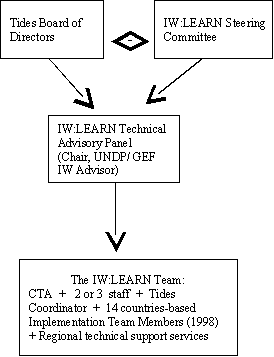
Overall
structure and accountability
|
Each
Tides project is guided by a program-specific board. In the
case of IW:LEARN, the IWLEARN Steering Committee will serve as
the “program board” and the Tides Board will serve as
the legal entity that is accountable to donors as defined by a
corresponding Memo of Understanding. Board and Steering
Committee guidance will be transmitted through the Chair of the
IW:LEARN Advisory Panel (who is also a member of the Steering
Committee) and through the project’s Chief Technical
Advisor (CTA). IW:LEARN staff include an Education and Training
Officer (program development, fundraising, work in Africa); a
Technology Manager, and an Administration Officer to work
closely with the Tides Coordinator, who works in San Francisco or
Washington.
Members
of the IW:LEARN Implementation Team are countries-based. Most are
assigned to IW:LEARN activities by their respective GEF or
EC-financed projects following successful participation in the
7-week “Training, Brainstorming, and Planning Workshop”.
They work as a team, supported logistically and technically by
IW:LEARN.
Roles
and functions are described more fully in Annex E, “Terms
of Reference: Roles and Functions”.
|
|
How
a relationship with the Tides Center is launched and maintained
|
(1)
A” non-501 ©3 program“ (e.g., IW:LEARN) applies
to become a program of the Tides Center.
(2)
With concurrence from the Tides Board and from the program’s
donors (e.g., UNDP-GEF), a renewable, one-year Memo of
Understanding is drawn up.
(3)
Once funding is approved and the MOU is signed, a trained
Tides-based Coordinator is assigned to serve as a liaison between
the program and the Tides Administrative Office. The Coordinator
provides support in installing and training staff on the use of
administrative systems.
(4)
Training programs introduce the project to The Tides Center and
provide education on financial and HR procedures.
(4)
A 7-page Policy Overview supplements the Memo of Understanding.
(5)
A detailed Operations
Manual describes
policies and procedures
(6)
A comprehensive Employee
Handbook describes
benefits programs, rights, obligations, and grievance procedures
(7)
The relationship is assessed and renewed annually based. The
review process involves all parties.
Tides
provides services as described below.
|
|
Management and
Administrative Services
|
|
An
overall management framework
|
Tides
systems are predicated upon principles of proactive management
versus crisis management
Establishes
an overall management plan defined by the Memo of Understanding
(MOU)
Requires
and reviews annual reports to be submitted by the project (i.e.,
IW:LEARN)
Initiates
frequent phone checks
Seeks
feedback on its services (The client program assesses Tides
services annually; review is a two-way process.)
|
|
Legal
advice
|
Provides
legal counsel to handle routine legal issues on behalf of the
project
|
|
Travel
arrangements
|
Employee
travel arrangements are managed as follows:
1.
Travel budget is established, then revised through quarterly
reporting process with Tides
2.
Employee calls his or her travel agent to make arrangements
3.
Employee books reservations using corporate credit card
4.
Employees pays actual expenses (hotels, meals, taxis) with
corporate credit card or cash withdrawals whose purpose is
documented
Traveler
does not require cash advances or reimbursement. Travel
expenditures are immediately verifiable and show up in budget
accounts
|
|
Equipment
procurement
|
Most
equipment is purchased directly as needed, i.e., computer
equipment is orderly directly from low-cost mail order vendors
who normally ship same day
Larger
items (e.g., >$3,000) must be authorized by Tides; they are
purchased quickly and billed directly to the project’s
account
|
|
Reports
to donors
|
Routinely
alerts the project of its donors reporting deadlines and
specific requirements
Works
closely with the project to assure compliance with all
programmatic and financial reporting
Provides
training and software to assist in reporting
Helps
to prepare annual reports for submission to donors
|
|
Contracts
|
Provides
templates and advice for most common contracts
Provides
access to legal counsel to draft and review contracts
Serves
as signatory on contracts or leases over $3,000; the project
director is authorized to sign contracts less than $3,000 on
behalf of the Tides Administrative Office.
|
|
Insurance
|
Provides
access to a comprehensive insurance package covering:
|
|
Leases
and office space
|
|
|
Intellectual
property
|
Copyright
for intellectual property produced by project belongs to Tides
for duration of MOU, but then reverts to the project or to
individuals
Intellectual
property produced by Tides projects can be left in the public
domain in order to assure widest possible public access
|
|
Credit
applications
|
|
|
Training
|
Provides
regular workshops for project staff on accounting, budgeting,
board management
Provides
training on the use of all Tides administrative systems
Provides
referral services in specialized areas of organizational
development not covered by in-house expertise
Provides
short courses in areas such as sexual harassment in the
workplace, stress management, etc.
|
|
Finance
|
|
Project
accounts
|
Funds
for each Tides project are held, accounted for, and audited
separately. There is no mixing of project funds or accounts.
|
|
Budget
process
|
Each
project produces, records, and works within an annual budget
Budgets
are reviewed annually
|
|
Cash
flow management
|
Provides
timely accounting and up-to-date information on available cash
balance
Tracks
both projected and actual revenue and expenses
All
systems are designed to assure regularity and predictability in
cash flow
Invoices
are paid weekly; employee salaries paid through regular payroll
|
|
Tracking
and statements
|
|
|
Approvals
of expenditures;
limits
on approval authorization
|
The
project director authorized to make direct expenditures up to
$3,000 on project’s behalf, subject to quarterly reporting
Expenditures
>$3,000 must be approved by Tides Administrative Coordinator;
the release of funds is immediate
|
|
Corporate
credit cards
|
Yes
|
|
Payments
|
|
|
“Bridge
funding” (i.e., advances for operations against funds
committed by donor but not disbursed)
|
Once
a grant agreement is signed with a donor, Tides will advance
funds to cover one month of operating expenses, thereby allowing
the project to start implementation immediately
|
|
Cash
reserves and emergencies
|
|
|
Taxes
and other regulatory compliance
|
Files
all required taxes and reports
|
|
Audits
|
Complete
annual audits by well-qualified outside auditors
Audits
carried out to a wide array of requirements, including OMB;
however, higher rates are charged to projects with special
auditing requirements due to restricted funding.
|
|
Employee Benefits
|
|
Employment
status
|
Project
staff are Tides employees, with full employee benefits
|
|
Health
insurance
|
Yes,
CIGNA Plan
HMO
or Preferred Provider Option
|
|
Dental
insurance
|
Yes
|
|
Insurance for business travel
|
Yes
|
|
Protection against unfair
termination
|
Employees have recourse to
grievance procedures in the event of unfair employment
termination
|
|
Direct
deposit of paychecks
|
Biweekly
salary payment via direct deposit
|
|
Taxes
and tax reporting for staff
|
Taxes
deducted; reporting to IRS and state; W2’s provided
|
|
Long-term
disability insurance
|
Yes
|
|
Tax
sheltered annuity plan
|
Yes
|
|
Life
and accidental death insurance coverage
|
Yes
|
|
Organizational
culture
|
.
|
|
Overhead rate
|
|
Overhead rate
|
Tides
normal overhead rate is 9-15% but can be negotiated to 6% for
projects with annual expenditure >$ 1 million. An agreement
has been reached for 9% for Year 1 of operation. At that end
of Year 1, the relationship will be reviewed and reassessed.
The rate will be revised downward to about 6% if (i.) annual
budget expenditures are close to $1 million per year (the non-GEF
allocation could vary with co-financing and (ii.) IW:LEARN
successfully demonstrates to Tides Center that execution of a “UN
project” does not entail bureaucratic complexities and
administrative demands beyond those of a “regular”
project.
|
Annex B
PROJECT COOPERATION AGREEMENT
between
THE UNITED NATIONS DEVELOPMENT
PROGRAMME
and
THE TIDES CENTER
Whereas the United Nations Development
Programme (hereinafter referred to as “UNDP”) the Tides
Center (hereinafter referred to as “the NGO”) have, on
the basis of their respective mandates, a common aim in the
furtherance of sustainable human development;
Whereas UNDP has been entrusted by its
donors with certain resources that can be allocated for cooperative
programmes and projects, and is accountable to its donors and to the
Executive Board of UNDP and the United Nations Population Fund
(UNFPA) for the proper management of these funds and can, in
accordance with the UNDP Financial Regulations and Rules, make
available such resources for cooperation in the form of a Project;
Whereas the NGO, its status being in
accordance with national regulations, is committed to the principles
of participatory sustainable human development and development
cooperation, has demonstrated the capacity needed for the activities
involved, in accordance with the UNDP requirements for project
execution; is apolitical and not profit-making;
Whereas the NGO and UNDP agree that
activities shall be undertaken without discrimination, direct or
indirect, because of race, ethnicity, religion or creed, status of
nationality or political belief, gender, handicapped status, or any
other circumstances;
Now, therefore, on the basis of
mutual trust and in the spirit of friendly cooperation, the NGO and
UNDP have entered into the present Agreement.
Article I. Definitions
1. For the purpose of the present
Agreement, the following definitions shall apply:
(a) “Parties” shall
mean the NGO and UNDP;
(b) “UNDP” shall mean
the United Nations Development Programme, a subsidiary organ of the
United Nations, established by the General Assembly of the United
Nations;
(c)© “The NGO”
shall mean The Tides Center, a non-governmental organization
incorporated under the laws of the State of California for the
purpose of providing financial and administrative management services
to non-profit organizations working in the areas of social justice,
community affairs, economic public policy, international affairs, and
environment and natural resources;
(d) “The Agreement”
or “the present Agreement” shall mean the present Project
Cooperation Agreement, which incorporates the Project Objectives and
Activities, Project Work Plan, Project Inputs being provided by
UNDP resources, and Project Budget, and all other documents agreed
upon between the Parties to be integral parts of the present
Agreement;
(e)
“Project” shall mean the activities as described in the
Project Document, “International Waters
Distance Learning Project (IW:LEARN)”; Project Number:
GLO/98/G33/A/1G/71);
(f) “Government” shall
mean the government of states participating in global International
Waters projects;
(g) “UNDP Resident
Representative” in the case of a Global Project shall mean the
Executive Coordinator in charge of the UNDP-GEF Central Unit, or
the person acting on his behalf;
(h) “Person in charge of the
Project” or “Project Director” shall mean the
person appointed by the NGO, in consultation with UNDP, who acts as
the overall coordinator of the Project and assumes the primary
responsibility for all aspects of it;
(i) “Expenditure” shall
mean the sum of disbursements made and valid outstanding obligations
incurred in respect of goods and services rendered;
(j) “To advance” shall
mean a transfer of assets, including a payment of cash or a transfer
of supplies, the accounting of which must be rendered by the NGO at a
later date, as herein agreed upon between the Parties;
(k) “Income” shall mean
the interest on the Project funds and all revenue derived from the
use or sale of capital equipment, and from items purchased with funds
provided by UNDP or from revenues generated from Project outputs;
(l) “Force Majeure”
shall mean acts of nature, war (whether declared or not), invasion,
revolution, insurrection, or other acts of a similar nature or force;
(m) “Project Work Plan”
shall mean a schedule of activities, with corresponding time frames
and responsibilities, that is based upon the Project Document, deemed
necessary to achieve Project results, prepared at the time of
approval of the Project, and revised annually.
Article II. Objective and Scope of the Present
Agreement
1. The present Agreement sets forth
the general terms and conditions of the cooperation between the
Parties in all aspects of achieving the Project Objectives, as set
out in the Project Document, Annex I of the present Agreement.
2. The Parties agree to join efforts
and to maintain close working relationships, in order to achieve the
Objectives of the Project.
Article III. Duration of Project Agreement
1. The term of the present Agreement
shall commence on February 1, 1999 and terminate on January 31,
2002. The Project shall commence and be completed in accordance with
the time frame or schedule set out in the Project Document.
2. Should it become evident to
either Party during the implementation of the Project that an
extension beyond the expiration date set out in paragraph 1, above,
of the present Article, will be necessary to achieve the Objectives
of the Project, that Party shall, without delay, inform the other
Party, with a view to entering into consultations to agree on a new
termination date. Upon agreement on a termination date, the Parties
shall conclude an amendment to this effect, in accordance with
Article XVII, below.
Article IV. General Responsibilities of the
Parties
1. The Parties agree to carry out their
respective responsibilities in accordance with the provisions of the
present Agreement, and to undertake the Project in accordance with
the document “UNDP Procedures for Project Execution by a
Non-governmental Organization”, which forms an integral part
of the present Agreement.
Each
Party shall determine and communicate to the other the person (or
unit) having the ultimate authority
and
responsibility for the Project on its behalf. The Person in charge of
the Project or Project Director shall be appointed by the NGO, in
consultation with UNDP.
3. The Parties shall keep each other informed of
all activities pertaining to the Project and shall consult once every
three months or as circumstances arise that may have a bearing on the
status of either Party in the country or that may affect the
achievement of the Objectives of the Project, with a view to
reviewing the Work Plan, Budget and implementation of the Project.
4. The Parties shall cooperate with
each other to facilitate the obtention of any licenses and permits
required by national laws, where appropriate and necessary for the
achievement of the Objectives of the Project. The parties shall also
cooperate in the preparation of any reports, statements or
disclosures which are required by national law.
5. The NGO may only use the name and
emblem of the United Nations or UNDP in direct connection with the
Project, and subject to prior written consent of UNDP;
6. The Project Director will be
responsible for day-to-day contacts with relevant national
authorities participating in the global project and UNDP on
operational matters during the implementation of the Project. The
UNDP GEF Executive Coordinator or his representative will act as the
principal channel for communicating with the national coordinating
authorities regarding the activities under the Project Cooperation
Agreement
The
UNDP-GEF Executive coordinator will facilitate access to
information, advisory services, technical
and
professional support available to UNDP and will assist the NGO to
access the advisory services of other United Nations organizations,
whenever necessary. The Division of Policy and Procedures (DOPP) in
the Operations Support Group (OSG) will provide information,
technical support, and guidance in issues related to NGO project
execution. The UNDP-GEF Senior Advisor for International Waters
shall serve as the primary liaison and focal point for communication
between UNDP and the Project.
8. The Parties shall
cooperate in any public relations or publicity exercises, when these
are deemed appropriate or useful by the Executive Coordinator.
Article V. Personnel Requirements
1. The NGO shall be fully
responsible for all services performed by its personnel, agents,
employees, contractors or subcontractors (hereinafter referred to as
“Personnel”).
2. The NGO’s Personnel shall
not be considered in any respect as being the employees or agents of
UNDP. The NGO shall ensure that all relevant national labour laws are
observed.
3. UNDP does not accept any
liability for claims arising out of the activities performed under
the present Agreement, or any claims for death, bodily injury,
disability, damage to property or other hazards that may be suffered
by NGO Personnel as a result of their work pertaining to the project.
It is understood that adequate medical and life insurance for
Personnel, as well as insurance coverage for service-incurred
illness, injury, disability or death, is the responsibility of the
NGO.
4. The NGO shall ensure that its
Personnel meet the highest standards of qualification and technical
and professional competence necessary for the achievement of the
Objectives of the Project, and that decisions on employment related
to the implementation of the Project shall be free of discrimination
on the basis of race, religion or creed, ethnicity, ethnicity or
national origin, gender, handicapped status, or other similar
factors. The NGO shall ensure that all Personnel are free from any
conflicts of interest relative to the Project Activities.
Article VI. Terms and Obligations of Personnel
1. The NGO undertakes to be bound by
the terms and obligations specified below, and shall accordingly
ensure that the Personnel performing project-related activities under
the present Agreement comply with these obligations:
(a) The Personnel shall be under
the direct charge of the NGO which functions under the general
guidance of UNDP and the laws of the State in which the NGO is
registered to operate;
(b) Further to subparagraph (a)
above, they shall not seek nor accept instructions regarding the
activities under the present Agreement from any other authority
external to UNDP;
(c)© They shall refrain from
any conduct which would adversely reflect on the United Nations, and
shall not engage in any activity which is incompatible with the aims
and objectives of the United Nations or the mandate of UNDP;
(d) Subject to the requirements
outlined in the document “UNDP Public Information Disclosure
Policy”, information that is considered confidential shall not
be used without the authorization of UNDP. In any event, such
information shall not be used for individual profit. The Project
Director may communicate with the media regarding the methods and
scientific procedures used by the NGO, however, UNDP clearance is
required for the use of the name UNDP in conjunction with Project
Activities in accordance with Article IV, paragraph 5, above. This
obligation shall not lapse upon termination of the present Agreement,
unless otherwise agreed between the Parties.
Article VII. Supplies, Vehicles and
Procurement
1. UNDP shall contribute to the
Project the resources indicated in the Budget section of the Project
Document.
2. Technical and logistical
equipment, non-expendable materials, or other property furnished or
financed by UNDP shall remain the property of UNDP and shall be
returned to UNDP upon completion of the Project or upon termination
of the present Agreement, unless otherwise agreed upon between the
Parties, and in consultation with the national coordinating
authorities. During Project implementation and prior to such
return, the NGO shall be responsible for the proper custody,
maintenance and care of all equipment. The NGO shall, for the
protection of such equipment and materials during implementation of
the Project, obtain appropriate insurance in such amounts as may be
agreed upon between the Parties and incorporated in the Project
Budget.
3. UNDP will place on the supplies,
equipment and other materials it furnishes or finances such markings
as will be necessary to identify them as being provided by UNDP.
4. In cases of damage, theft or
other losses of vehicles and other property made available to the
NGO, the NGO shall provide UNDP with a comprehensive report,
including police report, where appropriate, and any other evidence
giving full details of the events leading to the loss of the
property.
5. In its procedures for procurement
of goods, services or other requirements with funds made available by
UNDP as provided for in the Project Budget, the NGO shall ensure
that, when placing orders or awarding contracts, it will safeguard
the principles of highest quality, economy and efficiency, and that
the placing of such orders will be based on an assessment of
competitive quotations, bids, or proposals, unless otherwise agreed
to by UNDP.
6. UNDP shall make every effort to
assist the NGO clearing all equipment and supplies through customs at
places of entry into the country(ies) where Project activities are to
take place.
7. The NGO shall maintain complete
and accurate records of equipment, supplies and other property
purchased with UNDP funds and shall take periodic physical
inventories. The NGO shall provide UNDP annually with the inventory
of such equipment, property and non-expendable materials and
supplies, and at such time and in such form as UNDP may request.
Article VIII. Financial and Operational
Arrangements
1. In accordance with the Project Budget, UNDP has
allocated and will make available to the NGO funds up to the maximum
amount of $1,900805,400. The first installment of $385,000180,500
will be advanced to the NGO within 15 working days following
signature of the present Agreement. The second and subsequent
installments will be advanced to the NGO quarterly when a Financial
Report and other agreed upon documentation, as referenced in Article
X, below, for the activities completed have been submitted to and
accepted by UNDP as showing satisfactory management of use of UNDP
resources.
2. The NGO agrees to utilize the
funds and any supplies and equipment provided by UNDP in strict
accordance with the Project Document. The NGO shall be authorized to
make variations not exceeding twenty (20) per cent on any one line
item of the Project Budget, provided that the total Budget allocated
by UNDP is not exceeded. The NGO shall notify UNDP about any expected
variations on the occasion of the quarterly consultations set forth
in Article IV, paragraph 3, above. Any variations exceeding twenty
(20) per cent on any one line item that may be necessary for the
proper and successful implementation of the Project shall be subject
to prior consultations with and approval by UNDP.
3. The NGO further agrees to return
within two (2) weeks any unused supplies made available by UNDP at
the termination or end of the present Agreement or the completion of
the Project. Any unspent funds shall be returned within two (2)
months of the termination of the present Agreement or the completion
of the Project.
4. UNDP shall not be liable for the
payment of any expenses, fees, tolls or any other financial cost not
outlined in the Project Work Plan or Project Budget, unless UNDP has
explicitly agreed in writing to do so prior to the expenditure by the
NGO.
5. The Project Management Fee
(“overhead”) charged by the Tides Center is to be set at
9% per year, subject to the annual review and discussion by Tides
Center and IW:LEARN. The overhead rate would be adjusted to 6% for
any year if two conditions are met: (i.) IW:LEARN grant income
from all sources managed by Tides Center approaches $1 million in
that calendar year, and (ii) the reporting, auditing, and
administrative requirements of IW:LEARN do not significantly expand
beyond the parameters set forth in this document.
Article IX. Maintenance of Records
1. The NGO shall keep accurate and
up-to-date records and documents in respect of all expenditures
incurred with the funds made available by UNDP, to ensure that all
expenditures are in conformity with the provisions of the Project
Work Plan and Project Budgets. For each disbursement, proper
supporting documentation shall be maintained, including original
invoices, bills, and receipts pertinent to the transaction. Any
Income, as defined in Article I, paragraph 1 (k), above, arising from
the management of the Project shall be promptly disclosed to UNDP.
The Income shall be reflected in a revised Project Budget and Work
Plan and recorded as accrued income to UNDP, unless otherwise agreed
between the Parties.
2. Upon completion of the
Project/Termination of the Agreement, the NGO shall maintain the
records for a period of at least four (4) years, unless otherwise
agreed upon between the Parties.
Article X. Reporting Requirements
The NGO
shall provide UNDP with periodic reports on the progress,
activities, achievements and results
of
the Project, as agreed between the Parties. As a minimum, the NGO
shall prepare an annual progress report (APR).
2. Financial Reports will be undertaken as
described in the document “UNDP Procedures for Project
Execution by a Non-Governmental Organization”.
The NGO is expected to prepare a Financial
Report and submit it to the person designated by the UNDP-GEF
Executive Coordinator within thirty (30) days after the end of each
quarter, in English.
(b) The purpose of the Financial Report is to request a quarterly
advance of funds, to list the disbursements incurred on the Project
by budgetary component on a quarterly basis, reconcile outstanding
advances and foreign exchange loss/gain during The NGO is expected to
prepare a Financial Report and submit it to the person designated by
the UNDP-GEF Executive Coordinator within thirty (30) days after the
end of each quarter, in English
(cb) The purpose of the Financial Report is to request a quarterly
advance of funds, to list the disbursements incurred on the Project
by budgetary component on a quarterly basis, reconcile outstanding
advances and foreign exchange loss/gain during the quarter.
(d)© The Financial Report has been designed to reflect the
transactions of a project on a cash basis. Because of this,
unliquidated obligations or commitments should not be reported to
UNDP, i.e., the reports should be prepared on a “cash basis”,
not an accrual basis, and thus will only include
disbursements made by the NGO and not commitments.
However, the NGO shall provide indication when submitting reports as
to the level of unliquidated obligations or commitments, for
budgetary purposes.
(ed) The information furnished on the Report forms the basis of a
periodic financial review, and its timely submission is a
prerequisite to the continuing funding of the Project. Unless the
Financial Report is received, requests for advances of funds from
UNDP will not be acted upon by the UNDP.
(fe) Any refund received by an NGO from a supplier should be
reflected on the Report as a reduction of disbursements on the
component to which it relates.
3. Within two (2) months of the
completion of the Project or of the termination of the present
Agreement, the NGO shall submit a final report on the Project
activities and include a final Financial Report on the use of UNDP
funds, as well as an inventory of supplies and equipment.
Article XI. Audit Requirements
1. The NGO shall submit to UNDP a
certified annual financial statement on the status of funds advanced
by UNDP. The Project will be audited at least once during its
lifetime, but may be audited annually, as will be reflected in the
annual audit plan prepared by UNDP Headquarters (Division of Audit
and Performance Review), in consultation with the Parties to the
Project. The audit shall be carried out by the auditors of the NGO or
by a qualified audit firm, which will produce an audit report and
certify the financial statement. UNDP Headquarters (Office of Audit
and Performance Review) approval is not required in the selection of
a qualified audit firm.
2. Notwithstanding the above, UNDP
shall have the right, at its own expense, to audit or review such
Project-related books and records as it may require, and have access
to the books and record of the NGO, as necessary.
Article XII. Responsibility for Claims
1. The NGO shall indemnify, hold and
save harmless, and defend at its own expense, UNDP, its officials and
persons performing services for UNDP, from and against all suits,
claims, demands and liability of any nature and kind, including their
cost and expenses, arising out of the acts or omissions of the NGO or
its employees or persons hired for the execution of the present
Agreement and the Project .
2. The NGO shall be responsible for,
and deal with all claims brought against it by its Personnel,
employees, agents or contractors.
Article XIII. Suspension and Early Termination
1. The Parties hereto recognize that
the successful completion and accomplishment of the purposes of a
technical cooperation activity are of paramount importance, and that
UNDP may find it necessary to terminate the Project, or to modify the
arrangements for execution of a Project, should circumstances arise
which jeopardize successful completion or the accomplishment of the
purposes of the Project. The provisions of the present Article shall
apply to any such situation.
2. UNDP shall consult with the NGO
if any circumstance arises that, in the judgment of UNDP, interferes
or threatens to interfere with the successful completion of the
Project or the accomplishment of its purposes. The NGO shall
promptly inform UNDP of any such circumstance that might come to the
NGO’s attention. The Parties shall cooperate towards the
rectification or elimination of the circumstance in question and
shall exert all reasonable efforts to that end, including prompt
corrective steps by the NGO, where such circumstances are
attributable to it or within its responsibility or control. The
Parties shall also cooperate in assessing the consequences of
possible termination of the Project on the target beneficiaries of
the Project.
3. UNDP may at any time after
occurrence of the circumstance in question and appropriate
consultations suspend execution of the Project by written notice to
the NGO, without prejudice to the initiation or continuation of any
of the measures envisaged in paragraph 2, above, of the present
Article. UNDP may indicate to the NGO the conditions under which it
is prepared to authorize a resumption of execution of the Project.
4. If the cause of suspension is
not rectified or eliminated within fourteen (14) days after UNDP has
given notice of suspension to the NGO, UNDP may, by written notice at
any time thereafter during the continuation of such cause: (a)
terminate the Project; or (b) terminate the NGO’s execution of
the Project, and entrust its execution to another Executing Agency.
The effective date of termination under the provisions of the present
paragraph shall be specified by written notice from UNDP.
5. Subject to paragraph 4 (b),
above, of the present Article, the NGO may terminate the present
Agreement in cases where a condition has arisen that impedes the NGO
from successfully fulfilling its responsibilities under the present
Agreement, by providing UNDP with written notice of its intention to
terminate the present Agreement at least 30 days prior to the
effective date of termination, if the Project has a duration of up
to six (6) months, and at least sixty (60) days prior to the
effective date of termination, if the Project has a duration of more
than (6) months.
6. The NGO may only terminate the
present Agreement under point 5, above, of the present Article, after
consultations have been held between the NGO and UNDP, with a view to
eliminating the impediment, and shall give due consideration to
proposals made by UNDP in this respect.
7. Upon receipt of a notice of
termination by either Party under the present Article, the Parties
shall take immediate steps to terminate activities under the present
Agreement, in a prompt and orderly manner, so as to minimize losses
and further expenditures. The NGO shall undertake no forward
commitments and shall return to UNDP, within thirty (30) days, all
unspent funds, supplies and other property provided by UNDP, unless
UNDP has agreed otherwise in writing.
8. In the event of any termination
by either Party under the present Article, UNDP shall reimburse the
NGO only for the costs incurred to execute the project in conformity
with the express terms of the present Agreement. Reimbursements to
the NGO under this provision, when added to amounts previously
remitted to it by UNDP in respect of the Project, shall not exceed
the total UNDP allocation for the Project.
9. In the event of transfer of the
NGO’s responsibilities for execution of a Project to another
Executing Agency, the NGO shall cooperate with UNDP and the other
Executing Agency in the orderly transfer of such responsibilities.
Article XIV. Force
Majeure
1. In the event of and as soon as
possible after the occurrence of any cause constituting Force
Majeure, as defined in Article I, paragraph 1, above, the Party
affected by the Force Majeure shall give the other Party notice and
full particulars in writing of such occurrence, if the affected Party
is thereby rendered unable, in whole or in part, to perform its
obligations or meet its responsibilities under the present Agreement.
The Parties shall consult on the appropriate action to be taken,
which may include suspension of the present Agreement by UNDP, in
accordance with Article XIII, paragraph 3, above, or termination of
the Agreement, with either Party giving to the other at least seven
(7) days written notice of such termination.
2. In the event that the present
Agreement is terminated due to causes constituting Force Majeure,
the provisions of Article XIII, paragraphs 8 and 9, above, shall
apply.
Article XV. Arbitration
The Parties shall try to settle amicably through
direct negotiations, any dispute, controversy or claim arising out of
or relating to the present Agreement, including breach and
termination of the Agreement. If these negotiations are unsuccessful,
the matter shall be referred to arbitration in accordance with United
Nations Commission on International Trade Law (UNCITRAL) Arbitration
Rules. The Parties shall be bound by the arbitration award rendered
in accordance with such arbitration, as the final decision on any
such dispute, controversy or claim.
Article XVI. Privileges and Immunities
Nothing in or related to the present Agreement
shall be deemed a waiver, express or implied, of any of the
privileges and immunities of the United Nations and UNDP.
Article XVII. Amendments
The present Agreement or its Annexes may be
modified or amended only by written agreement between the Parties.
IN WITNESS WHEREOF the undersigned, being
duly authorized thereto, have on behalf of the Parties hereto signed
the present Agreement at the place and on the day below written.
For The Tides Center: For
UNDP:
Signature: _______________________ Signature: _______________________
Name:
_______________________ Name: _______________________
Title: _______________________ Title: _______________________
Place: _______________________ Place: _______________________
Date:
_______________________ Date: _______________________
Annex
C
CapacitIES: ASSESSMENT AND ACTION
PLAN for NGO Execution
Matrix for Assessing Project
Execution Capacity
Project title: International Waters Distance Learning Project
Executing NGO: The Tides Center
Project number: GLO/98/G33/A/1G/71
XXX
|
(a)
REQUIREMENTS
FOR XECUTION
|
(b)
FINDINGS AND CONCLUSIONS
|
©
SOLUTIONS
|
(d)
RESPONSIBLE
|
I. Technical,
managerial, administrative, and financial capacities
|
|
Technical
capacities
|
|
|
|
Organizational
competency to undertake technical tasks
(e.g., network planning, software development, technical
training)
|
IW:LEARN
has assembled an experienced, highly skilled technical team. The
project has a track record of successfully completing technical
tasks, including Web site development, telecommunications
planning, development of software applications, gopher site
development, and database management. The Tides Center is highly
experienced in providing the necessary administrative and
managerial backup to support the technical work. No
deficiency
|
If
needed, IW:LEARN can draw upon additional technical resources from
the World Bank, UNDP, commercial technology providers, and
universities. Funds are budgeted for this purpose as needed.
|
|
|
|
All
individuals associated with IW:LEARN are highly experienced in
their respective fields. The recently selected Members of the
Implementation Team, representing the respective GEF IW projects,
include individuals with a vast range of technical skills and
practical experience.
Brief
bibliographical summaries for staff and Implementation Team are
available.
|
.
|
|
|
|
i.)
The UNDP-GEF IW Advisor is well placed to effectively monitor
this project
ii.)
The “virtuality” of this project makes all activities
highly transparent and in many respects easier to monitor than a
conventional project
iii)
The GEF Monitoring and Evaluation Unit has capacity to monitor
this project
iv)
Tides Center carefully monitors the management and administration
of all Tides-affiliated projects
|
|
|
|
Managerial
capacity
|
|
|
|
|
|
The
Tides Center has managed nearly 300 projects of this sort. Tides
will provide IW:LEARN with a full suite of management services,
including a Coordinator, training sessions, well tested software
to support smooth project management, regular phone check-ins,
and proactive management strategies. IW:LEARN’s capacity to
coordinate complex activities is illustrated by the fact that an
outstanding Implementation Team was been assembled over the past
four months representing 9 GEF projects and individuals from 13
different countries. A complex technical plan has been developed.
A virtual office is being set up. A three-year plan has been
devised and is unfolding on track.
|
|
|
|
|
Tides
has well developed planning systems—for example,
comprehensive annual review of all projects, quarterly budgeting
cycles, and overall assistance with strategic planning. The
IW:LEARN technical team is also well experienced with planning
methodologies. IW:LEARN itself was developed under a GEF Planning
and Project Preparation grant to UNDP (i.e., a PDF-B). All
planned PDF-B activities are on track or ahead of schedule.
The
IW:LEARN Team holds intense 2-hour planning sessions on a weekly
basis. IW:LEARN is strengthening its internal planning through
Web-based use of MS Project (software). If present trials are
successful, this will be adapted as a “standard” among
members of the Implementation Team (Fall 1998).
|
|
|
|
|
i.)
Tides operates on a rock-solid management structure that has been
developed over 20+ years of NGO management.
ii.)
The IW:LEARN Project Steering Committee is in place to further
strengthen the overall management structure
iii.)
A Technical Advisory Panel, chaired by UNDP/GEF IW Advisor, will
meet virtually twice a year
iv.)
The Boston-based management team integrates management on a
day-to-day basis, working closely with the Tides Administrative
Office, the countries-based Implementation Team, and UNDP/GEF.
|
|
|
|
|
Overall
policy decisions on program are translated through the Project
Steering Committee, chaired by the UNDP/GEF Technical Advisor.
(The IW:LEARN CTA serves as Secretary to the Steering Committee
for these purposes.) The Tides Board does not normally get
involved in programmatic decisions, but has full administrative
authority in the well defined areas of Tides’
responsibility. The CTA translates decision on a day to day
basis. As a matter of organizational philosophy and style,
IW:LEARN is committed to principles of team planning,
decision-making through the process of consensus building, and a
work ethos in which each individual accepts responsibility for his
or her own decisions. IW:LEARN hires people who have already
demonstrated excellent problem-solving skills. Individuals who
work on IW:LEARN are expected to operate with a high degree of
autonomy. They are expected to make their own decisions on a
day-to-day basis and to accept responsibility for outcomes.
|
|
|
|
Administrative
capacity
|
|
|
|
|
|
i.)
The Tides Center has extremely well developed, well-supported
internal systems for tracking, managing, and reporting upon all
expenditures. These procedures have been tested and refined on
dozens of NGO projects similar to IW:LEARN in size and complexity.
ii.)
Tides offers extensive training to the project team on all
aspects of administration
iii)
Rigorous auditing procedures are in place and have been applied
successfully over many years, including highly complex auditing
and expenditure tracking required by government-financed programs
|
|
|
|
|
i.)
IW:LEARN staff is extremely experienced in the area of equipment
management.
ii)
Several of the participants selected to attend the IW:LEARN
Training Workshop in London are IT officers for their respective
GEF projects.
iii)
A proposal currently under review by the UNDP Nordic Fund would
provide a full-time Nordic consultant to help manage equipment for
the full IW:LEARN project
|
|
|
|
|
i.)
The Tides Center has well-defined policies on personnel
recruitment, grievance procedures to assure fair treatment of
employees, and a comprehensive benefit package to help retain
capable employees.
ii)
Project personnel are recruited through national advertisement
and hiring process
iii)
IW:LEARN has a vast network of person contacts for recruiting
personnel
iv)
IW:LEARN is highly skilled at using the Internet to expand
recruiting
|
|
|
|
|
A
proposal for separate equipment management services is currently
under review by the UNDP Nordic Fund. A full-time Nordic
consultant would take over this responsibility if proposal is
approved, as expected.
|
If UNDP Nordic Fund is not
approved, IW:LEARN
will have to re-direct resources and attention to procurement.
The Tides Center has ample internal capability, including accounts
and direct relationships with key equipment vendors.
|
IW:LEARN Project Officer for
Technology and Administration will ensure that equipment
procurement capacity is in place by November 1, 1998.
|
|
Financial
capacity
|
|
|
|
|
|
i)
All financial activities are performed by the Tides Center in
accordance with rigorous budgeting guidelines; budgets are
reviewed annually
ii)
Project budgets are tracked and updated automatically, with
written reports on expenditures and balances generated each month
iii.)
Early warning systems in place to detect possible overspending
iv.)
Tides Center provides in-house training on use of its budgeting
systems
|
|
|
|
|
i.)
Funds are disbursed weekly against budgeted categories
ii.)
Streamlined disbursements systems are in place for expenditures
<$3,000
|
|
|
|
|
Tides
Center maintains rigorous systems for recording and reporting on
all financial transactions. All projects publish comprehensive
annual reports.
|
|
|
|
|
i.)
As a “virtual program” IW:LEARN is developing systems
to assure backups and instantaneous access to all records
ii.)
Tides Center offices in Washington independently stores physical
records
iii)
IW:LEARN is currently developing a comprehensive electronic
filing system for multiple locations
ivii)
Use of scanners and the Internet assures that all documents are
backed up and stored digitally in multiple locations
|
|
|
|
II. Capacity to Perform Key
Tasks
|
|
Requirements
Findings/Conclusions
Solutions Responsible
|
|
1.
Train Knowledge Management Implementation Team
|
The
present Tides/IW:LEARN team has successfully planned and carried
out the first intensive 7 week training session (“The
Training, Brainstorming, and Planning Workshop”, Egham,
England (Fall 1998).
|
|
|
|
2.
Develop and test Web Deliverable learning products with IW
projects, GEF, World Bank, and UNEP
|
The
present team has extensive experience in the development of
educational materials over the Web, including data bases, gopher
sites, Web sites, software tools, and distance learning programs.
The present team has an extensive network of well developed
contacts and potential partners in each of the GEF Implementing
Agencies.
|
|
|
|
3.
Create the International Waters Knowledge Commons
|
The
present IW:LEARN/Tides Team has conducted technical studies and
developed the present infrastructure plan while carrying out PDF-B
activities on this project.
|
|
|
|
4.
Present results at biennial meetings (1999,2001) and a scaling
up plan for Phase 2
|
The
present IW:LEARN/Tides team has extensive experience in the
presentation and evaluation of projects, including proposal
development.
|
|
|
|
Overall
Conclusion
|
The
Tides Center provides outstanding managerial, administrative, and
financial infrastructure so that the IW:LEARN technical team can
focus effectively on the challenges of program development. The
“Tides model” is highly geared to the needs and
operating style of NGOs as well as to the still-novel requirements
of a “virtual organization.”
|
|
|
Prepared
by:
UNDP
__________________
Executing
Agent ___________
Annex D
Rationale for Waiver from
Competitive Bidding
A systematic search was conducted to locate an
appropriate and cost effective executing agent for IW:LEARN. NGO and
non-NGO alternatives were explored, including universities, training
centers, international NGOs, and technology providers. Most were
deemed inappropriate for one or several of the following reasons:
Not
equipped, prepared, or experienced to deal effectively with a
technology-intensive “virtual program”.
Not
experienced with a global program, the UN system, or on-the-ground
realities of developing country implementation.
Viewed
IW:LEARN as an adjunct that would help to subsidize other programs,
suggesting future wrangling over resources rather than a path to
financial sustainability
• Many
international NGOs with well-established thematic and/or geographic
priorities which did not fit. No existing organization has similar
mandate in international waters. For example, some NGOs are
interested in marine but not freshwater systems, Asian but not
African systems, etc.
Highly
interested in education innovation and cutting-edge
technologies….but not necessarily the more mundane details of
procurement, budgeting, personnel, and day-to-day project management
The Tides Center was the only organization that
had none of the above drawbacks, and moreover, met all
of the following criteria. No other organization met even a
majority:
The
Tides Center currently manages about 300 programs, representing
roughly $30 million in nonprofit expenditures per year. Tides
successfully operates many programs of the scale and complexity of
IW:LEARN. Details on Tides services are
provided in Annex A. In general, Tides
charges an administrative overhead rate of 9% -- with rates of 6% for
programs with expenditures in the range of $1 million per year.
IW:LEARN anticipates an average
three-year rate of 7%.
High satisfaction
with services among current programs
Staff and directors of
several Tides-managed programs were interviewed. Without exception,
they commended Tides on efficiency, responsiveness, and
value-for-service. Several programs commended Tides on its
underlying organizational values relating to diversity, gender
equity, and fair treatment of staff in the workplace.
Capacity to handle
a virtual mode of operation
Tides has always operated
in a decentralized mode. Expanded use of information technology is a
natural and comfortable step. Tides’ administrative systems
are fully compatible with IW:LEARN’s “virtual office”
mode. Several of Tides current programs are world leaders in the use
of information technology.
Experience
with management of international computer networking projects.
One of the Tides Center’s
best known projects, the Institute of Global Communications (IGC),
developed the world’s first (and still foremost) computer
network dedicated to environmental preservation and sustainability.
With support from Tides in 1990, IGC and six other international
partners co-founded the Association for Progressive Communications
(APC), an international coalition of computer networks that provides
communications and information-sharing to over 50,000 NGO’s and
activists working in more than 130 countries. APC is by far the
world’s largest and most important NGO computer network,
particularly in the developing world.
Experience with UN
system and GEF
The Association for
Progressive Communications (APC, see above) works closely with
several UN agencies in order to make UN information more accessible
and transparent to NGOs. As an NGO, APC has consultative status
with the UN Economic and Social Council. UNDP has posted GEF project
documents on APC networks since 1996. APC served as the primary
provider of telecommunications services for NGOs and UN delegates
attending preparatory and on-site meetings of UNCED. Since then, it
has provided similar services to the UN Conference on Human Rights
(Vienna, 1993), the International Conference on Population and
Development (Cairo, 1994), the World Summit on Social Development
(Copenhagen, 1995), the Conference of the Parties to the Climate
Change Convention (Berlin, 1995), and the World Conference on Women
(1995). Among other programs closely related to the UN, multilateral
agencies, and sustainable development, the Tides Center currently
operates the Clearinghouse Project for the NGO Steering Committee for
the UN Commission on Sustainable Development (CSD).
Extensive
experience in developing countries
Through
management and support services for IGC and APC, Tides has helped to
build the world’s largest and most important NGO computer
network in developing countries. Tides laid groundwork leading to
the expansion of NGO networking capacities worldwide, especially in
Africa, Latin America, Russia, and Eastern Europe.
The
Tides Center does not become involved in the day-to-day technical or
programmatic work of its programs—instead, its role is to
provide highly efficient administrative systems, management services,
fiscal controls, accountability, legal support, and organizational
backup. Tides does not have a programmatic agenda that would favor
one set of GEF IW projects relative to others—for example, an
“Asian bias” or a preference for marine rather than
freshwater projects. In this respect, Tides is “program
neutral.” Funds administered through Tides could not be used
to support any
organizational activities other than those discussed in this
Document.
Tides is presently
executing a $140,000 grant to IW:LEARN from the World Bank
(infoDev). Tides is capable of immediate start-up on the
present GEF grant. With systems already in place, there would be no
loss of time, reprogramming, or break in IW:LEARN’s current
momentum.
Capacity to
“graduate” IW:LEARN program into a self-sustaining
permanent organization
Tides
operates in two modes. First, it helps “unincorporated”
programs that want to become NGOs to make the transition to full
legal NGO status. Second, it provides ongoing support to
organizations that choose to not
become NGOs. IW:LEARN could opt for either alternative for Phase 2
of its activities (2003-51-3). Looking toward long-term
sustainability, Tides has extensive experience with a broad range of
donors and can offer assistance with external fundraising if
necessary. Tides programs are presently supported by: corporations
and private foundations (e.g., American Express, Arco,
Hewlett-Packard, IBM, Sony, etc.); major foundations (e.g., Ford
Foundation, W. Alton Jones Foundation, John D. and Catherine
T. MacArthur Foundation, the Soros
Foundation, Pew Charitable Trusts); and US government agencies (e.g.,
US AID, Department of Agriculture, US Environmental Protection
Agency.)
Employee benefits
package to attract and hold quality staff
Persons working in Tides programs are provided with a
full suite of employee benefits, e.g., health insurance, retirement
plans, and skills-upgrading opportunities. (See Annex A). By
shouldering administrative and management functions in a
comprehensive cost-effective package, Tides will enable the
IW:LEARN staff and Implementation Team to focus on technical and
programmatic problems to be solved. By extending a standard
package of personnel benefits, the Tides Center enhances project
productivity by building employee confidence and motivation. The
Tides Center creates a stable work environment capable of
attracting and keeping high-quality staff
-
-
Annex E
Terms of Reference: Roles and
Functions
E.1.
IW:LEARN Implementation Team
Who: Individuals
sponsored by participating GEF International Waters projects who
develop a project Implementation Plan, to be carried out locally in
the context of their sponsoring project over a period of at least one
year. IW:LEARN Team Members will be selected from among the persons
who have received training in: i.) IW:LEARN Training, Brainstorming,
and Planning Workshop, or ii.) Distance Masters program (including
participation in the IW:LEARN Workshop)
Responsibilities:
in the 7-week resident Workshop
learning activities to be undertaken within the
sponsoring project
IW:LEARN, and if necessary, develop a plan for
additional external support
Lead on-the-ground implementation of the workplan,
working with the sponsoring project, IW:LEARN project staff, and
other members of the Implementation Team
contribute actively to the overall team effort
Compensation/incentives:
activities
Projectct
Opportunity to channel resources to the sponsoring
project (i.e., new
techniques, knowledge, equipment, project spinoffs,
international contacts
institutions pending)
Stipend or salary paid by sponsoring project
Opportunities for travel, internships, apprenticeships
Opportunity to apply enhanced capacity and channel
resources to the
sponsoring
project (i.e., new techniques, knowledge, equipment, project
spin-offs, international contacts
E.2 IW:LEARN Steering
Committee
Who: International
Waters Advisors of the GEF Implementing Agencies (UNDP, World Bank,
UNEP and representatives of major co-financing partners (i.e.,
infoDev,
European Commission (DG-VIII), DANIDA (funded through the UN Nordic
Fund). The Steering Committee will meet once a year to review
progress and provide strategic guidance. The UNDP-GEF International
Waters Advisor will serve as Chairperson for the Steering Committee.
The IW:LEARN Chief Technical Advisor will serve as Secretary to the
Steering Committee. The GEF Secretariat International
Waters/Biodiversity Team Leader will serve as liaison to the Steering
Committee.
Responsibilities:
Provide overall policy direction, including
substantive input on critical training themes, feedback on GEF’s
needs and priorities, guidance on improved communication and
collaboration with water resource specialists within the respective
agencies, assistance in securing new intellectual, technological,
and financial resources
Annually review progress and the next year’s
Work Plan
Review reports and communicate as needed to the
executing agency (Tides Center)
The World Bank member of the Steering Committee
will be responsible for reviewing and authorizing annually all
expenditures under Budget Line 21.012 (“Knowledge Management
Products”, with the World Bank)
The UNEP member of the Steering Committee will be
responsible for reviewing and authorizing annually all expenditures
under Budget line 21.023 (“Best Practices Study”, with
UNEP)
E.3
Technical Advisory Panel
Who: About
a dozen persons, including: Current or former Chief Technical
Advisors of GEF International Waters projects (at least half the
membership of the Advisory Panel to be CTAs or former CTAs),
technical waters specialists from the three GEF Implementing Agencies
or co-financing partners, distance learning or technology
specialists, scientists. The UNDP-GEF International Waters Advisor
will serve as Chairperson for the Steering Committee. The Technical
Advisory Panel will meet as a group once a year (virtually). Members
will be available for subgroup meetings and for occasional ad hoc
meetings in order to provide advising, additional problem-solving
capacity, and input into programmatic decision making.
Responsibilities:
Provide continuous feedback on the overall IW:LEARN
program, i.e., learning products, training programs, geographical
priorities
Advise on the regional GEF International Waters
projects’ needs in regard to training programs (e.g., the
training workshop and pilot Master’s programs) and
content/delivery of learning products
Recommend individuals, ideas, technologies, or
organizations that can improve the productivity and sustainability
of IW:LEARN’s work
Serve as occasional trainer, mentor, or content
provider within the virtual learning/teaching environment
E.4 KEY
STAFF POSITIONS
4a) Chief
Technical Advisor
Who: Project
director. Responsible to the IW:LEARN Steering Committee and the
Tides Center Board of Directors for the development and overall
performance of IW:LEARN. Works closely with UNDP-GEF Task Manager.
Responsibilities:
Team leader responsible for goal setting, program
development, personnel management, inter-organizational coordination,
and forward planning.
4b) Administrative
Officer
Who: Administrative
manager. Team leader to develop a smoothly running, healthy,
efficient organizational work environment.
Responsibilities:
Responsible for creating a globally-extended virtual
office, including document management over the Internet; shared
filing systems through interlinked workstations and servers; the
choice, ordering, and maintenance of office equipment; shared data
bases for contact management, scheduling, and forms; vendor
relationships
Training and technical support in regard to the virtual
office and associated IW:LEARN training needs
Liaison with Tides Administrative Coordinator in regard
to preparation and processing of financial information, reports to
donors, travel requests, equipment procurement, handling of payroll
and employee benefits
Member of the program planning team, especially in
regard to decision making that affects staff allocation of time,
planning processes, budgetary requirements
Member of the program planning team, especially in
regard to decision making that affects staff allocation of time,
planning processes, budgetary requirements
4c) Tides
Project Coordinator
Who: Tides
Administrative Coordinator. Employee of the Tides Administrative
Office (TAO) assigned to coordinate administrative and management
tasks pertaining to IW:LEARN. Salary paid from overhead to Tides.
Responsibilities
Processing payments, invoices, salaries, benefits
Coordination of reporting to Tides and donors
Personnel issues
Training to IW:LEARN staff to synchronize and integrate
admin systems
Liaison to Tides Administrative Office, Board of
Directors, Staff, and other Tides programs as required
4d) Technology
Director
Who: Team
leader in regard to developing and implementing the technological
vision that is at the core of IW:LEARN activities.
Responsibilities:
Overall design of the International Waters “Knowledge
Commons”, including choice and location of servers, ISP
issues, software and operating systems,
Design of user support systems at all levels of
operation, including planning field-based technical support sites
Technical advising and evaluation on IW:LEARN’s
use of emerging technologies
Oversees the design and creation of the interlinked web
sites that will be IW:LEARN’s programmatic “front end”
4e) Education,
Training, and Program Development OfficerDirector for Operations
Who: Program
developer with imagination, strong organizational ability and
in-depth understanding of sustainable development to conceptualize,
coordinate and carry out Implementation Team training and educational
activities, launch follow-up implementation of IW:LEARN-supported
initiatives on inter-project and intra-project levels, develop
innovative regionally oriented resource mobilisation activities.
Responsibilities:
Responsible for increasing project participation in IW:
LEARN, and recruitment of candidates for IW: LEARN’s training
programs
Provide logistical and programmatic support for annual
Implementation Team training workshops and distance MSc programme
Conduct operational study on sustainable financing
mechanisms to support greater access to advanced degree and
capacity-building training for developing and transitional country
environmental specialists
Support country-based activities as resource person to
facilitate integrated implementation of specific work plans
developed and carried out by Implementation Team members on a
national, regional (intra-project) and global (inter-project) level
Conceptualize
and plan regional subprograms as feasible through potential
co-financing, with initial focus on Africa, and in particular with
possible European Commission (DG-VIII) co-financing further expand
project activity in francophone Africa.
Promote integrated cooperation among Implementing
Agencies within IW: LEARN programs. Bring substantive input into
educational and training activities that capture and integrate the
comparative advantage of each agency’s resources and areas of
expertise.
E.5
Knowledge Management Partnership with World Bank
What: As
an element of the UNDP/World Bank Cooperative Program for
International Waters, the IW:LEARN team and World Bank staff,
consultants, and project personnel will collaborate to jointly
develop a limited number (2-4) of distance learning products. These
products will be geared to the demand for knowledge among
International Waters policy makers and project teams working in keys
areas of ongoing GEF International Waters projects, .e.g., Nile ,
Mekong, Lake Ohrid, the African Lakes, the Red Sea. These products
will build on ongoing Bank Knowledge Management and distance learning
activities underway in various parts of the Bank and on work under
way by IW:LEARN and its partners. The products will be tested and
adapted in the field by country-based members of IW:LEARN
Implementation Team. These products would serve as pilot products
for more global dissemination and for use among evolving UNDP and
Bank waters projects. The materials will also be broadly available
within the evolving International Waters “Knowledge Community”.
Who/how: Products
will be developed and tested as follows:
The
Bank will appoint a Task Team Leader (TTL) to serve as Task Manager
for these activities. The TTL will work closely with the UNDP Task
Manager and CTA for IW:LEARN. The TTL will provide a brief annual
end-of-year report to be submitted to the IW:LEARN Steering
Committee and to the Tides Center. The TTL will provide written
materials as required by the evaluation and review mechanisms of
UNDP, including Project Performance and Evaluation Review,
Tri-partite Review, and an external Evaluation and Final Report
prior to the conclusion of the project. Materials will also be
provided for the annual PIR (Project Implementation Review) exercise
of the GEF.
The TTL will report to the Leader for the Water
Thematic Team (the “Blue Team”) with the Bank’s
Environment and Socially Sustainable Development Vice Presidency.
A consultancy fee of $50,000 will be paid to the TTL through the
Tides Center, with funds budgeted from the GEF grant (BL 21.01)
Over the next two years, the Bank Team Task Leader and
IW:LEARN will collaborate in the following:
(1). Consultative process. A consultative process
within the Bank will identify needs and opportunities for distance
learning products. Representatives from the Bank’s Knowledge
Management Community and key Waters Groups will be consulted.
Potential project participants will be involved.
(2) Selection of activities. Factors to be
considered include: (i.) significant lessons or learning
opportunities related to key policy questions or project management
issues, (ii) opportunities to maximize work already done at the
project level or work under way within the Bank’s water groups,
(iii.) potential for productive new synergies at the project level
between World Bank, UNDP, WBI, and other partners, (iv )
opportunities to launch, test, or build distance learning components
into new projects, especially regional projects, (v) unusual
opportunities for innovation with the rapidly evolving methods,
materials, and techniques of distance learning, (vi.) opportunities
to support and respond to particular projects, individuals, or new
initiatives that can benefit from the resources being brought
together through this collaboration. . (Approximately 6-8 months)
(3) Implementation.. Field testing and local
adaptation of the methods and pilot materials developed through this
collaboration, e.g., through the IW:LEARN Implementation Team, the
World Bank Distance Learning Network, etc. (Approximately 12-18
months)
(4) Assessment and evaluation. Systematic feedback
on the effectiveness and means to improve these products and methods.
(5)
Efforts to link these activities directly to the ongoing knowledge
management activities in the water sector and to the Global Water
Forum sponsored by the Global Water Partnership and reporting on
these activities to the global meeting of GEF International Waters
projects to be held in 2000 and 2002.
$300,000 in IW:LEARN funds will be used to catalyze and
support these activities. The Bank will minimally contribute
equivalent counterpart in intellectual resources, staff time, and
use of Bank infrastructure and resources. The evolving activities
may require the use of matched funding from participating IW
projects or complementary funding from trust funds and other
external sources.
E.6 International
Waters Best Practices Data Base (with UNEP)
The International Waters Best Practice Database will
capture institutional memory of lessons
learned and create
an interactive forum for knowledge-sharing which expands the scope of
user
benefit beyond GEF projects. An associated award scheme
has functioned for an existing Best
Practice database created by Habitat as a built-in
incentive for the database to ‘self-populate’.
UNEP and IW: LEARN have agreed to a 3 year workplan to
establish an International Waters
Best Practices
Database as follows:
UNEP will draft a budget proposal by Autumn 1999, to
coordinate with the International Waters Task Force (IW:LEARN
Steering Committee) meeting.
UNEP will define the structure of the database;
consensus among UNEP, UNDP and the World Bank on the database fields
will be solicited by UNEP. The database will target national level
environmental professionals.
A target date of 1 January 2000 has been set to
finalize criteria for submissions and definition of categories.
Year 1: Search
engine set-up will require 6-8 months; input GEF projects, 6 mos;
identify sponsor (approach Turner Foundation), partners to vet
submissions, jury for award scheme. Target date for data base
creation: September 2000.
Year 2: open database
for submissions
Year 3: first award
selection and presentation
UNEP’s $150,000 subcontract with IW: LEARN will
be in the form of a memorandum of understanding (not subject to 78%
UNOPS Tides overhead)
Annex F
GEF INTERNATIONAL WATERS
PROJECT DESCRIPTIONS
Organization of this information:
GEF Implementing Agency, Project Title, Countries,
Summary, Web link (if available)
UNDP
/ GEF International Waters Projects:
Danube River Basin
Pollution Reduction Programme
Bosnia-Herzegovina, Bulgaria, Croatia,
Czech Republic, Hungary, Moldova, Romania, Slovakia, Slovenia,
Ukraine, Federal Yugoslav Republic
The immediate goal of this project is to
prepare for funding pollution prevention and reduction activities to
both restore the Danube River Basin and to protect the Black Sea
environment. The main output will be prioritized pollution reduction
projects for co-financing by national and international sources, set
within a strategic policy framework for the Danube and Black Sea
Basin. This immediate goal is composed of four objectives which are
to be achieved over a 16 month period: Objective 1: Complete the
knowledge base for priority-setting; Objective 2: Review policy for
protection (especially nature protection) of the Danube Basin and
Black Sea; Objective 3: Increase public awareness and participation;
and Objective 4: Develop the financing of the pollution reduction
programme within the Danube Strategic Action Plan.
WWW:
http://www.infoterm.or.at/ceit/danis.htm
http://www.rec.org/DanubePCU
Strategic Action
Programme for the Dnieper River Basin
Belarus,
Russia, Ukraine
Following the completion of a
Transboundary Diagnostic Analysis for the Dneiper River Basin, the
full project will include formulation and endorsement of a Strategic
Action Program, as well as associated capacity building and
institutional strengthening in areas such as monitoring, public
awareness, biodiversity conservation, and policy/legislative
approaches to transboundary pollution reduction. The project will
be linked to the Black Sea basin approach currently under
development.
Caribbean
Contaminated Bays
Jamaica, Colombia, Costa Rica, Cuba
Following identification of a suite of
priority issues/problems (sewage, solid waste management,
agrochemicals, industry) and needed actions in the pilot phase, this
project will feature a set (one per site) of incremental cost
interventions aimed at barrier removal and demonstrations of best
practices to reduce contaminant flows to each of the four bays. The
focus will be on innovative technologies and approaches which can be
both sustained locally and replicated in similar situations
throughout the Caribbean.
WWW:
http://www.nrca.org/kingston_harbour/PLAN/main.htm
Strategic Action
Programme for the Tumen River Basin
Russia,
Mongolia, Republic of Korea, DPR Korea, China
Following the project development
phase, this project will include preparation of a Transboundary
Diagnostic Analysis and a Strategic Action Programme for protection
of International Waters and Biodiversity in the Tumen River basin,
its related coastal regions and its northeast Asian environs. The
program will also include public awareness, a small grants programme,
information systems development, and strengthening of Environmental
Impact Assessment capacities.
WWW:
http://www.tradp.org/htmls/envgefp.htm
Implementation of a Strategic Action
Programme for the South Pacific Small Island Developing States (SIDS)
Cook Islands, Federated States of
Micronesia, Fiji, Kiribati, Marshall Islands, Nauru, Niue, Papua New
Guinea, Samoa, Solomon Islands, Tonga, Tuvalu and Vanuatu
Following the completion and
endorsement of a Strategic Action Programme (SAP) for the region
during the first phase, this project will focus on implementing
‘incremental’ elements of the SAP falling within the six
major areas of concern identified in the SAP: biodiversity, fish
stocks, tourism development, water supply
vulnerability to climate change, and
pollution. In accord with the SAP, the project will have two
principal components: Ocean Fisheries Management and Integrated
Coastal & Watershed Management.
Regional Programme for the
Prevention and Management of Marine Pollution in the East Asian Seas
Cambodia, China, DPR Korea, Indonesia,
Malaysia, Philippines, Republic of Korea, Singapore, Thailand,
Vietnam
The goal of the project is to enable
the region to collectively protect and manage its coastal and marine
environment through intergovernmental and intersectoral partnerships
using a programmatic and integrative approach. The latter will
include: building planning and management capacity, increasing
environmental investments, advancing scientific inputs for
environmental management decision-making, establishing integrated
information systems, enhancing the knowledge and technical skills of
NGOs and related groups, facilitating the formulation or
strengthening of national coastal and marine policies and strategic
action programs, and augmenting regional commitment to implement
international conventions..
WWW:
http://www.skyinet.net/users/imo/
http://www.imo.org.ph/
Strategic Action
Programme for the Rio de la Plata and its Maritime Front
Uruguay,
Argentina
The goal of this project will be to
complete a Transboundary Diagnostic Analysis and Strategic Action
Programme for the Rio de la Plata/Maritime Front. The SAP
formulation project will have associated capacity building
activities, e.g. institutional strengthening, public awareness,
information systems, legal/policy reform and stakeholder involvement.
The project will be linked closely with both the World Bank
Patagonia LME project and upstream activities in the UNEP Upper
Paraguay and Bermejo River basin programs.
Pollution Control and other Measures
to Protect Biodiversity in Lake Tanganyika
Burundi,
Congo, Tanzania, Zambia
The project focuses on the development
of a strategic plan for the long-term management of the Lake and its
unique biological resources. Project seeks to achieve a better
understanding of the ecosystem, establish and harmonize regional
efforts, implement a pollution monitoring program and conservation
plans, and train relevant individuals through on-the-job education,
support to universities and fellowships.
WWW:
http://www.nri.org:80/Lake_Tanganyika/
http://www.ltbp.org
Strategic Action
Programme for the Caspian Sea
Russia,
Kazakhstan, Turkmenistan, Azerbaijan, Iran
The goal of this project will be to
complete a Transboundary Diagnostic Analysis and Strategic Action
Programme for the Caspian Sea. The SAP project will have associated
capacity building activities, e.g. institutional strengthening,
public awareness, information systems, legal/policy and stakeholder
involvement. The project will be part of the broader “Caspian
Environment Programme” including contributions from the World
Bank, European Union and UNEP.
WWW:
http://www.caspianenvironment.org/
Implementation of the Strategic
Action Programme (SAP) for the Red Sea and Gulf of Aden
Djibouti, Egypt,
Jordan, Saudi Arabia, Somalia, Sudan, Yemen
The long term objective of the project
is to safeguard the coastal and marine environments of the Red Sea
and Gulf of Aden Region and ensure sustainable use of its resources.
The project will enable the implementation of a series of
complementary, preventive and curative actions identified in the SAP.
The project will be composed of the following objectives.
(a) Institutional
strengthening to facilitate regional co-operat(b) Reduction of
navigation risks and maritime pollution;
(c) Sustainable
use and management of living marine resources;
(d) Development
of a Regional Network of Marine Protected Areas (MPAs);
(e) Support
for integrated coastal zone management (ICZM);
(f) Enhancement
of public awareness and participation; and
(g) Monitoring
and evaluation of programme impacts.
WWW:
http://www.unops.org/5proin/5pi2012.html
Strategic Action
Strategic Action
Programme for the Benguela Current Large Marine Ecosystem
Angola,
Namibia, South Africa
The objective of the project to be
developed is to enhance national and regional efforts to move towards
sustainable integrated management of the Benguela Current Large
Marine Ecosystem (BCLME). The first steps in this process will be
the establishment of a mechanism for regional cooperation, a review
of the existing knowledge of the status and threats to the BCLME, and
the development of a Strategic Action Programme (SAP) to address both
these threats and the gaps in knowledge essential to the sustainable
management of the ecosystem. In addition to assisting in the
development of the SAP, the GEF role in the resulting project is
expected to focus on the strengthening of effective consultation,
coordination and monitoring mechanisms, the development of
institutional capacity, and the continued brokering and coordination
of donor support.
Integrated Management of
the Lake Chad Basin
Chad,
Niger, Nigeria, Cameroon
This project involves support for the
countries of the Lake Chad Basin in their efforts to address the
critical environmental problems of the basin through the development
and implementation of a Strategic Action Programme (SAP). The GEF
role is to facilitate the preparation and implementation of the SAP
by assisting in the establishment of effective consultation,
coordination and monitoring mechanisms, the development of
institutional capacities, the brokering of donor support, and the
direct support of some of the priority programmes and activities
identified in the SAP.
Integrated Management in
the Okavango River Basin
Angola,
Botswana, Namibia
The overall objective of the project is
the sustainable development of the shared Okavango basin and the
protection of the hydro-environmental and ecological integrity of its
unique delta. Activities will concentrate on capacity building in
integrated basin management and natural resource management of the
delta combined with specialized hydro-environmental monitoring and
assessment.
Removal of Barriers to
Ship Ballast Water Control in Developing Countries
Global
The overall objective of this programme
is to help developing countries reduce the transfer of harmful
organisms in ship ballast water and thus eliminate the environmental
damage resulting from such transfers. The GEF-financed activities
will build upon the technical and regulatory authority and capacities
of the International Maritime Organization by identifying
state-of-the-art ballast water management and control methods,
barriers to their application in selected regions, and strategies for
removing those barriers. The programme will also utilize a series of
pilot sites to test and document new and effective control measures
and approaches to barrier removal.
Global Mercury Abatement
from Artisanal Gold Mining
Global
The objective of the GEF project will
be to demonstrate and enable the development of more environmentally
benign alternatives to mercury amalgamation as an artisanal gold
mining method in a suite of developing countries. At the same time,
the project will improve the productivity and environmental income of
the miners through more efficient recovery and provide advice to
governments on the regulation of small-scale mining and the
establishment of institutional structures to assist sustainable
artisanal gold mining. As the adoption of new technologies might be
hindered by various barriers, i.e., legal, informational,
institutional, financial, political, cultural etc., the project will
also focus on identifying these barriers in each country and propose
solutions to overcome them. Additionally, as a large number of women
are involved in mining activities, the project will integrate
activities specifically targeting women.
Basinwide Approach to Environmental
Management and Protection of the
Black Sea
Romania,
Bulgaria, Russia, Ukraine, Turkey, Georgia
Since
1992, the Black Sea Environment Programme (BSEP) has had three
primary objectives: to strengthen and create regional capacities for
managing the Black Sea ecosystem; to develop and implement an
appropriate
policy and legal framework for the assessment, control and prevention
of pollution and the maintenance and enhancement of biodiversity; and
to facilitate the preparation of sound environmental investments.
Activities are funded with associated contributions from European
Union’s PHARE and TACIS programme, as well as bilateral
contributions from Canada, the Netherlands, France and Switzerland.
Following
the ongoing process of consolidating the policy strategy to implement
the Black Sea Strategic Action Plan (SAP), preparing its technical
implementation, support of public involvement to facilitate its
adoption, and development of financing options, this project will
create a coordination and implementation framework for a Black Sea
Basin approach to effective environmental management and protection
of the Black Sea. The project will also feature a series of
‘incremental’ interventions (demonstration and pilot
projects, barrier removal, investments, etc.) aimed at rehabilitation
of the Black Sea ecosystem.
Black Sea Environmental Internet Node:
http://www.grid.unep.ch:80/bsein/
Protection of Marine Ecosystems of
the Red Sea Coast:
Yemen
This project aims to protect ecosystems
important to fisheries and biodiversity through improving knowledge
and monitoring of Yemen’s Red Sea resources and their use. A
regional component of the project involves Saudi Arabia and is
implemented in cooperation with UNEP.
Lake Manzala Engineered
Wetlands
Egypt
The poor
quality of Nile River waters threatens the health and livelihood of
millions in Egypt while polluting the Mediterranean. The project is
demonstrating an ecologically sustainable ‘engineered wetlands’
approach to trapping sediments and pollutants from municipal,
industrial and agricultural sources, demonstrating the efficacy of
this affordable, relatively simple and efficient technology.
Industrial Water Pollution Control
in the Gulf of Guinea Large Marine Ecosystem
Benin,
Cote d’Ivoire, Cameroon, Ghana, Nigeria
This project is working to establish and
equip a network of scientific and monitoring institutions and train
officials about pollution assessment and environmental management.
Research on ecosystems, creation of a Geographic Information System,
policy analysis and consensus-building at the national and regional
levels is also underway.
WWW:
http://www.africaonline.co.ci/AfricaOnline/societes/goglme/goglme.html
Support for Regional Oceans Training
Programme
Global
To increase capabilities and growth of
regional contacts and communications networks, this project
establishes four regional centers in Costa Rica, India, Fiji and
Senegal that deliver curricula and train scientists and officials
from their respective regions. Participants in the training program
jointly create intervention methodologies for later implementation in
their countries of origin.
UNEP GEF
International Waters Projects
Strategic Action
Programme for the Mediterranean Sea
Albania, Algeria, Bosnia &
Herzegovina, Croatia, Egypt, Lebanon, Libya, Morocco, Slovenia,
Syria, Tunisia, Turkey
The completed Transboundary Diagnostic
Analysis will provide a basis for deciding on future priorities
relating to transboundary issues in the Mediterranean. It will
provide the justification for actions recommended in the Strategic
Action Programme and GEF Project. The Focus of the GEF project will
be on addressing Land-Based activities resulting in pollution and
contamination of the Mediterranean Sea. The GEF intervention will
serve as a catalyst to government and bilateral interventions through
provision of a framework for action in addressing this issue.
Strategic Action
Programme for the Upper Paraguay River
Brazil
The project to be prepared during the
preparatory phase will assist the Government of Brazil in promoting
the sustainable development of the Upper Paraguay River Basin through
a comprehensive program of Action addressing multiple GEF Focal
areas. Key specific objectives are to promote stakeholder involvement
in water resources management; define the nature of interactions
between the upper Paraguay River Basin, the Pantanal and the Lower
Paraguay River Basin under various development scenarios; formulate a
watershed management plan; strengthen institutions and implement
pilot demonstration projects in reforestation, mine waste reclamation
non-point source pollution control and land management.
Global International
Waters Assessment
Global
The overall objective of the project is
to develop a comprehensive strategic framework for the identification
of priority areas for remedial and mitigatory actions in
international waters designed to achieve significant environmental
benefits at national, regional and global levels. The project will
result in strategic information for GEF use at a programmatic level
through the provision of a framework for the identification of
regional and global priority areas for GEF consideration in the focal
area of international waters and decision making concerning
appropriate management interventions, including identification of
more sustainable approaches to the use of water and its associated
resources.
WWW:
http://www.unep.ch/EARTHW/giwab.htmwww.giwa.net
Integrated Management of
the Water Resources of the Sao Francisco and its Coastal Zone
Brazil
The project will assist the Government
of Brazil to promote sustainable development of the Sao Francisco
River Basin, through the implementation of a Watershed Management
Programmes integrating the watershed and coastal zone. The Phase 1
project will assist the Government of Brazil in incorporating
land-based environmental concerns into development policies, plans
and programmes for the basin and for the protection of its coastal
zone and to conduct pilot demonstration activities to develop needed
information for management purposes.
Strategic Action
Programme for the South China Sea
Cambodia,
China, Indonesia, Malaysia, Philippines, Thailand, Vietnam
The primary objective of this
initiative is to undertake an extensive Transboundary Diagnostic
Analysis for the South China Sea and the watersheds draining it. The
Transboundary Diagnostic Analysis will form the basis for formulating
a framework Strategic Action Programme that will detail short and
medium-term priorities for action.
Preparation of a Transboundary
Diagnostic Analysis for the Protection and Management of the Marine
and Coastal Environment of the Western Indian Ocean
Comoros, Kenya,
Mauritius, Madagascar, Mozambique, La Reunion, Seychelles, Somalia,
South Africa, Tanzania
Transboundary issues in this region
encompass not only the consequences of dam construction in inland
countries on coastal systems, issues of transboundary pollution,
shared fisheries stocks and populations of endangered species, but
also issues surrounding the global ‘value’ of the endemic
shallow water marine biodiversity. The Transboundary Diagnostic
Analysis once completed will provide a basis for deciding on future
priorities relating to these transboundary issues including
over-exploitation of fisheries, Land-Based Activities and priorities
for shallow water marine biodiversity conservation. The follow-up
project that will result from this preparatory activity will aim to
link and integrate the existing programmes and projects in the
Western Indian Ocean, identifying priority issues, gaps, overlaps and
areas that need to be addressed in
a holistic manner through the
development of a Strategic Action Programme (SAP) for the Western
Indian Ocean.
Shrimp Trawling:
Reduction of By-Catch
Global
A number of technologies have been
developed for reducing shrimp by-catch, but are not widely applied at
the present time. The purpose of the preparatory phase is to identify
a suitable tropical shrimp fishery where governments, industrial and
artisanal fishermen will be encouraged to adopt more ‘environmentally
friendly’ technologies through barrier removal via GEF
intervention.
Bermejo River
Binational Basin
Argentina, Bolivia
The project aims to develop a Strategic
Action Programme that will promote environmentally sustainable
development within the basin, taking into consideration the program
of investments being prepared by the Binational Commission for the
Development of the Upper Bermejo and Grande de Tarija Rivers Basins.
World Bank GEF International
Waters Projects
Lake Ohrid Management
Macedonia,
Albania
To protect the natural resources of
Lake Ohrid (e.g. fisheries) and economic activities (e.g. tourism),
GEF funds will assist the two nations sharing it in: 1) creating an
international Lake Ohrid Management Board to develop the
institutional, legal and regulatory framework for transboundary
cooperation; 2) establishing a monitoring program for water quality,
discharges into and uses of the Lake, and changes in natural
resources (fish stocks); 3) preparing a Lake Ohrid Strategic Action
Plan and Investment Program to address issues of transboundary
pollution, natural resources management, and environmental impacts of
economic development in the catchment area; and 4) financing a public
awareness campaign and small investments to promote community
support, test new technologies and serve as catalysts for future
investments.
WWW (download):
http://www.worldbank.org/html/gef/wprogram/0197/intro.htm
Water and Environmental
Management in the Aral Sea Basin
Uzbekistan,
Kazakhstan, Kyrgystan, Tajikistan, Turkmenistan
The project will address causes of
overuse and pollution in the Aral Sea Basin, and support the
sustainable management and future development of its natural
resources by formalizing and implementing the first stage of a
regional strategic action plan. It will help the five states sharing
the Basin to: a) develop and implement regional and national water
management strategies and agreements focusing on water uses, use
efficiency and sharing; b) assess water quality problems, especially
salinity, and develop cost-effective strategies to improve water
quality; c) expand and upgrade monitoring and regional databases on
water quality, dynamics and quality, and enhance a regional
environmental information system to support decision-making; d)
restore certain remaining Aral Sea wetlands; and e) support a public
education campaign on the nature and extent of the problems to engage
it in addressing them.
WWW:
http://www.worldbank.org/html/pic/WhatsNew/WhatsNew.970818.html
Lake Victoria
Environmental Management
Kenya, Uganda,
Tanzania
The project will address the major
threats facing the Lake Victoria ecosystem, including overfishing,
eutrophication and algae levels, pollution, and invasive exotic
species like the water hyacinth. Actions include a) regional
cooperation in fisheries research, extension and management; b)
research and monitoring of water quality and pollution, strengthening
and harmonization of pollution regulatory, incentive and enforcement
systems, and priority investments in wastewater management; c)
monitoring and sustainable use of wetlands; d) control of water
hyacinth and e) management of land use in the catchment, including
soil conservation and afforestation.
Oil Pollution Management,
Abatement and Control in the Southwest Mediterranean Sea
Algeria,
Egypt, Libya, Morocco, Tunisia
The project aims to: a) reduce the input
of hydrocarbons into the international waters of the Mediterranean;
b) ensure commonality of approach, regulatory policies and
methodologies; c) promote exchange of information and coordination of
implementation; d) utilize national data sets to assess long-term
regional trends in marine pollution, both for national coastal waters
and for adjacent international waters; e) enhance the national
monitoring capability and f) develop a coastal environmental
management framework.
Gulf of Aqaba Environmental Action Plan
Jordan
As part of the regional Environmental
Action Plan for the Gulf of Aqaba, the project will: a) develop
regional collaborative mechanisms for strengthening the capacity to
protect the coastal zone and marine biodiversity; b) develop and
enforce the legal framework and regulations for control of
transboundary pollution; c) provide safeguards against oil pollution;
d) establish and implement guidelines for sustainable development of
the coastal zone; e) assess the effects of wastewater seepage on the
quality and level of the transboundary water table; f) implement a
plan to control solid waste impacts on marine and coastal waters; and
g) demarcate and manage a marine protected area.
Mekong River Basin Water
Utilization Rules and Monitoring
Vietnam,
Cambodia, Laos, Thailand
The project will review data, reports
and studies related to the Mekong River Water Utilization Program
(WUP), review related programs in the Mekong River Program, and
consult with regional sub-committees and national committees. It
will then prepare a framework concept paper for the WUP with
priorities and strategy options and hold a conference to build
consensus on the design approach to take. Phase Two will design,
review and build consensus for the WUP project including detailed
financing and implementation plans.
Regional Oil Spill Contingency,
Western Indian Ocean
Regional:
Western Indian Ocean
The preliminary phase of the project
will finance studies assessing oil spill risk and impacts in the
subregion, recommending risk mitigation measures, plans and
arrangements, and recommending institutional, organizational and
financial arrangements for the oil spill contingency and response
system. They will also finance seminars to discuss and refine study
recommendations, and a coordinator responsible for overseeing
technical aspects of project
preparation.
Regional Oil Spill
Response, Africa
Regional: Africa
The
project preparatory phase funded a joint petroleum
industry/government planning seminar, and associated follow-up work
to prepare a project designing national and sub-regional contingency
plans for oil spill containment and treatment to respond to spills of
differing size, location and degree of threat; provision of basic
training and equipment to execute plans at the national and
sub-regional levels; design of mechanisms to ensure financial and
operational sustainability.
Ship Waste Disposal
China
This project combines
GEF, IDA and local financing to reduce pollution in international and
territorial waters caused by ship wastes. It provides technical and
financial assistance to the government of China and six port
authorities, selected as models, for the construction and/or
rehabilitation and expansion of ship waste disposal facilities. The
project includes both national and individual port components.
Ship-Generated Waste Management:
Caribbean OECS
Antigua & Barbuda, Dominica,
Grenada, St. Kitts & Nevis, St. Lucia, St. Vincent and the
Grenadines
The project will assist the Organization
of Eastern Caribbean States (OECS) governments in reducing pollution
of international and territorial waters caused by the discharge of
ship-generated solid wastes by supporting appropriate actions aimed
at improving collection, treatment and disposal of these wastes.
Project includes national components consisting of the establishment
of port-waste reception facilities and incremental expansion of
landfill sites to handle ship-generated wastes, together with a
regional component comprised of support activities and technical
assistance for project management, training and education,
establishment of common legal framework for ship waste management,
recycling possibilities, and public awareness programs. Project
activities will also protect critical habitat for the endangered
Grenada dove.
Wider Caribbean Initiative for
Ship-Generated Waste
Regional:
Wider Caribbean
Project activities will lay the foundation for
countries in the wider Caribbean region to ratify and
implement the MARPOL 73/78 Convention, ending discharge
of ship-generated wastes into international and territorial waters.
Technical assistance will be provided for studies leading to a
regional strategy for the implementation of MARPOL 73/78, assessment
of existing waste management systems, formulation of criteria for
waste reception facilities at ports, development of integrated waste
management alternatives, and public awareness programs. The project
will also support periodic regional consultative meetings to reach
consensus on different elements of a regional MARPOL strategy.
Global Mercury Abatement
from Artisanal Gold Mining
Global
The objective of the GEF project will
be to demonstrate and enable the development of more environmentally
benign alternatives to mercury amalgamation as an artisanal gold
mining method in a suite of developing countries. At the same time,
the project will improve the productivity and environmental income of
the miners through more efficient recovery and provide advice to
governments on the regulation of small-scale mining and the
establishment of institutional structures to assist sustainable
artisanal gold mining. As the adoption of new technologies might be
hindered by various barriers, i.e., legal, informational,
institutional, financial, political, cultural etc., the project will
also focus on identifying these barriers in each country and propose
solutions to overcome them. Additionally, as a large number of women
are involved in mining activities, the project will integrate
activities specifically targeting women.
Basinwide Approach to Environmental
Management and Protection of the
Black Sea
Romania,
Bulgaria, Russia, Ukraine, Turkey, Georgia
Since
1992, the Black Sea Environment Programme (BSEP) has had three
primary objectives: to strengthen and create regional capacities for
managing the Black Sea ecosystem; to develop and implement an
appropriate policy and legal framework for the assessment, control
and prevention of pollution and the maintenance and enhancement of
biodiversity; and to facilitate the preparation of sound
environmental investments. Activities are funded with associated
contributions from European Union’s PHARE and TACIS programme,
as well as bilateral contributions from Canada, the Netherlands,
France and Switzerland.
Following
the ongoing process of consolidating the policy strategy to implement
the Black Sea Strategic Action Plan (SAP), preparing its technical
implementation, support of public involvement to facilitate its
adoption, and development of financing options, this project will
create a coordination and implementation framework for a Black Sea
Basin approach to effective environmental management and protection
of the Black Sea. The project will also feature a series of
‘incremental’ interventions (demonstration and pilot
projects, barrier removal, investments, etc.) aimed at rehabilitation
of the Black Sea ecosystem.
Black Sea Environmental Internet Node:
http://www.grid.unep.ch:80/bsein/
Protection of Marine Ecosystems of
the Red Sea Coast:
Yemen
This project aims to protect ecosystems
important to fisheries and biodiversity through improving knowledge
and monitoring of Yemen’s Red Sea resources and their use. A
regional component of the project involves Saudi Arabia and is
implemented in cooperation with UNEP.
Lake Manzala Engineered
Wetlands
Egypt
The poor quality of Nile River waters
threatens the health and livelihood of millions in Egypt while
polluting the Mediterranean. The project is demonstrating an
ecologically sustainable ‘engineered wetlands’ approach
to trapping sediments and pollutants from municipal, industrial and
agricultural sources, demonstrating the efficacy of this affordable,
relatively simple and efficient technology.
Industrial Water Pollution Control
in the Gulf of Guinea Large Marine Ecosystem
Benin, Cote
d’Ivoire, Cameroon, Ghana, Nigeria
This project is working to establish and
equip a network of scientific and monitoring institutions and train
officials about pollution assessment and environmental management.
Research on ecosystems, creation of a Geographic Information System,
policy analysis and consensus-building at the national and regional
levels is also underway.
WWW:
http://www.africaonline.co.ci/AfricaOnline/societes/goglme/goglme.html
Support for Regional Oceans Training
Programme:
Global
To increase capabilities and growth of
regional contacts and communications networks, this project
establishes four regional centers in Costa Rica, India, Fiji and
Senegal that deliver curricula and train scientists and officials
from their respective regions. Participants in the training program
jointly create intervention methodologies for later implementation in
their countries of origin.
UNEP GEF International Waters
Projects:
Strategic Action
Programme for the Mediterranean Sea:
Albania, Algeria, Bosnia &
Herzegovina, Croatia, Egypt, Lebanon, Libya, Morocco, Slovenia,
Syria, Tunisia, Turkey
The completed Transboundary Diagnostic
Analysis will provide a basis for deciding on future priorities
relating to transboundary issues in the Mediterranean. It will
provide the justification for actions recommended in the Strategic
Action Programme and GEF Project. The Focus of the GEF project will
be on addressing Land-Based activities resulting in pollution and
contamination of the Mediterranean Sea. The GEF intervention will
serve as a catalyst to government and bilateral interventions through
provision of a framework for action in addressing this issue.
Strategic Action
Programme for the Upper Paraguay River:
Brazil
The project to be prepared during the
preparatory phase will assist the Government of Brazil in promoting
the sustainable development of the Upper Paraguay River Basin through
a comprehensive program of Action addressing multiple GEF Focal
areas. Key specific objectives are to promote stakeholder involvement
in water resources management; define the nature of interactions
between the upper Paraguay River Basin, the Pantanal and the Lower
Paraguay River Basin under various development scenarios; formulate a
watershed management plan; strengthen institutions and implement
pilot demonstration projects in reforestation, mine waste reclamation
non-point source pollution control and land management.
Global International
Waters Assessment:
Global
The overall objective of the project is
to develop a comprehensive strategic framework for the identification
of priority areas for remedial and mitigatory actions in
international waters designed to achieve significant environmental
benefits at national, regional and global levels. The project will
result in strategic information for GEF use at a programmatic level
through the provision of a framework for the identification of
regional and global priority areas for GEF consideration in the focal
area of international waters and decision making concerning
appropriate management interventions, including identification of
more sustainable approaches to the use of water and its associated
resources.
WWW:
http://www.unep.ch/EARTHW/giwab.htm
Integrated Management of
the Water Resources of the Sao Francisco and its Coastal Zone:
Brazil
The project will assist the Government
of Brazil to promote sustainable development of the Sao Francisco
River Basin, through the implementation of a Watershed Management
Programmes integrating the watershed and coastal zone. The Phase 1
project will assist the Government of Brazil in incorporating
land-based environmental concerns into development policies, plans
and programmes for the basin and for the protection of its coastal
zone and to conduct pilot demonstration activities to develop needed
information for management purposes.
Strategic Action
Programme for the South China Sea
Cambodia,
China, Indonesia, Malaysia, Philippines, Thailand, Vietnam
The primary objective of this
initiative is to undertake an extensive Transboundary Diagnostic
Analysis for the South China Sea and the watersheds draining it. The
Transboundary Diagnostic Analysis will form the basis for formulating
a framework Strategic Action Programme that will detail short and
medium-term priorities for action.
Preparation of a Transboundary
Diagnostic Analysis for the Protection and Management of the Marine
and Coastal Environment of the Western Indian Ocean
Comoros, Kenya, Mauritius,
Madagascar, Mozambique, La Reunion, Seychelles, Somalia, South
Africa, Tanzania
Transboundary issues in this region
encompass not only the consequences of dam construction in inland
countries on coastal systems, issues of transboundary pollution,
shared fisheries stocks and populations of endangered species, but
also issues surrounding the global ‘value’ of the endemic
shallow water marine biodiversity. The Transboundary Diagnostic
Analysis once completed will provide a basis for deciding on future
priorities relating to these transboundary issues including
over-exploitation of fisheries, Land-Based Activities and priorities
for shallow water marine biodiversity conservation. The follow-up
project that will result from this preparatory activity will aim to
link and integrate the existing programmes and projects in the
Western Indian Ocean, identifying priority issues, gaps, overlaps and
areas that need to be addressed in a holistic manner through the
development of a Strategic Action Programme (SAP) for the Western
Indian Ocean.
Shrimp Trawling:
Reduction of By-Catch
Global
A number of technologies have been
developed for reducing shrimp by-catch, but are not widely applied at
the present time. The purpose of the preparatory phase is to identify
a suitable tropical shrimp fishery where governments, industrial and
artisanal fishermen will be encouraged to adopt more ‘environmentally
friendly’ technologies through barrier removal via GEF
intervention.
Bermejo River Binational Basin
Argentina,
Bolivia
The project aims to develop a Strategic
Action Programme that will promote environmentally sustainable
development within the basin, taking into consideration the program
of investments being prepared by the Binational Commission for the
Development of the Upper Bermejo and Grande de Tarija Rivers Basins.
WWW:
http://www.worldbank.org/html/gef/wprogram/july96/bermejo/bermejo.htm
World Bank GEF International
Waters Projects
Lake Ohrid Management:
Macedonia,
Albania
To protect the natural resources of
Lake Ohrid (e.g. fisheries) and economic activities (e.g. tourism),
GEF funds will assist the two nations sharing it in: 1) creating an
international Lake Ohrid Management Board to develop the
institutional, legal and regulatory framework for transboundary
cooperation; 2) establishing a monitoring program for water quality,
discharges into and uses of the Lake, and changes in natural
resources (fish stocks); 3) preparing a Lake Ohrid Strategic Action
Plan and Investment Program to address issues of transboundary
pollution, natural resources management, and environmental impacts of
economic development in the catchment area; and 4) financing a public
awareness campaign and small investments to promote community
support, test new technologies and serve as catalysts for future
investments.
WWW (download):
http://www.worldbank.org/html/gef/wprogram/0197/intro.htm
Water and Environmental
Management in the Aral Sea Basin:
Uzbekistan,
Kazakhstan, Kyrgystan, Tajikistan, Turkmenistan
The project will address causes of
overuse and pollution in the Aral Sea Basin, and support the
sustainable management and future development of its natural
resources by formalizing and implementing the first stage of a
regional strategic action plan. It will help the five states sharing
the Basin to: a) develop and implement regional and national water
management strategies and agreements focusing on water uses, use
efficiency and sharing; b) assess water quality problems, especially
salinity, and develop cost-effective strategies to improve water
quality; c) expand and upgrade monitoring and regional databases on
water quality, dynamics and quality, and enhance a regional
environmental information system to support decision-making; d)
restore certain remaining Aral Sea wetlands; and e) support a public
education campaign on the nature and extent of the problems to engage
it in addressing them.
WWW:
http://www.worldbank.org/html/pic/WhatsNew/WhatsNew.970818.html
Lake Victoria Environmental
Management
Kenya, Uganda,
Tanzania
The project will address the major
threats facing the Lake Victoria ecosystem, including overfishing,
eutrophication and algae levels, pollution, and invasive exotic
species like the water hyacinth. Actions include a) regional
cooperation in fisheries research, extension and management; b)
research and monitoring of water quality and pollution, strengthening
and harmonization of pollution regulatory, incentive and enforcement
systems, and priority investments in wastewater management; c)
monitoring and sustainable use of wetlands; d) control of water
hyacinth and e) management of land use in the catchment, including
soil conservation and afforestation.
WWW:
http://bio.bu.edu/~lesk/lakevictoria.html
Oil Pollution Management,
Abatement and Control in the Southwest Mediterranean Sea
Algeria,
Egypt, Libya, Morocco, Tunisia
The project aims to: a) reduce the input
of hydrocarbons into the international waters of the Mediterranean;
b) ensure commonality of approach, regulatory policies and
methodologies; c) promote exchange of information and coordination of
implementation; d) utilize national data sets to assess long-term
regional trends in marine pollution, both for national coastal waters
and for adjacent international waters; e) enhance the national
monitoring capability and f) develop a coastal environmental
management framework.
Gulf of Aqaba Environmental Action Plan
Jordan
As part of the regional Environmental
Action Plan for the Gulf of Aqaba, the project will: a) develop
regional collaborative mechanisms for strengthening the capacity to
protect the coastal zone and marine biodiversity; b) develop and
enforce the legal framework and regulations for control of
transboundary pollution; c) provide safeguards against oil pollution;
d) establish and implement guidelines for sustainable development of
the coastal zone; e) assess the effects of wastewater seepage on the
quality and level of the transboundary water table; f) implement a
plan to control solid waste impacts on marine and coastal waters; and
g) demarcate and manage a marine protected area.
Mekong River Basin Water
Utilization Rules and Monitoring
Vietnam,
Cambodia, Laos, Thailand
The project will review data, reports
and studies related to the Mekong River Water Utilization Program
(WUP), review related programs in the Mekong River Program, and
consult with regional sub-committees and national committees. It
will then prepare a framework concept paper for the WUP with
priorities and strategy options and hold a conference to build
consensus on the design approach to take. Phase Two will design,
review and build consensus for the WUP project including detailed
financing and implementation plans.
Regional Oil Spill Contingency,
Western Indian Ocean
Regional:
Western Indian Ocean
The preliminary phase of the project
will finance studies assessing oil spill risk and impacts in the
subregion, recommending risk mitigation measures, plans and
arrangements, and recommending institutional, organizational and
financial arrangements for the oil spill contingency and response
system. They will also finance seminars to discuss and refine study
recommendations, and a coordinator responsible for overseeing
technical aspects of project preparation.
Regional Oil Spill
Response, Africa
Regional: Africa
The
project preparatory phase funded a joint petroleum
industry/government planning seminar, and associated follow-up work
to prepare a project designing national and sub-regional contingency
plans for oil spill containment and treatment to respond to spills of
differing size, location and degree of threat; provision of basic
training and equipment to execute plans at the national and
sub-regional levels; design of mechanisms to ensure financial and
operational sustainability.
Ship Waste Disposal:
China
This project
combines GEF, IDA and local financing to reduce pollution in
international and territorial waters caused by ship wastes. It
provides technical and financial assistance to the government of
China and six port authorities, selected as models, for the
construction and/or rehabilitation and expansion of ship waste
disposal facilities. The project includes both national and
individual port components.
Ship-Generated Waste Management:
Caribbean OECS
Antigua & Barbuda, Dominica,
Grenada, St. Kitts & Nevis, St. Lucia, St. Vincent and the
Grenadines
The project will assist the Organization
of Eastern Caribbean States (OECS) governments in reducing pollution
of international and territorial waters caused by the discharge of
ship-generated solid wastes by supporting appropriate actions aimed
at improving collection, treatment and disposal of these wastes.
Project includes national components consisting of the establishment
of port-waste reception facilities and incremental expansion of
landfill sites to handle ship-generated wastes, together with a
regional component comprised of support activities and technical
assistance for project management, training and education,
establishment of common legal framework for ship waste management,
recycling possibilities, and public awareness programs. Project
activities will also protect critical habitat for the endangered
Grenada dove.
Wider Caribbean Initiative for
Ship-Generated Waste:
Regional: Wider Caribbean
Project activities will lay the
foundation for countries in the wider Caribbean region to ratify and
implement the MARPOL 73/78 Convention, ending discharge of
ship-generated wastes into international and territorial waters.
Technical assistance will be provided for studies leading to a
regional strategy for the implementation of MARPOL 73/78, assessment
of existing waste management systems, formulation of criteria for
waste reception facilities at ports, development of integrated waste
management alternatives, and public awareness programs. The project
will also support periodic regional consultative meetings to reach
consensus on different elements of a regional MARPOL strategy.