LAND-OCEAN INTERACTIONS IN THE COASTAL ZONE
July `97
No. 4
LOICZ NEWSLETTER
SUCCESSFUL
tions of the natural history of
Mexican coastal zone, an
WORKSHOP ON
overview of the LOICZ budgeting
MEXICO LAGOONS
procedure, and detailed results for
Bahia San Quintin as a teaching
S. Smith, S. Ibarra-Obando,
example, the participants broke
P. Boudreau, V. Camacho.
into three working groups, loosely
structured around hydrological
A central and essential objective
regimes of the Mexican coastal
of LOICZ is to gain a better
zones:
understanding of the global cycles
of the key nutrient elements
Group 1 - the arid desert region of
carbon, nitrogen, and
Baja California and Sonora.
phosphorus; to understand how
the coastal zone effects these
Group 2 - the high-runoff region
fluxes through biogeochemical
between Sinaloa and Chiapas.
processes; and the relationship of
these fluxes to human
Group 3 - the transition region
intervention. In order to pursue
between the high runoff area of the
this objective, LOICZ convened a
This is the third newsletter of
lower part of the Gulf of Mexico
workshop on material fluxes in
the Land Ocean Interactions in
coast and the Yucatán Peninsula,
Mexican coastal lagoons at the
the Coastal Zone (LOICZ) Core
which is dominated by low surface
Center for Scientific Research
Project of the IGBP. It will be
runoff but high groundwater flow.
and Higher Education of
produced quarterly to provide
Ensenada (CICESE), Mexico, on
news and information regarding
Eight budgets were (essentially)
June 2-3rd 1997. Eleven
LOICZ and related activities.
completed during the workshop.
scientists familiar with lagoons
Subsequent to the completion of
throughout Mexico and a number
the workshop, two additional
of resource persons met to Modelling Guide-lines (LOICZ budgets were provided and will be
compile biogeo- chemical flux Reports & Studies No. 5). Such a included in a forthcoming Reports
budgets for a number of lagoon workshop seemed likely to yield & Studies document. Table 1 and
systems.
several useful budgets, to generate Figure 1 summarise the lagoon
interest in the region in developing systems which have been
Coastal lagoons along the 12,000 further bud-gets, and perhaps to budgeted and the authorship on
km shoreline of Mexico are provide a formula for generating each. It is hoped that budgets will
numerous, diverse, and well- regional bud-gets to be compiled be developed for several
studied. They are also subject to into the world-wide database being additional systems in Mexico as a
extremely varied degrees and developed by the LOICZ result of this workshop.
kinds of human pressure due to Biogeochemical Model-ling Node. Additionally, there may be
direct uses and indirect impacts. These budget results from the sufficient information to budget
Considerable scientific informa- workshop will be posted on a World some systems in Mexico over
tion exists for many of these Wide Web Home Page (reachable time, in a manner that will
systems, and the bibliographic through http://www.nioz.
document the interactions
information has been well nl/loicz/modelnod). It was further between material fluxes and
summarised. All of these consider recognised that an understanding human intervention. As a first step
ations led to the recognition by of the functioning of these diverse towards this goal, two socio-
several members of the LOICZ and well-studied Mexican lagoons economic characterisations were
Scientific Steering Committee might be exported to other regions provided. It is hoped that these
that it would be appropriate to of the world with less wellstudied documents, together with the
hold a regional workshop in order lagoons.
biogeochemical budgets will help
to develop budgets according to
provide the framework for realistic
the LOICZ Biogeochemical Following introductory presenta- integration between understanding
page 2
LOICZ NEWSLETTER
T a b l e 1 . N e t e c o s y s t e m b u d g e t s d e v e l o p e d d u r i n g o r i m m e d i a t e l y s u b s e q u e n t t o t h i s w o r k s h o p .
N o .
S Y S T E M & S T A T E
A U T H O R S
L a t i t u d e N
L o n g i t u d e E
1
E s t e r o d e P u n t a B a n d a
M . P o u m i a n
3 1 o 44'
1 1 6 o 38'
2
B a h í a S a n Q u i n t í n
V . C a m a c h o , J . C a r r i q u i r y ,
3 0 o 27'
1 1 5 o 58'
S . S m i t h
3
B a h í a S a n L u i s G o n z a g a
F . D e l g a d i l l o
2 9 o 49'
1 1 4 o 23'
4
B a h í a C o n c e p c i ó n
C . L e c h u g a
2 8 o 59'
1 1 2 o 09'
5
E s t e r o L a C r u z
M . B o t e l l o
2 6 o 43'
1 1 1 o 48'
6
L a P a z
C . L e c h u g a
2 4 o 14'
1 1 0 o 29'
7
T e c a p a n - A g u a B r a v a -
G . d e l a L a n z a , F . F l o r e s
2 2 o 08'
1 0 5 o 32'
M a r i s m a s N a c i o n a l e s ,
8
C a r r e t a s - P e r e y r a
F . C o n t r e r a s
1 5 o 27'
9 3 o 10'
9
C h a n t u t o - P a n z a c o l a ,
F . C o n t r e r a s , S . Ibarra-
1 5 o 13'
9 2 o 50'
O b a n d o
1 0
L a g u n a d e T e r m inos,
E . G o m e z , A . V a z q u e z ,
1 8 o 40'
9 1 o 35'
J. C a r r i q u i r y ,
R . B u d d e m e i e r
Figure 1. Map of Mexico showing names of coastal states and locations of budgeted lagoonal systems
page 3
LOICZ NEWSLETTER
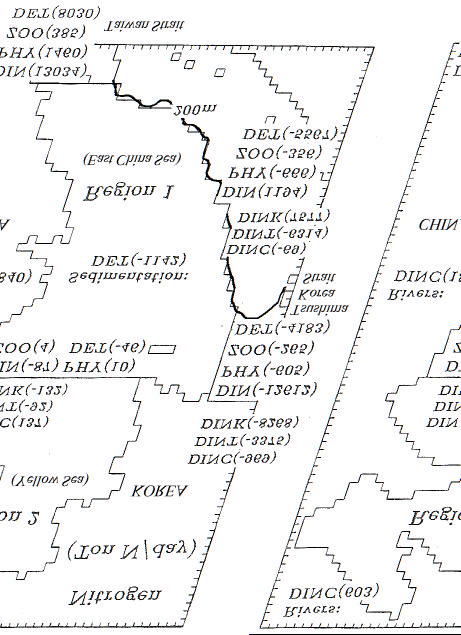
the Chinese project MAFLECS
Tsushima/Korea Strait (see
COASTAL
(Guo et al., 1997).
middle right portion of Fig. 2), all
Based on these calculated results,
OCEANOGRAPHY
forms of nitrogen are transported
the role of the nutrients from
out of the ECS at slightly lower
different origins (Chinese rivers,
rates. Along the 200 m contour
T. Yanagi
Taiwan Strait, and the shelf edge),
line (see lower left hand corner of
the budgets, the average resi-
Fig. 2), DIN is transported into the
One of objectives of coastal
dence times of the nitrogen and
ECS, while PHY, ZOO and DET
oceanography is to produce an
phosphate, and the ecosystem
represent net outputs of nitrogen
accurate numerical ecosystem
structure are discussed for the
from the ECS. Along the
model and to clarify quantitatively
ECS. The fluxes of various forms
boundary between the ECS
the material flux in the coastal
of nitrogen, including DIN (DINC-
(Region 1) and the Yellow Sea
sea. We have established a
from Chinese rivers; DINT - from
(Region 2), DIN and DET are
lower trophic ecological model in
Taiwan Strait; DINK - from the
transported into the Yellow Sea,
the East China Sea (ECS) from
shelf edge), phytoplankton (PHY),
while PHY and ZOO are
such a viewpoint. An ecological
zooplankton (ZOO) and detritus
transported from the Yellow Sea
model which includes DIN
(DET), through the boundaries of
to the ECS. The transport of DIN
(dissolved inorganic nitrogen),
Region 1 are shown in Figure 2.
across 200m contour line (1194
DIP (dissolved inorganic
Plus values for nitrogen flux (in
ton N/day) is less than the input of
phosphate), phytoplank-ton,
tons of N per day) indicate an
DIN from Chinese rivers in the
zooplankton and detritus can
influx of nitrogen whereas
region (1840 ton N/day). The
reproduces observed distributions
negative values indicate an
fluxes of organic materials
of DIN, DIP, chlorophylla, and
outflux. In the Taiwan Strait (see
through the Taiwan Strait and the
detritus observed in the East
lower left portion of Fig. 2), all
Tsushima/Korea Strait are not
China Sea in April 1994. These
forms of nitrogen are transported
balanced, although the volume of
findings were obtained as part of
north into the ECS. In the
water transported through these
two straits is similar. In other
words, a portion of the organic
material coming in from the
Taiwan Strait is directly trans-
ported out of the ECS across
200m contour line. Using this
ecological model, we can predict
future changes in material fluxes
across the shelf edge related to
global change.
References:
Guo, X., T. Yanagi, and D.Hu
(1997) Ecological modeling in the
East China Sea (to be submitted).
COASTAL
VULNERABILITY
ASSESSMENT
N. Harvey
One of the long-term objectives
contained within the LOICZ
Implementation Plan (Task 4.2.3)
is to "improve methodologies for
vulnerability assessment at
regional and global scales". This
resulted from criticisms of the
original "Common Methodology"
(developed by the Coastal Zone
Management Subgroup (CZMS)
of the Intergovernmental Panel
on Climate Change (IPCC) in
1991. In particular a number of
international studies were
Fig 2. Nitrogen Fluxes in the East China and Yellow Seas.
conducted to test the applicability
of this methodology but questions
page 4
LOICZ NEWSLETTER
were raised, particularly from by the IOC Secretariat in Paris.
CPO STAFF
Australian studies, at the World The target audience is the marine
Coast Conference held in The science community, however
Netherlands in 1993. The Austra- freshwater and brackish water
lian Commonwealth Government
ROY C. SIDLE,
scientists are also welcome to
conducted its own vulnerability
Executive Officer
submit their entries. Data can be
assessment studies in an attempt
PAUL R. BOUDREAU,
directly submitted through a www
to find an appropriate
Project Scientist
input form on:
methodology. Recent research in
CYNTHIA PATTIRUHU,
South Australia has produced a
Office Administrator
http://www.unesco.org/ioc/isisdb/ht
revised methodo-logy, which
MILDRED JOURDAN,
ml/glod.htm. General information
attempts to address spatial and
Secretary
on GLORDIR can be found on:
temporal scales, to reduce the
MARTIJN VAN DER ZIJP
http://www.unesco.org/ioc/infserv/g
emphasis on sea-level rise relative
Data Analyst
to other impacts such as human
REGINA FOLORUNSHO
induced hazards, and to
GIS Analyst
incorporate appropriate manage-
ment and response priorities.
FOR MORE INFORMATION,
***
Research conducted by the Centre
PLEASE CONTACT:
for Environmental Studies at the
- LOICZ Second Workshop on
University of Adelaide in South
Integrated Modelling, July 28-30
Australia demonstrates the
LOICZ CORE PROJECT OFFICE
Kuala Lumpur, Malaysia.
appli- cability of this revised
NETHERLANDS INSTITUTE FOR SEA
- Coastal Margins Task Team,
methodology using case studies
RESEARCH
(CMTT) Workshop, October 6-9
from different biophysical and
PO BOX 59
Texel, The Netherlands.
socio-economic coastal areas. It is
1790 AB DEN BURG - TEXEL
- LOICZ Open Science Meeting,
concluded that the methodology
October 10 -13, Noordwijkerhout,
T
lends itself to a broader application
HE NETHERLANDS
The Netherlands.
than previous methodologies for
- LOICZ SSC7 Meeting, October
coastal vulnerability assessment
PHONE: 31-222 369404
13-14, Noordwijkerhout, The
and is particularly revealed for
FAX:
31-222 369430
Netherlands.
developing an integrated approach
E-MAIL: LOICZ@NIOZ.NL
- SARCS/WOTRO/LOICZ P.I.
to coastal management.
WWW HOME PAGE:
Meeting, November 24-28, The
Philippines.
HTTP://WWW.NIOZ.NL/LOICZ/
***
LOICZ 3rd Open
Science Meeting
CPO Credits
Although the official deadline for
registration for the LOICZ Open
The LOICZ CPO would like to
NEW LOICZ PUBLICATIONS
Science Meeting has past, there
acknowledge the completion of
are still openings for funded
work and training of Ms. Regina
scientists who wish to participate.
Folorunsho in the CPO. Ms. Folo-
Please send registration forms in to (To be published in August):
runsho was in the CPO for the first
the LOICZ CPO promptly if you
half of 1997 as a visiting GIS
wish to participate. Information on - Comparison of Carbon, Nitrogen specialist funded through a START
the meeting is available on: and Phosphorus fluxes in Mexican fellowship. She has worked with
http://www.nioz.nl/loicz/osmnot.ht
Coastal Lagoons. Texel, The the CPO Geographic Information
m The meeting will be held from Netherlands, LOICZ Reports & systems developing skills in data
October 10 to 13, 1997 in Noord- Studies No. XX.
management, manipulation and
wijkerhout, The Netherlands.
presentation of results. She
returns to her home institute, the
Nigerian Institute for
IOC GLOBAL
Oceanography and Marine
Research (NIOMR) in Lagos. We
DIRECTORY
wish her the best and look forward
"Science is the great antidote
to continued co-operation on the
A Global Directory of Marine (and
to the poison of enthusiasm
development of the global LOICZ
Freshwater) Scientists (GLODIR)
and superstition"
typology initiative.
containing information on indivi-
dual scientists is being maintained