





December 2005
www.loicz.org
No. 36
period came only one year after the actual continuation of the
The LOICZ Newsletter is produced quarterly to
Project office.
provide news and information regarding LOICZ activities
The first "Office manager" of the Project Office was John
CONTENTS
Pernetta who was a much involved and very hard working
person who managed to establish a solid Core Office in a very
LOICZ-IPO and Royal NIOZ: a happy, beneficial and fruitful
short time. He is remembered for his perfect filing system, his
relationship for 13 years.
implementation plan - known as the Pernetta bible, his cooking
By Jan de Leeuw, Han Lindeboom and Wim Mook
capabilities, his moods and personal views, his extravagant
Highlights of Dutch Coastal Zone Research
waistcoats and the weekly visits to the local Chinese restaurant
together with Wim Mook. During this first phase of LOICZ-
Long-term ferry observations in the Marsdiep tidal inlet
IPO, Paul Boudreau joined the office as an advanced data
By Herman Ridderinkhof
manager. He too was very dedicated to LOICZ, but discovered
Terrestrial organic matter input in the coastal system as
that to put the whole coastal world in one database is a very
revealed by tetraether membrane lipids
tricky if not impossible task.
By Lydie Herfort, Jan P. Boon, Stefan Schouten, Martijn Woltering,
Marianne Baas and Jaap S. Sinninghe Damsté
After a short interim period with Roy Siddle, Chris Crossland
The North American Nitrogen Center
and Hartwig Kremer took over the LOICZ office as Chief
By Dennis P. Swaney and Robert W. Howarth
Executive Officer and Deputy Executive Officer respectively.
They too were very dedicated to the LOICZ mission, did an
4th GKSS Fall School on Helgoland
excellent job, worked like hell, were continuously suffering
By Götz Flöser
from jetlag and on top of that managed to generate substantial
IPO Notes:
additional funding for interesting coastal projects. After Chris
SSC update and new office at GKSS
and his wife Jan, who also worked part time for the Core Office,
decided to return to their homeland down under, it was clear for
Publications, Meetings and Workshops
everybody except himself, that Hartwig was going to be the new
Chief Executive for the last phase and transition of LOICZ at
LOICZ-IPO and Royal NIOZ: a happy, beneficial
NIOZ. Later on, he was assisted by Martin Le Tissier, who acted
and fruitful relationship for 13 years.
as his deputy.
By Jan de Leeuw, Han Lindeboom and Wim Mook
During all these years the secretariat of the LOICZ-IPO has
Royal NIOZ, PO Box 59, 1790 AB Texel, the Netherlands
been efficiently and effectively supported by Sheila Lunter,
Cynthia Pattiruhu, Mildred Jourdan and Hester Whyte who,
During the second half of 1992, several meetings and subsequent
with their major involvement, willingness to work day and
correspondence between John Marks of the Ministry of Educa-
night wherever on this planet and of course their superb
tion, Culture and Science (OCW), the late Henk Postma chairing
professionalism the LOICZ mission was fulfilled. Without their
IGBP-Netherlands on behalf of the Royal Netherlands Academy
enormous dedication, the success of LOICZ and its IPO could
of Sciences (KNAW) and Wim Mook, director of the Netherlands
not have been realized.
Institute for Sea Research (NIOZ) resulted in an offer to host the
The relationship of the office with the Scientific Steering
International Project Office of LOICZ (LOICZ-IPO) at NIOZ on
Committee (SSC) of LOICZ has always been good and efficient,
the island of Texel, the Netherlands. This offer was announced
in particular during the period when Han Lindeboom was chair
and formally accepted at the IGBP meeting in Ensenada, Mexico
of the SSC, because Han worked at NIOZ and daily
at the end of January 1993. It is worthy to note that the decision
contacts were very helpful to keep the LOICZ machine running
to fund the first five years of the IPO by three Dutch ministries,
smoothly.
the Netherlands Organization for Scientific Research
(NWO) and NIOZ was made at the very last minute,
Over the years the relationship of the LOICZ-IPO
i.e. during the Ensenada meeting! That last minute
with NIOZ as its host has been very good on all
decision turned out to be symbolic for the funding of
levels. Since NIOZ was the official employer of the
the LOICZ-IPO throughout the 13 years it has been
LOICZ personnel, the LOICZ team was an integral
hosted at NIOZ: every time funding had to be
part of the NIOZ community. And although their
continued major efforts by representatives of NWO
activities sent them abroad very often, they were
and NIOZ were required and formal funding for the last
always welcomed home when returning.
A core project of the
International Geosphere-Biosphere Programme and the
International Human Dimensions Programme on Global Environmental Change
page 2
LOICZ NEWSLETTER
Through the IPO, NIOZ increasingly participated in LOICZ
Not directly involved in Dutch LOICZ but a Dutch science
programs and activities, leading to more research both in Dutch
highlight addressing tools for the science policy interface was
coastal areas and elsewhere. The many informal contacts between
presented by Han Lindeboom and Erik Meesters (Alterra-
other NIOZ personnel and LOICZ employees led to many
Texel, The Netherlands). Their paper introduced a new integra-
fruitful discussions and ideas for new exciting projects. These
tion, management and modelling tool - called - EMIGMA (Effect
contacts also covered a wide array of issues ranging from purely
Modelling of Indicators, usaGe and MAnagement) - that can be
scientific advice, very practical technical and logistic support to
used to integrate the outcome of monitoring programs and scien-
human interactions of all kinds.
tific research projects and at the same time develop managerial
advises which are soundly based on the actual developments of
Although the actual mutual benefits of all these interactions are
the marine realm. This tool addresses the problem of reconciling
difficult to measure, we are sure that the long term presence of
the complex interplay between natural and human induced
the IPO has contributed significantly to NIOZ coastal research
driving forces that determine the nature of the marine ecosystem.
and the functioning of the LOICZ project.
The tool has applications for traditional uses such as fisheries,
shipping, oil and gas extraction and beach nourishment, and the
We are very pleased that Germany is willing to take over the
impact of eutrophication and pollution and the development of
LOICZ-IPO flag and we hope and expect that their future host-
large windmill parks. The call to establish Marine Protected
guest relationship will be as fruitful as our relationship over the
Areas puts an increasing pressure on the Dutch coastal zone and
last thirteen years.
this new tool, if applied at appropriate scales, offers a method to
establish the effectiveness of managerial measures.
Highlights of Dutch Coastal Zone Research
The following two articles highlight in more detail some of the
scientific achievements of the DUTCH-LOICZ programme.
The DUTCH-LOICZ research programme was initiated several
years after the LOICZ-IPO was established at the Royal
NIOZ, funded by NWO and has funded a broad spectrum of
Netherlands focussed research. The papers presented in a
Long-term ferry observations in
special sessions during the recently held Inaugural Open
the Marsdiep tidal inlet
Science meeting of the new LOICZ dedicated to this research
initiative highlighted the breadth of the programme.
By Herman Ridderinkhof
Royal NIOZ, PO Box 59, 1790 AB Texel,
Carlo Heip, Jack Middelburg, Karline Soetaert, Peter Herman
the Netherlands, e-mail: rid@nioz.nl.
and Britta Gribsholt (Centre for Estuarine and Marine Ecology,
Netherlands Institute of Ecology, Yerseke, The Netherlands)
Introduction
summarized our current knowledge of the Western Scheldt
In a cooperation between Royal NIOZ and the ferry company
estuary that drains the Scheldt river into the North Sea and
TESO (Texels Eigen Stoomboot Onderneming) long-term
which is one of the best studied estuarine systems in the world.
oceanographic observations from the ferry `Schulpengat' that
Its history is well documented and reflects the interplay of poli-
crosses the Marsdiep tidal inlet between den Helder (mainland)
tical, religious and economic developments with the dominant
and Texel (westernmost barrier island of the Dutch Wadden Sea)
physical processes, storms, sea level rise and the tidal energy
are carried out. The ferry is equipped with a throughflow system
from the North Sea over the last 2000 years. Most of the
for temperature and salinity observations and an ADCP that
changes in geomorphology of the estuary are directly or
measures the current field below the ferry. The ferry crosses
indirectly due to human activities. The Scheldt drainage basin
the Marsdiep tidal inlet each 30 minutes daily from 06.00 to 22.00
covers three countries France, Belgium and The Netherlands
hrs, thereby resolving tidal variability. The width of the inlet that
covering one of the most highly industrialised and densely
the ferry crosses in 15 minutes is about 4 km and the maximum
populated areas in Europe and the impact of changes has
depth is some 30 m. The observations are used to inform the
implications not just for human uses of the estuary but also the
general public by displaying the observed data directly on a
application of the EU Birds and Habitat directives that
screen in the passenger's lounge and to study the variability in
strengthen the conservation potential for the area.
oceanographic parameters and fluxes in this tidal inlet. Some
results of the scientific analyses are discussed in this note.
Coastal morphodynamics is never far from coastal research in
the Netherlands, and Piet Hoekstra (Utrecht University, Institute
Currents
for Marine and Atmospheric Research IMAU) described how
Figure 1 shows typical examples of the depth-averaged currents
this has now become a multidisciplinary science with contribu-
around maximum flood, maximum ebb and of the tidally
tions from coastal and marine geology, coastal oceanography,
averaged currents.Tidal currents reach maximum values of
physical geography, civil and coastal engineering and marine
around 1.5 m s-1, with strongest currents in the deepest central
biology and ecology. Riks Laanbroek (NIOO KNAW Centre
part of the inlet. The strength of the tidal mean currents is about
for Limnology & Utrecht University, Section of Landscape
10% of the tidal currents and has a large spatial variability even
Ecology) showed how ammonia-oxidising bacteria play an
over the relatively short distance of the inlet. At the northern site
important role in the global nitrogen cycle by converting
of the inlet the mean currents are outward (towards the adjacent
ammonia to nitrite. Frank van Kouwen (Utrecht University
North Sea) and at the southern site the currents are inward. The
dept. of Geography) described how Decision Support Systems
influence of wind or river inflow on these tidal mean currents
(DSSs) will become important in the development of a
appears to be relatively weak because they are mainly caused by
sustainable and integrated approach to coastal management.
the interaction between the tidal currents and topography.
page 3
LOICZ NEWSLETTER
size and quality of the suspended material could not explain the
failures of the classical model.
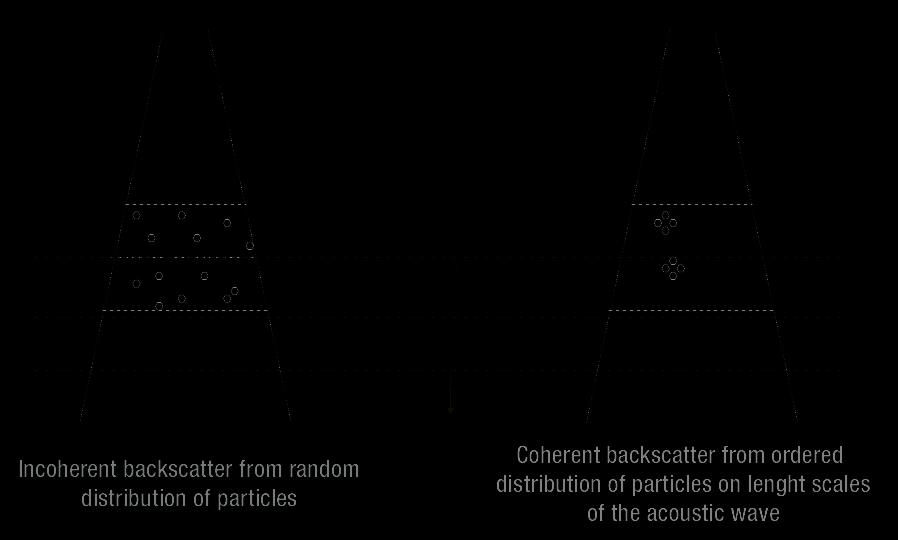
Therefore, the classical model has been extended to develop a
novel model that includes the effect of acoustic backscatter
enhanced by coherence in the particles' spatial distribution as a
result of turbulence-induced sediment fluctuations (Figure 3).
Figure 1.
Typical examples of the depth-averaged tidal and mean
currents in the Marsdiep inlet as observed with the ferry-ADCP on the
route den Helder-Texel.
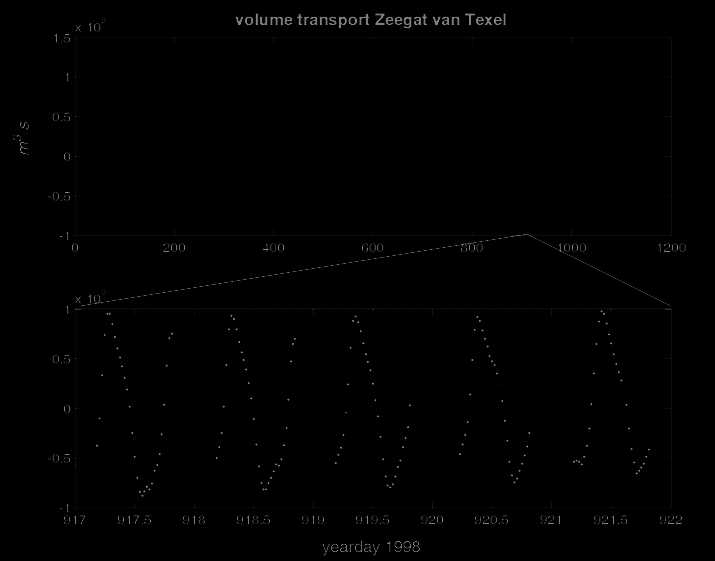
By integrating the measured vertical profiles over each transect
a more or less synoptic dataset on the water transport through
the entire inlet was obtained. A harmonic fit, using 67 tidal
components was applied to analyse this data set. Figure 2 shows
the results for a period of 5 years (1998-2002). The top of the
Figure 3.
Sketch of backscatterance in the classical model (left side)
figure shows the harmonic fit of the data and the bottom shows
and in the extended model (right side)
the original data (black dots), the harmonic fit (blue line) and
the difference between both (red dots) for a representative
A theoretical derivation (Merckelbach, 2005) showed that in
number of days. Further analyses showed that the variability in
strong currents the relation between EI and SSC changes to
the remaining signal (red dots) can largely be explained from
EI ~ log (SSC2). This relation was compared with a number of
variability in wind speed and direction. For such a type of
detailed observations obtained during field surveys to calibrate
analyses of the variability in water transport it is essential that
the ferry observations (Merckelbach & Ridderinkhof, 2005).
the data set has a high frequency and a long duration enabling
It was shown that the extended model gives a large improve-
the determination of relatively high- and low- frequency tidal
ment of the estimated SSC and can be used to apply to the ferry
components. Here the period of the tidal components that was
data set to analyse suspended sediment transport through the
used in the analysis varied between about 2 hours and one year.
Marsdiep tidal inlet.
The first application of the new model to the ferryADCP data-
set to 2003 data (Figure 4) shows the monthly mean absolute
value of the flux of suspended sediments through the Marsdiep
tidal inlet, divided between flood and ebb periods. The diffe-
rence between both indicates the net flux. There appears to be a
relatively large net flux of suspended sediments towards the
Wadden sea. Moreover, this flux is substantially larger during
spring and early summer, as compared to the other periods
suggesting that biological processes play an important role in
influencing the magnitude of this net flux (Ridderinkhof &
Merckelbach, 2006).
Figure 2.
Water transport through the Marsdiep tidal inlet between the
North Sea and Wadden Sea as determined from the long term ADCP
observations. The top panel shows the harmonic fit to the data for a
-1
period of about 4 years, the bottom panel shows a typical example of the
s
-2
original data (black dots), the harmonic fit (blue line) and the difference
gm
between both for a period of 6 days.
Suspended sediments
In principle, the observations on acoustic backscatter from the
ADCP can be used also to obtain insight in the suspended sedi-
ment concentration (SSC) in the tidal inlet. However, studies on
variability in SSC critically depend on the translation of the
Figure 4.
Mean absolute value of the flux of suspended sediments
acoustic backscatter signal to SSC values. The classical model
through the Marsdiep tidal inlet, averaged over the flood (red) and ebb
assumes that EI ~ log (SSC), where EI (dB) is the echo-intensity
(blue) tide, from March 2003 (month 3) till November 2003 (month 11)
of the backscattered signal. Calibration experiments that were
done in the framework of the LOICZ project showed that this
Temperature and salinity
relation appeared to give very poor results especially for strong
Temperature (T) and salinity (S) variations across the inlet are
currents (stronger than 0.7 m s-1). Moreover, variability in the
largely dominated by tidal variations, such as current.
page 4
LOICZ NEWSLETTER
Figure 5 illustrates this by showing the cross-sectional averaged
L.M. Merckelbach and H. Ridderinkhof, 2005. Estimating suspended
T- and S- values for 2 days of observations.
sediment concentration using backscatterance from an acoustic
Doppler profiling current meter at a site with strong tidal currents.
Accepted for publication in Ocean Dynamics.
H. Ridderinkhof & L. Merckelbach, 2006. Suspended sediment
fluxes through the Marsdiep tidal inlet from long-term ferry-ADCP
observations. In prep.
Terrestrial organic matter input in the coastal
system as revealed by tetraether membrane lipids
By Lydie Herfort, Jan P. Boon, Stefan Schouten,
Martijn Woltering, Marianne Baas
and Jaap S. Sinninghe Damsté
Department of Marine Biogeochemistry & Toxicology,
Royal Netherlands Institute for Sea Research (NIOZ),
P.O. Box 59, 1790 AB Den Burg, Texel, The Netherlands.
* Corresponding author e-mail Herfort@nioz.nl.
Figure 5.
Cross-section averaged salinity and temperature in the
Marsdiep tidal inlet for a period of 2 days.
Although rivers provide large amounts of organic carbon to the
marine environment (ca. 4x10¹⁴ g C year -1; Schlesinger and
The tidal influence on these observations is clear. Salinity
Melack 1981), the importance and fate of terrestrial organic
increases during flood when saltier water from the adjacent
matter (TOM) in the ocean remains one of the major uncer-
North Sea enters the Wadden Sea through the tidal inlet and
tainties of the global carbon cycle. Several methods have been
decreases during ebb tides. A similar variability is seen in
developed to resolve this problem, such as analysing the C/N
temperature variations. Both show that differences in T and S
ratio and the 13C content of bulk organic matter, or the use of
between the Wadden Sea and North Sea can be large and these
higher plants-derived biomarkers, but none are truly satisfactory
data can be used to study variations in the induced longitudinal
(see Pancost and Boot 2004 and Hedges et al. 1997 for details).
density gradient across the tidal inlet.
Recently, using 2D NMR techniques we have identified the
Longer term variability in the salinity observations is shown in
structure of a group of branched glycerol dialkyl glycerol tetra-
Figure 6 where daily averaged values (top) and the daily standard
ethers (GDGT) isolated from Dutch peat (Sinninghe Damsté et
deviation (bottom) are shown for a typical year. Salinity values
al. 2000). Pilot studies suggest that these GDGTs may be used
are lowest in winter and spring when the input of fresh water
as a indicator for TOM input in the coastal environment as they
into the coastal zone from the rivers in largest. A relatively low
are found abundantly in peats and soil, and to a lesser extant in
mean salinity coincides with relatively high daily variability in
coastal marine sediments, but not in open ocean sediments.
salinity values. Thus, as expected, salinity differences between
Hopmans et al. (2004) have presented a novel proxy, the
the North Sea and Wadden Sea are largest when the input of
so-called Branched and Isoprenoid Tetraether (BIT) index,
fresh water to the coastal zone is largest.
based on the relative abundance of crenarchaeol, an isoprenoid
GDGT considered as a specific biomarker for the marine
Crenarchaeota group I belonging to the archaeal domain
(Sinninghe Damsté et al. 2002; Schouten et al. 2000; Powers
et al. 2004), and that of the branched GDGTs which are
synthesised by terrestrial Bacteria (Weijers et al. in press). BIT
index values range from 0, in sediments containing exclusively
organic carbon of marine origin, to 1 in samples with no
crenarchaeol and, therefore, comprising only terrigenous carbon.
In a Dutch LOICZ project (funded by the Dutch Organization for
Scientific Research), TOM transport into the Southern North Sea
was determined using the BIT index. Although it is well known
that the Southern North Sea is strongly influenced by river
discharges, several studies have suggested that the resulting high
freshwater input is not associated with important TOM addition
to the marine environment (Salomons and Mook 1981; Megens
et al. 2001). As the Rhine/Meuse is the most important river
Figure 6.
Daily averaged salinity (top) and daily standard deviation
system flowing into this area, water sampling was also carried out
(bottom) in the Masdiep tidal inlet for a period of one year.
in the Rhine. Sampling was carried out in the Southern North Sea
at eight stations during three cruises in February 2003, April 2004
References
and August/September 2004 and in the Rhine at three locations
L.M. Merckelbach, 2005. A model for high-frequency acoustic
in February 2005 and September 2006 (Figure 1).
Doppler current profiler backscatter from suspended sediments in
strong currents. Submitted to Cont. Shelf Res.
page 5
LOICZ NEWSLETTER
analysis did not reveal higher Crenarchaeota concentrations in
the Rhine than in the Southern North Sea (data not shown).
Hence, the Crenarchaeota living in the river cannot account
alone for the high crenarchaeol concentrations measured in the
Rhine. Crenarchaeol has been detected in the surface sediments
of a large number of lakes distributed all over the world (Powers
et al. 2004) and also the Rhine may receive a constant input of
crenarchaeol from lacustrine origin may thus explain the high
crenarchaeol concentration measured in the river.
The resulting BIT indices in river water were high, with an
average value of 0.84 that was 3 times higher than the highest
value obtained in the Southern North Sea (Dutch Coast: 0.25;
Table 1). However, the relatively high crenarchaeol concentra-
tion measured in the river Rhine affected the BIT index, gene-
rating a value below the theoretical terrestrial value of 1. This
was not a seasonal effect as all measurements gave BIT indices
below 0.9. This agrees with recent findings by Weijers et al. (In
press) who calculated the BIT indices of soils from widely dis-
Figure 1.
Map showing the location of the study sites in the Southern
tributed locations and found an average of 0.91. So, clearly
North Sea and the river Rhine. Abbreviations = DC: Dutch Coast; CSB:
values below 1 can also characterize a terrestrial environment.
Central Southern Bight; B14: Breeveertien; SFF: South Frisian Front;
This underlines that, as previously stressed by Hopmans et al.
FF: Frisian Front; NFF: North Frisian Front; OG: Oyster Grounds;
(2004), this new proxy gives a relative measure of TOM trans-
DB: Dogger Bank; Ma: Maassluis; Go: Gorinchem; Mi: Millingen.
port and should not be used as an absolute quantity. This also
implies that instead of the originally defined range of the BIT
The detection of branched GDGTs in suspended particulate
index as pure marine to pure terrestrial it would be more accu-
organic matter in surface seawater demonstrates the presence of
rate to describe it as from terrestrial environments containing
TOM in the Southern North Sea. Furthermore, elevated BIT
exclusively branched GDGTs (and thus no crenarchaeol) to
indices were associated with low salinity values (Table 1),
aquatic environments dominated by crenarchaeol sources.
suggesting that the BIT index may be good tracer for TOM
input in the coastal environment.
References
Abreu, C., G. Jurgens, P. De Marco, A. Saano, and A. A. Bordalo 2001.
High concentrations of branched GDGTs were detected at both
Crenarchaeota and Euryarchaeota in temperate estuarine sediments.
seasons in the water of the river Rhine. With an average
J. Appl. Microbiol. 90: 713-718.
concentration of 33 ng l-1, the branched GDGTs were 20 times
Hedges, J. I., R. G. Keil, and R. Benner 1997. What happens to
more abundant in the Rhine than at the site of the Southern North
terrestrial matter in the ocean? Org. Geochem. 27: 195-212.
Sea with the highest concentration (Dutch Coast: 1.6 ng l-1;
Hopmans, E. C., J. W. H. Weijers, E. Schefuß, L. Herfort, J. S. Sin-
Table 1). This confirms that branched GDGTs are transported
ninghe Damsté, and S. Schouten 2004. A novel proxy for terrestrial
from soils and peats to the marine environment via rivers.
organic matter in sediments based on branched and isoprenoid tetraether
Although much lower than that of branched GDGTs, the con-
lipids. Earth Planet. Sci. Lett. 224: 107-116.
centration of crenarchaeol measured in the Rhine was higher
Megens, L., J. van der Plicht, and J. W. de Leeuw 2001. Temporal
than in the Southern North Sea. This result was unexpected as
variations in 13C and 14C concentrations in particulate organic matter
it is traditionally thought that crenarchaeol is a specific bio-
from the southern North Sea. Geochim. Cosmochim. Acta 65: 2899-
marker for the marine group I Crenarchaeota and that those are
2911.
not abundant in soils and peats (Weijers et al. 2004). So, input
Pancost, R. D., and C. S. Boot 2004. The palaeoclimatic utility of
of crenarchaeol from soils and peats cannot account for the high
terrestrial biomarkers in marine sediments. Mar. Chem. 92: 239-261.
lipid concentration measured in the Rhine. Crenarchaeota have
Powers, L. A., J. P. Werne, T. C. Johnson, E. C. Hopmans, J. S.
been detected in rivers (Abreu et al. 2001), but molecular
Sinninghe Damsté, and S. Schouten 2004. Crenarchaeotal membrane
Table 1 - Salinity values, branched GDGT and crenarchaeol concentrations, and BIT indices for eight stations in the Southern North Sea and three
locations in the river Rhine. Station abbreviations are given in the caption of Figure 1.
page 6
LOICZ NEWSLETTER
lipids in lake sediments: A new paleotemperature proxy for continental
The NANC is the North American node of the International
paleoclimate reconstruction? Geology 32: 613-616.
Nitrogen Initiative (INI) and was established in 2004 at Cornell
Salomons, W., and W. G. Mook 1981. Field observations of the
University in Ithaca, New York, USA under the direction of Bob
isotopic composition of particulate organic carbon in the southern North
Howarth with 4 overall goals:
Sea and adjacent estuaries. Mar. Geol. 41: M11-M20.
· To better assess the sources of nitrogen pollution and dri-
Schlesinger, W. H., and J. M. Melack 1981. Transport of organic
vers of change in nitrogen cycling across the regions of
carbon in the worlds rivers. Tellus 33: 172-187.
North America, with an emphasis on evaluating trends in
Schouten, S., E. C. Hopmans, R. D. Pancost, and J. S. Sinninghe
fluxes and environmental exposure.
Damsté 2000. Widespread occurrence of structurally diverse tetraether
· To comprehensively and quantitatively assess both the eco-
membrane lipids: Evidence for the ubiquitous presence of low-tempera-
logical and human health consequences of nitrogen pollu-
ture relatives of hyperthermophiles. Proc. Natl. Acad. Sci. USA 97:
tion in North America.
14421-14426.
· To develop policy options for reducing nitrogen pollution
Sinninghe Damsté, J. S., E. C. Hopmans, R. D. Pancost, , S. Schou-
and to encourage large scale pilot studies to test potential
ten, J.A.J. Geenevasen 2000. Newly discovered non-isoprenoid glycerol
policies and technical solutions.
dialkyl glycerol tetraether lipids in sediments. Chem. Commun. 2000:
· To communicate the issues arising from human accelera-
1683-1684.
tion of the nitrogen cycle to the public and decision makers,
Sinninghe Damsté, J. S., W. I. C. Rijpstra, E. C. Hopmans, F. G. Prahl,
and facilitate communication and interaction within the
S. G. Wakeham, and S. Schouten 2002. Distribution of membrane lipids
scientific community.
of planktonic Crenarchaeota in the Arabian sea. Appl. Environ.
Microbiol. 68: 2997-3002.
An example of research directed at the first goal is the develop-
Weijers, J. W. H., S. Schouten, M. van den Linden, B. van Geel, and
ment of a methodology to estimate net anthropogenic nitrogen
J. S. Sinninghe Damsté 2004. Water table related variations in the
inputs (NANI) into watersheds and relate them to corresponding
abundance of intact archaeal membrane lipids in a Swedish peat bog.
nitrogen fluxes from the watersheds. NANI includes 4 categories
FEMS Microbiol. Lett. 239: 51-56.
of nitrogen: fertilizer use, nitrogen fixation in agricultural and
Weijers, J. W. H., S. Schouten, E.C. Hopmans, J.A.J. Geenevasen,
forest lands, atmospheric deposition into the watershed, and
O.R.P. David, J.M. Coleman, R.D. Pancost and J. S. Sinninghe Damsté
nitrogen content of net food and animal feed fluxes into the
In press. Membrane lipids of mesophilic anaerobic bacteria thriving in
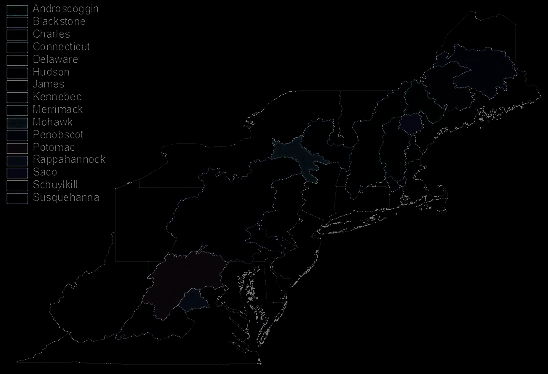
watershed. For 16 watersheds in the Northeastern USA (Figure
peats have typical archaeal traits. Environmental Microbiology.
1a, b), NANI has been related to average riverine N fluxes over
the period 1988-93 (Boyer et al., 2002). Similar analyses are
being pursued for some European watersheds.
The North American Nitrogen Center
The NANI methodology originates from the International
By Dennis P. Swaney1 and Robert W. Howarth2
SCOPE nitrogen project and is being extended by using its load
1 Boyce Thompson Institute for Plant Research,
estimates in a hydrological-based model (the Regional Nutrient
Tower Road, Cornell University, Ithaca, NY 14853, USA,
Management model, ReNuMa) to simulate seasonal and annual
e-mail: dps1@cornell.edu.
streamflow and nitrogen fluxes (Figure 2). Across these water-
2 Department of Ecology and Evolutionary Biology,
sheds, total annual riverine N and simulated annual DIN fluxes
Cornell University, E311 Corson Hall, Ithaca, NY 14853,
vary in response to the magnitude of N inputs. The magnitude
e-mail: rwh2@cornell.edu.
of nitrogen inputs, as well as their major components, vary sig-
nificantly across the region, from atmospheric deposition-
Earlier this year LOICZ agreed a memorandum of understanding
driven watersheds of the north, to urban watersheds with large
to cooperate with the North American Nitrogen Center (NANC)
wastewater loads and southern watersheds with relatively large
on educational and research issues related to nitrogen in the
agricultural sources of N. Nitrogen retention processes in the
environment. So, what is the NANC and how will it interact
landscape, including denitrification, are responsible for the
with LOICZ?
difference between inputs and outputs.
1a
1b
Figure 1a.
Sixteen major watersheds of the Northeastern United States. In each case, boundaries are delimited by the furthest downstream USGS
gauging station, and so do not include the portions in closest proximity to the coast. Figure 1b.
Relationship between total N inputs to the watersheds
(NANI) and riverine N fluxes from the watersheds (data from Boyer et al., 2002).
page 7
LOICZ NEWSLETTER
Although there have been many attempts to quantify discrete
portions of the region's nitrogen cycle in the past 30 years
(including several LOICZ initiatives), a comprehensive assess-
ment of N sources and health consequences of N pollution has
not been previously attempted, and this is part of the second
goal of the NANC.
Policy options are considered under NANC's third goal. These
range from assessing the implications of agricultural Best
Management Practices on coastal nitrogen loads, to assessing
which components of NANI dominate local nitrogen sources,
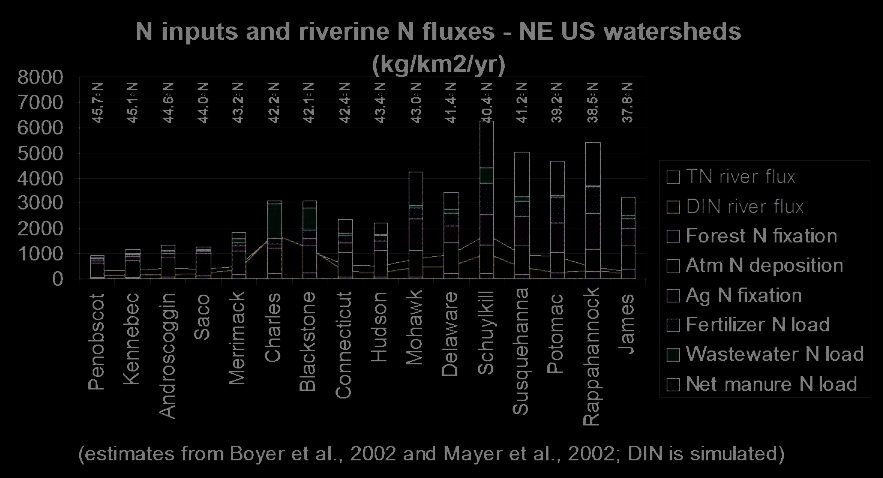
Figure 2.
Variation in major sources of N inputs (bars) and N fluxes in
to understanding the implications of human accelerated climate
rivers (areas) to watersheds and corresponding outflows in rievrs for the
change on nitrogen transport and processing in the environ-
northeastern US watersheds along a gradient from North to South.
ment. For example, in attempting to further understand the
Latitudes of the watershed centers are shown along the top of the figure.
relationship between nitrogen inputs and outputs in watersheds,
(from Swaney et al, 2005)
Howarth et al. ( in press) suggested that hydrological controls
(i.e., decreased residence times) can effectively short-circuit
Human and environmental health consequences of nitrogen are
nitrogen retention in relatively "wet" watersheds (those with
addressed under NANC's second goal. For example, while
higher precipitation and streamflow), thus increasing the
synthetic nitrogen fertilizer has been an essential component of
efficiency of transport of watershed nitrogen loads to the
the green revolution and has contributed to increased global
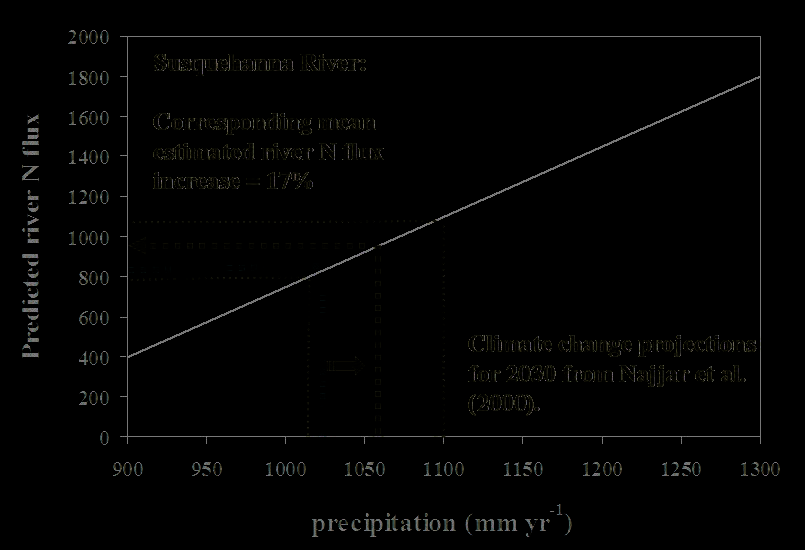
coastal zone (Figure 4a). This represents a potential mechanism
food production and decreased hunger and malnutrition over
by which changes in regional climate may be driving regional
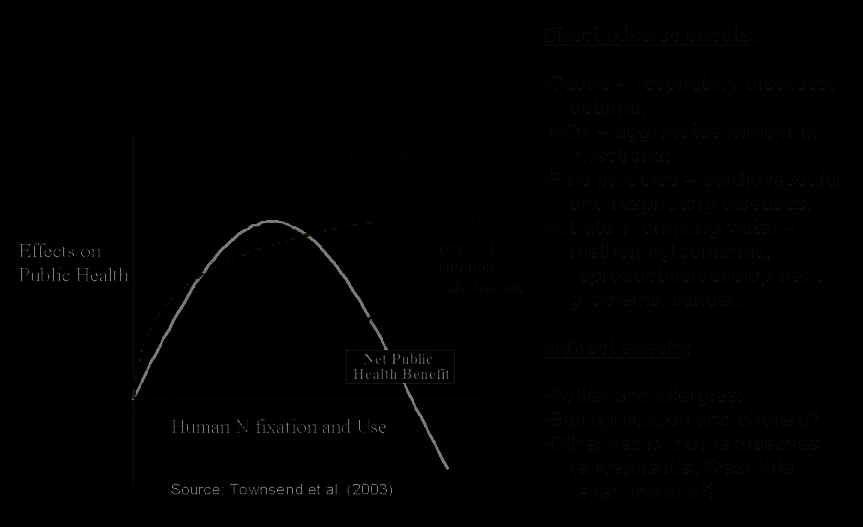
the past several decades, nitrogen can pose carcinogenic risks
biogeochemical as well as hydrological fluxes (Figure 4b).
both from nitrate in drinking water and from fine particles in
Changes in land use patterns which increase runoff may
the atmosphere (Figure 3).
exacerbate the problem. Policymakers should be considering
the implications of these effects for the coastal zone in addition
to the conventional list of expected impacts of climate change,
such as sea level rise and increased hurricane frequency.
Finally, the importance of communicating research and policy
implications to the scientific and management communities
and the general public cannot be overemphasized, and this
represents a key goal of the NANC, as well as LOICZ. This
needs to occur on many levels, including advising government
agencies on research and management priorities for the
coastal zone and its watersheds, organizing workshops and
hosting special sessions at scientific meetings, posting basic
information, scientific summaries, workshop reports, and
Figure 3. The tradeoff between benefits and negative health effects
management tools on websites, and increasing public
associated with increasing levels of nitrogen use.
awareness via newsletters and informal presentations, such as
this one. An example of its role as advisors to government
Nitrogen pollution also increases pollen production, aggra-
policy, NANC staff were coauthors of the 2003 workshop
vating asthma and allergies (Townsend et al., 2003). Further
report to the National Oceanic and Atmospheric Administra-
acceleration of the nitrogen cycle can have large, net negative
tion, "Nutrient Pollution in Coastal Waters: Priority Topics for
effects on public health.
an Integrated National Research Program for the United States"
4a
4b
Figure 4a.
Observed relationship between average annual precipitation and fraction of watershed N inputs in riverine transport from the
watershed for the 16 northeastern US watersheds studied (Howarth et al., in press). Figure 4b. Estimated increase in riverine nitrogen flux from cur-
rent conditions (red line) to 2030 (blue line) corresponding to a regional climate change projection, assuming that the transport efficiency of
nitrogen in the watershed increases with increasing wetness.

page 8
LOICZ NEWSLETTER
(http://www.nccos.noaa.gov/documents/nutrientpollution.pdf).
health effects of a changing global nitrogen cycle. Frontiers in Ecology
The Center will continue to be active at all of the levels
and the Environment 1(5):240-246.
mentioned above, and expect that interactions with LOICZ will
Van Breemen, N., E.W. Boyer, C.L. Goodale, N.A. Jaworski, K.
enhance the productivity of both organizations.
Paustian, S.P. Seitzinger, K. Lajtha, B. Mayer, D. Van Dam, R.W.
LOICZ shares much that is outlined in the above goals, and has
Howarth, K.J. Nadelhoffer, M. Eve, and G. Billen. 2002. Where did all
been active in all these areas to varying degrees; LOICZ II, has
the nitrogen go? Fate of nitrogen inputs to large watersheds in the
an emphasis on coastal governance and is concerned with
northeastern U.S.A. Biogeochemistry 57/58: 267293.
policy and management options in the coastal zone. In the short
term, LOICZ-NANC interactions are likely to include basic
4th GKSS Fall School on Helgoland
functions related to the last of the stated goals, including:
- Cross-posting activities (workshops, meetings, etc) on
By Götz Flöser
program websites and in newsletters
GKSS-Forschungszentrum Institute for Coastal Research
- Joint representation of program interests at scientific
Max-Planck-Straße 1, D-21502 Geesthacht, Germany
conferences, etc
e-mail: goetz.floeser@gkss.de
- Sharing and web-hosting of relevant datasets and other
materials
On the island Helgoland in the North Sea, the Fourth GKSS
- Joint sponsorship or in-kind support of workshops,
School of Environmental Research which was endorsed by
meetings, etc
LOICZ, was held from 2nd-11th November, with some 20
Dennis Swaney currently serves as liaison between LOICZ
participants. Among them were guests from Nigeria, Sri Lanka,
and the NANC. To find out more see the NANC website
India and Brazil. The School was initiated by Hans von Storch,
(http://www.eeb.cornell.edu/biogeo/nanc/nanc.htm) and the
a climate researcher from GKSS Research Centre in
website of its parent organization, the INI (http://initrogen.org).
Geesthacht, Germany, and by Richard Tol, an economist from
More specific inquiries about aspects of the NANC can be
the University of Hamburg.
addressed by email to: nitrogen@cornell.edu.
The theme for the School was "Environmental Crises Science
References
and Policy", a subject that connects natural science (as in
Austin, A.T., R.W. Howarth, J.S. Baron, F.S. Chapin III, T.R.
climate research, fisheries, or chemistry) to social science,
Christensen, E.A. Holland, M.V.. Ivanov, A.Y. Lein, L.A. Martinelli, J.M.
journalism, and economics. The example of the politically
Melillo and C. Shang . 2003. Human disruption of element interactions:
motivated introduction of lead-free gasoline in the 80s can show
drivers, consequences and trends for the 21st century. . Chapter 2, in
the response time of a natural system like the Elbe River
SCOPE 61: Interactions of the Major Biogeochemical Cycles: Global
catchment area. Another up-to-date subject where policy and
Change and Human Impacts.. J. Melillo, C. Field, B. Moldan (eds.)
science are intimately connected is climate research and climate
Island Press, Washington.
policy. Apart from lectures, the participants developed
Boyer, E.W., C. L. Goodale, N. A. Jaworski and R. W. Howarth. 2002.
presentations in the line of the IPCC position of climate change
Anthropogenic nitrogen sources and relationships to riverine nitrogen
and on the side of "sceptical environmentalist" as represented
export in the northeastern U.S.A. Biogeochemistry 57/58:137-169.
by the Danish statistician Bjørn Lomborg. As had been the case
Howarth, R.W., R. Marino, and D. Scavia. 2003. Nutrient pollution in
in the first three Schools, a Springer book will be prepared with
coastal waters: priority topics for an integrated National research pro-
the contributions of the lecturers.
gram for the United States. U. S. Department of Commerce, National
Oceanic and Atmospheric Administration, Silver Spring, MD.
Howarth, R.W., D.P. Swaney, E.W. Boyer, R.M. Marino, N. Jaworski
and C.L. Goodale. In Press. The influence of climate on average nitrogen
export from large watersheds in the Northeastern United States. Bioge-
ochemistry.
Mayer, B., E.W. Boyer, C.L. Goodale, N.A. Jaworski, N. Van
Breemen, R.W. Howarth, S.P. Seitzinger, G. Billen K. Lajtha, K.J.
Nadelhoffer, D. Van Dam, L.J. Hetling, M. Nosal, and K. Paustian,. 2002.
Sources of nitrate in rivers draining sixteen watersheds in the north-
eastern U.S.: Isotopic constraints. Biogeochemistry 57/58: 171197.
Najjar, R. G., H. A. Walker, P. J. Anderson, E. J. Barron, R. J. Bord,
J. R. Gibson, V. S. Kennedy, C. G. Knight, J. P. Megonigal, R. E.
O'Connor, C. D. Polsky, N. P. Psuty, B. A. Richards, L. G. Soreson,
E. M. Steele, and R. S. Swanson. 2000. The potential impacts of climate
change on the mid-Atlantic coastal region. Climate Research 14:
219-233.
IPO NOTES
Swaney, D.P., R. W. Howarth, A.E. Galford, R.M. Marino and E.W.
Boyer. 2005. Latitudinal and Temporal Changes in Discharge and
Nitrogen Fluxes from Large Watersheds in the Northeastern United
LOICZ Scientific Steering Committee as
States: An Application of ReNuMa. Poster Presentation at the 18th
of January 2006
Biennial Conference of the Estuarine Research Federation, Norfolk, VA.
17-21 October.
Newsletter 35 introduced Jozef Pacyna and Dennis Swaney
Townsend, A. R., R. W. Howarth , F. A. Bazzaz , M. S. Booth , C. C.
who have now been confirmed as the new chair of the LOICZ
Cleveland , S. K. Collinge , A. P. Dobson , P. R. Epstein, E. A. Holland ,
SSC and the newest member of the SSC respectively. We look
D. R. Keeney , M. A. Mallin , P. Wayne and A. Wolfe. 2003. Human
very much forward to working with them both in the future.
page 9
LOICZ NEWSLETTER
From 1 January 2006, the LOICZ SSC will have the following membership:
Name
Country
Some fields of interest
Talaue-McManus, Liana USA/Philippines
Coastal systems ecology, river coast coupling
Ex-Officio Past-chair
and Human Dimensions
Pacyna, Jozef - Chair
Norway
Trace gases, river-coast coupling, integration
Lansigan, Felino
Philippines
Land and Water resources, statistics
Vice chair
and Human Dimensions
Parslow, John
Australia
System Models and biogeochemistry
Dennison, William C.
USA
Coastal ecology, rivers, science dissemination
Forbes, Anthony
South Africa
Ecology, river-coast coupling
Huang, Wei-Gen
China
Remote Sensing and satellite oceanography
Koike, Isao
Japan
Biogechemical cycles and microbiology
Newton, Alice
Portugal
Lagoon ecology, scales and training
Rabalais, Nancy
USA
River-shelf coupling and estuarine ecology
Restrepo, Juan Dario
Colombia
River-coast coupling, sediments and hydrology
Saito, Yoshiki
Japan
Sediments and Deltas
Wikramanayake, Nalin
Sri Lanka
Hydrodynamics, sediments and water quality
Gilbert, Alison
Netherlands
Coastal and catchment management, decisions
support systems and Human Dimensions
Roth, Eva
Denmark
Economy, fisheries and Human Dimensions
Glaeser, Bernhard
Germany
Coastal management, participation and Human Dimensions
Mee, Laurence
UK
Management, biogeochemistry and socio-ecological systems
Olsen, Stephen
USA
Coastal management, governance and participation
Swaney, Dennis
USA
Biogeochemical budgets, typology and river-coast coupling
A number of changes in the SSC will become effective from
Phone: +49 4152/87-2009
January 2006 as some members rotate off and we take this oppor-
Fax: +49 4152/87-2040
tunity to thank those members for their contribution to LOICZ
E-mail: loicz.ipo@loicz.org
particularly during the transition of LOICZ to its second 10 year
Web-site: www.loicz.org
phase of research and synthesis, namely: Laura David (3 Years,
Philippines); Elene Andreeva (2 years, Russia); Maria Snoussi
NEW e-mail addresses of current IPO staff:
(3 years, Morocco); Michel Meybeck (3 years, France); Peter
Hartwig H. Kremer
- hartwig.kremer@loicz.org
Burbridge (6 years, UK) and Shu Gao (6 years, China).
Martin Le Tissier
- martin.letissier@loicz.org
Hester Whyte
- hester.whyte@loicz.org
Special mention goes to our outgoing Chair Liana Talaue-
Maike Paul
- maike.paul@loicz.org
McManus who has been on the SSC for 7 years and for the past
2 years as Chair has been instrumental to the development of
Important note: Because of the holidays and the IPO moving
the new Science Plan and Implementation Strategy for LOICZ.
we will be closed from 23 December 2005 and re-open at the
Her guidance and diplomacy in handling an at times volatile
new location in Germany on 16 January 2006.
and argumentative SSC, as is characteristic of a group of
academics tasked and challenged to speak with one voice, has
been critical and she leaves LOICZ well placed to continue
making a significant contribution to coastal sciences and
informing societal needs. We are glad that Liana will remain an
On behalf of the LOICZ IPO staff,
Ex-Officio member of the LOICZ SSC as a Past-chair.
the Regional Node coordinators
and all SSC members:
New office, new address and new contact details
Wishing you all a
for LOICZ IPO and staff
very merry Christmas
As of 1 January 2006 the LOICZ International Project Office
and a great New Year
will be housed at the Institute for Coastal Research at GKSS
in Geesthacht, Germany. The new office address and staff
in which we look forward
contact details are as follows:
to continued collaboration and
LOICZ IPO
producing new and exiting
GKSS-Forschungszentrum
LOICZ Science.
Institute for Coastal Research
Max-Planck-Straße 1
D-21502 Geesthacht
Germany
page 10
LOICZ NEWSLETTER
PUBLICATIONS
Special thanks
Keep an eye on the LOICZ website for news on new LOICZ
On behalf of the entire LOICZ community
R&S reports that will soon be available as hard copy and
electronic download.
(SSC, Regional Nodes, LOICZ Scientists
and the IPO) we wish to thank everyone at our
SEPM Special Publication #83: River Deltas-Concepts,
hosting institute Royal NIOZ, collaborating
Models and Examples.
organizations and institutes and everyone we
Edited by Liviu Giosan and Janok Bhattacharya. Order online:
www.sepm.org/SF6/detail.aspx?ID=115.
worked with in the Dutch Science community
Table of content: www.sepm.org/publishing/toc/sp83toc.htm
and the Dutch funding agencies for their
support, contribution, input and dedication for
the LOICZ project. We hope that although the
HAVE YOU SEEN
International Project Office will now move to a
new location at GKSS in Germany,
Delta Competition for students- The DeltaCompetition is
that our ties with the Netherlands will remain
organised by Royal Haskoning in the context of its 125th
fruitful and we look forward to continued
anniversary next year. The DeltaCompetition aims to come up
with innovative, creative, sustainable solutions to typical delta
collaboration in an even more
area problems related to climate change, sea level rise,
challenging field of Global Change Science.
increased river discharges, etc. We are in particular looking for
multi-discipline solutions and therefore invite teams of students
to register and submit scientific papers, presenting their
For address or subscription changes please contact
solution. www.deltacompetition.nl
the LOICZ IPO by regular or e-mail
indicating you wish to receive the newsletter:
A. by an e-mail alert when it is posted on the LOICZ
MEETINGS & WORKSHOPS
website
B. by receiving an e-mail with the newsletter as PDF file
For a complete list of future meetings and regular updates visit
attached
our web-site at www.loicz.org
C. by hard copy
D. Unsubscribe
19 January 2006, The Hague, The Netherlands: RIKZ'
CoastNet Conference Participatory planning and working
with natural processes on the coast. Contact Pat Stitt at
IPO STAFF
pat@coastnet.org.uk
Hartwig Kremer
2-7 April 2006, Vienna,Austria: a special sessions on Coastal
Biogeochemistry during the General Assembly of the
Executive Officer
European Geosciences Union. Session is co-sponsored by
Martin Le Tissier
LOICZ and CARBOOCEAN and listed as session BG3.01.
Deputy Executive Officer
http://meetings.copernicus.org/egu2006/
Hester Whyte
17-21 July 2006, Espoo, Finland: Living with Climate
Office Manager
Variability and Change-Understanding the Uncertainties and
Maike Paul
Managing Risks. www.livingwithclimate.fi
Intern
4-8 September 2006, Mexico City, Mexico: Carbon Manage-
New address from 1 January 2006
ment at Urban and Regional Levels: Connecting Development
Decisions to Global Issues.
LOICZ International Project Office
www.globalcarbonproject.org/meetings/2006/Carbon
GKSS-Forschungszentrum
Management UnrbanConferenceMexicoSept06.pdf
Institute for Coastal Research
Max-Planck-Straße 1
7-8 November 2006, Beijing, China: 2nd International Young
Scientists' Global Change Conference.
D-21502 Geesthacht
e-mail: ysc@agu.org or visit www.start.org
Germany
Phone: +49 4152/87-2009
23-27 January 2007, Chiang Mai, Thailand: International
Dialogue on Science and Practice in Sustainable Development:
Fax: +49 4152/87-2040
Linking knowledge with action. www.sustdialogue.org.
E-mail: loicz.ipo@loicz.org
Deadline for submission of proposals 1 February 2006
www.loicz.org