





March 2005
www.loicz.org
No. 34
particular concerns over the coastal impacts from damming and
The LOICZ Newsletter is produced quarterly to
water abstraction that were subsequently further explored by the
provide news and information regarding LOICZ activities
AfriCat project (Snoussi et al., in prep.) as case studies covering
six catchments in four countries - Morocco, Senegal, Kenya and
CONTENTS
Tanzania (Figure 1). While the studies focused mainly on the
LOICZ AfriCat 1 Coastal impacts of damming and
impacts of damming and water abstraction, they also considered
water abstraction in African catchments
the environmental and socio-economic impacts from other
socio- economic and climate-related pressures to downstream
Russell Arthurton
and coastal state changes. The results of the individual case-
Impacts of the fluvial sediment inputs and channel
studies will be published, together with an overview, in LOICZ
morphology in the mobility of the Rhône delta coast
R & S Report No. 30 (Arthurton et al., in prep.).
during the holocene and recent periods
M. Provansal, F. Sabatier, C. Vella, C. Antonelli, G. Maillet
Meeting reports on:
START SC Meeting in Amsterdam 7-9 February 2005
20th IGBP SC Beijing, China, 19-23 February 2005
National ICZM strategies conference with international
perspectives, Berlin, Germany, 28 February-1 March 2005
IPO Notes:
SSC Update
LOICZ Inaugural Open Science Meeting
Publications, Meetings & Workshops
LOICZ AfriCat 1 Coastal impacts of damming
and water abstraction in African catchments
Russell Arthurton
Introduction
The impoundment and abstraction of freshwater in river
systems for the purposes of power generation and agricultural
irrigation has provided huge economic benefits at the global
scale over the last 50 years. In many cases the construction
of large dams has also significantly reduced the threat of
devastation by flooding resulting from extreme rainfall events.
However, the environmental and social costs of large dams have
Figure 1. Catchments studied in AfriCat 1
been poorly accounted for in economic terms so that the wider,
long-term cost/benefit analysis to determine the true
The pressures of damming and water abstraction
profitability of these schemes remains elusive (World
The impoundment of water since the 1950s, principally for power
Commission on Dams, 2000). The regional LOICZ-Basins core
generation and agricultural irrigation, in five of the six catch-
project (http://w3k.gkss.de/loiczbasins/Approach.htm)
ments has enabled major urban and industrial growth with
has explored the linkages between the principal
considerable socio-economic benefits at national
human activities in river catchments and the issues
scales. In Kenya, for example, power generated from
affecting downstream and coastal environments and
hydro-stations in the upper Tana basin provides 78%
communities using the DPSIR (Driver-Pressure-
of the total national electricity output. In Morocco
State-Impact-Response) analytical and response
damming in the Moulouya and Sebou basins has
framework (OECD, 1993). For the Africa region, the
enabled a major expansion in industrial and
AfriBasins study (Arthurton et al., 2002) identified
agricultural development (Snoussi et al., 2002).
A core project of the
International Geosphere-Biosphere Programme and the
International Human Dimensions Programme on Global Environmental Change
page 2
LOICZ NEWSLETTER
A major benefit of most of the dams has been control of the
particular, led to the disruption of established agricultural
water cascade so that damage and loss of life and livelihood
practices in the lower basin. The increasing salinization of
caused by flooding episodes have been greatly reduced.
groundwater that is reported to be adversely affecting estuarine
In the Sebou basin in Morocco, for example, the Al Wahda dam
and deltaic agriculture, notably in the Moulouya basin, is seen
can reduce the flood volumes at the Gharb plain by more
as another consequence of upstream freshwater impoundment
than 95%, avoiding an economic loss estimated at close to
and abstraction for irrigation. There is a similar problem below
27 million US$/yr. In the Senegal river system, the seasonal
the Diama dam in Senegal, which, unusually, provides no
emplacement of the Diama dam at the head of the estuary,
protection against flooding. Its barrage is raised during the wet
restricting the intrusion of sea water to the lower basin during
season leaving the estuary town of St Louis vulnerable to
the dry season, has led inter alia to a significant improvement
inundation. Estuarine siltation is yet another issue believed to
in agricultural production above the dam. The demands for
be caused by damming. The estuary of the Sebou river in
power and irrigation water are set to continue their increases
Morocco now requires costly dredging because its channel
of the last few decades, with new schemes being commissioned
sediments, increasingly of marine derivation, are no longer
or planned, notably in Kenya's upper Tana and Morocco's
flushed by river flood discharge.
Moulouya basins.
Other contributors to coastal impacts
State changes and impacts of damming
Damming and water abstraction are major contributors to state
Although there are obvious economic benefits accruing from
changes in the water cascade, but catchment land-use and
damming and water abstraction at the national and sub-regional
climate changes also have an important influence. As well as
scales, pressures from these activities also cause significant
these catchment pressures, there are pressures exerted in the
long-term changes in water and sediment fluxes within
coastal zone itself, both socio-economic and physical. Under-
catchment water cascades. These changes of state affect the
standing the relative strengths of each of these contributing
downstream and coastal environments and their dependant or
pressures, their temporal variation and their bearing on the state
associated communities (Table 1). Some of the impacts are
of the coastal environment and its management issues forms a
beneficial, but many are negative. The damming in the
key element in the formulation and activation of an appropriate
Moroccan basins illustrates the scale of the state changes. In the
response strategy within the DPSIR framework.
Moulouya, the total annual average volume of water carried to
As with damming and water abstraction, land-use changes in all
the Mediterranean before construction of the Mohamed V dam,
of the basins studied have become increasingly evident over the
from which water is diverted for irrigation, was close to one
last 50 years or so, driven by human influences including
billion cubic metres, though with a marked variability.
poverty, governance issues, national development policies and
Comparison of the downstream water flows before and after
external trading agreements. Of these changes, those involving
damming shows a reduction of 89%. The corresponding fluxes
deforestation and the extension of agriculture into marginal
of suspended sediment show a reduction of 94%. Reductions in
land have resulted in faster rainfall run-off and increased
the water flows following dam construction in the Sebou
sediment flux. The consequent increase in the rates of sediment
system are illustrated in Figure 2.
entrapment in dam reservoirs is reducing the effective lifespans
of dam reservoirs a matter of particular concern to catchment
managers in the Moroccan basins (Snoussi et al., 2002). Within
)3
m
the next few decades, expensive remedial actions e.g.
9
Idiss 1er dam
dredging or excavation will be necessary if the existing
Allal El Fassi dam
benefits of damming are to be maintained. Climate change
ge (10 4
Al Wahda dam
pressures are also reported in the catchments studied, mostly
with increased drought conditions and increased frequencies of
5.1
extreme events that exacerbate the problems of soil erosion and
ater dischar 2
sediment run-off. Major increases in sediment discharge
2.93
2.33
recorded over the last few decades in the undammed
1.49
Athi-Sabaki system in Kenya, where land-use changes and
Annual w 0
increased rainfall, including extreme events, have occurred, are
1940/72
1973/89
1990/05
1996/97
particularly striking (Table 1). Not only has this change resulted
in higher turbidity in freshwater supplies but it has caused major
accretion and resultant economic losses in Malindi Bay
Figure 2. Reductions in the Sebou water discharge at Mechra Bel
adjoining the river's mouth, and threatened coral at the northern
Ksiri (downstream measuring station) following the construction of
end of the Malindi-Watamu Marine Park with siltation.
three dams between 1972 and 1996 (Haida, 2000).
The contributions to water cascade state changes due to climate
change are difficult to isolate and quantify, particularly in
The changes include not only major reductions in the quantities
dammed systems. While there is a general perception that forest
of water and sediment transported to the coast (and coastal sea)
clearance and the spread of cultivation has led to increases in
but also the pattern of delivery of those fluxes notably
the rate of water run-off, the mobilisation of sediment in catch-
reductions in the incidence and amplitudes of peak water flows.
ments and the sediment loads being discharged, it may prove
While peak flows formerly created a threat of flooding, and still
difficult to distinguish such changes from those due to increased
do in the case of the Rufiji system in Tanzania, they were also
rainfall, including extreme events.
a key element in the maintenance of floodplain agriculture and
Of the human-related pressures created in the coastal zone
deltaic ecosystems through sedimentation and addition of
itself, the unsustainable use of coastal resources is a major issue
nutrients. The reduced frequency of floods in Kenya's upper
in the lower Rufiji basin and delta in Tanzania. There the
Tana basin following the construction of the Masinga dam, in
pressures of over-harvesting woodland and mangrove resources
page 3
LOICZ NEWSLETTER
for fuel wood, charcoal production and construction poles, and
the pressures of damming and water abstraction are of particular
the clearance of mangrove in favour of agriculture are impacting
significance considering the timescale of their occurrence.
adversely on the sustainability of those resources and on the
Almost all of the dams in the AfriCat 1 catchments have been
biodiversity that those environments support.
constructed and commissioned within the last 60 years. Within
All of the case studies identified coastal geomorphological
this period, there have been some major reductions in the
changes, though none reported specific evidence of sea-level
availability and discharge of freshwater at the coast as dams
rise. The long-term extension of the Langue de Barbarie, a spit
have been built and major irrigation schemes commissioned
at the mouth of the Senegal river, appears to be controlled by
mostly with immediate effect. Secondary effects of these
wave-dominated, longshore sediment transport. Conversely, the
reductions notably the salinization of soils, intrusion of sea-
instances of coastal erosion noted near to the outflow of the
water into estuarine groundwater tables affecting agricultural
Tana river's distributaries and adjoining the Moulouya's mouth
productivity in estuaries, and impacts of diminished sediment
are ascribed to reductions in the discharge of sediment as a
discharge have been slower to appear.
consequence of damming.
The current trends of change in all of the dammed catchments
suggest that the physical adjustments to the water cascades are
Table 1. Changes in the states of water and sediment discharges at
by no means complete and that the downstream, estuarine/
the coast in the river systems over the last 25 years.
deltaic and coastal sea environments will continue to be subject
to changing conditions as a result of damming. Little is known
Country
River
Damming
Annual
Mean
Incidence
Annual
of the likely consequences of the existing damming and water
catchment
objective(s) water
water flow of peak
sediment
abstraction over the long term, or the ways in which catchment
discharge
water flow discharge
systems may respond to further damming and water abstraction.
Moulouya
Irrigation
Major
Major
Major
Major
Power
reduction reduction
reduction
reduction
Responses
Morocco
As in most coastal countries, catchment and coastal management
Sebou
Irrigation
Major
Major
Major
Major
responsibilities in the AfriCat 1 countries are divided among
Power
reduction reduction
reduction
reduction
many different bodies, often focused to specific sectoral
Senegal
Senegal
Irrigation
Major
Major
Major
Major
goals that lack effective linkage between environmental and
Power
reduction reduction
reduction
reduction
developmental objectives. The case studies here illustrate an
Flood
imperative for the integration of catchment and coastal manage-
control
ment by agencies that take into account the whole water cascade
Tana
Power
Minor
Minor
Medium
Medium
and its human dimensions those affecting the cascade within
mainly
reduction increase
reduction
reduction
the catchment as well as those being affected by the cascade in
Kenya
downstream and coastal environments. Such agencies would
Athi-Sabaki Undammed No
Major
Major
Major
have dual roles of dealing with the inputs to the system and
significant increase
increase
increase
coping with the outputs.
change
Development authorities with responsibilities specifically for
Tanzania Rufiji
(Gt. Ruaha
Minor/
Medium
Medium
Medium
damming and irrigation water supply, as well as other key
trib.)
medium
reduction
increase
increase
stakeholder groups, should be represented within those
Power
reduction
agencies, which would provide the essential interface with
government policymakers. In the case of the transboundary
Senegal river, an international management body covering the
Review of the issues
four catchment countries already exists, though its remit is
As part of a Synthesis and Futures Workshop for AfriCat 1, the
currently restricted to the river basin and excludes the coastal
downstream and coastal impacts and issues for the various
zone. The recommended responses relating to the catchments
catchment to coastal sea cascades were reviewed on a country-
studied imply a need for capacity building at the institutional
by-country basis by two groups with different perspectives
level, in the science both in terms of human capacity and the
scientists who had collected/collated the data and participants
resources needed for comprehensive monitoring and in
who represented major funding bodies and policy-makers. In
communication including the improvement of public aware-
each case the issues were ranked according to their perceived
ness. Observational monitoring networks should form the basis
importance or severity and, where feasible, an indication was
of the physical and socio-economic information and modelling
given of the trends of these impacts. For some of the key issues,
required for catchment management. There is a strong case for
particularly downstream flooding, saltwater intrusion and
the re-establishment of many former river gauging stations that
sediment trapping, there was close agreement between the
have ceased to operate, and a need to enhance the observational
scientists' and the policymakers' rankings. However, the
meteorological network to provide a control for climate change
policymakers did not rank the issues of changes in water
models. Greater capacity in all countries to forecast the impacts
discharge and water supply, and placed much less emphasis on
of climate and demographic changes is another priority.
sediment discharge than did the scientists. Such differences
The responses from the case studies include a wide range of
illustrate that, in this African situation, there are significant
recommended actions mostly at the catchment level of
perception gaps between scientists and policy-oriented advisers
management. Those directly concerning damming and water
on a number of key issues.
abstraction include:
An important part of the review was an assessment of the
· Promotion of water discharges to provide improvements in
validity of the perceived causal linkages that connect down-
downstream and coastal conditions, while still providing
stream and coastal impacts and issues to specific pressures and
protection against damaging floods. This is one of the
drivers in the catchments a key process to determining
Strategic Priorities of the World Commission on Dams
relevant remedial strategies. The impacts of the changes due to
(WCD, 2000).
page 4
LOICZ NEWSLETTER
· Assessing the downstream and coastal impacts of planned
World Commission on Dams. 2000. Dams and Development
future schemes in catchments that are already dammed, as
A New Framework for Decision-Making. Earthscan Publica-
well as those presently un-dammed, particularly in the light
tions Ltd. 404 pages.
of climate change forecasts.
· Addressing the problem of sediment trapping impacting on
the sustainability of dam reservoirs together with the rigo-
Impacts of the fluvial sediment inputs and channel
rous application of soil conservation measures through
morphology in the mobility of the Rhône delta coast
improvements in land-use in upper catchments.
during the holocene and recent periods
Beyond the specific context of damming and abstraction, the
studies have highlighted the urgent need to tackle the root
M. Provansal, F. Sabatier, C. Vella, C. Antonelli, G. Maillet
causes of land degradation and soil erosion, and the over-
harvesting of estuarine and coastal resources.
CEREGE-UMR 6635 CNRS, Europôle méditerranéen de
l'Arbois, BP 80, F-13585, Aix-en-Provence
Acknowledgements
Generous financial support for these case-studies was provided
Over the past 7000 years, delta progradation phases are
principally by START (the global change SysTem for Analysis,
associated with significant variability of the Rhône river inputs
Research and Training) but also from IOC and IHP of
due to climatic forcing, gradually combined with increased
UNESCO. The support of the many organisations that
anthropic influence in the catchment basin, starting from the
contributed to the LOICZ-AfriCat I Synthesis Workshop, held
Neolithic period. Five periods of more abundant sediment
in Mombasa in February, 2004, under the auspices of the
supply have been determined on the basis of sedimentological
Coastal and Marine Secretariat of NePAD (New Partnership for
and paleontological studies (long cores, bank and lagoon
Africa Development) is gratefully acknowledged; also the
deposits along the paleochannels and near archaeological sites):
cooperation and assistance of the many public and private
5800-3800 yr BP, 2500-2400 yr BP, Ist century B.C. to IInd
bodies in the region that have made information available to the
century A.D. and Vth VIIIth centuries (Bruneton et al., 2001,
project.
Arnaud-Fassetta et al., 2000; Arnaud-Fassetta, 2002). For the
most recent phase (XVIth-XIXth centuries), field observations
Contact details
are corroborated by historical data recorded at Arles since the
Principal Investigators for AfriCat 1:
end of the XVIth century (Pichard, 1995, Arnaud-Fassetta &
Maria Snoussi, Department of Earth Sciences, Faculty of
Provansal, 1999). Therefore, channel bathymetric data, recorded
Science, University Mohamed V, Rabat, Morocco.
since the middle of the XIXth century permit reinterpretation of
Johnson Kitheka, UNEP-GEF WIOLAB Project Secretariat,
the paleohydrological evolution at the end of the Little Ice Age
Regional Office for Africa, UNEP, United Nations Complex-
and show that decrease of the liquid discharges could be
Gigiri, P.O Box 47074, Nairobi, Kenya.
moderate, taking into account the incision of the channel in the
Yohanna Shaghude, Institute of Marine Sciences, University of
calibration of limnigraphic scales.
Dar es Salaam, P.O. Box 668, Zanzibar, Tanzania.
Alioune Kane, Département de Géographie, Faculté des Lettres
Since subsidence is negligible on this time scale (Vella &
et Sciences Humaines, Université Cheikh Anta Diop, Boulevard
Provansal, 2000), three constraints introduce a distortion in the
Martin Luther King (Corniche Ouest), Dakar, Senegal, BP 5005.
relationship between sediment input and coastal mobility: (1)
AfriCat Coordinator: r.arthurton@btinternet.com
rate of sea-level rise, which temporary slowed down between
4500-3000 yr BP, (2) the accommodation space in front of the
Literature Cited
mouth, which depends on the topography of the Pleistocene
Arthurton, R.S., H.H. Kremer, E. Odada, W. Salomons and
bedrock and/or the previous Holocene sedimentary aggradation,
J.I. Marshall Crossland. 2002. African Basins: LOICZ Global
(3) the channel geomorphology, which allows sedimentary
Change Assessment and Synthesis of River CatchmentCoastal
transit to the coast. Due to a feedback effect, the abundant and
Sea Interaction and Human Dimensions. LOICZ Reports &
coarse inputs, initially responsible for rapid progradation, lead
Studies No. 25: ii+344 pages, LOICZ, Texel, The Netherlands.
to the development of a "braided river style", storing the
Haida S. 2000. Transport de matières et bilan de l'érosion
sediments and thus facilitating avulsions and mouth shift.
mécanique et de l'altération chimique dans un bassin versant
de zone semi-aride: Impact des variations climatiques et des
In this paper, the fluvial and coastal morpho-dynamics were
activités humaines. Thèse Doc. D'Etat, Université Ibn Tofail,
particularly studied during the last three centuries. Anthropic
Kénitra.
forcing corresponds to the rural demographic maximum in
Arthurton, R.S. et al. (in prep.). LOICZ Reports & Studies
Western Europe. The hydro-climatic forcing of the Little Ice
No. 30, LOICZ, Texel, The Netherlands.
Age is illustrated by several major episodes of flooding
OECD (Organisation for Economic Co-operation and
recorded at Arles since 1580.
Development). 1993. OECD core set of indicators for
environmental performance reviews. OECD Environmental
River channel evolution
Monographs No. 83, OECD Paris, 39 pages.
Snoussi, M. et al. (in press.) Coastal impacts of damming and
The decennal frequency of months with floods > 4m (fig. 1) is
water abstraction in African catchments. Environmental
significant in 1700-1710, 1750-1790, 1810-1820 and 1850-1860
Management
(Pichard, 1995). Before river management, the abundance of
Snoussi, M., S. Haida, and S. Imassi. 2002. Effects of the
sedimentary inputs led to a rapid advance of the mouth (80 to
construction of dams on the Moulouya and the Sebou rivers
180 m yr-1), but induced infilling of the channel. In 1711, an
(Morocco). Reg. Environ. Change, Vol. 3, Nos. 1-3, Dec. 2002,
avulsion stopped the seaward progradation and favoured
pages 5-12. Springer-Verlag.
spreading out of the deltaic system over a wide area.
page 5
LOICZ NEWSLETTER
probably explain the beginning of the entrenchment. The role
played by dams in the channel incision needs to be considered
)-1
since the more degraded period (1908-1965) corresponds to the
construction of 5 dams whereas the next period (1965-1999) is
synchronous with the construction of 17 dams on the whole
y (month yr
Rhone River. The decrease in flood frequencies since 1950
probably explains the relative recent stabilisation of the channel
morphology leading towards a state of "dynamic equilibrium"
floods frequenc
River management has induced better sedimentary transport to
the mouth and has given rise to the latest stage of mouth
progradation (>180 m yr-1 between 1860-1875). However,
Figure 1. Ten years floods frequency (> 4m on the Arles city scale)
human intervention has prevented excessive lengthening of the
during the Little Ice Age on the lower Rhône valley. From the XVIth to
profile, leading to the management of a "controlled" avulsion
the XIXth century, the floods > 4m on the Arles city survey scale are more
by opening a new mouth in 1893. A last recent advance
frequent, with four major phases (beginning and end of the XVIIIth,
(60 m yr-1 from 1895 to 1952) is itself slowing down, by growth
beginning and middle of the XIXth century).
of the accommodation space in front of present mouth, where the
prodelta probably acts as a sediment trap. In fact, since 1895 to
The total solid load of the Rhône is reducing from 20 Mt yr-1 at
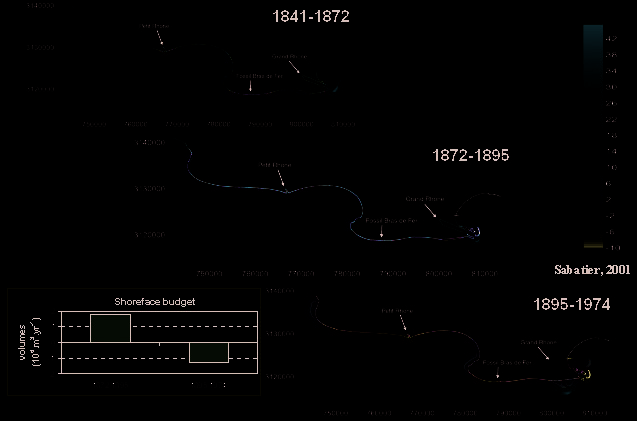
1974/88, cores and bathymetric comparison show an important
the end of the XIXth century, to 8-10 Mt yr-1 for in the second
sedimentary deposit between 0 and 20 m (1.9 Mm3 yr-1,
half of the XXth century as a consequence firstly with the
including 500 to 700 Mm3 of sands (fig. 3)). The mouth has
reduction of the frequency of the main floods (fig. 2a, b, c) and
become stabilized and then gradually deformed by longshore
the reafforestation in the catchment area, and, secondly, with the
drift over the last few decades (Sabatier, 2001).
building of dams and gravel extractions in the channel (Pont et
al., 2002; Antonelli, 2002).
fig. 2a
fig. 2b
fig. 2c
Figure 3. Sedimentary losses (1895 to 1974/88) on the upper shore-
face (0-20 m). Bathymetric comparison and shore face budget.
Coastal evolution
The river containment has led to a very weak supply of river
sediments, which has itself led to a destabilization of the coastal
zone, reinforced by the resumption of the rise in relative sea-
Figure 2. Slowing down in sedimentary input at the Rhône mouth
level (2.1 mm yr-1). Erosional process now prevail and the delta
(x106 m3 yr -1) according with reduction of the frequency of the major
coast exhibits an overall negative sedimentary budget, charac-
floods since 1841.
terized by an average retreat of 4 m yr-1 from the 1940's until
2a. Total solid load of the Rhône deposited at the mouth (bathymetric
the beginning of the 1980's (fig. 4). The predominant effect of
comparison).
the storms was demonstrated by Suanez and Bruzzi (1999)
2b. Reduction of the frequency of the main floods.
2c. Correlation between floods and sedimentary input at the mouth.
Bathymetric data in the Rhône channel permits measurement of
morphological adjustments of the river. Results compared with
those obtained upstream, or in other European rivers, suggest
that the lower Rhone River developed in response to external
stresses. The first part of the XXth century is characterised by
an average erosion rate of the riverbed of 2.8 mm yr-1, followed
by a decrease since the 1960's to <1.5 mm yr-1. The erosion rate
depends partially on local constraints, however the embank-
Figure 4. Variations of the coastline in the Rhône delta (m/year) by
ments and engineering works, started around 1860's in order
photo-interpretation: average retreat of 4 m yr-1 from the 1940's
to protect people against flood and make navigation easier,
until the beginning of the 1980's.
page 6
LOICZ NEWSLETTER
The use of digital processing techniques has been instrumental
tion industry and farmers of the Petite Camargue. The pursuit
in integrating and managing, via a Geographic Information
of scientific monitoring and analysis should enable politicians
System, the large database compiled from the analysis of
and managers to make decisions with a fuller knowledge of the
various sources. Variations of the coastline, analysed from 98
coastal processes. Figure 5 indicate the first mean global
profiles drawn perpendicular to the shore, leads to measures of
sedimentary budget of the Rhône delta during the last 50 years.
the secular evolution of surface area: the Camargue coast
records a gain of 3,875,600 m2 between 1895 and 1944, a loss
of 1,707,800 m2 between 1944 and 1987-1990, and a gain of
Acknowledgements
209,600 m2 between 1987-1990 and 1998-2000. The surface
Studies are supported by European projects (EURODELTA,
area determined over the scale of the century thus shows a net
EUROSTRATAFORM, EUROSION) and french national
gain of about 2,377,400 m2.
projects (ORME, ORE, GICC, GDR Marges).
Longshore sediment transport is the major process reshaping the
Rhône delta coastline, defining the identification of four sedi-
Bibliography
mentary cells, confirmed by simulations of longshore sediment
Antonelli C., Provansal M.,. Vella C., (2004) - Recent
transport using empirical equations (Suanez & Provansal, 1998;
morphological channel changes in a deltaïc environment. The
Sabatier, 2001). The beaches close to the Grand Rhône mouth are
case of the Rhône river, France. Geomorphology, 57, 385-402.
dependent on river sediment input but the erosion of fossil
Arnaud-Fassetta G. (2002) - Geomorphological records of a
sub-deltas plays also an important role in feeding the spits. The
flood-dominated regime in the Rhone delta (France) between the
large increase recorded between 1895 and 1944 can be explained
1st century and the 2nd century AD. What correlations with the
by an abundant supply of sediment to the coast.
catchment paleohydrology? Geodinamica Acta, 15, 79-92.
Arnaud-Fassetta G. (2003) - River channel changes in the
After 1944, agricultural decline and forest extension in the
Rhône Delta (France) since the end of the Little Ice Age:
Rhône catchment resulted in a decrease in sediment supply,
geomorphological adjustment to hydroclimatic change and
which became even more marked in the years 1950-1960 due
natural resource management. Catena, 51, 141-172.
to the construction of hydroelectric dams. But it remains
Arnaud-Fassetta G., Provansal M. (1999) - High frequency
difficult to separate the effects of hydrological changes (end
variations of water flux and sediment discharge during the Little
of the Little Ice Age) from modifications due to changing land
Ice Age (1586-1725 AD) in the Rhône delta (Mediterranean
use or hydraulic engineering works. The increase in surface
France). Relationship to the catchment basin. Hydrobiologia,
area between 1987-1990 and 1998-2000 demonstrates the
410, 241-250.
effectiveness of coastal defence structures in slowing down
Arnaud-Fassetta G., De Beaulieu J.-L., Suc J.-P., Provansal M.,
coastline retreat and the trend towards a new equilibrium of the
Williamson D., Leveau P., Aloïsi J.-C., Gadel F., Giresse P., Evin
littoral system, in a context of sedimentary starvation. There has
J., Duzer D. (2000) - Evidence for an early landuse in the Rhône
been a heated debate about their long-term effectiveness,
Delta (Mediterranean France) as recorded by late Holocene
especially in view of the forecasts of sea-level rise and the
fluvial paleoenvironments (1640-100 BC). Geodinamica Acta,
poorly known long-term evolution of the submerged shoreface
13, 377-389.
profile (Suanez & Sabatier, 1999; Provansal & Sabatier, 2000).
Bruneton H., Arnaud-Fassetta G., Provansal M., Sistach D.
(2001) -Geomorphological evidence for fluvial change during
the Roman period in the lower Rhone valley (Southern France).
Catena, 45, 287-312.
Pichard G. (1995) - Les crues sur le bas Rhône de 1500 à nos
jours, pour une histoire hydro-climatique. Méditerranée, 3-4,
105-116.
Pont D., Simonnet J.P., Walter A.V. (2002) - Medium terme
changes in suspended sediment delivery to the ocean:
consequences of catchment heterogeneity and river managment
(Rhone River, France). Estuarine, Coastal and Shelf Science,
54, 1-18.
Provansal M., 2003, Le delta du rhône, un héritage menacé,
lettre pigb-pmrc France, 15, 60-63.
Provansal M., Berger J.F., Bravard J.P., Salvador P.G., Arnaud-
Fassetta G., Bruneton H., Verot-Bourrely A. (2000) - Le régime
du Rhône dans l'Antiquité et au Haut Moyen-Age. Gallia, 56,
1-175.
Provansal, M. & Sabatier, F., (2000) Impact de la montée du
Figure 5. Mean global sedimentary budget of the Rhône delta during
niveau de la mer sur la côte du delta du Rhône, Le changement
the last 50 years.
climatique et les espaces côtiers. L'élévation du niveau de la mer:
risques et réponses, Colloque proposés par la mission i
In such a context, several stake-holders in coastal management
nterministérielle de l'effet de serre, région PACA et DATAR,
have put forward the idea of a strategic withdrawal of activities
12-13-14 octobre 2001, Arles, France, 78-81.
and settlement assets in certain sectors (Conservatoire du
Provansal M. , Vella C., Arnaud-Fassetta G., Sabatier F. et
Littoral, Parc de la Camargue, Réserve Nationale de Camargue).
Maillet G., 2003, Role of tfluvial sediment input in the mobility
This position is evidently resisted by the local residents and
of the Rhône delta coast, (France), Géomorphologie, relief,
inhabitants of Saintes-Maries-de-la-Mer and by the salt extrac-
environnement, 4, 271-282.
page 7
LOICZ NEWSLETTER
Sabatier F., 2001 Fonctionnement et dynamiques morpho-
new SPIS can rely on a broad ownership of both the natural and
sédimentaires du littoral du delta du Rhône. Thèse, Faculté des
social science community. Secondly LOICZ will participate in a
Sciences et Techniques de St Jérome, Université d'Aix-Marseille
fast-track initiative suggested by PAGES looking into the
III, 272 p.
relevance of paleo-records for future scenarios on ocean
Suanez S., Provansal M. (1998) - Large scale evolution of the
acidification. This initiative found a broad support also by
littoral of the Rhone delta (Southeast France). Journal of Coastal
IMBER and SCOR, and LOICZ can bring in its experiences
Research, 14/2, 493-501.
made in earlier investigations by Buddemeier and Kleypas which
Suanez S., Bruzzi C. (1999) - Shoreline management and its
resulted in the special issue of American Zoologist (Vol. 32)
implications for the coastal processes on the eastern part of the
published in 1999. Ocean acidification is seen as one of the major
Rhone delta. Journal of Coastal Conservation, 5, 1-12.
global change issues, the effects of which for ecosystem health
Suanez S., Sabatier F. (1999) - Eléments de réflexion pour une
and functioning, such as global reefs, is not yet fully understood
gestion plus cohérente d'un système anthropisé: exemple du
and ramifications for the human dimensions remain unclear.
littoral du delta du Rhône. Revue de Géographie de Lyon,
Thirdly, in a second joint activity, probably under the umbrella of
74/1, 7-25.
the IGOS, LOICZ will collaborate with LUCC/LAND in a multi-
Vella C. et Provansal M. (2000) - Relative sea level rise and
participants group on the issue of harmonisation of land-based
neotectonic events during the last 6500 yr on the southeastern
data for application in other GC projects. This is expected to be
Rhône delta, France. Marine Geology, 170, 27-39.
of high relevance in particular in our efforts to integrate land use
and cover change and demographic data with coastal change
information on a river catchment scale. Partner here is the LUCC
Focus 1 office, W. McCornell at Indiana University, USA.
MEETING REPORTS
START SC Meeting
National ICZM strategies conference
in Amsterdam 7-9 February 2005
with international perspectives, Berlin, Germany,
28 February-1 March 2005
On invitation LOICZ presented its future directions and key
features of the new Science Plan and Implementation Strategy
Organised by the Social Science Research Centre (WZB), Berlin
to the START SC Meeting hosted by the Royal Netherlands
on behalf of the Federal Office for Building and Regional
Academy of Sciences (KNAW) in Amsterdam. The presentation
Planning and the Ministry of Transport, Building and Housing,
generated a substantial discussion which concluded in the
this meeting was held to take stock of recent ICZM initiatives and
recognising that an enhanced collaboration between START and
look ahead to expected future developments. It took place in
LOICZ can play a leading role in building regional capacities.
response to the 2002 EU recommendations to develop and
Three issues received particular attention, (i) the Erasmus
implement national ICZM strategies and other EU-led agree-
Mundus Masters programme that promotes exchange of
ments concerning the economic potential and development of
expertise and education with third country coastal change
coasts. The meeting was convened by Bernhard Glaeser from the
scientists involved in coastal management, (ii) the role the
LOICZ SSC and a LOICZ presentation on "Research for coastal
regional LOICZ offices can play and how best to generate
system sustainability" was given. The meeting highlighted the
synergies between the regional organisation of START, e.g.,
challenges for LOICZ to connect its science to the demands of
through collaboration with SARCS and SASCOM and (iii) the
policy development and strategic spatial planning of the coastal
role LOICZ can play in promoting and supporting but also
zone in a way that balances the needs for economic development
benefiting from the activities of the regional intergovernmental
with ecological concerns and protection. However, there is
global change programmes such as the IAI and the APN. In the
clearly a role for LOICZ and its networks to play in facilitating
latter case the LOICZ role in particular in the recently completed
ICZM as a framework for responding to the many conflicting
APN regional coastal change synthesis was also highlighted in
needs of the goods and services provided by the coastal zone.
the presentation given by Martin Rice from APN. These links
will need to be further elaborated and built and LOICZ
Regional Nodes will have to play a key role here.
IPO NOTES
20th IGBP SC Beijing, China, 19-23 February 2005
LOICZ Inaugural Open Science Meeting,
Egmond aan Zee, the Netherlands, 27-29 June 2005
Following an invitation by the Chinese Academy of Science,
Coasts and Coastal People
under the chairmanship of Guy Brasseur assisted by IGBP's new
Scenarios of Change and Responses
Executive Director, Kevin Noone, the IGBP held its 20th SC
Meeting in snowy Beijing in February. The most important out-
Planning for the meeting is now advancing with over 250
comes for the new LOICZ are threefold: Firstly, the Science Plan
abstracts submitted. The quality and breadth of abstracts
and Implementation Strategy (SPIS) for LOICZ 2003-2012 has
submitted is very high, and we can be confident that we have the
now been officially approved by the IGBP and will go into print
basis for an exciting, motivating and stimulating meeting to kick-
following the also final approval that came from the IHDP SC
start the implementation of the new decade of LOICZ research.
Meeting in Bonn, Germany, on 21-23 March. This is a major step
The meeting is being well supported by the stalwarts of LOICZ,
which puts and end to a three year long process of synthesising
who will bring their experience and future vision to the meeting,
findings from the first decade and designing a new and truly
as well as a new community of LOICZ researchers with the
interdisciplinary LOICZ, a process which iteratively engaged a
expertise and experience to implement the more human
world wide community of scientists and institutions. Thus the
dimension focussed aspects of the new LOICZ.


page 8
LOICZ NEWSLETTER
We look forward to an interesting dialogue and exchange of
Between 1995-98, Bernhard was appointed Professor and
views during the sessions and workshops. The conference
Chair of Human Ecology at Göteborg University in Sweden
website (www.loicz.org/conference) is being continuously
where he developed an interest in integrated coastal zone
updated with information, and now includes a full programme
management (ICZM) and was appointed Program Director of
and details of the various sessions and workshops. In the near
the Swedish national coastal zone research program,
future it will include a list of participants and papers to be
"Sustainable Coastal Zone Management" (SUCOZOMA)
presented as confirmations and registrations flow in. You can still
from 1996 to 1998. Upon his return to Germany from Sweden
register online until April 30th.
in 1999, he set out to apply the Swedish experience to German
coastal areas, and in 2003, he began coordinating "Regional
spatial planning for the German coast: the national ICZM
strategy". This politically significant project is in the process
SSC UPDATES
of developing a conceptual framework for a German national
ICZM strategy, with particular emphasis on institutional
A warm goodbye to Jozef and James
cooperation and processes of dialogue. The German government
will submit a report on its national strategy to the European
At the beginning of the last transitional year of the new LOICZ,
Union in 2006. In 2004, Bernhard became involved in two
we would like to express our sincere thanks to Jozef Pacyna
more projects: "Coastal Futures" and "ICZM Oder" that
(SSC Member since 1999 and Vice Chair 2004) and
investigates the economic and social impacts of offshore wind
James Syvitski (SSC Member 1999-2004) who have officially
farm development on the North Sea coast of Schleswig-
finished their terms. They both provided fundamental input and
Holstein and the administrative framework required for
dedication in the SSC, been very actively involved in the
implementing ICZM in a cross-border Baltic context
synthesis of the first decade of LOICZ research and integral to
respectively. Beyond his involvement in national projects,
the design of the future of LOICZ in the form of the new
Glaeser is also part of the German-Indonesian international
Science Plan and Implementation Strategy. However, we are
collaborative research project, "Science for the Protection of
glad that they have both confirmed a wish to stay strongly
Indonesian Coastal Environments" (SPICE), where he assists
involved in the new LOICZ.
in building up a social science cluster focusing on governance,
Following his leading role in the complex ELOISE synthesis,
designed to complement natural science research on
which has generated a comprehensive digest of almost 60 EU
mangroves, lagoon sedimentation, and the consequences of
funded research projects opening results and outcomes to the
sea level rise. Bernhard has been in contact with LOICZ since
wider scientific and user community, Jozef will keep building
the late 1990s and contributed to the 2002 LOICZ Synthesis
LOICZ links into the New Independent States in Eastern Europe
and Futures meeting in Miami, Florida (USA). As an SSC
and has been actively promoting the recent formation of the
member, he hopes to be able to help integrate social and
Polish National LOICZ Committee. He also remains a key link
natural science subject matter and issues, and to link these to
to the European Commission focusing in particular on the role of
coastal policy and management.
coastal research in the 7th Framework Programme.
James Syvitski will stay connected to LOICZ as a leading
member of the recently launched LOICZ/SCOR/IAPSO
Laurence Mee
working group No 122 on sediment dynamics in estuaries and
Laurence is Professor of Marine
will continue his work on global change of sediment fluxes and
and Coastal Policy and serves
sea level issues. Both will be offered an Ex Officio membership
as Associate Head of the
in the new SSC.
School of Earth, Ocean and
Environmental Sciences of the
Three new SSC members Bernhard Glaeser, Laurence
University of Plymouth. He was
Mee and Stephen Olsen.
originally trained as a Chemical
LOICZ is fortunate to have 3 leading scientists at the cutting
Oceanographer, earning his
edge of the science-policy interface join the SSC, and who we
PhD from the University of
look forward to working with to realise the potential of the
Liverpool in 1977 following
recently approved Science Plan and Implementation Strategy.
extensive fieldwork in the
They are:
lagoons of Mexico's Pacific
coast where he studied nutrient
Bernhard Glaeser
flux and primary production. He was also involved in studies
Bernhard is a senior researcher
of upwelling in the Canaries Current and from 1977 to 1987
at the Social Science Research
was a senior researcher and lecturer at the National Autonomous
Center Berlin (WZB) in
University of Mexico. During this time he played a lead role
Germany and Professor of
in planning and managing the University's offshore research
Social Science in the Depart-
fleet including two 1000 ton purpose-built vessels, also
ment of Political and Social
participating and leading expeditions on marine fertility in the
Sciences at the Free University
tropical Pacific. From 1987 to 1993, Laurence worked at Head
of Berlin in Germany. His
of the UN funded Marine Environmental Studies Laboratory,
interests are in environment,
the non-nuclear section of the IAEA Marine Environmental
development, and sustainability
Laboratory in Monaco where he built a strong team
research and has worked on
conducting research on marine pollution worldwide. His
research projects in East Africa,
activities also included work on the development of the marine
India and China.
strategy (Ch. 17) within `Agenda 21', the substantive policy
page 9
LOICZ NEWSLETTER
document agreed at the 1992 Rio Summit. During this time,
Publish your science with LOICZ!
he became increasingly interested in the Black Sea and
facilitated negotiations the first ministerial agreement on its
You want to reach out to the global LOICZ community of
protection (the Odessa Declaration), signed in 1993. He
natural and social scientists and institutions? Than LOICZ
helped to establish the Black Sea Environmental Programme
strongly encourages publication of your science highlight
and raise the initial US$11 millions from the Global
in the LOICZ Newsletter and/or on the LOICZ website!
Environment Facility and EU for its implementation. He was
If you want to submit your scientific article or an extended
appointed to manage the programme in the same year and
executive summary for publication in the LOICZ media
continued in the role until 1998 when he decided to return to
please send it to loicz@nioz.nl indicating where you would
academia. In 1998 Laurence was awarded a Pew Fellowship
like it to go. The science highlight should report recent new
in Marine Conservation for his work on research and
research and be relevant to global LOICZ science as
environmental education in the Black Sea region and he
described in the new Science Plan and Implementation
joined the staff of Plymouth University where he now leads
Strategy. It will be subject to an internal review procedure.
the interdisciplinary Marine and Coastal Policy Research
Your contribution should have a maximum of three printed
Group. He continues to act as an advisor to the GEF and is
pages including figures, tables and references.
Chairman of the UK based Advisory Committee for the
Protection of the Sea. Apart from continued work on the Black
If you would like to submit notification of an up-coming
Sea, he brings to the SSC his focus on socio-ecological
meeting/workshop for inclusion in the LOICZ newsletter
systems including on the theory and practice of the ecosystem
and/or on our website please also contact the LOICZ IPO.
approach and adaptive management. He leads the 27 institute
pan-European FP6 project `European Lifestyles and Marine
PUBLICATIONS
Ecosystems', a project that is examining future scenarios for
Europe's seas through a systems approach bridging natural
and social sciences.
Keep an eye on the LOICZ website for news on new LOICZ
R&S reports that will soon be available as hard copy and
electronic download.
Stephen Olsen
Stephen has been the Director
Nutrient fluxes in transitional zones of the Italian coast. Eds.
of the Coastal Resources Center
Giordani, G., P. Viaroli, D.P. Swaney, C.N. Murray, J.M. Zaldivar
(CRC) of the Graduate School
and J.I. Marshall Crossland. 2005, LOICZ Reports & Studies
of Oceanography at the Univer-
No. 28, ii + 157 pages, LOICZ IPO, Texel, The Netherlands.
sity of Rhode Island for nearly
three decades. In that position
"Coastal Biogeochemistry" Eds. H. Thomas and A. Borges,
he has worked with inter-
Biogeosciences, Special issue, http://www.cosis.net/members/
disciplinary teams to formulate,
journals/df/special_issues.php?j_id=9
monitor and evaluate coastal
governance initiatives at a
Special issue: New Guinea and its coastal seas, a testable model
wide range of spatial scales.
of wet tropical; coastal processes: an introduction to the Project
Since 1985 the majority of
TROPICS. Edited by: Gregg J. Brunskill. 2004, Continental
CRC's activities have been in
Shelf Research, Volume 24, Issue 19.
developing nations in Latin America, Southeast Asia and East
Africa. All the work of CRC strives to incorporate the best
Coming out soon:
available science into a participatory governance process in
LOICZ R & S No. 29- Russia Basins
which issues of equity and transparent dealing play a
The LOICZ Science Plan and Implementation Strategy
dominant role. He served as the co-chair of the GESAMP
2003-2012
working group that produced the report "The Contributions of
the Sciences to Integrated Coastal Management" in 1996. His
interest in assessing how to measure progress in ICM and to
HAVE YOU SEEN
analyze the outcomes of governance processes has led to a
number of recent publications on this topic and to working
with both scientists and resource managers to better design the
10-15 April 2005, Rio de Janeiro, Brazil:
next generation of coastal initiatives. For example, one
Summer School on Environmental Modeling of Amazonia
on-going effort brings together practitioners from across Latin
www.cptec.inpe.br/summerschool
America to develop coastal governance baselines for mature
initiatives and then to engage in a collaborative learning and
2-11 November 2005, Helgoland, Germany: 4th GKSS
action process that will be sustained over at least the next three
School of Environmental Research; Environmental Crisis:
years. Stephen was invited to deliver a keynote at the final
Science and Policy; H. von Storch, GKSS Research Centre and
LOICZ conference that marked the close of its first ten
Richard Tol, University Hamburg, co-sponsored by LOICZ.
years and came away feeling that he could make a useful
http://w3k.gkss.de/events/4thschool/
contribution as someone with long experience in bridging the
natural and social sciences to promote effective coastal
Call for Ideas for the Next Earth Explorer Core Missions:
stewardship.
As part of its Earth Observation Envelope Programme, the
European Space Agency (ESA) announces an opportunity for
scientists from the Earth Observation communities in ESA
page 10
LOICZ NEWSLETTER
Member States and Canada, to make proposals for ideas to be
19-21 September 2005, La Coruña, Spain:
assessed as potential Earth Explorer Core Missions. These
Third International conference on Fluid Structure Interaction.
missions are intended to be used to conduct research in the field
www.wessex.ac.uk/conferences/2005/fsi2005/3.html
of Earth Observation and/or to demonstrate the potential of new
innovation Earth Observation techniques of relevance to both
4-9 October 2005, Klaipëda, Lithuania: 2nd European Lagoon
the scientific and the application communities.
Conference: European lagoons and watersheds: function and bio-
http://explorercall.esa.int
diversity. http://artiom.home.mindspring.com/gumilev/ch4.htm
9-13 October 2005, Bonn, Germany: Open Meeting of the
MEETINGS & WORKSHOPS
Human Dimensions of Global Environmental Change Research
Community, "Global Environmental Change, Globalization and
For a complete list of future meetings and regular updates visit
International Security: New Challenges for the 21st Century".
our web-site at www.loicz.org
http://openmeeting.homelinux.org
4-8 April 2005, Esbjerg, Denmark: Wadden Sea Symposium
21-16 January 2006, Boulder, Colorado, USA: 1st iLEAPS
"Monitoring and Assessment - Foundations and Perspectives".
(Integrated Land Ecosystem Atmosphere Processes Study)
www.wassensea-secretariat.org/news/symposia/Esbjerg2005/
Science Conference. www.atm.helsinki.fi/ILEAPS/boulder
Esbjerg-2005.html
23-27 January 2006, Paris, France: 3dr Global conference on
9-13 May 2005, Hong Kong SAR, China: International
Oceans, Coasts and Islands
workshop on Sub-aerially exposed continental shelves since the
Middle Pleistocene climatic transition.
21-24 May 2006, Baton Rouge, Louisiana, USA: International
Contact Dr Wyss Yim, wwsyim@hku.hk
conference on challenges in coastal hydrology and water
quality. www.aihydro.org/conference2006/
23-27 May 2005, New Orleans, USA: Special symposium
within the AGU-ASKLO Joint Assembly-ED04: Geoscience
Education and Outreach in the Americas: Opportunities for
For address or subscription changes please contact
North-South collaboration.
the LOICZ IPO by regular or e-mail
Convenors: Gerardo M.E. Perillo (perillo@criba.edu.ar)
(loicz@nioz.nl)
and Ivani Pereira (ipereira@pop900.gsfc.nasa.gov)
indicating you wish to receive the newsletter:
23 May - 3 June 2005, Gallipoli, Italy: NATO Advanced Study
A. by an e-mail alert when it is posted on the LOICZ
Institute (ASI): Advanced course on Seasonal to Interannual
website
Climate Variability - its Prediction and Impact on Society.
B. by receiving an e-mail with the newsletter as PDF file
http://www.ecmwf.int/staff/alberto_troccoli/nato_asi/index.html
attached
C. by hard copy
6-9 June 2005, Brest, France: 4th EuroGOOSm - European
D. Unsubscribe
Operational Oceanography: Present and Future.
www.eurogoos2005.org
19-24 June 2005, Santiago de Compostela, Spain: A
IPO STAFF
Pilgrimage through Global Aquatic Sciences. SS04: Nutrient
Transformation along the land-ocean continuum in the in the
Hartwig Kremer
context of Global Change http://aslo.org/meetings/santiago2005/
Executive Officer
Martin Le Tissier
6 July 2005, London, UK: Offshore development new
Deputy Executive Officer
frontiers of opportunity: A CoastNET conference delivered in
association with CIRIA. www.coastnet.org.uk and www.ciria.org
Hester Whyte
Office Manager
10-12 August 2005, Beijing, China: 2nd PAGES Open Science
· · ·
Meeting Paleoclimate, Environmental Sustainability and Our
Future. Deadline for abstract submission: 31 March.
LOICZ International Project Office
www.pages.org
Royal Netherlands Institute for Sea Research
23-27 August 2005, Amsterdam, The Netherlands:
PO Box 59
45th congress of European Regional Science Association
1790 AB Den Burg - Texel
(ERSA) 2005. Special session on: Modelling land use change.
The Netherlands
www.feweb.vu.nl/ersa2005
Phone: +31-222 369404
6 - 8 September 2005, Bologna, Italy: Third International
Fax: +31-222 369430
Conference on River Basin Management including all aspects
E-mail: loicz@nioz.nl
of Hydrology, Ecology, Environmental Management, Flood
Plains and Wetlands. Paper deadline: 6 May.
www.loicz.org
http://www.wessex.ac.uk/conferences/2005/rm2005/4.html